NVIDIA, Tesla, SpaceX, Microsoft, Amazon and Alphabet are among more than 60 prominent US stocks that could soon be available for 24/7 tokenized trading.
OKXICE, the joint venture between crypto exchange OKX and the Intercontinental Exchange (ICE), filed with the US Securities and Exchange Commission (SEC) on Sunday, notifying the regulator of plans to launch a marketplace for investors to buy tokenized stocks.
Former New York Governor Andrew Cuomo, OKXICE’s co-chair, says the firms plan to launch the trading venue under the SEC’s new “innovation exemption.”
“This is a landmark step toward a truly global, 24/7 Wall Street — and toward keeping the future of digital finance anchored here in the United States.
The digital asset revolution is already transforming our financial system. Tokenized securities are part of what comes next.”
Cuomo has advised OKX on policy matters since 2022, including during the exchange’s $504 million settlement with the Department of Justice (DOJ) over anti-money-laundering violations.
ICE, the parent company of the New York Stock Exchange (NYSE), has made a broad push into crypto infrastructure, including investments in OKX and the prediction market Polymarket, as well as its participation in stablecoin platform Circle’s $222 million Arc presale alongside BlackRock and Apollo.
Follow us on X, Facebook and Telegram Don't Miss a Beat – Subscribe to get email alerts delivered directly to your inbox
 
Disclaimer: Opinions expressed at The Daily Hodl are not investment advice. Investors should do their due diligence before making any high-risk investments in Bitcoin, cryptocurrency or digital assets. Please be advised that your transfers and trades are at your own risk, and any losses you may incur are your responsibility. The Daily Hodl does not recommend the buying or selling of any assets including cryptocurrencies, nor is The Daily Hodl an investment advisor. Please note that The Daily Hodl participates in affiliate marketing.
Amphenol(NYSE: APH) makes connectors, cables, and sensors. Nobody has ever put a cable assembly on a magazine cover. I mean, aside from very niche industry mags. Yet, on Oct. 1, the stock sits 3.2% below a recent all-time high, and the AI boom is a big reason.
A run like that raises the obvious question about whether the easy money is gone. The business results suggest it isn't, at least not yet.
Missed AI’s "Act 1"? Act 2 Could Be 15x Bigger. Most investors think they missed the AI boat because they didn't buy Nvidia in 2005. But according to our analysts, we’re only at the end of "Act 1"—the R&D phase. "Act 2" is the global rollout. Continue »
Image source: Getty Images.
Plumbing for the AI boom
The company holds the least glamorous seat at the AI party: the one that connects the processors. CEO Adam Norwitt calls interconnect the central nervous system of AI, and the logic is hard to dispute. A server rack that sells for $3 million is worth very little if the connectors never arrive. Amphenol's IT datacom business is roughly four times its size two years ago.
Start with the second quarter. Sales of $8.8 billion rose 55% year over year. Organic growth was 30%. Adjusted earnings per share of $1.35 jumped 67%. Orders reached $10.7 billion, a book-to-bill ratio of 1.23, meaning customers ordered 23% more than Amphenol shipped. That gap is the closest thing to a forward indicator in the report, and it points up.
Loud numbers, quiet CEO
Norwitt avoids the spotlight. At a recent Citi conference, he told the crowd that he doesn't do interviews and that the company announces none of its customer commitments, including long-term non-cancelable orders.
But he doesn't have to say much.
Quarterly orders of $10.7 billion against sales of $8.8 billion say plenty without an adrenaline-packed press release. That makes a nice change in an AI sector that often seems to run on video clips, social media posts, and headlines.
Slow and steady beats the hotshots
Here's the part that should interest anyone worried about being late. Amphenol is up 27.9% this year. Respectable, but well behind the company's closest rivals. Corning(NYSE: GLW) gained 81.1%, Flex(NASDAQ: FLEX) stock rose 85.9%, and Littelfuse(NASDAQ: LFUS) posted a 71.7% year-to-date run.
And the recent trends have been in Amphenol's favor. Over the past quarter, Amphenol gained 4.9% while Flex fell 18% and Corning dropped 19.4%. Tech giants are still planning and building massive AI data centers, but there's public pushback ahead of the midterm elections. The AI-adjacent crowd has been running harder and wobbling more, while Amphenol is holding steady.
Cheaper than the neighbors
The profits aren't thin, either. Operating margin is 28.1%, the highest in the peer group. The CommScope purchase, at $10.5 billion, is now expected to deliver $4.6 billion in sales this year, up from an earlier forecast of $4.1 billion.
At 26.4 times forward earnings, the stock trades at a lower multiple than Corning (36.6) and Cognex (30.6). The PEG ratio of 0.9 suggests the market isn't fully valuing growth. The dividend yield of 0.6% is a rounding error, and short interest is only 1.3% of the float. Few investors are betting against Amphenol's rising stock.
So, is it too late?
None of this makes Amphenol's stock a bargain, and 311.6% over three years has a way of making a new buyer feel tardy. Moreover, investors are currently paying an AI multiple for a mostly old-school product catalog. Still, the third-quarter guide calls for sales growth of 50% to 52%.
Is it too late? For the first quadrupling in three years, sure. The next leg is a separate question, and the bulging order book is making a decent bull case.
Should you buy stock in Amphenol right now?
Before you buy stock in Amphenol, consider this:
The Motley Fool Stock Advisor analyst team just identified what they believe are the 10 best stocks for investors to buy now… and Amphenol wasn’t one of them. The 10 stocks that made the cut could produce monster returns in the coming years.
Consider when Netflix made this list on December 17, 2004... if you invested $1,000 at the time of our recommendation, you’d have $375,240!* Or when Nvidia made this list on April 15, 2005... if you invested $1,000 at the time of our recommendation, you’d have $1,403,292!*
Now, it’s worth noting Stock Advisor’s total average return is 932% — a market-crushing outperformance compared to 211% for the S&P 500. Don't miss the latest top 10 list, available with Stock Advisor, and join an investing community built by individual investors for individual investors.
Anders Bylund has no position in any of the stocks mentioned. The Motley Fool has positions in and recommends Amphenol, Cognex, and Corning. The Motley Fool recommends Flex. The Motley Fool has a disclosure policy.
Axsome Therapeutics is delivering explosive revenue growth as it scales its commercial portfolio for central nervous system disorders.
Vertex Pharmaceuticals remains a highly profitable giant with absolute dominance in cystic fibrosis and expanding reach in gene therapy.
Both companies are building compelling drug portfolios in different disease areas. Which stage of the biotech journey fits your investing style better?
Choosing between Axsome Therapeutics(NASDAQ:AXSM) and Vertex Pharmaceuticals(NASDAQ:VRTX) means weighing aggressive revenue growth against established, highly profitable dominance in the global biotechnology market. Which is the better buy today?
Axsome focuses on central nervous system disorders with a rapidly expanding commercial portfolio, while Vertex is a cash flow powerhouse led by its cystic fibrosis treatments. Both companies represent different risk and reward profiles in the healthcare market, making them favorites for various types of investors.
The case for Axsome Therapeutics
Axsome Therapeutics focuses on developing and commercializing therapies for central nervous system conditions, including depression, migraine, and narcolepsy. As a growing player among biotech stocks, the company generates revenue from its approved products, Auvelity and Sunosi. It has recently resolved patent litigation for Sunosi through settlement agreements that establish a framework for generic entry starting in 2040, providing long-term clarity for that specific product line.
In FY 2025, revenue reached nearly $638.5 million, representing a significant growth of roughly 65.5% compared to the previous year. Despite this rapid expansion in sales, the company reported a net loss of approximately $183.2 million for the period. This net margin, which measures the percentage of revenue remaining as profit after all expenses, was a negative 28.7%, which was an improvement from deeper losses in prior years.
As of its December 2025 balance sheet, the debt-to-equity ratio is roughly 2.7x, meaning total debt is nearly three times the value of shareholder equity. The current ratio, which measures a company's ability to cover its short-term obligations with short-term assets, is approximately 1.4x. During FY 2025, free cash flow was negative $93.9 million, which is the cash remaining after the business paid for its operations and capital investments.
The case for Vertex Pharmaceuticals
Vertex Pharmaceuticals is a biotechnology leader known for its portfolio of medicines treating cystic fibrosis, such as Trikafta and Kalydeco. The company also markets therapies for sickle cell disease and has recently introduced Journavx for acute pain management. By maintaining extensive networks of authorized treatment centers and broad payer coverage, the business ensures its specialized therapies reach patients across global markets.
In FY 2025, revenue reached approximately $12.1 billion, which reflects a year over year growth of nearly 9.6%. The company is highly profitable, reporting net income of close to $4.0 billion for the fiscal year. This resulted in a net margin of approximately 32.7%, showing that Vertex retains nearly a third of its revenue as profit after accounting for all of its costs.
As of its December 2025 balance sheet, the debt-to-equity ratio is close to 0.2x, indicating that total debt is quite low relative to shareholder equity. Its current ratio is approximately 2.9x, suggesting a strong ability to meet short-term financial commitments with its existing assets. The company generated roughly $3.2 billion in free cash flow during FY 2025, which represents the cash left over after paying for operations and capital equipment.
Risk profile comparison
Axsome faces several operational and financial risks, including a history of net losses and a recurring need for additional funding to sustain its clinical trials. The company also deals with competition from generic versions of its products, such as recent regulatory filings for generic Auvelity and Symbravo. Regulatory hurdles remain a challenge, illustrated by a previous Refuse to File letter for its candidate AXS-14, alongside a heavy dependence on third-party manufacturers for supply.
Vertex contends with significant revenue concentration since most of its sales come from cystic fibrosis treatments, making it vulnerable to any manufacturing or safety disruptions in that area. Product development is complex and carries risks of failure, such as the setback for its VX-264 program. Furthermore, the company faces pricing pressures from government regulators and must successfully integrate acquisitions like Crinetics Pharmaceuticals and Alpine Immune Sciences while competing with CRISPR Therapeutics(NASDAQ:CRSP).
Valuation comparison
Vertex appears more conservatively valued based on its Forward P/E relative to future earnings estimates, while Axsome commands a higher P/S ratio measuring price against sales.
Metric
Axsome Therapeutics
Vertex Pharmaceuticals
Forward P/E
44.6x
27.2x
P/S ratio
16.7x
10.7x
Valuation metrics sourced from Financial Modeling Prep (FMP) and may differ from other data providers.
Which stock would I buy in 2026?
I'd go with Vertex Pharmaceuticals. It has built one of the most profitable and diversified drug portfolios in biotech, and the pipeline keeps expanding into new disease areas that could sustain that growth for years. Its cystic fibrosis franchise now treats the vast majority of patients living with the disease, and a new pain drug is gaining commercial traction alongside it. A recently completed acquisition adds a kidney disease drug awaiting an imminent FDA approval decision. The balance sheet is flush with cash, and management just raised its full-year outlook.
Axsome has quickly built a very strong commercial drug portfolio, with a new FDA approval for a condition affecting many Alzheimer's patients adding a promising new indication. For investors who want earlier-stage biotech exposure with commercial products already on the market, it is a good candidate.
The challenge for Axsome right now is that building a commercial drug business is expensive, and the costs are rising faster than the revenue. Missing estimates in the most recent quarter is a reminder that the path to profitability leaves little room for stumbles. Vertex faces no such uncertainty. It has already done the hard work of building a profitable, diversified business, and it keeps adding to it. That's why it's my pick.
Should you buy stock in Axsome Therapeutics right now?
Before you buy stock in Axsome Therapeutics, consider this:
The Motley Fool Stock Advisor analyst team just identified what they believe are the 10 best stocks for investors to buy now… and Axsome Therapeutics wasn’t one of them. The 10 stocks that made the cut could produce monster returns in the coming years.
Consider when Netflix made this list on December 17, 2004... if you invested $1,000 at the time of our recommendation, you’d have $375,240!* Or when Nvidia made this list on April 15, 2005... if you invested $1,000 at the time of our recommendation, you’d have $1,403,292!*
Now, it’s worth noting Stock Advisor’s total average return is 932% — a market-crushing outperformance compared to 211% for the S&P 500. Don't miss the latest top 10 list, available with Stock Advisor, and join an investing community built by individual investors for individual investors.
Sara Appino has no position in any of the stocks mentioned. The Motley Fool has positions in and recommends Axsome Therapeutics and Vertex Pharmaceuticals. The Motley Fool recommends CRISPR Therapeutics. The Motley Fool has a disclosure policy.
Firefly Aerospace(NASDAQ: FLY) is doing a lot more than launching rockets. The company is actually building an entire space transportation business around four major platforms: its Alpha rocket, Blue Ghost lunar lander, Elytra orbital vehicle, and the larger Eclipse rocket being developed with Northrop Grumman. And the numbers indicate Firefly is no slouch.
Q2 revenue reached a record $117.7 million, up 659% year over year, and management expects between $420 million and $450 million in revenue for 2026. Firefly also picked up more than half a dozen contracts during the quarter.
Missed AI’s "Act 1"? Act 2 Could Be 15x Bigger. Most investors think they missed the AI boat because they didn't buy Nvidia in 2005. But according to our analysts, we’re only at the end of "Act 1"—the R&D phase. "Act 2" is the global rollout. Continue »
To the moon!
Image source: Getty Images.
Firefly became the first commercial space company to successfully land on the moon, and it now has six contracted lunar missions. A recent $144 million NASA contract added another Blue Ghost mission, while a separate $75 million subcontract will use Firefly's Elytra spacecraft to deliver four drones to the moon's south pole.
The company is also expanding production capacity. Its new Texas cleanroom is designed to increase production of Blue Ghost and Elytra spacecraft, and it's developing a larger lunar lander capable of carrying heavier cargo, vehicles, infrastructure, and power systems to the moon.
Then there's defense. Firefly subsidiary SciTec recently won a $94 million Space Force contract, while Elytra is being developed for missions including satellite delivery, surveillance, communications, and even the removal of old satellites from orbit.
Of course, Firefly isn't a risk-free investment. The company lost $92.3 million in Q2, and developing rockets and spacecraft requires enormous amounts of capital. But Firefly doesn't need to be as big as Space Exploration Technologies or RocketLab to build a valuable business. It just needs to capture a piece of the growing market for launches, lunar missions, orbital services, and national-security space infrastructure.
With revenue accelerating and several major platforms moving deeper into production, Firefly is becoming much more than another speculative rocket company.
Should you buy stock in Firefly Aerospace right now?
Before you buy stock in Firefly Aerospace, consider this:
The Motley Fool Stock Advisor analyst team just identified what they believe are the 10 best stocks for investors to buy now… and Firefly Aerospace wasn’t one of them. The 10 stocks that made the cut could produce monster returns in the coming years.
Consider when Netflix made this list on December 17, 2004... if you invested $1,000 at the time of our recommendation, you’d have $375,240!* Or when Nvidia made this list on April 15, 2005... if you invested $1,000 at the time of our recommendation, you’d have $1,403,292!*
Now, it’s worth noting Stock Advisor’s total average return is 933% — a market-crushing outperformance compared to 211% for the S&P 500. Don't miss the latest top 10 list, available with Stock Advisor, and join an investing community built by individual investors for individual investors.
Jeff Siegel has no position in any of the stocks mentioned. The Motley Fool has positions in and recommends Firefly Aerospace and Rocket Lab. The Motley Fool has a disclosure policy.
Whether it's biotech stocks or regular pharmaceutical stocks, when investors buy a particular name in healthcare, they are making a wager on a single company's pipeline. However, there is one unique name within this space that enables investors to gain more diversified exposure to current and potential future blockbuster drugs: Royalty Pharma(NASDAQ: RPRX).
Operating like both a biopharma company and a venture capital firm, Royalty provides capital to both for-profit drugmakers and nonprofit researchers, such as universities, in exchange for percentage ownership in their developed or underdeveloped drug candidates.
Missed Nvidia in 2009? This Rare Signal Is Flashing Again.In 2009, a "Double Down" signal flashed for a little-known chipmaker called Nvidia. For the first time in years, that same "Total Conviction" signal is flashing for a company 1/100th the size of Nvidia. Continue »
With the stock trading at a relatively low valuation, despite owning royalty interests in 16 blockbuster drugs, not to mention a slew of promising drug candidates, much suggests this is a gem among healthcare stocks that's still getting discovered by the market.
Image source: Getty Images.
Three reasons why Royalty Pharma is a drug stock standout
I know what you are thinking: Why buy Royalty Pharma when investors can simply buy multiple drug stocks?
For one, while you could go ahead and attempt to build a diversified portfolio of drug candidate stocks, why not let Royalty Pharma's management team do the heavy lifting for you? Operating with a lean overhead that accounts for only 5.5%-6.5% of portfolio receipts, Royalty Pharma offers a team of experienced pharmaceutical executives and capital allocators dedicated to investing in royalty deals that generate solid returns on invested capital.
This brings us to Royalty Pharma's second key strength: the advantageous way that it structures its royalty deals. A prime example of this is one of the company's latest unsuccessful investments. In September, Novartis and its biotech partner Ionis Pharmaceuticals unveiled disappointing clinical trial data for its experimental heart drug pelacarsen.
Royalty Pharma, through a prior funding agreement with Ionis, held a royalty interest in pelacarsen, but just because this candidate failed doesn't mean Royalty is out of its investment. As disclosed in a Sept. 4 press release, the funding deal coupled exposure to pelacarsen with ownership in "stable and predictable" royalties from another drug, Spinraza. In short, while pelacarsen's failure limits upside potential, the company still expects to generate a positive return from this investment.
Third, thanks to the favorable way Royalty Pharma structures deals and manages risk, it has built a long track record of double-digit annualized returns on invested capital. As noted in its latest quarterly earnings release, Royalty Pharma's average return on invested capital and equity was 14.9% and 21.5%, respectively, between 2019 and 2025. For Q2 2026, these figures stood at 14.2% and 20.1%, respectively. During the quarter, management also reported 14% growth in royalty receipts.
An overlooked gem still entering prime time
Since the start of the year, Royalty Pharma shares have surged over 50%. Price discovery is clearly taking shape as investors catch on to this company's unique strengths and impressive track record.
However, don't assume price discovery has completed just yet. Based on analyst estimates calling for adjusted earnings per share (EPS) of $5.34 during 2026 and $5.73 during 2027, Royalty Pharma seems like it's at the lower end of the valuation range among biopharma stocks. Yes, critics can counter this by pointing out that these strong adjusted earnings are relatively recent. For 2023, 2024, and 2025, Royalty Pharma reported EPS of $2.54, $1.93, and $1.80 per share, respectively.
However, with the company now scaled up and generating steady royalties and portfolio receipts from its blockbuster drugs, shares could be in for some serious multiple expansion if it meets or beats the aforementioned analyst forecasts. Established, profitable biotechs such as Amgen and RegeneronPharmaceuticals trade at price-to-earnings (P/E) multiples in the high teens and low 20s.
Sure, contrary to this bull case, there are numerous long-term risks with Royalty Pharma. The company regularly issues new shares to finance expansion. In time, this dilution could weigh on long-term returns. Growing competition in the pharma royalty investment space could affect future returns.
Nevertheless, until Royalty Pharma's fiscal results and guidance more strongly reflect these risks, err on the side of optimism and consider this a long-term buy for investors seeking exposure to pharmaceutical stocks.
Should you buy stock in Royalty Pharma Plc right now?
Before you buy stock in Royalty Pharma Plc, consider this:
The Motley Fool Stock Advisor analyst team just identified what they believe are the 10 best stocks for investors to buy now… and Royalty Pharma Plc wasn’t one of them. The 10 stocks that made the cut could produce monster returns in the coming years.
Consider when Netflix made this list on December 17, 2004... if you invested $1,000 at the time of our recommendation, you’d have $375,240!* Or when Nvidia made this list on April 15, 2005... if you invested $1,000 at the time of our recommendation, you’d have $1,403,292!*
Now, it’s worth noting Stock Advisor’s total average return is 933% — a market-crushing outperformance compared to 211% for the S&P 500. Don't miss the latest top 10 list, available with Stock Advisor, and join an investing community built by individual investors for individual investors.
Thomas Niel has no position in any of the stocks mentioned. The Motley Fool has positions in and recommends Amgen, Ionis Pharmaceuticals, and Regeneron Pharmaceuticals. The Motley Fool has a disclosure policy.
When Space Exploration Technologies(NASDAQ: SPCX) debuted this past June, it drew significant investor attention. While the stock traded like a roller coaster in the early days, it has settled into a fairly narrow trading range over the past month. This makes now a great time to evaluate what the future could hold for this visionary company. At its current price of around $151, a $10,000 initial investment would buy you around 66 shares.
Over the next several years, SpaceX's growth will likely be driven by its AI computing leasing business and its satellite internet business, Starlink. SpaceX has been investing aggressively in building out its AI infrastructure, and it's basically created its own neocloud unit that rents out its excess compute power. As a bridge provider of compute power in a world with an insatiable appetite for it, SpaceX has been getting incredible short-term rates.
Missed Nvidia in 2009? This Rare Signal Is Flashing Again.In 2009, a "Double Down" signal flashed for a little-known chipmaker called Nvidia. For the first time in years, that same "Total Conviction" signal is flashing for a company 1/100th the size of Nvidia. Continue »
This is leading to strong returns for the business, with SpaceX saying it is getting a payback on its AI infrastructure investments in about a year. It recently signed a $1.1 billion per month compute deal, and said that it could potentially double the number of graphics processing units (GPUs) installed in its Colossus 2 supercomputer by year's end. Analysts see big upsides from these investments: Evercore projects that this investment could push SpaceX's AI solutions and infrastructure revenue to $83 billion in 2027, versus the $47 billion consensus. TD Cowen, meanwhile, projected that SpaceX will lease out up to 49% of its AI computing capacity through 2031.
Starlink also remains a growth driver. This is a great recurring revenue business, and it's growing quickly. Last quarter, the segment's revenue surged 66% year over year to $4.3 billion, while its number of subscribers doubled to 12 million. It continues to have a large opportunity, including in the consumer, enterprise (airlines and mobile partnerships), and government sectors.
Beyond these two businesses, the picture gets both murkier and more exciting. The company just completed the 14th test flight of its Starship rocket, which could be the gateway for it to generate significant other revenue streams, including from data center satellites in Earth orbit. It's also working with Nvidia on AI infrastructure that can withstand the rigors of space. The optionality of these potential ventures should keep the stock's valuation multiples high.
Image source: The Motley Fool.
What a $10,000 investment could be worth in 2035
By 2035, analysts anticipate that SpaceX will produce nearly $2.25 trillion in annual revenue and be highly profitable, generating adjusted earnings per share (EPS) of $41.24. Now, the further out you go, the more variables there are, and that is reflected in analysts' revenue estimates, which range from $1 trillion to slightly over $3 trillion.
When it comes to the question of how the market might be valuing SpaceX at that point, we can look to Musk's other public company, Tesla, for hints. In the first half of 2020, it traded at price-to-sales (P/S) ratios in the 3 to 8 range. Using the low and high ends of analyst revenue forecasts and Tesla's historical multiple range would value SpaceX at a market cap between $3 trillion and $24 trillion. Based on the $2.25 trillion consensus, meanwhile, it would be valued between $6.75 trillion and $18 trillion.
Given that SpaceX's future revenues will be highly dependent on it making considerable capital expenditures up front, we should assume there will be share dilution along the way. Let's assume the company's diluted share count will increase 1% a year (between capex and share compensation) to around 14.4 billion. That would value its stock at between $210 and $1,670 using the low and high ends of analyst estimates and Tesla's multiple. Using just the consensus revenue estimate, the stock would trade between $470 and $1,250.
That's a wide range, so if we want to just take the consensus and use a reasonable P/S multiple of 5, the stock would trade at around $780. That's over a fivefold increase from current prices, turning a $10,000 investment into around $51,500.
Now, SpaceX is going to have to execute, and there are a wide variety of outcomes, but it looks like this AI stock has plenty of long-term upside from here.
Should you buy stock in Space Exploration Technologies right now?
Before you buy stock in Space Exploration Technologies, consider this:
The Motley Fool Stock Advisor analyst team just identified what they believe are the 10 best stocks for investors to buy now… and Space Exploration Technologies wasn’t one of them. The 10 stocks that made the cut could produce monster returns in the coming years.
Consider when Netflix made this list on December 17, 2004... if you invested $1,000 at the time of our recommendation, you’d have $375,240!* Or when Nvidia made this list on April 15, 2005... if you invested $1,000 at the time of our recommendation, you’d have $1,403,292!*
Now, it’s worth noting Stock Advisor’s total average return is 933% — a market-crushing outperformance compared to 211% for the S&P 500. Don't miss the latest top 10 list, available with Stock Advisor, and join an investing community built by individual investors for individual investors.
Geoffrey Seiler has no position in any of the stocks mentioned. The Motley Fool has positions in and recommends Evercore and Tesla. The Motley Fool has a disclosure policy.
It's no secret that spending on AI data centers is booming, and projections for hyperscaler spending suggest the boom will continue. This will create opportunities for ongoing marginal growth for companies that provide the raw materials used in construction, such as copper miner Freeport-McMoRan(NYSE: FCX), construction materials company Vulcan Materials(NYSE: VMC), and data center infrastructure company Vertiv(NYSE: VRT).
Copper and Freeport-McMoRan
The chart below shows the scale of the spending increase, and although not all of it is allocated to physical data centers, it indicates a considerable marginal increase in end demand for these three companies.
Missed Nvidia in 2009? This Rare Signal Is Flashing Again.In 2009, a "Double Down" signal flashed for a little-known chipmaker called Nvidia. For the first time in years, that same "Total Conviction" signal is flashing for a company 1/100th the size of Nvidia. Continue »
Data source: Visible Alpha. Chart by author.
You can't build a data center without the copper to create and transmit power to it, and also within it. According to S&P Global's "Copper in the age of AI" report, AI and data centers are set to contribute 13.7% of total copper demand growth from 2025 to 2030, with the energy transition (EVs, renewable energy, transmission, and distribution) contributing 59%. Much of the demand for transmission and distribution also comes from data center build-outs.
The forecast 18% increase in copper demand from 2025 to 2030 may not sound like much, but it implies a gradually widening gap between demand and baseline copper supply, which will continue to grow until, by 2040, copper demand of 42.3 million tons is forecast to exceed supply by 10.1 million tons.
These forecasts imply a bullish outlook for copper prices, which is great news for Freeport-McMoRan, a copper company with ample reserves, opportunities to expand existing sites, and a nascent low-cost leaching technology to recover copper from existing stockpiles.
Image source: Getty Images.
Vulcan Materials
The aggregates company Vulcan Materials also explicitly linked electricity infrastructure demand to data centers. Speaking on the company's second-quarter earnings call, CEO Ronnie Pruitt said, "Large project opportunities continue to drive nonresidential activity, particularly data centers." In addition to the direct demand coming from data centers, he noted, "We've also seen a pickup in LNG projects along with energy generation and power infrastructure expansion, which is really being driven by the data centers."
The marginal increase in demand from non-residential construction, driven by power/data centers, is supporting the kind of "slow and steady" demand Pruitt covets, and it will also underpin demand while Vulcan waits for the more cyclical residential sector to return.
Vertiv's power, cooling, and IT infrastructure solutions have made it the darling of investors looking to buy stocks with exposure to AI build-out spending. As such, investors closely watch its order patterns as early indicators of data center spending.
The company's latest update indicates an end market that continues to strengthen. Discussing its order pipeline at a recent Goldman Sachs conference in September, Vertiv CEO Giordano Albertazzi said: "We see no sign of weakening. If anything, we're seeing strength that the pipeline is getting stronger and stronger, and our customers' resolve and building plan continue to evolve in the right direction."
The full-year guidance on the second-quarter earnings call was for a 37% increase in revenue and a 60% increase in earnings per share (EPS) over 2025, but if Albertazzi's commentary leads to stronger order growth, then investors can pencil in more revenue and earnings growth in the future.
That growth is likely to be enhanced by Vertiv's exposure to a new class of high-voltage and higher-productivity data centers for which Nvidia is developing architecture. Vertiv believes commercial adoption of the solutions it's developed for the new 800 volt direct current (VDC) will begin in the second half of 2027, with "volumes in 2028." That should kick off a new growth phase for the company.
Should you buy stock in Freeport-McMoRan right now?
Before you buy stock in Freeport-McMoRan, consider this:
The Motley Fool Stock Advisor analyst team just identified what they believe are the 10 best stocks for investors to buy now… and Freeport-McMoRan wasn’t one of them. The 10 stocks that made the cut could produce monster returns in the coming years.
Consider when Netflix made this list on December 17, 2004... if you invested $1,000 at the time of our recommendation, you’d have $375,240!* Or when Nvidia made this list on April 15, 2005... if you invested $1,000 at the time of our recommendation, you’d have $1,403,292!*
Now, it’s worth noting Stock Advisor’s total average return is 933% — a market-crushing outperformance compared to 211% for the S&P 500. Don't miss the latest top 10 list, available with Stock Advisor, and join an investing community built by individual investors for individual investors.
Lee Samaha has no position in any of the stocks mentioned. The Motley Fool has positions in and recommends Goldman Sachs Group, Nvidia, Oracle, and Vertiv. The Motley Fool has a disclosure policy.
OFAC sanctioned seven TRON addresses linked to an alleged Tren de Aragua money-laundering network.
The seven addresses received about $6.1M in crypto inflows since March 2022, according to TRM Labs.
The U.S. Department of the Treasury’s Office of Foreign Assets Control (OFAC) has sanctioned seven TRON blockchain addresses linked to an alleged ATM jackpotting and money-laundering operation connected to Tren de Aragua (TdA).
The action, announced on September 30, designated eight individuals and two Mexico-based companies tied to the alleged scheme, while also targeting TdA leader Juan Gabriel Rivas Nunez, known as “Juancho.” The seven TRON addresses were added to OFAC’s Specially Designated Nationals and Blocked Persons List.
According to Treasury, the operation used malware to force U.S. ATMs and interactive teller machines to dispense cash without charging a customer account. The stolen money was then moved between TdA members and associates to hide its origin, including through cryptocurrency transactions.
Treasury said reported losses from alleged TdA jackpotting attacks in the U.S. reached $40.73 million across more than 1,500 attacks as of August 2025. The Justice Department has also indicted 98 people since October 21, 2025 for alleged involvement in ATM jackpotting schemes.
Seven TRON Addresses Received $6.1M Since 2022
Blockchain analytics firm TRM Labs found that the seven sanctioned TRON addresses received about $6.1 million in total inflows since March 2022. The largest share, around $2.1 million, went to an address attributed to Eric Gabriel Cardenas Arzola.
TRM said all seven addresses were deposit addresses hosted by a centralized cryptocurrency exchange. The addresses received funds from multiple sources and later transferred money to other addresses associated with TdA. TRM also cautioned that the full $6.1 million cannot necessarily be attributed to the alleged ATM jackpotting operation.
(Source: TRM Labs)
The seven addresses subsequently sent funds to other TdA-linked addresses, which in turn transferred about $35 million to a network U.S. authorities have associated with Venezuelan national Jorge Figueira, who has been charged with laundering about $1 billion. Figueira has not been convicted, and those charges remain allegations.
OFAC’s action blocks property and interests in property of the designated persons that are in the United States or under the control of U.S. persons. The designation also means U.S. persons generally cannot conduct transactions involving the blocked property unless authorized by OFAC.
Nvidia vs SpaceX is the matchup a lot of investors keep coming back to right now, especially after SpaceX’s biggest technical win yet. A Nvidia vs SpaceX stock comparison still puts Nvidia ahead on steady profits, while SpaceX stock trades mostly on where its AI hosting and orbital programs go next. Both companies count among the biggest AI stocks around, and a Nvidia vs SpaceX valuation check still favors Nvidia, even as Wall Street turns more bullish on SpaceX.
Nvidia vs SpaceX Valuation: Which AI Stock Has More Upside?
Source: Investing
Nvidia’s market cap sits near $5.2 trillion, with shares around $212 and a trailing P/E ratio near 27.6x, a multiple built on real, growing earnings. SpaceX carries a valuation near $2 trillion, and SpaceX stock trades around $145 to $146 after slipping 2% on good news, with shares ranging $104.83 to $225.64 over the past year. Bank of America just raised the stakes on this Nvidia vs SpaceX valuation debate, with analyst Ronald Epstein backing a $235 SpaceX price target, about 60% above the reference price.
Nvidia’s Case In The Valuation Fight
In this Nvidia vs SpaceX matchup, Nvidia’s price comes down to its near-monopoly on the chips running today’s AI boom, from Blackwell to the newer Vera Rubin platform. Nvidia also just joined a $668 million round for GMI Cloud, an AI cloud firm, alongside South Korean backers like KB Investment, a sign of how far its money reaches beyond chips. That steady demand is why analysts treat Nvidia as the safer of the two AI stocks, even though its size limits the room left to grow.
Starship’s Orbital Win Boosts BofA’s SpaceX Call
SpaceX stock has swung hard since its June debut, and a Nasdaq rule fast-tracked the company into the Nasdaq-100 on July 7, forcing funds like the Invesco QQQ Trust to buy shares on behalf of millions of 401(k) savers. On Sept. 28, SpaceX pulled off its biggest technical win yet, sending Starship into orbit, deploying 26 Starlink V3 satellites, and landing the Super Heavy booster, yet SpaceX stock still fell 2% to $145.47 right after.
Anyone running a Nvidia vs SpaceX stock comparison on growth alone would probably lean toward SpaceX now, since Wall Street’s new target implies a lot more room to run.
What SpaceX And Nvidia Officials Are Saying
Executives on both sides have talked fairly openly about this Nvidia vs SpaceX partnership, and a few of their comments deserve a direct quote.
Elon Musk, SpaceX CEO, said:
“highly confident that SpaceX will be launching Nvidia VR NLV72 AI computers in space”
Jensen Huang, Nvidia CEO, said:
“Space computing, the final frontier, has arrived.”
Bret Johnsen, SpaceX CFO, said the company’s AI hosting deal gave management:
“even more conviction”
A Nvidia vs SpaceX stock comparison, at the time of writing, still favors Nvidia on steady earnings, but SpaceX stock just picked up a fresh vote of confidence from Bank of America right after Starship’s orbital debut. Nvidia’s lead among AI stocks looks safe for now, but SpaceX’s payoff looks closer than before.
Key takeaways De Amerikaanse luchtmacht wil de F-15EX Eagle II verbeteren door een waarschuwingssysteem voor raketlanceringen en -naderingen te integreren. Om een snelle implementatie te garanderen, zijn functionarissen op zoek naar technologie die al met succes is ingezet en gevalideerd op andere militaire platforms. Marktonderzoek In een op 29 september door de Wright-Patterson Air Force […]
Key takeaways Boeing heeft contracten binnengehaald voor zowel de volgende generatie gevechtsvliegtuigprogramma’s van de luchtmacht als die van de marine. Een onlangs vrijgegeven afbeelding van de F/A-XX biedt nieuwe aanwijzingen over het toekomstige stealthvliegtuig van de marine. Aangezien deze afbeeldingen zijn gemaakt voor een strikt geheim project, bevatten ze waarschijnlijk opzettelijke onnauwkeurigheden om buitenlandse inlichtingendiensten […]
A Flydubai Boeing 737 MAX 8 flying from Dubai to Tel Aviv diverted to Saudi Arabia after the two pilots reportedly became involved in a violent confrontation inside the cockpit.
A Flydubai Boeing 737 MAX 8 operating flight FZ1073 from Dubai International Airport to Ben Gurion Airport was diverted to Saudi Arabia on Sept. 30, 2026, after a serious incident developed inside the cockpit while the aircraft was enroute. The first hints about an ongoing incident arrived when the aircraft was noticed on flight tracking websites plummeting 14,000 ft in less than 30 seconds.
The aircraft later inverted the route and landed safely at Tabuk Airport, in northwestern Saudi Arabia, after transmitting a series of emergency signals. All passengers, approximately 174 – many of which from Israel, were reported safe and accounted for by Flydubai, while Saudi authorities said that both pilots sustained injuries and were taken to hospital.
Flydubai flight #FZ1073, a Boeing 737 MAX 8, registration number A6-FKF, flying from Dubai to Tel Aviv, diverted to Tabuk, Saudi Arabia, following an onboard security incident.
Timeline (UTC):
03:05 — Take off from Dubai
05:21 — Altitude fluctuations begin
05:22 — Aircraft drops… pic.twitter.com/xFS6138BIA
The incident initially triggered fears of a hijacking because the aircraft briefly transmitted the international transponder code 7500, which indicates unlawful interference. As a precaution, Israeli authorities scrambled fighter aircraft and held urgent security consultations while the airliner approached Israeli airspace.
Flydubai FZ1073, a Boeing 737 MAX 8, was diverted to Saudi Arabia after a serious cockpit incident during its approach to Tel Aviv on Wednesday.
The flight from Dubai to Ben Gurion Airport transmitted emergency squawk 7700 before switching to 7500, the international code for… pic.twitter.com/ufELugunfO
Following the landing, Israeli officials said that the aircraft had not been hijacked. Instead, the emergency appears to have resulted from a violent confrontation between the two pilots, which was stopped with the help of the cabin crew and passengers.
The flydubai flight that landed at Tabuk Airport in Saudi Arabia appears to have sustained damage to the rudder, likely due to the rapid plunge it took amid the incident. pic.twitter.com/A2paTx7TUf
Images which emerged following the landing show that the aircraft suffered substantial damage, with the rudder missing a large part. During the descent, the Boeing 737 reportedly exceeded its maximum operating speed.
A violent altercation and stabbing in the cockpit of a FlyDubai flight over Saudi Arabia this morning caused the 737-8 to plummet 18,400 feet in just under two minutes, exceeding its maximum operating speed by nearly 100 kts.
FZ1073 departed Dubai early in the morning, at 03:05 UTC, on a scheduled flight to Tel Aviv. According to publicly available flight-tracking data, the Boeing 737 was cruising at approximately 34,000 feet when it suddenly began a sharp descent at 05:22 UTC, according to data provided by Flightradar24 and AirNav Radar.
Between 05:22:07 and 05:22:36 flight #FZ1073 dropped from 30,875 feet to 16,750 feet (-14,125 feet in just 29 seconds) pic.twitter.com/hHfnX7cKWI
The aircraft reached approximately 15,000 feet in less than 30 seconds. This abrupt maneuver was followed by a sharp climb and another sharp descent, before the aircraft stabilized at approximately 15,000 feet and continued the flight toward Saudi Arabia.
The sequence was accompanied by a series of emergency transponder codes which were transmitted from 05:31 UTC, about ten minutes after the beginning of the first descent. The aircraft first transmitted 7700, the internationally recognized transponder code for a general emergency.
03:05 — Take off from Dubai International Airport
05:31 — Squawk changed to 7700
05:38 — Squawk changed to 7500
06:11 — Aircraft left Flightradar24 ground-based coverage
06:28 — Squawk 7700 received via satellite
06:58 — Last signal… pic.twitter.com/ChlUs4kRDU
Several minutes later, it briefly transmitted 7500, the standardized code which indicates possible unlawful interference, raising concerns that the aircraft could have been hijacked. The aircraft subsequently returned to 7700 before turning south and diverting toward Tabuk.
Meanwhile, Israeli fighter aircraft were scrambled as authorities attempted to determine what was happening aboard the aircraft. The incident also prompted urgent consultations involving Israeli officials, reportedly including Prime Minister Benjamin Netanyahu.
An Israeli official subsequently told Reuters that the emergency signals had been transmitted following a physical altercation between the two pilots.
What Happened in the Cockpit?
The precise sequence of events remains under investigation, but increasingly detailed accounts from Israeli officials and passengers point to a violent confrontation between the pilots. Reuters reported that two Israeli officials said the current Israeli assessment was that the incident may have been an attempted terror attack.
Following situation assessments and passenger testimonies, Israel is treating the incident as a full-fledged terrorist attack. It appears that the co-pilot repeatedly stabbed the captain. Once the attack began, several crew members and passengers managed to break through the… https://t.co/BXS4kIjGXk
“During the flight, as they were approaching Israel, one of the pilots stabbed the other pilot and, apparently, tried to crash the plane with its passengers on board,” said Netanyahu.
After speaking with passengers, the Prime Minister said a passenger and one of the crew members were able to break into the cockpit and overpower the pilot, while another crew member managed to stabilize the aircraft. The pilot who carried out the stabbing was arrested upon landing by Saudi authorities.
Israeli media have also circulated a photograph purportedly showing a passenger with a blood-soaked shirt. Reuters said it was unable to independently verify the photograph.
Meanwhile, Saudi authorities have confirmed that both the pilots were injured. The precise nature and severity of their injuries has not been fully disclosed, although authorities confirmed that both were transported to hospital for medical treatment.
Flydubai later sent two replacement planes to Tabuk, and all the passengers of flight FZ1073 have now departed Saudi Arabia.
Key takeaways De Amerikaanse luchtmacht heeft haar vloot van F-15EX-gevechtsvliegtuigen uitgebreid via een nieuwe overeenkomst ter waarde van 2,38 miljard dollar met Boeing. Deze laatste aankoop van 22 straaljagers brengt het totale aantal bestelde vliegtuigen op 120, verdeeld over zeven verschillende productiebatches. Waarschijnlijk zal dat aantal nog verdubbeld worden, maar op de officiële bevestiging daarover […]
SM-6, Sea Venom, and Naval Strike Missile munitions were paired alongside a Mark 48 ADCAP torpedo to send the decommissioned Oliver Hazard Perry class frigate to the bottom of the Atlantic Ocean.
Concluding Exercise Atlantic Thunder 2026, the sink exercise (SINKEX) was conducted in the Northern Atlantic off the Outer Hebrides in Northern Scotland. The former USS Klakring, an Oliver Hazard Perry class frigate commissioned in 1983 and decommissioned in 2013, was specially prepared for the exercise with extensive cleaning and hazard removal.
The SINKEX was used to validate the capabilities of a number of new munitions which have entered service in recent years. Arleigh Burke class guided missile destroyer USS Paul Ignatius (DDG 117) fired an SM-6 missile in its secondary role as an anti-ship weapon, testing the performance of the missile towards the upper end of its range.
Decommissioned Oliver Hazard Perry-class frigate USS Klakring (FFG-42) being towed out of Philadelphia Naval Inactive Ship Maintenance Facility (NISMF) for SINKEX reportedly around Scotland – August 12, 2026 SRC: FB- Delaware River Shipping / John Curdy pic.twitter.com/y5JIvPBLVu
“Atlantic Thunder demonstrates the unmatched lethality and interoperability of the United States and United Kingdom,” said Captain Kelechi Ndukwe, Commander, U.S. Task Force 65. “This sinking exercise not only validated the power behind U.S.-UK offensive weapons but delivers a clear message to adversaries that the U.S. Navy and Royal Navy remain a ready allied force.”
New onboard SINKEX views — including some wild slo-mo
US-UK forces send the decommissioned guided-missile frigate USS Klakring to the bottom of the Atlantic
Blows delivered by USS Paul Ignatius, the newly commissioned USS Massachusetts, others
Royal Navy Type 23 frigate HMS Portland (F79) used the opportunity to conduct the service’s first ever ‘warshot’ launch of the Norwegian-built Naval Strike Missile (NSM) that has replaced the Harpoon in UK service. Petty Officer James Kenyon, an Above Water Warfare specialist on HMS Portland, said: “Being the first person to fire war-shot NSM and achieve a hit is a very proud moment, and one that will stay with me for the rest of my career. This was the culmination of over a year’s effort in planning and bringing the drills into service, and I am glad that I was able to contribute.”
Lieutenant Commander Louise Kirkaldy, Portland’s Principal Warfare Officer (PWO), said: “The successful firing of NSM marks a significant milestone for the Royal Navy, demonstrating our ability to deliver credible, modern maritime strike capability.”
HMS Portland launches a Naval Strike Missile during Exercise Atlantic Thunder off Scotland, striking the decommissioned USS Klakring in the Royal Navy’s first operational firing of NSM.
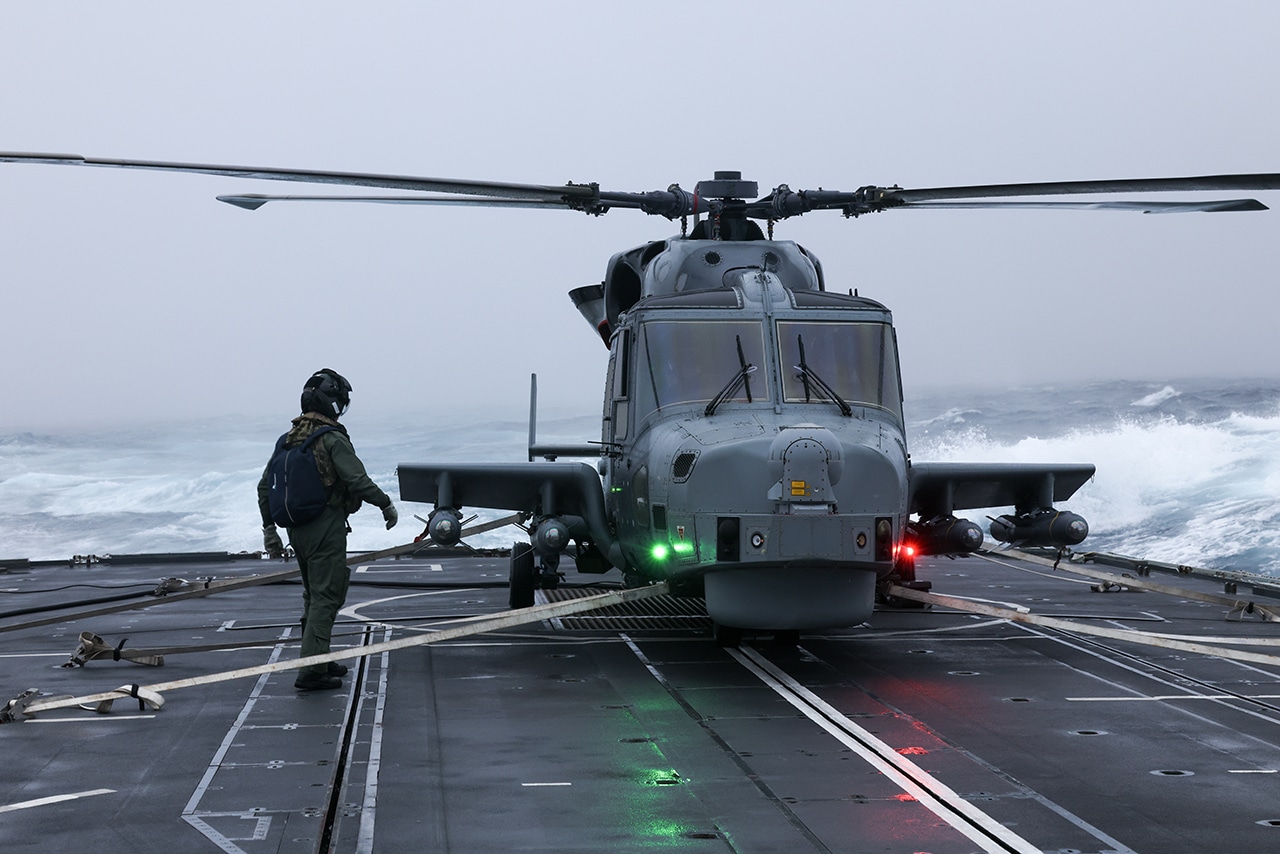
Portland’s contribution was added to by the ship’s embarked Wildcat helicopter, hailing from 815 Naval Air Squadron. In another first, the Wildcat fired a Sea Venom anti-ship missile at the Klakring in the first operational live firing of the weapon type against a realistic target.
A Wildcat helicopter can carry as many as four Sea Venom missiles per sortie, with each weapon packing a 120 kilogram warhead. Though much smaller than ship-killing weapons like NSM and Harpoon, the Sea Venom is designed to deliver enough destructive capability to destroy smaller naval vessels, or using multiple finely targeted missiles complete a successful mission kill against larger frigate or destroyer sized targets.
HMS Portland’s Wildcat Wildcat, prior to takeoff. | Source: LPhot Henry Parks/Crown Copyright 2026
Lieutenant Commander Rhydian Edwards, Test & Evaluation Commander, Maritime Aviation Strike Operational Advantage Group, said: “This was a landmark moment for the Wildcat Force. For the first time we demonstrated the live firing of an operational Sea Venom missile against a representative maritime target. More importantly, we proved our ability to execute the full maritime strike kill chain under realistic operational conditions.”
“This was about giving commanders confidence that Wildcat can find, fix and strike maritime targets using Sea Venom as part of a wider task group. The lessons learned from this activity will directly inform future tactics, training and operational capability development, ensuring Maritime Aviation Strike remains ready to fight and win when called upon.”
More air-launched munitions came in the form of guided bombs dropped by F-15E Strike Eagles based with the 48th Fighter Wing (FW) at RAF Lakenheath. P-8 Poseidon maritime patrol aircraft from the U.S. and UK also took part in the SINKEX, though no weapon launches have been attributed to them and their contribution may have simply been as surveillance platforms.
Finishing off the Klakring, the USS Massachusetts (SSN 798), commissioned into the U.S. Navy in March 2026, targeted the frigate with a Mark 48 Advanced Capability (ADCAP) torpedo.
USS Massachusetts (SSN 798) Virginia-class Block IV attack submarine leaving Faslane, Scotland – September 11, 2026 SRC: FB- Argyll Sea Glass pic.twitter.com/Ba4k7jzjyJ
Massachusetts, the 25th Virginia class submarine, was pushed into service without the traditional post-commissioning shakedown period in order to mitigate current shortfalls in U.S. attack submarine availability. The decision has been described as a ‘calculated risk’. The submarine was noted at the Royal Navy’s Faslane base earlier in September.
The US Navy announced Boeing has been awarded a multi-billion-dollar contract to produce its F/A-XX aircraft. The fighter will revolutionize advancements in open mission systems architecture, advanced mission systems and operational reach and capacity. F/A-XX is intended to replace the service’s fleet of F/A-18 Super Hornets.
“It’s an honor to be selected to produce the Navy’s first sixth-generation platform. Backed by decades of work, bolstered by game-changing innovations and solidified by the investments we’ve made in new facilities uniquely suited to build multiple products with next generation capabilities, our dedicated and talented team is ready to execute this critical program,” said Steve Parker, president and chief executive officer, Boeing Defense, Space & Security, in a company news release.
“Delivering two advanced fighters in parallel was always our plan, and we invested accordingly. We are ready and able to build multiple concurrent future combat aircraft franchise programs,” said Parker.
Construction continues on Boeing’s secure manufacturing facility, the largest in the U.S. Located in St. Louis, the facility will be part of the world’s most advanced, all-digital aerospace design and manufacturing system.
“Investment in facilities is just one part of the story; we’re also investing in technology and people so that we can deliver for our customers,” Parker added.
The technical and programmatic details of F/A-XX remain classified under US national security and export laws.
Northrop Grumman Vs Boeing
Noteworthy, only Northrop Grumman and Boeing were left to race one against the other in the US Navy Next Generation Air Dominance (NGAD) sixth-generation fighter jet program aimed at replacing F/A-18E/F and EA-18G aircraft by means of a new air superiority fighter.
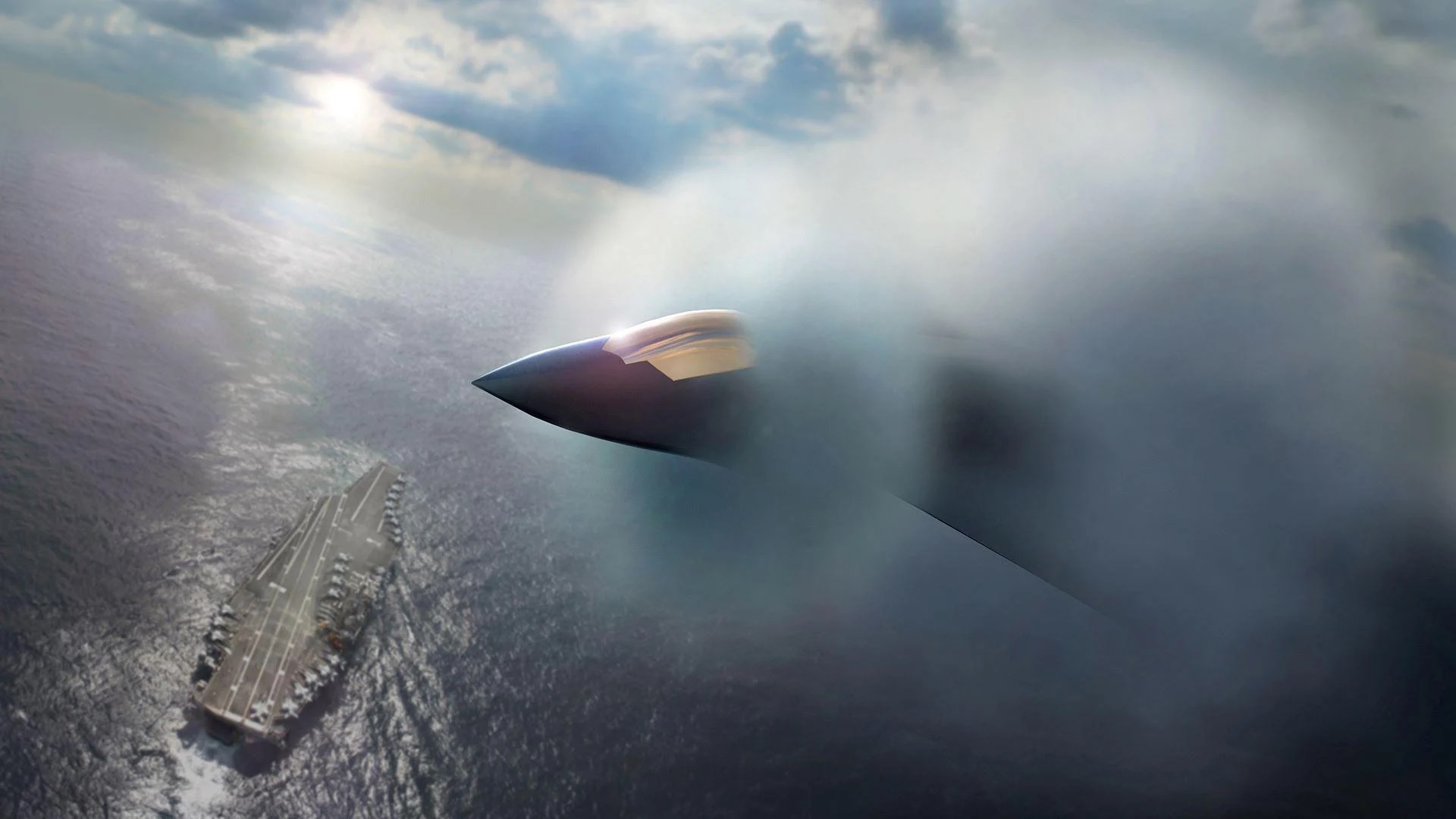
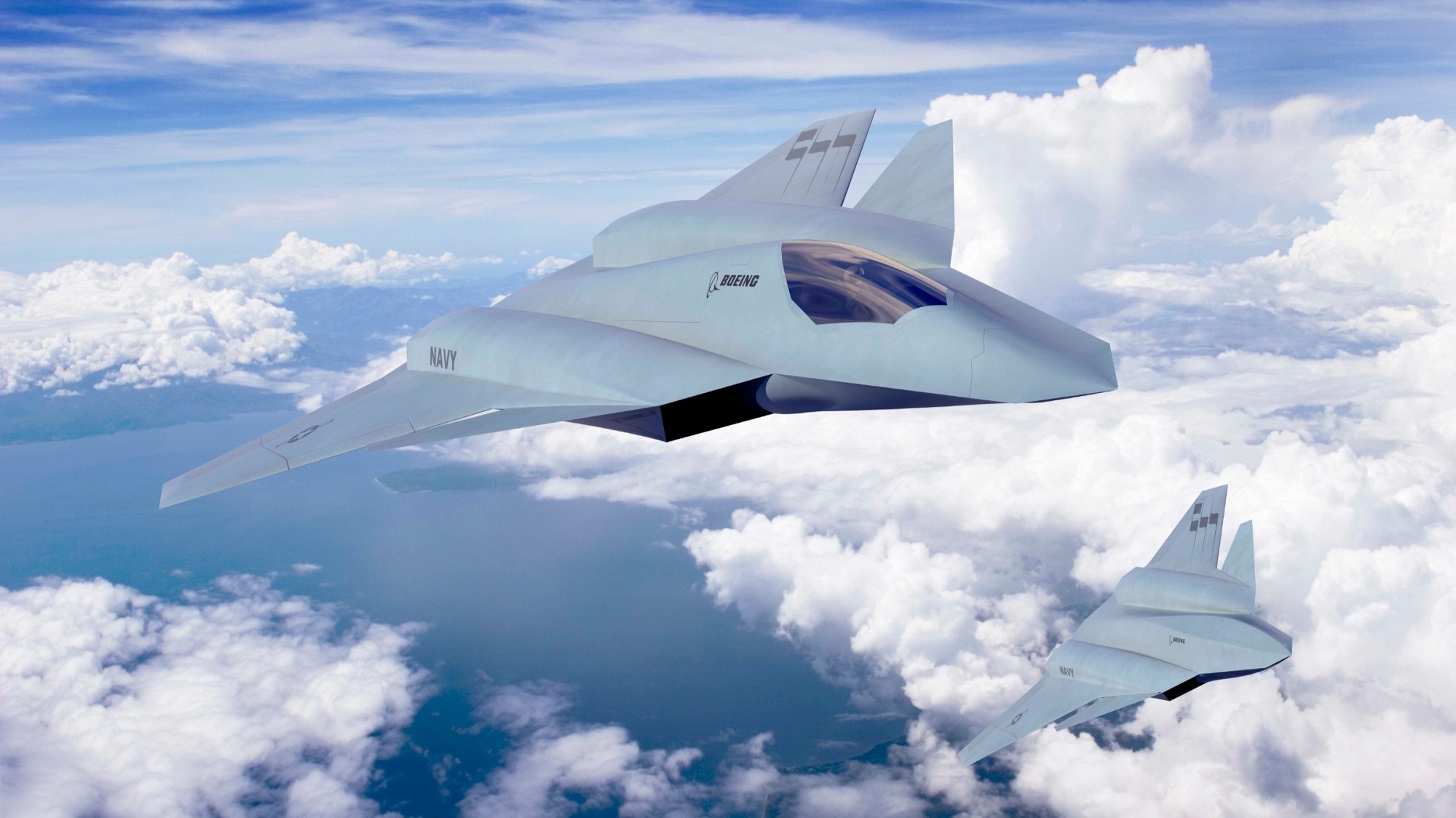
The Navy released this artist’s rendering of the Boeing F/A-XX, highlighting the Navy’s 6th-generation fighter intended to replace the service’s fleet of F/A-18 Super Hornets. Artist rendering: NAVAIR Public Release SPR-2026-0601.
As already reported in March 2025, the proposal submitted by Lockheed Martin to the service did not satisfy the US Navy’s criteria, a source with knowledge on the matter explained to Breaking Defense. What we know is that up to November 2024 proposals were evaluated by the service but as of today is not clear when Lockheed Martin was knocked out of the project. However, the company was no longer proceeding with any bid.
If Northrop Grumman had won the F/A-XX contract it would be the first fighter built by the company since the iconic F-14 Tomcat; instead since Boeing won the F/A-XX contract its facility in St. Louis will see a brighter future given that the company builds fighters in that facility.
Core attribute
According to a statement released in April 2025 by Rear Adm. Michael Donnelly, director of the Air Warfare division for the CNO, a “core attribute” of the F/A-XX is expected to be its range, up to “probably” 125 percent “of the range that we’re currently seeing today to give us better flexibility [and] operational reach.”
In a written testimony to Congress in May 2022, Navy officials said that the service NGAD program is meant to expand the range for carrier-based operations.
“The NGAD [family of systems] will replace the F/A-18E/F Block II aircraft as they begin to reach end of service life in the 2030s and leverage Manned-Unmanned Teaming (MUM-T) in order to provide increased lethality and survivability,” reads joint testimony from Department of Navy acquisition officials. “F/A-XX is the strike fighter component of the NGAD FoS that will be the ‘Quarterback’ of the MUM-T concept, directing multiple tactical platforms at the leading edge of the battlespace.”
Since the F-14 Tomcat interceptor left the inventory in 2006 the effective combat radius of the carrier air wing has contracted. Since the Pentagon’s strategy focused on the Indo-Pacific and the need to counter China in a potential conflict, the Navy has had to explore ways to extend the range of carrier operations due to the vastness of the region. The MQ-25A Stingray unmanned carrier tanker will nominally increase the combat radius.
This model is available from AirModels – CLICK HERE TO GET YOURS
Illinois has released draft rules for its 0.2% crypto transaction tax, including stablecoins and memecoins.
The tax is scheduled to take effect on January 1, 2027.
NFTs are excluded from the proposed digital asset tax rules.
The U.S. state of Illinois has released draft rules for its new 0.2% digital asset tax, giving crypto exchanges and other service providers more detail on how the levy could work when it takes effect next year.
The Illinois Department of Revenue (IDOR) posted the draft rules on September 28 and is accepting public comments through October 30, 2026. The rules have not yet been filed with the Secretary of State or submitted to the Joint Committee on Administrative Rules.
The underlying Digital Asset Tax Act was signed into law in June and is scheduled to take effect on January 1, 2027. It applies a 0.2% tax to the value of a digital asset involved in covered business activity received by an Illinois customer. Digital asset brokers are responsible for collecting the tax.
What the Draft Rules Cover
The proposed rules define taxable activity as the exchange, transfer or storage of digital assets through a business or for a customer. Exchanges include buying or selling crypto for dollars, trading one digital asset for another, converting fiat into crypto, converting crypto back into fiat and bridging assets between blockchains.
Transfers can also fall under the tax when a broker performs them for a fee. The draft specifically includes transfers between accounts belonging to the same customer when a digital asset broker facilitates the transaction for consideration. Direct peer-to-peer transfers without an intermediary are not covered.
The proposal also covers stablecoins and memecoins, while specifically excluding NFTs. Network or gas fees paid directly to miners and validators are not treated as taxable consideration. DeFi transactions generally fall outside the tax unless a platform receives qualifying fees, such as protocol fees.
The tax is based on the dollar value of the digital asset when the taxable activity is completed, rather than on whether the customer made a profit.
How It Compares With U.S. Federal Crypto Taxes
Illinois’ levy is separate from federal crypto taxation. The IRS treats digital assets as property, meaning sales and exchanges can create taxable capital gains or losses. Federal rules also require certain brokers to report digital asset transactions to the IRS through Form 1099-DA.
Illinois is currently the first U.S. state to enact a transaction-based tax specifically targeting digital asset activity. A separate Illinois bill, HB 5798, has been introduced to repeal the Digital Asset Tax Act, but it has not repealed the law.
Key takeaways Het Amerikaanse ministerie van Oorlog heeft Boeing een contract van meer dan 20 miljard dollar toegekend voor de ontwikkeling van de F/A-XX, een zesde-generatie gevechtsvliegtuig dat is ontworpen voor vliegdekschepen. Deze overwinning betekent dat Boeing voor de tweede keer een project voor een gevechtsvliegtuig van de zesde generatie in de wacht heeft gesleept, […]
Boeing has won the U.S. Navy’s F/A-XX competition for the sixth-generation carrier-based fighter, with a contract valued at more than $20B for the full-scale development phase.
After months of wait, the U.S. Navy has finally announced Boeing as the winner of the competition for the F/A-XX sixth-generation carrier-based fighter as part of the service’s Next Generation Air Dominance (NGAD) program. With the award, Boeing will now develop and build the NGAD crewed fighter jets of both the Navy and Air Force.
The highly anticipated award comes after an imminent announcement was reported multiple times since March 2025, with the program apparently stuck in a limbo. The last such report mentioned the Navy would announce its selection by the end of August 2026.
Earlier this year, Chief of Naval Operations (CNO) Adm. Daryl Caudle warned that the Navy must accelerate development of F/A-XX to ensure it can penetrate future air defense environments over the next decade. “Our ability to fly with impunity with our existing airframes is fleeting,” Caudle said. “If I don’t start building that immediately, you’re not going to get it for some time.”
The announcement
In the statement released on Sept. 29, 2026, the Department of War said Boeing was awarded a contract valued at more than $20B for the full-scale development phase of F/A-XX. The contract covers multiple test aircraft for ground, airworthiness, systems, and weapons integration testing.
“The F/A-XX is a critical pillar in our commitment to maintaining peace through strength. F/A-XX will dominate contested airspace, extend operational reach, and deliver a decisive combat advantage for the warfighter,” said Michael P. Duffey, Under Secretary of War for Acquisition and Sustainment. “The F/A-XX platform represents a crucial, non-negotiable investment in America’s national security and long-term air combat capabilities. We are joining forces with Boeing to field these capabilities rapidly, ensuring our warfighters possess the lethal and highly networked systems required to deter aggression, project undisputed power, and secure absolute air superiority.”
A rendering of Boeing’s proposed F/A-XX design. | Source: Boeing
The F/A-XX is expected to provide advanced carrier-based power projection, further extending the range of U.S. Navy aircraft carriers. The new fighter jet will augment and eventually replace legacy F/A-18E/F Super Hornets and EA-18G Growlers beginning in the 2030s, and operate alongside the F-35C and Collaborative Combat Aircraft (CCA).
“This achievement marks a new era for the U.S. Navy,” said acting Secretary of the Navy Hung Cao. “The Sixth-Generation fighter is a generational leap in air superiority and will provide the world’s best aviators with unparalleled capabilities to fight, win, and come home safe. We are excited to partner with Boeing, and for our warfighters to continue to dominate the skies and defeat our nation’s enemies.”
6th-gen edge.
Thank you, @USNavy, for continuing our partnership to design, build and deliver your F/A-XX aircraft. We’re honored to produce the 6th-generation fighter that will revolutionize advancements in naval aviation to maintain U.S. carrier air superiority.
The statement released by Boeing puts emphasis on the company’s work on the NGAD programs of both the Navy and Air Force.
“Delivering two advanced fighters in parallel was always our plan, and we invested accordingly. We are ready and able to build multiple concurrent future combat aircraft franchise programs,” said Steve Parker, president and chief executive officer, Boeing Defense, Space & Security.
History of the F/A-XX program
The F/A-XX is the strike fighter component within the U.S. Navy’s Next Generation Air Dominance (NGAD) Family of Systems (FoS). The requirement for this aircraft has been around since 2008, with a formal Request for Information in 2012, to replace the F/A-18E/F Super Hornet in the 2030s.
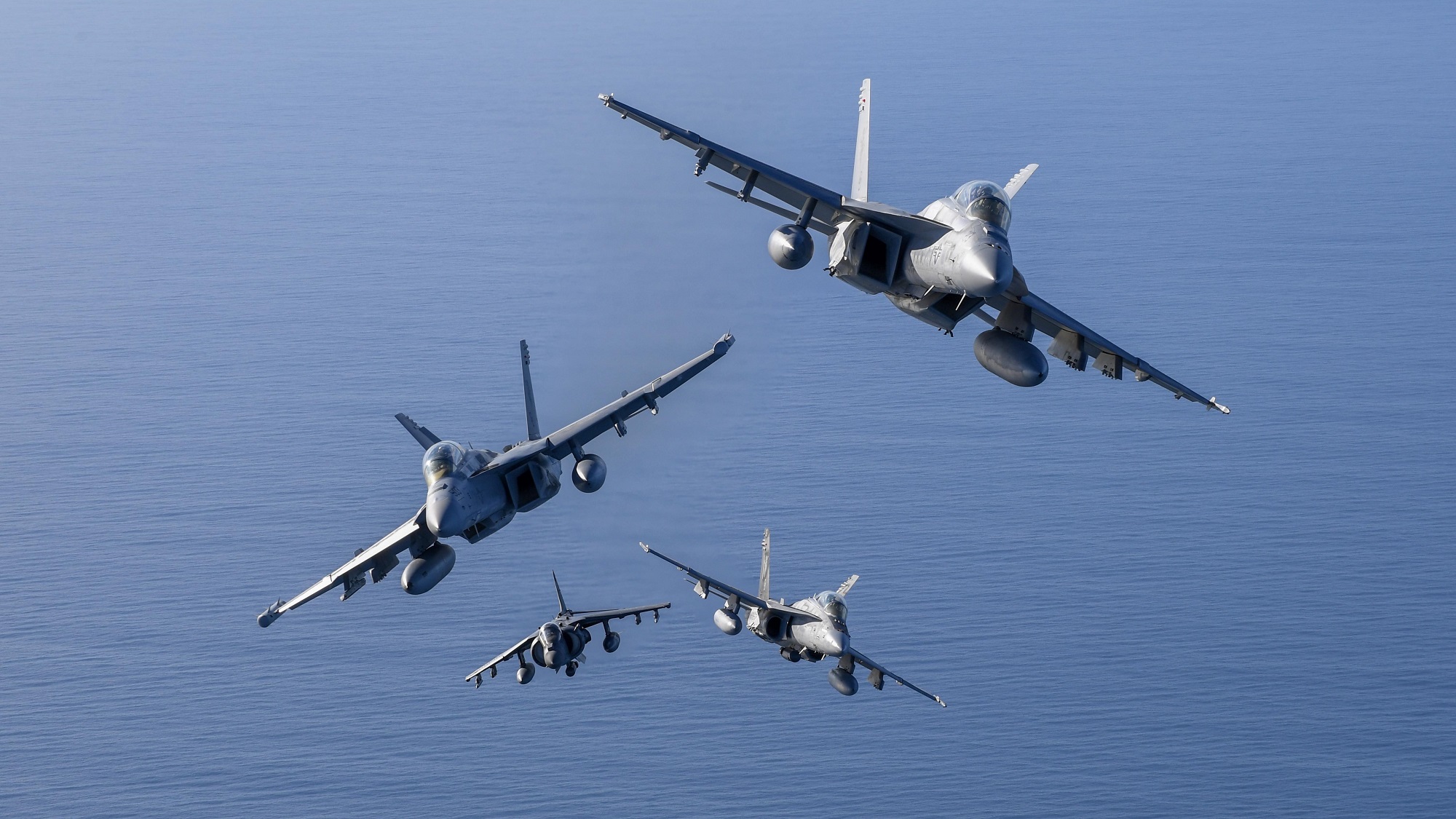
A formation of Air Test and Evaluation Squadron (VX) 31 “Dust Devils” aircraft, including an EA-18G Growler, AV-8B Harrier II+, an F/A-18F Super Hornet, and an F/A-18D Hornet, flies over Point Mugu’s Sea Range in Californati during a photo exercise. | Source: U.S. Navy
Later, the F/A-XX was included in the service’s NGAD program, which is a separate program from the identically named Air Force program. The Navy says that its “specific capabilities and technologies are under development, however analysis shows it must have longer range and greater speed, incorporate passive and active sensor technology, and possess the capability to employ the longer-range weapons programmed for the future”.
The NGAD FoS will include unmanned platforms with F/A-XX as the quarterback, exploiting the Manned/UnManned Teaming (MUM-T) concept to reduce risk to the manned aircraft, while simultaneously increasing capability, capacity, and survivability. The new MQ-25 Stingray will be the first unmanned asset to employ this capability, extending the strike range and enhancing maneuverability of the Carrier Air Wing.
Continued development of MUM-T will enable information sharing across a distributed force, increasing survivability, reducing risk to manned aircraft, and ensuring weapons capacity. The Navy is evaluating the appropriate mix of F/A-XX, manned and unmanned platforms to ensure the most lethal and affordable CVW possible, depending also on the maturity of autonomy and Machine Learning technologies.
The Navy envisions future unmanned air vehicles with survivable planforms, sensors, and robust autonomy able to find, fix, identify, track, engage, and assess land, sea, and air targets. These UAVs will be employed alongside manned aircraft and unmanned attritable assets to enable integrated kinetic and non-kinetic fires at tactically relevant ranges in multidomain operations.
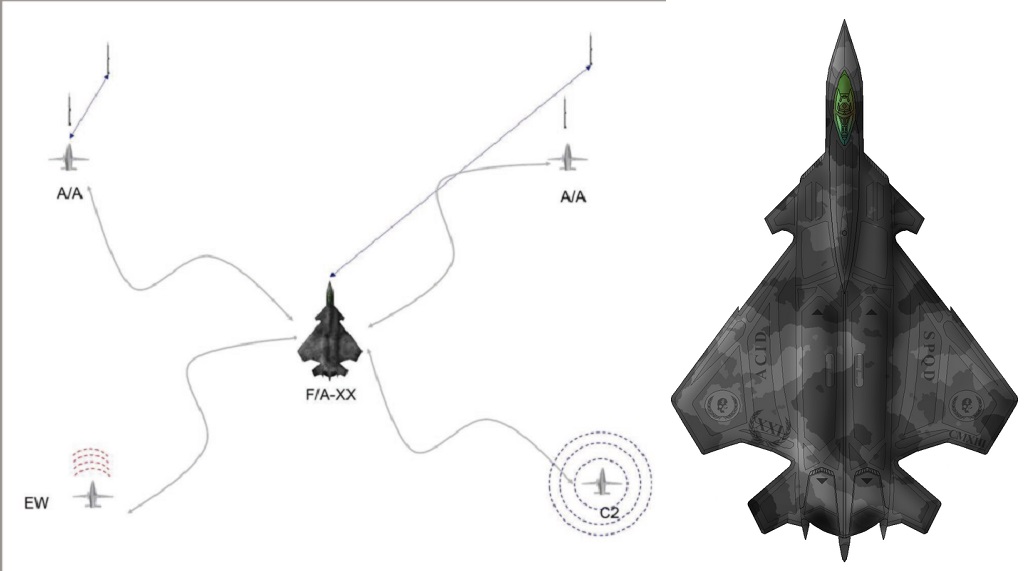
In a 2021 document, the Navy showed a fictional F/A-XX operating in a MUM-T environment with four drones, whose shape represents the MQ-25. Interestingly, the drones were shown employing Air-to-Air (AA), Electronic Warfare (EW) and Command and Control (C2) payloads, much like the Loyal Wingman drones currently being developed. This falls in line with the service envisioning Unmanned Air Systems (UAS) to fill refueling, communications relay, logistics, airborne electronic attack, strike, and ISR&T missions in the future air wing.
The F/A-XX placeholder design as shown by the U.S. Navy in its vision for 2030-2035, together with a better image of the original fictional design. (Images via U.S. Navy and Tapatalk) | Source: U.S. Navy
In 2024, in an interview released to Aviation Week, Rear Adm. Michael Donnelly, director of the air warfare division in the Office of the Chief of Naval Operations, said the Navy will develop its aircraft independently, a reverse of previous reports who said the Navy and Air Force would share the developments of their next generation aircraft programs.
The Navy’s decision to move forward independently might have shielded the F/A-XX from the results of the NGAD’s review and the subsequent decisions. The service is confident in the suitability and affordability of the F/A-XX and is committed to move forward with the program.
“We have to have an affordable platform to make it relevant to our force structure and force design, so we’ve got that in mind,” said Donnelly. “We think we’ve got an affordable solution that supports our force structure of the future.”
According to Donnelly, the F/A-XX program was on track for the Milestone B decision to move the Engineering and Manufacturing Development (EMD) phase by the end of fiscal year 2025.
“We feel really good through the concept development that we’ve got the right bracket for those requirements and the attributes we need to deliver the capability,” Donnelly says. “We’ll continue to look at that as we go through the next phases of the acquisition process and make smart decisions.”
An early artist’s render showing a hypothetical F/A-XX fighter-attack aircraft. | Source: Boeing
What F/A-XX Is Expected to Deliver
The Navy envisions F/A-XX as more than a simple replacement for the F/A-18E/F Super Hornet and the EA-18G Growler. The new aircraft is expected to combine stealth, extended range, electronic warfare, and command-and-control functions into a single next-generation platform.
Navy officials previously said F/A-XX is expected to have approximately 25% more range than the F-35C, as well as more advanced jamming capabilities than the Growler. Moreover, it is also designed from the outset to control multiple Collaborative Combat Aircraft (CCA), as noted by the CNO.
“The next-generation airframe, F/A-XX is so vital,” Caudle said. “It’s vital because of, one, the CCAs it will command and control. Its penetration – the Growlers won’t last forever, so it’ll be our electronic attack airplane as well. Its range will be coupled with the MQ-25 for clandestine refueling and organic refueling from the carrier.”
The aircraft is therefore central to the Navy’s future carrier air wing concept to maintain the service’s ability to project power in high-threat environments. In this mix of crewed and uncrewed platforms, the F/A-XX will be the quarterback, often said the Navy.
Navy’s and Air Force’s NGAD relation
According to Rear Adm. Donnelly, the new carrier-based fighter will be affordable, versatile and independent of Air Force-funded technologies such as an adaptive-cycle turbofan engine. While the service already said it would require a different airframe than the Air Force’s NGAD, other systems to be included were not mentioned.
The second rendering of the U.S. Air Force’s sixth generation fighter, the F-47. | Source: U.S. Air Force
Initially, the Navy appeared interested in the adaptive-cycle technology being developed for the Next-Generation Adaptive Propulsion (NGAP) program. In the past decade, however, propulsion plans for the two services have diverged, according to Donnelly.
“We’re looking at more of a derivative-type engine solution,” said Donnelly. “That’s just one example where we probably are different in many ways from the Air Force. In totality, they are two unique programs from an acquisition point of view and also going forward, so we’re relatively independent of each other at this point.”
Both programs appear to be under budgetary pressure, as both services are currently working on multiple large programs. In the Navy’s case, the 2025 budget for the new aircraft suffered a cut of 67%, with the $10.3 billion requested between 2025 and 2028 reduced to just $3.3 billion. The senate voted to restore $450 million to the budget but, even if approved, there would still a cut of 59% compared with last year’s budget.
Earlier this year, lawmakers agreed on the Fiscal Year 2026 Defense Appropriations Act to allocate $897 million specifically to F/A-XX, mandating the Pentagon to award a development contract aimed at accelerating initial operational capability. The wording used called out the Department of Defense for the slow pace of the program.
Another difference between the Navy’s and Air Force’s 6th gen fighter could be their roles. While the latter envisions its new aircraft mainly as an air superiority fighter, the Navy wants it to be multirole, optimized for air-to-surface strike but still capable of fleet defense.
“The central focus of its design is to be able to conduct long-range fires, sea control and those types of missions. Inherent in its design is its ability to participate in fleet defense,” Donnelly says. “We can’t afford to have a break-glass capability or a really unique single-mission or single-phase-of-operation focus.”
A final difference is the manned or unmanned debate. The Air Force left the door open for an optionally manned configuration, which was also the initial configuration proposed for the F/A-XX. However, the Navy has now opted for a fully manned platform.
“F/A-XX is intended to be a manned platform,” Donnelly says, noting that the “F/A-XX will really be our pivot point from a manned air wing to a hybrid future, with a manned-unmanned air wing.”
Key takeaways Raytheon, een dochteronderneming van RTX, heeft een exclusieve overeenkomst gesloten met het Amerikaanse ministerie van Oorlog ter waarde van maximaal 20,7 miljard dollar voor de productie van AMRAAM-raketten. Vijf plus twee jaar Deze meerjarige overeenkomst, die vijf jaar loopt met twee optionele verlengingen, is bedoeld om de productie op te schalen naar ongekende […]
Ons land krijgt een dubbele rekening gepresenteerd voor de rentestijging Maandag steeg de Belgische tienjaarsrente tot 4,31 procent. Begin september moest onze overheid voor het…
A Flylogix drone has completed what the company describes as the first civilian cross-border drone flight from the UK. The aircraft flew from Tingwall Airport on the Shetland Islands to Equinor’s Statfjord B offshore platform in Norwegian waters and then returned to Shetland. The BVLOS mission covered 290 nautical miles (537 km), took 4 hours and 50 minutes, and included a methane emissions survey at the offshore installation.

 Login