FreshRSS

🔒
❌ About FreshRSS
There are new articles available, click to refresh the page.
Before yesterdayCompounding Quality

ETF Portfolio Update August 2026

20 August 2026 at 14:46

The recommendation of Warren Buffett?

Most investors are better off buying the S&P 500.

But not every company in the S&P 500 is a good investment.

Let’s teach you how you can share the good from the bad.
Subscribe now

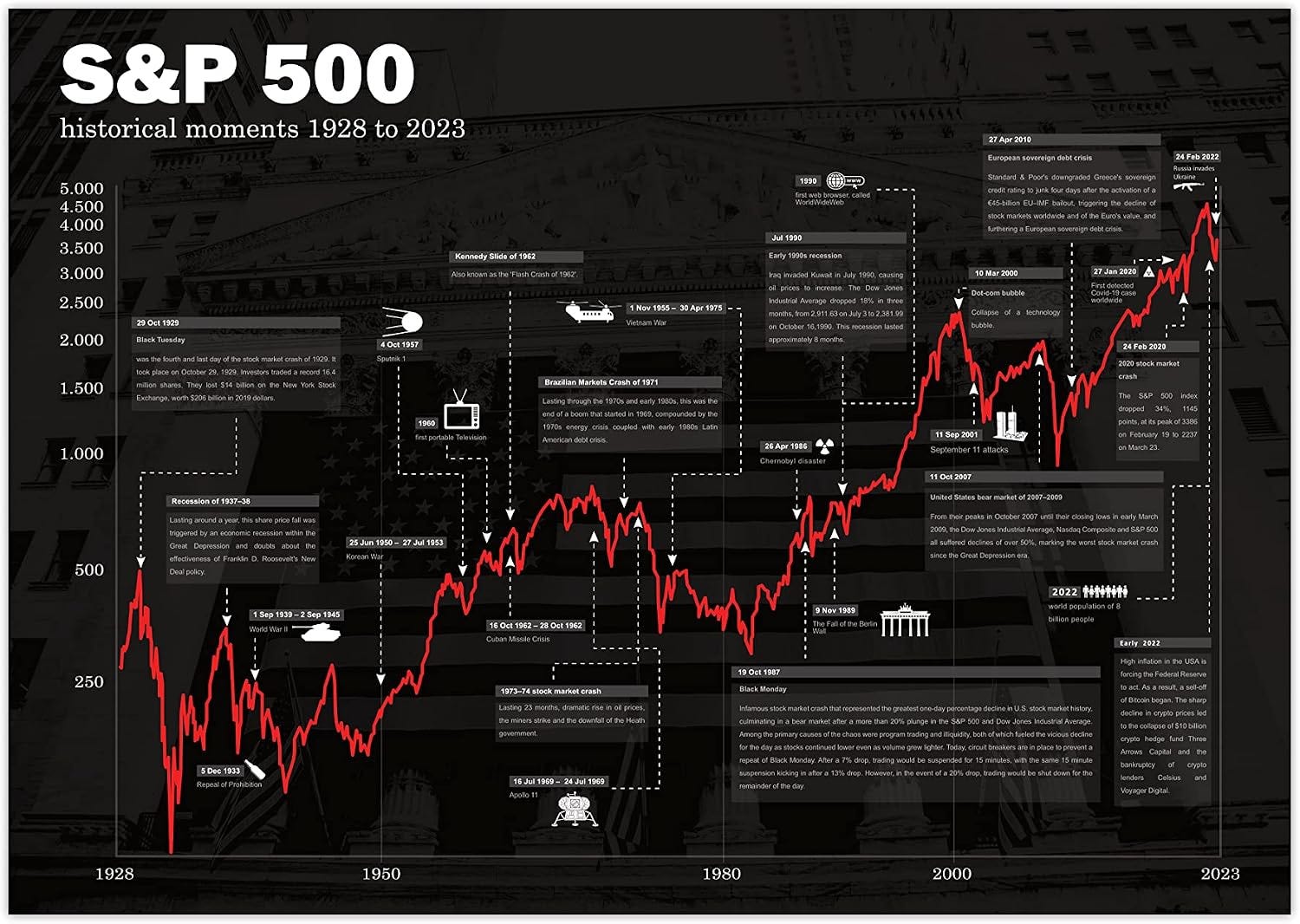
S And P 50 _ S&P 500 Index , S&P 500: Performances & Cotations, Cours ...

Only a few stocks matter

The S&P 500 has delivered an average annual return of 10% over the long term:
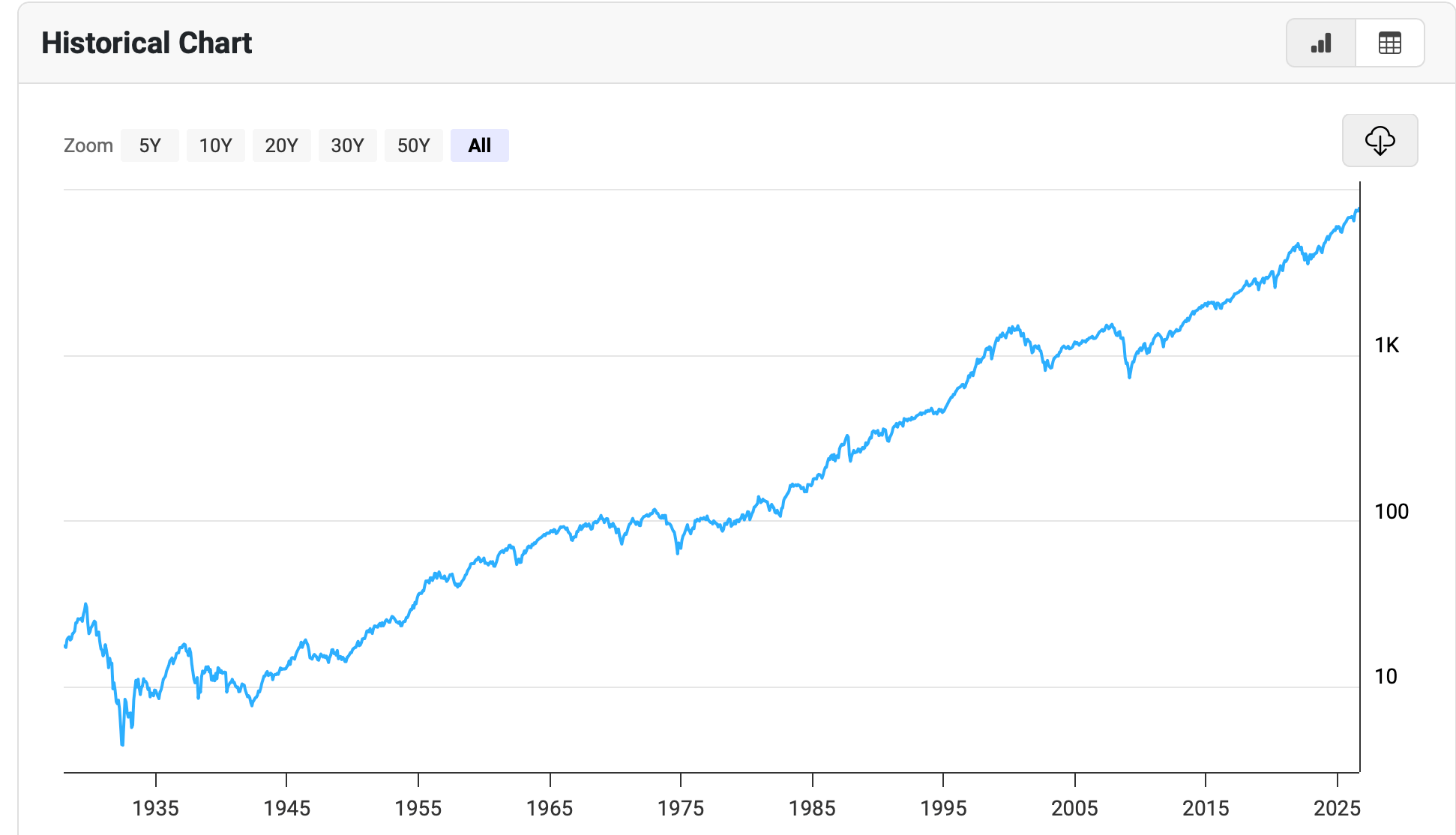
Source: Macrotrends

But you know what’s interesting?

Hendrick Bessembinder looked at nearly 100 years of stock returns.

Here’s what he found:

  • The average cumulative return was +22,840%

  • The median cumulative return was -7.41%
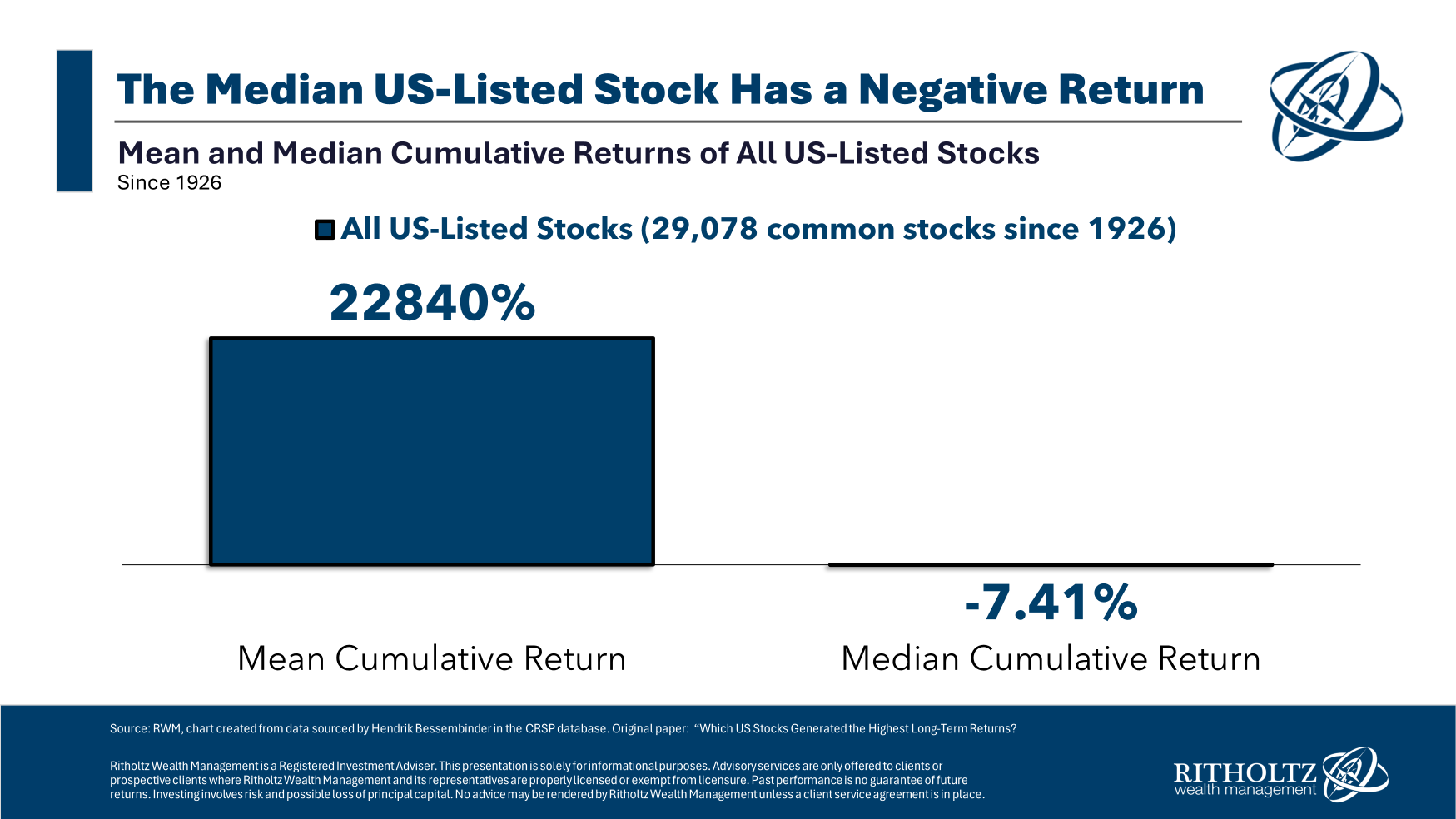
The Biggest Winners in the Stock Market - Stock Market Journalist
Source: Ritholtz Wealth Management

How can this be?

Because a very small number of stocks generate almost all market returns:
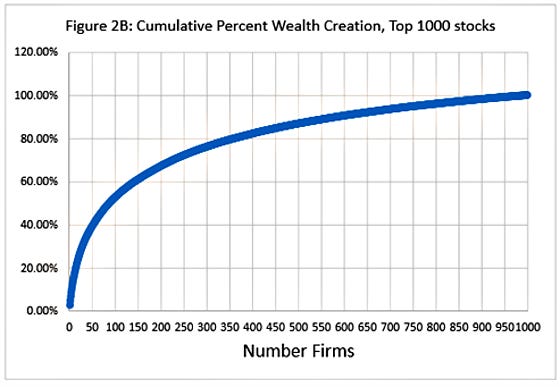
Bessembinder: A Fascinating But Skewed Study
Source: Gary Carmell

Buying a standard market-cap weighted index like the S&P 500 means you buy everything.

You get the highly profitable compounders, but you’re also buying the companies destroying capital.

As Quality Investors, we only want the best of the best.

What is quality?

You can define quality in several ways.

But there are a few general ideas that most of them have in common.

High reinvestment

In the long run, a stock is a slave to its business.

Not to sentiment. Not to macro. Not to the news cycle.

Eventually, a stock will always follow the fundamentals of the business.

That’s why you want to buy companies that can reinvest their own capital at high rates of return.

Here’s what Charlie Munger has to say about this topic:

"Over the long term, it's hard for a stock to earn a much better return than the business which underlies it earns. If the business earns 6% on capital over 40 years and you hold it for that 40 years, you're not going to make much different than a 6% return—even if you originally buy it at a huge discount. Conversely, if a business earns 18% on capital over 20 or 30 years, even if you pay an expensive looking price, you'll end up with a fine result."

As you can see in this chart, the companies with the highest Return On Equity (ROE) generate the highest returns:
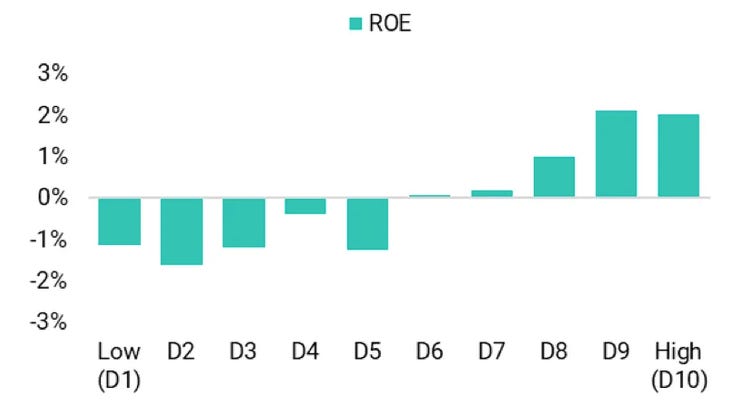
Source: MSCI

Low leverage

You want to own companies for a long time.
Let compounding do the heavy lifting for you.

As a result, you want to invest in companies that can survive for a very long time.

One thing that can hurt a business faster than almost anything else?

Too much debt.

Let’s turn to Charlie Munger for some more wisdom:

“There are only three ways a smart person can go broke: ladies, liquor, and leverage.”

When times are good, too much debt eats into your profits because you have to pay a lot of interest.

But when there’s a recession, rates go up, or credit tightens, too much debt can bankrupt a company (and wipe out equity investors like us).

As you can see in this chart, having little debt doesn’t necessarily boost your returns. But having too much debt can seriously hurt them.
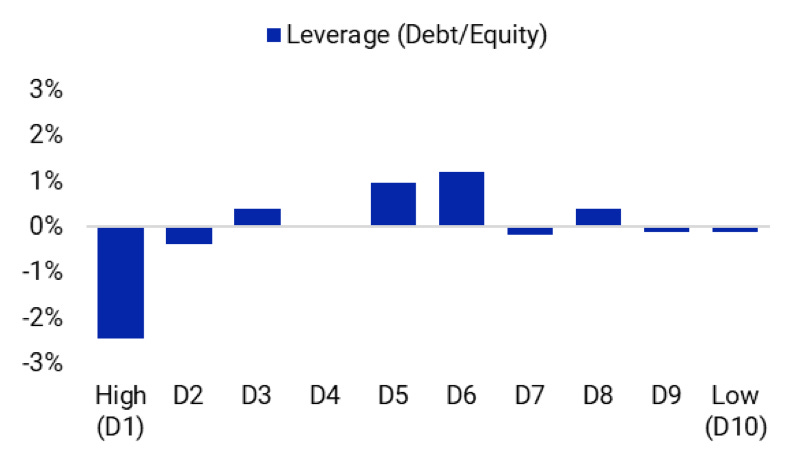
Source: MSCI

Real earnings

Accounting rules leave room for judgment, adjustments, and assumptions.

Sometimes, management teams use this to make a struggling business look much more profitable than it really is.

But you can’t fake cash in the bank.

Always remember:
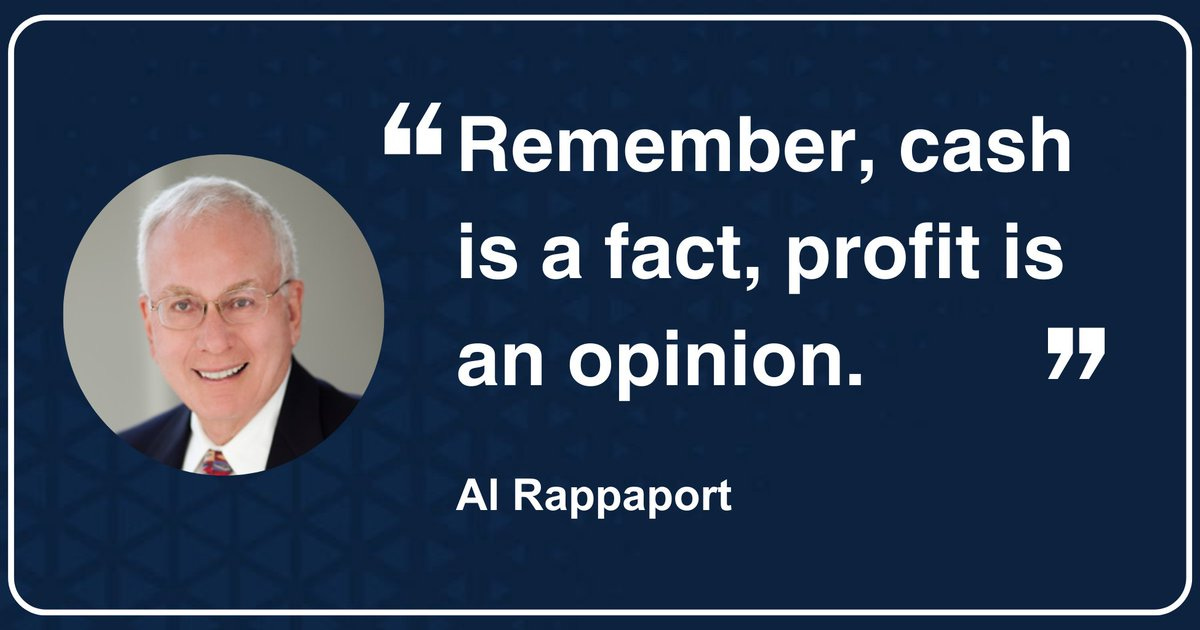
Quality companies make real profits and generate real cash.

Over the long run, a stock’s price follows the performance of the business.

But when it comes to cash generation, this can happen in the short term too.

Here’s the average annual return of companies with negative cash flow and accounting earnings:
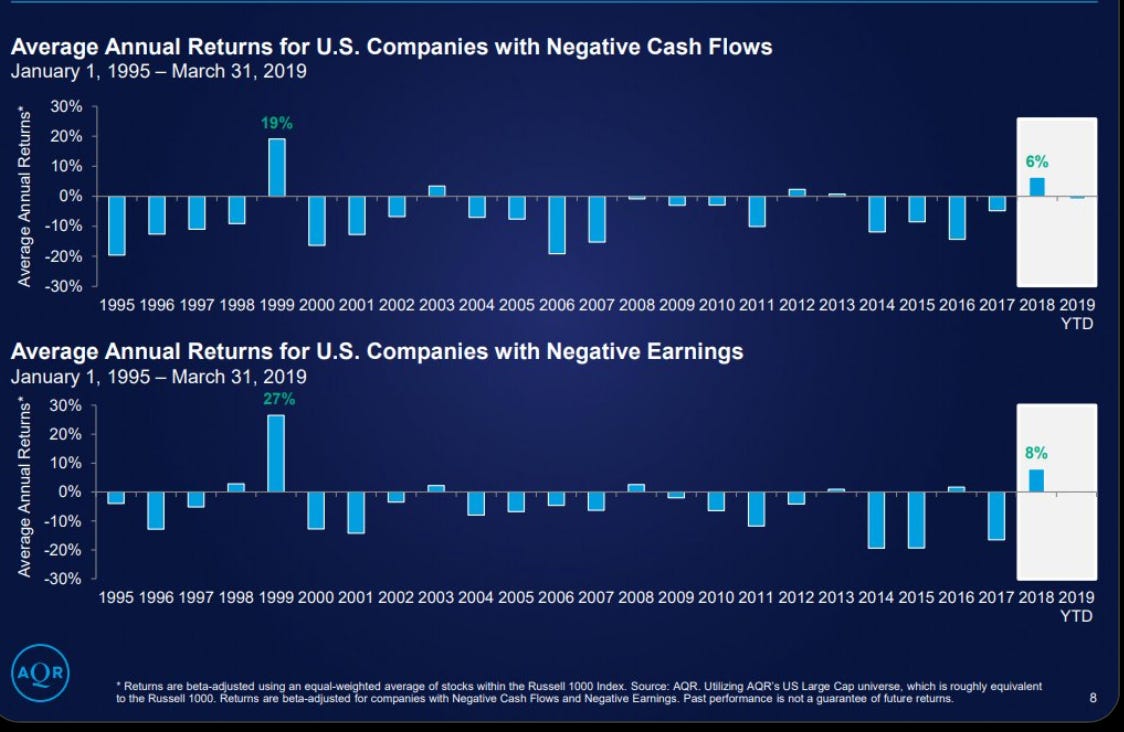
Source: AQR

The conclusion?

Companies with negative cash flow and earnings usually deliver negative stock returns too.

As an investor, you want to make sure the cash flowing in and out of a business matches its reported earnings.

When the two are close, you know you’re buying a business that makes real money.

So wouldn’t it be interesting to start with the S&P 500 and filter it down to the 100 highest-quality companies?

Companies that translate all their net income into pure cash?

That’s exactly what this month’s ETF does.

⭐ ETF of the Month (Spotlight)

Invesco S&P 500 Quality ETF (SPHQ)

Key Information

  • Name: Invesco S&P 500 Quality ETF

  • Ticker: SPHQ

  • Total Expense Ratio: 0.21%

  • Physical/Synthetic ETF: Physical

  • ISIN: US46137V2410

European Version

  • Ticker: SPQA

  • ISIN: IE000E6TPCH9

What?

The ETF starts with the S&P 500 Index.

It then looks at three things:

  1. Return on Equity (ROE): Shows how well a company turns shareholders’ money into profit.

  2. Financial Leverage: Shows how much a company relies on debt.

  3. Accruals Ratio: Shows how much of a company’s earnings are backed by real cash flow rather than accounting adjustments.

It uses these three metrics to give each of the 500 companies a quality score.

It then keeps only the 100 companies with the highest scores.

Finally, it weights each company based on its quality score and market capitalization.

Why?

When you find companies that can reinvest at attractive rates, grow without taking on too much debt, and turn most of their earnings into cash, you’ve found Quality Companies.

And when you invest in Quality Companies, you can expect to outperform over the long run.

Here’s what the historical performance looks like:
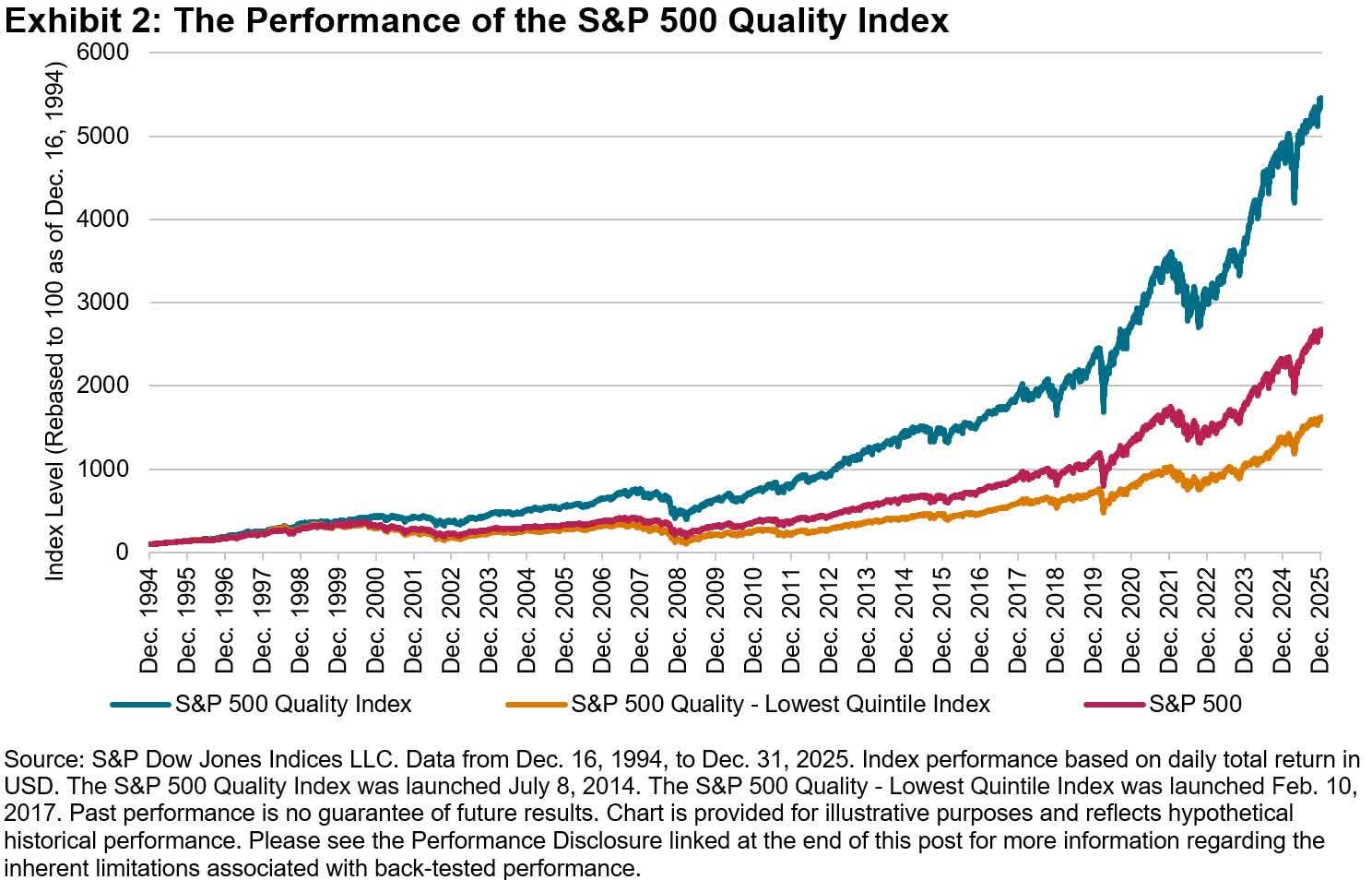
Quality Over Quantity: Features Of The S&P 500 Quality Index | Seeking Alpha

Sector Split

The sector breakdown looks like this.

The three largest sectors are Information Technology (42.5%), Industrials (18.9%), and Financials (15.3%).
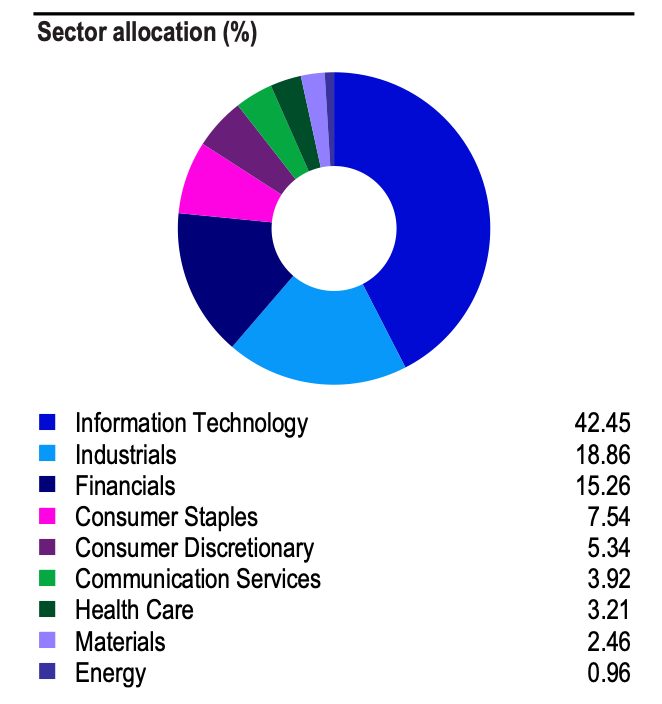
Source: iShares

Top Holdings

The top 10 positions right now:
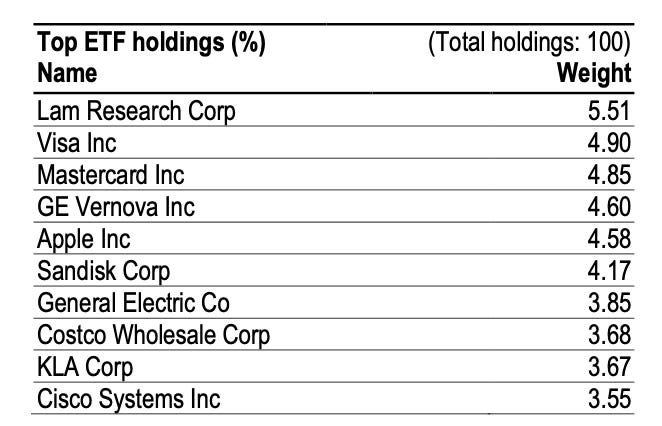
Source: iShares

ETF Portfolio Update: August 2026

Now, let’s dive into our ETF Portfolio Update.

Our Portfolio is a great mix of ETFs that we believe can outperform over the long run.

We use several factors that have historically performed well:

👑 Quality: Only invest in companies that have already won
📏 Size: The smaller the better
🚀 Multifactor: Quality, size, value & momentum
🌏 Emerging Markets: Small exposure to Emerging Markets

Let’s now dive into the ETF Portfolio itself.

You have 24/7 access to the ETF Portfolio here:

Read more

10 Stocks for Life

9 August 2026 at 14:45

Hi Partner 👋

Last Thursday, we talked about The Lindy Effect.

You can find the article here.

Today, we’ll dive into ‘10 Stocks for life’.

The oldest stock in this list has been around for over 200 (!) years.

The Lindy Effect: A Tool to Predict Longevity and Value - Sketchy Ideas

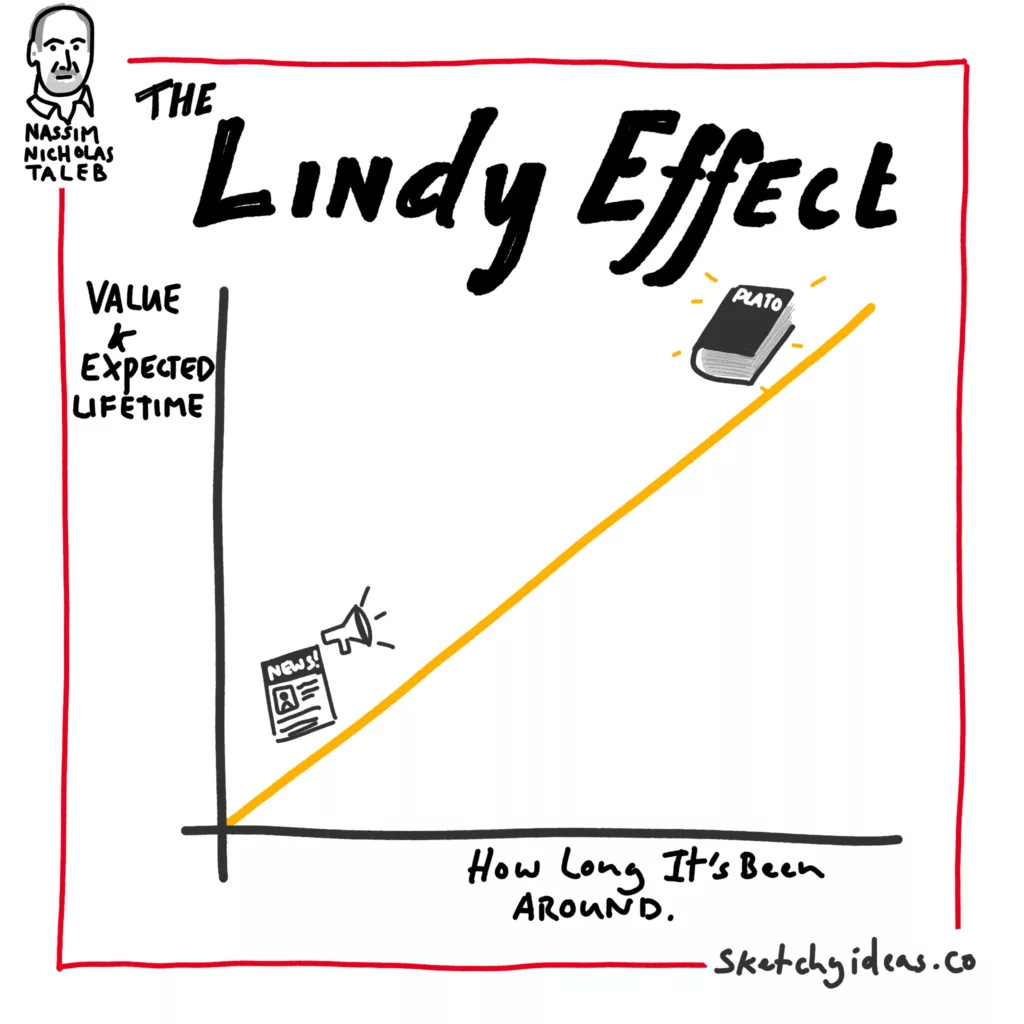
Before we begin, here’s a quick reminder of The Lindy Effect:

  • The longer something has survived, the longer it’s likely to survive.

  • Companies that have adapted for decades have already proven their durability.

  • Nothing is guaranteed, but longevity is often a sign of a great business.

Let’s look at the ten oldest companies on our list.

10. Coca-Cola ($KO)

Coca-Cola is the best known soft-drink brand in the world.

They sell concentrates and syrups to restaurants and independent bottling companies.

  • Founded: 1886

  • IPO: 1919

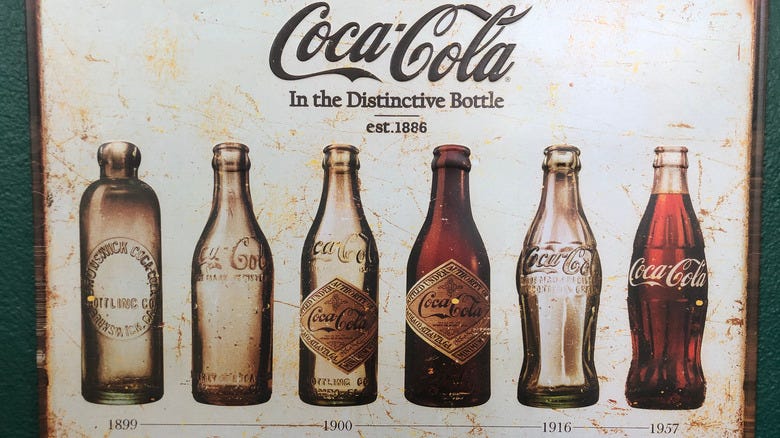
  • History: Pharmacist John Pemberton created the syrup in Atlanta. It originally contained small amounts of cocaine (!) and was marketed as a pain reliever.

The Little Known History Behind Coca-Cola Bottles

The Lindy Effect

  • People will always want sweet drinks.

  • Coca-Cola is one of the world’s strongest brands.

  • Its global distribution network is nearly impossible to copy.

How Has Coca-Cola Performed?

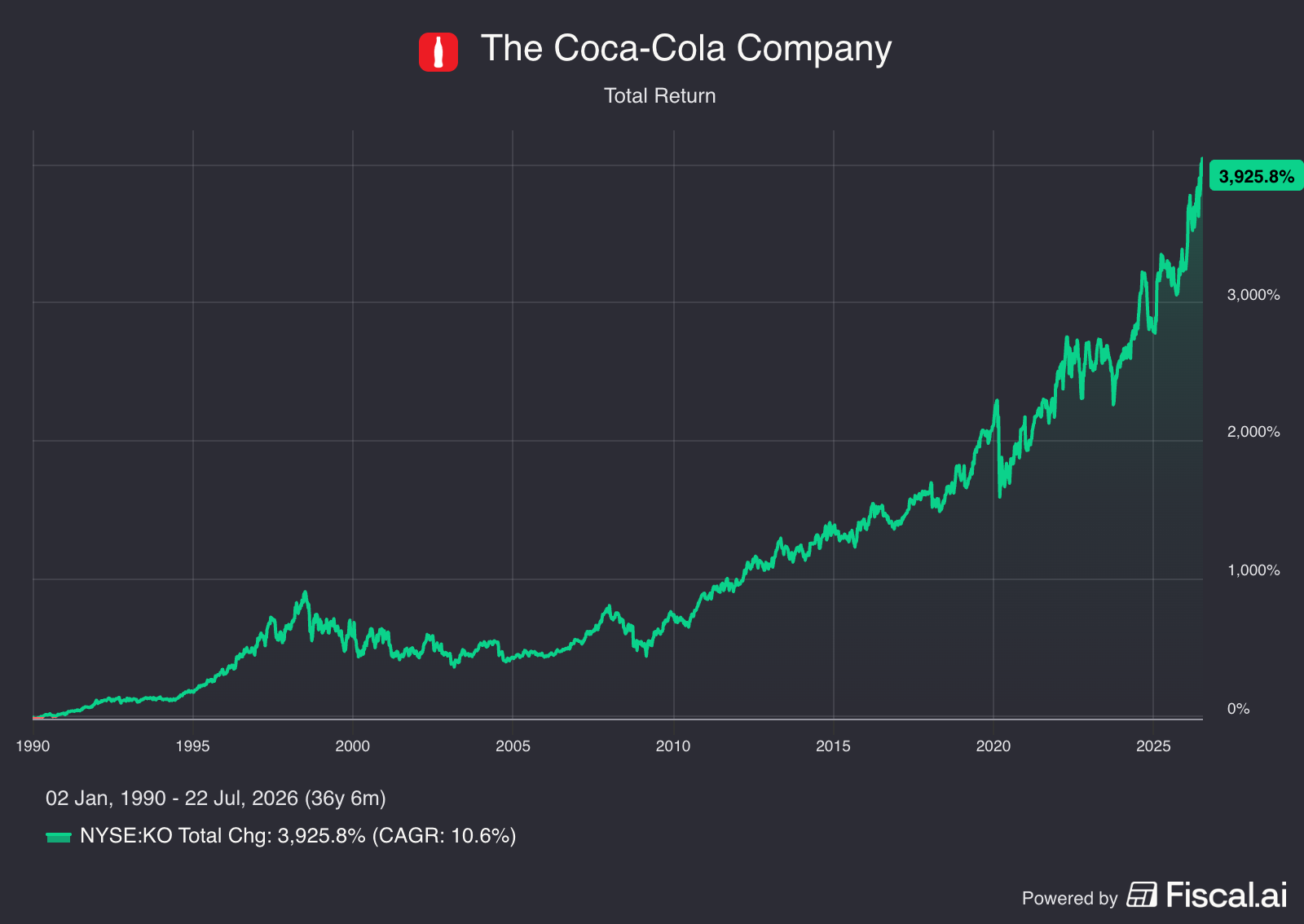
Coca-Cola has compounded at more than 10% per year since 1990.

They returned nearly 4,000% to shareholders over this period.

Source: Fiscal.ai

9. Eli Lilly ($LLY)

Eli Lilly researches and manufactures medicines.

They’re a major producer of insulin and now GLP-1 drugs.

  • Founded: 1876

  • IPO: 1952

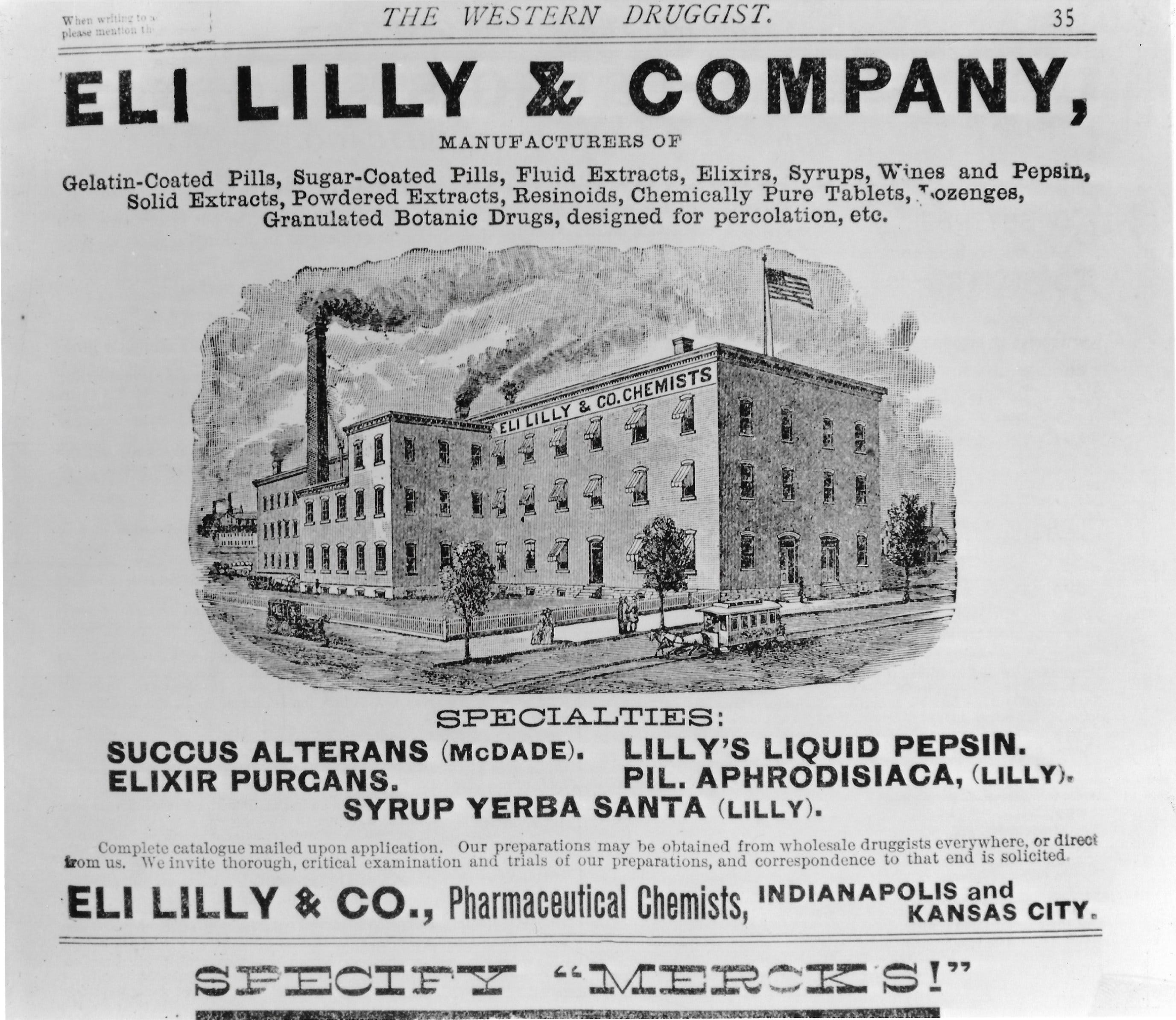
  • History: Civil War veteran and pharmacist Col. Eli Lilly opened a pharmaceutical lab in Indianapolis.

Eli Lilly and Company - indyencyclopedia.org

The Lindy Effect

  • People will always get sick, and they’ll always want medication to help them.

  • Lilly has decades of experience developing new medicines.

  • Strong patents protect its best products.

How Has Eli Lilly Performed?

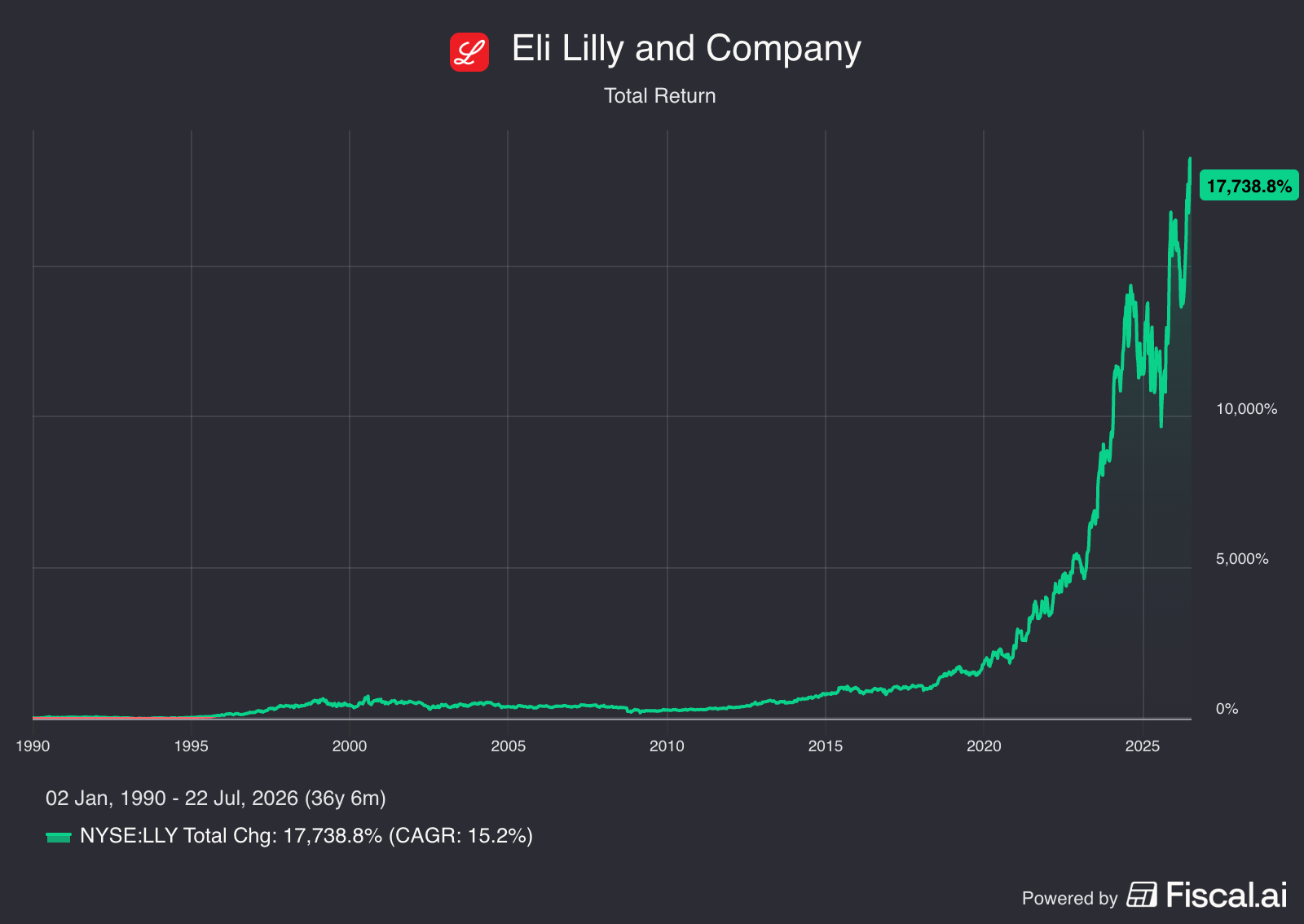
Lilly has returned more than 17,000% since 1990.

Source: Fiscal.ai

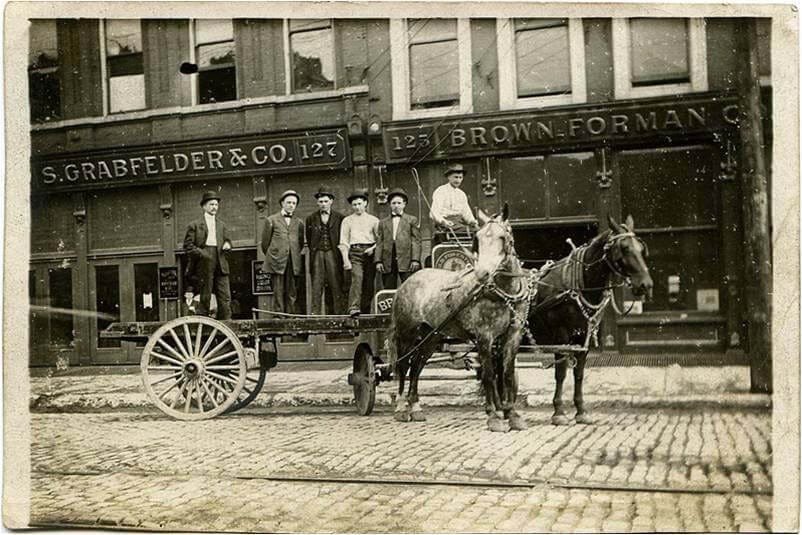
8. Brown-Forman ($BF.B)

Brown-Forman distills and produces premium alcohol and spirits.

They own brands like Jack Daniels, Old Forester, and Chambord.

  • Founded: 1870

  • IPO: 1929

  • History: George Garvin Brown began selling bottled whiskey (Old Forester) in Louisville.

100 Years Later — What You Might Not Know About Prohibition ...

The Lindy Effect

  • People have been drinking alcohol for centuries.

  • Brands like Jack Daniel’s have loyal customers around the world.

  • Strong brands give the company pricing power.

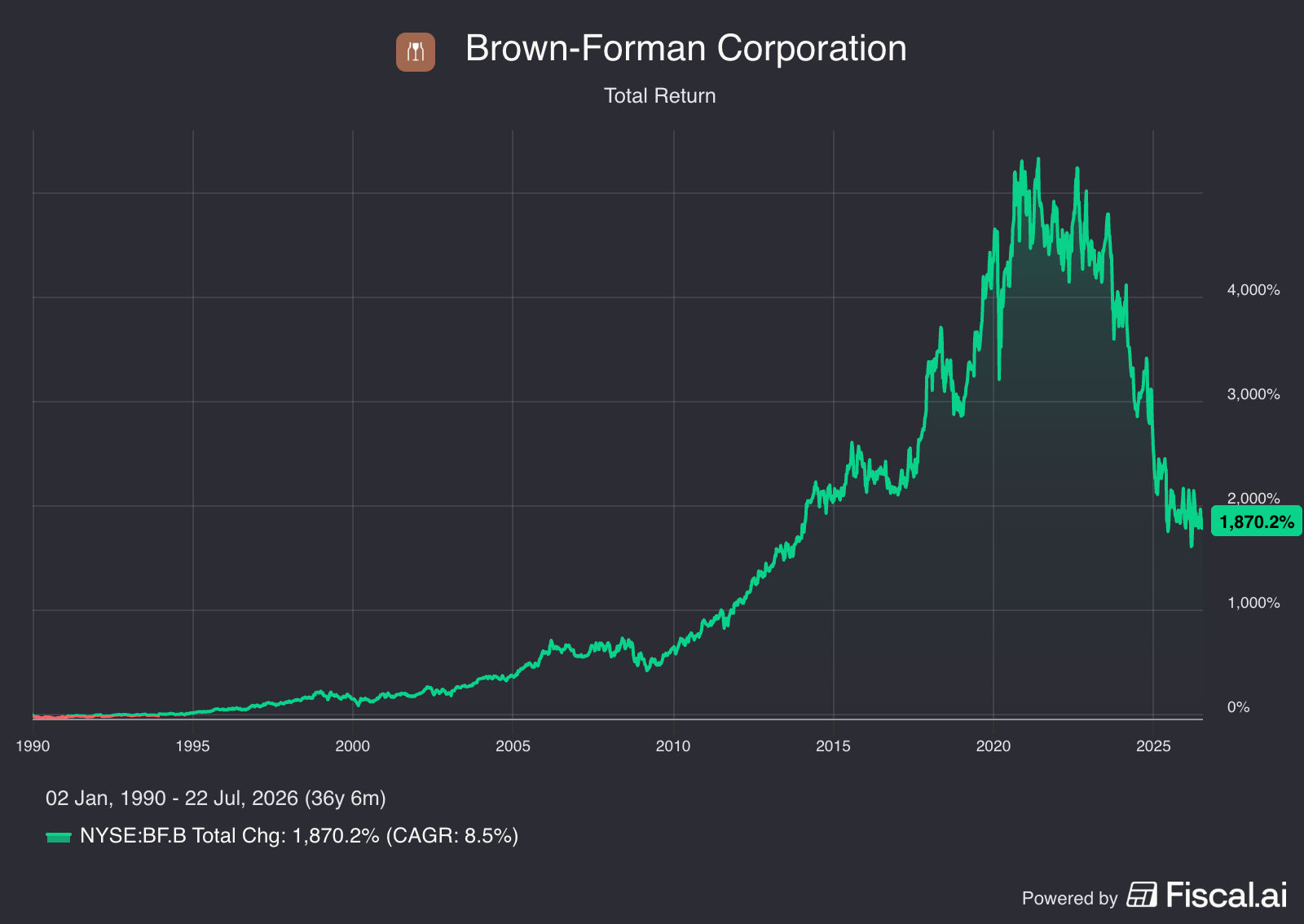
How Has Brown-Forman Performed?

Since 1990, Brown-Forman has returned around 1,800%, compounding at 8.5% annually.

Source: Fiscal.ai

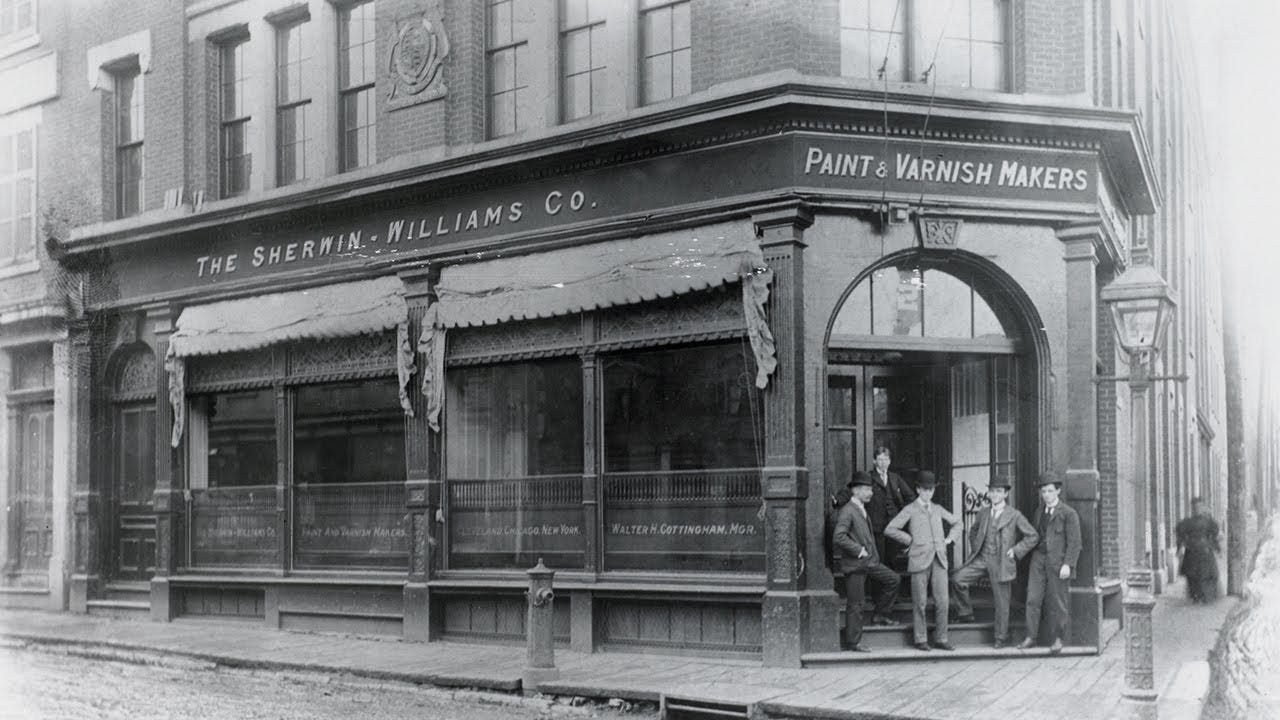
7. Sherwin-Williams ($SHW)

Sherwin-Williams makes and sells architectural paint.

They also own the vast majority of Sherwin-Williams stores throughout the U.S.

  • Founded: 1866

  • IPO: 1964

  • History: Henry Sherwin and Edward Williams founded a paint company in Cleveland.

The History of Sherwin-Williams - YouTube

The Lindy Effect

  • Homes and buildings will always need paint.

  • Sherwin-Williams has one of the biggest paint distribution networks in the U.S.

  • Its large store network makes contractors choose Sherwin-Williams because there’s always a store nearby for supplies.

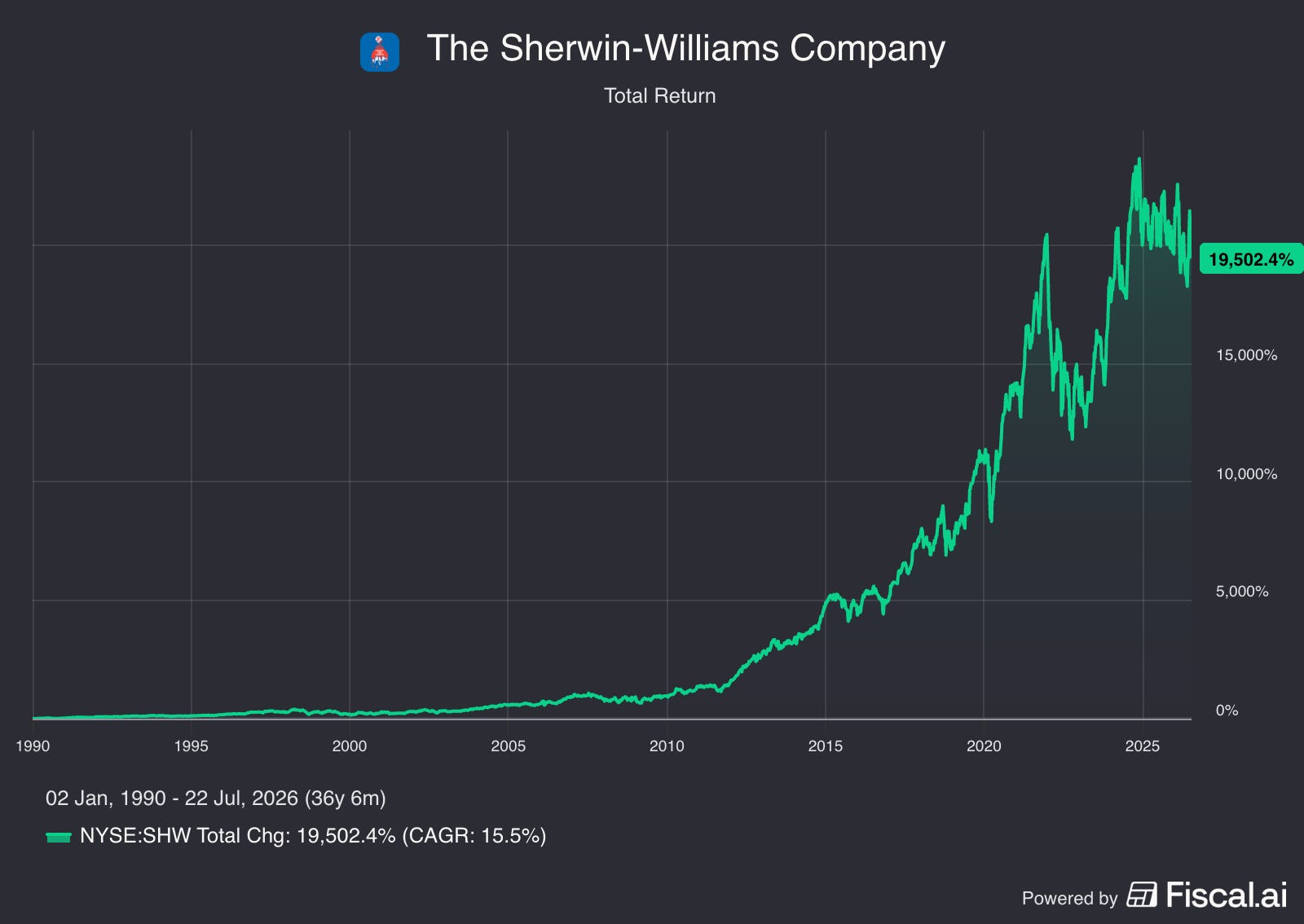
How Has Sherwin-Williams Performed?

The stock returned 15.5% (!) per year since 1990:

Source: Fiscal.ai

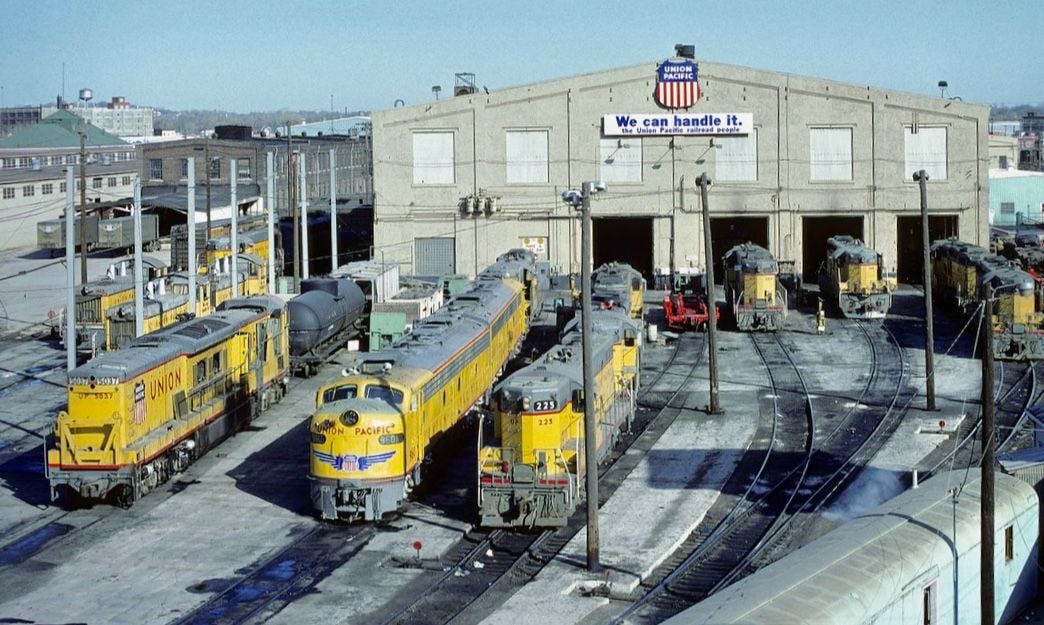
6. Union Pacific ($UNP)

Union Pacific runs freight trains across North America.

They transport raw materials and finished goods over thousands of miles.

  • Founded: 1862

  • IPO: 1897

  • History: Chartered under the Pacific Railway Act to build the eastern half of the first transcontinental railroad.

Pin by Eduardo Azevedo E Silva on Locomotivas A Diesel Americanas ...

The Lindy Effect

  • The economy depends on moving heavy goods.

  • Rail is one of the cheapest ways to transport freight.

  • Union Pacific’s rail network would be almost impossible to build today.

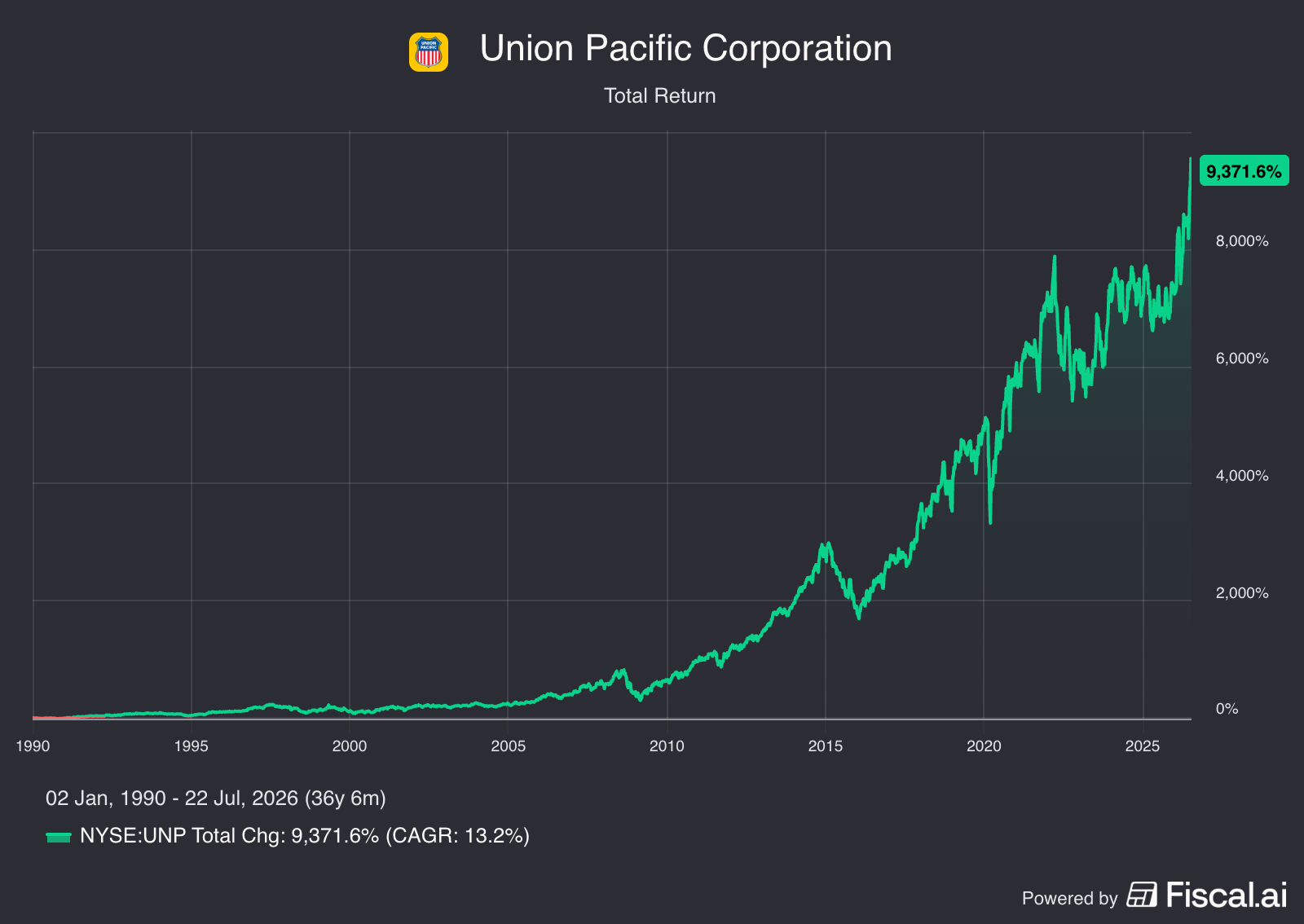
How Has Union Pacific Performed?

Union Pacific has returned more than 9.000% since 1990.

Source: Fiscal.ai

5. American Express ($AXP)

American Express issues credit cards and processes payments globally.

They control the entire transaction from the merchant to the consumer.

  • Founded: 1850

  • IPO: 1977

  • History: Started as an express-delivery (freight) company in Buffalo, NY, before moving into financial services.

American Express / Musée national de la Poste | Société historique

The Lindy Effect

  • People will always need a way to pay for things.

  • More cardholders attract more merchants, and vice versa.

  • American Express already has a strong network, and it becomes even stronger as it grows.

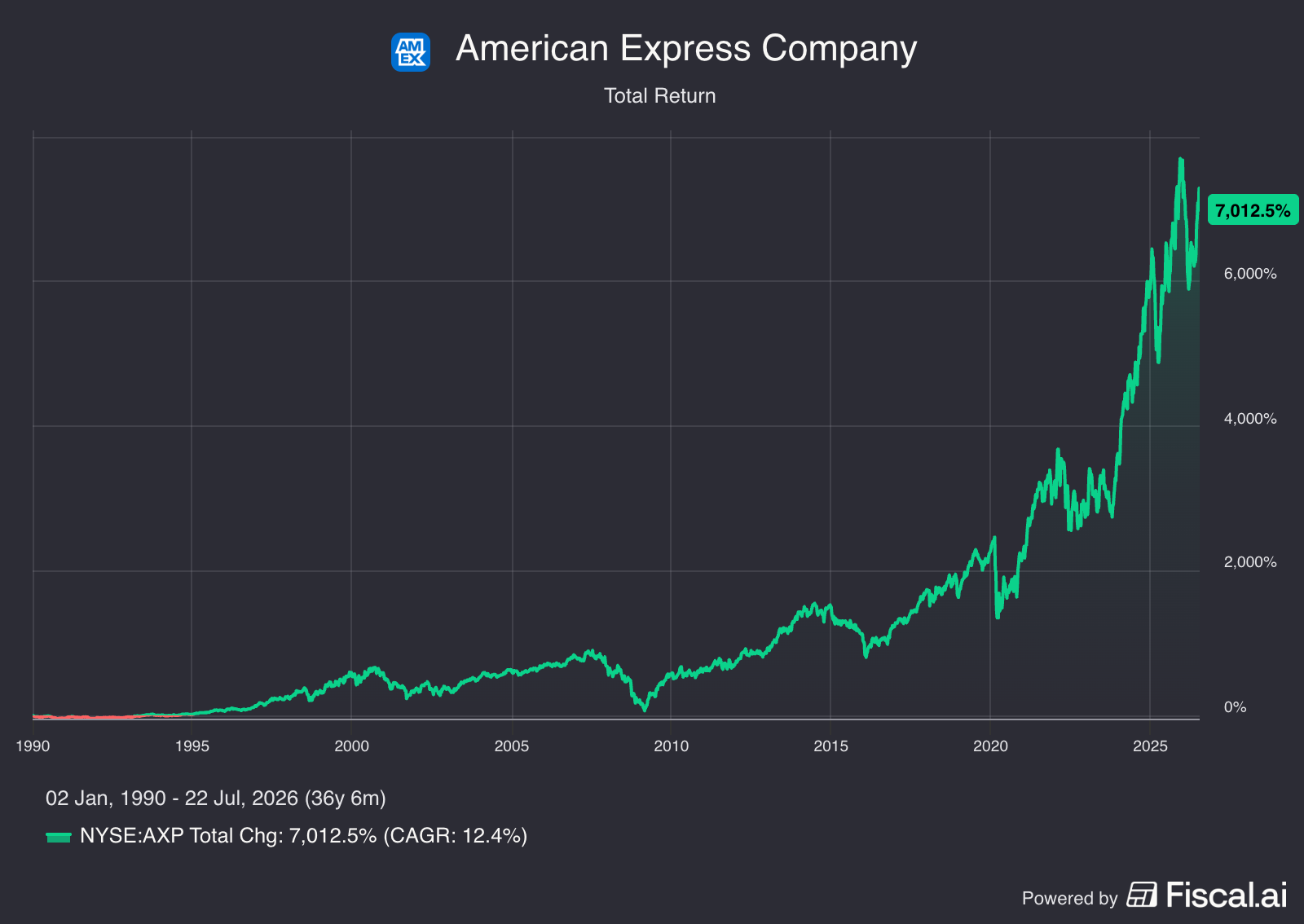
How Has American Express Performed?

American Express has returned more than 7,000% to shareholders since 1990.

Source: Fiscal.ai

4. Pfizer ($PFE)

Pfizer invents and manufactures prescription drugs and vaccines.

The medical system throughout the world relies on its products.

  • Founded: 1849

  • IPO: 1942

  • History: Cousins Charles Pfizer and Charles Erhart opened a fine-chemicals business in Brooklyn.

Pfizer Logo and symbol, meaning, history, sign.

The Lindy Effect

  • Medicines will always be needed.

  • Decades of research give Pfizer a competitive advantage.

  • Its large portfolio keeps cash flowing even as patents expire.

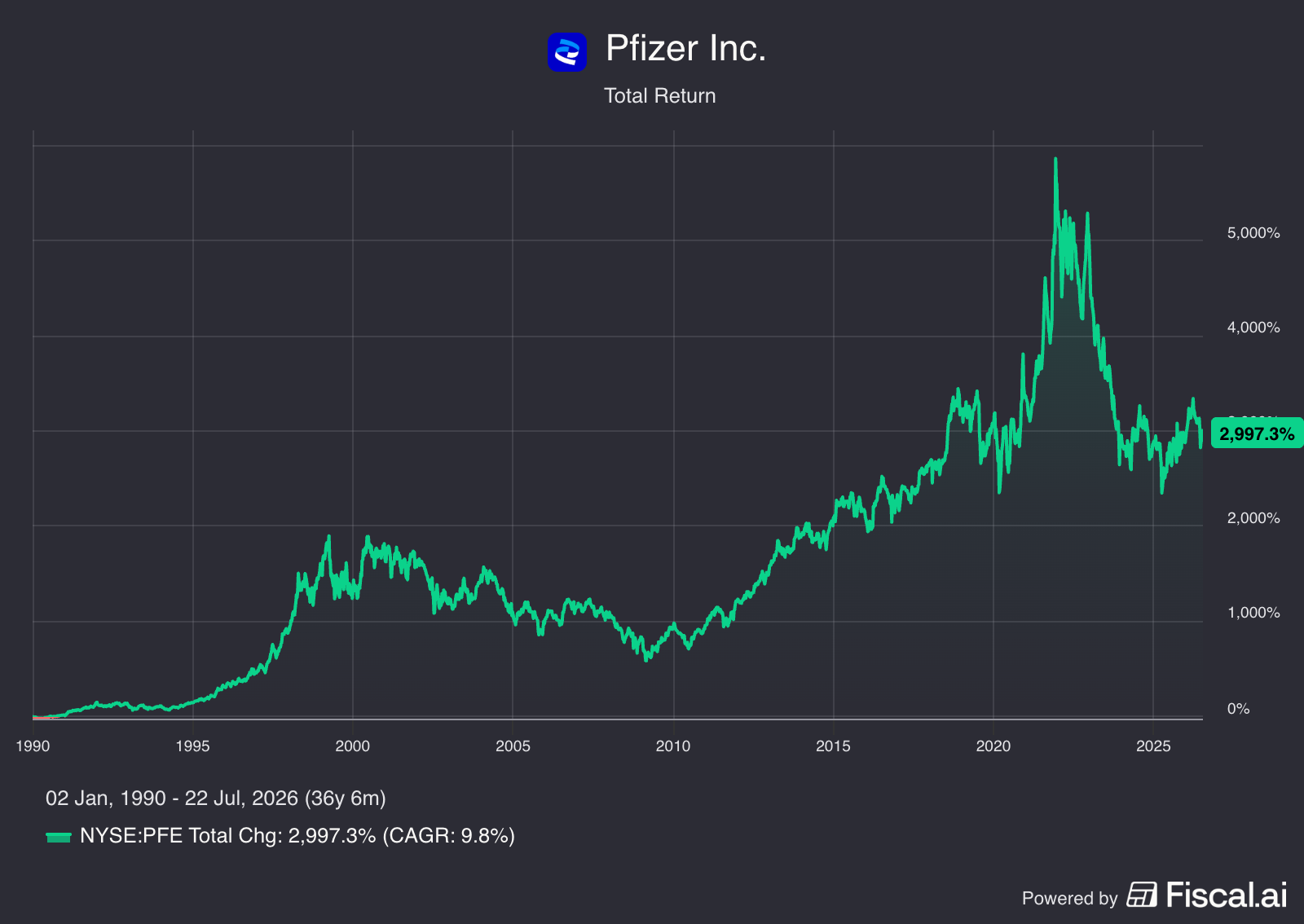
How Has Pfizer Performed?

Pfizer has returned 9.8% per year on average since 1990.

Source: Fiscal.ai

Now let’s dive into the top 3 and the conclusion.

Read more

ETF Portfolio Update July 2026

30 July 2026 at 14:51

You want to invest in companies that generate a lot of cash.

But you know what’s even better?

Companies that:u

  1. Generate a lot of cash

  2. Are growing attractively

  3. Trade at cheap valuation levels

The good news is you can easily achieve this via some well-chosen ETFs.

Subscribe now

4,200+ Etf Stock Photos, Pictures & Royalty-Free Images - iStock

The Buffett Mindset

When you look at a ticker on a screen, it’s easy to forget what you’re actually buying.

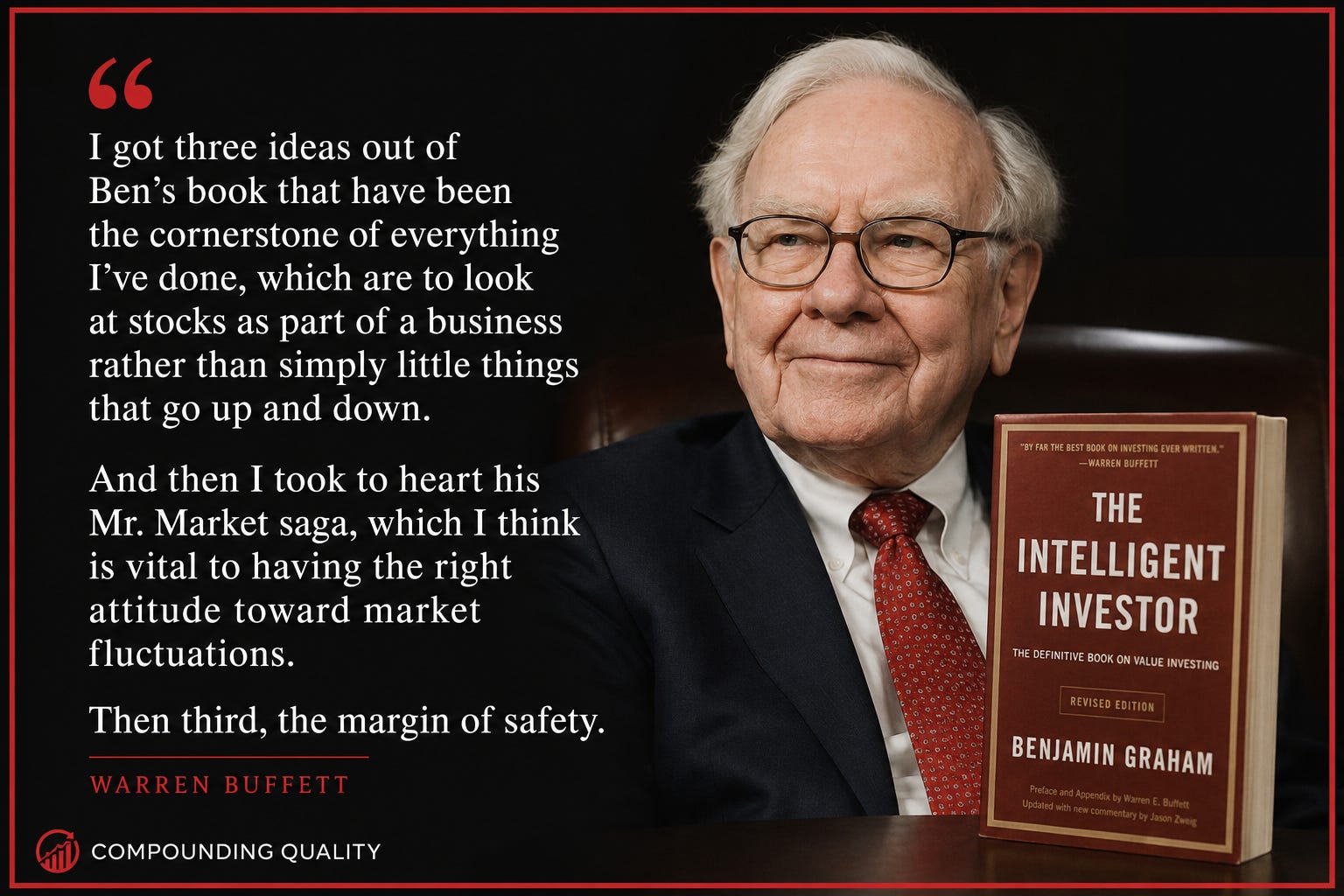
Warren Buffett has called The Intelligent Investor by Ben Graham the best investing book ever written.

Here are the three most important takeaways:

The most important thing?

When you buy a stock, you become the owner of that company.

It’s like buying a part of your local butcher across the street.

And it also means: if you buy 1 share of a company, you should be willing to buy the entire business if you had the money.

So just imagine you buy 1 share of Apple today.

In that case, you would be willing to buy the entire company for $4.6 trillion and you think it’s worth more than that.

PS If you have $4.6 trillion available, please send me a DM.

I’m just kidding of course… Or not? 😉

What’s the Purpose of a Business?

If owning a stock makes you a business owner, it’s worth asking what the purpose of a business is.

I think the easiest way to answer this is to think about a small, local business.

You probably have a gas station or convenience store in your town.

Let's use this as an example.

Download Gas Station Pictures | Wallpapers.com

The owner runs the business to make sure your car is fueled with gas, and that you’re fueled with coffee or snacks.

But the real purpose?

To sell you those things so that the owner earns an income.

Which, of course, means cash.

A business can look profitable on paper…

But if it has to reinvest every dollar into inventory or repairing gas pumps, it's not a great business.

Why would you want to own it?

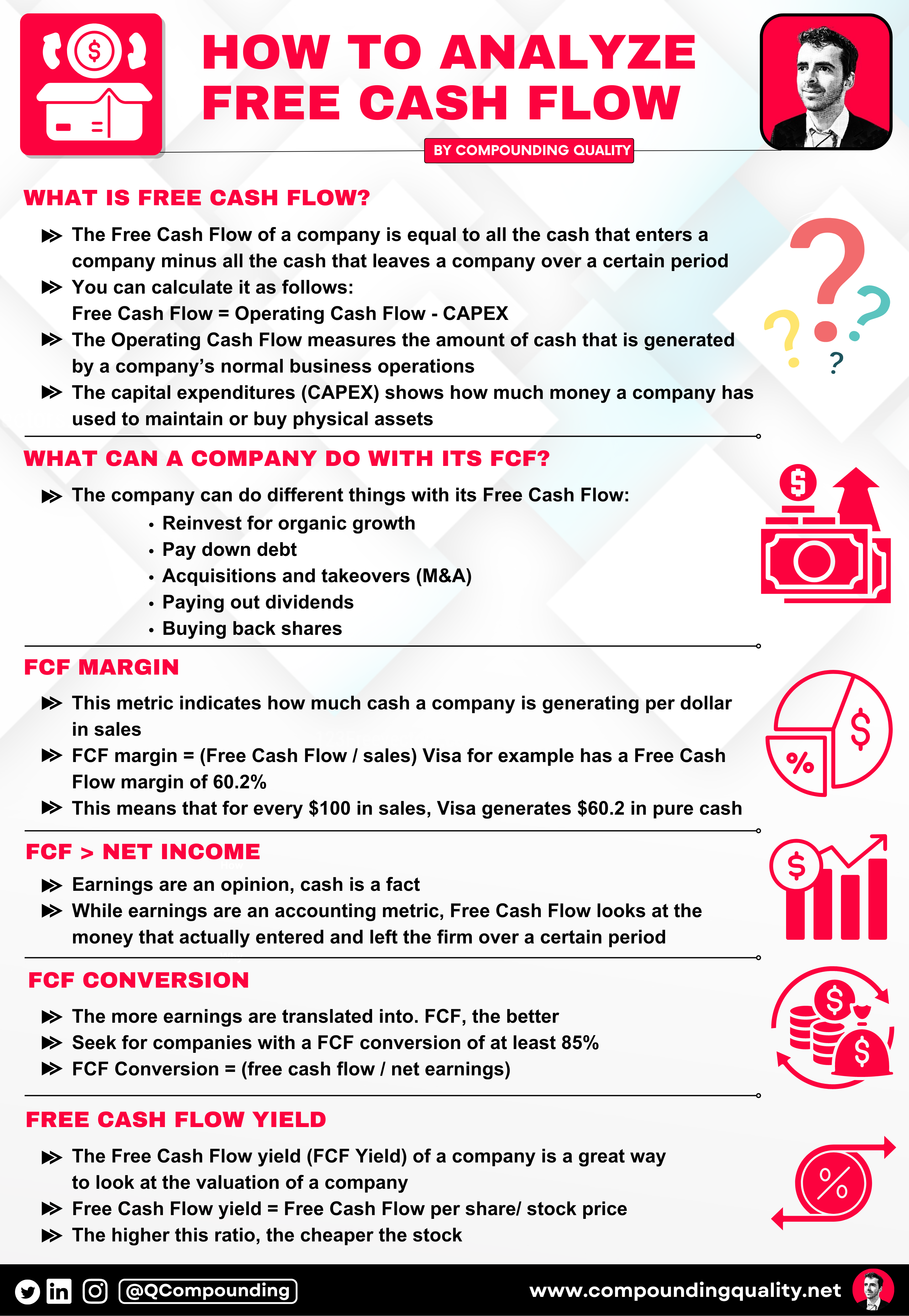
As an investor, you want businesses that produce a lot of Free Cash Flow (FCF).

Free Cash Flow is the real cash a company generates after deducting all expenses.

It’s basically all cash that comes in minus all cash that goes out.

Two ways to win

The beauty of being an investor?

You have more than one way to win.

A business owner makes more money when the business becomes more profitable.

But as an investor, you can win in two ways:

  • More profit: The business grows its earnings.

  • Higher valuation: The market decides to pay more for those earnings (e.g., the P/E ratio goes up).

More profit

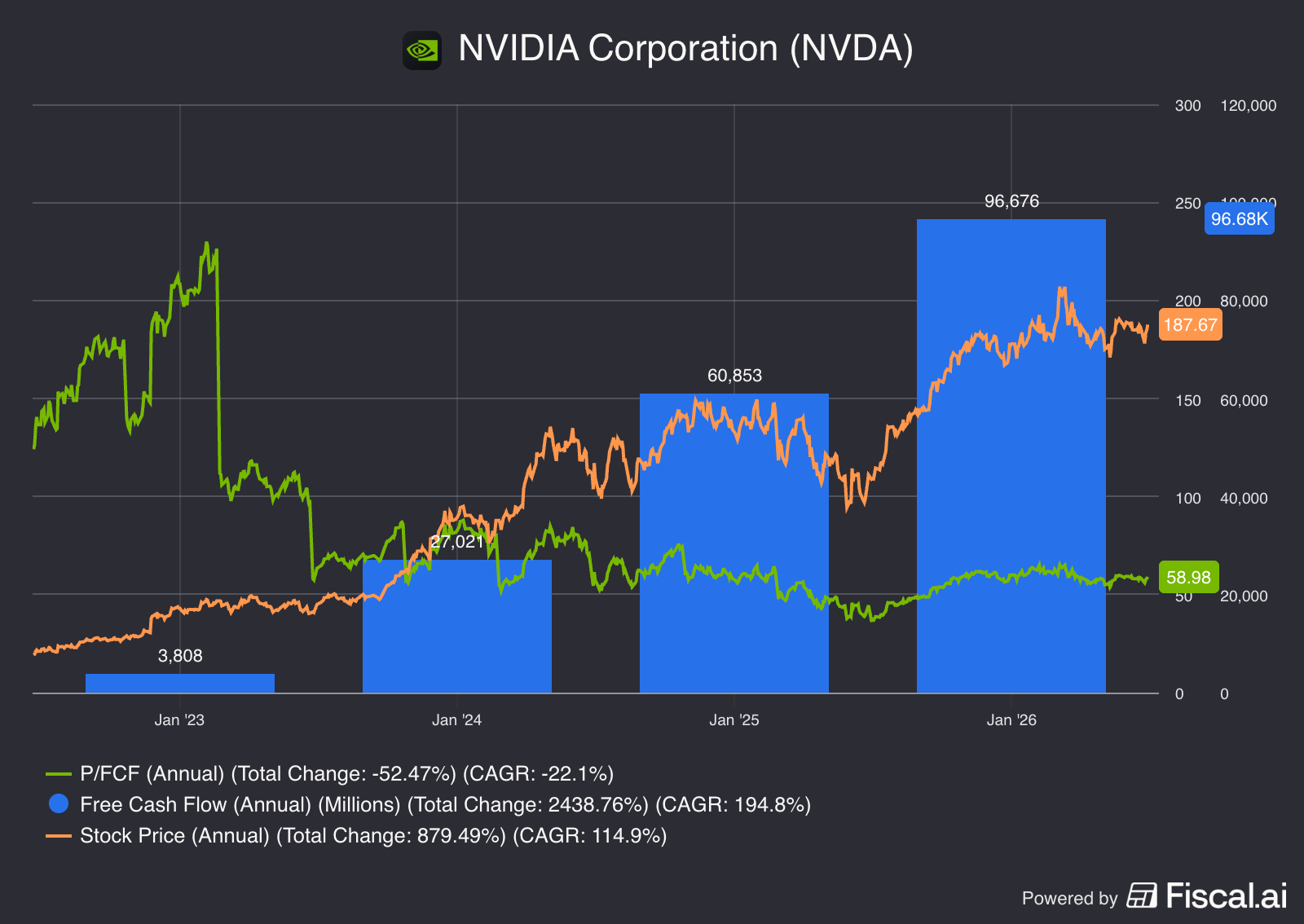
Nvidia's stock surged nearly 900% between 2023 and 2025.

That's despite its P/FCF multiple falling from over 100x to 58x.

The reason? Free cash flow grew by almost 25x (+2,500%).

Source: Fiscal.ai

Multiple Expansion

But a stock can also go up without profits growing.

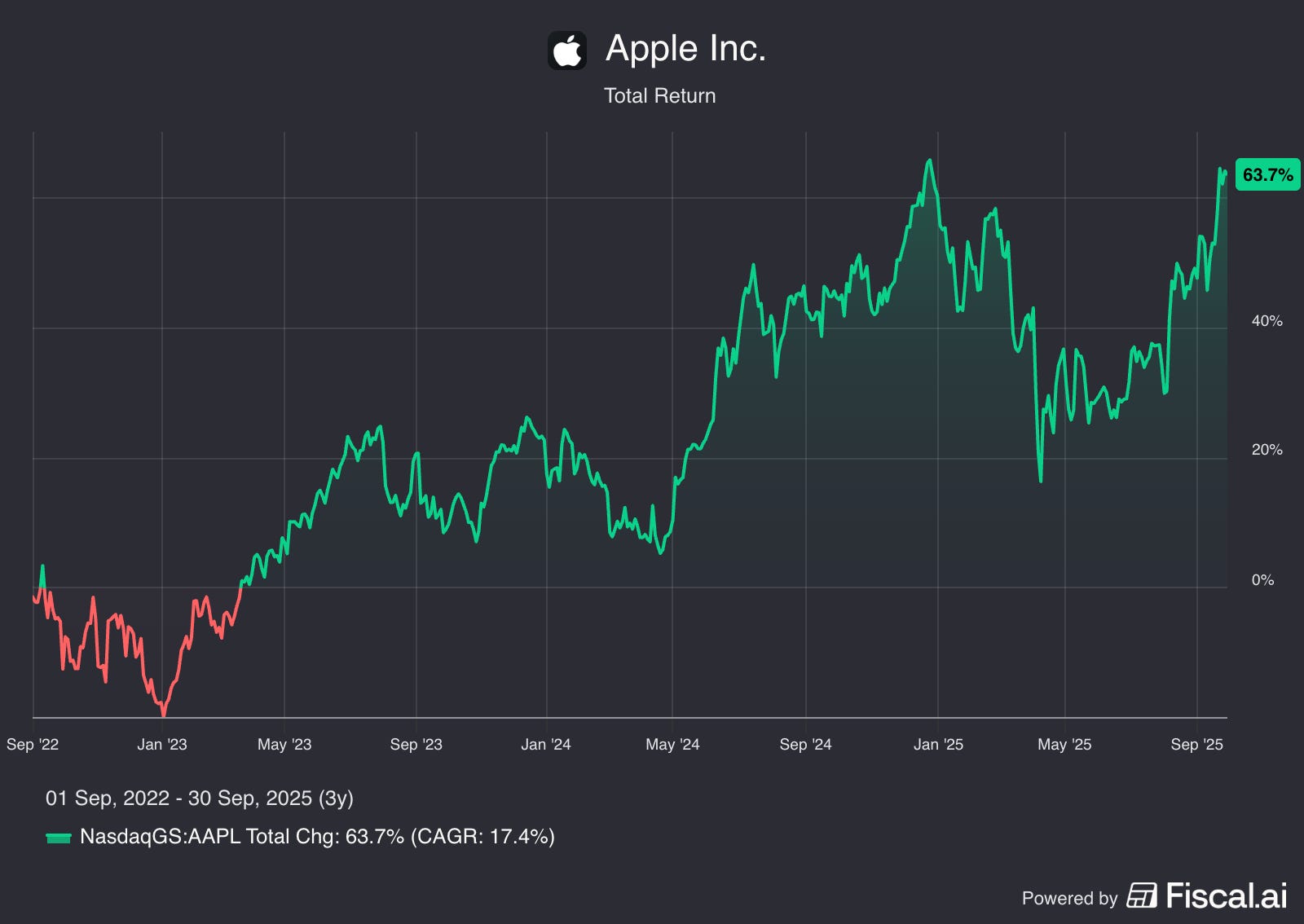
Just take Apple from 2022 to 2025.

The stock went up more than 60% during that period:

Source: Fiscal.ai

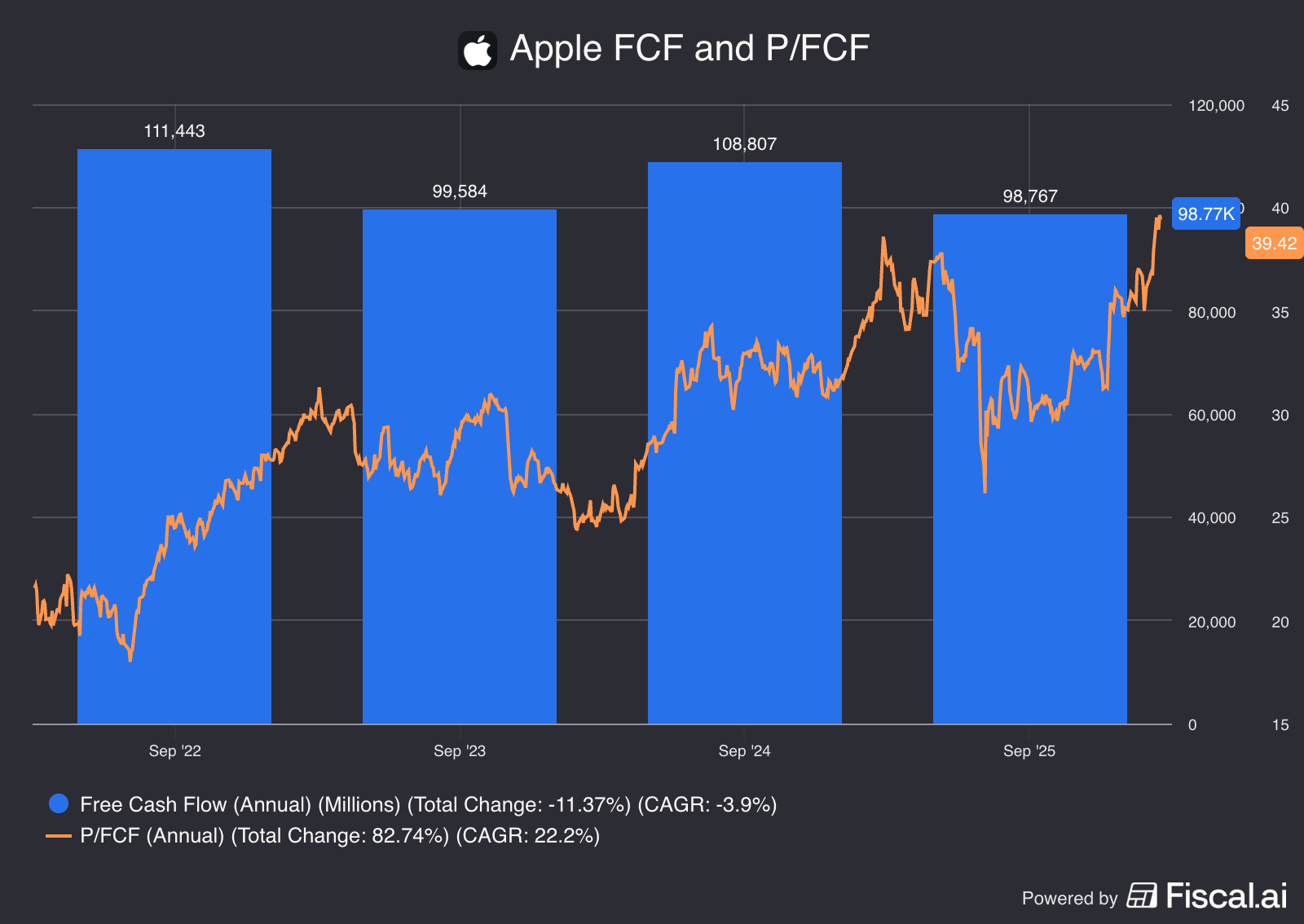
But Free Cash Flow went down during the same period.

What happened?

The answer is multiple expansion.

The market decided that instead of being worth 20x cash flow, Apple was worth 40x.

In other words: the valuation of Apple doubled.

Source: Fiscal.ai

The Twin-Engines of Returns

But what if both engines fire together? That’s where magic happens.

In his book 100 Baggers, Chris Mayer calls this the ‘twin-engines’ of wealth creation.

  • Engine 1: High earnings growth (like Nvidia).

  • Engine 2: Multiple expansion (like Apple).

When you buy a cheap, growing company, you benefit from both rising cash flows and an expanding valuation multiple.

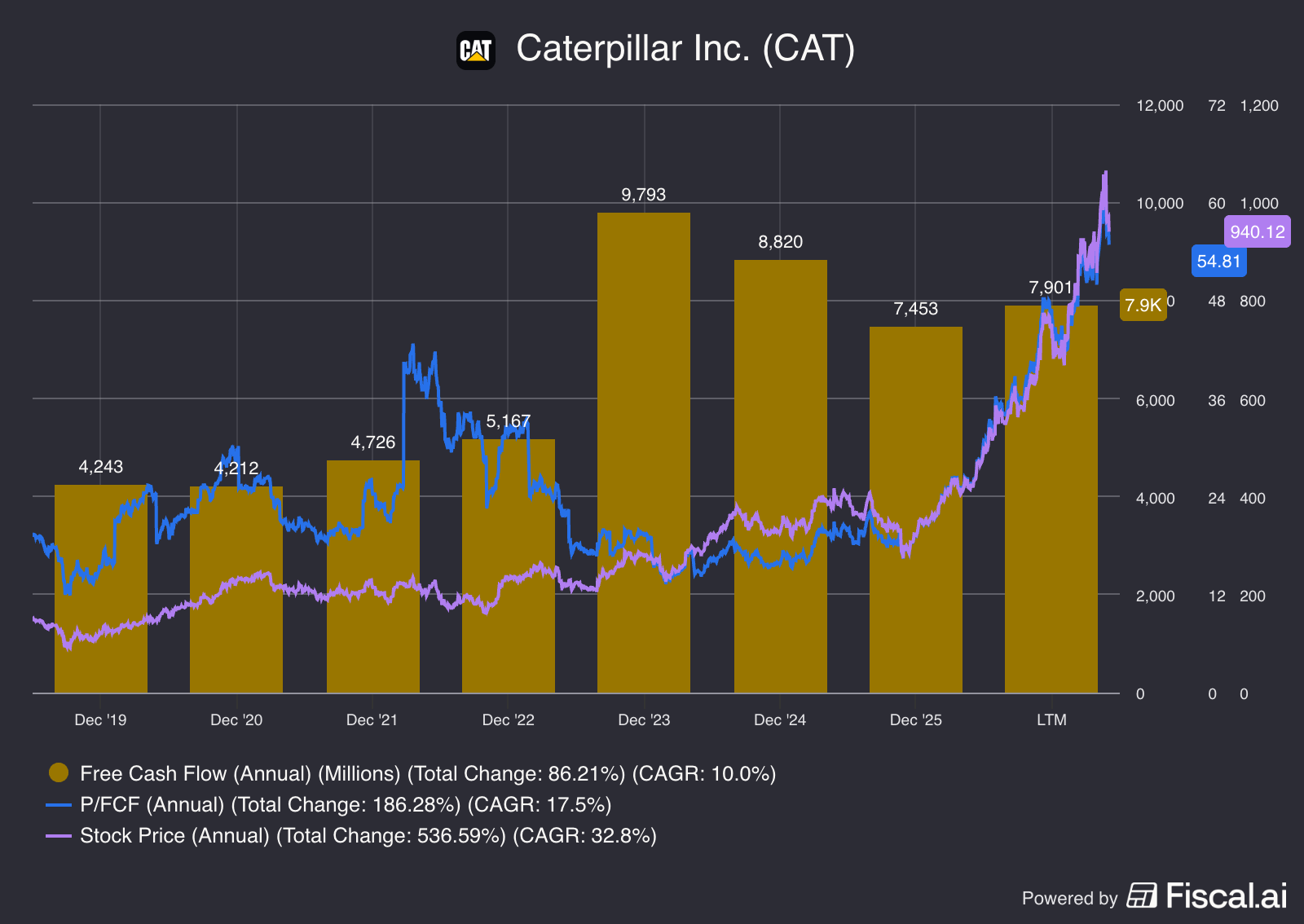
That’s what happened to Caterpillar ($CAT) from 2019 to today.

  • Free Cash Flow: +86%

  • Multiple: +186%

  • Stock Price: +536%

High earnings growth + multiple expansion is the golden goose for you as an investor.

Source: Fiscal.ai

To summarize

  • Stocks are pieces of businesses.

  • Businesses exist to generate cash.

  • Investors make money in two ways:

    • When the business generates more cash

    • When the market is willing to pay a higher multiple for that cash.

  • Combining growth with an attractive valuation gives you two powerful engines for compounding.

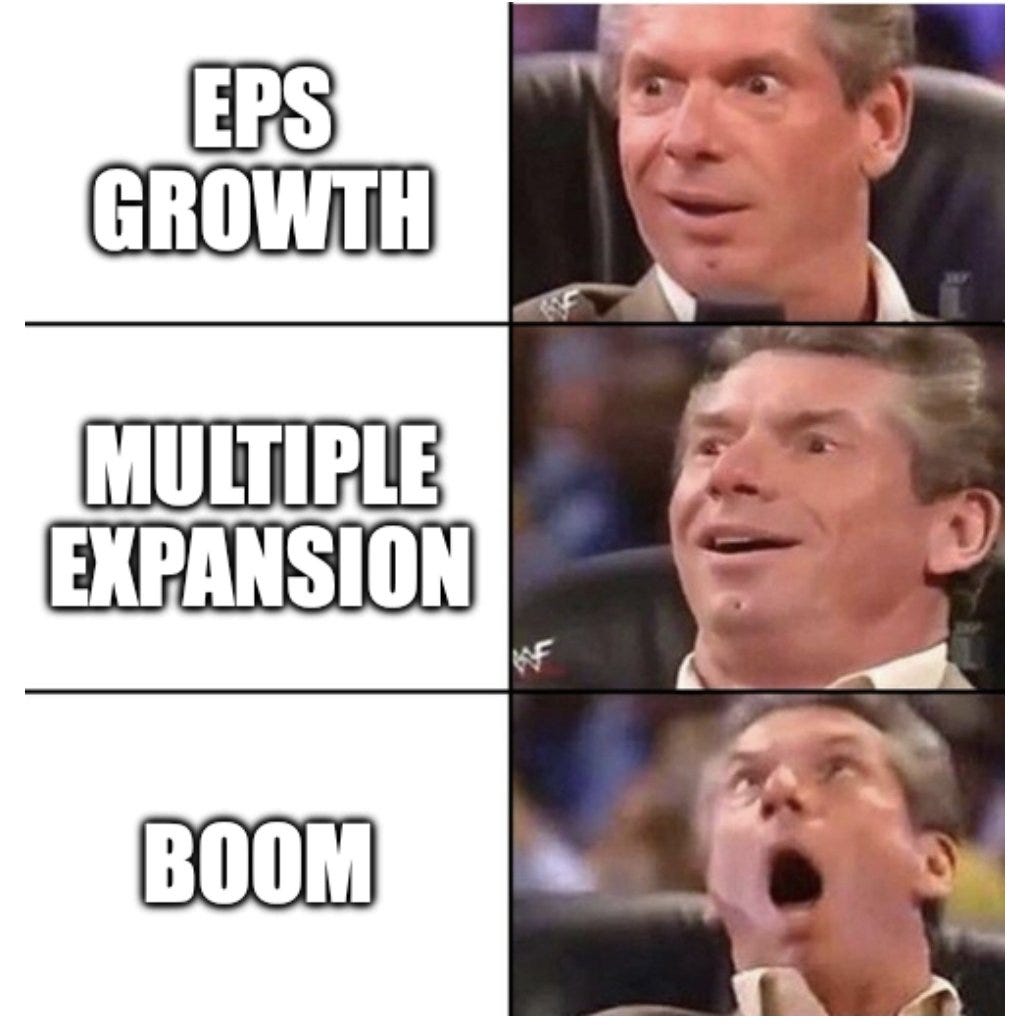
MicroCapClub on X: "You make the most by finding growth in value right  before it shows up in the fundamentals. EPS Growth + Multiple Expansion =  💥 https://t.co/6au0Ivgl73" / X

Wouldn’t it be interesting to buy an ETF that captures exactly these characteristics?

The good news is that you can.

⭐ ETF of the Month

VictoryShares Free Cash Flow ETF (VFLO)

Key Information

  • Name: VictoryShares Free Cash Flow ETF

  • Ticker: VFLO

  • Total Expense Ratio: 0.39%

  • Physical/Synthetic ETF: Physical

What?

The ETF invests in large companies in the United States with a specific set of characteristics:

  1. High Free Cash Flow Yield

  2. Strong forward growth

You might be wondering how this works in practice.

The ETF starts with the VettaFi US Large Cap Free Cash Flow Index.

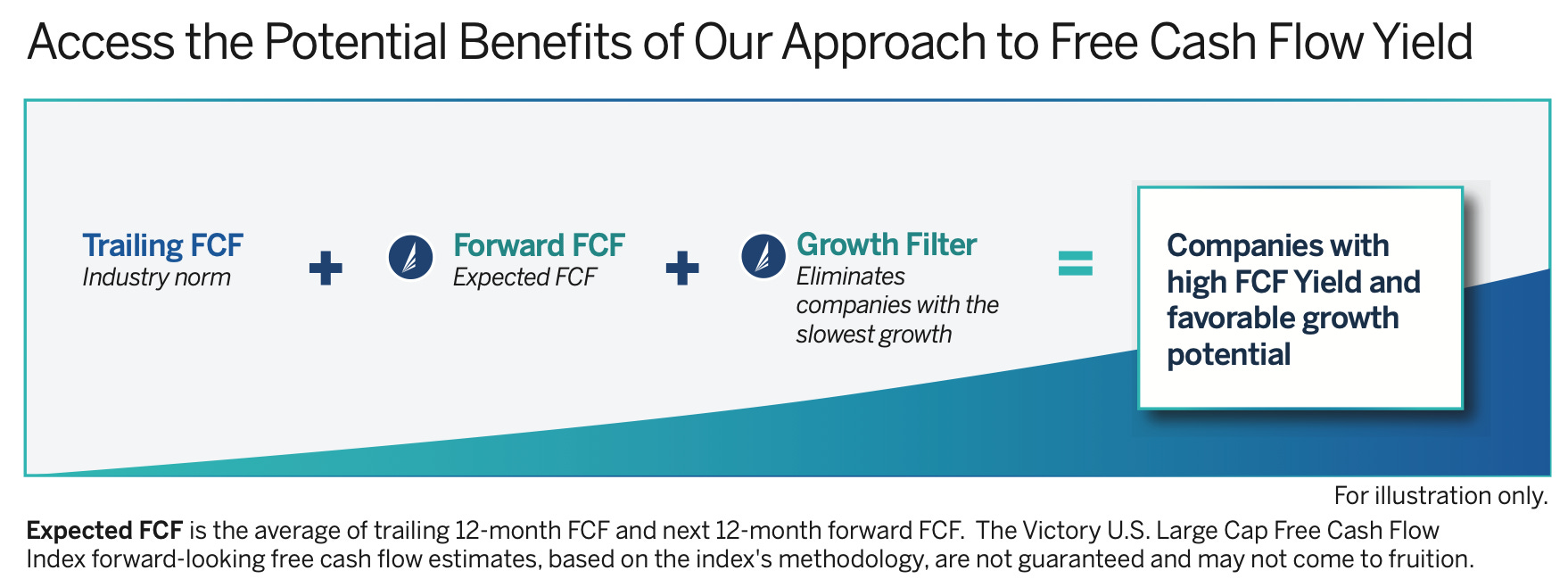
Afterwards, it applies a two-step filter:

  1. Value: It finds companies generating the most free cash flow relative to their enterprise value

  2. Growth: It screens out companies with the lowest expected growth

Source: Victory Capital

Why?

Buying the cheapest companies with the highest expected growth gives us the best chance to let our two favorite return engines work together:

  • Attractive growth

  • Room for multiple expansion

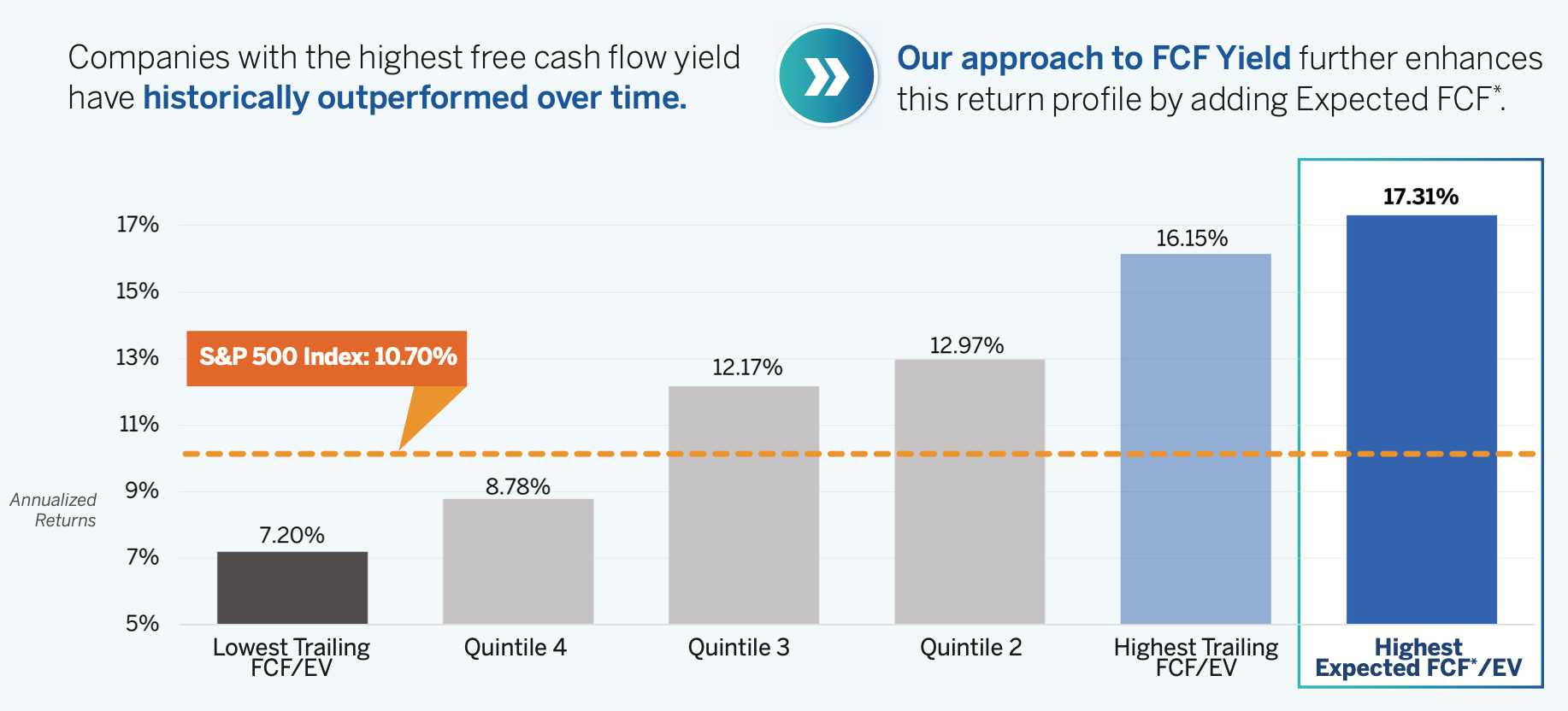
Historically, this strategy has worked very well.

Companies with the highest expected FCF/EV had a return of 17.3% (!) per year:

Source: Victory Capital

Sector Split

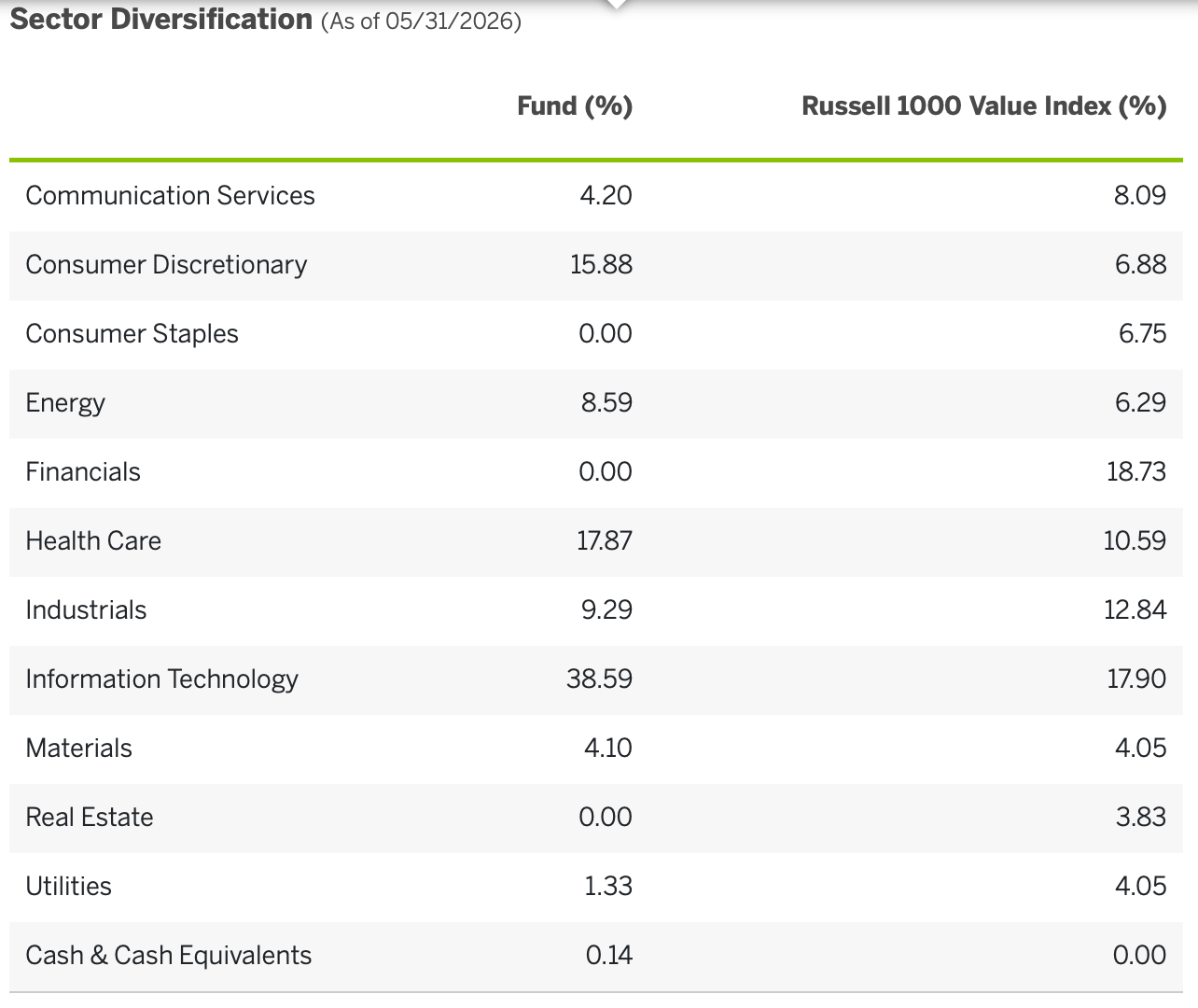
Here’s the sector breakdown of the ETF.

The three largest sectors are Information Technology (38.6%), Health Care (17.9%) and Consumer Discretionary (15.9%).

Source: Victory Capital

Top Holdings

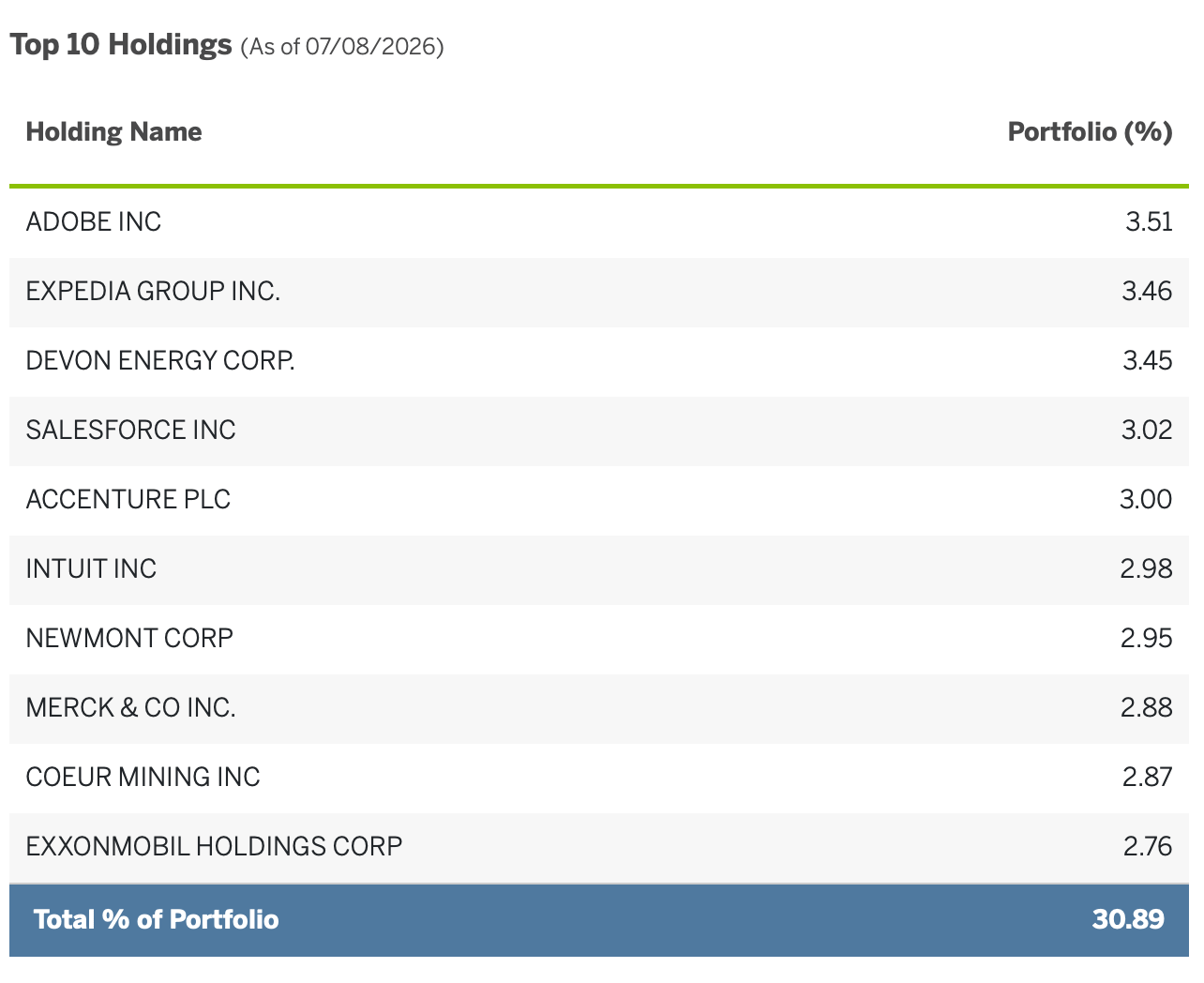
Here are the top 10 holdings of VFLO:

Source: Victory Capital

ETF Portfolio Update: July 2026

Now let’s dive in Our ETF Portfolio Update.

Our Portfolio is a great mix of ETFs that should be able to outperform in the long term.

We use multiple factors that tend to do well:

👑 Quality: Only invest in companies that have already won
📏 Size: The smaller the better
🚀 Multifactor: Quality, size, value & momentum
🌏 Emerging Markets: Small exposure to Emerging Markets

Let’s now dive into the ETF Portfolio itself.

You have 24/7 access to the ETF Portfolio here:
Read more

10 Stocks for the next 20 years

2 July 2026 at 18:13

Hi Partner 👋

I have a question for you…

… What if you had to buy 10 stocks, but you couldn’t sell any of them over the next 10 years?

It’s such a great thought exercise everyone should do once in a while.

In the past, Pieter already made a list with 10 stocks to own forever. You can find it here.

Today, TJ is doing the same.

Let’s dive in right away.

Pieter (left) and TJ (right) at the Berkshire AGM

The Community

The Compounding Quality community is an amazing place.

Thousands of investors gather every single day to discuss stock and investment ideas.

Recently, Alan asked this question:

Just imagine you receive a large lump sum of money.

It comes with one rule: you must invest it in 10 individual companies (no ETFs).
The portfolio then goes into a trust that you can’t touch or change for 20 years.

Dividends are reinvested automatically.

And if a company gets acquired, you automatically receive an equal value of shares in the company that buys it.

It’s a very interesting exercise.

Because with this structure in place…

You won’t be focused on making the most money.
You will be focused on avoiding big mistakes.

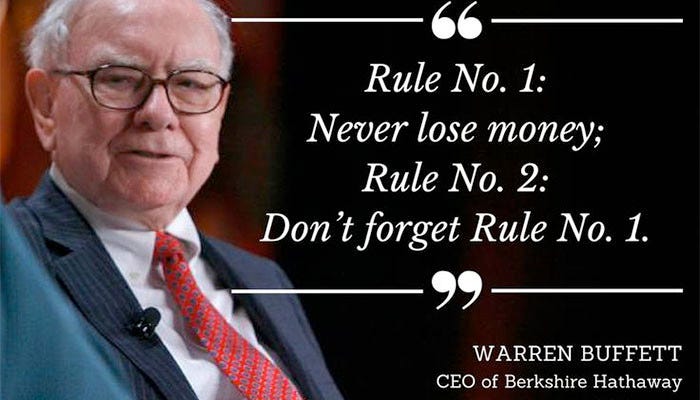
It’s all about following Warren Buffett’s most famous rule:
Warren Buffett once said: "The first rule of an investment is don't ...

Now let me show you the 10 companies I would buy and ignore for 20 years!

10. W.W. Grainger ($GWW)

How does the company make money?

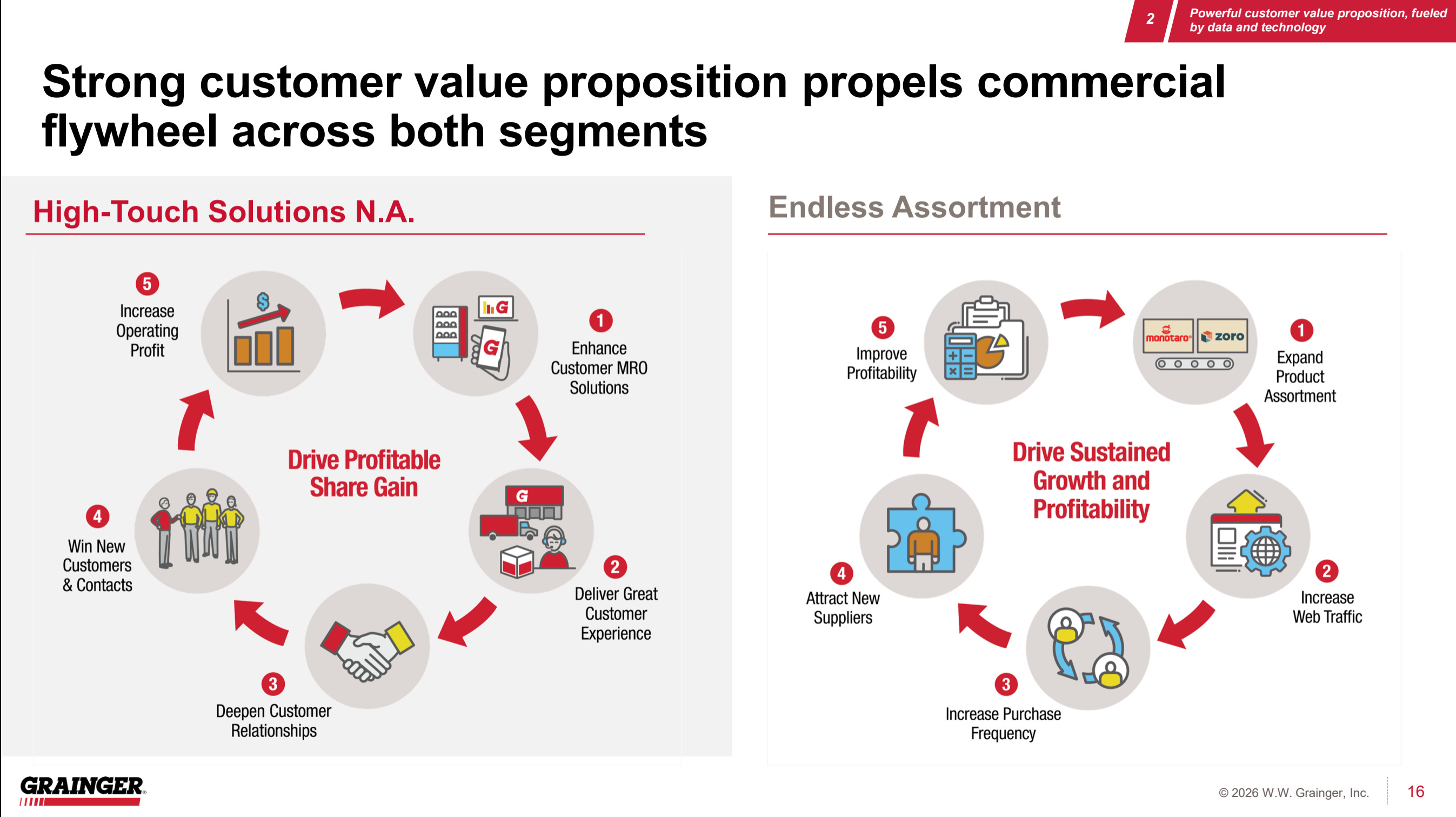
Grainger sells maintenance, repair, and operating (MRO) supplies. They sell everything from safety goggles to industrial motors.

Their products are offered to millions of businesses and institutions globally.

Source: Grainger Investor Relations

Why will it still be relevant 20 years from now?

  • Their huge size and wide distribution network keep costs low. They also carry the largest selection of products, making them a one-stop shop for complex operations.

  • Grainger is built deeply into B2B supply chains and corporate facility maintenance.

  • Physical businesses will always need tools, spare parts, and safety equipment to keep their facilities running.

9. Sherwin-Williams ($SHW)

How does the company make money?

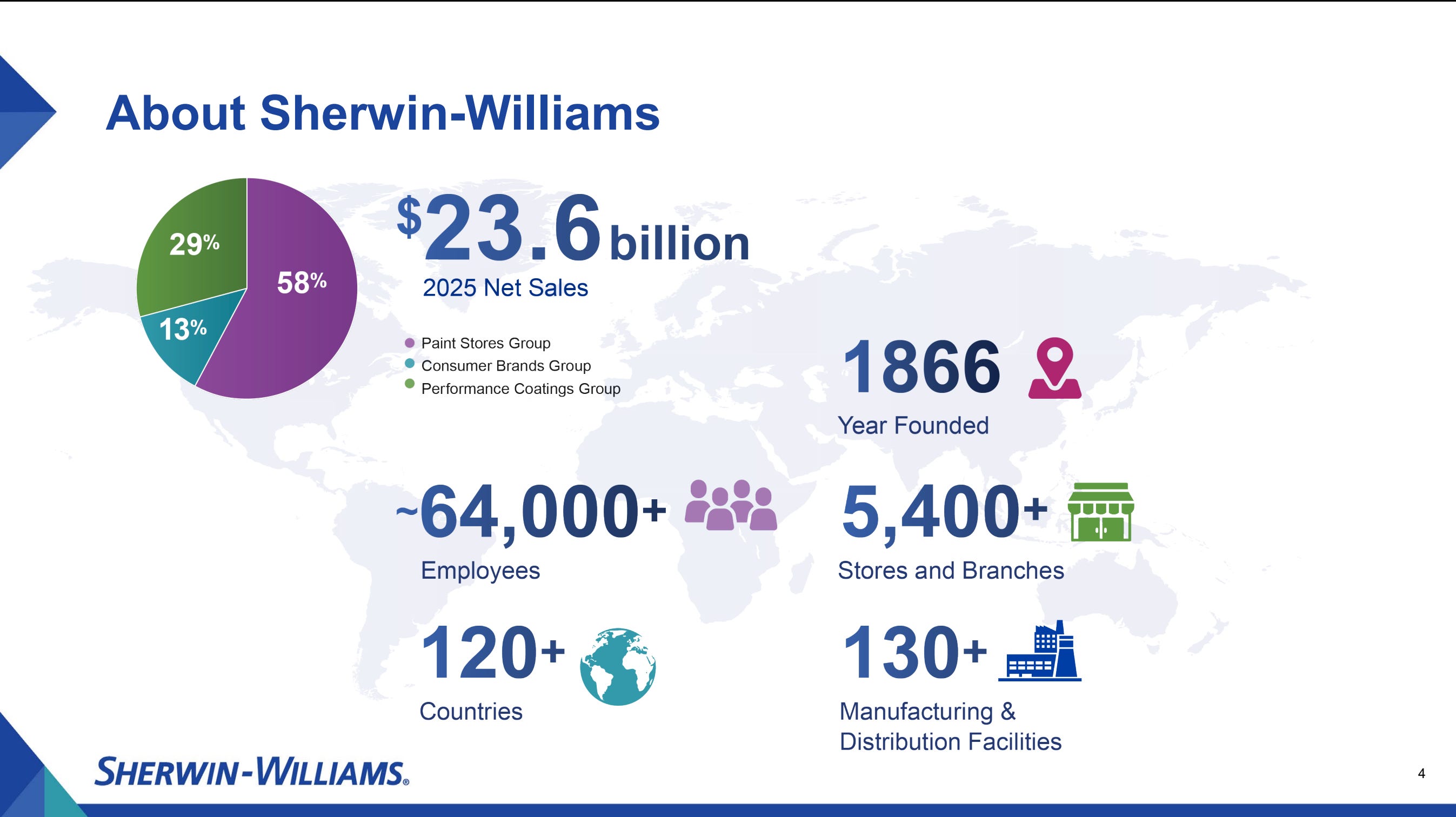
Sherwin-Williams manufactures and distributes paint, coatings, and related supplies.

They do this largely through their massive, localized network of company-owned stores tailored directly to professional contractors.

Source: Sherwin-Williams Investor Relations

Why will it still be relevant 20 years from now?

  • Paint and protective coatings will always be needed to maintain the world’s infrastructure and housing.

  • Like Grainger, their distribution network is nearly impossible for new competitors to copy.

  • Time is money for professional painters and contractors, and one of Sherwin-Williams’ 5,400 stores is always nearby. This keeps pros very loyal to the company’s products.

8. Cintas ($CTS)

How does the company make money?

Cintas makes money by renting and cleaning corporate uniforms and floor mats.

Furthermore, they are restocking restroom and first-aid supplies for businesses.

Source: Cintas Investor Relations

Why will it still be relevant 20 years from now?

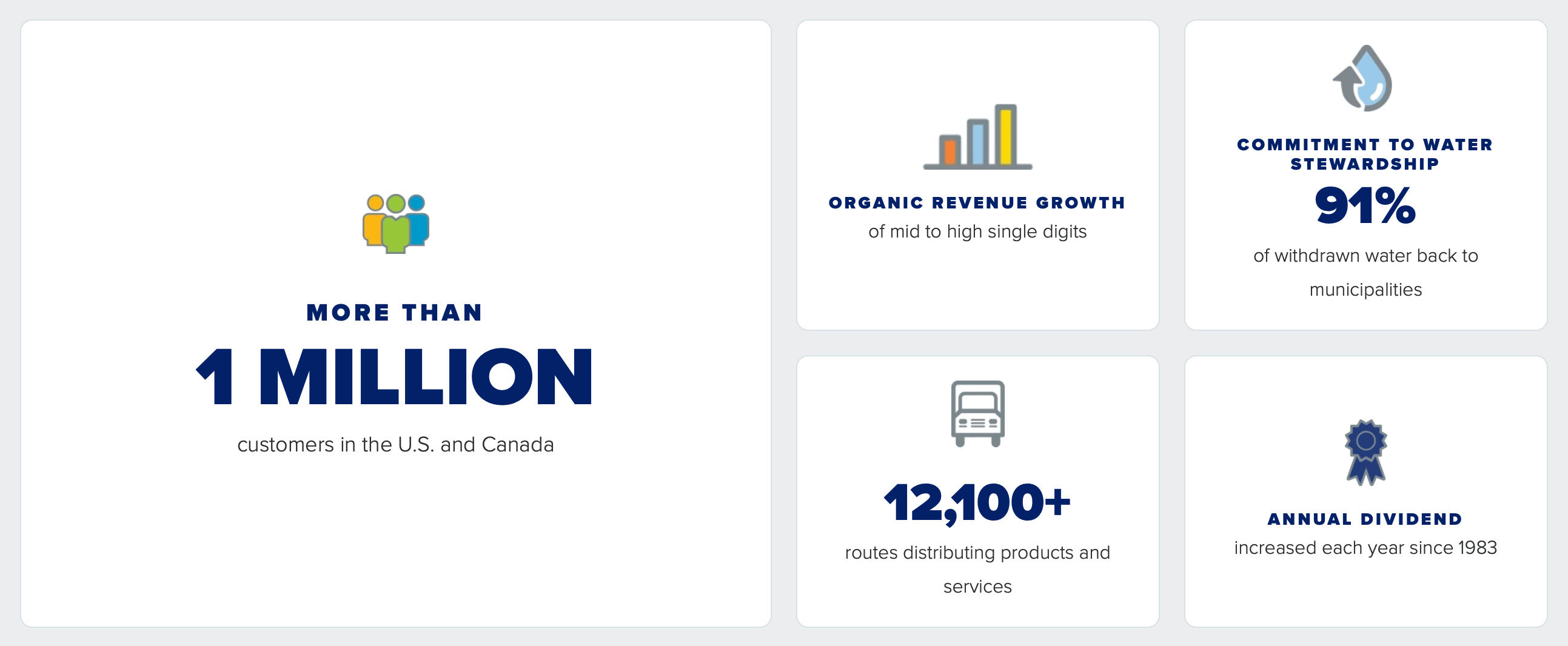
  • This is another business with huge local scale. Cintas runs more than 12,000 routes.

  • Once a company becomes a customer, it rarely leaves. Cintas makes life easy for facility managers, and its size keeps costs low.

  • As long as workplaces exist, they’ll need clean uniforms, safety gear, and restroom and cleaning supplies.

7. Rollins ($ROL)

How does the company make money?

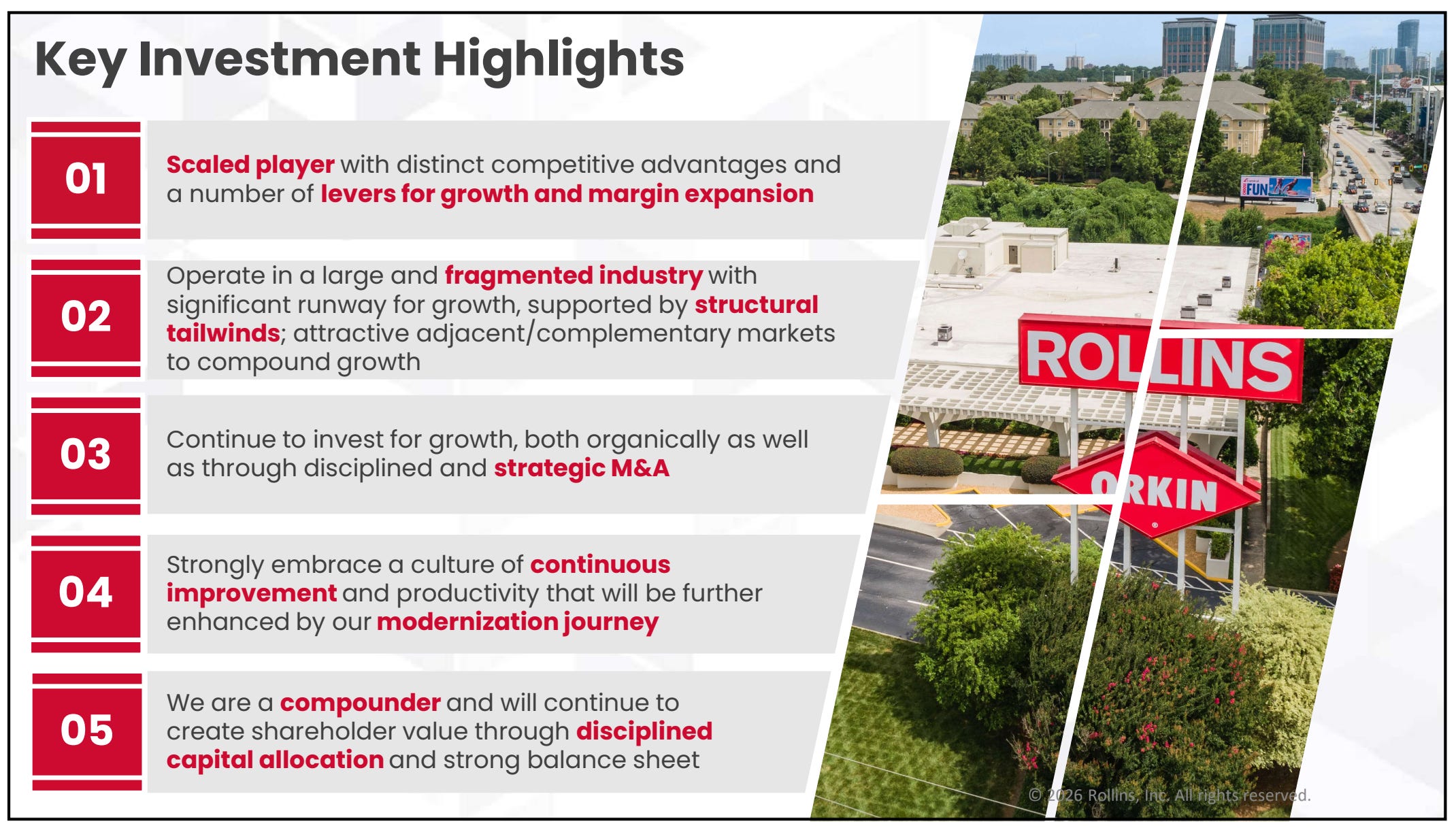
Rollins (the parent company of Orkin) provides pest control services to residential and commercial customers.

They do this through a recurring subscription model.

Source: Rollins Investor Relations

Why will it still be relevant 20 years from now?

  • Pests like termites, rodents, and insects aren’t going away. They need treatment again and again.

  • This business holds up in a recession. Homeowners and companies cut almost everything else before they cancel pest control.

  • The industry is still split among many small players. Rollins keeps buying them up, and has decades of growth ahead.

6. S&P Global ($SPGI)

How does the company make money?

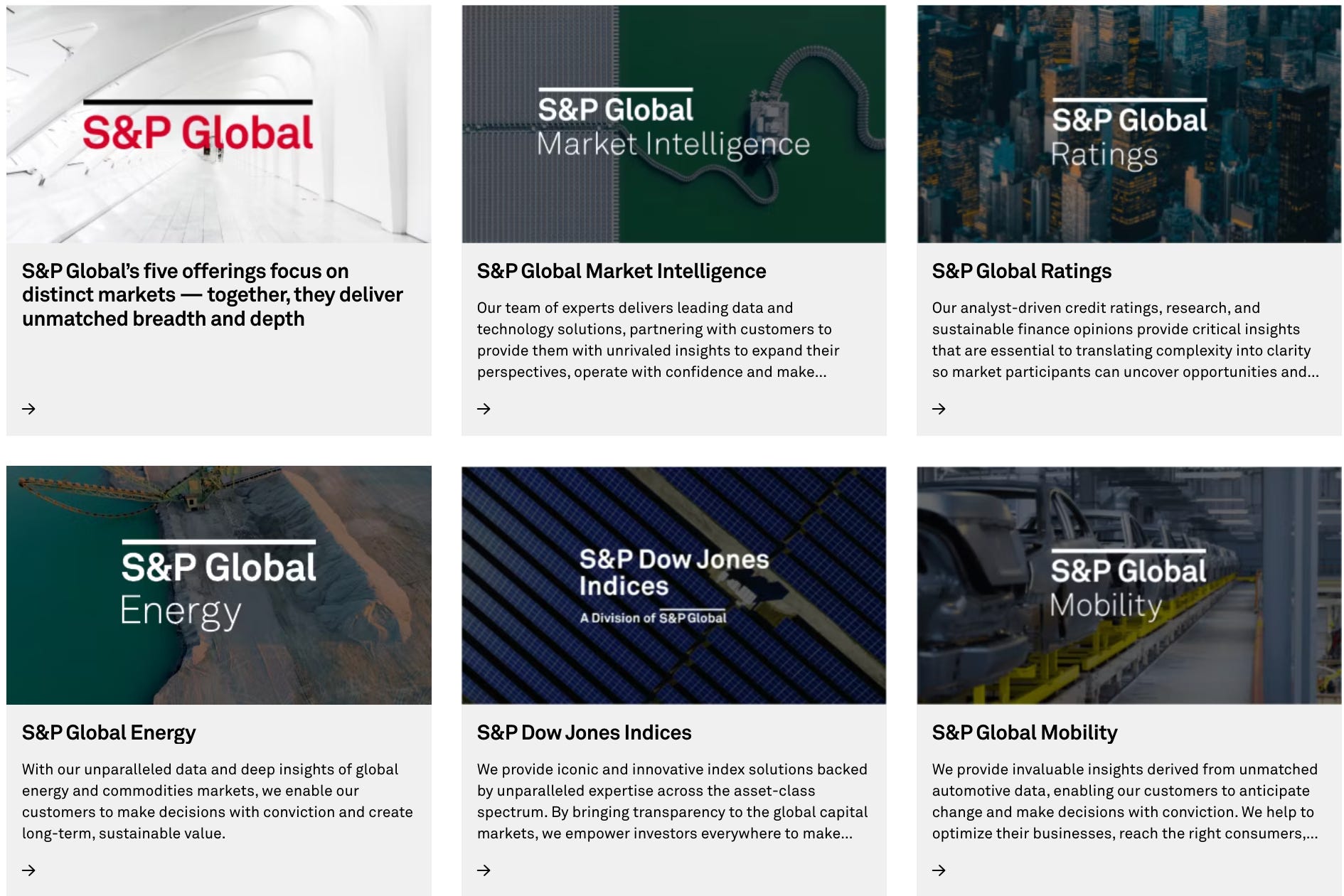
S&P Global provides credit ratings, financial benchmarks (such as the S&P 500 index), and data analytics to the global capital markets.

Source: S&P Global

Why will it still be relevant 20 years from now?

  • The company is one of just a few big players that dominate the world market.

  • Companies that borrow money need credit ratings. The global financial system can’t work without them.

  • As long as capital markets exist, S&P Global will take a cut of financial data and transactions.

5. Mastercard ($MA)

How does the company make money?

Mastercard operates the world’s largest digital payment networks.

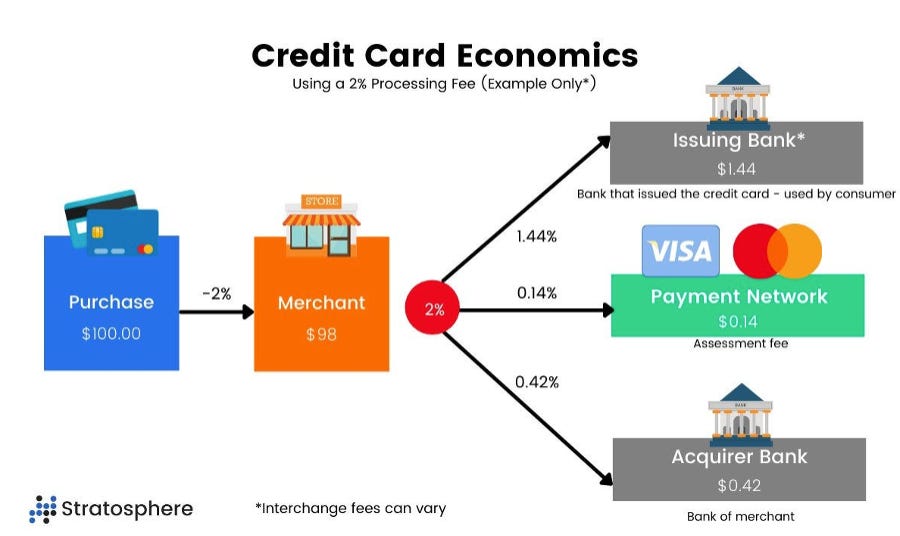
They earn a tiny fraction of a cent (and a percentage of the transaction) every time a card is swiped, inserted, or tapped globally.

Source: Fiscal.ai

Why will it still be relevant in 20 years from now?

  • Mastercard’s network feeds itself. Merchants accept it because shoppers use it, and shoppers use it because merchants accept it.

  • Mastercard takes no credit risk. It just runs the toll road that global payments flow through.

  • The world keeps moving away from cash, and that pushes more and more payments onto Mastercard’s network.

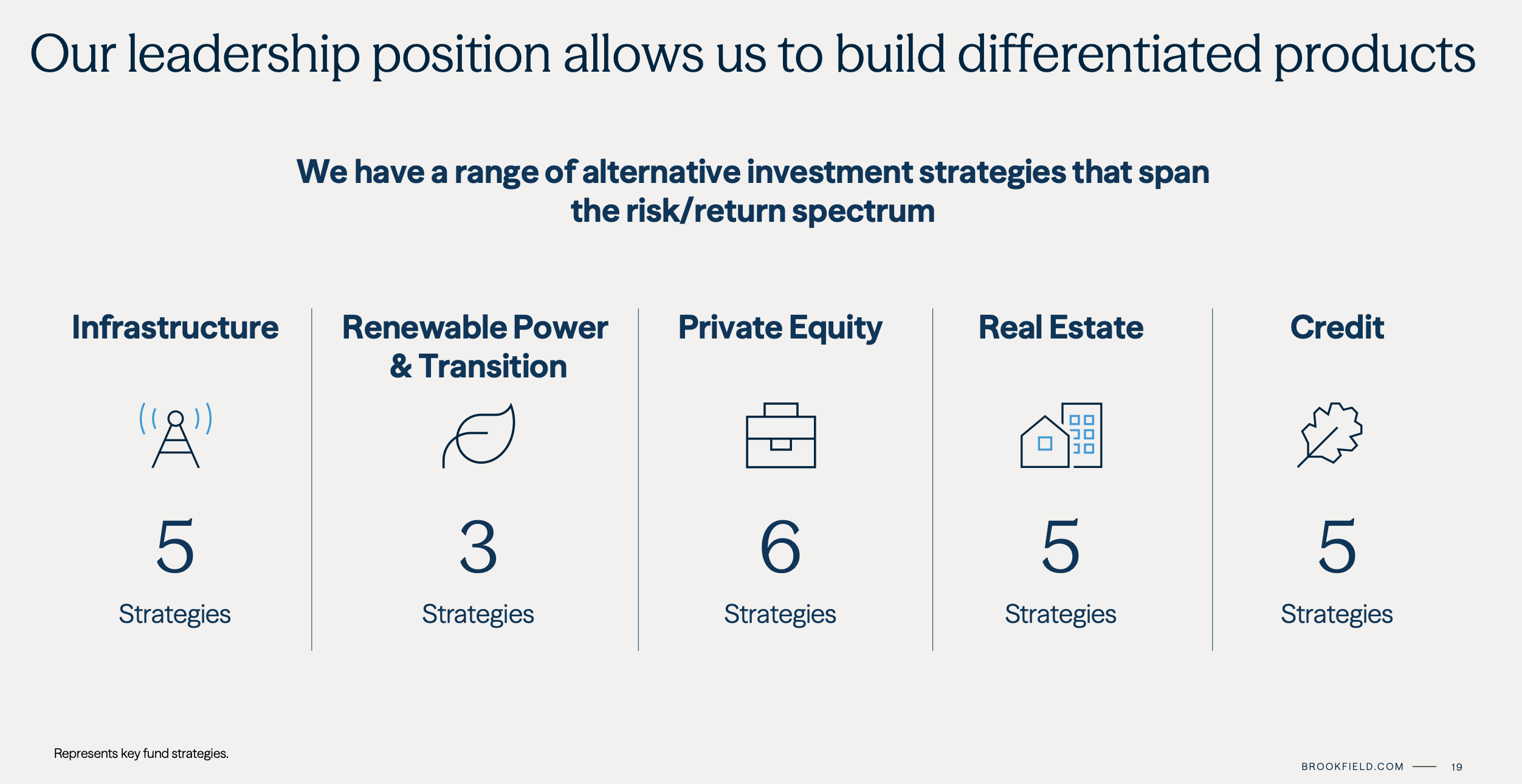
4. Brookfield Corporation ($BN)

How does the company make money?

Brookfield is an alternative asset manager that owns and operates massive, cash-generating real assets across the globe.

This includes toll roads, hydroelectric dams, and premier real estate.

Source: Brookfield Corporation

Why will it still be relevant 20 years from now?

  • They own physical assets the global economy depends on, and these can’t be replaced.

  • Their revenue often comes from contracts that last 20 to 50 years and rise with inflation.

  • The management team is excellent at putting money to work. They buy troubled assets, fix them up, and reinvest the proceeds.

Now let’s dive in the top 3.

Read more

ETF Portfolio Update: Just Buy The haystack

29 March 2026 at 14:44

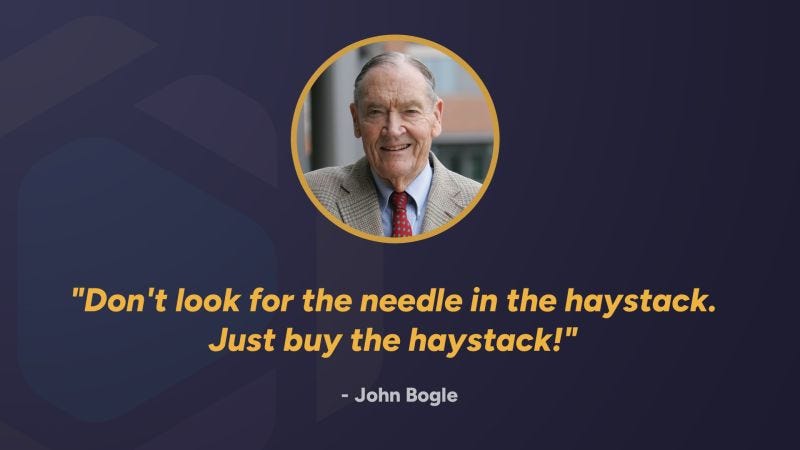
Passive investors don’t look for the needle in the haystack, they just buy the entire haystack.

But which haystack should you buy?

Let’s dive into our ETF Portfolio today.

Subscribe now

"Don't look for the needle in the haystack. Just buy the haystack ...

Passive investing 101

Passive investors don’t try to beat the market.

They are more than happy with matching the performance of the market.

To build wealth you don’t have to beat the market, just follow these simple steps:

  1. Spend less than you earn

  2. Invest at least 10% of your income every single month

Everyone can do it.

You don’t need to be interested in investing or spend a lot of time researching stocks.

“Paradoxically, when ‘dumb’ money acknowledges its limitations, and starts to invest periodically in an index fund, it ceases to be dumb.” - Warren Buffett

Why Does Passive Investing Work?

  1. Lower Costs: Passive funds are cheaper than active funds

  2. Lower Stress: you can automate your investments and ignore the market

  3. Market Growth: The stock market tends to go up in the long run

Another big reason passive investing works?

Diversification.

When you invest in an ETF, you own a small part of many companies.

Portfolio Diversification: What It Is & Why It's Important ...

This spreads out your risk.

If one company does poorly, it won’t hurt you as much because you have a lot of other investments.

Diversification doesn’t just mean owning a lot of different companies.

It means owning companies in different places.

Global Diversification

You can’t predict where the next winner will come from.

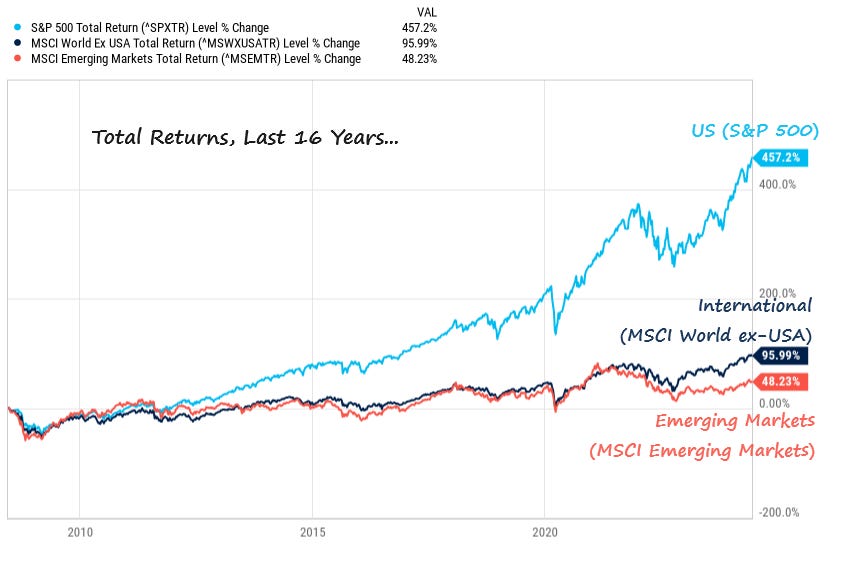
Since the bottom of the Global Financial Crisis in March of 2009, US stocks have compounded at 15% per year.

They have outperformed almost every asset over this period.

Image
Source: Charlie Bilello on X

It feels like US stocks will keep going up forever.

So why wouldn’t you solely invest in US ETFs?

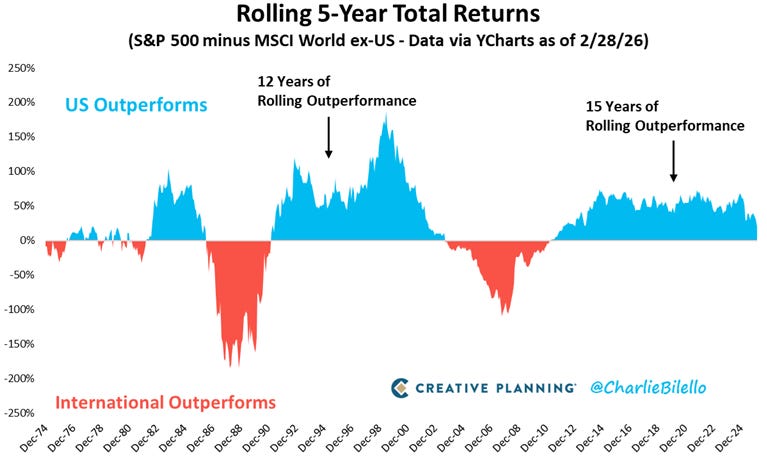
Because US stocks don’t always outperform.

The chart below shows the rolling 5-year returns.

  • Blue areas show where the US outperformed

  • Red areas show where the rest of the world outperformed

Image
Source: Charlie Bilello on X

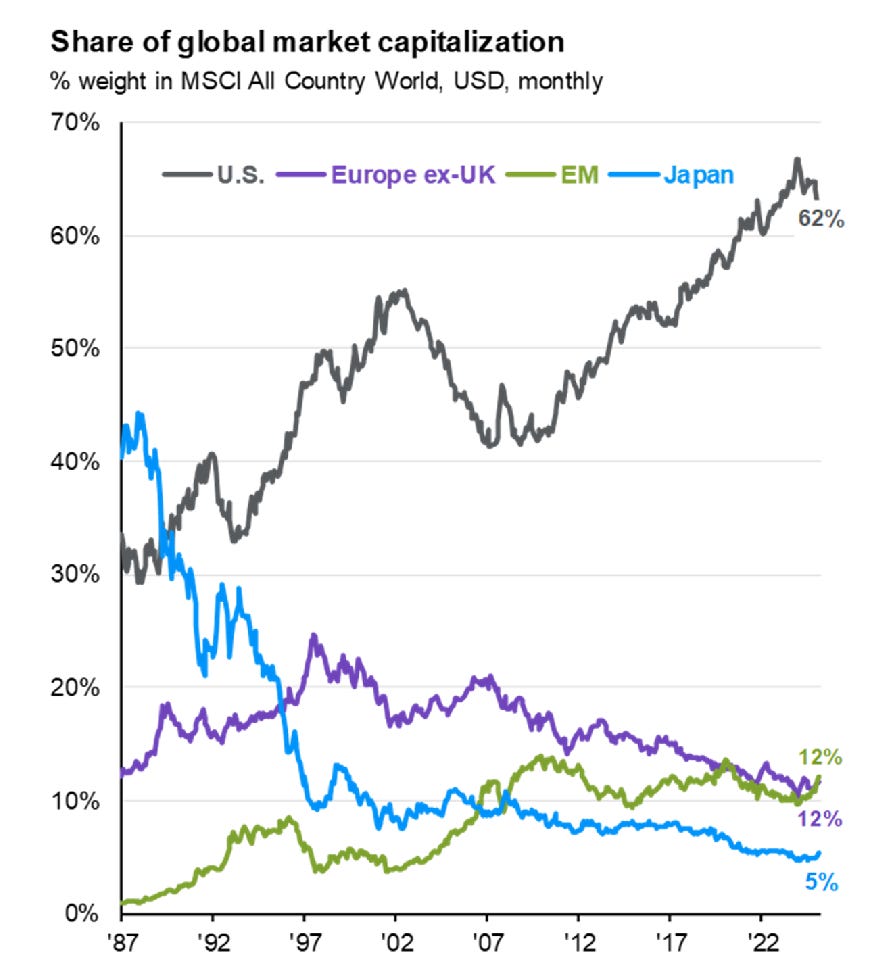
The US outperformance can’t go on forever.

If it did, US stocks would eventually make up 100% of the global stock market.

The chart below shows the market share of the following countries:

  • The United States

  • Europe, ex-UK

  • Emerging Markets

  • Japan

You can see that US stocks already make up a lot of the global market cap.

Source: J.P. Morgan

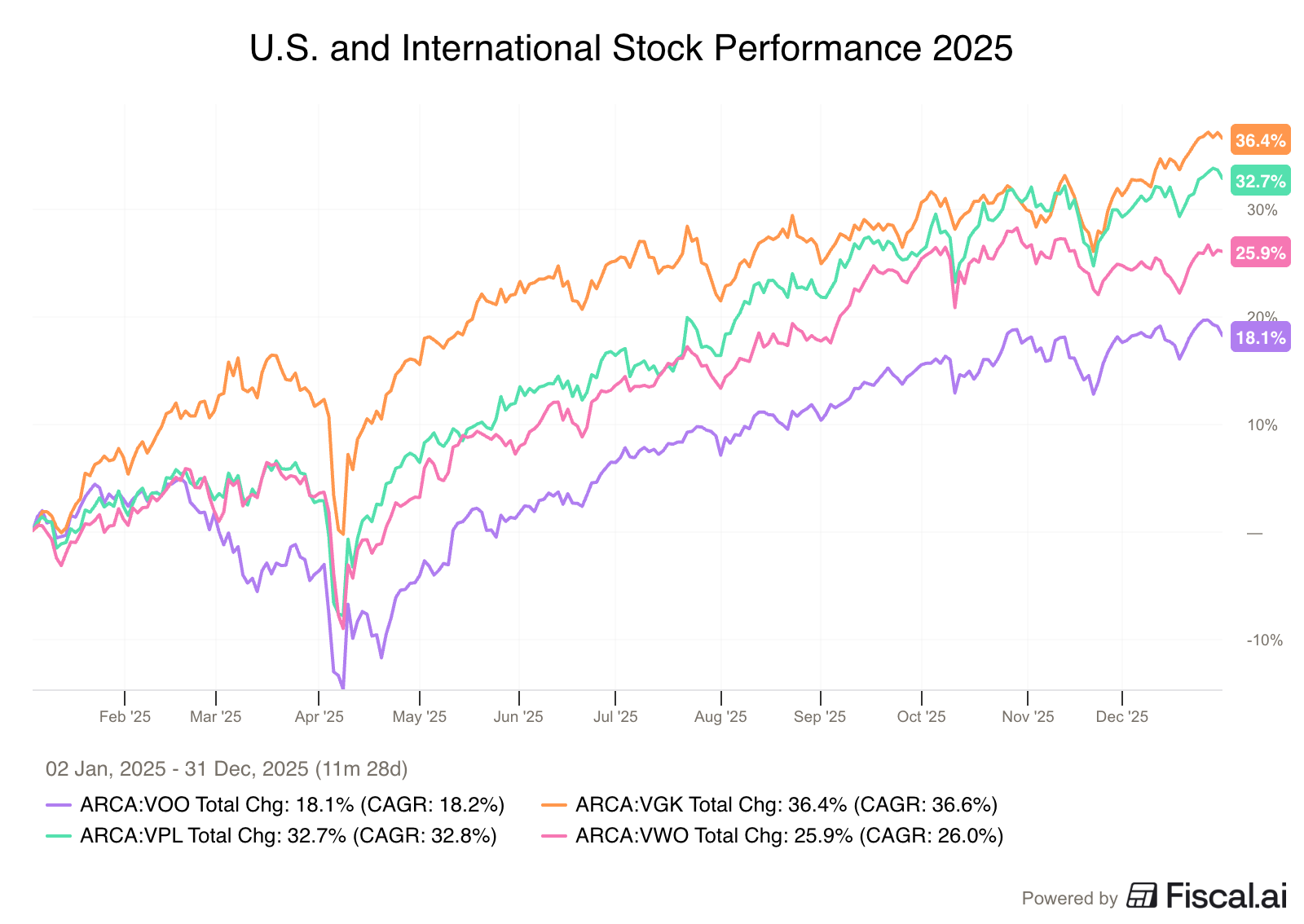
In 2025, the S&P 500 had a total return of 18.1%, which is amazing!

But it’s lower than a lot of other markets.

Here’s the performance of different regions:

  • US stocks (purple): 18.1%

  • Emerging Markets (pink): 25.9%

  • Asian Stocks (green): 32.7%

  • European Stocks (orange): 36.4%

Source: Fiscal.ai

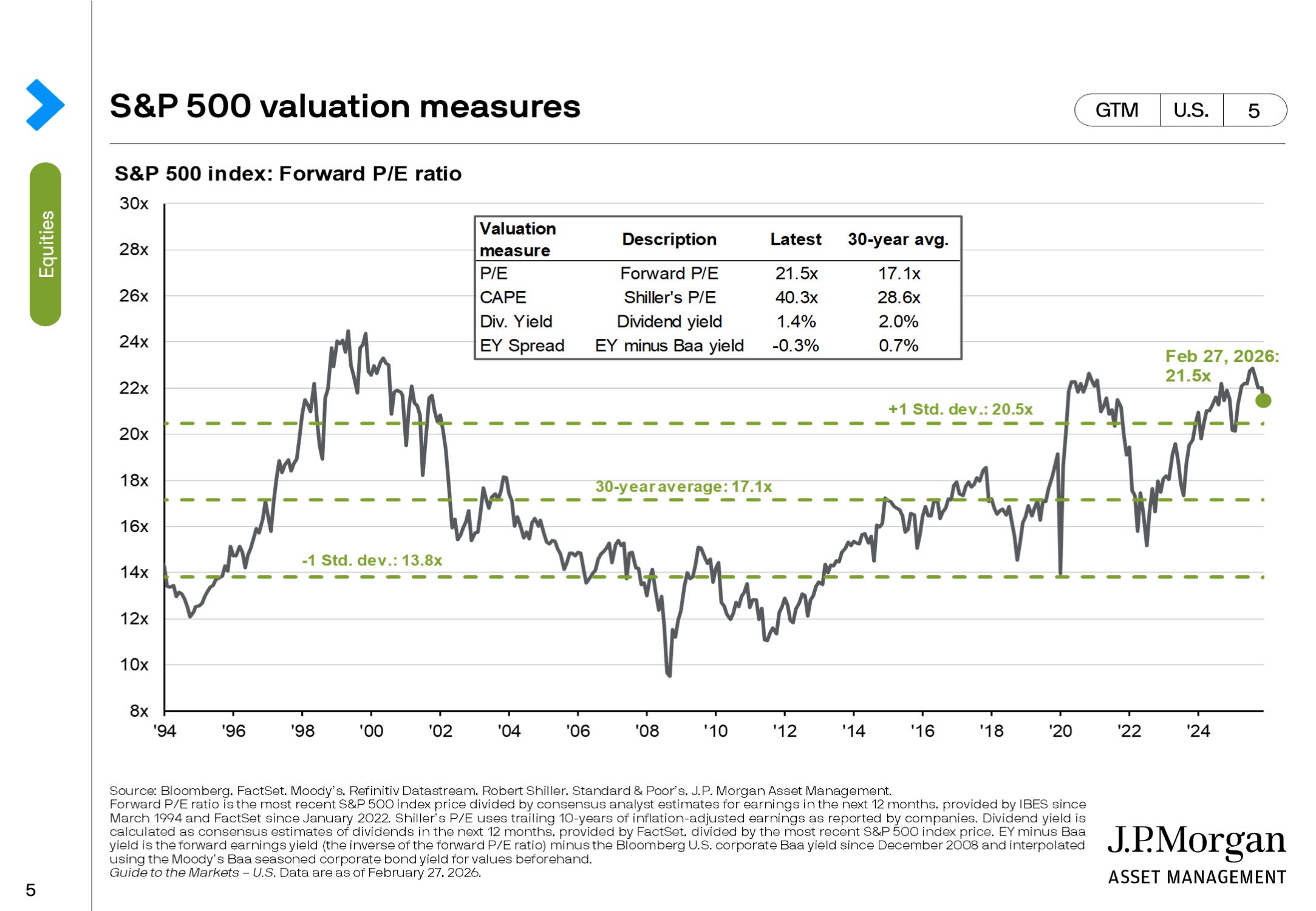
The US market is also quite expensive at this point in time.

Source: J.P. Morgan

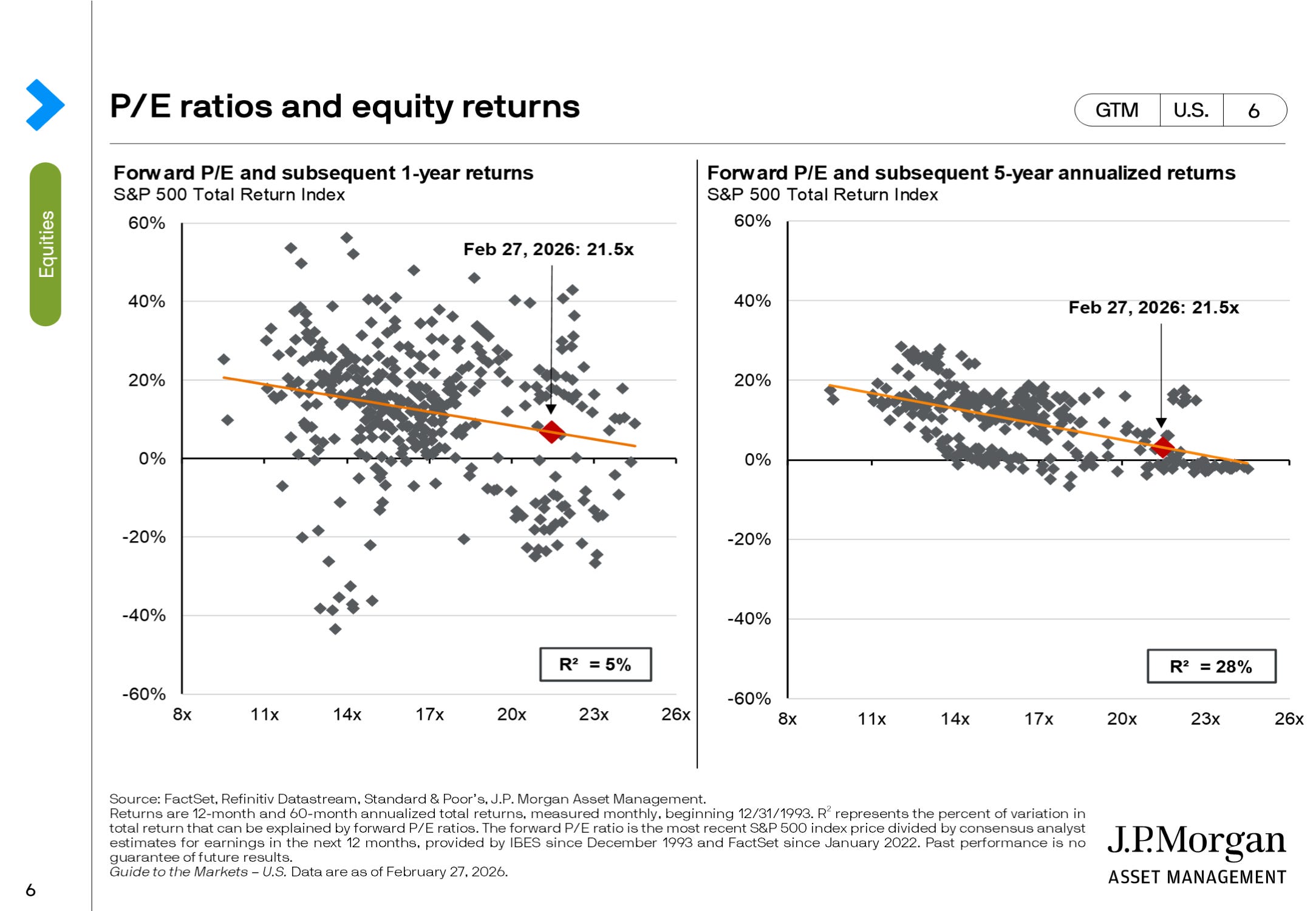
Buying the S&P 500 at the current valuation levels will probably yield lower returns:

Source: J.P. Morgan

But how do you diversify outside the United States?
How do you play this idea?

Let’s find out together.

Read more

8 Stocks Quality Investors Are Buying

5 March 2026 at 14:44

You know what’s beautiful?

The best investors in the world are obliged to share their portfolio every quarter.

Let’s see which Quality Stocks superinvestors like Warren Buffett and Terry Smith have been buying.

Subscribe now

A shameless copycat

Mohnish Pabrai put it best:

“I’m a shameless copycat. Everything in my life is cloned … I have no original ideas.”

Copying what works is a great strategy.

  • Charlie Munger modeled himself after Benjamin Franklin

  • Microsoft copied Netscape, Lotus, and many more to become dominant in software

  • Facebook has copied Snap and TikTok & bought Instagram, and WhatsApp

  • Pabrai copied Buffett’s partnership structure and his investing style

What’s also interesting?

Several studies have shown that by copying the best investors in the world, you tend to outperform the market:

With that in mind, let’s dive into what superinvestors have been buying and selling recently.


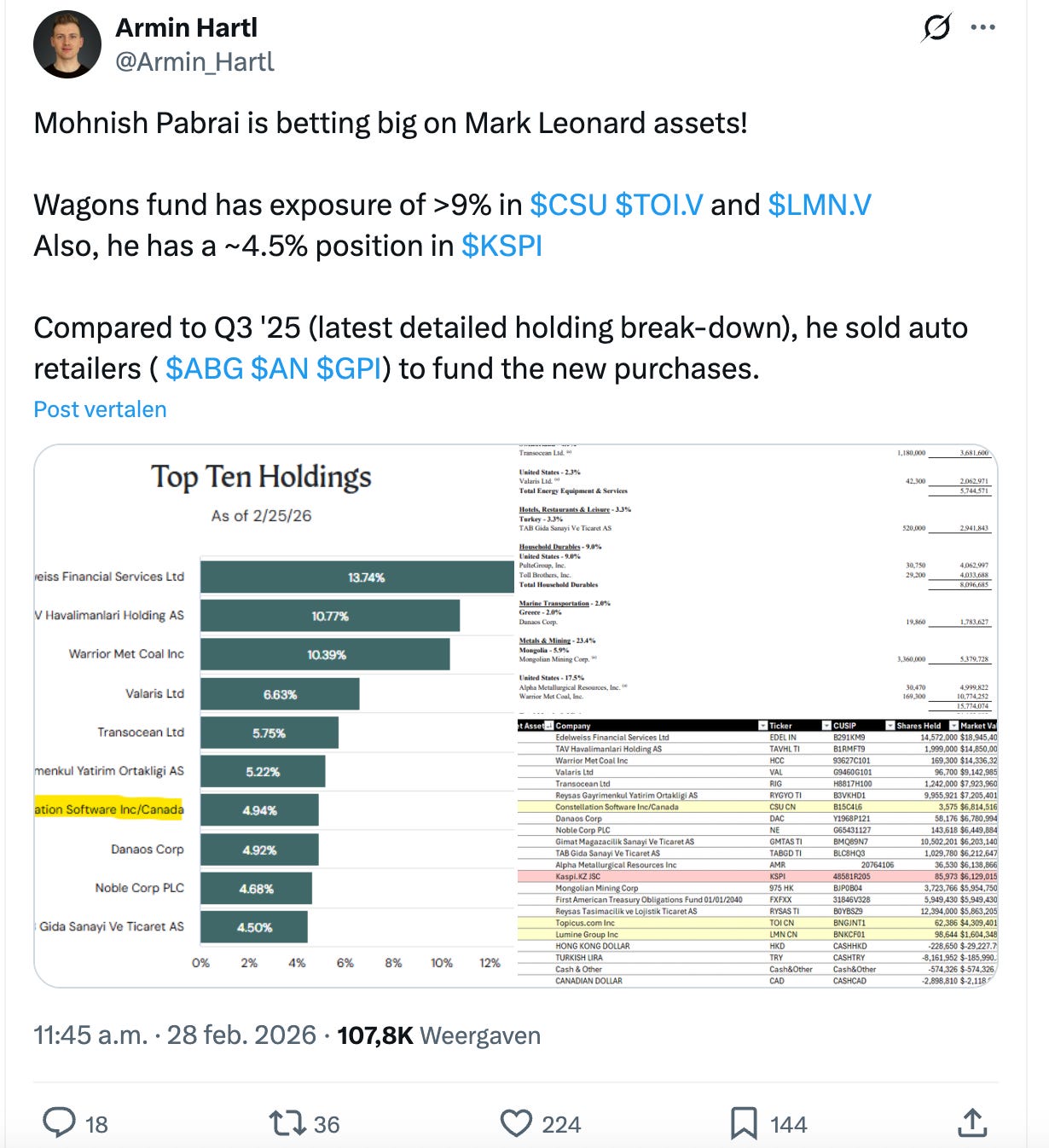
PS Do you know what’s really interesting?

Mohnish Pabrai recently added a lot to Constellation Software ($CSU).

This is very interesting to see, especially given the fact that he can be seen as a deep value investor.

In other words: Mohnish Pabrai thinks Constellation Software is way too cheap.

Source: Armin Hartl

Top 10 Buys

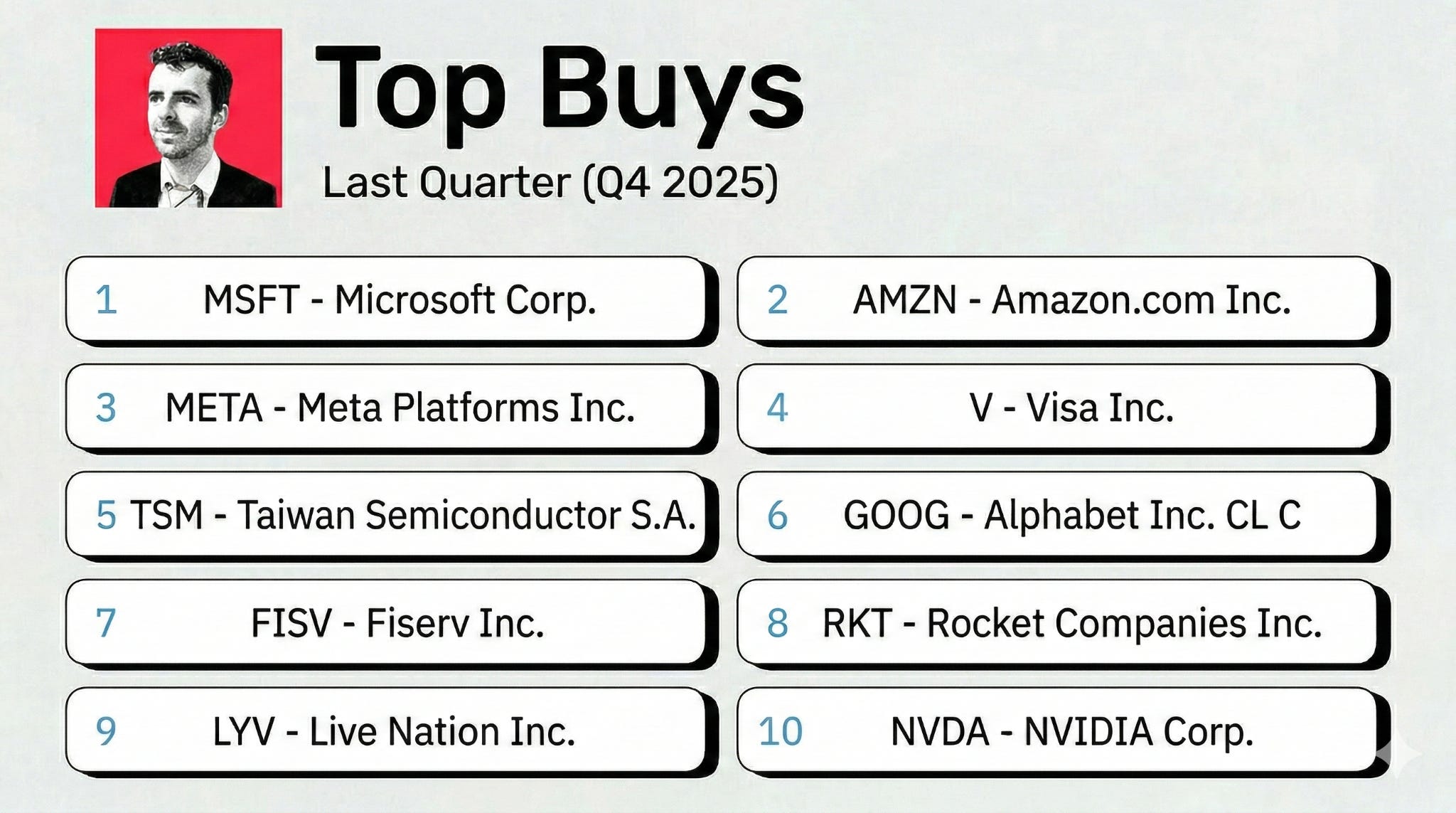
Here are the 10 stocks ‘superinvestors’ bought the most of last quarter:

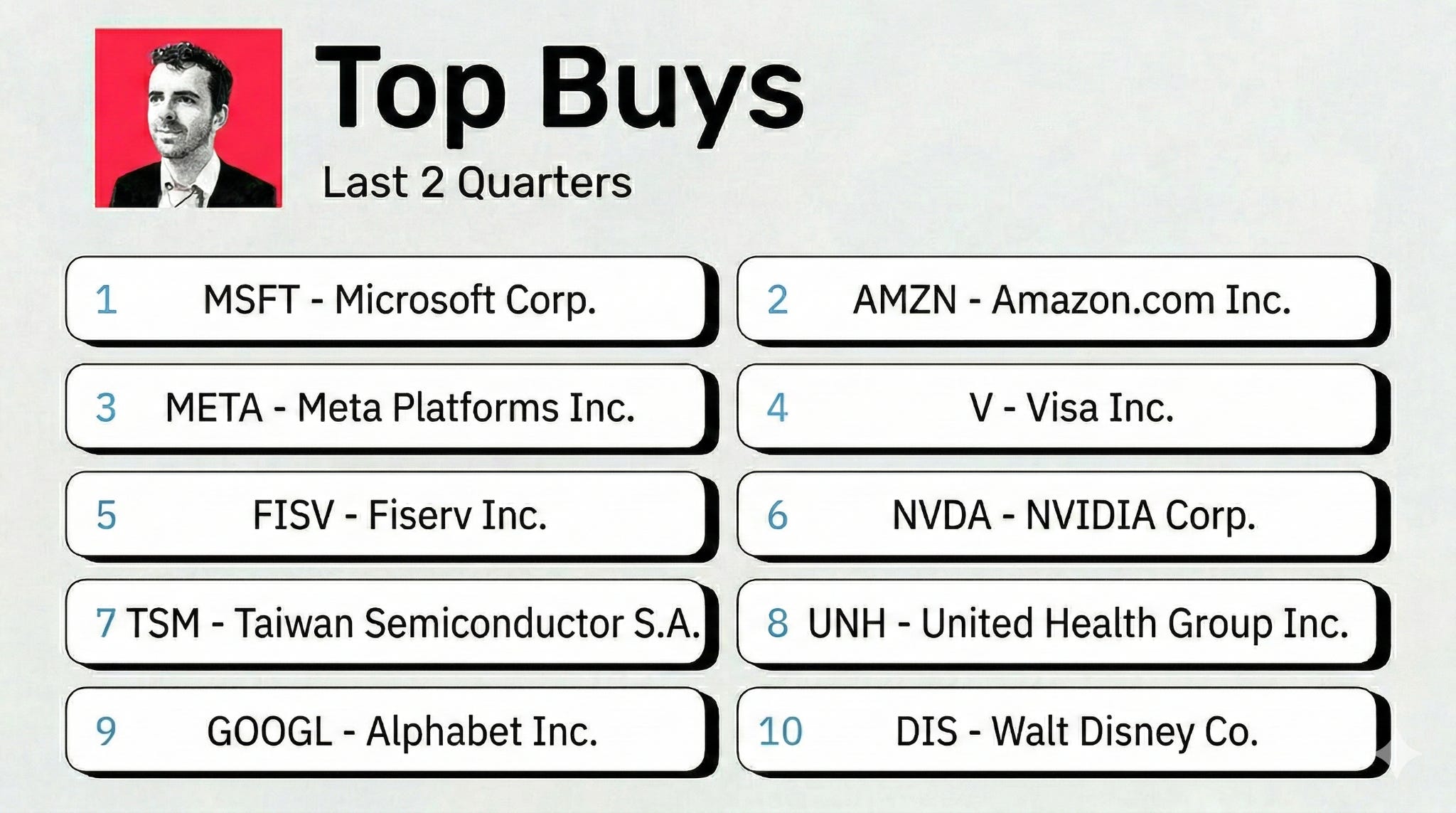
If we look at the last 2 quarters, we get the following:

There are a lot of large cap stocks in both lists:

Superinvestors like Warren Buffett, Terry Smith, Chuck Akre, … manage billions of dollars.

As a result, they are practically forced to own large cap stocks.

Why?

  • They are just not able to buy small caps because they would influence the stock price

  • Big Tech companies dominate the S&P 500. If you don’t own them, it’s hard to keep up with the benchmark

Rational, long-term investors like us don’t have this concern.

We don’t need to beat the index every quarter. We want to outperform in the long term.

The interesting thing? The larger the company, the harder it is to keep growing at very high rates.

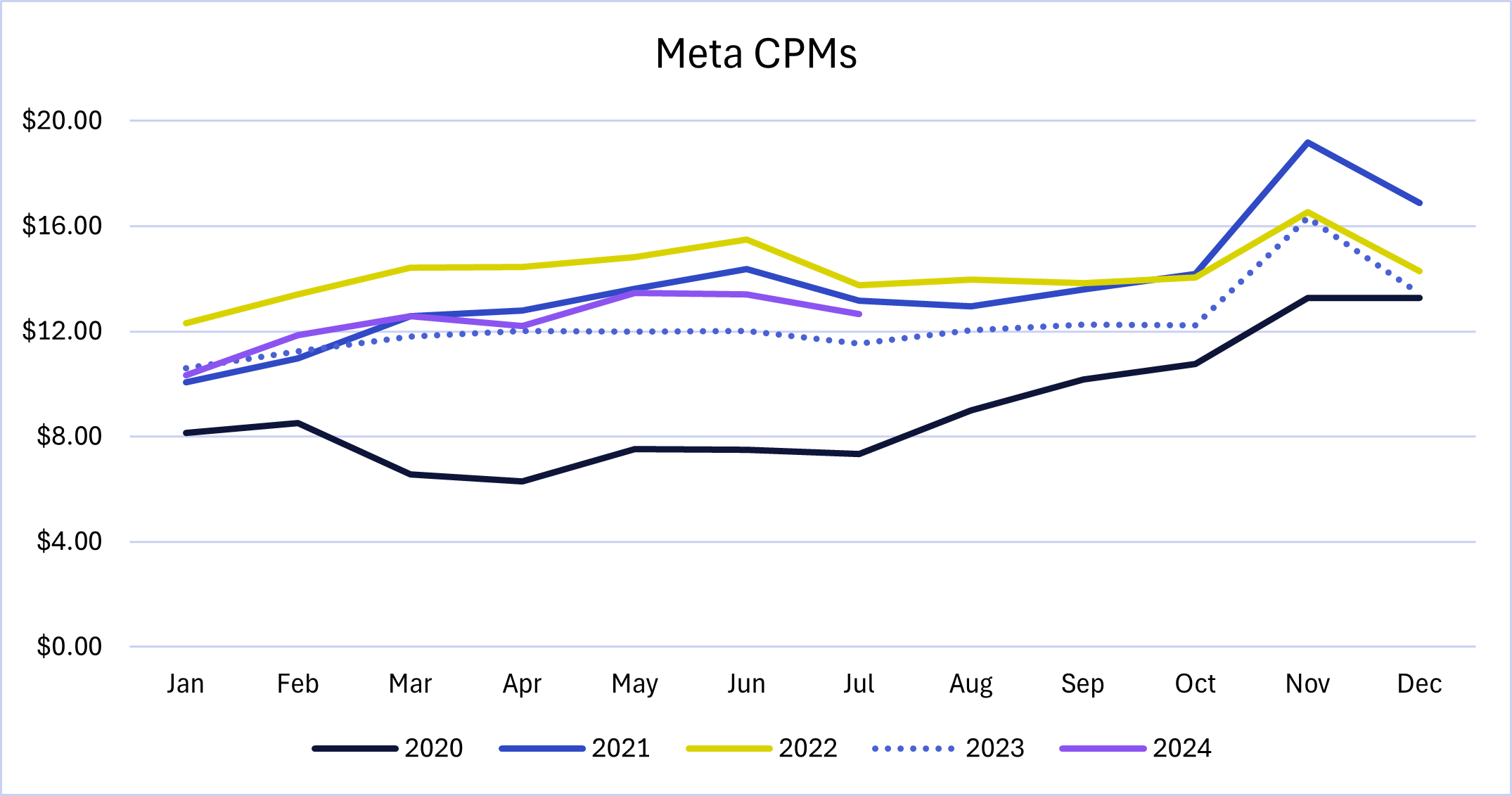
Just think about Meta Platforms for a second.

There’s not that much market share left for them to take.
As a result, growth needs to come from selling more to existing clients.

The costs for ads almost doubled since 2017 on Meta Platforms.

This will be much harder for them to do again over the next 8 years.

Understanding Q4 & 'Q5' Advertising Trends to Maximize Reach & Performance

The most interesting companies?

  1. The ones owned by the best quality investors in the world

  2. Small caps.

Quality Investors 101

The Community of Compounding Quality is amazing.

Every quarter, Mathieu creates a spreadsheet tracking the Portfolio of the 12 best quality investors in the world.

Think about investors like:

  • Fundsmith (Terry Smith)

  • Akre Capital (Chuck Akre)

  • Valley Forge (Devang Kantesaria)

  • Giverny Capital (François Rochon)

  • TCI Fund Management (Chris Hohn)

Let’s look into what they are buying and selling.

What Quality Investors Sold

Let’s start with the positions they sold.

1. Fiserv ($FI)

How does the company make money?

Fiserv earns fees by processing credit and debit card transactions for businesses and providing the software that banks use to manage customer accounts and digital banking.

Why did superinvestors sell?

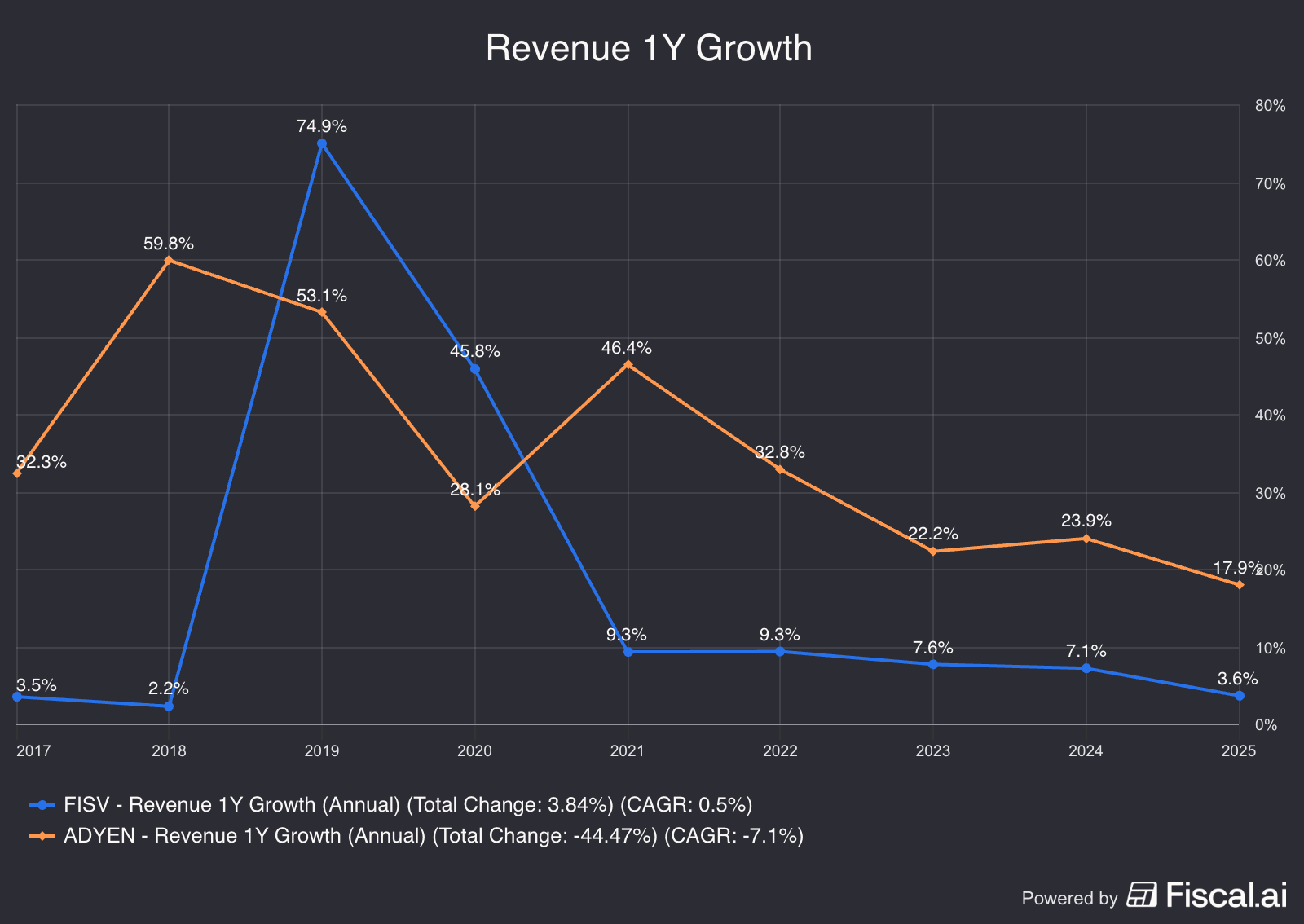
Fiserv used to be the only toll bridge in town.

But today, modern competitors like Stripe and Adyen are competing with Fiserv.

Source: Fiscal.ai

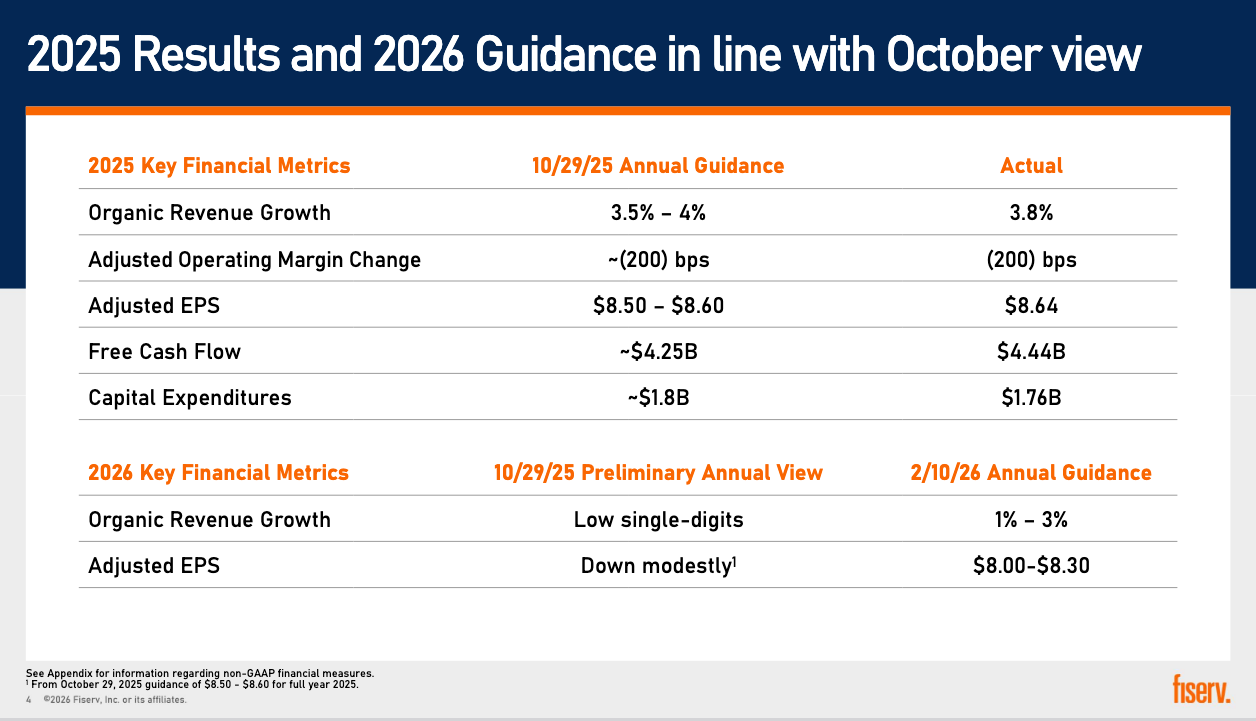
But when Michael Lyons took over, he dropped a bombshell.

The old growth targets were gone. Instead of 10% revenue growth, the new plan was just 3.5% to 4%.

That’s why investors like Francois Rochon decided to sell.

2. Booz Allen ($BAH)

How does the company make money?

Booz Allen provides specialized consulting, technology, and analytics services to United States government agencies, including defense, intelligence, and civil sectors.

Why did superinvestor sell?

One thing we love as quality investors is predictability.

For years, U.S. Government contracts were very stable.

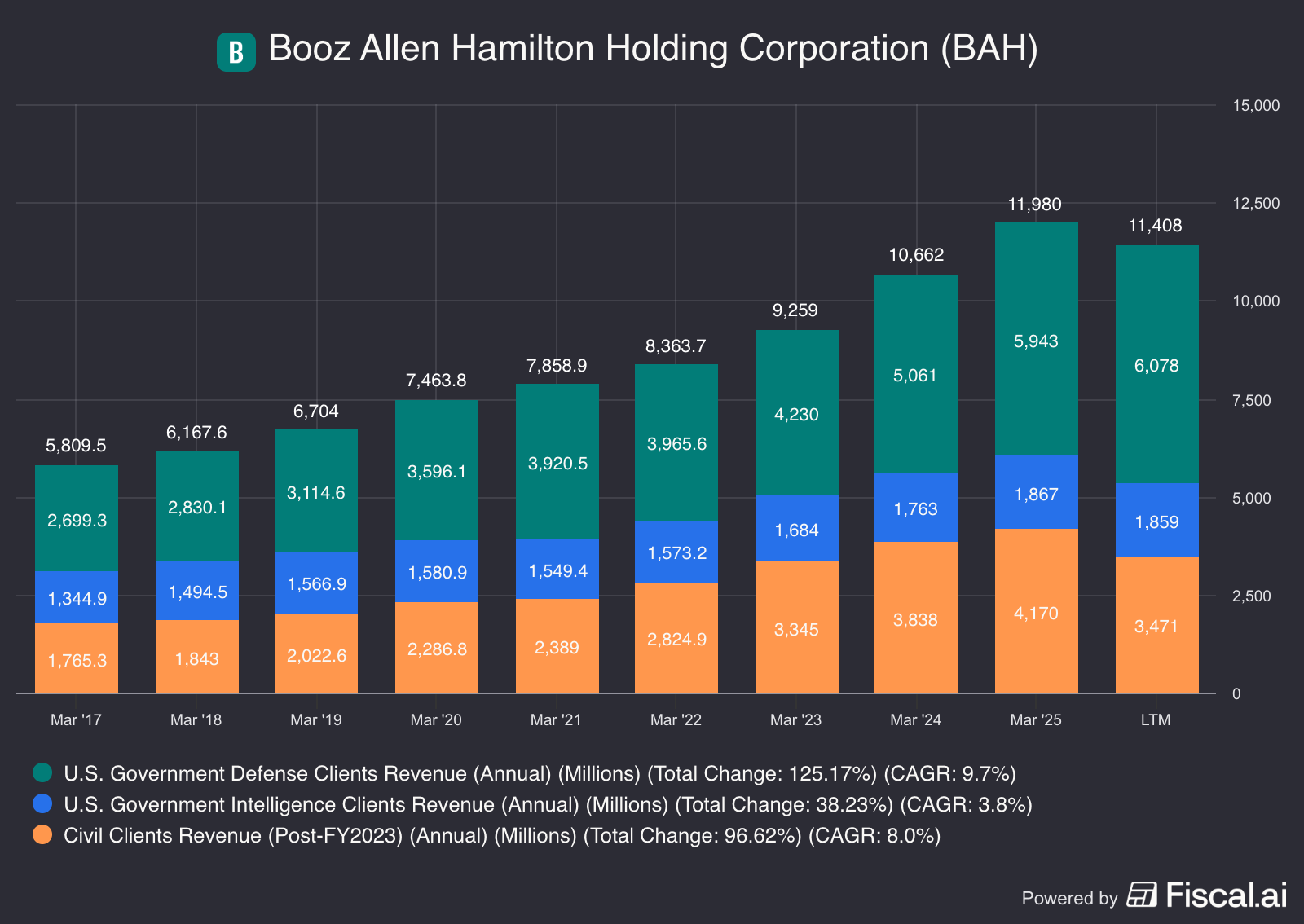
But that changed when Elon Musk started cutting contracts in an effort to reduce government spending with DOGE.

Why that’s bad for Booz Allen? 70% of its revenue comes from contracts with the U.S. Government.

Source: Fiscal.ai

That killed the revenue certainty. Suddenly, the company was in the midst of a political battle.

3. Credit Acceptance ($CACC)

How does the company make money?

Credit Acceptance Corp provides auto loans to high-risk consumers through a network of car dealers, earning revenue from the interest paid by borrowers and service fees charged to the dealerships.

Why did superinvestor sell?

Francois Rochon of Giverny Capital sold Credit Acceptance Corporation.

He told us exactly why in his investor letter:

“As for sales, we trimmed Credit Acceptance Corporation throughout the third quarter and exited fully on October 1. We believe Credit Acceptance has fallen behind other leading subprime lenders in both technology and underwriting sophistication and may have a hard time catching up.”

Temporary challenges? No problem. They often let you buy great companies at a discount.

But Credit Acceptance fell far behind its competitors. And catching up looks anything but certain.

What Quality Investors Trimmed

Here are some companies quality investors trimmed last quarter:

  • Microsoft (MSFT)

  • Alphabet (GOOGL)

  • Interactive Brokers (IBKR)

  • CME Group (CME)

  • Intuit (INTU)

  • O’Reilly Automotive (ORLY)

  • CarMax (KMX)

  • Fiserv (FI)

The most likely reason?

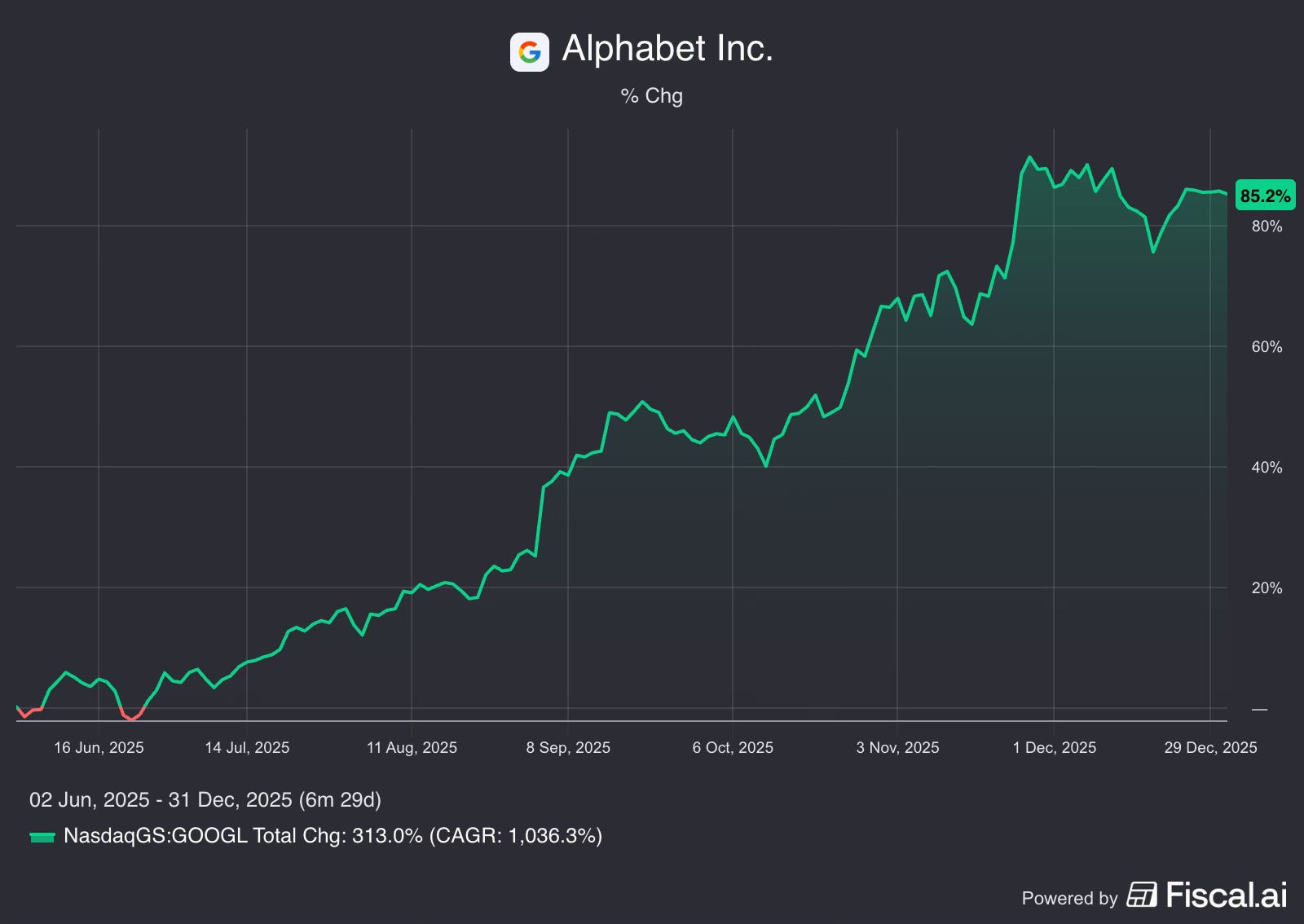
Companies like Microsoft, Alphabet, and Interactive Brokers did really well recently.

The valuation might become a bit too expensive according to some investors.

Source: Fiscal.ai

Big Funds, Small Positions

Here’s a list of companies that multiple funds have small positions in:

  • Waters Corp (WAT)

  • Booking Holdings (BKNG)

  • ADP (ADP)

  • Cadence Design Systems (CDNS)

  • Analog Devices (ADI)

  • Zoetis (ZTS)

  • Mercadolibre (MELI)

  • Floor & Decor (FND)

Let’s highlight three companies from this list.

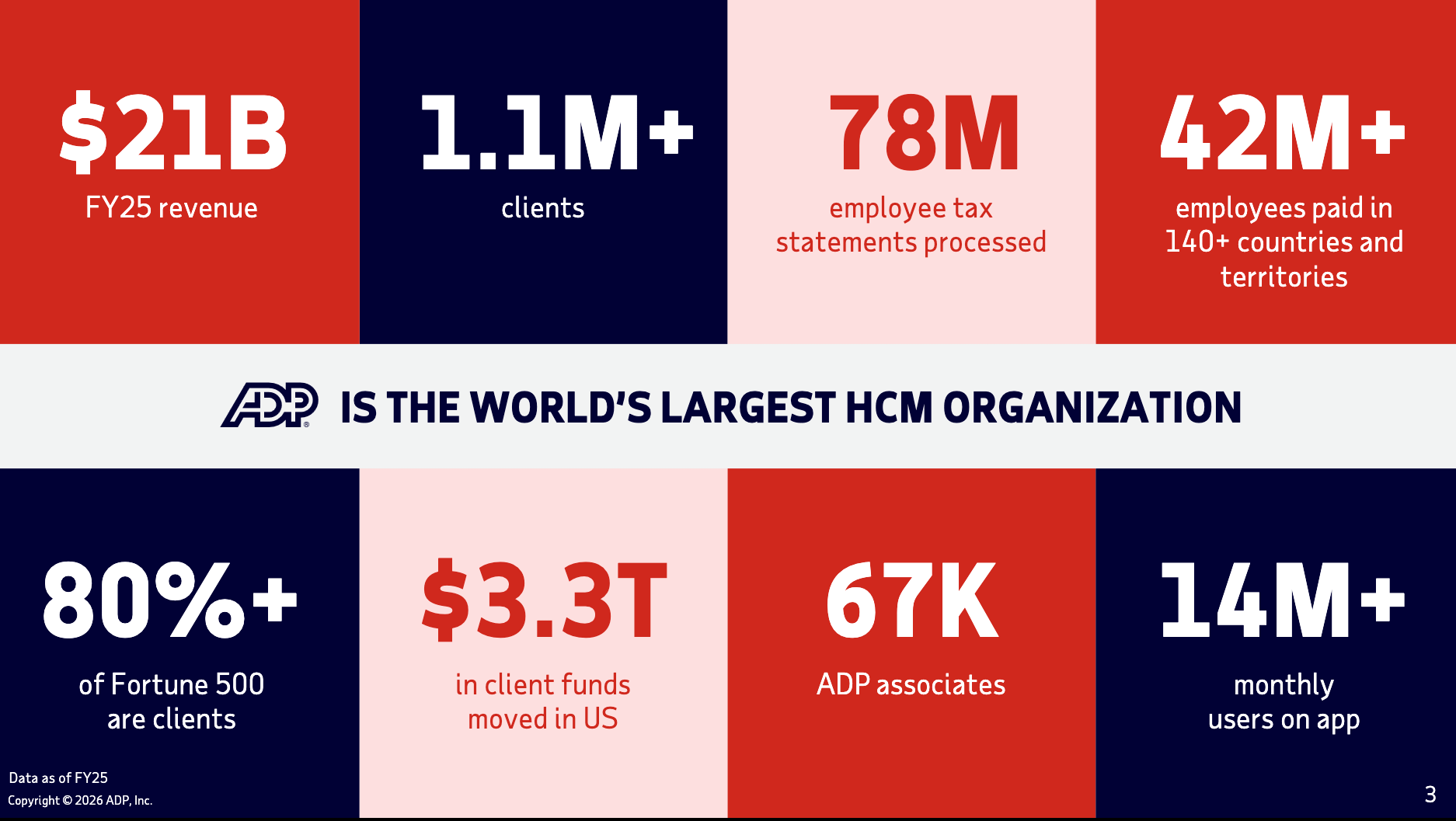
Automatic Data Processing (ADP)

How does the company make money?

ADP makes money by handling payroll and human resources for businesses. They charge recurring fees for these services, and earn significant interest on the billions of dollars they temporarily hold before paying them out to employees and tax authorities.

Why it might be interesting

ADP has very high switching costs.

Once a company trusts ADP with its taxes and payroll, they almost never leave.

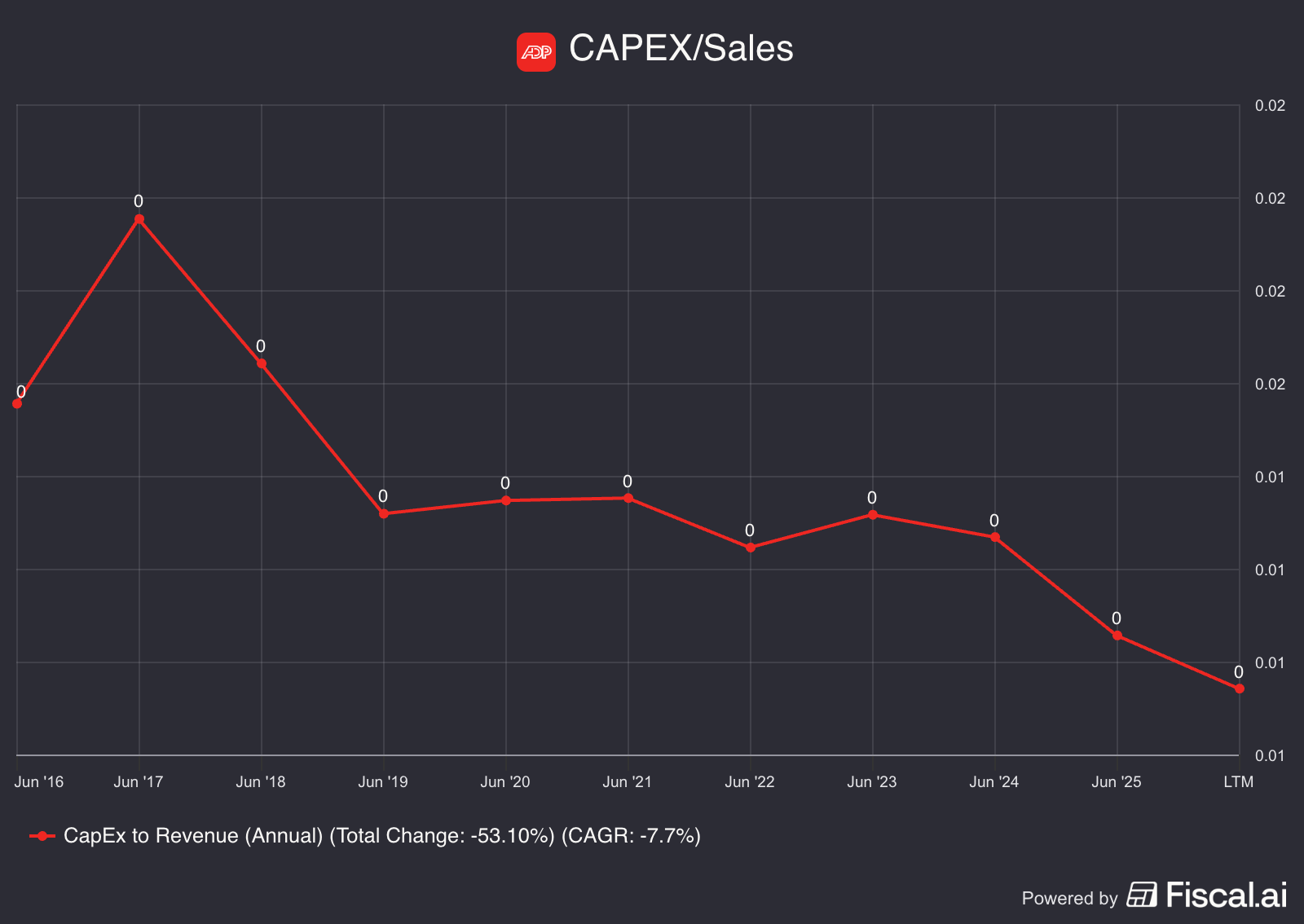
It’s also a very capital light business, with CAPEX/Sales below 2%:

Source: Fiscal.ai

They generate a lot of cash without needing to reinvest a lot back into the business.

  • Quality Funds Ownership:

    • Fundsmith: 6.3%

    • Guardcap: 3.8%

    • Seilern: 0.5%

Booking Holdings (BKNG)

How does the company make money?

Booking Holdings makes money by collecting commissions on travel reservations made through its platforms, processing payments directly as the merchant of record, and earning advertising and referral fees from brands like KAYAK and OpenTable.

Why it might be interesting

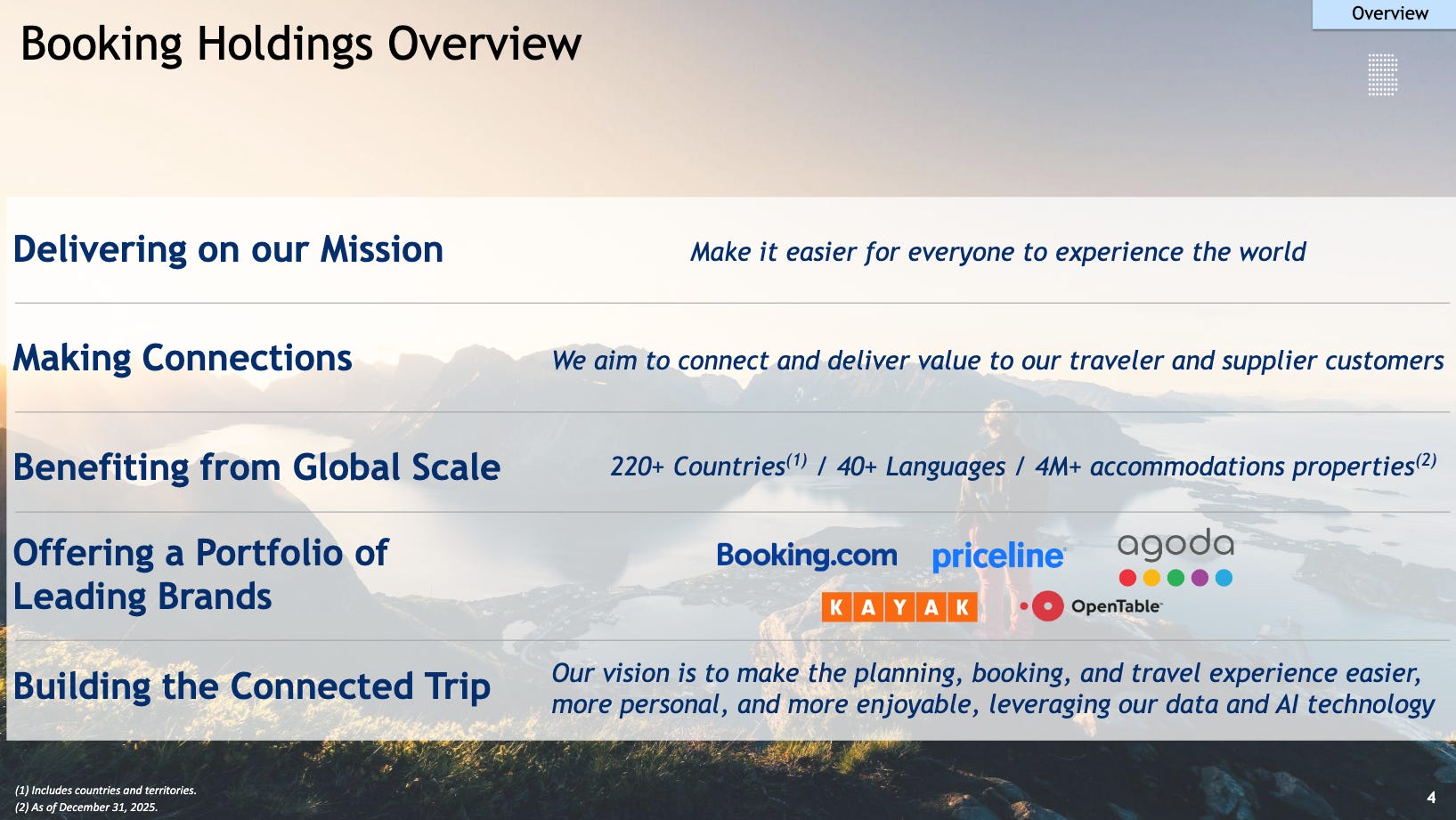
The company owns Booking.com, Agoda, and OpenTable.

For every hotel room or flight booked through their platform, Booking takes a percentage.

It’s important to understand they don’t own any hotels. They own the traffic.

This is a capital-light marketplace with a powerful network effect working in its favor.

  • The more hotels they list, the more travelers use the site

  • The more travelers use the site, the more hotels want to be listed

Another interesting thing?

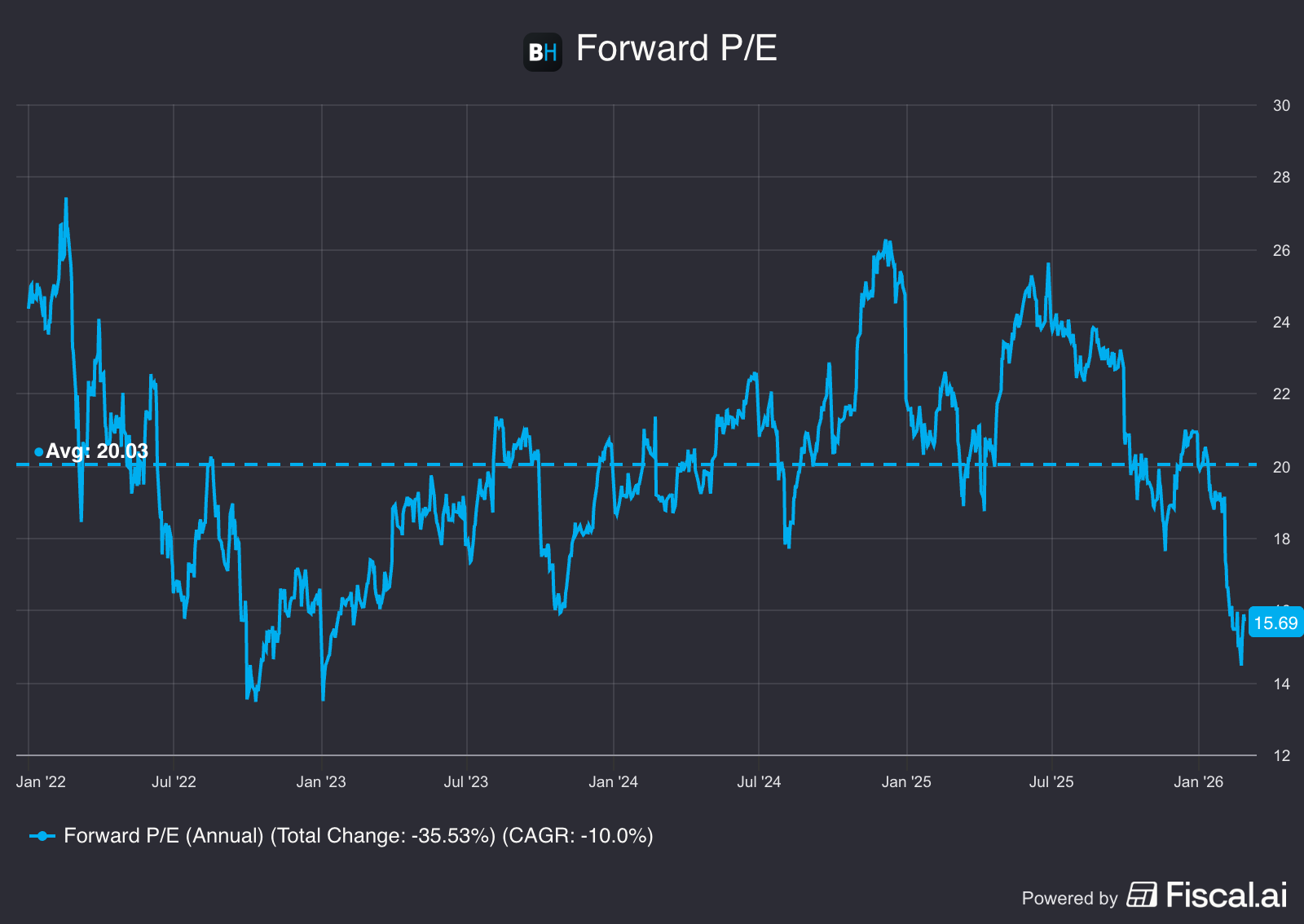
Booking is currently trading at one of the lowest Forward P/E ratios we’ve seen since 2020.

Why? Because investors fear AI will disrupt its business.

We don’t think this will be the case as Booking’s network effect is very powerful.

Source: Fiscal.ai
  • Quality Funds Ownership:

    • Giverny Capital: 3.8%

    • AKO Capital: 3.5%

    • Guardcap: 8.5%

MercadoLibre (MELI)

How does the company make money?

MercadoLibre makes money by taking commissions on sales on its e-commerce marketplace, and earning interest and fees through its massive fintech ecosystem, Mercado Pago, which provides digital payments and credit across Latin America.

Why it might be interesting

MercadoLibre owns a dominant ecosystem across Latin America:

  • E-commerce: MercadoLibre

  • Fintech: MercadoPago

You could see the company as ‘the Amazon of Latin America’.

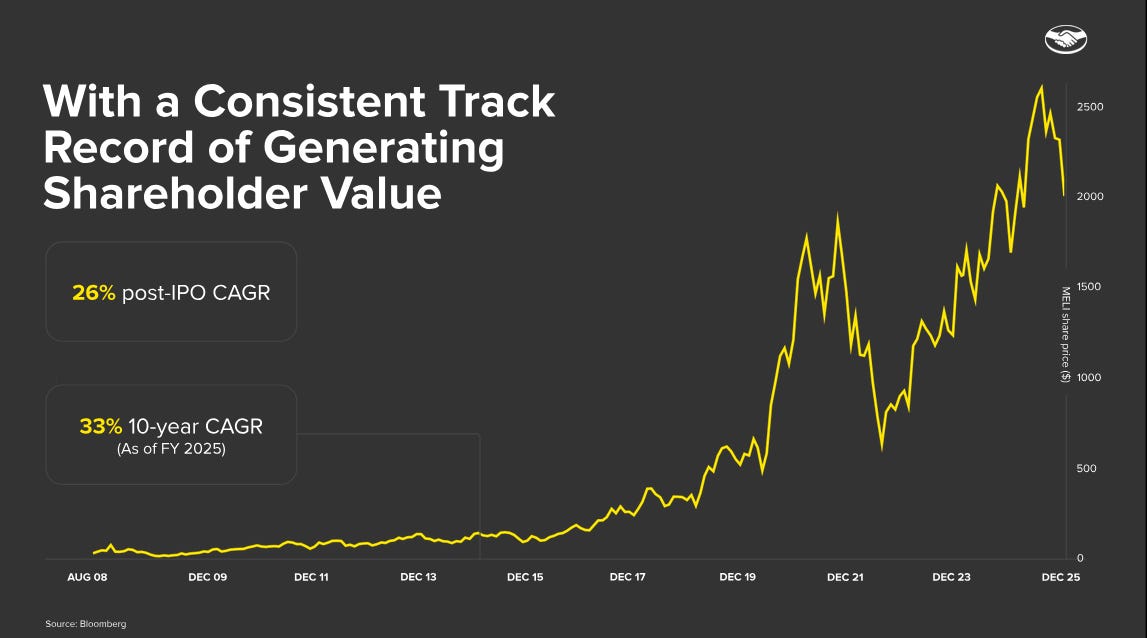
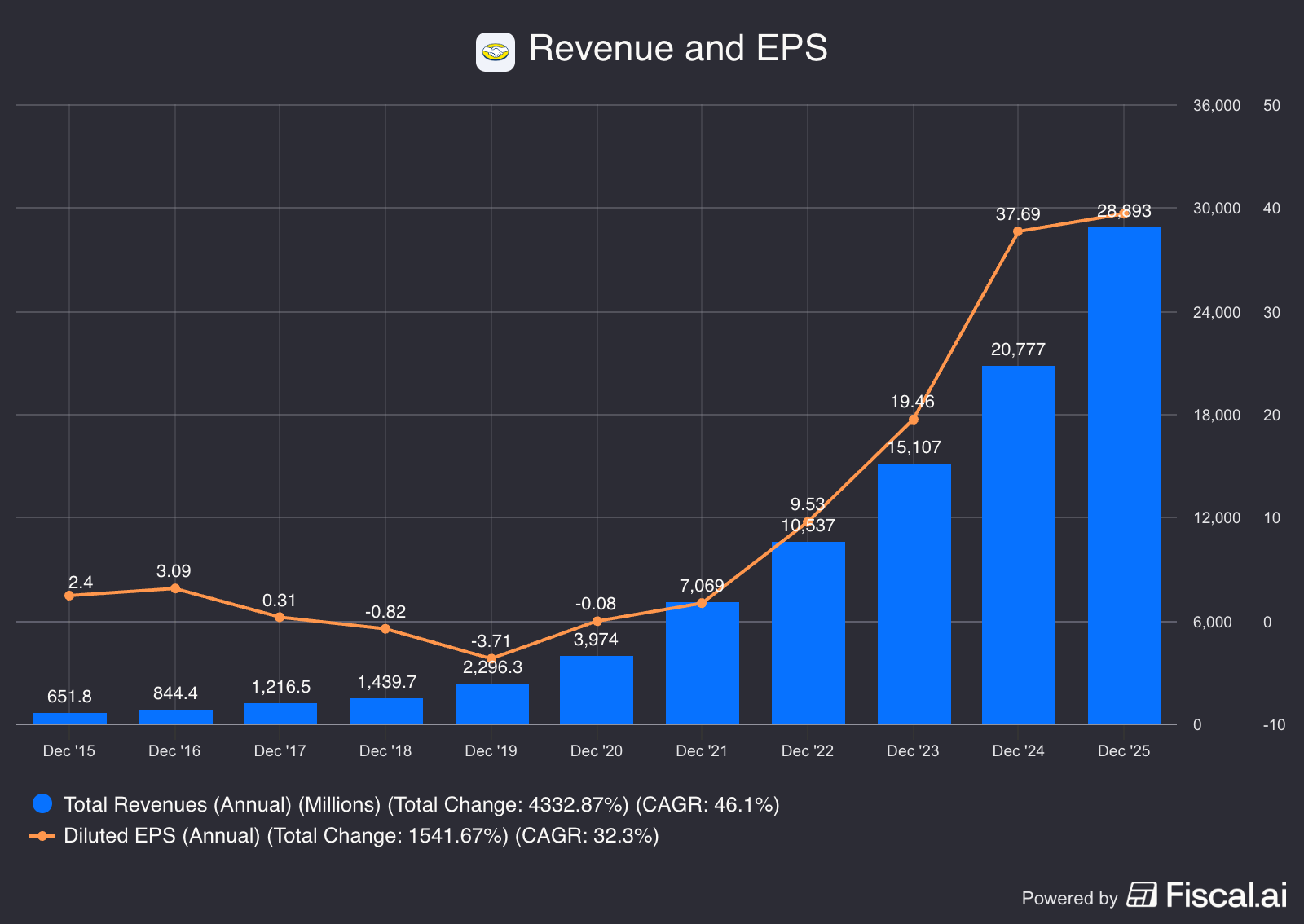
It’s grown incredibly fast:

Source: Fiscal.ai

Just like Amazon, MercadoLibre has a moat built on network effects and logistics infrastructure.

MercadoLibre is the dominant e-commerce platform in Latin America.

The more people use it, the more valuable it becomes:

  • Sellers stay because that’s where the customers are

  • Buyers stay because that’s where the best selection is

On top of that, their shipping network and digital payment system (MercadoPago) build a moat of convenience.

That’s powerful in a region where shipping and payments have always been a nightmare.

  • Quality Funds Ownership:

    • NSZ Capital: 1.4%

    • Guardcap: 0.1%

You can read a Not So Deep Dive of Mercadolibre here.

What Quality Investors Bought

This is the most interesting part of the article.

Here are some quality stocks superinvestors added to last quarter:

Read more

Best Buys November 2025

2 November 2025 at 14:44

By monthly tradition, you’ll get an update on our Best Buys of the month.

What’s going on in the markets? And what are our favorite stocks?

Let’s become a little bit wiser today.

November 2025

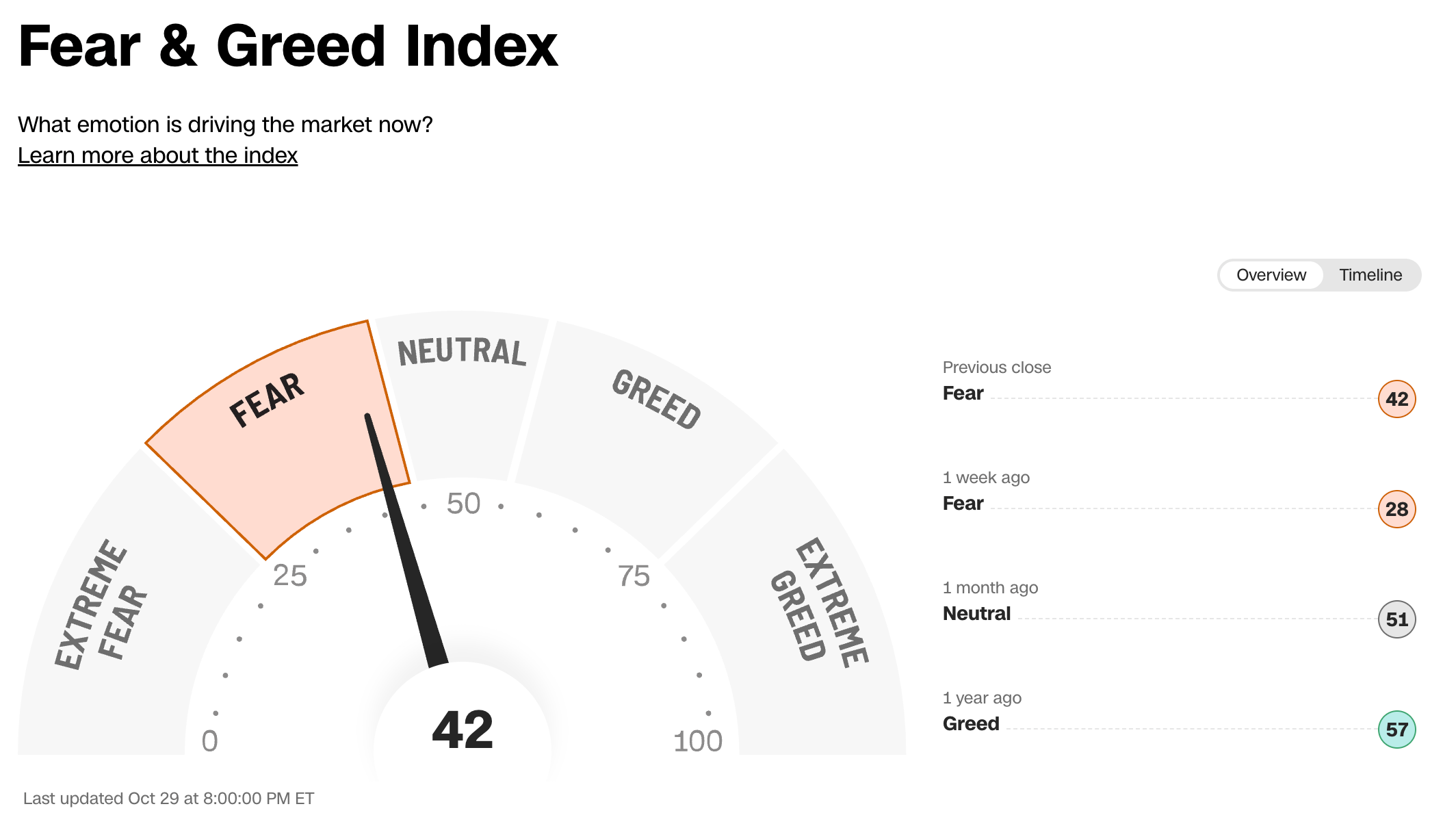
The S&P 500 increased by +2.8% in October.

Investors are fearful today according to the Fear & Greed Index:

Source: CNN

Best & Worst Performers

This overview shows you the best and worst performers in our investable universe.

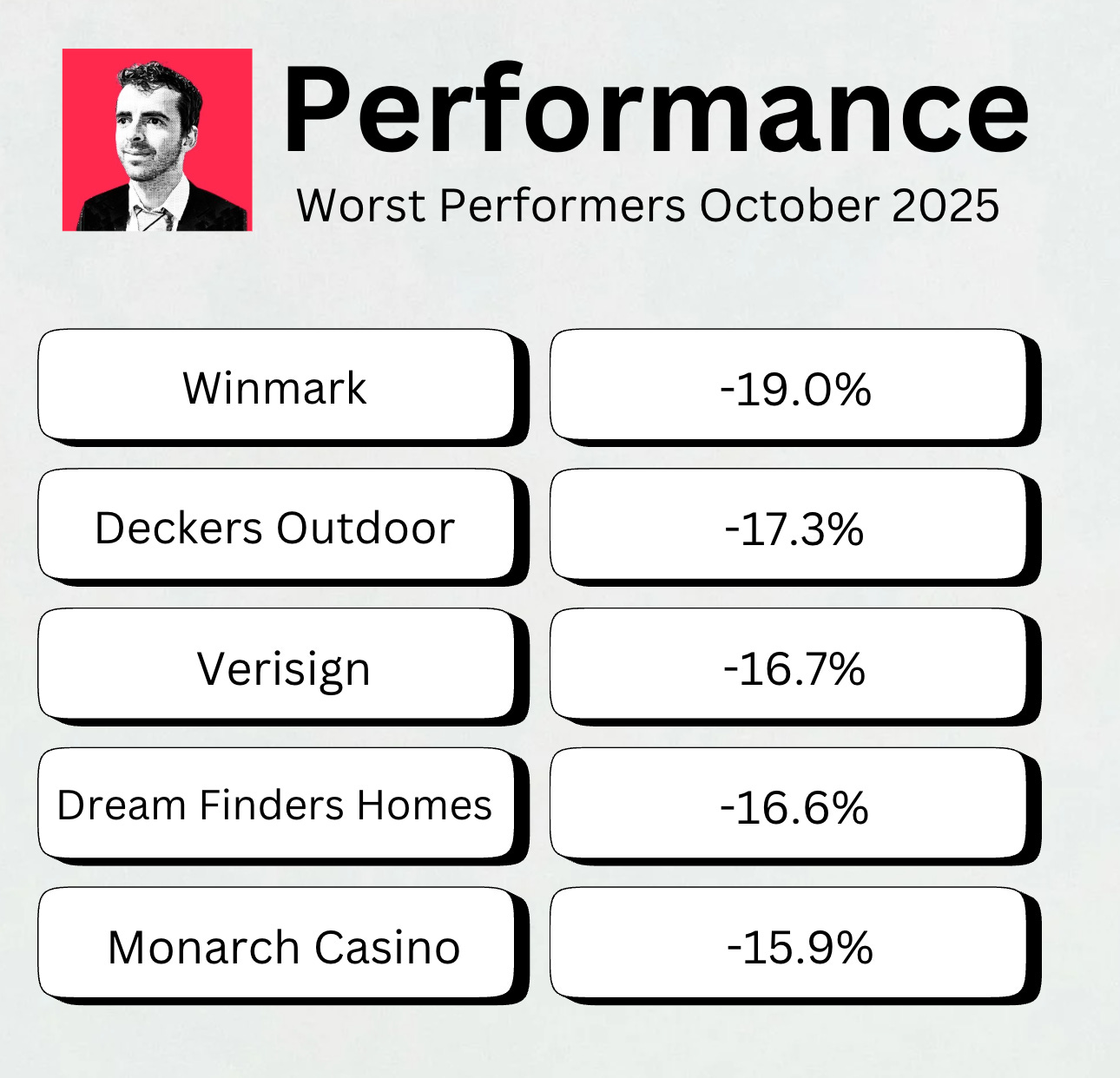
Worst performers

The cheaper we can buy great companies, the better.

Here are the worst performers of the past month:

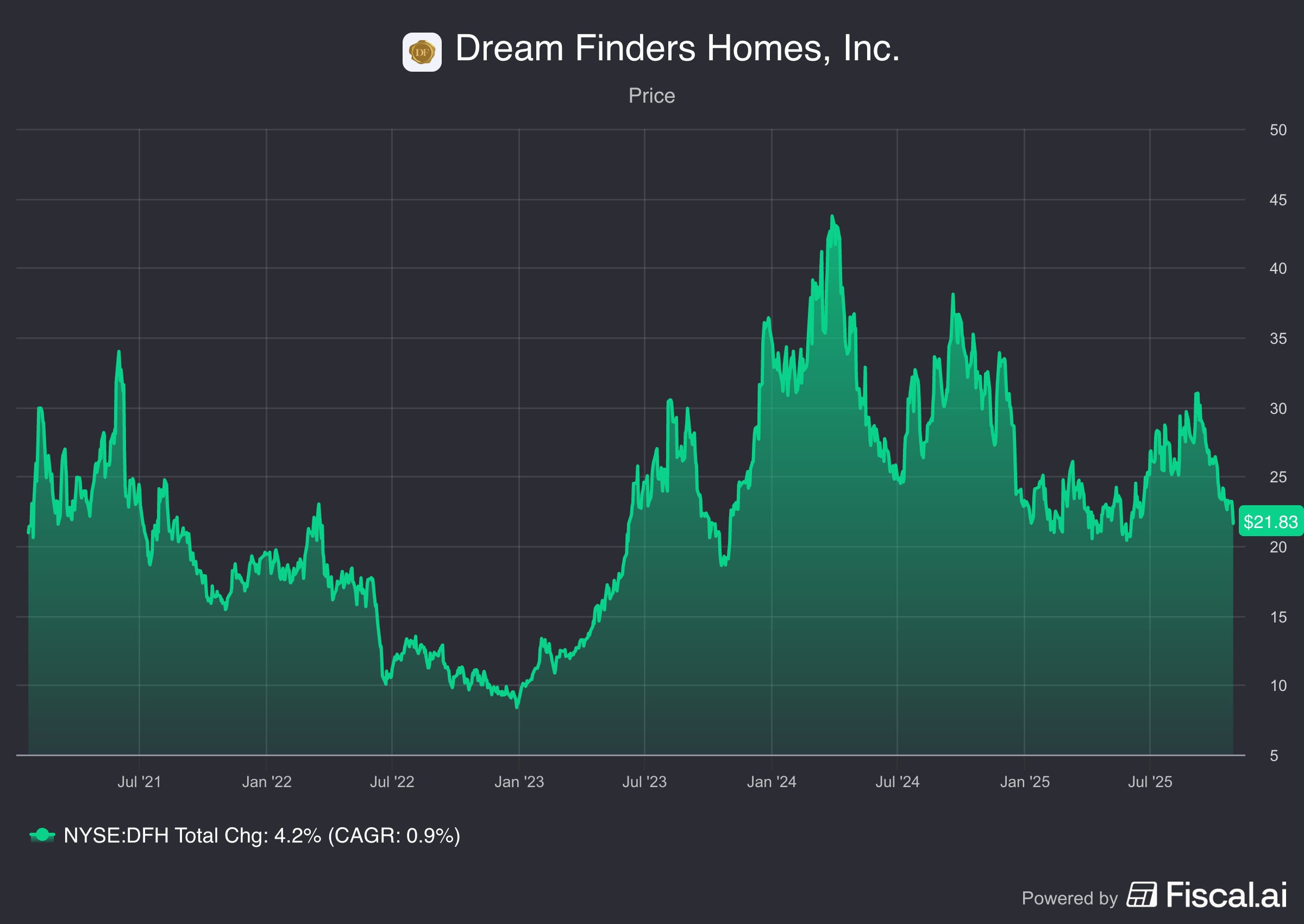
Dream Finders Homes is starting to look interesting for investors with a higher risk appetite.

The stock is currently trading around the same level as it was at the time of its IPO in 2021:

Source: Fiscal.ai

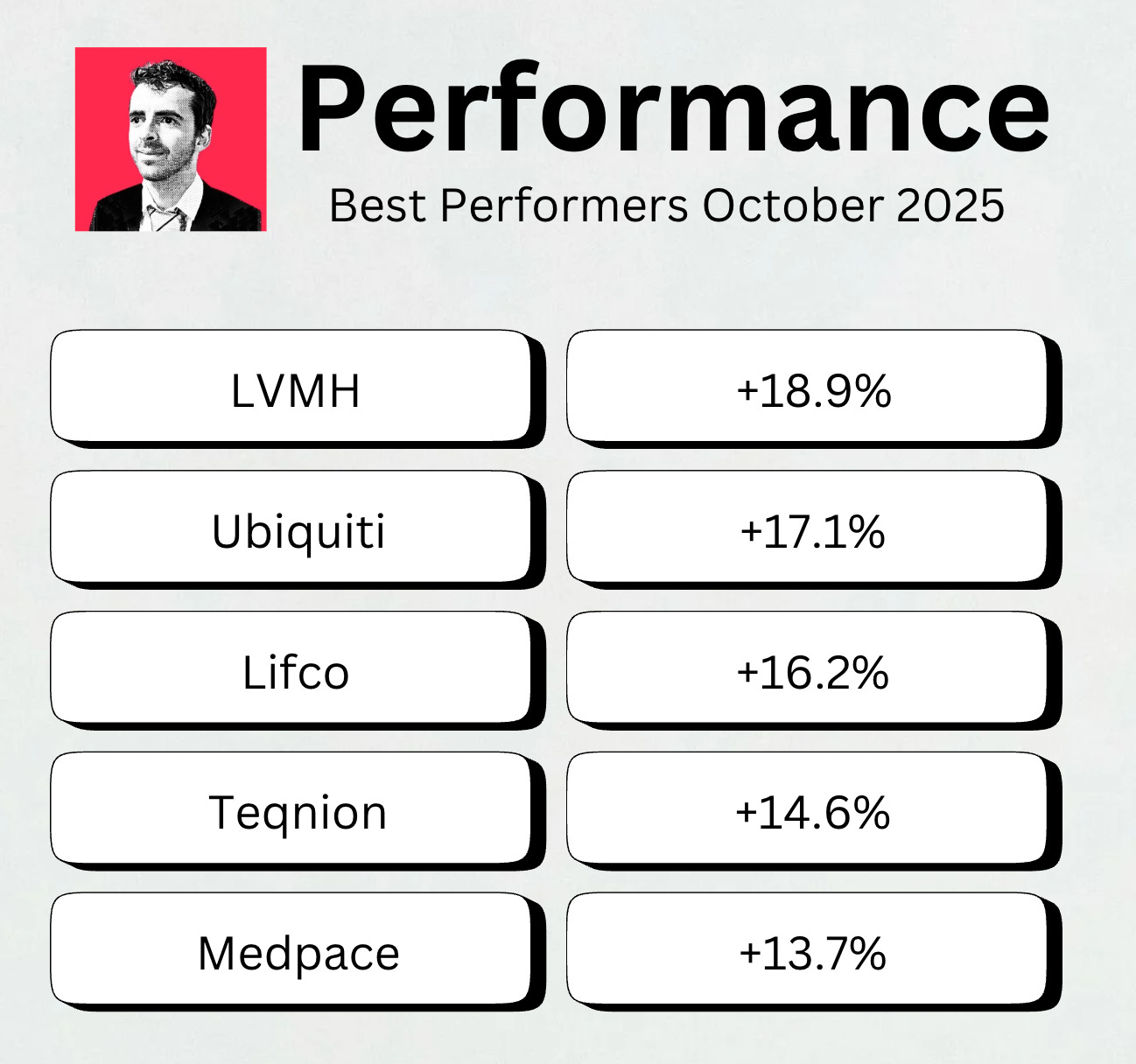
Best performers

Here are the best performers of October:

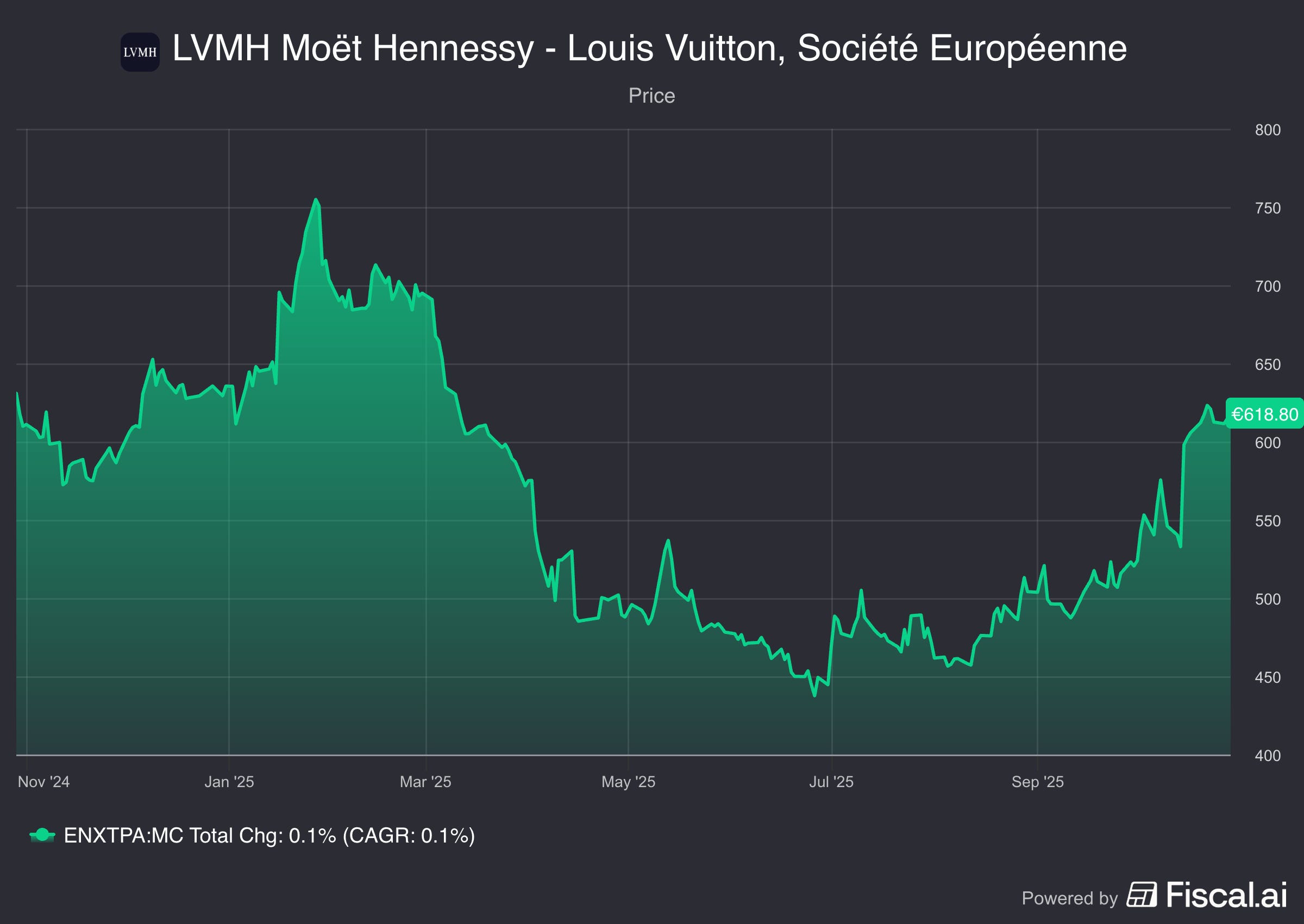
LVMH returns to growth after 4 quarters of decline.

The stock price jumped after they published great results:

Source: Fiscal.ai

Spotlight: Accenture plc ($ACN)

How does Accenture make money?
Accenture is a global professional services company. They help businesses with technology, consulting, and digital transformations. Their clients include big names like governments, tech companies, banks, and healthcare giants. They offer two main types of work: consulting projects, which are short-term, and managed services, which are long-term contracts.

Brief introduction

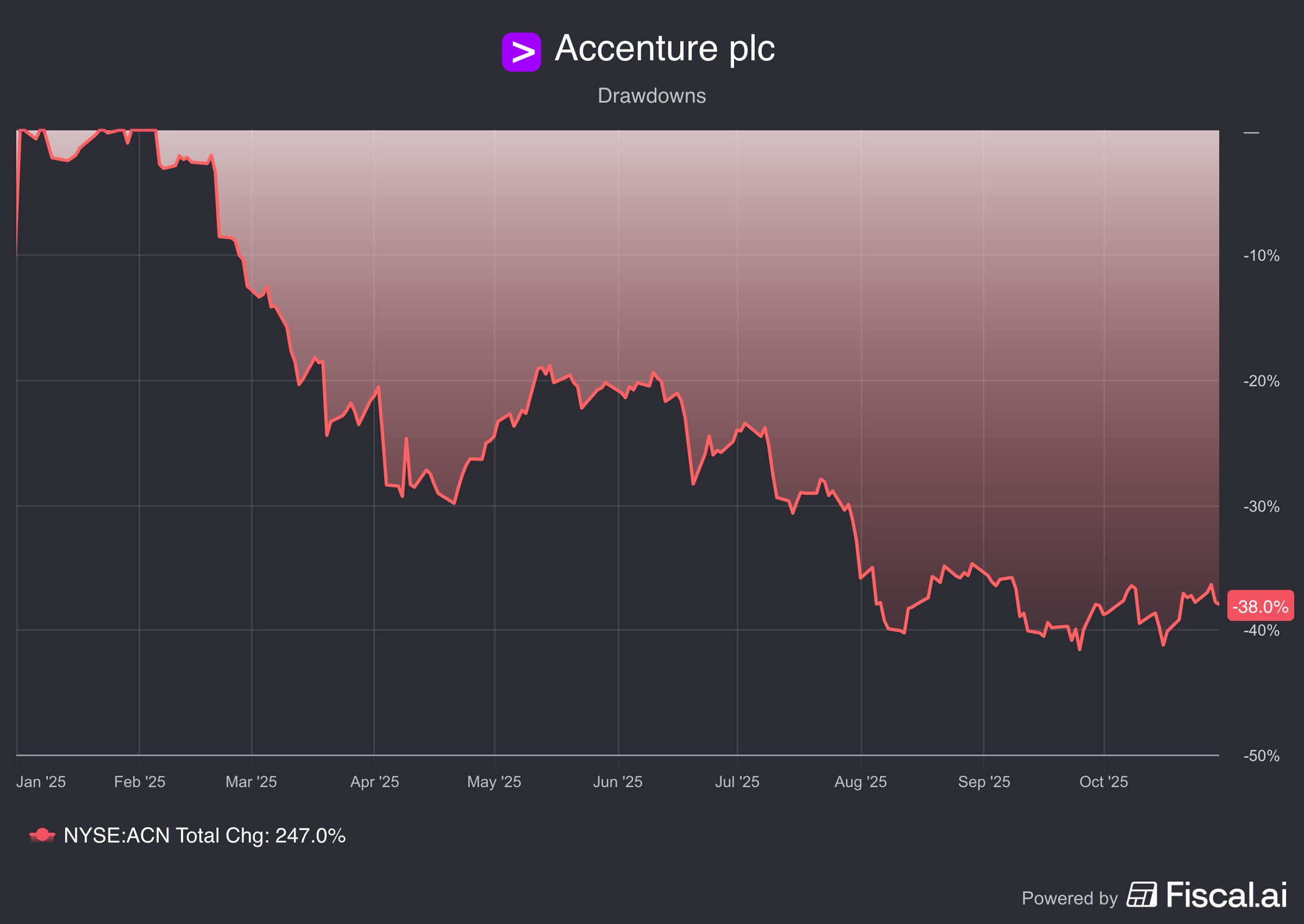
Accenture is a leader in its field.

But this year, the stock has fallen nearly 40%.

Source: Fiscal.ai

It’s facing challenges like canceled contracts, slower revenue growth, and uncertainty from AI.

But Accenture has a solid client base, strong financials, and key advantages that will likely help it bounce back.

The company has been around for decades, helping top companies implement technology and improve operations.

AI is creating uncertainty in consulting, but Accenture remains one of the most trusted names in the industry.

Competitive advantage

Accenture has a competitive advantage based on two pillars:

  1. Switching costs

  2. Intangible assets

Switching costs

The company is deeply embedded in the operations of its clients, helping with everything from strategy to big tech projects.

These long-term relationships make it tough for clients to switch. It would be very costly and disruptive.

The fact that 195 of their top 200 clients have stayed for over 10 years shows how strong these connections are.

Intangible assets

Accenture has a globally recognized brand and strong ties with C-suite executives at major enterprises.

It has a reputation for being a “safe choice”.

Think about the career and reputational risk that comes with choosing a lesser-known and cheaper alternative.

Imagine hiring the cheaper consulting company that crashed the website and deleted the data base.

Accenture’s trusted reputation gives it premium positioning, and preferential access to large projects.

Why is the stock cheap?

The company’s growth has slowed, and there are worries about how AI could impact its business.

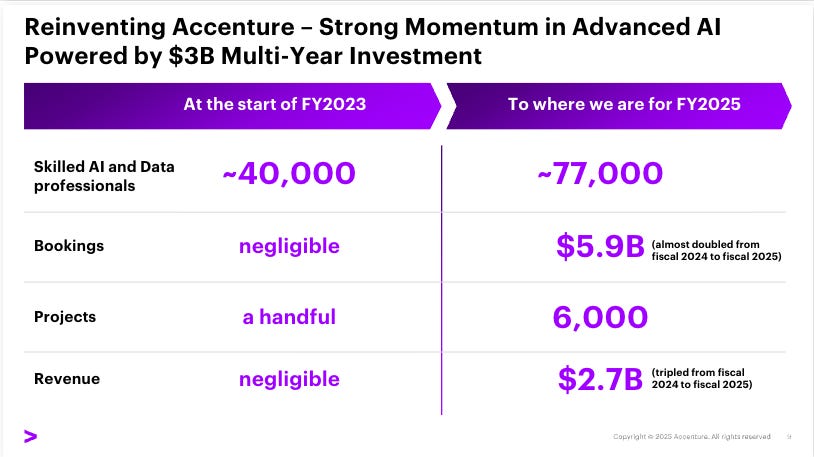
They are investing heavily in AI, which has led to restructuring and job cuts. Despite these issues, I believe the market is overreacting for several reasons:

  1. Accenture’s deep client relationships give it stability, especially in uncertain times

  2. They are a leader in AI, which could be a major growth area in the coming years

  3. Their balance sheet is strong, and their earnings (and dividend) have grown consistently for over a decade

Source: Accenture Investor Relations

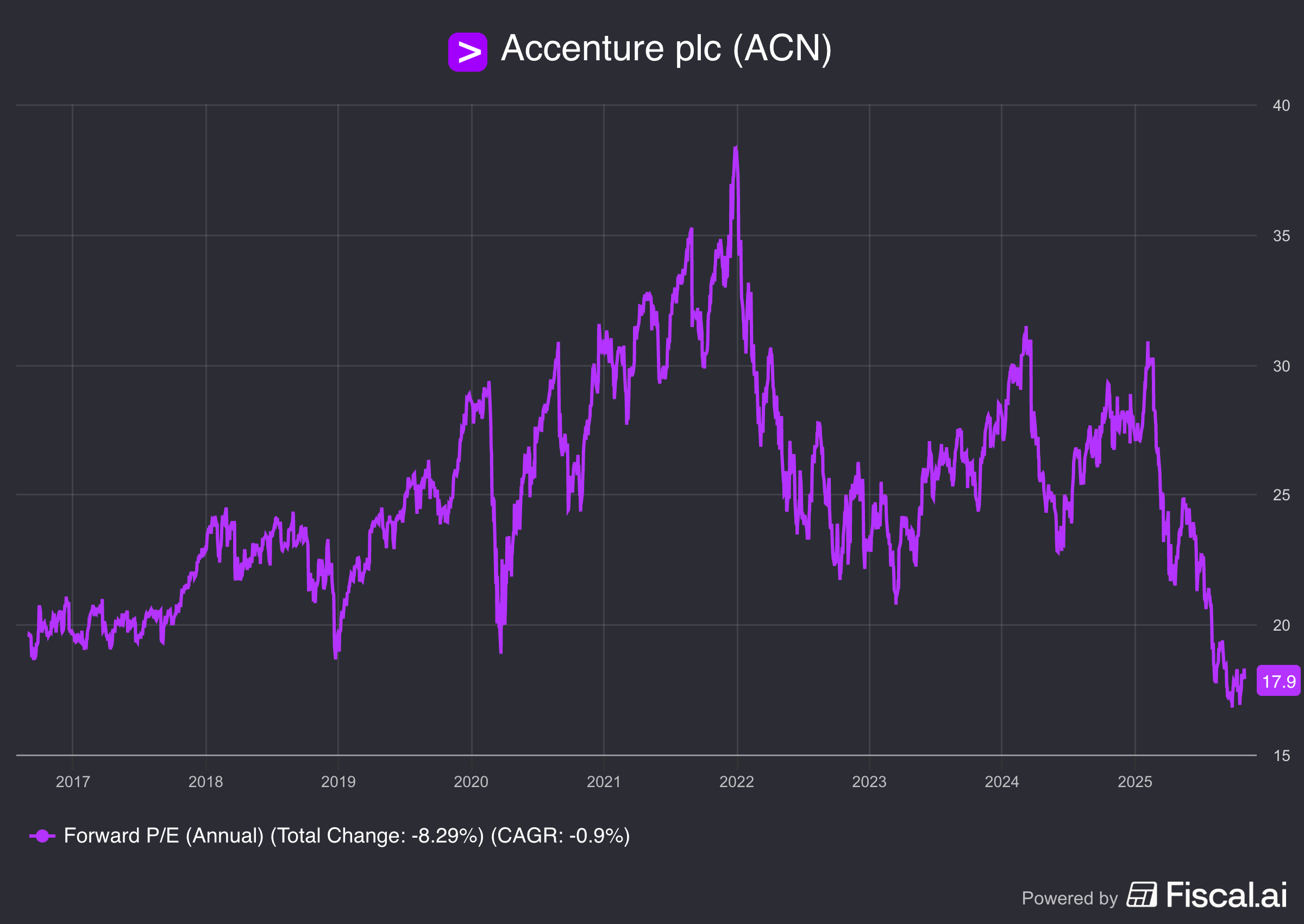
At a Forward PE of 17.9x, the stock is trading near its lowest point since 2017.

It could present a good buying opportunity for long-term investors.

Source: Fiscal.ai

Fundamentals

Here’s what Accenture’s fundamentals look like:

  • Debt/Equity: 0.3x (Debt/Equity < 1x? ✅)

  • ROCE: 26.5% (ROCE > 15%? ✅)

  • 5-Yr Revenue CAGR: 9.5% (5-Yr Revenue CAGR > 7%? ✅)

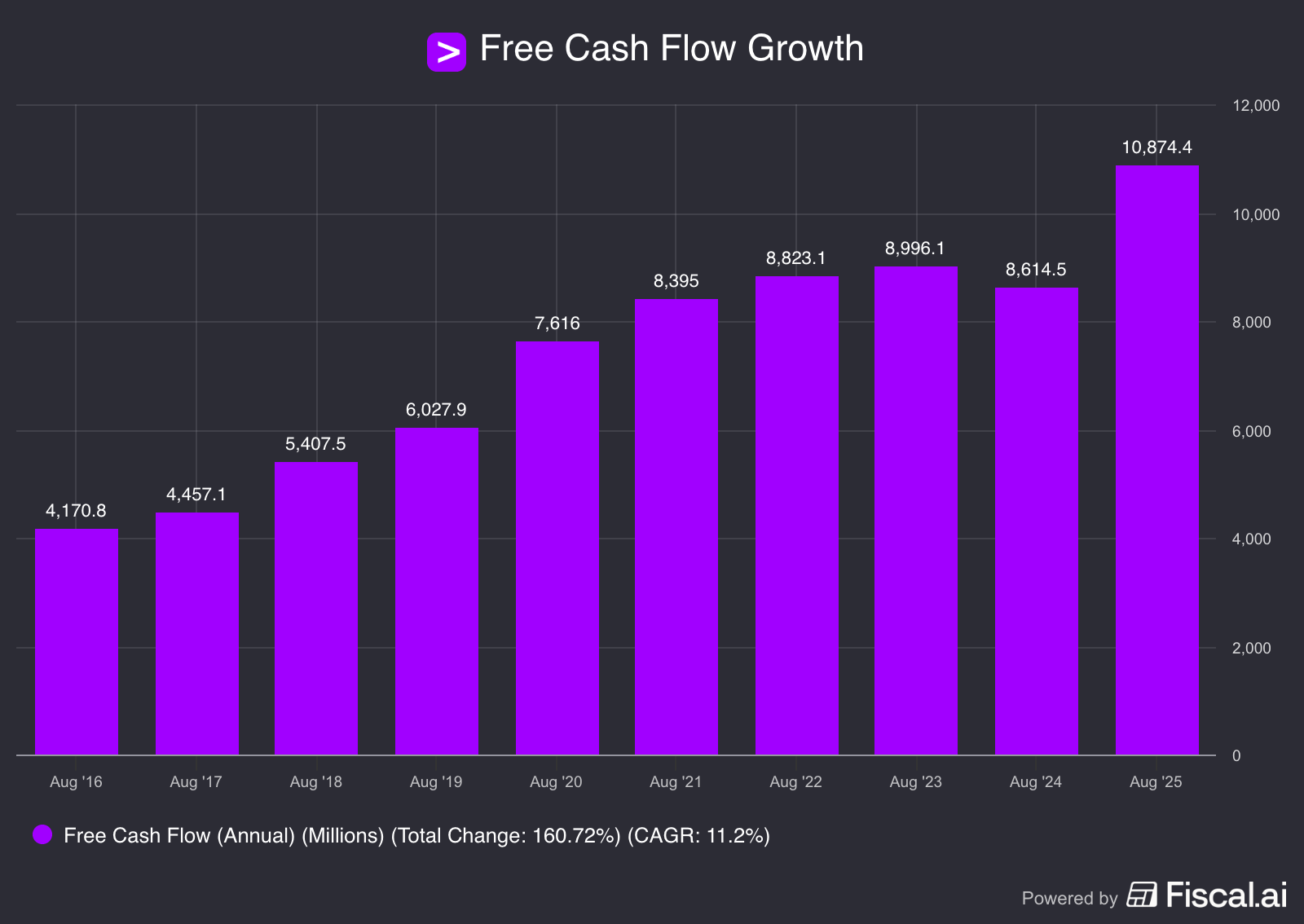
  • FCF-Margin: 15.6% (FCF-Margin > 10%? ✅)

  • P/FCF: 14.7x (P/FCF < 20x? ✅)

These fundamentals look very healthy.

Source: Fiscal.ai

Conclusion

Accenture is going through a rough patch, but the business remains strong.

The stock’s decline has created an opportunity to buy a high-quality company at a discount.

Accenture’s moat, dividend history, and future growth potential make it interesting for both dividend and quality investors.

Best Buys November 2025

Now, let’s dive into our five favorite stocks for November 2025.

This month, we’re featuring Dividend Growth Companies from Our Watchlist.

Why? Because Compounding Dividends 2.0 is launching this month!

5. Domino’s Pizza ($DPZ)

How does Domino’s make money?
Domino’s is the #1 pizza company in the world. It makes the majority of its money through its franchise model. Franchisees pay Domino’s a percentage of sales, which helps the company grow without taking on too much risk.

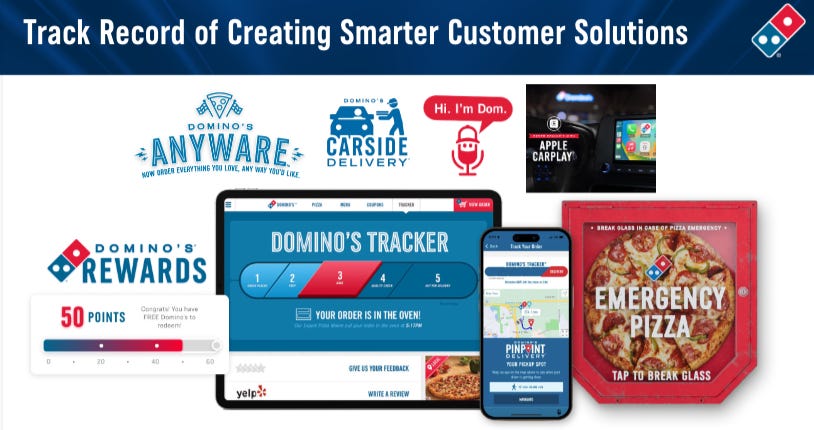
But what really makes Domino’s special is its focus on technology.

They’re a technology company that happens to sell pizza.

The company uses tech to make ordering and delivery faster. Their loyalty program drives repeat customers and more carryout orders.

Source: Domino’s Investor Relations

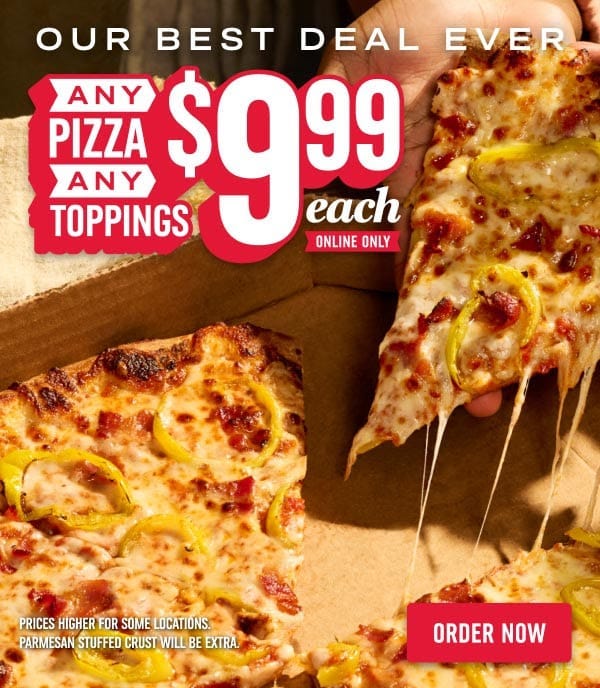
One of the things that drove Domino’s strong growth recently was their “Best Deal Ever” promotion.

Something very interesting about this?

Management said they couldn’t have done it a few years ago.

The only reason it’s possible now is because of the technology Domino’s has invested in:

“Best Deal Ever also highlights the operational excellence our system has achieved. We wouldn’t have been able to execute this kind of a promotion just a few years ago. The myriad of ever-changing topping combinations customers are putting together requires best-in-class operations. That was unlocked by franchisees leveraging our training programs and Dom.OS systems”

What makes Domino’s a great compounder?

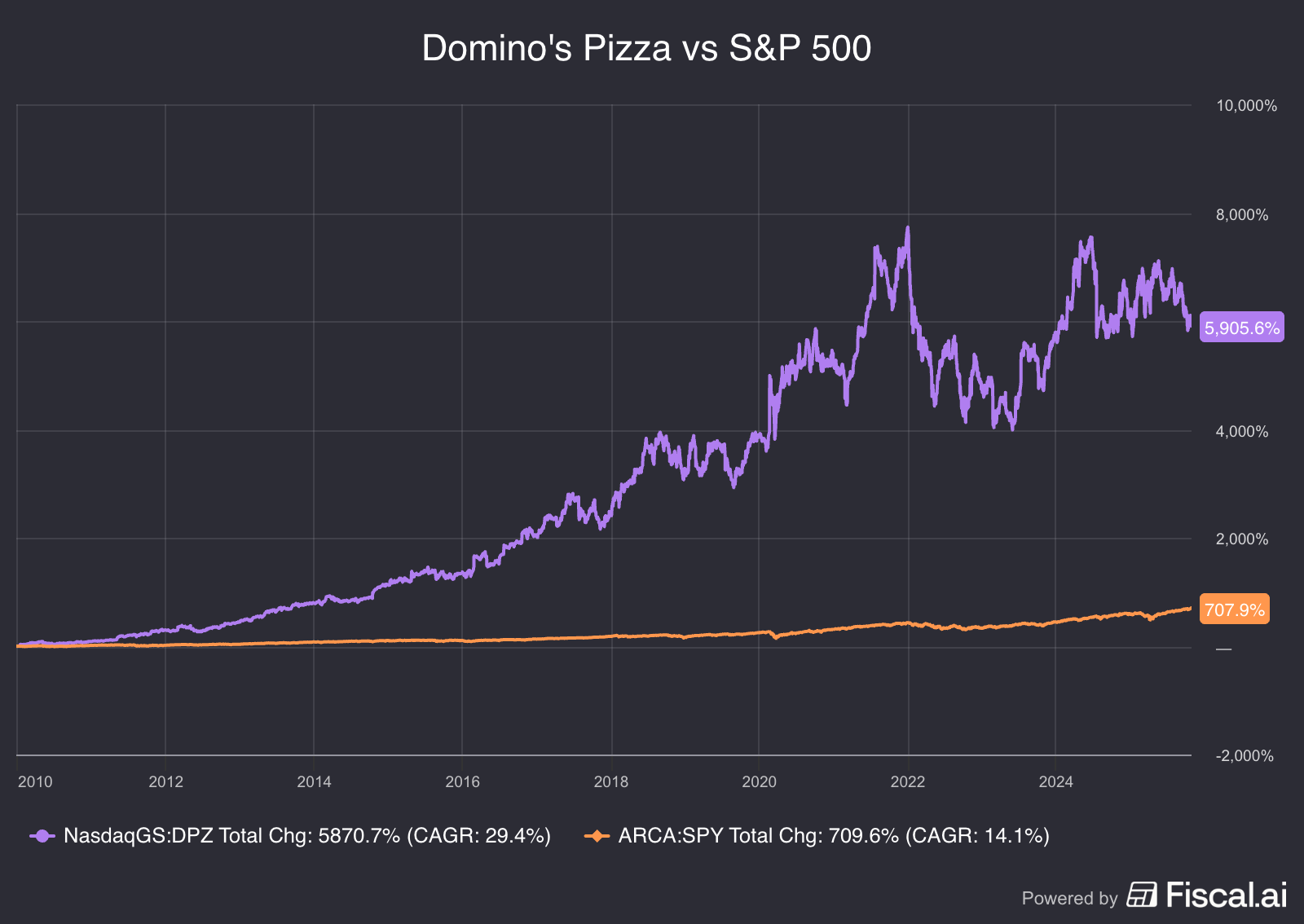
Since 2010, Domino’s has been a star performer.

The stock has compounded by more than 20% per year since 2010.

Source: Fiscal.ai

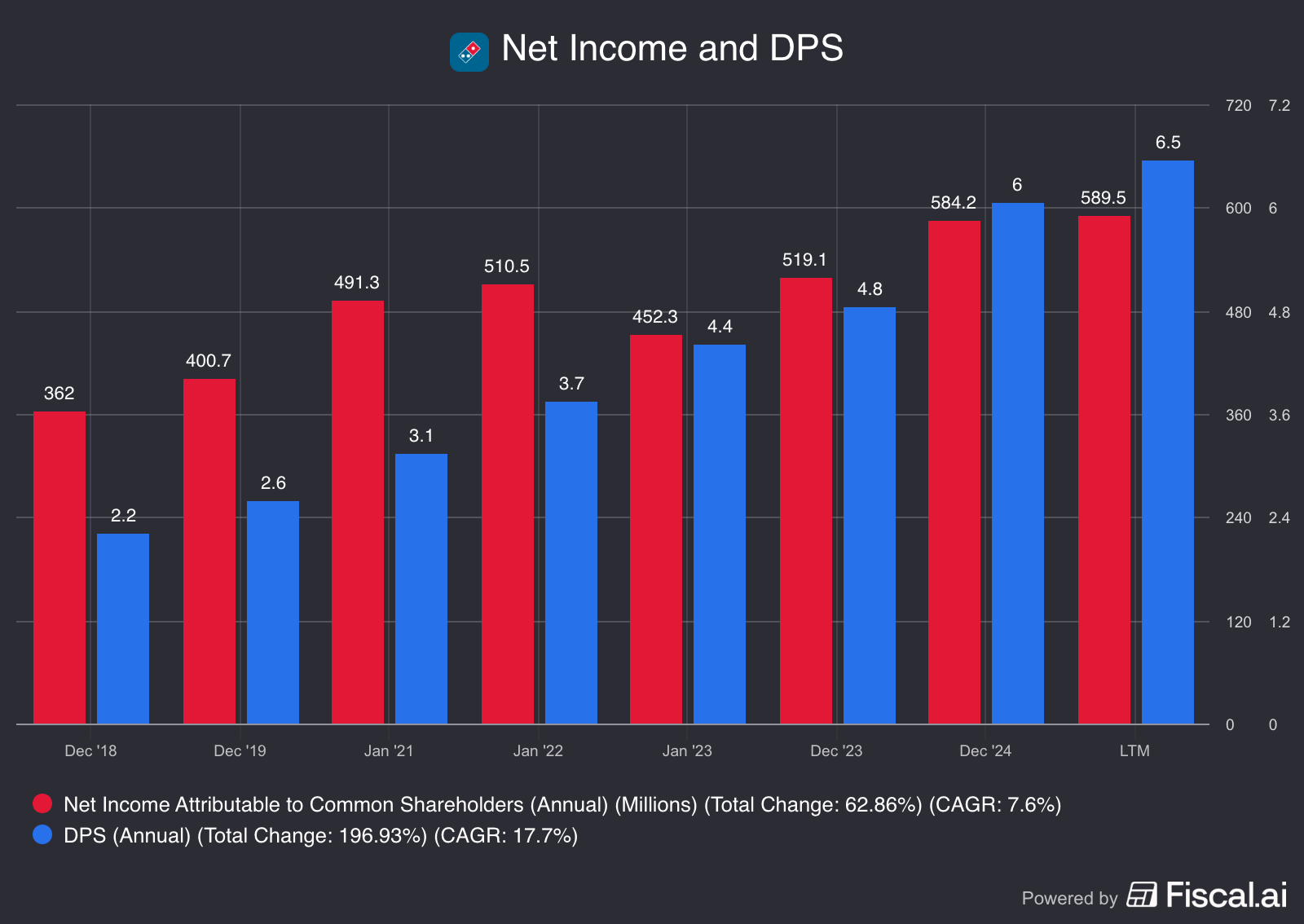
The company is a consistent dividend grower and has increased its dividend every year for over a decade.

Source: Fiscal.ai

One more reason to love Domino’s?

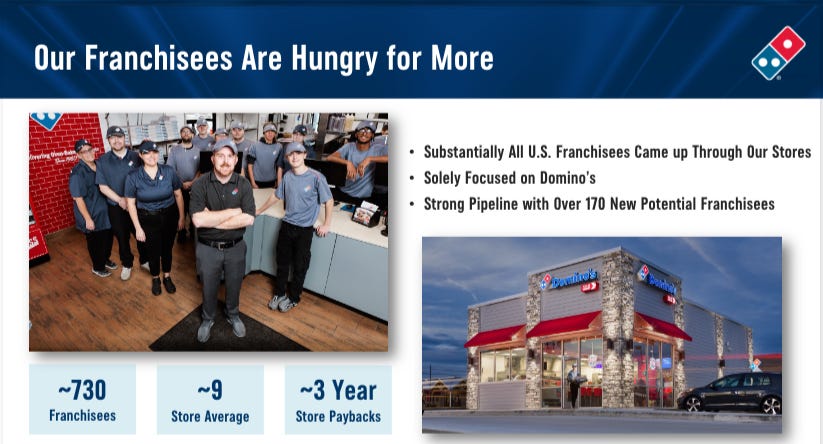
They have the right incentives in place:

  • To own a Domino’s, you must have worked at a Domino’s

  • If you own a Domino’s, you can’t own other businesses

  • When the Franchisees succeed, Domino’s succeeds

Source: Domino’s Investor Relations
  • The company’s scale, brand, and focus on franchisee success give it a big advantage in a tough market.

4. Equasens ($EQS)

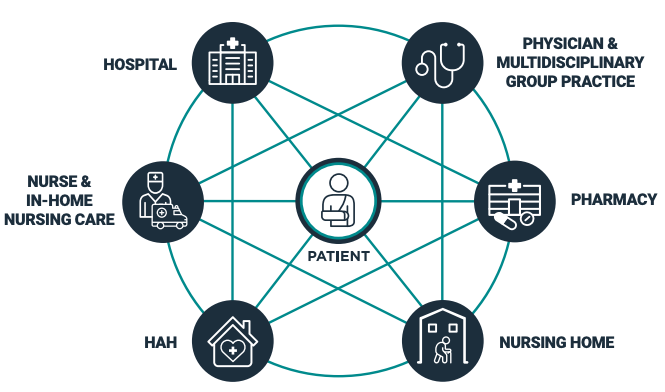
How does Equasens make money?
Equasens is a French company that specializes in  IT solutions for managing pharmacies, healthcare products, and services, focusing on improving patient care. 

Most of Equasens’ revenue comes from software licensing, maintenance, and service contracts.

These contracts often involve recurring fees, providing a stable revenue stream.

In addition, they sell software modules, hardware, and provide training and support to their clients.

Source: Equasens Investor Relations

Equasens can be considered a market leader in a niche.

They focus on providing end-to-end solutions for healthcare professionals, particularly in the French-speaking market.

It’s a segment larger, more generalized competitors may overlook.

This specialization allows them to build deeper relationships and tailor their offerings more effectively.

Source: Equasens Investor Relations

What makes Equasens a great compounder?

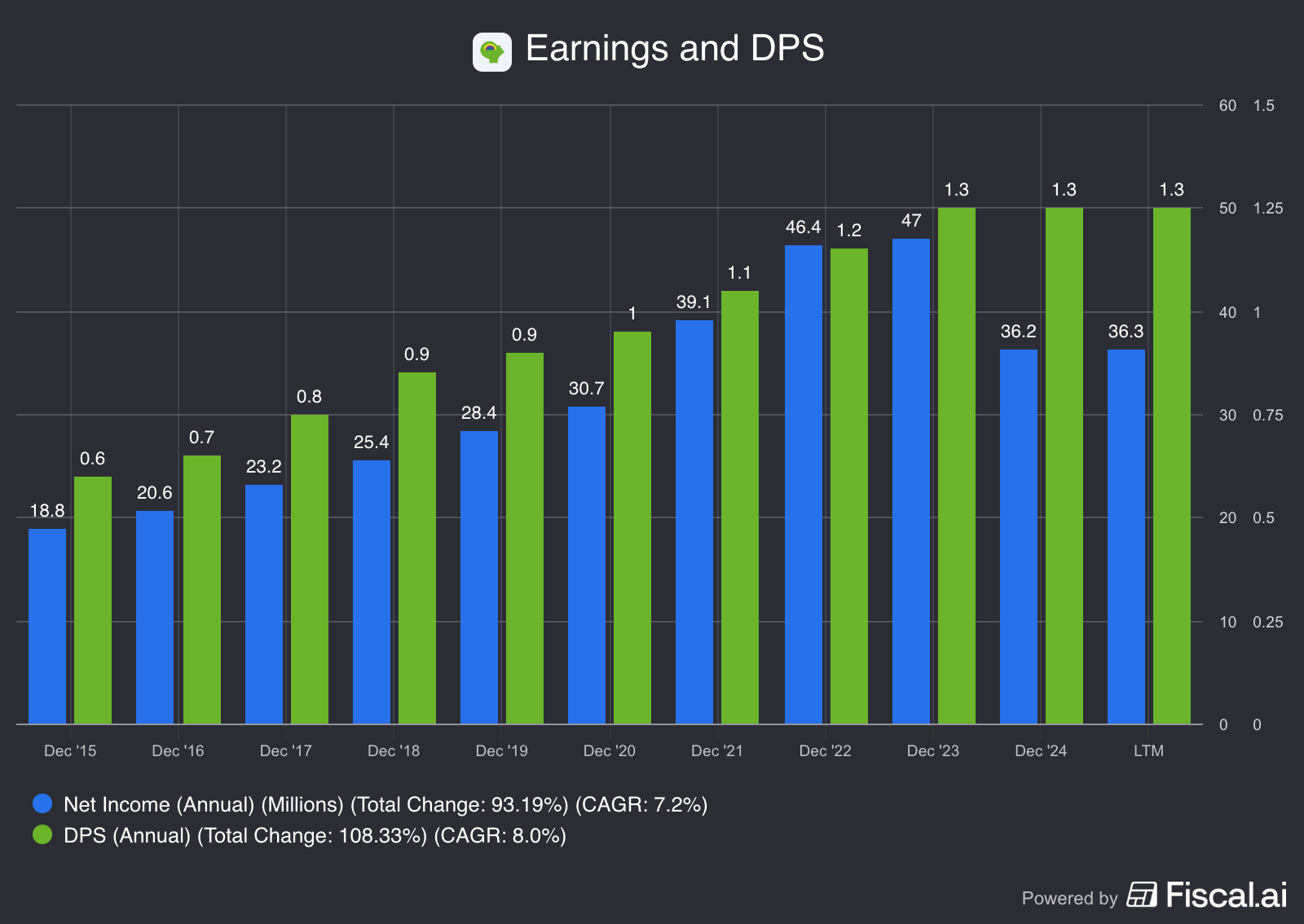
Equasens has grown its earnings and dividends consistently.

Thanks to its stable business model in the healthcare sector they can grow very reliably.

Source: Fiscal.ai

The company should continue to benefit from an aging population and the continued digitization of healthcare.

Now let’s dive into the top 3!

Read more

❌