❌

Reading view

Firefly Aerospace Is the Space Stock Nobody Is Talking About

Key Points

Firefly Aerospace (NASDAQ: FLY) is doing a lot more than launching rockets. The company is actually building an entire space transportation business around four major platforms: its Alpha rocket, Blue Ghost lunar lander, Elytra orbital vehicle, and the larger Eclipse rocket being developed with Northrop Grumman. And the numbers indicate Firefly is no slouch.

Q2 revenue reached a record $117.7 million, up 659% year over year, and management expects between $420 million and $450 million in revenue for 2026. Firefly also picked up more than half a dozen contracts during the quarter.

Missed AI’s "Act 1"? Act 2 Could Be 15x Bigger. Most investors think they missed the AI boat because they didn't buy Nvidia in 2005. But according to our analysts, we’re only at the end of "Act 1"β€”the R&D phase. "Act 2" is the global rollout. Continue Β»

To the moon!

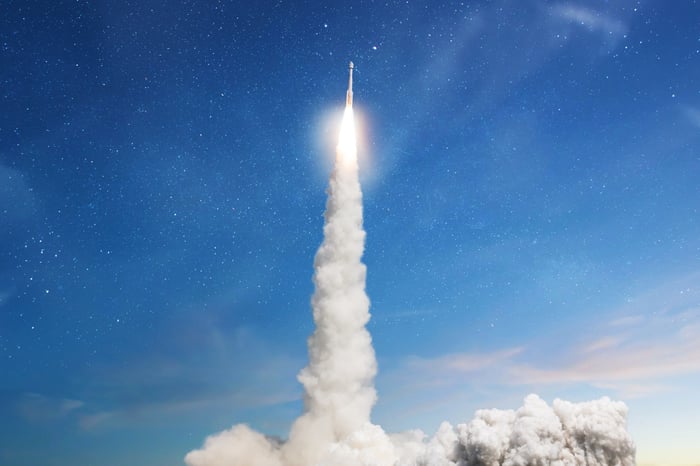
Rocket launch.

Image source: Getty Images.

Firefly became the first commercial space company to successfully land on the moon, and it now has six contracted lunar missions. A recent $144 million NASA contract added another Blue Ghost mission, while a separate $75 million subcontract will use Firefly's Elytra spacecraft to deliver four drones to the moon's south pole.

The company is also expanding production capacity. Its new Texas cleanroom is designed to increase production of Blue Ghost and Elytra spacecraft, and it's developing a larger lunar lander capable of carrying heavier cargo, vehicles, infrastructure, and power systems to the moon.

Then there's defense. Firefly subsidiary SciTec recently won a $94 million Space Force contract, while Elytra is being developed for missions including satellite delivery, surveillance, communications, and even the removal of old satellites from orbit.

Of course, Firefly isn't a risk-free investment. The company lost $92.3 million in Q2, and developing rockets and spacecraft requires enormous amounts of capital. But Firefly doesn't need to be as big as Space Exploration Technologies or RocketLab to build a valuable business. It just needs to capture a piece of the growing market for launches, lunar missions, orbital services, and national-security space infrastructure.

With revenue accelerating and several major platforms moving deeper into production, Firefly is becoming much more than another speculative rocket company.

Should you buy stock in Firefly Aerospace right now?

Before you buy stock in Firefly Aerospace, consider this:

The Motley Fool Stock Advisor analyst team just identified what they believe are the 10 best stocks for investors to buy now… and Firefly Aerospace wasn’t one of them. The 10 stocks that made the cut could produce monster returns in the coming years.

Consider when Netflix made this list on December 17, 2004... if you invested $1,000 at the time of our recommendation, you’d have $375,240!* Or when Nvidia made this list on April 15, 2005... if you invested $1,000 at the time of our recommendation, you’d have $1,403,292!*

Now, it’s worth noting Stock Advisor’s total average return is 933% β€” a market-crushing outperformance compared to 211% for the S&P 500. Don't miss the latest top 10 list, available with Stock Advisor, and join an investing community built by individual investors for individual investors.

See the 10 stocks Β»

*Stock Advisor returns as of October 1, 2026.

Jeff Siegel has no position in any of the stocks mentioned. The Motley Fool has positions in and recommends Firefly Aerospace and Rocket Lab. The Motley Fool has a disclosure policy.
  •  

Here's What a $10,000 Investment in SpaceX Stock Could Be Worth in 2035 (Hint: It's a Lot)

Key Points

When Space Exploration Technologies (NASDAQ: SPCX) debuted this past June, it drew significant investor attention. While the stock traded like a roller coaster in the early days, it has settled into a fairly narrow trading range over the past month. This makes now a great time to evaluate what the future could hold for this visionary company. At its current price of around $151, a $10,000 initial investment would buy you around 66 shares.

Over the next several years, SpaceX's growth will likely be driven by its AI computing leasing business and its satellite internet business, Starlink. SpaceX has been investing aggressively in building out its AI infrastructure, and it's basically created its own neocloud unit that rents out its excess compute power. As a bridge provider of compute power in a world with an insatiable appetite for it, SpaceX has been getting incredible short-term rates.

Missed Nvidia in 2009? This Rare Signal Is Flashing Again. In 2009, a "Double Down" signal flashed for a little-known chipmaker called Nvidia. For the first time in years, that same "Total Conviction" signal is flashing for a company 1/100th the size of Nvidia. Continue Β»

This is leading to strong returns for the business, with SpaceX saying it is getting a payback on its AI infrastructure investments in about a year. It recently signed a $1.1 billion per month compute deal, and said that it could potentially double the number of graphics processing units (GPUs) installed in its Colossus 2 supercomputer by year's end. Analysts see big upsides from these investments: Evercore projects that this investment could push SpaceX's AI solutions and infrastructure revenue to $83 billion in 2027, versus the $47 billion consensus. TD Cowen, meanwhile, projected that SpaceX will lease out up to 49% of its AI computing capacity through 2031.

Starlink also remains a growth driver. This is a great recurring revenue business, and it's growing quickly. Last quarter, the segment's revenue surged 66% year over year to $4.3 billion, while its number of subscribers doubled to 12 million. It continues to have a large opportunity, including in the consumer, enterprise (airlines and mobile partnerships), and government sectors.

Beyond these two businesses, the picture gets both murkier and more exciting. The company just completed the 14th test flight of its Starship rocket, which could be the gateway for it to generate significant other revenue streams, including from data center satellites in Earth orbit. It's also working with Nvidia on AI infrastructure that can withstand the rigors of space. The optionality of these potential ventures should keep the stock's valuation multiples high.

SpaceX logo.

Image source: The Motley Fool.

What a $10,000 investment could be worth in 2035

By 2035, analysts anticipate that SpaceX will produce nearly $2.25 trillion in annual revenue and be highly profitable, generating adjusted earnings per share (EPS) of $41.24. Now, the further out you go, the more variables there are, and that is reflected in analysts' revenue estimates, which range from $1 trillion to slightly over $3 trillion.

When it comes to the question of how the market might be valuing SpaceX at that point, we can look to Musk's other public company, Tesla, for hints. In the first half of 2020, it traded at price-to-sales (P/S) ratios in the 3 to 8 range. Using the low and high ends of analyst revenue forecasts and Tesla's historical multiple range would value SpaceX at a market cap between $3 trillion and $24 trillion. Based on the $2.25 trillion consensus, meanwhile, it would be valued between $6.75 trillion and $18 trillion.

Given that SpaceX's future revenues will be highly dependent on it making considerable capital expenditures up front, we should assume there will be share dilution along the way. Let's assume the company's diluted share count will increase 1% a year (between capex and share compensation) to around 14.4 billion. That would value its stock at between $210 and $1,670 using the low and high ends of analyst estimates and Tesla's multiple. Using just the consensus revenue estimate, the stock would trade between $470 and $1,250.

That's a wide range, so if we want to just take the consensus and use a reasonable P/S multiple of 5, the stock would trade at around $780. That's over a fivefold increase from current prices, turning a $10,000 investment into around $51,500.

Now, SpaceX is going to have to execute, and there are a wide variety of outcomes, but it looks like this AI stock has plenty of long-term upside from here.

Should you buy stock in Space Exploration Technologies right now?

Before you buy stock in Space Exploration Technologies, consider this:

The Motley Fool Stock Advisor analyst team just identified what they believe are the 10 best stocks for investors to buy now… and Space Exploration Technologies wasn’t one of them. The 10 stocks that made the cut could produce monster returns in the coming years.

Consider when Netflix made this list on December 17, 2004... if you invested $1,000 at the time of our recommendation, you’d have $375,240!* Or when Nvidia made this list on April 15, 2005... if you invested $1,000 at the time of our recommendation, you’d have $1,403,292!*

Now, it’s worth noting Stock Advisor’s total average return is 933% β€” a market-crushing outperformance compared to 211% for the S&P 500. Don't miss the latest top 10 list, available with Stock Advisor, and join an investing community built by individual investors for individual investors.

See the 10 stocks Β»

*Stock Advisor returns as of October 1, 2026.

Geoffrey Seiler has no position in any of the stocks mentioned. The Motley Fool has positions in and recommends Evercore and Tesla. The Motley Fool has a disclosure policy.

  •  
❌