❌

Reading view

Congress Considers Expanding Crypto, Stablecoin Rules for Banks

Congress is reportedly considering expanding crypto rules to allow banks and credit unions to hold digital assets, issue stablecoins, and use blockchain. According to new information from the Congressional Research Service, Policymakers are currently debating whether activities involving cryptocurrencies and digital assets (crypto) should be considered bank-permissible activities.

JUST IN: πŸ‡ΊπŸ‡Έ Congress considers expanding crypto rules to allow banks and credit unions to hold digital assets, issue stablecoins, and use blockchain.

β€” Watcher.Guru (@WatcherGuru) October 1, 2026

According to the report, any new legislation would result in a more durable outcome, reducing the likelihood of frequent regulatory changes. Furthermore, Congress may consider whether a more permanent solution allowing or limiting crypto activities would be preferable. In recent years, the policy debate on permissible activities has focused on crypto. Bank lawmakers have consistently maintained that banks can conduct crypto-related activities only if they are legally permissible and conducted in a safe and sound manner. However, that has changed in recent years, with the arrival of the second Trump administration and the growing popularity of cryptocurrency.

As the crypto clarity continues to be debated in the U.S. Senate, the future of digital assets in traditional finance remains a hot topic. The SEC has already agreed to begin working on clearer crypto regulation and new rules for digital assets to be handled by banks. The GENIUS Act already made stablecoin issuance, custody, and related activities allowed for businesses owned by banks this past summer.

Also Read: Broadcom (AVGO) to lend Anthropic up to $42 billion for AI Chips

Whether any administration seeks to expand or constrain bank participation in crypto, the report suggests the regulatory baseline remains vulnerable to reversal unless Congress acts, and that a permissive stance would raise questions about capital, liquidity, anti-money-laundering compliance, and exposure to crypto-market volatility.

  •  

Can Shiba Inu Reach $1 In the Next 12 Months?

Key Points

  • Shiba Inu’s all-time high was established nearly five years ago, demonstrating just how much it has fallen out of favor.

  • The meme token lacks any real fundamental advantages compared to other feature-rich blockchain networks.

  • Tokens are being burned, but the current rate is virtually nothing compared to Shiba Inu's gargantuan circulating supply.

Shiba Inu (CRYPTO: SHIB) might have a small market capitalization of $3.3 billion (as of Sept. 28), but that hasn't kept it from being one of the most popular digital assets on Earth. It capitalized on the investment community's interest in Dogecoin, while aiming to be more functional by leveraging its presence on the Ethereum blockchain.

This meme token has been in a troubling down cycle, however. Maybe positive momentum is on the horizon. Can Shiba Inu's price increase by almost 18,000,000% and reach $1 in the next 12 months?

Missed Nvidia in 2009? This Rare Signal Is Flashing Again. In 2009, a "Double Down" signal flashed for a little-known chipmaker called Nvidia. For the first time in years, that same "Total Conviction" signal is flashing for a company 1/100th the size of Nvidia. Continue Β»

Shiba Inu dog sitting on a gray couch.

Image source: Getty Images.

Weak fundamentals support ongoing price pressure

Over the long term, the most important factor for any cryptocurrency to even have a chance at staying relevant is a fundamental edge that supports real-world utility. It's accurate to assume that Shiba Inu falls flat in this area. Its developers built a metaverse, a decentralized exchange, and a layer-2 scaling solution, all innovative features within the cryptocurrency industry.

However, these strategic actions have done nothing to drive Shiba Inu's price, a clear indication that they're not catching on with users. What's more, there are numerous other cryptocurrencies that have more promising feature sets.

Shiba Inu followers know that fundamentals have minimal impact on the token's price movement. What has mattered most historically has been how excited (or disappointed) the Shib Army, the cryptocurrency's community of supporters, was at any given time. Even these advocates appear to be losing interest. This is clear when you realize that Shiba Inu currently trades 94% off its peak from almost five years ago.

Forget about burning tokens

Shiba Inu is in the process of burning its token supply. This entails sending tokens to a dead wallet, resulting in a removal from the circulating supply. Investors can think about it as if it were a company conducting share repurchases. From a fundamental perspective, nothing changes.

This doesn't guarantee that the desired outcome will happen. Existing token holders aren't certain to see the value of their positions increase simply because the community is undergoing a coin-burning scheme.

Additionally, Shiba Inu isn't burning enough tokens. It's not even close. In the past 30 days, 375.6 million tokens were burned, translating to roughly 4.5 billion on an annualized basis. Of the gargantuan supply of 589.2 trillion tokens, this represents next to nothing.

After Shiba Inu's mind-boggling 2021 run, it has fallen out of favor. There are probably still strong supporters out there who think that good times are coming. It's smart to drastically temper those expectations, however. This meme coin will not hit $1 in the next 12 months or ever.

Should you buy stock in Shiba Inu right now?

Before you buy stock in Shiba Inu, consider this:

The Motley Fool Stock Advisor analyst team just identified what they believe are the 10 best stocks for investors to buy now… and Shiba Inu wasn’t one of them. The 10 stocks that made the cut could produce monster returns in the coming years.

Consider when Netflix made this list on December 17, 2004... if you invested $1,000 at the time of our recommendation, you’d have $375,240!* Or when Nvidia made this list on April 15, 2005... if you invested $1,000 at the time of our recommendation, you’d have $1,403,292!*

Now, it’s worth noting Stock Advisor’s total average return is 933% β€” a market-crushing outperformance compared to 211% for the S&P 500. Don't miss the latest top 10 list, available with Stock Advisor, and join an investing community built by individual investors for individual investors.

See the 10 stocks Β»

*Stock Advisor returns as of October 1, 2026.

Neil Patel has no position in any of the stocks mentioned. The Motley Fool has positions in and recommends Ethereum. The Motley Fool has a disclosure policy.

  •  

Binance Pay Launches Crypto Payment Services Across Japan

Binance Pay is launching crypto and digital asset payments at millions of PayPay-supported locations across Japan. According to a press release from Binance, Binance Pay will allow eligible overseas users visiting Japan to spend more than 100 cryptocurrencies at the vast majority of PayPay-supported merchants starting today.

JUST IN: πŸ‡―πŸ‡΅ Binance Pay launches $USDT payments at millions of PayPay-supported locations across Japan.

β€” Watcher.Guru (@WatcherGuru) September 30, 2026

PayPay is a Japanese cashless payment service accepted at millions of locations nationwide around Japan. The service is accepted at several major chains, smaller retailers, vending machines, taxis, and public transportation in the country. PayPay lists nine other overseas payment services supported through HIVEX, mainly from China, Hong Kong and Taiwan. Now, it lists Binance as a supported platform, and issued the following press release about adding Binance: β€œUsers of Binance Pay can now use the feature for dining, shopping, accommodations, entertainment and other expenses at PayPay merchants throughout Japan. PayPay merchants will receive their sales proceeds in Japanese yen.”

The service will run through HIVEX, a payment interoperability framework that connects overseas QR payment services to PayPay-supported merchants in Japan, per Binance, making it the first crypto payment service to access PayPay-supported merchants through HIVEX. Binance Pay uses the Tether USDt stablecoin (USDT) as its backend settlement layer, while HIVEX settles with PayPay and PayPay settles merchants in yen.

Also Read: XRP Price Prediction: Here’s When It Could Hit $3 Again

The move shows a strong leap forward for crypto in Japan, as well as for Binance as a global platform. The latter’s native crypto coin, BNB Coin, rose just over 1.7% following the announcement. Here is how to use the Binance Pay Service in Japan via PayPay:

  1. Open the Binance App and tap the [Pay] icon.
  2. Tap the [PayPay] icon.
  3. There are two options to pay to PayPay merchants:
    • Option 1: Present Your PayPay payment code
      • Show your PayPay payment code in the Binance App.
      • Let the merchant scan the code on your phone to complete the payment.
    • Option 2: Scan the Merchant’s PayPay QR Code
      • Scan the merchant’s PayPay QR code via Binance Pay.
      • Enter the payment amount.
      • Complete the payment and show the result to the merchant.
  •  

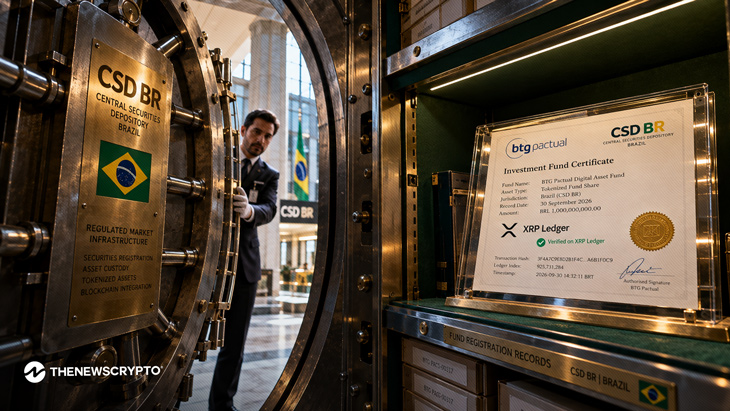
Ripple and CSD BR Bring XRP Ledger Into Brazil’s BRL 22 Trillion Market

ripple

  • Ripple and CSD BR will employ the XRP Ledger to reflect ownership data for Brazilian investment funds.
  • This initiative begins with BTG Pactual fund shares and might expand to include native issuance as well as other securities.

Brazil is integrating public blockchain technology into regulated financial infrastructure through a cooperation with Ripple and CSD BR. On September 29, CSD BR announced this initiative, which involves BTG Pactual investment fund shares. The operator has over BRL 22 trillion worth of assets registered. The XRP Ledger will reflect ownership data but will not substitute official records of CSD BR. CSD BR stated that the initiative marks the first use of public blockchain technology by the central securities depository for ownership mirroring. The operator has permission from Brazil’s Central Bank and CVM.

Tokenized Shares Will Be Subject to Institutional Controls

The shares issued by the fund will be based on the multi-purpose token standard of the XRP Ledger used by Ripple and CSD BR. The multi-purpose token standard allows for the setup of rules regarding financial assets and includes restrictions for approved participants as well as asset recovery processes. Corporate and banking institutions need to go through the verification process and anti-money laundering processes prior to gaining entry to the platform. CSD BR will control token issuance, participant approval, administration, and asset freezing. It will also manage clawbacks when regulatory or judicial action requires asset recovery. The blockchain infrastructure will be provided by Ripple together with the custody system.

Project May Be Expanding Beyond Brazilian Securities

This project can go further from simple record mirroring depending on whether the project meets its objectives at this stage. In subsequent stages, there may be the issuance of native financial instruments within the XRP ledger. Tokenized instruments would then be traded through the blockchain network by approved participants. These may include Real Estate Receivables Certificates which are known as CRIs and Agribusiness Receivables Certificates that are called CRAs.Β 

These are Brazilian fixed income securities which are backed by sector-specific receivables. Other tokenization activities in Brazil already have projects that are being undertaken by VERT and Mercado Bitcoin. For instance, VERT created a private credit platform which is based on XRPL, and it holds a BRL 700 million agribusiness receivables certificate. On the other hand, Mercado Bitcoin planned to tokenize more than $200 million worth of real-world assets.

Highlighted Crypto News:

Illinois Drafts Rules for 0.2% Crypto Transaction Tax

  •  
❌