❌

Reading view

Binance Reports Deposits Exceeding Withdrawals as User Activity Improves

Binance deposits exceed withdrawals on an hourly basis right now, the exchange said on Tuesday, as Binance user activity starts to pick up after the $6 billion hack. The shift came by 03:00 UTC on November 3, after days of heavy hack withdrawals and billions in Binance crypto outflows.

In the update confirming that Binance deposits exceed withdrawals, the exchange said:

“By 03:00 UTC, we are seeing hourly deposits exceed withdrawals, reflecting improving user activity and stabilizing flows.”

Withdrawal data update

By 03:00 UTC, we are seeing hourly deposits exceed withdrawals, reflecting improving user activity and stabilizing flows. pic.twitter.com/UiXmYC2lm3

— Binance (@binance) November 3, 2026

Binance Hack Recovery, $6 Billion Outflows and User Confidence

Binance Hack Recovery, $6 Billion Outflows and User Confidence
Source: EuroNews

The update matters because Binance deposits exceed withdrawals after two days in which money mostly flowed one way. Binance turned withdrawals back on in phases on Sunday, November 1, three days after the Binance $6 billion hack. It also plans to reopen more assets and networks, and user activity has picked up since then, based on its own data.

How Big Were The Binance Crypto Outflows?

During the first nine and a half hours, Binance processed $4.649 billion in withdrawals against $1.01 billion in deposits, a net outflow of about $3.64 billion, or 2.1% of its $171 billion in assets. Co-founder Changpeng “CZ” Zhao said on X that the bulk of the net outflow landed in the first couple of hours, when the Binance hack withdrawals hit their peak.

The bigger picture is heavier, even if deposits exceed withdrawals today. Binance’s own hourly chart, which runs from 06:00 UTC on November 1 to 04:00 UTC on November 3, put total Binance crypto outflows at $10.97 billion, against $5.695 billion in deposits, for a net outflow of $5.276 billion. The worst hour came at 08:00 UTC on November 1, when withdrawals hit $1.243 billion and the net outflow reached $936 million. USDT, USDC and BTC made up the biggest share of what users pulled out.

After that, the hourly gap kept shrinking. Binance logged net deposits in six separate hours on November 2 and early November 3, and in the 03:00 UTC hour it took in $193 million in deposits against $183 million in withdrawals. That is why the news that Binance deposits exceed withdrawals on an hourly basis carries so much weight right now.

How Binance Is Covering The $6 Billion Hack

Binance says it is paying for the losses with its own money and its Secure Asset Fund for Users (SAFU). Co-CEO Richard Teng made that promise soon after the Binance $6 billion hack, when he said:

“We are committed to covering all hacked losses through our company funds.”

By Sunday, the exchange had covered about 95% of the stolen assets, up from around 90% a day earlier, and it keeps buying the remaining less liquid tokens through open-market and OTC deals. Major coins, including BTC, ETH, USDT, BNB, SOL, USDC and XRP, are fully backed at 100%. It also plans to refill SAFU to about $1 billion. When withdrawals restarted, Teng stated:

“Binance will absorb the financial impact of the stolen funds, not our users.”

Users now get to test that pledge, and the fact that Binance deposits exceed withdrawals suggests many of them are sticking around.

Also Read: Musk’s Fortune Falls $48.5B as SpaceX Stock Drops 40% From Peak

What It Means For Binance Users

Right now, the fact that Binance deposits exceed withdrawals is the best sign yet that the rush to pull funds has slowed. At the time of writing, Binance user activity is picking back up, and the hack withdrawals look more like a short burst than a lasting exodus. A $3.64 billion net outflow in under ten hours is a lot of money, but it equals just 2.1% of the $171 billion Binance reported before the attack, and the crypto outflows have cooled off.

Binance deposits exceed withdrawals for now, but the exchange still has to buy back the last missing tokens and publish its updated proof-of-reserves report.

  •  

Musk’s Fortune Falls $48.5B as SpaceX Stock Drops 40% From Peak

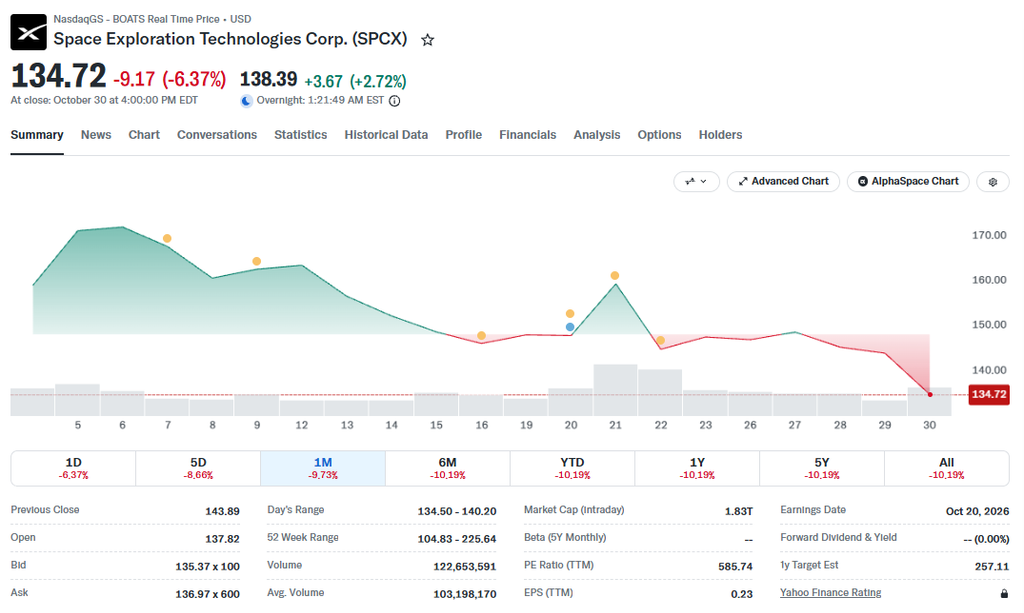
Musk’s fortune decline reached more than $48.5 billion on Friday, after Elon Musk’s net worth slid to $865 billion, according to Bloomberg data. The hit came from a SpaceX stock drop to $134.72, about 40% below the post-IPO high, as AI bubble fears spread across a broad US selloff. Anyone checking SpaceX stock today will find it at its lowest level since August, just weeks after Musk got back his trillionaire status.

Also Read: Should I Sell MU Stock as NAND Prices Slow Despite Record Revenue?

SpaceX Stock Decline Raises AI Bubble Fears as Musk’s Wealth Falls

when will SpaceX rebound
Source: Yahoo Finance

SpaceX listed on Nasdaq under the ticker SPCX on June 12, 2026, at $135 a share, and it hit a record of $225.64 four days later. Last month the shares climbed back to $176.56, and then the slide started again. That fast round trip explains why Musk’s fortune decline feels so sharp.

SpaceX (SPCX) one-month chart
SpaceX (SPCX) one-month chart, close of Oct. 30
Source: Yahoo Finance

Right now, a quick look at SpaceX stock today shows shares just under the IPO price. The stock lost $9.17, or 6.37%, on Friday alone, and it is down 9.73% over the past month. Musk’s fortune decline mirrors that chart, since most of his wealth sits in SpaceX.

The $40 Billion Lease That Spooked The Market

On Oct. 26, SpaceX disclosed an approximately $40 billion lease with an entity that Apollo Global Management runs. That entity will buy Nvidia’s next-generation Vera Rubin chips and lease them back to SpaceX over roughly five years, starting in 2027. Musk’s fortune decline picked up speed in the days after the deal.

Chief Financial Officer Bret Johnsen stated:

“This lease diversifies our funding sources and addresses a notable portion of the funding required to deliver on our growth plans.”

He also guided fourth-quarter capital spending to $35 billion to $40 billion, up from $19.6 billion in the third quarter.

AI Revenue Beats Starlink, But The Bill Keeps Growing

The Oct. 20 results looked strong on paper. Total revenue rose 161% to $14.58 billion, and AI revenue reached $7.56 billion, ahead of Starlink’s $5.24 billion. The AI unit also spent $16.4 billion, more than the space and connectivity segments combined, and that bill is a big reason behind Musk’s fortune decline.

Musk himself has warned about smaller cloud players. He had this to say on X:

“As of the past few weeks, debt markets have almost entirely shut off access to money for any company that doesn’t have substantial revenue independent of AI data centers.”

He added:

“That means the 200+ neoclouds are going to see guppy-level death and consolidation. Some will make it through, but not many.”

Peers CoreWeave, Nebius and IREN have each lost more than half their value from record highs, and that sector pain feeds both AI bubble fears and Musk’s fortune decline.

Also Read: 5 Wall Street Firms Cut Google Stock Price Target After Crash

Tesla Merger Talk Softens Musk’s Fortune Decline

Tesla gave Musk some relief, ending the week at $400 after he confirmed he is weighing a merger of the two companies. Dan Ives of Yorkville Ives puts the odds of a deal by the end of 2027 at 80% to 90%. Musk owns about 49% of SpaceX, so every SpaceX stock drop hits Elon Musk’s net worth far harder than his roughly 12% Tesla stake can offset.

For now, Musk’s fortune decline depends on whether the AI trade finds a floor. Another SpaceX stock drop would pull Elon Musk’s net worth lower again, and AI bubble fears will likely decide whether SpaceX stock today marks a bottom once the $35 billion to $40 billion spending plan starts to show results.

  •  

Should I Sell MU Stock as NAND Prices Slow Despite Record Revenue?

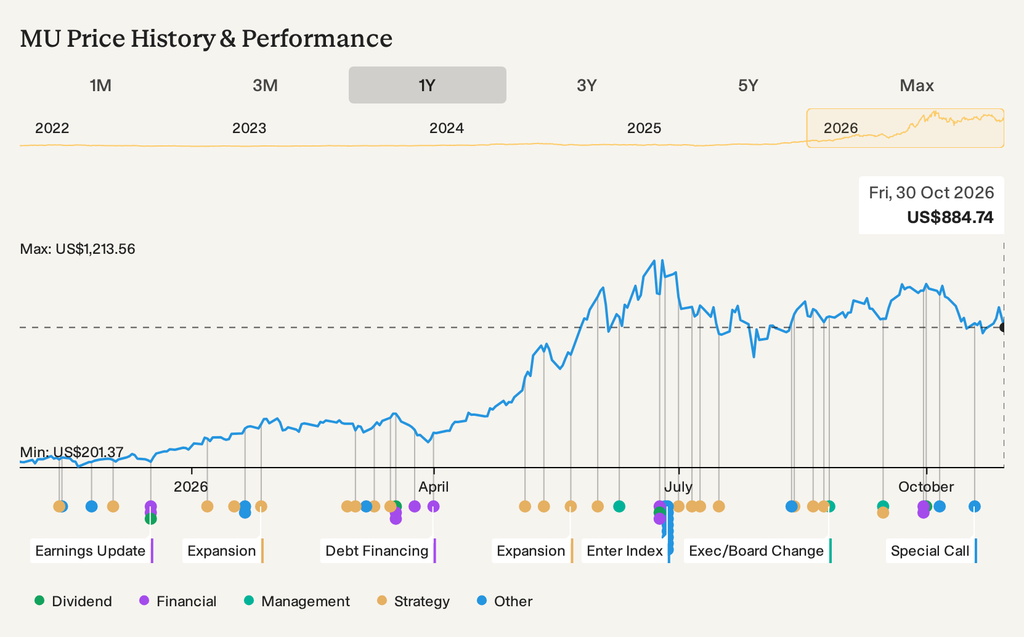
Should I sell MU stock right now? For most long term holders, the answer is no, at least not yet. Micron earnings hit a record $54.23 billion in revenue for Q4 fiscal 2026, and the company now expects tight memory supply through 2028. The real risk is Micron NAND prices, as Kioxia warned of slower price gains, along with fresh questions over AI spending. MU stock today trades at $884.74, and the Micron stock forecast from analysts still points higher, with a few warning signs attached.

Also Read: 5 Wall Street Firms Cut Google Stock Price Target After Crash

    Micron Stock Outlook: NAND Prices, AI Spending And Earnings

    Is Micron Stock a Sell Now as AI Momentum Slows? What Wall Street Thinks
    Source: Watcher.Guru

    MU stock today sits about 27% below its 12-month high of $1,213.56, but it is also up roughly 339% from the low of $201.37. That huge swing is the main reason so many holders now ask, “Should I sell MU stock and lock in my gains?” The chart below shows the full ride.

    MU 1-year stock price chart
    Source: NasdaqGS

    Record Micron Earnings And An Even Stronger Outlook

    Micron posted $133.19 billion in revenue for fiscal 2026, and it guided for about $61.5 billion in Q1 fiscal 2027 revenue, give or take $1.5 billion. Long term supply deals also cover more than 35% of revenue through 2030.

    Sanjay Mehrotra, Chairman and CEO of Micron Technology, said:

    “Micron delivered record fiscal 2026 results, and we expect an even stronger fiscal 2027. AI is becoming Super Intelligence (SI), and memory enhances this intelligence and the competitiveness of our customers’ platforms. We are increasing our investments in technology, products and manufacturing to help drive SI forward with our customers, and our Strategic Customer Agreements provide added confidence in the durability of Micron’s financial performance.”

    Those contracts are the strongest reply to anyone asking, “Should I sell MU stock before the cycle turns?”

    Micron NAND Prices Slow As AI Spending Gets Tested

    The pressure comes from rivals right now. SK Hynix talked up tight memory markets, but Kioxia warned of slower NAND price gains, and Intel flagged high memory costs. That mix of signals is exactly why “Should I sell MU stock?” keeps popping up this week.

    Softer Micron NAND prices would land at an awkward time, since Micron carries a heavy capital spending load. A pullback in AI capex, or faster price cuts from SK Hynix, Samsung or Kioxia, would hit that same contract base. So far, the noise has not clearly changed Micron’s own demand outlook. Still, if Micron NAND prices keep cooling into 2027, the answer to selling MU stock could flip fast.

    Should I Sell MU Stock? What The Micron Stock Forecast Says

    The main Micron stock forecast tracked by Simply Wall St calls for $320.4 billion in revenue and $217.9 billion in earnings by 2029. On that view, fair value sits around 76% above the current price. The most cautious analysts expect only about $236.3 billion in revenue and $207.2 billion in earnings, with a P/E near 6x. One of 28 other fair value estimates even shows 38% downside. For anyone asking, “Should I sell MU stock?”, that gap is the number to watch.

    Also Read: Nvidia Stock Falls as Chip Index Sinks 6.8% on AI Spending Fears

    So, should I sell MU stock? If you believe AI demand keeps memory tight, the contracts and guidance support holding. If you bought near the $1,213 peak and can’t handle another steep drop, trimming part of the position is a fair middle ground. With MU stock today well off its highs, the next round of Micron earnings, and also any fresh NAND pricing data, will likely decide which camp ends up right.

    •  

    Microsoft Layoffs: 60,000 Employees Offered Voluntary Buyouts

    Microsoft layoffs are taking a softer form right now, as Microsoft offered voluntary buyouts to around 60,000 employees in the U.S., Canada, India, and the U.K. on Oct. 26. That’s about 27% of its 223,000 workers. Eligible staff have until early December to decide, and those who say yes will leave on Dec. 31.

    JUST IN: Microsoft $MSFT offers buyouts to 60,000 employees as it cuts costs amid AI adoption.

    — Watcher.Guru (@WatcherGuru) October 26, 2026

    Microsoft’s voluntary buyouts are also the largest move so far in a year packed with job cuts. Unlike regular cuts, the Microsoft employee buyouts let people choose whether to go, and that makes this chapter of the layoffs 2026 story a bit different.

    Also Read: Has BRICS Officially Abandoned De-Dollarization?

    Microsoft Voluntary Buyouts: What the 2026 Job Cuts Mean

    Microsoft stock warning
    Source: NBC News

    Who Can Take The Microsoft Buyout Offer

    The latest wave of Microsoft layoffs covers workers at level 70 and below, which reaches up to vice presidents, a Microsoft spokesperson said. The package will look a lot like the company’s standard severance.

    Teams such as Xbox, Windows, Copilot, and Finance are taking part, and staff in data centers, sales, and marketing sit this one out. Unlike past Microsoft layoffs, nobody has to leave, and the heads of each organization decided who qualifies.

    Amy Coleman, Microsoft’s chief people officer, had this to say in a note to employees:

    “The Voluntary Exit Offer reflects an important part of how we’re evolving our approach to change: creating greater flexibility and, where possible, more ways for employees to shape their next chapter.”

    Why Microsoft Is Cutting Costs Right Now

    Behind the Microsoft layoffs sits a massive AI bill. Capital expenditures for the September quarter would top $50 billion, Microsoft said in July, up from $34.9 billion in capital spending and finance leases a year earlier.

    That spending has put a strain on Microsoft’s finances, and it shows in the steady run of Microsoft job cuts. In April, the company rolled out its first-ever voluntary retirement program, and more than 30% of eligible workers took the deal. Then in July came plans to lay off 4,800 employees, which added to the Microsoft layoffs 2026 count.

    Still, a Microsoft spokesperson told KUOW that AI is not driving these Microsoft voluntary buyouts. The company posted $19.64 billion in free cash flow in the second quarter, down 23% year over year, and Alphabet and Amazon both went negative.

    What Comes Next For Microsoft Workers

    Microsoft has no set target for this round of Microsoft layoffs. A spokesperson pointed Fortune to other big tech companies with similar programs that saw a 3% to 5% uptake. If the Microsoft employee buyouts follow that pattern, around 1,800 to 3,000 of the 60,000 eligible workers could leave by Dec. 31.

    In the same note, Coleman stated:

    “The Voluntary Exit Offer is new for us. We’ll learn from it. At the same time, we’ll keep helping people focus on the work that matters most, build new skills and, where it makes sense, find new opportunities across Microsoft. There is no one-size-fits-all approach for every team or every employee. These are a few of the ways we’re trying to meet different business needs while continuing to create opportunities for our own people to grow and contribute.”

    For investors, the timing matters. Microsoft reports quarterly results on Wednesday, Oct. 28, and right now Wall Street wants to see if these Microsoft job cuts can offset the cost of the AI race. The call should also show how the Microsoft layoffs 2026 plan and the Microsoft employee buyouts fit into the budget.

    •  

    Nvidia Stock Falls as Chip Index Sinks 6.8% on AI Spending Fears

    Nvidia stock falls 4.4% after the Philadelphia Semiconductor Index sank 6.8%, as AI spending fears hit chipmakers and AI cloud providers. The Nvidia stock drop also pushed the company’s market value down to around $5.12 trillion. Neocloud stocks fell even harder, with investors worried about the debt and the high costs tied to AI infrastructure spending.

    Also Read: Moderna Stock Drops 25% After Cancer Vaccine Data Leak

    Nvidia Stock Drop Raises Fears Over AI Spending and Neocloud Growth

    nvidia stock nvda logo
    Source: Coinpedia

    Nvidia stock falls at a time when Wall Street has started to question the money behind the AI boom. The Nvidia stock drop is no longer limited to chipmakers, and it has also reached the companies that rent out AI computing power.

    Chip Stocks Pull Back From Record Highs

    Only a short while ago, Nvidia shares hit a record high of $243.37, and that lifted the company’s market cap to $5.9 trillion, close to the $6 trillion mark. Strong fiscal Q2 results drove the rally, with revenue of $96.2 billion, up 106% year over year, and a Q3 outlook of $108 billion.

    Right now, that momentum has stalled. Nvidia stock falls alongside the wider chip sector, as investors grow uneasy about the cost of financing AI chips and data centers. These AI spending fears now weigh on the same names that led the record run.

    Neocloud Stocks Take The Hardest Hit

    Neocloud stocks, the firms that rent GPU capacity to AI developers, took the biggest losses. CoreWeave dropped 10.06%, Applied Digital fell 9.01%, IREN lost 8.37%, and Nebius slid 7.23%, according to MarketScreener data.

    The concerns center on the high cost of building data centers, the long wait for profits, and heavy debt at some operators. CoreWeave, which funds a large part of its expansion with debt, faces especially close scrutiny.

    As Nvidia stock falls, CEO Jensen Huang has pushed back on the gloom. Speaking to CNBC at GTC Berlin, Huang said:

    “If you look at the fundamentals, the demand for the neoclouds is off the charts.”

    Huang also stated:

    “Their capabilities are extraordinary, and so what is missing in the middle is the working capital to fuel that growth, to fund that growth.”

    He also flagged access to power as a hurdle, especially in Europe, where energy costs are high.

    Huang Wants Nvidia Chips To Become A Financeable Asset

    Nvidia stock falls partly because investors doubt neoclouds can keep paying for new chips, and Huang wants to fix that. On the sidelines of GTC Berlin, Huang said:

    “One of the things that we’re trying to do is to establish Nvidia’s compute as a financeable asset.”

    In August, Nvidia announced a $500 billion AI financing plan with several major Wall Street firms. The company is also backing AI infrastructure spending in Europe, with nearly $10 billion earmarked for companies, universities, and research groups.

    The pressure also shows up on crypto platforms, where Nvidia stock falls in tokenized form too. At the time of writing, the Robinhood NVIDIA token trades down 1.65% at $214.01, and traders see $210 as near-term support.

    Also Read: Wall Street Raises AMD Stock Target To $620 Ahead Of Earnings

    Robinhood’s Q3 earnings on October 27 come next for the token. After this Nvidia stock drop, the bigger test for the shares is whether the companies behind neocloud stocks can raise enough capital to keep AI infrastructure spending going. Until there is a clear answer, AI spending fears are likely to come back each time Nvidia stock falls on funding news.

    •  

    Moderna Stock Drops 25% After Cancer Vaccine Data Leak

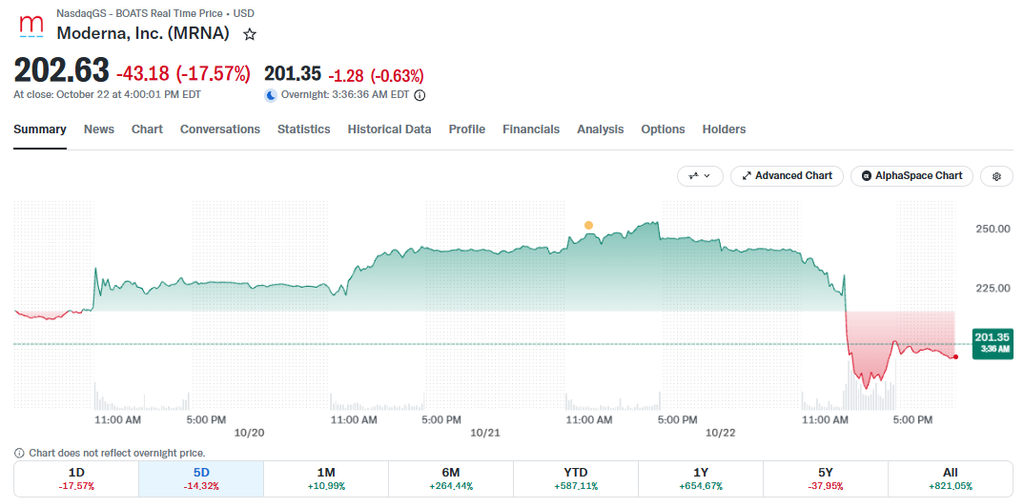
    The Moderna stock drop on Thursday, October 22, reached as much as 25% after partial data on the Merck Moderna cancer vaccine leaked on an oncology website ahead of its official release. It was an odd Moderna stock plunge, since the Moderna cancer vaccine actually delivered good news, cutting the risk of melanoma recurrence or death by 42% when paired with Merck’s Keytruda. By the close, the Moderna stock price had settled at $202.63, down $43.18 or 17.57%.

    Moderna stock price
    Source: Yahoo Finance

    Also Read: Wall Street Raises AMD Stock Target To $620 Ahead Of Earnings

    Moderna Stock Drop Follows Cancer Vaccine Data Leak Despite Positive Results

    Moderna Stock Drop Follows Cancer Vaccine Data Leak Despite Positive Results
    Source: FXLeaders

    Right now, the Moderna stock drop looks like sky-high hopes running into real numbers. Shares had nearly quadrupled since August, when the two companies said the trial worked but held back the actual data. The Moderna stock plunge wiped out a big chunk of that run, and yet, at the time of writing, Moderna is still up about 587% year-to-date, with a 52-week range of $22.28 to $254.48.

    What The Merck Moderna Cancer Vaccine Trial Showed

    The Phase 3 trial, called INTerpath-001, enrolled 1,137 melanoma patients after surgery. The Moderna cancer vaccine, known as intismeran autogene, reads the unique mutations in each patient’s tumor and trains the immune system to go after them.

    Paired with Keytruda, the Merck Moderna cancer vaccine cut the risk of recurrence or death by 42% and the risk of distant spread or death by 38%, compared with Keytruda alone. After two years, 82.2% of patients on the combo were still cancer-free, against 70% on Keytruda alone. The benefit also climbed to a 58% risk cut after the six-month vaccine regimen. On paper, these are strong numbers, which is why the Moderna stock drop caught so many people off guard.

    Dr. Dean Y. Li, president of Merck Research Laboratories, said:

    “INTerpath-001 is the first Phase 3 study to demonstrate a clinically meaningful improvement in RFS and DMFS over standard-of-care KEYTRUDA in patients with resected melanoma, setting a new benchmark in the adjuvant setting and representing one of the most significant advances in melanoma treatment since the advent of immunotherapy. These results, building on the body of evidence from the Phase 2b study, strengthen our confidence in the curative potential of intismeran autogene when given in combination with KEYTRUDA. Importantly, these data suggest that, by intervening earlier, this approach may offer a tangible opportunity to change the trajectory of a patient’s cancer.”

    Why The Moderna Stock Price Fell Anyway

    Most analysts say the Moderna stock drop came down to expectations, not the science. Several Wall Street analysts said ahead of the release that investors wanted a risk cut of 40% or more, and many had anchored on the earlier Phase 2b study, which showed a bigger effect, according to RBC Capital Markets. The 42% figure cleared the bar, but only just, so the Moderna stock price slid and Merck shares also lost about 1.8%. Moderna went from a $245.81 previous close to an intraday low of $180.80, and around 49.8 million shares changed hands, more than double the usual 20.2 million.

    BMO Capital Markets analyst Evan Seigerman tied the Moderna stock plunge to inflated expectations, not to weak efficacy, and UBS analysts also called it a strong data set overall. RBC’s Trung Huynh was less upbeat, saying melanoma should have been the best case for the shot.

    What Moderna And Merck Plan From Here

    Moderna CEO Stéphane Bancel said the companies are getting ready to file for US approval and expect the Moderna cancer vaccine to launch in 2027. The full data gets its formal debut on Saturday at the ESMO Congress in Madrid, and Merck and Moderna are also testing the combo in kidney, bladder and lung cancer. That timeline, though, did little to soften the Moderna stock drop on Thursday.

    Stéphane Bancel, Chief Executive Officer of Moderna, had this to say:

    “From the beginning, we believed mRNA technology could make it possible to develop cancer treatments uniquely matched to each patient’s tumor. The INTerpath-001 results mark a defining moment for that vision and show what’s possible when we rethink how medicines are made. These results reinforce our conviction that mRNA has the potential to fundamentally change how we treat cancer.”

    Also Read: SpaceX Stock Gets a Shock as Elon Musk Reveals $4.4B Profit

    For now, the Moderna stock drop says more about how high investors set the bar than about the shot itself. Anyone who bought near the top and rode out the Moderna stock drop will likely be watching two things: fresh data from other cancers and the company’s earnings report on November 6, when the Moderna stock price could swing again.

    •  

    Nvidia vs. SpaceX: BofA Sees SPCX Up 61%, Nvidia Joins $668M AI Deal

    Nvidia vs SpaceX is the matchup a lot of investors keep coming back to right now, especially after SpaceX’s biggest technical win yet. A Nvidia vs SpaceX stock comparison still puts Nvidia ahead on steady profits, while SpaceX stock trades mostly on where its AI hosting and orbital programs go next. Both companies count among the biggest AI stocks around, and a Nvidia vs SpaceX valuation check still favors Nvidia, even as Wall Street turns more bullish on SpaceX.

    Also Read: SPCX Stock Surges as Mizuho and Morgan Stanley Turn Bullish

    Nvidia vs SpaceX Valuation: Which AI Stock Has More Upside?

    Is Nvidia Stock a Bargain
    Source: Investing

    Nvidia’s market cap sits near $5.2 trillion, with shares around $212 and a trailing P/E ratio near 27.6x, a multiple built on real, growing earnings. SpaceX carries a valuation near $2 trillion, and SpaceX stock trades around $145 to $146 after slipping 2% on good news, with shares ranging $104.83 to $225.64 over the past year. Bank of America just raised the stakes on this Nvidia vs SpaceX valuation debate, with analyst Ronald Epstein backing a $235 SpaceX price target, about 60% above the reference price.

    Nvidia’s Case In The Valuation Fight

    In this Nvidia vs SpaceX matchup, Nvidia’s price comes down to its near-monopoly on the chips running today’s AI boom, from Blackwell to the newer Vera Rubin platform. Nvidia also just joined a $668 million round for GMI Cloud, an AI cloud firm, alongside South Korean backers like KB Investment, a sign of how far its money reaches beyond chips. That steady demand is why analysts treat Nvidia as the safer of the two AI stocks, even though its size limits the room left to grow.

    Starship’s Orbital Win Boosts BofA’s SpaceX Call

    SpaceX stock has swung hard since its June debut, and a Nasdaq rule fast-tracked the company into the Nasdaq-100 on July 7, forcing funds like the Invesco QQQ Trust to buy shares on behalf of millions of 401(k) savers. On Sept. 28, SpaceX pulled off its biggest technical win yet, sending Starship into orbit, deploying 26 Starlink V3 satellites, and landing the Super Heavy booster, yet SpaceX stock still fell 2% to $145.47 right after.

    Anyone running a Nvidia vs SpaceX stock comparison on growth alone would probably lean toward SpaceX now, since Wall Street’s new target implies a lot more room to run.

    What SpaceX And Nvidia Officials Are Saying

    Executives on both sides have talked fairly openly about this Nvidia vs SpaceX partnership, and a few of their comments deserve a direct quote.

    Elon Musk, SpaceX CEO, said:

    “highly confident that SpaceX will be launching Nvidia VR NLV72 AI computers in space”

    Jensen Huang, Nvidia CEO, said:

    “Space computing, the final frontier, has arrived.”

    Bret Johnsen, SpaceX CFO, said the company’s AI hosting deal gave management:

    “even more conviction”

    A Nvidia vs SpaceX stock comparison, at the time of writing, still favors Nvidia on steady earnings, but SpaceX stock just picked up a fresh vote of confidence from Bank of America right after Starship’s orbital debut. Nvidia’s lead among AI stocks looks safe for now, but SpaceX’s payoff looks closer than before.

    •  

    Micron Stock: Revenue Soars 379% to $54.23B as AI Memory Demand Surges

    Micron revenue hit a record $54.23 billion in the fiscal fourth quarter of 2026, up 379% from $11.32 billion a year earlier. The jump came on the back of Micron AI memory demand, which is still way ahead of supply right now, and it also pushed Micron earnings to $33.42 per share, above the $31.61 that Wall Street had expected. Net income climbed to $37.7 billion from just $3.2 billion. That kind of Micron revenue growth lifted full-year sales to $133.19 billion, but Micron stock barely moved in after-hours trading.

    Also Read: Is Micron Stock the Next Nvidia? Here’s What Comes Next

    Micron Revenue Growth: Earnings, AI Demand And Stock Outlook

    Is Micron Stock a Sell Now as AI Momentum Slows? What Wall Street Thinks
    Source: Watcher.Guru

    Chairman and CEO Sanjay Mehrotra put the jump in Micron revenue down to AI. He said:

    “Micron delivered record fiscal 2026 results, and we expect an even stronger fiscal 2027. AI is becoming Super Intelligence (SI), and memory enhances this intelligence and the competitiveness of our customers’ platforms. We are increasing our investments in technology, products and manufacturing to help drive SI forward with our customers, and our Strategic Customer Agreements provide added confidence in the durability of Micron’s financial performance.”

    Micron Earnings Top Estimates As DRAM Leads

    Gross margin came in at a record 87%, and DRAM chips did most of the heavy lifting, bringing in close to three-quarters of Micron revenue.

    Chief Financial Officer Mark Murphy had this to say:

    “Consolidated fiscal Q4 revenue was $54.2 billion, up 31% sequentially and up 379% year over year. Fiscal Q4 revenue was our sixth consecutive quarterly revenue record. Fiscal Q4 DRAM revenue was a record $39.8 billion, up 343% year over year and represented 73% of total revenue. Sequentially, DRAM revenue increased 27%.”

    Micron is calling for $38.15 per share and $61.5 billion in sales at the midpoint for the first quarter of fiscal 2027, against analyst calls for $35.40 and $57 billion. If that holds, sales would climb by roughly another $7.3 billion in just one quarter.

    Micron AI Memory Demand Keeps Supply Tight

    Micron is the only US maker of high-bandwidth memory, or HBM, which AI chips need to run large models. Mehrotra said on the call that customers have already locked in more than 75% of the company’s 2027 output. Higher prices are also feeding Micron revenue, with DRAM prices up by a high-teens percentage last quarter. With Micron AI memory demand this strong, the company says it can’t yet see when supply and demand will balance out.

    Mehrotra stated:

    “As strong as fiscal 2026 was, we expect fiscal 2027 to be even better. Industry demand has strengthened since our last earnings call, and we expect memory and storage supply-demand conditions to be much tighter in fiscal 2027 and 2028 than they were in 2026.”

    Micron Stock Outlook After The Record Quarter

    Shares traded flat after hours at about $1,065, as investors had already priced in a big beat after Micron stock gained more than 500% over the past year. Micron earnings have now topped estimates for eight quarters in a row, and the market cap sits above $1.2 trillion at the time of writing.

    Micron expects fiscal 2027 to be another record year, with Micron revenue rising in every quarter. Share buybacks should also pick up from December 9.

    With 26 long-term customer deals covering over 35% of expected sales through 2030, the next stretch of Micron revenue growth comes down to how quickly its new fabs in Idaho and New York can start shipping.

    •  

    AMD vs. Intel: Which Stock Could Rise More From Here?

    AMD vs Intel is a closer race than it looks, but right now AMD, the cheaper stock, seems to have more room to climb. Intel has run harder over the past year, up 322% against AMD’s 285%, so anyone weighing AMD stock vs Intel stock has to look past the chart. The AMD stock forecast also calls for 105% earnings growth in 2027, against 36% in the Intel stock forecast, making AMD the best AI chip stock of the pair at the time of writing.

    Also Read: If You Invest $100 in AMD Every Month, What Could You Have by 2030?

    AMD vs Intel: Stock Forecast, AI Growth And Upside Potential

    Intel Stock Below $100 Is This a Buying Opportunity or Warning?
    Source: Barron’s

    CPUs Are Back At The Center Of AI Data Centers

    The AMD vs Intel rivalry starts with CPUs. Demand for these chips in AI data centers has picked up, since they handle inference and agentic AI tasks. AMD said the CPU-to-GPU ratio there is moving from 1:4 or 1:8 toward 1:1, and it sees the server CPU market reaching $220 billion by 2030.

    AMD CEO Lisa Su had this to say:

    “CPUs are a very critical part of data center infrastructure.”

    Server CPUs are where the AMD vs Intel fight is tightest. Intel still holds 65.5% of that market, per Mercury Research, but AMD added 7.2 percentage points of share year over year in Q2.

    Intel CEO Lip-Bu Tan stated:

    “AI is driving unprecedented demand for compute.”

    AMD’s GPU Business Gives It An Extra Edge

    This is where AMD vs Intel starts to tilt. AMD also sells Instinct data center GPUs to big names such as OpenAI, Meta Platforms and Anthropic. Its data center revenue jumped 107% year over year in Q2 to $6.7 billion, and Intel’s data center and AI (DCAI) segment grew 59% to $6.3 billion.

    Lisa Su said on AMD’s Q2 earnings call:

    “Demand for both accelerators and CPUs is growing well above our prior expectations.”

    Analysts have turned more upbeat on AMD’s long-term growth, lifting the AMD stock forecast, and toned down what they expect from Intel.

    Valuation Could Decide The Best AI Chip Stock

    On valuation, AMD vs Intel isn’t a close call. Intel’s run has left the stock at 63 times forward earnings, against 40 times for AMD. Consensus estimates call for a 262% jump in Intel’s earnings this year, above AMD’s 82%, but that flips in 2027, when AMD’s growth should speed up to 105% and Intel’s could slow to 36%. That gap is why the AMD stock forecast looks stronger than the Intel stock forecast.

    Intel CFO David Zinsner had this to say:

    “Customers continue to signal a strong and sustainable spending environment.”

    AMD also sees the AI chip market hitting $2 trillion a year by 2030, and that’s a big reason it gets the nod as the best AI chip stock in the AMD vs Intel matchup.

    For anyone picking between AMD stock vs Intel stock right now, the numbers point toward AMD. The Intel stock forecast still rests on its server CPU lead, and a 63x multiple leaves little room if growth cools. AMD vs Intel may stay tight in CPUs, but on price and AI reach, AMD looks like the best AI chip stock of the two.

    •  
    ❌