❌

Reading view

iPhone Duo Guide: Everything you need to know about Apple’s folding iPhone

Macworld

The iPhone Duo, Apple’s first foldable iPhone, will be available to pre-order on October 16 and goes on sale October 23. Buyers can begin Apple’s “Get Ready” process on October 12, allowing them to choose their configuration and prepare payment, trade-in and delivery details before orders officially open.

The Duo opens like a book from a compact 5.4-inch phone into a much larger 7.6-inch device. Apple describes the internal screen as its largest-ever iPhone display, with 50 percent more screen area than the iPhone 18 Pro Max, while the outer display provides more than 90 percent of the screen area of an iPhone 18 Pro.

The biggest change is obviously the folding design, but Apple has done more than simply add a hinge. The iPhone Duo will ship with iOS 27.1, which adapts to different positions and orientations with fold-specific interface and multitasking features. These include Split View, hands-free FaceTime and video, StandBy without charging, and layouts that move seamlessly between the two screens. Apple Pencil USB-C support is also coming later in 2026.

The other major changes are the 7.6-inch nano-texture inner display, Touch ID replacing Face ID, an A20 Pro processor with vapor-chamber cooling, and a dual-battery system designed around the two halves of the phone. Apple has also introduced camera features that exploit the second screen, including Duo Preview, Smart Take, Kid Cue and Duo FaceTime.

Much of the pre-launch reporting proved accurate: the Duo name, book-style design, roughly 7.7- and 5.4-inch screens, Touch ID, two 48MP rear cameras, two front-facing cameras, A20 Pro, C2 modem, MagSafe and the white/dark-blue colours were all anticipated.

iPhone Duo at a glance

  • Apple’s first folding iPhone, with 5.4-inch outer and 7.6-inch inner displays.
  • Touch ID replaces Face ID, with the fingerprint sensor incorporated into the side button.
  • A20 Pro with vapor-chamber cooling, including a new 2nm manufacturing process.
  • Dual-battery architecture, giving up to 44 hours of video playback on the outer display.
  • Fold-specific iOS and camera features, including Split View, Duo Preview, Smart Take, Kid Cue and hands-free use.

iPhone Duo: Top 10 features

Foldable designBook-style titanium design with precision hinge
Inner display7.6-inch Super Retina XDR OLED, 120Hz ProMotion
Outer display5.4-inch Super Retina XDR OLED, 120Hz ProMotion
ProcessorA20 Pro, 6-core CPU, 7-core GPU
Neural EngineDual 16-core Neural Engine
AuthenticationTouch ID in side button
Rear cameras48MP Main + 48MP Ultra Wide
BatteryDual batteries; up to 44 hours video on outer screen
ConnectivityC2 modem, Wi-Fi 7, Bluetooth 6, second-gen UWB
Storage256GB, 512GB, 1TB or 2TB

iPhone Duo release date: When will it go on sale?

Apple unveiled the iPhone Duo on September 9, 2026, but unlike the iPhone 18 Pro models it won’t arrive until October.

From Monday, October 12, Apple will let customers “Get Ready” for iPhone Duo pre-orders. Through the Apple Store app, buyers will be able to choose their preferred color and storage capacity, select a carrier, arrange a trade-in or financing, choose AppleCare+, and enter payment and delivery information in advance. That should make placing the final order considerably quicker once pre-orders open.

Pre-orders begin on Friday, October 16, at 1 p.m. in the U.K. and 5 a.m. Pacific in the U.S.

The iPhone Duo officially goes on sale one week later on Friday, October 23, in more than 70 countries and regions, including the U.S., U.K., Canada, Australia, China, France, Germany, India and Japan. A further 28 countries and regions will get it on October 30.

Pre-order iPhone Duo at Apple U.S.

Pre-order iPhone Duo at Apple U.K.

It will be available directly from Apple online and through Apple Stores, with carrier availability varying by market.

Initial supplies may be limited. A late-September supply-chain report claimed Apple and its manufacturing partners were still experiencing relatively low production yields for the new folding design.

iPhone Duo design: What does it look like?
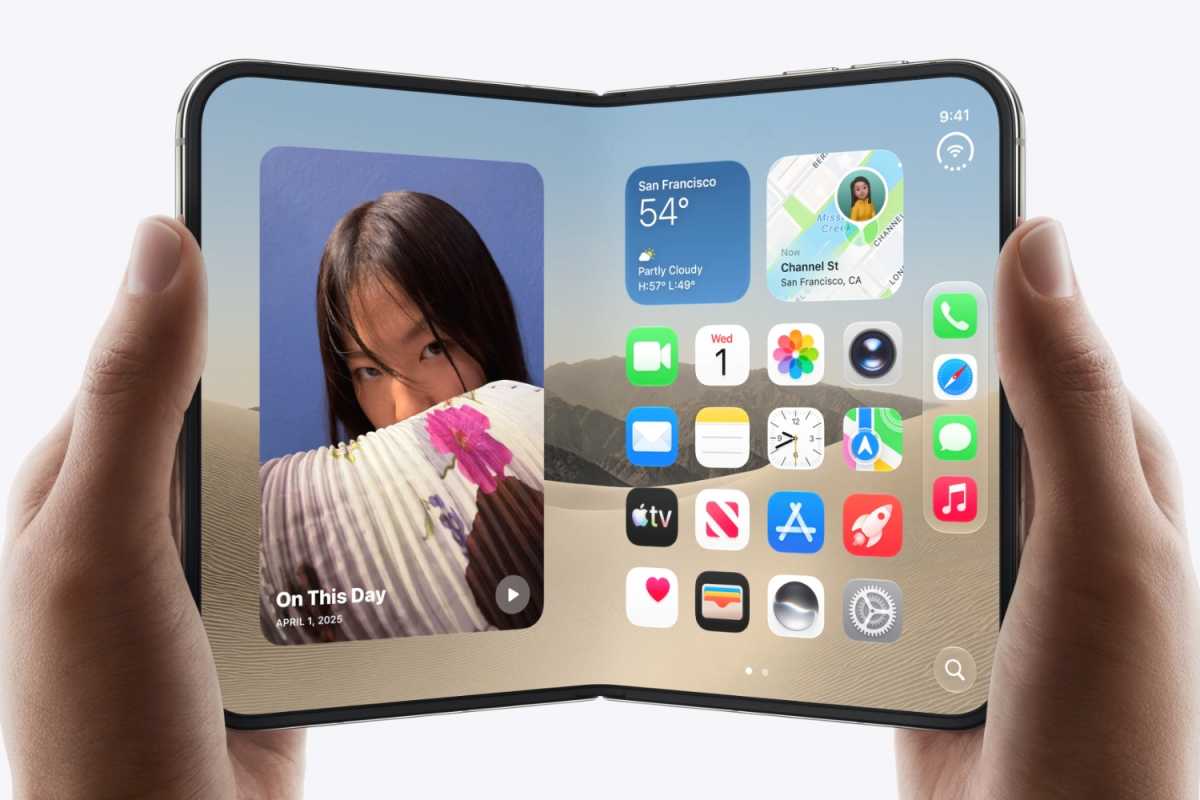
iPhone Duo Open

The iPhone Duo opens up like a book.


Apple

The iPhone Duo uses a book-style folding design. Closed, it is unusually short and wide for an iPhone, measuring 84.1mm wide, 117.8mm tall and 11.3mm thick. Open it and the width expands to 164.6mm, while thickness reduces to just 5.2mm, making it Apple’s thinnest iPhone when unfolded (taking that mantle from the iPhone Air). It weighs 254g.

The outer screen measures 5.4 inches, while the folding inner panel measures 7.6 inches. Both are Super Retina XDR OLED displays with ProMotion up to 120Hz, Always-On display support and up to 3,000 nits outdoor peak brightness. The internal display also has a nano-texture surface designed to reduce reflections and make the crease less noticeable.

The frame and hinge cover are made from Grade 5 titanium. Apple uses a mirror-polished finish on the enclosure and a micro-blasted finish on the 3D-printed hinge cover. Ceramic Shield protects the rear, while Ceramic Shield 2 protects the outer display. The phone retains an IP68 rating despite its folding construction.
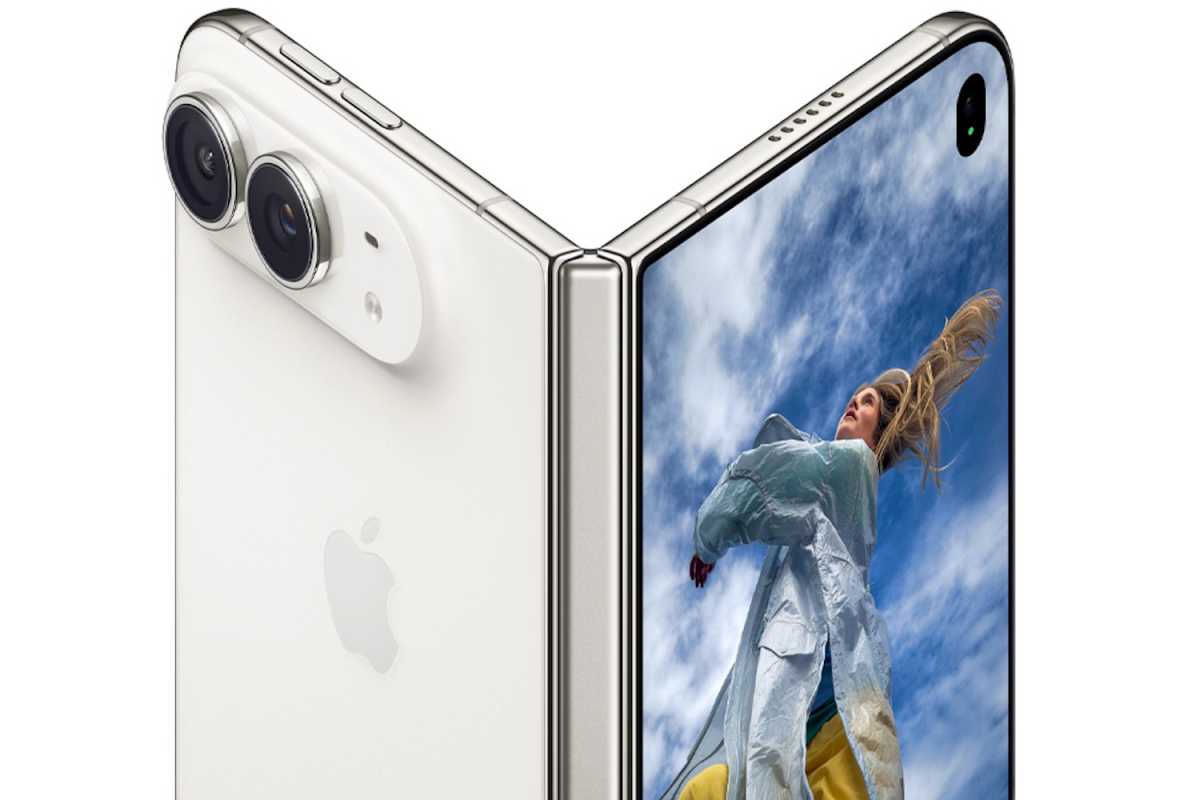
iPhone Duo hinge

The hinge from the outside.


Apple

There are just two colors: Star White and Night Sky, essentially confirming the pre-event reports of silver/white and a very dark blue. For more information read about the iPhone Duo colors.

Action button and Camera Control

There is Camera Control, giving access to exposure, depth, zoom, cameras, styles and tone. It can also launch the new Siri Camera mode.

However, Apple’s Duo doesn’t feature an Action button. The regular iPhone 18 Pro and Pro Max retain both the Action button and Camera Control, so this is one hardware-control compromise of the folding model.

Accessories

Apple is also launching two dedicated accessories for the foldable:

  • The iPhone Duo Case at $79/£79
  • The Duo Folio with Kickstand at $129/£129

Both will be orderable from October 16.

Face ID, Touch ID and the notch

Perhaps the most surprising difference between the iPhone Duo and Apple’s other flagship iPhones is that there is no Face ID.

Instead, Apple has brought back Touch ID, with the fingerprint sensor incorporated into the side button. It works whether the Duo is folded or unfolded, and Apple Watch can also be used to unlock the device. This confirms one of the most persistent pre-launch rumors.

The internal display therefore does not need the TrueDepth sensors used for Face ID. Its FaceTime camera sits beneath the display and disappears when it isn’t being used, giving the inner screen a largely uninterrupted surface.

The inner camera itself is hidden below the display rather than sitting permanently in a visible camera cutout. And yet, despite this and the absence of Face ID, there is still support for Dynamic Island.

iPhone Duo cameras: What cameras does it have?

iPhone Duo Colors

There are two cameras on the rear.


Apple

The Duo has a 48MP Dual Fusion camera system, comprising:

CameraResolutionEquivalent focal lengthAperture
Fusion Main48MP26mmf/1.6
2x crop from Main12MP52mmf/1.6
Fusion Ultra Wide48MP13mmf/2.2
Outer front camera12MP—f/2.2
Inner FaceTime cameraApple does not specify resolution—f/1.8

The Duo does not have variable aperture. Variable aperture is exclusive to the 48MP Fusion Main camera in the iPhone 18 Pro and Pro Max.

The biggest camera features for iPhone Duo

Duo Preview

The outer screen can show a live preview while somebody else is being photographed, allowing the subject to adjust their pose and framing.

Smart Take and Kid Cue

Smart Take detects when everybody is ready and automatically captures the shot. Kid Cue uses animations on the outer screen to encourage children to look towards the camera.

Two-screen shooting

The folding design supports unusual shooting configurations, including using the main cameras for selfies or group photos while seeing the composition on the other screen. Duo FaceTime can also put nearby participants onto the outer display.

Other notable camera features include 48MP macro photography, a 2x optical-quality crop from the Main camera, an under-display inner FaceTime camera, Dual Capture for simultaneous front-and-rear video, and 4K Dolby Vision recording at up to 120fps.

Rear cameras

The 48MP Fusion Main has an f/1.6 aperture, sensor-shift stabilization and can shoot 24MP or 48MP images. It also provides a 12MP, 2x optical-quality crop equivalent to a 52mm lens.

The 48MP Fusion Ultra Wide has a 13mm-equivalent lens, f/2.2 aperture and 120-degree field of view. It also supports 48MP macro photography and is the same Ultra Wide camera used by the iPhone 18 Pro family.

That means the Duo does not match the iPhone 18 Pro and Pro Max camera system. Those phones add a dedicated 48MP Fusion Telephoto and variable aperture on the Main camera, making the Pro models much more flexible for photography despite costing substantially less.

Pre-event reports were divided between a Main + Telephoto and Main + Ultra Wide arrangement. Apple ultimately chose Main + Ultra Wide, confirming the earlier reports that a dedicated telephoto could be sacrificed to save space.

Front cameras

On the outside is a 12MP Center Stage camera with an f/2.2 aperture. It supports Center Stage, automatic portrait/landscape framing, Dual Capture, Photonic Engine, Deep Fusion, Smart HDR 5 and 4K Dolby Vision video at up to 60fps.

Inside is an under-display FaceTime camera with an f/1.8 aperture. Apple does not specify its megapixel resolution. It supports Center Stage for video calls and records at up to 1080p/60fps. Its major advantage is visual rather than photographic: the camera effectively disappears beneath the display when it isn’t being used.

iPhone Duo video features

The Main camera records 4K Dolby Vision at 24, 25, 30, 60, 100 or 120fps, with 4K/120fps also available for slo-mo. Cinematic mode reaches 4K/60fps and Action mode up to 2.8K/60fps. Dual Capture can record at up to 4K/30fps.

Apple’s specifications also do not list ProRes or Apple Log recording for the Duo. Those remain more Pro-oriented capabilities rather than part of Apple’s foldable camera proposition.

The Duo does support Spatial Audio recording, Audio Mix, Dolby Vision HDR and Apple’s computational photography features including Photonic Engine, Deep Fusion, Smart HDR 5, Photographic Styles 3, smart focus tracking and Apple Intelligence-powered editing.

Apple does not list conventional Spatial Video capture in the Duo specifications.

iPhone Duo processor: What processor does it use?
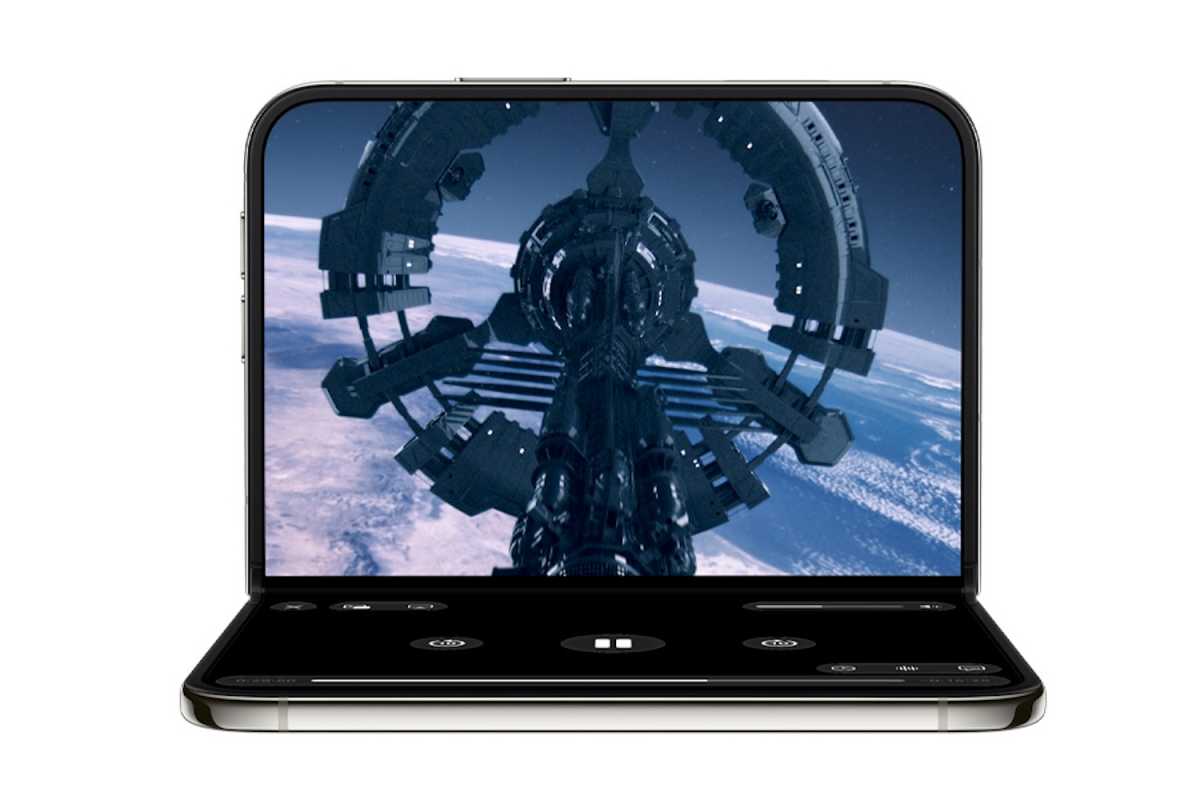
iPhone Duo laptop

Watch video on the screen.


Apple

The iPhone Duo uses the A20 Pro, the same processor as the iPhone 18 Pro and Pro Max.

It is manufactured using a 2-nanometer process, a major step forward in transistor density and efficiency. Apple combines it with a new chip packaging design inspired by its M-series Mac processors. The package connects the A20 Pro directly to a custom vapor chamber to transfer heat away from the processor more effectively.

The A20 Pro includes:

  • 6-core CPU: two super cores and four efficiency cores
  • 7-core GPU with Neural Accelerators
  • Dual 16-core Neural Engine
  • Hardware-accelerated ray tracing
  • A dedicated display engine capable of operating both Duo displays

Compared with the A19 Pro, Apple says the CPU is up to 20 percent faster, while the GPU is up to 40 percent faster and more power-efficient. The Dual 16-core Neural Engine delivers twice the compute power, while unified-memory bandwidth rises by 50 percent.

Apple also claims that the complete thermal system gives the Duo up to 35 percent better sustained performance than the iPhone 17 Pro. That sustained-performance figure is particularly important for a folding device because prolonged gaming, multitasking and AI workloads generate considerably more heat than short benchmark bursts.

iPhone Duo RAM: How much memory does it have?

Apple has not disclosed how much RAM is inside the iPhone Duo.

Before launch, supply-chain reports consistently pointed to 12GB of RAM, which would make sense given the demands of running two displays, simultaneous applications, Siri AI and larger on-device AI models.

Apple does reveal that A20 Pro has 50 percent more unified-memory bandwidth than A19 Pro, which should help the Duo move data more quickly between the CPU, GPU and Neural Engine.

Extra memory is particularly useful on the Duo because iOS 27.1 can display multiple apps simultaneously and because Apple Intelligence and Siri AI increasingly run generative models locally rather than relying entirely on cloud processing.

iPhone Duo connectivity
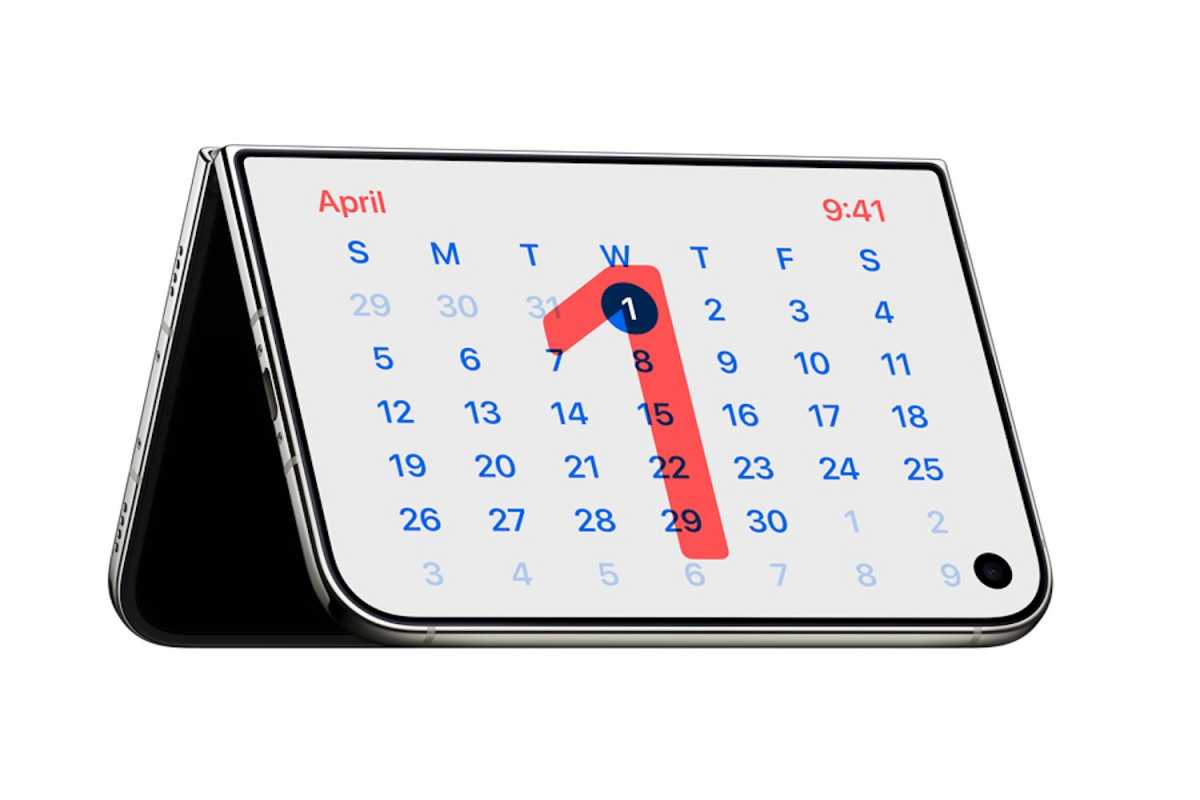
iPhone Duo Folded

An expensive desk calendar.


Apple

Apple has put a significant amount of its own communications silicon into the iPhone Duo.

It uses Apple’s new C2 cellular modem, replacing Qualcomm silicon. Apple says C2 introduces AI-powered improvements to cellular quality and reliability and supports mmWave 5G in the U.S.

The N1 wireless networking chip provides:

  • Wi-Fi 7 with 2×2 MIMO
  • Bluetooth 6
  • Thread networking

The USB-C port also supports USB 3 data transfers at up to 10Gbps and DisplayPort video output.

The Duo also has Apple’s second-generation Ultra Wideband chip, NFC and precision dual-frequency GPS.

It is eSIM-only worldwide, something that had been widely rumored before launch. Eliminating the SIM tray gives Apple additional internal space for its batteries.

Satellite capabilities include:

  • Emergency SOS via satellite
  • Roadside Assistance via satellite
  • Find My via satellite
  • Messages via satellite

Battery, MagSafe and charging: What’s available?

Instead of one battery spanning the body, the iPhone Duo contains two rechargeable lithium-ion batteries, with one high-energy battery fitted into each half of the device. Apple’s energy-balancing algorithms make them operate as a single battery system.

Apple rates battery life at:

  • Up to 24 hours of typical use
  • Up to 44 hours video playback using the outer display
  • Up to 31 hours using the inner display
  • Up to 37 hours streamed video on the outer screen
  • Up to 26 hours streamed video on the inner display

Apple has not disclosed the batteries’ combined capacity in mAh. The pre-launch rumor of approximately 5,000-5,500mAh therefore remains unconfirmed.

Wired charging can take the Duo to 50 percent in around 20 minutes with a 60W-or-higher USB-C adapter.

Despite earlier uncertainty, MagSafe is supported, with wireless charging at up to 25W. Qi2 charging also reaches 25W. Apple says a 35W-or-higher adapter and MagSafe charger can bring the battery to around 50 percent in approximately 30 minutes.

iPhone Duo price: How much does it cost?

The iPhone Duo starts at $1,999 in the U.S. and £1,999 in the U.K. for 256GB.

Prices are:

StoragePrice
256GB$1,999/£1,999
512GB$2,199/£2,199
1TB$2,599/£2,599
2TB$3,199/£3,199

The 256GB starting capacity means Apple has not created an unusually low-storage entry model simply to make the headline price look lower.

iPhone Duo vs iPhone 18 Pro pricing

The iPhone 18 Pro starts at $1,199/£1,199, while the iPhone 18 Pro Max starts at $1,299/£1,299. That makes the Duo approximately $700/£700 more expensive than the Pro Max at entry level.

That premium buys the folding display, precision hinge, titanium structure, second screen and more complex dual-battery design rather than superior cameras: in several areas the iPhone 18 Pro models are actually better equipped.

Reports before the launch suggested the Duo could cost anywhere from around $1,999 to $2,399 at entry level, largely because of the folding OLED display, hinge mechanism, titanium components and other expensive parts. Apple ultimately landed at the very bottom of those predictions.

Should you buy the iPhone Duo?

The iPhone Duo is the iPhone to buy if you genuinely want a phone and small tablet in one device. Its 7.6-inch display, multitasking features, A20 Pro performance and clever fold-specific camera modes offer capabilities no other iPhone has. 

But at $1,999/£1,999 it is enormously expensive, and there are significant compromises: no Face ID, no dedicated telephoto camera, no variable aperture and no Action button. 

For photography, battery life and conventional everyday use, the iPhone 18 Pro Max is likely to be the better-value flagship. Buy the Duo because you want the folding experience, not because it is simply the “best” iPhone.

Read: When is the best time to buy an iPhone and our iPhone Buying Guide.

  •  

How much power does the iPhone’s always-on display really use?

Macworld

The always-on display is a brilliant feature, particularly on the Apple Watch, where it makes the smartwatch look just like a proper watch. With the iPhone 14 Pro, Apple began incorporating a similar technology into the iPhone. Starting with the iPhone 17, Apple included the always-on display on all models except the iPhone 17e.

But how does the always-on display affect an iPhone’s battery life? After all, the battery has to power the large screen almost constantly. There are situations where the always-on display is switched off, despite the setting being enabled: in Sleep mode, when the iPhone is lying face down, when a paired Apple Watch isn’t nearby, or when CarPlay is activated in the car.

I ran a few tests to compare battery life when the always-on display is activated, and compared the results to when the display turns off when it’s not in use. Surprisingly, the results aren’t as drastic as one might think.

Testing battery life

My two weeks of testing involved an iPhone 17 running iOS 27 Beta 3. In the first week, I used the iPhone daily with the always-on display. In the following week, the screen was switched off. From the recorded data, I extracted the battery statuses at 15-minute intervals for each day and categorized them as Always On and Always Off. This yielded 672 data points in each category.

Effect of always-on display on the iPhone battery

iPhone always on display battery life

Foundry

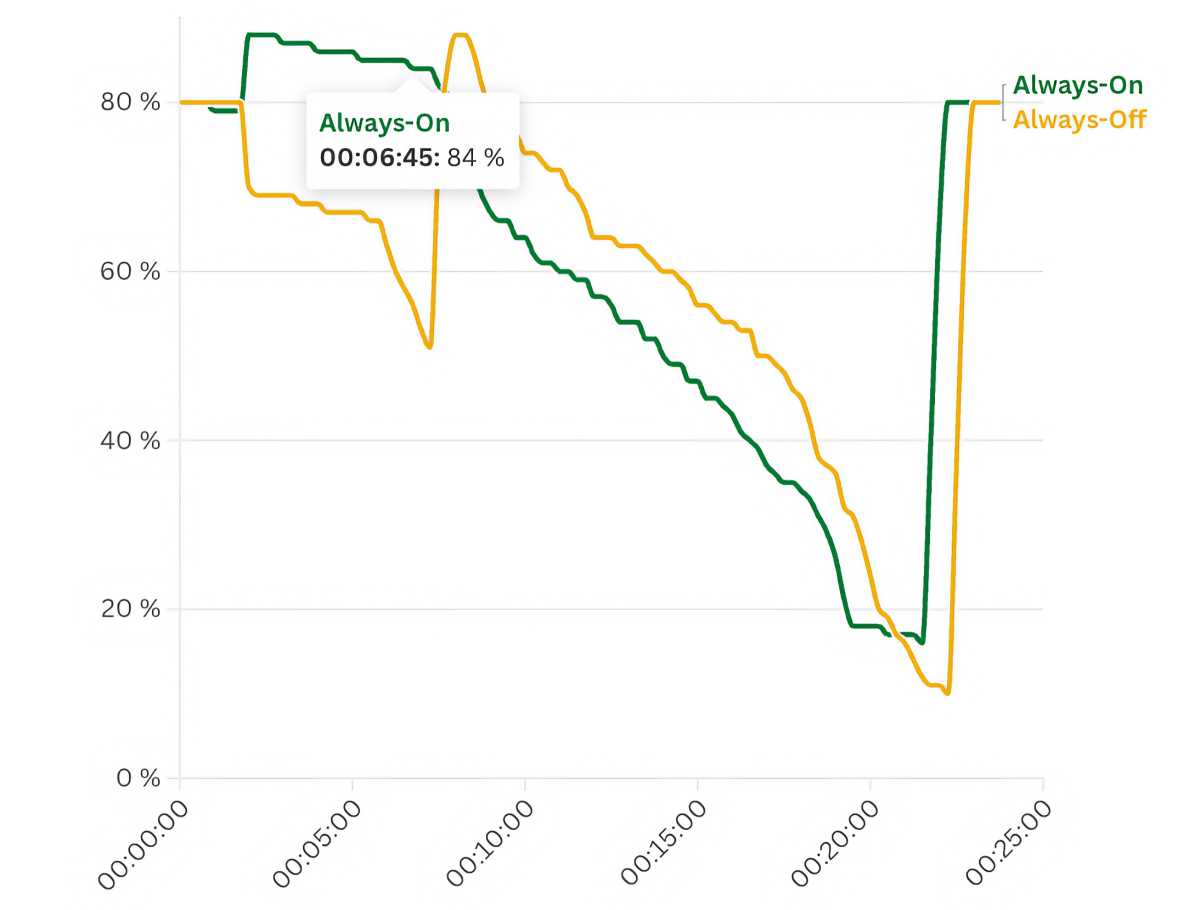
If you filter out the rows in both datasets showing the battery level when the iPhone was being charged, and calculate the discharge rate per hour, it turns out that the iPhone discharges at an average rate of 4.27 percent per hour when the display is always on. For an iPhone with the display deactivated, this rate is 3.75 percent per hour. The discharge rate during the day, from 8 a.m to 11 p.m., was 5.88 percent with the always-on display activated, and 5.37 percent with it off.

As can be seen from the data in the graph above, both discharge curves run almost parallel. There are no major discrepancies between the different settings that would suggest the always-on display being switched off has a significant effect on battery life. The t-test, which precisely calculates the significance of a factor, also yields a p-value of 0.3011 in this case. Significance is established at a p-value of 0.05 or less. This means that whether the always-on display is enabled or disabled has no significant effect on battery life.

Our measurement data supports what Apple claimed when introducing the always-on display in 2022. When the screen is locked, it is throttled down to 1Hz, which reduces power consumption. In the chaos of everyday life, which is influenced by user behavior, signal strength, and outside temperatures, whether the screen is on or off does not make a significant difference.

  •  

When is Apple’s next event? Dates, rumors, and what to expect

Macworld

Apple’s September event may not have been Apple’s final event of 2026 – another launch could be coming on October 13.

Apple typically has four main event windows each year: a spring event, WWDC in June, the iPhone event in September, and sometimes a further event in October. The company rarely confirms dates far in advance, and there’s no guarantee it will hold an event in every window. That leaves Apple fans – and anyone considering a new Apple device – wondering when the next event will happen and what might be announced.

Fortunately, Apple’s annual schedule is fairly predictable, while reliable rumours often provide additional clues about what’s coming. That means we can make informed estimates about the timing of future keynotes and the products most likely to appear.

Here’s everything we know about the event Apple could hold later in 2026 and beyond.

When is Apple’s next event?

  • Next rumored product launch: October 13, 2026. An event remains unconfirmed.

Bloomberg’s Mark Gurman has claimed on X that Apple will launch its “next big thing” on October 13, referring to new smart-home products. Apple has not confirmed the date, and it remains unclear whether the company will hold an event or announce the products through its website and press releases.

Apple hasn’t announced a date for another event in 2026, but it is possible that more new products will launch at an event, or via press release, before the end of the year.

Apple has held October events in the past: in 2023, an event was held on October 30, while in 2021 Apple held one on October 18. With the iPhone Duo launching on October 22, Apple may want to avoid clashing with that launch, making the following week, beginning October 26, a plausible window for another event or product announcements.

What could Apple launch at the next event?

The rumored lineup centers on Apple’s first smart-home display, often called HomePad. Gurman describes a 6-inch screen mounted above a speaker base on a manually tilting arm, plus a separate wall-mounted version. Updated HomePod mini and Apple TV 4K models with faster processors are also expected.

Other rumored launches include new iPads and a touchscreen MacBook Pro, but this report does not establish that they will arrive alongside the smart-home products.

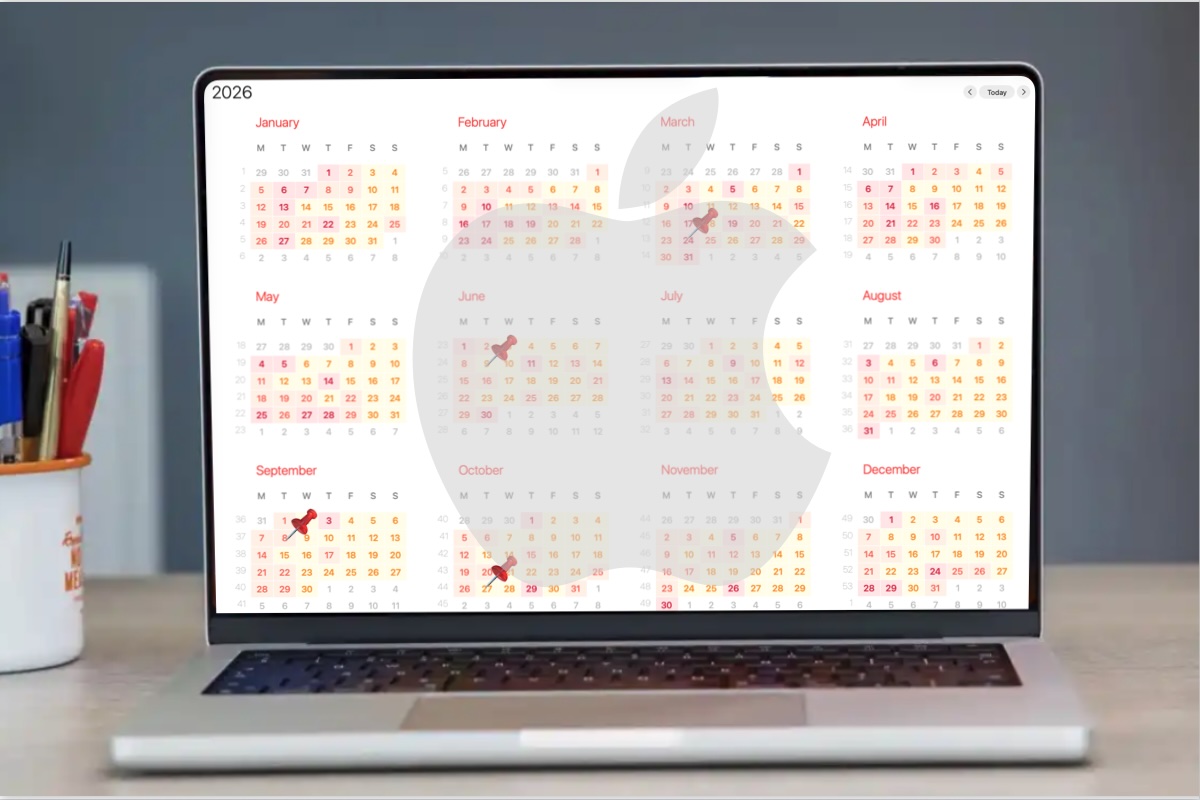
Apple event calendar 2026: What has Apple launched this year?

TimescaleEvent themeDatesProducts
March Special Experience2-4 MarchLaunched: iPhone 17e, MacBooks Neo, Pro & Air, iPad Air
JuneWWDCJune 8Unveiled plans for: iOS, macOS, other software, AI and Siri
SeptemberiPhone eventSeptember 9Launched: iPhone 18 Pro, iPhone 18 Pro Max, iPhone Duo, new Apple Watch, AirPods 5
OctoberRumored smart-home launchOctober 13 (rumored)Possible: HomePad, HomePod mini, Apple TV
Late 2026Other possible announcementsUnconfirmedPossible: Touchscreen MacBook, iPads
Spring 2027TBCTBCExpected: iPhone 18, iPhone 18e, iPhone Air 2

Apple has held three events so far in 2026, although the first was not an event in the traditional sense. On March 4, the company invited select media to hands-on “experiences” in multiple locations. In the run-up to that date, Apple launched several products via press release, including the iPhone 17e, M4 iPad Air, and M5 Pro and M5 Max MacBook Pro, M5 MacBook Air and the MacBook Neo.

The second event was WWDC, which began with a keynote on June 8. At the WWDC keynote Apple outlined the upcoming changes to its operating systems, including iOS 27 and macOS 27 Golden Gate.

In August Apple issued press releases to announce the new Mac mini and Mac Studio.

At the September 9 event Apple unveiled the iPhone 18 Pro and Pro Max, a foldable iPhone Duo, a new Apple Watch Series 12 and Ultra 4, and AirPods 5.

Apple Events Schedule 2026

Here’s when the 2026 Apple events might take place.


Foundry

FAQ


1.

How far in advance does Apple announce an event?

Apple usually announces its events around one to two weeks before they take place, although the timing varies. That means an October event could still be announced fairly late in the month. Apple may also choose not to hold an event at all and instead unveil new products through press releases, as it has done with a number of recent Mac and iPad launches.

2.

What time does the next Apple event start in U.S., U.K. and other global time zones

Apple keynotes usually start at 10 am PT. A future event would likely follow the same pattern. That translates to the following times in the countries where most of our readers live:

  • U.S.: 10 am PDT, 11 am MDT, 12 pm CDT, 1 pm EDT
  • Canada: as above, plus 2 pm ADT
  • U.K.: 6 pm
  • Europe: 7 pm CEST, 8 pm EEST
  • India: 10:30 pm IST
  • Australia: next day — 1 am AWST, 2:30 am ACST, 3 am AEST
  • New Zealand: next day — 5 am NZST

The timings are generally the same for all Apple Keynotes, but can be slightly different if Apple holds the event during the period of a couple of weeks when the clocks have changed in the U.S. but not elsewhere (in 2026 the clocks will change in the U.S. on November 1, while in the U.K. they change on October 25).

Sometimes Apple holds events at different times, for example, in October 2023 the event was held in late afternoon in San Francisco, which meant it was midnight in the U.K.

If Apple doesn’t hold an event and instead just issues a press release, that usually happens around 8 am PT, 11 am ET and 4 pm U.K. time.

3.

How long do Apple events usually last?

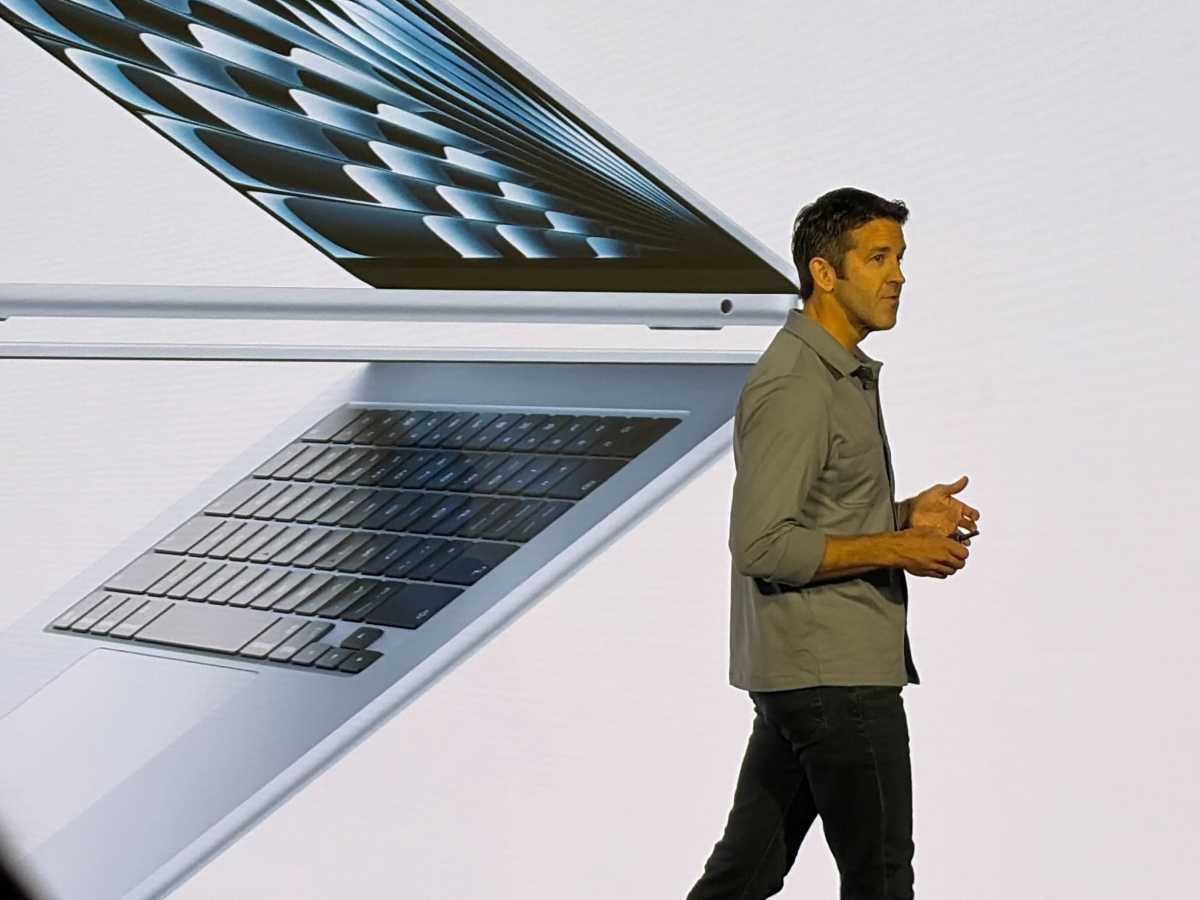
Apple keynotes usually last between one and two hours and feature the CEO alongside various other Apple executives. With John Ternus succeeding Tim Cook as CEO on September 1, 2026, this will be his first major product keynote in the role.

WWDC and the September event tend to be longer keynotes; the spring and late-fall events can be slightly shorter.

For example, the September 2024 event was 1 hour 38 minutes.

4.

How often does Apple hold events?

There can be as many as four Apple events in a year:

  • Spring Event
  • WWDC in June
  • iPhone Event in September
  • Late Fall Event in October

This event calendar is by no means set in stone, though, with the spring and October events being less regular. Some years, Apple doesn’t hold a spring event at all. In 2025 Apple only held two events, preferring instead to announce new products via press release.

5.

Does Apple take part in other events?

Apple doesn’t participate in major industry trade shows such as CES and IFA. Instead Apple invites the press and industry professionals to Apple Park to hear all about its latest products and services. Apple calls these ‘events’ and it streams them live online to millions of viewers.

6.

Does Apple ever announce products without an event?

Apple frequently announces products without a keynote event, often opting for press releases or multi-day announcement windows. In recent years, the company has increasingly reserved its large-scale media events for major flagship launches, such as the primary iPhone lineup in September, while using press releases for iterative updates or “chip bumps” that may not warrant a full hour-long presentation.

7.

How to watch an Apple event

Apple events are typically broadcast across several digital platforms, allowing viewers to tune in from almost any device. While the company previously restricted access to its own hardware or the Safari browser, these barriers have been removed in recent years.

You can access live Apple presentations through the following official channels:

  • YouTube: This is often considered the easiest way to watch. Apple streams its keynotes live on its official YouTube channel, which can be accessed via any web browser or the YouTube app on smartphones, tablets, and smart TVs.
  • Apple.com: The company hosts a dedicated “Events” page on its official website. For the best experience on a PC, it is recommended to use Microsoft Edge on Windows 10 or later.
  • Apple TV App: The stream is available within the Apple TV app on iPhone, iPad, Mac, and Apple TV hardware. Keynotes are usually listed in the app’s lineup a day or two before the event begins.
  • Apple Podcasts: Apple also showcases its events through the Podcasts app on Apple devices, where you can watch the video presentation.

You may also like to tune in to our Live Blog which will provide minute-by-minute text updates and analysis as products are announced.

Following the end of the event, detailed breakdowns will also be available on the Macworld Podcast, which can be found on Spotify, Soundcloud, and Apple Podcasts.

Will Apple have a second fall event in 2026?

Apple Scary Fast event

Apple

Will there be a late fall event in 2026?

The latest reporting points to a smart-home launch on October 13, although its presentation format remains unclear. Apple could announce these products without holding a keynote.

The last time Apple held a late fall event was on October 30, 2023, and before that on October 18, 2021. So while a late fall event would not be unprecedented, it has become relatively uncommon.

Right now, there is no way of knowing whether Apple will hold another event in late 2026, or whether it will continue to launch new products through press releases instead. In the past, October events have often focused on Macs, but in recent years Apple has shown that it does not always consider a dedicated event necessary for Mac launches.

What could Apple launch at the late fall 2026 event?

Apple’s next launch could focus on smart-home products, including the rumored HomePad display, an updated HomePod mini and a new Apple TV 4K. The latter two are expected to feature faster processors that could support Siri AI features.

Other possible launches before the end of the year include the rumored touchscreen MacBook Pro and updates to the iPad and iPad mini. However, it remains unclear whether Apple would announce these alongside its smart-home products, hold a separate event or introduce them through press releases.

For more information about Apple’s late fall events, read: Apple’s October Event: Date, time and what will launch.

Will Apple hold a spring event in 2027?

Apple March 2026 special experience 11
John Ternus: Apple’s new CEO.

Michael Simon / Foundry

Apple’s spring events have become increasingly unpredictable. The company has not held a traditional spring event since May 2024, although it did invite members of the media, including Macworld, to a “Special Apple Experience” in 2026.

Rather than a keynote presentation, the March 4, 2026 gathering was a hands-on showcase that followed three days of product announcements, including the MacBook Neo, iPhone 17e, and M5 MacBook Air.

Will Apple take a similar approach to spring product launches in 2027? It’s certainly possible. The format appeared to work well, allowing each product announcement to receive its own media coverage rather than competing for attention during a single event.

Apple is expected to release three iPhone models in spring 2027 – or it could be two new iPhones, with the Air and iPhone 18 merging.

Apple may also update the MacBook Air with an M6 processor in spring 2027.

When is WWDC 2027?

WWDC25

Foundry

When is the WWDC keynote?

In 2026 the WWDC keynote was on Monday June 8. In 2025 it started on Monday June 9. We expect WWDC will start on Monday 7 June in 2027.

WWDC generally runs from the Monday to Friday in the second week of June.

What Apple could launch at WWDC

WWDC is Apple’s big developer event at which it reveals plans for the operating systems that run on Apple hardware.

In June 2027 we expect Apple to unveil details of iOS 28, iPadOS 28, macOS 28, updates to watchOS, tvOS, HomePod software, and an update to Apple’s realityOS.

Apple sometimes announces new hardware at WWDC, usually the high-end models targeted at power users, so we could see new Macs.

Following the keynote on Monday, developer events and sessions will run throughout the week. You can read more about WWDC date, times and everything you need to know in a separate article.

What did Apple launch at past events?

So far in 2026 Apple has held an ‘experience’, which rather than being an event in the traditional sense, was a chance for journalists to get a look at products Apple had launched in the days prior, including MacBook Neo and iPhone 17e. The company also hosted the WWDC keynote on June 8, at which it revealed its plans for Apple Intelligence and Siri in iOS 27, macOS 27 and the other operating systems. Plus Apple held its iPhone launch event on September 9 at which the iPhone 18 Pro and Max, iPhone Duo, Apple Watch Series 12, Apple Watch Ultra 4 and AirPods 5 launched.

In 2025 Apple only held two events. The first was its Worldwide Developers Conference (WWDC) on June 9, at which it introduced the new features coming in the next version of its operating systems, and the second was the huge September 9 Apple Event where it launched new Apple Watches, new AirPods Pro and the new iPhones for 2025.

Apple doesn’t have to hold an event to launch new products though. Prior to WWDC, Apple launched a new iPhone 16e via press release on February 19, a new iPad and iPad Air via press release on March 4, and a new MacBook Air and Mac Studio on March 5.

Apple then went on to launch a new M5 MacBook Pro and M5 iPad Pro in October. No event was held to mark these launches.

In 2024, Apple held three events: one on Tuesday, May 7, at which it launched new iPads; a keynote to kick off WWDC on June 10; and an event on September 9 at which Apple unveiled the new iPhone 16, Apple Watch Series 10 and the AirPods 4. In October 2024 there was no event, but Apple did announce new products (iMac, Mac mini and MacBook Pro) via press release.

In 2023 there were three events: WWDC in June, an iPhone event in September, and Apple’s second fall event on October 30 (or after midnight on October 31 if you weren’t in the U.S.).

In 2022 Apple held three events: a spring event on March 8, WWDC on June 6, and the iPhone 14 launch on September 7. In other years Apple has held four events though.

Apple September Event

Foundry

When were Apple’s past events?

Spring Apple events have been held on the following dates:

  • 2026: ‘Experience’ Wednesday March 4
  • 2025: No event
  • 2024: Tuesday May 7
  • 2023: No event
  • 2022: Tuesday March 8
  • 2021: Tuesday April 20
  • 2020: No event
  • 2019: Monday March 25
  • 2018: Tuesday March 27
  • 2017: No event
  • 2016: Monday March 21
  • 2015: Monday March 9
  • 2014: No event
  • 2013: No event
  • 2012: Wednesday March 7

WWDC events have fallen on the following dates:

  • WWDC 2026: June 8 (8-12)
  • WWDC 2025: June 9 (9-13)
  • WWDC 2024: June 10 (10-14)
  • WWDC 2023: June 5 (5-9)
  • WWDC 2022: June 6 (6-10)
  • WWDC 2021: June 7 (7-11)
  • WWDC 2020: June 22 (22-26)
  • WWDC 2019: June 3 (3-7)
  • WWDC 2018: June 4 (4-8)
  • WWDC 2017: June 5 (5-9)

Here are the past few Apple September event dates:

  • 2026: Wednesday, September 9
  • 2025: Tuesday, September 9
  • 2024: Monday, September 9
  • 2023: Tuesday, September 12
  • 2022: Wednesday, September 7
  • 2021: Tuesday, September 14
  • 2020: Tuesday, September 15
  • 2019: Tuesday, September 10
  • 2018: Wednesday, September 12
  • 2017: Tuesday, September 12

In the past, Apple has held a second fall event on the following dates:

  • 2025: No event
  • 2024: No event
  • 2023: Monday, October 30
  • 2022: No event
  • 2021: Monday, October 18
  • 2020: Tuesday, October 13 and Tuesday, November 10
  • 2019: No event
  • 2018: Tuesday, October 30
  • 2017: No event
  • 2016: Thursday, October 27
  • 2015: No event
  • 2014: Thursday, October 16
  • 2013: Tuesday, October 22
  • 2012: Tuesday, October 23
  • 2011: Tuesday, October 4

  •  

iPhone 18 Pro speakers ‘crackling and popping,’ some owners complain

Macworld

It’s been just 12 days since the iPhone 18 Pro went on sale, and some customers are already complaining about their phones. Specifically, at certain times the speakers produce a clicking, crackling, snapping, or “raspy” sound.

As is often the case with such issues, affected parties congregated on a Reddit thread to discuss the problem.

The original poster reports that shortly after setup their new iPhone 18 Pro Max produced a brief clicking or popping noise from the speaker (either upper or lower; the poster seems unclear on this) “almost as if someone is pulling out an aux cord.” This didn’t just happen once. It happened, they report, a number of times “during app switching and [while] playing around with volume and possibly voice dictation.” But it became less frequent over time, and didn’t happen at all in the few hours before the post was made.

In a later edit, they add that “music at high volume sounds raspy as well.”

At the time of writing, there are 29 direct, undeleted and non-mod replies to the post, and by my count at least 21 of these say they’ve experienced the same issue(s). Some report positive conclusions. One says it only happened on phone calls and that since updating to iOS 27.0.1 has stopped entirely. Another says that going into the Phone settings and choosing “Standard” mode rather than “Voice Isolation” led to “way less crackling.”

But some cases appear to be more severe. One commenter, translated from Vietnamese, complains that they “hear random clicking or crackling sounds almost whenever I interact with the screen. Sometimes, I even hear it the moment I touch the screen to wake it up.”

More reports of the issue have appeared on the MacRumors forum. Again, complaints are made about “crackling” sounds, “intermittent popping sounds,” a “super faint tick/pop from the earpiece speaker,” and a different, “very unpleasant” emphasis in the higher frequencies, as compared to the iPhone 17 Pro Max. And again, far too many commenters confirm that they’ve experienced the same issue for this to be dismissed as user error or a single defective unit.

Apple has not yet made a public statement about the issue, but may address it in a software update. Go into Settings and select General > Software Update and follow the prompts to install the latest version of iOS.

Since Apple just released iOS 27.0.1 this week to fix other iPhone 18 Pro launch bugs, however, an imminent update is not guaranteed. In the meantime we recommend that owners of affected phones contact Apple to get them fixed, especially before the two-week return period ends.

  •  

Get ready: Apple sets iPhone Duo pre-pre-ordering date

Macworld

Apple unveiled its late-2026 iPhones (the iPhone 18 Pro, 18 Pro Max, and Duo) at a single event earlier this month, but admitted not all of them would be released at the same time. As reported even before the event, the two Pro models went on sale on September 18, but the Duo won’t be available until October. October 23, to be exact, with pre-orders commencing on October 16.

In a semi-surprising turn of events, however, Apple has now announced that October 16 isn’t the very earliest customers will be able to begin their purchase journey. According to updated verbiage on the iPhone Duo product page, as spotted by eagle-eyed Reddit users, we are cordially invited to “come back on 10.12 to get ready for pre‑order.” This is then followed by the same dates that had previously been announced: “Pre-order starting at 5:00 am PT on 10.16. Available starting 10.23.”

If availability starts on October 23, and pre-ordering on October 16, what exactly will happen on October 12? What does it mean to “get ready” for pre-order?

Happily, this isn’t the first time Apple has allowed customers to use this option. And based on past behavior, we can report that it essentially allows you to do everything necessary to place an order up to but not including clicking the final buy button. You’ll be able to go into the Apple Store app and pre-select your desired color and storage allocation, decide whether or not to use financing and/or trade-in on an older device, choose a carrier, and so on.

(As noted by a commenter in the Reddit thread, you can already start the process by “pre-saving” an iPhone Duo configuration in the Apple Store app, but the Get Ready process is much more thorough.)

All of this preliminary work makes the purchase on pre-order day a single-tap process, which could save you valuable time if, as is likely, Apple hasn’t made as many iPhone Duos as it hoped to and supplies quickly run out. It could make the difference between getting your hands on a brand-new iPhone Duo and having to wait months for a restock, and early adopters would be advised to take any advantage they can get.

  •  
❌