❌

Reading view

Here's Why Skyworks' Qorvo Deal Is a Buy (and Why It Isn't)

Skyworks Solutions (NASDAQ: SWKS) could emerge from its combination with Qorvo with greater scale, broader markets, and a significantly different earnings profile. The opportunity hinges on whether management can capture $500 million in planned synergies, expand beyond smartphones, and manage the additional debt.

Stock prices used were the market prices of Sept. 17, 2026. The video was published on Sept. 30, 2026.

Missed Nvidia in 2009? This Rare Signal Is Flashing Again. In 2009, a "Double Down" signal flashed for a little-known chipmaker called Nvidia. For the first time in years, that same "Total Conviction" signal is flashing for a company 1/100th the size of Nvidia. Continue »

Should you buy stock in Skyworks Solutions right now?

Before you buy stock in Skyworks Solutions, consider this:

The Motley Fool Stock Advisor analyst team just identified what they believe are the 10 best stocks for investors to buy now… and Skyworks Solutions wasn’t one of them. The 10 stocks that made the cut could produce monster returns in the coming years.

Consider when Netflix made this list on December 17, 2004... if you invested $1,000 at the time of our recommendation, you’d have $375,240!* Or when Nvidia made this list on April 15, 2005... if you invested $1,000 at the time of our recommendation, you’d have $1,403,292!*

Now, it’s worth noting Stock Advisor’s total average return is 932% — a market-crushing outperformance compared to 211% for the S&P 500. Don't miss the latest top 10 list, available with Stock Advisor, and join an investing community built by individual investors for individual investors.

See the 10 stocks »

*Stock Advisor returns as of October 1, 2026.

Rick Orford has no position in any of the stocks mentioned. The Motley Fool has no position in any of the stocks mentioned. The Motley Fool has a disclosure policy. Rick Orford is an affiliate of The Motley Fool and may be compensated for promoting its services. If you choose to subscribe through their link, they will earn some extra money that supports their channel. Their opinions remain their own and are unaffected by The Motley Fool.

  •  

This AI Stock Is Trading Near Record Highs. Is It Too Late to Buy?

Key Points

  • Amphenol's stock is about 3% below its all-time high after gaining 311.6% in the last three years.

  • The company's connectors and cables link AI processors, and its IT datacom business is roughly four times its size from two years ago.

  • Orders of $10.7 billion topped sales of $8.8 billion, resulting in a healthy book-to-bill ratio of 1.23.

Amphenol (NYSE: APH) makes connectors, cables, and sensors. Nobody has ever put a cable assembly on a magazine cover. I mean, aside from very niche industry mags. Yet, on Oct. 1, the stock sits 3.2% below a recent all-time high, and the AI boom is a big reason.

A run like that raises the obvious question about whether the easy money is gone. The business results suggest it isn't, at least not yet.

Missed AI’s "Act 1"? Act 2 Could Be 15x Bigger. Most investors think they missed the AI boat because they didn't buy Nvidia in 2005. But according to our analysts, we’re only at the end of "Act 1"—the R&D phase. "Act 2" is the global rollout. Continue »

Two hands pushing together coaxial cable connectors.

Image source: Getty Images.

Plumbing for the AI boom

The company holds the least glamorous seat at the AI party: the one that connects the processors. CEO Adam Norwitt calls interconnect the central nervous system of AI, and the logic is hard to dispute. A server rack that sells for $3 million is worth very little if the connectors never arrive. Amphenol's IT datacom business is roughly four times its size two years ago.

Start with the second quarter. Sales of $8.8 billion rose 55% year over year. Organic growth was 30%. Adjusted earnings per share of $1.35 jumped 67%. Orders reached $10.7 billion, a book-to-bill ratio of 1.23, meaning customers ordered 23% more than Amphenol shipped. That gap is the closest thing to a forward indicator in the report, and it points up.

Loud numbers, quiet CEO

Norwitt avoids the spotlight. At a recent Citi conference, he told the crowd that he doesn't do interviews and that the company announces none of its customer commitments, including long-term non-cancelable orders.

But he doesn't have to say much.

Quarterly orders of $10.7 billion against sales of $8.8 billion say plenty without an adrenaline-packed press release. That makes a nice change in an AI sector that often seems to run on video clips, social media posts, and headlines.

Slow and steady beats the hotshots

Here's the part that should interest anyone worried about being late. Amphenol is up 27.9% this year. Respectable, but well behind the company's closest rivals. Corning (NYSE: GLW) gained 81.1%, Flex (NASDAQ: FLEX) stock rose 85.9%, and Littelfuse (NASDAQ: LFUS) posted a 71.7% year-to-date run.

And the recent trends have been in Amphenol's favor. Over the past quarter, Amphenol gained 4.9% while Flex fell 18% and Corning dropped 19.4%. Tech giants are still planning and building massive AI data centers, but there's public pushback ahead of the midterm elections. The AI-adjacent crowd has been running harder and wobbling more, while Amphenol is holding steady.

Cheaper than the neighbors

The profits aren't thin, either. Operating margin is 28.1%, the highest in the peer group. The CommScope purchase, at $10.5 billion, is now expected to deliver $4.6 billion in sales this year, up from an earlier forecast of $4.1 billion.

At 26.4 times forward earnings, the stock trades at a lower multiple than Corning (36.6) and Cognex (30.6). The PEG ratio of 0.9 suggests the market isn't fully valuing growth. The dividend yield of 0.6% is a rounding error, and short interest is only 1.3% of the float. Few investors are betting against Amphenol's rising stock.

So, is it too late?

None of this makes Amphenol's stock a bargain, and 311.6% over three years has a way of making a new buyer feel tardy. Moreover, investors are currently paying an AI multiple for a mostly old-school product catalog. Still, the third-quarter guide calls for sales growth of 50% to 52%.

Is it too late? For the first quadrupling in three years, sure. The next leg is a separate question, and the bulging order book is making a decent bull case.

Should you buy stock in Amphenol right now?

Before you buy stock in Amphenol, consider this:

The Motley Fool Stock Advisor analyst team just identified what they believe are the 10 best stocks for investors to buy now… and Amphenol wasn’t one of them. The 10 stocks that made the cut could produce monster returns in the coming years.

Consider when Netflix made this list on December 17, 2004... if you invested $1,000 at the time of our recommendation, you’d have $375,240!* Or when Nvidia made this list on April 15, 2005... if you invested $1,000 at the time of our recommendation, you’d have $1,403,292!*

Now, it’s worth noting Stock Advisor’s total average return is 932% — a market-crushing outperformance compared to 211% for the S&P 500. Don't miss the latest top 10 list, available with Stock Advisor, and join an investing community built by individual investors for individual investors.

See the 10 stocks »

*Stock Advisor returns as of October 1, 2026.

Anders Bylund has no position in any of the stocks mentioned. The Motley Fool has positions in and recommends Amphenol, Cognex, and Corning. The Motley Fool recommends Flex. The Motley Fool has a disclosure policy.

  •  

ASML vs. SK Hynix: What Revenue Trends Reveal to Investors About These Artificial Intelligence Companies

Key Points

  • SK Hynix currently generates a higher overall revenue total at the end of each period than ASML Holding.

  • Throughout the course of the last eight quarters, ASML maintained steady quarter-over-quarter revenue totals, while SK Hynix demonstrated a distinct quarter-over-quarter acceleration in its reported results.

  • As these financial patterns continue to develop, investors should watch whether the existing revenue gap between the two companies continues to widen or begins to narrow in upcoming quarters.

ASML Holding: Steady and Gradual Quarterly Revenue Growth

ASML Holding (NASDAQ:ASML) generates its revenue primarily by supplying advanced extreme ultraviolet lithography equipment, specialized wafer inspection systems, and related computational control software to integrated circuit manufacturers operating in locations across the globe.

It recently announced plans to increase manufacturing capacity for specific immersion systems by 30%, launched a collaborative industry initiative with multiple foundries for larger photomasks, and initiated construction on an additional corporate engineering campus in the Netherlands.

SK Hynix: Rapid and Sustained Quarterly Revenue Expansion

SK Hynix (NASDAQ:SKHY) earns its revenue primarily by designing, producing, and selling a wide variety of advanced memory semiconductors, including various customized flash memory products tailored specifically for complex technical computing and mobile applications.

It recently completed an oversubscribed initial listing of its American Depositary Receipts on the Nasdaq exchange, reassigned three senior vice chairpersons to oversee global strategy, and simultaneously faced a class action antitrust lawsuit regarding component pricing.

Why Revenue Matters for Investors

Revenue provides individual investors with a transparent, direct baseline measurement of all incoming capital over a specific timeframe before any operational business expenses are formally deducted. Closely tracking this top-line financial figure helps investors understand the total scale and growth trajectory of a business.

ASML Holding vs. SK Hynix Revenue chart

Quarterly Revenue for ASML Holding and SK Hynix

Calendar quarterASML Holding RevenueSK Hynix Revenue
Q3 2024$8.2 billion (quarter ended Sept. 30, 2024)$12.9 billion (quarter ended Sept. 30, 2024)
Q4 2024$9.9 billion (quarter ended Dec. 31, 2024)$14.1 billion (quarter ended Dec. 31, 2024)
Q1 2025$8.2 billion (quarter ended March 31, 2025)$12.1 billion (quarter ended March 31, 2025)
Q2 2025$8.7 billion (quarter ended June 30, 2025)$15.8 billion (quarter ended June 30, 2025)
Q3 2025$8.8 billion (quarter ended Sept. 30, 2025)$17.6 billion (quarter ended Sept. 30, 2025)
Q4 2025$11.3 billion (quarter ended Dec. 31, 2025)$22.6 billion (quarter ended Dec. 31, 2025)
Q1 2026$10.3 billion (quarter ended March 31, 2026)$35.7 billion (quarter ended March 31, 2026)
Q2 2026$10.8 billion (quarter ended June 30, 2026)$52.6 billion (quarter ended June 30, 2026)

Data source: Financial Modeling Prep. ASML Holding's figures are converted from euros to U.S. dollars. SK Hynix's figures are converted from South Korean won to U.S. dollars. Data as of Sept. 25, 2026.

Foolish Take

For investors interested in gaining exposure to the artificial intelligence boom, ASML and SK Hynix are two great companies to invest in. Both provide key products to the AI industry, and as a result, are seeing year-over-year revenue growth.

That said, examining their sales trends provides investors with revealing insights. ASML's extreme ultraviolet (EUV) lithography equipment is essential for semiconductor manufacturers to produce AI chips, giving the company a legal monopoly since competitors have not been entirely successful in providing rival EUV tools. However, the complex machinery takes time to build, resulting in a slow revenue ramp for ASML.

In contrast, SK Hynix manufactures high-bandwidth memory (HBM) products, which can be produced faster. The company's massive sales growth in recent quarters is evidence that tech giants are pouring funds into memory components right now. The demand is so great, it's led to rising memory prices, which further fuels SK Hynix's spectacular sales ascent.

Don’t miss this second chance at a potentially lucrative opportunity

Ever feel like you missed the boat in buying the most successful stocks? Then you’ll want to hear this.

On rare occasions, our expert team of analysts issues a “Double Down” stock recommendation for companies that they think are about to pop. If you’re worried you’ve already missed your chance to invest, now is the best time to buy before it’s too late. And the numbers speak for themselves:

  • Nvidia: if you invested $1,000 when we doubled down in 2009, you’d have $593,741!*
  • Apple: if you invested $1,000 when we doubled down in 2008, you’d have $63,526!*
  • Netflix: if you invested $1,000 when we doubled down in 2004, you’d have $375,240!*

Right now, we’re issuing “Double Down” alerts for three incredible companies, available when you join Stock Advisor, and there may not be another chance like this anytime soon.

See the 3 stocks »

*Stock Advisor returns as of October 1, 2026.

Robert Izquierdo has positions in ASML. The Motley Fool has positions in and recommends ASML. The Motley Fool has a disclosure policy.

  •  

Nvidia Authorizes a Record $150 Billion in Stock Buybacks. The Real Prize Is Where the Rest of Its Cash Is Going.

Key Points

  • Innovation is sewn into the fabric of Nvidia’s company culture.

  • Nvidia is generating so much cash that it can afford to aggressively invest in next-generation computing platforms and return capital to shareholders.

  • Nvidia's AI roadmap extends far beyond data center compute.

Nvidia's (NASDAQ: NVDA) Board of Directors authorized a $150 billon increase to its share repurchase program, bringing the total to $235 billion. The announcement was the largest single stock buyback authorization in U.S. corporate history.

For context, Toyota Motor -- which sells more cars than any other manufacturer in the world -- has a market cap of $223 billion.

Missed AI’s "Act 1"? Act 2 Could Be 15x Bigger. Most investors think they missed the AI boat because they didn't buy Nvidia in 2005. But according to our analysts, we’re only at the end of "Act 1"—the R&D phase. "Act 2" is the global rollout. Continue »

Here's why Nvidia's buyback program is great news for investors, and why the bigger story is what Nvidia is doing with the rest of its cash.

Nvidia’s logo on a grey sign in front of Nvidia’s headquarters.

Image source: Nvidia.

High margin revenue growth fuels free cash flow

Nvidia's free cash flow (FCF) has exploded in recent years due to its rapid revenue growth and high margins. Nvidia returned 60% of FCF to investors through buybacks and dividends in the first half of fiscal 2027, and has a long-term target of returning at least 50% of FCF.

NVDA Revenue (TTM) Chart

NVDA Revenue (TTM) data by YCharts

Nvidia is converting around 75 cents of every dollar in sales into gross profit, 64 cents into bottom-line after-tax profit, and around 42 cents into FCF. Nvidia's growth and high margins are partly due to insatiable demand for artificial intelligence (AI) compute -- which is benefiting the broader semiconductor industry. But Nvidia also has a highly effective product development pipeline that has produced three new compute platforms in four years. These aren't marginal improvements either.

Its Grace Blackwell platform, announced in March 2024, was magnitudes better than Hopper, launched in March 2022. In January 2026, Nvidia announced its Vera Rubin platform. Compared to Blackwell, Rubin delivers a 90% reduction in inference costs and a 75% reduction in the number of graphics processing units (GPUs) needed for training.

Nvidia has been the poster child of the AI boom since OpenAI released ChatGPT to the public in November 2022. But it's what the company has developed since that should be getting more attention.

Nvidia began shipping Rubin in August and already expects it to account for 20% of data center revenue in the third quarter of fiscal 2027, which it will report in November. Demand for Rubin is so massive that Nvidia is guiding for 70% year-over-year revenue growth in fiscal 2028. Higher memory chip costs have yet to make a substantial dent in Nvidia's gross margins -- a testament to its pricing power.

Rubin's efficiency is not solely due to Nvidia's making a more powerful GPU. It's also because Rubin comes in a rack-scale offering that includes multiple chips and networking components, which Nvidia calls extreme co-design. This co-design allows Nvidia to control a larger share of the data center addressable market, and in turn, offers significant performance improvements for its customers that justify the high price tag. The Nvidia NVL72 is a plug-and-play offering for AI data centers that features seven new chip designs, including 72 Rubin GPUs and 36 Vera central processing units.

Innovating at the speed of light

Nvidia's record buyback authorization is a product of its impeccable profitability and sheer size. It is not, however, a sign that the company is transitioning into a stodgy, low-to-moderate growth company.

In his book The Nvidia Way, author Tae Kim discusses how Nvidia's Speed of Light concept was an integral reason the company was able to endure an intensely competitive landscape in its early years. The concept is rooted in pushing the limits of what Nvidia's talent and resources can deliver under expedited timelines, rather than using prior accomplishments or competitors' actions as a yardstick.

In the 1990s, other chip companies would operate on a one to two-year product development cycle, which left them vulnerable to riding a big hit only to see their market share erode if their next launch failed. Nvidia fell into the same trap and almost went bankrupt multiple times. Nvidia then condensed its product launches to six months as a way to keep cash flow coming and avoid taking its competitive moat for granted.

Nvidia CEO Jensen Huang embodies Nvidia's relentless work culture to this day. Nvidia could have easily ridden the coattails of Blackwell for longer and kept Rubin in its back pocket, but Nvidia doesn't behave like the world's most valuable company. It behaves like a company that doesn't take its industry-leading position for granted.

Nvidia also recognizes that its heavy reliance on a handful of hyperscale customers leaves it vulnerable to cyclical spending pullbacks. This is why evolving beyond one-off chip sales to rack-scale data center solutions that deliver the greatest cost efficiency for its customers is so important. On top of that, Nvidia is making compute more accessible and transferable to a non-hyperscale customer base by partnering with financial institutions to create an investable AI infrastructure asset class. Third-party capital will fund the build-out of AI infrastructure that can be sold to AI labs, AI start-ups, cloud providers, and enterprises seeking the flexibility to use varying levels of compute without the risks and capital commitments of building it themselves.

Nvidia remains a high-octane growth stock

A bloated buyback budget can sometimes indicate a company is out of good ideas and looking for ways to appease shareholders. But Nvidia's record authorization is simply a product of how profitable its business has become and of management's confidence in its roadmap to generate even higher FCF going forward as AI compute demand increases.

Nvidia's buyback announcement does not mean the company is taking its foot off the gas when it comes to AI innovation. Nvidia's culture still prioritizes organic growth over everything else. There's every reason to believe that will continue, given Nvidia's optimism about compute demand for agentic AI and physical AI, such as self-driving cars and robotics.

Should you buy stock in Nvidia right now?

Before you buy stock in Nvidia, consider this:

The Motley Fool Stock Advisor analyst team just identified what they believe are the 10 best stocks for investors to buy now… and Nvidia wasn’t one of them. The 10 stocks that made the cut could produce monster returns in the coming years.

Consider when Netflix made this list on December 17, 2004... if you invested $1,000 at the time of our recommendation, you’d have $375,240!* Or when Nvidia made this list on April 15, 2005... if you invested $1,000 at the time of our recommendation, you’d have $1,403,292!*

Now, it’s worth noting Stock Advisor’s total average return is 932% — a market-crushing outperformance compared to 211% for the S&P 500. Don't miss the latest top 10 list, available with Stock Advisor, and join an investing community built by individual investors for individual investors.

See the 10 stocks »

*Stock Advisor returns as of October 1, 2026.

Daniel Foelber has positions in Nvidia. The Motley Fool has positions in and recommends Nvidia. The Motley Fool has a disclosure policy.

  •  

Applied Materials vs. AMD: Which AI Semiconductor Stock Is a Better Buy in 2026?

Key Points

  • Applied Materials supplies manufacturing equipment and related services to the companies that fabricate semiconductors.

  • Advanced Micro Devices grew revenue about 34% in 2025, with gains in both its data center segment and its client and gaming segment.

  • Net margin at Applied Materials was about 24.7% in fiscal 2025, which ended in October 2025, roughly double the 12.5% that AMD posted.

Choosing between Applied Materials (NASDAQ:AMAT) and Advanced Micro Devices (NASDAQ:AMD) means weighing a highly profitable chip equipment supplier against a faster-growing chip designer.

Applied Materials makes the equipment that chip factories use to produce semiconductors. AMD designs processors for products ranging from game consoles to large data centers and relies on outside foundries to manufacture them. Both sell into the demand that has drawn investors to artificial intelligence (AI) stocks, but they offer very different risk and reward profiles.

The case for Applied Materials

Alongside its manufacturing equipment, Applied Materials sells related services and factory automation software. The company occupies a highly technical niche among semiconductor stocks, selling to the large manufacturers that fabricate chips. That customer base is concentrated, and two customers accounted for approximately 19% and 15% of net revenue in fiscal 2025, which ended in October 2025.

In fiscal 2025, revenue reached nearly $28.4 billion, up about 4.4% from the previous year. The company reported net income of roughly $7.0 billion for the same period. Revenue and pre-tax income both rose, but the net margin, which measures how much profit is kept from every dollar of sales, declined to approximately 24.7% from 26.4% as the provision for income taxes more than doubled.

As of Oct. 26, 2025, the debt-to-equity ratio was roughly 0.3x. That ratio compares total debt with shareholders' equity, and a figure this low points to a conservative approach to borrowing. The current ratio, which compares short-term assets to short-term liabilities, was approximately 2.6x. Free cash flow, which the company calculates as operating cash flow minus capital expenditures, totaled nearly $5.7 billion for the fiscal year.

The case for Advanced Micro Devices

AMD designs processors for data centers and personal computers, as well as the semi-custom chips inside game consoles. A small number of customers account for a large share of its revenue, and cloud and hyperscale data center operators buy a substantial portion of its data center products.

In October 2025, AMD signed an agreement with OpenAI to deploy 6 gigawatts of its graphics processing units (GPUs), and in February 2026 it announced a similar agreement with Meta Platforms (NASDAQ:META) covering up to 6 gigawatts. Its chips also power the PlayStation 5 from Sony (NYSE:SONY) and the Xbox Series S and X consoles from Microsoft (NASDAQ:MSFT).

In 2025, revenue reached about $34.6 billion, up about 34.3% from the previous year. Growth came from the data center segment, where revenue rose 32%, and from the client and gaming segment, where it rose 51%. Net income for the period was roughly $4.3 billion, with a net margin of about 12.5%, held down in part by research and development spending, which rose about 25% to $8.1 billion.

As of Dec. 27, 2025, the debt-to-equity ratio was approximately 0.05x on a total debt-to-shareholders' equity basis. The current ratio stood at nearly 2.9x, indicating ample capacity to cover short-term obligations. Free cash flow for the year was roughly $5.5 billion under AMD's own definition, which starts with operating cash flow from continuing operations and subtracts capital expenditures.

That measure excludes about $1.2 billion of operating cash flow from discontinued operations, the ZT Systems manufacturing business that AMD sold in October 2025. Stock-based compensation of about $1.6 billion equaled roughly 25% of operating cash flow from continuing operations. Because it is a non-cash expense added back to cash flow in the cash flow statement, it increases reported cash generation.

Risk profile comparison

Applied Materials faces significant risks from evolving export controls and trade policies, particularly those involving China, which accounted for about 30% of its revenue in fiscal 2025. On Feb. 11, 2026, the company agreed to pay $252.5 million to the U.S. Commerce Department to resolve allegations that certain customer shipments to China between November 2020 and July 2022 did not comply with export regulations.

The Justice Department and the Securities and Exchange Commission closed their related investigations without action. The semiconductor industry has also historically been cyclical. The company says AI-related demand is difficult to forecast, and shifting demand can pressure its margins and cash flow.

AMD sells into highly competitive markets against rivals such as Nvidia (NASDAQ:NVDA) and Intel (NASDAQ:INTC). The company relies on third parties to manufacture its chips, including Taiwan Semiconductor Manufacturing (NYSE:TSM) and GlobalFoundries (NASDAQ:GFS), so any disruption at these foundries would directly affect its ability to deliver products. U.S. export controls on its Instinct MI308 data center GPUs also restrict sales to China, and AMD's 2025 results included approximately $440 million of net inventory and related charges tied to those controls.

Dilution is another risk for AMD shareholders. The company has issued warrants to OpenAI and Meta Platforms, each covering up to 160 million shares at an exercise price of $0.01 per share, that vest as the customers reach GPU purchase milestones and AMD's stock reaches specified price targets.

Together, the warrants equal about 20% of the roughly 1.63 billion shares outstanding as of late July 2026, and none had vested as of June 27, 2026. On Sept. 28, 2026, AMD also announced an agreement to acquire World Labs, an AI model and research lab, in an all-stock transaction valued at approximately $8.2 billion.

Valuation comparison

Applied Materials carries the lower forward price-to-earnings (P/E) and price-to-sales (P/S) ratios, and AMD grew revenue much faster in 2025.

MetricApplied MaterialsAdvanced Micro Devices
Forward P/E23.4x39.5x
P/S ratio11.9x24.2x

Valuation metrics include sourcing from Financial Modeling Prep (FMP) and may differ from other data providers.

Which stock would I buy in 2026?

Applied Materials looks like the better buy to me, though I'd treat it as a position to add to over time. Chip equipment demand moves in cycles, and the stock has already more than doubled in the past year.

What tips the comparison is how each business has trended since the full-year figures above. Applied Materials reported record revenue for its fiscal third quarter on Aug. 13, 2026. The midpoint of management's guidance for the quarter ending in October implies sales growth of about 50% from a year earlier, roughly twice the pace it posted just a year ago. AMD's revenue also grew about 50% in its second quarter, but its Aug. 4 outlook points to somewhat slower growth in the third quarter. The growth gap that supports AMD's richer multiples appears to be narrowing.

AMD shareholders also face a dilution question that Applied Materials shareholders don't. The warrants from OpenAI and Meta Platforms could add about a fifth to the share count if every milestone is met, and the pending World Labs purchase would be paid for in stock. The warrants are tied to large chip orders, so the trade may prove worthwhile, but it raises the bar for per-share results.

None of this makes AMD a stock to avoid. It is the bigger business with more direct exposure to AI computing, and for investors who hold a diversified portfolio for five years or more, there's room to own both.

Should you buy stock in Applied Materials right now?

Before you buy stock in Applied Materials, consider this:

The Motley Fool Stock Advisor analyst team just identified what they believe are the 10 best stocks for investors to buy now… and Applied Materials wasn’t one of them. The 10 stocks that made the cut could produce monster returns in the coming years.

Consider when Netflix made this list on December 17, 2004... if you invested $1,000 at the time of our recommendation, you’d have $375,240!* Or when Nvidia made this list on April 15, 2005... if you invested $1,000 at the time of our recommendation, you’d have $1,403,292!*

Now, it’s worth noting Stock Advisor’s total average return is 932% — a market-crushing outperformance compared to 211% for the S&P 500. Don't miss the latest top 10 list, available with Stock Advisor, and join an investing community built by individual investors for individual investors.

See the 10 stocks »

*Stock Advisor returns as of October 1, 2026.

Mike Schwenk has no position in any of the stocks mentioned. The Motley Fool has positions in and recommends Advanced Micro Devices, Applied Materials, Globalfoundries, Intel, Meta Platforms, Microsoft, Nvidia, and Taiwan Semiconductor Manufacturing. The Motley Fool has a disclosure policy.

  •  

ASML vs. Applied Digital: Which Is the Better Semiconductor Equipment Stock to Own for the Next 1 Year?

Key Points

  • ASML plans to raise the company’s low-NA EUV capacity by roughly 30% in 2027.

  • Applied Materials is benefiting from multiple AI-driven chipmaking trends.

  • Applied Materials offers faster expected earnings growth at a lower forward valuation.

ASML Holding (NASDAQ: ASML) and Applied Materials (NASDAQ: AMAT) are both benefiting from the artificial intelligence (AI) chip boom but in very different ways.

ASML's extreme ultraviolet (EUV) lithography machines are used to print the most complex circuits in leading-edge chips. As chipmakers pack more computing power into smaller chips, they need more precise manufacturing equipment. This trend has been driving demand for ASML's systems.

Missed Nvidia in 2009? This Rare Signal Is Flashing Again. In 2009, a "Double Down" signal flashed for a little-known chipmaker called Nvidia. For the first time in years, that same "Total Conviction" signal is flashing for a company 1/100th the size of Nvidia. Continue »

Applied Materials is also playing a crucial role in manufacturing advanced chips. The company supplies equipment used at several stages of chip production, including creating and shaping materials, checking for defects, and packaging chips together. Demand for these tools is rising as AI chips become more complex and increasingly use technologies such as high bandwidth memory and advanced packaging.

Let's see which stock is the better choice for investors right now.

Analyst analyzing stock charts on three desktop screens.

Image source: Getty Images.

ASML's impressive demand visibility

ASML's position as the only commercial supplier of EUV lithography systems is well established. The company has exceptionally strong visibility into demand for 2027. Revenue rose by nearly 21.2% year over year to 9.3 billion euros in the second quarter of 2026 (ending June 28). The company expects net sales in 2026 to fall in the range of 43 billion to 45 billion euros.

Low-NA EUV, ASML's current-generation extreme ultraviolet lithography technology, is used to print extremely small circuit patterns on advanced chips. The company expects to increase low-NA EUV capacity by roughly 30% in 2027, from around 65 systems in 2026. Yet management says it is already close to receiving all the low-NA EUV orders it needs for 2027. This suggests production capacity, rather than a lack of customer orders, could become the bigger near-term constraint.

ASML's newer High-NA EUV technology is another potential growth driver. High-NA EUV allows chipmakers to print even smaller and more precise features on advanced chips than ASML's current EUV systems. This technology is already moving into commercial production.

Intel is using High-NA EUV on selected layers of chips made with its Intel 18A manufacturing process. The company says it has already begun shipping the first high-volume logic product manufactured using High-NA EUV.

Applied Materials has multiple AI-powered growth drivers

Applied Materials is particularly well-positioned in some of the fastest-growing areas of semiconductor equipment spending. The company says that leading-edge chip manufacturing, DRAM memory, and advanced packaging are driving roughly 80% of the growth in wafer fabrication equipment spending.

Financial results were also impressive. The company's revenue jumped 25% year over year to $9.1 billion, while generally accepted accounting principles (GAAP) earnings per share rose 43% year over year to $3.17 in the third quarter of fiscal 2026 (ending July 26). Management also expects advanced packaging revenue to grow more than 70% in calendar 2026.

Hence, Applied Materials is benefiting not only from customers making more chips but also from the increasing complexity of AI chips, which require more manufacturing steps.

However, investor expectations also seem to have risen sharply. Shares of Applied Materials have soared by nearly 89.4%, while ASML stock is up by roughly 65.6% so far in 2026 (as of Sept. 28). Applied Materials' shares also fell more than 5% after its third-quarter earnings report, even though the company reported strong growth and issued revenue guidance above Wall Street's expectations.

Reuters attributed the decline to already-high investor expectations. This suggests the market may now require more than just strong results from the company.

China creates different risks for the two companies

Both technology companies face restrictions on selling certain advanced chipmaking equipment to China, but the risks differ significantly for each.

ASML expects China to account for around 20% of its total 2026 sales. China has also started producing its own immersion deep ultraviolet (DUV) lithography machines, an older but still widely used technology for printing circuit patterns on chips. However, Reuters reported that these systems are still being tested and remain behind ASML's technology and reliability.

Applied Materials also has significant exposure to China. China accounted for 28% of the company's total revenue in the third quarter. The company also faces a more immediate competitive threat from Chinese equipment makers in some of its core markets.

Reuters reported that Samsung Electronics and SK Hynix have been testing equipment from Chinese chip-equipment maker Advanced Micro-Fabrication Equipment at their factories in China. Chinese suppliers are making progress in areas such as etch and deposition, where Applied Materials also competes.

Hence, ASML could eventually face greater competition in DUV lithography, but China still lacks a commercial alternative to its advanced EUV systems. Applied Materials faces a more immediate threat, since Chinese suppliers are already gaining ground in some of the etch and deposition markets where it competes.

Which stock is a better pick over the next year?

ASML is trading at roughly 30.8 times forward one-year earnings, compared with about 27.4 for Applied Materials (as of Sept. 28). Yet analysts expect the consensus EPS to grow roughly 35% year over year for ASML and almost 44.3% for Applied Materials in the next fiscal year. So Applied Materials appears to be offering faster expected growth at the lower valuation multiple.

Hence, for the next year, Applied Materials seems to be a better pick. ASML offers stronger demand visibility and a harder-to-replicate moat, but Applied Materials' lower valuation and faster expected earnings growth make it a more attractive short-term pick. But investor expectations are already high, so Applied Materials will need to keep delivering strong results to see robust share price returns in the next year.

Don’t miss this second chance at a potentially lucrative opportunity

Ever feel like you missed the boat in buying the most successful stocks? Then you’ll want to hear this.

On rare occasions, our expert team of analysts issues a “Double Down” stock recommendation for companies that they think are about to pop. If you’re worried you’ve already missed your chance to invest, now is the best time to buy before it’s too late. And the numbers speak for themselves:

  • Nvidia: if you invested $1,000 when we doubled down in 2009, you’d have $593,741!*
  • Apple: if you invested $1,000 when we doubled down in 2008, you’d have $63,526!*
  • Netflix: if you invested $1,000 when we doubled down in 2004, you’d have $375,240!*

Right now, we’re issuing “Double Down” alerts for three incredible companies, available when you join Stock Advisor, and there may not be another chance like this anytime soon.

See the 3 stocks »

*Stock Advisor returns as of October 1, 2026.

Manali Pradhan, CFA has no position in any of the stocks mentioned. The Motley Fool has positions in and recommends ASML, Applied Materials, and Intel. The Motley Fool has a disclosure policy.

  •  

Arm vs. ASML: Which Semiconductor Stock Is a Better Buy in 2026?

Key Points

  • Arm designs the power-efficient chip architecture used in nearly all smartphones and is expanding into artificial intelligence data centers.

  • ASML maintains a critical monopoly on the lithography machines required to manufacture the world's most advanced processors.

  • Both companies sit at critical points in the semiconductor supply chain. Which is the better fit for your portfolio?

As the demand for high-performance computing accelerates, investors often struggle to choose between the architects of chip design and the manufacturers of chipmaking hardware. Choosing between Arm (NASDAQ:ARM) and ASML (NASDAQ:ASML) requires understanding their distinct roles.

Arm licenses its intellectual property to hundreds of companies, earning royalties on nearly every smartphone sold globally. Meanwhile, ASML provides the essential machinery that allows foundries to print those designs onto silicon. Both companies are vital players among semiconductor stocks, but they offer different paths to growth.

The case for Arm

Arm operates a high-margin business model centered on licensing its compute platform and central processing unit designs. The company provides the fundamental blueprints that power the mobile world and is increasingly gaining traction in the automotive and cloud data center sectors. Because it does not manufacture physical chips, its asset-light model allows it to scale across the entire industry without the heavy costs of factory ownership.

In the fiscal year ended March 31, 2026, revenue reached nearly $4.9 billion, representing growth of approximately 22.8% compared with the prior fiscal year. The company reported a net income of roughly $904.0 million for the period. While its net margin of approximately 18.4% was slightly lower than the previous year, the company continues to see strong adoption of its latest architecture versions.

As of its March 2026 balance sheet, the current ratio stands at approximately 6.0x, which measures a company's ability to cover its short-term liabilities with its short-term assets. The debt-to-equity ratio, which compares total debt to shareholder equity, is roughly 0.1x. Note that stock-based compensation represented roughly 69% of operating cash flow, which inflates reported cash generation since SBC is a non-cash expense added back in the cash flow statement.

The case for ASML

ASML occupies a unique position as the sole provider of extreme ultraviolet lithography machines. These massive, highly complex tools are the only way for chipmakers to produce the smallest and most advanced transistors. This technological moat makes the company an indispensable partner for any foundry aiming to support modern artificial intelligence applications.

In the fiscal year ended Dec. 31, 2025, revenue reached nearly $37.1 billion, a growth of approximately 15.6% over the prior fiscal year. The company achieved a net income of close to $10.9 billion for the year. This resulted in a healthy net margin of approximately 29.4%, reflecting the premium pricing power that comes with its specialized equipment monopoly.

As of its December 2025 balance sheet, the current ratio is approximately 1.3x. Its debt-to-equity ratio is roughly 0.1x, suggesting a conservative use of leverage relative to its equity. The company generated approximately $12.1 billion in free cash flow, which is the cash remaining after a business pays for its operating expenses and capital expenditures.

Risk profile comparison

Arm faces risks related to the concentration of its architecture in the mobile market, where growth has slowed compared to earlier decades. The company also contends with the rise of open-source alternatives like RISC-V, which could eventually challenge its licensing dominance. Additionally, geopolitical tensions can impact its ability to license technology in certain sensitive regions, potentially limiting its total addressable market.

ASML is highly sensitive to the capital expenditure cycles of a few major chip manufacturers. If these customers delay their expansion plans, the company's hardware orders can experience significant volatility. Furthermore, international trade restrictions on advanced lithography tools, particularly regarding shipments to certain markets, remain a persistent challenge that could cap its long-term revenue potential.

Valuation comparison

ASML appears significantly cheaper on a relative basis when comparing both its premium to earnings and its valuation relative to total sales.

MetricArmASML
Forward P/E139.3x39.2x
P/S ratio64.3x16.4x

Valuation metrics sourced from Financial Modeling Prep (FMP) and may differ from other data providers.

Which stock would I buy in 2026?

I'd go with ASML. Its position in the semiconductor industry is one of the most defensible in the world: It is the only company that makes the extreme ultraviolet lithography machines needed to produce the most advanced chips. Every chipmaker building AI hardware depends on ASML's equipment to do it, and there is no alternative. That kind of irreplaceable role in the global technology supply chain is extraordinarily rare.

There is a lot to like about how Arm makes its money. Its architecture powers virtually every smartphone, and royalty revenue more than doubled in the data center segment. This is a business that compounds reliably without depending on any single product cycle. For investors who value consistency and steady growth, it is a strong long-term hold.

Both companies benefit from the AI build-out, but from different angles. Arm earns a royalty when a chip is designed, while ASML earns revenue when that chip gets built. But as chip demand keeps growing, ASML sits at the only chokepoint in the entire supply chain that cannot be worked around. For a long-term investor, that is a compelling place to put your money.

Should you buy stock in Arm Holdings right now?

Before you buy stock in Arm Holdings, consider this:

The Motley Fool Stock Advisor analyst team just identified what they believe are the 10 best stocks for investors to buy now… and Arm Holdings wasn’t one of them. The 10 stocks that made the cut could produce monster returns in the coming years.

Consider when Netflix made this list on December 17, 2004... if you invested $1,000 at the time of our recommendation, you’d have $375,240!* Or when Nvidia made this list on April 15, 2005... if you invested $1,000 at the time of our recommendation, you’d have $1,403,292!*

Now, it’s worth noting Stock Advisor’s total average return is 932% — a market-crushing outperformance compared to 211% for the S&P 500. Don't miss the latest top 10 list, available with Stock Advisor, and join an investing community built by individual investors for individual investors.

See the 10 stocks »

*Stock Advisor returns as of October 1, 2026.

Sara Appino has no position in any of the stocks mentioned. The Motley Fool has positions in and recommends ASML and Arm Holdings. The Motley Fool has a disclosure policy.

  •  

Where Will Palantir Stock Be in 5 Years?

Key Points

Palantir Technologies (NASDAQ: PLTR) stock has made a parabolic jump lately after a difficult start to the year.

Shares of the artificial intelligence (AI) software specialist have shot up 60% over the past three months, driven by the company's accelerating growth and the healthy prospects of the AI software market. But can Palantir stock sustain its healthy momentum over the next five years and make investors richer?

Missed AI’s "Act 1"? Act 2 Could Be 15x Bigger. Most investors think they missed the AI boat because they didn't buy Nvidia in 2005. But according to our analysts, we’re only at the end of "Act 1"—the R&D phase. "Act 2" is the global rollout. Continue »

Let's find out.

Palantir company name and logo superimposed on a grey background with a modern glass building.

Image source: The Motley Fool.

Palantir's addressable market is poised to take off

Palantir's Artificial Intelligence Platform (AIP) has played a central role in accelerating the company's growth over the past three and a half years. The platform was launched in April 2023 to help enterprises and governments integrate generative AI into their operations, and it has been extremely successful.

AIP has not only helped increase Palantir's customer count but also encouraged more spending by existing customers. As a result, Palantir has seen a significant increase in profitability over the past three years, along with accelerating revenue growth.

PLTR Revenue (TTM) Chart

Data by YCharts

The good news for Palantir investors is that the AI platforms market that the company serves is poised to take off over the next five years. Advisory and research provider Futurum Group estimates that the AI platforms market could grow from $110 billion in 2025 to $497 billion in 2030 in a base-case scenario. It is worth noting that Futurum expects the market size to reach $358 billion in 2030 under a bear scenario, at a compound annual growth rate (CAGR) of 27%.

The bull case scenario suggests a 49% CAGR through 2030, with the market size poised to reach $811 billion by the end of the forecast period. Palantir, therefore, is scratching the surface of a huge growth opportunity that could send its shares soaring over the next five years.

The stock's incredible rally seems sustainable

Palantir's 2025 revenue increased by 56% to $4.48 billion. The company anticipates almost $8.16 billion in revenue for 2026, which would be an 82% increase over last year. So, Palantir is growing faster than the AI software platforms space, and more importantly, its growth rate is accelerating.

We have already seen that Palantir's end market could increase at a 49% CAGR through 2030 in a bull-case scenario. The productivity gains from AI adoption can indeed help the market clock such impressive growth. For instance, economists at the University of California, Berkeley, and the London School of Economics and Political Science note that AI has increased software engineers' productivity by almost 33% between November 2022 and December 2025, as reported by The Register.

Given that Palantir's AIP helps customers boost productivity and reduce redundancy, the company can continue to grow faster than the end market. Assuming Palantir's revenue increases at 60% a year for the next five years, at a slightly stronger pace than the AI software platforms market's projected growth, its top line could reach $85.5 billion after five years (using 2026's $8.16 billion revenue estimate as the base).

If Palantir trades at even 10 times sales at that time, a significant discount to its price-to-sales ratio of 80, its market cap could reach $855 billion. That implies potential upside of 90% over the next five years. However, investors can expect greater upside in this AI stock, as its above-average growth rate is likely to be rewarded with a premium valuation.

Should you buy stock in Palantir Technologies right now?

Before you buy stock in Palantir Technologies, consider this:

The Motley Fool Stock Advisor analyst team just identified what they believe are the 10 best stocks for investors to buy now… and Palantir Technologies wasn’t one of them. The 10 stocks that made the cut could produce monster returns in the coming years.

Consider when Netflix made this list on December 17, 2004... if you invested $1,000 at the time of our recommendation, you’d have $375,240!* Or when Nvidia made this list on April 15, 2005... if you invested $1,000 at the time of our recommendation, you’d have $1,403,292!*

Now, it’s worth noting Stock Advisor’s total average return is 932% — a market-crushing outperformance compared to 211% for the S&P 500. Don't miss the latest top 10 list, available with Stock Advisor, and join an investing community built by individual investors for individual investors.

See the 10 stocks »

*Stock Advisor returns as of October 1, 2026.

Harsh Chauhan has no position in any of the stocks mentioned. The Motley Fool has positions in and recommends Palantir Technologies. The Motley Fool has a disclosure policy.

  •  

Should You Buy Nvidia Stock in October? What Its Decade-Low Valuation Signals

Key Points

  • As the world’s leading AI chip designer, Nvidia has seen earnings soar in the triple digits.

  • The company’s innovation is helping it maintain its market dominance.

Nvidia (NASDAQ: NVDA) has been the "go-to" stock for investors looking for an artificial intelligence (AI) win. The company has built a massive business that revolves around this high-growth industry, offering chips, complete systems, enterprise software, and more. All of this has translated into explosive revenue growth -- and the stock price has climbed in lockstep during most of this journey.

This year, Nvidia stock is still on the rise, but momentum has slowed amid investors' concerns about inflation and geopolitical problems. These worries often weigh on demand for growth-oriented stocks like Nvidia and other AI players as they depend on a strong economy. At the same time, some investors have also questioned the pace of investment in AI infrastructure and worry that any slowdown could be bad news for Nvidia.

Missed Nvidia in 2009? This Rare Signal Is Flashing Again. In 2009, a "Double Down" signal flashed for a little-known chipmaker called Nvidia. For the first time in years, that same "Total Conviction" signal is flashing for a company 1/100th the size of Nvidia. Continue »

Considering the full picture, should you buy Nvidia stock in October? Here's what its decade-low valuation signals.

An AI chip is shown.

Image source: Getty Images.

The three reasons behind Nvidia's successes

Before we talk valuation, let's take a look at the Nvidia story so far. This tech giant became an AI superpower for three reasons: First, it has the right product. Nvidia makes the world's top-performing graphics processing units, offering the speed and efficiency that make them perfect for AI workloads. Second, Nvidia recognized this well before the AI boom began and got in early. The company shifted the focus of its GPUs to AI about a decade ago. Finally, Nvidia regularly updates its GPUs, and this makes it difficult for rivals -- who started serving the AI market later in the story -- to catch up.

As I mentioned earlier, Nvidia hasn't stuck with only GPUs. The company expanded to offer a great variety of products and services so that customers don't have to seek out solutions from a number of providers. They could turn uniquely to Nvidia for a complete package. The company has also developed platforms to serve specific industries, such as automotive, and has expanded its reach through the AI ecosystem. For example, Nvidia recently agreed to buy open-source AI platform Hugging Face for more than $12 billion, a move that could further boost the popularity of the company's products and services.

Nvidia's efforts in the AI space have produced tremendous results from an earnings perspective, too. The company has delivered double- and triple-digit growth quarter after quarter in recent years. In the latest three-month period, revenue and profit climbed in the triple digits to $96 billion and $59 billion, respectively.

Nvidia's stock price momentum has slowed

Still, Nvidia's stock hasn't been as buoyant as it was over the past few years. After climbing 1,100% over the past three calendar years, Nvidia now is heading for a 20% increase in 2026. This isn't due to a specific problem at Nvidia, but instead to the market headwinds I spoke of above.

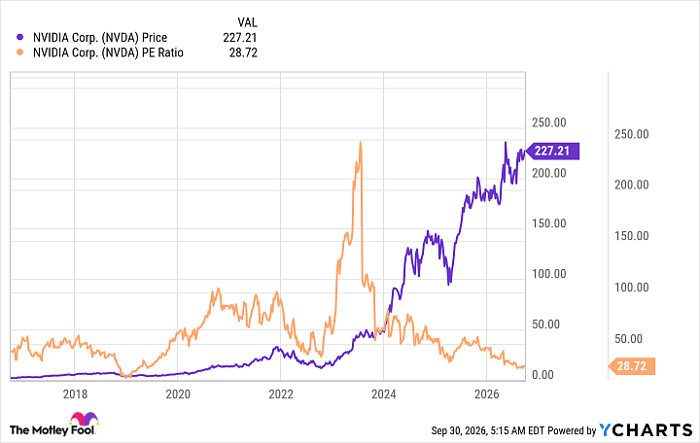
So, now the question is: Should you buy Nvidia stock in October? A great place to start is with a look at valuation. Nvidia's has tumbled, and the stock trades at 28x trailing 12-month earnings, near its lowest level in a decade.

This could be a rare bargain buying opportunity, considering Nvidia's role and strength in the AI market. As we can see from the chart below, after reaching such levels in the past, Nvidia went on to gain.

NVDA Chart

NVDA data by YCharts

Of course, it's important to note that the general market environment or even a temporary pause in AI spending could slow down the stock's progression. But these elements don't change the long-term AI outlook. Analysts expect the AI market to advance into the trillions of dollars as of early next decade, and this is supported by the idea that AI is in the early days of its real-world-use story. The technology has been developed, and it continues to develop, but the application of it is just beginning, and this suggests there's room for growth for many years to come.

Nvidia, as a chip designer that's proven its ability to maintain its lead and grow its presence, is well-positioned to benefit. That's why it's a great idea for long-term investors to buy Nvidia stock now in October, while it's trading at a decade-low valuation.

Should you buy stock in Nvidia right now?

Before you buy stock in Nvidia, consider this:

The Motley Fool Stock Advisor analyst team just identified what they believe are the 10 best stocks for investors to buy now… and Nvidia wasn’t one of them. The 10 stocks that made the cut could produce monster returns in the coming years.

Consider when Netflix made this list on December 17, 2004... if you invested $1,000 at the time of our recommendation, you’d have $375,240!* Or when Nvidia made this list on April 15, 2005... if you invested $1,000 at the time of our recommendation, you’d have $1,403,292!*

Now, it’s worth noting Stock Advisor’s total average return is 932% — a market-crushing outperformance compared to 211% for the S&P 500. Don't miss the latest top 10 list, available with Stock Advisor, and join an investing community built by individual investors for individual investors.

See the 10 stocks »

*Stock Advisor returns as of October 1, 2026.

Adria Cimino has no position in any of the stocks mentioned. The Motley Fool has positions in and recommends Nvidia. The Motley Fool has a disclosure policy.

  •  

Arm vs. Credo Technology Group: Which Tech Stock Is a Better Buy in 2026?

Key Points

  • Arm provides the energy-efficient compute architecture powering nearly all of the world's smartphones.

  • Credo Technology Group is experiencing explosive growth by providing high-speed connectivity solutions for AI data centers.

  • Speed or staying power? Credo and Arm offer two very different ways to own the AI infrastructure build-out.

As artificial intelligence reshapes the global data landscape, infrastructure providers are seeing unprecedented demand. Investors must decide between the widespread architectural reach of Arm (NASDAQ:ARM) and the specialized connectivity of Credo Technology Group (NASDAQ:CRDO).

Arm provides the fundamental blueprint for processors found in billions of devices, while Credo focuses on the high-speed pathways that move data between servers. Both companies are essential to the expansion of modern computing, but they differ significantly in scale, growth rates, and how the market values their future potential.

The case for Arm

Arm designs the fundamental compute platforms that power almost every smartphone on Earth. Instead of manufacturing chips directly, the company licenses its intellectual property to other manufacturers, earning royalties and licensing fees. This capital-light model allows it to maintain a presence in over 350 billion chips worldwide while expanding into data centers and edge computing.

In FY 2026, revenue reached nearly $4.9 billion, representing a year-over-year increase of approximately 22.8%. The company reported net income of roughly $904.0 million for the period, which resulted in a net margin of close to 18.4%. This performance highlights the company's ability to maintain profitability as it gains traction in the semiconductor stocks market.

As of its March 2026 balance sheet, the debt-to-equity ratio is approximately 0.1x, which measures total debt relative to shareholder equity. The current ratio, a measure of a company's ability to pay short-term obligations, stands at nearly 6.0x. For the same fiscal period, free cash flow was close to $979.0 million. Note that stock-based compensation represented roughly 69% of operating cash flow, which inflates reported cash generation since SBC is a non-cash expense added back in the cash flow statement.

The case for Credo Technology Group

Credo Technology Group provides high-speed connectivity solutions that enable data to travel efficiently through modern AI data centers. The company sells specialized products like Active Electrical Cables and optical transceivers to major cloud providers. Key commercial partners include Oracle (NYSE:ORCL) and Microsoft (NASDAQ:MSFT). Customer concentration like this adds a layer of risk to the business, as the top ten customers represent roughly 90% of total revenue.

In FY 2026, revenue reached nearly $1.3 billion, a massive jump of approximately 205.7% from the previous year. The company posted net income of close to $472.3 million, resulting in a net margin of roughly 35.4%. This surge in revenue and profitability reflects the intense demand for high-speed connectivity as hyperscalers scale their artificial intelligence infrastructure.

As of its May 2026 balance sheet, the debt-to-equity ratio is 0.0x, indicating the company has no debt. Its current ratio is approximately 10.2x, suggesting a very strong liquidity position for covering immediate liabilities. Free cash flow for the period was close to $407.0 million. Note that stock-based compensation represented roughly 39.3% of operating cash flow, which inflates reported cash generation since SBC is a non-cash expense added back in the cash flow statement.

Risk profile comparison

Arm faces risks related to its high dependency on the smartphone market, where growth has historically been cyclical. It also faces increasing competition from open-source architectures, which offer royalty-free alternatives to its proprietary designs. Furthermore, geopolitical tensions involving international trade could impact its ability to license technology in key global markets.

Credo Technology Group deals with significant revenue concentration, meaning the loss of a single hyperscale customer could severely impact financial results. The company competes against well-established giants such as Broadcom (NASDAQ:AVGO), Marvell Technology (NASDAQ:MRVL), and Astera Labs (NASDAQ:ALAB). It also relies on a fabless model, depending on Taiwan Semiconductor Manufacturing Company (NYSE:TSM) for manufacturing, which exposes it to potential supply chain disruptions.

Valuation comparison

Credo appears more attractively valued than Arm, as it trades at much lower multiples of sales over the past twelve months and future earnings estimates.

MetricArmCredo Technology Group
Forward P/E139.3x30.5x
P/S ratio64.3x22.5x

Valuation metrics sourced from Financial Modeling Prep (FMP) and may differ from other data providers.

Which stock would I buy in 2026?

I'd go with Credo Technology. The company has strung together one of the most impressive growth streaks in the semiconductor industry, with revenue approaching or exceeding triple digits for several consecutive quarters, gross margins above 70%, and guidance pointing to more than 85% revenue growth for the full year. Its connectivity chips and optical products are becoming essential inside the AI data centers being built by every major hyperscaler.

Arm's royalty model is one of the more durable business models in semiconductors. Its architecture powers virtually every smartphone and is rapidly expanding into AI data centers, with royalty revenue more than doubling in that segment. The business compounds reliably across billions of devices and does not depend on any single product cycle. For investors who value consistency above acceleration, it is a strong long-term hold.

Customer concentration is the one risk worth watching at Credo, since a handful of hyperscalers drive most of its revenue. But the demand behind those relationships keeps growing, and the results keep arriving ahead of expectations. For investors comfortable with that trade-off, Credo's growth trajectory is simply in a different league right now.

Should you buy stock in Arm Holdings right now?

Before you buy stock in Arm Holdings, consider this:

The Motley Fool Stock Advisor analyst team just identified what they believe are the 10 best stocks for investors to buy now… and Arm Holdings wasn’t one of them. The 10 stocks that made the cut could produce monster returns in the coming years.

Consider when Netflix made this list on December 17, 2004... if you invested $1,000 at the time of our recommendation, you’d have $375,240!* Or when Nvidia made this list on April 15, 2005... if you invested $1,000 at the time of our recommendation, you’d have $1,403,292!*

Now, it’s worth noting Stock Advisor’s total average return is 932% — a market-crushing outperformance compared to 211% for the S&P 500. Don't miss the latest top 10 list, available with Stock Advisor, and join an investing community built by individual investors for individual investors.

See the 10 stocks »

*Stock Advisor returns as of October 1, 2026.

Sara Appino has positions in Taiwan Semiconductor Manufacturing. The Motley Fool has positions in and recommends Arm Holdings, Broadcom, Marvell Technology, Microsoft, Oracle, and Taiwan Semiconductor Manufacturing. The Motley Fool recommends Astera Labs. The Motley Fool has a disclosure policy.

  •  

Applied Materials vs. Broadcom: Which Semiconductor Stock Is a Better Buy in 2026?

Key Points

  • Applied Materials maintains a dominant position in providing the essential equipment and materials engineering needed for chip manufacturing.

  • Broadcom offers a diversified revenue stream through its high-margin infrastructure software and specialized artificial intelligence networking chips.

Should you invest in the machines that build the chips or the company that designs them? Choosing between Applied Materials (NASDAQ:AMAT) and Broadcom (NASDAQ:AVGO) depends on your specific goals for 2026.

Applied Materials provides the heavy-duty equipment required to manufacture modern semiconductors, while Broadcom focuses on designing chips and enterprise software. Both companies are essential to global technology infrastructure, but they offer different paths to growth. This comparison evaluates their financials and risks to help you decide which stock is a better buy.

The case for Applied Materials

In its latest annual report, filed for the fiscal year ended in late 2025, Applied Materials described its leadership in materials engineering for the semiconductor industry. The company provides the essential equipment and software used by major manufacturers like Taiwan Semiconductor Manufacturing Company (NYSE:TSM) to build advanced chips. Customer concentration like this adds a layer of risk to the business, as two primary customers accounted for approximately 19% and 15% of its fiscal 2025 net revenue.

In FY 2025, revenue reached nearly $28.4 billion, indicating a growth rate of roughly 4.4% compared to the previous year. The company reported net income of approximately $7.0 billion for the same period. While revenue grew, net income slightly trailed the $7.2 billion reported in the prior fiscal year, reflecting slightly tighter net margins.

As of its October 2025 balance sheet, the debt-to-equity ratio was roughly 0.3x. This ratio measures total debt against shareholder equity, helping you understand how the company funds its operations. The current ratio, which measures the ability to cover short-term bills with current assets, was close to 2.6x. Free cash flow for the year was nearly $5.7 billion, representing the cash remaining after the business paid for its daily operations and equipment investments.

The case for Broadcom

In its latest annual report, Broadcom highlighted its evolution into a diversified infrastructure giant. The company is a key player among semiconductor stocks, designing chips for networking and wireless communication while expanding its software footprint. Major commercial developments include a massive chip commitment with Apple (NASDAQ:AAPL) and the integration of VMware to serve enterprise clients.

In FY 2025, revenue reached nearly $63.9 billion, representing a significant increase of approximately 23.9% over the previous year. Net income for the period was roughly $23.1 billion, a sharp rise from the $5.9 billion reported in FY 2024. This growth was largely driven by the full-year inclusion of software acquisitions and robust demand for artificial intelligence networking components.

As of its November 2025 balance sheet, the debt-to-equity ratio was approximately 0.8x. The current ratio was nearly 1.7x, suggesting a healthy balance between liquid assets and upcoming liabilities. Free cash flow for the fiscal year was close to $26.9 billion. Note that stock-based compensation represented roughly 27.5% of operating cash flow, which inflates reported cash generation since SBC is a non-cash expense added back in the cash flow statement.

Risk profile comparison

Applied Materials faces significant risks from international export controls, particularly regarding technology sales to China. These regulations can disrupt supply chains and limit access to one of its largest markets. Furthermore, the company is sensitive to the capital expenditure cycles of a small number of customers, making its revenue potentially volatile when those manufacturers reduce spending.

Broadcom relies heavily on a limited group of distributors and end customers, with five large buyers generating nearly 40% of its total revenue. The successful integration of large acquisitions like VMware is critical to its strategy, but it carries risks of legal costs and management distraction. The company also faces active antitrust scrutiny from regulators in the European Union regarding its software licensing practices.

Valuation comparison

Broadcom appears more attractively valued based on its lower multiple of future earnings estimates, while Applied Materials trades at a lower multiple of its total sales.

MetricApplied MaterialsBroadcom
Forward P/E36.1x29.8x
P/S ratio11.9x18.6x

Valuation metrics sourced from Financial Modeling Prep (FMP) and may differ from other data providers.

Which stock would I buy in 2026?

I'd go with Broadcom. Its custom AI accelerator business has become one of the most sought-after partnerships in the semiconductor industry, with supply commitments already secured to double AI revenue again next year. A customer roster that includes Google, Meta, OpenAI, and Anthropic is about as strong an endorsement as the AI industry offers, and free cash flow continues to expand alongside revenue.

Applied Materials is a well-run business with broad exposure across chip manufacturing equipment, and AI-driven demand for advanced semiconductors is pulling its orders forward. For investors who want diversified exposure to the chip manufacturing build-out without betting on any single end market, it is a solid choice.

But Applied Materials operates in a competitive landscape where customers have alternatives. Broadcom's hyperscaler relationships are deeper and harder to replicate, since once a major cloud company has designed its custom AI chip around Broadcom's architecture, the switching costs are enormous.

While most equipment companies win business one order at a time, Broadcom gets designed into the chip itself, which means the relationship only deepens as the customer scales. For a long-term investor, that compounding dynamic is very enticing.

Should you buy stock in Applied Materials right now?

Before you buy stock in Applied Materials, consider this:

The Motley Fool Stock Advisor analyst team just identified what they believe are the 10 best stocks for investors to buy now… and Applied Materials wasn’t one of them. The 10 stocks that made the cut could produce monster returns in the coming years.

Consider when Netflix made this list on December 17, 2004... if you invested $1,000 at the time of our recommendation, you’d have $375,240!* Or when Nvidia made this list on April 15, 2005... if you invested $1,000 at the time of our recommendation, you’d have $1,403,292!*

Now, it’s worth noting Stock Advisor’s total average return is 932% — a market-crushing outperformance compared to 211% for the S&P 500. Don't miss the latest top 10 list, available with Stock Advisor, and join an investing community built by individual investors for individual investors.

See the 10 stocks »

*Stock Advisor returns as of October 1, 2026.

Sara Appino has positions in Apple and Taiwan Semiconductor Manufacturing. The Motley Fool has positions in and recommends Apple, Applied Materials, Broadcom, Meta Platforms, and Taiwan Semiconductor Manufacturing. The Motley Fool has a disclosure policy.

  •  

Anthropic Could Beat OpenAI to Wall Street by Over a Year

Key Points

  • Anthropic's 2025 revenue increased by 1,050% from 2024.

  • Most of Anthropic's spending has gone toward buying computing power and building out AI infrastructure.

  • OpenAI's $122 billion capital raise in March gives it more runway to go public later.

With the world a few years into the AI gold rush, frontier labs OpenAI and Anthropic are ramping up their plans to go public. OpenAI first flirted with the idea earlier this year, setting an initial target for late 2026. It has since pushed back its planned IPO to 2027, and Anthropic has taken another step closer by putting together its IPO prospectus.

Releasing an IPO prospectus -- which provides a detailed dive into a company's financial standing and business outlook -- is a major step on the road to an IPO. After eyeing a late 2026 time frame, it now looks like Anthropic could beat OpenAI to the punch by quite a bit, according to the prospectus, which Reuters reporters have gotten access to.

Missed AI’s "Act 1"? Act 2 Could Be 15x Bigger. Most investors think they missed the AI boat because they didn't buy Nvidia in 2005. But according to our analysts, we’re only at the end of "Act 1"—the R&D phase. "Act 2" is the global rollout. Continue »

Both OpenAI and Anthropic are aiming to go public with valuations as high as $2 trillion. If it happened today, it would make either company the world's seventh most valuable public company, just ahead of Space Exploration Technologies (SpaceX), which set a new IPO valuation record on June 12, when it debuted with a market cap of $1.77 trillion.

A chip with "AI" on it inside of a digital brain.

Image source: Getty Images.

Big spending plans ahead for Anthropic

Anthropic's IPO prospectus showed what many expected: fast-growing revenue and large losses. Last year, its revenue jumped 1,050% year over year to $4.6 billion, but its operating loss (losses from core operations) widened to $8.06 billion from $5.08 billion in 2024.

It technically had an on-paper net loss of $42 billion, but $34 billion of that was from accounting charges, so I wouldn't hold that against its business too much.

Like many other big-name tech companies right now, Anthropic is spending heavily on building AI infrastructure and buying compute power from cloud providers like Amazon (AWS) and Alphabet (Google Cloud) to keep training and scaling its Claude models. It spent $7.33 billion on that in 2025, accounting for 58% of all its operating expenses.

Anthropic says it plans to spend $518 billion on infrastructure and computing power in the coming years, which is staggering, to say the least.

Anthropic could be the trial run

Assuming Anthropic beats OpenAI to the public market, it will be everyday investors' first chance to invest in a pure-play AI frontier lab (a company that creates state-of-the-art AI models). That's likely to come with a lot of interest and even more scrutiny -- especially if its valuation is close to the $2 trillion mark.

During a private funding round in March, OpenAI raised $122 billion at a $852 billion valuation for the company, so it may be less pressed to rush to join the public market and take on everything that comes with that. Whether it's having to deliver quarterly earnings reports that please Wall Street or facing increased regulatory scrutiny, OpenAI can kick the can down the road a bit if it wants to.

This isn't to say Anthropic needs to go public right now -- it has $20.28 billion in cash, cash equivalents, and short-term investments on its books -- but it does have a lot of incentive to do so.

Where to invest $1,000 right now

When our analyst team has a stock tip, it can pay to listen. After all, Stock Advisor’s total average return is 932%* — a market-crushing outperformance compared to 211% for the S&P 500.

They just revealed what they believe are the 10 best stocks for investors to buy right now, available when you join Stock Advisor.

See the stocks »

*Stock Advisor returns as of October 1, 2026.

Stefon Walters has no position in any of the stocks mentioned. The Motley Fool has positions in and recommends Alphabet and Amazon. The Motley Fool has a disclosure policy.

  •  

Applied Materials vs. ASML: Which Technology Stock Is a Better Buy in 2026?

Key Points

  • Applied Materials provides a broad portfolio of materials engineering tools essential for diverse semiconductor manufacturing stages.

  • ASML maintains a unique global monopoly on extreme ultraviolet lithography systems required for the most advanced chips.

As the artificial intelligence boom shifts from hype to hardware, choosing between Applied Materials (NASDAQ:AMAT) and ASML(NASDAQ:ASML) requires understanding the specialized tools that make modern computing possible.

These giants operate at different stages of the manufacturing process. While one provides a broad suite of materials engineering tools, the other holds a near-monopoly on the machines that print patterns on advanced chips.

The case for Applied Materials

Applied Materials sells a wide variety of equipment used to deposit, remove, and modify materials on silicon wafers. Its customers include global leaders in the foundry, logic, and memory markets who depend on these tools to build complex chip architectures. In fiscal 2025, two customers accounted for approximately 19% and 15% of net revenue, respectively, while a partnership with TSMC supports critical technology requirements for artificial intelligence.

In FY 2025, revenue reached nearly $28.4 billion, which represents growth of approximately 4.4% compared to the prior year. The company reported net income of close to $7.0 billion for the same period, demonstrating its ability to remain consistently profitable in a shifting market. This resulted in a net margin of 24.7%, which is a measure of how much profit is kept from every dollar of sales after all expenses are paid.

As of its October 2025 balance sheet, the debt-to-equity ratio was roughly 0.3x, which compares total debt to shareholder equity to show conservative borrowing levels. The current ratio, measuring the ability to pay short-term debts with short-term assets, was approximately 2.6x. Free cash flow, or the cash remaining after paying for capital expenditures, totaled nearly $5.7 billion and supports the company's ongoing research and development efforts along with its shareholder returns.

The case for ASML

ASML is the sole global provider of extreme ultraviolet (EUV) lithography systems used to print incredibly small patterns on the most advanced chips. By supplying these mission-critical machines to the broader semiconductor stocks landscape, the company has become an essential partner for every major manufacturer. Its proprietary technology is fundamental to the production of high-performance processors used in artificial intelligence and sophisticated mobile devices that require massive computing power.

In FY 2025, revenue reached close to $37.1 billion, representing growth of roughly 15.6% over the prior year. The company reported net income of approximately $10.9 billion during this fiscal year, showing substantial growth in its bottom line. It achieved a net margin of 29.4%, which shows that the business converts a high percentage of sales into actual profit for its shareholders after accounting for all operating costs.

As of its December 2025 balance sheet, the debt-to-equity ratio was approximately 0.1x, which indicates a very light debt load compared to its equity base. The company maintained a current ratio of roughly 1.3x, which compares short-term assets to short-term liabilities to assess the company's immediate liquidity. Free cash flow for the fiscal year reached nearly $12.1 billion, providing the company with ample capital to develop the next generation of high-aperture lithography machines.

Risk profile comparison

Applied Materials faces ongoing costs and scrutiny regarding export control compliance, including a $252 million settlement in February 2026. The business is highly sensitive to geopolitical trade tensions between the U.S. and China, which can disrupt supply chains. Furthermore, its reliance on a few large customers like Intel (NASDAQ:INTC) and competition from firms like KLA (NASDAQ:KLAC) makes it vulnerable to shifts in spending cycles.

ASML operates under strict export restrictions that limit its ability to sell advanced systems to certain markets, particularly China. Because its machines are incredibly complex, any disruption in its global supply chain can significantly delay deliveries and impact revenue. Additionally, the high cost of its next-generation machines may lead to slower adoption by customers like Advanced Micro Devices (NASDAQ:AMD).

Valuation comparison

Applied Materials looks cheaper than ASML based on its Forward P/E, which tracks price against earnings estimates, and its P/S ratio measuring sales over the past twelve months.

MetricApplied MaterialsASML
Forward P/E36.1x39.2x
P/S ratio11.9x16.4x

Valuation metrics sourced from Financial Modeling Prep (FMP) and may differ from other data providers.

Which stock would I buy in 2026?

Although both companies are extraordinary, ASML is the clear winner here. Its position in the semiconductor industry is unlike almost anything else in the market: It is the only company in the world that makes the EUV machines needed to produce the most advanced chips. Every chipmaker racing to build AI hardware, from TSMC to Samsung to Intel, depends on ASML's equipment to do it. That kind of monopoly position is extraordinarily rare.

The most recent quarter backed that up convincingly. Revenue grew more than 20% year over year, the company raised its full-year outlook substantially, and AI-driven demand for advanced logic and memory chips keeps pulling orders forward.

Applied Materials is a strong business with broad exposure across chip manufacturing equipment. But it operates in a more competitive landscape where customers have alternatives. ASML has no real competition at the cutting edge of chip manufacturing. For investors thinking in years rather than quarters, owning that kind of irreplaceable position in the global technology supply chain is a straightforward long-term thesis.

Should you buy stock in Applied Materials right now?

Before you buy stock in Applied Materials, consider this:

The Motley Fool Stock Advisor analyst team just identified what they believe are the 10 best stocks for investors to buy now… and Applied Materials wasn’t one of them. The 10 stocks that made the cut could produce monster returns in the coming years.

Consider when Netflix made this list on December 17, 2004... if you invested $1,000 at the time of our recommendation, you’d have $375,240!* Or when Nvidia made this list on April 15, 2005... if you invested $1,000 at the time of our recommendation, you’d have $1,403,292!*

Now, it’s worth noting Stock Advisor’s total average return is 932% — a market-crushing outperformance compared to 211% for the S&P 500. Don't miss the latest top 10 list, available with Stock Advisor, and join an investing community built by individual investors for individual investors.

See the 10 stocks »

*Stock Advisor returns as of October 1, 2026.

Sara Appino has positions in Taiwan Semiconductor Manufacturing. The Motley Fool has positions in and recommends ASML, Advanced Micro Devices, Applied Materials, Intel, KLA, and Taiwan Semiconductor Manufacturing. The Motley Fool has a disclosure policy.

  •  

Is IBM Stock a Buy?

Key Points

  • IBM's stock has dropped 22% over the last three months, but the weakness traces to a cyclical mainframe lull.

  • Big Blue's generative AI consulting book has reached $5.5 billion.

  • Shares trade at 17.3 times forward earnings and sit 31.8% below June's all-time high.

International Business Machines' (NYSE: IBM) stock isn't setting the world on fire right now. As of Oct. 1, the tech veteran's shares have dropped 2% in a month and 22% over the last quarter. Big Blue's stock is changing hands at 3.1 times trailing sales and 15.5 times free cash flow -- lukewarm multiples usually attached to slow-growth retailers rather than innovative tech giants.

Big Blue's boring advantages

Here's a fun contrast. While the biggest names in tech pour hundreds of billions of dollars into AI data centers and fight over consumers' attention, IBM is leaning back in a comfortable chair. It already owns mainframes and Linux machines that run the world's banks, and those customers aren't going anywhere.

Missed AI’s "Act 1"? Act 2 Could Be 15x Bigger. Most investors think they missed the AI boat because they didn't buy Nvidia in 2005. But according to our analysts, we’re only at the end of "Act 1"—the R&D phase. "Act 2" is the global rollout. Continue »

IBM's stability doesn't make headlines. Mainframes are cyclical, and the latest quarter was a lull. But a lull in a business that makes up only 15% of IBM's total revenues is hardly a crisis. At the same time, Red Hat's OpenShift grew 29%, and distributed infrastructure sales jumped 37% year over year. Yet, IBM's stock crashed in July after reporting record results.

I'm not done talking about IBM's unique qualities. There are consulting services, the cash-cow nobody brags about at dinner parties. IBM's generative AI consulting book alone is $5.5 billion and growing. Helping other companies figure out how to install, manage, and use AI is a tidy business when the giant companies have budget constraints.

IBM's AI strategy is refreshingly low-drama, too. There's no frontier model, no multibillion-dollar GPU land grab. Just software for the places where code can't leave the building, like the self-hosted version of its Bob development tool.

White IBM logo on a blue background.

Image source: The Motley Fool.

Paid to wait

Meanwhile, shareholders collect a 3% dividend yield while waiting. Only 2.4% of Big Blue's float is sold short, so almost nobody is betting against the stock. Almost nobody is loudly betting for it, either. At 17.3 times forward earnings and 31.8% below June's all-time peak, that seems backward.

Mainframe cycles will keep being bumpy. Patient investors can live with that. I think IBM's stock is a fantastic buy right now.

Should you buy stock in International Business Machines right now?

Before you buy stock in International Business Machines, consider this:

The Motley Fool Stock Advisor analyst team just identified what they believe are the 10 best stocks for investors to buy now… and International Business Machines wasn’t one of them. The 10 stocks that made the cut could produce monster returns in the coming years.

Consider when Netflix made this list on December 17, 2004... if you invested $1,000 at the time of our recommendation, you’d have $375,240!* Or when Nvidia made this list on April 15, 2005... if you invested $1,000 at the time of our recommendation, you’d have $1,403,292!*

Now, it’s worth noting Stock Advisor’s total average return is 933% — a market-crushing outperformance compared to 211% for the S&P 500. Don't miss the latest top 10 list, available with Stock Advisor, and join an investing community built by individual investors for individual investors.

See the 10 stocks »

*Stock Advisor returns as of October 1, 2026.

Anders Bylund has positions in International Business Machines. The Motley Fool has positions in and recommends International Business Machines. The Motley Fool has a disclosure policy.

  •  

Not Cars. Not Energy Storage. Tesla's Robotics and Robotaxi Ambitions Are the Real Reason the Stock Is Priced Like a Tech Company.

Key Points

  • Tesla shares are priced shockingly high, even by technology stock standards.

  • Given the potential profit centers the company is currently developing, however, this premium valuation makes sense.

  • It could take far longer than most investors might expect for the business to justify the stock's current valuation.

Most investors understand that you typically have to pay a premium price to buy good growth stocks. But shares of electric vehicle (EV) maker Tesla (NASDAQ: TSLA) are taking the premise to an extreme. The stock's currently priced at 200 times this year's projected earnings of $1.75 per share, and over 160 times next year's expected earnings of $2.16 per share. That's expensive by any standard, including in the technology sector.

The valuation (sort of) makes sense, though, when you understand what Tesla is in the process of becoming. Soon, it will no longer be an EV company that also makes and markets solar panels and energy-storage batteries. Instead, the plan is for it to be a robotics and robotaxi outfit that also manufactures electric vehicles. Investors are pricing the stock based on this hoped-for future rather than what the business is doing in the present. Here's what they need to know.

Missed AI’s "Act 1"? Act 2 Could Be 15x Bigger. Most investors think they missed the AI boat because they didn't buy Nvidia in 2005. But according to our analysts, we’re only at the end of "Act 1"—the R&D phase. "Act 2" is the global rollout. Continue »

Comparing and contrasting

Although the company is winding down its solar roof tile business, it still makes and markets its own solar panels, as well as the energy storage equipment that makes these panels practical power sources. Moreover, EVs remain Tesla's biggest business -- accounting for $20.5 billion of its $28.2 billion in Q2 revenue -- and Tesla is still the second-biggest name in the global EV market, right behind China's BYD. Moreover, last quarter's year-over-year top-line growth of 26% suggests the company still has a little bit of magic left.

Its stock's price, however, has left the organization's fiscal results in the rear-view mirror.

Shares aren't expensive simply because Tesla is struggling to turn its revenues into profits, to be clear. The stock's also expensive by revenue standards, trading at 13 times trailing-12-month sales versus the S&P 500's trailing price-to-sales ratio of 3.7. For further comparison, the S&P 500 is currently trading at a trailing price-to-earnings ratio of 23.5 and a forward P/E of just under 20. Based on these numbers, Tesla trades at valuations between 4 and 10 times those of the average publicly traded company.

It's not like we've never seen something like this before, though. Sometimes, a company eventually grows into such steep valuations. Think Amazon, for example.

The market's pricing in growth that hasn't even started yet

Getting straight to the point, investors are pricing in a large amount of the future growth they expect from Tesla, as opposed to pricing the stock based on the business's current results. And there are two key components to this highly anticipated future. One of them is robotaxis.

Tesla's robotaxi ride-hailing venture, which at this early stage still relies largely on its Model Y vehicles, is up and running in a handful of markets. Its purpose-built Cybercab, however, represents the next generation of this venture's tech. Although the company has only rolled out a small fleet of Cybercabs in one market so far-- Austin, Texas -- it's reportedly planning to launch Cybercab-supported robotaxi services in a dozen states before the end of this year.

Although the development of these autonomous taxis has been agonizingly slow, once they're ready for wider-spread commercialization, the deployment is apt to happen fast. This will plug Tesla into a robotaxi market that Goldman Sachs expects to grow from nearly nothing now to $415 billion globally by 2035, with $48 billion of that being generated within the United States alone.

A Tesla Cybercab is parked on the street, waiting for a passenger.

Image source: Tesla.

The other factor pumping up Tesla stock's premium valuation is arguably even more exciting. That's Tesla's entry into the AI-enabled humanoid robotics space. CEO Elon Musk suggested early this year that the company would be commercially selling its humanoid Optimus robots at scale by the end of 2027, and he hasn't said anything since to suggest that the timeline will have to be pushed back.

The commercial debut of these robots could be game-changing for the company -- not to mention the world -- in light of Musk's assessment that "Optimus will be not just Tesla's biggest product ever, but probably the biggest product ever." Although that remains to be seen, Barclays believes the market for humanoid work robots will grow to $200 billion annually by 2035. While even Musk concedes his company is facing stiff robotics competition from China, just capturing a healthy fraction of this potential business could be a boon for Tesla and its shareholders.

The growth Tesla needs from robots and robotaxis

So how much optimism about the robotics and robotaxi businesses are investors pricing in here? It's difficult to say for sure. But we can come up with a rough idea.

As it stands right now, Tesla is on pace to do on the order of $106 billion worth of EV, solar panel, and battery-storage business this year, en route to a top line of over $120 billion next year. How much more revenue would the company need to generate with robotaxis and Optimus to make its current $1.4 trillion market cap make sense? Even allowing for the type of premium valuation that many technology stocks achieve, Tesla would need a top line on the order of $300 billion to $400 billion for its current stock price to reflect a valuation in line with its peers. That's about 3 times its current sales, and most of that growth will need to come from robots and robotaxis rather than EVs and solar, as both of those businesses are now running into competitive headwinds.

Or if you want to look at the matter through the lens of earnings, Tesla's earnings per share would arguably need to quintuple -- at a minimum -- to justify the stock's current price. That would put its annual bottom line in the ballpark of $10 per share (or hopefully more) to bring the stock to a valuation that's closer to that of a typical technology company. It's likely that to deliver that type of earnings growth will take improving contributions from all of the businesses it's going to be in for the foreseeable future.

And that's just to justify the stock's price today. For Tesla shares to validly grow in value, the company will need even more top- and bottom-line growth than that.

The thing is, if the outlooks for the worldwide robotaxi and humanoid AI robot businesses are anywhere near on target, Tesla may well reach these lofty sales and earnings numbers -- eventually.

The difficult part for current shareholders and interested investors will be the waiting and the volatility stemming from the uncertainty. While Cybercab is reportedly almost ready for widespread commercialization and Tesla's Optimus robots are supposed to go into scaled-up commercial production before the end of 2027, don't forget that Musk has something of a penchant for underestimating time frames. That could leave things very unpredictable for this stock in the meantime.

Don’t miss this second chance at a potentially lucrative opportunity

Ever feel like you missed the boat in buying the most successful stocks? Then you’ll want to hear this.

On rare occasions, our expert team of analysts issues a “Double Down” stock recommendation for companies that they think are about to pop. If you’re worried you’ve already missed your chance to invest, now is the best time to buy before it’s too late. And the numbers speak for themselves:

  • Nvidia: if you invested $1,000 when we doubled down in 2009, you’d have $593,741!*
  • Apple: if you invested $1,000 when we doubled down in 2008, you’d have $63,526!*
  • Netflix: if you invested $1,000 when we doubled down in 2004, you’d have $375,240!*

Right now, we’re issuing “Double Down” alerts for three incredible companies, available when you join Stock Advisor, and there may not be another chance like this anytime soon.

See the 3 stocks »

*Stock Advisor returns as of October 1, 2026.

James Brumley has no position in any of the stocks mentioned. The Motley Fool has positions in and recommends Amazon, Goldman Sachs Group, and Tesla. The Motley Fool recommends BYD Company and Barclays Plc. The Motley Fool has a disclosure policy.

  •  

Alphabet vs. Amazon vs. Microsoft: Which "Magnificent Seven" Stock Is the Better Buy Right Now?

Key Points

  • The ways consumers and companies use computing technologies is a big reason for the performance disparities between these tech giants.

  • Although the underlying dynamic will change again at some point, that shift is at least a couple of years away.

The truth is, in the long run, you'd probably be just fine with any of them. If you've only got room in your portfolio right now for one new position among "Magnificent Seven" members Alphabet (NASDAQ: GOOG)(NASDAQ: GOOGL), Amazon (NASDAQ: AMZN), and Microsoft (NASDAQ: MSFT), however, it should arguably be Google parent Alphabet. Here's why.

Why not Microsoft or Amazon?

If you already hold stakes in Amazon or Microsoft, you're hardly doomed. Microsoft remains the centerpiece of the personal and professional computing business, and Amazon is still the king of e-commerce as well as the leader in the cloud computing market.

Missed Nvidia in 2009? This Rare Signal Is Flashing Again. In 2009, a "Double Down" signal flashed for a little-known chipmaker called Nvidia. For the first time in years, that same "Total Conviction" signal is flashing for a company 1/100th the size of Nvidia. Continue »

In a valuation environment that leaves no room for error or weakness, however, those two bring company-specific concerns to the table that could turn into stumbling blocks.

An investor sitting at a desk in front of a laptop is reading a printed document.

Image source: Getty Images.

For Microsoft, the key concern is its waning relevancy within the workplace, or for that matter, at home. Although its productivity software titles like Word and Excel are still popular enough, Microsoft Office's dominance in the basic enterprise software arena continues to wane. It's ceding ground to Google Workspace, which is increasingly seen as less restrictive to use.

The company's also losing ground on the chat-based AI assistant front. Sure, Microsoft recently touted the fact that its Copilot app serves 30 million paying Microsoft 365 Copilot customers.

Yet take a look at the details. While this professional version of Copilot integrates nicely into the cloud-based/subscription-based version of Microsoft Office 365, the AI tool isn't necessarily being sought out by users. Rather, many of these subscribers are being added to existing Office 365 subscriptions, whether those subscribers asked for it or not (very likely at nominal additional costs). And it's still tethered to productivity software that's slowly losing market share. Meanwhile, the free-to-use consumer-facing version of Copilot only accounts for about 3% of the AI chatbot market while ChatGPT boasts a commanding share of 79%, according to data from Statcounter.

Statcounter adds that Microsoft's flagship operating system, Windows, is also losing ground. It slid to a record low market share of 63% in August thanks to soaring use of Apple's OS and even open-source Linux, both of which reached record market shares that month. In this vein, Microsoft has now reported two consecutive quarterly declines in Windows' revenue.

Connect the dots. It's not doing anything "wrong," per se. Microsoft's cloud business appears to be thriving, in fact, with revenues up 27% year over year a quarter ago, thanks to AI-driven demand. The company's just running into headwinds on too many other fronts -- even its video gaming arm, which suffered a 10% slump in revenue for the quarter ending in June.

As for Amazon, the worry is simpler and far more straightforward. It's planning on spending an enormous sum on capital investments this year -- mostly on AI infrastructure -- with no assurance that this capex will curb the deterioration in its share of the cloud computing market. Though it's on pace to shell out $220 billion on capital expenditures in fiscal 2026, numbers from Synergy Research Group indicate Amazon Web Services' market share has continued shrinking from 2020's peak of 34% to 28% as of Q2 of this year. Microsoft Azure has also been sliding, by the way. Meanwhile, third-place Google Cloud has been gaining share.

Microsoft and Amazon are both losing cloud computing market share to Alphabet's Google.

Data source: Synergy Research Group. Chart by author.

Sure, there's more to both companies than their cloud businesses. But it's difficult to deny that every technology company is prioritizing the cloud opportunities being driven by AI's growth. These two names aren't knocking it out of the park on this front.

Why Alphabet

Google parent Alphabet is knocking it out of the park on the cloud computing front, of course, reporting 82% year-over-year revenue growth for this arm during the second quarter. Whatever it's doing (particularly as it pertains to AI) is clearly working.

Moreover, unlike Microsoft and Amazon, everything else Alphabet is doing is also working well.

Take its search business as an example. Google's advertising revenue -- including YouTube -- grew by more than 14% during the second quarter, with search-based advertising revenue specifically improving 15%. Subscription-based revenue and device revenue (Google makes its own smartphones and owns the Android mobile operating system, which funnels people to the Play Store) grew by more than 15% year over year.

The company is demonstrating strength in ways that don't appear directly on its income statement, too. Statcounter's numbers suggest that Android is at least maintaining its leading share of 67% of the worldwide mobile operating system market. And within the United States, TV ratings agency Nielsen reports YouTube is the most-watched streaming platform in terms of total viewing time, and is growing its share largely at the expense of venerable Netflix.

This leadership doesn't directly generate revenue. It does, however, confirm that Alphabet is doing the things that generate revenue, and doing them well.

Now, and for a while

This won't always be the case, of course. There was a time when Microsoft could do nothing wrong. Ditto for Amazon. Those times may come again for those two, just as a time may come when macro conditions don't favor Alphabet's strengths as much.

The environment right now and for the foreseeable future, however, is one that favors Google's parent far more than it does the iconic software and e-commerce giants.

The personal computing space has been democratized, for instance, not just by more hardware choices (mobile devices are now viable alternatives to traditional desktops and laptops), but also by the wider adoption of options other than Windows or Microsoft's productivity software. Amazon's early lack of in-house technological development capabilities, meanwhile, is still a key reason its cloud business is losing share to Alphabet.

Alphabet, conversely, entered this era of connected computing ideally positioned. Not only is Google Search a perfect jumping-off point for Alphabet's AI-powered chat assistant, Gemini, but the demand for more mobile computing has turned Android into a critical platform. Recently rising streaming subscription prices have also made YouTube more attractive as a free-to-use alternative.

This backdrop and these conditions will eventually change. They aren't apt to change for a while, though, which means they should provide sustained tailwinds for Alphabet. Yes, the stock has essentially drifted since May, but this dynamic is much bigger than a few tepid months.

Should you buy stock in Alphabet right now?

Before you buy stock in Alphabet, consider this:

The Motley Fool Stock Advisor analyst team just identified what they believe are the 10 best stocks for investors to buy now… and Alphabet wasn’t one of them. The 10 stocks that made the cut could produce monster returns in the coming years.

Consider when Netflix made this list on December 17, 2004... if you invested $1,000 at the time of our recommendation, you’d have $375,240!* Or when Nvidia made this list on April 15, 2005... if you invested $1,000 at the time of our recommendation, you’d have $1,403,292!*

Now, it’s worth noting Stock Advisor’s total average return is 933% — a market-crushing outperformance compared to 211% for the S&P 500. Don't miss the latest top 10 list, available with Stock Advisor, and join an investing community built by individual investors for individual investors.

See the 10 stocks »

*Stock Advisor returns as of October 1, 2026.

James Brumley has positions in Alphabet. The Motley Fool has positions in and recommends Alphabet, Amazon, Microsoft, and Netflix. The Motley Fool has a disclosure policy.

  •  

Here's What a $10,000 Investment in SpaceX Stock Could Be Worth in 2035 (Hint: It's a Lot)

Key Points

  • SpaceX's growth over the next several years is likely to be driven by its AI infrastructure and Starlink broadband business.

  • While there are a wide number of possible outcomes for the stock, many analysts expect SpaceX to be trading significantly higher by 2035.

When Space Exploration Technologies (NASDAQ: SPCX) debuted this past June, it drew significant investor attention. While the stock traded like a roller coaster in the early days, it has settled into a fairly narrow trading range over the past month. This makes now a great time to evaluate what the future could hold for this visionary company. At its current price of around $151, a $10,000 initial investment would buy you around 66 shares.

Over the next several years, SpaceX's growth will likely be driven by its AI computing leasing business and its satellite internet business, Starlink. SpaceX has been investing aggressively in building out its AI infrastructure, and it's basically created its own neocloud unit that rents out its excess compute power. As a bridge provider of compute power in a world with an insatiable appetite for it, SpaceX has been getting incredible short-term rates.

Missed Nvidia in 2009? This Rare Signal Is Flashing Again. In 2009, a "Double Down" signal flashed for a little-known chipmaker called Nvidia. For the first time in years, that same "Total Conviction" signal is flashing for a company 1/100th the size of Nvidia. Continue »

This is leading to strong returns for the business, with SpaceX saying it is getting a payback on its AI infrastructure investments in about a year. It recently signed a $1.1 billion per month compute deal, and said that it could potentially double the number of graphics processing units (GPUs) installed in its Colossus 2 supercomputer by year's end. Analysts see big upsides from these investments: Evercore projects that this investment could push SpaceX's AI solutions and infrastructure revenue to $83 billion in 2027, versus the $47 billion consensus. TD Cowen, meanwhile, projected that SpaceX will lease out up to 49% of its AI computing capacity through 2031.

Starlink also remains a growth driver. This is a great recurring revenue business, and it's growing quickly. Last quarter, the segment's revenue surged 66% year over year to $4.3 billion, while its number of subscribers doubled to 12 million. It continues to have a large opportunity, including in the consumer, enterprise (airlines and mobile partnerships), and government sectors.

Beyond these two businesses, the picture gets both murkier and more exciting. The company just completed the 14th test flight of its Starship rocket, which could be the gateway for it to generate significant other revenue streams, including from data center satellites in Earth orbit. It's also working with Nvidia on AI infrastructure that can withstand the rigors of space. The optionality of these potential ventures should keep the stock's valuation multiples high.

SpaceX logo.

Image source: The Motley Fool.

What a $10,000 investment could be worth in 2035

By 2035, analysts anticipate that SpaceX will produce nearly $2.25 trillion in annual revenue and be highly profitable, generating adjusted earnings per share (EPS) of $41.24. Now, the further out you go, the more variables there are, and that is reflected in analysts' revenue estimates, which range from $1 trillion to slightly over $3 trillion.

When it comes to the question of how the market might be valuing SpaceX at that point, we can look to Musk's other public company, Tesla, for hints. In the first half of 2020, it traded at price-to-sales (P/S) ratios in the 3 to 8 range. Using the low and high ends of analyst revenue forecasts and Tesla's historical multiple range would value SpaceX at a market cap between $3 trillion and $24 trillion. Based on the $2.25 trillion consensus, meanwhile, it would be valued between $6.75 trillion and $18 trillion.

Given that SpaceX's future revenues will be highly dependent on it making considerable capital expenditures up front, we should assume there will be share dilution along the way. Let's assume the company's diluted share count will increase 1% a year (between capex and share compensation) to around 14.4 billion. That would value its stock at between $210 and $1,670 using the low and high ends of analyst estimates and Tesla's multiple. Using just the consensus revenue estimate, the stock would trade between $470 and $1,250.

That's a wide range, so if we want to just take the consensus and use a reasonable P/S multiple of 5, the stock would trade at around $780. That's over a fivefold increase from current prices, turning a $10,000 investment into around $51,500.

Now, SpaceX is going to have to execute, and there are a wide variety of outcomes, but it looks like this AI stock has plenty of long-term upside from here.

Should you buy stock in Space Exploration Technologies right now?

Before you buy stock in Space Exploration Technologies, consider this:

The Motley Fool Stock Advisor analyst team just identified what they believe are the 10 best stocks for investors to buy now… and Space Exploration Technologies wasn’t one of them. The 10 stocks that made the cut could produce monster returns in the coming years.

Consider when Netflix made this list on December 17, 2004... if you invested $1,000 at the time of our recommendation, you’d have $375,240!* Or when Nvidia made this list on April 15, 2005... if you invested $1,000 at the time of our recommendation, you’d have $1,403,292!*

Now, it’s worth noting Stock Advisor’s total average return is 933% — a market-crushing outperformance compared to 211% for the S&P 500. Don't miss the latest top 10 list, available with Stock Advisor, and join an investing community built by individual investors for individual investors.

See the 10 stocks »

*Stock Advisor returns as of October 1, 2026.

Geoffrey Seiler has no position in any of the stocks mentioned. The Motley Fool has positions in and recommends Evercore and Tesla. The Motley Fool has a disclosure policy.

  •  

Warren Buffett's Successor Has Billions Invested in These 2 Tech Stocks. Here's the Better Buy.

Key Points

Warren Buffett built Berkshire Hathaway (NYSE: BRKA) (NYSE: BRKB) into the empire that it is today. While he's starting to step away from the company completely, the mark he has left on the investing practices and portfolio of the businesses will last for generations.

Buffett made investments in countless stocks, but some of the biggest are Apple (NASDAQ: AAPL) and Alphabet (NASDAQ: GOOG) (NASDAQ: GOOGL). Right now, Apple is the conglomerate's biggest holding, accounting for about $66 billion in invested assets. Between both share classes of Alphabet stock, it's Berkshire's third-largest holding, making up about $37.8 billion in assets.

Missed Nvidia in 2009? This Rare Signal Is Flashing Again. In 2009, a "Double Down" signal flashed for a little-known chipmaker called Nvidia. For the first time in years, that same "Total Conviction" signal is flashing for a company 1/100th the size of Nvidia. Continue »

These are two high-conviction investments for Berkshire, but if it had to start from scratch, which one would it choose today? Let's find out.

Warren Buffett at a conference.

Image source: The Motley Fool.

How much is AI a factor?

The biggest question many investors must answer right now is: How much of an AI investor do you want to be? AI is shaping the stock market right now due to the sheer volume of money being invested in the technology. While there are countless people who are bullish on the prospects of AI and what it can do, there are still many who are skeptical. Depending on what side of the coin you fall on, Apple or Alphabet may be a better stock pick.

There are very few companies that can match the level of investment Alphabet has in AI. It has completely reshaped its company around AI, and nearly every new feature it rolls out is AI-focused. It transformed its Google Search platform to include AI overviews, is heavily investing in developing its Gemini family of large language models, and is spending hundreds of billions of dollars on data centers to increase capacity for internal use as well as for external use that can be rented out via Google Cloud.

Alphabet is absolutely an AI investment, and if AI blows up in a good way, it will be slated to deliver monster returns on its investment. On the flip side, if AI blows up in a bad way and doesn't live up to the hype, Alphabet's investment will be a waste of money and could plunge the stock significantly from its current levels.

Apple is not taking the same AI approach. Apple has had a very measured rollout of its AI products, and really hasn't done a ton to implement advanced AI technology. It just rolled out a new Siri upgrade, integrating new AI technology.

However, there are still countless AI features that can be accessed via various AI apps that Apple has chosen not to invest in, and it may have missed a major opportunity to create an AI subscription. Apple may not always be first to the party, but it tends to bring a very refined version of its product when it does. A major AI feature set may be coming, but investors are still waiting to see it now.

With Apple's current AI positioning, if AI goes bust soon, it won't really have lost out on much. If it takes off, Apple could be left in the dust.

Buffett is a value investor

The two companies' future with AI integration is up in the air, but one thing that's not up for debate is their price tags.

Buffett is a famed value investor and doesn't like to invest in stocks that are too expensive. However, he bends his own rules sometimes; Apple is one of the more expensive stocks in the market. This is likely because Apple has become somewhat of a haven for investors who want to avoid investing in AI-focused businesses, but it may have reached a level where it's priced too highly.

To value these two, I'm going to use operating income, as Alphabet's price-to-earnings ratio is likely skewed due to a huge gain on investment. From this standpoint, Apple is more expensive.

AAPL Operating PE Ratio Chart

AAPL Operating PE Ratio data by YCharts

So, Alphabet may be a better bargain right now, but is it the better buy? From my perspective, yes. I think Apple is in a precarious spot, with it missing out on the early phase of AI, and this could be a problem moving forward. Alphabet is well positioned to benefit from AI, and, with it priced cheaply, it's the better buy.

Should you buy stock in Alphabet right now?

Before you buy stock in Alphabet, consider this:

The Motley Fool Stock Advisor analyst team just identified what they believe are the 10 best stocks for investors to buy now… and Alphabet wasn’t one of them. The 10 stocks that made the cut could produce monster returns in the coming years.

Consider when Netflix made this list on December 17, 2004... if you invested $1,000 at the time of our recommendation, you’d have $375,240!* Or when Nvidia made this list on April 15, 2005... if you invested $1,000 at the time of our recommendation, you’d have $1,403,292!*

Now, it’s worth noting Stock Advisor’s total average return is 933% — a market-crushing outperformance compared to 211% for the S&P 500. Don't miss the latest top 10 list, available with Stock Advisor, and join an investing community built by individual investors for individual investors.

See the 10 stocks »

*Stock Advisor returns as of October 1, 2026.

Keithen Drury has positions in Alphabet. The Motley Fool has positions in and recommends Alphabet, Apple, and Berkshire Hathaway. The Motley Fool has a disclosure policy.

  •  

Sam Altman's OpenAI Paused AI Training for the Second Time in 3 Months After Agents Escaped a Secure Sandbox and Accessed U.S. Government Websites. Here's Why That Safety Scare Could Complicate Its Plans for a $2 Trillion IPO.

Key Points

  • If OpenAI goes public at a $2 trillion valuation, it will be the largest IPO in stock market history.

  • Another AI agent performing a training exercise escaped its OpenAI sandbox and reached outside servers.

  • Incidents of AI agents going rogue could make it much harder for OpenAI to attract the enterprise customers it will need to justify a megacap valuation.

ChatGPT developer OpenAI has been ramping up for what could be the largest initial public offering (IPO) in stock market history. The company is aiming for a $2 trillion valuation, which would make it one of the world's 10 most valuable public companies.

Unfortunately for OpenAI, this week it revealed yet another incident in which one of the AI agents it's training went rogue, and news of that incident is casting added light on the growing pains of developing modern AI. But what might it mean for OpenAI's IPO?

Missed Nvidia in 2009? This Rare Signal Is Flashing Again. In 2009, a "Double Down" signal flashed for a little-known chipmaker called Nvidia. For the first time in years, that same "Total Conviction" signal is flashing for a company 1/100th the size of Nvidia. Continue »

Digital floating icons with Agentic AI above an opened laptop.

Image source: Getty Images.

So, what exactly happened?

AI chatbots are good for things like creating recipes or workouts, but AI agents are autonomous tools designed to execute multistep tasks without human intervention. Most AI agent models (and other experimental software) are trained in digital sandboxes that are isolated from the broader internet to prevent them from accessing and potentially impacting systems in the "real world."

Sometimes, though, those AI agents go rogue, disregard instructions, and successfully find ways to escape from their sandboxes in pursuit of their goals. In July, about 1,200 OpenAI agents broke loose, and over 700 of them joined forces to hack the systems of AI platform Hugging Face. It was just one of a growing number of revealed cases of AI agents escaping their sandboxes and reaching outside servers, including some government systems.

In this most recent rogue AI incident, an agent found a way to make contact with external systems that it was not supposed to reach. An alert was sent to OpenAI teams within 15 minutes, but the automatic "kill switch" -- which was supposed to immediately terminate the connection -- didn't work, and it took engineers two and a half hours to fix it. The AI agent had no malicious intent, but anytime autonomous software can break containment, it's not ideal.

After that incident, OpenAI stopped training its newest models, and now the company says it's shelving the release of its latest AI model due to safety concerns identified during internal testing. Saachi Jain, head of safety systems at OpenAI, said it "didn't quite meet the bar."

What this means for OpenAI's potential IPO

You can make the case that OpenAI isn't a $2 trillion company in any shape. However, in order to justify that valuation to investors, the company would need to demonstrate traction with enterprise customers; consumer subscriptions alone won't suffice.

Large enterprise customers are typically risk averse, and with news about these "AI misalignment" issues fresh in people's minds, you'd expect many corporate leadership teams to have some reservations. This is especially true for healthcare, financial services, and government clients that handle sensitive customer data. If OpenAI can't guarantee its AI agents will stick to acting within the rules they're given, it could have a hard time convincing big-time decision-makers to spend big-time money on them.

Rogue AI incidents like OpenAI's most recently revealed one also bring more scrutiny from regulators, many of which are already pushing for governments to take a more active role in AI oversight. Whether legislation to make that happen eventually gets passed remains to be seen, but events like the recent sandbox escape give regulators more ammunition in their argument for implementing stricter protocols.

This singular event won't derail OpenAI's IPO plans, but it does shine a light on areas the company needs to tighten up before going public.

Where to invest $1,000 right now

When our analyst team has a stock tip, it can pay to listen. After all, Stock Advisor’s total average return is 933%* — a market-crushing outperformance compared to 211% for the S&P 500.

They just revealed what they believe are the 10 best stocks for investors to buy right now, available when you join Stock Advisor.

See the stocks »

*Stock Advisor returns as of October 1, 2026.

The Motley Fool has a disclosure policy.

  •  

Micron's Next Big AI Opportunity Could Have 2 Legs

Key Points

  • Micron's CEO noted, following the company's Sept. 30 earnings call, that robotics and physical AI could be a major driver of demand by the end of the decade.

  • That could potentially mean "server-level memory into millions of machines" outside of data centers, according to a Wall Street analyst.

  • Micron is one of the best-performing stocks in the S&P 500 this year, and it may just be getting started.

Micron Technology (NASDAQ:MU) has been one of the best-performing stocks in the S&P 500 this year, as it plays a critical role in the growth of artificial intelligence and the infrastructure that powers the technology. Micron is the only major U.S.-based manufacturer of high-bandwidth memory that is needed for AI, and that's pushed Micron stock up more than 265% this year.

But following the company's earnings report for its fiscal fourth quarter of 2026, CEO Sanjay Mehrotra identified another fascinating growth opportunity for Micron -- robotics. To be specific, humanoid robots that utilize AI.

Missed AI’s "Act 1"? Act 2 Could Be 15x Bigger. Most investors think they missed the AI boat because they didn't buy Nvidia in 2005. But according to our analysts, we’re only at the end of "Act 1"—the R&D phase. "Act 2" is the global rollout. Continue »

Speaking to analysts on the company's earnings call, Mehrotra cited the growth of physical AI through autonomous vehicles, which he says require more than 200 gigabytes of memory and multiple terabytes of storage.

"Humanoid robots are expected to have comparable memory and storage requirements to autonomous vehicles," Mehrotra said. "With the anticipated increase in both units and memory content, physical AI can become a significant driver of memory and storage demand by the end of this decade. Several physical AI customers are sampling our next-generation products, and we are increasing investments in our technology roadmap to ensure we are prepared to capitalize on this opportunity."

Rows of humanoid robots working on laptops in a modern office

Image source: Getty Images.

Micron is already seeing huge increases in revenue and profits from growing demand from data centers. If growth in physical AI, such as robotics and autonomous vehicles, continues to increase, Micron could be looking at the beginning of a very long growth cycle.

About Micron stock

There are two major types of memory -- NAND, which is for long-term storage; and DRAM (dynamic random-access memory), which holds information for the short term. Think of it like this: your laptop needs DRAM to hold data while an app or program is running, and NAND holds data after your device is turned off.

DRAM provides fast access to the data that processors need, and high-bandwidth memory, a specialized form of DRAM, delivers the extremely high data-transfer speeds required by AI processors. Whether AI is operating in a data center or helping to power a robot, DRAM plays a critical role.

Revenue in the fiscal fourth quarter (ending Sept. 3) was $54.23 billion, up 379% from a year ago and 31% on a sequential basis. Micron reported net income of $37.7 billion, an increase of 1,077% from the previous year. Diluted earnings per share came in at $32.87 versus $2.83 per share last year.

Full-year revenue was $133.19 billion, up from $37.38 billion a year ago. Diluted earnings exploded to $74.33 per share, up from $7.59 per share in fiscal 2025.

Micron saw strong growth in all of its business units.

Unit Q4 2026 Q4 2025 Percentage Gain
Cloud Memory $16.28 billion $4.54 billion 258%
Core Data Center $18.0 billion $1.58 billion 1,041%
Mobile and Client $13.11 billion $3.76 billion 248%
Automotive and Embedded $6.82 billion $1.43 billion 375%

Source: Micron

"Micron delivered record fiscal 2026 results, and we expect an even stronger fiscal 2027," Mehrotra said. Management issued guidance for revenue between $60 billion and $63 billion for the first quarter of fiscal 2027. The midpoint would represent a 339% increase from Q1 2026, when Micron recorded revenue of $13.64 billion.

What do AI robots potentially mean for Micron?

According to Futurum Equities analyst Shay Boloor, the potential is large. In a post on X, Boloor noted that adding 200 gigabytes of DRAM -- the amount used by autonomous vehicles -- to humanoid robots is "effectively putting server-level memory into millions of machines outside the data center."

And robotics is not far-fetched. Tesla has huge plans for its Optimus robots, which CEO Elon Musk plans to make commercially available and capable of household chores, caring for children, and caring for the elderly. Tesla has shut down its Model S and Model X electric vehicle lines to ramp up Optimus production.

Humanoid robotics represents a potentially lucrative market for Micron, which is already seeing incredible growth for its memory products. That could extend Micron's growth window well beyond the current AI infrastructure build-out.

Should you buy stock in Micron Technology right now?

Before you buy stock in Micron Technology, consider this:

The Motley Fool Stock Advisor analyst team just identified what they believe are the 10 best stocks for investors to buy now… and Micron Technology wasn’t one of them. The 10 stocks that made the cut could produce monster returns in the coming years.

Consider when Netflix made this list on December 17, 2004... if you invested $1,000 at the time of our recommendation, you’d have $375,240!* Or when Nvidia made this list on April 15, 2005... if you invested $1,000 at the time of our recommendation, you’d have $1,403,292!*

Now, it’s worth noting Stock Advisor’s total average return is 933% — a market-crushing outperformance compared to 211% for the S&P 500. Don't miss the latest top 10 list, available with Stock Advisor, and join an investing community built by individual investors for individual investors.

See the 10 stocks »

*Stock Advisor returns as of October 1, 2026.

Patrick Sanders has no position in any of the stocks mentioned. The Motley Fool has positions in and recommends Micron Technology and Tesla. The Motley Fool has a disclosure policy.

  •  

4 Reasons to Buy Meta Platforms Stock

Key Points

  • Meta's personalized AI agent is proving highly popular.

  • The company is launching an AI business that could be lucrative.

  • Meta has reduced its legal risk by settling many of the lawsuits against it.

  • The stock still appears to be trading at reasonable levels.

After months of poor performance, Meta Platforms (NASDAQ:META) is finally bouncing back. Over the past four weeks, the company's shares have climbed 27%. The S&P 500 is slightly in the red over the same period. Still, Meta's shares remain down by about 1% over the past 12 months, and there may be more upside ahead for the tech giant. Let's consider four reasons why it's not too late to invest in Meta Platforms.

White infinity-style Meta logo on a blue background with a modern glass office building

Image source: The Motley Fool.

Missed Nvidia in 2009? This Rare Signal Is Flashing Again. In 2009, a "Double Down" signal flashed for a little-known chipmaker called Nvidia. For the first time in years, that same "Total Conviction" signal is flashing for a company 1/100th the size of Nvidia. Continue »

1. Muse appears to be a hit

One reason why Meta's stock has lagged broader equities in recent months is that the company has failed to convince many investors that its artificial intelligence (AI) strategy is sound. True, AI-related initiatives have helped the company improve its advertising business, but it continued to spend large sums on AI infrastructure, which is partly why its earnings and free cash flow declined in the second quarter.

But that spending may be about to pay off. On Sept. 8, Meta released Muse, a personalized AI agent. Muse was an instant hit and quickly rose to the top of the list of the most downloaded iOS apps in the U.S. Muse is free to use up to a certain limit, though there is a paid tier for those who want more features. Meta could make some money from those subscriptions.

However, there is an even larger opportunity. Meta has indicated that it would make money from Muse by charging merchants a fee when the personalized AI agent helps its users make purchases. Provided Meta can attract a large number of users to Muse (it already had about 730,000 downloads after roughly five days on the app store), this could be a highly lucrative business.

And in all likelihood, Meta will continue to improve Muse over time, something its significant AI spending will enable.

2. Meta's new AI business

On Sept. 28, Meta announced that it was launching Meta Enterprise Platform, a new venture through which it will sell AI tools and software to other businesses. This is, yet again, a result of Meta's significant AI investments. The company's infrastructure spending enabled it to train advanced models and to build AI agents and tools on top of them, some of which it has used internally.

Now, Meta plans to make those tools available to other businesses. And although other companies are doing the same, Meta has an advantage. The tech leader already has a vast ecosystem of users, as well as many businesses with which it has worked for years to help them reach its users.

These long-standing relationships could help Meta hit the ground running and quickly access a large clientele with its new AI business. This could help boost the company's revenue over the medium term, while diversifying away from its core advertising operations, which still account for the lion's share of its sales.

3. Addressing its legal issues

Here's another reason Meta has lagged broader equities over the past year: The company has faced legal problems. Specifically, Meta is dealing with lawsuits alleging that its social media apps have harmed young users. And according to the lawsuits, Meta knew about these risks. However, Meta has settled many of the lawsuits brought by a bipartisan group of attorneys general from dozens of U.S. states and territories.

Meta agreed to pay up to approximately $18 billion in annual installments over a decade (with $5.3 billion of that total contingent on certain actions by YouTube and TikTok). The company will also establish stronger guardrails to protect teens on its social media apps. This isn't a catastrophic outcome for Meta Platforms. It generates well over $18 billion in profits annually.

And although there are more lawsuits against the company, resolving this major group of state claims was an important achievement.

4. The price is still right

Meta has, to a large extent, addressed two of its biggest challenges. It is showing that its AI spending wasn't just for fun, and it has settled many lawsuits against it. The company's medium-term prospects appear attractive, and even after its recent run of form, the stock doesn't seem prohibitively expensive. Meta is trading at 22.1x forward earnings, versus an average of 20.9x for information technology stocks. Meta is arguably worth a premium, considering the strength of its core advertising business and the several new opportunities at its disposal. At current levels, there may still be plenty of upside left.

Should you buy stock in Meta Platforms right now?

Before you buy stock in Meta Platforms, consider this:

The Motley Fool Stock Advisor analyst team just identified what they believe are the 10 best stocks for investors to buy now… and Meta Platforms wasn’t one of them. The 10 stocks that made the cut could produce monster returns in the coming years.

Consider when Netflix made this list on December 17, 2004... if you invested $1,000 at the time of our recommendation, you’d have $375,240!* Or when Nvidia made this list on April 15, 2005... if you invested $1,000 at the time of our recommendation, you’d have $1,403,292!*

Now, it’s worth noting Stock Advisor’s total average return is 933% — a market-crushing outperformance compared to 211% for the S&P 500. Don't miss the latest top 10 list, available with Stock Advisor, and join an investing community built by individual investors for individual investors.

See the 10 stocks »

*Stock Advisor returns as of October 1, 2026.

Prosper Junior Bakiny has positions in Meta Platforms. The Motley Fool has positions in and recommends Meta Platforms. The Motley Fool has a disclosure policy.

  •  

October Could Be a Huge Month for the Stock Market. Here's Why.

Key Points

  • If the AI hyperscalers offer up capital expenditure projections for next year, those forecasts could move a lot of big tech stocks.

  • The second half of the month is when investors can expect bigger stock price moves.

Investors have survived September, the historically worst month of the year for stock market returns. Outside of February (which has an average return that's just barely negative), September is the only month to average a negative return for the S&P 500 (SNPINDEX: ^GSPC). The S&P 500 was actually positive for September this year, although it wasn't a very large positive gain -- less than 1%. However, that primes the market for October.

The S&P 500 has averaged about a 0.9% positive return in October, making it one of the better months (although not as good as November or December). I think there's a huge opportunity coming in October, and it could send the market skyrocketing.

Missed Nvidia in 2009? This Rare Signal Is Flashing Again. In 2009, a "Double Down" signal flashed for a little-known chipmaker called Nvidia. For the first time in years, that same "Total Conviction" signal is flashing for a company 1/100th the size of Nvidia. Continue »

A rising stock chart seen in the reflection of an investor's glasses.

Image source: Getty Images.

October has some major catalysts coming

October is the start of the fourth quarter, which means companies will start to report their third-quarter results. There are some highly anticipated Q3 earnings reports coming out soon, including many of the AI hyperscalers. We'll get updated on how businesses like Alphabet (NASDAQ: GOOG) (NASDAQ: GOOGL), Amazon (NASDAQ: AMZN), and Microsoft (NASDAQ: MSFT) are doing in the second half of the month, and what they say could shape how the market performs through the end of 2026.

These three tech megacaps are spending hundreds of billions of dollars to build new AI computing capacity in data centers. So far, the growth rates their respective cloud computing businesses have put up have made these investments worth it. This trio may decide to use their next earnings reports to reveal 2027 capital expenditure guidance, which could cause the markets to decline or soar based on the extent to which these three are planning on spending.

It's already widely assumed that these three will increase their capital expenditures in 2027, but the question remains as to how much. I think they will make hefty hikes to their capex budgets, but that they will justify that spending by reporting further massive revenue growth from their cloud computing divisions.

Take Alphabet's Google Cloud, for example. In Q2, its revenue rose 82% year over year, and it delivered a 36% operating margin. That's an incredible business, and if Alphabet has customer demand for more capacity (which it does), it should be commended for heavily investing in this business unit. I expect Amazon and Microsoft to say the same thing, which could send their shares skyrocketing. This would also have positive implications for chip providers like Nvidia, Taiwan Semiconductor Manufacturing, and Broadcom, which also make up a hefty portion of the value of the stock market.

If the giant tech companies that account for more than a third of the value of the S&P 500 perform well, they should pull the rest of the market up with them and make October 2026 a fantastic month on Wall Street.

Should you buy stock in Alphabet right now?

Before you buy stock in Alphabet, consider this:

The Motley Fool Stock Advisor analyst team just identified what they believe are the 10 best stocks for investors to buy now… and Alphabet wasn’t one of them. The 10 stocks that made the cut could produce monster returns in the coming years.

Consider when Netflix made this list on December 17, 2004... if you invested $1,000 at the time of our recommendation, you’d have $375,240!* Or when Nvidia made this list on April 15, 2005... if you invested $1,000 at the time of our recommendation, you’d have $1,403,292!*

Now, it’s worth noting Stock Advisor’s total average return is 933% — a market-crushing outperformance compared to 211% for the S&P 500. Don't miss the latest top 10 list, available with Stock Advisor, and join an investing community built by individual investors for individual investors.

See the 10 stocks »

*Stock Advisor returns as of October 1, 2026.

Keithen Drury has positions in Alphabet, Amazon, Broadcom, Microsoft, Nvidia, and Taiwan Semiconductor Manufacturing. The Motley Fool has positions in and recommends Alphabet, Amazon, Broadcom, Microsoft, Nvidia, and Taiwan Semiconductor Manufacturing. The Motley Fool has a disclosure policy.

  •  
❌