
❌

Reading view

Honeywell Split Into 3 Companies. Here's Which One I'd Buy for the Aerospace Boom.

Key Points

The need to modernize commercial and defense aerospace fleets is expected to drive increased spending in the sector. One report estimates that global aerospace spending will rise from $434.17 billion this year to $846.30 billion by 2035, a compound annual growth rate of 7.7% -- and so the industry is transforming as a result.

In 2024, one key player -- then known as just plain-old Honeywell International-- announced it would split its three segments of advanced materials, automation, and aerospace into three companies. In October of 2025, it spun off its advanced materials business into Solstice Advanced Materials (NASDAQ: SOLS). Three months ago, on June 29, the company completed the spinoff of Honeywell Technologies (NASDAQ: HON) for its automation business and Honeywell Aerospace (NASDAQ: HONA) for its aerospace business.

Missed Nvidia in 2009? This Rare Signal Is Flashing Again. In 2009, a "Double Down" signal flashed for a little-known chipmaker called Nvidia. For the first time in years, that same "Total Conviction" signal is flashing for a company 1/100th the size of Nvidia. Continue »

Deciding which Honeywell company is the right one to buy for the aerospace boom may seem like a trick question. The answer is so obvious, it can't be right, can it?

Jet plane on an airport tarmac.

Image source: Getty Images.

The choice isn't as simple as it seems

The name makes Honeywell Aerospace seem like the obvious stock to play the aerospace boom. The company builds aircraft engines, avionics, auxiliary power units, and other aviation systems for commercial and defense aircraft. However, the other two Honeywell companies each benefit from aerospace spending.

Solstice makes low-global-warming-potential hydrofluoroolefin solvents, which are critical for precision cleaning of sensitive flight instruments, oxygen lines, hydraulic systems, and jet turbine components. The company also makes high-purity chemicals, specialized blowing agents, and fluoropolymers used in semiconductors, radomes, thermal insulation, and circuit boards integrated into modern aircraft avionics.

Honeywell Technologies, which is what remains of Honeywell International, is a pure-play industrial automation company, but its products are critical to how aerospace equipment is manufactured, tested, and housed, including its distributed control systems, robotics, assembly line controls, and test facilities and environmental chambers.

So, the answer isn't so easy. To figure out which of these companies should thrive the most from an aerospace boom, you have to look back at the third quarter of 2025, when all three segments were under the same roof. In that quarter, Honeywell Aerospace reported 15% year-over-year sales growth, well ahead of the other two segments.

In the second quarter of this year, Honeywell Aerospace's first as an independent company, it reported sales of $4.5 billion, up 5% year over year. It also reported adjusted earnings per share of $1.87, down 32% from the same period last year, though that figure is somewhat skewed by short-term spinoff costs. It may take a while for the company to overcome those expenses, as its long-term debt increased to $15.85 billion from $4 million, reflecting financing moves related to its separation from Honeywell Technologies.

Investors have been lukewarm on the stock

Since its spinoff, the stock is down more than 18%, worse than the roughly 11% drop for Honeywell Technologiesso far this year and less than the 32% decline for Solstice stock. One reason for Honeywell Aerospace's decline is that it trimmed its full-year sales growth guidance from 7%-9% to 4%-5%.

Of the three, Solstice is predicting the most growth, 6%, at the midpoint, with Honeywell Technologiesexpecting 3% to 4% revenue growth.

The backlog is a big deal

As of the second quarter, Honeywell Aerospace had a backlog of $18.1 billion, and it continues to add to its orders. Year to date, Honeywell Aerospace has built significant commercial and defense momentum, securing an estimated $15 billion in lifetime value across a series of major new contract wins. Headlining these accomplishments is a historic deal with Indian carrier IndiGo, which selected Honeywell's flagship avionics and power systems for its massive order of 810 new Airbus A320neo family aircraft, marking the largest new-aircraft-selectable equipment win in the company's history.

In addition to major original equipment manufacturer (OEM) selections, Honeywell Aerospace continues to advance its retrofit, modification, and upgrade (RMU) growth strategy, highlighted by Aeromexico's intention to adopt its latest Surface Alerts (SURF-A) runway safety technology across its fleet of more than 100 Boeing 737NG and 737MAX aircraft. On the defense front, European OEMs have named Civitanavi Systems' ARGO 4000 inertial measurement unit as a preferred solution to integrate critical guidance capabilities into missile programs, unmanned platforms, maritime vessels, and land vehicles.

These orders provide great transparency of the company's earnings over the next couple of years. That backlog is largely tied to defense modernization programs, military avionics upgrades, and next-generation propulsion systems. The increase in defense budgets worldwide should give the company steady cash flow visibility even during broader economic pullbacks.

One of its biggest concerns is supply chain issues, but as a stand-alone company, it can focus on that issue more directly than when it was a segment of Honeywell International.

Taking the long-term view

Honeywell Aerospace, among the three Honeywell-related stocks, is best positioned to benefit from the aerospace boom. It has the most industry exposure of the three stocks, with Honeywell Technologies and Solstice having only tertiary exposure to aviation. Honeywell should also have more long-term growth, and its huge backlog of orders means it should have little difficulty paying down its debt.

Down the line, the stock could even offer a dividend or stock repurchases, making it more appetizing to investors. With more than $18.1 billion in revenue anticipated this year and a high-margin commercial aftermarket business, Honeywell Aerospace generates substantial free cash flow. This financial profile gives the board the flexibility to consider initiating a regular quarterly dividend once baseline operational and capital allocation priorities stabilize.

Should you buy stock in Honeywell Aerospace right now?

Before you buy stock in Honeywell Aerospace, consider this:

The Motley Fool Stock Advisor analyst team just identified what they believe are the 10 best stocks for investors to buy now… and Honeywell Aerospace wasn’t one of them. The 10 stocks that made the cut could produce monster returns in the coming years.

Consider when Netflix made this list on December 17, 2004... if you invested $1,000 at the time of our recommendation, you’d have $375,240!* Or when Nvidia made this list on April 15, 2005... if you invested $1,000 at the time of our recommendation, you’d have $1,403,292!*

Now, it’s worth noting Stock Advisor’s total average return is 932% — a market-crushing outperformance compared to 211% for the S&P 500. Don't miss the latest top 10 list, available with Stock Advisor, and join an investing community built by individual investors for individual investors.

See the 10 stocks »

*Stock Advisor returns as of October 1, 2026.

James Halley has no position in any of the stocks mentioned. The Motley Fool has positions in and recommends Honeywell Aerospace and Honeywell Technologies. The Motley Fool has a disclosure policy.


  •  

Why Did Infosys Stock Pop on Thursday?

Key Points

  • Accenture beat on both top and bottom lines in its Q4 earnings report today.

  • Accenture stock went up immediately, but so did Infosys.

  • Infosys is scheduled to report its own earnings later this month.

Infosys (NYSE:INFY) stock jumped 6.6% through 2 p.m. ET Thursday -- not because of anything Infosys did, but because of what rival IT consultant Accenture (NYSE:ACN) just reported.

Heading into Accenture's Q4 earnings report this morning, analysts expected Accenture to report a $3.19 per share profit on just over $18 billion in quarterly sales. In fact, Accenture earned $3.29 per share on $18.7 billion in sales -- beating on both top and bottom lines.

Missed AI’s "Act 1"? Act 2 Could Be 15x Bigger. Most investors think they missed the AI boat because they didn't buy Nvidia in 2005. But according to our analysts, we’re only at the end of "Act 1"—the R&D phase. "Act 2" is the global rollout. Continue »

Gold question mark over a rising green stock market arrow laid out on graph paper.

Image source: Getty Images.

What Accenture's earnings beat (might) mean for Infosys

Accenture reported 6% sales growth in Q4, 370 basis points worth of operating margin improvement, and a huge increase in net income -- up 46%. (Free cash flow grew only 6% year over year, merely pacing revenue growth.)

Accenture also gave guidance for the coming fiscal year 2027, forecasting sales growth to slow somewhat to a range of 3% to 6%, but for profit margins to continue expanding, resulting in earnings growth of 6% to 9%.

Investors appear to be looking at Accenture's good Q4 news and decent guidance for the coming year, and extrapolating from this that Infosys may also report strong numbers (and guidance) when its own earnings come out on Oct. 23.

What's next for Infosys?

So what must Infosys report to match Accenture's earnings beat?

Analysts polled by Yahoo! Finance see the company growing sales 10.7% to $492.5 billion, with earnings growth of only 5% to $0.21 per share. That's a high bar for sales growth, relative to what Accenture just reported, but a really low bar on earnings growth.

At just 13.3 times trailing earnings, Infosys stock looks cheaper than Accenture at 14.7 times earnings. It'll need to grow earnings a lot faster than just 5%, however, to make it a buy in my book.

Should you buy stock in Infosys right now?

Before you buy stock in Infosys, consider this:

The Motley Fool Stock Advisor analyst team just identified what they believe are the 10 best stocks for investors to buy now… and Infosys wasn’t one of them. The 10 stocks that made the cut could produce monster returns in the coming years.

Consider when Netflix made this list on December 17, 2004... if you invested $1,000 at the time of our recommendation, you’d have $375,240!* Or when Nvidia made this list on April 15, 2005... if you invested $1,000 at the time of our recommendation, you’d have $1,403,292!*

Now, it’s worth noting Stock Advisor’s total average return is 932% — a market-crushing outperformance compared to 211% for the S&P 500. Don't miss the latest top 10 list, available with Stock Advisor, and join an investing community built by individual investors for individual investors.

See the 10 stocks »

*Stock Advisor returns as of October 1, 2026.

Rich Smith has no position in any of the stocks mentioned. The Motley Fool has positions in and recommends Accenture Plc. The Motley Fool recommends the following options: long January 2028 $260 calls on Accenture Plc and short January 2028 $280 calls on Accenture Plc. The Motley Fool has a disclosure policy.

  •  

X-Energy Just Went Public in 2026. Here's How It Stacks Up Against Oklo, NuScale, and BWX Technologies.

Key Points

X-Energy (NASDAQ: XE), a developer of small modular reactors (SMRs), went public at $23 per share on April 24. But today, it trades at just $14. Let's see why X-Energy's stock dropped below its IPO price, and how it compares to three other popular nuclear energy stocks: Oklo (NYSE: OKLO), NuScale (NYSE: SMR), and BWX Technologies (NYSE: BWXT).

What does X-Energy do?

X-Energy's Xe-100 SMRs are much smaller than conventional nuclear reactors. A single Xe-100 generates only 80 MWe, whereas traditional reactors generate over 1,000 MWe. However, the Xe-100 can be deployed in modular "four packs" to expand a plant's capacity.

Missed AI’s "Act 1"? Act 2 Could Be 15x Bigger. Most investors think they missed the AI boat because they didn't buy Nvidia in 2005. But according to our analysts, we’re only at the end of "Act 1"—the R&D phase. "Act 2" is the global rollout. Continue »

Electrical transmission towers.

Image source: Getty Images.

SMRs can be more easily deployed in remote and off-grid areas. It's already landed major deals with Amazon, Dow, and Energy Northwest (a joint operating agency for public utility districts and municipalities across Washington state).

X-Energy has been scaling up its fuel production capacity to meet that demand, but it doesn't expect to deploy its first commercial reactors until the early 2030s. In 2025, the company still generated $109 million in revenue from its engineering services, government grants, and technical partnerships, while posting a net loss of $390 million. For 2026, analysts expect its revenue to rise another 94% to $212 million as its net loss widens to $430 million.

With a market cap of $4.1 billion, X-Energy trades at 19 times this year's sales. So even though it's dropped nearly 40% below its IPO price, it still can't be considered a bargain.

How does X-Energy compare to Oklo, NuScale, and BWX?

Oklo, NuScale, and BWX are also developing smaller nuclear reactors, but they've all adopted different technologies and strategies. Oklo develops microreactors, which are even smaller and only generate 1.5 MWe. They can also be chained together in their modular plants.

NuScale, which produces a 77 MWe SMR, is more comparable to X-Energy. But NuScale still uses conventional light-water reactor (LWR) technology and standard uranium rods. In contrast, X-Energy's Xe-100 uses high-temperature gas-cooled reactors (HTGRs) that consume TRISO (tri-structural isotropic) particle fuel. That key difference enables the Xe-100 to withstand much higher temperatures than NuScale's water-cooled SMRs.

Even though HTGR microreactors could be much safer than conventional reactors, the U.S. Nuclear Regulatory Commission (NRC) has only approved LWR designs (including NuScale's) so far. NuScale also expects to deploy its first microreactors in the early 2030s.

BWX -- the only large-scale manufacturer of specialized nuclear components, fuel systems, and naval reactor systems in North America -- sells smaller, transportable microreactors that generate 1-5 MWe. But that's only a small part of its massive business, which generates most of its revenue by selling reactors, fuel, and nuclear components to the U.S. Navy.

Is X-Energy's stock worth buying today?

X-Energy has several glaring weaknesses. First, it depends on a specific TRISO pebble fuel that isn't as readily available as uranium. To scale its business, it needs to ramp up the production of that proprietary fuel through its TRISO-X subsidiary.

Second, it trails far behind NuScale and other LWR SMR makers in regulatory clearance. Since TRISO pebble fuel is a newer and untested technology, the NRC will need to view it through a different lens before approving its first reactor designs. Lastly, X-Energy will remain overshadowed by bigger and more profitable nuclear giants -- like BWX -- in this unforgiving market for speculative, unprofitable companies trading at premium valuations.

While X-Energy's stock might take off once it clears its regulatory hurdles, increases its fuel production, and starts deploying its first commercial reactors, it will remain under pressure as long as rising Treasury yields continue to drive investors away from riskier stocks. Therefore, I'd avoid X-Energy and stick with more resilient market leaders like BWX.

Should you buy stock in X-Energy right now?

Before you buy stock in X-Energy, consider this:

The Motley Fool Stock Advisor analyst team just identified what they believe are the 10 best stocks for investors to buy now… and X-Energy wasn’t one of them. The 10 stocks that made the cut could produce monster returns in the coming years.

Consider when Netflix made this list on December 17, 2004... if you invested $1,000 at the time of our recommendation, you’d have $375,240!* Or when Nvidia made this list on April 15, 2005... if you invested $1,000 at the time of our recommendation, you’d have $1,403,292!*

Now, it’s worth noting Stock Advisor’s total average return is 932% — a market-crushing outperformance compared to 211% for the S&P 500. Don't miss the latest top 10 list, available with Stock Advisor, and join an investing community built by individual investors for individual investors.

See the 10 stocks »

*Stock Advisor returns as of October 1, 2026.

Leo Sun has positions in Amazon. The Motley Fool has positions in and recommends Amazon and BWX Technologies. The Motley Fool recommends NuScale Power. The Motley Fool has a disclosure policy.

  •  

Can Oklo and NuScale Power Survive a Stock Market Crash? (Hint: Yes, but It's Complicated)

Key Points

Experts increasingly agree that nuclear energy presents a compelling long-term opportunity for investors.

Research from Bank of America projects nuclear to be a $10 trillion global opportunity over the next couple of decades. The benefits won't be evenly spread throughout the nuclear sector, however.

Missed Nvidia in 2009? This Rare Signal Is Flashing Again. In 2009, a "Double Down" signal flashed for a little-known chipmaker called Nvidia. For the first time in years, that same "Total Conviction" signal is flashing for a company 1/100th the size of Nvidia. Continue »

The majority of the nuclear renaissance will be dominated by conventional nuclear power plants. Many big tech companies, for instance, are either restarting old nuclear reactors or constructing new facilities. Starting around 2030, however, Bank of America believes a relatively new kind of nuclear energy will begin scaling: small modular reactors, or SMRs. By 2050, up to 20% of the world's nuclear power would come from SMRs.

"Amid surging electricity demand, driven in part by the rise in AI/data centers, nuclear energy offers a potential solution," concludes Bank of America's research. "And new advancements in technology may now make the tipping point in sight for small modular reactors (SMRs) to reshape nuclear energy supply chains over the next decade."

From this perspective, SMR stocks including NuScale Power (NYSE: SMR) and Oklo (NYSE: OKLO) appear like promising investments, especially considering both companies have seen their valuations drop by roughly 50% this year. But as Bank of America's research suggests, mass SMR adoption could still be decades away. With how capital-intensive the industry is, both companies could face serious challenges during a bear market or economic weakness.

Can NuScale and Oklo survive a market crash? The answer is likely yes. But understanding how a sell-off could impact each company is critical before making an investment.

Here's how NuScale and Oklo could suffer during a market crash

SMR adoption is expected to rise globally over the coming decades. Importantly, only two SMR systems are currently in commercial operation. More than 80, however, are in development.

Given this, NuScale and Oklo have yet to successfully commercialize any of their SMR designs, despite both companies having impressive customer pipelines. NuScale may not get its first SMR project online until the 2030s. Oklo may get a system online sooner, but the company isn't even approved by U.S. regulators to begin deployment. Some of Oklo's bigger projects, meanwhile, have a start date of 2030 or later.

Building nuclear power plants, even miniature ones, is capital-intensive. So until Oklo and NuScale actually get a project up and running, investors should expect both companies to continue producing losses. Last quarter, NuScale posted a net loss of roughly $355 million, whereas Oklo lost around $105 million.

A depiction of a nuclear atom in fission.

Image source: Getty Images.

This is where both Oklo and NuScale could get in trouble during a market downturn. Both companies have impressive technologies chasing lucrative long-term growth runways. But continued losses, coupled with distant revenue streams, force these nuclear developers to rely on capital markets to survive. This summer, NuScale unveiled a $750 million share sale. Weeks later, Oklo announced its own $1 billion share sale.

Share sales dilute shareholders. When equity prices are high, this dilution is less impactful. When stock market prices fall, however, dilution can be onerous.

Given each company's liquidity position, NuScale and Oklo won't be facing severe financial constraints anytime soon. If their share sales are executed as planned, insolvency risk drops even further. That should prove true even during a market correction.

What could happen during a market crash, however, is a heavy amount of shareholder dilution at rock-bottom prices. This is what investors should be worried about during a bear market.

Should you buy stock in NuScale Power right now?

Before you buy stock in NuScale Power, consider this:

The Motley Fool Stock Advisor analyst team just identified what they believe are the 10 best stocks for investors to buy now… and NuScale Power wasn’t one of them. The 10 stocks that made the cut could produce monster returns in the coming years.

Consider when Netflix made this list on December 17, 2004... if you invested $1,000 at the time of our recommendation, you’d have $375,240!* Or when Nvidia made this list on April 15, 2005... if you invested $1,000 at the time of our recommendation, you’d have $1,403,292!*

Now, it’s worth noting Stock Advisor’s total average return is 933% — a market-crushing outperformance compared to 211% for the S&P 500. Don't miss the latest top 10 list, available with Stock Advisor, and join an investing community built by individual investors for individual investors.

See the 10 stocks »

*Stock Advisor returns as of October 1, 2026.

Bank of America is an advertising partner of Motley Fool Money. Ryan Vanzo has no position in any of the stocks mentioned. The Motley Fool recommends NuScale Power. The Motley Fool has a disclosure policy.

  •  

Firefly Aerospace Is the Space Stock Nobody Is Talking About

Key Points

Firefly Aerospace (NASDAQ: FLY) is doing a lot more than launching rockets. The company is actually building an entire space transportation business around four major platforms: its Alpha rocket, Blue Ghost lunar lander, Elytra orbital vehicle, and the larger Eclipse rocket being developed with Northrop Grumman. And the numbers indicate Firefly is no slouch.

Q2 revenue reached a record $117.7 million, up 659% year over year, and management expects between $420 million and $450 million in revenue for 2026. Firefly also picked up more than half a dozen contracts during the quarter.

Missed AI’s "Act 1"? Act 2 Could Be 15x Bigger. Most investors think they missed the AI boat because they didn't buy Nvidia in 2005. But according to our analysts, we’re only at the end of "Act 1"—the R&D phase. "Act 2" is the global rollout. Continue »

To the moon!

Rocket launch.

Image source: Getty Images.

Firefly became the first commercial space company to successfully land on the moon, and it now has six contracted lunar missions. A recent $144 million NASA contract added another Blue Ghost mission, while a separate $75 million subcontract will use Firefly's Elytra spacecraft to deliver four drones to the moon's south pole.

The company is also expanding production capacity. Its new Texas cleanroom is designed to increase production of Blue Ghost and Elytra spacecraft, and it's developing a larger lunar lander capable of carrying heavier cargo, vehicles, infrastructure, and power systems to the moon.

Then there's defense. Firefly subsidiary SciTec recently won a $94 million Space Force contract, while Elytra is being developed for missions including satellite delivery, surveillance, communications, and even the removal of old satellites from orbit.

Of course, Firefly isn't a risk-free investment. The company lost $92.3 million in Q2, and developing rockets and spacecraft requires enormous amounts of capital. But Firefly doesn't need to be as big as Space Exploration Technologies or RocketLab to build a valuable business. It just needs to capture a piece of the growing market for launches, lunar missions, orbital services, and national-security space infrastructure.

With revenue accelerating and several major platforms moving deeper into production, Firefly is becoming much more than another speculative rocket company.

Should you buy stock in Firefly Aerospace right now?

Before you buy stock in Firefly Aerospace, consider this:

The Motley Fool Stock Advisor analyst team just identified what they believe are the 10 best stocks for investors to buy now… and Firefly Aerospace wasn’t one of them. The 10 stocks that made the cut could produce monster returns in the coming years.

Consider when Netflix made this list on December 17, 2004... if you invested $1,000 at the time of our recommendation, you’d have $375,240!* Or when Nvidia made this list on April 15, 2005... if you invested $1,000 at the time of our recommendation, you’d have $1,403,292!*

Now, it’s worth noting Stock Advisor’s total average return is 933% — a market-crushing outperformance compared to 211% for the S&P 500. Don't miss the latest top 10 list, available with Stock Advisor, and join an investing community built by individual investors for individual investors.

See the 10 stocks »

*Stock Advisor returns as of October 1, 2026.

Jeff Siegel has no position in any of the stocks mentioned. The Motley Fool has positions in and recommends Firefly Aerospace and Rocket Lab. The Motley Fool has a disclosure policy.

  •  

Why Synopsys Stock Soared on Thursday

Key Points

  • Synopsys gave revenue guidance as high as $11.2 billion in its just-concluded Investor Day.

  • Analysts expect the company to produce only $9.7 billion in 2026 revenue.

  • Free cash flow next year should be about $3.1 billion.

Synopsys (NASDAQ:SNPS) stock, which makes design and simulation software for pre-production work on semiconductors, jumped 12.5% through 10:20 a.m. Thursday, after telling investors at its Investor Day that it expects to grow revenue as much as 15%, to $11.2 billion, in 2027.

Analysts polled by S&P Global Market Intelligence forecast only $9.7 billion in 2026 revenue and $11 billion in 2027.

Missed Nvidia in 2009? This Rare Signal Is Flashing Again. In 2009, a "Double Down" signal flashed for a little-known chipmaker called Nvidia. For the first time in years, that same "Total Conviction" signal is flashing for a company 1/100th the size of Nvidia. Continue »

Rising financial chart over a green world map and stock market data

Image source: Getty Images.

What else Synopsys said about 2027

Synopsys targets a 20.7% operating profit margin in 2027. Non-GAAP margins, which have been much stronger for the company lately, will remain so; management claims its non-GAAP margin will average 44% next year.

These widely diverging accounting treatments will continue to produce widely diverging totals for Synopsys's profits. Under GAAP, the company expects to earn only $8.16 to $8.61 per share next year, but under non-GAAP, it says profits will range from $19.04 to $19.12 per share.

Which number should investors focus on?

That above is the $64,000 question. Do you value Synopsys based on its all-too-fudgeable non-GAAP earnings, or stick with tried and true generally accepted accounting principles (GAAP)? Pick the former, and Synopsys stock will look reasonably priced at a price-to-earnings ratio of about 25.4. Give Synopsys credit only for its GAAP earnings, however, and Synopsys stock is going to look awfully expensive at nearly 58 times forward earnings!

This would be a difficult decision except for one thing: A third valuation metric, price-to-free cash flow, happens to align almost exactly with P/E using non-GAAP earnings.

Valued on its free cash flow, which management estimates will be $3.1 billion in 2027, Synopsys costs just a little over 25 times FCF. With analysts forecasting that Synopsys will average 22% earnings growth over the next five years, that seems like a fair price to me.

Should you buy stock in Synopsys right now?

Before you buy stock in Synopsys, consider this:

The Motley Fool Stock Advisor analyst team just identified what they believe are the 10 best stocks for investors to buy now… and Synopsys wasn’t one of them. The 10 stocks that made the cut could produce monster returns in the coming years.

Consider when Netflix made this list on December 17, 2004... if you invested $1,000 at the time of our recommendation, you’d have $375,240!* Or when Nvidia made this list on April 15, 2005... if you invested $1,000 at the time of our recommendation, you’d have $1,403,292!*

Now, it’s worth noting Stock Advisor’s total average return is 933% — a market-crushing outperformance compared to 211% for the S&P 500. Don't miss the latest top 10 list, available with Stock Advisor, and join an investing community built by individual investors for individual investors.

See the 10 stocks »

*Stock Advisor returns as of October 1, 2026.

Rich Smith has no position in any of the stocks mentioned. The Motley Fool has positions in and recommends Synopsys. The Motley Fool has a disclosure policy.

  •  

UPS Dips Below $94 and Has a 7% Dividend Yield: Time to Buy?

Key Points

The dip in the United Parcel Service (NYSE: UPS) share price takes its dividend yield to almost 7%. That could prove to be a highly attractive entry point for passive-income-seeking investors. Still, will it prove to be a good buy, or is it a value trap?

What Wall Street analysts expect

Wall Street is divided over UPS, with Goldman Sachs recently adding the stock to its "conviction list" with a buy rating and a $132 price target. In comparison, Bank of America recently lowered its price target to $108 from $115 and kept a neutral rating on the stock, citing delivery volume concerns.

Missed AI’s "Act 1"? Act 2 Could Be 15x Bigger. Most investors think they missed the AI boat because they didn't buy Nvidia in 2005. But according to our analysts, we’re only at the end of "Act 1"—the R&D phase. "Act 2" is the global rollout. Continue »

The volume situation is somewhat nuanced. UPS has now completed its so-called "glide down," whereby it voluntarily reduced its delivery volume for Amazon by 50% from the start of 2025 to mid-2026. As such, the 5.7% decline in the U.S. domestic package segment shouldn't come as a surprise. On the second-quarter earnings call, CFO Brian Dykes called for "average daily volume to decline mid-single digits" in the U.S. segment, "reflecting a seasonal decline as well as the impact of this year's Amazon glide down, which completed in June."

UPS expectations

Delivery volume is a key number to watch; however, volume is one thing, pricing is another, and the relationship among pricing, volume, and margin is yet another. I'll return to pricing in a moment, but first note that management's guidance calls for U.S. domestic package segment operating margin to be 7% in the third quarter, and then 10.6% for the fourth quarter, based on management's estimate for 8.8% in the back half of the year.

As management notes, these figures imply year-over-year margin growth, which is good and consistent with management's strategy of eschewing low- or negative-margin deliveries from Amazon and others and investing in technology (smart facilities, automation, etc.) to improve productivity.

Packages being scanned for delivery.

Image source: Getty Images.

But here's the problem: UPS faces margin pressure, and its massive dividend restricts its ability to react to any significant downward adjustment to its earnings and cash-flow expectations.

Pricing, volume, and margin

It's no secret that diesel costs (UPS ground operations) and jet fuel costs (UPS air operations) have both soared this year and stayed stubbornly high as the Strait of Hormuz remains largely closed for commercial traffic. Management offsets these rising costs by imposing fuel surcharges, and CEO Carol Tomé says they "functioned as designed" in the second quarter. Dykes says that while "higher fuel prices were a positive to revenue, the corresponding increase in expense meant that the net impact to consolidated operating profit dollars was modest."

While management didn't quantify the net impact, we know the following from its financial filings:

  • U.S. domestic package fuel surcharge revenue grew by $721 million in the first half, while international package fuel surcharge revenue grew by $452 million, for a total increase of $1.173 billion.
  • Total company fuel costs rose by $664 million in the first half, and its third-party fuel surcharge expense rose by $80 million.

Some simple math indicates a difference of $429 million. To be fair, this is not an exact estimate, as management noted there are other increased operating costs associated with fuel-related disruptions.

A collage of oil barrels, prices, arrows, and a $100 bill.

Image source: Getty Images.

That said, it's still a large number, and the question is whether UPS can continue to offset increased fuel costs with a fuel surcharge without suffering a loss of volume. It's a particular concern given how much it's gone up in 2026, and Amazon is likely to be competing with UPS, notably in the small and medium-sized business (SMB) market that UPS covets, through its new Amazon Supply Chain Services business launched in the spring.

Is UPS stock a buy?

The company's current dividend will cost $5.4 billion in 2026, and management is estimating $5.5 billion in free cash flow. Frankly, this is a slim cover, and there's little room for flexibility if its earnings outlook deteriorates amid higher costs and margin pressure stemming from difficulty meeting volume expectations due to higher prices and Amazon competition. All of which suggests now is not the best time to buy into the stock.

Should you buy stock in United Parcel Service right now?

Before you buy stock in United Parcel Service, consider this:

The Motley Fool Stock Advisor analyst team just identified what they believe are the 10 best stocks for investors to buy now… and United Parcel Service wasn’t one of them. The 10 stocks that made the cut could produce monster returns in the coming years.

Consider when Netflix made this list on December 17, 2004... if you invested $1,000 at the time of our recommendation, you’d have $375,240!* Or when Nvidia made this list on April 15, 2005... if you invested $1,000 at the time of our recommendation, you’d have $1,403,292!*

Now, it’s worth noting Stock Advisor’s total average return is 933% — a market-crushing outperformance compared to 211% for the S&P 500. Don't miss the latest top 10 list, available with Stock Advisor, and join an investing community built by individual investors for individual investors.

See the 10 stocks »

*Stock Advisor returns as of October 1, 2026.

Bank of America is an advertising partner of Motley Fool Money. Lee Samaha has no position in any of the stocks mentioned. The Motley Fool has positions in and recommends Amazon, Goldman Sachs Group, and United Parcel Service. The Motley Fool has a disclosure policy.
  •  

Data Centers Need Copper, Concrete, and Cooling. Here Are 3 Boring Industrials Set to Cash In.

Key Points

  • AI data center growth is driving demand for copper, concrete, and cooling.

  • Freeport-McMoRan, Vulcan Materials, and Vertiv are well positioned to benefit.

  • Forecasts suggest ongoing, multiyear growth opportunities for these companies.

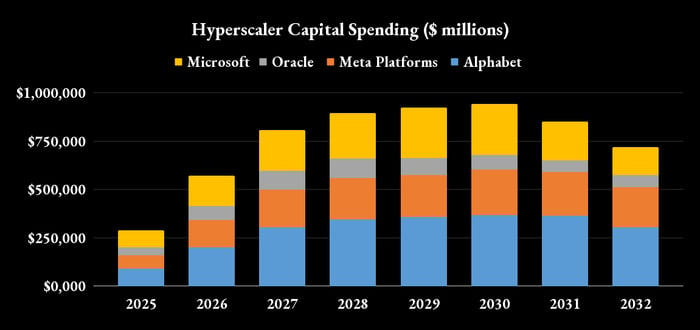
It's no secret that spending on AI data centers is booming, and projections for hyperscaler spending suggest the boom will continue. This will create opportunities for ongoing marginal growth for companies that provide the raw materials used in construction, such as copper miner Freeport-McMoRan (NYSE: FCX), construction materials company Vulcan Materials (NYSE: VMC), and data center infrastructure company Vertiv (NYSE: VRT).

Copper and Freeport-McMoRan

The chart below shows the scale of the spending increase, and although not all of it is allocated to physical data centers, it indicates a considerable marginal increase in end demand for these three companies.

Missed Nvidia in 2009? This Rare Signal Is Flashing Again. In 2009, a "Double Down" signal flashed for a little-known chipmaker called Nvidia. For the first time in years, that same "Total Conviction" signal is flashing for a company 1/100th the size of Nvidia. Continue »

Hyperscaler spending plans.

Data source: Visible Alpha. Chart by author.

You can't build a data center without the copper to create and transmit power to it, and also within it. According to S&P Global's "Copper in the age of AI" report, AI and data centers are set to contribute 13.7% of total copper demand growth from 2025 to 2030, with the energy transition (EVs, renewable energy, transmission, and distribution) contributing 59%. Much of the demand for transmission and distribution also comes from data center build-outs.

The forecast 18% increase in copper demand from 2025 to 2030 may not sound like much, but it implies a gradually widening gap between demand and baseline copper supply, which will continue to grow until, by 2040, copper demand of 42.3 million tons is forecast to exceed supply by 10.1 million tons.

These forecasts imply a bullish outlook for copper prices, which is great news for Freeport-McMoRan, a copper company with ample reserves, opportunities to expand existing sites, and a nascent low-cost leaching technology to recover copper from existing stockpiles.

A data center.

Image source: Getty Images.

Vulcan Materials

The aggregates company Vulcan Materials also explicitly linked electricity infrastructure demand to data centers. Speaking on the company's second-quarter earnings call, CEO Ronnie Pruitt said, "Large project opportunities continue to drive nonresidential activity, particularly data centers." In addition to the direct demand coming from data centers, he noted, "We've also seen a pickup in LNG projects along with energy generation and power infrastructure expansion, which is really being driven by the data centers."

The marginal increase in demand from non-residential construction, driven by power/data centers, is supporting the kind of "slow and steady" demand Pruitt covets, and it will also underpin demand while Vulcan waits for the more cyclical residential sector to return.

US Residential Construction Spending Chart

US Residential Construction Spending data by YCharts

Vertiv, an AI infrastructure company

Vertiv's power, cooling, and IT infrastructure solutions have made it the darling of investors looking to buy stocks with exposure to AI build-out spending. As such, investors closely watch its order patterns as early indicators of data center spending.

The company's latest update indicates an end market that continues to strengthen. Discussing its order pipeline at a recent Goldman Sachs conference in September, Vertiv CEO Giordano Albertazzi said: "We see no sign of weakening. If anything, we're seeing strength that the pipeline is getting stronger and stronger, and our customers' resolve and building plan continue to evolve in the right direction."

The full-year guidance on the second-quarter earnings call was for a 37% increase in revenue and a 60% increase in earnings per share (EPS) over 2025, but if Albertazzi's commentary leads to stronger order growth, then investors can pencil in more revenue and earnings growth in the future.

That growth is likely to be enhanced by Vertiv's exposure to a new class of high-voltage and higher-productivity data centers for which Nvidia is developing architecture. Vertiv believes commercial adoption of the solutions it's developed for the new 800 volt direct current (VDC) will begin in the second half of 2027, with "volumes in 2028." That should kick off a new growth phase for the company.

Should you buy stock in Freeport-McMoRan right now?

Before you buy stock in Freeport-McMoRan, consider this:

The Motley Fool Stock Advisor analyst team just identified what they believe are the 10 best stocks for investors to buy now… and Freeport-McMoRan wasn’t one of them. The 10 stocks that made the cut could produce monster returns in the coming years.

Consider when Netflix made this list on December 17, 2004... if you invested $1,000 at the time of our recommendation, you’d have $375,240!* Or when Nvidia made this list on April 15, 2005... if you invested $1,000 at the time of our recommendation, you’d have $1,403,292!*

Now, it’s worth noting Stock Advisor’s total average return is 933% — a market-crushing outperformance compared to 211% for the S&P 500. Don't miss the latest top 10 list, available with Stock Advisor, and join an investing community built by individual investors for individual investors.

See the 10 stocks »

*Stock Advisor returns as of October 1, 2026.

Lee Samaha has no position in any of the stocks mentioned. The Motley Fool has positions in and recommends Goldman Sachs Group, Nvidia, Oracle, and Vertiv. The Motley Fool has a disclosure policy.

  •  
❌