❌

Reading view

USS Klakring hit by SM-6, Sea Venom, Naval Strike Missile munitions and Mark 48 ADCAP torpedo before sinking during Exercise Atlantic Thunder 2026

Exercise Atlantic Thunder 2026

Ships, aircraft, and a submarine from the US and UK were involved in Exercise Atlantic Thunder 2026, a multi-domain sinking exercise (SINKEX) led by US 6th Fleet, in the North Atlantic, Sep. 25, 2026.

According to a US Navy news release, during the SINKEX, participating forces assigned to U.S. Commander, Task Force 65, US Commander, Task Force 67, US Commander, Task Force 68, US Commander, Task Force 69 and US Commander, Task Force 1060 alongside the UK Royal Navy and the US Air Force sank the decommissioned guided-missile frigate ex-USS Klakring. The event developed combined proficiency in tactics, targeting, and live-firing against a surface target at sea.

β€œAtlantic Thunder demonstrates the unmatched lethality and interoperability of the United States and United Kingdom,” said US Capt. Kelechi Ndukwe, Commander, U.S. Task Force 65. β€œThis sinking exercise not only validated the power behind U.S.-UK offensive weapons but delivers a clear message to adversaries that the U.S. Navy and Royal Navy remain a ready allied force.”

USS Klakring hit by SM-6, Sea Venom, Naval Strike Missile munitions and Mark 48 ADCAP torpedo before sinking during Exercise Atlantic Thunder 2026
HMS Portland fires a Naval Strike Missile on Sep. 20, 2026, during a sinking exercise.

The exercise strengthens the US-UK alliance, warfighting credibility, and interoperability during long-range maritime sinking operations. During the SINKEX, the guided-missile destroyer USS Paul Ignatius (DDG 117) successfully demonstrated maximum damage and range capability of an anti-surface variant of the Standard Missile 6 (SM-6). USS Massachusetts (SSN 798) successfully engaged the target with the Mk 48 Advanced Capability Torpedo, resulting in the final hit and ultimately sinking ex-USS Klakring, as the video in this post shows.

US and UK units involved in the exercise

During the exercise, the Royal Navy confirmed its newest ship-busting missiles, the Naval Strike Missile (NSM) and Sea Venom.

β€œThe successful firing of NSM marks a significant milestone for the Royal Navy, demonstrating our ability to deliver credible, modern maritime strike capability,” said Royal Navy Lt. Cmdr. Louise Kirkaldy, HMS Portland’s Principal Warfare.

F-15E model
This model is available from AirModels – CLICK HEREΒ TO GET YOURS.

Prior to the start of the exercise Naval Surface Warfare Center Carderock and Naval Information Warfare Center (NIWC) Pacific used sensors placed on the target ship to perform battle damage assessments. The data gathered will be used in post-exercise damage assessments to provide critical information to rapidly identify system failures, determine repair needs, and strengthen the Navy’s future real-world response.

US and UK units involved in the exercise included Paul Ignatius, USS Massachusetts, Royal Navy frigate HMS Portland (F 79), US Navy and Royal Air Force P-8 maritime patrol aircraft, a Royal Navy Wildcat helicopter, US Air Force F-15E Strike Eagles, and personnel assigned to US Explosive Ordnance Disposal Mobile Unit (EODMU) 8.

USS Klakring

USS Klakring (FFG-42) was a Oliver Hazard Perry class frigate of the United States Navy named for Rear Admiral Thomas B. Klakring (1904–1975), who was awarded three Navy Crosses as commander of the submarine USS Guardfish during World War II.

USS Klakring hit by SM-6, Sea Venom, Naval Strike Missile munitions and Mark 48 ADCAP torpedo before sinking during Exercise Atlantic Thunder 2026
The decommissioned guided-missile frigate ex-USS Klakring (FFG 42) is struck during a sinking exercise (SINKEX) as part of Exercise Atlantic Thunder 2026 on Sep. 20, 2026.

Klakring was laid down on 19 February 1982 by the Bath Iron Works Corp. Bath, Maine; launched on Sep. 18, 1982, sponsored by Beverly Bohen, niece of Rear Admiral Klakring, and commissioned on Aug. 20, 1983 at Bath.

The USS Klakring was decommissioned on Mar. 22, 2013.

Hulks

Former US Navy vessels used in SINKEXs, referred to as hulks, are prepared in strict compliance with regulations prescribed and enforced by the Environmental Protection Agency under a general permit the Navy holds pursuant to the Marine Protection, Research and Sanctuaries Act.

Prior to being transported, each hulk undergoes a rigorous cleaning process for environmental safety. Aligned with UK Ministry of Defense environmental policy, robust monitoring was conducted above and below the sea’s surface with trained personnel using specialized equipment to reduce the overall risk of inadvertent impact to the marine environment and marine mammals during the Atlantic Thunder 2026 SINKEX.

Photo credit: U.S. Navy and Royal Navy

Video: VIDEO: Former U.S. Frigate Sunk in Exercise with U.S., Royal Navies Dzirhan Mahadzir September 30, 2026 1:27 PM
  •  

[Updated] Two Naval Aviators Eject Following Mishap on USS Eisenhower

Eisenhower Mishap

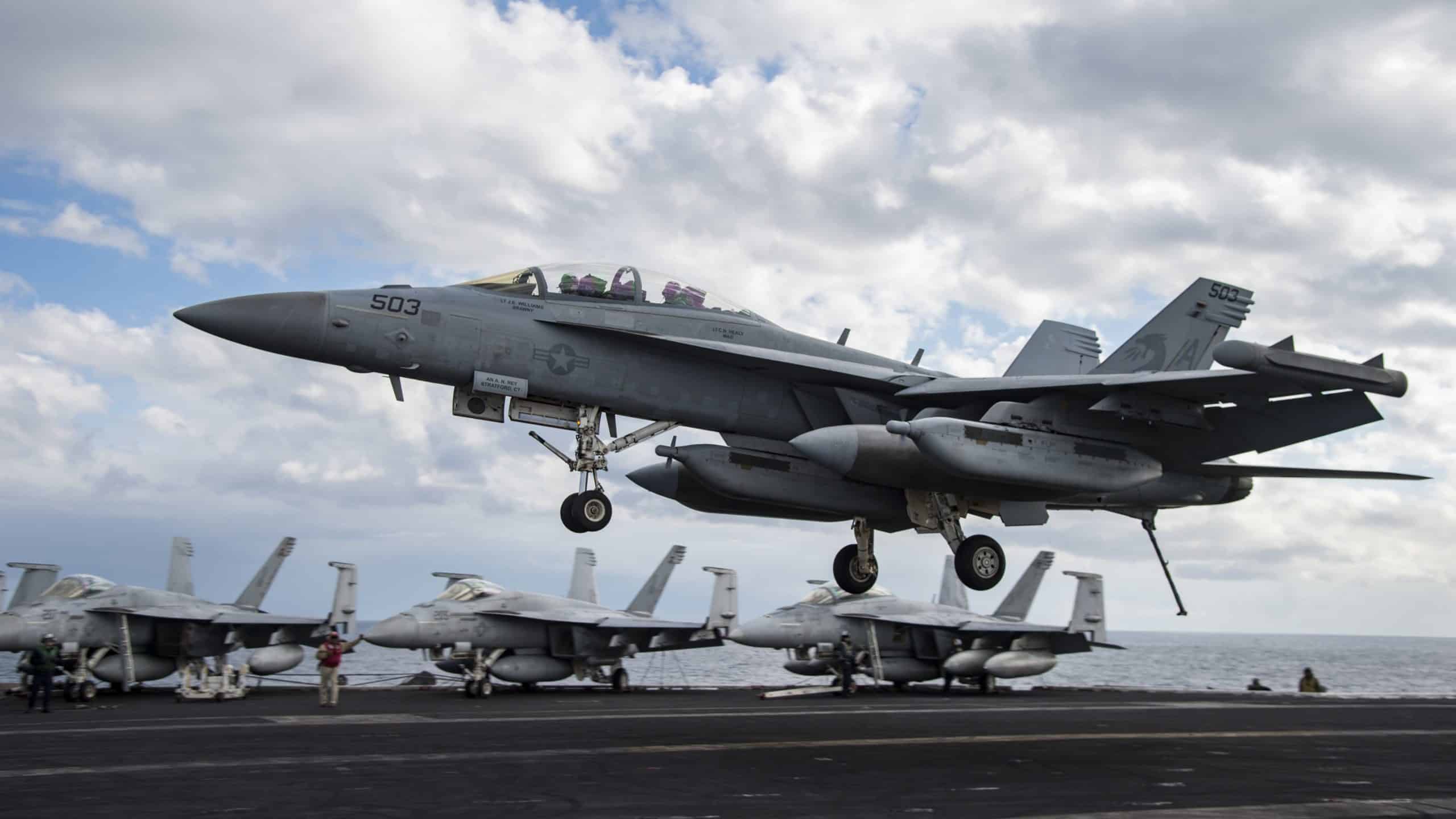
The U.S. Navy said that two Naval Aviators ejected from their EA-18G Growler following an arresting gear failure aboard the USS Eisenhower aircraft carrier and were promptly recovered by search and rescue forces.

The U.S. Navy announced that a recovery mishap aboard the USS Dwight D. Eisenhower (CVN 69) resulted in two Naval Aviators assigned to Carrier Air Wing (CVW) 3 ejecting from their aircraft. The service says that both were promptly recovered by search and rescue (SAR) forces and were safely returned to the ship to be evaluated by medical personnel.

https://t.co/3cNDtGbqgw

β€” U.S. Navy (@USNavy) September 29, 2026

Additionally, four shipboard personnel were also injured during the mishap and are receiving medical care. However, one Sailor is being evacuated to a Norfolk-area hospital for treatment of non-life-threatening injuries.

DSTY613 (MH-60S) brought the injured into Sentara Norfolk General Hospital last night. πŸ™

Audio via @liveatc and tracking via @ADSBex https://t.co/V1o0nyB70R pic.twitter.com/hmNLb0fcQN

β€” Thenewarea51 (@thenewarea51) September 29, 2026

The mishap happened at approximately 6:18 p.m. EDT on Sept. 28, 2026, as the Nimitz-class aircraft carrier was sailing off the coast of Virginia. According to USNI News, the USS Eisenhower is currently at sea for a carrier qualifications campaign, and left Naval Station Norfolk in the afternoon of Sept. 28.

The service did not release details about the aircraft involved in the mishap and whether it went overboard or stopped on the deck. The ejection of two Naval Aviators seemingly points to either the F/A-18F Super Hornet or the EA-18G Growler, the only two types of twin-seater aircraft currently in service with Carrier Air Wings.

An F/A-18F Super Hornet, attached to the β€œFighting Swordsmen” of Strike Fighter Squadron (VFA) 32, lands on the flight deck of the Nimitz-class aircraft carrier USS Dwight D. Eisenhower (CVN 69) in the Arabian Gulf, Dec. 10, 2023. | Source: U.S. Navy photo by Petty Officer 3rd Class Nicholas Rodriguez

CVW 3 is assigned one squadron of each aircraft, the Strike Fighter Squadron (VFA) 32 β€œSwordsmen” and the Electronic Attack Squadron (VAQ) 130 β€œZappers,” respectively. The Navy did not mention the squadron involved.

In the past, similar outcomes have resulted from rare mishaps in which an arresting cable snapped during an arrested landing and struck deck personnel as it recoiled, much like a whip suddenly released under tension. However, we can’t confirm that this is what happened in this case, as the Navy has not released specific details about the mishap.

The carrier recently completed its Planned Incremental Availability (PIA) at Norfolk Naval Shipyard. A PIA is a scheduled period for an aircraft carrier to undergo extensive maintenance, repairs and modernization to meet future operational demands, spanning a wide array of overhauls and inspections.

Update

The U.S. Navy confirmed that the aircraft involved was an E/A-18G Growler attached to the β€œZappers” of Electronic Attack Squadron (VAQ) 130. The two Naval Aviators were forced to eject following an arresting gear failure and were promptly recovered by search-and-rescue personnel assigned to Helicopter Sea Combat Squadron (HSC) 7.

UPDATE 1: At 6:18 p.m. EDT on Sept. 28, a mishap involving an E/A-18G Growler, attached to VAQ-130, occurred during aircraft recovery operations aboard the aircraft carrier USS Dwight D. Eisenhower (CVN 69) off the coast of Virginia.

Full release: https://t.co/DkzXwbIS2i

β€” U.S. Fleet Forces (@USFleetForces) September 29, 2026

The service said that a total of eight Sailors were evaluated by ship’s medical personnel following the incident, while one Sailor was flown to a Norfolk-area hospital for treatment of non-life-threatening injuries. The two aviators and two additional Sailors injured on the flight deck were flown to Naval Medical Center Portsmouth for follow-on evaluation.

An investigation into the causes of the mishap is ongoing.

Β© U.S. Navy photo by Mass Communication Specialist 3rd Class Nathan T. Beard

  •  
❌