FreshRSS

🔒
❌ About FreshRSS
There are new articles available, click to refresh the page.
☐ ☆ ✇ F-16 Fighting Falcon news

Belgian F-16s test laser-guided rockets for counter-drone missions

March 19, 2026 (by F-16.net) - The Belgian Air Force has begun testing a new counter-drone capability by equipping its F-16AM Fighting Falcons with laser-guided 70 mm rockets, reflecting the growing urgency to address the threat posed by low-cost unmanned aerial systems.
BAF F-16AM #FA-123 is coming in for landing showing off the brand-new Thales FZ275 guided rocket pods under the wing, seen here at Kleine-Brogel AB on February 27th, 2026. [Photo by Tim Van den Bergh]
According to recent reports, Belgian F-16s have been trialing the FZ275 laser-guided rocket (LGR), a precision-guided munition developed by Thales Belgium. The tests are part of a broader effort to explore cost-effective solutions for countering small and inexpensive attack drones, which have proven highly disruptive in recent conflicts.

A cost-effective response to a growing threat
The Belgian Ministry of Defence highlighted that modern battlefields have demonstrated how relatively cheap drones can inflict disproportionate damage. Using traditional air defense systems or high-end air-to-air missiles against such targets is often economically inefficient.

By contrast, laser-guided 70 mm rockets offer a significantly lower-cost alternative while still providing precision engagement capability. The FZ275 LGR is designed to convert standard unguided rockets into accurate, laser-guided weapons with a range of several kilometers and high hit probability.

F-16 integration and test configuration
Images released earlier in March showed a Belgian F-16AM configured with multiple LAU-131 rocket launchers, capable of carrying several 70 mm rockets per pod. This setup allows a single aircraft to engage multiple drone targets during a sortie, increasing its effectiveness in counter-UAS missions.

The trials reportedly focus on evaluating how well the rockets can be integrated into existing F-16 targeting systems and how effectively they can engage small, maneuverable aerial targets.

Part of a broader counter-UAS effort
The testing comes as Belgium accelerates its investment in counter-drone capabilities. The country recently launched a tender for a long-term counter-UAS solution, underlining the strategic importance of defending against unmanned threats.

The FZ275 is also gaining attention beyond Belgium. Earlier in 2026, the rocket was successfully tested as part of the U.S.-developed VAMPIRE counter-drone system, demonstrating its flexibility across different platforms.

Looking ahead
While still in the evaluation phase, the integration of laser-guided rockets on Belgian F-16s highlights a broader trend among air forces seeking scalable and affordable solutions to counter drone swarms.

If adopted operationally, the concept could provide a valuable bridge capability as Belgium transitions from its F-16 fleet to the F-35, ensuring continued relevance in modern, drone-heavy conflict environments.

Related articles:


Forum discussion:
☐ ☆ ✇ F-16 Fighting Falcon news

US approves major F-16 weapons package for UAE under emergency authorization

March 20, 2026 (by Lieven Dewitte) - The United States has approved a major weapons package for the United Arab Emirates (UAE), aimed at enhancing the combat capabilities of its F-16 fleet. The combined value of the two approved packages is estimated at $1.86 billion.
UAEAF F-16E block 60 #3078 from 1 sqn departs a KC-10A Extender aircraft from the 908th EARS after refueling during a multinational exercise on December 7th, 2009, in Southwest Asia. [USAF photo by SSgt. Michael B. Keller]
Announced on March 19, 2026, the approval covers both air-to-air missiles and precision-guided munitions for the UAE Air Force and Air Defence (AFAD), which operates the advanced F-16E/F block 60 “Desert Falcon”.

According to the U.S. Department of State, the sale was authorized under an emergency determination, allowing the process to move forward without the standard congressional review period.

Air-to-air capability boost
The first package, valued at approximately $1.22 billion, includes up to 400 AIM-120C-7 or AIM-120C-8 AMRAAM missiles. These beyond-visual-range air-to-air missiles significantly enhance the F-16’s ability to engage multiple aerial threats at extended distances and in contested environments.

The package also includes associated support equipment, spare parts, and logistical services required to sustain operations.

Precision strike enhancements
A second package, worth an estimated $644 million, focuses on air-to-ground capabilities. It includes:
  • 1,500 GBU-39/B Small Diameter Bombs (SDB I);
  • 900 KMU-556 Joint Direct Attack Munition (JDAM) and
  • 300 KMU-557 JDAM guidance sets.

These systems provide the UAE’s F-16s with highly accurate, all-weather strike capabilities against a wide range of targets. The package also includes elements of the Joint Mission Planning System, enabling improved mission preparation and weapons integration.

Supporting the Desert Falcon fleet
The UAE operates 78 F-16E/F Block 60 aircraft, one of the most advanced F-16 variants ever produced. The “Desert Falcon” is equipped with the AN/APG-80 AESA radar, conformal fuel tanks, and advanced electronic warfare systems, making it a highly capable multirole platform.

The newly approved munitions are expected to complement these capabilities, ensuring the fleet remains fully equipped for both air superiority and precision strike missions.

No timeline has been disclosed for the delivery of the weapons. The U.S. Secretary of State determined that an emergency exists requiring the immediate sale in the interest of national security, thereby waiving the standard Congressional review requirements.

In addition to its F-16 fleet, the UAE also operates Mirage 2000-9 fighters and has ordered 80 Dassault Rafale aircraft, which are expected to enter service in the coming years. Until then, the F-16E/F fleet continues to serve as a central pillar of the country’s airpower.

Related articles:


External link:
Forum discussion:
Additional images:
UAEAF F-16F block 60 "3001 is photographed in a spectacular way on the break at NAS Fort Worth in February of 2021. This aircraft has stayed in the US with Lockheed for its entire carreer to conduct test flights. [Photo by Txavgeek]
UAEAF F-16F block 60 #3002 is still serving as a Lockheed test mule at Fort Worth. It is seen during a pilot proficiency flight at the base on May 1st, 2025. The previous civil registration, N162LM, is showing through peeling paint at the base of the tail. [Photo by Keith Snyder]
UAEAF F-16F block 60 #3023 from 2 sqn is parked on a very sunny tarmac at Dubai IAP on November 14th, 2021. [Photo by Dirk A. Geerts]
☐ ☆ ✇ F-16 Fighting Falcon news

Top Aces to train Argentine Air Force F‑16 pilots

March 19, 2026 (by Lieven Dewitte) - The Argentine Air Force (Fuerza Aérea Argentina, FAA) has awarded a multi‑year contract to Canadian air services provider Top Aces to deliver F‑16 pilot training, marking a key milestone in Buenos Aires’ effort to stand up its newly acquired F‑16 fleet.
One of the first F-16s delivered to Argentina. [Photo by Argentine MoD]
Under the deal, valued at approximately $33.2 million, Top Aces will provide comprehensive pilot instruction from basic qualification through mission qualification, flight lead upgrade and instructor pilot training. The contract, issued under the U.S. Foreign Military Sales framework, is expected to run until June 30, 2029, with an option for an additional year of service.

Unlike some foreign training programmes that use contractor aircraft, the FAA’s training will be conducted on Argentina’s own F‑16 fighters at Argentine Air Force bases. The syllabus will combine classroom instruction, simulator work and live flying instruction, tailored to the FAA’s specific operational requirements.

Top Aces’ instructor pilots bring extensive experience with the F‑16, many with over 20 years of U.S. Air Force service and more than 2,300 flight hours on the Fighting Falcon. According to the company, its background in building and operating a fully‑fledged F‑16 training enterprise makes it well placed to support Argentina’s transition to operational capability on the type.

Argentina’s F‑16 programme has been one of the most significant developments in the nation’s military aviation in decades. The country acquired 24 F‑16AM/BM Fighting Falcons from Denmark, with the first batch of six aircraft delivered in late 2025. These fighters are destined to restore a supersonic combat capability the air force has lacked since the retirement of its earlier jets in the mid‑2010s.

The Top Aces training contract supports this effort by building a cadre of qualified FAA pilots and future instructor pilots, enabling Argentina to sustain an independent pilot training pipeline in the years ahead.

Related articles:


Forum discussion:
Additional images:
F-16 (M-1005) of the Argentine Air Force on the tarmac at Río Cuarto Air Base following its arrival from Denmark. [Photo by Top Aces]
Farewell flight of the RDAF F-16 by #E-018, #E-605 and #ET-612 with the white cliffs of Møns Klint showing in the background. E-018 is one of the aircraft transferred to the Argentine Air Force. [Forsvaret photo]
FAA F-16BM #M-1210 is parked in the hanger where the inauguration ceremony will take place in February of 2025. [FAA photo]
☐ ☆ ✇ F-16 Fighting Falcon news

Greece approves F-16 upgrades alongside new air defense investments

March 19, 2026 (by Lieven Dewitte) - Greece approved a new defense package that includes further upgrades to its F-16 fighter fleet alongside the acquisition of additional air defense systems, as part of a broader effort to modernize its armed forces. The decision was announced on March 16, 2026.
HAF F-16C block 52 #513 from 343 Mira is taking off from Kleine Brogel AB on September 13th, 2021 flying back home after the Sanicole airshow. [Photo by John de Winter]
Expanding the F-16 upgrade program
The Hellenic Air Force (HAF) operates a fleet of approximately 150 F-16s, making it one of the largest operators of the type in Europe. As part of its ongoing modernization effort, Greece has already upgraded around 40 aircraft to the advanced F-16V Block 70/72 “Viper” standard.

The latest plan includes the upgrade of an additional 38 F-16 block 50 aircraft, further expanding the number of jets equipped with modern avionics and systems.

The F-16V upgrade introduces the AN/APG-83 AESA radar, enhanced mission computers, advanced cockpit displays, and improved electronic warfare capabilities. These upgrades significantly boost the aircraft’s situational awareness, survivability, and interoperability with NATO forces.

Once completed, the Viper-standard F-16s are expected to form the backbone of Greece’s fighter fleet for years to come.

Integrated air defense improvements
In parallel with the F-16 upgrades, Greece is investing in new and upgraded air defense systems to strengthen its layered defense network. These systems are designed to complement the capabilities of the modernized fighter fleet, improving the detection and response to a wide range of aerial threats, including aircraft, missiles, and drones.

The combined approach reflects a broader strategy of integrating airborne and ground-based assets into a cohesive air defense architecture.

Looking ahead
Beyond the F-16 program, Greece is also moving forward with its next-generation fighter plans. The Hellenic Air Force is expected to receive at least 20 F-35 Lightning II aircraft, with an option for 20 additional jets, further enhancing its future capabilities.

Together, these investments underline Greece’s intent to maintain a modern, flexible, and interoperable air force, capable of operating effectively within NATO frameworks while addressing regional security challenges.

Further details on timelines and contract specifics have yet to be released.

Related articles:


Forum discussion:
Additional images:
HAF F-16D block 52 #023 void of unit markings but from 335 Mira is touching down on the runway at Araxos AB on October 16th, 2014. [<a href="http://www.airliners.net" target="new">Airliners.net</a> photo by Massimo Rossi]
HAF F-16D block 52 #023 void of unit markings but from 335 Mira is touching down on the runway at Araxos AB on October 16th, 2014. [Airliners.net photo by Massimo Rossi]
HAF F-16C block 52 #014 from 335 Mira is seen landing at Araxos AB on November 3rd, 2010. [Photo by Chris Lofting]
HAF F-16C block 52 #517 from 337 Mira is parked in a shelter at Larissa AB on June 6th, 2011. [<a href="http://www.airfighters.com" target="new">Airfighters.com</a> photo by Peter Boschert]
HAF F-16C block 52 #517 from 337 Mira is parked in a shelter at Larissa AB on June 6th, 2011. [Airfighters.com photo by Peter Boschert]
☐ ☆ ✇ F-16 Fighting Falcon news

Turkish F-16 crash in Balıkesir claims pilot’s life

February 25, 2026 (by Lieven Dewitte) - A Turkish Air Force F-16 crashed shortly after takeoff from Balıkesir in the early hours of February 25, 2026, killing the pilot.
TuAF F-16C block 50 #07-1005 from 181 Filo is coming in for landing at RAF Lossiemouth on April 11th, 2016 during exercise Joint Warrior. [<a href="http://www.airliners.net" target="new">Airliners.net</a> photo by Mike Macdonald]
According to initial reports, the aircraft departed from the 9th Main Jet Base Command in Balıkesir on a mission flight and went down at approximately 00:50 local time (21:50 GMT on February 24). Video circulating on social media appears to show the aircraft descending rapidly before impacting near a highway in the Balıkesir area.

Turkish authorities stated that radio contact and radar tracking were lost within minutes of departure, around 00:56 local time. Search-and-rescue teams were immediately dispatched, and the wreckage was subsequently located. The pilot did not survive the crash.

No information has yet been released regarding the specific F-16 variant involved or the identity of the pilot. The cause of the accident remains under investigation, and officials have not indicated whether mechanical failure, weather conditions, or other factors may have contributed.

The 9th Main Jet Base Command at Balıkesir is one of the Turkish Air Force’s principal F-16 operating locations. Turkey operates one of the largest F-16 fleets in NATO, with a mix of block 30, block 40, and block 50 aircraft forming the backbone of the country’s air defense and strike capabilities.

Turkish F-16s are routinely tasked with air policing, training, and operational missions across the Aegean, Mediterranean, and Black Sea regions. The fleet is currently undergoing modernization efforts under Turkey’s indigenous upgrade programs aimed at extending service life and enhancing avionics and mission systems.

The crash follows a few other fatal F-16 accidents worldwide in recent months. In January, a Taiwanese F-16 was lost at sea during a routine mission after the pilot ejected offshore and was reported missing. In August, a Polish F-16 crashed during rehearsals for an air show, resulting in the pilot’s death.

In a separate incident last November, Turkey temporarily suspended flights of its C-130 transport aircraft following a fatal crash in Georgia.

Further updates on the Balıkesir accident are expected once the Turkish Ministry of National Defence releases additional information.

Related articles:


Forum discussion:
  • Array
☐ ☆ ✇ F-16 Fighting Falcon news

South Korean Air Force F-16 crashes during night training; pilot ejects safely

February 25, 2026 (by Lieven Dewitte) - A Republic of Korea Air Force (RoKAF) F-16 fighter jet crashed near Yeongju in North Gyeongsang Province during a nighttime training sortie on February 25, 2026. The pilot safely ejected and was rescued shortly after the incident.
RoKAF F-16D block 52 #01-527 from the 121st FS is coming in for landing with special markings on its tail on March 30th, 2025. [Photo by Chan Hyuk]
The single-seat aircraft, assigned to Chungju Air Base, was participating in a routine night exercise when it went down in a non-urban area. Authorities stated that the pilot activated the ejection seat prior to impact and was recovered conscious. He was transported to a medical facility for precautionary examination and was reported to be in stable condition.

Initial reports indicate that contact with the aircraft was lost during the flight, prompting an immediate search-and-rescue response. Emergency services and military personnel secured the crash site, and no civilian injuries or significant property damage were reported.

The Republic of Korea Air Force has launched a formal accident investigation to determine the cause of the crash. At this stage, officials have not indicated whether mechanical malfunction, weather conditions, or operational factors played a role.

South Korea operates a large fleet of F-16 variants, including F-16C/D block 32 aircraft and domestically assembled KF-16 fighters based on the block 52 configuration. The type forms a key pillar of the country’s air defense and strike capability.

Night training missions are routine for RoKAF fighter units, which maintain high readiness levels given the security environment on the Korean Peninsula. These sorties typically include advanced navigation, air combat training, and precision strike exercises conducted under low-light conditions.

The previous accident involving a South Korean Air Force was in June 2025, when a ROKAF F-16 crashed Alaska. In that incident, the pilot also ejected safely. While there is no indication that the two events are related, the recurrence of incidents has drawn attention to the demanding operational tempo of modern fighter fleets.

It is also the second F-16 crash reported in less than 24 hours, after a Turkish Air Force jet went down near Balikesir early on February 25, 2026, killing its pilot.

Update 05 March: The two aircraft conducted a “battle damage inspection”, training a mandatory procedure where pilots visually check each other for aircraft damage. During a turn the left fuel tank of the No. 1 aircraft reportedly collided with the right wing of the No. 2 aircraft. After the collision, the No. 2 aircraft’s control systems malfunctioned, causing its altitude to continuously drop. Therefore the pilot ejectedThe Air Force accident investigation team confirmed that the No. 1 pilot, who was wearing night vision goggles, misjudged the distance to the No. 2 aircraft, leading to the collision. Night vision goggles narrow the field of view and reduce depth perception, which the investigation attributed to the pilot’s error.

Related articles:


Forum discussion:
  • Array

Additional images:
RoKAF F-16C block 52 #93-073 from 111 FS is coming in for landing at Suwon AB. [Photo by Hans Jacobs]
RoKAF F-16C block 52 #93-054 from the 19th FW taxis to the runway at Jungwon AB during Buddy Wing 15-6 on July 8th, 2015. [USAF photo by SSgt. Nick Wilson]
RoKAF F-16C block 52s from the 123rd TFS at Seosan AB arrive at Kunsan AB for Exercise Buddy Wing 15-4 on June 1st, 2015. Buddy Wing exercises are held multiple times throughout the year at various US and RoKAF bases to sharpen combined air combat tactics on the peninsula. [USAF photo by SSgt. Nick Wilson]
☐ ☆ ✇ F-16 Fighting Falcon news

Slovakia exploring purchase of four additional F-16 Block 70 fighter

February 18, 2026 (by Lieven Dewitte) - Slovakia is holding discussions with the United States about acquiring four additional F-16 fighter jets, potentially expanding its future fleet from 14 to 18 aircraft.
VS OOSR F-16C block 70 #1010 has just retracted its gear upon takeoff for a test sortie at Greenville IAP on November 10th, 2025. [Photo by Roger Metz]
Prime Minister Robert Fico confirmed the talks after meeting with U.S. Secretary of State Marco Rubio on February 15. According to Fico, increasing the fleet size would strengthen Slovakia’s ability to independently safeguard its national airspace.

Bratislava has relied on neighboring NATO members, including the Czech Republic, Hungary, and Poland, to conduct air-policing missions in recent years. Slovak officials have indicated that expanding the F-16 fleet would allow the country to fully assume those responsibilities once its new aircraft are operational.

Slovakia ordered 14 F-16 Block 70/72 aircraft in 2018, consisting of 12 single-seat F-16C models and two twin-seat F-16D variants. Production of the final aircraft in that batch was completed in December 2025 by Lockheed Martin.

The need for allied air-policing support followed Slovakia’s 2022–2023 transfer of its remaining MiG-29 fighters to Ukraine. Those Soviet-era aircraft were donated to support Kyiv’s defense efforts. The decision prompted domestic political debate, though a regional prosecutor’s office recently concluded that the transfer did not violate Slovak law.

If approved, the additional four F-16s would further standardize Slovakia’s combat aircraft inventory around the latest Block 70 configuration, enhancing fleet sustainability, pilot training flexibility, and overall operational readiness.

No timeline has yet been announced for a potential contract amendment.

Related articles:


Forum discussion:
  • Array

Additional images:
VS OOSR F-16C block 70 #1011 is strolling past the lens void of unit markings. [Photo by Falcon Spotter]
VS OOSR F-16C block 70 #1005 is retracting its gear upon takeoff for a test sortie at Greenville IAP in January of 2025. [Photo by Charlie Rucinski]
VS OOSR F-16C block 70 #1004 is retracting its gear upon takeoff for a test sortie at Greenville IAP on December 4th, 2024. [Photo by Brady Ensley]
☐ ☆ ✇ F-16 Fighting Falcon news

Denmark bids farewell to F-16 after 46 years of service

January 19, 2026 (by Lieven Dewitte) - Denmark's Royal Danish Air Force (RDAF) has officially retired its F-16 fleet following 46 years of dedicated service, marking a significant milestone in the nation's aviation history.
Farewell flight of the RDAF F-16 by #E-018, #E-605 and #ET-612 with the white cliffs of Møns Klint showing in the background. E-018 is one of the aircraft transferred to the Argentine Air Force. [Forsvaret photo]
The phaseout ceremony on 18 January 2026 at Skrydstrup Air Base featured a final formation flight by three aircraft (E-018, E-605, and ET-612) and a ceremonial landing at 13:57h by F-16AM E-008; still in the old camouflage scheme, made the final official landing of a Danish F-16. , attended by dignitaries including former Chief of Defense Gen. Christian Hvidt.​

Denmark joined the F-16 program in the late 1970s as one of four original European Participating Air Forces (EPAF) alongside Belgium, the Netherlands, and Norway, acquiring 77 F-16A/B Block 1/15 aircraft to replace older types like the F-100 Super Sabre, F-104G Starfighter, and Saab Draken. The jets underwent the Mid-Life Update (MLU) program, upgrading 61 to F-16AM/BM standards with local modifications in Aalborg, including unique Terma Pylon Integrated Dispenser Stations (PIDS) for enhanced self-protection. Danish F-16s logged extensive combat hours in NATO missions, including operations over Yugoslavia (1999), Afghanistan (2002-03, 2014-16), Libya (2011), and Baltic/Iceland air policing.

The F-16's retirement aligns with the RDAF's full transition to the F-35A Lightning II, now Denmark's sole fixed-wing combat aircraft, with orders increased from 27 to 43 jets in response to calls for higher defense spending. All F-35s are slated for full operational capability by 2027, emphasizing superior sensor fusion and multi-domain awareness over fourth-generation fighters. Recent deployments, such as two F-35s to Greenland with French tanker support in January 2026, underscore the platform's Arctic readiness amid geopolitical tensions.

Retired F-16s remain airworthy for extended service elsewhere, with 19 donated to Ukraine—where they have already seen combat alongside jets from other donors—and 24 sold to Argentina, the first six delivered in December 2025. These transfers, approved by the U.S. State Department, extend the legacy of Denmark's well-maintained fleet, including retained Terma pylons on Ukrainian examples.

With the exception of Portugal, the other EPAF nations have selected the F-35 as the F-16’s replacement. Norway was the first to transition entirely from F-16 to F-35, with the Netherlands following.

Related articles:


Forum discussion:
  • Array

Additional images:
Farewell flight of the RDAF F-16s #E-018, #E-605 and #ET-612 passing over Kronborg castle at Helsingør on January 18th, 2026. [Forsvaret photo]
Farewell flight of the RDAF F-16 with airframes #E-018, #E-605 and #ET-612 flying together on January 18th, 2026. [Forsvaret photo]
RDAF F-16AM #E-008 is coming in for landing at Aalborg AB on March 14th, 2005.  [Photo by Erik Frikke]
RDAF F-16AM #E-008 is coming in for landing at Aalborg AB on March 14th, 2005. [Photo by Erik Frikke]
☐ ☆ ✇ F-16 Fighting Falcon news

Taiwanese F-16V crashes off Hualien during night training; pilot missing

January 7, 2026 (by Lieven Dewitte) - A Republic of China Air Force (RoCAF) F-16V fighter jet has crashed into the sea off Taiwan’s eastern coast during a routine nighttime training mission, with the pilot believed to have ejected but remaining missing as of 7 January 2026.
RoCAF F-16A block 20 #6700 from the 23rd TFG is flying over Hsin-Chu AFB on April 26th, 2008. [<a href="http://www.asia-image.com" target="new">A.S.I.A. Archives Images</a> photo by MacPhil Wen]
RoCAF F-16A block 20 #6700 from the 23rd TFG is flying over Hsin-Chu AFB on April 26th, 2008. [A.S.I.A. Archives Images photo by MacPhil Wen]
The incident involving serial number 6700 highlights the challenges of night operations in rough weather and comes amid heightened regional tensions. Search and rescue efforts continue under difficult conditions, while the entire F-16 fleet has been grounded pending investigation.

The single-seat F-16V, assigned to the 5th Tactical Fighter Wing at Hualien Air Base, took off at 18:17 local time on 6 January 2026 for a standard night training sortie as wingman in a two-ship formation. At 19:27, the pilot reported losing contact with the lead aircraft ("TULOS") while at 7,600 feet in clouds; less than a minute later, at 19:28, Captain Hsin Po-yi reported a continuous descent through 4,000 feet.

He declared his intent to eject three times starting at 19:28:22 while at 2,600 feet, with flight data recording the automated "EJECT, EJECT, EJECT" alarm; radar contact was lost at 19:29:30 when the jet was at just 170 feet, roughly 10 nautical miles (18 km) east of Fengbin Township in Hualien County. President Lai Ching-te immediately directed a full-scale search and rescue operation, activating air force, coast guard, navy and civilian assets including C-130s, UH-60 Black Hawks, vessels and nearby fishing boats.

Captain Hsin Po-yi (辛柏毅), aged 29 and a 2019 graduate of the Air Force Academy, had accumulated 611 total flight hours, including 371 on the F-16V. Preliminary analysis points to a severe computer failure in the mission management computer (MMC), which disabled the flight path display and left the pilot disoriented in instrument meteorological conditions at night. The aircraft, originally an F-16A delivered under the 1990s Peace Phoenix program, had been upgraded to F-16V Block 20/70 standard by early 2024 and had logged around 3,894 hours with no major recent issues after routine maintenance.

Rescue operations face 3-meter swells, gale-force winds, low temperatures and poor visibility, complicating efforts despite illumination flares from C-130s and deployment of a Keelung-class destroyer. No emergency locator beacon from the ejection seat has been detected, leaving uncertainty over whether ejection actually occurred, though the pilot followed procedures correctly amid risks like spatial disorientation and controlled flight into terrain. Defense Minister Wellington Koo and Air Force leadership are overseeing the response from Hualien, with Premier Cho Jung-tai mobilizing coast guard support.

Taiwan operates around 140 upgraded F-16Vs from an original 150 F-16A/Bs, forming the backbone of its air defense against frequent PLA incursions; full operational capability was declared in 2021. The fleet has seen prior losses, including a 2022 F-16V crash that killed its pilot, but remains central to deterrence amid recent PRC exercises like "Justice Mission 2025." New-build Block 70/72 F-16s are in production at Lockheed Martin’s Greenville site, with the first rolled out in March 2025 to bolster numbers. All RoCAF F-16s are now grounded for inspections to ensure airworthiness.

According to Taiwan's Air Force, the pilot has clocked a total flight time of 611 hours, including 371 hours flying the F-16V.

Related articles:


Forum discussion:
  • Array

Additional images:
The first F-16 of the latest Taiwanese order of 66 airframes is this F-16D block 70 #6831 strolling past the camera on December 20th, 2025. [CNA photo]
RoCAF F-16A block 72 #93-0776 assigned to the 162nd Wing lands at Sioux City AP where the aircraft will be painted at the Air National Guard paint facility on August 6st, 2024.  [ANG photo by SMSgt. Vincent De Groot]
RoCAF F-16A block 72 #93-0776 assigned to the 162nd Wing lands at Sioux City AP where the aircraft will be painted at the Air National Guard paint facility on August 6st, 2024. [ANG photo by SMSgt. Vincent De Groot]
RoCAF F-16A block 72V is still in primer when going for a test flight after conversion on December 16th, 2022. [Photo by Tsungfang Tsai]
☐ ☆ ✇ F-16 Fighting Falcon news

Turkish F-16s shoot down stray drone over the Black Sea

December 18, 2025 (by Lieven Dewitte) - Turkish Air Force F-16s intercepted and destroyed an unmanned aerial vehicle over the Black Sea after it approached Turkish airspace, the country’s Ministry of National Defence confirmed.
TuAF F-16D block 40 #89-0044 from 151 Filo is taking off from Konya AB on May 10th, 2023 during exercise Anatolian Eagle. [Photo by Bob Fernandes]
According to the official statement, the drone was assessed to be “out of control” and was engaged as a precautionary measure. Turkish F-16s were scrambled once the aircraft was detected, and the drone was shot down in an area away from populated regions to eliminate any potential risk to civilians. The ministry did not disclose the drone’s origin, ownership, or specific type.

The interception took place over international waters in the Black Sea, underscoring Turkey’s ongoing airspace monitoring and quick-reaction alert posture in the region. Turkish F-16s regularly conduct air policing missions along the country’s northern coastline, which stretches more than 1,300 kilometers and borders one of Europe’s most militarized maritime areas.

The incident comes amid heightened drone activity in the Black Sea, where unmanned systems have increasingly been used for reconnaissance and strike missions. Turkey has expressed growing concern about incidents occurring near or within its exclusive economic zone, particularly following recent attacks on commercial shipping linked to Russia’s so-called “shadow fleet.”

While Ankara has maintained diplomatic channels with both Russia and Ukraine, the Turkish military continues to enforce strict airspace security measures. The shootdown highlights the role of the F-16 as Turkey’s primary air defense and interception platform, capable of rapid response against both manned and unmanned aerial threats.

No further details have been released, and Turkish authorities indicated that the incident remains under review.

Related articles:


Forum discussion:
Additional images:
TuAF F-16D block 50 #07-1027 from 161 Filo is touching down on the runway at Konya AB. [Photo by Ataberk Ozsoy]
☐ ☆ ✇ F-16 Fighting Falcon news

Lockheed Martin completes production of initial F-16 Block 70 fleets for Bulgaria and Slovakia

December 17, 2025 (by Lieven Dewitte) - Lockheed Martin has completed production of the initial F-16 Block 70 fleets for Bulgaria and Slovakia, marking the transition of both air forces from legacy MiG‑29s to a modern, NATO‑interoperable Viper configuration.
Slovakia is the first European country for the F-16 block 70, a capability that strengthens its ability to stay ahead of regional threats and support allied missions with F-16C block 70 #1001 paving the way. [Lockheed Martin Aeronautics photo]
The aircraft are being delivered under U.S. Foreign Military Sales (FMS) procedures from the company’s F‑16 final assembly line in Greenville, South Carolina, where they receive final systems integration and acceptance before transfer.​

Fleets for Bulgaria and Slovakia
Bulgaria ordered a total of 16 F‑16C/D Block 70s on order, split into two batches of eight aircraft intended to fully replace its MiG‑29 fleet at Graf Ignatievo Air Base. The first aircraft began arriving in 2025, with the final jets from the initial batch ( six F-16C and two F-16D aircraft) expected by the end of this year as production is now completed. The production of the second batch comprising four F-16C and four F-16Ds continues and is scheduled to reach full operational status later in the decade.​

Slovakia ordered 14 F‑16 Block 70s (12 single-seat F-16C and two twin-seat F-16D aircraft) to assume the air policing and air defense roles previously handled by its MiG‑29s. The first Slovak airframes arrived in 2024 at Malacky Air Base, where they are forming the core of a new F‑16 squadron that will integrate into NATO’s integrated air and missile defense architecture.​

Block 70 configuration and systems
Both Bulgarian and Slovak aircraft are configured to the F‑16 Block 70 standard, centered on the Northrop Grumman AN/APG‑83 SABR active electronically scanned array (AESA) radar. APG‑83 shares a high degree of software and hardware commonality with the F‑35’s radar, providing high‑resolution synthetic aperture radar (SAR) mapping, improved clutter rejection, and simultaneous air‑to‑air and air‑to‑ground modes for multi‑role missions.​

The Block 70 airframes are provisioned with conformal fuel tanks (CFTs), significantly increasing fuel capacity without occupying underwing pylons and with less drag than external tanks. The avionics suite includes a modern glass cockpit with large‑area color displays, an advanced mission computer, secure and high‑capacity datalinks, and updated electronic warfare systems consistent with current F‑16 upgrade roadmaps.​

Airframe life and safety upgrades
A major structural enhancement of the Block 70 design is the 12,000‑hour service life, compared to roughly 8,000 hours for earlier F‑16 blocks, achieved through redesigned and reinforced primary structure. For operators like Bulgaria and Slovakia, this translates into several decades of service at typical European peacetime utilization rates before any major life‑extension work is necessary.​

All of these jets incorporate the Automatic Ground Collision Avoidance System (Auto‑GCAS), which monitors flight parameters and terrain and will initiate an automatic recovery if a ground collision becomes imminent and the pilot does not respond. Auto‑GCAS has already been credited with saving multiple USAF F‑16s and their pilots, making it one of the most significant safety additions compared to legacy European Vipers.​

Integration into the European F‑16 community
With Bulgaria and Slovakia joining as operators, the European F‑16 user community grows both in numbers and capability, adding two fleets built from the outset to the highest current Viper standard. Through FMS and multinational training arrangements, both countries can tap into existing F‑16 schoolhouse, simulator, and logistics frameworks, reducing the cost and risk of transition from Soviet‑era platforms.​

Domestic aerospace companies such as LOTN in Slovakia and Avionams in Bulgaria are expected to support maintenance and selected component work, tying both nations into the broader industrial support network for the type. For the F‑16.net audience, these programs represent the first fully new‑build European Block 70 fleets, combining AESA radar, CFTs, Auto‑GCAS and a 12,000‑hour structural life into what is effectively the most modern 4+ generation Viper variant currently in production.​

Related articles:


Forum discussion:
Additional images:
VS OOSR F-16C block 70 #1001 seen here on its first flight on September 29th, 2023. [Lockheed photo]
BVVS F-16C block 70 #316 is about to touch down after a test flight from Greenville IAP on September 5th, 2025. [Photo by Brady Ensley]
VS OOSR F-16C block 70 #1001 seen here touching down and deploying its drag chute after its first flight on September 29th, 2023. [Lockheed photo]
☐ ☆ ✇ F-16 Fighting Falcon news

Thunderbirds F-16C crashes near Trona during training; Pilot ejects safely

December 3, 2025 (by Lieven Dewitte) - A block 52 F-16C from the U.S. Air Force Thunderbirds demonstration team crashed late Wednesday morning in a remote desert area near Trona, California, after the pilot safely ejected and sustained only minor injuries.
USAF Thunderbirds photographed at the 2012 Quonset Point Air Show held on June 16th, 2012. [Photo by Bob Derouin]
The single‑seat F-16C went down just south of Trona Airport, on a dry lakebed near the eastern edge of California’s Death Valley region in San Bernardino County. The crash site lies roughly 27 miles southeast of Naval Air Weapons Station China Lake and about 117 miles southwest of the Thunderbirds’ home station at Nellis Air Force Base, Nevada.​

According to local emergency services, response crews from San Bernardino County Fire supported China Lake personnel in securing the scene and extinguishing a post‑impact fire on the desert floor. Officials reported no injuries on the ground and no threat to nearby communities or surrounding vegetation.​

The Thunderbirds confirmed that the pilot successfully ejected from the F-16 at approximately 10:45h local time and descended under a parachute before being recovered by rescue personnel. The pilot was transported to a hospital in Ridgecrest with non‑life‑threatening injuries, described as stable and receiving follow‑on medical care.​

No identifying details about the pilot, including assignment within the team’s formation, have been released pending standard notification procedures. The Air Force has emphasized that updates on the pilot’s status and any changes in medical condition will come through official channels as more information becomes available.​

The Thunderbirds are the U.S. Air Force’s premier aerial demonstration squadron, flying the F-16C Fighting Falcon in tightly choreographed formation and solo aerobatic routines at airshows across the United States and abroad. Each winter, the team conducts intensive work‑up training from Nellis Air Force Base near Las Vegas to prepare for the upcoming show season, flying frequent practice sorties over nearby training ranges and designated airspace.​

This is the first reported Thunderbird mishap involving an F-16 in several years, though the team regularly conducts high-intensity training that places significant demands on aircraft and pilots.

The aircraft involved in the crash was participating in one of these pre‑season training missions when the mishap occurred, during a period in which the team typically refines maneuvers and evaluates new or repositioned pilots. While unofficial reports have suggested the jet may have been one of the team’s solo aircraft, officials have not yet confirmed that detail.​

Related articles:


Forum discussion:
Additional images:
Thunderbird no. 6 ejection at Mt. Home airshow in 2003  [Photo by SSgt Bennie J. Davis III - Still Photographer, USAF]
Thunderbird no. 6 ejection at Mt. Home airshow in 2003 [Photo by SSgt Bennie J. Davis III - Still Photographer, USAF]
☐ ☆ ✇ F-16 Fighting Falcon news

First ex-Danish F-16s on route to Argentina

November 28, 2025 (by Bjorn Claes) - Today the first six refurbished former Flyvevåbnet (Royal Danish Air Force, RDAF) F-16s departed from Skrydstrup AB, beginning their long journey to join the Fuerza Aérea Argentina (Argentinian Air Force, FAA).
FAA F-16AM #M-1020 destined for Grupo Aéreo 6 is coming in for landing with brakes opened at Zaragoza AB on November 28th, 2025. [<a href="https://www.jetphotos.com" target="new">Jetphotos.com</a> photo by Rodrigo Train]
FAA F-16AM #M-1020 destined for Grupo Aéreo 6 is coming in for landing with brakes opened at Zaragoza AB on November 28th, 2025. [Jetphotos.com photo by Rodrigo Train]
Argentina originally requested a total of 38 F-16s, but U.S. Congress eventually authorized the sale of 24 aircraft under the Peace Condor program. These are divided into 16 A-models and 6B-models with a further number of airframes being delivered - amongst F-16BM M1210 (ex. ET-210) - to act as instructional airframes. Before being transferred these jets where overhauled and adapted according to Argentinian specifications.

These F-16s are eventually destined for Grupo Aéreo 6 de Caza which is based at Tandil AB. They will initially be delivered to Área Material IV (ARMACUAR) in Río Cuarto.

The first delivery flight consisted of two F-16AMs and four F-16BMs:

F-16AM:
M-1009 (ex. E-602)
M-1020 (ex. E-007)

F-16BM:
M-1004 (ex. ET-615)
M-1005 (ex. ET-197)
M-1007 (ex. ET-199)
M-1008 (ex. ET-022)

The first legg of their journey brought them to Zaragoza AB in Spain. A further legg will most probably be to Lajes AB from which the Atlantic passing will take place initially to Brazil via Gando and Natal, ultimately reaching Río Cuarto on 5 December. In the days that follow, they will conduct several flyovers of FAA bases in western Argentina. The formal handover ceremony at Río Cuarto is planned for 12 December.

Related articles:


Forum discussion:
  • Array

Additional images:
FAA F-16BM #M-1004 destined for Grupo Aéreo 6 is coming in for landing with brakes partially opened at Zaragoza AB on November 28th, 2025. [Photo by Patrick van Stiphout]
FAA F-16AM #M-1020 destined for Grupo Aéreo 6 is coming in for landing with brakes opened at Zaragoza AB on November 28th, 2025. [Photo by Patrick van Stiphout]
☐ ☆ ✇ F-16 Fighting Falcon news

U.S. awards new contract to sustain Iraqi F-16 fleet through 2026

November 24, 2025 (by Lieven Dewitte) - The United States has awarded Vectrus Systems Corp. a $252 million contract to continue providing maintenance and support services for the Iraqi Air Force’s F-16 fleet.
IqAF F-16C block 52 is parked on a sunny tarmac guarded by an Iraqi military. [IqAF photo]
The agreement follows a previous $118 million contract signed in June, underscoring Washington’s ongoing commitment to keeping Iraq’s F-16 operations fully mission-ready.

Under the new contract, Vectrus will deliver base operations support, life-support services, and security functions at Martyr Brigadier General Ali Flaih Air Base in Salah al-Din province. All work is scheduled to be completed by September 24, 2026.

The award extends more than a decade of U.S. contractor involvement in sustaining Iraq’s F-16 program. Despite challenges in previous years—including temporary contractor withdrawals caused by security threats—support has remained steady, ensuring the Iraqi F-16 fleet stays operational. According to Army Recognition, maintaining consistent contractor presence has been essential to preserving readiness and flight safety.

Iraq currently operates 34 F-16C/D Block 52+ aircraft, delivered between 2014 and 2017. The jets form the backbone of the Iraqi Air Force’s fixed-wing combat capability and are its primary platform for air-to-ground and precision-strike missions.

The fleet is based at Martyr BG Ali Flaih Air Base (formerly Balad Air Base), located 60–70 km north of Baghdad. Since their arrival in 2014, the aircraft have played a major role in operations against the Islamic State under Operation Inherent Resolve.

Reliable sustainment remains critical for Iraq, as the F-16IQ program includes advanced systems—such as the AN/APG-68(V)9 radar, modern defensive suites, and precision-guided munitions—that require ongoing technical expertise.

With the new contract in place through 2026, Iraq’s F-16 fleet is expected to remain fully capable of meeting current and future security demands, including counterterrorism operations and regional air defense requirements.

Related articles:


Forum discussion:
Additional images:
IqAF F-16C block 52 #1634 is spotted at NAS Fort Worth on June 23rd, 2017 during a pre-delivery check flight. [Photo by Keith Snyder]
IqAF F-16C block 52 #1617 is spotted during a test flight from NAS Fort Worth in 2015. [IraqiDude photo]
The first F-16 for the Iraqi Air Force was delivered in ceremonies at the Lockheed Martin facility in Fort Worth on June 5th, 2014. This aircraft, a two-seat F-16D block 52 (Iraqi serial number 1601) is the first of thirty-six F-16s for the reconstituted Iraqi Air Force. [Photo by Angel DelCueto]
☐ ☆ ✇ F-16 Fighting Falcon news

F-16 Fighting Falcon milestone: 10,000 flight hours and counting

October 18, 2025 (by MSgt. Luke Olson) - An F-16 Fighting Falcon from the South Dakota Air National Guard achieved a significant milestone by surpassing 10,000 flight hours on October 17, 2025, at Joe Foss Field.
Staff Sgt. Mason Mathieu, left, dedicated crew chief with the 114th Aircraft Maintenance Squadron, shakes hands with Col. Brandon Eskam, commander of the 114th Fighter Wing, both with the South Dakota Air National Guard, beside tail 452 prior to the sortie marking the jet’s 10,000 flight hour milestone at Joe Foss Field, South Dakota, Oct. 17, 2025. The milestone reflects durable airframe design and the teamwork that keeps the aircraft mission ready year after year. [US ANG photo by Master Sgt. Luke Olson]
This accomplishment is a testament to the skilled operators and the disciplined and dedicated maintenance professionals of the 114th Fighter Wing.

Col. Brandon Eskam, commander of the 114th FW, flew the sortie that pushed tail 452 into the 10,000s.

“It’s such a privilege to take aircraft 452 over the 10,000-hour mark, it’s humbling,” he said. “Two things stand out: the incredible design, the F-16 first came out in ’74, and the maintenance team has that kept it flying.”

Eskam describes a ritual before every launch, involving eye contact and a handshake exchanged between the pilot and the crew chief, which serves as a physical transfer of trust. “I will take care of the airplane, and it will take care of me.”

That ritual is also one of mutual respect and understanding for all the work that makes the launch possible.

“The unseen work is countless: inspections, documentation, and the behind-the-scenes details that people don’t see when jets are flying by,” said Staff Sgt. Mason Mathieu, dedicated crew chief with the 114th Aircraft Maintenance Squadron. “A habit that pays off over thousands of hours is keeping the jet clean, which makes finding issues a lot easier.”

Every hour of flight time requires roughly 40 hours of maintenance work behind the scenes. It’s the cumulative effect that turns routine into a milestone.

“Ten thousand hours shows the pride and effort people have put in for years,” Mathieu said. “Doing the little things right every day adds up.” Mathieu added that the best advice he ever got, he still carries today. “Do your job every day like someone’s life is on the line.”

Why 10,000 matters: early F-16s were built for roughly 8,000 flight hours, but inspections and a service-life program have cleared many C/D models to fly safely up to 12,000. That’s why five-digit Vipers are showing up across the force. For the 114th Fighting Lobos, 452’s crossing stands as both local pride and proof that high standards are engrained in the culture.

As the South Dakota Air National Guard approaches their 80th Anniversary, Col. Eskam reflects on what it takes to sustain eight decades of fighter excellence.

Eskam said the unit’s culture is built by how we do the little things every day long before any milestone. “Our wing has a long history of doing things right, consistent productivity, and consistent execution. You don’t wait for the moment of truth; you make a habit of it.”

Measured against the mission, the 114th has flown the F-16 since 1992. 10,000 hours is maintenance converted into years of support for overseas combat missions and 24/7 homeland defense to protect the communities and nation these Airmen serve.

“We’ve logged 10,000 hours of either actively protecting, or preparing to protect, the United States,” Mathieu said. “For a guard unit to hit 10,000 airframe hours is a big mission.”

The F-16 took shape in another era, but the way 452 reached five digits speaks to this one. The milestone reflects durability of this airframe and it also reflects the teamwork and attention to detail that keep these jets mission-ready year after year. Every hour in the sky sits on hours of preparation and inspection on the line. At Joe Foss Field, that’s not nostalgia, it’s the job.

Related articles:


Forum discussion:
Additional images:
USAF F-16C block 40 #88-0452 from the 175th FS is returning to NAS Fort Worth after performing a flyover of the FCS Championship football game between South Dakota State and North Dakota State (held in Frisco) on January 8th, 2023. [Photo by Keith Snyder]
USAF F-16C #88-0452 from the 421st FS based at Hill AFB going into the verticle. [USAF photo]
USAF F-16C block 40 #88-0452 from the 175th FS sits on the ramp at Bagram Airfield on August 5th, 2018. The 175th EFS are deployed from the 114th FW, Sioux Falls, in support of combat operations in Afghanistan. [USAF photo by TSgt. Eugene Crist]
☐ ☆ ✇ F-16 Fighting Falcon news

US accelerates F-16V deliveries to Taiwan amid production delays

November 14, 2025 (by Lieven Dewitte) - The United States is working to speed up the manufacturing of the F-16V “Viper” fighter jets ordered by Taiwan, after the island’s defence ministry reported a series of production delays.
RoCAF F-16A block 72 #93814 from the 21st FS is strolling past the lens in a stunning new paintscheme on March 28th, 2025. [Photo by Jeff C.H. Cho]
Taiwan’s Ministry of National Defence informed lawmakers that the delivery schedule for all 66 new F-16V aircraft—originally slated for completion by the end of 2026—had been pushed back due to factors including production line relocations and supply-chain disruptions.

According to the ministry, 50 of the jets are already on the assembly line, and 10 are expected to undergo flight testing in 2025, with delivery targeted for 2026.

In response to the delays, contractors for the programme have instituted two 20-hour shifts per day to accelerate production rates and meet contractual commitments.

Beyond the F-16 order, Taiwan also faces delays for other US defence systems: the AGM-154C Joint Standoff Weapon glide bombs and MK-48 torpedoes have moved from 2026 to 2027-28 delivery timelines due to similar supply chain issues. Meanwhile, the High Mobility Artillery Rocket Systems (HIMARS) are reportedly arriving ahead of schedule.

Why it matters:
  • The F-16V upgrade is a key element of Taiwan's plan to maintain air-superiority in the face of growing military pressure from mainland China.
  • Delays in delivery could limit Taiwan’s front-line readiness at a time when tensions in the Taiwan Strait continue to rise.
  • Taiwan’s request for accelerated production underscores the importance of reliable delivery timelines for advanced defence platforms.


Lockheed Martin, the manufacturer of the jets, said it remains committed to delivering “mission-critical capabilities” while working with the U.S. government to maintain safe compliance. Taiwan says it will continue to closely monitor progress, adjust payment schedules accordingly, and ensure that future deliveries align with its defensive needs.

Related articles:


Forum discussion:
Additional images:
RoCAF F-16A block 72V #6701 is spotted during a test flight at Ching Chuan Kang AB right after conversion on November 8th, 2019. [Photo by Jeroen Bos]
RoCAF F-16V test mule #93-0702 on another local test flight at NAS Fort Worth on June 21st, 2019. Certainly would look nice with some special markings! [Photo by Keith Snyder]
RoCAF F-16B block 72V #93843 is strolling by the lens at Luke AFB after being transferred to the 21st FS on February 7th, 2023. [Photo by Bob Fernandes]
☐ ☆ ✇ F-16 Fighting Falcon news

Romania takes ownership of 18 Dutch F-16s for training and operational use

November 10, 2025 (by Lieven Dewitte) - Romania has formally taken ownership of 18 F-16AM/BM Fighting Falcons previously operated by the Royal Netherlands Air Force. The transfer agreement between the two governments was signed on November 3, 2025, at the Romanian Ministry of National Defence in Bucharest.
A formation of Dutch F-16s over Volkel, in November 2021. [Photo by  Dutch Ministry of Defense]
A formation of Dutch F-16s over Volkel, in November 2021. [Photo by Dutch Ministry of Defense]
The aircraft have been stationed at Fetești Air Base as part of the European F-16 Training Center (EFTC), jointly operated by Romania, the Netherlands, and Lockheed Martin. The EFTC provides advanced F-16 training for Romanian pilots as well as for allied and Ukrainian aircrews.

These 18 aircraft bring Romania’s F-16 inventory to approximately 67 jets when combined with prior acquisitions including ex-Norwegian airframes. Although the transfer is often described as a “symbolic” sale for €1, the logistics support package and VAT incurred amount to multiple millions of euros.

Romania previously purchased 17 ex-Norwegian F-16s to expand its fleet, which now totals 35 operational aircraft before the latest addition. These Dutch airframes are expected to supplement both training and operational roles while ensuring standardization across the fleet.

The Fetești-based training center, inaugurated in 2023, is the first of its kind in Europe, offering a full F-16 pilot training pipeline supported by Lockheed Martin. The program is expected to evolve further as European nations transition to the F-35, with discussions already underway to integrate advanced training modules.

According to officials, the newly transferred jets will continue to be used for pilot instruction under the EFTC framework while maintaining operational readiness for Romania’s air defense.

Related articles:


Forum discussion:
Additional images:
The first F-16 BM delivered to the EFTC in July 2024 shown pictured in a hanger before departing for Romania. [Photo by Dutch Ministerie van Defensie]
FAR F-16AM #1622 is parked in the static display at the 2025 Bucharest International Airshow. [Photo by Rob Hofman]
FAR F-16AM #1613 is performing a fly-by at the 2024 Bucharest International Airshow. [Photo by Rob Hofman]
☐ ☆ ✇ F-16 Fighting Falcon news

Peru cleared for possible purchase of F-16 Block 70 jets

September 16, 2025 (by Lieven Dewitte) - The U.S. State Department has approved a possible Foreign Military Sale (FMS) to Peru for a fleet of F-16 Block 70 Fighting Falcons and associated systems.
Two F-16s from 34th FS form up with a Peruvian MiG-29 and Mirage 2000 during dissimilar air combat training as part of Falcon and Condor 2007, a joint exercise between the U.S. and Peruvian Air Forces on February 15th, 2007. [USAF photo by TSgt. Eric Kreps]
The proposed package, valued at an estimated $3.42 billion, represents a major step forward in the modernization of the Peruvian Air Force (FAP).

The Defense Security Cooperation Agency (DSCA) notified Congress of the potential sale on September 15, 2025. If finalized, Peru would receive twelve aircraft: ten single-seat F-16C Block 70s and two two-seat F-16D Block 70s. The deal also includes fourteen F110-GE-129 engines, advanced avionics, and a wide range of weapons and support equipment.

The F-16 Block 70, also known as the F-16V “Viper,” is the most advanced production variant of the fighter to date. Key features include the Northrop Grumman AN/APG-83 Active Electronically Scanned Array (AESA) radar, the AN/ALQ-254 Viper Shield electronic warfare suite, and state-of-the-art avionics powered by the Modular Mission Computer (MMC 7000AH). Together, these upgrades give the aircraft enhanced detection, tracking, and survivability against modern air and ground threats.

The package includes a modest starter weapons suite with twelve AIM-120C-8 AMRAAM medium-range air-to-air missiles and twelve AIM-9X Block II Sidewinder short-range missiles. Other systems in the request are:
  • AN/APG-83 AESA radars
  • AN/AAQ-28 Litening targeting pods
  • JHMCS II helmet-mounted cueing systems
  • MIDS-JTRS datalink radios
  • Mission planning equipment and simulators

Beyond the hardware, the potential sale covers training for pilots and ground crews, spare parts, technical documentation, and long-term logistical and engineering support from both the U.S. government and Lockheed Martin.

Peru has long sought to replace its aging fleet of Soviet-era fighters, including MiG-29s and Mirage 2000s, which face increasing maintenance and capability limitations. If completed, the deal would significantly boost the FAP’s air defense and multirole combat capabilities, aligning it more closely with regional partners and U.S. interoperability standards.

Related articles:


External link:
Forum discussion:
☐ ☆ ✇ F-16 Fighting Falcon news

Belgium's Air Force takes on strategic NATO air policing in Iceland

August 27, 2025 (by Lieven Dewitte) - The Belgian Air Component (BAC) has officially taken command of a crucial air policing mission over strategic Icelandic airspace, deploying a contingent of F-16s to Keflavik Air Base.
BAF F-16AM #FA-132 from 2 W is taking off from Leeuwarden AB on October 7th, 2021 during the Weapons Instructor Course. [Photo by John de Winter]
This rotational deployment underscores Belgium’s commitment to NATO’s collective defense and highlights the vital role of Iceland's location at the heart of transatlantic air and sea routes.

Iceland, a NATO member without its own standing air force, relies on allied nations to secure its airspace, a critical component of the so-called Greenland-Iceland-UK (GIUK) gap. This strategic chokepoint is key to controlling access to the North Atlantic. For a minimum of one month, the BAC will maintain continuous patrols, ready to respond to any potential threats.

Operating under the 2nd Tactical Wing from Florennes Air Base, the Belgian F-16s are on high alert, prepared for quick-reaction missions (QRA). According to the detachment commander, potential threats are typically identified 2-3 hours before they might enter Icelandic airspace, allowing crews to be airborne in less than 15 minutes. "Protecting NATO airspace between Iceland, the United Kingdom, and Canada is a strategic priority," the commander stated.

This deployment comes at a pivotal time for the Belgian Air Component, which is undergoing a major modernization of its fleet. The service is in the process of replacing its legacy F-16s with the next-generation Lockheed Martin F-35A stealth fighter. Belgium has already received eight F-35As, which are currently stationed in the United States to train the first cohort of Belgian pilots and maintenance personnel. A recent announcement from Brussels indicated a plan to order 11 more F-35As, which would bring the total commitment for the type to 45 aircraft.

Related articles:


Forum discussion:
  • Array

Additional images:
The 1300th F-16 from the SABCA factory after maintenance and overhaul and ready to return back to operational service. [Photo by G. Dedeurwaerder]
BAF F-16AM #FA-132 from 2 W is taking off from Leeuwarden AB on October 7th, 2021 during the Weapons Instructor Course. [Photo by John de Winter]
RDAF F-16AM's #E-182 and #E-188 from Esk. 727 are performing a simultanious landing at Keflavik AB on March 2nd, 2010 upon arrival for their deployment during the Iceland Air Policing and Surveillance. [<a href="http://www.airfighters.com" target="new">Airfighters.com</a> photo by Baldur Sveinsson]
RDAF F-16AM's #E-182 and #E-188 from Esk. 727 are performing a simultanious landing at Keflavik AB on March 2nd, 2010 upon arrival for their deployment during the Iceland Air Policing and Surveillance. [Airfighters.com photo by Baldur Sveinsson]
☐ ☆ ✇ F-16 Fighting Falcon news

Polish F-16 Tiger Demo crashes during Radom Air Show training

August 28, 2025 (by Lieven Dewitte) - The aviation world is in mourning after Major Maciej “SLAB” Krakowian, a highly regarded pilot with the Polish Air Force F-16 Tiger Demo Team, was killed in a tragic crash this afternoon during a rehearsal for the Radom International Airshow.

PolAF F-16C block 52 #4056 from 6 elt spotted in a very nice tiger scheme for the Tigermeet held at Konya AB on May 7th, 2015. [Photo by John de Winter]
The F-16 fighter jet (#4056) crashed at the Radom airfield, south of Warsaw, while performing an acrobatic maneuver in preparation for the upcoming air show. Witnesses and video footage show the aircraft entering a steep descent, impacting the runway, and bursting into flames.

Major Krakowian was the sole occupant of the aircraft. A statement from the Polish military confirmed the fatality, expressing deep sorrow and paying tribute to the pilot's service and dedication. "A Polish Army pilot died in the crash of an F-16 aircraft – an officer who always served his country with dedication and great courage," said Defence Minister Władysław Kosiniak-Kamysz, who traveled to the crash site.

The cause of the accident is not yet known, and an investigation is underway. The General Command of the Armed Forces confirmed that there were no injuries to anyone on the ground.

Major “SLAB” Krakowian was a celebrated figure in the air display community, known across Europe for his precision and passion for flight. He was recently recognized with the "As the Crow Flies" Trophy for the "best overall flying demonstration" at the Royal International Air Tattoo (RIAT) in 2025. The Polish Air Force F-16 Tiger Demo Team's official social media shared a poignant message, remembering him as "a pilot, a mentor, and a friend."

In the wake of the tragedy, the Radom International Airshow, one of Europe's largest aviation events, has been canceled. The incident has cast a somber shadow over the aviation community, which is remembering a pilot who inspired many with his skill and a deep love for flight.

"His legacy will live on in every crowd moved by the sound of afterburner thunder and the sight of a Fighting Falcon carving through the heavens," the demo team's tribute read. "Blue skies and eternal tailwinds, SLAB. You will never be forgotten."
In Memoriam

Related articles:


Forum discussion:
  • Array

Additional images:

PolAF F-16C block 52 #4056 from 31 BLT is coming in for landing at Leeuwarden AB on April 8th, 2019 after another sortie during exercise Frisian Flag. [Photo by John de Winter]

PolAF F-16C block 52 #4056 from 6 elt is strolling past the lens at Konya AFB on May 5th, 2015 during the NATO Tiger Meet 2015. [Photo by Dirk A. Geerts]

PolAF F-16C block 52 #4056 from 6 elt is passing the lens at Poznan AB on May 27th, 2008. [Photo by Paweł Bondaryk]
☐ ☆ ✇ F-16 Fighting Falcon news

Poland signs $3.8 Billion deal to upgrade F-16 fleet to Viper standard

August 14, 2025 (by Lieven Dewitte) - Poland has finalized a $3.8 billion agreement with the United States to modernize its fleet of 48 F-16C/D block 52+ fighters to the F-16V (Viper) standard, significantly enhancing its NATO-aligned air combat capabilities.

PolAF F-16C block 52 #4047 from 31 BLT is taxiing by the lens right after the base organised an elephant walk on October 31st, 2024. [Photo by Arek Biały]
The modernization program will upgrade 36 single-seat and 12 twin-seat F-16s. Work will occur at Poland’s Military Aviation Works No. 2 in Bydgoszcz, with two aircraft flown to the U.S. for testing. The remaining jets will be upgraded domestically between 2028 and 2038.

Upgrades include the Northrop Grumman AN/APG-83 AESA (SABR) radar, next-gen mission computers, helmet-mounted display systems, Sniper advanced targeting pods, upgraded electronic warfare suites (e.g., Viper Shield), Auto-GCAS, and structural improvements extending service life to 12,000 flight hours.

Enhancements will boost integration with F-35A jets, Abrams tanks, Apache helicopters, and multi-domain operations—a critical leap as Poland finalizes orders for 32 F-35A "Husarz" and raises defense spending to 5% of GDP by 2026.

Given rising tensions from Russia’s war in Ukraine, this modernization program enhances deterrence and consolidates Poland’s position as a key eastern NATO bulwark. The upgraded F-16V fleet will support missions such as Baltic Air Policing and rapid responses to regional threats.

The agreement is part of a broader $7.3 billion U.S. Foreign Military Sale (FMS) package approved in October 2024.

Related articles:


Forum discussion:
Additional images:

To commemorate the 18th anniversary of the Vipers in service, a unique 'Elephant Walk' formation was organized on the runway of the 31st Tactical Air Base featuring exactly 18 F-16C/D block 52+ aircraft. [Photo by Arek Biały]

PolAF F-16D block 52 #4084 from 6 elt is taking off from Schleswig AB on June 23rd, 2014 during the NATO Tigermeet. [Airfighters.com photo by Radim Spalek]

PolAF F-16C block 52 #4054 engages in a planned intercept of a USAF B-52H Stratofortress during Bomber Task Force Europe 20-1 on October 28th, 2019 over Poland. [USAF photo by A1C. Duncan C. Bevan]
☐ ☆ ✇ F-16 Fighting Falcon news

Thai F‑16 executes precision strike amid escalating border clashes with Cambodia

July 24, 2025 (by Lieven Dewitte) - Amid a sudden outbreak of hostilities with Cambodia, Thailand deployed its F‑16 Fighting Falcons to carry out precision airstrikes on July 24th.

RTAF F-16AM #40319 from 403 sqn is flying a training sortie together with a sistership. [RAAF photo]
One of six jets positioned along the disputed border struck a Cambodian military target, marking a rare combat use of Thailand’s F‑16 fleet.

What began as sporadic artillery and small arms exchanges across multiple flashpoints quickly intensified. Thai and Cambodian forces traded heavy shelling from six locations across the 209 km border, prompting Thailand to close border crossings and accelerate aerial operations .

Thailand’s military confirmed that an F‑16 strike destroyed a Cambodian command facility. Cambodian officials decried the action as "reckless and brutal military aggression," escalating diplomatic tensions.

Thailand’s decision to deploy fighter jets highlights a significant asymmetry in capability. Cambodia—lacking any fighter aircraft—relied primarily on artillery and rocket fire. The F‑16 strike underlines Thailand’s operational advantage in both range and firepower.

Related articles:


Forum discussion:
  • Array

Additional images:

RTAF F-16A ADF #10207 from 102 sqn is flying overhead in a bank at Korat AB on January 11th, 2014. [Photo by John de Winter]

A RTAF F-16 takes off from Nakhon Ratchasima AFB on February 18th, 2013 during exercise Cobra Gold 2013. [USMC photo by LCpl. Todd F. Michalek]

RTAF F-16B block 15 #10304 from 103 sqn is flying through the sky during a training sortie. [RTAF photo]
☐ ☆ ✇ F-16 Fighting Falcon news

Ukraine F-16 pilot killed After after shooting down 7 air threats during massive Russian attack

June 30, 2025 (by Lieven Dewitte) - Ukraine has confirmed the loss of one of its F-16 Fighting Falcons and the death of its pilot, 1st Class Lieutenant Colonel Maksym Ustymenko, during a large-scale Russian missile and drone assault overnight.
The Ukrainian Air Force announced the incident on Sunday, hailing Ustymenko as a hero who intercepted seven incoming aerial threats before his aircraft went down.

According to the Ukrainian military, Ustymenko's F-16 was damaged while engaging the final target. Despite the aircraft losing altitude, the pilot managed to guide the jet away from populated areas but was unable to eject in time.

The downing occurred amidst one of Russia’s most intense air offensives to date, with 537 projectiles—ranging from Shahed drones to cruise and ballistic missiles—launched against Ukrainian territory. Ukrainian air defenses reported intercepting 475 of them.

President Volodymyr Zelensky paid tribute to the fallen pilot, stating that Ustymenko “heroically protected Ukraine’s skies” and highlighting his destruction of seven aerial threats before the crash. The Ukrainian Air Force echoed this praise, calling the pilot’s actions a “remarkable display of bravery and professionalism.” Ustymenko was also posthumously promoted to the rank of Colonel and awarded the Order “Golden Star.”

Ustymenko’s death marks the third Ukrainian F-16 pilot killed since the introduction of the jets into Ukraine’s inventory last year. The crash also brings the total number of Ukrainian-operated F-16s lost to four. With only a limited number of Ukrainian pilots trained to fly the advanced multi-role fighter, each loss carries significant operational and symbolic weight.

Military analysts have noted that while the F-16 excels in air-to-air combat and high-speed interception roles, it may not be the most effective platform against slow-moving swarm drone attacks—like those frequently used by Russia against Ukrainian cities. Nevertheless, the aircraft have become a critical asset in Ukraine’s layered air defense strategy.

Ukraine has not publicly disclosed the exact size of its F-16 fleet. Deliveries of the fighter jets began in 2024 from donor nations including the Netherlands, Denmark, and Norway. U.S. support has included pilot training and the supply of compatible munitions such as AIM-120 AMRAAMs, Sidewinders, and JDAM-ER precision-guided bombs.
In Memoriam

Related articles:


Forum discussion:
  • Array
☐ ☆ ✇ F-16 Fighting Falcon news

South Korean KF-16 crashes during takeoff in Alaska, pilots eject safely

June 11, 2025 (by Lieven Dewitte) - A South Korean Air Force KF-16D fighter jet crashed during takeoff at Eielson Air Force Base in Alaska around 16:00 on Tuesday. The aircraft, participating in a Red Flag-Alaska exercise, encountered an emergency shortly after becoming airborne, prompting both pilots to eject.

RoKAF F-16D block 52 #93-120 from the 20th FW takes off from Eielson AFB on October 3rd, 2014 during Red Flag-Alaska 15-1. [USAF photo by TSgt. Joseph Swafford Jr.]
The KF-16D, a South Korean-built variant of the American F-16, was participating in Red Flag-Alaska, a multinational air combat drill hosted by the United States Pacific Air Forces. The crash occurred during a local acclimation flight ahead of the main phase of the exercise, which is set to begin on June 16.

Both pilots — captains in the South Korean Air Force — ejected safely and were taken to a nearby hospital with minor burns and lacerations.

Initial reports suggest a malfunction occurred just after the aircraft’s landing gear lifted off the runway. The two-seat jet was departing for a scheduled sortie when the emergency unfolded.

“The crashed aircraft, partially destroyed by fire, is located on the grass next to the runway,” the South Korean Air Force said in an official statement.

Red Flag-Alaska is a recurring joint exercise involving aircraft and personnel from allied nations. South Korea has deployed fighter jets to the exercise since 2013. This year’s iteration includes 11 aircraft and approximately 100 South Korean service members, including KF-16 fighters and KC-330 aerial refueling tankers.

“Takeoff and landing are the riskiest phases of flight for fighter jets,” said a South Korean military official, speaking anonymously. “The fact that both pilots survived is a testament to their training and professionalism.”

This incident marks the 15th crash involving a KF-16 since the aircraft was introduced in South Korea in the 1990s under license from Lockheed Martin. It is also the fifth reported South Korean military aviation incident this year, following two earlier KF-16 accidents in March and April.

Related articles:


Forum discussion:
Additional images:

RoKAF F-16D block 52 #92-4046 is seen on a local test flight out of NAS Fort Worth on September 25th, 2020. The aircraft has been at the Lockheed plant for some time undergoing modifications and has been carrying USAF markings during that time. [Photo by Keith Snyder]

RoKAF F-16D block 52 #93-116 from the 20th FW is taxiing by the lens on its way to the runway. [RoKAF photo]

RoKAF F-16D block 52 #01-527 from the 121st FS is coming in for landing with special markings on its tail on March 30th, 2025. [Photo by Chan Hyuk]
☐ ☆ ✇ F-16 Fighting Falcon news

PACAF F-16 Demo Team conducts final flight after 30 years of enhancing U.S. relations worldwide

May 30, 2025 (by TSgt. Peter Reft) - U.S. Air Force Capt. Ethan “Bantam” Smith slams the engine throttle to maximum, creating 29,000 lbs. of thrust that launches the F-16 Fighting Falcon down the runway at over 150 mph before lifting off and immediately banking hard into a figure eight turn.

Capt. Ethan "Bantam" Smith, PACAF F-16 Demonstration Team commander, salutes his crew chief as he taxis out in an F-16 Fighting Falcon during the team’s final flight at Misawa AB, on May 30, 2025. Since 1995, the demo team enhanced U.S. outreach efforts over a span of 30 years with approximately 400 airshows to 24.7 million audience members. [USAF photo by TSgt. Peter Reft]
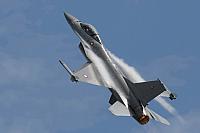
Low pressure air ripping away from the fuselage condenses the late Spring humidity into an iconic pair of white vapor cones engulfing the sides of the jet.

Repositioning for a high-speed pass, Bantam steadies the pressure-sensitive control stick with surgical precision, and slams forward the throttle again. In the cockpit, his world remains as calm and steady as his nerves of steel, hardened by hundreds of hours of training. Outside, the F-16 bolts across the airfield at 725 mph with an ear splitting 135-decibel roar of defiance and unleashed air power. Bantam continues his high intensity aerial demo routine the same as dozens of past performances as the PACAF Viper Demo pilot.
However, this demonstration flight was unlike any other before it because this is the final Demo flight for PACAF’s F-16 Demo Team.
After thirty years of inspiring goodwill and promoting positive relations between the U.S. and partner nations across Indo-Pacific and European theaters, the Pacific Air Forces F-16 Demonstration Team conducted its final demonstration flight at Misawa Air Base, Japan, May 30, 2025.

“Personally, I think it’s the best feeling in the world. Only a select few people have ever been the PACAF Demo pilot,” said Smith. “It’s truly an honor to be the last PACAF Demo pilot to close out this legacy of 30 years, and I get to be the exclamation point at the end.”
Capt. Smith first joined as one of the team’s safety observers in 2022 before becoming the demo pilot.

“When I was first selected to be the demonstration pilot, I was ecstatic, a huge honor,” said Smith. “I was a safety observer a year prior to that, and put my hat in the ring for the job and got it! It’s been off to the races ever since.”

“It’s been the most amazing three years being a part of Demo, but now I’m moving to my next assignment,” he added.

The demo team is scheduled to fully deactivate on June 16, 2025, making this the final Demo flight for PACAF’s F-16 Demo Team.
“By then, Bantam will have changed duty stations,” said Master Sgt. Bradley Pippin, PACAF F-16 Demonstration Team superintendent. “The rest of us will be at the American Day event on June 15, taking photos, signing autographs and giving one final farewell to all the people here at Misawa who have supported us since the beginning.”

Since that beginning in 1995, the demo team played a vital role in not only enhancing U.S. relations with Japan, but also with 20 other countries around the world including but not limited to the Philippines, Mexico, United Kingdom, Egypt, India, Republic of Korea, Australia and Malaysia.

In a 2007 correspondence between the 35th Fighter Wing historian, Senior Master Sgt. Donald Koser, and the first PACAF F-16 Demonstration Team pilot, Lt. Col. Bryan “Shadow” Turner, recounted the creation of the team.

“Now Chief Master Sgt. Lloyd Muranaka and I stood the team up at Misawa AB starting in mid-summer 1995. Prior to that, PACAF did not have a demonstration team,” Turner said. “The PACAF Commander, Gen. John Lorber (former 35th FW commander) directed Misawa to stand up a team. This enabled PACAF to increase visibility within the region, as well as show our allies (and others watching) the caliber of men, women and air power deployed within the region.”

“Overall, during the first two seasons of the PACAF Demo Team, we traveled over 110,000 miles, performed over 40 shows in 6 countries to over 4 million people, including 7 heads of state.”

According to limited data from various demo pilot accounts, internal documents, and previous PACAF news articles, the PACAF F-16 Demonstration Team performed approximately 400 airshows with an estimated 24.7 million attendees over its 30-year tenure as U.S. Air Force ambassadors.

“It is truly an honor representing not only the USAF but the United States as whole around the world and showing off the jet to millions of people,” said Smith. “For 30 years, the demo team has been inspiring the next generation of pilots and airmen. I’ve even met some Japan Air Self Defense Force cadets at the airshows.”

The demo team conducted its final public performance for 117,000 people at the Yokota Air Base during the Japanese-American Friendship Festival, May 17 and 18, 2025. This event hosted two flying aircraft, the second of which was flown by Col. Matthew Kenkel, the 35th Fighter Wing deputy commander.

“It was an honor and a privilege to fly alongside the Demo Team at their final public appearance at the Yokota Friendship Festival, more than 14 years since my last experience on the demo team in 2011,” said Kenkel. “I am continually amazed at the caliber of the Airman selected to be a part of the team and the impact they continue to have all across the Pacific.

As a prior demo team member of three years and wearing the familiar black demo team flight suit, droves of airshow attendees crowded around both Kenkel and Smith for selfies and autographs.

“The energy of the crowd and the dedication of Japanese airshow fans was incredible,” said Kenkel. “Fans brought photos from the day before and asked for autographs, and they stuck it out through rough weather on Saturday to enjoy a great airshow day on Sunday. The connection, the excitement, and the amazing interactions continue to strengthen the alliance between our two nations.”
“Oh man, I wish you could have seen it,” exclaimed Pippin, “People formed a huge line for autographs, and we were just signing everything for two hours right up until closing time! It’s really all about the people, they make all of this so worth it.”

While moments like these reflect the strong community bonds with demo team members, they also underscore the base’s evolving role in regional security and U.S.-Japan defense cooperation.

“Misawa is transitioning to an F-35 fighter wing as part of U.S. Forces Japan’s broader modernization efforts,” said Kenkel. “Basing the F-35 here is a significant investment in regional security and deepens our integration with Japanese allies. This move doesn’t just enhance our deterrence posture today—it sets the tone for what Misawa will represent over the next 40 years: a forward, ready, and modern force at the edge of the Indo-Pacific.”

Courtesy of 35th Fighter Wing

Related articles:


Forum discussion:
Additional images:

PACAF F-16 Demonstration Team members salutes Capt. Ethan "Bantam" Smith, F-16 Demonstration Team commander, during a ground show performance after the team’s final flight at Misawa AB, May 30, 2025. [USAF photo by TSgt. Peter Reft]

Capt. Ethan "Bantam" Smith, PACAF F-16 Demonstration Team commander, conducts aerial maneuvers in an F-16 Fighting Falcon during the team’s final flight at Misawa AB, May 30, 2025. [USAF photo by TSgt. Peter Reft]
☐ ☆ ✇ F-16 Fighting Falcon news

Romania takes delivery of two more F-16s from Norway

May 23, 2025 (by Lieven Dewitte) - Romania’s Air Force continues to bolster its capabilities with the arrival of two more F-16 Fighting Falcons from Norway. The aircraft touched down on May 22 at the 71st Air Base “General Emanoil Ionescu” in Câmpia Turzii, as confirmed by the Romanian Ministry of Defense.

Three more F-16's, purchased from Norway, landed on December 13th, 2024 at the 71st AB in Câmpia Turzii with F-16AM #1636 and #1636 together with F-16BM #1646 seen on the tarmac. [FAR photo]
These jets are part of an ongoing transfer agreement between Romania and Norway involving 32 former Royal Norwegian Air Force F-16s. The contract also includes a package of logistical support, additional gear, and services provided through cooperation with the U.S. government.

With this latest delivery, Romania has now received 18 of the 32 aircraft. Sixteen of them currently serve with the 48th Fighter Squadron at Câmpia Turzii. The two newly arrived jets are destined for the 571st Fighter Squadron stationed at Mihail Kogălniceanu Air Base.

The incoming aircraft will enhance the Romanian Air Force’s ability to perform both national defense and NATO-led air policing missions. These F-16s are tasked with securing Romanian and allied airspace as part of the Permanent Combat Service – Air Policing (SLP-PA), a mission that remains critical in the context of regional security.

Delivered in fully operational condition, the Norwegian F-16s are expected to serve the Romanian Air Force for at least another decade. Their arrival ensures continued capability as Romania prepares for a future transition to a fifth-generation fighter fleet.

Related articles:


Forum discussion:
Additional images:

FAR F-16AM #1638 from Esc. 48 is parked on the tarmac at Câmpia Turzii AB on December 13th, 2024 right after its delivery. [Photo by Alexandru Aioanei]
☐ ☆ ✇ F-16 Fighting Falcon news

Ukrainian Air Force loses another F-16 as pilot ejects during combat mission

May 16, 2025 (by Lieven Dewitte) - The Ukrainian Air Force has lost contact with one of its F-16 fighter jets during a combat mission, prompting the pilot to eject. While the pilot was safely recovered, the aircraft is lost—marking the third known incident involving Ukraine’s newly acquired F-16s since they were introduced into service.

A Ukrainian F-16AM is making a tight right turn with vapor strikes coming off the wings. [Photo by Ukrainian Air Force]
According to an official statement on May 16, contact was lost with the F-16 during a combat sortie. The pilot diverted the plane away from populated areas, and successfully ejected, though the exact cause of the incident has not been disclosed. Ukrainian authorities noted that an investigation is underway to determine whether it was due to hostile fire, technical failure, or other factors.

“The pilot is safe and has been evacuated. The circumstances of the loss are being clarified,” the Ukrainian Air Force said on Telegram, withholding operational specifics due to wartime sensitivities.

Ukraine began receiving F-16s in late 2024, with deliveries coordinated by European partners such as Denmark and the Netherlands, and supported by U.S. pilot training and armaments. The fighter jets are part of Ukraine’s broader effort to modernize its air force and counter Russia’s dominance in the skies.

The F-16s are equipped with advanced radar, electronic warfare capabilities, and modern munitions such as the AIM-120 AMRAAM and JDAM-ER guided bombs. Still, the limited number of aircraft and the intensity of Russian air defenses pose serious challenges.

This marks the third known loss of an F-16 in Ukrainian service:
These incidents reflect both the challenges of fielding advanced combat aircraft in wartime and the high-risk conditions Ukrainian pilots operate in daily.


Related articles:


Forum discussion:
  • Array
☐ ☆ ✇ F-16 Fighting Falcon news

Ukrainian F-16 pilot Pavlo Ivanov killed in combat mission

April 14, 2025 (by Lieven Dewitte) - The Ukrainian Air Force has confirmed the loss of one of its F-16 pilots, Captain Pavlo Ivanov, who died during a combat operation. His death marks a somber moment in Ukraine’s efforts to integrate Western fighter jets into its front-line defenses against Russian aggression.

One of the first F-16s delivered to Ukraine is taking off for a mission. All serials have been removed from this airframe. [Photo by Ukrainian Air Force]
Captain Ivanov was conducting a combat sortie when his aircraft was downed under circumstances that have not been publicly detailed. The Air Force reported his death in an official statement, honoring him as a hero who served with “honor and courage.”

Military authorities have not disclosed the location or the specific mission details due to operational security, but sources within the defense establishment noted that he was flying an F-16 during the mission.

Pavlo Ivanov was a seasoned fighter pilot who transitioned to the F-16 following training provided by Ukraine's Western allies. His colleagues have described him as a disciplined, dedicated officer who quickly adapted to the complexities of flying a 4th-generation multi-role fighter in high-threat combat zones.

Ivanov’s death marks the second confirmed loss of an F-16 pilot in Ukrainian service. The first, Captain Oleksii Mes, was killed in August 2024, also during a combat operation.

Ukraine received its first F-16s in late 2024, and the aircraft quickly became a key component of Ukraine's air defense strategy. The jets are flown by pilots who underwent extensive training abroad and are equipped with modern Western munitions such as AIM-120 AMRAAMs and JDAM-ERs.

Despite their advanced capabilities, Ukrainian F-16s operate in a hazardous environment, often facing formidable Russian air defenses and electronic warfare threats.

Captain Pavlo Ivanov’s death is a stark reminder of the risks faced by Ukrainian airmen in their defense of national sovereignty. His sacrifice will be remembered as part of Ukraine's ongoing struggle to secure its skies and push back against occupation.

Related articles:


Forum discussion:
  • Array
☐ ☆ ✇ F-16 Fighting Falcon news

U.S. sends decommissioned F-16s to Ukraine for spare parts

May 1, 2025 (by Lieven Dewitte) - The United States has begun transferring retired F-16 Fighting Falcons to Ukraine, not as operational aircraft, but as sources of spare parts to support Ukraine's growing fleet of European-donated F-16s.

'Mothballed' F-16s are parked in the 'bone yard' at Davis-Monthan AFB on July 30th, 2010. Maintainers from the 309th AMARG are regenerating F-16s so they can be converted into usable manned or drone targets allowing Airmen to train and test new weapons platforms. [USAF photo by SSgt. Desiree N. Palacios]
These non-operational F-16s, stored at the 309th Aerospace Maintenance and Regeneration Group (AMARG) at Davis-Monthan Air Force Base in Arizona, are being dismantled and shipped to Ukraine. The aircraft lack critical components such as engines and radar systems, rendering them unsuitable for flight. However, they provide valuable parts to maintain and repair Ukraine's active F-16s.

Recent images have surfaced showing disassembled F-16 airframes being loaded onto Ukrainian Antonov An-124 cargo planes in Arizona, with flight tracking data indicating destinations in Poland. This marks the first visual confirmation of such transfers.

While the U.S. has not supplied Ukraine with operational F-16s, it has played a significant role in supporting the sustainment of the aircraft donated by European allies, including Denmark, the Netherlands, Norway, and Belgium. This support includes providing spare parts, maintenance assistance, and pilot training.

In addition to the transfer of spare parts, the U.S. State Department has approved a $310.5 million Foreign Military Sale to Ukraine, encompassing modifications, upgrades, training for operations and maintenance, technical documentation, repair support, and ground handling equipment. Contractors involved in this deal include Valiant Integrated Services, Top Aces Corporation, Lockheed Martin, Pratt & Whitney, and L3Harris.

The provision of these spare parts is crucial for Ukraine to maintain the operational readiness of its F-16 fleet, especially as the country continues to face challenges in its defense efforts. The U.S.'s contribution underscores its commitment to supporting Ukraine's military capabilities through logistical and technical assistance.

Although the United States has yet to send combat-ready F-16s to Ukraine, it has played a vital role in equipping Kyiv’s future fleet. American support includes training Ukrainian pilots via the 162nd Wing of the Arizona Air National Guard and supplying a range of advanced munitions. These include AIM-120 AMRAAM and AIM-9 Sidewinder air-to-air missiles, JDAM-ER precision-guided bombs with an estimated range of 50 miles, Small Diameter Bombs, and HARM missiles designed to target enemy radar systems.

Additionally, the Biden administration previously committed to sending AGM-154 Joint Standoff Weapons — medium-range glide bombs capable of hitting targets over 70 miles away — although it remains uncertain if those have reached Ukraine yet.

Related articles:


Forum discussion:
  • Array

Additional images:

The RNZAF Delegation inspecting the line-up of 28 stored Pakistani F-16s at the Boneyard at Davis Monthan AFB [RNZAF photo]

USAF F-16A block 15 #81-0701 has the checkerboard tail of the 171th FS still applied on the tail when it was spotted in the Boneyard in 2005. [Photo by Phillip Kovaric]

USAF F-16A block 15 #80-0587 from the 169th FS is parked in a row of spraylatted vipers in the Boneyard. [Photo by Phillip Kovaric]
☐ ☆ ✇ F-16 Fighting Falcon news

Bulgarian parliament seeks investigation into potential sabotage of new F-16 jet

May 6, 2025 (by Lieven Dewitte) - The Bulgarian Parliament called for an investigation last Wednesday into possible foreign interference following an incident involving a newly delivered F-16 fighter jet.

First of 16 new F-16 fighter jets from the US arriving in Bulgaria at Graf Ignatievo airbase Wednesday, April 2, 2025. (Photo by Bulgarian Government)
The aircraft, part of Bulgaria's strategic shift towards NATO-standard defence capabilities, arrived from the United States only a month ago. Shortly after its arrival, the jet reportedly experienced technical issues, prompting concerns over potential sabotage.

Members of Parliament have expressed unease regarding the timing and nature of the malfunction, especially given Bulgaria's strategic position within NATO and recent efforts to modernize its air force. The Defense Committee has urged national security agencies to examine the incident thoroughly and determine whether external actors may have been involved.

This development comes amid heightened vigilance over cybersecurity and defense integrity in the region. Previous incidents, such as cyberattacks on Bulgarian government institutions and alleged espionage activities linked to foreign entities, have underscored the need for robust security measures.

The investigation aims to ensure the integrity of Bulgaria's defense acquisitions and to address any vulnerabilities that may compromise national security. As the country continues to align its military capabilities with NATO standards, safeguarding its assets against potential threats remains a top priority.

Related articles:


Forum discussion:
Additional images:

Bulgaria's first F-16 block 70 #311 seen at Lockheed Martin’s Greenville site in South Carolina. [BVVS photo]
☐ ☆ ✇ F-16 Fighting Falcon news

Philippines cleared to buy F-16s at estimated $5.6B

April 3, 2025 (by Lieven Dewitte) - The United States has officially approved the sale of 20 F-16 Fighting Falcons to the Philippines as part of a $5.6 billion weapons package. This milestone decision is a major step in strengthening the Southeast Asian nation’s air force and reinforcing its defense capabilities amid rising regional tensions.

An F-16C block 25 from it's neighbour Indonesia seen here taking off with full afterburner from Halim Perdana Kusuma AFB on October 5th, 2019. [Photo by Alex Sidharta]
After years of deliberation and negotiations, the Philippines has fianlly secured approval to acquire F-16 fighter jets from the United States. The package includes 16 single-seat F-16C Block 70/72 aircraft and 4 twin-seat F-16D Block 70/72 aircraft, which will be fully equipped with 88 LAU-129 guided missile launchers, 22 M61A1 anti-craft guns with 20 installed upon delivery, 12 AN/AAQ-33 sniper advanced targeting pods, radio systems, AESA radars, and navigational devices.

The deal, announced by the U.S. Defense Security Cooperation Agency (DSCA), falls under the U.S. Foreign Military Sales (FMS) program. The approval underscores Washington’s commitment to bolstering the Philippines' defense posture and its role as a key regional ally.

The Philippine Air Force (PAF) has long sought to modernize its aging fleet, which currently relies on older aircraft such as the FA-50 light fighters acquired from South Korea. The acquisition of F-16s will significantly enhance the country’s aerial capabilities, providing a fourth-generation multi-role fighter with advanced avionics, radar systems, and weaponry.

This approval comes at a time when the Philippines faces increasing security challenges in the South China Sea, where tensions with China over territorial disputes continue to escalate. The introduction of F-16s will enable the PAF to conduct more effective air patrols, air defense operations, and joint exercises with allied forces.

In addition to the F-16 aircraft, the U.S. has also authorized the sale of:
  • 112 advanced medium-range air-to-air missiles (AMRAAMs) or AIM-120C-8 or equivalent missiles;
  • 36 guided bomb units;
  • 40 AIM-9X Block II Sidewinder missiles with 32 AIM-9X Block II Sidewinder Captive Air Training Missiles (CATMs);
  • 60 MK-84 2,000-lb general-purpose bombs;
  • and 30 Joint Direct Attack Munition (JDAM) KMU-572 tail kits for GBU-38 or Laser JDAM GBU-54.

These armaments will enhance the operational capabilities of the PAF, providing it with the ability to conduct both defensive and offensive missions with greater precision.

While the deal has been approved, the next step involves contract finalization and production timelines. Lockheed Martin, the manufacturer of the F-16, is expected to begin the delivery process within the next few years, with the first aircraft arriving in the Philippines by the latter half of the decade.

The Philippine Air Force will also undergo extensive training programs to integrate the new fighters into its fleet effectively. Pilots and maintenance crews will receive training in the U.S. to ensure seamless operation and maintenance of the new aircraft.

The PAF has been examining two combat aircraft on offer, the Lockheed Martin F-16 Block 70/72 and the Saab Gripen-E.

Note that the authorization for the F-16 sale does not automatically mean that an acquisition will go through. The deal will only be finalized after a letter of offer and acceptance is signed by the Philippines. This means that an official confirmation from Manila is still awaited.

Related articles:


External link:
Forum discussion:
  • Array

Additional images:

TNI-AU F-16C block 25 #TS-1641 from SkU 14 is adorned with a special tail on October 21st, 2024. [Photo by Mcaskil]

Two Indonesian vipers, fully armed with 4x AIM-9 and 2x AGM-65 missiles, flying low (200 ft) over Gulf Of Popoh, South of East Java Province. [Photo by Capt.Agung "Sharky" Sasongkojati]

Indonesian Air Force F-16BM #TS-1603 after repainted. TS-1603 had a mishap in 2017 and was grounded until 2024 when it was upgraded to MLU standard. TS-1603 was handed to the squadron on January 16th, 2025. [Photo by Mcaskil]
☐ ☆ ✇ F-16 Fighting Falcon news

Bulgaria receives first of 16 new F-16s

April 3, 2025 (by Lieven Dewitte) - Bulgaria has officially received the first F-16 Fighting Falcon it bought, marking a major step in modernizing its air force and aligning with NATO standards. The arrival of the jet at Graf Ignatievo Air Base on April 3, 2025, signals a new era for Bulgaria’s defense capabilities.

First of 16 new F-16 fighter jets from the US arriving in Bulgaria at Graf Ignatievo airbase Wednesday, April 2, 2025. (Photo by Bulgarian Government)
Bulgaria has long sought to replace its aging Soviet-era MiG-29 fleet, and the arrival of the first F-16 Block 70 is a significant milestone. The new aircraft, part of a $1.3 billion deal signed in 2019, is the first of eight jets initially ordered. The country later secured a second batch of eight additional F-16s in 2022, bringing the total order to 16 aircraft expected to be delivered by 2027.

Prime Minister Rosen Zhelyazkov hailed the delivery of the first jet at Graf Ignatievo Air Base, emphasizing the aircraft’s role as more than just a fighter jet. He described it as a symbol of Bulgaria’s strategic partnership with the United States, strengthening the country’s defense and reinforcing its commitment to NATO.

The original plan aimed for the first aircraft to arrive in 2023, but supply chain disruptions caused by the COVID-19 pandemic delayed deliveries. Despite these setbacks, the Bulgarian government remained committed to the modernization program. With Russia’s ongoing war in Ukraine and increasing regional security concerns, the need for advanced NATO-compatible aircraft has become more pressing.

Until the new fleet becomes fully operational, Bulgaria has been relying on NATO allies to assist in air policing duties. The introduction of the F-16 Block 70 will provide the country with a much-needed boost in air defense capability, allowing it to contribute more effectively to the alliance’s collective security efforts.

The F-16 Block 70 is the most advanced version of the Fighting Falcon, featuring cutting-edge avionics, improved radar systems, and enhanced combat capabilities. These upgrades will provide Bulgaria with a modern, multi-role fighter that can perform air defense, ground attack, and reconnaissance missions with increased efficiency.

The arrival of the first jet represents the beginning of a broader transformation for Bulgaria’s air force, with pilots and ground crews undergoing training to transition to the new platform. Lockheed Martin, the manufacturer of the F-16, is supporting the integration process, ensuring Bulgaria can maximize the capabilities of its new fleet.

Related articles:


Forum discussion:
  • Array

Additional images:

First of 16 new F-16 fighter jets from the US arriving in Bulgaria at Graf Ignatievo airbase Wednesday, April 2, 2025. (Photo by Bulgarian Government)

BVVS F-16C block 70 #311 is taking off from Greenville IAP on November 18th, 2024 [Photo by Brady Ensley]

BVVS F-16D block 70 #301 is shown during the delivery ceremony at the Lockheed plant at Greenville IAP in January of 2025. [Lockheed photo]
☐ ☆ ✇ F-16 Fighting Falcon news

77 FS ‘Gamblers' make their first appearance at Cope Tiger 25

March 31, 2025 (by MSgt. Jerilyn Quintanilla) - The U.S. Air Force 77th Fighter Squadron ‘Gamblers' have flown countless missions supporting numerous conflicts and exercises around the world for 107 years, making them one of the most storied flying units still operating. Today, they're bringing that knowledge and lethality to the Pacific theatre for Cope Tiger 25—a rare first in the unit's long history.

Airmen assigned to the 77th EFS stand in formation for a group photo during Cope Tiger 25, at Korat Royal Air Base, Thailand, on March 7, 2025. The 77th EFS is based out of Shaw AFB, and is participating in the 31st iteration of exercise Cope Tiger, an annual trilateral exercise with the RTAF and RSAF. [USAF photo by SSgt. Sidney Shippy]
Exercise Cope Tiger was established in 1994 and over the years has evolved to match the needs and missions of three nations, the United States, Singapore, and Thailand. It retains the same key, time-tested purpose: providing participants with a platform to train and enhance tactics, techniques and procedures while simultaneously increasing interoperability and fostering relations amongst the partner nations.

"It's the 31st anniversary of doing this exercise but it's the first time for the 77th Fighter Squadron," said USAF Lt. Col. Steven McCord, 77th FS detachment commander. "We're looking to take a lot from our allies and partners, the Royal Thai Air Force and Republic of Singapore Air Force, because every time we train together we get a little bit better at integrating."

According to USAF Maj. Gregory Rinker, 77th FS pilot and USAF exercise project officer, "Suppression of Enemy Air Defenses" is the defining mission capability the ‘Gamblers' bring to the fight.

"For decades, the 77 FS has proudly carried the "Wild Weasel" mantle, consistently preparing to be the ‘first in, last out' force within any combat area of responsibility," Rinker said. "Our F-16s and pilots leverage their expanding capabilities and experience to not only achieve tactical objectives but also maximize interoperability with allied partners."

Out on the training range all three nations are not only testing their own capabilities, they're pushing one another to increase their abilities and limits.

"This is a very important exercise for the Republic of Singapore Air Force. It's the only event where we bring together all the different parts of our Air Force," said RSAF Col. Lee Yew Chern Benjamin, CT25 Exercise Director. "We come here to train with our partners, with the U.S. as well as Thailand in a very challenging and dynamic environment."

The ‘Gamblers' also participated in the recent Cobra Gold 2025 exercise held in Thailand, where they flew similar missions for regional security cooperation, promoted interoperability among participating nations, and practised new tactics with international partners never before seen at the event.

The amount of working practice in sorties flown and hours of mission planning are vital; but for Rinker, it is not the most rewarding part of CT25.

"The most rewarding aspect of these exercises is the opportunity to foster enduring relationships with our allies," Rinker said. "Collaboratively developing plans and then witnessing their tactical evolution through shared experiences builds confidence and trust between our nations for future operations."

Courtesy of Pacific Air Forces

Related articles:


Forum discussion:
Additional images:

USAF F-16 Fighting Falcons assigned to the 77th EFS taxis on the flightline prior to take off, during Cope Tiger 25, at Korat Royal Air Base, Thailand on March 19, 2025. The Cope Tiger exercise provides the USAF,RTAF, and the RSAF with an optimal training environment to enhance readiness, interoperability and combined capabilities. [USAF photo by MSgt. Jerilyn Quintanilla]
☐ ☆ ✇ F-16 Fighting Falcon news

End of an era: the last USAF F-16 flight from Luke AFB

March 26, 2025 (by Lieven Dewitte) - For nearly 45 years, Luke Air Force Base has been synonymous with the F-16 Fighting Falcon, training thousands of pilots and maintaining a crucial role in the aircraft’s legacy. However, with the U.S. Air Force shifting its focus to fifth-generation platforms like the F-35 Lightning II, the base has now bid farewell to its last operational F-16.

U.S. Air Force Lt. Col. Michael Ress, 309th Fighter Squadron commander, climbs into the cockpit of an F-16 Fighting Falcon to pilot the final U.S. F-16 flight out of Luke Air Force Base, March 24, 2025, delivering it to the 16th Weapons Squadron at Nellis AFB. This flight concludes the divestment of the remaining U.S. F-16s, ending this chapter for the 309th FS as it prepares to transition to the F-35A Lightning II. [USAF photo by Senior Airman Katelynn Jackson]
On March 24, the final F-16 flight (#89-2173ALPLACEHOLDER1PH) from Luke AFB took off, flown by the 56th Fighter Wing, which has long been responsible for training both U.S. and allied fighter pilots. The event marks the official transition of Luke AFB into a dedicated F-35 training and operational base.

Luke AFB has played a vital role in the development of F-16 pilots since the early 1980s. As one of the premier training bases, it has been instrumental in preparing pilots for combat missions worldwide. The 56th Fighter Wing, known as the "Thunderbolts," has trained generations of F-16 aviators, ensuring air superiority for the U.S. and its allies.

The departure of the F-16 from Luke comes as the Air Force continues to modernize its fleet. The transition to the F-35 allows for enhanced multi-role capabilities, aligning with the service’s long-term strategic goals. Luke AFB began transitioning F-16 squadrons into F-35 squadrons in the early 2000s, the 309th FS being the last to transition out of the six fighter squadrons on base.

The F-16 pilot training program began over 42 years ago in 1983 and has graduated over 20 thousand pilots since. The final class of F-16 student pilots graduated from the 309th FS in September 2024, and the last local training sortie was in February of 2025.

Luke AFB will continue to fly and train F-16 Republic of Singapore Air Force fighter pilots and maintainers from the 425th FS until they transition to Ebbing Air National Guard Base, Arkansas, in the coming years. Other than that, their focus now shifts entirely to the F-35 program. The base is already home to a significant F-35 training mission, providing instruction to pilots from the U.S. and partner nations. With the phase-out of the F-16 complete, Luke will further solidify its role as a key center for fifth-generation fighter training.

The final F-16 flight from Luke AFB represents the end of an iconic era for the base and the aircraft’s training mission there. While the Fighting Falcon leaves behind a storied legacy, its departure paves the way for the next generation of airpower. As Luke AFB fully transitions to the F-35, the base remains at the forefront of fighter pilot training, ensuring continued air dominance for years to come.

Related articles:


Forum discussion:
Additional images:

U.S. Air Force 56th Fighter Wing Airmen watch the final U.S. F-16 taxis to the runway, March 24, 2025, on the flightline at Luke Air Force Base, preparing to fly to the 16th Weapons Squadron at Nellis AFB. [USAF photo by Senior Airman Katelynn Jackson]

U.S. Air Force Lt. Col. Michael Ress, 309th Fighter Squadron commander, walks out of the 309th FS to pilot the final U.S. F-16 Fighting Falcon flight out of Luke Air Force Base, March 24, 2025, delivering it to the 16th Weapons Squadron at Nellis AFB. [USAF photo by Senior Airman Katelynn Jackson]

The millionth F-16 flying training hour at Luke AFB was reached on March 13th, 2013. F-16s first touched down at Luke AFB on December 6th, 1982. To date, Luke has graduated 18,164 F-16 fighter pilots. Approximately 2,000 F-16 hours are flown a month by Luke pilots and students. This photo shows F-16D block 42 #89-2157 from the 309th FS. [USAF photo by A1C. Devante Williams]
☐ ☆ ✇ F-16 Fighting Falcon news

F-16 Block 40 fires SOM-J cruise missile in Turkey’s latest weapons test

March 25, 2025 (by Lieven Dewitte) - Turkey has successfully carried out a test launch of the SOM-J, a next-generation air-launched cruise missile (ALCM), from an F-16 block 40. This development is part of Turkey’s broader efforts to enhance its indigenous defense capabilities and reduce reliance on foreign-made weapon systems.

A Turkish F-16 of the 401st Test Squadron launches a SOM-J missile on 21/03/2025 [Picture source: Turkish MoD - serial blurred out]
Developed by TÜBİTAK SAGE, the Defence Research and Development Institute of Turkey and Roketsan, the SOM-J is a variant of the SOM (Turkish: Satha Atılan Orta Menzilli Mühimmat) family, designed primarily for use on fighter aircraft such as the F-16 and the F-35. It offers extended-range precision strike capabilities against high-value, heavily defended land and naval targets.

According to Turkish defense sources, an F-16 of the TUAF 401st Test Squadron fired the SOM-J cruise missile on March 21st and achieved a successful strike on the target in open waters with pinpoint accuracy. The test firing validated the missile’s advanced guidance, target acquisition, and precision strike capabilities in real-world conditions, ensuring its effectiveness in future combat scenarios.

Key highlights of the SOM-J:
  • Stealth and Precision: The missile features low-observable characteristics, making it harder for enemy air defenses to detect and intercept.
  • Extended Range: It boasts a range of approximately 250+ km (155+ miles), enabling stand-off strikes beyond enemy defenses.
  • Advanced Guidance System: Uses GPS/INS navigation combined with an imaging infrared (IIR) seeker for high-accuracy targeting.

Strategic Importance
The successful test comes at a time when Turkey continues to develop its domestic defense industry, aiming for greater self-sufficiency in military technology. The integration of the SOM-J onto Turkey’s F-16 fleet significantly enhances the aircraft’s strike capabilities, especially in contested environments.

Additionally, the missile’s compatibility with the F-35 was initially a major selling point, though Turkey's removal from the F-35 program has shifted its focus to alternative platforms, including its indigenous TF-X fighter project and UCAV such as the Bayraktar Akıncı and Kizilelma. However, the SOM-J remains a viable option for other allied nations operating the F-35, potentially expanding Turkey’s defense export opportunities.

With the successful test of the SOM-J, Turkey has demonstrated its growing ability to produce advanced precision-strike weapons.

Related articles:


Forum discussion:
  • Array

Additional images:

TuAF F-16C block 40 #91-0015 from 401 Filo is parked on the tarmac at Eski&scedil;ehir AB. [TuAF photo]
☐ ☆ ✇ F-16 Fighting Falcon news

F-16s to get AGM-158C LRASM: a game-changing upgrade

March 19, 2025 (by Lieven Dewitte) - The F-16 Fighting Falcon is now set to gain a powerful new weapon in its arsenal—the AGM-158C LRASM (Long Range Anti-Ship Missile). This capability will significantly enhance the aircraft’s ability to engage naval threats at extended ranges, positioning the F-16 as a more viable platform for maritime strike operations.

USAF F-16C block 50 #91-0396 from the 40th Flight Test Squadron at Eglin carrying an AGM-158 JASSM-ER [Photo bny USAF]
According to recent reports, the U.S. Air Force has confirmed plans to integrate the AGM-158C-1 variant of the missile onto select F-16 units. The LRASM, developed by Lockheed Martin, is a stealthy, precision-guided cruise missile designed to locate and destroy enemy ships even in highly contested environments. It builds upon the successful AGM-158 JASSM (Joint Air-to-Surface Standoff Missile) but incorporates enhanced sensors and guidance systems tailored for maritime engagements.

While traditionally employed in air-to-air and air-to-ground roles, the F-16 has seen increasing emphasis on maritime strike capabilities. The LRASM’s integration into the fleet aligns with broader U.S. defense strategies that prioritize countering potential naval threats, particularly in regions like the Indo-Pacific and the Baltic Sea. The missile carries a 450 kg fragmentation-explosive warhead, designed to inflict severe damage on surface vessels.

The aircraft’s existing anti-ship capability is limited, primarily relying on the AGM-84 Harpoon missile. However, the extent to which Air Force F-16 units currently operate the Harpoon remains unclear.

Equipping the F-16 with the AGM-158C brings several advantages:
  • Extended Range: The missile is capable of striking targets over 300 nautical miles away, keeping the launching aircraft at a safer distance from enemy defenses.

  • Stealth and Survivability: Its low-observable design reduces detection by enemy radar systems.

  • Advanced Targeting: Using an onboard multi-mode sensor and artificial intelligence, LRASM can independently locate and strike priority targets even in GPS-jammed environments.


This upgrade is expected to be particularly beneficial for U.S. allies operating the F-16, as it provides a new level of operational flexibility. Countries like Taiwan, Poland, and other NATO partners could potentially benefit from this capability, strengthening their deterrence against maritime threats. When exactly F-16s might start flying operationally with LRASM is unknown however.

While traditionally not viewed as a dedicated maritime strike aircraft, the F-16’s ability to carry the LRASM opens new operational possibilities. It is likely that only select squadrons will receive this upgrade, with a focus on regions where naval threats are of greater concern.

This development also raises questions about further enhancements to the F-16’s maritime strike role, potentially including networking capabilities with naval assets and additional standoff weapon integration.

Related articles:


External link:
Forum discussion:
  • Array

Additional images:

F-16 # 92-3926 assigned to the 53rd Test and Evaluation Group taxies with a U.S. Navy Harpoon missile system equipped at Nellis Air Force Base, Nevada. (U.S. Air Force photo by Airman 1st Class Timothy Perish)

An F-16 (#88441) from the Eglin Test force carrying the AGM-158 Joint Air-to-Surface Standoff Missile [USAF photo]
☐ ☆ ✇ F-16 Fighting Falcon news

Belgium will not send F-16s to Ukraine in 2025

March 4, 2025 (by Lieven Dewitte) - The Belgian government has confirmed that it will not be delivering F-16 fighter jets to Ukraine this year, despite a previous commitment.

BAF F-16AM #FA-95 from 10 wing is adorned with a special 8,000 hours tail scheme seen on September 6th, 2023. The aircraft will make it's final flight on September 8th reaching those 8,000 hours. [BAF photo]
Former Prime Minister Alexander De Croo pledged in April 2024 to send two F-16s by the end of the year, as part of a broader promise to provide 30 jets by 2028 under a security agreement signed with Ukrainian President Zelensky.

Belgium is a member of the "F-16 coalition," a group of nations—including the Netherlands and Denmark—that are donating surplus F-16s to Ukraine. In total, around 75 aircraft have been pledged.

Ukraine requests a halt in additional F-16 deliveries
Operating an F-16 fleet requires trained personnel and logistical support, which remains a challenge for Ukraine. Pilot training has been slower than expected, leading Ukraine to request a temporary stop on additional F-16 deliveries. The country does not want to store aircraft it cannot effectively deploy due to shortages of pilots, weapons, or spare parts, as they would become prime targets for Russian airstrikes. Instead, it prefers to keep them in safe locations in donor countries.

Belgian Air Force’s own need for spare parts
Belgium is gradually retiring its aging F-16 fleet in favor of F-35s, but delays in this transition have created a high demand for spare parts. The F-16s Belgium intended to donate were likely non-operational aircraft, valuable primarily for their spare components. According to sources, as long as Ukraine does not urgently require these spare parts, Belgium sees more benefit in retaining them to sustain its own fleet.

Related articles:


Forum discussion:
☐ ☆ ✇ F-16 Fighting Falcon news

Lack of Link 16 possibly caused fatal Ukrainian F-16 crash

February 16, 2025 (by Lieven Dewitte) - According to The Wall Street Journal, the August F-16 crash that claimed the life of Oleksiy ‘Moonfish’ Mes might have been prevented if the U.S. had provided a critical tactical system.

The ex-Royal Danish Air Force F-16A block 20 MLU that was shot down
The Wall Street Journal has published a column on the likely cause of the F-16 crash that killed pilot Oleksii Mes on August 26, 2024. According to the report, the aircraft was mistakenly shot down by a Patriot air defense system.

Sources suggest the incident may have occurred because the American-supplied equipment had been modified before deployment, with one key recognition system removed. The Link 16 tactical network, which enhances situational awareness by integrating aircraft, ground units, air defenses, and command centers in real time, was not in place. This system improves coordination among allies and reduces risks for pilots.

Ukraine received its first Patriot air defense systems in April 2023. WSJ cites Dariia Kaleniuk, co-founder of the International Centre for Ukrainian Victory, as saying that the Patriots were disconnected from Link 16 because Ukraine was not initially expected to receive F-16s. When the decision was later made to supply the jets, the issue remained unresolved.

The article suggests that the U.S. may have withheld Link 16 due to concerns over security, reflecting what it describes as the Biden administration’s cautious approach to military aid for Ukraine.

The Pentagon declined to comment on the specific configuration of weapons provided to Ukraine, directing inquiries to Ukrainian officials. Meanwhile, sources indicate that efforts are being made to address the issue, though no further details were disclosed.

Related articles:


Forum discussion:
Additional images:

PS ZSU F-16AM #80-3596 is pulling some G's after take-off armed with AIM-120 and AIM-9 missiles in an A/A configuration. [PS ZSU photo]

A Ukrainian F-16AM is making a tight right turn with vapor strikes coming off the wings. [Photo by Ukrainian Air Force]
❌