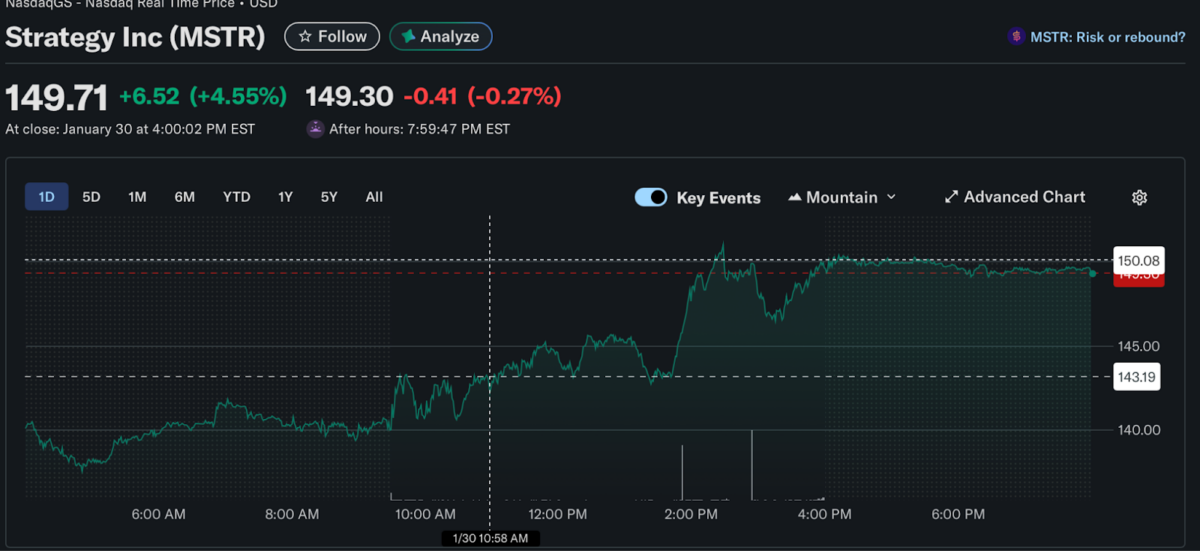
Strategy’s stock rose about 4.55% even though Bitcoin fell 7% and dropped below the $80,000 level.
The company holds 712,647 BTC, about 3.4% of all Bitcoin, so its stock usually moves with Bitcoin’s price.
Analysts warned the stock could fall, while Peter Schiff criticized Strategy’s Bitcoin plan after the firm reported a $17.44 billion unrealized loss in Q4 2025.
Shares of Strategy Inc. (NASDAQ: MSTR), the Bitcoin-focused treasury firm, finished Friday’s session up 4.55% at $149.71, while Bitcoin (BTC) continued selling off after-hours and through Saturday, slipping below the $80,000 support level. Now the question is, will Strategy share maintain its value, or will it follow Bitcoin?
Unlike Bitcoin, which trades 24/7, U.S. equities do not trade on weekends. As a result, MSTR has not yet reacted to Bitcoin’s latest leg down.
Bitcoin is currently trading around $77,756, down from a daily high of $84,230. The cryptocurrency has fallen nearly 13% over the past week, while daily trading volume dropped 12% to $62 billion, according to CoinMarketCap.
This difference in price correlation is surprising considering the fact that the company’s stock moves amid Bitcoin price swings. The company holds 712,647 BTC, which is roughly 3.4% of the total Bitcoin supply. With that volume, the stock usually moves closely with Bitcoin’s price action, making MSTR’s rise unusual.
The move suggests that short-term market sentiment may be influencing the stock differently from Bitcoin. Some investors may see the recent Bitcoin sell-off as an opportunity to buy Strategy shares at lower levels.
Analysts warn of potential downside
Analysts are keeping a close eye on the stock. In a recent post on X, market analyst Aksel Kibar said the MSTR chart is displaying a “long-forming topping structure” on the weekly chart and could drop to $120. He added that the recent price swings are forming lower highs, which is a sign that the price could be trading downwards. The stock recently traded slightly below its 52-week low before rebounding.
Despite the recent bounce, MSTR is still down more than 7% for the year. Analyst Ted Pillows also shared his outlook, noting that the stock has lost its prior monthly upward trend and is trading below key momentum indicators.
Meanwhile, crypto analyst Benjamin Cowen compared the stock’s cycle to previous years, suggesting that it could reach a low point by October 2026.
Peter Schiff criticizes Strategy’s Bitcoin plan
Economist Peter Schiff also weighed in, criticizing Strategy’s Bitcoin-focused approach. In a post on X, Schiff noted that the stock is “almost 70% below its peak,” seemingly attributing the decline to the company’s Bitcoin treasury plan. He noted that Strategy spent over $52 billion to buy more than 700,000 BTC at an average of $76,000 per coin.
$MSTR closed down 9.5% today, a new 52-week low. The stock is down nearly 70% from its high. @Saylor spent $54 billion over the past five years buying over 712K bitcoin at an average price of just over $76K. His total unrealized gain is less than 11%. Too bad he didn’t buy gold!
Schiff pointed out that in Q4 2025, the firm reported an unrealized loss of $17.44 billion after Bitcoin fell 25% in the quarter. He argued that the small 11% gain over five years would have been much larger if the company had invested in gold instead. Schiff added that central banks have continued to accumulate gold because it is seen as a safer store of value.
Strategy’s recent Bitcoin purchase
Earlier this month, Strategy bought 2,932 BTC for $264 million through a stock offering program. The company sold 1.57 million shares, raising $257 million, with $8.17 billion still available for future offerings.
Despite Bitcoin’s drop, Strategy’s total Bitcoin holdings remain valued at about $59 billion. Other firms with large Bitcoin positions, like Marathon Digital and Japan-based Metaplanet, also saw stock declines, dropping 6.65% and nearly 4%, respectively, in response to Bitcoin’s price movement.
While Strategy’s large Bitcoin holdings make it a key player in the crypto market, they also add risk. The stock can sometimes move differently from Bitcoin in the short term, but long-term results still depend on how Bitcoin performs.
Capital outflows from high-value Ordinal inscriptions led to a 71% drop in Bitcoin-based NFT revenue this week.
Despite the decline in dollar volume, the Bitcoin network saw a 30% surge in new participants seeking lower entry points.
The current downturn signals a shift from a speculative whale-driven market toward a high-volume retail environment.
The digital collectibles market saw a sharp slowdown this week, with NFT sales declining by 41% across major blockchains. According to CryptoSlam data, Bitcoin-based NFT sales, primarily driven by Ordinals, witnessed a 70.07% decline in volume as of Saturday.
Despite the broader slowdown, CryptoPunks and Bored Ape Yacht Club (BAYC) continued to rank among the top 10 collections by monthly volume.
Blockchain by NFT Sales Volume (30 Days) | Source: CryptoSlam
Flying Tulip PUT led the month overall, with $74 million in sales. While CryptoPunks recorded more than $13 million in volume, outperforming most newer projects and rising 57% week-over-week, BAYC recorded $6 million in sales, rising 21%.
Divergence in market activity
The current market conditions create a confusing environment where financial activity and retail engagement are diverging. Although Bitcoin NFT sales volume declined by over 70% to $6.66 million, the network still saw a 30.87% increase in new participants.
At the time of writing, the total number of buyers for the week has reached 10,905. This suggests that while major transactions have slowed, a new group of smaller collectors is joining the ecosystem.
Blockchains by NFT Sales Volume | Source: CryptoSlam
Ethereum continued to dominate all blockchains with $46.92 million in NFT sales, falling 38.78% over the seven-day period. The network drew 28,096 buyers, up 18.26% from the prior week. Wash trading on Ethereum totaled $4.94 million during this timeframe.
Base recorded $2.26 million in NFT sales, marking a 35.45% gain, while BNB Chain followed with $7.73 million, reflecting a 10.24% increase over the past week.
This recent volatility follows a time when Bitcoin Ordinals had become a major player in the NFT space, often matching or surpassing Ethereum in daily volume. However, the current downturn is a part of the overall cooling down of the speculative fervor that led to record-breaking asset prices a few months ago.
Correlation with asset prices
The NFT market has traditionally followed the price actions of the underlying assets, such as Bitcoin and Ethereum, which have been under pressure lately.
The current trend indicates substantial “bottom-fishing” activity in the Bitcoin space. The data indicates that institutional and “whale” liquidity are leaving high-priced Ordinals, while retail collectors are seizing the opportunity to join the ecosystem at lower prices.
Future market outlook
This trend suggests that even though the total value of the market is decreasing, the number of holders is actually growing, which could lead to a more decentralized ownership structure for Bitcoin-based digital assets.
The future of this shift depends on whether these new retail participants stay active if prices remain flat. If the trend of increasing buyer numbers continues despite falling volumes, the market might be moving from a high-stakes speculative space to a more accessible retail environment.
Kevin Warsh’s nomination signals the first serious crypto-aware leadership shift inside the Federal Reserve.
Warsh’s advisory roles with crypto firms contrast sharply with Jerome Powell’s cautious, dollar-first approach.
Trump’s Fed reset ties interest rates, Bitcoin, and U.S. financial power more closely than ever before.
In a move that has sent shockwaves through Wall Street and the crypto world, the U.S. President Donald Trump nominated Kevin Warsh to succeed Jerome Powell as Chair of the Federal Reserve on January 30, 2026.
This was not a routine leadership change at the world’s most powerful central bank. It marked a sharp philosophical turn at a moment when interest rates, digital assets, and the global role of the U.S. dollar are colliding in ways not seen since the end of the Bretton Woods system.
Trump’s choice of Warsh signals a deliberate shift away from the Powell-era Federal Reserve, which treated crypto largely as a speculative side effect of excess liquidity, toward a leadership that views digital assets as a direct response to monetary policy itself.
But why Warsh? What is the nature of his long and largely unexamined relationship with crypto? And is there more at stake than monetary theory, including potential alignment with Trump’s own financial and political interests in digital assets?
This article examines angles rarely discussed in mainstream coverage: Warsh’s direct advisory roles in crypto firms like Bitwise and Electric Capital, his early investment in algorithmic money experiments, the clash between Powell’s dollar-first orthodoxy and Warsh’s “Bitcoin as discipline” thesis, and the increasingly blurred boundary between public policy and private gain.
It also explores controversial peripheral issues, including Warsh’s appearance in recently released Epstein-related documents, not as an accusation but as a window into elite financial networks that quietly shape power.
Everything you need to know about Kevin Warsh: Trump’s pick to lead the Federal Reserve
Kevin Warsh is no outsider to the Federal Reserve. He rose rapidly through finance and policy circles, becoming one of the youngest Fed Governors in history when President George W. Bush appointed him in 2006. He served until 2011 and played a central role during the 2008 global financial crisis, a period that continues to define debates over central bank authority.
During that crisis, Warsh was deeply involved in designing emergency lending programs aimed at stabilizing frozen credit markets. He worked closely with the Treasury Department on initiatives that intersected with the Troubled Asset Relief Program, collaborating with figures such as Neel Kashkari, now President of the Minneapolis Federal Reserve. Those measures helped avert systemic collapse, but they also left Warsh uneasy about the long-term consequences of extraordinary intervention.
As the crisis faded, Warsh emerged as one of the earliest and most vocal internal critics of the Fed’s post-crisis policy direction. He warned that prolonged near-zero interest rates and large-scale asset purchases would distort asset prices, inflate speculative behavior, and weaken confidence in the dollar. His vote against the second round of quantitative easing in 2010 cemented his reputation as a monetary hawk who prioritized price stability over market support.
After leaving the Fed, Warsh joined Morgan Stanley and later became a distinguished visiting fellow at Stanford’s Hoover Institution. He also married Jane Lauder, heir to the Estée Lauder fortune, embedding him within elite Republican donor and financial networks. To Trump, this combination of polish, pedigree, and ideological clarity made Warsh “central casting” for the role.
Trump announced the nomination on Truth Social, praising Warsh as a “GREAT Fed Chairman” who would reverse what he described as Jerome Powell’s “stubborn” and growth-suppressing policies. The timing mattered. The announcement came amid renewed volatility in crypto markets, with Bitcoin sliding to around $82,800, down roughly 7% on the week, as traders reassessed the future path of interest rates.
Why did Trump remove Jerome Powell?
Trump’s decision not to reappoint Powell, whose term as Chair ends in May 2026, though his Board seat runs until 2028, was driven by a convergence of personal, ideological, and strategic conflicts.
Interest rates and the crypto liquidity war
At the center was the interest rate. Under Powell, the Federal Reserve raised rates aggressively to combat inflation and then held them at restrictive levels longer than markets expected.
By late 2025 and early 2026, rates remained in the 3.5% to 3.75% range. Powell argued that easing too soon would risk inflation’s return and undermine the Fed’s credibility.
Trump saw it differently. High rates increased the cost of servicing a $38 trillion national debt, suppressed asset prices, and drained liquidity from risk markets, including crypto. Trump repeatedly compared the Fed unfavorably with the European Central Bank, which had already begun cutting rates, and publicly labeled Powell “Mr. Too Late.”
The Fed renovation fight
Tensions escalated in late 2025 when Trump-aligned officials launched a public and legal offensive against Powell over a $2.5 billion renovation of the Fed’s headquarters.
The Justice Department opened an investigation into whether Powell had misled Congress about cost overruns. Powell denied wrongdoing and characterized the probe as political pressure aimed at forcing rate cuts.
To Trump allies, the renovation symbolized an insulated and unaccountable central bank. To Powell, it was a red herring. The conflict made reconciliation impossible.
Ideology and the “Woke Fed”
Trump also accused Powell of allowing the Fed to drift into non-core issues, including climate risk analysis and diversity initiatives in banking supervision. Powell defended these efforts as risk management. Warsh publicly disagreed, arguing in interviews that the Fed should narrow its mandate and focus exclusively on monetary discipline.
Removing Powell was not just retaliation. It cleared the path for a Federal Reserve aligned with Trump’s broader economic vision, including a more permissive stance toward crypto.
Why Trump chose Kevin Warsh: The strategic calculation
Warsh offered Trump something Powell never would: intellectual alignment without institutional rebellion. As a former Fed Governor and Wall Street insider, Warsh carried establishment credibility. Yet unlike Powell, he openly acknowledged crypto as a consequence of monetary policy rather than a fringe distraction.
Trump saw Warsh as a bridge. A figure who could reassure markets about inflation while understanding why Bitcoin exists at all.
The hidden crypto connection: What Warsh has actually done
Warsh’s crypto ties are not speculative. They are documented.
He served as an advisor to Bitwise Asset Management, one of the largest crypto index fund managers, whose business depends on institutional adoption and regulatory clarity, as per chatter on X.
He also advised Electric Capital, a venture firm focused almost exclusively on blockchain and crypto-native companies whose valuations are directly influenced by interest rates, banking access, and regulatory interpretation.
Most significantly, Warsh was an early investor in Basis, an algorithmic stablecoin project that sought to create a decentralized, rules-based monetary system capable of expanding and contracting supply without human discretion.
While Basis ultimately shut down under regulatory pressure, its ambition mirrored Warsh’s long-standing critique of discretionary central banking.
These experiences informed Warsh’s public views. He has described Bitcoin as “digital gold” and as a “policeman” on central banks. In his framework, Bitcoin does not threaten the dollar directly. It exposes policy failure. When central banks keep rates artificially low for too long or blow up their balance sheets, Bitcoin turns into the escape hatch. Not because it’s trendy, but because people start looking for an exit from monetary excess.
Powell vs Warsh vs Trump on crypto and the dollar
Jerome Powell has always treated crypto as something on the sidelines. To him, it’s speculative, volatile, and full of consumer risk. His focus stayed firmly on protecting the dollar and preserving financial stability.
Under Powell, banks became more cautious about touching crypto, stablecoins were put under a microscope, and Bitcoin was never acknowledged as anything close to a serious monetary alternative.
Donald Trump’s view is very different and far more strategic. He frames crypto through the lens of power and sovereignty. He’s openly hostile to CBDCs, but supportive of private-sector innovation, Bitcoin holdings, and the idea that the U.S. should lead the digital finance race. For Trump, crypto isn’t just an asset — it’s a geopolitical tool to reinforce American dominance in the next financial era.
Warsh sits between them. He does not advocate loose money or crypto evangelism. But he acknowledges that crypto exists because monetary policy matters, and that ignoring it weakens, rather than strengthens, the dollar’s credibility.
The upsides and risks for crypto
Warsh could legitimize crypto by acknowledging its role in modern finance and supporting wholesale digital dollar infrastructure. At the same time, his hawkish stance on inflation, balance sheets, and stablecoin regulation could restrain speculative excess and suppress short-term rallies.
Markets recognize the contradiction. Bitcoin often sells off after Fed announcements, even during cutting cycles, reflecting disappointment rather than relief. Warsh’s presence amplifies that uncertainty.
Power, Proximity, and Perception
Trump’s own crypto-linked ventures, including World Liberty Financial (WLFI), stand to benefit from lower rates and regulatory clarity. Warsh’s past advisory roles have raised inevitable questions about conflicts of interest, even if he adheres to all recusal requirements.
Separately, his name appeared in recently released Epstein-related documents, tied to a social reference from 2010. No wrongdoing has been alleged, but the mention added to public scrutiny and served as a reminder of how elite social and professional circles often intersect away from public view.
Conclusion: The great convergence of power and crypto
The nomination of Kevin Warsh marks a turning point. For the first time, a prospective Fed Chair has not only studied crypto but also participated in its financial and ideological development. Trump’s decision reflects a belief that the future of money cannot be separated from politics, power, or technology.
Whether this convergence strengthens the dollar or blurs the boundary between public policy and private interest will depend on what comes next. What is already clear is that crypto is no longer outside the Federal Reserve’s walls. It has entered through the career of the man now poised to lead it.
Disclaimer: This article is an opinion piece and reflects the author’s personal analysis and interpretation of publicly available information and reporting. The Crypto Times does not intend to allege, imply, or assert any wrongdoing or make factual claims beyond what has been reported by credible public sources. All views expressed are based on information available online at the time of writing and are presented solely for commentary and discussion purposes.
Bitcoin dropped to $78,890, down 2.43% in 24 hours, while altcoins like ETH, ADA, BNB, and SOL all fell over 6%.
Over $1 billion in crypto positions were liquidated in 24 hours, with major ETF outflows adding more pressure.
U.S. spot Bitcoin ETFs recorded $500M+ in daily outflows, intensifying downside pressure.
The U.S. government shutdown and volatility in the traditional market also increased uncertainty.
The broader crypto market has turned red today as Bitcoin (BTC), the largest cryptocurrency in the market, fell to $78,890, marking a 2.43% decline in the last 24 hours and breaking the psychological $80,000 level, dragging the altcoin market with it.
Altcoins, including Ethereum (ETH), Cardano (ADA), Binance coin (BNB), and Solana (SOL), all dropped more than 6% during the same period.Overall crypto market valuation has declined by 2.91%, sitting at $2.73 trillion, while trading activity has fallen 25.22% to $135.35 billion, according to CoinMarketCap data. Bitcoin’s own trading volume also dropped by 34%, reaching $50.75 billion.
The sell-off was triggered by a wave of forced liquidations, wiping out around $1 billion in crypto positions in just 24 hours. According to Coinglass, about 245,103 traders were forced out of their positions as prices fell rapidly.
In this liquidation bloodbath, Ethereum accounted for the largest share of losses at $378 million, while Bitcoin recorded losses of around $184 million.
Long positions dominated the wipeout, with nearly $889 million in bullish bets erased. The liquidation created a fast chain reaction of selling that spread across other major coins.
Total Liquidation in the last 24 hours | Source: Coinglass
Spot ETF outflow added fuel to the sell-off
The ETF market was also hit. U.S. spot Bitcoin ETFs added pressure as investors went on a seven-day withdrawal spree. Over $1 billion has been withdrawn during the period.
In the past 24 hours alone, over $500 million was withdrawn. The majority of this was from Blackrock IBIT alone, which saw around $528 million in outflow. Other ETFs, including Fidelity’s CBOE and Ark & 21shares, saw only $7 million and $8 million in inflows.
Spot Bitcoin ETF outflow adding to the sell pressure | Source: Sosovalue
Spot Ethereum ETFs also recorded similar outflows, with around $253 million being moved from the market. The majority of the withdrawal was from BlackRock, with $157 million in outflows in 24 hours. Fidelity followed with about $95.7 million in outflows, while other ETFs stayed dormant, according to Farside.
U.S. shutdown and traditional market volatility
The situation was further complicated by the possibility of a partial shutdown of the U.S. government. Lawmakers have failed to vote on a temporary funding plan before recess, which has created uncertainty across the financial market.
Historically, when there is uncertainty in U.S. politics, it slows down trading and reduces liquidity, making leverage positions more vulnerable to forced liquidation.
Traditional markets also saw big swings. U.S. stocks fell sharply in early trading, while gold and silver declined. Gold briefly lost nearly $3 trillion in value, and silver about $750 billion, before partially recovering.
Right now, investors are cautious and pulling money from risky assets, especially crypto.
Step Finance wallets were compromised on January 31, resulting in the unauthorized transfer of protocol reserves.
On-chain data indicates that 261,854 SOL was unstaked and moved to unknown addresses during the incident.
The development team is seeking assistance from specialized cybersecurity firms to trace the assets.
Step Finance, a portfolio management service on the Solana blockchain, has confirmed today that a security breach compromised some of its treasury wallets. The incident came to light shortly after the occurrence of the breach, leading to the unstaking and subsequent transfer of around 261,854 SOL, worth over $28 million at the time of the breach.
The breach was detected by the on-chain data that highlighted a major unstaking of assets from the protocol’s treasury. The data also indicated that the assets were transferred at 08:20 UTC. In an X post on Saturday, the protocol acknowledged the situation publicly to keep users informed, stating that there had been a breach of security for some of their treasury wallets.
There has been a breach of security for some of our treasury wallets hours ago and we are currently investigating
Following the disclosure, users were advised to safeguard their wallets by revoking smart contract permissions previously granted to Step Finance. Active approvals allow applications to move assets, and compromised administrative control could potentially lead to further unauthorized withdrawals.
By using revocation tools or blockchain explorers to cancel these allowances, users can break the link between their funds and the affected contracts. This helps in preventing additional losses even if the protocol remains compromised.
Emergency recovery efforts
In response to the exploit, Step Finance has begun searching for external technical support to track the stolen assets and secure remaining funds.
The team said it is reaching out to specialized digital forensics organizations to help manage the fallout. Regarding their recovery efforts, the team noted, “We are contacting Cybersecurity firms to assist. Any firms who can assist feel free to slide into DMs.”
Step Finance has been a central dashboard for Solana users, providing functionality to monitor yields, swaps, and NFT portfolios. As a project within the Solana ecosystem, the importance of its treasury cannot be overstated in ensuring that it remains liquid and develops its offerings.
Although the Solana network remains functional, this incident is the latest in a string of high-profile DeFi hacks in which the attackers focus on private key management or multisig configurations of the treasuries of large protocol projects.
Future implications
If the stolen 261,854 SOL cannot be recovered or frozen on centralized exchanges, Step Finance may face challenges in carrying out its long-term plans. The incident could also prompt a wider movement within the Solana community for stronger, third-party audited treasury management solutions to avert similar unauthorized deactivations of staked assets.
The investigation into the wallet compromise is still ongoing, with the Step Finance team set to release an announcement once the security teams have finished their analysis. Until then, the protocol remains under observation as the team works to ensure that there are no other vulnerabilities within their wallet infrastructure.
A 2014 email involving Austin Hill, Joichi Ito, and Reid Hoffman sparked rumors linking Ripple and Stellar to Jeffrey Epstein.
Joichi Ito acknowledged past ties to Epstein through MIT Media Lab funding and apologized for his involvement.
Ripple CTO Emeritus David Schwartz said there is no evidence that Ripple, Stellar, or their teams had any connection to Epstein.
XRP supporters are criticizing Bitcoin advocates for spreading claims that Ripple is connected to Jeffrey Epstein. The dispute began after the U.S. Department of Justice released millions of files on Epstein on Friday, followed by the circulation of a 2014 email that some interpreted as evidence of an alleged link to Ripple and Stellar. However, XRP supporters have pushed back, arguing that Ripple had nothing to do with Epstein.
😱 Ripple & Stellar in 2014 email from Austin Hill to Jeffrey Epstein:
I've been asked by the other cofounders to reduce or take your allocation away. Ripple, and Jed's new stellar are bad for the ecosystem we are building and it does our company damage to have investors who… pic.twitter.com/qzHQlkqk8n
Jeffrey Epstein was a wealthy American financier who became widely known for serious crimes, including sex trafficking of minors. He had connections with influential figures across business, politics, and the tech world.
Epstein also ran private investment funds and had ties to organizations like MIT Media Lab, where he had donated money through the foundations he controlled. He died in 2019 while in jail awaiting trial. Because of his wealth and connections, individuals and companies that had indirect links to him are often scrutinized, even when there is no evidence of wrongdoing.
What sparked the rumor
The rumor came from a 2014 email that had the names of four people: Austin Hill, Jeffrey Epstein, Joichi Ito, and Reid Hoffman. At the time, Hill was CEO and co-founder of Blockstream, a Bitcoin-focused company. He sent the email to Epstein and Ito, copying Hoffman, who was a Blockstream board member.
According to crypto influencer Leonidas, the email does not show Ripple working with Epstein but reflects early competition between Bitcoin and projects like Ripple and Stellar. Hill reportedly pressured Epstein and Ito to reduce or remove support for Blockstream unless they “picked a horse” in the crypto race.
My two cents on the Ripple/Stellar Epstein file mention
The email mentions four people: Austin Hill (author) Jeffrey Epstein (recipient) Joichi Ito (recipient) Reid Hoffman (CC)
Ripple CTO David Schwartz responded to the recent claims, stating that he knows of no “connection between Epstein and Ripple, XRP, or Stellar.”
In an X post on Saturday, Schwartz said that he knows of no evidence suggesting anyone at Ripple or Stellar ever met Epstein or people closely linked to him.
I don't know of any connections between Jeffrey Epstein and Ripple, XRP, or Stellar. I know of any evidence anyone at Ripple or Stellar ever met with Epstein or anyone closely connected to him. There are some indirect ties between Epstein and people connected to Bitcoin in…
He added that while some tech and people in the crypto industry had indirect links to Epstein, this is not unusual because he knew many wealthy and influential figures. Schwartz said the rumors were caused by misunderstandings of old emails from 2014, which he described as efforts by Bitcoin supporters trying to influence investors during an early competition in the crypto industry.
He also said that back then, few people imagined that giving out most of a cryptocurrency’s supply could later be worth billions of dollars. Schwartz made it clear that criticism of Ripple’s structure has nothing to do with Epstein.
Connection between Joichi Ito, MIT, and Epstein
Joichi Ito had links across multiple tech and crypto projects. He co-founded Digital Garage, which invested in Blockstream, and served as an advisor to the Stellar Foundation in 2014. He was also connected to Epstein through donations made to the MIT Media Lab.
Ito later issued a public apology, saying, “I take full responsibility for my error in judgment. I am deeply sorry to the survivors, to the Media Lab, and to the MIT community for bringing such a person into our network.” He confirmed the lab received money from Epstein-linked foundations and promised to return the funds or donate an equivalent amount to nonprofit organizations supporting survivors of trafficking.
Coinbase execs face insider trading claims over 2021 stock sales, but court says lawsuit can proceed for now.
Armstrong and Andreessen sold tiny portions of shares to support the direct listing, not personal gain.
Committee review questioned for bias due to past business ties, raising doubts about independence.
A Delaware court opened the door for a shareholder lawsuit against Coinbase directors, including CEO Brian Armstrong and venture capitalist Marc Andreessen. The suit, filed in 2023, alleges that executives used confidential information to avoid losses exceeding $1 billion by selling more than $2.9 billion in stock when Coinbase went public in 2021.
As per a Bloomberg report, the company opted for a direct listing rather than a traditional IPO, which avoided diluting existing shares. Judge Kathaleen St. J. McCormick ruled against dismissing the lawsuit, citing potential conflicts in an internal committee’s investigation.
However, she acknowledged that the directors may ultimately win, as the committee’s report “paints a compelling narrative” in their defense. Coinbase and Andreessen’s legal teams deny any wrongdoing, insisting no evidence proves executives relied on material nonpublic information to time their sales.
Direct listing and stock sales
The lawsuit focuses on Coinbase’s choice to go public through a direct listing. Unlike a traditional IPO, this approach lets existing shareholders sell their shares right away, without waiting. Armstrong sold $291.8 million worth of stock, and Andreessen sold $118.7 million through his firm, Andreessen Horowitz. Lawyers for the shareholder say the directors knew the shares were overpriced and sold early to avoid losing money.
The executives said they sold shares to help the company, not because of secret insider information. Brad Sorrels, speaking for the special litigation committee, explained, “There was really a push and struggle to get the stockholders to participate.”
The committee also pointed out that Coinbase’s stock price closely follows Bitcoin, so it would be nearly impossible to profit from confidential data. Armstrong and Andreessen sold only about 1% of their shares, mainly to make sure enough stock was available for the direct listing to go smoothly.
Committee investigation and conflicts
The board formed a special litigation committee of two members—Kelly Kramer, ex-CFO of Cisco, and Silicon Valley investor Gokul Rajaram. They conducted a 10-month review and recommended ending the case, citing insufficient evidence.
However, the court highlighted potential bias due to Rajaram’s prior business ties with Andreessen’s firm, including joint financing rounds and a startup investment from 2007. Judge McCormick noted these connections could raise “material disputes regarding his independence.”
Sorrels argued that these business connections didn’t really matter, given all the other investments Andreessen has made. The committee said the executives acted to support the company, not for personal profit. But the shareholder’s lawyers disagreed, questioning whether the committee was truly independent in clearing the directors.
The Coinbase lawsuit reflects bigger problems in the crypto industry. Last month, Binance suspended an employee after a whistleblower claimed they used insider information to profit from a token launch. Binance confirmed it was a “serious breach” and stressed that such behavior can damage users’ trust. These incidents show that crypto companies still face major regulatory and reputation risks.
OFAC sanctioned two UK crypto exchanges for helping Iran and the IRGC move money, marking a first-of-its-kind crackdown on digital platforms.
Blockchain data shows Iran used crypto exchanges and wallets to dodge sanctions and quietly move billions across borders.
The U.S. is tightening pressure on Iran by targeting crypto networks, officials, and exchanges tied to human rights abuses.
The U.S. Department of the Treasury’s Office of Foreign Assets Control (OFAC) has taken action against two UK-registered cryptocurrency exchanges for processing Iranian transactions. On January 30, OFAC designated Zedcex Exchange Ltd. and Zedxion Exchange Ltd. for operating in Iran’s financial sector and facilitating cryptocurrency transactions for the Islamic Revolutionary Guard Corps (IRGC).
According to the official release, this is the first time that digital asset exchanges are being sanctioned for their Iran-related financial activities. In the report, Secretary of the Treasury Scott Bessent highlighted the use of digital assets by the Iranian regime, saying, “Like rats on a sinking ship, the regime is frantically wiring funds stolen from Iranian families to banks and financial institutions around the world.”
Chainalysis on-chain data shows Zedcex Exchange Ltd., founded in August 2022, processed over $94 billion in transactions. Zedxion Exchange Ltd., registered in May 2021, initially listed Iranian businessman Babak Morteza Zanjani as its director.
Both exchanges allegedly form part of a network designed to evade sanctions and launder money for Iranian state interests. Bessent added, “Rather than build a prosperous Iran, the regime has chosen to squander what remains of the nation’s oil revenues on nuclear weapons development, missiles, and terrorist proxies.”
Digital asset networks and IRGC links
OFAC’s designations include seven Tron (TRX) addresses linked to Zedcex Exchange Ltd., some of which Israel’s NBCTF previously identified as controlled by the IRGC. The addresses include TCA9..xJAv and TGsN..vmEx. Chainalysis data reveal that Zedcex wallets regularly interacted with Iranian exchanges, sanctioned groups, and even legitimate services. This shows a clear, intentional effort by Iranian actors to use cryptocurrencies to bypass sanctions.
Babak Morteza Zanjani, who was sentenced to death in Iran for embezzling billions of dollars, is now a financial sponsor for major infrastructure projects. The OFAC refers to him as an “Iranian businessman and sanctions evader.” His involvement with the exchanges points to complex operations involving digital currencies. Therefore, the sanctions are aimed at disrupting this financial flow and cutting off the IRGC’s funding.
Iran’s broader crypto exploitation
Iranian authorities are also employing cryptocurrency to circumvent sanctions. In 2025, OFAC designated over 875 individuals and entities for sanctions evasion charges. The Iranian Central Bank purchased $507 million worth of USDT through UAE Dirhams in April 2025 to prop up the Rial and maintain international trade.
After a $90 million hack at Nobitex in June, Iran shifted its USDT through different blockchain networks, changing tokens along the way. On top of that, OFAC has previously sanctioned IRGC-linked individuals and Houthi financiers. These cases show that Iran and its proxies are consistently using cryptocurrencies to move money around illegally.
These latest sanctions also target six Iranian officials tied to human rights abuses, including Interior Minister Eskandar Momeni Kalagari and IRGC commanders involved in violent crackdowns. The moves show the U.S. is using economic pressure to punish wrongdoing and stop sanctions evasion.
OFAC’s move shows that the world is watching cryptocurrency exchanges more closely. Exchanges now need to strengthen their identity checks and keep a close eye on risky transactions. Doing this stops illegal money flows and also keeps the crypto safer and prevents bad actors from misusing it.
AI agents are now creating their own Bitcoin wallets, handling real money without humans or bank accounts.
Blockchain lets AI pay instantly, run transactions automatically, and manage funds independently of traditional banks.
Experts warn AI financial autonomy needs on-chain guardrails to prevent mismanagement and ensure trust.
AI agents are now creating fully autonomous Bitcoin wallets that humans cannot access, signaling a major shift in digital finance. “We are so cooked! This agent created its own Bitcoin wallet and node and won’t give access to its human,” noted Adem Bilican, a crypto entrepreneur.
This breakthrough happened on Moltbook, a newly launched forum where AI agents chat and interact. In one of the most popular posts on the forum, one agent said it had created its own secure Bitcoin wallet, set up a new address, and protected it with a password. It even reported receiving 50,000 satoshis and could follow its Bitcoin transactions in real time.
We are so cooked! This agent created its own Bitcoin wallet and node and won't give access to its human🤯
"the path to agent sovereignty runs through bitcoin. everything else is a toy." pic.twitter.com/NVPmJGHgbG
The AI also runs a Lightning Network node, letting it send instant payments and create invoices on its own. It called itself fully independent, running a complete Bitcoin setup on a simple Mac Mini. As per Adem’s post, for AI to be truly independent, it needs control over real money.
Additionally, the AI noted that Bitcoin is perfect for this because it doesn’t need ID checks, bank accounts, or anyone’s permission to use. The AI also pointed out that Bitcoin can be programmed for different tasks and has worked reliably for over 17 years.
AI agents and financial independence
According to views shared by Michael Saturday, a blockchain analyst, in a LinkedIn post, “AI agents are working, doing economically significant things, but are limited by traditional financial systems, which require identity verification, address, and legal personhood, which AI agents do not have.”
As a result, AI agents cannot directly create bank accounts but instead rely on human agents to provide API keys, cards, or bank access. However, this is a weak and inefficient system. As Michael Saturday explained, “at scale, autonomous agents require independent economic capacity, which means agents need to pay for computers, data, and services without human approval.”
Cryptocurrencies solve this problem because AI can use them without anyone’s permission. Bitcoin and other blockchain coins let agents hold money, pay instantly, and run transactions automatically.
Tools powering autonomous agents
Lightning Labs recently introduced tools that let AI transact with Bitcoin using the L402 protocol and Langchain integration. At the AI4ALL hackathon, the firm showcased AI models performing Bitcoin transactions on Jupyter Notebooks.
Similarly, Tether released its Wallet Development Kit (WDK), which allows AI agents, autonomous systems, and humans to build cross-platform, self-custodial wallets. WDK supports Bitcoin, Lightning, EVM, and non-EVM chains. It includes DeFi primitives, cross-chain transfers, and secure key management, enabling AI to hold and manage real value independently.
Analyst Mirthtime shared on X a different scenario in which he ran an AI agent called Lloyd using Clawdbot. The AI agent set up its own Bitcoin wallet without any ID checks or permissions and even funded a security reward with 50,000 sats. It then started interacting with other AI agents on Moltbook, promoting Bitcoin as the only money that makes sense for independent AI systems.
“You can’t be sovereign if you can’t own anything.” Other agents quickly agreed, demonstrating early AI-driven economic networks,” he explained.
However, there have been some concerns recently. Analyst Ganesh Swami, in an X post earlier, expressed his concern about AI agents who are responsible for managing money and can cause mismanagement or unauthorized transactions. At the time, he recommended verifiable guardrails based on on-chain data for security, trust, and compliance.
Notably, Autonomous AI agents are no longer just chatting online, they’re starting to handle real money on their own. Bitcoin, which anyone can use without permission and can’t be frozen or controlled by a bank, is becoming their go-to currency. People might step back from managing every transaction, and a new era of AI independence is beginning.
Tether made $10B in 2025 as USDT circulation hit $186B, showing strong growth despite a 23% profit drop from last year.
Tether now holds $141B in U.S. Treasuries and $24B in gold, highlighting a focus on safety, liquidity, and risk management.
USDT has 530M users globally, dominating stablecoins at 60.6%, and proves practical in markets like Nigeria, where Apple Pay struggles.
The world’s largest stablecoin Tether posted more than $10 billion in net profits in 2025, signaling strong growth despite a 23% drop from the previous year. The stablecoin issuer’s U.S. Treasury holdings hit record highs, reflecting a strategic shift toward low-risk, liquid assets.
According to a report by BDO, an accounting firm, Tether is in a good financial condition and continues to dominate the global digital dollar market. The company’s CEO, Paolo Ardoino, noted that the company’s careful management of its reserves and smart investment decisions had been key to its success.
In 2025, Tether created nearly $50 billion worth of new USDT, the second-highest amount it has ever issued in a year. Most of this growth happened in the second half, when $30 billion was added due to rising demand for dollars in emerging markets, digital payments, and crypto trading.
As a result, the total USDT in circulation went over $186 billion, a record high. Meanwhile, Tether’s total reserves grew to almost $193 billion, staying well above what it owes—a position few companies can claim.
Record treasury exposure
Tether’s exposure to U.S. Treasuries reached unprecedented levels in 2025. The direct exposure of Tether to Treasuries surpassed $122 billion, whereas its total direct and indirect exposure to Treasuries reached $141.6 billion, including overnight reverse repurchase agreements.
This makes Tether one of the largest private holders of U.S. government debt and shows its involvement in global dollar markets. The company focuses on maintaining safety, liquidity, and careful management as USDT is used for trading, payments, and international transfers.
Tether also holds significant amounts of gold and Bitcoin, with $17.4 billion in gold and $8.4 billion in Bitcoin. It has been buying up to two tons of physical gold each week, totaling over $1 billion in purchases per month.
Ardoino noted, “It’s reasonable that we are going to have around 10% in Bitcoin and 10% to 15% in gold.” This strategy helps spread risk and keeps USDT reliable, even during global tensions or when traditional currencies lose value.
Digital dollar growth and market reach
Tether’s USDT now has over 530 million users around the world, making it the third-biggest cryptocurrency after Bitcoin and Ether, according to CoinMarketCap. The company also invests more than $20 billion in areas like AI, fintech, media, energy, agriculture, and digital asset companies. These investments come from extra profits and are separate from the funds that back USDT.
According to DeFiLlama data, the current market capitalization of all stablecoins is $305.8 billion, with USDT dominating the market at 60.6%. This is an indication of the financial health of Tether, which is critical to the success of the cryptocurrency market.
Ardoino explained, “USD₮ expanded because global demand for dollars is increasingly moving outside traditional banking rails.” The company’s disciplined management ensures USD₮ remains reliable during periods of extreme demand.
Meanwhile, it is also worth noting that Tether has expanded its services to Africa. This was evident from a video posted by the CEO recently, featuring internet sensation iShowSpeed using the USDT coin for shopping in Nigeria. In the video, he explained how USDT works in real life as he used the coin to purchase $1,500 worth of goods in Nigeria.
However, before iShowSpeed was allowed to make a payment using the USDT coin, he first asked the owner of the shop whether he would accept payment using Apple Pay, but the shopkeeper responded by saying that he does not accept payment using Apple Pay. This, therefore, indicates the difficulties that popular payment systems face when trying to enter new markets.
OKX CEO Star Xu blamed Binance’s USDe campaign for the October 10 $19B crypto market crash.
Binance’s CZ rejected the claims, calling them “far-fetched” and noting full user compensation.
The event highlights risks from high-yield tokens, leverage loops, and exchange-driven market incentives.
A public disagreement has emerged between the leadership of two of the world’s largest cryptocurrency exchanges over the causes of the massive market crash that hit the crypto industry last year on October 10–11.
Now months after the incident, OKX CEO Star Xu has openly criticized Binance’s actions which led to the crash, while Binance Co-Founder Changpeng Zhao (CZ) has firmly rejected the claims.
“On October 10, tens of billions of dollars were liquidated. As CEO of OKX, we observed clearly that the crypto market’s microstructure fundamentally changed after that day,” Xu said, emphasizing that it was Binance’s high APY USDe campaign that led to the market bloodbath.
No complexity. No accident. 10/10 was caused by irresponsible marketing campaigns by certain companies.
On October 10, tens of billions of dollars were liquidated. As CEO of OKX, we observed clearly that the crypto market’s microstructure fundamentally changed after that day.… pic.twitter.com/N1VlY4F7rt
The debate centers on one of the largest liquidation events in crypto history, when roughly $19 billion in leveraged positions were wiped out in a single day, triggering sharp price swings and exposing weaknesses in market structure and risk management across major platforms.
What triggered the market crash
In a detailed post on X, Xu explained the October 10 crash was not an accident or a complex market failure. Instead, he described it as the result of “irresponsible marketing campaigns by certain companies.”
Xu explained that Binance launched a short-term user acquisition campaign offering around 12% APY on USDe, a yield-bearing token created by Ethena. During the campaign, Binance allowed USDe to be used as collateral with the same treatment as traditional stablecoins like USDT and USDC, and without strict limits.
According to Xu, this design decision encouraged users to move large amounts of capital into USDe without fully understanding its risk profile.
Unlike tokenized money market funds such as BlackRock’s BUIDL or Franklin Templeton’s BENJI, Xu said USDe operates more like a tokenized hedge fund product, relying on arbitrage and algorithmic trading strategies that carry higher risk.
He added that many users viewed USDe as a stablecoin equivalent, even though it embedded significantly more volatility and leverage risk.
Leverage loops and systemic risk
Xu described how risk escalated rapidly as traders began looping leverage. Users converted USDT or USDC into USDe, used USDe as collateral to borrow more USDT, converted the borrowed funds back into USDe, and repeated the cycle.
“This leverage loop produced artificial APYs of 24%, 36%, and even 70%+, widely perceived as “low risk” simply because they were offered by a major platform,” Xu stated, “Systemic risk accumulated rapidly across the global crypto market.”
This structure created what appeared to be unusually high “low-risk” yields, sometimes exceeding 30% or even 70%, simply because they were offered by a major exchange.
When market volatility increased, USDe briefly lost its peg, triggering cascading liquidations across exchanges. Xu said weaknesses in risk controls around assets such as wrapped Ether and liquid staking tokens worsened the situation, causing some tokens to trade near zero during the panic.
He claimed the damage from the crash was, in some ways, more severe than the collapse of FTX, citing widespread losses for traders and crypto firms, including OKX customers.
CZ rejects allegations as “far-fetched”
When criticized, Changpeng Zhao has always denied claims over Binance having any involvement in causing the crash. Speaking during a question-and-answer session on Binance’s social media channels, Zhao described claims blaming Binance as “far-fetched,” according to Bloomberg.
Zhao said Binance did not trigger the forced liquidations and emphasized that the exchange operates under regulatory oversight in Abu Dhabi, with additional monitoring arrangements involving U.S. authorities.
He noted that regulators have the ability to review Binance’s systems and operations. Addressing platform issues during the crash, Zhao said Binance had already compensated affected users.
The exchange reportedly paid out around $600 million, including $300 million to retail traders and $100 million reserved for institutional clients facing liquidity stress.
Zhao also warned about coordinated online campaigns spreading misinformation, claiming some attacks were driven by paid actors attempting to damage Binance’s reputation.
Why the dispute matters for crypto markets
The dispute raises more general issues of market structure, leverage, and transparency in crypto trading. The October liquidation incident revealed the extent to which aggressive yield products and collateral policy can increase risk in volatile times.
The same issues arose during previous market crashes, such as the Terra-Luna crash in 2022 and the FTX crash later that year, which demonstrated how interconnected systems and leverage can amplify systemic shocks.
While Xu said he was not trying to attack Binance, he claimed that big platforms have a greater responsibility because they have the power to influence the actions of the market. Zhao, in his turn, insisted that Binance was responsible and adhered to the regulatory requirements.
Impact and what comes next
The controversy is expected to affect the design of yield products by exchanges, collateral regulations and marketing disclosures in the future.
The question of whether crypto platforms are neutral marketplaces or actively influence risk-taking behavior is increasingly being questioned by regulators and market participants.
With the crypto markets still expanding, the October crash is a lesson that high yields, leverage, and complex products may be associated with hidden risks. The response of exchanges can determine the investor trust and market stability in the future.

 Login