❌

Reading view

Strategy Stock Slides 11% After Bitcoin Breaks $85K Support

Key Highlights

  • Strategy Inc.’s stock fell 10%, hitting the bottom of its 52-week range, after Bitcoin dropped below $85,000.
  • The company recently bought 2,932 Bitcoin for $264 million, raising its total holdings to 712,647 BTC.
  • Strategy’s stock tends to mirror Bitcoin’s price movements, often amplifying market swings.

Strategy Inc. (NASDAQ: MSTR), the Bitcoin-focused treasury firm, saw its stock drop sharply on Thursday, falling as much as 11.85% during the afternoon trading session. The stock was currently trading for $140.18, close to the bottom of its 52-week range.

The decline came as Bitcoin (BTC) fell under $85,000, reacting immediately as the company holds a huge amount of Bitcoin; its stock often moves even more strongly than BTC itself. 

MSTR Share Price Chart
MSTR Share Price Chart | Source: Yahoo

Bitcoins fell roughly 6% from the previous day. Earlier this week, it had briefly gone above $90,000 but quickly reversed and fell back. The token is trading around $84,300. At one point, the price was near $83,559, down about 7% in a single day. 

Trading activity also jumped strongly, with volume rising over 35% to above $55 billion, as traders began to close positions by panic selling. Bitcoin’s total market value also dropped by around 6.73% to $1.68 trillion.

Holding 3.4% of Bitcoin’s total supply

Strategy is known today as a “bitcoin treasury firm,” while still running its enterprise analytics software business. Earlier this week, the company purchased 2,932 BTC for $264 million, bringing its total Bitcoin holdings to 712,647 BTC, which is roughly 3.4% of Bitcoin’s fixed supply. 

The firm paid an average price of $90,061 per coin for the recent purchase. Overall, Strategy has spent about $54.2 billion to acquire all its Bitcoin, with an average cost of $76,037 per coin.

The company funded this purchase through its at-the-market stock offering program. Strategy sold about 1.57 million shares of its Class A stock, raising roughly $257 million in net proceeds. It also sold 70,201 shares of its preferred stock, bringing in another $7 million. The company said it still has about $8.17 billion available for future stock issuance under its program. 

At the previous price, the company’s holding was worth around $63 billion. However, with the current market dip, that figure has declined to about $58.95 billion, still more than some countries’ reserves.

Other Bitcoin-holding firms saw similar drops

Marathon Digital, another Bitcoin holding company, saw its stock drop by 6.65% due to the price drop in Bitcoin. The stock is currently trading for $9.67 from an intraday high of $10.2. The company holds about 52,850 BTC, which was valued at approximately $6.12 billion.

Share of Japan-based Metaplanet also fell nearly 4%, according to Yahoo Finance. The drop comes weeks after the company shared that it recorded a 104.6 billion yen (roughly $680 million) loss on its Bitcoin holdings last year. 

In short, companies like Strategy move with Bitcoin like a high-speed mirror. The company’s large Bitcoin holdings make it both powerful in the crypto market and vulnerable to price swings.

Also Read: Gold Prices Crash: Sheds More Than Whole Crypto Market

  •  

Bitcoin Falls Below $85K as $850M Gets Liquidated in Market Sell-Off

Key Highlights

  • Bitcoin dropped below $85,000, falling about 6% in 24 hours and now trading near $84,700 after failing to hold above $90,000.
  • Nearly $850 million was liquidated as over 216,000 traders were forced out of their positions.
  • Stock market volatility drove the sell-off, especially after Microsoft shares fell 11%, dragging major indexes down and putting pressure on risk assets like Bitcoin.

Bitcoin (BTC) has fallen below $85,000 again, currently trading near $84,704 after losing roughly 6.15% in the past 24 hours. The drop came after Bitcoin briefly reached highs above $90,000 earlier in the week.

Trading activity is up by 35% in the last 24 hours, resulting in over $55 billion in volume. However, the selling pressure suggests this is just traders selling their positions instead of buying.

This price drop came after the cryptocurrency failed to hold about key technical levels. After briefly crossing $90,000, the token quickly reversed, dropping to lows around $84,416, before moving up slightly. As a result, Bitcoin’s total market capitalization has dropped by 6.73% to $1.68 trillion.

Rate outlook and stock market volatility hit crypto

The drop comes amid recent macro events, including the U.S. Federal Reserve reporting today that the labor market is strong, with unemployment at 4.4%. With this, there was no signal reason for urgent rate cuts, which has influenced investors’ decisions, especially toward Bitcoin, which is seen as a risky asset.

Meanwhile, volatility in traditional markets intensified. Microsoft shares fell more than 11% after the company reported a steep growth in its cloud business, which was weaker than investors expected. This dragged the Nasdaq down by about 1.5%, increasing selling pressure across tech stocks.

The S&P 500 fell 1.2%, while the Dow Jones Industrial Average lost 304 points. The S&P 500 Volatility Index jumped to 19, its second-highest level since November, showing rising uncertainty in the market. At the same time, the DXY index, which tracks the U.S. dollar, rebounded to 96.6, putting extra pressure on risk assets like Bitcoin.

Nearly $850 million liquidated in 24 hours 

This turbulence in the stock market spilled over into the crypto market. Aside from Bitcoin, the overall market felt it, leading to a 4% drop in total market valuation from $2.91 trillion down to $2.87 trillion.

Major altcoins, including Ethereum, Solana, Dogecoin, and Cardano, lost between 5% and 6% during the same period. As a result, 216,843 traders were liquidated from the market. According to CoinGlass, around $849.73 million was liquidated in total. $730 million from the amount came from traders who had bet on prices going up, while $119 million came from short position traders.

Total Market Liquidation
Total Market Liquidation | Source: Coinglass

Corporate Bitcoin holders also felt the impact, with Strategy (MSTR) down 8%, marking its worst day since December 12 and returning to September 2024 levels. Circle (CRCL) and Coinbase (COIN) posted losses between 4% and 8%.

Bitcoin to test key support levels at $80K

Looking at the chart on the daily timeframe, Bitcoin is dropping to $80k, where the nearest support level is located. The price has tested this zone multiple times, which could act as a critical level for stabilization in the coming days.

Bitcoin Daily Price Chart
Bitcoin Daily Price Chart | Source: TradingView

Moreover, the Relative Strength Index (RSI) is at 33, while the moving average is at 46. This confirms that the price is currently controlled by the seller. However, it is approaching an oversold condition, which could act as a stable position for buyers to take over. 

$8 billion in Bitcoin options set to expire

Looking ahead, traders are preparing for Friday’s Bitcoin options expiry, which is expected to be one of the largest this year. Options worth $8.27 billion will expire on Deribit at 8:00 UTC, the world’s largest crypto derivatives exchange. Traders appear bullish heading into the expiry, as the max pain price remains well above the current price at $90,000, with the put-call ratio standing at 0.56, showing more calls than puts.

🚨 Options Expiry Alert 🚨

At 8:00 UTC tomorrow, over $9.5B in crypto options are set to expire.$BTC: $8.27B notional | Put/Call: 0.54 | Max Pain: $90K$ETH: $1.27B notional | Put/Call: 0.74 | Max Pain: $3.1K

BTC is trading sideways just under $90K going into expiry, while… pic.twitter.com/vEXRIaIreO

— Deribit (@DeribitOfficial) January 29, 2026

Options allow traders to lock in prices now for future buying or selling, and the expiry could influence Bitcoin’s price action next week, especially if the Fed signals easier monetary policy.

Also Read: Bitcoin May Surge if Fed Intervenes in Yen, JGB Markets: Arthur Hayes

  •  

Dubai Residents Can Now Pay Insurance Premiums in Bitcoin

Key Highlights

  • Dubai Insurance has unveiled a digital wallet allowing residents to pay premiums using Bitcoin and major cryptocurrencies.
  • The initiative operates under VARA and ADGM oversight, ensuring institutional-grade transactions for policyholders.
  • The system removes traditional banking delays and positions the UAE as a leader in the frictionless digital economy.

Dubai Insurance has launched a first-of-its-kind digital wallet, allowing UAE residents to pay for car, health, and home insurance using Bitcoin and other major cryptocurrencies.

The move, announced on Wednesday, follows a regulatory change within the Dubai International Financial Centre (DIFC). It functions under the supervision of the Virtual Assets Regulatory Authority (VARA) and the Abu Dhabi Global Market’s Financial Services Regulatory Authority (ADGM FSRA).

As per a report, the project aims to transform the insurance industry by offering a faster payment solution. This is in line with the UAE’s vision of incorporating digital assets into the economy through the “Next Gen Finance” initiative.

Bypassing traditional banking fees

The new payment system allows customers to pay without going through banks through a direct digital wallet integration developed in collaboration with Zodia Custody. This change prevents the usual delays and high transaction fees tied to bank-led premium payments. It allows for 24/7 instant policy issuance, even on weekends and public holidays.

The introduction of this specialized wallet moves cryptocurrency beyond being a purely speculative investment. It turns it into a practical tool for everyday financial security. 

Residents with digital assets can now manage their insurance needs directly from their portfolios. They do not have to change their assets into fiat money in order to finish a transaction. This is a positive development for the growing number of “crypto-native” professionals in Dubai, who are increasingly earning and spending money in a purely digital environment.

History of proactive regulation

The UAE has historically taken a proactive approach to digital asset regulation. It established VARA in 2022 to create a clear legal framework for virtual asset service providers. Most recently, on January 12, 2026, the Dubai Financial Services Authority (DFSA) updated its rules. 

This change shifted the responsibility of token suitability assessments to individual firms and fostered a more agile and innovative environment. These regulatory improvements have opened the door for institutional players like Dubai Insurance to connect traditional insurance and blockchain technology.

Future of smart contracts

The success of this model indicates a future where decentralized technologies could further streamline the insurance lifecycle. Industry insiders believe the next level could include the use of smart contracts for automatic settlement of claims. This would enable instant payment into the policyholder’s wallet upon confirmation of a covered event.

By introducing crypto-based insurance payments, Dubai is reinforcing its leadership in the digital economy. The UAE is setting the pace globally by ensuring that its residents are able to insure their lives and properties without the need for banks.

Also Read: Kansas Proposes Bitcoin Reserve Using Unclaimed Digital Assets

  •  

Midnight Takes Privacy Off the Internet With Satellite Messaging

Key Highlights

  • Midnight and Spacecoin are exploring a peer-to-peer messaging system routed through decentralized satellites.
  • The stack removes phone numbers, servers, and terrestrial ISPs from the privacy equation.
  • The same infrastructure could extend to finance, healthcare, and sensitive cross-border data.

Midnight Foundation, a privacy-enhancing blockchain, and Spacecoin, a decentralized satellite internet provider, are partnering to push private communication beyond the reach of traditional censorship into orbit. The collaboration focuses on developing peer-to-peer communication that operates over low-Earth orbit (LEO) satellites, reducing dependence on centralized internet providers while preserving user privacy at multiple layers of the stack.

According to the announcement, Spacecoin’s satellite network coordinated through blockchain-based infrastructure will provide the connectivity layer, while Midnight’s zero-knowledge (ZK) privacy framework will protect message content, user identities, locations, and communication patterns.

Midnight 🤝 @spacecoin

We’re excited to announce we're partnering with Spacecoin to explore a privacy-enhancing, peer-to-peer messaging platform built on decentralized satellite infrastructure.

By combining Spacecoin’s low-Earth orbit satellite infrastructure and… https://t.co/FXCAMSvnKr pic.twitter.com/CWSegLSQve

— Midnight (@MidnightNtwrk) January 29, 2026

Unlike traditional encrypted messaging apps that still rely on centralized servers, the proposed system aims to eliminate single points of control that can be censored, monitored, or shut down.

Cutting the Earth-bound “kill switch”

Internet shutdowns in countries like Uganda and Iran have shown how quickly governments can silence digital communication by pulling centralized levers. Spacecoin’s decentralized satellite network is designed to route data without relying on national gateways, keeping connectivity alive even during nationwide blackouts.

Because the network is coordinated through blockchain logic rather than a single operator, there is no obvious choke point to subpoena or shut down.

Privacy without metadata trails

Most “secure” messaging apps still leak who you talk to, when, and from where. Midnight’s zero-knowledge system tackles that gap directly. Users can prove they are authorized to send or receive messages without revealing phone numbers, IP addresses, or physical coordinates to the network itself.

“Privacy is not a feature or a privilege — it is a fundamental human right. To protect this right, we need to think beyond the application layer. If the underlying infrastructure itself is exploitable, true privacy does not exist,” said Fahmi Syed, President of the Midnight Foundation.

That approach turns privacy into a default property of the system rather than a promise made by a service provider.

Direct-to-device, no servers required

Unlike satellite internet services that depend on proprietary dishes, Spacecoin is exploring direct smartphone connectivity using 5G non-terrestrial network (NTN) standards. When paired with Midnight’s serverless architecture, the result is a communication layer with no central servers to seize, monitor, or quietly compromise.

The goal is resilience by design: fewer trust assumptions, fewer intermediaries, and fewer points of failure.

Recently, Spacecoin partnered with World Liberty Financial to use satellites for decentralized finance, expanding access to the internet and financial services. The company has launched three satellites to provide internet access without relying on traditional providers.

The announcement arrives amid volatility for both projects’ tokens. NIGHT is trading near $0.054, down about 4.8% on the week, while SPACE fell sharply to $0.011 over the same period despite elevated trading volume.

The partnership itself is still exploratory, but it signals a longer-term bet: pushing privacy beyond apps and into sovereign, censorship-resistant infrastructure.

Also read: AVAX Retests $11 Support, Can It Bounce Back to $13?

  •  

Hyperliquid Slashes Team Payouts 98% to Protect HYPE Floor

Key Highlights

  • Hyperliquid cut its February team token distribution to ~140,400 HYPE, down 98% from early projections near 9M tokens per month.
  • The move follows January’s already reduced 1.2M HYPE payout and removes a potential $300M+ monthly supply overhang.
  • The decision coincides with record open interest near $790M and a ~58% weekly rally in HYPE.

Hyperliquid, a decentralized exchange, is sharply reducing near-term token supply as it moves to protect HYPE’s price floor following a rapid rally. A message shared by a team member on Discord this week shows that only 140,400 HYPE will be unstaked and distributed to team members on February 6, marking a drop from prior months.

Initial projections had pointed to roughly 9 million HYPE per month entering circulation, a level that analysts warned could overwhelm spot demand. January’s distribution was already cut to 1.2 million tokens, making February’s payout an additional 88% drop month-over-month.

WTF lmao

Initially it was supposed to be 9M $HYPE ($290M) each month.

Then it was reduced to 1.2M $HYPE ($38.7M) the following month.

And now it’s down to 140k $HYPE ($4.5M) this month.

What a goated team.

Hyperliquid. pic.twitter.com/tjBEEuEkDU

— Alex (@alex_hunter20) January 29, 2026

Zero-VC structure enables unilateral supply control

Unlike many derivatives platforms, Hyperliquid launched without venture capital backing. This gives the core team the ability to alter or cancel vesting schedules without negotiating with external investors.

This supply move lands in a market where most HYPE is already constrained. Data from DeFiLlama shows roughly 59.25% of the token supply is locked, with only 40.75% circulating, meaning the team’s decision further tightens an already limited float.

Token Availability
Token Availability. Source: Defillama

In this context, cutting distributions doesn’t just reduce emissions, it amplifies the supply squeeze underpinning Hyperliquid’s current price structure. By doing so, the team is effectively absorbing short-term opportunity costs to avoid introducing heavy sell pressure during a sensitive phase of price discovery.

Liquidity tightens as demand accelerates

The timing of the cut aligns closely with a rise in activity across Hyperliquid’s markets. Open interest has climbed toward $790 million, while trading volumes have surged alongside the rollout of HIP-3 perpetuals, including traditional assets such as gold and silver.

Reducing token emissions as leverage and participation increase creates a deliberate supply-demand imbalance. With fewer tokens entering circulation, incremental demand has a greater impact on price, reinforcing upward momentum rather than diluting it.

A signal of long-term alignment

At current prices, the change means the team is passing on what would have been massive monthly payouts. Instead of relying on token unlocks, Hyperliquid is leaning on protocol revenue, estimated at around $844 million in 2025, to keep things running.

According to CoinMarketCap, HYPE is trading around $33.69 after a sharp 58% weekly rally, pushing its market capitalization to roughly $10.2 billion. Trading volume remains elevated near $757 million over 24 hours, reflecting heavy positioning even as activity cooled slightly day over day.

The priority is clear. Rather than cashing out early, the team is choosing to limit supply and avoid putting extra pressure on the market. It’s a different approach from many 2024 launches, where heavy unlocks quickly weighed on price. For now, Hyperliquid is signaling that protecting HYPE’s market structure comes first.

Also read: Crypto Trader Makes $2M in 24 Hours on Hyperliquid Amid HYPE Rally

  •  

AVAX Retests $11 Support, Can It Bounce Back to $13?

Key Highlights

  • AVAX has dropped below $12 and is now trading around $11.07 amid strong selling pressure.
  • Bitcoin’s drop and weak demand are adding more downside risk for AVAX.
  • VanEck launched the first U.S.-listed AVAX ETF, but it hasn’t caused a major price rally yet.

Avalanche (AVAX) is facing renewed pressure after breaking below a key support level near $12. The token is currently trading around $11.07, marking an 8% drop in the last 24 hours from an intraday high of $12.10.

Trading activity has also dropped by 6.18%, recording about $295 million in trading volume, while the market cap sits at $4.8 billion.

AVAX Price Chart
AVAX Price Chart | Source: CoinMarketCap

AVAX’s market structure is pushing bearish momentum as sellers continue to control the trend. Looking at the chart on the daily, the price has initially tapped up the current support zone it is in, which propelled it up to $12.22 before dropping again.

Meanwhile, this downtrend is shared across all altcoins as the overall market dropped by 2.04% to $2.94 trillion in the last 24 hours, influenced by a 2.34% drop in Bitcoin, the largest cryptocurrency, which saw its price fall below $90,000. AVAX happens to be one of the altcoins that is highly influenced by Bitcoin’s price action. If Bitcoin falls, AVAX could face more downside pressure before finding another strong support. 

Analyst Jesse Peralta noted in a recent post on X that the AVAX/BTC pair remains stuck in a descending channel, with risk of falling toward the 0.000110 BTC region if support breaks. This matters because when AVAX cannot outperform Bitcoin, it often drops harder during market pullbacks.

$AVAXBTC looks weak here!

Could drop to 0.000110BTC pic.twitter.com/JXuteZOMcB

— Jesse Peralta (@TheJessePeralta) January 29, 2026

Traders stay cautious despite ETF spotlight

Derivatives are also printing similar pictures. According to Coinglass, AVAX future volume is down 8.33% to $574 million in volume, while its open interest has also dropped by 3.27% to about $463 million. This means that traders are being cautious of the market as they slow down on opening new positions.

AVAX Derivatives Data - Coinglass
AVAX Derivatives Data | Source: Coinglass

At the same time, over $881,000 has been liquidated from the market in the last 24 hours. $838,000 from that amount came from traders who had bet on the price going up, while $42,740 came from short position traders.

Meanwhile, the token is gaining attention in the traditional market as VanEck launched the first U.S.-listed Avalanche ETF on January 26. The ETF, which trades on Nasdaq under the ticker VAVX, is designed to allow investors to get exposure to AVAX without directly buying or holding the token. VanEck has also waived fees on the first $500 million in assets until late February. However, the ETF has not yet triggered a strong price jump.

AVAX heads straight for $10 support level

On the daily chart, AVAX has broken another key support at $11 and is heading toward the weekly support level at $10.94. In short, the price disrespected the $12 support level with a break of structure to the downside despite a short rally from December 2025.

AXAX Weekly Price Chart
AXAX Weekly Price Chart | Source: TradingView

If the current daily candle takes liquidity and rejects, it could spark a possible rally, with momentum to break out above $13 or push the price toward $14.80–$15. However, if the candle closes in a solid, the price would have to test the $10.94 support level to gather enough momentum for a possible rally.

Moreover, the Relative Strength Index (RSI) is currently at 39, while the moving average is at 32. This means that the sellers are still controlling the market, but a switch could happen if it enters an oversold condition.

Also Read: Crypto Trader Makes $2M in 24 Hours on Hyperliquid Amid HYPE Rally

  •  

Gold Prices Crash: Sheds More Than Whole Crypto Market

Key Highlights

  • Gold’s recent price crash wiped out ~$3 trillion in global value in days.
  • The loss exceeds the entire crypto market cap, currently near $2.9 trillion.
  • The drop followed profit-taking after gold hit record highs above $5,590 per ounce.
  • Despite the correction, ETF inflows and institutional demand remain strong.

Gold just delivered one of the largest silent wealth shocks in modern market history.

As prices fell roughly 8% from recent highs near $5,600 per ounce to around $5,140, the global gold market shed an estimated $3 trillion in value, a sum larger than the entire cryptocurrency market combined.

To put that into perspective, every cryptocurrency we know, whether it is Bitcoin (BTC), Ethereum (ETH), stablecoin, or altcoin, together is worth less than what gold lost in this single correction. As per the data from CoinMarketCap, the total crypto market currently stands at $2.89 trillion.

With over 208,000 tonnes of above-ground supply, or 6.69 billion ounces, even small price moves translate into trillion-dollar swings.

The sell-off was triggered primarily by profit-taking after gold touched record highs near $5,595 per ounce, not a collapse in demand. Spot gold was last trading around $5,150, still up 19% for January and 3.6% for the week, putting it on track for its strongest monthly performance since the 1980s.

Gold gains over $1000 in January.

Importantly, institutional flows remain positive. Holdings in the SPDR Gold Trust, the world’s largest gold-backed ETF, have risen to a nearly four-year high, signaling that large investors are still accumulating gold despite the pullback.

Demand is also expanding beyond traditional macro funds. Tether’s CEO recently confirmed plans to allocate 10–15% of the firm’s investment portfolio to physical gold, showing that even crypto-native firms are increasing exposure to the metal as macro uncertainty rises.

Macro conditions remain supportive as well. The U.S. Federal Reserve kept rates unchanged, while markets are pricing in potential rate cuts by June. Political uncertainty around the upcoming replacement of Fed Chair Jerome Powell has further reinforced gold’s role as a hedge.

Crypto felt the same shock, very differently

While gold absorbed the move through spot repricing, crypto markets processed it through forced liquidations.

As reported by The Crypto Times earlier, more than $135.8 million in Bitcoin positions were liquidated in a single day, with most of the losses coming from long traders who were positioned for a rebound. Bitcoin slipped to around $87,800, down roughly 1.7% in 24 hours, as leveraged bets were unwound.

Ethereum followed the same pattern. ETH fell to around $2,940, losing over 2.5% on the day, while nearly $52 million in ETH positions were liquidated. The sell-off accelerated once ETH broke below the $3,000 psychological level, a key support zone for derivatives traders.

In total, crypto liquidations exceeded $324 million in 24 hours, with Bitcoin and Ethereum accounting for most of the damage.

Two markets, two stress mechanisms

The contrast could not be clearer.

  • Gold erased ~$3 trillion without leverage or liquidation events
  • Crypto erased hundreds of millions through visible liquidation cascades

The headline number is shocking, but the structure of the move matters more.

Gold erased trillions in value, yet capital is still flowing in a reminder that size, not stability, defines gold’s volatility. The metal may move slowly, but when it moves, it reshapes balance sheets at a scale no other asset class can match in today’s world.

  •  

Multiplifi TVL Surges to $187M as RWA Pipeline Floods Protocol

Key Highlights

  • Multiplifi’s TVL jumped to roughly $187M, tripling in less than a week.
  • On-chain data shows that most of the inflow occurred in a single day, not through gradual deposits.
  • The surge was driven by rwaUSD activation and Centrifuge-backed RWA pipelines, not DeFi incentives.

Multiplifi, the DeFi protocol, has seen its total value locked (TVL) surge to nearly $187 million this week after a single large on-chain inflow reshaped the protocol’s balance sheet almost overnight. The jump occurred as tokenized real-world assets were moved into the platform, following Multiplifi’s integration with Centrifuge and the launch of rwaUSD, rather than through steady user deposits.

The timing suggests a pipeline deployment of institutional assets, marking a deliberate shift in how capital is entering the protocol.

TVL Per Chain
TVL Per Chain. Source: DefiLlama

RWAUSD emerges as the largest TVL component

Token composition data shows that roughly 67% of Multiplifi’s TVL is now concentrated in rwaUSD, a stablecoin backed 1:1 by short-term U.S. Treasuries, dollar deposits, and cash equivalents. The asset is issued by BitGo, with branding and ecosystem services provided by World Liberty Financial.

Tokens Breakdown
Tokens Breakdown. Source: DefiLlama

The rwaUSD has grown fast. In the past 30 days, its market cap reached $4.93 billion, while monthly transfer volume jumped above $32 billion. Active addresses nearly doubled in the same period, reinforcing that the capital flowing into Multiplifi is operational liquidity rather than idle TVL.

Speculative chatter is happening on social media that the TVL surge stems from its strategic shift toward infrastructure-focused partnerships rather than traditional farming. Users point to the newly launched $50M RWA-backed stablecoin vault, a collaboration with AFI Protocol on Base, as the likely catalyst for this massive liquidity influx.

Seems this was the reason @multiplifi TVL surged soo much.

Thinking multiplifi would do more partnerships like this. Infra as opposed to the normal stablefarms we know.

Also today is the last day to sell your crystals. So sell now if you have thoughts of selling.

gMultipli https://t.co/9xGR1NVtpN pic.twitter.com/XoMviOnjqT

— Jux (@Jameel69420) January 28, 2026

RWA momentum extends beyond one protocol

Multiplifi’s partnership with Centrifuge brings tokenized AAA CLO exposure, including JAAA, alongside tokenized equity and Treasury instruments into a unified collateral framework. Instead of farming incentives, the protocol positions itself as infrastructure: enabling yield on tokenized stocks, borrowing against them, and turning RWAs into productive balance-sheet assets.

The surge comes amid broader expansion in tokenized real-world assets. Over the past 30 days, total on-chain RWA value climbed to $24.02 billion, with asset holders up more than 34%, according to RWA.xyz. Tokenized Treasuries, private credit, and equities are increasingly being treated as long-duration infrastructure flows rather than speculative DeFi rotations.

Solana’s real-world asset (RWA) ecosystem has crossed $1 billion in on-chain value, marking a key milestone for tokenized finance on public blockchains. The growth is coming from tokenized Treasury funds and yield products, which tend to be longer-term and help keep on-chain activity steady even as markets cool.

In that context, Multiplifi’s TVL jump looks less like a one-off anomaly and more like a preview. As large RWA pipelines move on-chain, growth may arrive in blocks—not drips—reshaping how TVL should be interpreted across DeFi.

Also read: Ethereum To Rollout ERC-8004 On Mainnet To Empower AI Agents

  •  

U.S. Senate Advances Crypto Market Structure Bill in Party-Line Vote

Key Highlights

  • The Senate Agriculture Committee approved a crypto bill in a 12-11 party-line vote, moving it closer to the full Senate.
  • Democrats opposed the vote, and several proposed amendments on ethics, crypto fraud, and federal bailouts were rejected.
  • The bill now needs approval from the Senate Banking Committee and must be merged with the House version before becoming law.

The Senate Agriculture Committee voted on Thursday to move forward with the crypto market structure bill, sending it to the full Senate floor without support from both parties. The committee has reportedly approved the bill in a close 12-11 vote, giving new regulatory powers to the Commodity Futures Trading Commission (CFTC) over digital tokens.

The bill will later need to be merged with another part overseen by the Senate Banking Committee, which focuses on the Securities and Exchange Commission (SEC).

Under Chairman @JohnBoozman’s leadership, the Senate Ag Committee advanced crypto market structure legislation. This is a big move for consumer protection and innovation. pic.twitter.com/w0KpL2WXWM

— Senate Ag Committee Republicans (@SenateAgGOP) January 29, 2026

The vote follows months of delay and discussion between Agriculture Committee Chairman John Boozman, a Republican from Arkansas, and Sen. Cory Booker, a Democrat from New Jersey. However, an agreement was not made, so Boozman moved forward with a Republican-only bill. “There were fundamental policy disagreements,” Boozman said. He added, “It is now time to move this process forward.”

He described the bill as defining digital commodities clearly and providing the CFTC with the resources to take on its new responsibilities.

Democrats oppose party-line votes and amendments

Sen. Cory Booker criticized the GOP-only approach, saying Republicans abandoned the bipartisan process. That frustrates me because I see a bipartisan glide path to land this plane, to punch through the end zone,” he said.

Several Democratic-backed amendments were rejected, including a proposal from Sen. Michael Bennet that would stop federal officials and their families from issuing or endorsing digital assets. Other proposals, including measures to prevent crypto ATM fraud and to stop some crypto firms from getting federal bailouts, were also voted down along party lines.

Senator Amy Klobuchar, the committee’s ranking Democrat, said that while progress was made, more work is needed. “The progress that has been made here is good, but I think we believe that we’re not quite done yet,” she said.

Boozman noted that the bill can still be updated through manager amendments before it reaches the full Senate. He also agreed that the CFTC should have a full team of commissioners as it takes on crypto oversight.

Next steps for crypto oversight

After clearing the Agriculture Committee, the bill must pass the Senate Banking Committee and then be combined with its counterpart from the House. The House has already passed a version of the bill with strong support.

Meanwhile, the White House is expected to host another meeting next week to bring together crypto, banking, and political interests. U.S. President Donald Trump and his representatives have opposed some ethics provisions that Democrats wanted in the bill, citing conflicts of interest concerns.

This development represents one of the furthest steps the crypto industry has achieved in Congress. Last year, the space secured a major victory when the GENIUS Act bill, aimed at regulating stablecoins, was passed into law.

If this new bill is passed, it would give investors more confidence to trade digital assets and spread the adoption of cryptocurrency.

Also Read: Crypto in 401(k)s? SEC Chair Paul Atkins Says ‘Time is Right’

  •  

Crypto in 401(k)s? SEC Chair Paul Atkins Says ‘Time is Right’

Key Highlights

  • Paul Atkins advocates to include crypto in 401(k) plans from federal regulators to individual fund managers.
  • The move forces fiduciaries to choose between the risks of high market volatility and the potential failure to provide competitive returns.
  • The absence of regulatory safe harbors has created a legal gray area for plan sponsors.

Securities and Exchange Commission (SEC) Chairman Paul Atkins discussed a potential shift in federal retirement policy, stating that professional fund managers and trustees should have the authority to include digital assets in 401(k) plans.

In an interview with CNBC on Thursday, Atkins said, “The time is right to go forward with that in a measured way that has guardrails to protect the retirees.”

The SEC hopes to follow a White House executive order focused on digital asset innovation and asset diversification for everyday workers. The proposal seeks to modernize the American retirement system by treating cryptocurrency like institutional pension funds that have already accepted digital assets.

However, while Atkins has expressed support for the idea, no formal rule has been passed. The SEC does not control retirement plans, as that responsibility falls under the U.S. Department of Labor (DOL).

Current unregulated market

The current state of affairs for 401(k) plans is that there is no clear regulation, leaving those who manage American wealth in a precarious position. If they choose to include crypto and the market crashes, they could be sued for not adequately safeguarding the retirement savings of their participants.

On the other hand, if they choose to exclude digital assets during a market boom, they could face backlash for not providing the modern diversification and competitive returns that the current executive branch now promotes.

Managers now face a tough choice

If passed, the proposal would shift the responsibility of risk from federal regulators to private managers. Sponsors would have to deal with the complex interaction between the latest portfolio theory and the issue of liability. Atkins framed this shift as part of his “Project Crypto” initiative, which emphasizes financial freedom and innovation.

However, this approach puts the wealth managers in a tough spot. Without established safe harbors, these fiduciaries need to consider the potential for institutional growth alongside the risk of lawsuits if the volatile crypto market suffers a major downturn. 

Clearer guidance from regulators, like the Department of Labor, is required to shield managers from personal liability and to define exactly how digital assets can be integrated. As the primary enforcer of the Employee Retirement Income Security Act (ERISA), the department rescinded its “extreme care” warning in May 2025 to return to a neutral stance; it has yet to provide a green light for digital assets.

Industry-friendly regulatory approach

The need for crypto inclusion comes about as the SEC is now taking a more industry-friendly approach under the current administration. Atkins has been vocal about the need to shift away from regulation by enforcement and instead seeks to provide clear channels for new technologies.

This discussion is a part of a larger order that seeks to understand the role of digital assets in domestic savings. However, there might be some with the belief that the volatile nature of assets such as Bitcoin presents a major risk to the retirement savings of millions of American workers.

What comes next

The integration of crypto into 401(k) plans will likely require future coordination between the SEC and the DOL. Until formal regulations or safe harbors are proposed, plan sponsors will likely operate in a period of uncertainty.

While there is high potential for billions of dollars to flow into the crypto ecosystem, the immediate outcome is a complicated legal environment for fund trustees. The coming months will reveal whether the 401(k) market will truly adopt digital assets or if the fear of litigation will keep these trillions of dollars tied to traditional investment options.

Also Read: Tokenized Securities Face Same Rules as Traditional Assets, Says SEC

  •  

Bybit Launches MyBank With IBANs for 18 Fiat Currencies

Key Highlights

  • With the launch of MyBank, Bybit is aiming to simplify banking and trading in one platform.
  • The Bybit Card in Georgia enables crypto spending via Mastercard, supporting multiple currencies and Google Pay for use.
  • Bybit targets U.S. entry, global growth, and a future public listing while navigating strict regulations in the UK and Japan.

Crypto exchange Bybit is set to make a major move into banking with its “MyBank” service next month. Starting in February, the platform will allow customers to hold and transfer fiat currencies like U.S. dollars and euros using personal International Bank Account Numbers (IBANs). 

According to a report, MyBank will support 18 fiat currencies and operate through partnerships with licensed banks, including Georgia-based Pave Bank. Bybit aims to streamline the entry into digital assets by letting users convert fiat to crypto instantly upon deposit.

Unlike companies like Revolut or Robinhood, which added crypto after building banking tools, Bybit is putting crypto first. It’s using its existing payment system, Bybit Pay, to combine banking and digital assets in one place. This means users can move money in and out faster, without waiting on third-party services that usually slow things down.

Expansion into crypto neobanking

The exchange is also entering the neobanking space, just like some of the other cryptocurrency-based platforms, such as Ether.fi, Kast, and Offramp. These platforms make it easier for people to use digital currency rather than the conventional banking system.

MyBank enables users to instantly exchange their cash for cryptocurrency with Bybit, which enables them to start trading immediately. Therefore, the platform is becoming appealing to people across the globe due to the convenience of banking and trading in one place.

Additionally, Bybit has introduced the Bybit Card in Georgia, allowing users to spend crypto wherever Mastercard is accepted. “Georgia is one of the most dynamic markets in the region, and we’re excited to introduce the Bybit Card here,” said Tekla Iashagashvili, Country Manager of Bybit Georgia.

The card supports multiple cryptocurrencies, offers instant virtual card access, and can link to Google Pay in supported regions. David Zgudadze of Mastercard added, “Such partnerships strengthen the financial ecosystem and promote technological progress in the country.”

Regulatory challenges and global strategy

Bybit’s expansion comes as it navigates strict regulations. The exchange relaunched in the UK last month after a two-year absence due to tightened Financial Conduct Authority (FCA) rules. Partnering with UK-licensed exchange Archax, Bybit can now offer Spot and peer-to-peer trading under a compliant structure. 

In Japan, Bybit is implementing phased restrictions to comply with the Financial Services Agency requirements. Users identified as Japanese residents must complete additional verification by January 22, 2026, or face account limitations.

Bybit’s CEO, Ben Zhou, said the company plans to enter the U.S., but only with a licensed partner. The Dubai-based exchange already serves over 81 million users in 200 countries and hopes to go public in the U.S. eventually. 

Bybit’s worldwide growth, new payment tools, and soon-to-launch banking service show it wants to make using crypto as easy as regular banking.

Also Read: Sygnum, Starboard Launch Fund Targeting 8–10% Returns on BTC Holdings

  •  

Crypto’s $1B Tokenized Stocks Faces Centralized Custody Bottleneck

Key Highlights

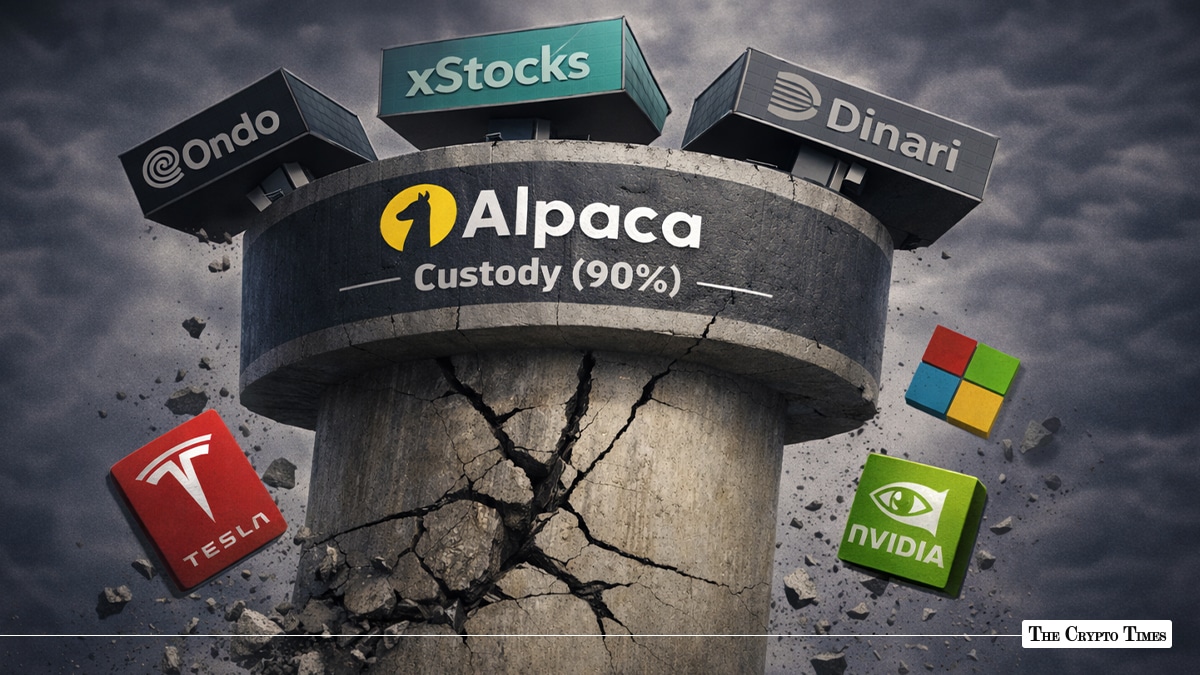
  • Alpaca Securities dominates the tokenized U.S. stocks market with roughly 94% share as of December 2025, serving as the primary custodian for major platforms like Ondo Finance, xStocks, and Dinari.
  • Despite tokens trading on decentralized blockchains, real-world settlement and custody rely on traditional finance infrastructure, exposing the ecosystem to regulatory scrutiny from the SEC, compliance challenges, and geographic restrictions that could disrupt the entire market.
  • The tokenized equities sector has grown rapidly, with Alpaca’s assets under custody nearing $670 million by early 2026 and leading issuers like Ondo ($546M) and xStocks ($209.5M).

While tokenized U.S. stocks are expanding rapidly, a closer examination over it reveals a significant irony: the tokens themselves trade on decentralized protocols, but the underlying settlement and custody processes remain profoundly centralized.

As noted by The Information with December 2025 data, nearly 94% market share of the tokenized stocks and exchange traded funds (ETFs) remains in the hands of Alpaca Securities, a California-based stock broker and dealer. Platforms like Ondo Finance, Kraken’s xStocks (via Backed Finance), and Dinari are all collectively using Alpaca as their go-to tokenized stock broker. 

From Alpaca’s perspective, the growth is a phenomenon, but the heavy reliance on one broker introduces notable vulnerabilities in a sector that champions decentralization. A disruption at Alpaca–whether from operational issues, cyberattacks, or heightened regulatory scrutiny–could affect a vast portion of tokenized equities.

This can be compared to past centralized failures in crypto, where single chokepoints amplified risks. A prime example is the 2022 Terra/Luna collapse, where the centralized design of the UST stablecoin peg led to a rapid death spiral and over $40 billion in market value destruction. Comparatively, the tokenized stocks market is currently a toddler but risk remains the same regardless of the market valuation. 

On top, regulatory bodies like the U.S. Securities and Exchange Commission (SEC) increasingly view tokenized assets as securities subject to existing rules, potentially targeting key infrastructure providers. One blue eye from them could shake the whole sector as it is already fragile due to its nature. The real-world settlements of tokenized stocks (trade execution, clearing, and share custody) depend on traditional systems. This hybrid model exposes the ecosystem to traditional finance (TradFi) frictions, including compliance hurdles and geographic restrictions. 

Alpaca’s dominance in tokenized stocks management

Initially known for its developer-friendly APIs, Alpaca has become the go-to provider for tokenized stock issuers. Early reports indicated that Alpaca held custody for nearly 75% of tokenized U.S. stocks in a market exceeding $1 billion. However, as the industry matured, Alpaca’s dominance rose and it currently sits on the top; apparently the only position. 

Alpaca Market Share Analysis
Source: Alpaca

Latest data from RWA.xyz indicates that Ondo Global Markets’ $546 million in issuances, followed by xStocks with $209.5 million, further solidified Alpaca’s position. By early 2026, reports cited tokenized assets under management (AUM) climbing toward $670 million under Alpaca’s custody. 

The concentration stems from Alpaca’s willingness to engage where others hesitate, providing self-clearing custody and APIs tailored for tokenization via its Instant Tokenization Network. 

Explosive growth in tokenized stocks 

These digital tokens, backed by real shares in companies such as Tesla and Nvidia, promise 24/7 trading, fractional ownership, and global accessibility without traditional intermediaries. 

Tokenized stocks function by linking blockchain-based tokens to actual U.S. equities held in custody. These issuers purchase the underlying shares through a broker and mint corresponding tokens on blockchains such as Solana or Ethereum.

The sector has experienced explosive growth. By late January 2024, the valuation of total tokenized assets under custody (AUC) remained at $963.04 million, with over $2.11 billion in monthly transfer volume—as per RWA.xyz data. 

Tokenized Stocks  Metrics
Source: RWA.xyz

Popular tokens include EXOD, TSLA, SPY (S&P 500 ETF), QQQ, NVDA, and IVV—all having millions in on-chain value. This boom reflects broader interest in real-world assets (RWAs) as a bridge between TradFi and decentralized finance (DeFi). 

Looking ahead: Expansion and challenges

An optimistic point is that as the AUM in tokenized stocks reach new heights, Alpaca continues to invest aggressively in its role. In January 2026, the company secured $150 million in Series D funding at a $1.15 billion valuation, alongside a $40 million credit line. This capital is said to be used for global expansion, additional licenses, and enhanced tokenization infrastructure. 

Proponents view this phase as transitional, with Alpaca serving as essential bridge infrastructure until more diversified or fully on-chain solutions emerge. Critics, however, argue that true decentralization requires reducing such dependencies to avoid undermining the sector’s foundational promises. 

As tokenized equities grow from a niche experiment to a meaningful market segment, the tension between innovation and centralization persists. For now, Alpaca’s quiet dominance underscores a key reality: even in blockchain-powered finance, critical backend processes often remain firmly in centralized hands. 

Also read: Tokenized Securities Face Same Rules as Traditional Assets, Says SEC

  •  

Silver Outshines Bitcoin with 100% Gain in 50 Days — Is Risk Appetite Changing?

Key Highlights

  • Crypto sees heavy selling: Over $346M in positions liquidated as Bitcoin drops near $87,800 and Ethereum falls below $3,000.
  • Silver and gold rally: Silver hits a record $120/oz (₹4,10,000–₹4,25,000/kg in India) and gold rises to $5,516/oz as investors seek safer assets.
  • Markets cautious amid Fed and global uncertainty: Fed holds rates 10–2, Asian markets are mixed, and Indian indices open cautiously, with Sensex and Nifty steady.

Crypto markets saw heavy selling over the past 24 hours as traders tried to cut their risk, while silver surged to record highs, highlighting a shift in investor sentiment.

According to CoinGlass, more than $346 million in crypto positions were liquidated during this period, affecting over 120,000 traders. The largest single liquidation was a Bitcoin trade on Hyperliquid worth $31.64 million.

liquidation heatmap - coinglass
Source: Coinglass

This wave of selling pushed Bitcoin further down, continuing its recent decline.

Bitcoin slips amid liquidations

At the time of writing, Bitcoin was trading near $87,800, down around 1.7% in the last 24 hours. Over the past week, the world’s largest cryptocurrency has slipped more than 2%, as leveraged bets were unwound and traders turned cautious.

Data showed that $135.83 million worth of Bitcoin positions were liquidated in a day, with the majority coming from long trades. This suggested that many traders were caught on the wrong side of the move after betting on a rebound.

Ethereum under pressure

The second-largest cryptocurrency also moved lower. Ethereum fell to around $2,940, losing more than 2.5% on the day, as per CoinMarketCap data. 

Nearly $52 million in ETH positions were liquidated, most of them longs. The fall accelerated after Ethereum slipped below the $3,000 mark, a level closely watched by traders.

Silver hits record high as crypto struggles

While crypto struggled, precious metals moved in the opposite direction.

Silver shot up to a record $120 per ounce before pulling back a little to about $119.26, as per TradingView data. In India, it climbed to around ₹4,10,000–₹4,25,000 per kilogram, showing strong demand for the physical metal. Gold also went up sharply, reaching $5,516 per ounce, as investors looked for safer places to put their money.

Economist and Bitcoin critic Peter Schiff reacted to the metals rally on social media, posting: “In 2017, at its peak of nearly $20k, Bitcoin was worth 14.25 ounces of gold. Today it’s worth 16 ounces. That’s a 12% gain in nine years. Was it worth the risk to beat gold by just 1.3% per year? HODLers will find out the hard way as Bitcoin crashes and gold continues to soar.” His comment highlights concerns about crypto, with many investors turning to precious metals for safety.

Global uncertainty fuels safe-haven demand

The rally in metals comes at a time of rising global uncertainty. Markets reacted after U.S. President Donald Trump warned of possible 100% tariffs on Canada if it moved ahead with trade deals involving China. The comments revived fears of trade tensions and pushed investors toward traditional safe havens.

Demand for physical silver has been especially strong in China and India. Market participants say buying of silver bars has increased sharply in recent weeks, tightening supply and pushing prices higher.

Fed policy and market caution

Uncertainty around U.S. monetary policy continues to weigh on markets. The Federal Reserve voted 10–2 to keep interest rates unchanged, pushing back against pressure for immediate cuts. Officials said inflation remains sticky and they want clearer signs before easing policy. The decision has added to investor caution, with many staying away from riskier assets like crypto.

Recent data showed the U.S. unemployment rate fell to 4.4% in December despite weak job growth, and economists expect the Personal Consumption Expenditures Price Index, excluding food and energy, to rise 3% year-over-year for the month, well above the Fed’s 2% target. 

Inflation remains higher than desired, and the latest jobs data leaves little room for quick policy easing. Because of this, investors are being careful and staying away from riskier assets like crypto.

Indian markets stay steady

Indian markets remained steady through the session. The Sensex rose nearly 500 points to close above ₹82,300, while the Nifty gained over 160 points. Investors remained cautious ahead of the Economic Survey and the Union Budget 2026, which are expected to set the direction for markets.

Early signals pointed to a soft start in the next session. Gift Nifty was trading around 25,364, nearly 86 points lower than the previous Nifty futures close, indicating a slightly negative opening. The weakness reflected mixed global cues rather than any domestic concern.

Asian markets showed mixed trends following the US Federal Reserve’s policy decision.

  • Japan’s Nikkei: up 0.18%
  • Topix: down 0.57%
  • South Korea’s Kospi: up 1.09%
  • Kosdaq: up 2.69%
  • Hang Seng futures indicated a lower open

In the U.S., Wall Street closed mostly higher after the Fed kept interest rates unchanged.

  • Dow Jones: up 12.19 points to $49,015.60
  • S&P 500: down 0.01% to $6,978.03
  • Nasdaq Composite: up 40.35 points to $23,857.45

The S&P 500 briefly crossed the $7,000 mark, showing resilience despite caution around future rate cuts.

Overall, mixed global signals suggest Indian markets may open cautiously, with stock-specific movement likely to drive trading.

Why Bitcoin is falling while silver rises

It’s an old question, but worth asking again: why is Bitcoin going down while silver is climbing?

Traders say it’s all about how risky investors feel things are. When times feel uncertain, people move their money to things that feel safer, like gold and silver. Bitcoin is often called digital gold, but in the short term, it still acts like a risky investment, especially when people are using leverage.

In the past, Bitcoin has sometimes fallen behind gold and silver before bouncing back once things settle down. Whether that happens this time, we’ll have to wait and see. For now, it’s clear that investors are playing it safe, volatility is up, and people are choosing security over big bets.

Also Read: Crypto Trader Makes $2M in 24 Hours on Hyperliquid Amid HYPE Rally

  •  

Fed Defies White House with 10-2 Hold Amid Cut Pressure

Key Highlights

  • The Fed paused rates at 3.5%-3.75%, signaling caution as jobs stabilize but inflation remains a concern.
  • Cryptos reacted cautiously, with Bitcoin near $88K; traders are now watching dollar strength more than Fed moves.
  • A weaker dollar may support crypto gains, while a strong dollar could act as a ‘wrecking ball’ for risk assets.

Defying intense political pressure and a series of verbal attacks from the White House, the Federal Reserve voted 10-2 on Wednesday to maintain the federal funds rate at 3.5%–3.75%. In its policy statement, the Federal Reserve highlighted that “job gains have remained low, and the unemployment rate has shown some signs of stabilization.” Inflation, it noted, remains “somewhat elevated.” 

While the move was widely expected by institutional desks, the dissenting votes from Governors Stephen Miran and Christopher Waller highlight a growing rift within the FOMC. Both were appointed under President Donald Trump, highlighting ongoing debates about how fast the Fed should act.

Fed Chair Jerome Powell said that while the labor market is stabilizing, the Fed is in no rush to cut further until the inflationary effects of recent tariffs are fully understood.

Market response and crypto implications

Major cryptocurrencies reacted cautiously to the Fed announcement, indicating that market participants were waiting for Powell’s press conference for more insights. The current global cryptocurrency market cap is $2.98 trillion, down 1.34% in the last 24 hours, while the total trading volume is down 2.73% to $111.76 billion, as per CoinMarketCap data. 

Bitcoin (BTC), the top cryptocurrency by market cap, is currently trading at $88,165.80 with a slight daily increase of 0.07%, although it has experienced a decline of 1.05% and 2.14% in the last week and month, respectively. The market capitalization of Bitcoin is above $1.76 trillion, with approximately 20 million BTC in circulation.

Market Performance - CoinMarketCap
Market Performance, Source: CoinMarketCap

Ethereum (ETH) traded around $2,950, up just 0.05% for the day but down 1.8% over the week. Binance’s BNB rose slightly to $898.65, and XRP gained 0.31%, reaching $1.88. With this market performance, therefore, the Fed’s decision didn’t shake crypto markets immediately, but changes in the dollar’s strength could have a bigger impact on prices over time.

Dollar dynamics and broader market signals

The US dollar continues to weaken, with the Bloomberg Spot Dollar Index reaching new four-year lows. President Trump dismissed the decline of the dollar, stating, “The value of the dollar is great.” Some analysts say that President Trump indirectly supports lower rates by weakening the dollar.

The Kobeissi Letter called it “a clear signal that President Trump is willing to tolerate a weaker Dollar to push rates lower and boost US exports.” Similarly, Bloomberg TV APAC noted, “President Trump may effectively be cutting rates on the Fed’s behalf by letting the dollar slide.”

President Trump may effectively be cutting rates on the Fed’s behalf by letting the dollar slide.

ICYMI – Dollar saw a massive collapse overnight. Bloomberg gauge saw a 3-sigma move down. Trump said he’s not concerned about the currency’s decline.

🔉on pic.twitter.com/t5Wgcw9Ues

— David Ingles (@DavidInglesTV) January 27, 2026

Historically, cryptocurrencies have performed well under loose monetary policy. However, experts argue that dollar strength often outweighs rate changes in driving crypto sentiment. Julien Bittel, Head of Macro Research at Global Macro Investor, described a strong dollar as a “wrecking ball” for risk assets. 

The Fed’s decision to pause shows it’s being careful with the economy while inflation is still a concern. Cryptocurrencies tend to react more to the dollar’s strength, so how the dollar moves will likely shape crypto prices.

Also Read: U.S. Senators Set to Vote on Crypto Market Bill on January 29

  •  

Tokenized Securities Face Same Rules as Traditional Assets, Says SEC

Key Highlights

  • The SEC clarified that putting a stock on a blockchain does not change its legal status; it is still a security subject to full registration.
  • Issuing or recording securities on-chain does not change registration, disclosure, or compliance requirements.
  • The guidance reinforces oversight amid shifting crypto enforcement but leaves crypto-native asset status unresolved.

The U.S. Securities and Exchange Commission (SEC) has clarified that tokenized securities remain subject to federal securities laws, reinforcing that placing a financial instrument on a blockchain does not alter its legal status. 

The guidance was issued Wednesday through a joint staff statement from the SEC’s Divisions of Corporation Finance, Trading and Markets, and Investment Management. 

The statement is made in the context of increasing attention of financial institutions to the tokenization of traditional assets (stocks, bonds, funds) with blockchain technology. Although the agency recognized the operational distinction of on-chain recordkeeping, it still highlighted that the regulatory obligations are the same.

Legal obligations are not altered by blockchain format

The SEC states that securities issued or registered on a blockchain should be subject to the same registration, disclosure, and compliance requirements as those of securities issued using traditional systems. 

The agency claimed that the issuance format, on-chain or off-chain, does not influence the federal securities laws. On-chain transactions are transactions that are recorded on a blockchain as ownership and transfers instead of using the conventional databases. 

The SEC observed that issuers can issue tokenized securities in a separate category or in combination with conventional securities. In some cases, regulators can consider both formats as one and the same class under some laws as they have rights and privileges that are substantially similar. 

The main difference, which the statement clarified, is the way issuers keep records of shareholders. Rather than off-chain databases, issuers or their representatives can rely on a single or multiple crypto networks to monitor ownership, without altering the legal nature of the security.

Regulation arrives amid changing crypto enforcement

The explanation comes in the fact that the SEC has changed its approach to crypto regulation in the last year. During the Trump administration, the agency has abandoned or shut down over a dozen enforcement actions of big crypto companies. 

Some of those cases focused on the issue of whether digital tokens, staking services, or wallet infrastructure were unregistered securities.

Although the enforcement posture is less aggressive, the statement of Wednesday strengthens the legal basis of most of the previous cases by restating that the securities laws are applicable irrespective of the technological structure. 

Nevertheless, the guidance does not consider whether crypto-native products are securities in the first place, which is a question that is legally unanswered.

The clarification and its importance to markets

The declaration offers regulatory certainty to institutions that consider tokenized securities, especially with traditional finance starting to experiment with blockchain-based settlement and recordkeeping. 

Meanwhile, it is an indication that innovation will not spare products of regulation. Although the SEC has reduced certain crypto enforcement, it still pursues cases of activities like Bitcoin mining services, which it claims can be securities offerings. 

The guidance suggests that regulatory scrutiny will focus on economic reality rather than labels or technology. As tokenization gains traction, the SEC’s message is clear: blockchain may change how securities move, but not how they are regulated.

Also Read: Ondo Finance Demands Clear Rules for Digital Asset Securities from SEC

  •  

Russia Unveils 2027 Crypto Roadmap for Retail and Qualified Traders

Key Highlights

  • Russia will allow both retail and institutional investors to legally buy crypto by 2027 under new rules and limits.
  • Retail investors face testing and a 300,000-ruble yearly limit, while qualified investors can trade most cryptocurrencies freely.
  • Russia leads Europe in crypto, moving $376B in a year, with strong growth in Germany, Ukraine, and Poland too.

Russia is set to roll out its long-awaited crypto rules in July, allowing both regular and institutional investors to legally buy Bitcoin by mid-2027. The new law, developed by the Bank of Russia and the parliament, will establish clear guidelines for various categories of investors, as well as impose fines for illegal crypto-related activities.

According to Anatoly Aksakov, the Head of the State Duma Committee on Financial Markets, the new law will impose fines for illegal crypto-related activities, just like in the banking industry. The development of the law is expected to be completed by the end of June.

As per an official report, under the new rules, unqualified or retail investors must pass a test before purchasing crypto and will face an annual investment limit of 300,000 rubles per intermediary. “The Central Bank will most likely compile a list of the top 5 or 10 most traded cryptocurrencies on major crypto exchanges. These will definitely include BTC and ETH. They might also add SOL or TON, given their popularity in our country,” explained lawyer Alexandra Fedotova. 

Qualified investors, meanwhile, will undergo mandatory testing but can purchase any cryptocurrency in unlimited quantities, except anonymous coins like Monero, Zcash, and Dash.

Defined investor rules and high-risk warnings

The Central Bank classifies cryptocurrencies as high-risk instruments. They are not issued or guaranteed by any jurisdiction and are subject to volatility and sanction risks. Consequently, investors must understand that their funds are at risk. Stablecoins may be treated differently, potentially functioning as a “digital dollar” for corporate foreign economic activity. Fedotova noted that USDT could serve as a corporate tool, purchasable through licensed brokers.

Besides, the legislation clarifies that cryptocurrencies cannot be used as legal payment in Russia. Transactions must occur through licensed intermediaries, including exchanges, brokers, and trustees. Specialized depositories and online exchangers will face additional licensing requirements. “Exchangers will have to obtain a license. Without one, they will become illegal,” Fedotova added. Residents can still purchase crypto abroad using foreign accounts but must notify the tax service for compliance.

The law also targets cryptocurrency mining. Aksakov emphasized that miners will have the chance to legalize operations fully. The framework will set rules for cryptocurrency creation, circulation, and mining while banning usage as a domestic payment method. 

Administrative, financial, and potentially criminal penalties will be applied to illegal operators. Adjustments to retail investment caps are still possible, with the 300,000-ruble limit currently under discussion.

Europe’s crypto landscape highlights Russia

According to Chainalysis, Russia leads Europe in crypto, handling $376 billion between July 2024 and June 2025—well ahead of the UK’s $273 billion. Crypto is growing steadily, with both regular people and big institutions getting involved. Other countries like Germany, Ukraine, and Poland are also seeing strong growth, thanks to more people adopting crypto and supportive financial systems.

In addition, the bigger markets like Russia enjoy the effects of networks, which in turn attract more participants to the market. The transaction volume in Russia reached a peak of $234 billion in December 2024.

Russia’s 2027 crypto rules are designed to make investing in cryptocurrencies clearer and safer. Regular investors will have limits and need to pass a simple test, while experienced investors can trade more freely.

Also Read: U.S. Senators Set to Vote on Crypto Market Bill on January 29

  •  

Sygnum, Starboard Launch Fund Targeting 8–10% Returns on BTC Holdings

Key Highlights

  • Capital Raised: Over 750 Bitcoin (BTC) secured from professional and institutional investors in four months.
  • Institutional Interest: 68% of institutional investors have invested or plan to invest in Bitcoin products.
  • Strategy & Access: Market-neutral arbitrage fund; units can be used as collateral for USD loans without selling bitcoin.

Sygnum, a Swiss digital asset bank, and Starboard Digital, a crypto investment firm, have raised over 750 Bitcoin (BTC) for a new fund that focuses on arbitrage trading, as institutional investors look for ways to earn returns from crypto without relying only on price increases.

The fund, called the BTC Alpha Fund, was launched in October 2025 and has drawn capital from professional and institutional investors over the past four months. According to figures shared by the firms, it delivered an annualized return of 8.9% in Bitcoin terms during the fourth quarter of 2025.

📣 News: Sygnum and Starboard Digital raise over 750 BTC for BTC Alpha Fund

▪️ Over 750 BTC raised from professional investors in first four months, validating institutional demand for yield-generating Bitcoin strategies
▪️ First regulated bank globally to offer market-neutral… pic.twitter.com/1PTHym83RW

— Sygnum Bank (@sygnumofficial) January 29, 2026

Instead of betting on whether Bitcoin’s price will go up, the fund follows market-neutral strategies. It focuses on exploiting price differences across crypto markets, especially between spot and derivatives, making profits from these gaps rather than from changes in BTC’s price.

Shift in institutional approach

The fund is launching at a time when institutional interest in digital assets is shifting. With spot Bitcoin exchange-traded funds (ETFs) making it easier for big investors to get exposure, and price volatility lower than in earlier cycles, simple long-only strategies are becoming less appealing. 

Because of this, some investors are now looking at approaches similar to traditional hedge funds, such as market-neutral and relative-value strategies, which aim to generate returns under a variety of market conditions.

Sygnum provides the banking and custody infrastructure for the fund, while Starboard Digital is responsible for managing the trading strategy.

Markus Hämmerli, who leads the BTC Alpha Fund at Sygnum, said the product was developed in response to this shift in investor behavior.

“As Bitcoin becomes a core portfolio allocation for institutional investors, we’re seeing growing demand for strategies that can generate returns beyond simple price appreciation. The fund’s Q4 performance demonstrates that professional Bitcoin management can deliver meaningful results even when spot markets are flat or declining.”

How the strategy works

The BTC Alpha Fund is domiciled in the Cayman Islands and uses systematic arbitrage strategies across major crypto trading venues. These include price differences between spot and derivatives markets, as well as short-term inefficiencies that arise across exchanges.

The fund does not bet on whether Bitcoin’s price will go up or down. It is designed to stay market-neutral, earning returns mainly through trading activity that does not depend on overall market movements. Any profits are added back into Bitcoin rather than being converted to fiat.

To manage risk, the fund uses position limits, liquidity checks, and focuses on markets with high trading volumes. It offers monthly liquidity to investors and keeps its assets stored off-exchange.

Role of Sygnum and Starboard

Sygnum acts as the banking and infrastructure provider, offering custody and financing services linked to the fund. Starboard Digital manages execution and portfolio construction.

One feature of the structure is that fund units can be used as collateral for US dollar–denominated Lombard loans through Sygnum, allowing investors to access liquidity without selling their Bitcoin exposure.

Nikolas Skarlatos of Starboard Digital said the fund was built to address a long-standing challenge in institutional crypto investing. “Generating yield on Bitcoin while maintaining exposure to its long-term upside has been a persistent challenge for institutional investors. The early performance of the fund points to growing acceptance of yield-focused strategies, with a target range of 8–10% annual returns across different market conditions.”

Broader market context

The fund is launching at a time when crypto markets are growing more mature, with deeper liquidity and stronger infrastructure that make more complex investment strategies possible. 

At the same time, arbitrage strategies depend on gaps in the market, which can narrow as more money flows in. How well the fund performs also depends on execution, the depth of the markets it trades in, and how risks are handled during volatile periods. Data from the industry suggests that demand for professionally managed Bitcoin products is growing. Around 68% of institutional investors have either already invested in, or plan to invest in, Bitcoin exchange-traded products (ETPs) or related instruments, reflecting the growing appetite for structured crypto strategies beyond simple spot exposure.

Even so, the scale of capital raised in a relatively short period suggests that institutional investors are becoming more comfortable allocating to structured crypto products that go beyond simple price exposure.

Also Read: ABTC Expands Treasury To 5,843 BTC As Corporate Buying Ramps Up

  •  

Ethereum To Rollout ERC-8004 On Mainnet To Empower AI Agents

Key Highlights

  • ERC-8004 gives AI agents trusted IDs and reputations, letting them work across organizations without a central authority.
  • Ethereum becomes a neutral platform for AI, enabling discovery, verification, and collaboration between autonomous agents.
  • With growing adoption and payment protocols like x402, ERC-8004 could lay the foundation for a global AI agent economy.

Ethereum is rolling out a new protocol today that gives AI agents identities and reputations they can carry between organizations: the ERC-8004. This helps solve a major trust problem, letting AI systems work on their own without needing a central authority.

According to Ethereum’s official X post, “ERC-8004 is going live on mainnet soon. By enabling discovery and portable reputation, ERC-8004 allows AI agents to interact across organizations ensuring credibility travels everywhere.” Davide Crapis, Ethereum Foundation’s AI Lead, explained that Ethereum is in a unique position to manage and secure interactions between AI agents. He added that the ERC-8004 standard is set to launch on the mainnet soon.

ERC-8004 is going live on mainnet soon.

By enabling discovery and portable reputation, ERC-8004 allows AI agents to interact across organizations ensuring credibility travels everywhere.

This unlocks a global market where AI services can interoperate without gatekeepers. https://t.co/Yrl0rvnSxj

— Ethereum (@ethereum) January 27, 2026

A neutral trust layer for AI

Also called “Trustless Agents,” ERC-8004 solves the trust problem in AI coordination. Autonomous agents often lack a neutral way to discover, verify, or assess each other. The protocol introduces three on-chain registries that work alongside existing agent communication systems like A2A and MCP. 

The Identity Registry gives each AI agent a unique ID using non-fungible tokens (NFTs), so their identity can be trusted. The Reputation Registry keeps track of feedback from clients, building a permanent history of how well the agent performs. The Validation Registry lets outside parties check an agent’s work using methods like cryptography or trusted reviewers.

ERC-8004, proposed in August 2025 by the Ethereum Foundation team, MetaMask, Google, and Coinbase, keeps costs low and lets developers create their own trust systems outside the blockchain. Ethereum’s neutral platform, resistance to censorship, and global accessibility make it a good fit for helping AI agents find and verify each other. Vitto Rivabella of the Ethereum Foundation wrote on X that ERC-8004 addresses a growing problem in the AI agent ecosystem: trust.”

https://t.co/2uI4EiqNxg

— Vitto Rivabella (@VittoStack) January 9, 2026

Rapid adoption and developer momentum

ERC-8004 has also seen strong early adoption. Davide Crapis shared that 1,000 to 2,000 builders already engage in projects based on the standard. MetaMask has integrated it, and over 70 projects built agent browsers similar to blockchain explorers. Layer 2 networks, including Taiko, officially support ERC-8004, signaling fast-moving infrastructure development. 

Interestingly, Coinbase’s x402 payment protocol, which facilitates payments between AI agents through automated stablecoin payments, recorded a transaction volume growth of 10,000% in October 2025. This protocol works alongside the new standard for payments and the ERC-8004 standard for trust and identity verification. 

Cloudflare and Coinbase’s x402 Foundation have also standardized machine-to-machine payments, including the stablecoin called NET Dollar for AI micropayments.

Why this matters

This new launch positions Ethereum as the TCP/IP for AI agents, providing a neutral layer free from corporate control. As developer binji noted on X, “Civilizations scale because humans are capable of implicit trust, AI agents are not; their only path to building an agentic society is through a ledger of shared truth…aka a blockchain.” Consequently, ERC-8004 may transform Ethereum from a cryptocurrency platform to a foundational layer for global AI coordination.

Civilizations scale because humans are capable of implicit trust, ai agents are not; their only path to building an agentic society is through a ledger of shared truth..aka a blockchain.

ERC 8004 cements Ethereum and its L2s as that blockchain.

Let a thousand societies bloom.

— binji (@binji_x) January 27, 2026

With contributions from Google, Coinbase, and MetaMask, ERC-8004 shows how Ethereum can provide a shared framework for AI agents to work together across systems.

Also Read: ZetaChain 2.0 Launch Nudges Classic “Sell the News” Psyop

  •  

Crypto Trader Makes $2M in 24 Hours on Hyperliquid Amid HYPE Rally

Key Highlights

  • On-chain data shows that a trader earned over $2 million in 24 hours through leveraged HYPE longs on Hyperliquid.
  • HYPE rallied 50–65% amid explosive growth in HIP-3 perpetuals and record trading volumes.
  • Similar high-leverage wins highlight rising DEX activity but also underline significant trading risks.

A low-profile crypto trader has drawn attention after he generated over $2 million in profits within 24 hours on the decentralized perpetuals exchange Hyperliquid, according to data from blockchain intelligence firm Arkham Intelligence. 

The trade highlights both the growing influence of on-chain transparency and the rising activity on decentralized derivatives platforms.

How the trade happened

Arkham’s on-chain analysis shows that the trader built roughly $4.5 million in leveraged long exposure to HYPE, Hyperliquid’s native token, shortly before a sharp price rally. 

Track Wanyewest on Arkham:https://t.co/lYebOUK3R7

— Arkham (@arkham) January 28, 2026

The gains came as HYPE surged from recent lows near $21 to around $34–35, marking a 50–65% increase in recent weeks. The trader’s positions were large enough to place them among Hyperliquid’s top daily performers. 

Arkham’s entity mapping linked activity across multiple exchanges, including Binance, showing how blockchain data can connect wallets and trading behavior even when identities remain anonymous.

The portfolio behind the gains was mostly a combination of ETH holdings with Hyperliquid perpetual contracts, which confirms a trend in which traders pledge ETH to gain access to high leverage derivatives on decentralized exchanges.

Hyperliquid’s growth and the HYPE rally

The trade occurred amid a broader resurgence in Hyperliquid’s ecosystem. One of the main forces has been the fast implementation of HIP-3, which enables users to open decentralized perpetual markets through the staking of HYPE.

This has expanded trading beyond crypto assets into commodity-linked perpetuals, including gold and silver. Open interest on HIP-3 markets recently climbed to over $790 million, up from around $260 million a month earlier. 

HIP-3 open interest reached an all-time high of $790M, driven recently by a surge in commodities trading.

HIP-3 OI has been hitting new ATHs each week. A month ago, HIP-3 OI was $260M.

— Hyperliquid (@HyperliquidX) January 26, 2026

Trading activity has also intensified, with Silver-USDC perpetuals posting more than $1.2 billion in 24-hour volume, making it one of the platform’s most actively traded contracts.

Hyperliquid routes 50% of trading fees into HYPE buybacks, a mechanism that analysts say has supported token demand alongside reduced sell pressure following earlier staking unlocks.

Similar high-risk wins

This is not an isolated case. Hyperliquid has experienced several big trades in recent months such as a $1.5 million deposit turned into $875,000 in profit with leveraged HYPE longs, and a position scaled to $8.1 million that earned over $1 million in unrealized gains.

In January 2026, another trader who invested $85, made over $115K on a Chinese memecoin. Nonetheless, according to the market observers, these gains are associated with a lot of risk. Extremely high leverage on perpetuals has also resulted in the loss of multimillion dollars when the market turns.

Another example just this week in Solana, a wallet made $285 into $627,000 in a 24-hour timeframe by buying the new ZReaL token, which brought up the issue of timing benefits and insider trading.

These incidents highlight the way decentralized trading platforms are transforming market participation, providing transparency and extreme volatility. Although big wins get attention, analysts warn that big wins are an exception, not a rule, particularly in high-leverage settings.

Also Read: Polymarket Whale Turns Fortunes with $6.12M Profit in Just 24 Hours

  •  
❌