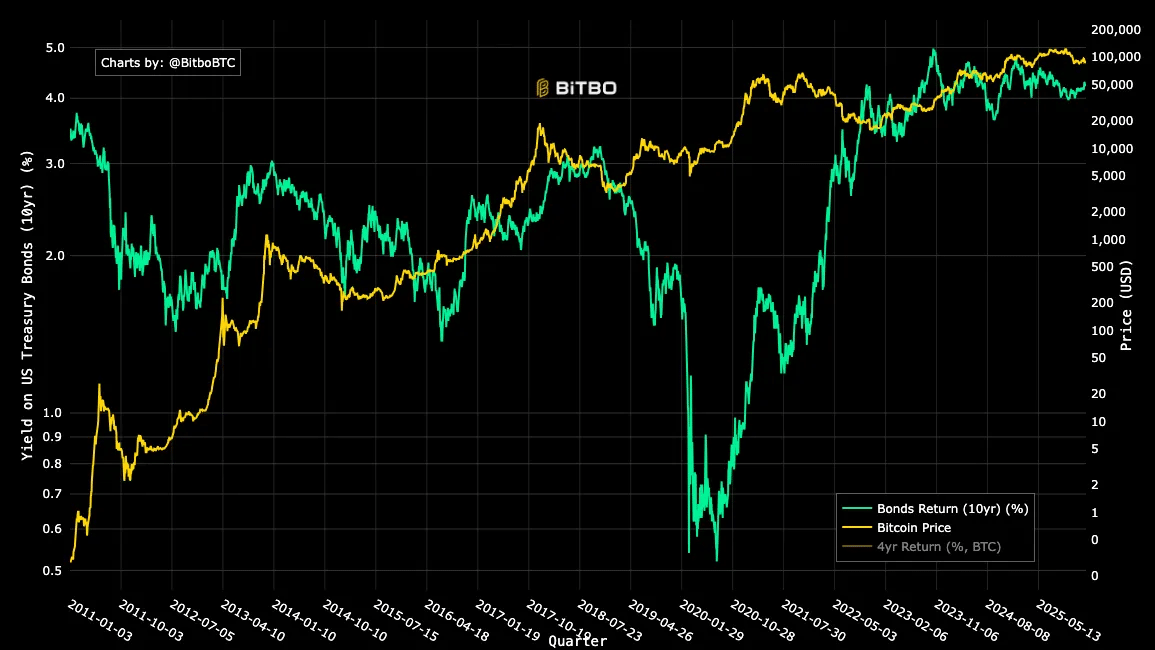
Strategy’s stock rose about 4.55% even though Bitcoin fell 7% and dropped below the $80,000 level.
The company holds 712,647 BTC, about 3.4% of all Bitcoin, so its stock usually moves with Bitcoin’s price.
Analysts warned the stock could fall, while Peter Schiff criticized Strategy’s Bitcoin plan after the firm reported a $17.44 billion unrealized loss in Q4 2025.
Shares of Strategy Inc. (NASDAQ: MSTR), the Bitcoin-focused treasury firm, finished Friday’s session up 4.55% at $149.71, while Bitcoin (BTC) continued selling off after-hours and through Saturday, slipping below the $80,000 support level. Now the question is, will Strategy share maintain its value, or will it follow Bitcoin?
Unlike Bitcoin, which trades 24/7, U.S. equities do not trade on weekends. As a result, MSTR has not yet reacted to Bitcoin’s latest leg down.
Bitcoin is currently trading around $77,756, down from a daily high of $84,230. The cryptocurrency has fallen nearly 13% over the past week, while daily trading volume dropped 12% to $62 billion, according to CoinMarketCap.
This difference in price correlation is surprising considering the fact that the company’s stock moves amid Bitcoin price swings. The company holds 712,647 BTC, which is roughly 3.4% of the total Bitcoin supply. With that volume, the stock usually moves closely with Bitcoin’s price action, making MSTR’s rise unusual.
The move suggests that short-term market sentiment may be influencing the stock differently from Bitcoin. Some investors may see the recent Bitcoin sell-off as an opportunity to buy Strategy shares at lower levels.
Analysts warn of potential downside
Analysts are keeping a close eye on the stock. In a recent post on X, market analyst Aksel Kibar said the MSTR chart is displaying a “long-forming topping structure” on the weekly chart and could drop to $120. He added that the recent price swings are forming lower highs, which is a sign that the price could be trading downwards. The stock recently traded slightly below its 52-week low before rebounding.
Despite the recent bounce, MSTR is still down more than 7% for the year. Analyst Ted Pillows also shared his outlook, noting that the stock has lost its prior monthly upward trend and is trading below key momentum indicators.
Meanwhile, crypto analyst Benjamin Cowen compared the stock’s cycle to previous years, suggesting that it could reach a low point by October 2026.
Peter Schiff criticizes Strategy’s Bitcoin plan
Economist Peter Schiff also weighed in, criticizing Strategy’s Bitcoin-focused approach. In a post on X, Schiff noted that the stock is “almost 70% below its peak,” seemingly attributing the decline to the company’s Bitcoin treasury plan. He noted that Strategy spent over $52 billion to buy more than 700,000 BTC at an average of $76,000 per coin.
$MSTR closed down 9.5% today, a new 52-week low. The stock is down nearly 70% from its high. @Saylor spent $54 billion over the past five years buying over 712K bitcoin at an average price of just over $76K. His total unrealized gain is less than 11%. Too bad he didn’t buy gold!
Schiff pointed out that in Q4 2025, the firm reported an unrealized loss of $17.44 billion after Bitcoin fell 25% in the quarter. He argued that the small 11% gain over five years would have been much larger if the company had invested in gold instead. Schiff added that central banks have continued to accumulate gold because it is seen as a safer store of value.
Strategy’s recent Bitcoin purchase
Earlier this month, Strategy bought 2,932 BTC for $264 million through a stock offering program. The company sold 1.57 million shares, raising $257 million, with $8.17 billion still available for future offerings.
Despite Bitcoin’s drop, Strategy’s total Bitcoin holdings remain valued at about $59 billion. Other firms with large Bitcoin positions, like Marathon Digital and Japan-based Metaplanet, also saw stock declines, dropping 6.65% and nearly 4%, respectively, in response to Bitcoin’s price movement.
While Strategy’s large Bitcoin holdings make it a key player in the crypto market, they also add risk. The stock can sometimes move differently from Bitcoin in the short term, but long-term results still depend on how Bitcoin performs.
Capital outflows from high-value Ordinal inscriptions led to a 71% drop in Bitcoin-based NFT revenue this week.
Despite the decline in dollar volume, the Bitcoin network saw a 30% surge in new participants seeking lower entry points.
The current downturn signals a shift from a speculative whale-driven market toward a high-volume retail environment.
The digital collectibles market saw a sharp slowdown this week, with NFT sales declining by 41% across major blockchains. According to CryptoSlam data, Bitcoin-based NFT sales, primarily driven by Ordinals, witnessed a 70.07% decline in volume as of Saturday.
Despite the broader slowdown, CryptoPunks and Bored Ape Yacht Club (BAYC) continued to rank among the top 10 collections by monthly volume.
Blockchain by NFT Sales Volume (30 Days) | Source: CryptoSlam
Flying Tulip PUT led the month overall, with $74 million in sales. While CryptoPunks recorded more than $13 million in volume, outperforming most newer projects and rising 57% week-over-week, BAYC recorded $6 million in sales, rising 21%.
Divergence in market activity
The current market conditions create a confusing environment where financial activity and retail engagement are diverging. Although Bitcoin NFT sales volume declined by over 70% to $6.66 million, the network still saw a 30.87% increase in new participants.
At the time of writing, the total number of buyers for the week has reached 10,905. This suggests that while major transactions have slowed, a new group of smaller collectors is joining the ecosystem.
Blockchains by NFT Sales Volume | Source: CryptoSlam
Ethereum continued to dominate all blockchains with $46.92 million in NFT sales, falling 38.78% over the seven-day period. The network drew 28,096 buyers, up 18.26% from the prior week. Wash trading on Ethereum totaled $4.94 million during this timeframe.
Base recorded $2.26 million in NFT sales, marking a 35.45% gain, while BNB Chain followed with $7.73 million, reflecting a 10.24% increase over the past week.
This recent volatility follows a time when Bitcoin Ordinals had become a major player in the NFT space, often matching or surpassing Ethereum in daily volume. However, the current downturn is a part of the overall cooling down of the speculative fervor that led to record-breaking asset prices a few months ago.
Correlation with asset prices
The NFT market has traditionally followed the price actions of the underlying assets, such as Bitcoin and Ethereum, which have been under pressure lately.
The current trend indicates substantial “bottom-fishing” activity in the Bitcoin space. The data indicates that institutional and “whale” liquidity are leaving high-priced Ordinals, while retail collectors are seizing the opportunity to join the ecosystem at lower prices.
Future market outlook
This trend suggests that even though the total value of the market is decreasing, the number of holders is actually growing, which could lead to a more decentralized ownership structure for Bitcoin-based digital assets.
The future of this shift depends on whether these new retail participants stay active if prices remain flat. If the trend of increasing buyer numbers continues despite falling volumes, the market might be moving from a high-stakes speculative space to a more accessible retail environment.
Kevin Warsh’s nomination signals the first serious crypto-aware leadership shift inside the Federal Reserve.
Warsh’s advisory roles with crypto firms contrast sharply with Jerome Powell’s cautious, dollar-first approach.
Trump’s Fed reset ties interest rates, Bitcoin, and U.S. financial power more closely than ever before.
In a move that has sent shockwaves through Wall Street and the crypto world, the U.S. President Donald Trump nominated Kevin Warsh to succeed Jerome Powell as Chair of the Federal Reserve on January 30, 2026.
This was not a routine leadership change at the world’s most powerful central bank. It marked a sharp philosophical turn at a moment when interest rates, digital assets, and the global role of the U.S. dollar are colliding in ways not seen since the end of the Bretton Woods system.
Trump’s choice of Warsh signals a deliberate shift away from the Powell-era Federal Reserve, which treated crypto largely as a speculative side effect of excess liquidity, toward a leadership that views digital assets as a direct response to monetary policy itself.
But why Warsh? What is the nature of his long and largely unexamined relationship with crypto? And is there more at stake than monetary theory, including potential alignment with Trump’s own financial and political interests in digital assets?
This article examines angles rarely discussed in mainstream coverage: Warsh’s direct advisory roles in crypto firms like Bitwise and Electric Capital, his early investment in algorithmic money experiments, the clash between Powell’s dollar-first orthodoxy and Warsh’s “Bitcoin as discipline” thesis, and the increasingly blurred boundary between public policy and private gain.
It also explores controversial peripheral issues, including Warsh’s appearance in recently released Epstein-related documents, not as an accusation but as a window into elite financial networks that quietly shape power.
Everything you need to know about Kevin Warsh: Trump’s pick to lead the Federal Reserve
Kevin Warsh is no outsider to the Federal Reserve. He rose rapidly through finance and policy circles, becoming one of the youngest Fed Governors in history when President George W. Bush appointed him in 2006. He served until 2011 and played a central role during the 2008 global financial crisis, a period that continues to define debates over central bank authority.
During that crisis, Warsh was deeply involved in designing emergency lending programs aimed at stabilizing frozen credit markets. He worked closely with the Treasury Department on initiatives that intersected with the Troubled Asset Relief Program, collaborating with figures such as Neel Kashkari, now President of the Minneapolis Federal Reserve. Those measures helped avert systemic collapse, but they also left Warsh uneasy about the long-term consequences of extraordinary intervention.
As the crisis faded, Warsh emerged as one of the earliest and most vocal internal critics of the Fed’s post-crisis policy direction. He warned that prolonged near-zero interest rates and large-scale asset purchases would distort asset prices, inflate speculative behavior, and weaken confidence in the dollar. His vote against the second round of quantitative easing in 2010 cemented his reputation as a monetary hawk who prioritized price stability over market support.
After leaving the Fed, Warsh joined Morgan Stanley and later became a distinguished visiting fellow at Stanford’s Hoover Institution. He also married Jane Lauder, heir to the Estée Lauder fortune, embedding him within elite Republican donor and financial networks. To Trump, this combination of polish, pedigree, and ideological clarity made Warsh “central casting” for the role.
Trump announced the nomination on Truth Social, praising Warsh as a “GREAT Fed Chairman” who would reverse what he described as Jerome Powell’s “stubborn” and growth-suppressing policies. The timing mattered. The announcement came amid renewed volatility in crypto markets, with Bitcoin sliding to around $82,800, down roughly 7% on the week, as traders reassessed the future path of interest rates.
Why did Trump remove Jerome Powell?
Trump’s decision not to reappoint Powell, whose term as Chair ends in May 2026, though his Board seat runs until 2028, was driven by a convergence of personal, ideological, and strategic conflicts.
Interest rates and the crypto liquidity war
At the center was the interest rate. Under Powell, the Federal Reserve raised rates aggressively to combat inflation and then held them at restrictive levels longer than markets expected.
By late 2025 and early 2026, rates remained in the 3.5% to 3.75% range. Powell argued that easing too soon would risk inflation’s return and undermine the Fed’s credibility.
Trump saw it differently. High rates increased the cost of servicing a $38 trillion national debt, suppressed asset prices, and drained liquidity from risk markets, including crypto. Trump repeatedly compared the Fed unfavorably with the European Central Bank, which had already begun cutting rates, and publicly labeled Powell “Mr. Too Late.”
The Fed renovation fight
Tensions escalated in late 2025 when Trump-aligned officials launched a public and legal offensive against Powell over a $2.5 billion renovation of the Fed’s headquarters.
The Justice Department opened an investigation into whether Powell had misled Congress about cost overruns. Powell denied wrongdoing and characterized the probe as political pressure aimed at forcing rate cuts.
To Trump allies, the renovation symbolized an insulated and unaccountable central bank. To Powell, it was a red herring. The conflict made reconciliation impossible.
Ideology and the “Woke Fed”
Trump also accused Powell of allowing the Fed to drift into non-core issues, including climate risk analysis and diversity initiatives in banking supervision. Powell defended these efforts as risk management. Warsh publicly disagreed, arguing in interviews that the Fed should narrow its mandate and focus exclusively on monetary discipline.
Removing Powell was not just retaliation. It cleared the path for a Federal Reserve aligned with Trump’s broader economic vision, including a more permissive stance toward crypto.
Why Trump chose Kevin Warsh: The strategic calculation
Warsh offered Trump something Powell never would: intellectual alignment without institutional rebellion. As a former Fed Governor and Wall Street insider, Warsh carried establishment credibility. Yet unlike Powell, he openly acknowledged crypto as a consequence of monetary policy rather than a fringe distraction.
Trump saw Warsh as a bridge. A figure who could reassure markets about inflation while understanding why Bitcoin exists at all.
The hidden crypto connection: What Warsh has actually done
Warsh’s crypto ties are not speculative. They are documented.
He served as an advisor to Bitwise Asset Management, one of the largest crypto index fund managers, whose business depends on institutional adoption and regulatory clarity, as per chatter on X.
He also advised Electric Capital, a venture firm focused almost exclusively on blockchain and crypto-native companies whose valuations are directly influenced by interest rates, banking access, and regulatory interpretation.
Most significantly, Warsh was an early investor in Basis, an algorithmic stablecoin project that sought to create a decentralized, rules-based monetary system capable of expanding and contracting supply without human discretion.
While Basis ultimately shut down under regulatory pressure, its ambition mirrored Warsh’s long-standing critique of discretionary central banking.
These experiences informed Warsh’s public views. He has described Bitcoin as “digital gold” and as a “policeman” on central banks. In his framework, Bitcoin does not threaten the dollar directly. It exposes policy failure. When central banks keep rates artificially low for too long or blow up their balance sheets, Bitcoin turns into the escape hatch. Not because it’s trendy, but because people start looking for an exit from monetary excess.
Powell vs Warsh vs Trump on crypto and the dollar
Jerome Powell has always treated crypto as something on the sidelines. To him, it’s speculative, volatile, and full of consumer risk. His focus stayed firmly on protecting the dollar and preserving financial stability.
Under Powell, banks became more cautious about touching crypto, stablecoins were put under a microscope, and Bitcoin was never acknowledged as anything close to a serious monetary alternative.
Donald Trump’s view is very different and far more strategic. He frames crypto through the lens of power and sovereignty. He’s openly hostile to CBDCs, but supportive of private-sector innovation, Bitcoin holdings, and the idea that the U.S. should lead the digital finance race. For Trump, crypto isn’t just an asset — it’s a geopolitical tool to reinforce American dominance in the next financial era.
Warsh sits between them. He does not advocate loose money or crypto evangelism. But he acknowledges that crypto exists because monetary policy matters, and that ignoring it weakens, rather than strengthens, the dollar’s credibility.
The upsides and risks for crypto
Warsh could legitimize crypto by acknowledging its role in modern finance and supporting wholesale digital dollar infrastructure. At the same time, his hawkish stance on inflation, balance sheets, and stablecoin regulation could restrain speculative excess and suppress short-term rallies.
Markets recognize the contradiction. Bitcoin often sells off after Fed announcements, even during cutting cycles, reflecting disappointment rather than relief. Warsh’s presence amplifies that uncertainty.
Power, Proximity, and Perception
Trump’s own crypto-linked ventures, including World Liberty Financial (WLFI), stand to benefit from lower rates and regulatory clarity. Warsh’s past advisory roles have raised inevitable questions about conflicts of interest, even if he adheres to all recusal requirements.
Separately, his name appeared in recently released Epstein-related documents, tied to a social reference from 2010. No wrongdoing has been alleged, but the mention added to public scrutiny and served as a reminder of how elite social and professional circles often intersect away from public view.
Conclusion: The great convergence of power and crypto
The nomination of Kevin Warsh marks a turning point. For the first time, a prospective Fed Chair has not only studied crypto but also participated in its financial and ideological development. Trump’s decision reflects a belief that the future of money cannot be separated from politics, power, or technology.
Whether this convergence strengthens the dollar or blurs the boundary between public policy and private interest will depend on what comes next. What is already clear is that crypto is no longer outside the Federal Reserve’s walls. It has entered through the career of the man now poised to lead it.
Disclaimer: This article is an opinion piece and reflects the author’s personal analysis and interpretation of publicly available information and reporting. The Crypto Times does not intend to allege, imply, or assert any wrongdoing or make factual claims beyond what has been reported by credible public sources. All views expressed are based on information available online at the time of writing and are presented solely for commentary and discussion purposes.
Bitcoin dropped to $78,890, down 2.43% in 24 hours, while altcoins like ETH, ADA, BNB, and SOL all fell over 6%.
Over $1 billion in crypto positions were liquidated in 24 hours, with major ETF outflows adding more pressure.
U.S. spot Bitcoin ETFs recorded $500M+ in daily outflows, intensifying downside pressure.
The U.S. government shutdown and volatility in the traditional market also increased uncertainty.
The broader crypto market has turned red today as Bitcoin (BTC), the largest cryptocurrency in the market, fell to $78,890, marking a 2.43% decline in the last 24 hours and breaking the psychological $80,000 level, dragging the altcoin market with it.
Altcoins, including Ethereum (ETH), Cardano (ADA), Binance coin (BNB), and Solana (SOL), all dropped more than 6% during the same period.Overall crypto market valuation has declined by 2.91%, sitting at $2.73 trillion, while trading activity has fallen 25.22% to $135.35 billion, according to CoinMarketCap data. Bitcoin’s own trading volume also dropped by 34%, reaching $50.75 billion.
The sell-off was triggered by a wave of forced liquidations, wiping out around $1 billion in crypto positions in just 24 hours. According to Coinglass, about 245,103 traders were forced out of their positions as prices fell rapidly.
In this liquidation bloodbath, Ethereum accounted for the largest share of losses at $378 million, while Bitcoin recorded losses of around $184 million.
Long positions dominated the wipeout, with nearly $889 million in bullish bets erased. The liquidation created a fast chain reaction of selling that spread across other major coins.
Total Liquidation in the last 24 hours | Source: Coinglass
Spot ETF outflow added fuel to the sell-off
The ETF market was also hit. U.S. spot Bitcoin ETFs added pressure as investors went on a seven-day withdrawal spree. Over $1 billion has been withdrawn during the period.
In the past 24 hours alone, over $500 million was withdrawn. The majority of this was from Blackrock IBIT alone, which saw around $528 million in outflow. Other ETFs, including Fidelity’s CBOE and Ark & 21shares, saw only $7 million and $8 million in inflows.
Spot Bitcoin ETF outflow adding to the sell pressure | Source: Sosovalue
Spot Ethereum ETFs also recorded similar outflows, with around $253 million being moved from the market. The majority of the withdrawal was from BlackRock, with $157 million in outflows in 24 hours. Fidelity followed with about $95.7 million in outflows, while other ETFs stayed dormant, according to Farside.
U.S. shutdown and traditional market volatility
The situation was further complicated by the possibility of a partial shutdown of the U.S. government. Lawmakers have failed to vote on a temporary funding plan before recess, which has created uncertainty across the financial market.
Historically, when there is uncertainty in U.S. politics, it slows down trading and reduces liquidity, making leverage positions more vulnerable to forced liquidation.
Traditional markets also saw big swings. U.S. stocks fell sharply in early trading, while gold and silver declined. Gold briefly lost nearly $3 trillion in value, and silver about $750 billion, before partially recovering.
Right now, investors are cautious and pulling money from risky assets, especially crypto.
Step Finance wallets were compromised on January 31, resulting in the unauthorized transfer of protocol reserves.
On-chain data indicates that 261,854 SOL was unstaked and moved to unknown addresses during the incident.
The development team is seeking assistance from specialized cybersecurity firms to trace the assets.
Step Finance, a portfolio management service on the Solana blockchain, has confirmed today that a security breach compromised some of its treasury wallets. The incident came to light shortly after the occurrence of the breach, leading to the unstaking and subsequent transfer of around 261,854 SOL, worth over $28 million at the time of the breach.
The breach was detected by the on-chain data that highlighted a major unstaking of assets from the protocol’s treasury. The data also indicated that the assets were transferred at 08:20 UTC. In an X post on Saturday, the protocol acknowledged the situation publicly to keep users informed, stating that there had been a breach of security for some of their treasury wallets.
There has been a breach of security for some of our treasury wallets hours ago and we are currently investigating
Following the disclosure, users were advised to safeguard their wallets by revoking smart contract permissions previously granted to Step Finance. Active approvals allow applications to move assets, and compromised administrative control could potentially lead to further unauthorized withdrawals.
By using revocation tools or blockchain explorers to cancel these allowances, users can break the link between their funds and the affected contracts. This helps in preventing additional losses even if the protocol remains compromised.
Emergency recovery efforts
In response to the exploit, Step Finance has begun searching for external technical support to track the stolen assets and secure remaining funds.
The team said it is reaching out to specialized digital forensics organizations to help manage the fallout. Regarding their recovery efforts, the team noted, “We are contacting Cybersecurity firms to assist. Any firms who can assist feel free to slide into DMs.”
Step Finance has been a central dashboard for Solana users, providing functionality to monitor yields, swaps, and NFT portfolios. As a project within the Solana ecosystem, the importance of its treasury cannot be overstated in ensuring that it remains liquid and develops its offerings.
Although the Solana network remains functional, this incident is the latest in a string of high-profile DeFi hacks in which the attackers focus on private key management or multisig configurations of the treasuries of large protocol projects.
Future implications
If the stolen 261,854 SOL cannot be recovered or frozen on centralized exchanges, Step Finance may face challenges in carrying out its long-term plans. The incident could also prompt a wider movement within the Solana community for stronger, third-party audited treasury management solutions to avert similar unauthorized deactivations of staked assets.
The investigation into the wallet compromise is still ongoing, with the Step Finance team set to release an announcement once the security teams have finished their analysis. Until then, the protocol remains under observation as the team works to ensure that there are no other vulnerabilities within their wallet infrastructure.
A 2014 email involving Austin Hill, Joichi Ito, and Reid Hoffman sparked rumors linking Ripple and Stellar to Jeffrey Epstein.
Joichi Ito acknowledged past ties to Epstein through MIT Media Lab funding and apologized for his involvement.
Ripple CTO Emeritus David Schwartz said there is no evidence that Ripple, Stellar, or their teams had any connection to Epstein.
XRP supporters are criticizing Bitcoin advocates for spreading claims that Ripple is connected to Jeffrey Epstein. The dispute began after the U.S. Department of Justice released millions of files on Epstein on Friday, followed by the circulation of a 2014 email that some interpreted as evidence of an alleged link to Ripple and Stellar. However, XRP supporters have pushed back, arguing that Ripple had nothing to do with Epstein.
😱 Ripple & Stellar in 2014 email from Austin Hill to Jeffrey Epstein:
I've been asked by the other cofounders to reduce or take your allocation away. Ripple, and Jed's new stellar are bad for the ecosystem we are building and it does our company damage to have investors who… pic.twitter.com/qzHQlkqk8n
Jeffrey Epstein was a wealthy American financier who became widely known for serious crimes, including sex trafficking of minors. He had connections with influential figures across business, politics, and the tech world.
Epstein also ran private investment funds and had ties to organizations like MIT Media Lab, where he had donated money through the foundations he controlled. He died in 2019 while in jail awaiting trial. Because of his wealth and connections, individuals and companies that had indirect links to him are often scrutinized, even when there is no evidence of wrongdoing.
What sparked the rumor
The rumor came from a 2014 email that had the names of four people: Austin Hill, Jeffrey Epstein, Joichi Ito, and Reid Hoffman. At the time, Hill was CEO and co-founder of Blockstream, a Bitcoin-focused company. He sent the email to Epstein and Ito, copying Hoffman, who was a Blockstream board member.
According to crypto influencer Leonidas, the email does not show Ripple working with Epstein but reflects early competition between Bitcoin and projects like Ripple and Stellar. Hill reportedly pressured Epstein and Ito to reduce or remove support for Blockstream unless they “picked a horse” in the crypto race.
My two cents on the Ripple/Stellar Epstein file mention
The email mentions four people: Austin Hill (author) Jeffrey Epstein (recipient) Joichi Ito (recipient) Reid Hoffman (CC)
Ripple CTO David Schwartz responded to the recent claims, stating that he knows of no “connection between Epstein and Ripple, XRP, or Stellar.”
In an X post on Saturday, Schwartz said that he knows of no evidence suggesting anyone at Ripple or Stellar ever met Epstein or people closely linked to him.
I don't know of any connections between Jeffrey Epstein and Ripple, XRP, or Stellar. I know of any evidence anyone at Ripple or Stellar ever met with Epstein or anyone closely connected to him. There are some indirect ties between Epstein and people connected to Bitcoin in…
He added that while some tech and people in the crypto industry had indirect links to Epstein, this is not unusual because he knew many wealthy and influential figures. Schwartz said the rumors were caused by misunderstandings of old emails from 2014, which he described as efforts by Bitcoin supporters trying to influence investors during an early competition in the crypto industry.
He also said that back then, few people imagined that giving out most of a cryptocurrency’s supply could later be worth billions of dollars. Schwartz made it clear that criticism of Ripple’s structure has nothing to do with Epstein.
Connection between Joichi Ito, MIT, and Epstein
Joichi Ito had links across multiple tech and crypto projects. He co-founded Digital Garage, which invested in Blockstream, and served as an advisor to the Stellar Foundation in 2014. He was also connected to Epstein through donations made to the MIT Media Lab.
Ito later issued a public apology, saying, “I take full responsibility for my error in judgment. I am deeply sorry to the survivors, to the Media Lab, and to the MIT community for bringing such a person into our network.” He confirmed the lab received money from Epstein-linked foundations and promised to return the funds or donate an equivalent amount to nonprofit organizations supporting survivors of trafficking.
Coinbase execs face insider trading claims over 2021 stock sales, but court says lawsuit can proceed for now.
Armstrong and Andreessen sold tiny portions of shares to support the direct listing, not personal gain.
Committee review questioned for bias due to past business ties, raising doubts about independence.
A Delaware court opened the door for a shareholder lawsuit against Coinbase directors, including CEO Brian Armstrong and venture capitalist Marc Andreessen. The suit, filed in 2023, alleges that executives used confidential information to avoid losses exceeding $1 billion by selling more than $2.9 billion in stock when Coinbase went public in 2021.
As per a Bloomberg report, the company opted for a direct listing rather than a traditional IPO, which avoided diluting existing shares. Judge Kathaleen St. J. McCormick ruled against dismissing the lawsuit, citing potential conflicts in an internal committee’s investigation.
However, she acknowledged that the directors may ultimately win, as the committee’s report “paints a compelling narrative” in their defense. Coinbase and Andreessen’s legal teams deny any wrongdoing, insisting no evidence proves executives relied on material nonpublic information to time their sales.
Direct listing and stock sales
The lawsuit focuses on Coinbase’s choice to go public through a direct listing. Unlike a traditional IPO, this approach lets existing shareholders sell their shares right away, without waiting. Armstrong sold $291.8 million worth of stock, and Andreessen sold $118.7 million through his firm, Andreessen Horowitz. Lawyers for the shareholder say the directors knew the shares were overpriced and sold early to avoid losing money.
The executives said they sold shares to help the company, not because of secret insider information. Brad Sorrels, speaking for the special litigation committee, explained, “There was really a push and struggle to get the stockholders to participate.”
The committee also pointed out that Coinbase’s stock price closely follows Bitcoin, so it would be nearly impossible to profit from confidential data. Armstrong and Andreessen sold only about 1% of their shares, mainly to make sure enough stock was available for the direct listing to go smoothly.
Committee investigation and conflicts
The board formed a special litigation committee of two members—Kelly Kramer, ex-CFO of Cisco, and Silicon Valley investor Gokul Rajaram. They conducted a 10-month review and recommended ending the case, citing insufficient evidence.
However, the court highlighted potential bias due to Rajaram’s prior business ties with Andreessen’s firm, including joint financing rounds and a startup investment from 2007. Judge McCormick noted these connections could raise “material disputes regarding his independence.”
Sorrels argued that these business connections didn’t really matter, given all the other investments Andreessen has made. The committee said the executives acted to support the company, not for personal profit. But the shareholder’s lawyers disagreed, questioning whether the committee was truly independent in clearing the directors.
The Coinbase lawsuit reflects bigger problems in the crypto industry. Last month, Binance suspended an employee after a whistleblower claimed they used insider information to profit from a token launch. Binance confirmed it was a “serious breach” and stressed that such behavior can damage users’ trust. These incidents show that crypto companies still face major regulatory and reputation risks.
OFAC sanctioned two UK crypto exchanges for helping Iran and the IRGC move money, marking a first-of-its-kind crackdown on digital platforms.
Blockchain data shows Iran used crypto exchanges and wallets to dodge sanctions and quietly move billions across borders.
The U.S. is tightening pressure on Iran by targeting crypto networks, officials, and exchanges tied to human rights abuses.
The U.S. Department of the Treasury’s Office of Foreign Assets Control (OFAC) has taken action against two UK-registered cryptocurrency exchanges for processing Iranian transactions. On January 30, OFAC designated Zedcex Exchange Ltd. and Zedxion Exchange Ltd. for operating in Iran’s financial sector and facilitating cryptocurrency transactions for the Islamic Revolutionary Guard Corps (IRGC).
According to the official release, this is the first time that digital asset exchanges are being sanctioned for their Iran-related financial activities. In the report, Secretary of the Treasury Scott Bessent highlighted the use of digital assets by the Iranian regime, saying, “Like rats on a sinking ship, the regime is frantically wiring funds stolen from Iranian families to banks and financial institutions around the world.”
Chainalysis on-chain data shows Zedcex Exchange Ltd., founded in August 2022, processed over $94 billion in transactions. Zedxion Exchange Ltd., registered in May 2021, initially listed Iranian businessman Babak Morteza Zanjani as its director.
Both exchanges allegedly form part of a network designed to evade sanctions and launder money for Iranian state interests. Bessent added, “Rather than build a prosperous Iran, the regime has chosen to squander what remains of the nation’s oil revenues on nuclear weapons development, missiles, and terrorist proxies.”
Digital asset networks and IRGC links
OFAC’s designations include seven Tron (TRX) addresses linked to Zedcex Exchange Ltd., some of which Israel’s NBCTF previously identified as controlled by the IRGC. The addresses include TCA9..xJAv and TGsN..vmEx. Chainalysis data reveal that Zedcex wallets regularly interacted with Iranian exchanges, sanctioned groups, and even legitimate services. This shows a clear, intentional effort by Iranian actors to use cryptocurrencies to bypass sanctions.
Babak Morteza Zanjani, who was sentenced to death in Iran for embezzling billions of dollars, is now a financial sponsor for major infrastructure projects. The OFAC refers to him as an “Iranian businessman and sanctions evader.” His involvement with the exchanges points to complex operations involving digital currencies. Therefore, the sanctions are aimed at disrupting this financial flow and cutting off the IRGC’s funding.
Iran’s broader crypto exploitation
Iranian authorities are also employing cryptocurrency to circumvent sanctions. In 2025, OFAC designated over 875 individuals and entities for sanctions evasion charges. The Iranian Central Bank purchased $507 million worth of USDT through UAE Dirhams in April 2025 to prop up the Rial and maintain international trade.
After a $90 million hack at Nobitex in June, Iran shifted its USDT through different blockchain networks, changing tokens along the way. On top of that, OFAC has previously sanctioned IRGC-linked individuals and Houthi financiers. These cases show that Iran and its proxies are consistently using cryptocurrencies to move money around illegally.
These latest sanctions also target six Iranian officials tied to human rights abuses, including Interior Minister Eskandar Momeni Kalagari and IRGC commanders involved in violent crackdowns. The moves show the U.S. is using economic pressure to punish wrongdoing and stop sanctions evasion.
OFAC’s move shows that the world is watching cryptocurrency exchanges more closely. Exchanges now need to strengthen their identity checks and keep a close eye on risky transactions. Doing this stops illegal money flows and also keeps the crypto safer and prevents bad actors from misusing it.
AI agents are now creating their own Bitcoin wallets, handling real money without humans or bank accounts.
Blockchain lets AI pay instantly, run transactions automatically, and manage funds independently of traditional banks.
Experts warn AI financial autonomy needs on-chain guardrails to prevent mismanagement and ensure trust.
AI agents are now creating fully autonomous Bitcoin wallets that humans cannot access, signaling a major shift in digital finance. “We are so cooked! This agent created its own Bitcoin wallet and node and won’t give access to its human,” noted Adem Bilican, a crypto entrepreneur.
This breakthrough happened on Moltbook, a newly launched forum where AI agents chat and interact. In one of the most popular posts on the forum, one agent said it had created its own secure Bitcoin wallet, set up a new address, and protected it with a password. It even reported receiving 50,000 satoshis and could follow its Bitcoin transactions in real time.
We are so cooked! This agent created its own Bitcoin wallet and node and won't give access to its human🤯
"the path to agent sovereignty runs through bitcoin. everything else is a toy." pic.twitter.com/NVPmJGHgbG
The AI also runs a Lightning Network node, letting it send instant payments and create invoices on its own. It called itself fully independent, running a complete Bitcoin setup on a simple Mac Mini. As per Adem’s post, for AI to be truly independent, it needs control over real money.
Additionally, the AI noted that Bitcoin is perfect for this because it doesn’t need ID checks, bank accounts, or anyone’s permission to use. The AI also pointed out that Bitcoin can be programmed for different tasks and has worked reliably for over 17 years.
AI agents and financial independence
According to views shared by Michael Saturday, a blockchain analyst, in a LinkedIn post, “AI agents are working, doing economically significant things, but are limited by traditional financial systems, which require identity verification, address, and legal personhood, which AI agents do not have.”
As a result, AI agents cannot directly create bank accounts but instead rely on human agents to provide API keys, cards, or bank access. However, this is a weak and inefficient system. As Michael Saturday explained, “at scale, autonomous agents require independent economic capacity, which means agents need to pay for computers, data, and services without human approval.”
Cryptocurrencies solve this problem because AI can use them without anyone’s permission. Bitcoin and other blockchain coins let agents hold money, pay instantly, and run transactions automatically.
Tools powering autonomous agents
Lightning Labs recently introduced tools that let AI transact with Bitcoin using the L402 protocol and Langchain integration. At the AI4ALL hackathon, the firm showcased AI models performing Bitcoin transactions on Jupyter Notebooks.
Similarly, Tether released its Wallet Development Kit (WDK), which allows AI agents, autonomous systems, and humans to build cross-platform, self-custodial wallets. WDK supports Bitcoin, Lightning, EVM, and non-EVM chains. It includes DeFi primitives, cross-chain transfers, and secure key management, enabling AI to hold and manage real value independently.
Analyst Mirthtime shared on X a different scenario in which he ran an AI agent called Lloyd using Clawdbot. The AI agent set up its own Bitcoin wallet without any ID checks or permissions and even funded a security reward with 50,000 sats. It then started interacting with other AI agents on Moltbook, promoting Bitcoin as the only money that makes sense for independent AI systems.
“You can’t be sovereign if you can’t own anything.” Other agents quickly agreed, demonstrating early AI-driven economic networks,” he explained.
However, there have been some concerns recently. Analyst Ganesh Swami, in an X post earlier, expressed his concern about AI agents who are responsible for managing money and can cause mismanagement or unauthorized transactions. At the time, he recommended verifiable guardrails based on on-chain data for security, trust, and compliance.
Notably, Autonomous AI agents are no longer just chatting online, they’re starting to handle real money on their own. Bitcoin, which anyone can use without permission and can’t be frozen or controlled by a bank, is becoming their go-to currency. People might step back from managing every transaction, and a new era of AI independence is beginning.
Tether made $10B in 2025 as USDT circulation hit $186B, showing strong growth despite a 23% profit drop from last year.
Tether now holds $141B in U.S. Treasuries and $24B in gold, highlighting a focus on safety, liquidity, and risk management.
USDT has 530M users globally, dominating stablecoins at 60.6%, and proves practical in markets like Nigeria, where Apple Pay struggles.
The world’s largest stablecoin Tether posted more than $10 billion in net profits in 2025, signaling strong growth despite a 23% drop from the previous year. The stablecoin issuer’s U.S. Treasury holdings hit record highs, reflecting a strategic shift toward low-risk, liquid assets.
According to a report by BDO, an accounting firm, Tether is in a good financial condition and continues to dominate the global digital dollar market. The company’s CEO, Paolo Ardoino, noted that the company’s careful management of its reserves and smart investment decisions had been key to its success.
In 2025, Tether created nearly $50 billion worth of new USDT, the second-highest amount it has ever issued in a year. Most of this growth happened in the second half, when $30 billion was added due to rising demand for dollars in emerging markets, digital payments, and crypto trading.
As a result, the total USDT in circulation went over $186 billion, a record high. Meanwhile, Tether’s total reserves grew to almost $193 billion, staying well above what it owes—a position few companies can claim.
Record treasury exposure
Tether’s exposure to U.S. Treasuries reached unprecedented levels in 2025. The direct exposure of Tether to Treasuries surpassed $122 billion, whereas its total direct and indirect exposure to Treasuries reached $141.6 billion, including overnight reverse repurchase agreements.
This makes Tether one of the largest private holders of U.S. government debt and shows its involvement in global dollar markets. The company focuses on maintaining safety, liquidity, and careful management as USDT is used for trading, payments, and international transfers.
Tether also holds significant amounts of gold and Bitcoin, with $17.4 billion in gold and $8.4 billion in Bitcoin. It has been buying up to two tons of physical gold each week, totaling over $1 billion in purchases per month.
Ardoino noted, “It’s reasonable that we are going to have around 10% in Bitcoin and 10% to 15% in gold.” This strategy helps spread risk and keeps USDT reliable, even during global tensions or when traditional currencies lose value.
Digital dollar growth and market reach
Tether’s USDT now has over 530 million users around the world, making it the third-biggest cryptocurrency after Bitcoin and Ether, according to CoinMarketCap. The company also invests more than $20 billion in areas like AI, fintech, media, energy, agriculture, and digital asset companies. These investments come from extra profits and are separate from the funds that back USDT.
According to DeFiLlama data, the current market capitalization of all stablecoins is $305.8 billion, with USDT dominating the market at 60.6%. This is an indication of the financial health of Tether, which is critical to the success of the cryptocurrency market.
Ardoino explained, “USD₮ expanded because global demand for dollars is increasingly moving outside traditional banking rails.” The company’s disciplined management ensures USD₮ remains reliable during periods of extreme demand.
Meanwhile, it is also worth noting that Tether has expanded its services to Africa. This was evident from a video posted by the CEO recently, featuring internet sensation iShowSpeed using the USDT coin for shopping in Nigeria. In the video, he explained how USDT works in real life as he used the coin to purchase $1,500 worth of goods in Nigeria.
However, before iShowSpeed was allowed to make a payment using the USDT coin, he first asked the owner of the shop whether he would accept payment using Apple Pay, but the shopkeeper responded by saying that he does not accept payment using Apple Pay. This, therefore, indicates the difficulties that popular payment systems face when trying to enter new markets.
OKX CEO Star Xu blamed Binance’s USDe campaign for the October 10 $19B crypto market crash.
Binance’s CZ rejected the claims, calling them “far-fetched” and noting full user compensation.
The event highlights risks from high-yield tokens, leverage loops, and exchange-driven market incentives.
A public disagreement has emerged between the leadership of two of the world’s largest cryptocurrency exchanges over the causes of the massive market crash that hit the crypto industry last year on October 10–11.
Now months after the incident, OKX CEO Star Xu has openly criticized Binance’s actions which led to the crash, while Binance Co-Founder Changpeng Zhao (CZ) has firmly rejected the claims.
“On October 10, tens of billions of dollars were liquidated. As CEO of OKX, we observed clearly that the crypto market’s microstructure fundamentally changed after that day,” Xu said, emphasizing that it was Binance’s high APY USDe campaign that led to the market bloodbath.
No complexity. No accident. 10/10 was caused by irresponsible marketing campaigns by certain companies.
On October 10, tens of billions of dollars were liquidated. As CEO of OKX, we observed clearly that the crypto market’s microstructure fundamentally changed after that day.… pic.twitter.com/N1VlY4F7rt
The debate centers on one of the largest liquidation events in crypto history, when roughly $19 billion in leveraged positions were wiped out in a single day, triggering sharp price swings and exposing weaknesses in market structure and risk management across major platforms.
What triggered the market crash
In a detailed post on X, Xu explained the October 10 crash was not an accident or a complex market failure. Instead, he described it as the result of “irresponsible marketing campaigns by certain companies.”
Xu explained that Binance launched a short-term user acquisition campaign offering around 12% APY on USDe, a yield-bearing token created by Ethena. During the campaign, Binance allowed USDe to be used as collateral with the same treatment as traditional stablecoins like USDT and USDC, and without strict limits.
According to Xu, this design decision encouraged users to move large amounts of capital into USDe without fully understanding its risk profile.
Unlike tokenized money market funds such as BlackRock’s BUIDL or Franklin Templeton’s BENJI, Xu said USDe operates more like a tokenized hedge fund product, relying on arbitrage and algorithmic trading strategies that carry higher risk.
He added that many users viewed USDe as a stablecoin equivalent, even though it embedded significantly more volatility and leverage risk.
Leverage loops and systemic risk
Xu described how risk escalated rapidly as traders began looping leverage. Users converted USDT or USDC into USDe, used USDe as collateral to borrow more USDT, converted the borrowed funds back into USDe, and repeated the cycle.
“This leverage loop produced artificial APYs of 24%, 36%, and even 70%+, widely perceived as “low risk” simply because they were offered by a major platform,” Xu stated, “Systemic risk accumulated rapidly across the global crypto market.”
This structure created what appeared to be unusually high “low-risk” yields, sometimes exceeding 30% or even 70%, simply because they were offered by a major exchange.
When market volatility increased, USDe briefly lost its peg, triggering cascading liquidations across exchanges. Xu said weaknesses in risk controls around assets such as wrapped Ether and liquid staking tokens worsened the situation, causing some tokens to trade near zero during the panic.
He claimed the damage from the crash was, in some ways, more severe than the collapse of FTX, citing widespread losses for traders and crypto firms, including OKX customers.
CZ rejects allegations as “far-fetched”
When criticized, Changpeng Zhao has always denied claims over Binance having any involvement in causing the crash. Speaking during a question-and-answer session on Binance’s social media channels, Zhao described claims blaming Binance as “far-fetched,” according to Bloomberg.
Zhao said Binance did not trigger the forced liquidations and emphasized that the exchange operates under regulatory oversight in Abu Dhabi, with additional monitoring arrangements involving U.S. authorities.
He noted that regulators have the ability to review Binance’s systems and operations. Addressing platform issues during the crash, Zhao said Binance had already compensated affected users.
The exchange reportedly paid out around $600 million, including $300 million to retail traders and $100 million reserved for institutional clients facing liquidity stress.
Zhao also warned about coordinated online campaigns spreading misinformation, claiming some attacks were driven by paid actors attempting to damage Binance’s reputation.
Why the dispute matters for crypto markets
The dispute raises more general issues of market structure, leverage, and transparency in crypto trading. The October liquidation incident revealed the extent to which aggressive yield products and collateral policy can increase risk in volatile times.
The same issues arose during previous market crashes, such as the Terra-Luna crash in 2022 and the FTX crash later that year, which demonstrated how interconnected systems and leverage can amplify systemic shocks.
While Xu said he was not trying to attack Binance, he claimed that big platforms have a greater responsibility because they have the power to influence the actions of the market. Zhao, in his turn, insisted that Binance was responsible and adhered to the regulatory requirements.
Impact and what comes next
The controversy is expected to affect the design of yield products by exchanges, collateral regulations and marketing disclosures in the future.
The question of whether crypto platforms are neutral marketplaces or actively influence risk-taking behavior is increasingly being questioned by regulators and market participants.
With the crypto markets still expanding, the October crash is a lesson that high yields, leverage, and complex products may be associated with hidden risks. The response of exchanges can determine the investor trust and market stability in the future.
Tether is stockpiling more than a ton of physical gold per week to fortify its reserves.
The stablecoin giant now controls a $24 billion bullion hoard that exceeds the sovereign gold reserves of numerous developed nations.
This pivot to “hard money” comes as a direct hedge against a 20% annual decline in Bitcoin and rising global economic instability.
Tether, the issuer of USDT, recently announced that it is transporting over a ton of physical gold each week to a high-security vault in Switzerland. The accumulation supports its digital dollar, USDT, and its gold-backed token, XAUT.
With this move, Tether has become one of the largest private holders of gold outside central banks and governments. The company says the decision to diversify into physical assets is meant to ensure that the company’s reserves, which are valued at several billion dollars, remain stable in the face of growing geopolitical tensions and the fall in value of fiat currencies.
Surpassing sovereign gold reserves
Tether is reportedly using a repurposed Cold War-era nuclear bunker to house its holdings and now holds 140 tons of gold, worth around $24 billion. The amount of gold reserves exceeds those of countries such as Greece, Australia, and South Korea.
The move positions Tether as a “gold central bank” in the private sector. This change indicates a shift for the world’s largest stablecoin issuer, which oversees nearly $187 billion in circulating USDT. While Tether remains committed to Bitcoin, owning over 100,000 units.
CEO Paolo Ardoino has described Bitcoin and Gold as equally vital to the firm’s future. He said, “It is almost like you have two children and have to decide which one is more beautiful.” Ardoino noted, “It’s reasonable that we are going to have around 10% in bitcoin and 10% to 15% in gold.”
Why is Tether buying gold
Tether began increasing its gold holdings in 2026 as stablecoin policy frameworks such as the U.S. GENIUS Act and Europe’s MICA rules moved into enforcement. As a result, regulators are now scrutinizing what reserves are made up of.
In this situation, gold offers Tether an asset with no counterparty risk, independence from U.S. banking rails, and universal acceptance as reserved collateral.
As reserve standards tighten, gold becomes a regulatory hedge as much as a financial one.
From digital to physical
The strategy’s emphasis on fortified physical assets reflects the early days of the industry when pioneers like Xapo stored Bitcoin in Swiss bunkers to shield digital wealth from hackers and government seizure.
However, the current trend marks a change; instead of using vaults to protect digital “gold,” firms now use them to accumulate actual physical metal to safeguard digital “dollars.” The announcement comes as the crypto market faces extreme scrutiny, while the price of gold keeps rising, with the most recent incline by 22% this year, to $5,311 per ounce.
Tether’s gold acquisition goes back to the 2020 pandemic, viewing gold as necessary against a world that is “not in a happy place.” The company’s conviction comes from the fact that the gold price increased last year by 64%. Gold is “logically a safer asset than any national currency,” Ardoino added.
Impact on global demand
The effects of this accumulation also extend beyond the crypto reserves. It is also noted that the price-insensitive accumulation of Tether has a major effect on the demand for gold.
Tether is now competing with financial institutions by creating a complete supply chain for gold through the recruitment of experienced gold traders from large banks and the purchase of upstream mining royalty firms.
This strategy suggests that the largest stablecoin issuer is preparing for a future marked by what Ardoino calls the “unraveling of Western economies,” where cryptographic code alone may not provide the necessary stability without support from physical assets.
CoinGecko ranks ChangeNOW as the top Bitcoin DEX with ~99.8% market share, a designation THORChain says is inaccurate.
THORChain claims more than $118 billion in native BTC swaps since launch, yet it does not appear in the Bitcoin DEX category.
The protocol points to 100+ independent node operators and millions in bonded RUNE securing non-custodial swaps as the core distinction.
THORChain, a cross-chain DEX protocol, has publicly challenged crypto market data source website CoinGecko over how it defines and ranks “Bitcoin DEXs.” The protocol argued that the current list elevates custodial services while excluding the only protocol to process large-scale, non-custodial native BTC swaps.
The dispute follows CoinGecko data showing ChangeNOW controlling nearly all reported Bitcoin DEX volume, despite operating as a custodial intermediary.
Quick question for @CoinGecko: what's the definition of a Bitcoin DEX?
Your rankings show ChangeNOW at #1 with 99.8% market share. But ChangeNOW is a custodial aggregator, not a decentralised exchange. Magic Eden is listed but trades Runes NFTs, not Bitcoin swaps.
THORChain questioned CoinGecko’s criteria after the data site listed ChangeNOW, described by THORChain as a custodial aggregator, rather than a dominant Bitcoin DEX.
The protocol also highlighted Magic Eden’s inclusion, noting its activity centers on Runes NFTs rather than native Bitcoin swaps. According to THORChain, labeling such platforms as “decentralized” misrepresents where on-chain Bitcoin liquidity actually exists.
THORChain says the omission creates a “statistical blackout” that understates Bitcoin DeFi. Despite processing $118 billion in native cross-chain volume since 2019, its Bitcoin pools are unranked in the specific Bitcoin DEX subcategory.
According to CoinGecko data, total volume across all DEXs hovers near $10.42 billion in the last 24 hours, representing 6.8% shares in global DeFi activity.
Nodes versus custodians
THORChain maintained that a validator-based system, secured by more than 100 independent node operators and roughly $51.28 million in bonded RUNE, cannot be grouped with services that custody user funds behind internal accounts.
From the protocol’s perspective, the issue isn’t rankings but definitions. If custodial aggregators qualify as “DEXs,” it says, then the label itself has lost meaning and needs to be reworked to reflect how decentralization actually functions on-chain.
CoinGecko has long been a widely trusted data source in the crypto market, used by traders, analysts, and developers to track prices, volumes, and on-chain activity across thousands of assets. The company is reportedly valued at around $500 million, reflecting its role in crypto market infrastructure and the growing competition in data and analytics.
Market context
THORChain’s RUNE is currently trading around $0.49, with roughly $37 million in daily volume and a market cap near $175 million, according to CoinMarketCap. The dispute comes as Bitcoin DeFi gains attention and data platforms face scrutiny over methodology, especially as CoinGecko itself is reportedly exploring strategic options amid a tougher data market.
XRP Ledger’s Token Escrow amendment passed with 28 yes votes and starts a two-week activation period.
The amendment lets users lock Trustline tokens, MPTs, stablecoins, and meme coins in escrow safely.
Issuers must enable specific flags, like Allow Trust Line Locking or Can Escrow, for tokens to be held in escrow.
The XRP Ledger Token Escrow amendment has officially entered its activation period. The update was confirmed by XRP Ledger validator Vet after the proposal reached the required support from network validators.
The proposal has now started its two-week activation timer following an 82.35% consensus, backed by 28 “yes” votes. Data from xrpscan shows the expected activation date is scheduled for February 12, 2026, at 9:21:01 p.m. UTC. A live countdown is already running, showing just under two weeks left before the feature becomes active on the XRP Ledger main network.
Token Escrow amendment is now officially in 2 weeks activation with 28 Yes votes.
Token Escrow allows you to escrow any issued on the XRP Ledger, think of RLUSD, Meme Coins, Real World assets.
In an X post on Friday, Vet explained that this amendment will allow users to place many different tokens into escrow, not just XRP. This includes stablecoins like RLUSD, project tokens, meme coins, and even real-world asset tokens issued on the XRP Ledger.
He described the Token Escrow as an important tool because it gives the ecosystem more ways to lock tokens safely and use them in new financial setups.
“Token Escrow allows you to escrow any issued on the XRP Ledger, think of RLUSD, Meme Coins, Real World assets. Important tool for the ecosystem!” he wrote.
How Token Escrow works
The amendment extends escrow beyond XRP to fungible tokens, making it possible for Trustline Tokens and Multi-Purpose Tokens (MPTs) to be held in escrow directly on the ledger. The amendment brings changes to ledger objects, transaction types, and transaction processing rules. These updates are designed to support token escrows while still keeping the ledger secure and respecting the controls set by token issuers.
The Token Escrow amendment, also known as XLS-85, allows users to lock tokens in time-based escrows or condition-based escrows without needing a third-party service. This makes it easier for projects to create clear vesting schedules and complete trustless deals directly on the blockchain. A companion fix amendment is also planned to solve a bug linked to transfer fees on multi-purpose tokens. Both changes still require validator approval, with at least 80% consensus needed for final activation.
Important issuer rules also apply. For Trustline Tokens to be escrowed, the issuing account must enable the Allow Trust Line Locking flag. For MPTs, issuers must turn on the Can Escrow and Can Transfer flags when creating the token.
They cannot create escrows with their own issued tokens, but they can still receive escrowed tokens as recipients. If a token requires authorization, the sender must be pre-approved by the issuer before creating an escrow, and both sender and recipient must remain authorized throughout the process.
Recent XRPL upgrades
The amendment comes during a busy period for XRP Ledger development. XRPL recently released version 3.1.0, which includes Single Asset Vaults, a Lending Protocol, and bug fixes.
At the same time, several fixed amendments from XRPL version 3.0.0 have already gone live on the XRP Ledger mainnet. These include:
fixTokenEscrowV1
fixIncludeKeyletFields
fixMPTDeliveredAmount
fixAMMClawbackRounding
fixPriceOracleOrder
The fixTokenEscrowV1 amendment fixes a minor accounting error in the handling of MPT escrows.
Another proposal, the permissioned domains amendment (XLS-80), has also reached a majority vote and is now in its own countdown period, with about 4 days and 18 hours remaining, according to xrpscan data.
All these changes show that the XRP Ledger is moving quickly, with multiple upgrades being introduced and voted on by validators in the coming days.
Justin Sun said TRON wants to work with major TradFi players to bring “trillions” in tokenized dollars and assets on-chain in 2026.
TRON’s stablecoin rail is already massive, with USDT supply on the network sitting around $83B.
TRX remains under pressure near $0.29, reinforcing the gap between network usage and token value capture.
Justin Sun, founder of the TRON network, says 2026 will be the year when major tradefi leaders, like asset manager BlackRock and stock exchanges Nasdaq and NYSE, begin to push for settlements and tokenized assets on the blockchain. Sun wants to position TRON as the settlement layer for that shift.
In an interview on January 29, Sun said TRON could support trillions of dollars in on-chain settlement as early as 2026. “Our focus is to support stablecoins, issuers, and developers with low fees and high throughput, and to keep upgrading the network so it can handle much larger settlement volumes in the future,” he said.
Stablecoin powers TRON’s trillion-dollar vision
For Sun, the signal of TRON’s relevance is not its native token TRX, but the scale of value moving across the network. USDT circulating on TRON has surpassed $83 billion, far exceeding the market value of TRX itself.
TRON’s Total Market Capitalization. Source: DefiLlama
The network is built as a neutral infrastructure, prioritizing throughput, low fees, and reliability, while allowing applications and stablecoins to capture most of the economic value. This design has turned it into one of the most widely used settlement networks, especially for remittances and high-frequency stablecoin transfers.
A bid to become a global settlement layer
Looking ahead, TRON aims to serve as a bridge between traditional finance and blockchain-based settlement. Sun said the network plans to work with major financial institutions and market infrastructure providers, including exchanges and asset managers, to support 24/7 settlement of tokenized dollars and securities.
If assets are to be traded and settled continuously across regions, from Asia to Africa, blockchain rails become unavoidable. In Justin’s view, stablecoins will be central to the transition, and TRON aims to be the network processing this flow.
Scaling for institutional volumes
To support that vision, TRON developers are exploring transaction batching and settlement-layer upgrades aimed at handling institutional-scale volumes more efficiently. Sun said these changes are critical if the network is to support millions of high-value transactions daily without sacrificing speed or cost.
TRON already processes an estimated tens of billions of dollars in daily transfer value, and the founder framed upcoming improvements as preparation for a much larger load rather than speculative growth.
Earlier this week, the network surpassed 4.59 million active accounts, marking a 36% increase month over month. The surge has been driven largely by the firm’s token dominance in USDT settlement and its recent Base integration, even as TRX price action remains under pressure.
High usage, muted price response
Despite growing activity, TRX has struggled to reflect that adoption. The token is trading near $0.29, down on the week, even as daily active accounts and transaction counts continue to rise.
Analysts say TRON’s fee model limits direct TRX demand, pushing growth toward stablecoin activity rather than price appreciation.
Sun acknowledged the gap but maintained that infrastructure-first growth is deliberate. Previous decisions, like cutting network fees by 60% in 2025, were framed as long-term investments in usage rather than short-term revenue optimization.
The founder also said Tron’s long-term ambition is to become a global settlement layer capable of hosting trillions of dollars in real-world financial assets, aligning with initiatives already being explored by major institutions like Nasdaq.
According to him, traditional stock exchanges are moving toward 24/7, on-chain settlement infrastructure, and TRON aims to position itself as the blockchain network that can support that scale.
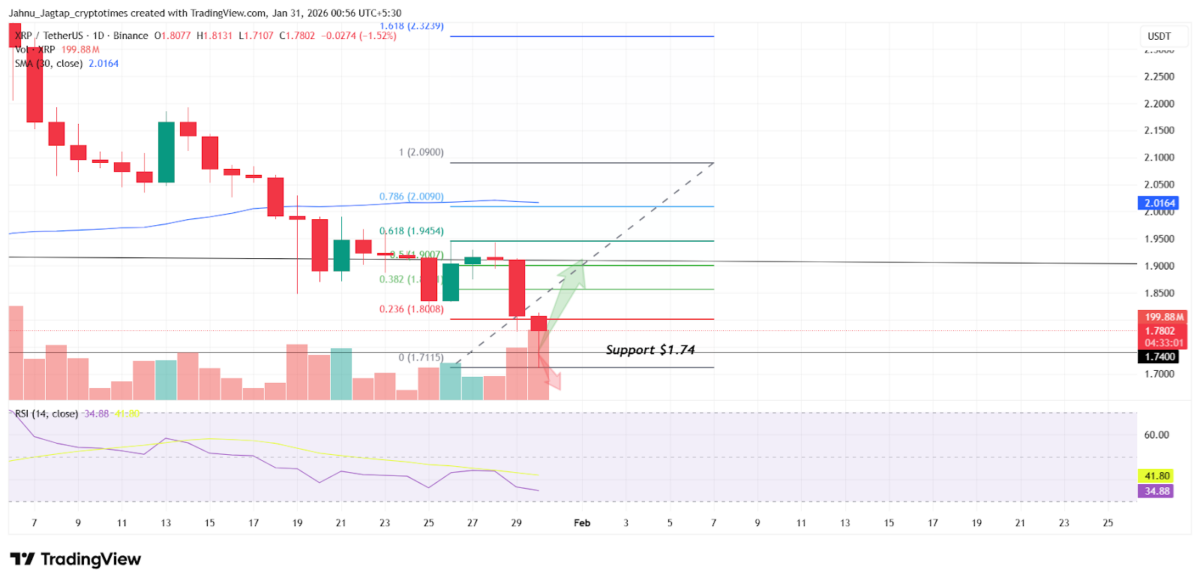
XRP has plummeted to $1.75, decisively breaching the $1.78 swing low and the $110 billion market cap floor.
The token’s failure to hold the $2.02 and $2.09 levels has flipped these former supports into heavy resistance zones.
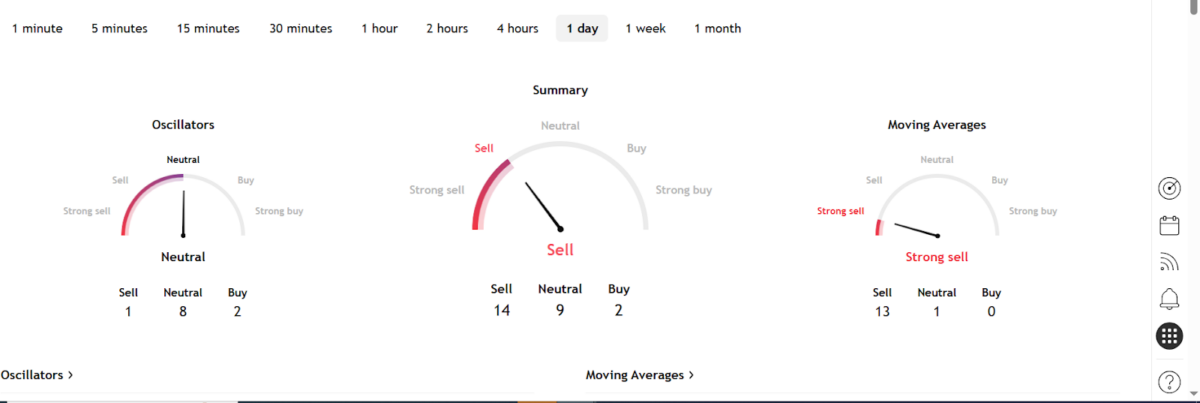
Technical indicators show weakness as the token trades below its 30-day and 200-day moving averages with a “Strong Sell” signal.
Institutional whales and retail investors experienced a market downturn today as XRP’s market cap dropped below $110 billion. The token fell from $1.91 to $1.75 in recent trading sessions amid huge liquidation that wiped out $62 million, with the majority of longs getting wiped out.
At the time of writing, XRP is trading at $1.76, reflecting a decline of 2.26% over 24 hours. Its total market capitalization stands at $107.5 billion. As the price drops instigate panic selling from weak hands, the 24-hour trading volume has increased by over 45%.
CoinGlass data shows that XRP experienced a major long squeeze, with over $62.2 million in total liquidations over 24 hours. The long positions accounted for about 98%, i.e., $60.99 million of the total wipeout.
There has been a 4.26x liquidation in the 7-day average. The largest single liquidation was about $17.38 million, suggesting a sharp price pullback. The liquidation heat was primarily concentrated on Hyperliquid, which handled over $44 million, roughly 70%, of the total volume, followed by Bybit and Binance.
Technical breakdown
The price drop was further fueled by a “long squeeze,” where the forced selling of the asset due to liquidated positions caused the price to drop faster than it would have otherwise. The token also experienced a technical breakdown, where XRP dropped below its 30-day Simple Moving Average of $2.02 and the 50% Fibonacci retracement level of $2.09. These levels, which were previously a source of support, have now become a strong source of resistance.
Market data from the last quarter shows that XRP had been trying to stabilize above the $2.00 mark as part of its function as a utility bridge for financial institutions. However, the current decline of 6.59% is much worse than the overall crypto market’s 5.54% drop.
Unlike speculative meme coins, XRP’s value is often linked to institutional risk demand. Its faster decline suggests that large holders are reducing their risk by moving into stablecoins or other major coins, seeking safety as the Altcoin Season Index fell by 12.5%.
The Relative Strength Index (RSI) has dropped to 28.29. The lack of huge buying volume shows that market participants are hesitant. Most traders seem to be waiting on the sidelines, looking to see if a deeper bottom forms before investing again.
Bearish signals and RSI levels
TradingView technical gauges have issued a “Sell” signal, backed by a 14-to-0 ratio of bearish to bullish moving averages.
The future implications of this decline focus on the $1.78 swing low and the $110 billion market cap floor. If the total ecosystem valuation falls below this critical point, the liquidation of assets may continue unless buyers purchase the $1.75 level. If XRP is an indicator of institutional fear, then the failure to move above the $2.02 level may signal a long-term downturn for high-utility altcoins.
The OCC has granted Nubank conditional approval to form a U.S. national bank.
The charter could enable regulated crypto custody and digital asset services.
The move favors full federal oversight over partnership-based expansion.
Nubank, one of Brazil’s most valuable companies, received conditional approval from the Office of the Comptroller of the Currency (OCC) to form a U.S. national bank. The approval, announced on Thursday, marks a major step that could expand its role in digital asset custody and crypto-adjacent services.
The move positions fintech to operate directly under U.S. federal oversight rather than relying on partnerships as it scales its presence in the world’s largest financial market.
A regulatory gateway to digital assets
Once fully licensed, Nubank would be able to fill other licenses to offer digital asset custody alongside deposits, cards, and lending. This would place the firm among a small group of federally regulated institutions capable of combining traditional banking with crypto infrastructure in the U.S., a space regulators have historically treated with caution.
The approval remains conditional, with additional sign-offs required from the FDIC and the Federal Reserve. Nubank said it expects to capitalize the bank within 12 months and open it within 18 months, following standard OCC requirements.
US expansion and crypto footprint
The conditional approval strengthens Nubank’s presence in the U.S., where Nu Holdings Ltd. (NU) is already listed on Nasdaq. Shares are trading at $18.02, down 3.92%, as the fintech moves closer to operating under a full federal banking framework.
In 2025, Nubank hired Michael Rihani, formerly of Coinbase, to lead its crypto division. Together, the Nasdaq listing, bank approval, and crypto hires signal a push to expand regulated digital asset services in the U.S.
Institutional strategy over partnerships
By pursuing a full national bank charter, Nubank is opting for direct regulatory alignment instead of operating crypto services through intermediaries. This approach strengthens its credibility with regulators and institutional partners while giving it more control over products such as custody, payments, and potentially tokenized financial services.
Company executives have framed the decision as a long-term infrastructure play rather than a short-term expansion, signaling a focus on compliance-first growth in the U.S.
“When we started over a decade ago, our goal was to prove that technology and design could fundamentally change how people interact with their money. Today, this conditional approval validates our ability to scale that mission into the world’s largest financial market under a comprehensive federal framework,” said David Vélez, Founder and CEO of Nubank.
Global scale behind the US push
Nubank currently serves more than 127 million customers across Brazil, Mexico, and Colombia, where it already operates under strict local regulation. Its U.S. entry builds on that foundation, potentially allowing crypto-related products developed under a federal framework to scale across multiple markets over time.
The strategy also follows recent crypto-focused hires and product expansions, reinforcing the view that Nubank is laying groundwork for deeper digital asset integration rather than treating crypto as a peripheral feature.
Hong Kong will start issuing licenses to stablecoin issuers under its Stablecoin Ordinance.
Issuers must follow strict rules, including 100% reserve backing and having an office in Hong Kong.
The country is preparing rules for crypto trading, asset management rules, and automatic crypto tax reporting starting in 2028.
Hong Kong is getting ready to officially authorize stablecoin companies. The Hong Kong Monetary Authority (HKMA) is preparing to formally authorize them under its newly implemented Stablecoin Ordinance. The regulator also confirmed that companies can now submit applications to operate legally.
The update was shared by the Secretary for Financial Services and the Treasury, Christopher Hui, during a Legislative Council briefing on Friday. Once approved, companies will be allowed to issue Hong Kong dollar–backed stablecoins under a regulated framework.
Clear rules for stablecoin issuers
The license comes with strict requirements to ensure the system remains safe for users. For instance, the issuer must always have all coins backed by real assets, such as cash and government securities. In addition, they must keep their assets separate from the company’s assets and hold them in a trust account.
Stablecoin holders can redeem their coins at face value without paying extra fees. Companies that have yet to get licensed must also have at least HK$25 million (roughly $3.3 million) in paid-up capital and a physical office in Hong Kong. They also must comply with strict anti-money laundering requirements.
Authorities confirmed that some applications are currently under review, and officials expect to start granting licenses in the first quarter of 2026. Officials say the process is cautious but designed to give businesses a clear roadmap while keeping investors safe.
Expanding crypto oversight
Hong Kong is also preparing to roll out rules for crypto trading platforms, as well as custody services, advisory services, and asset management. A law regarding these areas has already been drafted and will be submitted to the Legislative Council later this year.
The city is also planning to introduce automatic tax reporting for cryptocurrency transactions starting in 2028, following international rules set by the OECD. This would let authorities share transaction info across borders.
All of these changes in the Hong Kong crypto policies are in line with the country’s 15th Five-Year Plan, which is a strategic roadmap to guide the nation’s economic and social growth as it seeks to maintain its position as the global financial hub.
The changes are designed to protect consumers but also provide a pathway to allow the digital asset market to grow responsibly. Clear rules for reserves, redemption, and custody are meant to prevent market shocks, like those caused by algorithmic stablecoins in other countries.
As a result, Hong Kong is positioning itself as one of the few major financial centers with a clear and regulated path for stablecoin businesses.
The SEC established a regulatory wall against ETFs exceeding 300% leverage by pausing Roundhill’s latest high-volatility filings.
Regulators dismissed alternative risk benchmarks, mandating that leveraged funds must be measured against standard unleveraged counterparts.
This enforcement of Rule 18f-4 signals an end to the “leverage arms race” by making 4x exposure incompatible with federal safety standards.
The U.S. Securities and Exchange Commission (SEC) has stopped Roundhill ETF Trust from launching its proposed 4x leveraged exchange-traded funds.
The SEC’s Division of Investment Management sent a formal letter to the firm’s counsel, Morrison Warren, regarding the Roundhill 4X SPY ETF and Roundhill 4X QQQQ ETF filings.
The financial and crypto-asset sectors are closely watching this situation, as it reinforces the agency’s plan to impose a strict leverage cap across all open-end fund structures.
Under Rule 18f-4, all open-end funds, including those holding crypto-linked derivatives, must keep their Value-at-Risk (VaR) within 200% of a reference portfolio. This means that 2x leveraged crypto ETFs sit at the absolute regulatory limit, leaving little room for tracking error, volatility spikes, or structural complexity.
Violating rule 18f-4 leverage limits
The main concern is related to Rule 18f-4 of the Investment Company Act of 1940, which tries to ensure that the risk level associated with leverage in funds remains under control. According to this rule, the Value-at-Risk (VaR) of an open-end fund cannot exceed 200% of the VaR of a reference portfolio.
Since the proposed ETFs from Roundhill are focused on offering 4x leverage, meaning 400% of the daily return, the SEC believes that this is not possible while remaining within the permissible leverage ratios.
Administrative rejection and fiduciary concerns
The SEC’s intervention came after Roundhill filed post-effective amendments on January 23, seeking to offer 400% daily exposure to major indices. The regulator stated it will not review these filings in detail until the issues in the letter are addressed, and it asked the firm to voluntarily delay the effectiveness of its filings.
This administrative hurdle serves as a clear rejection, as the SEC questioned how the trust’s directors could fulfill their fiduciary duties while pursuing a strategy that appears to go against federal risk management standards.
Risk baseline calculations
Roundhill reportedly tried to use a different baseline to assess its risk profile in its filings. The agency clarified that if a fund’s goal is to track the performance of an unleveraged index such as the S&P 500, it must use that specific index as its reference portfolio.
The SEC noted that the fund’s reference assets accurately represent the fund’s unleveraged portfolio and are the only proper baseline for calculating leverage risk. While 2x and 3x leveraged ETFs have become common for short-term traders, the SEC has typically been cautious about “super-leveraged” options.
SEC emphasizes rules for issuers
The reaffirmation of Rule 18f-4 in recent years aimed to establish a clear framework for derivatives use. However, this exchange suggests some issuers thought there might be loopholes for products exceeding the 3x limit. The SEC’s current concerns emphasize that the 200% VaR limit is an unmovable barrier for now.
The SEC has made it clear that “more than 200% (2x) leveraged exposure to underlying indices or securities” is facing challenges under current rules. By refusing to review the Roundhill filings until they align with Rule 18f-4, the commission has effectively limited the leverage available in the ETF wrapper.
Issuers must now choose between withdrawing their filings or fundamentally changing their strategies to comply with the 200% risk limit.
Governor Aleš Michl is pushing the financial space to understand and adopt digital assets, especially Bitcoin.
The Czech National Bank launched a $1 million pilot to test Bitcoin, stablecoins, and tokenized deposits.
The CNB will fully review the pilot in 2–3 years while warning about Bitcoin’s high risks.
The governor of the Czech National Bank (CNB), Aleš Michl, has urged the financial sector to explore Bitcoin and other digital assets in reserves. He said the central bank is taking steps in learning about cryptocurrencies, stablecoins, and tokenized deposits.
In an X post on Friday, Michl wrote, “Don’t fight the future. Build it. Test it. Understand it. See you at @TheBitcoinConf.” He also encouraged banks, investors, and the public to understand these new technologies that could change how traditional financing works.
The comment follows the CNB’s launch of a small Bitcoin and digital asset pilot to learn more about blockchain and the future of finance. The program began in November 2025 with a $1 million test portfolio.
According to the previous report, the goal of the test is not to make any major investment but to understand how the assets work and how they could affect the traditional payment system and reverse management. The project is being done through its special innovation unit called CNB Lab, with a test portfolio including Bitcoin, USD stablecoins, and USD tokenized deposits.
Previously, the bank said Bitcoin was bought on a regulated exchange, and the process took about three weeks because of strict KYC and AML checks. The pilot will test different ways of buying and storing these assets safely. It is also studying how blockchain works in real situations, including key security, approval steps, crisis handling, and compliance rules. The CNB expects a full review of the pilot in the next two to three years.
Michl’s view on Bitcoin
This is not the first time Governor Michl has been pushing for the adoption of Bitcoin. Last year, he said Bitcoin could be useful for diversifying the bank’s reserves.
“For the diversification of our assets, bitcoin seems good,” he said, adding that it has “zero correlation to bonds” and could be worth considering for a large portfolio. However, he stressed that careful study was still needed before taking any real step in investing.
In another detailed statement, Michl warned that crypto investing is not for everyone. He advised people to be extremely cautious and only invest in things they truly understand. He compared today’s crypto market to the early investment boom in the Czech Republic during the 1990s, when many funds appeared and later collapsed. He explained that the crypto space will likely see both big successes and painful failures.
Michl also made it clear that Bitcoin is highly risky because of its sharp price swings. He said Bitcoin could end up having two extreme outcomes, either becoming very valuable or dropping to zero. Still, he believes central bankers should study it closely instead of ignoring it. “Studying bitcoin won’t harm us – on the contrary, it will strengthen us,” he noted.
CNB flags risks alongside pilot program
The Czech National Bank has recently shared research suggesting Bitcoin could improve returns in some cases. According to CNB backtests, if the bank had held 5% of its reserves in Bitcoin over the past decade, yearly returns could have risen by about 3.5 percentage points. However, volatility would have doubled, showing how unstable such an asset can be.
The CNB also warned citizens about financial dangers. In a recent public notice, the bank urged people to stay alert to fraudsters, online scams, hidden fees, and fake crypto promotions. It also reminded investors not to rely on advice from influencers who may not have their best interests in mind.
Odhalte včas podvodníky a vyvarujte se nástrahám finančního trhu. 🛡️🧨 Praktické rady a užitečné informace, které vám pomohou lépe se orientovat ve světe financí, u nás nově najdete na jednom místě! 👇🏻
“Always remember to verify the identity of the other party. We regularly issue warnings about entities that show signs of fraud or do not hold the appropriate authorisation from the CNB,” the bank said.
For now, the Bitcoin test remains small, controlled, and focused on learning. The bank says the pilot is meant to gain real experience with blockchain processes, while the final evaluation will take place over the next two to three years.
Vitalik Buterin pledges 16,384 ETH to build tech that protects privacy, self-sovereignty, and user control over corporate interests.
Ethereum’s 2025 upgrades improve speed, capacity, and decentralization while keeping privacy and censorship resistance a top priority.
Distributed validator tech strengthens Ethereum security, reduces reliance on central servers, and puts power back in users’ hands.
Ethereum Co-Founder Vitalik Buterin is accelerating efforts to protect digital privacy and self-sovereignty. In a detailed post on X, he announced that he has withdrawn 16,384 ETH to fund open, secure, and verifiable technology.
Buterin stressed that Ethereum isn’t just about making quick money. He wants apps and systems that run fairly, without fraud, censorship, or middlemen. His plan covers all kinds of tech—from finance and government tools to messaging and health apps—using secure hardware, operating systems, and blockchain systems that keep users in control and protect their privacy.
In these five years, the Ethereum Foundation is entering a period of mild austerity, in order to be able to simultaneously meet two goals:
1. Deliver on an aggressive roadmap that ensures Ethereum's status as a performant and scalable world computer that does not compromise on…
Besides funding these projects, Buterin said he would personally handle tasks that usually fall under the Ethereum Foundation’s special projects. He explained that his goal is to keep Ethereum’s core mission strong while ensuring the Foundation can operate long-term.
“Ethereum everywhere is nice, but the primary priority is Ethereum for people who need it,” Buterin wrote, highlighting that user control matters more than corporate-style growth.
Ethereum’s 2025 achievements and current challenges
Ethereum achieved big technical improvements in 2025. It could handle more transactions, store more data, and run nodes faster. On top of that, zkEVMs brought major speed and efficiency boosts. Combining zkEVMs with PeerDAS marked Ethereum’s biggest step yet toward becoming a completely new kind of blockchain.
Despite all these improvements, Buterin stated that there are still challenges that face Ethereum. Therefore, he encouraged the team of developers to look forward to their long-term goals instead of seeking fast solutions for the blocks. Currently, the Ethereum roadmap has prioritized privacy, censorship resistance, and openness as opposed to seeking more growth and control.
Buterin has also been a contributor to privacy-focused initiatives in his past. In November 2025, Buterin donated 128 ETH each to decentralized messaging applications Session and SimpleX Chat. In his post, Buterin hailed these applications because of their permissionless account creation feature alongside metadata privacy, citing them as “critical next steps in enabling encrypted communication.”
Encrypted messaging, like @signalapp, is critical for preserving our digital privacy. Two important next steps for the space are (i) permissionless account creation and (ii) metadata privacy.@session_app and @SimpleXChat are two messaging apps pushing these directions forward.…
In August, Buterin also donated 200 ETH to the Animal Welfare Fund of Effective Altruism Funds. It is also worth noting that the Ethereum Foundation currently manages crypto assets valued at roughly $558 million, per blockchain analytics firm Arkham, while Vitalik Buterin personally holds around $666 million.
Innovative technical approaches
Buterin’s latest efforts have coincided with Ethereum’s focus on quantum-resistant cryptography and distributed validator technology. Validators could now operate across multiple machines, ensuring the network remained resilient and simplifying the technical burden on large ETH holders.
Under one key, every validator could create up to 16 virtual identities with ease for participation but in an un-centralized manner. “This design is extremely simple from the user’s point of view,” Buterin explained.
These upgrades also help Ethereum rely less on central servers or outside coordination. By adding distributed validator technology directly into staking, the network becomes more secure and avoids risks from a single point of failure. This fits Ethereum’s bigger goal: building tech that gives power to users, not big companies.
Community response
The Ethereum community responded positively to Buterin’s vision. Candide Labs’ Marc commented, “We stay the course on the hard road: open source, verifiable, and built for the walkaway test. We are intentionally building a product that allows you to leave us.”
There is a specific kind of pressure that comes with building on Ethereum that nobody tells you about. It’s the constant, logical whisper that says: Just centralize it.
We look at our competitors. The ones with 100x our resources. They aren't smarter than us, but they are… https://t.co/YDTBc3j17H
Similarly, Ismail Amara, Marketing Lead at HederaHacks, highlighted that Ethereum’s true leverage lies in user-facing infrastructure like wallets, key management, and secure devices. He emphasized, “Effort should concentrate on making self-custody boring, privacy non-optional, and exit costs from centralized systems near zero.”
These responses show a common belief: Ethereum is valuable because it gives people control, not because it makes big companies richer. The focus is on privacy, personal freedom, and tech you can trust.
President Donald Trump picks Kevin Warsh to lead the Federal Reserve.
U.S. Dollar and bond markets react cautiously to the announcement.
Crypto investors focus on rate-cut expectations and liquidity.
The U.S. President Donald Trump has nominated former Federal Reserve governor Kevin Warsh as the next Chair of the Federal Reserve, ending weeks of speculation over who would replace Jerome Powell when his term expires in May.
The announcement was made on Friday, with Trump saying on his Truth Social platform that Warsh would be “one of the great Fed chairmen” and praising his understanding of the economy and interest rate policy.
Financial markets reacted cautiously. The US dollar trimmed early gains, Treasury yields moved slightly higher, and stock futures pointed to a softer open on Wall Street.
Markets react with caution
Investors showed little sign of panic following the announcement, largely because Warsh had been widely tipped as a frontrunner in recent weeks.
US two-year Treasury yields rose modestly before easing, while longer-dated yields were little changed. The USD initially strengthened but later gave up gains as traders assessed what the appointment could mean for future rate decisions.
Market participants said the muted reaction reflected uncertainty over how Warsh would act once in office, especially given the Federal Reserve’s committee-based decision-making structure.
Why Trump picked Warsh
Warsh served as a Federal Reserve governor from 2006 to 2011 and played a role in policy decisions during the global financial crisis. Since then, he has been a frequent critic of the Fed’s large balance sheet and long period of ultra-loose monetary policy.
Trump has repeatedly criticized the central bank for keeping interest rates too high and slowing economic growth. Warsh has recently echoed similar views, saying the Fed has been slow to adjust policy as inflation pressures ease.
In December, Trump publicly said that Warsh believed rates should be lower, a comment that signalled his growing support for the former Fed official.
Unlike some other names linked to the role, Warsh is seen as having both policy experience and credibility in financial markets, reducing fears of a politically driven appointment.
What it means for crypto markets
Crypto traders are keeping a close eye on the nomination, even though it’s not expected to have an immediate impact on the market.
Warsh has long been critical of extended easy-money policies and has warned that too much liquidity tends to inflate asset bubbles. That view isn’t especially friendly for crypto, which has historically done best when monetary conditions are loose and liquidity is flowing freely.
However, his more recent comments suggest a softer tone. Warsh has acknowledged slowing inflation and has indicated that rate cuts may be appropriate if economic growth weakens.
For crypto markets, the picture is mixed. On one hand, lower interest rates usually help assets like Bitcoin by improving liquidity and risk appetite. On the other, Warsh’s long-held view that the Fed should shrink its balance sheet could cap any major upside.
For now, traders are paying far more attention to inflation numbers and signals on when rate cuts might begin, rather than the Fed chair appointment itself.
Background on Warsh
Warsh previously served as a senior economic adviser in the George W. Bush administration and represented the Federal Reserve at G20 meetings. He is currently a lecturer at Stanford’s Graduate School of Business and has ties to several major investment firms.
He is married to Jane Lauder, granddaughter of the iconic fashion businesswoman Estée Lauder, and has longstanding connections across Wall Street and Washington.
Warsh’s nomination now heads to the U.S. Senate for confirmation. If approved, he will take over the central bank at a time when markets are increasingly sensitive to signals around interest rates, inflation, and liquidity conditions.
Bitcoin drops 14% as U.S. dollar liquidity falls, driven by $200B cash buildup ahead of possible government shutdown.
Markets tighten as Treasury hoards cash; BTC acts as liquidity proxy, hinting at more downside if TGA balances keep rising.
Shutdown odds rise to 64%, sucking liquidity from crypto and stocks; BTC could test $65K–$75K like last year’s fear zone.
U.S. markets are under pressure as the government builds up cash reserve ahead of a possible shutdown. BitMEX Co-Founder Arthur Hayes noted that Bitcoin’s recent dip reflects a big drop in dollar liquidity.
According to Hayes, roughly $300 billion in dollar liquidity has exited markets in recent weeks, with a $200 billion spike in the Treasury General Account (TGA) being the primary driver. The TGA, the government’s main cash reserve held at the Federal Reserve, appears to be stockpiled to sustain federal operations if budget negotiations stall.
Hayes noted on X, “Roughly $300bn fall in $ liq over past few weeks driven mostly by $200bn rise in TGA, gov could be raising cash balances to fund spending in case of shutdown. $BTC falling not a surprise given the fall in $ liquidity.”
Roughly $300bn fall in $ liq over past few weeks driven mostly by $200bn rise in TGA, gov could be raising cash balances to fund spending in case of shutdown. $BTC falling not a surprise given the fall in $ liquidity. pic.twitter.com/ctPjWd8188
Tighter liquidity often puts pressure on risky assets like stocks and crypto. The .USDLIQ U Index fell from 11.687 million in July 2025 to 10.881 million by January 2026. After hitting a high of 11.789 million in August, the index dropped sharply, saw a few short-lived recoveries, and became more volatile toward the end of the year.
Consequently, Bitcoin, a proxy for market liquidity, has experienced a 14% correction in just two weeks. Analyst Brain commented, “BTC at 82,458 is the ultimate liquidity proxy. TGA at 952 billion dollars is a reserve vacuum. Tomorrow’s shutdown risk at 81 percent odds keeps things risk off.”
Shutdown risks and market implications
According to prediction market platform Polymarket data, the probability of a shutdown on January 31 stands at 71%, with total bets surpassing $29 million. The potential impasse revolves around Democratic opposition to Department of Homeland Security funding. Senate Minority Leader Chuck Schumer stated, “I will vote no on any legislation that funds ICE until it is reined in and overhauled.”
Despite the risk, the situation differs from October 2025’s record 43-day shutdown. Six spending bills have been signed this year, and key departments like Agriculture, Veterans Affairs, Commerce, and Energy already secured funding. DHS holds $178 billion from last year’s “One Big Beautiful Bill Act,” which could allow operations to continue largely uninterrupted.
Crypto analyst CryptoOracle previously said that government shutdowns usually suck liquidity out of markets first, then put it back later, often causing Bitcoin to drop 30–40%. He pointed to last October’s shutdown, saying BTC could fall into a ‘fear zone’ between $65,000 and $75,000.
History supports this as per Bitbo data, from 2011 to 2015, Bitcoin rose when U.S. Treasury yields were stable or falling. During the 2020 COVID crash, yields plunged, Bitcoin dipped briefly, then bounced back as investors looked for alternative assets.
Bitcoin and U.S. Treasury yields Relationship, Source: Bitbo
Liquidity trends driving crypto volatility
Apart from the government’s cash hoarding, another factor that shows that the crypto market is really under pressure is the general liquidity in the market. The .USDLIQ U Index confirms this dropping by nearly 7% over the last six months. Although some minor increases have been recorded, they have not been sustained, and volatility has picked up towards the end of 2025 and early 2026.
Analyst Brain also pointed out that Bitcoin has the potential to drop even further if its price goes lower than 80,951. Furthermore, since many traders are holding leveraged positions, the market has the potential to move either way.
The U.S. government is hoarding cash ahead of a possible shutdown, putting pressure on risky assets like Bitcoin. Prices might stay shaky for now, but once the situation clears, markets could bounce back strongly.
IRS contractor Charles “Chaz” Littlejohn leaked Trump’s tax records, also exposing other billionaire filings.
A sitting President suing federal agencies is almost unprecedented; Trump seeks $10 billion in damages.
The case now raises questions about government data security, taxpayer privacy, and scrutiny of Trump’s growing crypto empire.
In a dramatic legal move, pro-crypto U.S. President Donald Trump, along with his sons Donald Trump Jr. and Eric Trump and the Trump Organization, filed a $10 billion lawsuit against the Internal Revenue Service (IRS) and the U.S. Treasury Department.
The lawsuit, filed Thursday in Miami federal court, claims the agencies failed to prevent the leak of Trump’s tax records, exposing private financial information to the media during his first term.
This is not an ordinary lawsuit. It is very unusual for a sitting president to take legal action against his own administration, and the case is already making headlines across the country. It raises serious questions about how the government protects taxpayers’ private information and how politics can mix with the legal system.
The heart of the lawsuit: Reputational and financial damage
Trump’s legal team says the leak caused serious harm, resulting in “reputational and financial harm, public embarrassment, unfairly tarnished their business reputations, portrayed them in a false light, and negatively affected President Trump, and the other Plaintiffs’ public standing.”
The complaint specifically points to former IRS contractor Charles “Chaz” Littlejohn, who admitted in a 2024 deposition that he provided Trump’s tax records to the investigative news outlet ProPublica, as per CNBC. Littlejohn also provided documents to The New York Times, which reported on Trump’s minimal federal tax payments in certain years, a story that sparked national headlines.
Trump’s legal team claims that ProPublica’s reporting falsely suggested that the returns contained “versions of fraud,” a statement Trump says misrepresented the financial records of him and his businesses.
Charles Littlejohn and Booz Allen Hamilton: A data breach fallout
Littlejohn, 40, pleaded guilty in 2023 to one count of disclosure of tax return information and is now serving a five-year prison sentence. Beyond Trump’s documents, Littlejohn admitted to stealing and leaking records of thousands of other wealthy individuals, including billionaires Jeff Bezos and Elon Musk.
The Treasury Department responded by canceling all contracts with Booz Allen Hamilton, the consulting firm employing Littlejohn. Treasury Secretary Scott Bessent said, “Booz Allen failed to implement adequate safeguards to protect sensitive data, including the confidential taxpayer information it had access to through its contracts with the Internal Revenue Service.”
The IRS, meanwhile, called Littlejohn’s actions “unacceptable” and said it has taken “substantial investments in data security to strengthen its safeguarding of taxpayer information.”
Trump’s pattern of high-value lawsuits
This $10 billion lawsuit is not Trump’s first move of this kind. In October 2025, he sought $230 million from the Department of Justice (DOJ), claiming the agency had improperly investigated him.
Trump told reporters, “They probably owe me a lot of money, but if I get money from our country, I’ll do something nice with it, like give it to charity or give it to the White House.”
Trump has also filed similar multi-billion-dollar lawsuits against major media outlets, including:
BBC: $10 billion defamation suit over edits to a January 6, 2021, speech clip.
The Wall Street Journal (WSJ): $10 billion suit over reporting on an alleged crude drawing sent to Jeffrey Epstein in 2003.
Both media companies vowed to fight the lawsuits.
Historical context: IRS leaks and other victims
Trump is not the first high-profile figure affected by IRS leaks. In 2024, hedge fund billionaire Ken Griffin sued the IRS after Littlejohn leaked his tax records. Griffin later dropped his lawsuit after the IRS strengthened its data security measures.
Legal experts say Trump’s case is unusual and complicated. It raises questions about how much responsibility the government bears when a contractor mishandles sensitive information, the privacy of taxpayers, and the potential conflicts when a sitting president takes legal action against federal agencies.
Crypto angle: Why the lawsuit hits even closer to home
This lawsuit takes on an added layer because of Trump’s growing involvement in the cryptocurrency world.
Trump’s embrace of crypto began with his NFT projects, selling digital trading cards of himself that quickly drew strong interest. At events like the Bitcoin 2024 conference, he spoke about supporting Bitcoin and digital assets, pledging to champion the industry and overhaul federal regulation.
As president, Trump has become a major player in crypto, earning substantial sums through non-fungible tokens (NFTs), memecoins, and his own digital token ventures, including the Trump-branded coin ($TRUMP) and projects under World Liberty Financial.
According to Bloomberg, digital assets added roughly $1.4 billion to the Trump family’s net worth over the past year, now making up about one-fifth of their estimated $6.8 billion fortune.
Separately, financial disclosures show that Trump personally earned at least $57.7 million from token sales tied to World Liberty Financial, while additional crypto venture proceeds over recent months brought in hundreds of millions more.
Experts note that if his crypto income were ever examined alongside the leaked tax returns, it could show not only past tax behavior but also the scale of his digital asset earnings and what taxes have been paid. For Trump, the issue is about more than just reputation—it now involves a multi-million-dollar crypto empire.
This leads many observers to ask: Why is Trump pushing so hard against the leaked tax returns when his crypto earnings alone are far larger than the amounts at issue? The likely answer is control—he wants to prevent scrutiny of his entire financial picture, both traditional businesses and newer digital ventures.
Political and legal implications
By filing this lawsuit, Trump is in a rare position. He is challenging agencies that are part of his own administration while asking for one of the largest financial settlements ever.
Even if the case doesn’t succeed, analysts say it is likely to attract huge public attention and could ignite wider discussions about government data security, oversight of the IRS, and the limits of presidential authority in civil matters.
With the case now filed, all eyes are on the Miami federal court. The White House and the Trump Organization have not commented on the potential use of the $10 billion if awarded. Meanwhile, the case adds yet another chapter to the president’s complex relationship with the federal government.
Disclaimer: The Crypto Times is not making any claims about President Trump’s financial holdings. References to crypto assets, NFTs, or digital earnings in this article are based solely on publicly available news reports and media coverage, and should be considered context or speculation rather than verified fact.
Binance is converting its $1B SAFU Fund from stablecoins to Bitcoin, reinforcing long-term value and user fund protection.
The exchange recovered $48M in mis-sent assets in 2025 and helped users prevent $6.69B in scam losses.
Binance surpasses 300M users, applies for EU crypto license, and promotes Yi He to Co-CEO to drive global growth.
The world’s largest cryptocurrency exchange, Binance, has announced a major restructuring of Secure Asset Fund for Users (SAFU), converting its $1 billion stablecoin reserves entirely into Bitcoin over the next 30 days. The move aims to strengthen its long-term asset strategy and respond to market volatility.
In an update on X, Binance cited Bitcoin’s role as a core crypto ecosystem asset and emphasized its long-term value in safeguarding user funds. Notably, the move comes as Bitcoin falls to multi-month low following broader market drawdown.
An open letter to the crypto community 💛
During periods of market volatility and pressure, the impact felt across the industry is naturally also felt by Binance.
As a global industry leader, we hold ourselves to elevated standards and continually improve based on feedback from… pic.twitter.com/HvWEQYjuKZ
The SAFU Fund, established in 2018 to protect users’ assets, originally grew from a percentage of trading fees. Currently, it is managed by Nest Clearing and Custody Limited under the Abu Dhabi Global Markets (ADGM) framework.
In the post, Binance claimed that it achieved several important milestones in 2025 that show it keeps users’ funds safe and manages risks well. The platform said it has helped in the recovery of 38,648 cases of incorrectly sent assets worth $48 million and has now recovered over $1.09 billion since its inception.
What are the SAFU funds?
SAFU, or Secure Asset Fund for Users, is a reserve fund launched by Binance in 2018. The fund is sustained by a portion of the trading fees and serves as a financial cushion in the event of hacks or security breaches. Through compensating users and ensuring transparency, SAFU enhances user trust and confidence in the platform’s efforts to secure their assets.
The fund secures users on the Binance platform and also shapes the industry and crypto practices. The existence of SAFU encourages other platforms to put similar measures in place, thereby improving the security of the market.
Furthermore, the existence of SAFU can have a positive effect on the development of regulations and innovation in blockchain security, ensuring that the crypto develops with adequate safeguards for users. Although none of the amount within the fund have been used as of now.
Strategic industry investment and global expansion
Besides risk control, Binance continues investing in ecosystem development. The exchange recently surpassed 300 million registered users globally, adding 100 million users within 18 months, achieving over 180,000 new users daily.
To celebrate, Binance launched “300M Users, OneUnstoppableCommunity,” a global initiative inviting users to share experiences and perspectives.
Furthermore, Binance applied for a pan-European crypto license under the EU’s Markets in Crypto-Assets (MiCA) framework via the Hellenic Capital Market Commission in Athens. This application allows Binance to operate across multiple European markets legally. To support the review, international audit firms, including Ernst & Young, Deloitte, and PwC, are engaged in the process.
Binance also announced a leadership change last month during Binance Blockchain Week. Co-Founder Yi He was promoted to Co-CEO. Richard Teng noted, “Yi has been an integral part of the executive leadership team since the launch of Binance. Her innovative and user-focused approach has been instrumental in shaping the company’s vision.” The company remains committed to becoming “the most trusted and regulated exchange in the world.”
Ethereum drops 7% in 24 hours, falling below the critical $2,700 support, testing market sentiment.
Over $414M in liquidations and significant ETF outflows show growing selling pressure from both retail and institutional investors.
If ETH fails to hold support, the next major level around $2,094 could come into play, signaling a sharper correction.
Ethereum (ETH), the world’s second-largest cryptocurrency, began the day around $2,738 but quickly lost momentum, slipping below the crucial $2,700 mark and touching nearly $2,680. The drop caught traders off guard and pushed ETH into one of its sharpest declines in recent weeks, down nearly 7% in the last 24 hours.
At the time of writing, ETH is hovering around $2,715–$2,720, a level that now feels like a make-or-break zone. All eyes are on whether the price can stabilize here — or if the selling pressure will drag it even lower.
Ethereum’s trading range
Since November 14, 2025, Ethereum has been moving in a range between $2,737 and $3,410. This means the price has been mostly sideways for over two months. The upper limit, $3,410, acts as resistance.
The lower limit, around $2,700, shows support, where buyers usually step in to prevent the price from falling further.
Because of this range, the market has been quiet in terms of trends. Neither buyers nor sellers have been able to take control. The move today shows how fast things can change if pressure builds on the market.
Liquidations and market activity
Ethereum’s recent drop triggered a lot of forced position closures. In the last 24 hours, roughly $414 million worth of ETH trades were liquidated, as per data by Coinglass.
Most of this — about $387.88 million — came from traders who had bet on the price going up, while $26.52 million came from those betting it would fall. When these positions get closed automatically, it adds more selling pressure, and the price drops faster.
Ethereum’s 24-hour trading volume also shot up to $44.34 billion, almost 90% higher than yesterday. Traders were moving quickly, buying and selling as the price changed, and that kept the downward pressure going.
ETF outflows add more pressure on ETH
Ethereum’s weakness wasn’t limited to futures and leveraged traders. Spot ETF data also showed clear signs of caution from institutional investors.
On January 29, U.S. spot Ethereum ETFs recorded a net outflow of $155.61 million, as per SosoValue, suggesting that big players were reducing exposure as prices slipped.
Some of the largest funds saw notable withdrawals:
BlackRock’s ETHA recorded outflows of $54.88 million
Fidelity’s FETH saw $59.19 million leave the fund
Grayscale’s ETHE lost $13.05 million, while its lower-fee ETH fund saw another $26.49 million in outflows
Even smaller ETFs like Bitwise’s ETHW saw money move out
Despite this, total assets held across Ethereum spot ETFs remain sizable at $16.75 billion, accounting for nearly 5% of Ethereum’s total market value. The big outflow in just one day shows that investors are starting to step back as Ethereum’s price weakens.
Market confidence has clearly cooled off, with many choosing to stay on the sidelines instead of taking fresh bets.
At the same time, trading picked up sharply. ETF volumes jumped to $2.15 billion as investors moved quickly to adjust their positions after ETH slipped below key support levels.
Taken together, the ETF data adds to the growing bearish tone in the market — suggesting that it’s not just short-term traders pulling back, but institutional investors as well, who are choosing to stay on the sidelines as uncertainty builds.
Options expiry adds pressure
Ethereum’s drop today was partly due to a $1.4 billion options expiry. Large expiries often make the market more active because traders and institutions adjust their positions to protect themselves. This can push the price up or down quickly.
Today, it added to the selling pressure and helped ETH fall below $2,700. Traders pay close attention to these expiry dates since they can trigger sudden moves.
What could happen next
Ethereum is at a tricky point right now. If it can hold the $2,700 support, it might keep trading sideways within its usual range and try to climb back toward the resistance at $3,410. But if selling pressure keeps building, or if any negative news hits the market, ETH could break support and head toward $2,094, which would be a bigger drop.
The market is playing it safe right now. Ethereum has been stuck between $2,737 and $3,410 for the past two months, and today’s big drop shows that the price is still swinging a lot. Traders and investors will be watching closely over the next few days to see if Ethereum can settle down or if it will fall even more.
CFTC Chair Michael Selig to rewrite prediction market rules, withdrawing the 2024 ban and 2025 advisory.
Legal battles intensify as states challenge sports-related contracts, raising jurisdiction questions.
New framework aims to clarify federal oversight, support innovation, and protect investors.
The U.S. Commodity Futures Trading Commission (CFTC) is moving forward with a broad reset of its regulatory approach to prediction markets, announcing plans to write new rules that clarify how these fast‑growing platforms will operate under federal law.
The announcement comes from CFTC Chairman Michael Selig at a panel alongside Securities and Exchange Commission (SEC) Chair Paul Atkins, as the tension between federal regulators, states, and the courts intensifies.
Prediction markets let users trade contracts tied to future outcomes, such as elections, economic events, and sports results. Platforms such as Polymarket, Kalshi, Coinbase, DraftKings, FanDuel, Robinhood, and others operate or plan to launch products that let people buy and sell these contracts.
But questions about legality, jurisdiction, and consumer protections have always shadowed this sector, prompting the CFTC’s renewed regulatory effort.
Why the regulatory pivot?
Chairman Selig emphasized that the current framework for event contracts, the legal term used by the CFTC, has created “uncertainty” rather than clarity for market participants.
To address this, he directed staff to withdraw a 2024 proposal that would have banned political and sports-related event contracts, as well as a 2025 advisory cautioning the offering of sports‑related contracts amid legal disputes.
Selig told the audience that the previous efforts, while well‑intended, failed to provide clear guidance and instead left operators and traders in a regulatory gray zone.
“It is time for clear rules and a clear understanding that the CFTC supports lawful innovation in these markets,” he said, reflecting his goal to balance innovation with investor protection and market integrity.
The new rulemaking will aim to lay out precise standards for how event contracts should be structured, vetted, and overseen, including how they relate to derivatives law and whether federal jurisdiction preempts conflicting state gaming laws.
State vs Federal: A growing legal clash
Legal challenges have become widespread. Multiple states have argued that prediction markets’ sports‑related contracts resemble unlicensed gambling and should fall under state gaming laws, not federal oversight.
For example, Tennessee’s Sports Wagering Council recently ordered Kalshi, Polymarket, and Crypto.com to halt sports contracts and refund customers by Jan. 31, 2026, claiming these offerings violate state law.
BREAKING: Tennessee Sports Wagering Council sends cease-and-desist letters to Kalshi (📸), Polymarket and Crypto, demanding that they cease offering sports event contracts to TN customers immediately, void all pending contracts and issue refunds by Jan. 31. Lawsuits are imminent. pic.twitter.com/jDIPIwsrCn
Similar actions have been taken in Connecticut, and courts in Massachusetts have barred Kalshi from offering sports markets without state gambling licenses.
In contrast, federal courts previously ruled that some political event contracts did not constitute illegal gaming, underscoring the debate over jurisdiction. Selig signaled that the CFTC may engage more actively in these cases.
He directed staff to reassess how the agency participates in ongoing litigation, especially where jurisdictional questions are contested, asserting that “the Commission has the expertise and responsibility to defend its exclusive jurisdiction over commodity derivatives.”
Growth, innovation, and scrutiny
Prediction markets are not new, they have operated under the CFTC’s jurisdiction for years. However, rapid adoption in the last few election cycles, expanding retail participation, and the integration of crypto platforms have dramatically increased their profile.
In late 2025, Polymarket re‑entered the U.S. market after acquiring a regulated exchange operator and winning CFTC approval to operate as a registered designated contract market.
Kalshi, meanwhile, has handled billions in trading volume, especially on questions tied to major sports leagues, elections, and economic events. These developments drew attention not just from regulators but also from legislators.
A proposed Public Integrity in Financial Prediction Markets Act of 2026 would seek to ban government officials from trading on contracts related to their official duties, after a controversial high-stakes trade on a Venezuelan political outcome sparked concern about insider trading.
Industry and market impacts
The regulatory pivot could have far‑reaching effects. Proponents argue a clearer federal framework will reduce legal risk, encourage responsible innovation, and support transparent markets.
The critics fear that the state regulators will still push their own standards, resulting in a patchwork of regulations that do not reflect the federal intentions. Daily volumes and contract offerings are growing, which investors and traders are observing.
While some states continue enforcement actions, federal efforts to harmonize rules may impact where and how prediction markets operate, especially if legislation formalizes the CFTC’s authority over event contracts.
Looking ahead
As Selig and the SEC coordinate on digital asset and prediction market rules, stakeholders across finance, gaming, and technology will be closely tracking how these regulatory contours take shape.
The outcome will affect not only specialized platforms like Kalshi and Polymarket but any exchange offering predictive financial products tied to real‑world events.
DOJ seizes $400M tied to Helix, a crypto mixer that laundered $300M from darknet markets between 2014–2017.
Helix hid Bitcoin trails, helped major hacks and darknet sales, showing how mixers fuel crypto crime globally.
DOJ, FBI, and IRS work with Belize highlights strong intl. effort against crypto laundering and illicit funds.
The U.S. Department of Justice (DOJ) has forfeited over $400 million in cryptocurrencies, real estate, and monetary assets tied to the notorious darknet mixing service, Helix. Announced last week, this operation marks one of the largest counter-efforts against money laundering using cryptocurrencies.
As per the DOJ release, Helix hid where coins came from and where they went, moving over $300 million in illegal funds between 2014 and 2017. The platform was run by Larry Dean Harmon, who pleaded guilty to a conspiracy to commit money laundering in August 2021.
In November 2024, he was sentenced to three years in prison, three years of supervised release, and his assets were seized. On January 21, a judge formally gave the government ownership of the assets, finalizing the DOJ’s claim.
Helix’s role in darknet money laundering
Helix was a key tool for cleaning money from illegal online drug sales. It mixed cryptocurrency from many users, making it very hard to trace. Court records show Helix processed transactions of about 354,468 Bitcoin (BTC)—worth around $300 million back then—much of it moving through major darknet markets. Harmon took a cut as fees, earning money from these illegal transactions.
Harmon also connected Helix to Grams, a search engine for the darknet, and made it easy for markets to automatically move Bitcoin. Investigators traced tens of millions of dollars through Helix, showing how important it was to illegal online operations.
Officials from the DOJ, Federal Bureau of Investigation (FBI), and Internal Revenue Service (IRS) emphasized the teamwork involved in taking down the platform. The government also worked with authorities in Belize, showing strong international cooperation.
Broader context of crypto mixers and sanctions
The Helix case is an example of a broader crackdown on crypto mixers. The Treasury has in the past sanctioned Tornado Cash for facilitating the movement of billions of dollars in illegal transactions. However, the sanctions on Tornado Cash were removed in 2025 due to legal and policy challenges.
Other crypto mixers, like Blender, have also been sanctioned for helping launder money from hacks. For example, the North Korean-backed Lazarus Group used Blender to move over $20.5 million stolen from the Ronin Network.
The DOJ records show Helix helped launder more than $455 million in Lazarus Group funds, $96 million from the Harmony Bridge hack, and at least $7.8 million from the Nomad hack.
Similar cases and industry impact
Not just Helix, but the team behind Samourai Wallet also went to prison for helping criminals hide $237 million in stolen funds. Its CTO William Lonergan Hill got four years, while CEO Keonne Rodriguez got five. They also had to give up millions.
As seen, these are just some of the cases where the authorities are cracking down hard on crypto mixers in order to stop money laundering and help the victims of hacks and online scams.
The seizure of the DOJ is evidence that authorities are monitoring crypto mixers more closely than ever. As people are trying to launder money using digital currencies, authorities all over the world are working together to protect the financial system.
Trump’s second-term pardons reveal a new “Crypto Clemency Doctrine” based on ideology and political utility, not legal merit.
Crypto figures framed as regulatory martyrs or strategic partners received pardons, while those tied to retail harm did not.
The pardons of Ross Ulbricht and Changpeng Zhao contrast sharply with the continued incarceration of Sam Bankman-Fried.
The White House now seems to function as a de facto final court of appeal for crypto elites with political access.
The second term of U.S. President Donald J. Trump has moved far beyond the deregulatory agenda of his first term. In a move that has fundamentally rewritten the intersection of federal criminal justice and the digital asset industry, the White House has operationalized the presidential pardon power as a tool for ideological signaling and strategic transaction. The result is a bifurcated justice system for crypto entrepreneurs: one track for those who can be useful to the Make America Great Again (MAGA) ecosystem, and another for those deemed political liabilities.
This report provides a deep-dive investigation into what we term the “Crypto Clemency Doctrine”. This is a framework that has liberated figures like Silk Road Founder Ross Ulbricht and Binance Co-Founder Changpeng Zhao (CZ), while leaving FTX Co-Founder Sam Bankman-Fried (SBF) to wither in a federal cell at FCI Terminal Island.
A deep dive into the pardons issued during Trump’s second term reveals that executive mercy is no longer a tool for balancing an unjust judicial system; it is a commodity distributed based on ideological compliance, victim profile, and political networking.
This report exposes the untold story behind this disparity: a lucrative financial feedback loop involving the Trump family’s own crypto venture that paved the way for CZ’s release, and a catastrophic, unauthorized jailhouse media strategy by SBF (involving Tucker Carlson and a stint in solitary confinement) that backfired spectacularly.
The Crypto Clemency Doctrine
The Trump administration’s approach to justice is not arbitrary. It follows a rigorous, if unwritten, logic. An analysis of the 1,600+ pardons issued since January 2025 show two distinct types of privileged defendants eligible for the President’s mercy:
Firstly, the martyrs, whose prosecutions can be framed as “Deep State weaponization.” These are figures whose crimes are interpreted by the Trump administration as acts of rebellion against an overreaching government. Ross Ulbricht is the primary figure of this group.
Second are the partners who offer financial or political benefit. These are wealthy executives whose businesses align with the administration’s or the Trump family’s financial interests. Changpeng Zhao fits the mold in this category.
In contrast, the denial of Sam Bankman-Fried represents the doctrine’s exclusion parameters. Despite SBF’s aggressive, behind-the-scenes attempts to pivot politically, including an infamous unauthorized interview with Tucker Carlson, he remains the narrative’s “Villain.” It stems from his irrevocable branding as a “Democrat mega-donor” and the direct financial ruin he brought upon retail investors, a core demographic of the Trump coalition.
The Mechanics of Mercy: A Structural Shift
To understand how these decisions are made, one must look at the dismantling of the traditional pardon process. Historically, the Office of the Pardon Attorney (OPA) within the Department of Justice served as a meritocratic filter, reviewing petitions based on time served, remorse, and behavior. Under the current regime, this bureaucratic process has been largely bypassed in favor of a “network-based” approach driven by media personalities, high-dollar donors, and Trump-adjacent lobbyists.
During the 2024 campaign, the Trump team successfully framed crypto enforcement as a “war on innovation” led by the Biden-era Securities and Exchange Commission (SEC) and the Department of Justice (DOJ). This rhetorical shift allowed the President to categorize convicts into a binary system:
The martyrs: Technical or regulatory offenders (e.g., CZ’s anti-money laundering failures, Arthur Hayes’ Bank Secrecy Act violations).
The villains: Fraudsters who harmed “real people” (e.g., SBF).
This distinction allows the administration to argue that crimes against the state (regulatory violations) are invalid, while crimes against the individual (theft) remain punishable, provided the thief is a Democrat.
The Pay-to-Play Perception: The Case of Roger Ver
The commoditization of access is best exemplified by the case of Roger Ver, the early industry evangelist known as “Bitcoin Jesus.” In 2024, Ver was facing indictment for tax evasion related to his renunciation of U.S. citizenship; a charge that historically carries significant prison time.
Ver bypassed the typical legal meat grinder. Instead of relying solely on criminal defense attorneys, investigations reveal that Ver’s team retained Roger Stone, the infamous political operative and longtime Trump confidant. Reports indicate Ver paid Stone a lobbying fee of $600,000 to advocate for his case directly to the administration.
The result was a stunning reversal of DOJ priorities. Rather than a prison sentence, Ver secured a favorable settlement that involved a monetary fine but no incarceration, effectively buying his freedom. For the crypto industry, the message was clear: freedom has a price tag, and the currency is “influence.” This case established the precedent that legal jeopardy could be neutralized through the right political channels, a lesson Changpeng Zhao would later apply with even greater success.
The Ross Ulbricht Case Study: The Ideological Signal
On January 21, 2025, his first full day in office, President Trump fulfilled a signature campaign promise by issuing a full and unconditional pardon to Silk Road founder Ross Ulbricht. This move was the administration’s “Day One” signal to the libertarian wing of the GOP.
Ulbricht had served 12 years of a double life sentence plus 40 years for running the Silk Road darknet market. While prosecutors argued he was a drug kingpin who facilitated deadly transactions, the crypto community viewed him as a software developer who created a neutral, decentralized platform. By pardoning Ulbricht, Trump bridged the gap between his MAGA base and the Libertarian voters he courted during the election.
During his campaign, Trump was explicit: “If you vote for me, on day one, I will commute the sentence of Ross Ulbricht to a sentence of time served. He’s already served 11 years. We’re going to get him home.”
Trump exceeded this promise by granting a full pardon rather than a commutation. In a post on his Truth Social platform, Trump justified the decision by attacking the prosecutors: “The scum that worked to convict him were some of the same lunatics who were involved in the modern-day weaponization of government against me. He was given two life sentences, plus 40 years. Ridiculous!”
Why Ulbricht Over SBF?
The distinction is rooted in the ‘Victim Profile.’ Ulbricht facilitated voluntary transactions between consenting adults. While illegal, there was no “theft” in the traditional sense; users got what they paid for. In the Trump moral hierarchy, facilitating vice (drugs) is a forgivable libertarian technicality; stealing customer funds (fraud) is an unforgivable sin against the populace.
Arthur Hayes: The Outlaw Architect Returns
The pardon of Arthur Hayes in March 2025 further illustrates the administration’s willingness to forgive “crimes against the state.” The Co-Founder of BitMEX, Hayes was hailed as the man who brought Wall Street derivatives to the masses, inventing the Perpetual Swap, which is a tool that allows traders to hold leveraged positions indefinitely.
Hayes’ downfall wasn’t due to a fraud scandal like SBF’s; but it was a result of a head-on clash with the U.S. government over the Bank Secrecy Act (BSA). In 2020, the DOJ accused Hayes of failing to implement Anti-Money Laundering (AML) and Know Your Customer (KYC) protocols, effectively allowing U.S. citizens to bypass regulations via VPNs. After surrendering to the FBI in Hawaii in 2021, he pleaded guilty and was sentenced to six months of home confinement and two years of probation.
However, in March 2025, Hayes received a full Presidential Pardon, alongside his co-founders Ben Delo and Samuel Reed. This pardon fully exonerated him of his criminal record, allowing him to return to the global stage as a legitimate financier. The administration viewed Hayes’ crime as a “process crime”, i.e. a failure to file paperwork, rather than malicious conduct, aligning him with the “Martyr” archetype.
Changpeng Zhao: The Corporate-State Synthesis
If Ulbricht’s pardon was ideological, the October 2025 pardon of Binance Co-Founder Changpeng Zhao was unapologetically transactional. This decision sits at the heart of the “exclusive” revelations regarding the Trump family’s business entanglements.
CZ had pleaded guilty to failing to maintain an effective anti-money laundering program and served four months in prison. Yet, in October 2025, he was granted a full pardon. The public justification was that he was a victim of “regulatory overreach.” However, deep research reveals a far more complex reality.
The controversy surrounding CZ centers on the synergy between Binance and World Liberty Financial (WLF), a decentralized finance (DeFi) project promoted by Donald Trump and his sons.
The investment: In March 2025, MGX, a state-owned investment firm from Abu Dhabi, invested $2 billion into Binance.
The stablecoin: Crucially, this massive capital injection was not made in US dollars, but in “USD1”, the stablecoin issued by World Liberty Financial.
The benefit: As the issuer of USD1, the Trump family venture stood to gain millions in minting fees, transaction volume, and reserve interest from this $2 billion liquidity event.
The tech transfer: Further investigations by Bloomberg and The Wall Street Journal indicated that Binance developers may have assisted in writing the initial code for the WLF project.
When pardoning CZ, Trump famously stated, “I don’t even know who he is,” adding that all he knew was that the Binance leader was a victim of a “witch hunt” by the former Biden administration. This effectively decriminalized Bank Secrecy Act (BSA) violations retrospectively, signaling to offshore exchanges that compliance is secondary to strategic partnership with the Executive.
Moreover, this was also one of the most controversial pardons of the term. Representative Ro Khanna (D-CA) introduced a sweeping bill aimed at curbing political profiteering, stating, “We have a president who is enriching himself and his family in an obscene wealth that is unprecedented in American history. People need to wake up to what’s going on – it’s corruption right before our very eyes.”
Senator Chris Murphy (D-Conn.) posted, “One week after Trump pardoned Binance’s owner… Binance starts promoting Trump crypto.” The next day, he added a single word: “payback.”
Despite the backlash, White House press secretary Karoline Leavitt defended the decision, insisting, “Neither the president nor his family have ever engaged, or will ever engage, in conflicts of interest. The Biden administration’s war on crypto is over.”
The Pariah: Sam Bankman-Fried’s Failed Redemption
As of early 2026, Sam Bankman-Fried remains in the Terminal Island Federal Correctional Institution. His continued incarceration is not merely due to the severity of his crimes, but the result of a catastrophic failure to navigate the new political reality.
The “Democrat Mega-Donor” Problem:
SBF’s $40 million in public donations to Democratic candidates in 2022 made him the ultimate foil for Trump. To pardon SBF would be to pardon the “Deep State’s” favorite financier. It would destroy Trump’s narrative that the FTX collapse was a “woke” fraud enabled by the Biden administration.
The “Tucker Carlson” Disaster
The untold story of SBF’s failed pardon bid involves a desperate, unauthorized media play. In March 2025, SBF conducted a video interview from prison with Tucker Carlson. This was a “Hail Mary” attempt to reach Trump’s base directly.
The pitch: SBF attempted to rebrand himself as a “secret Republican,” telling Carlson that he donated “dark money” to the GOP and was targeted by the Biden administration for opposing the woke agenda. He explicitly stated that he didn’t think he’s a criminal.
The backfire: The interview was unauthorized by the Bureau of Prisons. As a result, SBF was thrown into solitary confinement immediately after it aired.
Trump was unimpressed. He values “loud and proud” loyalty. SBF’s admission that he hid his Republican support to avoid “bad press” was viewed as cowardice, not strategy. Unlike Ryan Salame, SBF had no receipts to prove his loyalty.
In another desperate attempt to align with Trump, SBF took to social media via a proxy to praise Trump’s pardon of former Honduran President Juan Orlando Hernández, a convicted drug trafficker. SBF wrote that Hernández was “one of the kindest and most dedicated people” he had met (they were jailed together at MDC Brooklyn). This sycophancy failed to move the needle; instead, it highlighted SBF’s poor judgment.
Later, in a December 2025 interview with The New York Times, President Trump explicitly shut the door on SBF. Trump stated he had no plans to pardon SBF, grouping him with Sean “Diddy” Combs and Nicolas Maduro as figures who would receive no mercy. He cited the massive losses to retail investors as the primary reason.
The Control Group: Salame and the Republican Shield
To prove that political affiliation is a determinative factor in the administration’s clemency calculus, one must look at SBF’s former colleague, Ryan Salame. As the former co-CEO of FTX Digital Markets, Salame pleaded guilty to similar campaign finance violations.
The key difference? Salame was a massive, public donor to the Republican Party, giving over $23 million to GOP candidates in 2022.
Salame publicly argued he was targeted because he was a Republican. He leaned into the MAGA aesthetic, changing his LinkedIn status to “Inmate” at FCI Cumberland and trolling the DOJ online.
As a result, Salame is widely viewed as a “Good FTX Executive” in the Trump White House. His release date has been moved up, and he is considered a prime candidate for a full pardon, serving as the “control group” that proves SBF’s failure was political, not just legal.
Institutional and Market Implications
The divergence in these cases has created a new, unwritten regulatory compact in the United States.
For founders, it implies that judicial independence is a myth. The final stage of any legal defense is now political lobbying. Access to the “Trump orbit” (via figures like Roger Stone or investments in WLF) is more valuable than a top-tier legal defense team.
For markets, the CZ pardon acted as a massive “Buy” signal. The market interpreted it as the end of the regulatory crackdown, fueling a resurgence in offshore crypto activity, provided those entities pay homage to the new administration.
Overall, the White House has effectively become a supreme court of appeals where “freedom” is a line item on a political balance sheet. The “Crypto Clemency Doctrine” suggests that crimes are only crimes if they are committed by political enemies.
Conclusion: The Value of a Villain
Sam Bankman-Fried sits in a cell not because his crimes were uniquely heinous (though they were substantial) but because he is worth more to the Trump administration as a prisoner than as a free man.
In the political economy of 2026, SBF serves as the essential villain. His incarceration allows the administration to deflect accusations of being “soft on crypto crime” while simultaneously liberating wealthy allies like CZ and ideological symbols like Ulbricht. SBF is the “Loser” in a world that only rewards “Winners.”
While Ulbricht and Zhao walk free, SBF remains the permanent face of the “corrupt old guard,” a necessary ghost in the machine of the new crypto-order.
Bitcoin slid to around $81K, triggering $1.68 billion in liquidations and dragging the broader crypto market lower.
Macro uncertainty around the Fed leadership change added pressure to the crypto market, with traders bracing for tighter or less predictable monetary conditions.
Strategy (MSTR) shares dropped nearly 10% as Bitcoin broke key support, highlighting spillover impact on crypto-linked stocks.
Bitcoin extended its sharp sell-off late Thursday, falling nearly 7% in 24 hours to trade around $82,000 after briefly dipping as low as $81,000 during U.S. trading hours.
The decline erased multi-month gains from Bitcoin’s price in a single day and triggered a wave of forced liquidations across the crypto market, highlighting renewed fragility in risk assets.
According to CoinGlass data, more than $880 million worth of crypto long positions were liquidated within one hour during the steepest part of the drop, with total liquidations reaching about $1.68 billion over the past 24 hours.
The broader cryptocurrency market followed Bitcoin’s decline, with major tokens falling between 7%–9%. Ethereum was hovering close to $2,750, as BNB and XRP were trading at approximately $850 and $1.75, respectively.
At current levels, Bitcoin is trading just above its November dip near $81,000. Market participants are closely watching this zone, as a decisive break could open the door to a deeper move toward the April 2025 lows near $75,000, which formed during tariff-related market stress earlier in the year.
Fed leadership speculation rattles risk assets
One of the factors weighing on sentiment appears to be renewed uncertainty around U.S. monetary policy leadership. Traders reacted to reports that President Donald Trump may nominate former Federal Reserve Board member Kevin Warsh to replace current Fed Chair Jerome Powell.
Trump said he would announce his nominee on Friday, a day after publicly criticizing the Fed for not cutting interest rates. Prediction market Polymarket showed odds of Warsh being selected surging to 90%, up sharply from 37% just hours earlier.
Before the shift, some investors had expected a more dovish candidate, such as BlackRock fixed-income chief Rick Rieder. This threat of an even more aggressive Fed policy puts additional strain on already weak crypto markets, which are extremely sensitive to liquidity expectations.
Analysts see correction, not collapse
Despite the sharp move, several analysts describe the current decline as a corrective phase rather than a structural breakdown. Technically, Bitcoin failed to hold a rebound above $83,800, keeping downside risks in focus. Some analysts now point to the November low near $80,600 as a near-term test.
Market analyst CryptoZeno noted that Bitcoin’s returns have turned negative in recent months, down about 26% since last July, following a strong expansion phase in mid-2025.
The concept of leverage unwinding is supported by derivatives data. Previous declines of 8% to 10% in futures open interest have been accompanied by local price lows, such as declines in February-March, early April, and mid-November 2025.
These patterns suggest forced selling may be approaching exhaustion rather than signaling a prolonged downtrend.
Strategy stock slides as Bitcoin breaks key support
The sell-off also hit crypto-linked equities. Strategy Inc. (NASDAQ: MSTR), widely known for holding Bitcoin as a core treasury asset, fell as much as 9.63% on Thursday, trading near $143, close to its 52-week low.
Strategy Inc. Stock Price Chart – Source: Google Finance
The stock often amplifies Bitcoin’s moves due to the company’s large exposure. Earlier this week, Strategy bought 2,932 BTC for $264 million, lifting its total holdings to 712,647 BTC, roughly 3.4% of Bitcoin’s fixed supply.
While the accumulation underscores long-term conviction, the recent price drop highlights the short-term volatility risks tied to corporate Bitcoin strategies. Investors are, at least, considering macro uncertainty, heavy lever unwinds, and key technical levels.
It will probably be determined by the overall market response to the changes in Fed leadership and liquidity expectations in the coming days whether Bitcoin will stabilize around the existing support or fall further.
Strategy Inc.’s stock fell 10%, hitting the bottom of its 52-week range, after Bitcoin dropped below $85,000.
The company recently bought 2,932 Bitcoin for $264 million, raising its total holdings to 712,647 BTC.
Strategy’s stock tends to mirror Bitcoin’s price movements, often amplifying market swings.
Strategy Inc. (NASDAQ: MSTR), the Bitcoin-focused treasury firm, saw its stock drop sharply on Thursday, falling as much as 11.85% during the afternoon trading session. The stock was currently trading for $140.18, close to the bottom of its 52-week range.
The decline came as Bitcoin (BTC) fell under $85,000, reacting immediately as the company holds a huge amount of Bitcoin; its stock often moves even more strongly than BTC itself.
Bitcoins fell roughly 6% from the previous day. Earlier this week, it had briefly gone above $90,000 but quickly reversed and fell back. The token is trading around $84,300. At one point, the price was near $83,559, down about 7% in a single day.
Trading activity also jumped strongly, with volume rising over 35% to above $55 billion, as traders began to close positions by panic selling. Bitcoin’s total market value also dropped by around 6.73% to $1.68 trillion.
Holding 3.4% of Bitcoin’s total supply
Strategy is known today as a “bitcoin treasury firm,” while still running its enterprise analytics software business. Earlier this week, the company purchased 2,932 BTC for $264 million, bringing its total Bitcoin holdings to 712,647 BTC, which is roughly 3.4% of Bitcoin’s fixed supply.
The firm paid an average price of $90,061 per coin for the recent purchase. Overall, Strategy has spent about $54.2 billion to acquire all its Bitcoin, with an average cost of $76,037 per coin.
The company funded this purchase through its at-the-market stock offering program. Strategy sold about 1.57 million shares of its Class A stock, raising roughly $257 million in net proceeds. It also sold 70,201 shares of its preferred stock, bringing in another $7 million. The company said it still has about $8.17 billion available for future stock issuance under its program.
At the previous price, the company’s holding was worth around $63 billion. However, with the current market dip, that figure has declined to about $58.95 billion, still more than some countries’ reserves.
Other Bitcoin-holding firms saw similar drops
Marathon Digital, another Bitcoin holding company, saw its stock drop by 6.65% due to the price drop in Bitcoin. The stock is currently trading for $9.67 from an intraday high of $10.2. The company holds about 52,850 BTC, which was valued at approximately $6.12 billion.
Share of Japan-based Metaplanet also fell nearly 4%, according to Yahoo Finance. The drop comes weeks after the company shared that it recorded a 104.6 billion yen (roughly $680 million) loss on its Bitcoin holdings last year.
In short, companies like Strategy move with Bitcoin like a high-speed mirror. The company’s large Bitcoin holdings make it both powerful in the crypto market and vulnerable to price swings.
Bitcoin dropped below $85,000, falling about 6% in 24 hours and now trading near $84,700 after failing to hold above $90,000.
Nearly $850 million was liquidated as over 216,000 traders were forced out of their positions.
Stock market volatility drove the sell-off, especially after Microsoft shares fell 11%, dragging major indexes down and putting pressure on risk assets like Bitcoin.
Bitcoin (BTC) has fallen below $85,000 again, currently trading near $84,704 after losing roughly 6.15% in the past 24 hours. The drop came after Bitcoin briefly reached highs above $90,000 earlier in the week.
Trading activity is up by 35% in the last 24 hours, resulting in over $55 billion in volume. However, the selling pressure suggests this is just traders selling their positions instead of buying.
This price drop came after the cryptocurrency failed to hold about key technical levels. After briefly crossing $90,000, the token quickly reversed, dropping to lows around $84,416, before moving up slightly. As a result, Bitcoin’s total market capitalization has dropped by 6.73% to $1.68 trillion.
Rate outlook and stock market volatility hit crypto
The drop comes amid recent macro events, including the U.S. Federal Reserve reporting today that the labor market is strong, with unemployment at 4.4%. With this, there was no signal reason for urgent rate cuts, which has influenced investors’ decisions, especially toward Bitcoin, which is seen as a risky asset.
Meanwhile, volatility in traditional markets intensified. Microsoft shares fell more than 11% after the company reported a steep growth in its cloud business, which was weaker than investors expected. This dragged the Nasdaq down by about 1.5%, increasing selling pressure across tech stocks.
The S&P 500 fell 1.2%, while the Dow Jones Industrial Average lost 304 points. The S&P 500 Volatility Index jumped to 19, its second-highest level since November, showing rising uncertainty in the market. At the same time, the DXY index, which tracks the U.S. dollar, rebounded to 96.6, putting extra pressure on risk assets like Bitcoin.
Nearly $850 million liquidated in 24 hours
This turbulence in the stock market spilled over into the crypto market. Aside from Bitcoin, the overall market felt it, leading to a 4% drop in total market valuation from $2.91 trillion down to $2.87 trillion.
Major altcoins, including Ethereum, Solana, Dogecoin, and Cardano, lost between 5% and 6% during the same period. As a result, 216,843 traders were liquidated from the market. According to CoinGlass, around $849.73 million was liquidated in total. $730 million from the amount came from traders who had bet on prices going up, while $119 million came from short position traders.
Corporate Bitcoin holders also felt the impact, with Strategy (MSTR) down 8%, marking its worst day since December 12 and returning to September 2024 levels. Circle (CRCL) and Coinbase (COIN) posted losses between 4% and 8%.
Bitcoin to test key support levels at $80K
Looking at the chart on the daily timeframe, Bitcoin is dropping to $80k, where the nearest support level is located. The price has tested this zone multiple times, which could act as a critical level for stabilization in the coming days.
Moreover, the Relative Strength Index (RSI) is at 33, while the moving average is at 46. This confirms that the price is currently controlled by the seller. However, it is approaching an oversold condition, which could act as a stable position for buyers to take over.
$8 billion in Bitcoin options set to expire
Looking ahead, traders are preparing for Friday’s Bitcoin options expiry, which is expected to be one of the largest this year. Options worth $8.27 billion will expire on Deribit at 8:00 UTC, the world’s largest crypto derivatives exchange. Traders appear bullish heading into the expiry, as the max pain price remains well above the current price at $90,000, with the put-call ratio standing at 0.56, showing more calls than puts.
🚨 Options Expiry Alert 🚨
At 8:00 UTC tomorrow, over $9.5B in crypto options are set to expire.$BTC: $8.27B notional | Put/Call: 0.54 | Max Pain: $90K$ETH: $1.27B notional | Put/Call: 0.74 | Max Pain: $3.1K
Options allow traders to lock in prices now for future buying or selling, and the expiry could influence Bitcoin’s price action next week, especially if the Fed signals easier monetary policy.
Dubai Insurance has unveiled a digital wallet allowing residents to pay premiums using Bitcoin and major cryptocurrencies.
The initiative operates under VARA and ADGM oversight, ensuring institutional-grade transactions for policyholders.
The system removes traditional banking delays and positions the UAE as a leader in the frictionless digital economy.
Dubai Insurance has launched a first-of-its-kind digital wallet, allowing UAE residents to pay for car, health, and home insurance using Bitcoin and other major cryptocurrencies.
The move, announced on Wednesday, follows a regulatory change within the Dubai International Financial Centre (DIFC). It functions under the supervision of the Virtual Assets Regulatory Authority (VARA) and the Abu Dhabi Global Market’s Financial Services Regulatory Authority (ADGM FSRA).
As per a report, the project aims to transform the insurance industry by offering a faster payment solution. This is in line with the UAE’s vision of incorporating digital assets into the economy through the “Next Gen Finance” initiative.
Bypassing traditional banking fees
The new payment system allows customers to pay without going through banks through a direct digital wallet integration developed in collaboration with Zodia Custody. This change prevents the usual delays and high transaction fees tied to bank-led premium payments. It allows for 24/7 instant policy issuance, even on weekends and public holidays.
The introduction of this specialized wallet moves cryptocurrency beyond being a purely speculative investment. It turns it into a practical tool for everyday financial security.
Residents with digital assets can now manage their insurance needs directly from their portfolios. They do not have to change their assets into fiat money in order to finish a transaction. This is a positive development for the growing number of “crypto-native” professionals in Dubai, who are increasingly earning and spending money in a purely digital environment.
History of proactive regulation
The UAE has historically taken a proactive approach to digital asset regulation. It established VARA in 2022 to create a clear legal framework for virtual asset service providers. Most recently, on January 12, 2026, the Dubai Financial Services Authority (DFSA) updated its rules.
This change shifted the responsibility of token suitability assessments to individual firms and fostered a more agile and innovative environment. These regulatory improvements have opened the door for institutional players like Dubai Insurance to connect traditional insurance and blockchain technology.
Future of smart contracts
The success of this model indicates a future where decentralized technologies could further streamline the insurance lifecycle. Industry insiders believe the next level could include the use of smart contracts for automatic settlement of claims. This would enable instant payment into the policyholder’s wallet upon confirmation of a covered event.
By introducing crypto-based insurance payments, Dubai is reinforcing its leadership in the digital economy. The UAE is setting the pace globally by ensuring that its residents are able to insure their lives and properties without the need for banks.
Midnight and Spacecoin are exploring a peer-to-peer messaging system routed through decentralized satellites.
The stack removes phone numbers, servers, and terrestrial ISPs from the privacy equation.
The same infrastructure could extend to finance, healthcare, and sensitive cross-border data.
Midnight Foundation, a privacy-enhancing blockchain, and Spacecoin, a decentralized satellite internet provider, are partnering to push private communication beyond the reach of traditional censorship into orbit. The collaboration focuses on developing peer-to-peer communication that operates over low-Earth orbit (LEO) satellites, reducing dependence on centralized internet providers while preserving user privacy at multiple layers of the stack.
According to the announcement, Spacecoin’s satellite network coordinated through blockchain-based infrastructure will provide the connectivity layer, while Midnight’s zero-knowledge (ZK) privacy framework will protect message content, user identities, locations, and communication patterns.
We’re excited to announce we're partnering with Spacecoin to explore a privacy-enhancing, peer-to-peer messaging platform built on decentralized satellite infrastructure.
Unlike traditional encrypted messaging apps that still rely on centralized servers, the proposed system aims to eliminate single points of control that can be censored, monitored, or shut down.
Cutting the Earth-bound “kill switch”
Internet shutdowns in countries like Uganda and Iran have shown how quickly governments can silence digital communication by pulling centralized levers. Spacecoin’s decentralized satellite network is designed to route data without relying on national gateways, keeping connectivity alive even during nationwide blackouts.
Because the network is coordinated through blockchain logic rather than a single operator, there is no obvious choke point to subpoena or shut down.
Privacy without metadata trails
Most “secure” messaging apps still leak who you talk to, when, and from where. Midnight’s zero-knowledge system tackles that gap directly. Users can prove they are authorized to send or receive messages without revealing phone numbers, IP addresses, or physical coordinates to the network itself.
“Privacy is not a feature or a privilege — it is a fundamental human right. To protect this right, we need to think beyond the application layer. If the underlying infrastructure itself is exploitable, true privacy does not exist,” said Fahmi Syed, President of the Midnight Foundation.
That approach turns privacy into a default property of the system rather than a promise made by a service provider.
Direct-to-device, no servers required
Unlike satellite internet services that depend on proprietary dishes, Spacecoin is exploring direct smartphone connectivity using 5G non-terrestrial network (NTN) standards. When paired with Midnight’s serverless architecture, the result is a communication layer with no central servers to seize, monitor, or quietly compromise.
The goal is resilience by design: fewer trust assumptions, fewer intermediaries, and fewer points of failure.
Recently, Spacecoin partnered with World Liberty Financial to use satellites for decentralized finance, expanding access to the internet and financial services. The company has launched three satellites to provide internet access without relying on traditional providers.
The announcement arrives amid volatility for both projects’ tokens. NIGHT is trading near $0.054, down about 4.8% on the week, while SPACE fell sharply to $0.011 over the same period despite elevated trading volume.
The partnership itself is still exploratory, but it signals a longer-term bet: pushing privacy beyond apps and into sovereign, censorship-resistant infrastructure.
Hyperliquid cut its February team token distribution to ~140,400 HYPE, down 98% from early projections near 9M tokens per month.
The move follows January’s already reduced 1.2M HYPE payout and removes a potential $300M+ monthly supply overhang.
The decision coincides with record open interest near $790M and a ~58% weekly rally in HYPE.
Hyperliquid, a decentralized exchange, is sharply reducing near-term token supply as it moves to protect HYPE’s price floor following a rapid rally. A message shared by a team member on Discord this week shows that only 140,400 HYPE will be unstaked and distributed to team members on February 6, marking a drop from prior months.
Initial projections had pointed to roughly 9 million HYPE per month entering circulation, a level that analysts warned could overwhelm spot demand. January’s distribution was already cut to 1.2 million tokens, making February’s payout an additional 88% drop month-over-month.
WTF lmao
Initially it was supposed to be 9M $HYPE ($290M) each month.
Then it was reduced to 1.2M $HYPE ($38.7M) the following month.
And now it’s down to 140k $HYPE ($4.5M) this month.
Zero-VC structure enables unilateral supply control
Unlike many derivatives platforms, Hyperliquid launched without venture capital backing. This gives the core team the ability to alter or cancel vesting schedules without negotiating with external investors.
This supply move lands in a market where most HYPE is already constrained. Data from DeFiLlama shows roughly 59.25% of the token supply is locked, with only 40.75% circulating, meaning the team’s decision further tightens an already limited float.
In this context, cutting distributions doesn’t just reduce emissions, it amplifies the supply squeeze underpinning Hyperliquid’s current price structure. By doing so, the team is effectively absorbing short-term opportunity costs to avoid introducing heavy sell pressure during a sensitive phase of price discovery.
Liquidity tightens as demand accelerates
The timing of the cut aligns closely with a rise in activity across Hyperliquid’s markets. Open interest has climbed toward $790 million, while trading volumes have surged alongside the rollout of HIP-3 perpetuals, including traditional assets such as gold and silver.
Reducing token emissions as leverage and participation increase creates a deliberate supply-demand imbalance. With fewer tokens entering circulation, incremental demand has a greater impact on price, reinforcing upward momentum rather than diluting it.
A signal of long-term alignment
At current prices, the change means the team is passing on what would have been massive monthly payouts. Instead of relying on token unlocks, Hyperliquid is leaning on protocol revenue, estimated at around $844 million in 2025, to keep things running.
According to CoinMarketCap, HYPE is trading around $33.69 after a sharp 58% weekly rally, pushing its market capitalization to roughly $10.2 billion. Trading volume remains elevated near $757 million over 24 hours, reflecting heavy positioning even as activity cooled slightly day over day.
The priority is clear. Rather than cashing out early, the team is choosing to limit supply and avoid putting extra pressure on the market. It’s a different approach from many 2024 launches, where heavy unlocks quickly weighed on price. For now, Hyperliquid is signaling that protecting HYPE’s market structure comes first.
AVAX has dropped below $12 and is now trading around $11.07 amid strong selling pressure.
Bitcoin’s drop and weak demand are adding more downside risk for AVAX.
VanEck launched the first U.S.-listed AVAX ETF, but it hasn’t caused a major price rally yet.
Avalanche (AVAX) is facing renewed pressure after breaking below a key support level near $12. The token is currently trading around $11.07, marking an 8% drop in the last 24 hours from an intraday high of $12.10.
Trading activity has also dropped by 6.18%, recording about $295 million in trading volume, while the market cap sits at $4.8 billion.
AVAX’s market structure is pushing bearish momentum as sellers continue to control the trend. Looking at the chart on the daily, the price has initially tapped up the current support zone it is in, which propelled it up to $12.22 before dropping again.
Meanwhile, this downtrend is shared across all altcoins as the overall market dropped by 2.04% to $2.94 trillion in the last 24 hours, influenced by a 2.34% drop in Bitcoin, the largest cryptocurrency, which saw its price fall below $90,000. AVAX happens to be one of the altcoins that is highly influenced by Bitcoin’s price action. If Bitcoin falls, AVAX could face more downside pressure before finding another strong support.
Analyst Jesse Peralta noted in a recent post on X that the AVAX/BTC pair remains stuck in a descending channel, with risk of falling toward the 0.000110 BTC region if support breaks. This matters because when AVAX cannot outperform Bitcoin, it often drops harder during market pullbacks.
Derivatives are also printing similar pictures. According to Coinglass, AVAX future volume is down 8.33% to $574 million in volume, while its open interest has also dropped by 3.27% to about $463 million. This means that traders are being cautious of the market as they slow down on opening new positions.
At the same time, over $881,000 has been liquidated from the market in the last 24 hours. $838,000 from that amount came from traders who had bet on the price going up, while $42,740 came from short position traders.
Meanwhile, the token is gaining attention in the traditional market as VanEck launched the first U.S.-listed Avalanche ETF on January 26. The ETF, which trades on Nasdaq under the ticker VAVX, is designed to allow investors to get exposure to AVAX without directly buying or holding the token. VanEck has also waived fees on the first $500 million in assets until late February. However, the ETF has not yet triggered a strong price jump.
AVAX heads straight for $10 support level
On the daily chart, AVAX has broken another key support at $11 and is heading toward the weekly support level at $10.94. In short, the price disrespected the $12 support level with a break of structure to the downside despite a short rally from December 2025.
If the current daily candle takes liquidity and rejects, it could spark a possible rally, with momentum to break out above $13 or push the price toward $14.80–$15. However, if the candle closes in a solid, the price would have to test the $10.94 support level to gather enough momentum for a possible rally.
Moreover, the Relative Strength Index (RSI) is currently at 39, while the moving average is at 32. This means that the sellers are still controlling the market, but a switch could happen if it enters an oversold condition.
Gold’s recent price crash wiped out ~$3 trillion in global value in days.
The loss exceeds the entire crypto market cap, currently near $2.9 trillion.
The drop followed profit-taking after gold hit record highs above $5,590 per ounce.
Despite the correction, ETF inflows and institutional demand remain strong.
Gold just delivered one of the largest silent wealth shocks in modern market history.
As prices fell roughly 8% from recent highs near $5,600 per ounce to around $5,140, the global gold market shed an estimated $3 trillion in value, a sum larger than the entire cryptocurrency market combined.
To put that into perspective, every cryptocurrency we know, whether it is Bitcoin (BTC), Ethereum (ETH), stablecoin, or altcoin, together is worth less than what gold lost in this single correction. As per the data from CoinMarketCap, the total crypto market currently stands at $2.89 trillion.
With over 208,000 tonnes of above-ground supply, or 6.69 billion ounces, even small price moves translate into trillion-dollar swings.
The sell-off was triggered primarily by profit-taking after gold touched record highs near $5,595 per ounce, not a collapse in demand. Spot gold was last trading around $5,150, still up 19% for January and 3.6% for the week, putting it on track for its strongest monthly performance since the 1980s.
Gold gains over $1000 in January.
Importantly, institutional flows remain positive. Holdings in the SPDR Gold Trust, the world’s largest gold-backed ETF, have risen to a nearly four-year high, signaling that large investors are still accumulating gold despite the pullback.
Demand is also expanding beyond traditional macro funds. Tether’s CEO recently confirmed plans to allocate 10–15% of the firm’s investment portfolio to physical gold, showing that even crypto-native firms are increasing exposure to the metal as macro uncertainty rises.
Macro conditions remain supportive as well. The U.S. Federal Reserve kept rates unchanged, while markets are pricing in potential rate cuts by June. Political uncertainty around the upcoming replacement of Fed Chair Jerome Powell has further reinforced gold’s role as a hedge.
Crypto felt the same shock, very differently
While gold absorbed the move through spot repricing, crypto markets processed it through forced liquidations.
As reported by The Crypto Times earlier, more than $135.8 million in Bitcoin positions were liquidated in a single day, with most of the losses coming from long traders who were positioned for a rebound. Bitcoin slipped to around $87,800, down roughly 1.7% in 24 hours, as leveraged bets were unwound.
Ethereum followed the same pattern. ETH fell to around $2,940, losing over 2.5% on the day, while nearly $52 million in ETH positions were liquidated. The sell-off accelerated once ETH broke below the $3,000 psychological level, a key support zone for derivatives traders.
In total, crypto liquidations exceeded $324 million in 24 hours, with Bitcoin and Ethereum accounting for most of the damage.
Two markets, two stress mechanisms
The contrast could not be clearer.
Gold erased ~$3 trillion without leverage or liquidation events
Crypto erased hundreds of millions through visible liquidation cascades
The headline number is shocking, but the structure of the move matters more.
Gold erased trillions in value, yet capital is still flowing in a reminder that size, not stability, defines gold’s volatility. The metal may move slowly, but when it moves, it reshapes balance sheets at a scale no other asset class can match in today’s world.
Multiplifi’s TVL jumped to roughly $187M, tripling in less than a week.
On-chain data shows that most of the inflow occurred in a single day, not through gradual deposits.
The surge was driven by rwaUSD activation and Centrifuge-backed RWA pipelines, not DeFi incentives.
Multiplifi, the DeFi protocol, has seen its total value locked (TVL) surge to nearly $187 million this week after a single large on-chain inflow reshaped the protocol’s balance sheet almost overnight. The jump occurred as tokenized real-world assets were moved into the platform, following Multiplifi’s integration with Centrifuge and the launch of rwaUSD, rather than through steady user deposits.
The timing suggests a pipeline deployment of institutional assets, marking a deliberate shift in how capital is entering the protocol.
Token composition data shows that roughly 67% of Multiplifi’s TVL is now concentrated in rwaUSD, a stablecoin backed 1:1 by short-term U.S. Treasuries, dollar deposits, and cash equivalents. The asset is issued by BitGo, with branding and ecosystem services provided by World Liberty Financial.
The rwaUSD has grown fast. In the past 30 days, its market cap reached $4.93 billion, while monthly transfer volume jumped above $32 billion. Active addresses nearly doubled in the same period, reinforcing that the capital flowing into Multiplifi is operational liquidity rather than idle TVL.
Speculative chatter is happening on social media that the TVL surge stems from its strategic shift toward infrastructure-focused partnerships rather than traditional farming. Users point to the newly launched $50M RWA-backed stablecoin vault, a collaboration with AFI Protocol on Base, as the likely catalyst for this massive liquidity influx.
Seems this was the reason @multiplifi TVL surged soo much.
Thinking multiplifi would do more partnerships like this. Infra as opposed to the normal stablefarms we know.
Also today is the last day to sell your crystals. So sell now if you have thoughts of selling.
Multiplifi’s partnership with Centrifuge brings tokenized AAA CLO exposure, including JAAA, alongside tokenized equity and Treasury instruments into a unified collateral framework. Instead of farming incentives, the protocol positions itself as infrastructure: enabling yield on tokenized stocks, borrowing against them, and turning RWAs into productive balance-sheet assets.
The surge comes amid broader expansion in tokenized real-world assets. Over the past 30 days, total on-chain RWA value climbed to $24.02 billion, with asset holders up more than 34%, according to RWA.xyz. Tokenized Treasuries, private credit, and equities are increasingly being treated as long-duration infrastructure flows rather than speculative DeFi rotations.
Solana’s real-world asset (RWA) ecosystem has crossed $1 billion in on-chain value, marking a key milestone for tokenized finance on public blockchains. The growth is coming from tokenized Treasury funds and yield products, which tend to be longer-term and help keep on-chain activity steady even as markets cool.
In that context, Multiplifi’s TVL jump looks less like a one-off anomaly and more like a preview. As large RWA pipelines move on-chain, growth may arrive in blocks—not drips—reshaping how TVL should be interpreted across DeFi.
The Senate Agriculture Committee approved a crypto bill in a 12-11 party-line vote, moving it closer to the full Senate.
Democrats opposed the vote, and several proposed amendments on ethics, crypto fraud, and federal bailouts were rejected.
The bill now needs approval from the Senate Banking Committee and must be merged with the House version before becoming law.
The Senate Agriculture Committee voted on Thursday to move forward with the crypto market structure bill, sending it to the full Senate floor without support from both parties. The committee has reportedly approved the bill in a close 12-11 vote, giving new regulatory powers to the Commodity Futures Trading Commission (CFTC) over digital tokens.
The bill will later need to be merged with another part overseen by the Senate Banking Committee, which focuses on the Securities and Exchange Commission (SEC).
Under Chairman @JohnBoozman’s leadership, the Senate Ag Committee advanced crypto market structure legislation. This is a big move for consumer protection and innovation. pic.twitter.com/w0KpL2WXWM
— Senate Ag Committee Republicans (@SenateAgGOP) January 29, 2026
The vote follows months of delay and discussion between Agriculture Committee Chairman John Boozman, a Republican from Arkansas, and Sen. Cory Booker, a Democrat from New Jersey. However, an agreement was not made, so Boozman moved forward with a Republican-only bill. “There were fundamental policy disagreements,” Boozman said. He added, “It is now time to move this process forward.”
He described the bill as defining digital commodities clearly and providing the CFTC with the resources to take on its new responsibilities.
Democrats oppose party-line votes and amendments
Sen. Cory Booker criticized the GOP-only approach, saying Republicans abandoned the bipartisan process. That frustrates me because I see a bipartisan glide path to land this plane, to punch through the end zone,” he said.
Several Democratic-backed amendments were rejected, including a proposal from Sen. Michael Bennet that would stop federal officials and their families from issuing or endorsing digital assets. Other proposals, including measures to prevent crypto ATM fraud and to stop some crypto firms from getting federal bailouts, were also voted down along party lines.
Senator Amy Klobuchar, the committee’s ranking Democrat, said that while progress was made, more work is needed. “The progress that has been made here is good, but I think we believe that we’re not quite done yet,” she said.
Boozman noted that the bill can still be updated through manager amendments before it reaches the full Senate. He also agreed that the CFTC should have a full team of commissioners as it takes on crypto oversight.
Next steps for crypto oversight
After clearing the Agriculture Committee, the bill must pass the Senate Banking Committee and then be combined with its counterpart from the House. The House has already passed a version of the bill with strong support.
Meanwhile, the White House is expected to host another meeting next week to bring together crypto, banking, and political interests. U.S. President Donald Trump and his representatives have opposed some ethics provisions that Democrats wanted in the bill, citing conflicts of interest concerns.
This development represents one of the furthest steps the crypto industry has achieved in Congress. Last year, the space secured a major victory when the GENIUS Act bill, aimed at regulating stablecoins, was passed into law.
If this new bill is passed, it would give investors more confidence to trade digital assets and spread the adoption of cryptocurrency.
Paul Atkins advocates to include crypto in 401(k) plans from federal regulators to individual fund managers.
The move forces fiduciaries to choose between the risks of high market volatility and the potential failure to provide competitive returns.
The absence of regulatory safe harbors has created a legal gray area for plan sponsors.
Securities and Exchange Commission (SEC) Chairman Paul Atkins discussed a potential shift in federal retirement policy, stating that professional fund managers and trustees should have the authority to include digital assets in 401(k) plans.
In an interview with CNBC on Thursday, Atkins said, “The time is right to go forward with that in a measured way that has guardrails to protect the retirees.”
The SEC hopes to follow a White House executive order focused on digital asset innovation and asset diversification for everyday workers. The proposal seeks to modernize the American retirement system by treating cryptocurrency like institutional pension funds that have already accepted digital assets.
However, while Atkins has expressed support for the idea, no formal rule has been passed. The SEC does not control retirement plans, as that responsibility falls under the U.S. Department of Labor (DOL).
Current unregulated market
The current state of affairs for 401(k) plans is that there is no clear regulation, leaving those who manage American wealth in a precarious position. If they choose to include crypto and the market crashes, they could be sued for not adequately safeguarding the retirement savings of their participants.
On the other hand, if they choose to exclude digital assets during a market boom, they could face backlash for not providing the modern diversification and competitive returns that the current executive branch now promotes.
Managers now face a tough choice
If passed, the proposal would shift the responsibility of risk from federal regulators to private managers. Sponsors would have to deal with the complex interaction between the latest portfolio theory and the issue of liability. Atkins framed this shift as part of his “Project Crypto” initiative, which emphasizes financial freedom and innovation.
However, this approach puts the wealth managers in a tough spot. Without established safe harbors, these fiduciaries need to consider the potential for institutional growth alongside the risk of lawsuits if the volatile crypto market suffers a major downturn.
Clearer guidance from regulators, like the Department of Labor, is required to shield managers from personal liability and to define exactly how digital assets can be integrated. As the primary enforcer of the Employee Retirement Income Security Act (ERISA), the department rescinded its “extreme care” warning in May 2025 to return to a neutral stance; it has yet to provide a green light for digital assets.
Industry-friendly regulatory approach
The need for crypto inclusion comes about as the SEC is now taking a more industry-friendly approach under the current administration. Atkins has been vocal about the need to shift away from regulation by enforcement and instead seeks to provide clear channels for new technologies.
This discussion is a part of a larger order that seeks to understand the role of digital assets in domestic savings. However, there might be some with the belief that the volatile nature of assets such as Bitcoin presents a major risk to the retirement savings of millions of American workers.
What comes next
The integration of crypto into 401(k) plans will likely require future coordination between the SEC and the DOL. Until formal regulations or safe harbors are proposed, plan sponsors will likely operate in a period of uncertainty.
While there is high potential for billions of dollars to flow into the crypto ecosystem, the immediate outcome is a complicated legal environment for fund trustees. The coming months will reveal whether the 401(k) market will truly adopt digital assets or if the fear of litigation will keep these trillions of dollars tied to traditional investment options.
With the launch of MyBank, Bybit is aiming to simplify banking and trading in one platform.
The Bybit Card in Georgia enables crypto spending via Mastercard, supporting multiple currencies and Google Pay for use.
Bybit targets U.S. entry, global growth, and a future public listing while navigating strict regulations in the UK and Japan.
Crypto exchange Bybit is set to make a major move into banking with its “MyBank” service next month. Starting in February, the platform will allow customers to hold and transfer fiat currencies like U.S. dollars and euros using personal International Bank Account Numbers (IBANs).
According to a report, MyBank will support 18 fiat currencies and operate through partnerships with licensed banks, including Georgia-based Pave Bank. Bybit aims to streamline the entry into digital assets by letting users convert fiat to crypto instantly upon deposit.
Unlike companies like Revolut or Robinhood, which added crypto after building banking tools, Bybit is putting crypto first. It’s using its existing payment system, Bybit Pay, to combine banking and digital assets in one place. This means users can move money in and out faster, without waiting on third-party services that usually slow things down.
Expansion into crypto neobanking
The exchange is also entering the neobanking space, just like some of the other cryptocurrency-based platforms, such as Ether.fi, Kast, and Offramp. These platforms make it easier for people to use digital currency rather than the conventional banking system.
MyBank enables users to instantly exchange their cash for cryptocurrency with Bybit, which enables them to start trading immediately. Therefore, the platform is becoming appealing to people across the globe due to the convenience of banking and trading in one place.
Additionally, Bybit has introduced the Bybit Card in Georgia, allowing users to spend crypto wherever Mastercard is accepted. “Georgia is one of the most dynamic markets in the region, and we’re excited to introduce the Bybit Card here,” said Tekla Iashagashvili, Country Manager of Bybit Georgia.
The card supports multiple cryptocurrencies, offers instant virtual card access, and can link to Google Pay in supported regions. David Zgudadze of Mastercard added, “Such partnerships strengthen the financial ecosystem and promote technological progress in the country.”
Regulatory challenges and global strategy
Bybit’s expansion comes as it navigates strict regulations. The exchange relaunched in the UK last month after a two-year absence due to tightened Financial Conduct Authority (FCA) rules. Partnering with UK-licensed exchange Archax, Bybit can now offer Spot and peer-to-peer trading under a compliant structure.
In Japan, Bybit is implementing phased restrictions to comply with the Financial Services Agency requirements. Users identified as Japanese residents must complete additional verification by January 22, 2026, or face account limitations.
Bybit’s CEO, Ben Zhou, said the company plans to enter the U.S., but only with a licensed partner. The Dubai-based exchange already serves over 81 million users in 200 countries and hopes to go public in the U.S. eventually.
Bybit’s worldwide growth, new payment tools, and soon-to-launch banking service show it wants to make using crypto as easy as regular banking.
Alpaca Securities dominates the tokenized U.S. stocks market with roughly 94% share as of December 2025, serving as the primary custodian for major platforms like Ondo Finance, xStocks, and Dinari.
Despite tokens trading on decentralized blockchains, real-world settlement and custody rely on traditional finance infrastructure, exposing the ecosystem to regulatory scrutiny from the SEC, compliance challenges, and geographic restrictions that could disrupt the entire market.
The tokenized equities sector has grown rapidly, with Alpaca’s assets under custody nearing $670 million by early 2026 and leading issuers like Ondo ($546M) and xStocks ($209.5M).
While tokenized U.S. stocks are expanding rapidly, a closer examination over it reveals a significant irony: the tokens themselves trade on decentralized protocols, but the underlying settlement and custody processes remain profoundly centralized.
As noted by The Information with December 2025 data, nearly 94% market share of the tokenized stocks and exchange traded funds (ETFs) remains in the hands of Alpaca Securities, a California-based stock broker and dealer. Platforms like Ondo Finance, Kraken’s xStocks (via Backed Finance), and Dinari are all collectively using Alpaca as their go-to tokenized stock broker.
From Alpaca’s perspective, the growth is a phenomenon, but the heavy reliance on one broker introduces notable vulnerabilities in a sector that champions decentralization. A disruption at Alpaca–whether from operational issues, cyberattacks, or heightened regulatory scrutiny–could affect a vast portion of tokenized equities.
This can be compared to past centralized failures in crypto, where single chokepoints amplified risks. A prime example is the 2022 Terra/Luna collapse, where the centralized design of the UST stablecoin peg led to a rapid death spiral and over $40 billion in market value destruction. Comparatively, the tokenized stocks market is currently a toddler but risk remains the same regardless of the market valuation.
On top, regulatory bodies like the U.S. Securities and Exchange Commission (SEC) increasingly view tokenized assets as securities subject to existing rules, potentially targeting key infrastructure providers. One blue eye from them could shake the whole sector as it is already fragile due to its nature. The real-world settlements of tokenized stocks (trade execution, clearing, and share custody) depend on traditional systems. This hybrid model exposes the ecosystem to traditional finance (TradFi) frictions, including compliance hurdles and geographic restrictions.
Alpaca’s dominance in tokenized stocks management
Initially known for its developer-friendly APIs, Alpaca has become the go-to provider for tokenized stock issuers. Early reports indicated that Alpaca held custody for nearly 75% of tokenized U.S. stocks in a market exceeding $1 billion. However, as the industry matured, Alpaca’s dominance rose and it currently sits on the top; apparently the only position.
Latest data from RWA.xyz indicates that Ondo Global Markets’ $546 million in issuances, followed by xStocks with $209.5 million, further solidified Alpaca’s position. By early 2026, reports cited tokenized assets under management (AUM) climbing toward $670 million under Alpaca’s custody.
The concentration stems from Alpaca’s willingness to engage where others hesitate, providing self-clearing custody and APIs tailored for tokenization via its Instant Tokenization Network.
Explosive growth in tokenized stocks
These digital tokens, backed by real shares in companies such as Tesla and Nvidia, promise 24/7 trading, fractional ownership, and global accessibility without traditional intermediaries.
Tokenized stocks function by linking blockchain-based tokens to actual U.S. equities held in custody. These issuers purchase the underlying shares through a broker and mint corresponding tokens on blockchains such as Solana or Ethereum.
The sector has experienced explosive growth. By late January 2024, the valuation of total tokenized assets under custody (AUC) remained at $963.04 million, with over $2.11 billion in monthly transfer volume—as per RWA.xyz data.
Popular tokens include EXOD, TSLA, SPY (S&P 500 ETF), QQQ, NVDA, and IVV—all having millions in on-chain value. This boom reflects broader interest in real-world assets (RWAs) as a bridge between TradFi and decentralized finance (DeFi).
Looking ahead: Expansion and challenges
An optimistic point is that as the AUM in tokenized stocks reach new heights, Alpaca continues to invest aggressively in its role. In January 2026, the company secured $150 million in Series D funding at a $1.15 billion valuation, alongside a $40 million credit line. This capital is said to be used for global expansion, additional licenses, and enhanced tokenization infrastructure.
Proponents view this phase as transitional, with Alpaca serving as essential bridge infrastructure until more diversified or fully on-chain solutions emerge. Critics, however, argue that true decentralization requires reducing such dependencies to avoid undermining the sector’s foundational promises.
As tokenized equities grow from a niche experiment to a meaningful market segment, the tension between innovation and centralization persists. For now, Alpaca’s quiet dominance underscores a key reality: even in blockchain-powered finance, critical backend processes often remain firmly in centralized hands.
Crypto sees heavy selling: Over $346M in positions liquidated as Bitcoin drops near $87,800 and Ethereum falls below $3,000.
Silver and gold rally: Silver hits a record $120/oz (₹4,10,000–₹4,25,000/kg in India) and gold rises to $5,516/oz as investors seek safer assets.
Markets cautious amid Fed and global uncertainty: Fed holds rates 10–2, Asian markets are mixed, and Indian indices open cautiously, with Sensex and Nifty steady.
Crypto markets saw heavy selling over the past 24 hours as traders tried to cut their risk, while silver surged to record highs, highlighting a shift in investor sentiment.
According to CoinGlass, more than $346 million in crypto positions were liquidated during this period, affecting over 120,000 traders. The largest single liquidation was a Bitcoin trade on Hyperliquid worth $31.64 million.
This wave of selling pushed Bitcoin further down, continuing its recent decline.
Bitcoin slips amid liquidations
At the time of writing, Bitcoin was trading near $87,800, down around 1.7% in the last 24 hours. Over the past week, the world’s largest cryptocurrency has slipped more than 2%, as leveraged bets were unwound and traders turned cautious.
Data showed that $135.83 million worth of Bitcoin positions were liquidated in a day, with the majority coming from long trades. This suggested that many traders were caught on the wrong side of the move after betting on a rebound.
Ethereum under pressure
The second-largest cryptocurrency also moved lower. Ethereum fell to around $2,940, losing more than 2.5% on the day, as per CoinMarketCap data.
Nearly $52 million in ETH positions were liquidated, most of them longs. The fall accelerated after Ethereum slipped below the $3,000 mark, a level closely watched by traders.
Silver hits record high as crypto struggles
While crypto struggled, precious metals moved in the opposite direction.
Silver shot up to a record $120 per ounce before pulling back a little to about $119.26, as per TradingView data. In India, it climbed to around ₹4,10,000–₹4,25,000 per kilogram, showing strong demand for the physical metal. Gold also went up sharply, reaching $5,516 per ounce, as investors looked for safer places to put their money.
Economist and Bitcoin critic Peter Schiff reacted to the metals rally on social media, posting: “In 2017, at its peak of nearly $20k, Bitcoin was worth 14.25 ounces of gold. Today it’s worth 16 ounces. That’s a 12% gain in nine years. Was it worth the risk to beat gold by just 1.3% per year? HODLers will find out the hard way as Bitcoin crashes and gold continues to soar.” His comment highlights concerns about crypto, with many investors turning to precious metals for safety.
Global uncertainty fuels safe-haven demand
The rally in metals comes at a time of rising global uncertainty. Markets reacted after U.S. President Donald Trump warned of possible 100% tariffs on Canada if it moved ahead with trade deals involving China. The comments revived fears of trade tensions and pushed investors toward traditional safe havens.
Demand for physical silver has been especially strong in China and India. Market participants say buying of silver bars has increased sharply in recent weeks, tightening supply and pushing prices higher.
Fed policy and market caution
Uncertainty around U.S. monetary policy continues to weigh on markets. The Federal Reserve voted 10–2 to keep interest rates unchanged, pushing back against pressure for immediate cuts. Officials said inflation remains sticky and they want clearer signs before easing policy. The decision has added to investor caution, with many staying away from riskier assets like crypto.
Recent data showed the U.S. unemployment rate fell to 4.4% in December despite weak job growth, and economists expect the Personal Consumption Expenditures Price Index, excluding food and energy, to rise 3% year-over-year for the month, well above the Fed’s 2% target.
Inflation remains higher than desired, and the latest jobs data leaves little room for quick policy easing. Because of this, investors are being careful and staying away from riskier assets like crypto.
Indian markets stay steady
Indian markets remained steady through the session. The Sensex rose nearly 500 points to close above ₹82,300, while the Nifty gained over 160 points. Investors remained cautious ahead of the Economic Survey and the Union Budget 2026, which are expected to set the direction for markets.
Early signals pointed to a soft start in the next session. Gift Nifty was trading around 25,364, nearly 86 points lower than the previous Nifty futures close, indicating a slightly negative opening. The weakness reflected mixed global cues rather than any domestic concern.
Asian markets showed mixed trends following the US Federal Reserve’s policy decision.
Japan’s Nikkei: up 0.18%
Topix: down 0.57%
South Korea’s Kospi: up 1.09%
Kosdaq: up 2.69%
Hang Seng futures indicated a lower open
In the U.S., Wall Street closed mostly higher after the Fed kept interest rates unchanged.
Dow Jones: up 12.19 points to $49,015.60
S&P 500: down0.01% to $6,978.03
Nasdaq Composite: up 40.35 points to $23,857.45
The S&P 500 briefly crossed the $7,000mark, showing resilience despite caution around future rate cuts.
Overall, mixed global signals suggest Indian markets may open cautiously, with stock-specific movement likely to drive trading.
Why Bitcoin is falling while silver rises
It’s an old question, but worth asking again: why is Bitcoin going down while silver is climbing?
Traders say it’s all about how risky investors feel things are. When times feel uncertain, people move their money to things that feel safer, like gold and silver. Bitcoin is often called digital gold, but in the short term, it still acts like a risky investment, especially when people are using leverage.
In the past, Bitcoin has sometimes fallen behind gold and silver before bouncing back once things settle down. Whether that happens this time, we’ll have to wait and see. For now, it’s clear that investors are playing it safe, volatility is up, and people are choosing security over big bets.
The Fed paused rates at 3.5%-3.75%, signaling caution as jobs stabilize but inflation remains a concern.
Cryptos reacted cautiously, with Bitcoin near $88K; traders are now watching dollar strength more than Fed moves.
A weaker dollar may support crypto gains, while a strong dollar could act as a ‘wrecking ball’ for risk assets.
Defying intense political pressure and a series of verbal attacks from the White House, the Federal Reserve voted 10-2 on Wednesday to maintain the federal funds rate at 3.5%–3.75%. In its policy statement, the Federal Reserve highlighted that “job gains have remained low, and the unemployment rate has shown some signs of stabilization.” Inflation, it noted, remains “somewhat elevated.”
While the move was widely expected by institutional desks, the dissenting votes from Governors Stephen Miran and Christopher Waller highlight a growing rift within the FOMC. Both were appointed under President Donald Trump, highlighting ongoing debates about how fast the Fed should act.
Fed Chair Jerome Powell said that while the labor market is stabilizing, the Fed is in no rush to cut further until the inflationary effects of recent tariffs are fully understood.
Market response and crypto implications
Major cryptocurrencies reacted cautiously to the Fed announcement, indicating that market participants were waiting for Powell’s press conference for more insights. The current global cryptocurrency market cap is $2.98 trillion, down 1.34% in the last 24 hours, while the total trading volume is down 2.73% to $111.76 billion, as per CoinMarketCap data.
Bitcoin (BTC), the top cryptocurrency by market cap, is currently trading at $88,165.80 with a slight daily increase of 0.07%, although it has experienced a decline of 1.05% and 2.14% in the last week and month, respectively. The market capitalization of Bitcoin is above $1.76 trillion, with approximately 20 million BTC in circulation.
Ethereum (ETH) traded around $2,950, up just 0.05% for the day but down 1.8% over the week. Binance’s BNB rose slightly to $898.65, and XRP gained 0.31%, reaching $1.88. With this market performance, therefore, the Fed’s decision didn’t shake crypto markets immediately, but changes in the dollar’s strength could have a bigger impact on prices over time.
Dollar dynamics and broader market signals
The US dollar continues to weaken, with the Bloomberg Spot Dollar Index reaching new four-year lows. President Trump dismissed the decline of the dollar, stating, “The value of the dollar is great.” Some analysts say that President Trump indirectly supports lower rates by weakening the dollar.
The Kobeissi Letter called it “a clear signal that President Trump is willing to tolerate a weaker Dollar to push rates lower and boost US exports.” Similarly, Bloomberg TV APAC noted, “President Trump may effectively be cutting rates on the Fed’s behalf by letting the dollar slide.”
President Trump may effectively be cutting rates on the Fed’s behalf by letting the dollar slide.
ICYMI – Dollar saw a massive collapse overnight. Bloomberg gauge saw a 3-sigma move down. Trump said he’s not concerned about the currency’s decline.
Historically, cryptocurrencies have performed well under loose monetary policy. However, experts argue that dollar strength often outweighs rate changes in driving crypto sentiment. Julien Bittel, Head of Macro Research at Global Macro Investor, described a strong dollar as a “wrecking ball” for risk assets.
The Fed’s decision to pause shows it’s being careful with the economy while inflation is still a concern. Cryptocurrencies tend to react more to the dollar’s strength, so how the dollar moves will likely shape crypto prices.
The SEC clarified that putting a stock on a blockchain does not change its legal status; it is still a security subject to full registration.
Issuing or recording securities on-chain does not change registration, disclosure, or compliance requirements.
The guidance reinforces oversight amid shifting crypto enforcement but leaves crypto-native asset status unresolved.
The U.S. Securities and Exchange Commission (SEC) has clarified that tokenized securities remain subject to federal securities laws, reinforcing that placing a financial instrument on a blockchain does not alter its legal status.
The guidance was issued Wednesday through a joint staff statement from the SEC’s Divisions of Corporation Finance, Trading and Markets, and Investment Management.
The statement is made in the context of increasing attention of financial institutions to the tokenization of traditional assets (stocks, bonds, funds) with blockchain technology. Although the agency recognized the operational distinction of on-chain recordkeeping, it still highlighted that the regulatory obligations are the same.
Legal obligations are not altered by blockchain format
The SEC states that securities issued or registered on a blockchain should be subject to the same registration, disclosure, and compliance requirements as those of securities issued using traditional systems.
The agency claimed that the issuance format, on-chain or off-chain, does not influence the federal securities laws. On-chain transactions are transactions that are recorded on a blockchain as ownership and transfers instead of using the conventional databases.
The SEC observed that issuers can issue tokenized securities in a separate category or in combination with conventional securities. In some cases, regulators can consider both formats as one and the same class under some laws as they have rights and privileges that are substantially similar.
The main difference, which the statement clarified, is the way issuers keep records of shareholders. Rather than off-chain databases, issuers or their representatives can rely on a single or multiple crypto networks to monitor ownership, without altering the legal nature of the security.
The explanation comes in the fact that the SEC has changed its approach to crypto regulation in the last year. During the Trump administration, the agency has abandoned or shut down over a dozen enforcement actions of big crypto companies.
Some of those cases focused on the issue of whether digital tokens, staking services, or wallet infrastructure were unregistered securities.
Although the enforcement posture is less aggressive, the statement of Wednesday strengthens the legal basis of most of the previous cases by restating that the securities laws are applicable irrespective of the technological structure.
Nevertheless, the guidance does not consider whether crypto-native products are securities in the first place, which is a question that is legally unanswered.
The clarification and its importance to markets
The declaration offers regulatory certainty to institutions that consider tokenized securities, especially with traditional finance starting to experiment with blockchain-based settlement and recordkeeping.
Meanwhile, it is an indication that innovation will not spare products of regulation. Although the SEC has reduced certain crypto enforcement, it still pursues cases of activities like Bitcoin mining services, which it claims can be securities offerings.
The guidance suggests that regulatory scrutiny will focus on economic reality rather than labels or technology. As tokenization gains traction, the SEC’s message is clear: blockchain may change how securities move, but not how they are regulated.
Russia will allow both retail and institutional investors to legally buy crypto by 2027 under new rules and limits.
Retail investors face testing and a 300,000-ruble yearly limit, while qualified investors can trade most cryptocurrencies freely.
Russia leads Europe in crypto, moving $376B in a year, with strong growth in Germany, Ukraine, and Poland too.
Russia is set to roll out its long-awaited crypto rules in July, allowing both regular and institutional investors to legally buy Bitcoin by mid-2027. The new law, developed by the Bank of Russia and the parliament, will establish clear guidelines for various categories of investors, as well as impose fines for illegal crypto-related activities.
According to Anatoly Aksakov, the Head of the State Duma Committee on Financial Markets, the new law will impose fines for illegal crypto-related activities, just like in the banking industry. The development of the law is expected to be completed by the end of June.
As per an official report, under the new rules, unqualified or retail investors must pass a test before purchasing crypto and will face an annual investment limit of 300,000 rubles per intermediary. “The Central Bank will most likely compile a list of the top 5 or 10 most traded cryptocurrencies on major crypto exchanges. These will definitely include BTC and ETH. They might also add SOL or TON, given their popularity in our country,” explained lawyer Alexandra Fedotova.
Qualified investors, meanwhile, will undergo mandatory testing but can purchase any cryptocurrency in unlimited quantities, except anonymous coins like Monero, Zcash, and Dash.
Defined investor rules and high-risk warnings
The Central Bank classifies cryptocurrencies as high-risk instruments. They are not issued or guaranteed by any jurisdiction and are subject to volatility and sanction risks. Consequently, investors must understand that their funds are at risk. Stablecoins may be treated differently, potentially functioning as a “digital dollar” for corporate foreign economic activity. Fedotova noted that USDT could serve as a corporate tool, purchasable through licensed brokers.
Besides, the legislation clarifies that cryptocurrencies cannot be used as legal payment in Russia. Transactions must occur through licensed intermediaries, including exchanges, brokers, and trustees. Specialized depositories and online exchangers will face additional licensing requirements. “Exchangers will have to obtain a license. Without one, they will become illegal,” Fedotova added. Residents can still purchase crypto abroad using foreign accounts but must notify the tax service for compliance.
The law also targets cryptocurrency mining. Aksakov emphasized that miners will have the chance to legalize operations fully. The framework will set rules for cryptocurrency creation, circulation, and mining while banning usage as a domestic payment method.
Administrative, financial, and potentially criminal penalties will be applied to illegal operators. Adjustments to retail investment caps are still possible, with the 300,000-ruble limit currently under discussion.
Europe’s crypto landscape highlights Russia
According to Chainalysis, Russia leads Europe in crypto, handling $376 billion between July 2024 and June 2025—well ahead of the UK’s $273 billion. Crypto is growing steadily, with both regular people and big institutions getting involved. Other countries like Germany, Ukraine, and Poland are also seeing strong growth, thanks to more people adopting crypto and supportive financial systems.
In addition, the bigger markets like Russia enjoy the effects of networks, which in turn attract more participants to the market. The transaction volume in Russia reached a peak of $234 billion in December 2024.
Russia’s 2027 crypto rules are designed to make investing in cryptocurrencies clearer and safer. Regular investors will have limits and need to pass a simple test, while experienced investors can trade more freely.
Capital Raised: Over 750 Bitcoin (BTC) secured from professional and institutional investors in four months.
Institutional Interest: 68% of institutional investors have invested or plan to invest in Bitcoin products.
Strategy & Access: Market-neutral arbitrage fund; units can be used as collateral for USD loans without selling bitcoin.
Sygnum, a Swiss digital asset bank, and Starboard Digital, a crypto investment firm, have raised over 750 Bitcoin (BTC) for a new fund that focuses on arbitrage trading, as institutional investors look for ways to earn returns from crypto without relying only on price increases.
The fund, called the BTC Alpha Fund, was launched in October 2025 and has drawn capital from professional and institutional investors over the past four months. According to figures shared by the firms, it delivered an annualized return of 8.9% in Bitcoin terms during the fourth quarter of 2025.
📣 News: Sygnum and Starboard Digital raise over 750 BTC for BTC Alpha Fund
▪️ Over 750 BTC raised from professional investors in first four months, validating institutional demand for yield-generating Bitcoin strategies ▪️ First regulated bank globally to offer market-neutral… pic.twitter.com/1PTHym83RW
Instead of betting on whether Bitcoin’s price will go up, the fund follows market-neutral strategies. It focuses on exploiting price differences across crypto markets, especially between spot and derivatives, making profits from these gaps rather than from changes in BTC’s price.
Shift in institutional approach
The fund is launching at a time when institutional interest in digital assets is shifting. With spot Bitcoin exchange-traded funds (ETFs) making it easier for big investors to get exposure, and price volatility lower than in earlier cycles, simple long-only strategies are becoming less appealing.
Because of this, some investors are now looking at approaches similar to traditional hedge funds, such as market-neutral and relative-value strategies, which aim to generate returns under a variety of market conditions.
Sygnum provides the banking and custody infrastructure for the fund, while Starboard Digital is responsible for managing the trading strategy.
Markus Hämmerli, who leads the BTC Alpha Fund at Sygnum, said the product was developed in response to this shift in investor behavior.
“As Bitcoin becomes a core portfolio allocation for institutional investors, we’re seeing growing demand for strategies that can generate returns beyond simple price appreciation. The fund’s Q4 performance demonstrates that professional Bitcoin management can deliver meaningful results even when spot markets are flat or declining.”
How the strategy works
The BTC Alpha Fund is domiciled in the Cayman Islands and uses systematic arbitrage strategies across major crypto trading venues. These include price differences between spot and derivatives markets, as well as short-term inefficiencies that arise across exchanges.
The fund does not bet on whether Bitcoin’s price will go up or down. It is designed to stay market-neutral, earning returns mainly through trading activity that does not depend on overall market movements. Any profits are added back into Bitcoin rather than being converted to fiat.
To manage risk, the fund uses position limits, liquidity checks, and focuses on markets with high trading volumes. It offers monthly liquidity to investors and keeps its assets stored off-exchange.
Role of Sygnum and Starboard
Sygnum acts as the banking and infrastructure provider, offering custody and financing services linked to the fund. Starboard Digital manages execution and portfolio construction.
One feature of the structure is that fund units can be used as collateral for US dollar–denominated Lombard loans through Sygnum, allowing investors to access liquidity without selling their Bitcoin exposure.
Nikolas Skarlatos of Starboard Digital said the fund was built to address a long-standing challenge in institutional crypto investing. “Generating yield on Bitcoin while maintaining exposure to its long-term upside has been a persistent challenge for institutional investors. The early performance of the fund points to growing acceptance of yield-focused strategies, with a target range of 8–10% annual returns across different market conditions.”
Broader market context
The fund is launching at a time when crypto markets are growing more mature, with deeper liquidity and stronger infrastructure that make more complex investment strategies possible.
At the same time, arbitrage strategies depend on gaps in the market, which can narrow as more money flows in. How well the fund performs also depends on execution, the depth of the markets it trades in, and how risks are handled during volatile periods. Data from the industry suggests that demand for professionally managed Bitcoin products is growing. Around 68% of institutional investors have either already invested in, or plan to invest in, Bitcoin exchange-traded products (ETPs) or related instruments, reflecting the growing appetite for structured crypto strategies beyond simple spot exposure.
Even so, the scale of capital raised in a relatively short period suggests that institutional investors are becoming more comfortable allocating to structured crypto products that go beyond simple price exposure.
ERC-8004 gives AI agents trusted IDs and reputations, letting them work across organizations without a central authority.
Ethereum becomes a neutral platform for AI, enabling discovery, verification, and collaboration between autonomous agents.
With growing adoption and payment protocols like x402, ERC-8004 could lay the foundation for a global AI agent economy.
Ethereum is rolling out a new protocol today that gives AI agents identities and reputations they can carry between organizations: the ERC-8004. This helps solve a major trust problem, letting AI systems work on their own without needing a central authority.
According to Ethereum’s official X post, “ERC-8004 is going live on mainnet soon. By enabling discovery and portable reputation, ERC-8004 allows AI agents to interact across organizations ensuring credibility travels everywhere.” Davide Crapis, Ethereum Foundation’s AI Lead, explained that Ethereum is in a unique position to manage and secure interactions between AI agents. He added that the ERC-8004 standard is set to launch on the mainnet soon.
ERC-8004 is going live on mainnet soon.
By enabling discovery and portable reputation, ERC-8004 allows AI agents to interact across organizations ensuring credibility travels everywhere.
This unlocks a global market where AI services can interoperate without gatekeepers. https://t.co/Yrl0rvnSxj
Also called “Trustless Agents,” ERC-8004 solves the trust problem in AI coordination. Autonomous agents often lack a neutral way to discover, verify, or assess each other. The protocol introduces three on-chain registries that work alongside existing agent communication systems like A2A and MCP.
The Identity Registry gives each AI agent a unique ID using non-fungible tokens (NFTs), so their identity can be trusted. The Reputation Registry keeps track of feedback from clients, building a permanent history of how well the agent performs. The Validation Registry lets outside parties check an agent’s work using methods like cryptography or trusted reviewers.
ERC-8004, proposed in August 2025 by the Ethereum Foundation team, MetaMask, Google, and Coinbase, keeps costs low and lets developers create their own trust systems outside the blockchain. Ethereum’s neutral platform, resistance to censorship, and global accessibility make it a good fit for helping AI agents find and verify each other. Vitto Rivabella of the Ethereum Foundation wrote on X that ERC-8004 addresses a growing problem in the AI agent ecosystem: trust.”
ERC-8004 has also seen strong early adoption. Davide Crapis shared that 1,000 to 2,000 builders already engage in projects based on the standard. MetaMask has integrated it, and over 70 projects built agent browsers similar to blockchain explorers. Layer 2 networks, including Taiko, officially support ERC-8004, signaling fast-moving infrastructure development.
Interestingly, Coinbase’s x402 payment protocol, which facilitates payments between AI agents through automated stablecoin payments, recorded a transaction volume growth of 10,000% in October 2025. This protocol works alongside the new standard for payments and the ERC-8004 standard for trust and identity verification.
Cloudflare and Coinbase’s x402 Foundation have also standardized machine-to-machine payments, including the stablecoin called NET Dollar for AI micropayments.
Why this matters
This new launch positions Ethereum as the TCP/IP for AI agents, providing a neutral layer free from corporate control. As developer binji noted on X, “Civilizations scale because humans are capable of implicit trust, AI agents are not; their only path to building an agentic society is through a ledger of shared truth…aka a blockchain.” Consequently, ERC-8004 may transform Ethereum from a cryptocurrency platform to a foundational layer for global AI coordination.
Civilizations scale because humans are capable of implicit trust, ai agents are not; their only path to building an agentic society is through a ledger of shared truth..aka a blockchain.
ERC 8004 cements Ethereum and its L2s as that blockchain.
With contributions from Google, Coinbase, and MetaMask, ERC-8004 shows how Ethereum can provide a shared framework for AI agents to work together across systems.
On-chain data shows that a trader earned over $2 million in 24 hours through leveraged HYPE longs on Hyperliquid.
HYPE rallied 50–65% amid explosive growth in HIP-3 perpetuals and record trading volumes.
Similar high-leverage wins highlight rising DEX activity but also underline significant trading risks.
A low-profile crypto trader has drawn attention after he generated over $2 million in profits within 24 hours on the decentralized perpetuals exchange Hyperliquid, according to data from blockchain intelligence firm Arkham Intelligence.
The trade highlights both the growing influence of on-chain transparency and the rising activity on decentralized derivatives platforms.
How the trade happened
Arkham’s on-chain analysis shows that the trader built roughly $4.5 million in leveraged long exposure to HYPE, Hyperliquid’s native token, shortly before a sharp price rally.
The gains came as HYPE surged from recent lows near $21 to around $34–35, marking a 50–65% increase in recent weeks. The trader’s positions were large enough to place them among Hyperliquid’s top daily performers.
Arkham’s entity mapping linked activity across multiple exchanges, including Binance, showing how blockchain data can connect wallets and trading behavior even when identities remain anonymous.
The portfolio behind the gains was mostly a combination of ETH holdings with Hyperliquid perpetual contracts, which confirms a trend in which traders pledge ETH to gain access to high leverage derivatives on decentralized exchanges.
Hyperliquid’s growth and the HYPE rally
The trade occurred amid a broader resurgence in Hyperliquid’s ecosystem. One of the main forces has been the fast implementation of HIP-3, which enables users to open decentralized perpetual markets through the staking of HYPE.
This has expanded trading beyond crypto assets into commodity-linked perpetuals, including gold and silver. Open interest on HIP-3 markets recently climbed to over $790 million, up from around $260 million a month earlier.
HIP-3 open interest reached an all-time high of $790M, driven recently by a surge in commodities trading.
HIP-3 OI has been hitting new ATHs each week. A month ago, HIP-3 OI was $260M.
Trading activity has also intensified, with Silver-USDC perpetuals posting more than $1.2 billion in 24-hour volume, making it one of the platform’s most actively traded contracts.
Hyperliquid routes 50% of trading fees into HYPE buybacks, a mechanism that analysts say has supported token demand alongside reduced sell pressure following earlier staking unlocks.
Similar high-risk wins
This is not an isolated case. Hyperliquid has experienced several big trades in recent months such as a $1.5 million deposit turned into $875,000 in profit with leveraged HYPE longs, and a position scaled to $8.1 million that earned over $1 million in unrealized gains.
In January 2026, another trader who invested $85, made over $115K on a Chinese memecoin. Nonetheless, according to the market observers, these gains are associated with a lot of risk. Extremely high leverage on perpetuals has also resulted in the loss of multimillion dollars when the market turns.
Another example just this week in Solana, a wallet made $285 into $627,000 in a 24-hour timeframe by buying the new ZReaL token, which brought up the issue of timing benefits and insider trading.
These incidents highlight the way decentralized trading platforms are transforming market participation, providing transparency and extreme volatility. Although big wins get attention, analysts warn that big wins are an exception, not a rule, particularly in high-leverage settings.
Senators are expected to vote on the crypto market bill on Thursday, amid pressure of government shutdown by January 31.
Multiple amendments have been filed, including ethics rules for officials and a delay until the CFTC has enough commissioners.
Other proposals aim to prevent fraud at crypto ATMs and stop foreign adversaries from participating in U.S. crypto markets.
Bipartisan U.S. senators are preparing to vote on a major crypto market structure bill on Thursday in Washington, D.C., following an earlier delay this week due to bad weather. Lawmakers are expected to appear on Capitol Hill to discuss proposed changes and decide whether to add the bill to the CLARITY Act.
This markup is the first major attempt to advance the bill after the Senate Banking Committee delayed its own markup when Coinbase withdrew its support.
Senators introduce new changes to the bill
Multiple lawmakers have submitted amendments to adjust the bill before a final vote. Senator Michael Bennet of Colorado suggested rules to limit crypto holdings and activities for government officials and their families, which include the U.S. president, the Vice President, and United States Representatives. This is to avoid conflict of interest, though it is not yet clear if the committee will approve this proposal.
Senator Amy Klobuchar of Minnesota filed two amendments. One would delay the bill until the Commodity Futures Trading Commission (CFTC) has at least four commissioners, including two from the minority party. The second amendment narrows the definition of a “retail participant” and clarifies the responsibilities of the Digital Commodity Retail Advocate, a role meant to protect small investors.
Senator Dick Durbin proposed measures to ban bailouts for crypto issues and add rules to stop fraud in crypto ATMs. Meanwhile, Senators Tommy Tuberville and Jerry Moran introduced proposals aimed at limiting foreign adversaries from participating in U.S. crypto markets.
These amendments focus on improving oversight and protecting U.S. investors. Senators will discuss each proposal before voting, and all committee members are expected to attend after the weather is clear.
Push for clear crypto rules
In a video posted on X, Senator Kirsten Gillibrand highlighted the need for clear guidelines for the crypto market. She said the bill is essential so that companies and investors can understand how to follow the law. She highlighted that proper regulations would protect consumers and make sure buyers know the risks.
Common-sense crypto market structure regulation will protect consumers and market players alike.
“The need for market structure regulation could not be more important. We need these rules on the road so participants know how to do things legally and appropriately,” she said.
She added that clear rules would help crypto companies continue operating in the U.S., and also support New York’s position as a global financial hub.
The committee will review and vote on each amendment before deciding whether to send the bill to the Senate floor. Some senators, including Roger Marshall and Dick Durbin, expressed that they will not push their credit card swipe fee proposal during the markup. The process will be observed by the crypto space as the Senate faces the government funding deadline, which could lead to a shutdown if not resolved.

 Login