Strategy Inc.’s stock fell 10%, hitting the bottom of its 52-week range, after Bitcoin dropped below $85,000.
The company recently bought 2,932 Bitcoin for $264 million, raising its total holdings to 712,647 BTC.
Strategy’s stock tends to mirror Bitcoin’s price movements, often amplifying market swings.
Strategy Inc. (NASDAQ: MSTR), the Bitcoin-focused treasury firm, saw its stock drop sharply on Thursday, falling as much as 11.85% during the afternoon trading session. The stock was currently trading for $140.18, close to the bottom of its 52-week range.
The decline came as Bitcoin (BTC) fell under $85,000, reacting immediately as the company holds a huge amount of Bitcoin; its stock often moves even more strongly than BTC itself.
Bitcoins fell roughly 6% from the previous day. Earlier this week, it had briefly gone above $90,000 but quickly reversed and fell back. The token is trading around $84,300. At one point, the price was near $83,559, down about 7% in a single day.
Trading activity also jumped strongly, with volume rising over 35% to above $55 billion, as traders began to close positions by panic selling. Bitcoin’s total market value also dropped by around 6.73% to $1.68 trillion.
Holding 3.4% of Bitcoin’s total supply
Strategy is known today as a “bitcoin treasury firm,” while still running its enterprise analytics software business. Earlier this week, the company purchased 2,932 BTC for $264 million, bringing its total Bitcoin holdings to 712,647 BTC, which is roughly 3.4% of Bitcoin’s fixed supply.
The firm paid an average price of $90,061 per coin for the recent purchase. Overall, Strategy has spent about $54.2 billion to acquire all its Bitcoin, with an average cost of $76,037 per coin.
The company funded this purchase through its at-the-market stock offering program. Strategy sold about 1.57 million shares of its Class A stock, raising roughly $257 million in net proceeds. It also sold 70,201 shares of its preferred stock, bringing in another $7 million. The company said it still has about $8.17 billion available for future stock issuance under its program.
At the previous price, the company’s holding was worth around $63 billion. However, with the current market dip, that figure has declined to about $58.95 billion, still more than some countries’ reserves.
Other Bitcoin-holding firms saw similar drops
Marathon Digital, another Bitcoin holding company, saw its stock drop by 6.65% due to the price drop in Bitcoin. The stock is currently trading for $9.67 from an intraday high of $10.2. The company holds about 52,850 BTC, which was valued at approximately $6.12 billion.
Share of Japan-based Metaplanet also fell nearly 4%, according to Yahoo Finance. The drop comes weeks after the company shared that it recorded a 104.6 billion yen (roughly $680 million) loss on its Bitcoin holdings last year.
In short, companies like Strategy move with Bitcoin like a high-speed mirror. The company’s large Bitcoin holdings make it both powerful in the crypto market and vulnerable to price swings.
Bitcoin dropped below $85,000, falling about 6% in 24 hours and now trading near $84,700 after failing to hold above $90,000.
Nearly $850 million was liquidated as over 216,000 traders were forced out of their positions.
Stock market volatility drove the sell-off, especially after Microsoft shares fell 11%, dragging major indexes down and putting pressure on risk assets like Bitcoin.
Bitcoin (BTC) has fallen below $85,000 again, currently trading near $84,704 after losing roughly 6.15% in the past 24 hours. The drop came after Bitcoin briefly reached highs above $90,000 earlier in the week.
Trading activity is up by 35% in the last 24 hours, resulting in over $55 billion in volume. However, the selling pressure suggests this is just traders selling their positions instead of buying.
This price drop came after the cryptocurrency failed to hold about key technical levels. After briefly crossing $90,000, the token quickly reversed, dropping to lows around $84,416, before moving up slightly. As a result, Bitcoin’s total market capitalization has dropped by 6.73% to $1.68 trillion.
Rate outlook and stock market volatility hit crypto
The drop comes amid recent macro events, including the U.S. Federal Reserve reporting today that the labor market is strong, with unemployment at 4.4%. With this, there was no signal reason for urgent rate cuts, which has influenced investors’ decisions, especially toward Bitcoin, which is seen as a risky asset.
Meanwhile, volatility in traditional markets intensified. Microsoft shares fell more than 11% after the company reported a steep growth in its cloud business, which was weaker than investors expected. This dragged the Nasdaq down by about 1.5%, increasing selling pressure across tech stocks.
The S&P 500 fell 1.2%, while the Dow Jones Industrial Average lost 304 points. The S&P 500 Volatility Index jumped to 19, its second-highest level since November, showing rising uncertainty in the market. At the same time, the DXY index, which tracks the U.S. dollar, rebounded to 96.6, putting extra pressure on risk assets like Bitcoin.
Nearly $850 million liquidated in 24 hours
This turbulence in the stock market spilled over into the crypto market. Aside from Bitcoin, the overall market felt it, leading to a 4% drop in total market valuation from $2.91 trillion down to $2.87 trillion.
Major altcoins, including Ethereum, Solana, Dogecoin, and Cardano, lost between 5% and 6% during the same period. As a result, 216,843 traders were liquidated from the market. According to CoinGlass, around $849.73 million was liquidated in total. $730 million from the amount came from traders who had bet on prices going up, while $119 million came from short position traders.
Corporate Bitcoin holders also felt the impact, with Strategy (MSTR) down 8%, marking its worst day since December 12 and returning to September 2024 levels. Circle (CRCL) and Coinbase (COIN) posted losses between 4% and 8%.
Bitcoin to test key support levels at $80K
Looking at the chart on the daily timeframe, Bitcoin is dropping to $80k, where the nearest support level is located. The price has tested this zone multiple times, which could act as a critical level for stabilization in the coming days.
Moreover, the Relative Strength Index (RSI) is at 33, while the moving average is at 46. This confirms that the price is currently controlled by the seller. However, it is approaching an oversold condition, which could act as a stable position for buyers to take over.
$8 billion in Bitcoin options set to expire
Looking ahead, traders are preparing for Friday’s Bitcoin options expiry, which is expected to be one of the largest this year. Options worth $8.27 billion will expire on Deribit at 8:00 UTC, the world’s largest crypto derivatives exchange. Traders appear bullish heading into the expiry, as the max pain price remains well above the current price at $90,000, with the put-call ratio standing at 0.56, showing more calls than puts.
🚨 Options Expiry Alert 🚨
At 8:00 UTC tomorrow, over $9.5B in crypto options are set to expire.$BTC: $8.27B notional | Put/Call: 0.54 | Max Pain: $90K$ETH: $1.27B notional | Put/Call: 0.74 | Max Pain: $3.1K
Options allow traders to lock in prices now for future buying or selling, and the expiry could influence Bitcoin’s price action next week, especially if the Fed signals easier monetary policy.
Dubai Insurance has unveiled a digital wallet allowing residents to pay premiums using Bitcoin and major cryptocurrencies.
The initiative operates under VARA and ADGM oversight, ensuring institutional-grade transactions for policyholders.
The system removes traditional banking delays and positions the UAE as a leader in the frictionless digital economy.
Dubai Insurance has launched a first-of-its-kind digital wallet, allowing UAE residents to pay for car, health, and home insurance using Bitcoin and other major cryptocurrencies.
The move, announced on Wednesday, follows a regulatory change within the Dubai International Financial Centre (DIFC). It functions under the supervision of the Virtual Assets Regulatory Authority (VARA) and the Abu Dhabi Global Market’s Financial Services Regulatory Authority (ADGM FSRA).
As per a report, the project aims to transform the insurance industry by offering a faster payment solution. This is in line with the UAE’s vision of incorporating digital assets into the economy through the “Next Gen Finance” initiative.
Bypassing traditional banking fees
The new payment system allows customers to pay without going through banks through a direct digital wallet integration developed in collaboration with Zodia Custody. This change prevents the usual delays and high transaction fees tied to bank-led premium payments. It allows for 24/7 instant policy issuance, even on weekends and public holidays.
The introduction of this specialized wallet moves cryptocurrency beyond being a purely speculative investment. It turns it into a practical tool for everyday financial security.
Residents with digital assets can now manage their insurance needs directly from their portfolios. They do not have to change their assets into fiat money in order to finish a transaction. This is a positive development for the growing number of “crypto-native” professionals in Dubai, who are increasingly earning and spending money in a purely digital environment.
History of proactive regulation
The UAE has historically taken a proactive approach to digital asset regulation. It established VARA in 2022 to create a clear legal framework for virtual asset service providers. Most recently, on January 12, 2026, the Dubai Financial Services Authority (DFSA) updated its rules.
This change shifted the responsibility of token suitability assessments to individual firms and fostered a more agile and innovative environment. These regulatory improvements have opened the door for institutional players like Dubai Insurance to connect traditional insurance and blockchain technology.
Future of smart contracts
The success of this model indicates a future where decentralized technologies could further streamline the insurance lifecycle. Industry insiders believe the next level could include the use of smart contracts for automatic settlement of claims. This would enable instant payment into the policyholder’s wallet upon confirmation of a covered event.
By introducing crypto-based insurance payments, Dubai is reinforcing its leadership in the digital economy. The UAE is setting the pace globally by ensuring that its residents are able to insure their lives and properties without the need for banks.
Midnight and Spacecoin are exploring a peer-to-peer messaging system routed through decentralized satellites.
The stack removes phone numbers, servers, and terrestrial ISPs from the privacy equation.
The same infrastructure could extend to finance, healthcare, and sensitive cross-border data.
Midnight Foundation, a privacy-enhancing blockchain, and Spacecoin, a decentralized satellite internet provider, are partnering to push private communication beyond the reach of traditional censorship into orbit. The collaboration focuses on developing peer-to-peer communication that operates over low-Earth orbit (LEO) satellites, reducing dependence on centralized internet providers while preserving user privacy at multiple layers of the stack.
According to the announcement, Spacecoin’s satellite network coordinated through blockchain-based infrastructure will provide the connectivity layer, while Midnight’s zero-knowledge (ZK) privacy framework will protect message content, user identities, locations, and communication patterns.
We’re excited to announce we're partnering with Spacecoin to explore a privacy-enhancing, peer-to-peer messaging platform built on decentralized satellite infrastructure.
Unlike traditional encrypted messaging apps that still rely on centralized servers, the proposed system aims to eliminate single points of control that can be censored, monitored, or shut down.
Cutting the Earth-bound “kill switch”
Internet shutdowns in countries like Uganda and Iran have shown how quickly governments can silence digital communication by pulling centralized levers. Spacecoin’s decentralized satellite network is designed to route data without relying on national gateways, keeping connectivity alive even during nationwide blackouts.
Because the network is coordinated through blockchain logic rather than a single operator, there is no obvious choke point to subpoena or shut down.
Privacy without metadata trails
Most “secure” messaging apps still leak who you talk to, when, and from where. Midnight’s zero-knowledge system tackles that gap directly. Users can prove they are authorized to send or receive messages without revealing phone numbers, IP addresses, or physical coordinates to the network itself.
“Privacy is not a feature or a privilege — it is a fundamental human right. To protect this right, we need to think beyond the application layer. If the underlying infrastructure itself is exploitable, true privacy does not exist,” said Fahmi Syed, President of the Midnight Foundation.
That approach turns privacy into a default property of the system rather than a promise made by a service provider.
Direct-to-device, no servers required
Unlike satellite internet services that depend on proprietary dishes, Spacecoin is exploring direct smartphone connectivity using 5G non-terrestrial network (NTN) standards. When paired with Midnight’s serverless architecture, the result is a communication layer with no central servers to seize, monitor, or quietly compromise.
The goal is resilience by design: fewer trust assumptions, fewer intermediaries, and fewer points of failure.
Recently, Spacecoin partnered with World Liberty Financial to use satellites for decentralized finance, expanding access to the internet and financial services. The company has launched three satellites to provide internet access without relying on traditional providers.
The announcement arrives amid volatility for both projects’ tokens. NIGHT is trading near $0.054, down about 4.8% on the week, while SPACE fell sharply to $0.011 over the same period despite elevated trading volume.
The partnership itself is still exploratory, but it signals a longer-term bet: pushing privacy beyond apps and into sovereign, censorship-resistant infrastructure.
Hyperliquid cut its February team token distribution to ~140,400 HYPE, down 98% from early projections near 9M tokens per month.
The move follows January’s already reduced 1.2M HYPE payout and removes a potential $300M+ monthly supply overhang.
The decision coincides with record open interest near $790M and a ~58% weekly rally in HYPE.
Hyperliquid, a decentralized exchange, is sharply reducing near-term token supply as it moves to protect HYPE’s price floor following a rapid rally. A message shared by a team member on Discord this week shows that only 140,400 HYPE will be unstaked and distributed to team members on February 6, marking a drop from prior months.
Initial projections had pointed to roughly 9 million HYPE per month entering circulation, a level that analysts warned could overwhelm spot demand. January’s distribution was already cut to 1.2 million tokens, making February’s payout an additional 88% drop month-over-month.
WTF lmao
Initially it was supposed to be 9M $HYPE ($290M) each month.
Then it was reduced to 1.2M $HYPE ($38.7M) the following month.
And now it’s down to 140k $HYPE ($4.5M) this month.
Zero-VC structure enables unilateral supply control
Unlike many derivatives platforms, Hyperliquid launched without venture capital backing. This gives the core team the ability to alter or cancel vesting schedules without negotiating with external investors.
This supply move lands in a market where most HYPE is already constrained. Data from DeFiLlama shows roughly 59.25% of the token supply is locked, with only 40.75% circulating, meaning the team’s decision further tightens an already limited float.
In this context, cutting distributions doesn’t just reduce emissions, it amplifies the supply squeeze underpinning Hyperliquid’s current price structure. By doing so, the team is effectively absorbing short-term opportunity costs to avoid introducing heavy sell pressure during a sensitive phase of price discovery.
Liquidity tightens as demand accelerates
The timing of the cut aligns closely with a rise in activity across Hyperliquid’s markets. Open interest has climbed toward $790 million, while trading volumes have surged alongside the rollout of HIP-3 perpetuals, including traditional assets such as gold and silver.
Reducing token emissions as leverage and participation increase creates a deliberate supply-demand imbalance. With fewer tokens entering circulation, incremental demand has a greater impact on price, reinforcing upward momentum rather than diluting it.
A signal of long-term alignment
At current prices, the change means the team is passing on what would have been massive monthly payouts. Instead of relying on token unlocks, Hyperliquid is leaning on protocol revenue, estimated at around $844 million in 2025, to keep things running.
According to CoinMarketCap, HYPE is trading around $33.69 after a sharp 58% weekly rally, pushing its market capitalization to roughly $10.2 billion. Trading volume remains elevated near $757 million over 24 hours, reflecting heavy positioning even as activity cooled slightly day over day.
The priority is clear. Rather than cashing out early, the team is choosing to limit supply and avoid putting extra pressure on the market. It’s a different approach from many 2024 launches, where heavy unlocks quickly weighed on price. For now, Hyperliquid is signaling that protecting HYPE’s market structure comes first.
AVAX has dropped below $12 and is now trading around $11.07 amid strong selling pressure.
Bitcoin’s drop and weak demand are adding more downside risk for AVAX.
VanEck launched the first U.S.-listed AVAX ETF, but it hasn’t caused a major price rally yet.
Avalanche (AVAX) is facing renewed pressure after breaking below a key support level near $12. The token is currently trading around $11.07, marking an 8% drop in the last 24 hours from an intraday high of $12.10.
Trading activity has also dropped by 6.18%, recording about $295 million in trading volume, while the market cap sits at $4.8 billion.
AVAX’s market structure is pushing bearish momentum as sellers continue to control the trend. Looking at the chart on the daily, the price has initially tapped up the current support zone it is in, which propelled it up to $12.22 before dropping again.
Meanwhile, this downtrend is shared across all altcoins as the overall market dropped by 2.04% to $2.94 trillion in the last 24 hours, influenced by a 2.34% drop in Bitcoin, the largest cryptocurrency, which saw its price fall below $90,000. AVAX happens to be one of the altcoins that is highly influenced by Bitcoin’s price action. If Bitcoin falls, AVAX could face more downside pressure before finding another strong support.
Analyst Jesse Peralta noted in a recent post on X that the AVAX/BTC pair remains stuck in a descending channel, with risk of falling toward the 0.000110 BTC region if support breaks. This matters because when AVAX cannot outperform Bitcoin, it often drops harder during market pullbacks.
Derivatives are also printing similar pictures. According to Coinglass, AVAX future volume is down 8.33% to $574 million in volume, while its open interest has also dropped by 3.27% to about $463 million. This means that traders are being cautious of the market as they slow down on opening new positions.
At the same time, over $881,000 has been liquidated from the market in the last 24 hours. $838,000 from that amount came from traders who had bet on the price going up, while $42,740 came from short position traders.
Meanwhile, the token is gaining attention in the traditional market as VanEck launched the first U.S.-listed Avalanche ETF on January 26. The ETF, which trades on Nasdaq under the ticker VAVX, is designed to allow investors to get exposure to AVAX without directly buying or holding the token. VanEck has also waived fees on the first $500 million in assets until late February. However, the ETF has not yet triggered a strong price jump.
AVAX heads straight for $10 support level
On the daily chart, AVAX has broken another key support at $11 and is heading toward the weekly support level at $10.94. In short, the price disrespected the $12 support level with a break of structure to the downside despite a short rally from December 2025.
If the current daily candle takes liquidity and rejects, it could spark a possible rally, with momentum to break out above $13 or push the price toward $14.80–$15. However, if the candle closes in a solid, the price would have to test the $10.94 support level to gather enough momentum for a possible rally.
Moreover, the Relative Strength Index (RSI) is currently at 39, while the moving average is at 32. This means that the sellers are still controlling the market, but a switch could happen if it enters an oversold condition.
Gold’s recent price crash wiped out ~$3 trillion in global value in days.
The loss exceeds the entire crypto market cap, currently near $2.9 trillion.
The drop followed profit-taking after gold hit record highs above $5,590 per ounce.
Despite the correction, ETF inflows and institutional demand remain strong.
Gold just delivered one of the largest silent wealth shocks in modern market history.
As prices fell roughly 8% from recent highs near $5,600 per ounce to around $5,140, the global gold market shed an estimated $3 trillion in value, a sum larger than the entire cryptocurrency market combined.
To put that into perspective, every cryptocurrency we know, whether it is Bitcoin (BTC), Ethereum (ETH), stablecoin, or altcoin, together is worth less than what gold lost in this single correction. As per the data from CoinMarketCap, the total crypto market currently stands at $2.89 trillion.
With over 208,000 tonnes of above-ground supply, or 6.69 billion ounces, even small price moves translate into trillion-dollar swings.
The sell-off was triggered primarily by profit-taking after gold touched record highs near $5,595 per ounce, not a collapse in demand. Spot gold was last trading around $5,150, still up 19% for January and 3.6% for the week, putting it on track for its strongest monthly performance since the 1980s.
Gold gains over $1000 in January.
Importantly, institutional flows remain positive. Holdings in the SPDR Gold Trust, the world’s largest gold-backed ETF, have risen to a nearly four-year high, signaling that large investors are still accumulating gold despite the pullback.
Demand is also expanding beyond traditional macro funds. Tether’s CEO recently confirmed plans to allocate 10–15% of the firm’s investment portfolio to physical gold, showing that even crypto-native firms are increasing exposure to the metal as macro uncertainty rises.
Macro conditions remain supportive as well. The U.S. Federal Reserve kept rates unchanged, while markets are pricing in potential rate cuts by June. Political uncertainty around the upcoming replacement of Fed Chair Jerome Powell has further reinforced gold’s role as a hedge.
Crypto felt the same shock, very differently
While gold absorbed the move through spot repricing, crypto markets processed it through forced liquidations.
As reported by The Crypto Times earlier, more than $135.8 million in Bitcoin positions were liquidated in a single day, with most of the losses coming from long traders who were positioned for a rebound. Bitcoin slipped to around $87,800, down roughly 1.7% in 24 hours, as leveraged bets were unwound.
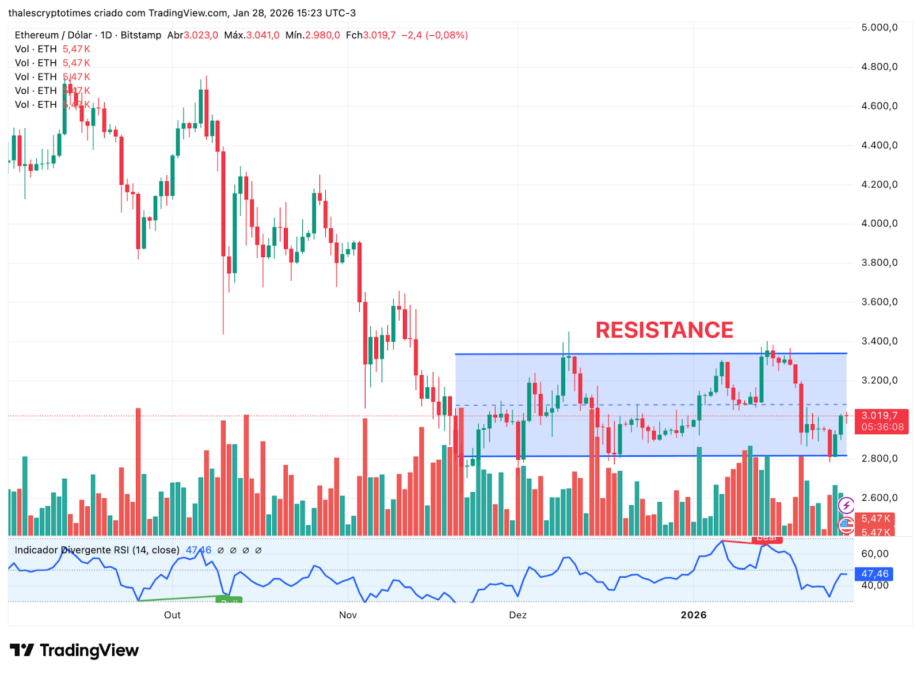
Ethereum followed the same pattern. ETH fell to around $2,940, losing over 2.5% on the day, while nearly $52 million in ETH positions were liquidated. The sell-off accelerated once ETH broke below the $3,000 psychological level, a key support zone for derivatives traders.
In total, crypto liquidations exceeded $324 million in 24 hours, with Bitcoin and Ethereum accounting for most of the damage.
Two markets, two stress mechanisms
The contrast could not be clearer.
Gold erased ~$3 trillion without leverage or liquidation events
Crypto erased hundreds of millions through visible liquidation cascades
The headline number is shocking, but the structure of the move matters more.
Gold erased trillions in value, yet capital is still flowing in a reminder that size, not stability, defines gold’s volatility. The metal may move slowly, but when it moves, it reshapes balance sheets at a scale no other asset class can match in today’s world.
Multiplifi’s TVL jumped to roughly $187M, tripling in less than a week.
On-chain data shows that most of the inflow occurred in a single day, not through gradual deposits.
The surge was driven by rwaUSD activation and Centrifuge-backed RWA pipelines, not DeFi incentives.
Multiplifi, the DeFi protocol, has seen its total value locked (TVL) surge to nearly $187 million this week after a single large on-chain inflow reshaped the protocol’s balance sheet almost overnight. The jump occurred as tokenized real-world assets were moved into the platform, following Multiplifi’s integration with Centrifuge and the launch of rwaUSD, rather than through steady user deposits.
The timing suggests a pipeline deployment of institutional assets, marking a deliberate shift in how capital is entering the protocol.
Token composition data shows that roughly 67% of Multiplifi’s TVL is now concentrated in rwaUSD, a stablecoin backed 1:1 by short-term U.S. Treasuries, dollar deposits, and cash equivalents. The asset is issued by BitGo, with branding and ecosystem services provided by World Liberty Financial.
The rwaUSD has grown fast. In the past 30 days, its market cap reached $4.93 billion, while monthly transfer volume jumped above $32 billion. Active addresses nearly doubled in the same period, reinforcing that the capital flowing into Multiplifi is operational liquidity rather than idle TVL.
Speculative chatter is happening on social media that the TVL surge stems from its strategic shift toward infrastructure-focused partnerships rather than traditional farming. Users point to the newly launched $50M RWA-backed stablecoin vault, a collaboration with AFI Protocol on Base, as the likely catalyst for this massive liquidity influx.
Seems this was the reason @multiplifi TVL surged soo much.
Thinking multiplifi would do more partnerships like this. Infra as opposed to the normal stablefarms we know.
Also today is the last day to sell your crystals. So sell now if you have thoughts of selling.
Multiplifi’s partnership with Centrifuge brings tokenized AAA CLO exposure, including JAAA, alongside tokenized equity and Treasury instruments into a unified collateral framework. Instead of farming incentives, the protocol positions itself as infrastructure: enabling yield on tokenized stocks, borrowing against them, and turning RWAs into productive balance-sheet assets.
The surge comes amid broader expansion in tokenized real-world assets. Over the past 30 days, total on-chain RWA value climbed to $24.02 billion, with asset holders up more than 34%, according to RWA.xyz. Tokenized Treasuries, private credit, and equities are increasingly being treated as long-duration infrastructure flows rather than speculative DeFi rotations.
Solana’s real-world asset (RWA) ecosystem has crossed $1 billion in on-chain value, marking a key milestone for tokenized finance on public blockchains. The growth is coming from tokenized Treasury funds and yield products, which tend to be longer-term and help keep on-chain activity steady even as markets cool.
In that context, Multiplifi’s TVL jump looks less like a one-off anomaly and more like a preview. As large RWA pipelines move on-chain, growth may arrive in blocks—not drips—reshaping how TVL should be interpreted across DeFi.
The Senate Agriculture Committee approved a crypto bill in a 12-11 party-line vote, moving it closer to the full Senate.
Democrats opposed the vote, and several proposed amendments on ethics, crypto fraud, and federal bailouts were rejected.
The bill now needs approval from the Senate Banking Committee and must be merged with the House version before becoming law.
The Senate Agriculture Committee voted on Thursday to move forward with the crypto market structure bill, sending it to the full Senate floor without support from both parties. The committee has reportedly approved the bill in a close 12-11 vote, giving new regulatory powers to the Commodity Futures Trading Commission (CFTC) over digital tokens.
The bill will later need to be merged with another part overseen by the Senate Banking Committee, which focuses on the Securities and Exchange Commission (SEC).
Under Chairman @JohnBoozman’s leadership, the Senate Ag Committee advanced crypto market structure legislation. This is a big move for consumer protection and innovation. pic.twitter.com/w0KpL2WXWM
— Senate Ag Committee Republicans (@SenateAgGOP) January 29, 2026
The vote follows months of delay and discussion between Agriculture Committee Chairman John Boozman, a Republican from Arkansas, and Sen. Cory Booker, a Democrat from New Jersey. However, an agreement was not made, so Boozman moved forward with a Republican-only bill. “There were fundamental policy disagreements,” Boozman said. He added, “It is now time to move this process forward.”
He described the bill as defining digital commodities clearly and providing the CFTC with the resources to take on its new responsibilities.
Democrats oppose party-line votes and amendments
Sen. Cory Booker criticized the GOP-only approach, saying Republicans abandoned the bipartisan process. That frustrates me because I see a bipartisan glide path to land this plane, to punch through the end zone,” he said.
Several Democratic-backed amendments were rejected, including a proposal from Sen. Michael Bennet that would stop federal officials and their families from issuing or endorsing digital assets. Other proposals, including measures to prevent crypto ATM fraud and to stop some crypto firms from getting federal bailouts, were also voted down along party lines.
Senator Amy Klobuchar, the committee’s ranking Democrat, said that while progress was made, more work is needed. “The progress that has been made here is good, but I think we believe that we’re not quite done yet,” she said.
Boozman noted that the bill can still be updated through manager amendments before it reaches the full Senate. He also agreed that the CFTC should have a full team of commissioners as it takes on crypto oversight.
Next steps for crypto oversight
After clearing the Agriculture Committee, the bill must pass the Senate Banking Committee and then be combined with its counterpart from the House. The House has already passed a version of the bill with strong support.
Meanwhile, the White House is expected to host another meeting next week to bring together crypto, banking, and political interests. U.S. President Donald Trump and his representatives have opposed some ethics provisions that Democrats wanted in the bill, citing conflicts of interest concerns.
This development represents one of the furthest steps the crypto industry has achieved in Congress. Last year, the space secured a major victory when the GENIUS Act bill, aimed at regulating stablecoins, was passed into law.
If this new bill is passed, it would give investors more confidence to trade digital assets and spread the adoption of cryptocurrency.
Paul Atkins advocates to include crypto in 401(k) plans from federal regulators to individual fund managers.
The move forces fiduciaries to choose between the risks of high market volatility and the potential failure to provide competitive returns.
The absence of regulatory safe harbors has created a legal gray area for plan sponsors.
Securities and Exchange Commission (SEC) Chairman Paul Atkins discussed a potential shift in federal retirement policy, stating that professional fund managers and trustees should have the authority to include digital assets in 401(k) plans.
In an interview with CNBC on Thursday, Atkins said, “The time is right to go forward with that in a measured way that has guardrails to protect the retirees.”
The SEC hopes to follow a White House executive order focused on digital asset innovation and asset diversification for everyday workers. The proposal seeks to modernize the American retirement system by treating cryptocurrency like institutional pension funds that have already accepted digital assets.
However, while Atkins has expressed support for the idea, no formal rule has been passed. The SEC does not control retirement plans, as that responsibility falls under the U.S. Department of Labor (DOL).
Current unregulated market
The current state of affairs for 401(k) plans is that there is no clear regulation, leaving those who manage American wealth in a precarious position. If they choose to include crypto and the market crashes, they could be sued for not adequately safeguarding the retirement savings of their participants.
On the other hand, if they choose to exclude digital assets during a market boom, they could face backlash for not providing the modern diversification and competitive returns that the current executive branch now promotes.
Managers now face a tough choice
If passed, the proposal would shift the responsibility of risk from federal regulators to private managers. Sponsors would have to deal with the complex interaction between the latest portfolio theory and the issue of liability. Atkins framed this shift as part of his “Project Crypto” initiative, which emphasizes financial freedom and innovation.
However, this approach puts the wealth managers in a tough spot. Without established safe harbors, these fiduciaries need to consider the potential for institutional growth alongside the risk of lawsuits if the volatile crypto market suffers a major downturn.
Clearer guidance from regulators, like the Department of Labor, is required to shield managers from personal liability and to define exactly how digital assets can be integrated. As the primary enforcer of the Employee Retirement Income Security Act (ERISA), the department rescinded its “extreme care” warning in May 2025 to return to a neutral stance; it has yet to provide a green light for digital assets.
Industry-friendly regulatory approach
The need for crypto inclusion comes about as the SEC is now taking a more industry-friendly approach under the current administration. Atkins has been vocal about the need to shift away from regulation by enforcement and instead seeks to provide clear channels for new technologies.
This discussion is a part of a larger order that seeks to understand the role of digital assets in domestic savings. However, there might be some with the belief that the volatile nature of assets such as Bitcoin presents a major risk to the retirement savings of millions of American workers.
What comes next
The integration of crypto into 401(k) plans will likely require future coordination between the SEC and the DOL. Until formal regulations or safe harbors are proposed, plan sponsors will likely operate in a period of uncertainty.
While there is high potential for billions of dollars to flow into the crypto ecosystem, the immediate outcome is a complicated legal environment for fund trustees. The coming months will reveal whether the 401(k) market will truly adopt digital assets or if the fear of litigation will keep these trillions of dollars tied to traditional investment options.
With the launch of MyBank, Bybit is aiming to simplify banking and trading in one platform.
The Bybit Card in Georgia enables crypto spending via Mastercard, supporting multiple currencies and Google Pay for use.
Bybit targets U.S. entry, global growth, and a future public listing while navigating strict regulations in the UK and Japan.
Crypto exchange Bybit is set to make a major move into banking with its “MyBank” service next month. Starting in February, the platform will allow customers to hold and transfer fiat currencies like U.S. dollars and euros using personal International Bank Account Numbers (IBANs).
According to a report, MyBank will support 18 fiat currencies and operate through partnerships with licensed banks, including Georgia-based Pave Bank. Bybit aims to streamline the entry into digital assets by letting users convert fiat to crypto instantly upon deposit.
Unlike companies like Revolut or Robinhood, which added crypto after building banking tools, Bybit is putting crypto first. It’s using its existing payment system, Bybit Pay, to combine banking and digital assets in one place. This means users can move money in and out faster, without waiting on third-party services that usually slow things down.
Expansion into crypto neobanking
The exchange is also entering the neobanking space, just like some of the other cryptocurrency-based platforms, such as Ether.fi, Kast, and Offramp. These platforms make it easier for people to use digital currency rather than the conventional banking system.
MyBank enables users to instantly exchange their cash for cryptocurrency with Bybit, which enables them to start trading immediately. Therefore, the platform is becoming appealing to people across the globe due to the convenience of banking and trading in one place.
Additionally, Bybit has introduced the Bybit Card in Georgia, allowing users to spend crypto wherever Mastercard is accepted. “Georgia is one of the most dynamic markets in the region, and we’re excited to introduce the Bybit Card here,” said Tekla Iashagashvili, Country Manager of Bybit Georgia.
The card supports multiple cryptocurrencies, offers instant virtual card access, and can link to Google Pay in supported regions. David Zgudadze of Mastercard added, “Such partnerships strengthen the financial ecosystem and promote technological progress in the country.”
Regulatory challenges and global strategy
Bybit’s expansion comes as it navigates strict regulations. The exchange relaunched in the UK last month after a two-year absence due to tightened Financial Conduct Authority (FCA) rules. Partnering with UK-licensed exchange Archax, Bybit can now offer Spot and peer-to-peer trading under a compliant structure.
In Japan, Bybit is implementing phased restrictions to comply with the Financial Services Agency requirements. Users identified as Japanese residents must complete additional verification by January 22, 2026, or face account limitations.
Bybit’s CEO, Ben Zhou, said the company plans to enter the U.S., but only with a licensed partner. The Dubai-based exchange already serves over 81 million users in 200 countries and hopes to go public in the U.S. eventually.
Bybit’s worldwide growth, new payment tools, and soon-to-launch banking service show it wants to make using crypto as easy as regular banking.
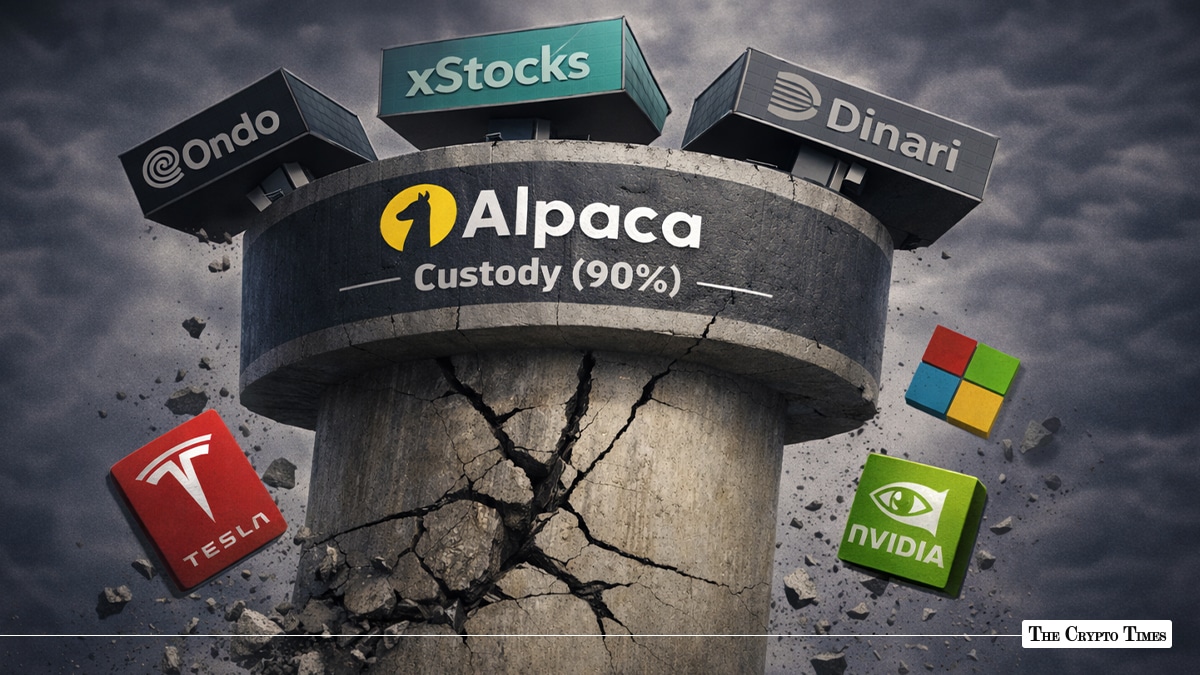
Alpaca Securities dominates the tokenized U.S. stocks market with roughly 94% share as of December 2025, serving as the primary custodian for major platforms like Ondo Finance, xStocks, and Dinari.
Despite tokens trading on decentralized blockchains, real-world settlement and custody rely on traditional finance infrastructure, exposing the ecosystem to regulatory scrutiny from the SEC, compliance challenges, and geographic restrictions that could disrupt the entire market.
The tokenized equities sector has grown rapidly, with Alpaca’s assets under custody nearing $670 million by early 2026 and leading issuers like Ondo ($546M) and xStocks ($209.5M).
While tokenized U.S. stocks are expanding rapidly, a closer examination over it reveals a significant irony: the tokens themselves trade on decentralized protocols, but the underlying settlement and custody processes remain profoundly centralized.
As noted by The Information with December 2025 data, nearly 94% market share of the tokenized stocks and exchange traded funds (ETFs) remains in the hands of Alpaca Securities, a California-based stock broker and dealer. Platforms like Ondo Finance, Kraken’s xStocks (via Backed Finance), and Dinari are all collectively using Alpaca as their go-to tokenized stock broker.
From Alpaca’s perspective, the growth is a phenomenon, but the heavy reliance on one broker introduces notable vulnerabilities in a sector that champions decentralization. A disruption at Alpaca–whether from operational issues, cyberattacks, or heightened regulatory scrutiny–could affect a vast portion of tokenized equities.
This can be compared to past centralized failures in crypto, where single chokepoints amplified risks. A prime example is the 2022 Terra/Luna collapse, where the centralized design of the UST stablecoin peg led to a rapid death spiral and over $40 billion in market value destruction. Comparatively, the tokenized stocks market is currently a toddler but risk remains the same regardless of the market valuation.
On top, regulatory bodies like the U.S. Securities and Exchange Commission (SEC) increasingly view tokenized assets as securities subject to existing rules, potentially targeting key infrastructure providers. One blue eye from them could shake the whole sector as it is already fragile due to its nature. The real-world settlements of tokenized stocks (trade execution, clearing, and share custody) depend on traditional systems. This hybrid model exposes the ecosystem to traditional finance (TradFi) frictions, including compliance hurdles and geographic restrictions.
Alpaca’s dominance in tokenized stocks management
Initially known for its developer-friendly APIs, Alpaca has become the go-to provider for tokenized stock issuers. Early reports indicated that Alpaca held custody for nearly 75% of tokenized U.S. stocks in a market exceeding $1 billion. However, as the industry matured, Alpaca’s dominance rose and it currently sits on the top; apparently the only position.
Latest data from RWA.xyz indicates that Ondo Global Markets’ $546 million in issuances, followed by xStocks with $209.5 million, further solidified Alpaca’s position. By early 2026, reports cited tokenized assets under management (AUM) climbing toward $670 million under Alpaca’s custody.
The concentration stems from Alpaca’s willingness to engage where others hesitate, providing self-clearing custody and APIs tailored for tokenization via its Instant Tokenization Network.
Explosive growth in tokenized stocks
These digital tokens, backed by real shares in companies such as Tesla and Nvidia, promise 24/7 trading, fractional ownership, and global accessibility without traditional intermediaries.
Tokenized stocks function by linking blockchain-based tokens to actual U.S. equities held in custody. These issuers purchase the underlying shares through a broker and mint corresponding tokens on blockchains such as Solana or Ethereum.
The sector has experienced explosive growth. By late January 2024, the valuation of total tokenized assets under custody (AUC) remained at $963.04 million, with over $2.11 billion in monthly transfer volume—as per RWA.xyz data.
Popular tokens include EXOD, TSLA, SPY (S&P 500 ETF), QQQ, NVDA, and IVV—all having millions in on-chain value. This boom reflects broader interest in real-world assets (RWAs) as a bridge between TradFi and decentralized finance (DeFi).
Looking ahead: Expansion and challenges
An optimistic point is that as the AUM in tokenized stocks reach new heights, Alpaca continues to invest aggressively in its role. In January 2026, the company secured $150 million in Series D funding at a $1.15 billion valuation, alongside a $40 million credit line. This capital is said to be used for global expansion, additional licenses, and enhanced tokenization infrastructure.
Proponents view this phase as transitional, with Alpaca serving as essential bridge infrastructure until more diversified or fully on-chain solutions emerge. Critics, however, argue that true decentralization requires reducing such dependencies to avoid undermining the sector’s foundational promises.
As tokenized equities grow from a niche experiment to a meaningful market segment, the tension between innovation and centralization persists. For now, Alpaca’s quiet dominance underscores a key reality: even in blockchain-powered finance, critical backend processes often remain firmly in centralized hands.
Crypto sees heavy selling: Over $346M in positions liquidated as Bitcoin drops near $87,800 and Ethereum falls below $3,000.
Silver and gold rally: Silver hits a record $120/oz (₹4,10,000–₹4,25,000/kg in India) and gold rises to $5,516/oz as investors seek safer assets.
Markets cautious amid Fed and global uncertainty: Fed holds rates 10–2, Asian markets are mixed, and Indian indices open cautiously, with Sensex and Nifty steady.
Crypto markets saw heavy selling over the past 24 hours as traders tried to cut their risk, while silver surged to record highs, highlighting a shift in investor sentiment.
According to CoinGlass, more than $346 million in crypto positions were liquidated during this period, affecting over 120,000 traders. The largest single liquidation was a Bitcoin trade on Hyperliquid worth $31.64 million.
This wave of selling pushed Bitcoin further down, continuing its recent decline.
Bitcoin slips amid liquidations
At the time of writing, Bitcoin was trading near $87,800, down around 1.7% in the last 24 hours. Over the past week, the world’s largest cryptocurrency has slipped more than 2%, as leveraged bets were unwound and traders turned cautious.
Data showed that $135.83 million worth of Bitcoin positions were liquidated in a day, with the majority coming from long trades. This suggested that many traders were caught on the wrong side of the move after betting on a rebound.
Ethereum under pressure
The second-largest cryptocurrency also moved lower. Ethereum fell to around $2,940, losing more than 2.5% on the day, as per CoinMarketCap data.
Nearly $52 million in ETH positions were liquidated, most of them longs. The fall accelerated after Ethereum slipped below the $3,000 mark, a level closely watched by traders.
Silver hits record high as crypto struggles
While crypto struggled, precious metals moved in the opposite direction.
Silver shot up to a record $120 per ounce before pulling back a little to about $119.26, as per TradingView data. In India, it climbed to around ₹4,10,000–₹4,25,000 per kilogram, showing strong demand for the physical metal. Gold also went up sharply, reaching $5,516 per ounce, as investors looked for safer places to put their money.
Economist and Bitcoin critic Peter Schiff reacted to the metals rally on social media, posting: “In 2017, at its peak of nearly $20k, Bitcoin was worth 14.25 ounces of gold. Today it’s worth 16 ounces. That’s a 12% gain in nine years. Was it worth the risk to beat gold by just 1.3% per year? HODLers will find out the hard way as Bitcoin crashes and gold continues to soar.” His comment highlights concerns about crypto, with many investors turning to precious metals for safety.
Global uncertainty fuels safe-haven demand
The rally in metals comes at a time of rising global uncertainty. Markets reacted after U.S. President Donald Trump warned of possible 100% tariffs on Canada if it moved ahead with trade deals involving China. The comments revived fears of trade tensions and pushed investors toward traditional safe havens.
Demand for physical silver has been especially strong in China and India. Market participants say buying of silver bars has increased sharply in recent weeks, tightening supply and pushing prices higher.
Fed policy and market caution
Uncertainty around U.S. monetary policy continues to weigh on markets. The Federal Reserve voted 10–2 to keep interest rates unchanged, pushing back against pressure for immediate cuts. Officials said inflation remains sticky and they want clearer signs before easing policy. The decision has added to investor caution, with many staying away from riskier assets like crypto.
Recent data showed the U.S. unemployment rate fell to 4.4% in December despite weak job growth, and economists expect the Personal Consumption Expenditures Price Index, excluding food and energy, to rise 3% year-over-year for the month, well above the Fed’s 2% target.
Inflation remains higher than desired, and the latest jobs data leaves little room for quick policy easing. Because of this, investors are being careful and staying away from riskier assets like crypto.
Indian markets stay steady
Indian markets remained steady through the session. The Sensex rose nearly 500 points to close above ₹82,300, while the Nifty gained over 160 points. Investors remained cautious ahead of the Economic Survey and the Union Budget 2026, which are expected to set the direction for markets.
Early signals pointed to a soft start in the next session. Gift Nifty was trading around 25,364, nearly 86 points lower than the previous Nifty futures close, indicating a slightly negative opening. The weakness reflected mixed global cues rather than any domestic concern.
Asian markets showed mixed trends following the US Federal Reserve’s policy decision.
Japan’s Nikkei: up 0.18%
Topix: down 0.57%
South Korea’s Kospi: up 1.09%
Kosdaq: up 2.69%
Hang Seng futures indicated a lower open
In the U.S., Wall Street closed mostly higher after the Fed kept interest rates unchanged.
Dow Jones: up 12.19 points to $49,015.60
S&P 500: down0.01% to $6,978.03
Nasdaq Composite: up 40.35 points to $23,857.45
The S&P 500 briefly crossed the $7,000mark, showing resilience despite caution around future rate cuts.
Overall, mixed global signals suggest Indian markets may open cautiously, with stock-specific movement likely to drive trading.
Why Bitcoin is falling while silver rises
It’s an old question, but worth asking again: why is Bitcoin going down while silver is climbing?
Traders say it’s all about how risky investors feel things are. When times feel uncertain, people move their money to things that feel safer, like gold and silver. Bitcoin is often called digital gold, but in the short term, it still acts like a risky investment, especially when people are using leverage.
In the past, Bitcoin has sometimes fallen behind gold and silver before bouncing back once things settle down. Whether that happens this time, we’ll have to wait and see. For now, it’s clear that investors are playing it safe, volatility is up, and people are choosing security over big bets.
The Fed paused rates at 3.5%-3.75%, signaling caution as jobs stabilize but inflation remains a concern.
Cryptos reacted cautiously, with Bitcoin near $88K; traders are now watching dollar strength more than Fed moves.
A weaker dollar may support crypto gains, while a strong dollar could act as a ‘wrecking ball’ for risk assets.
Defying intense political pressure and a series of verbal attacks from the White House, the Federal Reserve voted 10-2 on Wednesday to maintain the federal funds rate at 3.5%–3.75%. In its policy statement, the Federal Reserve highlighted that “job gains have remained low, and the unemployment rate has shown some signs of stabilization.” Inflation, it noted, remains “somewhat elevated.”
While the move was widely expected by institutional desks, the dissenting votes from Governors Stephen Miran and Christopher Waller highlight a growing rift within the FOMC. Both were appointed under President Donald Trump, highlighting ongoing debates about how fast the Fed should act.
Fed Chair Jerome Powell said that while the labor market is stabilizing, the Fed is in no rush to cut further until the inflationary effects of recent tariffs are fully understood.
Market response and crypto implications
Major cryptocurrencies reacted cautiously to the Fed announcement, indicating that market participants were waiting for Powell’s press conference for more insights. The current global cryptocurrency market cap is $2.98 trillion, down 1.34% in the last 24 hours, while the total trading volume is down 2.73% to $111.76 billion, as per CoinMarketCap data.
Bitcoin (BTC), the top cryptocurrency by market cap, is currently trading at $88,165.80 with a slight daily increase of 0.07%, although it has experienced a decline of 1.05% and 2.14% in the last week and month, respectively. The market capitalization of Bitcoin is above $1.76 trillion, with approximately 20 million BTC in circulation.
Ethereum (ETH) traded around $2,950, up just 0.05% for the day but down 1.8% over the week. Binance’s BNB rose slightly to $898.65, and XRP gained 0.31%, reaching $1.88. With this market performance, therefore, the Fed’s decision didn’t shake crypto markets immediately, but changes in the dollar’s strength could have a bigger impact on prices over time.
Dollar dynamics and broader market signals
The US dollar continues to weaken, with the Bloomberg Spot Dollar Index reaching new four-year lows. President Trump dismissed the decline of the dollar, stating, “The value of the dollar is great.” Some analysts say that President Trump indirectly supports lower rates by weakening the dollar.
The Kobeissi Letter called it “a clear signal that President Trump is willing to tolerate a weaker Dollar to push rates lower and boost US exports.” Similarly, Bloomberg TV APAC noted, “President Trump may effectively be cutting rates on the Fed’s behalf by letting the dollar slide.”
President Trump may effectively be cutting rates on the Fed’s behalf by letting the dollar slide.
ICYMI – Dollar saw a massive collapse overnight. Bloomberg gauge saw a 3-sigma move down. Trump said he’s not concerned about the currency’s decline.
Historically, cryptocurrencies have performed well under loose monetary policy. However, experts argue that dollar strength often outweighs rate changes in driving crypto sentiment. Julien Bittel, Head of Macro Research at Global Macro Investor, described a strong dollar as a “wrecking ball” for risk assets.
The Fed’s decision to pause shows it’s being careful with the economy while inflation is still a concern. Cryptocurrencies tend to react more to the dollar’s strength, so how the dollar moves will likely shape crypto prices.
The SEC clarified that putting a stock on a blockchain does not change its legal status; it is still a security subject to full registration.
Issuing or recording securities on-chain does not change registration, disclosure, or compliance requirements.
The guidance reinforces oversight amid shifting crypto enforcement but leaves crypto-native asset status unresolved.
The U.S. Securities and Exchange Commission (SEC) has clarified that tokenized securities remain subject to federal securities laws, reinforcing that placing a financial instrument on a blockchain does not alter its legal status.
The guidance was issued Wednesday through a joint staff statement from the SEC’s Divisions of Corporation Finance, Trading and Markets, and Investment Management.
The statement is made in the context of increasing attention of financial institutions to the tokenization of traditional assets (stocks, bonds, funds) with blockchain technology. Although the agency recognized the operational distinction of on-chain recordkeeping, it still highlighted that the regulatory obligations are the same.
Legal obligations are not altered by blockchain format
The SEC states that securities issued or registered on a blockchain should be subject to the same registration, disclosure, and compliance requirements as those of securities issued using traditional systems.
The agency claimed that the issuance format, on-chain or off-chain, does not influence the federal securities laws. On-chain transactions are transactions that are recorded on a blockchain as ownership and transfers instead of using the conventional databases.
The SEC observed that issuers can issue tokenized securities in a separate category or in combination with conventional securities. In some cases, regulators can consider both formats as one and the same class under some laws as they have rights and privileges that are substantially similar.
The main difference, which the statement clarified, is the way issuers keep records of shareholders. Rather than off-chain databases, issuers or their representatives can rely on a single or multiple crypto networks to monitor ownership, without altering the legal nature of the security.
The explanation comes in the fact that the SEC has changed its approach to crypto regulation in the last year. During the Trump administration, the agency has abandoned or shut down over a dozen enforcement actions of big crypto companies.
Some of those cases focused on the issue of whether digital tokens, staking services, or wallet infrastructure were unregistered securities.
Although the enforcement posture is less aggressive, the statement of Wednesday strengthens the legal basis of most of the previous cases by restating that the securities laws are applicable irrespective of the technological structure.
Nevertheless, the guidance does not consider whether crypto-native products are securities in the first place, which is a question that is legally unanswered.
The clarification and its importance to markets
The declaration offers regulatory certainty to institutions that consider tokenized securities, especially with traditional finance starting to experiment with blockchain-based settlement and recordkeeping.
Meanwhile, it is an indication that innovation will not spare products of regulation. Although the SEC has reduced certain crypto enforcement, it still pursues cases of activities like Bitcoin mining services, which it claims can be securities offerings.
The guidance suggests that regulatory scrutiny will focus on economic reality rather than labels or technology. As tokenization gains traction, the SEC’s message is clear: blockchain may change how securities move, but not how they are regulated.
Russia will allow both retail and institutional investors to legally buy crypto by 2027 under new rules and limits.
Retail investors face testing and a 300,000-ruble yearly limit, while qualified investors can trade most cryptocurrencies freely.
Russia leads Europe in crypto, moving $376B in a year, with strong growth in Germany, Ukraine, and Poland too.
Russia is set to roll out its long-awaited crypto rules in July, allowing both regular and institutional investors to legally buy Bitcoin by mid-2027. The new law, developed by the Bank of Russia and the parliament, will establish clear guidelines for various categories of investors, as well as impose fines for illegal crypto-related activities.
According to Anatoly Aksakov, the Head of the State Duma Committee on Financial Markets, the new law will impose fines for illegal crypto-related activities, just like in the banking industry. The development of the law is expected to be completed by the end of June.
As per an official report, under the new rules, unqualified or retail investors must pass a test before purchasing crypto and will face an annual investment limit of 300,000 rubles per intermediary. “The Central Bank will most likely compile a list of the top 5 or 10 most traded cryptocurrencies on major crypto exchanges. These will definitely include BTC and ETH. They might also add SOL or TON, given their popularity in our country,” explained lawyer Alexandra Fedotova.
Qualified investors, meanwhile, will undergo mandatory testing but can purchase any cryptocurrency in unlimited quantities, except anonymous coins like Monero, Zcash, and Dash.
Defined investor rules and high-risk warnings
The Central Bank classifies cryptocurrencies as high-risk instruments. They are not issued or guaranteed by any jurisdiction and are subject to volatility and sanction risks. Consequently, investors must understand that their funds are at risk. Stablecoins may be treated differently, potentially functioning as a “digital dollar” for corporate foreign economic activity. Fedotova noted that USDT could serve as a corporate tool, purchasable through licensed brokers.
Besides, the legislation clarifies that cryptocurrencies cannot be used as legal payment in Russia. Transactions must occur through licensed intermediaries, including exchanges, brokers, and trustees. Specialized depositories and online exchangers will face additional licensing requirements. “Exchangers will have to obtain a license. Without one, they will become illegal,” Fedotova added. Residents can still purchase crypto abroad using foreign accounts but must notify the tax service for compliance.
The law also targets cryptocurrency mining. Aksakov emphasized that miners will have the chance to legalize operations fully. The framework will set rules for cryptocurrency creation, circulation, and mining while banning usage as a domestic payment method.
Administrative, financial, and potentially criminal penalties will be applied to illegal operators. Adjustments to retail investment caps are still possible, with the 300,000-ruble limit currently under discussion.
Europe’s crypto landscape highlights Russia
According to Chainalysis, Russia leads Europe in crypto, handling $376 billion between July 2024 and June 2025—well ahead of the UK’s $273 billion. Crypto is growing steadily, with both regular people and big institutions getting involved. Other countries like Germany, Ukraine, and Poland are also seeing strong growth, thanks to more people adopting crypto and supportive financial systems.
In addition, the bigger markets like Russia enjoy the effects of networks, which in turn attract more participants to the market. The transaction volume in Russia reached a peak of $234 billion in December 2024.
Russia’s 2027 crypto rules are designed to make investing in cryptocurrencies clearer and safer. Regular investors will have limits and need to pass a simple test, while experienced investors can trade more freely.
Capital Raised: Over 750 Bitcoin (BTC) secured from professional and institutional investors in four months.
Institutional Interest: 68% of institutional investors have invested or plan to invest in Bitcoin products.
Strategy & Access: Market-neutral arbitrage fund; units can be used as collateral for USD loans without selling bitcoin.
Sygnum, a Swiss digital asset bank, and Starboard Digital, a crypto investment firm, have raised over 750 Bitcoin (BTC) for a new fund that focuses on arbitrage trading, as institutional investors look for ways to earn returns from crypto without relying only on price increases.
The fund, called the BTC Alpha Fund, was launched in October 2025 and has drawn capital from professional and institutional investors over the past four months. According to figures shared by the firms, it delivered an annualized return of 8.9% in Bitcoin terms during the fourth quarter of 2025.
📣 News: Sygnum and Starboard Digital raise over 750 BTC for BTC Alpha Fund
▪️ Over 750 BTC raised from professional investors in first four months, validating institutional demand for yield-generating Bitcoin strategies ▪️ First regulated bank globally to offer market-neutral… pic.twitter.com/1PTHym83RW
Instead of betting on whether Bitcoin’s price will go up, the fund follows market-neutral strategies. It focuses on exploiting price differences across crypto markets, especially between spot and derivatives, making profits from these gaps rather than from changes in BTC’s price.
Shift in institutional approach
The fund is launching at a time when institutional interest in digital assets is shifting. With spot Bitcoin exchange-traded funds (ETFs) making it easier for big investors to get exposure, and price volatility lower than in earlier cycles, simple long-only strategies are becoming less appealing.
Because of this, some investors are now looking at approaches similar to traditional hedge funds, such as market-neutral and relative-value strategies, which aim to generate returns under a variety of market conditions.
Sygnum provides the banking and custody infrastructure for the fund, while Starboard Digital is responsible for managing the trading strategy.
Markus Hämmerli, who leads the BTC Alpha Fund at Sygnum, said the product was developed in response to this shift in investor behavior.
“As Bitcoin becomes a core portfolio allocation for institutional investors, we’re seeing growing demand for strategies that can generate returns beyond simple price appreciation. The fund’s Q4 performance demonstrates that professional Bitcoin management can deliver meaningful results even when spot markets are flat or declining.”
How the strategy works
The BTC Alpha Fund is domiciled in the Cayman Islands and uses systematic arbitrage strategies across major crypto trading venues. These include price differences between spot and derivatives markets, as well as short-term inefficiencies that arise across exchanges.
The fund does not bet on whether Bitcoin’s price will go up or down. It is designed to stay market-neutral, earning returns mainly through trading activity that does not depend on overall market movements. Any profits are added back into Bitcoin rather than being converted to fiat.
To manage risk, the fund uses position limits, liquidity checks, and focuses on markets with high trading volumes. It offers monthly liquidity to investors and keeps its assets stored off-exchange.
Role of Sygnum and Starboard
Sygnum acts as the banking and infrastructure provider, offering custody and financing services linked to the fund. Starboard Digital manages execution and portfolio construction.
One feature of the structure is that fund units can be used as collateral for US dollar–denominated Lombard loans through Sygnum, allowing investors to access liquidity without selling their Bitcoin exposure.
Nikolas Skarlatos of Starboard Digital said the fund was built to address a long-standing challenge in institutional crypto investing. “Generating yield on Bitcoin while maintaining exposure to its long-term upside has been a persistent challenge for institutional investors. The early performance of the fund points to growing acceptance of yield-focused strategies, with a target range of 8–10% annual returns across different market conditions.”
Broader market context
The fund is launching at a time when crypto markets are growing more mature, with deeper liquidity and stronger infrastructure that make more complex investment strategies possible.
At the same time, arbitrage strategies depend on gaps in the market, which can narrow as more money flows in. How well the fund performs also depends on execution, the depth of the markets it trades in, and how risks are handled during volatile periods. Data from the industry suggests that demand for professionally managed Bitcoin products is growing. Around 68% of institutional investors have either already invested in, or plan to invest in, Bitcoin exchange-traded products (ETPs) or related instruments, reflecting the growing appetite for structured crypto strategies beyond simple spot exposure.
Even so, the scale of capital raised in a relatively short period suggests that institutional investors are becoming more comfortable allocating to structured crypto products that go beyond simple price exposure.
ERC-8004 gives AI agents trusted IDs and reputations, letting them work across organizations without a central authority.
Ethereum becomes a neutral platform for AI, enabling discovery, verification, and collaboration between autonomous agents.
With growing adoption and payment protocols like x402, ERC-8004 could lay the foundation for a global AI agent economy.
Ethereum is rolling out a new protocol today that gives AI agents identities and reputations they can carry between organizations: the ERC-8004. This helps solve a major trust problem, letting AI systems work on their own without needing a central authority.
According to Ethereum’s official X post, “ERC-8004 is going live on mainnet soon. By enabling discovery and portable reputation, ERC-8004 allows AI agents to interact across organizations ensuring credibility travels everywhere.” Davide Crapis, Ethereum Foundation’s AI Lead, explained that Ethereum is in a unique position to manage and secure interactions between AI agents. He added that the ERC-8004 standard is set to launch on the mainnet soon.
ERC-8004 is going live on mainnet soon.
By enabling discovery and portable reputation, ERC-8004 allows AI agents to interact across organizations ensuring credibility travels everywhere.
This unlocks a global market where AI services can interoperate without gatekeepers. https://t.co/Yrl0rvnSxj
Also called “Trustless Agents,” ERC-8004 solves the trust problem in AI coordination. Autonomous agents often lack a neutral way to discover, verify, or assess each other. The protocol introduces three on-chain registries that work alongside existing agent communication systems like A2A and MCP.
The Identity Registry gives each AI agent a unique ID using non-fungible tokens (NFTs), so their identity can be trusted. The Reputation Registry keeps track of feedback from clients, building a permanent history of how well the agent performs. The Validation Registry lets outside parties check an agent’s work using methods like cryptography or trusted reviewers.
ERC-8004, proposed in August 2025 by the Ethereum Foundation team, MetaMask, Google, and Coinbase, keeps costs low and lets developers create their own trust systems outside the blockchain. Ethereum’s neutral platform, resistance to censorship, and global accessibility make it a good fit for helping AI agents find and verify each other. Vitto Rivabella of the Ethereum Foundation wrote on X that ERC-8004 addresses a growing problem in the AI agent ecosystem: trust.”
ERC-8004 has also seen strong early adoption. Davide Crapis shared that 1,000 to 2,000 builders already engage in projects based on the standard. MetaMask has integrated it, and over 70 projects built agent browsers similar to blockchain explorers. Layer 2 networks, including Taiko, officially support ERC-8004, signaling fast-moving infrastructure development.
Interestingly, Coinbase’s x402 payment protocol, which facilitates payments between AI agents through automated stablecoin payments, recorded a transaction volume growth of 10,000% in October 2025. This protocol works alongside the new standard for payments and the ERC-8004 standard for trust and identity verification.
Cloudflare and Coinbase’s x402 Foundation have also standardized machine-to-machine payments, including the stablecoin called NET Dollar for AI micropayments.
Why this matters
This new launch positions Ethereum as the TCP/IP for AI agents, providing a neutral layer free from corporate control. As developer binji noted on X, “Civilizations scale because humans are capable of implicit trust, AI agents are not; their only path to building an agentic society is through a ledger of shared truth…aka a blockchain.” Consequently, ERC-8004 may transform Ethereum from a cryptocurrency platform to a foundational layer for global AI coordination.
Civilizations scale because humans are capable of implicit trust, ai agents are not; their only path to building an agentic society is through a ledger of shared truth..aka a blockchain.
ERC 8004 cements Ethereum and its L2s as that blockchain.
With contributions from Google, Coinbase, and MetaMask, ERC-8004 shows how Ethereum can provide a shared framework for AI agents to work together across systems.
On-chain data shows that a trader earned over $2 million in 24 hours through leveraged HYPE longs on Hyperliquid.
HYPE rallied 50–65% amid explosive growth in HIP-3 perpetuals and record trading volumes.
Similar high-leverage wins highlight rising DEX activity but also underline significant trading risks.
A low-profile crypto trader has drawn attention after he generated over $2 million in profits within 24 hours on the decentralized perpetuals exchange Hyperliquid, according to data from blockchain intelligence firm Arkham Intelligence.
The trade highlights both the growing influence of on-chain transparency and the rising activity on decentralized derivatives platforms.
How the trade happened
Arkham’s on-chain analysis shows that the trader built roughly $4.5 million in leveraged long exposure to HYPE, Hyperliquid’s native token, shortly before a sharp price rally.
The gains came as HYPE surged from recent lows near $21 to around $34–35, marking a 50–65% increase in recent weeks. The trader’s positions were large enough to place them among Hyperliquid’s top daily performers.
Arkham’s entity mapping linked activity across multiple exchanges, including Binance, showing how blockchain data can connect wallets and trading behavior even when identities remain anonymous.
The portfolio behind the gains was mostly a combination of ETH holdings with Hyperliquid perpetual contracts, which confirms a trend in which traders pledge ETH to gain access to high leverage derivatives on decentralized exchanges.
Hyperliquid’s growth and the HYPE rally
The trade occurred amid a broader resurgence in Hyperliquid’s ecosystem. One of the main forces has been the fast implementation of HIP-3, which enables users to open decentralized perpetual markets through the staking of HYPE.
This has expanded trading beyond crypto assets into commodity-linked perpetuals, including gold and silver. Open interest on HIP-3 markets recently climbed to over $790 million, up from around $260 million a month earlier.
HIP-3 open interest reached an all-time high of $790M, driven recently by a surge in commodities trading.
HIP-3 OI has been hitting new ATHs each week. A month ago, HIP-3 OI was $260M.
Trading activity has also intensified, with Silver-USDC perpetuals posting more than $1.2 billion in 24-hour volume, making it one of the platform’s most actively traded contracts.
Hyperliquid routes 50% of trading fees into HYPE buybacks, a mechanism that analysts say has supported token demand alongside reduced sell pressure following earlier staking unlocks.
Similar high-risk wins
This is not an isolated case. Hyperliquid has experienced several big trades in recent months such as a $1.5 million deposit turned into $875,000 in profit with leveraged HYPE longs, and a position scaled to $8.1 million that earned over $1 million in unrealized gains.
In January 2026, another trader who invested $85, made over $115K on a Chinese memecoin. Nonetheless, according to the market observers, these gains are associated with a lot of risk. Extremely high leverage on perpetuals has also resulted in the loss of multimillion dollars when the market turns.
Another example just this week in Solana, a wallet made $285 into $627,000 in a 24-hour timeframe by buying the new ZReaL token, which brought up the issue of timing benefits and insider trading.
These incidents highlight the way decentralized trading platforms are transforming market participation, providing transparency and extreme volatility. Although big wins get attention, analysts warn that big wins are an exception, not a rule, particularly in high-leverage settings.
Senators are expected to vote on the crypto market bill on Thursday, amid pressure of government shutdown by January 31.
Multiple amendments have been filed, including ethics rules for officials and a delay until the CFTC has enough commissioners.
Other proposals aim to prevent fraud at crypto ATMs and stop foreign adversaries from participating in U.S. crypto markets.
Bipartisan U.S. senators are preparing to vote on a major crypto market structure bill on Thursday in Washington, D.C., following an earlier delay this week due to bad weather. Lawmakers are expected to appear on Capitol Hill to discuss proposed changes and decide whether to add the bill to the CLARITY Act.
This markup is the first major attempt to advance the bill after the Senate Banking Committee delayed its own markup when Coinbase withdrew its support.
Senators introduce new changes to the bill
Multiple lawmakers have submitted amendments to adjust the bill before a final vote. Senator Michael Bennet of Colorado suggested rules to limit crypto holdings and activities for government officials and their families, which include the U.S. president, the Vice President, and United States Representatives. This is to avoid conflict of interest, though it is not yet clear if the committee will approve this proposal.
Senator Amy Klobuchar of Minnesota filed two amendments. One would delay the bill until the Commodity Futures Trading Commission (CFTC) has at least four commissioners, including two from the minority party. The second amendment narrows the definition of a “retail participant” and clarifies the responsibilities of the Digital Commodity Retail Advocate, a role meant to protect small investors.
Senator Dick Durbin proposed measures to ban bailouts for crypto issues and add rules to stop fraud in crypto ATMs. Meanwhile, Senators Tommy Tuberville and Jerry Moran introduced proposals aimed at limiting foreign adversaries from participating in U.S. crypto markets.
These amendments focus on improving oversight and protecting U.S. investors. Senators will discuss each proposal before voting, and all committee members are expected to attend after the weather is clear.
Push for clear crypto rules
In a video posted on X, Senator Kirsten Gillibrand highlighted the need for clear guidelines for the crypto market. She said the bill is essential so that companies and investors can understand how to follow the law. She highlighted that proper regulations would protect consumers and make sure buyers know the risks.
Common-sense crypto market structure regulation will protect consumers and market players alike.
“The need for market structure regulation could not be more important. We need these rules on the road so participants know how to do things legally and appropriately,” she said.
She added that clear rules would help crypto companies continue operating in the U.S., and also support New York’s position as a global financial hub.
The committee will review and vote on each amendment before deciding whether to send the bill to the Senate floor. Some senators, including Roger Marshall and Dick Durbin, expressed that they will not push their credit card swipe fee proposal during the markup. The process will be observed by the crypto space as the Senate faces the government funding deadline, which could lead to a shutdown if not resolved.
BTC is pinned below the $90,000–$93,000 ceiling as sellers defend the zone.
ETH is struggling to reclaim $3,200, with $3,400 emerging as the cleaner trend reset level.
U.S. crypto ETFs saw about $1.8B in weekly outflows, signaling broad de-risking, not rotation.
Bitcoin (BTC) and Ethereum (ETH) are stalling near $89,000 and $2,900 as institutional capital continues to exit the market. Both assets remain capped by key resistance levels, with price stability masking a broader shift toward risk reduction.
Between January 19 and 23, roughly $1.8 billion flowed out of U.S. crypto ETFs, the largest weekly outflow since late 2025. At the same time, on-chain data shows rising exchange inflows, increasing realized losses, and falling derivatives leverage, pointing to a market moving decisively from profit-taking into active de-risking.
A market stabilizing, not recovering
Bitcoin’s slide toward $89,782 reflects sustained selling pressure. Repeated failures in the $90,000–$93,000 range confirm that demand has not been strong enough to reclaim higher ground.
From its October 2025 all-time high (ATH) of approximately $125,000, BTC has seen a significant drop of 30%. The Relative Strength Index (RSI) is currently sitting at 46.56, indicating a neutral-to-bearish momentum that lacks the “oversold” signal needed for a sharp reversal.
On the other hand, Ethereum is hovering near $3,000, but failing to reclaim the $3,300 area that would signal real momentum returning.
Ethereum is down about 42% from its ATH near $4,800. Its Relative Strength Index (RSI) of 46.34 confirms a similar lack of buying pressure at these local resistance zones.
Both assets are now sitting in a “dead zone” where buyers are present, but not aggressive, and sellers don’t need to do much to keep the lid on.
Technically, momentum has cooled. The RSIs of BTC and ETH read neutral-to-soft rather than “washed out.” Markets typically need either fresh demand or true exhaustion selling to reverse cleanly. Right now, neither is obvious.
The ceiling is technical, and the pressure is flow
The $1.8 billion weekly outflow from U.S. ETFs suggests institutions aren’t simply trimming profits. They are reducing risk exposure into strength and using liquidity windows to exit.
That’s a classic “loss-realization” phase: prices can stop falling fast, but money is still walking out the door.
Despite the recent weekly crash, 2026 started on a high note for Ethereum, which reached $11 billion in YTD inflows by mid-January, outperforming Bitcoin on a proportional basis relative to assets under management.
Stabilization after tough Q4, but momentum still lags
Bitcoin has started 2026 on a steadier footing after a brutal end to last year. Following sharp losses in November and December, BTC is up about 2% in January, signaling stabilization rather than a rebound.
While Bitcoin remains roughly 30% below its late-2025 peak near $128,000, year-to-date inflows of around $678 million suggest institutional support is still stronger than in prior bear markets.
Ethereum is seeing a similar, weaker recovery. After a 28% drop in Q4 2025, ETH is up just 0.9% in January, with choppy price action and about $630 million in recent weekly outflows. The market continues to struggle to reclaim the $3,000 level.
Despite being roughly 42% off its highs, Ethereum pulled in about $12.6 billion of inflows over 2025, pointing to lingering institutional interest, just not enough yet to drive a sustained breakout.
ETF flows turn risk-off in January
U.S. spot Bitcoin ETFs reversed sharply in January, posting about $1.33 billion in net outflows for the week ending January 23, the worst since early 2025 and a sharp flip from the prior week’s inflows. The sell-off peaked on January 21 with a $709 million single-day redemption, signaling broad institutional de-risking.
BlackRock’s IBIT showed late-month resilience with a $15.9 million inflow on January 26 and still leads with $63.4 billion in cumulative inflows. Meanwhile, Fidelity’s FBTC and Grayscale’s GBTC saw the heaviest exits, highlighting how ETF demand remains fragile as Bitcoin trades below key resistance.
Ethereum spot ETFs followed Bitcoin into risk-off mode, logging $611 million in net outflows for the week of January 19–23. The pullback erased much of January’s early gains after a $229.9 million single-day redemption on January 20, underscoring choppy institutional positioning around current price levels.
BlackRock’s ETHA led withdrawals with $432 million exiting over the week, though it still holds $12.4 billion in cumulative inflows. Fidelity’s FETH and Grayscale’s ETHE also saw steady redemptions, while Grayscale’s mini ETH product was a rare bright spot. Despite the volatility, total ETH ETF AUM sits near $18.1 billion, suggesting long-term institutional interest remains intact even as short-term risk is trimmed.
What would change the setup
Bitcoin and Ethereum are no longer just consolidating; they are being stress-tested. With BTC pinned near $89,000 and ETH struggling around $2,900, both assets remain trapped beneath heavy resistance as institutional flows turn decisively defensive.
The $1.8 billion pulled from U.S. crypto ETFs in a single week signals a shift from passive profit-taking to active risk reduction, marking a broader loss-realization phase. Until flows stabilize and these core ceilings are reclaimed, rallies are likely to fade quickly, leaving the market in a fragile balance between consolidation and deeper downside.
The RIVER token price dropped 29% to $49.11 after hitting a January 26 record high of $87.73, erasing recent gains.
Only five wallets possess nearly the entire circulating supply, i.e., 94%.
The sharp sell-off contrasts with a recent $12 million funding round involving TRON and Maelstrom Fund.
RIVER, the native asset of a chain-abstraction stablecoin system, fell sharply over the past 24 hours, dropping nearly 29% and is now trading around $49. The decline happened right after the token hit an all-time-high (ATH) of about $87, concluding a month where its value surged nearly 2,000%.
Analysts had already warned about the possible risk of a crash due to low usage and possible manipulated trading, heightened by using leverage options like 80X.
Market watchers attribute this correction to extreme supply concentration and large profit-taking by early investors who exited their positions after a period of rapid growth.
At the time of writing, RIVER is trading at $49.11, with a decline of 29.57% on the day. The total market capitalization has declined by 29.53% in 24 hours, reaching $924.07 million. The 24H volume is $136.22 million with a rise of 70.15%. The circulating supply currently is 19.6 million RIVER, accounting for approximately 19.6% of the 100 million maximum supply.
Institutional funding impact
One of the key factors that contributed to the initial price explosion was a funding round, which drew the attention of institutional investors. Prominent investors like TRON founder Justin Sun and Arthur Hayes’ Maelstrom Fund gave the project a certain degree of legitimacy that helped RIVER boost its market capitalization.
The funding injected into the project was intended to help the project’s objective of developing a multi-chain stablecoin abstraction layer that would render the need for bridges obsolete when transferring stablecoins between different blockchains.
Major centralization risks
Despite the project’s buzz, on-chain data shows that around 94% of the total RIVER supply is currently held in five individual wallets. This level of concentration of the total supply in the hands of a few individuals means that a handful of investors can create a huge effect on the market price.
Experts in the industry have warned that such a system is fraught with danger and that these ‘whales’ can create massive price crashes at will, leaving retail investors who purchased during the peak with massive losses. The future stability of RIVER is unclear as the market assesses the consequences of this supply distribution.
Although the project is still in the process of building its ecosystem by partnering with other networks such as TRON and Sui, the looming threat of further liquidation by the major holders casts a shadow over the price. Regulatory scrutiny could also increase if this uneven distribution leads to more claims of market manipulation or artificial volume.
The RIVER token is currently experiencing a similar pattern to what most of the other tokens that spiked during the bull market and went downhill once trading euphoria collapsed. While support from industry giants helped drive its 2,000% rise, the 29% fall acts as a reminder of the risks tied to highly centralized assets.
The protocol will strip exclusive block-construction authority from builders to prevent a centralized takeover of the network.
The control shifts from a few high-powered entities back to the broader community of individual validators to ensure fair access.
This update serves as a programmable barrier to prevent Ethereum’s infrastructure from evolving into a traditional, closed financial system.
Researcher Thomas Thiery, known as soispoke, along with other contributors, proposed Fork-Choice Enforced Inclusion Lists (FOCIL, EIP-7805) on Wednesday, aiming to protect Ethereum’s fundamental principles. The mechanism is expected to become a part of the upcoming Hegota upgrade, currently targeted for late 2026.
The adjustment aims to prevent network censorship by allowing multiple validators to work together, ensuring valid transactions are included according to the fork-choice rule.
By requiring transactions to be processed within a set timeframe, the proposal seeks to limit the growing power of centralized block builders who currently have a lot of control over transaction ordering. Developers are prioritizing this change to keep Ethereum a neutral and decentralized ledger rather than letting it become dominated by a few intermediaries.
A push for fairness
The move toward FOCIL is not just a technical adjustment; it reflects a call for fairness built into Ethereum’s code. The network has had to contend with issues related to the growing influence of specialized builders who are able to selectively decide which transactions to validate in order to maximize their profits or in response to external pressures.
FOCIL removes this kind of exclusionary power from the centralized bodies and returns it to the thousands of individual validators who help to support the network. This is a reflection of a very important struggle within the environment: the struggle to prevent Ethereum from becoming what it originally set out to replace, the centralized banking systems.
Breaking the builder monopoly
The main feature of EIP-7805 sets a binding requirement for block creation. Currently, a single block builder decides which transactions get included in a block. Under the new proposal, a group of validators will create an inclusion list of pending transactions from the public mempool.
Thiery’s research paper, “Who Wins Ethereum Block Building Auctions and Why?” shows the urgency of this transition. The study reveals that only three builders produced 80% of all Ethereum blocks between late 2023 and early 2024.
This “chicken-and-egg” problem means dominant builders receive exclusive order flow because they win blocks, and they win blocks because they have exclusive order flow. FOCIL breaks this cycle by introducing a committee-based design where a rotating group of validators get local inclusion lists based on their own view of the mempool.
Cryptographic guarantee of neutrality
If a builder tries to leave out these transactions, the fork-choice rule will require validators to reject that block and select another one that follows the list. This offers a cryptographic guarantee that no one entity can permanently gatekeep the blockchain.
The proposal responds directly to the delay of similar features in the previous Glamsterdam upgrade. Although Glamsterdam, set for the first half of 2026, focuses on Proposer-Builder Separation (ePBS) to promote fairness in the network, developers concluded that FOCIL needed more thorough review before becoming a key feature.
Future protocol resilience
By separating censorship resistance from block production, Ethereum can continue to grow with builders without compromising its credibility. For users, this means better assurance that their transactions won’t be unjustly blocked or delayed by institutional competitors or centralized intermediaries. For the wider industry, it sets an example for protocol-level resistance against the “cartelization” of block building, ensuring that the network’s rules stay clear and fair.
Adding FOCIL as the primary feature for Hegota shows the dedication to the blockchain’s core principles. As the scale and resource requirements for the node operators grow, the risk of centralization becomes more prominent. Through this move, Ethereum can maintain its position to build a system that is open to all, irrespective of the changes in the regulatory or economic landscape.
A federal court dismissed investor Bradley Sostack’s lawsuit against Ripple.
The court ruled that XRP sales in 2017 were not a separate offering.
The decision follows Ripple’s recent settlement with the SEC and closes another chapter in XRP-related lawsuits.
A U.S. federal appeals court has dismissed a lawsuit against Ripple Labs, the company behind the cryptocurrency XRP, ruling that the case was filed too late under securities law. The lawsuit, brought by investor Bradley Sostack, alleged that Ripple sold XRP as an unregistered security.
In a recent filing, the Ninth Circuit Court ruled that Ripple started offering XRP to the public in 2013, and U.S. law only allows claims like this to be filed within three years. The court also said that XRP sales in 2017 were not a separate offering. As a result, Ripple does not have to face federal securities claims from the investor.
Investor lawsuit dismissed for being late
Sostack filed his complaint in 2019, six years after XRP was first sold to the public. He argued that the monthly XRP sales from Ripple’s escrow account should count as ongoing offerings. However, the court rejected this claim. It said the 2017 XRP sales were part of the original offering in 2013 and did not reset the three-year time limit for lawsuits.
XRP was created in 2012 through the XRP Ledger. Ripple Labs received 80 billion of the 100 billion tokens that were created. The ledger became available to the public either in 2012 or early 2013. In 2017, Ripple began releasing one billion XRP each month from its holdings. Thousands of users bought XRP during these sales, including via the ledger’s built-in exchange.
Sostack claimed that these later sales made XRP a continuing offering, but the court disagreed, saying all XRP stayed the same and were part of the original sale.
Another legal win for Ripple
This is another major win for Ripple. It follows the firm’s settlement with the U.S. Securities and Exchange Commission (SEC) in August 2025, which ended a nearly five-year legal battle. The agency accused Ripple of raising $1.3 billion by selling XRP without registering it as a security. As part of the settlement, Ripple was ordered to pay a $125 million penalty to the SEC, which had already been placed in escrow.
XRP hasn’t really reacted to the recent development. At the time of writing, the token is trading for $1.90. This is just a modest 0.08% drop from the previous day, with a 14% surge in trading activity reaching about $2.39 billion in trading activity with its market cap sitting at $116 billion.
This dismissal is another big win for Ripple. The case added to the debate that questions whether XRP is an unregistered security, a topic that has caused a lot of talk in the crypto world.
Fidelity is bypassing the industry’s reliance on third-party partners by acting as the issuer, custodian, and bank for its new digital asset.
The token bridges traditional brokerage accounts and blockchain technology through full compliance with the GENIUS Act.
By using its own national trust bank, Fidelity aims to reduce the counterparty risks that have limited institutional stablecoin adoption.
Fidelity Investments announced on Wednesday that it will launch its own stablecoin, the Fidelity Digital Dollar, or FIDD. The token will be accessible to institutional and retail investors in the coming weeks and will maintain a 1:1 peg with the U.S. dollar using cash reserves and short-term U.S. Treasuries.
With this launch, Fidelity is aiming to use its large existing infrastructure to compete directly with established players like Tether, Circle, and Ripple during a time of rapid regulatory changes in the United States.
Regulatory compliance and framework
As per a report, the rollout follows the passage of the Genius Act, a federal law that created an official U.S. regulatory framework for digital dollars. FIDD is based on the Ethereum blockchain and is intended to be a high-efficiency settlement layer for Fidelity’s trading and wealth management activities.
Mike O’Reilly, President of Fidelity Digital Assets, said that as digital asset adoption continues to grow, the company saw the stablecoin launch as the logical next step for the market and its clients. The launch aims to create a compliant, easy-to-use environment for around-the-clock liquidity and global payments.
Vertical integration advantage
A key advantage of Fidelity in the stablecoin market is its vertical integration as a traditional financial giant. While the market leaders Tether and Circle are primarily issuers and rely on third-party partners for banking and custody, Fidelity operates its own federally chartered national trust bank.
This enables the firm to act as the issuer, custodian, and exchange simultaneously. By managing the entire financial framework internally, Fidelity reduces counterparty risk often linked with stablecoins, providing a “closed-loop” system that may attract conservative institutional investors who have previously steered clear of the fragmented sector.
Market competition and testing
The launch of FIDD comes nearly a year after reports indicated Fidelity was testing a stablecoin. The current market is very competitive. Tether-issued USDT still leads with about 60% market share. Circle comes in at second place with USDC having approximately 23%, followed by others in a relatively small margin.
Recently, Tether has launched its USAT stablecoin. While Fidelity uses its own bank for safety, Tether’s move attempts to neutralize its “offshore” reputation by submitting to the GENIUS Act and moving its primary reserve management to U.S.-regulated firms.
The long-term effects of FIDD’s launch could lead to the easing of traditional capital markets. By moving dollars onto a blockchain, Fidelity hopes to improve efficiency in its various wealth management platforms since digital transfers tend to be cheaper and faster than traditional networks like ACH.
Future market outlook
O’Reilly noted that many firms use stablecoins as the settlement method on crypto platforms because they offer liquidity for providers and firms year-round at a low cost. Additionally, Fidelity’s announcement hinted that the company might manage reserves for stablecoins issued by other firms, which could position it as the behind-the-scenes infrastructure for the industry.
As the industry waits for the outcome of future legislation, such as the Clarity Act, the success of FIDD will likely depend on whether Fidelity can transfer its trillions of dollars in managed assets to this new digital platform. The company already has extensive knowledge of managing reserves, and a large customer base gives it a competitive edge.
Nigerian crypto exchange Quidax has paused its peer-to-peer (P2P) trading service just five months after launching it.
P2P trading helped users trade directly and boost liquidity, but regulators cited fraud and exchange-rate risks.
Other services like instant swaps and order-book trading continue, and crypto platforms now face high capital requirements.
Nigeria’s crackdown on crypto exchanges continues to intensify as regulators tighten rules on crypto exchanges. Over the past few years, authorities have increased oversight and placed heavy restrictions on banks, exchanges, and even crypto transfer services like peer-to-peer trading, making it harder for both users and businesses to trade freely.
The latest development comes from Quidax, a Nigerian crypto exchange that has halted its peer-to-peer (P2P) trading service in the country just five months after it went live, according to a local report.
This decision seemingly follows increased regulatory pressure on crypto platforms, especially those involved in direct user-to-user transactions. It has also sparked a debate in the Nigerian crypto space on whether the government is trying to slow down the use of crypto in the country or turn it off completely.
Why P2P trading became popular in Nigeria
Peer-to-peer trading (P2P) has been one of the most common ways Nigerians transfer money with each other, either locally or internationally. The system allows users to trade directly with one another instead of going through the exchange itself. The payments are usually made through bank transfers, which the platform acts as a meeting point, in many cases, an escrow service.
The trading model made crypto easy for citizens to access and helped keep trading active even during periods when banks were restricted from offering crypto services. It also helped improve liquidity and allowed users to easily find buyers and sellers at any time.
However, the Nigerian regulators have long viewed it as a problem. Authorities claim that the system has been used by criminals to carry out fraud and move illegal money to avoid transaction trails, as well as to influence exchange rates outside official markets.
Quidax’s solution to the issue
Initially, Quidax tried to address this issue by introducing strict control when it launched its P2P service. Users who wanted to operate as merchants were required to complete full identity checks, including two-factor authentication, and go through an approval process before being allowed to trade. Only verified traders were allowed to post ads and interact with customers.
Still, with the measure, the feature was still suspended, which suggested that the effort was to keep P2P activity within a controlled environment that regulators could monitor. However, even with these safeguards, the P2P feature was still suspended, showing that the effort to comply alone was not enough under the current regulations.
However, the exchange clarified that while P2P trading has been paused, other services remain active. Users can still access instant swaps and order-book trading.
Adoption despite regulatory crackdown
Despite this crackdown on crypto, Nigeria remains the largest crypto market in Africa. From 2024 to 2025 alone, the country processed around $92.1 billion in crypto transactions, which is three times that of other major African countries like South Africa.
Last year, the House of Representatives, in a public hearing held in Abuja, Nigeria, also urged authorities to stop viewing young Nigerians as internet fraudsters. In a previous report, a member of the house, Olufemi Bamisile, said that the security agencies, including the Economic and Financial Crimes Commission (EFCC) and the Nigeria Financial Intelligence Unit (NFIU), should stop the ‘misplaced aggression on Nigerians that trade crypto,’ saying that not every young person with a crypto wallet is a fraudster.
In short, Nigeria’s crypto market seems to be entering a new phase. Crypto is still active in Nigeria, but platforms are being forced to drop or rethink services that regulators see as risky. For now, P2P trading appears to be the most affected, even as other parts of the market continue to operate.
1INCH fell roughly 20% after a single wallet sold its full remaining allocation.
The address received 15M tokens through early team/investor vesting.
1inch said no team or treasury wallets were involved in the sale.
The 1inch Network token (1INCH) dropped nearly 20% this week after on-chain data showed an investor’s wallet liquidating its remaining vested tokens in a single $14M transaction. The sale hit thin liquidity on Ethereum markets, sparking panic selling that erased close to $40 million in market value.
The move came despite a public statement from 1inch denying that any tokens were sold by the team, treasury, or wallets under its control.
Vesting wallet exit, not random volatility
Blockchain data shows the selling address had previously received around 15 million 1INCH tokens through early team or investor vesting. Over time, portions of that allocation had already been distributed. This week’s transaction marked a full exit of the remaining balance.
While the wallet is not controlled by the 1inch team, its history ties it directly to early allocations, making the sell-off look less like market noise and more like a delayed vesting unwind finally hitting thin liquidity.
Thin liquidity meant one large exit quickly snowballed into fear-driven selling, pushing the price down far more than the initial sale alone would suggest.
1inch denies team involvement
In response to speculation, 1inch stated that the sell-off did not come from team wallets, treasury multisigs, or any entities it controls. The project stressed that third-party holders trade independently and are outside its reach.
Statement
With respect to yesterday’s activity, no 1INCH was sold from wallets controlled by 1inch entities or our team, or our treasury multisigs. We do not control third-party holdings or their trading decisions.
Our mission and vision remain unchanged. It is that focus which…
The team also said nothing has changed internally. The roadmap is intact, operations are ongoing, and the team plans to revisit parts of its tokenomics later this year to make the system more resilient when liquidity thins out.
Market reaction overshadows fundamentals
At the time of writing, 1INCH was hovering around $0.116, down around 20% from recent highs, even though nothing broke. The decline occurred without any exploit, outage, or partnership fallout.
Throughout 2025, 1INCH steadily slid, ending the year down nearly 64%. The decline reflected ongoing vesting pressure and fading demand for DeFi governance tokens, with the latest sell-off accelerating an already established trend.
The weakness in price has persisted even as 1inch continued shipping new integrations. In mid-2025, the protocol added support for Uniswap’s Unichain, expanding swap routing and MEV protection and extending its developer tooling.
While 1inch framed the incident as unrelated to internal activity, the on-chain evidence tells a narrower story. In this case, the sell-off was driven by an early investor having a large amount of tokens vested in the project, which raised concerns for the community and traders.
The Ethereum activation bottleneck has stretched to nearly two months as over 3.5 million ETH sit in the entry queue.
A near-zero exit queue indicates that current stakers are prioritizing long-term holding over immediate liquidity.
Staking participation has crossed the 30% threshold of total supply.
In a market that is ‘now or never,’ Ethereum (ETH) investors are doing something unexpected. They are waiting. As of today, the Ethereum validator entry queue has reached 3.53 million ETH, creating a 61-day bottleneck that is in contrast to the exit queue of under 40 ETH. This huge imbalance indicates a surge in institutional and retail demand to lock up capital, even as staking yields have compressed to a low of 2.83%.
By choosing a two-month waiting period over immediate liquidity, investors appear to be signaling a shift in Ethereum’s market role. ETH is increasingly being viewed as a long-term investment rather than just a speculative asset for short-term trading. The desire for stability is outweighing the demand for high immediate returns.
Surge in demand despite low yields
The entry queue has risen sharply over the last 30 days, even with a limit of 256 ETH per epoch in place to control validator movement. Current data shows that 30.02% of the total ETH supply, roughly 36.4 million tokens, is now staked. This represents over $118 billion and sets a new record for the network.
This strong commitment remains steady, even though the staking APR has reached all-time lows. It shows that investors are prioritizing the network’s security and their long-term positions rather than short-term returns.
Evolution of ETH
In the past, staking offered higher yields of almost 6% and shorter entry times. However, as the network has developed, institutional investors and major exchange-traded product issuers have become the main drivers of this growth.
For example, companies like BitMine have increased their assets, now owning over 4.2 million ETH tokens. The proposed Grayscale Ethereum Staking ETF has also helped bring “native yield” and attention into traditional financial systems. This change follows important technical upgrades, such as the Fusaka upgrade.
Introduction of DVT
Ethereum co-founder Vitalik Buterin has proposed integrating native Distributed Validator Technology (DVT) directly into the protocol to support network security and decentralization. This proposal aims to simplify the current complexities of DVT, allowing stakers to split a single validator across multiple independent nodes to eliminate single points of failure and reduce slashing risks.
For the millions of ETH currently waiting in the entry queue, such an upgrade could provide a more resilient infrastructure, making it safer for the growing wave of institutions and stakers to lock up their capital long-term.
Impact on market dynamics
At the time of writing, Ethereum is trading at $3,003, reflecting a gain of 1.31% over 24 hours. The total market capitalization stands at approximately $363.5 billion. The circulating supply currently is 120.69 million ETH, accounting for 100% of the current total supply. The current queue situation has major effects on Ethereum’s market dynamics:
Lower Sell Pressure: A nearly empty exit queue shows that current stakers are not selling their holdings immediately. This contrasts with earlier periods of congestion and demonstrates strong confidence in the asset’s future value.
Demand Over Yield: Investors’ readiness to wait almost two months for a 2.8% return confirms that Ethereum staking is increasingly seen as a safe option.
Supply Impact: With nearly one-third of the total supply locked up, the amount of liquid ETH available on exchanges continues to shrink. This could increase the effect of any future demand spikes on market prices.
Ethereum stakers are willing to wait almost two months for a 2.8% yield as the network builds a native yield system accepted by global capital markets. While Ethereum’s price has remained sensitive to wider market sentiment and leverage, the underlying on-chain data shows a strong and growing ecosystem where long-term capital is opting to stay locked in the consensus layer rather than seeking to exit.
In the early days of the blockchain revolution, the Decentralized Autonomous Organization (DAO) was hailed as the ultimate “corporate killer.” The vision was simple yet profound: an organization with no CEO, no physical headquarters, and no middle management. By replacing human fallibility with smart contracts, DAOs promised a world where “code is law” and every member held an equal stake in a hyper-efficient, neutral entity.
However, by 2026, the honeymoon phase has officially ended. While the technology to execute decisions automatically is better than ever, the human element—governance—has become a massive bottleneck. Many DAOs today are stuck in a “governance trap,” spending more time debating how to vote than actually building products.
We saw this clearly in January 2026. While the technology works, its sociology is broken. Just look at the recent Optimism Superchain vote or the Uniswap Fee Switch debates. These weren’t town halls; they were board meetings where a handful of whales dictated the fate of millions of dollars, leaving the ‘community’ to rubber-stamp the decision.
How a DAO Actually Operates
To understand the current crisis, one must first look at the “Proposal Pipeline.” Unlike a traditional company where a board of directors meets behind closed doors, a DAO’s lifeblood is its public ledger.
Who can propose changes?
Permissionless: Some DAOs allow anyone with a wallet to submit a proposal. While democratic, this often leads to “governance spam,” where the community is flooded with low-quality or scam requests.
Threshold-based: Most mature DAOs (like Uniswap or Aave) require a “minimum stake.” You might need to hold 0.1% or even 1% of the total token supply just to put a proposal on the ballot.
The Pipeline:
Ideation: Discussion on Discord or a governance forum
Formal Proposal: A technical document submitted to a platform like Snapshot.
Voting Period: Token holders cast their votes over a period of three to seven days.
Execution: If passed, the smart contract automatically executes the code—moving funds or updating the protocol—without needing a human “signer.”
The Three Pillars of the Governance Crisis
Despite this elegant technical flow, the “autonomous” dream is hitting three major roadblocks:
1. Voter Apathy:
In 2025 and 2026, data showed that participation rates in major DAOs frequently dipped below 10%. When members are asked to vote on everything from multimillion-dollar grants to the color of a logo, “decision fatigue” sets in. This creates “ghost town” governance where a tiny, active minority makes decisions for the silent majority.
2. The “Whale” Problem:
Most DAOs use a “one-token-one-vote” system. This has inadvertently birthed a new form of digital oligarchy. Wealthy “whales” or venture capital firms can effectively veto or push through any proposal, turning the “decentralized” mission into a playground for the 1%. This can technically make a DAO centralized.
3. Analysis Paralysis:
In a fast-moving tech world, speed is life. A CEO can make a decision in minutes; a DAO often takes weeks to move a proposal through the pipeline. This lag time has caused many projects to lose their competitive edge as they remain paralyzed by internal debate.
When “Code is Law” Becomes a Weapon
The most dangerous consequence of the “Governance Trap” isn’t just slow progress—it’s the risk of Governance Capture. In a system where voting power is a tradable commodity, malicious actors can treat a DAO like a corporate raider would a traditional company, but with the speed and anonymity of blockchain.
1. The Build Finance “Coup” (Feb 2022)
If other governance issues are “heists,” Build Finance was a scorched-earth invasion. Billed as a “venture builder” for crypto projects, Build Finance was literally taken over by a single malicious actor who used the organization’s own democratic tools to dismantle it.
A user known as “Suho.eth” put forward a proposal to take full control of the project’s minting keys, treasury, and governance. After an initial attempt failed, the attacker doubled down with a “stealth” strategy.
To ensure the second attempt passed, the attacker disabled the DAO’s “proposal bot” and Gitbook (documentation site). This effectively blinded the community; because no one was “watching the gates,” the proposal passed with almost no counter-votes.
Once the keys were handed over by the smart contract, the attacker minted over 1 billion new BUILD tokens, drained the treasury of approximately $470,000, and laundered the funds. The project was effectively killed overnight. In a DAO, management isn’t a board of founders; it’s whoever holds the most tokens.
2. The Compound Finance “Golden Boys” Incident (July 2024)
One of the most famous examples of a “Whale Attack” occurred within Compound Finance, a titan of DeFi. A small group of investors, known as the “Golden Boys,” successfully passed a proposal to divert $24 million (5% of the treasury) into a yield-bearing vault they controlled.
Compound Finance’s Golden Boys Proposal | Source: Compound Finance
They didn’t find a bug in the code. Instead, they quietly accumulated COMP tokens on exchanges and through delegation until they had enough power to force the vote through during a period of low community participation.
It was a “governance heist” performed in broad daylight. While an “amicable” solution was eventually reached through intense social negotiation, the event proved that a DAO without high participation is essentially an open vault for wealthy whales.
3. The Tornado Cash Takeover (May 2023)
In another high-profile attack, a malicious actor submitted a proposal that looked like a routine technical update but contained hidden code. Once the community passed the vote, the hidden code granted the attacker complete control over the DAO’s treasury.
This highlighted the “Information Gap.” Most DAO members vote based on the title of a proposal because they cannot read the underlying smart contract code. This creates a massive security hole where “Governance Theater” masks malicious intent.
4. The Beanstalk Farm Exploit (April 2022)
Beyond whales, attackers have used Loans—which is borrowing millions of dollars in tokens for just a few seconds—to manipulate votes. By borrowing a massive amount of voting power, passing a proposal to drain the treasury, and then returning the loan all in a single transaction, hackers have bypassed the need to even own the tokens they are using to “govern.”
Beanstalk Farms exploit was a purely mathematical execution. It proved that if you can “buy” a majority for just one second, you can own the entire protocol.
On April 17, 2022, an attacker used a Flash Loan to borrow nearly $1 billion in assets from Aave and Uniswap. They used this massive capital to instantly acquire a 67% “supermajority” of the protocol’s governance tokens.
Beanstalk’s code had an emergencyCommit function. It allowed a proposal to execute immediately if it reached a 2/3 majority, bypassing the standard multi-day waiting period. Within the same single blockchain transaction, the attacker borrowed the money, voted for a malicious proposal they had seeded 24 hours earlier (BIP-18). This triggered the emergencyCommit function and attacker drained $182 million from the treasury, and repaid the loan.
Vitalik Buterin’s Warning
The cracks in the system have caught the attention of Ethereum Co-Founder Vitalik Buterin. In a series of 2025 and early 2026 statements, Buterin issued a stark warning.
We Need More DAOs—But Different And Better DAOs: Vitalik
Buterin suggests that different problems need different voting styles. “Concave” problems (like setting a budget) benefit from compromise and wide community input. “Convex” problems (like a major strategic pivot) require decisive, high-conviction leadership that current DAOs lack.
Privacy and ZK-Proofs:
He is advocating for Zero-Knowledge (ZK) voting to prevent “social signaling,” arguing that public voting makes governance a “social game” where people vote to look good rather than to do what’s right.
AI Integration:
Buterin suggests that AI can help reduce “decision fatigue” by summarizing dense forum debates and filtering votes for the community.Vitalik also argued that “walking away from DAOs would be a mistake.”
Why Ethereum Needs High-Quality DAOs To Survive
Vitalik outlined five critical areas where Ethereum needs high-quality DAOs to survive:
Optimizing Oracle Design:
Current oracles are too easily manipulated; we need DAOs to ensure “truth” enters the blockchain neutrally. If the oracle is token based, whales can manipulate the answer on a subjective issue and it becomes difficult to counteract them.
On-Chain Dispute Resolution:
For things like DeFi insurance, we need decentralized “courts” to make subjective judgments.
Keeping Lists Honest:
DAOs are needed to maintain the lists. Preventing “hidden power” by using DAOs to maintain safe-lists of verified apps and registries.
Helping Startup Projects:
Allowing fast, community-led funding for short-term projects that don’t need a full legal entity.
Long-Term Project Stewardship:
Ensuring protocols don’t die just because the original founding team moves on. DAOs are needed for long term project maintenance.
Alongside his DAO comments, Vitalik has pushed for “Protocol Simplification” in 2026. He warns that if Ethereum’s code becomes an “unwieldy mess” that only a few experts understand, then decentralization is an illusion.
He argues that for a DAO to be truly autonomous, the underlying protocol must be simple enough to pass the “Walkaway Test”: if the core developers disappeared today, could a new team understand and run the network tomorrow?
DAOs Turning Votes into Value
To escape the trap, the next generation of DAOs is moving away from simple voting and toward more nuanced models. As we move through late January 2026, the “Governance Trap” is being broken by hard economics. Two of the largest DAOs in history are currently executing “Economic Pivots” that tie their tokens directly to network revenue.
1. The Optimism Superchain Revenue Share:
On January 22, 2026, the Optimism Collective initiated a landmark vote to allocate 50% of Superchain sequencer revenue toward monthly OP token buybacks for 12 months, directly linking network growth to token value beginning in February.
This proposal strengthens the token’s role in the ecosystem. It signals a transition from pure governance utility to a model where token demand scales with network adoption across chains like Base, Uniswap, Ink and World Chain.
2. Uniswap “Unification”:
After years of “Analysis Paralysis,” Uniswap activated its long-debated ‘Fee Switch’ in late 2025. Protocol fees now programmatically burn UNI tokens, turning a “governance-only” asset into a deflationary value-accrual asset. This proposal establishes a long-term model for how Uniswap would operate.
This proposal shifts operational duties from the Foundation to Labs, putting them in charge of ecosystem support, funding, governance, and developer relations. As of January 2026, early data shows annualized burns reaching millions of dollars, proving DAOs can move from “theater” to “business.”
The “Governance Trap” isn’t a sign that DAOs have failed; it’s a sign that they are maturing. As we move through 2026, the focus is shifting from “decentralizing everything” to “decentralizing what matters.” For DAOs to reclaim their original goal, they must find a way to let the code handle the routine and let the humans focus on the vision.
A recent Chainalysis report shows that global crypto laundering hit $82 billion in 2025, with Chinese networks (CMLNs) driving 20% of this figure.
Fast, automated swaps, and money mules let criminals move stolen crypto in minutes, making detection extremely tricky.
Despite sanctions, these networks adapt instantly by migrating to Telegram, using the app as a “darknet” operational base.
Crypto money laundering didn’t just grow in 2025; it professionalized. Illicit flows reached at least $82 billion, up sharply from $10 billion in 2020. U.S.-based blockchain research firm Chainalysis’ findings show that this growth is largely driven by Chinese-language money laundering networks (CMLNs).
According to the report, these networks appeared during the pandemic and now move nearly $44 million in crypto every day. The engine behind this explosion is specific: Chinese-language money laundering networks (CMLNs), who handle about 20% of all known crypto laundering.
Researchers found that they often work alongside offline criminal schemes, like “pig butchering” scams, while avoiding big exchanges. As a result, authorities find it harder to track these operations because much of the money moves through Telegram, which offers both trust and secrecy.
CMLN operations and rapid growth
Chainalysis found over 1,799 active wallets linked to CMLNs in 2025, up from just a few years ago. They move money on a massive scale, with some services handling $1 billion in just a few months.
For instance, Black U services reached that milestone in only 236 days, while over-the-counter (OTC) services took 1,136 days. Black U refers to “tainted” crypto known to be stolen or linked to scams. Because these tokens risk being frozen, they are sold at a discount. Altogether, these networks move around $44 million every day, showing how organized and well-funded they have become.
Experts say this growth is tied to China’s strict capital controls. Tom Keatinge, Director at the Centre for Finance & Security, noted, “Wealthy individuals seeking to move money out of China provide liquidity needed to service organized crime groups in the West.”
Similarly, Chris Urben of Nardello & Co explained that crypto is replacing old informal transfer systems, making it faster and easier to move money across borders without drawing attention.
The backbone of these networks: Guarantee platforms
Guarantee platforms form the backbone of CMLNs. Platforms like Huione and Xinbi work like marketplaces and escrow services, helping connect buyers and sellers without directly handling the laundering itself. Vendors build their reputations and advertise service quality, which creates a kind of accountability within this underground system.
These platforms support a range of services, from money mules and informal trading (OTC) to Black U platforms, peer-to-peer services, online gambling, and crypto mixing. Moreover, they link easily with offline operations, allowing money to move quickly and efficiently across borders.
Running point brokers and money mules are key players in the process of money transfer by these criminal networks. Running points enable criminals to use bank accounts and/or wallets to launder their stolen money. Money mules help launder the money by moving it through several accounts to conceal its origin. Moreover, online gambling sites and mixing services help funnel stolen funds back into the financial system.
In short, these networks follow the same basic money laundering steps—breaking up, moving, and merging funds—but now do it all using crypto.
Automation and efficiency in laundering
The automated tools also make the laundering process faster. The Black U services can move large amounts of money in less than two minutes, while the gambling sites move huge amounts of money on a daily basis.
The money mules are slower but are used for the largest transactions. The ads are always about the speed, secrecy, and reliability of the services, making sure the large amounts of money are moved for the high-end clients.
Global implications and enforcement
Chinese-language money laundering networks show just how hard it is to regulate crypto worldwide. Authorities in the U.S. and the UK have sanctioned groups like Huione and Prince Group, and FinCEN has warned about these networks.
However, they adapt quickly, simply moving to new platforms when disrupted. Keatinge stressed, “There is a chasm in most countries between the capabilities of criminals and law enforcement when it comes to crypto use.” Stopping them effectively requires countries to work together, using blockchain analysis and human intelligence to track and dismantle these networks.
The Ethereum Co-Founder made $70K on Polymarket by betting against hype, showing that calm thinking often beats crowd-driven speculation.
Prediction markets work well technically, but weak data sources, low yields, and heavy regulation still limit real-world use.
Despite Ethereum’s progress, Vitalik warns crypto risks losing purpose if apps chase hype instead of real social value.
Vitalik Buterin, the Co-Founder of Ethereum, revealed he earned $70,000 on the prediction market Polymarket last year, investing approximately $440,000. The gain came from betting against markets driven by irrational hype, a strategy he calls “anti-crazy mode.”
In a recent interview in Chiang Mai, Thailand, Vitalik Buterin explained how he spotted markets getting too much hype and used that to make smart bets. He also said that while platforms like Polymarket work well, they still face rules and design problems that need fixing.
Besides personal profit, Vitalik highlighted broader issues in crypto applications. “Over the past year, Ethereum has made major progress in scaling technology. Our gas capacity has increased from 30 million to 60 million, and this year’s goal is to reach 300 million,” he said. zkEVMs have launched successfully, and wallet infrastructure has improved, enabling smoother access for users. However, he pointed out that financial success in crypto often overshadows meaningful application development.
The limits of prediction markets
Polymarket allows users to bet on future events, including political outcomes, economic indicators, and weather patterns. However, Vitalik noted many markets focus on short-term predictions like sports or hourly price movements. “I think these short-term bets don’t have much social significance in the long run. In theory, the prediction market is a successful tool (because it works), but we need more meaningful applications,” he explained. He expressed interest in long-term incentive models such as Robin Hanson’s Futarchy, which MetaDAO is experimenting with.
Vitalik also warned that the reliability of oracles—the systems that feed real-world data to crypto platforms—is a big concern. For example, a market about Ukraine gave the wrong result because the data source messed up, showing how fragile current systems can be.
While Chainlink is the main solution, Vitalik said it’s “complex and relatively centralized” and hopes for simpler, fully decentralized options. He also pointed out that most prediction markets don’t pay interest, which makes them unattractive for people who want safer, long-term bets.
SocialFi and the application gap
The conversation shifted to SocialFi, where Vitalik criticized overly financialized social networks. “When users are no longer there to acquire quality content but to make money, they begin to generate a large amount of spam in order to maximize their profits,” he said. He praised Substack as a model where content quality drives engagement, unlike some crypto platforms where hype dominates. Farcaster’s pivot toward wallets, he explained, reflects SocialFi’s inability to scale purely as a social platform.
Vitalik also talked about how Ethereum could play a bigger role in the age of AI. He imagines it as an open “world computer” where AI programs can own money, trade, and join decentralized organizations. But he warned we shouldn’t force AI into everything.
Instead, he focuses on three practical uses: AI bank accounts, prediction markets, and verifying that content is real. He believes crypto can help stop AI from becoming too centralized and prevent digital control by a few powerful players.
Regulatory and market challenges
The platform, however, has been under watch in different parts of the world. In the United States, customers were barred from using Polymarket from 2022 to as late as December 2025, owing to CFTC concerns about unregistered derivatives. About a week ago, Portuguese regulators ordered an emergency shutdown after suspicious betting activity during a presidential election.
Several countries, such as Singapore and Ukraine, have also banned or restricted access to the platform. These issues, therefore, highlight the challenges facing prediction markets, even with technical advancement.
Audit certificates are often cited by decentralized finance (DeFi) protocols as proof of their robust security. However, although audits provide some peace of mind, they should be viewed as a layer of security rather than a comprehensive shield.
The image of forensic auditors probing smart contract codebases, identifying and resolving every single flaw, is itself flawed as illustrated by the vast number of defi projects that have suffered exploits post-audit. A successful audit should never confer a sense of serenity about all things being well.
Daejun Park, senior security researcher at a16z Crypto, recently made this point by arguing that protocols must go beyond “patch-after-the-hack” security to preserve the health of the entire defi sector.
Learning Lessons From TradeFi
Just as the global financial system defines safety through layered risk management and operational resilience, DeFi counterparts must evolve beyond code-centric assurances, particularly as more real-world assets (RWAs) come on-chain.
This is not to say auditors don’t do a tremendous job. After all, they often report a laundry list of findings, many of them non-critical and others more serious. It all essentially helps developers improve the usability of a protocol and avoid an unforeseen catastrophe. That said, auditors don’t conform to an industry standard and code audits are just one line of defence.
The same is true in the legacy financial system, where another kind of audit occurs to ensure the accuracy of financial statements, and where risk management processes take account of various dangers facing a company. In addition to risk management, financial firms must weigh up things like physical and cyber security, fraud prevention, data privacy, and disaster recovery.
In DeFi, audit-first security should be viewed as a necessary but insufficient step during an age in which RWAs and institutional capital are demanding systems capable of operating reliably through failures, disruptions, and human error. At the end of the day, code exploits are just one threat with others stemming from operational breakdowns and systemic risk.
When Audits Fail, the System Fails
In the most egregious example of an audit failing to flag systemic risk, the FTX cryptocurrency exchange imploded in spite of audits conducted by Prager Metis CPAs, which later paid $1.95 million to settle two Securities and Exchange Commission (SEC) charges of negligence.
The SEC pointedly remarked that in its haste to accept FTX as a client, Prager Metis “assembled an engagement team that collectively lacked the competence, experience, and knowledge to appropriately conduct the audits.”
FTX may be the most obvious example, but many other extensively audited projects, from Euler Finance to Nomad Bridge, have suffered significant exploits, driving home the point that audits alone cannot be afforded a ‘gold standard’ status when it comes to security.
Beyond Code Analysis
As TradeFi entities embrace tokenization and move parts of their business on-chain, security is destined to become defined by institutional risk frameworks rather than code correctness alone.
With RWA adoption growing, it stands to reason that platforms boasting institutional-grade operational and governance maturity will have an advantage over those simply putting their faith in an auditor.
What does this mean in practice? It means combining audits with things like bug bounties, rigorous monitoring systems, incident response processes, multisig governance, and penetration testing, the better to prove one’s ability to absorb shocks, manage off-chain dependencies and human factors, and maintain availability under duress. The next phase of DeFi competition is likely to be defined by resilience rather than velocity.
Some projects appear to understand this. Pharos, a EVM-compatible finance-ready blockchain for RWAs and cross-chain liquidity, was built to unify Web2 and Web3 at internet scale and its clear emphasis on operational resilience, governance, and failure recovery aligns with how global financial systems define security.
Rather than optimizing solely to avoid exploits, Pharos was designed to withstand, contain, and recover from failures, an essential requirement for RWA and institutional participation in defi. With its integrated KYC/AML modules and modular SPN architecture, compliance is built-in rather than bolted on. Auditing is also automated, and Zero-Knowledge Proofs (ZKPs) are deployed to provide an extra layer of security.
Seize the Day
Institutional adoption continues to accelerate, a consequence of regulatory de-risking and maturing tech. Protocols intent on seizing the day must start to appreciate the expectations of those entering the market and abandon their ‘code is law’ approach.
The launch of ZetaChain 2.0 sparked a brief price surge in $ZETA but it dropped nearly 30%, taking out all the gains in a short time.
Despite big AI and cross-chain claims, on-chain activity remains thin, with just $1.5M in TVL and very low trading volume.
Limited exchange coverage and weak liquidity add pressure to $ZETA, increasing volatility risks for short-term traders and holders.
Layer 1 blockchain ZetaChain’s anticipated “2.0” update triggered a sharp market reaction, pumping its native token $ZETA before prices collapsed almost instantly. Yesterday, the core development team unveiled ZetaChain 2.0, aiming to merge high-performance blockchain interoperability with sovereign artificial intelligence (AI) technology.
Following the announcement, the native token $ZETA witnessed a short-lived spike, but it has since declined by approximately 30% from the high. The team pitched the 2.0 upgrade as a revolutionary step for developers. The platform allows applications to run across multiple blockchains and AI models without complicated back-end integrations.
2.0 shift and its impact
According to the team, ZetaChain 2.0 removes the need for custom wallets and services, letting developers focus on product creation. Besides, it introduces an AI Portal to connect models such as OpenAI, Gemini, Grok, open-source, and private inference providers. Routing, optimization, and billing capabilities now centralize in one hub.
Although the development promises futuristic optimism, seemingly a “sell the news” psyop, it has failed to push ZetaChain’s negligible presence further in the blockchain landscape. At the time of publishing, the price of ZETA was trading as $0.0715, with a 24h volume of $11.86 million and a 7.43% price decline in the last day.
Token performance and ecosystem activity on ZetaChain
Since its mainnet launch in February 2024, ZetaChain has failed to gain much traction. Data from DeFiLlama shows its total locked value (TVL) merely sits at $1.51 million. Moreover, network activity within its ecosystem remains very low, with no fees or revenue recorded, and trading on decentralized exchanges barely reaches $27,748 in 24 hours.
The $ZETA token has a market cap of $87.55 million and a fully diluted value of $150.95 million. It once hit $600 million in early days of launch and since then the project has only lost its credible value.
Despite the $ZETA token being listed on prominent exchanges—including Coinbase, KuCoin, OKX, Gate, Bybit, and others— its liquidity remains thin and indicates a higher possibility of price manipulation.
Industry perspectives
The timing of the news aligns with the Solana co-founder Anatoly Yakovenko’s recent criticism on “pump and dump” culture prevalent in early-stage token launches. He suggested limiting token release on launch day, rewarding long-term holders, and unlocking tokens only after a year.
“Staking rewards long-term holders, much like funds with 10+ year timeframes get rewarded in early rounds,” Toly said. His framework aims to stabilize token prices and build sustainable market growth, contrasting sharply with ZetaChain’s rapid hype-driven launch.
India’s 1% TDS on crypto is pushing 85% of trading offshore, undermining domestic liquidity and innovation.
Union Budget 2026 could decide whether India captures a $5 trillion Web3 economy or loses ground to foreign markets.
Industry demands pragmatic reforms: lower TDS to 0.01%, rationalized capital gains tax, and a clear regulatory framework.
When the Union Budget for 2026–27 is presented in Parliament by Finance Minister Nirmala Sitharaman on February 1, 2026, it will arrive at a moment of quiet consequence for India’s digital economy.
Over the last decade, India has quietly built one of the world’s most advanced public digital backbones, from real-time payments and digital identity systems to large-scale financial inclusion infrastructure that reaches hundreds of millions of people.
In parallel, the country has also emerged as a major source of blockchain talent, fintech founders, and engineers working at the cutting edge of global crypto and Web3 development.
And yet, despite these structural advantages, India today finds itself drifting toward the margins of the global digital asset economy rather than shaping its direction.
This gap sits at the centre of the policy challenge now confronting the government. The question is no longer whether cryptocurrencies or blockchain-based systems belong in India’s financial future. Market behavior, international adoption, and domestic participation have already answered that.
What remains unresolved is how India chooses to engage with this reality—and on what terms. The real question is whether India intends to shape this sector strategically or allow it to grow beyond its regulatory and economic influence.
The answer will not be found in speeches or policy intent notes. It will be embedded in the fine print of taxation, compliance architecture, and regulatory signalling contained in the Union Budget 2026.
In the Union Budget 2025, the government chose to maintain the existing crypto tax framework, offering no relief to the industry. The 30% tax on virtual digital asset gains and the 1% TDS on transactions were retained without any changes, despite repeated appeals from exchanges and industry stakeholders.
The budget made no specific mention of crypto or Web3, signalling that the government preferred to continue with a cautious, tax-first approach rather than introduce regulatory clarity or reforms.
What parliament data shows about crypto tax in India
In a written reply tabled in the Lok Sabha in December 2025, the government laid out, for the first time in detail, how crypto taxation is actually playing out on the ground. The response showed that while tax collections from crypto transactions have gone up over the last three years, the system itself is far from settled.
Total Tax Deducted by Top 10 Indian States (in Crores), Source: Sansad
The Finance Ministry admitted that enforcement action had to be taken against several exchanges for non-compliance.
In its own words, “survey actions under Section 133A of the Income Tax Act were carried out against three crypto exchanges and non-compliance of TDS provisions under Section 194S to the tune of ₹39.8 crore and undisclosed income of ₹125.79 crore were detected.” The reply also revealed that further investigations led to the discovery of undisclosed income amounting to ₹888.82 crore linked to virtual digital asset transactions.
What stands out even more is what the government has not done. In the same reply, the Finance Ministry clearly stated that no study has been carried out to examine how other countries tax or regulate crypto.
“No studies for implementation of taxation models as seen in other countries, such as Thailand and Indonesia, for cryptocurrency have been undertaken,” the government said. This effectively confirms that India’s approach so far has been driven almost entirely by tax enforcement, not by policy design.
The contradiction is hard to miss. On one hand, authorities are collecting hundreds of crores in taxes and carrying out surveys and searches. On the other hand, there is still no formal framework that defines how crypto should operate in India, how exchanges should be regulated, or how the sector fits into the broader financial system.
Even during India’s G20 presidency, no concrete global framework on crypto regulation emerged. As things stand, India is taxing crypto aggressively, but without clearly deciding what role the asset class is meant to play in the country’s economy.
The illusion of success in the tax numbers
At first glance, the government appears to have succeeded in bringing crypto activity into the tax net. Official data shows that tax deducted at source on virtual digital asset transactions rose to approximately ₹511.83 crore ($55.8 million) in Financial Year (FY) 2024–25, up from ₹362.7 crore ($39.5 million) the previous year and more than double the ₹221.27 crore ($24.1 million) collected in FY 2022–23.
TDS on Crypto Transaction
These figures are frequently cited as proof that the crypto tax framework is working. But this conclusion does not survive closer scrutiny.
Tax Deducted at Source (TDS) data captures only transactions conducted on Indian exchanges that comply with domestic reporting norms. It does not reflect the much larger volume of trading undertaken by Indian users on offshore platforms, nor does it capture activity routed through decentralized exchanges, peer-to-peer networks, or overseas entities that fall outside Indian jurisdiction.
Industry estimates derived from blockchain analytics, exchange order flow, and cross-border settlement data indicate that Indian residents traded between ₹4.8 lakh crore ($52.37 billion) and ₹5.2 lakh crore ($56.7 billion) worth of digital assets on offshore platforms in FY 2024–25 alone. In other words, for every rupee collected in TDS, nearly ₹100 worth of trading activity occurred outside the Indian tax net.
Once this context is applied, the apparent success of the current regime begins to look less like regulatory effectiveness and more like statistical distortion. The tax system is capturing a shrinking slice of a much larger market that has quietly moved beyond its reach.
The idea behind the TDS was to track transactions in a market that was largely unregulated at the time. It was not meant to be a revenue source. It was not designed as a revenue-raising measure.
The measure was positioned as a tracking mechanism rather than a fiscal one. No changes have been made to this structure since its introduction, and no separate regulatory framework has been notified alongside it.
How a compliance tool became a market distorter
The central flaw in India’s crypto taxation regime lies not in its intent, but in its structure.
Unlike the capital gains tax, which applies only to profits, the 1% TDS on virtual digital assets is levied on the gross value of every transaction. In traditional financial markets, the very idea of such a setup would be unheard of.
In markets where liquidity and turnover are the main drivers, margins are slim, and capital efficiency is of the utmost importance.
Typically, professional traders use margins that range between 0.1% and 0.3% per trade.
Market makers, who facilitate liquidity and help stabilize prices, operate on even tighter spreads. A flat 1% deduction on every transaction renders these activities mathematically unviable.
The arithmetic is unforgiving. After 10 trades, 10% of deployed capital is lost to tax regardless of profitability. No market participant can sustain operations under such conditions.
The impact was immediate and predictable. Liquidity providers exited Indian exchanges. Bid–ask spreads widened sharply. Trading volumes collapsed. Retail participants faced poorer execution and higher costs. Exchanges saw revenues shrink, leading to layoffs, closures, and consolidation.
What emerged was not a regulated ecosystem, but a hollowed-out one.
The tax structure that made participation unviable
The impact of the 1% TDS cannot be understood without looking at the second pillar of India’s crypto tax framework: the 30% tax on gains under Section 115BBH.
This provision applies a flat tax rate on all profits from virtual digital assets, with no allowance for loss set-off, no carry-forward of losses, and no deduction for trading costs. In effect, crypto is treated differently from every other financial asset class in the country.
In equity markets, losses can be adjusted against gains. In commodities and derivatives, trading expenses are deductible. In crypto, none of this applies.
The practical consequence is visible at the transaction level.
Why the math simply does not work for traders
To understand why India’s crypto tax regime has driven activity offshore, it helps to look at a simple, real-world example.
Consider a retail trader who deploys ₹10 lakh in crypto over the course of a year.
When this trader first deposits funds into a crypto exchange and executes a buy order, 1% TDS is deducted immediately. That means ₹10,000 is taken at the time of purchase itself, even before any profit is made.
If the trader later sells the asset and withdraws the funds, another 1% TDS is deducted at exit. That is another ₹10,000 gone.
Now, assume the trader redeploys the same capital again during the year, which is common in active markets. The moment the funds are deposited again and trades are executed, another 1% TDS applies. And when the trader exits for the second time, yet another 1% is deducted.
In practical terms, a trader who deposits and withdraws capital twice in a year ends up paying close to 4% of total capital purely in TDS, regardless of whether any profit was made.
This deduction happens on turnover, not on income.
It is important to underline what this means. The tax is applied even if the trader makes a loss. It is applied even if the trade breaks even. And it is applied before profitability is calculated.
On top of this, any profit that does remain is taxed separately at 30% under Section 115BBH, with no allowance for loss set-off, no carry forward of losses, and no deduction for transaction costs or fees.
So in effect, a crypto trader in India faces:
1% TDS when buying (18% GST on exchange fees)
1% TDS when selling (18% GST on exchange fees)
Repetition of this cycle with every redeployment of capital
30% tax on net profits
On top of this, the government also charges 4% as a health and education cess
No ability to offset losses
No recognition of trading expenses
This structure means that even a modest trading strategy becomes unviable. A trader making 2–3% annual returns can end up paying more in tax than the profit actually earned.
How does this compare with stock market taxation
This is where the contrast with India’s equity markets becomes stark.
In stock trading:
There is no TDS on buying or selling shares
Securities Transaction Tax (STT) is extremely small and applies only once per trade
Capital gains are taxed only on profit, not on turnover
Losses can be set off against gains
Losses can be carried forward for up to eight years
Business expenses can be deducted for active traders
For example, an equity trader who trades ₹10 lakh multiple times in a year does not lose capital simply for participating in the market. Tax liability arises only when profits are realized.
In crypto, however, the tax is imposed at every step of activity, regardless of outcome.
This is why the crypto market reacts so differently to taxation than equity markets. Crypto trading depends heavily on liquidity, volume, and capital efficiency. A structure that taxes capital movement itself destroys these fundamentals.
The result is predictable. Serious traders move offshore. Liquidity migrates. Market making disappears. And the remaining activity becomes shallow, expensive, and inefficient.
This is not a question of avoiding tax. It is a question of whether a market can function at all under a structure where capital is taxed repeatedly before profits even exist.
Adding to the regulatory burden, the government has now made crypto tax reporting mandatory from 2026, requiring all traders to disclose their crypto holdings and transactions to the tax authorities. This measure reinforces the existing TDS and flat tax structure, making compliance even more complex for active traders.
That is the core flaw in India’s current crypto tax design and the reason why trading volumes have shifted abroad despite rising TDS collections.
This is why volumes did not decline gradually. They collapsed.
Comparison of Crypto vs Stock Market Taxation in India (₹10 Lakh Example)
STCG – Short-Term Capital Gains, LTCG – Long-Term Capital Gains, and GST – Goods and Services Tax
Between FY 2022–23 and FY 2023–24, trading activity on Indian exchanges fell by more than 70%, even as global crypto volumes remained stable. The issue was not demand. It was costly.
Crypto became the only asset class in India where capital was taxed on entry, exit, and profit, without recognition of risk or loss. Once this structure took hold, the outcome was inevitable.
The quiet migration offshore
By late 2023, the consequences of this structure had become visible. Trading volumes on Indian exchanges had declined by more than 70% from their peak. Several platforms shut down entirely, while others pivoted to non-crypto businesses.
At the same time, Indian activity on offshore exchanges surged. Dubai, Singapore, Seychelles, and similar crypto-friendly jurisdictions turned out to be the hotspots of choice for Indian traders. Stablecoins replaced the fiat rails. Peer-to-peer markets boomed.
VPN usage increased after the ban of some foreign platforms, showing that users bypassed restrictions to continue trading. This migration was not limited to retail traders.
Founders, developers, market makers, and proprietary trading desks began relocating operations abroad. Intellectual property was registered outside India. Treasury functions moved offshore. Venture capital followed.
What occurred was not capital flight in the traditional sense, but something more subtle and potentially more damaging: the gradual export of an entire financial ecosystem.
The numbers behind the shift
When viewed alongside actual trading activity, the scale of this displacement becomes clear.
The data reveal a stark reality: as enforcement increased, compliance did not rise proportionally. Instead, the activity migrated. The tax base narrowed even as headline collections rose.
This is the classic signature of a policy that suppresses participation rather than regulating it.
Consolidation at the exchange level
FY 2024–25 crypto data shows concentration at a few exchanges. CoinDCX paid ₹259.58 crore ($28.3 million) in TDS. Total TDS collected was ₹511.83 crore ($55.8 million). More than 50% came from CoinDCX.
Smaller exchanges struggled with TDS compliance. Some shut down. Some reduced operations. Liquidity moved to larger exchanges. 1% TDS made market making difficult. Section 133A surveys found ₹39.8 crore ($4.38 million) unpaid TDS and ₹125.79 crore ($13.72 million) undisclosed income at the exchange level. Other investigations found ₹888.82 crore in undisclosed income from Virtual Digital Assets (VDAs). Most trading now happens at a few large platforms.
A growing gap between potential and reality
The timing of the Union Budget 2026 matters because the economic opportunity is no longer speculative.
Estimates suggest that embracing virtual digital assets and the broader Web3 ecosystem could add $1.1 trillion to India’s GDP by 2032. Large-scale cloud and digital adoption, including blockchain, could contribute $380 billion to GDP by 2026 and create 14 million jobs.
Yet, the divergence between India’s potential and its current trajectory is illustrated by the staggering volume of trade that has exited the domestic jurisdiction. Indian nationals traded nearly ₹5 lakh crore on offshore platforms in a single year.
If this volume had been executed on compliant domestic exchanges, the 1% TDS, or even a rationalized 0.01% TDS, would have yielded significant revenue. More importantly, trading fees would have generated Goods and Services Tax for the state. Instead, this value was captured by foreign entities such as Binance, Bybit, and KuCoin, contributing nothing to the Indian exchequer.
The shadow multiplier of Web3
The ₹5 trillion figure cited in industry discourse refers not just to lost trading volumes but to the broader multiplier effect of the Web3 economy. By pushing trading offshore, India disincentivizes the establishment of domestic liquidity providers, market makers, and custodians.
These are high-tech businesses that pay corporate tax and employ skilled engineers. Startups require liquid token markets to monetize their products. Suppressed domestic markets force them to incorporate in Dubai or Singapore to access capital and liquidity. India possesses 11% of the global Web3 talent pool, yet without a domestic market, this talent largely works for foreign protocols.
Indian engineers build the product, but the intellectual property and economic value accrual occur elsewhere. The current tax regime acts as a primary incentive for offshore migration, effectively subsidizing foreign exchanges at the cost of domestic industry health. The Make in India initiative is undermined in the digital sector by a tax policy that makes trade in India mathematically unviable.
How India’s approach differs from global practice
Globally, the trajectory has been markedly different.
The United States has gone down the path of regulatory clarity through legislation and agency guidance, culminating in the GENIUS Act, which brings stablecoins into the regular banking system.
Europe’s Markets in Crypto Assets (MiCA) regulation is a single licensing regime for 27 countries. Singapore and Dubai have set up clear and predictable rules, thus fostering institutional involvement.
India, by contrast, has relied primarily on taxation as a regulatory substitute.
This approach has produced a paradox. While the country possesses one of the largest crypto user bases and developer communities in the world, it remains largely absent from the institutional layer of the global digital asset economy. Major funds, custodians, and infrastructure providers operate elsewhere.
Markets can adapt to high taxes. What they cannot adapt to is uncertainty.
Global regulatory benchmarks
While India debated TDS rates, the United States and the European Union moved decisively to integrate digital assets into formal financial systems. The GENIUS Act in the United States integrates stablecoins with insured banks.
Dollarization risk is a major concern for the Reserve Bank of India (RBI) and remittance flows. Europe’s MiCA regulation creates a single licensing framework for 27 countries, allowing passporting for CASPs and institutional inflows.
Dubai VARA and Singapore MAS have established clear rules, attracting Indian founders and capital. India’s focus on taxation rather than regulation has produced a paradox.
While the country possesses one of the largest crypto user bases and developer communities, it remains absent from the institutional layer of the global digital asset economy. Major funds, custodians, and infrastructure providers operate elsewhere.
What global data shows
A recent PricewaterhouseCoopers (PwC) report, a firm that provides audit, tax, and advisory services across 151 countries, on global crypto regulation shows how far other markets have already moved ahead. The report says more than 560 million people worldwide now hold digital assets, and most large economies no longer treat crypto as an experimental sector.
According to PwC, countries in Europe, the US, and parts of Asia have already put full regulatory systems in place for crypto exchanges, custodians, and stablecoin issuers. This includes licensing for exchanges, mandatory audits, capital requirements, and compliance standards that mirror those followed by banks.
The report also points out that enforcement has replaced uncertainty. Regulators are no longer debating whether crypto should exist. They are monitoring transactions, tracking risks, and supervising platforms through formal frameworks.
PwC notes that jurisdictions offering clear rules and predictable taxation are seeing higher institutional participation and business activity. In contrast, countries relying mainly on restrictive taxes or unclear policies are seeing trading volumes and startups shift abroad.
The report adds that stablecoins and tokenised assets are now a key focus area globally, with several countries integrating them into their financial systems under regulated structures.
What the PwC report says about India
India does not have a full crypto rulebook yet. PwC says over 52 countries already have clear regulations for crypto. These rules include licensing, audits, and compliance requirements. India is not among them.
Despite this, India has a very large crypto market. Around 90 million Indians hold or have used crypto. Adoption is high, but there are no clear rules for exchanges or businesses.
So far, India has focused on taxation. There is a 30% tax on crypto income and a 1% TDS on transactions. This helps the government track activity, but it does not make things clear for companies or users. There is no licensing system, no set capital requirements, and no standard compliance process.
In other countries, exchanges follow strict rules. They have audits, customer protection, and reporting requirements. India has some checks, but mostly through tax tracking. There is no dedicated regulatory structure.
Because of this, bigger exchanges can survive because they can pay for compliance. Smaller exchanges struggle, and some have shut down or reduced activity. Some trading has moved abroad because of uncertainty about the rules.
India has scale and a lot of users, but no clear framework to support them. Without proper rules, the market is unstable. If things do not change, India could fall behind countries that have set up clear crypto regulations.
The policy dilemma for the Union Budget 2026
The Finance Ministry faces a choice. Retaining a 1% TDS may secure ₹500–600 crore ($55 – $65 million) for the Consolidated Fund, but it risks losing India’s seat in the future digital economy. Industry bodies advocate for a reduced TDS of 0.01%, allowing liquidity providers to return and offshore volume to be repatriated.
Regulatory clarity and incentives to build domestic infrastructure are critical if India is to capture the $5 trillion opportunity and protect its talent and intellectual property. Strategic action now could turn policy inertia into an economic engine, creating jobs, tax revenue, and global leadership.
Industry voices on Budget 2026 and crypto
As Union Budget 2026 approaches, leaders in India’s crypto industry are watching closely. They say the current tax framework, introduced in 2022, has shaped trading behavior and pushed activity offshore.
Many highlight that regulatory clarity and predictable rules will be key to bringing domestic activity back. India already has a large base of crypto users and Web3 talent. But high taxes and unclear rules are limiting domestic participation.
Vikram Subburaj, CEO, Giottus.com, said: “The India crypto story is no longer hypothetical. Nearly 100 million Indians hold digital assets and the broader global base is over 560 million. We are past early adoption and are in the real participatory growth stage. For 2026, FIU-IND’s updated AML and CFT expectations push the sector toward bank-grade KYC, monitoring, and traceability. In the Budget, the most practical unlock would be predictability. This includes a clear rulebook for VDA intermediaries and reviewing frictions like the 1% TDS that hurts liquidity and onshore participation.”
He also added, “India can be an innovation hub if compliant players get clarity on licensing, custody, and taxation. There should also be regulatory sandboxes for Web3 rails at UPI scale and a dedicated crypto regulatory body for single-window clearance and customer protection.”
Sumit Gupta, Co-Founder & CEO, CoinDCX, said: “As we approach Budget 2026, the virtual digital asset sector is looking for measured relief, especially since it has been four years since the current taxation framework was introduced. The decisions taken now can accelerate innovation and help India emerge as a global Web3 and VDA leader.”
Gupta added, “Pragmatic reforms that bring users back to compliant platforms while strengthening compliance are key. Reducing TDS from 1% to 0.01% would retain monitoring while removing the primary incentive for offshore migration. Aligning the 30% capital gains tax with income tax slabs, allowing loss offsetting and standard business deductions for Web3 ventures, would create a stable and transparent ecosystem for responsible innovation.”
Edul Patel, CEO, Mudrex, said: “I do not expect anything to change immediately in this Budget regarding the 1% TDS or the 30% tax. These do not solve government concerns. Over time, more clarity is expected on regulatory rules. Recent FIU updates focus on the formalization of infrastructure and tracking for crypto players. There is also chatter about dedicated bodies responsible for crypto, including stablecoin monitoring by the RBI. Gradually, we expect more formalization and clarity for crypto payments in India.”
Vikas Gupta, Country Manager – India, Bybit, said: “2026 is likely to be a selective market rather than broadly bullish. Short-term rebounds may appear due to liquidity shifts, positioning resets, or technical factors, not underlying fundamentals. Macro developments, like US inflation and Fed policy, will influence market direction. Investors should focus on risk management, diversification, controlled exposure, and technical signals. The market will reward informed and disciplined participation rather than speculation.”
Ashish Singhal, Co-Founder of CoinSwitch, said: “India’s VDA ecosystem is at a pivotal stage, with growing adoption across the country. However, the current tax framework presents challenges for retail participants by taxing transactions without recognizing losses, creating friction rather than fairness. A reduction in TDS on VDA transactions from 1% to 0.01% could improve liquidity, ease compliance, and enhance transparency while preserving transaction traceability. Raising the TDS threshold to ₹5 lakh would help protect small investors from disproportionate impact.”
Ashish also added, “Introduced in 2022 as a stand-in for regulation at that time, VDA taxation has since been complemented by strong oversight from FIU-IND and improved compliance. This Budget presents a great opportunity to revisit the framework in a manner beneficial to both investors and the government. We remain hopeful that the government will recognize this gap and consider reviewing the current framework soon.”
Together, these perspectives show that the industry is not looking for exemptions. They are asking for “predictable rules, rational taxation, and a clear regulatory framework.” This can support domestic liquidity, innovation, and compliance.
What the industry is actually asking for
Contrary to popular perception, the industry is not seeking exemptions or special treatment. Its demands are narrow and pragmatic.
A reduction of TDS to around 0.01%, sufficient to maintain transaction traceability without destroying liquidity.
Rationalization of capital gains taxation, including loss set-offs.
Clear legal classification of digital assets and custody norms.
Regulatory certainty that allows long-term planning and institutional participation.
These measures would not weaken oversight. They would strengthen it by bringing activity back within the formal economy.
A decision that will shape the next decade
The debate around crypto in India is often framed as ideological. In reality, it is economic.
It is about whether India wants to shape the next generation of financial infrastructure or merely observe it from the sidelines. Whether it wishes to build platforms or consume them. Whether it wants to capture value or export it.
Budget 2026 will not announce this choice explicitly. But it will encode it — quietly, precisely, and decisively — in tax rates, definitions, and compliance rules.
And those choices will determine whether India emerges as a serious participant in the global digital economy or watches its most promising frontier mature elsewhere.
The infamous threat actor Lick launched a new memecoin $LICK on Solana, which followed a classic pump-and-dump scheme.
Lick allegedly stole $40M+ from U.S. government crypto wallets, raising red flags for investor safety.
The U.S. keeps seized Bitcoin in a Strategic Reserve; Samourai Wallet assets remain under federal control.
John Daghita, widely known as Lick and accused of stealing $40 million from the U.S. government, has launched a new memecoin, $LICK, on Solana. According to security firm Bubblemaps, Lick initially held 40% of the token supply and promoted the launch through live streams on Telegram.
John Daghita (@lick), who stole $40M from the US government, just launched $LICK on pumpfun and is live streaming on Telegram
Dexscreener data shows that $LICK saw an increase in buying activity, but prices declined drastically soon as selling activity dominated. Its price jumped as high as $0.0009029, an increase of nearly 1,200% from the launch, just to crash to nearly zero within hours.
Lick/SOL Source: Dexscreener
Lick’s alleged history of theft
Lick’s actions have raised serious concerns beyond just his token. According to on-chain investigator ZachXBT, he allegedly stole $40 million from U.S. government crypto wallets in 2024, and also targeted other victims in late 2025. Reports show he controlled several wallets holding millions in Ethereum and other crypto, including money tied to the 2016 Bitfinex hack.
“Meet the threat actor John (Lick), who was caught flexing $23M in a wallet address directly tied to $90M+ in suspected thefts from the U.S. Government,” ZachXBT posted. The thread traces his crypto movements, highlighting transfers from government-seized wallets to personal addresses.
1/ Meet the threat actor John (Lick), who was caught flexing $23M in a wallet address directly tied to $90M+ in suspected thefts from the US Government in 2024 and multiple other unidentified victims from Nov 2025 to Dec 2025. pic.twitter.com/SBAFU5hTnE
Furthermore, Lick’s father owns CMDSS, a company contracted by the U.S. Marshals Service to manage and dispose of seized crypto, potentially enabling insider access.
Government scrutiny and Strategic Bitcoin Reserve
After these claims came out, the U.S. Marshals Service said it’s investigating whether over $40 million in seized crypto was stolen. The Virginia-based contractor CMDSS, responsible for handling some of these assets, is at the center of the investigation.
This has raised bigger questions about how the government keeps its crypto safe, especially since it holds around 328,372 Bitcoin worth about $29 billion.
The controversy came after more attention was paid to how the government handles seized Bitcoin, especially after claims that Samourai Wallet funds were sold even though they were supposed to stay in the U.S. Strategic Bitcoin Reserve.
Nevertheless, it has now been confirmed by the DOJ that assets from the Samourai Wallet case are still under federal control and part of the Strategic Bitcoin Reserve. Additionally, the Treasury Secretary, Scott Bessent, announced at the World Economic Forum that seized Bitcoin, including assets from the Tornado Cash case, will not be sold but will be used for long-term reserve purposes.
BitMEX’s Arthur Hayes says Bitcoin could rise if the Fed expands its balance sheet to stabilize the yen and Japanese government bond markets.
Stress in Japan’s weakening yen and rising JGB yields may push US authorities to intervene to protect global and US financial stability.
Bitcoin, trading near $89,000, has historically benefited from increased liquidity during central bank market interventions.
Arthur Hayes, Co-Founder of BitMEX, says Bitcoin could see a strong upside move if the US Federal Reserve intervenes in Japan’s currency and bond markets through balance sheet expansion.
In his latest essay titled “Woomph,” Hayes argues that stress in the Japanese yen and government bond market may eventually force central banks to inject fresh liquidity into the global financial system, a development that has historically supported Bitcoin prices.
Hayes uses the metaphor of a “woomph,” a sound that signals hidden danger in a snowpack, to describe recent market signals coming from Japan. According to him, the sharp weakening of the yen alongside rising yields on long-term Japanese Government Bonds (JGBs) is an unusual and troubling combination.
“Woomph” is a an essay on my theory about how the Fed could be printing money to manipulate the yen and JGB markets. If true money printer go fucking BRRRR!
Normally, a country’s currency strengthens when bond yields rise, reflecting investor confidence. Japan’s divergence, Hayes notes, suggests growing strain beneath the surface.
Why Japan’s bond and currency stress matters
Japan plays a major role in global financial markets. Its investors hold one of the largest foreign investments in the US Treasury bonds, and the nation is highly dependent on imports, in particular, energy.
A weaker yen raises inflation risks for Japan, while higher JGB yields increase borrowing costs for the government and pressure the Bank of Japan’s balance sheet. Hayes argues that the Japanese authorities should not be able to stabilize these markets otherwise the US can intervene to safeguard its interests.
Japanese investors selling US Treasuries in large amounts in a brief period would drive up US yields at a time when Washington is already operating at historically large deficits.
To avoid this instability, Hayes thinks that the Federal Reserve might act indirectly by increasing its balance sheet to boost the prices of the yen and the JGBs.
“The line item to monitor is Foreign Currency Denominated Assets,” Hayes emphasized. “They will not provide a detailed breakdown of exactly which assets it owns. We must infer from JGB price action whether the Fed is present. “
Such intervention, he explains, would involve the New York Fed creating new dollar liquidity, exchanging it for yen, and potentially buying Japanese government bonds. This process would increase the Fed’s balance sheet and inject more dollars into the financial system.
Implications for Bitcoin and crypto markets
Hayes says this type of liquidity expansion would be positive for Bitcoin. Historically, Bitcoin has been doing well when central banks inject more money into the economy because investors seek an alternative to fiat currencies.
While Hayes cautions that the impact may not be immediate, he believes sustained balance sheet growth would eventually lift Bitcoin and other crypto assets in nominal terms.
“Bitcoin will pump alongside a growing Fed balance sheet (gold). It might not happen on your timeframe if you are 100x leveraged trading 1m candles on some shitcoin perp, but Bitcoin and quality shitcoins will mechanically levitate in fiat terms as the quantity of paper money rises,” he said.
Recent market activity supports his broader thesis. In the last year, Bitcoin has been mostly trading flat even with the interest rate cuts in the US indicating that traders are waiting to see more indicators of new liquidity and not policy signals alone.
Current Bitcoin Market Snapshot
The current price of Bitcoin was $88,753.36 and the 24-hour trading volume was $38.17 billion at the time of writing. It is down nearly 10% from the month high, according to CoinMarketCap data.
While Hayes’ analysis remains a theory and not a proven policy outcome, it points to the way in which the traditional financial market changes, especially in Japan, might determine the next significant step of Bitcoin.
Ripple is positioning itself to compete directly for enterprise treasury workflows, not just cross-border payments.
The GTreasury integration brings four decades of CFO-grade tooling into Ripple’s digital asset stack.
The move targets idle corporate liquidity, aiming to activate capital through real-time settlement and yield optimization.
Ripple, a U.S.-based enterprise blockchain developer, has unveiled Ripple Treasury, which is powered by its recently acquired GTreasury platform, marking a strategic push into the $120 trillion global corporate treasury market.
The launch, announced on Wednesday, positions the blockchain infrastructure firm to target Fortune 500 finance teams worldwide. The firm aims to modernize how companies manage, move, and deploy liquidity by replacing slow, bank-centric systems with real-time, blockchain-based infrastructure.
Today, we're proud to introduce Ripple Treasury, Powered by GTreasury: the world's first comprehensive treasury platform combining 40 years of proven enterprise expertise with cutting-edge digital asset infrastructure.
At the core of Ripple’s strategy is how hundreds of billions of dollars sit idle every day inside corporate balance sheets, trapped by slow settlement cycles, pre-funding requirements, and fragmented banking infrastructure. Ripple estimates that around $700 billion in corporate capital remains effectively stagnant, not because companies want it that way, but because legacy systems leave them few alternatives.
By absorbing GTreasury and rolling out Ripple Treasury as a unified platform, Ripple is positioning itself as an operating system for CFOs, one that spans traditional cash, digital assets, and real-time liquidity management under a single roof.
What Ripple Treasury changes for users
Ripple Treasury shifts treasury operations from fragmented systems to a single, always-on platform. By merging GTreasury’s enterprise tooling with Ripple’s blockchain rails, finance teams gain real-time visibility across cash, FX exposure, payments, and digital assets, without being limited by banking hours or geography.
For day-to-day operations, the most significant changes are speed and control, according to the official release. Cross-border payments settle in seconds instead of days, FX risk is compressed to near-zero during transfers, and companies no longer need to pre-fund overseas accounts just to keep vendors paid on time. In practice, users gain:
One view across fiat, stablecoins, and tokenized assets
24/7 settlement and liquidity, including weekends
Reduced FX exposure and faster vendor payments
Yield generation on cash that previously sat idle
The result is a treasury stack designed to operate at internet speed rather than traditional banking speed.
Beyond cross-border payments
Ripple’s purchase of GTreasury marks its third major acquisition in 2025, following deals for Hidden Road and the stablecoin platform Rail. Together, these moves signal a shift beyond bank-focused payments toward a broader role as a full-stack financial infrastructure provider for large enterprises.
If successful, Ripple Treasury could reshape how Fortune 500 companies manage cash, turning treasury from a back-office safeguard into an active tool for unlocking and deploying capital.
For Ripple, the goal is to modernize how corporations move and deploy money, and the rest of enterprise finance will follow.
The Tron network reached 4.59 million daily active accounts, marking an acceleration in organic network engagement.
Dominance in the global stablecoin market remains the primary driver, with the ecosystem now supporting a circulating USDT supply exceeding $80 billion.
A shift is underway for 2026, focusing on deep AI integration and EVM compatibility to attract high-scale dApps.
The Tron network is experiencing a surge in active users, reaching 4.59 million on Tuesday, i.e., a 36% increase from the previous month. As the network continues to dominate stablecoin settlement, its token TRX fails to show any significant movement in the market.
Yet as count rises, the TRON (TRX) token price remains largely unmoved. At the time of writing TRX is trading at $0.2947, reflecting a decline of 0.42% over 24 hours. The total market capitalization stands at $27.91 billion and the circulating supply currently is 84.71 billion TRX.
For investors, the divergence is becoming impossible to ignore: Tron adoption is accelerating, but the token is failing to capture it.
Meanwhile, the growth in active accounts is mainly due to Tron’s strong position in the stablecoin market and its focus on real-world use. By prioritizing low fees and speed instead of speculative hype, the network has attracted a steady user base. This trend is expected to keep going as the network adds more features for high-volume financial services.
The main reason for this user increase is Tron hosting over $82 billion UDT in supply. This accounts for more than 98% of the stablecoin volume on the network, making Tron a key settlement layer for USDT. The network’s integration with the Base network in December 2025 improved its cross-chain capabilities. This allows the TRX token to connect with Coinbase’s Layer 2 ecosystem.
Price Analysis: high usage, low value capture
The latest 4-hour TRX/USDT chart shows that token is continuing to compress inside a descending wedge. This indicates that TRX is experiencing selling pressure despite stable network fundame.
At the time of writing TRX is trading near $0.2928, having failed multiple times to reclaim the $0.30–$0.31 resistance zone since January 24. Each bounce has been met with lower highs, while support has gradually shifted down toward the $0.29 area, confirming a short-term downtrend.
Volume has also declined steadily during this compression phase, indicating waning speculative participation even as on-chain usage rises. Moreover, onchain data shows no corresponding increase in spot accumulation.
Momentum indicators remain weak. The Relative Strength Index (RSI) is at 36.3, below the neutral 50 level and approaching oversold territory, signaling that bearish momentum still dominates.
Most fees on Tron are paid via bandwidth and energy credits, not through direct TRX spending, which limits fee-driven buy pressure even as daily transactions exceed 10 million.
AI and technical roadmap
The overall impact of this user growth is shown in the network’s revenue, which has recently surpassed that of other major blockchains. The 2026 roadmap includes the Java-tron v4.8.1 upgrade to improve EVM compatibility and a project focused on integrating artificial intelligence into DeFi and NFTs. These upgrades aim to attract more developers and boost on-chain use.
Japan’s FSA is seeking public opinion on draft rules for stablecoin reserve assets and crypto supervision under the 2025 Payment Services Act amendments.
Only certain foreign-issued bonds with high credit ratings and large issuance can back stablecoins under trust structures.
Banks, insurance firms, and subsidiaries must clearly explain crypto risks to customers, and foreign stablecoin issuers cannot target Japanese users directly.
Japan’s Financial Services Agency (FSA) is seeking opinions from the public concerning new draft rules that will govern how stablecoins are backed and how crypto-related services are supervised under the country’s updated payments law.
This process is open until February 27, 2026, and follows previous changes on the Payment Services Act, which was passed in June 2025 to set the rules for how money and electronic payments are handled in the country.
In a statement released on Monday, the FSA said it has prepared a set of draft regulatory notices linked to Act No. 66 of 2025. These notices are part of the country’s overhaul of rules that cover its settlement system and electronic payment methods. The agency explained that the drafts are meant to define how regulated stablecoins should be backed and supervised under the law.
Clear rules for stablecoin reserve assets
One major part of the rules focuses on reserve assets used by regulated stablecoins that rely on trust structures. In Japan, companies that issue stablecoins often rely on a structure known as “specified trust beneficiary interests.” The new rules explain how assets under this structure can be invested and what types of financial products are allowed to support stablecoin value.
According to the draft notice, only certain foreign-issued bonds will qualify as reserve assets. The FSA said these bonds must meet two conditions. First, they must carry a very high credit rating and fall within a credit risk category of “1–2” or higher, as assessed by an approved rating agency. Second, the foreign issuer must have a very large bond market, with at least 100 trillion yen in bonds already issued.
New guidelines for banks and subsidiaries
The regulator also released updated supervisory guidelines for banks, insurance companies, and their subsidiaries. A newly added rule says that when a subsidiary offers cryptocurrency intermediation services, it must give customers clear and appropriate explanations about the risk involved.
The FSA said the measure is to prevent people from thinking a crypto product is safe just because it is offered by a well-known financial group.
For companies that want to handle stablecoins issued outside Japan, the draft rules add another requirement. Firms must explain that the foreign issuer will not issue, redeem, or actively promote stablecoins to everyday users in Japan. The FSA said it will also work with overseas regulators to share information about these stablecoins and their issuers.
Japan’s push for a regulated stablecoin market
The consultation is part of Japan’s attempt to build a regulated stablecoin environment. In October 2025, local fintech company JPYC launched what it described as Japan’s first legally recognized yen-backed stablecoin.
The country’s three major banks, MUFG, SMBC, and Mizuho, have also been testing stablecoins and tokenized deposits for payments and settlements, with formal backing from the FSA in December.
With the stablecoin market becoming a thing of interest in the country. Japan is pushing to protect customers by making sure banks and subsidiaries explain risks when offering crypto services. Limiting eligible reserve assets to high-quality foreign bonds reduces financial risk and ensures stability. The FSA said the rules will be finalized after the public comment period ends and will be enforced following the necessary legal steps.
American Bitcoin raised its Bitcoin reserves to about 5,843 BTC as corporate accumulation trends accelerate alongside Strategy Inc.
The company’s BTC yield has reached roughly 116% since its Nasdaq debut, driven by steady reserve growth.
ABTC shares moved higher following the treasury update, extending recent momentum in the stock.
Trump family-backed Bitcoin mining firm American Bitcoin Corp. (ABTC) expanded its Bitcoin reserves to roughly 5,843 BTC, according to a treasury update released this week. The move reflects a broader accumulation trend led by firms like Strategy Inc and includes purchases made through January 25, 2026, following the company’s most recent Bitcoin buy earlier this month.
In an X post on Wednesday, Eric Trump praised the company’s accumulation strategy, writing, “$ABTC is leading the charge, building America’s Bitcoin infrastructure faster than anyone.”
In 4 months and 22 days since our public debut on NASDAQ, American Bitcoin Corp (@ABTC) has sprinted past company after company:
30. DeFi Technologies — 2,452 BTC (passed September 2, 2025)
29. The Smarter Web Company PLC — 2,674 BTC (passed September 8, 2025)
American Bitcoin said its BTC yield reached about 116% since its Nasdaq debut. The figure is based on the company’s Satoshis Per Share metric, which shows how much Bitcoin backs each outstanding share.
As of late January, SPS climbed to 586 satoshis per share, up sharply from levels recorded at listing. The steady increase reflects a combination of direct Bitcoin purchases and operational gains rather than short-term trading activity.
Market reaction
Shares of American Bitcoin Corp. traded higher following the disclosure, rising 5.8% after reports of the January 25 reserve increase. The move extended a period of elevated volatility, as investors continue to price ABTC largely as a proxy for Bitcoin exposure.
Even after the recent pop, the shares are still far from past highs, underscoring how ABTC’s price moves tend to mirror crypto market sentiment more than classic stock fundamentals.
The same sharp jump happens every Monday when Strategy CEO Michael Saylor announces new BTC purchases. Yesterday, the notice seemed to drive prices 2.1% up.
The update follows American Bitcoin’s shift after its September 2025 Nasdaq listing, when it leaned fully into a Bitcoin treasury model and began judging progress by how much BTC backs each share, rather than by traditional operating metrics.
A smaller stack, a similar playbook
With roughly 5,843 BTC on its balance sheet, American Bitcoin now sits around 18th among public Bitcoin holders, according to BitcoinTreasuries. Its market cap hovers near $1 billion, putting it in the mid-cap tier of Bitcoin treasury companies. That scale is modest compared to the giants on the top 3 holders, but the strategy is familiar.
Just yesterday, Strategy Inc. added 2,932 BTC for about $264 million, pushing its total holdings to 712,647 BTC, or roughly 3.4% of Bitcoin’s fixed supply. Strategy’s approach is relentless and mechanical: constant capital recycling, steady equity issuance, and zero concern for short-term price moves.
American Bitcoin is playing the same game, just on a very different board. Where Strategy leverages massive access to capital markets, American Bitcoin is focused on incremental accumulation and growing Bitcoin per share as its core.
Tether has introduced USA₮, a domestic stablecoin designed to comply with the federal GENIUS Act for digital assets.
The asset is issued through Anchorage Digital Bank, utilizing a national trust charter to provide a regulated bridge for U.S. institutional users.
Former White House advisor Bo Hines leads the new Charlotte-based venture, which secures its dollar reserves through Cantor Fitzgerald.
Digital asset firm Tether launched USA₮ today, a stablecoin regulated by the federal government and designed for the U.S. market. Issued through Anchorage Digital Bank, N.A., the token is the first to operate under the federal GENIUS Act framework established in July 2025.
As per the official announcement, the stablecoin aims to provide domestic institutions with a dollar-backed asset that meets strict national oversight standards while using established financial infrastructure like Cantor Fitzgerald for reserve custody.
Tether Announces the Launch of USA₮, the Federally Regulated, Dollar-Backed Stablecoin, Made in America 🇺🇲🚀
This launch follows a preliminary design announcement made late last year, signaling a change in how stablecoins connect with the American banking system. USA₮ is now available to U.S. users via major platforms like Bybit, Crypto.com, Kraken, OKX, and Moonpay.
CEO Bo Hines, who previously served as the Executive Director of the White House Crypto Council, joined Tether in September and is leading the project. He said that the project focuses on stability and responsible governance to ensure American leadership in financial innovation.
Shift to federal oversight
While Tether’s global token, USD₮, is the most widely adopted stablecoin around the world, it has often operated outside the direct oversight of U.S. federal regulators. Meanwhile, USA₮ is designed to meet bank-grade compliance requirements and offers on-chain transparency through a nationally chartered bank.
Paolo Ardoino, CEO of Tether, noted that while USD₮ has shown the utility of digital dollars globally for over a decade, USA₮ extends that mission by providing a product specifically tailored to the American regulatory environment.
Global economic implications
The launch has wider implications for the future of the U.S. dollar in a digital-first global economy. As countries compete to shape the future of money, integrating a major stablecoin issuer into a federally recognized framework could set a new standard for trust and transparency.
Anchorage Digital Bank has developed infrastructure to manage large-scale transactions while maintaining integrated risk management, which may encourage more traditional financial entities to adopt blockchain-based settlements.
Legitimizing Tether’s role
USA₮ represents a fundamental rebranding for a company that has spent a decade navigating the American financial system. While Tether has been established with USDT, it did so by operating offshore, often drawing heavy scrutiny from U.S. regulators regarding its reserve transparency. In contrast, USA₮ is a calculated move toward transparency and federal legitimacy.
This approach is further solidified by the focus on “dollar innovation.” This launch places USA₮ under the direct supervision of the Office of the Comptroller of the Currency (OCC). It’s no longer just an offshore claim, but a bank-issued asset subject to the same compliance standards as traditional national banks.
The debut of USA₮ represents Tether’s effort to shift from being a global industry participant to a key player in the domestic regulated financial system. Although USA₮ is not legal tender and is not issued or guaranteed by the U.S. government, its compliance with the GENIUS Act serves as a foundation for the next generation of American commerce.
Clawdbot’s GitHub and X accounts were hijacked by crypto scammers, showing how top AI projects face real security risks.
Fake Clawdbot tokens spiked 129,000% in a day, proving hype can quickly attract scammers and put users at risk.
Developers must separate real projects from scams, as visibility often draws fake coins and malicious actors online.
Clawdbot, an open-source AI assistant now rebranded as Moltbot, is facing a major security scare after its Founder, Peter Steinberger, revealed that crypto scammers hijacked his GitHub and X accounts.
In a series of posts on X, Steinberger emphasized that he has never issued any tokens and that projects listing him as a coin owner are scams. He urged crypto enthusiasts to stop harassing him and clarified that he will not accept any token-related fees.
To all crypto folks: Please stop pinging me, stop harassing me. I will never do a coin. Any project that lists me as coin owner is a SCAM. No, I will not accept fees. You are actively damanging the project.
Steinberger explained that a forced account renaming by Anthropic triggered the issue. He posted, “Crypto folks: I was forced to rename the account by Anthropic. Wasn’t my decision.” Scammers immediately squatted on his old accounts.
Steinberger added, “Do I have anyone from GitHub in my timeline who could help me get my account on GitHub back? It was snatched by crypto scammers.” The founder also confirmed that the targeting came specifically from crypto communities, stating, “Because it’s only that community that harasses me on all channels and they were already waiting.”
Clawdbot security risks exposed
The founders’ posts come as blockchain security firm SlowMist recently warned about problems with Clawdbot. The firm found hundreds of Clawdbot API keys and private chat logs exposed online. Some accounts can be accessed without passwords, letting hackers steal information or take control. The risk comes from Clawdbot’s system that handles messages, tools, and sensitive account info.
Security Researcher Jamieson O’Reilly explained on X, “Something users (developers included) often don’t realise is, the entire IPv4 internet gets scanned continuously – by people on both sides of the security spectrum.” Some Clawdbot servers even run the agent as root, giving anyone who discovers them full system control. Reverse proxy setups can misinterpret external connections as local, allowing unauthorized access.
The Clawdbot craze has also spread into crypto. Fake Clawdbot tokens have seen wild price swings—one jumped nearly 129,000% in a single day—showing how hype can quickly attract scammers.
Co-Founder of Voltagent Ozmen added, “This happens to nearly every OSS project. When it gains visibility, scammers create fake coins with the name, farm engagement, & run rugs.” He suggested that developers make it clear their projects are separate from scams and avoid getting unnecessarily involved.
Crypto scams worsen across platforms
The Clawdbot situation highlights a broader trend of targeting high-profile tech figures, similar to the recent phishing attack on South Korean prosecutors. Earlier this month, a prosecutor’s office in South Korea lost $48 million in Bitcoin after falling victim to a phishing scam. The officials accessed a phishing website while working on crypto assets that had been seized and stored their passwords on USB drives, which is not advisable.
In another case, a crypto user lost over $500,000 in USDT after falling victim to an Ethereum address poisoning attack. The victim sent out a bulk transfer to an address that was very similar to the intended recipient. This shows that even experts can be victims of basic errors that cost them big.
Clawdbot’s stolen accounts and security gaps show how important it is for AI and crypto projects to stay safe. People should double-check if a project is real, keep their login info secure, and stay away from unverified coins or tokens.
Markets expect the Fed to hold rates at 3.5%-3.75%, though a rare surprise could still shake investor sentiment.
Even with a strong consensus to stay put, traders are placing big bets on all possible rate outcomes.
Historical data shows Fed officials often weigh inflation risks heavily, even when unemployment rises sharply.
Traders and investors are bracing for market movements as the Federal Reserve (Fed) prepares for its January 2026 Federal Open Market Committee (FOMC) meeting tomorrow. The market is closely watching whether the central bank will adjust interest rates, amid persistently high inflation and early signs of a cooling job market.
The Fed, which has been cutting interest rates in recent meetings, now seems to be adopting a cautious stance, choosing to wait and see. The uncertainty is creating confusion among financial institutions, crypto traders, and even retail investors.
Currently, the Fed’s benchmark interest rate stands at 3.5%-3.75%. The central bank reduced rates by 75 basis points in the last three consecutive meetings, aiming to protect the labor market from rising unemployment. However, last month’s FOMC meeting showed many officials advocating a pause after repeated cuts. This signals that the Fed may maintain its current rates rather than push further easing or tightening.
Market sentiment and crypto implications
According to blockchain analytic platform Lookonchain, the market heavily prices in no change for the January 28 decision. Yet, a single wallet recently spent $23,000 betting on all three possible outcomes on Polymarket: a 25+ bps increase, a 25 bps decrease, or a 50+ bps decrease. If any outcome hits, the wallet could earn between $1.27 million and $5.64 million.
The market is pricing in no change for the Jan 28 #Fed decision.
Yet a newly created wallet spent $23K betting on all three extremes:
25+ bps increase 25 bps decrease 50+ bps decrease
It may seem unlikely — but if any one hits, the wallet stands to profit $1.27M+, $2.01M+, or… pic.twitter.com/DHFMxmLFEh
Polymarket data confirms this, showing the trader holding active bets worth roughly $18,700. Despite the strong positioning for a rate increase, the account has posted nearly $3,000 in losses due to incorrect rate-cut predictions. This underscores the unpredictability in the market, even as consensus leans toward a hold.
The CME FedWatch Tool also shows this sentiment, showing a 97.2% probability that the Fed rates remain unchanged. Only a small minority, just under 3%, expect a cut to 3.25%-3.50%. No meaningful probability exists for a rate hike, suggesting the market broadly expects stability.
Analyst Vlad Pivnev noted, “The FOMC meeting is coming soon. There’s a 99% chance there won’t be any changes. We’ve made a profit, so it’s time to open the next meeting.” He added that traders should monitor upcoming economic data to better gauge macro trends.
Chief US Economist Anna Wong analyzed historical FOMC patterns, particularly Kevin Warsh’s commentary during 2006–2011. She observed, “Even as inflation eased slightly, his remarks show a consistent worry that price pressures could re-emerge.” During the 2008 financial crisis, Warsh emphasized inflation risks despite surging unemployment, signaling how policymakers weigh long-term price stability against growth concerns.
If Trump wants someone easy on inflation, he got the wrong guy in Kevin Warsh.
Here we chart his inflation assessment during the FOMC meeting from 2006-2011 (along the unemployment rate, with core PCE inflation in the background).
The Fed’s decision could have a big impact on the crypto market. The total crypto market is around $2.98 trillion, slightly up 0.21% today. Still, major coins like Bitcoin, Ethereum, and XRP are losing value. BitMine CEO Tom Lee recently said that the drop is partly because investors are turning to gold and silver. The Fed’s rate decision could either help crypto prices steady or cause short-term swings.
The parabolic and continued surge in Gold and silver are overshadowing inherently strengthening fundamentals of crypto, particularly Ethereum $ETH and Bitcoin $BTC@Davos 2026 highlighted financial institutions are set to build on ethereum and smart blockchains
Investors and traders expect the Fed to keep interest rates unchanged, though a small surprise is possible. The decision could affect borrowing costs, market behavior, and crypto prices.
Clawdbot exposes API keys and chat logs online—hackers could steal data or take control if instances aren’t locked down.
Misconfigured Clawdbot agents can act independently, letting attackers impersonate users or manipulate digital interactions.
A number of copycat Clawdbot crypto tokens soar on hype amid market buzz.
Open-source AI agent platform Clawdbot is currently facing security risks amid broader market trend. In the latest update on X, security firm SlowMist highlighted that hundreds of API keys and private chat logs from Clawdbot are exposed online.
As per the post, some Clawdbot instances can be accessed by anyone without a password, which could let hackers steal login info or even run malicious commands. SlowMist recommends locking down any open ports so only trusted IP addresses can connect.
🚨SlowMist TI Alert🚨
Clawdbot gateway exposure identified: hundreds of API keys and private chat logs are at risk. Multiple unauthenticated instances are publicly accessible, and several code flaws may lead to credential theft and even remote code execution (RCE).
The threat stems from how Clawdbot connects AI agents to messaging platforms and manages integrations. Clawdbot Control, the web-based admin interface, holds sensitive information such as conversation histories and API keys.
As noted by hacker Jamieson O’Reilly on X, the exposure is similar to hiring a butler and leaving your front door wide open. Anyone can access private chats, API keys, and other credentials if the Control UI is improperly secured.
Exposed gateways and misconfigurations
Clawdbot’s gateway handles message routing, tool execution, and credential management. However, O’Reilly discovered that some instances run with default settings that auto-approve localhost connections.
Consequently, reverse proxy setups misinterpret external connections as local, allowing unauthenticated access. Some servers run the agent as root, granting full system control to anyone who finds the gateway online.
The vulnerabilities of Clawdbot can be easily found by using online tools like Shodan or Censys. Simply searching for “Clawdbot Control” results in hundreds of exposed instances within seconds.
“Something users (developers included) often don’t realise is, the entire IPv4 internet gets scanned continuously – by people on both sides of the security spectrum,” O’Reilly said.
He noted that many of these contain chat logs, API keys, as well as login credentials for Telegram, Slack, Signal, and other services, making it easy for hackers to pretend to be users, steal their information, or control what they see.
Operational risks and real-world impact
The hacker himself ironically emphasized that Clawdbot agents are independent and can send messages, perform commands, and change their responses without anyone observing. This makes them susceptible to hacking, where a hacker could pretend to be you or alter your digital interactions.
O’Reilly pointed out the risks associated with AI agents. In one case, there was an exposure of signal integrations, where the device pairing file was publicly accessible. This meant that the encryption could be bypassed. In another case, the server was executing commands and had full system access, exposing sensitive files and settings.
Crypto market buzz: Clawdbot tokens
The Clawdbot craze has spilt over into crypto. Several Clawdbot copycat tokens have seen huge short-term jumps. One token rose nearly 129,000% in a day, while another shot up 4,778% over 24 hours.
These copycat tokens are examples of the hype and meme effect that creates a great deal of excitement in the market. While the project itself, Clawdbot, is all about innovation in AI, the rush to invest in these tokens is all about the potential gains that these projects might bring.
The digital asset manager launched its first non-custodial onchain vault on Morpho, targeting up to 6% yield on stablecoins through overcollateralized lending.
Users retain full control of funds, with all strategies executed transparently on-chain and risk managed by Bitwise’s team.
The move marks Bitwise’s entry into DeFi infrastructure, signaling growing institutional adoption of onchain vaults.
Digital asset manager Bitwise has taken its first direct step into decentralized finance (DeFi) by launching non-custodial on-chain vaults in partnership with lending protocol Morpho.
The firm confirmed the launch on January 26, and it was a change of direction in its traditional emphasis on exchange-traded products and research targeting institutional investors.
A shift beyond ETFs and traditional crypto products
The new product allows users to earn yield on stablecoins while retaining full control of their funds. Instead of transferring custody, investors deposit assets into an onchain vault that is managed through smart contracts. Bitwise curates the strategy and oversees risk, but all execution happens transparently on-chain.
According to Bitwise, the first vault focuses on stablecoins and deploys capital into overcollateralized lending markets on Morpho. The strategy currently targets returns of up to 6% annually, though actual yields may vary depending on market conditions.
“Finance is moving onchain. Vaults are a key part of that, offering investors a transparent way to earn digital yield on their assets,” Bitwise said in a post on X announcing the launch.
Finance is moving onchain. Vaults are a key part of that, offering investors a transparent way to earn digital yield on their assets.
Today, we’re excited to announce that Bitwise is launching non-custodial vault strategies as a curator on @Morpho.
The vault allocates deposited funds to lending pools where borrowers provide excess collateral, reducing counterparty risk compared to unsecured lending models. All positions remain visible on-chain, and users can withdraw funds at any time, unlike some staking or locked-yield products.
Strategy design and real-time risk oversight are led by Jonathan Man, CFA, Bitwise’s Portfolio Manager and Head of Multi-Strategy Solutions. The firm said the vault leverages infrastructure and risk frameworks it has developed over several years managing crypto investment products.
“Decentralized finance, or DeFi, offers compelling yield opportunities, but the complexity of managing onchain risk has kept many investors on the sidelines,” Man said. “Bitwise provides value-add by layering professional guidance and risk management experience onto these non-custodial tools.”
The move comes as asset managers increasingly explore blockchain-based financial infrastructure rather than relying solely on regulated wrappers such as ETFs. While Bitwise has been best known for serving traditional investors, the Morpho vault signals a broader industry trend toward treating DeFi as core financial infrastructure.
Morpho’s growing institutional footprint
Morpho has become a prominent platform of curated lending strategies, where professional managers can create custom vaults with standardized smart contracts. The protocol is now the seventh-largest DeFi platform by total value locked (TVL), having a fund of approximately $6.7 billion, as per DeFiLlama.
The platform’s growth accelerated in late 2025 following partnerships with Coinbase, Crypto.com, and Société Générale’s digital asset unit SG-FORGE. Earlier this week, Morpho also announced that curated vaults from Sentora had been integrated into Kraken’s DeFi Earn program.
Kraken's DeFi Earn has integrated @SentoraHQ curated vaults that allocate to Morpho.
“Bitwise joining Morpho as a vault curator highlights growing institutional demand for allocating capital onchain through noncustodial infrastructure,” Morpho Co-Founder and CEO Paul Frambot said.
What comes next for Bitwise’s DeFi strategy
Bitwise has not disclosed performance data or timelines for expanding its vault offerings. However, the firm previously predicted that on-chain vaults, often described as “ETFs 2.0” could double assets under management in 2026.
The Morpho launch appears to be an early step in that longer-term strategy, as traditional asset managers cautiously deepen their involvement in decentralized finance.

 Login