FreshRSS

🔒
❌ About FreshRSS
There are new articles available, click to refresh the page.
☐ ☆ ✇ TheNewsCrypto

PUMP Is Compressing Hard: At a Level That Could Go Either Way

By: Sarayu Krishna

PUMP Is Compressing Hard: At a Level That Could Go Either Way

  • PUMP is currently hovering around the $0.0041 mark.
  • There’s a bullish attempt to counter a macro downtrend.

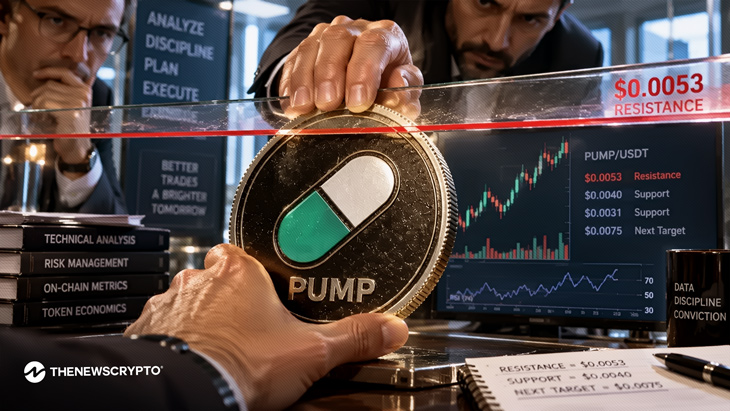
As the first week of September closes, Pump.fun (PUMP) is trading at $0.004195. Buyers have stepped in and defended the $0.0040 zone twice, printing a double bottom and showing that the sellers can’t push through that floor with any conviction.

The neckline likely sits at $0.00455. A clean breakout above that level with volume behind it confirms the double bottom and opens the door toward the projected target at around $0.0052, a crucial move from current levels. Until that breakout is confirmed, the bulls are in a waiting game. 

In the early hours, the asset traded at a bottom of $0.004096. With a shift in momentum, it tested and broke multiple price ranges and gradually drove the PUMP price to a high level of $0.004405. Besides, the 24-hour volume has potentially reached the $147.17 million zone. 

Near-Term Price Levels to Watch for PUMP 

With the negative outlook, the recent trading pattern might slip even deeper and test the key support at the $0.004139 range. Further correction on the downside could likely trigger the emergence of the death cross in the PUMP market, and the bears would send the price below $0.0040. 

On the upside, if the bulls re-entered the market, the asset’s price could instantly rise to its nearest resistance level at $0.004251. Extended bullish pressure might push for the formation of the golden cross. Eventually, it could drive the PUMP price even higher, above the $0.0043 mark. 

Where Will PUMP Take its Current Momentum? 

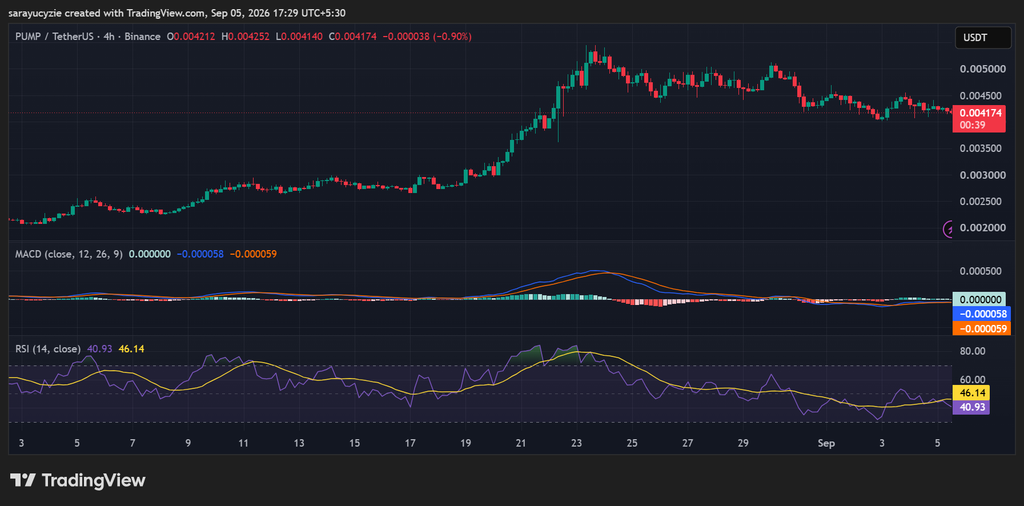
The Moving Average Convergence Divergence line is slightly above the signal line, while both lines remain below the zero line; it is an early sign of bullish momentum forming within a broader downward trend. The overall background of the PUMP market is still bearish.

Short-term price moving averages are lower than long-term averages, confirming sustained selling pressure. MACD crossing one point above it forms a fresh bullish crossover, showing that buyers are stepping in and driving price up faster than the immediate recent average. This represents a bullish attempt to counter a macro downtrend. 

(Source: TradingView)

Moreover, the daily Relative Strength Index reading positioned at 40.93 hints at weak or neutral-bearish territory. The sellers currently hold a slight edge over buyers, with average price losses outperforming average gains over the recent lookback period. 

The asset still has room to fall further before becoming overextended to the downside. A drop toward 40 signals a healthy pullback before the broader trend resumes. If the broader market is already bearish, an RSI staying in the 40–30 range confirms sustained selling pressure without enough buying momentum to reverse direction.

Crypto Market Highlights

Hyperliquid (HYPE) at a Crossroads: $90 Breakout or $80 Breakdown?

☐ ☆ ✇ TheNewsCrypto

Hyperliquid (HYPE) at a Crossroads: $90 Breakout or $80 Breakdown?

By: Sarayu Krishna

Hyperliquid (HYPE) at a Crossroads: $90 Breakout or $80 Breakdown?

  • Hyperliquid is currently trading at around $84.
  • HYPE’s baseline trend remains overall bullish.

The global crypto market cap is settled at $2.77 trillion, after a 1.2% loss. In line with this, Hyperliquid (HYPE) has posted a modest 1.6% drop in value over the last 24 hours. Moreover, the session’s range falls between $83.64 and $87.31. The asset could have tested key price ranges to confirm the current momentum. 

If the bears stay for a longer period, the price could see more downside. At the time of writing, Hyperliquid traded at around the $84.61 mark, with its market cap at $18.75 billion. Besides, the daily trading volume has reached the $1.164 billion zone, as per CoinGecko data

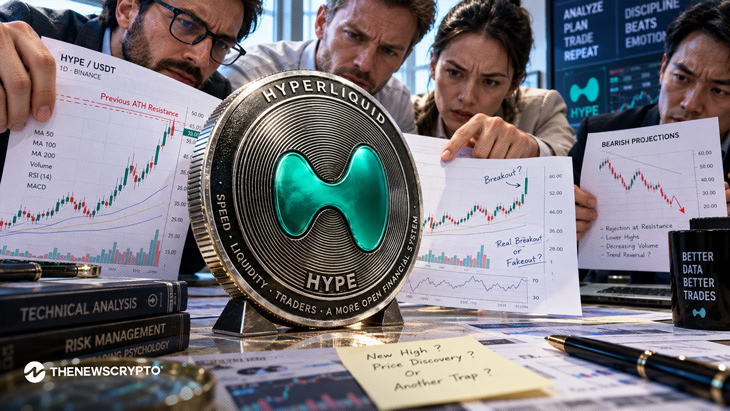
Zooming in on the recent price chart, there is a bearish trait within the pattern. The Hyperliquid momentum could drop to the support at $83.68 if the bears stay stronger. An extended, powerful downside correction might trigger the death cross to take place and send the price even lower, around $82. 

On the flip side, assuming Hyperliquid turns for a bullish reversal, the price could jump and find the nearest resistance within the $85 range. With the potential upside pressure strengthening, the golden cross could likely unfold and push the asset’s price upward, above the $86.12 level. 

Hyperliquid’s Technical Chart Points to a Weakening Trend

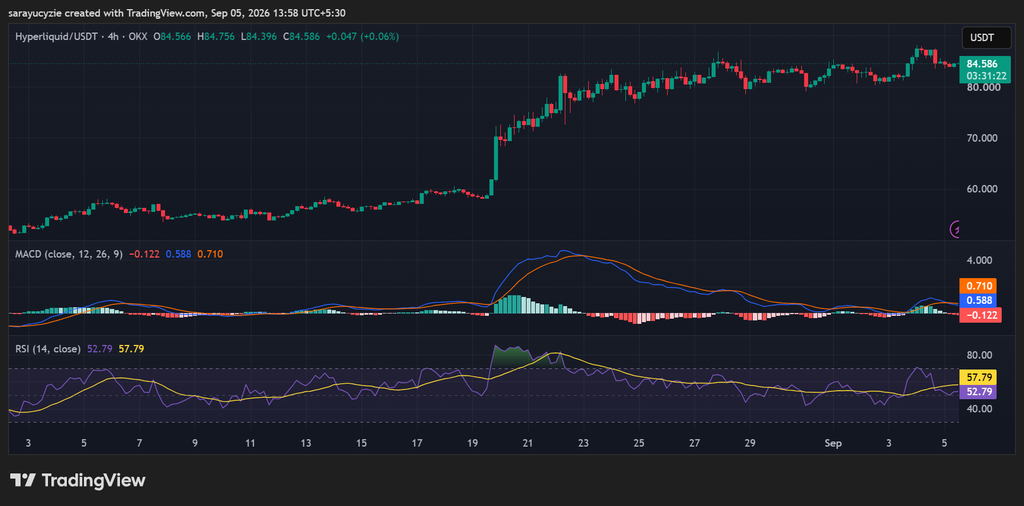
The technical analysis reports that the Moving Average Convergence Divergence line is below the signal line. Both lines remain above the zero line, signalling a bullish uptrend that is experiencing short-term weakening. The baseline trend of Hyperliquid remains overall bullish.

It reflects an established uptrend in the broader market structure, with the short-term momentum slowing down. When the MACD line crosses below its signal line, it creates a bearish crossover. Also, the price might be forming a flag pattern, consolidating sideways before resuming the broader upward trend.

(Source: TradingView)

Hyperliquid’s daily Relative Strength Index of 52.79 is in the neutral territory, with a subtle bias toward bullish momentum. It is in equilibrium, with neither buyers nor sellers exercising dominant control over the price. This is high enough to confirm strong momentum; it is either consolidating sideways before its next directional move. 

Price is moving within a horizontal range while the momentum decides on a direction. Following an active rally or sell-off, price is taking a breather to cool off before continuing the primary trend. If RSI recently crossed upward from below 50, it suggests momentum is slowly shifting from sellers to buyers.

Crypto Market Highlights

Zcash (ZEC) Jumps 19%: How Far Can This Move Actually Go?

☐ ☆ ✇ TheNewsCrypto

Dash Price Breaks Above $70: Can DASH Sustain the Breakout?

By: Sarala

Dash Price Breaks Above $70: Can DASH Sustain the Breakout?

  • DASH climbed above $70 after a sharp 4-hour breakout, with the price reaching around $73.80
  • The RSI moved above 87, showing strong buying momentum but also placing DASH firmly in overbought territory.

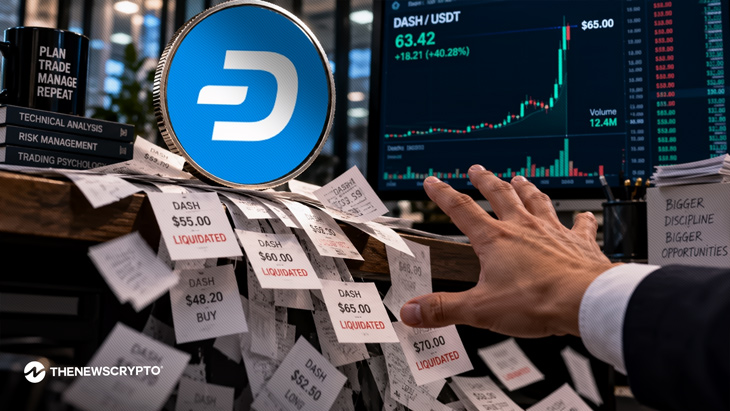
Today, one of the leading privacy-coin, Dash (DASH) has made a sharp move higher, with the token gaining more than 47% in the past 24 hours as buying activity picked up across the market. 

According to CoinMarketCap data, DASH is currently trading near $70, after moving between an intraday low of $49.46 and a high of $72.95 during the latest 24-hour session. The altcoin’s market cap has climbed to about $913.8 million, while daily trading volume reached $561 million, up more than 193%.

The jump has pushed DASH to levels not seen since January and placed the token among the stronger performers in the current privacy-coin rally. Dash also recently held DashCon 2026 in Amsterdam, while the wider privacy sector has attracted renewed attention following strong gains in other privacy-focused assets.

DASH Technical Picture Turns Strong but Overheated

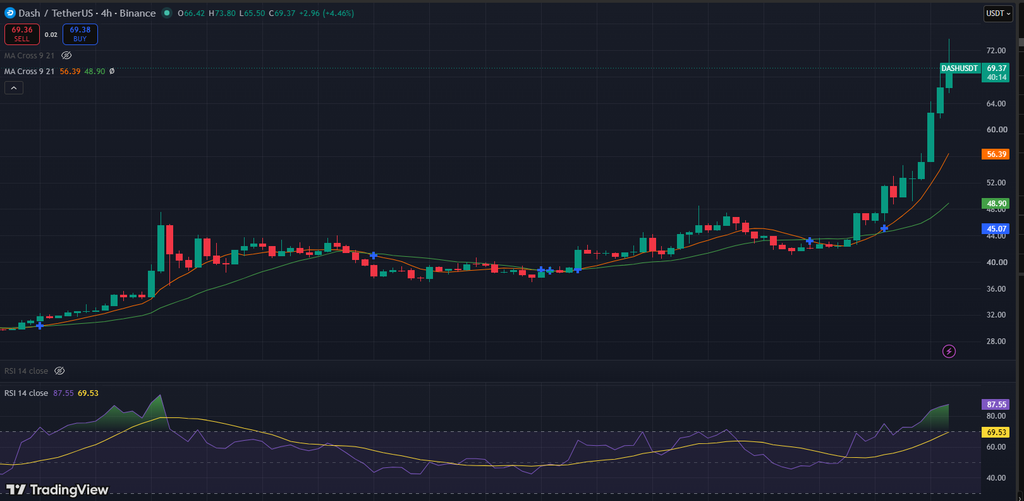
The technical setup shows strong short-term momentum, but it also points to a market that has moved quickly. On the 4-hour chart, the DASH price climbed from the low-$40s to above $70 in a series of strong buying moves. The latest candle on the Binance DASH/USDT chart shows the token trading around $69.37, after reaching an intraday high of $73.80. DASH is now holding well above the $64 level, which has become an important area after the latest breakout. 

Zooming in, the chart shows a clear bullish structure. The 9-day moving average is near $56.39, while the 21-day average sits around $48.90. Both are below the current price and are rising, showing that buyers have taken control of the short-term trend.

(Source: TradingView)

DASH first pushed through the $45 area before accelerating above $52 and then breaking through $60. Each move higher came with large green candles, showing strong buying pressure rather than a slow recovery.

Still, the momentum has now become stretched. The 14-day RSI on the 4-hour chart is around 87.55, far above the 70 level normally associated with overbought conditions. This does not automatically mean the rally must reverse. But it shows that the price has moved very quickly and could face profit-taking. 

Meanwhile, the MACD remains positive, while the five-day moving average is around $69.67, suggesting that short-term momentum is still favoring buyers.

If the DASH coin keeps the trend, the immediate resistance stands around $73.80, the latest chart high and a multiple-rejection zone. A clean break above this level would keep the current breakout structure intact. If the breakout fails, $64 is the first important support, followed by the $56–$57 moving-average area.

For now, the 4-hour trend remains firmly bullish. But the extreme RSI makes a period of consolidation or a pullback possible before another attempt higher.

Highlighted Crypto News:

Anthropic IPO Delayed to Mid-October as Company Targets $2 Trillion Valuation

☐ ☆ ✇ TheNewsCrypto

Anthropic IPO Delayed to Mid-October as Company Targets $2 Trillion Valuation

By: Lakshya Baskar

IPO

  • An IPO marketing campaign could kick off in mid-October with a successful conclusion ahead of November’s midterm U.S. elections.
  • The company plans to issue its IPO prospectus in late September as it closes on its $15 billion financing facility.

Anthropic is pushing its IPO timetable into mid-October, sources said. The artificial intelligence company will start pitching its IPO by mid-October at the earliest. As reported by Reuters, Anthropic also plans to list its stock several days before the U.S. midterm elections in November.

The revised timetable comes in contrast to initial plans. Two sources reported that Anthropic was expected to file its IPO prospectus as soon as next week. However, the artificial intelligence company now expects to file its prospectus publicly later in September. The sources pointed out that Anthropic can still revise the timetable. Companies frequently revise their IPO timetables when navigating various market considerations.

Prospectus Release Timing to Define the Offering

The delay might mean that one of the most eagerly awaited technology offerings of the year will be delayed. The rumored valuation for Anthropic is close to $2 trillion. This valuation will make the company one of the largest IPOs ever tried. It will also provide public market investors yet another chance to participate in the artificial intelligence sector.

Anthropic is currently working on defining the financing structure of the offering. The company needs to close a $15 billion revolving credit facility. After that, the analysts working for the participating banks could have a meeting with Anthropic. This was reported earlier by Bloomberg News. Usually, there is a gap of a few weeks between the analyst meeting and the filing of the prospectus. Nevertheless, Anthropic could act more quickly because analysts know about the company, one source notes.

AI IPO Race Draws Investor Interest

The anticipated IPO from Anthropic takes place amid investor interest in the AI IPO race as a whole. OpenAI may consider taking itself public as well, joining other prominent firms in the industry. In the meantime, SpaceX went public with an initial public offering in June, setting a new record with a valuation of $1.77 trillion.

A number of banks are helping with the IPO preparation for Anthropic. Among the banks assisting with the process are Morgan Stanley, Goldman Sachs, JPMorgan, and Citi, sources close to the situation say. Anthropic did not have anything to say about the timeline in question. Similarly, the banks declined to comment. Investors will need to wait until the end of September, when the company will release the prospectus.

Highlighted Crypto News:

Pencil Finance Completes $1M Onchain Student Lending Cycle Across Southeast Asia

☐ ☆ ✇ TheNewsCrypto

CoinRabbit Wins “Best Crypto Lending Platform 2026” Award from International Business Magazine

By: Chainwire

CoinRabbit Wins “Best Crypto Lending Platform 2026” Award from International Business Magazine

Toronto, Canada, September 4th, 2026, Chainwire


CoinRabbit has been named Best Crypto Lending Platform 2026 by International Business Magazine, highlighting a lending product that has issued more than $1.45 billion in loans since 2020.

About the International Business Magazine Award

The International Business Magazine Awards recognize companies and executives making a significant impact across global industries. The selection process combines public nominations with jury review, with nominees assessed on their work, progress, and contribution to their respective industries.

For CoinRabbit, the award comes at an important stage in the company’s development. It is moving beyond borrowing against crypto and building a broader ecosystem for managing digital-asset capital.

Why CoinRabbit Was Named the Best Crypto Lending Platform

The Best Crypto Lending Platform 2026 award recognizes the work CoinRabbit has put into its ecosystem. The platform provides borrowers with fast access to liquidity and confidence that their funds remain secure. CoinRabbit maintains a clear no-rehypothecation policy, giving clients greater certainty that their collateral is not being reused or lent out elsewhere.

That focus on a predictable borrowing experience has remained central as CoinRabbit has expanded the product. There is no traditional credit check because crypto collateral does the underwriting, and the lending process takes about 10 minutes whether a client is borrowing a few hundred dollars or managing a six-figure position.

The award jury also highlighted CoinRabbit’s Private Program as a high-touch approach for clients with significant balances. Designed for portfolios of $500,000 and above, it offers a more personalized way to manage assets around each client’s financial goals, liquidity needs, and timing. As part of CoinRabbit’s broader digital-asset ecosystem, the program gives clients a more private banking-style experience.

Capital Preservation at the Core

CoinRabbit is expanding into capital management, but lending remains at the core of the business. By giving clients access to liquidity without a need to sell their crypto, it helps preserve capital and keep assets invested for the long term.

Walter Barrett, Chief Strategy & Growth Officer at CoinRabbit, commented:

“We’ve spent years building and refining the product, and it’s rewarding to see that work recognized. At the same time, CoinRabbit is becoming more than just a lending platform. With the Private Program, we’re bringing a private credit approach to managing crypto. Clients can work directly with a success manager to find the right strategy for their needs, with a more tailored way to build crypto capital. We also continue to improve the core lending product, keeping it simple. For us, the goal is to make both sides of the business stronger as we grow.”

As CoinRabbit evolves, capital preservation remains a central idea behind the company’s products and services.

About CoinRabbit

CoinRabbit is a crypto asset management platform built for long-term capital preservation. It provides flexible liquidity management across multiple environments. Instant payments and lending, yield and trading products, and also the Private Program are available from a single platform. Since 2020, CoinRabbit has maintained a 100% capital reserve model, ensuring that client assets are fully reserved and never rehypothecated.


Contact

CoinRabbit
marketing@coinrabbit.io

☐ ☆ ✇ TheNewsCrypto

Liquid Mercury Announces Initial Closing of ACQUA1 Offering

By: Chainwire

Liquid Mercury Announces Initial Closing of ACQUA1 Offering

Chicago, United States, September 4th, 2026, Chainwire


Liquid Mercury today announced that ACQUA1, LLC completed the initial closing of its MERC exchange offering on September 1, 2026.

ACQUA1 is a Liquid Mercury subsidiary that operates Liquid Mercury’s Lab Company program, licensing Liquid Mercury technology to companies primarily tokenizing real-world assets and receiving fees plus a minority equity stake in return. Liquid Mercury is the majority holder and Manager.

“Over the past 18 months, dozens of companies have approached Liquid Mercury seeking to tokenize their assets,” said Tony Saliba, CEO and founder of Liquid Mercury. “Many assumed they would need to raise capital and build this infrastructure from scratch. Licensing Mercury RWA lets them launch on systems that were already live and proven, at a fraction of the time and cost. ACQUA1 token holders now own a slice of the business that earns equity, plus fees from the companies in the Lab Company program.”

Verified accredited investors subscribed by exchanging MERC for non-voting Class B units of ACQUA1 at the initial conversion rate of 10 MERC per unit. Under its operating agreement, ACQUA1 must burn 100% of the MERC it receives at each closing within five business days and may not transfer, trade, lend, stake, pledge, or otherwise deploy it.

On September 2, all 563,230,000 MERC received at the initial closing were burned via a transfer to the dead address, as the offering documents require.

Initial Closing Highlights

  • Initial closing: September 1, 2026
  • MERC burned: 563,230,000
  • Transferred to the dead address September 2, 2026
  • Units issued: 56,323,000
  • Non-voting Class B units of ACQUA1, LLC under Rule 506(c) of Regulation D
  • 10 MERC per unit
  • Evidenced on-chain by ACQUA1-C tokens
  • ACQUA1-C tokens convert one-for-one into ACQUA1 tokens upon issuance
  • Remaining closings: On or about October 30 and December 31, 2026
  • ACQUA1 may skip or terminate at its discretion
  • The conversion rate at subsequent closings may differ

Verification Links

Burn transaction

ACQUA1-C contract

Verified accredited investors can request full terms at acqua1.liquidmercury.com/contact.

About Liquid Mercury

Liquid Mercury powers professional crypto trading and digital asset marketplaces. The company delivers institutional-grade infrastructure, access to deep liquidity, and best-in-class trading tools and workflow automation across its Pro, OTC, and RWA platforms. Through Mercury RWA, Liquid Mercury is extending that infrastructure into tokenized real-world assets, with $MERC serving as the access and platform layer token. For more information, visit www.liquidmercury.com.

Investor Notice

This press release does not constitute an offer to sell or the solicitation of an offer to buy any securities. Class B units of ACQUA1, LLC and the ACQUA1 tokens representing them are offered and sold in reliance on the exemption from registration provided by Rule 506(c) of Regulation D under the Securities Act of 1933, solely to verified accredited investors as defined in Rule 501(a) of Regulation D, and solely pursuant to ACQUA1’s confidential private placement memorandum, as supplemented, and definitive subscription documents, which contain important information, including risk factors. ACQUA1 tokens are restricted securities, are subject to transfer restrictions under ACQUA1’s operating agreement and may remain illiquid indefinitely; investors should not assume that Rule 144 will be available. Statements regarding future revenues, valuations, portfolio performance, and subsequent closings are forward-looking and subject to risks and uncertainties; actual results may differ materially. The MERC contract has no burn function; tokens are removed from circulation by transferring to the dead address. Supply outstanding excluding the dead address is 5,436,770,000 MERC, as of the date of publication.


Contacts

Director
Kent Egan
Liquid Mercury
ke@liquidmercury.com
Director
Ryan Hansen
Liquid Mercury
hansenr@liquidmercury.com

☐ ☆ ✇ TheNewsCrypto

Pencil Finance Completes $1M Onchain Student Lending Cycle Across Southeast Asia

By: Lakshya Baskar

Pencil Finance Completes $1M Onchain Student Lending Cycle Across Southeast Asia

  • Pencil Finance has completed a $1 million onchain cycle of student lending, financing 6,600 students in 118 institutions in Southeast Asia.
  • The cycle had 1,050 borrowers directly receiving the funds and investment from Animoca Brands, Open Campus, and New Campus.

Pencil Finance completes a $1 million on-chain student lending cycle in Southeast Asia. The milestone helps link the blockchain-based lending services to students who traditionally do not have access to financing options. Pencil provided the funds as a lender and managed to track the whole lending cycle on-chain. The borrowers paid back their debts, which helped the platform to repay the capital and interest to the original investors.

$1M Loan Cycle Benefited 6,600 Students

In all, the loan cycle helped around 6,600 students from 118 different institutions in Southeast Asia. Approximately 1,050 students received direct financing under the cycle. Moreover, Pencil Finance specifically designed the loan cycle to support students who lacked access to traditional financing. 50% of the borrowers were women. Students from poorer backgrounds made up 93% of the borrower population.

These statistics show how the loan cycle targeted students with limited access to financing options. However, the use of blockchain technology gave a clear view of the loan cycle. The company claimed that this loan cycle was their first onchain student loan cycle. Pencil referred to it as the first-ever onchain student lending cycle on the blockchain networks.

Financing Structure Supported by Animoca Brands

July 2025 saw the participation of Animoca Brands, Open Campus, and New Campus in the funding of the loan bundle.  In the structure of the loan bundle, senior and junior tranches were used to segregate returns and risks. The senior tranche provided fixed returns for participating funders, while the junior tranche had variable returns and first-loss risk. Pencil then allocated the $1 million to fund students before the end of the repayment cycle. Repayments by borrowers were used to repay the funders in the bundle. This is an example of how blockchain technology can track lending from allocation to repayment.

RWA Lending Goes Beyond Traditional Collateral

The financing process in Pencil’s case also highlights the growing use of tokenized real-world assets in lending markets. Moreover, RWA platforms are increasingly connecting physical and financial assets with blockchain-based financing systems. As a result, this approach could further integrate traditional lending structures with blockchain technology. The latest development has seen collateral tokenization take an unusual turn.

This month, B3, the Brazilian stock exchange, offered a loan of 100,000 Brazilian reais backed by 10 tokenized cows as collateral for the financing process. The tokens were individually created for each cow, and each animal had its encrypted digital identity. Cowmed AI-powered smart collars tracked each cow’s condition during the financing period. Such processes demonstrate how blockchain technology can be used to link the two–lending and real-world assets.  In the Pencil’s case, the financing process involves using the same technology for student loans across Southeast Asia.

Highlighted Crypto News:
SEC Chair Paul Atkins Unveils New Rules to Bring Crypto Firms Back to the U.S.

☐ ☆ ✇ TheNewsCrypto

Zcash (ZEC) Jumps 19%: How Far Can This Move Actually Go?

By: Sarayu Krishna

Zcash (ZEC) Jumps 19%: How Far Can This Move Actually Go?

  • A 19% gain in value has pushed Zcash to $1K.
  • The ZEC buyers are firmly in control.

As of September 4, within the broader crypto market, Zcash ($ZEC) has shown stronger bullish momentum after surging 19.4%. Currently, the price is trading at the $1,009.82 level, pushing firmly above the crucial $950 level. Moreover, its trading volume has reached $1.265 billion. 

Significantly, Zcash’s momentum is back in the market spotlight following another sharp move higher. It may reach a new high without retesting key technical structure, reflecting strong bullish sentiment. As it enters an expansion phase, sustained buying pressure will drive further upside.

The token is now approaching the key $1,018 – $1,030 resistance zone, with its 24-hour trading range stretching from $842.06 – $1,023.40. A decisive breakout above $1,043 could likely strengthen the bullish setup of ZEC and potentially trigger another expansion move.

The $845 – $886 area remains an important support zone, while the broader 7-day range of $779.96 – $1,023.40 exhibits how sharply Zcash has advanced. With the price near the weekly high, traders will be watching whether the buyers can sustain the momentum and turn the above-mentioned zone into the next support.

Zcash Technical Chart Turns the Momentum Bullish 

The Moving Average Convergence Divergence (MACD) line is above the signal line, indicating buying momentum is currently increasing. This is a strong bullish trend confirmation signal. As both lines are above the zero line, the asset is in a broad, established uptrend rather than just a brief bounce.

ZEC’s short-term moving averages are pulling away from long-term averages, showing that the buyers are firmly in control. On top of that, traders view this combination as a green light to buy or hold long positions, as the path of least resistance remains upward.

In addition, the daily Relative Strength Index (RSI) reading settled at 76.11, suggesting that the asset is currently in overbought territory. The price has risen rapidly in recent periods, driven by aggressive buying pressure. Zcash is overextended in the short term, increasing the likelihood of a pullback. 

In strong uptrends, the indicator can remain overbought for extended periods, and a high value reflects strength, not an instant top. Also, caution is warranted for new entries; traders look for price action to show signs of slowing down before entering long positions.

Crypto Market Highlights

IMF Clears $140M for El Salvador as BTC Buys No Longer Use Public Funds

☐ ☆ ✇ TheNewsCrypto

Pocket Bitcoin Data Breach Reveals Personal and Financial Data of 5,411 Customers

By: Lakshya Baskar

Bitcoin

  • Pocket Bitcoin found two datasets that were breached, affecting 5,411 customers following its investigation process.
  • There was no compromise to core databases, customer Bitcoin, and private keys, and the authorities have been notified about the breach.

The Pocket Bitcoin has now widened its August security breach scope following its full forensic analysis. According to the Swiss Bitcoin company, there were two data sets in connection to the security issue involving 5,411 users. While the first dataset included bank transactions records for 5,120 users, the second one consisted of communication records of an additional 291 users.

⚠ Update zum Sicherheitsvorfall bei Pocket Bitcoin

Unsere Untersuchung ist abgeschlossen.
Dabei hat sich gezeigt, dass in einzelnen Fällen weitere Daten betroffen sind als in unserem ersten Beitrag beschrieben.

Wir haben dazu zwei betroffene Gruppen identifiziert. https://t.co/XASbu1wTQH

PocketBitcoin.com 🏦👉🔑 (@PocketBitcoin) September 3, 2026

Exposed Bank Records During Compliance Checks

The bigger data set was collected through transaction lists that Pocket Bitcoin received from partner banks during the compliance checks. The list comprised customers’ names, residence address, amount of transactions and dates. Some of these lists also had the IBAN number related to the individual transactions. Second data set was gathered through the correspondence of Pocket Bitcoin and its partner banks. Depending on customers, the correspondence contained information about postal addresses, Bitcoin public addresses, and copies of identity documents. Some of the correspondence also contained the source-of-funds information.

Pocket Bitcoin explained that the customers did not necessarily have each of the above types of information exposed. Pocket Bitcoin contacted each affected customer and gave him information about his case. Another type of information could be exposed to customers during the initial breach – email addresses or support communications.

Bitcoin Core Assets Were Unaffected

Pocket Bitcoin extended its statement regarding the August security incident following a forensic investigation into exposed information about 5,411 users. This compromised information comprised names, addresses, transaction history, and some IBANs, while for 291 users, there was a risk of compromising identity documents and funding information. Bitcoin Pocket stated that its core systems, user Bitcoins, and keys were unaffected by this security compromise. There were no indications of any misuse, but the risk of physical fraud was indicated.

Customers Notified About Physical Fraud

Pocket Bitcoin said that there is currently no reason to believe that any of the data was used by attackers for any malicious actions. However, the names, addresses, and transfer information can be used to conduct a more convincing social engineering attack against the targeted customers through physical communication channels.

The threat of fake letters and other physical communication was explicitly raised by Pocket Bitcoin. The company noted that the newly found databases do not have any information regarding email addresses and passwords, which makes it unlikely that targeted email phishing attacks can be conducted with their use.

Pocket Bitcoin informed the Swiss Federal Data Protection and Information Commissioner and the Liechtenstein Data Protection Authority about the breach. They also filed a police report after the investigation of the incident. The vulnerability has been closed, and new security measures have been implemented.

Highlighted Crypto News:

CFTC Seeks Dismissal of CME’s Kalshi Bitcoin Futures Lawsuit

☐ ☆ ✇ TheNewsCrypto

South Korea Unveils Plans to Tokenize Stocks, Bonds and Funds

By: Sarala

South Korea Unveils Plans to Tokenize Stocks, Bonds and Funds

  • South Korea targets a February 2027 tokenized securities market launch.
  • Initial assets include funds, bonds, unlisted stocks and fractional securities.

South Korea is moving to expand tokenized securities beyond fractional investment products, with plans to build infrastructure that can eventually support stocks, bonds, funds and other traditional securities.

The Financial Services Commission (FSC) announced the policy direction on September 4 following a meeting of its public-private tokenized securities consultative body. 

NEW: South Korea plans to build infrastructure to tokenize traditional securities, including stocks, bonds and funds, as part of a phased rollout beginning in February 2027. ⚡#SouthKorea #Tokenization #RWA pic.twitter.com/rEmXuq6CAG

— TheNewsCrypto (@The_NewsCrypto) September 4, 2026

According to the announcement, the government is preparing to launch its tokenized securities market in February 2027, with regulators laying out a phased plan to bring traditional financial assets onto blockchain networks.

The first phase is expected to begin when the new Tokenized Securities Act takes effect in February 2027. Under this phase, privately placed money market funds and corporate bonds will be eligible for tokenization for institutional investors. Unlisted stocks will also be tokenized through trust structures, while publicly offered fractional investment securities will be included in the initial rollout.

Three-Phase Tokenization Plan

South Korea plans to connect the new infrastructure with the Korea Securities Depository’s tokenized securities system. The aim is to create a framework for issuing and trading securities through distributed ledger technology while maintaining links with the existing financial market system.

The second phase could expand tokenization to publicly offered securities as the technology and infrastructure develop. Regulators said the timing will depend on the stability and efficiency of the first phase.

The third phase would introduce on-chain settlement by connecting tokenized securities with payment instruments, including stablecoins. However, the timing of this stage will also depend on future stablecoin legislation and technological progress.

The FSC also said companies that already hold the required financial investment licenses will not need a separate license solely for handling tokenized securities. South Korea plans to publish proposed changes to related regulations for public comment later this month.

The measures mark a broader push by South Korean regulators to bring blockchain-based securities into the country’s existing capital-market framework.

Highlighted Crypto News:

IMF Clears $140M for El Salvador as BTC Buys No Longer Use Public Funds

☐ ☆ ✇ TheNewsCrypto

IMF Clears $140M for El Salvador as BTC Buys No Longer Use Public Funds

By: Sarayu Krishna

IMF Clears $140M for El Salvador as BTC Buys No Longer Use Public Funds

  • El Salvador could receive $140M pending IMF Executive Board approval and completion of prior actions.
  • The country has used no public funds for BTC purchases since June 2025.

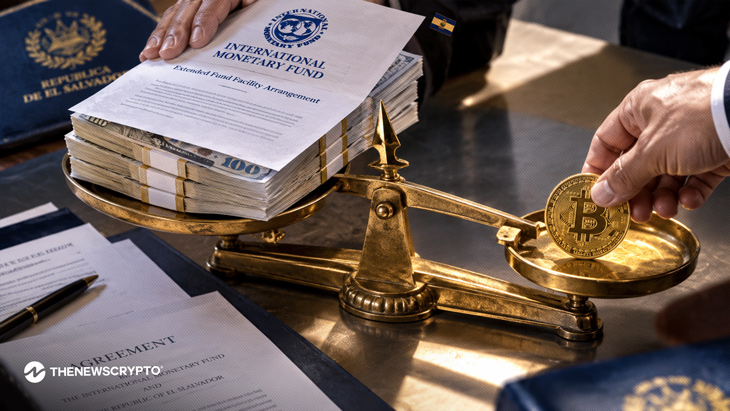
El Salvador and the IMF have reached a staff-level agreement on the combined second and third reviews of the country’s 40-month Extended Fund Facility arrangement. Subject to IMF Executive Board approval and the completion of agreed prior actions, El Salvador stands to receive approximately $140 million. It is equivalent to SDR 101.96 million in additional funding.

This brings total disbursements under the EFF to a significant level, following the programme’s approval on February 26, 2025. This has a total access of SDR 1,033.92 million, approximately $1.4 billion. The first review was concluded on June 27, 2025, with SDR 172.32 million disbursed so far.

The Economy Is Outperforming

The macro picture for El Salvador is stronger than expected. Real GDP growth exceeded projections in 2025 and is forecast to reach 4.5% in 2026. It is likely driven by investment, private consumption, remittances, tourism, and capital inflows. Security improvements and investor confidence have played a crucial role in that trajectory.

The NFPS primary surplus is expected to strengthen from 2.9% of GDP in 2026 to 3.7% by 2027, consistent with the Fiscal Responsibility Law target of reducing the public debt-to-GDP ratio to 80% by 2030. The programme has also contributed to a measurable decline in poverty through improved efficiency in public services.

Bitcoin Is No Longer a Public Spending Line

The IMF confirmed that El Salvador has provided documentation verifying that all Bitcoin accumulated since the first review in June 2025 came entirely from private donations. Notably, no public resources were used. Going forward, no further BTC accumulation beyond documented donations is expected, a condition that forms part of the framework agreed with IMF staff.

Moreover, the Chivo e-wallet, once government-operated, has had its majority ownership and operational control transferred to a private operator. The government retains a minority stake and custodial responsibilities for customer assets. Also, efforts are underway to enhance transparency around Bitcoin holdings across various wallets.

In addition, the IMF and El Salvador have also agreed to modernise the legal, regulatory, and supervisory framework for digital assets and strengthen governance and risk-management arrangements for public-sector crypto holdings.

Market impact might be like El Salvador stepping back from public BTC accumulation removes a sovereign buying narrative from the market. Furthermore, the agreement signals the country is prioritising macroeconomic stability and institutional credibility over crypto-forward policy. The IMF programme compliance and Bitcoin maximalism don’t easily coexist at the government level.

Crypto Market Highlights

Dogecoin (DOGE) Printed a Buy Signal: The Uptrend Could Be Loading

☐ ☆ ✇ TheNewsCrypto

Coinbase Files SEC Notices for U.S. Single-Stock Perpetual Trading

By: Sarala

Coinbase Files SEC Notices for U.S. Single-Stock Perpetual Trading

  • Coinbase filed Form 1-N and Form BD-N notices with the SEC as it prepares for a potential U.S. stock-perpetual offering.
  • The exchange already offers leveraged stock perpetual futures to eligible non-U.S. customers, covering major U.S. stocks and ETFs.

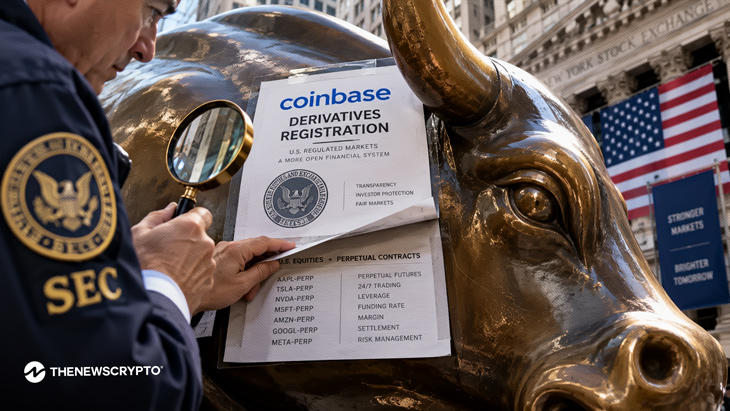
Coinbase, America’s leading regulated centralized crypto exchange, has taken a regulatory step toward bringing single-stock perpetual contracts to the U.S. market by filing notice registrations with the Securities and Exchange Commission (SEC) for its derivatives exchange and brokerage business.

The crypto exchange confirmed the move in a post on X on September 3, saying it is working to bring single-stock perpetuals, also known as “stock perps,” to the United States. The company said it filed SEC-notice registrations for its derivatives exchange and broker and plans to work with the SEC and Commodity Futures Trading Commission (CFTC).

We're working to bring single stock perps to the US.

This week, we filed SEC-notice registrations for our derivatives exchange and broker.

We'll be collaborating closely with the SEC and CFTC to bring more major financial products onshore. pic.twitter.com/6wvjLXRwih

— Coinbase 🛡 (@coinbase) September 3, 2026

The filings, dated September 1, cover two Coinbase entities. Coinbase Derivatives, LLC submitted a Form 1-N, while Coinbase Financial Markets, Inc. filed a Form BD-N, according to copies of the notices.

Coinbase Expands Its Perpetual Products

Single-stock perpetual contracts are derivatives that track the price of individual shares without requiring traders to own the underlying stocks. Unlike traditional futures, perpetual contracts do not have a fixed expiration date.

Meanwhile, Coinbase already offers stock perpetual futures to eligible customers outside the U.S. The company launched the products in March 2026, giving traders access to 24/7 leveraged exposure to U.S. stocks through its regulated derivatives platform.

The non-U.S. contracts include exposure to major companies such as Apple, Microsoft and Tesla. The contracts are cash-settled in USDC, with leverage of up to 10 times for individual stock contracts and up to 20 times for ETF products.

For U.S. customers, however, the process is still underway. Coinbase’s filings are regulatory notices and do not mean that American traders can begin using the products immediately. The company still needs to complete the applicable regulatory process before launching the contracts in the country.

The move is part of Coinbase’s wider push to expand its derivatives business and bring more financial products into the U.S. market. The company said it will continue working with the SEC and CFTC as it seeks to move the products onshore.

Highlighted Crypto News:

Standard Chartered Launches Institutional Bitcoin, Ether Spot Trading in UAE

☐ ☆ ✇ TheNewsCrypto

Dogecoin (DOGE) Printed a Buy Signal: The Uptrend Could Be Loading

By: Sarayu Krishna

Dogecoin (DOGE) Printed a Buy Signal: The Uptrend Could Be Loading

  • The DOGE price is currently hovering at the $0.083 mark.
  • The short-term moving average is lower than the long-term.

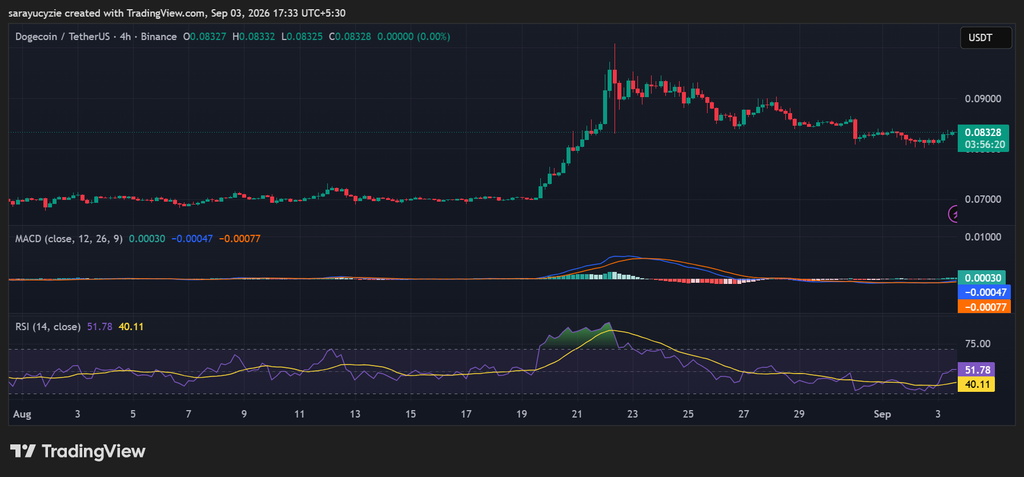
Dogecoin (DOGE) is the first and most famous dog-themed token, and it hit $0.1007 on August 22 and has since retraced more than 17% to current levels. At press time, the meme coin is trading at $0.08318, with a value rise of over 3%, and with the volume settled at $594.58 million. 

It’s worth noting that the 24-hour session has ranged between $0.08067 and $0.08359, with the 7-day range sitting between $0.08021 and $0.0902. 

Significantly, the Tom DeMark Sequential has flashed a buy signal, and that has indicated the end of a corrective phase for DOGE. Alongside that, a morning doji star has formed on the daily chart, a bullish reversal pattern that appears near the end of a downtrend as selling momentum fades and buyers begin stepping in.

Moreover, the large holders have accumulated more than 400 million DOGE over the past five days. That’s not retail buying the dip; that is whale-level conviction at current prices.

Looking at Where the DOGE’s Momentum Goes

The $0.0813 support level is the line that holds this entire setup together. Almost 35 billion DOGE were previously traded at that level, making it a major floor. As long as it holds, the bullish case stays intact. 

On the upside, $0.1552 is the first crucial target, with $0.1774 as the next major resistance beyond that. The $0.0813 ground is the one number that decides whether this is a reversal or just a temporary bounce.

The 4-hour chart shows that the Moving Average Convergence Divergence (MACD) line crosses above the signal line, but both lines remain below zero. It hints at a bullish recovery attempt within an overall downtrend. The market context is bearish, with the short-term moving average lower than the long-term.

The buyers are attempting to push the DOGE price higher. Also, this gives an early warning signal that the downtrend is weakening. However, as both lines are below zero, it carries higher risk; traders often treat it as a potential trend reversal. 

(Source: TradingView)

In addition, the daily Relative Strength Index (RSI) reading is resting at 51.78, indicating a completely neutral market. It reveals that neither bulls nor bears are driving price action. The upward price movements have slightly edged out downward moves over recent candles, but the difference is negligible.

At this value, it reflects that the market is at equilibrium. Furthermore, traders look for a breakout above 60 to confirm accelerating bullish momentum, or a drop below 40 to signal that the bears are taking over control.

Crypto Market Highlights

Ethereum (ETH) Is Standing Its Ground: The Chart Is Starting to Point Toward $3K

☐ ☆ ✇ TheNewsCrypto

Ledger Faces $500M Class Action Over Alleged $1.9M Crypto Loss

By: Sarala

Ledger Faces $500M Class Action Over Alleged $1.9M Crypto Loss

  • Ledger faces a proposed $500M class action over an alleged $1.95M crypto loss.
  • The complaint links the case to Ledger’s 2023 Connect Kit security incident.

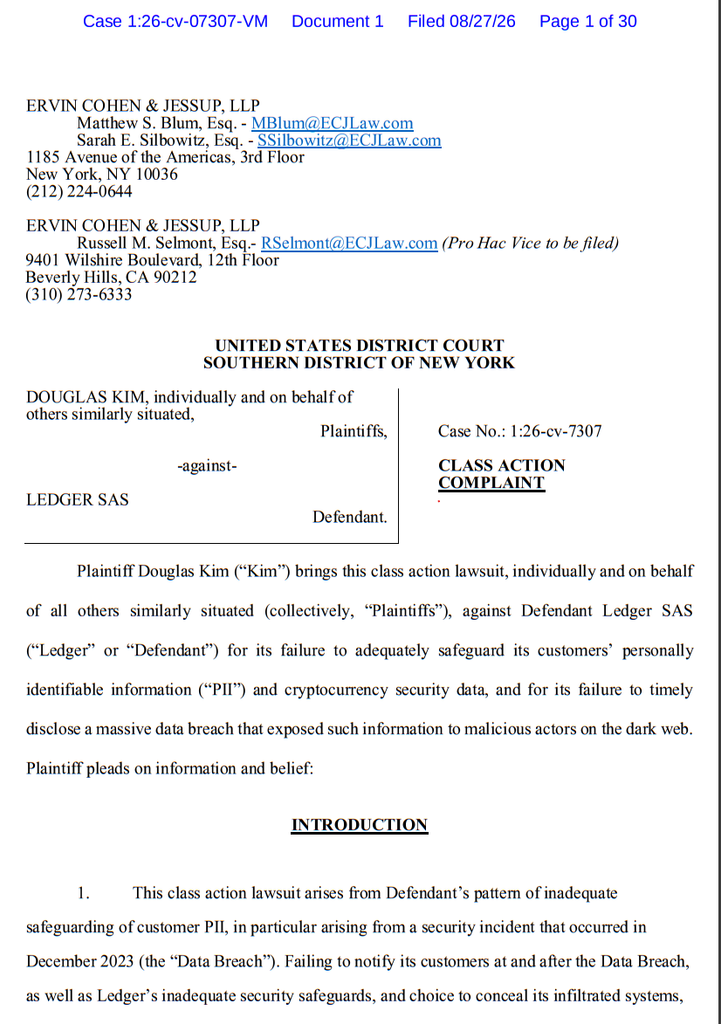
The leading hardware wallet company, Ledger SAS, is facing a proposed class-action lawsuit in the U.S. District Court for the Southern District of New York over an alleged $1.9 million cryptocurrency loss.

Douglas Kim filed the complaint on August 27, 2026, seeking at least $500 million in damages. According to the complaint, Kim purchased a Ledger hardware wallet in 2017 and later upgraded to a Ledger Nano X in 2021. The filing says he was contacted in February 2025 by people claiming to represent Coincover and Ledger.

Kim alleges that the callers told him there had been an attempt to enroll him in Ledger Recover. He was then directed to a website and instructed to provide information that allegedly allowed the attackers to access his crypto holdings.

The complaint states that Kim discovered on February 20, 2025, that approximately $1.95 million in cryptocurrency had been transferred from his wallets. It says he has not recovered the assets.

Complaint Links Loss to 2023 Security Incident

The lawsuit connects the incident to a December 2023 compromise involving Ledger’s Connect Kit, a software library used to connect Ledger wallets with decentralized applications.

The complaint alleges that attackers obtained access through a former Ledger employee and used the compromised software to carry out fraudulent transactions. It further alleges, on information and belief, that customer information from the 2023 incident was later used to target Kim.

Looking further, Kim is seeking to represent a nationwide class of Ledger users. The complaint estimates the proposed class could include up to 210,000 people and says total damages could reach at least $500 million.

The lawsuit brings claims including negligence, negligent misrepresentation, breach of contract-related duties, promissory estoppel and violations of New York consumer protection laws.

The complaint also requests a jury trial. The allegations have not been proven in court, and the proposed class has not been certified. The case remains pending in the Southern District of New York.

Highlighted Crypto News:

SEC Chair Paul Atkins Unveils New Rules to Bring Crypto Firms Back to the U.S.

☐ ☆ ✇ TheNewsCrypto

SEC Chair Paul Atkins Unveils New Rules to Bring Crypto Firms Back to the U.S.

By: Lakshya Baskar

Atkins Promises Pro-Crypto Regulatory Shift In SEC’s Crypto Roundtable 

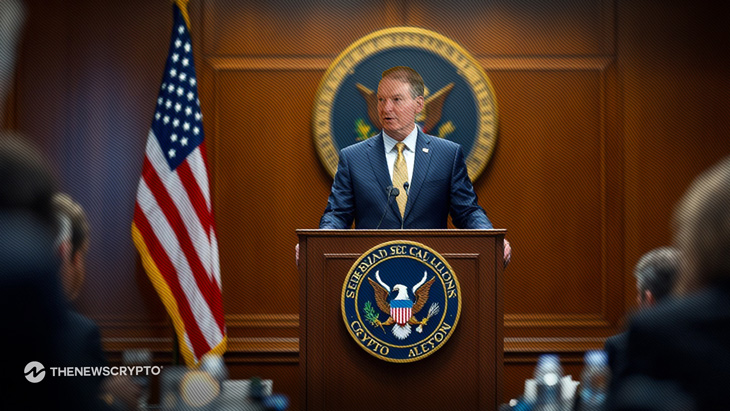
  • According to SEC Chairman Paul Atkins, the new fundraising regulations can attract cryptocurrency innovators and capital back to U.S. markets.
  • He is in favor of the CLARITY Act that will create legal crypto regulation for the SEC and CFTC.

Paul Atkins, the chair of the SEC, has framed the Regulation Crypto Assets as an answer to years of ambiguity. The regulation will make the American market more welcoming for crypto-based firms and innovators. According to Atkins, the former administration was too aggressive in its enforcement efforts and thus pushed the fundraising efforts overseas. Founders required guidance rather than regulatory fights and uncertain registration requirements.

Atkins Seeks to Regulate Through Enforcement

The Atkins report was critical of the application of securities laws developed long ago before the emergence of digital assets. He claimed that regulators failed to consider crypto’s unique features in applying the regulations. In the view of Atkins, such an approach has undermined capital formation in the entire crypto industry.

The chairman of the SEC stressed that the new regulation is designed to increase the confidence of innovators while raising capital in the United States. In addition, he referred to the issue of American investors sending funds abroad. Digital technologies make it possible to move funds abroad almost effortlessly. Therefore, Atkins wants investors to have access to digital asset opportunities via U.S. markets and law. This is precisely what his reasoning relies on.

Regulation Crypto Assets Proposes Changes to Raising Capital

Two exemptions from the SEC’s proposal aim to decrease regulatory obstacles for crypto companies. Those exemptions were introduced by Atkins together with an initiative to develop clear guidelines for digital assets.

The proposal is developed amid discussions on how the old securities laws can be applied to tokens. It is already clear to Atkins that the current enforcement actions can never become a permanent basis for digital asset companies. Also, he believes that the introduction of the legislation by Congress is crucial to this transition process. Atkins still supports the CLARITY Act that is currently pending.

CLARITY Act Remains Integral to the Framework

According to the CLARITY Act, crypto will be regulated by the SEC and the Commodity Futures Trading Commission. According to Atkins, legislation can help formulate lasting rules more than agency actions can do. A future SEC can easily change rules formulated under agency rulemaking. Legislation can create statutory responsibilities and limitations for the regulators.

Atkins does not consider the two initiatives to be competing against each other. Rather, Atkins believes both to be part of the same initiative meant to improve America’s crypto market. The current SEC crypto policy initiative now puts capital formation as the core of its new policy framework. The ultimate aim of this initiative is to create clear ways for companies to build capital within the country.

Highlighted Crypto News:
CFTC Seeks Dismissal of CME’s Kalshi Bitcoin Futures Lawsuit

☐ ☆ ✇ TheNewsCrypto

DWF Labs Expands Global Regulatory Footprint with BVI Virtual Asset Service Provider Approval

By: Chainwire

Road Town, Tortola, British Virgin Islands, September 3rd, 2026, Chainwire

DWF Labs, an established, market-tested investor and market maker built to strengthen digital asset market infrastructure at scale, today announced an expansion of its global regulatory footprint with a group entity granted Virtual Asset Service Provider (VASP) regulatory approval from the British Virgin Islands Financial Services Commission (BVI FSC).

Granted under the BVI’s Virtual Assets Service Providers Act 2022, the approval authorizes DWF Labs as a registered VASP, to provide the exchange of one or more forms of virtual assets, as well as to participate in, and provide financial services related to an issuer’s offer and/or sale of a virtual asset.

The approval enables institutional clients access to DWF Labs’ integrated OTC trading and market making capabilities, including spot trading across thousands of digital assets and stablecoins, through a regulated BVI entity. It also strengthens the company’s ability to deliver investment, incubation and ecosystem development services to support token issuers and digital asset projects on a global scale. 

The BVI has established itself as a leading jurisdiction for decentralized ledger deployments and structured real-world asset (RWA) tokenization. The territory now represents nearly 10% of the global tokenization US treasuries market, with $1.5 billion in distributed value. BVI-domiciled entities also facilitate more than $1.2 billion in active, circulating stablecoins – figures underpinned by more than 24,700 stablecoin asset holders and weekly transfer volumes of $694.1 million. These figures (Source: rwa.xyz treasuries and stablecoins) reflect the strength of both the regulatory and market infrastructure DWF Labs is now positioned to operate within. 

Heng Lee, Managing Director and Partner at DWF Labs said, “The Virtual Asset Service Provider (VASP) approval from the British Virgin Islands Financial Services Commission (BVI FSC) is a key step in responsibly expanding and delivering DWF Labs’ regulated digital asset services to international institutional clients.” 

“As the digital asset market and industry continue to mature, and adoption increases, this addition to our regulatory framework will enable us to deliver a broader range of solutions, products, and services, while reinforcing our focus upon transparency and governance.”

DWF Labs will continue to expand its regulatory footprint across key global markets, supporting its international growth strategy and commitment to operating within robust regulatory frameworks.

About DWF Labs

Established in 2022, DWF Labs is an investor and market maker, focused on giving builders the capital, liquidity, expertise, and partnerships needed to take ideas from concept to scale. DWF Labs is among the world’s largest high-frequency digital asset trading organizations, active on more than 80 centralized and decentralized exchanges. The firm supports over 20% of CoinMarketCap’s Top 100 projects and 35% of its Top 1,000, and has worked with more than 1,000 blockchain companies across Layer 1 and Layer 2 networks, DeFi, gaming, AI, payments, infrastructure, and tokenization.

The firm’s work is organized across four business lines: Liquidity (institutional market making and liquidity provision), Investment and Incubation (strategic capital and token advisory for emerging projects), Ecosystem Development (go-to-market support), and OTC and Structured Markets (tailored trading solutions for institutions, funds, and protocol treasuries). DWF Labs also founded and incubated Falcon Finance, a synthetic dollar and universal collateralization protocol.

DWF Labs operates a globally distributed team on a 24/7/365 basis. 

For more information, visit www.dwf-labs.com, or follow DWF Labs on X, LinkedIn, and Telegram.

Contact

DWF Labs
press@dwf-labs.com

☐ ☆ ✇ TheNewsCrypto

Standard Chartered Launches Institutional Bitcoin, Ether Spot Trading in UAE

By: Sarala

Standard Chartered Launches Institutional Bitcoin, Ether Spot Trading in UAE

  • Standard Chartered launches institutional BTC and ETH spot trading in the UAE.
  • The bank becomes the first G-SIB to offer this service in the UAE.
  • Eligible institutions can trade deliverable BTC/USD and ETH/USD through Standard Chartered’s electronic trading channels.

Standard Chartered has launched Bitcoin and Ether spot trading for institutional clients in the United Arab Emirates, expanding its regulated digital asset services through its Dubai International Financial Centre (DIFC) entity.

The British multinational bank announced the move on September 3, 2026, saying it has become the first global systemically important bank (G-SIB) to offer institutional digital asset spot trading in the UAE. Standard Chartered also said it is currently the only global bank offering institutional digital asset spot trading in the region.

Trading Available Through Existing Platforms

Eligible institutional clients can access deliverable Bitcoin (BTC/USD) and Ether (ETH/USD) spot trading through Standard Chartered’s electronic trading channels. The service is integrated with the bank’s existing platforms, allowing clients to trade digital assets through the same type of foreign exchange interfaces they already use.

Unlike derivatives, spot trading involves the purchase or sale of the underlying asset for delivery. Clients can settle their trades through a custodian of their choice, including Standard Chartered’s digital asset custody service in the UAE.

Builds on UAE Digital Asset Services

The new trading service adds execution capabilities to the bank’s existing digital asset custody offering, which was launched in the UAE in September 2024.

Standard Chartered initially introduced institutional Bitcoin and Ether spot trading via its UK branch in July 2025. At the time, the bank became the first G-SIB to offer deliverable spot crypto-asset trading to institutional clients. The UAE launch now extends that service into the Middle East.

The UAE service is provided through Standard Chartered DIFC and is regulated by the Dubai Financial Services Authority (DFSA).

The bank said the latest expansion forms part of its broader digital asset strategy covering custody, trading and tokenisation services. It also operates digital asset ventures including Zodia Markets and Libeara.

Standard Chartered’s UAE launch comes as financial institutions expand their involvement in regulated cryptocurrency markets, particularly through services designed for professional and institutional investors.

Highlighted Crypto News:

Ethereum (ETH) Is Standing Its Ground: The Chart Is Starting to Point Toward $3K

☐ ☆ ✇ TheNewsCrypto

Ethereum (ETH) Is Standing Its Ground: The Chart Is Starting to Point Toward $3K

By: Sarayu Krishna

Ethereum (ETH) Is Standing Its Ground: The Chart Is Starting to Point Toward $3K

  • Ethereum (ETH) is currently holding at $2.4K. 
  • The selling pressure is accelerating to the downside.

The largest altcoin, Ethereum (ETH), has strengthened its market structure after buyers successfully defended the long-term ascending trendline. The reaction from this macro support triggered a sharp recovery, allowing ETH to break through the initial resistance zone and turn that former ceiling into near-term support.

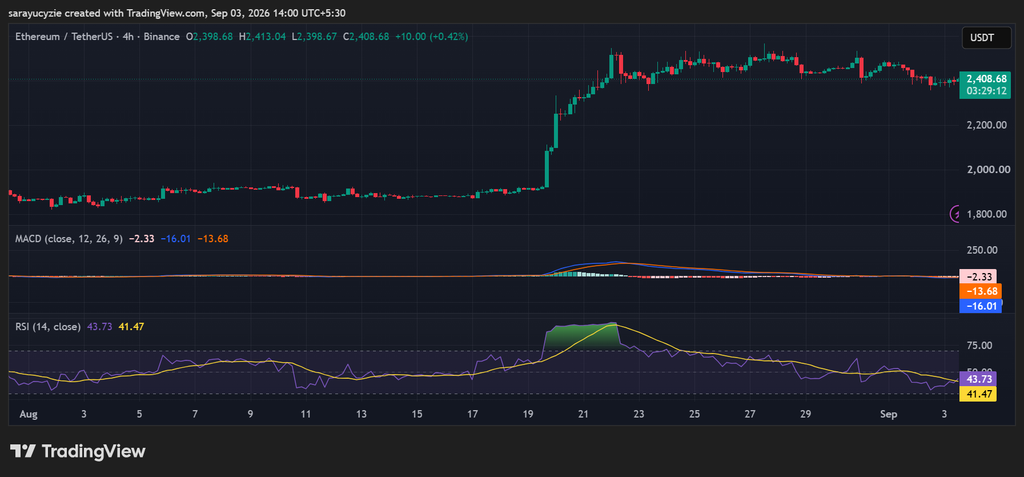
ETH is currently trading at $2,404, with $13.23 billion in 24-hour trading volume. The price has moved between $2,357 and $2,417 over the past day, while the seven-day range stands at $2,357-$2,558. The recovery has kept broader bullish momentum intact; the latest price action suggests the market could cool after the aggressive advance.

Ethereum’s Support and Resistance Levels 

The immediate question is whether the asset can hold its newly reclaimed support as it approaches the next supply zone. A short-term pullback toward $2,300-$2,200 remains possible, with the $2,324 0.236 Fibonacci level offering an earlier potential support area.

From an Elliott Wave perspective, ETH appears to be completing daily Wave 3, leaving a potential Wave 4 correction between $2,112 and $2,222. Because the previous Wave 2 was particularly sharp, the current correction could remain relatively shallow. A daily close below $2,050 would invalidate this Wave 4 structure.

On the other hand, an upside bounce from $2,324 could push Ethereum toward the $2,784-$2,966 target zone before another deeper retracement becomes possible. Furthermore, the broader bullish objective remains at around $3,000.

For now, the price action reflects a market shifting from recovery toward expansion. Holding reclaimed support while absorbing overhead supply would strengthen the bullish case, whereas losing key support could delay the next major advance.

Will the ETH Momentum Weakens Further? 

The MACD line is found below the signal line, and both lines are below the zero line. This crossover suggests strong bearish momentum across both the short-term and the long-term timeframes. Notably, the overall market trend of Ethereum is strictly bearish.

Also, the selling pressure is actively accelerating to the downside. It is one of the strongest sell signals in technical analysis, showing that the bears are in firm control and prices are likely to push lower. 

(Source: TradingView)

Additionally, the daily RSI of ETH is positioned at 43.73, indicating neutral-to-slightly bearish momentum. Trading below the 50 mark shows that the price movements have slightly outweighed upward gains over recent candles. 

There is enough room for the price to move lower before becoming overextended. Traders look for a break above 50 to confirm renewed bullish momentum or a drop below 40 to signal accelerating selling pressure.

Crypto Market Highlights

Bitcoin (BTC) at a Crossroads: Is the Next Leg to $80K Loading?

☐ ☆ ✇ TheNewsCrypto

Kraken Parent Payward Reportedly Delays IPO to Q2 2027

By: Sarala

Kraken Parent Payward Reportedly Delays IPO to Q2 2027

  • Payward, Kraken’s parent company, reportedly delays its U.S. IPO to Q2 2027 at the earliest.
  • Payward reports $508 million in Q2 2026 adjusted revenue, up 17% year over year.
  • LSEG partners with Payward to explore tokenized UK-listed shares.

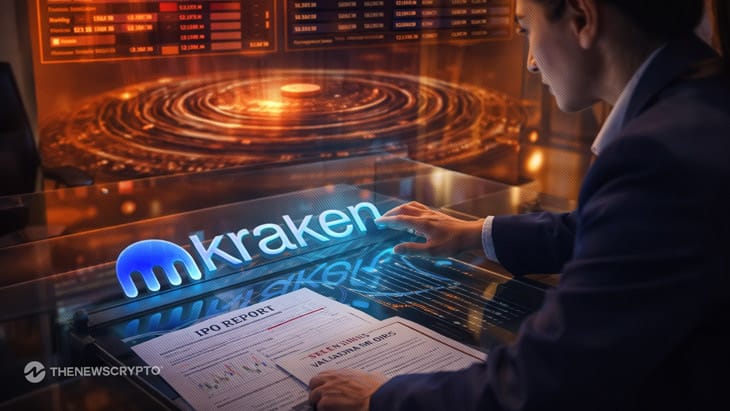
Payward, the parent company of crypto exchange Kraken, again pushed back its planned initial public offering (IPO) to the second quarter of 2027 at the earliest, according to the CoinDesk report.

The latest timeline extends the delay that began earlier this year, when Payward put its IPO plans on hold amid difficult market conditions. Kraken has not publicly confirmed the new listing date.

Payward IPO Plans Remain on Hold

Payward confidentially submitted a draft S-1 registration statement to the U.S. Securities and Exchange Commission in November 2025 as it prepared for a potential U.S. stock market listing. The filing came shortly after the company raised $800 million in funding at a $20 billion valuation.

The company later paused the IPO process in March 2026 as conditions in the cryptocurrency market weakened. The latest report indicates that Payward is now not expected to proceed with the offering before the second quarter of 2027.

The delay comes as crypto companies continue to face changes in trading activity and market valuations. Still, Payward’s financial results have continued to show growth despite the postponed listing.

For the second quarter of 2026, the company reported $508 million in adjusted revenue, an increase of 17% from the same period a year earlier. Adjusted EBITDA was $23 million for the quarter, according to the company’s financial disclosure.

Payward also reported a record 6.6 million funded accounts, while assets on its platform reached about $40 billion.

The figures come as Kraken expands beyond its traditional cryptocurrency exchange business. Payward has completed acquisitions including derivatives platform Bitnomial and stablecoin payments company Reap in 2026.

Kraken Expands Into Tokenized Assets

Payward is also developing products outside conventional crypto trading. On September 1, London Stock Exchange Group announced a partnership with Payward to explore tokenized UK-listed shares. The products are expected to be offered through LSE 24, a new trading venue planned for the first half of 2027, subject to regulatory approval.

For now, Payward’s IPO remains on hold. If the latest reported schedule holds, the company could pursue a public listing from the second quarter of 2027, depending on market conditions and the progress of its regulatory process.

Highlighted Crypto News:

CFTC Seeks Dismissal of CME’s Kalshi Bitcoin Futures Lawsuit

☐ ☆ ✇ TheNewsCrypto

CFTC Seeks Dismissal of CME’s Kalshi Bitcoin Futures Lawsuit

By: Lakshya Baskar

Kalshi Bolsters

  • The CFTC says that CME is unable to prove competitive injury from Kalshi’s Bitcoin perpetual futures.
  • The case may impact how regulators in the United States regulate crypto perpetuals.

The Commodity Futures Trading Commission (CFTC)is seeking a dismissal of the lawsuit filed by CME Group against Kalshi’s Bitcoin perpetual futures in a federal court. The Commission asserts that CME does not have standing because the Commission has failed to demonstrate any actual competitive injury caused by its approval of the contract. Furthermore, the document rejects CME’s contention that Kalshi’s perpetual futures are a swap under the Commodity Exchange Act.

CFTC Defies CME Over Competition Concerns

In a 30-page dismissal filing, the CFTC submitted its motion in federal court in Washington, D.C., on September 2. CFTC described CME’s action as “much ado about nothing.” In doing so, the CFTC is defying CME’s core reasons for initiating the lawsuit. CME has not alleged that the CFTC doesn’t have jurisdiction over trading in perpetual futures. Also, it has not claimed that the CFTC did not have the power to give regulatory nod to the contract.

The CFTC believes that CME cannot prove any concrete financial harm from the approval. CME had claimed earlier that Kalshi’s product may become a competitive threat to retail traders. However, the CFTC highlights that CME admitted that there was no demand from its clients for the perpetual futures. CFTC also highlighted that CME’s cryptocurrency futures trading has grown after the approval.

Bitcoin Perpetual Trading Creates a Broader Regulation Controversy

On May 28, 2026, KalshiEX applied for review of its BTCPERP agreement. CFTC approved the agreement the next day according to the regulatory body’s futures regulations. The BTCPERP agreement follows the CF Benchmarks Bitcoin Real Time Index, which measures the spot price of Bitcoin. It is traded in units of 1/10,000 of Bitcoin and runs on a perpetual basis all week long.

The Kalshi exchange began trading Bitcoin perpetuals on June 3 and Ethereum perpetuals on June 4. The first day’s trading volume for Bitcoin went beyond $100 million, based on Kalshi reports and other sources. Within one week, notional trading volume had gone past $1 billion.

Possible Impact of Court Decision on Crypto Derivatives

According to the CFTC, CME cannot classify the contracts in an attempt to protect its business from competition under the CEA. The commission further states that the act is meant to ensure development of the futures market, customer protection, innovation, and supervision. Reclassification of the contract does not offer a solution because even though Kalshi would have done so, the contracts can still be classified as swaps. Judge Colleen Kollar-Kotelly has scheduled October 2 for opposition by the CME.

Highlighted Crypto News:
Crypto Council Urges SEC to Streamline Novel ETP Approvals

☐ ☆ ✇ TheNewsCrypto

Bitcoin (BTC) at a Crossroads: Is the Next Leg to $80K Loading?

By: Sarayu Krishna

Bitcoin (BTC) at a Crossroads: Is the Next Leg to $80K Loading?

  • Bitcoin (BTC) is currently trading at the $77.5K mark.
  • The short-term momentum is weaker than the long-term.

The largest and dominant asset, Bitcoin (BTC), is trading at $77,578 with a 24-hour range of $76,297 to $77,830 and a seven-day range stretching from $76,297 to $81,281. Also, its volume sits at $26.79 billion. The bounce from $76K is significant. 

$79,500 is the resistance BTC has failed to properly reclaim multiple times since breaking above $80K. Every attempt has been met with sellers defending that level. Until it breaks $79.5K and holds it on the 4-hour chart, the recovery stays unconfirmed.

A head and shoulders pattern has formed on the recent timeframe. Price has already lost the neckline and is now attempting a retest. A rejection at the neckline opens the door toward $71K. The setup gets invalidated only if Bitcoin reclaims the neckline and holds above it. 

The BTC Price Levels That Decide Everything Ahead

The $79,500 zone is the resistance that needs to be broken. A clean 4-hour close above it makes $80K easier to take out, with $81K–$82K as the next targets above that. The descending trendline near $80K has been tested multiple times and continues to act as a strong barrier.

Moreover, $76K is the support that needs to hold. Lose it, and the chart starts looking considerably less comfortable. Below $76K, the watch zone drops to $72K–$70K, where the next crucial support sits.

For the short-term correction, the $75,800 level represents a buying opportunity with DCA in the $75,000 range. A drop to $73K signals a sharper decline in the cycle, with long-term expectations pointing to $68,000 in that case. The bigger structure remains intact as long as Bitcoin holds above the $70,500 pivot.

The biggest selling zone in the current setup sits at $83,000–$85,000, a more realistic threshold than the $92,000 and $105,000 targets that were circulating earlier. BTC is still in a short-term correction from the $78K–$76K area, and the current price around $77K is roughly the halfway point of that correction.

Where is Bitcoin’s Momentum Heading in the Near Term?

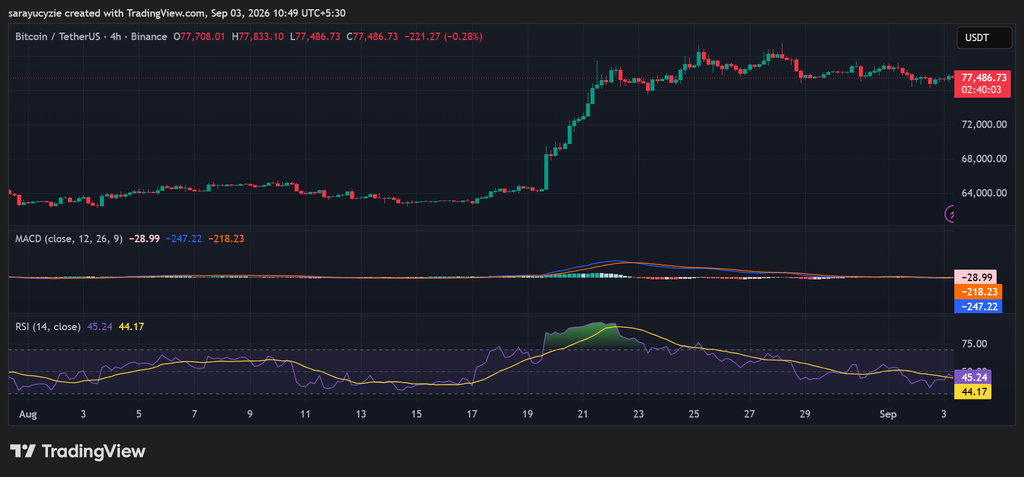
The technical chart analysis shows that the Moving Average Convergence Divergence (MACD) line is positioned below the signal line. As both lines are below the zero line, it hints at strong bearish momentum. The short-term momentum is weaker than the long-term, putting it in a broader downside.

This bearish crossover of Bitcoin shows that the selling pressure is actively accelerating downward. This is one of the strongest sell or trend-continuation signals on the chart, showing that bears are in firm control of the market.

(Source: TradingView)

Furthermore, the daily Relative Strength Index (RSI) at 45.24 reflects a neutral-to-slightly negative trend. The reading is sitting below the 50 midpoint, indicating that the recent price declines slightly outweigh recent price gains. Sellers have a slight edge, but there is no strong downward trend. 

There is plenty of room for the price action to move in either direction before hitting extreme territory. This reflects the BTC market in consolidation, and traders wait for a break above 50 or below 40 to confirm the next move.

Crypto Market Highlights

10% Pump for Uniswap (UNI): Can It Hold Above Resistance?

☐ ☆ ✇ TheNewsCrypto

Crypto Council Urges SEC to Streamline Novel ETP Approvals

By: Lakshya Baskar

ETP Frenzy

  • CCI encourages the SEC to make the approval process for Novel ETPs more efficient in terms of timing and regulation.
  • The organization also calls for parity of tax treatment, disclosure requirements, and confidentiality for novel ETPs.

Crypto Council for Innovation is advocating for a modernized framework for ETP by the Securities and Exchange Commission. CCI is calling for more clarity and predictability in the process of obtaining approvals for innovative ETPs. The suggestions from CCI were presented on August 31 concerning the framework for novel ETFs proposed by the SEC. The framework involves products that relate to crypto assets, blockchain opportunities, and event contracts. CCI is advocating for the same level of efficiency in the process of gaining approval for non-ETF products as that provided for qualifying ETFs.

CCI Pushes for Faster ETP Approvals

Existing regulations on ETFs may provide a blueprint for expanding the scope of reform to ETPs, according to CCI. For instance, Rule 6c-11 allows qualifying ETFs to conduct their activities without the need to receive exemptive orders on a case-by-case basis from the SEC. Similarly, Rule 485 allows ETP sponsors to file new funds using post-effective amendments with specific automatic effectiveness dates.

CCI calls for such efficiencies in the context of ETPs that do not qualify as ETFs. Additionally, CCI favors clear criteria in respect of which issuers will have a better idea of how much time is needed for product approval. The proposed measures would be especially applicable in developing products in the form of exchange-traded instruments based on digital assets.

Industry Group Targets Tax Differences

The second issue for which CCI seeks action by the SEC is coordination with the Treasury and IRS in respect of the taxation of the product. According to CCI, there are certain types of ETPs which are not ETFs, but whose tax status could be less favorable than that of ETFs.

In light of the above mentioned facts, the group feels that there should be coordination between the tax rules and securities market approval procedures. CCI is against any changes to the existing definition of an investment company under the Investment Company Act. It believes that the current statute provides regulators sufficient flexibility in determining whether Novel ETFs should be considered an investment company under the law.

Clearer Labels for Investors

CCI further called for clearer naming and disclosure requirements for products that are not deemed investment companies. CCI expects these products to be easily differentiated from ETFs. It cited exchange-traded commodity trusts and some digital asset products as examples. They can use the term “ETF” although they have varying structures under securities law.

CCI also favors confidential draft registration statements and pre-filing consultations voluntarily. It stated that such an approach will guard innovative products from copycat filings before their introduction. However, it isseeking confidentiality measures without extending timelines for Rule 485 filing. CCI’s proposal therefore includes a faster approval process with clear disclosure and greater protection for innovative products.

Highlighted Crypto News:
G20 Backs Clear Regulatory Pathways for Digital Asset Innovation

☐ ☆ ✇ TheNewsCrypto

Filecoin Price Surges 16% as FIL Breaks Key Resistance Levels

By: Sarala

Filecoin Price Surges 16% as FIL Breaks Key Resistance Levels

  • Filecoin (FIL) surged over 16% as trading volume jumped 338%, pushing the token above key technical resistance levels.
  • FIL faces resistance around $0.80-$0.81, while rising open interest and positive funding point to increased trader activity.

While the global crypto market attempts to recover from one of its worst phases of the year, with Bitcoin trading above $76K, altcoins are also trying to keep pace with the giant crypto. Among them, Filecoin (FIL) is one of the top performers, posting gains of more than 16% over the past 24 hours and topping the gainers list.

After hitting an all time low of $0.614 on August 18, Filecoin extended its recent recovery as strong trading volume and a technical breakout pushed the cryptocurrency back above key resistance levels.

According to CoinMarketCap data, FIL is currently trading at around $0.7749 with an intraday high of $0.8073, up 16.51% over 24 hours. The move came alongside a sharp increase in trading activity, with CoinMarketCap reporting a 338% rise in volume.

Filecoin (FIL) Technical Analysis

The latest rally follows a strong move from the $0.68 area at the end of August. CoinGecko’s historical data shows FIL closed at $0.682 on August 31 before rising to $0.80 on September 2, marking a sharp two-day recovery.

(Source: TradingView)

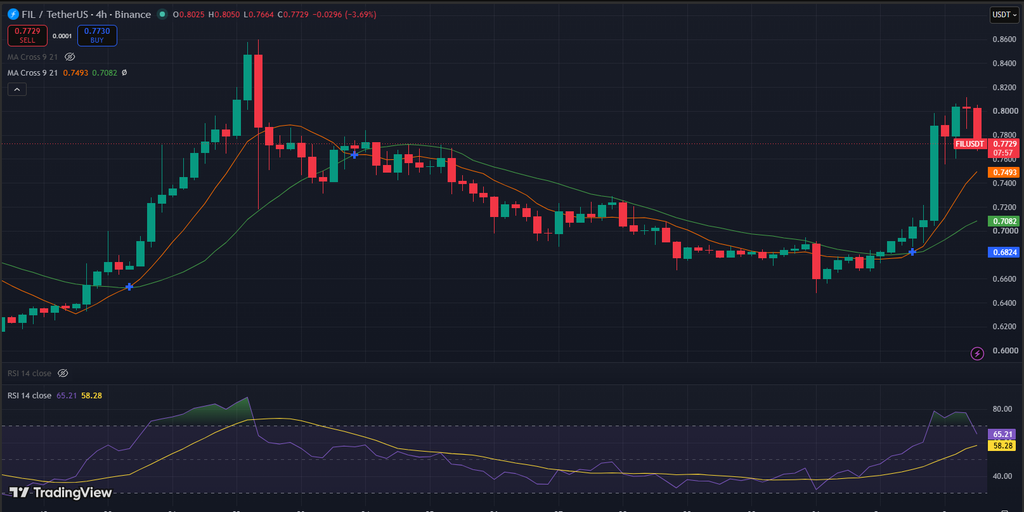
While checking the FIL/USDT 4-hour chart, Filecoin trading in a bull flag/consolidation pattern with price breaking above the $0.70-$0.72 range. The token climbed from a recent low of $0.6929 to a high of $0.8073, marking a gain of around 16.51%. 

FIL is currently trading above both the 9 and 21-day moving averages, at around $0.7493 and $0.7082 respectively, supporting the short-term bullish trend. The RSI is at 65.21, showing strong momentum while remaining below the overbought zone. 

Zooming in, FIL moved above its 200-day simple moving average near $0.704 and the 61.8% Fibonacci retracement level around $0.720. The breakout was accompanied by increased volume, suggesting stronger market participation behind the price move.

Open interest in Filecoin derivatives also increased significantly. CoinMarketCap’s analysis reported open interest rising to about $88.53 million from a previous range of $60 million to $70 million. The funding rate was also positive at 0.0117%, indicating that traders holding long positions were paying funding at the time of the analysis.

Despite the sharp gain, there is no confirmed major Filecoin protocol announcement or new listing that clearly explains the move. Current market analysis instead points to technical momentum, increased speculative activity and interest in Filecoin’s decentralized-storage and artificial-intelligence infrastructure narrative.

Still, FIL is facing resistance around $0.80-$0.81, where the recent rally has started to see some profit-taking. A breakout above this zone could push the price toward $0.82, while $0.75 and $0.71-$0.72 remain important support levels. 

Highlighted Crypto News:

Goldman Sachs, Bank of America and Citi Among 21 Firms Planning U.S. Dollar Stablecoin Launch in 2027

☐ ☆ ✇ TheNewsCrypto

Goldman Sachs, Bank of America and Citi Among 21 Firms Planning U.S. Dollar Stablecoin Launch in 2027

By: Sarala

Goldman Sachs, Bank of America and Citi Among 21 Firms Planning U.S. Dollar Stablecoin Launch in 2027

  • Goldman Sachs, Bank of America, Citi and 18 other firms plan a U.S. dollar stablecoin launch in the first half of 2027.
  • The 21 financial institutions aim to use the bank-backed stablecoin for blockchain payments, settlement and cross-border transactions.

A group of 21 major financial institutions, including Goldman Sachs, Bank of America, Citi and Deutsche Bank, plans to establish a new company to issue a U.S. dollar-denominated stablecoin in the first half of 2027.

According to the announcement from the institutions on September 1, they intend to form a new stablecoin company during the second half of 2026, subject to closing conditions. The planned stablecoin will initially be denominated in U.S. dollars, with the group also looking to develop stablecoins linked to other Group of Seven, or G7, currencies. The euro is expected to be a priority for a future expansion.

21 Financial Institutions Join Stablecoin Initiative

The initiative was first announced in October 2025, when the group consisted of 10 banks. It has since expanded to 21 financial institutions as traditional financial firms increase their focus on blockchain-based payment and settlement systems.

Other institutions involved include UBS, Wells Fargo, Fidelity Investments, Santander, BBVA, Mitsubishi UFJ Financial Group, TD, Scotiabank, PNC, Capital One and other major financial firms.

The proposed stablecoin is intended to support payments and settlement using blockchain technology. The group is considering applications across commercial, institutional and, depending on the market, retail use. Cross-border payments and digital-asset transactions are among the potential uses being discussed.

Stablecoins are digital assets designed to maintain a stable value against an underlying asset, most commonly the U.S. dollar. The market is currently dominated by non-bank issuers, including Tether and Circle, whose USDT and USDC tokens account for most of the dollar stablecoin market.

At the time of writing, the total stablecoin market cap stands at $313 billion, with USDT accounting for $183.27 billion, while USDC stands at $73.75 billion.

Banks Enter a Growing Stablecoin Market 

The banking consortium will also face competition from other financial-industry initiatives. A separate group of 37 financial institutions has established Qivalis, which is preparing to launch a regulated 1:1 euro-pegged stablecoin later in 2026. BBVA is involved in both initiatives.

The planned bank-backed stablecoin comes as financial institutions continue to explore blockchain technology for moving and settling money. Banks have also been examining tokenized deposits, which represent traditional bank deposits on blockchain networks.

The 21-firm group has not yet announced the name of the new company, the stablecoin’s ticker, its blockchain network or detailed reserve structure. The launch target is therefore a planned timetable rather than a currently available product.

If completed as planned, the initiative would mark a significant coordinated move by major global financial institutions into the stablecoin market, putting established banks in more direct competition with existing crypto-native issuers.

Highlighted Crypto News:

G20 Backs Clear Regulatory Pathways for Digital Asset Innovation

☐ ☆ ✇ TheNewsCrypto

G20 Backs Clear Regulatory Pathways for Digital Asset Innovation

By: Lakshya Baskar

18 G20 Nations Emerge as the Hubs for Crypto Degens

  • G20 embraced a path to regulating responsible innovation in the digital assets arena, keeping stability measures intact.
  • It is a supportive approach to the development of digital finance without any direct regulations on cryptocurrencies and stablecoins.

The G20 indicated an increased emphasis on digital asset innovation while remaining cognizant of maintaining financial stability in its approach to policy formulation. Financial ministers and central bank governors saw the opportunity that digital financial innovation provides as a means of achieving broader economic growth.

This new emphasis has come from the G20 Chair’s Statement in the aftermath of the second G20 finance meeting of the US 2026 presidency. The US Treasury Secretary Scott Bessent published the statement on September 1, 2026, after the meeting held in Asheville, North Carolina. This statement emphasizes the importance of developing regulatory and supervisory frameworks that establish “clear pathways” for safe digital financial innovation and digital assets.

G20 Makes Progress in Digital Assets Regulation

This language differs significantly from the G20’s previous focus on the dangers of crypto assets. In 2019, the G20 Finance Track members called for monitoring risks associated with crypto assets. Under India’s 2023 presidency, the G20 supported enhanced regulation, supervision, and oversight of the crypto economy. Similarly, the Financial Stability Board identified crypto and stablecoin risks in its 2025 G20 presidency (South Africa). The current 2026 statement recognizes digital innovation along with economic growth as key financial policy areas of the G20.

The language aligns with the United States’ priorities for its G20 presidency. According to Bessent, one of the Finance Track priorities included a thriving digital asset ecosystem. Nevertheless, the statement does not introduce any new regulations for G20 countries. It just offers guidance for the future.

Stablecoins Get Special Attention from the G20

Furthermore, the G20 reiterated its policy roadmap to enhance cross-border payments. In that context, officials emphasized extending operating hours for high-value payment systems, as well as the use of ISO 20022. At the same time, the G20 stressed the importance of cross-border data transfer for financial institutions, taking into account data security and domestic legal arrangements. However, stablecoins were given special consideration as part of the digital finance agenda. Thus, the G20 noted the FSB’s forthcoming report about global stablecoin arrangements and their impact on cross-border transactions.

Statement Indicates Policy Orientation

The statement holds a significant procedural feature in that it is not a G20 communiqué representing a consensus position. The U.S. Treasury stated that all present parties agreed except for China. China disagreed with paragraphs dealing with global economic disruptions, trade imbalances, IMF surveillance, and sovereign debt sustainability. 

These objections were not in regard to the digital asset part in paragraph 16. Consequently, the language related to digital assets remains part of the policy signal agreed upon. It promotes regulatory pathways while avoiding a global framework. Further rules will be defined by the national jurisdictions according to their procedures. The statement emphasizes the G20’s increasing interest in regulating innovation for investors and digital asset companies.

Highlighted Crypto News:
Hyperliquid Strategies Expands Chardan Equity Facility to $2.5 Billion

☐ ☆ ✇ TheNewsCrypto

10% Pump for Uniswap (UNI): Can It Hold Above Resistance?

By: Sarayu Krishna

10% Pump for Uniswap (UNI): Can It Hold Above Resistance?

  • After a 10% jump, Uniswap’s price is trading at $6.
  • UNI’s indicators exhibit a healthy macro uptrend.

The broader crypto market is barely moving, making a potential move lag. Among the digital assets, Uniswap (UNI) enters September under bullish pressure. With buyers maintaining full control of its trajectory, the asset has surged 47% over the past 7 days, extending its monthly gains to 54%. 

Notably, the bulls have stuck to the charts, blocking the entry of a downside trading pattern. The technical structure remains firmly positive, as it trades within a well-established uptrend. The bullish price alignment confirms that buyers continue to dominate the broader market trend of UNI. 

As per CoinGecko reporting, Uniswap has posted a 10.8% rise in value and is currently trading within the $6.31 range. The price is holding above the daily low noted at $5.58, and below the daily high of $6.37. Moreover, the daily volume has reached $1.15 billion. In the last 24 hours, the UNI market has seen $3.75 million in liquidations

Uniswap’s Key Price Levels to Watch  

The short-term price structure depends on a few important upcoming levels. As the bulls are active, the immediate resistance might be at $6.39, followed by a range above $6.50. A sturdy upper zone of UNI observed between $6.57-$6.79 is crucial and will decide whether it stabilises or continues to climb. 

On the other hand, a bearish reversal could place the initial support level at around $6.23. The price would slip through $6.10 if the negative momentum intensifies, and likely confirm that sellers are gaining control. With the next levels sitting near $5.97-5.70, the lower targets are aimed to be broken. 

UNI Technicals Point to Further Upside

The four-hour chart of Uniswap reveals that the Moving Average Convergence Divergence (MACD) line has crossed above the signal line. With both lines trading above zero, there is strong bullish momentum. It also confirms a healthy macro uptrend. 

The buying momentum is actively accelerating, and traders view this combination as a high-conviction signal that the path of least resistance remains up.

(Source: TradingView)

In addition, the daily Relative Strength Index (RSI) value at 74.86 is in overbought territory with a strong uptrend. The buying pressure has been intense. A period of consolidation is increasingly likely, and buyers are in firm control of price action. 

Entering new long positions here carries a poorer risk-to-reward ratio due to the heightened pullback risk. It serves as a caution signal for traders to monitor potential short-term pullbacks.

Crypto Market Highlights

Robinhood and Fomo Face Scrutiny Over KYC-Free Meme Coin Purchases

☐ ☆ ✇ TheNewsCrypto

Hyperliquid Strategies Expands Chardan Equity Facility to $2.5 Billion

By: Lakshya Baskar

Hyperliquid (HYPE) Ignites a 22% Rally: Can Bulls Chase $30 as Volatility Creeps In?

  • Hyperliquid Strategies raised its Chardan equity facility from $1 billion to $2.5 billion to enhance its ability to raise capital.
  • By the end of June, Hyperliquid had issued around $647 million worth of shares using the old facility.

The committed equity facility of Hyperliquid Strategies with Chardan Capital Markets has been increased to $2.5 billion from $1 billion. This development allows the digital asset treasury company to have more flexibility to secure funds by issuing stocks in the future. The information has been revealed by the company in its most recent SEC filing. The primary focus of Hyperliquid Strategies’ treasury management is HYPE, the native token of the Hyperliquid ecosystem.

Chardan Equity Facility Experiences Major Expansion

Hyperliquid Strategies revised its ChEF Purchase Agreement with Chardan Capital Markets, which was initially executed on October 22, 2025. Under the new deal, the company is permitted to issue shares of its newly issued common stock to Chardan. In case of sale of a $1 billion sale of shares, Nasdaq imposes a limit of $12.02, which can only be raised to 42,641,847 shares or 19.99% of issued and outstanding shares before the modification. It has not disclosed reasons for the $1.5 billion expansion. However, the filing suggests the company has sold approximately $647 million in shares under the old facility.

Company Has Already Raised $647 Million via Share Issuance

Hyperliquid Strategies had issued about $647 million in shares through the aforementioned deal by the end of June. As a result, the newly established facility leaves the firm with plenty of options regarding financing opportunities. Further share issuances would bring more cash for the company’s treasury strategy. Nonetheless, the latest filing fails to clarify whether all the proceeds from the extended facility would be used to purchase HYPE.

The company has been making itself more dependent on accumulating HYPE tokens as the key asset of its treasury strategy. As per the latest 10-K filing of Hyperliquid Strategies, the firm owns approximately 29.4 million HYPE tokens as of August 23. Such a treasury strategy allows investors to have direct access to the company’s strategy regarding the Hyperliquid ecosystem.

Company Has Already Raked In $647 Million Thanks to Share Issuance

Hyperliquid Strategies had already issued around $647 million in shares as of June through the above deal. This means that the newly opened facility has enabled the company to have several options regarding its financing opportunities. The further issuance of shares will add some funds to the company’s treasury strategy. However, the recent filing does not indicate whether all funds from the expanded facility will be used to purchase HYPE.

The company has become increasingly dependent on the accumulation of HYPE tokens as the primary assets in its treasury strategy. According to the latest 10-K filing of Hyperliquid Strategies, the company has around 29.4 million HYPE tokens as of August 23. This makes it possible for investors to get direct insight into the strategy of the company in the Hyperliquid ecosystem.

Highlighted Crypto News:
Ripple Unlocks 1B XRP as Escrow Balance Falls to 31.28B

☐ ☆ ✇ TheNewsCrypto

HIPTHER Warsaw Summit 2026: Where iGaming, Compliance and Tech Move Forward

By: Isabella

On 27–28 October, HIPTHER brings decision-makers, regulators and innovators to Warsaw for two focused days of high-level intelligence, cross-industry dialogue, practical learning and curated networking — without the noise of the mega-show circuit.

As regulated digital industries face accelerating change across technology, regulation and consumer expectations, HIPTHER Warsaw Summit 2026 returns to the InterContinental Warsaw by IHG on 27–28 October, bringing together the people navigating that change in practice.

From Regulation to AI: One Agenda for an Increasingly Connected Business World

The evolving HIPTHER Warsaw Summit 2026 agenda will tackle the forces reshaping regulated digital industries across Europe, from gambling regulation, compliance and market development to Responsible Gambling, AML, fraud prevention, digital identity and eIDAS 2.0. With Poland as the meeting point for a wider European conversation, the programme will examine how regulators, operators, legal experts and technology providers can respond to rising compliance expectations while supporting sustainable growth, stronger player protection and more resilient business models.

The discussion will extend across Fintech, banking and payments, AI, cybersecurity, infrastructure, marketing, SEO and AI-powered discoverability, business development and leadership — reflecting how quickly these areas are converging in practice. From responsible AI implementation and operational resilience to frictionless payments, secure digital identity and the future of visibility in AI-driven search, HIPTHER Warsaw will bring the people building, regulating and operating these systems into the same room to explore not only what is changing, but what businesses should do next.

Not Another Mega-Show. A Room Where You Can Actually Meet.

HIPTHER Warsaw is deliberately designed differently.

In an event calendar increasingly dominated by massive exhibition floors, packed schedules and a race for attention, HIPTHER’s boutique conference format prioritises access over scale and relevance over volume.

HIPTHER Warsaw Summit creates an environment where attendees can participate in the conversations on stage, meet speakers and fellow decision-makers directly, continue discussions during networking breaks and lunches, and build relationships throughout the two-day experience.

For companies and professionals increasingly evaluating the return on every event they attend, the proposition is simple: less conference logistics, more conference value.

Zoltan Tündik, Co-Founder & Head of Business at HIPTHER, commented:

“In an event landscape increasingly dominated by overwhelming mega-shows, HIPTHER Warsaw Summit is intentionally built around focus, access, and value. As technology, compliance, and market demands converge faster than ever, our goal is to bring the right leaders into the same room, not just to discuss what’s changing across Europe, but to leave with clear, actionable strategies for what to do next. From AI implementation and eIDAS 2.0 to responsible gambling and payments, this year’s agenda brings regulators, operators, and tech pioneers together for direct, high-level dialogue and practical learning that extends far beyond the stage.”

Learning That Continues Beyond the Panel

Alongside the main conference programme, HIPTHER Academy adds a practical learning layer to the Summit through expert-led workshops designed to transform industry knowledge into professional capability.

This combination of strategic conference content and applied learning reflects a wider HIPTHER principle: professionals should leave an event not only knowing what is changing, but understanding what they can do about it.

Business Happens Between the Sessions, Too

Networking is not treated as an add-on to the HIPTHER Warsaw experience.

Morning wellness activities and networking, structured breaks, networking lunches, and evening gatherings are intentionally integrated into the programme, giving attendees repeated opportunities to connect without having to constantly choose between content and conversation.

The Summit experience will also include the European iGaming Excellence Awards (EiGE Awards 2026), bringing the industry together to recognise excellence across European iGaming as part of HIPTHER Warsaw’s wider community experience.

Warsaw: Two Days to Understand What Comes Next

Connecting the iGaming market from Poland to Europe and beyond, the Summit will unite operators, regulators, suppliers, legal and compliance experts, technology providers, fintech and payments professionals, AI specialists, cybersecurity leaders, marketers, founders and senior decision-makers for two days built around one central purpose: turning the industry’s biggest questions into meaningful conversations with the people capable of answering them.

Learn more, explore the speakers and secure your pass:
https://hipther.com/events/warsaw-summit/

Media and sponsorship queries:

Disclaimer: TheNewsCrypto does not endorse any content on this page. The content depicted in this Press Release does not represent any investment advice. TheNewsCrypto recommends our readers to make decisions based on their own research. TheNewsCrypto is not accountable for any damage or loss related to content, products, or services stated in this Press Release.

☐ ☆ ✇ TheNewsCrypto

Robinhood and Fomo Face Scrutiny Over KYC-Free Meme Coin Purchases

By: Sarayu Krishna

Robinhood and Fomo Face Scrutiny Over KYC-Free Meme Coin Purchases

  • Robinhood and Fomo allegedly allowed meme coin purchases via credit cards without KYC verification.
  • Chase has sought a Visa investigation, while the New York Attorney General’s Office has launched its own probe.

Users of Robinhood Wallet and social trading app Fomo discovered they could purchase meme coins, including dogwifhat (WIF). They can use Visa and Mastercard credit cards, Apple Pay, and Google Pay, without completing any separate KYC identity verification. The transactions went through, earned standard credit card points and cash back, and nobody flagged them at processing.

Instead of being classified under merchant category codes 6012 or 6051, the standard crypto categories that typically carry a crypto indicator and exclude purchases from card rewards. The transactions were processed under MCC 5815, which covers digital goods and media. That classification meant the purchases looked like any other digital content buy to the card networks.

Crossmint, the crypto infrastructure company powering the transactions through its Token Checkout product, has defended the categorisation. The company points to joint SEC and CFTC guidance released in March that treats certain meme coins, including WIF, as digital collectables rather than crypto assets. It is framing that supports the digital goods classification.

Where Did it Start Unravelling?

Chase, JPMorgan‘s banking arm, reviewed the transactions and landed on a different conclusion. The bank determined that the Visa purchases had been misclassified. The transactions were not flagged as crypto, and the MCC assignment was incorrect. Also, the purchases should not have qualified for credit card rewards. 

Chase has formally filed a case inquiry with Visa and asked the network to investigate. Moreover, the New York State Attorney General’s Office has also acknowledged the matter. Further confirmed it is reviewing the payment structure.

What This Means for the Market

If meme coins can be purchased through mainstream payment rails without KYC and while earning card rewards, the on-ramp to crypto just got significantly wider, not through regulatory approval but through a classification loophole.

In addition, lower friction, familiar payment methods, and reward points on meme coin purchases remove several of the barriers that have historically kept casual buyers out of the market.

But the regulatory interference surrounding this structure from Chase, Visa, and the New York AG simultaneously suggests the window may be short. How Visa rules on the misclassification question will determine whether this payment method survives or gets shut down before it scales.

If the structure holds, expect more platforms to replicate it. If regulators close it, the conversation shifts to how tightly payment rails will ultimately be locked down around crypto purchases.

Crypto Market Highlights

Arbitrum (ARB) Surges 31%: How Far Can This Rally Actually Go?

☐ ☆ ✇ TheNewsCrypto

Aster and World Liberty Financial Launch USD1 RWA Boost: Phase 1, Offering 125M $WLFI + 6.25M USD1 in Rewards

By: Chainwire

George Town, British Virgin Islands, September 1st, 2026, Chainwire

Aster, the privacy-first onchain trading platform backed by YZi Labs, today announced the kickoff of USD1 RWA Boost: Phase 1 with World Liberty Financial (WLFI), featuring 125,000,000 $WLFI and 6,250,000 USD1 in rewards.

The campaign builds on AOS-2, Aster’s earlier expansion of its Aster Open Standards (AOS) framework from spot markets to perpetuals.

Leonard, CEO at Aster, said: “AOS-2 is turning Aster from a decentralized perp exchange into an open infrastructure layer where anyone can launch and operate their own perpetual markets on top of Aster Chain. The first USD1 RWA perpetuals show that model is already working.”

AOS-2: A Published Standard for Perpetual Listings

AOS-2 is Aster’s standardized, onchain framework for initiating perpetual market listings, enabling projects to propose new markets through a transparent and automated process.

Applicants stake 1 million $ASTER, locked for four years with no early exit, before the proposal goes to an onchain validator vote. If approved, Aster’s risk team configures the market and the perpetual can go live as early as T+1; if rejected, the stake is returned in full. 

Listing access runs on published onchain rules, while leverage and other trading parameters stay under Aster’s risk controls, letting Aster bring new markets to traders faster without giving up risk management.

USD1 RWA Boost Phase 1: 125M $WLFI + 6.25M USD1 in Rewards

The campaign runs from August 31 through December 31, 2026, covering SPCX/USD1, CL/USD1, XAU/USD1, SNDK/USD1, SKHYNIX/USD1, and MU/USD1. 

Users earn Trading Points through taker volume on eligible USD1 pairs, which determine their share of the USD1 reward pool, while Open Interest (OI) Points are earned by holding eligible positions and determine their share of the $WLFI reward pool. Traders using Single Asset Mode with USD1 as collateral receive a 2x boost on OI Points. Rewards are calculated across weekly epochs and distributed the following week.

“When real-world assets trade onchain, the settlement asset matters as much as the market itself. Perpetuals on gold, energy, and equities, all denominated in USD1, give traders one dollar instrument across every one of these markets, and that is what stablecoins were built to do. We are supporting these markets because this is where onchain market structure is heading, and Phase 1 is only the start,” said Zach Witkoff, Co-Founder and CEO at World Liberty Financial.

Building the Frontier of Onchain Trading

AOS-2 gives Aster a repeatable, onchain path for bringing new markets to the platform, and the first USD1 RWA perpetual listings show that path is already at work. Paired with the ecosystem support from Aster and WLFI, the launch turns a new listing framework into real trading activity from day one.

As more real-world and crypto-native assets move onchain, Aster aims to become a leading venue for bringing new asset markets onchain. The map gets bigger from here.

About Aster

Aster is a privacy-first onchain trading platform backed by YZi Labs, with unique features like Hidden Orders to protect user trading activity. It pioneers the frontier of on-chain trading through perpetual futures, spots, and earn products for top-trending assets, including RWAs, memes, and core crypto markets. It is powered by Aster Chain, a Layer 1 blockchain built to power the future of decentralized finance.

Users can learn more about Aster on the official website or follow Aster on X.

*Disclaimer: Eligible pairs, reward parameters, and campaign rules are subject to change during the campaign. Please refer to the official campaign page for the latest eligible pair list and campaign details. Trading cryptocurrencies and leveraged products involves significant risk and may result in the loss of capital. This announcement is for informational purposes only and does not constitute investment or financial advice.

Contact

Marketing Manager
Lola Chen
Aster DEX
lola.chen@asterdex.com

☐ ☆ ✇ TheNewsCrypto

Alkemya Metacore Secures $50M via Tokenised Equity to Scale Nickel Energy and Security Tech

By: Chainwire

London, London, September 1st, 2026, Chainwire

ALKEMYA METACORE SCSp SECURES INITIAL USD 50 MILLION INVESTMENT AHEAD OF LISTING OF TOKENISED EQUITY NICKEL OFFERING

Alkemya Luxembourg S.à.r.l. (“Alkemya”), the sponsor, is pleased to announce that Alkemya Metacore SCSp has secured USD 50 million in a pre-launch capital raise for its precision industrial nickel wire business backed by Class 1 nickel wire. It is announcing the sale of additional ALKN tokens in a new tranche (the “Token”) at USD 1.0 per Token. 

The offer, which is being arranged by Hanover Square Capital (UK) Ltd, will take place on Bitfinex Securities. The offer is available to institutional and professional investors and will close on 15 October 2026.

The Tokens are issued by Alkemya Metacore SCSp (“Alkemya Metacore”), a special limited partnership based in Luxembourg, which is registered as an Issuer with CNAD (National Commission of Digital Assets) in El Salvador. 

Alkemya Metacore is a Luxembourg-based investment and operating platform focused on the industrial development, commercialisation, and financial structuring of high-technology metals. It owns approximately 7 million metres of 99.99% ultra-pure nickel wire with 0.025 mm diameter, which has been independently verified and valued at approximately USD 1.64 billion. The asset is held in institutional custody in Lugano, Switzerland.

Alkemya will use part of the initial capital raise and further funds raised in additional tranches to invest working capital in Alkemya Metacore to finance its commercialisation strategy of transforming its ultra-pure wire into engineered mesh products tailored to high-growth applications across seven sectors: EMI shielding, aerospace and defence, marine and desalination, power and industrials, semiconductors, green hydrogen and rare/precious metals recovery. 

The successful capital raise, before secondary market listing, represents a major milestone for the offering and demonstrates confidence in the underlying exposure to high-purity nickel and the structure of the issue. The Token affords investors a combination of an asset-backed investment and a thematic play on energy transition and electronic security technologies.

The listing on Bitfinex Securities of the Token will enable Alkemya to leverage tokenisation to access a wider pool of global investors and be part of a regulated, 24/7 trading venue.

The Tokens aim to provide long-term investment value linked to real-world applications and technology. 

Cash distributions will be governed by a strict waterfall that first returns investor capital in full, cumulative distributions equal to a 6% per annum compound interest calculated annually (i.e., the preferred return) on the investor capital at any time outstanding, from the date of payment of the same up to the date of final repayment of the invested capital and an additional 80/20 profit split with a carry partner in favour of Token holders from the commercial business. 

Carlo Guido Della Peruta, Manager of the General Partner of Alkemya Metacore, commented: “Securing this initial investment is a significant milestone for Alkemya and validates both the quality of our asset and the strength of our commercialisation strategy. We chose to list on Bitfinex Securities because tokenisation offers us access to a genuinely global investor base within a regulated framework, and because it reflects the innovative approach we are taking across all aspects of our business. This raise will allow us to begin transforming our nickel wire asset into high-value engineered products serving some of the fastest-growing sectors in the global economy, and we look forward to welcoming further investors as the listing progresses.” 

Jesse Knutson, Head of Operations at Bitfinex Securities, commented: “Bitfinex Securities exists to connect exciting investment opportunities with a broader and deeper investor base, giving more people access to investments that were previously out of reach and giving businesses access to a wider pool of capital. Alkemya Metacore will represent yet another example of how we’re using blockchain technology to bring previously inaccessible asset classes to market within stringent regulatory guardrails, and Alkemya’s initial $50 million capital raise is a sign of appetite for this exciting opportunity.”

Arvinder Sood, CEO and Director at Hanover Square Capital (UK) Ltd, said: “Hanover Square Capital is delighted to announce this transaction in collaboration with Bitfinex Securities and its successful pre-launch close of USD 50 million investment, which not only underscores the evolving direction of global capital markets but also establishes a compelling foundation for a groundbreaking transaction with the launch of ALKN tokens. This milestone reflects a broader structural shift in how financial assets are created, accessed, and exchanged, as traditional frameworks increasingly converge with digital innovation. By embracing tokenised equity, the transaction highlights a more efficient, transparent, and accessible model for capital formation, one that is better aligned with the demands of modern investors and issuers alike, with the capacity to trade on a peer-to-peer basis.

Hanover Square Capital believes that this transaction not only validates that trajectory but also signals the growing importance of blockchain-enabled solutions in redefining how assets are issued, managed, and traded on a global scale.”

Bitfinex Securities provides a regulated venue for the issuance and trading of tokenised securities, combining blockchain technology with regulated market access for issuers and eligible investors.

The offering was advised by the following law firms: CMS DeBacker in Luxembourg (as regards Luxembourg law aspects), Dentons El Salvador (as regards El Salvador law aspects), Foley and Lardner in the US (as regards US law aspects), and CNPLaw LLP in Singapore (as regards Singapore law aspects). Winston Taylor acted for Bitfinex Securities. The Edison Group advised on investor relations and issued a pre-IPO research note. The ALKN tokens will be available for trading across three regulated exchanges: Bitfinex Securities, AGX (operated by LabyrinthX Technologies Pte Ltd, a company in the Hydra X group) and Archax Ltd. HydraX Digital Assets Pte. Ltd. is the custodian and distribution partner in Asia, with Archax playing a similar role in the UK. Scytale, the technology firm, is providing onboarding technology services for compliance to Alkemya Metacore under Luxembourg and EU law.

About Hanover

Hanover Square Capital (UK) Ltd (“HSC”) is an independent, regulated advisory firm headquartered in London, comprising a small team of highly experienced finance professionals. The firm provides strategic advice across a broad range of areas, including energy transition and climate-related solutions, public and private debt and equity placements, bank financing, and both project and commodity finance, alongside advisory services on financial investments. HSC brings deep sector expertise spanning environment-related projects, infrastructure development, next-generation technologies with applications to electromagnetic shielding and efficient green energy production, with a particular emphasis on sustainability and the global energy transition.

As a member of the UK Sustainable Investment and Finance Association (UKSIF), the firm is closely aligned with leading sustainability practices. Its client base is global, encompassing large and mid-cap corporations, government and state agencies, selected institutional investors, and professional investors. HSC is further supported by its connected company, Hanover Square Investments Pte. Ltd, based in Singapore.

About Bitfinex Securities

Bitfinex Securities provides a regulated platform for the issuance, listing and trading of tokenised securities. Licensed in El Salvador and Kazakhstan, Bitfinex Securities gives issuers and eligible investors access to digital securities markets within established regulatory frameworks.

The platform supports capital raising and secondary market trading for tokenised securities, including real-world asset-linked opportunities. By combining market infrastructure, technology and regulatory oversight, Bitfinex Securities aims to make capital formation more efficient, transparent and accessible for issuers and investors.

Media Contact:

Richard Morgan Evans

rmorganevans@sapiencecomms.co.uk

Jonathan Batchelor

jbatchelor@sapiencecomms.co.uk

Sapience Communications

+44 (0) 203 841 7610

Disclaimer:

No offering is being made in the European Union or the European Economic Area, and no retail investors within the meaning of Directive 2014/65/EU (as amended, “MiFID II”) will be admitted as purchasers of the ALKN Tokens. The ALKN Tokens are also exempt from the obligation to publish a prospectus for offers to the public under Regulation (EU) 2017/1129, as amended (the “Prospectus Regulation”), as the offering will only be addressed to qualified investors in the EEA/EU. The offering is limited to institutional investors in Singapore. This news release does not constitute an offer to sell or a solicitation of an offer to buy, nor shall there be any sale of any of the ALKN Tokens in any jurisdiction in which such offer, solicitation or sale would be unlawful. These securities have not been and will not be registered under the US Securities Act of 1933, as amended (the “Securities Act”), the securities laws of any U.S. state or the securities laws of any other jurisdiction outside El Salvador, nor is such registration contemplated. The ALKN Tokens will only be offered and sold outside the United States (as defined in Regulation S under the Securities Act (“Regulation S”)) in offshore transactions pursuant to Rule 903 or Rule 904 of Regulation S and in accordance with any other applicable securities laws where such offers and sales are made. The ALKN Tokens have not been and will not be offered or sold within the United States. 

Forward-Looking Statements: Information outlined in this news release may involve forward-looking statements under applicable securities laws. The forward-looking statements contained herein are expressly qualified in their entirety by this cautionary statement. The forward-looking statements included in this document are made as of the date of this document, and Alkemya Metacore and Alkemya disclaim any intention or obligation to update or revise any forward-looking statements, whether because of new information, future events or otherwise, except as expressly required by applicable securities legislation. Although management believes that the expectations represented in such forward-looking statements are reasonable, there can be no assurance that such expectations will prove to be correct.

Notice: None of Bitfinex Securities, Archax Ltd or the Hydra X group accepts responsibility for the adequacy or accuracy of this news release.

Since this offering is not targeting US investors as it is made under Regulation S and similarly it is not targeting EU retail investors under the EU Directive 2014/65/EU (as amended, “MiFID II”) or non-institutional investors in Singapore, this announcement is not intended for US investors, retail investors in the EU or non-institutional investors in Singapore. US investors, EU retail investors and non-institutional investors in Singapore are considered prohibited investors under the ALKN Token offering. 

Contact

Jonathan Batchelor
Sapience
jbatchelor@sapiencecomms.co.uk

☐ ☆ ✇ TheNewsCrypto

Ripple Unlocks 1B XRP as Escrow Balance Falls to 31.28B

By: Lakshya Baskar

Ripple Survey Finds 72% of Finance Leaders See Digital Assets as Key to Competitiveness

  • XRP was unlocked through 3 separate transactions, leaving about 31.28 billion XRP in active escrow.
  • This move does not signify an actual sale by Ripple, while upcoming transactions will determine the net number of XRP unlocked by Ripple.

The company unlocked 1 billion XRP from escrow on September 1st through 3 transactions. These were 500 million XRP, 400 million XRP, and 100 million XRP, respectively. This was revealed by the blockchain monitoring account Whale Alert in relation to the XRP that was unlocked from Ripple-controlled escrow accounts. This is part of the scheduled monthly unlocking of XRP through timed escrow contracts by Ripple.

XRP Unlock in September by Ripple Lowers Escrow Holdings

About 31.28 billion XRP were left in active escrow after the September transactions executed by Ripple. An independent monitor estimated the number of coins by referencing trusted XRP Ledger information. The monitor identified about 32.28 billion XRP before the issuance of 1 billion tokens. This means that there was a decrease of about 1 billion XRP in the active escrow account due to the transaction. The coins left in the account are about 31.28% of the initial 100 billion coins supplied with XRP. There is still more total XRP owned by Ripple due to operational wallets that hold released tokens.

Unlocking XRP Does Not Indicate a Market Sale

Ripple created the escrow system back in December 2017 by locking 55 billion XRP in time-based contracts. The design was intended to introduce more certainty regarding the number of XRP that may be unlocked by Ripple on a monthly basis. The design ensures that up to 1 billion XRP can be unlocked on a monthly basis as a result of the release conditions.

An EscrowFinish transaction unlocks the XRP once the escrow conditions have been fulfilled. However, the unlock transaction does not guarantee the XRP tokens will move to the exchange, buyer, or liquidity providers. Consequently, the September transactions cannot reveal the usage of the XRP that has been unlocked. Investors should differentiate between the unlocking of XRP and XRP moving into public trading markets.

Re-Escrowed Tokens Will Influence the Final Net Release Amount

Ripple returned any unused monthly XRP tokens to new escrow deals. As Ripple stated before, all unused tokens will be added to new escrows after every token release process. Previously, the amount of tokens that Ripple put back into escrow in every cycle was between 600 million and 800 million XRP. But past trends do not guarantee how many tokens Ripple will re-escrow in September. At the time this report was written, no independently confirmed figure of re-escrowed tokens was announced. EscrowCreate deals will show us how much XRP is actually locked up once again under time limitations.

Ripple’s Upcoming XRP Unlock Expected in October

Ripple’s upcoming release window is expected to occur in October following the same existing monthly pattern. An additional 1 billion XRP may be released when escrowed objects mature on their respective release dates. The future re-escrows may push back the release date by locking away any unlocked XRP behind further restrictions. The XRP price was recorded at $1.39 for the period covered by the provided market data. Nevertheless, the upcoming escrow release does not necessarily explain the price fluctuation of XRP.

Highlighted Crypto News:
Lazarus Group Moves $30M Through Hyperliquid as Trump Backs US Expansion

☐ ☆ ✇ TheNewsCrypto

Lazarus Group Moves $30M Through Hyperliquid as Trump Backs US Expansion 

By: Lakshya Baskar

Hyperliquid (HYPE) Rallies to $37 as Arthur Hayes Predicts Major Upside to $150

  • Data from Arkham reveals Lazarus-affiliated wallets transferred more than $30 million using Hyperliquid and HyperUnit.
  • This was amid Hyperliquid’s efforts to access the U.S. markets through Bitnomial, which is owned by Payward.

Wallets affiliated with the North Korea-based Lazarus Group have sent over $30 million via Hyperliquid, according to chain analysis from Arkham. This information was revealed on August 31 by Arkham researcher Emmett Gallic. He identified the transactions carried out within about three weeks. These funds went through HyperUnit, where the wallets changed BTC for ETH and Solana before moving the funds through various blockchain networks. Finally, these funds were transferred to centralized exchanges such as KuCoin, LBank, and Kraken, among other Tron-based platforms. Several BTC outflows were seen in the transaction dashboard from Lazarus-affiliated wallets.

Lazarus Group-Associated Transactions Come Under Scrutiny

The transactions carried out via the wallet have raised more suspicion about Hyperliquid. Since US authorities have put sanctions on the Lazarus Group for their ties to North Korea’s regime and cyber activities. Blockchain analyst ZachXBT discovered some of the addresses in 2024 during an investigation of Lazarus-associated crypto money laundering operations. Previously, the analyst had linked the group to the proceeds from various crypto attacks and the methods of moving the stolen crypto funds.

The permissionless nature of the Hyperliquid platform has provided yet another avenue to shift native assets to the platform. The Hyperunit product offered by Hyperliquid enables users to lock their native Bitcoin, Ethereum, and Solana in exchange for corresponding tokens in the environment of Hyperliquid.

US Expansion for Hyperliquid Is Regulatory Driven

The timing of the decision is also crucial since Hyperliquid has an important regulatory development that takes place in the USA. President Donald Trump noted that CFTC Chairman Michael Selig is making efforts to bring Hyperliquid to the US under the right regulatory framework. This statement came after a meeting at the White House where the heads of cryptocurrency and financial firms participated. The market response to the HYPE coin of Hyperliquid was also significant after the statement.

Bitnomial Structure Fails to Overcome Regulatory Obstacles

Bitnomial will be responsible for managing onboarding of the customers, access to trading, and compliance issues. Whereas Hyperliquid technology will facilitate the functioning of markets associated with the listed contracts. The regulatory clearance is still pending, and no information about financial details has been released by the parties. Consequently, the Lazarus-associated transactions occur amid the attempts by Hyperliquid to gain market access regulated in the US.

Highlighted Crypto News:
Kalshi Faces Fresh Legal Setback as Ninth Circuit Backs Nevada Sports-Betting Rules

☐ ☆ ✇ TheNewsCrypto

Arbitrum (ARB) Surges 31%: How Far Can This Rally Actually Go?

By: Sarayu Krishna

Arbitrum (ARB) Surges 31%: How Far Can This Rally Actually Go?

  • Arbitrum price climbed 31%, hovering at the $0.11 mark.
  • ARB’s momentum reflects extreme buyer dominance.

Kicking off September 1, the new month begins with Arbitrum (ARB) trading at around $0.1116, posting a 31.6% gain in value. Its daily volume is settled at $381.13 million. Moreover, the asset’s 24-hour session has ranged between $0.08477 and $0.1193.

Significantly, the Robinhood Chain, built on Arbitrum Orbit, has been live since July 8 and generated over $1.92 million in fees in a single 24-hour period. There is a massive jump from its average daily revenue of around $100,000. 

Notably, 10% of net revenue flows back to the Arbitrum ecosystem; yesterday alone pushed approximately $190,000 directly into Arbitrum’s treasury. Also, the tokenised stocks on Arbitrum One have simultaneously hit a new all-time high of $200 million in market cap.

L2 projects had been widely written off, but Robinhood operating a dedicated Arbitrum chain successfully has reframed what Layer 2 infrastructure can actually deliver when a major platform commits to it seriously.

On the other hand, ARB has touched its monthly resistance at current levels. Without a daily close above it, this risks being treated as an artificial pump rather than a structural breakout.

Can Arbitrum Build Enough Momentum to Sustain the Rally?

The four-hour price chart exhibits upside momentum, and if it breaks above the $0.1141 level, the trajectory could sustain. Assuming the bulls gain enough strength, they might initiate the formation of a golden cross, and the Arbitrum price would potentially climb and test the resistance near $0.1180. 

In the case of the bullish sentiment fading, the bears would influence the asset’s price, and that could immediately slip to the support at $0.1101. Further correction on the downside would trigger ARB’s death cross to take place. Gradually, the bearish pressure might pull back the price to its former low. 

Zooming in on the technical chart of Arbitrum, the Moving Average Convergence Divergence (MACD) line is above the signal line, and both are trading above the zero line. It indicates strong bullish momentum and likely confirms an established uptrend. The buying momentum is still accelerating, and it is considered a high-conviction continuation signal for traders. 

(Source: TradingView)

In addition, the current market condition of ARB is in an extreme overbought zone, as the daily Relative Strength Index (RSI) stays at 81.14. This suggests an intense, vertical buying surge. The short-term price increase has been so aggressive that a consolidation becomes increasingly likely. It reflects extreme buyer dominance, but serves as a warning light rather than a buy signal. 

Crypto Market Highlights

Helium (HNT) Surges 20%: Can It Hold the Gains and Push Higher?

☐ ☆ ✇ TheNewsCrypto

Kalshi Faces Fresh Legal Setback as Ninth Circuit Backs Nevada Sports-Betting Rules

By: Lakshya Baskar

Kalshi Bolsters U.S. Policy Engagement With New Washington, D.C. Office

  • Kalshi is under increased regulatory scrutiny now that the Ninth Circuit has denied its bid to stop Nevada from enforcing its sports contract regulations.
  • The decision will bolster Nevada’s hand as it battles a contrary opinion from the Third Circuit.

The legal tussle involving Kalshi against state regulators has reached yet another significant stage following the dismissal of the latest legal challenge by the appeals court. The ruling handed down on August 28 was unanimous that Kalshi had failed to prove that Nevada’s rules for sports contracts were likely to violate federal laws on commodities.

Ninth Circuit Rejects Kalshi’s Preemption Theory

Kalshi claimed that federal commodity regulation preempted state law concerning its sports contract business from Nevada’s gaming statutes. Kalshi runs itself as a designated contract market regulated by the CFTC, classifying its contracts as swaps. But the Ninth Circuit concluded that Kalshi’s contracts probably do not fit within the definition because it operates similarly to sports bets.

The court denied Kalshi’s express, conflict, and field preemption claims during the preliminary injunction phase. Circuit Judge Ryan Nelson also stressed that the CFTC is not the national gambling regulatory agency. The decision invalidates an existing injunction that exempted Kalshi from any Nevada enforcement action throughout the legal process. The court also remanded the Nevada election contract dispute to the district court.

Legal Issues for CFTC Rulemaking on Its Own Terms

While addressing the major-questions doctrine, the court declined to render a decision declaring the CFTC’s rulemaking efforts unconstitutional. The court noted that Kalshi’s broad view of federal power could give rise to major-questions issues, but the judges did not determine whether the agency’s proposed rules in the future would infringe upon the doctrine. According to gaming attorney Daniel Wallach, the CFTC rule is facing serious legal challenges after the court’s decision and can become subject to an Administrative Procedure Act lawsuit.

Circuit Split Puts Supreme Court Within Reach

The Ninth Circuit case poses a notable distinction from the Third Circuit ruling supporting Kalshi. This distinction may raise the chances of Supreme Court action, despite the fact that review is not assured. There was a deadline of September 3 for New Jersey to file for further review on the Third Circuit case. Kalshi can also seek Ninth Circuit rehearing or Supreme Court review.

As of now, Nevada will be able to enforce its gaming laws against Kalshi’s sports agreements. The CFTC proposed rules are also still pending at the agency after considering public feedback. So this issue is still ongoing in the federal courts, state agencies, and through federal rulemaking.

Highlighted Crypto News:
Bitcoin (BTC) Is Mirroring 2022: Does That Put $83K on the Table?

☐ ☆ ✇ TheNewsCrypto

Tectonic Exploit Forces Cronos to Halt: $75M at Risk

By: Sarayu Krishna

Tectonic Exploit Forces Cronos to Halt: $75M at Risk

  • Tectonic was exploited for over $75M, prompting Cronos Network to pause operations.
  • $6.29M has moved to Ethereum and was swapped for 2,592 ETH, while $68.7M remains on the Cronos Network.

The Cronos network has been halted following a major exploit targeting Tectonic, the DeFi lending protocol that held approximately $121.6 million in total value locked, roughly 46% of all Cronos DeFi TVL, before the attack hit.

The attacker targeted TONIC, Tectonic’s illiquid governance token, and drove its price up approximately 100-fold in roughly 20 minutes. With the artificially inflated TONIC posted as collateral, the attacker borrowed large amounts of harder assets from Tectonic’s lending pools, an estimated $75 million in total. 

It’s the same technique Avraham Eisenberg used to drain over $100 million from Solana-based Mango Markets in October 2022. 

Where the Money Went, and Where It Did Not

The attacker began moving proceeds across a bridge to Ethereum, the only exit route off the Cronos chain. Approximately $6.29 million made it across before validators halted block production on Cronos, freezing the network in place. 

Around $60 million remains stranded on the frozen chain, unable to move. That means roughly 91% of the estimated haul is effectively locked. It is waiting on a decision from validators about what happens when the network restarts.

Some on-chain estimates put the total at risk as high as $119.5 million, but that figure remains unconfirmed and may conflate assets at risk with assets actually drained.

Moreover, Cronos confirmed the exploit and halted the network. Tectonic acknowledged the incident and advised users not to interact with the protocol until it is confirmed safe. Neither has officially confirmed the exact losses or disclosed the root cause publicly.

Crypto.com CEO Kris Marszalek confirmed that the Crypto.com app and exchange were not affected and are operating normally. All user funds on the platform are safe. Crypto.com’s security team is actively supporting the Cronos investigation. 

Notably, Cronos was originally developed by Crypto.com, while Tectonic operates independently as a DeFi lending protocol on the network. Also, no restart timeline for the Cronos network has been announced. Furthermore, how the attacker’s stranded assets will be handled post-restart remains an open question.

The Exploit’s Market Impact

An exploit of this scale hitting 46% of a chain’s DeFi TVL in a single attack freezes user confidence alongside the network itself. The frozen $60 million creates a significant situation: the attacker can’t move the funds, but neither can anyone else until validators decide what comes next. 

That decision will define how Cronos handles the recovery and whether the DeFi ecosystem on the chain survives the reputational damage.

Crypto Market Highlights

Bitcoin (BTC) Is Mirroring 2022: Does That Put $83K on the Table?

☐ ☆ ✇ TheNewsCrypto

Hong Kong Web3 Festival 2027 Set for April 19-21 at HKCEC

By: Isabella

The fifth edition will take place from April 19–21, 2027, at the Hong Kong Convention and Exhibition Centre, continuing its legacy as World’s premier Web3 summit.

The Hong Kong Web3 Festival 2027 (“the Festival”) is scheduled to be held from April 19 to 21, 2027, at the Hong Kong Convention and Exhibition Centre (HKCEC). Co-hosted by Wanxiang Blockchain Labs and HashKey Group, and organized by W3ME, the Festival has been a flagship annual event since its inaugural edition in April 2023. Running for five consecutive years, it has grown into a globally recognized gathering that connects developers, project teams, investors, regulators, and ecosystem stakeholders to explore the latest trends, industrial breakthroughs, and the evolving future of Web3.

Over its past four editions, the Festival has showcased more than 500 exhibitors, featured over 1,600 thought leaders, attracted upwards of 150,000 attendees, and hosted more than 600 side events. The speaker lineup has consistently included some of the most influential figures in finance, technology, and policy, such as:

  • Paul CHAN Mo-po, Financial Secretary of the Government of the Hong Kong Special Administrative Region
  • XIAO Feng, Chairman of Wanxiang Blockchain, Chairman and CEO of HashKey Group
  • Vitalik Buterin, Co-Founder of Ethereum
  • Cathie Wood, Founder, CEO and CIO of ARK Invest
  • Michael Faulkender, Professor of Finance, University of Maryland
  • CZ, Founder of Binance
  • Sergey Nazarov, Co-Founder of Chainlink
  • Bo Feng, Founder of Dragonfly.xyz
  • Hong Fang, President of OKX
  • He Yi, Co-Founder and Co-CEO of Binance
  • Sandeep Nailwal, Co-Founder of Polygon
  • Lily Liu, President of Solana Foundation
  • Avery Ching, Co-Founder and CTO of Aptos Labs
  • Yat Siu, Co-Founder and Chairman of Animoca Brands

Over the past four editions, the Festival has borne witness to the industry’s evolution—from foundational infrastructure development to the early stages of mass adoption. During this same period, Hong Kong’s virtual asset ecosystem has matured considerably. Regulatory frameworks have advanced, compliant stablecoins have moved from regulatory approval toward commercial deployment, tokenized deposits and digital assets have entered real-world pilot programs, and asset tokenization has drawn growing participation from traditional financial institutions and regulated trading platforms.

As the industry enters a new phase of growth, several pivotal questions are coming to the forefront: How can tokenization transition from proof-of-concept to scalable real-world use? How can the full lifecycle of asset issuance, circulation, and trading be more seamlessly integrated? As stablecoin payments and on-chain settlement gain momentum, how will global financial infrastructure be reshaped? And as artificial intelligence continues to transform industries worldwide, how will the convergence of AI and blockchain unlock novel applications and ecosystem opportunities?

These are no longer abstract debates. They are tangible challenges that the industry must address today. In April 2027, the Festival will convene builders, investors, regulators, and researchers across the globe to share insights and chart the next chapter of Web3 development.

The official website will be launched shortly. Early-bird tickets for a limited time are now available at a special rate of $169 USD via Luma: https://luma.com/hkweb3festival_2027. Applications for speakers, sponsorships, media partnerships, community collaborations, and side events will be rolled out in phases. Stay tuned for updates.

Follow Hong Kong Web3 Festival (@festival_web3) on X for the latest updates.

About Wanxiang Blockchain Labs

Founded in 2015, Wanxiang Blockchain Labs (“the Labs”) is a non-profit research institution focusing on blockchain technology. The labs gathers global experts to conduct researches and promote dialogues on the development, application and strategy to provide guidance for entrepreneurs and to provide reference information for regulatory bodies, all in the effort to promote growth for the society and economy leveraging blockchain technology’s potential.

Since its inception, the Labs has established a strong global presence as one of the leading blockchain research institutions through initiatives including the annual Shanghai Blockchain Global Summit and Hong Kong Web3 Festival, hackathons, developer programs, incubation initiatives, blockchain publications, research, lectures, and academic collaborations.

About HashKey Group (3887.HK)

HashKey Group (3887.HK) is a leading comprehensive digital asset group in Asia with a global footprint. Founded in 2018, we are building the next-generation global financial infrastructure to serve institutions, retail investors and blockchain ecosystem partners. We enable traditional institutions and blockchain projects to efficiently access global resources and achieve compliant expansion and growth for their products and businesses. The Group operates across four core pillars: Transaction Facilitation, On-Chain Services, Asset Management and RWA Tokenisation.

HashKey Group is committed to driving the large-scale adoption of blockchain technology and delivering dependable and accessible digital asset services to one billion users worldwide.

Disclaimer: TheNewsCrypto does not endorse any content on this page. The content depicted in this Press Release does not represent any investment advice. TheNewsCrypto recommends our readers to make decisions based on their own research. TheNewsCrypto is not accountable for any damage or loss related to content, products, or services stated in this Press Release.

☐ ☆ ✇ TheNewsCrypto

Same Election Question, Two Different Odds: Predictions.io Launches Free Cross-Venue Comparison Tools

By: Chainwire

Washington, United States, August 28th, 2026, Chainwire

As prediction-market volume hits record highs and regulators circle, identically worded midterm questions are trading several points apart depending on the venue. Predictions.io now tracks 9,700+ markets across Kalshi, Polymarket and Manifold in one place – with free fee and odds calculators so traders can see what a price actually costs them.

Prediction markets have never been bigger, or more contested. Kalshi, Polymarket and Polymarket US together posted a record $50.59 billion in combined volume in July, with Kalshi accounting for roughly 74.5% of the total. In the same month, New York City opened a probe into both leading venues, a Washington judge ordered Kalshi to halt most wagers in the state, and the CFTC began an internal review of so-called “mention markets.”

Amid that scrutiny, a simpler question has gone largely unexamined: when two venues list the same question, do they agree on the answer?

Often, they do not. On identically worded midterm markets tracked by Predictions.io, “Blue tsunami in 2026?” was priced at 44.5% on Polymarket and 36.0% on Kalshi. “Blue wave in 2026?” showed 82.5% against 74.0%. Both gaps are 8.5 percentage points — on questions whose wording is identical on the two venues. Across a sample of directly comparable binary markets live on more than one venue, the median gap was more than four points, and nearly half of the pairs differed by five points or more. (Prices as of 05:08 UTC on 28 August 2026; both venues’ live prices are shown side by side on Predictions.io.)

Those gaps matter to anyone quoting a single number. A market priced at 44.5% on one venue and 36.0% on another does not have one “market-implied probability” – it has two, and which one gets cited is arbitrary unless the reader is told both.

“A single venue’s price is a data point. The spread between venues is the information. When the two biggest markets in the world disagree by seven points on the same sentence, that disagreement is the story – and nobody who runs one of those markets is in a position to report it.” said spokesperson of Predictions.io

Predictions.io aggregates markets from Kalshi, Polymarket and Manifold, matching equivalent questions across venues so the same event can be compared directly. The platform currently tracks more than 9,700 event pages across 23 categories including US politics, economics, crypto, sport and geopolitics.

Alongside the comparison pages, Predictions.io publishes two free tools:

Fee Calculator — enter any trade and see the fee, total outlay and effective all-in price on each venue, including Kalshi’s 0.07 × P × (1−P) taker formula and maker discount against Polymarket’s zero-fee standard markets.

https://predictions.io/tools/fee-calculator

Odds Converter — convert American, decimal and fractional odds into implied probability and prediction-market prices, and see the vig-free line.

https://predictions.io/tools/odds-converter

A direct venue comparison is available at https://predictions.io/compare/polymarket-vs-kalshi, and live midterms markets at https://predictions.io/lobby/us-politics.

Predictions.io operates no market and takes no position in any contract. It is a data and comparison service, not an exchange, broker or investment adviser.

About Predictions.io

Predictions.io is an independent aggregator of prediction markets, bringing prices from Kalshi, Polymarket and Manifold into a single view so the same question can be compared across venues. It publishes free tools for traders and journalists, including a cross-venue fee calculator and odds converter.

Users can learn more about Predictions.io here: https://predictions.io/

Predictions.io socials: https://bio.site/predictions.io

Contact

Spokesperson
Predictions.io
support@predictions.io

☐ ☆ ✇ TheNewsCrypto

MEXC Launches Earn Plus With Limited-Time Event Offering up to 800% APR Booster

By: Isabella

MEXC, a pioneer in 0-fee digital asset trading, has launched Earn Plus, a new flexible savings product, and introduced a limited-time event that offers eligible users an APR boost of up to 800%.

Earn Plus is a flexible savings product that allows users to stake stablecoins and earn daily interest. The product offers 100% principal protection, with interest generated from low-risk, high-liquidity assets. Earn Plus has no lock-up period or maximum subscription limit, allowing users to stake and redeem assets at any time, with redemptions processed within seconds. Interest is calculated hourly and settled daily, and larger staked amounts qualify for higher APRs than those in standard Flexible Savings, currently up to 11%.

Earn Plus complements MEXC’s existing Earn product suite: Flexible Savings offers everyday liquidity with floating rates, Fixed Savings provides locked-term products for higher guaranteed returns, and On-chain Earn enables participation in on-chain yield opportunities. These products allow users to select an Earn solution based on their liquidity needs and risk preference.

The limited-time event runs from August 27 to October 24, 2026 (UTC), during which users can earn additional APR boosters on top of standard rates. New users who complete a qualifying deposit task can receive an APR booster of up to 800%. New and existing users who refer friends to complete deposit tasks are eligible for APR boosters of up to 800%, while those who reach specified net deposit thresholds can receive boosters of up to 500%. Specific booster terms, including APR and duration, are subject to the details displayed on the platform.

For event details and participation, please visit the MEXC platform.

About MEXC

MEXC is the world’s fastest-growing cryptocurrency exchange, trusted by more than 40 million users across 170+ markets. Built on a user-first philosophy, MEXC offers industry-leading 0-fee trading and access to over 3,000 digital assets. As the Gateway to Infinite Opportunities, MEXC provides a single platform where users can easily trade cryptocurrencies alongside tokenized assets, including stocks, ETFs, commodities, and precious metals.

MEXC Official Website X TelegramHow to Sign Up on MEXC

For media inquiries, please contact MEXC PR team: media@mexc.com

Risk Disclaimer:

This content does not constitute investment advice. Given the volatility of financial markets, including digital assets, tokenized assets, and traditional financial products, investors should carefully assess market conditions, underlying asset fundamentals, and potential financial risks before making any investment or trading decisions.

Source

Disclaimer: TheNewsCrypto does not endorse any content on this page. The content depicted in this Press Release does not represent any investment advice. TheNewsCrypto recommends our readers to make decisions based on their own research. TheNewsCrypto is not accountable for any damage or loss related to content, products, or services stated in this Press Release.

☐ ☆ ✇ TheNewsCrypto

SigmaX Global Ltd Plans Strategic Marketing Collaboration With a Top 100 Global Financial Company To Accelerate International Expansion

By: Isabella

 SigmaX Global Ltd recently announced a new phase of its international market expansion strategy, with plans to establish a strategic marketing partnership with a company ranked among the world’s top 100 financial institutions. Through the sharing of market resources, promotional channels, and brand influence, SigmaX aims to broaden the reach of its international operations. The initiative also marks a shift in the company’s globalization strategy, from regional market development toward deeper cross-institutional collaboration.

In recent years, investor demand for trading tools, market intelligence, and diversified asset allocation services has continued to grow. Founded in the United States in 2021, SigmaX Global Ltd positions itself as a global investment and trading services ecosystem. The company currently has a team of more than 300 professionals, over 250 partners, and reports approximately USD 2 billion in assets under management. Its business spans investment education, trading technology, and diversified financial product services.

The proposed strategic marketing collaboration will focus primarily on market promotion and user acquisition. SigmaX plans to leverage the regional distribution networks and market resources of international financial institutions to expand awareness of its brand and financial services. The company also intends to deepen cooperation in areas such as investor education, product promotion, and customer services.

This initiative builds on SigmaX’s development over the past two years, during which the company has continued to enhance its trading technology and connect community resources with real-world market services. SigmaX is now placing greater emphasis on global market development and expanding its international presence through regional partnerships.

At the product level, SigmaX has gradually broadened its range of investment tools in recent years. Its current offerings cover areas including tokenized equities, cryptocurrencies, and gold, alongside an intelligent stock-screening tool. As its product portfolio expands, the company aims to provide investors in different markets with a wider range of financial service options through a broader international partnership network.

According to its development roadmap, SigmaX plans to further build out a comprehensive investment ecosystem between 2027 and 2028, expanding beyond trading services to provide products and services across different stages of the investment journey. The company also plans to explore applications involving artificial intelligence, global connectivity, and community-based collaboration. Its current international marketing partnership initiative is expected to provide additional market channels and collaborative resources in support of this longer-term strategy.

Industry observers note that, as competition intensifies across global financial markets, the international expansion of fintech platforms increasingly depends on localized distribution channels, strategic partners, and service capabilities. Marketing partnerships with established financial institutions can help improve brand reach in target markets while also allowing fintech companies to draw on the market expertise of mature institutions when developing localized operations.

From financial education and trading technology to expansion in Asian markets and cooperation with international institutions, SigmaX’s business development path is becoming increasingly defined. If the proposed strategic marketing partnership is successfully implemented, it could further expand the company’s global cooperation network and market coverage while creating additional opportunities for the development of its broader investment ecosystem.

Disclaimer: TheNewsCrypto does not endorse any content on this page. The content depicted in this Press Release does not represent any investment advice. TheNewsCrypto recommends our readers to make decisions based on their own research. TheNewsCrypto is not accountable for any damage or loss related to content, products, or services stated in this Press Release.

☐ ☆ ✇ TheNewsCrypto

Bitcoin (BTC) Is Mirroring 2022: Does That Put $83K on the Table?

By: Sarayu Krishna

Bitcoin (BTC) Is Mirroring 2022: Does That Put $83K on the Table?

  • Bitcoin (BTC) price is currently trading at the $79.8K mark.
  • The sellers are temporarily in charge, and the broader market remains bullish.

The largest and dominant asset, Bitcoin (BTC), is currently hovering within the $79.8K range, and its volume is settled at $36.37 billion. It has ranged between $78,597 and $81,281 over the past 24 hours. Notably, the setup on the chart is drawing uncomfortable comparisons to 2022.

In 2023, Bitcoin broke its downtrend, tested the previous August high, then pulled back toward $20,000 before launching into its next major bull run. The same structure appears to be forming now. Also, the equivalent level this cycle is the May 2026 high near $83,000. 

A rejection at that level would not break the bullish case. It would set up the next major buying opportunity. 

Bitcoin’s Key Price Levels to Watch 

The immediate resistance zone sits between $83,307 and $84,569, an area where nearly 975,000 BTC were previously acquired. That concentration of supply makes a clean first-attempt breakout unlikely. 

Above the current price, $81K is the first liquidity pool. Below, $75K–$77K is loaded with resting orders, and $76,996–$78,258 is the support range to watch if selling pressure builds.

Lose that support and $63,111 comes into focus as the next major demand zone. The more aggressive bearish roadmap puts the sequence at $81K, $74K, $63K, $48K, a path that stays on the table as long as $83K remains unbroken. 

BTC got rejected after failing to clear $82K, and that rejection was called the moment price tapped the $80K–$81K zone. Both liquidity pools above and below are loaded, and the first sweep will reveal the next major directional move.

Where is BTC Momentum Heading? 

Bitcoin’s technical analysis shows that the Moving Average Convergence Divergence line is below the signal line, indicating that the sellers are temporarily in charge. As both lines are found above the zero line, the broader market structure remains bullish.

If the MACD line curves back up and crosses above the signal line while still over the zero line, it confirms that the broader uptrend is resuming. If the pullback turns into a heavy sell-off and both lines fall below zero, the macro trend shifts from bullish to bearish.

(Source: TradingView)

Furthermore, the daily Relative Strength Index (RSI) of BTC at 58.85 reflects a healthy market with moderate bullish momentum. The 50 line acts as the dividing mark between buying and selling power. Being at 59 confirms that buyers hold a solid, active edge over sellers.

The asset is far enough from the overbought threshold that it has plenty of room to run before getting overextended. This is a sustainable, steady move up. Moreover, buyers are in control, and the price action is favouring the upside without immediate signs of exhaustion.

Crypto Market Highlights

Zcash (ZEC) Charts a Head-and-Shoulders Setup With $600 on the Downside

☐ ☆ ✇ TheNewsCrypto

GoMining Launches Instant Funds for Eligible Digital Bitcoin Miners

By: Sarala

GoMining Launches Instant Funds for Eligible Digital Bitcoin Miners

  • GoMining launches Instant Funds for eligible digital Bitcoin miner holders in supported markets.
  • Users can use eligible NFT miners as collateral to access USDT or USDC while receiving Bitcoin mining rewards.

GoMining, a platform for tokenized Bitcoin mining, has launched Instant Funds, a new feature that lets eligible holders use digital miners as collateral to access stablecoin liquidity such as USDT or USDC without selling their miners. The feature is now available to eligible users in supported markets after previously being offered in closed mode.

Users can lock an eligible NFT miner as collateral and receive funds directly in their GoMining balance while continuing to receive Bitcoin mining rewards during an active position.

Each Instant Funds position has a 30-day term with 0% APR and automatically renews. An origination fee of 1.5% to 2.5%, depending on the user’s VIP level, is charged when the position is opened and at each 30-day renewal.

How Instant Funds Works

Users can access up to 30% of their miner’s collateral value, with the minimum amount set at $5 and the total available per user capped at $10,000. Multiple positions are allowed as long as they remain within the overall limit.

The miner continues earning Bitcoin while the position remains active and below the liquidation threshold. If the loan-to-value ratio reaches 60%, the position enters a seven-day buyback period. Mining rewards generated after the buyback begins, including rewards earned during any subsequent auction period, are forfeited.

At launch, the feature is limited to miners with energy efficiency of 12 watts per terahash (W/TH) or better. The miner must be held in the user’s platform wallet and cannot be listed on GoMining’s secondary marketplace. Miners linked to an active Mine Now, Pay Later plan or an overdue auto-upgrade subscription are also excluded.

GoMining said it plans to raise the eligibility threshold over time, allowing more miners to qualify for Instant Funds. KYC Level 1 verification is required, while eligible users in the European Economic Area who meet the verification requirements can access funds in USDC.

The feature is now available through the GoMining app in supported markets.

☐ ☆ ✇ TheNewsCrypto

YZi Labs Backs TermMax to Advance On-Chain Bond Market Infrastructure

By: Chainwire

Singapore, Singapore, August 27th, 2026, Chainwire

TermMax, a fixed-rate lending protocol built by Term Structure Labs, announced on August 26 that it has received a strategic investment from YZi Labs. Terms were not disclosed.

TermMax was selected for YZi Labs’ EASY Residency Season 3 and has raised more than $8 million to date. Its earlier backers include Cumberland DRW — which led the 2023 seed round — HashKey Capital, Decima Fund, Longling Capital and MZ Web3 Fund.

The protocol has been live on mainnet since April 2025 and now runs across 10 EVM-compatible chains, with 60 fixed-rate markets, 40 strategy vaults, tens of millions of dollars in total value locked and more than 1.5 million registered wallets. Keyrock, Hardcore Labs, Edge Capital and Origami serve as Curators, managing strategy vaults on the protocol. The $TMX token completed its TGE on August 25.

The investor’s own public position points to the gap this investment is meant to fill. In an August 14 post describing what it wants to see built, YZi Labs wrote that tokenized blue-chip equities have reached meaningful volume, but that the financial application layer around them — credit, collateral management, risk transfer and structured products — remains underdeveloped, and that options and other risk-transfer products in particular remain conspicuously absent.

YZi Labs placed this investment precisely where that gap sits.

“When I left banking, there were a few hundred billion dollars of assets sitting on-chain without a single directly observable interest rate curve between them. In traditional markets, that would be unheard of. That is what made me decide to build this infrastructure on-chain.” – Jerry Li, Co-founder and CEO, TermMax.

Tokenized equities are the fastest-growing asset class on-chain, now at $2.48 billion, with holder count up 165% in 30 days.

TermMax integrated Ondo Global Markets in January 2026 to launch the first fixed-rate borrowing market to accept tokenized U.S. equities as collateral, then added Binance’s bStock. In August it went live on Robinhood Chain, where QQQ, SPY and NVDA can be posted against USDG.

But financing is only half of what tokenized equities need. Nearly all of this year’s tokenized-equity infrastructure has gone into perpetual futures, and almost none into options.

TermMax Alpha is where that changes: physical delivery options, with no liquidation before expiry. The conversion price is fixed when the position is opened, and the position is settled by physical delivery at expiry. A directionally correct position therefore cannot be knocked out by a few minutes of volatile trading in thin liquidity — the failure mode that makes perpetuals unsuitable at the illiquid end of tokenized equities.

This no-liquidation design rests on a choice running through the whole protocol: when liquidation does happen, it settles by physical delivery, with collateral delivered directly to the lender rather than sold into the market. The usual assumption — that collateral can be sold at fair value on demand — holds for ETH and fails for a tokenized equity with a few million dollars of depth.

On the institutional side, TermPrime completed its first live trade on Canton Network at the end of June and has since grown its counterparty network to nine institutions.

TermMax runs an early validator node on Canton, and TermPrime is ready to support lending business for institutions there through open markets.

TermMax holds a DeFiSafety Process Quality Review score of 93%, matching Aave V3.

“What we set out to do is not to teach traditional institutions DeFi. It is to let DeFi grow into something professional enough to genuinely serve finance.” – Jerry Li, Co-founder and CEO, TermMax.

What TermMax wants to be is not another lending protocol, but the on-chain interest rate curve itself.

About TermMax

TermMax is a fixed-rate, fixed-term borrowing and lending marketplace built by Term Structure Labs, live on mainnet since April 2025 and deployed across 10 EVM-compatible chains, where it runs 60 fixed-rate markets and 40 strategy vaults. The protocol splits debt into three tradable tokens: FT (principal), XT (interest and option value) and GT (an ERC-721 receipt for leveraged positions). Professional Curators set target APR ranges across isolated markets and manage strategy vaults, and liquidations settle by physical delivery of collateral. Co-founder and CEO Jerry Li has 25 years in global financial markets and served as Managing Director at Deutsche Bank, running fixed income and FX for Greater China.
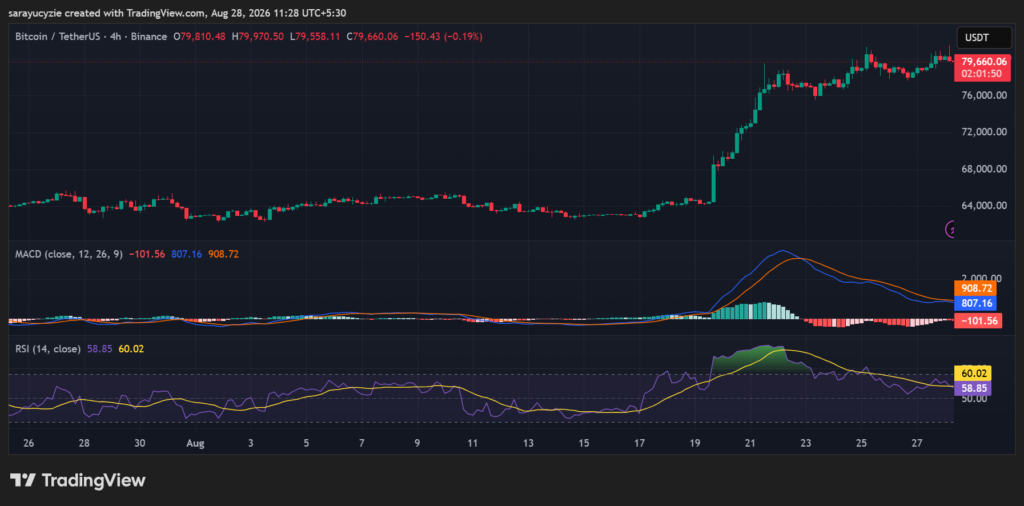
Website: https://ts.finance/

About YZi Labs

YZi Labs manages over $10 billion in assets globally. Our investment philosophy emphasizes impact first — we believe that meaningful returns will naturally follow. We invest in ventures at every stage, prioritizing those with solid fundamentals in Web3, AI, and biotech. YZi Labs’ portfolio covers over 300 projects from over 25 countries across six continents. Some notable portfolios include Trust Wallet, CoinMarketCap, Polygon, Injective, Ethena, SafePal Wallet, Better Payment Network, Aster, XAI, and more. More than 65 of YZi Labs’ portfolio companies have gone through our incubation program, EASY Residency. For more information, follow YZi Labs on X (@yzilabs).

Contact

TermMax Marketing Team
hello@cipherdance.com

☐ ☆ ✇ TheNewsCrypto

Nimiq Launches Second Mini Apps Competition for Developers and AI Builders

By: Sarala

Nimiq Launches Second Mini Apps Competition for Developers and AI Builders

  • Nimiq launches its second Mini Apps Competition cycle for developers, AI builders and indie hackers.
  • Participants can build open-source apps for Nimiq Pay using the Mini Apps Framework.

Nimiq, an open-source blockchain project focused on digital payments, has opened the second cycle of its Mini Apps Competition. The four-week competition began on Aug. 24, giving developers, AI builders and indie hackers the opportunity to create open-source applications for Nimiq Pay. It offers $17,000 in prizes as part of a three-cycle competition with more than $50,000 in total prizes.

The new round follows the first competition, which attracted 62 Mini App submissions. The competition is built around the Nimiq Pay Mini Apps Framework, which lets developers create and host lightweight web applications that users can access through Nimiq Pay.

Developers Can Build Apps for Nimiq Pay

Nimiq Pay provides the wallet and payment functionality used by Mini Apps, while developers keep control of their applications, infrastructure and intellectual property. The framework also allows developers to distribute their applications without submission fees, platform commissions or revenue sharing.

Nimiq Executive Director Max Burger described the model as an “App Store moment” for crypto payments, saying developers can bring extensions to the Nimiq payment experience directly to users instead of keeping them in separate applications.

The framework is intended to reduce some of the work involved in launching conventional applications through mobile app stores. Developers do not need to build separate payment infrastructure for their Mini Apps, allowing them to focus on building their applications.

The competition is open to developers, AI builders, vibe coders and indie hackers. Participants can use AI development tools during the building process, while eligible projects include games, productivity tools, marketplaces, social experiences and other web applications.

Cycle II runs through Sept. 18. Participants can use the Mini Apps Framework along with competition rules and starter resources to build and launch their applications for Nimiq Pay users.

The competition is part of Nimiq’s broader move to turn its payment app into an open platform where developers can create Mini Apps and distribute them directly to the Nimiq community. The approach gives the payment app additional functionality while allowing developers to build products without operating within a separate distribution platform.

☐ ☆ ✇ TheNewsCrypto

Bithumb Wins Second Lawsuit Over 620,000 BTC Crediting Error

By: Lakshya Baskar

Bithumb Grabs 25% South Korean Market Share Before IPO

  • Bithumb obtained its second victory in court while trying to get funds from the erroneous Bitcoin deposit in their February marketing event.
  • Seoul Central District Court ruled that one of their users should repay around 194 million won for his mistake in selling Bitcoins.

Bithumb wins another case as it seeks payments from wrongly credited Bitcoin users. In an effort to collect money for wrongly credited Bitcoin from users in February 2018, the Seoul Central District Court ordered one of the defendants to pay back 194 million Korean won, roughly $140,513, according to Digital Asset. This is the second largest out of four civil suits Bithumb has filed after the February case. 

The biggest one is worth 500 million won which is worth $362,229. Bithumb has won two out of four civil lawsuits against users in February. The whole issue arose when Bithumb mistakenly credited more than 620,000 BTC to hundreds of people during a promotion activity. It was because of the mistake by one of its employees who mistook BTC for Korean won.

The Mistake Was Also Affecting Bithumb’s Market 

This strange crediting mistake soon started to have an impact on Bithumb’s overall market activity, as the BTC/KRW trading pair fell by 15% due to the incident. The fall did not concern only those users who were involved in the distribution mistake. In addition to this, Bithumb became the subject of an investigation by the South Korean regulators, who were checking the internal procedures that led to such a mistake and were discussing the measures taken to prevent this situation.

The latest victory in court for Bithumb does not end all the lawsuits related to this mistake. The decision is relevant to the defendant in this particular case, but it does not influence the decisions in other lawsuits. The exchange will continue to fight to obtain the rights through other legal processes.

Bithumb Strikes Balance between Legal Battle and IPO Plans

This ruling comes as Bithumb is gearing up for yet another important event in its corporate history. At the start of the month, the exchange announced plans for an IPO in 2028. The upcoming IPO represents another significant event for Bithumb as the exchange deals with the implications of its February Bitcoin mistake. In the meantime, the most recent ruling improves Bithumb’s position in its legal battle.

Highlighted Crypto News:
Grayscale’s Zach Pandl Says Rising U.S. Debt Could Boost BTC, ETH and ZEC

☐ ☆ ✇ TheNewsCrypto

Grayscale’s Zach Pandl Says Rising U.S. Debt Could Boost BTC, ETH and ZEC

By: Lakshya Baskar

Grayscale Unveils New AI Crypto Sector Covering $21 Billion in Assets

  • According to Grayscale Investments’ Zach Pandl, increased US debt would put a strain on bonds and reduce confidence in fiat currencies.
  • Pandl pointed out that investors would be looking for an alternative means of storing value, which would favor Bitcoin, Ethereum, and Zcash.

The chief research officer of Grayscale Research, Zach Pandl, connected the recent bond repurchases by the US Treasury to increased pressure exerted by the level of government debt. The US Treasury will conduct more open market purchases of long-term notes and bonds prior to their retirement. According to Pandl, the repurchases have the potential to lower the risk-adjusted supply of Treasuries and offer some stimulus to the economy. However, Pandl noted that bond repurchases tackle symptoms rather than solve the underlying fiscal issue of the country. According to Pandl, structural budget deficits and the fast growing debt of the government are issues that should be considered.

US National Debt Exceeds $40 Trillion

On the same day, the Treasury made it clear that the national debt of the United States had exceeded the $40 trillion mark for the first time. Pandl pointed out that it came together with a stock of debt that has been increasing almost continuously from the global financial crisis onwards. Pandl explained that, at the time, higher government debt did not have any notable impact on interest rates as a result of the housing collapse.

According to Pandl, times have changed since then, as both firms and investors borrow in large amounts to fund the construction of artificial intelligence. Higher government borrowing comes along with increased private sector borrowing, resulting in greater demand for financing.

Zach Pandl Catches Bitcoin in the Debasement Trade

Pandl also made a connection between government debt and the threat of a loss in credibility of fiat currency as well as the demand for other means of storing value. According to him, growing debt could result in the gradual loss of trust in conventional currencies. Such an atmosphere could lead to the demand for assets providing monetary and financial exposures outside the norm. Pandl considered physical gold and certain cryptocurrencies as examples of such beneficiaries. In the case of cryptocurrency, he believed that the “debasement trade” would be advantageous for Bitcoin, Ethereum, and Zcash. The inclusion of these cryptocurrencies in such a reaction to government debt is explained by Pandl’s vision of their place.

Highlighted Crypto News:
BlackRock Cuts IBIT In-Kind Bitcoin Minimum 96% to $1 Million

☐ ☆ ✇ TheNewsCrypto

BingX Returns as Title Sponsor of TOKEN2049 Singapore 2026, Showcasing Its Multi-Asset Trading Vision

By: Isabella

BingX, the world’s leading multi-asset trading platform, today announced its return as Title Sponsor of TOKEN2049 Singapore 2026. Under the theme “Building the Future of Trading,” BingX will showcase its evolution from a crypto exchange into a multi-asset trading platform designed to connect users with a broader range of opportunities, supported by an integrated trading experience, intelligent tools, and tried-and-tested services.

TOKEN2049 Singapore 2026 will take place on October 7–8 at Marina Bay Sands. Expected to welcome more than 25,000 attendees, over 300 speakers, 1,000 side events, the event will bring together founders, investors, industry leaders, institutions, developers, and policymakers.

At TOKEN2049, BingX will present its vision for the next generation of trading platforms: seamless access to multiple asset classes through one cohesive experience. Its presence will highlight expanding multi-asset offerings alongside crypto, AI-powered tools, 24/7 trading and more. Through its exhibition booth and broader program of networking, community engagement, and partner activities, BingX will demonstrate how product integration, user education, platform resilience, security, transparency, and compliance can help traders identify and act on emerging multi-asset opportunities.

BingX will also host one of the most hotly anticipated events of TOKEN2049 week: an afterparty featuring an exclusive appearance by the internationally renowned DJ SODA. Bringing together traders, industry partners, key opinion leaders, and ecosystem stakeholders, the event will combine entertainment, networking, and lifestyle experiences to strengthen relationships across the crypto community. Prior to the afterparty, BingX will host a private, invitation-only meet-and-greet with Formula 1 driver Charles Leclerc, offering selected guests an exclusive opportunity to connect with one of global motorsport’s most recognized figures.

“The future of trading will not be defined simply by the number of assets available on a platform, but by how effectively those opportunities are brought together for users,” said Kevin Lee, Chief Strategy Officer at BingX. “Our return as Title Sponsor of TOKEN2049 Singapore reflects BingX’s commitment to building an integrated, intelligent, and trusted multi-asset trading experience. As the boundaries between crypto and traditional finance continue to evolve, security, transparency, compliance, and strong talent will remain fundamental to sustainable growth. TOKEN2049 gives us an important global stage to share our multi-asset vision and deepen our relationships with users, partners, and the wider industry.”

Looking ahead, BingX will continue developing the infrastructure, products, and services needed for a multi-asset future. Supported by ongoing investment in platform security and resilience, 100% Proof of Reserves, a $150 million Shield Fund, and internationally recognized security standards, BingX aims to help users navigate increasingly connected markets with greater confidence.

About BingX

Founded in 2018, BingX is the world’s leading multi-asset trading platform, serving more than 40 million users worldwide. From crypto to traditional markets, BingX connects users with a broad range of assets, markets, and opportunities through one unified trading platform.

With perpetual futures, TradFi offerings, spot trading and copy trading, alongside AI-powered products and solutions, BingX delivers a reliable and responsive trading experience designed to help traders navigate evolving markets and act on opportunities with greater confidence and efficiency.

BingX has been the Principal Partner of Chelsea FC since 2024 and became the first Official Crypto Exchange Partner of Scuderia Ferrari HP in 2026.

For media inquiries, please contact: media@bingx.com

For more information, please visit: https://bingx.com/

Disclaimer: TheNewsCrypto does not endorse any content on this page. The content depicted in this Press Release does not represent any investment advice. TheNewsCrypto recommends our readers to make decisions based on their own research. TheNewsCrypto is not accountable for any damage or loss related to content, products, or services stated in this Press Release.

☐ ☆ ✇ TheNewsCrypto

CertiK Finds Out-of-Bounds Write Vulnerability in BitBox02 Hardware Wallet

By: Sarala

CertiK Finds Out-of-Bounds Write Vulnerability in BitBox02 Hardware Wallet

  • CertiK found an out-of-bounds write flaw in BitBox02’s USB HID communication.
  • BitBox fixed the issue in its July Oeschinen security update after CertiK reported the vulnerability.

Web3 security firm CertiK has identified an out-of-bounds (OOB) write vulnerability in the BitBox02 hardware wallet. BitBox disclosed and fixed the issue in its July Oeschinen security update, crediting CertiK researcher Guanxing Wen for reporting the vulnerability.
Source: BitBox

The issue highlights that hardware wallet security extends beyond keeping private keys isolated from connected devices. Wallets also need to securely process external commands, firmware updates and transaction data before approving a signature.

Vulnerability Found in Host-Device Communication

According to the disclosure, the vulnerability affected how the BitBox02 firmware handled a specific USB HID control request. The firmware accepted a length value controlled by the connected host without checking it against the size of the destination buffer.

A specially crafted request could therefore cause data to be written outside the intended memory area, potentially leading to a control-flow hijack. The finding shows how an attacker could target the communication path between a hardware wallet and a connected computer or smartphone, even though the private key itself remains on the device.

The issue is not the first hardware wallet security finding involving the researcher. Ledger also disclosed a vulnerability in January 2026 that Guanxing Wen identified through its bug bounty program. The issue affected the MCU firmware update process and involved insufficient validation of a host-provided reset_handler address. Ledger fixed the vulnerability and said user funds were not at risk.

The two vulnerabilities affected different components, but both demonstrate the importance of securing the wider environment around a hardware wallet, including communication protocols, firmware and boot processes.

CertiK’s Hack3D H1 2026 report recorded 344 Web3 security incidents and more than $1.31 billion in losses during the first half of 2026. Wallet compromises accounted for more than $444 million across 33 incidents, making them the most financially damaging attack category during the period.

For users, keeping wallet firmware updated and downloading companion applications only from official sources remain important security measures. Checking transaction details directly on the device also helps ensure that the transaction being signed matches what the user intended to approve.

☐ ☆ ✇ TheNewsCrypto

MEXC Launches SHEIN Subscription With $1M Quota as Inaugural IPO Express Event

By: Isabella

MEXC, a pioneer in 0-fee digital asset trading, has launched IPO Express, a new event offering eligible users access to SHEIN’s IPO subscription, ahead of its scheduled listing on the Hong Kong Stock Exchange on September 1, 2026. The first-in-market opportunity is designed to allow users to gain economic exposure to SHEIN’s post-listing performance using USDT and receive mirror credits, without directly holding SHEIN shares.

MEXC is committed to removing barriers to market participation, based on the belief that opportunity should not be limited by identity, capital size, or geography. IPO allocations have traditionally been concentrated among institutional investors, leaving retail users with limited access to primary market subscriptions and often requiring them to buy in at a premium on the secondary market after listing. IPO Express offers a new way to participate. Users can subscribe without opening a traditional securities account. Once subscribed, they are not required to trade or time their exit. MEXC settles mirror credits according to the event rules, using the offering’s closing price on its first trading day as the reference. The process involves three steps: selecting the offering, submitting a subscription, and awaiting settlement, with unallocated funds automatically refunded. IPO Express provides retail users with a convenient gateway to participate in selected IPO opportunities.

The subscription period for the SHEIN IPO Express event runs from August 27, 2026, 10:00 (UTC) to August 31, 2026, 10:00 (UTC). The event has a total subscription quota of $1,000,000, divided into three options, each with an individual subscription limit of 100–10,000 USDT:

  • New User Subscription: $300,000 quota
  • General Subscription: $500,000 quota
  • Elite Subscription: $200,000 quota, for VVIP users with an M-Score of 800 or above

The subscription price ranges from HKD 47.60 to HKD 49.50 per share (approximately $6.07–$6.32), with the final price determined in accordance with the event rules. Eligible users can also increase their individual subscription limit by completing additional deposit tasks during the event period. To mirror the cost structure of an actual IPO subscription, participation in this event is subject to a subscription fee of approximately 1.0085% and a selling fee of 0.5%, charged at settlement.

The mirror credits provided through this event do not represent direct ownership of SHEIN shares. The final settlement amount depends on the applicable settlement rules and SHEIN’s market performance, and may be lower than the user’s subscription amount. Full terms, eligibility requirements, and risk disclosures are available on the IPO Express event page.

About MEXC

MEXC is the world’s fastest-growing cryptocurrency exchange, trusted by more than 40 million users across 170+ markets. Built on a user-first philosophy, MEXC offers industry-leading 0-fee trading and access to over 3,000 digital assets. As the Gateway to Infinite Opportunities, MEXC provides a single platform where users can easily trade cryptocurrencies alongside tokenized assets, including stocks, ETFs, commodities, and precious metals.

MEXC Official Website X TelegramHow to Sign Up on MEXC

For media inquiries, please contact MEXC PR team: media@mexc.com

Risk Disclaimer:

This content does not constitute investment advice. Given the volatility of financial markets, including digital assets, tokenized assets, and traditional financial products, investors should carefully assess market conditions, underlying asset fundamentals, and potential financial risks before making any investment or trading decisions.

Source

Disclaimer: TheNewsCrypto does not endorse any content on this page. The content depicted in this Press Release does not represent any investment advice. TheNewsCrypto recommends our readers to make decisions based on their own research. TheNewsCrypto is not accountable for any damage or loss related to content, products, or services stated in this Press Release.

❌