FreshRSS

🔒
❌ About FreshRSS
There are new articles available, click to refresh the page.
☐ ☆ ✇ CryptoPotato

Important Ripple News and XRP Price Update: September 3

By: George Georgiev

Over the past few days, developments in Ripple’s ecosystem centered on asset management, custody, and tokenization.

Meanwhile, XRP has failed to extend the rally that briefly carried it to around $1.70 in August, leaving traders focused on resistance levels and key support lines.

Bitwise XRP ETF Tops $500 Million

Bitwise’s spot XRP ETF has surpassed $500 million in assets under management only nine months after it was first launched. As CryptoPotato reported, the fund held about $507 million after Monday’s close, while US spot XRP ETFs had managed to attract a record $1.66 billion in cumulative net inflows by the end of last week.

Bitwise’s product leads this particular category with more than $600 million in cumulative inflows. It’s currently ahead of Canary Capital’s XRPC and Franklin Templeton’s XRPZ.

The milestone suggests that there’s continued demand for regulated exposure to XRP despite the token’s pullback from its August high.

Ripple, SettleMint Target Banks with New Institutional Stack

Ripple Labs and SettleMint have launched a partnership. It seeks to integrate Ripple Custody with SettleMint’s Digital Asset Lifecycle Platform.

The offering is aimed at allowing regulated financial institutions to custody, issue, and manage tokenized assets through a single system.

The service is already live in Asia, with expansion already planned. It targets banks, market infrastructure operators, and sovereign entities, while RLUSD and XRP are among the assets that support Ripple’s institutional solutions.

The partnership also provides the company with more exposure to tokenization – a market BCG estimates could reach $88 trillion in the next 10 years.

Evernorth Moves Closer to Nasdaq Listing

The popular XRP-focused treasury company Evernorth cleared yet another important regulatory hurdle after the US Securities and Exchange Commission declared its registration statement effective. Shareholders of merger partner Armada Acquisition Corp. II are scheduled to vote on the transaction on September 30th.

If approved, the combined company is expected to trade on Nasdaq under the ticker XRPN. Evernorth has so far disclosed more than $1 billion in gross proceeds from its investors, including Ripple, SBI Holdings, Pantera Capital, Kraken, and Arrington Capital.

The strategy is centered on holding and actively managing XRP as a corporate treasury asset.

XRP Price Update: Bulls Need to Reclaim $1.40 – $1.50

Last but not least, let’s take a closer look at XRP’s price action throughout the past few days. It is trading at around $1.35 at the time of this writing, with a market capitalization nearing $85 billion. It has slipped by about 2% in the past few days, dropping by 6% on the weekly chart.

That said, analysts remain divided. Some of them foresee $1.70 as the next major target if the current breakout holds. On the other hand, some highlight the resistance that is currently being faced at around $.140 to $1.43 followed by $1.5, warning that failing to break above these levels could signal weakness and a drop to below $1.3.

The post Important Ripple News and XRP Price Update: September 3 appeared first on CryptoPotato.

☐ ☆ ✇ CryptoPotato

When Governments Want to Direct Your Wealth, Bitcoin Offers an Exit

By: George Georgiev

You have all probably heard the speech that Ursula von der Leyen, the European Commission President, gave at the annual conference “La Rencontre des Entrepreneurs de France 2026,” held on August 26th. It’s been circulating on crypto Twitter like wildfire throughout the past few days.

To those of you who might have missed it, her message was rather clear: the world has already changed, and Europe must respond by becoming more independent, more industrially capable, and more willing to direct capital toward strategic priorities.

Von der Leyen argued that many of the assumptions that once underpinned the Union’s economic model have disappeared. Part of her point was that Europe must become a continent that “produces, invests and protects.” She said that the expanding access to China, open global trade, strategic American protection, cheap imported energy, as well as the West’s technological dominance can no longer be taken for granted.

And as a European, I can get behind some of the things she’s saying. European companies are facing increasingly high energy costs, regulatory complexity, and growing competition from China. However, I can’t help but consider one particular point she’s making to be rather alarming.

Today, 10 trillion EUR in household savings are kept in bank accounts. And a large share of Europe’s savings is invested outside our continent. Europe now needs to put these savings to work for its companies.

The intention behind this may be to boost growth, but the language, to me, reveals something important about the relationship between private wealth and governments.

🇪🇺 E.U. Commission President said households have €10T sitting “idle” that can be “put to work” to boost the economy.

Yes, Ursula von der Leyen really said that. 🤯

Buy Bitcoin while you can! pic.twitter.com/hguuQjzk3r

— Bitcoin Archive (@BitcoinArchive) September 2, 2026

Who Should Control Your Savings?

From her speech, I see one thing: to policymakers, our household savings are increasingly viewed not just as our property, but as a resource – an economic catalyst that could be encouraged, incentivized, or regulated toward potential objectives.

And, mind you, consider this statement in light of how heavily Europe has traditionally been taxed. A very brief Google search shows that 4 of the top 5 countries in the world with the highest income tax rates are in the European Union.

We already surrender a massive share of our economic output to the state. That, apparently, isn’t sufficient to accomplish the Union’s political and industrial objectives.

So here’s my question: who should decide what my savings are for?

I’ve worked for my money; I’ve paid my taxes when I earned it; I’m also paying consumption taxes when I spend it in the form of VAT. Oh, by the way, guess where the top six countries with the highest VATs are located. So, having this in mind, should my savings be regarded as capital waiting to be deployed toward certain priorities, which may or may not align with my own?

Something’s Becoming Interesting

This is exactly where Bitcoin becomes interesting. With all of its flaws, Bitcoin represents the absolute opposite philosophy.

It’s an asset without a central issuer. The European Central Bank, or any other bank for that matter, cannot increase its total supply. The EC cannot decide to mint more BTC to finance industrial expansion. There is no government that can determine its issuance schedule.

There will never be more than 21 million bitcoin in existence. I can hold it without an intermediary (I know, lately this has become a touchy subject, but still). If I hold it on my own and keep my private keys private, theoretically, nobody can confiscate it. Nobody can tell me what to do with it.

This is an important distinction – one that carries increasing significance in the times that we appear to be headed toward.

Now, don’t get me wrong, I’m not trying to call out European politicians for doing something they haven’t yet done. Most headlines on this topic scream “the EU wants to steal your savings,” while I’m taking a more moderate approach. As an EU citizen, however, as someone who has spent my entire life here, I cannot rule that possibility out, especially not in the face of modern politics.

A few years ago, we were in Amsterdam at a Bitcoin conference, and we asked a bunch of people: “Why do you Bitcoin?”

I guess this is my answer: this is why I Bitcoin.

The post When Governments Want to Direct Your Wealth, Bitcoin Offers an Exit appeared first on CryptoPotato.

☐ ☆ ✇ CryptoPotato

Watch These 3 Coins on Robinhood Chain This Week

By: George Georgiev

Robinhood Chain has been booming in popularity throughout the past month, becoming the talk of town in crypto Twitter, or more like crypto X.

The network saw its total value locked expand by a whopping 93% in the past 30 days, according to data from DeFiLlama, surpassing the likes of Plasma, Avalanche, Sui, and others.

Screenshot 2026-09-02 at 10.41.54
Source: DeFiLlama

The popular platform, which allows users to scan newly released cryptocurrencies by chain and monitor the performance of different tokens, DexScreener, is flooded with coins on Robinhood Chain, which is indicative of the level of interest the network is attracting. Platforms like FOMO are seeing a surge in interest as the concept of social trading gains traction.

As CryptoPotato reported, the volume aggregated through the network’s automated market makers hit $1.3 billion.

But what are some of the more interesting projects that are attracting investors? Let’s find out.

PONS: Pons Family, Robinhood’s Pump.fun?

Starting off, we have PONS, the native cryptocurrency of the Pons (dot) family platform. As described in their own documents:

“pons is a place to launch and trade tokens on Robinhood Chain. You can browse launches, open any token to see its details, and trade straight from your wallet. Pons never holds your funds. Every launch and trade is a transaction your wallet asks you to approve.”

Undoubtedly the main large actor on Robinhood Chain, PONS boasts a market capitalization of around $285 million at the time of this writing – impressive for a coin launched less than two months ago.

Screenshot 2026-09-02 at 11.13.33
Source: CoinGecko

Its price action has been all over the place over the past few days, especially after Hyperliquid announced it would support perps for PONS. The token skyrocketed to a high of slightly below $0.5, only to plummet to about $0.36 and then recover to $0.4, where it’s currently trading at the time of this writing.

PONS is seen as the main “infrastructure play” on Robinhood Chain, and many associate it with Pump.fun – an alternative token launchpad that was largely behind the “meme coin season” that took place on Solana in 2024. However, some market observers have expressed caution, pointing out that expansion of existing solutions (much like Pump.fun itself) to Robinhood Chain could cause serious pressure on PONS.

Cash Cat (CASHCAT)

If you’ve been on crypto X in the past couple of months, you’ve undoubtedly heard stories of people becoming millionaires in a few days after buying and holding Robinhood Chain’s premier meme coin – CASHCAT.

There’s really no way to explain what the token is about other than just reading its name – it’s just that: a cat-themed meme coin, currently sitting at a market capitalization of $280 million, up 40% in the past week. It’s pretty much impossible to break down its gains for a longer period of time because the zeros become far too much, but that’s also a tale as old as crypto meme coin cycles now. Recall DOGE, SHIB, WIF, FARTCOIN, and whatnot.

Holders argue that it’s the network’s largest and most promising meme coin, while countless others are trying to replicate its success by minting alternative meme coins on Pons.

Screenshot 2026-09-02 at 11.24.20
Source: CoinGecko

Artificial Inu (AI)

Things change fast in this space and AI is perhaps the main example. The token is actually paired against tokenized Nvidia stock – it’s not paired against the USD, which is one of the more interesting concepts of Robinhood Chain. In other words, the “dog” trades directly against NVDA, which is largely described as the most important stock in the AI space.

Trading activity is also growing the token’s vault, while the generated fees are either burned or locked.

Combined with the virality of a dog-themed meme coin, this has allowed it to explode in both interest and value throughout the past few days, and achieve a market cap similar to that of Cash Cat.

Screenshot 2026-09-02 at 11.45.14
Source: DexScreener

The above are three of the largest coins on the Robinhood Chain by market cap. None of it should be taken as financial advice or recommendation. The article is strictly for informational purposes.

The post Watch These 3 Coins on Robinhood Chain This Week appeared first on CryptoPotato.

☐ ☆ ✇ CryptoPotato

Bitcoin’s Price Approaches $80K, Millions Liquidated in Hours

By: George Georgiev

Bitcoin’s price reached nearly $79,500 moments ago, causing all sorts of reactions across the crypto community. This brings its total gains for the past 24 hours to slightly more than 13%.

The parabolic move has been mirrored across most of the altcoin market, with many large-cap cryptocurrencies bringing outsized gains throughout the past week. Just today, Ripple’s XRP exploded by 25%, for example.

Screenshot 2026-08-21 at 12.14.59
Source: Quantify Crypto

The price has since retraced to slightly below $78K. In any case, volatility has led to severe liquidations for yet another day across derivatives markets. Data from Coinglass shows that, in the past hour alone, total liquidations surpassed $330 million, the bulk of which came from short traders – somewhat expectedly.

Total liquidations over the past 24 hours are approaching $1.5 billion, making this yet another historic day in the market. Most of the liquidations are also associated with Bitcoin positions – about $825M at the time of this writing. Binance leads in terms of exchanges, with Hyperliquid reporting about half as much.

In total, over 170,000 traders were wiped out, and the largest single liquidation order occurred on Hyperliquid, with a face value of $23.59 million.

The post Bitcoin’s Price Approaches $80K, Millions Liquidated in Hours appeared first on CryptoPotato.

☐ ☆ ✇ CryptoPotato

Why Did the Bitcoin Price Suddenly Spike Toward $73K?

By: George Georgiev

UPDATE: The article has been updated to reflect the most recent movements

Bitcoin’s price suddenly jumped toward $72,500K earlier today as investors reacted to an unexpected intervention in the US government bond market.

As CryptoPotato reported, the price tapped almost $73,000, leaving more than $3 billion in liquidated positions across the derivatives market. This is pretty much the highest BTC has traded since the middle of June.

The catalyst for that move appears to have been an announcement on behalf of the US Treasury Department, which will be doubling (at least) the maximum size of liquidity-support buybacks for longer-dated government debt, raising them from $2 billion to at least $4 billion per operation. The changes will start on September 9 and remain in place through November 4.

Why the Treasury’s Move Matters for Bitcoin

The announcement came after increased stress in the bond market. The 30-year Treasury yield touched 5.34% on Tuesday, which was its highest level since 2007. This came amid persistent inflation concerns, heavy government borrowing, and worries about the overall US fiscal outlook.

As Politico reported, the government is stepping up purchases of older Treasury securities as pressure builds in the long end of the market. And the market’s reaction was immediate. The 30-year yield dropped toward 5.20%, while the 10-year yield also moved lower.

This prompted a move in stocks, gold, and crypto, all of which moved up, while the dollar weakened. Lower bond yields can make non-yielding and riskier assets relatively more attractive.

Did the US Government Finally Blink?

In a detailed thread on X, the Kobeissi Letter described the decision as the intervention it had been expecting since July 31. That was when long-term US borrowing costs were already reaching very high levels – unseen since before the global financial crisis (as mentioned above).

TKL argued that the government has a strong incentive to prevent yields from rising indefinitely because its interest bill is becoming increasingly expensive.

Still, the program should not be confused with Federal Reserve quantitative easing (QE). Treasury buybacks are usually designed to improve trading liquidity in older securities, and the additional purchases remain small relative to the enormous Treasury market.

For Bitcoin’s price, however, this entire ordeal showed exactly how sensitive the asset is to changes in yields, the dollar, and expectations for financial-market liquidity. It’s true that many tech stocks also moved up throughout the past few hours, but none of it has been as pronounced as the jump in crypto prices.

Screenshot 2026-08-20 at 15.00.48
Source: Quantify Crytpo

The post Why Did the Bitcoin Price Suddenly Spike Toward $73K? appeared first on CryptoPotato.

☐ ☆ ✇ CryptoPotato

Tech Futures Drop on Rising Treasury Yields While Bitcoin Holds Near $64K

By: George Georgiev

US stock futures moved lower ahead of today’s open, with the Nasdaq 100 dropping by 1.2%, the S&P 500 by 0.5%, and the Dow by 0.1%.

This selloff came as the 10-year Treasury yield climbed to 4.74% and the 30-year yield reached 5.2% – its highest level since June 2007.

Higher Yields Hit Tech Stocks

The sharp move in bonds had the greatest impact on growth and tech stocks. Nvidia dropped by about 2% in premarket trading, while Micron Technology fell by about 4%.

This weakness followed a softer session yesterday, when the Dow declined by 272 points, and both the S&P 500 and Nasdaq also closed lower. Rising oil prices also added to the pressure, with WTI crude oil currently trading at around $84.5 per barrel.

Home Depot stock was a notable exception, gaining roughly 1.5%, but that’s because it reported better-than-expected fiscal second-quarter results while maintaining its full-year outlook.

Screenshot 2026-08-18 at 16.48.56
Source: TradingView

Crypto Markets Remain Relatively Resilient

In an interesting change of pace, crypto has been steadier throughout the past 24 hours. The total market cap is at around $2.28 trillion, up about 0.5% over the day.

Bitcoin remains above $64K at the time of writing, up roughly 1% during the period, despite the pressured equities and the rise in Treasury yields.

This suggests that the crypto market has managed to absorb the latest macro pressure better, which hasn’t been the case for a while – when risk-on assets decline, the drop in cryptocurrencies is usually more pronounced.

The post Tech Futures Drop on Rising Treasury Yields While Bitcoin Holds Near $64K appeared first on CryptoPotato.

☐ ☆ ✇ CryptoPotato

Jane Street Reveals Over $1 Billion Invested in Bitcoin ETFs

By: George Georgiev

Jane Street – the popular quant trading firm with a heavy orientation toward crypto – disclosed more than $1 billion in U.S. spot Bitcoin ETF holdings as of the second quarter of this year.

BlackRock’s iShares Bitcoin Trust (IBIT) is currently dominating its portfolio. According to the firm’s latest Form 13F, filed on August 14th with the Securities and Exchange Commission (SEC), Jane Street holds roughly $828 million invested in IBIT, alongside other positions in products including Fidelity’s FBTC and Grayscale’s GBTC.

The filing covers the overall securities the firm holds at the end of the reporting period rather than direct Bitcoin ownership.

With that in mind, it turns out that the quant trading heavyweight also expanded its exposure across crypto exchange-traded funds beyond Bitcoin. As CryptoPotato recently reported, the same Q2 filing showed it holding more than 1.2 million shares of Bitwise’s spot XRP ETF, compared with just 20,605 shares three months earlier.

Jane Street also reported positions in XRP products from Franklin Templeton, Grayscale, Canary Capital, and 21Shares.

The Bitcoin numbers represent a serious increase from the first quarter. The company had previously cut its IBIT position by around 71% to about 5.9 million shares, which were worth approximately $225 million before rebuilding the stake during the second quarter.

That said, the holdings shouldn’t necessarily be interpreted as a one-sided bullish bet on Bitcoin. The firm is one of the largest market makers in the industry, and these filings provide only a quarter-end snapshot of long positions. They do not show the firm’s complete short, futures, swaps, or exposure to other derivative products.

The post Jane Street Reveals Over $1 Billion Invested in Bitcoin ETFs appeared first on CryptoPotato.

☐ ☆ ✇ CryptoPotato

Is Anthropic About to Go Public Soon? October IPO Odds Are Surging

By: George Georgiev

Anthropic appears to be moving closer to its initial public offering (IPO), which undoubtedly is one of the most closely watched technology listings of 2026.

The emerging consensus is that Claude’s maker could reach the public markets this fall; however, there are still a few important caveats and clarifications.

Prediction Markets Lean Toward October

While in no way a certainty, prediction market traders are leaning heavily in the direction that the IPO will come in October.

As you can see on the Polymarket snapshot, the contract tracking whether Anthropic will go public by September 15 implies just a 2% chance, while the probability for September 30 stands at 10%. By October 31, however, the odds jumped to 70%, and the market shows an 83% chance of an IPO by the end of this year.

Screenshot 2026-08-17 at 10.26.33
Source: Polymarket

Notably, the October probability had increased sharply in recent trading sessions, suggesting that users are becoming more confident that the listing could happen during that month.

Reports Also Point to Fall Listing

Not surprisingly, that view is also largely supported by recent reporting. A report from the Wall Street Journal said that the firm’s executives have been meeting with prospective investors to strengthen confidence ahead of an IPO that could arrive in September or early October.

Anthropic has also taken a major procedural step: the firm confidentially filed for a US IPO in June, giving it flexibility to move once regulatory review and market conditions allow it.

But that’s not the only impressive part about the IPO. Another report outlined that some investors are targeting a valuation of $2 trillion or even more for an October debut. This would be more than double the $965 million post-money valuation that Anthropic received in its May funding round, although the company has not publicly confirmed either the IPO date or the valuation.

$2 Trillion Valuation?

Whether participants in the IPO and public investors will support such a massive figure is likely to depend on the confidence placed in Anthropic’s growth projections.

Reuters reported that the company is forecasting roughly $190 billion to $200 billion in revenue in 2028, compared with a $47 billion annualized revenue run rate disclosed in May. Bankers and investors are now looking unusually far into the future when they assess what the firm could be worth. They are attempting to account for the company’s rapid growth and the high costs of training and operating cutting-edge AI models.

The post Is Anthropic About to Go Public Soon? October IPO Odds Are Surging appeared first on CryptoPotato.

☐ ☆ ✇ CryptoPotato

Robinhood Brings Crypto Trading to UK Investors With Zero Fees

By: George Georgiev

Robinhood has launched cryptocurrency trading for UK investors, thus expanding its local offering beyond stocks, options, and futures.

The service will begin rolling out to eligible customers this week through Bitstamp UK Ltd.

Users will be able to trade over 50 digital assets, including Bitcoin, Ethereum, XRP, Hyperliquid, and more. The firm said crypto trading will also come with zero trading, account maintenance, or custody fees. However, the users will have to pay a 0.1% FX fee, which will increase to 0.3% during weekends.

Speaking on the matter was Jordan Sinclair, President of Robinhood UK LTD and GM of Bitstamp UK LTD, who said:

“A new wave of UK investors sees digital assets as an important part of a diversified portfolio. With today’s launch, we’re taking another major step toward becoming the all-in=one investment platform for the UK.”

Moreover, the firm is also introducing Cortex Digests for Crypto – an AI-powered feature that’s designed to summarize market news, technical indicators, and factors that influence individual crypto assets.

It’s also worth noting that the announcement comes amid interesting times for Robinhood, as its proprietary Robinhood Chain continues attracting attention. Since the global launch of the network, it has already generated over $18 billion in DEX trading volume, expanding its total value locked (TVL) to more than $840 million.

As CryptoPotato reported recently, the blockchain also became the largest one by means of its real-world assets (RWAs) holder count.

The post Robinhood Brings Crypto Trading to UK Investors With Zero Fees appeared first on CryptoPotato.

☐ ☆ ✇ CryptoPotato

Important Cardano News and ADA Price Update: August 5th

By: George Georgiev

Cardano’s ecosystem recorded several important developments between July 30 and August 5th. These range from a new cross-chain connection to changes in the way governance representation works.

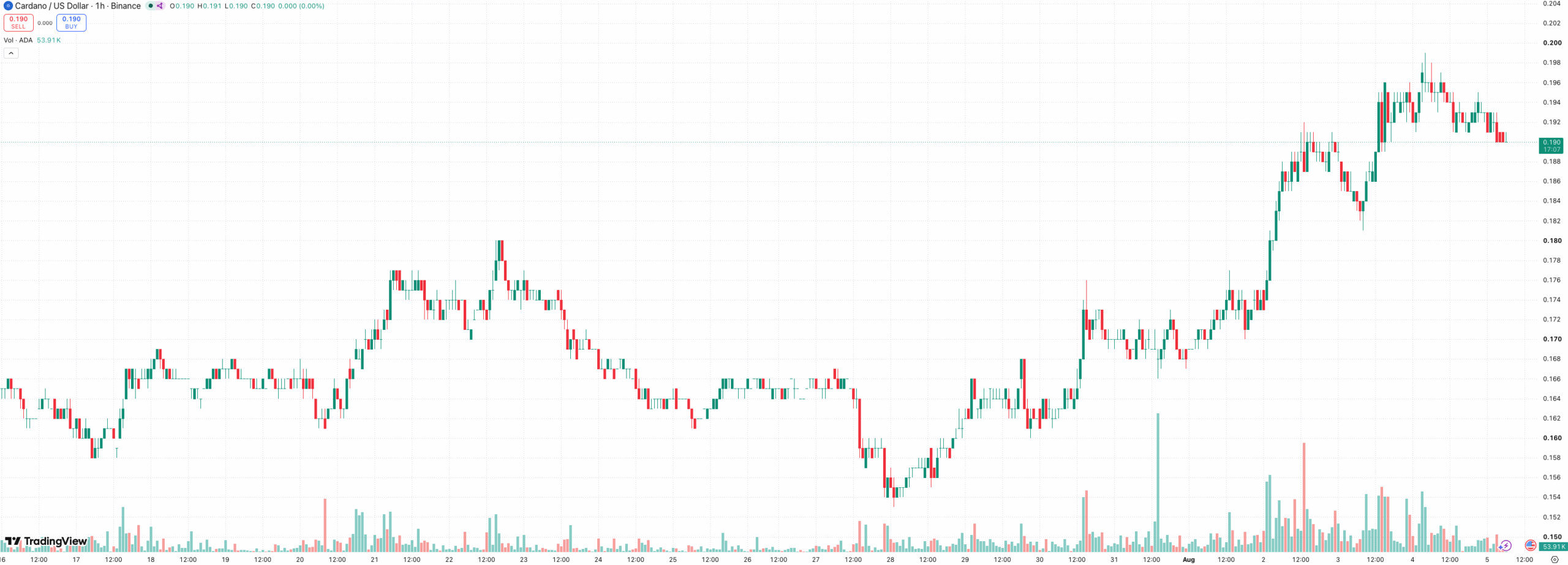
Meanwhile, ADA briefly approached $0.20 after gaining over 20% over the past week. Here are some of the most important Cardano news and an update on ADA’s price action from the past few days.

Cardano Connects With Injective Through IBC

Cardano and Injective established their very first connection through the Inter-Blockchain Communication protocol on the testnet.

In an official announcement, Injective said the integration is designed to eventually allow ADA to enter its ecosystem while INJ itself becomes fully available on Cardano.

The testnet deployment creates a direct cross-chain rail and is intended to represent another step toward improving the compatibility of Cardano with other networks outside its existing ecosystem.

JUST IN🔥 : Cardano is now officially connected to Injective, the first blockchain to have a live onchain rail to Cardano via testnet.$ADA is coming to Injective. $INJ is coming to @Cardano. Both will be available across the two ecosystems. pic.twitter.com/ECnexrfx8c

— Injective 🥷 (@injective) August 3, 2026

Development Shifts Toward the Dijkstra Era

Following the completion of the van Rossem upgrade,  Cardano developers turned their attention to the upcoming Dijkstra development era. According to the latest update, planned work includes Nested Transactions and Linear Leios, with both targeted for mainnet implementation by the end of this year.

Recall that van Rossem previously introduced improvements, including Plutus performance, ledger consistency, and improved node security.

New Governance Tools Move On-Chain

In another important piece of news, Cardanoo has moved the election of its Constitutional Committee onto the blockchain, making the voting process easier to verify and more transparent. The committee is responsible for checking whether major governance decisions follow the Cardano constitution.

Meanwhile, the ecosystem has also opened a new portal where community members can test how future changes to that constitution may be proposed. Additionally, ADA holders, as well as their representatives, can now vote on a separate proposal to adjust some of the network’s technical settings.

Together, these updates give the community a more direct role in the way Cardano is managed and developed.

EMURGO Steps Down from Intersect’s Board

EMURGO announced its immediate resignation from the Intersect board. The organization plans to deregister its delegated representatives.

The decision followed serious community criticism surrounding governance participation and the delegation experience within Yoroi Wallet.

EMURGO acknowledged that both positions carried significant responsibilities and said the changes are intended to address these specific concerns.

The departure has once again renewed discussions about accountability among Cardano’s major ecosystem organizations.

ADA Price Update: One-Month High and Renewed Bullish Expectations

ADA climbed from around $0.15 in late July to a one-month high of approximately $0.195 on August 4th. The move, at the time, represented a weekly gain of roughly 26%, although the cryptocurrency has since pulled back as traders look to book some profits.

Screenshot 2026-08-05 at 9.42.53
Source: TradingView

The rally started during the weekend, when ADA jumped by 9% and outperformed a lot of the large-cap altcoins.

One possible reason for the move was the increased buying from large investors. Whales accumulated more than 240 million ADA within five days, helping it soar by roughly 22% during that same period.

ADA is now testing a very important resistance area between $0.19 and $0.20. Some analysts believe that a successful break above it could open the way toward $0.28-40.30.

However, it’s also important for the cryptocurrency to remain above $0.17 to protect its improving short-term structure – from a strict technical perspective.

The post Important Cardano News and ADA Price Update: August 5th appeared first on CryptoPotato.

☐ ☆ ✇ CryptoPotato

Important Ripple News and XRP Price Update: August 4th

By: George Georgiev

Ripple announced yet another expansion of its institutional digital asset strategy. In fact, the past seven days were rather packed with ecosystem updates.

All of it happened as XRP traded near $1.07 following a few unsuccessful recovery attempts, but more on that later. Now, let’s dive into the most important and recent Ripple news.

Ripple Invests in ZILO and Licuido

Undoubtedly the week’s largest ecosystem development was Ripple’s investment in ZILO and Licuido – two companies building infrastructure for digital investment funds and trading of institutional assets. Ripple did not disclose the size of either of those investments.

ZILO provides transfer agency and fund administration technology for tokenized share classes. It sounds fancy and tech, but the important part is that it fits well into Ripple’s plans to become the preferred international settlement layer for both retail and institutions. Conversely, Licuido operates a platform that supports the issuance, distribution, trading, and use of traditional assets as digital collateral. The important bit here is that it’s regulated in the United Kingdom.

Ripple plans to connect those services with its existing XRP Ledger infrastructure. The goal is to let institutions issue tokenized assets, transfer them between investors, hold them in custody, and use them as collateral. RLUSD could provide the settlement side of the transactions, allowing assets and payments to settle together and instantly.

Mastercard Completes Acquisition of Ripple Partner BVNK

Mastercard completed its acquisition of BVNK – a stablecoin infrastructure company that also supports XRP deposits and outgoing payments through its multichain infrastructure.

The company itself has worked with Ripple since 2024, even before RLUSD was officially launched. Both firms also participate in Mastercard’s Crypto Partner Program and have contributed to its multi-token network initiative.

Mastercard mentioned that this deal would help connect traditional and digital forms of money.

FXRP Enters $280 Million RLUSD Lending Vault

Another important development is that Flare’s wrapped XRP (FXRP) received approval to be used as collateral in an RLUSD lending pool that’s managed by Sentora.

The vault, worth $280 million, operates through an isolated market on Morpho Blue. Users can deposit FXRP and borrow RLUSD, essentially without losing their exposure to XRP.

Around 155 million FXRP had been minted by the time of the announcement. There are some relative complications, though. Users have to mint FXRP on Flare, bridge to Ethereum, deposit on Morpho, and then borrow RLUSD.

XRP ETFs Stay Positive, but Demand Slows Down

XRP exchange-traded funds kept on attracting capital in July. However, the demand has weakened significantly.

These products recorded around $27 million in net inflows throughout the month. That was considerably less than the $60 million (approximately) registered in June, and a far cry from the $132 million in May.

However, the positive results are indicative of the fact that investors continue to add XRP exposure. On the other hand, the declining monthly totals suggest that institutional momentum might be cooling.

XRP Price Tests Long-Term Support

Last but not least, let’s look at the price action. XRP is currently found at around $1.07, after spending some time defending the area around $1.05 – $1.06. It remained below its 20-day exponential moving average near $1.08 and the 50-day average around $1.12.

Screenshot 2026-08-04 at 15.55.12
Source: TradingView

That said, popular analyst ChartNerd described the current structure as a falling wedge that’s forming near a six-year support area. He argued that the next several months could prepare XRP for a broader repricing, although a temporary break below the critical $1 level could still take place.

On the other hand, a sustained move above $1.08 and $1.12 would improve the short-term picture and provide for a more reliable rally.

The post Important Ripple News and XRP Price Update: August 4th appeared first on CryptoPotato.

☐ ☆ ✇ CryptoPotato

Strategy Sold Over $100 Million in Bitcoin, Buys Back More STRC

By: George Georgiev

Strategy has increased its US dollar reserve and expanded its preferred-stock repurchases. The otherwise Bitcoin-focused company is moving to strengthen its balance sheet.

The firm added $250 million to its cash reserve, bringing the total to $4 billion. It also repurchased approximately $81 million worth of its Variable Rate Series A Perpetual Stretch Preferred Stock (STRC).

Strategy increased its USD Reserve by $250M and repurchased $81M of $STRC. This increased USD Duration by 57 days to 2.3 years and tightened STRC’s BTC Credit by 5 bps. As of 8/2/26, we hold ₿842,138 in our BTC Reserve and $4.0B in our USD Reserve. $MSTR https://t.co/t7bGZJ8Q3o

— Michael Saylor (@saylor) August 3, 2026

The transaction builds on the firm’s recently introduced Digital Credit Capital Framework. The company intends to use its dollar reserve primarily to cover preferred-stock dividends and debt interest, reducing the need to sell Bitcoin during periods of market stress.

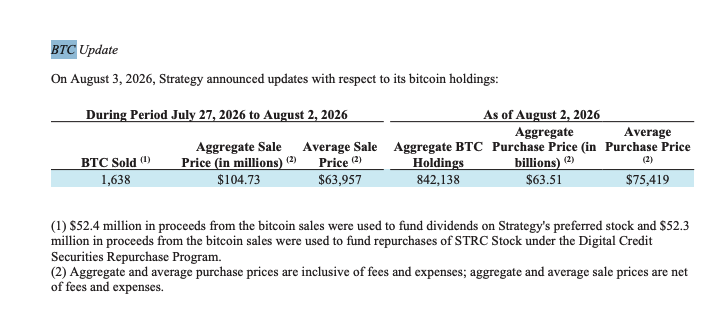
What Saylor failed to mention in the tweet was that the firm also sold some 1,638 BTC for approximately $105 million between July 27 and August 2 at an average price of $63,957 – according to the official filing.

Screenshot 2026-08-03 at 15.12.25
Source: SEC


The post Strategy Sold Over $100 Million in Bitcoin, Buys Back More STRC appeared first on CryptoPotato.

☐ ☆ ✇ CryptoPotato

Important Ripple (XRP) Announcement, New Investments: August 3

By: George Georgiev

Ripple has expanded its digital capital markets strategy. The company announced today investments in Zilo and Lucuido – two firms that are focused on developing infrastructure for tokenized funds and institutional asset trading.

The move builds on existing partnerships with both firms. Ripple did not disclose the size of either investment.

Speaking on the matter was Nigel Khakoo, SVP, Trading and Markets at Ripple, who said:

“… ZILO and Licuido provide core capabilities that are essential to further scaling this shift: regulated digital transfer agency infrastructure and liquidity for issuance and collateral mobility. This is just the beginning of the journey, and we see a substantial opportunity to bring huge efficiencies to the investment sector over the next decade.”

ZILO provides transfer agency and fund administration technology. Its systems give asset managers and custodians regulated digital records for tokenized share classes. Licuido, on the other hand, operates an FCA-regulated platform that supports the issuance, distribution, trading, and use of traditional assets as digital collateral.

Ripple plans to integrate these capabilities with its infrastructure on the XRP Ledger. The company wants institutions to issue tokenized assets, hold them in custody, move them between investors, and use them as collateral without relying on legacy systems.

Naturally, RLUSD will serve as the regulated cash component for delivery-versus-payment transactions. This structure is designed to allow the asset and payment sides of a trade to settle together on XRPL.

The investments also support Ripple’s recent push to build a broader institutional platform around tokenization, payments, stablecoins, and trading. Last month, the firm launched Ripple Mint and made an investment in compliance provider Notabene. This strengthens the infrastructure that’s available to institutions using RLUSD.

It’s also noteworthy that the company has worked with Aviva Investors, Franklin Templeton, and DBS on tokenized fund and collateral projects. Ripple said that ZILO and Licuido will help turn those individual partnerships into infrastructure that asset managers can use at scale.

The post Important Ripple (XRP) Announcement, New Investments: August 3 appeared first on CryptoPotato.

☐ ☆ ✇ CryptoPotato

Trade.xyz Will Cover Losses From SK Hynix Liquidation Anomaly on Hyperliquid

By: George Georgiev

Trade.xyz said it will cover liquidation losses linked to the sudden collapse of its SK Hynix perpetual contract on July 27, following an incident that affected nearly 1,000 leveraged positions on Hyperliquid.

Recall that the other day, the mark price for the stock dropped from $1,127.90 to $917.25. The move triggered a massive liquidation cascade, which caused about $57 million in liquidations with about $17.3 million in realized losses, according to preliminary analysis.

The team behind the Hyperliquid HIP-3 operator said the price originated from an executed transaction carried by several independent data providers. Its oracle was tracking an external venue responsible for the trade, which the platform described as the main Korean pre-market venue.

According to them, the oracle operated according to its existing specifications. However, the resulting mark price caused liquidations before the underlying market recovered from the isolated print.

On July 27 at 23:01 UTC, SKHYNIX mark price dropped from $1,127.9 to $917.25. This print was based on an executed trade which was relayed by multiple independent data providers. The XYZ oracle was live in external pricing and tracking that venue, which serves as the primary…

trade.xyz (@tradexyz) July 29, 2026

Trade.xyz outlined that they will reimburse liquidation losses attributable to the anomaly. The platform will announce eligibility requirements soon and expects to complete distributions within the coming days.

The company also described the compensation as a one-time discretionary measure. It stressed that the decision does not guarantee reimbursements following similar incidents in the future.

The announcement also addressed the immediate financial impact on traders but doesn’t change how leveraged positions were automatically closed when the oracle price fell.

In addition, the firm also plans to strengthen its pricing systems against similar tail events. The review will scope the platform’s reliance on external venues and the assumptions used when constructing mark prices.

The team said they will also consider giving more weight to activity on its own order books.

The post Trade.xyz Will Cover Losses From SK Hynix Liquidation Anomaly on Hyperliquid appeared first on CryptoPotato.

☐ ☆ ✇ CryptoPotato

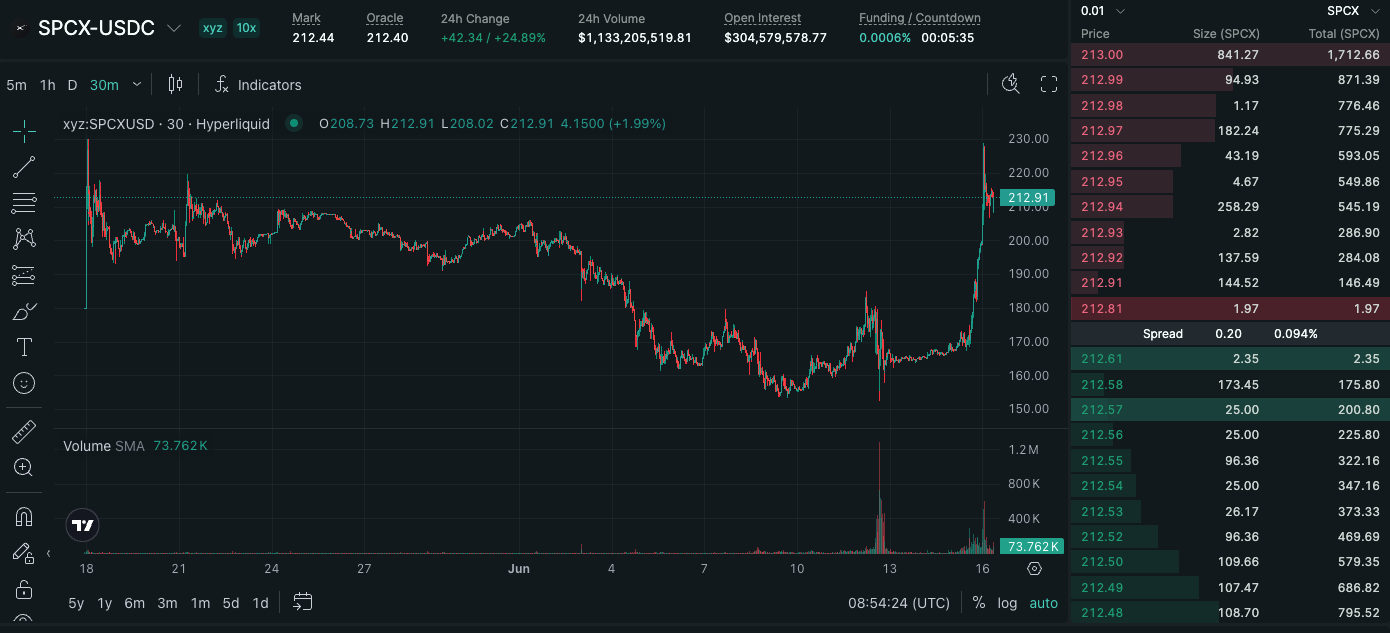
Why SpaceX (SPCX) Stock Has Crashed Nearly 50% Since Its June Peak

By: George Georgiev

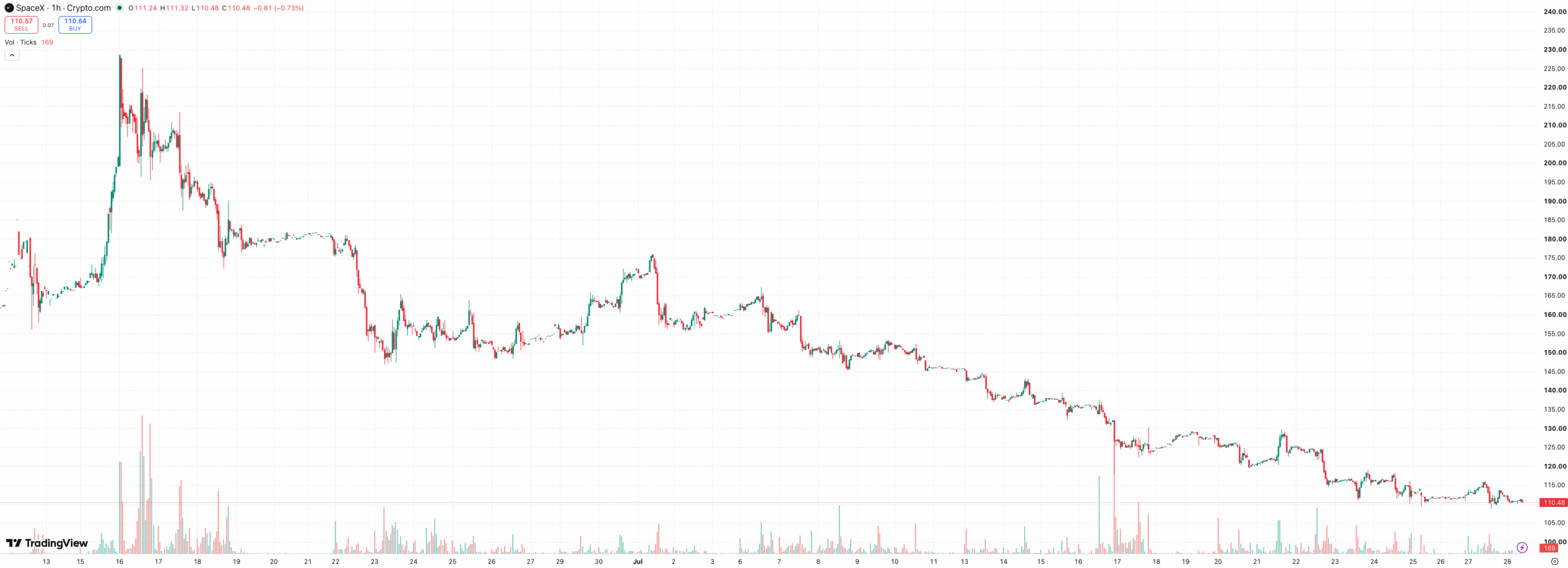
SpaceX stock fell to a record closing low of $113.50 on July 27, extending a very sharp reversal that began shortly after the company saw its debut on June 12.

The shares have now lost almost half of their value from the post-IP high above $225 and trade well below the offering price of $135.

It’s worth noting that SpaceX was the most-traded tokenized stock before and after its initial public offering on platforms such as Hyperliquid, Binance, and more.

Investors Reassess SpaceX’s Valuation

After the SpaceX IPO, the firm reached a market capitalization above $2.6 trillion, albeit briefly. By July 27, that figure had fallen to around $1.5 trillion, erasing slightly less than 50% of its gains.

The initial rally may have been driven by a number of factors, including speculation. However, it appears to have priced in substantial future growth from Starlink, reusable rockets, artificial intelligence, and proposed orbital data centers. Investors have since become less willing to pay for projects that may require years of development before producing any meaningful returns. This is evident in the chart.

Screenshot 2026-07-28 at 13.00.28
Source: TradingView

According to official SpaceX reports, the company lost $4.9 billion last year on revenue of close to $19 billion. It’s worth noting that they also raised $25 billion through the bond market to support expensive technology infrastructure, adding concerns about higher borrowing costs as well as debt-funded AI spending.

Some analysts have noted that profit-taking, as well as the unwinding of extremely bullish post-IPO positions, has undoubtedly contributed to and accelerated the decline.

Lockup Fears Add More Selling Pressure

In addition to the above, the approaching expiration of SpaceX’s first post-IPO lockup period represents another concern investors have. After the company reports its first public quarterly results, some early investors, as well as eligible employees, will be allowed to sell a part of their holdings. This starts on August 6th – two days after the report, which is scheduled for August 4th.

Short sellers have also increased their positions, somewhat expectedly.

All in all, the attention is now entirely focused on August 4 and it’s interesting to see the details regarding the firm’s revenue, losses, AI spending, the growth of Starlink, as well as the potential supply of newly tradable shares.

The post Why SpaceX (SPCX) Stock Has Crashed Nearly 50% Since Its June Peak appeared first on CryptoPotato.

☐ ☆ ✇ CryptoPotato

One Bad Price, 960 Liquidations: Inside SK Hynix Flash Crash on Hyperliquid

By: George Georgiev

The xyz.SKHYNIX perpetual on Hyperliquid crashed around 20% almost instantly late on Monday night, dropping from $1,131 to as low as $900, completely decoupling from pricing elsewhere on crypto exchanges.

On-chain data indicates that the entire cascade stems from a single share trade placed from Seoul.

How One Bad Price Caused a Liquidation Cascade

It appears that during the pre-market window before trading opened on the South Korean Nextrade exchange, there was an order to sell stock for major chip manufacturer SK Hynix placed 30% below the previous closing price. This order may have been placed by accident.

With thin pre-market liquidity, there were no competing orders on Nextrade at that moment, and that single trade briefly set the price of the stock on that exchange.

The price corrected back to market value within two minutes, but by that time, the XYZ oracle responsible for setting the price for this stock on Hyperliquid had already consumed and relayed the information.

Just four seconds after Nextrade opened for trading, the SKHYNIX oracle price plummeted 15.6%, and liquidations began about 2 seconds later.

Freefall: The Final Figures

On Hyperliquid, users were betting on the price of the semiconductor stock using leverage. X.com user MarketAlpha calculated that 960 accounts lost $57 million in a liquidation cascade as a result of this oracle error, with $17.3 million in realized losses.

Today, a single share sale triggered millions of dollars in liquidations on Hyperliquid.

At 11:00 pm UTC on July 27, $SKHYNIX suffered a flash crash on Hyperliquid, falling roughly 20% within seconds before rapidly recovering.

The entire cascade began with a single share sold… pic.twitter.com/quFIo2o1Lc

— Markets Alpha (@MarketsAlpha) July 28, 2026

The backstop then triggered auto-deleveraging against profitable short positions, with $10.8 million in gains realized across 100 accounts. The largest gains and losses for individual accounts were $2.55 million and $2.05 million, respectively. Surprisingly, the flash crash mimicked a real stock price correction of around 15%, which took place hours later on the open market.

Hyperliquid staff have pointed out that the exchange is permissionless and that SKHYNIX is deployed and operated by XYZ, which is reportedly investigating the issue but has not released a statement.

Source: Hyperliquid Discord

The post One Bad Price, 960 Liquidations: Inside SK Hynix Flash Crash on Hyperliquid appeared first on CryptoPotato.

☐ ☆ ✇ CryptoPotato

Hyperliquid and Multicoin Push CFTC Toward One Prediction Market Rulebook

By: George Georgiev

The Hyperliquid Policy Center and Multicoin Capital submitted a joint comment to the US Commodity Futures Trading Commission (CFTC) on July 27th.

They expressed support for the agency’s proposed prediction market framework but also pressed for two changes that could affect how on-chain event contracts are designed and approved.

The filing is a direct response to the CFTC’s “Prediction Markets; Public Interest Determinations” proposal published earlier in June. It aims to amend Regulation 40.11 and seeks to establish a 90-day process for reviewing event contracts that may involve gaming, war, terrorism, assassination, or other activities listed in the Commodity Exchange Act, among other things.

HPC and Multicoin called the plan a “clear and well-reasoned framework.” They argued that prediction markets belong under the CFTC’s exclusive federal jurisdiction.

The letter also states that regulating prediction markets on a state level, creating “fifty separate state regimes,” would fragment national derivatives markets.

Prediction markets topped $50 billion in trading volume last month, and the biggest names in traditional finance are moving in.

Today, with @multicoin, we filed a joint comment supporting the @CFTC ‘s proposed prediction markets framework.

These markets have grown up. The… https://t.co/pYG4mevmbT

— Hyperliquid Policy Center (@HyperliquidPC) July 27, 2026

Settlement: Key Regulatory Test

The first concern that the group outlines is related to the use of one word in the Commodity Exchange Act: “involve.” Under the statute’s rule, the CFTC can review contracts that involve certain listed activities and prohibit them when they are contrary to the public interest.

The letter supports an interpretation focused on settlement. Instead of treating trading itself as gaming, regulators would have to examine the event that determines the payout. A contract would fall within the special rule when settlement directly turns on illegal activity, not merely because buying it resembles placing a wager.

In addition, the group asked for more examples. Edge cases may include certain contracts with several potential paths to settlement or products that reference a sensitive activity only indirectly. Clear illustrations would help exchanges and developers assess regulatory exposure before having to commit resources to a launch.

Transparency Could Become a Competitive Requirement

The second recommendation concerns what happens after a review under Regulation 40.11. Under the current proposal, the CFTC would publish written findings when it blocks a contract and explain how that particular decision fits with earlier findings.

HPC and Multicoin argue that this could create an information gap: an approval, including by inaction, can reveal as much about the regulatory boundaries as a prohibition. Without any public reasoning, other platforms may repeat the same legal work, seek guidance, or avoid products that could have been permissible.

In any case, it’s interesting to follow developments surrounding the letter and whether the CFTC would adopt the two requested changes. This could be a signal that regulators are actively listening to industry experts and attempt to legislate in a way that’s both fair to anyone involved.

The post Hyperliquid and Multicoin Push CFTC Toward One Prediction Market Rulebook appeared first on CryptoPotato.

☐ ☆ ✇ CryptoPotato

Ripple (XRP) News and Price Update: July 27

By: George Georgiev

Ripple and the wider XRP ecosystem saw several noteworthy developments over the past few days.

These included, but are not limited to, a new institutional platform for the RLUSD stablecoin, an investment in payments infrastructure, fresh Binance incentives, rising AI-agent activity, as well as continued demand for spot XRP ETFs.

The following breaks down the most important latest Ripple news and an update on XRP’s price action and the levels that traders currently monitor.

Ripple Launches Institutional RLUSD Platform

The firm launched Ripple Mint on July 23rd.

It gives institutional customers a single point to mint, redeem, bridge, and manage Ripple USD (RLUSD).

Companies can now use a standard interface or, alternatively, they can connect their internal systems through APIs and webhook notifications. The launch targets businesses that need automated stablecoin access for payments, treasury management, and trading operations.

Ripple Invests in Notabene

The company also announced a strategic investment in Notabene – a well-known compliance infrastructure provider.

Both firms plan to integrate RLUSD into Notabene Flow. This is a business-to-business stablecoin payments platform.

According to the announcement, Notabene’s network connects over 2,300 institutions across more than 100 jurisdictions and processes about $2 trillion in annualized transaction volume.

The agreement is aimed at giving RLUSD wider access to regulated payment providers and financial institutions.

XRP Ledger AI Transactions Pass a New Milestone

The XRP Ledger surpassed 1.4 million transactions initiated by AI agents on July 22nd.

Data from the XRPL AI Hub showed over 1.4 million agent-driven transactions and 129 participating merchants at the time of the report. The milestone followed Ripple’s launch of an AI starter kit in June, which is designed to help developers build automated payment applications on XRPL.

The numbers also suggest that developers are testing the network for machine-to-machine payments, as well as for other automated transactions.

Binance Introduces RLUSD and XRP Rewards

Binance announced new incentives for RLUSD users.

The exchange pointed out that the variable return for eligible holdings has reached 22.25%. Users who hold or trade RLUSD through Binance Earn and Margin products can also receive weekly rewards in XRP.

It’s important to note that the rate remains variable and can change depending on current market conditions and user participation.

XRP Price Action: Levels to Watch

As we pointed out in our most recent XRP technical analysis, the cryptocurrency trades around $1.10 after approaching $1.16 earlier in the week. This means that most of the gains made during the recent recovery are pretty much gone.

The cryptocurrency remains in a broad descending channel, meaning that the trend is negative and a break above certain levels has to happen for it to reverse.

Traders are currently watching $1.18 as the first line of resistance. A rejection there could extend the broader downtrend.

However, it’s also worth noting that buyers previously managed to defend the $1.02 – $1.04 zone of demand, which was a show of strength. That area has to hold to prevent a crash below $1. The biggest resistance in the short-term stands at $1.28.

The post Ripple (XRP) News and Price Update: July 27 appeared first on CryptoPotato.

☐ ☆ ✇ CryptoPotato

Robinhood Chain Becomes Largest Blockchain by RWA Holder Count

By: George Georgiev

Robinhood Chain has become the leading blockchain by real-world asset (RWA) holder count. This comes less than a month after its public mainnet launch, and it marks a massive milestone in the company’s push into on-chain finance.

The network is an Ethereum layer 2, and it went live on July first. So far, it has surpassed established ecosystems despite its relatively short operating history, at least in this domain.

Retail Distribution Becomes Robinhood’s Main Advantage

Unlike many blockchain projects that first focus on crypto-native users, Robinhood entered the industry with millions of existing brokerage customers. That distribution is obviously translating into rapid adoption of real-world assets (RWAs).

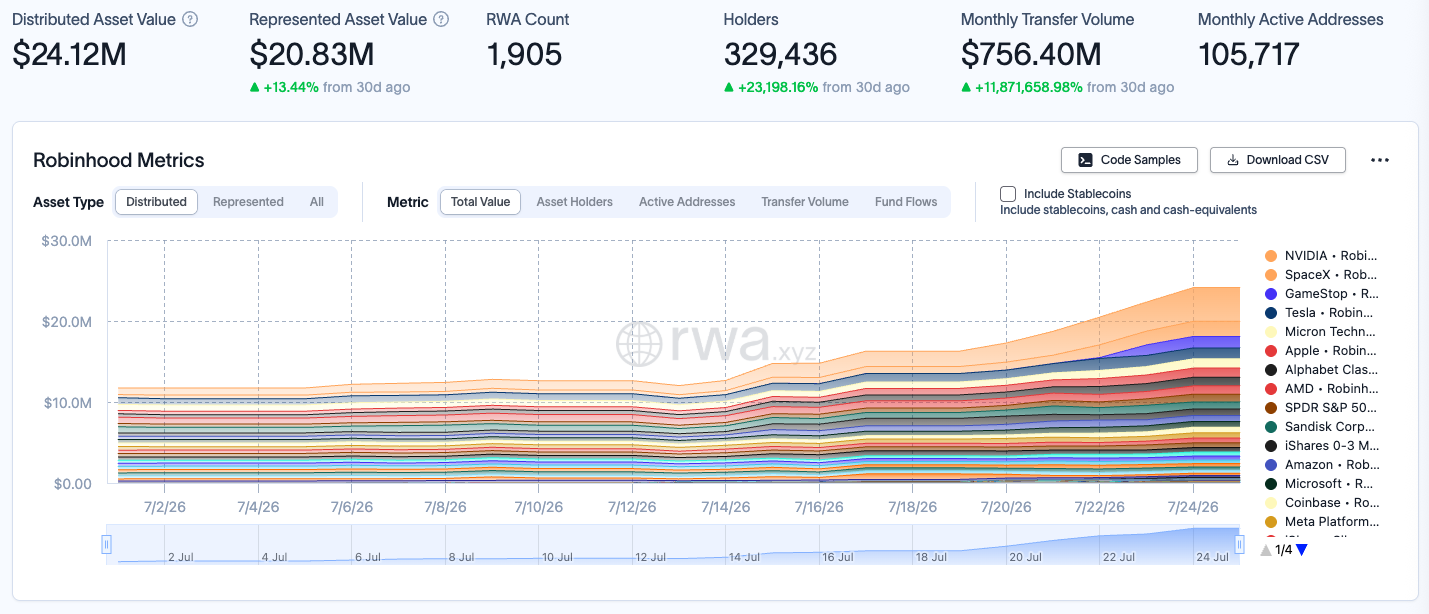
Data from RWA.xyz shows that Robinhood has accumulated almost 330,000 RWA holders, alongside $24.12 million in distributed asset value and over $20 million in represented asset value. The network hosts around 1900 tokenized assets, while monthly transfer volume stands at $750 million at the time of this writing.

Screenshot 2026-07-27 at 7.32.28
Source: RWA.xyz

Second in line by this metric is Solana, followed by Plume, Ethereum, and BNB Chain.

Screenshot 2026-07-27 at 7.34.05
Source: RWA.xyz

It’s worth noting, however, that Ethereum dominates when it comes to total value. Almost $18 billion worth of RWA assets are hosted on the network. Second in line is BNB Chain, followed by Solana.

This milestone comes as the platform continuously expands its tokenized stock offering across Europe. The network was designed specifically for regulated financial assets rather than general-purpose DeFi, which allows users to trade tokenized US equities and ETFs around the clock. Transactions are settled on Ethereum through Arbitrum technology.

Early Success Driven Not Only by RWAs

Still, it’s interesting to note that tokenized assets are not yet the chain’s dominant activity driver.

Meme coin trading currently accounts for the majority of decentralized exchange volume. Tokenized stocks represent only a small portion of on-chain value today, although the company views them as the network’s long-term differentiator. Recall the frenzy surrounding the viral meme coin CASHCAT – a cryptocurrency that exploded in value in a few short days only to plummet almost immediately after, leaving stories of overnight millionaires and missed fortunes altogether.

Stablecoins are also growing on the network, noting a 22% increase in their market capitalization, currently pushing $500 million, according to DeFiLlama.

The post Robinhood Chain Becomes Largest Blockchain by RWA Holder Count appeared first on CryptoPotato.

☐ ☆ ✇ CryptoPotato

DEX Aggregator Odos is Shutting Down: What Users Need to Do Before July 30

By: George Georgiev

Odos is a popular decentralized exchange aggregator that helps users find efficient token swap routes across numerous DEXs and liquidity sources. Instead of acting as a custodian of user funds, the protocol is designed to let traders connect their own wallets and execute on-chain transactions. During this process, they retain full control of their assets, which never leave their custody.

The company behind it, however, has announced on July 23rd that it’s winding down operations, with the application entering read-only mode on July 27th. All company-operated services will permanently shut down on July 30, 2026.

The team has emphasized that Odos is non-custodial and has provided instructions for users seeking different guidance, so the following breaks down the most common questions you may have.

What Happens on July 27 and July 30 Regarding Odos DEX?

Can I still use Odos to swap tokens?

Yes, but only for a limited time. Existing users can continue to use the platform freely and as usual until July 27. On that date, the application will switch to read-only mode. From that day until July 30, users will only be able to view wallet balances and transaction histories. They will not be able to execute new swaps or any other interactive functions on the protocol.

Can I create a new account or wallet?

No. New account registrations, wallet creation through ODos, and new limit orders were disabled on the day the announcement to wind down was made – on July 23rd.

Will my crypto disappear after the shutdown?

No. As we mentioned above, Odos is non-custodial. This means that the company doesn’t hold any of your funds. Your crypto remains on the respective blockchain and is controlled by you, not by Odos.

Do I Need to Move My Funds?

I connected MetaMask, Rabby, Ledger, or another wallet. Do I need to do anything?

In most cases, no. If you used a self-custody wallet, your assets remained accessible through that wallet after Odos shuts down. You can simply continue using another aggregator or DeFi application going forward.

I created my wallet using Google, Apple, email, or another social login. What should I do?

If your wallet was created directly through Odos using a social or email login, the company advises that you should transfer your assets to another wallet or export your private key before July 30. Although instructions to access your wallet will remain available on the Odos official page even after the shutdown, completing the process early reduces the risk of unnecessary complications later.

Will the ODOS token disappear?

No. The ODOS token exists on-chain and is independent of the aggregator’s functioning. According to the company, it doesn’t take custody of the token or act as its market maker. This means that the shutdown shouldn’t alter its underlying on-chain mechanics.

The team also said that the Odos DAO operates separately from the company and that it will communicate any future decisions independently.

To the Odos community: after much consideration, the operating company behind Odos is winding down its operations. The app moves to read-only on July 27, and all Odos services shut down permanently on July 30, 2026. Odos is non-custodial: your assets remain yours and on-chain. If… pic.twitter.com/9btbBLyhRL

— ODOS (@odosprotocol) July 23, 2026

The post DEX Aggregator Odos is Shutting Down: What Users Need to Do Before July 30 appeared first on CryptoPotato.

☐ ☆ ✇ CryptoPotato

Charles Hoskinson Compares Cardano to Anthropic, Says Slow Approach is Paying Off

By: George Georgiev

In a recent interview, Hoskinson compared Cardano’s development trajectory to Anthropic’s path in the evolution of the artificial intelligence industry. He outlined that the firm is currently the leader of the pack despite entering the market later than existing powerhouses like Google and OpenAI.

Instead of chasing speed, he said that Anthropic is successful because it adopted a disciplined philosophy regarding its development practices from the get-go. He believes Cardano is now experiencing a very similar shift in perception. This comes as developers and investors are increasingly prioritizing security and governance over “speed to market.”

“Google initially had the big lead and then OpenAI had the big lead and then somehow this Anthropic thing came out and they were able to leapfrog everybody. […] They hadn’t fundamentally changed, they just had the right mindset,” Hoskinson said in the interview with CoinDesk.

He also added that the same principle could eventually benefit Cardano:

“People are starting to wake up, especially in the age of AI hacking, where everything is getting broken, where speed to market is not the most desirable way.”

.@IOHK_Charles compares Cardano’s strategy to Anthropic’s rise.

Google had the lead. Then OpenAI. Then Anthropic leapfrogged both, not by moving faster, but by building differently.

Hoskinson says the same lesson could apply to crypto in the latest episode of Markets Outlook… pic.twitter.com/h36GiShZYV

— CoinDesk (@CoinDesk) July 23, 2026

Security Incidents Strengthen Cardano’s Case

Hoskinson specifically referenced the most recent Kelp DAO exploit and the knock-on effects it had on Aave as examples of the risks, which are associated with prioritizing innovation over resilience.

In April, Kelp DAO suffered a massive exploit where $292 million was drained after attackers were able to forge cross-chain messages and withdraw unbacked rsETH through a misconfigured LayerZero bridge.

While Aave’s smart contracts were in no way compromised, the attacker deposited the fraudulent rsETH as collateral to borrow real assets. This essentially left the lending protocol with significant exposure to bad debt and triggered billions of dollars in TVL outflows before the team implemented recovery measures.

For Hoskinson, this particular episode demonstrated how vulnerabilities in one protocol can rapidly spread through the broader DeFi ecosystem and cause massive outflows and reputational damage:

“The recent AAVE thing and Kelp thing shows you how quickly you can lose your TVL (total value locked) and how uqickly you can lose your customer base. So, it works until it doesnt, and when it doesn’t, it’s catastrophic for the ecosystem.”

He argued that for stability to be lasting, this requires more than technically sound code:

“People want stability and it only comes from having a clear governance system, a clear software development system, and really goo dideas on how to develop a roadmap in a sustainable way.”

ADA’s Longstanding Underperformance

Hoskinson’s comments also come after a long time of built-up criticism from parts of the crypto community about how Cardano has prioritized academic research (arguably one of the protocol’s standout differentiators) at the expense of ecosystem growth.

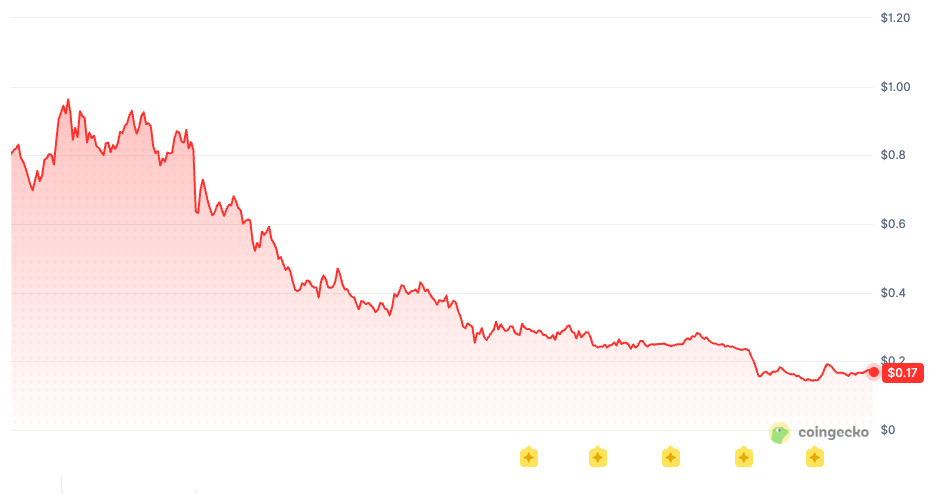
Cardano remains one of the largest protocols by market capitalization. At the time of this writing, it’s at $6.2 billion, ranking as the 20th largest project in the industry – but that’s a far cry from where it used to stand, let alone from where proponents were hoping it would be. ADA is one of the worst performers of the past year, down 80% in the past 365 days. Ethereum, the smart contract platform Hoskinson often compares Cardano to, including in this interview, is down 48% in contrast. Bitcoin, the industry’s benchmark, is down 44%.

ada_price_chart_2407261
Source: CoinGecko

Hoskinson acknowledged that their decision-making hasn’t been flawless.

“It took us a long time to get here. A lot of mistakes were made, and I own the lion’s share of them as the leader.”

Nevertheless, he expressed confidence that the network is now positioned much better than in previous market cycles.

“Ultimately, I’m very happy with where wi sit, and I think we will grow very strongly over the next 12 to 24 months.”

Of course, it remains to be seen whether that prediction will come to fruition, but his broader argument also reflects an ongoing debate across industry proponents about whether the next phase of crypto adoption will come from protocols that come strong and move fast or those that prioritize security, governance, and long-term sustainability. Or perhaps both are not mutually exclusive?

The post Charles Hoskinson Compares Cardano to Anthropic, Says Slow Approach is Paying Off appeared first on CryptoPotato.

☐ ☆ ✇ CryptoPotato

Toobit Exchange Guide 2026: AI Trading, Zero Spot Fees, High Leverage, TradFi and More

By: George Georgiev

Toobit is one of the most popular centralized cryptocurrency exchanges. It’s built for users who are looking to trade more than just crypto – a model adopted by many exchanges in the industry.

Alongside spot trading, the platform offers perpetual futures, copy trading, automated bots, AI-assisted market analysis, programmable AI-based agent tools, and exposure to traditional financial markets.

If all of this sounds complicated, don’t worry; I will break it all down in the following guide. When it comes down to it, there are four very important features that I will be looking at. These are its AI trading assistant and MCP-based AI Agent Trade Kit, the leverage proposition of up to 500x on eligible markets, zero maker and taker fees for standard spot trading, as well as TradFi products linked to metals, forex, stocks, commodities, and indices.

In this Toobit guide, I will explain how those features work, what else the exchange has to offer, its current fee structure and security measures, as well as the risks you should understand before trading.

  • Zero maker and taker fees for standard spot trading
  • AI trading assistant and open-source MCP Trade Kit
  • High leverage of up to 500x on eligible markets
  • TradFi perpetual futures for stocks, forex, and metals
  • Copy trading features optimized for zero slippage
  • Assessment Zone spot pairs excluded from zero-fee policy
  • Extreme liquidation risk with high leverage options
  • TradFi contracts do not provide actual share ownership

What is Toobit?

First things first, though, let’s lay down some fundamentals. As mentioned above, Toobit is a centralized exchange, but this definition doesn’t do it much justice. It would be fairer to say that it’s a multi-product crypto exchange that’s available through a web platform and mobile applications.

Its core trading propositions include spot trading, USDT-margined and USDC-margined perpetual futures, copy trading, and crypto trading bots. The platform, however, has also expanded into decentralized finance, prediction markets, Event Contracts, crypto Earn products, as well as derivatives linked to traditional financial instruments.

The resulting product is an exchange that’s designed primarily for those of you who trade actively. But this doesn’t mean that the platform is not suited for beginners – they do offer a range of different educational materials and simple products which are aimed towards those taking their first steps in the industry.

Once you’ve created an account, you can fund it in several different ways. Users can deposit crypto from another exchange or a self-custody wallet, but you can also buy crypto with a bank card or use a supported third-party payment service.

What Makes Toobit Stand Out in 2026?

And while the exchange offers a product kit similar to those of many of the best cryptocurrency exchanges in 2026, there are a few features that make it stand out, and that’s what I’ll focus on in this section.

AI Trading Assistant and MCP AI Agent Trade Kit

We live in times where artificial intelligence is spreading like wildfire, and people are using it more and more in their everyday tasks. This doesn’t exclude trading. In fact, AI is becoming a more prominent part of the crypto trading experience.

That said, Toobit’s AI goes beyond a conventional chatbot.

The first component is called Toobit Synapse – an AI-powered market assistant that can turn market data into structured analysis, which covers areas such as current conditions, technical indicators, trends, and possible trading strategies.

Users can select an asset and receive an AI-generated market report, rather than having to interpret every chart and indicator manually.

The exchange argues that Synapse takes advantage of the Model Context Protocol (or MCP), to access current market information. The tool is intended to simplify research and help traders identify relevant signals a lot quicker. Planned functions include automated alerts, rule-based order management, and more.

The second component is the Toobit AI Agent Trade Kit. This is an open-source toolkit that lets compatible AI agents interact with Toobit through natural-language prompts or terminal commands.

In essence, the toolkit provides two main interfaces:

  • MCP Server connects compatible AI models and applications to Toobit via a conversational interface.
  • Command-line interface, which gives those users who are more technically experienced access to trading and account functions from a terminal

According to the exchange, the kit contains 65 tools, which cover spot orders, USDT-margined perps, balances, positions, fees, market data, profit and loss, transaction histories, and fund management.

A simple use case could be for the user to ask a connected AI agent to retrieve available BTC market data, review open positions, check account balances, or prepare a spot futures order. The agent can also work with take-profit and stop-loss orders.

High-Leverage Futures Trading

Toobit provides USDT-margined and USDC-margined perpetual contracts. These allow traders to speculate on rising or falling crypto prices without having to own the underlying asset directly. These contracts have no expiry date, but users have to pay (or receive) funding fees.

A major selling point here (or not) is the leverage of up to 500x on eligible futures markets. Naturally, this means that a 0.2% move in the wrong direction would see your position liquidated, arguably pushing this far beyond the scope of traditional trading.

That said, there are traders who are looking for aggressive strategies, and having this option does make the platform more versatile. Of course, you should be well aware that any type of leverage trading significantly amplifies your risk and the chances of getting liquidated.

Therefore, this high leverage trading style is most appropriate for extremely experienced traders who have very strict position-sizing and risk-management rules, as well as understanding of market dynamics.

Zero Spot Trading Fees

Toobit’s standard spot markets currently have 0% maker fees and 0% taker fees across every single VIP level.

This can make the platform very attractive to frequent spot traders, as well as people who rebalance their portfolios very often or use multiple orders to execute their strategies.

There is an important exception, though. Spot pairs, which are placed in Toobit’s Assessment Zone, are excluded from the zero-fee policy and follow a separate VIP-based schedule. At VIP 0, the current Assessment Zone rate is 0.075% for makers and 0.1% for takers.

Zero trading commission also doesn’t mean that every transaction is free. Users may still encounter:

  • Difference between bid and ask prices (spread)
  • Blockchain withdrawal fees
  • Card-processing or third-party provider charges
  • Slippage
  • Perpetual-futures funding fees

TradFi Trading: Stocks and Other Traditional Markets

Toobit’s TradFi section allows users to trade different instruments, which are linked to traditional financial markets, while using USDT for margin and settlement.

Available categories include stocks, foreign exchange, precious metals, indices, and commodities. You can both long and short these. You can trade various stocks like Tesla, SpaceX, Nvidia, and more.

There is an important caveat here. You shouldn’t confuse these products with buying shares through a conventional stockbroker. Toobit’s stock products are basically USDT-settled perpetual futures – an instrument designed to track the price of an underlying asset.

You can use various leverage and you can trade 24/7 – something rarely available on existing traditional alternatives. Of course, trading outside the underlying market’s normal hours is likely to have an impact on liquidity, pricing, and funding conditions, so keep that in mind.

Other Toobit Products and Trading Tools

Although the above four are some of the more distinctive features of the platform, this doesn’t mean that there aren’t more.

Copy Trading

This allows you to follow experienced traders and automatically reproduce their positions. You can compare profiles using metrics such as ROI and win rate. Copiers can also adjust their copy mode, leverage, and other settings rather than following each strategy with identical parameters.

One of the interesting features is that Toobit has optimized its system to allow for zero slippage when copy trading.

Trading Bots

There are multiple bots that you can set up, including Futures Grid and Futures DCA or even Martingale strategies. Grid bots palace orders across a predetermined price range, while DCA-style strategies may increase a position as the market moves.

DEX+

This feature provides access to selected Web3 on-chain assets through Toobit’s interface. It’s suitable for those users who are looking for a more crypto-native experience. Users can also trade on-chain using the USDT they have deposited in their spot account, making it for a frictionless experience.

Is Toobit Safe?

Yes, Toobit is considered a safe cryptocurrency exchange. It lists multi-factor authentication, ongoing audits, phishing detection, encrypted infrastructure, real-time account monitoring, as well as cold storage practices among its security measures.

When you create an account, I highly recommend that you activate all of the available protections, such as a unique password and two-factor authentication before depositing funds.

The exchange also publishes a Proof of Reserves system, which helps users see if deposits are matched 1:1. It uses a summation Merkle tree to allow users to confirm these numbers.

Toobit Pros and Cons

Toobit’s principal advantages are its broad range of trading products, AI-assisted research, open-source MCP toolkit, zero-fee standard spot markets and access to both crypto and TradFi-linked derivatives. Copy Trading, bots, APIs, TradingView tools and demo trading give active users several ways to build and test a strategy.

Its main limitations are closely connected to those features. High leverage creates substantial liquidation risk. AI output can be inaccurate. Copy Trading and bots can reproduce losses as efficiently as profitable trades. TradFi contracts do not provide the same rights as owning the underlying shares, and some services may be unavailable in particular jurisdictions.

Like any centralized exchange, Toobit also requires users to accept custodial risk while assets remain on the platform.

Frequently Asked Questions

Is Toobit a cryptocurrency exchange?

Yes, Toobit is a centralized cryptocurrency exchange. It offers spot trading, perpetual futures, copy trading, bots, AI tools, and trading products linked to traditional financial instruments like stocks and commodities.

Does Toobit charge spot trading fees?

Standard spot markets currently have 0% maker and taker fees. There are some pairs which are excluded from the offering.

How much leverage does Toobit offer?

Toobit advertises leverage of up to 500x on eligible markets. The maximum varies by contract, asset, position size and current risk rules, so 500x is not available universally.

Does Toobit require KYC?

Toobit has different verification levels. The required level depends on the service, withdrawal limit and account function. Advanced verification is required for read-and-write API permissions.

Does Toobit publish Proof of Reserves?

Yes. Toobit publishes reserve information and provides Merkle-tree-based tools through which users can check the inclusion of their balances. The exchange says it conducts comprehensive audits monthly.

Conclusion: Is Toobit Worth Considering in 2026?

Over the years, Toobit has developed into a wide-ranging trading platform rather than a basic spot exchange. Some of its strongest differentiators are its AI trading assistant and MCP AI Agent Trade Kit, zero-fee standard spot trading, leverage of up to 500x on some eligible markets, and USDT-settled access to TradFi-linked products.

Those features make Toobit particularly relevant to traders who are active and technically confident.

That said, there is a range of comprehensive tooling for beginners as well. Of course, some of the abovementioned options do come with certain risks, which have to be accounted for – just like any other exchange.

The post Toobit Exchange Guide 2026: AI Trading, Zero Spot Fees, High Leverage, TradFi and More appeared first on CryptoPotato.

☐ ☆ ✇ CryptoPotato

Ripple, Coinbase, Circle Join Linux x402 Foundation to Help Shape AI Payments

By: George Georgiev

Ripple, alongside a range of other cryptocurrency-oriented firms, has joined the newly operational x402 Foundation as a premier member.

Hosted by the Linux Foundation, the organization is designed to oversee x402 – an open protocol contributed by Coinbase that embeds payments directly into standard web interactions.

The main purpose of the technology is to let AI-based agents, applications, and APIs send and receive money as easily as they exchange data.

Ripple is proud to join the x402 Foundation as a Premier Member.

As AI agents begin to take on more of the transaction lifecycle, they’ll need a way to pay that’s as fast and reliable as the way they already exchange data. We’ve been helping build that future on the XRP Ledger… https://t.co/eSzTyXBQFm

— Ripple (@Ripple) July 14, 2026

The protocol could become increasingly important as AI agents move from making recommendations to actually purchasing services, accessing paid APIs, and completing transactions entirely on their own. Through open, vendor-neutral governance, the foundation aims to ensure that this emerging payment infrastructure supports various networks and payment methods without being controlled by a single company.

Speaking on the matter was Markus Infranger, senior vice president of RippleX, who said:

“Open standards like x402 help lay the foundation for trusted, interoperable machine-to-machine payments.”

He also added that Ripple has already developed XRP Ledger infrastructure, which supports x402. This should enable AI agents to transact using XRP and the company’s RLUSD stablecoin.

The post Ripple, Coinbase, Circle Join Linux x402 Foundation to Help Shape AI Payments appeared first on CryptoPotato.

☐ ☆ ✇ CryptoPotato

Crypto.com Exchange’s Managing Director: Institutions Are Moving Beyond Bitcoin to Rewire Finance On-Chain (Interview)

By: George Georgiev

Institutional crypto adoption is entering a new phase – one that is defined a lot less by passive exposure and more by direct participation in on-chain market formation, tokenized assets, and real-time settlement infrastructure.

In the following interview with the new Managing Director of the Crypto.com Exchange, Iskandar Vanblarcum, we discuss the forces that drive that shift, the barriers still holding institutions back, and why real-world assets (RWAs), collateral utility, and regulated prediction markets could reshape the global financial landscape as we know it.

You’ve said the next era of finance will be “rebuilt on-chain.” From your conversations with institutional clients, what has changed most in their attitude toward digital assets over the past 12–18 months?

This is a pivotal moment for institutional involvement in the digital assets space. What’s changed in the last 12- 18 months is the steady maturation of our industry, alongside the development of specific and focused regulation governing the sector. Attitudes are also changing as more institutions recognize the value of blockchain technology and cryptocurrencies, and how their portfolios and businesses can benefit from reduced friction, faster settlement, 24/7 access, deep liquidity, and ultra-low-latency infrastructure, just to name a few.

Institutional adoption of crypto has often been framed around Bitcoin exposure, ETFs, or custody. Are we now entering a phase where institutions are looking more seriously at on-chain market infrastructure itself, rather than just crypto as an asset class?

Yes, this is an interesting shift that we’re seeing. We are witnessing a deep, structural integration where institutions are moving away from simply gaining passive price exposure to actively utilizing decentralized infrastructure. This is evident as institutions integrate tokenized real-world assets, like BlackRock’s BUIDL, directly as active trading collateral. Firms are also adopting real-time blockchain settlement networks, such as Lynq, to optimize capital efficiency through “Yield-in-Transit” technology. Additionally, traditional banks like Nedbank are utilizing blockchain rails to create resilient, low-cost cross-border payment ecosystems. Ultimately, the distinction between traditional assets and digital infrastructure is disappearing as institutions leverage blockchain’s 24/7 programmability to rewire legacy markets.

What are the main barriers still preventing larger institutions from increasing their allocation or activity in digital assets: regulation, liquidity, counterparty risk, internal mandates, reputational concerns, or something else?

Institutions demand a high regulatory standard of operation and strict security and compliance frameworks. There are still challenges around fragmented global regulatory frameworks and the legal classification of certain products, which may be holding some investors back. We have spent years building and investing in an institutional-grade platform, but institutions will also need to invest heavily in specialized infrastructure to manage evolving compliance standards and technological vulnerabilities before they can build trust and deploy capital safely. 

The Crypto.com Exchange has highlighted real-world asset offerings as part of your remit. Which categories of tokenized RWAs do you believe have the strongest near-term institutional demand: money-market funds, bonds, equities, commodities, private credit, or something else?

We are laser-focused on the Exchange’s Real-World Asset offerings. This is a key area for the industry right now, and offering BUIDL-as-collateral was an important milestone. The next play is perpetual markets on real-world exposures like equities, commodities, metals, and pre-IPO names, offering all of this 24/7 on-chain and backed by institutional-grade infrastructure. The Crypto.com Exchange is well on its way to delivering on this, and I’m looking forward to spearheading the development of these products and services even further. 

Tokenized RWAs are often described as a bridge between traditional finance and crypto. In practical terms, what do institutions need from an exchange venue before they are comfortable trading, using, or posting tokenized assets as collateral?

As an institutional-grade exchange, you have to offer a combination of compliant, industry-leading product offerings, unparalleled security, robust infrastructure, solid custody services, and strong banking partnerships globally for on- and off-ramps. All asset classes—including equities, commodities, bonds, funds, art, and real estate—will progressively be tokenized on the blockchain. Bringing these assets on-chain directly resolves legacy market inefficiencies by unlocking 24/7 tradability, rapid real-time settlement, lower transaction costs, and enhanced global liquidity. But you have to have the foundational infrastructure in place to handle the levels of Institutional capital that are flowing into tokenized assets.

The Crypto.com Exchange recently integrated BlackRock’s tokenized fund BUIDL as collateral for margin trading, according to the appointment announcement. How important is collateral utility in making tokenized assets institutionally relevant, rather than simply tokenized versions of existing products?

This was a landmark moment that perfectly illustrates the rapid convergence of traditional finance and digital assets. It signals a definitive shift toward a future where financial markets operate entirely on-chain, transforming how capital is managed and deployed. It’s a testament to the growing demand for tokenized securities and proves that the future of finance will be defined by the programmability, speed, and 24/7 nature of digital infrastructure. The integration serves as a blueprint for how TradFi asset issuers like BlackRock can effectively merge with regulated centralized crypto platforms like Crypto.com Exchange and decentralized on-chain access to create a more efficient financial system. 

Your new role also includes expanding regulated prediction markets and event contracts. What makes these products attractive to institutional clients, and how do you see them fitting alongside traditional derivatives, macro-hedging tools, or portfolio risk strategies? 

Prediction markets are quickly becoming one of the most in-demand financial instruments and can serve as an alternative way to trade and offset risk for institutional investors. We are where derivatives were in the 1980s – institutional capital knows they belong in the portfolio, and they are looking for a regulated, secure platform to access these contracts. This is where the opportunity lies for the Crypto.com Exchange. For example, it was the first major crypto platform globally to secure a full stack of U.S. CFTC derivatives licenses  – and prediction markets in the U.S. come firmly within CFTC oversight. You combine compliant products, security, access to collateral and custody services, on top of deep liquidity and other financial services, all in one platform, and this is a really attractive offer to those institutions looking to use a reputable and established brand for their entry into the event contracts space.

The post Crypto.com Exchange’s Managing Director: Institutions Are Moving Beyond Bitcoin to Rewire Finance On-Chain (Interview) appeared first on CryptoPotato.

☐ ☆ ✇ CryptoPotato

India’s Central Bank Renews Push for Crypto Ban: Report

By: George Georgiev

The Reserve Bank of India (RBI) has reiterated its support for a crypto policy, which is “leaning towards prohibition,” according to internal government documents reviewed by Reuters.

They show that the institution continues to be concerned about financial stability, monetary sovereignty, and the role of privately issued stablecoins.

RBI Wants Crypto Outside Regulated Finance

According to the report, the RBI said that banks and financial institutions should be prohibited from holding, trading, or gaining any exposure to cryptocurrencies and to privately issued stablecoins (such as USDT and USDC). The bank also considers a prohibition a means of keeping digital assets outside the regulated financial system and reducing further risks.

RBI also flags stablecoins as a specific concern. The main stance is that foreign currency-pegged coins could pose a risk to domestic monetary sovereignty, while rupee-backed stablecoins could affect the government’s income from issuing fiat currency and create problems for financial stability during periods of stress.

It’s important to note that India hasn’t fully banned crypto trading. However, the sector remains in a regulatory grey zone. Major lenders generally avoid direct crypto exposure after receiving multiple warnings from the central bank, even though there is no direct prohibition on dealing in digital assets.

But that’s not all.

Tax Department Also Piles On

The country’s tax department also warned that crypto transactions are becoming a lot harder to track – in a separate statement. This is particularly true when transactions are routed through offshore exchanges, peer-to-peer rupee trades, or originate from private self-custody wallets.

The department found that fewer than a quarter of 645,000 individuals who made crypto transactions who made any kind of crypto transactions back in 2023 reported them on their tax returns.

India currently taxes crypto gains at 30%. However, overseas platforms, valuation gaps, and unclear ownership tend to complicate compliance, according to officials.

The post India’s Central Bank Renews Push for Crypto Ban: Report appeared first on CryptoPotato.

☐ ☆ ✇ CryptoPotato

SpaceX Bitcoin Wallet Wakes Up With a Tiny Transaction: What’s Next?

By: George Georgiev

Arkham Intelligence reported today that a SpaceX-tagged wallet has made a small test transaction after roughly six months of being inactive.

The address, identified as SpaceX (15atF), sent about $88 worth of BTC to another wallet that begins with bc1q9.

The transaction itself is very minor, but the market is starting to pay attention because corporate-linked Bitcoin wallets rarely move BTC without a reason. Small transactions are usually used to test address control or custody setup.

SPACEX JUST MOVED BITCOIN

A tagged SpaceX address just moved Bitcoin for the first time in 6 months. SpaceX (15atF) made a test transaction of $88 of BTC to SpaceX (bc1q9).

Is SpaceX about to move more BTC? pic.twitter.com/vQITSDKtGI

— Arkham (@arkham) July 8, 2026

There is no confirmation that the company is preparing to sell. The fact that it sent the BTC to another one of its own wallets could also suggest that this is simply a matter of rotation.

That said, SpaceX currently holds 18,712 BTC worth around $1.16 billion, making it the 8th-largest corporate holder.

It’s also worth noting that the firm recently went public in a historic IPO and joined the Nasdaq 100 index yesterday. The index is one of the world’s most widely-followed technology benchmarks, and is also serving as the foundation of countless funds and investment products designed to track its performance.

The post SpaceX Bitcoin Wallet Wakes Up With a Tiny Transaction: What’s Next? appeared first on CryptoPotato.

☐ ☆ ✇ CryptoPotato

Self-Custody Has Won the Argument, Now It Has to Work: Trust Wallet CEO (Interview)

By: George Georgiev

Crypto has spent many years asking users to accept complexity in exchange for ownership. But as self-custody moves closer and closer to the mainstream audience, Trust Wallet’s new CEO, Felix Fan, argues that the real challenge is no longer proving why people should control their assets – it’s making that control feel effortless.

In the following interview, we discuss the product lessons shaping Fan’s leadership, why wallets must take more responsibility for user protection, how payments, trading, stablecoins, AI agents, and clear regulation are pushing crypto into a more mature phase.

His message, however, is clear: self-custody may have won the philosophical argument, but the user experience has some catching up to do.

You’ve stepped into a new role at Trust Wallet at a moment when self-custody is becoming both more mainstream and more complex. What parts of your own journey prepared you most for leading a product used by hundreds of millions of people?

My expertise lies in product, complemented by my experience as a serial entrepreneur. Before Trust Wallet, I spent years thinking about how to make complex financial tools feel simple to people who don’t have time or patience to become experts.

Leading at this scale is different. Trust Wallet already has millions of users. The job isn’t only to convince people that self-custody is the future. It’s to make that future feel obvious in the product experience every day. That means listening, moving fast, and being ruthlessly honest about where we fall short so we can fix it quickly.

The part of my journey that prepared me most? Learning that the best products don’t have to explain themselves. If a user has to read a guide to understand what just happened, we haven’t finished building yet.

Before joining Trust Wallet, you were known as a product leader. How does that background shape the way you think about leadership, especially in a sector where user trust, security, and speed of execution all matter at once?

Product thinking means you start with the user problem, not the solution. That sounds obvious, but it’s genuinely rare in crypto, where the default is to lead with technology and hope users catch up.

When I look at trust, security, and execution speed as competing priorities, I don’t see a tension. I see a product sequencing problem. Security can’t be a tax on speed — if it slows users down in a way that’s perceptible, we lose them to worse choices. So the answer is to engineer security that protects users before they know they need protection.

That’s what our Security Scanner does $458 million in prevented losses from malicious contracts. Users didn’t have to become security experts for that to happen. The product did the work. That’s what good product leadership looks like in this sector.

Crypto has gone through several identity shifts — speculation, DeFi, NFTs, institutional adoption, stablecoins, AI agents, RWAs, and more. How would you define the current phase of the industry?

I’d call it the infrastructure coming of age. For years, crypto had the vision, but the experience was too rough for most people to stay. The phases you describe, “speculation, DeFi, NFTs”, each added something real, but also came with so much friction that only the committed stayed.

What’s different now is that the rails are catching up with the ideas. Onchain liquidity is deep enough to compete. Stablecoins have real-world utility. Tokenized RWAs are more accessible. AI is starting to interact with onchain systems in ways that weren’t possible two years ago.

We’re at the point where the question isn’t “Can crypto do this?”, it’s “Can we make it simple enough that the next hundred million people don’t need to already believe in it to try it?”

Self-custody is often framed as a principle, but for mainstream users it can still feel intimidating. What has to change for self-custody to become as intuitive as mobile banking without compromising ownership?

Three things, in order.

First, the language has to change. “Private keys,” “seed phrases,” “non-custodial” etc, these are terms that mean something to insiders and nothing to everyone else. We have to build products that protect users deeply without requiring them to understand the underlying mechanics. That’s how mobile banking worked. You don’t know how your bank’s authentication stack works. You just feel safe.

Second, recovery has to feel safe. The thing that stops most people from trying self-custody isn’t the setup — it’s the fear of losing access permanently. Better recovery options, designed for real humans, not cryptographers, are one of the most important problems the industry needs to solve.

Third, the surrounding experience has to match what people already use. If trading onchain is harder than using an app they already have, we lose. The gap is closing, though there’s still work to be done.

The principle of self-custody is already winning the argument. The product experience is what has to catch up.

Trust Wallet now sits at the intersection of wallets, DeFi, payments, stablecoins, and AI. Where do you see the biggest near-term use case for crypto: trading, payments, savings, identity, AI agents, or something else?

Payments and trading for the near term.

Trading because onchain liquidity has matured. With integrations like Hyperliquid for perps, prediction markets, and tokenized stocks through bStocks, users can do things inside a self-custodial wallet that they’d have needed a traditional brokerage account or CEX for a few years ago.

AI agents are the category I watch most carefully for the medium term. The ability to automate strategies within rules you set, while keeping keys on your device, could meaningfully change the financial landscape. But we’re at the early-infrastructure stage there. In the near term, payments and trading are where the real use is happening.

Security remains one of crypto’s biggest barriers to adoption. What responsibility should wallets take in protecting users, and where should the line be between user sovereignty and platform-level safeguards?

Self-custody wallets should take significant responsibility for protecting users, and I’d push back on the idea that this creates a tension with sovereignty.

The false version of user sovereignty is: “we give you total freedom and total exposure.” That’s not empowering; that’s abandonment. Real sovereignty means users have full control over their assets and real protection against threats they can’t always see.

Our Security Scanner feature has flagged over $458 million directed at malicious contracts, and helped alert users to more than $191 million in suspicious transactions in 2025 alone. Our Address Poisoning Protection, a feature that detects lookalike scam addresses in real-time and alerts users before they send funds, is the latest addition to Trust Wallet’s industry-leading security stack. Users don’t have to understand address poisoning or malicious smart contracts to be protected from them. That’s what we should expect from a wallet.

The line I draw is this: we warn, we protect, we give users the information to make a decision — but we don’t make decisions for them. If a user wants to interact with something our security systems flag as risky, we tell them clearly, and then we respect their choice. Sovereignty with information is the goal. Sovereignty without information isn’t freedom, it’s exposure.

Regulation is becoming clearer in some markets while others remain fragmented or uncertain. How should wallet companies like Trust Wallet navigate the balance between decentralization, compliance, and user access across different jurisdictions?

Regulatory clarity is genuinely good for this industry. Uncertainty can create more problems than it solves; for users, for builders, and for the long-term credibility of crypto.

What’s important to understand is what Trust Wallet is and isn’t. We’re a self-custodial software interface. We don’t hold customer funds, we don’t operate markets, we don’t match orders, and we’re not anyone’s counterparty. That’s a different regulatory conversation than the one centralized exchanges are having.

Our approach is to engage constructively where needed, be transparent about how the product works, and make sure the users have access to the best available services. When regulation creates real clarity, it helps us by setting clear expectations for the industry.

What I’d push back on is regulation as a barrier to access. The populations who benefit most from self-custody — people without access to traditional banking, people in economies with currency instability — are often the least served by fragmented regulatory environments. Good regulation should protect users, not exclude them.

The post Self-Custody Has Won the Argument, Now It Has to Work: Trust Wallet CEO (Interview) appeared first on CryptoPotato.

☐ ☆ ✇ CryptoPotato

How Much New Money Does Bitcoin Need to Start a Fresh Bull Run? (It’s a Lot)

By: George Georgiev

Bitcoin might still enter another major bull cycle, but the amount of money needed to fuel it has grown dramatically compared to previous bull markets, according to the CEO of CryptoQuant, Ki Young Ju.

In a recent thread, he argued that the cryptocurrency’s capital efficiency has declined considerably as the asset has matured.

In 2011, he said, roughly $2.7 billion in net capital inflows was enough to drive a rally of more than 55,000%. In the current cycle, however, around $697 billion in inflows produced a return of slightly less than 700%.

The main takeaway is quite simple: Bitcoin is much larger now compared to before, and moving its price requires far more capital.

Bitcoin’s Next Parabolic Move May Need Trillions

Market cycles are interesting, and all of them, despite some similarities, are quite different.

According to Ju, in 2011, only $5 million in net inflows was enough to double BTC’s price. In this cycle, that figure increased to roughly $101 billion. He believes that the next parabolic run would likely require trillions of dollars in net capital inflows.

Of course, this doesn’t mean that upside is impossible; it just suggests that the asset may need a deeper institutional bid than in the previous cycle.

The analyst also framed the issue in terms of Bitcoin’s realized capitalization. This is a metric that values each coin based on the price at which it last moved on-chain rather than simply mutliplying the current spot price by its circulating supply.

Ju said that if Bitcoin can absorb upwards of $1 trillion in realized cap, another parabolic rally remains possible. In practical terms, though, this would require the cryptocurrency to move beyond a retail-led ETF trade and become an established macro allocation for funds, corporations, institutions, and possibly even sovereign entities.

He noted that this shift is still early and hasn’t been invalidated yet.

Gold Comparisons: The Size of the Opportunity?

The comparison with gold remains central to Bitcoin’s long-term investment thesis. The current market cap of the precious metal, according to popular estimates, is $29 trillion, although keep in mind that this figure can vary depending on the assumed above-ground supply.

By contrast, Bitcoin’s market cap is $1.25 trillion, at the time of this writing.

This gap remains the reason some analysts still see significant room for Bitcoin to grow as institutional adoption expands. Of course, it also highlights the challenge – every new cycle will likely require considerably larger pools of capital than the last.

The post How Much New Money Does Bitcoin Need to Start a Fresh Bull Run? (It’s a Lot) appeared first on CryptoPotato.

☐ ☆ ✇ CryptoPotato

Fake Weakness? Could Ripple (XRP) Be Setting Up for a Violent Move?

By: George Georgiev

XRP seems to be showing one of the more interesting derivatives setups amongst the large-cap altcoins at the moment. On the surface, the price is climbing slowly, while the open interest is falling.

Normally, this would suggest that traders are stepping away from the market. But when this happens alongside a rising net position delta, it might be time to pay attention.

XRP is Rising, Here’s the Bullish Signal to Watch For

The current uptrend from the past few days seems to be driven more by the closing of short positions rather than by aggressive new buying, according to an analyst. Put in simple terms, bearish traders seem to be exiting the market, and that short-covering pressure is helping push XRP’s price higher.

This can definitely support a steady move upward, but it is far from being enough for a sustained rally. A true acceleration usually tends to happen when new buyers begin entering the market with conviction.

This is why open interest matters a lot. A decreasing open interest suggests that leverage is being reduced – not added – which is typically a sign of waning conviction.

The daily outlook also supports a cautious bullish bias. XRP closed bullish during yesterday’s trading session, but it still needs to hold it to avoid slipping back into weaker territory. This is why a move toward the resistance at $1.13 remains very important, while stronger momentum could help push it even higher.

Shorts Getting Squeezed

That said, the real trigger that traders should watch is the simultaneous increase in both open interest and net position delta. This would suggest that the market is shifting from a state where the increase is driven by closing short positions to one where longs are opening.

If that shift happens, XRP’s price could accelerate even quicker.

Intraday, the cryptocurrency remains relatively volatile and stuck in a range. If it manages to push above and hold $1.18, this could offer an opportunity for buyers to return with force.

For now, the signal remains rather clear. The bears appear to be loosening their grip, but the bulls have not yet stepped in convincingly.

The post Fake Weakness? Could Ripple (XRP) Be Setting Up for a Violent Move? appeared first on CryptoPotato.

☐ ☆ ✇ CryptoPotato

Bitcoin Holds Above $62K as HYPE, ADA Lead Altcoin Recovery: Weekend Watch

By: George Georgiev

The cryptocurrency market managed to sustain its recovery over the past 24 hours. Most of the large-cap altcoins are trading in the green. Bitcoin maintained its recent rebound, as some alts delivered even stronger daily gains.

The total crypto market cap also rose as traders returned to risk assets following a volatile start to the month. However, BTC’s dominance remains steady, suggesting that the market recovery is unfolding in a balanced manner.

BTC Defends $62K Following Latest Bounce

Bitcoin’s price traded mostly in the green throughout the past 24 hours, staying above the $62K mark after reclaiming it earlier in the week. The asset changed hands at roughly $62,500, up about 1.3% on the day and 3.6% on the week.

BTC moved within a relatively tight daily range, briefly dipping toward $61,500 before buyers pushed it back above, even charting an intraday high around $62,800. The move kept its capitalization around $1.25 trillion.

ETF flows also showed signs of stabilizing. US spot Bitcoin ETFs recorded around $220 million in net inflows on July 2nd. Interestingly, most of it came in Fidelity’s products, as BlackRock clients continued to sell and offloaded over $40 million.

BTCUSD_2026-07-04_11-13-44
Source: TradingView

HYPE, ADA, XRP Outperform

The broader cryptocurrency market improved as well, with the total capitalization surpassing $2.2 trillion.

Ethereum traded around $1,754 after gaining more than 2% on the day and roughly 11% over the past week, making it a standout performer. Among the larger altcoins, Hyperliquid’s HYPE was one of those that increased the most over the past 24 hours, rising above $71 and gaining upwards of 6%. Cardano also advanced sharply, while XRP, Stellar, Dogecoin, Solana, and others posted more moderate gains.

The market’s next test is whether Bitcoin can rise above the current area between $62K and $63K, while altcoin momentum continues into the weekend.

Screenshot 2026-07-03 at 19.44.31
Source: Quantify Crypto

The post Bitcoin Holds Above $62K as HYPE, ADA Lead Altcoin Recovery: Weekend Watch appeared first on CryptoPotato.

☐ ☆ ✇ CryptoPotato

Bitcoin Recovers Toward $62K as ETF Inflows Return and Trump’s BTC Holdings Make Waves: Weekly Crypto Update

By: George Georgiev

Although July has only just begun, the past seven days brought some much-needed and long-awaited relief to the cryptocurrency market, even if the overall sentiment remains nothing but fragile.

Last week at this time, Bitcoin was still struggling around the $60,000 mark after the painful correction that was charted in June. The cryptocurrency spent the weekend moving mostly sideways, as neither bulls nor bears managed to take control.

The real action only started at the beginning of the business week. BTC attempted to recover, but was quickly rejected near $60,700, which allowed the sellers to push it lower. The pressure intensified on Tuesday, when Bitcoin, alongside the majority of the broader market, including the S&P500, the Nasdaq, as well as major tech stocks, took a beating. BTC dumped below $59,000 and slipped toward $58K on some exchanges, marking its intraweek low.

However, that support held firm. The cryptocurrency bounced back and quickly reclaimed $60,000. Later, it pushed toward $62,000 as buyers returned and spot Bitcoin ETFs finally saw renewed inflows after a brutal streak of outflows.

Altcoins were also able to follow, and some of them even marked sharper increases. ETH recovered strongly and moved back toward $1700, while SOL was among the best performers with a double-digit weekly jump. XRP, DOGE, ADA, XLM, and HYPE also joined the rebound, helping the total crypto market cap recover some of its recent losses.

The week was also packed with some major headlines. Donald Trump’s latest financial disclosure showed that he holds more than $50 million in Bitcoin, reigniting strong debates. FBI Director Kash Patel also amended a disclosure that was associated with Strategy’s stock, while Securitize made its NYSE debut and launched tokenized shares on Solana and Avalanche.

Overall, the bulls were finally able to stop the bleeding. However, this doesn’t mean that the worst is over. BTC still needs a decisive breakout above pivotal levels around $70K to prove that this was more than just a slight dead cat bounce.

Market Data

Screenshot 2026-07-03 at 19.44.31
Source: TradingView

Market Cap: $2.22T | 24H Vol: $66B | BTC Dominance: 56%

BTC: $62,000(+2.7%) | ETH: $1,731 (+9.6%) | XRP: $1.12 (+7.2%)

This Week’s Crypto Headlines You Can’t Miss

Tokenized Stocks Emerge as Altcoin Lifeline Amid Crypto Market Reset. A new report argued that tokenized stocks are becoming one of crypto’s few bright spots, as persistent token unlocks and weak altcoin narratives continue to wear speculative assets down. The analyst also outlined that Solana is currently dominating tokenized equity trading alongside Hyperliquid’s HIP-3.

Why Bitwise’s Matt Hougan Thinks Strategy’s Bitcoin Era Is Fading. The CEO of Bitwise, Matt Hougan, said that Strategy’s role as one of the largest corporate buyers of Bitcoin is likely going to fade, especially as the next cycle could be led by institutions such as banks, asset managers, pension funds, and sovereign wealth funds.

Standard Chartered Becomes First Major Bank to Offer Direct Stablecoin Services. Standard Chartered became the very first major global bank to offer direct USDC minting and redemption services to institutional clients through its banking platform. The service was launched with Circle in Dubai’s DIFC.

Can Circle Defend Its Stablecoin Lead Against OpenUSD? Experts Weigh In. Experts, on the other hand, warned that Circle itself might be facing one of its toughest challenges yet from OpenUSD – a new stablecoin backed by major financial and payments firms such as Visa, Mastercard, BlackRock, and Coinbase.

UK Investors Sue Binance and Former CEO Changpeng Zhao for $200M. A group of 1,700 UK investors sued Binance and its former CEO – Changpeng Zhao – in London’s High Court. The plaintiffs seek roughly $200 million in damages, claiming that the exchange sold unauthorized derivatives products.

The Vanishing Bitcoin Bid: Where Are the ETF Billions Going? HashKey research Tim Sun told us that Bitcoin’s recent ETF outflows may reflect capital rotating into AI, semiconductors, and GPU-related stocks rather than a complete collapse in risk appetite.

Charts

This week, we have a chart analysis of Ethereum, Ripple, Cardano, Binance Coin, and Hyperliquid – click here for the complete price analysis.

The post Bitcoin Recovers Toward $62K as ETF Inflows Return and Trump’s BTC Holdings Make Waves: Weekly Crypto Update appeared first on CryptoPotato.

☐ ☆ ✇ CryptoPotato

Will Markets React When $2 Billion Bitcoin Options Expire Today? 

By: George Georgiev

Around 31,000 Bitcoin options contracts will expire on Friday, July 3, with a notional value of roughly $1.9 billion. This event is much smaller than last week’s big end-of-quarter expiry, so there is unlikely to be any impact on spot markets.

Crypto markets have been flat for most of this week but picked up on Friday, with $70 billion entering the space since Monday as losses have slowed from last month’s rout.

Bitcoin Options Expiry

This week’s batch of Bitcoin options contracts has a put/call ratio of 0.7, meaning that sellers of long (call) contracts slightly outweigh short (put) contract sellers. Max pain is around $61,000, which is close to current spot prices, so some will be in the money on expiry.

Open interest (OI), or the value or number of Bitcoin options contracts yet to expire, remains highest at the $80,000 strike price on Deribit, with $1.1 billion, but short sellers still have $900 million in OI at $60,000.

Total BTC options OI across all exchanges has fallen to a 16-month low of $26 billion following last week’s big expiry, according to Coinglass.

“Short-dated skew continues to account for the majority of downside premium embedded in BTC options pricing,” said derivatives provider Greeks Live this week.

“Options positioning remains primarily driven by near-term risk management rather than a broad repricing of longer-term expectations.”

In addition to today’s batch of Bitcoin options, around 134,000 Ethereum contracts are expiring, with a notional value of $228 million, a max pain of $1,650, and a put/call ratio of 1.3.

Total ETH options OI across all exchanges is low at around $3.6 billion, its lowest level since January 2023. This brings the total notional value of crypto options expirations to around $1.8 billion.

Spot Market Outlook

Crypto markets are seeing a rare day of green gains across the board this Friday, raising total capitalization to $2.2 trillion.

Bitcoin led the pack, hitting an intraday high of $62,000 on Thursday on weaker-than-expected US jobs data, before falling back to trade at $61,500 on Friday morning in Asia.

Ether fared a little better, reclaiming $1,700 in a 6% daily gain and holding on to those gains over the past 12 hours.

The long weekend in the US means that market activity is likely to be subdued.

BREAKING: Bitcoin reclaims $62,000 as June jobs data came in weaker than expected, lowering odds of a Fed rate hike.

Over $69 billion has been added to the crypto market in the last 6 hours.

Bitcoin is up +3.5%, adding roughly $41 billion to its market cap.

Ethereum is up… pic.twitter.com/8J21vi4q2W

— Bull Theory (@BullTheoryio) July 2, 2026

The post Will Markets React When $2 Billion Bitcoin Options Expire Today?  appeared first on CryptoPotato.

☐ ☆ ✇ CryptoPotato

Bitcoin Reclaims $60K as SOL, BCH Lead Alts Higher (Market Watch)

By: George Georgiev

Bitcoin’s price was able to return above $60,000 today following a volatile 24 hours that saw the asset drop towards $58,300 before staging a recovery.

At the time of this writing, BTC trades at around $60,500, up nearly 3% on the day, with its market capitalization back near $1.2 trillion.

BTC Price Back Above $60K

Bitcoin had slipped to an intraday low at roughly $58,300 before the bulls were able to step in and push the asset above $61,000 at one point. The recovery was not enough, however, to erase the broader downtrend. That said, it did help BTC regain a key psychological level after several days of selling pressure.

BTCUSD_2026-07-02_12-33-27
Source: TradingView

The total cryptocurrency market capitalization stands at a bout $2.16 trillion, which is up roughly 2% in the past 24 hours. Daily trading volume is above $83 billion, while the BTC dominance remains above 56%, suggesting that altcoins are unable to outperform, for the time being.

Ethereum also recovered alongside Bitcoin as it trades close to $1625 after gaining 3% over the past day. It remains far below levels seen earlier in the year, however.

BCH, SOL, ADA Turn Green

Most of the larger altcoins followed BTC higher. Solana is amongst the strongest performers from the top 10, rising by more than 4%, while Bitcoin Cash jumped by about 5%. Cardano (ADA) also increased by over 3%, and LINK gained similarly.

Ripple’s native cryptocurrency XRP is also up, trading near $1.06 following a modest gain. It’s worth noting that XRP-linked ETF products have managed to stand out with their inflows as Bitcoin and Ether ETFs suffer outflows.

Screenshot 2026-07-02 at 12.36.51
Source: Quantify Crypto

The post Bitcoin Reclaims $60K as SOL, BCH Lead Alts Higher (Market Watch) appeared first on CryptoPotato.

☐ ☆ ✇ CryptoPotato

Bitcoin Bulls Fight for $60K as Markets Digest US-Iran News (Market Watch)

By: George Georgiev

Bitcoin’s price action remained choppy over the past 24 hours as bulls attempted to reclaim the psychologically important $60,000 level. Meanwhile, broader risk markets reacted positively to fresh signs of easing tensions between the United States and Iran.

The primary cryptocurrency briefly climbed above $60,600 but failed to hold the line and slipped back toward $59,4000 at the time of this writing. Its intraday low came just below $59,000, suggesting that sellers remain active around every push toward $60,000.

BTC Price Battles for $60K

Bitcoin started the new week under pressure. It dropped below $60,000 – a level that has become a key battleground for traders in the short term. Although it managed to stage a modest recovery, momentum has remained limited as traders continue to weigh macroeconomic risks, geopolitical developments, and weakening crypto sentiment. This has perhaps been accurately reflected in the fresh wave of ETF outflows, with another $300 million leaving BlackRock’s IBIT.

One of the main external drivers of yesterday’s price action was US President Donald Trump, who said that peace talks with Iran would be renewed. The comments helped ease some concerns around the conflict, although there has been mixed reporting on Tehran’s reaction over the scope and the timing of these supposed negotiations.

In any case, traditional markets reacted very positively. The Nasdaq Composite and the S&P 500 both finished yesterday’s session in the green. The Dow Jones Industrial Average posted a record high, as investors rotated back into major tech-related shares and responded to the signs of de-escalation.

Bitcoin has, unfortunately, been unable to capitalize on the move. The cryptocurrency remains stuck slightly below $60K, with a decisive break above that needed to improve the current short-term sentiment. A failure to do so could expose it to yet another test of the support zone around $59,000.

BTCUSD_2026-06-30_11-21-02
Source: TradingView

Alts Mixed as Market Remains Relatively Flat

Most of the larger-cap altcoins posted little moves over the past 24 hours. Ethereum trades near $1600 following a small increase. Ripple’s XRP is flat at $1.04, while Solana is inching closer to $74 following a slight increase of 1%. Perhaps more notable is the move of Hyperliquid’s native token, HYPE, which increased by about 4.5% and is trading at around $65.

The broader cryptocurrency market remains mostly flat, with the total capitalization hovering around $2.14 trillion, according to CoinGecko. Daily trading volumes remain somewhat elevated, while Bitcoin’s dominance stands at 58%.

Overall, crypto traders continue to be cautious. US equities definitely benefited from renewed optimism around the diplomacy between the US and Iran, but Bitcoin needs to turn $60K back into support before the market can stage a stronger recovery.

Screenshot 2026-06-30 at 12.04.45
Source: Quantify Crypto

The post Bitcoin Bulls Fight for $60K as Markets Digest US-Iran News (Market Watch) appeared first on CryptoPotato.

☐ ☆ ✇ CryptoPotato

Bitcoin Cycle Timing: Could the Next BTC Bottom Arrive in October 2026?

By: George Georgiev

If you’ve been in the crypto industry for a while, you’re undoubtedly aware of market cycles.

They tend to revolve around Bitcoin’s halving, which usually acts as a catalyst for an incoming bull run. Many have expressed doubts about this theory, but so far it appears to be playing out incredibly accurately.

Let’s dive in and see if we can estimate when this downturn could end, taking into account previous market behavior.

What the Previous Cycles Suggest

The first reference point is the price increase from Bitcoin’s 2015 low to its 2017 high. This period lasted roughly 1064 days (this may vary depending on the exchange data you use, but it’s a very accurate estimate). From then, the bear market lasted until the low on December 15th, 2018. This created a 363-day top-to-bottom window. The market then spent months recovering, but the main capitulation low had already been set.

The second reference point is the cycle that began after the December 2018 low and lasted until the 2021 high on November 10th. This time, it took Bitcoin 1062 days to complete the cycle (about the same as the previous cycle). From there, BTC started declining into bear market territory, which ultimately bottomed on November 21, 2022.

That took 376 days, only 13 days longer than the previous cycle. Despite different macro conditions, different market participants, and a larger crypto ecosystem, the timing was alarmingly close.

Here’s where it gets interesting. From the low in 2022 to the high achieved on October 6th, 2025, it’s around 1051 days – more or less the same. Following that logic and using a historical average of 363 to 376 days from top to bottom, the current bear market might reach its lowest point between October 4 and October 17, 2026. Make of this what you will.

This is a Window, not a Prediction

Now, this kind of cycle analysis could be useful, but it should never be treated as a guaranteed forecast – previous results do not promise future ones. Bitcoin’s future bottom will heavily depend on liquidity, interest rates, ETF flows, regulation, miner behavior, leverage, broader risk appetite, geopolitics, and more. A major macro shock could accelerate the decline, while strong institutional demand could easily shorten it.

Still, this pattern is worth watching. It gives some sort of a framework. If Bitcoin tops around October 2025, history suggests the most important low may not arrive in the next few days or weeks. It may take another few months of correction and eventual capitulation before the conditions reset.

For now, the historical model points to one key window: October 2026.

The post Bitcoin Cycle Timing: Could the Next BTC Bottom Arrive in October 2026? appeared first on CryptoPotato.

☐ ☆ ✇ CryptoPotato

From Wallets to Agents: CoinFello’s Bet on the Future of DeFi (Interview)

By: George Georgiev

DeFi has long promised open and self-custodial finance. But for most users, actually using it still means juggling through wallets, dApps, bridges, pools, approvals, and risks that are very hard to understand in real time, especially for someone who’s relatively new to the industry.

CoinFello believes that the experience is ready for a major shift. With Fello 1, the company is building a self-sovereign AI agent designed to help users interact with DeFi through plain language while keeping complete control over their wallets and keys.

In the following interview with the founder, we go through why agents could become the primary interface for onchain finance, how controlled delegation can make automation a lot safer, and why liquidity provision is one of the first major frontiers for agent-powered decentralized finance.

coinfello_cover

CoinFello is positioning itself as a self-sovereign AI agent for DeFi. In simple terms, what problem are you trying to solve that wallets and dapps have not solved yet?

CoinFello is a completely new way to understand, use, and automate smart contracts.

The previous paradigm required users to create a wallet, navigate many disjointed websites, connect that wallet to a website, and then almost blindly trust that the smart contracts on that website do what the website promises they do. This made DeFi inaccessible, extremely complicated, and dangerous, and was one of the primary barriers to broader DeFi adoption.

CoinFello’s approach is to give users an agent that can interface directly with the smart contracts through a Claude-like user experience that people are familiar with. The agent isn’t just easier to use, it also opens up new frontiers of automation, where agents can act on behalf of users to accomplish virtually anything in DeFi: batch swap multiple tokens and bridge them across networks, discover advanced yield strategies, optimize existing deposits, take out a loan and automate payments, and a whole lot more. CoinFello makes doing these things super simple.

Fello 1 is described as a general-purpose DeFi agent rather than a narrowly integrated assistant. Why is general-purpose execution important, and what does it unlock for users that protocol-specific interfaces cannot?

DeFi is not one app or use case.

DeFi is an ecosystem of contracts, protocols, pools, vaults, bridges, and networks that constantly change.

Unfortunately, most of the crypto AI agent products on the market are just trading bots connected to some centralized API. If an agent only works through narrow integrations, it will always be limited to a few narrow use cases. That’s not how people use the internet (web browsers), their phones (extensible smartphones), AI agents, or even Ethereum itself. All of the great innovations were fundamentally extensible.

General-purpose execution means Fello 1 can reason about and interact with EVM-compatible smart contracts more broadly, instead of being locked into a small set of pre-built workflows. That unlocks all kinds of use cases that we ourselves never anticipate or integrate with. New pools, new protocols, and new opportunities can become accessible faster, without waiting for a dedicated front end or a code release for every specific action.

For the user, the benefit is simple: they do not need to jump between ten different interfaces to complete one DeFi strategy. They can describe what they want, review the steps, and execute across protocols from one agentic interface.

One of CoinFello’s core promises is that users can interact with DeFi through plain language while keeping custody of their wallets and private keys. How do you balance ease of use with the security expectations of self-custody?

We’ve tried to bring self-custody principles to the agentic era. This means that funds must remain in a self-custodied wallet, and agents should have guardrails enforced on them that define what funds they can access, in what ways those funds can be used, and for how long that agent has access to those funds.

With Fello 1, users keep their wallets and private keys. The agent operates through limited permissions that the user chooses to grant, and users review and approve transactions before execution. Plain language is the interface layer, not a replacement for consent. We fundamentally disagree with the approach of transferring funds to a centralized trading bot and hoping for the best.

The goal is to reduce cognitive overload without reducing user sovereignty. Fello can do the math, explain the route, surface the risks, prepare the transaction, and monitor positions, but the user remains in control of what permissions exist and what actually gets executed.

The Fello 1 launch puts a lot of emphasis on liquidity provision, including Uniswap V2, V3, and V4 positions, fee tiers, impermanent loss, and live position monitoring. Why did you choose LP management as such an important use case for the product?

Liquidity provision is one of the best examples of DeFi’s promise and its complexity. Concentrated liquidity can be a powerful yield opportunity, but it asks a lot from the user. You need to understand price ranges, ticks, fee tiers, pool selection, position sizing, impermanent loss, and when your liquidity is in or out of range.

That is exactly the kind of experience where an AI agent can create real value. Fello 1 can handle the mechanical and analytical parts: identifying LP strategies, doing the math, monitoring the position, explaining whether it is in range, showing the real return, and helping the user understand the trade-offs.

We chose LP management because it is not just a button-clicking problem. It is a decision-support problem. If we can make LPing understandable and manageable for more users while keeping them self-custodial, that is a major step toward making DeFi more mainstream.

AI agents in crypto are often associated with automation, but CoinFello says Fello 1 is not designed as an autonomous trading bot and that users still review and approve transactions. Where do you draw the line between helpful automation and too much delegation?

To be clear, we are building for automation, and we deeply believe users should be able to delegate approval for tightly defined automations to their agent. These are very complex problems to solve, so we’ve been working to expand the agent’s capabilities and the kinds of automation the user can create through the permissions and delegations we’ve been championing.

You previously led operations at MetaMask, one of the most important wallet products in crypto. What did that experience teach you about user behavior, wallet UX, and self-custody that directly shaped CoinFello?

MetaMask had a very radical vision in the early days of Ethereum. Most people at the time were building “use case wallets” with a handful of brittle integrations. MetaMask sought to do something else: create a permissionless and extensible wallet that could be used with any smart contract protocol.

We’ve brought the same radical values and vision to CoinFello that we previously used to build MetaMask. While most in the agent space are building narrow “use case bots,” our goal is different: to bring users onchain, and give them access to the entire decentralized web.

We also learned about the limitations of trying to solve the safety and user experience problems at the wallet layer. Wallets are forced to maintain endless integrations with third party protocols, and these integrations make their products slow to innovate, highly prone to bugs, and generally dangerous because the wallet still can’t understand what a smart contract *actually does.*

CoinFello is how we will solve these problems for the next wave of on-chain innovation.

CoinFello relies on a delegation model where users grant agents limited permissions that can be modified or revoked. What does a safe permission system for onchain AI agents need to look like as these tools become more powerful?

A safe permission system needs to be specific, limited, transparent, and revocable.

Users should not have to grant broad, unlimited authority over funds to an agent. Permissions should be scoped by action type, asset, protocol, amount, duration, and any other relevant rule the user cares about. The user should be able to see what permissions exist, understand what they allow, and revoke or modify them at any time.

As agents become more powerful, permission design becomes one of the most important parts of the stack. The future is not giving the AI your keys. The future is controlled delegation, where the agent can help execute within boundaries that the user defines. That is how we get the benefits of automation without sacrificing self-sovereignty.

Looking ahead, do you think the future of DeFi will still be built around users manually navigating dapps, or will agents become the primary interface for onchain finance?

I think dapps will still matter, but agents will become the primary interface for most users.

Today, DeFi still looks like the early internet in some ways. Users manually navigate different websites, learn different interfaces, and stitch together actions themselves. That works for power users, but it does not scale to broader adoption.

Agents change the interface from navigation to intent. Instead of asking users to know exactly which protocol to use and which buttons to click, they can say what they want to accomplish, compare options, understand risks, and approve execution.

The future of on-chain finance will still be open, composable, and self-custodial. But the way users access it will become much more conversational, automated, and personalized. Our view is that agents will become the execution layer that makes DeFi usable for the next wave of users.

Disclaimer: The content shared in this interview is for informational purposes only and does not constitute financial advice, investment recommendation, or endorsement of any project, protocol, or asset. The cryptocurrency space involves risk and volatility. Readers are encouraged to conduct their own research and consult with qualified professionals before making any financial decisions. This interview was conducted in cooperation with CoinFello, who generously shared their time and insights. The content has been reviewed and approved for publication in mutual understanding. Minor edits have been made for clarity and readability, while preserving the substance and tone of the original conversation.

The post From Wallets to Agents: CoinFello’s Bet on the Future of DeFi (Interview) appeared first on CryptoPotato.

☐ ☆ ✇ CryptoPotato

BlackRock Says Bitcoin’s Portfolio Role Is Changing: Why 1-2% Matters

By: George Georgiev

The world’s largest asset manager, BlackRock, has reiterated that bitcoin’s role in investment portfolios is evolving, describing the asset as a viable complementary diversifier for long-term strategies.

The firm outlined that 1% to 2% Bitcoin allocation can be a reasonable range for investors who believe adoption will continue while still accounting for the cryptocurrency’s volatility. The latter, by the way, has been dwindling lately.

The view builds on BlackRock’s broader push into the digital asset industry. As CryptoPotato reported earlier this month, the firm launched the iShares Bitcoin Premium Income ETF, which expanded its BTC-linked product lineup. It’s also a testament to the growing demand for covered-call strategies oriented toward BTC.

At the same time, major institutions are also paying closer attention to blockchain infrastructure. BlackRock’s BUIDL fund is playing a major role in tokenization.

A Small Bitcoin Allocation With Outsized Risk Impact

BlackRock’s portfolio-sizing strategy focuses more on adoption and volatility. In a traditional 60/40 stock-and-bond portfolio, the firm said a 1% to 2% Bitcoin position could contribute a risk share comparable to large technology stocks.

Bitcoin’s role in portfolios is evolving, and it could be considered a complementary diversifier.

We believe a modest allocation (typically ~1–2%) could impact return potential in a portfolio while maintaining appropriate risk tolerance.

Hear more from Michael Gates on how… pic.twitter.com/oOIRfq6F4D

— BlackRock (@BlackRock) June 23, 2026

The key point here is that the allocation remains small by design. According to the asset manager, moving beyond that range could sharply increase Bitcoin’s contribution to overall portfolio risk, especially because the asset remains prone to steep drawdowns and rapid shifts in sentiment.

 Institutional Demand Continues to Expand

BlackRock’s latest commentary comes just as Bitcoin exposure through regulated financial products continues to expand. The launch of the iShares Bitcoin Premium Income ETF added yet another layer to the market, targeting investors who are interested in BTC-oriented income strategies, rather than simple spot exposure.

Moreover, the institutional backdrop is also moving beyond Bitcoin. In a recent interview with CryptoPotato, Aptos Labs Chief Business Officer Solomon Tesfaye discussed why firms such as BlackRock are watching blockchain rails tied to tokenized assets, settlement efficiency, and institutional-grade financial activity.

That said, BlackRock’s own language remains cautious. The firm continues highlighting the asset’s volatility, uncertain path of adoption, as well as the need for regular portfolio review.

The post BlackRock Says Bitcoin’s Portfolio Role Is Changing: Why 1-2% Matters appeared first on CryptoPotato.

☐ ☆ ✇ CryptoPotato

Bitcoin Caught in Crossfire as Tech Stocks Unravel

By: George Georgiev

Nasdaq 100 futures dropped 2% today alongside a 1.1% decline in S&P 500 futures, while South Korean tech stocks tanked as much as 10% before trading was briefly halted.

The past few weeks have spelled trouble for tech valuations overall with June 5th seeing the biggest daily drop for the Nasdaq since April 2025, falling well over 4%

The atmosphere has created strong risk-off sentiment, which has spilled over into crypto, leading Bitcoin and Ethereum to drop 4% and 6%, respectively.

Market factors

U.S. chip manufacturing giant Broadcom failed to meet quarterly sales expectations earlier this month, causing some uncertainty in the market. Sentiment is not aided by the major debt backing the massive AI expansion seen this year, with $750 billion worth of enterprise investment in AI and tech leaving the industry exposed to borrowing costs.

With the market now anticipating a potential interest rate hike in October, the future earning potential of AI companies for investors is now up for debate.

The SOX index measuring semiconductor stocks has now hit extreme volatility levels matching those seen in the 00’s dot com bubble, another concerning signal for tech investors.

Risk-off sellers offload crypto

Bitcoin has seen heightened correlation with tech stocks since 2025. BTC plunged below $62,000 earlier today in line with the drop in tech stocks, with Kalshi prediction market investors now favoring a decline below $60k this year.

Bearish sentiment has also stemmed from a stronger dollar, major ETF outflows earlier this year, and the executive order on quantum technologies signed by Donald Trump yesterday. ETH is now down 35% from its 2026 highs, while the broader altcoin market has often seen drops of over 50%.

While today’s price correction by no means spells doom for global markets, the price action is a firm reminder that the AI hype seen over the last year still relies on future profits rather than current revenues.

The post Bitcoin Caught in Crossfire as Tech Stocks Unravel appeared first on CryptoPotato.

☐ ☆ ✇ CryptoPotato

Ripple Secures Preliminary MiCA License: Here’s Why That’s Important

By: George Georgiev

Ripple announced today that it has managed to secure preliminary approval for a Crypto Asset Service Provider (CASP) license from Luxembourg’s Commission de Surveillance du Secteur Financier under the European Union’s Markets in Crypto-Assets regulation (MiCA).

The approval was issued through a Green Light Letter and remains subject to final conditions. However, if granted entirely, it could allow the firm to roll out regulated cryptoasset services throughout the EEA.

It’s worth noting that this move builds on Ripple’s earlier push into Luxembourg. As CryptoPotato previously reported, the firm had already obtained preliminary approval for an Electronic Institution license in the country, which allows it to provide digital payment services once granted. The CASP approval adds another layer to the strategy, as the firm continues to expand its RLUSD stablecoin, which recently gained more visibility through Mastercard’s broader stablecoin settlement plans.

A Larger European Payments Push

Ripple said the CASP license, combined with its existing EMI license, would allow European banks, fintechs, and corporates to access its cryptoasset and stablecoin payments infrastructure through a single integration. This includes actions such as collecting, exchanging, and disbursing funds across supported rails.

This matters. MiCA has become the EU’s main framework for regulating crypto companies, stablecoin issuers, and service providers. For firms that target institutional clients, licensing is increasingly becoming a prerequisite rather than a marketing advantage.

The company also stated the approval could let it scale services across all 30 EEA countries. Commenting on the matter was Cassie Craddock, Managing Director, UK & Europe at Ripple, who said:

“Financial market infrastructure is moving onchain – from cross-border payments and settlement to collateral management and tokenised assets – and banks and fintechs are actively building the digital asset capabilities they need to remain competitive. With our growing European presence, regulatory track record and institutional-grade infrastructure, we’re ready to meet the moment and support that transition at scale.”

MiCA Compliance Becomes Increasingly Important

Ripple framed the approval of this license as part of a wider regulatory expansion. The firm said it holds over 75 regulatory licenses globally and pointed to its January 2026 EMI license and cryptoasset registration from the UK’s Financial Conduct Authority.

It’s worth noting that the timing is also relevant. RLUSD is being positioned alongside XRP and Ripple Payments as part of the firm’s institutional infrastructure stack, while larger payment companies are testing stablecoins for settlement and liquidity management. c

The post Ripple Secures Preliminary MiCA License: Here’s Why That’s Important appeared first on CryptoPotato.

☐ ☆ ✇ CryptoPotato

Why BlackRock and Other Major Institutions Pay Attention to Blockchain Tech: Aptos CBO Solomon Tesfaye Interview

By: George Georgiev

The tokenization narrative is not only growing, but it’s also evolving. While early conversations focused on whether the real-world asset sector could move on-chain, institutions are now asking a very different question: can blockchain infrastructure support financial markets at scale?

This shift is becoming increasingly visible across multiple networks, including Aptos. Securitize-related assets have reportedly surged 632% in June to reach $276 million. As major products such as BlackRock’s BUIDL fund expand on the network, Aptos is positioning itself as infrastructure built for continuous settlement, institutional-grade financial activity, liquidity, and more.

In the following interview, Solomon Tesfaye discusses the rapid growth of tokenized assets on the platform, the infrastructure institutions actually care about, and why the next phase of blockchain adoption may be driven by the convergence of both markets and machines.

Securitize-related assets on Aptos have reportedly grown 632% this month to $276 million. What does that kind of growth tell you about how institutions are approaching onchain markets right now?

The percentage growth is interesting, but what matters more is where activity concentrates once assets actually live.

Securitize issues and manages tokenized real-world assets for institutional sponsors including BlackRock and Apollo, and Aptos is one of the networks those assets can run on. Once that happens, issuance is no longer the main focus. The focus shifts to how those assets function inside real financial systems.

That is where the shift toward “markets” becomes visible. Settlement, collateral movement, and integration with trading and payment workflows all start to matter more than tokenization itself. On Aptos, those flows sit on infrastructure designed for continuous, high-frequency activity rather than static issuance.

What we’re seeing across the industry is a transition from proving assets can be tokenized to determining whether blockchain infrastructure can support real financial activity at scale. The networks that benefit are increasingly the ones capable of supporting continuous market activity, not just issuance.

What do you think is driving the recent increase in Securitize-related activity on Aptos specifically?

As assets become active in markets, operational requirements become much more important.

Tokenized funds are not static holdings. They move through settlement processes, collateral workflows, liquidity venues, and treasury operations. That creates a very different infrastructure requirement than simply recording ownership on-chain.

Aptos has now processed more than 5 billion transactions, maintains approximately 30-millisecond block times, and has delivered 99.99% uptime since mainnet launch. Those are the types of operational characteristics institutions evaluate because they reduce uncertainty around execution.

What we’re seeing across the industry is activity increasingly concentrating on infrastructure that has already demonstrated reliability under real-world conditions rather than theoretical performance.

BlackRock’s BUIDL fund, tokenized by Securitize, expanded to Aptos alongside several other chains, bringing one of the largest tokenized fund products into the Aptos ecosystem. What does that signal about Aptos’ position in the institutional RWA market?

The signal is that infrastructure choices are being made at a much more technical and operational level. BlackRock is not selecting chains for visibility. It is evaluating whether infrastructure can support regulated financial products operating at scale with predictable settlement and performance.

The expansion of BUIDL through Securitize onto Aptos reflects that evaluation process. It signals confidence that Aptos meets the requirements for institutional-grade financial products, particularly around consistent performance, reliability, and the ability to support continuous market activity.

More broadly, it reinforces Aptos’ positioning in the RWA market as infrastructure designed for high-frequency, always-on financial systems where tokenized funds, settlement flows, and collateral movement need to operate without friction at scale.

The takeaway is that institutional adoption is increasingly converging on infrastructure capable of supporting real financial market operations on-chain, not just tokenization experiments.

A lot of the discussion around tokenization still focuses on future potential, including tokenized stocks and other multi-trillion-dollar markets. What are tokenized real-world assets actually being used for onchain today?

Today, adoption is concentrated in relatively familiar financial instruments.

Money market funds, Treasury products, private credit, and short-duration fixed income assets account for much of the activity. Examples include products such as BlackRock’s BUIDL and Franklin Templeton’s BENJI.

What’s notable is that institutions are not necessarily starting with entirely new asset classes. They’re starting with assets where operational improvements can be realized immediately through faster settlement, reduced reconciliation, improved collateral mobility, and greater programmability.

In many ways, the first wave of tokenization is less about changing what assets are and more about changing how financial infrastructure operates around those assets.

For tokenized assets to move from early adoption to institutional scale, what infrastructure matters most: speed, settlement finality, compliance tooling, identity, liquidity, custody, interoperability, or something else?

Every component matters: compliance, custody, identity, liquidity, interoperability, and settlement.

But reliability is the prerequisite.

Institutions can solve many operational challenges. What they cannot solve is infrastructure that behaves inconsistently under load. Financial systems operate continuously, so sustained performance matters far more than peak performance.

Once reliability is established, the rest becomes an integration challenge across custody, compliance, trading, and liquidity.

Increasingly, institutions are evaluating blockchain infrastructure the same way they evaluate traditional financial infrastructure: based on resilience, predictability, and uptime.

Aptos has often positioned itself around performance, scalability, and reliability. How do those technical priorities translate into real advantages for institutions issuing or managing tokenized assets on-chain?

The best infrastructure is infrastructure that fades into the background.

Institutions are not trying to optimize for blockchain activity. They are trying to operate financial products efficiently and predictably. Performance only matters if it translates into operational certainty.

Features like parallel execution, fast finality, and the safety of Move help ensure institutions can focus on the asset and workflow rather than the underlying infrastructure.

As tokenized assets, stablecoins, and automated financial systems scale, this is where markets and machines begin to converge. In that environment, consistent execution matters far more than peak throughput. That’s where technical architecture becomes a business outcome.

As more financial assets move on-chain, how should the industry think about the relationship between public blockchain transparency and the privacy or compliance requirements of traditional financial institutions?

Transparency and privacy are not opposing goals.

Institutions need auditability, regulatory oversight, and verifiable settlement, while also requiring confidentiality around sensitive financial activity.

The long-term solution is not choosing one over the other. It is building systems where outcomes can be verified without unnecessarily exposing underlying information.

That becomes increasingly important as markets become more automated and trust shifts from manual processes to cryptographic verification.

Looking ahead, what role do you want Aptos Labs to play in the next phase of institutional blockchain adoption: infrastructure provider, ecosystem builder, capital markets partner, or something broader?

Markets are already moving on-chain through tokenized assets, stablecoins, and settlement infrastructure. At the same time, machine-driven systems are emerging that can transact, allocate capital, and interact directly with those markets.

Aptos is being built to support both. That means providing the infrastructure for financial markets to operate at scale while enabling increasingly autonomous systems to participate in the economy.

Performance, reliability, and continuous operation are not optional characteristics in either environment. They are foundational requirements.

We believe the convergence of markets and machines will drive the next phase of infrastructure demand.

The post Why BlackRock and Other Major Institutions Pay Attention to Blockchain Tech: Aptos CBO Solomon Tesfaye Interview appeared first on CryptoPotato.

☐ ☆ ✇ CryptoPotato

Major Figure in $15 Billion Bitcoin Scam Network Arrested in Tokyo

By: George Georgiev

Hu Shi is allegedly a senior member of Prince Group, which has been sanctioned by the U.S. government

Tokyo Metropolitan police have arrested alleged crypto crime kingpin Hu Xiaowei, aka Hu Shi, after tracking his movements across various luxury hotels in Osaka.

Hu is believed by police to be a high-ranking member of Prince Group, which CryptoPotato has reported is responsible for high-level pig-butchering scams and investment fraud totaling $15 billion in Bitcoin.

Tokyo Arrest: Prince Group Crypto Kingpin Hu Xiaowei (Hu Shi) Nabbed – Linked to $15B Bitcoin Scam Empire

According to Asahi Shimbun, Tokyo police arrested Hu Xiaowei (Hu Shi), a senior figure allegedly tied to Cambodia-based Prince Group, one of Asia’s largest transnational… pic.twitter.com/n3hT8vE2hA

— Wu Blockchain (@WuBlockchain) June 22, 2026

Fall of an empire

Prince Group is one of Asia’s largest organized groups, operating at least 10 scam compounds staffed at the height of its power. The suspected leader of the group, Chen Zhi, was arrested in Cambodia and extradited to China in January.

The U.S. government sanctioned 146 entities linked to the group in October 2025, and the British government has blacklisted several individuals for alleged ties to the Prince Group.

A national of Cyprus and Cambodia, Hu Shi is currently charged with submitting a fraudulent change-of-address form to obtain permanent residency in Japan.

Two Chinese nationals were arrested for submitting paperwork on his behalf. Tokyo police said that the individual named Chen Xiao’er on the U.S. sanctions list is the same person as the Hu Shi they now have in custody, and that a wider investigation into Prince Group and Hu’s involvement is still underway.

The post Major Figure in $15 Billion Bitcoin Scam Network Arrested in Tokyo appeared first on CryptoPotato.

☐ ☆ ✇ CryptoPotato

Ethereum Layer 2 Taiko Urges Users to Withdraw Funds From Bridges, Confirms Security Breach

By: George Georgiev

Taiko, the Ethereum layer 2 blockchain, has urged users to withdraw their funds from all bridges deployed on the network immediately.

This follows a confirmation of a security breach involving the network’s chain state verification mechanism.

We have confirmed a compromise of Taiko’s chain state verification mechanism. As a result, the security assumptions of all bridges deployed on Taiko can no longer be relied upon.

The team confirmed they are actively working with the Security Council and various ecosystem partners to contain the incident, pause the affected system wherever possible, and take both technical and legal actions.

So far, there’s no information on the amount of funds in jeopardy or if something has been stolen.

According to data from PeckShield, the exploit resulted in a loss of $1.7 million, while the attacker has already transferred 1.99 million TAIKO tokens, worth slightly less than $200K, to MEXC.

#PeckShieldAlert @taikoxyz has been exploited for ~$1.7M.

The exploiter has already transferred 1.99M $TAIKO (~$189.12K) to #MEXChttps://t.co/uJhqTYrqHH pic.twitter.com/Sl9kesSSUM

— PeckShieldAlert (@PeckShieldAlert) June 22, 2026

The post Ethereum Layer 2 Taiko Urges Users to Withdraw Funds From Bridges, Confirms Security Breach appeared first on CryptoPotato.

☐ ☆ ✇ CryptoPotato

BlackRock Rolls Out Bitcoin Income ETF as Demand for Covered Calls Grows

By: George Georgiev

BlackRock has launched its iShares Bitcoin Premium Income ETF (BITA). The move aims to expand its crypto product lineup beyond direct spot BTC exposure and into yield-focused strategies.

The new product is designed to give investors exposure to Bitcoin-linked performance while also generating income through an actively managed options strategy.

The product will target an annual yield of 15-25%.

ALL SET: the iShares Bitcoin Premium Income ETF $BITA is launching TOMORROW (tue). Confirmed by Nasdaq. Also, the ETF will target 15-25% annual yield while trying to capture at least 70% of bitcoin’s upside in process. pic.twitter.com/BK0M4cO4mj

— Eric Balchunas (@EricBalchunas) June 15, 2026

According to the official SEC filing, the trust will primarily sell call options on shares of BlackRock’s iShares Bitcoin Trust (IBIT), and may also use indices tied to spot BTC ETFs.

The structure resembles a covered-call strategy. In practice, it can generate option premium income. However, it also limits upside participation when IBIT or BTC itself rallies above the strike price of the written options. Of course, investors remain exposed to downside moves in both assets.

The launch comes as IBIT remains the world’s largest spot Bitcoin ETF. It currently manages over $50,9 billion in net assets, with daily volume sitting well above 50 million shares.

The post BlackRock Rolls Out Bitcoin Income ETF as Demand for Covered Calls Grows appeared first on CryptoPotato.

☐ ☆ ✇ CryptoPotato

Important Ripple (XRP) Update: June 16

By: George Georgiev

Ripple has made a strategic investment in Flutterwave, a leading payments company in Africa.

The deal aims to expand stablecoin-powered payments across the region, with Ripple’s RLUSD, Ripple Payments, and the XRP Ledger set to be integrated into Flutterwave’s infrastructure.

The funding round values the African payment rails provider at $3.2 billion, while the company said it has raised over $500 million and processed over 1 billion transactions worth over $50 billion.

RLUSD Moves Deeper into Payment Rails

According to the official release, the partnership focuses on using RLUSD as a settlement asset across Flutterwave’s payment rails and Send App remittance corridors, while XRPL will be used for faster transaction clearing.

The goal is practical settlement – both companies said the integration will combine Flutterwave’s local payment methods, including bank transfers, mobile wallets, cards, and more, with Ripple’s existing blockchain infrastructure.

Commenting on the matter was Reece Merrick, Managing Director, MEA at Ripple, who said:

“Our investment will establish RLUSD within that infrastructure, with Flutterwave driving stablecoin flows over the XRPL and deepening its role as a settlement layer for real-world payments across the continent. Together we also plan to bring Ripple Payments’ speed and efficiency to cross-border transactions in the region, opening up faster, lower-cost financial services to businesses and consumers at scale.”

Broader Alignment

The move also fits Ripple’s broader push to position RLUSD as an enterprise-grade stablecoin rather than just a retail trading asset.

As CryptoPotato recently reported, XRP and RLUSD are also being positioned for new XRPL-based payment applications tied to autonomous AI agents.

Moreover, RLUSD has also appeared amid a broader institutional push for stablecoin. Recall that not so long ago, Mastercard expanded its stablecoin strategy through partnerships with Ripple and other crypto-oriented firms.

The post Important Ripple (XRP) Update: June 16 appeared first on CryptoPotato.

☐ ☆ ✇ CryptoPotato

HYPE Price Explodes as ETF Inflows and SpaceX Perps Boost Hyperliquid

By: George Georgiev

Hyperliquid’s native cryptocurrency, HYPE, is one of today’s best performers, charting a double-digit move as trading activity accelerates across multiple verticals.

At the time of this writing, HYPE is trading at around $72, very close to its all-time high.

This marks an increase of around 10% in the past 24 hours, lining it up as one of the best performers during the period. The move is driven by accelerated ETF buying and fresh momentum around its ecosystem, fueled by the success of SpaceX perps trading.

ETF Demand Adds Fresh Optimism

ETF data from SoSoValue suggests that regulated products around HYPE are becoming a powerful part of the token’s market structure. The three products currently listed and operated by Bitwise, 21Shares, and Grayscale hold a combined total of $209M worth of HYPE, accounting for around 1.4% of its total market capitalization.

During this fresh rally, net inflows over the past 24 hours surpass $17 million, bringing the cumulative total to $171M, suggesting strong structural interest in Hyperliquid’s underlying cryptocurrency.

Screenshot 2026-06-16 at 11.52.33
Source: SoSoValue

By contrast, BTC ETFs recorded outflows of around $64M, suggesting risk appetite is shifting towards altcoins, a trend further supported by positive flows into ETH, SOL, and XRP ETFs.

SpaceX Perps Strengthen the HIP-3 Narrative

The other key driver is Hyperliquid’s growing role in non-crypto markets through HIP-3.

As seen in the chart below, SPCX-USDC is currently trading with a 24-hour trading volume of more than $1.12 billion. Open interest is approaching $300 million, while the contract trades near $212.

This follows broader market attention around SpaceX-linked perpetuals. In fact, during the initial burst after the listing, SPCX became the most-traded asset on the venue, with trading exceeding $1.3 billion.

This adds more weight to the idea that Hyperliquid can host liquid markets far beyond standard crypto pairs. Previous examples include gold and oil. After all, it has become one of the preferred exchanges to trade oil with crypto. 

Screenshot 2026-06-16 at 11.54.24
Source: Hyperliquid

The post HYPE Price Explodes as ETF Inflows and SpaceX Perps Boost Hyperliquid appeared first on CryptoPotato.

☐ ☆ ✇ CryptoPotato

Important Ripple (XRP) Announcement, June 11

By: George Georgiev

Ripple has announced an important development concerning users in South America.

The firm is expanding its partnership with Bitso to bring MXNB, Bitso’s Mexican peso-backed stablecoin, to the XRP Ledger for enterprise settlement.

As part of the collaboration, MXNB will be integrated into Ripple’s Payments on Decentralized Exchange infrastructure. The asset will work together with RLUSD – the firm’s dollar-backed stablecoin- and will support cross-border liquidity between the US dollar and the Mexican peso.

It also builds on Ripple and Bitso’s long-running payments relationship in Latin America, as Bitso now serves over 10 million users.

Stablecoin Liquidity Takes Center Stage

The main purpose of the collaboration is to make enterprise payments between the US and Mexico more efficient. MXNB is designed to give institutions peso-denominated liquidity on-chain, while RLUSD will provide the dollar side of the settlement.

Commenting on the matter was Silvio Pegado, Ripple’s Managing Director of Latam, who said:

“Ripple and Bitso have spent years building payment infrastructure that operates at real-world scale across Latin America. […] By bringing together RLUSD and MXNB on the XRPL Permissioned DEX, we’re helping create regulated, onchain liquidity infrastructure purpose-built for enterprise cross-border payments. This is the next evolution of how value moves between dollars and pesos.”

The development also provides RLUSD with additional real-world payment context. As CryptoPotato reported, Mastercard recently expanded its stablecoin strategy to include assets such as RLUSD, USDC, USDG, PYUSD, USDP, and more across networks including Ripple’s XRPL, Ethereum, Solana, Base, etc.

That broader push shows that stablecoins are being positioned for settlement and payment infrastructure more so than just crypto trading.

By the way, this is a point we discussed at length in our recent interview with BitGo’s COO. You can find it here.

XRPL Upgrade Gives More Ecosystem Context

It’s also worth noting that the announcement comes right as the XRPL Ledger approaches a notable technical upgrade – version 3.2.0.

It’s expected to reduce node memory usage by around 40%, improve network efficiency, and rebrand the core server software to “xrpld.”

The next thing to watch would be if more enterprises start using MXNB and RLUSD for live settlement flows across the US and Mexico.

The post Important Ripple (XRP) Announcement, June 11 appeared first on CryptoPotato.

☐ ☆ ✇ CryptoPotato

Japan to Regulate Crypto Like Stocks, Could Pave Way for ETFs

By: George Georgiev

The country’s parliament is poised to pass legislation that would bring cryptocurrencies under the same regulatory framework as stocks.

The bill passed the lower house of Parliament today and is expected to take effect next year after going through the upper house.

The proposal could classify cryptocurrencies as financial instruments, subjecting assets such as Bitcoin and Ethereum to stricter trading rules while potentially lowering the tax burden for investors.

It’s important to note that Japan’s government had already approved a bill that granted crypto status of financial instruments, marking an attempt to bring digital assets closer to securities for oversight purposes.

Lower Taxes and ETF Hopes Take Center Stage

One of the most closely watched parts of this particular legislative reform is taxation. Crypto gains in Japan have historically been taxed as miscellaneous income, with rates that can climb as high as 55%. Under the proposed framework, gains could be taxed closer to 20%, which is the rate applied to stocks.

That change would make the local crypto market much more attractive to retail and institutional investors, especially compared to the current system, which industry participants have long criticized as a bit too restrictive.

The move could also open the door for new regulated products, such as spot crypto exchange-traded funds. Bloomberg reported that the bill may help pave the way for ETFs, which give investors a fully regulated way to gain exposure to cryptocurrencies like Bitcoin without having to hold them directly.

Commenting on the matter was Masato Yoshizawa, a representative for the Financial Services Agency, who said:

“We aim to foster more innovation by creating a sound trading environment. We’re not necessarily giving crypto a stamp of approval, but we’re aiming for healthy market growth.”

Japan Also Pushes for More Oversight

But the proposed legislation is not only focused on growth. By bringing cryptocurrencies under the rules that regulate stocks, Japan is also preparing stricter guardrails for trading activity. This means more control over insider trading, stronger disclosure requirements, and more restrictions altogether.

Naturally, this would align crypto much more closely with Japan’s existing financial market structure, where investor protection and market transparency are central in legislation.

That said, the next step is whether the upper house passes the bill and how regulations define all the details before the expected implementation next year.

The post Japan to Regulate Crypto Like Stocks, Could Pave Way for ETFs appeared first on CryptoPotato.

☐ ☆ ✇ CryptoPotato

How One Guy Used Claude Code to Discover a Billion-Dollar Bug

By: George Georgiev

Taylor Hornby, a security researcher who works with Shielded Labs, discovered a bug on May 29, 2026 – just one day after Anthropic released Opus 4.8- that resulted in billions of dollars removed from the project’s market capitalization.

The flaw affected a shielded pool within the protocol’s design that powered private Zcash transactions, and was serious enough to trigger an emergency response across the entire ecosystem. It resulted in a sudden sell-off that saw ZEC’s price crash by roughly 60%, thereby erasing more than $4 billion in market cap.

The short version of the story is relatively simple: a missing constraint in Zcash’s Orchard circuit could have allowed a malicious prover to spend the same shielded note many times over while producing different nullifiers. In practice, this means an attacker could have inflated ZEC within the Orchard pool without leaving an on-chain fingerprint.

The scary part is that this bug has existed since Orchard went live, and this happened in May 2022. Therefore, the total exposure window lasted for around four years, before it was ultimately patched shortly after Hornby discovered it.

AI Helped Find The Critical Vulnerability

This story isn’t just about the flaw, but the way it was found.

Hornby said he used a custom “zcash-full-stack-auditor” agent framework with Claude Opus 4.8. It was designed to work at maximum effort and was pointed at the halo2 implementation, including the Orchard circuit. The AI was searching for soundness and zero-knowledge security issues.

The researcher reported that around 6 p.m. on May 29, one of the audit agents flagged a vulnerability that it believed could be used to double-spend Orchard notes. Hornby then used Claude to help write proof-of-concept code against a similar circuit, before testing the issue against the real Orchard circuit.

Testing the Exploit with Claude

Hornby later built a full test in Zcash’s local regtest mode, where the exploit doubled the value of an Orchard note until the test wallet balance exceeded 10 million ZEC. These transactions were never broadcast to mainnet or testnet, of course, but the test itself was significant because regtest applies the exact same validation rules, meaning that it could have been done on mainnet with the same degree of success.

Per the official disclosure, the full PoC took roughly six hours to develop using Claude Code’s help. Hornby said the model needed relatively little guidance beyond a few hints.

Of course, it’s important to understand that this doesn’t mean that AI independently “hacked Zcash.”

Taylor Hornby is a renowned specialist security researcher. That audit was targeted, and the tools were custom-built.

Still, the case shows how some frontier AI models are beginning to significantly reduce the time required to investigate highly complex, technical systems.

The post How One Guy Used Claude Code to Discover a Billion-Dollar Bug appeared first on CryptoPotato.

☐ ☆ ✇ CryptoPotato

Best Exchanges to Trade Oil With Crypto in 2026: The Complete Guide

By: George Georgiev

The crypto industry isn’t what it was a few years ago. I remember when I started, there were a handful of exchanges – all centralized- and nobody would ever consider that buying stocks or commodities on them was even possible. Well, that’s not the case anymore. Tokenization is now a major part of the field, and trading commodities such as oil is not only possible but also generates billions in trading volume every single day.

As blockchain infrastructure evolves, traders in 2026 can access oil markets through tokenized assets and decentralized platforms without relying on conventional brokers.

In the following, I will walk you through everything you need to know about trading oil with crypto – starting from the exchanges you can use, a step-by-step tutorial on how to use them, their fees, pros, cons, differences, and more.

Main Takeaways:

  • Trading oil with crypto typically provides synthetic exposure to crude oil via perpetual futures.
  • Most of the products are settled in stablecoins like USDC and USDT.
  • You can trade oil with crypto on both centralized and decentralized exchanges.
  • The best platform will depend on your preference.
  • Hyperliquid, Binance, and Bybit are amongst the best options.

Understanding the Link Between Oil Markets and Cryptocurrency

The connection between oil markets and cryptocurrency has strengthened and become more pronounced as multiple digital asset platforms expand beyond spot trading into derivatives and real-world asset (RWA) exposure.

Traditionally, oil trading has been largely dominated by futures contracts on regulated exchanges. Now, however, crypto infrastructure has evolved to enable similar exposure through tokenized alternatives. Instead of holding physical barrels of oil or using legacy brokers, traders can speculate on oil prices using crypto-collateralized perpetual contracts that mirror crude oil benchmarks such as Brent or WTI.

In fact, several major platforms have already accelerated this process. Most famously, the popular decentralized perpetual contracts exchange Hyperliquid quickly became the preferred place to trade oil during the weekend when the war between the US, Israel, and Iran started. It remains a preferred platform for trading tokenized oil, with billions in open interest within weeks.

Centralized exchanges are also becoming increasingly popular. Binance, for example, offers oil-linked derivatives that function much like traditional oil futures but are settled in crypto. Bybit has also introduced trading interfaces that bridge traditional finance concepts and digital assets, allowing users to gain exposure to commodities such as crude oil alongside crypto markets.

In any case, this evolution reflects a broader trend: cryptocurrency exchanges are quickly becoming multi-asset trading venues. Oil, as one of the most liquid commodities in the world, is nothing but a natural extension.

It’s worth noting, though, that the link remains synthetic rather than physical – the prices are derived from external markets, and the positions are usually settled in stablecoins or other cryptocurrencies.

Best Exchanges to Trade Oil With Crypto: Detailed Comparison for 2026

Name Features Rating
Hyperliquid Hyperliquid Top DEX
  • Pioneered oil-linked derivatives via HIP-3
  • Captures over 90% of DEX market share
  • Features on-chain settlement and funding rates
4.8/5
Binance Binance Best CEX
  • Direct exposure to Crude and Brent oil
  • Offers up to 100x maximum leverage
  • Zero learning curve for derivatives traders
4.7/5
Bybit Bybit Multi-Asset
  • Dedicated TradFi service for commodities
  • Seamlessly bridges crypto and traditional markets
  • Includes mobile access and advanced trading tools
4.6/5

I have to divide this section into two categories: decentralized and centralized exchanges that feature oil-linked products tradable with stablecoins.

For years, the consensus has been that centralized exchanges are easier to use, but, to be honest, Hyperliquid comes very close to that experience without requiring you to custody your funds with them. This will be reflected in my following review.

Decentralized Exchanges

Hyperliquid: Best for On-Chain Derivatives Traders

Rating: 4.8/5
  • Non-stop decentralized commodity trading
  • Complete self-custody with wallet execution
  • Ideal for advanced DeFi derivatives users
  • Potential smart contract and oracle issues
  • Steeper learning curve for newcomers
  • External ecosystem builders run the markets

Hyperliquid is the largest decentralized cryptocurrency exchange by far, capturing over 90% of the DEX market share for perpetual futures trading. It also pioneered oil-linked derivatives after they launched HIP-3 on mainnet. For a long time, it was the only place where users could trade OIL contracts using crypto, even on weekends, making it a valuable instrument for price discovery during times of military conflict in the Middle East.

So, yes, Hyperliquid treats crude as a 24/7 on-chain perpetual market. Instead of going through a traditional commodity broker, users can post crypto collateral and take long or short exposure to oil-linked contracts.

In my opinion, this is the most crypto-native experience of the three – you get wallet-backed access, on-chain settlement, perpetual futures, funding rates, and continuous trading all at once.

Of course, centralized venues eventually caught on, but Hyperliquid accounts for a huge portion of the trading volume and for a good reason. Of course, there are some drawbacks. Hyperliquid is not a regulated commodity exchange (but neither are Binance or Bybit).  The onboarding experience for non-crypto users can be a bit intimidating, because they would have to set up a wallet and bridge funds to the exchange – something that many people might find scary. However, if you have connected a wallet to any Web3 dApp before, you will experience no problems whatsoever.

Now, it’s worth noting that the markets available on Hyperliquid are deployed by 3rd-party firms, who build on top of the exchange’s infrastructure – that’s what their builder codes program is for. That said, this also suggests these companies support the markets, meaning that the Hyperliquid team isn’t responsible for them.

Presently, the teams offering oil-linked perps on Hyperliquid include:

  • WTIOIL-USDC (By trade.xyz)
  • BRENTOIL-USDC (by trade.xyz)
  • USOIL-USDH (by Kinetiq)
  • OIL-USDH (by Felix)

Together, they account for close to $1 billion in daily trading volume.

Pros: 

  • Fully crypto-native oil trading experience
  • Wallet-based access without using a broker or a custody service
  • 24/7 trading
  • Strong fit for experienced on-chain derivatives traders

Cons: 

  • Oracle and infrastructure risk are part of the trading environment
  • Less beginner-friendly
  • Third-party providers for the markets themselves

Centralized Exchanges

Binance: Best for Existing Binance Futures Users

Rating: 4.7/5
  • Identical interface to standard crypto futures
  • Deep liquidity and robust learning tools
  • Effortless deployment of existing stablecoin balances
  • Geographic access limitations
  • Requires trusting a centralized party with assets

Binance offers direct exposure to crude and Brent oil prices through its derivatives platform, Binance Futures. The pairs are:

  • CLUSDT for Crude Oil
  • BZUSDT for Brent Oil

Now, the convenience here is rather evident – Binance is the world’s largest cryptocurrency exchange with millions of daily active users. These traders now have a way to gain exposure to oil perpetual future contracts right at their fingertips. The trading experience is exactly the same as for cryptocurrency derivatives, and there is literally no learning curve.

Trading is 24/7, and maximum leverage is currently set at 100x.

Pros: 

  • Familiar platform for existing crypto traders
  • Strong ecosystem, wallet infrastructure and educational resources
  • Convenient for users who already hold stablecoins on Binance

Cons: 

  • Product availability can vary by region
  • Users have to custody their funds with Binance

Bybit: Best for Multi-Asset Crypto Traders

Rating: 4.6/5
  • Quick stablecoin-settled oil exposure
  • Streamlined system combining crypto and TradFi
  • Advanced features with mobile accessibility
  • Restricted in certain jurisdictions
  • Requires close tracking of overnight swap charges

Bybit is a direct option for trading oil with crypto. Just like Binance, it’s well-suited for people who already use the platform to trade cryptocurrencies.

The exchange offers a TradFi service, enabling trading of WTI and Brent oil using USDT. It gives the experience a very familiar structure for crypto derivatives traders.

I have found this model easy to understand, and it’s clear that centralized exchanges are expanding into stocks and commodities in a way that doesn’t disconnect users from their existing experience.

The main strength in that is convenience. Bybit bridges crypto balances and traditional markets without requiring a separate commodities broker. The platform also offers mobile access and advanced tools.

Pros:

  • Uses USDT, which is convenient for crypto traders
  • Familiar derivatives-style trading interface
  • Useful for traders who want crypto, commodities, and other markets in one account

Cons: 

  • Regional restrictions may apply
  • Spreads, commissions, and overnight/swap fees require your close attention

Fees and Costs

Fees vary widely across the platforms I’ve chosen to review. They can also change based on account tier, trading volume, region, and market conditions.

In general, I strongly suggest that you look beyond the headline-maker-and-taker fee. You should consider funding rates, spreads, slippage, withdrawal fees, bridging costs, and any commissions or overnight costs before settling down on an exchange.

The following table attempts to simplify your choice:

Platform Trading fees Funding costs Extra costs to watch
Hyperliquid Volume-based perp fees Hourly funding Bridge costs, slippage, oracle risk, third-party market risk
Binance Maker/taker futures fees, VIP-based Perpetual funding payments Spread, slippage, withdrawal fees, regional restrictions
Bybit TradFi commissions or USDT perp-style fees, depending on product Perpetual funding where applicable Spread, commissions, VIP tier, contract-specific costs

Why Traders Are Using Crypto Platforms to Trade Oil

If you’ve traded commodities – you know, oil has traditionally been traded through brokers, futures exchanges, CFDs, and other conventional financial platforms. For many crypto traders, these routes can feel slow. I know when I was setting up my brokerage account, I had to go through lengthy administrative procedures – something that I just don’t have to deal with to that extent when trading on a crypto-native platform.

And let’s face it – you are highly unlikely to trade in physical oil, so derivatives is likely to be what you’re looking for. That said, here are some advantages I like about trading oil with crypto.

24/7 Market Access

This is undoubtedly why many traders use crypto platforms for oil exposure, because they provide around-the-clock access. Traditional oil futures tend to follow exchange trading hours, while many crypto-native markets are designed to operate continuously. This can be very attractive, and it is to me, especially during holidays, weekends, or periods of geopolitical tension, when oil-related news may break while traditional markets are closed.

Trading with Stablecoins

If you already use it, then chances are you are holding some stablecoins, or at least trade against them. With all of the above trading platforms, you can trade oil directly with your stablecoins.

They also make the experience feel familiar, which I will touch upon a bit later, but for now – know that you can post collateral, open long or short positions, monitor profit and loss, and settle trades in dollar-denominated stablecoins like USDT or USDC.

No Brokers Required

Crypto platforms can reduce (I’m not saying they will entirely replace it) the need for a separate commodities broker.

For those of you who already trade crypto, this removes a whole lot of friction. You won’t need to open new accounts with a legacy brokerage, get used to a new interface, or move capital between different financial platforms.

As you can already imagine, this is particularly appealing for crypto-native users.

Familiar Trading Experience

Oil-linked products on crypto exchanges resemble the perpetual futures markets that most of you might already be familiar with. If not, they are basically tailored to regular users with plenty of quality-of-life upgrades. This is especially true for centralized exchanges, which basically hold your hand throughout the entire setup process.

Now, these are just some of the benefits, but others include:

  • Access during high-volatility events
  • One account for multiple markets
  • Ability to trade both directions, and more.

Key Risks of Trading Oil With Crypto

Most of the risks present in all sorts of perpetual futures are also inherently present in oil trading with crypto. Namely, these include:

  • Market volatility
  • Leverage and liquidation risk
  • Funding rate risk
  • Liquidity and slippage risk
  • Platform and custody risk

However, there are a few specifics I should address.

Oracle and Pricing Risk

Crypto-based oil markets rely on external price feeds, for the most part, including index calculations or various oracle systems designed to track benchmarks such as Brent or WTI. If the oracle is delayed, inaccurate, manipulated, or temporarily disconnected from the underlying market, traders may face unexpected pricing issues.

Now, it’s hard to say if this risk is present more with decentralized or centralized exchanges, since both types (even the large names) have experienced them at some point in the past, but it’s one that you should keep into account if you’ve decided to tap into crypto-based oil trading.

Decentralized vs Centralized Platforms: Comparison Table

I can’t recommend a single best option for every trader. The truth is that decentralized platforms and centralized exchanges come with different trade-offs, and the right choice largely depends on your experience level, custody preferences, and risk tolerance.

Here’s a summarized table that will help you in your choice:

Category Decentralized Platforms Centralized Exchanges
Custody Users trade through a wallet and may retain more direct control over funds. Users deposit funds into an exchange account, meaning the platform holds custody.
Ease of use More crypto-native, but usually requires wallet setup and may involve bridging funds. Easier for beginners, especially if they already have an account and stablecoins on the exchange.
Trading experience Built around on-chain access, perpetual futures, funding rates, and wallet-based execution. Similar to standard crypto futures trading, with familiar interfaces, mobile apps, and account dashboards.
Costs Maker/taker fees, funding rates, slippage, bridge costs, and possible network-related costs. Maker/taker fees or commissions, funding, spreads, withdrawal fees, and product-specific costs.
Risks Smart contract, oracle, bridge, liquidity, and third-party market risks. Custody, platform downtime, withdrawal, counterparty, and regional restriction risks.
Best for Experienced DeFi users who value wallet-based access and crypto-native trading. Traders who want convenience, customer support, easier onboarding, and one account for multiple markets.

Frequently Asked Questions (FAQs)

Can you trade oil with crypto?

Yes, many crypto platforms now offer oil-linked products that let traders gain exposure to crude oil prices using stablecoins or crypto collateral. In most of the cases, these are derivatives or synthetic markets rather than physical oil ownership.

Are crypto oil products backed by real barrels of oil?

Usually, no. Most oil-linked crypto products track benchmarks such as Brent or WTI through derivatives, perpetual contracts, indexes, or oracle-based pricing rather than giving traders ownership of physical crude oil.

Which crypto exchanges let you trade oil?

Oil-linked products are available on exchanges such as Hyperliquid, Binance, and Bybit. Availability can change, so you should always check the live platform before you decide to deposit funds.

Can you trade oil with crypto on weekends?

Yes, most of the crypto-based oil markets are open 24/7. However, weekend trading usually comes with wider spreads, lower liquidity, and pricing differences from traditional oil markets.

Is trading oil with crypto safe?

Yes, trading oil with crypto is generally considered to be safe. Of course, you need to consider market volatility, leverage risk, liquidation risk, and all the caveats that come with perpetual futures trading.

Do you need USDT or USDC to trade oil with crypto?

Yes, you need USDT or USDC to trade oil with crypto. Most of the exchanges support at least one of the stablecoins, so make sure to check which is it before you deposit.

Final Verdict: Best Crypto Exchange to Trade Oil

Hyperliquid is the best crypto exchange to trade oil if you are a crypto native and prefer an on-chain experience. Both Binance and Bybit are great options if you are an existing user or if you are looking for a reliable, trusted, and safe centralized exchange to trade oil.

Keep in mind that the main appeal here is convenience. For inexperienced traders, it might feel a little intimidating, but I’ve found that crypto exchanges do a very good job of walking you through the basics, as well as providing ongoing learning materials for you to improve as a trader.

In short, trading oil with crypto can be incredibly useful for those of you who value speed, stablecoin settlement, and crypto-native access. Of course, it’s not a shortcut around risk.

The post Best Exchanges to Trade Oil With Crypto in 2026: The Complete Guide appeared first on CryptoPotato.


❌