FreshRSS

🔒
❌ About FreshRSS
There are new articles available, click to refresh the page.
☑ ☆ ✇ CoinDesk

Bitcoin Price Makes Another Run at $100K as U.S. Traders Return After Thanksgiving

By: Krisztian Sandor, James Van Straten

One week after its first attempt, bitcoin (<a href="https://www.coindesk.com/price/bitcoin" target="_blank">BTC</a>) is once again approaching the $100,000 milestone on Friday as crypto prices surged higher alongside the return of U.S. traders following Thanksgiving.

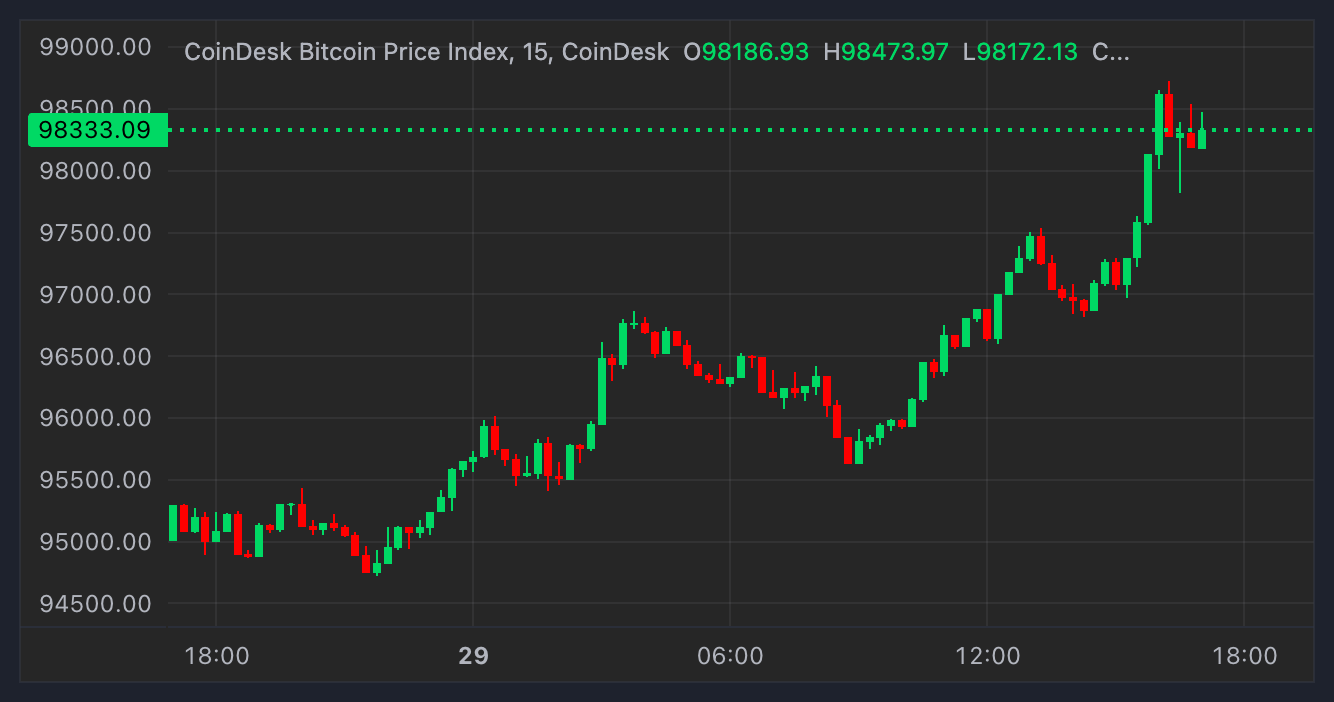
The Coindesk Bitcoin Index climbed to a $98,690 session high during early U.S. hours, advancing 3.3% over the past 24 hours. The broad-market <a href="https://indices.coindesk.com/indices/cd20" target="_blank">CoinDesk 20 Index</a> surged 6.2% during the same period, indicating that altcoins led the advance. XRP, ADA, RENDER and HBAR booked double-digit gains during the day.

Traditional U.S. markets are having a shortened session today after being closed on Thursday's holiday. U.S.-listed bitcoin miners — which don't always rise just because the price of bitcoin gains —, are moving higher, led by Bitdeer's (BTDR) 15% advance to notch a fresh all-time high above $14. Major miners including MARA Holdings (MARA), Riot Platforms (RIOT), were all up 5%-10% in the first hours of the session. Crypto equities Coinbase (COIN), MicroStrategy (MSTR) and Semler Scientific (SMLR) lagged behind the miners.

Bitcoin futures on the <a href="https://www.tradingview.com/symbols/CME-BTC1!/" target="_blank">Chicago Mercantile Exchange</a> (CME) briefly surpassed the $100,000 level during the day before slightly retreating, per TradingView data. That's the second occasion after first hitting the milestone last Friday.

The price premium on futures relative to the spot market suggests strong institutional participation, with open interest for bitcoin CME futures sitting at all-time high levels.

The Coinbase Price Premium, which measures BTC spot price on Coinbase relative to the off-shore exchange Binance, also bounced back to positive territory since bitcoin pulled back below $91,000 earlier this week. The Coinbase Premium underscores that the rally is primarily driven by American market participants.

"Judging by order size, Coinbase whales are driving this bitcoin rally," Ki Young Ju, CEO of CryptoQuant, said in an <a href="https://x.com/ki_young_ju/status/1862452335202771444" target="_blank">X post</a>.

Bitcoin Price Index (CoinDesk)

☑ ☆ ✇ CoinDesk

I Watched Justin Sun Eat the World's Most Expensive Banana. I Don't Get It.

By: Callan Quinn

Justin Sun walked into the room flanked by his usual entourage of bodyguards and advisers and made his way to the stage. Behind him, a banana was duct taped in position on a white wall. On either side, two blank-faced men in white shirts and black aprons stared into the sea of cameras and smartphones. I wondered what they were thinking.

As for what I was thinking, it was something along the lines of how ridiculous this all was. To give some background, on Nov. 21 Tron founder Justin Sun paid a whopping $6.2 million — including $1 million in commission — at an auction at Sotheby’s in New York for an <a href="https://www.sothebys.com/en/buy/auction/2024/contemporary-evening-auction-2/comedian" target="_blank">artwork called </a><a href="https://www.sothebys.com/en/buy/auction/2024/contemporary-evening-auction-2/comedian" target="_blank">Comedian</a>. The work, created by modern artist Maurizio Cattelan in 2019, is the aforementioned banana duct taped to the wall.

The reaction among many observers was the typical one seen whenever anyone spends a large sum of money on modern art: bewilderment, a bit of disgust, an eye roll. I think people who don’t like art can still appreciate the skill that goes into paintings or sculptures. If works like Comedian or Unmade Bed have any artistic merit, I cannot comprehend it. Tron’s public relations team assured me art is subjective.

But it’s memecoin season and things with absolutely no intrinsic value are very in right now. So it was hardly surprising that shortly after buying the banana-and-duct-tape combo, Sun said he planned to eat it.

This has happened twice before: Once in 2019, when a performance artist took it from the Art Basel in Miami shortly after it was sold for $120,000. Then again by a South Korean art student at the Leeum Museum of Art in Seoul in 2023.

It doesn’t affect the artwork. The banana and duct tape are replaced regularly anyway.

The consumption took place at the 5-star Peninsula Hotel in the Tsim Sha Tsui area of Hong Kong on Friday, a stone’s throw from some of the city’s most notorious doss houses.

The crowd consisted of a mix of journalists and people from the art and crypto industries, Tron and Sotheby’s employees and so-called key opinion leaders (KOLs). I mean the sort of people who wear clothes that look like they came from the local market, but probably cost thousands of dollars — U.S. dollars, not Hong Kong. One fellow journalist had flown all the way from Shanghai just for the event. Around us in the foyer, servers in white suit jackets served wine and other refreshments.

An information board near the entrance said Sun sought to immerse himself in the performance art of Cattelan, with Comedian as his muse. “He envisions this iconic piece as a catalyst for sparking dialogues and exchanges,” the text read.

Other people I spoke to in attendance were more skeptical, characterizing the event as little more than a marketing gimmick.

It’s not the first time Sun has courted the limelight. In 2019, he paid $4.57 million at a charity auction to have lunch with Warren Buffett. In April this year, he commissioned a theme song for Tron written by legendary movie composer Hans Zimmer.

He also served as <a href="https://www.coindesk.com/business/2021/12/17/justin-sun-is-retiring-from-tron-but-not-crypto" target="_blank">Grenada's permanent representative</a> to the World Trade Organization and, more recently, became prime minister of the libertarian <a href="https://liberland.org/about" target="_blank">micronation Liberland</a>, which is located in a floodplain on the Croatian side of the Danube.

Sun has also made the headlines in far less whimsical ways. Last year the U.S. Securities and Exchange Commission <a href="https://www.sec.gov/newsroom/press-releases/2023-59" target="_blank">charged</a> him with fraud and other securities law violations, including “fraudulently manipulating the secondary market for TRX through extensive wash trading.” Sun responded on X that the suit was without merit.

Meanwhile, his lawyers have <a href="https://coingeek.com/justin-sun-tron-threaten-to-sue-coingeek-for-reporting-on-blockchain-terror-ties/" target="_blank">threatened media outlets</a> with legal action when they report on Tron’s use by terrorist groups.

Perhaps the hope was that the banana would bring everyone together and let them forget about this. Indeed, Sun seems to believe the banana is the start of some sort of mass movement. “Is it simply a banana or something belonging to all of us?” he asked at one point.

He compared the process of replacing the banana every few days to the changing Chinese dynasties over the millennia. He praised the banana for how much traffic and attention it had brought himself and Tron. He noted that the banana’s value went beyond the limits of money.

Then he ate it.

November in Hong Kong seems to just be the prime season for odd crypto events. Fortunately, unlike <a href="https://www.coindesk.com/business/2023/11/06/apefest-attendees-report-severe-eye-burn-bayc-says-less-than-1-have-symptoms" target="_blank">ApeFest last November</a>, this time nobody was hospitalized. Instead, upon leaving attendees received a replica of Comedian along with a roll of duct tape and a spare banana.

At least that’s my breakfast tomorrow sorted.

Justin Sun eats the world's most expensive banana

☑ ☆ ✇ CoinDesk

Bitcoin Set to Have Its Fourth Strongest Month Since October 2021

By: James Van Straten

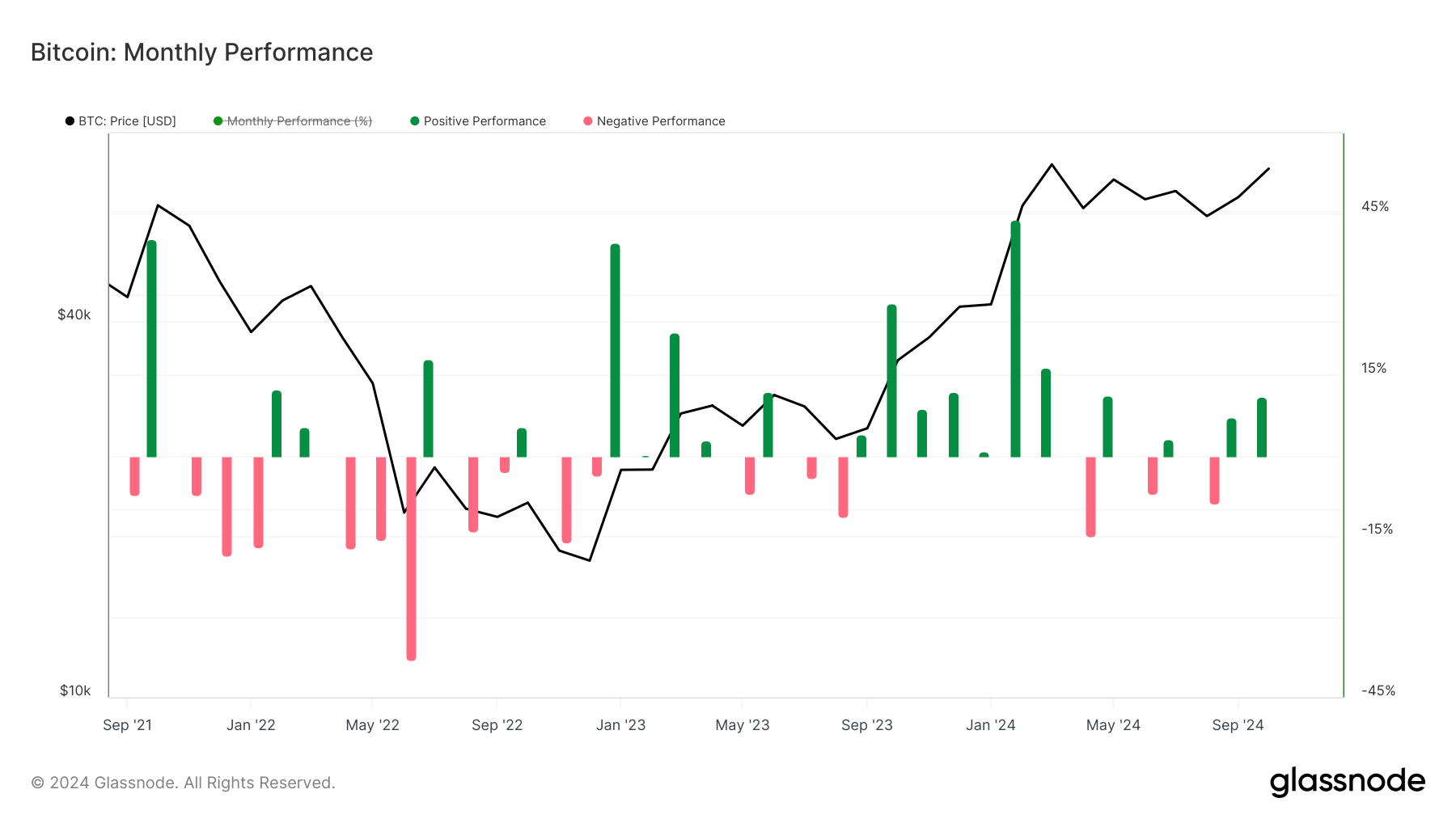
Nov. 30, is the last trading day of the month, so all eyes will be on bitcoin's (BTC) monthly candle. Bitcoin is less than 4% away from the psychological wall of $100,000. While the <a href="https://www.coindesk.com/markets/2024/11/25/bitcoin-options-worth-9-b-expire-friday-traders-may-be-thankful-for-the-post-thanksgiving-volatility" target="_blank">$9 billion worth of options expiry</a> for bitcoin has just expired, which has sent the token slightly higher on the day to over $96,000. CoinGlass data shows that November has been one of the strongest months for bitcoin for several years, currently up over 36%, which would be the fourth best performing month since October 2021. November's rise has only been beaten thrice February 2024 (44%), January 2023 (40%) and October 2021 (40%). November's impressive performance is largely due to the fact that Donald Trump won the U.S. presidential election earlier this month. Yet, bitcoin still has two more days until the official monthly close so there is still time to beat these milestones. On a quarterly timeframe, bitcoin is currently up 51% on the quarter with December still to come, on average the month of December returns around 5%. Q4 2024 has been the strongest quarter since Q1 which returned 69%.

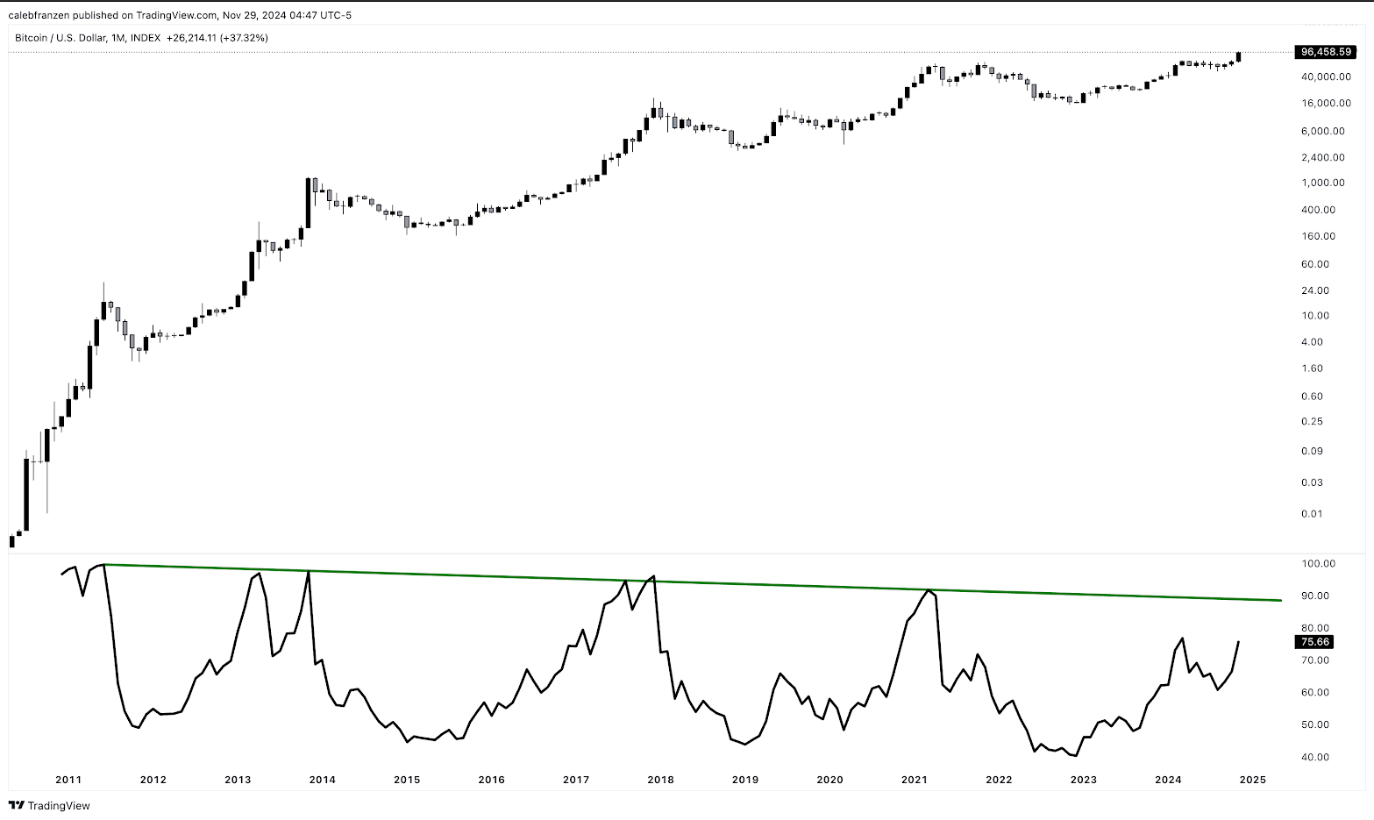
It seems a matter of when not if, bitcoin breaks past $100,000 while it is on track towards an all-time high monthly close. Analyst Caleb Franzen believes there is more juice left to squeeze in this current bitcoin bull market. "BTCUSD monthly chart with the RSI indicator: Bitcoin bull markets often peak with the monthly RSI trading above 90, versus the current level of 75. Historically, we've seen each bull market peak with a lower RSI, illustrated by the descending trend line, Franzen says. The implication is that momentum is not yet "overheated" and that more upside can be squeezed out of this uptrend in the months/quarters ahead".

Similar market structure to Q4 2020

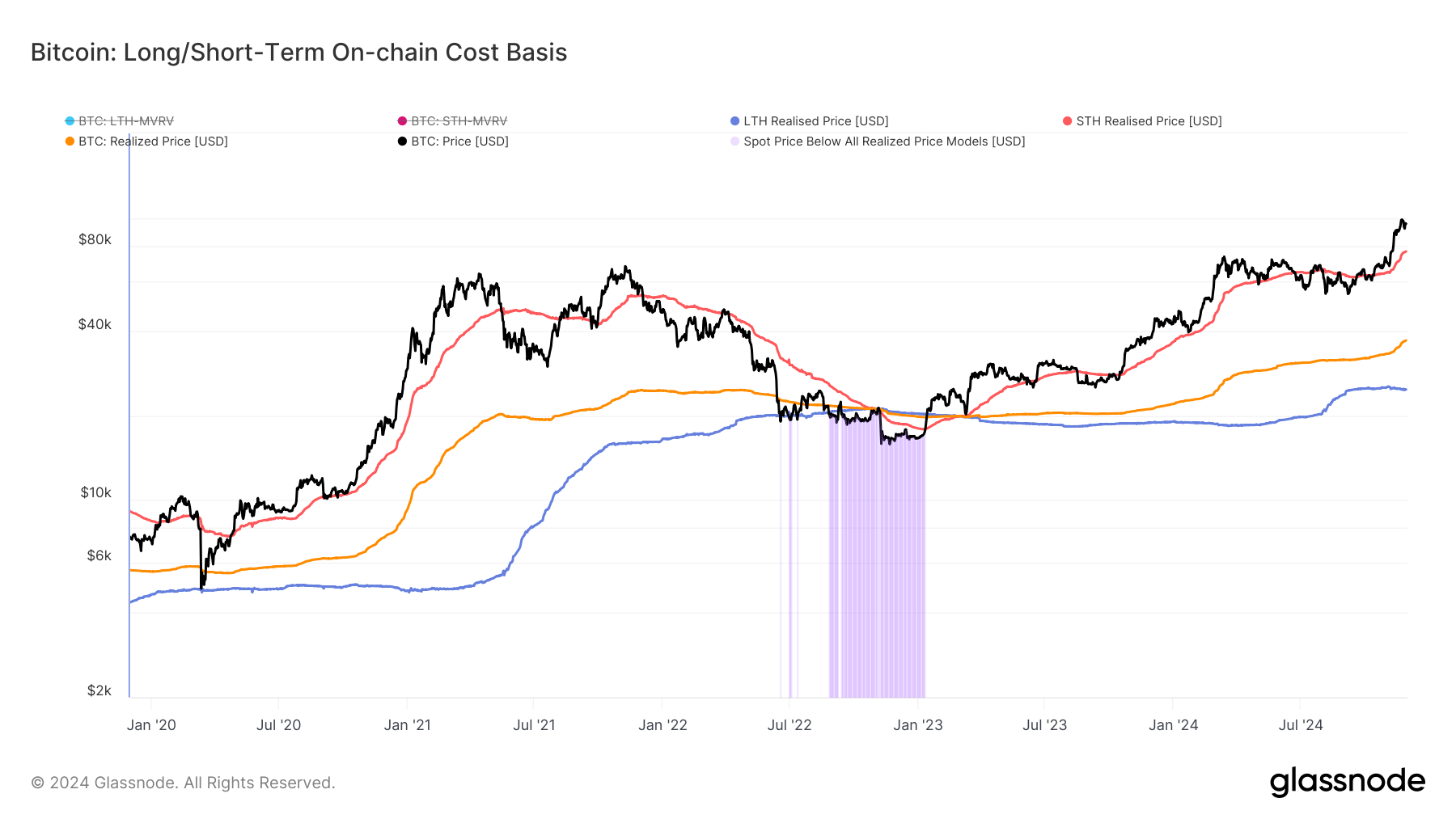
Bitcoin is in a similar market structure to Q4 2020, both periods saw strong green months in October and November, with a correction during the <a href="https://www.coindesk.com/markets/2024/11/26/bitcoins-tumble-to-91-k-evokes-thanksgiving-massacre-of-2020" target="_blank">2020 Thanksgiving period</a>. In the back end of 2020, this was when bitcoin conclusively left behind the psychological barrier of $10,000 and went to $60,000 by April 2021. Glassnode data shows that when bitcoin is above the short-term holder's realized price (STHRP) it tends to mean bitcoin is in a bull market. In Q4 2020, bitcoin used the STHRP consistently as a support level, as the price continued higher. An expectation could be that bitcoin continues higher and using the STHRP as a support level mimicking Q4 2020. STHP reflects the average on-chain acquisition price for coins held outside exchange reserves, which were moved within the last 155 days. These reflect the most probable coins to be spent on any given day. There is also a growing divergence between the realized price (which reflects the average on-chain acquisition price for the entire coin supply) and the long-term holder realized price (LTHRP) which reflects the average on-chain acquisition price for coins held outside exchange reserves, which have not moved within the last 155-days. These reflect the least probable coins to be spent on any given day. A growing divergence tells us that new participants are entering the market while long-term holders are spending or realizing profits. One very small data point indicates that bitcoin could even hit $100,000 on Nov. 29. Bitcoin first hit $1,000 on Nov. 27, 2013. Four years and one day later, bitcoin first hit $10,000. Could we see $100,000, just seven years and one day later?

BTC: Long/Short Term On-Chain Cost Basis (Glassnode)

☑ ☆ ✇ CoinDesk

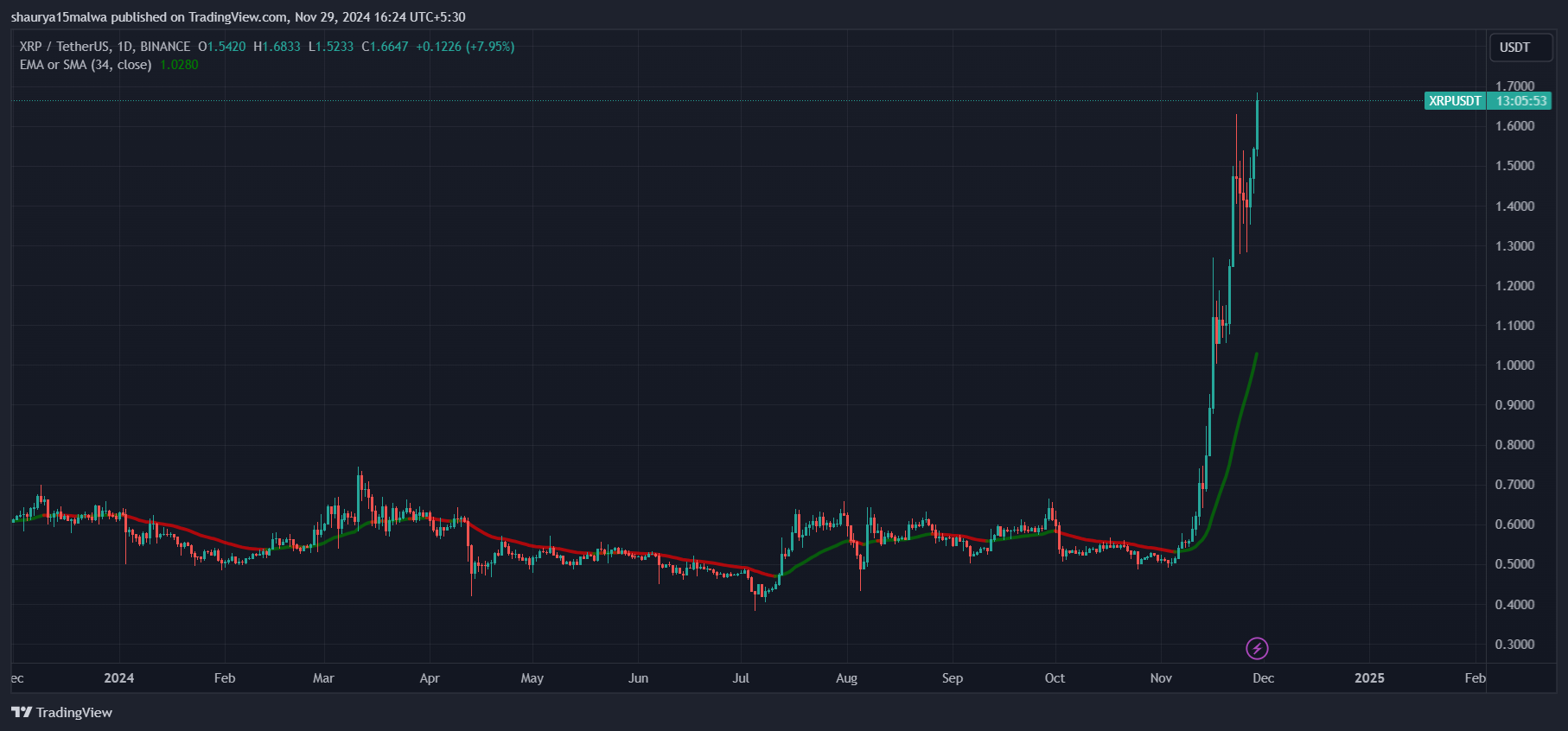
XRP Surges 14%, Nears $1.70 Level Last Seen in April 2021

By: Shaurya Malwa

Several fundamental and regulatory developments have pushed the <a href="https://www.coindesk.com/price/xrp" target="_blank">XRP price</a> to levels not seen since April 2021, with bulls now <a href="https://x.com/search?q=xrp%20%242&src=typed_query&f=top" target="_blank">eyeing the $2 mark</a> in a sign of renewed strength for the previously embattled token.

XRP surged 14% in the past 24 hours, outpacing bitcoin and other major cryptocurrencies, extending a month-long run that has seen the <a href="https://www.coingecko.com/en/coins/xrp" target="_blank">price rise 200%</a> to make the token the best-performing major token alongside dogecoin (<a href="https://www.coindesk.com/price/dogecoin" target="_blank">DOGE</a>).

Prices approached $1.70 in the European morning, with 24-hour trading volume rising 30% to $10 billion. Volume was led by South Korean exchange UpBit.

There was no immediately apparent cause for Friday's jump, though several factors have contributed to XRP's appeal in recent weeks.

The rise started in early November after Republican victories in the U.S. elections renewed investor confidence in tokens with links to U.S. companies, such as XRP's closely related Ripple Labs.

XRP advanced again in mid-November when U.S. Securities and Exchange Commission Chair Gary Gensler said he would step down in January — boosting hopes of a more relaxed regulatory environment.

XRP and U.S. dollar-denominated open interest are over record levels, with over 2 billion tokens (worth more than $2 billion at current prices) in futures positions betting on further market volatility.

Some traders also expect an XRP exchange-traded fund (ETF) in the U.S., especially those anticipating a more-lenient regulatory environment. A money-market fund launched on XRP Ledger, the network that uses XRP as fees to confirm and process transactions, boosting expectations of institutional usage.

Ripple has said it plans to invest an unspecified amount in the newly rebranded Bitwise Physical XRP ETP (earlier called the ETC Group Physical XRP), <a href="https://www.coindesk.com/markets/2024/11/27/xrp-rally-sees-record-profit-taking-as-ripple-labs-plans-to-invest-in-bitwise-xrp-etf" target="_blank">as reported</a> Wednesday. The announcement sent XRP higher by 10% at the time.

XRP's bullish momentum keeps on going. (Flickr)

☑ ☆ ✇ CoinDesk

Ethereum ETFs Inflow Streak Sets Up ETH for New Lifetime Highs, Traders Say

By: Shaurya Malwa

A streak of inflows into U.S.-listed spot ether (<a href="https://www.coindesk.com/price/ethereum/ " target="_blank">ETH</a>) exchange-traded funds (ETFs), rising activity on the Ethereum blockchain and increased institutional trading interest could help the second-largest cryptocurrency by market cap surpass its three-year-old price record in the coming months.

“ETH spot ETFs continue to record strong net inflows, totaling $90.1 million yesterday and marking a 4-day winning streak," QCP Capital said in a note referring to Wednesday trading. "Despite this week's retracement, these healthy inflows highlight the market's growing optimism. ETH was the main outperformer Wednesday as it rallied 11.65% to a high of 3,688. This is aligned with our thesis of capital rotation from BTC to ETH."

The ether ETFs attracted over $220 million in the Nov. 22-27 period, data shows, the second-longest streak of inflows since they went live in July. That has helped bring cumulative flows to a positive $240 million.

“Given that ETH has lagged behind BTC and SOL in the current rally, its recent strength supports the case for it to retest its all-time high of 4,868 (+35.4%),” QCP said.

Fundamental factors and money flows are further boosting ether’s growth prospects.

A <a href="https://www.coindesk.com/markets/2024/11/27/think-ethereum-s-eth-is-dead-surging-metrics-show-otherwise" target="_blank">CoinDesk analysis</a> earlier this week noted that cumulative open interest in perpetual and standard futures contracts has surged to a record 6.32 million ETH, worth over $27 billion.

Activity in the ether options market listed on Deribit is also picking up, with over 2 million contracts active or open at press time, the most since late June.

Other data shows a jump in revenue, fees, new wallets and Ethereum blockchain volumes, with the past month registering elevated levels of activity compared with the period from May to September.

<a href="https://defillama.com/stablecoin/tether" target="_blank">Stablecoin data</a> further shows that Ethereum has more USDT hosted than Tron, with $60.3 billion on Ethereum versus $57.94 billion on Tron, the first time that's happened since June 2022.

Ether bulls are eyeing a return to lifetime peaks. (Shutterstock)

☑ ☆ ✇ CoinDesk

HyperLiquid's Native Token Debuts at Fully Diluted $4.2B Market Cap

By: Oliver Knight

<a href="https://www.coindesk.com/learn/what-is-a-dex-how-decentralized-crypto-exchanges-work/ " target="_blank">Decentralized crypto exchange</a> HyperLiquid distributed its native token, HYPE, spurring demand that saw the price jump to $4.18 from an initial $3.2 and lifting the fully diluted value (FDV) to $4.2 billion

There are 333 million of the planned 1 billion tokens in circulation after the airdrop, giving a market cap of around $1.4 billion. Trading volume topped $165 million during the first hour of trading.

Of the total supply, 38.88% has been allocated to future emissions and community rewards and 23.8% is set aside for current and future core contributors.

The token can be staked to secure HyperBFT, the <a href="https://www.coindesk.com/learn/2020/12/30/what-is-proof-of-stake/ " target="_blank">proof-of-stake consensus</a> algorithm that powers the platform. It can also be used to pay transaction fees and create decentralized finance (DeFi) applications.

Users were eligible for the airdrop after earning "points" over a six-month period that ended in May. Airdropped tokens typically face immediate sell pressure as airdrop hunters attempt to extract maximum value, however the signs are that demand for HYPE has outstripped supply, with strong momentum to the upside.

The HYPE/USDC order book is maintaining a significant amount of liquidity with 5% market depth, standing at around $4 million on both sides.

HyperLiquid airdrops HYPE token (Ian Dooley/Unsplash)

☑ ☆ ✇ CoinDesk

Stablecoins Could Grow to 10% of U.S. Money Supply: Standard Chartered and Zodia Markets

By: Will Canny

Stablecoins could grow to 10% of the U.S. money supply and foreign exchange transactions once the sector becomes more legitimized, Standard Chartered (STAN) and Zodia Markets said in a report Thursday.

Currently, the stablecoin market is equivalent to 1% of U.S. M2 and 1% of foreign exchange transactions, the report said.

"As the sector becomes legitimized, a move to 10% on each measure is feasible," wrote authors Geoff Kendrick and Nick Philpott.

A <a href="https://www.coindesk.com/learn/what-is-a-stablecoin" target="_blank">stablecoin</a> is a type of crypto that is designed to hold a steady value and is usually pegged to the U.S. dollar, though some other currencies such as gold are also used. M2 is a measure of U.S. money supply, and includes cash, savings and other short-term investments.

The catalyst for this surge in adoption will be U.S. regulation of stablecoins, the authors said, adding that cross-border payments and FX-equivalent transactions are key areas of growth.

Three bills were brought forward during Joe Biden's administration but scant progress was made, the report noted, adding that more success on the regulatory front is expected when Donald Trump's administration takes over in early 2025.

Bernstein said that stablecoins were becoming more important to the global financial system, and constitute the 18th-largest holder of U.S. Treasuries, the broker said in a research report in September.

Read more: <a href="https://www.coindesk.com/markets/2024/09/19/stablecoins-are-becoming-systemically-important-bernstein-says" target="_blank">Stablecoins Are Becoming Systemically Important, Bernstein Says</a>

16:9 CROP: Standard Chartered (Shutterstock)

☑ ☆ ✇ CoinDesk

XRP Outperforms Crypto Majors as Japan Yen Strength Signals Bitcoin Trouble

By: Shaurya Malwa

XRP rose over 5% in the past 24 hours to drive gains among majors in the past 24 hours as a Thanksgiving holiday saw bitcoin (BTC) avoid a feared historical “massacre,” with a slight uptick across the market. BTC was changing hands above $96,000 in the early hours Friday, a steady rise from Thursday’s lows of $93,500. Ether (ETH), Solana’s SOL, and BNB were little changed, while Cardano’s ADA was 3.5% higher, and dogecoin (DOGE) lost 1.2%. The broad-based CoinDesk 20 (CD20), a liquid fund tracking major tokens, added 1.3%. Algorand’s ALGO and Worldcoin’s WLD jumped as much as 21% to lead gains among midcaps amidst no immediate catalysts. The crypto market’s moves in Asian hours came as the Japanese yen broke a key level against U.S. dollars. The yen briefly crossed 150 against the dollar due to expectations of a Bank of Japan (BOJ) rate increase in December, spurred by higher-than-expected Tokyo inflation data. The movement was likely accentuated by month-end financial adjustments and low liquidity due to Thanksgiving. Market sentiment leans towards a 63% chance of a BOJ rate hike, contrasting with a 67% likelihood of a Fed rate cut, which could reduce the attractiveness of yen carry trades. Yen is colloquially known as an "anti-risk" currency and is seen as a safe-haven currency that investors turn to during times of stress. Yen's outperformance at the end of July and September has previously catalyzed the unwinding of carry trades, or bullish risk-on bets, financed by relatively cheap yen-denominated loans as it became more expensive to borrow the Japanese currency. A <a href="https://www.coindesk.com/markets/2024/11/27/bitcoin-bulls-lose-steam-aussie-yen-dips-hinting-at-broad-based-risk-aversion-ahead" target="_blank">CoinDesk analysis</a> earlier this week signaled bitcoin's bullish run has weakened, with the Aussie dollar/Yen exchange rate dropping, signaling a risk-off mood. The AUD, linked to global economic health, and the yen tend to affect risk assets like BTC inversely. This scenario echoes an earlier period when a yen surge due to BOJ rate hike rumors led to an 8% drop in AUD/JPY and a $20,000 fall in BTC, showing the potential impact of FX movements on cryptocurrencies.

(Wesley Tingey/Unsplash)

☑ ☆ ✇ CoinDesk

Crypto for Advisors: To Crypto or Not to Crypto?

By: DJ Windle, Sarah Morton

In today’s issue, <a href="https://www.linkedin.com/in/djwindle/" target="_blank">DJ Windle</a> from Windle Wealth looks at the risks advisors face when they can't or won't help clients who want exposure to digital assets.

Then, <a href="https://www.linkedin.com/in/hongzhesun/" target="_blank">Hong Sun</a> from Core DAO talks about custody and DeFi in Ask an Expert.

Thank you to our sponsor of this week's newsletter, L1 Advisors.

Happy reading.

– <a href="https://www.coindesk.com/author/sarah-morton" target="_blank">Sarah Morton</a>

You’re reading <a href="https://www.coindesk.com/newsletters/crypto-for-advisors/" target="_blank">Crypto for Advisors</a>, CoinDesk’s weekly newsletter that unpacks digital assets for financial advisors. <a href="https://www.coindesk.com/newsletters/crypto-for-advisors/" target="_blank">Subscribe here</a> to get it every Thursday.

Houston, Advisors Have a Problem

Financial advisors have largely ignored cryptocurrency for years, dismissing it as a speculative bubble or outright scam. Meanwhile, the financial landscape has shifted dramatically. Major players like BlackRock, Visa, Mastercard, Venmo, and many others are integrating blockchain technology and cryptocurrency into their operations. The crypto ecosystem is no longer a backwater - it’s becoming a part of the mainstream economy.

The disconnect between client interest and advisor readiness presents a stark choice for the advisory industry: adapt or risk losing clients, particularly high-net-worth clients, to more forward-thinking competitors.

The Two Crypto Scenarios

When clients approach their advisors about cryptocurrency, they typically encounter one of two scenarios:

1. Dismissal and Dismissiveness

Advisors brush off client inquiries with the same tired refrain: “Crypto is a scam,” “It’s just like tulip bulbs,” or “It’s too risky and has no inherent value.” While advisors may feel this stance is prudent, clients often interpret it as out-of-touch or condescending.

2. Inexperience and Inaction

Sometimes, advisors are willing to listen but lack the knowledge or tools to act. They haven’t taken the time to educate themselves about cryptocurrency, and their compliance departments won’t allow them to offer guidance. These advisors are left unable to help their clients purchase or manage crypto assets, leaving significant gaps in their service offerings and in their clients' portfolios.

Both scenarios lead to the same result: frustrated clients who feel their advisors are unprepared for the future.

Clients Notice

Let me illustrate this disconnect with a real-life example from my practice. A client with a net worth exceeding $10 million approached their advisor about investing $50,000 in cryptocurrency. The advisor dismissed the idea, calling crypto a scam and urging the client to steer clear. The client, unconvinced and having spent a lot of time researching it, reached out to their estate planning attorney for other options, who in turn contacted me because they didn’t know anyone else advising on cryptocurrency.

We opened an account for the client, walked them through the basics of this new asset class, and provided the education they needed to make informed decisions. Within a few weeks, this client transferred all of their assets to us, citing a lack of confidence in their previous advisor. Their parting words? “Why would I leave my money with an advisor who doesn’t understand the future?”

This story is not unique. I’ve received countless calls from individuals looking for help because their advisors aren’t willing, from advisors themselves asking me to manage cryptocurrency investments for their clients - and even from advisors requesting help with their personal portfolios. The irony is glaring: advisors who dismissed crypto as irrelevant are finding themselves out of their depth and, in many cases, out of a client.

The Perfect Storm for Crypto Adoption

We’re at a pivotal moment for cryptocurrency. Several factors have aligned to create a favorable environment for adoption:

1. Institutional Legitimacy

BlackRock, Fidelity, and other institutional giants are launching crypto-related funds and digitizing real-world assets like real estate, art, and others, signaling that crypto is no longer a fringe asset but a legitimate part of the investment landscape.

2. Regulatory Shifts

The anticipated replacement of Gary Gensler as SEC Chair marks a potential shift toward a more supportive regulatory framework. This could lower barriers for advisors and investors alike.

3. Increased Integration

Companies like Visa, Mastercard, and Venmo are incorporating blockchain technology into their operations, making cryptocurrency more accessible and practical for everyday use.

4. Client Demand

Perhaps most importantly, clients are driving this change. Distrust in the government and the barge of positive crypto news has put crypto at the forefront, and clients are starting to do their research and wonder why they’ve been left out of this asset class.

This moment represents a once-in-a-generation opportunity for advisors to position themselves as leaders in a rapidly evolving financial landscape and prove to the public that they aren’t just doing the same old thing their predecessors have.

The Bottom Line

The financial advisory industry is at a crossroads. Cryptocurrency is no longer a speculative fringe asset; it’s becoming a cornerstone of the modern economy. Advisors who dismiss or ignore it risk alienating their clients who are looking for forward-thinking guidance.

The question isn’t whether cryptocurrency will play a role in the future of finance—it already does. The real question is whether advisors will adapt in time to meet their clients’ evolving needs. Those who embrace this challenge will position themselves as trusted partners in a changing world. Those who don’t may find themselves left behind.

- <a href="https://www.coindesk.com/author/dj-windle" target="_blank">DJ Windle, founder and portfolio manager, WIndle Wealth</a>

Ask an Expert

Q. How do you see the evolution of custody models for institutional players?

While self-custody aligns with the core ethos of crypto, it’s not always practical for institutions. Entities involving multiple stakeholders often require custodial solutions due to regulatory, compliance, and operational complexities.

Institutional players prioritize regulatory compliance, technology risks, security, operational efficiency, reputation, trust, and market liquidity. Their approach balances embracing digital assets’ potential and mitigating associated risks. Familiarity with custodianship in traditional finance also makes this model more appealing to institutions.

By supporting both self-custody and third-party custodial models, the crypto industry can attract a broader range of participants. This flexibility enables institutions to engage with digital assets in ways that align with their operational and security requirements while fostering adoption and adhering to crypto's fundamental principles.

Q. How will custody models enable a shift toward decentralized products?

Custody, whether delegated or DIY, centers on secure ownership. Blockchain technology offers a scalable asset control solution, benefiting individuals and institutions. Digital assets like bitcoin build trust in immutable code, enabling users to decide whom to trust with storage.

For decentralized finance (DeFi) adoption, self-custody isn't a strict requirement. Institutions can engage with decentralized applications while hiring custodians to safeguard assets. This flexibility allows institutions to explore DeFi products without overhauling custody models, fostering broader participation and innovation in the decentralized ecosystem.

Q. With bitcoin, DeFi, and staking gaining traction, what needs to happen for institutional adoption?

For institutions, key adoption drivers include safety, sustainability, and scalability. Institutions require assurances to maintain full control over their assets while avoiding risks like slashing or vulnerabilities from external smart contracts. They also seek transparency in yield sources, preferring sustainable activities within a Bitcoin DeFi ecosystem.

Scalability is critical as institutions must efficiently deploy substantial capital and ensure the system can handle it. Models that offer flexible options tailored to diverse user needs are best positioned to support institutional involvement at scale.

The same principles apply to Bitcoin DeFi (BTCfi). Clear value propositions, secure smart contracts, and deep liquidity pools are essential for adoption. As these elements mature, institutions will likely find BTCfi appealing, not just for access to bitcoin ETFs but for more flexible derivative products that support sophisticated financial strategies.

- <a href="https://www.linkedin.com/in/hongzhesun/" target="_blank">Hong Sun, institutional contributor, Core DAO</a>

Keep Reading

Bitcoin reached a <a href="https://www.cnbc.com/2024/11/21/crypto-market.html" target="_blank">new all-time high</a> just shy of the $100,000 mark on November 22.

BlackRock <a href="https://www.cnbc.com/2024/11/21/crypto-market.html" target="_blank">bitcoin options ETF</a> saw $1.9 billion traded on the first day.

Ripple announced its entry into the <a href="https://news.bitcoin.com/ripple-unveils-first-tokenized-money-market-fund-on-xrp-ledger/" target="_blank">tokenized money market</a> space.

Blue and orange image


☑ ☆ ✇ CoinDesk

Bitcoin Could Hit as High as $124k Before Year-End, Says ARK Invest Analyst

By: Tom Carreras

Bitcoin (<a href="https://www.coindesk.com/price/bitcoin?_gl=1*16vsd1c*_up*MQ..*_ga*MTA1ODY0MTAzMy4xNzMyODIwOTk0*_ga_VM3STRYVN8*MTczMjgyMDk5NC4xLjAuMTczMjgyMDk5NC4wLjAuMTk0NjQyMDA3Ng.." target="_blank">BTC</a>) has slumped back to $95,000 after coming within a few hundred dollars of passing the symbolic $100,000 price level. But the largest cryptocurrency is only catching its breath before surging to newer heights, according to investment management firm ARK Invest.

“We’re more or less anticipating $104,000 to $124,000 price targets by end of year,” David Puell, one of the firm’s research associates, told CoinDesk in an interview. “With the caveat that it's not a recommendation, but so far, price action has kept up to that projection quite nicely.”

Puell’s calculus is based on bitcoin’s seasonality — a term referring to the ways the asset has behaved in various stages of previous bull markets — as well as on-chain metrics. In Puell’s view, cycles are very much still at play until any strong evidence of the contrary, meaning that he eventually expects a top to form and for bitcoin to experience another serious pullback like in 2022.

“I would classify the current market environment as a sort of middle of the bull,” Puell said. “If you're measuring bottom to top, I would say we're at about 55% to 65% of the way there.” That currently places the bitcoin cycle top at roughly $126,000 to $134,000 according to on-chain metrics, he said, though these price targets could move higher “if the market accelerates to the upside.”

That would lend to the theory that bitcoin returns are diminishing each cycle as the asset matures — a $134,000 top would mean bitcoin would have only doubled its valuation compared to its 2021 top of $69,000. Back then, bitcoin had managed to triple its price compared to the 2017 cycle. Puell said ARK Invest was ready for such a scenario of diminishing returns, but that data was inconclusive so far.

At the beginning of the year, ARK Invest CEO Cathie Wood <a href="https://www.coindesk.com/markets/2024/01/11/cathie-wood-sees-bitcoin-price-reaching-15m-by-2030-after-etf-approval" target="_blank">laid out</a> a bullish target of $1 million to $1.5 million per bitcoin by 2030, with a base target of $650,000. Price will likely be buoyed by the incoming Trump administration, Puell said, depending on who the President-elect picks as chairman of the Securities and Exchange Commission (SEC), and how accommodative towards risk-on assets the Federal Reserve’s policy turns out to be. Not to mention the prospect of a strategic bitcoin reserve.

“Monetary policy and the SEC stance are the things to focus on. But the analogy I would use is that a strategic bitcoin reserve wouldn’t be just like the cherry on top — it would be like a whole new cake on top of a cake,” Puell said.

But that doesn’t mean bitcoin will keep soaring forever. Seasonality and cycles mean that eventually, the top cryptocurrency could suffer another bear market, and eventually plunge 70% from its all-time high, Puell said. The price floor will depend, then, on how high bitcoin can go before the music stops.

Read more: <a href="https://www.coindesk.com/markets/2024/11/28/bitcoin-to-overcome-100-k-despite-pullback-has-plenty-of-more-room-before-topping-crypto-quant" target="_blank">Bitcoin to Overcome $100K Despite Pullback, Has Plenty of More Room Before Topping: CryptoQuant</a>

CDCROP: Cathie Wood, chief executive officer and chief investment officer, Ark Invest (Marco Bello/Getty Images)

☑ ☆ ✇ CoinDesk

Bitcoin to Overcome $100K Despite Pullback, Has Plenty of More Room Before Topping: CryptoQuant

By: Krisztian Sandor

Bitcoin's (<a href="https://www.coindesk.com/price/bitcoin" target="_blank">BTC</a>) pullback from the $100,000 level after continuously hitting fresh new highs is only a temporary setback before eventually shooting past the barrier to even higher prices, crypto analytics firm CryptoQuant said.

According to a Wednesday report shared with CoinDesk, multiple blockchain data metrics suggest that the largest crypto has more room to run before topping.

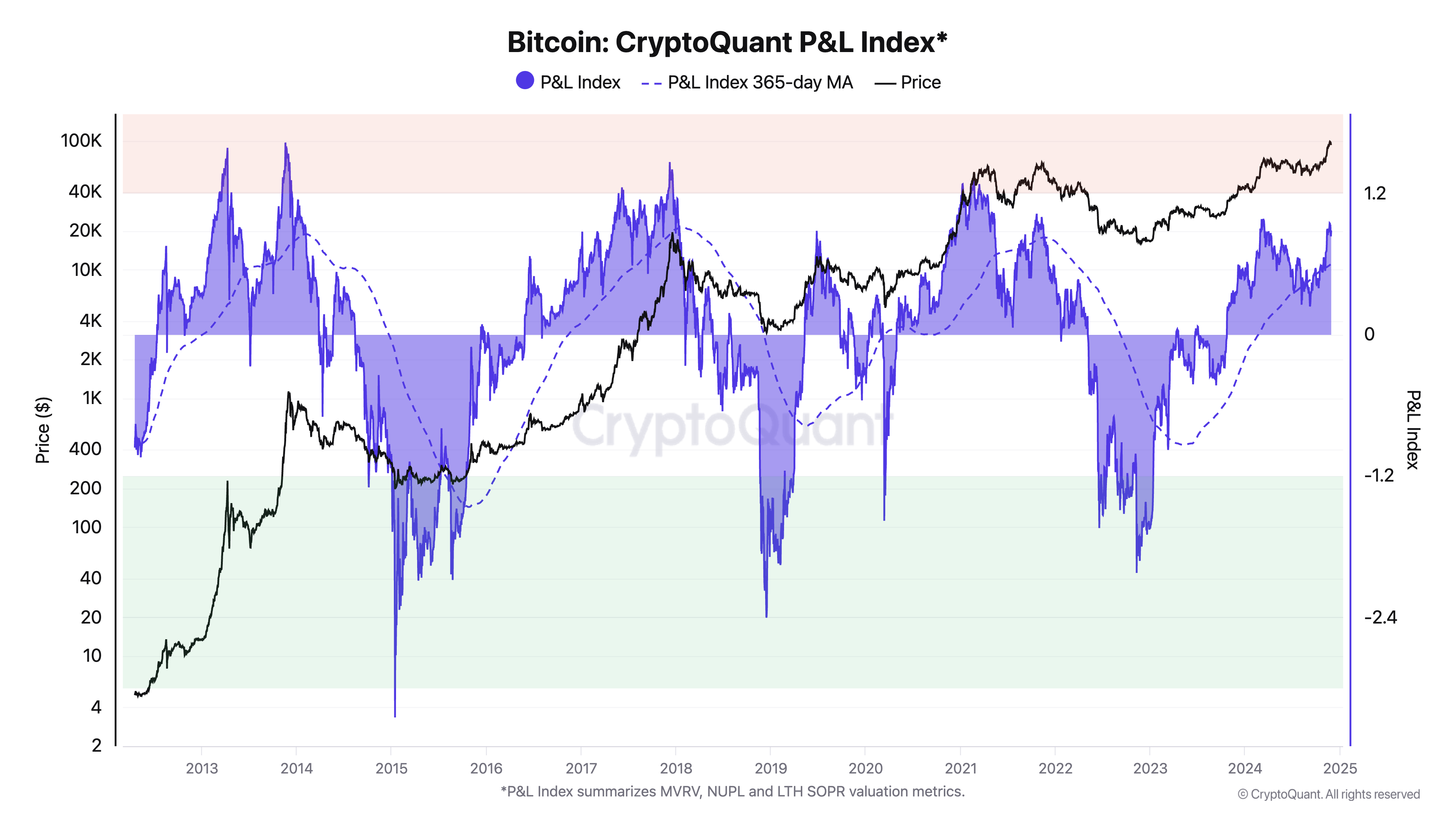
CryptoQuant's custom P&L index, which combines several on-chain valuation metrics to signal whether BTC is overvalued or undervalued, shows that the asset is firmly in a bull market but far from the overvalued levels it reached at the previous market peaks in 2021, 2017 and 2013.

The firm's Bull-Bear Market Cycle Indicator has only started to heat up after dipping slightly into bear market territory earlier this year as BTC corrected from March's record $73,000 to $50,000. The metric is nowhere near the overheated levels seen at local tops at this March or other local tops.

Meanwhile, participation of retail investors is still muted, contrary to the typical buying frenzy observed around previous cycle tops. Per CryptoQuant data, retail sold 41,000 bitcoin since October lowering their holdings likely to take profits. Large investors, meanwhile, increased holdings by 130,000 BTC during the same period.

New investors aren't rushing to enter the market either. The value of BTC held by new investors, or addresses holding the asset since less than six months ago, stands at 50% of the total value invested in bitcoin (Realized Cap). That's far below the 80%-90% levels in 2017 and 2021.

"Price tops typically occur when new investors enter the market to buy at extremely high prices, which causes them to hold a large proportion of the total value invested," the authors said. "Previous bull cycles have ended when retail investors buy aggressively, which is not the case today."

Bitcoin's peak target

Over the past week, BTC's violent run-up after Donald Trump's U.S. election victory was halted at the $100,000 barrier, sliding back as much as 9% from its latest record. On Thursday, CoinDesk data shows, it changed hands at around $95,000.

Despite the setback, surpassing the $100,000 barrier is only a matter of time, CryptoQuant analysts said.

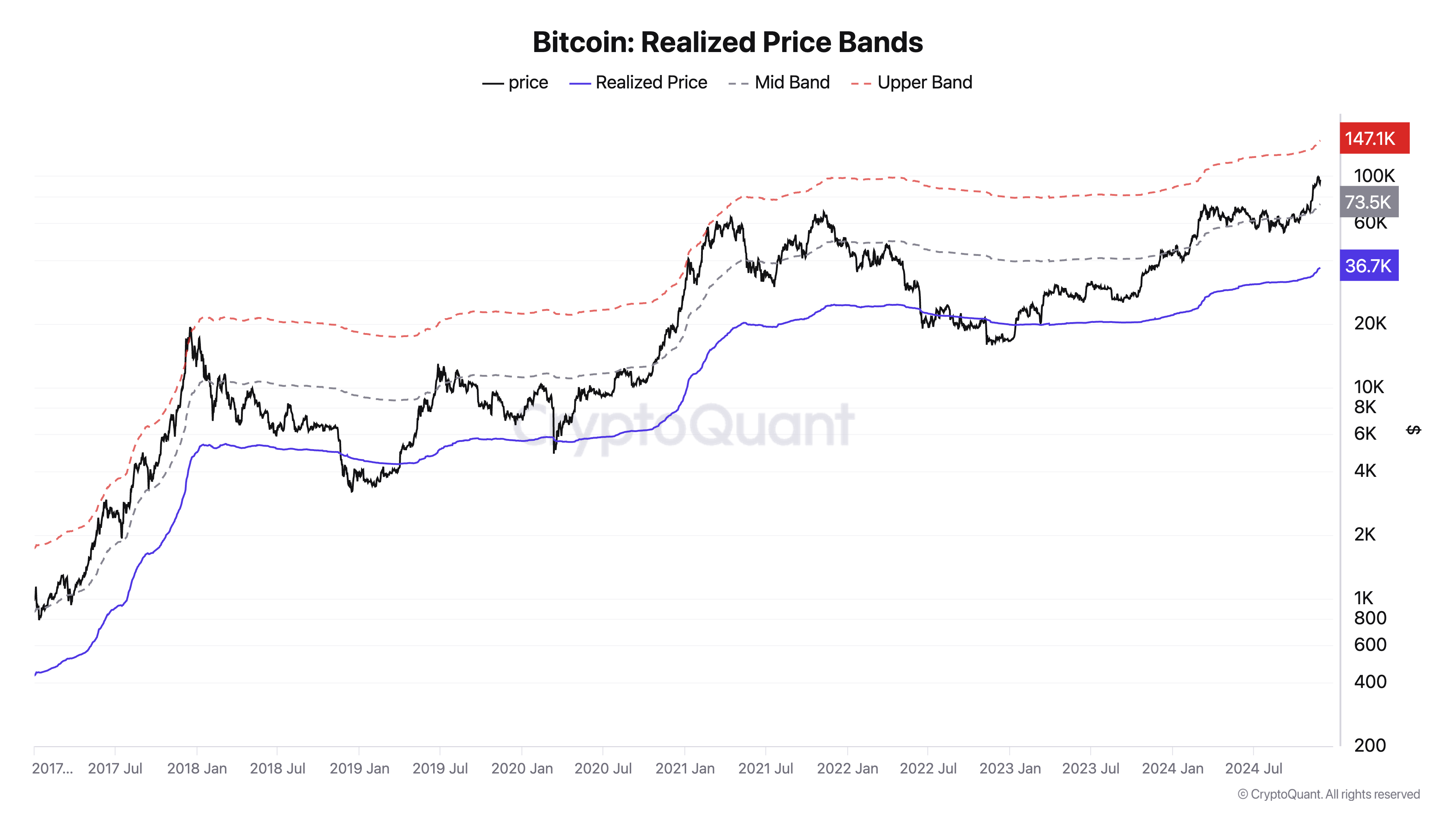
Previous bitcoin bull markets topped around the upper band of bitcoin's realized price metric, set at four times the average price at which all BTC in circulation has been transferred for the last time. Data shows that the realized price is currently at $36,000-$37,000 and quickly rising, marking the upper band at $147,000.

If the pattern repeats, BTC could rally to at least $147,000 before reaching a market cycle top, per CryptoQuant.

CryptoQuant isn't the only firm that is bullish on bitcoin's rally. Recently, Galaxy Research said the price is expected to reach $100,000 in the near term and may run up higher, citing increasing institutional adoption and the potential for the creation of bitcoin nation-state reserves.

Read more: <a href="https://www.coindesk.com/markets/2024/11/27/bitcoin-bull-market-is-far-from-over-galaxy-research-says" target="_blank">Bitcoin Bull Market Is Far From Over, Galaxy Research Says</a>

Ether bulls are eyeing a return to lifetime peaks. (Shutterstock)

☑ ☆ ✇ CoinDesk

Bitcoin Miners Approach $40B Market Cap as Difficulty Set for Fifth Straight Increase

By: James Van Straten

Publicly traded bitcoin (<a href="https://www.coindesk.com/price/bitcoin/ " target="_blank">BTC</a>) miners are approaching the milestone of an aggregated $40 billion market cap, according to <a href="https://farside.co.uk/miners/" target="_blank">Farside data</a>, doubling in seven months as bitcoin's price rocketed through multiple record highs to approach six figures for the first time.

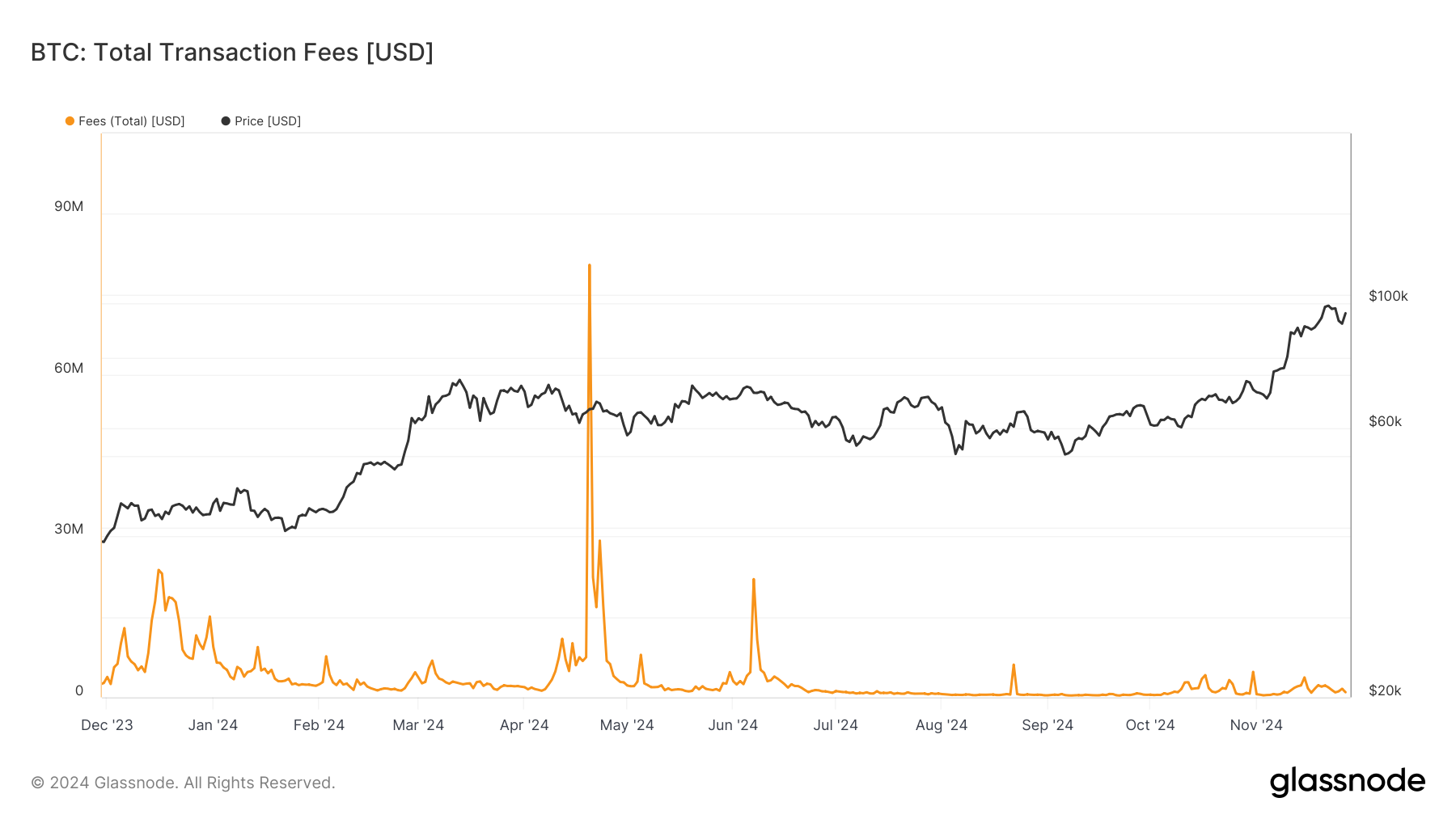
Miners' biggest challenge is revenue. The reward they receive for confirming blocks on the Bitcoin blockchain was cut <a href="https://www.coindesk.com/learn/bitcoin-halving-explained" target="_blank">50% in April</a>, when their combined market cap was about $20 billion. In this current epoch, only 450 bitcoin are mined a day and fees paid to miners remain at cycle lows, just 10 BTC ($946,000) on Nov. 27 according to Glassnode data.

That means they either have to diversify revenue streams or produce bitcoin at a cheaper cost than the spot price, currently about $96,000.

That's a challenge that is about to become more difficult. The mining difficulty, which measures how hard it is to produce the blockchain's blocks, is expected to increase by a further 3% at some point in the next few days.

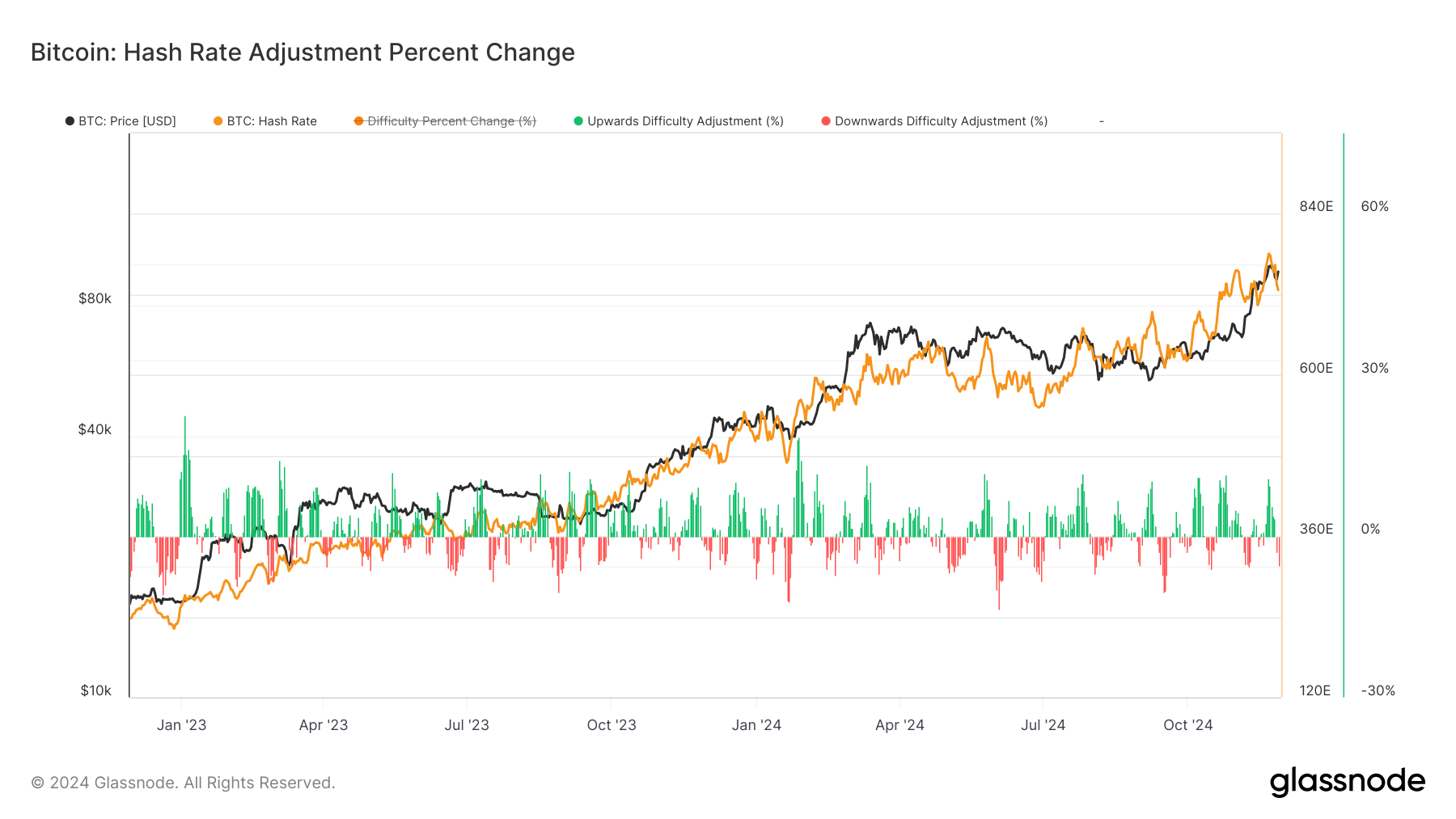
Mining difficulty, already firmly above <a href="https://www.coindesk.com/markets/2024/11/05/bitcoin-mining-difficulty-tops-100t-for-first-time-piling-pressure-on-small-miners" target="_blank">1 trillion</a>, automatically adjusts every 2016 blocks or roughly every two weeks. The higher the difficulty, the harder — and costlier — for miners to produce a new block.

The heart of the issue is the soaring hashrate, which has held above 700 exahash per second (EH/s) for more than a month. The hashrate is the computational power required to mine and process transactions on a <a href="https://www.coindesk.com/learn/2020/12/16/what-is-proof-of-work/ " target="_blank">proof-of-work blockchain</a> like Bitcoin.

On a seven-day moving average, the hashrate is currently at 726 EH/s, continuing to put in higher highs and higher lows since mid-year, according to Glassnode data.

In 2024, many miners have diversified their revenue streams by pivoting into the AI and high-performance computing (HPC) industries, where there is soaring demand for locations that can host the computing power they need.

One example is IREN (IREN), whose shares surged 30% on Wednesday on <a href="https://www.coindesk.com/business/2024/11/27/bitcoin-miner-iren-surges-on-renewed-ai-interest-possible-btc-dividend-payment" target="_blank">renewed AI interest</a>.

Other, such as MARA Holdings (MARA), are leveraging their bitcoin stashes and bumping up their bitcoin balance sheet holdings. As of Nov. 27, MARA added a <a href="https://x.com/MARAHoldings/status/1861848253362274469" target="_blank">further 703 BTC</a> after selling a 0% $1 billion convertible note to raise the funds. The company now owns a total 34,794 BTC.

The CoinShares Valkyrie Bitcoin Miners ETF is a proxy for publicly traded miners. Its share price is up 60% year-to-date, which is underperforming bitcoin's 113%.

Coinmint, a crypto data center in upstate New York, is set to host a portion of new miners from Riot’s Oklahoma City facility. (Shutterstock)

☑ ☆ ✇ CoinDesk

UltraShort Bitcoin ETF Offering 2x Inverse Returns Sees Record Volume as BTC Holds Above $90K

By: Omkar Godbole

There’s something about major psychological price levels, like bitcoin's (<a href="https://www.coindesk.com/price/bitcoin/ " target="_blank">BTC</a>) $100,000 mark. As prices near these thresholds, anything tied to the asset gets an extra spark of energy.

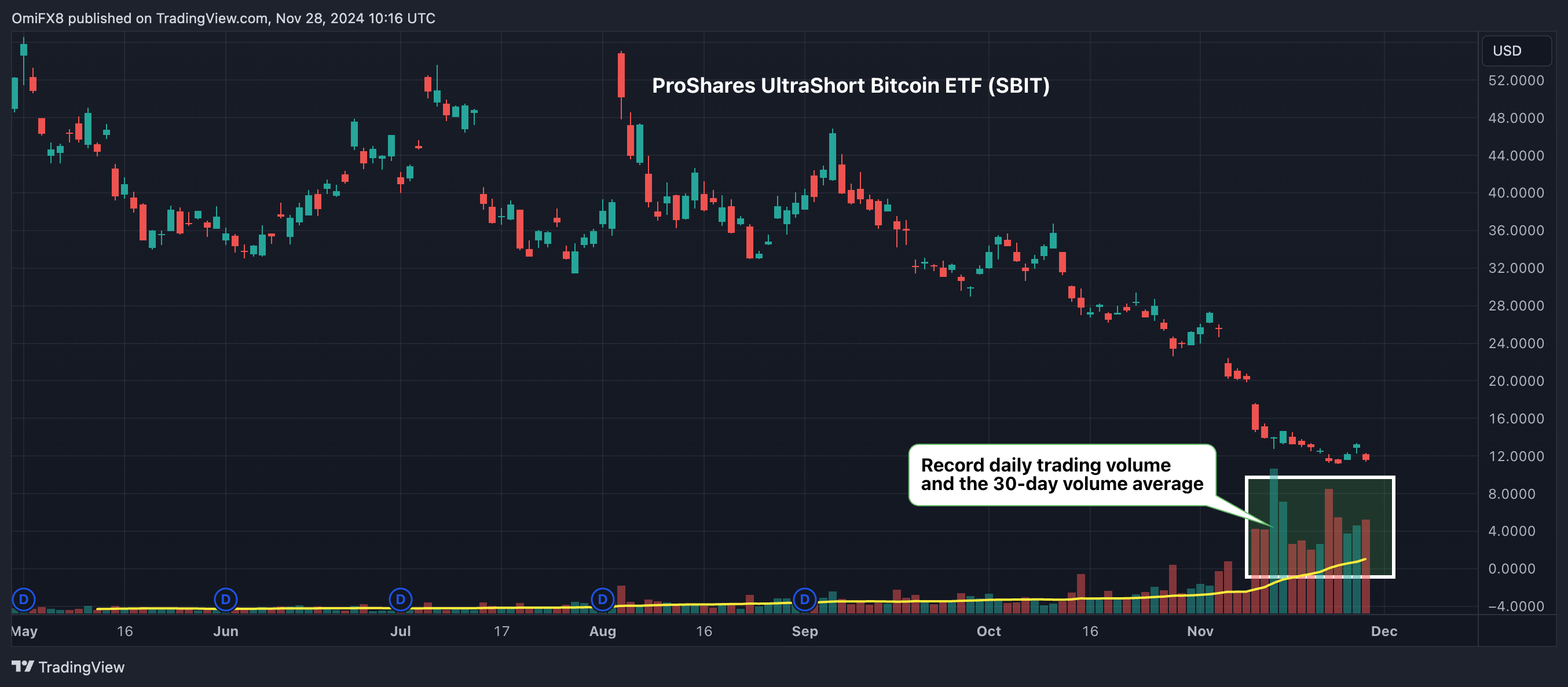
The Nasdaq-listed ProShares UltraShort Bitcoin ETF (SBIT) is a case in point, posting record trading volume of over 8 million shares on Nov. 13 as bitcoin topped $90,000 for the first time and strengthening the case for a rally into six figures by year-end, data tracked by TradingView show.

Since then, BTC has held between $90,000 and $100,000, and the ETF's daily trading volume has averaged just over 5 million shares. That's significantly greater than the sub-2 million readings over the preceding months.

The ETF seeks to deliver twice the inverse daily price performance of bitcoin, so that if BTC falls by 1%, the ETF rises by 2%, offering a leveraged bearish bet on the cryptocurrency.

The spike in volume could be associated with the capitulation of investors who bought the ETF early this year anticipating a slide in BTC. Or it could be bulls protecting their long positions in spot/futures markets from possible BTC price pullbacks as the key $100,000 level approaches.

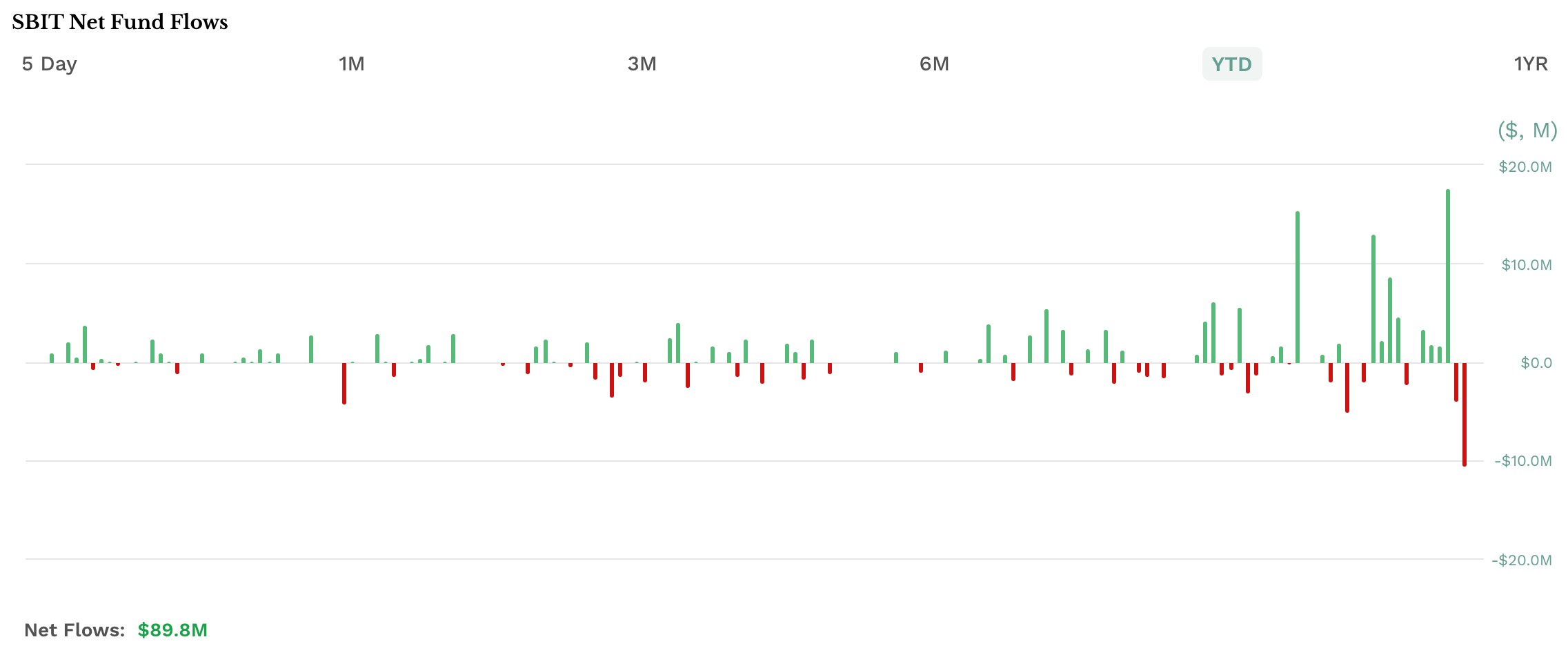
The latter seems to be the case, because inflows into the ETF have picked up. The fund registered a net inflow of $17.7 million on Friday, the most since its debut in April, according to data source ETF.com.

Bitcoin bulls, however, can still stay optimistic as the 11 spot bitcoin ETFs have accumulated over $2.5 billion in net inflows since Nov. 13, according to data tracked by <a href="https://farside.co.uk/btc/" target="_blank">Farside Investors</a>.

Polar bears

☑ ☆ ✇ CoinDesk

Crypto Exchange XT Is Hacked for $1.7M

By: Oliver Knight

Cryptocurrency exchange XT.com has suffered a hack worth $1.7 million, according to blockchain security firm <a href="https://x.com/PeckShieldAlert/status/1862059885174874355" target="_blank">PeckShield</a>.

The stolen funds were converted to ether <a href="https://www.coindesk.com/price/ethereum" target="_blank">(ETH)</a> and now sit in a newly created Ethereum wallet.

"Today, XT detected an abnormal transfer from our platform wallet. Rest assured, this will not affect our users," XT.com <a href="https://x.com/XTexchange/status/1862072439154569282" target="_blank">wrote on X</a>. "We always maintain reserves 1.5x greater than user assets to ensure maximum security."

CoinGecko <a href="https://www.coingecko.com/en/exchanges/xt" target="_blank">data</a> shows that the Seychelles-based exchange has $47.7 million in reserves and reported trading volume of $3.3 billion in the past 24 hours.

The hack marks the latest in a string of attacks targeting exchanges; <a href="https://www.coindesk.com/tech/2024/09/20/crypto-exchange-bingx-hacked-onchain-data-shows-over-43m-drained" target="_blank">BingX</a> and <a href="https://www.coindesk.com/markets/2024/09/11/indonesian-crypto-exchange-indodax-hacked-for-22m-pauses-activity-before-bigger-hit" target="_blank">Indodax</a> lost $43 million and $22 million, respectively, in September.

(Wesley Tingey/Unsplash)

☑ ☆ ✇ CoinDesk

Celsius to Make Second Payout to Creditors ‘Soon’ as Mashinsky Awaits Day in Court

By: Callan Quinn

Celsius will soon begin a second distribution of funds to creditors, according to a court filing on Nov. 27.

A total of $127 million will be given out in bitcoin (BTC) or USD to creditors in five classes including retail borrower deposit claims, general earn claims, withhold claims, unsecured loan claims, and general unsecured claims.

Each eligible creditor will receive 60.4% of the value of their claim as of the Petition Date.

After emerging from Chapter 11 bankruptcy in January this year, the crypto company shut down its mobile and web apps on Feb. 29 and has begun the process of reimbursing creditors. Some creditors also received shares in <a href="https://www.coindesk.com/business/2024/02/01/celsius-bitcoin-mining-assets-to-restart-as-new-unit-prepares-to-go-public" target="_blank">Ionic Digital</a>, which is a company formed from Celsius’ reorganized mining business.

The upcoming payout follows a much larger one that the company made in August, when Celsius <a href="https://www.coindesk.com/policy/2024/02/01/celsius-to-distribute-3b-crypto-to-creditors-as-firm-emerges-from-bankruptcy" target="_blank">distributed</a> over $2.53 billion to more than 251,000 creditors. The first payout covered about two-thirds of all eligible creditors and about 93% of the eligible value.

Celsius initially filed for bankruptcy relief under Chapter 11 on July 13, 2022 after the business collapsed. Its former CEO, Alex Mashinsky resigned in September 2022. He was later <a href="https://www.coindesk.com/policy/2023/07/13/sec-sues-bankrupt-celsius-network-alex-mashinsky-over-securities-fraud" target="_blank">arrested</a> on fraud charges and will go to trial in the U.S. in January 2025.

Former Chief Revenue Officer at Celsius, Roni Cohen-Pavon pled guilty to market manipulation and fraud last year. He is due to be sentenced next month.

The process also saw the company make a $4.7 billion <a href="https://www.coindesk.com/business/2023/11/10/celsius-bankruptcy-reorganization-plan-approved-by-court-implementation-by-early-2024" target="_blank">settlement</a> with U.S. authorities over fraud allegations.

Celsius CEO Alex Mashinsky (CoinDesk archives)

☑ ☆ ✇ CoinDesk

Crypto Exchange HyperLiquid to Airdrop 310M Tokens to Early Adopters

By: Oliver Knight

<a href="https://www.coindesk.com/learn/what-is-a-dex-how-decentralized-crypto-exchanges-work/" target="_blank">Decentralized exchange</a> HyperLiquid announced the launch of HYPE, a native token that will be airdropped to early adopters on Friday.

One billion tokens will be issued, with 31% going to users who earned points in a campaign that ended in May. A further 23.8% will be set aside for current and future core contributors, the latter of which will be locked for one year.

HyperLiquid has more than 220,000 users and has racked up $2.4 billion in trading volume over the past 24 hours.

Points campaigns have become increasingly common in the <a href="https://www.coindesk.com/learn/what-is-defi/ " target="_blank">decentralized finance</a> (DeFi) sector this year as they incentivize the use of the platform in return for eventual token airdrops. They have even spurred the birth of a<a href="https://www.coindesk.com/business/2024/10/11/scroll-airdrop-allocation-met-with-dismay-from-farmers" target="_blank">irdrop farmers</a>, investors who move liquidity from one project to another in order to be eligible for various airdrops.

Unlike a standard governance token, HYPE will have numerous functions including staking capabilities and a payment method for gas fees. Staking HYPE will secure HyperBFT, the proof-of-stake consensus algorithm that powers the HyperLiquid platform.

The token generation event will take place at 07:30 UTC on Nov. 29 and a HYPE/USDC market will be added on HyperLiquid's spot trading book.

HyperLiquid to distribute token airdrop (Getty Images/Unsplash)

☑ ☆ ✇ CoinDesk

Looking to Earn More on Dogecoin? This Bitcoin Layer-2 Will Use DOGE for Yields

By: Shaurya Malwa

Bitcoin layer-2 network GOAT will soon let dogecoin (DOGE) users stake their tokens to earn fixed yields in BTC, with plans for additional memecoin-based financial applications later for users to earn “even greater rewards” on DOGE holdings.

GOAT Network, whose mainnet is yet to be released, has so far let users lock up BTC to earn network rewards in a process colloquially called staking. The network’s ecosystem — when built — will let bitcoin holders participate in various decentralized finance (DeFi), such as lending or trading, without giving up ownership of their assets.

DOGE prices have more than doubled in the past 30 days on an <a href="https://www.coindesk.com/markets/2024/11/10/dogecoin-flips-xrp-as-elon-musk-linked-trade-keeps-on-giving/" target="_blank">Elon Musk-linked trade</a> and the virality of non-governmental agency Department of Government Efficiency (D.O.G.E.)

Besides its “long, colorful, and wildly successful history,” the GOAT Network team said it chose dogecoin for its strong “community vibe that has now a U.S. government agency called D.O.G.E. named after it,” and the coin being “ready for the next phase of its journey.”

“This way, Dogecoin investors can weather the volatility of crypto without paper-handing DOGE before its time has come and, in the process, earn digital gold, which is now being adopted by corporations, institutions, and nation-states,” the team said in a release shared with CoinDesk. “So, by adding Dogecoin to its rapidly-growing ecosystem, GOAT Network is positioning itself as the ‘home of The People’s Coins.”

Bitcoin DeFi has surged in the past months on various catalysts. Just a month ago, the total value locked (TVL) in the space was near $900 million, which has now surged past $4 billion, per DefiLlama data.

GOAT Network uses a system (called a sequencer) where transactions are sorted and grouped off the main blockchain before being sent there for final processing. To operate a node in this system, an entity needs to lock up at least 100 BTC. However, those with smaller holdings can still link their assets to a sequencer to help run the network and earn yields.

Yield sign (Shutterstock)

☑ ☆ ✇ CoinDesk

Gitfo's Founders Mint Billions of GFT After Binance Delists Web3 Wallet's Token

By: Oliver Knight

The founders of web3 wallet Gifto minted 1.2 billion GFT tokens after Binance announced that it was delisting the asset on Tuesday. The surge in supply spurred a 55% plunge in GFT over the past two days.

The newly-minted tokens were then sent to several exchanges leading to an increase in trading volume from $8.6 million on Tuesday to $66 million in the past 24-hours. Analysis by <a href="https://cms.coindesk.com/studio/news/all;7e5a0ed0-a477-4df2-a2d6-9e62c9a27756" target="_blank">ZachXBT</a> shows that the tokens were distributed to 19 wallets across seven exchanges.

Due to the rapid increase in supply, the project's market cap momentarily increased from $11 million to $20 million before tumbling back to $16 million as the price of GFT continued to fall, according to <a href="https://cms.coindesk.com/studio/news/all;7e5a0ed0-a477-4df2-a2d6-9e62c9a27756" target="_blank">CoinMarketCap</a>.

Gifto's social media channels have remained silent since the delisting and the team did not immediately respond to CoinDesk's request for comment.

(Clay Banks/Unsplash)

☑ ☆ ✇ CoinDesk

Solana-Based DEX Raydium's RAY Is Still Too Hot to Handle: Godbole

By: Omkar Godbole

Bitcoin's (BTC) recent bullish pause has cooled jets in the broader market, shaking out over-leveraged positions and normalizing costs associated with betting on price rallies. One token, however, is still blazing hot: Solana-based decentralized exchange Raydium's native cryptocurrency, RAY.

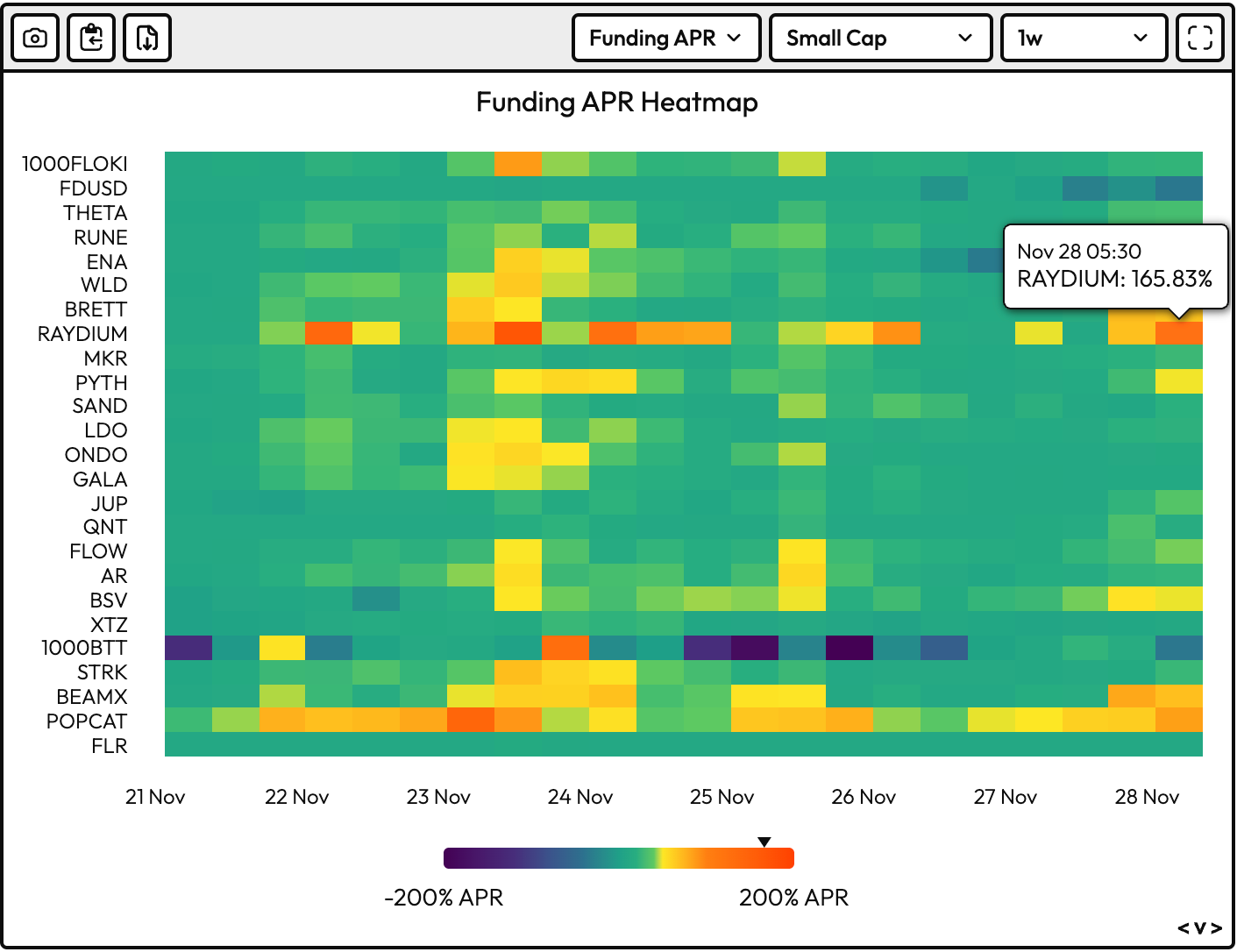
As the only coin with annualized perpetual funding rates still exceeding 160%, RAY stands out among the small, mid and large-cap tokens as the most overheated cryptocurrency, according to data from VeloData. The elevated rate suggests the market for RAY is overcrowded with long positions, with leverage skewed heavily toward the bullish side.

In such conditions, even a slight dip in price can shake the confidence of over-leveraged bulls, especially late entrants, triggering a mass unwinding of long positions, which often exacerbates the price decline, leading to a more pronounced sell-off. Tokens with a <a href="https://www.coingecko.com/en/categories/decentralized-exchange" target="_blank">market capitalization</a> of less than $5 billion, such as RAY, are particularly vulnerable to shenanigans in the derivatives market.

It's easy to see why bulls have thrown caution to the wind. Despite the recent 17% price pullback to $5.39, RAY is still up 67% for the month versus market leader BTC's 35% surge, <a href="https://www.coindesk.com/price/raydium" target="_blank">CoinDesk data show</a>.

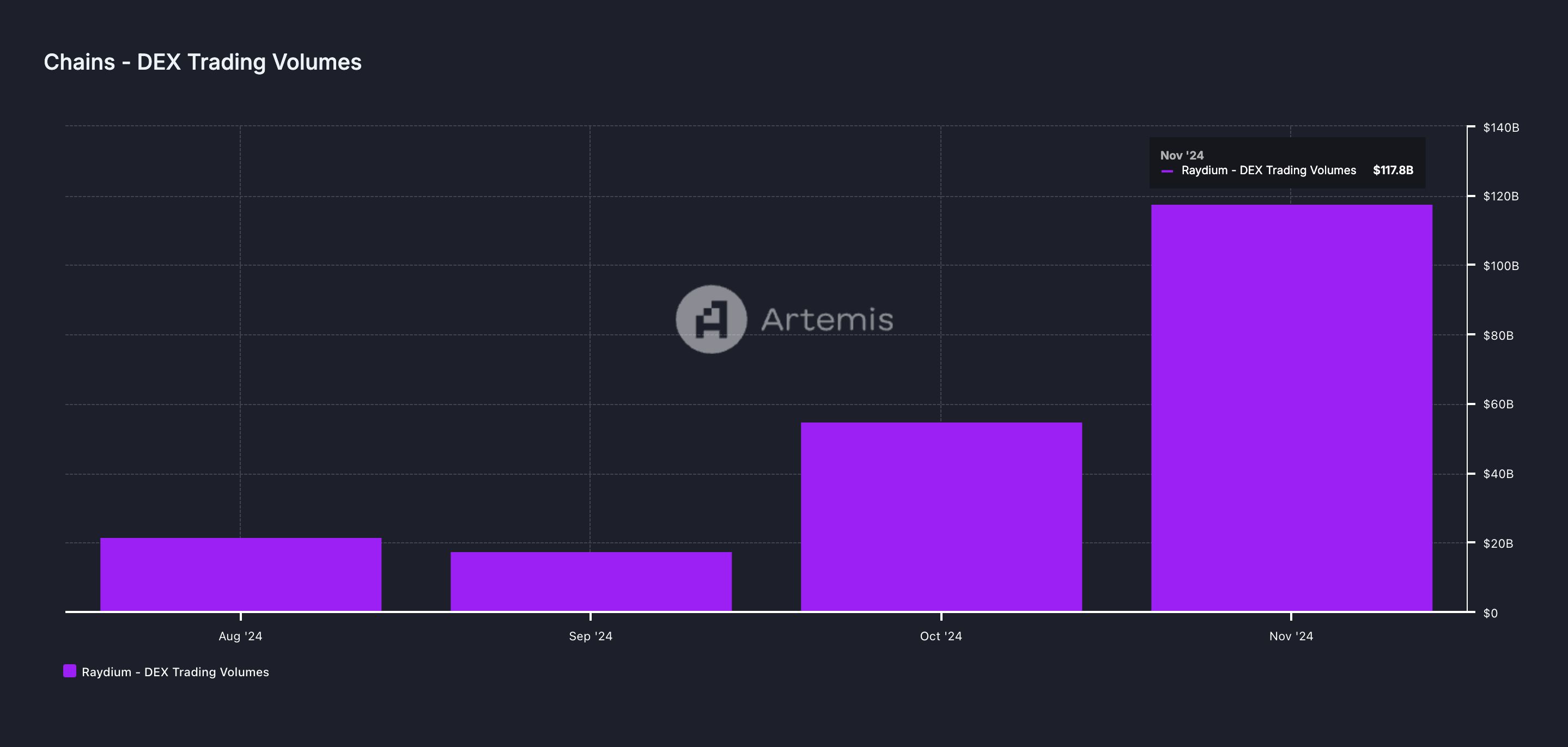
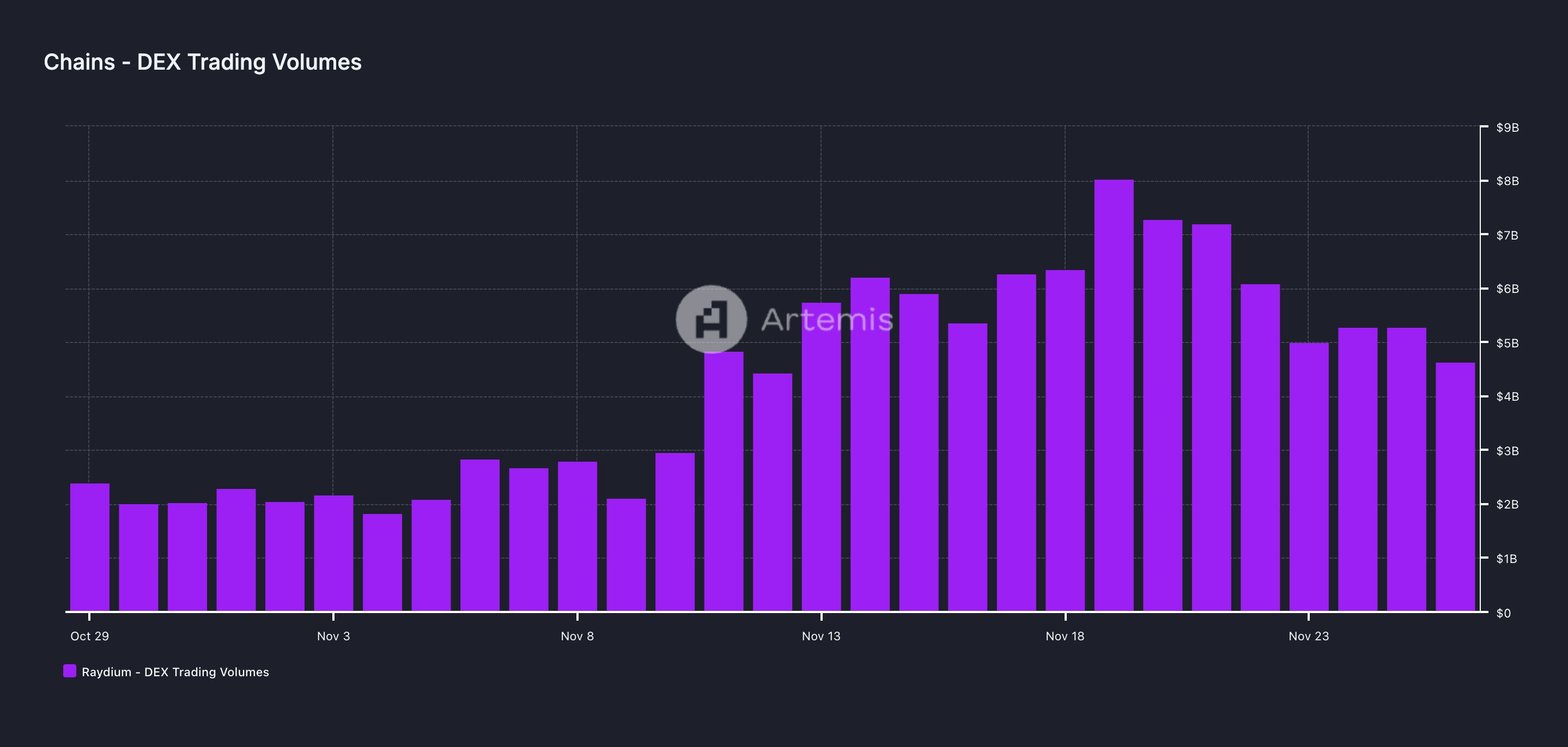
The market-beating rise comes amid record activity on Raydium. According to data source <a href="https://app.artemis.xyz/home" target="_blank">Artemis</a>, Raydium has <a href="https://app.artemis.xyz/project/raydium?from=sectors&tab=fundamentals" target="_blank">registered</a> a trading volume of $117.8 billion this month, nearly twice the entire <a href="https://app.artemis.xyz/project/Ethereum?from=sectors&tab=fundamentals" target="_blank">Ethereum-based DEX volume</a> of $66.8 billion. Raydium has generated $175 million in fees versus Ethereum's $168 million. Ethereum is the world's largest smart contract blockchain.

Note that much of the record activity on Raydium occurred early this month, primarily driven by the memecoin frenzy, which propelled trading volumes to record highs, fueling significant interest in the RAY token. However, the frenzied momentum has begun to cool, weakening the underlying support for a sustained rise in the RAY token.

Dune, landform

☑ ☆ ✇ CoinDesk

Memecoins Show Coinbase's Base Blockchain Isn't So Centralized, Founder Says

By: Sam Reynolds

BANGKOK – Coinbase's Base blockchain launched in August 2023, and grew with the power of memecoins like BALD, a reference to CEO Brian Armstrong's bare scalp. But the protocol's creator says there's more to the story than silliness.

“BALD caught us all by surprise. You know, this was before the public launch of Base. It was when it was just open for developers," Jesse Pollak said during an interview on the sidelines of Devcon in Bangkok. "I remember waking up on Saturday morning and being like, what is going on? It was not in our plan, and it happened.”

BALD was a salient reminder before Base’s public launch that the crypto space can be unpredictable, and sometimes, rather than trying to control everything, the stewards of a protocol simply need to lean into the chaos and figure out how to turn unexpected situations into something great, Pollak said.

Something that's not a rugpull, which <a href="https://www.coindesk.com/markets/2023/07/31/bald-token-plunges-90-as-developer-pulls-liquidity" target="_blank">Bald unfortunately ended up being.</a>

Even though dozens of memecoins have launched on Base in the last year, Pollak wants the protocol to be known for more than that.

Pollak has been on something of a world tour with Base over the last few weeks meeting developers in Africa and Asia, stopping in conferences like Devcon.

During the interview, he emphasized that Base is witnessing significant growth in emerging markets like Southeast Asia, Kenya, and India, where the population wants access to secure economic options like stablecoins.

Indeed, <a href="https://defillama.com/stablecoins/chains" target="_blank">on-chain data shows</a> that Base is quickly catching up to Solana – a much older and more established blockchain – in stablecoin issuance. DeFiLlama data shows Base clocking in at just over $3.5 billion in stablecoin market cap, making it the sixth-highest chain for the dollar-pegged tokens.

Base also has its critics, who argue that <a href="https://www.coindesk.com/business/2024/09/03/bitgo-ceo-says-wrapped-bitcoins-critics-arent-being-intellectually-honest-about-their-concerns" target="_blank">its ties to Coinbase</a> lead to an unhealthy amount of <a href="https://www.coindesk.com/podcasts/carpe-consensus/did-centralization-cause-the-base-blockchain-outage" target="_blank">centralization in the industry.</a>

The recent one-two punch of delisting Wrapped Bitcoin (wBTC) while promoting a Base-powered competitor, cbBTC, earned the latter bitcoin analogue the epithet "<a href="https://www.coindesk.com/tech/2024/11/20/coinbase-delists-wrapped-bitcoin-wbtc-citing-listing-concerns" target="_blank">central bank bitcoin</a>" from the CEO of wBTC's custodian. But Pollak dismisses these concerns, pointing to Bald.

"Bald showed that Base wasn't going to be this place that was fully manicured, curated, controlled, and centralized," he said.

Pollak argues that if Bald can happen on Base with such incredible expressiveness that the Base team had no control over, it proves the platform’s openness.

"I think that was actually a really, really powerful welcoming for the rest of the ecosystem to embrace Base as an open economy where they could participate," he continued.

Base, a layer-2, is built to lean into the decentralization of Ethereum, the protocol that it's built upon, Pollak pointed out.

“Base is built on open source, so that anyone, anywhere can fork the code, know what’s running, and see that it’s actually doing the thing they wanted to,” he said, pointing to the recent launch of <a href="https://base.mirror.xyz/eOsedW4tm8MU5OhdGK107A9wsn-aU7MAb8f3edgX5Tk" target="_blank">fault proofs</a> on Base.

These proofs allow any of Base's 763,036 active addresses (<a href="https://defillama.com/chain/Base?addresses=true" target="_blank">according to DeFiLlama data</a>) to validate and challenge transactions, which Pollak says significantly increases decentralization by removing reliance on centralized entities.

Centralized entities, including Coinbase, which, technically, Base could outlive.

“There are seamless ways to get in and out of Base, so even if Coinbase completely disappeared, people would still be able to transact," Pollak said.

Jesse Pollak presents in Singapore (Coinbase)

☑ ☆ ✇ CoinDesk

Bitcoin Pumps Above $97K, Then Dumps, as Ether, XRP Surge 7%

By: Shaurya Malwa

Bitcoin zoomed above $97,000, bringing hopes of breaching the landmark $100,000 level on social media, before paring gains to nearly $95,500 in Asian morning hours on Thursday. BTC added 3.3% in the past 24 hours, <a href="https://www.coingecko.com/" target="_blank">data shows</a>, ahead of a Thanksgiving weekend that has historically recorded sudden price dumps. Strength in BTC buoyed major tokens, with ether (ETH) outperforming with a 7% surge, XRP and BNB Chain rising 6%, and dogecoin (DOGE) adding more than 5%. A <a href="https://www.coindesk.com/markets/2024/11/27/think-ethereum-s-eth-is-dead-surging-metrics-show-otherwise" target="_blank">CoinDesk analysis</a> on Wednesday pointed out rising activity on ETH-linked futures and on-chain movements, indicative of traders expecting volatility to the update on the second-largest crypto asset. Data shows a bump in revenue, fees, new wallets and on-chain volumes on Ethereum, with the past month showing elevated levels of activity compared to the period from May to September. Meanwhile, cumulative open interest in perpetual and standard futures contracts has surged to a record 6.32 million ETH, worth over $27 billion — all signs that support higher ETH prices ahead. Elsewhere, DeFi tokens aave (AAVE) and uniswap (UNI) surged 9%, and memecoins pepe (PEPE) and mog (MOG) jumped more than 8% on their tendency to act as ether beta bets, as a <a href="https://www.coindesk.com/markets/2024/05/27/ethereum-meme-coins-pepe-mog-hit-lifetime-highs-on-ether-etf-filing-approvals/#:~:text=Frog%2Dthemed%20pepe%20(PEPE),in%20related%20networks%20or%20protocols." target="_blank">CoinDesk analysis</a> noted in May. Traders at QCP Capital said in a Thursday broadcast that money flows are shifting to ETH, with broader equity markets supporting growth in risky asset classes. “The market is shifting flows to ETH, as evidenced by a 13% surge in the ETH/BTC pair to 0.0366 from its post-election low of 0.0318,” QCP said. “ETH even outperformed the broader CoinDesk 20 Index, which rose just 0.5%.” “Wall Street achieved record highs after President-elect Trump nominated Scott Bessent as Treasury Secretary, lifting market sentiment. Bessent’s market-friendly approach and potential willingness to moderate Trump’s tariff policies fueled optimism, driving a broad rally across markets, with risky assets leading the charge,” QCP added. Bessent runs Key Square Group, a macro investing firm. He worked for prominent investor George Soros three decades ago and is <a href="https://www.coindesk.com/policy/2024/11/22/trump-plans-to-name-pro-crypto-hedge-fund-manager-scott-bessent-as-treasury-secretary" target="_blank">considered to be</a> "one of the driving forces" behind Soros Fund Management's famous bet — that netted a more than $1 billion profit — that the British pound would collapse. In a July interview, Bessent said crypto “is about freedom” and that the crypto economy was “here to stay,” pointing out the asset class’ appeal among younger people who may have previously not participated in markets.

(Unsplash)

☑ ☆ ✇ CoinDesk

White House Crypto Czar?

By: Nikhilesh De

We don't know a lot yet about Donald Trump's crypto plans, but we can at least see what's happened so far.

You’re reading State of Crypto, a CoinDesk newsletter looking at the intersection of cryptocurrency and government. <a href="https://www.coindesk.com/newsletters/state-of-crypto" target="_blank">Click here</a> to sign up for future editions.

A crypto czar … and a crypto ambassador

The narrative

Nearly three weeks after the 2024 election, we're still waiting for clear signs of how President-elect Donald Trump's administration might approach crypto. Here's what we know so far.

Why it matters

A large chunk of the crypto industry is betting that Trump's administration will be friendlier toward crypto than President Joe Biden's administration was. Companies are filing for new exchange-traded products tied to crypto and prices shot up in the immediate aftermath of the election.

Breaking it down

The next administration may include a White House official specifically to oversee crypto policy. It's unclear just what this person might do, what sort of budget or staff they may command or just how much authority they will wield. Nevertheless, there are discussions about creating a crypto czar to either oversee policymaking or liaise with policymakers.

<a href="https://www.bloomberg.com/news/articles/2024-11-20/trump-team-mulls-creating-first-ever-white-house-crypto-role" target="_blank">Bloomberg</a> first reported that Trump might appoint a crypto czar.

As a White House position, the role would likely be more focused on political engagement than policymaking, perhaps as a liaison with federal regulators or the independent agencies. The czar could drive the White House's priorities around crypto — whatever those might end up being — as lawmakers draft bills. A lot remains to be seen.

Trump's business ventures also appear to be tightening their relationships with the industry. World Liberty Financial, the Trump-backed crypto project, <a href="https://www.coindesk.com/business/2024/11/25/trumps-sluggish-de-fi-project-gets-a-big-boost-from-justin-suns-30-m-token-purchase" target="_blank">sold $30 million worth of WLFI tokens</a> on Monday to Justin Sun, best known for his roles with Tron and HTX (formerly Huobi), as well as his brief stint as <a href="https://www.coindesk.com/policy/2023/03/30/tron-founder-justin-sun-reportedly-lost-his-diplomatic-status" target="_blank">an ambassador</a> for Grenada to the World Trade Organization.

Prior to Sun's buy, World Liberty Financial had only sold about $21 million worth of tokens. At the $30 million mark, a company Trump controls would begin to receive proceeds from further sales — and Sun's buy pushed the total sales past that threshold. World Liberty Financial's sales, which had been sluggish prior to Monday, also saw additional boosts from other buyers after Sun's purchase.

World Liberty Financial announced Sun <a href="https://www.coindesk.com/business/2024/11/26/justin-sun-joins-donald-trumps-world-liberty-financial-as-adviser" target="_blank">would join it as an adviser</a> a day later.

Another of Trump's companies, Trump Media and Technology Group — Truth Social's parent company — is considering acquiring Bakkt, a crypto trading platform launched by Intercontinental Exchange (ICE, the New York Stock Exchange's parent company), according to <a href="https://www.ft.com/content/d7f921d5-3668-4b6b-a98d-2681ad73610f" target="_blank">The Financial Times</a>. Bakkt's first CEO was Kelly Loeffler, who was later appointed a U.S. Senator and is the wife of ICE CEO Jeffrey Sprecher. Loeffler is also <a href="https://apnews.com/article/trump-inauguration-8d90aacdb40a461214c828abac53e916" target="_blank">a co-chair of Trump's inaugural committee</a>.

TMTG's interest in Bakkt was reported a day after Truth Social <a href="https://tsdr.uspto.gov/#caseNumber=98859006&caseSearchType=US_APPLICATION&caseType=DEFAULT&searchType=statusSearch" target="_blank">applied for a trademark</a> for "TRUTHFI," which the application said would refer to digital wallet software that includes cryptocurrency payment processing and custody services. <a href="https://www.nytimes.com/2024/11/21/business/trump-media-crypto-payment-service.html" target="_blank">The New York Times</a> first reported on the application.

Stories you may have missed

<a href="https://www.coindesk.com/policy/2024/11/27/eu-approves-commissioners-including-ones-who-will-likely-oversee-crypto-rules" target="_blank">EU Approves Commissioners, Including Ones Who Will Likely Oversee Crypto Rules</a>: The European Union has confirmed its slate of commissioners to oversee various regulatory priorities, including three individuals who may be responsible for the implementation and further development of rules around crypto.

<a href="https://www.coindesk.com/policy/2024/11/26/ripple-drops-another-usd25m-into-crypto-pac-to-sway-2026-congressional-races" target="_blank">Ripple Drops Another $25M Into Crypto PAC to Sway 2026 Congressional Races</a>: Ripple has committed $25 million to the Fairshake crypto super political action committee, bringing its fresh funds to $73 million so far for the 2026 election cycle. Fairshake already has $30 million left over from the 2024 cycle, so the war chest totals $103 million.

<a href="https://www.coindesk.com/policy/2024/11/26/tornado-cash-sanctions-overturned-by-u-s-appeals-court" target="_blank">Tornado Cash Sanctions Overturned by U.S. Appeals Court; TORN Soars Over 500%</a>: The Fifth Circuit Court of Appeals ruled that the U.S. Treasury Department exceeded its authority in sanctioning Tornado Cash, saying "immutable smart contracts … are not the 'property' of a foreign national or entity." Coinbase was among the plaintiffs who brought the case.

<a href="https://www.coindesk.com/policy/2024/11/27/vitalik-buterin-donated-1-m-in-ether-to-coin-center-hours-after-tornado-cash-victory" target="_blank">Vitalik Buterin Donated $1M in Ether to Coin Center Hours After Tornado Cash Victory</a>: Coin Center, which has its own case over the Tornado Cash sanctions pending before the Eleventh Circuit Court of Appeals, received $1 million from Ethereum creator Vitalik Buterin.

<a href="https://www.coindesk.com/policy/2024/11/26/crypto-gains-let-poor-people-buy-houses-u-s-research-finds-but-risks-may-lurk" target="_blank">Crypto Gains Let Poor People Buy Houses, U.S. Research Finds, But Risks May Lurk</a>: Crypto owners may have used their gains to buy houses at a greater rate than the broader U.S. population, the Treasury Department's Office of Financial Research said in a new paper. The office only had data through 2021, meaning the market collapse of 2022 did not figure into this week's report.

This week

Wednesday

The European Parliament confirmed its commissioners for the coming term.

Elsewhere:

(<a href="https://www.404media.co/xs-objection-to-the-onion-buying-infowars-is-a-reminder-you-do-not-own-your-social-media-accounts/" target="_blank">404 Media</a>) X, formerly known as Twitter, has objected to The Onion acquiring the X handles used by InfoWars after The Onion won a bankruptcy auction to acquire the assets of the media company founded by conspiracist Alex Jones.

(<a href="https://www.washingtonpost.com/business/2024/11/27/trump-strategic-bitcoin-reserve-plan/" target="_blank">The Washington Post</a>) Crypto executives really want the U.S. government to establish a strategic bitcoin reserve.

If you’ve got thoughts or questions on what I should discuss next week or any other feedback you’d like to share, feel free to email me at <a href="mailto:nik@coindesk.com" target="_blank">nik@coindesk.com</a> or find me on Bluesky <a href="https://bsky.app/profile/nikhileshde.bsky.social" target="_blank">@nikhileshde.bsky.social</a>.

You can also join the group conversation on <a href="https://t.me/CDstateofcrypto" target="_blank">Telegram</a>.

See ya’ll next week!

(René DeAnda/Unsplash)

☑ ☆ ✇ CoinDesk

Why Costa Rica Is Taking a Hands-Off Approach to Regulating Crypto

By: Tom Carreras

Costa Rica doesn’t have any formal crypto laws. But its government and institutions are quietly letting the sector flourish.

That’s according to Jorge Eduardo Dengo Rosabal, a former deputy of Costa Rica’s Legislative Assembly who participated in the drafting of a proposed — and rejected — crypto regulation bill for the Latin American nation back in 2022.

“The best way to define the situation is that the government is carefully watching what is going on in the crypto world, but hasn't gotten its hands fully into regulation yet, although there have been some discussions around it,” Dengo told CoinDesk in an interview.

The hands-off approach is partially motivated by a desire to keep track of the various crypto experiments popping up in the Latin American country of 5.2 million people and see whether they yield positive results, Dengo said.

One such project is Pura Vida Technologies, a firm that builds bitcoin (<a href="https://www.coindesk.com/price/bitcoin" target="_blank">BTC</a>) infrastructure in Costa Rica by supporting merchant adoption, providing over-the-counter (OTC) trading services and spinning up bitcoin ATMs. Josh Pooley, the corporation’s business development manager, said that the regulatory limbo gives crypto companies a chance to prove their merits before the country makes any big decision in favor or against the industry.

“Specific members of the Legislative Assembly and of the government … they’re curious. They're watching and in regular contact.” Pooley told CoinDesk in an interview. “If we can prove that bitcoin is a net positive to Costa Rica, I think we'll see things move along a lot faster.”

Central to this state of play is Costa Rica’s constitution and civil code, explained Dengo, who is an attorney and public notary. Both documents state that, as far as private parties are concerned, any activity that is not explicitly forbidden by the law is permitted. In other words, Costa Ricans can trade and own cryptocurrencies, or provide crypto services, simply based on the fact that there aren’t any laws prohibiting it.

Costa Rica’s situation is therefore quite different from fellow Central American nation El Salvador, which under President Nayib Bukele’s leadership has adopted <a href="https://www.coindesk.com/policy/2024/11/16/an-interview-with-el-salvadors-top-crypto-regulator-developing-countries-can-lead-the-financial-revolution" target="_blank">a regulatory framework tailored to crypto</a>, with a focus on bitcoin as a financial asset. Nor is the regime antagonistic towards the industry in the way that the Chinese Communist Party or even the Biden administration have been. Rather, it’s comfortable with watching events unfold — and this state of affairs could persist for a while, Dengo said.

“It’s a ‘tomorrow problem.’ And by tomorrow, I mean two or three years from now,” Dengo said. “My educated guess on this matter would be that the move to regulate would probably be deeply related to the question of taxing crypto transactions.”

Legal status of cryptocurrencies in Costa Rica

The absence of crypto legislation means that Costa Ricans must rely on existing laws and institutional communiqués for regulatory guidance.

The Central Bank of Costa Rica (BCCR) <a href="https://perma.cc/KD4P-WXX8" target="_blank">declared</a> in 2017 that cryptocurrencies — including bitcoin — could not be recognized as legal tender in the country because unlike the nation’s official currency, the colón, their monetary supplies are not controlled by the central bank. And since no other central bank in the world issues them, they cannot be treated as foreign currencies either.

This means cryptocurrencies may fall under the classification of “means of payment” and “quasi-money,” as international law firm Freeman Law <a href="https://freemanlaw.com/cryptocurrency/costa-rica/" target="_blank">has argued</a>. Costa Rica’s labor code stipulates that assets as diverse as food or land can be used as means of payment, while quasi-money refers to highly liquid non-cash assets, like gold certificates or government-issued treasury securities.

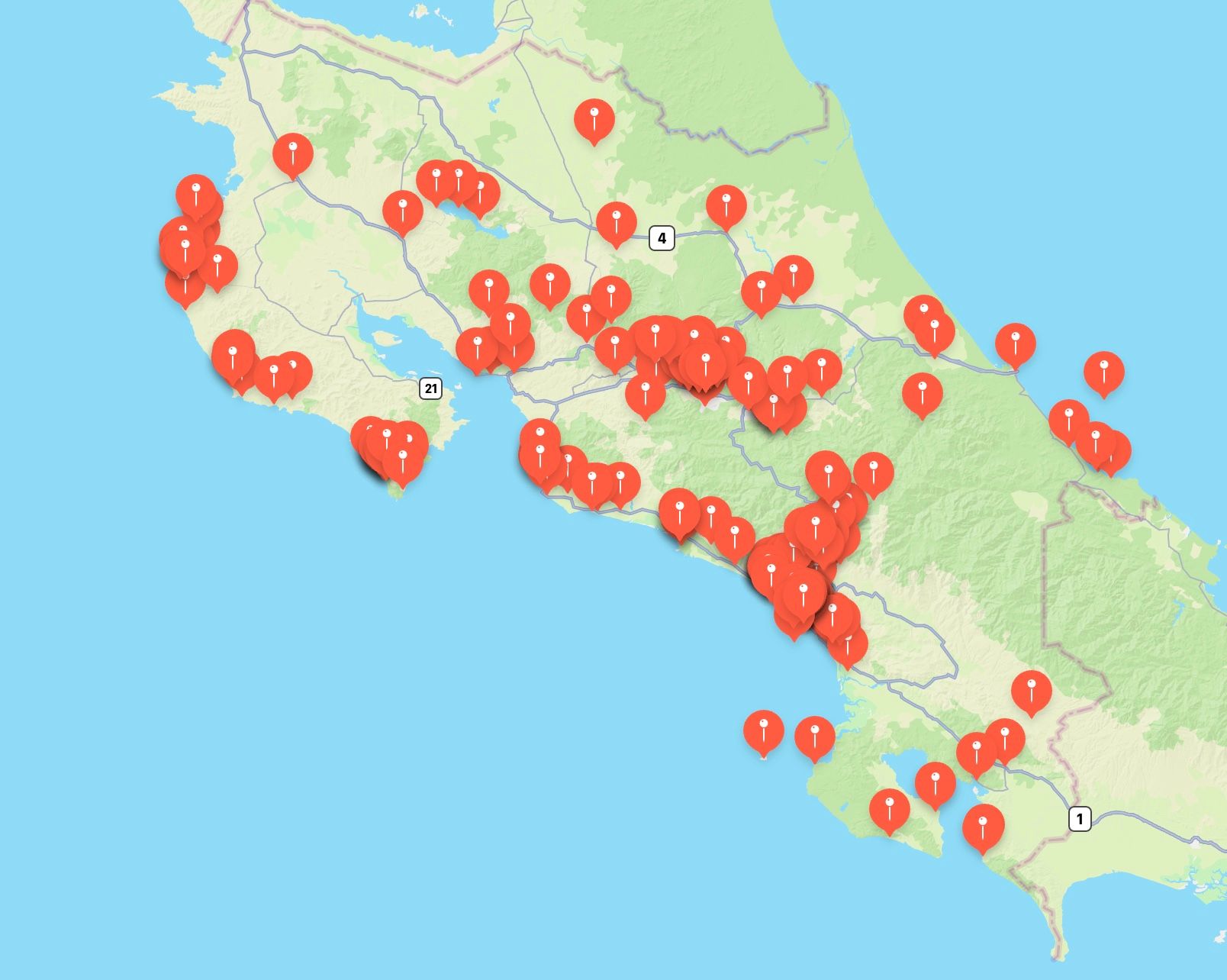
Costa Rica only ranked 90th out of 151 countries in terms of global crypto adoption in Chainalysis’ <a href="https://www.chainalysis.com/wp-content/uploads/2024/10/the-2024-geography-of-crypto-report-release.pdf" target="_blank">2024 Geography of Crypto Report</a>, yet an increasing number of Costa Rican merchants — such as coffee shops, car washes, hotels, legal services, health and wellness centers, restaurants, tourism activities, nurseries and transportation companies — have been making use of the technology. Three provinces especially stand out in terms of adoption: the nation’s capital San José, as well as Puntarenas and Guanacaste, along the Pacific coast.

That’s not all. Cryptocurrencies, and especially bitcoin, are regularly used for real estate purposes. In fact, such transactions provide Pura Vida Technologies one of its main revenue streams. “Trading volumes at our OTC desk range from a couple hundred dollars to $750,000 a day,” Pooley said, with multiple transactions occurring each day. “My dad [Pura Vida CEO Mark Pooley], has taken point on OTC, you should see the guy's phone. It’s disgusting how many messages he receives.”

The widespread adoption of cryptocurrencies across the country could be seen as supporting a quasi-money classification. However, in 2019 the BCCR <a href="https://www.bccr.fi.cr/publicaciones/Criptomonedas/NT-01-2019-Criptoactivos-analisis-e-implicaciones-desde-la-perspectiva-del-BCCR.pdf" target="_blank">published a report</a> in which it argued that, based on the agency’s interpretation of Costa Rica’s civil code, cryptocurrencies are a type of asset that should be considered “goods” or “property.”

The Ministry of the Hacienda — Costa Rica’s tax authority — <a href="https://globaltaxnews.ey.com/news/2023-1492-costa-rican-tax-authority-issues-a-private-letter-ruling-related-to-the-tax-treatment-of-crypto-assets" target="_blank">went further</a> in a private letter ruling from August 2023. The Hacienda’s position: Cryptocurrencies are considered virtual assets for tax purposes and can be subject to corporate income or capital gains taxes, depending on circumstances. Crypto service providers such as wallet providers, miners and exchanges must comply with various tax obligations too.

Other government entities like the National Registry (which maintains a public database of the ownership of assets nationwide) are also taking steps to accept cryptocurrencies within their own frameworks, Dengo said. In the Registry’s case, he explained, the purchase and selling of assets — like motorbikes, cars or real estate — can now be noted as having occurred through crypto means as long as both parties first register the value of the transaction in colones or U.S. dollars.

“Finding a legal qualification for a crypto asset is essential, since it gives rise to the possibility of assigning a sphere of rights to the person who owns it, as well as the legal mechanisms for its protection,” Costa Rican lawyer Carlos Astorga Cerdas and finance professor Malberth Cerdas Herrera <a href="https://www.scielo.sa.cr/scielo.php?script=sci_arttext&pid=S2215-24662024000100001#f2" target="_blank">wrote</a> in 2023. “This qualification is imperative as long as there is constitutional protection of justice, in which all people have the right to compensation for damages attributed to their person or property.”

Costa Rica’s Crypto Asset Market Law

It’s not like Costa Rican legislators have been asleep at the wheel.

A comprehensive crypto regulation bill called the <a href="https://d1qqtien6gys07.cloudfront.net/wp-content/uploads/2022/10/23415.pdf" target="_blank">Crypto Asset Market Law</a> was introduced at the Legislative Assembly in 2022 by deputy Johana Obando Bonilla, with assistance from Dengo, as well as deputies Eli Feinzaig Mintz and Luis Diego Vargas Rodríguez. All four are members of the Liberal Progressist Party, an opposition party which holds five of the 57 available seats in the Assembly. The bill aimed to codify the use of cryptocurrencies for the payment of goods and services in Costa Rica, but without making any of them — not even bitcoin — legal tender as in El Salvador. It tackled a range of subjects, including the legal definition of crypto assets, the registration of crypto asset service providers and their inclusion in the BCCR’s national electronic payment system (SINPE), anti-money laundering provisions and a tax regime on crypto assets.

But the bill got stuck at the commission level, meaning that most members of the Assembly haven’t had a chance to debate and vote on the proposal yet.

“The most positive aspect of the project was that it tried to regulate and define cryptocurrencies as assets that aren’t subject to taxes,” Dengo said. “But that was also the aspect that led the bill to be stopped. It was controversial for its standing on taxes. … Deputies in Costa Rica are not well versed on these matters — they do not understand how cryptocurrencies work.” Dengo, who retired for family reasons in May before his term ended, said that he doesn’t expect any kind of crypto legislature to go through the Assembly before the next legislative elections in spring of 2026. “There is no immediate political gain in trying to bring this to the table,” Dengo said. “It’s not like the vast majority of people in Costa Rica deal with cryptocurrencies. This is a very niche subject matter.”

Down the line, crypto could end up having a particularly strong impact in rural areas of Costa Rica where financial services are limited, Dengo said. The World Bank <a href="https://digitalfinance.worldbank.org/country/costa-rica" target="_blank">estimated</a> in 2021 that roughly 25% of the population was unbanked and only 22% of adults placed their savings in financial institutions.

Pooley, whose efforts focus in rural areas of the Guanacaste province, agreed. “My dream is to get this entire coastline orange,” he said, referring to the color associated with bitcoin.

Costa Rica, parrots, jungle

☑ ☆ ✇ CoinDesk

The Protocol: Bitcoin Bridged Trustlessly to L2; Ethereum's Blob Mob

By: Marc Hochstein

Welcome to The Protocol, CoinDesk's weekly wrap-up of the most important stories in cryptocurrency tech development. I'm <a href="https://www.coindesk.com/author/marc-hochstein/" target="_blank">Marc Hochstein</a>, CoinDesk's deputy editor-in-chief for features, opinion and standards.

IN THIS ISSUE:

Ethereum's blob mob

Staking on Starknet

Avalanche's big upgrade

L2 teams beam over Beam Chain

Sui suffers a brief outage

Bitcoin bridged, trustlessly

This article is featured in the latest issue of <a href="https://www.coindesk.com/newsletters/the-protocol/" target="_blank">The Protocol</a>, our weekly newsletter exploring the tech behind crypto, one block at a time. <a href="https://www.coindesk.com/newsletters/the-protocol/" target="_blank">Sign up here</a> to get it in your inbox every Wednesday. Also please check out our weekly <a href="https://www.coindesk.com/podcasts/the-protocol/" target="_blank">The Protocol</a> podcast.

Network news

BEAMING OVER THE BEAM CHAIN: What's good for the L1 is good for the L2s. That's the assessment the teams behind zkSync and Polygon, two of the leading layer-2 networks running on top of Ethereum, gave of Justin Drake's proposal to overhaul the $400 billion blockchain, dismissing suggestions it would make their auxiliary networks redundant. “That's really a misconception,” said Alex Gluchowski, the CEO of Matter Labs, the developer firm behind zkSync. “The changes that Justin announced are focused on the consensus layer, not on the execution layer. It's not going to affect the execution layer.” In addition to incorporating ZK, Drake's proposal seeks to shorten block times, which could cut transaction costs for L2s settling on Ethereum. Drake also said he wants to introduce single-slot finality, meaning blocks with transaction data could be finalized immediately, and that information would become permanent right away. “All of those things are great because we depend on Ethereum as the global settlement layer,” Gluchowski said. Brendan Farmer, a co-founder at Polygon, also told CoinDesk he doesn’t think the Beam Chain would obsolesce layer-2s. Instead, he said, the upgrade would “make rollups work better.” However, others in the crypto community were underwhelmed by the whole plan, lamenting in particular that Drake’s five-year timeline wasn’t ambitious enough, leaving ample room for centrally-developed chains like Solana to eat Ethereum’s lunch.” <a href="https://www.coindesk.com/tech/2024/11/21/ethereum-layer-2-teams-welcome-proposal-to-overhaul-blockchain" target="_blank">Read more</a>

SUI OUTAGE: Sui Network (SUI), a relatively new blockchain, experienced an unexpected two-hour outage on Thursday. The downtime was caused by a bug in its transaction scheduling logic, which led to its validator network crashing. The issue was resolved, the network said. Blockchain outages can take place for a plethora of reasons, ranging from a 51% attack to technical errors. A common error is that of nodes - or individual entities that process transactions - being unable to sync with each other, causing the blockchain to go offline. Software bugs may be another error vector, where outdated code can render the network's processes inoperable. <a href="https://www.coindesk.com/tech/2024/11/21/sui-network-back-up-after-scheduling-bug-leads-to-two-hour-downtime-sui-recovers" target="_blank">Read more</a>

STAKING ON STARKNET: Starknet has become the first major rollup blockchain running on top of Ethereum to let users earn money by staking their tokens and validating transactions. (Metis was the first layer-2 to do so but is far smaller and is an "optimium," a different kind of L2.) Now, anyone who has at least 20,000 STRK tokens (roughly $12,000 at recent prices) can pledge the asset as collateral and earn rewards for validating transactions. Users with less than 20,000 STRK can delegate their tokens to validators to stake on their behalf. (Validators that behave maliciously or neglect their duties stand to forfeit staked tokens.) Validators and delegators that want to withdraw staked tokens must wait 21 days to receive them as well as any rewards earned from staking. Implementing staking on Starknet is part of a multiphase plan. During this first phase, StarkWare, the company developing Starknet will study staking habits on the network, and from there will assess whether and how its validators can be given the additional responsibilities of creating and "attesting," or confirming, blocks in the protocol. <a href="https://www.coindesk.com/tech/2024/11/26/crypto-staking-goes-live-on-starknet-in-first-for-ethereum-l2-blockchains" target="_blank">Read more</a>

AVALANCHE'S BIG UPGRADE: Avalanche, the eighth-largest blockchain by total value locked (TVL), is moving ahead with a major technical makeover. The Avalanche9000 upgrade went live in a test network environment Monday, bringing the changes one step closer to the main network. Avalanche9000 will be the largest upgrade that Avalanche has seen. It is designed to cut the costs of sending transactions, operating validators and building apps on the network, whose native token (AVAX) is the 11th-largest cryptocurrency, with a $16 billion market cap. The foundation is trying to attract developers to Avalanche and encourage users to create customized blockchains using its technology, known as subnets. Somewhat confusingly, subnets are now officially referred to in the Avalanche community as "L1s," even though they are roughly analogous to the layer-2, or L2, networks that augment Ethereum and other blockchains. (Avalanche's "primary network," the equivalent of a layer-1 in other ecosystems, is considered a subnet.) The team is hoping to bring Avalanche9000 to mainnet by yearend. Among other changes, 9000 would allow for a new type of validator with which anyone can launch their own subnets. <a href="https://www.coindesk.com/tech/2024/11/25/avalanche-blockchains-largest-ever-upgrade-goes-live-on-testnet?_gl=1*1ycxzn7*_up*MQ..*_ga*MTExNTkwOTY0Ny4xNzMyNjM1NDE3*_ga_VM3STRYVN8*MTczMjYzNTQxNi4xLjEuMTczMjYzNTQyNS4wLjAuNzc0MTY1MjQy" target="_blank">Read more</a>

ONE-WAY TICKET: BitcoinOS, a smart contract project led by crypto O.G. <a href="https://www.coindesk.com/policy/2024/10/26/from-smuggling-gold-out-of-africa-to-bridging-bitcoin-and-cardano" target="_blank">Edan Yago</a>, has executed what it bills as the first trustless bridge transaction for any blockchain. Using zero-knowledge cryptography, a nominal amount of bitcoin (0.0002 BTC, about $19 and change) was locked up on the main blockchain's testnet, and a proof was generated minting tokens on the testnet for Merlin Chain, a layer-2 network. No oracle or custodian was involved, according to BitcoinOS. For now, however, Merlin Chain is like the <a href="https://genius.com/37517" target="_blank">Hotel California</a> or a <a href="https://www.youtube.com/watch?v=ZXUQ_4gMoG0" target="_blank">roach motel</a> for the bridged BTC. "This is one half of the bridge showing the ability to bridge assets from Bitcoin to an EVM," BitcoinOS said in a press release. "Once the other half of the bridge is completed, Merlin Chain users can settle their Bitcoin-pegged assets back to the mainchain by proving that the tokens were burned."

Ethereum's Blob Mob

Usage of binary large objects, or blobs, has surged on the Ethereum network, signaling that more users are embracing layer-2 scaling tech for faster and more affordable transactions.

This year, Ethereum's Dencun upgrade introduced blobs, which allow large chunks of data to be temporarily attached to transactions, and later deleted after the data is verified. (You can think of a blob as a <a href="https://www.cyfrin.io/blog/what-is-eip-4844-proto-danksharding-and-blob-transactions#what-is-a-blob-transaction" target="_blank">sidecar that rides along with a motorcycle</a> for a time but eventually gets detached and discarded.) Layer-2 protocols such as BASE, Arbitrum, and Optimism use blobs to bundle transactions together, process them off-chain and then post them to the Ethereum main chain for verification without permanently gumming up the works.

The number of blobs posted to the network consistently averaged more than 21,000 this month, matching the record activity seen in March, according to pseudonymous data analyst Hildobby's <a href="https://dune.com/hildobby/blobs" target="_blank">Dune Analytics dashboard</a>.

Posting blobs costs a fee, which fluctuates depending on network conditions. The fees are paid in Ethereum's native token ether, and are burned just like regular transaction fees, taking supply of ETH off the market, a positive for the coin's price.

In this way, blobs mitigate the much-discussed cannibalization of the main chain by L2.

The blob base submission fee spiked as high as $80 on Monday, the highest since March, and the average number of blobs posted in each Ethereum block rose to 4.3. More importantly, blob fees have burned over 214 ETH worth $723,000 over the last seven days, the sixth largest source of fee burns on the network over that period, according to data from ultrasound.money.

<a href="https://www.coindesk.com/markets/2024/11/26/ethereum-blob-usage-explodes-as-traders-rush-to-layer-2-solutions" target="_blank">CLICK HERE FOR THE FULL ANALYSIS BY COINDESK'S OMKAR GODBOLE</a>

Money Center

Vibe shift

<a href="https://www.coindesk.com/business/2024/11/22/coinbase-app-gets-left-behind-as-memecoin-craze-drives-traders-on-chain?_gl=1*12vt1du*_up*MQ..*_ga*MTExNTkwOTY0Ny4xNzMyNjM1NDE3*_ga_VM3STRYVN8*MTczMjYzNTQxNi4xLjEuMTczMjYzNTQyNS4wLjAuNzc0MTY1MjQy" target="_blank">Coinbase App Gets Left Behind as Memecoin Craze Drives Traders On-Chain</a>

Not just fun and games?

<a href="https://www.coindesk.com/opinion/2024/11/25/why-memecoins-matter" target="_blank">Why Memecoins Matter</a>

Bringing in the big Sun

<a href="https://www.coindesk.com/business/2024/11/25/trumps-sluggish-de-fi-project-gets-a-big-boost-from-justin-suns-30-m-token-purchase?_gl=1*lnsg8n*_up*MQ..*_ga*MTExNTkwOTY0Ny4xNzMyNjM1NDE3*_ga_VM3STRYVN8*MTczMjYzNTQxNi4xLjEuMTczMjYzNTQyNS4wLjAuNzc0MTY1MjQy" target="_blank">Trump's Sluggish DeFi Project Gets a Big Boost From Justin Sun's $30M Token Purchase</a>

<a href="https://www.coindesk.com/business/2024/11/26/justin-sun-joins-donald-trumps-world-liberty-financial-as-adviser?_gl=1*lnsg8n*_up*MQ..*_ga*MTExNTkwOTY0Ny4xNzMyNjM1NDE3*_ga_VM3STRYVN8*MTczMjYzNTQxNi4xLjEuMTczMjYzNTQyNS4wLjAuNzc0MTY1MjQy" target="_blank">Justin Sun Joins Donald Trump's World Liberty Financial as Adviser</a>

"Reports are greatly exaggerated"

<a href="https://www.coindesk.com/markets/2024/11/27/think-ethereum-s-eth-is-dead-surging-metrics-show-otherwise" target="_blank">Think Ethereum’s ETH is Dead? Surging Metrics Show Otherwise</a>

Calendar

Dec. 4-5: <a href="https://indiablockchainweek.com/" target="_blank">India Blockchain Week</a>, Bangalore

Dec. 5-6: <a href="https://www.theblock.co/post/283406/the-block-launches-emergence-a-premier-conference-for-the-digital-assets-industry" target="_blank">Emergence</a>, Prague

Dec. 9-12: <a href="https://adfw.com/" target="_blank">Abu Dhabi Finance Week</a>

Dec. 11-12: <a href="https://newyork.theaisummit.com/" target="_blank">AI Summit NYC</a>

Dec. 11-14: <a href="https://www.taipeiblockchainweek.com/" target="_blank">Taipei Blockchain Week</a>

Jan 9-12, 2025: <a href="https://www.ces.tech/" target="_blank">CES</a>, Las Vegas

Jan. 15-19: <a href="https://www.weforum.org/events/world-economic-forum-annual-meeting-2024" target="_blank">World Economic Forum</a>, Davos, Switzerland

January 21-25: <a href="https://329b0589.isolation.zscaler.com/profile/2332cf23-bc6a-418b-a941-f595d0e3ea25/zia-session/?controls_id=22337358-9ef1-4c14-8042-bae40f505928&region=pdx&tenant=cac35314c425&user=065ae33aa0b7fd8bb4e9ae9286b2fcf7c62d677db428d6cd9b6e4d01e6ffa098&original_url=https%3A%2F%2Fwagmi.miami%2F&key=sh-1&hmac=5349b2cbc41b5242c21267747a0dc197c5cb3cc3c860fe73f8de2f049e1adea8" target="_blank">WAGMI conference</a>, Miami.

Jan. 24-25: <a href="https://adoptingbitcoin.org/capetown-2024/" target="_blank">Adopting Bitcoin</a>, Cape Town, South Africa.

Jan. 30-31: <a href="https://planb.sv/" target="_blank">PLAN B Forum</a>, San Salvador, El Salvador.

Feb. 1-6: <a href="https://satoshiroundtable.org/" target="_blank">Satoshi Roundtable</a>, Dubai

Feb. 19-20, 2025: <a href="https://consensus-hongkong2025.coindesk.com/" target="_blank">ConsensusHK</a>, Hong Kong.

Feb. 23-24: <a href="https://www.nftparis.xyz/" target="_blank">NFT Paris</a>

Feb 23-March 2: <a href="https://www.ethdenver.com/" target="_blank">ETHDenver</a>

May 14-16: <a href="https://consensus2025.coindesk.com/" target="_blank">Consensus</a>, Toronto.

May 27-29: <a href="https://x.com/LasVegasLocally/status/1817280637457551831" target="_blank">Bitcoin 2025</a>, Las Vegas.

Network solutions

☑ ☆ ✇ CoinDesk

EU Approves Commissioners, Including Ones Who Will Likely Oversee Crypto Rules

By: Camomile Shumba

The European Parliament approved its slate of commissioners <a href="https://www.europarl.europa.eu/news/en/press-room/20241121IPR25546/parliament-approves-the-von-der-leyen-ii-commission" target="_blank">on Wednesday</a>, including the individuals who will be responsible for monitoring regulations around digital assets.

In September, European Parliament President Ursula Von der Leyen <a href="https://ec.europa.eu/commission/presscorner/detail/en/ip_24_4723" target="_blank">proposed a list of commissioners</a>. While crypto did not stand out as a core topic amongst the roles, this group will be responsible for ensuring digital asset rules are implemented.

The European Union (EU), a bloc of 27 nations, was the first major jurisdiction in the world to establish <a href="https://www.coindesk.com/policy/2023/05/31/eu-formally-signs-new-crypto-licensing-money-laundering-rules-into-law/" target="_blank">a bespoke crypto legislative package last year, otherwise known as the Markets in Crypto Assets</a> legislation (MiCA). <a href="https://www.coindesk.com/policy/2024/06/27/eus-restrictive-stablecoin-rules-take-effect-soon-and-issuers-are-running-out-of-time/" target="_blank">Stablecoin rules came into force in June, while the rest of the rules are expected to come in force by December</a>.

"I don't expect a big legislative agenda in the blockchain space and in the digital space per se, over the next year or so," said Mark Foster, EU policy lead at the Crypto Council for Innovation.

Though no commissioner role is solely dedicated to crypto, the EU still has to ensure MiCA is being followed. Some commissioners will have digital assets fall within their remit as the nation advances its crypto rules, Foster said.

"What the industry is really wanting is the EU to continue to discuss with its international partners and ensure that the rules that are being developed across the globe are to the extent possible, interoperable, consistent, and have the same goals," Foster said.

The commissioners have also been tasked with exploring whether or not more regulation is needed.

"According, to MiCA, we are also required to present a report on the latest developments with respect to crypto assets, including an assessment of the necessity and feasibility of regulating decentralized finance activities, lending and borrowing of crypto assets, as well as non-fungible tokens," said Marcel Haag, director of Horizontal Policies at the European Commission, at a Crypto Council for Innovation Forum last week.

They will also have to decide whether or not to terminate the <a href="https://www.esma.europa.eu/esmas-activities/digital-finance-and-innovation/dlt-pilot-regime" target="_blank">Distributed Ledger Technology</a> pilot or make it permanent and review a proposal for establishing a legal framework for the digital euro, a central bank digital currency issued by the European Central Bank.

The commission is also set to launch a legal analysis on the suitability of member states' legislation for financial asset tokenization, Haag said.

Read more: <a href="https://www.coindesk.com/learn/mica-eus-comprehensive-new-crypto-regulation-explained/" target="_blank">MiCA, EU’s Comprehensive New Crypto Regulation, Explained</a>

The Commission

The EU commission is the executive branch of the EU. Each member state has to select one person to form the commission.

Von der Leyen, who asked for a balanced gender group of commissioners, had the task of choosing what roles each person will take on for the next five years. People were appointed for roles on trade, climate, technology, economy, international partnership, finance and more.

Each commissioner will have their own focus, but Von der Leyen said in her <a href="https://commission.europa.eu/about-european-commission/towards-new-commission-2024-2029/commissioners-designate-2024-2029_en" target="_blank">mission letters</a> the priorities are not standalone and will affect each other.

Plus, crypto is a trans-sectoral topic, Faustine Fleuret, president of industry group ADAN that focuses on Web3 said, adding that they could "engage with everyone" in the commission when it comes to the sector.

Commissioners from Portugal, Finland and France will likely have some purview over crypto.

Stéphane Séjourné

France's Stéphane Séjourné has been chosen to be the executive vice-president for prosperity and industrial strategy, as well as the commissioner for industry, small and medium-sized enterprises (SMEs) and the single market.

This <a href="https://commission.europa.eu/document/6ef52679-19b9-4a8d-b7b2-cb99eb384eca_en" target="_blank">job would include improving access to finance</a>, simplifying the regulatory environment and promoting innovation for small and medium-sized enterprises. He will also oversee a project called the "horizontal single market strategy" that will require him to address barriers to the movement of goods and services abroad. His role could bring crypto under his oversight, Fleuret said.

Fleuret said she could see the industry pushing Web3 interests and positions on "trade and economic safety, finance, the capital market union, innovation and research" to Séjourné.

"We had previous relations with Stéphane Séjourné during the MiCA negotiation, and at that stage, he was quite open to innovation," Fleuret said, adding that he believed in regulating the sector but knew not to hamper crypto with rules that were too strict.

Maria Luís Albuquerque

Portugal's <a href="https://commission.europa.eu/document/ac06a896-2645-4857-9958-467d2ce6f221_en" target="_blank">Maria Luís Albuquerque</a> will be the commissioner for financial services and the savings and investment union. Her work will include ensuring rules for the financial sector are enforced and improving the EU's supervisory system. She will work on improving digital finance and payments.

Plus, Albuquerque will ensure the enforcement of the <a href="https://www.coindesk.com/policy/2024/04/26/eu-parliament-adopts-anti-money-laundering-rules-package-also-policing-crypto/" target="_blank">anti-money laundering package</a> that targets large cash payments, crypto firms and more.

The EU has been considering doing <a href="https://www.coindesk.com/policy/2022/06/27/nft-private-wallet-fates-hang-on-eu-crypto-talks-this-week/" target="_blank">a MiCA 2.0</a> to address issues like crypto staking, lending and decentralized finance.

"If the commission were to come up with new legislation specifically for digital assets, it would most likely be the Portuguese Commissioner Albuquerque," Foster said.

She might have to coordinate and get input from one of the executive vice presidents, which would most likely be Séjourné, Foster added.

"She has a background in financial services. She's a former finance minister... So she's very experienced in traditional finance," Foster said. Her crypto views were not available online.

Henna Virkkunen

Another figure the industry thinks is important to watch out for is <a href="https://commission.europa.eu/document/3b537594-9264-4249-a912-5b102b7b49a3_en" target="_blank">Finland's Henna Virkkunen</a>.

"We also think that one really important portfolio will be the one of Henna Virkkunen, who will be in charge of tech, sovereignty, security and democracy, because of all the related topics within Web3," Fleuret said.

Virkkunen's role will include boosting artificial intelligence innovation, looking at how digital technologies will enhance law enforcement capabilities, strengthening cybersecurity and taking enforcement action using the Digital Services Act where necessary to promote online safety. She <a href="https://www.bloomberg.com/news/articles/2024-09-17/eu-picks-tech-enforcer-who-helped-write-its-social-media-rules?sref=3REHEaVI" target="_blank">will also have to work with Séjourné</a>.

Read more: <a href="https://www.coindesk.com/news-analysis/2024/06/28/elections-across-europe-wont-hinder-blocs-crypto-ambitions/" target="_blank">Elections Across Europe Won't Hinder Bloc's Crypto Ambitions</a>

The EU parliament approved new commissioners (Santiago Urquijo / Getty Images)

☑ ☆ ✇ CoinDesk

Bitcoin Price Makes Another Run at $100K as U.S. Traders Return After Thanksgiving

By: Krisztian Sandor, James Van Straten

One week after its first attempt, bitcoin (<a href="https://www.coindesk.com/price/bitcoin" target="_blank">BTC</a>) is once again approaching the $100,000 milestone on Friday as crypto prices surged higher alongside the return of U.S. traders following Thanksgiving.

The Coindesk Bitcoin Index climbed to a $98,690 session high during early U.S. hours, advancing 3.3% over the past 24 hours. The broad-market <a href="https://indices.coindesk.com/indices/cd20" target="_blank">CoinDesk 20 Index</a> surged 6.2% during the same period, indicating that altcoins led the advance. XRP, ADA, RENDER and HBAR booked double-digit gains during the day.

Traditional U.S. markets are having a shortened session today after being closed on Thursday's holiday. U.S.-listed bitcoin miners — which don't always rise just because the price of bitcoin gains —, are moving higher, led by Bitdeer's (BTDR) 15% advance to notch a fresh all-time high above $14. Major miners including MARA Holdings (MARA), Riot Platforms (RIOT), were all up 5%-10% in the first hours of the session. Crypto equities Coinbase (COIN), MicroStrategy (MSTR) and Semler Scientific (SMLR) lagged behind the miners.

Bitcoin futures on the <a href="https://www.tradingview.com/symbols/CME-BTC1!/" target="_blank">Chicago Mercantile Exchange</a> (CME) briefly surpassed the $100,000 level during the day before slightly retreating, per TradingView data. That's the second occasion after first hitting the milestone last Friday.

The price premium on futures relative to the spot market suggests strong institutional participation, with open interest for bitcoin CME futures sitting at all-time high levels.

The Coinbase Price Premium, which measures BTC spot price on Coinbase relative to the off-shore exchange Binance, also bounced back to positive territory since bitcoin pulled back below $91,000 earlier this week. The Coinbase Premium underscores that the rally is primarily driven by American market participants.

"Judging by order size, Coinbase whales are driving this bitcoin rally," Ki Young Ju, CEO of CryptoQuant, said in an <a href="https://x.com/ki_young_ju/status/1862452335202771444" target="_blank">X post</a>.

Bitcoin Price Index (CoinDesk)

☑ ☆ ✇ CoinDesk

I Watched Justin Sun Eat the World's Most Expensive Banana. I Don't Get It.

By: Callan Quinn

Justin Sun walked into the room flanked by his usual entourage of bodyguards and advisers and made his way to the stage. Behind him, a banana was duct taped in position on a white wall. On either side, two blank-faced men in white shirts and black aprons stared into the sea of cameras and smartphones. I wondered what they were thinking.

As for what I was thinking, it was something along the lines of how ridiculous this all was. To give some background, on Nov. 21 Tron founder Justin Sun paid a whopping $6.2 million — including $1 million in commission — at an auction at Sotheby’s in New York for an <a href="https://www.sothebys.com/en/buy/auction/2024/contemporary-evening-auction-2/comedian" target="_blank">artwork called </a><a href="https://www.sothebys.com/en/buy/auction/2024/contemporary-evening-auction-2/comedian" target="_blank">Comedian</a>. The work, created by modern artist Maurizio Cattelan in 2019, is the aforementioned banana duct taped to the wall.

The reaction among many observers was the typical one seen whenever anyone spends a large sum of money on modern art: bewilderment, a bit of disgust, an eye roll. I think people who don’t like art can still appreciate the skill that goes into paintings or sculptures. If works like Comedian or Unmade Bed have any artistic merit, I cannot comprehend it. Tron’s public relations team assured me art is subjective.

But it’s memecoin season and things with absolutely no intrinsic value are very in right now. So it was hardly surprising that shortly after buying the banana-and-duct-tape combo, Sun said he planned to eat it.

This has happened twice before: Once in 2019, when a performance artist took it from the Art Basel in Miami shortly after it was sold for $120,000. Then again by a South Korean art student at the Leeum Museum of Art in Seoul in 2023.

It doesn’t affect the artwork. The banana and duct tape are replaced regularly anyway.

The consumption took place at the 5-star Peninsula Hotel in the Tsim Sha Tsui area of Hong Kong on Friday, a stone’s throw from some of the city’s most notorious doss houses.

The crowd consisted of a mix of journalists and people from the art and crypto industries, Tron and Sotheby’s employees and so-called key opinion leaders (KOLs). I mean the sort of people who wear clothes that look like they came from the local market, but probably cost thousands of dollars — U.S. dollars, not Hong Kong. One fellow journalist had flown all the way from Shanghai just for the event. Around us in the foyer, servers in white suit jackets served wine and other refreshments.

An information board near the entrance said Sun sought to immerse himself in the performance art of Cattelan, with Comedian as his muse. “He envisions this iconic piece as a catalyst for sparking dialogues and exchanges,” the text read.

Other people I spoke to in attendance were more skeptical, characterizing the event as little more than a marketing gimmick.

It’s not the first time Sun has courted the limelight. In 2019, he paid $4.57 million at a charity auction to have lunch with Warren Buffett. In April this year, he commissioned a theme song for Tron written by legendary movie composer Hans Zimmer.

He also served as <a href="https://www.coindesk.com/business/2021/12/17/justin-sun-is-retiring-from-tron-but-not-crypto" target="_blank">Grenada's permanent representative</a> to the World Trade Organization and, more recently, became prime minister of the libertarian <a href="https://liberland.org/about" target="_blank">micronation Liberland</a>, which is located in a floodplain on the Croatian side of the Danube.

Sun has also made the headlines in far less whimsical ways. Last year the U.S. Securities and Exchange Commission <a href="https://www.sec.gov/newsroom/press-releases/2023-59" target="_blank">charged</a> him with fraud and other securities law violations, including “fraudulently manipulating the secondary market for TRX through extensive wash trading.” Sun responded on X that the suit was without merit.

Meanwhile, his lawyers have <a href="https://coingeek.com/justin-sun-tron-threaten-to-sue-coingeek-for-reporting-on-blockchain-terror-ties/" target="_blank">threatened media outlets</a> with legal action when they report on Tron’s use by terrorist groups.

Perhaps the hope was that the banana would bring everyone together and let them forget about this. Indeed, Sun seems to believe the banana is the start of some sort of mass movement. “Is it simply a banana or something belonging to all of us?” he asked at one point.

He compared the process of replacing the banana every few days to the changing Chinese dynasties over the millennia. He praised the banana for how much traffic and attention it had brought himself and Tron. He noted that the banana’s value went beyond the limits of money.

Then he ate it.

November in Hong Kong seems to just be the prime season for odd crypto events. Fortunately, unlike <a href="https://www.coindesk.com/business/2023/11/06/apefest-attendees-report-severe-eye-burn-bayc-says-less-than-1-have-symptoms" target="_blank">ApeFest last November</a>, this time nobody was hospitalized. Instead, upon leaving attendees received a replica of Comedian along with a roll of duct tape and a spare banana.

At least that’s my breakfast tomorrow sorted.

Justin Sun eats the world's most expensive banana

☑ ☆ ✇ CoinDesk

Bitcoin Set to Have Its Fourth Strongest Month Since October 2021

By: James Van Straten

Nov. 30, is the last trading day of the month, so all eyes will be on bitcoin's (BTC) monthly candle. Bitcoin is less than 4% away from the psychological wall of $100,000. While the <a href="https://www.coindesk.com/markets/2024/11/25/bitcoin-options-worth-9-b-expire-friday-traders-may-be-thankful-for-the-post-thanksgiving-volatility" target="_blank">$9 billion worth of options expiry</a> for bitcoin has just expired, which has sent the token slightly higher on the day to over $96,000. CoinGlass data shows that November has been one of the strongest months for bitcoin for several years, currently up over 36%, which would be the fourth best performing month since October 2021. November's rise has only been beaten thrice February 2024 (44%), January 2023 (40%) and October 2021 (40%). November's impressive performance is largely due to the fact that Donald Trump won the U.S. presidential election earlier this month. Yet, bitcoin still has two more days until the official monthly close so there is still time to beat these milestones. On a quarterly timeframe, bitcoin is currently up 51% on the quarter with December still to come, on average the month of December returns around 5%. Q4 2024 has been the strongest quarter since Q1 which returned 69%.

It seems a matter of when not if, bitcoin breaks past $100,000 while it is on track towards an all-time high monthly close. Analyst Caleb Franzen believes there is more juice left to squeeze in this current bitcoin bull market. "BTCUSD monthly chart with the RSI indicator: Bitcoin bull markets often peak with the monthly RSI trading above 90, versus the current level of 75. Historically, we've seen each bull market peak with a lower RSI, illustrated by the descending trend line, Franzen says. The implication is that momentum is not yet "overheated" and that more upside can be squeezed out of this uptrend in the months/quarters ahead".

Similar market structure to Q4 2020

Bitcoin is in a similar market structure to Q4 2020, both periods saw strong green months in October and November, with a correction during the <a href="https://www.coindesk.com/markets/2024/11/26/bitcoins-tumble-to-91-k-evokes-thanksgiving-massacre-of-2020" target="_blank">2020 Thanksgiving period</a>. In the back end of 2020, this was when bitcoin conclusively left behind the psychological barrier of $10,000 and went to $60,000 by April 2021. Glassnode data shows that when bitcoin is above the short-term holder's realized price (STHRP) it tends to mean bitcoin is in a bull market. In Q4 2020, bitcoin used the STHRP consistently as a support level, as the price continued higher. An expectation could be that bitcoin continues higher and using the STHRP as a support level mimicking Q4 2020. STHP reflects the average on-chain acquisition price for coins held outside exchange reserves, which were moved within the last 155 days. These reflect the most probable coins to be spent on any given day. There is also a growing divergence between the realized price (which reflects the average on-chain acquisition price for the entire coin supply) and the long-term holder realized price (LTHRP) which reflects the average on-chain acquisition price for coins held outside exchange reserves, which have not moved within the last 155-days. These reflect the least probable coins to be spent on any given day. A growing divergence tells us that new participants are entering the market while long-term holders are spending or realizing profits. One very small data point indicates that bitcoin could even hit $100,000 on Nov. 29. Bitcoin first hit $1,000 on Nov. 27, 2013. Four years and one day later, bitcoin first hit $10,000. Could we see $100,000, just seven years and one day later?

BTC: Long/Short Term On-Chain Cost Basis (Glassnode)

☑ ☆ ✇ CoinDesk

XRP Surges 14%, Nears $1.70 Level Last Seen in April 2021

By: Shaurya Malwa

Several fundamental and regulatory developments have pushed the <a href="https://www.coindesk.com/price/xrp" target="_blank">XRP price</a> to levels not seen since April 2021, with bulls now <a href="https://x.com/search?q=xrp%20%242&src=typed_query&f=top" target="_blank">eyeing the $2 mark</a> in a sign of renewed strength for the previously embattled token.

XRP surged 14% in the past 24 hours, outpacing bitcoin and other major cryptocurrencies, extending a month-long run that has seen the <a href="https://www.coingecko.com/en/coins/xrp" target="_blank">price rise 200%</a> to make the token the best-performing major token alongside dogecoin (<a href="https://www.coindesk.com/price/dogecoin" target="_blank">DOGE</a>).

Prices approached $1.70 in the European morning, with 24-hour trading volume rising 30% to $10 billion. Volume was led by South Korean exchange UpBit.

There was no immediately apparent cause for Friday's jump, though several factors have contributed to XRP's appeal in recent weeks.

The rise started in early November after Republican victories in the U.S. elections renewed investor confidence in tokens with links to U.S. companies, such as XRP's closely related Ripple Labs.

XRP advanced again in mid-November when U.S. Securities and Exchange Commission Chair Gary Gensler said he would step down in January — boosting hopes of a more relaxed regulatory environment.

XRP and U.S. dollar-denominated open interest are over record levels, with over 2 billion tokens (worth more than $2 billion at current prices) in futures positions betting on further market volatility.

Some traders also expect an XRP exchange-traded fund (ETF) in the U.S., especially those anticipating a more-lenient regulatory environment. A money-market fund launched on XRP Ledger, the network that uses XRP as fees to confirm and process transactions, boosting expectations of institutional usage.

Ripple has said it plans to invest an unspecified amount in the newly rebranded Bitwise Physical XRP ETP (earlier called the ETC Group Physical XRP), <a href="https://www.coindesk.com/markets/2024/11/27/xrp-rally-sees-record-profit-taking-as-ripple-labs-plans-to-invest-in-bitwise-xrp-etf" target="_blank">as reported</a> Wednesday. The announcement sent XRP higher by 10% at the time.

XRP's bullish momentum keeps on going. (Flickr)

☑ ☆ ✇ CoinDesk

Ethereum ETFs Inflow Streak Sets Up ETH for New Lifetime Highs, Traders Say

By: Shaurya Malwa

A streak of inflows into U.S.-listed spot ether (<a href="https://www.coindesk.com/price/ethereum/ " target="_blank">ETH</a>) exchange-traded funds (ETFs), rising activity on the Ethereum blockchain and increased institutional trading interest could help the second-largest cryptocurrency by market cap surpass its three-year-old price record in the coming months.

“ETH spot ETFs continue to record strong net inflows, totaling $90.1 million yesterday and marking a 4-day winning streak," QCP Capital said in a note referring to Wednesday trading. "Despite this week's retracement, these healthy inflows highlight the market's growing optimism. ETH was the main outperformer Wednesday as it rallied 11.65% to a high of 3,688. This is aligned with our thesis of capital rotation from BTC to ETH."

The ether ETFs attracted over $220 million in the Nov. 22-27 period, data shows, the second-longest streak of inflows since they went live in July. That has helped bring cumulative flows to a positive $240 million.

“Given that ETH has lagged behind BTC and SOL in the current rally, its recent strength supports the case for it to retest its all-time high of 4,868 (+35.4%),” QCP said.

Fundamental factors and money flows are further boosting ether’s growth prospects.

A <a href="https://www.coindesk.com/markets/2024/11/27/think-ethereum-s-eth-is-dead-surging-metrics-show-otherwise" target="_blank">CoinDesk analysis</a> earlier this week noted that cumulative open interest in perpetual and standard futures contracts has surged to a record 6.32 million ETH, worth over $27 billion.

Activity in the ether options market listed on Deribit is also picking up, with over 2 million contracts active or open at press time, the most since late June.

Other data shows a jump in revenue, fees, new wallets and Ethereum blockchain volumes, with the past month registering elevated levels of activity compared with the period from May to September.

<a href="https://defillama.com/stablecoin/tether" target="_blank">Stablecoin data</a> further shows that Ethereum has more USDT hosted than Tron, with $60.3 billion on Ethereum versus $57.94 billion on Tron, the first time that's happened since June 2022.

Ether bulls are eyeing a return to lifetime peaks. (Shutterstock)

☑ ☆ ✇ CoinDesk

HyperLiquid's Native Token Debuts at Fully Diluted $4.2B Market Cap

By: Oliver Knight

<a href="https://www.coindesk.com/learn/what-is-a-dex-how-decentralized-crypto-exchanges-work/ " target="_blank">Decentralized crypto exchange</a> HyperLiquid distributed its native token, HYPE, spurring demand that saw the price jump to $4.18 from an initial $3.2 and lifting the fully diluted value (FDV) to $4.2 billion

There are 333 million of the planned 1 billion tokens in circulation after the airdrop, giving a market cap of around $1.4 billion. Trading volume topped $165 million during the first hour of trading.

Of the total supply, 38.88% has been allocated to future emissions and community rewards and 23.8% is set aside for current and future core contributors.

The token can be staked to secure HyperBFT, the <a href="https://www.coindesk.com/learn/2020/12/30/what-is-proof-of-stake/ " target="_blank">proof-of-stake consensus</a> algorithm that powers the platform. It can also be used to pay transaction fees and create decentralized finance (DeFi) applications.

Users were eligible for the airdrop after earning "points" over a six-month period that ended in May. Airdropped tokens typically face immediate sell pressure as airdrop hunters attempt to extract maximum value, however the signs are that demand for HYPE has outstripped supply, with strong momentum to the upside.

The HYPE/USDC order book is maintaining a significant amount of liquidity with 5% market depth, standing at around $4 million on both sides.

HyperLiquid airdrops HYPE token (Ian Dooley/Unsplash)

☑ ☆ ✇ CoinDesk

Stablecoins Could Grow to 10% of U.S. Money Supply: Standard Chartered and Zodia Markets

By: Will Canny

Stablecoins could grow to 10% of the U.S. money supply and foreign exchange transactions once the sector becomes more legitimized, Standard Chartered (STAN) and Zodia Markets said in a report Thursday.

Currently, the stablecoin market is equivalent to 1% of U.S. M2 and 1% of foreign exchange transactions, the report said.

"As the sector becomes legitimized, a move to 10% on each measure is feasible," wrote authors Geoff Kendrick and Nick Philpott.

A <a href="https://www.coindesk.com/learn/what-is-a-stablecoin" target="_blank">stablecoin</a> is a type of crypto that is designed to hold a steady value and is usually pegged to the U.S. dollar, though some other currencies such as gold are also used. M2 is a measure of U.S. money supply, and includes cash, savings and other short-term investments.

The catalyst for this surge in adoption will be U.S. regulation of stablecoins, the authors said, adding that cross-border payments and FX-equivalent transactions are key areas of growth.

Three bills were brought forward during Joe Biden's administration but scant progress was made, the report noted, adding that more success on the regulatory front is expected when Donald Trump's administration takes over in early 2025.

Bernstein said that stablecoins were becoming more important to the global financial system, and constitute the 18th-largest holder of U.S. Treasuries, the broker said in a research report in September.

Read more: <a href="https://www.coindesk.com/markets/2024/09/19/stablecoins-are-becoming-systemically-important-bernstein-says" target="_blank">Stablecoins Are Becoming Systemically Important, Bernstein Says</a>

16:9 CROP: Standard Chartered (Shutterstock)

☑ ☆ ✇ CoinDesk

XRP Outperforms Crypto Majors as Japan Yen Strength Signals Bitcoin Trouble

By: Shaurya Malwa

XRP rose over 5% in the past 24 hours to drive gains among majors in the past 24 hours as a Thanksgiving holiday saw bitcoin (BTC) avoid a feared historical “massacre,” with a slight uptick across the market. BTC was changing hands above $96,000 in the early hours Friday, a steady rise from Thursday’s lows of $93,500. Ether (ETH), Solana’s SOL, and BNB were little changed, while Cardano’s ADA was 3.5% higher, and dogecoin (DOGE) lost 1.2%. The broad-based CoinDesk 20 (CD20), a liquid fund tracking major tokens, added 1.3%. Algorand’s ALGO and Worldcoin’s WLD jumped as much as 21% to lead gains among midcaps amidst no immediate catalysts. The crypto market’s moves in Asian hours came as the Japanese yen broke a key level against U.S. dollars. The yen briefly crossed 150 against the dollar due to expectations of a Bank of Japan (BOJ) rate increase in December, spurred by higher-than-expected Tokyo inflation data. The movement was likely accentuated by month-end financial adjustments and low liquidity due to Thanksgiving. Market sentiment leans towards a 63% chance of a BOJ rate hike, contrasting with a 67% likelihood of a Fed rate cut, which could reduce the attractiveness of yen carry trades. Yen is colloquially known as an "anti-risk" currency and is seen as a safe-haven currency that investors turn to during times of stress. Yen's outperformance at the end of July and September has previously catalyzed the unwinding of carry trades, or bullish risk-on bets, financed by relatively cheap yen-denominated loans as it became more expensive to borrow the Japanese currency. A <a href="https://www.coindesk.com/markets/2024/11/27/bitcoin-bulls-lose-steam-aussie-yen-dips-hinting-at-broad-based-risk-aversion-ahead" target="_blank">CoinDesk analysis</a> earlier this week signaled bitcoin's bullish run has weakened, with the Aussie dollar/Yen exchange rate dropping, signaling a risk-off mood. The AUD, linked to global economic health, and the yen tend to affect risk assets like BTC inversely. This scenario echoes an earlier period when a yen surge due to BOJ rate hike rumors led to an 8% drop in AUD/JPY and a $20,000 fall in BTC, showing the potential impact of FX movements on cryptocurrencies.

(Wesley Tingey/Unsplash)

☑ ☆ ✇ CoinDesk

Crypto for Advisors: To Crypto or Not to Crypto?

By: DJ Windle, Sarah Morton

In today’s issue, <a href="https://www.linkedin.com/in/djwindle/" target="_blank">DJ Windle</a> from Windle Wealth looks at the risks advisors face when they can't or won't help clients who want exposure to digital assets.

Then, <a href="https://www.linkedin.com/in/hongzhesun/" target="_blank">Hong Sun</a> from Core DAO talks about custody and DeFi in Ask an Expert.

Thank you to our sponsor of this week's newsletter, L1 Advisors.

Happy reading.

– <a href="https://www.coindesk.com/author/sarah-morton" target="_blank">Sarah Morton</a>

You’re reading <a href="https://www.coindesk.com/newsletters/crypto-for-advisors/" target="_blank">Crypto for Advisors</a>, CoinDesk’s weekly newsletter that unpacks digital assets for financial advisors. <a href="https://www.coindesk.com/newsletters/crypto-for-advisors/" target="_blank">Subscribe here</a> to get it every Thursday.

Houston, Advisors Have a Problem

Financial advisors have largely ignored cryptocurrency for years, dismissing it as a speculative bubble or outright scam. Meanwhile, the financial landscape has shifted dramatically. Major players like BlackRock, Visa, Mastercard, Venmo, and many others are integrating blockchain technology and cryptocurrency into their operations. The crypto ecosystem is no longer a backwater - it’s becoming a part of the mainstream economy.

The disconnect between client interest and advisor readiness presents a stark choice for the advisory industry: adapt or risk losing clients, particularly high-net-worth clients, to more forward-thinking competitors.

The Two Crypto Scenarios

When clients approach their advisors about cryptocurrency, they typically encounter one of two scenarios:

1. Dismissal and Dismissiveness

Advisors brush off client inquiries with the same tired refrain: “Crypto is a scam,” “It’s just like tulip bulbs,” or “It’s too risky and has no inherent value.” While advisors may feel this stance is prudent, clients often interpret it as out-of-touch or condescending.

2. Inexperience and Inaction

Sometimes, advisors are willing to listen but lack the knowledge or tools to act. They haven’t taken the time to educate themselves about cryptocurrency, and their compliance departments won’t allow them to offer guidance. These advisors are left unable to help their clients purchase or manage crypto assets, leaving significant gaps in their service offerings and in their clients' portfolios.

Both scenarios lead to the same result: frustrated clients who feel their advisors are unprepared for the future.

Clients Notice

Let me illustrate this disconnect with a real-life example from my practice. A client with a net worth exceeding $10 million approached their advisor about investing $50,000 in cryptocurrency. The advisor dismissed the idea, calling crypto a scam and urging the client to steer clear. The client, unconvinced and having spent a lot of time researching it, reached out to their estate planning attorney for other options, who in turn contacted me because they didn’t know anyone else advising on cryptocurrency.

We opened an account for the client, walked them through the basics of this new asset class, and provided the education they needed to make informed decisions. Within a few weeks, this client transferred all of their assets to us, citing a lack of confidence in their previous advisor. Their parting words? “Why would I leave my money with an advisor who doesn’t understand the future?”

This story is not unique. I’ve received countless calls from individuals looking for help because their advisors aren’t willing, from advisors themselves asking me to manage cryptocurrency investments for their clients - and even from advisors requesting help with their personal portfolios. The irony is glaring: advisors who dismissed crypto as irrelevant are finding themselves out of their depth and, in many cases, out of a client.

The Perfect Storm for Crypto Adoption

We’re at a pivotal moment for cryptocurrency. Several factors have aligned to create a favorable environment for adoption:

1. Institutional Legitimacy

BlackRock, Fidelity, and other institutional giants are launching crypto-related funds and digitizing real-world assets like real estate, art, and others, signaling that crypto is no longer a fringe asset but a legitimate part of the investment landscape.

2. Regulatory Shifts

The anticipated replacement of Gary Gensler as SEC Chair marks a potential shift toward a more supportive regulatory framework. This could lower barriers for advisors and investors alike.

3. Increased Integration

Companies like Visa, Mastercard, and Venmo are incorporating blockchain technology into their operations, making cryptocurrency more accessible and practical for everyday use.

4. Client Demand

Perhaps most importantly, clients are driving this change. Distrust in the government and the barge of positive crypto news has put crypto at the forefront, and clients are starting to do their research and wonder why they’ve been left out of this asset class.

This moment represents a once-in-a-generation opportunity for advisors to position themselves as leaders in a rapidly evolving financial landscape and prove to the public that they aren’t just doing the same old thing their predecessors have.

The Bottom Line

The financial advisory industry is at a crossroads. Cryptocurrency is no longer a speculative fringe asset; it’s becoming a cornerstone of the modern economy. Advisors who dismiss or ignore it risk alienating their clients who are looking for forward-thinking guidance.

The question isn’t whether cryptocurrency will play a role in the future of finance—it already does. The real question is whether advisors will adapt in time to meet their clients’ evolving needs. Those who embrace this challenge will position themselves as trusted partners in a changing world. Those who don’t may find themselves left behind.

- <a href="https://www.coindesk.com/author/dj-windle" target="_blank">DJ Windle, founder and portfolio manager, WIndle Wealth</a>

Ask an Expert

Q. How do you see the evolution of custody models for institutional players?

While self-custody aligns with the core ethos of crypto, it’s not always practical for institutions. Entities involving multiple stakeholders often require custodial solutions due to regulatory, compliance, and operational complexities.

Institutional players prioritize regulatory compliance, technology risks, security, operational efficiency, reputation, trust, and market liquidity. Their approach balances embracing digital assets’ potential and mitigating associated risks. Familiarity with custodianship in traditional finance also makes this model more appealing to institutions.

By supporting both self-custody and third-party custodial models, the crypto industry can attract a broader range of participants. This flexibility enables institutions to engage with digital assets in ways that align with their operational and security requirements while fostering adoption and adhering to crypto's fundamental principles.

Q. How will custody models enable a shift toward decentralized products?

Custody, whether delegated or DIY, centers on secure ownership. Blockchain technology offers a scalable asset control solution, benefiting individuals and institutions. Digital assets like bitcoin build trust in immutable code, enabling users to decide whom to trust with storage.

For decentralized finance (DeFi) adoption, self-custody isn't a strict requirement. Institutions can engage with decentralized applications while hiring custodians to safeguard assets. This flexibility allows institutions to explore DeFi products without overhauling custody models, fostering broader participation and innovation in the decentralized ecosystem.

Q. With bitcoin, DeFi, and staking gaining traction, what needs to happen for institutional adoption?

For institutions, key adoption drivers include safety, sustainability, and scalability. Institutions require assurances to maintain full control over their assets while avoiding risks like slashing or vulnerabilities from external smart contracts. They also seek transparency in yield sources, preferring sustainable activities within a Bitcoin DeFi ecosystem.

Scalability is critical as institutions must efficiently deploy substantial capital and ensure the system can handle it. Models that offer flexible options tailored to diverse user needs are best positioned to support institutional involvement at scale.

The same principles apply to Bitcoin DeFi (BTCfi). Clear value propositions, secure smart contracts, and deep liquidity pools are essential for adoption. As these elements mature, institutions will likely find BTCfi appealing, not just for access to bitcoin ETFs but for more flexible derivative products that support sophisticated financial strategies.

- <a href="https://www.linkedin.com/in/hongzhesun/" target="_blank">Hong Sun, institutional contributor, Core DAO</a>

Keep Reading

Bitcoin reached a <a href="https://www.cnbc.com/2024/11/21/crypto-market.html" target="_blank">new all-time high</a> just shy of the $100,000 mark on November 22.

BlackRock <a href="https://www.cnbc.com/2024/11/21/crypto-market.html" target="_blank">bitcoin options ETF</a> saw $1.9 billion traded on the first day.

Ripple announced its entry into the <a href="https://news.bitcoin.com/ripple-unveils-first-tokenized-money-market-fund-on-xrp-ledger/" target="_blank">tokenized money market</a> space.

Blue and orange image

☑ ☆ ✇ CoinDesk

Bitcoin Could Hit as High as $124k Before Year-End, Says ARK Invest Analyst

By: Tom Carreras

Bitcoin (<a href="https://www.coindesk.com/price/bitcoin?_gl=1*16vsd1c*_up*MQ..*_ga*MTA1ODY0MTAzMy4xNzMyODIwOTk0*_ga_VM3STRYVN8*MTczMjgyMDk5NC4xLjAuMTczMjgyMDk5NC4wLjAuMTk0NjQyMDA3Ng.." target="_blank">BTC</a>) has slumped back to $95,000 after coming within a few hundred dollars of passing the symbolic $100,000 price level. But the largest cryptocurrency is only catching its breath before surging to newer heights, according to investment management firm ARK Invest.

“We’re more or less anticipating $104,000 to $124,000 price targets by end of year,” David Puell, one of the firm’s research associates, told CoinDesk in an interview. “With the caveat that it's not a recommendation, but so far, price action has kept up to that projection quite nicely.”

Puell’s calculus is based on bitcoin’s seasonality — a term referring to the ways the asset has behaved in various stages of previous bull markets — as well as on-chain metrics. In Puell’s view, cycles are very much still at play until any strong evidence of the contrary, meaning that he eventually expects a top to form and for bitcoin to experience another serious pullback like in 2022.

“I would classify the current market environment as a sort of middle of the bull,” Puell said. “If you're measuring bottom to top, I would say we're at about 55% to 65% of the way there.” That currently places the bitcoin cycle top at roughly $126,000 to $134,000 according to on-chain metrics, he said, though these price targets could move higher “if the market accelerates to the upside.”

That would lend to the theory that bitcoin returns are diminishing each cycle as the asset matures — a $134,000 top would mean bitcoin would have only doubled its valuation compared to its 2021 top of $69,000. Back then, bitcoin had managed to triple its price compared to the 2017 cycle. Puell said ARK Invest was ready for such a scenario of diminishing returns, but that data was inconclusive so far.

At the beginning of the year, ARK Invest CEO Cathie Wood <a href="https://www.coindesk.com/markets/2024/01/11/cathie-wood-sees-bitcoin-price-reaching-15m-by-2030-after-etf-approval" target="_blank">laid out</a> a bullish target of $1 million to $1.5 million per bitcoin by 2030, with a base target of $650,000. Price will likely be buoyed by the incoming Trump administration, Puell said, depending on who the President-elect picks as chairman of the Securities and Exchange Commission (SEC), and how accommodative towards risk-on assets the Federal Reserve’s policy turns out to be. Not to mention the prospect of a strategic bitcoin reserve.

“Monetary policy and the SEC stance are the things to focus on. But the analogy I would use is that a strategic bitcoin reserve wouldn’t be just like the cherry on top — it would be like a whole new cake on top of a cake,” Puell said.

But that doesn’t mean bitcoin will keep soaring forever. Seasonality and cycles mean that eventually, the top cryptocurrency could suffer another bear market, and eventually plunge 70% from its all-time high, Puell said. The price floor will depend, then, on how high bitcoin can go before the music stops.

Read more: <a href="https://www.coindesk.com/markets/2024/11/28/bitcoin-to-overcome-100-k-despite-pullback-has-plenty-of-more-room-before-topping-crypto-quant" target="_blank">Bitcoin to Overcome $100K Despite Pullback, Has Plenty of More Room Before Topping: CryptoQuant</a>

CDCROP: Cathie Wood, chief executive officer and chief investment officer, Ark Invest (Marco Bello/Getty Images)

☑ ☆ ✇ CoinDesk

Bitcoin to Overcome $100K Despite Pullback, Has Plenty of More Room Before Topping: CryptoQuant

By: Krisztian Sandor

Bitcoin's (<a href="https://www.coindesk.com/price/bitcoin" target="_blank">BTC</a>) pullback from the $100,000 level after continuously hitting fresh new highs is only a temporary setback before eventually shooting past the barrier to even higher prices, crypto analytics firm CryptoQuant said.

According to a Wednesday report shared with CoinDesk, multiple blockchain data metrics suggest that the largest crypto has more room to run before topping.

CryptoQuant's custom P&L index, which combines several on-chain valuation metrics to signal whether BTC is overvalued or undervalued, shows that the asset is firmly in a bull market but far from the overvalued levels it reached at the previous market peaks in 2021, 2017 and 2013.

The firm's Bull-Bear Market Cycle Indicator has only started to heat up after dipping slightly into bear market territory earlier this year as BTC corrected from March's record $73,000 to $50,000. The metric is nowhere near the overheated levels seen at local tops at this March or other local tops.

Meanwhile, participation of retail investors is still muted, contrary to the typical buying frenzy observed around previous cycle tops. Per CryptoQuant data, retail sold 41,000 bitcoin since October lowering their holdings likely to take profits. Large investors, meanwhile, increased holdings by 130,000 BTC during the same period.

New investors aren't rushing to enter the market either. The value of BTC held by new investors, or addresses holding the asset since less than six months ago, stands at 50% of the total value invested in bitcoin (Realized Cap). That's far below the 80%-90% levels in 2017 and 2021.

"Price tops typically occur when new investors enter the market to buy at extremely high prices, which causes them to hold a large proportion of the total value invested," the authors said. "Previous bull cycles have ended when retail investors buy aggressively, which is not the case today."

Bitcoin's peak target

Over the past week, BTC's violent run-up after Donald Trump's U.S. election victory was halted at the $100,000 barrier, sliding back as much as 9% from its latest record. On Thursday, CoinDesk data shows, it changed hands at around $95,000.

Despite the setback, surpassing the $100,000 barrier is only a matter of time, CryptoQuant analysts said.

Previous bitcoin bull markets topped around the upper band of bitcoin's realized price metric, set at four times the average price at which all BTC in circulation has been transferred for the last time. Data shows that the realized price is currently at $36,000-$37,000 and quickly rising, marking the upper band at $147,000.

If the pattern repeats, BTC could rally to at least $147,000 before reaching a market cycle top, per CryptoQuant.

CryptoQuant isn't the only firm that is bullish on bitcoin's rally. Recently, Galaxy Research said the price is expected to reach $100,000 in the near term and may run up higher, citing increasing institutional adoption and the potential for the creation of bitcoin nation-state reserves.

Read more: <a href="https://www.coindesk.com/markets/2024/11/27/bitcoin-bull-market-is-far-from-over-galaxy-research-says" target="_blank">Bitcoin Bull Market Is Far From Over, Galaxy Research Says</a>

Ether bulls are eyeing a return to lifetime peaks. (Shutterstock)

☑ ☆ ✇ CoinDesk

Bitcoin Miners Approach $40B Market Cap as Difficulty Set for Fifth Straight Increase

By: James Van Straten

Publicly traded bitcoin (<a href="https://www.coindesk.com/price/bitcoin/ " target="_blank">BTC</a>) miners are approaching the milestone of an aggregated $40 billion market cap, according to <a href="https://farside.co.uk/miners/" target="_blank">Farside data</a>, doubling in seven months as bitcoin's price rocketed through multiple record highs to approach six figures for the first time.

Miners' biggest challenge is revenue. The reward they receive for confirming blocks on the Bitcoin blockchain was cut <a href="https://www.coindesk.com/learn/bitcoin-halving-explained" target="_blank">50% in April</a>, when their combined market cap was about $20 billion. In this current epoch, only 450 bitcoin are mined a day and fees paid to miners remain at cycle lows, just 10 BTC ($946,000) on Nov. 27 according to Glassnode data.

That means they either have to diversify revenue streams or produce bitcoin at a cheaper cost than the spot price, currently about $96,000.

That's a challenge that is about to become more difficult. The mining difficulty, which measures how hard it is to produce the blockchain's blocks, is expected to increase by a further 3% at some point in the next few days.

Mining difficulty, already firmly above <a href="https://www.coindesk.com/markets/2024/11/05/bitcoin-mining-difficulty-tops-100t-for-first-time-piling-pressure-on-small-miners" target="_blank">1 trillion</a>, automatically adjusts every 2016 blocks or roughly every two weeks. The higher the difficulty, the harder — and costlier — for miners to produce a new block.

The heart of the issue is the soaring hashrate, which has held above 700 exahash per second (EH/s) for more than a month. The hashrate is the computational power required to mine and process transactions on a <a href="https://www.coindesk.com/learn/2020/12/16/what-is-proof-of-work/ " target="_blank">proof-of-work blockchain</a> like Bitcoin.

On a seven-day moving average, the hashrate is currently at 726 EH/s, continuing to put in higher highs and higher lows since mid-year, according to Glassnode data.

In 2024, many miners have diversified their revenue streams by pivoting into the AI and high-performance computing (HPC) industries, where there is soaring demand for locations that can host the computing power they need.

One example is IREN (IREN), whose shares surged 30% on Wednesday on <a href="https://www.coindesk.com/business/2024/11/27/bitcoin-miner-iren-surges-on-renewed-ai-interest-possible-btc-dividend-payment" target="_blank">renewed AI interest</a>.

Other, such as MARA Holdings (MARA), are leveraging their bitcoin stashes and bumping up their bitcoin balance sheet holdings. As of Nov. 27, MARA added a <a href="https://x.com/MARAHoldings/status/1861848253362274469" target="_blank">further 703 BTC</a> after selling a 0% $1 billion convertible note to raise the funds. The company now owns a total 34,794 BTC.

The CoinShares Valkyrie Bitcoin Miners ETF is a proxy for publicly traded miners. Its share price is up 60% year-to-date, which is underperforming bitcoin's 113%.

Coinmint, a crypto data center in upstate New York, is set to host a portion of new miners from Riot’s Oklahoma City facility. (Shutterstock)

☑ ☆ ✇ CoinDesk

UltraShort Bitcoin ETF Offering 2x Inverse Returns Sees Record Volume as BTC Holds Above $90K

By: Omkar Godbole

There’s something about major psychological price levels, like bitcoin's (<a href="https://www.coindesk.com/price/bitcoin/ " target="_blank">BTC</a>) $100,000 mark. As prices near these thresholds, anything tied to the asset gets an extra spark of energy.

The Nasdaq-listed ProShares UltraShort Bitcoin ETF (SBIT) is a case in point, posting record trading volume of over 8 million shares on Nov. 13 as bitcoin topped $90,000 for the first time and strengthening the case for a rally into six figures by year-end, data tracked by TradingView show.

Since then, BTC has held between $90,000 and $100,000, and the ETF's daily trading volume has averaged just over 5 million shares. That's significantly greater than the sub-2 million readings over the preceding months.

The ETF seeks to deliver twice the inverse daily price performance of bitcoin, so that if BTC falls by 1%, the ETF rises by 2%, offering a leveraged bearish bet on the cryptocurrency.

The spike in volume could be associated with the capitulation of investors who bought the ETF early this year anticipating a slide in BTC. Or it could be bulls protecting their long positions in spot/futures markets from possible BTC price pullbacks as the key $100,000 level approaches.

The latter seems to be the case, because inflows into the ETF have picked up. The fund registered a net inflow of $17.7 million on Friday, the most since its debut in April, according to data source ETF.com.

Bitcoin bulls, however, can still stay optimistic as the 11 spot bitcoin ETFs have accumulated over $2.5 billion in net inflows since Nov. 13, according to data tracked by <a href="https://farside.co.uk/btc/" target="_blank">Farside Investors</a>.

Polar bears

☑ ☆ ✇ CoinDesk

Crypto Exchange XT Is Hacked for $1.7M

By: Oliver Knight

Cryptocurrency exchange XT.com has suffered a hack worth $1.7 million, according to blockchain security firm <a href="https://x.com/PeckShieldAlert/status/1862059885174874355" target="_blank">PeckShield</a>.

The stolen funds were converted to ether <a href="https://www.coindesk.com/price/ethereum" target="_blank">(ETH)</a> and now sit in a newly created Ethereum wallet.

"Today, XT detected an abnormal transfer from our platform wallet. Rest assured, this will not affect our users," XT.com <a href="https://x.com/XTexchange/status/1862072439154569282" target="_blank">wrote on X</a>. "We always maintain reserves 1.5x greater than user assets to ensure maximum security."

CoinGecko <a href="https://www.coingecko.com/en/exchanges/xt" target="_blank">data</a> shows that the Seychelles-based exchange has $47.7 million in reserves and reported trading volume of $3.3 billion in the past 24 hours.

The hack marks the latest in a string of attacks targeting exchanges; <a href="https://www.coindesk.com/tech/2024/09/20/crypto-exchange-bingx-hacked-onchain-data-shows-over-43m-drained" target="_blank">BingX</a> and <a href="https://www.coindesk.com/markets/2024/09/11/indonesian-crypto-exchange-indodax-hacked-for-22m-pauses-activity-before-bigger-hit" target="_blank">Indodax</a> lost $43 million and $22 million, respectively, in September.

(Wesley Tingey/Unsplash)

☑ ☆ ✇ CoinDesk

Celsius to Make Second Payout to Creditors ‘Soon’ as Mashinsky Awaits Day in Court

By: Callan Quinn

Celsius will soon begin a second distribution of funds to creditors, according to a court filing on Nov. 27.

A total of $127 million will be given out in bitcoin (BTC) or USD to creditors in five classes including retail borrower deposit claims, general earn claims, withhold claims, unsecured loan claims, and general unsecured claims.

Each eligible creditor will receive 60.4% of the value of their claim as of the Petition Date.

After emerging from Chapter 11 bankruptcy in January this year, the crypto company shut down its mobile and web apps on Feb. 29 and has begun the process of reimbursing creditors. Some creditors also received shares in <a href="https://www.coindesk.com/business/2024/02/01/celsius-bitcoin-mining-assets-to-restart-as-new-unit-prepares-to-go-public" target="_blank">Ionic Digital</a>, which is a company formed from Celsius’ reorganized mining business.

The upcoming payout follows a much larger one that the company made in August, when Celsius <a href="https://www.coindesk.com/policy/2024/02/01/celsius-to-distribute-3b-crypto-to-creditors-as-firm-emerges-from-bankruptcy" target="_blank">distributed</a> over $2.53 billion to more than 251,000 creditors. The first payout covered about two-thirds of all eligible creditors and about 93% of the eligible value.

Celsius initially filed for bankruptcy relief under Chapter 11 on July 13, 2022 after the business collapsed. Its former CEO, Alex Mashinsky resigned in September 2022. He was later <a href="https://www.coindesk.com/policy/2023/07/13/sec-sues-bankrupt-celsius-network-alex-mashinsky-over-securities-fraud" target="_blank">arrested</a> on fraud charges and will go to trial in the U.S. in January 2025.

Former Chief Revenue Officer at Celsius, Roni Cohen-Pavon pled guilty to market manipulation and fraud last year. He is due to be sentenced next month.

The process also saw the company make a $4.7 billion <a href="https://www.coindesk.com/business/2023/11/10/celsius-bankruptcy-reorganization-plan-approved-by-court-implementation-by-early-2024" target="_blank">settlement</a> with U.S. authorities over fraud allegations.

Celsius CEO Alex Mashinsky (CoinDesk archives)

☑ ☆ ✇ CoinDesk

Crypto Exchange HyperLiquid to Airdrop 310M Tokens to Early Adopters

By: Oliver Knight

<a href="https://www.coindesk.com/learn/what-is-a-dex-how-decentralized-crypto-exchanges-work/" target="_blank">Decentralized exchange</a> HyperLiquid announced the launch of HYPE, a native token that will be airdropped to early adopters on Friday.

One billion tokens will be issued, with 31% going to users who earned points in a campaign that ended in May. A further 23.8% will be set aside for current and future core contributors, the latter of which will be locked for one year.

HyperLiquid has more than 220,000 users and has racked up $2.4 billion in trading volume over the past 24 hours.

Points campaigns have become increasingly common in the <a href="https://www.coindesk.com/learn/what-is-defi/ " target="_blank">decentralized finance</a> (DeFi) sector this year as they incentivize the use of the platform in return for eventual token airdrops. They have even spurred the birth of a<a href="https://www.coindesk.com/business/2024/10/11/scroll-airdrop-allocation-met-with-dismay-from-farmers" target="_blank">irdrop farmers</a>, investors who move liquidity from one project to another in order to be eligible for various airdrops.

Unlike a standard governance token, HYPE will have numerous functions including staking capabilities and a payment method for gas fees. Staking HYPE will secure HyperBFT, the proof-of-stake consensus algorithm that powers the HyperLiquid platform.

The token generation event will take place at 07:30 UTC on Nov. 29 and a HYPE/USDC market will be added on HyperLiquid's spot trading book.

HyperLiquid to distribute token airdrop (Getty Images/Unsplash)

☑ ☆ ✇ CoinDesk

Looking to Earn More on Dogecoin? This Bitcoin Layer-2 Will Use DOGE for Yields

By: Shaurya Malwa

Bitcoin layer-2 network GOAT will soon let dogecoin (DOGE) users stake their tokens to earn fixed yields in BTC, with plans for additional memecoin-based financial applications later for users to earn “even greater rewards” on DOGE holdings.

GOAT Network, whose mainnet is yet to be released, has so far let users lock up BTC to earn network rewards in a process colloquially called staking. The network’s ecosystem — when built — will let bitcoin holders participate in various decentralized finance (DeFi), such as lending or trading, without giving up ownership of their assets.

DOGE prices have more than doubled in the past 30 days on an <a href="https://www.coindesk.com/markets/2024/11/10/dogecoin-flips-xrp-as-elon-musk-linked-trade-keeps-on-giving/" target="_blank">Elon Musk-linked trade</a> and the virality of non-governmental agency Department of Government Efficiency (D.O.G.E.)

Besides its “long, colorful, and wildly successful history,” the GOAT Network team said it chose dogecoin for its strong “community vibe that has now a U.S. government agency called D.O.G.E. named after it,” and the coin being “ready for the next phase of its journey.”

“This way, Dogecoin investors can weather the volatility of crypto without paper-handing DOGE before its time has come and, in the process, earn digital gold, which is now being adopted by corporations, institutions, and nation-states,” the team said in a release shared with CoinDesk. “So, by adding Dogecoin to its rapidly-growing ecosystem, GOAT Network is positioning itself as the ‘home of The People’s Coins.”

Bitcoin DeFi has surged in the past months on various catalysts. Just a month ago, the total value locked (TVL) in the space was near $900 million, which has now surged past $4 billion, per DefiLlama data.

GOAT Network uses a system (called a sequencer) where transactions are sorted and grouped off the main blockchain before being sent there for final processing. To operate a node in this system, an entity needs to lock up at least 100 BTC. However, those with smaller holdings can still link their assets to a sequencer to help run the network and earn yields.

Yield sign (Shutterstock)

☑ ☆ ✇ CoinDesk

Gitfo's Founders Mint Billions of GFT After Binance Delists Web3 Wallet's Token

By: Oliver Knight

The founders of web3 wallet Gifto minted 1.2 billion GFT tokens after Binance announced that it was delisting the asset on Tuesday. The surge in supply spurred a 55% plunge in GFT over the past two days.

The newly-minted tokens were then sent to several exchanges leading to an increase in trading volume from $8.6 million on Tuesday to $66 million in the past 24-hours. Analysis by <a href="https://cms.coindesk.com/studio/news/all;7e5a0ed0-a477-4df2-a2d6-9e62c9a27756" target="_blank">ZachXBT</a> shows that the tokens were distributed to 19 wallets across seven exchanges.

Due to the rapid increase in supply, the project's market cap momentarily increased from $11 million to $20 million before tumbling back to $16 million as the price of GFT continued to fall, according to <a href="https://cms.coindesk.com/studio/news/all;7e5a0ed0-a477-4df2-a2d6-9e62c9a27756" target="_blank">CoinMarketCap</a>.

Gifto's social media channels have remained silent since the delisting and the team did not immediately respond to CoinDesk's request for comment.

(Clay Banks/Unsplash)

☑ ☆ ✇ CoinDesk

Solana-Based DEX Raydium's RAY Is Still Too Hot to Handle: Godbole

By: Omkar Godbole

Bitcoin's (BTC) recent bullish pause has cooled jets in the broader market, shaking out over-leveraged positions and normalizing costs associated with betting on price rallies. One token, however, is still blazing hot: Solana-based decentralized exchange Raydium's native cryptocurrency, RAY.

As the only coin with annualized perpetual funding rates still exceeding 160%, RAY stands out among the small, mid and large-cap tokens as the most overheated cryptocurrency, according to data from VeloData. The elevated rate suggests the market for RAY is overcrowded with long positions, with leverage skewed heavily toward the bullish side.

In such conditions, even a slight dip in price can shake the confidence of over-leveraged bulls, especially late entrants, triggering a mass unwinding of long positions, which often exacerbates the price decline, leading to a more pronounced sell-off. Tokens with a <a href="https://www.coingecko.com/en/categories/decentralized-exchange" target="_blank">market capitalization</a> of less than $5 billion, such as RAY, are particularly vulnerable to shenanigans in the derivatives market.

It's easy to see why bulls have thrown caution to the wind. Despite the recent 17% price pullback to $5.39, RAY is still up 67% for the month versus market leader BTC's 35% surge, <a href="https://www.coindesk.com/price/raydium" target="_blank">CoinDesk data show</a>.

The market-beating rise comes amid record activity on Raydium. According to data source <a href="https://app.artemis.xyz/home" target="_blank">Artemis</a>, Raydium has <a href="https://app.artemis.xyz/project/raydium?from=sectors&tab=fundamentals" target="_blank">registered</a> a trading volume of $117.8 billion this month, nearly twice the entire <a href="https://app.artemis.xyz/project/Ethereum?from=sectors&tab=fundamentals" target="_blank">Ethereum-based DEX volume</a> of $66.8 billion. Raydium has generated $175 million in fees versus Ethereum's $168 million. Ethereum is the world's largest smart contract blockchain.

Note that much of the record activity on Raydium occurred early this month, primarily driven by the memecoin frenzy, which propelled trading volumes to record highs, fueling significant interest in the RAY token. However, the frenzied momentum has begun to cool, weakening the underlying support for a sustained rise in the RAY token.

Dune, landform

☑ ☆ ✇ CoinDesk

Memecoins Show Coinbase's Base Blockchain Isn't So Centralized, Founder Says

By: Sam Reynolds

BANGKOK – Coinbase's Base blockchain launched in August 2023, and grew with the power of memecoins like BALD, a reference to CEO Brian Armstrong's bare scalp. But the protocol's creator says there's more to the story than silliness.

“BALD caught us all by surprise. You know, this was before the public launch of Base. It was when it was just open for developers," Jesse Pollak said during an interview on the sidelines of Devcon in Bangkok. "I remember waking up on Saturday morning and being like, what is going on? It was not in our plan, and it happened.”

BALD was a salient reminder before Base’s public launch that the crypto space can be unpredictable, and sometimes, rather than trying to control everything, the stewards of a protocol simply need to lean into the chaos and figure out how to turn unexpected situations into something great, Pollak said.

Something that's not a rugpull, which <a href="https://www.coindesk.com/markets/2023/07/31/bald-token-plunges-90-as-developer-pulls-liquidity" target="_blank">Bald unfortunately ended up being.</a>

Even though dozens of memecoins have launched on Base in the last year, Pollak wants the protocol to be known for more than that.

Pollak has been on something of a world tour with Base over the last few weeks meeting developers in Africa and Asia, stopping in conferences like Devcon.

During the interview, he emphasized that Base is witnessing significant growth in emerging markets like Southeast Asia, Kenya, and India, where the population wants access to secure economic options like stablecoins.

Indeed, <a href="https://defillama.com/stablecoins/chains" target="_blank">on-chain data shows</a> that Base is quickly catching up to Solana – a much older and more established blockchain – in stablecoin issuance. DeFiLlama data shows Base clocking in at just over $3.5 billion in stablecoin market cap, making it the sixth-highest chain for the dollar-pegged tokens.

Base also has its critics, who argue that <a href="https://www.coindesk.com/business/2024/09/03/bitgo-ceo-says-wrapped-bitcoins-critics-arent-being-intellectually-honest-about-their-concerns" target="_blank">its ties to Coinbase</a> lead to an unhealthy amount of <a href="https://www.coindesk.com/podcasts/carpe-consensus/did-centralization-cause-the-base-blockchain-outage" target="_blank">centralization in the industry.</a>

The recent one-two punch of delisting Wrapped Bitcoin (wBTC) while promoting a Base-powered competitor, cbBTC, earned the latter bitcoin analogue the epithet "<a href="https://www.coindesk.com/tech/2024/11/20/coinbase-delists-wrapped-bitcoin-wbtc-citing-listing-concerns" target="_blank">central bank bitcoin</a>" from the CEO of wBTC's custodian. But Pollak dismisses these concerns, pointing to Bald.

"Bald showed that Base wasn't going to be this place that was fully manicured, curated, controlled, and centralized," he said.

Pollak argues that if Bald can happen on Base with such incredible expressiveness that the Base team had no control over, it proves the platform’s openness.

"I think that was actually a really, really powerful welcoming for the rest of the ecosystem to embrace Base as an open economy where they could participate," he continued.

Base, a layer-2, is built to lean into the decentralization of Ethereum, the protocol that it's built upon, Pollak pointed out.

“Base is built on open source, so that anyone, anywhere can fork the code, know what’s running, and see that it’s actually doing the thing they wanted to,” he said, pointing to the recent launch of <a href="https://base.mirror.xyz/eOsedW4tm8MU5OhdGK107A9wsn-aU7MAb8f3edgX5Tk" target="_blank">fault proofs</a> on Base.

These proofs allow any of Base's 763,036 active addresses (<a href="https://defillama.com/chain/Base?addresses=true" target="_blank">according to DeFiLlama data</a>) to validate and challenge transactions, which Pollak says significantly increases decentralization by removing reliance on centralized entities.

Centralized entities, including Coinbase, which, technically, Base could outlive.

“There are seamless ways to get in and out of Base, so even if Coinbase completely disappeared, people would still be able to transact," Pollak said.

Jesse Pollak presents in Singapore (Coinbase)

☑ ☆ ✇ CoinDesk

Bitcoin Pumps Above $97K, Then Dumps, as Ether, XRP Surge 7%

By: Shaurya Malwa

Bitcoin zoomed above $97,000, bringing hopes of breaching the landmark $100,000 level on social media, before paring gains to nearly $95,500 in Asian morning hours on Thursday. BTC added 3.3% in the past 24 hours, <a href="https://www.coingecko.com/" target="_blank">data shows</a>, ahead of a Thanksgiving weekend that has historically recorded sudden price dumps. Strength in BTC buoyed major tokens, with ether (ETH) outperforming with a 7% surge, XRP and BNB Chain rising 6%, and dogecoin (DOGE) adding more than 5%. A <a href="https://www.coindesk.com/markets/2024/11/27/think-ethereum-s-eth-is-dead-surging-metrics-show-otherwise" target="_blank">CoinDesk analysis</a> on Wednesday pointed out rising activity on ETH-linked futures and on-chain movements, indicative of traders expecting volatility to the update on the second-largest crypto asset. Data shows a bump in revenue, fees, new wallets and on-chain volumes on Ethereum, with the past month showing elevated levels of activity compared to the period from May to September. Meanwhile, cumulative open interest in perpetual and standard futures contracts has surged to a record 6.32 million ETH, worth over $27 billion — all signs that support higher ETH prices ahead. Elsewhere, DeFi tokens aave (AAVE) and uniswap (UNI) surged 9%, and memecoins pepe (PEPE) and mog (MOG) jumped more than 8% on their tendency to act as ether beta bets, as a <a href="https://www.coindesk.com/markets/2024/05/27/ethereum-meme-coins-pepe-mog-hit-lifetime-highs-on-ether-etf-filing-approvals/#:~:text=Frog%2Dthemed%20pepe%20(PEPE),in%20related%20networks%20or%20protocols." target="_blank">CoinDesk analysis</a> noted in May. Traders at QCP Capital said in a Thursday broadcast that money flows are shifting to ETH, with broader equity markets supporting growth in risky asset classes. “The market is shifting flows to ETH, as evidenced by a 13% surge in the ETH/BTC pair to 0.0366 from its post-election low of 0.0318,” QCP said. “ETH even outperformed the broader CoinDesk 20 Index, which rose just 0.5%.” “Wall Street achieved record highs after President-elect Trump nominated Scott Bessent as Treasury Secretary, lifting market sentiment. Bessent’s market-friendly approach and potential willingness to moderate Trump’s tariff policies fueled optimism, driving a broad rally across markets, with risky assets leading the charge,” QCP added. Bessent runs Key Square Group, a macro investing firm. He worked for prominent investor George Soros three decades ago and is <a href="https://www.coindesk.com/policy/2024/11/22/trump-plans-to-name-pro-crypto-hedge-fund-manager-scott-bessent-as-treasury-secretary" target="_blank">considered to be</a> "one of the driving forces" behind Soros Fund Management's famous bet — that netted a more than $1 billion profit — that the British pound would collapse. In a July interview, Bessent said crypto “is about freedom” and that the crypto economy was “here to stay,” pointing out the asset class’ appeal among younger people who may have previously not participated in markets.

(Unsplash)

☑ ☆ ✇ CoinDesk

White House Crypto Czar?

By: Nikhilesh De

We don't know a lot yet about Donald Trump's crypto plans, but we can at least see what's happened so far.

You’re reading State of Crypto, a CoinDesk newsletter looking at the intersection of cryptocurrency and government. <a href="https://www.coindesk.com/newsletters/state-of-crypto" target="_blank">Click here</a> to sign up for future editions.

A crypto czar … and a crypto ambassador

The narrative

Nearly three weeks after the 2024 election, we're still waiting for clear signs of how President-elect Donald Trump's administration might approach crypto. Here's what we know so far.

Why it matters

A large chunk of the crypto industry is betting that Trump's administration will be friendlier toward crypto than President Joe Biden's administration was. Companies are filing for new exchange-traded products tied to crypto and prices shot up in the immediate aftermath of the election.

Breaking it down

The next administration may include a White House official specifically to oversee crypto policy. It's unclear just what this person might do, what sort of budget or staff they may command or just how much authority they will wield. Nevertheless, there are discussions about creating a crypto czar to either oversee policymaking or liaise with policymakers.

<a href="https://www.bloomberg.com/news/articles/2024-11-20/trump-team-mulls-creating-first-ever-white-house-crypto-role" target="_blank">Bloomberg</a> first reported that Trump might appoint a crypto czar.

As a White House position, the role would likely be more focused on political engagement than policymaking, perhaps as a liaison with federal regulators or the independent agencies. The czar could drive the White House's priorities around crypto — whatever those might end up being — as lawmakers draft bills. A lot remains to be seen.

Trump's business ventures also appear to be tightening their relationships with the industry. World Liberty Financial, the Trump-backed crypto project, <a href="https://www.coindesk.com/business/2024/11/25/trumps-sluggish-de-fi-project-gets-a-big-boost-from-justin-suns-30-m-token-purchase" target="_blank">sold $30 million worth of WLFI tokens</a> on Monday to Justin Sun, best known for his roles with Tron and HTX (formerly Huobi), as well as his brief stint as <a href="https://www.coindesk.com/policy/2023/03/30/tron-founder-justin-sun-reportedly-lost-his-diplomatic-status" target="_blank">an ambassador</a> for Grenada to the World Trade Organization.

Prior to Sun's buy, World Liberty Financial had only sold about $21 million worth of tokens. At the $30 million mark, a company Trump controls would begin to receive proceeds from further sales — and Sun's buy pushed the total sales past that threshold. World Liberty Financial's sales, which had been sluggish prior to Monday, also saw additional boosts from other buyers after Sun's purchase.

World Liberty Financial announced Sun <a href="https://www.coindesk.com/business/2024/11/26/justin-sun-joins-donald-trumps-world-liberty-financial-as-adviser" target="_blank">would join it as an adviser</a> a day later.

Another of Trump's companies, Trump Media and Technology Group — Truth Social's parent company — is considering acquiring Bakkt, a crypto trading platform launched by Intercontinental Exchange (ICE, the New York Stock Exchange's parent company), according to <a href="https://www.ft.com/content/d7f921d5-3668-4b6b-a98d-2681ad73610f" target="_blank">The Financial Times</a>. Bakkt's first CEO was Kelly Loeffler, who was later appointed a U.S. Senator and is the wife of ICE CEO Jeffrey Sprecher. Loeffler is also <a href="https://apnews.com/article/trump-inauguration-8d90aacdb40a461214c828abac53e916" target="_blank">a co-chair of Trump's inaugural committee</a>.

TMTG's interest in Bakkt was reported a day after Truth Social <a href="https://tsdr.uspto.gov/#caseNumber=98859006&caseSearchType=US_APPLICATION&caseType=DEFAULT&searchType=statusSearch" target="_blank">applied for a trademark</a> for "TRUTHFI," which the application said would refer to digital wallet software that includes cryptocurrency payment processing and custody services. <a href="https://www.nytimes.com/2024/11/21/business/trump-media-crypto-payment-service.html" target="_blank">The New York Times</a> first reported on the application.

Stories you may have missed

<a href="https://www.coindesk.com/policy/2024/11/27/eu-approves-commissioners-including-ones-who-will-likely-oversee-crypto-rules" target="_blank">EU Approves Commissioners, Including Ones Who Will Likely Oversee Crypto Rules</a>: The European Union has confirmed its slate of commissioners to oversee various regulatory priorities, including three individuals who may be responsible for the implementation and further development of rules around crypto.

<a href="https://www.coindesk.com/policy/2024/11/26/ripple-drops-another-usd25m-into-crypto-pac-to-sway-2026-congressional-races" target="_blank">Ripple Drops Another $25M Into Crypto PAC to Sway 2026 Congressional Races</a>: Ripple has committed $25 million to the Fairshake crypto super political action committee, bringing its fresh funds to $73 million so far for the 2026 election cycle. Fairshake already has $30 million left over from the 2024 cycle, so the war chest totals $103 million.

<a href="https://www.coindesk.com/policy/2024/11/26/tornado-cash-sanctions-overturned-by-u-s-appeals-court" target="_blank">Tornado Cash Sanctions Overturned by U.S. Appeals Court; TORN Soars Over 500%</a>: The Fifth Circuit Court of Appeals ruled that the U.S. Treasury Department exceeded its authority in sanctioning Tornado Cash, saying "immutable smart contracts … are not the 'property' of a foreign national or entity." Coinbase was among the plaintiffs who brought the case.

<a href="https://www.coindesk.com/policy/2024/11/27/vitalik-buterin-donated-1-m-in-ether-to-coin-center-hours-after-tornado-cash-victory" target="_blank">Vitalik Buterin Donated $1M in Ether to Coin Center Hours After Tornado Cash Victory</a>: Coin Center, which has its own case over the Tornado Cash sanctions pending before the Eleventh Circuit Court of Appeals, received $1 million from Ethereum creator Vitalik Buterin.

<a href="https://www.coindesk.com/policy/2024/11/26/crypto-gains-let-poor-people-buy-houses-u-s-research-finds-but-risks-may-lurk" target="_blank">Crypto Gains Let Poor People Buy Houses, U.S. Research Finds, But Risks May Lurk</a>: Crypto owners may have used their gains to buy houses at a greater rate than the broader U.S. population, the Treasury Department's Office of Financial Research said in a new paper. The office only had data through 2021, meaning the market collapse of 2022 did not figure into this week's report.

This week

Wednesday

The European Parliament confirmed its commissioners for the coming term.

Elsewhere:

(<a href="https://www.404media.co/xs-objection-to-the-onion-buying-infowars-is-a-reminder-you-do-not-own-your-social-media-accounts/" target="_blank">404 Media</a>) X, formerly known as Twitter, has objected to The Onion acquiring the X handles used by InfoWars after The Onion won a bankruptcy auction to acquire the assets of the media company founded by conspiracist Alex Jones.

(<a href="https://www.washingtonpost.com/business/2024/11/27/trump-strategic-bitcoin-reserve-plan/" target="_blank">The Washington Post</a>) Crypto executives really want the U.S. government to establish a strategic bitcoin reserve.

If you’ve got thoughts or questions on what I should discuss next week or any other feedback you’d like to share, feel free to email me at <a href="mailto:nik@coindesk.com" target="_blank">nik@coindesk.com</a> or find me on Bluesky <a href="https://bsky.app/profile/nikhileshde.bsky.social" target="_blank">@nikhileshde.bsky.social</a>.

You can also join the group conversation on <a href="https://t.me/CDstateofcrypto" target="_blank">Telegram</a>.

See ya’ll next week!

(René DeAnda/Unsplash)

☑ ☆ ✇ CoinDesk

Why Costa Rica Is Taking a Hands-Off Approach to Regulating Crypto

By: Tom Carreras

Costa Rica doesn’t have any formal crypto laws. But its government and institutions are quietly letting the sector flourish.

That’s according to Jorge Eduardo Dengo Rosabal, a former deputy of Costa Rica’s Legislative Assembly who participated in the drafting of a proposed — and rejected — crypto regulation bill for the Latin American nation back in 2022.

“The best way to define the situation is that the government is carefully watching what is going on in the crypto world, but hasn't gotten its hands fully into regulation yet, although there have been some discussions around it,” Dengo told CoinDesk in an interview.

The hands-off approach is partially motivated by a desire to keep track of the various crypto experiments popping up in the Latin American country of 5.2 million people and see whether they yield positive results, Dengo said.

One such project is Pura Vida Technologies, a firm that builds bitcoin (<a href="https://www.coindesk.com/price/bitcoin" target="_blank">BTC</a>) infrastructure in Costa Rica by supporting merchant adoption, providing over-the-counter (OTC) trading services and spinning up bitcoin ATMs. Josh Pooley, the corporation’s business development manager, said that the regulatory limbo gives crypto companies a chance to prove their merits before the country makes any big decision in favor or against the industry.

“Specific members of the Legislative Assembly and of the government … they’re curious. They're watching and in regular contact.” Pooley told CoinDesk in an interview. “If we can prove that bitcoin is a net positive to Costa Rica, I think we'll see things move along a lot faster.”

Central to this state of play is Costa Rica’s constitution and civil code, explained Dengo, who is an attorney and public notary. Both documents state that, as far as private parties are concerned, any activity that is not explicitly forbidden by the law is permitted. In other words, Costa Ricans can trade and own cryptocurrencies, or provide crypto services, simply based on the fact that there aren’t any laws prohibiting it.

Costa Rica’s situation is therefore quite different from fellow Central American nation El Salvador, which under President Nayib Bukele’s leadership has adopted <a href="https://www.coindesk.com/policy/2024/11/16/an-interview-with-el-salvadors-top-crypto-regulator-developing-countries-can-lead-the-financial-revolution" target="_blank">a regulatory framework tailored to crypto</a>, with a focus on bitcoin as a financial asset. Nor is the regime antagonistic towards the industry in the way that the Chinese Communist Party or even the Biden administration have been. Rather, it’s comfortable with watching events unfold — and this state of affairs could persist for a while, Dengo said.

“It’s a ‘tomorrow problem.’ And by tomorrow, I mean two or three years from now,” Dengo said. “My educated guess on this matter would be that the move to regulate would probably be deeply related to the question of taxing crypto transactions.”

Legal status of cryptocurrencies in Costa Rica

The absence of crypto legislation means that Costa Ricans must rely on existing laws and institutional communiqués for regulatory guidance.

The Central Bank of Costa Rica (BCCR) <a href="https://perma.cc/KD4P-WXX8" target="_blank">declared</a> in 2017 that cryptocurrencies — including bitcoin — could not be recognized as legal tender in the country because unlike the nation’s official currency, the colón, their monetary supplies are not controlled by the central bank. And since no other central bank in the world issues them, they cannot be treated as foreign currencies either.

This means cryptocurrencies may fall under the classification of “means of payment” and “quasi-money,” as international law firm Freeman Law <a href="https://freemanlaw.com/cryptocurrency/costa-rica/" target="_blank">has argued</a>. Costa Rica’s labor code stipulates that assets as diverse as food or land can be used as means of payment, while quasi-money refers to highly liquid non-cash assets, like gold certificates or government-issued treasury securities.

Costa Rica only ranked 90th out of 151 countries in terms of global crypto adoption in Chainalysis’ <a href="https://www.chainalysis.com/wp-content/uploads/2024/10/the-2024-geography-of-crypto-report-release.pdf" target="_blank">2024 Geography of Crypto Report</a>, yet an increasing number of Costa Rican merchants — such as coffee shops, car washes, hotels, legal services, health and wellness centers, restaurants, tourism activities, nurseries and transportation companies — have been making use of the technology. Three provinces especially stand out in terms of adoption: the nation’s capital San José, as well as Puntarenas and Guanacaste, along the Pacific coast.

That’s not all. Cryptocurrencies, and especially bitcoin, are regularly used for real estate purposes. In fact, such transactions provide Pura Vida Technologies one of its main revenue streams. “Trading volumes at our OTC desk range from a couple hundred dollars to $750,000 a day,” Pooley said, with multiple transactions occurring each day. “My dad [Pura Vida CEO Mark Pooley], has taken point on OTC, you should see the guy's phone. It’s disgusting how many messages he receives.”

The widespread adoption of cryptocurrencies across the country could be seen as supporting a quasi-money classification. However, in 2019 the BCCR <a href="https://www.bccr.fi.cr/publicaciones/Criptomonedas/NT-01-2019-Criptoactivos-analisis-e-implicaciones-desde-la-perspectiva-del-BCCR.pdf" target="_blank">published a report</a> in which it argued that, based on the agency’s interpretation of Costa Rica’s civil code, cryptocurrencies are a type of asset that should be considered “goods” or “property.”

The Ministry of the Hacienda — Costa Rica’s tax authority — <a href="https://globaltaxnews.ey.com/news/2023-1492-costa-rican-tax-authority-issues-a-private-letter-ruling-related-to-the-tax-treatment-of-crypto-assets" target="_blank">went further</a> in a private letter ruling from August 2023. The Hacienda’s position: Cryptocurrencies are considered virtual assets for tax purposes and can be subject to corporate income or capital gains taxes, depending on circumstances. Crypto service providers such as wallet providers, miners and exchanges must comply with various tax obligations too.

Other government entities like the National Registry (which maintains a public database of the ownership of assets nationwide) are also taking steps to accept cryptocurrencies within their own frameworks, Dengo said. In the Registry’s case, he explained, the purchase and selling of assets — like motorbikes, cars or real estate — can now be noted as having occurred through crypto means as long as both parties first register the value of the transaction in colones or U.S. dollars.

“Finding a legal qualification for a crypto asset is essential, since it gives rise to the possibility of assigning a sphere of rights to the person who owns it, as well as the legal mechanisms for its protection,” Costa Rican lawyer Carlos Astorga Cerdas and finance professor Malberth Cerdas Herrera <a href="https://www.scielo.sa.cr/scielo.php?script=sci_arttext&pid=S2215-24662024000100001#f2" target="_blank">wrote</a> in 2023. “This qualification is imperative as long as there is constitutional protection of justice, in which all people have the right to compensation for damages attributed to their person or property.”

Costa Rica’s Crypto Asset Market Law

It’s not like Costa Rican legislators have been asleep at the wheel.

A comprehensive crypto regulation bill called the <a href="https://d1qqtien6gys07.cloudfront.net/wp-content/uploads/2022/10/23415.pdf" target="_blank">Crypto Asset Market Law</a> was introduced at the Legislative Assembly in 2022 by deputy Johana Obando Bonilla, with assistance from Dengo, as well as deputies Eli Feinzaig Mintz and Luis Diego Vargas Rodríguez. All four are members of the Liberal Progressist Party, an opposition party which holds five of the 57 available seats in the Assembly. The bill aimed to codify the use of cryptocurrencies for the payment of goods and services in Costa Rica, but without making any of them — not even bitcoin — legal tender as in El Salvador. It tackled a range of subjects, including the legal definition of crypto assets, the registration of crypto asset service providers and their inclusion in the BCCR’s national electronic payment system (SINPE), anti-money laundering provisions and a tax regime on crypto assets.

But the bill got stuck at the commission level, meaning that most members of the Assembly haven’t had a chance to debate and vote on the proposal yet.

“The most positive aspect of the project was that it tried to regulate and define cryptocurrencies as assets that aren’t subject to taxes,” Dengo said. “But that was also the aspect that led the bill to be stopped. It was controversial for its standing on taxes. … Deputies in Costa Rica are not well versed on these matters — they do not understand how cryptocurrencies work.” Dengo, who retired for family reasons in May before his term ended, said that he doesn’t expect any kind of crypto legislature to go through the Assembly before the next legislative elections in spring of 2026. “There is no immediate political gain in trying to bring this to the table,” Dengo said. “It’s not like the vast majority of people in Costa Rica deal with cryptocurrencies. This is a very niche subject matter.”

Down the line, crypto could end up having a particularly strong impact in rural areas of Costa Rica where financial services are limited, Dengo said. The World Bank <a href="https://digitalfinance.worldbank.org/country/costa-rica" target="_blank">estimated</a> in 2021 that roughly 25% of the population was unbanked and only 22% of adults placed their savings in financial institutions.

Pooley, whose efforts focus in rural areas of the Guanacaste province, agreed. “My dream is to get this entire coastline orange,” he said, referring to the color associated with bitcoin.

Costa Rica, parrots, jungle

☑ ☆ ✇ CoinDesk

The Protocol: Bitcoin Bridged Trustlessly to L2; Ethereum's Blob Mob

By: Marc Hochstein

Welcome to The Protocol, CoinDesk's weekly wrap-up of the most important stories in cryptocurrency tech development. I'm <a href="https://www.coindesk.com/author/marc-hochstein/" target="_blank">Marc Hochstein</a>, CoinDesk's deputy editor-in-chief for features, opinion and standards.

IN THIS ISSUE:

Ethereum's blob mob

Staking on Starknet

Avalanche's big upgrade

L2 teams beam over Beam Chain

Sui suffers a brief outage

Bitcoin bridged, trustlessly

This article is featured in the latest issue of <a href="https://www.coindesk.com/newsletters/the-protocol/" target="_blank">The Protocol</a>, our weekly newsletter exploring the tech behind crypto, one block at a time. <a href="https://www.coindesk.com/newsletters/the-protocol/" target="_blank">Sign up here</a> to get it in your inbox every Wednesday. Also please check out our weekly <a href="https://www.coindesk.com/podcasts/the-protocol/" target="_blank">The Protocol</a> podcast.

Network news

BEAMING OVER THE BEAM CHAIN: What's good for the L1 is good for the L2s. That's the assessment the teams behind zkSync and Polygon, two of the leading layer-2 networks running on top of Ethereum, gave of Justin Drake's proposal to overhaul the $400 billion blockchain, dismissing suggestions it would make their auxiliary networks redundant. “That's really a misconception,” said Alex Gluchowski, the CEO of Matter Labs, the developer firm behind zkSync. “The changes that Justin announced are focused on the consensus layer, not on the execution layer. It's not going to affect the execution layer.” In addition to incorporating ZK, Drake's proposal seeks to shorten block times, which could cut transaction costs for L2s settling on Ethereum. Drake also said he wants to introduce single-slot finality, meaning blocks with transaction data could be finalized immediately, and that information would become permanent right away. “All of those things are great because we depend on Ethereum as the global settlement layer,” Gluchowski said. Brendan Farmer, a co-founder at Polygon, also told CoinDesk he doesn’t think the Beam Chain would obsolesce layer-2s. Instead, he said, the upgrade would “make rollups work better.” However, others in the crypto community were underwhelmed by the whole plan, lamenting in particular that Drake’s five-year timeline wasn’t ambitious enough, leaving ample room for centrally-developed chains like Solana to eat Ethereum’s lunch.” <a href="https://www.coindesk.com/tech/2024/11/21/ethereum-layer-2-teams-welcome-proposal-to-overhaul-blockchain" target="_blank">Read more</a>

SUI OUTAGE: Sui Network (SUI), a relatively new blockchain, experienced an unexpected two-hour outage on Thursday. The downtime was caused by a bug in its transaction scheduling logic, which led to its validator network crashing. The issue was resolved, the network said. Blockchain outages can take place for a plethora of reasons, ranging from a 51% attack to technical errors. A common error is that of nodes - or individual entities that process transactions - being unable to sync with each other, causing the blockchain to go offline. Software bugs may be another error vector, where outdated code can render the network's processes inoperable. <a href="https://www.coindesk.com/tech/2024/11/21/sui-network-back-up-after-scheduling-bug-leads-to-two-hour-downtime-sui-recovers" target="_blank">Read more</a>

STAKING ON STARKNET: Starknet has become the first major rollup blockchain running on top of Ethereum to let users earn money by staking their tokens and validating transactions. (Metis was the first layer-2 to do so but is far smaller and is an "optimium," a different kind of L2.) Now, anyone who has at least 20,000 STRK tokens (roughly $12,000 at recent prices) can pledge the asset as collateral and earn rewards for validating transactions. Users with less than 20,000 STRK can delegate their tokens to validators to stake on their behalf. (Validators that behave maliciously or neglect their duties stand to forfeit staked tokens.) Validators and delegators that want to withdraw staked tokens must wait 21 days to receive them as well as any rewards earned from staking. Implementing staking on Starknet is part of a multiphase plan. During this first phase, StarkWare, the company developing Starknet will study staking habits on the network, and from there will assess whether and how its validators can be given the additional responsibilities of creating and "attesting," or confirming, blocks in the protocol. <a href="https://www.coindesk.com/tech/2024/11/26/crypto-staking-goes-live-on-starknet-in-first-for-ethereum-l2-blockchains" target="_blank">Read more</a>

AVALANCHE'S BIG UPGRADE: Avalanche, the eighth-largest blockchain by total value locked (TVL), is moving ahead with a major technical makeover. The Avalanche9000 upgrade went live in a test network environment Monday, bringing the changes one step closer to the main network. Avalanche9000 will be the largest upgrade that Avalanche has seen. It is designed to cut the costs of sending transactions, operating validators and building apps on the network, whose native token (AVAX) is the 11th-largest cryptocurrency, with a $16 billion market cap. The foundation is trying to attract developers to Avalanche and encourage users to create customized blockchains using its technology, known as subnets. Somewhat confusingly, subnets are now officially referred to in the Avalanche community as "L1s," even though they are roughly analogous to the layer-2, or L2, networks that augment Ethereum and other blockchains. (Avalanche's "primary network," the equivalent of a layer-1 in other ecosystems, is considered a subnet.) The team is hoping to bring Avalanche9000 to mainnet by yearend. Among other changes, 9000 would allow for a new type of validator with which anyone can launch their own subnets. <a href="https://www.coindesk.com/tech/2024/11/25/avalanche-blockchains-largest-ever-upgrade-goes-live-on-testnet?_gl=1*1ycxzn7*_up*MQ..*_ga*MTExNTkwOTY0Ny4xNzMyNjM1NDE3*_ga_VM3STRYVN8*MTczMjYzNTQxNi4xLjEuMTczMjYzNTQyNS4wLjAuNzc0MTY1MjQy" target="_blank">Read more</a>

ONE-WAY TICKET: BitcoinOS, a smart contract project led by crypto O.G. <a href="https://www.coindesk.com/policy/2024/10/26/from-smuggling-gold-out-of-africa-to-bridging-bitcoin-and-cardano" target="_blank">Edan Yago</a>, has executed what it bills as the first trustless bridge transaction for any blockchain. Using zero-knowledge cryptography, a nominal amount of bitcoin (0.0002 BTC, about $19 and change) was locked up on the main blockchain's testnet, and a proof was generated minting tokens on the testnet for Merlin Chain, a layer-2 network. No oracle or custodian was involved, according to BitcoinOS. For now, however, Merlin Chain is like the <a href="https://genius.com/37517" target="_blank">Hotel California</a> or a <a href="https://www.youtube.com/watch?v=ZXUQ_4gMoG0" target="_blank">roach motel</a> for the bridged BTC. "This is one half of the bridge showing the ability to bridge assets from Bitcoin to an EVM," BitcoinOS said in a press release. "Once the other half of the bridge is completed, Merlin Chain users can settle their Bitcoin-pegged assets back to the mainchain by proving that the tokens were burned."

Ethereum's Blob Mob

Usage of binary large objects, or blobs, has surged on the Ethereum network, signaling that more users are embracing layer-2 scaling tech for faster and more affordable transactions.

This year, Ethereum's Dencun upgrade introduced blobs, which allow large chunks of data to be temporarily attached to transactions, and later deleted after the data is verified. (You can think of a blob as a <a href="https://www.cyfrin.io/blog/what-is-eip-4844-proto-danksharding-and-blob-transactions#what-is-a-blob-transaction" target="_blank">sidecar that rides along with a motorcycle</a> for a time but eventually gets detached and discarded.) Layer-2 protocols such as BASE, Arbitrum, and Optimism use blobs to bundle transactions together, process them off-chain and then post them to the Ethereum main chain for verification without permanently gumming up the works.

The number of blobs posted to the network consistently averaged more than 21,000 this month, matching the record activity seen in March, according to pseudonymous data analyst Hildobby's <a href="https://dune.com/hildobby/blobs" target="_blank">Dune Analytics dashboard</a>.

Posting blobs costs a fee, which fluctuates depending on network conditions. The fees are paid in Ethereum's native token ether, and are burned just like regular transaction fees, taking supply of ETH off the market, a positive for the coin's price.

In this way, blobs mitigate the much-discussed cannibalization of the main chain by L2.

The blob base submission fee spiked as high as $80 on Monday, the highest since March, and the average number of blobs posted in each Ethereum block rose to 4.3. More importantly, blob fees have burned over 214 ETH worth $723,000 over the last seven days, the sixth largest source of fee burns on the network over that period, according to data from ultrasound.money.

<a href="https://www.coindesk.com/markets/2024/11/26/ethereum-blob-usage-explodes-as-traders-rush-to-layer-2-solutions" target="_blank">CLICK HERE FOR THE FULL ANALYSIS BY COINDESK'S OMKAR GODBOLE</a>

Money Center

Vibe shift

<a href="https://www.coindesk.com/business/2024/11/22/coinbase-app-gets-left-behind-as-memecoin-craze-drives-traders-on-chain?_gl=1*12vt1du*_up*MQ..*_ga*MTExNTkwOTY0Ny4xNzMyNjM1NDE3*_ga_VM3STRYVN8*MTczMjYzNTQxNi4xLjEuMTczMjYzNTQyNS4wLjAuNzc0MTY1MjQy" target="_blank">Coinbase App Gets Left Behind as Memecoin Craze Drives Traders On-Chain</a>

Not just fun and games?

<a href="https://www.coindesk.com/opinion/2024/11/25/why-memecoins-matter" target="_blank">Why Memecoins Matter</a>

Bringing in the big Sun

<a href="https://www.coindesk.com/business/2024/11/25/trumps-sluggish-de-fi-project-gets-a-big-boost-from-justin-suns-30-m-token-purchase?_gl=1*lnsg8n*_up*MQ..*_ga*MTExNTkwOTY0Ny4xNzMyNjM1NDE3*_ga_VM3STRYVN8*MTczMjYzNTQxNi4xLjEuMTczMjYzNTQyNS4wLjAuNzc0MTY1MjQy" target="_blank">Trump's Sluggish DeFi Project Gets a Big Boost From Justin Sun's $30M Token Purchase</a>

<a href="https://www.coindesk.com/business/2024/11/26/justin-sun-joins-donald-trumps-world-liberty-financial-as-adviser?_gl=1*lnsg8n*_up*MQ..*_ga*MTExNTkwOTY0Ny4xNzMyNjM1NDE3*_ga_VM3STRYVN8*MTczMjYzNTQxNi4xLjEuMTczMjYzNTQyNS4wLjAuNzc0MTY1MjQy" target="_blank">Justin Sun Joins Donald Trump's World Liberty Financial as Adviser</a>

"Reports are greatly exaggerated"

<a href="https://www.coindesk.com/markets/2024/11/27/think-ethereum-s-eth-is-dead-surging-metrics-show-otherwise" target="_blank">Think Ethereum’s ETH is Dead? Surging Metrics Show Otherwise</a>

Calendar

Dec. 4-5: <a href="https://indiablockchainweek.com/" target="_blank">India Blockchain Week</a>, Bangalore

Dec. 5-6: <a href="https://www.theblock.co/post/283406/the-block-launches-emergence-a-premier-conference-for-the-digital-assets-industry" target="_blank">Emergence</a>, Prague

Dec. 9-12: <a href="https://adfw.com/" target="_blank">Abu Dhabi Finance Week</a>

Dec. 11-12: <a href="https://newyork.theaisummit.com/" target="_blank">AI Summit NYC</a>

Dec. 11-14: <a href="https://www.taipeiblockchainweek.com/" target="_blank">Taipei Blockchain Week</a>

Jan 9-12, 2025: <a href="https://www.ces.tech/" target="_blank">CES</a>, Las Vegas

Jan. 15-19: <a href="https://www.weforum.org/events/world-economic-forum-annual-meeting-2024" target="_blank">World Economic Forum</a>, Davos, Switzerland

January 21-25: <a href="https://329b0589.isolation.zscaler.com/profile/2332cf23-bc6a-418b-a941-f595d0e3ea25/zia-session/?controls_id=22337358-9ef1-4c14-8042-bae40f505928&region=pdx&tenant=cac35314c425&user=065ae33aa0b7fd8bb4e9ae9286b2fcf7c62d677db428d6cd9b6e4d01e6ffa098&original_url=https%3A%2F%2Fwagmi.miami%2F&key=sh-1&hmac=5349b2cbc41b5242c21267747a0dc197c5cb3cc3c860fe73f8de2f049e1adea8" target="_blank">WAGMI conference</a>, Miami.

Jan. 24-25: <a href="https://adoptingbitcoin.org/capetown-2024/" target="_blank">Adopting Bitcoin</a>, Cape Town, South Africa.

Jan. 30-31: <a href="https://planb.sv/" target="_blank">PLAN B Forum</a>, San Salvador, El Salvador.

Feb. 1-6: <a href="https://satoshiroundtable.org/" target="_blank">Satoshi Roundtable</a>, Dubai

Feb. 19-20, 2025: <a href="https://consensus-hongkong2025.coindesk.com/" target="_blank">ConsensusHK</a>, Hong Kong.

Feb. 23-24: <a href="https://www.nftparis.xyz/" target="_blank">NFT Paris</a>

Feb 23-March 2: <a href="https://www.ethdenver.com/" target="_blank">ETHDenver</a>

May 14-16: <a href="https://consensus2025.coindesk.com/" target="_blank">Consensus</a>, Toronto.

May 27-29: <a href="https://x.com/LasVegasLocally/status/1817280637457551831" target="_blank">Bitcoin 2025</a>, Las Vegas.

Network solutions

❌