FreshRSS

🔒
❌ About FreshRSS
There are new articles available, click to refresh the page.
☐ ☆ ✇ Business Insider Nederland

Wereldhandel daalt opnieuw: effecten van tariefsverhogingen zichtbaar

By: Gyurka Jansen
  • De wereldhandel daalde in mei 2025 met 0,9% na eerdere krimp in april.
  • Deze daling komt dit keer niet door VS-import, maar is breder verspreid over regio’s.
  • Er is een verschuiving van handelspatronen zichtbaar, met groei uit Vietnam en daling vanuit China.

Na een sterke toename in het eerste kwartaal van 2025 zet de daling van de wereldhandel door. In mei nam het volume met 0,9 procent af ten opzichte van de maand ervoor, na een eerdere krimp van 1,0 procent in april.

Waar de daling in april vooral te wijten was aan de plotselinge afname van Amerikaanse importen, is nu sprake van een bredere terugval in meerdere regio’s. Dat blijkt uit de Wereldhandelsmonitor van het Centraal Planbureau.

Tariefsverhogingen werken nog door

De sterke stijging van Amerikaanse importen begin 2025 was het gevolg van anticipatie op aangekondigde tariefsverhogingen. Die tijdelijke piek sloeg in april om in een scherpe correctie (-20%). In mei veerden de VS-importen licht op (+0,3%), waarmee het niveau zich stabiliseerde rond het niveau van voor de tariefdreiging.

Uit Amerikaanse handelsstatistieken blijkt dat vooral medische en farmaceutische producten uit Ierland verantwoordelijk waren voor de eerdere importpiek. Tegelijkertijd verschuiven handelsstromen zichtbaar: Vietnam levert meer aan de VS, terwijl import uit China juist daalt.

Deze ontwikkeling wijst op ontwijkgedrag van importeurs, die proberen de hogere heffingen op Chinese producten te omzeilen door via andere landen te importeren.

☐ ☆ ✇ Business Insider Nederland

Hervorming box 3 dreigt averechts uit te pakken: minder opbrengst, meer schade

By: Gyurka Jansen
  • Verhoging van de vermogensbelasting kan leiden tot lagere opbrengsten door gedragseffecten.
  • Er is kritiek op het belasten van papieren winsten zonder inflatiecorrectie.
  • Economen pleiten voor afschaffing van box 3 en stimulering in plaats van bestraffing.

De beoogde hervorming van box 3, het Nederlandse belastingstelsel voor vermogen, lijkt op ramkoers te liggen met de economische realiteit. Volgens critici, waaronder Han Dieperink (Chief Investment Officer bij vermogensbeheerder Auréus), kan het nieuwe systeem leiden tot lagere belastingopbrengsten in plaats van de gehoopte stijging.

Dieperink wijst op een klassieke beleidsfout: de aanname dat hogere tarieven automatisch leiden tot meer inkomsten. Internationale voorbeelden, zoals in het Verenigd Koninkrijk, tonen het tegendeel aan. Daar daalden de inkomsten uit vermogenswinsten met 10% nadat de tarieven omhooggingen, doordat vermogenden hun gedrag aanpasten of hun kapitaal verplaatsten.

Belast op papier, geraakt in de praktijk

Een heikel punt in de Nederlandse hervorming is het belasten van papieren winsten, waardestijgingen die nog niet verzilverd zijn, zonder enige inflatiecorrectie. Dit kan resulteren in een situatie waarin belasting betaald moet worden over theoretische vermogensgroei, terwijl de reële koopkracht juist daalt.

Volgens Dieperink kan dit leiden tot verkoopdruk op beleggingen, verstoring van markten en uiteindelijk een feitelijke afname van het vermogen. Ondertussen kampt de Belastingdienst al met structurele uitvoeringsproblemen, wat de effectiviteit van de hervorming verder ondermijnt.

Stimuleren werkt beter dan straffen

Critici pleiten dan ook niet voor een bijstelling, maar voor de afschaffing van box 3. Zij wijzen op internationale voorbeelden waarin verlaging van kapitaalbelasting juist leidde tot meer economische activiteit.

Zo groeide de economie in Ierland en Oostenrijk aanzienlijk na belastingverlagingen. Ook de bekende hervormingen van Ronald Reagan in de jaren ’80 in de Verenigde Staten worden aangehaald als bewijs dat fiscale stimulering meer oplevert dan bestraffing.

Volgens Dieperink staat het Nederlandse kabinet voor een keuze: vasthouden aan ideologische principes of kiezen voor beleid dat werkt. “Door vast te houden aan een verhoging van vermogensbelasting dreigt men de economische basis te ondermijnen.”

☐ ☆ ✇ Business Insider Nederland

Baanmobiliteit neemt verder af: minder wisselingen ondanks krappe arbeidsmarkt

By: Gyurka Jansen
  • In Q2 2025 wisselden 305.000 werknemers van werkgever, het laagste aantal in drie jaar.
  • Vooral werknemers met korte dienstverbanden en uit commerciële beroepen wisselden minder vaak.
  • De meeste overstappers kwamen uit flexibele arbeidsrelaties.

Volgens recente cijfers van het CBS daalde het aantal baanwisselaars in het tweede kwartaal van 2025 naar 305 duizend, goed voor 3,8 procent van alle werknemers. Drie jaar eerder lag dit percentage nog op 4,7 procent, met 358 duizend wisselingen.

De daling volgt op de afnemende spanning op de arbeidsmarkt sinds de piek in 2022. In die periode wisselden werknemers vaker van baan, mede dankzij de grote vraag naar personeel.

Toch is de overstapfrequentie onder flexwerkers nog steeds hoog. In 2025 stapte 62 procent van de baanwisselaars over vanuit een flexibele arbeidsrelatie, terwijl 38 procent een vaste aanstelling achterliet.

Aanzienlijke daling in commerciële en administratieve sector

Niet alle beroepsgroepen zijn even hard getroffen door de daling. Vooral commerciële functies, administratief en bedrijfseconomisch werk en logistieke beroepen zagen een sterke afname in mobiliteit.

Bij commerciële beroepen daalde het aandeel overstappers van 7,1 procent in 2022 naar 5,3 procent in 2025. In de transport- en logistieke sector liep dit terug van 6,7 naar 5,5 procent. Toch blijven deze sectoren – net als de agrarische en dienstverlenende beroepen – boven het gemiddelde scoren qua baanmobiliteit.

Managers bleken het minst geneigd om van werkgever te wisselen, gevolgd door werknemers in het openbaar bestuur, de veiligheid en juridische functies.

Jong dienstverband, maar toch minder overstappers

Een opvallende trend is dat werknemers die korter dan een jaar in dienst waren, minder vaak overstapten dan voorheen. In Q2 2025 wisselde 7,3 procent van hen van baan, tegenover 9,4 procent in 2022.

Ook onder werknemers met een dienstverband van één tot vijf jaar daalde het overstappercentage, van 5,4 naar 4,3 procent.

Deze ontwikkeling duidt mogelijk op meer behoud onder werkgevers, onzekerheid op de arbeidsmarkt of verminderde bereidheid bij werknemers om te veranderen van functie of sector.

☐ ☆ ✇ Business Insider Nederland

Zekerheid boven avontuur: waarom professionals hun baan minder vaak opzeggen

By: Gyurka Jansen
  • In tijden van wereldwijde onrust zoeken werknemers houvast, geen risico.
  • Stabiliteit, duidelijkheid en betrouwbaarheid worden belangrijker dan bonussen.
  • Werkgevers die zekerheid bieden, bouwen aan duurzame loyaliteit.

Volgens recente cijfers van het CBS neemt het aantal baanwisselingen in Nederland al jaren af. Maar volgens Charlotte Van Asseldonk, leiderschapsexpert en oprichter van de TalentenLeider, is deze trend meer dan alleen een gevolg van economische bewegingen.

“Het is geen puur economisch verhaal,” stelt Van Asseldonk. “We leven in een tijd van voortdurende onrust. In zo’n context verlangen mensen naar voorspelbaarheid, rust en veiligheid.”

Denk aan geopolitieke spanningen, de impact van klimaatverandering, AI-disruptie, economische onzekerheid en stijgende kosten. In deze realiteit wint het bekende het van het onbekende. Zelfs leidinggevenden die normaliter koers durven te zetten, kiezen nu voor behoud van rust; uit zelfbescherming, niet gemakzucht.

De nieuwe rol van werkgevers: houvast bieden

Werkgevers hebben in deze periode van onzekerheid een andere rol te vervullen, benadrukt Van Asseldonk. “Juist nu moeten ze een stabiele bedding creëren. Werknemers moeten kunnen vertrouwen op hun baan, hun salaris, maar ook op duidelijkheid over hun rol en toekomst.”

Dat vraagt om transparantie over de financiële situatie van het bedrijf en heldere verwachtingen richting medewerkers. “Financiële prikkels zoals bonussen zijn niet langer doorslaggevend. Het gaat om vertrouwen, steun en ontwikkelperspectief. Dáár zit het echte behoud.”

Vertrouwen is het nieuwe behoud

Van Asseldonk ziet dat loyaliteit onder medewerkers nog steeds hoog is, zolang de omgeving betrouwbaar aanvoelt. Maar zodra de stabiliteit wankelt, vertrekken mensen alsnog. Niet omdat ze op zoek zijn naar avontuur, maar omdat ze elders wél zekerheid verwachten te vinden.

☐ ☆ ✇ Business Insider Nederland

Consumenten en werkgevers profiteren van arbeidsmigratie, behalve op de huizenmarkt

By: Gyurka Jansen
  • Arbeidsmigranten vullen arbeidstekorten aan, maar vergroten schaarste op andere terreinen.
  • De effecten zijn ongelijk verdeeld: werkgevers en consumenten profiteren, maar druk op woningmarkt stijgt.
  • De economische bijdrage hangt sterk af van opleiding, verblijfsduur en integratie.

Het Centraal Planbureau (CPB) publiceerde 2025 een uitgebreide analyse over de economische gevolgen van arbeidsmigratie. De kernboodschap is genuanceerd: arbeidsmigratie biedt economische voordelen, maar gaat gepaard met risico’s en verdringingseffecten op andere terreinen.

Werk is de voornaamste reden waarom migranten naar Nederland komen. Hierdoor kunnen zij personeelstekorten tijdelijk verlichten, vooral in sectoren als landbouw, bouw en logistiek. Tegelijkertijd ontstaat er extra druk op de woningmarkt, infrastructuur en publieke voorzieningen.

Ongelijke verdeling van voor- en nadelen

Arbeidsmigratie levert niet iedereen evenveel op. Werkgevers profiteren van lagere loonkosten en kunnen productieprocessen voortzetten. Consumenten krijgen toegang tot betaalbare producten en diensten.

Daartegenover staan groepen die last ondervinden van deze ontwikkelingen. Starters en andere woningzoekenden worden geconfronteerd met toenemende krapte op de woningmarkt. Ingezetenen in wijken met veel arbeidsmigranten ervaren soms overlast of spanningen.

Ook migranten zelf zijn kwetsbaar. Vooral laagbetaalde arbeidsmigranten hebben vaker flexibele contracten, wonen in matige omstandigheden en zijn gevoelig voor uitbuiting.

Verblijfsduur en integratie bepalen economische impact

De bijdrage van arbeidsmigranten aan het bruto binnenlands product (bbp) per persoon is vooral positief als zij hoogopgeleid zijn, langdurig in Nederland verblijven, en werk doen dat aanvullend is aan dat van ingezetenen.

Tijdelijke arbeidsmigranten hebben minder toegang tot voorzieningen, maar ook minder prikkels om te investeren in taal, scholing of netwerkvorming. Permanente migranten leveren meer fiscale opbrengsten, maar vragen ook meer van de zorg, het onderwijs en de woningmarkt.

De structurele effecten op productiviteit en innovatie hangen samen met de mate waarin migranten complementair zijn aan het bestaande arbeidsaanbod.

Woningmarkt extra onder druk

Arbeidsmigranten dragen via hun werk bij aan de bouwsector, maar hun woonvraag is groter dan hun bijdrage aan het woningaanbod. Door de lage aanbodelasticiteit stijgen prijzen snel bij extra vraag.

Vooral lager betaalde migranten belanden in sobere huisvesting of zelfs op vakantieparken. Huisvesting is soms onterecht gekoppeld aan arbeidscontracten, wat de juridische positie van deze migranten verder ondermijnt.

Tegelijk leidt toewijzing van woningen aan migranten geregeld tot maatschappelijke onvrede onder inwoners die zelf al lang wachten op een huis.

☐ ☆ ✇ Business Insider Nederland

Hoge kosten zetten onderhoud koopwoning onder druk: 1 op 3 stelt werkzaamheden uit

By: Gyurka Jansen
  • Eén op de drie huiseigenaren stelt onderhoud uit vanwege stijgende kosten.
  • Uitstel vergroot risico op schade, waardeverlies en minder woongenot.
  • Univé pleit voor bewustwording en tijdige actie met praktisch onderhoudsadvies.

Door aanhoudende inflatie lopen de kosten voor woningonderhoud flink op. Denk aan hogere tarieven voor vakmensen en duurdere materialen. Voor één op de drie Nederlandse huiseigenaren is dat reden genoeg om onderhoud aan hun koopwoning voorlopig uit te stellen.

De gevolgen zijn niet gering: bijna 20 procent maakt zich zorgen over de veiligheid van hun woning en 38 procent ervaart hierdoor minder woongenot. Dat blijkt uit een representatief onderzoek van PanelWizard in opdracht van Univé onder 1.000 Nederlanders.

Zelf doen of goedkoper inkopen

Om de kosten te drukken overweegt ruim de helft van de woningeigenaren zelf onderhoudsklussen op te pakken, zoals schilderwerk of het vernieuwen van kitnaden. Daarnaast kiest 1 op de 5 voor goedkopere materialen, ondanks dat dit ten koste kan gaan van duurzaamheid en kwaliteit.

Kleine gebreken, zoals bladderende kozijnen of een haperende cv-installatie, worden hierdoor op termijn grotere problemen. Toch blijft structureel onderhoud vaak op de lange baan geschoven, totdat er schade optreedt of comfortverlies merkbaar wordt, zo lezen we in het persbericht.

Bewust van risico’s, maar toch afwachtend

Een meerderheid (77%) is zich bewust van de risico’s die uitgesteld onderhoud met zich meebrengt, zoals hogere herstelkosten en waardevermindering van de woning. Toch geeft 40 procent aan het onderhoud desondanks uit te stellen.

Ongeveer 60 procent van de geïnformeerde huiseigenaren vindt dat de overheid moet ingrijpen, bijvoorbeeld via subsidies of fiscale voordelen, om onderhoud toegankelijker te maken.

Volgens Erik Dokter, manager Verzekeringsbedrijf bij Univé, zit de sleutel in preventie: “Juist door kleine dingen bij te houden, zoals het schoonmaken van je dakgoot, het bijhouden van buitenschilderwerk of het vervangen van kit in de badkamer, kun je grote schade voorkomen.”

☐ ☆ ✇ Business Insider Nederland

Prijsprikkels verlagen stroompiek bij huishoudens

By: Gyurka Jansen
  • Huishoudens mijden dure uren bij tijdsafhankelijke stroomtarieven.
  • Het laadgedrag van elektrische auto’s blijkt goed stuurbaar via prijsmechanismen.
  • Statische overschrijdingstarieven werken beter dan tijdsgebonden tarieven.

Een veldexperiment van de ACM en de Rijksuniversiteit Groningen toont aan dat huishoudens hun elektriciteitsverbruik effectief kunnen verschuiven als ze worden geconfronteerd met prijsprikkels, zo schrijft Binnenlands Bestuur.

Meer dan 600 huishoudens met een elektrische auto namen deel aan het onderzoek. Door hogere tarieven tijdens piekuren en lagere daarbuiten, paste een groot deel zijn laadgedrag aan, waardoor de netbelasting in drukke uren afnam.

Het onderzoek wijst uit dat een statisch overschrijdingstarief, waarbij verbruik boven een grens extra kost, beter werkt dan tijdsgebonden tarieven. Laatstgenoemde zorgt vooral voor een verschuiving, wat op andere momenten juist nieuwe pieken kan veroorzaken.

LEES HET HELE ARTIKEL BIJ BINNENLANDS BESTUUR: Prijsprikkels effectief tegen netcongestie

☐ ☆ ✇ Business Insider Nederland

Inflatie in juli 2025 zakt licht: dempende effecten van huisvesting nu voelbaar

By: Gyurka Jansen
  • De inflatie in Nederland daalde in juli 2025 naar 2,9 procent, tegen 3,1 procent in juni.
  • Woninghuren en verblijfskosten drukten de inflatie, ondanks prijsstijgingen op andere fronten.
  • Op maandbasis stegen consumentenprijzen met 1,3 procent, vooral seizoensgedreven.

In juli 2025 lagen de prijzen voor consumentengoederen en -diensten gemiddeld 2,9 procent hoger dan een jaar eerder, zo blijkt uit cijfers van het Centraal Bureau voor de Statistiek (CBS). Daarmee zet de dalende lijn zich voort, na een inflatie van 3,1 procent in juni.

De maand-op-maand stijging bedraagt 1,3 procent, maar dit wordt deels toegeschreven aan seizoensinvloeden zoals vakantiekosten.

De meest recente inflatiecijfers komen overeen met de snelle raming die op 1 augustus werd gepubliceerd. Daarmee wordt de terughoudende verwachting van beleidsmakers bevestigd: inflatie daalt, maar blijft zichtbaar.

Woninghuren omhoog, maar minder dan voorheen

De ontwikkeling van woninghuren speelde opnieuw een grote rol in de inflatiecijfers. Volgens voorlopige cijfers stegen de huren in juli met 4,9 procent ten opzichte van een jaar eerder. Ter vergelijking: in juni bedroeg deze stijging nog 5,4 procent.

Opmerkelijk is dat juist deze component, huisvesting, water en energie, ondanks de forse stijgingen een dempend effect had op het totaalbeeld. Dit komt onder andere doordat ook andere componenten minder hard zijn gestegen of zelfs licht daalden. Een voorbeeld hiervan is de categorie “verblijf in bungalowparken”, die tijdelijk in prijs daalde en daarmee inflatie drukte.

Inflatie eurozone stabieler dan in Nederland

Naast huisvesting droegen ook voedingsmiddelen en alcoholvrije dranken stevig bij aan de inflatie (+0,55 procentpunt). De prijsdruk vanuit diverse goederen en diensten (+0,47), en recreatie en cultuur (+0,27) bleef eveneens merkbaar.

Tegelijkertijd namen de bijdragen van horeca en alcoholhoudende dranken af, ten opzichte van juni. De categorie kleding en schoeisel had zelfs een negatieve bijdrage van -0,10 procentpunt, wat wijst op prijsdalingen in die sector.

De inflatie op basis van de Europees geharmoniseerde consumentenprijsindex (HICP) kwam in Nederland in juli uit op 2,5 procent. Dat is een lichte daling ten opzichte van de 2,8 procent in juni. In de eurozone als geheel bleef de inflatie gelijk op 2,0 procent.

De verschillen zijn deels te verklaren door hogere prijsstijgingen in Nederland voor voeding, dranken en tabak. Daarnaast stegen de energieprijzen in Nederland nog licht, terwijl deze in de rest van de eurozone juist daalden.

☐ ☆ ✇ Business Insider Nederland

Tekort aan technici: sector rekent op zij-instromers en digitale innovatie

By: Gyurka Jansen

De technieksector heeft 121.000 nieuwe medewerkers nodig tot 2029.

Zij-instromers vormen 70% van de benodigde instroom.

Innovatie en digitalisering moeten productiviteit verhogen.

De Nederlandse technieksector staat aan de vooravond van een forse personeelsuitdaging. In de periode tot 2029 zijn er volgens opleidingsfonds Wij Techniek maar liefst 121.000 nieuwe arbeidskrachten nodig. Deze instroom is noodzakelijk om zowel de verwachte groei te faciliteren als het verlies van circa 118.000 vertrekkende medewerkers te compenseren, zo stelt Techniek Nederland, de ondernemersvereniging van werkgevers in de technische sector.

Hoewel in 2025 een tijdelijke daling van de werkgelegenheid wordt verwacht, herstelt de sector zich vanaf 2026 met een jaarlijkse groei van circa 0,5%. De groei onder zelfstandigen ligt vermoedelijk zelfs op 1,5% per jaar. De vraag richt zich vooral op werkvoorbereiders, monteurs en gespecialiseerde technici.

Zij-instromers cruciaal voor toekomstige instroom

Opvallend is de toenemende afhankelijkheid van zij-instromers. Maar liefst 70% van de benodigde nieuwe medewerkers zal uit andere sectoren moeten komen. Ondanks de daling van het aantal jongeren en de afnemende instroom in technische opleidingen, blijft het beroepsonderwijs volgens het rapport stabiel in het leveren van nieuwe instroom. Toch ligt de nadruk duidelijk op volwassenen die kiezen voor een carrière in de techniek.

Deze groep speelt daarmee een sleutelrol in de toekomst van de sector. Bedrijven worden dan ook opgeroepen om actief in te zetten op werving, opleiding en begeleiding van zij-instromers.

Digitaal vaardige vakmensen maken het verschil

Naast kwantiteit draait het ook om kwaliteit. De technologische complexiteit van installaties groeit, waardoor digitale vaardigheden steeds belangrijker worden. Bedrijven die hierin investeren, hebben volgens de prognose een duidelijke voorsprong bij het aantrekken én behouden van personeel.

Mark Harbers, voorzitter van Techniek Nederland, benadrukt dat het aantrekken van personeel slechts een deel van de oplossing is. “We moeten het technisch beroepsonderwijs aantrekkelijker maken, zij-instroom stimuleren én onze mensen voor de sector behouden. Maar daarmee alleen redden we het niet. Verhoging van de arbeidsproductiviteit is cruciaal.”

Hij ziet innovatie als de sleutel: “Door AI, robotisering, digitalisering en industrieel produceren kunnen we méér werk verzetten met hetzelfde aantal mensen. Innovatie biedt enorme kansen om de technieksector uit te laten groeien tot koploper van de Nederlandse economie.”

☐ ☆ ✇ Business Insider Nederland

Positief effect herstelfonds corona voor de Nederlandse economie is vele malen groter dan wat ons land direct ontvangt

By: Gyurka Jansen
  • Een spillovereffect levert Nederland €8,8 miljard op, meer dan ons land direct krijgt vanuit de EU.
  • Sterk geïntegreerde sectoren zoals IT en bouw profiteren van Europese gelden.
  • De economische veerkracht van de EU-lidstaten versterkt onderling concurrentievermogen.

De Nederlandse economie blijkt stevig te profiteren van EU-gelden die elders worden geïnvesteerd. Volgens een nieuwe studie van de Europese Commissie bedraagt het zogeheten spillovereffect voor Nederland maar liefst €8,8 miljard.

Daarmee overstijgt het indirecte voordeel ruimschoots de €5,4 miljard die ons land zelf uit het Europese coronaherstelfonds ontvangt.

De verklaring ligt in de manier waarop het geld wordt besteed. Nederlandse bedrijven voeren, als onderdeel van de Europese interne markt, projecten uit in andere lidstaten. Denk hierbij aan opdrachten in infrastructuur, digitalisering en energietransitie. Door de verwevenheid van onze economie met die van andere EU-landen, is het effect voor Nederland bovengemiddeld.

Uit de analyse blijkt dat met name de groothandel, bouwsector, juridische dienstverlening, accountancy en IT-adviessector profiteren van de buitenlandse investeringen. Deze sectoren leveren producten en diensten die hard nodig zijn bij het uitvoeren van de hervormingen en investeringen die door de Europese Commissie zijn opgelegd als voorwaarde voor herstelfondsmiddelen.

De studie combineerde economische data met handelsstromen tussen lidstaten, wat inzicht gaf in welke sectoren structureel betrokken zijn bij grensoverschrijdende opdrachten. Dat leverde het totaalplaatje op van de Nederlandse verdiensten, ondanks dat het geld initieel niet op Nederlandse bodem wordt geïnvesteerd.

Coronaherstelfonds als katalysator voor EU-brede versterking

Het Herstel- en Veerkrachtfonds werd in 2021 opgericht om de gevolgen van de pandemie economisch op te vangen. In ruil voor hervormingen, zoals de invoering van nieuwe pensioenstelsels en investeringen in groene energie, ontvangen lidstaten miljarden aan financiële steun. De Commissie benadrukt dat deze impuls landen niet alleen individueel sterker maakt, maar ook de concurrentiekracht van de EU als geheel verhoogt.

Het feit dat Nederland meer verdient aan buitenlandse investeringen dan aan directe steun toont volgens economen de kracht van een geïntegreerde markt. Het onderstreept ook hoe grensoverschrijdende samenwerking rendeert, zelfs wanneer het geld elders binnenkomt

☐ ☆ ✇ Business Insider Nederland

Bewuster gebruik smartphone goed voor hoofd én milieu

By: Gyurka Jansen
  • Ouders maken zich zorgen over de invloed van smartphones op kinderen.
  • Digitale gewoontes verbruiken veel energie en leiden tot mentale vermoeidheid.
  • Kleine gedragsaanpassingen kunnen al zorgen voor meer rust en minder impact.

Steeds meer ouders vragen zich af wat intensief smartphonegebruik doet met de ontwikkeling van hun kinderen. Niet alleen de aandachtsspanne en sociale vaardigheden staan onder druk, ook de mentale gezondheid en het milieu worden beïnvloed door onze digitale gewoontes. Scrollen, streamen en appen verbruiken energie; niet alleen van onszelf, maar ook van datacenters wereldwijd. Daarover schrijft refurbished-smartphonebedrijf Swappie.

Toch staat meer dan de helft van de Nederlanders (56,6%) nooit stil bij de milieu-impact van hun digitale gedrag.

Kleine stappen, groot effect

Bewuster omgaan met de smartphone kan mentale overbelasting tegengaan én energie besparen. Denk aan simpele oplossingen zoals het uitschakelen van meldingen, het beperken van schermtijd of het gebruik van een ouderwetse wekker in plaats van de telefoon naast het bed.

Deze kleine gedragsveranderingen dragen bij aan meer rust, een gezonder ritme en minder belasting voor het milieu.

☐ ☆ ✇ Business Insider Nederland

Palantir salaries revealed: Here’s how much the defense tech giant pays software engineers, researchers, and more


  • Palantir attracts early-career talent with an interest in defense tech work.
  • Federal filings reveal what the defense tech company pays engineers and researchers.
  • Forward Deployed Engineers can make as much as $200,000 in base pay.

Palantir is having a moment. The software and defense tech company has been on a tear in 2025; its stock is up over 100% this year, as of Tuesday’s close. As shares soar, what about their employees’ paychecks?

Palantir is gaining ground with early-career talent — including some recruits who haven’t even started college — thanks to cushy software engineering salaries and a growing appetite among younger techies for defense tech work. The company is also riding a tone shift in Silicon Valley, where working with the government is no longer taboo.

Google, for instance, quietly dropped its ban on using its technology to build weapons in February. At elite universities like Stanford, a coding job at a defense tech company like Palantir or a drone startup is becoming as coveted as a traditional tech job, according to the San Francisco Standard.

Palantir builds software that helps institutions — both government agencies and commercial companies — manage and analyze their data. In addition to building defense software for the US and allied militaries, the company also makes AI tools for health systems like Mount Sinai and HCA Healthcare.

The company appears to be hiring across the board, with open roles ranging from entry-level software engineers to government-focused business development staff, according to its job listings. While compensation information isn’t publicized by most tech companies, including Palantir, public records from US work visa applications give some insight into pay for specific positions.

The data comes from filings from the first quarter of 2025 that companies submit to the US Department of Labor when hiring foreign workers on H-1B visas. Business Insider analyzed Palantir’s filings to see where it’s hiring — and what it’s paying. The figures only refer to foreign hires and only account for base pay, not the bonuses and stock awards that employees receive.

Unlike tech giants such as Microsoft, Google, and Meta, which each filed thousands of H-1B applications during the same period, Palantir submitted far fewer. That may be in part due to the nature of its government work; some of these roles at Palantir could require US security clearance, according to Palantir job postings reviewed by BI. Security clearance can only typically be granted to American citizens, according to the State Department.

Palantir didn’t immediately respond to a request for comment from BI.

Here’s what Palantir is paying across key roles, from Forward Deployed Engineers to Machine Learning Researchers.

Deployment roles: Forward Deployed Engineers can make as much as $200,000 in base pay.

Forward Deployed Engineer: $143,000 to $200,000

Deployment Strategist: $120,000 to $160,000

Software Engineers can make up to $240,000 in base pay.

Software Engineer: $155,000 to $240,000

Machine Learning Researcher: $210,000 to $250,000

Read the original article on Business Insider

☐ ☆ ✇ Business Insider Nederland

Trump wants a baby boom in America. A housing boom could make that happen.


Ayanna Gay was in her 30s and had been married for three years before she and her husband, Nakhaz, began seriously thinking about having a baby. A slew of considerations kept them on the fence, including not just the astronomical cost of childcare and fears about bringing a kid into a world in political and economic turmoil, but also a prohibitive mortgage.

Finally, they decided to take the leap. Gay is due to have her first child in mid-August. “We got to a point where we were like, we can afford this more than we could have afforded it before,” Gay tells me. “But it was never, like ‘Oh, yeah, we’re going to be smooth sailing.'”

The Gays are far from alone. While there are myriad reasons the birth rate in America has been falling since 2008, surveys have found the rising cost of having a kid is at the top of the list. Childcare often costs more than a typical mortgage, nearly three-quarters of private sector workers still don’t get paid parental leave, and the inflated price of everything from eggs to minivans is putting extra pressure on family budgets.

Rising housing costs are a major part of those concerns. A record number of Americans are struggling to afford their rent or mortgage. Restrictive building and land-use regulations and developer norms have made starter homes and family-sized apartments scarce. Birth rates have fallen the most in parts of the country where housing costs have risen fastest. And families now make up the fastest-growing group of Americans falling into homelessness.

The homeownership boom starting in the 1930s helped create the baby boom.

This isn’t a new problem. There has long been a close relationship between housing costs and birth rates in America. While parts of the US with the cheapest housing tend to have higher birthrates (a 2018 Zillow report found that fertility has risen in some places with the least cost inflation), areas with stricter land-use laws that prevent denser, cheaper housing from being built are closely correlated with lower fertility rates. A 10% increase in home prices led to a 1% decrease in births among non-homeowners in the 1990s and early 2000s, the economists Lisa Dettling and Melissa Schettini Kearney found in a 2012 paper published in the National Bureau of Economic Research. In a 2025 paper, Dettling and Kearney also found that the advent of the modern, low-down-payment mortgage in the 1930s made homeownership far more accessible to younger people and was responsible for more than three million additional births — meaning the homeownership boom helped create the baby boom.

These days, rents are unaffordable for half of US tenants, and homeownership is out of reach for a growing share of 20- and 30-somethings. The typical first-time homebuyer in 2024 was 38 years old, a record high. Sixty percent of Gen Z worry they might never own a home, one recent survey found. And that lack of affordable, stable housing — as the prospective parents, new parents, and housing experts I talked to for this story repeatedly told me — is deepening the financial concerns many younger people have about having kids.

While Gay and her husband bought their home in Orlando, Florida, in 2022, their housing costs are straining their budget, especially with the added expenses of a kid. And with both working from home, she thinks they’ll need a bigger house if they ever want to have a second kid. Without cheaper housing options, they won’t grow their family.

“If there’s a world where only one is sustainable, then we will only have one,” she says.


The country’s declining birth rate isn’t all bad news. Fewer teens are becoming parents. American women are getting more education, making more money, and delaying or not having kids of their own accord.

But it’s also a symptom of darker trends. American women aren’t having as many kids as they say they want. Young people are having less sex and fewer of them, especially those with lower incomes, are getting married or living with romantic partners. As men struggle economically, fewer women are as interested in marrying or having kids with them. A third of US adults over 50 say they’re childless because they never found the right partner.

The conversations Americans are having about starting a family or having another kid are “very layered,” Paige Connell, a mother of four and parenting influencer, tells me. She hears from mothers who feel burned out working and caring for their kids, and worry that having another would overwhelm them or hurt their careers. She also hears from childless people who don’t know how they could afford childcare or a bigger home. Affordability is the biggest concern she hears from parents and people considering having kids.

Housing costs are the single biggest factor preventing Americans from having as many kids as they want, according to a recent report published by the Institute for Family Studies, a conservative think tank. In IFS’s recent survey of more than 8,000 Americans 18 to 54 years old, a quarter of respondents listed housing costs as a concern, while 30% cited the cost of childcare, and 26% said they wanted more leisure time. But of those factors, housing costs had the largest total effect on family size.

“Housing is the biggest affordability hurdle facing families,” Lyman Stone, a co-author of the report and the director of IFS’s Pronatalism Initiative, tells me. “It’s the thing that everybody thinks about first, as soon as they’re thinking about fertility.”

It really is the case that if you give people more bedrooms in their apartments, they’re more interested in having children.Lyman Stone

In Connell’s case, being able to afford her three-bedroom home has allowed her to have the number of kids she wanted, she says. She’s among the lucky millennial homeowners who landed a 3% mortgage interest rate on her suburban Boston house back in 2020. If housing costs had been as high then as they are now, she doesn’t think she and her husband would have had a fourth.

“There’s a growing conversation about not having children unless you, quote unquote, have enough space for them,” she says. “Like, if you can’t afford to give them their own bedroom, then you should have shouldn’t have that child.”

Stone’s research has found that the problem isn’t just the cost of housing, it’s the scarcity of the types of homes most appealing to families: those with two or more bedrooms in communities that are safe, walkable, and have decent schools. People who have kids or want families tend to prefer single-family homes over apartments. Above all, they just want room to grow. “It really is the case that if you give people more bedrooms in their apartments, they’re more interested in having children,” Stone tells me.

The fundamental driver of soaring rent and mortgage prices is a steep housing shortage. Family-sized housing is particularly scarce.

When rents rise, single adults can live with housemates to split costs, says Emily Hamilton, a housing researcher at the libertarian-leaning Mercatus Center at George Mason University. People with kids aren’t likely to do the same, meaning they can’t as easily defray rising housing costs. A group of roommates “can generally pay more for housing than one or two working parents with kids could,” Hamilton says.

Developers also aren’t incentivized to build affordable family-sized housing, especially in expensive cities. They tend to build two more profitable types of homes: detached single-family houses with lots of lawn and square footage on the outskirts of cities, and large apartment buildings with cramped one-bedroom and studio units in the urban core. Neither make for affordable homes for families.

That’s in large part because land-use regulations, building codes, and financing models have made it very difficult or impossible to build anything in between, Michael Eliason, a Seattle-based architect and founder of Larch Lab, tells me. Affordable housing designed for families is increasingly relegated to far-flung exurbs and rural areas. “We’ve hit the limits of sprawl,” Eliason says. At the same time, we “aren’t good at building urban, multi-family housing that is of a quality similar to living in a detached house or a townhouse.”

Bobby Fijan, a real estate developer who’s been pushing for more family-centric dense housing, tells me there’s a lot developers could do under the current constraints to make their buildings more family-friendly. That could include designing two-bedroom apartments for a couple and a child, rather than two roommates, by featuring just one bathroom and reallocating square footage to an additional bedroom. Or apartment buildings could include a children’s playroom in their common space instead of a dog washing station.


President Donald Trump and Vice President JD Vance talk openly about their concerns with the falling birth rate. Vance has famously blamed society’s ills on “childless cat ladies,” while Trump has promised to usher in a baby boom. Their pro-natalist policies are focused on expanding federal cash benefits for parents, including Trump’s proposal for a $5,000 baby bonus. But they’ve also talked about opening up federal land for housing construction. Some Democrats have gotten behind the idea as well.

Brad Wilcox, cofounder of IFS, previously told BI that the group has had conversations with the Trump administration’s Domestic Policy Council about pronatalist policies. He pointed to the administration’s efforts to sell federal land for housing construction as a promising path forward.

As part of their “big beautiful bill,” Republican lawmakers expanded the child tax credit from $2,000 per kid to $2,200. The proposal excludes the neediest families who don’t make enough money to be eligible for the full benefit. The reconciliation package also includes a baby bonus in the form of investment accounts with $1,000 of seed funds for every American baby born from 2025 through 2028.

While some researchers, including Stone, have found that an expanded child tax credit would increase birth rates, it wouldn’t be enough for many Americans.

Catherine, a 43-year-old physician in the San Francisco Bay Area, and her husband, a neuroscientist, make about $500,000 a year combined. But the couple and their two young daughters live in one of the most expensive housing markets in the country and bought their three-bedroom house in Carmel for nearly $1.7 million in 2023.

While their 1,700-square-foot home has enough space for a third baby, Catherine worries that expanding their family would deplete their financial safety net and make their fixed costs — mostly their mortgage — unaffordable. If either she or her husband takes a step back at work to help take care of a third baby, they’d likely struggle with their sky-high mortgage payments. She asked that her last name be excluded from the story because she fears her employer would discriminate against her if they knew she was considering having a third kid.

“For us, it’s not so much maternity and paternity leave guarantees that would lead us to have a third child, it’s really about reducing that fixed cost long term,” Catherine says. “We’re doing OK now, but if we add this third element and something else happens, how are we going to pay our bills?”

Moving doesn’t make sense for them. A cheaper three-bedroom home is nearly impossible to come by in their school district. And Catherine’s job, which requires her to be in the office five days a week, means they can’t decamp to a cheaper state. If she or her husband were to lose their jobs or want to find other work, the opportunities in their niche fields are much more abundant in the Bay Area than they are elsewhere.

Not to mention, they love living in Carmel. There are robotics and surfing camps, a plethora of museums, and access to the outdoors — all great for raising kids.

“We’re paying for the neighborhood, for the school options, for the safety, for our jobs,” Catherine says. “The Bay Area is just really, really, really expensive.”


Eliza Relman is a policy correspondent focused on housing, transportation, and infrastructure on Insider’s economy team.


Read the original article on Business Insider

☐ ☆ ✇ Business Insider Nederland

A self-made millionaire says he doesn’t believe in index funds — and explains why he doesn’t see options as higher risk


  • Jason Brown rebuilt his wealth through options trading after early investment losses.
  • Brown’s skepticism of traditional investing led him to focus on self-directed options.
  • He emphasizes understanding options to mitigate risk and protect financial assets.

Jason Brown built wealth his own way.

After a disappointing early experience handing over his money to professionals — he took $2,000 worth of high school graduation money to the bank to invest and, two years later, his account had dropped to $700 — he decided if he was going to lose money, at least it would be on his own terms.

As a college student, he started buying stocks and grew his modest savings to six figures before losing it all on one trade. After selling his car, moving back home, and taking a job at Verizon selling cellphones, he started trading again — this time, with a set of investing principles that would prevent him from going broke again.

Brown, 43, gradually rebuilt his portfolio and hit the seven-figure mark by trading options. Business Insider confirmed his net worth by reviewing an account summary that shows his 2024 investment activity.

An option is a type of financial contract giving you the right, but not the obligation, to buy or sell an asset at a specific price before a specific date. Options are generally more complex than traditional investing, such as buying and holding stocks or index funds, but Brown’s adamant that traditional investing doesn’t cut it.

“I don’t really believe in index funds,” he told BI.

He became skeptical after digging into his 401(k) plan when he worked for Verizon. Specifically, he looked at the fund his 401(k) money was invested in. It was comprised of about five major companies like Apple and Google that he knew and trusted, but “the rest of it was junk,” he said. “That’s when I was like, I want to move it over to a self-directed IRA, and I just want to pick these five companies. Why are they forcing me to buy all this other stuff?”

Index fund investing has helped many regular investors build wealth, but for Brown, who prefers to be more hands-on with his investments, options trading made more sense.

Foto: Courtesy of Jason Brown

‘Options are not risky. The way people use them is risky.’

Brown, who trades full-time, runs a financial education company, and is the author of “Five-Year Millionaire,” believes there is a lot of misunderstanding around options trading.

“When people don’t understand options, they’ll say, ‘That’s risky what he’s doing.’ The reality is, it’s risky not knowing how to use options,” he said.

Stock options can be compared to renters’ or car insurance, depending on whether you’re buying or selling options and whether you’re using calls or puts.

For example, buying a put is like buying car insurance. You pay a premium (the cost of the put), and hope nothing bad happens (the stock doesn’t crash), but if it does, you’re protected: You can sell the stock at the agreed-upon price (the strike price), just like insurance would reimburse you if your car gets totaled.

“If options are so risky, then stop paying your homeowner’s insurance or your car insurance, because that’s what you’re doing every month when you cut a check: You are buying a put option to protect yourself in case something happens,” said Brown. “Why don’t we buy protection for our investment accounts when a COVID-19 happens, when an ’08 real estate market crash happens, when a tariffs situation happens, and the market tanks?”

Options can require careful timing and market-watching, and Brown knows he won’t make money on every trade.

“You cannot be right on every trade,” he said, which is why he has a robust emergency fund, multiple revenue streams, and follows investing principles, including: Know your “I’m wrong level.”

When he lost everything in his early 20s, he never considered his “I’m wrong level,” he explained. “I only thought, ‘What would happen if this goes right? I’m getting a condo.’ I never stopped to think, ‘If I’m wrong, I’ll lose it all and I have to move back home.'”

Now, he knows exactly when he needs to cut his losses and shut down a trade.

“Options are not risky. The way people use them is risky,” said Brown. “You can use them to gamble and treat it like a casino, or you can use them to protect some of your most valuable assets — protect your accounts and grow your accounts.”

Read the original article on Business Insider

☐ ☆ ✇ Business Insider Nederland

Internal Microsoft pay guidelines reveal salary, hiring bonus, and stock award ranges by level


  • Microsoft’s internal pay guidelines show how much the company generally offers new hires.
  • The documents include pay ranges for engineers and researchers in the US.
  • There’s a carve-out allowing recruiters to get approval for higher offers in competitive cases.

Microsoft pay guidelines obtained by Business Insider reveal how much the software giant generally will pay technical talent, shedding light on an opaque hiring process.

The documents, last updated in May, do come with a carve-out: In competitive situations, recruiters can seek approval for higher offers for exceptional candidates.

That’s a key caveat considering big tech companies are in an all-out battle for AI talent, with some offering staggering pay packages to engineers and researchers. OpenAI CEO Sam Altman said Meta is offering engineers $100 million signing bonuses. Meta also reportedly poached a former top Apple AI engineer with a pay package worth more than $200 million.

Microsoft has a level system to denote seniority. Levels 57 to 59 are generally considered entry-level engineers, while senior engineers begin at level 63, and principal-level engineers begin at level 65. The higher levels are more rare. Partners start at level 68 while distinguished engineers are at level 70.

According to the documents, Level 70 candidates can earn a yearly salary of as much as $408,000, depending on location. Their compensation would also include a one-time stock award upon hiring of as much as $1.9 million and could include an additional signing bonus, though a range isn’t specified. Their future compensation would include an annual stock award worth as much as $1,476,000, according to the documents.

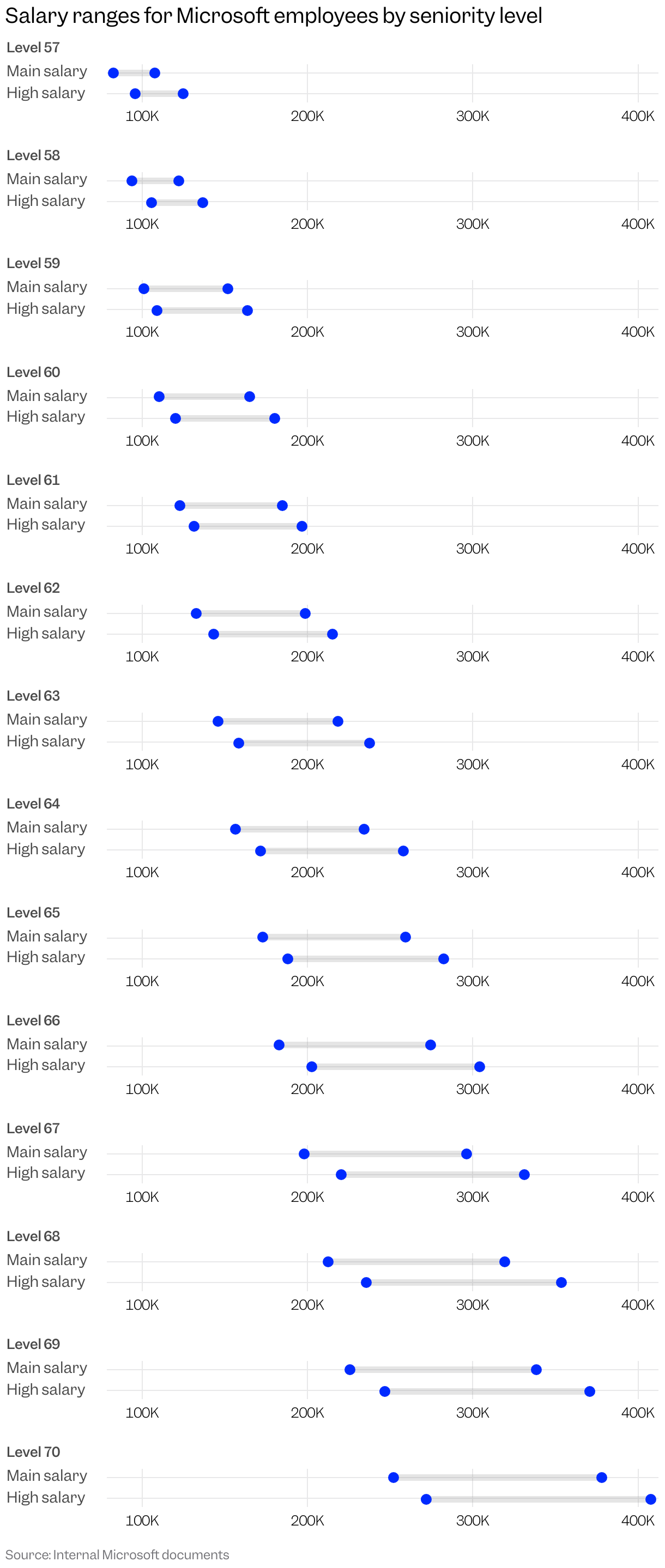
Microsoft has different salary ranges for different locations. For example, there’s a “main” pay range for workers at the company’s Redmond, Washington, headquarters, along with a “high” pay range for workers in higher cost-of-living areas such as San Francisco. Most of Microsoft’s hiring happens in these locations, according to a person familiar with the hiring process.

The packages outlined in these documents include ranges for salaries, on-hire stock awards, signing bonuses, annual stock awards, and percentages for annual bonuses based on levels. Microsoft declined to comment.

Level 57

  • “High” salary range: $95,800 to $124,600
  • “Main” salary range: $83,000 to $108,000
  • On-hire stock award: $5,000 to $13,000
  • Annual stock award: “By career stage”
  • Signing bonus: $0 to $9,000
  • Annual bonus: “NA”

Level 58

  • “Main” salary range: $94,100 to 122,300
  • “High” salary range: $105,900 to $137,700
  • On-hire stock award: $6,000 to $20,000
  • Annual stock award: “By career stage”
  • Signing bonus: $0 to $18,000
  • Annual bonus: 0 to 20%

Level 59

  • “Main” salary range: $101,400 to $152,000
  • “High” salary range: $109,000 to $163,600
  • On-hire stock award: $15,000 to $120,000
  • Annual stock award: $0 to $20,000
  • Signing bonus: $0 to $18,000
  • Annual bonus: 0 to 20%

Level 60

  • “Main” salary range: $110,200 to $165,200
  • “High” salary range: $120,200 to $180,400
  • On-hire stock award: $20,000 to $130,000
  • Annual stock award: $0 to $24,000
  • Signing bonus: $0 to $27,000
  • Annual bonus: 0 to 20%

Level 61

  • “Main” salary range: $123,200 to $184,800
  • “High” salary range: $131,400 to $197,000
  • On-hire stock award: $30,000 to $150,000
  • Annual stock award: $0 to $36,000
  • Signing bonus: $0 to $36,000
  • Annual bonus: 0 to 20%

Level 62

  • “Main” salary range: $132,600 to $199,000
  • “High” salary range: $143,600 to $215,400
  • On-hire stock award: $40,000 to $170,000
  • Annual stock award: $0 to $44,000
  • Signing bonus: $0 to $45,000
  • Annual bonus: 0 to 20%

Level 63

  • “Main” salary range: $145,000 to $218,400
  • “High” salary range: $158,400 to $237,600
  • On-hire stock award: $55,000 to $220,000
  • Annual stock award: $0 to $64,000
  • Signing bonus: $0 to $45,000
  • Annual bonus: 0 to 30%

Level 64

  • “Main” salary range: $156,500 to $234,700
  • “High” salary range: $172,000 to $258,000
  • On-hire stock award: $70,000 to $270,000
  • Annual stock award: $0 to $80,000
  • Signing bonus: $0 to $54,000
  • Annual bonus: 0 to 30%

Level 65

  • “Main” salary range: $172,800 to $259,200
  • “High” salary range: $188,000 to $282,000
  • On-hire stock award: $100,000 to $320,000
  • Annual stock award: $0 to $130,000
  • Signing bonus: $0 to $90,000
  • Annual bonus: 0 to 40%

Level 66

  • “Main” salary range: $183,200 to 274,800
  • “High” salary range: $202,800 to $304,200
  • On-hire stock award: $180,000 to $640,000
  • Annual stock award: $0 to $200,000
  • Signing bonus: $0 to $126,000
  • Annual bonus: 0 to 40%

Level 67

  • “Main” salary range: $197,800 to $296,400
  • “High” salary range: $220,800 to $331,200
  • On-hire stock award: $380,000 to $850,000
  • Annual stock award: $0 to $420,000
  • Signing bonus: $0 to $180,000
  • Annual bonus: 0 to 60%

Level 68

  • “Main” salary range: $212,800 to $319,200
  • “High” salary range: $236,000 to $354,000
  • On-hire stock award: $500,000 to $1,150,000
  • Annual stock award: $0 to $754,000
  • Signing bonus: Not listed
  • Annual bonus: 0 to 90%

Level 69

  • “Main” salary range: $225,600 to $338,400
  • “High” salary range: $247,000 to $370,800
  • On-hire stock award: $657,000 to $1.35 million
  • Annual stock award: $0 to $1,150,000
  • Signing bonus: Not listed
  • Annual bonus: 0 to 90%

Level 70

  • “Main” salary range: $252,000 to $378,000
  • “High” salary range: $272,000 to $408,000
  • On-hire stock award: $827,001 to $1.9 million
  • Annual stock award: $0 to $1,476,000
  • Signing bonus: Not listed
  • Annual bonus: 0 to 90%
Dot chart showing low and high end salaries for Microsoft employees at various seniority levels. They range from $83,000 to $108,000 for a level 57 employee, to as much as $272,000 to $408,000 for a level 70 employee.

Have a tip? Contact this reporter via email at astewart@businessinsider.com or Signal at +1-425-344-8242. Use a personal email address and a nonwork device; here’s our guide to sharing information securely.

Read the original article on Business Insider

☐ ☆ ✇ Business Insider Nederland

IMF sees Russia’s wartime economy slowing after two strong years


  • The IMF has downgraded Russia’s 2025 growth forecast due to policy tightening and lower oil prices.
  • Russia’s economy faces a slowdown after defying sanctions and a military spending boom.
  • President Donald Trump is threatening tariffs if Russia doesn’t reach a ceasefire with Ukraine in 10 days.

Russia’s wartime boom is faltering — and the International Monetary Fund is the latest to weigh in with a downgrade.

“We are expecting Russia’s economic growth to slow down in 2025, and that is very much due to the policy tightening and lower oil prices,” said Petya Koeva Brooks, a deputy director of the research department at the IMF, on Tuesday.

After two years of defying sanctions and riding a military spending boom, the country is now facing a sharp slowdown, according to the IMF. The organization has slashed its growth forecast and flagged weakness across key sectors.

The IMF now expects Russia’s economy to grow 0.9% in 2025, down from the 1.5% it had projected in April. It’s also expecting the country’s economy to grow 1% in 2026

Koeva Brooks said the downgrade was prompted by recent economic data in Russia’s retail sales, industrial production, and official monthly GDP figures, which reflected “relative weakness.”

Russia’s manufacturing activity contracted last month, employment has softened, and GDP growth slowed to 1.4% in Q1, down sharply from 4.5% the previous quarter.

The latest downgrade comes just months after an upward revision to 2024 growth, which the IMF raised to 4.3%, citing stronger-than-expected momentum in the fourth quarter. That compares to full-year growth of 4.1% in 2023.

While Moscow has managed to dodge economic collapse since its full-scale invasion of Ukraine in 2022 — in part by pouring cash into defense contracts — the wartime boom that once risked overheating now appears to be unraveling.

Just last month, Russia’s economy minister, Maxim Reshetnikov, warned that the country was “on the brink” of a recession.

Pressure from Washington

IMF’s updated outlook on Russia’s economy came days after the country’s central bank cut its key interest rates from 20% to 18% to boost demand as inflation slows.

Meanwhile, geopolitical pressure on Moscow is intensifying.

On Tuesday, President Donald Trump issued a sharp warning to Russian President Vladimir Putin saying the US would impose tariffs and other punitive measures if Russia fails to agree to a ceasefire with Ukraine within 10 days.

The ultimatum sent oil prices surging to around $70 a barrel, their highest level in over a month. But Trump downplayed concerns about potential blowback from additional sanctions.

“I don’t worry about it. We have so much oil in our country. We’ll just step it up even further,” he said, referring to a potential boost in production.

Read the original article on Business Insider

☐ ☆ ✇ Business Insider Nederland

Ukraine gave us a new look at how first-person-view drones can attack from boats on the open sea


  • Ukraine’s intelligence released footage of an aerial drone attack that it said was from the sea.
  • It’s the country’s first recorded instance of launching quadcopters from boats at maritime targets.
  • Past drone warfare at sea typically featured surface vessel drones or munitions launched from land.

Ukraine’s intelligence department posted footage on Tuesday of what it said were first-person-view attack drones launched by boat crews on the open sea.

The Main Intelligence Directorate, or GUR, wrote in a statement on its Telegram channel that the clips were archival footage of a raid on September 11, 2024.

“Thanks to this component of the operation, the GUR soldiers were able to suppress enemy fire on the Petro Godovanets gas production platform in the Black Sea,” it wrote.

GUR said the attack was carried out on the coast of Crimea by the Raven Group, a unit in its special forces. Business Insider could not independently verify the authenticity of the footage.

The clips appear to show a nighttime attack, where at least three first-person-view, or FPV, drones take off from a boat and crash into the ocean platform. Surveillance drone footage captured flashes and explosions.

“The occupiers suffered losses in personnel and equipment,” GUR wrote. Based on the clips posted, the true extent of the damage is not immediately clear.

GUR also posted clips of its troops traversing the open sea in lightweight combat craft, likely rigid inflatable boats such as the Zodiac.

The intelligence division said the raid was Ukraine’s first known instance of attacking with FPV drones via boats on the open sea.

Such an operation is markedly different from how drone warfare is typically conducted at sea, which primarily emphasizes uncrewed surface vehicles — essentially boat drones designed to ram into a target with explosives.

FPV drones, however, are usually remote-controlled quadcopters that require a radio or cable connection to the operator.

Loitering munitions have been used in combat at sea before, such as by Yemen’s Houthi rebels to attack ships on the Red Sea. However, they’ve typically been understood to be launched from inland locations and flown out to the coast.

While GUR didn’t say what equipment was used, an FPV drone operation from a boat would typically require drone pilots to bring control and navigation gear such as headsets, tablets, and GPS modules.

The platform identified, Petro Godovanets, is a Black Sea drilling site that has seen back-and-forth fighting since at least 2023.

Read the original article on Business Insider

☐ ☆ ✇ Business Insider Nederland

Elon Musk explains why xAI is calling its staff engineers, not researchers


  • Elon Musk says he’s doing away with the “researcher” job title at xAI.
  • Musk’s move echoes the approach used by OpenAI and Anthropic.
  • Both use a single title, “Member of Technical Staff,” for their engineering and research hires.

Elon Musk says he has banished the job title “researcher” from his AI startup, xAI.

The distinction between researcher and engineer is a “thinly masked way of describing a two-tier engineering system,” Musk wrote in an X post on Tuesday.

“There are only engineers,” Musk said.”Researcher is a relic term from academia.”

Musk then drew a comparison to his rocket company, SpaceX, which he said did more “meaningful, cutting-edge” research on rockets and satellites than “all the academic university labs on earth combined.”

“But we don’t use the pretentious, low-accountability term ‘researcher,'” Musk said.

xAI did not respond to requests for comment from Business Insider.

OpenAI, which Musk co-founded with Sam Altman and Greg Brockman in 2015, uses a similar naming approach for its technical hires.

Brockman, the president of OpenAI, wrote in an X post in February 2023 that they did not want to “bucket people into researchers and engineers” and “thought hard about what job titles to use.” OpenAI later decided to use the term “Member of Technical Staff.”

Brockman said the term was first used by Xerox PARC, a research laboratory known for its pioneering innovations, such as the mouse and the graphical user interface used on computers.

Anthropic, a company founded by former OpenAI employees, said on its website that its “research and engineering hires all share a single title — ‘Member of Technical Staff.'” The company said it listed its engineers as authors on their research papers, “often as first author.”

“While there’s historically been a division between engineering and research in machine learning, we think that boundary has dissolved with the advent of large models,” Anthropic wrote on its career page.

Read the original article on Business Insider

☐ ☆ ✇ Business Insider Nederland

Starbucks isn’t giving up on its China dream


  • Starbucks is looking for a local partner to help run its stores in China.
  • CEO Brian Niccol said he believes there will be thousands more Starbucks outlets in China’s future.
  • Niccol added that he sees “no reason why this can’t be one of the best businesses in China.”

Starbucks isn’t giving up on its China dream and is seeking a helping hand to run its stores there.

CEO Brian Niccol said in an earnings call on Tuesday that the Seattle-based coffee chain is looking for a local partner to manage its stores in China. The country is Starbucks’ second-largest market after the US, and has seen sales stagnate in recent quarters.

He said Starbucks is evaluating a pool of 20 interested parties who wish to partner with it.

“What this is about is how do we ensure that the Starbucks brand is in a much better place in the future because I do believe there’s going to be thousands of more Starbucks in China,” Niccol said. “And I think there’s no reason why this can’t be one of the best businesses in China.”

“And so we’re looking for a partner that shares that passion and shares that belief that there’s this opportunity to grow one of the special brands in China,” he added.

Starbucks released its third-quarter 2025 earnings on Tuesday, reporting its sixth straight quarter of sales declines. Global same-store sales were down 2% compared to a year ago.

However, it reported an 8% net revenue increase in China in the third quarter compared to the same period last year and a 2% increase in same-store sales.

Starbucks’ results in China showed signs of improvement compared to past quarters. Same-store sales were flat in the second quarter and dropped 6% in the first quarter.

The chain also opened 522 new stores in China in the past year, which represents a 7% increase in its retail footprint in the country.

This is a welcome sign for the chain, which has been struggling with a challenging market in China. Weakened local consumer spending power and strong competition from local players have resulted in declining sales.

Chinese brands like Luckin Coffee have eaten into Starbucks’ market share, offering similar products at lower prices and drawing customers in with aggressive discounts.

Despite recent weak performance, Niccol has repeatedly expressed confidence in the Chinese market. In a February interview with Bloomberg, he talked about a large-scale expansion in China, saying the market “is going to continue to grow for us.”

While China’s Starbucks stores are company-owned, most of its other international stores are run by domestic partners, like the Alshaya group in the Middle East.

The company’s stock was up nearly 5% in after-hours trading on Tuesday.

A representative for Starbucks China declined a request for comment from BI.

Read the original article on Business Insider

☐ ☆ ✇ Business Insider Nederland

Apple’s supply chain makeover just gave India a massive win over China


  • India became the top US smartphone exporter, thanks to Apple’s supply chain shift, according to Canalys.
  • Apple’s ‘China Plus One’ strategy boosted India’s export share, dethroning China.
  • The Trump administration has been pushing Apple to produce in the US instead of India or China.

India has overtaken China to become the top smartphone exporter to the US, and the country has Apple to thank for its new ranking.

India’s share of smartphone exports in the quarter that ended in June rose sharply from the same time last year.

The country’s dethroning of China is largely driven by Apple’s shifting supply chains, according to analysis from research firm Canalys published on Monday.

“Apple has scaled up its production capacity in India over the last several years as a part of its ‘China Plus One’ strategy and has opted to dedicate most of its export capacity in India to supply the US market so far in 2025,” wrote Sanyam Chaurasia, principal analyst at Canalys.

Still, much of iPhone manufacturing takes place in China, and the company depends on manufacturing hubs in China for Pro model parts, Canalys said.

Smartphones assembled in India made up 44% of US imports in the second quarter, a significant jump from 13% in the same period last year. The total volume of smartphones made in India soared 240% from a year earlier, Canalys said.

Vietnam came second, taking 30% of the market share. China’s share fell from 61% to 25% year over year.

Samsung and Motorola have also increased their share of US-targeted supply from India, but their shifts are significantly slower and smaller in scale than Apple’s, the Canalys report said.

Apple has been rapidly shifting iPhone production to India, in an effort to reduce reliance on China and cut back on geopolitical risks. The iPhone 16 is being assembled in India.

In the company’s first quarter earnings call, Apple’s CEO, Tim Cook, addressed Chinese diversification and said the company expects “the majority of iPhones sold in the US will have India as their country of origin” in the quarter ending in June.

Apple’s manufacturing in India and China has been repeatedly scrutinized by President Donald Trump’s administration.

In May, Trump threatened Cook with a 25% tariff on iPhones if the devices were made in India or elsewhere, in a move to pressure Apple to build its flagship product domestically. Trade experts have said that making iPhones in the US will push their prices higher.

Earlier this month, White House trade advisor Peter Navarro said Cook isn’t doing enough to move manufacturing out of China.

“Going back to the first trump term, Tim Cook has continually asked for more time in order to move his factories out of China,” Navarro said on CNBC. “I mean it’s the longest-running soap opera in Silicon Valley. My problem with Tim Cook is he never takes the steps to actually do that.”

While many of Apple’s core products, including iPhones and Mac laptops, have received exemptions from Trump’s “reciprocal tariffs,” officials have warned that it could be a temporary reprieve.

Read the original article on Business Insider

☐ ☆ ✇ Business Insider Nederland

Video appears to show Putin’s bodyguards armed with a handheld anti-drone interceptor


  • A new video appears to show one of Putin’s bodyguards equipped with an interceptor drone.
  • The footage aligns closely with Putin’s inspection of commanders at this year’s Victory Day parade.
  • The device closely resembles the Yolka, designed to crash into incoming attack drones.

A newly surfaced video appears to show a member of Russian leader Vladimir Putin’s security detail holding an interceptor drone while watching over his boss.

The undated clip was posted on Tuesday by Serhii “Flash” Beskrestnov, a Ukrainian analyst known locally for his expertise on drone warfare.

The video appears to depict Putin inspecting and greeting senior uniformed officers in a parade-like fashion at Moscow’s Red Square — a sign that the footage was filmed during a Victory Day parade on May 9.

In the footage, shot on the sidelines of the parade, a man can be seen in the foreground following Putin’s movements while holding a device resembling a Russian Yolka interceptor drone and its launcher.

The Yolka, fired from a handheld launcher, features four fins on its front and another four larger fins with propellers on the back. In the clip, similar fins with propellers can be seen on the device in the man’s hands.

The Yolka is a kinetic interceptor that’s meant to fly into the path of an incoming first-person-view drone and destroy the attacking device by collision.

Business Insider could not independently verify the authenticity of the footage.

However, parts of the video align closely with a livestream of Putin meeting contingent commanders at this year’s Victory Day parade. Several officers, such as a colonel of the Russian army and a colonel of the Russian airborne forces, are seen in both videos saluting and shaking hands with Putin.

The man seen holding the device is also dressed consistently with what Putin’s bodyguard detail was wearing on that day: with a suit, navy blue tie, and a red lanyard.

Additionally, two of Putin’s other bodyguards, seen in the clip of the apparent drone, can also be seen in official TV footage of the parade segment.

Foto: Screenshot/Russian Embassy in Kazakhstan YouTube Channel

The appearance of a Yolka drone in Putin’s security detail coincides with Russia’s heightened drone defenses at this year’s parade, which Ukraine threatened to disrupt with uncrewed aerial system attacks.

Long-range drone strikes that month had forced Moscow’s four airports to close multiple times.

The Yolka, however, is more suited to fighting lighter drones, and its appearance at the parade could indicate that Russia also prepared a contingency for a drone attack from within the city.

More videos of Russian Yolka interceptor drones in action in Ukraine. According to Ukrainian expert Serhii Flash, the Yolka still isn’t in widespread use. Second photo lists purported specs.https://t.co/DTYal52yenhttps://t.co/p7UUGJPct5https://t.co/jugvu1vIukhttps://t.co/Gh2jpCqxXy pic.twitter.com/9j3aV9ivuS

— John Hardie (@JohnH105) May 26, 2025

While militaries have historically relied heavily on electronic warfare to counter uncrewed aerial threats, the recent rise of unjammable fiber-optic drones, which use cables instead of radio, has put greater emphasis on air defenses that use kinetic force.

Read the original article on Business Insider

☐ ☆ ✇ Business Insider Nederland

Wereldwijde groei productiviteit geremd door lage betrokkenheid werknemers

By: Gyurka Jansen
  • Wereldwijde werknemersbetrokkenheid daalde in 2024 van 23% naar 21%.
  • Managers ondervinden de grootste terugval in welzijn en betrokkenheid.
  • Investeren in goed management kan wereldwijd $9,6 biljoen aan productiviteit opleveren.

Volgens het nieuwste State of the Global Workplace-rapport van onderzoeksbureau Gallup is een daling in werknemersbetrokkenheid een van de grootste remmen op wereldwijde economische groei. In 2024 daalde het percentage betrokken werknemers wereldwijd van 23% naar 21%. Die afname, de tweede in twaalf jaar tijd, kostte de wereldeconomie naar schatting $438 miljard aan verloren productiviteit.

Vooral managers kregen het zwaar te verduren: hun betrokkenheid daalde van 30% naar 27%, met extra scherpe dalingen bij vrouwelijke managers (-7%) en jongere managers onder de 35 jaar (-5%). Ondertussen bleef de betrokkenheid onder niet-leidinggevende medewerkers stabiel op 18%.

Managers onder druk: tussen beleid en personeel

De oorzaken zijn veelzijdig. Managers bevinden zich in een spanningsveld tussen veranderende strategische doelen van het management en de verhoogde verwachtingen van medewerkers sinds de pandemie.

Denk aan flexibiliteit, hybride werken en psychologische veiligheid. Tegelijkertijd worden budgetten aangescherpt, personeelswisselingen zijn aan de orde van de dag en de druk op prestaties blijft hoog.

Gallup adviseert organisaties om het managersvak opnieuw vorm te geven. In plaats van klassieke taakverdeling draait het in de moderne werkomgeving om coaching, ontwikkeling en prestatiebegeleiding. Goed getrainde managers zorgen voor meer betrokkenheid, betere resultaten en stabielere teams.

Welzijn opnieuw gedaald: impact op leven en werk

Naast betrokkenheid nam ook het algehele welzijn van werknemers af; voor het tweede jaar op rij. Slechts 33% van de werknemers wereldwijd beoordeelt zijn of haar leven als ‘bloeiend’. Opnieuw zijn het vooral managers die hierin achteruitgaan, terwijl de cijfers bij gewone medewerkers licht verbeterden.

Werknemersbetrokkenheid blijkt daarbij een sterke voorspeller van welzijn: van de betrokken medewerkers voelt de helft zich bloeiend, tegenover slechts een derde van de niet-betrokken medewerkers.

Triljoenen aan potentieel onbenut

Volgens Gallup gaat er wereldwijd $9,6 biljoen aan productiviteit verloren doordat organisaties hun medewerkers onvoldoende weten te betrekken. Dat komt neer op ongeveer 9% van het wereldwijde bruto binnenlands product.

De oplossing? Wetenschappelijk onderbouwd leiderschap en een strategisch HR-beleid dat inzet op managementontwikkeling.

Zelfs eenvoudige trainingen laten al positieve effecten zien, maar bij best practices stijgt het prestatieniveau van managers en hun teams met 20% tot 28%.

☐ ☆ ✇ Business Insider Nederland

Anthropic’s cofounder says ‘dumb questions’ are the key to unlocking breakthroughs in AI


  • Anthropic’s cofounder said the key to advancing AI is asking “very naive, dumb questions.”
  • AI is an “incredibly new field” and “a lot of the most basic questions haven’t been answered,” said Jared Kaplan.
  • Dumb questions can make big trends “as precise as possible,” the chief science officer added.

Anthropic’s cofounder said the key to advancing AI isn’t rocket science — it’s asking the obvious stuff nobody wants to say out loud.

“It’s really asking very naive, dumb questions that get you very far,” said Jared Kaplan at a Y Combinator event last month.

The chief science officer at Anthropic said in the video published by Y Combinator on Tuesday that AI is an “incredibly new field” and “a lot of the most basic questions haven’t been answered.”

For instance, Kaplan recalled how in the 2010s, everyone in tech kept saying that “big data” was the future. He asked: How big does the data need to be? How much does it actually help?

That line of thinking eventually led him and his team to study whether AI performance could be predicted based on the size of the model and the amount of compute used — a breakthrough that became known as scaling laws.

“We got really lucky. We found that there’s actually something very, very, very precise and surprising underlying AI training,” he said. “This was something that came about because I was just sort of asking the dumbest possible question.”

Kaplan added that as a physicist, that was exactly what he was trained to do. “You sort of look at the big picture and you ask really dumb things.”

Simple questions can make big trends “as precise as possible,” and that can “give you a lot of tools,” Kaplan said.

“It allows you to ask: What does it really mean to move the needle?” he added.

Kaplan and Anthropic did not respond to a request for comment from Business Insider.

Anthropic’s AI breakthroughs

Anthropic has emerged as a powerhouse in AI‑assisted coding, especially after the release of its Claude Sonnet 3.5 model in June 2024.

“Anthropic changed everything,” Sourcegraph’s Quinn Slack said in a BI report published last week.

“We immediately said, ‘This model is better than anything else out there in terms of its ability to write code at length’ — high-quality code that a human would be proud to write,” he added.

“And as a startup, if you’re not moving at that speed, you’re gonna die.”

Anthropic cofounder Ben Mann said in a recent episode of the “No Priors Podcast” that figuring out how to make AI code better and faster has been largely driven by trial and error and measurable feedback.

“Sometimes you just won’t know and you have to try stuff — and with code that’s easy because we can just do it in a loop,” Mann said.

Elad Gil, a top AI investor and No Priors host, concurred, saying the clear signals from deploying code and seeing if it works make this process fruitful.

“With coding, you actually have like a direct output that you can measure: You can run the code, you can test the code,” he said. “There’s sort of a baked-in utility function you can optimize against.”

BI’s Alistair Barr wrote in an exclusive report last week about how the startup might have achieved its AI coding breakthrough, crediting approaches like Reinforcement Learning from Human Feedback, or RLHF, and Constitutional AI.

Anthropic may soon be worth $100 billion, as the startup pulls in billions of dollars from companies paying for access to its models, Barr wrote.

Read the original article on Business Insider

☐ ☆ ✇ Business Insider Nederland

Starbucks plans to phase out its mobile-only stores for a future with more ‘warmth and human connection’


  • Starbucks is phasing out mobile order-only stores, converting some to full-service locations.
  • The shift comes as Starbucks faces declining same-store sales for six consecutive quarters.
  • Starbucks has a new store prototype and a $500 million investment plan to improve operations.

Starbucks’ grab-and-go stores are on the way out.

On Tuesday, the coffee store chain announced that it’s discontinuing its mobile order-only store model.

Around 80 to 90 pickup-only locations in the US, many of which are located in office buildings and offer no seating, will be phased out, said CEO Brian Niccol. Some will be converted into full-service stores with room to linger.

“These stores felt too transactional and didn’t deliver the warmth or human connection our customers expect,” Niccol told investors on the third-quarter earnings call.

A Starbucks spokeswoman declined to comment, including on how much the store renovations would cost.

The company has also been working with CloudKitchens, the ghost kitchen company run by Uber cofounder Travis Kalanick, to broaden Starbucks’ network in locations like San Francisco, Business Insider reported in 2023. These ghost kitchens, with private kitchens and no corporate storefronts, get Starbucks orders out on platforms like DoorDash to lessen the burden on brick-and-mortar stores.

Starbucks announced on Tuesday that it is developing a new “coffeehouse of the future” prototype that includes 32 seats and a drive-thru, which it plans to debut in the company’s next fiscal year. Starbucks is investing $500 million over the next year to bolster staffing and improve in-store wait times.

These changes come as Starbucks tries to boost sales — same-store sales dropped for a sixth quarter in a row. Niccol, who took over as CEO last year, has issued memos telling employees to spend more time in the office as part of his effort to “turn things around.”

On Tuesday’s call, Niccol said unpredictable coffee prices and ongoing pressure from tariffs may mean challenging financials until 2026. He said that “momentum is building” and that the company is “ahead of schedule.”

Throughout the day, Starbucks shares dipped on Q3 earnings that came in below analyst expectations, but rose around 3% in after-hours trading. Shares are flat this year.

Read the original article on Business Insider

☐ ☆ ✇ Business Insider Nederland

How to watch Las Vegas Aces vs. Los Angeles Sparks: Live stream Cameron Brink’s WNBA return


When you buy through our links, Business Insider may earn an affiliate commission. Learn more

Cameron Brink is scheduled to make her return to the WNBA tonight. We’ve compiled everything you need to know about how to watch the Sparks vs. Aces, including live streaming options for those without cable.

Following a 13-month recovery period, Brink has finally been cleared to return to action with the Los Angeles Sparks. The No. 2 overall 2024 draft pick tore her ACL early in her rookie season with the Sparks and has spent the past year recovering from the injury.

Los Angeles will host the Aces at Crypto.com Arena for tonight’s game. With an 11-14 regular-season record, the Sparks have already seen a much better season so far than last year, thanks in no small part to the addition of Aces alum Kelsey Plum. The Aces, who won the 2022 and 2023 WNBA championships, are 13-13, marking a much rougher season than the team is used to. A’ja Wilson, Jackie Young, and Chelsea Gray are at the helm of the Vegas team.

Whether you’re rooting for the Aces or the Sparks, we’ve got you covered when it comes to tuning in. Keep reading to learn some of the best ways to live stream the game, including services that will unlock a variety of other WNBA games this season.

What channel is Aces vs. Sparks on?

The Aces vs. Sparks game will air on NBA TV in the United States. The game, which takes place on the West Coast, is scheduled to tip off at 10 p.m. ET.

How to watch Aces vs. Sparks in the US

Cord-cutters or cable subscribers without access to NBA TV have a few different options for watching the channel. Some of the best live TV streaming services we’ve tested — including DirecTV, Sling TV, and Fubo — carry the channel in their lineups. These are month-to-month streaming services that function like cable alternatives, although you can cancel anytime and don’t need to worry about long-term contracts.

DirecTV is the best cable alternative you can stream, and the new genre packs allow people to stream top-rated channels at a reduced rate. The service’s MySports pack carries NBA TV, and about 20 other popular live sports channels, including ESPN, TNT, and local channels (where regionally available). MySports also bundles in access to ESPN Plus. Subscriptions cost $70 a month, but new users can get a five-day free trial to decide whether the service is right for them.

Sling TV is another popular way to live stream NBA TV. You’ll need to subscribe to a base plan, either Sling Blue or Orange (for $46 a month), and then add on the Sports Extra ($11 a month). This will cost a total of $57 a month, but new users can get $23 off their first month of service. A base plan and the Sports Extra will unlock anywhere from 45 to 50+ popular live channels, including TNT, CNN, and AMC.

WNBA fans can also live stream NBA TV through Fubo’s Elite plan. The Elite tier includes access to 200+ live channels, including nearly everything you’ll need to watch the 2025 WNBA broadcast schedule. Subscriptions cost $95 a month, but new users can get their first month for $75 after a five-day free trial.

How to watch Aces vs. Sparks from anywhere

WNBA fans traveling outside the US don’t need to worry about missing out on any of the action. They can keep up with their usual streaming methods from anywhere with the help of a VPN. Virtual private networks are easy-to-use tech tools that allow people to change their virtual locations. Plus, they’re instant ways to boost cybersecurity. The services we’ve highlighted require US methods of payment, so this option will work best for Americans who are just traveling abroad at the moment.

NordVPN is one of the best VPNs on the market, thanks to its user-friendly interface and impressive selection of global servers. Plus, it comes with a 30-day money-back guarantee. You can learn more about the app in our official NordVPN review.


Note: The use of VPNs is illegal in certain countries and using VPNs to access region-locked streaming content might constitute a breach of the terms of use for certain services. Business Insider does not endorse or condone the illegal use of VPNs.

Read the original article on Business Insider

☐ ☆ ✇ Business Insider Nederland

Starbucks CEO Brian Niccol says price changes are a last resort in coffee chain turnaround — but they are ‘absolutely’ coming


  • Starbucks on Tuesday released its Q3 earnings, reporting its sixth straight quarter of slipping sales.
  • CEO Brian Niccol’s “Back to Starbucks” revitalization campaign aims to fix slumping sales.
  • Niccol said price changes are his last resort — but they’re “absolutely” coming.

Price changes are the last resort for Starbucks’ CEO, Brian Niccol, he said on Tuesday’s Q3 earnings call, but he won’t rule them out as part of his revitalization efforts of the coffee giant.

A quick-service restaurant veteran, Niccol has led successful revitalization campaigns at Taco Bell and Chipotle. His “Back to Starbucks” campaign is proceeding ahead of schedule, the CEO told investors on Tuesday.

“But with that said, you know, pricing will be a part of our business model,” he added. “There are times where it makes sense to take some price — and when those situations present itself, we’re going to do it in the least amount of pricing necessary. I prefer to always hold back on that one as much as possible. So will we have to use it in the future? Absolutely — it’s going to be the last lever I’d like to pull. And when we pull that lever, I probably want to do as little as possible.”

Since Niccol took over, Starbucks has already implemented changes to its pricing model. The company has removed surcharges for non-dairy milk substitutes and started charging more for some syrups and powder add-ins.

It is unclear when any additional price changes may take place or what menu items may be affected. A spokesperson for Starbucks declined to comment when reached by Business Insider.

Niccol’s comments on changes to the menu prices came as Starbucks reported a decline in sales for the sixth consecutive quarter while the company continues its turnaround plan.

Global comparable store sales declined 2% overall, driven by a 2% decline in comparable transactions, according to Starbucks’ Q3 earnings report. The decline was partially offset by a 1% increase in the average ticket price. Most of the decrease was seen in North American markets, as international comparable store sales were mostly flat.

The company’s revenue — up 4% to $9.5 billion — beat analysts’ tepid expectations, Reuters reported. However, it missed on earnings, with an adjusted EPS of $0.50, a 46% decline over the prior year, missing estimates of 65 cents, the outlet reported.

Starbucks’ stock increased more than 3.5% in after-hours trading following the earnings call.

“While our financial results don’t yet reflect all the progress we’ve made, the signs are clear — we’re gaining momentum,” CEO Brian Niccol said in a statement included in the report. “Our ‘Back to Starbucks’ plan is working. It’s grounded in what makes us Starbucks: handcrafted beverages, welcoming coffeehouses, and the human connection that brings it all together.”

Niccol’s preferred turnaround method starts with customer service, making the chain’s new Green Apron Service model the heart of the revitalization campaign. Niccol and CFO Kathy Smith said on the call that the foundational operating model, focused on crafting cravable coffees and enhancing consumer connection, is being rolled out early across stores nationwide after being tested in pilot stores.

Coffee houses already using Green Apron Service techniques have driven improvements in transactions, sales, and customer service times, outperforming the broader North American portfolio, Niccol said Tuesday.

Niccol’s “Back to Starbucks” campaign, which he launched upon taking over last September, aims to improve slumping sales and customer experience complaints that have plagued the international coffee giant.

Starbucks has since rolled out a series of changes in-store, including remodeling stores with comfy chairs and ceramic dishes to encourage visitors to stay longer, bringing back the self-serve condiment bar, and asking baristas to hand-write smiley faces and inspirational messages on to-go orders.

On the corporate side, the company has cracked down on its return-to-office mandate, requiring most support staff to work from the Seattle headquarters or Toronto office four days a week — or leave the company, Business Insider previously reported.

Have a tip? Contact this reporter via email at Katherine Tangalakis-Lippert at ktangalakislippert@businessinsider.com or Signal at byktl.50. Use a personal email address, a nonwork WiFi network, and a nonwork device; here’s our guide to sharing information securely.

Read the original article on Business Insider

☐ ☆ ✇ Business Insider Nederland

Corporate America is on edge and hiring armed guards after the NYC office shooting


  • Wall Street firms were on guard Tuesday in response to the shooting at Blackstone’s headquarters.
  • The fatal shooting on Monday left five dead, including a top Blackstone executive.
  • Firms are racing to hike security spending at offices and for CEOs. Here’s a look at their reaction.

Corporate America is on guard.

A deadly shooting at a New York City office tower on Monday has companies and executives boosting security across Wall Street and corporate America. Firms are scrambling to hire armed guards, conduct risk assessments, review security protocols, and reassure employees that they’re safe, security experts said on Tuesday.

“The phone hasn’t stopped since this morning,” Sean Crowley, the cofounder and CEO of CTS Research and Investigations, told Business Insider. CTS, based in NYC, is a partner and co-owner of Illuno, an app — “Like Uber for hiring security guards,” Crowley calls it — that makes it easy to hire law enforcement for security jobs.

Most of the calls, Crowley said, are coming from commercial and office property managers in Manhattan and downtown Brooklyn who want to bring in armed security guards, clad in suits and ties, to post in their lobbies. “This will more than double our workload,” said Crowley, a former NYPD captain and commander of the Manhattan District Attorney’s Office detective squad.

Corporate leaders are on edge after the second deadly shooting involving business executives in six months. Monday’s attack, which played out at the New York City headquarters of the private equity firm Blackstone, left five dead, including real estate executive Wesley LePatner and the gunman. Monday’s shooting followed the assassination of UnitedHealthcare CEO Brian Thompson in December. Companies are now rushing to reassure staff and bolster security as haunting images—like barricaded office doors—underscore growing fears that working for corporate America is no longer safe.

Don Aviv, president of Interfor International, a security firm that works with asset managers, told BI on Tuesday that roughly 80% of his firm’s clients had “retained additional security for their lobbies and foyers,” with some hiking protective services through next week.

“The issue with our society is that we’re reactionary and not proactive,” Aviv said.

Heightened security comes at a cost

Banks like Goldman Sachs and Citi sought to assuage employees about workplace security on Tuesday.

Goldman Sachs “has robust protocols in place to keep our people safe every day, and is proactively assessing and monitoring the safety of the firm’s global campuses to protect our people and facilities around the clock,” Goldman said in a memo authorised by Jacqueline Arthur, head of human capital management and corporate and workplace solutions.

“This includes our dedicated team of NYPD officers and security guards at the entrance of and within our buildings, who are trained to carefully manage entry to our offices and respond to any potential incident,” Arthur said, adding that Goldman “is constantly assessing” its security protocols.

Citi told New York-based employees on Tuesday that the firm had “increased the security presence and capabilities at our headquarters” within the past year. “This includes working closely with the NYPD,” he said. “While we feel confident with the protocols we have in place, we will not hesitate to adjust if necessary,” said the memo by Ed Skyler, Citi’s head of enterprise services and public affairs.

For companies seeking to boost security, the extra layer of protection won’t come cheap. Two security executives in New York City say posting an armed former or off-duty police officer in your lobby will cost building managers $75 to $200 an hour or more. Hiring an armed escort to protect a CEO or other prominent person will cost in the $135 to $200 range per hour.

For now, it’s not prohibiting demand. Herman Weisberg said his security company usually hires about 15 armed former military and NYPD officers to protect CEOs and other high-profile individuals in New York and Washington, DC. On Tuesday, that number was up to 30 — and the managing director of SAGE Intelligence thinks it will grow further.

Weisberg, a former NYPD detective, said he is also seeing an increase in requests for “threat assessments,” including risks tied to former disgruntled ex-employees.

“One firm,” he said, “wants us to work with their customer service department on analyzing current people who are complaining ‘outside the norm.'”

He pointed to the back-to-back tragedies of the fatal shooting of UnitedHealthcare’s CEO, followed by Monday’s attack.

“When this stuff happens more than once, I think anybody with controversial or, at this point, even non-controversial businesses are starting to look at security and take it a little bit more seriously.”

Read the original article on Business Insider

☐ ☆ ✇ Business Insider Nederland

Musk v. Altman judge dings both sides for ‘gamesmanship’ as AI clash drags on


  • The judge in Elon Musk’s racketeering lawsuit against Sam Altman chastised both sides on Tuesday.
  • She accused both of “gamesmanship” in their year-old battle while granting a small victory to Musk.
  • In a previous judicial eye-roll, she termed the tech titans’ tiff “billionaires vs billionaires.”

The California judge for Elon Musk’s racketeering lawsuit against Sam Altman granted the Tesla CEO a small legal victory Tuesday, but not before dinging both sides for trying to waste her time with “excessive” court filings.

“The court will not waste precious judicial resources on the parties’ gamesmanship,” US District Judge Yvonne Gonzalez Rogers wrote.

“Here, the parties to this action have repeatedly over-litigated this case,” she wrote.

The judge’s terse, two-page decision grants Musk’s request that she trim Altman’s bulky response to the bulky, 2024 lawsuit, which accuses OpenAI and Microsoft of civil racketeering, fraud, breach of contract, and violating antitrust laws.

Altman’s lawyers responded by filing a list of 55 “affirmative defenses.” (Affirmative defenses are to be proven at trial by the defense.)

Filing 55 affirmative defenses was an overblown response on Altman’s part, Gonzalez Rogers wrote Tuesday, agreeing with Musk’s lawyers on that point.

“Plaintiffs are correct that defendants have inappropriately asserted an excessive number of defenses, many of which appear to be irrelevant, redundant, insufficient or immaterial,” she agreed.

But Musk’s lawyers answered Altman’s excessiveness with still more excess, she said.

Musk’s side “failed to take the high road, instead moving to strike all of the asserted defenses,” the judge wrote Tuesday. “They too over-reached.”

It’s not the first time Gonzalez Rogers voiced her impatience with the two clashing tech titans. At a court hearing in February, she said she was skeptical of Musk’s claim of irreparable financial harm, noting that this was a case of “billionaires versus billionaires.”

“How can I say, as a matter of law, there is a likely restraint of trade when your client has raised $11 billion” for rival xAI, she asked then.

Lawyers for Altman had hoped to defend all 55 affirmative responses at an August court hearing, but Gonzalez Rogers cut things short Tuesday, trimming their number down by 16.

These 16 were “plainly insufficiently alleged, irrelevant, redundant or immaterial,” she said.

They include Altman’s assertion that the lawsuit should be tossed out because its claims are too old, that it was brought with “unreasonable delay,” and that it is voided by “Musk’s unclean hands,” a reference to alleged misconduct that was left unspecified.

Altman’s 55 defenses were “untethered,” Musk’s side had countered in a filing last month, “to any coherent legal theory, facts, or cause of action.”

In their July 10 filing, Altman disagreed and called Musk’s attempt to strike all 55 defenses “nothing more than a tactical maneuver” to delay turning over evidence in the case.

Musk is accusing Altman’s OpenAI of abandoning its “not for profit” origins and raking in millions through a self-dealing “unregulated merger” with Microsoft. He seeks monetary damages and a judgment voiding OpenAI and Microsoft’s licensing agreement.

Altman’s side denies Musk’s allegations in their entirety and seeks to fight them at trial using the surviving 39 defenses. Gonzalez Rogers has set a March 30 date for jury selection in her Oakland, California courtroom.

Read the original article on Business Insider

☐ ☆ ✇ Business Insider Nederland

‘A new normal’: Midtown shooting sparks anxiety, but nearby office life goes on


  • The Park Avenue building where Monday’s shooting occurred remains closed, as the NYPD investigates.
  • Midtown workers expressed anxieties about the recent violence but planned to return to their jobs.
  • Workplace-crisis experts said there are ways companies can support affected employees.

Scores of workers funneled into New York city offices this morning just like any other weekday, hours after a lone gunman killed four people in a Midtown building.

While the site remains closed, nearby workers who spoke with Business Insider expressed sorrow over the shooting and anxiety about returning to their in-person jobs. Workplace-crisis experts, however, told BI they didn’t anticipate a lasting effect on office attendance.

“Unfortunately these things are happening all the time,” said Bo Mitchell, president of 911 Consulting, a Wilton, Connecticut-based provider of emergency-preparedness services.

Less than a year ago, UnitedHealthcare’s CEO Brian Thompson was gunned down in the same vicinity. There were 524 fatal injuries due to homicides in the workplace in 2022, up 8.9% from 2021, according to the latest figures available from the US Department of Labor.

“It’s a little bit eerie” and “weirdly feeling like a new normal,” said Virginia Gersham, who works at the Museum of Modern Art, close to where Thompson was killed.

Another local worker, Jim Santana, who works at an assisted-living facility in Midtown, described the incident as nerve-racking. He told BI he was still on his way to his job.

“Yeah, I’m going to go to work,” he said, “just to get my mind off of that.”

How impacted employers are reacting

The Park Avenue building where Monday night’s shooting occurred remains surrounded by barricades as police conduct their investigation. The property is home to several companies including investment firm Blackstone and the National Football League. In multiple interviews, Mayor Eric Adams said the NFL was the gunman’s apparent target.

Wesley LePatner, a star executive in Blackstone’s real-estate business, was among those killed. She was 43 years old.

Blackstone’s employees worldwide have been given the option to work from home for now and are being encouraged to take as much time off as they need, according to a person familiar with the matter. They are also being provided counseling and other resources, this person said.

Another building resident, accounting firm KPMG, told staff in a memo late Monday that its office there would be closed Tuesday and that they should work from home or from a different company office. The memo, which Business Insider has seen, was signed by Yesenia Scheker Izquierdo, the managing partner for KPMG’s New York office.

Other companies directly impacted didn’t respond to requests for comment.

Employer support is crucial

Ross Eisenberg works a few blocks from both shooting locations and said despite the somber mood, it’s mostly been business as usual for him and his staff.

“There’s a strong pattern of New Yorkers putting things aside and staying strong,” Eisenberg, CEO of real-estate brokerage firm RDE Advisor, told Business Insider. “It’s not a matter of forgetting about it, but it’s not letting it interrupt their life.”

If workers are worried, though, leaders ought to reiterate their safety policies and protocols to help ease everyone’s anxiety, said Michelle Sinning, a principal at Bernstein Crisis Management in Mission Viejo, California.

“It should be made clear that this topic isn’t taboo, and the company will provide any resource necessary to help employees feel comfortable and confident returning to work,” she said.

It might also make sense to let employees temporarily work from home and allow them to ease back into the office, Sinning added.

“A gradual or phased approach would help employees acclimate,” she said. “Employees will need time to heal.”

For people who experience workplace violence firsthand, employers should go out of their way to provide support, added Mitchell, the emergency-preparedness executive.

“They need a lot of counseling, communication, and hand-holding,” he said. “They’re suffering from PTSD.”

Read the original article on Business Insider

☐ ☆ ✇ Business Insider Nederland

Treasury Secretary Bessent says it’s ‘not the end of the world’ if Trump’s snapback tariffs go into effect on Friday


  • President Donald Trump says he won’t budge on Friday’s tariff deadline.
  • His Treasury secretary said businesses shouldn’t be concerned if the delayed tariffs go into effect.
  • Some major US trading partners are racing to reach an agreement with just days to spare.

The White House says businesses shouldn’t worry if President Donald Trump’s tariffs go into effect on Friday.

“I would think that it’s not the end of the world if these snapback tariffs are on for anywhere from a few days to a few weeks, as long as the countries are moving forward and trying to negotiate in good faith,” Treasury Secretary Scott Bessent said Tuesday on CNBC.

Trump and his trade team have said that August 1 is the final deadline for countries to reach an agreement with the US. Otherwise, the White House will unilaterally impose a new rate, a reality that Bessent said would make the president “equally as happy.”

“I think, for President Trump, the — for me, what’s given us a lot of negotiating leverage is, he’s happy to do the deal, but he’s equally as happy, sometimes in more cases — in some cases, more happy just to have the tariff income,” Bessent said.

Major US trading partners — including Canada, Mexico, South Korea, and India — still haven’t reached an agreement. Trump has threatened to impose a 50% tariff on Brazil if authorities don’t end the trial of former President Jair Bolsonaro.

Separately, Trump has sent letters informing roughly two dozen nations of the rate the US will impose if a deal isn’t reached. Some of those rates differ from the original ones Trump announced when he rolled out his so-called reciprocal tariffs in April.

Earlier on Tuesday, Commerce Secretary Howard Lutnick said that deals with the rest of the world will be done by Trump’s deadline. The only exception will be for China, where talks have proceeded on a different timeline.

“For the rest of the world, we’re going to have things done by Friday. And Friday is not that far away,” Lutnick said on CNBC’s “Squawk Box.” ‘So you should expect, we said August 1st is the date that we’re setting all these rates, and they are off to the races after that.”

Trump said before July 9 that he was reluctant to delay the tariffs further. He later did so, setting up the August 1 cutoff.

Read the original article on Business Insider

☐ ☆ ✇ Business Insider Nederland

Don’t believe the hype about tariff rebate checks just yet


  • Trump said he’s “thinking about” sending checks to Americans paid for by tariff revenue.
  • GOP senators say that’s a bad idea, and that they’d prefer the money be spent on the debt.
  • It’s similar to what they said about the “DOGE Dividend” earlier this year.

If you think you’re about to get another stimulus check in the mail from Uncle Sam, think again.

First, it was the “DOGE Dividend.” Now, it’s a rebate check paid for by tariff revenue.

President Donald Trump said on Friday that he’s “thinking about a little rebate” for Americans of “a certain income level.” That would require an act of Congress, so Republican Sen. Josh Hawley of Missouri introduced a bill on Monday that would send $600 tax rebate checks to lower-income Americans.

Yet the proposal faces some of the same headwinds that quickly scuttled the DOGE check idea earlier this year: Most Republicans simply don’t like it.

“It’ll never pass,” Republican Sen. Bernie Moreno of Ohio flatly told reporters on Tuesday, rejecting the idea. “We have a $37 trillion debt.”

Trump also didn’t propose the idea himself, but was responding to an idea floated by a reporter.

“You just made a lot of news,” Trump told the reporter at the time.

It’s similar to what happened in December, when Trump said he’d “consider” raising the minimum wage after being asked about it by a reporter, or when he said DOGE checks were “under consideration.”

Ultimately, both ideas ended up fizzling.

How the tariff rebate check would work

Trump’s tariffs, ever-changing as they are, have brought in some additional revenue. The rebate check is one proposal for how to spend it.

According to US Treasury data, the federal government has collected over $100 billion from customs duties so far this year, and Secretary Scott Bessent said earlier this month that the US could be on track to collect $300 billion this year.

Hawley’s bill would use that money to provide checks of at least $600 for each individual and dependent child in a family. Thus, a family of four would receive at least $2,400.

The bill also allows for larger checks if the tariff revenue soars higher than current projections, which Hawley’s office estimates to be around $150 billion.

It’s designed to primarily benefit lower-income Americans: the rebate would be phased out for joint filers making more than $150,000, a household head making more than $112,500, and an individual making more than $75,000.

“I mean, who better to benefit from that than working people who could use a break?” Hawley asked reporters at the Capitol on Tuesday.

At the very least, Hawley’s legislation does not suffer from the same math problem that beset the $5,000 DOGE checks, which were based on Elon Musk’s lofty and ultimately unrealistic expectation of $2 trillion in savings as the result of cost-cutting.

Hawley’s plan is modeled after the pandemic-era stimulus check programs. The second round of stimulus checks, which were also $600 per person, ultimately cost roughly $141 billion, according to Internal Revenue Service data.

Hawley said he had not yet spoken with Trump about the idea. The White House did not respond to a request for comment.

‘It’s the dumbest idea I’ve ever heard’

For the most part, other GOP senators say they’d prefer to use tariff revenue elsewhere.

Sen. Rand Paul of Kentucky said the idea was “ridiculous” given the size of the national debt, which currently stands at more than $37 trillion.

“We’re gonna basically borrow money to send it to the American people? There is no rebate if there’s no money,” Paul said. “I mean, it’s the dumbest idea I’ve ever heard.”

“Well, when we have a surplus, I’d be all for it,” said Sen. Ron Johnson of Wisconsin said of the tariff rebate checks. “But we’re $37 trillion in debt, running a deficit that’s about $2 trillion as far as the eye can see. I would oppose it.”

Sen. Cynthia Lummis of Wyoming told BI she’d also prefer to see any tariff revenue be used to pay down the debt — or to fund a strategic Bitcoin reserve.

“You can take at least a portion of those tariff revenues, hold them in reserve, and they would appreciate in value at a pace that far exceeds any other asset,” Lummis said. “I think rebating it is not as good an idea as either paying down the debt or saving it in a reserve. I think it’s kind of a lost opportunity.”

For Hawley, a self-styled populist who recently introduced a bill to raise the federal minimum wage to $15 an hour, the proposal is another attempt to focus attention on the GOP’s working-class base.

“Why shouldn’t working people benefit from the president’s policies, is my question to my fellow Republicans,” Hawley said.

For now, he appears to be going it alone, telling reporters he’s not aware of any GOP colleagues who also support the idea.

“I don’t know, good question,” Hawley said. “Let me know if you find somebody.”

Read the original article on Business Insider

☐ ☆ ✇ Business Insider Nederland

Do cruise lines have answers to US Navy maintenance problems? Trump’s pick for top admiral wants to find out.


  • Cruise lines could help the Navy with ship maintenance issues, President Trump’s pick for chief of naval operations said.
  • The Navy’s been examining what can be learned from cruise lines for ship maintenance for years.
  • The service could adopt some strategies from these companies, but there are challenges.

The US Navy faces significant problems keeping its ships ready to sail. President Donald Trump’s pick for top admiral says that he is looking to cruise lines for ideas.

The Navy has long been interested in what it can learn from cruise lines, like how to stick to planned maintenance schedules, but the sea service faces challenges in adopting those lessons and ensuring readiness, naval affairs experts says.

Last week, Adm. Daryl Caudle, Trump’s nominee for chief of naval operations, told the US Senate Armed Services Committee that the Navy needed to fix how it conducted ship maintenance.

“And learning from the best in the world,” he said, referencing some cruise ship companies, “certainly should be on the table.”

He noted that during Miami Fleet Week earlier this year, he’d met with executives from Norwegian Cruise Line, and that the Navy was working with Carnival Cruise Line on the issue.

Last fall, Caudle said during the Fleet Maintenance & Modernization Symposium that borrowing industry practices was vital, explaining that the Navy is “looking across industries like shipping and cruise lines for ideas and best practices to improve maintenance and modernization by the professionals that are financially motivated for their business survival.”

While Caudle and other Navy officials have acknowledged differences between fixing military vessels and cruise ships, such as various classes of ships and capabilities, the service is taking steps to see what practices are applicable — and how they can be implemented in order to fix maintenance woes.

Chronic maintenance problems

Foto: Photo by Specialist 3rd Class Jake Greenberg/U.S. Navy via Getty Images

The Navy has been dealing with issues tied to regularly scheduled maintenance for its ships for decades. These range from shipyard backlogs and limited dry dock availability at a small number of shipyards to scheduling errors, workforce shortages, lack of clear and consistent data, and more repair work being needed than expected.

Earlier this year, the US Government Accountability Office, a watchdog agency, tracked many of these persistent issues, including shortages of spare parts and materials. Previously, the GAO assessed that between the 2015 and 2020 fiscal years, 75% of planned maintenance availabilities were delayed.

Many of these problems run concurrently with larger Navy shipbuilding problems and have raised questions in Washington, the service, and across experts and observers about whether the Navy can adequately maintain its force while shipbuilding delays slow the process of acquiring new ones. And then there’s the big question about what that could mean in a high-end fight against an adversarial power like China.

Cruise lines could have some answers

Foto: AaronP/Bauer-Griffin/GC Images

The Navy has acknowledged that it could take a page or two from some of the world’s biggest commercial cruise lines. In 2019, then-Secretary of the Navy Richard Spencer revealed that Navy personnel “spent some time with Carnival Cruise Line,” saying he was impressed that “they turn a 700-foot floating hotel on a maintenance avail around in 28 days,” while it can take the Navy months, even years to turn some ships around.

And earlier this year, prior to his retirement, Rear. Adm. William Greene said that the Navy was partnering with cruise lines to develop better maintenance skills. The Navy is eager to get its surge readiness rates up to 80% by 2027.

The Navy could learn lessons in planning and scheduling from cruise companies, as well as others on reducing dry dock wait times and having clearer pictures of the work that vessels will require before the ships get to the yard. 

The key approach for cruise lines is sticking to consistent and planned schedules.

“The ships go into refits and overhaul at specified periodicities, and the condition of the ship is predictable because the operational profile is well known,” Bryan Clark, a retired Navy submarine officer and defense expert at the Hudson Institute, told Business Insider.

Clark said there is more the Navy can do to stick with planned maintenance schedules and push back against changes. Alternative ways to meet operational needs are also an option. The Navy can also “ensure the work package reflects assessments done on the ship before it enters the maintenance period,” he added, so that unforeseen problems with the vessel don’t arise while it’s being worked on. 

Challenges in adoption

Foto: US Navy photo by Mass Communication Specialist Seaman Mekhi Manson

The Navy’s schedules change for a number of reasons including where the fleet needs to be deployed around the world, what specific classes of vessels and capabilities need to be available, and how those requirements fit with vessels that are already undergoing maintenance.

Similarly, the condition of Navy ships isn’t as well known or predictable as cruise ships. There could be specific problems related to a ship’s systems or weapons, and there are then processes for those who are specifically authorized to fix that.

One big issue facing Navy maintenance is the limits on the “right to repair” for sailors at sea. During his confirmation hearing, Caudle said sailors aboard Navy vessels needed better training and authorization to repair equipment while underway, saying, “We can’t rely on a contractor’s permission to do maintenance in the middle of the ocean.” That said, the issues run much deeper for the Navy.

Read the original article on Business Insider

☐ ☆ ✇ Business Insider Nederland

I realized I’m not happy living in Florida. So we’re moving to a small town in Italy, where life moves at a better pace.


  • Todd Kleperis is moving from Florida to Lazio, Italy, after being unhappy in the US.
  • He’s lived in the US and Asia, and is following a friend to Italy for a slower pace of life.
  • Italy’s family-oriented culture, affordable homes, and free healthcare were selling points.

This as-told-to essay is based on conversations with Todd Kleperis, 54, a Florida resident who is leaving the Sarasota area and moving to Lazio, Italy, about an hour south of Rome. The conversation has been edited for length and clarity.

I’m 54 years old, and I don’t know how long I have left on the planet. Let’s say we can make it 10 to 15 more years. Are you happy? I haven’t been happy here in the last eight or nine years.

I made a deal with my wife a couple of years ago. I said, “If we’re still here, I want to be able to be out of here.” And she goes, “OK.” So that’s what happened.

The reason that I chose Italy was because I have a friend who is Italian who’s going back there.

He has blood cancer, and he wants to live out the rest of his life in an Italian family village. I like family, I like community, and I like close-knit groups.

I’ve known him my entire life. His family is all Italian. Three or four days a week, I’d be down at their house and experience what they had as a culture. And then when I came back to the United States, I was like, “Where is that culture?”

I grew up in a small town in Connecticut, and my town was a small farming town that had about 6,000 people. I believe in small-town values, and I believe in trying to take care of people and doing the right thing.

Italy represents that to me because it’s still a lot of family, a lot of good values, a lot of good food, a lot of good culture — a lot of good everything. You’ve got the coasts, you’ve got skiing, you can go kayaking, you’ve got everything that I’d like to do outdoors. Everything that I can’t do in Florida during the summertime, I can do there.

I’ve been around the world too many different times to not do what I want to do.

I’ve lived abroad before and didn’t want to move back to the US

I spent five years working in Taiwan. Then I moved to Singapore, and then we bought a house in Thailand. Then I lived in China for nine years.

My wife got a job in the United States and asked if I wanted to go back. I said no. I said that 10 years ago, and I’ve been living in Florida ever since. But this year is the last year.

Foto: Todd Kleperis

There are three questions I always ask before a move. If you can answer the three questions, then you know where you want to go: Do you like the food, do you like the people, and do you like the healthcare? If you have those three things, you could pretty much live wherever that is.

But people really need to understand that if they’re going to do this, there are things that they need as a criteria list that they should have set, and then they build around that.

For instance, if you have to have some type of international restaurant, then you don’t want to go to a small village because they will not have international restaurants — that’s just not going to happen. I’m not going to go to my local village and say, “Hey, why aren’t you making any Indian food?”

What drew me to Italy was the proximity to the rest of Europe and the cultural nuances of having a society that’s been around for a very long time. The culture is very solid, and I think the way Italians interact with each other is different. Life is at a little bit of a different pace, but it’s also a better pace. And, in my opinion, it’s a better way to live.

Homes are cheaper in Italy, plus healthcare is free once you’re a citizen

We bought a home about an hour south of Rome in Lazio. It’s a little village that nobody in America would know where it is. It’s so remote and there aren’t a lot of foreigners, which is perfect.

Our home in Florida is 2,800 square feet, and the home in Italy is 2,500 square feet. Homes in my neighborhood in Florida are about $750,000. In Italy, you can buy the same house for $100,000.

Now, I’d have to put probably $50,000 into it, but it’d be almost the same size. I’m going to put on a 200-square-foot glass room addition on my home in Italy, and it’ll be nearly at the same size as my home in Florida, and it’ll cost me an 18th of the cost.

Foto: ItalyDrones/Getty Images

My wife and I will do the residency the first year, and then after that, it’s only a two- to five-year stint before you can actually apply for citizenship — or 10 years, and you get citizenship as included.

We’re definitely nomadic, though. My wife will probably travel more than I will back and forth to the United States.

If you’re a couple in your 40s in the United States, you can almost rest assured that you’re going to be paying a couple of thousand dollars a month in health insurance. In Italy, once you have residency, you’re completely covered by the Italian government.

Just that one example changes the dynamic for people when they look at the long term. You hit 60 years old, and you’re lucky to get Medicare and Medicaid in United States in the next 15 to 20 years. Over in other countries — and I’m not just specifically talking Italy — they have a different system set up as you get older, so weigh your benefits and your minuses.

I’m always going to travel, and will always be around different parts of Italy. But I definitely see that small town as being part of my life, because a small town has a small culture with small belief systems, and it’s the kind of thing that I liked. That makes it easier.

Read the original article on Business Insider

☐ ☆ ✇ Business Insider Nederland

I became friendly with the mothers of my son’s friends out of necessity. Now, they’re some of my most meaningful relationships.


  • I didn’t expect the mothers of my son’s friends to become such a big part of my life.
  • Our bond has extended beyond school logistics, offering us connection and emotional support.
  • These friendships provide a judgment-free space where we can support and celebrate each other.

I never would have imagined that my closest adult friendships would form in school corridors. But over the last few years, the mothers of my son’s friends have become the people I turn to first. I turn to them for help, for company, and even for perspective.

I didn’t seek them out. We found each other through our sons, a group of five 12-year-old boys who have been together since the beginning of elementary school. It started with the usual small talk at pickups and birthday parties, the kind of surface-level politeness that doesn’t mean much at first. But the bond deepened over time, slowly but naturally.

Our friendship goes beyond the usual bond of school moms

We started sharing homework updates when one kid was out sick. Then came group chats about class projects, laughter over birthday party chaos, one-dish parties, and shared sighs at end-of-year events We shared so many moments together, often experiencing similar feelings and emotions.

Eventually, the conversations shifted. We stopped just talking about the boys and began opening up about ourselves. We connected about our jobs, our marriages, our exhaustion, our joy. Our connections stopped being just about school logistics and turned into something much more intimate.

When my son fell seriously ill and had to stay home for a few weeks, it was this group of moms that kept me going. They checked in, helped with classwork, and shared thoughtful advice. A kind friend even offered to take my other kids to her place if I wanted to focus fully on my sick child. That simple gesture meant everything.

They didn’t just ask about my son. They asked about me, and that kind of care stays with you.

We are united by life’s similarities

It wasn’t just that moment that made me realize how special our bond is. It’s been the pattern all along. When one of us is sick, overwhelmed, or dealing with a family emergency, the others step in. No one keeps score. No one expects perfection. We give what we can, when we can.

There is something powerful about going through the same season of life at the same time, raising children the same age, worrying about the same things: grades, puberty, sibling fights, or screen time.

The power of our judgment-free bond

What I value most about these friendships is that with them, I never feel the need to impress. No one judges when one of us forgets the submission date of a school project or a test. We talk openly about everything, from toddler tantrums to pregnancy woes, from our sons’ growing pains to our own frustrations and wins. We are honest about our parenting mistakes and generous with our advice, though none of us claims to have it all figured out.

We have celebrated each other, too. We have hosted get-togethers that honestly feel more fun for us than for our kids. Being together outside of the routine school setting made me realize how rare and refreshing this bond is.

These women have helped raise my kids in small but meaningful ways. They have helped me feel seen in moments of loneliness, especially during tough parenting phases when I felt invisible. And they have never hesitated to speak up when something needed to be addressed, whether it was academic concerns at school or the emotional well-being of one of the boys.

Even as life changes, our friendship hold steady

Recently, one friend from our group moved to another country. Her departure left a visible gap. My son misses his friend, and I miss mine. We gave her a warm farewell, filled with laughter and tears. It reminded all of us how lucky we were to have found each other. We have promised to meet whenever she visits, and I know we will.

Mostly, I feel grateful for these friends. I may not have chosen these women as friends in the traditional sense, but they have shaped my life in ways I never expected and have become some of the most fulfilling relationships of my adult life.

Read the original article on Business Insider

☐ ☆ ✇ Business Insider Nederland

The story behind the Blackstone office photo that’s striking a nerve in the wake of the NYC shooting


  • Photos of Blackstone employees barricading their offices with furniture has been widely shared.
  • People with knowledge of the events told BI the photos are real and shared what was happening.
  • They said Blackstone employees were heroic and quick-thinking during the unthinkable event.

In every tragedy, certain images sear into the public’s memory. In Monday’s deadly shooting at a New York City office building, where a lone gunman killed four people, it’s a snapshot of couches and other furniture stacked against a door in Blackstone’s headquarters that stands out.

The photos circulating on popular Wall Street social media pages like Overheard on Wall Street depict a towering barricade of office chairs and couches stacked to the ceiling against a door — an ominous symbol of the danger outside.

Photos from inside the Blackstone office on 32nd floor of 345 Park Ave.

Employees pushed furniture in front of doors to barricade themselves in during the attack.

The gunman was later found dead on the 33rd floor (also occupied by Blackstone) after taking his own life. pic.twitter.com/UONJOGYP6F

— Overheard on Wall Street (@OHWallStreet) July 29, 2025

The photos came from inside the offices of $1.3 trillion investment manager Blackstone, two people with direct knowledge of the events told Business Insider. They struck a nerve because they reflect the quick thinking that was unfolding inside, and which was verified by people who confirmed the photos.

They asked not to be named because they were not authorized to speak publicly about the tragic event.

Photos from inside the Blackstone office on 32nd floor of 345 Park Ave.

Employees pushed furniture in front of doors to barricade themselves in during the attack.

The gunman was later found dead on the 33rd floor (also occupied by Blackstone) after taking his own life. pic.twitter.com/UONJOGYP6F

— Overheard on Wall Street (@OHWallStreet) July 29, 2025

One person with direct knowledge of the events said Blackstone employees moved quickly and worked together to pile up everything, including a refrigerator. Eventually, this person said, a SWAT team came to escort employees out of the building.

This person expressed pride in the employees, saying they have been showing support by calling each other individually to check in ever since.

A second person who confirmed the photos said Blackstone employees also barricaded themselves inside bathrooms, closets, and conference rooms. “It was a long day,” this person said, adding that some employees were hunkered down until past 10 p.m. as they waited for the authorities to clear the 44-floor building.

The lone shooter, who has been identified as 27-year-old Shane Tamura of Las Vegas, was found dead of a self-inflicted gunshot wound to the chest on the 33rd floor of 345 Park Avenue. Police said he opened fire around 6:30 p.m. on Monday, killing a Blackstone executive, an executive from Rudin Management, as well as a security guard and NYPD officer in the lobby.

“Words cannot express the devastation we feel,” Blackstone said in a statement about Wesley LePatner, a real estate executive and mother of two children. “Wesley was a beloved member of the Blackstone family and will be sorely missed. She was brilliant, passionate, warm, generous, and deeply respected within our firm and beyond. She embodied the best of Blackstone,” the company said.

BI profiled LePatner in 2022 as a power player in Blackstone’s real estate team.

The office building also housed KPMG and the NFL, which police said was the shooter’s target. A spokesperson for Rudin Management said the building will remain closed as the authorities continue their investigation.

“Our thoughts and prayers are with those injured and lost last night, including our cherished Rudin colleague, a brave New York City police officer, a beloved lobby security guard and an employee at a tenant firm,” the firm added.

Read the original article on Business Insider

☐ ☆ ✇ Business Insider Nederland

NYC office shooter Shane Tamura left a note criticizing the NFL: ‘Please study brain for CTE’


  • Midtown officer shooter Shane Tamura left behind a note when he died.
  • The note criticized the NFL and mentioned CTE, Business Insider has learned.
  • Tamura’s note also referenced NFL player Terry Long.

The Midtown Manhattan corporate office shooter left behind a three-page handwritten note that criticized the NFL and said, “study my brain please” for the degenerative brain disease CTE, Business Insider has learned.

Investigators found the note inside the wallet of 27-year-old shooter Shane Tamura, who police said opened fire inside of 345 Park Avenue Monday evening, killing four people, including an NYPD officer and a Blackstone executive, before he turned the gun on himself. He died of a self-inflicted gunshot wound.

The first page of Tamura’s note made references to CTE (chronic traumatic encephalopathy), asked “study my brain please,” and said, “I’m sorry,” said a law enforcement source who provided excerpts of the missive.

An excerpt from the second page of Tamura’s note mentioned late NFL player Terry Long, who died by suicide in 2005 by drinking antifreeze. He had been diagnosed with CTE after he died.

“Football gave me CTE and it cause me to drink a gallon of antifreeze,” Tamura’s note read. It added, “You can’t go against the NFL.”

“They’ll squash you,” another part of the second page of the note said.

The note’s third page read in part, “Please study brain for CTE.”

“The league knowingly concealed the dangers to our brains to maximize profits. They failed us,” the third page also read, referring to the NFL.

This story is developing and will be updated.

Read the original article on Business Insider

☐ ☆ ✇ Business Insider Nederland

Wall Street is bullish on Meta’s Q2 performance ahead of its earnings report: ‘One of the best AI opportunity stocks’


  • Meta will report second-quarter earnings after the closing bell on Wednesday.
  • Wall Street expects revenue to grow to $44.7 billion and EPS of $5.86.
  • Analysts are paying close attention to the company’s AI projects and increased capex.

It’s Meta’s time to shine.

The Facebook parent is on deck to report earnings for the second quarter after the closing bell on Wednesday, and Wall Street analysts are feeling bullish on the tech giant’s coming results.

Analysts are expecting the company to report $44.7 billion in revenue for the last three-month period, compared to $42.3 billion in revenue for the first quarter. Earnings per share are expected to come in at $5.86, according to Bloomberg data.

Wall Street has increasingly come to see Meta as a key AI play, with the company on track to roll out two major data centers and profit from AI-driven advertising on its platforms.

Earlier in the year, the company also said it would spend up to $65 billion in capex as AI becomes a central growth strategy to the company.

Here’s what analysts are saying about the stock ahead of its next earnings report.

Bank of America: “Top Online ad stock”

Foto: Jakub Porzycki/NurPhoto via Getty Images

Analysts at Bank of America said they expect Meta to beat consensus estimates for second-quarter earnings, pointing to positive checks they conducted on Meta’s advertising business.

Revenue could come in around $45.5 billion, they estimated, at the higher end of Meta’s guidance for the quarter.

In a note earlier this month, analysts called Meta a “Top Online ad stock” in 2025. That’s because the company looks best-positioned to reap the benefits from AI-driven advertising, they wrote, which they believe could support a higher valuation for the stock.

But Meta’s AI spending could be an issue.

“Expense risk on reports that Meta has ramped up AI hiring, and capex spend is the biggest concern into the print,” analysts wrote last week, adding that they expected the company’s total headcount to rise 2% for the quarter.

Analysts reiterated their “Buy” rating on the stock. Earlier this month, they lifted their price target to $775 from $765, which implies 8% upside from the stock’s current levels.

Oppenheimer: Ads are a bullish factor

Oppenheimer lifted its revenue outlook for Meta through the rest of 2025. Revenue could climb 4% in the second quarter, 9% in the third quarter, and 3% in the fourth quarter, analysts wrote in a note last month, citing the reduced risk of a tariff-induced recession as well as an improved outlook for the online ad market.

Still, Oppenheimer said it saw a handful of key risks looming over the stock. Here are some of the potential headwinds they see:

  • Meta could struggle to innovate its AI features. “Scout” and Maverick,” the company’s latest AI models for Llama 4, “have dramatically trailed peers,” Oppenheimer said.
  • Investors could sell Meta stock to divert proceeds to new tech IPOs.
  • Meta’s ads could become less effective if privacy restrictions make it difficult for the company to track user data
  • The company faces competition from the likes of Google, Microsoft, Pinterest, Twitter, and TikTok.

Oppenheimer reiterated its “Outperform” rating on the stock and lifted its price target to $775 a share, implying 8% upside from current levels.

Needham: ‘We expect META to over-deliver’

Needham had a mixed view of Meta headed into its second-quarter earnings. On the one hand, the firm’s analysts upgraded their rating for the stock from “Underperform” to “Hold,” citing two positive catalysts:

  • Rising revenue. “Based on our channel checks, we expect META to over-deliver on our prior rev and margin estimates for 2Q25 and FY 25,” the analysts said, estimating that Meta would post 14% revenue growth and 6% earnings per share growth for the year.
  • High productivity. Meta’s business could be more productive than other mega-cap tech firms, with the company scoring the highest on free cash flow relative to labor costs in 2024.

Still, analysts see a handful of risks ahead that held them back from rating the stock as a “buy.” Risks include pressure on Meta’s margins and free-cash flow, potentially higher-than-expected total labor costs due to stock-based compensation, and Meta’s use of several strategies in its business, which “wastes capital and adds risks,” analysts said.

Citizens: Capex could climb past $90 billion next year

Foto: VINCENT FEURAY/Hans Lucas/AFP via Getty Images

Meta could lift its capital expenditures even higher as it ploughs more money into its AI and superintelligence projects, analysts at Citizens wrote in a note.

“With Meta making material investments in its superintelligence team, including researchers and compute, we believe the company is going through a significant investment cycle and we expect 2026 CapEx to surprise the Street as Meta builds multiple 1GQ or greater data centers,” they said, estimating capex could come in around $91 billion next year.

Stocks typically don’t benefit when a company is going through an investment cycle, analysts said. But the situation could be different for Meta, as AI can enhance the ad experience for users.

“To that end, we believe more compute and access to better models can help sustain revenue growth and we moderately increase our growth estimates for Meta,” analysts said.

The firm reiterated its “Market Outperform” rating and $750 price target on the stock, implying 5% upside from current levels.

CFRA Research: Hiring, ad spending, AI in focus

Angelo Zino, an analyst at CFRA Research, wrote this month that investors will likely be most interested in three things heading into Meta’s earnings call:

  1. The implications of the company’s recent “AI hiring spree.”
  2. The health of Meta’s ad spending across its social media platforms.
  3. The company’s monetization of AI and other growth initiatives.

Still, Zino said he expects Meta to meet its expected revenue targets for the second and third quarters, largely due to increased stability in the digital ad market.

Meta’s ad impressions could see an increase of around 5%-6%, while the average price per ad could rise 9%-10% in both the second and third quarters, Zino said.

CFRA reiterated its “Buy” rating on the stock and lifted its price target to $800 from $750, implying 12% upside from current levels.

Read the original article on Business Insider

☐ ☆ ✇ Business Insider Nederland

Here’s how much crypto or gold investing legend Ray Dalio says you should have in your portfolio


  • Ray Dalio thinks investors shouldn’t skimp on adding gold or crypto to their portfolios.
  • The famed investor is known for his takes on economic and financial risk.
  • He sees gold and bitcoin as hedges against the devaluing of fiat currencies.

Hedge fund icon Ray Dalio hasn’t been feeling particularly upbeat about the prospects for America’s fiscal situation.

The founder of Bridgewater Associates, Dalio has lately been sounding the alarm on a brewing US debt crisis he believes is quickly approaching.

On an episode of the Master Investor podcast over the weekend, he discussed the current economy with host Wilfred Frost, stating that he thinks investors should allocate roughly 15% of their portfolio for either bitcoin or gold due to the currency debasement he sees unfolding as the US dollar is debased by rapid borrowing and deficit spending.

“If you were neutral on everything and optimizing your portfolio for the best return-to-risk ratio, you would have about 15% of your money in gold or bitcoin,” he said.

Dalio added that while he strongly prefers gold over bitcoin, he believes the real economic issue facing markets and investors is the devaluation of fiat money, a phenomenon which occurs in times of both economic excess and geopolitical tension, both of which apply to America’s current situation.

Citing previous historic examples, such as the market spasms of the 1970s, Dalio stressed the importance of holding an effective diversifier in your portfolio and holding 15% as a hedge against.

However, he also made it clear that he doesn’t think investors should “go overweight” in allocating more than 15% to these assets, stating that diversification was more important than trying to play the market.

Other financial experts, such as Ric Edelman, have said that it may make sense for investors to have as much as 40% of their portfolios allocated for crypto. But for someone like Dalio, a more measured approach is on brand.

“15% of a portfolio is a rather small share — after all, the remaining 85% can be invested however you like,” said Arthur Azizov, founder of B2 Ventures. “[Dalio] is simply encouraging people to have a solid foundation, so that in the event of unexpected circumstances, they have a more likely chance of making a profit.”

Read the original article on Business Insider

☐ ☆ ✇ Business Insider Nederland

TripAdvisor cofounder says he sometimes gets ghosted on LinkedIn now that he’s no longer CEO


  • TripAdvisor cofounder Steve Kaufer stepped down in 2022. Now, some people won’t respond to his LinkedIn messages.
  • “That that didn’t used to happen to me, but okay, get used to your new life,” Kaufer said on the Grit podcast.
  • Kaufer said that he now prefers running a smaller company because they “move faster.”

It turns out even CEOs can be left on read — especially if they’re no longer running a household name company.

Steve Kaufer cofounded TripAdvisor in 2000. Over his 22 years at the company, Kaufer sold his company for $212 million to IAC, navigated it through the 2005 Expedia spin-off and 2011 spin-off into a standalone public company, and built up a workforce of over 3,000 employees.

In 2022, Kaufer stepped down as CEO. Nowadays, Kaufer told the Grit podcast that one unexpected reality of leaving such a high-profile position is that some people don’t return his LinkedIn messages.

“I laugh at it sometimes when I reach out to someone on LinkedIn and I get ghosted,” Kaufer said. “I’m like, ‘Wow, that that didn’t used to happen to me, but okay, get used to your new life.'”

Losing the trappings of being CEO of a publicly traded company didn’t bother Kaufer, though he did think they “would have carried over a little bit more.”

Kaufer wasn’t an especially public-facing CEO. Unlike many of his contemporaries, Kaufer has yet to publish a book or join a slew of Big Tech boards. On the podcast, Kaufer said he intentionally kept a lower profile.

“I enjoyed solving the real business problems and I’d be out on stage or speaking gigs where I genuinely thought the publicity for the company was helpful,” Kaufer said. “I don’t miss it.”

Grit interviewer Joubin Mirzadegan asked Kaufer what the biggest downside of the job was. Kaufer said that it wasn’t having to do quarterly earnings calls or being in the public eye — it was the scale.

“I felt very responsible for the success of the company, for the 3,000 people,” Kaufer said.

Under Kaufer, TripAdvisor faced stiff competition from Google. Google Flights launched in 2011, the same year TripAdvisor spun off into its own private company. In 2016, Google launched a standalone travel app, which it has since shuttered. Kaufer said that Google’s travel play put the company in a “challenging place.”

Before starting TripAdvisor, Kaufer co-founded and led engineering for Centerline Software. The company never scaled to the size of TripAdvisor, and eventually, Kaufer and his fellow owners split the company and sold half.

Kaufer remembered his work at Centerline Software fondly, as well as the early days of running TripAdvisor.

“Smaller companies just move faster,” Kaufer said. “It was time for me to give up the seat to somebody who enjoyed figuring out how to move the company quicker, how to communicate to the entire company about the need for the speed.”

Kaufer’s own speediness, he said, was more “startup cowboy.”

Now, Kaufer is CEO of Give Freely, an automatic coupon finder that allows users to support their favorite charities while shopping online. The company is small, as Kaufer intended.

When TripAdvisor colleagues asked what he would do after leaving, Kaufer had a clear response: “I don’t know, but it’s going to start off as a one-person company or a 20-person company,” he said.

“I just want to start where I can get back to the days where I know everyone’s name,” Kaufer said. “It’s a real small, effective team with all the agility that comes with that.”

Read the original article on Business Insider

☐ ☆ ✇ Business Insider Nederland

Meta will let some job candidates use AI in their coding interviews


  • Meta will start allowing job candidates to use an AI assistant in coding interviews.
  • The company thinks the move, first reported by 404 Media, “makes LLM-based cheating less effective.”
  • Meta said in a statement it’s “focused on using AI to help engineers with their day-to-day work.”

Is it cheating to use AI in a job interview? Not if the company’s OK with it.

Meta is, at least in some cases. The company is going to start allowing candidates to use an AI assistant in coding interviews.

404 Media’s Jason Koebler first reported the news, which Meta has confirmed to Business Insider.

A post on the company’s internal message board from earlier this month publicized “AI-Enabled Interviews.”

“Meta is developing a new type of coding interview in which candidates have access to an AI assistant,” the post read. “This is more representative of the developer environment that our future employees will work in, and also makes LLM-based cheating less effective.”

The post also said Meta is seeking “mock candidates” among its current employees to test out this interview process.

“The questions are still in development; data from you will help shape the future of interviewing at Meta,” it said.

“We’re obviously focused on using AI to help engineers with their day-to-day work, so it should be no surprise that we’re testing how to provide these tools to applicants during interviews,” a Meta spokesperson said in a statement to BI.

Meta CEO Mark Zuckerberg has talked about AI’s impact on coding before.

“Probably in 2025, we at Meta, as well as the other companies that are basically working on this, are going to have an AI that can effectively be a sort of midlevel engineer that you have at your company that can write code,” he said on the Joe Rogan Experience podcast in January.

Meta’s stance on candidates’ use of AI in job interviews breaks from that of its Big Tech peers. Amazon, for example, recently instructed internal recruiters to disqualify job applicants who are found to have used an AI tool in an interview. AI research lab Anthropic initially told job applicants not to use AI assistants during the job application process before reversing course.

Meta also plans to start using AI in its recruitment processes, specifically to automate tasks like testing coding skills and devising question prompts, according to an internal document obtained by BI.

“Like many other companies, we’re using AI to make recruiting more efficient and match candidates with open roles more quickly,” a Meta spokesperson told BI at the time. “Humans talking to humans will always be part of the interview process, that remains unchanged.”

Read the original article on Business Insider

☐ ☆ ✇ Business Insider Nederland

Education becomes a new battlefield in the AI war between OpenAI and Google


  • OpenAI launched Study Mode for ChatGPT.
  • Study Mode aims to transform ChatGPT from a productivity tool into a learning companion.
  • OpenAI’s move mirrors Google’s strategy to capture young users for long-term tech adoption.

OpenAI introduced a major update to ChatGPT on Tuesday with the launch of Study Mode, a new feature designed to help students learn, rather than just giving them answers.

This is the latest sign that education is becoming a new battlefield in the AI war.

ChatGPT has been seen as a cheating tool in the past because it helped students easily knock out essays and other homework without much work. Study Mode tackles this by purposely injecting friction into the process — friction that’s needed for humans to actually learn.

The move signals a strategic push by OpenAI to position its flagship AI product not just as a productivity tool, but as an educational companion that could help the company attract and retain more younger users.

“When ChatGPT is prompted to teach or tutor, it can significantly improve academic performance. But when it’s just used as an answer machine, it can hinder learning,” Leah Belsky, VP of education at OpenAI, said.

Younger mindshare

OpenAI sees Study Mode as part of a broader educational vision.

“For educators, AI can free up time for the human work of teaching. For institutions, AI will become core infrastructure, like the internet, reshaping how we teach, research, and run operations,” Belsky added. “For students, AI holds the most powerful potential of all, the ability to serve as a personal tutor that never gets tired of their questions.”

Winning the mindshare of a younger audience is key for Big Tech companies because, as these people grow up and enter the workforce, they often take the tools they learned to use in school and spread them across companies and the broader society.

Google mastered this technique years ago when it got young students hooked on free workplace apps, including Google Docs, Sheets, and Slides. Now, these users are older and have brought this software into more official work situations, where companies often pay for access through Google’s Workspace service.

Google vs. OpenAI, with Khan in the mix

A replay of this strategy is beginning to play out in the generative AI arena, where OpenAI, Google, and others are racing to redefine digital education through more personalized AI learning experiences.

Last year, Khan Academy, a pioneering online education provider, launched Khanmingo, an AI-powered assistant for teachers and students that uses OpenAI technology.

Earlier this year, Google announced Gemini for Education, which offers tools such as bespoke quizzes, AI-generated lesson plans and simulations, along with study video overviews. On Tuesday, the company unveiled new education features that are woven into its new AI Mode in Google Search.

Last week, OpenAI unveiled a tighter integration with Canvas, the leading learning app used by thousands of schools and colleges in the US. This week, the startup launched Study Mode. It’s available to all logged-in users of ChatGPT Free, Plus, Pro, and Team plans starting on Tuesday. It will roll out to ChatGPT Edu in coming weeks.

From answers to learning

Unlike traditional interactions with ChatGPT, which often deliver quick, complete answers, Study Mode actively avoids this, and instead guides students along a learning journey by asking them to clarify questions, while gauging their skill levels and tailoring explanations, quizzes and other responses accordingly.

In Study Mode, if a student tells the chatbot to just give the answer, the technology will respond by reminding them they’re here to learn, and then it will try to entice them back into the learning flow with another question or suggestion.

The technology incorporates Socratic questioning techniques, personalized feedback, and a knowledge check, with a goal of encouraging learners to reflect, struggle, and engage deeply — trying to mimic the role of a patient human tutor.

The feature was built with input from teachers, learning scientists, and pedagogy experts from about 40 institutions, according to OpenAI. The underlying system instructions were designed to foster curiosity and help students understand the material rather than memorize answers.

Study Mode’s current implementation uses custom system instructions rather than deep AI model training. This helped OpenAI release the first version of Study Mode quicker, and will let the company iterate on the product based on more student feedback. The startup said it plans to incorporate these behaviors into its core models over time, signaling an even deeper integration of pedagogy into AI design.

Read the original article on Business Insider

☐ ☆ ✇ Business Insider Nederland

How Russia’s air war against Ukraine changed, as seen from a NATO surveillance jet


  • NATO’s E-3 surveillance aircraft have been tracking the Ukraine war since the beginning.
  • Crew members told Business Insider that they’ve noticed a shift in the air element of the war.
  • As the front lines froze, air attacks shifted from close bombing runs to standoff strikes.

IN POLISH AIRSPACE — The crew of this NATO surveillance aircraft may not be able to see every detail of the fighting in Ukraine from its cruising altitude of 30,000 feet, but they still have a surprisingly clear picture of the battlefield.

From high above Eastern Europe, NATO’s airborne surveillance crews operating the alliance’s E-3 Sentry planes have tracked Russia’s evolving air war since the start of its full-scale invasion of Ukraine.

In the early days, aircrews watched Russian warplanes fly bombing runs toward the front lines. Now, aircraft are rarely crossing into Ukrainian airspace, having largely been replaced by standoff missile strikes and drone attacks as both sides rely more on air defenses and long-range firepower.

At the beginning of the war, “you saw a lot of activity.” Capt. Jasper, a Dutch surveillance controller who monitors the airspace and surface, told Business Insider aboard the E-3 during a recent mission over Eastern Europe in support of NATO’s Baltic Sentry operation.

But as the front lines gradually froze and the war became more static, there was “less activity with airplanes,” he said. “That’s actually what we saw on our side.”

Foto: DIMITAR DILKOFF via Getty Images

In the early weeks of the invasion, Russian jets and helicopters were commonly seen in Ukrainian skies, flying deep into the country to support advancing forces, though often inadequately. But losses and effective Ukrainian air defenses, which Russia failed to suppress, blunted its efforts.

The war moved east, where Russia could lob missiles into Ukraine or let its bombers fire from relative safety. Both sides fielded air defenses so thick that the NATO aircrews watching from high above could see the shift — pilots on both sides stopped flying into range, and Russia’s air war became increasingly remote.

The skies over Ukraine have become a battlefield defined by denial, not air dominance. Neither side owns the skies, so Russia and Ukraine punish the enemy from a distance. And the E-3 surveillance crews have seen the difference.

NATO’s eyes in the sky

The E-3, a modified Boeing 707/320 passenger jet, can detect hostile aircraft, ships, and missile launchers from far away. It has a 360-degree rotating radar dome that can see over 300 miles across the air and surface, and high-tech sensors that, unlike ground stations, are not restricted by terrain or the Earth’s curvature.

Foto: US Air Force Staff Sgt. Andrew D. Sarver

The airborne warning and control system, or AWACS, can also track friendly assets and interface with them. Data collected by the plane can be easily distributed in real time to NATO aircraft, ships, or command centers, giving allies critical situational awareness during war or peacetime.

NATO received its first E-3 in the early 1980s, and the small-but-capable fleet has flown in support of numerous missions and conflict operations in the decades since, including over North America, Europe, and the Middle East.

Russia’s illegal annexation of Crimea in 2014 marked a turning point for the AWACS fleet, which began to see increased activity in Eastern Europe. After Moscow’s full-scale invasion of Ukraine in 2022, NATO intensified its air patrols to better monitor Russian activities and deter any aggression on the alliance’s eastern flank.

Maj. Ben, an American officer and the E-3’s fighter allocator in charge of coordinating with other aircraft, said NATO’s air policing missions in Eastern Europe have gone from sporadic to regular since 2022.

“We fly more — provide more deterrence,” explained Maj. Ben, who, like other members of the multinational crew that BI spoke with during the flight, could only be identified by his rank and first name for security reasons.

The E-3 doesn’t carry weapons, but it provides situational awareness, coordination, and visibility that extend the alliance’s radar horizon by hundreds of miles and make it harder for an adversary to hide movements or attempt surprise attacks, boosting deterrence.

Foto: Russian Defense Ministry Press Service via AP, File

The AWACS fleet is also tracking how the battlefield has changed in Ukraine. Capt. Jasper said airpower was a heavy feature at the start of the full-scale invasion, but this slowed down as the war shifted from maneuver-heavy combat to a more attritional campaign, and the front lines became more static.

“What we see is more ISR flights — surveillance and reconnaissance flights — and not as much air activity into Ukraine anymore,” he explained, and recalled how the crew could watch on their computer screens as aircraft took off, flew toward the front lines, and turned away — signalling that a bombing run had ended.

Capt. Donny Demmers, a Dutch public affairs officer who was permitted to share his full name, said aircraft avoid getting too close to the front lines now because Ukraine and Russia are both fielding sophisticated air defense systems that threaten enemy jets.

“But you still see there will be a lot of missile attacks,” he explained. However, instead of close bombing runs, the attacks are carried out at longer ranges using standoff weapons.

Ukrainian officials, including President Volodymyr Zelenskyy, have constantly pushed Kyiv’s Western military backers for additional air defense systems and ammunition to replenish exhausted stockpiles amid Russia’s worsening missile and drone attacks on major cities.

Read the original article on Business Insider

☐ ☆ ✇ Business Insider Nederland

I graduated from Stanford a few months ago but can’t land a job. I’m working 3 part-time gigs and struggling with shame.


  • I graduated from Stanford with a bachelor’s and master’s, but I can’t land a full-time job.
  • I also need a job to stay in the US, so I’m under a lot of pressure.
  • I feel a lot of shame, and it’s taking its toll on me.

Last December, I graduated from Stanford University with my bachelor’s and master’s in English. Now, over 100 job applications later, I’m working three part-time jobs, living in one of the most expensive areas in the US, and constantly doubting where I should go and what I should do.

Three months before graduation, I started the grueling application process. I applied for project management, marketing, UX, and writing roles. I even applied to entry-level roles and postitons in Big Tech.

I personalized nearly all my résumés, wrote cover letters (mostly) without ChatGPT, conducted company research, and prepared hours for the few I got.

But nothing worked, and I’m still trying to figure out my next steps as a recent graduate.

I’ve struggled to find a job that will sponsor my work visa

One complicating factor in the job search has been my international status. I’m in the US on a student visa extension — known as Optional Practical Training — which means I could legally work in the US for one year without needing work visa sponsorship. However, I would need to find a job within 60 days after my OPT starts.

Two months postgrad, I was starting to panic. The 60-day unemployment on my OPT was ticking, and I was scared that I’d be sent home.

One day, complaining about all this to a friend and asking how their job was going, they showed me their company, an AI startup’s, website. I took a good look and said, “I could write copy better than this.” And that was my pitch to the CEO. A week and two rounds of interviews later, I was hired as their first marketing intern.

The three months at my first job passed like a blur. I was thrown into the world of tech, AI, B2B, CRM, and other increasingly frustrating acronyms. It was difficult, confusing.

Throughout my internship, I still applied for other roles. Despite my manager’s many verbal promises, I knew the startup wouldn’t be able to hire me full-time. I was proven right.

That meant back to the job search, back to the ticking clock

After I left that internship, I gathered myself up, gave myself one day to cry, and started the cycle all over again. I subscribed to at least a dozen job boards, followed Gen Z career influencers on LinkedIn, and reached out to senior tech writers for advice and consolation, repeating their words in my mind: “The economy is bad. This is not your fault.”

One piece of advice from a career blog stuck with me: to create, write, and document in public. So, I started a TikTok account. I branded myself a “non-techie in tech.” I shared my job search journey publicly. I also started posting on LinkedIn, where one post about my difficulty with the job search received a little virality.

Now, my three part-time jobs are barely enough to keep me afloat, even though they allow me to maintain my legal status in the US, for now. I capitalized on my admission to Stanford, helping students with their college essays as a freelancer. I use my English degree to be an essay editor for an EdTech company. I also help out an AI startup as a copywriter.

The job search is taking its toll on me

Throughout these six months, through various phases of unemployment and semi-employment, I’ve experienced a range of emotions: sudden bursts of motivation and drive, excitement about a position, but always ending with disheartenment after each job rejection, each “Thank you for your time.”

The hardest part of all this is telling my family, who worry constantly and ask what I would do next. I try my best to keep up a front, telling them the little successes, but they never know the true extent of my tiredness, of this quiet shame.

What had these past eight years in the US been all for? I’ve asked myself again and again. What use are these degrees if I couldn’t even get a full-time position that doesn’t involve me being in debt?

I joke about unemployment on Twitter, on TikTok, and commiserate with my fellow Stanford grads in similar predicaments. But as my outrageously high rent eats into my savings, as my health insurance expired, I grow more anxious and depressed with every passing day.

I’ve stopped applying for jobs for a month now. I feel like I should start again, as I only had six months left before I would need a company to sponsor my work visa, but I just can’t bring myself to it.

Amid the stress of money and immigration, I had forgotten why I had spent four years working toward two, seemingly useless, English degrees: and that was to read critically, to write with care, and above all, to create, to tell stories, to find community. I’m trying to practice that love for stories again, even during these times.

Read the original article on Business Insider

☐ ☆ ✇ Business Insider Nederland

3 reasons the stock market could be overheating this summer


  • The stock market has pushed past a wall of worry to hit fresh records this summer.
  • But some are concerned that the rally is showing signs of overheating.
  • Sources say they believe high margin debt and a muted reaction to trade news signal the rally is at risk.

This summer has been a complicated time for financial markets.

Despite constant speculation of turbulence ahead, major indexes have demonstrated an unshakeable ability to push past the noise and reach record highs.

For investors, the summer stock market rally is a relief after months of tariff-fueled uncertainty. But it’s also raising one uncomfortable question: Is the market getting ahead of itself?

“One of the fastest sell-offs thanks to Liberation Day then one of the fastest rebounds,” stated Jay Woods, chief global strategist of Freedom Capital Markets. “That rally back wasn’t an overheated market, it was a recovery.”

In the months since the April sell-off and recovery, though, other market experts have raised concerns that stocks are showing signs of overheating. As Tom Bruni, editor-in-chief and VP of community at Stocktwits, said recently, the market has been flashing signs of tougher days ahead.

Here are three signals market pros are watching to know how much steam the current rally has left.

The market’s reaction to tariffs

Tariffs have been a key input for investors all summer, but the reaction to positive updates has been relatively tepid compared to the volatile swings seen a few months ago.

The market moves in reaction to Trump’s deals with Japan and the European Union were tiny, but indexes eked out record highs after the news.

However, Dean Smith, chief strategist of FolioBeyond, warns that the market isn’t out of the woods when it comes to the trade war.

“The trade deals that are being announced are being viewed by many with some relief since ‘it could have been worse,'” he told Business Insider. “I contend it will get worse for the real economy, both because deals fall apart, or the agreed-upon tariffs actually start to have an adverse impact.”

Smith added that it can take longer for supply shocks to cause real economic damage than people expect, but others also say the tepid response is itself a sign that markets are feeling fatigued after the latest rally to all-time highs.

“News is not what’s important; it’s the market’s reaction to the news that tells the real story. And right now, investors are saying that the recent ‘good news’ isn’t good enough to keep prices moving higher after a record rally off the Liberation Day lows,” Bruni said.

Margin debt is rising

Smith also pointed to record levels of margin debt among investors. The trend of investors borrowing money to buy stocks is often considered a sign of an over-extended market rally or a speculative bubble.

According to data from Finra, margin debt has topped $1 trillion, an increase of 9.4% in the last month, and a jump of 25% in the last year.

“Much of the new credit is to younger investors with fewer reserves,” Smith said. “Any sort of hiccup could trigger a wave of selling due to margin calls. Leverage amplifies moves in both directions.”

This is likely partially fueled by the recent meme stock rally, which already seems to be running out of steam. Stocks like Opendoor, Krispy Kreme and Rocket Companies, which surged last week on retail-driven momentum, are already back in the red.

“The broader meme stock rally will only be sustained if the market can maintain sideways trading or upward momentum,” he stated. “If the broader equity and cryptocurrency markets begin to decline, it will be a significant headwind for meme stocks that thrive on risk-taking and retail speculation.”

The AI factor

The artificial intelligence boom may have helped fuel the market rally in recent years, but Smith said that he sees it as an “uncontrolled experiment” that has the power to upend recent market momentum.

“The role of fundamental investors in the market is rapidly declining in favor of fully automated quantitative strategies. AI is pushing that envelope, and is doing so with lightning speed, and zero regulatory guardrails.”

As Business Insider reported, quantitative hedge funds have indeed been struggling since June 2025 and are struggling to find answers. This growing reliance on AI is a pressing concern for Smith.

“No one truly knows how these AI models will work in an environment of financial stress,” he stated. “And no one knows what could set them off.”

Read the original article on Business Insider

☐ ☆ ✇ Business Insider Nederland

I work at Anthropologie. Here are 6 mistakes I always see customers make.


  • I’ve worked at Anthropologie for over two years and have seen customers repeat the same mistakes.
  • Many customers leave clothes in the dressing room and ignore return policies.
  • I’ve also noticed that some customers pass on the opportunity to upgrade an outfit with accessories.

I’ve worked at Anthropologie for over two years and have witnessed a lot of recurring mistakes that customers should be aware of.

From exploring only part of the store to ignoring return policies, here are six common mistakes I see customers make when they shop at Anthropologie.

Failing to use the sales associates’ expertise

Foto: Eugene Gologursky/Getty Images

Anthropologie associates can transform a shopping experience from good to great. However, I find that many customers don’t ask us for assistance.

Associates have extensive knowledge of clothing and styling and are experts in tracking down hidden gems. We can answer questions about specific pieces, recommend flattering outfits, and curate looks that suit a specific style and budget.

My store even has personal stylists to assist customers in the fitting room.

Displaying poor dressing room etiquette

Bad dressing room etiquette leads to a disarrayed, inefficient shopping environment that disrupts customer and employee flow. At my store, customers frequently leave trails of clothing around the fitting rooms.

I advise customers to practice proper etiquette by returning unwanted items to the sales associate and ensuring the space is ready for the next customer.

Associates aren’t expecting garments to be perfectly hung or folded, but returning items helps to maintain order.

Underestimating the importance of accessories

Accessories can easily elevate an outfit, but many customers overlook their potential to enhance an ensemble.

A statement necklace, a vibrant scarf, or eye-catching earrings can inject personality and flair into almost any outfit.

Exploring Anthropologie’s diverse range of accessories may inspire customers to experiment with new styles and revitalize their wardrobes.

Exploring only one area of the store

Foto: Kansas City Star/Getty Images

Anthropologie carries a variety of products, including apparel, accessories, home decor, and beauty essentials. However, some customers only explore a single department.

I encourage customers to venture beyond their comfort zones to enhance their shopping experience.

Ignoring return policies and restrictions

Understanding return policies and restrictions is crucial for a seamless shopping experience. Failing to follow Anthropologie’s return policies can cause frustration, particularly when customers attempt to return sale items with additional markdowns.

If a customer isn’t sure about a piece, I recommend trying on clothes at home and promptly returning them within 30 days. Customers must also refrain from cutting tags off, as removing them voids the item’s eligibility for return.

Maintaining an item’s original condition and preserving tags facilitates a smooth return transaction.

Not understanding associate responsibilities

Many customers approach sales associates stationed at the cash register or in certain zones with lengthy inquiries. Sales associates often operate within designated zones, so they may be unable to assist with a request outside their assigned area.

For example, if an associate is zoned at the register, they have to stay there to process transactions. Similarly, associates zoned in the fitting room may be unable to retrieve items from other areas of the store.

Instead, look for associates who are restocking shelves or organizing displays. These employees have the flexibility to locate items or answer lengthy questions.

This story was originally published on March 13, 2024, and most recently updated on July 29, 2025.

Read the original article on Business Insider

☐ ☆ ✇ Business Insider Nederland

Stocks and bonds are behaving like the US economy is recession-proof


  • Markets look like investors now believe the US economy is “recession-proof
  • DataTrek Research pointed to signs in stocks and bonds that reflect extremely high confidence in the US economy.
  • Most forecasters on Wall Street also expect the US to avoid a recession this year.

“Recession-proof.”

Professional economists might balk at the phrase, but it’s how the stock and bond markets see the economy in the second half of 2025.

DataTrek Research wrote on Tuesday that markets are flashing signs of extreme confidence in the trajectory of the US economy. Nicholas Colas, cofounder of the firm, pointed to two signals being sent in the stock and bond markets in particular:

In the stock market, valuations look similar to levels seen during the internet boom in the 1990s, Colas said, with the S&P 500 achieving a series of record highs in recent weeks.

The benchmark index now looks like it’s 8% more expensive than it was during the dot-com bubble, based on the forward price-to-earnings multiple among S&P 500 companies, DataTrek said. Given earnings estimates for 2026, the index looks on track to be 23% more expensive than it was during the dot-com bubble next year.

There’s no way to explain those valuations without using a price-to-earnings ratio that implies “Peak confidence” or “Super Peak” confidence among investors, Colas said.

“Whether one likes or not, US large cap valuations imply at least a ‘highly recession resistant US economy,’ if not a ‘recession-proof’ one,” he said.

In the bond market, a similar story is unfolding in the 10-year US Treasury yield.

When recession odds decrease, investors tend to expect two things, Colas said:

  • They don’t expect a decrease in inflation. Recessions are inherently disinflationary, and tend to reduce the overall inflation rate by an average of 4.4 percentage points, Colas said.
  • They expect long-term interest rates to rise. That’s because investors don’t expect the Fed to lower interest rates to boost growth, leading to a higher 10-year yield.

The 10-year US Treasury yield hovered around 4.4% on Tuesday, higher than levels seen 10 years ago.

Meanwhile, the 10-year breakeven inflation rate hovered around 2.44% on Tuesday. That’s also higher than the average through 2010-2019, when inflation expectations hovered around 2%.

“The idea that markets are cutting future recession odds does a good job of explaining why nominal yields may remain high,” Colas said. “It is optimism about the US economy’s recession resistance, not pessimism regarding the Fed’s inflation fighting credentials, driving this phenomenon.”

The research firm said it was first introduced to the idea of a “recession-proof” US economy from a previous conversation with a financial journalist. The thesis is based on five things that show increased resilience in the US economy, Colas said:

  1. The US economy avoided a recession during the 2010s. It was the first-ever decade in modern history where the economy didn’t have a downturn.
  2. The economy avoided a recession that decade despite a handful of catalysts, like the Greek Debt Crisis and when the Fed raised interest rates in 2018.
  3. Since 2018, there have been more job openings than unemployed workers. The labor shortage could buffer the job market during shocks that, in the past, would have caused a recession.
  4. After the Great Financial Crisis, the US erected guardrails to keep the banking and financial sectors stable.
  5. Since the late 2010s, stock valuations have climbed higher, a possible sign equity investors”were beginning to catch on” to the idea that the economy is more resistant to downturns that in past eras.

The US slipped into a recession at the start of the COVID-19 pandemic, and later entered a brief technical recession in 2022, when GDP contracted for two quarters in a row. But an official recession, which is declared by the National Bureau of Economic Research, hasn’t arrived since the Fed began raising interest rates.

Most forecasters on Wall Street expect the economy to cool off, but steer clear of an official downturn this year. According to a Bank of America survey conducted in July, 65% of global fund managers said they believed the most likely outcome for the world economy was a soft landing, while 21% said they believed the most likely outcome was a “no-landing,” a situation where inflation comes down and the economy continues to expand.

Read the original article on Business Insider

☐ ☆ ✇ Business Insider Nederland

I’ve stayed at all of Disney World’s priciest resorts — only one’s worth it for its easy park access and great amenities


  • I visit Disney World at least twice a month and often stay at the most expensive deluxe resorts.
  • My favorite is Disney’s Riviera Resort. It has excellent pools and a range of nice rooms and villas.
  • I also like the resort’s restaurants, like Topolino’s Terrace, and evening entertainment options.

I visit Disney World at least twice a month. On about half of my trips, I stay at the most expensive resorts on the property, which Disney labels “deluxe.”

Deluxe resorts are often the closest to the theme parks and feature upgraded amenities and special restaurants.

As they’re above Disney’s lower-cost value resorts and moderate options, they can get pricey. Starting rates at the deluxe resorts typically start at about $500 a night.

I love all of the high-end places I’ve stayed at, but if I had to recommend just one on the entire Disney World property, it’d be the Riviera Resort.

The resort brings a chic European style to the heart of Disney World

Foto: Megan duBois

From the outside, the grayish resort doesn’t look like much. However, the interior is stunning and filled with custom artwork inspired by Disney’s princesses and movies set in Europe, like “The Aristocats.”

I also love that the resort has two pools. One is a dedicated quiet pool with plush seating and shaded tables that’s mainly for adults looking to relax. The other is more family-friendly with a slide and water features that are fun for kids.

There’s also plenty of upscale amenities on the property, like a beautiful gym and a rooftop bar overlooking the Disney Skyliner gondola system.

Even better, the Skyliner can easily take guests to two of Disney’s theme parks, Epcot and Hollywood Studios. Getting to the latter can sometimes take about 30 minutes (and requires a transfer), but the ride to Epcot is only about eight minutes.

Foto: Megan duBois

The resort has a broad range of accommodations, ranging from studios that sleep two to massive three-bedroom villas that sleep 12 and are complete with a formal dining room, full kitchen, and outdoor deck.

My favorite is the resort’s one-bedroom villa, which can sleep up to five people.

Foto: Megan duBois

It has a beautiful main bedroom that’s attached to a marble-covered bathroom. The open living room and kitchen double as another sleeping space with two pull-down beds.

The villa has a lot of storage, which I really love. It means I can unpack and spread out, but my space never looks cluttered throughout my stay.

There are great dining options at Disney’s Riviera Resort

Foto: Megan duBois

I often like to cook my own food to save money on Disney trips — it’s cheaper than buying every meal at the parks or a hotel. However, the Riviera Resort has great dining options for a splurge meal.

My favorite is Topolino’s Terrace for Breakfast à la Art with Mickey & Friends. This character-dining experience is a delightful way to spend a morning.

Mickey, Minnie, Donald, and Daisy make their way around the restaurant to take photos with guests as they munch on dishes like sour-cream waffles with roasted apples and French-toast bread pudding.

Other dining options around the resort are Bar Riva, an excellent pool bar serving drinks and sizable lunch and dinner plates, and Primo Piatto, a quick-service restaurant dishing out everything from hot sandwiches and pizza to soups and salads.

Plus, there’s plenty to do on the property once the sun goes down

Foto: Megan duBois

During the day, I love spending time in the resort’s pools. At night, I always find lots to do around the property.

The resort hosts nightly movies on its lawn, where you can catch an animated Disney classic. I also love the free marshmallow roasts that happen each evening around a fire.

When it’s time for the Epcot fireworks, I head up to Topolino’s Terrace for incredible viewing on the outdoor patio. About 30 minutes before the show begins, I like to grab a drink from the bar that I can enjoy outside— its old-fashioneds are incredible.

This is the resort I always recommend to friends

When friends ask me where to stay at Disney World, the Riviera Resort is always my first suggestion if they have extra room in their vacation budgets.

Though a stay can be pricey, I still think the resort is a good pick for its easy access to two theme parks, ample dining options, exceptional amenities, and large rooms for bigger families. I’ve stayed here a handful of times and always enjoy my vacation.

Even if the resort isn’t in your budget, you should still try to get to Topolino’s Terrace for breakfast.

Read the original article on Business Insider

☐ ☆ ✇ Business Insider Nederland

The Midtown Manhattan shooter said he had CTE, authorities said. Here’s what that means.


  • Shane Tamura, suspected of shooting four people in New York City on Tuesday, claimed in a note that he had CTE.
  • The note found in his pocket referenced the NFL, and asked for his brain to be studied.
  • CTE is associated with being repeatedly hit in the head.

A man who opened fire in a New York City office, killing four people and wounding others before turning the gun on himself, carried a note claiming to have a traumatic brain injury, authorities said.

The shooter was identified as 27-year-old Shane Tamura.

A note found in his pocket stated that he suffered from CTE (chronic traumatic encephalopathy), and asked that his brain be studied. His note made references to the NFL, New York City Mayor Eric Adams said.

“He seemed to have blamed the NFL,” Adams in a press conference, ESPN reported. “The NFL headquarters was located in the building, and he mistakenly went up the wrong elevator bank.”

The incident occurred at 345 Park Avenue, a building which houses Blackstone, the NFL, and a KPMG office.

What is CTE?

CTE is a brain disorder that has been diagnosed in people who have suffered repeated head injuries, including some NFL players.

Brain researchers believe repeated, subconcussive hits to the head can damage nerve cells, causing serious disruption to cognitive function and mood.

Symptoms of CTE include memory loss, impaired decision making, anxiety, depression, personality changes, and impulsiveness.

The condition progresses over time, and can take years to develop.

There is no cure and there is no way to definitively diagnose CTE during life (it requires posthumous analysis of the brain).

However, there are medications and therapies that may help manage symptoms in people suspected to have CTE.

CTE is a hot-button topic in football

Contact sports like football, mixed martial arts, and rugby are a risk factor for CTE since they involve recurring impacts to the head, research shows. People in certain military roles, such as those routinely firing heavy weapons, also have a higher a risk of CTE.

The brain disease has become a controversial topic in professional sports leagues such as the NFL.

CTE has been identified in high-profile incidents involving former pro athletes who have died suddenly or committed violent crimes.

Ex-NFL player Phillip Adams who shot and killed six people and then himself in 2021. New England Patriots tight end Aaron Hernandez was convicted a murder before his death by suicide at 27 years old. He was posthumously diagnosed with the worst case of CTE researchers had ever seen.

The shooter may have been targeting the NFL, Mayor Adams said

The NFL did not immediately respond to a request for comment from Business Insider.

Tamura, the suspect in the recent NYC shooting, was a football player in high school, and mentioned the NFL in the note, the police said.

New York City Mayor Eric Adams said in a press conference that authorities believe the shooter was trying to reach the NFL offices but reached the wrong floor.

Read the original article on Business Insider

☐ ☆ ✇ Business Insider Nederland

Read the NFL commissioner’s memo to staff after Monday’s shooting at its NYC offices


  • An NFL employee was seriously injured in Monday’s shooting at its New York City office building.
  • NYC Mayor Eric Adams said the gunman appeared to be targeting the NFL over CTE, a degenerative brain disease.
  • Read the note NFL Commissioner Roger Goodell sent to staff.

National Football League Commissioner Roger Goodell sent a note to staff encouraging them to work remotely or take the day off following Monday’s fatal shooting at its New York City office building.

An NFL employee was seriously injured in the attack. Goodell said in the note sent Monday that the employee was in stable condition.

New York City Mayor Eric Adams said Tuesday on news channel PIX11 that a note was found on the shooter saying he had CTE, a degenerative brain disease linked to repeated head trauma, and that the gunman appeared to be targeting the NFL over CTE.

CTE, or chronic traumatic encephalopathy, is a contentious issue in contact sports like American football.

The gunman killed four people, including an NYPD officer and an executive at asset management firm Blackstone, after entering the office building at 345 Park Avenue. KPMG also occupies the building.

Police identified the gunman, who died of a self-inflicted gunshot wound, as 27-year-old Shane Tamura.

Here’s the memo Commissioner Goodell sent to employees:

NFL Employees,
 As has been widely reported, a gunman committed an unspeakable act of violence in our building at 345 Park Avenue. One of our employees was seriously injured in this attack. He is currently in the hospital and in stable condition. NFL staff are at the hospital and we are supporting his family.
We believe that all of our employees are otherwise safe and accounted for, and the building has nearly been cleared. 
We are deeply grateful to the law enforcement officers who responded to this threat quickly and decisively and to Officer Islam, who gave his life to protect others.  
Please continue to pay close attention to GSOC notices for all available emergency information. These communications allow us to ensure that you are safe.
As you know, there are significant resources available to all employees, including grief counselors. Shortly, HR will send you more information on the available resources and how to take advantage of them.
Those based in New York should work remotely tomorrow. It is understandable if you prefer to take the day off.
There will be an increased security presence at 345 Park Avenue in the days and weeks to come.
Every one of you is a valued member of the NFL family. We will get through this together.  
Roger
Read the original article on Business Insider

❌