FreshRSS

πŸ”’
❌ About FreshRSS
There are new articles available, click to refresh the page.
☐ β˜† βœ‡ The Motley Fool

Netflix Has No Dividend. Here's Why Long-Term Investors Should Own It Anyway.

By: newsfeedback@fool.com (James Brumley) β€”

Key Points

  • Netflix isn’t sidestepping the sweeping slowdown the entire streaming industry seems to be facing now.

  • The pioneer of the streaming business, however, still enjoys its highly profitable dominance of this market.

  • Interested investors should recognize they’re buying into the strength and potential of the well-established brand name itself rather than any particular batch of numbers.

There's no denying Netflix's (NASDAQ: NFLX) highest growth days are (probably) in the past rather than in the future. Not only did its second-quarter year-over-year revenue growth of 13.4% -- the weakest growth rate of the past four quarters -- to $12.56 billion miss analysts' already-lowered expectations of just under $12.59 billion, but revenue guidance for the quarter currently underway was also disappointing, at only 11.7% better than 2025's Q3 comparison.

Sensing this headwind could mark the beginning of a more sweeping slowdown for the entire streaming business, Netflix stock has performed poorly since April, and really, since reaching a record high in the middle of last year. That's when the whole industry's transition from its growth phase to its slower, fully mature phase began to become clearer.

Missed Nvidia in 2009? This Rare Signal Is Flashing Again. In 2009, a "Double Down" signal flashed for a little-known chipmaker called Nvidia. For the first time in years, that same "Total Conviction" signal is flashing for a company 1/100th the size of Nvidia. Continue Β»

Nevertheless, long-term growth investors might want to own a stake in the streaming giant anyway, despite its complete lack of dividends. Here's why.

A person's hand is pointing a remote control at a television to select an on-demand streaming title.

Image source: Getty Images.

Being first, and now biggest, makes all the difference

While Netflix's future numbers will almost certainly look weaker, the stock is still a solid buy for a pair of related reasons. Those are, (1) the streaming business is here to stay, and (2) Netflix is positioned to continue dominating it.

That doesn't mean competitors aren't trying to dethrone the market leader. In fact, numbers from TV-ratings agency Nielsen indicate that over the course of the past year, U.S. consumers are -- albeit only slightly -- decreasingly tuning into Netflix. Netflix is still the leading streaming name within the United States though, and according to data from Hub Research, the first streaming platform U.S. consumers visit when they turn their television on.

It isn't doing too shabbily outside of the U.S. either. Its European and Middle East arm's revenue improved 11% on a currency-neutral basis last quarter, and grew 16% in Latin America. Even its relatively small Asia/Pacific operation experienced a neutral sales growth 18% during the second quarter of 2026. That's encouraging, particularly given that Netflix currently serves fewer than half of the planet's broadband customers, and its programming only accounts for a tiny fraction of the world's total television viewing time.

In other words, there's room to continue growing even if its domestic presence may be peaking, according to Pew Research, a market-leading 72% penetration rate of U.S. households

Perhaps more importantly, there's good reason to believe Netflix can and will continue growing here and abroad, particularly now that it offers an ad-supported option.

The foundation for this continued growth is two-fold.

The first of these folds is the fact that being the first name of its kind in the streaming business (it arguably created the streaming business, in fact) as well as the most entrenched, Netflix is the yardstick by which consumers measure all other streaming services. Indeed, the brand name itself is almost synonymous with the word "streaming" itself. That's powerful. It means Netflix is the name consumers consider first. It also means Netflix has its pick of potential partners, if and when it chooses to forge such relationships.

The other piece of the argument that Netflix is positioned to continue delivering value-building growth is its sheer size and scale, and everything that comes with it. And chief among these upsides is wider profit margins.

Although most major streaming platforms are now profitable on an operating or EBITDA basis, it's still unclear whether they are producing actual net profits. Netflix most definitely is, though. Despite this year's slowdown, through the first half of 2026, roughly $6.0 billion (24%) of its $24.8 billion in year-to-date revenue was turned into ordinary net income, easily making this company the most profitable name in the streaming business. As such, it can spend as much as it needs to in order to remain ahead of its competitors. In light of this, the streaming industry's broad slowdown actually works to Netflix's advantage, making it more difficult for rivals to achieve the subscriber growth needed to better compete with the industry's titan.

Netflix's larger top- and bottom-line results are also a testament to the quality and depth of its content library, much of which is self-produced.

Durable dominance

Will there ever come a time when Netflix just runs out of growth runway? Sure. Nothing lasts forever.

That point is many, many years down the road for Netflix, though, and there's plenty of opportunity for growth between now and then. An outlook from Mordor Intelligence suggests the worldwide streaming market is set to grow at an average annual rate of nearly 11% through 2031, matched by global growth of the ad-supported streaming business that Netflix is now in.

Netflix could continue growing nicely for far longer than that, though, simply because it's got a powerful brand name that can be leveraged in a number of ways beyond the conventional delivery of on-demand entertainment content. This includes a deeper dive into theatrical films, the licensing and monetization of home-grown intellectual property, video gaming, and more. Indeed, it's not inconceivable that Netflix could eventually even develop its own cable channel, utilizing the very cable television business it's largely forced into a massive reset.

Bottom line? Unlike its competitors, Netflix isn't just another struggling streamer that looks more like a late-to-the-party afterthought than a strategically intentional concept. It's a reliably viable business with a powerful brand name that can be leveraged in a bunch of different ways. That's the long-term growth potential you'd be buying into ... even if it doesn't pay dividends in the meantime.

Should you buy stock in Netflix right now?

Before you buy stock in Netflix, consider this:

The Motley Fool Stock Advisor analyst team just identified what they believe are the 10 best stocks for investors to buy now… and Netflix wasn’t one of them. The 10 stocks that made the cut could produce monster returns in the coming years.

Consider when Netflix made this list on December 17, 2004... if you invested $1,000 at the time of our recommendation, you’d have $421,997!* Or when Nvidia made this list on April 15, 2005... if you invested $1,000 at the time of our recommendation, you’d have $1,413,876!*

Now, it’s worth noting Stock Advisor’s total average return is 978% β€” a market-crushing outperformance compared to 213% for the S&P 500. Don't miss the latest top 10 list, available with Stock Advisor, and join an investing community built by individual investors for individual investors.

See the 10 stocks Β»

*Stock Advisor returns as of September 7, 2026.

James Brumley has no position in any of the stocks mentioned. The Motley Fool has positions in and recommends Netflix. The Motley Fool has a disclosure policy.


☐ β˜† βœ‡ The Motley Fool

There Are Only a Handful of S&P 500 Stocks That Yield Over 5%. Here's My Top Pick to Buy in September.

By: newsfeedback@fool.com (James Brumley) β€”

Key Points

  • Interest rates have edged upward of late to multiyear highs, driving up yields on bonds and other fixed-income instruments.

  • With safer alternatives now offering reliable returns, the number of truly attractive high-income stocks just got much smaller.

  • One large-cap, high-yield dividend stock in particular is positioned for reliable dividend growth regardless of the market environment and future changes to interest rates: Verizon Communications.

With interest rates on U.S. Treasuries now firmly in multiyear-high territory, income investors have much to think about. The sort of yields that only dividend stocks were able to offer just a short while ago can now be matched -- if not topped -- by longer-term bonds. For perspective, 30-year Treasuries are now yielding 5.25%. An income-generating stock is going to need to bring something special to the table, so to speak, to justify its risk when safer and similarly yielding bonds are available.

There are some names out there that are up to the task, however, even if you're limiting your options to S&P 500 (SNPINDEX: ^GSPC) constituents. My pick of the litter this month is Verizon Communications (NYSE: VZ), which at the current share price boasts a forward yield of 5.7%.

Missed Nvidia in 2009? This Rare Signal Is Flashing Again. In 2009, a "Double Down" signal flashed for a little-known chipmaker called Nvidia. For the first time in years, that same "Total Conviction" signal is flashing for a company 1/100th the size of Nvidia. Continue Β»

Verizon and its dividend are built to last

Verizon, of course, doesn't need much in the way of introduction. As of the middle of this year, nearly 147 million different mobile devices were connected to its wireless network, making it the United States' top cellphone service provider. It's serving nearly 350,000 broadband internet customers as well.

Its sheer size isn't the big selling point, though, and for that matter, neither is its sizable dividend yield (although it certainly doesn't hurt). Rather, the more nuanced reason Verizon is my top S&P 500 dividend stock pick is that the company's got 19 consecutive years of dividend hikes under its belt, and there's no sign that streak is going to come to an end.

Think about it. For better or worse, consumers are practically glued to their mobile phones, and their smartphones in particular. Pew Research reports that 98% of adults in the United States own a mobile phone, with over 90% of those being smartphones. And among those smartphone owners, 45% made an attempt within the past 12 months to use them less often -- cutting back on the 5-plus hours that Harmony Healthcare IT says they're staring at their device's screens -- but only one-fourth of that 45% say they were very successful in their efforts.

A person is looking at a smartphone while shopping in a store.

Image source: Getty Images.

Connect the dots. Americans are effectively addicted to their mobile phones. Mentally healthy or not, they're not likely to disconnect their pocket-sized connections to the rest of the world now or anytime soon. This means plenty of reliable cash flow ahead for the nation's top name in the business.

Just understand what it is, and isn't

There's a trade-off to owning a stake in Verizon, to be clear. That's a lack of capital gains. While the telecom giant is entrenched, the wireless market is saturated. The bulk of its growth potential comes from population growth and price increases, neither of which is a huge growth engine. There are more effective and productive ways of driving capital gains (and still collect decent dividends along the way). This stock should be viewed strictly as an income and dividend growth holding.

For that particular purpose, though, you'll find few -- if any -- better options than this one.

So, don't overthink it. The yield is solid, and with the stock priced at only about 10 times this year's expected earnings, it's not likely to run into a valuation headwind anytime soon, either.

Should you buy stock in Verizon Communications right now?

Before you buy stock in Verizon Communications, consider this:

The Motley Fool Stock Advisor analyst team just identified what they believe are the 10 best stocks for investors to buy now… and Verizon Communications wasn’t one of them. The 10 stocks that made the cut could produce monster returns in the coming years.

Consider when Netflix made this list on December 17, 2004... if you invested $1,000 at the time of our recommendation, you’d have $421,997!* Or when Nvidia made this list on April 15, 2005... if you invested $1,000 at the time of our recommendation, you’d have $1,413,876!*

Now, it’s worth noting Stock Advisor’s total average return is 978% β€” a market-crushing outperformance compared to 213% for the S&P 500. Don't miss the latest top 10 list, available with Stock Advisor, and join an investing community built by individual investors for individual investors.

See the 10 stocks Β»

*Stock Advisor returns as of September 7, 2026.

James Brumley has no position in any of the stocks mentioned. The Motley Fool recommends Verizon Communications. The Motley Fool has a disclosure policy.

☐ β˜† βœ‡ The Motley Fool

Here's How Long the Average S&P 500 Bull Market Lasts, According to History. Should Investors Be Nervous?

By: newsfeedback@fool.com (James Brumley) β€”

Key Points

  • Given that the economy’s moving parts, policymakers’ decisions, and investor behavior are seemingly consistent, it’s reasonable to assume most of them more or less mirror one another.

  • And it’s true that while no two bull markets are exactly the same, certainly many of them are similar.

  • Enough of them are so different than the average, however, that it’s best to avoid assuming any of them will adhere to a particular schedule.

With a start date of Oct. 12, 2022, the current bull market is now nearly four years old. And by some measures, that's a potential problem. See, the S&P 500's (SNPINDEX: ^GSPC) average bull market only lasts 2.7 years.

That's the number from mutual fund company Hartford, anyway, based on the 27 bull markets since 1928. Since 1949, Fisher Investments notes the typical (and more recent) bull market lasts just over five years, which jibes with figures from brokerage firm Charles Schwab. Raymond James (NYSE: RJF) puts the number at 51 months, or four years and three months.

Missed Nvidia in 2009? This Rare Signal Is Flashing Again. In 2009, a "Double Down" signal flashed for a little-known chipmaker called Nvidia. For the first time in years, that same "Total Conviction" signal is flashing for a company 1/100th the size of Nvidia. Continue Β»

In other words, most of the statistics say there's probably at least a little more life left ahead for this one.

Just don't get too fixated on the typical bull market's time frame.

It's not a time-based matter

Those figures are averages across all bull markets that start at different times. In all of these cases, however, the length of the S&P 500's underlying bull markets still varied widely. The one that began shortly after the onset of the COVID-19 pandemic only lasted less than two years, for instance. The one stemming from the subprime mortgage meltdown back in 2008 persisted for nearly 11 years. Before that, the recovery from the dot-com collapse of 2000 lasted a predictable five years. Anything's possible.

A person seated at a desk is using a laptop.

Image source: Getty Images.

No two bull markets are the same. Their economic underpinnings are always different and always changing. These changes aren't exactly predictable either. Neither is the response of investors nor that of policymakers to them.

Your best bet, therefore, is not falling into the trap of expecting the S&P 500's cyclical ebbs and flows to adhere to any particular time frame. It's not that you can't or shouldn't look to the future for warning signs. It's just that you want to make sure you're seeing those red flags regardless of what the calendar suggests.

To this end (and in answer to the titular question), no, there's no need for investors to be nervous. Just be alert.

Should you buy stock in S&P 500 Index right now?

Before you buy stock in S&P 500 Index, consider this:

The Motley Fool Stock Advisor analyst team just identified what they believe are the 10 best stocks for investors to buy now… and S&P 500 Index wasn’t one of them. The 10 stocks that made the cut could produce monster returns in the coming years.

Consider when Netflix made this list on December 17, 2004... if you invested $1,000 at the time of our recommendation, you’d have $421,997!* Or when Nvidia made this list on April 15, 2005... if you invested $1,000 at the time of our recommendation, you’d have $1,413,876!*

Now, it’s worth noting Stock Advisor’s total average return is 978% β€” a market-crushing outperformance compared to 213% for the S&P 500. Don't miss the latest top 10 list, available with Stock Advisor, and join an investing community built by individual investors for individual investors.

See the 10 stocks Β»

*Stock Advisor returns as of September 7, 2026.

Charles Schwab is an advertising partner of Motley Fool Money. James Brumley has positions in Raymond James Financial. The Motley Fool recommends Charles Schwab and recommends the following options: short September 2026 $95 calls on Charles Schwab. The Motley Fool has a disclosure policy.

☐ β˜† βœ‡ The Motley Fool

Berkshire Hathaway's Cash Fell From $397 Billion to $366 Billion in a Single Quarter

By: newsfeedback@fool.com (James Brumley) β€”

Key Points

  • Berkshire Hathaway had been amassing an ever-growing war chest since 2022.

  • But in the second quarter, the company bought more stock than it sold for the first time in 14 quarters.

  • Although this doesn’t guarantee more immediate deployment of the remaining cash balance, it does suggest Berkshire is more open-minded on the matter than it had been of late.

After nearly four years of steadily amassing a cash balance of $397 billion, Berkshire Hathaway (NYSE: BRKA) (NYSE: BRKB) is finally putting a measurable amount of that money back to work.

Oh, most of it still remains on the sidelines, undeployed. Specifically, as of the end of the conglomerate's second fiscal quarter, which ended in June, it still had nearly $366 billion in liquidity. That's a reduction of $31 billion in just three months' time, or less than one-tenth of its cash pile.

Missed Nvidia in 2009? This Rare Signal Is Flashing Again. In 2009, a "Double Down" signal flashed for a little-known chipmaker called Nvidia. For the first time in years, that same "Total Conviction" signal is flashing for a company 1/100th the size of Nvidia. Continue Β»

Still, it's a start.

So where did all that money go? It's not too tough to figure out.

An analyst seated in front of a laptop is using a calculator.

Image source: Getty Images.

Where the money went

The biggest chunk of that $31 billion went toward the purchase of more shares of technology giant Alphabet (NASDAQ: GOOG) (NASDAQ: GOOGL). Berkshire ended Q1 with 54.2 million "A" shares of the company (worth roughly $15.6 billion at the time), plus a handful of "C" shares. Now it owns a bunch more of both, with a collective stake worth nearly $36 billion. That makes Alphabet Berkshire Hathaway's third-biggest holding, right behind American Express.

That's certainly not the only addition Berkshire's current CEO Greg Abel -- with some guidance from Warren Buffett, of course -- made to the company's equity portfolio during the second quarter, though. Although it already owned stakes in both, the company scooped up another 17.5 million shares of Delta Air Lines (NYSE: DAL) to bring its count to 57.3 million, and more than doubled its position in department store chain Macy's (NYSE: M), adding another 4.3 million shares. Those trades would have cost on the order of $1.6 billion and $100 million, respectively.

Expanded positions in homebuilder Lennar (NYSE: LEN) (NYSE: LENB) and The New York Times Company (NYSE: NYT) would have also used up some of Berkshire's cash, although not nearly as much as the $17 billion it shelled out to expand its stake in Alphabet.

Perhaps Abel's most noteworthy use of Berkshire Hathaway's idle cash during Q2, however, wasn't a new pick or adding to an existing one. It's the $4.5 billion used to repurchase outstanding shares of Berkshire itself. That's a dramatic increase from the $235 million spent on the company's own stock in Q1, snapping a six-quarter hiatus in share buybacks.

It's also worth noting that Berkshire Hathaway sold on the order of $3.7 billion in equity holdings during the three months in question, bolstering the conglomerate's quarter-ending cash balance. The remainder of any difference between the sum total of these purchases minus the proceeds of these sales reflects capital spending or net costs incurred by Berkshire's privately owned businesses, such as GEICO Insurance, Clayton Homes, Pilot Travel Centers, and Dairy Queen, just to name a few.

Picky about picks, but also patient

The allocation of this cash deployment is interesting, to be sure. Perhaps more interesting, however, is the fact that Abel is finally doing something with all of that idle capital. Yet, Berkshire's CEO doesn't appear to be in a rush to put it all to work at once. This patience is just as impressive as the conglomerate's stock's long-term price performance.

Should you buy stock in Berkshire Hathaway right now?

Before you buy stock in Berkshire Hathaway, consider this:

The Motley Fool Stock Advisor analyst team just identified what they believe are the 10 best stocks for investors to buy now… and Berkshire Hathaway wasn’t one of them. The 10 stocks that made the cut could produce monster returns in the coming years.

Consider when Netflix made this list on December 17, 2004... if you invested $1,000 at the time of our recommendation, you’d have $421,997!* Or when Nvidia made this list on April 15, 2005... if you invested $1,000 at the time of our recommendation, you’d have $1,413,876!*

Now, it’s worth noting Stock Advisor’s total average return is 978% β€” a market-crushing outperformance compared to 213% for the S&P 500. Don't miss the latest top 10 list, available with Stock Advisor, and join an investing community built by individual investors for individual investors.

See the 10 stocks Β»

*Stock Advisor returns as of September 6, 2026.

American Express is an advertising partner of Motley Fool Money. James Brumley has positions in Alphabet. The Motley Fool has positions in and recommends Alphabet, American Express, Berkshire Hathaway, Lennar, and The New York Times Co. The Motley Fool recommends Delta Air Lines. The Motley Fool has a disclosure policy.

☐ β˜† βœ‡ The Motley Fool

PepsiCo Hasn't Been This Cheap Relative to Free Cash Flow in 10 Years. Here's Why That's the Signal to Buy.

By: newsfeedback@fool.com (James Brumley) β€”

Key Points

  • PepsiCo shares have performed poorly since 2023 on lackluster revenue.

  • Recent adjustments and improvements, however, have quietly rekindled earnings growth.

  • The stock doesn’t reflect these improving fiscal metrics just yet, but it could soon enough.

There are several ways of measuring a stock's value, each of which has its own pros and cons. Perhaps the best-known way is a ticker's price-to-earnings (or P/E) ratio, which simply compares that stock's price to its underlying per-share profit. A company's top goal is generating earnings, after all.

A reported per-share bottom line, however, isn't necessarily the only meaningful means of weighing what a stock's worth. Although it's not a commonly considered valuation metric, in certain cases, cash flow can mean even more than a reported earnings figure.

Missed Nvidia in 2009? This Rare Signal Is Flashing Again. In 2009, a "Double Down" signal flashed for a little-known chipmaker called Nvidia. For the first time in years, that same "Total Conviction" signal is flashing for a company 1/100th the size of Nvidia. Continue Β»

To this end, on a free-cash-flow basis, shares of beverage company PepsiCo (NASDAQ: PEP) haven't been this cheap in a decade. You might want to dive in before other investors begin figuring it out.

But first things first.

What's cash flow?

There's certainly some similarity between profits and cash flow. But there are important differences as well.

Net profits are, of course, the difference between any given quarter's reported revenue and that same quarter's ongoing operating costs and ordinary expenses. Sometimes you'll also hear a non-GAAP (generally accepted accounting principles) profit figure that excludes unusual one-time expenses, which paints a more accurate picture of how that company is performing.

A person seated at a desk is reading a financial newspaper.

Image source: Getty Images.

Cash flow, on the other hand, is a measure of the dollars left over from actual collected revenue during a particular quarter after all of that quarter's bills are paid with real money. Notably, cash flow reflects any loans taken out or repaid during that accounting period, interest payments, depreciation, the amortized purchase of equipment, gains or losses on the sale of any assets, or any other actual cash-consuming cost. Free cash flow is the amount of real cash left behind after covering these costs, but without capital expenditures factored in, which -- like non-GAAP profits -- can sometimes paint a clearer picture of that particular company's current fiscal health.

Both are important metrics in their own right, too, even if they seemingly paint the same picture in a slightly different way. The chief difference between the two is just timing. The cost of manufacturing goods, providing services, or buying inventory isn't recognized on a profit-and-loss statement until that good or service is turned into billable revenue. The total net cost of procuring those goods or creating those services and everything even indirectly related to them, however, is reflected on a cash flow statement as they're paid for or sold.

Perhaps more to the point, reported profits illustrate a business's long-term viability, while cash flow tells you if a company generates enough short-term cash to cover costs that have already been incurred at the same time that business is incurring new ones. If enough actual dollars aren't flowing through the business fast enough, short-term financial strain chips away at long-term viability.

And it's this latter measure where PepsiCo is really shining now, even if most investors don't yet realize it.

PepsiCo's stealthy turnaround

The beverage and snack business is a low-margin one, and PepsiCo is no exception. Of last year's total revenue of $93.9 billion, only $8.2 billion (or 8.7%) was converted into net income. Not bad, but not great, either.

Except that net profit margins aren't the only important measure to consider here. Even if net profit margins are relatively thin, if a company can push its products through its sales channels faster and subsequently push more revenue through its accounting and cost pipeline at a faster clip, it can clear plenty of total money with a relatively small operation and physical footprint.

In other words, an efficient and effective operation can create strong cash flow even when profits and profit margins are modest.

PepsiCo is proof of this. After a much-needed overhaul, last year's operating cash flow was a solid $12.1 billion, allowing the company to invest a little more in its own growth as well as pay down a little more of its debt (which will eventually make a positive impact on operating profits). Moreover, the company's free cash flow through the first two reported quarters of this year isn't just growing, but soaring, reaching levels well above year-ago levels.

PEP Cash from Operations (TTM) Chart

PEP Cash from Operations (TTM) data by YCharts

Yet, none of this is being reflected in the stock's price. PepsiCo shares have continued to slide since their 2023 peak, deflating the price-to-free-cash flow ratio to a 10-year low of just above 20.

PEP Chart

PEP data by YCharts

Paired with a bit of profit growth, the bullish argument is strong

It's a somewhat understandable hesitation. The company struggled following the wind-down of the COVID-19 pandemic, facing a combination of rising production costs and a product portfolio with waning relevancy. It took a toll on reported profitability, which, as was noted, is still an important fundamental metric.

Even by that measure, however, there's a light at the end of the tunnel. Last quarter's organic revenue growth rate improved to 2.4%, while smart acquisitions pumped up the company's Q2 top line by 6.4% year over year, leading to per-share profit growth of 4%. Analysts are looking for similar progress for the remainder of this year, as well as through next year.

Indeed, while not quite as compelling as its price-to-free-cash-flow ratio, PEP stock is still arguably undervalued at less than 16 times next year's projected per-share profit of $8.97. Perhaps the big bullish takeaway here is that -- unlike more than a few companies in similar scenarios -- PepsiCo can grow its reported profits and its actual free cash flow at the same time, rather than sacrificing one to grow the other. It's not unusual to see the two measures moving in the opposite direction, or at least one stagnating while the other rises.

So, connect the dots. The market isn't giving PepsiCo stock enough credit for how well the underlying company is starting to perform. Its rekindled free-cash-flow growth is just the centerpiece of its renewed bullish thesis.

Should you buy stock in PepsiCo right now?

Before you buy stock in PepsiCo, consider this:

The Motley Fool Stock Advisor analyst team just identified what they believe are the 10 best stocks for investors to buy now… and PepsiCo wasn’t one of them. The 10 stocks that made the cut could produce monster returns in the coming years.

Consider when Netflix made this list on December 17, 2004... if you invested $1,000 at the time of our recommendation, you’d have $421,997!* Or when Nvidia made this list on April 15, 2005... if you invested $1,000 at the time of our recommendation, you’d have $1,413,876!*

Now, it’s worth noting Stock Advisor’s total average return is 978% β€” a market-crushing outperformance compared to 213% for the S&P 500. Don't miss the latest top 10 list, available with Stock Advisor, and join an investing community built by individual investors for individual investors.

See the 10 stocks Β»

*Stock Advisor returns as of September 6, 2026.

James Brumley has no position in any of the stocks mentioned. The Motley Fool has no position in any of the stocks mentioned. The Motley Fool has a disclosure policy.

☐ β˜† βœ‡ The Motley Fool

Prediction: Greg Abel Announces Another Whole-Company Acquisition Before Year-End

By: newsfeedback@fool.com (James Brumley) β€”

Key Points

  • Berkshire Hathaway, after a lull, is showing some interest in putting its hoard of idle cash to work.

  • The conglomerate isn’t just considering new stocks for its equity portfolio.

  • Such a strategic shift makes sense because stocks carry a lot of risk relative to their long-term rewards.

Any prediction about any company's future acquisitions should be taken with a big grain of salt. This one is no different. Nobody truly knows what the future holds.

There are certainly reasonable, well-supported guesses about what's likely to transpire, though.

Missed Nvidia in 2009? This Rare Signal Is Flashing Again. In 2009, a "Double Down" signal flashed for a little-known chipmaker called Nvidia. For the first time in years, that same "Total Conviction" signal is flashing for a company 1/100th the size of Nvidia. Continue Β»

Enter Berkshire Hathaway (NYSE: BRKA) (NYSE: BRKB).

Although you may know it best for its portfolio of stocks handpicked by iconic investor Warren Buffett, that's not all Berkshire is. The conglomerate wholly owns a few dozen businesses, including GEICO Insurance, Duracell batteries, Shaw flooring, Pilot travel centers, Clayton Homes, and more. It also recently completed its acquisition of homebuilder Taylor Morrison, and in January closed on the purchase of OxyChem from previous owner Occidental Petroleum.

And the timing of these two recent outright purchases is telling. While it's certainly not unheard of for Berkshire to take a publicly traded company private, it is relatively rare. Now it's happened twice in less than a year, a period in which Buffett, as well as current Chief Executive Officer Greg Abel, have indicated there just aren't many stocks out there worth their price. (The one clear exception has been Alphabet, which is now Berkshire Hathaway's third-biggest stock holding.)

In light of how little has changed in equity markets in the meantime, it's a reasonably good bet that Abel is considering more acquisitions of undervalued companies rather than new positions in publicly traded ones. In fact, it's possible that at least one more could be announced before the end of 2026.

Private is making more and more sense compared to public

Outside of its insurance and energy businesses (where adopting a new name is relatively easy), the last major whole acquisition Berkshire made was its 2016 purchase of the aforementioned Duracell battery brand from Procter & Gamble. So again, outright acquisitions are relatively rare for Berkshire Hathaway.

One of Berkshire Hathaway's more compelling investment attributes, however, is its flexibility. It can focus on picking stocks when it makes sense. When it doesn't make sense, though, the conglomerate can change tack and opt for complete ownership.

And it's recently done so, and for good reason. On an inflation-adjusted basis, the market as a whole is very expensive right now. It would also be naΓ―ve to overlook that nearly every sliver of the market is at least somewhat affected by the artificial intelligence (AI) revolution that could live up to every lofty expectations, collapse, or end up somewhere in between these two extremes. The danger to investors is simply not knowing how any AI upheaval might shake out.

An investment analyst sitting at a desk is examining a printed document.

Image source: Getty Images.

It's not just Berkshire Hathaway showing heightened interest in opportunities outside the conventional equity market, by the way. Hedge fund Pershing Square's (NYSE: PS) chief Bill Ackman is creating a new venture fund specifically meant to offer ordinary investors access to private companies planning to go public, while BlackRock (NYSE: BLK) is working on a way of adding modest exposure to privately owned businesses within workers' 401(k) plans. At the same time, interest in private credit and private equity investments through publicly traded companies such as Main Street Capital (NYSE: MAIN) and Brookfield Renewable Partners (NYSE: BEP) (NYSE: BEPC) continues to grow.

All this underscores a certain level of disillusionment with stocks as a whole. Greg Abel's likely seeing and feeling the same.

Then there's the possibility that the stock market itself may be entering a prolonged period of subpar returns. A recent outlook from brokerage firm Charles Schwab suggests large-cap stocks as a whole are only going to produce an average annual return of about 6% through 2036, less than half the average during the past decade, jibing with a prediction from mutual fund powerhouse Vanguard.

Given that outright ownership of entire companies means all of their cash flow trickles up to the parent organization's bottom line -- which isn't the case with stock ownership -- it's conceivable that wholly owning a cash-generating enterprise will bear more fruit for the foreseeable future than being a stockholder of most publicly traded companies.

Possible picks

As for which company (or companies) Abel might choose to wholly acquire next, that's even tougher to predict than whether he'll make any such deal at all. There are a handful of arguable prospects, though.

One of these possible targets is GATX (NYSE: GATX), which leases out its fleet of railroad cars. Although the stock's still within sight of April's record high, it's also reasonably valued at only about 17 times this year's projected per-share profits. Its business is also growing well despite economic headwinds and would mesh well enough with Berkshire's current railroad holding, BNSF. GATX is also simply affordable, with a market cap of a little more than $6 billion.

Or, if Abel wanted to stick with a well-proven approach, Berkshire could shell out roughly $23 billion of the $365.5 billion in cash it's currently sitting on and scoop up insurer Markel Group (NYSE: MKL) while its stock is down. It would certainly be a good cultural fit, as Markel is much like Berkshire Hathaway in that it owns a combination of handpicked publicly traded and privately held companies. It's even occasionally called a "Baby Berkshire."

If Berkshire were willing to think bigger, however, don't rule out a deal for Illinois Tool Works (NYSE: ITW). Although it would cost a hefty $77 billion or more, it would be an outstanding fit.

ITW is a decentralized conglomerate itself, and a successful one because it makes a point of remaining that way, leaving managers alone to let them run their businesses. It's also the kind of reliable cash cow that Buffett loves, with 63 consecutive years of per-share dividend growth.

Just be careful about any such speculations. If a complete acquisition is in the cards, we're not likely to guess it right.

But that's OK -- current Berkshire Hathaway shareholders don't need to worry too much about which deal Abel is likely to make next. Even if it's an acquisition of a publicly traded company at a premium valuation, Berkshire's investors will be the ultimate beneficiaries of any such deal.

Should you buy stock in Berkshire Hathaway right now?

Before you buy stock in Berkshire Hathaway, consider this:

The Motley Fool Stock Advisor analyst team just identified what they believe are the 10 best stocks for investors to buy now… and Berkshire Hathaway wasn’t one of them. The 10 stocks that made the cut could produce monster returns in the coming years.

Consider when Netflix made this list on December 17, 2004... if you invested $1,000 at the time of our recommendation, you’d have $421,997!* Or when Nvidia made this list on April 15, 2005... if you invested $1,000 at the time of our recommendation, you’d have $1,413,876!*

Now, it’s worth noting Stock Advisor’s total average return is 978% β€” a market-crushing outperformance compared to 213% for the S&P 500. Don't miss the latest top 10 list, available with Stock Advisor, and join an investing community built by individual investors for individual investors.

See the 10 stocks Β»

*Stock Advisor returns as of September 6, 2026.

Charles Schwab is an advertising partner of Motley Fool Money. James Brumley has positions in Alphabet and Procter & Gamble. The Motley Fool has positions in and recommends Alphabet, Berkshire Hathaway, BlackRock, and Markel Group. The Motley Fool recommends Brookfield Renewable, Brookfield Renewable Partners, Charles Schwab, Illinois Tool Works, and Occidental Petroleum and recommends the following options: short September 2026 $95 calls on Charles Schwab. The Motley Fool has a disclosure policy.

☐ β˜† βœ‡ The Motley Fool

McDonald's Has Raised Its Dividend Every Year Since 1976. Here Are 3 Reasons I'd Buy It and Never Sell.

By: newsfeedback@fool.com (James Brumley) β€”

Key Points

  • Despite the revenue headwind that’s weighed on the stock this year, there’s nothing about this recent weakness that’s permanent, or insurmountable.

  • Its consistent dividend growth isn’t rooted in food sales -- it's driven by something more persistent.

  • McDonald’s stock is also about to upgrade its status as a dividend payer to dividend royalty, which will raise its stature as an investment.

Has your search for a new income-generating holding led you to McDonald's (NYSE: MCD) yet? Its forward-looking dividend yield of 2.9% is certainly respectable enough, although there's no denying you could find better.

Nevertheless, if your portfolio needs more reliable cash flow or if you're just looking for a bargain, stepping into a long-term position in this fast-food restaurant chain's stock while it's down 24% from its February peak could be a brilliant decision.

Missed Nvidia in 2009? This Rare Signal Is Flashing Again. In 2009, a "Double Down" signal flashed for a little-known chipmaker called Nvidia. For the first time in years, that same "Total Conviction" signal is flashing for a company 1/100th the size of Nvidia. Continue Β»

Here are the three biggest reasons why.

A group of people eating inside a McDonald's restaurant.

Image source: Getty Images.

1. Its business is resilient

Despite this year's disappointing sales growth that caused the pullback from February's high, the fast-food restaurant business, and McDonald's in particular, are resilient. People always need to eat, and always need convenient value. With an industry-leading 46,028 locations peppered all over the planet, McDonald's is usually people's first and best option.

It's also worth adding that this year's sales headwind isn't anything the company hasn't faced before, and either navigated around or pushed through. That's not apt to be different this time around.

As CFO Ian Borden believably commented during the second-quarter earnings conference call: "We're acting with urgency to improve our baseline guest traffic and put the U.S. business in a stronger position as we exit 2026."

2. The company can consistently fund its dividend payment (and its growth)

Most investors understand that McDonald's is a franchise. What most investors may not fully appreciate is how this franchise is so different from almost any other.

The organization's top profit center isn't selling food. It's not even royalties for the use of its well-known brand name. It's rent. McDonald's owns most of the buildings its franchisees operate out of -- and charges them ever-rising market-based rent rates regardless of how well that location is performing -- so the parent company's cash flow is secured.

If you want specific numbers, about 95% of the chain's restaurants are franchises. While more than 60% of the total revenue the company collected from these operators year to date is rent, less than 40% of it is royalty payments.

3. It's on the verge of becoming a Dividend King

Finally, as was noted, this company's per-share dividend has grown every year since 1976. It hasn't announced its next consecutive payment increase, but it usually makes this announcement in October. Look for the next one to be made next month.

The upcoming announcement will be different than all the others up until this point, however. The next one will mark the 50th consecutive annual dividend payment growth, the milestone that will officially qualify McDonald's as a Dividend King. Although this technically doesn't change anything about the stock's value, it does take its stature as an income investment up a notch, bolstering the ticker's perceived value.

Should you buy stock in McDonald's right now?

Before you buy stock in McDonald's, consider this:

The Motley Fool Stock Advisor analyst team just identified what they believe are the 10 best stocks for investors to buy now… and McDonald's wasn’t one of them. The 10 stocks that made the cut could produce monster returns in the coming years.

Consider when Netflix made this list on December 17, 2004... if you invested $1,000 at the time of our recommendation, you’d have $421,997!* Or when Nvidia made this list on April 15, 2005... if you invested $1,000 at the time of our recommendation, you’d have $1,413,876!*

Now, it’s worth noting Stock Advisor’s total average return is 978% β€” a market-crushing outperformance compared to 213% for the S&P 500. Don't miss the latest top 10 list, available with Stock Advisor, and join an investing community built by individual investors for individual investors.

See the 10 stocks Β»

*Stock Advisor returns as of September 6, 2026.

James Brumley has no position in any of the stocks mentioned. The Motley Fool recommends the following options: long January 2028 $320 calls on McDonald's and short January 2028 $340 calls on McDonald's. The Motley Fool has a disclosure policy.

☐ β˜† βœ‡ The Motley Fool

Sundar Pichai's Gemini App Grew From 400 Million to Over 1 Billion Monthly Users in a Little Over a Year. Does That Adoption Curve Justify Alphabet's AI Spending Binge?

By: newsfeedback@fool.com (James Brumley) β€”

Key Points

  • Droves of ordinary users of AI-powered chatbot assistants are gravitating to the latest version of Google's Gemini app.

  • The free-to-use consumer-facing version of Gemini, however, isn't the focus of most of Alphabet's AI development efforts.

  • Rather, Alphabet's sizeable AI investment is intended to power enterprise-oriented offerings with a higher return on that investment.

Whatever Google has done to improve its artificial intelligence assistant app, called Gemini, over the past year has clearly been worth it.

From 400 million monthly users in May 2025 to 1 billion monthly users as of last month, the app has become the fastest-growing product in Alphabet's (NASDAQ: GOOG) (NASDAQ: GOOGL) history. It's the sort of progress that almost makes the $200 billion the company has budgeted for AI infrastructure investments this year worth it.Almost.

Missed Nvidia in 2009? This Rare Signal Is Flashing Again. In 2009, a "Double Down" signal flashed for a little-known chipmaker called Nvidia. For the first time in years, that same "Total Conviction" signal is flashing for a company 1/100th the size of Nvidia. Continue Β»

Whatever the case, Alphabet's leadership on multiple AI fronts -- regardless of the cost -- makes its stock worth stepping into, particularly following its weakness since May.

The free, consumer-facing version of Gemini was never the point

Congratulations are in order. Not only has Alphabet's Gemini dramatically expanded its user base, but it's taking market share away from OpenAI's market-leading ChatGPT (according to numbers from Sensor Tower), as well as from Grok and Perplexity.

Just don't lose perspective on the dynamic. Although it's difficult to measure, it would be short-sighted to ignore that Gemini's traffic is at least partially cannibalizing some of Google's search engine queries, even if Gemini's traffic is somewhat comparably monetized.

Don't worry about it too much either way, though. See, the bulk of Alphabet's AI spending was never really about a consumer-facing version of Gemini anyway.

A person seated at a desk is using a smartphone.

Image source: Getty Images.

Don't misunderstand. There's a consumer AI assistant market to be sure.

The crux of the AI investments that the company is making this year, however, is the construction of new AI data centers and hardware that won't necessarily serve a large number of users, but will more deeply serve a smaller number of more active paying customers with tools like Gemini Robotics ER (embodied reasoning), or Gemini Enterprise for Legal, meant for legal professionals.

Then there are the solutions that aren't interfaced through any iteration of Gemini at all, like machine learning platform Document AI, or AutoML Image, the latter of which trains a platform to understand what digital images are portraying.

These institutional uses of Alphabet's tech were always going to be the company's bigger AI profit center, even if they aren't yet. A recent outlook from Precedence Research suggests the enterprise-level artificial intelligence industry is poised to grow just under 40% between now and 2035, from last year's $21 billion to 2035's expected $592 billion.

Given this, Alphabet's seemingly aggressive AI capex budget of $200 billion this year is justified, as long as Alphabet remains ahead of its competition and keeps itself positioned to win at least its fair share of this growth.

A must-do, but worth it

Much can change in 10 years, of course. In the meantime, $200 billion is a lot of money to spend... even for Alphabet. It's not as if this is an ironclad, risk-free spending plan that will be painless to execute.

It's a spending plan the company must execute, however, if for no other reason than because most of its competitors are spending similarly for the same reason. It will be worth it in the long run. It's just got next to nothing to do with how many non-paying consumers are now regularly using the free version of Gemini.

Should you buy stock in Alphabet right now?

Before you buy stock in Alphabet, consider this:

The Motley Fool Stock Advisor analyst team just identified what they believe are the 10 best stocks for investors to buy now… and Alphabet wasn’t one of them. The 10 stocks that made the cut could produce monster returns in the coming years.

Consider when Netflix made this list on December 17, 2004... if you invested $1,000 at the time of our recommendation, you’d have $421,997!* Or when Nvidia made this list on April 15, 2005... if you invested $1,000 at the time of our recommendation, you’d have $1,413,876!*

Now, it’s worth noting Stock Advisor’s total average return is 978% β€” a market-crushing outperformance compared to 213% for the S&P 500. Don't miss the latest top 10 list, available with Stock Advisor, and join an investing community built by individual investors for individual investors.

See the 10 stocks Β»

*Stock Advisor returns as of September 5, 2026.

James Brumley has positions in Alphabet. The Motley Fool has positions in and recommends Alphabet. The Motley Fool has a disclosure policy.

☐ β˜† βœ‡ The Motley Fool

Forget High-Yield Traps: Coca-Cola Is the Best Dividend Stock

By: newsfeedback@fool.com (James Brumley) β€”

Key Points

  • Maximizing a portfolio’s income output is obviously important to income-minded investors.

  • Higher dividend yields alone, however, don’t necessarily make a stock one worth owning.

  • Smart investors recognize that an unusually high yield is often unusually high for a concerning reason, while seemingly lower starting yields are the price of owning long-term quality.

Income investors obviously love high dividend yields. After all, the bigger the yield, the greater the cash flow from that particular position.

After nearly three decades in the investment business, however, I know all too well that bigger dividend yields are only part of an income stock's story. If the underlying dividend payment doesn't grow or if the stock in question is likely to lose value rather than gain ground, the solution to your income problem is offset by the creation of another. I've heard such tickers sometimes called yield traps -- stocks that seem attractive due to their sizable dividend yield (frequently resulting from a steep sell-off) but often end up underperforming in other ways, leaving their owners unsure of what to do once they're in a position.

Missed Nvidia in 2009? This Rare Signal Is Flashing Again. In 2009, a "Double Down" signal flashed for a little-known chipmaker called Nvidia. For the first time in years, that same "Total Conviction" signal is flashing for a company 1/100th the size of Nvidia. Continue Β»

As unappealing as the idea may be on the surface, I'm firmly convinced that sometimes the smartest long-term decision an income-minded investor can make is stepping into a dividend name with a modest entry yield, but a track record of strong net growth -- by all measures -- that will make this investment worth its seemingly slow start. And one of the best of these choices right now is beverage behemoth Coca-Cola (NYSE: KO).

Bottles of soda are being produced on an assembly line.

Image source: Getty Images.

Coca-Cola under the microscope

You know the company. In addition to its incredibly popular namesake cola, Coca-Cola is the parent to Minute Maid juices, Gold Peak tea, Powerade sports drink, Dasani water, and more. It's got something for every consumer taste.

Just as important, the company knows how to market these products. Credit its sheer size. Not only can The Coca-Cola Company afford to spend more on marketing than its competitors, but grocers know its brands draw shoppers to their stores.

Coca-Cola isn't quite the company it seems to be on the surface, however. Unlike its top rival, PepsiCo (NASDAQ: PEP), Coca-Cola does very little of its own actual bottling these days. It's punted the vast majority of this work -- and distribution -- to third-party bottlers so it can focus on what it does best. That's marketing. This business model also puts the bulk of the ever-volatile production cost burden on these bottlers, allowing the parent to enjoy wider net profit margins even if it generates less revenue.

This model is, of course, ideal for supporting dividend payments. The company's dividend pedigree says as much. Not only has Coca-Cola been able to pay a quarterly dividend like clockwork for decades now, but it has also raised its per-share payout in each of the past 64 years.

Still, Coke's forward-looking dividend yield of 2.4% just isn't thrilling compared to several other options, including the aforementioned PepsiCo, which currently boasts a forward-looking dividend yield of 4.2%.

So why would Coca-Cola be a better choice for income investors?

Think bigger picture, and longer term

Yield matters to be sure. It's not all that matters, though. For anyone planning on sticking with a dividend stock for the long term, reliable and meaningful dividend growth is just as important, if not more important.

And that's where Coca-Cola really shines. Not that PepsiCo's historical dividend growth has been weak, but over the course of the past 30 years, Coke's quarterly per-share payment has grown (on a split-adjusted basis) at an average annual rate of 7.4%, and at an inflation-beating pace of more than 4% for the past turbulent decade. Not bad.

Then there's the other thing. Even if it's not your primary goal right now, Coca-Cola's stock is still capable of producing solid capital growth. A $10,000 investment made 30 years ago would be worth more than $35,000 today, and that's not counting any dividends paid in the meantime. Had you been reinvesting its dividend payments since then, a $10,000 stake purchased back in the middle of 1996 would be worth more than $75,000 today. Moreover, with a forward-looking yield of 2.4%, that stake would be capable of producing a little over $1,800 worth of dividends per year, and the stock itself would still be logging slow and steady gains.

That's why I think Coca-Cola shines through as one of the market's very best dividend prospects even if its yield isn't exactly sky-high right now -- or ever.

If you can be patient enough to see the bigger, longer-term picture, when the time comes, a growth position fueled by persistent dividend reinvestment can become an income holding in the future simply by stopping your dividend reinvestment and instead starting to collect those payments in cash. In this particular scenario, your effective dividend yield on your initial investment is far higher than what it would be if you were just now opening a position in KO.

Perhaps my more important point is that there's more to picking the right income investment than a simple snapshot of a stock's dividend yield right now. If you want quality, sometimes the price you must pay upfront is a smaller starting yield than you might prefer. It can definitely be worth it in the long run.

Should you buy stock in Coca-Cola right now?

Before you buy stock in Coca-Cola, consider this:

The Motley Fool Stock Advisor analyst team just identified what they believe are the 10 best stocks for investors to buy now… and Coca-Cola wasn’t one of them. The 10 stocks that made the cut could produce monster returns in the coming years.

Consider when Netflix made this list on December 17, 2004... if you invested $1,000 at the time of our recommendation, you’d have $445,833!* Or when Nvidia made this list on April 15, 2005... if you invested $1,000 at the time of our recommendation, you’d have $1,402,153!*

Now, it’s worth noting Stock Advisor’s total average return is 993% β€” a market-crushing outperformance compared to 214% for the S&P 500. Don't miss the latest top 10 list, available with Stock Advisor, and join an investing community built by individual investors for individual investors.

See the 10 stocks Β»

*Stock Advisor returns as of September 5, 2026.

James Brumley has positions in Coca-Cola. The Motley Fool has no position in any of the stocks mentioned. The Motley Fool has a disclosure policy.

☐ β˜† βœ‡ The Motley Fool

Cathie Wood's Ark Innovation ETF Has Delivered a Negative 7.5% Annualized Return Over the Past Five Years, While the S&P 500 Gained 11.2% a Year. Does Her High-Conviction Style Still Deserve a Place in Your Portfolio?

By: newsfeedback@fool.com (James Brumley) β€”

Key Points

  • The Ark Innovation ETF is designed to invest in β€œdisruptive innovation.”

  • It's not always clear, however, which companies are actually going to prove disruptive.

  • And even when it becomes clear which innovations are going to disrupt their industries, that doesn't necessarily guarantee those companies' stocks will perform as previous disruptors' tickers have.

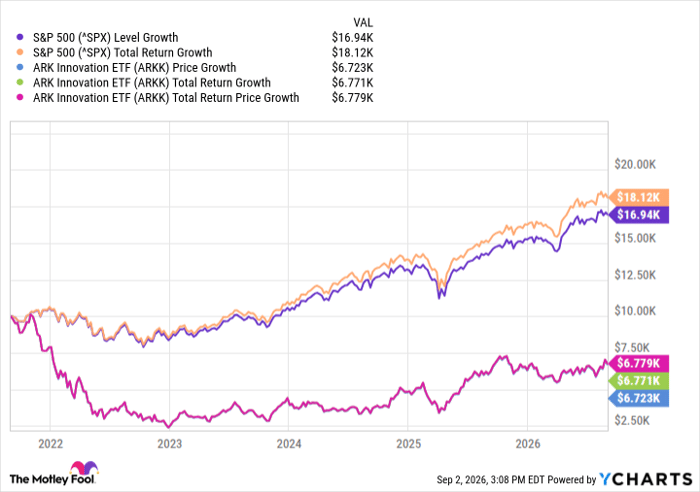
In theory, the fund should have trounced the market during the time frame in question. The Ark Innovation ETF (NYSEMKT: ARKK) is built to capitalize on "disruptive innovation," after all, and there's certainly been plenty of that of late.

Yet, it hasn't happened. Since September of 2021, the S&P 500 (SNPINDEX: ^GSPC) has gained 69.7% (or 81.2% with reinvested dividends), while Ark's Innovation ETF has lost 32.4% of its value. That's annualized growth of 11.2% and -7.5%, respectively.

Missed Nvidia in 2009? This Rare Signal Is Flashing Again. In 2009, a "Double Down" signal flashed for a little-known chipmaker called Nvidia. For the first time in years, that same "Total Conviction" signal is flashing for a company 1/100th the size of Nvidia. Continue Β»

^SPX Chart

^SPX data by YCharts.

What gives?

Simply put, Ark founder and chief stock picker Cathie Wood is sticking with the wrong stocks. Perhaps more than that, she's not actually sticking with the right ones long enough.

The Ark Innovation ETF under the microscope

The premise holds enough water. Many of the market's most rewarding stocks have represented the world's most disruptive companies. Think Amazon (NASDAQ: AMZN) and Apple (NASDAQ: AAPL). To this end, some of the Ark Innovation ETF's top holdings right now are electric vehicle (EV) maker Tesla (NASDAQ: TSLA), SpaceX (NASDAQ: SPCX), and gene-editing biotechnology CRISPR Therapeutics (NASDAQ: CRSP). And despite the fund's lingering underperformance, Wood is still picking stocks based on their companies' apparent potential to change the world.

There are two arguable pitfalls with the fund, however.

One is that, while Cathie Wood remains convinced of ARKK's underlying philosophy, her actual long-term confidence in the ETF's positions appears low. According to its disclosure documents, last year's turnover rate was a relatively high 43%, meaning the fund replaced 43% of its holdings during the 12-month stretch. And that figure arguably understates the amount of trading activity ARKK actually saw for that time frame. It's not unusual for the fund to buy and sell the same stock over and over within the same year.

It's a concern simply because -- as veteran investors can attest -- frequent trading works against you more often than it works for you. Through no fault of her own, Wood can't time the market's ebbs and flows any better than most amateur and professional investors.

A person at home is sitting at a desk in front of a laptop and looking at their phone, while a child is playing in the background.

Image source: Getty Images.

And the other factor crimping the Ark Innovation ETF's performance? It's not owning companies that are potentially disruptive. It's the notion that one can actually know if a company with a potentially disruptive product, technology, or service is actually worth owning before that disruption materializes.

As a reminder, Apple didn't actually pioneer smartphones. That honor arguably belongs to BlackBerry. Even though it was largely expected to, it never disrupted the mobile phone business. Apple was the unlikely name to do so about a decade later. Amazon also wasn't the first seemingly disruptive e-commerce outfit. It just ended up becoming the dominant one several years into its existence.

The point is, while ARKK's holdings like Tesla and SpaceX are considered disruptors, that doesn't necessarily mean their stocks are guaranteed to perform like past, proven disruptors' tickers have.

Not a must-have

In answer to the initial question then, no, despite Cathie Wood's high confidence that some companies in certain industries will prove disruptive, the Ark Innovation ETF doesn't inherently belong in your portfolio. The fund's relatively frequent trading activity actually implies a lack of conviction in its stocks. Plus, many of the ETF's holdings appear to be all-or-nothing bets rather than proven buy-and-hold investments.

Should you buy stock in Ark ETF Trust - Ark Innovation ETF right now?

Before you buy stock in Ark ETF Trust - Ark Innovation ETF, consider this:

The Motley Fool Stock Advisor analyst team just identified what they believe are the 10 best stocks for investors to buy now… and Ark ETF Trust - Ark Innovation ETF wasn’t one of them. The 10 stocks that made the cut could produce monster returns in the coming years.

Consider when Netflix made this list on December 17, 2004... if you invested $1,000 at the time of our recommendation, you’d have $445,833!* Or when Nvidia made this list on April 15, 2005... if you invested $1,000 at the time of our recommendation, you’d have $1,402,153!*

Now, it’s worth noting Stock Advisor’s total average return is 993% β€” a market-crushing outperformance compared to 214% for the S&P 500. Don't miss the latest top 10 list, available with Stock Advisor, and join an investing community built by individual investors for individual investors.

See the 10 stocks Β»

*Stock Advisor returns as of September 5, 2026.

James Brumley has no position in any of the stocks mentioned. The Motley Fool has positions in and recommends Amazon, Apple, and Tesla. The Motley Fool recommends BlackBerry and CRISPR Therapeutics. The Motley Fool has a disclosure policy.
☐ β˜† βœ‡ The Motley Fool

Sundar Pichai Told Employees Waymo Could 'Meaningfully' Contribute to Alphabet's Financials as Soon as 2027. Is the Self-Driving Bet Underrated by the Market Today?

By: newsfeedback@fool.com (James Brumley) β€”

Key Points

  • Google’s autonomous taxi business is expanding rapidly this year, marking something of a turning point for this venture.

  • Even at considerably more scale, however, Waymo won’t be as big as some of Alphabet’s core businesses for quite some time.

  • Waymo’s market value already reflects its distant future, which may also already be reflected in Alphabet stock’s price.

Anyone patiently waiting for Google's budding robotaxi business to matter may not have to wait much longer.

That's the top takeaway from Alphabet (NASDAQ: GOOG) (NASDAQ: GOOGL) CEO Sundar Pichai's internal update on the development of Waymo delivered late last year, when he suggested the self-driving taxi brand would "meaningfully" contribute to Alphabet's results beginning sometime in 2027.

Missed Nvidia in 2009? This Rare Signal Is Flashing Again. In 2009, a "Double Down" signal flashed for a little-known chipmaker called Nvidia. For the first time in years, that same "Total Conviction" signal is flashing for a company 1/100th the size of Nvidia. Continue Β»

And there's no reason to suspect otherwise now. Since then, the company has launched service in Sacramento, Chicago, and Dallas, and expanded service in a slew of other cities, with more on the way before the end of 2026. As of midyear, the service was providing over 500,000 rides each week. In short, not only does the autonomous taxi's technology work, but consumers are embracing it.

The question is, does what constitutes "meaningful" to Pichai do the same for Alphabet's shareholders?

A Waymo robotaxi is picking up riders in front of a house.

Image source: Waymo.

Where Waymo stands

Waymo's results still aren't broken out within Alphabet's quarterly reports, and likely won't be anytime soon ... if ever. For now, they're part of the company's "other bets" arm, which contributed just $382 million in revenue during the three-month stretch ending in June.

If you dig deep enough into Alphabet's investor-facing information, though, you'll find some data that paints a clearer picture of where Waymo is. Case in point: In an earlier fundraising presentation, the company indicated that Waymo is worth $126 billion. Even without knowing exactly what this means for revenue, it's clearly not an insignificant amount, even if the bulk of the valuation reflects what this business could become rather than what it is.

And there's certainly plenty of opportunity ahead, even if most of it must wait a while to be tapped. Goldman Sachs expects the U.S. robotaxi market to be worth $19 billion by 2030, en route to $48 billion by 2035, when the worldwide autonomous taxi industry could be worth more than $400 billion.

Respectable, but not under-reflected

That's impressive, to be sure, and there's no denying that Alphabet's got a chance to win at least its fair share of this growth. From this perspective, Waymo isn't unreasonably valued at $126 billion even if revenue is currently modest. That revenue is likely coming, eventually.

It might be a bit of a stretch, however, to suggest Alphabet shares are currently undervalued specifically because the market is underestimating how soon Waymo will produce meaningful revenue. Pichai's prediction that 2027 (or 2028) will mark fiscal turning points for the business might have been better described as "measurable" rather than meaningful. For perspective, Google's search business alone produced over $63 billion of revenue in the second quarter, while cloud computing -- where it reports its artificial intelligence results -- added nearly $25 billion to the top line.

Regardless, with or without Waymo's foreseeable future priced in, Alphabet's still arguably undervalued. Analysts think so, anyway. The vast majority of them currently rate GOOGL stock a strong buy, with a consensus price target of $ 426.68, which is 26% above the ticker's current price.

Should you buy stock in Alphabet right now?

Before you buy stock in Alphabet, consider this:

The Motley Fool Stock Advisor analyst team just identified what they believe are the 10 best stocks for investors to buy now… and Alphabet wasn’t one of them. The 10 stocks that made the cut could produce monster returns in the coming years.

Consider when Netflix made this list on December 17, 2004... if you invested $1,000 at the time of our recommendation, you’d have $445,833!* Or when Nvidia made this list on April 15, 2005... if you invested $1,000 at the time of our recommendation, you’d have $1,402,153!*

Now, it’s worth noting Stock Advisor’s total average return is 993% β€” a market-crushing outperformance compared to 214% for the S&P 500. Don't miss the latest top 10 list, available with Stock Advisor, and join an investing community built by individual investors for individual investors.

See the 10 stocks Β»

*Stock Advisor returns as of September 4, 2026.

James Brumley has positions in Alphabet. The Motley Fool has positions in and recommends Alphabet and Goldman Sachs Group. The Motley Fool has a disclosure policy.

☐ β˜† βœ‡ The Motley Fool

BlackRock Wants 5% to 20% of Your Target-Date Fund in Private Assets

By: newsfeedback@fool.com (James Brumley) β€”

Key Points

  • With the stock market becoming less balanced and more difficult to navigate, investors are showing increasing interest in alternative investments.

  • Although some private equity and private credit investments are available in brokerage accounts and IRAs, investment manager BlackRock is bringing this option to accounts where such offerings remain relatively rare.

Your employer's 401(k) plan could soon have a brand-new, never-before-offered kind of investment option -- funds that hold a healthy dose of privately owned (as opposed to publicly traded) businesses.

That's the important takeaway from an announcement by investment manager BlackRock (NYSE: BLK) around the middle of this year. As the stock market's risks rise and its rewards shrink -- and as it grows more difficult to navigate -- BlackRock wants to give ordinary investors access to potentially better returns.

Missed Nvidia in 2009? This Rare Signal Is Flashing Again. In 2009, a "Double Down" signal flashed for a little-known chipmaker called Nvidia. For the first time in years, that same "Total Conviction" signal is flashing for a company 1/100th the size of Nvidia. Continue Β»

Here's what you need to know.

The how and why

Your retirement savings account's exposure to privately held businesses will still be relatively limited, for the record. Initially, only target-date mutual funds overseen by Great Gray Trust will hold stakes in these enterprises, and even then, only 5% to 20% of these funds' capital will be allocated to private investments. And investors will only be able to access this narrow selection of target-date funds if their 401(k) plan's sponsor and administrator agree that adding this option is in employees' best interest.

One analyst is speaking to another in front of a presentation screen.

Image source: Getty Images.

It shouldn't be terribly difficult to sell this idea to sponsors and administrators, however. BlackRock (which manages the iShares family of exchange-traded funds) notes that, on average, privately owned ventures return about 50 more basis points annually than stocks. Over the course of 40 years, that would make 401(k) account balances about 15% bigger than they'd otherwise be using nothing but conventional stock-based funds.

Demand is growing

Although this launch will be one of the first of its kind for 401(k) plans, access to private enterprises through publicly traded instruments is not unheard of. Business development companies like Main Street Capital (NYSE: MAIN) are a form of private equity and private credit, while Brookfield Asset Management's (NYSE: BAM) Brookfield Renewable Partners (NYSE: BEP) (NYSE: BEPC) offers its shareholders exposure to a basket of energy-related ventures that aren't accessible any other way. Hedge fund manager Bill Ackman is also planning a new venture fund that will offer ordinary, non-institutional investors access to companies that have not yet gone public, but eventually will.

Still, these options remain relatively rare.

That's clearly changing, though. Perhaps finally prompted by the recent initial public offering of Space Exploration Technologies -- you know it better as SpaceX -- which has made its earliest insiders considerably wealthier than its post-IPO investors, more people are clamoring for alternatives capable of delivering better returns. BlackRock's and Great Gray's offering will certainly bring that prospect to the table.

That said, it would also be naΓ―ve to ignore the fact that the stock market as a whole has become uncomfortably unbalanced. The S&P 500's 10 biggest companies collectively account for nearly 40% of its value, while nearly as much of the index's value is held by technology stocks. If only for the sake of better diversification, access to alternative investments (private or otherwise) have their obvious appeal.

Look for more of the same

Only time will tell how quickly BlackRock's concept becomes a common option for 401(k) plans. Don't be surprised to see measurable interest, though. In this same vein, don't be surprised to see other outfits introduce similar private investment offerings now that BlackRock is pushing the boundaries of the premise.

Should you buy stock in BlackRock right now?

Before you buy stock in BlackRock, consider this:

The Motley Fool Stock Advisor analyst team just identified what they believe are the 10 best stocks for investors to buy now… and BlackRock wasn’t one of them. The 10 stocks that made the cut could produce monster returns in the coming years.

Consider when Netflix made this list on December 17, 2004... if you invested $1,000 at the time of our recommendation, you’d have $446,157!* Or when Nvidia made this list on April 15, 2005... if you invested $1,000 at the time of our recommendation, you’d have $1,377,357!*

Now, it’s worth noting Stock Advisor’s total average return is 983% β€” a market-crushing outperformance compared to 212% for the S&P 500. Don't miss the latest top 10 list, available with Stock Advisor, and join an investing community built by individual investors for individual investors.

See the 10 stocks Β»

*Stock Advisor returns as of September 4, 2026.

James Brumley has no position in any of the stocks mentioned. The Motley Fool has positions in and recommends BlackRock and Brookfield Asset Management. The Motley Fool recommends Brookfield Renewable and Brookfield Renewable Partners. The Motley Fool has a disclosure policy.

☐ β˜† βœ‡ The Motley Fool

3 Things You Need to Know If You Buy Pfizer Stock Today

By: newsfeedback@fool.com (James Brumley) β€”

Key Points

  • Investors won’t start seeing the fruits of Pfizer’s current efforts for several more years.

  • A handful of its top-selling drugs will be losing their patent protection in the meantime.

  • Aggressive cost-cutting could make a surprising difference to its bottom line in the meantime.

As the old saying goes, "If something sounds too good to be true, it probably is."

That clichΓ©d wisdom presents something of a problem for any investor eyeing a new stake in pharmaceutical outfit Pfizer (NYSE: PFE) while its stock is priced at less than 10 times this year's expected per-share profit of $2.98, with a forward-looking dividend yield that's unusually high at just over 6%.

Missed Nvidia in 2009? This Rare Signal Is Flashing Again. In 2009, a "Double Down" signal flashed for a little-known chipmaker called Nvidia. For the first time in years, that same "Total Conviction" signal is flashing for a company 1/100th the size of Nvidia. Continue Β»

What's the market seeing? Maybe it's what the market's not seeing. To this end, if you're thinking about diving in, here are the top three things you need to know about Pfizer today.

1. The real revenue turning point is 2030

All stock prices reflect that company's plausible future more so than its past, or even its present. The challenge for investors interested in Pfizer at this time is how far into the future they need to look.

While its acquisitions and in-house research and development work on this front are certainly promising, the company's goal of having eight new blockbuster oncology drugs on the market -- and doubling its total number of cancer patients it's currently serving as a result -- won't even begin to start happening until after 2028, and not in earnest until 2030.

A pharmaceutical lab technician is preparing a clinical test.

image source: Getty Images.

Meanwhile, its top-selling drugs like cancer-fighting Ibrance, pneumonia vaccine Prevnar, and blood-thinner Eliquis (which accounts for about 15% of Pfizer's total revenue) will lose their patent protection. In other words, it could be a tough few years between now and 2030,

2. Its cost-cutting goals aggressive

At the same time, the drugmaker is setting up new profit centers to offset the eventual wind-down of others, and it's also cutting costs. Specifically, between this year and 2029, Pfizer expects to find $9.7 billion worth of operational savings. Most will come from cost realignments, but some will be the result of manufacturing optimization.

For perspective on that number, the company's on pace to do on the order of $62 billion worth of business this year. That's also more than all of last year's net income.

3. The high yield and low valuation make it worth the risk

Finally, although the stock's dirt cheap valuation and oddly high dividend yield suggest most investors doubt Pfizer will be able to achieve its goals anytime soon (and with a consensus 12-month price target of only $28.28 per share, most analysts seem to agree), this is a scenario where investors should think longer term, recognizing that Pfizer's forced overhaul isn't anything new or unusual for it or any other names in the pharmaceutical industry. It should be a far more promising company five years from now.

Also, remember that most stocks tend to move in anticipation of turnarounds, because they actually take hold. In this vein, Pfizer's got a great deal of drug-development progress news already lined up for the next five years, which will give investors plenty of bullish milestones to latch onto. Just make sure you're ready for a bumpy ride during this stretch.

Should you buy stock in Pfizer right now?

Before you buy stock in Pfizer, consider this:

The Motley Fool Stock Advisor analyst team just identified what they believe are the 10 best stocks for investors to buy now… and Pfizer wasn’t one of them. The 10 stocks that made the cut could produce monster returns in the coming years.

Consider when Netflix made this list on December 17, 2004... if you invested $1,000 at the time of our recommendation, you’d have $446,157!* Or when Nvidia made this list on April 15, 2005... if you invested $1,000 at the time of our recommendation, you’d have $1,377,357!*

Now, it’s worth noting Stock Advisor’s total average return is 983% β€” a market-crushing outperformance compared to 212% for the S&P 500. Don't miss the latest top 10 list, available with Stock Advisor, and join an investing community built by individual investors for individual investors.

See the 10 stocks Β»

*Stock Advisor returns as of September 3, 2026.

James Brumley has no position in any of the stocks mentioned. The Motley Fool has positions in and recommends Pfizer. The Motley Fool has a disclosure policy.

☐ β˜† βœ‡ The Motley Fool

I'm Calling It: Bloom Energy's Revenue Guidance Will Keep Surprising Wall Street Through Year-End

By: newsfeedback@fool.com (James Brumley) β€”

Key Points

  • Fuel cell company Bloom Energy has already raised its full-year revenue guidance once this year.

  • The underlying swell of AI-driven demand, however, isn’t abating.

  • Look for more new deals and expansions of partnerships that Bloom has already entered at least through the end of 2026.

After last quarter's year-over-year revenue growth of 165.5% paired with the 12% (at the midpoint) increase in its already-impressive full-year revenue guidance, it's difficult to believe Bloom Energy (NYSE: BE) could dish out another pleasant surprise.

Except maybe it isn't. Despite economic headwinds like lingering inflation and weak consumer confidence, capital investments in artificial intelligence (AI) infrastructure are still being made in earnest.

Missed Nvidia in 2009? This Rare Signal Is Flashing Again. In 2009, a "Double Down" signal flashed for a little-known chipmaker called Nvidia. For the first time in years, that same "Total Conviction" signal is flashing for a company 1/100th the size of Nvidia. Continue Β»

An artificial intelligence data center is being powered by wind turbines.

Image source: Getty Images.

Bloom Energy manufactures electricity-generating fuel cells, by the way. Although the technology wasn't initially envisioned as a primary power source for AI data centers, as it's improved while data centers have become increasingly starved for electricity, it's become a viable option. Bloom Energy's solid-oxide fuel cells are particularly marketable in that -- unlike most other fuel cells -- they can use readily available natural gas to generate power.

The market is clearly embracing the solution, too, as evidenced by Q2's explosive revenue growth to just over $1.0 billion, versus Q1's top line of $751 million. That's why the company understandably expects to report total revenue of between $3.9 billion and $4.2 billion this year, up from April's guidance of a range between $3.4 billion and $3.8 billion.

This upward-revised guidance may still ultimately be too conservative, though. As noted, demand for AI data center-capable power equipment -- all of it -- remains insatiable. Just last month, Bloom expanded its supply agreement with AI server manufacturer MiTAC Computing Technology. That follows April's announcement that its similar (but larger) partnership with Oracle is also being expanded, from 1.2 gigawatts to 2.8 gigawatts.

Connect the dots. Bloom Energy had already proven itself to be a capable power solutions provider. Now that it has, industries are looking for more of it simply because they're desperate, and Bloom can offer a workable solution right now. Don't be surprised to see more of the same kind of dealmaking before the end of the year.

Should you buy stock in Bloom Energy right now?

Before you buy stock in Bloom Energy, consider this:

The Motley Fool Stock Advisor analyst team just identified what they believe are the 10 best stocks for investors to buy now… and Bloom Energy wasn’t one of them. The 10 stocks that made the cut could produce monster returns in the coming years.

Consider when Netflix made this list on December 17, 2004... if you invested $1,000 at the time of our recommendation, you’d have $446,157!* Or when Nvidia made this list on April 15, 2005... if you invested $1,000 at the time of our recommendation, you’d have $1,377,357!*

Now, it’s worth noting Stock Advisor’s total average return is 984% β€” a market-crushing outperformance compared to 212% for the S&P 500. Don't miss the latest top 10 list, available with Stock Advisor, and join an investing community built by individual investors for individual investors.

See the 10 stocks Β»

*Stock Advisor returns as of September 3, 2026.

James Brumley has no position in any of the stocks mentioned. The Motley Fool has positions in and recommends Bloom Energy and Oracle. The Motley Fool has a disclosure policy.

☐ β˜† βœ‡ The Motley Fool

Loan Delinquencies Edge Lower in Q2, but Some Remain at Very High Levels. Here's What It Means for Investors.

By: newsfeedback@fool.com (James Brumley) β€”

Key Points

  • Overall, U.S. consumers are demonstrating improving economic resiliency.

  • A subset of these consumers, however, are starting to show serious signs of financial struggle.

  • Investors can’t afford to ignore the proven and potential impact of this divergence.

Economic data continues to send mixed messages. That's the takeaway from the Federal Reserve's second-quarter snapshot of U.S. consumer loans anyway. The total number of loans that were delinquent by 90 or more days fell from 2.91% a year earlier to 2.57% in the second quarter of this year, down from Q1's figure of 2.83%.

There are pockets of problems, however. Mortgage delinquencies edged measurably higher -- again -- as did past-due auto loans. Indeed, car loan delinquencies are showing signs of serious trouble, moving back within sight of multiyear highs.

Missed Nvidia in 2009? This Rare Signal Is Flashing Again. In 2009, a "Double Down" signal flashed for a little-known chipmaker called Nvidia. For the first time in years, that same "Total Conviction" signal is flashing for a company 1/100th the size of Nvidia. Continue Β»

There's an important nuance that's not readily evident in the Fed's main numbers, however. That is, subprime loans (loans granted to borrowers with lower credit scores) account for a significant share of the recent weakness. For instance, the Fed's data indicates that while the second quarter's subprime mortgage loan delinquency rate of 1.86% was a hair lower than Q1's 1.88%, the rate is still near a multiyear high. As the Mortgage Bankers Association's vice president of industry analysis, Marina Walsh, recently noted, while "mortgage delinquencies decreased [sequentially] slightly across all loan types in the second quarter of 2026 ... the broader trend is that both delinquencies and foreclosures have increased over the past year."

A worried investor is staring at a laptop screen.

Image source: Getty Images.

Separately but simultaneously, although bond rating firm Fitch reported that last quarter's subprime car loan delinquencies fell from 6.5% at the end of 2025 to 5.8% as of the end of Q2, its recent analysis also says, "July, however, showed renewed deterioration, particularly in subprime," attributing the delinquency divergence to "affordability pressures weighing disproportionately on lower-income, highly leveraged borrowers in a K-shaped economy." Moreover, Fitch "expects prime and subprime auto loan ABS [asset-backed securities] performance to weaken further in the second half of this year, driven by tariff uncertainty, oil-price volatility tied to the U.S.-Iran conflict, and a cooling labor market, with subprime remaining under greater pressure than prime."

And this is nothing for investors to ignore.

A tale of two kinds of consumer

Last quarter's delinquency data underscores the argument that -- just as Fitch's report suggests -- the U.S. is experiencing a K-shaped economic recovery. In other words, rather than a rising tide lifting all boats, affluent households are adjusting to rising inflation and higher interest rates well enough, while lower-earning households and consumers are increasingly struggling.

And we were already seeing hints of this dynamic. Take American Express' (NYSE: AXP) second-quarter results as an example. The credit card company largely serving a more affluent customer base saw year-over-year revenue growth of 9% -- the highest in three years -- more or less matched by profit growth. Chief Financial Officer Christophe Le Caillec specifically highlighted this during Q2's earnings conference call, noting that card-based retail spending, restaurant spending, and travel-related spending all grew at an even faster clip. Yet loan delinquencies didn't budge, and remain below levels seen during the COVID-19 pandemic. That's in contrast to credit bureau TransUnion's observation that "a growing subprime population largely drove the increase" drove the second quarter's 90-day credit card delinquencies.

We're seeing similar red flags on other fronts, too. Fast-food restaurant chain McDonald's (NYSE: MCD) Q2 sales growth fell short of expectations largely because, in CEO Chris Kempczinski's words, "Although we've restored our overall value and affordability leadership, our restaurant level results show that execution was inconsistent across the system." That underscores the economic sensitivity of its core, value-conscious customer.

Brick-and-mortar discount retailer Walmart (NASDAQ: WMT) misfired last quarter as well. U.S. same-store sales growth of 2.6% fell short of the 3.8% year-over-year growth rate analysts were expecting.

Interestingly, used-car dealers Carvana (NYSE: CVNA) and CarMax (NYSE: KMX) aren't showing any serious signs of trouble yet, despite their dependence on consumers' ability to obtain credit. That trouble could be brewing, though. Data from industry research outfit Cox Automotive indicates that subprime loans' share of the nation's auto lending market fell every month in Q2, from March's 19.5% to June's 16.6%, with subprime lenders simply rejecting more of these increasingly risky loan applications.

An extension of this headwind could prove particularly problematic for Carvana, which counts sales of automobile loans to third-party investors as a key component of its per-car profit. Again, Fitch expects automobile-loan-based asset-backed securities to underperform for the remainder of this year, largely because their underlying subprime borrowers are facing a growing amount of economic hardship that's making it tougher to repay these loans. In this vein, know that online bank Ally Financial (NYSE: ALLY) also manages a sizable subprime car loan portfolio that could be vulnerable.

Expect more of the same

Only time will tell whether this dynamic will persist into the foreseeable future, and if so, to what degree.

Clearly, not much has changed with or for the economy since the second quarter of the year, though. Inflation is still uncomfortably high, the job market is less than solid, and paychecks are relatively weak, while corporate and consumer confidence is low. The reasons for the K-shaped economic recovery that were clearly in place in Q2 appear to still be in place now. Investors shouldn't be surprised to see at least a similar outcome and impact on companies' performances, if not the exact same ones.

Should you buy stock in American Express right now?

Before you buy stock in American Express, consider this:

The Motley Fool Stock Advisor analyst team just identified what they believe are the 10 best stocks for investors to buy now… and American Express wasn’t one of them. The 10 stocks that made the cut could produce monster returns in the coming years.

Consider when Netflix made this list on December 17, 2004... if you invested $1,000 at the time of our recommendation, you’d have $437,097!* Or when Nvidia made this list on April 15, 2005... if you invested $1,000 at the time of our recommendation, you’d have $1,355,077!*

Now, it’s worth noting Stock Advisor’s total average return is 978% β€” a market-crushing outperformance compared to 213% for the S&P 500. Don't miss the latest top 10 list, available with Stock Advisor, and join an investing community built by individual investors for individual investors.

See the 10 stocks Β»

*Stock Advisor returns as of September 2, 2026.

American Express is an advertising partner of Motley Fool Money. James Brumley has no position in any of the stocks mentioned. The Motley Fool has positions in and recommends American Express, CarMax, and Walmart. The Motley Fool recommends the following options: long January 2028 $320 calls on McDonald's and short January 2028 $340 calls on McDonald's. The Motley Fool has a disclosure policy.

☐ β˜† βœ‡ The Motley Fool

Nvidia Sells the Brains of the AI Boom. Something Else Is Selling the Muscle -- and It's Not on Wall Street's Radar.

By: newsfeedback@fool.com (James Brumley) β€”

Key Points

  • Computing processor maker Nvidia rightfully gets much of the credit for ushering in the era of modern-day AI.

  • AI’s proliferation, however, will require cost-reducing efficiency on all fronts, including electricity consumption.

  • Power supply platforms that handle higher voltages at lower current draw require less total power, making them cheaper to operate.

Despite the advent of alternatives such as Alphabet's Tensor Processing Units (TPUs), Nvidia (NASDAQ: NVDA) remains the leader of the artificial intelligence (AI) data center chip market. It sold $89 billion worth of data center silicon last quarter alone.

But more than just chips go into data center operations. Processing capacity is another aspect of artificial intelligence data centers. Networking is another. Electricity is still another, along with cooling. One of these more nuanced slivers of the AI business has gone largely unnoticed by both Main Street and Wall Street. And despite what you're probably thinking, it's not onsite power like the electricity generated by GE Vernova's (NYSE: GEV) natural gas power turbines.

Missed Nvidia in 2009? This Rare Signal Is Flashing Again. In 2009, a "Double Down" signal flashed for a little-known chipmaker called Nvidia. For the first time in years, that same "Total Conviction" signal is flashing for a company 1/100th the size of Nvidia. Continue Β»

The overlooked aspect of the modern-day AI business is the 800-volt power distribution equipment that could eventually become the industry norm, making the companies operating in this space a lot of money.

A data center electrician is installing an 800-volt power supply.

Image source: Getty Images.

A new norm for data centers is on the horizon

A quick lesson: The ordinary electrical outlets in your home deliver 110 alternating current (or AC) volts, while appliances like your dryer or oven need between 220 and 240 volts to function. Some industrial manufacturing equipment requires 440 volts to operate. And by and large, data centers have historically been built to use these long-standing conventional voltages, particularly within the United States.

With energy prices soaring, though, every potential improvement in data centers' electrical efficiency matters. And as it turns out, 800-volt direct-current platforms are far more power-efficient, and therefore cheaper to operate. Specifically, this option costs about 10% less than most of the power supplies readily available right now.

And this technology is far from being merely theoretical or experimental. Vertiv (NYSE: VRT) -- the company arguably best known for its data center cooling solutions -- co-announced with Nvidia in August of last year that it was making good design progress with its 800-volt power infrastructure specifically for Nvidia's ballyhooed next-generation Vera Rubin accelerators.

Nvidia and Vertiv aren't the only players adapting to 800-volt power supplies, though. Chipmakers Navitas Semiconductor (NASDAQ: NVTS) and Texas Instruments (NASDAQ: TXN) are moving in this direction, while smaller players like Korea-based Delta Electronics and non-publicly traded Schneider Electric are developing 800-volt power distribution equipment for data centers.

Vertiv and Nvidia are arguably leading the race, however. Nvidia confirmed in mid-August that its MGX-compatible direct current 800-power rack will be available before the end of 2026, firmly launching the beginning of a new chapter in AI data centers' power management.

There should be plenty of business to go around, given that many modern-day data centers' power consumption is measured in megawatts.

Just keep your eyes peeled

There is a challenge here. While no one disputes that 800-volt direct current platforms are more power-efficient and therefore offer an important cost savings, we're still at the early stages of a transition that could take years, and the industry is already committed to spending over $700 billion this year alone on other AI infrastructure. It may balk at replacing recently installed power supply equipment, even if it is inferior to newer options.

Still, it's a technological upgrade with clear potential, even if most of Wall Street isn't paying attention yet. You'll want to keep your eyes and ears open for how this story develops simply because there's an opportunity buried within it.

Should you buy stock in Vertiv right now?

Before you buy stock in Vertiv, consider this:

The Motley Fool Stock Advisor analyst team just identified what they believe are the 10 best stocks for investors to buy now… and Vertiv wasn’t one of them. The 10 stocks that made the cut could produce monster returns in the coming years.

Consider when Netflix made this list on December 17, 2004... if you invested $1,000 at the time of our recommendation, you’d have $437,097!* Or when Nvidia made this list on April 15, 2005... if you invested $1,000 at the time of our recommendation, you’d have $1,355,077!*

Now, it’s worth noting Stock Advisor’s total average return is 978% β€” a market-crushing outperformance compared to 213% for the S&P 500. Don't miss the latest top 10 list, available with Stock Advisor, and join an investing community built by individual investors for individual investors.

See the 10 stocks Β»

*Stock Advisor returns as of September 1, 2026.

James Brumley has positions in Alphabet. The Motley Fool has positions in and recommends Alphabet, GE Vernova, Nvidia, Texas Instruments, and Vertiv. The Motley Fool has a disclosure policy.

☐ β˜† βœ‡ The Motley Fool

This High-Yield Pipeline Stock Could Turn $450 a Month Into a Six-Figure Portfolio Paying Real Annual Income

By: newsfeedback@fool.com (James Brumley) β€”

Key Points

  • Oil and gas pipeline stocks generate revenue based on the volume usage their pipeline networks see.

  • Since demand for oil and gas logistics services is consistent, so too are the dividends -- and dividend growth -- from these organizations.

  • Although Enbridge has proven its reliability, plenty of other companies can produce similarly sized (and surprising) net gains.

Do investors make building an income portfolio more difficult than it needs to be? Many of them do.

If you feel like this could be you, there's a simple solution hiding in plain sight. It's an oil and gas pipeline company called Enbridge (NYSE: ENB). A commitment of just $450 per month to this oil stock could eventually turn into a six-figure stash, and perhaps more importantly, generate meaningful income when you finally need it.

Missed Nvidia in 2009? This Rare Signal Is Flashing Again. In 2009, a "Double Down" signal flashed for a little-known chipmaker called Nvidia. For the first time in years, that same "Total Conviction" signal is flashing for a company 1/100th the size of Nvidia. Continue Β»

Reliable persistence is the key

A pipeline company is an ideal business for producing reliable, recurring dividends. Pipeline operators aren't impacted by the ever-fluctuating price of natural gas or crude oil. Rather, since pipeline network owners like Enbridge simply charge a flat fee based on usage volume, they're only concerned about consumption (which remains steady).

A welder is connecting oil and gas pipes for a pipeline network.

Image source: Getty Images.

And its business's resiliency is evident in this company's long-term performance. Not only has Enbridge paid a quarterly dividend like clockwork for decades now, but it has also raised its per-share payment every year for the past 31 years. Indeed, had you reinvested these dividends in more Enbridge shares, a $10,000 investment made 30 years ago would be worth a little over $206,000 now, mostly thanks to those ever-growing dividends.

ENB Chart

Data by YCharts.

That's an annualized growth rate of 10.6%, by the way. Assuming Enbridge stock continues to inflate its stock and its dividend payment at the same pace, investing $450 per month every month -- and reinvesting its dividends -- for the next 20 years would leave you with just a little less than $374,000. Moreover, based on the stock's current forward-looking yield of 5.6%, that position could generate nearly $21,000 in annual dividend income.

Your dividend stock pick doesn't necessarily have to be Enbridge

Past performance is no guarantee of future results, of course. On the other hand, past performance is a pretty good indication of what's likely in the future.

Whatever happens with Enbridge going forward, this example illustrates the cumulative, compounding power of consistent dividend payments.

Should you buy stock in Enbridge right now?

Before you buy stock in Enbridge, consider this:

The Motley Fool Stock Advisor analyst team just identified what they believe are the 10 best stocks for investors to buy now… and Enbridge wasn’t one of them. The 10 stocks that made the cut could produce monster returns in the coming years.

Consider when Netflix made this list on December 17, 2004... if you invested $1,000 at the time of our recommendation, you’d have $440,710!* Or when Nvidia made this list on April 15, 2005... if you invested $1,000 at the time of our recommendation, you’d have $1,335,252!*

Now, it’s worth noting Stock Advisor’s total average return is 978% β€” a market-crushing outperformance compared to 213% for the S&P 500. Don't miss the latest top 10 list, available with Stock Advisor, and join an investing community built by individual investors for individual investors.

See the 10 stocks Β»

*Stock Advisor returns as of September 1, 2026.

James Brumley has no position in any of the stocks mentioned. The Motley Fool has positions in and recommends Enbridge. The Motley Fool has a disclosure policy.
☐ β˜† βœ‡ The Motley Fool

The 1 Metric I Check Before Buying Any Dividend Stock

By: newsfeedback@fool.com (James Brumley) β€”

Key Points

  • Income-seeking investors are usually well served by holding dividend-paying stocks.

  • The returns you’d be getting in the near term from a new position based on its current payout rate can be the most important factor to weigh.

  • Dividend yield is not the only criterion you ought to consider.

There are several details I consider before adding any particular stock to my portfolio. One of them is the ticker's price in relation to its earnings or the amount of revenue that the company is turning into reliable cash every quarter. The organization's past and projected earnings growth are also important starting points for me.

For my income-generating stock holdings, though, there's one crucial measure I consider before any other: their dividend yield. Here's a concise explanation of what dividend yield is, and why you should put it at the top of your list of criteria, too.

Missed Nvidia in 2009? This Rare Signal Is Flashing Again. In 2009, a "Double Down" signal flashed for a little-known chipmaker called Nvidia. For the first time in years, that same "Total Conviction" signal is flashing for a company 1/100th the size of Nvidia. Continue Β»

What's a dividend yield?

It's not a complicated concept. Dividend-paying companies distribute per-share cash payments to their investors on a regular schedule, usually quarterly.

The dividend yield is just the amount of money that you can expect the company to distribute per share over the course of a year, divided by the price of the stock. Broadly speaking, higher is better.

An example will help illustrate the concept. Let's use beverage company Coca-Cola (NYSE: KO).

Right now, every three months, its shareholders receive payments of $0.53 for each KO share they own. On a full-year basis, assuming that the payout doesn't change, that will come to $2.12 per share. Dividing that amount by the stock's current price of just over $89 per share gives it a dividend yield of just under 2.4%.

That's the forward-looking dividend, meaning it reflects the expected total per-share payments for the coming 12 months, based on the latest payout rate. But plenty of companies adjust their payouts over time. Coca-Cola has now raised its per-share dividend payment for 64 consecutive years, so it's reasonable to assume that management will boost it again early next year.

Companies also show their trailing yields -- based on the total dividends that were distributed during the prior 12 months. In this case, that includes two quarters when its payouts were $0.51 per share and two at $0.53 per share, for a total of $2.08. That gives it a trailing yield closer to 2.3%.

When looking at trailing yields, you'll also want to make sure the yield is based on a payment cadence and size that's likely to be repeated in the future. Some companies occasionally pay "special" dividends or "one-time" bonus dividends. Those are nice surprises, but they aren't reliable, and can temporarily skew a yield to misleading levels.

The rest of the story

Beginning your consideration of a new income stock by looking at its yield is smart, but it's certainly not the end of the matter for me. It's also worth checking to ensure the company in question can actually afford to continue paying its dividend.

This requires per-share profits that at least match its per-share payout, although ideally, those profits should exceed the amount of money an organization is paying out in dividends -- usually by a significant amount. In the case of Coca-Cola, its total per-share profits for the past four quarters were $3.33, meaning its earnings easily covered its total per-share dividend payout of $2.08.

An investment analyst seated at a desk is reviewing a printed document.

Image source: Getty Images.

Just as important is how a stock's dividend payment has changed -- hopefully grown -- up until the point I'm considering it. Although past performance is never a guarantee of future results in the stock market, it can provide a pretty good indication of what the future likely holds.

Based on this additional information, I sometimes conclude that the highest-yielding dividend stock I'm eyeing for the income portion of my portfolio isn't necessarily the best long-term option for me. I might opt for a lower-yielding stock, knowing that its dividend payments should be more resilient or based on the idea that over time, the total dividends paid by a reliable payout booster will be higher, even though I'm buying in with a lower present yield.

Just bear in mind that you're still buying into an actual business

With all that being said, just remember that when you buy a stock -- even one that you're primarily picking to generate recurring income -- you're still ultimately buying into a company that you hope will be able to continue doing business for the indefinite future. Analysts' outlooks can tell you what to plausibly expect (earnings-wise) for the near term. The underlying company, however, will ideally be timeless, with a perpetually marketable product or service.

Coca-Cola is, of course, such a company. Not only has it been in business for well over a century, but it has also paid dividends like clockwork for decades. And as it's a Dividend King -- one of the few companies that have boosted their dividend payments for at least 50 consecutive years -- it's reasonable to expect it will prioritize keeping that streak alive.

It's certainly not the only solid, all-around dividend stock to consider for your portfolio, though. Poke around a bit. At any given time, you should be able to find several promising dividend-paying prospects.

Should you buy stock in Coca-Cola right now?

Before you buy stock in Coca-Cola, consider this:

The Motley Fool Stock Advisor analyst team just identified what they believe are the 10 best stocks for investors to buy now… and Coca-Cola wasn’t one of them. The 10 stocks that made the cut could produce monster returns in the coming years.

Consider when Netflix made this list on December 17, 2004... if you invested $1,000 at the time of our recommendation, you’d have $440,710!* Or when Nvidia made this list on April 15, 2005... if you invested $1,000 at the time of our recommendation, you’d have $1,335,252!*

Now, it’s worth noting Stock Advisor’s total average return is 978% β€” a market-crushing outperformance compared to 213% for the S&P 500. Don't miss the latest top 10 list, available with Stock Advisor, and join an investing community built by individual investors for individual investors.

See the 10 stocks Β»

*Stock Advisor returns as of August 30, 2026.

James Brumley has positions in Coca-Cola. The Motley Fool has no position in any of the stocks mentioned. The Motley Fool has a disclosure policy.

☐ β˜† βœ‡ The Motley Fool

What Are Hyperscalers? The 3 Cloud Giants Powering AI's Next Decade

By: newsfeedback@fool.com (James Brumley) β€”

Key Points

  • As AI continues to proliferate, data centers are getting larger to achieve greater efficiency.

  • Some of them are becoming so big, in fact, that they are their own digital, physical, and logistical ecosystem.

  • Even without knowing precisely what a hyperscale data center is, knowing who offers cloud-based access to them -- and what their platforms are capable of -- puts things in their proper perspective.

Hyperscalers. It's a term we've all heard tossed around quite a bit lately -- and maybe even used ourselves -- perhaps without even knowing exactly what it means.

If that's you, I've got good news for you. That is, there's no hard-and-fast textbook definition of the word. There is an unofficial understanding of what it means, though.

Missed Nvidia in 2009? This Rare Signal Is Flashing Again. In 2009, a "Double Down" signal flashed for a little-known chipmaker called Nvidia. For the first time in years, that same "Total Conviction" signal is flashing for a company 1/100th the size of Nvidia. Continue Β»

To fully appreciate what a hyperscaler is, however, you should also know which companies are the biggest names in the hyperscaling business. If you are interested in investing in hyperscalers, keep the information below in mind as you research your options.

Two computer technicians are walking through a data center.

Image source: Getty Images.

Hyperscalers are data centers on steroids

Getting straight to the point, hyperscalers are just organizations that own and operate massive data centers.

There's no specific threshold for computing capacity, power consumption, or the number of processing chips that qualifies a data center as hyperscale. Both Cisco Systems and IBM agree that a true hyperscale facility is at least 10,000 square feet and houses a minimum of 5,000 servers (although most are far greater in scale and scope). And, each of these servers can accommodate anywhere from one to several dozen actual computing processors.

As for power, at the lower end of the scale, a smaller hyperscale data center may only need a few megawatts of electricity, although many require in the ballpark of 100 megawatts. A handful of the largest hyperscale facilities can draw several hundred megawatts of electricity, enough to power a few hundred thousand homes.

Most of the data centers that have been recently constructed or are currently being planned are, of course, artificial intelligence data centers, built using higher-performance technology that can handle significantly more digital data than the previous generation of data centers. As of its latest count, Data Center Map say there are over 12,000 data centers peppered all across the planet, with nearly 4,800 of those located in the United States alone.

Not all of those are hyperscale data centers or, for that matter, artificial intelligence data centers. Numbers from Synergy Research Group indicate that only about 1,360 data centers were up and running as of the end of 2025 and would qualify as hyperscale facilities. Although Synergy's data didn't say as much, I think it's reasonably safe to presume the majority of these hyperscale data centers are at least AI-capable, handling anywhere from a few petabytes to a few hundred petabytes of digital data every day.

For reference, a petabyte is 1 million gigabytes.

The usual hyperscale suspects

As I noted, knowing the companies that are leading the hyperscaler race may be even more helpful than understanding what a hyperscale facility technically is.

To this end, none of the big names in the business is particularly surprising. Amazon (NASDAQ: AMZN), Microsoft (NASDAQ: MSFT), and Alphabet's (NASDAQ: GOOG) (NASDAQ: GOOGL) Google are the industry's three biggest players, collectively controlling 63% of the public cloud market. That just means they offer remote, cloud-based access to their data center infrastructure to companies that don't want to (or can't) build their own. And again, much of this cloud computing infrastructure -- and certainly most of the more recently constructed facilities -- is hyperscaled infrastructure capable of artificial intelligence work.

It's not just Amazon, Microsoft, or Google, though. Meta Platforms (NASDAQ: META) and Oracle (NYSE: ORCL) are in the mix as well. While they may own fewer total hyperscale data centers, the ones they operate are, on average, similar in size to those managed by the big three names in the business. In fact, Meta's $50 billion, 10-million-square-foot "Hyperion" facility, currently under construction in Louisiana, will be one of the world's largest artificial intelligence data centers once it's completed.

Apple (NASDAQ: AAPL) is another hyperscaler name. Although it has fewer total AI data centers, just because it doesn't run a public cloud computing business, the few facilities it owns for its own internal use are massive.

Don't forget to look overseas as well. Like Apple and Oracle, China's technology powerhouses Alibaba (NYSE: BABA) and Baidu (NASDAQ: BIDU) don't have many high-performance data centers. Several of the ones they do have, however, are enormously capable simply because they're enormous. For instance, an AI data center being built by China Telecom in southern China will employ 10,000 "Zhenwu" processing chips designed and made by Alibaba for the express purpose of doing artificial intelligence work. This facility will most definitely qualify as a hyperscale data center.

That being said, I still contend that Amazon, Alphabet's Google, and Microsoft will remain the leading names in the artificial intelligence data center market, with Google eventually eclipsing Amazon's leading market share due to the strong performance of its proprietary Tensor Processing Units, or TPUs.

Don’t miss this second chance at a potentially lucrative opportunity

Ever feel like you missed the boat in buying the most successful stocks? Then you’ll want to hear this.

On rare occasions, our expert team of analysts issues a β€œDouble Down” stock recommendation for companies that they think are about to pop. If you’re worried you’ve already missed your chance to invest, now is the best time to buy before it’s too late. And the numbers speak for themselves:

  • Nvidia: if you invested $1,000 when we doubled down in 2009, you’d have $564,953!*
  • Apple: if you invested $1,000 when we doubled down in 2008, you’d have $60,985!*
  • Netflix: if you invested $1,000 when we doubled down in 2004, you’d have $440,710!*

Right now, we’re issuing β€œDouble Down” alerts for three incredible companies, available when you join Stock Advisor, and there may not be another chance like this anytime soon.

See the 3 stocks Β»

*Stock Advisor returns as of August 30, 2026.

James Brumley has positions in Alphabet. The Motley Fool has positions in and recommends Alphabet, Amazon, Apple, Baidu, Cisco Systems, International Business Machines, Meta Platforms, Microsoft, and Oracle. The Motley Fool recommends Alibaba Group. The Motley Fool has a disclosure policy.

☐ β˜† βœ‡ The Motley Fool

The Most Active Stocks Today Include Tesla, Nvidia, and Apple: Here's My Contrarian Take on All Three

By: newsfeedback@fool.com (James Brumley) β€”

Key Points

  • Nvidia should remain the top name in artificial intelligence chips, but its continued dominance of this market is in question.

  • Tesla is moving into what could be a big AI android market, but investors may be underestimating the competition on this front.

  • Apple shares have soared since early 2023 for good reason, but now are arguably fully valued. They may even be overvalued.

As has been the case for a while now, technology giants Nvidia (NASDAQ: NVDA), Tesla (NASDAQ: TSLA), and Apple (NASDAQ: AAPL) are not only the world's most-talked-about companies, but their stocks remain the planet's most heavily traded tickers. By and large, most of the chatter and trading is bullish.

If I'm being honest, though, I'm starting to lean in a contrarian direction with all three names. That just means while the majority of the trading crowd is bullish on these stocks, I'm in the bearish minority. Here's why for each one.

Missed Nvidia in 2009? This Rare Signal Is Flashing Again. In 2009, a "Double Down" signal flashed for a little-known chipmaker called Nvidia. For the first time in years, that same "Total Conviction" signal is flashing for a company 1/100th the size of Nvidia. Continue Β»

Nvidia

There's no denying Nvidia retains the title of artificial intelligence (AI) processing chip market leader. It sold $89 billion worth of data center silicon last quarter alone, up 117% year over year.

The high-performance processor business is changing, however. Although graphics processing units (or GPUs) like the ones made by Nvidia are still the backbone of most newly built artificial intelligence platforms, alternatives are quickly coming into the mix. This includes more conventional central processing units (or CPUs) from the likes of Intel, but the next chapter of AI technology's story will also prominently feature chips like Alphabet's Tensor Processing Units, or Amazon's Graviton processors.

Both were built from the ground up as alternatives to Nvidia's expensive hardware. Arguably more important, both were built to serve the customers of the world's two biggest public cloud computing service providers.

Traders working on the floor of a stock exchange.

Image source: Getty Images.

That's not to suggest Nvidia is doomed. Its GPU-based high-performance computing solutions will remain a marketable option. With its stock priced based on the assumption that the company is on track to grow its top line by 84% this year and then by another 44% next year, however, there's no room for error should the artificial intelligence industry start utilizing these other options more often.

Given that poor ROIs (returns on investment) remain a problem for many of the institutions embracing AI, I'm betting that many of these institutions are already shopping around for other platforms. That's the last thing the current market leader wants happening.

Tesla

The buzz surrounding Tesla's ongoing work on the AI robotics front remains palpable. CEO Elon Musk said early this year that the electric vehicle company could be mass-manufacturing and selling its humanoid assistants by the end of 2027, and he hasn't extended the commercialization timeline in the meantime.

Given his suggestion that these artificial intelligence androids -- called Optimus -- could be "the biggest product ever made" and eventually account for the vast majority of Tesla's market value, people are understandably keeping an eye on this stock.

Just for the record, though, the crowd isn't exactly plowing into the stock in droves. After a solid (albeit erratic) gain between 2023 and 2025, this stock's now down nearly 30% from its December peak.

Investors may be remembering that Musk has something of a penchant for overpromising and underdelivering, at least as far as timelines are concerned.

The short timeline that's still keeping Tesla's price mostly buoyed, however, is the problem. I don't think most investors fully appreciate how many other technology companies are working on their own AI-driven humanoid robots. These companies could bring their products to the commercial market before Optimus becomes widely available, even though it's already technically entered production at Tesla's Fremont facility.

An OpenAI-funded company called 1X Technologies is working on a humanoid robot called NEO, while Figure AI's "03" model is showing tremendous promise as an at-home assistant. Unitree, Apptronik, Neura Robotics, and AgiBot are some of the other names that are nearing readiness to enter the humanoid robot market.

It's a prospective problem simply because much of the value Tesla stock still has is based on the assumption that its android assistant will actually start being sold en masse by the end of next year, when it very well may be.

Apple

Finally, I'm adding Apple to the list of stocks that almost everybody seems to love right now, except me. That's particularly true given that it's still within reach of the record high it hit in late July as a result of its 150% rally since the end of 2022.

To its credit, Apple regrouped well enough following its disappointing foray into the artificial intelligence era in late 2024. New features have been added, and older features have been improved. Perhaps most noteworthy: Its digital assistant Siri works as well as it arguably should, given the company's once-stellar reputation.

Consumers are responding, too. After a slow patch, Apple's iPhone revenue improved by 22% during the quarter ending in June, and is up just as much through the first three quarters of the fiscal year ending in September.

Just keep your expectations in check. I am. Not only is AAPL stock almost fully valued at less than 4% below analysts' current consensus price target of $333.10, but the company's got a new CEO as well ... the second since Steve Jobs left the role.

While John Ternus is certainly capable enough, each chief executive following the bigger-than-life visionary who turned Apple into the powerhouse it is today is at an increasing disadvantage. Not only does the company not have as much opportunity to create and cultivate new consumer-technology profit centers as it used to, but competitors continue to figure out how to keep Apple in check.

For example, rather than limiting its users to a home-grown artificial intelligence solution, Apple's Siri is powered by Google's Gemini, while OpenAI's ChatGPT is readily accessible through iOS's Apple Intelligence.

The long-standing, impenetrable developmental silo that gave Apple its competitive edge is slowly fading away. For now, the stock is still being priced like it isn't.

Should you buy stock in Apple right now?

Before you buy stock in Apple, consider this:

The Motley Fool Stock Advisor analyst team just identified what they believe are the 10 best stocks for investors to buy now… and Apple wasn’t one of them. The 10 stocks that made the cut could produce monster returns in the coming years.

Consider when Netflix made this list on December 17, 2004... if you invested $1,000 at the time of our recommendation, you’d have $440,710!* Or when Nvidia made this list on April 15, 2005... if you invested $1,000 at the time of our recommendation, you’d have $1,335,252!*

Now, it’s worth noting Stock Advisor’s total average return is 978% β€” a market-crushing outperformance compared to 213% for the S&P 500. Don't miss the latest top 10 list, available with Stock Advisor, and join an investing community built by individual investors for individual investors.

See the 10 stocks Β»

*Stock Advisor returns as of August 30, 2026.

James Brumley has positions in Alphabet. The Motley Fool has positions in and recommends Alphabet, Amazon, Apple, Intel, Nvidia, and Tesla. The Motley Fool has a disclosure policy.

☐ β˜† βœ‡ The Motley Fool

Rocket Lab Just Sold Its First Full Neutron Flight to Kepler Communications. Here's What That Means in Its Competition With SpaceX.

By: newsfeedback@fool.com (James Brumley) β€”

Key Points

  • Rocket Lab can launch smaller satellites, and it is developing a rocket capable of much larger payloads.

  • Canadian telecom Kepler, in fact, has contracted Rocket Lab to handle its next satellite deployment flight.

  • Kepler's choice of Rocket Lab underscores the importance of everything Rocket Lab brings to the table.

Although it's now been more than two months since its ballyhooed initial public offering, all eyes are still on Space Exploration Technologies (NASDAQ: SPCX) -- also known as SpaceX -- arguably at the expense of other space stocks. But that may be a mistake. At least one of the other names in the orbital launch business is quietly making inroads against the industry's biggest player.

That other company is Rocket Lab (NASDAQ: RKLB), which just signed a launch contract for a rocket that has yet to make its first flight.

Missed Nvidia in 2009? This Rare Signal Is Flashing Again. In 2009, a "Double Down" signal flashed for a little-known chipmaker called Nvidia. For the first time in years, that same "Total Conviction" signal is flashing for a company 1/100th the size of Nvidia. Continue Β»

Bigger and better

Rocket Lab helps companies design and deploy satellites and other space-based technology. Although it's technically not its biggest business, the company's highest-profile profit center at this time is its reusable Electron rocket capable of lifting up to 660 pounds into low earth orbit, or LEO.

A rocket is lifting off of a launchpad.

Image source: Getty Images.

That's not the end of Rocket Lab's launch-capabilities ambitions, though. It's developing a much bigger reusable rocket called Neutron that will lift in excess of 28,000 pounds' worth of payload into LEO. Canada's space-based telecom outfit Kepler Communications even recently commissioned a dedicated launch of Rocket Lab's Neutron to deploy a handful of its satellites.

The curious part of the agreement? Neutron's never actually been flight-tested.

Unproven, yet still trusted

It's not from lack of trying. By early 2025, it looked like the rocket in question would finally be ready for initial flights by the end of that year. Then that milestone was pushed back to early 2026. Then it was pushed back again to late 2026, or even early 2027, as the company continues to address performance and safety issues. And that assumes no new concerns materialize in the meantime. They could.

Kepler clearly isn't deterred, though. Even with other options -- including SpaceX -- for putting its satellites into low Earth orbit, it chose Rocket Lab's Neutron knowing it wouldn't be handling this contracted work until 2028, at the earliest. What gives?

Take the hint at face value

It's not always exactly clear why an organization chooses one company's service over another's. This instance is no exception. It would be short-sighted, however, to ignore the depth and breadth of the service that Rocket Lab brings to the table.

It's not just launch. Satellite components, engineering services, software, and propulsion are all in its wheelhouse, and more, particularly after its recent acquisitions of Iridium Communications and Optical Support. This company is a complete, vertically integrated solutions provider, whereas SpaceX isn't. Although this menu of capabilities may or may not matter to all satellite communications companies in search of launch services, clearly for some of them, the customized assurance that Rocket Lab brings to the table is making a marketable difference.

It's just something to consider if you're mulling stepping into a position in RKLB on this dip, which, by the way, may largely be fueled by the feverish but somewhat reckless bullish interest in SPCX at the expense of other worthy stocks in the industry. That dynamic won't last forever.

Don’t miss this second chance at a potentially lucrative opportunity

Ever feel like you missed the boat in buying the most successful stocks? Then you’ll want to hear this.

On rare occasions, our expert team of analysts issues a β€œDouble Down” stock recommendation for companies that they think are about to pop. If you’re worried you’ve already missed your chance to invest, now is the best time to buy before it’s too late. And the numbers speak for themselves:

  • Nvidia: if you invested $1,000 when we doubled down in 2009, you’d have $564,953!*
  • Apple: if you invested $1,000 when we doubled down in 2008, you’d have $60,985!*
  • Netflix: if you invested $1,000 when we doubled down in 2004, you’d have $440,710!*

Right now, we’re issuing β€œDouble Down” alerts for three incredible companies, available when you join Stock Advisor, and there may not be another chance like this anytime soon.

See the 3 stocks Β»

*Stock Advisor returns as of August 29, 2026.

James Brumley has no position in any of the stocks mentioned. The Motley Fool has positions in and recommends Rocket Lab. The Motley Fool has a disclosure policy.

☐ β˜† βœ‡ The Motley Fool

Caterpillar's Power Generation Business Is Nearly as Big as Its Construction Segment. Here's What That Shift Means for the Stock's Multiple

By: newsfeedback@fool.com (James Brumley) β€”

Key Points

  • Caterpillar’s power and energy arm almost matched its construction unit’s revenue in Q2 of this year, while power’s profits exceeded construction’s.

  • Given the growth and mix of its order backlog, its power and energy business should become the company’s breadwinner soon, and for a while.

  • The ticker is priced like a company benefitting from the rapid proliferation of AI data centers.

Investors mostly know Caterpillar (NYSE: CAT) as a maker of bulldozers and backhoes, and construction equipment is still a huge part of its business, to be sure.

What was only an ancillary part of its business mix, however, is quickly becoming an important profit center for the company. This new center is Caterpillar's power generation unit, which offers conventional combustion-power generators, gas turbines, and even some solar power solutions.

Missed Nvidia in 2009? This Rare Signal Is Flashing Again. In 2009, a "Double Down" signal flashed for a little-known chipmaker called Nvidia. For the first time in years, that same "Total Conviction" signal is flashing for a company 1/100th the size of Nvidia. Continue Β»

This shift -- or perhaps more precisely, the reason for this shift -- is affecting the stock's valuation in a way the market is likely to support for the foreseeable future.

A Caterpillar generator is installed in a facility.

Image source: Caterpillar Inc.

Another company capitalizing on the AI revolution

It's never been a bad company. With only a handful of predictable exceptions, however, the slow-moving, single-digit-growth nature of the construction business has kept Caterpillar shares priced below the S&P 500's modern-era average price/earnings ratio of around 20.

As is the case with plenty of other related companies, though, the advent of artificial intelligence (AI) is changing how investors value this one.

It's true! While the construction of data centers requires heavy-duty bulldozing and the like, Caterpillar's biggest and most unexpected growth engine of late is the aforementioned power-generation equipment. Starved for electricity, data centers are now utilizing this company's conventional combustion-powered generators for auxiliary and even primary power. For customers willing and able to make the larger upfront investment, Caterpillar is even supplying natural gas power turbines.

And this demand is making a measurable impact on its top and bottom lines. Last quarter, Caterpillar's power and energy unit's revenue grew 17% year over year to more than $8.2 billion, nearing company-leading construction-related sales of just over $8.3 billion. Moreover, power and energy's operating profit of a little more than $2 billion eclipsed construction's profit of just under $2 billion, underscoring the power arm's margin-widening pricing power in this environment.

Look for more of the same, too, and for the same reason. The company's order backlog now stands at $72 billion, growing 92% year over year for the three months ending in June.

The thing is, this future growth appears to already be priced into the stock. CAT shares have soared nearly 90% over the past 12 months due to AI-driven growth, pumping the stock up to a frothy forward-looking price/earnings ratio of a little more than 30. For perspective on this figure, that makes Caterpillar shares more expensive than Microsoft's, Alphabet's, and Nvidia's.

Just get used to it for a while.

Probably not a short-term fluke

Only time will tell how long investors are willing to support such a premium valuation. But, given the amount of money already earmarked for investment in AI infrastructure and how quickly that money is intended to be deployed, it's conceivable this could be the new valuation norm for several more years.

Analysts seem to think so anyway. Indeed, most of them are saying Caterpillar shares still aren't fully valued. The analyst community's current consensus price target of $991.21 is more than 20% above the ticker's current price, allowing room for an even richer valuation.

Should you buy stock in Caterpillar right now?

Before you buy stock in Caterpillar, consider this:

The Motley Fool Stock Advisor analyst team just identified what they believe are the 10 best stocks for investors to buy now… and Caterpillar wasn’t one of them. The 10 stocks that made the cut could produce monster returns in the coming years.

Consider when Netflix made this list on December 17, 2004... if you invested $1,000 at the time of our recommendation, you’d have $440,710!* Or when Nvidia made this list on April 15, 2005... if you invested $1,000 at the time of our recommendation, you’d have $1,335,252!*

Now, it’s worth noting Stock Advisor’s total average return is 978% β€” a market-crushing outperformance compared to 213% for the S&P 500. Don't miss the latest top 10 list, available with Stock Advisor, and join an investing community built by individual investors for individual investors.

See the 10 stocks Β»

*Stock Advisor returns as of August 29, 2026.

James Brumley has positions in Alphabet. The Motley Fool has positions in and recommends Alphabet, Caterpillar, Microsoft, and Nvidia. The Motley Fool has a disclosure policy.

☐ β˜† βœ‡ The Motley Fool

The 1 Thing Every Investor Needs to Know About Surviving a Bear Market

By: newsfeedback@fool.com (James Brumley) β€”

Key Points

  • Stocks suffer a bear market every three to four years.

  • Although subsequent bull markets eventually unwind the damage inflicted by these bear markets, the beginning of these rebounds is never clear until well after they've begun.

  • The early stages of a post-bear-market recovery, however, are also incredibly bullish. Investors can’t afford to miss out.

Most investors know bear markets are just a normal part of the stock market's cyclical ebb and flow. Most of those same investors also know, however, just how devastating a bear market can be. The average one pulls stocks down by more than 30% from peak to trough, and in some cases can last for years. Never even mind the amount of time that's often required just to reclaim levels reached before the bear market began.

Still, they're survivable, particularly if you can remember one thing about them when it's most difficult to do so. That one thing is, you want to be 100% invested when they end.

Missed Nvidia in 2009? This Rare Signal Is Flashing Again. In 2009, a "Double Down" signal flashed for a little-known chipmaker called Nvidia. For the first time in years, that same "Total Conviction" signal is flashing for a company 1/100th the size of Nvidia. Continue Β»

Then there's the second-most important thing. That is, you have no idea when they're going to end. You only know that -- like every one so far -- the next one will eventually end as well.

The average bear market

Numbers from mutual fund company Hartford indicate that the average of the 27 bear markets suffered since 1929 has dragged the S&P 500 (SNPINDEX: ^GSPC) 35.2% lower over the course of 289 calendar days. Based on data from CFRA, the brokerage firm Charles Schwab agrees with the scope of the typical loss but says the last 12 bear markets lasted an average of 14 months.

Either way, they can clearly be tough to ride out patiently.

But that's exactly what you should do. Just not for the reason you might think.

The numbers tell the tale

Yes, staying the course is critical. Nobody's consistently good at timing the market's ebbs and flows. Your best statistical bet, therefore, is not even trying to do so.

That's not quite the reason for sticking with your quality holdings even when they're being beaten down by a bear market, though, even knowing you can't know where the bottom is going to be made.

A worried investor is staring at a laptop screen.

Image source: Getty Images.

Rather, the reason for remaining patient is the market's performance right at the very beginning of new bull markets. Hartford goes on to point out that over the past 20 years, more than one-third of the S&P 500's biggest single-day gains materialized during just the first two months of a new bull market. Separately but similarly, Hartford highlights the fact that the index's average gain during just the first month of a new bull market is 13.6%, and 25.3% during just its first three months. Indeed, in nearly three-fourths of the 27 bull markets since 1929, the S&P 500 performed better in the first half than it did during the second half.

In other words, a young bull market's early gains are too important to miss out on, even if it means suffering through a bear market.

Play the ultimate odds

Are there exceptions? Sure. The next bear market could be particularly devastating, or last an unusually long time. Or, you may be one of the few investors that spots the market's next peak and trough. Never say never.

As was noted, though, these are exceptions, and even if they weren't, your best long-term bet is still simply staying invested in stocks even when it's mentally tough. Every bear market so far has eventually ended and ultimately preceded new highs. The next one will, too.

Should you buy stock in S&P 500 Index right now?

Before you buy stock in S&P 500 Index, consider this:

The Motley Fool Stock Advisor analyst team just identified what they believe are the 10 best stocks for investors to buy now… and S&P 500 Index wasn’t one of them. The 10 stocks that made the cut could produce monster returns in the coming years.

Consider when Netflix made this list on December 17, 2004... if you invested $1,000 at the time of our recommendation, you’d have $430,571!* Or when Nvidia made this list on April 15, 2005... if you invested $1,000 at the time of our recommendation, you’d have $1,399,268!*

Now, it’s worth noting Stock Advisor’s total average return is 986% β€” a market-crushing outperformance compared to 214% for the S&P 500. Don't miss the latest top 10 list, available with Stock Advisor, and join an investing community built by individual investors for individual investors.

See the 10 stocks Β»

*Stock Advisor returns as of August 29, 2026.

Charles Schwab is an advertising partner of Motley Fool Money. James Brumley has no position in any of the stocks mentioned. The Motley Fool recommends Charles Schwab and recommends the following options: short September 2026 $95 calls on Charles Schwab. The Motley Fool has a disclosure policy.

☐ β˜† βœ‡ The Motley Fool

A Wall Street Journal Report on $3 Trillion in Off-Balance-Sheet AI Commitments Recently Tanked Vertiv and GE Vernova. Here's What Actually Changed.

By: newsfeedback@fool.com (James Brumley) β€”

Key Points

  • The artificial intelligence industry’s leading names have seemingly overcommitted themselves to future spending plans.

  • This money that’s already earmarked for future AI investments that may or may not be worth their cost is already largely committed.

  • Evidence that this spending is going to pay off is starting to materialize, even if only modestly for now.

Most investors understand that technology giants like Alphabet (NASDAQ: GOOG) (NASDAQ: GOOGL), Microsoft (NASDAQ: MSFT), and Facebook parent Meta Platforms (NASDAQ: META) are spending a fortune on artificial intelligence infrastructure. What they may not fully appreciate is just how much money these companies have earmarked for AI infrastructure investments.

That's the big takeaway from recent reporting from The Wall Street Journal. Digging deeper into all of the industry titans' disclosure documents, reporters Peter Rudegeair and Peter Santilli found that artificial intelligence powerhouses like Amazon (NASDAQ: AMZN) and the aforementioned Alphabet collectively have an additional $3 trillion in AI-related liabilities -- like data center leases and technology purchase commitments -- that aren't reflected on their balance sheets.

Missed Nvidia in 2009? This Rare Signal Is Flashing Again. In 2009, a "Double Down" signal flashed for a little-known chipmaker called Nvidia. For the first time in years, that same "Total Conviction" signal is flashing for a company 1/100th the size of Nvidia. Continue Β»

For perspective on that number, the biggest names in the business are jointly budgeting on the order of $750 billion worth of infrastructure this year alone, and that's been viewed by investors as a jaw-dropping figure.

Sheer shock rattled shares of the companies implicated by the WSJ's reporting -- but not just those companies' stocks. Companies like GE Vernova (NYSE: GEV) and Vertiv (NYSE: VRT) that benefit directly from the massive AI build-out saw their stocks stumble in response to the news as well, and understandably so.

However, maybe shares of these ancillary outfits didn't actually deserve their knee-jerk punishment.

Investors know companies can't spend money they don't have

Off-balance-sheet obligations and liabilities are neither illegal nor immoral. These planned commitments shouldn't yet be on these companies' balance sheets, in fact, according to GAAP (generally accepted accounting principles). For the sake of complete transparency, these companies disclosed these additional future obligations in their most recent quarterly Securities and Exchange Commission (SEC) filings anyway.

What exactly are these liabilities that will eventually be moved to actual balance sheets in the future?

Some of them are commitments to future purchases of technology like AI-capable processing chips, data center networking solutions, or even the electricity that power-hungry data centers require.

Person using a calculator while seated in front of a laptop.

Image source: Getty Images.

Another chunk of this $3 trillion worth of off-balance-sheet liabilities represents future leases of these data centers themselves. Many of these companies would rather rent access to them and walk away from a lease if need be -- even with a penalty for doing so -- than commit to the cost of outright ownership of a massive technology facility they may not want to actually own in the long run.

Some of the facilities that could potentially be leased in the future have yet to even be built.

That's where and why Vertiv and GE Vernova enter the picture. The former makes cooling solutions and power-management equipment for data centers. The latter makes onsite electricity-production solutions, including, most notably, natural gas power turbines. GE Vernova's orders soared 88% last quarter, largely due to AI data center-driven demand for power-production equipment. Vertiv's second-quarter sales grew 24% year over year, largely for the same reason. Both companies and their investors are looking for more of the same for the foreseeable future.

However, if that $3 trillion worth of off-balance-sheet planned spending never makes it to an actual balance sheet because it's canceled before being deployed, demand for Vertiv's and GE Vernova's wares could be upended in an instant.

What actually changed for Vertiv and GE Vernova?

Those are the dots investors are connecting, and to be fair, it's not an unreasonable concern.

For a handful of reasons, however, The Wall Street Journal's suggested number doesn't necessarily expose a new, potentially bearish problem for AI infrastructure players like GE Vernova and Vertiv.

One of these reasons is simply that -- while $3 trillion worth off-balance-sheet commitments is an admittedly huge figure -- it's not actually a shocking one.

Most investors understand that Big Tech's collective capital expenditure budget of $750 billion for 2026 is only the beginning of a multiyear spending spree of comparable annual amounts. And prior to the WSJ's reporting, a similar assessment published by Nikkei in late July put the artificial intelligence industry's off-balance-sheet liabilities in the same ballpark, at $1.65 trillion. Whether they readily realize it or not, The Wall Street Journal's calculation is within the scope of the amount that most investors have tacitly understood for some time now was going to be committed to investments in AI infrastructure. We now just have another specific working number, which initially jarred the market, but arguably didn't actually surprise it.

Another reason Vertiv and GE Vernova shares were arguably unduly punished by the WSJ's report is the argument that the earmarked $3 trillion is still very likely to be spent exactly how the artificial intelligence industry's top dogs say they're planning on spending it, for a couple of reasons.

One of them AI's newly proven value.

Despite its rocky start and revenue growth that's yet to keep up with its cost growth, there's a proverbial light at the end of the tunnel for the customers that "big tech" has been building AI platforms to serve. In its recently published "The State of AI in 2026" report, consulting firm McKinsey explains that enterprises' investments in artificial intelligence solutions are finally "on the road to ROI [return on investment]."

That doesn't mean all of it is paying off well enough yet. However, it does highlight that the latest iterations of AI tech and institutions' understanding of how to best use it are finally what was hoped for in artificial intelligence's infancy. Now that it's (reasonably) well-proven to add value, look for demand for AI solutions to pull that $3 trillion in off-balance-sheet commitments onto balance sheets with actual investments in actual artificial intelligence infrastructure.

The other reason this earmarked money is going to be spent regardless? While no agreement is entirely unbreakable, many of these off-balance-sheet commitments are indeed contracts that must be honored, or be resolved by sizable penalties or potential litigation, which can still result in high costs. Affordability or reason aren't really factors in the matter.

Perhaps more important to interested investors, although it's a dynamic that will take years to fully play out, their recent setbacks are all the more reason to step into GEV and VRT. Both are currently trading below analysts' current consensus price targets, by the way, and both are currently considered strong buys by the analyst community as well.

Should you buy stock in GE Vernova right now?

Before you buy stock in GE Vernova, consider this:

The Motley Fool Stock Advisor analyst team just identified what they believe are the 10 best stocks for investors to buy now… and GE Vernova wasn’t one of them. The 10 stocks that made the cut could produce monster returns in the coming years.

Consider when Netflix made this list on December 17, 2004... if you invested $1,000 at the time of our recommendation, you’d have $430,571!* Or when Nvidia made this list on April 15, 2005... if you invested $1,000 at the time of our recommendation, you’d have $1,399,268!*

Now, it’s worth noting Stock Advisor’s total average return is 986% β€” a market-crushing outperformance compared to 214% for the S&P 500. Don't miss the latest top 10 list, available with Stock Advisor, and join an investing community built by individual investors for individual investors.

See the 10 stocks Β»

*Stock Advisor returns as of August 28, 2026.

James Brumley has positions in Alphabet. The Motley Fool has positions in and recommends Alphabet, Amazon, GE Vernova, Meta Platforms, Microsoft, and Vertiv. The Motley Fool has a disclosure policy.
☐ β˜† βœ‡ The Motley Fool

Is This "Boring" Pipeline Stock a Bargain, or Is the 7.4% Yield a Warning Sign? An Honest Look.

By: newsfeedback@fool.com (James Brumley) β€”

Key Points

  • The "midstream" crude oil and natural gas pipeline and logistics business generates reliable cash flow.

  • What this industry doesn't do particularly well is generate growth without equally significant investments.

  • This type of holding can also create some tax-filing headaches, but this one may be worth the trouble.

Income-minded investors obviously like high yields. Dividend yields that are unusually high, however, are understandably viewed with suspicion. Frothy yields are often the result of a falling stock, and a falling stock is often an indication that trouble is brewing.

Enter MPLX (NYSE: MPLX). This oil and gas pipeline company's forward-looking dividend yield currently stands right around 7.4%, and just as shockingly, the ticker's trailing price-to-earnings ratio is just under 13. Both are at the deep-value end of the midstream sliver of the energy sector.

Missed Nvidia in 2009? This Rare Signal Is Flashing Again. In 2009, a "Double Down" signal flashed for a little-known chipmaker called Nvidia. For the first time in years, that same "Total Conviction" signal is flashing for a company 1/100th the size of Nvidia. Continue Β»

What gives? Why is MPLX so bargain-priced?

A handful of factors are at work here, not the least of which is that the company is built from the ground up to generate income rather than produce net growth.

Although its dividend payment can and does grow -- it's done so for 13 consecutive years now, in fact -- the prospect of meaningful, sustained capital gains from MPLX without dilutive or debt-based fundraising is modest compared to alternatives.

The stock's valuation and dividend yield reasonably reflect this reality relative to its risk, with perhaps the biggest risk simply being an unpredictable degree of dividend growth from one year to the next.

A pipefitter is welding a pipeline together.

Image source: Getty Images.

The other (and arguably bigger) reason MPLX shares are so cheap is the underlying company's legal structure. It's not a conventional corporation, as most publicly traded companies are. It's organized as a master limited partnership, which requires additional tax forms and additional steps when filing your taxes.

Although the investment income that some publicly traded partnerships generate can be more fruitful than dividend-paying stocks of seemingly similar companies, this added tax-filing burden can make limited partnerships less attractive to many investors. That's particularly true if the position in the partnership is relatively small.

Even so, with a dividend yield that's so much stronger than most other options right now, MPLX might be worth the trouble here.

Should you buy stock in MPLX right now?

Before you buy stock in MPLX, consider this:

The Motley Fool Stock Advisor analyst team just identified what they believe are the 10 best stocks for investors to buy now… and MPLX wasn’t one of them. The 10 stocks that made the cut could produce monster returns in the coming years.

Consider when Netflix made this list on December 17, 2004... if you invested $1,000 at the time of our recommendation, you’d have $430,571!* Or when Nvidia made this list on April 15, 2005... if you invested $1,000 at the time of our recommendation, you’d have $1,399,268!*

Now, it’s worth noting Stock Advisor’s total average return is 986% β€” a market-crushing outperformance compared to 214% for the S&P 500. Don't miss the latest top 10 list, available with Stock Advisor, and join an investing community built by individual investors for individual investors.

See the 10 stocks Β»

*Stock Advisor returns as of August 28, 2026.

James Brumley has no position in any of the stocks mentioned. The Motley Fool has no position in any of the stocks mentioned. The Motley Fool has a disclosure policy.

☐ β˜† βœ‡ The Motley Fool

Toyota's Electrified Vehicles Now Make Up Nearly 52% of Its Quarterly Volume

By: newsfeedback@fool.com (James Brumley) β€”

Key Points

  • Battery-only electric vehicles aren't the only alternative to combustion-powered autos.

  • A slightly different technology has actually become much more popular.

  • While Tesla and BYD garner much attention, investors may want to keep tabs on a third name.

Electric vehicle makers Tesla (NASDAQ: TSLA) and China's BYD (OTC: BYDDY) may be the industry's most talked about companies because they're the industry's two biggest names.

Yet, there's a third carmaker that both BYD and Tesla and their shareholders might want to start keeping a closer eye on since it's coming on strong within the electrified vehicle market.

Missed Nvidia in 2009? This Rare Signal Is Flashing Again. In 2009, a "Double Down" signal flashed for a little-known chipmaker called Nvidia. For the first time in years, that same "Total Conviction" signal is flashing for a company 1/100th the size of Nvidia. Continue Β»

That's automobile maker Toyota Motor (NYSE: TM). Yes, that Toyota.

Missing the boat (so to speak)

Most investors probably know that Toyota has been tinkering with hybrids and even battery-only vehicles for a while now. What these investors might not fully appreciate is just how deep the world's biggest carmaker has waded into the electric vehicle market.

For the quarter ended in June, 1.41 million (or 51.9%) of the 2.71 million automobiles that Toyota manufactured during that three-month stretch were electric rather than combustion-powered.

An owner of an electric vehicle is using a recharging station.

Image source: Getty Images.

The vast majority of these cars were hybrids, which are distinctly different from all of the EVs made by Tesla, and roughly half the so-called new-energy vehicles manufactured by BYD. Teslas are only powered by a rechargeable battery, whereas hybrids combine battery power with a combustion engine, making them practical even when recharging them is impractical.

The thing is, Toyota's dedication to the continued development of its hybrid automobile business may be a brilliant one despite all the hype being generated by the proliferation of battery-only electric vehicles. For perspective, while sales of battery-electric vehicles (or BEVs) within the United States grew slightly to 1.26 million cars in 2025, according to data from the National Automobile Dealers Association (NADA), hybrid sales quietly but decisively topped that figure at 2.05 million, up 27.6% year over year.

And the U.S. market hasn't been particularly receptive to either alternative to conventional combustion-powered automobiles. Of the roughly 90 million cars that were sold worldwide last year, industry research outfit Imarc reports nearly 16.3 million were hybrids, up 24.8% year over year, easily outpacing sales and sales growth of battery-only EVs. Electric vehicle market leaders Tesla and BYD only delivered 3.86 million BEVs between them last year, for reference.

Moreover, Imarc expects hybrid automobile sales to reach nearly 126 million units per year by 2034, once consumers recognize this option sidesteps most of the concerns that are crimping interest in battery-only EVs here and abroad. Already the leading name of the hybrid market with last fiscal year's sales of over 4.6 million hybrid cars, Toyota stands ready to capture at least its fair share of this growth.

A development that's too big to ignore

Only time will tell whether hybrids will displace battery-only EVs, or if there's room for both options. What is clear is that the demand for hybrids is very real, and growing, posing at least an indirect threat to Tesla, which is already contending with a formidable BYD on the electric vehicle front. In the meantime, BYD is also becoming a respectable contender in the hybrid business that's proving a marketable alternative to BEVs.

Arguably more than anything, though, Toyota may be an investment prospect that too many investors are looking right past, assuming it's no longer relevant. It very much is.

Should you buy stock in Toyota Motor right now?

Before you buy stock in Toyota Motor, consider this:

The Motley Fool Stock Advisor analyst team just identified what they believe are the 10 best stocks for investors to buy now… and Toyota Motor wasn’t one of them. The 10 stocks that made the cut could produce monster returns in the coming years.

Consider when Netflix made this list on December 17, 2004... if you invested $1,000 at the time of our recommendation, you’d have $430,571!* Or when Nvidia made this list on April 15, 2005... if you invested $1,000 at the time of our recommendation, you’d have $1,399,268!*

Now, it’s worth noting Stock Advisor’s total average return is 986% β€” a market-crushing outperformance compared to 214% for the S&P 500. Don't miss the latest top 10 list, available with Stock Advisor, and join an investing community built by individual investors for individual investors.

See the 10 stocks Β»

*Stock Advisor returns as of August 28, 2026.

James Brumley has no position in any of the stocks mentioned. The Motley Fool has positions in and recommends Tesla. The Motley Fool recommends BYD Company. The Motley Fool has a disclosure policy.

☐ β˜† βœ‡ The Motley Fool

Rocket Lab Just Hit 93 Electron Launches. Is the Neutron Timeline Still the Stock's Biggest Risk?

By: newsfeedback@fool.com (James Brumley) β€”

Key Points

  • Rocket Lab has proven its smaller LEO space launch vehicle is reliable.

  • However, its bigger one, built for heavier payloads, has suffered developmental delays.

  • Recent headlines are having a greater impact on the stock's price than the potential upside from the company's recent additions.

In a market environment that's still buzzing about the recent IPO of Space Exploration Technologies (NASDAQ: SPCX), much smaller space launch company Rocket Lab (NASDAQ: RKLB) quietly continues plodding along. It just launched its so-called Electron rocket for the 93rd time, in fact, although it doesn't seem to be affecting the share price much.

Its stock is still falling from its late-May peak, with investors remaining enamored with SpaceX and unimpressed by Rocket Lab's continued progress. What gives?

Missed Nvidia in 2009? This Rare Signal Is Flashing Again. In 2009, a "Double Down" signal flashed for a little-known chipmaker called Nvidia. For the first time in years, that same "Total Conviction" signal is flashing for a company 1/100th the size of Nvidia. Continue Β»

Arguably, one factor far more than any other. That's its other rocket, called Neutron.

A rocket is lifting off from a launchpad.

Image source: Getty Images.

The right idea at the right time

Not all rockets are built the same. The reusable Electron is designed and built from the ground up to put payloads of 660 pounds or less into low-Earth orbit, or LEO. And it's proven to reliably do exactly that.

There's only so much need for this sliver of the space launch industry, though. Much of the future of space-based science, communication satellites, and even lunar and interplanetary exploration will require bigger rockets.

Enter Neutron. It can lift over 14 tons of equipment and/or personnel into LEO, making it competitive with SpaceX's medium-lift capabilities. And Neutron isn't just an idea. It's been designed, built, and almost launched a handful of times.

There's the rub. Initially expected to fly in 2024, its first flight has been pushed back several times now, with the latest projection suggesting its inaugural launch now won't happen until sometime in 2027. And that assumes delays won't surface in the meantime. Investors are understandably frustrated, recognizing that each day Rocket Lab can't prove its Neutron rocket works is another day a potential customer considers tapping SpaceX (or another competitor) instead.

It matters simply because, according to an outlook from industry research outfit Precedence Research, the worldwide space launch service market is expected to grow at an average annual pace of more than 11% between now and 2035 -- led by medium-lift LEO launches -- when it should be worth on the order of $70 billion per year.

The story behind the steering wheel

Successfully entering the medium-lift launch business isn't critical to Rocket Lab's current and future viability. More than half of last year's top line reflected sales of products and satellite design services. Moreover, its recent acquisitions of Mynaric, Optical Support, and Iridium Communications bring it even more ways to capitalize on the ever-growing space business without Neutron making regular flights. And to its credit, even without its first successful launch, Rocket Lab recently announced that Kepler Communications would become a paying Neutron customer once the medium-lift rocket is finally ready for regular commercial operations.

It just doesn't matter to investors nearly as much as it arguably should. Neutron is Rocket Lab's highest-profile effort right now, which means the company's stock largely reflects its developmental progress (or lack thereof).

More to the point for investors in or mulling a position in RKLB stock: Yes, Neutron's timeline is still your biggest risk ... even bigger than the company's ongoing losses or the hefty $8 billion price it paid for Iridium.

Just recognize that the stock's recent weakness could still reverse course at any time with no warning. The analyst community still contends it's worth $116 per share, which is more than 70% above the ticker's current price.

Don’t miss this second chance at a potentially lucrative opportunity

Ever feel like you missed the boat in buying the most successful stocks? Then you’ll want to hear this.

On rare occasions, our expert team of analysts issues a β€œDouble Down” stock recommendation for companies that they think are about to pop. If you’re worried you’ve already missed your chance to invest, now is the best time to buy before it’s too late. And the numbers speak for themselves:

  • Nvidia: if you invested $1,000 when we doubled down in 2009, you’d have $592,039!*
  • Apple: if you invested $1,000 when we doubled down in 2008, you’d have $60,008!*
  • Netflix: if you invested $1,000 when we doubled down in 2004, you’d have $430,571!*

Right now, we’re issuing β€œDouble Down” alerts for three incredible companies, available when you join Stock Advisor, and there may not be another chance like this anytime soon.

See the 3 stocks Β»

*Stock Advisor returns as of August 28, 2026.

James Brumley has no position in any of the stocks mentioned. The Motley Fool has positions in and recommends Rocket Lab. The Motley Fool has a disclosure policy.

☐ β˜† βœ‡ The Motley Fool

Bill Ackman Is Launching a New Pershing Square Ventures Fund to Give Everyday Investors Access to Pre-IPO Companies. Here Are 4 Things Investors Need to Know Before They Dive In.

By: newsfeedback@fool.com (James Brumley) β€”

Key Points

  • Privately owned pre-IPO companies have historically only been available to larger, accredited institutional investors.

  • SpaceX's recent graduation from a private company to a publicly traded one, however, has pushed a particular investor frustration to a turning point.

  • Hedge fund manager Bill Ackman is developing an investment vehicle that bridges the gap between pre-IPO and post-IPO companies for ordinary retail investors.

Do you ever wish you could buy stakes in companies before they go public? It's not impossible, although it can be difficult, and somewhat convoluted. Most of these few offerings still aren't exactly suited for smaller investors.

Hedge fund manager Bill Ackman plans on changing this, and soon.

Missed Nvidia in 2009? This Rare Signal Is Flashing Again. In 2009, a "Double Down" signal flashed for a little-known chipmaker called Nvidia. For the first time in years, that same "Total Conviction" signal is flashing for a company 1/100th the size of Nvidia. Continue Β»

Ackman is the chief stock picker behind Pershing Square Capital Management, L.P. (aimed at larger, accredited investors) and Pershing Square USA (NYSE: PSUS) (for smaller retail investors), which holds a hand-picked portfolio of publicly traded equities. Ackman also runs Pershing Square Inc. (NYSE: PS), an alternative asset management firm, while its primary investment vehicle is Pershing Square Holdings (OTC: PSHZF).

Ackman is working on a new investment vehicle for smaller retail traders that will own private stakes in pre-IPO companies. He spoke about it earlier this month.

Bill Ackman is standing at a podium.

Pershing Square Capital Management CEO Bill Ackman. Image source: Getty Images.

As Ackman explained at the time of the announcement, "One of the biggest complaints of the average investor today is that while SpaceX is an amazing company and still has a great trajectory, their first chance to invest in SpaceX was at a $1.5 trillion valuation." That's why the so-called Pershing Square Ventures fund will be made available to ordinary investors, allowing them to participate in a part of the market they've largely been locked out of.

To this end, here are the four big things you need to know about the planned venture fund:

1. Pershing Square Ventures can and will hold both private and publicly traded companies

Obviously, Pershing Square Ventures will own equity positions in companies before they become publicly traded. A holding's IPO doesn't necessarily mean Pershing will exit that trade, though. The fund's managers have the option of sticking with their position after a public offering is completed, allowing them to maximize their gains when the right opportunity is in place.

2. Management fees should be relatively low

Like any other fund, this one will impose a recurring management fee (taken out of its performance rather than directly billing shareholders). And, like any other actively managed fund, this one's management fee is likely to be above the fund industry's average.

Broadly speaking, though, Pershing Square Ventures' closed-end "evergreen" structure should make it relatively cheaper to manage than similar private venture funds. The specifics of its fees won't be known until the official launch, and even then are subject to change.

3. The initial portfolio is yet to be decided, but...

Although Ackman has predictably narrowed down this fund's initial focus to biotechnology and artificial intelligence investments, Pershing Square Ventures' positions will change over time.

That being said, Ackman doesn't expect investors to buy in at its launch without having at least some idea of what they're buying into. He'll be pulling -- and disclosing -- some of Pershing's current private stakes over into the venture fund's portfolio. The fund is also likely to receive some private funding before becoming publicly traded itself just so it can round out its inaugural positions, although we still won't know what all of those initial holdings are until closer to the launch date.

4. Pershing Square Ventures should launch before the end of this year

Pershing Square Ventures' official public debut date hasn't yet been set. Ackman did indicate it would become available by the end of this year; however, with the possibility of it coming to the market sometime this fall, depending on how soon Pershing can complete its filings with the SEC. We'll get an official ticker nearer that launch.

Should you buy stock in Pershing Square USA right now?

Before you buy stock in Pershing Square USA, consider this:

The Motley Fool Stock Advisor analyst team just identified what they believe are the 10 best stocks for investors to buy now… and Pershing Square USA wasn’t one of them. The 10 stocks that made the cut could produce monster returns in the coming years.

Consider when Netflix made this list on December 17, 2004... if you invested $1,000 at the time of our recommendation, you’d have $439,308!* Or when Nvidia made this list on April 15, 2005... if you invested $1,000 at the time of our recommendation, you’d have $1,286,826!*

Now, it’s worth noting Stock Advisor’s total average return is 964% β€” a market-crushing outperformance compared to 212% for the S&P 500. Don't miss the latest top 10 list, available with Stock Advisor, and join an investing community built by individual investors for individual investors.

See the 10 stocks Β»

*Stock Advisor returns as of August 27, 2026.

James Brumley has no position in any of the stocks mentioned. The Motley Fool has no position in any of the stocks mentioned. The Motley Fool has a disclosure policy.

☐ β˜† βœ‡ The Motley Fool

Procter & Gamble Has Raised Its Dividend for 70 Straight Years. Here's How Much $25,000 Invested Pays Annually.

By: newsfeedback@fool.com (James Brumley) β€”

Key Points

  • Although several others have track records that match P&G's, only one stock has a longer streak of annual dividend hikes.

  • Procter & Gamble's yield is still just so-so.

  • It has grown its payouts at a much faster rate than most other dividend stocks.

If you're looking for a well-proven dividend stock, consumer goods name Procter & Gamble (NYSE: PG) is about as good as they come, with 70 consecutive years of annual dividend hikes to its credit. Indeed, only one other company has a longer track record of uninterrupted yearly dividend increases. That streak isn't apt to end anytime soon, if ever.

But reliable dividend growth is only half the story. How much are income investors actually making with their positions in P&G?

Missed Nvidia in 2009? This Rare Signal Is Flashing Again. In 2009, a "Double Down" signal flashed for a little-known chipmaker called Nvidia. For the first time in years, that same "Total Conviction" signal is flashing for a company 1/100th the size of Nvidia. Continue Β»

Procter & Gamble's forward-looking dividend yield currently stands at 3%, based on a quarterly payment of $1.0885 per share. A $25,000 position in the stock -- about 172 shares -- would produce just over $187 in dividend income per quarter, or just under $750 per year. That's not earth-shattering, but it's not bad either.

But those numbers arguably understate the total long-term potential that Procter & Gamble offers to patient investors. This company also boasts one of the better rates of dividend growth among blue chip dividend payers. Over the past 10 completed fiscal years, Procter's annual dividend payout has grown from $2.66 to $4.26 per share, and is currently running at an annualized pace of $4.35 per share. That's annualized growth of right around 4.8%, easily outpacing inflation as well as most other Dividend Kings' payment increase rates.

And this is important to investors looking for investments that will provide good income streams in the future, even if they don't need to take those payouts to supplement their budgets now. Establishing positions in quality dividend stocks early gives them time to grow their payments into something significant by the time you finally do need that income.

A consumer is shopping for paper towels in a retail store.

Image source: Getty Images.

Credit the nature of its business and the strength of its brands, which include Pampers diapers, Tide laundry detergent, and Bounty paper towels, just to name a few. The consistent marketability of these consumer products isn't likely to wane in the near or distant future, which is why you can reasonably count on P&G's continued dividend growth.

Should you buy stock in Procter & Gamble right now?

Before you buy stock in Procter & Gamble, consider this:

The Motley Fool Stock Advisor analyst team just identified what they believe are the 10 best stocks for investors to buy now… and Procter & Gamble wasn’t one of them. The 10 stocks that made the cut could produce monster returns in the coming years.

Consider when Netflix made this list on December 17, 2004... if you invested $1,000 at the time of our recommendation, you’d have $439,308!* Or when Nvidia made this list on April 15, 2005... if you invested $1,000 at the time of our recommendation, you’d have $1,286,826!*

Now, it’s worth noting Stock Advisor’s total average return is 964% β€” a market-crushing outperformance compared to 212% for the S&P 500. Don't miss the latest top 10 list, available with Stock Advisor, and join an investing community built by individual investors for individual investors.

See the 10 stocks Β»

*Stock Advisor returns as of August 27, 2026.

James Brumley has positions in Procter & Gamble. The Motley Fool has no position in any of the stocks mentioned. The Motley Fool has a disclosure policy.

☐ β˜† βœ‡ The Motley Fool

History Says Long-Term Investors Who Build the Most Wealth All Understand This 1 Thing

By: newsfeedback@fool.com (James Brumley) β€”

Key Points

  • Some investors’ total returns are markedly lower than seemingly similar peers’ results despite having access to the exact same stocks.

  • Broadly speaking, those people that fared the best likely did the least in terms of total trading activity.

  • Being able to embrace the β€œless is more” mindset means accepting one simple but critical reality about how the stock market works.

Have you ever wondered why some investors seem to extract so much more performance than other investors manage to get out of the very same stock market? It's not luck. It's rarely skill or intelligence, either. Indeed, most professional investment managers actually underperform the overall market.

Rather, the members of the relatively small crowd that builds the most wealth over the long haul have one thing in common. That's an understanding and acceptance of what they can't possibly know -- because no one can know -- about the market. Armed with this clarity, these investors can then make very smart decisions.

Missed Nvidia in 2009? This Rare Signal Is Flashing Again. In 2009, a "Double Down" signal flashed for a little-known chipmaker called Nvidia. For the first time in years, that same "Total Conviction" signal is flashing for a company 1/100th the size of Nvidia. Continue Β»

The crowd occasionally forgets how stocks should be priced

The notion that some things about the stock market simply can't be known is a tough pill for many investors to swallow. The investing industry itself doesn't always help matters either, suggesting that better tools and more information give you some sort of reliably competitive edge on other investors. Perhaps sometimes they can. By and large, though, it's just a simpler, bigger-picture (and longer-term) approach that tends to produce superior results than one that also includes short-term elements.

See, stocks' and the broad market's short-term movements are very difficult -- if not impossible -- to predict. Trying to do so, in fact, can often undermine your long-term performance.

A wealthy investor is throwing money into the air.

Image source: Getty Images.

That's not an indictment of anybody's intelligence. It's just a reminder of a long-understood reality. As Benjamin Graham put it, "In the short run, the market is a voting machine, but in the long run, it is a weighing machine." Most investors have a pretty good sense of a company's "weight" in the sense of its potential long-term growth and profits, even after a recession or bear market. Investors' "votes" that drive short-term price movements tend to be driven by emotions like fear and greed, which are impossible to predict.

Knowing what you can't know better defines your approach

Don't dismiss the importance of looking past short-term noise either. As was noted, the clarity that comes with knowing what you can't know and knowing what you can know -- like the fact that the stock market's never not eventually rebounded from a bear market -- is actually quite empowering. You then know exactly what to focus on, and what not to worry about. This will, in almost all cases, result in less trading activity and more buying and holding, sidestepping one of investors' top stumbling blocks. See, we're all eventually pretty bad at timing the market.

Of course, this bigger-picture focus almost always incorporates details like a company's sustainable cash flow, a competitive product or service that can't be easily copied, a healthy balance sheet that isn't getting in the way of growth, and all the other boring fundamental measures that truly matter in the long run, even if they mean little in the short run.

Here's the litmus test for knowing whether or not you're a true long-termer, or if your fortunes are instead tethered to the market's next unpredictable short-term turn: If you're genuinely worried about a bear market or even a garden-variety market correction, you're probably not actually a long-term investor. Consider reconfiguring your portfolio so you won't be lured into making a short-term-minded decision that ends up doing more long-term harm than good.

Where to invest $1,000 right now

When our analyst team has a stock tip, it can pay to listen. After all, Stock Advisor’s total average return is 973%* β€” a market-crushing outperformance compared to 213% for the S&P 500.

They just revealed what they believe are the 10 best stocks for investors to buy right now, available when you join Stock Advisor.

See the stocks Β»

*Stock Advisor returns as of August 27, 2026.

The Motley Fool has a disclosure policy.

☐ β˜† βœ‡ The Motley Fool

Prediction: Bloom Energy's Backlog Will Top $50 Billion Before Year's End

By: newsfeedback@fool.com (James Brumley) β€”

Key Points

  • Bloom Energy makes and markets fuel cells that are increasingly in demand for artificial intelligence data centers.

  • The company confirmed its backlog stood at $20 billion at the end of last year, even though the bulk of that represented future services rather than equipment sales.

  • Without citing a specific number, CEO KR Sridhar recently provided a clear reason to expect a swell in Bloom's business.

If you've been keeping tabs on Bloom Energy (NYSE: BE), you know this year has been a major turning point for the fuel cell maker. Its first-quarter revenue jumped 130% year over year, while its second-quarter top line of nearly $1.1 billion grew by 166%. The company's expecting to double last fiscal year's revenue in 2026 as well, although given its recent history, that may be conservative guidance.

These are no accounting flukes, either. The bulk of both quarters' sales reflected sales of its solid-oxide fuel cells.

Missed Nvidia in 2009? This Rare Signal Is Flashing Again. In 2009, a "Double Down" signal flashed for a little-known chipmaker called Nvidia. For the first time in years, that same "Total Conviction" signal is flashing for a company 1/100th the size of Nvidia. Continue Β»

There's a far more important figure that illustrates Bloom Energy's near-term and longer-term potential, however. That's its backlog of business that's already been lined up but hasn't yet been booked as revenue because it hasn't yet been delivered.

But first things first.

What are fuel cells, and what makes Bloom's so special?

On the off chance you aren't aware, Bloom Energy makes and markets electricity-generating fuel cells. This is just equipment that uses an electrochemical process (rather than a combustion-powered, mechanical one) to turn a gas into usable electricity. Most fuel cells require hydrogen as their fuel source, although Bloom's tech is something of a standout in that it's also capable of using more accessible natural gas.

A technician is testing a fuel cell.

Image source: Getty Images.

And yes, its solid-oxide fuel cells are being embraced by artificial intelligence data center owners as a primary source of power. That's why its revenue is suddenly soaring this year.

Don't expect a slowdown anytime soon, either. An outlook from Precedence Research suggests the worldwide fuel cell market is poised to grow at an average annualized pace of more than 25% through 2035, when it will be worth $112 billion. And that growth just reflects demand for equipment. It doesn't include any related services, like maintenance.

Bloom Energy's predicted backlog

So how much of this future growth might Bloom have lined up by the end of 2026? This is obviously just a guess, but it could easily reach $50 billion.

That sounds outrageous compared to the company's 2026 revenue projection of only around $4 billion. It's not difficult to believe, however, given that Bloom Energy confirmed its backlog stood at $20 billion at the end of 2025 and given that -- without citing a specific number -- CEO KR Sridhar commented during last month's second-quarter earnings conference call that the company's backlog had grown faster than its revenue, which grew by 166%.

Also understand that only $6 billion of 2025's year-end backlog reflected future equipment sales. The other $14 billion was set to come from services, installation, and contracted electricity generation using its own fuel cells over the course of several years; Sridhar mentioned "backlogs stretching to 2029 and beyond" during the Q2 call.

Revenue is revenue, though, and with the exception of installation's near breakeven, all of Bloom's revenue is now profitable on an operating basis. More to the point, if Bloom Energy's backlog growth outpaced Q2 revenue growth, and it reported only around $1 billion in sales last quarter, the vast majority of whatever new business has since been won is still waiting to be booked as revenue. Not bad.

Should you buy stock in Bloom Energy right now?

Before you buy stock in Bloom Energy, consider this:

The Motley Fool Stock Advisor analyst team just identified what they believe are the 10 best stocks for investors to buy now… and Bloom Energy wasn’t one of them. The 10 stocks that made the cut could produce monster returns in the coming years.

Consider when Netflix made this list on December 17, 2004... if you invested $1,000 at the time of our recommendation, you’d have $443,461!* Or when Nvidia made this list on April 15, 2005... if you invested $1,000 at the time of our recommendation, you’d have $1,307,633!*

Now, it’s worth noting Stock Advisor’s total average return is 973% β€” a market-crushing outperformance compared to 213% for the S&P 500. Don't miss the latest top 10 list, available with Stock Advisor, and join an investing community built by individual investors for individual investors.

See the 10 stocks Β»

*Stock Advisor returns as of August 27, 2026.

James Brumley has no position in any of the stocks mentioned. The Motley Fool has positions in and recommends Bloom Energy. The Motley Fool has a disclosure policy.

☐ β˜† βœ‡ The Motley Fool

How Much More Power Do AI Data Centers Need Right Now? Morgan Stanley Says 38 Gigawatts. Here Are 3 Stocks Cashing In on That Opportunity.

By: newsfeedback@fool.com (James Brumley) β€”

Key Points

  • Natural gas power turbine maker GE Vernova remains the top investment prospect of the movement simply because its solution is proven and readily available.

  • Fuel cells are quickly moving into the mainstream as a bring-your-own-power (or BYOP) solution for data centers. Bloom Energy's fuel cell technology offers incredible flexibility.

  • NuScale Power's tech won't be able to help meet the initial surge in electricity demand, but it's a fantastic way to capitalize on the long-term growth in AI data centers' power consumption.

It's no secret that artificial intelligence data centers need more power than the electric utility industry will be able to effectively offer them anytime soon. Morgan Stanley equity strategist Michelle Weaver recently quantified the problem, suggesting earlier this month that "there's a potential shortfall of around 38 gigawatts needed through 2028." That's enough electricity to power a couple of dozen major metropolitan cities, for perspective, or perhaps a few dozen AI data centers (depending on their size).

This is why so many artificial intelligence data center owners/operators are taking matters into their own hands, setting up their own power production solutions alongside their facilities. That spells opportunity for investors.

Missed Nvidia in 2009? This Rare Signal Is Flashing Again. In 2009, a "Double Down" signal flashed for a little-known chipmaker called Nvidia. For the first time in years, that same "Total Conviction" signal is flashing for a company 1/100th the size of Nvidia. Continue Β»

To this end, here's a closer look at three industrial names offering the stand-alone power-generation solutions the artificial intelligence industry so desperately needs.

GE Vernova

GE Vernova (NYSE: GEV) remains arguably the top way of plugging into AI data centers' so-called BYOP (bring-your-own-power) movement for one simple reason. That is, its natural gas power turbines are proven and accessible. The company took orders for a few dozen of these massive, on-site power-production machines last quarter alone, accounting for the bulk of this division's $16.7 billion in orders during the three months ending in June, up 134% year over year. For perspective on that figure, GE Vernova is now looking for total revenue of about $46 million for the entirety of 2026 versus last year's companywide top line of $38 billion, with natural gas power equipment driving most of this growth.

This is still only the beginning, though. An outlook from Global Market Insights suggests that the worldwide natural gas power turbine market, which GE Vernova currently leads, is poised to grow by more than 11% per year through 2035, when it should be worth nearly $65 billion annually.

That being said, don't dismiss the potential of this company's other profit centers. While gas turbines will be its breadwinner for the foreseeable future, the proliferation of power-hungry data centers is also underscoring the inadequacy of the United States' (not to mention the rest of the world's) electrical grids. Analysts with J.P. Morgan expect $5.8 trillion worth of upgrades to be made to the planet's power grids between now and 2035, with $1 trillion of that to be made within the United States alone. That brings GE Vernova's other businesses, like nuclear power, energy storage, and power grid technologies, into the picture as well.

Simply put, GE Vernova is very much in the right place at the right time, and will be for a while.

Bloom Energy

Bloom Energy (NYSE: BE) CEO KR Sridhar's recent comment that his company's equipment is "now a standard for AI onsite power" may be somewhat overstated. But his bigger philosophical point still stands -- the company did a record-breaking $1.06 billion in business last quarter (up 166% year over year), the bulk of which was product sales.

That product is fuel cells, and in Bloom's specific case, proprietary solid-oxide fuel cells.

In simplest terms, fuel cells convert a gas like hydrogen or natural gas into electricity through an electrochemical process rather than a combustion-powered mechanical one. Specifically, when the gas-based fuel passes through the fuel cell's electrolyte membrane, which only allows positively charged ions through it, that equipment effectively becomes a conventional -- albeit enormous -- battery with a negatively charged anode on one side and a positively charged cathode on the other. The only byproducts are water and heat.

Power turbines are at work in an electricity-generation facility.

Image source: Getty Images.

This low-emissions footprint is clearly something AI data center owners appreciate, but it's not necessarily why the artificial intelligence industry is suddenly embracing Bloom Energy's tech. It's the flexibility of Bloom's solution. Whereas most commercialized fuel cells thus far have been built to use hydrogen fuel that isn't exactly cheap or abundant, Bloom Energy's solutions are capable of utilizing hydrogen or natural gas, the latter of which is readily available.

And as was the case with GE Vernova, Bloom Energy's second quarter was just a taste of what lies ahead. A projection from Precedence Research suggests the global fuel cell industry is set to grow at an average annualized pace of more than 25% between now and 2035, when it could be worth more than $73 billion per year. On-site power for AI data centers will account for a huge piece of that growth.

NuScale Power

Finally, add NuScale Power (NYSE: SMR) to your list of stocks that are poised to perform well as artificial intelligence data centers seek out their own power-generation solutions.

The idea of using small-scale nuclear reactor power plants to produce electricity at the very same facility where it's being used was unthinkable several years ago. Now it's not only possible, but likely. NuScale Power's small modular reactor (SMR) designs have already been approved for use within the United States by the U.S. Nuclear Regulatory Commission, with its second, higher-output (77 megawatt) design approved in May last year.

That doesn't mean pre-profit NuScale Power's small-scale nuclear power plants will be generating electricity anytime soon, or even by 2028. It still takes years to plan, permit, and then construct such a facility, even with an approved design. That's what makes NuScale's stock the riskiest and most difficult to value among the three names in focus here.

Nevertheless, there's no denying that small modular reactors feature prominently in the AI data center industry's longer-term future. The International Energy Agency predicts that total electricity output from SMRs like the ones NuScale builds will start to soar beginning in 2030 as the first SMRs come online, growing from roughly 1.5 gigawatts then to over 100 gigawatts' worth of power production capacity by 2050.

This might help in the meantime: The analyst community's current 12-month price target of $12.59 is more than 30% above NuScale stock's current price. That's not a bad way to start out a new position.

Should you buy stock in GE Vernova right now?

Before you buy stock in GE Vernova, consider this:

The Motley Fool Stock Advisor analyst team just identified what they believe are the 10 best stocks for investors to buy now… and GE Vernova wasn’t one of them. The 10 stocks that made the cut could produce monster returns in the coming years.

Consider when Netflix made this list on December 17, 2004... if you invested $1,000 at the time of our recommendation, you’d have $443,461!* Or when Nvidia made this list on April 15, 2005... if you invested $1,000 at the time of our recommendation, you’d have $1,307,633!*

Now, it’s worth noting Stock Advisor’s total average return is 973% β€” a market-crushing outperformance compared to 213% for the S&P 500. Don't miss the latest top 10 list, available with Stock Advisor, and join an investing community built by individual investors for individual investors.

See the 10 stocks Β»

*Stock Advisor returns as of August 26, 2026.

JPMorgan Chase is an advertising partner of Motley Fool Money. James Brumley has no position in any of the stocks mentioned. The Motley Fool has positions in and recommends Bloom Energy, GE Vernova, and JPMorgan Chase. The Motley Fool recommends NuScale Power. The Motley Fool has a disclosure policy.

☐ β˜† βœ‡ The Motley Fool

If You Invest $1,000 in VOO Right Now and Never Touch It, Here's What History Says You Could Have in 25 Years

By: newsfeedback@fool.com (James Brumley) β€”

Key Points

  • Investors can't buy directly into a stock market index.

  • Exchange-traded funds like the Vanguard S&P 500 ETF or the SPDR S&P 500 ETF Trust, however, effectively make it possible to do so.

  • The S&P 500's average annual performance's persistence speaks volumes about its repeatability.

As the clichΓ©d saying goes, past performance is no guarantee of future results. It is a pretty good indication of what's likely, though, if the underpinnings of that performance don't change.

To this end, assuming the stock market's long-term history repeats itself, what would, say, a $1,000 investment in the S&P 500 (SNPINDEX: ^GSPC) made today be worth 25 years from now?

Missed Nvidia in 2009? This Rare Signal Is Flashing Again. In 2009, a "Double Down" signal flashed for a little-known chipmaker called Nvidia. For the first time in years, that same "Total Conviction" signal is flashing for a company 1/100th the size of Nvidia. Continue Β»

It's not too tough to figure out.

Person using calculator in front of laptop.

Image source: Getty Images.

Crunching the numbers

You can't invest in the S&P 500 index itself. But, you can buy an index fund like the Vanguard S&P 500 ETF (NYSEMKT: VOO) or the SPDR S&P 500 ETF Trust (NYSEMKT: SPY) meant to mirror it. They both do a good job of matching the index's performance, too.

History says its performance is plenty promising. A $1,000 investment made in the S&P 500 exactly 25 years ago would be worth $6,604 today. And that's not counting any dividend payments made in the meantime. Had you reinvested the index's or ETFs' dividends dished out between then and now, your position would be worth $10,540 today.

^SPX Chart

^SPX data by YCharts

Assuming history repeats itself and the S&P 500 maintains its average net annual gain of nearly 10%, putting the same amount of money to work in the same investment could achieve roughly the same result, growing it to around $10,540 by late-August 2051.

A well-established growth rate for this economic backdrop

Again, past performance is no guarantee of future results. It's possible the next 25 years won't be as fruitful for stocks as the past 25 have been.

It's possible, but seemingly unlikely. Not only has the market averaged an annual return of nearly 10% for the past 25 years, but that's the average yearly net gain going all the way back to 1928. That long-term growth rate is too persistently consistent to pretend there's nothing to it. Assuming that backdrop doesn't change, look for this average yearly gain to repeat itself.

Just be prepared to hold through the inevitable ups and downs in shorter-term time frames.

Should you buy stock in Vanguard S&P 500 ETF right now?

Before you buy stock in Vanguard S&P 500 ETF, consider this:

The Motley Fool Stock Advisor analyst team just identified what they believe are the 10 best stocks for investors to buy now… and Vanguard S&P 500 ETF wasn’t one of them. The 10 stocks that made the cut could produce monster returns in the coming years.

Consider when Netflix made this list on December 17, 2004... if you invested $1,000 at the time of our recommendation, you’d have $443,461!* Or when Nvidia made this list on April 15, 2005... if you invested $1,000 at the time of our recommendation, you’d have $1,307,633!*

Now, it’s worth noting Stock Advisor’s total average return is 973% β€” a market-crushing outperformance compared to 213% for the S&P 500. Don't miss the latest top 10 list, available with Stock Advisor, and join an investing community built by individual investors for individual investors.

See the 10 stocks Β»

*Stock Advisor returns as of August 26, 2026.

James Brumley has no position in any of the stocks mentioned. The Motley Fool has positions in and recommends Vanguard S&P 500 ETF. The Motley Fool has a disclosure policy.

☐ β˜† βœ‡ The Motley Fool

3 Dividend Stocks I'd Actually Bet My Own Portfolio On

By: newsfeedback@fool.com (James Brumley) β€”

Key Points

  • Pipeline company Enbridge is built for cash flow, and will remain built for cash flow even when demand for crude oil and natural gas starts fading in the distant future.

  • Wireless telecom giant Verizon Communications will never offer much in the way of growth, but it more than offsets this shortcoming with its dividend.

  • Brookfield Renewable offers a handful of things investors can’t find anyplace else, including above-average net growth led by dividends.

One of the upsides of being in the market-commentary business is that you come across a bunch of fantastic stocks. I can't necessarily buy them all, largely due to practicality -- I don't always have room for yet another holding in my portfolio.

Regardless, if and when I find room and reason to add a new dividend payer to my portfolio in the foreseeable future, I can honestly say these three dividend stocks will be at the top of my watch list. I'd suggest putting them at the top of your watch list as well, if not going ahead and buying them now.

Missed Nvidia in 2009? This Rare Signal Is Flashing Again. In 2009, a "Double Down" signal flashed for a little-known chipmaker called Nvidia. For the first time in years, that same "Total Conviction" signal is flashing for a company 1/100th the size of Nvidia. Continue Β»

Enbridge

Enbridge (NYSE: ENB) isn't a particularly well-known dividend-paying stock. After 31 consecutive years of dividend growth and a forward yield of 5.6% at the current share price, however, it's definitely one that should be on your radar. But not just because of its solid yield and persistent payment increases. The crux of the bullish argument here is the company's underlying business model.

See, Enbridge is a pipeline company. Its 19,373 miles of natural gas pipelines transport about one-fifth of the natural gas consumed within the United States, while its 18,085-mile crude oil pipeline network handles nearly one-third of North America's total production. It's also developing other profit centers like a solar power farm in Texas and an offshore wind power project off the coast of Bessin, France.

All of these businesses have one thing in common (other than being energy related). That is, they all generate recurring revenue that supports those persistent dividend payments and dividend growth. That's even true of its pipelines. Although the prices of the oil and natural gas being pushed through these pipes are constantly fluctuating, the prices that Enbridge charges for the use of its pipeline network are consistent and volume based. As long as the U.S. continues to consume natural gas and crude oil like it has in the past -- which it is -- Enbridge will enjoy reliable revenue that's readily converted into profits, which in turn can keep funding the dividend.

Verizon Communications

For better or worse, Americans are essentially addicted to their smartphones. A recent study done by Harmony Healthcare IT indicates that U.S. mobile phone owners look at their screens for an average of over five hours every day. In a separate indication of the same addiction, recent reporting from Reviews.org says the typical American checked their phone 186 times every day in 2025, whether or not there was a specific reason to do so (like a notification chime), with most of the survey's respondents reporting they feel uneasy whenever they leave home without their mobile device.

Mental health matters notwithstanding, this dynamic is a fantastic one for wireless telecom service provider Verizon Communications (NYSE: VZ), which as of the end of June boasted nearly 147 million paying customer accounts.

A thinking investor is sitting in front of a laptop.

Image source: Getty Images.

It's not a growth stock by any stretch of the imagination. Like every other name in the nation's well-saturated mobile telecom business, most of Verizon's growth from here will depend on population growth and price increases, neither of which is apt to soar at any point in the foreseeable future. It's purely a value stock, and an income stock in particular.

But what an income stock it is! With nearly every adult living in the U.S. committed to keeping their mobile phones turned on and connected, Verizon's now been able to raise its dividend for 19 consecutive years, with a 20th boost almost certainly around the corner.

And that's based on a dividend payment, by the way, with a solid forward yield of 5.7% at the current share price. You'd be hard-pressed to find a better yield from a company with a comparable risk and dividend growth profile.

Brookfield Renewable

Last but not least, I'm adding Brookfield Renewable (NYSE: BEPC) to my list of dividend stocks I'd personally be willing to buy. Its forward yield of 4.8% paired with the sheer pace of its payout growth should make it too compelling for most income-minded investors to pass up.

If the name rings a bell, it may be because you're familiar with one of the asset manager's related offerings like Brookfield Infrastructure Partners, Brookfield Business Partners (the version of Brookfield Renewable Partners (NYSE: BEP) that's organized for tax purposes as a limited partnership), or perhaps the parent company and overarching investment manager, Brookfield Asset Management. All of them are attractive income investments in their own ways.

If I could only own one of these options, though, I would pick Brookfield Renewable ("BEPC").

As the name suggests, this slice of Brookfield's family largely focuses on renewable energy businesses. Brookfield Renewable holds stakes in several privately owned ventures like hydropower stations, wind farms, and solar power facilities that aren't otherwise ownable by ordinary investors. These assets are often better performing in the long run simply because these companies need not attempt to keep shareholders happy via short-term moves, freeing management to favor smart, long-term-focused decisions.

Perhaps more important to income-minded investors, Brookfield has publicly committed BEPC to a pace of dividend growth that beats most other dividend stocks. Specifically, Brookfield Renewable is targeting long-term annual distribution (payout) growth of between 5% and 9%, contributing to net annual returns of between 12% and 15%.

The thing is, given the business's history and its plausible future, Brookfield can certainly deliver such results.

Should you buy stock in Enbridge right now?

Before you buy stock in Enbridge, consider this:

The Motley Fool Stock Advisor analyst team just identified what they believe are the 10 best stocks for investors to buy now… and Enbridge wasn’t one of them. The 10 stocks that made the cut could produce monster returns in the coming years.

Consider when Netflix made this list on December 17, 2004... if you invested $1,000 at the time of our recommendation, you’d have $431,488!* Or when Nvidia made this list on April 15, 2005... if you invested $1,000 at the time of our recommendation, you’d have $1,279,584!*

Now, it’s worth noting Stock Advisor’s total average return is 958% β€” a market-crushing outperformance compared to 212% for the S&P 500. Don't miss the latest top 10 list, available with Stock Advisor, and join an investing community built by individual investors for individual investors.

See the 10 stocks Β»

*Stock Advisor returns as of August 26, 2026.

James Brumley has no position in any of the stocks mentioned. The Motley Fool has positions in and recommends Brookfield Asset Management and Enbridge. The Motley Fool recommends Brookfield Infrastructure Partners, Brookfield Renewable, Brookfield Renewable Partners, and Verizon Communications. The Motley Fool has a disclosure policy.

☐ β˜† βœ‡ The Motley Fool

Realty Income Pays a Monthly Dividend. Here's Exactly How Much $30,000 Invested Generates Each Month.

By: newsfeedback@fool.com (James Brumley) β€”

Key Points

  • Realty Income’s revenue-generating real estate portfolio is ideally suited for supporting sustained dividend payments.

  • The real estate investment trust has the dividend track record to prove it, too.

  • While net growth potential may be modest, the ticker’s above-average yield still makes it well worth it for income-minded investors.

Investors know that most dividend stocks dish out their payments on a quarterly basis. That's not a regulatory requirement, though. These companies can pay this money out at any cadence they like, including a monthly one. Some of them do so, in fact, including real estate investment trust Realty Income (NYSE: O).

To this end, how much monthly income would a $30,000 holding in Realty Income generate right now?

Missed Nvidia in 2009? This Rare Signal Is Flashing Again. In 2009, a "Double Down" signal flashed for a little-known chipmaker called Nvidia. For the first time in years, that same "Total Conviction" signal is flashing for a company 1/100th the size of Nvidia. Continue Β»

Realty Income is a REIT not quite like any other

If you're not familiar with it, like all other real estate investment trusts -- or REITs -- this one owns revenue-bearing real estate. However, even by REIT standards, Realty Income is unique. It specializes in serving as a landlord to the brick-and-mortar retailing industry. Its top tenants include Dollar General, Walgreens, and 7-Eleven.

A consumer is shopping in a big-box retail store.

Image source: Getty Images.

The industry focus clearly works, too. Not only has the company paid a monthly dividend like clockwork for decades, but it has also raised its per-share payment for 31 consecutive years. Indeed, it's raised its dividend every quarter for almost 29 years.

The number

So how much would a $30,000 holding produce every month? Based on a current per-share payment of $0.271, a $30,000, 476-share stake in Realty Income would generate right at $129 per month at this time. Annualized, that's just under $1,550 per year, translating into a dividend yield of 5.2%.

You'd of course be hard-pressed to find another name that offers a similar dividend yield and equally reliable income with the convenience of monthly dividend payments, although such companies are out there.

Should you buy stock in Realty Income right now?

Before you buy stock in Realty Income, consider this:

The Motley Fool Stock Advisor analyst team just identified what they believe are the 10 best stocks for investors to buy now… and Realty Income wasn’t one of them. The 10 stocks that made the cut could produce monster returns in the coming years.

Consider when Netflix made this list on December 17, 2004... if you invested $1,000 at the time of our recommendation, you’d have $431,488!* Or when Nvidia made this list on April 15, 2005... if you invested $1,000 at the time of our recommendation, you’d have $1,279,584!*

Now, it’s worth noting Stock Advisor’s total average return is 958% β€” a market-crushing outperformance compared to 212% for the S&P 500. Don't miss the latest top 10 list, available with Stock Advisor, and join an investing community built by individual investors for individual investors.

See the 10 stocks Β»

*Stock Advisor returns as of August 26, 2026.

James Brumley has no position in any of the stocks mentioned. The Motley Fool has positions in and recommends Realty Income. The Motley Fool has a disclosure policy.

☐ β˜† βœ‡ The Motley Fool

If I Could Tell All Investors 1 Thing About Buying at Record Highs, It Would Be This

By: newsfeedback@fool.com (James Brumley) β€”

Key Points

  • The S&P 500 remains within easy reach of its all-time high from earlier this month.

  • Its lofty level implies that stocks pose more risk and offer less reward than they normally do.

  • However, investors would do best not to to try and time the market based on current stock valuations.

With the S&P 500 (SNPINDEX: ^GSPC) just a few points below its record high hit earlier this month, investors are not only understandably hesitant to continue buying stocks, but they're even a little worried about sticking with many of their current ones.

If you're one of these worriers, however, don't sweat it too much. Here's why.

Missed Nvidia in 2009? This Rare Signal Is Flashing Again. In 2009, a "Double Down" signal flashed for a little-known chipmaker called Nvidia. For the first time in years, that same "Total Conviction" signal is flashing for a company 1/100th the size of Nvidia. Continue Β»

A data-backed reality check

Don't misread the message. Stocks are broadly overbought and fundamentally overvalued, leaving the market positioned for at least a correction. Even if it's not in the immediate offing, it's going to happen sooner or later, and likely sooner.

Much can happen in the meantime, though, and statistically speaking, it's likely to be more bullishness you want to participate in than bearishness worth trying to avoid. And even if it's the latter, that weakness is likely to be relatively short-lived.

An investor sitting at a desk is using a laptop.

Image source: Getty Images.

Think about it. The fact that the market's currently near yet another record high says something very plainly -- that stocks can and do continue moving higher even after reaching those record levels. They've always done so. That doesn't mean they don't also fall back from a record from time to time. But they've recovered every time to eventually make their way back to a new record. Every. Single. Time.

But are you going to get the timing right, sidestepping the pullback whenever it materializes? Maybe. However, that's much easier said than done, which is why most investors don't do it well enough, to help themselves. In fact, most people are measurably bad at timing the market's near-term twists and turns, doing themselves more harm than good by trying.

A 2024 study done by investment research outfit DALBAR illustrates this point. Although average investors aren't outright horrible at spotting the market's peaks and troughs, they're only right a little more than half the time. And when they're wrong, they're really, really wrong. The DALBAR study points out that while the S&P 500 achieved average annual gains of 9.9% in the 20 years prior to the report being published, the typical equity investor only achieved an average gain of 5.5% during this time. Trading decisions meant to lock in gains and minimize losses ended up having the opposite effect.

Timing isn't everything

Is it possible you're right to be wary of a sizable pullback in the very near future? Sure. You're ultimately betting on how the crowd's going to feel in the immediate future, though, and guessing how people are going to feel at any point in the near future is tough to do, and impossible to do consistently. And remember, even if you get out at the right time, you then have to get back in at the right time.

The smartest way to win the market-timing game, therefore, is choosing not to play it at all, and instead buying and holding stocks on faith that their actual value will eventually shine through. That's a game you can actually win simply because there's no guessing about the crowd's future feelings. It's all ultimately about a company's quantifiable performance.

It's also a long-term game that doesn't leave room for any short-term moves.

Should you buy stock in S&P 500 Index right now?

Before you buy stock in S&P 500 Index, consider this:

The Motley Fool Stock Advisor analyst team just identified what they believe are the 10 best stocks for investors to buy now… and S&P 500 Index wasn’t one of them. The 10 stocks that made the cut could produce monster returns in the coming years.

Consider when Netflix made this list on December 17, 2004... if you invested $1,000 at the time of our recommendation, you’d have $431,488!* Or when Nvidia made this list on April 15, 2005... if you invested $1,000 at the time of our recommendation, you’d have $1,279,584!*

Now, it’s worth noting Stock Advisor’s total average return is 958% β€” a market-crushing outperformance compared to 212% for the S&P 500. Don't miss the latest top 10 list, available with Stock Advisor, and join an investing community built by individual investors for individual investors.

See the 10 stocks Β»

*Stock Advisor returns as of August 25, 2026.

James Brumley has no position in any of the stocks mentioned. The Motley Fool has no position in any of the stocks mentioned. The Motley Fool has a disclosure policy.

☐ β˜† βœ‡ The Motley Fool

If You'd Invested $5,000 in the S&P 500 Ahead of the Dot-Com Bubble Burst, Here's What You'd Have Today

By: newsfeedback@fool.com (James Brumley) β€”

Key Points

  • The amount of time it took to recover the ground lost because of the dot-com crash was unprecedented.

  • In fact, S&P 500 investors wouldn’t reclaim what they lost until 2007, right before the subprime mortgage crisis inflicted similar damage on the stock market.

  • Even so, investors who simply stuck with buy-and-hold positions over this stretch have done amazingly well.

For those investors old enough to remember it, the dot-com mania of the late-1990s was an amazingly bullish time for the stock market. You'll also remember that the crash that began in March of 2000 was nothing less than miserable.

All told, the S&P 500 (SNPINDEX: ^GSPC) fell 50% from its then-peak to its October 2002 trough, and it wouldn't revisit that peak again until the middle of 2007 ... right before the subprime mortgage meltdown wrecked the market once again with an even bigger sell-off.

Missed Nvidia in 2009? This Rare Signal Is Flashing Again. In 2009, a "Double Down" signal flashed for a little-known chipmaker called Nvidia. For the first time in years, that same "Total Conviction" signal is flashing for a company 1/100th the size of Nvidia. Continue Β»

And yet, for investors with enough patience to ride out these very rough patches, stocks still offer tremendous long-term upside. Here's the math.

a person sits at a desk holding a pen and writes with a laptop and calculator sitting nearby and glass panels visible behind the person

Image source: Getty Images.

Patience clearly pays off

It's true: Even if your timing was incredibly unlucky, and you made a major investment in the market -- perhaps in the form of an investment in an S&P 500 index fund -- at its peak of 1,552.92 in March of 2000, you'd still be well up. The S&P 500 is trading at above 7,670 today, or nearly 400% above that high. In more relatable terms, a $5,000 investment in the S&P 500 then would be worth roughly $25,120 today.

And that's without reinvesting any dividends paid in the meantime, by the way. If you had put those cash payments back to work in the S&P 500 as they were issued, you'd now have roughly $40,790.

^SPX Chart

^SPX data by YCharts.

Time heals all wounds

Past performance is never a guarantee of future results, of course. However, the numbers paint a pretty clear picture of what's possible, even if you're unlucky enough to buy in at the worst possible time. In the long run, just being in -- and staying in -- the market can undo a great deal of bad luck.

Should you buy stock in S&P 500 Index right now?

Before you buy stock in S&P 500 Index, consider this:

The Motley Fool Stock Advisor analyst team just identified what they believe are the 10 best stocks for investors to buy now… and S&P 500 Index wasn’t one of them. The 10 stocks that made the cut could produce monster returns in the coming years.

Consider when Netflix made this list on December 17, 2004... if you invested $1,000 at the time of our recommendation, you’d have $429,223!* Or when Nvidia made this list on April 15, 2005... if you invested $1,000 at the time of our recommendation, you’d have $1,317,883!*

Now, it’s worth noting Stock Advisor’s total average return is 965% β€” a market-crushing outperformance compared to 212% for the S&P 500. Don't miss the latest top 10 list, available with Stock Advisor, and join an investing community built by individual investors for individual investors.

See the 10 stocks Β»

*Stock Advisor returns as of August 25, 2026.

James Brumley has no position in any of the stocks mentioned. The Motley Fool has no position in any of the stocks mentioned. The Motley Fool has a disclosure policy.

☐ β˜† βœ‡ The Motley Fool

Here's What a $1,000 Bet on USA Rare Earth a Year Ago Looks Like Today

By: newsfeedback@fool.com (James Brumley) β€”

Key Points

  • USA Rare Earth is developing mines and production facilities that will supply the United States with critical rare-earth elements used in many technologies.

  • Much of this developmental progress has occurred only in the past year and a half -- shortly after USAR became publicly traded -- and both are resulting in rather extreme volatility.

  • This volatility isn't likely to abate anytime soon, but it's tolerable if you own this stock with the right mindset.

There's certainly no denying that the past year and a half has been an exciting time for USA Rare Earth (NASDAQ: USAR) and its shareholders.

After going public through a special purpose acquisition company (SPAC) deal in early 2025, it immediately ramped up the construction of its rare-earth magnet facility in Stillwater, Oklahoma, while simultaneously moving forward with the planning of its flagship mineral resource at Round Top, in Sierra Blanca, Texas, where tons -- figuratively and literally -- of rare-earth elements like gallium and yttrium are waiting to be dug up.

Missed Nvidia in 2009? This Rare Signal Is Flashing Again. In 2009, a "Double Down" signal flashed for a little-known chipmaker called Nvidia. For the first time in years, that same "Total Conviction" signal is flashing for a company 1/100th the size of Nvidia. Continue Β»

Then, just a couple of months ago (as part of the CHIPS Act, meant to ensure the country isn't wholly dependent on other nations for critical technology and materials), the company finalized its developmental funding through the U.S. Department of Commerce.

Sensing what was and is still coming, it would have been easy to get excited enough to plow into a stake in the company. Plenty of people did so, in fact. And this raises a question: If you had invested $1,000 in this stock a year ago, when the buzz was just getting going in earnest, how much would you have today?

A heavy-duty loader is filling up a dump truck at a mine.

Image source: Getty Images.

All over the map, but mostly up (yet still far from fully valued)

Cutting straight to the chase, a $1,000 investment in USAR made back in late August 2025 would have grown 13% to roughly $1,140 today.

It clearly didn't get there in a straight line, though. At one point, you would have been up by more than 150%, and several times in the meantime, your position would have been in the red. This sort of extreme volatility is normal for mining and materials stocks, particularly when they represent small, pre-profit companies. A couple of acquisitions and management changes made in the meantime have made it even more difficult to determine what USA Rare Earth's shares are worth.

That isn't preventing the analyst community from making their guesses, however. Although analyst coverage is modest, all eight analysts keeping tabs on this name agree the stock's a strong buy, with a consensus price target of $37.50 -- twice the ticker's current price.

Just make sure your expectations are realistic

Just don't count on the volatility abating simply because analysts are making a bold call based on the company's clear forward progress. Round Top is years away from a meaningful output of rare-earth elements, and for that matter, USA Rare Earth is years away from producing a net profit. There will continue to be plenty of speculative pushing and pulling on the stock's price in the meantime.

Given this, don't forget what it really means to hold a stake in this name. It's not a conventional growth investment, and it's certainly not an income holding. It's mostly speculation that the U.S. will continue to wean itself off China's market-dominant supply of rare-earth metals.

The thing is, it's not a bad bet. It's just one with risk that's commensurate with its potential reward, which you can manage by limiting the size of any trade you decide to step into.

It's also best viewed as a long-term bet, which means be mentally prepared to ride out the inevitable volatility.

Should you buy stock in USA Rare Earth right now?

Before you buy stock in USA Rare Earth, consider this:

The Motley Fool Stock Advisor analyst team just identified what they believe are the 10 best stocks for investors to buy now… and USA Rare Earth wasn’t one of them. The 10 stocks that made the cut could produce monster returns in the coming years.

Consider when Netflix made this list on December 17, 2004... if you invested $1,000 at the time of our recommendation, you’d have $429,223!* Or when Nvidia made this list on April 15, 2005... if you invested $1,000 at the time of our recommendation, you’d have $1,317,883!*

Now, it’s worth noting Stock Advisor’s total average return is 965% β€” a market-crushing outperformance compared to 212% for the S&P 500. Don't miss the latest top 10 list, available with Stock Advisor, and join an investing community built by individual investors for individual investors.

See the 10 stocks Β»

*Stock Advisor returns as of August 24, 2026.

James Brumley has no position in any of the stocks mentioned. The Motley Fool has no position in any of the stocks mentioned. The Motley Fool has a disclosure policy.

☐ β˜† βœ‡ The Motley Fool

Fidelity's Magellan Fund Manager Peter Lynch Was a Stock-Picking Rockstar in the 1980s, Averaging an Annual Return of 29%. Could His Top Rule Then Work for You Now?

By: newsfeedback@fool.com (James Brumley) β€”

Key Points

  • The former Fidelity fund manager left behind an impressive track record of performance.

  • But he did so in a market environment that was at least a bit more rational and less volatile than it is today.

  • More information can't hurt, but it should be paired with an understanding of the modern-day market.

You're probably aware that Warren Buffett led Berkshire Hathaway to a market-beating performance for the better part of the past few decades using simple -- not complicated -- investing rules.

If you were in the market in the 1980s, though, then you also know Buffett wasn't the only stock-picker with superior stellar results around that time. Fidelity's Magellan Fund (NASDAQMUTFUND: FMAGX) manager Peter Lynch was reliably hot during that era too, with an average annual gain of 29% that inflated the fund's assets from $18 million to $14 billion while he was at the helm between 1977 and 1990.

Missed Nvidia in 2009? This Rare Signal Is Flashing Again. In 2009, a "Double Down" signal flashed for a little-known chipmaker called Nvidia. For the first time in years, that same "Total Conviction" signal is flashing for a company 1/100th the size of Nvidia. Continue Β»

The secret to his success? It was also his favorite advice to investors: "Invest in what you know," mirroring Buffett's famous advice to "never invest in a business you cannot understand." The question is, given how different the market environment is now compared to then, does Lynch's top tip still work?

Not really. Here's why.

It's just different now

Don't misunderstand. Knowing something certainly can't hurt. Lynch's lesson was learned, however, at a time when it was possible to know more about a particular business than most other investors could. The advent of the internet in the meantime means every investor now has access to all the same information you do at any given time.

So simply investing in what you know doesn't translate into a strategic edge just because plenty of other investors know, see, and understand the exact same information.

A young investor sitting at a desk is using a laptop.

Image source: Getty Images.

Perhaps the bigger reason simply investing in what you know doesn't necessarily result in market-beating returns, however, is that what the market -- the crowd -- rewards now is much more generous than what it rewarded then. Then, a company would likely need to have already become profitable before the bulls became bold enough to buy en masse. Now, investors are willing to pile into a name well before it has any chance of swinging to a profit, pricing in its distant future.

The thing is, it works. Think stocks like Amazon or Tesla, both of which soared well before either company turned profitable, and as such were unlikely brilliant performers for their earliest shareholders. Back in the 1980s, though, investors (including Peter Lynch) probably would have been happy to keep an eye on such companies, but most would have likely only become interested enough to buy their stocks once sustained profits materialized.

It would also be naΓ―ve to ignore the other thing that's since changed. Then, even aggressive, high-risk stocks were viewed as long-term holdings, sidestepping the risk of chickening out of a position at the exact wrong time. Today, cheap online trading arguably makes it too easy to get in and out of a position, adding to the very volatility that separates a stock from a reasonable valuation.

Ignore the modern-day disconnect at your own peril

By all means, invest in what you know. And learn more so you can invest in more.

Just understand that investing in companies and businesses you know alone won't necessarily translate into superior returns these days. Navigating the modern-day market environment means acknowledging that valuations can and do reach -- and remain at -- levels that may or may not reflect the underlying value of a business like they did when Peter Lynch was managing Fidelity's Magellan fund back in the 80s.

Should you buy stock in Fidelity Magellan Fund right now?

Before you buy stock in Fidelity Magellan Fund, consider this:

The Motley Fool Stock Advisor analyst team just identified what they believe are the 10 best stocks for investors to buy now… and Fidelity Magellan Fund wasn’t one of them. The 10 stocks that made the cut could produce monster returns in the coming years.

Consider when Netflix made this list on December 17, 2004... if you invested $1,000 at the time of our recommendation, you’d have $429,223!* Or when Nvidia made this list on April 15, 2005... if you invested $1,000 at the time of our recommendation, you’d have $1,317,883!*

Now, it’s worth noting Stock Advisor’s total average return is 965% β€” a market-crushing outperformance compared to 212% for the S&P 500. Don't miss the latest top 10 list, available with Stock Advisor, and join an investing community built by individual investors for individual investors.

See the 10 stocks Β»

*Stock Advisor returns as of August 24, 2026.

James Brumley has no position in any of the stocks mentioned. The Motley Fool has positions in and recommends Amazon, Berkshire Hathaway, and Tesla. The Motley Fool has a disclosure policy.

☐ β˜† βœ‡ The Motley Fool

Here's How Much You Actually Need to Build a $1 Million Portfolio -- and the Simplest Way to Get There

By: newsfeedback@fool.com (James Brumley) β€”

Key Points

  • As big as the number seems, million-dollar nest eggs aren’t out of reach for most people.

  • Building a $1 million portfolio mostly requires time and the discipline to consistently put money toward the cause.

  • The sort of growth you’ll need to do so, however, can only be achieved in the stock market. Fortunately, there’s a very simple, low-maintenance option.

A million bucks isn't quite the head-turning amount of money it used to be. Let's face it, though -- it's still a sizable stash the average person probably won't get to.

But it's not nearly as out of reach as it might seem at first blush. Here's a closer look at how most ordinary earners can reach that mark in just their lifetime, and the simplest way to get there.

Missed Nvidia in 2009? This Rare Signal Is Flashing Again. In 2009, a "Double Down" signal flashed for a little-known chipmaker called Nvidia. For the first time in years, that same "Total Conviction" signal is flashing for a company 1/100th the size of Nvidia. Continue Β»

Crunching the numbers

Let's address the second matter first -- that's the simplest way to amass a $1 million. You're going to need a lot of growth to reach that mark, and the only option capable of producing that sort of growth is stocks.

However, investing in individual stocks isn't so simple. They may require more than a little ongoing monitoring. The simplest solution, rather, is to own a maintenance-free cross-section of the overall stock market itself, with a broad-based index fund like the Vanguard S&P 500 ETF (NYSEMKT: VOO) or the SPDR S&P 500 ETF Trust (NYSEMKT: SPY). Assuming the S&P 500 Index (SNPINDEX: ^GSPC) maintains its average historical annual return, you can expect a long-term average gain of about 10% from either of these ETFs.

A person is sleeping in a pile of cash money.

Image source: Getty Images.

As for growing an investment in the S&P 500 into a $1 million nest egg, that's a function of how much time and money you've got to work with. Starting with a lump sum of $500,000 and an average annual gain of 10%, you could get there in just eight years, according to numbers from Calculator.net. If you're starting with only $100,000, it would take about 25 years (by which point $1 million would mean even less than it does today).

Let's more realistically assume you're starting from scratch, though, and will be contributing cash to the cause as you earn it. How long would it take you to get to the million-dollar mark then? If you've got 30 years to do it, committing just $450 per month would do the trick. If you can only spare $300 per month, however, you'll need 34 years. Conversely, if you can come up with $1,000 per month, you'll get to $1 million in about 23 years.

Make your plan, then take action

These numbers are only meant for scope, of course -- they're obviously not your exact numbers. You'll want to use one of the web's many growth-projection calculators and enter inputs for your particular situation.

The bigger takeaway is the same for everyone, though. That is, it doesn't take a ton of money to give yourself a chance of becoming a millionaire. The key is simply to get started as soon as you possibly can and let time do the bulk of the work, even with seemingly small amounts of money. That might mean sacrificing something like the weekly big night out, or taking on a part-time job to come up with some extra cash. In the long run, though, a better-funded retirement is almost always worth it.

Where to invest $1,000 right now

When our analyst team has a stock tip, it can pay to listen. After all, Stock Advisor’s total average return is 965%* β€” a market-crushing outperformance compared to 212% for the S&P 500.

They just revealed what they believe are the 10 best stocks for investors to buy right now, available when you join Stock Advisor.

See the stocks Β»

*Stock Advisor returns as of August 24, 2026.

James Brumley has no position in any of the stocks mentioned. The Motley Fool has positions in and recommends Vanguard S&P 500 ETF. The Motley Fool has a disclosure policy.

☐ β˜† βœ‡ The Motley Fool

Tesla Maintained Its Majority of the U.S. EV Market in Q2, but That's Not All You Need to Know

By: newsfeedback@fool.com (James Brumley) β€”

Key Points

  • Tesla continues to make up the majority of the United States’ electric vehicle sales.

  • The nation’s total EV sales, however, are quickly deteriorating, and Tesla’s no exception.

  • The company’s already small market share in overseas markets continues to shrink.

Given nothing more than the headline number, it would be easy to believe electric vehicle maker Tesla (NASDAQ: TSLA) is firing on all (proverbial) cylinders...at least within the United States. Although down slightly from the first quarter's 54.2% share of the U.S. electric vehicle market, Cox Automotive reported that the iconic EV brand accounted for 50.5% of the country's second-quarter EV sales -- as measured in units -- holding onto an industrywide majority reclaimed in the final quarter of last year for the first time since 2023.

Now read the fine print. Tesla is only enjoying a market share advantage because its domestic rivals are suffering bigger EV sales setbacks than Tesla did. Total electric vehicle sales in the U.S. fell 20% during the second quarter, whereas Tesla's total unit sales fell 13% from 143,535 automobiles in the second quarter of last year to 124,800 units in Q2 of this year.

Missed Nvidia in 2009? This Rare Signal Is Flashing Again. In 2009, a "Double Down" signal flashed for a little-known chipmaker called Nvidia. For the first time in years, that same "Total Conviction" signal is flashing for a company 1/100th the size of Nvidia. Continue Β»

Losing share in other markets

The United States isn't Tesla's only market. Europe and China are key electric vehicle markets as well, and the company's worldwide second-quarter total deliveries improved 25% year over year, to 480,126 automobiles.

A person taps their smartphone while charging their car.

Image source: Getty Images.

Even so, Tesla is losing market share in both of those markets, largely to China's BYD, but also to Chinese EV manufacturers Geely and Changan in China, and Volkswagen in Europe.

Of course, electric vehicles could soon be a secondary business for Tesla anyway. The company continues developing AI-powered humanoid robots that CEO Elon Musk has suggested could begin commercial production before the end of next year.

Don’t miss this second chance at a potentially lucrative opportunity

Ever feel like you missed the boat in buying the most successful stocks? Then you’ll want to hear this.

On rare occasions, our expert team of analysts issues a β€œDouble Down” stock recommendation for companies that they think are about to pop. If you’re worried you’ve already missed your chance to invest, now is the best time to buy before it’s too late. And the numbers speak for themselves:

  • Nvidia: if you invested $1,000 when we doubled down in 2009, you’d have $557,604!*
  • Apple: if you invested $1,000 when we doubled down in 2008, you’d have $59,011!*
  • Netflix: if you invested $1,000 when we doubled down in 2004, you’d have $429,223!*

Right now, we’re issuing β€œDouble Down” alerts for three incredible companies, available when you join Stock Advisor, and there may not be another chance like this anytime soon.

See the 3 stocks Β»

*Stock Advisor returns as of August 23, 2026.

James Brumley has no position in any of the stocks mentioned. The Motley Fool has positions in and recommends Tesla. The Motley Fool recommends BYD Company. The Motley Fool has a disclosure policy.

☐ β˜† βœ‡ The Motley Fool

Target Just Reported Earnings. Here's Whether the Dividend King Is Still a Buy.

By: newsfeedback@fool.com (James Brumley) β€”

Key Points

  • Big-box retailer Target's Q2 results were healthy, underscoring that its new CEO's plans are gaining traction.

  • It's looking for similar progress at least for the remainder of this year, although it could certainly last far longer.

  • While the stock's nearly fully valued now, its dividend makes being patient worth the wait for longer-term gains.

After a long dry spell, retailer Target (NYSE: TGT) is back on track.

That's the quick takeaway from last quarter's earnings report anyway. The company's same-store sales grew 3.8% year-over-year on a 3.6% improvement in foot traffic for the three months ending in early August, driving total top-line growth of 5.3%, and marking the second strong quarter in a row following yet-another disappointing year ending in early February.

Missed Nvidia in 2009? This Rare Signal Is Flashing Again. In 2009, a "Double Down" signal flashed for a little-known chipmaker called Nvidia. For the first time in years, that same "Total Conviction" signal is flashing for a company 1/100th the size of Nvidia. Continue Β»

It's arguably not mere temporary luck either. The strategic turnaround plan unveiled in March has much of what previous plans were missing. That's effective investments in the right opportunities for improvement like more store personnel and smarter merchandise assortment (assisted by artificial intelligence).

Guidance suggests more of the same is in the cards too. Here's what this could mean for investors.

A shopper is using a self-checkout at a Target store.

Image source: Getty Images.

It's also worth noting that evidence of a successful turnaround effort is materializing shortly after current CEO Michael Fiddelke took the helm in August of last year. Having been with the company for 20 years, he was certainly familiar with its challenges, and its potential. It simply needed the right tweaks.

Worth adding to a portfolio?

But is this retailer's stock -- a Dividend King -- worth buying following its 85% run-up from October's low (shortly after Fiddelke took over)?

Yes, it arguably is, and not just because its turnaround story has evolved from promising to full-blown likely. From that perspective, TGT's potential near-term upside is relatively modest. Most analysts only consider it a hold at this time, with a consensus twelve-month price target of just over $160. The stock's trading right below that level right now.

Longer-term though, this stock's still got a huge amount of room to recover from the steep sell-off it suffered during the wind-down of the pandemic.

You'd also be rewarded for your patience in the meantime too; newcomers would be plugging into a forward-looking dividend yield of 2.9%. And as was noted, Target's a Dividend King, boasting 55 consecutive years of annual dividend growth. That streak's not apt to end anytime soon, especially now that the company's growing in earnest again.

Should you buy stock in Target right now?

Before you buy stock in Target, consider this:

The Motley Fool Stock Advisor analyst team just identified what they believe are the 10 best stocks for investors to buy now… and Target wasn’t one of them. The 10 stocks that made the cut could produce monster returns in the coming years.

Consider when Netflix made this list on December 17, 2004... if you invested $1,000 at the time of our recommendation, you’d have $429,223!* Or when Nvidia made this list on April 15, 2005... if you invested $1,000 at the time of our recommendation, you’d have $1,317,883!*

Now, it’s worth noting Stock Advisor’s total average return is 965% β€” a market-crushing outperformance compared to 212% for the S&P 500. Don't miss the latest top 10 list, available with Stock Advisor, and join an investing community built by individual investors for individual investors.

See the 10 stocks Β»

*Stock Advisor returns as of August 23, 2026.

James Brumley has no position in any of the stocks mentioned. The Motley Fool has positions in and recommends Target. The Motley Fool has a disclosure policy.

☐ β˜† βœ‡ The Motley Fool

Gas Turbine Prices Are on Track to Nearly Triple. These Stocks Are Cashing In

By: newsfeedback@fool.com (James Brumley) β€”

Key Points

  • AI data centers are being built faster than the power utility industry can add electricity-generating capacity.

  • That’s why the artificial intelligence industry is taking power-production matters into its own hands.

  • This demand for natural gas power turbines will exceed the supply of them well into the foreseeable future.

Just a few years ago, most people may not have even known what a natural gas power turbine was, or what they're used for. Today, investors keeping tabs on the artificial intelligence (AI) revolution are almost certainly familiar with them, and the AI industry's lack of them.

See, gas turbines generate onsite electricity that AI data centers need, but utility companies aren't in a position to deliver. Anywhere from the size of a delivery truck to a train car, these massive machines can put out watts to power a small city, or -- obviously -- an AI data center. They just need a supply of natural gas, which is now proving easier to get than an institutional-scale hookup to a power grid.

Missed Nvidia in 2009? This Rare Signal Is Flashing Again. In 2009, a "Double Down" signal flashed for a little-known chipmaker called Nvidia. For the first time in years, that same "Total Conviction" signal is flashing for a company 1/100th the size of Nvidia. Continue Β»

And the AI industry is most definitely embracing the solution. Although the majority of them aren't yet operational, BloombergNEF reports that there are nearly 100 data centers with, or building, on-site natural gas turbine power infrastructure. Although they come with a higher upfront cost, owners/operators like their long-term cost-effectiveness and the self-sufficiency they enable. To this end, PwC expect the AI industry's consumption of natural gas to more than quintuple by 2035, with power turbines accounting for much of this growth.

Wooden blocks stacked on top of one another are in the shape of a rising chart.

Image source: Getty Images.

There's just one not-so-small problem with the idea. That is, with demand greatly exceeding supply, prices of natural gas power turbines are soaring. As energy industry consulting and research firm Wood Mackenzie noted earlier this year, by the end of next year, the per-kilowatt cost of gas-powered turbines could be 195% higher than where it was in 2019.

What's frustrating for AI data center owners, however, is a boon for the few companies capable of making such heavy equipment. To this end, here's a closer look at the publicly traded companies already cashing in on the craze and likely to continue doing so for at least several more years.

Stocks being driven higher by insatiable demand for natural gas power turbines

It's not necessarily a complete list. It is, however, a look at the names leading the business, as well as at the pure-play natural gas turbine companies most accessible to investors.

GE Vernova

If there's one single-best way to capitalize on the swell of demand for gas turbines, it's GE Vernova (NYSE: GEV). Although GE Vernova makes everything from wind turbines to power grid solutions to hydropower equipment, natural gas power turbines for AI data centers are its leading profit center right now and for the foreseeable future. Last quarter's organic revenue growth of 12% was led by 14% growth in the power division, which includes gas turbines.

That's not huge, but it's also not the whole story. This unit's total orders jumped 134% year over year in Q2, beefing up its backlog by $13 billion, to $176 billion. For perspective, that's more than four years' worth of revenue at the company's current level of annualized sales, and the backlog is sure to continue growing in the meantime.

Siemens Energy

While North America's natural gas turbine needs are largely met by GE Vernova, Germany's heavy equipment maker Siemens Energy (OTC: SMERY) (OTC: SMEGF) is its counterpart in Europe. Last quarter's revenue was up 18.5% year over year largely thanks to AI data center demand.

Yet, this still only scratches the surface of the opportunity. While it delivered 6 gigawatts' worth of gas-powered turbines during the three-month stretch, it received 15 gigawatts' worth of new orders, growing its backlog to 69 gigawatts' worth of gas-power equipment.

Mitsubishi Heavy Industries

Finally, add Japan's Mitsubishi Heavy Industries (OTC: MHVYF) to the list of major, investment-worthy names in the natural gas power turbine industry.

Like Siemens and GE Vernova, it's doing well enough right now, reporting revenue growth of 13.3% in its most recently completed quarter, with comparable growth in the cards for the remainder of the year. Also, like Siemens and GE Vernova, it's still adding capacity to meet demand it can't yet meet.

Don't sweat Mitsubishi's or Siemens' OTC listings either, by the way. These aren't micro caps or penny stocks that are frequently listed as OTC stocks. These are major companies with conventional exchange listings in their home countries. They've simply chosen to not pursue a conventional U.S. exchange listing due to the unjustified hassle or cost of doing so.

Honorable mentions

These aren't the only names in the gas turbine business that are experiencing strong, AI-driven growth at this time, nor are they necessarily the biggest. They're just the biggest direct beneficiaries of soaring turbine prices. Two other outfits are also worth a look, even if natural gas power turbines aren't a major profit center for either right now.

Caterpillar

You likely know Caterpillar (NYSE: CAT) best as a maker of bulldozers and other heavy construction equipment, but you may also be aware that its conventional, diesel-powered generators are also now in use as a source of primary or secondary power for a few AI data centers. Perhaps most notably, Microsoft's planned Monarch Compute Campus in West Virginia will initially depend on Caterpillar's G3500-series of natural gas generators for electricity. This is mostly just a stop-gap though. This facility will ultimately be powered by two gigawatts' worth of Caterpillar-made -- through its wholly owned subsidiary Solar Turbines -- natural gas turbines, underscoring that the company is capable of competing outside of the construction arena.

To this end, a large share of last year's 24% year-over-year sales growth was driven by data center demand.

Woodward

Finally, add Woodward (NASDAQ: WWD) to your list of stocks in the natural gas power turbine business that are benefiting from the rising price of this machinery. It could have earned a spot on the primary list alongside GE Vernova, Siemens, or Mitsubishi Heavy Industries, but the company's reporting doesn't offer as much transparency as most investors would like. All we know for sure is that Woodward serves the on-site power production market.

Nevertheless, investors willing to keep it on their watch list for a while or dig deeper into the company's inner workings might eventually access some more specific information. In the meantime, GE Vernova arguably remains your best bet, on the notion that its rising price won't actually crimp the artificial intelligence industry's growing demand for natural-gas power turbines anytime soon.

Should you buy stock in GE Vernova right now?

Before you buy stock in GE Vernova, consider this:

The Motley Fool Stock Advisor analyst team just identified what they believe are the 10 best stocks for investors to buy now… and GE Vernova wasn’t one of them. The 10 stocks that made the cut could produce monster returns in the coming years.

Consider when Netflix made this list on December 17, 2004... if you invested $1,000 at the time of our recommendation, you’d have $429,223!* Or when Nvidia made this list on April 15, 2005... if you invested $1,000 at the time of our recommendation, you’d have $1,317,883!*

Now, it’s worth noting Stock Advisor’s total average return is 965% β€” a market-crushing outperformance compared to 212% for the S&P 500. Don't miss the latest top 10 list, available with Stock Advisor, and join an investing community built by individual investors for individual investors.

See the 10 stocks Β»

*Stock Advisor returns as of August 23, 2026.

James Brumley has no position in any of the stocks mentioned. The Motley Fool has positions in and recommends Caterpillar, GE Vernova, and Microsoft. The Motley Fool recommends Siemens Energy Ag. The Motley Fool has a disclosure policy.

☐ β˜† βœ‡ The Motley Fool

3 Reasons Not to Claim Social Security at 67

By: newsfeedback@fool.com (James Brumley) β€”

Key Points

  • The longer you wait to claim, the bigger your benefits payment gets (and it's no small amount).

  • Delaying the initiation of your benefits could also raise the benefit your spouse may be due in the event of your passing.

  • Unless you need your Social Security retirement benefits income when you turn 67, waiting could reduce your total tax liability right now, postponing it to a point when you'll be in a lower tax bracket anyway.

If you've explored your options for claiming Social Security retirement benefits, then you know that full retirement age -- the age at which filing will result in receiving 100% of intended benefits -- is 67 years for anyone born in or after 1960. Of course, if you're willing to accept smaller payments, you can claim as soon as you're 62. Conversely, waiting until you turn 70 to file results in a bigger monthly benefits payment than filing at 67.

If you've done the math and still can't decide, however, there are other factors worth considering. Here are the top three reasons you might not want to claim Social Security retirement benefits when you turn 67, even though you can.

Missed Nvidia in 2009? This Rare Signal Is Flashing Again. In 2009, a "Double Down" signal flashed for a little-known chipmaker called Nvidia. For the first time in years, that same "Total Conviction" signal is flashing for a company 1/100th the size of Nvidia. Continue Β»

Retirees are speaking with a financial advisor.

Image source: Getty Images.

1. You'll increase your eventual benefits payment

The first reason is also the best one. That's the payment bump for delaying your benefits. For every month you wait, you'll add 0.66% to the payment you would have received if you'd claimed at full retirement age. That's an additional 8% per year.

Just don't wait too long. This credit stops being added once you turn 70, when your benefit is 24% more than your payment would have been if you'd claimed at 67.

2. Waiting to file boosts your spouse's survivor benefits, too

It's not just your Social Security benefit that gets bigger the longer you wait to claim it. If you're married and have a history of more taxable income than your spouse (and are therefore due more Social Security retirement benefits), your spouse will also see a comparable increase in his or her survivors benefits payment if you die first.

Surviving spouse rules can get a bit complicated. So you'll want to check with the Social Security Administration for all the options in your particular situation.

3. You might reduce your current tax liability

Finally, there are tax matters to consider before initiating your Social Security benefits.

The biggest one is the possibility that Social Security income could push you into a higher tax bracket if you're also earning work-based wages or withdrawing money from an ordinary retirement account at the same time you're receiving benefits. For this year, if you're an individual filer with reported taxable income of less than $25,000, none of your Social Security income is federally taxed. If you report income of between $25,000 and $34,000, however, up to half of your Social Security income is subject to taxation. And if you're going to report a total income of more than $34,000, up to 85% of your Social Security income could be federally taxed. Those thresholds are raised to less than $32,000, $32,000 to $44,000, and more than $44,000 (respectively) for married joint filers.

It may not matter much. If you're still making a good work-based income at the age of 67 and don't really need your Social Security benefits yet, though, delaying them potentially keeps your tax bill down until your employment wages are no longer part of the calculation.

Postponing these payments also gives you a chance to tax-efficiently convert your ordinary IRA to a Roth IRA.

The $23,760 Social Security bonus most retirees completely overlook

If you're like most Americans, you're a few years (or more) behind on your retirement savings. But a handful of little-known "Social Security secrets" could help ensure a boost in your retirement income.

One easy trick could pay you as much as $23,760 more... each year! Once you learn how to maximize your Social Security benefits, we think you could retire confidently with the peace of mind we're all after. Join Stock Advisor to learn more about these strategies.

View the "Social Security secrets" Β»

The Motley Fool has a disclosure policy.

☐ β˜† βœ‡ The Motley Fool

Social Security Recipients Could Soon Work Without Benefit Penalties

By: newsfeedback@fool.com (James Brumley) β€”

Key Points

  • Social Security beneficiaries who have not yet reached their full retirement age are allowed to work, but that can reduce their retirement benefits payments.

  • A recently introduced bill would eliminate this potential penalty for working while also receiving benefits payments.

  • Although critics fear turning this bill into law would put further strain on Social Security's already strained trust fund, at worst, it's mathematically neutral.

Social Security beneficiaries who have been forced to choose between earning less work-based income and accepting reduced retirement benefits payments may soon not need to make that choice. They could have the best of both worlds, so to speak.

That's the purpose of the Senior Citizens Freedom to Work Act of 2026, presented to Congress by Sen. Rick Scott (R-Fla.) and Rep. Greg Murphy (R-N.C.) as H.R. 8344. If it becomes law, the rule that can penalize people already receiving Social Security retirement benefits by reducing the size of their payments if certain work-based income thresholds are eclipsed will simply no longer apply.

Missed Nvidia in 2009? This Rare Signal Is Flashing Again. In 2009, a "Double Down" signal flashed for a little-known chipmaker called Nvidia. For the first time in years, that same "Total Conviction" signal is flashing for a company 1/100th the size of Nvidia. Continue Β»

Here's what you need to know.

How it works right now

It's not that retirees already receiving Social Security aren't allowed to work. It's just that doing so can reduce the size of their benefits payments. For 2026, every $2 earned above $24,480 (per year) results in a $1 reduction of your total benefits payments for the year. If you earn enough at your job, you could eliminate all of your Social Security benefits for the year, although most people don't.

This portion of your payments isn't simply lost, however. For every month's worth of benefits lost, you're given credit for having retired a month later, boosting your monthly payment. You'll also potentially be raising your calculated benefit simply by continuing to earn FICA-taxable income even though you're already receiving Social Security retirement benefits.

A retired investor is holding several $100 bills, fanned out in his hand.

Image source: Getty Images.

Often overlooked is the fact that this rule doesn't apply to everyone receiving Social Security retirement benefits. This reduction applies only to those who choose to accept smaller benefits payments by claiming their Social Security benefits before reaching their full retirement age. (The earliest possible age to claim your benefits is 62.) Once you reach your full retirement age, or FRA -- 67 for everyone beginning next year -- you're allowed to work and earn as much as you want without any adverse impact to your benefits payments.

Not a law yet

The Senior Citizens Freedom to Work Act of 2026 isn't a law yet, to be clear, and it may never become one. Fans obviously like the idea of giving older Americans an opportunity to collect all the benefits they're due when they're eligible to receive them, and (if they choose to do so) to simultaneously earn work-based income. Its critics, conversely, point out that making these non-reduced payments could put more strain on Social Security's already strained trust fund by disbursing funds faster.

The suggested change, however, is mostly mathematically neutral.

The program's individual payments are calculated based -- and funded -- on the assumption that its beneficiaries won't be working once receiving benefits. The downward adjustment to the payment applies only if and when those pre-FRA individuals end up earning taxable work-based wages. Indeed, the FICA-taxable income these workers are earning actually puts more money back into the program's trust fund. It also arguably even stimulates the economy, bolstering it by adding to retirees' spendable dollars.

The only institutional, systemic downside of H.R. 8344 is that it could keep senior Americans in the workforce longer and therefore keep younger Americans from filling their roles. The jobs most of these older people are keeping or getting, however, don't seem to the ones most younger people are seeking.

The $23,760 Social Security bonus most retirees completely overlook

If you're like most Americans, you're a few years (or more) behind on your retirement savings. But a handful of little-known "Social Security secrets" could help ensure a boost in your retirement income.

One easy trick could pay you as much as $23,760 more... each year! Once you learn how to maximize your Social Security benefits, we think you could retire confidently with the peace of mind we're all after. Join Stock Advisor to learn more about these strategies.

View the "Social Security secrets" Β»

The Motley Fool has a disclosure policy.

☐ β˜† βœ‡ The Motley Fool

3 Dividend Stocks to Buy and Hold for the Next 5 Years

By: newsfeedback@fool.com (James Brumley) β€”

Key Points

  • Weak discretionary spending and weak homebuilding activity may both be nearing their end.

  • McDonald's has been forced to rethink how its core customers are faring in this economic environment.

  • Although it will take years to reach its goal, drugmaker Johnson & Johnson's reinvention is more than promising.

Most of the time, buying a dividend stock is a long-term commitment. It's not that these stocks can't do well enough in the short run. Their chief purpose and performance, however, is often rooted in steady, cumulative progress that takes a while to start paying off in earnest.

Every now and then, though, a shorter-term reason to own a dividend stock surfaces. In addition to their income potential, the underlying tickers themselves are undervalued and ripe for capital gains typically not expected of dividend-paying names.

Missed Nvidia in 2009? This Rare Signal Is Flashing Again. In 2009, a "Double Down" signal flashed for a little-known chipmaker called Nvidia. For the first time in years, that same "Total Conviction" signal is flashing for a company 1/100th the size of Nvidia. Continue Β»

With that backdrop in place, here's a closer look at three dividend stocks you might want to step into, as long as you start with a five-year mindset. If you choose to do so down the road, of course, you can always decide to stick with them well beyond the five-year mark.

An investor sitting in front of a laptop is thinking while looking into the distance.

Image source: Getty Images.

Home Depot

It's no secret why Home Depot (NYSE: HD) shares haven't made any net progress for the past five years. Although the home improvement retailer's stock soared during and because of the COVID-19 pandemic, spending on home improvements and homebuilding itself remains anemic. The U.S. Census Bureau reports that, as of July, residential housing starts and completions are both now near or at multiyear lows. And Home Depot's recently reported Q2 same-store sales were up only 1.7%, and 1.3% in the U.S., with much of that modest growth simply the result of higher prices. Moreover, with home prices and mortgage rates both still outrageously high, it doesn't feel like accelerated growth is on the near-term horizon either.

As the old adage goes, though, it's always darkest before dawn.

It's difficult to remember or believe when you're in the trough, but the economy -- and even different aspects of the economy -- are highly cyclical. Things seem tough right now, but market dynamics do eventually dictate change.

The stage is set for change from a big chunk of Home Depot's business, too. That's homebuilding. Data recently gathered by the Congressional Research Service indicates that the U.S. needs on the order of an additional 4 million to 5 million homes to meet actual demand. Although homebuilding starts are still currently at multiyear lows, they may also be near a cyclical bottom. It's also worth noting that average home prices and median home prices of homes being sold in the United States have actually been slowly drifting lower for three years now, according to the Census Bureau and U.S. Department of Housing and Urban Development. Both measures are now on the verge of falling back under pre-2021 levels, in fact, when prices first reached untenable levels.

Only time will tell how close the residential construction market and Home Depot stock are to their respective bottoms. You'd be plugging into a forward-looking dividend yield of 2.8% in the meantime, though, which certainly makes it easier to remain patient waiting on the eventual recovery.

McDonald's

One would think a value-oriented brand like fast-food restaurant chain McDonald's (NYSE: MCD) would thrive when money is tight, and consumers are pinching pennies. That's certainly been the case in the past anyway.

In light of last quarter's results, however, it's clear that McDonald's simply missed the mark. Companywide same-store sales only improved 1.3% year over year, while comparable sales in the United States were only up 0.8%. And like Home Depot, at least some of that sales growth is attributable to price increases. CEO Christopher Kempczinski also conceded during the Q2 earnings conference call that, "although we've restored our overall value and affordability leadership, our restaurant level results show that execution was inconsistent across the system."

Investors seemed to see it coming well beforehand, though. The share price peaked all the way back in February and is now down more than 20% from that high, and it is still near a two-year low.

Once again, however, it's always darkest before dawn. Last quarter's lackluster results appear to be a wake-up call for McDonald's management team. As CFO Ian Borden commented during the Q2 earnings call, "we're acting with urgency to improve our baseline guest traffic and put the U.S. business in a stronger position as we exit 2026."

Investors looking to capitalize on this stock's impending, growth-driven recovery will be stepping into a forward-looking yield of 2.8%. And that's based on a dividend, by the way, that's now been raised for 49 consecutive years. There's no end to the streak in sight, either, given that a large portion of McDonald's cash flow comes from the rent its franchisees pay, regardless of how well or poorly their restaurants perform.

Johnson & Johnson

Last but not least, add Johnson & Johnson (NYSE: JNJ) to your list of dividend stocks to buy and hold for the next five years.

There's no denying you can do better than its forward-looking yield of only 2%. So, if you need more income right out of the gate, by all means, look elsewhere.

If you're looking for a balance of income and growth potential, however, Johnson & Johnson brings some of both to the table even after its 92% run-up from early last-year's low -- that rally still doesn't fully reflect what's likely in store in the foreseeable future.

Simply put, J&J is looking to become an oncology titan. Specifically, it aims to grow its cancer drug business from around $30 billion annually to at least $50 billion by 2030, making it the largest player in oncology.

The thing is, it can do it. Through a combination of strategies that includes expanded approvals of existing treatments like Darzalex (which achieved year-over-year reported revenue growth of 19% in Q2), partnerships like the one that brought Carvykti into its portfolio, and outright acquisitions like last year's purchase of Halda Therapeutics that gave it clinical stage prostate cancer drug HLD-0915, that $50 billion mark is more than achievable by 2030.

And that's just oncology. Johnson & Johnson is also turning up the heat on its medical technology business. Just a few days ago, the company announced the FDA had cleared the latest version of the software used by its robotically assisted bronchoscopy platform called the Monarch. It's the fourth launch of new Monarch technology in the past year and a half, with this latest one also integrating Johnson & Johnson's digital learning ecosystem called Polyphonic.

The point is, J&J is finally reinventing itself following a slow exit from the impact of the COVID-19 pandemic.

Should you buy stock in Home Depot right now?

Before you buy stock in Home Depot, consider this:

The Motley Fool Stock Advisor analyst team just identified what they believe are the 10 best stocks for investors to buy now… and Home Depot wasn’t one of them. The 10 stocks that made the cut could produce monster returns in the coming years.

Consider when Netflix made this list on December 17, 2004... if you invested $1,000 at the time of our recommendation, you’d have $432,189!* Or when Nvidia made this list on April 15, 2005... if you invested $1,000 at the time of our recommendation, you’d have $1,330,956!*

Now, it’s worth noting Stock Advisor’s total average return is 967% β€” a market-crushing outperformance compared to 212% for the S&P 500. Don't miss the latest top 10 list, available with Stock Advisor, and join an investing community built by individual investors for individual investors.

See the 10 stocks Β»

*Stock Advisor returns as of August 22, 2026.

James Brumley has no position in any of the stocks mentioned. The Motley Fool has positions in and recommends Home Depot. The Motley Fool recommends Johnson & Johnson and recommends the following options: long January 2028 $320 calls on McDonald's and short January 2028 $340 calls on McDonald's. The Motley Fool has a disclosure policy.

☐ β˜† βœ‡ The Motley Fool

Alphabet's TPU Chips Generated Revenue for the First Time Last Quarter. Here's Why That Line Item Matters More Than the Headline Cloud Number.

By: newsfeedback@fool.com (James Brumley) β€”

Key Points

  • Google parent Alphabet reported phenomenal growth from its cloud computing arm during the second quarter.

  • It also began generating revenue from outright sales of its custom-designed AI-capable processors.

  • Sales of AI computing hardware could become a significant profit center for the company in the foreseeable future.

There's no denying that Alphabet's (NASDAQ: GOOG)(NASDAQ: GOOGL) cloud computing results were the centerpiece of the company's recently posted second-quarter report. This business unit's revenue improved by a whopping 82% year over year, more than tripling its operating income as a result.

As encouraging as that is, however, perhaps it's not the most exciting leap Google's parent company made during the three months ending in June. Far more important was the fact that -- for the first time ever -- the company's so-called Tensor Processing Units (TPUs) were also directly monetized, officially putting Alphabet in the chipmaking business.

Missed Nvidia in 2009? This Rare Signal Is Flashing Again. In 2009, a "Double Down" signal flashed for a little-known chipmaker called Nvidia. For the first time in years, that same "Total Conviction" signal is flashing for a company 1/100th the size of Nvidia. Continue Β»

Alphabet is in the right place at the right time

Nvidia remains the leading designer of artificial intelligence processors. But several technology giants with the capabilities of designing their own, often in partnership with players like Broadcom -- are doing so. Alphabet's one of them. Its Tensor Processing Units were initially used strictly in-house, with capacity leased to clients via Google Cloud. But now, some are being shipped to data centers operated by third parties.

A chip foundry technician is placing a computer processor in place.

Image source: Getty Images.

We don't know how much revenue these chips actually produced last quarter, although it likely wasn't a great deal. All we know is that these sales were reflected within the company's Q2 cloud computing revenue of $24.8 billion, which, as was noted, grew 82% year over year.

Nevertheless, look for an increasingly bigger impact from TPUs going forward.

See, the AI industry has only scratched the surface of establishing the infrastructure it thinks it will eventually need. Technology industry research outfit Technavio expects the worldwide artificial intelligence chip business's annual revenue to grow at an average annual pace of more than 24% between now and 2030, when it will be $155 billion bigger than it is now. That growth outlook jibes with Global Market Insights' projection, which is calling for $1.1 trillion worth of annual artificial intelligence chip sales by 2035.

Already a well-proven cloud technology name, Alphabet is positioned to capture at least its fair share of this growth.

Bolstering the bullish case

It's not a reason in and of itself to own Alphabet stock. The lion's share of the company's sales and operating income still comes from its market-leading search engine, and for the time being, most of its cloud computing revenue reflects rented access to its service and apps rather than revenue stemming from sales of Tensor Processing Units. And with Google Cloud's backlog of future business growing by $50 billion to $514 billion as of the end of Q2 (and Q2's total revenue of $119.8 billion, for perspective), that's not apt to change in the immediate future. That's even more so the case given that the company's current supply of TPU chips is being rationed between external customers and internal use.

The potential revenue that TPUs could -- and likely will -- bring to the table in the near and distant future, however, is yet another good reason to take a swing at Alphabet stock.

Of course, the top reason to buy right now remains that shares of the powerhouse technology company are still down 15% from their mid-May peak, for reasons that most analysts don't agree with. The majority of Wall Street pros covering the ticker still rate it as a strong buy, with a consensus price target of $426.40. That's 24% above the stock's present price.

Should you buy stock in Alphabet right now?

Before you buy stock in Alphabet, consider this:

The Motley Fool Stock Advisor analyst team just identified what they believe are the 10 best stocks for investors to buy now… and Alphabet wasn’t one of them. The 10 stocks that made the cut could produce monster returns in the coming years.

Consider when Netflix made this list on December 17, 2004... if you invested $1,000 at the time of our recommendation, you’d have $432,189!* Or when Nvidia made this list on April 15, 2005... if you invested $1,000 at the time of our recommendation, you’d have $1,330,956!*

Now, it’s worth noting Stock Advisor’s total average return is 967% β€” a market-crushing outperformance compared to 212% for the S&P 500. Don't miss the latest top 10 list, available with Stock Advisor, and join an investing community built by individual investors for individual investors.

See the 10 stocks Β»

*Stock Advisor returns as of August 21, 2026.

James Brumley has positions in Alphabet. The Motley Fool has positions in and recommends Alphabet, Broadcom, and Nvidia. The Motley Fool has a disclosure policy.

☐ β˜† βœ‡ The Motley Fool

All It Takes Is $5,000 Invested in Each of These 3 High-Yield Dividend Stocks to Generate Over $800 in Yearly Dividends

By: newsfeedback@fool.com (James Brumley) β€”

Key Points

  • The brick-and-mortar retailing industry may be running into headwinds. Fortunately, Realty Income serves its strongest survivors.

  • Healthy or not, nothing’s going to convince U.S. consumers to give up their mobile phones now.

  • Not every company in the energy business is subject to crude oil’s price volatility. Pipeline operators like Enbridge repeatedly get paid the same regardless of crude’s price.

Got some cash you're looking to turn into a reliable stream of income? Dividend stocks are your best bet for a handful of reasons. One of them is the fact that they offer the highest immediate cash flow. Another is the possibility of also delivering capital gains. Perhaps more than anything, though, the right dividend stocks will regularly raise their per-share payments at a rate that at least keeps pace with inflation.

With that as the backdrop, here's a rundown of three great dividend stocks that can turn $15,000 -- allocating $5,000 to each -- into an initial annual income of $831.50 that grows reliably each and every year.

Missed Nvidia in 2009? This Rare Signal Is Flashing Again. In 2009, a "Double Down" signal flashed for a little-known chipmaker called Nvidia. For the first time in years, that same "Total Conviction" signal is flashing for a company 1/100th the size of Nvidia. Continue Β»

Realty Income

You've probably stepped foot onto a Realty Income (NYSE: O) property without even realizing it. This real estate investment trust (or REIT) exclusively owns and rents out brick-and-mortar retail properties. Its top tenants include Dollar General, 7-Eleven, Walgreens, Home Depot, and Walmart, just to name a few. And it's good at finding and then keeping paying renters. Since 2013, its occupancy rate has consistently remained at or above 98%, even during the turbulent 2020, when COVID-19 was wreaking havoc on the retail industry.

That's not the chief reason Realty Income is such a compelling income holding, however. It's the REIT's dividend track record. Not only has it paid a monthly (yes, monthly) dividend like clockwork for decades now, but it has raised its dividend payment every year for the past 31 years.

That streak isn't apt to end anytime soon, if ever, particularly given that the company's now moving into the data center business. Cloud-based access to remote AI-capable platforms is rented rather than outright owned.

This REIT's forward-looking dividend yield right now stands at 5.2%. A $5,000 investment in it would generate on the order of $260.50 in yearly dividend income.

Verizon Communications

Verizon Communications (NYSE: VZ) is, of course, one of the United States' biggest wireless telecom service providers, boasting 147 million paying customers as of the end of Q2. For the entirety of last year, the company turned $138.2 billion in revenue into net income of $17.6 billion.

There's not a great deal of growth potential here. That's because the U.S. wireless market is highly saturated, with Pew Research reporting that 98% of adults in the country already own a mobile phone. Population growth, churn from competing wireless service providers, and price increases are the only real sources of growth here, which isn't much.

A person sitting at a desk is catching paper money falling from above.

Image source: Getty Images.

What Verizon lacks in ultimate upside, however, it more than makes up for in reliability. For better or worse, Americans are effectively addicted to their cell phones. A recent study from Harmony Healthcare IT indicates that people living in the United States spend more than five hours looking at them every day. Healthy or not, most of us aren't going to give them up now. We'll continue paying our monthly phone bill to maintain that mobile connection to the rest of the world. This steady stream of revenue in turn supports Verizon's continued dividend payments.

To this end, Verizon's now raised its yearly payout for 19 consecutive years, with more of the same sure to be in the cards. Now yielding 5.9%, a $5,000 position in Verizon right now produces $294.50 in annual income.

Enbridge

Last but not least, add Enbridge (NYSE: ENB) to your list of dividend stocks that could be solid foundations for an income portfolio. With its forward-looking yield of 5.5%, putting $5,000 into this name would start you out with yearly dividend income of $276.50.

It's not a household name, but there's a very good chance you or someone in your household regularly depends on its service.

Enbridge is a crude oil and natural gas pipeline operator. Its nearly 19,000-mile network, spanning much of the U.S. and Canada, handles about 20% of the nation's total gas, while 30% of the country's crude oil is delivered through its 18,000 miles of oil pipelines.

It's an ideal business for generating reliable dividend income, too. Whereas explorers and drillers like Chevron and BP are highly sensitive to the ever-changing price of oil or gas, pipeline operators like Enbridge simply charge a flat fee for the volume of the oil and gas being pushed through their pipes, regardless of its market price. As long as consumption of both remains consistent -- and it does -- so do Enbridge's results. That's how it's been able to raise its per-share payout for 31 consecutive years now.

Should you buy stock in Verizon Communications right now?

Before you buy stock in Verizon Communications, consider this:

The Motley Fool Stock Advisor analyst team just identified what they believe are the 10 best stocks for investors to buy now… and Verizon Communications wasn’t one of them. The 10 stocks that made the cut could produce monster returns in the coming years.

Consider when Netflix made this list on December 17, 2004... if you invested $1,000 at the time of our recommendation, you’d have $432,189!* Or when Nvidia made this list on April 15, 2005... if you invested $1,000 at the time of our recommendation, you’d have $1,330,956!*

Now, it’s worth noting Stock Advisor’s total average return is 967% β€” a market-crushing outperformance compared to 212% for the S&P 500. Don't miss the latest top 10 list, available with Stock Advisor, and join an investing community built by individual investors for individual investors.

See the 10 stocks Β»

*Stock Advisor returns as of August 21, 2026.

James Brumley has no position in any of the stocks mentioned. The Motley Fool has positions in and recommends Chevron, Enbridge, Home Depot, Realty Income, and Walmart. The Motley Fool recommends BP and Verizon Communications. The Motley Fool has a disclosure policy.

☐ β˜† βœ‡ The Motley Fool

It's Been 26 Years Since Costco Split 2-for-1. Here's What $1,000 Invested the Day Before the Split Would Be Worth Today.

By: newsfeedback@fool.com (James Brumley) β€”

Key Points

  • Costco’s stock is one of the market’s highest-priced tickers, keeping it out of reach for many investors.

  • A stock split, however, would make its shares more accessible by lowering their cost.

  • Although the previous split itself had nothing to do with Costco’s big gain in the meantime, there’s no denying that bullishness often materializes around a stock split.

Although the company itself hasn't hinted that one might be on the near-term radar, with shares currently priced at almost $1,000 apiece, investors are certainly talking about the prospect of a stock split from club-membership warehouse retailer Costco Wholesale (NASDAQ: COST).

And this begs the question: When was the last time Costco split its stock, and how far has it come in the meantime?

Missed Nvidia in 2009? This Rare Signal Is Flashing Again. In 2009, a "Double Down" signal flashed for a little-known chipmaker called Nvidia. For the first time in years, that same "Total Conviction" signal is flashing for a company 1/100th the size of Nvidia. Continue Β»

As for the "when," it's been a while. It was all the way back in January 2000, in fact, when the retailer initiated a 2-for-1 split of its stock, cutting its share price at the time of $98.12 in half, to $49.06. It's clearly grown a great deal since then. Indeed, had you made a $1,000 investment in this name right before this split, that holding would be worth just over $19,700 today. Nice!

A shopper is browsing a Costco store.

Image source: Getty Images.

Such gains, of course, have nothing to do with stock splits ... or lack thereof. Splitting a stock is merely tantamount to exchanging a $20 bill for two $10 bills; the actual amount of money you're holding hasn't actually changed, just as the relative size of your stake in a company that your shares represent doesn't change due to a split. Stock splits are largely undertaken to accommodate investors who want to fine-tune the size of their positions in a particular equity.

Still, there's no denying the short-lived bullishness that often results from the market's buzz about an expected -- and then enacted -- stock split. It wouldn't necessarily be wrong to keep your eyes and ears open for one from Costco, even if it's not a reason in and of itself to own the stock.

That being said, there's certainly good reason to own a stake in Costco, whether or not the company splits its stock anytime soon.

Should you buy stock in Costco Wholesale right now?

Before you buy stock in Costco Wholesale, consider this:

The Motley Fool Stock Advisor analyst team just identified what they believe are the 10 best stocks for investors to buy now… and Costco Wholesale wasn’t one of them. The 10 stocks that made the cut could produce monster returns in the coming years.

Consider when Netflix made this list on December 17, 2004... if you invested $1,000 at the time of our recommendation, you’d have $432,621!* Or when Nvidia made this list on April 15, 2005... if you invested $1,000 at the time of our recommendation, you’d have $1,335,314!*

Now, it’s worth noting Stock Advisor’s total average return is 973% β€” a market-crushing outperformance compared to 213% for the S&P 500. Don't miss the latest top 10 list, available with Stock Advisor, and join an investing community built by individual investors for individual investors.

See the 10 stocks Β»

*Stock Advisor returns as of August 21, 2026.

James Brumley has no position in any of the stocks mentioned. The Motley Fool has positions in and recommends Costco Wholesale. The Motley Fool has a disclosure policy.

❌