 Login
Login


Against a backdrop of broadly weak token performance in 2025, Layer 1 (L1) activity increasingly split across distinct roles and narratives. Speculative flows concentrated on a handful of high-throughput venues, while Ethereum deepened its position as a settlement and data availability hub through L2-driven growth and falling fees. Stablecoins cemented their status as the ecosystem’s […]

A stablecoin is now live in Kyrgyzstan, which confirmed plans to launch a CBDC and explore a national crypto reserve after meeting with strategic adviser Changpeng Zhao.

Crypto analysts said the altcoin season could be arriving soon as liquidity shifts to risk assets, but altseason indicators currently stand at bear market lows.

Unlimited leverage and sentiment-driven valuations create cascading liquidations that wipe billions overnight. Crypto’s maturity demands systematic discipline.
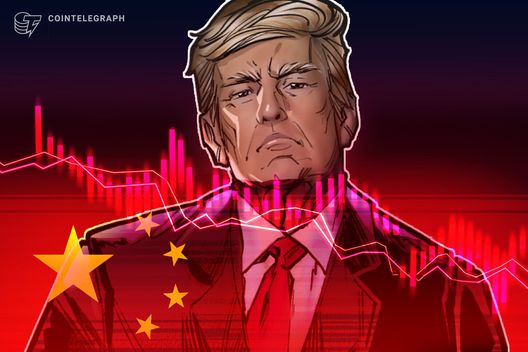
The selling in Bitcoin and altcoin is not over yet, but data suggests that the nature of the CME Bitcoin and equities futures market open on Sunday will determine the direction BTC price takes.

Morgan Stanley's wealth management division will initially cap crypto allocations and begin with Bitcoin funds from BlackRock and Fidelity, potentially adding choices later.
Meme coin launchpad Four.Meme, built on BNB Chain, recorded $1.43 million in revenue over 24 hours, surpassing Solana-based Pump.fun during the same period.
According to data from DeFiLlama, the daily volume for pump.fun was $1.14 million today, October 8, which was swiftly overtaken by Four.Meme as meme coins on BNB Chain started spiking tremendously.
The surge marks Four.Meme’s first time topping the daily revenue leaderboard, placing it briefly among the top decentralized finance (DeFi) revenue-generating protocols alongside platforms such as Uniswap and Aave.
Four.Meme’s performance underscores a recent increase in meme coin activity within the BNB Chain ecosystem, which has benefited from lower transaction fees and high retail participation, leading to a raise in their DEX trading volume, almost surpassing $6 billion in 24 hours.
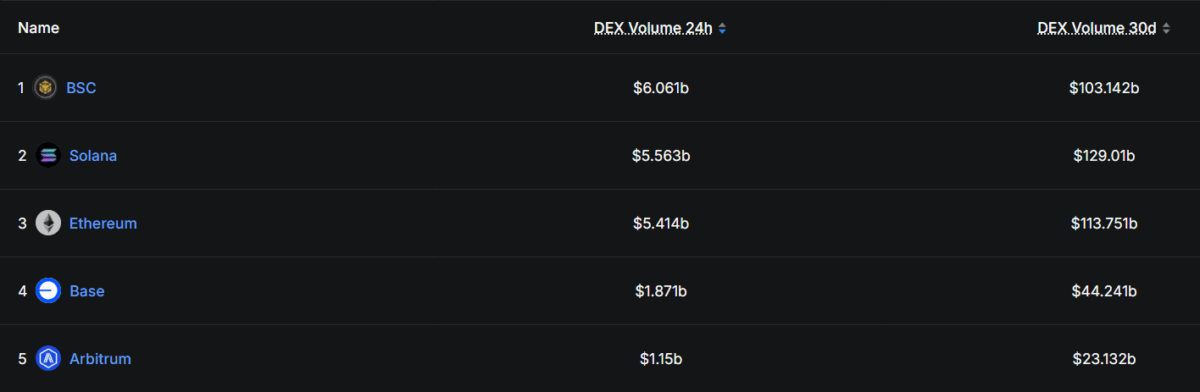
While meme tokens often dominate short-term on-chain volume, analysts note that high daily revenue figures can reflect transaction intensity rather than sustainable user retention.
On a weekly basis, Pump.fun continues to lead in cumulative fees and total volume, though Four.Meme’s recent activity suggests new market competition between BNB Chain and Solana ecosystems for meme coin liquidity.
Data from DeFiLlama indicates that Four.Meme’s annualized revenue exceeds $100 million, though such metrics depend heavily on user engagement and token trading frequency. Industry observers point out that both platforms employ similar models, allowing users to mint and trade new tokens directly from launchpads — a process that has driven daily fee growth but also heightened concerns around volatility and speculative risk.
Four.Meme’s rise highlights how network-specific meme trends can influence short-term revenue dynamics across blockchains. Whether this momentum represents sustained user migration to BNB Chain or a temporary shift in market attention remains to be seen.
Also Read: YZi Labs Launches $1B Fund for BNB Chain Innovators

Pineapple Financial (NYSE American: PAPL) announced its first open-market purchase of 678,353 Injective (INJ) tokens valued at approximately $8.9 million, marking the initial step in a planned $100 million Digital Asset Treasury (DAT) strategy.
According to the company’s official statement, all purchased tokens will be held and staked directly on the Injective blockchain, forming part of a structured treasury diversification initiative.
🚨Pineapple Financial $PAPL has executed its first strategic purchase of INJ from the open market, acquiring 678,353 $INJ worth approximately $8.9 Million.
— Pineapple PAPL (@PAPLpineapple) October 7, 2025
This is the first cash purchase in a series of planned open market acquisitions.
Infinite more ahead. pic.twitter.com/gtziEXQ4gY
The move follows Pineapple’s recent $100 million private placement, which was established to fund a dedicated Injective-based treasury. The company described this first acquisition as the beginning of a series of cash purchases to gradually build on-chain holdings.
Pineapple said the INJ tokens will be staked on-chain to generate yield from network rewards, with current estimates suggesting an annual return of roughly 12.75%. The initiative aims to integrate blockchain-based assets into Pineapple’s financial operations while maintaining compliance within the firm’s existing corporate framework.
“This initial Injective investment underscores our conviction in the strength of the INJ token’s future and our ambition to create the world’s largest and most productive INJ treasury platform,” said Shubha Dasgupta, Chief Executive Officer of Pineapple Financial.
The company’s strategy reflects a broader industry trend of traditional or fintech entities allocating a portion of their balance sheet to digital assets that offer yield potential through decentralized finance (DeFi) mechanisms rather than purely holding crypto as speculative assets.
Injective (INJ) is a layer-one blockchain focused on decentralized finance applications, including derivatives trading and liquidity provision.
For Pineapple, the initiative represents an early experiment in using on-chain treasuries to complement traditional finance operations.If successful, this model could inform how public companies approach digital asset exposure through regulated and yield-generating vehicles rather than speculative trading.
Also read: Mega Matrix Diversifies Digital Treasury into Stablecoin Basket
Pineapple Financial Kicks-off $100M Asset Treasury, Buys $8.9M in INJ

IREN Limited (NASDAQ: IREN), a Bitcoin miner and data center operator, announced on October 7, that it has signed several multi-year contracts to provide cloud computing services using NVIDIA’s upcoming Blackwell GPUs.
According to an official statement, the agreements represent roughly $225 million in annualized run-rate revenue (ARR), with 11,000 of the company’s 23,000 GPUs already pre-sold. The contracts are part of IREN’s ongoing expansion into artificial intelligence (AI) infrastructure using its existing facilities in British Columbia and Childress, Texas.
IREN’s expansion reflects a wider industry trend in which firms originally focused on digital asset mining are adapting their high-capacity energy and cooling infrastructure to support AI workloads. While pre-contracting high-end GPUs such as NVIDIA’s Blackwell models provides upfront revenue visibility, it also underscores the capital intensity.
The Bitcoin miner is also discontinuing its monthly operating updates in favor of standardized reporting, aligning its disclosure approach with traditional cloud and data center operators.
The new contracts mark a material step in IREN’s shift toward AI compute services, a segment experiencing strong demand for high-performance infrastructure. Execution on GPU deployment timelines and operational performance will determine whether the company reaches its projected $500 million ARR by early 2026.
The development highlights how firms with existing power and hardware capacity are positioning themselves within both the AI and digital asset infrastructure sectors.
Also read: China Orders ByteDance & Alibaba to Stop Buying Nvidia AI Chips
Bitcoin Miner IREN Secures Multi-Year AI Cloud Contracts


Users on the social media platform X have reported difficulties accessing funds and their accounts on cryptocurrency exchange OKX.
One detailed post alleged that withdrawals were blocked following a random request for “additional verification” on an account that had already completed Know Your Customer (KYC) requirements. The user described the experience as an unresolved support loop that eventually resulted in account closure.
How OKX will steal your money
— Insightful (@info_insightful) October 7, 2025
1/ Randomly require "additional verification" (account is already KYCd) so there is actually nothing else to verify
2/ Account restricted – have to complete "verification" still, claim "assets will remain safe and intact and you can still make… pic.twitter.com/ewvGXmlR4D
OKX reportedly cited potential transactions with blockchain addresses flagged under its Terms of Service as the reason for suspension, referencing compliance procedures related to high-risk counterparties.
According to a post on X, the process begins with a prompt for extra verification despite an existing KYC record. The user claimed that, once restricted, withdrawals were unavailable and customer-support interactions led repeatedly back to the same verification request. The account was later closed, with OKX citing a violation of Section 3 of its user terms.
In a subsequent post, another user made similar claims regarding stalled withdrawal processes. These accounts have not been independently verified, and OKX has not issued a public statement addressing these specific incidents.
Finally someone with bigger influence alerting everyone
— Cryphodl (@Cryphodl_) October 7, 2025
had this problem with okx since junehttps://t.co/J5Ixtk4h4i
While the team is not responding to these reports officially, OKX CEO has previously acknowledged that automated security systems can occasionally produce “false positives,” resulting in temporary account restrictions.
Such systems are commonly used across exchanges to comply with Anti-Money-Laundering (AML) and counter-terrorism financing (CTF) regulations.They monitor for links between user transactions and blockchain addresses associated with sanctioned or high-risk entities.
Centralized exchanges hold considerable control over user accounts, making transparent procedures and accessible support essential to sustaining trust. Whether OKX clarifies these recent reports or introduces clearer verification guidance remains to be seen.
Also read: Binance And OKX Announce Crypto Payment Cards for Brazil
Users Accuse OKX Exchange of Locking Funds and Random KYC Demands


In an October 4 opinion piece for Entrepreneur Magazine, Polygon co-founder Sandeep Nailwal argued that the path to mainstream cryptocurrency adoption may come from enabling frequent, low-value transactions rather than courting large financial institutions.
Nailwal wrote that digital assets could reach billions of users by supporting affordable micro-payments, framing this as consistent with crypto’s original principles of accessibility and self-custody.
However, this view contrasts with the industry’s current focus on institutional adoption, and what it suggests about the future of crypto use in emerging markets.
According to Nailwal, the industry’s emphasis on institutional “whales” risks overlooking the everyday financial activity that traditional systems often fail to serve.
“The obsession with stablecoins as institutional rails or wholesale infrastructure misses the largest opportunity: low-friction, everyday payments for the next billion users,” he wrote. Sandeep pointed to examples such as a $5 tip sent to a content creator in Manila or a $20 payment to a freelance developer in Nairobi as use cases that illustrate crypto’s potential utility.
In this perspective, such transactions could demonstrate practical value more effectively than replicating existing banking models on-chain.
Nailwal noted that legacy financial networks remain costly for small transfers, citing World Bank data showing that remittance fees in Sub-Saharan Africa can exceed 7%. He contrasted this with blockchain-based solutions where stablecoins and low-fee networks can reduce costs to a few cents, potentially making cross-border micro-payments sustainable.
The co-founder of Polygon suggests that low-cost blockchain infrastructure could support new payment behaviors—such as recurring tips, streaming payments, or small business transactions—that are impractical in the existing system.
The piece situates this view within a larger discussion about what drives global crypto adoption. While some industry participants focus on institutional inflows and regulatory clarity, others emphasize grassroots use cases that address day-to-day financial needs.
This view is increasingly mirrored in industry developments: exchanges such as Binance and OKX recently launched crypto-payment cards in Brazil, aiming to let users spend crypto for daily purchases. Such infrastructure aligns with Nailwal’s argument about enabling micro-transactions as a practical adoption path.
Nailwal’s perspective also highlights how Layer 1 and Layer 2 networks are competing to handle high-volume, low-fee transactions as a measure of scalability and user relevance.
The commentary adds to an ongoing conversation about crypto’s real-world utility. Whether the next wave of adoption comes from major financial players or from billions of small transactions remains uncertain, but both dynamics continue to shape the industry’s evolution.
Also read: Binance To Halt Polygon Withdrawals To Support Network Upgrade
Micro-Payments Will Drive Real Crypto Adoption: Polygon Co-founder

S&P Dow Jones Indices (S&P DJI), a division of S&P Global, announced plans on October 7, 2025, to launch a new hybrid crypto index. The S&P Digital Markets 50 Index will combine 15 cryptocurrencies and 35 public crypto-linked companies.
According to the company, the index aims to meet rising investor demand for diversified exposure to the digital asset ecosystem. The initiative, in collaboration with tokenized securities provider Dinari, will create a single, rules-based benchmark for the global financial market.
The S&P Digital Markets 50 Index is structured to provide a broad view of the crypto economy. It includes 15 cryptocurrencies selected from the existing S&P Cryptocurrency Broad Digital Market Index, such as Bitcoin, Ethereum, Solana, and XRP.
Alongside these digital assets, the index features 35 publicly traded companies involved in blockchain infrastructure and digital asset operations, while the index follows specific rules to balance, including a cap preventing any single asset from exceeding five percent of its total composition and a set rebalancing schedule.
A key part of the announcement is S&P DJI’s collaboration with Dinari. The firm will be responsible for creating a token designed to track the performance of the S&P Digital Markets 50 Index. This process of tokenization makes the index’s performance accessible as an investable asset, while offering more exposition without the need of individual purchase.
The new index packs crypto-related assets into a familiar S&P-branded format. This structure could bridge the gap between traditional finance and decentralized markets. The creation of a holistic benchmark may also serve as a foundation for new financial products, such as Exchange-Traded Funds (ETFs) or other funds that track the index.
The S&P Digital Markets 50 Index marks a try in legitimizing and simplifying diversified investment in the digital asset ecosystem. It also represents a center piece of market infrastructure, potentially unlocking a new wave of capital by offering a single vehicle for broad crypto ecosystem exposure.
Also read: ICE Set to Invest $2B in Crypto Platform Polymarket
S&P Global Launches Hybrid Crypto and Stock Index for Broader Exposure

Aave, one of the largest decentralized lending protocols, has surpassed a significant milestone with its total net deposits (TVL) exceeding $75 billion. It is currently the first decentralized finance (DeFi) protocol to achieve the mark.
The update was shared in a post on the protocol’s official X account, marking one of the highest liquidity levels ever recorded in decentralized finance (DeFi).
Another all-time high for Aave.
— Aave (@aave) October 6, 2025
$75 billion net deposits. pic.twitter.com/YoBel9rFBg
According to data from DefiLlama, Aave ranks first among the top DeFi protocols globally by TVL, reflecting strong activity across its all deployments on blockchain networks like Ethereum, Arbitrum, Plasma, Base, Avalanche, Linea, and others. The growth follows a broader rebound in on-chain lending and borrowing activity amid increasing institutional participation in DeFi markets.
The $75 billion milestone positions Aave alongside some mid-sized traditional financial institutions in terms of assets under management. For perspective, if Aave were a traditional bank, it would rank roughly among the top 70 global banks by deposits — close to institutions such as the Brazilian Central Bank and UBS Switzerland AG.
DeFi’s growth curve has accelerated in 2025 as more capital flows into yield-generating products and tokenized assets. DeFi adoption, the integration of stablecoins and tokenized treasuries has helped strengthen on-chain liquidity, creating a more resilient lending environment.
Aave’s $75 billion in net deposits illustrates how DeFi has evolved into a parallel financial system with measurable scale. It also signals broader confidence in decentralized credit markets and sets the stage for continued debate about how blockchain-based systems might coexist with, or challenge, the global financial establishment.
While Aave’s TVL milestone demonstrates DeFi’s growing scale, it also underscores key structural differences between decentralized protocols and banks.
DeFi platforms like Aave allow users to deposit and borrow against crypto assets directly through on-chain pools, governed by community protocols rather than corporate entities. In contrast, traditional banks rely on regulatory capital ratios, credit risk assessments, and central bank oversight.
The rapid inflow of deposits into DeFi platforms has also revived discussions about systemic risk and smart contract vulnerabilities. Analysts note that while the growth signals greater user confidence, sustainability will depend on ongoing improvements in protocol security and regulatory clarity.
Also read: Aave Founder Believes that Declining Rates Could Ignite DeFi Revival
Aave Hits $75B in Net Deposits, Underscoring DeFi’s Expanding Scale
ZOOZ Power Ltd. announced that it has purchased additional 329 Bitcoin for around $40 million October 6, increasing its total holdings to 854 BTC, now valued at over $100 million. The acquisition is part of ZOOZ’s ongoing bitcoin treasury reserve strategy, which it first publicized in prior purchases.
According to the official press release by ZOOZ, the purchase was made using net proceeds from a private placement announced on July 29, 2025. The company stated that this move accelerates its transition toward an “institutional quality bitcoin treasury.”
Jordan Fried, CEO of ZOOZ, emphasized that the firm’s strategy remains focused on holding bitcoin long term and providing equity exposure to the asset class through its shares.
The latest purchase reinforces the narrative that ZOOZ is doubling down on Bitcoin as a core component of its balance sheet. Compared to the company’s prior acquisition of $60 million in Bitcoin reported earlier this month, this increment shows continued commitment to the strategy.
However, ZOOZ has not publicly disclosed details such as the breakdown of the price per coin, its risk management framework related to price volatility, or expectations for future capital deployment toward more BTC acquisition.
ZOOZ’s activity sits within a broader movement of companies treating cryptocurrencies, especially Bitcoin, as reserve assets. The incremental purchases reflect how some firms are adopting a “buy and hold” doctrine.
Whether ZOOZ’s approach is sustainable over time depends on how well it manages exposure to Bitcoin’s price swings and maintains transparency around its treasury operations.
Also read: Michael Saylor Tells MrBeast to “Buy Bitcoin” as Bitcoin Hits ATH
ZOOZ Buys 329 Bitcoin for its Treasury, Now Holds Over $100M in BTC


Former Central Bank of Brazil president Roberto Campos Neto stated that cryptocurrencies played a direct role in inspiring national financial innovations such as Pix and Drex.
Speaking during an event at the São Paulo Stock Exchange (B3) on October 6, Campos Neto said that the technological design of digital assets influenced how the Central Bank approached efficiency, inclusion, and automation in Brazil’s payment systems.
According to Campos Neto, features commonly associated with cryptocurrencies—such as transaction speed, cost efficiency, and transparency—helped guide the creation of Pix, the instant payments system launched in 2020.
Pix allows users to send and receive money instantly through smartphones or online banking platforms, operating 24/7 and at no cost for individuals. The system has become one of the cornerstones of Brazil’s financial infrastructure, facilitating millions of daily transactions and driving digital inclusion.
Its success has also drawn international attention — and some criticism. Recently, former U.S. President Donald Trump described Pix as a “threat” to private financial institutions, prompting Brazil’s fintech and banking sectors to publicly defend the system’s innovation and accessibility.
Campos Neto noted that, although Drex will be a centralized and regulated system, its architecture draws from the same conceptual foundation that underpins blockchain-based networks.
He said this alignment allows Brazil to incorporate the best aspects of both models: “The crypto world showed us that it’s possible to design faster and cheaper systems for transferring value,” he remarked.
The statement aligns with the Central Bank’s broader modernization strategy, which includes Pix, Open Finance, and Drex as interconnected pillars aimed at improving access to financial services.
Campos Neto’s comments come amid a period of rapid cryptocurrency growth in Brazil. According to recent data, total crypto transaction volume in the country reached R$ 1.7 trillion in 2024, more than doubling year over year — a sign of increasing retail and institutional participation.
Campos Neto’s remarks reflect how Brazil’s regulatory and technological developments are occurring alongside this broader expansion. By linking crypto-inspired design principles to public financial infrastructure, the country positions itself as a test case for how blockchain concepts can influence state-backed systems without replicating their decentralized structure.
Also read: Binance And OKX Announce Crypto Payment Cards for Brazil
President of Brazilian Central Bank Says Crypto Inspired the Creation of ‘Pix’


The first week of October opened with renewed investor activity across the digital asset market. Bitcoin’s record-breaking surge above $125,000, paired with a steady rise in stablecoin supply and institutional accumulation of BTC and ETH, underscored a continued appetite for crypto exposure.
According to Lookonchain’s weekly report covering September 29 – October 5, 2025, the crypto market maintained strong momentum despite a modest pullback in decentralized-exchange (DEX) volumes.
Sept 29–Oct 5, 2025 #LookonchainWeeklyReport
— Lookonchain (@lookonchain) October 6, 2025
🟢 Onchain Overview
Despite a slight dip in DEX volumes, the crypto market remained strong last week as BTC broke above $125,000 to a new all-time high. Stablecoin supply increased by $5.48B, while institutions like Bitmine and… pic.twitter.com/IoSFtpL43R
Bitcoin (BTC) surged past $125,000, setting a new record high. The week also saw an expansion of stablecoin supply by $5.48 billion, suggesting sustained capital inflows into the digital-asset ecosystem.
Metaplanet, one of the largest Bitcoin treasury companies, added 5,268 BTC (approximately $603.7 million), increasing its total holdings to 30,823 BTC with an average acquisition price of $107,912. However, no new Bitcoin purchases were reported from Strategy, another prominent corporate Bitcoin holder.
Meanwhile for Ethereum, large institutional players remained active as analysts expect ETH to weigh in at a top market value. Bitmine purchased 179,251 ETH (worth approximately $821.7 million) and now holds about 2.83 million ETH valued at $12.97 billion.
The total stablecoin market capitalization rose by $5.48 billion during the week. On Ethereum, USDT and USDC supplies grew by $2.24 billion, while on Plasma, the same pair declined by about $716 million. The shift indicates a concentration of liquidity back to Ethereum-based venues, where institutional-grade DeFi products and yield opportunities are more established.
Spot trading on decentralized exchanges reached $120.88 billion, down 13.86% from the prior week. Uniswap led with $28.74 billion in volume, down 0.53% compared to the previous week, followed by PancakeSwap with $21.96 billion, down 1.66% for the same period.
Perpetual-futures DEX volume totaled $224.22 billion, marking an 8.29% weekly decline. Hyperliquid accounted for $58.92 billion (-26.83%), while Lighter posted $55.38 billion (-12.31%). Despite the decreases, aggregate on-chain trading levels remain historically high.
The data suggest that capital is consolidating within established ecosystems—Ethereum for stablecoins and major DEXs, and Bitcoin for institutional reserves. While trading volumes have cooled slightly, continued accumulation from firms such as Bitmine and Metaplanet points to persistent institutional conviction even as prices reach new highs.
Further monitoring of stablecoin flows and corporate balance-sheet activity will help gauge whether the current rally represents sustained inflows or short-term positioning following Bitcoin’s record peak.
Also read: Bitcoin Eyes New High This Week as Market Optimism Fuels Rally
October Kick-starts with Renewed Investor Interest in Crypto Market

Jupiter, a leading decentralized exchanges (DEXs) aggregator on the Solana blockchain, announced on October 7 2025 that it has launched a desktop version of the Jupiter Wallet.
The update was shared through an official post on X, extending the exchange’s ecosystem beyond its existing mobile application. “The goal was to create an experience that is both simple and complete – designed to feel effortless for newcomers yet powerful enough for pro traders,” it said.
The launch of the desktop wallet aims to provide users with broader access to Jupiter’s trading and liquidity aggregation services while introducing several key features.
According to the company, the wallet supports gasless trading, profit and loss (PnL) analysis tools, and deep integration with Jupiter’s existing ecosystem, including its launchpad and token management suite. It also advertises transaction fees up to ten times lower than those of competing wallets.
These additions are designed to streamline on-chain activity and create a more unified trading experience for both casual and professional users.
Jupiter has been actively expanding its product lineup over the past year, introducing features such as its launchpad and token-management suite. The desktop wallet complements this strategy by integrating more functions into Jupiter’s native environment, potentially allowing users to manage multiple DeFi interactions without relying on third-party wallets.
The release follows a broader movement in decentralized finance (DeFi) toward multi-platform wallet experiences. As more DEXs and DeFi protocols seek to attract both retail and institutional participants, supporting desktop environments has become a key step in improving usability and bridging mobile and web experiences.
The desktop wallet launch marks another step in Jupiter’s effort to build a unified platform within the Solana ecosystem, though adoption and user feedback will determine its long-term impact.
Also read: Circle Launches USYC On Solana, Bringing Tokenized Yield On-Chain
Solana-based Jupiter Exchange Launches Desktop Wallet for Users

Ondo Finance has announced that it has completed the acquisition of fintech infrastructure provider Oasis Pro. The deal gives the real-world asset (RWA) tokenization firm access to several regulated entities in the United States, including a broker-dealer, an Alternative Trading System (ATS), and a transfer agent.
1/ Ondo Finance has completed its purchase of Oasis Pro, including its SEC-registered digital assets broker-dealer, alternative trading system (ATS), and transfer agent (TA) licenses.
— Ondo Finance (@OndoFinance) October 6, 2025
This provides the Ondo Finance group with the most comprehensive set of SEC registrations for… pic.twitter.com/vaLjJZ5QAv
According to the official blog post from Ondo, Oasis Pro’s licenses include an SEC-registered broker-dealer for handling securities transactions, a FINRA-approved ATS for secondary market trading, and an SEC-registered transfer agent that manages securities ownership records.
These assets provide the company with the necessary framework to operate under U.S. financial regulations, even though details of the transaction and launch timeline have not been disclosed yet.
Ondo Finance has previously targeted non-U.S. investors with products such as tokenized U.S. Treasuries and money market funds, exceeding $300M in tokenized equity stocks. This acquisition marks a move toward offering similar services to the U.S.-based investors within a compliant structure.
The decision reflects a broader shift among blockchain firms seeking to align with existing securities laws rather than operate in unregulated spaces. The U.S. remains one of the most tightly regulated financial markets, making compliance a prerequisite for large-scale institutional participation.
Ondo’s acquisition aligns with a growing trend of tokenization platforms acquiring or developing regulated infrastructure to support the issuance and secondary trading of tokenized assets. Similar efforts have been seen across the industry as firms aim to bridge blockchain-based products with traditional finance systems.
The acquisition also underscores how regulatory readiness has become a competitive factor in the RWA sector, as companies position themselves for future institutional adoption and oversight clarity.
Also read: Galaxy Digital Launches GalaxyOne Platform for U.S. Investors
Ondo Completes Oasis Pro Acquisition, Gains Major Licenses in U.S.
Rothschild & Co Redburn shifted its outlook on Coinbase (NASDAQ: COIN) to “Buy” on October 3, 2025, raising the price target to $417. The bank’s analysts pointed to stronger revenue diversification and the projected expansion of USDC’s market capitalization as the main factors supporting the upgrade.
According to the reports, lower U.S. interest rates could weigh on short-term revenue, but this is expected to be offset by the expansion of USDC.
Coinbase’s role in the stablecoin’s ecosystem, combined with its broader shift toward subscription and service revenue, was described as a key driver for the stock’s long-term outlook.
Rothschild also provided updated data points for investors. The bank adjusted its Coinbase price target from $372 to $417, estimating an upside of 12.1%.
At the time of writing, Coinbase stock (COIN) was trading at $378. The firm also initiated coverage of Circle Internet Group (CRCL) with a “Neutral” rating and a $136 target price, compared with its current trading level of $155.79, according to TradingView.
Alongside its positive assessment of Coinbase, Rothschild highlighted concerns about Circle, pointing to its revenue-sharing model as a possible vulnerability. The bank also reiterated a “Sell” rating on Robinhood (NASDAQ: HOOD), arguing the stock is “priced for perfection” and may not reflect potential downside risks.
The diverging ratings reflect how traditional financial analysts are assessing varying strategies in the crypto sector. Coinbase is viewed as having revenue support from USDC growth, while Circle and Robinhood face questions tied to their business models.
The mixed outlook highlights that investor sentiment toward publicly traded crypto firms remains shaped by both opportunities around stablecoins and ongoing risks from regulation and market conditions.
Also Read: Coinbase Hits $1B Milestone in Bitcoin-Backed Onchain Loans
Rothschild Upgrades Coinbase to “Buy,” Flags Risks for Circle and Robinhood
On October 3, 2025, crypto-native firm The Ether Machine announced it had earned 1,000 Ether (ETH) in yield from staking its entire treasury.
According to the company’s press release, the yield came from in-house validator operations, which the firm described as part of its “fully staked, vertically integrated” treasury model.
Instead of delegating to third-party providers, The Ether Machine operates its own validators, which it says reduces costs and provides greater control over assets.
The firm positions this approach as a way to maximize ETH-denominated returns while maintaining transparency around treasury management, illustrating a growing trend of organizations using staking yields as a treasury tool.
We have generated 1,350+ ETH in staking rewards, compounding in our machine. We are fully staked, top ~5% validator efficiency, zero outsourced mgmt fees.
— The Ether Machine (@TheEtherMachine) October 3, 2025
Vertical integration = market-leading yield for shareholders.
The ticker is $ETHM ⚙️
Co-Founder and Chairman Andrew Keys framed the milestone as validation of this model, saying the company was built by “original believers in the power of Ethereum and ETH as the most attractive, productive asset in the digital economy.”
He added that the staking rewards demonstrate the firm’s role as “a vehicle for institutional-grade public exposure to Ethereum, optimizing yield and continually increasing ETH generation per share.”
While potential rewards are appealing, the approach also raises challenges around custody, operational transparency, and financial reporting, key takeaways to determine whether such models can be sustained in the long term or adapted by other firms.
The announcement underscores how staking is being tested as a corporate treasury mechanism. While The Ether Machine’s results mark an early example, more detailed information on performance and risk management will be necessary to assess how sustainable this approach may be.
Also Read: The Ether Machine secures $654M ETH from Blockchains’ Jeffrey Berns
Ether Machine Reports 1,000 ETH in Yield From Fully-Staked Treasury

Euler Finance announced on October 3, 2025, that it will support PT-tUSDe as a new collateral asset. The update was revealed in a short post on the protocol’s official X account.
A new option is available for Pendle tUSDe users.
— Terminal Finance (@Terminal_fi) October 3, 2025
PT-tUSDe (11.77% APY) can be used as collateral on @eulerfinance to borrow USDe.
tUSDe liquidity on Pendle is currently above $50M.
// Loopers gotta loop_ pic.twitter.com/y7kg13n491
The move signals an expansion of assets supported on Euler’s lending platform, but details on risk controls, collateral limits, and implementation are still awaited.
PT-tUSDe is part of the Pendle Finance ecosystem, where staked tokens can be split into two components: Principal Tokens (PTs), which lock in fixed yield until maturity, and Yield Tokens (YTs), which represent variable returns.
In this case, PT-tUSDe represents the principal portion of staked Ethena USDe deposits, while the process able users to:
This creates opportunities for users to put their fixed-yield positions to work as collateral, turning passive returns into active liquidity.
While the post confirms support for PT-tUSDe collateral, important details have yet to be published. These typically include loan-to-value (LTV) ratios, liquidation thresholds, oracle price feeds, and results of any security audits. Such parameters are critical for users to assess how much they can safely borrow and what risks are involved.
The addition of PT-tUSDe reflects a broader shift in DeFi lending, where protocols are moving beyond conventional collateral like ETH and stablecoins to include structured yield-bearing assets.
For Euler, supporting Pendle’s principal token could draw in more advanced users who actively manage APY strategies within Pendle’s ecosystem.
For borrowers, this type of collateral offers greater capital efficiency, since they can unlock liquidity while still maintaining an income stream from their yield positions. At the same time, the use of derivative tokens introduces new risks, including valuation challenges at maturity and reliance on accurate oracle pricing.
How Euler sets its risk parameters will determine whether the benefits outweigh these added complexities.
Also read: Aave Founder Believes that Declining Rates Could Ignite DeFi Revival
Euler Finance to Add PT-tUSDe as Collateral, Expanding Yield Strategies
Samsung Electronics and Coinbase (NASDAQ: COIN) announced an expanded partnership on October 3, 2025, offering new crypto-related features for Samsung Wallet users in the United States.
According to a company’s press release, customers will now receive a three-month trial of Coinbase One, a subscription service with zero trading fees and higher staking rewards, along with a $25 trading credit for completing their first trade.
The integration allows Samsung Wallet users to view their Coinbase balances directly within the app, alongside existing credit, debit, and loyalty cards.
This aims to provide a unified financial interface without requiring users to switch between separate applications. The new perks build on a previous integration that enabled crypto purchases through Samsung Pay.
According to Drew Backlard, of Mobile Product Management at Samsung Electronics America, this project works together with Samsung’s mobile facilities:
“Millions of Galaxy users rely on their smartphone to complete everyday tasks, and that goes far beyond communication — it’s paying in-store, unlocking a car, showing an ID,and more. Samsung Wallet enables each of these experiences and we’re continuing to expand its functionality”, he said.
Coinbase CEO Brian Armstrong also commented on the integration, calling it “a major step forward in making crypto more accessible through everyday consumer technology
Excited to be partnering with @Samsung to make crypto even more accessible.
— Brian Armstrong (@brian_armstrong) October 3, 2025
We’re offering 75M+ Samsung Galaxy users in the U.S. free access to Coinbase One to bring them onboard. And we’ve fully integrated Samsung Pay, so every Coinbase user in the U.S. can use that to buy… pic.twitter.com/kfBvo2znCQ
By embedding crypto services into pre-installed mobile applications, Samsung and Coinbase focus on accessibility to everyday users.
Samsung’s large U.S. user base could provide Coinbase with exposure to new demographics, while the integration reflects a broader industry push toward multi-function “super apps” that combine payments, banking, and investing.
Also, when it comes to crypto assets, Samsung diversifies its strategy, since alongside with exchange partnership, the company also invests in stablecoin infrastructure.
The collaboration illustrates how technology firms are experimenting with integration with traditional finance. Similar partnerships could intensify competition among mobile wallet providers as they expand services to attract users.
The expanded partnership positions Samsung Wallet as a platform that integrates crypto into mainstream financial management tools. Its effectiveness will depend on consumer adoption and whether other tech firms adopt similar approaches.
Also read: Coinbase Hits $1B Milestone in Bitcoin-Backed Onchain Loans
Samsung Expands Coinbase Partnership With Wallet Integration
Binance founder Changpeng Zhao (CZ) met with Kazakhstan President Kassym-Jomart Tokayev this week, highlighting recent developments in the country’s digital asset policy.
In a post, CZ pointed to three areas: Binance’s local regulatory license, the rollout of the KZTx stablecoin, and the addition of BNB to Kazakhstan’s reserve holdings. These moves reflect broader steps the country has taken to formalize its digital asset framework, which will be examined in more detail below.
New photo, from today. Honored to meet with President Kassym-Jomart Tokayev again 3 year laters. Lots of progress in Astana, Kazakhstan🇰🇿
— CZ 🔶 BNB (@cz_binance) October 2, 2025
Binance Licensed
Stablecoin KZTx stablecoin
Crypto Reserve includes #BNB
And much more…
Great city name, too.😆 https://t.co/SdlFqtF8ZK pic.twitter.com/sHHVo7k9XW
Binance received regulatory approval to operate locally earlier, allowing it to provide crypto services under Kazakhstan’s digital asset framework.
The license followed the government’s idea to set up rules aimed at attracting global exchanges while maintaining oversight. Meanwhile, the country was a pioneer to launch Central Asia’s First Bitcoin ETF.
The KZTx stablecoin was launched as part of Kazakhstan’s broader initiative to integrate digital assets into its financial system.
Authorities had already taken steps in this direction by authorizing USD-backed stablecoins for paying certain regulatory fees, a measure aimed at testing the practical use of digital currencies in state processes
The Alem Crypto Fund, Kazakhstan’s state-backed vehicle for managing digital asset reserves, which recently announced the purchase of BNB for long-term holding.
CZ’s remarks after meeting President Tokayev highlighted steps already underway in Kazakhstan’s digital asset strategy: the licensing of Binance, the launch of the KZTx stablecoin, and the addition of BNB to state reserves.
These developments illustrate how the country is beginning to implement previously announced policies about the digital asset world, with further outcomes depending on how regulatory and market structures evolve.
Also read: Kazakhstan’s RAKS Exchange Dismantled Over Money Laundering
Binance Founder Meets Kazakhstan President, Highlights Crypto Moves

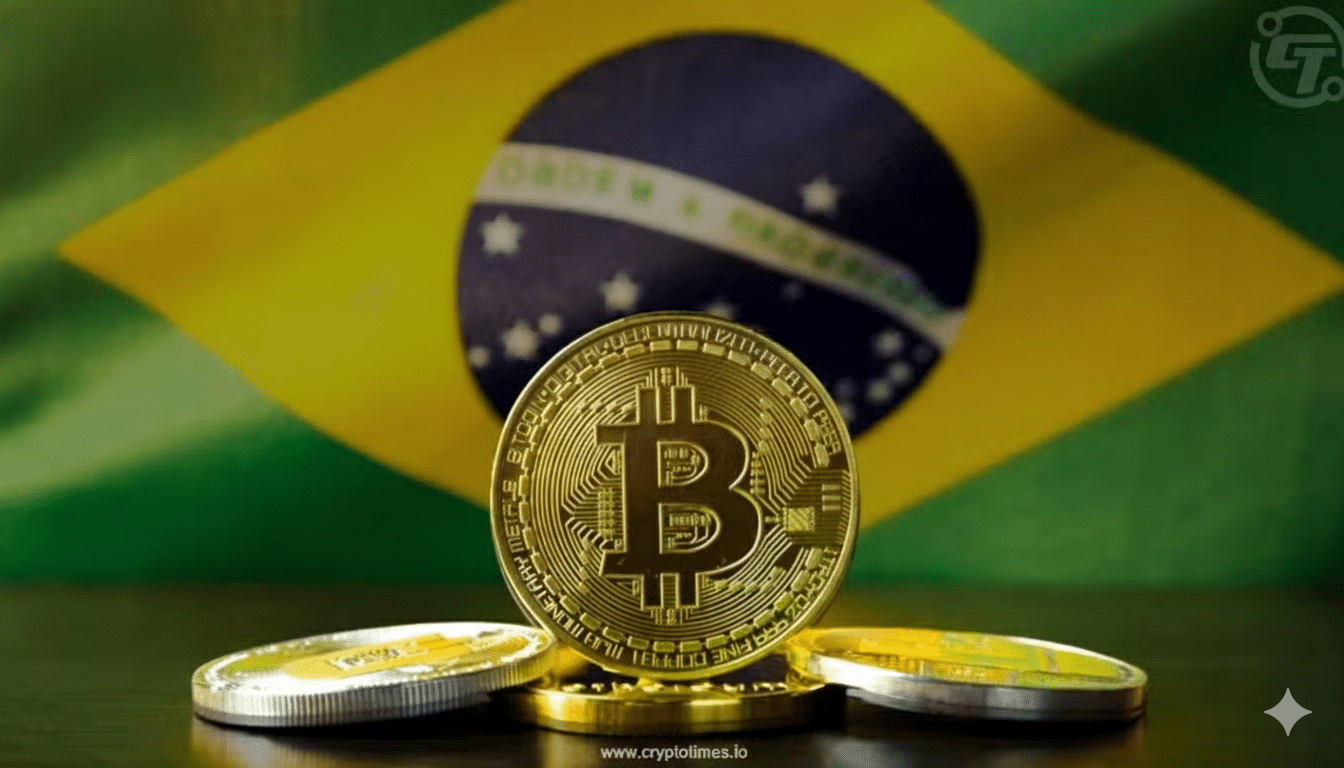
Brazil’s cryptocurrency transaction volume more than doubled over the past year, according to new data from blockchain analytics firm Chainalysis.
The country recorded R$ 1.7 trillion (US$ 318.8 billion) in crypto transactions between July 2024 and June 2025, representing a 109.9% year-over-year increase. The figures were published in the firm’s 2025 Geography of Cryptocurrency Report.
The report attributes much of this growth to the widespread use of stablecoins, which made up over 90% of all transaction flows.
Chainalysis noted that the primary applications of these assets in Brazil are payments and international remittances, suggesting that cryptocurrencies are being used increasingly for everyday financial activity rather than purely speculative trading.
This leads to a lot of strategies, such as the launching of credit cards, which is a move that directly links to the previous analysis.
The R$ 1.7 trillion figure highlights Brazil’s weight in Latin America’s digital asset ecosystem and places the country among the most active crypto markets globally. Chainalysis ranks Brazil as the fifth-largest market worldwide by transaction volume, ahead of several G20 economies.
The report attributes this position to a mix of large institutional flows—particularly through exchanges and over-the-counter desks—as well as a steadily growing retail base that uses crypto for different purposes.
This combination could have been what made Brazil both a regional leader and a test case for how emerging markets adopt digital assets at scale.
The rapid expansion of the market has also drawn attention to Brazil’s evolving regulatory landscape.
The confirmed scale of crypto activity underscores the importance of forthcoming policies from the Central Bank and tax authorities, which will need to address compliance, reporting, and consumer protection.
In one year, Brazil’s crypto economy effectively doubled, with stablecoins leading transaction activity. It illustrates the extent to which digital assets have become integrated into financial behavior in the country, while also raising questions about how regulation will adapt to oversee such growth.
Also read: Brazil Police Seize $4.3M USDT With The Help of Binance And TRM Labs
Brazil’s Crypto Transactions Reach R$ 1.7 Trillion, Doubling in One Year

CME Group, one of the largest global derivatives marketplaces, announced on October 2, 2025, that it intends to introduce 24/7 trading for its cryptocurrency futures and options.
The change, expected in early 2026 pending regulatory approval, would bring CME’s crypto products in line with the continuous nature of spot markets and allow clients to manage positions outside traditional weekday hours.
The initiative will apply to all CME cryptocurrency futures and options products, which will trade continuously on the CME Globex platform with only a brief weekly maintenance period. While weekend trading will be available, clearing, settlement, and reporting will continue to follow the next business day schedule.
“While not all markets lend themselves to operating 24/7, client demand for around-the-clock cryptocurrency trading has grown as market participants need to manage their risk every day of the week,” said Tim McCourt, Global Head of Equities, FX and Alternative Products at CME Group.
CME said the change reflects client demand for continuous access to risk management tools. Spot crypto markets already operate without interruption, and expanding derivatives hours would allow traders to respond to price movements or news at any time.
Currently, positions cannot be adjusted over weekends, leaving exposure to “gaps” when markets reopen.
A 24/7 model from a regulated venue could influence how other traditional exchanges approach crypto-linked products. It may also change weekend volatility by giving market participants the ability to hedge continuously.
At the same time, the change raises operational challenges, requiring clearing and settlement systems that can accommodate the extended uptime under regulatory oversight, which is something in the radar, as said by McCourt “Ensuring that our regulated cryptocurrency markets are always on will enable clients to trade with confidence at any time.”
CME’s plan reflects how established institutions are adapting to the structure of digital assets while waiting on regulatory review to move forward. The implementation, if approved, will be a development closely followed by both traditional and crypto-focused market participants.
Also read: CME Group to Launch Options on Solana and XRP Futures
CME Group to Launch 24:7 Trading for Crypto Futures and Options


At the Token2049 conference in Singapore on October 1, 2025, Robinhood CEO Vlad Tenev said he views asset tokenization as a long-term trend that could bring crypto and traditional finance closer together.
He described the process as creating digital versions of assets, such as stocks, on a blockchain—a service Robinhood recently introduced for customers in the European Union.
Tenev suggested that tokenized assets may become the default way for investors outside the U.S. to gain exposure to American stocks.
According to him, this shift could address inefficiencies in current financial infrastructure and create closer links between digital and traditional systems. Robinhood’s introduction of tokenized U.S. stock trading in the EU reflects this view.
Tenev’s remarks also reflect Robinhood’s ongoing international expansion. Earlier this year, the company introduced tokenized U.S. stock trading for customers in the European Union, where the Markets in Crypto-Assets (MiCA) regulation provides a clearer framework for such products.
By starting in a jurisdiction with established oversight, Robinhood is testing tokenization in a regulated environment before considering broader adoption in other markets.
Tenev’s comments fit into a wider industry discussion about tokenization, where creating digital versions of assets such as stocks is seen as a way to make markets more accessible and efficient.
Other financial firms have launched similar projects, but significant challenges remain, including regulatory uncertainty in the U.S., the scalability of blockchain infrastructure, and the security standards needed for large-scale adoption. Although, something notable is that this market is being explored with certain expectations.
Tenev’s remarks highlight how a major U.S. brokerage views tokenization as part of its international strategy. The pace of adoption, however, will depend on regulatory clarity, technical scalability, and how both investors and institutions respond to these models.
Also read: S&P 500 Adds AppLovin, Robinhood, Emcor, Excludes MicroStrategy
Robinhood CEO Calls Asset Tokenization an ‘Unstoppable Freight Train’


Bitwise Asset Management announced on October 2, 2025, the launch of two exchange-traded funds (ETFs) designed to generate monthly income using covered call strategies.
The new products are the Bitwise CRCL Option Income Strategy ETF (ICRC), which writes options on shares of Circle (CRCL), and the Bitwise Ethereum Option Income Strategy ETF (IETH), which applies the same approach to spot Ether ETPs.
The two new funds employ a covered call strategy to generate returns. This approach involves holding underlying assets—in this case, Circle (CRCL) stock or spot Ether exchange-traded products (ETPs)—while selling call options against those holdings.
The income is generated from the premiums collected from selling these options, which are then intended to be distributed to shareholders monthly.
This strategy provides regular income but caps the upside appreciation of the underlying assets, since it offers exposure through a familiar ETF wrapper.
The ICRC fund introduces a distinct strategy by linking its income generation to the stock of Circle, the company behind the USDC stablecoin.
This creates a connection between a traditional equity options strategy and the stablecoin sector. It follows other recent Bitwise initiatives, including a proposed stablecoin tokenization ETF, aimed at exploring new intersections between digital assets and traditional investment products.
Bitwise’s launch of covered call ETFs reflects a market for crypto-related investment products due to the firm the portfolio of income- and derivative-based funds, alongside other filings such as a HyperLiquid ETF tied to the HYPE token.
The launch of ICRC and IETH adds to the growing range of regulated strategies aimed at generating yield from crypto-related assets. Their performance will be watched as part of Bitwise’s broader expansion, which spans income products, tokenization-focused ETFs, and market research on industry trends such as stablecoin profitability.
Together, these initiatives reflect how asset managers are testing different approaches to integrate digital assets into mainstream investment frameworks.
Also read: Tether Could Outprofit Saudi Aramco in Profitability: Bitwise CIO
Bitwise Launches Covered Call ETFs for Circle Stock and Ether

Mega Matrix Inc., a U.S.-listed holding company based in Singapore, announced a strategic update to its Digital Asset Treasury (DAT) on October 1, 2025.
According to a press release, the company is moving from a treasury focused on a single asset to a diversified basket of stablecoins and their associated governance tokens, since the firm wants to implement a ‘dual-engine’ model for stable yield generation with long-term growth potential.
MPU to Diversify DAT Strategy with Basket of Leading Stablecoins and Governance Tokens
— Mega Matrix Inc. (NYSE American: MPU) (@MegaMatrixMPU) October 1, 2025
Mega Matrix Inc. (NYSE American: MPU) today announced a strategic update to its Digital Asset Treasury (“DAT”) strategy. The Company will transition from a single-asset approach focused on… pic.twitter.com/RIjR2Pz2aC
The company’s previous strategy focused on holding Ethena’s governance token, ENA. The updated approach reallocates assets across multiple stablecoin ecosystems, including USDe/ENA, USDS/DAI, USDH, USDF, and USST. The shift is described as an effort to reduce concentration risk while broadening exposure to different digital asset systems.
The new strategy consists of two core components, which the company describes as a “dual-engine” model. The first engine focuses on generating stable yield by deploying its stablecoin holdings across various Decentralized Finance (DeFi) protocols.
The second engine aims to capture long-term capital appreciation by holding the governance tokens associated with these stablecoin ecosystems.
The two components work together to generate income from stablecoin activity and expose investors to governance tokens for potential market gains. This structure outlines how Mega Matrix plans to manage different types of returns within its digital treasury.
As a publicly traded company on a U.S. exchange, Mega Matrix’s move adds another example of how listed firms are approaching digital assets. Unlike companies that have limited their exposure to assets such as Bitcoin, this model involves multiple positions in DeFi markets.
The company notes that risks include smart contract security, regulatory developments around stablecoins, and operational complexity.
The change marks a diversification of Mega Matrix’s digital treasury approach. The performance of the dual structure, balancing yield and governance token exposure, will depend on both execution and broader market conditions. Although, the strategy is following what has been seen in the public companies market.
Also Read: Mega Matrix Files $2B Shelf to Buy Governance Tokens
Disclaimer: The Crypto Times publishes news, analysis, and educational content for informational purposes only. We do not offer financial, investment, legal, or trading advice of any kind. All content on our website is intended to be neutral and fact-based. Readers should always do their own research, consult with licensed professionals, and evaluate risks independently. The Crypto Times does not endorse or recommend any specific cryptocurrencies, tokens, projects, financial products, or investment strategies. We do not accept legal liability for any financial losses incurred as a result of reliance on information published by us.
Mega Matrix Diversifies Digital Treasury into Stablecoin Basket

At the start of October 2025, Binance and OKX each announced new crypto-linked card products for the Brazilian market. Binance is relaunching its card through a partnership with Mastercard, while OKX is introducing a stablecoin-backed account and card under the brand OKX Pay.
Together, the initiatives reflect an effort to position digital assets for everyday spending in a country ranked among the world’s top adopters of cryptocurrencies
OKX introduced OKX Pay, a digital account denominated in U.S. dollars and backed by stablecoins, alongside the OKX Card. The company said payments will draw from the account balance and will not incur Brazil’s international taxes (IOF) or currency spread fees.
Binance, meanwhile, relaunched its Binance Card in partnership with Mastercard. The card converts cryptocurrencies such as Bitcoin (BTC) and Ether (ETH) into Brazilian reais at the point of sale.It will be accepted across merchants within the Mastercard network, according to the exchange.
The simultaneous entry of Binance and OKX underscores Brazil’s role as a priority market. According to industry research by Chainalysis, Brazil ranks fifth globally and first in Latin America for cryptocurrency adoption.
The cards appeal to users who want to transact using dollar-pegged assets or access international payments more easily as part of a trend where global firms like 21Shares are expanding deeper into Brazil’s crypto market.
The arrival of two global exchanges in the local card market may increase competition for payments customers, influencing both fintech firms and other exchanges. It also reflects a broader trend of attempting to position digital assets for practical use in retail and cross-border payments.
Challenges remain, including regulatory developments, the tax treatment of crypto-to-fiat transactions, and the volatility of non-stablecoin assets.
Stablecoins may mitigate some of these risks, but widespread adoption will depend on how consumers respond to these new products and how the regulatory environment evolves, since this market shows optimistic forecasts.
The launch of Binance and OKX cards illustrates the varied approaches exchanges are testing to integrate digital assets into daily financial life. Brazil’s response could provide insight into how such products perform in emerging markets with high levels of crypto adoption.
Also Read: Brazil’s Finance Minister Defends Drex Tokenization Plan
Binance And OKX Announce Crypto Payment Cards for Brazil
Digital asset platform Bullish announced on October 1, 2025, the launch of its spot trading services in the United States. The platform is now available in 20 states, including New York.
The company stated that it is targeting institutional and advanced traders with its entry after securing both a BitLicense and a Money Transmission License from the New York State Department of Financial Services (NYDFS), a regulated entry into the US market.
The NYDFS license places Bullish among a limited group of exchanges approved to operate in New York, a state with one of the most stringent regulatory regimes. Alongside licensing, the company named Nonco and BitGo as initial launch partners.
Bullish has also pursued regulated products internationally, partnering with Société Générale-Forge to launch Europe’s first MiCA-licensed stablecoin.
The U.S. rollout follows Bullish’s global operations, where it reports more than $1.5 trillion in cumulative trading volume since late 2021 and a position among the top ten exchanges for Bitcoin (BTC) and Ethereum (ETH) trading activity.
Bullish combines a central limit order book (CLOB) with an Automated Market Maker (AMM), a design the company says is intended to support deeper liquidity and execution for larger trades. As part of its rollout, the platform is offering zero percent maker fees, a structure intended to appeal to institutional market participants and liquidity providers.
Chris Tyrer, President of Bullish Exchange, said the platform was designed with professional traders in mind: “Our U.S. launch introduces a platform that we believe combines institutional-grade liquidity, cutting-edge technology, and cost efficiency to empower institutions and, for the first time, advanced individual traders.”
Launch partners also highlighted the regulatory aspect of the entry. Jeffrey Howard, Head of North America at Nonco, described the move as “a meaningful step forward for institutional adoption,” while BitGo CEO Mike Belshe said the approvals “mark an important milestone for compliant digital asset innovation in the United States.”
The entry of a regulated exchange with a zero-maker-fee model could influence pricing strategies across the U.S. market, where trading fees remain a source of competition. The launch also adds another venue for institutions seeking regulated access to digital asset trading.
Also read: ARK Invest Buys $16M BitMine and $7.5M Bullish Stocks
Bullish Launches NYDFS-Licensed Spot Trading Platform in US

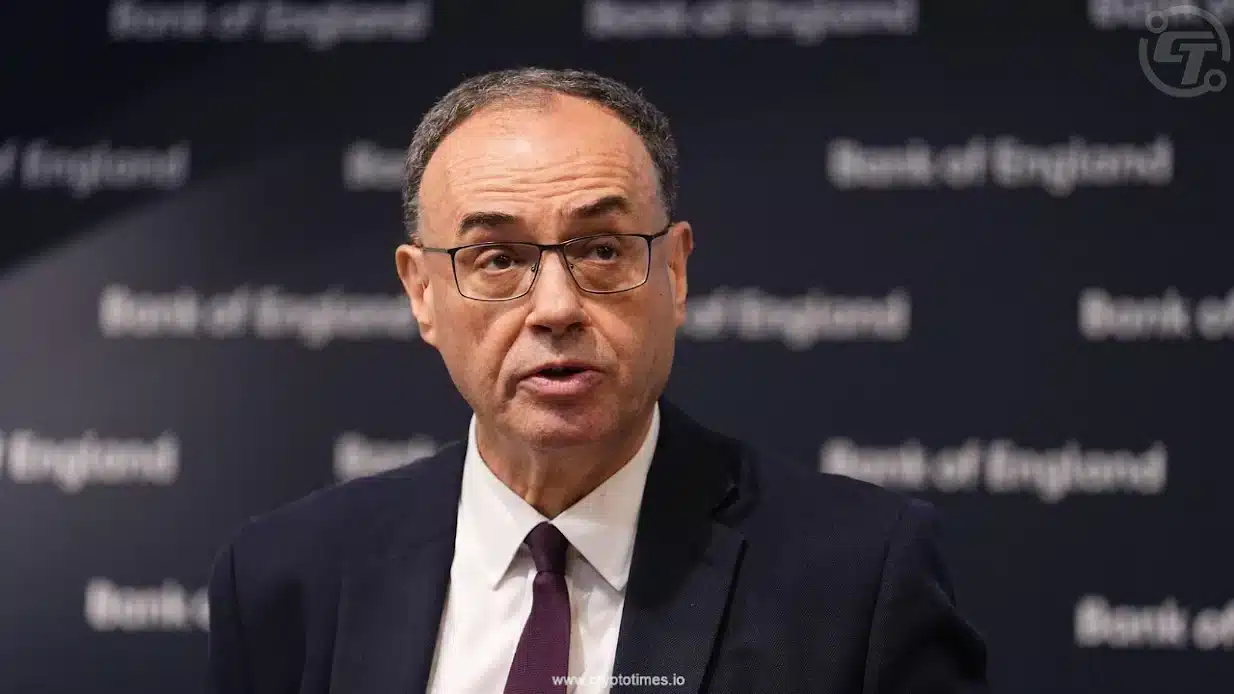
The Bank of England (BoE) has signaled plans to introduce a new regulatory framework for stablecoins.
In an article published on October 1, Governor Andrew Bailey said the UK should “reap the benefits” of the technology while ensuring safeguards comparable to those applied to traditional money, arguing that consumers need risk prevention as stablecoin use grows.
In a Financial Times article, Bailey said that it would be “wrong to be against stablecoins as a matter of principle.”
This reflects a shift in tone from previous caution toward a structured approach to digital assets. The BoE plans to publish a consultation paper in the coming months to set out details for what Bailey described as an “advanced regime for stablecoins.”
Bailey explained that stablecoins differ from cryptocurrencies like Bitcoin because they are pegged to official currency rather than relying on market value alone. He argued that physical money and digital assets could co-exist in a financial system that looks different from today, with banks and stablecoins both issuing money and non-banks taking on more credit provision.
He added that while stablecoins would not replace bank money, widely used UK-issued stablecoins should be granted access to central bank accounts at the BoE.
This would give them a similar status to commercial bank deposits, with regulation focused on depositor protection and financial stability. Bailey stressed that such changes would need careful consideration before implementation.
Regulatory clarity could provide stablecoin issuers with a defined path into the UK’s financial infrastructure. Bailey emphasized the need to balance innovation with financial stability, noting that regulation would need to address risks such as asset backing and operational resilience. If implemented, the framework could allow stablecoins to function alongside existing payment systems and banking services.
The upcoming consultation paper will set out how stablecoins could be integrated into the UK financial system under clear oversight. Its outcome will indicate how the UK positions itself in relation to digital asset regulation among G7 economies.
Also Read: IG Secures UK Crypto License for In-House Trading Services
Bank of England signals new framework for stablecoin oversight


Technology services firm VisionSys AI announced on October 1, 2025, a treasury initiative to acquire and stake up to $2 billion in Solana (SOL).
According to the press release, the NASDAQ-listed company will work exclusively with Solana staking protocol Marinade Finance to carry out the program.
The plan will roll out in stages, starting with the acquisition and staking of $500 million in SOL within six months.
Over time, VisionSys AI said it intends to expand this to as much as $2 billion. The company framed the initiative as part of a broader treasury management strategy involving both balance sheet planning and digital assets.
As part of the exclusive partnership, Marinade Finance will oversee security, compliance, and operational management of the staked assets, since it brings previous experience from supporting security audits and operations for more than 154,000 SOL holders.
Scott Gralnick, Head of Institutional Growth at Marinade Finance, described the partnership as aligned with both firms’ objectives, saying, “We are excited to partner with VisionSys. As a leader in AI solutions for blockchains, forming a Solana treasury vehicle with the leading Solana delegation provider is a perfect fit.”
VisionSys AI also indicated it will explore integrating its AI technology with Solana in what it described as potential “intelligent DeFi” applications.
Allocating a large share of a corporate treasury to Solana marks a departure from the more common corporate approach. The strategy introduces potential risks from SOL’s price volatility and ongoing regulatory uncertainty, while also adding to Solana’s staked asset base, which supports network validation.
Other listed companies are also adjusting how they manage digital assets; for example, ZOOZ Power recently purchased 525 Bitcoin ($60 million) via a U.S.–Israel dual-listed structure, shifting toward a bitcoin treasury model.
VisionSys AI’s plan combines phased SOL staking, an exclusive partnership with Marinade, and the exploration of AI applications on Solana. The initiative highlights how listed companies are diversifying digital asset strategies while also facing risks linked to volatility and regulation.
Also Read: 21Shares Updates Solana ETF Filing Ahead of SEC October Decisions
VisionSys AI Partners With Marinade for $2B Solana Staking Plan

UK-listed investing and trading platform IG announced on Tuesday, September 30, 2025, that it has been granted a cryptoasset license from the UK’s Financial Conduct Authority (FCA).
According to the official announcement, this makes IG the first UK-listed business to be added to the FCA’s cryptoasset register. The move is part of a strategy to bring its cryptocurrency services in-house and expand its platform capabilities.
Previously, IG offered cryptocurrency trading to its clients through a partnership with the external firm Uphold. The new license from the FCA allows IG to operate its own native crypto platform.
Within this license IG will operate its own crypto platform, taking responsibility for custody, trade execution, and related services. The company stated that customers currently using the partner-based service will be migrated to the in-house platform.
IG’s registration marks a development in the integration of digital assets within the UK’s regulated financial sector. As the first UK-listed trading company on the FCA’s register, the firm provides an example of how established financial institutions may approach crypto services.
Michael Healy, UK Managing Director at IG, said the license provides a foundation for expanding services under FCA oversight. “This marks a significant step forward for IG as we continue to broaden our offering for UK investors.” He added that the firm looks forward to working with the regulator as it builds out its crypto platform.
As the first UK-listed trading company added to the FCA’s cryptoasset register, IG’s registration illustrates how financial institutions could be looking forward to expanding into digital assets under regulatory supervision.
This positions the firm to compete alongside crypto-native exchanges while offering services within a regulated framework, since the UK government is making efforts to align these policies.
IG’s entry into the FCA register signals a structural change in how the firm manages its crypto services. The transition to an in-house model, alongside plans for expanded features, reflects the gradual integration of digital assets into the UK’s regulated financial sector.
Also read: Big Banks Join UK Finance to Test Tokenized Deposits Pilot
IG Secures UK Crypto License for In-House Trading Services

ZOOZ Power Ltd., a company dual-listed in the U.S. and Israel, announced on Tuesday that it has purchased 525 Bitcoin for approximately $60 million.
The acquisition marks the official launch of the company’s new corporate strategy to operate as a Bitcoin treasury reserve company, offering shareholders direct exposure to the digital asset.
The purchase was funded using about 95% of the net proceeds from a recently closed $159 million private placement (PIPE) that included investors such as Pantera Capital, FalconX, and Arrington Capital.
The company first outlined its revised focus on July 29, 2025, and shareholders approved the plan on September 19, 2025. According to the announcement, ZOOZ Power intends to operate as a “global bitcoin treasury.”
ZOOZ Power’s move places it among the publicly traded firms that have added Bitcoin to their balance sheets as part of a treasury strategy.
The company’s planned $1 billion raise and the performance of its Bitcoin-focused model on the Nasdaq and Tel Aviv Stock Exchanges will offer additional details about how such strategies are received by investors.
ZOOZ Power’s formal shift into a Bitcoin holding company underscores how some publicly traded firms are expanding their treasury strategies beyond traditional assets.
In a somewhat parallel example, Hyperion DeFi (NASDAQ: HYPD) recently made a direct on-chain acquisition of $10 million worth of its native token HYPE—moving from passive holdings to active ecosystem participation.
Next steps include the company’s planned $1 billion capital raise, the rollout of its Bitcoin-per-share disclosures and risk guardrails, and its performance on the Nasdaq and Tel Aviv exchanges.
Also read: Tether Buys 8,888 Bitcoin Worth $1 Billion For Reserves
ZOOZ Power Purchases $60M in Bitcoin for Treasury Reserves
The Midnight Foundation announced a collaboration with Google Cloud on September 22, 2025, to support the infrastructure of its zero-knowledge (ZK) network.
According to the announcement, Google Cloud will run a validator and provide security and confidential computing services to enhance the development of applications that require data privacy.
Midnight 🤝 @googlecloud
— Midnight (@MidnightNtwrk) September 30, 2025
The @midnightfdn is collaborating with Google Cloud to accelerate privacy-first infrastructure and advance zero-knowledge technology as essential infrastructure for the next generation of digital systems.
Under this collaboration, Google Cloud will:… pic.twitter.com/3sNQVuOLXI
Google Cloud’s role in the ecosystem includes operating network infrastructure and integrating its Confidential Computing service, which encrypts data during processing. In addition, Mandiant, a Google-owned cybersecurity firm, will provide threat monitoring for the Midnight network.
The collaboration also includes security enhancements from Mandiant, a cybersecurity firm owned by Google, which will provide threat monitoring for the Midnight network. This move aims to build a secure environment for developers and enterprises looking to build applications that handle sensitive information.
Richard Widmann, Head of Web3 Strategy and Operations at Google Cloud, said the collaboration reflects the balance enterprises seek when adopting new technologies. “The future of enterprise applications requires both transparency and privacy.”
He also pointed out that by providing scalable infrastructure, they are enabling developers to experiment with zero-knowledge frameworks to verify transactions without exposing sensitive data.
The collaboration also extends to developer support. Startups building on Midnight will have access to the Google for Startups Web3 Program, which offers resources and credits valued at up to $200,000. The program aims to stimulate new initiatives and broaden the scope of privacy-preserving applications developed using ZK technology.
By linking Midnight’s privacy-focused blockchain with Google Cloud’s enterprise infrastructure, the partnership brings tools and services aimed at developers and organizations in sectors where data security is a priority.
Also read: Google, PayPal Unite for AI-Powered Payment Solutions
Google Cloud to Support Midnight’s Privacy-Focused ZK Network

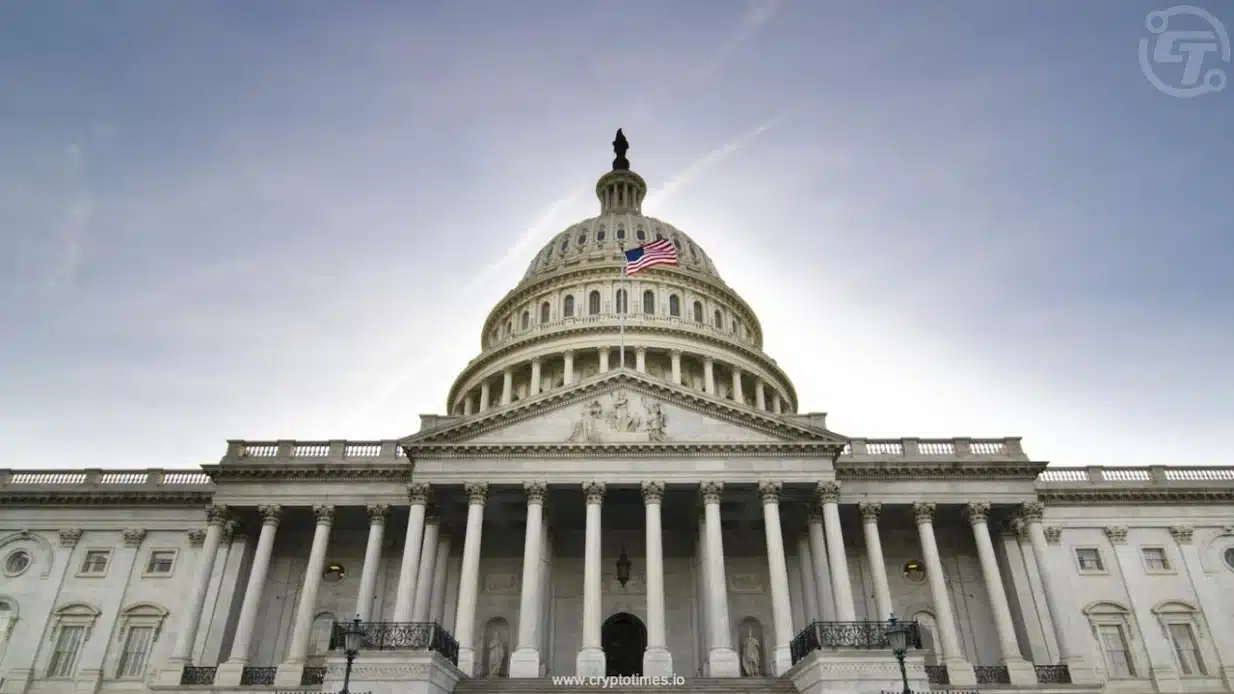
The United States faces the possibility of a government shutdown if Congress fails to pass a new funding bill before the September 30 deadline.
While essential services would continue, a prolonged closure could disrupt operations at federal agencies and unsettle financial markets, according to a report from BBC news.
For cryptocurrencies, the impact would be indirect but noteworthy: reduced staffing at regulators such as the SEC and CFTC could delay ETF applications, for example, while broader investor uncertainty could drive volatility in digital assets.
A shutdown would result in furloughs across agencies such as the Securities and Exchange Commission (SEC) and the Commodity Futures Trading Commission (CFTC). This could slow progress on rulemaking, enforcement actions, and pending exchange-traded fund (ETF) applications. In 2019, for example, the SEC postponed decisions on several Bitcoin ETF proposals during a similar budget standoff.
Uncertainty over US fiscal policy has historically weighed on financial markets. When it comes to digital assets, the impact is less direct but can be felt: volatility could arise as investors reassess exposure to risk assets.
Some market participants view Bitcoin as a potential hedge during political gridlock, while others may reduce positions in volatile assets during periods of uncertainty.
Shutdowns can affect confidence in US fiscal management, influencing the dollar index (DXY) and Treasury yields. Crypto traders closely track both indicators as part of the macro backdrop. A weaker dollar or rising yields could shift capital flows into or out of digital assets, depending on broader risk sentiment.
At the time of writing, Bitcoin (BTC) trades at $113,208 and Ethereum (ETH) at $4,130, according to CoinMarketCap. Given the uncertainty surrounding US fiscal policy, analysts suggest that short-term volatility in crypto markets should be expected.
While the immediate impact on cryptocurrencies would be indirect, the broader effects of a shutdown, ranging from delayed regulation to shifts in investor confidence, are relevant to the digital asset industry. The budget talks’ outcome and the length of any shutdown will determine the effects’ severity.
Also read: 21Shares Updates Solana ETF Filing Ahead of SEC October Decisions
Disclaimer: Some elements of this content may have been enhanced with the help of our artificial intelligence (AI) assistants for purposes such as basic refinement, review, image generation, and translation to deliver high-quality news in a shorter time frame. However, all AI-assisted content is reviewed and approved by our team to ensure accuracy, fairness, and editorial integrity.
US Government Shutdown Risk Raises Uncertainty for Crypto Markets
Cronos, an Ethereum-compatible blockchain ecosystem, announced a collaboration with Amazon Web Services (AWS) on September 30, 2025.
The partnership focuses on integrating Cronos into AWS’s cloud infrastructure with three priorities: making blockchain data accessible, offering credits to startups, and providing access to AI tools.
A central element of the partnership is the inclusion of Cronos’s blockchain data in AWS Public Blockchain Data. The dataset is intended to provide a reliable source for developers, analysts, and institutions that require consistent reporting and compliance-ready information. By simplifying access, the integration lowers technical barriers for building applications on Cronos.
According to an announcement on X, startups working in the Cronos ecosystem may receive up to $100,000 each in AWS credits.
Cronos is collaborating with @awscloud Amazon Web Services (AWS) to accelerate institutional adoption of tokenization & RWA.
— Cronos (@cronos_chain) September 30, 2025
The collaboration has 3 key pillars:
➡️ Cronos EVM Data on AWS (Beta) Public Blockchain Dataset
Making Cronos data easily accessible while building a… pic.twitter.com/A4sahiOevo
The goal is to reduce infrastructure costs and support early-stage development. In addition, developers will have access to AWS AI tools, including Amazon Bedrock, to build and deploy AI-enabled applications on the Cronos blockchain.
The initiative reflects a trend of blockchain ecosystems working with established cloud providers to address institutional needs around security, scalability, and compliance. Cronos has outlined goals of reaching $10 billion in tokenized assets and 20 million users by 2026.
The collaboration with AWS is intended to align its infrastructure with standards that may appeal to financial institutions exploring tokenization and real-world asset (RWA) projects. Which has become a growing focus across financial markets in 2025, with banks, fintechs, and asset managers piloting tokenized products.
The Cronos and AWS collaboration links blockchain data availability, startup support through cloud credits, and access to AI tools. Set against the wider growth of RWA initiatives, it shows how cloud and blockchain infrastructure are being combined to support new development and potential institutional use cases.
Also read: Mirae Asset Taps Avalanche for RWA Tokenization in TradFi Push
Cronos Partners with AWS on Tokenization and Developer Support

At the joint SEC–CFTC roundtable held on September 29, SEC Chair Paul Atkins said the two agencies should end decades of regulatory fragmentation by coordinating more closely on oversight.
The SEC and CFTC have already published the agenda for this joint roundtable, outlining panels on agency history, trading platforms, and the role of market participants in evolving regulation.
The roundtable includes discussions on how to define the boundaries between securities and commodities oversight and how to handle areas of overlapping authority.
Atkins argued that parallel and sometimes conflicting rulebooks have increased costs for investors and pushed innovation overseas. He framed the discussion as a “turning point” in U.S. financial market history, calling for harmonization rather than a merger of the agencies, which would require congressional action.
“Our focus is on harmonization, not on a merger of the SEC and the CFTC,” Atkins said. “The path forward right now is collaboration, not consolidation.”
He noted that companies often move operations abroad to avoid conflicting rules, while investors deal with overlapping requirements that tie up capital. According to Atkins, coordination between the agencies could transform dual oversight from “a source of confusion into a source of strength.”
Looking ahead, Atkins linked the effort to maintaining U.S. leadership in financial innovation. He pointed to the convergence of securities and commodities markets and said the agencies must operate “side-by-side, hand-in-glove” to ensure that new products, including blockchain-based assets, develop under consistent rules.
The roundtable will also include discussions on the historical evolution of the agencies’ jurisdictions and specific areas of overlap that continue to create uncertainty for market participants.
Also read: White House Weighs Jill Sommers and Kyle Hauptman for CFTC Chair
Paul Atkins Calls for SEC–CFTC Harmonization at Joint Roundtable



The Ministry of Artificial Intelligence and Digital Development of Kazakhstan announced on September 29, 2025, the creation of the country’s first state-backed crypto fund.
According to an official statement, the initiative named the Alem Crypto Fund, is intended to build long-term reserves of digital assets. In partnership with Binance Kazakhstan, the fund’s first disclosed investment was in BNB.
The fund operates under a government mandate. It was established by the Ministry of Artificial Intelligence and Digital Development and is managed by Qazaqstan Venture Group.
Registered within the Astana International Financial Centre (AIFC), a financial hub with its own regulatory framework, the fund is positioned within an established legal structure. Its cooperation with Binance Kazakhstan, a licensed exchange in the country, provides the mechanism for executing transactions .
By setting up a state-managed fund, Kazakhstan is applying a model typically used for sovereign assets such as gold or foreign currency reserves to digital assets. The use of the AIFC framework indicates an attempt to align the initiative with a regulated financial environment.
The development adds Kazakhstan to the list of governments experimenting with formal mechanisms for holding digital assets. Observers note that the long-term role of such reserves will depend on factors including market volatility, international regulation, and domestic policy decisions.
Also read: Nigeria Tops Africa in Stablecoin Transactions at $22B
Kazakhstan Establishes State Fund for Strategic Crypto Holdings

The U.S. Securities and Exchange Commission (SEC) has asked asset managers to withdraw their individual exchange listing applications for several spot altcoin exchange-traded funds (ETFs).
Following the agenda, this applies to products tracking tokens such as Solana (SOL) and XRP. The withdrawals are part of an administrative shift to move issuers under a generic listing framework recently approved by the SEC.
This request is not a rejection of the proposed funds. Instead, it follows the SEC’s decision to allow certain crypto ETFs to be listed through a standardized process, replacing the prior case-by-case filings known as 19b-4 forms. The new framework removes the need for individual exchange rule change proposals, which previously added time to the review process.
Under the revised approach, exchanges can list crypto ETFs that meet predefined criteria without submitting separate 19b-4 filings. Issuers will now focus on completing their S-1 registration statements with the SEC.
The approval of these ETFs will depend on the clearance of the S-1 filings. Tokens potentially affected include Solana, XRP, Litecoin, Cardano, and Dogecoin. According to Eleanor Terrett, withdrawals could start happening as soon as this week.
Supporters of the update argue that it offers issuers a clearer and more consistent pathway, while others note that the impact will depend on how the S-1 reviews are handled. The development also connects to the SEC’s broader policy agenda for digital assets and may influence the timeline for institutional crypto products.
The change reflects ongoing regulatory adjustments as the SEC incorporates digital asset products into existing securities frameworks. In practical terms, attention now shifts from tracking individual 19b-4 deadlines to monitoring progress on S-1 registration statements, which remain the final step before potential market launch.
Also read: SEC Clears Grayscale’s ETH ETFs Under New Generic Rules
Solana, XRP ETF Applications Withdrawn Per New SEC Generic Rule
Poland’s lower house of parliament, the Sejm, passed the “Crypto-Asset Market Act” on Friday, establishing a formal regulatory framework for the digital asset industry.
The legislation, approved with a vote of 230 in favor and 196 against, places crypto asset service providers under the authority of the country’s top financial regulator.
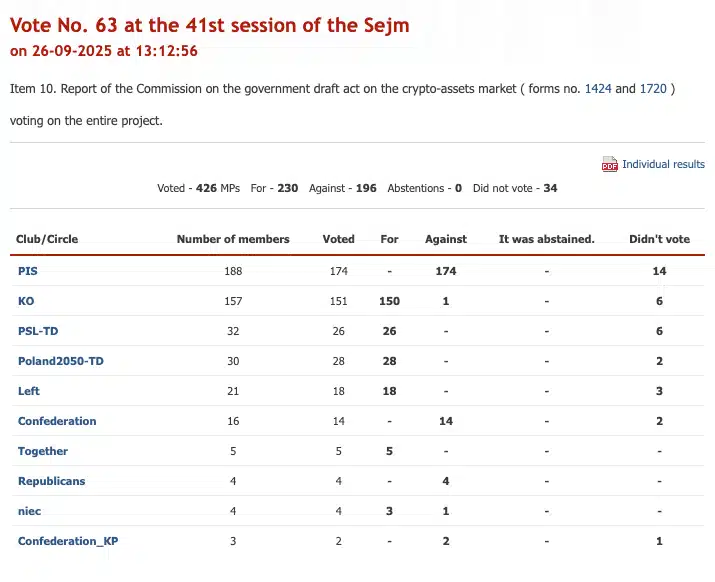
This move aims to implement the European Union’s Markets in Crypto-Assets (MiCA) regulation, standardizing rules across the bloc.
The legislation, detailed in Bill 1424, officially designates the Polish Financial Supervision Authority (KNF) as the primary oversight body for the crypto sector. This places digital asset companies under the same supervisory umbrella as institutions like banks and insurers.
According to the official vote process, the bill passed with support from opposition parties, while the governing PiS party voted against it. The legislation will now proceed to the Senate for further consideration.
Under the new act, Crypto Asset Service Providers (CASPs) operating in Poland will be required to obtain a license from the KNF to operate legally. The framework introduces guidelines and aims to standardize operations within the Polish crypto ecosystem.
The law includes strict penalties for non-compliance. Violations could result in fines of up to 10 million Polish zlotys and potential prison sentences of up to two years.
This legislation precedes the institutionalization of cryptocurrency. By following the EU’s MiCA states, Poland looks to meet its standards, which could attract institutional investment seeking regulatory clarity.
While the law provides a clear structure, some critics have raised concerns that the strict penalties and regulatory oversight could be perceived as overly restrictive, potentially impacting innovation.
The act represents Poland’s crypto industry interests, which aims to establish more regulation, so It could join a growing trend of national governments integrating digital assets into regular financial systems.
Also read: Société Générale and Bullish Launch First MiCA-Regulated Stablecoin
Poland Approves Crypto Law, Bringing Sector Under Regulator Oversight

Hyperion DeFi, Inc. (NASDAQ: HYPD) has appointed former PayPal executive David Knox as its new Chief Financial Officer.
The publicly traded company, based in Laguna Hills, California, announced the move on September 29 as part of a strategy to merge traditional financial products with the world of decentralized finance (DeFi). The news was also shared through the company’s official social media channels
Hyperion DeFi welcomes Paypal's former Head of Capital Markets and Head of Finance for Global Credit & Financial Services as its Chief Financial Officer, effective immediately. $HYPD. More than just $HYPE.
— Hyperion (@HyperionDeFi) September 29, 2025
Hyperliquid. https://t.co/0iY2BfJfjJ
According to the announcement, the hire is a part of Hyperion’s plan to strengthen governance and position itself as a “bridge between Wall Street and the decentralized future.”
David Knox joins Hyperion DeFi from PayPal, where he was the Head of Capital Markets and Head of Finance for Global Credit and Financial Services. His career also includes roles at such as Cantor Fitzgerald, SoFi, and the Royal Bank of Scotland.
In a statement, Knox said he plans to use his “extensive industry connections across institutional finance,” particularly in structured products like asset-backed securities (ABS) and collateralized loan obligations (CLO), in order to bring these solutions on-chain.
Hyperion DeFi is the first U.S. publicly listed company focused on building a strategic treasury of HYPE, the native token of the Hyperliquid blockchain. According to the press release, CEO Hyunsu Jung, Knox can help “accelerate our mission of moving institutional finance to Hyperliquid.”
As part of the hiring agreement, Hyperion DeFi granted Knox a restricted stock unit award of 100,000 shares. The company noted that the grant, which vests over one year, was an inducement material to his employment under Nasdaq Listing Rules.
Following the announcement, HYPD stock surged 11.6% to $10.68 in early trading on September 29, reflecting positive investor sentiment.
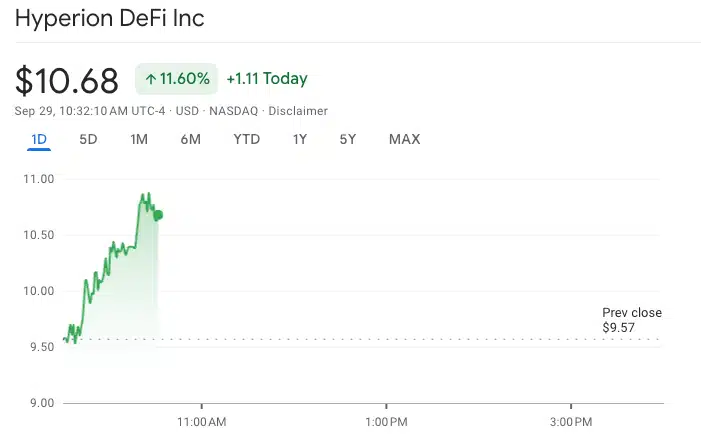
The traditional way of working could bring Wall Street experience basis to introduce ‘new’ sources of liquidity and transparency to the market. This can reflect a growing trend of DeFi companies recruiting executives from traditional finance to enhance credibility and attract institutional capital.
Also read: Bitwise Files to Launch Hyperliquid ETF with HYPE Token
Hyperion DeFi Hires Ex-PayPal to Bridge TradFi and DeFi


Bitcoin (BTC) and Ethereum (ETH) experienced significant price instability on Friday, September 26, with Bitcoin and ETH breaking below key support levels of $110,000 and $4000, respectively before reclaiming it.
In the past 24 hours, Ethereum (ETH) has gained 3.82%, climbing to $4,050 with a market cap of $488.8 billion. Bitcoin (BTC) also edged higher, up 0.39% to $109,983, holding a market cap above $2.19 trillion, according to CoinMarketCap. Despite the uptick, trading volumes for both assets declined, signaling that broader market sentiment remains cautious.
The recent price correction for Bitcoin has accelerated, with the asset dropping below the $110,000 level. This movement coincides with significant selling pressure from institutional investors. According to market data from analytics platform SoSoValue show that the US Spot Bitcoin ETFs recorded outflows of $258 million on Thursday.
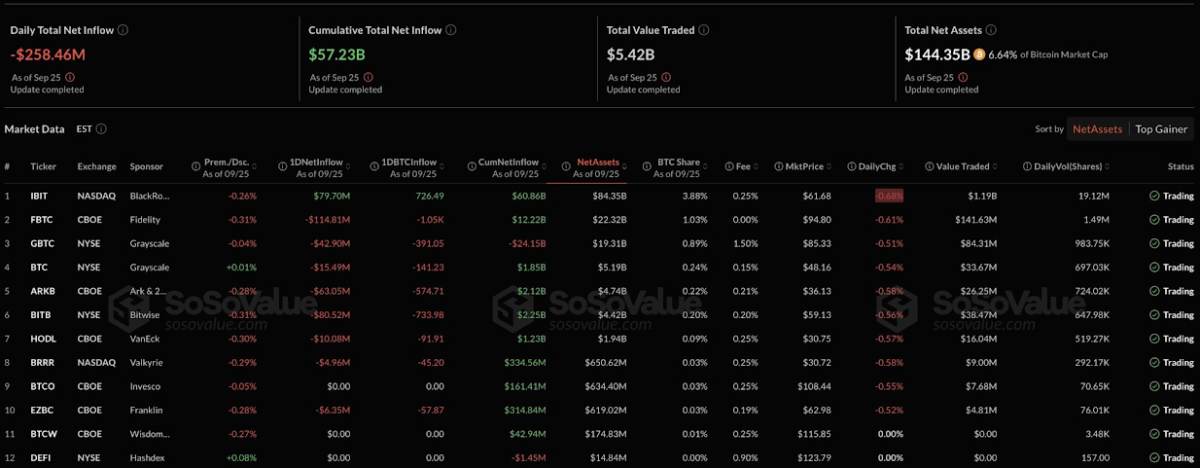
Ethereum has mirrored Bitcoin’s downturn, experiencing similar price instability. The market for the second-largest cryptocurrency saw investor withdrawals totaling $251 million from its own spot ETF products.
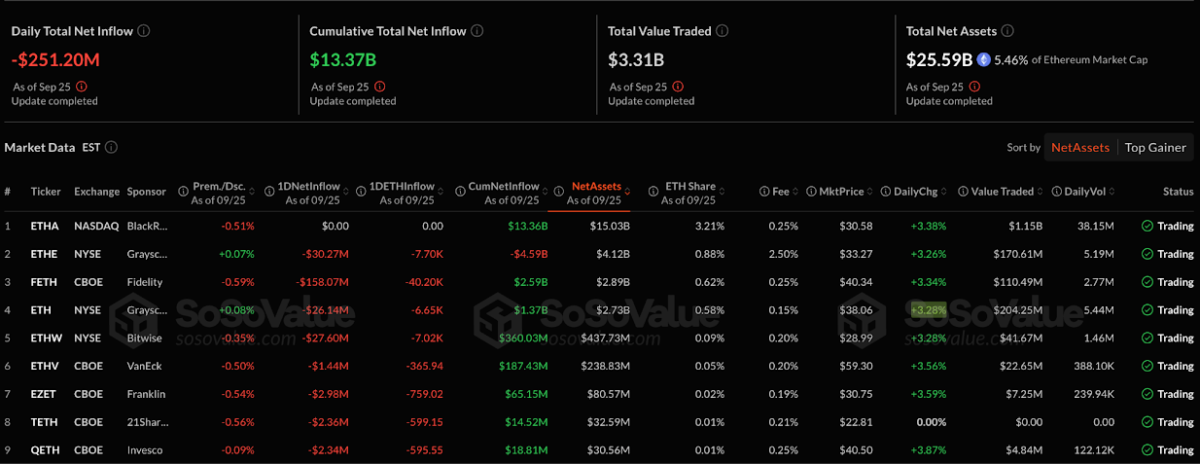
The combined outflow of over $500 million signals a widespread “risk-off” sentiment among institutional players, suggesting they are reducing their exposure to digital assets in anticipation of further volatility.
This trend suggests that large-scale investors are actively reducing their exposure to digital assets in anticipation of further market volatility.The current downturn follows a period of instability where Bitcoin recently lost key support levels, while ETH’s supply on centralized exchanges has hit its lowest point since 2016.
The Crypto Fear and Greed Index dropped to 32 (Fear), down from a neutral 41 yesterday, according to CoinMarketCap. The shift reflects growing investor anxiety after weeks of ETF outflows and weak technical signals, marking one of the lowest sentiment levels since March’s “extreme fear” reading.
The substantial outflows from institutional investment products mark a clear shift in market sentiment, acting as the primary driver for the current weakness in Bitcoin and Ethereum prices. Continued withdrawals could lead to further price declines in the short term unless there is a significant improvement in overall market confidence. For now, investor caution appears to be shaping the immediate future of the digital asset market.
Also read: Trader Loses $45M as Ethereum Price Drops Below $4,000
Bitcoin and Ethereum Prices Wobble Fight ETF Outflows


Akio, a Non-Fungible Token (NFT) project, falsely announced on September 24 that it had raised a $5 million seed round led by Pantera Capital. The announcement, made on the social media platform X, was quickly and publicly denied by Pantera partner Franklin Bi, highlighting an issue of projects making unsubstantiated claims to generate interest. The incident is a warning of the importance of background checks on statements claimed in social media, by crypto projects.
The incident began when Akio published a graphic on its X account detailing a supposed $5 million seed round with Pantera Capital as the lead investor, along with Nvidia Ventures, Hasbro Ventures, AMD Ventures, and other players.
Shortly after the post went live, Franklin Bi of Pantera Capital issued a direct denial on X, stating, “Pantera is not an investor in this.”
Alert: Pantera is not an investor in @AkioWorldNFT.
— Franklin Bi (@FranklinBi) September 25, 2025
We've confimed the same with several other investors mentioned in the tweet below.
I was blocked by the project & can't respond directly to the original tweet or comments.
Good luck out there. Stay paranoid. 🫡 pic.twitter.com/FqeWdw7JU4
Beyond Pantera, none of the other companies shown in the Akio post, Nvidia Ventures, Hasbro Ventures, AMD Ventures, Net Ease Global, SBI GRoup, SIG DTI, Susquehanna International Group Company, have publicly acknowledged any investment in Akio or the publication.
Instead of issuing a correction, the Akio project reportedly blocked Franklin Bi on the platform following his refutation of their announcement.
The Akio incident offers a direct example of red flags and underscores that investors have to carefully review information, as well as the source of the announcement. Legitimate funding rounds are typically confirmed through official press releases or on the investors’ own channels, not just a social media graphic.
Investors can also verify claims with the alleged investors directly, such as: Pantera Capital’s official website reveals no mention of Akio in its portfolio. A lack of confirmation on a venture firm’s official blog, portfolio page, or social media can be a warning sign.
The Akio incident serves as a real-time case study in the red flags that can surround fundraising announcements. For investors, it places a spotlight on the importance of verifying claims before making financial decisions. Here are key steps for due diligence:
False claims damage the reputation of the project making them and force venture capital firms to publicly defend their credibility. Also, it contributes to an erosion of trust across the industry. Furthermore, false hype can be used to temporarily inflate the price of tokens or NFTs, leaving uninformed buyers at a loss when the claims are proven false. The Akio-Pantera is a reminder that in a largely unregulated space, claims should be treated with skepticism.
Also read: X Exposes Crypto Scam Bribery Network Amid Rising Fraud
Pantera Capital Refutes Investment in NFT Project Akio


Nubank, a digital financial services platform in Latin America, has appointed former Coinbase product director Michael Rihani as its new Director of Crypto. Rihani, a veteran product leader and entrepreneur with over 15 years of experience, joins Nubank after holding high-impact roles at some of the world’s most prominent technology and crypto companies.
The company announced the hire on September 26, 2025, enhancing the move of established professionals from United States technology hubs exploring high-growth firms in emerging markets. Rihani will be based in the US and will report to Thomaz Fortes, the executive director of Nubank’s crypto division.
Rihani brings experience from technology companies like Apple, Tesla, Cash App, and Coinbase. Before this new role, he served as a product director at the crypto exchange, while at Tesla and Cash App, he worked on the company’s Bitcoin payment integration. Earlier, he was part of the teams that developed Apple Pay and the Apple Card.
In a post on X, Rihani stated he is dedicating his career to Bitcoin and improving the world’s financial system. According to the company, he views Nubank as the ideal place to build products with significant impact.
Thrilled to share that I’ve joined @Nubank (NYSE: NU) as Head of Crypto.
— Michael Rihani (@MichaelRihani) September 25, 2025
Nubank is one of the largest digital financial services platforms in the world with over 123M customers, more than 60% of Brazilian adults as customers, a $75B+ market cap, and 80%+ of its growth comes from… pic.twitter.com/RWuQc4Jjrb
“Over the past few years, I’ve dedicated my career to Bitcoin and improving the world’s financial system,” said Michael Rihani. “If you want to build something new and impactful, there’s no better place than Nubank. Nubank Crypto has become one of the most competitive options on the market, and it’s a privilege to work with a team committed to redefining the future of money,” the executive says.
Rihani will now lead the Nubank Cripto, a platform that allows users to buy, sell, and store digital assets. The platform currently serves six and a half million customers, according to information from the company.
This strategic hire follows other recent crypto-focused initiatives from the digital bank. The appointment comes shortly after the company enabled customers to pay credit card bills using Bitcoin, indicating an expansion of its digital asset services.
Rihani’s move from a US crypto exchange to a Brazilian-headquartered fintech shows how emerging countries are investing in external expertise for their growing technology sector. The appointment may be seen as a validation of the region’s market potential for widespread cryptocurrency adoption, given Nubank’s large user base. Since the fintech is advancing on digital asset plans, this hiring is aligned with what the bank has been showing.
Also read: Nubank to Test Dollar-Backed Stablecoin Payments via Credit Cards
Coinbase Michael Rihani Joins Brazil's Nubank to Lead Crypto

The Brazilian Federal Police (PF), in collaboration with blockchain intelligence firm TRM Labs and crypto exchange Binance, dismantled a money laundering operation on Wednesday, September 24. The action, named ‘Operation Lusocoin’, resulted in the seizure of approximately $4.3 million USDT (about R$22.5 million).
The criminal organization, with leadership based in Dubai, is suspected of moving an estimated US$9.3 billion from illicit activities such as drug trafficking. The case underscores how traditional law enforcement is working together with private-sector expertise to trace digital assets.
According to a press release, the operation involved 13 search warrants and 11 temporary arrests across several Brazilian states. Authorities also blocked the accounts of 65 individuals and entities and seized six vehicles and six properties to disrupt the group’s infrastructure.
The organization allegedly used cryptocurrencies for foreign exchange evasion and to move criminal proceeds. As this channel was used, both Binance and TRM Labs could help, offering assisted law enforcement for freezing the cited $9.3B USDT tokens, as well as blockchain analysis, respectively.
‘Operation Lusocoin’ reflects how law agencies and crypto companies are partnering to fight organized crime. This model of combining public authority with private expertise may influence future regulatory efforts, encouraging frameworks that foster such partnerships to strengthen compliance and security in the ecosystem. As criminals adopt new technologies, these public-private collaborations highlight how law enforcement can adapt.
Also read: Brazil’s Crypto Inflows Hit R$28.8M on Fed Rate Cut Hopes
Brazil Police Seize $4.3M USDT With Binance and TRM Labs Help
Internet infrastructure company Cloudflare announced on September 25, 2025, its plans to introduce the NET Dollar, a new U.S. dollar-backed stablecoin.
According to the company‘s release, the initiative is designed to support a new business model for the internet based on pay-per-use payments and microtransactions. The stablecoin is intended to facilitate payments within the emerging “agentic web,” where autonomous artificial intelligence (AI) agents transact online. The company stated it will also contribute to open payment standards, including the Agent Payments Protocol and x402.
The NET Dollar is prototyped to provide quick and secure global transactions for AI agents. In a statement, Cloudflare CEO Matthew Prince said the goal is to “help modernize the financial rails needed to move money at the speed of the Internet.” The project aims to create a financial system capable of handling automated, programmatic actions, such as an AI agent booking a flight or paying a supplier on its own.
While the announcement outlines the vision for the stablecoin, key technical details, such as which blockchain the NET Dollar will be issued on, have not yet been disclosed.
Cloudflare’s move follows other major technology firms expanding into digital assets. PayPal recently launched its own stablecoin, PYUSD, signaling a pattern of established companies building infrastructure for digital transactions.
The NET Dollar initiative also includes industry collaboration. According to its press release, Cloudflare will work with Coinbase to launch the x402 Foundation, an entity focused on developing an open standard for internet payments, symbolizing foundational systems being incorporated into e-commerce.
The entry of a major internet infrastructure provider like Cloudflare could influence the stablecoin ecosystem. The involvement of publicly traded U.S. companies may affect the strategies of existing stablecoin issuers and potentially introduce new distribution channels.
This trend could also foster more collaboration between traditional technology companies and the crypto industry, especially around the development of open standards for payments. The development of the x402 Foundation and the market’s reception to the NET Dollar can further enhance discussion on the topic.
Also read: CFTC Proposes Stablecoins as Collateral in Derivatives Markets
Cloudflare Announces NET Dollar to Power AI-Driven Payments

Global asset manager Mirae Asset Global Investments and Ava Labs, the firm behind the Avalanche blockchain, announced a new partnership on September 25, 2025.
The two companies signed a Memorandum of Understanding (MOU) to collaborate on tokenizing real-world assets (RWAs), with an initial focus on investment funds. The collaboration aims to merge traditional finance (TradFi) expertise with blockchain infrastructure.
The agreement details a joint effort to develop solutions for RWA tokenization. According to an official announcement, Mirae Asset will provide its institutional expertise in asset management, while Ava Labs will supply the underlying technology through the Avalanche network. The partnership’s initial steps will include a feasibility review and a pilot project to build the necessary on-chain management and settlement systems for tokenized funds.
Avalanche is adding a $316B giant to its institutional ecosystem. 🔺
— Avalanche🔺 (@avax) September 25, 2025
Mirae Asset Global Investments, one of Asia’s largest asset managers, signed an MOU with Ava Labs at KBW to pioneer fund tokenization and on-chain fund operations. pic.twitter.com/ZErbGqSTGX
The stated goals for the partnership include creating innovative financial products and enhancing the investment experience for customers. While tokenization can bring efficiency, transparency, and access to new global liquidity pools, the move represents a contemporary trend that players are exploring after the sector reported a 224% growth.
According to Kim Young-hwan, President of Mirae Asset’s Innovation and Global Management Division, said, “This partnership marks a key step in strengthening our digital transformation capabilities as a global asset manager. By combining Ava Labs’ blockchain technology with our product and operational expertise, we will accelerate the tokenization of real assets (RWA), provide new investment experiences for clients, and secure a leading position in the global market.”
For Ava Labs, this collaboration represents a validation from a institutional partner, which could help drive further adoption of its platform for institutional-grade RWAs, as reported by local media.
The involvement of traditional asset managers could encourage others from the niche to adhere to blockchain, as it is happening in the bank sector. The collaboration may also help accelerate growth and standardization in the Real-World Asset (RWA). Such developments align with industry projections that suggest the market for tokenized assets could grow significantly by the end of the decade.
The following alliance is an example of how the architecture of modern finance is evolving. It moves the tokenization of real-world assets from a niche tangible in reality. Although the results for the sector are positive, there are still a lot of variables that will both be watched closely by investors, regulatory bodies, and other stakeholders.
Also Read: Tokenized Assets Have Grown 224% Since 2024: Dune & RWA Report
Mirae Asset Taps Avalanche for RWA Tokenization in Major TradFi Push


 FreshRSS