FreshRSS

🔒
❌ About FreshRSS
There are new articles available, click to refresh the page.
☐ ☆ ✇ The Motley Fool

Elon Musk Owns 28% of Tesla, a Stake Worth Nearly $350 Billion. Here's Why His Ownership Level Matters for Shareholders.

By: newsfeedback@fool.com (Todd Shriber)

Key Points

  • Tesla shares and Elon Musk’s influence are, not surprisingly, joined at the hip.

  • His 28.4% stake in his company signals confidence and skin in the game.

  • But there are some potential drawbacks to such a high percentage of Tesla shares residing in one pair of hands.

Some companies are synonymous with their founders or high-ranking executives. Elon Musk's Tesla (NASDAQ: TSLA) definitely fits that bill. The data confirm as much.

It could be said that investing in Tesla is synonymous with investing in Musk. Likewise, Musk could be said to be investing in Tesla. The CEO of the electric vehicle (EV) behemoth owns 28.4% of the company's shares, a stake valued at nearly $391.8 billion. Putting Musk's stake into context, it's more than double the combined ownership of Vanguard and BlackRock. The two largest institutional owners of Tesla stock own just over 13% of the shares combined.

Missed Nvidia in 2009? This Rare Signal Is Flashing Again. In 2009, a "Double Down" signal flashed for a little-known chipmaker called Nvidia. For the first time in years, that same "Total Conviction" signal is flashing for a company 1/100th the size of Nvidia. Continue »

Effectively, any investor, including the do-it-yourself crowd, who is long on Tesla is making a de facto bet on Musk. It's a wager that has its pros and cons.

Four Teslas at a charging station.

Elon Musk's massive stake in Tesla is well known and it has pros and cons. Image source: Getty Images.

Consider the risks

Whether it's Tesla or another company where a massive chunk of the shares is controlled by a single person (or a small group of people), there are potential risks to consider.

Musk previously said he wants to control at least a quarter of the company to make the investments needed to turn it into an artificial intelligence (AI) and robotics company. In the past, he's said that if that desire isn't satisfied, he'll focus on AI ventures outside of Tesla's scope. For now, it appears that particular risk has been diminished because the company is forging ahead with Optimus production at one of its California facilities.

Two more risks investors can't ignore: key person risk and board independence. Obviously, Musk is the key person. Various studies confirm that when CEOs fall ill (or worse), their companies' shares often decline. An example of that ominous trend and one that's relevant in the Musk/Tesla equation is the drop in Apple shares when Steve Jobs revealed his cancer diagnosis.

Regarding board independence, when a single shareholder, particularly one who actually runs the company, holds sway as Musk does at Tesla, some critics believe the board will act at that investor's whims, forsaking true independence in the process.

Additionally, companies with highly concentrated share ownership may not be appealing acquisition targets. To be fair, the pool of credible buyers for Tesla with a market capitalization of $1.4 trillion is shallow and likely confined to Musk's other public company, Space Exploration Technologies.

Benefits, too

Musk's 28.4% stake in Tesla isn't solely a cause for concern among investors. There are potential perks, too. At a minimum, he's clearly signaling faith in his abilities and the company's long-term trajectory, meaning his objectives align with the BlackRocks and Vanguards of the world, as well as with the small investor who owns just five, 10, or 20 Tesla shares.

Musk doesn't take a cash salary from Tesla. All of his compensation is equity-based, meaning he's incentivized to make the moves needed to push Tesla shares higher.

A CEO owning as much stock in the company as Musk does in Tesla is rare. Still, investors may want to consider an old Harvard study indicating that members of the Russell 3000 index with what was considered high levels of CEO equity ownership delivered total shareholder returns in excess of those of counterparts whose bosses owned lower percentages of company stock.

Don’t miss this second chance at a potentially lucrative opportunity

Ever feel like you missed the boat in buying the most successful stocks? Then you’ll want to hear this.

On rare occasions, our expert team of analysts issues a “Double Down” stock recommendation for companies that they think are about to pop. If you’re worried you’ve already missed your chance to invest, now is the best time to buy before it’s too late. And the numbers speak for themselves:

  • Nvidia: if you invested $1,000 when we doubled down in 2009, you’d have $598,219!*
  • Apple: if you invested $1,000 when we doubled down in 2008, you’d have $61,037!*
  • Netflix: if you invested $1,000 when we doubled down in 2004, you’d have $421,997!*

Right now, we’re issuing “Double Down” alerts for three incredible companies, available when you join Stock Advisor, and there may not be another chance like this anytime soon.

See the 3 stocks »

*Stock Advisor returns as of September 7, 2026.

Todd Shriber has no position in any of the stocks mentioned. The Motley Fool has positions in and recommends Apple, BlackRock, and Tesla. The Motley Fool has a disclosure policy.

☐ ☆ ✇ The Motley Fool

There Are Only a Handful of Nasdaq-100 Stocks That Yield Over 3%. Here's My Top Pick to Buy Now.

By: newsfeedback@fool.com (Todd Shriber)

Key Points

  • Mondelez may just be the most enticing of the Nasdaq-100 stocks yielding north of 3%.

  • It's been the best performer of the index's three high-dividend staples stocks.

  • It trades at a noticeable discount to Nasdaq-100's two most prominent staples holdings.

The Nasdaq-100 is many things. Widely followed index? Check. A roster of famed large- and mega-cap growth companies? Definitely. A history of long-term outperformance over other domestic equity indexes? You bet.

A dividend destination? Not so much. While marquee components such as Apple and Microsoft, among others, have evolved into legitimate dividend growth stories, the largest exchange-traded fund (ETF) tracking the Nasdaq-100 yields a paltry 0.4%. That's not even half of the roughly 1% that investors find in an S&P 500 index fund, and that's saying something, because the S&P 500's current dividend yield is near all-time lows.

Missed Nvidia in 2009? This Rare Signal Is Flashing Again. In 2009, a "Double Down" signal flashed for a little-known chipmaker called Nvidia. For the first time in years, that same "Total Conviction" signal is flashing for a company 1/100th the size of Nvidia. Continue »

Snacks on shelves at a grocery store.

Mondelez is the winner among the Nasdaq-100 stocks with dividend yields of at least 3%. Image source: Getty Images.

The quest to find high-dividend stocks in the Nasdaq-100 isn't hard. The pool comprises just eight names, one of which is Mondelez (NASDAQ: MDLZ). Yes, the tech-heavy Nasdaq-100 has some exposure to consumer staples. A mere 2.1% to be exact, but three of the index's components from that sector, including Mondelez, yield 3% or more.

The Oreo maker isn't just the safest bet of that trio. For long-term investors, it could easily be the best (or one of the top) performers of that group of eight. Multiple reasons support my bullish view of this snack giant, particularly when comparing it with its "peers" in the Nasdaq-100.

Better by comparison and some diversification, too

As noted above, Mondelez is one of three consumer staples stocks in the Nasdaq-100 yielding at least 3%. The other two are Kraft Heinz (NASDAQ: KHC) and PepsiCo (NASDAQ: PEP). Those are big names, to be sure, and, to its credit, PepsiCo is a Dividend King, or one of the companies with a payout increase streak of at least 50 years.

In the case of Kraft Heinz, that's a stock that flummoxed some of the biggest names in investing, and waiting on its redemption story is turning into a Waiting for Godot moment. Bottom line: Mondelez has beaten Kraft and Pepsi over the past 10 years, and that feat can be repeated.

MDLZ Total Return Level Chart

MDLZ Total Return Level data by YCharts

Owing to the utility sector's status as a high-yield hangout, it's not surprising that three such stocks are among the eight Nasdaq-100 stocks yielding 3% or more. That trio consists of American Electric Power, Exelon, and Xcel Energy. These utility stocks have clear ties to the artificial intelligence (AI) trade, but that may not be all it's cracked up to be.

Investors have avenues for potentially superior AI returns in other sectors, and those AI ties could reduce some of the safety associated with utilities equities. Plus, with the Federal Reserve unlikely to lower interest rates anytime soon, debt-laden utilities may lack catalysts.

With $21 billion in liabilities, Mondelez is no "debt angel," but given that most of that debt doesn't mature over the next five years, a case can be made that the Ritz maker is less rate-sensitive than utilities stocks.

As for the other two Nasdaq-100 names in the 3%-plus yield club, that's Comcast and Paychex. Comcast yields close to 5%, the result of a five-year decline of nearly 54%. Some might argue the stock is inexpensive, but it's challenged by declines in the old-guard broadband business, and its cash-flow and earnings growth outlooks appear light relative to longer-running averages.

Paychex was one of the software names caught up in the "SaaSpocalypse" earlier this year. While the company has done an admirable job of allaying those concerns, as highlighted by a 25.7% gain over the past 90 days, it's still a purveyor of human resources (HR) software in a lethargic job market. I'll take Mondelez's reduced macroeconomic sensitivity.

Sort of a discount

One of the rubs with the consumer staples sector is that investors pay up on valuation for the privilege of accessing the group's defensive traits. However, it's mainly Costco Wholesale and Walmart that skew the sector's valuation higher. Yes, Costco has a stellar long-term growth track record, but it trades at 46.7 times earnings. At 28.4 times earnings, Nvidia looks cheap by comparison.

Valuation isn't a concern with Mondelez. In fact, some experts view the stock as deeply discounted, particularly when measured against Costco and Walmart, which are the largest staples names in the Nasdaq-100.

That discount doesn't mean investors are sacrificing upside potential or solid fundamentals. Mondelez is considered one of the best-run food companies, revenue grew at a decent 3.3% compound annual growth rate over the past five years, and earnings could grow at more 9% per year from 2028 through 2030. Sign me up for this star of the Nasdaq-100 3% yield club.

Should you buy stock in Mondelez International right now?

Before you buy stock in Mondelez International, consider this:

The Motley Fool Stock Advisor analyst team just identified what they believe are the 10 best stocks for investors to buy now… and Mondelez International wasn’t one of them. The 10 stocks that made the cut could produce monster returns in the coming years.

Consider when Netflix made this list on December 17, 2004... if you invested $1,000 at the time of our recommendation, you’d have $421,997!* Or when Nvidia made this list on April 15, 2005... if you invested $1,000 at the time of our recommendation, you’d have $1,413,876!*

Now, it’s worth noting Stock Advisor’s total average return is 978% — a market-crushing outperformance compared to 213% for the S&P 500. Don't miss the latest top 10 list, available with Stock Advisor, and join an investing community built by individual investors for individual investors.

See the 10 stocks »

*Stock Advisor returns as of September 7, 2026.

Todd Shriber has no position in any of the stocks mentioned. The Motley Fool has positions in and recommends Apple, Costco Wholesale, Microsoft, Nvidia, and Walmart. The Motley Fool recommends Comcast and Kraft Heinz. The Motley Fool has a disclosure policy.
☐ ☆ ✇ The Motley Fool

1 Unstoppable Vanguard Growth ETF Up 14% in 2026 to Buy and Hold for the Next 20 Years

By: newsfeedback@fool.com (Todd Shriber)

Key Points

Value investing is taking its lumps, and that's been the case for a while. Yes, various styles move in and out of favor over the years, but the stark reality is that the tide has favored growth stocks for the better part of two decades now.

The Vanguard S&P 500 Growth ETF (NYSEMKT: VOOG) is an exchange-traded fund (ETF) for long-term investors seeking growth equity exposure without the stock-picking burden today.

Missed Nvidia in 2009? This Rare Signal Is Flashing Again. In 2009, a "Double Down" signal flashed for a little-known chipmaker called Nvidia. For the first time in years, that same "Total Conviction" signal is flashing for a company 1/100th the size of Nvidia. Continue »

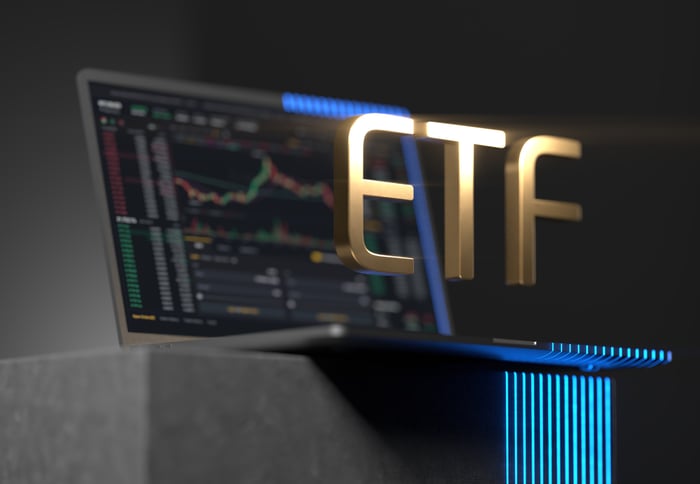
The ETF acronym in gold letters in front of a laptop.

This ETF is ideal for investors searching for a long-term core holding. Image source: Getty Images.

As its name implies, this $27.1 billion growth ETF tracks the S&P 500 Growth index, the growth offshoot of the S&P 500. Don't worry if you're new to ETFs or index funds because the mechanics of this gauge are easy to understand. Stocks in the growth index and thus the Vanguard S&P 500 Growth ETF are evaluated on momentum, revenue growth, and "the ratio of earnings change to price." Now let's get into the details about why this fund could add value to portfolios over the next 20 years.

Growth and quality

As artificial intelligence (AI) has gained more importance and momentum, allusions to the bursting of the tech bubble in 2000 have become more frequent. Market participants love historical comparisons, and some love bubble talk, but the AI/tech bubble comparison has some flaws, including the point that many of today's tech leaders, including stocks residing in the Vanguard S&P 500 Growth ETF, are highly profitable companies. That wasn't the case back in 2000.

Good news for investors considering this ETF: The combination of quality business models and strong profitability within a growth-stock wrapper is a recipe for long-term durability and upside. Companies with high return on assets (ROA), which measures how firms use their assets to turn profits, have proven durable over the long haul.

Some of today's ROA leaders among U.S.-based companies are Nvidia, Apple, Alphabet, Microsoft, and Amazon. That quintet accounts for about 45% of the Vanguard S&P 500 Growth ETF's portfolio.

They're also among the most cash-rich U.S. companies, as are several other members of this ETF's roster. At the same time, this growth ETF is steeped in quality metrics that support its status as a core holding for long-term investors.

Some economic protection, too

This Vanguard ETF could prove valuable to investors on another front. Conventional investing wisdom dictates that when economic growth slows, market participants should embrace less economically dependent sectors, such as consumer staples and utilities.

However, as the growth rally ages, more investors (and perhaps economists) are awakening to the fact that when economic growth slows, market participants put a premium on accessing noncyclical growth and wide competitive moats. Those are boxes checked by an array of the Vanguard S&P 500 Growth ETF's 148 holdings, including the five mentioned earlier. None of that is to say this ETF will post double-digit gains during a recession, but it could prove more resilient than some investors think.

Adding to the case for the Vanguard S&P 500 Growth ETF as a long-term holding and one that could outperform over the next 20 years is its low annual expense ratio of 0.07%, or $7 on a $10,000 investment.

Should you buy stock in Vanguard Admiral Funds - Vanguard S&P 500 Growth ETF right now?

Before you buy stock in Vanguard Admiral Funds - Vanguard S&P 500 Growth ETF, consider this:

The Motley Fool Stock Advisor analyst team just identified what they believe are the 10 best stocks for investors to buy now… and Vanguard Admiral Funds - Vanguard S&P 500 Growth ETF wasn’t one of them. The 10 stocks that made the cut could produce monster returns in the coming years.

Consider when Netflix made this list on December 17, 2004... if you invested $1,000 at the time of our recommendation, you’d have $421,997!* Or when Nvidia made this list on April 15, 2005... if you invested $1,000 at the time of our recommendation, you’d have $1,413,876!*

Now, it’s worth noting Stock Advisor’s total average return is 978% — a market-crushing outperformance compared to 213% for the S&P 500. Don't miss the latest top 10 list, available with Stock Advisor, and join an investing community built by individual investors for individual investors.

See the 10 stocks »

*Stock Advisor returns as of September 7, 2026.

Todd Shriber has no position in any of the stocks mentioned. The Motley Fool has positions in and recommends Alphabet, Amazon, Apple, Microsoft, and Nvidia. The Motley Fool has a disclosure policy.

☐ ☆ ✇ The Motley Fool

If the Fed Hikes Interest Rates This Month, History Says This Is the Smartest ETF to Buy Right Now

By: newsfeedback@fool.com (Todd Shriber)

Key Points

The next Federal Reserve meeting is on Wednesday, Sept. 16, and it could be a doozy because the central bank could deliver its first interest rate hike in more than three years. Many professional investors believe that will happen as Fed funds futures implied a 59.4% chance of a rate increase as of Sept. 4.

Inflation tells the tale of why a hawkish stance is very much on the table for the Fed. While headline inflation is expected to cool this month, a deeper dive reveals that Core Personal Consumption Expenditures (PCE) are climbing. That gauge, which is a preferred tool of the Federal Open Market Committee (FOMC), strips out volatile energy and food prices, implying that consumers are paying higher prices for an array of goods beyond gas and groceries.

Missed Nvidia in 2009? This Rare Signal Is Flashing Again. In 2009, a "Double Down" signal flashed for a little-known chipmaker called Nvidia. For the first time in years, that same "Total Conviction" signal is flashing for a company 1/100th the size of Nvidia. Continue »

A doctor talking to a patient.

This healthcare could be just what the doctor ordered if interest rates rise. Image source: Getty Images.

So it's not a stretch to say that the Fed's hand may be forced and that a rate hike is imminent. Investors may find some rate-hike protection in healthcare stocks and exchange-traded funds, such as the State Street Health Care Select Sector SPDR ETF (NYSEMKT: XLV).

XLV's relevancy then and now

Time will tell whether the Fed merely nudges rates higher once or twice, or embarks on a rate-tightening regime à la 2022-23. Ideally, it's not the latter, but if it is, this healthcare ETF has a favorable recent history. When the Fed began raising interest rates in 2022 to curb inflation, the S&P 500 tumbled 18.6%, while this healthcare ETF lost just 1.1%.

XLV Total Return Level Chart

XLV Total Return Level data by YCharts

The $45 billion healthcare ETF's history against the backdrop of Fed tightening is relevant here and now because of some wonky correlation stuff. Put simply, the correlation between equities and 10-year Treasury yields is now negative, indicating that Mr. Market is walking on sticky inflation eggshells.

Defensive sectors, including healthcare, have a history of proving durable or less bad when the aforementioned "correlation conundrum" appears. One reason is that those groups are chock-full of dividend-paying stocks, which can serve as a buffer when broader benchmarks slip. For its part, the SPDR ETF carries a 30-day SEC yield of 1.47%.

The ETF is home to four Dividend Kings -- those companies that have raised payouts in 50 consecutive years -- three of which are among the fund's top 10 holdings. That trio is led by Johnson & Johnson, which is the healthcare ETF's second-largest component.

Inflation backs the case for this ETF

Some certainties make the SPDR ETF a smart idea this month. First, new Federal Reserve Chair Kevin Warsh is eager to ward off inflation. Second, larger, higher-quality healthcare stocks tend to be somewhat insensitive to rate hikes while still generating solid earnings when Fed hawkishness cools economic growth.

Another certainty is that Fed rate actions, be they cuts or increases, take time to work their way through the economy. That is to say, a rate hike could arrive this month, but its inflation-cooling effects may not be felt for months. If that proves to be the case, the healthcare sector's reputation for growing earnings in inflationary environments becomes all the more coveted, underscoring why some experts call the group the "antidote" for inflationary times.

So the State Street Health Care Select Sector SPDR ETF isn't a cure for undesirable monetary policy, but it is a smart investment when rates rise.

Should you buy stock in Select Sector SPDR Trust - State Street Health Care Select Sector SPDR ETF right now?

Before you buy stock in Select Sector SPDR Trust - State Street Health Care Select Sector SPDR ETF, consider this:

The Motley Fool Stock Advisor analyst team just identified what they believe are the 10 best stocks for investors to buy now… and Select Sector SPDR Trust - State Street Health Care Select Sector SPDR ETF wasn’t one of them. The 10 stocks that made the cut could produce monster returns in the coming years.

Consider when Netflix made this list on December 17, 2004... if you invested $1,000 at the time of our recommendation, you’d have $421,997!* Or when Nvidia made this list on April 15, 2005... if you invested $1,000 at the time of our recommendation, you’d have $1,413,876!*

Now, it’s worth noting Stock Advisor’s total average return is 978% — a market-crushing outperformance compared to 213% for the S&P 500. Don't miss the latest top 10 list, available with Stock Advisor, and join an investing community built by individual investors for individual investors.

See the 10 stocks »

*Stock Advisor returns as of September 7, 2026.

Todd Shriber has no position in any of the stocks mentioned. The Motley Fool recommends Johnson & Johnson. The Motley Fool has a disclosure policy.

☐ ☆ ✇ The Motley Fool

Why I Just Added to My Chevron Position Despite Trump Criticism

By: newsfeedback@fool.com (Todd Shriber)

Key Points

  • Chevron and ExxonMobil endured criticism from the White House recently.

  • The president says the oil giants made too much money off the war in Iran.

  • That’s likely election-year chatter and not an impetus to sell Chevron stock.

If there's one sector that's littered with political boogeymen, it's the energy sector, oil producers in particular. That status is arguably amplified in a midterm election year in which affordability, including gas prices, is a marquee issue.

So it's not surprising that some bellwether energy stocks have political targets on their backs. Chevron (NYSE: CVX) and ExxonMobil (NYSE: XOM) learned that the hard way in early August when President Trump accused the largest domestic oil companies of making too much money off high oil prices caused by the war in Iran. He pushed both corporations to cut the prices consumers are paying at their local gas stations.

Missed Nvidia in 2009? This Rare Signal Is Flashing Again. In 2009, a "Double Down" signal flashed for a little-known chipmaker called Nvidia. For the first time in years, that same "Total Conviction" signal is flashing for a company 1/100th the size of Nvidia. Continue »

An oil rig in the ocean.

Chevron is still a buy despite barbs from the White House. Image source: Getty Images.

The president's sharp words for Chevron came just three months after California's Democratic governor, Gavin Newsom, urged drivers in his state to boycott Chevron stations over high prices. So it'd appear this company is in bipartisan political crosshairs, but it's likely a case of bark being worse than bite, and it's not enough of a reason to sell this high-flying oil stock. Actually, I'm a buyer of Chevron because the long-term fundamental story may be too good to pass up.

The other country boosting the Chevron case

In terms of recent price action, Chevron stock is up 5.64% since the president made his comments, indicating that the will of the markets, not politicians, is winning out.

Drilling down on more durable reasons to consider Chevron today, there's the Venezuela catalyst. Last week, the White House announced a deal with the South American nation that essentially grants the U.S. control over 65 billion barrels of oil. As one of my Foolish colleagues rightly points out, that's a potential windfall for Chevron.

Chevron is validating that thesis because, on Sept. 1, reports emerged that the oil major is close to securing an agreement granting it access to another pair of fields in Venezuela's Orinoco Belt, one of the most oil-dense regions in the world.

Venezuela's state-run oil company previously estimated that the Chevron unit operating in the country could pump up to 400,000 barrels per day when its Orinoco holdings fully ramp up. The addition of two more fields could represent a major increase to that estimate. In other words, Chevron may be rewarded for playing the long game in Venezuela. The company continued operating there over the years while many rivals departed, citing unfavorable political conditions.

A long-term winner

Politicians' targets in corporate America come and go, as do the politicians themselves, so the gas-price rhetoric isn't a headwind for Chevron. Price action confirms as much. In addition, Chevron's other long-term attributes are compelling.

Confirming the company isn't reliant on a single country or region, it notched record output in the U.S. in the second quarter while worldwide production increased 20% year over year. The latter point is noteworthy, given that, by the company's own admission, "geopolitical uncertainty" loomed large in the quarter.

Likewise, political chatter doesn't diminish Chevron's $1.5 billion in savings (in just one quarter) from the Hess acquisition, nor should that rhetoric overshadow a 20-year data center power deal with Microsoft in West Texas. I'll let the pollsters deal with politics while I enjoy my Chevron stake.

Should you buy stock in Chevron right now?

Before you buy stock in Chevron, consider this:

The Motley Fool Stock Advisor analyst team just identified what they believe are the 10 best stocks for investors to buy now… and Chevron wasn’t one of them. The 10 stocks that made the cut could produce monster returns in the coming years.

Consider when Netflix made this list on December 17, 2004... if you invested $1,000 at the time of our recommendation, you’d have $421,997!* Or when Nvidia made this list on April 15, 2005... if you invested $1,000 at the time of our recommendation, you’d have $1,413,876!*

Now, it’s worth noting Stock Advisor’s total average return is 978% — a market-crushing outperformance compared to 213% for the S&P 500. Don't miss the latest top 10 list, available with Stock Advisor, and join an investing community built by individual investors for individual investors.

See the 10 stocks »

*Stock Advisor returns as of September 5, 2026.

Todd Shriber has a position in Chevron. The Motley Fool has positions in and recommends Chevron and Microsoft. The Motley Fool has a disclosure policy.

☐ ☆ ✇ The Motley Fool

Here's How Many Shares of PepsiCo You'd Need for $25,000 in Yearly Dividends

By: newsfeedback@fool.com (Todd Shriber)

Key Points

  • Investors need a lot of shares (and capital) to generate $25,000 in yearly dividends from PepsiCo stock.

  • The good news is that this is one of the most dependable dividend growth stocks.

In investing, goal-setting is important. Whether it's retirement planning, using stocks to save for a home, or just simple wealth-building, investors should identify their end games early on in the process.

Many dividend investors are already checking that box. Before getting involved with a stock, many experienced payout hunters will say to themselves, "I want to generate $X per year in dividends from a particular stock."

Missed Nvidia in 2009? This Rare Signal Is Flashing Again. In 2009, a "Double Down" signal flashed for a little-known chipmaker called Nvidia. For the first time in years, that same "Total Conviction" signal is flashing for a company 1/100th the size of Nvidia. Continue »

Two glasses of cola with ice.

Investors will need a lot of cash to get to $25,000 in yearly dividends with PepsiCo stock. Image source: Getty Images.

Obviously, there's some math behind that exercise, but fortunately not the high school algebra kind. For investors who want to harness $25,000 a year, an impressive sum to be sure, from PepsiCo (NASDAQ: PEP), knowing the math is essential. With a 4% increase delivered in February, PepsiCo stock features a yearly payout of $5.92 per share. Divide $25,000 by the dividend of $5.92, and the result is that 4,223 shares are required to generate $25,000 in annual dividends from Pepsi.

Here's where the dividend math gets intimidating with this consumer staples stock. PepsiCo closed at $140.52 on Sept. 2. Round down and call it $140.50, multiply that by 4,223 shares, and the result is $593,331.50.

Generating $25,000 a year in dividends from PepsiCo is definitely an ambitious goal. But that doesn't mean market participants should forget the value of ambition in investing. Nor does the math imply that they should simply gloss over PepsiCo.

Over time, the math becomes more favorable, particularly if an investor makes regular additions to their PepsiCo stake. Time is also on the side of patient shareholders with this stock because it's raised its payout for 55 consecutive years, making it a Dividend King, or a company with an annual dividend increase streak of at least 50 years.

That's where the math becomes more favorable because, as PepsiCo's dividend rises, less capital is required for investors to reach their $25,000 dreams.

Should you buy stock in PepsiCo right now?

Before you buy stock in PepsiCo, consider this:

The Motley Fool Stock Advisor analyst team just identified what they believe are the 10 best stocks for investors to buy now… and PepsiCo wasn’t one of them. The 10 stocks that made the cut could produce monster returns in the coming years.

Consider when Netflix made this list on December 17, 2004... if you invested $1,000 at the time of our recommendation, you’d have $446,157!* Or when Nvidia made this list on April 15, 2005... if you invested $1,000 at the time of our recommendation, you’d have $1,377,357!*

Now, it’s worth noting Stock Advisor’s total average return is 983% — a market-crushing outperformance compared to 212% for the S&P 500. Don't miss the latest top 10 list, available with Stock Advisor, and join an investing community built by individual investors for individual investors.

See the 10 stocks »

*Stock Advisor returns as of September 4, 2026.

Todd Shriber has no position in any of the stocks mentioned. The Motley Fool has no position in any of the stocks mentioned. The Motley Fool has a disclosure policy.

☐ ☆ ✇ The Motley Fool

Kinetik Holdings: Buy, Sell, or Hold After Its Recent Run?

By: newsfeedback@fool.com (Todd Shriber)

Key Points

  • Kinetik Holdings is up more than 57% this year.

  • This high-yield midstream stock may have more gas in its tank.

  • The pipeline operator recently lifted its 2026 outlook.

It's been a solid year for mid-cap stocks and an even better one for broader gauges of high-yield pipeline stocks. Combine those two concepts, and there's potential for investors to be cooking with gas (pun very much intended).

Just look at Kinetik Holdings (NYSE: KNTK). With a market capitalization of $8.9 billion, this pipeline operator is a mid-cap stock. As is the case with so many equities with that designation, Kinetik flies somewhat under the radar. That relative anonymity is amplified when measuring this name against larger, more widely known midstream companies.

Missed Nvidia in 2009? This Rare Signal Is Flashing Again. In 2009, a "Double Down" signal flashed for a little-known chipmaker called Nvidia. For the first time in years, that same "Total Conviction" signal is flashing for a company 1/100th the size of Nvidia. Continue »

"Time to Buy" written on a clock.

This midstream stock is hot, but it's still a "buy." Image source: Getty Images.

Fortunately, investing isn't a popularity contest, and Kinetik's quiet-by-comparison hasn't prevented the stock from surging more than 57% this year, including a pop of 7.6% in August. More good news: Those aren't the only reasons the stock is still a buy.

Make the Kinetik connection

For the uninitiated, Kinetik operates primarily in the Delaware Basin, an oil- and natural gas-rich corner of the broader Permian Basin. The company's footprint is pertinent because, in its own words, it's a "pure-play, Permian-to-Gulf Coast" operator. Not many competitors can match that purity.

Second, Kinetik's focus on the Delaware Basin is material to long-term investors because, amid political pushes to "unlock American energy dominance," this region fits squarely in that theme. The Delaware Basin's proven reserves consist of 46.3 billion barrels of oil, a staggering 281 trillion cubic feet of natural gas, and 20 billion barrels of natural gas liquids (NGLs). That's more than enough to keep exploration and production companies and midstream operators such as Kinetik busy (and potentially profitable) for years to come.

Yes, this stock is hot, and some analysts think it may be due for a breather, but there are no guarantees that a pullback deep enough to satisfy eager dip buyers will arrive.

What's more, this is a fundamentally sound midstream company. Record second-quarter results and increased 2026 guidance confirm as much. Importantly, the higher 2026 earnings before interest, taxes, depreciation, and amortization (EBITDA) aren't just the product of what Kinetik delivered in the first half of the year, but also of how it sees things setting up in the third and fourth quarters.

Emerging dividend dependability

Another important point is that, in its current form, Kinetik isn't even five years old. However, there have already been three dividend hikes, including one announced in January. So, in short order, this midstream name is positioning itself as a legitimate oil dividend stock.

The company generated nearly $195 million in distributable cash flow (DCF) in the second quarter. That's important because DCF is the marquee metric by which analysts and investors assess midstream companies' ability to pay dividends. Put simply, its payout doesn't burden Kinetik, a fact affirmed by a coverage ratio of 1.47x at the end of the June quarter.

Vernacular like "coverage ratio" sounds nerdy. Still, it's important to income investors, and with a little extra "oomph" on that front, Kinetik can get into a range that older, larger midstream companies typically occupy. Moving in that direction is one more reason the stock is a "buy" candidate today.

Should you buy stock in Kinetik right now?

Before you buy stock in Kinetik, consider this:

The Motley Fool Stock Advisor analyst team just identified what they believe are the 10 best stocks for investors to buy now… and Kinetik wasn’t one of them. The 10 stocks that made the cut could produce monster returns in the coming years.

Consider when Netflix made this list on December 17, 2004... if you invested $1,000 at the time of our recommendation, you’d have $446,157!* Or when Nvidia made this list on April 15, 2005... if you invested $1,000 at the time of our recommendation, you’d have $1,377,357!*

Now, it’s worth noting Stock Advisor’s total average return is 984% — a market-crushing outperformance compared to 212% for the S&P 500. Don't miss the latest top 10 list, available with Stock Advisor, and join an investing community built by individual investors for individual investors.

See the 10 stocks »

*Stock Advisor returns as of September 3, 2026.

Todd Shriber has no position in any of the stocks mentioned. The Motley Fool has no position in any of the stocks mentioned. The Motley Fool has a disclosure policy.

☐ ☆ ✇ The Motley Fool

1 Magnificent Vanguard Growth ETF I'm Buying Hand Over Fist in September

By: newsfeedback@fool.com (Todd Shriber)

Key Points

Both the S&P 500 and the S&P 500 Growth index are up more than 13% year-to-date. Actually, the latter's 2026 gain is closer to 14%, confirming that this is another year in which large- and mega-cap growth stocks are delivering for investors.

Fortunately, this isn't a growth-only rally. As investors have heard countless times this year, breadth is widening, meaning segments beyond the largest growth stocks are fanning bullish flames. The "other" club certainly includes small-cap equities. The S&P SmallCap 600 index (the importance of that index will be revealed shortly) is beating the S&P 500 by more than 800 basis points year-to-date.

Missed Nvidia in 2009? This Rare Signal Is Flashing Again. In 2009, a "Double Down" signal flashed for a little-known chipmaker called Nvidia. For the first time in years, that same "Total Conviction" signal is flashing for a company 1/100th the size of Nvidia. Continue »

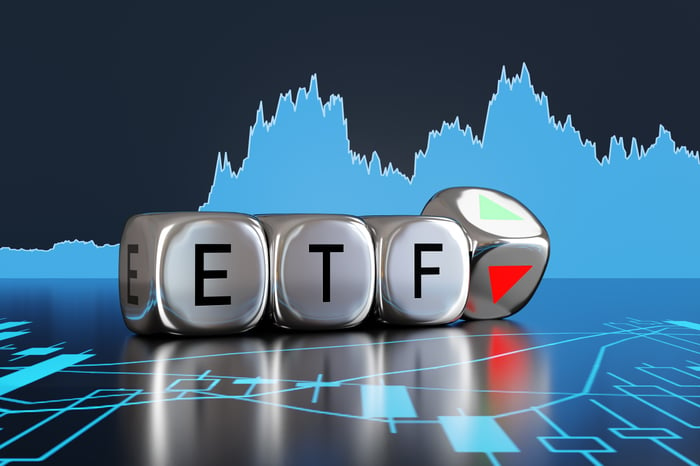
ETF inscribed on silver blocks with a blue chart in the background.

This Vanguard growth ETF is one to consider in September. Image source: Getty Images.

That's one reason I'm excited about the Vanguard S&P Small-Cap 600 Growth ETF (NYSEMKT: VIOG) in September. The good news there's an array of catalysts that support more upside for this Vanguard ETF going into year-end.

Investigating indexes

As its name implies, the Vanguard funds the S&P SmallCap 600 index, the growth offshoot of the parent gauge mentioned above. Whenever an investor investigates a passive exchange-traded fund (ETF), they must spend a few minutes evaluating the underlying index.

Index 101 is about to commence. For this growth ETF, the choice of index is critical because the S&P SmallCap 600 has a long-standing track record of outperforming its rival, the Russell 2000 index. From 2000 through 2024, the S&P gauge outperformed its competitor in 20 of those calendar years.

Understanding why that happens is easy. Unlike the Russell small-cap index, the S&P gauge mandates that companies have a history of positive earnings before inclusion. That requirement extends to the index tracked by the Vanguard Growth ETF, and it pays off for patient investors as highlighted by a comparison of this fund against a rival that tracks the Russell 2000 Growth index.

VIOG Total Return Level Chart

VIOG Total Return Level data by YCharts

So while this fund isn't dedicated to the quality factor, it has an element of quality. This can smooth out some of the bumps associated with small-cap investing. Adding to the ETF's appeal for long-term investors is the fact that many small-cap growth stocks struggle to become profitable. There are times when "junk" carries the day in the small stock arena, but it's not a wager that smart investors want to make over the long haul.

No Fed help, no problem

Another reason I'm excited about this Vanguard ETF in September is that the fund and its peers are strutting their stuff amid a challenging interest rate environment. Maybe it's another case of an asset class believed to be sensitive to interest rates decoupling from rates. Still, the reality is that small caps are surging at a time when rates are high, and the Federal Reserve isn't signaling rate cuts.

Typically, elevated rates are viewed as burdensome for smaller companies because many rely on access to capital markets, making them vulnerable to high borrowing costs. The Fed isn't helping small-cap stocks this year. Still, the Vanguard ETF isn't bothered by that scenario, suggesting investors may be focusing on fundamentals, including small-cap earnings growth, rather than monetary policy.

So there's a lot to like about this ETF in September. And with an annual fee of just 0.10%, or $10 on a $10,000 position, this $1.1 billion fund is appropriate for long-term investors seeking some extra growth from smaller stocks.

Should you buy stock in Vanguard Admiral Funds - Vanguard S&P Small-Cap 600 Growth ETF right now?

Before you buy stock in Vanguard Admiral Funds - Vanguard S&P Small-Cap 600 Growth ETF, consider this:

The Motley Fool Stock Advisor analyst team just identified what they believe are the 10 best stocks for investors to buy now… and Vanguard Admiral Funds - Vanguard S&P Small-Cap 600 Growth ETF wasn’t one of them. The 10 stocks that made the cut could produce monster returns in the coming years.

Consider when Netflix made this list on December 17, 2004... if you invested $1,000 at the time of our recommendation, you’d have $437,097!* Or when Nvidia made this list on April 15, 2005... if you invested $1,000 at the time of our recommendation, you’d have $1,355,077!*

Now, it’s worth noting Stock Advisor’s total average return is 978% — a market-crushing outperformance compared to 213% for the S&P 500. Don't miss the latest top 10 list, available with Stock Advisor, and join an investing community built by individual investors for individual investors.

See the 10 stocks »

*Stock Advisor returns as of September 1, 2026.

Todd Shriber has no position in any of the stocks mentioned. The Motley Fool has no position in any of the stocks mentioned. The Motley Fool has a disclosure policy.
☐ ☆ ✇ The Motley Fool

Grayscale Just Launched the First-Ever ETF for Zcash (ZEC). Here's Why That's Big News for Crypto Investors.

By: newsfeedback@fool.com (Todd Shriber)

Key Points

  • Grayscale just converted its Zcash trust into an ETF.

  • That’s potentially significant for cryptocurrency investors because it signals faith in an asset outside of the "Big Two."

  • Zcash investors could benefit from inflows into the new ETF.

There are nearly 8,100 digital currencies on the market today, but among those that make the cut as legitimate additions to the world of exchange-traded funds (ETFs), the universe is much, much smaller.

One way of looking at that scenario is that now, more than two-and-a-half years since the first spot Bitcoin (CRYPTO: BTC) ETFs came to market in the U.S., it's still kind of a big deal when new spot crypto ETFs appear. It's all the more meaningful when considering that some large fund sponsors won't expand their crypto ETF lineups beyond Bitcoin and Ethereum (CRYPTO: ETH), the two largest digital currencies by market capitalization.

Missed Nvidia in 2009? This Rare Signal Is Flashing Again. In 2009, a "Double Down" signal flashed for a little-known chipmaker called Nvidia. For the first time in years, that same "Total Conviction" signal is flashing for a company 1/100th the size of Nvidia. Continue »

A trader looking at crypto prices on their phone.

This new Zcash ETF could user new adoption of that cryptocurrency. Image source: Getty Images.

So yes, it's big news that Grayscale recently launched the Grayscale Zcash ETF (NYSEMKT: ZCSH). OK, this isn't an ETF launch in the traditional sense of the term because the issuer converted a previously existing trust into the wrapper. Hence, the new ETF came to market with $260 million in assets under management (it's up to $313 millionas of Aug. 28), but that only scratches the surface of this rookie fund's potential significance.

Charting new ETF territory

By market value, Zcash (CRYPTO: ZEC) is the 11th-largest cryptocurrency. That's not so far down the totem pole as to make this ETF a stretch. It is, however, the first ETF dedicated to this digital asset, making it the first ETF to focus on a privacy-dedicated token.

For crypto investors, the debut of a Zcash ETF is significant beyond Grayscale's status as a first-mover fund (more on that later). Interestingly, the Grayscale ETF debuted a few weeks after the now-infamous Coldcard Hack. Yes, that involved Bitcoin theft, but some experts believe that event could spur more adoption of ETFs as preferred avenues for crypto exposure, because many market participants don't want the burden of figuring out how to store cryptocurrency.

That's one potential demand driver for this infant ETF. Another is the familiarity of the ETF wrapper, which could stoke curiosity about Zcash. Inquisitive investors mulling over the Grayscale ETF may learn that nearly a third of the Zcash supply is held in shielded addresses, many of which are long-term devotees of the token.

Curious investors may also learn that, like Bitcoin, Zcash's supply is capped at 21 million tokens. That's pertinent to crypto market participants because, assuming the Zcash ETF continues to haul in assets, those inflows effectively remove Zcash supply from the market, potentially boosting prices in the process. Call it the "Bitcoin ETF effect."

Institutional intrigue

The advent of the Grayscale Zcash ETF is material for another reason. As has been the case with spot Bitcoin ETFs, the new fund could lure more institutional investors to Zcash. That's when the big bucks start rolling in, which is to say if professional market participants nibble at Zcash by way of this ETF, that would be significant for crypto investors because it'd show institutional appetite for digital assets beyond Bitcoin and Ethereum.

Increased adoption of Zcash would, you guessed it, likely lift the price of the cryptocurrency itself, as well as that of the Grayscale fund.

There's evidence that Zcash adoption is already rising as demand for privacy in financial transactions grows in the age of artificial intelligence (AI). Should that adoption uptick continue, it'd likely be a boon for this young ETF.

Should you buy stock in Grayscale Zcash ETF right now?

Before you buy stock in Grayscale Zcash ETF, consider this:

The Motley Fool Stock Advisor analyst team just identified what they believe are the 10 best stocks for investors to buy now… and Grayscale Zcash ETF wasn’t one of them. The 10 stocks that made the cut could produce monster returns in the coming years.

Consider when Netflix made this list on December 17, 2004... if you invested $1,000 at the time of our recommendation, you’d have $440,710!* Or when Nvidia made this list on April 15, 2005... if you invested $1,000 at the time of our recommendation, you’d have $1,335,252!*

Now, it’s worth noting Stock Advisor’s total average return is 978% — a market-crushing outperformance compared to 213% for the S&P 500. Don't miss the latest top 10 list, available with Stock Advisor, and join an investing community built by individual investors for individual investors.

See the 10 stocks »

*Stock Advisor returns as of September 1, 2026.

Todd Shriber has no position in any of the stocks mentioned. The Motley Fool has positions in and recommends Bitcoin and Ethereum. The Motley Fool has a disclosure policy.

☐ ☆ ✇ The Motley Fool

Down 14% From Its High, Is Genesis Energy a Buy?

By: newsfeedback@fool.com (Todd Shriber)

Key Points

The pipeline stock universe is littered with large-cap companies, many of which are familiar to income investors. So it stands to reason that amid a recent tidal wave of midstream payout increases, some companies go overlooked.

Such is life for Genesis Energy (NYSE: GEL), a small-cap provider of pipeline infrastructure services. The stock is off nearly 14% from its 52-week high, confirming a correction. However, the stock jumped 7% over the past month, perhaps signaling the worst is behind it and momentum is on its side.

Missed Nvidia in 2009? This Rare Signal Is Flashing Again. In 2009, a "Double Down" signal flashed for a little-known chipmaker called Nvidia. For the first time in years, that same "Total Conviction" signal is flashing for a company 1/100th the size of Nvidia. Continue »

Dividend yield written on a metal case next to an alarm clock.

This high-dividend stock is in a correction, but it's starting to bounce back. Image source: Getty Images.

Quietly last month, Genesis upped its quarterly distribution to 20 cents per share from 18 cents, a 11.1% boost from the prior quarter. As the company puts it, that's 21.2% year-over-year dividend growth. This energy stock offers a dividend yield of 4.9%, more than 5x the yield of the small-cap Russell 2000 Index.

While Genesis isn't the most popular name in the pipeline space, there's a lot to like here from an income perspective. On an annualized basis, the dividend is now 80 cents a share, representing 33% growth in just two years. Importantly, Genesis recently told investors it had distribution coverage of 3.2x in the second quarter. In plain English, this dividend isn't a strain on the company.

Yes, there is some debt to consider. To be precise, $3.2 billion at the end of the second quarter. Some investors may see that figure, rightfully note that it's well in excess of the company's market capitalization, and then ponder the fate of the dividend.

Those concerns can be allayed on multiple fronts. Genesis is moving to reduce its $3.2 billion in debt -- a smart move considering that figure is well in excess of its $2 billion market capitalization. Additionally, the pipeline infrastructure outfit has no debt maturing this year, next year, or in 2028. It's also using free cash flow to retire preferred stock, thus reducing its dividend obligations.

Combine efforts to firm the balance sheet with dividend growth and the stock's recent strength, and Genesis Energy is a "buy" for risk-tolerant income investors.

Should you buy stock in Genesis Energy right now?

Before you buy stock in Genesis Energy, consider this:

The Motley Fool Stock Advisor analyst team just identified what they believe are the 10 best stocks for investors to buy now… and Genesis Energy wasn’t one of them. The 10 stocks that made the cut could produce monster returns in the coming years.

Consider when Netflix made this list on December 17, 2004... if you invested $1,000 at the time of our recommendation, you’d have $440,710!* Or when Nvidia made this list on April 15, 2005... if you invested $1,000 at the time of our recommendation, you’d have $1,335,252!*

Now, it’s worth noting Stock Advisor’s total average return is 978% — a market-crushing outperformance compared to 213% for the S&P 500. Don't miss the latest top 10 list, available with Stock Advisor, and join an investing community built by individual investors for individual investors.

See the 10 stocks »

*Stock Advisor returns as of August 31, 2026.

Todd Shriber has no position in any of the stocks mentioned. The Motley Fool has no position in any of the stocks mentioned. The Motley Fool has a disclosure policy.

☐ ☆ ✇ The Motley Fool

This Unstoppable ETF Could Turn $100 per Month Into $40,000 With Next to No Effort on Your Part. Here's How.

By: newsfeedback@fool.com (Todd Shriber)

Key Points

One of the biggest misnomers about investing is that prospective market participants need considerable sums of capital to get started. Investors who invest with patience, time, and compounding can reap big long-term rewards even when starting small.

That potential certainly exists with the Invesco Nasdaq 100 ETF (NASDAQ: QQQM). For those not familiar with this exchange-traded fund (ETF), it's basically the lower-cost counterpart to the famous Invesco QQQ ETF (NASDAQ: QQQ). Both funds track the Nasdaq-100, but the QQQ ETF charges 0.18% per year, or $18 on a $10,000 investment, while the $103.7 billion Invesco Nasdaq 100 ETF has an annual expense ratio of 0.15%.

Missed Nvidia in 2009? This Rare Signal Is Flashing Again. In 2009, a "Double Down" signal flashed for a little-known chipmaker called Nvidia. For the first time in years, that same "Total Conviction" signal is flashing for a company 1/100th the size of Nvidia. Continue »

A golden bull on rows of $100 bills.

This ETF can turn small stakes into large dollar amounts over the long term. Image source: Getty Images.

That's not a big difference, but over time it can add up, suggesting that cost-conscious investors should opt for the lower-fee option. Speaking of time, it's something investors want to put on their side with these growth ETFs. Consider the case of the QQQ ETF, which is the older of these two funds.

It debuted in March 1999. An investor who put just $100 into it the following month would have had $1,520 as of July with no additional contributions to the initial $100 stake.

Imagine what that $1,520 could have been if the investor contributed $100 monthly to their cause. We don't have to imagine. A backtest shows that an investor who contributed $100 per month for a decade to the QQQ ETF would have more than $38,000.

That figure would be higher with the Invesco Nasdaq 100 ETF, which turns six years old in October, due to its lower expense ratio.

Of course, past performance isn't a guarantee of future returns, but that doesn't mean this ETF can't turn $100 monthly contributions into $40,000 or more over a decade. If history repeats or rhymes over the coming decade, the Nasdaq-100 Index could extend its long-term outperformance of the S&P 500. And if the artificial intelligence (AI) trend gains more momentum, that'd be one more tailwind for the Invesco Nasdaq 100 ETF.

Should you buy stock in Invesco NASDAQ 100 ETF right now?

Before you buy stock in Invesco NASDAQ 100 ETF, consider this:

The Motley Fool Stock Advisor analyst team just identified what they believe are the 10 best stocks for investors to buy now… and Invesco NASDAQ 100 ETF wasn’t one of them. The 10 stocks that made the cut could produce monster returns in the coming years.

Consider when Netflix made this list on December 17, 2004... if you invested $1,000 at the time of our recommendation, you’d have $440,710!* Or when Nvidia made this list on April 15, 2005... if you invested $1,000 at the time of our recommendation, you’d have $1,335,252!*

Now, it’s worth noting Stock Advisor’s total average return is 978% — a market-crushing outperformance compared to 213% for the S&P 500. Don't miss the latest top 10 list, available with Stock Advisor, and join an investing community built by individual investors for individual investors.

See the 10 stocks »

*Stock Advisor returns as of August 31, 2026.

Todd Shriber has no position in any of the stocks mentioned. The Motley Fool has no position in any of the stocks mentioned. The Motley Fool has a disclosure policy.
☐ ☆ ✇ The Motley Fool

Prediction: This Pipeline Stock's Payout Will Grow Faster Than Chevron's [or Exxon's] Over the Next 5 Years

By: newsfeedback@fool.com (Todd Shriber)

Key Points

  • Sunoco LP is on the list of unheralded midstream dividend growers.

  • It has the potential to deliver payout growth that outpaces integrated oil stocks over the next several years.

  • Sunoco is already on a nice run of consecutive quarterly dividend increases.

For committed, patient long-term income investors, some of the best opportunities, in terms of both yield and payout growth, can be found in the energy patch.

The sector's status as a payout haven encompasses a broad range of names, from pipeline stocks to some of the world's largest oil companies. Many market participants opt for familiarity and reliability, which helps explain why ExxonMobil and Chevron are hits with dividend investors. The two largest U.S. domestic oil companies have dividend increase streaks of 43 and 39 years, respectively.

Missed Nvidia in 2009? This Rare Signal Is Flashing Again. In 2009, a "Double Down" signal flashed for a little-known chipmaker called Nvidia. For the first time in years, that same "Total Conviction" signal is flashing for a company 1/100th the size of Nvidia. Continue »

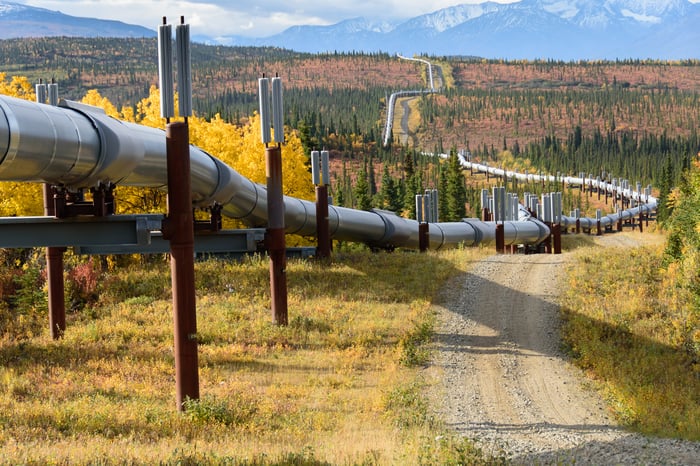
A pipeline running through a grassy area.

Sunoco LP is an overlooked midstream name with big dividend growth potential. Image source: Getty Images.

To be sure, those are impressive runs, but barring any surprises, those companies are likely to continue raising their payouts at low-single-digit percentages. Income-hungry investors seeking rapid dividend growth should look to the midstream segment, home to Sunoco LP (NYSE: SUN). Indeed, this pipeline company has sunny dividend potential.

This SUN can shine for dividend investors

First, a housekeeping item. Sunoco LP is not the same as SunocoCorp LLC (NYSE: SUNC). However, the latter "owns a direct limited partner interest in Sunoco LP." Interestingly, Sunoco LP's general partner is owned by Energy Transfer, one of the most beloved large-cap names in the midstream income space.

Maybe it's a stretch, but DNA is relevant because Sunoco LP is following the Energy Transfer playbook, becoming a serial dividend grower and quarterly at that. Sunoco LP's most recent dividend increase of 1.25% marked the seventh straight quarter in which the pipeline operator hiked the payout.

That keeps it on pace to meet its stated objective of a "multi-year distribution growth rate of at least 5%." So if that rate is met or exceeded, I'm not going out on a limb by saying that Sunoco LP's dividend should grow at a higher percentage over the next five years than the payouts of ExxonMobil and Chevron.

Sunoco LP currently yields 5.3%, which is above the yields typically seen in integrated oil equities. However, that yield isn't a cause for alarm. The midstream company's net leverage ratio of 3.98x is where executives want it to be, and the operator is considered a disciplined capital allocator, implying a commitment to debt management and dividend growth.

This dividend could surprise

All right, so it's clear that Sunoco LP is targeting distribution growth of at least 5% annually, which is likely to surpass what ExxonMobil and Chevron deliver. However, Sunoco (though it's not guaranteed) may exceed its stated payout growth rate.

Earlier this month, Sunoco LP announced the $600 million all-cash acquisition of Offen Petroleum. No, a $600 million deal isn't earth-shattering news, particularly in the energy sector, but the details matter. The acquisition isn't financially straining Sunoco LP. Still, it did tell investors that the purchase will be accretive right off the bat, while clearly stating that the deal "will increase cash flow for distribution growth."

So it's possible that as Offen is brought into the Sunoco LP fold (the transaction closes in the fourth quarter), the acquisition could pave the way for dividend growth north of 5% starting next year. Even if that doesn't happen, dependable 5% raises are pretty good, too.

Should you buy stock in Sunoco right now?

Before you buy stock in Sunoco, consider this:

The Motley Fool Stock Advisor analyst team just identified what they believe are the 10 best stocks for investors to buy now… and Sunoco wasn’t one of them. The 10 stocks that made the cut could produce monster returns in the coming years.

Consider when Netflix made this list on December 17, 2004... if you invested $1,000 at the time of our recommendation, you’d have $430,571!* Or when Nvidia made this list on April 15, 2005... if you invested $1,000 at the time of our recommendation, you’d have $1,399,268!*

Now, it’s worth noting Stock Advisor’s total average return is 986% — a market-crushing outperformance compared to 214% for the S&P 500. Don't miss the latest top 10 list, available with Stock Advisor, and join an investing community built by individual investors for individual investors.

See the 10 stocks »

*Stock Advisor returns as of August 29, 2026.

Todd Shriber has no position in any of the stocks mentioned. The Motley Fool has positions in and recommends Chevron. The Motley Fool has a disclosure policy.
☐ ☆ ✇ The Motley Fool

Bitcoin ETFs Just Posted Their Best Week Since October 2025. That's Why I'm Bullish on Bitcoin.

By: newsfeedback@fool.com (Todd Shriber)

Key Points

  • Led by the iShares Bitcoin Trust ETF, spot Bitcoin ETFs hauled in $1.92 billion in fresh capital last week.

  • That was the group’s best weekly haul in 10 months.

  • It’s one reason to consider being bullish on the largest digital currency.

As of midday Wednesday, Aug. 26, Bitcoin (CRYPTO: BTC) traded around $78,500. It needs to gain approximately 60.5% to reach its all-time high. That's a long way off, but all rebounds have to start somewhere, and for the largest cryptocurrency, last week may mark the start of its resurgence.

Spot Bitcoin exchange-traded funds (ETFs) are providing bullish clues about the cryptocurrency's trajectory. With a big helping hand from the iShares Bitcoin ETF Trust (NASDAQ: IBIT), the largest fund in the spot Bitcoin ETF category, those ETFs hauled in $1.92 billion in new capital last week. That marks the group's best week of inflows since October 2025.

Missed Nvidia in 2009? This Rare Signal Is Flashing Again. In 2009, a "Double Down" signal flashed for a little-known chipmaker called Nvidia. For the first time in years, that same "Total Conviction" signal is flashing for a company 1/100th the size of Nvidia. Continue »

A gold coin with the Bitcoin "B" on it.

Bitcoin ETFs are hauling in new cash, and that's one reason to be bullish. Image source: Getty Images.

In broad terms, ETF inflows aren't always clear "buy" signals. Some professional investors buy ETFs to hedge short positions in stocks, while others move in and out of highly liquid ETFs within days. However, inflows into the IBIT ETF and its peers are a positive signal, indicating that institutional investors are renewing their enthusiasm for Bitcoin.

More positive clues

To reiterate, flows (in or out) aren't the end-all and be-all of ETF decision-making, but something interesting is happening with Bitcoin ETFs. More investors are showing a preference for the ETF wrapper for Bitcoin exposure.

BlackRock, the issuer of the iShares Bitcoin ETF, has processed $5 billion in Bitcoin "swaps," in which market participants move their Bitcoin into the ETF. That allows them to remain committed HODLers without worrying about cold storage and the potential vulnerabilities of digital wallets.

The pace of these swaps is gaining enough momentum that authorized participants, the folks who keep the ETF universe humming through the creation/redemption process, have dramatically lowered the dollar amount required to execute Bitcoin-to-Bitcoin ETF transactions. What was once a $100 million affair has now sunk to $50 million, and now just $3 million is required to execute these exchanges.

Moving Bitcoin off an exchange or out of a digital wallet into ETFs creates inflows. That asset accumulation is pertinent for several reasons. The investors behind those transactions are reiterating their commitment to Bitcoin. They're showing affinity for the ETF wrapper. Finally, there's evidence indicating that Bitcoin ETF investors are part of the "diamond hands" crowd, meaning they plan to hold their stakes in those funds for extended periods.

Bitcoin stars may be aligning

Beyond ETF inflows, there are other reasons to believe Bitcoin may be getting its groove back. The cryptocurrency is again showing correlation with gold, and that's a good thing because bullion is on a scintillating run of its own of late.

The prevailing wisdom holds that "digital gold" and "real gold" are moving higher in tandem amid concerns about Uncle Sam's $40 trillion debt tab, which is stoking the debasement trade. What's being debased is the U.S. dollar, and that erosion is viewed as positive for alternative money. Bitcoin and physical gold fit that bill.

Speaking of the debasement, it's one reason Bernstein says Bitcoin is heading to $300,000 in three years. If that forecast is even close to accurate, investors buying Bitcoin ETFs today while displaying diamond hands behavior will be handsomely rewarded.

Should you buy stock in iShares Bitcoin Trust right now?

Before you buy stock in iShares Bitcoin Trust, consider this:

The Motley Fool Stock Advisor analyst team just identified what they believe are the 10 best stocks for investors to buy now… and iShares Bitcoin Trust wasn’t one of them. The 10 stocks that made the cut could produce monster returns in the coming years.

Consider when Netflix made this list on December 17, 2004... if you invested $1,000 at the time of our recommendation, you’d have $430,571!* Or when Nvidia made this list on April 15, 2005... if you invested $1,000 at the time of our recommendation, you’d have $1,399,268!*

Now, it’s worth noting Stock Advisor’s total average return is 986% — a market-crushing outperformance compared to 214% for the S&P 500. Don't miss the latest top 10 list, available with Stock Advisor, and join an investing community built by individual investors for individual investors.

See the 10 stocks »

*Stock Advisor returns as of August 28, 2026.

Todd Shriber has no position in any of the stocks mentioned. The Motley Fool has positions in and recommends Bitcoin, BlackRock, and iShares Bitcoin Trust. The Motley Fool has a disclosure policy.

☐ ☆ ✇ The Motley Fool

The Best Gold ETF for 2027 Won't Surprise You. It's Still GLD.

By: newsfeedback@fool.com (Todd Shriber)

Key Points

It's never too early to start planning, and with barely more than four months remaining in 2026, now is a good time for investors to evaluate stocks and exchange-traded funds (ETFs) that can be embraced today and held into 2027 and beyond.

Preparation is one reason I'm eyeing the SPDR Gold Shares (NYSEMKT: GLD) for today and 2027. The GLD ETF is the oldest and largest fund in the gold ETF category. This $157.1 billion SPDR ETF debuted in November as the first ETF backed by a physical asset to trade in the U.S.

Missed Nvidia in 2009? This Rare Signal Is Flashing Again. In 2009, a "Double Down" signal flashed for a little-known chipmaker called Nvidia. For the first time in years, that same "Total Conviction" signal is flashing for a company 1/100th the size of Nvidia. Continue »

A stack of small gold bars.

The SPDR Gold Shares is the best ETF for investors seeking bullion exposure in 2027. Image source: Getty Images.

I believe that's a good segue into explaining this gold ETF to new investors and those unfamiliar with the mechanics of physical commodities ETFs. Just as our favorite equity-based ETFs hold, well, stocks, the SPDR Gold Shares is backed by holdings of physical gold. Those bars are stored in London and custodied by two of the world's largest banks, meaning investors don't have to worry about securing and storing actual gold.

And because this ETF is backed by physical bullion rather than futures contracts or other derivatives, its price action reflects what's happening in the spot market, not the futures market. I see that as advantageous for numerous investors because not only is the SPDR Gold ETF easy to understand, it doesn't confine investors to the timing element of the futures market (futures contracts have expiration dates), making the fund appropriate for long-term market participants.

No need to wait until 2027

I'm in the camp of SPDR Gold Shares 2027 believers, but there's no need to wait until then. Following a rough, multimonth stretch in which gold languished, betraying its safe-haven status amid the war in Iran, the yellow metal is roaring back with a vengeance.

For the month ending Aug. 26, this gold ETF surged 15.1%. I'm not going to complain about a 15.1% gain in a month. No investor should. What I will say is that gold's recent bullishness is worth examining not only because it positions the commodity to reclaim the psychologically important $ 5,000-per-ounce level, but also because the good vibes suggest the yellow metal is decoupling from interest rates.

I agree that "decoupling" is often investment mumbo jumbo, but gold's relationship with interest rates is important. Typically, when rates are high, gold loses luster because it doesn't pay a dividend or interest. The same is true of the SPDR Gold Shares. No dividends or other income streams.

However, the commodity and the ETF are on the mend, even as 30-year Treasury yields recently touched their highest levels in 19 years. That underscores the case for this ETF now and into 2027, because with gold rallying in this environment, the message is that investors are more concerned about the U.S. government's $40 trillion in debt and about gold's vulnerabilities to high rates.

GLD will shine in 2027

There are multiple reasons why I'm excited about the SPDR Gold Shares' 2027 prospects. Indeed, U.S. debt burden of $40 trillion is one of them. Let's keep it real. Material progress won't be made on that front over the coming months, so the U.S. will head into next year with an uncomfortably high debt level, one that could diminish the appeal of Treasuries while boosting the allure of gold.

Second, some of gold's primary demand drivers look strong. Bar and coin demand in China and India is robust. At the same time, data indicate that various Asia-listed ETFs comparable to the SPDR gold fund are packing on assets despite gold's rough patch earlier this year.

Finally, I'm a fan of this ETF because, like many of you, I'm primarily invested in stocks and equity-based ETFs (and a bond ETF). Portfolios heavy in stocks and bonds could use a dollop of gold exposure because the yellow metal is negatively correlated with those asset classes, meaning that when they zig, gold should zag.

Should you buy stock in SPDR Gold Shares right now?

Before you buy stock in SPDR Gold Shares, consider this:

The Motley Fool Stock Advisor analyst team just identified what they believe are the 10 best stocks for investors to buy now… and SPDR Gold Shares wasn’t one of them. The 10 stocks that made the cut could produce monster returns in the coming years.

Consider when Netflix made this list on December 17, 2004... if you invested $1,000 at the time of our recommendation, you’d have $443,461!* Or when Nvidia made this list on April 15, 2005... if you invested $1,000 at the time of our recommendation, you’d have $1,307,633!*

Now, it’s worth noting Stock Advisor’s total average return is 973% — a market-crushing outperformance compared to 213% for the S&P 500. Don't miss the latest top 10 list, available with Stock Advisor, and join an investing community built by individual investors for individual investors.

See the 10 stocks »

*Stock Advisor returns as of August 27, 2026.

Todd Shriber owns shares of the SPDR Gold Shares. The Motley Fool has no position in any of the stocks mentioned. The Motley Fool has a disclosure policy.

☐ ☆ ✇ The Motley Fool

Should You Buy Alibaba Stock This Month?

By: newsfeedback@fool.com (Todd Shriber)

Key Points

  • Recent news of a $10.2 billion secondary share sale doesn’t help the short-term case for this stock.

  • Alibaba is spending heavily on AI infrastructure, and will direct all of the proceeds from this stock sale to its build-out.

  • The stock could remain under near-term pressure.

When it comes to buy-and-sell decisions, there are occasions when companies make it easy for investors, sending clear signals that inform the ultimate call to embrace or part ways with a specific stock.

That's the case with Alibaba (NYSE: BABA). The consumer discretionary company is overtly telling market participants it's not buy-worthy, at least over the next several days. That's a harsh assessment to be sure, but it's also one grounded in reality, and the reality is that the Chinese company's recent news flow has largely been negative for shareholders.

Missed Nvidia in 2009? This Rare Signal Is Flashing Again. In 2009, a "Double Down" signal flashed for a little-known chipmaker called Nvidia. For the first time in years, that same "Total Conviction" signal is flashing for a company 1/100th the size of Nvidia. Continue »

A Chinese flag with tech imagery on it.

Image source: Getty Images

On Friday, the Chinese e-commerce giant announced plans for a secondary share offering of about $10.2 billion, which will dilute current shareholders by that amount. On Thursday, its market cap was above $310 billion. The sale price was set at an 8.4% discount to where Alibaba closed trading Friday.

Only the add-on offerings recently launched by Alphabet and Intel, at $80 billion and $15 billion, respectively, exceed Alibaba's secondary stock sale.

Compounding the stock sale issue is the fact that Alibaba is telling investors that all proceeds will be directed to its artificial intelligence (AI) efforts. The problem with that message is that it arrived just a day after Alibaba delivered second-quarter results, telling shareholders that its profits for that period were sapped by, you guessed it, AI expenditures.

There's something to be said for timing. Still, it appears Alibaba didn't get that message because informing shareholders that their stakes are going to be diluted in the name of AI spending just a day after announcing that AI spending seriously crimped second-quarter profits is jamming a lot of rough news into a short time frame. Unappealing news flow and a limited appetite in the market for large-scale AI spending may be among the reasons some well-known investors are looking for options beyond Alibaba in the Chinese e-commerce space.

Combine those factors, and for those wondering how to buy Alibaba stock, it might be best to temper that wonderment in the near term. At a minimum, this secondary offering says there's no need to rush into the shares in the next few days.

Should you buy stock in Alibaba Group right now?

Before you buy stock in Alibaba Group, consider this:

The Motley Fool Stock Advisor analyst team just identified what they believe are the 10 best stocks for investors to buy now… and Alibaba Group wasn’t one of them. The 10 stocks that made the cut could produce monster returns in the coming years.

Consider when Netflix made this list on December 17, 2004... if you invested $1,000 at the time of our recommendation, you’d have $443,461!* Or when Nvidia made this list on April 15, 2005... if you invested $1,000 at the time of our recommendation, you’d have $1,307,633!*

Now, it’s worth noting Stock Advisor’s total average return is 973% — a market-crushing outperformance compared to 213% for the S&P 500. Don't miss the latest top 10 list, available with Stock Advisor, and join an investing community built by individual investors for individual investors.

See the 10 stocks »

*Stock Advisor returns as of August 26, 2026.

Todd Shriber has no position in any of the stocks mentioned. The Motley Fool has positions in and recommends Alphabet and Intel. The Motley Fool recommends Alibaba Group. The Motley Fool has a disclosure policy.
☐ ☆ ✇ The Motley Fool

This Utility's Dividend Growth Is Boring by Design. That's Exactly Why I Own It.

By: newsfeedback@fool.com (Todd Shriber)

Key Points

Long before the sector became a derivative play on the artificial intelligence (AI) trade, utility stocks were coveted by income-hungry, risk-averse investors. The thesis often attached to the sector is access to above-average yields and defensive traits with the potential for better long-term returns than high-grade bonds. Not to be overlooked is the sector's potential for payout growth.

Utility stocks account for 13.3% of the S&P High Yield Dividend Aristocrats® index, a gauge that includes only those members of the S&P Composite 1500 index that have raised dividends in at least 20 consecutive years.

Missed Nvidia in 2009? This Rare Signal Is Flashing Again. In 2009, a "Double Down" signal flashed for a little-known chipmaker called Nvidia. For the first time in years, that same "Total Conviction" signal is flashing for a company 1/100th the size of Nvidia. Continue »

Lit up power lines between towers.

This utility stock has quickly become a dependable dividend growth name. Image source: Getty Images.

Constellation Energy (NASDAQ: CEG) isn't there yet, but it's positioning itself to be a boring, dependable utility dividend raiser. Officially spun off from Exelon in February 2022, Constellation is young as a stand-alone publicly traded utility company, particularly among utility names. Youth isn't preventing the company from showing commitment to payout growth, and that's one of the reasons I like this stock.

Immediately following the Exelon separation, Constellation became not just a dividend payer but a dividend grower. From 2022 through 2025, the utility's annual payout nearly tripled.

Here's another reason I like this stock: Not only did Constellation boost its dividend by 10% last year, but it's also targeting the same level of growth this year. Call it boring or dependable, but either way, I'll take the clarity. I'll also happily take a dividend growth rate that far outpaces inflation, and these days, that's saying something.

Though not necessarily boring, Constellation's dividend trajectory has other favorable attributes. First, 2025 marked the fourth straight year in which the company's earnings topped the midpoint of its guidance range. That's a sign the earnings growth is there to support boring but consistent payout increases.

Second, Constellation is a utility with exposure to the AI power demand trade. A recently completed acquisition makes Constellation the largest U.S. provider of electricity, and its portfolio includes natural gas, nuclear, and renewables, making it a desirable partner for data center firms.

Should you buy stock in Constellation Energy right now?

Before you buy stock in Constellation Energy, consider this:

The Motley Fool Stock Advisor analyst team just identified what they believe are the 10 best stocks for investors to buy now… and Constellation Energy wasn’t one of them. The 10 stocks that made the cut could produce monster returns in the coming years.

Consider when Netflix made this list on December 17, 2004... if you invested $1,000 at the time of our recommendation, you’d have $443,461!* Or when Nvidia made this list on April 15, 2005... if you invested $1,000 at the time of our recommendation, you’d have $1,307,633!*

Now, it’s worth noting Stock Advisor’s total average return is 973% — a market-crushing outperformance compared to 213% for the S&P 500. Don't miss the latest top 10 list, available with Stock Advisor, and join an investing community built by individual investors for individual investors.

See the 10 stocks »

*Stock Advisor returns as of August 26, 2026.

Todd Shriber owns shares of Constellation Energy. The Motley Fool has positions in and recommends Constellation Energy. The Motley Fool has a disclosure policy.

☐ ☆ ✇ The Motley Fool

Cathie Wood's Ark Innovation Fund Returned 17% Over the Past Year. Is It Still a Buy After Years of Underperformance?

By: newsfeedback@fool.com (Todd Shriber)

Key Points

Being an active equity fund manager sounds like a glamorous job. It also usually pays well.

That's reasonable because it's hard work. In the domestic large-cap equity arena, the S&P 500 (SNPINDEX: ^GSPC) is the rock against which the surf (active fund managers) crashes. It's a stone-cold fact. Last year, 79% of all active large-cap U.S. equity funds failed to beat the S&P 500. That's far worse than the 65% failure rate in 2024, and 2025 was the fourth-worst year for large-cap managers in the study's 25-year history.

Missed Nvidia in 2009? This Rare Signal Is Flashing Again. In 2009, a "Double Down" signal flashed for a little-known chipmaker called Nvidia. For the first time in years, that same "Total Conviction" signal is flashing for a company 1/100th the size of Nvidia. Continue »

So it's not altogether surprising that over the past year, the Ark Innovation ETF (NYSEMKT: ARKK), Cathie Wood's largest and most widely followed exchange-traded fund (ETF), is trailing the S&P 500 (up 18.4%). However, the ARKK ETF still has fans among growth-inclined investors, so it's worth examining if the fund merits a "buy" label today.

Ark Investment Management's Cathie Wood.

Ark Investment Management's Cathie Wood. Image source: Getty Images.

Understanding how this ARKK sails

This ETF is up 9.6% over the past year, so it's not in the proverbial tank while broader benchmarks are thriving. But the ARK ETF's lagging performance underscores the difficulties active managers face. The fund's active status is also a reminder that investors need to evaluate the ETF's largest holdings.

It's a fun exercise because the fund's top holdings include familiar names. On that note, investors should note that this ETF is a de facto bet on Elon Musk because it allocates nearly 15% of its portfolio to Tesla and Space Exploration Technologies, both of which Musk is the CEO of.

That's not surprising because Wood has long been a Musk devotee. She was one of the earliest Tesla bulls and has similar enthusiasm for SpaceX. She's said to have added to her firm's position in that stock multiple times (buying the dip) since the June initial public offering (IPO). The point is investors holding this ETF need Musk to execute on not one, but two fronts.

Beyond this fund's Musk bets, its 31.6% weight (as of June 30) to the healthcare sector is a tailwind at a time when biotech stocks are soaring. There's a belief that, due to increasing consolidation, rising IPO activity, and progress in obesity and oncology treatments, the biotech rebound has legs. That'd be a tailwind for this ETF.

Then there's cryptocurrency. Wood's ETF features a trio of crypto stocks among its top 10 holdings. That's great when Bitcoin soars, as it did last week. The other side of the coin (pun intended) is that holdings such as Coinbase Global and Robinhood Markets (a combined 7.9% of the portfolio) need digital currencies to continue ascending or to articulate their growing business outside of crypto (they are) to contribute upside to the Ark ETF.

Talking turnover

There are a lot of moving parts for making clear "buy" or "sell" calls on this Ark ETF. For risk-tolerant investors, it's a "buy" if the two Musk stocks post gains and if biotech and crypto extend recent upside.

There's another moving part to consider: portfolio turnover. This ETF turns over at a 43% clip. While that's below average among active domestic large-cap funds, the pace at which this fund's roster is altered far exceeds that of a passively managed equivalent.

Investors need to account for turnover with this ETF because what they sign up for today may change a bit by tomorrow.

Should you buy stock in Ark ETF Trust - Ark Innovation ETF right now?

Before you buy stock in Ark ETF Trust - Ark Innovation ETF, consider this:

The Motley Fool Stock Advisor analyst team just identified what they believe are the 10 best stocks for investors to buy now… and Ark ETF Trust - Ark Innovation ETF wasn’t one of them. The 10 stocks that made the cut could produce monster returns in the coming years.

Consider when Netflix made this list on December 17, 2004... if you invested $1,000 at the time of our recommendation, you’d have $431,488!* Or when Nvidia made this list on April 15, 2005... if you invested $1,000 at the time of our recommendation, you’d have $1,279,584!*

Now, it’s worth noting Stock Advisor’s total average return is 958% — a market-crushing outperformance compared to 212% for the S&P 500. Don't miss the latest top 10 list, available with Stock Advisor, and join an investing community built by individual investors for individual investors.

See the 10 stocks »

*Stock Advisor returns as of August 25, 2026.

Todd Shriber has no position in any of the stocks mentioned. The Motley Fool has positions in and recommends Bitcoin and Tesla. The Motley Fool recommends Coinbase Global. The Motley Fool has a disclosure policy.

☐ ☆ ✇ The Motley Fool

Chewy Is Down 80% From Its All-Time High. Is This a No-Brainer Buy for Growth Stock Investors?

By: newsfeedback@fool.com (Todd Shriber)

Key Points

  • Chewy stock has perked up of late, but the investment community is divided on this name.

  • More upside is possible, but getting all the way back to the all-time high is a tall order.

  • Its upcoming earnings report on Sept. 9 could provide crucial clues regarding the stock’s fate.

New investors may not yet be experts regarding bear market rallies, so here's a quick primer on those scenarios. Put simply, it's a fast-paced, often short-lived rally by a stock that's mired in the confines of a longer-ranging bear market.

That may be what's playing out with Chewy (NYSE: CHWY). The once beloved pet equity is a good example of two things being true at once. Bad news: the consumer discretionary stock is 80% off its all-time high. On the more positive side of the ledger, shares of Chewy gained 17.5% for the 90 days ended Aug. 20.

Missed Nvidia in 2009? This Rare Signal Is Flashing Again. In 2009, a "Double Down" signal flashed for a little-known chipmaker called Nvidia. For the first time in years, that same "Total Conviction" signal is flashing for a company 1/100th the size of Nvidia. Continue »

Hey, that's nothing to scoff at; all rebounds have to start somewhere, and it's excellent work in a short time frame. However, investors need to tread carefully before assigning Chewy "no-brainer" growth stock status.

A dog in the driver's seat of a car.

Chewy stock is rebounding, but it has a lot of work to do to reclaim lost glory. Image source: Getty Images

When luxury is a problem

Chewy customers and investors know this is not a luxury-brand stock. That label is typically reserved for high-end automakers or companies behind tony handbag and jewelry brands. As rewarding as pet ownership is (I know, I have a dog), it's typically not viewed as a pursuit of opulence.

The potential problem for Chewy, as it relates to the stock ever sniffing its record high, is that pet ownership is increasingly viewed as a luxury. As a result, the pet population is declining. Data indicate that in the first and second quarters, veterinarian visits declined year over year. Practices are dealing with those drops by hiking prices, but that's not tenable.

Expectations of declining pet ownership are at odds with Chewy's earlier-this-year commentary. The company sees people's embrace of four-legged (and other) friends rising over the long-term. However, pet retailers, including Chewy, are emphasizing pricier products and services they know affluent customers will pay for. Arguably, that's an admission that being a pet parent is a luxury.

The rise vs. fall pet-ownership argument may well be one reason for the division within the investment community over Chewy. Some analysts recently pared back price targets for the name, while others see better opportunities in the e-commerce industry. The point is that there is too much debate to dub this stock a "no-brainer."

Not a lost cause

Chewy reports fiscal second-quarter earnings on Sept. 9, and that's an opportunity for the company to get out of the doghouse and show investors that consumer sentiment is perking up (assuming it is) and that it met or beat previously reduced guidance.

Beyond the earnings report, long-term investors mulling over this stock need to consider Chewy's commentary on efforts to boost consumer spending and progress in the company's evolution from a pure-play online retailer to a tech-driven pet healthcare destination that links vets, owners, and pets.

All of that is to say, there are a lot of moving parts with the Chewy investment thesis. More upside is certainly possible, but it's too early to apply the "no-brainer" label to this stock.

Should you buy stock in Chewy right now?

Before you buy stock in Chewy, consider this:

The Motley Fool Stock Advisor analyst team just identified what they believe are the 10 best stocks for investors to buy now… and Chewy wasn’t one of them. The 10 stocks that made the cut could produce monster returns in the coming years.

Consider when Netflix made this list on December 17, 2004... if you invested $1,000 at the time of our recommendation, you’d have $429,223!* Or when Nvidia made this list on April 15, 2005... if you invested $1,000 at the time of our recommendation, you’d have $1,317,883!*

Now, it’s worth noting Stock Advisor’s total average return is 965% — a market-crushing outperformance compared to 212% for the S&P 500. Don't miss the latest top 10 list, available with Stock Advisor, and join an investing community built by individual investors for individual investors.

See the 10 stocks »

*Stock Advisor returns as of August 24, 2026.

Todd Shriber has no position in any of the stocks mentioned. The Motley Fool has positions in and recommends Chewy. The Motley Fool has a disclosure policy.

☐ ☆ ✇ The Motley Fool

Prediction: ExxonMobil Raises Its Dividend More Than Wall Street Expects

By: newsfeedback@fool.com (Todd Shriber)

Key Points

  • ExxonMobil’s last three dividend hikes each added $0.04 to the quarterly per-share payout.

  • The oil giant can easily exceed that with its next payout increase.

  • It may be compelled to do just that due to a fairly tame yield of only 2.5%.

Dividends are great, but what's even better for long-term investors is knowing that they're holding shares of a company that's a true dividend stock, not just a stock that pays a dividend.

Companies become true dividend names by showing unwavering commitment to steadily increasing their payouts. One of the world's largest oil companies, ExxonMobil (NYSE: XOM), is certainly in that camp. ExxonMobil is on a 43-year run of increasing its payout. Those are increases shareholders can set their clocks by, and for those wondering, pencil in the energy stock's next dividend lift. It's likely to arrive in October, as it has over the past several years.

Missed Nvidia in 2009? This Rare Signal Is Flashing Again. In 2009, a "Double Down" signal flashed for a little-known chipmaker called Nvidia. For the first time in years, that same "Total Conviction" signal is flashing for a company 1/100th the size of Nvidia. Continue »

A worker at an oil well at sunset.

Image source: Getty Images.

Each of the company's 2023 through 2025 increases was $0.04 per share quarterly. That's not much, but those boosts add up over time. That consistency may have some on Wall Street banking on another increase of $0.03 to $0.04 a share, but ExxonMobil can deliver an "October surprise" -- and a positive one at that.

ExxonMobil can enhance dividend excellence

In addition to the 43-year payout increase streak, ExxonMobil is the second-largest dividend payer in the S&P 500. Fortunately, a yield of 2.5% and a payout ratio of 52.5% imply two pivotal factors. First, the energy company isn't burdened by its dividend obligations. Second, there's room for payout growth.

How much growth? That's the $64,000 question, but there are credible reasons ExxonMobil could deliver a larger-than-expected dividend increase later this year. As the company noted last December, it was on pace to buy back $20 billion of its shares in 2025 and expected to maintain a similar cadence this year. Retire $40 billion worth of stock over two years, and any company's dividend tab will decline, making it easier to juice payouts to the upside.

ExxonMobil's status as an oil dividend stock royalty is further supported by cold, hard cash. Under its 2030 plan, the oil behemoth raised its 2024 to 2030 earnings and cash flow growth targets to $25 billion and $35 billion, respectively.

Perhaps shortening the odds of a dividend surprise is ExxonMobil's expectation of $145 billion in "surplus cash flow" through 2030. That's based on $65-per-barrel Brent crude prices. Brent closed at nearly $89 on Aug. 20. If that oil contract remains elevated into the fourth quarter, it's possible (not promised) that ExxonMobil could put a little something extra in dividend investors' Halloween goody bags (the dividend increase is often announced around that holiday).

Competitive considerations

Corporations are always competing with each other, but the competition isn't limited to business and generating sales. It extends to captivating investors' attention and their dollars. This is particularly true with dividend investors, and ExxonMobil likely knows as much.

These days, there's plenty of competition. Bond yields are high, and a slew of energy companies sport dividend yields well beyond ExxonMobil's 2.5%. Some of those companies boost payouts several times a year.

So while ExxonMobil's yield is more than double that of the S&P 500, that's not saying much, and the energy company may not want to rest on those "laurels." Amid stiff competition for dividend investors' capital, it might be prudent for ExxonMobil to go the extra mile with its next payout increase.

Should you buy stock in ExxonMobil right now?

Before you buy stock in ExxonMobil, consider this:

The Motley Fool Stock Advisor analyst team just identified what they believe are the 10 best stocks for investors to buy now… and ExxonMobil wasn’t one of them. The 10 stocks that made the cut could produce monster returns in the coming years.

Consider when Netflix made this list on December 17, 2004... if you invested $1,000 at the time of our recommendation, you’d have $429,223!* Or when Nvidia made this list on April 15, 2005... if you invested $1,000 at the time of our recommendation, you’d have $1,317,883!*

Now, it’s worth noting Stock Advisor’s total average return is 965% — a market-crushing outperformance compared to 212% for the S&P 500. Don't miss the latest top 10 list, available with Stock Advisor, and join an investing community built by individual investors for individual investors.

See the 10 stocks »

*Stock Advisor returns as of August 23, 2026.

Todd Shriber has no position in any of the stocks mentioned. The Motley Fool has no position in any of the stocks mentioned. The Motley Fool has a disclosure policy.

☐ ☆ ✇ The Motley Fool

Is Brookfield Renewable a Better Buy Now Than It Was 6 Months Ago?

By: newsfeedback@fool.com (Todd Shriber)

Key Points

Unbeknown to some rookie investors, high oil prices can stoke enthusiasm for clean energy stocks. It happened in 2022. Soon after Russia invaded Ukraine, oil prices spiked, sending the S&P Global Clean Energy Transition Index into rally mode.

Though not in jaw-dropping fashion, that scenario is playing out again this year, with that index up nearly 9% year to date as of Aug. 19. Renewable energy stocks rising in tandem with rising fossil fuel prices makes sense.Elevated crude prices can be demand-destructive, and when that situation arises due to geopolitical events, governments around the world increasingly view energy security as national security, prompting deeper consideration of renewables.

Missed Nvidia in 2009? This Rare Signal Is Flashing Again. In 2009, a "Double Down" signal flashed for a little-known chipmaker called Nvidia. For the first time in years, that same "Total Conviction" signal is flashing for a company 1/100th the size of Nvidia. Continue »

Red stock quotes indicating a bear market.

Brookfield Renewable stock looks worse today than it did six months ago. Image source: Getty Images.

However, oil's positive reverberations on clean energy equities don't play out uniformly. Just look at Brookfield Renewable (NYSE: BEPC), whose shares are off 21.2% over the past six months. That decline, which represents a bear market, may sound like a buying opportunity, but this energy stock isn't in a better place than it was six months ago. Here's why.

Fed a foe to Brookfield Renewable

Undoubtedly, some investors may be enticed by Brookfield Renewable's 4.7% yield, which makes it one of the stalwarts of the renewable energy dividend stock sphere. Now isn't the time to give in to dividend temptation with this stock.

The reason is that -- and this explains why the stock isn't in a better position today than it was six months ago -- Brookfield often heads to the capital markets to sell equity or debt. In terms of raising cash via the bond market, now isn't the time for that strategy because interest rates are high, meaning corporate borrowers will be subject to higher interest payments when they issue debt.

Compounding that issue is the fact that several members of the Federal Reserve want the central bank to raise rates to fight off inflation. There's another rate-related matter to consider with Brookfield. The company is an active seller of mature assets, using the proceeds raised to reinvest in its business and pursue new deals.

While Brookfield is on a brisk pace of "capital recycling" in 2026, its ability to efficiently offload assets could be crimped if prospective buyers can't pay in cash and are forced to raise capital at higher interest rates. So, like traditional clean energy stocks, Brookfield is vulnerable to higher interest rates, and a higher-for-longer interest rate environment makes it difficult to embrace this stock.

Wait, but don't ignore

Brookfield is an interesting case because the stock's slump and interest rate woes confirm that the shares are significantly weaker and riskier than they were in March. Those are reasons to pass on the stock for now, but "pass" and "ignore" are different strategies.

Risk-tolerant long-term investors may want to monitor this stock because, despite the aforementioned challenges, interest rates will eventually come down, and the company has attractive fundamentals. Brookfield reported record funds from operations (FFO) in the second quarter, and, as noted above, its asset recycling program has been strong.

If Brookfield can articulate artificial intelligence (AI) power demand benefits and leverage reduction progress to investors, the stock could offer some upside down the road. Just wait for the rate dust to settle before jumping in.

Should you buy stock in Brookfield Renewable right now?

Before you buy stock in Brookfield Renewable, consider this:

The Motley Fool Stock Advisor analyst team just identified what they believe are the 10 best stocks for investors to buy now… and Brookfield Renewable wasn’t one of them. The 10 stocks that made the cut could produce monster returns in the coming years.

Consider when Netflix made this list on December 17, 2004... if you invested $1,000 at the time of our recommendation, you’d have $429,223!* Or when Nvidia made this list on April 15, 2005... if you invested $1,000 at the time of our recommendation, you’d have $1,318,055!*

Now, it’s worth noting Stock Advisor’s total average return is 965% — a market-crushing outperformance compared to 212% for the S&P 500. Don't miss the latest top 10 list, available with Stock Advisor, and join an investing community built by individual investors for individual investors.

See the 10 stocks »

*Stock Advisor returns as of August 23, 2026.

Todd Shriber has no position in any of the stocks mentioned. The Motley Fool recommends Brookfield Renewable. The Motley Fool has a disclosure policy.

☐ ☆ ✇ The Motley Fool

Active ETFs Now Take 42% of Every Dollar Flowing Into ETFs, Up From 26% in 2024

By: newsfeedback@fool.com (Todd Shriber)

Key Points

  • Active ETFs are cementing their status as inflow powerhouses.

  • That has implications for ETF investors as well those considering individual stocks, such as BlackRock and JPMorgan Chase, among others.

  • Some publicly traded asset managers need to up their active ETF games or risk being left behind.

Exchange-traded funds (ETFs) are widely synonymous with passive investing. So much so that when investors ponder how to invest in index funds, many instinctively turn to ETFs.

ETFs' links to passive, or index-based, investing are among the reasons why the asset class was once viewed as a threat to active mutual funds. That perceived threat was enhanced by the facts that ETFs trade like stocks (all day while the market is open), offer tax perks relative to mutual funds (minimal odds of capital gains distributions), and generally feature lower fees.

Missed Nvidia in 2009? This Rare Signal Is Flashing Again. In 2009, a "Double Down" signal flashed for a little-known chipmaker called Nvidia. For the first time in years, that same "Total Conviction" signal is flashing for a company 1/100th the size of Nvidia. Continue »

The ETF acronym on blocks sitting on a laptop.

The rise of active ETFs could boost shares of select asset managers. Image source: Getty Images.

That speaks to the advantages inherent in the ETF "wrapper" and underscores why so many investors evaluating how to invest in mutual funds simply switch to ETFs. Some asset managers got the memo, and rather than forcing themselves into the ultracompetitive world of low-cost passive ETFs, they are breathing new life into active management by bringing that style to ETFs.

Don't just take my word for it. In the first quarter, investors poured $245.2 billion into US-listed active ETFs, toppling records set last year. That momentum has continued throughout this year. Last month, actively managed ETFs trading in the U.S. tacked on nearly $63.6 billion in fresh assets, bringing the year-to-date tally to $466.8 billion, well ahead of the $263 billion pace seen in the comparable 2025 period.

The tidal wave of inflows into active ETFs has implications for fund and single-stock investors and could affect some well-known names over the long term.

Giants loom large in active ETFs

A list of the largest active ETFs reveals a who's who of the fund management realm, but many of the top dogs in the space are private companies, including Dimensional Fund Advisors and Fidelity. Vanguard, the king of low-cost passive investing, is a rising star in the world of active ETFs.

Among publicly traded active ETF kings, BlackRock (NYSE: BLK) and JPMorgan Chase (NYSE: JPM) are two of the most recognizable names. Thanks to a robust lineup of active bond and options income funds, JPMorgan sponsors some of the largest non-passive ETFs. However, this is the largest bank in the U.S. with its hands in a lot of pies. Although JPMorgan's ETF business is undoubtedly successful, it contributes a scant percentage (by some estimates, a mere 1%) to the bank's overall earnings.

BlackRock is a different ballgame. Across ETFs and other structures, the company controlled $3.6 trillion in active assets under management as of the end of June. Add to that the estimate that actively managed ETF assets will swell to $4.2 trillion globally by 2030. BlackRock is also increasingly deploying active ETFs in its model portfolios. Put it all together, and the asset manager is making clear that active ETFs are integral parts of its long-term growth plans.

Another publicly traded active ETF purveyor investors may want to keep an eye on is T. Rowe Price (NASDAQ: TROW). Up 9.6% this year, the stock's performance has been middling, but that may also be a sign that markets aren't fully appreciating this asset manager's active ETF story.

Long a leading provider of actively managed mutual funds, T. Rowe Price is leveraging that experience to succeed in the active ETF space. Rather than reinventing the wheel, T. Rowe Price (in some cases) introduces ETF versions of some of its popular mutual funds. Same branding and same management teams, so there's an element of familiarity that end users enjoy. Investors' embrace of the familiar shouldn't be underestimated, and that could be a sign that active ETFs will be additive to T. Rowe Price's long-term growth story.

Some issuers may be vulnerable, but not BEN

The rise of active ETFs presents challenges to some asset managers and their investors. Legacy mutual fund issuers that don't lead or follow risk will be left behind. However, market participants should be cautious regarding which names they gloss over due to perceived threats from active ETFs.

Franklin Templeton (NYSE: BEN) may once have been mentioned in that vein, but the financial services stock is up 42.2% year to date, confirming that its long-running pivot to ETFs, both active and passive, is paying off. Not to be understated is the fact that the company has some enviable fund brands, including Brandywine, Putnam, and Royce.

That perk could work in favor of long-term investors as the issuer's active ETF story crystallizes and markets begin to fully appreciate it as a contributor to upside in the shares.

As for the fund sponsors in the most vulnerable camp, they have options to allay investor concerns and boost share prices. Those include following the T. Rowe Price model of introducing "new" products that are ETF versions of old mutual funds or filing for ETF share classes of existing mutual funds. The latter is a fine strategy as it helped Vanguard become one of the largest ETF issuers in the world. Interestingly, Vanguard's patent on that methodology expired in 2023, and yes, the asset management community is very much aware of that fact.

Should you buy stock in BlackRock right now?

Before you buy stock in BlackRock, consider this:

The Motley Fool Stock Advisor analyst team just identified what they believe are the 10 best stocks for investors to buy now… and BlackRock wasn’t one of them. The 10 stocks that made the cut could produce monster returns in the coming years.

Consider when Netflix made this list on December 17, 2004... if you invested $1,000 at the time of our recommendation, you’d have $429,223!* Or when Nvidia made this list on April 15, 2005... if you invested $1,000 at the time of our recommendation, you’d have $1,318,055!*

Now, it’s worth noting Stock Advisor’s total average return is 965% — a market-crushing outperformance compared to 212% for the S&P 500. Don't miss the latest top 10 list, available with Stock Advisor, and join an investing community built by individual investors for individual investors.

See the 10 stocks »

*Stock Advisor returns as of August 22, 2026.

JPMorgan Chase is an advertising partner of Motley Fool Money. Todd Shriber has no position in any of the stocks mentioned. The Motley Fool has positions in and recommends BlackRock, JPMorgan Chase, and T. Rowe Price Group. The Motley Fool has a disclosure policy.
☐ ☆ ✇ The Motley Fool

This Energy Stock Pays an 8% Dividend, and Nobody's Talking About It

By: newsfeedback@fool.com (Todd Shriber)

Key Points

  • Hess Midstream yields nearly 8%, but it’s flying under the radar.

  • Despite Hess Midstream’s anonymity, the company’s marquee customer is one of the biggest names in the energy sector.

  • This midstream operator recently boosted its dividend…again.

The energy sector is a dividend investor's delight. By my count, 53 energy stocks trading in the U.S. sport dividend yields of at least 5%.

One interesting thing about that group is that it's not just home to the integrated oil and gas majors of the world. Except for a handful of names, including Energy Transfer and Enterprise Products, the high-yield energy patch is home to a bevy of pipeline stocks that many investors aren't yet acquainted with.

Missed Nvidia in 2009? This Rare Signal Is Flashing Again. In 2009, a "Double Down" signal flashed for a little-known chipmaker called Nvidia. For the first time in years, that same "Total Conviction" signal is flashing for a company 1/100th the size of Nvidia. Continue »

A person holding $100 bills.

Hess Midstream yields nearly 8% and continues to raise its dividend. Image source: Getty Images.

Hess Midstream (NYSE: HESM) is a prime example of an energy stock with a big yield that's flying under the radar. It shouldn't be, and what really cements that notion isn't the yield so much as dividend dependability and the potential for long-term upside.

Honing in on Hess Midstream

Admittedly, I fibbed a little bit. Hess Midstream doesn't quite yield 8%. Its dividend yield was 7.7% as of Aug. 18. Hey, that's still more than 7x the dividend yield of the S&P 500.

Important to long-term investors is the fact that this energy company is among the midstream names that steadily raise distributions. Hess Midstream gently lifts its payout every quarter. In fact, it's on a 37-quarter run of dividend hikes. For those keeping score at home, that's nine years and some change.

The company's second-quarter dividend, declared on July 27, is nearly a penny higher than the first-quarter dividend. Obviously, a penny doesn't sound like much. Most of us see one a penny on the sidewalk and don't bother picking it up. But in the context of quarterly dividend increases, pennies here and there add up over the long haul. Hess Midstream's latest payout increase is in line with the 5% annualized growth the company is targeting through 2028.

Another reason Hess Midstream deserves more kudos in the energy dividend conversation is that it embraces the shareholder yield trifecta -- buybacks, rising dividends, and debt reduction. This midstream operator accelerated the repurchase of shares from an affiliate of Chevron, thereby reducing its dividend obligations, and has "approximately $1 billion of financial flexibility" through 2028, which it can use to continue rewarding shareholders while reducing debt.

Speaking of Chevron...

Hess Midstream and Chevron have a relationship stemming from the latter's massive $53 billion acquisition of Hess Corp., announced in October 2023. Through that deal, the buyer inherited the seller's 37.8% in the midstream company.

The Chevron/Hess Midstream relationship pays, well, dividends because the midstream operator is the energy behemoth's primary gatherer, processor, and provider of storage services in the oil-rich Bakken and Three Forks regions of North Dakota. In relationship terms, Chevron and Hess aren't a "situationship." Rather, they're highly committed, if not engaged. That commitment plays out in the two companies inking long-term, fee-driven agreements with each other.

There's nothing glamorous about this relationship, but Hess Midstream's ties to Chevron may be another reason it's perplexing that the mid-cap energy name isn't getting more love. More importantly, the Chevron relationship provides cash flow and revenue clarity, which support Hess Midstream's long-term dividend growth.

Should you buy stock in Hess Midstream right now?

Before you buy stock in Hess Midstream, consider this:

The Motley Fool Stock Advisor analyst team just identified what they believe are the 10 best stocks for investors to buy now… and Hess Midstream wasn’t one of them. The 10 stocks that made the cut could produce monster returns in the coming years.

Consider when Netflix made this list on December 17, 2004... if you invested $1,000 at the time of our recommendation, you’d have $432,189!* Or when Nvidia made this list on April 15, 2005... if you invested $1,000 at the time of our recommendation, you’d have $1,330,956!*

Now, it’s worth noting Stock Advisor’s total average return is 967% — a market-crushing outperformance compared to 212% for the S&P 500. Don't miss the latest top 10 list, available with Stock Advisor, and join an investing community built by individual investors for individual investors.

See the 10 stocks »

*Stock Advisor returns as of August 21, 2026.

Todd Shriber has no position in any of the stocks mentioned. The Motley Fool has positions in and recommends Chevron. The Motley Fool recommends Enterprise Products Partners. The Motley Fool has a disclosure policy.
☐ ☆ ✇ The Motley Fool

1 High-Yield Pipeline Stock Investors Keep Underestimating

By: newsfeedback@fool.com (Todd Shriber)

Key Points

  • The stock has been one of the best large-cap bets in the energy sector this year.

  • The company recently raised its 2026 guidance and notched a data center agreement.

There's no shortage of pipeline stocks delivering the goods for investors this year, including an array of familiar, high-yield, large-cap names.

Up 30.6% this year, Oneok (NYSE: OKE) is performing more like a traditional oil stock (or even a high-growth tech stock) than a sleepy natural gas transportation outfit. In fact, Oneok is beating the Alerian Midstream Energy Select Index, a gauge in which the stock is the fifth-largest component, by 68 basis points year to date.

Missed Nvidia in 2009? This Rare Signal Is Flashing Again. In 2009, a "Double Down" signal flashed for a little-known chipmaker called Nvidia. For the first time in years, that same "Total Conviction" signal is flashing for a company 1/100th the size of Nvidia. Continue »

Pipelines running to an energy facility.

Image source: Getty Images.

In other words, investors shouldn't need any convincing that Oneok is a strong pipeline stock in a strong place. The other side of the Oneok coin is that the intensity of the stock's 2026 run, coupled with an extended run of largely positive news flow, may be surprising even its biggest fans.

Oneok is proving why it shouldn't be doubted

Some investors may be apt to nitpick with Oneok. The stock offers a dividend yield of 4.5%, which is great relative to the S&P 500 but mostly just OK compared to many peers in the midstream space. Second, some market participants may hold biases and preconceived notions about how stocks should perform over different time horizons. Oneok's stock price jumping nearly 31% in seven-and-a-half months may be a case of a stock punching above its weight in the eyes of some investors.

Let's address these issues. Undoubtedly, there are higher-yielding midstream stocks out there. Plenty of them, but Oneok's yield is low by comparison because its share price is rapidly rising (stock prices and yields move inversely). Plus, the 4% payout increase announced by the company earlier this year aligns with the 3% to 4% annual bump the firm is targeting.

Given the breakneck pace at which Oneok stock has risen this year, investors shouldn't be running for the exits or doubting the potential for further upside. After all, when it delivered second-quarter results earlier this month, the energy company lifted its 2026 earnings per share (EPS) and net income outlooks.

That implies that Oneok's 2026 performance is rooted in solid fundamentals. On a related note, some investors may be underestimating the effects of surging demand for natural gas liquids (NGLs) and the potential for new investments in the Permian Basin to pay off over the long term.

Don't forget the data center angle

The ability to move natural gas efficiently is increasingly in demand due to data center demand. Having recently notched a deal to deliver gas to a 1-gigawatt power plant with data center inroads, it's clear Oneok is a beneficiary of the artificial intelligence (AI) trade.

What's interesting is that while Oneok's proximity to AI data centers is a known factor, investors may be underestimating how the company's metamorphosis could improve cash flow and earnings in the future.

It's not every day that a stock yielding 4.5%, up nearly 31% in barely more than seven months, is underestimated. Still, based on its upped 2026 guidance and longer-ranging data center opportunity set, Oneok may be an underrated energy name.

Should you buy stock in Oneok right now?

Before you buy stock in Oneok, consider this:

The Motley Fool Stock Advisor analyst team just identified what they believe are the 10 best stocks for investors to buy now… and Oneok wasn’t one of them. The 10 stocks that made the cut could produce monster returns in the coming years.

Consider when Netflix made this list on December 17, 2004... if you invested $1,000 at the time of our recommendation, you’d have $432,621!* Or when Nvidia made this list on April 15, 2005... if you invested $1,000 at the time of our recommendation, you’d have $1,335,314!*

Now, it’s worth noting Stock Advisor’s total average return is 973% — a market-crushing outperformance compared to 213% for the S&P 500. Don't miss the latest top 10 list, available with Stock Advisor, and join an investing community built by individual investors for individual investors.

See the 10 stocks »

*Stock Advisor returns as of August 21, 2026.

Todd Shriber has no position in any of the stocks mentioned. The Motley Fool recommends Oneok. The Motley Fool has a disclosure policy.

☐ ☆ ✇ The Motley Fool

Why MPLX Stock Is Suddenly Trending on Wall Street

By: newsfeedback@fool.com (Todd Shriber)

Key Points

  • MPLX stock is making headlines amid a spate of midstream dividend hikes, among other reasons.

  • Enthusiasm for natural gas liquids (NGLs) is another reason investors are eyeballing this midstream stock.

  • A dividend yield north of 7% doesn’t hurt matters, either.

Missed Nvidia in 2009? This Rare Signal Is Flashing Again. In 2009, a "Double Down" signal flashed for a little-known chipmaker called Nvidia. For the first time in years, that same "Total Conviction" signal is flashing for a company 1/100th the size of Nvidia. Continue »

The energy sector accounts for just 3.3% of the S&P 500, or not even a tenth of the weight commanded in the index by tech stocks, but energy is punching above its weight in garnering headlines in 2026.

Undoubtedly, the war in Iran is a major catalyst behind energy stocks' attention-grabbing ways this year, but there's more to the story. Notably, the buzz around the energy patch isn't confined to the group's largest, most well-known constituents.

Yield in wood letters against a yellow backdrop.

A big dividend yield isn't the only reason why MPLX stock is trending on Wall Street. Image source: Getty Images.

Midstream operators, including MPLX (NYSE: MPLX), are in the spotlight, too. Specific to MPLX, which holds dominant positioning in natural gas gathering and processing in the Permian Basin, the pipeline stock is starting to trend on Wall Street, and for multiple reasons at that.

Why Wall Street is examining MPLX stock

MPLX is up by 4% over the past month, flirting with a 52-week high, and it recently released a solid second-quarter earnings report, so it's not surprising Wall Street is paying a bit more attention to this midstream company. Two examples: Goldman Sachs recently reiterated a "buy" rating on MPLX with a $63 price target. That was after Barclays reaffirmed an "overweight" rating on the stock and raised its price target to $63 from $59.

Of course, the pros are pros for various reasons, including the point that they don't focus on surface-level data. MPLX's 7.2% dividend yield is potentially attractive to investors of all stripes, but professionals are, quite literally, paid to dig deeper. They may have liked what they saw in MPLX's second-quarter numbers.

During that period, the midstream company returned $1.1 billion in capital to shareholders, which was easily covered by the $1.5 billion in distributable cash flow (DCF) MPLX generated. That results in a coverage ratio of 1.3x. There's room for improvement in that coverage ratio, but MPLX is pacing ahead of what the pros consider adequate dividend coverage.

Another reason Wall Street may be cozying up to this energy stock is the clarity on spending. MPLX told investors it's upping 2026 spending plans by $500 million to $2.9 billion, adding that it "plans to invest over 90% of organic growth capital toward opportunities" to capitalize on booming demand for natural gas and natural gas liquids (NGLs) infrastructure. That's a sign that MPLX is committed to growth, not just being a high-dividend play. Additionally, the operator's expenditures are skewed toward this year and 2027, implying that 2028 could mark an inflection point, with spending declining while the share price rises.

Plenty of love on Main Street, too

MPLX's aforementioned dividend yield of 7.2% is substantially better than what investors find on the S&P 500, underscoring why the stock is favored by Main Street income investors, too. A recent string of midstream distribution increases may also be contributing to retail market participants' enthusiasm for this pipeline name.

MPLX last announced a dividend hike in October 2025, but when it reported quarterly results, it reiterated a call for 12.5% payout growth this year and in 2027. That's not just growth. It's inflation-thumping dividend growth, which is meaningful because the income from basic equity indexes barely offsets high consumer costs.

Then there's a point all long-term investors can get behind with MPLX. Supported by liquefied natural gas (LNG) and data center needs, U.S. natural gas demand is expected to increase 15% through 2030, potentially stoking upside for this energy income stock.

Should you buy stock in MPLX right now?

Before you buy stock in MPLX, consider this:

The Motley Fool Stock Advisor analyst team just identified what they believe are the 10 best stocks for investors to buy now… and MPLX wasn’t one of them. The 10 stocks that made the cut could produce monster returns in the coming years.

Consider when Netflix made this list on December 17, 2004... if you invested $1,000 at the time of our recommendation, you’d have $432,621!* Or when Nvidia made this list on April 15, 2005... if you invested $1,000 at the time of our recommendation, you’d have $1,335,314!*

Now, it’s worth noting Stock Advisor’s total average return is 973% — a market-crushing outperformance compared to 213% for the S&P 500. Don't miss the latest top 10 list, available with Stock Advisor, and join an investing community built by individual investors for individual investors.

See the 10 stocks »

*Stock Advisor returns as of August 20, 2026.

Todd Shriber has no position in any of the stocks mentioned. The Motley Fool has positions in and recommends Goldman Sachs Group. The Motley Fool recommends Barclays Plc. The Motley Fool has a disclosure policy.

☐ ☆ ✇ The Motley Fool

Is UPS a Good Stock for Passive Income Investors?

By: newsfeedback@fool.com (Todd Shriber)

Key Points

  • UPS is a reminder that dividend investors can’t afford to focus on yield or past payout hikes.

  • A frozen payout is better than a cut or suspension, but it ended a 16-year streak of payout growth.

  • Some experts view the package shipping giant as a potential dividend offender.

Equity income investors have a lot to consider. With the S&P 500's yield hovering near all-time lows, it's understandable that some market participants are prioritizing yield, at least relative to the broader market.

Then there's the element of consistent, dependable payout growth, which is the lifeblood for long-term passive income investors. Of course, it's always nice to command an above-average yield and steady dividend increases under the umbrella of a single stock. Still, investors need to be cautious before being seduced by high yields and long streaks of payout increases.

Missed Nvidia in 2009? This Rare Signal Is Flashing Again. In 2009, a "Double Down" signal flashed for a little-known chipmaker called Nvidia. For the first time in years, that same "Total Conviction" signal is flashing for a company 1/100th the size of Nvidia. Continue »

United Parcel Service (NYSE: UPS) confirms as much. Earlier this year, the company froze its payout. That's one strike against this industrial stock, and there are other reasons passive income investors should tread cautiously.

A person delivering packages.

UPS hasn't cut its dividend, but there are stronger payout stocks to consider. Image source: Getty Images.

This dividend may deliver problems

UPS yields 6.3%, or more than 6 times the dividend yield of the S&P 500, so it's easy to understand why yield-hungry investors may be interested in the stock. Additionally, those viewing it through rose-colored glasses may argue that a company freezing its payout is preferable to a cut or elimination of the payout.

That's true, but the dividend freeze is an acknowledgment that UPS was devoting too much of its earnings to the payout. Additionally, what looks like a step in the right direction isn't 100% protection against negative dividend action in the future. UPS hasn't announced plans to trim or eliminate its dividend, but Morningstar recently released a list of 15 potential dividend offenders, and UPS is part of that dubious group.

Part of the cause for concern is a payout ratio the research firm estimates at 106%. That means UPS's dividend obligation exceeds its net income, and it's well above what many experts consider a healthy payout ratio (generally 35% to 55%).

The other source of concern with the UPS dividend is declining free cash flow. The company posted $5.47 billion in free cash flow last year, but that figure is expected to decline to $5.05 billion this year and $5.01 billion in 2027. That's the wrong trajectory for dividend safety.

The balance sheet is decent, but there's a "but"

At the end of the second quarter, UPS had $23.8 billion in long-term debt and finance leases. That's a big number, but experts view the package shipper's balance sheet as mostly healthy, with no strain on the company in servicing debt.

These are good things, but it's worth noting that high-quality dividend payers can and do accomplish the trifecta of buying back stock, boosting dividends, and lowering debt. UPS isn't checking all of those boxes.

Admittedly, hope isn't tangible investing advice, but there is hope that UPS won't subject investors to negative dividend action. The company bought back $1 billion of its shares last year. The more shares it retires, the lower its dividend obligations become, and that's a good thing for investors. Still, this payout could remain stuck in neutral for some time, suggesting income investors should look elsewhere.

Should you buy stock in United Parcel Service right now?

Before you buy stock in United Parcel Service, consider this:

The Motley Fool Stock Advisor analyst team just identified what they believe are the 10 best stocks for investors to buy now… and United Parcel Service wasn’t one of them. The 10 stocks that made the cut could produce monster returns in the coming years.

Consider when Netflix made this list on December 17, 2004... if you invested $1,000 at the time of our recommendation, you’d have $409,970!* Or when Nvidia made this list on April 15, 2005... if you invested $1,000 at the time of our recommendation, you’d have $1,381,040!*

Now, it’s worth noting Stock Advisor’s total average return is 969% — a market-crushing outperformance compared to 215% for the S&P 500. Don't miss the latest top 10 list, available with Stock Advisor, and join an investing community built by individual investors for individual investors.

See the 10 stocks »

*Stock Advisor returns as of August 18, 2026.

Todd Shriber has no position in any of the stocks mentioned. The Motley Fool has positions in and recommends United Parcel Service. The Motley Fool has a disclosure policy.

☐ ☆ ✇ The Motley Fool

History Shows Right Now Could Be a Fantastic Time to Invest in the Stock Market. Here's Why.

By: newsfeedback@fool.com (Todd Shriber)

Key Points

  • The Vanguard S&P 500 ETF is a basic index fund, but some interesting history makes it an intriguing option for investors right now.

  • The same goes for the high-growth Invesco QQQ ETF.

  • How stocks act before and following elections may be revealing for these ETFs.

Experienced investors know that politics and Wall Street often intersect. Compounding that issue in the near term is this year's status as a midterm election year.

No candidates or parties are being endorsed here; the "stump speech" is about why investors of all experience levels should be students of market history. Rookies and experienced investors alike may find it easier to stay the course with exchange-traded funds (ETFs) such as the Invesco QQQ ETF (NASDAQ: QQQ) and the Vanguard S&P 500 ETF (NYSEMKT: VOO).

Missed Nvidia in 2009? This Rare Signal Is Flashing Again. In 2009, a "Double Down" signal flashed for a little-known chipmaker called Nvidia. For the first time in years, that same "Total Conviction" signal is flashing for a company 1/100th the size of Nvidia. Continue »

A person putting a ballot into the ballot box.

Image source: Getty Images.

On multiple levels, history bodes well for the Invesco fund and the VOO ETF. Let's examine why.

Time to open the market history books

One of investing's oldest (and frequently proven accurate) sayings is: "History doesn't always repeat, but it often rhymes." So let's talk history. Since 1957, the S&P 500 has notched average annual returns of 10%, confirming the benefits of long-term investing.

However, history also says that of the four years in the presidential cycle, the midterm election year is the worst for stocks. In those years, the S&P 500 averaged a gain of just 4.9%, or less than half the historical average. But even when accounting for that somewhat ominous history, the QQQ ETF and its Vanguard S&P 500 counterpart are up 19.5% and 14.7%, respectively, year to date.

Under any circumstances, those are impressive showings, and they confirm the validity of not pulling out of stocks due to electoral headlines. But the returns delivered by the Invesco and Vanguard ETFs this year are all the more noteworthy when you consider that midterm election-year lethargy for stocks isn't a new phenomenon. In financial market terms, it's almost ancient. Since 1950, the midterm year has, on average, been the one in which stocks delivered the smallest gains or worst performance.

A lot can change between now and November, but with equities defying midterm-election-year precedent, it's clear that stocks are in a strong position. Another history lesson underscores why that's important to investors shopping today.

Another history lesson

If you're planning to play the long game, you may want to consider buying stocks in the near term for another reason, one backed by historical precedent. While the midterm election year is usually the most trying for equities, the following year is typically the best.

Who would want to ditch the Vanguard S&P 500 ETF today when the index it tracks delivers an average gain of 14.5% in the third year of the presidential cycle? The answer should be "nobody." Reasons abound as to why the third year is usually the best, but some experts believe it's because presidents, regardless of party, are looking to juice the economy. That can benefit growth stocks and consumer names. Good news: The Invesco QQQ ETF allocates nearly 83% of its weight to technology and consumer cyclical stocks.

If you're a long-term investor, you can tap into practical ETFs, such as the Invesco QQQ ETF and the Vanguard S&P 500 ETF, to get through this year -- while positioning for what could be impressive upside in 2027, if history holds up.

Should you buy stock in Vanguard S&P 500 ETF right now?

Before you buy stock in Vanguard S&P 500 ETF, consider this:

The Motley Fool Stock Advisor analyst team just identified what they believe are the 10 best stocks for investors to buy now… and Vanguard S&P 500 ETF wasn’t one of them. The 10 stocks that made the cut could produce monster returns in the coming years.

Consider when Netflix made this list on December 17, 2004... if you invested $1,000 at the time of our recommendation, you’d have $421,511!* Or when Nvidia made this list on April 15, 2005... if you invested $1,000 at the time of our recommendation, you’d have $1,381,960!*

Now, it’s worth noting Stock Advisor’s total average return is 981% — a market-crushing outperformance compared to 216% for the S&P 500. Don't miss the latest top 10 list, available with Stock Advisor, and join an investing community built by individual investors for individual investors.

See the 10 stocks »

*Stock Advisor returns as of August 17, 2026.

Todd Shriber has positions in Vanguard S&P 500 ETF. The Motley Fool has positions in and recommends Vanguard S&P 500 ETF. The Motley Fool has a disclosure policy.

☐ ☆ ✇ The Motley Fool

Meet the High-Yield Dividend King Wall Street Is Sleeping on. Here's Why It's a Buy in August.

By: newsfeedback@fool.com (Todd Shriber)

Key Points

  • Sysco's boring business model may be ideal for investors looking to offset risk in growth-heavy portfolios.

  • It's a Dividend King, and a high-flying stock at that.

Though it's not foolproof investing wisdom, and it is stock-specific, there is something to the "boring is beautiful" thesis. It's one reason that so many income investors and risk-averse market participants embrace consumer staples stocks.

The other side of the boring coin is that mundane doesn't captivate hearts, minds, and investor capital when growth stocks are in vogue, and that's very much the case these days. Many market participants are chasing tech stocks and pondering what's next in the world of artificial intelligence (AI).

Missed Nvidia in 2009? This Rare Signal Is Flashing Again. In 2009, a "Double Down" signal flashed for a little-known chipmaker called Nvidia. For the first time in years, that same "Total Conviction" signal is flashing for a company 1/100th the size of Nvidia. Continue »

A customer paying for food at a restaurant.

Sysco is a Dividend King and worthy of that royal designation. Image source: Getty Images

Those trends don't necessarily mean that Wall Street is in the midst of another round of Dutch tulip mania, nor that a bubble will imminently burst, but investors' adulation for what they perceive as glitzy names helps explain how some defensive stocks can slip through the cracks, even when those companies are delivering solid showings. Such is life for Sysco (NYSE: SYY), the king of food distributors.

A tasty dividend idea

Considering that the stock is up 15% year to date and there's been ample talk of market-breadth widening, Sysco arguably isn't getting the respect it deserves. But to be fair, Wall Street isn't completely overlooking the stock: 15 analysts cover it.

That's a decent amount, but that crowd has been relatively quiet on Sysco of late. Still, the stock is a buy this month and for multiple reasons. One of the eye-catchers is Sysco's status as a Dividend King -- one of the few companies that has boosted its annual payouts for at least 50 consecutive years. To be precise, Sysco's dividend increase is at 58 years, a streak surpassed by just 17 other domestic companies.

This food stock's dividend yield is also part of the "buy now" case. At the current share price, the payout yields 2.6%, which isn't so high as to imply Sysco is a yield trap (it's not). Still, that yield is all the more meaningful at a time when the yield on the S&P 500 is barely above 1% and flirting with its all-time low. Given all that, it's not a stretch to say that Wall Street should be beating the drum on this defensive stock.

Another reason Sysco is worth considering in the near term is that the shares are rising in a tough environment for restaurant operators. When it reported its fiscal fourth-quarter results earlier this month, Sysco said its sales jumped 4.7%, and management noted that increased investments in selling programs are paying off at the local level. Investors should not overlook those points, as consumers are price-sensitive and restaurants are trying to navigate the impact of persistent inflation.

A trustworthy dividend

There are scores of dividend payers on the market, but not all are legitimate blue chip dividend stocks. Some may even morph into dividend offenders. Compounding that potential problem is the fact that several of the names that could eventually be dividend cutters or eliminators hail from the consumer staples sector.

Don't worry: Sysco isn't on that dubious list. The company is digesting (pun intended) its acquisition of Jetro Restaurant Depot, which could send its leverage to 6.4 times earnings before interest, taxes, depreciation, and amortization (EBITDA) next year. However, it expects to bring that leverage ratio down to 4 by fiscal 2030. Plus, the Jetro purchase adds $16 billion in annual sales to its top line.

Importantly, Sysco has the capacity to continue growing its payout, perhaps by as much as 6% annually. If that level of dividend growth is realized, it implies the stock will be an above-average inflation fighter. With inflation elevated today, Sysco's inflation-fighting chops make this long-term stock all the more appealing over the near term.

For investors approaching this stock with a long-term perspective, as they should, it's estimated that Sysco could return as much as $23 billion to shareholders through dividends and stock buybacks over the next decade, assuming it doesn't pursue another large acquisition. That's eating good in the investing neighborhood.

Should you buy stock in Sysco right now?

Before you buy stock in Sysco, consider this:

The Motley Fool Stock Advisor analyst team just identified what they believe are the 10 best stocks for investors to buy now… and Sysco wasn’t one of them. The 10 stocks that made the cut could produce monster returns in the coming years.

Consider when Netflix made this list on December 17, 2004... if you invested $1,000 at the time of our recommendation, you’d have $421,511!* Or when Nvidia made this list on April 15, 2005... if you invested $1,000 at the time of our recommendation, you’d have $1,381,960!*

Now, it’s worth noting Stock Advisor’s total average return is 981% — a market-crushing outperformance compared to 216% for the S&P 500. Don't miss the latest top 10 list, available with Stock Advisor, and join an investing community built by individual investors for individual investors.

See the 10 stocks »

*Stock Advisor returns as of August 16, 2026.

Todd Shriber has no position in any of the stocks mentioned. The Motley Fool has positions in and recommends Sysco. The Motley Fool has a disclosure policy.

☐ ☆ ✇ The Motley Fool

This Oil Dividend Just Got a Raise. Here's What It Means for Shareholders.

By: newsfeedback@fool.com (Todd Shriber)

Key Points

On the dividend front, the energy sector certainly isn't suffering from the summertime blues, as a plethora of pipeline stocks have delivered higher payouts in recent weeks.

Count Delek Logistics Partners (NYSE: DKL), which operates in some of the most coveted domestic shale regions, is among the recent dividend boosters. On July 22, this midcap midstream company upped its quarterly distribution by half a cent to $1.135 a share.

Missed Nvidia in 2009? This Rare Signal Is Flashing Again. In 2009, a "Double Down" signal flashed for a little-known chipmaker called Nvidia. For the first time in years, that same "Total Conviction" signal is flashing for a company 1/100th the size of Nvidia. Continue »

That doesn't sound like much, but it's worth noting that the July increase marked the third time this year Delek Logistics raised its dividend and the 54th consecutive quarter in which the pipeline stock has done so.

A welder working on a pipeline.

Delek Logistics stock pulled back, but its dividend story is intact. Image source: Getty Images.

Slight quarterly payout boosts are seen elsewhere in the midstream segment, and smart investors enjoy the like-clockwork dependability of those increases because they know that, over time, all those small increases add up to something substantial. That's certainly the case with Delek Logistics, whose annual dividend in dollar terms is a stout $4.54 per share. To be sure, that's tempting, but there are some other factors to consider.

Let the dust settle

Accounting for the pipeline operator's 2026 dividend increase cadence, it's a relatively safe bet that another hike is coming in October. That's over the near term, but over the really, really near-term, investors who currently aren't engaged with this energy stock may want to let the smoke clear.

The smoke arrived on Thursday, Aug. 13, when Delek Logistics announced a 4 million-share offering at $50 a share. Even when excluding the additional 600,000 shares that underwriters can purchase for up to a month, the company is diluting investors by $200 million. That's a significant percentage of its market capitalization, $2.8 billion.

The other issue is the $50 sale price, which is well below the energy stock's Aug. 12 closing price of $60. That explains why this midstream name slumped nearly 13% on Aug. 13. Of course, when a stock price declines, its dividend yield rises, so Delek Logistics now yields an enticing 7.7%.

Keeping it real, dilutive share offerings are not picnics for investors, but shareholders looking for green shoots in the Delek Logistics sale may take heart that management capitalized on an elevated share price and that some of the proceeds will be used to retire debt at an interest rate of 6.05%.

A positive breakup

Obviously, the share sale is a near-term headwind for this energy stock, but it deserves some credit because it's up 17.2% year to date. Gains are gains, but in this case, Delek Logistics' upside is important because it may indicate that market participants are buying into the notion that a "separation" from Delek US (NYSE: DK) is progressing.

In some circles, that parent/subsidiary relationship is viewed as an overhang on both stocks, but the "breakup" is progressing. Four years ago, Delek US owned 79% of the logistics business. Today, that percentage is closer to 63%.

Following its second-quarter earnings release, Delek reiterated that it expects 80% of 2026 earnings before interest, taxes, depreciation, and amortization (EBITDA) to come from third parties, also known as companies that aren't Delek US. So the logistics company is making some positive moves. Just wait for cooler heads to prevail after the share sale before rushing into this stock.

Should you buy stock in Delek Logistics Partners right now?

Before you buy stock in Delek Logistics Partners, consider this:

The Motley Fool Stock Advisor analyst team just identified what they believe are the 10 best stocks for investors to buy now… and Delek Logistics Partners wasn’t one of them. The 10 stocks that made the cut could produce monster returns in the coming years.

Consider when Netflix made this list on December 17, 2004... if you invested $1,000 at the time of our recommendation, you’d have $421,511!* Or when Nvidia made this list on April 15, 2005... if you invested $1,000 at the time of our recommendation, you’d have $1,381,960!*

Now, it’s worth noting Stock Advisor’s total average return is 981% — a market-crushing outperformance compared to 216% for the S&P 500. Don't miss the latest top 10 list, available with Stock Advisor, and join an investing community built by individual investors for individual investors.

See the 10 stocks »

*Stock Advisor returns as of August 16, 2026.

Todd Shriber has no position in any of the stocks mentioned. The Motley Fool recommends Delek Us. The Motley Fool has a disclosure policy.

☐ ☆ ✇ The Motley Fool

Inflows Into Hyperliquid ETFs Have Reversed. Should Investors Be Concerned?

By: newsfeedback@fool.com (Todd Shriber)

Key Points

  • The Grayscale Hyperliquid Staking ETF and its peers got off to strong starts, but the momentum is drying up.

  • Some experts believe increased competition in the perpetual futures space is to blame.

  • It’s an issue for HYPE investors and holders of these ETFs to stay abreast of.

Exchange-traded fund (ETF) flows aren't always as revealing as some investors believe. For example, a stock-based ETF can be beset by departures, but if the fund's underlying holdings increase in value, the ETF's price rises.

Perpetual futures competition is weighing on Hyperliquid (CRYPTO: HYPE) ETF flows. ETFs dedicated to a specific cryptocurrency are different animals because, at least in theory, market participants buy them to express bullish views. Conversely, they sell to take profits or because their positive views weren't validated.

Missed Nvidia in 2009? This Rare Signal Is Flashing Again. In 2009, a "Double Down" signal flashed for a little-known chipmaker called Nvidia. For the first time in years, that same "Total Conviction" signal is flashing for a company 1/100th the size of Nvidia. Continue »

A person staring at a blue board that says ETF.

Image source: Getty Images.

That makes the recent goings-on in the Hyperliquid space, an infant corner of the cryptocurrency ETF realm, interesting. The Grayscale Hyperliquid Staking ETF (NASDAQ: HYPG), the largest ETF in an admittedly small group, and its two primary competitors got off to solid starts, but that momentum evaporated. Let's explore why that's the case and why Hyperliquid's direct owners shouldn't overlook the situation.

Pressure from perps

To the credit of the Grayscale fund, the Bitwise Hyperliquid ETF (NYSEMKT: BHYP), and the 21Shares Hyperliquid ETF (NASDAQ: THYP), these funds got off to fine starts. The latter two debuted in May and now combine for more than $150 million in assets under management (AUM), while the Grayscale ETF is closing in on $113 million in AUM despite being barely more than two months old. Those are impressive tallies given the funds' ages and the intense competition in the crypto ETF arena.

Speaking of competition, that's what reversed the Hyperliquid ETF flows. Hyperliquid is the dominant decentralized protocol for the trading of perpetual futures (perps). In the first quarter of 2026, this digital asset was the currency of choice for more than $633 billion in perps volume. Much of the related fees went toward Hyperliquid token buybacks, acting as a supply suppressant.

The problem for Hyperliquid investors, and one that likely explains the sluggish flow dynamics in these ETFs, is that more centralized exchanges are waking up to the perps opportunity. As JPMorgan notes, the potential strain on Hyperliquid may be exacerbated by the possibility that traders could ultimately prefer to transact in perps on platforms regulated in the U.S. Hyperliquid doesn't fit that bill.

The three ETFs mentioned here are regulated products, but if this previously high-flying cryptocurrency loses some of its perp shine, inflows into these funds could be hard to come by.

A Hyperliquid "prediction"

The perps issue is one that Hyperliquid investors must be mindful of, but it probably won't be a death knell for the digital currency. Prediction markets could bode well for cryptocurrency and these funds.

Clearly, the $1.5 trillion in yes/no exchange volume Macquarie projects by 2030 is intriguing. As it relates to Hyperliquid, it's been dancing in the event-contracts space for a few months now, with those derivatives accounting for a scant percentage of turnover relative to perps.

But as one of my Foolish colleagues astutely points out, Hyperliquid's real prediction-market opportunity lies in catering to professional traders, not to small market participants flocking to a yes/no exchange to essentially bet on sports. A recent Hyperliquid update allows pros, such as hedge funds, to hold perps and event contracts in one marginable account, confirming convenience and access to leverage.

It's possible that as the prediction market opportunity set takes shape, investors will renew their enthusiasm for the Hyperliquid ETFs. It's too early to worry.

Should you buy stock in Hyperliquid right now?

Before you buy stock in Hyperliquid, consider this:

The Motley Fool Stock Advisor analyst team just identified what they believe are the 10 best stocks for investors to buy now… and Hyperliquid wasn’t one of them. The 10 stocks that made the cut could produce monster returns in the coming years.

Consider when Netflix made this list on December 17, 2004... if you invested $1,000 at the time of our recommendation, you’d have $421,943!* Or when Nvidia made this list on April 15, 2005... if you invested $1,000 at the time of our recommendation, you’d have $1,382,819!*

Now, it’s worth noting Stock Advisor’s total average return is 983% — a market-crushing outperformance compared to 216% for the S&P 500. Don't miss the latest top 10 list, available with Stock Advisor, and join an investing community built by individual investors for individual investors.

See the 10 stocks »

*Stock Advisor returns as of August 14, 2026.

JPMorgan Chase is an advertising partner of Motley Fool Money. Todd Shriber has no position in any of the stocks mentioned. The Motley Fool has positions in and recommends Hyperliquid and JPMorgan Chase. The Motley Fool has a disclosure policy.

☐ ☆ ✇ The Motley Fool

All It Takes Is 50 Shares of This High-Yielding Dividend Stock to Generate Over $200 in Year Dividends

By: newsfeedback@fool.com (Todd Shriber)

Key Points

The consumer staples sector is prime real estate for dividend investors, with select beverage stocks ranking among the most venerable dividend names in the U.S.

Payout seekers can also be rewarded by adopting a global perspective. Coca-Cola Femsa (NYSE: KOF) proves as much. Often overlooked in the consumer staples dividend conversation, this small large-cap (it has a market capitalization of $23.1 billion) yields an impressive 3.9%.

Missed Nvidia in 2009? This Rare Signal Is Flashing Again. In 2009, a "Double Down" signal flashed for a little-known chipmaker called Nvidia. For the first time in years, that same "Total Conviction" signal is flashing for a company 1/100th the size of Nvidia. Continue »

A flag of Mexico.

This soft drink stock sports an above-average dividend yield. Image source: Getty Images.

Digging deeper into the numbers, based on the stock's closing price of $109.87 on Aug. 12 and its current dividend of $4.24 per share, an investor would need to own about 50 shares of Coca-Cola Femsa to generate $212 in yearly payouts. That's not too shabby when considering this consumer staples stock jumped nearly 140% over the past five years, outpacing "big" Coca-Cola in the process.

KOF Total Return Level Chart

KOF Total Return Level data by YCharts

Speaking of the Coca-Cola tie-in, an accurate colloquialism for Femsa is that it's "the Coke of Latin America." However, investors should note that this Mexican company doesn't make Coke or any of the U.S.-based companies' famous brands. But by volume, Femsa is the world's largest bottler of those famous drinks. That status is achieved by serving Latin America. So if you're enjoying a Coke or a Sprite in Brazil, Mexico, or eight other countries in the region, it was likely bottled by Femsa.

Femsa's geographic exposures are material to the long-term case for the stock because Latin America is one of the regions in the world where demand for carbonated soft drinks is steadily growing. So too is consumer appetite for less sugary drinks, which the company also bottles. As one example, Coke Zero sales are rapidly accelerating in Brazil and Mexico, which are the region's two largest economies.

The long-term outlook for the dividend is attractive because Coca-Cola Femsa is expected to generate free cash flow equal to 6.4% of sales from 2026 through 2030 and is unlikely to squander capital by expanding outside its home region.

Should you buy stock in Coca-Cola Femsab. De C.v. right now?

Before you buy stock in Coca-Cola Femsab. De C.v., consider this:

The Motley Fool Stock Advisor analyst team just identified what they believe are the 10 best stocks for investors to buy now… and Coca-Cola Femsab. De C.v. wasn’t one of them. The 10 stocks that made the cut could produce monster returns in the coming years.

Consider when Netflix made this list on December 17, 2004... if you invested $1,000 at the time of our recommendation, you’d have $400,209!* Or when Nvidia made this list on April 15, 2005... if you invested $1,000 at the time of our recommendation, you’d have $1,375,393!*

Now, it’s worth noting Stock Advisor’s total average return is 964% — a market-crushing outperformance compared to 215% for the S&P 500. Don't miss the latest top 10 list, available with Stock Advisor, and join an investing community built by individual investors for individual investors.

See the 10 stocks »

*Stock Advisor returns as of August 14, 2026.

Todd Shriber has no position in any of the stocks mentioned. The Motley Fool has no position in any of the stocks mentioned. The Motley Fool has a disclosure policy.
☐ ☆ ✇ The Motley Fool

SpaceX Stock Just Rallied 12% in a Single Day. Did Elon Musk Survive the Lockup Expiration Unscathed?

By: newsfeedback@fool.com (Todd Shriber)

Key Points

There's much work to be done before reclaiming the high of $225.64, but for the week ending Monday, Aug. 10, shares of Elon Musk's Space Exploration Technologies (NASDAQ: SPCX) are higher by 21.1%.

Alone, that's impressive, but the stock's resurgence is all the more noteworthy when considering it coincided with the expiration of the first lockup period. Aug. 6 was the first day since the June initial public offering (IPO) on which 911.5 million shares held by SpaceX insiders, including employees, could ring the register.

Missed Nvidia in 2009? This Rare Signal Is Flashing Again. In 2009, a "Double Down" signal flashed for a little-known chipmaker called Nvidia. For the first time in years, that same "Total Conviction" signal is flashing for a company 1/100th the size of Nvidia. Continue »

A chain and a lock on a stack of $100 bills.

Image source: Getty Images.

Some likely did engage in a bit of selling. After all, the SpaceX IPO minted 4,000 new millionaires among staffers, and by the looks of some Los Angeles-area markets near SpaceX offices, some of those employees are planning to buy tony real estate. Yet, even with the lockup, the stock is climbing. So much so that on Aug. 10, it closed above the $135 IPO price for the first time in almost a month. How long the rally holds remains to be seen.

Musk unscathed, sort of...

No one is going to cry for SpaceX founder and CEO Elon Musk. Immediately following the IPO, he was briefly the first person in history with a net worth of at least $1 trillion. That figure was "just" $853.3 billion as of Aug. 10.

So Musk is no longer the lone member of the $1 trillion club, the result of SpaceX trading lower since the IPO. Still, the stock's post-lockup price action suggests Musk's formidable wallet emerged relatively unscathed. Here's where things get interesting. The lockup period Musk and all SpaceX shareholders endured last week isn't the last.

Another 28% of the float unlocks on the second full trading day following the company's third-quarter earnings report. As of yet, that update isn't scheduled, but it's likely to arrive in late October or early November. After that, all restrictions on employee selling end in mid-December, so it could be an eventful fourth quarter for SpaceX.

Arguably somewhat lost in the commotion surrounding the stock's post-IPO weakness is that the drop prevented an unlocking of another 10% of the float, which could have occurred had the shares traded at least 30% above the IPO price of $135 for at least 5 of the 10 trading days ending on the earnings release date. That didn't happen.

There is more to the SpaceX "lockup cliff"

There are more moving parts in the SpaceX lockup cliff, some of which could affect the share price in the near term.

As the company itself points out, there are five time-based tranches in which approximately 7% of SpaceX shares can be released each time. The first one arrives on Aug. 21. Two more occur next month, with another pair due in October. All five of those time-based unlocks are slated to occur before SpaceX's next quarterly earnings report.

So last week's lockup expiration was merely the first of several related tests to come. Maybe Musk and SpaceX will make it through unscathed again. One thing's for certain: Price action will reveal the truth.

Should you buy stock in Space Exploration Technologies right now?

Before you buy stock in Space Exploration Technologies, consider this:

The Motley Fool Stock Advisor analyst team just identified what they believe are the 10 best stocks for investors to buy now… and Space Exploration Technologies wasn’t one of them. The 10 stocks that made the cut could produce monster returns in the coming years.

Consider when Netflix made this list on December 17, 2004... if you invested $1,000 at the time of our recommendation, you’d have $403,337!* Or when Nvidia made this list on April 15, 2005... if you invested $1,000 at the time of our recommendation, you’d have $1,334,946!*

Now, it’s worth noting Stock Advisor’s total average return is 958% — a market-crushing outperformance compared to 214% for the S&P 500. Don't miss the latest top 10 list, available with Stock Advisor, and join an investing community built by individual investors for individual investors.

See the 10 stocks »

*Stock Advisor returns as of August 12, 2026.

Todd Shriber has no position in any of the stocks mentioned. The Motley Fool has no position in any of the stocks mentioned. The Motley Fool has a disclosure policy.

☐ ☆ ✇ The Motley Fool

Chevron Just Paid Down $8.4 Billion in Debt. Should You Invest $500 in the Stock Right Now?

By: newsfeedback@fool.com (Todd Shriber)

Key Points

  • Chevron cut its debt load by a record $8.4 billion in the second quarter.

  • That’s an encouraging move, especially when interest rates remain high.

  • The debt reduction is also a sign that shares of the oil giant are worth investors’ attention.

Imagine being a contestant on Jeopardy! and Investing being one of the categories. Taking it a step further, one of the clues requires contestants to call out the three pillars of shareholder yield: buyback yield, dividend yield, and? Bueller?

The last one is where many market participants trip up. It's debt reduction. For many investors, reducing liabilities isn't as glamorous or as tangible as dividends or share repurchases, but it's important nonetheless. So it's commendable that Chevron (NYSE: CVX) trimmed its obligations by a record $8.4 billion during the second quarter.

Missed Nvidia in 2009? This Rare Signal Is Flashing Again. In 2009, a "Double Down" signal flashed for a little-known chipmaker called Nvidia. For the first time in years, that same "Total Conviction" signal is flashing for a company 1/100th the size of Nvidia. Continue »

Chevron logo on a blue background.

Image source: The Motley Fool.

Sure, in the context of Chevron's $392.4 billion market cap, $8.4 billion doesn't sound like much. But as a famous senator once said, "A billion here, a billion there, and pretty soon you're talking real money." More importantly, Chevron's debt-reducing efforts confirm the stock is worth evaluating, even by investors with small grubstakes.

Chevron debt reduction definitely matters

S&P rates Chevron AA-, which is at the higher end of the investment-grade range. As such, it's in the upper tier of oil stocks in terms of effective interest rates. Chevron's is 4.3%. A few rivals have lower effective interest rates. Plenty more have higher rates.

The point is that with the Federal Reserve providing little indication that it will cut interest rates this year, it's prudent for companies of all shapes and sizes to reduce debt. Last year, Chevron spent $1.2 billion on interest expenses alone. Erasing $8.4 billion from its debt tally implies that, by some estimates, the oil giant could save as much as $336 million annually in interest expenses.

Chevron's second-quarter liabilities-reducing efforts are important for another reason. It's a matter of keeping up with the Joneses. In this case, the Joneses are Chevron competitors ExxonMobil and Shell. These rivals pared obligations by more than $7 billion and $10.8 billion, respectively, during the June quarter.

The point is that in a sector-specific game of debt-cutting musical chairs, it's best not to be left standing up when the music stops. Chevron has a chair, and that's good news for investors.

Chevron is sending a message

Actually, the oil major is arguably sending several messages by shedding $8.4 billion in debt. That move cuts Chevron's net debt-to-cash flow from operations (CFFO) ratio to 0.6x from 1.3x in the first quarter, confirming that balance sheet health is a priority.

Offshore oil rig.

Image source: Getty Images.

Chevron's debt paring also occurred as the company spent $6.5 billion on buybacks and dividends, confirming its cash flow position is sturdy. The subsequent drop in interest expenses could be used to fortify the energy company's status as a buyback machine and as a blue chip dividend stock.

Timing is also relevant. Chevron shedding some of its obligations while it notched earnings per share (EPS) that more than quadrupled year over year may be a sign that management wanted to capitalize on high prices while the getting was good. After all, oil prices are notoriously cyclical, and that's exactly the type of prudence that makes this energy stock worth considering.

Should you buy stock in Chevron right now?

Before you buy stock in Chevron, consider this:

The Motley Fool Stock Advisor analyst team just identified what they believe are the 10 best stocks for investors to buy now… and Chevron wasn’t one of them. The 10 stocks that made the cut could produce monster returns in the coming years.

Consider when Netflix made this list on December 17, 2004... if you invested $1,000 at the time of our recommendation, you’d have $403,337!* Or when Nvidia made this list on April 15, 2005... if you invested $1,000 at the time of our recommendation, you’d have $1,334,946!*

Now, it’s worth noting Stock Advisor’s total average return is 958% — a market-crushing outperformance compared to 214% for the S&P 500. Don't miss the latest top 10 list, available with Stock Advisor, and join an investing community built by individual investors for individual investors.

See the 10 stocks »

*Stock Advisor returns as of August 12, 2026.

Todd Shriber has no position in any of the stocks mentioned. The Motley Fool has positions in and recommends Chevron. The Motley Fool has a disclosure policy.

☐ ☆ ✇ The Motley Fool

3 Vanguard ETFs Built to Deliver Steady Long-Term Growth

By: newsfeedback@fool.com (Todd Shriber)

Key Points

In the exchange-traded funds (ETFs) industry, Vanguard is an undisputed force, with 116 such funds trading in the U.S. That number covers many asset classes, with only a few notable gaps (no gold or cryptocurrency) in the issuer's lineup. (Amazingly, two upstart issuers have exceeded that tally just this year with their new ETF launches.)

The point is, Vanguard has a little something for everyone, including investors who are aiming for long-term growth, and who doesn't love that? Here's a trio of Vanguard ETFs that deliver growth in a variety of ways.

Missed Nvidia in 2009? This Rare Signal Is Flashing Again. In 2009, a "Double Down" signal flashed for a little-known chipmaker called Nvidia. For the first time in years, that same "Total Conviction" signal is flashing for a company 1/100th the size of Nvidia. Continue »

A stopwatch sitting on $1 bills.

Image source: Getty Images.

Lots of growth leaders under one umbrella

Signs point to widening market breadth, and that's a good thing. More participation in a bull market can fan those flames for longer. That said, megacap growth stocks have been the primary leaders of the current bull market until recently. Count the Vanguard Morningstar Mega-Cap Growth ETF (NYSEMKT: MGK) among the beneficiaries of that trend.

This growth ETF, which tracks the Morningstar US Mega Cap Growth Index, lives up to its billing as one-stop shopping for megacap growth fare. The fund is home to 56 stocks with a median market capitalization of $1.8 trillion. One way of looking at this Vanguard ETF, and an accurate one at that, is that it's well-suited for investors who want broad exposure to the largest artificial intelligence (AI) names without having to stock-pick in that group or own dozens of stocks individually.

Investors should have diverse portfolios with multiple stocks, but owning dozens of AI stocks isn't practical for many. So, let this fund do the heavy lifting. It's also good for exposure to Nvidia and Apple, as they together account for more than a quarter of this ETF's roster, given that this is a market-cap-weighted fund.

This Vanguard ETF returned more than 90% over the past five years, confirming that it delivers when growth is in style. With an annual fee of just 0.05%, or $5 on a $10,000 stake, this fund is perfect for cost-conscious investors who believe in AI's long-term trajectory.

Bonds? Believe it.

Taking a break from stocks for a moment (don't worry, back to our regularly scheduled programming shortly), it's widely believed that when it comes to bonds versus stocks, the former lack growth prospects relative to the latter. Broadly speaking, that's true, but the Vanguard Emerging Markets Government Bond ETF (NASDAQ: VWOB) proves investors can have their cake (income) and eat it, too (some growth).

Home to 924 bonds, this $6.3 billion Vanguard ETF returned 9.6% over the past five years, and its 30-day Securities and Exchange Commission (SEC) yield of 6.1% is nearly 150 basis points ahead of the yield on the Bloomberg US Aggregate Bond index. In other words, this Vanguard bond fund is compensating investors for added risk, as more than 41% of its holdings are junk-rated.

Credit risk is something bond investors should always be mindful of, but the good news with this ETF is that its largest country weights, such as Saudi Arabia and Mexico, aren't likely to default.

More good news: While many investors overlook emerging markets debt, the under-owned asset class has outperformed both emerging markets stocks and U.S. high-yield corporate bonds over the long term. This Vanguard ETF charges 0.15% annually, far below the category average fee of 0.95%.

A dividend dynamo

Growth comes in a variety of forms, and the right blue chip dividend stocks can deliver it. The Vanguard High Dividend Yield ETF (NYSEMKT: VYM) proves as much. No, this fund won't keep pace with the growth counterpart highlighted earlier, but that's not a knock on dividend investing.

Actually, this ETF serves a variety of positive functions. The fund can smooth out some of the bumps that can arise in growth-heavy portfolios, and it can certainly generate dependable income. To the latter point, while this ETF is advertised as a high-yield fund, the reality is that many of its 605 holdings aren't yield traps, but many have payout-increase streaks measured in decades.

For this ETF to outperform a growth fund, value investing would have to come back into style in a big way. Those are the breaks when a fund allocates about 48% of its portfolio to financial services, industrial, and healthcare stocks. Still, this Vanguard ETF has more than tripled over the past decade and is less volatile than the Russell 1000 Value index.

This fund is accommodating to long-term investors for another reason. It charges just 0.04% per year, far below the category average of 0.85%.

Should you buy stock in Vanguard Morningstar Mega Cap Growth ETF right now?

Before you buy stock in Vanguard Morningstar Mega Cap Growth ETF, consider this:

The Motley Fool Stock Advisor analyst team just identified what they believe are the 10 best stocks for investors to buy now… and Vanguard Morningstar Mega Cap Growth ETF wasn’t one of them. The 10 stocks that made the cut could produce monster returns in the coming years.

Consider when Netflix made this list on December 17, 2004... if you invested $1,000 at the time of our recommendation, you’d have $403,337!* Or when Nvidia made this list on April 15, 2005... if you invested $1,000 at the time of our recommendation, you’d have $1,334,946!*

Now, it’s worth noting Stock Advisor’s total average return is 958% — a market-crushing outperformance compared to 214% for the S&P 500. Don't miss the latest top 10 list, available with Stock Advisor, and join an investing community built by individual investors for individual investors.

See the 10 stocks »

*Stock Advisor returns as of August 12, 2026.

Todd Shriber has no position in any of the stocks mentioned. The Motley Fool has positions in and recommends Apple, Nvidia, and Vanguard High Dividend Yield ETF. The Motley Fool has a disclosure policy.

☐ ☆ ✇ The Motley Fool

Forget Buying Gold Directly: Wheaton Precious Metals Could Be the Better Play.

By: newsfeedback@fool.com (Todd Shriber)

Key Points

  • Wheaton Precious Metals operates one of the more unique models in the precious metals mining arena.

  • It’s not a pure-play miner, but it’s lumped in with that group.

  • That’s relevant because gold mining stocks are often more responsive to commodity price swings.

It's not quite a first-to-worst story, but after shining last year, gold has lost considerable luster in 2026. Thanks to a strong start to August, the SPDR Gold Shares and other gold ETFs backed by physical holdings of the commodity are sporting modest year-to-date gains.

If not for that recent strength, gold and related stocks and ETFs would likely be saddled with losses in 2026. Well, not all gold equities. Confirming it is, in fact, a viable alternative to directly owning bullion or a comparable exchange-traded fund (ETF), Wheaton Precious Metals (NYSE: WPM) is up 13.4% this year.

Missed Nvidia in 2009? This Rare Signal Is Flashing Again. In 2009, a "Double Down" signal flashed for a little-known chipmaker called Nvidia. For the first time in years, that same "Total Conviction" signal is flashing for a company 1/100th the size of Nvidia. Continue »

Rows of gold bars.

Wheaton Precious Metals is outpacing gold and may be a safer bet than traditional miners. Image source: Getty Images

Given that gold stocks are often described as under-owned, perhaps chronically so, Wheaton may not be a household name to a broad swath of investors. However, the stock is worth examining, particularly for investors seeking a unique avenue for gold exposure.

Understanding Wheaton's "magic"

Broadly speaking, gold-aware investors are familiar with commodity futures, direct holdings of gold (bars, coins, jewelry, etc.), ETFs, and mining stocks. Wheaton Precious Metals doesn't check those boxes, and that's OK.

Classified as a materials stock, Wheaton doesn't get its hands dirty by directly mining bullion. Rather, the company runs a streaming model. No, not the Netflix-type streaming. In Wheaton's case, streaming means the company is leveraged to a mine's potential. The company purchases a percentage of the mine's output in exchange for an upfront payment and a second payment upon delivery of the metals. That defrays costs for pure-play miners, and that's meaningful because gold mining is a cost-intensive gambit.

As highlighted by the fact that Wheaton's shares have more than tripled over the past three years, outperforming gold over that span, investors reap the rewards of that business model, too. It's easy to see why. Wheaton's costs are essentially etched in stone once a mining agreement is reached, helping it deliver one of the best operating margins in the industry.

Those benefits pan out on the top and bottom lines. In the first half of 2026, Wheaton posted record earnings, revenue, and operating cash flow, and ended the second quarter with $100 million in cash on hand.

Maybe a Goldilocks gold play

Investors who want to amplify returns during gold bull markets often turn to mining equities, which is a valid idea, but not a risk-free affair. Gold mining equities often overshoot the commodity in both directions, confirming a double-edged sword scenario.

Wheaton Precious Metals is in the middle of the precious metals performance spectrum. Historically, the stock has outpaced gold and silver while providing long-term investors with a less bumpy ride than owning traditional mining stocks.

One more point to consider: Wheaton is forecasting a 50% jump in production in gold-equivalent ounces (GEO) by 2030, indicating that if the yellow metal rebounds in earnest and regains its long-term bull market footing, this stock can extend its winning ways.

Should you buy stock in Wheaton Precious Metals right now?

Before you buy stock in Wheaton Precious Metals, consider this:

The Motley Fool Stock Advisor analyst team just identified what they believe are the 10 best stocks for investors to buy now… and Wheaton Precious Metals wasn’t one of them. The 10 stocks that made the cut could produce monster returns in the coming years.

Consider when Netflix made this list on December 17, 2004... if you invested $1,000 at the time of our recommendation, you’d have $411,427!* Or when Nvidia made this list on April 15, 2005... if you invested $1,000 at the time of our recommendation, you’d have $1,335,252!*

Now, it’s worth noting Stock Advisor’s total average return is 965% — a market-crushing outperformance compared to 215% for the S&P 500. Don't miss the latest top 10 list, available with Stock Advisor, and join an investing community built by individual investors for individual investors.

See the 10 stocks »

*Stock Advisor returns as of August 12, 2026.

Todd Shriber has positions in Netflix. The Motley Fool has positions in and recommends Netflix. The Motley Fool has a disclosure policy.
☐ ☆ ✇ The Motley Fool

The First Spot Bitcoin ETF Is Closing Down. Here's Why I'm Not Concerned About Bitcoin Right Now.

By: newsfeedback@fool.com (Todd Shriber)

Key Points

Exchange-traded funds (ETFs) are a lot like feelings and seasons: They come and go, and that's true across various asset classes, including stocks, bonds, and cryptocurrency.

Missed Nvidia in 2009? This Rare Signal Is Flashing Again. In 2009, a "Double Down" signal flashed for a little-known chipmaker called Nvidia. For the first time in years, that same "Total Conviction" signal is flashing for a company 1/100th the size of Nvidia. Continue »

Cryptocurrency ETFs make up a young but growing corner of the broader ETF universe and one that garnered significant attention when the first batch of spot Bitcoin ETFs came to market in January 2024. Those launches marked evolution and spawned the creation of other spot crypto ETFs, including funds linked to Ethereum.

A going out of business sign hanging in a window.

This spot Bitcoin ETF is shutting down, but that's not a negative sign for Bitcoin itself. Image source: Getty Images.

However, this ETF segment isn't inviting to all participants. The recently announced closure of the Hashdex Bitcoin Futures ETF (NYSEMKT: DEFI) confirms as much. That marks the first example of a U.S.-traded ETF linked to spot Bitcoin (CRYPTO: BTC) shuttering, but investors should be careful not to make mountains out of molehills.

DEFI's demise isn't an indictment of Bitcoin

Investors who have strong feelings about the largest digital currency should not read too deeply into the closure of the Hashdex ETF. The fund's pending death (it will stop accepting creation orders on Aug. 17) isn't a commentary on Bitcoin itself. Bitcoin determines the fate of the ETFs holding it, not the other way around. Yes, these funds are helpful from an adoption perspective, but a closure here or there doesn't mean the digital currency is dying or even that it's poised for a big drop. Think of Bitcoin as the tail wagging the dog, with the dog being a spot ETF.

Still, DEFI's closure provides another example of just how competitive the ETF industry is. Perhaps it's an extension of bullish bias, but investors and ETF industry observers often focus more on launches than closures. With that in mind, 730 new ETFs debuted in the U.S. through the first six months of 2026, but 156 closed. That pace of closures is well ahead of the 190 ETFs liquidated in the U.S. last year.

ETFs can and do "go out of business," and it happens more frequently than many investors realize. When a fund heads to the ETF graveyard, it's not a negative commentary on its underlying assets, and that's certainly true of the Hashdex ETF.

Closed ETFs, however, are reminders of just how competitive the ETF industry is. It's so competitive that Bloomberg Intelligence senior ETF analyst Eric Balchunas famously describes it as the "ETF Terrordome."

Quips aside, ETFs need to attract assets to extend their lifespans. The Hashdex fund didn't do that, as highlighted by its diminutive assets under management tally of just $14.7 million.

Investors love the Bitcoin/ETF combo

There's also ample evidence that market participants love accessing digital currencies through ETFs, meaning the Hashdex ETF’s demise isn't a clear sell signal. Eight spot Bitcoin and Ethereum ETFs have at least $1 billion in assets under management. Several others have more than $300 million in assets, suggesting those funds may be profitable for their issuers and pose little risk of being shuttered.

So one spot Bitcoin ETF closing shouldn't feed bearish fires or compel crypto investors to abandon the asset class. It's merely a reminder that success is the last thing that's guaranteed in the ultra-competitive world of ETFs.

Should you buy stock in Tidal Commodities Trust I - Hashdex Bitcoin ETF right now?

Before you buy stock in Tidal Commodities Trust I - Hashdex Bitcoin ETF, consider this:

The Motley Fool Stock Advisor analyst team just identified what they believe are the 10 best stocks for investors to buy now… and Tidal Commodities Trust I - Hashdex Bitcoin ETF wasn’t one of them. The 10 stocks that made the cut could produce monster returns in the coming years.

Consider when Netflix made this list on December 17, 2004... if you invested $1,000 at the time of our recommendation, you’d have $411,427!* Or when Nvidia made this list on April 15, 2005... if you invested $1,000 at the time of our recommendation, you’d have $1,335,252!*

Now, it’s worth noting Stock Advisor’s total average return is 965% — a market-crushing outperformance compared to 215% for the S&P 500. Don't miss the latest top 10 list, available with Stock Advisor, and join an investing community built by individual investors for individual investors.

See the 10 stocks »

*Stock Advisor returns as of August 12, 2026.

Todd Shriber has no position in any of the stocks mentioned. The Motley Fool has positions in and recommends Bitcoin and Ethereum. The Motley Fool has a disclosure policy.

☐ ☆ ✇ The Motley Fool

TransDigm Reported Earnings Last Week. Here's How This Quiet Aerospace Stock Turned $10,000 Into a Fortune.

By: newsfeedback@fool.com (Todd Shriber)

Key Points

  • TransDigm delivered another set of strong quarterly results last week.

  • The nondescript aerospace components supplier is essentially a “legal monopoly.”

  • The company leverages acquisitions to fortify its competitive moat.

"Hidden gem" describes a high-performing stock that isn't generating much fanfare. In the hidden gem family, some names are undiscovered Hope Diamonds. That's the 45.5-carat gem with an estimated value of up to $350 million.

Admittedly, describing that level of jewelry prestige for any stock takes some liberties, but it is befitting of some names in the unheralded camp. TransDigm (NYSE: TDG) is a prime example.

Missed Nvidia in 2009? This Rare Signal Is Flashing Again. In 2009, a "Double Down" signal flashed for a little-known chipmaker called Nvidia. For the first time in years, that same "Total Conviction" signal is flashing for a company 1/100th the size of Nvidia. Continue »

First, let's address the recent goings-on at this aerospace and defense parts supplier. The company reported fiscal third-quarter results last week, telling investors sales jumped 23% to $2.74 billion while adjusted earnings before interest, taxes, depreciation, and amortization (EBITDA) rose 19% to $1.5 billion.

Two engineers working on a jet engine.

TransDigm stock has been a millionaire maker, and more long-term upside is possible. Image source: Getty Images.

The industrial stock pulled back following the report, extending its 2026 loss to nearly 8%. As of Aug. 7, TransDigm trades 16.3% below its 52-week high, but the stock's history indicates its recent weakness may also be a buying opportunity. Speaking of history...

TransDigm's history matters

Acknowledging that financial markets are forward-looking enterprises, a quick TransDigm history lesson is worth the time because it reveals how this nondescript aerospace stock is the definition of a compounder and a millionaire maker.

The company was formed in 1993 with starting equity of $25 million. After that, no additional equity was raised, but here we are discussing a stock with a market capitalization of $69 billion. TransDigm went public in 2006 at $21 share, and it closed at $1,225.25 last Friday. So even if we're generous and dismiss the stock's lethargy in 2026, it delivered an annualized return of 23.1% through the end of 2025.

Investors who missed TransDigm's first decade as a public company weren't cheated if they got involved with the stock 10 years ago. Since then, the shares have risen nearly sixfold, beating the Nasdaq-100 index in the process while thumping the largest industrial exchange-traded fund (ETF).

TDG Total Return Level Chart

TDG Total Return Level data by YCharts

It's safe to say TransDigm is a serial compounder, and part of the reason it attained that status is because it's a serial acquirer. Over the years, it has acquired dozens of purveyors of "mission-critical" aerospace and defense components. It's almost guaranteed that the next time you travel by air, the plane you're on will have at least a few parts manufactured by a TransDigm company. Put differently, TransDigm puts the "wide" in "wide moat."

Berkshire Hathaway comparisons

TransDigm is often compared to a private equity firm because its approximately 100 divisions largely operate autonomously. That's comparable to the conglomerate-like structure of Berkshire Hathaway, where Warren Buffett was famous for letting the top executives of units such as Dairy Queen and BNSF Railway do their thing without day-to-day meddling from the boss.

Buffett was also famous for embracing wide-moat businesses, and TransDigm certainly checks that box. Buffett's affinity for wide-moat enterprises stems from their pricing power. He once said, "The single most important decision in evaluating a business is pricing power."

That wisdom is instructive in evaluating TransDigm's potential to continue compounding. Not only does TransDigm have pricing power, but some market observers also view the company as having a quasi-monopoly because many of its operating divisions face little or no competition. Put simply, TransDigm provides clients with essential products that can't be easily attained elsewhere, and that's an attribute long-term investors need to consider.

Should you buy stock in TransDigm Group right now?

Before you buy stock in TransDigm Group, consider this:

The Motley Fool Stock Advisor analyst team just identified what they believe are the 10 best stocks for investors to buy now… and TransDigm Group wasn’t one of them. The 10 stocks that made the cut could produce monster returns in the coming years.

Consider when Netflix made this list on December 17, 2004... if you invested $1,000 at the time of our recommendation, you’d have $411,427!* Or when Nvidia made this list on April 15, 2005... if you invested $1,000 at the time of our recommendation, you’d have $1,335,252!*

Now, it’s worth noting Stock Advisor’s total average return is 965% — a market-crushing outperformance compared to 215% for the S&P 500. Don't miss the latest top 10 list, available with Stock Advisor, and join an investing community built by individual investors for individual investors.

See the 10 stocks »

*Stock Advisor returns as of August 11, 2026.

Todd Shriber has no position in any of the stocks mentioned. The Motley Fool has positions in and recommends Berkshire Hathaway and TransDigm Group. The Motley Fool has a disclosure policy.
☐ ☆ ✇ The Motley Fool

Here's How Many Shares of Procter & Gamble You'd Need for $10,000 in Yearly Dividends.

By: newsfeedback@fool.com (Todd Shriber)

Key Points

In the court of Dividend Kings, or those companies that have raised payouts in at least 50 consecutive years, Procter & Gamble (NYSE: PG) is in fact royalty. With a streak of 71 dividend increases, this consumer staples stock is royalty among royalty.

It's tied with four other stocks for the second-longest run of dividend increases in Corporate America. Only American States Water, at 73 years, beats the quintet, of which Procter & Gamble is a part. While talking numbers, the Tide maker yields nearly 3%, and its annual payout is $4.36 a share.

Missed Nvidia in 2009? This Rare Signal Is Flashing Again. In 2009, a "Double Down" signal flashed for a little-known chipmaker called Nvidia. For the first time in years, that same "Total Conviction" signal is flashing for a company 1/100th the size of Nvidia. Continue »

A person in the home care aisle of a store.

It takes a lot of coin to print $10,000 in dividends with Procter & Gamble. Image source: Getty Images.

In dollar terms, P&G's payout is stout, even among blue chip dividend stocks. But for investors who generate $10,000 in cash checks annually from this stock, that goal is capital-intensive. It's essentially a foregone conclusion that the Dawn maker will continue raising its dividend. Still, assuming no future payout growth, based on the current dividend of $4.36 per share, an investor would need 2,293.5 shares of P&G to reach $10,000 in dividend income.

Based on the stock's Aug. 7 closing price of $145.79, 2,293.5 shares cost $334,380. That's a lot of dough. It's far above the median home price in a slew of states. In that context, many investors may find it daunting, if not impossible, to ever reach the five-figure payout club from P&G alone.

Those market participants can take heart in some important facts. First, if history repeats with consumer staples stocks, the shares could again prove to be a better bet than the sector at large or high-quality bonds. Due to the sector's defensive traits and, broadly speaking, consistent dividends, consumer staples are often viewed as bond proxies.

PG Total Return Level Chart

PG Total Return Level data by YCharts

Second, P&G's dividend is highly likely to continue growing over the long term, so investors who can get involved with the stock today and let the payouts compound may be able to realize a "shortcut" to $10,000 in yearly payouts down the road.

Third, P&G's dividend growthoften beats inflation, so even without reaching $10,000 in annual dividends, investors gain some inflation protection with this stock.

Should you buy stock in Procter & Gamble right now?

Before you buy stock in Procter & Gamble, consider this:

The Motley Fool Stock Advisor analyst team just identified what they believe are the 10 best stocks for investors to buy now… and Procter & Gamble wasn’t one of them. The 10 stocks that made the cut could produce monster returns in the coming years.

Consider when Netflix made this list on December 17, 2004... if you invested $1,000 at the time of our recommendation, you’d have $399,832!* Or when Nvidia made this list on April 15, 2005... if you invested $1,000 at the time of our recommendation, you’d have $1,374,595!*

Now, it’s worth noting Stock Advisor’s total average return is 968% — a market-crushing outperformance compared to 215% for the S&P 500. Don't miss the latest top 10 list, available with Stock Advisor, and join an investing community built by individual investors for individual investors.

See the 10 stocks »

*Stock Advisor returns as of August 11, 2026.

Todd Shriber has no position in any of the stocks mentioned. The Motley Fool has no position in any of the stocks mentioned. The Motley Fool has a disclosure policy.

☐ ☆ ✇ The Motley Fool

Energy Transfer Keeps Growing Its Dividend and Offers a 6.7% Yield Worth Considering

By: newsfeedback@fool.com (Todd Shriber)

Key Points

Recently, there's been a flurry of positive dividend activity in the midstream energy sector with both well-known and lesser-heralded pipeline firms boosting payouts.

Energy Transfer (NYSE: ET) is one of the guests at the midstream dividend increase party. Following a July distribution increase of nearly 1%, Energy Transfer's consecutive streak of boosted payouts now spans an impressive 19 quarters, or nearly five years for those keeping score at home. Typically, Energy Transfer delivers gentle upside nudges to its dividend, and investors love the consistency.

Missed Nvidia in 2009? This Rare Signal Is Flashing Again. In 2009, a "Double Down" signal flashed for a little-known chipmaker called Nvidia. For the first time in years, that same "Total Conviction" signal is flashing for a company 1/100th the size of Nvidia. Continue »

An energy pipeline running through a rural area.

Energy Transfer continues raising its dividend and investors should expect that trend to continue. Image source: Getty Images.

Plus, those modest increases add up over time. The stock yields 6.7% and, by some estimates, if its current trajectory of dividend increases continues, the dividend could nearly double over the next decade. That'd be music to the ears of long-term investors. Fortunately, this pipeline stock has the fundamentals to keep good dividend times coming.

Stars aligning for dividend growth

Not only did Energy Transfer announce a dividend increase in July, but it also followed that up with a second-quarter earnings report and updated 2026 guidance confirming the distribution is on solid ground and poised for long-term growth.

In the June quarter, Energy Transfer's distributable cash flow (DCF), one of the bedrocks of pipeline operators' dividends, climbed to $2.59 billion from $1.96 billion a year earlier. The midstream company's DCF could continue to improve in the current quarter and beyond, driven by the revised 2026 guidance. Energy Transfer told investors it now expects 2026 full-year adjusted earnings before interest, taxes, depreciation, and amortization (EBITDA) of $18.8 billion to $19.1 billion, up from a prior forecast of $18.2 billion to $18.6 billion.

Regardless of sector, if there's anything that investors should demand of dividend-paying companies, it's rising earnings and cash flow. Those are telltale signs that current dividend obligations can be met and that payouts can grow over the long term.

Longer-ranging support for the distribution doesn't end there. Energy Transfer is a diverse midstream operator with exposure to natural gas liquids (NGLs) and oil transportation as well as midstream gathering. That diversity matters for multiple reasons. First, management sounded optimistic about improving finances across its various segments. Second, in just a year, NGL projects went from out of fashion to being in high demand, indicating that Energy Transfer's related investments could pay dividends (pun intended).

AI angles

Investors seeking artificial intelligence (AI) "derivative" exposure while balancing low-yielding, growth-heavy portfolios with income-generating assets should look to the midstream sector, including Energy Transfer.

All those high-priced data centers need power, but it can take years for traditional utilities to obtain all the permits required to deliver grid power to data centers. Guess which companies are adept at transporting energy? Pipeline operators such as Energy Transfer.

On the company's second-quarter earnings conference call, co-CEO Thomas Long said customers are expressing interest in upping their commitments for Energy Transfer's services that deliver energy to data centers and nearby power facilities. He also mentioned "advanced negotiations" with customers in six states to provide additional natural gas volumes.

Imagine capturing steady dividends while participating in the AI trade. With Energy Transfer, that's a reality, not a dream.

Should you buy stock in Energy Transfer right now?

Before you buy stock in Energy Transfer, consider this:

The Motley Fool Stock Advisor analyst team just identified what they believe are the 10 best stocks for investors to buy now… and Energy Transfer wasn’t one of them. The 10 stocks that made the cut could produce monster returns in the coming years.

Consider when Netflix made this list on December 17, 2004... if you invested $1,000 at the time of our recommendation, you’d have $399,832!* Or when Nvidia made this list on April 15, 2005... if you invested $1,000 at the time of our recommendation, you’d have $1,374,595!*

Now, it’s worth noting Stock Advisor’s total average return is 968% — a market-crushing outperformance compared to 215% for the S&P 500. Don't miss the latest top 10 list, available with Stock Advisor, and join an investing community built by individual investors for individual investors.

See the 10 stocks »

*Stock Advisor returns as of August 11, 2026.

Todd Shriber has no position in any of the stocks mentioned. The Motley Fool has no position in any of the stocks mentioned. The Motley Fool has a disclosure policy.

☐ ☆ ✇ The Motley Fool

1 Long-Term Dividend ETF Built to Outlast Any Market Cycle Over 20 Years

By: newsfeedback@fool.com (Todd Shriber)

Key Points

Experienced market participants know that when one invests long enough, one encounters a variety of cycles, including bull and bear markets, as well as periods in which stocks chop along, doing little.

Obviously, prolonged bull markets are most investors' preference, but bear markets are facts of life. On average, those circumstances pop up once every 3.5 years and last nearly 10 months. The difficulty many investors encounter is timing market cycles, which is why it's always nice to have exposure to strategies that can be durable across various market "seasons."

Missed Nvidia in 2009? This Rare Signal Is Flashing Again. In 2009, a "Double Down" signal flashed for a little-known chipmaker called Nvidia. For the first time in years, that same "Total Conviction" signal is flashing for a company 1/100th the size of Nvidia. Continue »

The word "Dividends" written in yellow letters on a chalkboard, surrounded by various images.

This Vanguard dividend ETF has all-weather potential. Image source: Getty Images.

Some exchange-traded funds (ETFs) accomplish that objective, including the famed Vanguard Dividend Appreciation ETF (NYSEMKT: VIG). Let's examine why this fund is appropriate for long-term investors of all stripes.

To VIG for income and upside

Regarding this Vanguard fund, the largest ETF in the dividend category, a couple of disclaimers are important. First, as no- and low-yielding growth stocks have led U.S. stocks higher, dividend payers lagged the broader market. Second, dividend stocks and ETFs don't provide full protection during bear markets.

All that said, this Vanguard ETF sported lower annualized volatility and lower maximum drawdown than the S&P 500 over the decade ending Aug. 4. The VIG ETF has another feather in its cap. It's one of the most durable long-term performers in its category. Over the 10 years ending July 31, just four domestic dividend ETFs beat this Vanguard fund.

For investors who aren't familiar with this ETF, it's worth exploring how that success was attained. The Vanguard fund tracks the S&P U.S. Dividend Growers index, which is a collection of stocks with dividend increase streaks of at least 10 years. To boot, the index excludes the top 25% of highest-yielding names, implying the Vanguard fund isn't littered with a bunch of yield traps.

To be sure, those are important facts, and they reveal other attributes of this Vanguard ETF's potential sturdiness across various market climates. Broadly speaking, dividend growth stocks, of which this ETF holds 322, are less volatile than the broader market. Second, over the long term, dividend growth can beat inflation, assuming 1970s- or 2022-style price increases don't materialize.

Fees and flexibility help

Many dividend ETFs, particularly those of the high-yield variety, are heavily allocated to defensive sectors. That can be advantageous or less bad when markets decline, but that methodology can leave investors wanting more when stocks rally. Additionally, too much emphasis on defensive sectors can leave investors underexposed to new sources of payout growth.

This Vanguard ETF is more flexible. For example, it devotes 26.3% of its weight to tech stocks. In bygone eras of dividend investing, it would've been unthinkable for a dividend ETF to have such a large weight to tech equities, but times change, and this ETF is rolling with those changes. That is to say, when tech stocks are leading markets higher, this dividend fund offers investors some participation in that trend.

Something else that never goes out of style is the benefit of low-cost ETFs. This Vanguard fund definitely checks that box as its annual expense ratio is just 0.04%, or $4 on a $10,000 stake. That's far below the category average of 0.72%, and it's confirmation that this fund is appropriate for long-term investors.

Should you buy stock in Vanguard Dividend Appreciation ETF right now?

Before you buy stock in Vanguard Dividend Appreciation ETF, consider this:

The Motley Fool Stock Advisor analyst team just identified what they believe are the 10 best stocks for investors to buy now… and Vanguard Dividend Appreciation ETF wasn’t one of them. The 10 stocks that made the cut could produce monster returns in the coming years.

Consider when Netflix made this list on December 17, 2004... if you invested $1,000 at the time of our recommendation, you’d have $399,832!* Or when Nvidia made this list on April 15, 2005... if you invested $1,000 at the time of our recommendation, you’d have $1,374,595!*

Now, it’s worth noting Stock Advisor’s total average return is 968% — a market-crushing outperformance compared to 215% for the S&P 500. Don't miss the latest top 10 list, available with Stock Advisor, and join an investing community built by individual investors for individual investors.

See the 10 stocks »

*Stock Advisor returns as of August 9, 2026.

Todd Shriber has no position in any of the stocks mentioned. The Motley Fool has positions in and recommends Vanguard Dividend Appreciation ETF. The Motley Fool has a disclosure policy.

☐ ☆ ✇ The Motley Fool

Why This International ETF Might Be the Most Underrated Investment of 2026

By: newsfeedback@fool.com (Todd Shriber)

Key Points

With so many exchange-traded funds (ETFs) trading in the U.S., "underrated" is often a matter of perspective. For some investors, ETFs in the underappreciated/underrated camp are simply strong-performing funds that aren't generating much buzz.

To other market participants, under-loved ETFs are big funds or those hailing from well-known issuers' stables that are flying under the radar. The Vanguard International High Dividend ETF (NASDAQ: VYMI) checks all three of those boxes. Believe it or not, what ranks as one of the best Vanguard ETFs in 2026 is generating appropriate attention.

Where to invest $1,000 right now? Our analyst team just revealed what they believe are the 10 best stocks to buy right now, when you join Stock Advisor. See the stocks »

Dividend yield written on a briefcase next to a small clock.

This international Vanguard ETF is quietly crushing the competition. Image source: Getty Images.

Obviously, branding isn't the issue here. Nor are age and size. This $19.5 billion ETF turned 10 years old in February. More important than the fund's underrated label is its status as a leader in its respective category.

Dividends don't mean underperformance

When it comes to domestic dividend stocks, investors are often conditioned to believe that in exchange for the benefits associated with that asset class, they might have to deal with prolonged periods of lagging behind broader benchmarks. This Vanguard international ETF dispels that notion, as it's trouncing both the S&P 500 and wider international ETFs this year.

VYMI Total Return Level Chart

VYMI Total Return Level data by YCharts.

Given those gaps, it'd be reasonable to think this fund would be commanding more attention. It's not, and that's all right. Performance and how the ETF arrived there are what matter. This Vanguard fund tracks the FTSE All-World ex-US High Dividend Yield index, but don't be fooled into thinking this ETF leans into risky high-yield stocks. Yes, its 3.5% dividend yield looks good compared to broader domestic and international indexes, but that yield doesn't imply elevated risk.

In fact, some experts note that this Vanguard ETF strikes the right notes between quality high-dividend stocks and yield traps, as in the bulk of its 1,565 holdings are in the former camp, not the latter. That's the result of the index excluding half of the universe of dividend payers from which it can select stocks.

That's an underappreciated attribute because it boosts the ETF's quality and safety profiles while potentially mitigating the odds of future dividend offenders entering the portfolio.

More to appreciate with this ETF

This Vanguard ETF offers more benefits beyond its underrated status. At a time when many investors are heavily allocated to domestic tech stocks, there's wisdom in considering international value strategies, particularly when those funds are lightly exposed to tech. The Vanguard ETF devotes just 5.4% of its roster to tech stocks, about 400 basis points below the category average.

Speaking of sector exposures, half of Vanguard's holdings are in financial services and industrial stocks. Those sectors are key drivers of payout growth in markets outside this country. Plus, international dividend payers are attractively valued compared to U.S. stocks.

One point about this ETF that is appreciated is its low annual fee of 0.07%, or $7 on a $10,000 position. That confirms the fund lives up to the Vanguard heritage of low costs and that it's far cheaper to own the average fund in the international dividend category.

Should you buy stock in Vanguard International High Dividend Yield ETF right now?

Before you buy stock in Vanguard International High Dividend Yield ETF, consider this:

The Motley Fool Stock Advisor analyst team just identified what they believe are the 10 best stocks for investors to buy now… and Vanguard International High Dividend Yield ETF wasn’t one of them. The 10 stocks that made the cut could produce monster returns in the coming years.

Consider when Netflix made this list on December 17, 2004... if you invested $1,000 at the time of our recommendation, you’d have $396,758!* Or when Nvidia made this list on April 15, 2005... if you invested $1,000 at the time of our recommendation, you’d have $1,300,820!*

Now, it’s worth noting Stock Advisor’s total average return is 939% — a market-crushing outperformance compared to 211% for the S&P 500. Don't miss the latest top 10 list, available with Stock Advisor, and join an investing community built by individual investors for individual investors.

See the 10 stocks »

*Stock Advisor returns as of August 5, 2026.

Todd Shriber has positions in Vanguard S&P 500 ETF. The Motley Fool has positions in and recommends Vanguard S&P 500 ETF. The Motley Fool has a disclosure policy.

☐ ☆ ✇ The Motley Fool

Better Buy: iShares Bitcoin ETF vs. Morgan Stanley Bitcoin ETF

By: newsfeedback@fool.com (Todd Shriber)

Key Points

At the end of the second quarter, there were nearly 5,300 exchange-traded products, including exchange-traded funds (ETFs), listed in the U.S. In a densely populated universe like that, there's bound to be what industry experts and insiders dub "copycat" or "me too" products.

That's ETF speak for products with different branding that perform essentially the same function. Advisors and investors aren't bothered by the existence of copycat ETFs. As just one example, the three largest ETFs each track the S&P 500, with the only differences between these funds being branding and annual expense ratios.

Where to invest $1,000 right now? Our analyst team just revealed what they believe are the 10 best stocks to buy right now, when you join Stock Advisor. See the stocks »

A gold coin with the famous Bitcoin B on it.

These two Bitcoin ETFs are similar, but investors need to look closely. Image source: Getty Images.

Although cryptocurrency ETFs are young compared to their traditional equity and fixed-income counterparts, there's plenty of mimicking in that corner of the ETF market. Consider the case of spot Bitcoin ETFs, 11 of which debuted on Jan. 11, 2024. More joined the party after that, meaning investors now have at least a dozen ETFs that do basically the same thing to choose among.

That group includes the iShares Bitcoin Trust ETF (NASDAQ: IBIT) and the Morgan Stanley Bitcoin Trust ETF (NYSEMKT: MSBT). Let's attempt to settle this duel right now.

When familiarity matters...

One of the reasons the largest ETF issuers are, well, the largest is because investors find comfort in recognizable brands. That certainly extends to BlackRock's iShares, which is locked in a tight battle with Vanguard for the top spot in ETF assets, and the trend of familiarity carrying weight applies to Bitcoin ETFs, where the $46.5 billion iShares fund is the largest product in the category.

Think about that. It debuted on the same day as 10 other comparable funds, and today it's more than quadruple the size of its nearest rival. Confirming the weight of the iShares brand, this Bitcoin ETF is the category's leader in assets under management, though not the least expensive fund. Five of its competitors have lower annual expense ratios than the 0.25% the iShares fund charges.

Asset heft, coupled with not being the cost leader in the Bitcoin ETF camp, suggests that part of the iShares' success stems from significant adoption among institutional investors. It's easy to see why the pros like this ETF. Its 30-day median bid/ask spread is just 0.03%, which equates to just a penny or two, meaning the fund can absorb large transactions without materially affecting the price.

Although this ETF is open to all investors, it may not be the best option for everyone.

When costs matter...

The Morgan Stanley Bitcoin Trust ETF launched on April 7, and despite what's been a gloomy period in the cryptocurrency realm, the fund is off to a solid start, as highlighted by its $392.3 million in assets under management.

Obviously, Morgan Stanley is a widely recognized financial services brand in its own right, but the catalyst for this fund's fast start, as well as the issue that may settle this fund vs. fund debate for many investors, is its low fee. The issuer was astute enough to realize it was a late entrant into this competitive corner of the ETF market and that it needed to differentiate its product from rivals.

That was accomplished by placing a yearly expense ratio of 0.14% on this fund, making it the cheapest offering among all spot Bitcoin ETFs. Time and again in the ETF industry, it's been proven that low fees are effective tools for generating buzz and, more importantly, attracting assets.

That may be playing out with this Morgan Stanley ETF. What is clear is that, assuming neither of the ETFs mentioned here adjusts their expense ratios, the Morgan Stanley fund is the winning bet for investors looking to take the long view of the future of cryptocurrency.

Should you buy stock in iShares Bitcoin Trust right now?

Before you buy stock in iShares Bitcoin Trust, consider this:

The Motley Fool Stock Advisor analyst team just identified what they believe are the 10 best stocks for investors to buy now… and iShares Bitcoin Trust wasn’t one of them. The 10 stocks that made the cut could produce monster returns in the coming years.

Consider when Netflix made this list on December 17, 2004... if you invested $1,000 at the time of our recommendation, you’d have $395,463!* Or when Nvidia made this list on April 15, 2005... if you invested $1,000 at the time of our recommendation, you’d have $1,268,290!*

Now, it’s worth noting Stock Advisor’s total average return is 927% — a market-crushing outperformance compared to 211% for the S&P 500. Don't miss the latest top 10 list, available with Stock Advisor, and join an investing community built by individual investors for individual investors.

See the 10 stocks »

*Stock Advisor returns as of August 5, 2026.

Todd Shriber has no position in any of the stocks mentioned. The Motley Fool has positions in and recommends BlackRock and iShares Bitcoin Trust. The Motley Fool has a disclosure policy.

☐ ☆ ✇ The Motley Fool

Enterprise Products Just Raised Its Dividend. Here's What the New Yield Looks Like.

By: newsfeedback@fool.com (Todd Shriber)

Key Points

For the bulk of the 21st century, buybacks have been corporate America's preferred way of returning capital to shareholders, but S&P 500 dividend growth has been solid, if not awe-inspiring. Savvy equity income investors know that some segments deliver the dividend goods more than others. Those groups include energy stocks.

Taking things a step further, pipeline stocks are known for offering tempting yields and, in many cases, dependable payout growth. Enterprise Products Partners (NYSE: EPD) checks those boxes. Although the third quarter isn't even half over, it's already brought a spate of midstream dividend hikes, with Enterprise Products being one of the guests at that party.

Missed Nvidia in 2009? This Rare Signal Is Flashing Again. In 2009, a "Double Down" signal flashed for a little-known chipmaker called Nvidia. For the first time in years, that same "Total Conviction" signal is flashing for a company 1/100th the size of Nvidia. Continue »

Pipelines running toward a processing facility.

Enterprise Products is one of the dividend leaders in the midstream segment. Image source: Getty Images.

On July 7, the pipeline operator told investors that the dividend it's delivering Aug. 14 represents a 2.8% year-over-year increase. As of Aug. 3, the stock yields 5.8%. That's more than 5x the dividend yield on the S&P 500, and more than double the yield of the largest energy exchange-traded fund (ETF). Fortunately, that's not the end of the good news when it comes to the Enterprise Products dividend.

A dependable pipeline payout

Not all oil stocks are cut of the same dividend cloth. In the energy patch, there are low yields, alarmingly high yields, and a lack of dividend clarity. Enterprise Products doesn't wear any of those dubious labels. Twenty-eight consecutive years of increased distributions confirm that this is a dependable equity income name.

Fundamentals indicate that the streak can be extended over the long haul. Income investors assessing Enterprise Products today can benefit from valuable insight provided by the company when it delivered second-quarter earnings on July 30. For those who don't want to get "in the weeds," the dividend is safe. For investors demanding more detail, here goes.

In the June quarter, this pipeline operator generated a record $2.3 billion in operational distributable cash flow (DCF), resulting in coverage of 1.9x the distributions paid during that period. Enterprise Products also retained $1.1 billion of that DCF.

Here are two more points that dividend investors will like. First, the midstream company repurchased $159 million worth of its stock during Q2. Fewer shares outstanding reduce a company's dividend obligations because dividends aren't paid on retired shares. Second, the 56% payout ratio isn't demanding given rising DCF and declining shares outstanding.

Long-term allure

Pipeline stocks, including Enterprise Products, are often calmer than their integrated and exploration and production peers, implying it's advisable to approach midstream equities with long-term perspectives.

With Enterprise Products, investors should consider that approach because the true value of dividend growth is realized over longer holding periods. Additionally, the company is just beginning to realize benefits from new projects, including increased volumes in the pipeline and at marine terminals.

Those volume increases, combined with higher marketing volumes and margins, supported Q2 earnings and cash flow growth. Margin expansion was evident in Enterprise Products' natural gas liquids (NGLs) segment, where the company has industry-leading export infrastructure. That underpins Enterprise Products' status as a wide-moat midstream operator, potentially bolstering the stock's long-term bull case.

Should you buy stock in Enterprise Products Partners right now?

Before you buy stock in Enterprise Products Partners, consider this:

The Motley Fool Stock Advisor analyst team just identified what they believe are the 10 best stocks for investors to buy now… and Enterprise Products Partners wasn’t one of them. The 10 stocks that made the cut could produce monster returns in the coming years.

Consider when Netflix made this list on December 17, 2004... if you invested $1,000 at the time of our recommendation, you’d have $395,463!* Or when Nvidia made this list on April 15, 2005... if you invested $1,000 at the time of our recommendation, you’d have $1,268,290!*

Now, it’s worth noting Stock Advisor’s total average return is 927% — a market-crushing outperformance compared to 211% for the S&P 500. Don't miss the latest top 10 list, available with Stock Advisor, and join an investing community built by individual investors for individual investors.

See the 10 stocks »

*Stock Advisor returns as of August 5, 2026.

Todd Shriber has no position in any of the stocks mentioned. The Motley Fool recommends Enterprise Products Partners. The Motley Fool has a disclosure policy.

☐ ☆ ✇ The Motley Fool

This Is the Biggest Mistake Too Many Investors Make With an S&P 500 ETF

By: newsfeedback@fool.com (Todd Shriber)

Key Points

  • The Vanguard S&P 500 ETF and its peers are easy to understand, but newer investors often make a mistake with these funds.

  • The mistake centers on perceived diversification.

  • It’s a correctable error and boils down knowing what you own.

Newer investors often hear about the virtues of diversification, while others are inclined to wait on stock picking until the foundation of their knowledge (and capital) grows. Those are among the reasons S&P 500 exchange-traded funds (ETFs) are so popular.

So popular that the three largest ETFs are all S&P 500 trackers. That group includes the Vanguard S&P 500 ETF (NYSEMKT: VOO), the world's largest ETF. Another reason this ETF and its peers are so beloved is that some market participants believe these funds are diverse because they hold 506 stocks.

Where to invest $1,000 right now? Our analyst team just revealed what they believe are the 10 best stocks to buy right now, when you join Stock Advisor. See the stocks »

Oops! on a red key on a keyboard.

S&P 500 ETFs aren't as diverse as some investors assume. Image source: Getty Images

That's a mistake, but it's one that's easily corrected. Here's how investors can accomplish that objective.

Quantity doesn't equal diversification

On the surface, any ETF holding 500-plus stocks appears to be diverse, but investors should not conflate quantity with diversity. Upon further examination, investors will discover that S&P 500 ETFs aren't all that diverse. For example, as of June 30, the aforementioned Vanguard ETF allocated 38% of its roster to tech stocks.

That's one sector out of 11 commanding 38% of the S&P 500, and just one other (financial services) garners a double-digit allocation.

The perceived lack of diversification with S&P 500 ETFs isn't a knock on the funds themselves. Actually, it's confirmation that these products are functioning as expected. The Vanguard S&P 500 ETF and its closest rivals are cap-weighted funds, meaning the holdings are weighted by market capitalization.

At the end of the second quarter, Nvidia was the largest holding in these funds. Cap-weighted funds tap into the market's "collective wisdom." If a diverse lineup results from that, great, but diversification isn't necessarily a priority when weighting stocks by market value.

Investors can take another important step toward correcting the diversification assumption by doing a bit of homework to understand why some companies are added to the S&P 500. Yes, sector balance is a priority, but S&P Dow Jones Indices is also trying to compile a gauge that's representative of the U.S. economy at large. The economy is tech-heavy, hence the index's significant exposure to that sector. Fifty years ago, the gauge's largest sector exposure was to industrials.

Don't expect overnight riches

In addition to the diversification assumption, another mistake made by novice investors with S&P 500 ETFs is assuming that these funds are a path to quick riches. That's not the case.

To print large dollar amounts in short order with a basic S&P 500 ETF, an investor needs significant capital and/or to be wealthy in the first place, because the index simply isn't designed to be a thrill ride from a return perspective. Since its launch in September 2010, the Vanguard S&P 500 ETF has produced average annual returns of nearly 15% when accounting for reinvested dividends.

If that history repeats, it's all the more attractive because the ETF's yearly expense ratio is just 0.03%, or $3 on a $10,000 investment, making it one of the least expensive ETFs on the market.

Roughly 15% a year isn't something to scoff at, but it's not a recipe for instant millionaire-maker status. S&P 500 ETF investors should keep that perspective to avoid disappointment.

Should you buy stock in Vanguard S&P 500 ETF right now?

Before you buy stock in Vanguard S&P 500 ETF, consider this:

The Motley Fool Stock Advisor analyst team just identified what they believe are the 10 best stocks for investors to buy now… and Vanguard S&P 500 ETF wasn’t one of them. The 10 stocks that made the cut could produce monster returns in the coming years.

Consider when Netflix made this list on December 17, 2004... if you invested $1,000 at the time of our recommendation, you’d have $395,463!* Or when Nvidia made this list on April 15, 2005... if you invested $1,000 at the time of our recommendation, you’d have $1,268,290!*

Now, it’s worth noting Stock Advisor’s total average return is 927% — a market-crushing outperformance compared to 211% for the S&P 500. Don't miss the latest top 10 list, available with Stock Advisor, and join an investing community built by individual investors for individual investors.

See the 10 stocks »

*Stock Advisor returns as of August 4, 2026.

Todd Shriber has positions in Vanguard S&P 500 ETF. The Motley Fool has positions in and recommends Nvidia and Vanguard S&P 500 ETF. The Motley Fool has a disclosure policy.

☐ ☆ ✇ The Motley Fool

If a Bear Market Is Coming, I'm Buying This 1 ETF Hand Over Fist

By: newsfeedback@fool.com (Todd Shriber)

Key Points

Seven months into 2026, the S&P 500 is up more than 9% and down only about 1.6% from all-time highs, confirming that bear market conditions (a decline of at least 20% from recent highs) are a long way off. That's good news.

On the other hand, it's worth remembering that while it's often said "complacency is the enemy of progress," in investing, complacency is the enemy of preparedness. Put another way, the bull vs. bear market debate doesn't need to be settled, but investors should be proactive about being equipped for either scenario.

Missed Nvidia in 2009? This Rare Signal Is Flashing Again. In 2009, a "Double Down" signal flashed for a little-known chipmaker called Nvidia. For the first time in years, that same "Total Conviction" signal is flashing for a company 1/100th the size of Nvidia. Continue »

In the spirit of preparation, let's assume that a bear market is coming. Some exchange-traded funds (ETFs) help investors strike a balance between remaining engaged with equities during pullbacks and providing shelter from market storms. A strong example is the Schwab U.S. Dividend Equity ETF (NYSEMKT: SCHD), the second-largest dividend ETF (based on total assets) in the world.

Dividends written in red letters on beige paper next to a jar of change and a wad of cash.

Image source: Getty Images.

Why I'd rush to buy SCHD in a bear market

First, a disclaimer. SCHD isn't an inverse ETF, so it won't rise when markets falter. A reasonable expectation is that it would perform less poorly than S&P 500 ETFs or comparable funds during a bear market.

There is some evidence that could be the case. Dating back to 2018, a period that included a deep market pullback due to trade tensions with China, the coronavirus bear market, and the Federal Reserve's 2022 interest rate-tightening campaign, the Schwab dividend ETF displayed lower annualized volatility than the S&P 500 and a slightly better maximum drawdown.

Two more reasons I'd be excited to embrace this ETF if the bears growl. First, bear markets tend to be short. On average, they last almost 10 months. However, no one knows exactly when they'll end. That gets into the second point: Time in the market beats timing the market. Sure, it'd be great to know exactly when to go to cash before a bear market and know exactly when to start buying stocks again, but those are wishes Mr. Market will never grant.

The Schwab ETF makes it easier to ride out turbulent periods because its lineup comprises financially sound companies with documented commitments to dividend growth. Undoubtedly, bear markets are trying, but investors who don't need income today may find value in allowing the dividends delivered by the SCHD ETF to compound during pullbacks.

Don't forget defense

Another reason I'd be enthusiastic to own this Schwab ETF during a bear market is its defensive posture. It allocates 41.1% of its roster to healthcare and consumer staples stocks. Those sectors are desirable for both dividends and favorable volatility characteristics.

Not only that, but if the next bear market is caused by a macroeconomic calamity or a full-on recession, history confirms that defensive sectors perform less poorly during recessions and in the early stages of economic recovery.

Plus, regardless of market environment, the $103.7 billion Schwab U.S. Dividend Equity ETF is inexpensive to own. Its annual expense ratio is just 0.06%, or $6 on a $10,000 investment, making it one of the most cost-effective funds in the category.

Should you buy stock in Schwab U.S. Dividend Equity ETF right now?

Before you buy stock in Schwab U.S. Dividend Equity ETF, consider this:

The Motley Fool Stock Advisor analyst team just identified what they believe are the 10 best stocks for investors to buy now… and Schwab U.S. Dividend Equity ETF wasn’t one of them. The 10 stocks that made the cut could produce monster returns in the coming years.

Consider when Netflix made this list on December 17, 2004... if you invested $1,000 at the time of our recommendation, you’d have $386,727!* Or when Nvidia made this list on April 15, 2005... if you invested $1,000 at the time of our recommendation, you’d have $1,232,139!*

Now, it’s worth noting Stock Advisor’s total average return is 906% — a market-crushing outperformance compared to 208% for the S&P 500. Don't miss the latest top 10 list, available with Stock Advisor, and join an investing community built by individual investors for individual investors.

See the 10 stocks »

*Stock Advisor returns as of August 4, 2026.

Todd Shriber has no position in any of the stocks mentioned. The Motley Fool has no position in any of the stocks mentioned. The Motley Fool has a disclosure policy.

☐ ☆ ✇ The Motley Fool

Should You Buy Texas Roadhouse Stock Before Aug. 6?

By: newsfeedback@fool.com (Todd Shriber)

Key Points

Inflation and lack of confidence in personal economies are among the reasons, broadly speaking, that consumer discretionary stocks are scuffling this year. Texas Roadhouse (NASDAQ: TXRH) didn't get the memo.

Ahead of the restaurant operator's second-quarter earnings report on Thursday, Aug. 6, the stock jumped 27.6% over the 90 days ending July 31 and now trades near its 52-week high. All the while, some names in the fast-food and fast-casual camps are disappointing investors. Alone, that strength could make Texas Roadhouse a "buy" in advance of the earnings report. That proposition would be heightened if the Jaggers operator beats estimates calling for earnings per share of $1.90 on sales of $1.68 billion.

Where to invest $1,000 right now? Our analyst team just revealed what they believe are the 10 best stocks to buy right now, when you join Stock Advisor. See the stocks »

A steak on a grill held by tongs.

Texas Roadhouse is serving up gains ahead of its earnings report. Image source: Getty Images.

No guarantees, but beating estimates is a legitimate possibility because Texas Roadhouse is on a 60-quarter streak of comparable sales growth. Another reason this restaurant's stock is cooking into earnings is that the company is a margin master. Beef prices have been up nearly 18% over the past year, but in the first quarter, Texas Roadhouse's margins surged by 10.5%. That's appetizing growth against a challenging backdrop.

Margin growth like that, regardless of operating environment, is a testament to strong execution. It also highlights the variable of customer devotion. Texas Roadhouse has it while many peers lack it.

Related to that, Texas Roadhouse could be a post-earnings winner if the company's subsequent commentary highlights reinvestment in stores and other enhancements aimed at improving the dining experience. The chain's knack for checking those boxes keeps customers coming back while underscoring why the stock is up 122.9% over the past five years.

Should management signal continued reinvestment in stores and technology while, hopefully, saying it sees some relief in beef prices, the stock could see further gains after Aug. 6, indicating it's worth looking into before then.

Should you buy stock in Texas Roadhouse right now?

Before you buy stock in Texas Roadhouse, consider this:

The Motley Fool Stock Advisor analyst team just identified what they believe are the 10 best stocks for investors to buy now… and Texas Roadhouse wasn’t one of them. The 10 stocks that made the cut could produce monster returns in the coming years.

Consider when Netflix made this list on December 17, 2004... if you invested $1,000 at the time of our recommendation, you’d have $386,727!* Or when Nvidia made this list on April 15, 2005... if you invested $1,000 at the time of our recommendation, you’d have $1,232,139!*

Now, it’s worth noting Stock Advisor’s total average return is 906% — a market-crushing outperformance compared to 208% for the S&P 500. Don't miss the latest top 10 list, available with Stock Advisor, and join an investing community built by individual investors for individual investors.

See the 10 stocks »

*Stock Advisor returns as of August 3, 2026.

Todd Shriber has no position in any of the stocks mentioned. The Motley Fool has positions in and recommends Texas Roadhouse. The Motley Fool has a disclosure policy.

☐ ☆ ✇ The Motley Fool

McDonald's Reports Earnings Aug. 4. Here's How Much $10,000 Invested Pays Annually.

By: newsfeedback@fool.com (Todd Shriber)

Key Points

  • McDonald's dividend yield is well above what's found in the consumer discretionary sector and the S&P 500.

  • The stock is closing in on Dividend King status.

  • A $10,000 stake results in a decent, but not life-changing, amount of annual income.

Investors aren't lovin' it. McDonald's (NYSE: MCD) is slated to hit the earnings drive-thru on Tuesday, Aug. 4, and ahead of that report, the fast food stock is slumping.

As of July 29, shares of the burger chain are off 9.6% year to date, a showing that's more than 400 basis points worse than that of the broader consumer discretionary sector. McDonald's is also laboring 20.4% below its 52-week high.

Where to invest $1,000 right now? Our analyst team just revealed what they believe are the 10 best stocks to buy right now, when you join Stock Advisor. See the stocks »

A hamburger, fries, a drink, and dipping sauces.

McDonald's has a dependable dividend, but a lot needs to go right for the stock to rebound. Image source: Getty Images.

For those mulling the stock as an earnings play, Wall Street expects McDonald's to report earnings per share of $3.32 on sales of $7.3 billion compared with year-earlier earnings of $3.19 and revenue of $6.8 billion. With inflation weighing on some of the Big Mac's core customers, the earnings report likely needs to be exceptional to spark a rally, but patient investors may find comfort in the dividend.

$10,000 in McDonald's stock equals decent income

So, how much does $10,000 worth of this consumer discretionary stock generate in yearly income? Here's the math.

At a share price of $272, a $10,000 stake in McDonald's yields nearly 37 shares. The annual dividend on this stock is currently $7.35 per share, so 37 shares equal $271.95 in annual payouts. That's decent. It's actually pretty good for investors who don't need that income right now and can leverage the benefit of time by consistently reinvesting McDonald's dividends, allowing them to compound into a larger share position over the long term.

On the other hand, $272 a year in dividends isn't life-changing money, particularly for retirees facing inflationary pressures and high healthcare and long-term care costs. That underscores the point that investors should be diversified and not depend on a single stock, McDonald's or otherwise, for equity income.

Putting McDonald's dividend into a direct Golden Arches context, Big Mac prices ranged from $4.67 to $6.72 about a year ago across the U.S. Call the average $5.70, and that means McDonald's dividend currently pays for 47.7 Big Macs -- and, no, these restaurants aren't serving partial burgers.

Good dividend news

For investors who aren't overly impressed with McDonald's dividend, don't fret, because there's still something to see here. The fast-food giant is a committed dividend grower, as evidenced by a 5% increase last October.

That marked the 49th consecutive year the company raised its payout. Should it repeat that feat this year, and it likely will, that would make McDonald's a Dividend King, or one of the companies with 50 consecutive years of higher dividends.

Dividend growth is a safe bet with this stock because the company generated $2.4 billion in operating cash flow in the first quarter, easily surpassing capital spending of $1.7 billion. Additionally, McDonald's is a dedicated buyer of its own shares, thus shrinking its share count while making its dividend obligations more manageable.

Should you buy stock in McDonald's right now?

Before you buy stock in McDonald's, consider this:

The Motley Fool Stock Advisor analyst team just identified what they believe are the 10 best stocks for investors to buy now… and McDonald's wasn’t one of them. The 10 stocks that made the cut could produce monster returns in the coming years.

Consider when Netflix made this list on December 17, 2004... if you invested $1,000 at the time of our recommendation, you’d have $397,081!* Or when Nvidia made this list on April 15, 2005... if you invested $1,000 at the time of our recommendation, you’d have $1,166,221!*

Now, it’s worth noting Stock Advisor’s total average return is 889% — a market-crushing outperformance compared to 203% for the S&P 500. Don't miss the latest top 10 list, available with Stock Advisor, and join an investing community built by individual investors for individual investors.

See the 10 stocks »

*Stock Advisor returns as of July 31, 2026.

Todd Shriber has no position in any of the stocks mentioned. The Motley Fool recommends the following options: long January 2028 $320 calls on McDonald's and short January 2028 $340 calls on McDonald's. The Motley Fool has a disclosure policy.

☐ ☆ ✇ The Motley Fool

Here's Why Caterpillar Is a Buy Before Earnings

By: newsfeedback@fool.com (Todd Shriber)

Key Points

  • Caterpillar stock is being taken to task amid AI-related fears.

  • The stock is in a bear market, but it can shake that condition if it delivers the earnings goods.

  • If data center commentary is to the market’s satisfaction, Caterpillar can rebound.

The artificial intelligence (AI) trade can be a gift and a curse. Just look at Caterpillar (NYSE: CAT). Previously a non-tech darling of AI enthusiasts, this industrial stock is slumping ahead of its second-quarter earnings report, due on Tuesday, Aug. 4.

With investors perhaps temporarily cooling on the AI trade, Caterpillar stock is off 16.4% over the past month and, as of July 28, was laboring 22.3% below its 52-week high. That's a bear market. To be sure, those are ominous data points, and they imply no margin for error on estimates calling for earnings per share of $6.25 on sales of $19.31 billion.

Missed Nvidia in 2009? This Rare Signal Is Flashing Again. In 2009, a "Double Down" signal flashed for a little-known chipmaker called Nvidia. For the first time in years, that same "Total Conviction" signal is flashing for a company 1/100th the size of Nvidia. Continue »

A worker in front of yellow construction equipment.

Caterpillar's pullback may be an opportunity to buy the stock ahead of earnings. Image source: Getty Images.

Combine those factors, and market participants are understandably skittish ahead of the machinery giant's earnings report. On the other hand, risk-tolerant investors with long-term perspectives may want to consider capitalizing on Caterpillar's recent dip and evaluate the stock ahead of the Aug. 4 earnings update. Here's why.

Data centers still matter

The days of Caterpillar being viewed solely as a cyclical construction and mining equipment manufacturer are gone. Global spending on artificial intelligence, including data centers, has seen to that. Caterpillar's wide moat in construction heavy machinery has put it in a prime position for the data center build-out.

It's a double-edged sword. Now that it's tethered to the AI trade, Caterpillar, as shown in recent weeks, is treated like an AI stock, and when those names are out of favor, derivative plays suffer. But hyperscalers, including Amazon and Meta Platforms, remain undaunted. Hyperscalers are planning to spend as much as $700 billion on data centers this year.

Yes, that's priced into Caterpillar stock, and with the shares appearing expensive, the company has no latitude to provide anything but bullish data center commentary. The upcoming earnings report is an opportunity to allay investor concerns, with the energy and power segment providing opportunity for Caterpillar to regain its bullish ways post-earnings.

Once an afterthought in the broader Caterpillar investment thesis, energy and power are now a key growth driver for the company. The business grew 30% last year, and some experts see no evidence of a slowdown, particularly as estimates indicate data centers could consume as much as 9.1% of U.S. power by 2030.

More power

With Caterpillar, near-termism is winning the day. For the moment, many large-cap stocks with AI ties feel as though they're wearing scarlet letters, heightening pre-earnings risk for Caterpillar.

Cooler heads will prevail, potentially soon, particularly if the energy and power segment continues thriving. It's a vital cog in the long-term Caterpillar thesis, which is the perspective investors should adopt. Not only does Caterpillar provide backup generators, but it's expanding its field of data center power opportunities by delivering primary power, potentially setting the stage for recurring revenue over the long term.

There may be bumps heading into earnings, but Caterpillar isn't a lottery ticket. It's a matter of when, not if, the market reconciles this is one of the more compelling large-cap, non-tech AI plays for long-term investors.

Should you buy stock in Caterpillar right now?

Before you buy stock in Caterpillar, consider this:

The Motley Fool Stock Advisor analyst team just identified what they believe are the 10 best stocks for investors to buy now… and Caterpillar wasn’t one of them. The 10 stocks that made the cut could produce monster returns in the coming years.

Consider when Netflix made this list on December 17, 2004... if you invested $1,000 at the time of our recommendation, you’d have $397,081!* Or when Nvidia made this list on April 15, 2005... if you invested $1,000 at the time of our recommendation, you’d have $1,166,221!*

Now, it’s worth noting Stock Advisor’s total average return is 889% — a market-crushing outperformance compared to 203% for the S&P 500. Don't miss the latest top 10 list, available with Stock Advisor, and join an investing community built by individual investors for individual investors.

See the 10 stocks »

*Stock Advisor returns as of July 30, 2026.

Todd Shriber has no position in any of the stocks mentioned. The Motley Fool has positions in and recommends Amazon, Caterpillar, and Meta Platforms. The Motley Fool has a disclosure policy.

☐ ☆ ✇ The Motley Fool

Kraft Heinz Is One of the Top Dividend Payers in Bill Gates' $33 Billion Foundation Portfolio, an Income Play Other Investors Can Study

By: newsfeedback@fool.com (Todd Shriber)

Key Points

  • Kraft Heinz is one of many dividend payers in the Gates Foundation portfolio.

  • The foundation has owned the stock for about four years, though it sold some in 2025.

  • It's one of the holdings Gates shares in common with his friend Warren Buffett.

An interesting thing about famous investors is that they're not all investors by trade. Bill Gates, the 19th-richest person in the world, is an example of that.

Along with the late Paul Allen, Gates was a co-founder of Microsoft. Thanks to his Gates Foundation, a charitable organization, Gates is, in fact, a famous investor. The foundation manages $33 billion in assets, or slightly less than a third of Gates' net worth of $106.2 billion.

Missed Nvidia in 2009? This Rare Signal Is Flashing Again. In 2009, a "Double Down" signal flashed for a little-known chipmaker called Nvidia. For the first time in years, that same "Total Conviction" signal is flashing for a company 1/100th the size of Nvidia. Continue »

A person grocery shopping.

Kraft Heinz is a Gates Foundation holding, but it needs more than that to return to old highs. Image source: Getty Images.

Obviously, $33 billion is a lot of dough, and the Gates Foundation holds 22 equity positions, but nearly 78% of the portfolio is allocated to just four stocks: Berkshire Hathaway, Canadian National Railway, Waste Management, and Caterpillar. Further down the list is Kraft Heinz (NASDAQ: KHC), arguably one of the foundation's more intriguing holdings.

Investing like one of his buddies

Even the rich and famous aspire to invest like Warren Buffett, and the Gates Foundation is home to some stocks that look like Warren Buffett investments. That's interesting because Buffett and Gates are friends, and because Berkshire Hathaway, the company Buffett led, is one of Kraft Heinz's largest shareholders.

Like Buffett, Gates approached the ketchup maker with a long-term view. His foundation started a position in consumer staples stock nearly four years ago, so, like Berkshire, it's sitting on a dud. Unlike Berkshire, the Gates Foundation has shown a willingness to part with some of its Kraft Heinz, selling 150,000 shares in July 2025.

Buffett has admitted Kraft Heinz was one of his rare gaffes. Earlier this year, there was even chatter that under new CEO Greg Abel, Berkshire could consider parting ways with Kraft Heinz. That talk has since gone by the wayside, and the consumer staples stock is up an S&P 500-beating 9.5% year to date.

Without Gates and his investing team publicly explaining why they're sticking by Kraft Heinz, investors are left to guess. Maybe one of the lessons is that they can afford to endure a couple of duds. The Gates Foundation's average buy price on Kraft Heinz is $37.20, and the stock closed at $26.22 on July 27, confirming the foundation is saddled with a loser.

Perhaps another lesson is that even famous investors make mistakes (clearly, they do), and ordinary investors need to know how to avoid short-term losers becoming regrettable long-term commitments.

The dividend lesson

Another page from the Buffett playbook Gates adopted is an affinity for dividend stocks. While Berkshire itself isn't a dividend payer, the conglomerate has a long track record of owning dividend payers, including many known for consistently growing payouts.

At the Gates Foundation, Caterpillar and Waste Management, among others, check the dividend and payout growth boxes. With a yield of 6.2%, Kraft Heinz checks the dividend box, but it slashed the payout to conserve cash and reduce debt.

The Gates Foundation got involved several years later, potentially sensing a turnaround opportunity. That may play out because Kraft is generating $3.7 billion in free cash flow, and the dividend can provide some support for the shares, but the turnaround story needs to bear fruit.

Should you buy stock in Kraft Heinz right now?

Before you buy stock in Kraft Heinz, consider this:

The Motley Fool Stock Advisor analyst team just identified what they believe are the 10 best stocks for investors to buy now… and Kraft Heinz wasn’t one of them. The 10 stocks that made the cut could produce monster returns in the coming years.

Consider when Netflix made this list on December 17, 2004... if you invested $1,000 at the time of our recommendation, you’d have $390,394!* Or when Nvidia made this list on April 15, 2005... if you invested $1,000 at the time of our recommendation, you’d have $1,209,184!*

Now, it’s worth noting Stock Advisor’s total average return is 899% — a market-crushing outperformance compared to 206% for the S&P 500. Don't miss the latest top 10 list, available with Stock Advisor, and join an investing community built by individual investors for individual investors.

See the 10 stocks »

*Stock Advisor returns as of July 30, 2026.

Todd Shriber has no position in any of the stocks mentioned. The Motley Fool has positions in and recommends Berkshire Hathaway, Caterpillar, and Microsoft. The Motley Fool recommends Canadian National Railway, Kraft Heinz, and WM. The Motley Fool has a disclosure policy.

☐ ☆ ✇ The Motley Fool

Israel Englander's Top Disclosed Holding Is an iShares Russell 2000 ETF, a Bet on Small-Cap Stocks Broadening Out the Rally

By: newsfeedback@fool.com (Todd Shriber)

Key Points

Many market participants, even some professionals and certainly plenty of newbies, are inspired by famous investors. That adulation is understandable. After all, most famous investors attained that status for a simple reason: They're market-beaters, having consistently accomplished that feat.

Hence, so many investors worship at the altar of Warren Buffett and go out of their way to add Warren Buffett investments to their portfolios. Obviously, do-it-yourself investors are unlikely to get the same prices Berkshire Hathaway gets, but buy stocks such as American Express and Coca-Cola and, boom, you're investing like Buffett.

Where to invest $1,000 right now? Our analyst team just revealed what they believe are the 10 best stocks to buy right now, when you join Stock Advisor. See the stocks »

Four $1 bills rolled.

A famous investor holds put options on a small-cap ETF, but there's more to the story. Image source: Getty Images.

Mirroring other famous investors isn't always that easy. Let's look at an example in which investors who want to follow a highly accomplished money manager need to do so by digging a bit further.

Options galore on a small-cap ETF

At the end of the first quarter, the largest position on a percentage basis at Israel "Izzy" Englander's Millennium Management was put options on the iShares Russell 2000 ETF (NYSEMKT: IWM). Also among the firm's top five positions was call options on that same exchange-traded fund (ETF), which is the third largest in its category.

So what gives? Can Englander not make up his mind? This is why it pays to dig deeper into what famous investors are doing instead of following them blindly. In this case, simply because Millennium holding puts on the iShares ETF doesn't mean England is espousing a bearish view on small caps. Ordinary investors who interpreted Millennium's puts on the small-cap ETF as negative commentary and who followed suit likely lost money, because the fund is up 18.8% this year.

It should be noted that Millennium has thousands of positions, many of which are long. So what Englander is doing with the substantial put position in the iShares ETF is protecting the firm's long holdings in the event markets turn south rapidly. He's not saying small caps stink, but rather saying, "I'm prepared."

That's what's called hedging, and Millennium is, well, a hedge fund. Indeed, if markets went haywire, the puts on the iShares ETF would pay off handsomely, because roughly 40% of Russell 2000 members aren't profitable, and those are the types of companies that get severely punished in bear markets.

Tough betting against small caps

Investors ought to be careful betting against the $79.5 billion iShares ETF. As noted above, it's up almost 19% this year, and that's without the Federal Reserve lowering interest rates, which often helps capital-needy smaller companies.

Plus, small caps are coming off their best first-half performance in decades, and earnings estimates for the group are surging. And as market participants scurry to find opportunities outside technology, small-cap ETFs stand to benefit. For its part, the iShares fund allocates just 12.8% of its portfolio to tech stocks.

Bottom line: Don't read too deeply into Englander's puts on the iShares Russell 2000 ETF, because the fund and its peers have bullish momentum on their side.

Should you buy stock in iShares Trust - iShares Russell 2000 ETF right now?

Before you buy stock in iShares Trust - iShares Russell 2000 ETF, consider this:

The Motley Fool Stock Advisor analyst team just identified what they believe are the 10 best stocks for investors to buy now… and iShares Trust - iShares Russell 2000 ETF wasn’t one of them. The 10 stocks that made the cut could produce monster returns in the coming years.

Consider when Netflix made this list on December 17, 2004... if you invested $1,000 at the time of our recommendation, you’d have $390,394!* Or when Nvidia made this list on April 15, 2005... if you invested $1,000 at the time of our recommendation, you’d have $1,209,184!*

Now, it’s worth noting Stock Advisor’s total average return is 899% — a market-crushing outperformance compared to 206% for the S&P 500. Don't miss the latest top 10 list, available with Stock Advisor, and join an investing community built by individual investors for individual investors.

See the 10 stocks »

*Stock Advisor returns as of July 29, 2026.

American Express is an advertising partner of Motley Fool Money. Todd Shriber has no position in any of the stocks mentioned. The Motley Fool has positions in and recommends American Express and Berkshire Hathaway. The Motley Fool has a disclosure policy.

❌