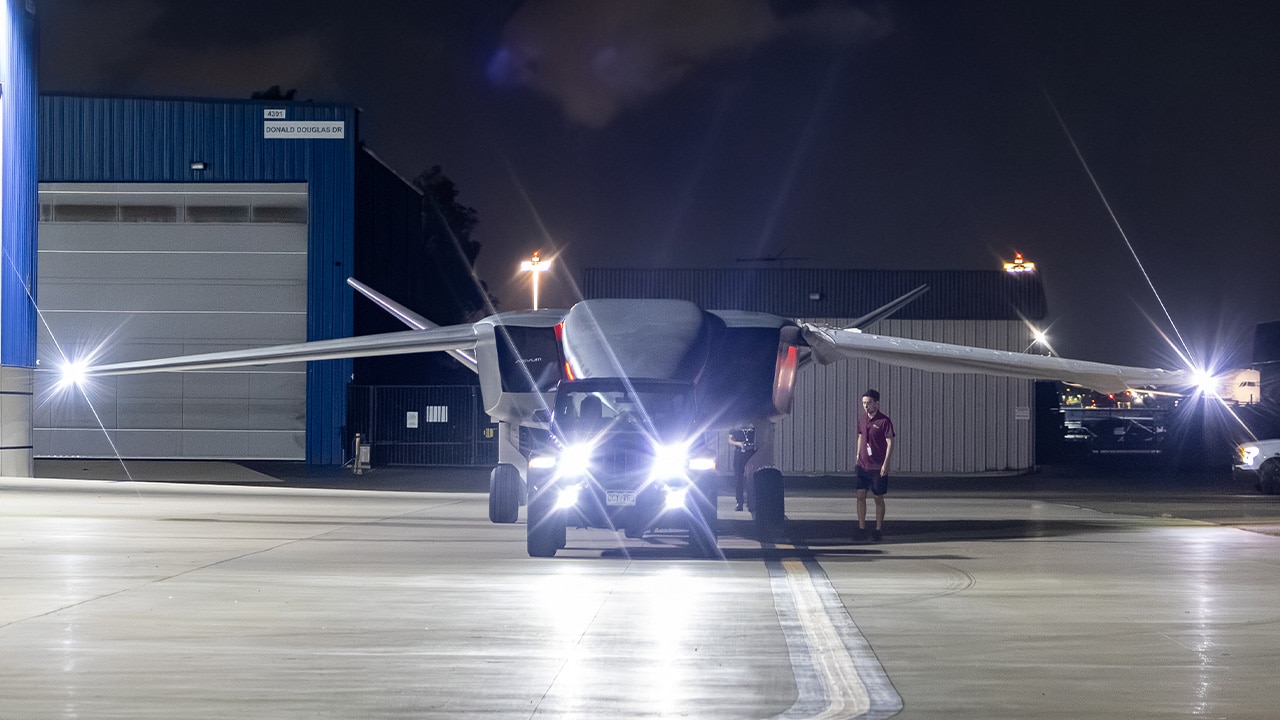
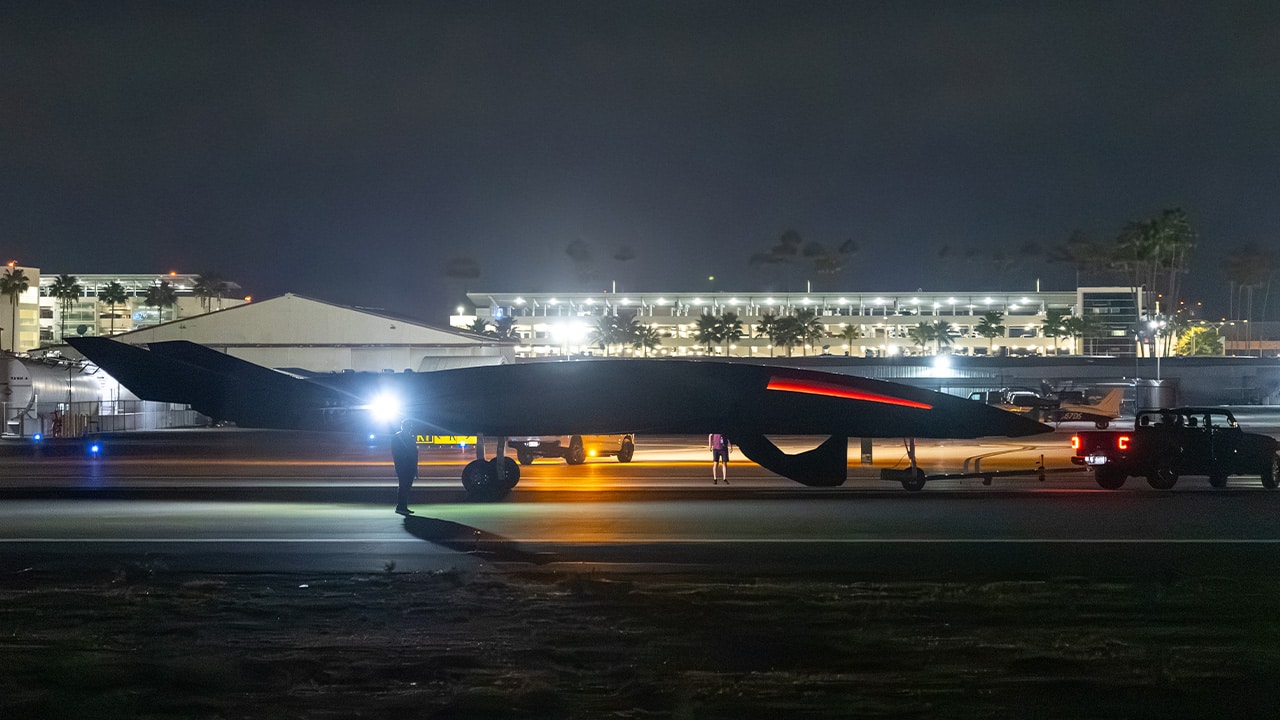
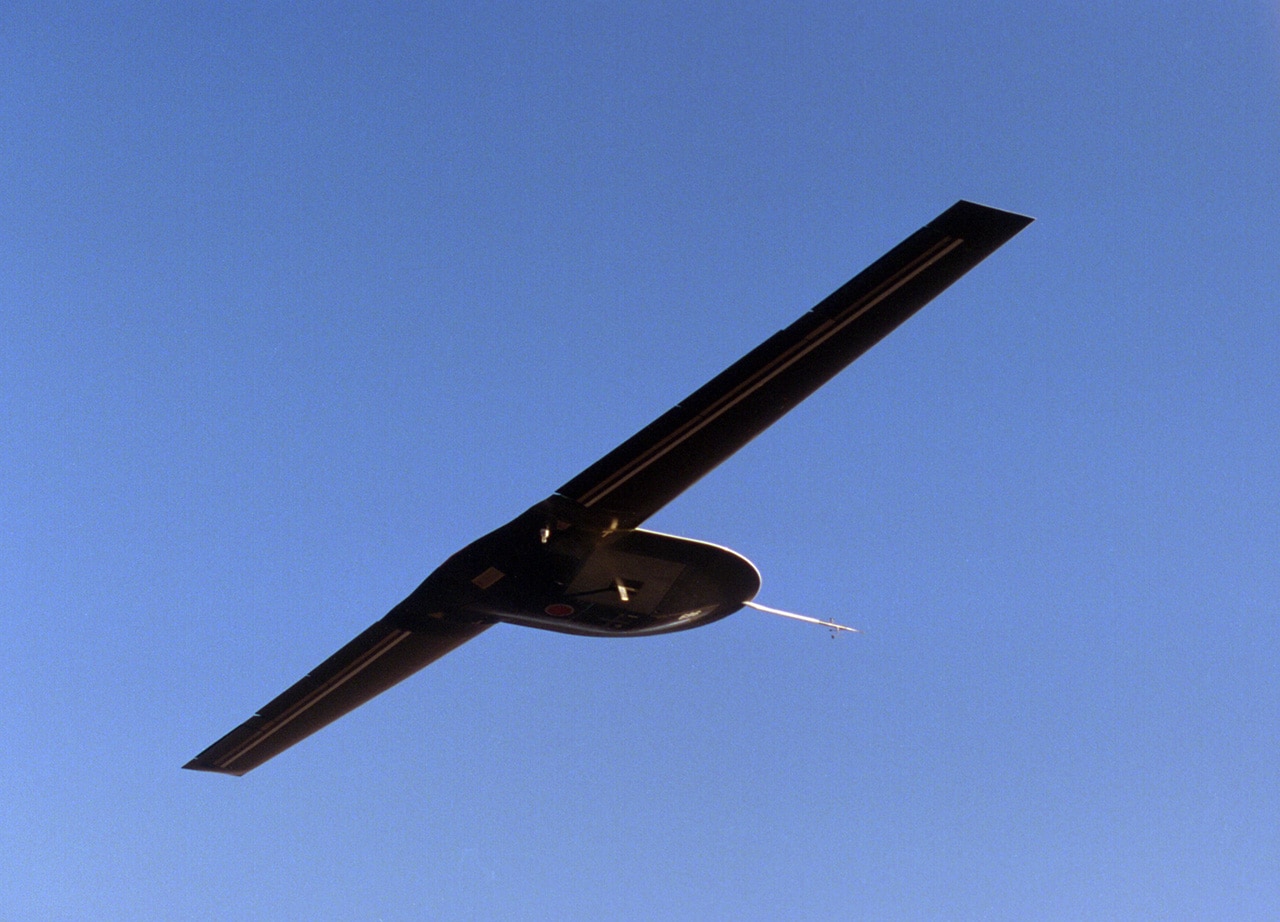
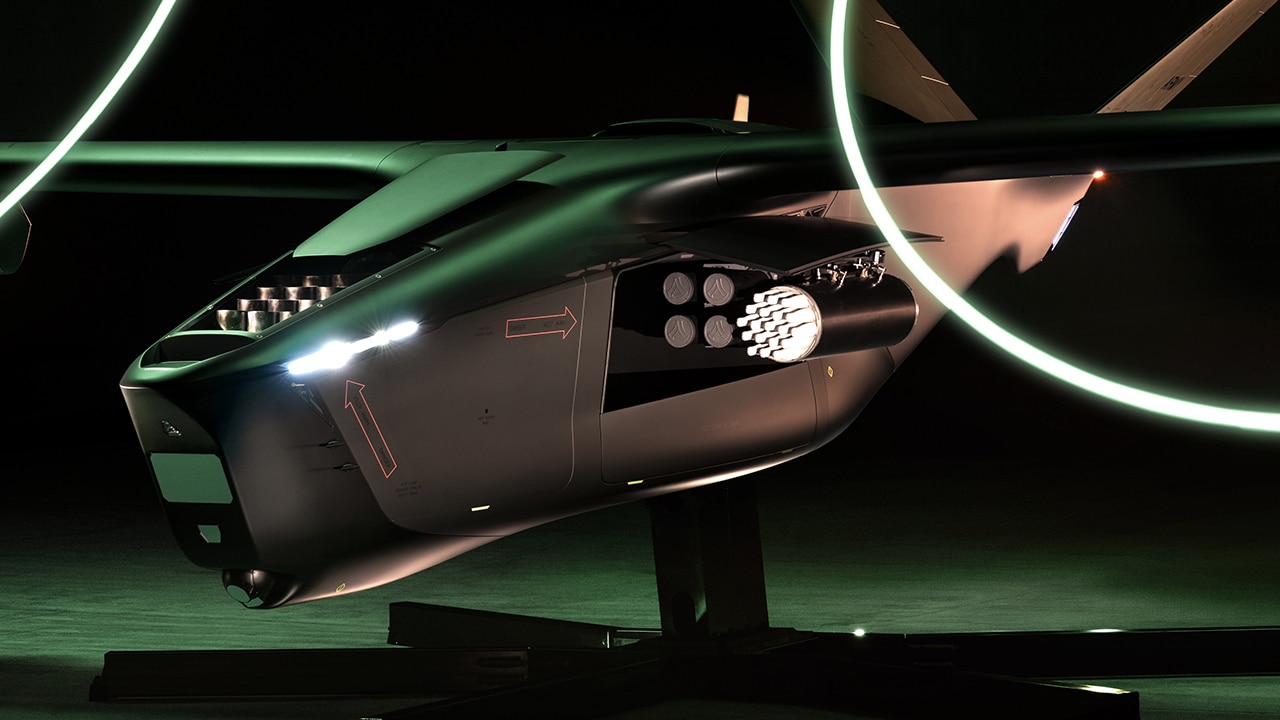
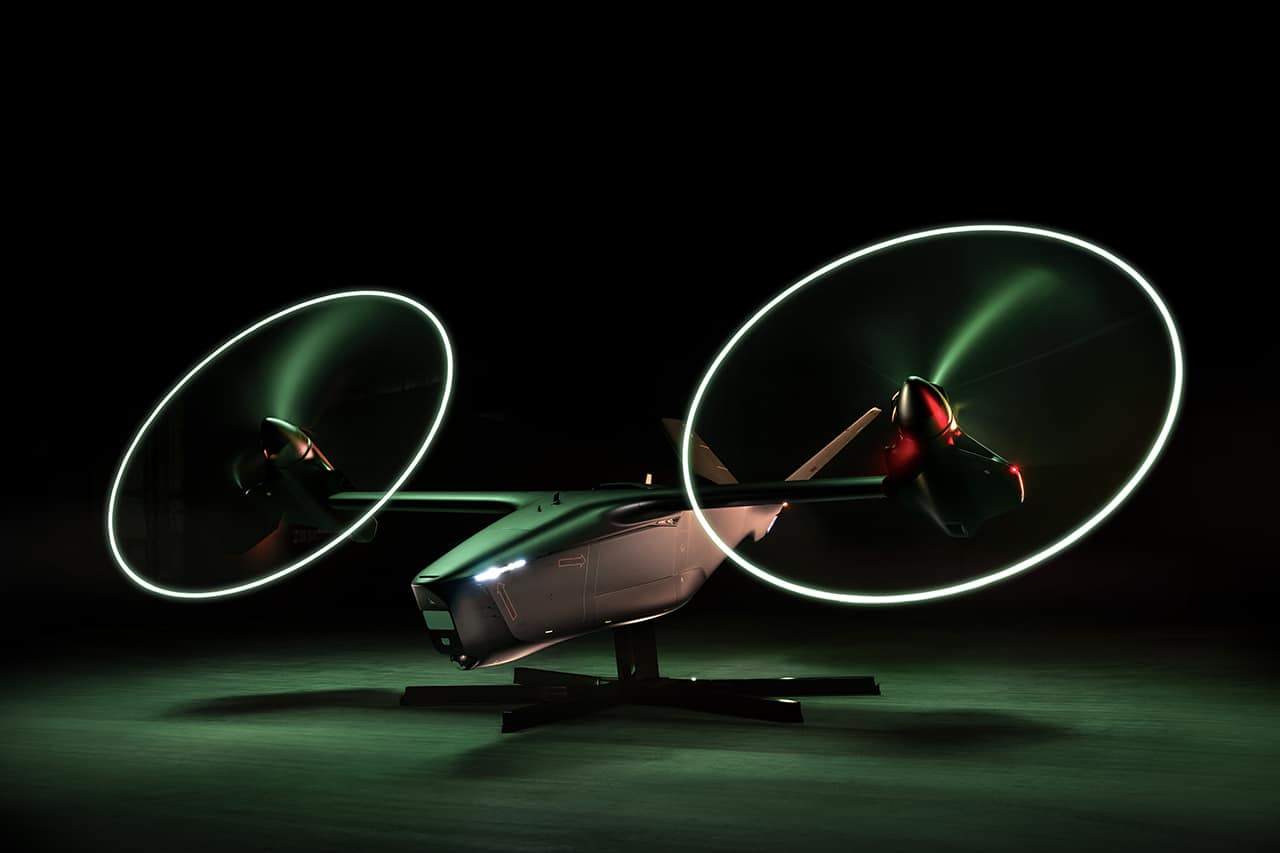
After years of little activity, the Ravn X rolled out of a hangar at Long Beach Airport for its very first autonomous taxi tests and caught the attention of local enthusiasts. Designed to launch small payloads into space, its planned first mission in 2021 has still yet to take place.
At eighty feet long and with a wingspan of sixty feet, the Ravn X is a huge autonomous aircraft said to pack two afterburning turbofan engines that allow high subsonic flight up to an altitude of 60,000 feet.
Head on with the Ravn X, showing its impressive size. | Source: Matthew Dawson
At maximum velocity, the Ravn X is designed to release the rocket-powered second stage which then takes over boosting the 100 kilogram payload into orbit. This fills a niche in providing a responsive launch capability that can be readied at much shorter notice compared to traditional launch vehicles like the Falcon 9 or Vulcan Centaur.
Aevum distinguishes Ravn X from air launch methods (such as Northrop Grumman’s Pegasus or Virgin Orbit’s LauncherOne) as the vehicle is not dropping the rocket but rather accelerating it up through the atmosphere. pic.twitter.com/mVIT8pzmQi
The U.S. Air Force contracted Aevum in 2019 to provide the launch system for the ASLON-45 mission, featuring a number of cubesats. To this date, the Ravn X has still not flown and as time went on it became questionable whether any development was proceeding on the aircraft.
However quiet the company was about its operations, we can now see that work did continue, and the Ravn X has finally completed its first taxi tests.
It is not immediately apparent whether this airframe – also marked and registered as N567RX – is the same as the one shown off by Aevum in 2020, which we reported on here. It may still be a mockup rather than a flight representative airframe, and certainly the landing gear appears to be fixed and for ground use only.
Aevum Ravn X, showing off a distinctive light design. | Source: Matthew Dawson
No official announcement has yet been forthcoming from Aevum – which is headquartered in Long Beach – or any other stakeholder as to why the Ravn X made such a sudden appearance after years in the dark.
If The Aviationist learns any more about this story, we will be sure to update you.
Many thanks to Long Beach local Matthew Dawson for sending us his images of the Ravn X’s roll out. You can find him on Instagram here.
From Sep. 1, the Royal Air Force’s headquarters is now to be known as Air & Space Command, reflecting the still increasing importance of the space domain to national security and the RAF’s role beyond Earth’s atmosphere.
Formed in 2007 following the merger of Strike Command and Personnel & Training Command, Air Command has served as the office of the Chief of the Air Staff (the professional head of the Royal Air Force) and the effective headquarters for the whole organisation. Strike Command was itself an amalgamation of Fighter Command and Bomber Command, while Personnel & Training Command was the successor to Support Command.
This may have passed unnoticed by many, but it’s a big deal in the reorganisation of UK Defence. Air Command has been re-designated to Air & Space Command. Per Ardua ad Astra https://t.co/Nx8KqNq4xT
While the RAF has long held responsibility over the space domain, managing the ballistic missile early warning facility at RAF Fylingdales since the early 1960s, and overseeing the UK’s SKYNET communications satellite network since 1969, the integration of space-based capabilities at every level of military operations – down to the individual soldier on the battlefield – as well as to daily civilian life has made its security a key priority.
‘Major Tedman of UK Space Command has described satellite jamming as a weekly occurrence. ‘
You’re daily reminder that we’re in a Cold War and woefully underprepared. https://t.co/SWQSsYOxZ2
— Martin Prince-Parrott RIBA FRSA (@MPrinParr) July 7, 2026
Chief of the Air Staff Sir Harv Smyth noted: “Space is essential to defence, security, prosperity, and our modern way of life. But it is also a domain of growing strategic competition. It has fast become an operational domain in its own right, and is vital to our ambition to develop and mature the integrated force. The RAF’s core mission of gaining and maintaining control of the air is fundamentally dependant on our freedom of action in and through the space domain.”
“It is now more important than ever for space power to be planned and delivered through the highest levels of military leadership, like all other domains. Our new HQ Air & Space Command will lead the delivery of space power with the same dedication that it leads for the air domain,” he added.
Smyth, himself, was previously the first person to hold the role of Director Space UK, and then moved to the role of Deputy Commander (Operations) in 2022. In 2023, this role was itself named to Air & Space Commander. Smyth continued in this post until 2024, at which point he was promoted to Deputy Chief of the Defence Staff (Military Strategy and Operations), and then to his current role as Chief of the Air Staff.
UK Space Command (UKSC), which was formed under the Air Command structure in 2021, will continue to operate under the new Air & Space Command umbrella.
This may have passed unnoticed by many, but it’s a big deal in the reorganisation of UK Defence. Air Command has been re-designated to Air & Space Command. Per Ardua ad Astra https://t.co/Nx8KqNq4xT
Though led by the RAF, UKSC incorporates personnel from the Royal Navy, British Army, and Civil Service. It maintains the 1 Space Operations Squadron at the National Space Operations Centre, RAF High Wycombe, and 2 Space Warning Squadron is tasked with operating RAF Fylingdales. UKSC personnel are also deployed in small numbers worldwide to support the UK’s overseas bases and deployments.
In the latest 60 Second update from across the RAF, UK Space Command are deployed on @HMSPWLS, while working with the Australian Defence Space Command and we welcome the new Chief of the Air Staff, Air Chief Marshal Harv Smyth. pic.twitter.com/PIIdOGKToe
Dating from the formation of the Royal Flying Corps in 1912, the Royal Air Force’s famous motto will continue to ring strong through the service, perhaps with a renewed sense of meaning. Per ardua ad astra – through adversity to the stars.
Now back on its own wheels ready for the next phase of restoration, the Bristol Type 170 Freighter, built in Britain but now the only surviving example in the whole of Europe, is due to eventually take pride of place in Aerospace Bristol’s new outdoor exhibit area.
Aerospace Bristol, a rapidly growing aviation museum founded in 2017 on the site of Bristol Filton Airport, is most well known for being the home of G-BOAF, the last Concorde built and the last to ever fly, but has taken on diverse range of aircraft as part of its ambition to showcase British aviation history.
The Bristol Freighter, developed by the legendary manufacturer that was proudly headquartered at Filton, taking its name from the nearby city, was one of the largest and last projects delivered by the firm before its amalgamation into the British Aircraft Corporation (BAC) conglomerate in 1960. The prototype Freighter first flew in December 1945, and the last ever flight by a Freighter took place in Canada in 2004.
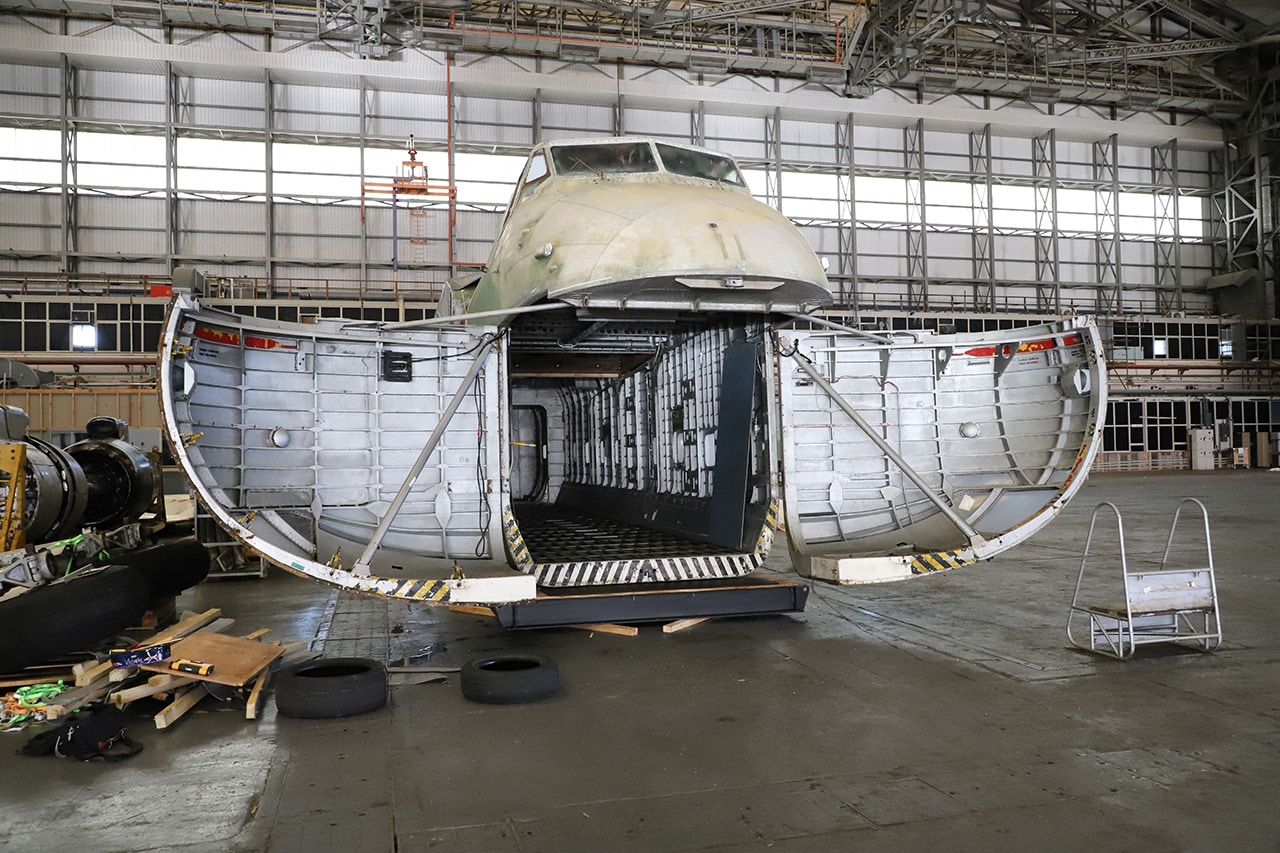
With the cockpit mounted high, a nose cargo door allowed excellent access for loading and unloading freight, and the Type 170 became particularly well known as a vehicle transporter. Over 200 of these aircraft were built, but fewer than ten percent of these survive, and Aerospace Bristol’s example became the only survivor in Europe after its delivery from New Zealand in 2018.
Historic image of a Type 170 Freighter in use as a car transporter. | Source: Aerospace Bristol
“Seeing our Freighter standing tall is a truly special moment for everyone who has contributed to this project. It is a testament to the skill, dedication and sheer number of hours of work that our team has put into bringing this beautiful aircraft back to life,” said Sally Cordwell, CEO of Aerospace Bristol.
“The Freighter has already come along extraordinarily since returning to Bristol in 2018, having only left its conservation hangar last month. There’s more to do, but seeing this project becoming a display that truly allows visitors to experience a remarkable piece of Bristol’s aviation heritage up close is incredibly rewarding for us.”
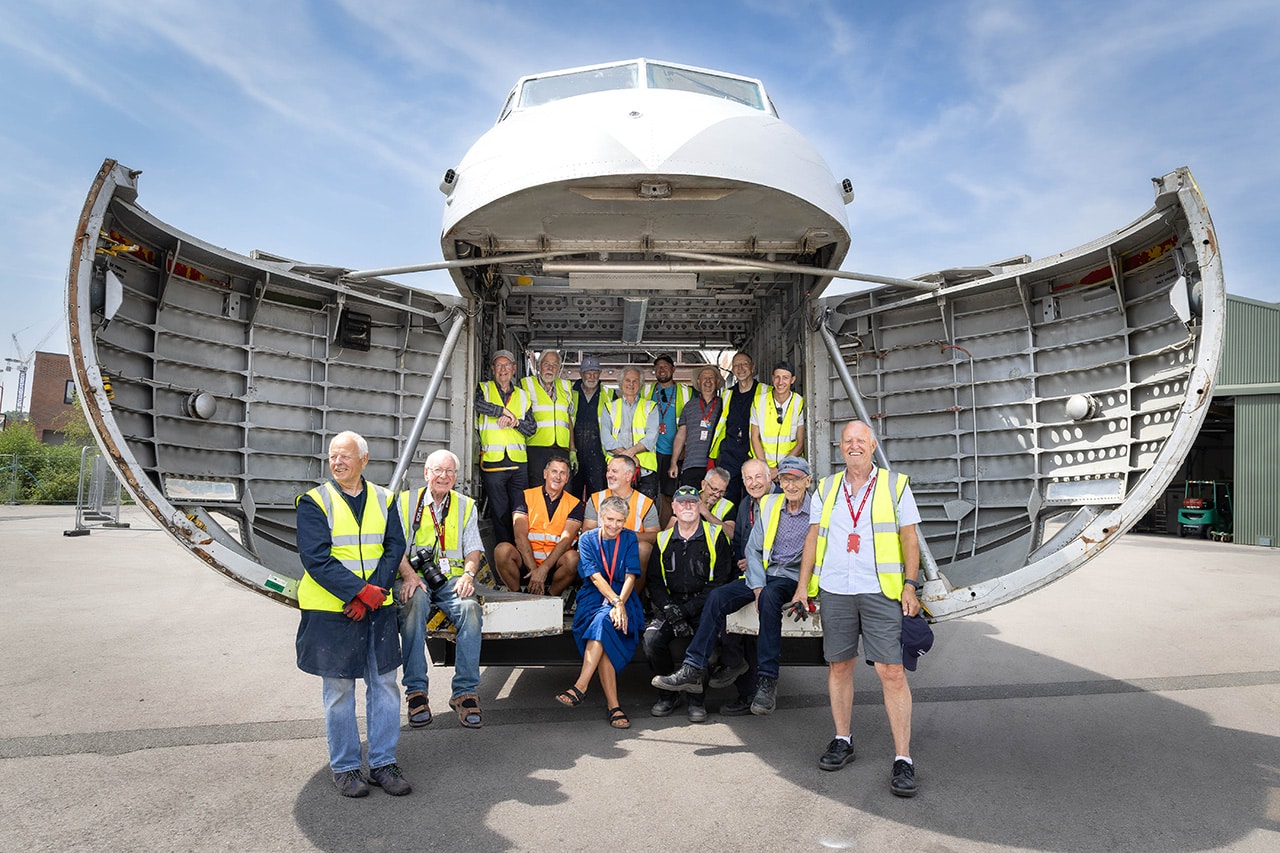
Aerospace Bristol CEO and volunteers with their Type 170 Freighter. | Source: First Avenue Photography/Aerospace Bristol
NZ5911 was built at Filton in 1953 for the Royal New Zealand Air Force, remaining in service until 1977 and even flying missions during the Vietnam War. Sold to the civilian market, the aircraft saw little further use and was grounded from 1978 and stored externally for decades before its acquisition by the museum.
The full restoration now being planned for the coming years aims to see the Freighter restored to a complete, static display standard. Up to 50 specialist volunteers, former aerospace engineers and ex-Bristol Aeroplane Company employees – including a 90 year old former apprentice – will spend an expected total of 10,000 hours preserving the airframe to be seen for generations to come.
The Freighter inside the conservation hangar prior to being raised onto its landing gear once again. | Source: Aerospace Bristol
When fully reassembled, the Bristol Freighter will have a wingspan of 108 feet (32.9 metres). The wings are currently stored separate from the aircraft, and are undergoing their own restoration process.
The undertaking is the largest restoration ever attempted by Aerospace Bristol, and one which – unusually – will be completed largely in public view, allowing museum visitors over the years to watch and see progress being made in real time.
Post-War Bristol
Bristol’s post-war aircraft designs – like the Type 170 Freighter, and its Wayfarer passenger variant – are often overlooked by history despite making a strong mark in the aviation world in their day. The Freighter alone saw civilian service in no fewer than 22 countries across 6 continents. The type additionally flew with the military or state aviation operators of 8 countries.
Bristol’s Superfreighter, a stretched variant, upped the load capacity and was specialised in the ‘air ferry’ role transporting cars and their passengers to holiday destinations.
After the freighter came the Britannia, an early turboprop airliner which struggled to compete against emerging jet airliners but managed to reach 85 production airframes. Britannias served with British Overseas Airways Corporation (BOAC), Cubana, and Monarch Airlines. Notably, in service with Israeli flag carrier El Al, a Britannia was used to secretly extradite Adolf Eichmann to stand trial in Jerusalem for his role in perpetrating the Holocaust.
A former Royal Air Force Bristol Britannia on display outside Royal Air Force Museum Midlands (Cosford). | Source: Kai Greet
The crowning achievement in Bristol’s lineup was hoped to be the Brabazon, a mammoth piston airliner developed in the mid to late 1940s for transatlantic service. Unfortunately for Bristol, technology caught up with the Brabazon before it could ever enter service, and no customers placed an order for the expensive, luxurious behemoth. The only example ever built was reduced to scrap just years after completion.
#OnThisDay 1950: Newsreel showed footage of a behemoth of the skies, the Bristol Brabazon, as it touched down in London for the first time. pic.twitter.com/nktcVP2ciQ
The last aircraft to bear the Bristol name, developed just as the firm was absorbed by BAC, was also one of its most distinctive. Some have labelled the Bristol Type 188 as Britain’s answer to the Lockheed SR-71, despite being built for a very different purpose. Aesthetically, though, it is sort of easy to see why, though as a purely experimental aircraft the Type 188 eschewed the signature matte black Blackbird look in favor of bare stainless steel. It also fell short in terms of speed, reaching a maximum of ‘just’ Mach 1.88 at a fairly average altitude of 36,000 feet.
The Bristol Type 188 was the world’s first stainless steel supersonic aircraft. Two were built for experimental research. In April 1966 both 188 fuselages were sent to the Proof & Experimental Est. at #Shoebury Garrison for target practice. XF926 was later scrapped at #Foulness. pic.twitter.com/3kzU3YKyW6
— Southend & South Essex History (@HistorySouthend) December 17, 2021
Nonetheless, the Type 188 served its purpose in experimenting with different aircraft design techniques, manufacturing practices, and materials, informing the development of Concorde as well as the TSR-2 strike aircraft.
Aerospace Bristol proudly displays a variety of Bristol’s aircraft types alongside its centrepiece Concorde, as well as a few examples of aircraft developed by its successor firms, including a Sea Harrier and a BAe 146 airliner.
In a response to an MP’s written question, Defence minister Luke Pollard said that the RAF’s existing aerial refueling force will be complemented by the development of a boom refueling capability.
The news comes following our previous article, which reported on rumors from anonymous officials that a boom refueling option was being ‘looked at’. Confirmation from Luke Pollard MP, who is Minister of State for Defence Readiness and Industry, suggests that such a move has now been approved at a governmental level.
In response to a question from opposition MP Ben Obese-Jecty, the Minister said: “The Royal Air Force currently operates a probe and drogue air-to-air refuelling system and will complement this with the development of a boom system. This will ensure we have a sovereign air-to-air refuelling capability for the future Royal Air Force fleet that enhances interoperability with NATO Allies and partners.”
For the first time we have a Minister confirming the Boom is coming to Royal Air Force tankers, although the when and the how currently remain very much up in the air.
Still significant to have it through government voices and not just through the RAF itself. pic.twitter.com/esRN7NVoPy
While a boom refueling system, like the type operated by the U.S. Air Force and many NATO forces, has been frequently put forward as a matter of urgency for the Royal Air Force due to the service’s operation of boom-refueled aircraft like the P-8 Poseidon MRA1, RC-135 Rivet Joint, and C-17A Globemaster III, as well as future operation of the F-35A Lightning II and E-7A Wedgetail MRA1, the change in policy is likely motivated by another factor.
A French air force A330 MRTT refueled and RC-135 aircraft over France for the first time, demonstrating a significant step in allied air-force integration.
It is interesting to note that the Royal Air Force is not able to refuel its own RC-135W Rivet Joint aircraft, as it… pic.twitter.com/YK2tR4zbme
The design of the resulting sixth generation fighter from the Global Combat Air Programme, or GCAP, is known feature a receptacle for boom refueling. While a retractable probe might be able to be fitted to the aircraft, there is suspicion that with the exceptional size of the fighter this lower capacity refueling system might not be able to deliver an adequate flow of fuel for timely refueling.
Other operators of the A330 MRTT, known as Voyager in RAF service, have fitted their aircraft with a flying boom system, but the RAF relies solely on hose and drogue units. As written in our previous article:
Although the A330 MRTT is used across the world with a flying boom system, the RAF’s examples, known as Voyagers – owned by the AirTanker consortium and leased to the RAF through a private finance initiative (PFI) – are fitted for hose and drogue refueling operations only. Voyager KC2 aircraft are configured with two wing-mounted Cobham 905E hose and drogue units while Voyager KC3 aircraft additionally feature a Cobham 805E Fuselage Refueling Unit (FRU) in the rear fuselage with the option for a higher fuel transfer rate for larger aircraft like the Airbus A400M.
It is unknown at this stage whether a boom refueling capability is planned to be considered as an upgrade for the RAF’s existing Voyagers or whether new aircraft – potentially from Airbus’ upgraded MRTT+ line – are being proposed. These details may yet to be decided within the MoD. The current fleet is technically owned by AirTanker and provided to the RAF under a private finance initiative (PFI) which is due to expire in 2035. After this date, the aircraft are apparently due to fall under RAF ownership, though they will also be older than almost all other MRTTs in operation worldwide.
Notably, though the RAF’s examples are not currently configured for this, the A330 MRTT is also exclusively able to be refueled by the flying boom system, so adoption of the boom could allow a return to tanker-to-tanker refueling in the RAF. Such a capability was lost with the retirement of the VC10 and TriStar, which were both adapted with refueling probes.
Explosive-laden drones, including one which hit, but failed to detonate, a Ukrainian Antonov transport aircraft at Leipzig Airport in early August have been publicly identified by German officials as part of a Russian hybrid warfare campaign.
Germany’s Foreign and Interior Ministers spoke publicly in Berlin on Sep. 1, 2026, to publicly announce new measures the German government will take against Russia in light of “police investigations” and “intelligence findings” which conclude that a “low-level” Russian agent was behind the drone incidents at Leipzig in August.
Security services were first alerted to a potential threat when a quadcopter drone was discovered on the airport tarmac next to a parked Antonov An-124 belonging to the Ukrainian state-owned Antonov Airlines. 800 grams of explosives were attached to the drone, which CCTV footage showed impacting the wing of the aircraft before falling to the ground without detonating.
Antonov’s aircraft have used Leipzig Airport in central eastern Germany as a hub for many years, though it has become the airline’s primary base of operations since Russia’s full scale invasion of Ukraine in 2022. Its fleet of An-124 transports, the heaviest active transport aircraft type in the world, are used extensively to support and supply Ukraine’s defensive efforts. The airport, then, would be a lucrative target for any Russian or Russia-aligned actors.
Germany’s response underlines the importance of close coordination among Allies. #NATO stands united in protecting our countries and deterring threats across the Alliance. Support for #Ukraine and strengthened defence capabilities remain essential to our collective security. 2/2
After the An-124 incident, following the airport’s closure for security reasons, a Boeing 757-200 freighter operated by European Air Transport for carrier DHL struck an object while aborting its landing. Minor damage was identified on the nose of the aircraft after it landed at another airport. It is believed this object was another drone, potentially operating alongside the one that was apparently intended to strike and damage the An-124.
U.S. intelligence has reportedly linked the explosive-laden drone discovered at Germany’s Leipzig/Halle Airport this week to the Russian government, according to The Wall Street Journal.
The drone was discovered Tuesday night inside a secure area of the airport, just meters from… pic.twitter.com/4w5KulzYMm
A third drone was discovered later in the month in a field near to the airport.
Johann Wadephul, the German Foreign Minister, told reporters: “With the attempted attack in Leipzig, the Russian leadership has, in fact, deliberately chosen to further and significantly damage our already severely strained bilateral relationship.”
Interior Minister Alexander Dobrindt said: “Taken together, police investigations, patterns of the offences and intelligence findings establish Russian responsibility for the attempted attack at Leipzig Airport.”
German Interior Minister Dobrindt: “Ladies and gentlemen, we are not at war. But we are the target of hybrid warfare every day.” https://t.co/Rxe8ZPL7zT
In response, Wadephul said that Russia’s consulate-general in Bonn would be closed down from Sep. 18. A Russian state-owned cultural hub in Berlin, Russia House, would also be shuttered. Russia’s ambassador was also summoned by the German government, likely to be delivered an official message and protest to be conveyed to Moscow.
Moscow maintains its innocence in the affairs, with its Berlin embassy saying the accusations are “unsubstantiated, absurd and contrary to common sense”.
Germany’s stance has drawn support from its NATO and EU allies. Mark Rutte, General Secretary of NATO, wrote on social media: “The evidence is clear. And I welcome the measures announced by Germany in response. NATO will continue to strengthen our ability to deter and defend all Allies against any threat – including malign actions like those seen in Leipzig and elsewhere across the Alliance.”
I just spoke with @Bundeskanzler Friedrich Merz. NATO stands in full solidarity with Germany after the Russian hybrid attack in Leipzig on 4 August.
The evidence is clear. And I welcome the measures announced by Germany in response. NATO will continue to strengthen our ability…
“Russia’s attempts to intimidate us, to undermine our unity and our willingness to support Ukraine are futile and will fail. Our support to Ukraine is unwavering, as is our ironclad commitment to NATO’s collective defence,” he added.
UK Prime Minister Andy Burnham, who took office in late July and notably chose Ukraine as the first overseas trip of his leadership, said: “The United Kingdom stands in full solidarity with Germany following Russia’s egregious and reckless attack in Leipzig. Russian attempts to undermine our united resolve and our willingness to support Ukraine are futile and doomed to fail.As I made clear in Kyiv last week, our commitment to supporting Ukraine from Russia’s illegal invasion is ironclad.”
“The strong measures taken by the German government show action against any attack of this nature will be met with a clear response. We will not waver in our resolve to deter attacks on our freedom and security.”
L’Allemagne a établi la responsabilité de la Russie dans les graves incidents survenus à Leipzig début août.
Ces attaques hybrides se multiplient en Europe. Elles ne peuvent rester sans réponse.
La France est pleinement solidaire de l’Allemagne et soutient l’adoption de…
French President Emmanuel Macron wrote: “These hybrid attacks are multiplying in Europe. They cannot go unanswered. France is fully in solidarity with Germany and supports the adoption of new European sanctions against Russia. In the face of this escalation, we must be united, determined, and strengthen our support for Ukraine. France will continue to play its full part.”
No official comment has, at the time of writing, been noted from U.S. President Donald Trump or from the wider U.S. Government.
A new budget document released by the Japanese Ministry of Defense includes a reference to the ASM-3 as both an anti-ship and an anti-air missile, hinting at an additional role for the newly developed supersonic munition.
The ASM-3 is Japan’s latest indigenous anti-ship missile, designed to replace the ASM-1 and ASM-2 missiles carried most notably by the Mitsubishi F-2. Development took place during the 2010s, culminating in flight testing in 2017. At this stage, further testing was postponed in order to allow for an upgrade (ASM-3A) to increase the missile’s range to the 400 kilometre mark. ASM-3A officially began to be fielded in 2025, while a further upgrade pushing the range out to 600 kilometres is in development as the ASM-3 Kai (coming from 改, meaning ‘modified’ or ‘revised’).
An air to air variant has not previously been discussed before the release of this document, though it can be assumed to have now been on the cards for some time. Presumably, this missile would fulfil the long-range air to air missile role for the Japan Air Self-Defense Force (JASDF).
Japan, at present, employs the AIM-120 AMRAAM and the home-grown AAM-4 as beyond visual range air to air munitions, but even the latest AMRAAM developments fail to break past the 200 kilometre mark that could be achieved by even the original ASM-3 design.
This development would echo the rapid push towards longer range air to air missile seen across the Pacific in the United States, where the AIM-174B has been created from the ship-launched SM-6 (which has a range in excess of 370 kilometres) while the AIM-260 Joint Advanced Tactical Missile (JATM) and the newly revealed AIM-424 Malice wait in the wings.
An AIM-424 Long Range Air-to-Air Missile (LRAAM) is mounted in the internal weapons bay of an F-35C with an AIM-120 Advanced Medium Range Air-to-Air Missile (AMRAAM) mounted on the weapon bay door. (via Dvids) pic.twitter.com/xJLA4IN5Bc
These missiles are expected to have the biggest impact in the Pacific theatre, countering China’s growing arsenal of long range air to air weapons.
As noted in our article on the AIM-424:
Although the capabilities of the large missiles aren’t clear when it comes to engaging hostile fighters over long distances, they will certainly be effective in targeting high-value targets including the likes of AEW&C (Airborne Early Warning and Control), EW (Electronic Warfare), and ISR (Intelligence, Surveillance, and Reconnaissance) aircraft in the early phases of a potential conflict.
The ASM-3’s guidance module already features an Active Electronically Scanned Array (AESA) radar derived from the one used in the AAM-4B, so it is possible very little to no modification might be necessary to use the missile for airborne targets. However, it is likely that any missiles designated for anti-aircraft use would be fielded with an alternative warhead to the armor piercing tandem charge, perhaps instead incorporating a proximity-detonated fragmentation round which would allow the weapon to be effective even without directly hitting an aircraft.
Meteor
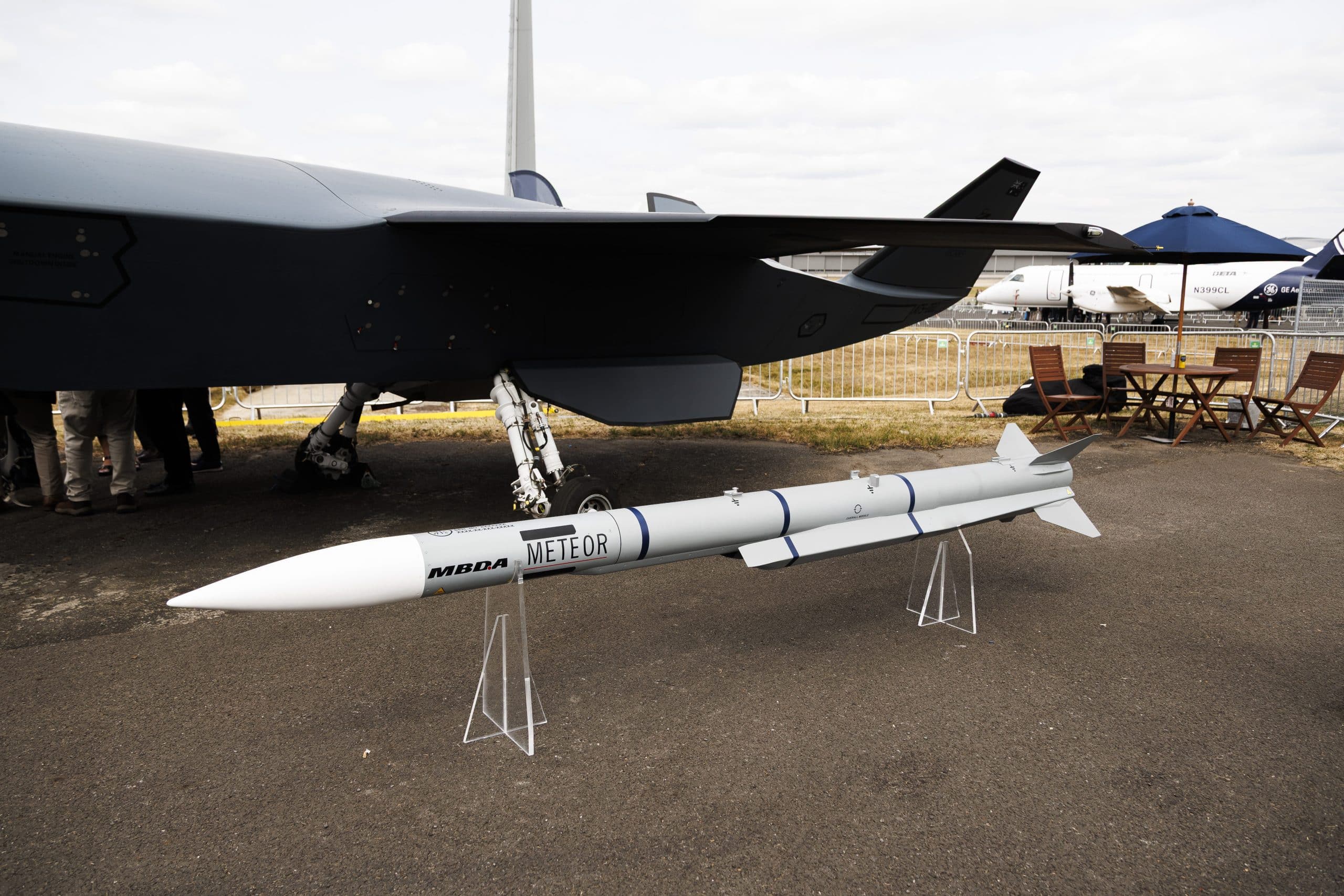
Integrating the AAM-4B’s AESA radar onto the European MBDA Meteor was previously investigated by a joint UK-Japan program known as Joint New Air to Air Missile (JNAAM). Work on this soon went quiet, and it is unclear how far down the road the project got or whether it is still possibly held on the back burner.
Like the ASM-3, Meteor attains its extended range by using a highly efficient ramjet engine. Meteor’s current (publicly known) upper limit for range is around 200 kilometres, and a previously planned mid-life upgrade for the missile has been scrapped in favor of newer designs. If an AESA equipped Meteor did ever come to fruition, which seems increasingly unlikely as time marches on, it would more likely take the place of Japan’s AIM-120s rather than this new ASM-3 based design.
AARGM-ER
The Japanese budget documents also refer to the U.S.-made AGM-88 AARGM-ER (Advanced Antiradiation Guided Missile – Extended Range), the first time a possible procurement of this weapon has been disclosed for Japan.
Japan does not currently field a dedicated suppression of enemy air defences (SEAD) missile, so the introduction of AARGM-ER would also be an introduction of an entirely new category of weapon for the JASDF. Crucially, unlike earlier variants of the AGM-88, the AARGM-ER can be carried in the internal weapon bays of Japan’s fleet of F-35A Lightning IIs.
Except for F35B users, the rest of the #F35 community would have access to the AARGM-ER, and the USAF’s Stand In Attack Weapon. Initially, #SiAW will operationalize a modified #AARGMER on F-35A but may eventually produce a significantly different, or a completely new weapon. https://t.co/l04wVzeoZmpic.twitter.com/rGCQPSiLK4
— Air-Power | NatSec Ledger (@NatSecLedger) July 2, 2023
There is also the theoretical possibility that it would, in the future, be able to be integrated in the sixth generation fighter that is due to sprout from the Global Combat Air Programme (GCAP) joint venture with the UK and Italy.
As with the ASM-3 air to air variant, we await further comment and additional detail on this.
Many thanks to our friend Ryan Chan (@ryankakiuchan) for pointing us towards this story and many others. You can find his work on X/Twitter here.
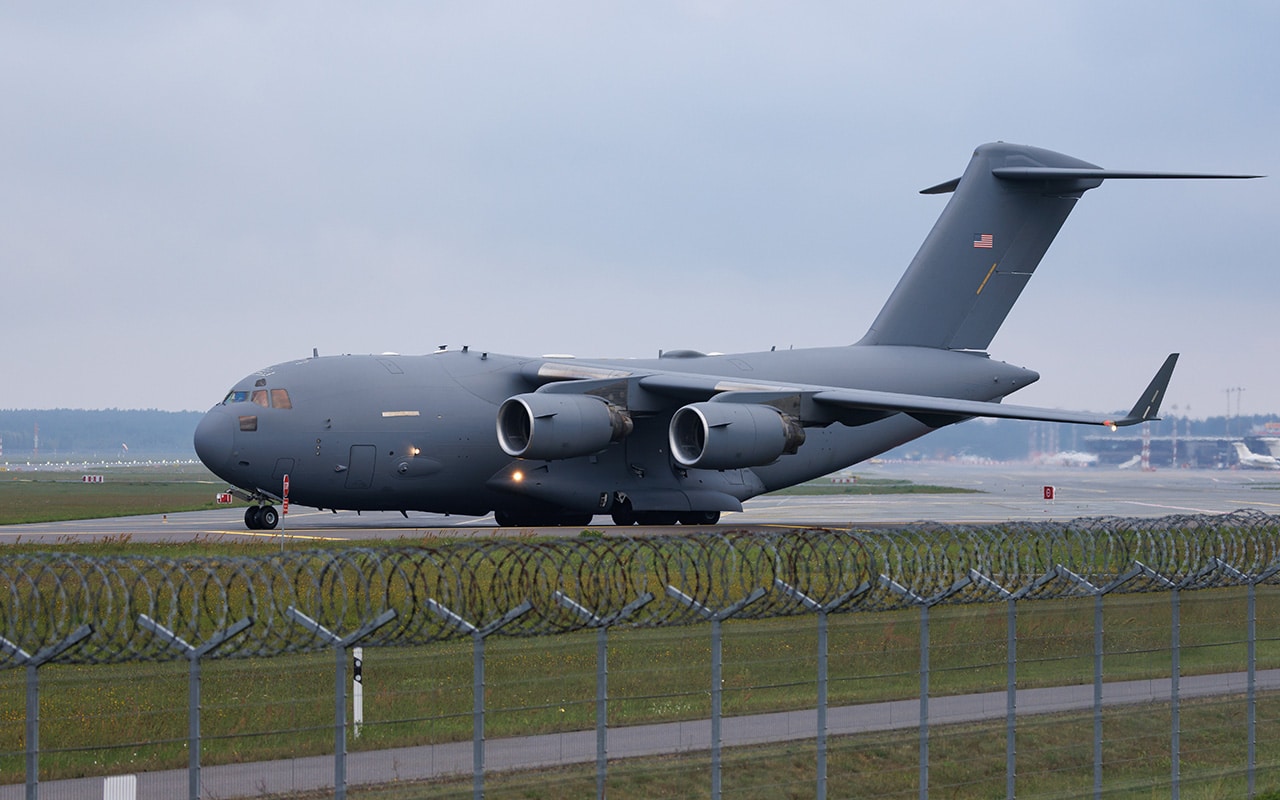
A U.S. Air Force C-17 was noted making an unusual journey into Russian airspace on Aug. 25, 2026 shortly before U.S. media outlets broke the story that CIA Director John Ratcliffe was in Moscow for undisclosed talks.
The C-17 Globemaster III, flying under Air Mobility Command (AMC) callsign REACH 4555 (four digit callsigns have been noted regularly for ‘high priority’ C-17 taskings), took off from Riga International Airport on the morning of Aug. 25 after arriving from Andrews Air Force Base. 07-7181, the airframe in question, is one of a significant number of AMC aircraft almost completely devoid of identifying markings, sporting only a U.S. flag and a low-visibility U.S. Air Force roundel.
In a rare move, the C-17 flew east across the Russian border and to Vnukovo International Airport, Moscow. Hours after this was first reported, U.S. media outlets reported on a surprise trip by John Ratcliffe, Director of the Central Intelligence Agency, to Moscow for high level talks – his first known visit to Russia. Neither the U.S. nor Russia have officially acknowledged the visit.
WSJ: CIA Director Ratcliffe arrived in Moscow after the US gathered intelligence indicating mobilization preparations and plans to test NATO's resolve.
Former Deputy Director of US National Intelligence Beth Sanner told the publication that Ratcliffe may have met with Putin to… pic.twitter.com/49R7Ml5TIM
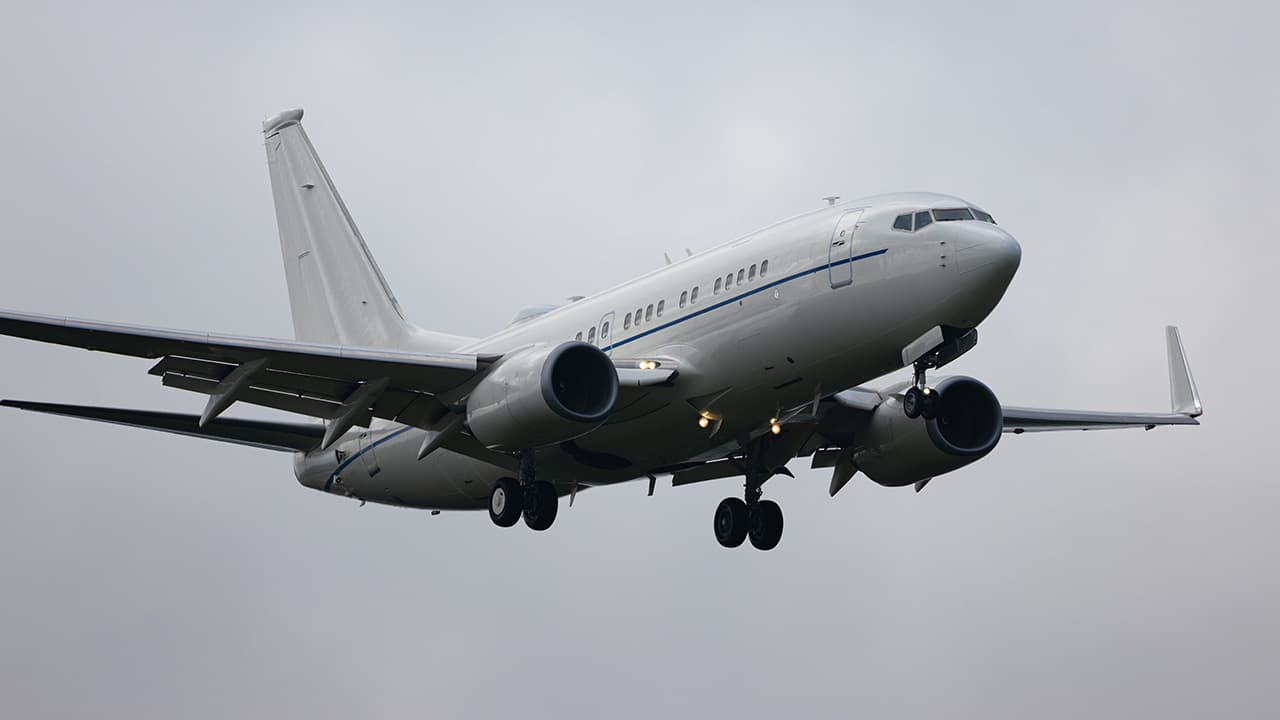
Ratcliffe and his entourage appear to have travelled from Andrews to Riga using a C-40B (a military Boeing 737-700 BBJ) before transferring over to the C-17.
U.S. Air Force C-40B landing in Riga. | Source: Gustavs Gailitis
The C-17 would have likely still needed to travel via Andrews to collect a Roll-On Conference Capsules (ROCC), which provides a more comfortable travel option for VIPs compared to the very rudimentary seating options usually offered in an airlifter’s cargo hold.
Russian media report that a motorcade with American diplomatic license plates was spotted on the streets of Moscow following reports that a U.S. Air Force Boeing C-17 Globemaster III had landed at Vnukovo Airport. https://t.co/EiKsKdnu6tpic.twitter.com/Hzrppj9fFy
The ROCC, certified as a Sensitive Compartmented Information Facility (SCIF), features a conference room, living quarters, toilet facilities, and an array of secure communication options. These containerized units replaced the famous ‘Silver Bullet’ trailers which – unlike the ROCC – could not be occupied during takeoff or landing, nor during air to air refueling or moderate turbulence.
C-17s (and other airlifters) have routinely been used to accommodate VIP airlift into less secure locations, being much more discreet than a dedicated executive aircraft while also boasting a defensive aids suite (DAS) designed for flying into potential threat zones. This type of mission is what originally spawned the creation of the Silver Bullet system, and why an investment was made into the ROCC.
REACH 4555, almost completely devoid of markings, at Riga International Airport. | Source: Gustavs Gailitis
In theory, an arranged trip into Russian airspace should be considered relatively safe and it is not known exactly why this additional layer of security was considered necessary. Notably, in 2025, a U.S. Air Force C-37B in the highly visible blue and white VIP scheme made a brief trip to Moscow for unknown reasons. The last time a C-17 is recorded to have visited Moscow was, according to Russian media, in 2017.
When the flight was first spotted on flight tracking sites like Flightradar24.com, many initial assumptions were that the C-17 was taking part in a fairly routine support mission for the U.S. Embassy in Moscow. C-17s conduct these missions on a regular basis across the world, often with the callsign REACH 1815, keeping the extensive network of U.S. Embassies and diplomatic offices linked together. It was only after reports of the C-40’s simultaneous presence at Riga did the mission spark additional interest, before the news about Ratcliffe began to hit the headlines.
U.S. diplomatic relations with Russia have soured but not ceased during the latter’s full scale invasion of Ukraine, and official visits to Russia by high level officials were notably resumed under President Trump’s second term after being curtailed by President Biden’s administration. In return, Russian President Vladimir Putin made a short visit to U.S. territory in Alaska last year for a major summit with Trump himself.
Russian aircraft have also ventured regularly to New York, using a complicated route to avoid overflying many European nations, in order to support Russia’s presence at the United Nations.
#RuAF Russian Air Force – Special Flight Detachment
Ilyushin Il-96-300 1x
#157713 RA-96019 – STATE AERO 788
The C-17 departed Moscow after around eight hours, heading back to Riga. The accompanying C-40 then departed Riga bound for Bangor, Maine (fuel efficiency is decreased when flying westbound across the Atlantic).
Many thanks to our friend Gustavs Gailitis for contributing his images for this story!
The U.S. has approved a possible foreign military sale (FMS) of up to 21 UH-60M Black Hawks to Norway plus spares and associated equipment for $2.3 billion.
Just months after Norway reneged on its plan to acquire nine HH-60W Jolly Green II helicopters, which was approved by the U.S. Department of State in 2025, the Scandinavian country is now setting its eyes upon a larger order of the less-specialised but widely popular Lockheed Martin/Sikorsky UH-60M Black Hawk.
Approved for up to 21 UH-60Ms alongside 46 of its General Electric T700-GE-701D powerplants, the proposed deal also includes 25 sets of AN/AAR-57 Common Missile Warning Systems, Common Infrared Countermeasures (CIRCM), and AN/APR-39E(V)2 Radar Warning Receivers.
Proven and pioneering with unparalleled speed, performance and reliability, our Common Infrared Countermeasures (CIRCM) maximizes aircraft survivability and protects warfighters in the most challenging environments.
If the purchase goes through, the Black Hawks are most likely to supplant the Royal Norwegian Air Force’s 18 strong fleet of Bell 412s, which have been in service for over thirty years. These have been undergoing a mid-life upgrade (MLU) program in order to extend their expected service lives.
Norwegian & U.S. special forces from @US_SOCEUR teamed up for joint training in Troms, Norway. Strengthening ties and practicing personnel recovery behind enemy lines. Norwegian Bell 412 helicopters in action. : Nicholas Moyte, U.S. Army. #AdamantSerpent#StrongerTogetherpic.twitter.com/1Y8IH6GcUf
— Norwegian Armed Forces | Forsvaret (@Forsvaret_no) October 5, 2023
Notably, the Black Hawks will share the same basic powerplant as the service’s AW101 Merlins, which are used primarily for search and rescue duties. There will also be a high degree of commonality with the Royal Norwegian Navy’s MH-60R Seahawks.
The long-rumored potential purchase of additional AW101s by Norway in an anti-submarine warfare configuration would also share the T700 powerplant. Although the helicopters are envisioned to be very similar to the Royal Navy’s examples, new AW101 airframes are no longer produced with the Rolls-Royce Turbomeca RTM322s used by UK Merlins.
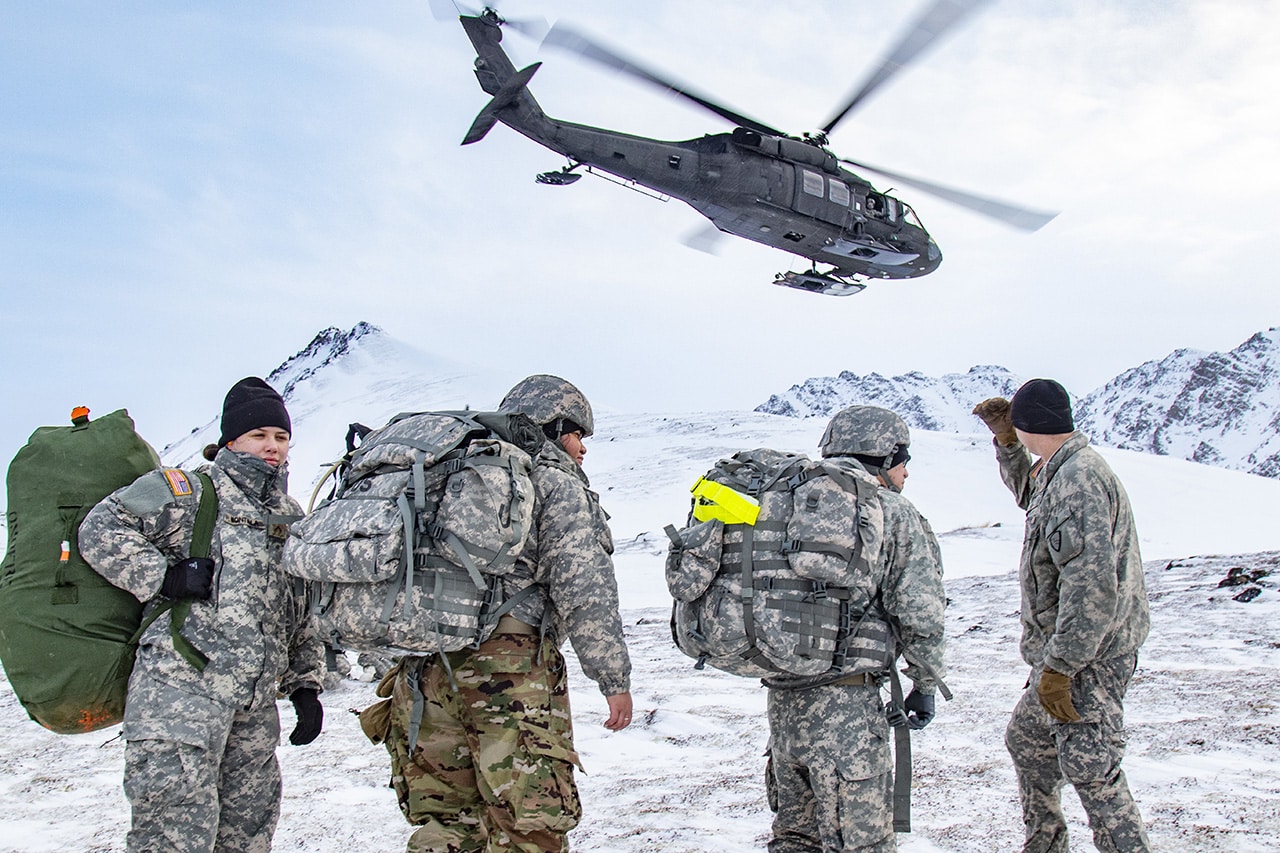
Norway’s cold climate, with significant amounts of territory within the Arctic Circle, means that snow skis for the aircraft’s landing gear are included among the additional specified equipment in the approval. Other equipment includes bambi buckets for aerial firefighting, litters for casualty evacuation, fast rope insertion equipment, external fuel tanks, MX-10D electro-optical/infrared camera turrets, M240H machine guns, and M134 miniguns.
A U.S. Army UH-60 Black Hawk in Alaska fitted with snow skis. | Source: U.S. Army National Guard photo by Spc. Michael Risinger
LINK-16 datalink terminals will be fitted to the aircraft, allowing secure data communications with other Norwegian and allied units. Norway already employs LINK-16 on a range of its equipment, and the nation has participated in testing of new capabilities using the NATO-standard protocol.
The Department of State’s approval notice stated that the sale “will support the foreign policy and national security objectives of the United States by improving the security of a NATO Ally that is a force for political stability and economic progress in Europe.”
“The proposed sale will improve Norway’s capability to meet current and future threats and enhance its interoperability with U.S. and other allied forces. It will also upgrade Norway’s rotary wing capability, allowing Norwegian Army and Special Operations Forces to independently conduct operations while taking advantage of a common platform across the fleet,” it adds.
No comment is yet apparent from Norway acknowledging the approval. The sale will still be subject to final confirmation and contractual arrangements.
A decidedly frosty Swedish UH-60M in #Älvdalen (central Sweden). The not-perhaps-completely-objective pilot argues it is nicest piece of kit of the Swedish Air Force #UH60#Blackhawkhttps://t.co/lmggOdWYD1
Norway’s neighbour, Sweden, is a current operator of the UH-60M and in 2024 expanded upon their initial purchase of 15 airframes with an order for 12 additional helicopters.
Despite making its first flight over 50 years ago, the UH-60 continues to receive massive amounts of investment to ensure it remains effective for modern military forces, and even as the U.S. Army looks towards the MV-75 Cheyenne II as a successor it is clear that the UH-60 and its array of derivatives will remain a solid workhorse for years to come.
President Trump toured the ornate, granite helipad under construction on the White House South Lawn with reporters, adding his signature to a piece of the stonework that could see use as soon as next month.
Commissioned following the long, highly publicized drama of the new VH-92A Patriot helicopters being unable to land at the White House without scorching the manicured grass lawn, the new helipad will be used for all helicopter movements in and out of the President’s official residence as well as for hosting events and press conferences.
It is constructed of four inch thick Californian granite and inlaid with the Presidential seal. The $5-6 million bill is reportedly being funded by Sikorsky, who manufactures the VH-92 aircraft, alongside personal donations including from President Trump.
“This is a helipad at the highest level. It can land any helicopter in the world, no matter how big, no matter how powerful, no matter how strong,” the President told reporters. Presumably, this means it could also accommodate the V-22 Osprey, as flown in a support role by HMX-1. The Osprey is also well known for its hot exhaust causing scorch marks and even fires on grass landing sites, and its particularly strong downdraft has destroyed less substantial helipads. While HMX-1’s V-22s do not carry the President, the ability for the type and those like it to land safely at the White House is arguably a good contingency measure for emergency scenarios.
Construction workers wait on the new helipad for President Trump to tour the new site which is under construction on the South Lawn of the White House. @POTUSpic.twitter.com/dhDMTiC5QZ
Used for decades to land the legacy fleet of HMX-1 helicopters and their predecessors, the White House’s South Lawn has seen a wide variety of occasions through the years. Frequently used for ceremonial occasions, most recently it controversially hosted a massive, temporary stage for the UFC Freedom 250 event. This was widely accused of causing significant damage to the lawn, though as we now know this was partially mitigated by plans for the helipad’s construction immediately afterwards. Off to the sides of the South Lawn are Presidential amenities, including a putting green, tennis courts, and swimming pool.
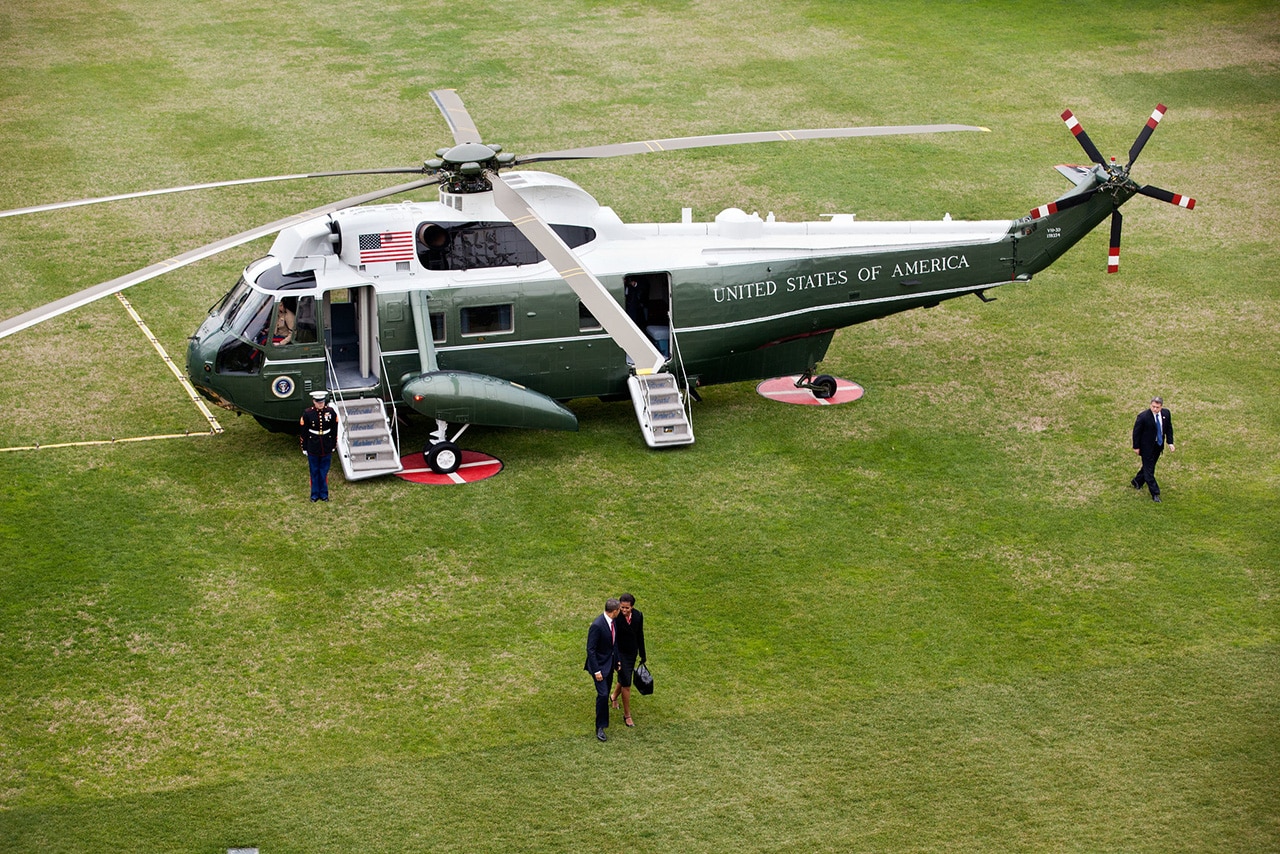
The grass is usually protected from damage by circular aluminium panels that could be placed on the grass ahead of a helicopter’s arrival. The skilled pilots of HMX-1 would then land the helicopter on these red dots, so that the landing gear did not damage the turf or – in wetter weather – sink into the ground.
President Barack Obama and First Lady Michelle Obama arrive on the South Lawn of the White House following their trip to Fort Bragg, N.C., Dec. 14, 2011. | Source: Official White House Photo by Chuck Kennedy
Heat damage is a newer concern, caused by the VH-92’s exhaust gases from the main engines and the auxiliary power unit (APU). While the VH-92 commenced Presidential service during President Biden’s term in office, this issue meant that helicopter transport to and from the White House itself was still primarily handled by the VH-3D Sea King and VH-60N White Hawk.
Exclusive: President Trump has directed contractors to redo weeks of work on his planned White House helipad, according to people who spoke on the condition of anonymity.
Trump claims that attempts to build a dedicated helipad at the White House had been made for decades but had not made progress until now. Most Presidents assume a role closer to a caretaker when occupying the White House, and are reluctant to make significant permanent changes to the structure or the grounds unless absolutely necessary. President Trump, however – at least in his current, second term – has appeared to feel much less bound to such traditions.
WASHINGTON (AP) — The entire White House East Wing has been demolished as Trump moves forward with ballroom construction, AP photos show.
With the covering over of the famous Rose Garden early in his term, as well as the complete demolition of the White House’s East Wing in favor of a lavish, controversial new ballroom (and, underneath, a new Presidential bunker), the addition of a granite helipad is certain to be one of the less unpopular changes. As Trump remarked of the solid stone pad, “this will be here long after we’re gone, no matter what happens with the world, this is not moving.”
The only airworthy example of an original de Havilland DH.88 Comet nosed-over while landing following a display at Shuttleworth’s Flying Proms. The pilot was quickly extracted, and has since been discharged from hospital after medical checks.
G-ACSS, named Grosvenor House, is a staple of the Shuttleworth Collection’s yearly program of flying displays at Old Warden, Bedfordshire. Painted in its original striking red livery, the aircraft is famous for having won the MacRobertson Air Race in October 1934, completing the England-Australia route in just 70 hours, 55 minutes – 19 hours ahead of the Douglas DC-2 that took second place.
Following yesterday’s incident at our Flying Proms Air Show (15.08.2026), we can confirm that the crew member involved has been discharged from hospital. pic.twitter.com/KdmNZZeAhd
After displaying for the Shuttleworth Flying Proms event on Aug. 15, 2026, the notoriously difficult to land de Havilland racer nosed-over on the grass airfield and came to rest upside down. While the extent of the damage has yet to be assessed, the aircraft’s tail can be seen to have taken a substantial hit, with the horizontal stabilizers now visibly out of alignment with the fuselage.
Just heard the Shuttleworth Comet G-ACSS has nosed over on landing, possibly heavy braking. pic.twitter.com/XVMfosQveK
Nosing-over is a well known risk for aircraft with a taildragger landing gear configuration. With the centre of gravity so finely balanced, even slight miscalculations with braking can see the aircraft pivot forward on its main landing gear and strike its nose on the ground. With enough momentum, this can lead to the aircraft completely flipping over.
The Comet’s long nose, low-set cockpit, and twin engines (mounted above and forward of the main landing gear), mean that it can be particularly difficult to land. In fact, as a machine designed purely for air racing speed, the Comet in general was a hard aircraft for pilots to master, intended primarily as a product of prestige and intended to be flown in small numbers by few pilots.
Countdown #10 for the @ShuttleworthTru 2021 Season on DVD/Blu-ray/Vimeo stream available later this month. A clip of the Collections famous DH88 Comet racer with headcam footage courtesy of Shuttleworth Chief Engineer and pilot Jean Munn. pic.twitter.com/Q2rgTL4BPC
Drawn up by de Havilland chief designer Arthur Ernest Hagg, the Comet was the first British aircraft to follow the formula of then-modern high performance aircraft. The fuselage incorporated stressed-skin, the landing gear was fully retractable, and the cockpit was completely enclosed – all features that were pivotal for providing the aerodynamic shape necessary for its 237 mile per hour maximum speed and near-3,000 mile range. It completed its first test flight only six weeks prior to the air race beginning.
Grosvenor House was restored to airworthy condition beginning in 1972, an effort that took until 1987 to complete. It was the first time G-ACSS had flown in almost 50 years. Four other Comets were produced, though all but one of these have not survived.
Did you know that our 1934 DH88 Comet G-ACSS was alleged to be involved in a plot to assassinate Hitler?
The sole remaining example other than Grosvenor House is G-ACSP, or Black Magic. Black Magic was the first Comet to be built, though it failed to complete the race after suffering engine issues. It was sold to Portugal in anticipation of a Lisbon-Rio de Janeiro flight but this was thwarted after it was damaged during takeoff. Black Magic, known as Salazar in Portugal, was subsequently lost for over four decades before being rediscovered and returned to the UK where it is undergoing a long, careful restoration to flight.
Though the damage to Grosvenor House is certain to see it out of commission for an extended period, there is still hope that one day in the near future the UK’s display circuit will be graced by both of these incredible flying machines.
The Comet name would later be reused by de Havilland for the world’s first jet airliner, which set multiple records in its own right before being developed into the Nimrod, serving with the Royal Air Force until 2011.
The John F. Kennedy, the second Gerald R. Ford class nuclear-powered aircraft carrier, left Newport News on Aug. 12 to commence acceptance trials before its handover to the U.S. Navy.
Pre-Commissioning Unit (PCU) John F. Kennedy, soon to be the USS John F. Kennedy (CVN 79) will now have its systems and equipment evaluated in these final manufacturer trials to prove it is up to specification before delivery.
Previously scheduled for delivery in 2025, the 100,000 ton aircraft carrier was delayed by issues with the new Advanced Arresting Gear (AAG) as well as its Advanced Weapons Elevators (AWE). It first set sail in January 2026 for initial manufacturer trials.
Today, our nation’s newest aircraft carrier, John F. Kennedy (#CVN79), departed our #NewportNewsShipbuilding division to begin acceptance sea trials. These trials will test and evaluate important ship systems and components at sea. (1/2) pic.twitter.com/6dD0i1y7h2
In between the two trials periods, U.S. Navy personnel have been busy at work on board the ship conducting drills and ensuring both the vessel and its crew are fit to sail.
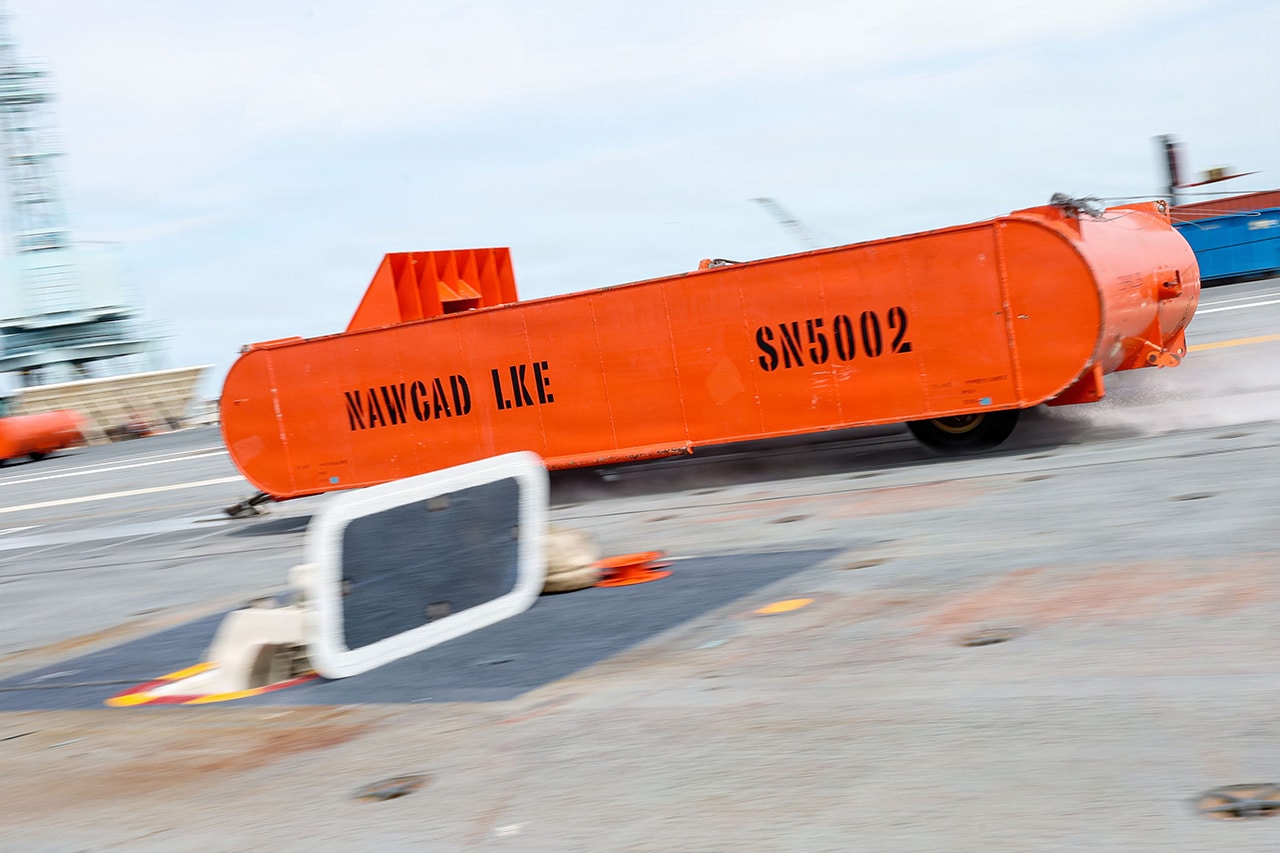
A deadload sled is launched from the flight deck of Pre-Commissioning Unit John F. Kennedy (CVN 79) using the ship’s electromagnetic aircraft launch system (EMALS) during deadload testing, June 26, 2026. | Source: U.S. Navy photo by Mass Communication Specialist Seaman Jayden Howard
Unlike the Gerald R. Ford, the Kennedy will – thanks to Congressional intervention, and delays – be delivered to the Navy ready and able to operate the F-35C Lightning II. Modifications necessary include reinforcement of the jet blast deflectors, as well as the addition of specialised equipment and systems used to maintain the fifth gen stealth fighter.
2nd voyage for sea trials for the future USS John F. Kennedy (CVN 79) more than 4 months after its first.
After entering service, the Kennedy is due to be homeported at Naval Base Kitsap-Bremerton in the state of Washington. This will make it the first Ford class based on the U.S. West Coast, ideally positioned for regular deployments to the Indian and Pacific Oceans. Under current plans the carrier will arrive there no earlier than 2029. A $145 million overhaul of the naval port’s facilities – focused on electrical infrastructure – ahead of the Kennedy’s arrival began in May 2025.
The carrier will supplant the veteran USS Nimitz (CVN 68) which is on the cusp of being decommissioned. A short reprieve has been granted, partially in order to fulfil the U.S. Navy’s legal mandate to operate at least eleven aircraft carriers, though it is unlikely to ever sail on an extended operational deployment ever again.
Commissioning of the new carrier is pencilled in for March 2027, though it should be noted that this will not mean the ship will then be ready for active operational service from this point.
As well as the requirement to be able to operate F-35s from delivery, the John F. Kennedy was also chosen to be the first Ford class carrier with the new AN/SPY-6(V)3 Enterprise Air Surveillance Radar (EASR). This is a fixed panel version of the radar system already retrofitted to several Nimitz class carriers.
An illuminator radar is visible on the port quarter of CVN-79 John F. Kennedy. While all ships belong to the U.S. Navy’s Ford-class aircraft carriers, CVN-78 Gerald R. Ford remains the only unit equipped with the Dual Band Radar (DBR) suite, comprising the SPY-4 phased-array… https://t.co/l5gzHxhFAbpic.twitter.com/4yoRJthPeT
The Gerald R. Ford itself is instead fitted with the AN/SPY-4, and due to various issues and high costs encountered with the system it will likely remain the only ship to carry this type of unit. AN/SPY-4 was developed to work in tandem with the AN/SPY-3, forming the Dual Band Radar (DBR) system for the Zumwalt class and the Gerald R. Ford class. None of the three Zumwalt class destroyers were ever fitted with their AN/SPY-4 panels.
After the Kennedy, the next aircraft carrier to enter U.S. Navy service is due to be the USS Enterprise (CVN 80). Under current plans, the Enterprise will commission in 2031.
Future USS Enterprise (CVN 80) Gerald R. Ford-class aircraft carrier penultimate aft hull section being lifted into place in Newport News, Virginia – posted March 12, 2025 #ussenterprise#cvn80
In 2034, the Enterprise will be joined by the USS Doris Miller (CVN 81), named for a U.S. Navy sailor who, after carrying wounded sailors to safety during the 1941 attack on Pearl Harbor later manned a machine gun and – without any prior experience – downed at least one attacking Japanese aircraft. He became the first ever black man to receive the Navy Cross, which was bestowed by Chester Nimitz in 1942. Miller was killed in action the following year on board the USS Liscome Bay.
After the Doris Miller, the only Gerald R. Ford class currently due to be named for someone other than a former President, the next two named vessels are the William J. Clinton and the George W. Bush, both yet to begin construction.
A Ukrainian Air Force pilot was forced to eject from a MiG-29 after an air to air missile malfunction caused the aircraft to catch fire in midair.
While flying a counter-unmanned aerial systems (C-UAS) sortie over Odesa Oblast in southwest Ukraine an unspecified malfunction occurred while launching an air to air missile that caused the fighter aircraft to catch alight. The pilot wrestled to regain control of the aircraft but was unsuccessful, eventually electing to eject and abandon the aircraft. He was safely recovered and taken to a medical facility for evaluation.
Though the exact nature of the incident is unclear, it should be noted that missile launch malfunctions that could cause such a scenario are uncommon but far from impossible, with the solid rocket motors fitted to air to air missiles burning at thousands of degrees celsius. The regularity with which Ukraine is needing to employ live air to air munitions combined with the likely use of old missile stocks out of necessity mean these incidents almost certainly have a higher chance of occurring than usual.
Ukraine’s Air Force confirmed the loss of a MiG-29 fighter during a combat mission against enemy aerial targets over Odesa Oblast on August 10. Preliminary information indicates an abnormal situation occurred during an air-launched missile firing, after which the aircraft caught… pic.twitter.com/UG78RAq9QL
Video footage was captured from the ground showing the MiG-29 in flames, while authorities would later release images of the aircraft’s crash site itself. The MiG-29, unsurprisingly, was completely destroyed in the crash.
Ukrainian authorities publish photos from the crash site of a MiG-29 fighter jet in Odesa Oblast.
The plane caught fire due to the malfunction of an air-to-air missile during its launch. The burning airframe plummeted into the ground, with its pilot ejecting safely. https://t.co/6TN52vZNhipic.twitter.com/NJwnHgUuS8
— Status-6 (War & Military News) (@Archer83Able) August 11, 2026
The MiG-29 is the second example to crash in as many months, with another jet having been lost in June. As in this case, the pilot was able to eject and survive. A third MiG-29 was destroyed on the ground during a Russian drone attack against Voznesensk Air Base.
While Ukraine is aiming to move away from Russian-built equipment like the MiG-29, the Fulcrum’s extensive use among former Warsaw Pact NATO nations means that there is a relatively healthy stock of spares and expertise. Additional airframes are also potentially on the cards from Poland.
Adding to the losses, in late July an F-16 Fighting Falcon was lost during a training sortie. Again, the more valuable pilot was able to eject, but until more stable deliveries of fighter aircraft can be assured every airframe is precious. The news of the F-16 crash came only days after it was confirmed that a Ukrainian F-16 had, for the first time, shot down a Russian fighter – specifically an Su-35S Flanker-E.
Wow! Confirmed now. A Ukrainian F-16 shot down the Russian Su-35. This is the first air-to-air kill by a Ukrainian F-16 and one of, if not the only time, a Ukrainian jet was confirmed to have downed a Russian one. Very significant. https://t.co/Yi5Yj5k1N5pic.twitter.com/soMg9k2SNd
Ukraine has lined up Gripens and Rafales to reinforce its air arm, though the timeframe beyond initial deliveries – particularly with regards to larger numbers of aircraft – is unclear at this stage.
Authorities are investigating the MiG-29 crash to determine the root cause. According to the State Bureau of Investigation (SBI) in their most recent statement, the search for the MiG-29’s flight data recorder unit is still underway. The investigation is referred to as a criminal investigation, though at this stage this does not mean any crime is known to have taken place.
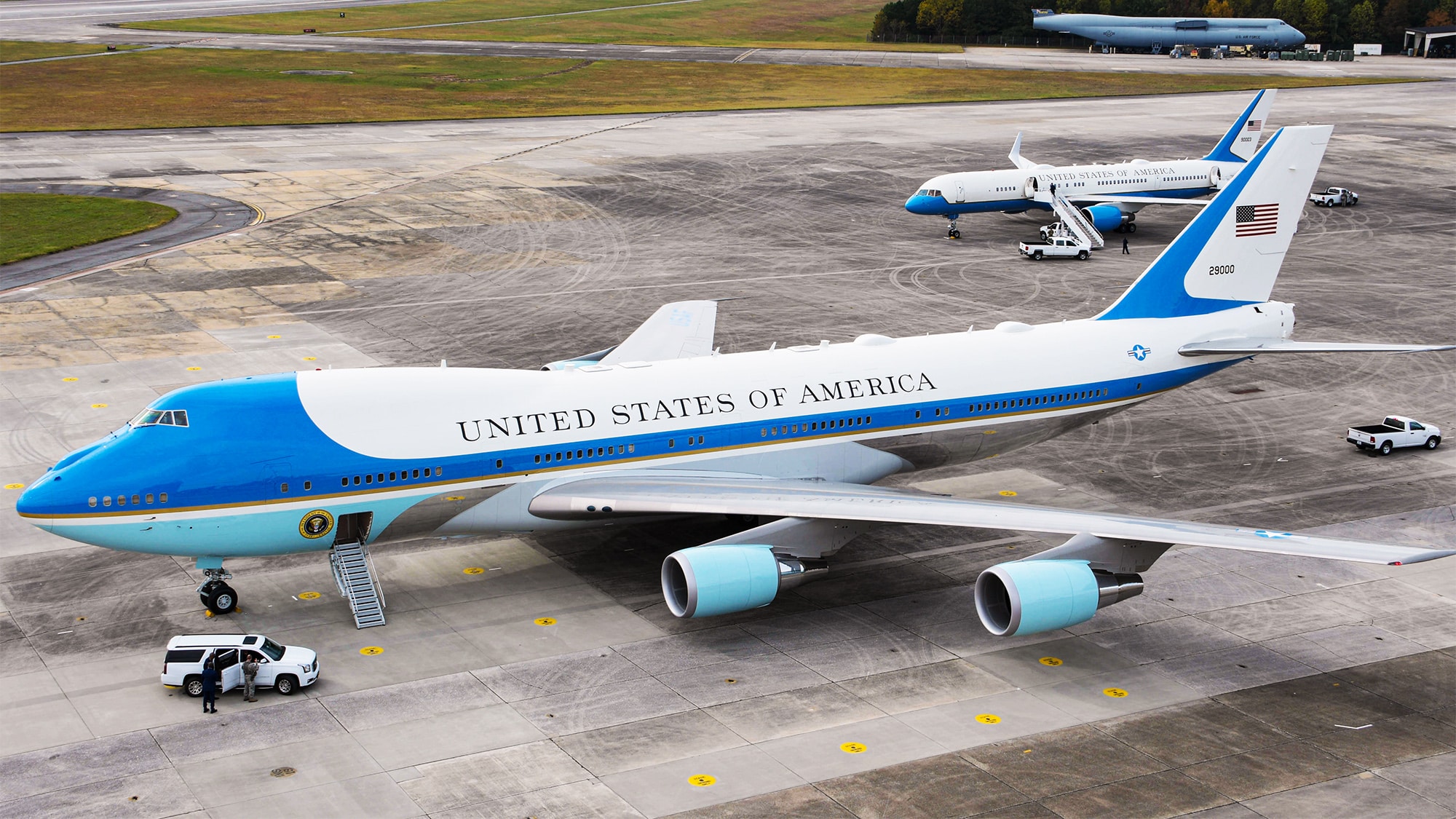
After President Trump boarded the legacy VC-25A – instead of the VC-25B Bridge – for his flight home from Ankara he was secretly transferred inside a catering truck to a waiting C-32A, according to the Washington Post.
While the world believed that the U.S. President had taken 92-9000 home from the NATO Summit in Ankara, Turkey, with the jet even going to the length of flying under the Air Force One callsign, he actually took one of the ‘escape’ jet C-32As that are regularly deployed in support of Presidential travel. This new discovery was first published by the Washington Post, who claim that the ruse was unknown even to some members of the White House staff who were on board the VC-25A.
In Ankara, President Trump boarded the VC-25A in full view of TV cameras. After disappearing from view inside the jet, a catering truck drove away from the opposite side of the aircraft. This, the Post was told by an unnamed official, is how the President was transferred in secret between the aircraft.
Officially, the line was that the legacy VC-25A was to be used in place of the new VC-25B Bridge to allow the latter to fly to RAF Mildenhall and open up for tours for stationed personnel.
In reality, it was quickly assumed that the switchover owed to security concerns over the newer jet which underwent a rapid conversion process – skipping over many of the otherwise necessary security and communications capabilities – for Presidential use after being gifted by the state of Qatar. The actual VC-25B aircraft, which will eventually take over from the VC-25B Bridge, have been in the modification process for many years to ensure they are fully equipped.
After arriving at the NATO Summit several days earlier, Trump had declared that the U.S. ceasefire with Iran was over. The leading assumption has therefore been that the renewed hostilities with a nation that borders Turkey meant that the threat analysis that initially permitted the use of the VC-25B Bridge had to be reassessed. Now it is believed that the U.S. became directly aware of a credible threat against Air Force One which would see it targeted by a surface to air missile upon departure from the Turkish capital.
Discrete Escape?
The Washington Post reporting today that the US President was moved to the discrete escape jet which flew into Mildenhall as REACH 018.
We had been expecting the VC-25B, followed by a C-40 and then the VC-25A as AF1.
Extra security measures were also enforced at RAF Mildenhall, where the VC-25B Bridge and VC-25A were due to stop. Fencelines were draped with plastic sheeting to block sightlines, while semi-trucks and trailers were parked behind them as a physical barrier.
Looking back in retrospect, it is very likely that President Trump was on board REACH 18, a C-32A which transited through the base before the VC-25 arrived. This aircraft was flying without Mode S or ADS-B, so did not display on flight tracking applications, but this is not uncommon for some elements of the Presidential entourage.
The Washington Post credited this great plane tracker account with an import detail in our exclusive tonight. Sharing credit where it’s due: https://t.co/A5J6ltf8qZ
An additional switch, from C-32A back to the VC-25A, then took place at Mildenhall so he could emerge from ‘Air Force One’ as expected and take the VC-25B Bridge back to Andrews AFB.
Could well be right, I noticed RCH18 the C-32 wasn’t tracking and was told to land first just before the VC-25A at Mildenhall, RCH18 then stopped for a while blocking the VC-25As parking space which I thought was odd at the time, I guess that’s when he disembarked the C-32.
The White House still maintains that the President was on board Air Force One as usual, and it is still not known how widely within the administration the decoy plans were spread.
This would not be the first time that alternative, discreet aircraft have been used to transport the President while the regular, highly conspicuous aircraft have trailed as a decoy. This measure was taken during a visit to Pakistan in 2000 by President Bill Clinton.
In other circumstances, the primary jets have been used but were flight planned under a different identity. Famously, when President George W. Bush was conducting a surprise visit to Iraq in 2003, Air Force One’s cover as a ‘Gulfstream’ was apparently almost blown when a civilian pilot, reportedly from British Airways, reported seeing Air Force One. British Airways denied that any of its pilots had made such a report, and there is no official record of the incident having actually occurred, though it was repeated by then Air Force One pilot Colonel Mark Tillman during a National Geographic documentary.
However, a number of differences to previous occasions have been pointed out by Pete Souza, Chief White House Photographer for Barack Obama. For Obama’s clandestine trips to Afghanistan, he said, “members of the press pool that would accompany us were contacted individually ahead of time and were sworn to secrecy”. These reporters would then be able to report on the trip after landing. No reporters were allowed on this secretive flight, and Souza additionally questions whether or not a White House photographer was allowed to accompany the President to ensure a historical record exists.
Souza asks: “If there was a legitimate threat that Iran would launch a missile at Air Force One, why was the White House willing to use the plane as a decoy thereby potentially sacrificing the lives of dozens of people aboard?”
Security Features
While the C-32A is likely not as elaborately equipped as the VC-25A in terms of security and communications features, the act of making it appear that Trump was on board the latter means that this higher degree of capability is less necessary as any hostile actor would instead target the larger jet.
The Boeing 757-based aircraft have regularly been used to support Presidential travel as a backup aircraft, especially in more recent years where there have been significant periods where only one VC-25A is available. It can additionally be used to support travel into smaller airports which would be unable to accommodate a Boeing 747.
After a several hour delay for the VC-25A (Boeing 747) having to turn around near Long Island, NY due to electrical issues. POTUS boarded the backup jet (Boeing C-32A aka Boeing 757) and is now on the way to the Zurich Airport in Switzerland to attend WEF 26 in Davos. The back up… pic.twitter.com/EN5FOUkYt9
Eight C-32As are operated by the U.S. Air Force, though it officially acknowledges only four of these.
The VC-25As are equipped with an array of self-defence capabilities, most of the details of which are classified. However, the external elements of some of this equipment are clearly evident and identifiable upon close inspection. None of these are present on the VC-25B Bridge aircraft in its current configuration.
A request for information (RFI) has been released to gather industry responses ahead of the replacement of the Hawk T1 and Hawk T2 in Royal Air Force service.
With the planned early retirement of the Hawk T2 and the 2030 sundown of the Red Arrows’ Hawk T1 confirmed in the recently released Defence Investment Plan (DIP), the race to select and procure a new Jet Training System (JTS) has begun in earnest.
Ahead of the release of a full tender, this RFI seeks to gather information from interested industry partners. Though only in its second decade of service, senior members of the Royal Air Force have repeatedly expressed a desire to move away from the Hawk T2 as quickly as possible due to longstanding availability and reliability issues.
6/ However, the Hawk T2 has had issues that have impacted availability throughout its life. The most recent engine problem has seriously curtailed aircraft availability, and the head of the RAF has also stated that the aircraft won’t meet the needs of future GCAP training.
Most of the expected key contenders are already well known, having staked out their bids quite clearly over the last few years. This was particularly notable at this year’s Farnborough International Airshow, where multiple vendors put a significant emphasis on their proposals for the role.
BAE Systems, the manufacturer of the current Hawk aircraft, is partnering with Boeing and Saab to offer the T-7 Red Hawk which was developed to replace the T-38 Talon in U.S. service. Although it doesn’t keep the T-38’s supersonic capability, the Red Hawk’s afterburning GE F404 turbofan would represent a significant step-up in performance over the Hawk’s non-afterburning Rolls-Royce Adour. The bid has been said to include plans for UK-based final assembly, almost certain to take place at BAE’s Warton plant.
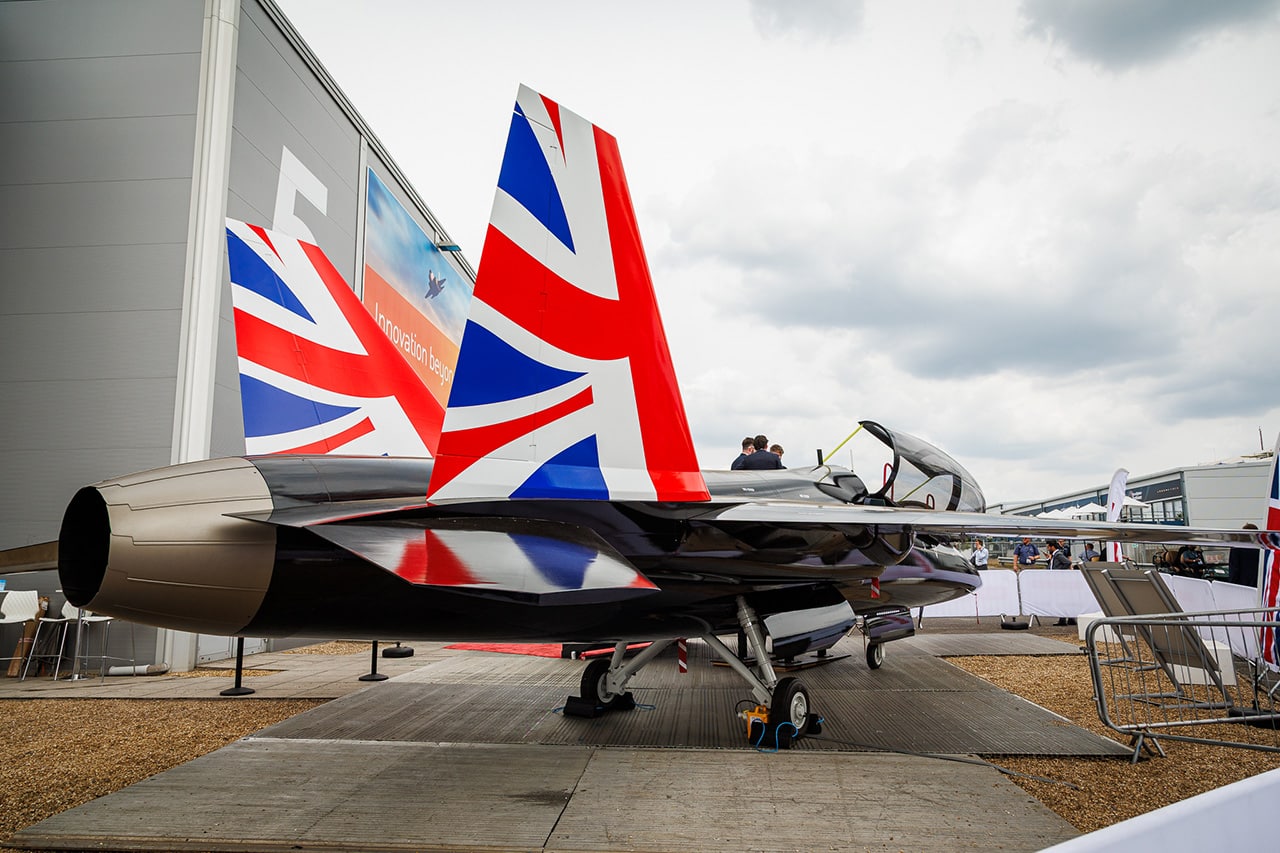
T-7 Red Hawk mock-up at Farnborough International Airshow 2026. | Source: Kai Greet
A representative mock-up of the T-7, marked with the UK flag and painted in the high visibility black favored by UK training aircraft, was displayed prominently outside the BAE Systems hall at Farnborough. The aircraft is advertised as ‘fourth and fifth generation ready’ and ‘sixth generation enabled.
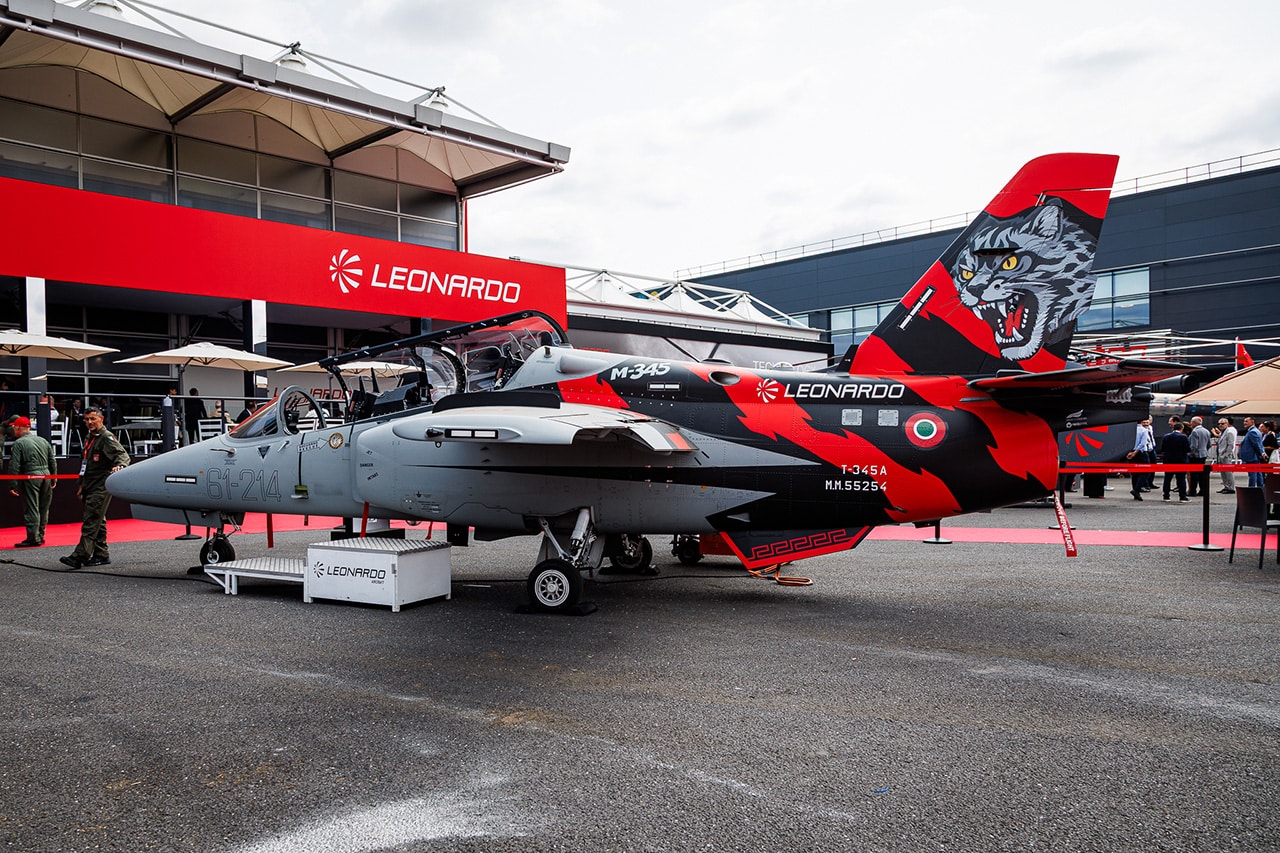
Across at Leonardo, though there was notably less emphasis on the UK bid, both of the company’s potential options were featured at the airshow in the flesh. Leonardo’s own stand featured one of its M-345 jet trainers, while an Italian Air Force example of the more advanced M-346 was shown off in the static display park.
Nigel Colman, Managing Director of Leonardo Helicopters UK, ruled out the possibility of the company’s Yeovil site being used as the local manufacture element of any bid made, but Leonardo’s significant UK presence would almost certainly see local industrial involvement regardless of where final assembly takes place. The RFI calls for a “significant UK workshare”.
MM55254, a T-345A (M-345), on display at FIA 2026 with its NATO Tiger Meet special scheme. | Source: Kai Greet
The M-345 is, perhaps, the most direct analogue to the Hawk aircraft. It is based on the SIAI-Marchetti S.211, introduced in the 1980s, and is powered by a single non-afterburning Williams FJ44 turbofan. However, its suitability for the range of performance levels needed for a future UK jet trainer is called into question by the Frecce Tricolori display team’s decision to abandon its move to the M-345 in favor of the M-346.
Its place in the Italian training system takes the place usually covered by a turboprop aircraft, offering a rare case of ab initio training on a jet aircraft. As such, the M-345 and M-346 are best thought of as a combined system rather than competitors with each other. It is uncertain, though, whether the UK’s budget could expand to cover two individual aircraft types.
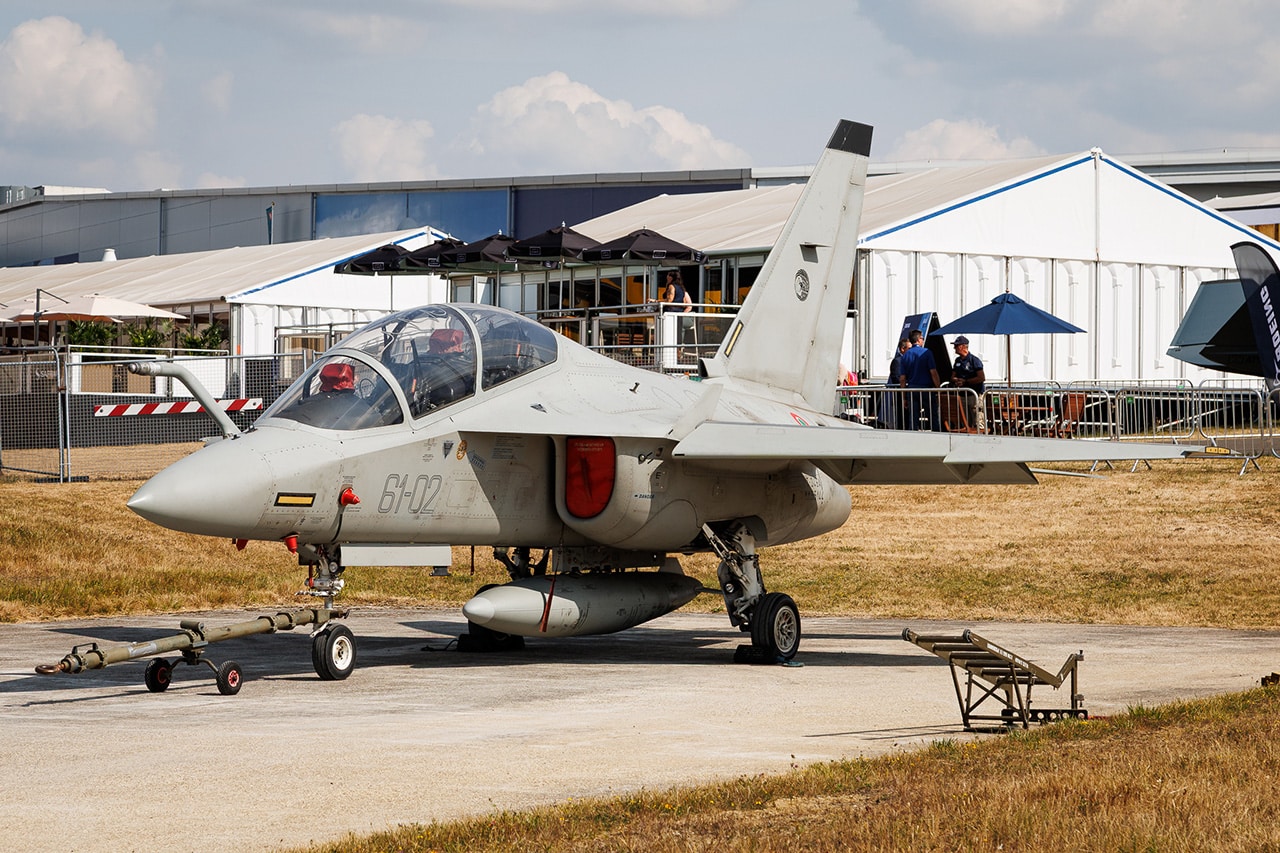
Italian Air Force T-346A (M-346) MM55144 at FIA 2026. | Source: Kai Greet
With two Honeywell/ITEC F124 engines and baked-in weapons capabilities, the M-346 is more of a hybrid between a jet trainer and a light fighter. It was initially developed in tandem with the Yakovlev Yak-130. Though the programs eventually diverged, both aircraft share significant similarities. Royal Air Force pilots have already spent many hours on the M-346 with Decimomannu’s International Flight Training School.
Outside Contenders
With less firm prospects of UK worksharing, the Turkish Aerospace Industries Hürjet – which has seen NATO export success with Spain – is being angled as another possibility for the UK. Unlike the above aircraft, the Hürjet is supersonic.
The Hürjet’s best chance would have been as part of an alignment with BAE Systems, acting as a reciprocal deal for the supply of UK-built Typhoons to Turkey. However, this has been quashed by BAE Systems’ choice to partner with Boeing and Saab. Additionally, though both the Hürjet and Red Hawk are in their prototype and initial production stages, there is likely to be a higher degree of confidence on the latter thanks to its U.S. backing.
Contending as a more mature option, with hundreds of aircraft already in service, the Korean Aerospace Industries (KAI) T-50 Golden Eagle has also been put forward. This is comparable in role to the M-346, offering both a jet trainer and a light fighter. It has seen export success in Asia, and has now broken through to NATO in Poland, but the potential for high UK worksharing is low.
No full-scale mock-up was shown off at Farnborough, though KAI’s stand included a model in a scheme designed to represent the Red Arrows display team.
KAI T-50 Golden Eagle in a representative Red Arrows scheme. | Source: Kai Greet
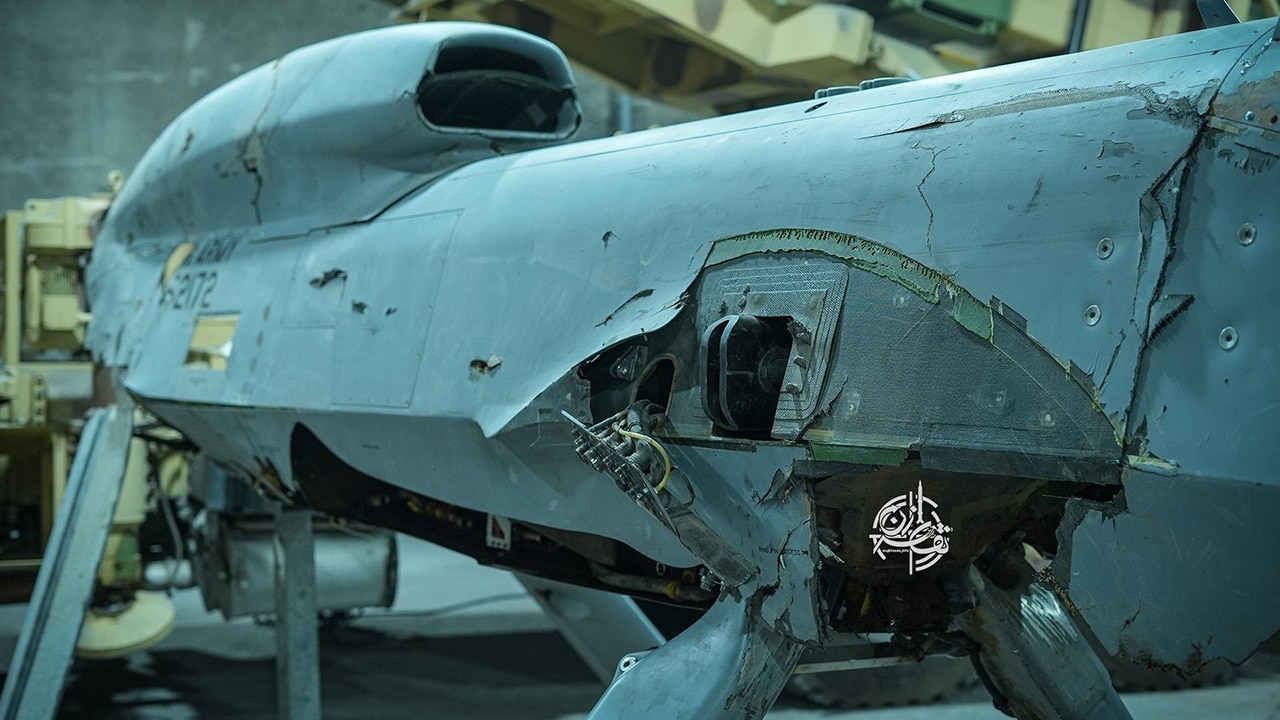
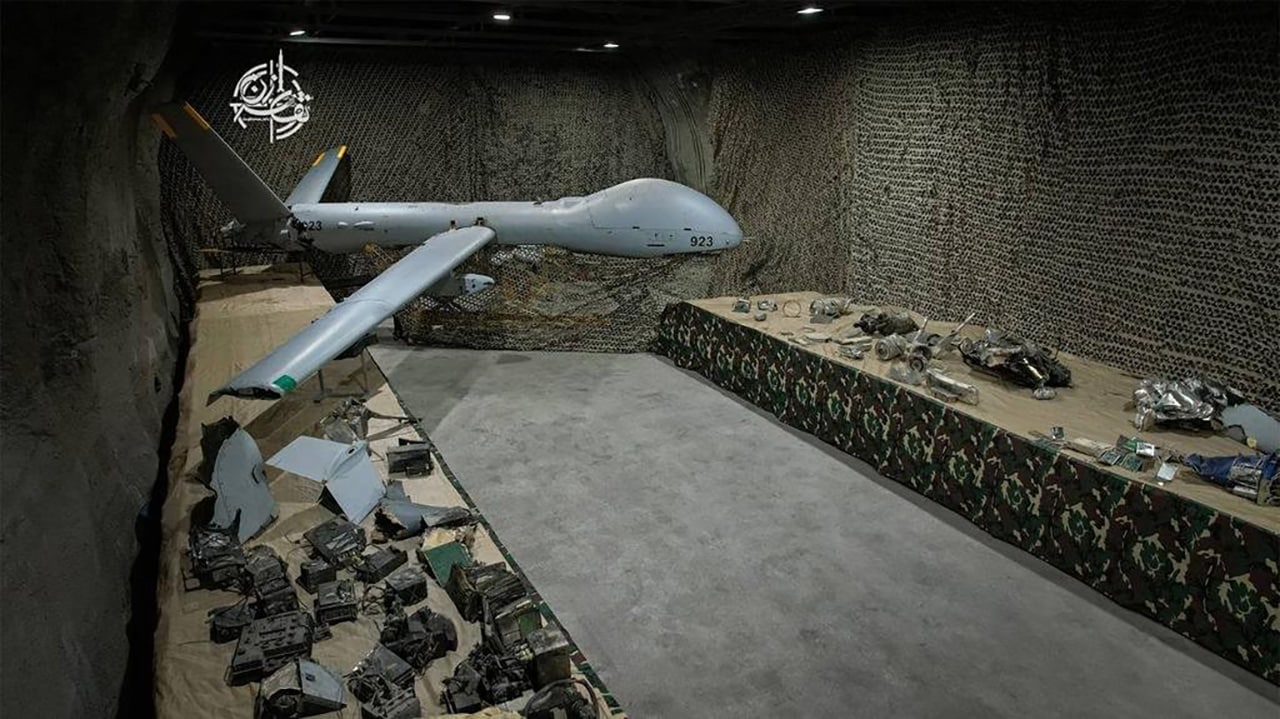
Iranian state media has released images of a display of aircraft wreckage from the U.S.-Iran war, including remnants of DUDE 44, an F-15E Strike Eagle which can now be confirmed without doubt as airframe 00-3000.
The aircraft remains have been arranged on display in underground chambers, and alongside the F-15E Strike Eagle the ‘exhibition’ also includes wreckage of MQ-1 Predators and MQ-9 Reapers.
Many U.S. MQ-9s have been lost throughout Operation Epic Fury, putting strain on the wider fleet. They have been called the U.S. Air Force’s ‘most valuable’ asset in the war, but their slow speed and lack of any significant self-protection features make them easy prey for even simple air defence systems. Losses of MQ-1s involved the U.S. Army’s MQ-1C Gray Eagle variant.
MQ-1C Gray Eagle wreckage. | Source: Iran State Media
One of the larger sets of debris comprises the canopy and ejection seat from F-15E Strike Eagle 00-3000, a serial which can now be confirmed based on markings visible in these images. 00-3000 has been featured on The Aviationist previously, having tallied at least nine drone kills with AIM-9X Sidewinders during a 2023-2024 deployment.
Wreckage displaying tail number 00-3000, an “LN” marked F-15E Strike Eagle.
These are from DUDE 44, which was shot down over Iran in early April. Unsurprisingly, of all the debris, the ACES II ejection seat – which would have descended with a parachute – is one of the most intact pieces shown.
The Iranians have found the Advanced Concept Ejection Seat II (ACES II) ejection seat system employed in U.S. Air Force F-15E Strike Eagle fighter jet that crashed in Iran this morning.
— Status-6 (War & Military News) (@Archer83Able) April 3, 2026
As had been suggested previously, the jet belonged to the 48th Fighter Wing (FW) at RAF Lakenheath, UK. Lakenheath dispatched more than half of its active combat jets, including F-15E Strike Eagles and F-35A Lightning IIs, for Operation Epic Fury.
Reportedly, remains of the C-130s ditched during the rescue mission for the weapon systems officer (WSO) of DUDE 44 are also included, though they are not immediately identifiable in the images. These aircraft were intentionally destroyed by U.S. personnel alongside MH-6/AH-6 Little Birds after they became stuck at a makeshift landing ground.
Israeli Hermes 900. | Source: Iran State Media
Israeli Hermes drones also feature as exhibits, with one example of a Hermes 900, serial 923, appearing quite intact. This aircraft was downed in March, complete with its weaponry.
In many cases, where possible, downed aircraft which may contain sensitive equipment or documents are themselves targeted by airstrikes. Given the amount of U.S. airpower over Iran during the conflict, this is likely to have taken place, with particular regard being paid to any electronics equipment that might have survived an impact with the ground to a degree that would allow Iran to reverse engineer it. However, regardless of the efforts taken to prevent it, there will almost always be a certain level of intelligence an adversary could gain from an aircraft’s wreckage.
One such example comes from the MQ-9 Reaper wreckage, which includes a four-bladed propeller. Regular MQ-9s use a three-bladed prop, while four-bladed examples are used by the more capable MQ-9 ER (Extended Range). The ER variant improves upon the already excellent endurance of the Reaper by increasing the total flight time up to 34 hours.
Iran has a notable history of flaunting captured military technology, with the most famous example being the public display of the RQ-170 Sentinel that Iran claims was brought to the ground through cyberwarfare.
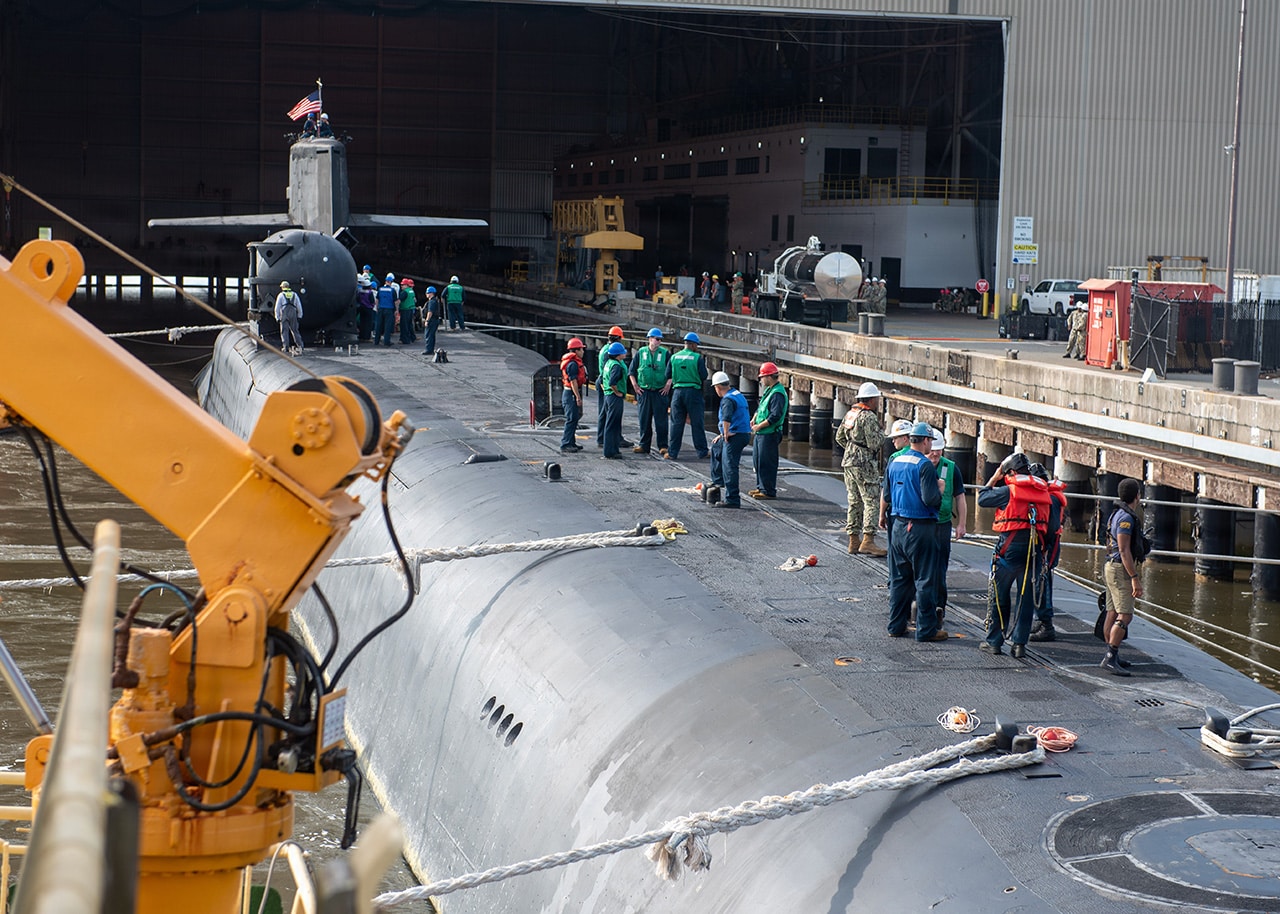
Beginning with the USS Arizona, 19 new boats in the U.S. Navy’s Virginia class of nuclear powered attack submarines will officially be referred to as SSGNs to reflect the boost in cruise missile capacity offered by the new Virginia Payload Module (VPM).
Now to be designated as guided missile submarines, otherwise known as SSGNs, the newer boats of the Virginia class will be the U.S. Navy’s direct replacement for its current four Ohio class SSGNs which were converted from ballistic missile submarines (SSBN).
While the Virginias cannot match the sheer size of the Ohio’s cruise missile armament (154 missiles), the huge boost in numbers compared to the preceding class could allow more flexible, distributed positioning of these valuable, powerful strike assets.
If you felt that sudden disturbance in the submerged VLS force, it was the first one of the four missile boats of the Tomahawkalypse riding off into retirement.
Recovery will take a decade. Loss of the Ohio-class SSGN submarines will leave a big hole, & not just in VLS capacity. https://t.co/ldLHqGYbU3pic.twitter.com/1wsEt17U3d
The Virginia Payload Module (VPM), developed from the Virginia Payload Tubes (VPT) fitted to Block III boats (from USS North Dakota (SSN 784) onwards), comprises four additional tubes fitted in an extension of the amidship hull allowing the carriage of an extra 28 Tomahawk Land Attack Missiles (TLAM) or a to-be-determined number of future missiles.
Fitted to Block V boats starting with the USS Arizona (SSGN 803), the VPM, combined with the two VPTs in the nose of the submarine, will permit each boat to carry as many as 40 TLAMs. The earliest Virginias feature individual missile tubes similar to those used on the improved Los Angeles class.
4/ The Virginia-class has 12 VLS (vertical launch) tubes for cruise missiles. This older Los Angeles class vessel shows what they’re like open. There are five Blocks (construction groups) thus far. Block III will use two multipurpose Virginia Payload Tubes (VPT) instead. pic.twitter.com/VOBlt1pTbC
“This reclassification is a clear acknowledgment of the increased lethality VPM brings to the undersea fight,” said Vice Adm. Rob Gaucher, Director, Submarine Programs. “These VPM-equipped SSGNs will ensure the Navy continues to dominate the undersea domain for decades to come. By integrating this additional payload capacity, we will have the ability to surge strike power to assure our allies, deter aggression, outmatch any adversary, and give our Fleet commanders an incredibly versatile, hard-hitting instrument of national power.”
The Ohio-class guided-missile submarine USS Georgia (SSGN 729) transits the East River as she returns to her homeport at Naval Submarine Base Kings Bay, Georgia, July 27, 2026. This marks the submarine’s final return from operations before officially commencing her scheduled inactivation process on July 31 after 42 years of active service. | Source: U.S. Navy photo by Mass Communications Specialist 1st Class Travis S. Alston
Arizona will be the first submarine commissioned from new into the U.S. Navy since the USS Halibut (SSGN 587) in 1960. All four of the Ohio SSGNs were converted while the boats were already in service as SSBNs. Halibut spent only five years as an SSGN, carrying the Regulus nuclear-armed cruise missile, until it was converted for special operations and redesignated as an SSN. It would go on to take part in the famous Operation Ivy Bells and secretly tap into Soviet communication cables.
USS Jimmy Carter (SSN 23), a modified Seawolf class submarine, currently fulfils the U.S. Navy’s special mission submarine role, and is expected to be replaced by a modified Block VI Virginia class boat.
Happy Birthday SSGNThe first nuclear powered guided missile submarine, USS Halibut (SSGN-587) was commissioned #OTD in 1960 at Mare Island.
Halibut conducted nuclear deterrent patrols with Regulus missiles, qualifying her crew for the SSBN Deterrent Patrol Insignia. #USNavypic.twitter.com/Hy3jL8Ek6O
“Reclassifying Virginia Payload Module-equipped submarines as SSGNs accurately reflects the extraordinary strike capacity, operational flexibility, and global reach these platforms bring to the Fleet,” said the Chief of Naval Operations, Adm. Daryl Caudle. “This transition comes at an important moment as USS Georgia, one of the Navy’s four Ohio-class guided-missile submarines, begins the inactivation process after more than four decades of exceptional service. Georgia and her sister ships proved the enduring value of combining undersea stealth with unmatched clandestine strike capability.”
“The next generation of Virginia-class SSGNs builds on that legacy with greater survivability, adaptability, and sustained combat power. These submarines will provide our Nation with a powerful and persistent deterrent, expand options for our combatant commanders, and ensure the Navy remains ready to fight and win whenever and wherever called upon,” the CNO added.
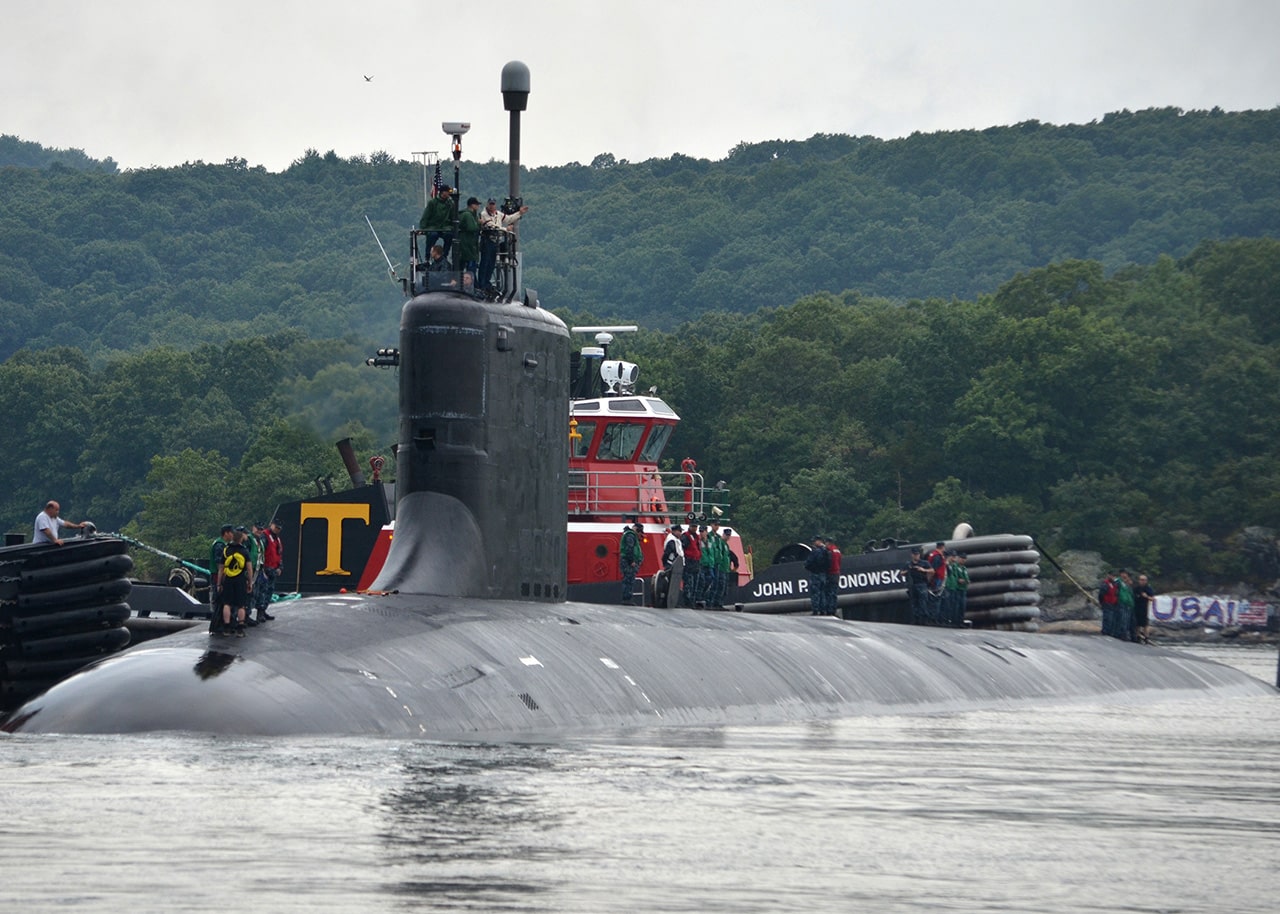
The Virginia-class attack submarine USS Virginia (SSN 774) departs Naval Submarine Base New London for a six-month deployment. (U.S. Navy photo by Mass Communication Specialist 1st Class Jason J. Perry/Released) | Source: U.S. Navy photo by Mass Communication Specialist 1st Class Jason J. Perry
The first VPM-equipped submarine delivery is expected in FY 2029, with further deliveries taking place through to at least 2038.
“The Submarine Force is defined by our ability to operate undetected and strike without warning,” said Vice Adm. Rick Seif, Commander, Submarine Forces. “By integrating high-volume precision strike capabilities into these stealth platforms, these SSGNs serve as the ultimate enabler for Distributed Maritime Operations, giving our warfighters the overwhelming, flexible firepower required to win decisively in any theater.”
688 to Virginia
Replacing the Los Angeles (688 and 688i) class as the U.S. Navy’s primary fleet submarine, the Virginia class takes inspiration from its predecessor as well as the three strong Seawolf class to balance absolute performance with operational efficiency and affordability. A pumpjet unit replaces the Los Angeles class’ traditional propeller, while newer reactor developments have been designed to enhance natural convection effects so noise-emitting coolant pumps can be disabled at lower power levels for maximum stealth.
The Los Angeles class fast-attack submarine USS Norfolk. (U.S. Navy photo/Seaman Ryan Steinhour) | Source: U.S. Navy photo/Seaman Ryan Steinhour
Sonar systems have been continually advanced and upgraded through the different Blocks of the Virginia class. The Virginias also feature larger lock-out chambers for an increased emphasis on special forces deployment. While slightly larger than the LA class, the Virginia was designed for improved performance in littoral areas in the post-Cold War expectation of the submarine’s role shifting from open sea engagements with Soviet fleets to clandestine operations in shallower areas.
The Ohio class ballistic missile submarine USS Nebraska (SSBN 739) received an airborne escort while surfaced in the Pacific Ocean, exercising with a U.S. Air Force A-10C Thunderbolt II.
As one of the most destructive and most valuable assets in the entire U.S. military, the protection of the U.S. Navy’s 14 Ohio class ballistic missile submarines (SSBNs) is an endeavor which can require the support of any and all of the branches of the U.S. military.
Each submarine is able to carry as many as 20 UGM-133 Trident II D5 missiles, each offering a range capability in excess of 7,400 km and delivering up to 12 independently targeted thermonuclear warheads that re-enter Earth’s atmosphere at over 20 times the speed of sound.
Trident II D5 ballistic missile takes flight in the background of another Trident II D5.
This was the 12th flight of a Trident II, D-5 missile (X-12)
𝘓𝘢𝘶𝘯𝘤𝘩 𝘊𝘰𝘮𝘱𝘭𝘦𝘹 46, 𝘊𝘢𝘱𝘦 𝘊𝘢𝘯𝘢𝘷𝘦𝘳𝘢𝘭 (1998) pic.twitter.com/P6AgkJzO9X
Submarines are at their most vulnerable when on the surface, where they can be detected by visual means or by radar, and even spotted by satellites.
During routine operations, the U.S. Navy employs a specialist fleet of four Black Powder class support ships to provide additional protection to these submarines. When entering and exiting port, the ships sail close by to the submarines acting as a sacrificial shield for the precious missile compartment.
This week’s @MSCSealift “Ship in the Spotlight,” submarine support ship USNS Eagleview (T-AGSE 3) recently escorted the Ohio-class ballistic-missile submarine USS Maine (SSBN 741) as it transited the Puget Sound during routine operations. Petty Officer 1st Class Ryan Riley. pic.twitter.com/ON23JaSFEa
— U.S. Navy’s Military Sealift Command (@MSCSealift) March 31, 2025
In times of heightened tensions, or during open conflict, these passive protection measures would be supplanted by active protection.
One form this can take is an Armed Airborne Escort, also known as AAE, as demonstrated during the exercise on Jul. 28, 2026. In this role, armed aircraft would provide overwatch for the submarine until it can submerge beneath the waves and lurk silently underwater.
A U.S. Air Force A-10 Thunderbolt II aircraft escorts Ohio-class ballistic missile submarine USS Nebraska (SSBN 739) in the Pacific Ocean, July 28, 2026. | Source: U.S. Navy photo by Mass Communication Specialist 1st Class Ryan Riley
Underwater protections would then comprise a shield of attack submarines, like those from the Los Angeles and Virginia classes, to defend the SSBN from hostile submarines.
A U.S. Navy statement reads: “AAEs demonstrate joint force readiness to protect SSBNs, ensuring they remain a credible, reliable, and survivable force capable of operating anywhere in the world.”
“SSBNs remain a top U.S. Department of War priority due to their unmatched stealth and second-strike capability. Their strategic importance necessitates the strongest protection available during critical surfaced operations.”
As we noted at the time, the use of the A-10 in this role showed off its increasing utility in the maritime domain. The aircraft was originally designed with the very specific task of prowling the European frontlines during a war between NATO and the Soviet Union, taking out the Soviet Union’s massive armada of tanks and armoured vehicles from the air.
Emerging Threats
A major threat which has emerged since the introduction of the Ohio class and their Royal Navy counterpart Vanguard class submarines has been from small, fast watercraft laden with explosives. These can be operated with ease by both state and non-state actors, and strike with little warning while hidden among the small boats that feature in the populated coastal areas surrounding many naval ports.
This threat was most dramatically evidenced by the terrorist attack in 2000 against the destroyer USS Cole (DDG 67) while alongside in Yemen. A fibreglass boat packed with C4 explosives hit the side of the ship, blasting a huge hole and claiming the lives of 17 crew members. This boat was driven by two attackers, who committed suicide in the attack. Now, with the widespread use of uncrewed craft, the limitation of needing people willing to give their lives in such attacks has been removed.
A surfaced submarine’s missile compartment would be the prime target for such an attack, and a submarine by itself has very little capability to defend itself. Across the Atlantic, the Royal Navy’s Vanguard class boats were retrofitted with armor plating along the upper section of their missile compartments providing a similar style of protection to the containers arranged on the decks of the U.S. Black Powder class.
Royal Navy submarine HMS Vanguard (S28) with the armor plating highlighted. This plating is often mistaken for a flank sonar array. | Source: Kai Greet
In circumstances requiring the heightened, active protective measures, close air support aircraft like the A-10 or helicopters like the AH-64 Apache would be the ideal escorts for such submarines. Varied munition loadouts enable these aircraft to target a wide array of different types of threat, allowing them to respond to any emerging situation. A-10s, for example, have been used extensively over the Strait of Hormuz to hunt and destroy Iranian fast attack craft threatening civilian shipping.
The surviving KC-135R Stratotanker from the incident over Iraq in March which saw another Stratotanker lost with six fatalities has been repaired with a replacement vertical stabilizer taken from another aircraft.
Captured at RAF Mildenhall, UK during its transit back towards the United States from forward deployment in Israel, the aircraft was visibly displaying two different serial numbers. On the fuselage itself was the ‘correct’ 63-8017, while the tail is from the aircraft 63-8002, which was last noted with the fleet depot at Tinker Air Force Base, Oklahoma.
She Lives!!!!
63-8017 arrived at RAF Mildenhall this afternoon as REACH 564 from Tel Aviv Ben Gurion Airport.
This airframe was involved in a mid-air collision back in March with ZEUS 95, which was sadly lost along with the crew. 63-8017 limped back to Tel Aviv with the top… pic.twitter.com/j29GXo8uN0
It was subsequently pictured with this damage when back on the ground at Tel Aviv’s Ben Gurion International Airport, which has become a hub of U.S. Air Force aerial refueling capability during the conflict.
The damaged tail of 63-8017 that manged to land in TLV with squawk 7700. https://t.co/aTaclAFFjc
It arrived at Mildenhall in the late afternoon on Aug. 2, 2026, as REACH 564.
63-8017 on the deck at RAF Mildenhall. | Source: Havoc Aviation
Further work will likely be undertaken on the aircraft once it arrives back in the United States, not least including a repaint with the correct markings (should the donor tail be kept permanently).
Close-up of the tail fitted to 63-8017, donated from 63-8002. | Source: Havoc Aviation
Despite entering service almost 70 years ago, the KC-135 remains the most numerous refueling aircraft in U.S. service and it managed to outlive the much newer KC-10 Extender. Current plans will see the Stratotanker live on until at least 2050, so preserving the long out of production airframes is an important and continually ongoing effort.
63-8017 arriving at RAF Mildenhall on Aug. 2, 2026. | Source: Havoc Aviation
Operation Epic Fury has placed an immense strain on the force. Alongside the two airframes involved in the mid-air collision, several KC-135s have been damaged on the ground by Iranian attacks on U.S. bases.
The exact degree of damage to these, and whether any attacks managed to write off any airframes, is not entirely clear, but we have been able to see some of the results as affected tankers have transited back across the Atlantic complete with temporary repair patches scattered across the aircraft.
F-16 Demo Team paying tribute to the fallen KC-135 crew.
ZEUS 95 was the call sign for a U.S. Air Force KC-135 Stratotanker crew that tragically lost their lives during a mid-air collision in western Iraq on March 12, 2026, supporting Operation Epic Fury. https://t.co/5m9sG34IfLpic.twitter.com/wtuLqgWtVM
America’s refueling fleet is by a significant margin the largest in the world, but with the size and global spread of U.S. operations and the country’s simultaneous commitments in multiple theaters many argue that the current force falls short of being sufficient. The KC-46A Pegasus has had a troubled entry to service, and is still not cleared to refuel all aircraft types, but orders continue while decisions are made on future options.
Many thanks to Havoc Aviation (@havoc_aviation) for sending us his images of the jet arriving at RAF Mildenhall, as well as to our friend Bob Archer for contributing additional information.
The U.S. Marine Corps has confirmed an ‘aircraft mishap’ occurred at MCAS Miramar on Jul. 31 after footage appeared on social media showing an F-35B Lightning II off the runway and on fire.
U.S. Marine Corps spokespeople have confirmed to the press that the pilot of the F-35B aircraft was able to eject safely and was recovered and taken to a medical facility with non-life threatening injuries.
Emergency personnel responded to an F-35B aircraft mishap on MCAS Miramar at 10:00 am PST. The pilot ejected, was transported to a local medical facility in stable condition for evaluation and treatment of non-life-threatening injuries.
Footage emerged on social media at around 1730 UTC on Friday, Jul. 31, showing a plume of dark smoke rising from the airfield at Marine Corps Air Station Miramar, California. A news helicopter was soon dispatched and captured more detail of the scene, revealing a stricken and burned F-35B Lightning II surrounded by charred grass and firefighting vehicles.
BREAKING: Emergency crews are responding to an aircraft mishap appearing to involve an F-35 at Marine Corps Air Station Miramar in San Diego after the incident was reported earlier this morning.+
Authorities have not released details about what happened, and it remains unclear… pic.twitter.com/PqTBisE7Jo
The jet was assigned to the 3rd Marine Aircraft Wing, Marine Aircraft Group 11, headquartered at the San Diego base which is most famous as the former home of TOPGUN. Miramar was transferred from the U.S. Navy to the U.S. Marine Corps in the 1990s, and today is home to F-35B and F-35C Lightning IIs, F/A-18C/D Hornets, MV-22B Ospreys, KC-130J Hercules, and CH-53E Super Stallions.
The Aviationist understands that a safety stand-down of U.S. Marine Corps F-35B operations – at least for non-essential flying – was instituted shortly after the incident.
Exclusive video sent by our follower.
Initial reports indicate that a U.S. Marine Corps F-35B Lightning II has crashed at Marine Corps Air Station Miramar, home of the 3rd Marine Aircraft Wing, in San Diego, California. pic.twitter.com/qze3GLm8Og
— aircraftmaintenancengineer (@airmainengineer) July 31, 2026
Further detail on the incident has yet to be released. It is the first known major incident involving an F-35B since May 2024. Statistically, the F-35 is an incredibly safe aircraft, but as more and more airframes are delivered and more flight hours are flown the chances of any incidents occurring will only increase.
Air traffic control audio confirms the incident took place while the jet was on short final to land.
NIGHTMARE 21 flight (VMFAT-502 Marine Fighter Attack Training Squadron 502) crash ATC audio at Miramar MCAS this morning. The pilot ejected
JS Chōkai, a Kōngo class destroyer, is the first Japan Maritime Self-Defense Force ship to be equipped with the BGM-109 Tomahawk Land Attack Missile (TLAM).
Though an extensive operator of warships with Mark 41 Vertical Launch System (VLS) cells, the Japan Maritime Self-Defense Force (JMSDF) has until now only used these to employ air defence and anti-submarine weaponry.
Japan’s procurement of 400 Tomahawk missiles from the U.S. was finalised in January 2024 following a prior change to the nation’s defence ethos that called for the introduction of longer ranged strike capabilities as a self-defence measure against hostile forces with long range munitions of their own.
Chōkai, which entered JMSDF service in 1998, sailed to the United States in the second half of 2025 to receive modifications ready to become the service’s first Tomahawk-equipped vessel. The test firing, which took place on Jul. 29, 2026, was conducted with U.S. Navy support in the Pacific Ocean. The ship is scheduled to return to Japan in September 2026 after further testing and training.
JS Chōkai (DDG-176) firing a Tomahawk missile. | Source: Japan Maritime Self-Defense Force
The Japanese Ministry of Defense said: “This live-fire test demonstrates steady progress in the Tomahawk project, and the Ministry of Defense will continue to work towards the early establishment of stand-off defense capabilities.”
JS Chokai, now in San Diego, is making steady progress every day in training for Tomahawk operations.
The JMSDF is working to build readiness for real-world missions to further strengthen deterrence and response capabilities. pic.twitter.com/rImzPwGcgY
Closely inspired by the U.S. Navy’s Arleigh Burke class, the Kōngo class – along with the subsequent Atago and Maya classes – features the distinctive AN/SPY-1 radar arrays on the superstructure, and utilises the Aegis Combat System.
Chōkai features 90 Mark 41 VLS cells, the same number as on the Flight I and Flight II Arleigh Burke class vessels. The Atago and Maya classes expand this number to 96, which is matched by Flight IIA and III Arleigh Burkes. Unlike the two newer classes, the Kōngo class carries an OTO Melara 127 mm/5 inch gun rather than the U.S. standard Mk 45.
Japan Maritime Self-Defense Force guided-missile destroyer JS Chokai (DDG 176) departs Joint Base Pearl Harbor-Hickam following the conclusion of Rim of the Pacific 2016. | Source: U.S. Navy Photo By Mass Communication Specialist 2nd Class Johans Chavarro
The Tomahawk has been in U.S. service for over forty years and is one of the most widely known missile types even outside of the defence industry. It can be deployed from ships, submarines, or from land-based launchers, and certain variants were designed to be equipped with nuclear payloads.
Over 1,000 Tomahawks have been fired during Operation Epic Fury alone, and because of the missile’s widespread deployment on almost all U.S. Navy surface and sub-surface combatants it has frequently been employed extensively during ‘one-off’ operations like the strikes against Syria during the late 2010s.
JMSDF conducts its first firing of a Tomahawk Land Attack Missile from JS Chokai.
Japan is purchasing around 200 Block IV and 200 Block V TLAM to equip at least 5 of its AEGIS destroyers.
The Block IV and Block V missiles procured boast a publicly stated range capability in excess of 1,600 kilometres, carrying a 1,000 lb class warhead. Guidance is provided by GPS, along with terrain following capabilities that allow high-speed low level flight to increase survivability. The missile flies at subsonic speeds.
Other Deployment Options
Japan’s submarines, which use diesel-electric propulsion, are able to fire Harpoon anti-ship missiles but are unlikely to become additional candidates for fielding the Tomahawk as they lack the VLS cells which are now preferred on U.S. submarine designs. Some operators, like the Royal Navy, still fire Tomahawks from torpedo tubes, but without the bulky U.S. orders for the tube-launched variant it seems increasingly unlikely that any more will be produced. Instead, there have been indications that a submarine-launched variant of the Japanese Hyper Velocity Gliding Projectile (HVGP) could be developed.
Submarine launched cruise missiles enable attacks with a greater element of surprise, though some in Japan might argue that this would be in contravention of the country’s policies against offensive military capabilities.
Undoubtedly, Japan will be looking to eventually field the Tomahawk across its force of Mark 41 equipped destroyers.
After decades of using overseas production lines in Romania, Britten-Norman has resumed manufacturing of the STOL stalwart Islander aircraft at its historic UK home of Bembridge on the Isle of Wight.
The first Islander to be built in the UK since 1968, serial number 2317 (registered as G-FRZT), has left the Britten-Norman factory and is now being prepared for ground testing.
Islander aircraft under production at Britten-Norman’s Bembridge facility. | Source: Britten-Norman
Britten-Norman flew the first of its BN-2 Islander aircraft in 1968, the second aircraft type produced by founders John Britten and Desmond Norman and the first to enter serial production.
A militarised variant known as the Defender followed in 1970, although standard Islanders also became common sights in military markings around the world. In the same year, a lengthened variant was released as the Trislander, incorporating an additional Lycoming piston engine mounted on the tail.
On 11 September 1970, the BN2A Mk III Trislander took its maiden flight with John Britten, Desmond Norman and test pilot Andy Coombe on board, arriving at Farnborough Air Show the same day for a bold public debut. pic.twitter.com/c8eQEUaQwD
Orders came in fast, soon outpacing the production capability of the small company’s line in Bembridge. Contracts were arranged with Romanian firm IRMA, today known as Romaero, to produce the aircraft on a larger scale. This eventually became the sole manufacturing site for the Islander family.
Well over 1,200 Islanders, Defenders, and Trislanders have been produced to date, according to essentially the same design as the one originally developed in the 1960s. The piston engines have given way to turboprops in many applications, with turboprop equipped Islanders designated BN-2T.
The new Islander comes with full IFR glass cockpit, all window seating, enlarged baggage access and a higher All Up Mass than earlier variants. The aircraft can have a variety of engines including Lycoming 260hp and 300hp piston and Rolls Royce 320hp or 400hp turboprop. pic.twitter.com/wIDRPGkm5g
The return of manufacturing to the UK was confirmed in 2023, and since then the company has invested significantly in its facilities to provide modern computer numerical control (CNC) machine tools along with a more than 40% increase in its workforce.
With ground roll distances for both takeoff and landing far below 1,000ft, the Islander is an industry leading short takeoff and landing (STOL) performer and this has led to popularity among small airlines serving rural and coastal communities. In the UK, the Islander is notably used on the service between Westray and Papa Westray in the Orkney Islands, which covers just 1.7 miles and takes approximately 90 seconds.
On the other side of the country, the Islander is one of two aircraft types used by the Isles of Scilly Skybus to fly between the Isles of Scilly and the UK mainland alongside the larger DHC-6 Twin Otter.
British Army Defender AL2 in 2018. | Source: Kai Greet
The British military used the Islander/Defender for decades, with the last example retiring from service in 2021. Used in a liaison and intelligence, surveillance, and reconnaissance (ISR) role, the type saw extensive use in Northern Ireland as well as with the RAF Northolt Station Flight in London. Some airframes saw overseas service supporting UK military operations in Eastern Europe, Iraq, and Afghanistan. Some ISR configured Islanders – often nicknamed ‘Spylanders’ – continue to operate today under civilian contracts over the UK.
Two different Islanders spotted at Belfast International today
G-CGTC BN-2A Defender 4000 AL.2 operated by the PSNI
Despite its age, the Islander’s simple, effective design has enabled it to stay involved with cutting edge aviation technology. The UK’s battlefield surveillance program that culminated in the Sentinel R1 began with a modified Islander under the Corps Airborne Stand-Off Radar (CASTOR) project. The same aircraft, and others, would also be used to advertise an airborne early warning (AEW) configured variant, though no orders for this were secured.
— Cranfield Aerospace Solutions (@CAeS_UK) August 3, 2023
Britten-Norman’s investment into the regenerated Bembridge production line indicates a high degree of confidence in the future of the Islander platform, and there undoubtedly continues to be widespread civilian and military applications for such an aircraft type.
Just weeks after the shock news that the Wildcat AH1 would be withdrawn from service, Leonardo spoke at Farnborough International Airshow about its belief in the future of both the Wildcat and Merlin platforms.
Still ‘digesting’ the Defence Investment Plan (DIP) released on Jun. 30, 2026, Leonardo Helicopters UK Managing Director Nigel Colman says the firm is working with the Ministry of Defence to understand fully how Leonardo can best support the MoD’s ambitions for the future of the British military.
With the drawdown of Wildcat AH1 in UK service due to commence from next year, Leonardo says it is still awaiting to hear the exact details as to how this process will be completed. At present, no more specific timeline has been made available, nor have any details as to what might happen to the retired airframes.
Wildcat AH1 from 847 NAS conduct mountain flying training during Operation Clockwork in Norway. | Source: POPhot Lee Blease/Crown Copyright 2026
Leonardo says the “incredibly capable” Wildcat AH1s would, in theory, be good candidates for further use by other operators, or even as candidates for conversion into uncrewed helicopters, with “lots of service life left”. The company has not been made specifically aware of whether the drawdown will also affect the AH1s operated by the Royal Marines, though it is expected that it will.
Wildcat HMA2 is expected to continue in service well into the next decade, quashing suggestions based on the DIP that it too is on the chopping block. While the DIP committed to replacing Wildcat HMA2 with uncrewed alternatives, no timeline was set for this proposal, and it should be treated more as a long-term ambition than as current planning. The HMA2 continues to mature in operational service, now offering a considerable capability with its Martlet and Sea Venom missiles.
Martlet and Sea Venom drill rounds displayed on a Wildcat HMA2 at Farnborough International Airshow 2026. | Source: Kai Greet
The future of rotary aviation, Leonardo says, will be achieved by combining crewed and uncrewed capabilities. This leaves room for new developments like Proteus, now with its funding renewed, alongside ongoing programs like the Wildcat, Merlin, and even Lynx. While the Lynx has long been out of production, Leonardo continues to support upgrades for existing operators.
For Merlin, which has been in production since the 1990s, Leonardo hopes for continued success. The first flight of an upgraded Merlin – locally designated CH-149 Cormorant – for Canada took place at the firm’s Yeovil airfield in June. Meanwhile, a decision from Norway on its plans for a new anti-submarine warfare (ASW) helicopter are expected in the next 12 months.
Leonardo, and many others, believe that the Merlin is the ideal candidate for this requirement. Not only is the maritime variant Merlin one of the most highly regarded ASW helicopters in the world, but it would link perfectly with Norway’s future Type 26 frigate fleet.
As the Royal Navy’s future ASW frigate, Type 26 has been designed from the ground up to accommodate and work alongside Merlin helicopters, and the operation of Merlin would further reinforce the UK-Norway concept of a unified, ‘interchangeable’ ASW force in the North Atlantic.
Norway itself is also no stranger to the AW101 platform, already operating the aircraft to great effect in the search and rescue (SAR) role.
Merlin Mk2 from 814 Naval Air Squadron (NAS) deploying a Folding Light Acoustic System (FLASH), which includes an active sensor dipped into the water by winch to locate submarine targets. | Source: LPhot Guy Pool/Crown Copyright 2023
No discussions have taken place around the potential for additional UK Merlins alongside any Norwegian order, though Leonardo would be open to such a deal. It was noted by those in the briefing room that should Norway procure Merlins it would be purchasing an aircraft type that have already been in frontline UK service for over two decades.
Colman, formerly a Royal Air Force Merlin pilot, noted that there are obsolescence issues among the UK Merlin fleet. This will be rectified to some degree by a life-extension program, though what will and will not be included in this upgrade is still being assessed alongside the MoD. £1.6 billion was allocated to sustain Merlin HM2 and HC4/HC4A into the future by the DIP.
Yeovil
After a rocky road awaiting the New Medium Helicopter (NMH) AW149 contract, Leonardo now appears confident in the future of its Yeovil plant. UK and overseas orders are expected to sustain the factory for years to come, making sure Yeovil continues as the home of British helicopter manufacturing as well as a centre of excellence in autonomous capabilities.
It was, notably, however ruled out that Yeovil could play a part in offering Leonardo’s jet trainer aircraft for the Royal Air Force. The lack of a paved runway was already one major barrier in the location’s involvement, but even in terms of parts production the focus appears to very much be on helicopters and not on jet aircraft.
The Aviationist sat down with representatives from Lockheed Martin’s Skunk Works and Sikorsky divisions to discuss and understand the firm’s ambitions for the future of autonomous military capabilities.
Lockheed Martin first entered the uncrewed domain in the 1960s, producing the D-21 surveillance drone designed for launch by the M-21, a specially configured variant of the Lockheed A-12, and by B-52 Stratofortress bombers.
By the 1990s, Lockheed Martin was developing fully autonomous aircraft like the RQ-3 DarkStar. The DarkStar was notably among the first uncrewed aircraft to utilise the Williams FJ44 turbofan, now used by the Anduril YFQ-44A Fury and the Boeing MQ-28 Ghost Bat.
Lockheed Martin’s RQ-3 DarkStar, a high altitude UAV with stealth characteristics which first flew in 1996. | Source: NASA
Today, Lockheed Martin, alongside its famous rotary-wing focused subsidiary Sikorsky, are presenting their concepts for how autonomous technology can best be integrated into military forces worldwide, enabling better capability, efficiency, and affordability.
At the heart is the firm’s ‘One LM’ culture. This ethos focuses on maximum autonomous systems compatibility between different platforms across all domains. An operator with familiarity with one type of autonomous Lockheed Martin product would be able to translate this familiarity to any other product, with basic software architecture shared across autonomous aircraft of all shapes and sizes (Group 1 through to Group 5) as well as to autonomous surface and underwater vehicles.
Michael Biorn, formerly of the U.S. Air Force, and Ramsey Bentley, formerly of the U.S. Army, both now bring their extensive experience in real-world combat deployments to Lockheed Martin. Speaking to The Aviationist and Defense One, they said that interest in autonomy from international customers is becoming much broader. This includes interest in fixed wing and rotary wing autonomy.
The company’s alignment with the Department of Defense (the company’s representatives used the Trump administration’s unofficial Department of War name) on Autonomy Government Reference Architecture (A-GRA) is viewed as a benefit for both U.S. and international interests. A-GRA calls for autonomy software to be as platform agnostic as possible. Lockheed Martin’s autonomy systems are, therefore, designed to be ‘plug and play’, allowing seamless integration of in-house and third party products.
Due to the cross-platform architecture, capabilities developed for one platform can very quickly be implemented on other platforms. How the autonomous software reacts to unfamiliar situations, for example, is something that can be applied in almost the same fashion to vastly different platforms like the Sikorsky U-HAWK and the Lockheed Martin Vectis.
Re-use of existing platforms as autonomous vehicles is a specific focus alongside the development of new designs. One of the most notable examples of this is the Sikorsky U-HAWK, based on the ubiquitous UH-60/S-70 Black Hawk. The F-16 VISTA’s highly successful conversion into the AI-powered X-62 is an example of how even airframes built to be crewed can be converted into fully autonomous platforms.
Conversions along these lines open up even more avenues for increasing affordability and mass, particularly for overseas customers where this is a major concern. Different customers require different mission sets, which require different autonomy requirements. Lockheed Martin says it is “ready to address any particular requirement”.
Future trials are planned to expand the ability of autonomous systems to operate in realistic environments outside of clean, controlled test areas. The HAVE REMY program, it was said, has currently been working with “clean” and “pure” data. The next steps will see it operate with “unfiltered” data to make autonomy more effective in real world situations.
Autonomy also has a role to play on crewed platforms, whether it is to increase capability without increasing a crew members’ workload, or to add to existing safety measures on board an aircraft. The Automatic Ground Collision Avoidance System (Auto-GCAS) available for F-16 and F-35 aircraft has to date, the company says, saved 13 pilots and 12 aircraft.
Declassified footage of the Auto Ground Collision Avoidance System (GCAS) on a U.S. Air Force F-16 saving the pilot and the aircraft after he loses consciousness pulling 8.4Gs. Note that the aircraft sustained 9.1Gs when pulling out of the dive towards the ground. pic.twitter.com/r4m3GJbMN2
More announcements on Lockheed Martin’s autonomous developments are expected to come. The company is able to confirm that it remains full engaged with the U.S. Air Force’s collaborative combat aircraft (CCA) program, but further details are unavailable at this time. Lockheed Martin missed out on a contract for Increment 1 of the program, with then Skunk Works General Manager John Clark saying this was due to the company’s proposal over-delivering with gold-plated capabilities that missed the U.S. Air Force’s marks for affordability.
Greater Manchester Police are investigating a hoax bomb threat made against a Qatar Airways Boeing 777, which led to an emergency response by Royal Air Force Quick Reaction Alert (QRA) Typhoon FGR4s.
Typhoon FGR4s, callsigns RIGID 11 and RIGID 12, were launched from RAF Coningsby shortly before 1800 UTC and directed south towards A7-BAJ, a Boeing 777-300ER flying as QTR52N between Doha and Manchester.
The jets escorted the airliner towards its destination, where it eventually landed safely and was greeted by a significant police presence.
Alert fighter launches to aircraft relating to bomb threats have become a matter of standard procedure in the last few decades, with the initial goal usually being to gain direct eyes-on the aircraft and establish a greater awareness of the ongoing situation. In fact, a Qatar Airways aircraft was victim to a similar hoax in 2014 which also saw an armed Typhoon response.
Qatar Airways Boeing 777 landing at London Heathrow Airport in 2023. | Source: Kai Greet
QRA aircraft are armed as a rule, but use of force against a civilian airliner would be authorised only in extreme scenarios. For RAF Typhoons, the standard armament is a mixture of Meteor radar guided missiles and infrared guided Advanced Short Range Air to Air Missiles (ASRAAM).
#RAF Royal Air Force – NATO Air Policing / Quick Reaction Alert (QRA)
Chief Inspector Gary Homa of Operations at Manchester Airport said: “This type of behaviour is completely unacceptable. The safety of the public is always our top priority and every report of this nature is treated extremely seriously.”
“Hoax calls can cause significant disruption, divert vital emergency service resources and create unnecessary concern for passengers, crew and the wider public. Thankfully, this incident concluded safely, but making false reports is not a prank and can have serious consequences. We will always investigate incidents of this kind thoroughly and take robust action where offences have been committed,” he added.
Typhoon ZK434 returns to RAF Coningsby after the intercept. | Source: Luke Tuffs
The police have yet to formally clarify whether they believe the 14 year old boy being questioned was the individual who made the hoax call or whether he is linked to it in some other way. He was not a passenger on the aircraft.
Pilots on board the Qatar flight apparently became aware of the intercept shortly before 1814 UTC, confirming in an ACARS message (picked up by Airframes.io contributors) to Qatar Airways operations:
BEING INTERCEPTED BY
UK MILITARY
GOT TCAS RA
AWAITING INST FROM ATC
The interception was seen and filmed from the ground, then posted on social media. In the footage you can clearly see the thick contrails of the airliner plus the two thin trails of the intercepting Typhoons.
Most interceptions of airliners are somewhat routine and occur following the loss of communications between the aircraft and air traffic control, either due to equipment failure or incorrect frequency usage. This type of intercept is so common that when the Typhoons were seen to intercept a commercial airliner it was assumed by many observers that this is what had occurred.
Many thanks to Luke Tuffs for contributing his images of the Typhoons returning to Coningsby after the operation.
Leonardo confirmed at Farnborough International Airshow that funding for the Proteus uncrewed helicopter demonstrator had been renewed to carry over through to mid 2027.
Speaking to the press during a briefing at Farnborough International Airshow 2026, Leonardo Helicopters UK Managing Director Nigel Colman confirmed that the Proteus helicopter program is continuing following questions over a potential lapse in funding.
The Proteus airframe, serial number LH001, has flown on only one occasion. This first flight took place in January 2026 at Predannack Airfield, Cornwall, home of the National Drone Hub.
Liftoff!
The UK’s first autonomous full-size helicopter, #Proteus, has completed a historic maiden flight at Predannack airfield in Cornwall.
Designed and built by #Leonardo in Yeovil, the Home of British Helicopters, Proteus is a major step forward in autonomous maritime… pic.twitter.com/nqZ9Qyp23Z
Proteus is a technology demonstrator advancing autonomous rotary wing capability for the UK.
Designed and built by Leonardo in Yeovil, in partnership with the @RoyalNavy and @DefenceHQ’s Defence Equipment and Support Future Capability Innovation team, it is helping define how… pic.twitter.com/JTka3xDzdp
— Leonardo Helicopters (@LDO_Helicopters) July 22, 2026
Responding to questions from the media, Colman clarified that it had only flown once because it “only needed to fly once”. Much of the necessary development is able to be completed in a virtual environment, with the company’s view being that any available money is “best spent” on this and mission systems development rather than more flight testing than absolutely required.
Enabling this, Leonardo uses a ‘digital twin’ of Proteus to conduct advanced testing without physical test flying.
Leonardo’s Proteus helicopter at FIA 2026. | Source: Author
Proteus, as a demonstrator, is not envisioned to directly enter operational service but will directly inform the development of operational models. These would be marketed both towards the UK as well as overseas, particularly to operators of other Leonardo maritime helicopter products like the Merlin and Wildcat.
The helicopter, which features a sizeable modular payload area in the fuselage, was previously shown off with concepts of mission modules and payloads that could be a sign of what a future operational airframe based on the design could look like.
Leonardo sees the future of rotary wing maritime aviation as a natural area for crewed-uncrewed teaming (CUC/T, also known as manned-unmanned teaming or MUM/T). Autonomous systems would conduct “dull, dirty, dangerous missions” reducing overall cost and minimizing risk to personnel.
Autonomy is shaping the future of rotary wing aviation.
Anti-submarine warfare (ASW) is one of the most complex tasks available even for crewed aircraft, so getting uncrewed aircraft to the level of working alongside a highly trained ASW force is likely to take some time. At the most basic level, however, an autonomous vehicle could be directed to deploy patterns of sonobuoys or deploy a dipping sonar at various programmed locations. Any data produced could then be streamed back to a crewed helicopter, ship, or shore station for processing.
In terms of Leonardo’s response to the Defence Investment Plan (DIP), the company is still in the process of digesting what it means both for the firm and for UK defence as a whole. It is working with the Ministry of Defence to understand what it will require from Leonardo in the coming years.
Nigel Colman, Managing Director of Leonardo Helicopters UK. | Source: Author
Colman says Yeovil is ensured to stay as not only the home of British helicopters but as a UK centre of excellence in autonomous systems. “When people think of Yeovil they think of helicopters,” he said. “Yeovil’s future is not defined by one aircraft type.”
Images released by Boeing of the Royal Air Force’s next batch of Chinook helicopters confirm long-standing reports of their similarity to the U.S. MH-47G variant.
The new-build Chinooks will supplant some of the oldest examples currently in RAF service, some of which date back to the early 1980s.
The H-47ER specification Chinooks are the first Block II Chinooks to be sold overseas and are the RAF’s second foray into a ‘fat tank’ special operations variant after the Chinook HC3 (now upgraded to HC5). When delivered in the early 2000s, intended as a simplified version of the MH-47E, the type was plagued by certification problems relating to the installed avionics.
Exclusive: photos of the UK’s first H-47 Extended Range Chinook at our factory in Philadelphia.
With 14 on order, the @RoyalAirForce will be the first international operator of a Block II Chinook, helping the UK fly farther and carry more in support of its missions. pic.twitter.com/NAOlQgBXA6
A later program to install the already certified avionics package from the RAF’s Chinook HC2s onto the HC3 fleet was completed and produced its first flying aircraft in 2009. They were subsequently included in the scope of Project Julius, integrating digital flight deck systems from Thales, seeing Chinook HC2s become HC4s and Chinook HC3s becoming HC5s.
Two Chinook HC5s from 27 Squadron, RAF, participating in Exercise TARTAN TUSKER in 2024. | Source: AS1 Palmer/Crown Copyright
Curiously, although these helicopters are specified to be replacing the RAF’s oldest Chinooks (designated HC6A), their equipment and the paint scheme would suggest their dedication to special operations missions, like the HC5s, rather than as general purpose airframes, like the HC6As. This, alongside overall reductions in the once 60-strong fleet of RAF Chinooks, would lead to a significant loss in rotary wing airlift. While these highly equipped aircraft could be used for general purpose missions, it would add to the overall flight hours of these more capable, exquisite airframes and risk their temporary or permanent loss from the active fleet due to mishaps or other damage.
As the finer details of the UK #DIP continue to come out in the wash, MoD tells @JanesINTEL that #Chinook numbers will temporarily but significantly drop over the coming few years as all 29 remaining older HC6As are to be retired by 2030. Will overlap with introduction of 14 H-47… pic.twitter.com/yHfOc3Wz0h
The official designation for the new variant in UK service has yet to be announced, with all official comment leaning further towards the manufacturer’s H-47ER designation. Depending on its pathway into operational service, it could join other American types like the AH-64E Apache Guardian and C-17A Globemaster III in not having a true UK military designation.
Previous comment by the UK Ministry of Defence suggested the first deliveries are expected in 2027. Given that the Chinook airframe we are seeing is presumably one of the first, which were confirmed to be in production only last year, this estimate may still hold true but more likely will be pushed back slightly.
14 aircraft are currently on order from Boeing. A further order of Chinook aircraft is expected in the coming years, according to the Defence Investment Plan, but it is too early to say what form the next batch will take.
The Chinooks will be equipped with Northrop Grumman’s Common Infrared Countermeasures (CIRCM) system for self defence. In the images there is also noticeably the sponson and empty space for the Raytheon AN/APQ-187 Silent Knight radar, used by MH-47Gs for terrain following at low level at all times of day and all weathers.
A second Chinook buy will sustain UK heavy lift beyond 2040, the MoD says, though lift capacity faces a temporary dip while older fleets are replaced. Click image for more.https://t.co/Uun2rlxcN8
The aircraft in production will also feature the MH-47G’s ability to refuel in the air, although the UK does not at present operate a suitable tanker aircraft to make use of this capability. Whether they will be fitted or flown with the MH-47G’s signature refueling probe is unclear – notably, the UK’s Merlin HC4 fleet were delivered new as HC3s with refuelling probes but outside of testing these have spent most of their lives stored in a warehouse.
Aerial refuelling adds significant capability to the Chinook for special operations roles, allowing the aircraft to extend its combat radius deep beyond the frontlines to enable deep insertions of special forces or the recovery of captured personnel and downed pilots.
The UK may seek to at least partially utilise the aerial refuelling capability by using allied tankers during joint missions. Such an arrangement may additionally benefit the U.S. Air Force, as their MC-130J Commando II special operations support aircraft based at RAF Mildenhall would be the logical choice to support training and currency flights. These aircraft rarely get the chance to rehearse refueling Chinooks, instead they work most closely with the co-located CV-22B Ospreys.
Boeing has delivered a briefing update on its MQ-28 Ghost Bat collaborative combat aircraft (CCA), currently on display at Farnborough International Airshow, confirming the addition of Leonardo as an official European partner.
Glen Ferguson, MQ-28 Program Global Director, announced on Jul. 21, 2026 at Farnborough International Airshow that Leonardo, Eton, and Hensoldt have joined as international parters as Boeing pitches the Ghost Bat to more and more customers. Eton manufactures the payload launch system, and offers both ITAR and non-ITAR variants. Leonardo has worked with the Ghost Bat team for eight years, contributing electronic systems, but has now formally become an official program partner.
Hensoldt will work specifically on the MQ-28 for the German market – their exact contribution is unconfirmed, but Ferguson notes that the aim is to build a library of knowledge in their partners so there will always be capabilities available should a customer require them rather than targeting capabilities directly.
The Ghost Bat on display at Farnborough first flew five years ago, and was the second airframe constructed. It has now been withdrawn from service as the focus turns to newer aircraft with iterative improvements. Compared to the latest designs, the MQ-28 displayed features a 25% smaller wing. A 3.3 meter addition to the aircraft’s wingspan is designed to maximize the aircraft’s adaptability for different mission sets and expand its operational range with a larger fuel load.
New developments to coming to Boeing MQ-28 Ghost Bat CCA, internal weapon bays (2 X AMRAAM or 4 X SBDs) modular nose, BVLOS comms, and bigger wing. #avgeek#FIA2026pic.twitter.com/CzEhOsujK9
It is displayed alongside an MBDA Meteor missile. Ferguson confirmed that, while the specific timeline for a test firing has yet to be finalized, they are working with MBDA to integrate a wide range of additional weapons capabilities. He noted that a test firing may not even be necessary owing to the advanced nature of the simulation software, suggesting all trials could be carried out virtually.
MBDA Meteor air to air missile displayed alongside the MQ-28 at Farnborough. | Source: Author
The MQ-28 is in discussion with a number of countries, but has no specific public plan to pitch the aircraft anywhere other than Germany. Discussions are flowing naturally as customers become more and more focused on the fielding of CCAs. As soon as a customer orders a suitable number of aircraft, Boeing is prepared to provide for sovereign manufacturing wherever necessary. The company does not expect to follow a ‘megafactory’ style of manufacturing process with the Ghost Bat.
Sovereignty over the aircraft is also reinforced by its modularity. The nose section, interchangeable with just a handful of bolts, can be swapped rapidly for other configurations, allowing different sensor packages to be carried according to mission requirements. Maintenance is simplified as much as possible, and it was noted that Ghost Bat was able to be turned around between exercise sorties as quickly as 19 minutes.
Glen Ferguson shows media around the MQ-28 aircraft. | Source: Author
When participating in the U.S. Valiant Shield exercise, MQ-28 flew nine sorties across 6-7 days, requiring no infrastructure. More overseas exercises are said to be on the way.
Ghost Bat passed 200 flight hours last month, but many times more have been flown in virtual environments. The company says the physical airframes could have flown over 1,000 hours by now, but the maturity of the virtual environments available means this is not deemed necessary. They “fly to validate”.
A U.S. Air Force F-15EX Eagle II, assigned to the 85th Test and Evaluation Squadron, and a Boeing Defence Australia MQ-28 Ghost Bat are seen here over the Philippine Sea during exercise Valiant Shield 26.
The jet’s protracted development, spanning many years, has drawn criticism but the company says its priority is on making sure the aircraft is mature and ready to operate rather than achieving incremental goals. Much of this time has been spent on mission systems development.
While the current focus is on providing a ‘loyal wingman’ to fighter aircraft, supporting other platforms like the E-7 Wedgetail and P-8 Poseidon are very much on the cards. When MQ-28 achieved its first live test firing of an AIM-120 AMRAAM – an event that passed unremarkably due to the many times it had been simulated – the target was sent to the MQ-28 by an E-7.
Ghost Bat is designed specifically to complement rather than replace crewed aircraft. It is, the company said, not simply an uncrewed fighter but an additional capability that expands mission capabilities and distributes risk.
Ferguson said CCAs are “critical to the future” of warfare.
GA-ASI announced that qualification testing for the MQ-9B, to carry the Paveway IV guided bomb and Brimstone 3 missile was completed on Jun. 18, 2026, though notably Paveway IV has already been seen on the aircraft.
Announced on the first day of Farnborough International Airshow 2026, the news brings some clarity to questions over whether the Protector RG1 – which is flying operational missions with the Royal Air Force in place of the retired MQ-9A Reaper – has completely assumed all of the capabilities of its predecessor.
However, it should be noted that as we reported in June, the Protector RG1 has already been documented carrying Paveway IV in operational service. Airframe PR010 was shown in official Ministry of Defence (MoD) images carrying one example of the precision guided bomb alongside what we believe to be an Outdragon pod.
New Images Show RAF Protector RG1 Operating from Akrotiri with ‘Outdragon’ SIGINT Pod
The UK Ministry of Defence has published new photos of the first deployments of the MQ-9B Protector RG1 to RAF Akrotiri on Cyprus, including some of the best official views of what is believed…
Potentially, the weapon – and potentially other payloads – had been authorised for carriage ahead of the official qualification as an urgent operational requirement, since the Reaper already bowed out of service.
GA-ASI say this marks the first time the firm has led on the integration of weapons on behalf of a customer. The process was completed in Southern California.
“The Royal Air Force is our MQ-9B launch customer and we’re here to support them in any way we can,” said company President David R. Alexander. “Leading the qualification test was a unique experience and we’re excited to complete the process so successfully for the RAF.”
Protector was the first aircraft in its class to attain a Military Type Certificate from the UK Military Aviation Authority (MAA), granting it the ability to operate alongside crewed aircraft in unsegregated airspace. This means that, unlike the Reaper, the Protector fleet is based in the UK and can operate directly from RAF Waddington. In fact, it was also already documented flying from RAF Waddington with Paveway IVs.
PROTECTOR has been seen flying with live Paveway IVs, but as far as i’ve been able to gather, not yet with BRIMSTONE 3. Whether that absence specifically is what’s holding back IOC declaration, i don’t know.
16 Protectors have been ordered for the RAF, replacing 10 MQ-9s. Due to the ability to work in unsegregated airspace, it is likely the Protector RG1 will assume a wider degree of roles compared to its predecessor. This could include supporting UK-based exercises which previously relied on crewed aircraft playing the role of an uncrewed platform overhead. It may also take on some of the shortfall in intelligence, surveillance, and reconnaissance (ISR) capability once the Shadow is withdrawn from service.
“The completion of U.S.-based safe-separation weapons testing is a landmark achievement for the Protector RG Mk1. It demonstrates not only the maturity of the platform, but also the ability of the programme to integrate advanced weapons with a cutting-edge, certified remotely piloted air system, delivering benefits to both the UK and our partners,” said RAF Programme Director, Group Captain Rob Evans. “Protector will provide operational commanders with persistent intelligence, surveillance and reconnaissance, combined with highly precise strike capability, ensuring that the United Kingdom remains equipped to meet evolving security challenges in an increasingly complex security environment.”
Protector RG1 at RAF Akrotiri. | Source: Sgt Tim Hammond/Crown Copyright 2026
GA-ASI says aircraft are still being delivered to the service. The last public statement by the MoD said that eight airframes were in active service – a number of further airframes have been ‘delivered’ but are being utilized for trials and testing purposes.
Alongside the RAF, the MQ-9B has been delivered to Belgium and Japan. Customers pending delivery include Canada, Denmark, Poland, Germany, India, Qatar, Taiwan, and the U.S. Air Force Special Operations Command. A potential buy for the wider U.S. Air Force has been touted as the logical way to respond to the loss of a large number of MQ-9As during Operation Epic Fury and prior operations against the Houthi rebels, though current efforts seem focused on securing the few remaining MQ-9A spec airframes available.
Denmark joins the U.K., Belgium and Poland in the growing list of European countries that have selected #MQ9B for its multi-domain capabilities with exceptionally long range and endurance. The versatile system provides advanced, interoperable ISR&T capabilities to Denmark and… https://t.co/f2L4Qctt5r
— General Atomics Aeronautical Systems, Inc (GA-ASI) (@GenAtomics_ASI) August 7, 2025
Also announced at this year’s Farnborough International Airshow was the news that GA-ASI has progressed along the pathway to certifying the Kongsberg Joint Strike Missile (JSM) on the MQ-9B. JSM – which, in ideal conditions, has a range in excess of 500 kilometres – would give MQ-9B a significant upgrade in terms of long range strike.
Despite the heavy losses suffered by the U.S. Reaper fleet in recent years, it is clear the platform is still held in high regard throughout the industry. The U.S. Air Force itself labelled the Reaper as its ‘most valuable platform’ during the U.S.-Iran conflict.
Anduril began their 2026 showing at Farnborough International Airshow strong with the unveiling of Thunder, an autonomous tiltrotor designed for modular payloads.
The impressive looking aircraft, represented at the airshow by a full-scale model, follows the common Anduril concept of featuring modular and easily interchangeable payloads. Thunder is able to operate as an intelligence, surveillance, and reconnaissance (ISR) node as well as a fully fledged combat asset boasting air to surface missiles, tube-launched drones, counter-drone effectors, or up to 76 70 mm rockets.
Thunder is pitched, Anduril says, to deliver affordable mass to even the most heavily defended of battlespaces. From the outset, Thunder is designed for manned-unmanned teaming (MUM-T) operations with crewed rotary wing assets like the Chinook. The company says a single Apache teamed with three Thunder units could carry three times the number of munitions into the fight without risking any additional personnel.
Close-up of some of the weaponry shown carried by Thunder in Anduril’s official images (cropped). | Source: Anduril
It is a large aircraft, classed as a Group 5 UAS alongside mainstays of drone warfare like the MQ-9 Reaper. Despite this, it is designed to be transportable inside a standard shipping container, allowing intermodal transport by road, rail, sea, and air. If necessary, Thunder could also self-deploy to operating locations within range.
Anduril Thunder | Source: Anduril
By virtue of being a tiltrotor, Thunder is intended to enable operations from austere locations while still permitting a significant speed advantage over traditional rotorcraft. As part of Anduril’s ongoing collaboration with Archer Aviation, which The Aviationist reported on previously, the Thunder will feature a hybrid-electric powertrain. Rotor RPM is variable in flight, able to be configured for maximum efficiency, peak performance, or a combination of the two, as well as enabling a reduced acoustic signature when necessary.
Alongside the headline combat role, Anduril says the new tiltrotor could be deployed for maritime patrol using its modular ISR payloads, or even for logistics use where the module bays could be used for cargo stowage.
Rising Startup
Anduril, founded less than a decade ago by a group of entrepreneurs, including most notably the Oculus VR founder and billionaire Palmer Luckey, has quickly become one of the most talked about names within the field of drone and AI technology.
Though the company – named for a sword featured in J. R. R. Tolkien’s The Lord of the Rings – has faced derision from some areas of the industry but has undoubtedly proven itself a success in a number of areas. Well-placed acquisitions of other firms now see the Anduril name behind products like the Altius series of tube-launched drones and the Dive-LD autonomous underwater vehicle (AUV) which is now informing large AUV designs for naval forces including the Royal Australian Navy.
US Defense firm Anduril opened a new manufacturing facility in Sydney to produce undersea drones known as ‘Ghost Sharks’ and deliver on $1.1 billion supply contract with Australia’s navy https://t.co/R2WYw3PTIBpic.twitter.com/8e28pJJfyL
From its in-house teams of designers, Anduril has produced one of just two collaborative combat aircraft (CCA) designs chosen by the U.S. Air Force for its Increment One CCA program. The YFQ-44A Fury was first revealed in 2025, and has now completed initial live air to air missile test firings.
New test footage: first missile shot from YFQ-44A.
YFQ-44A executed an end-to-end, beyond-line-of-sight strike against a simulated target.
Anduril is leaning heavily towards a system of systems approach, with individual platforms geared at different roles but able to interact seamlessly with each other in real time. ISR drones would automatically link with strike drones to designate targets and prosecute them autonomously, though with all final decisionmaking over a ‘kill’ subject to manual human approval.
. @USNorthernCmd deployed Anduril’s Flyaway Kit capability to secure the Anduril 250. Powered by Lattice, the C-UAS system delivers full detect-track-identify-defeat capabilities for all rapid, short-term deployments. https://t.co/WCgNvVUIZdpic.twitter.com/TjolmGaKd6
They have also joined the ever-growing counter-UAS market, and Anduril C-UAS systems were notably deployed in previous weeks at public sports events in the United States.
Keep an eye out for more news and features from The Aviationist’s team at Farnborough International Airshow 2026 here and on our social media. We will be sure to catch up further with Anduril during the coming days.
A Royal Air Force official at the Global Air and Space Chiefs’ Conference 2026 has confirmed that the planned GCAP fighter will be designed for boom refueling, meaning it will not be compatible from the outset with the RAF’s hose and drogue refueling system.
Gareth Jennings, Aviation Desk Editor for Janes, quotes an unnamed official at the Air Power Association’s annual Global Air and Space Chiefs’ Conference, saying: “We currently do not have boom in the UK. We have a requirement for boom from GCAP. We have to resolve that requirement, and that is what we’re now looking at.”
.@RoyalAirForce confirmed today that #GCAP will be refuelled via boom rather than hose. “We currently do not have boom in the UK. We have a requirement for boom from GCAP. We have to resolve that requirement, and that is what we’re now looking at.” – service official at… https://t.co/ucPQby1Yjv
This follows previous renderings which have depicted the GCAP fighter with what appears to be a door for a refueling receptacle but not with any similar hatch that would contain an extendable refueling probe.
The RAF has long maintained a preference for hose and drogue refueling, sometimes at the significant cost of bespoke modifications to aircraft designed for boom refueling.
Voyager ZZ336, or ‘Vespina’, refueling two F-35B aircraft. | Source: Corporal Alex Scott/Crown Copyright 2022
While offering a reduced fuel transfer rate compared to the flying boom system preferred by the U.S. Air Force and subsequently adopted by many other air arms, the more compact hose and drogue system can allow the simultaneous refueling of multiple receivers from one tanker aircraft, and has historically allowed aircraft without a built-in refueling capability to be modified with fixed probes and fuel piping.
#OTD 28 April 1982, and following its successful first flight from Woodvale the day before, a #Nimrod MR2P conducted its first air-to-air refueling mission with one of the few #Victor tankers left remaining in the UK. #Falklands40pic.twitter.com/2xyErzW0gP
Such modifications were made to the RAF’s VC10s and Tristars when converted from civilian specification, and were adopted onto the Avro Vulcan and Handley-Page Victor early in their careers. The Hawker Siddeley Nimrod also received this upgrade as an urgent requirement for the 1982 Falklands War. This continued in use for decades until the 2006 crash of Nimrod MR2 XV230 over Afghanistan, causing the death of all 14 on board. The cause was narrowed down to a fuel leak or overflow suffered during aerial refueling, and all aerial refueling operations with the Nimrod were halted from 2007.
Modern, stringent airworthiness regulations had already called the Nimrod’s safety into question, and they most certainly would prevent any further modifications to an aircraft’s fuel system without a significant testing and certification process. As such, many aircraft have now been introduced into RAF service without any modifications and therefore without any chance of being refueled by the RAF’s own tanker fleet. This includes the RC-135W Rivet Joint, the P-8A Poseidon MRA1, the C-17A Globemaster III, and, soon, the E-7A Wedgetail AEW1.
A good thing it is, because the RAF Rivet Joint will literally be the first victim if 100 Wing USAF leaves with its tankers.
USAF tankers have refueled Rivet Joint so far, enabling it and its missions towards Russia. The RAF’s own tankers can’t do that for lack of the boom… https://t.co/esZUP4tDGv
— Gabriele Molinelli (@Gabriel64869839) June 19, 2026
The recent decision to procure 12 F-35A Lightning II aircraft as part of the next tranche of F-35 orders will add yet another boom-refueling only aircraft to the RAF’s inventory. While a hose and drogue modification for the F-35A is said to be possible, no customer has specified this option and it is unlikely it would be put into service for such a small purchase of jets.
Although the A330 MRTT is used across the world with a flying boom system, the RAF’s examples, known as Voyagers – owned by the AirTanker consortium and leased to the RAF through a private finance initiative (PFI) – are fitted for hose and drogue refueling operations only. Voyager KC2 aircraft are configured with two wing-mounted Cobham 905E hose and drogue units while Voyager KC3 aircraft additionally feature a Cobham 805E Fuselage Refueling Unit (FRU) in the rear fuselage with the option for a higher fuel transfer rate for larger aircraft like the Airbus A400M.
French air force A330 MRTT conducting nighttime aerial refuelling of Polish air force F-16s over Poland. by 31. Baza Lotnictwa Taktycznego Poznań-Krzesiny / FB pic.twitter.com/jjJtiWykpe
While still relatively new, the RAF’s Voyagers are among the oldest MRTTs in service. Deliveries began in 2011, and were completed in 2016. Of the fourteen aircraft delivered, nine form a ‘core’ fleet permanently available for military service while the five remaining jets can be made available for civilian charter or lease when not required by the Ministry of Defence (MoD).
Each Voyager has both a military serial and a civilian registration assigned to it for this reason, and aircraft have occasionally moved between the core and surge fleets as required. When carrying a civilian registration the military modifications are removed and for all intents and purposes they revert to being Airbus A330-200s. One particular aircraft, ZZ336, was chosen to receive special upgrades for VIP transport in 2015, and was later adorned with a UK Government paint scheme. Though still occasionally used for VIP duties, this is now more often covered by an A321neo on a long term charter from Titan Airways. ZZ336, or Vespina as it is also known, is therefore commonly seen supporting UK training sorties or Quick Reaction Alert (QRA) operations.
It has frequently been said that AirTanker would oppose the modification of Voyager aircraft with the flying boom system as it would complicate moving aircraft between the civil and military fleets. However, whenever approached with such an idea AirTanker officials have suggested there would be no issue with such a move, and that it just required the commitment and funding from the MoD to make it happen.
Notably, the current PFI for the Voyager aircraft is due to expire in 2035, less than 10 years away, and the official out of service date for the Voyager matches this. By this time, the oldest Voyagers will be over 20 years old and be ideal candidates for replacement. It may, instead of modifications, therefore be prudent to instead pursue an alteration and/or extension of the contract that covers the procurement of new-build airframes with the flying boom system already installed.
The first A330 Multi Role Tanker Transport aircraft “CC330 Husky” for the @RCAF_ARC took to the skies for the very first time today at our Getafe facilities in Spain!
Everything is on track for delivery next year. The RCAF’s A330 MRTT will be equipped with both… pic.twitter.com/9pT33EhpdG
Adding boom refueling to the RAF’s capabilities has been one of the most talked about ‘small’ improvements that could be made for some time, both among seasoned commentators and enthusiasts. As well as opening up the opportunity of better supporting the RAF’s boom-only aircraft, which currently rely primarily on U.S. Air Force tanker support when required, it would permit greater interoperability with the many NATO allies who operate boom-only aircraft like the F-35A and the F-16.
The prospect of GCAP joining the ranks of boom-only RAF aircraft may become the straw that breaks the camel’s back. The long range of the P-8, C-17, and E-7, and the close cooperation of RAF RC-135s with USAF operations, can allow the RAF to argue that organic refueling of these aircraft is a low priority, but being unable to refuel what is due to be the RAF’s premier combat aircraft of the future would introduce a critical flaw in the service’s ability to project sovereign air power.
RAF P-8A Poseidon Tests Mid-Air Refueling for the First Time
The RAF notoriously lacks a boom air-to-air refueling capability to support the Poseidon, and the simulated refueling with a KC-135 signals steps are being taken to address the issue.
However long-legged the GCAP fighter will be, we can see from current operations that fighter missions without some form of tanker support are almost unheard of.
A plan for a modernised, turboprop-powered version of the iconic Catalina is one step closer to becoming realised with a Hong Kong operator signing a letter of intent covering the purchase of as many as 46 aircraft from the Florida-based Catalina Aircraft Trust.
The Next Generation Amphibious Aircraft (NGAA) Catalina II concept was officially launched in 2023 by the Catalina Aircraft Trust, who have been the custodian for the original PBY Catalina’s type certification for over a decade. Stepping beyond their expertise in supporting the operation of original Catalina aircraft worldwide, the firm believes that there is a market for a new, improved variant based directly on the tried and tested 1930s design.
Big news today up here at Oshkosh ‘23! Catalina Aircraft is announcing a production restart program with the rebirth of an iconic and respected legend as the Catalina II, a new production, modernized, turboprop with civil and government/military variants. #OSH23#CatalinaIIpic.twitter.com/Xs0QEc83af
Flightglobal was the first to report the news that Hong Kong-based startup Pan American Airways System (PAAS) – licensing the legendary Pan Am name from Pan American Global Holdings – has declared to the Catalina Aircraft Trust its intent to purchase up to 46 of its re-envisioned Catalinas.
PAAS would initially introduce the Catalina II on its planned ultra-luxury flights across Africa, before expanding to include routes in the Caribbean, South America, and South Asia. These services would take on the historic ‘Clipper’ name famously used by Pan Am’s transoceanic flying boat services in the first half of the 20th century, offering only 10 seats per aircraft alongside a lounge and galley.
Computer rendering released by Pan American Airways System of a possible interior layout for their aircraft. | Source: Pan American Airways System
The company’s official website says its first services are planned to take flight in 2027, though as much of the development – let alone production – work for the Catalina II is yet to take place it is not certain how such a schedule would be implemented. The Catalina Aircraft Trust’s official press release says the airline’s letter of intent (LOI) is ‘funded’.
In 2023, the Catalina Aircraft Trust were aiming for deliveries of the Catalina II in 2029. It is unclear whether this has now been pushed back given the delay in receiving provisional orders. Flightglobal reports that options for engines, avionics, and other flight systems are now being evaluated by the firm, suggesting that even initial test flights are still some years away.
Nonetheless, founder and company president Lawrence Reece says that, as a modification of an existing aircraft type, he believes the Catalina II will have a simpler certification process than a completely new from-scratch design.
Military & Special Mission Use
Alongside niche commercial use, the Catalina II is being targeted at military and special mission customers as the benefits of amphibious fixed-wing aircraft are once again being examined by a number of nation states. Initially discarded decades ago as the helicopter came to reign supreme in the maritime domain, the generally greater speed, endurance, and airlift performance of flying boats and similar amphibious designs has been noted as being of potential value in future conflicts, particularly in the Pacific.
U.S. military personnel have frequently worked alongside and evaluated the Japanese ShinMaywa US-2 seaplane – Japan is one of a handful of nations to have never abandoned fixed wing amphibians. Additionally, the U.S. military has looked at a number of new and adapted designs aimed at introducing such a platform.
Based on its marketing and released renderings, the Catalina Aircraft Trust sees the Catalina II being suited to search and rescue (SAR), maritime patrol, anti-submarine warfare (ASW), firefighting, and gunship applications. In this regard, it would take on many of the same roles previously assigned to the original PBY Catalina.
Perhaps this is a niche that Catalina Aircraft can target with the relaunch of the iconic Catalina flying boat? A Leonardo Osprey AESA suite as seen in Fire Scout and SAR helicopter. Long loiter time. https://t.co/4WnyOGLMUk
The company says a special mission-configured Catalina II could offer 19 hours of endurance, carry 30 troops or up to 16,000lbs of internal cargo/equipment, and operate with a wide flight envelope including speeds as high as 200 knots and as low as 62 knots. Two wing-mounted pylons could each support external stores up to 2,500lbs, and – if specified by a customer – the integral landing gear could be removed for additional performance at the cost of losing the flexibility of being able to land ashore.
I remain highly skeptical, but…they do have one of the major massive money holes, obtaining a new Type Certificate, already solved. I wish them luck. When I see three or more on their ramp, I will tip my hat! https://t.co/N6vYWerKnk
With only one customer currently lined up – one that, at present, operates no other aircraft – the Catalina IIs path towards operational service still has many hurdles to clear. The Catalina Aircraft Trust knows the Catalina airframe, and would certainly appear to have the expertise to make this project work. The main remaining question is whether more customers will follow suit and commit their names in the order books.
Notably, the Catalina Aircraft Trust is in fact one of two manufacturers in Florida vying to reignite the Catalina. The Catalina Aircraft Company of Vero Beach is aiming for a more ambitious effort, with a clean-sheet design inspired but not directly based on the original Catalina labelled the Catalina SPAR.
The Catalina Orkan is the first manned transport-class amphibious aircraft engineered from day one for open architecture, software defined mission systems and manned/unmanned teaming. pic.twitter.com/uCQBYutICn
— Catalina Aircraft Company (@catalina_air) June 22, 2026
As a clean-sheet design, the SPAR could offer more flexibility in terms of customer specification, even including options for payload ramps and a pressurized cabin. This would come at the cost of needing an all-new type certification by regulators.
Deployed to Israel since February, F-22 Raptors from the 1st Fighter Wing at Langley AFB transited towards home with an unusual stopover at RAF Fairford over the weekend.
Twelve 1st FW Raptors in total are thought to be part of the package heading home. Ten jets made it to RAF Fairford on Jul. 10, 2026, with nine then departing on Jul. 14. The two remaining aircraft that didn’t make it to Fairford are rumored to have stopped along the way – presumably for technical reasons – at Naval Air Station Sigonella, Italy, though this is unconfirmed.
We reported on the deployment of these F-22s in February, alongside other moves towards the Middle East which were in anticipation of the then-unannounced Operation Epic Fury. After passing through RAF Lakenheath, the jets were stabled at Ovda Airbase, Israel, for the conflict.
One of the first F-22s to taxi out today at RAF Fairford, lots of heat coming from that Raptor. pic.twitter.com/Sx3esFN8UJ
Unusually, on their way back through, the F-22s transited through the Gloucestershire base of RAF Fairford. Fairford has been used extensively during Epic Fury, providing a forward base for B-1B Lancer and B-52H Stratofortress strategic bombers. The B-1s remain at Fairford, though the B-52s departed for home earlier this month when the ceasefire was still officially holding.
Fighter stopovers at the base are uncommon – Lakenheath, itself a fighter base, is a much more common location, with some other movements occasionally going through Glasgow Prestwick Airport. F-15E Strike Eagles from Lakenheath’s 48th Fighter Wing notably also themselves returned home in recent weeks, decorated with a variety of nose artworks.
Our friend, who goes by Saint1 on X/Twitter, was at Fairford for both the arrival and departure of the F-22s and captured footage on both occasions.
The Raptors used the Coronet callsign TREND for both legs of the trip. The ten jets that arrived were 05-4099, 05-4104, 08-4154, 08-4158, 08-4168, 08-4171, 09-4175, 09-4177, 09-4187, and 10-4194. 05-4104 is the single jet still on the deck at Fairford, while 08-4152 and 09-4173 appear to be the jets still somewhere downrange – either still in Israel or at an intermediate base like Sigonella.
While these jets head back toward the U.S., the situation in the Middle East is deteriorating rapidly. The ceasefire between the U.S. and Iran has now officially been declared over, and the U.S. has resumed daily attacks against Iranian targets. Notably, this included a strike against the Bandar Abbas Naval Base near the Strait of Hormuz employing unmanned surface vessels (USVs) in a one-way attack role.
Yesterday, using multiple one-way attack surface drones, CENTCOM forces successfully struck a submarine and ship maintenance facility in Iran. Three Corsair unmanned surface vessels hit the port at Bandar Abbas Naval Base, marking the first time American forces have employed sea… pic.twitter.com/bOM2kmgRxz
Some have asked why the Raptors would head home at this time, though it should be considered that any aircraft and any squadron has a finite amount of time they can reasonably be forward deployed while maintaining a high level of operational capability. The resumption of hostile action against Iran will also take a very different approach compared to the opening days of Operation Epic Fury – much of the air defence threat has already been neutralised, without enough time to fully regenerate, and high end ‘exquisite’ capabilities like the incredibly stealthy F-22 might be lower on the list of required assets.
Indeed, in the later stages of the war, we saw more vulnerable aircraft types like the A-10 Thunderbolt II getting closer and closer to the frontlines after previously being relegated to targeting Iranian proxies in Iran and Syria.
A U.S. Marine Corps F-35C Lightning II taxis in preparation for flights, at an undisclosed location in the Middle East, in support of Operation Epic Fury, May 27, 2026. | Source: Sgt. Joealfred Damaso/U.S. Marine Corps
Even with the return of the 1st Fighter Wing’s F-22s, the U.S. maintains a significantly heightened presence of assets across the Middle East including fourth and fifth generation fighters, the Abraham Lincoln and George H. W. Bush carrier strike groups (CSGs), and the Boxer amphibious ready group (ARG).
An F/A-18F Super Hornet, attached to Strike Fighter Squadron (VFA) 41, launches from the flight deck of Nimitz-class aircraft carrier USS Abraham Lincoln (CVN 72), June 29, 2026. The USS George H. W. Bush (CVN 77) can be seen in the distance. | Source: U.S. Navy
President Trump formally notified Congress on Jul. 10 that hostilities with Iran had resumed. Any efforts since to resume peace talks have appeared to fail.
News w/ @AndrewDesiderio: Trump formally notified Congress of the resumption of military activities against Iran on July 10 under the war powers resolution.
Dems say the war is illegal and the president cannot restart the 60-day clock for military action. pic.twitter.com/SpFjBiYMx0
He wrote: “These strikes are limited, measured, planned, and executed in a manner designed to minmize civilian casualties. They are focused on military capabilities posing a threat to the United States Armed Forces in the region, protecting the United States homeland, advancing United States national interests, securing safe passage of commercial vessels through the Strait of Hormuz, and defending our regional allies and partners.”
Many thanks to our friend @Saint1mil for letting us use his footage to illustrate this article. You can find more footage on his YouTube channel.
Footage has emerged showing a Greek F-16 on fire after an emergency gear-up landing on the island of Zakynthos, commonly known as Zante. Officials have confirmed that the pilot is ‘in good health’.
Lieutenant Colonel Konstantinos Gravalos of the Hellenic Air Force told the media that the F-16C Fighting Falcon, one of over 100 operated by the Greek air arm, suffered an unspecified technical malfunction while on a training sortie on Jul. 9, 2026. The pilot elected to make an emergency landing at Zakynthos Airport, which is known to many as the popular tourist destination Zante.
Footage shows the F-16 on the airport tarmac on its belly, with flames erupting around the aircraft. Fire crews doused the flames with water and foam. It is clear that the pilot left the aircraft as normal, without ejecting, as the canopy and seat are still present on the jet.
Other footage, taken as the aircraft approached the runway, confirms that the undercarriage was not deployed before landing.
Hellenic Air Force F-16 performed a gear-up landing at Dionysios Solomos (ZTH) airport on the Greek island of Zakynthos due to a landing gear malfunction today.
The F-16 caught fire on the ground and the pilot safely egressed without ejecting. pic.twitter.com/blKgZGseP2
Some initial reports claimed the jet belonged to the U.S. Air Force, but even before the Hellenic Air Force’s confirmation the Greek national markings and dark grey paint scheme clearly identified the operator.
Flights scheduled to arrive at the airport were diverted to a number of nearby locations, including Athens, Corfu, and Thessaloniki.
A British Airways flight to Zakynthos diverting to Athens. | Source: Flightradar24.com
The Notice to Airmen/Aviation (NOTAM) closing Zakynthos’ runway to all but approved medical, government, and military helicopters was issued at 12:10 UTC.
Local media reports say the F-16 belongs to the 116th Combat Wing at Araxos Air Base in Eastern Greece. The wing is comprised of the 336th Bomber Squadron and 335th Squadron, both flying F-16s. They were notably the last unit in the world to operate the A-7 Corsair II, which retired in 2014.
This article concerns a developing news story and may be updated as new information becomes available.
After taking President Trump to Ankara for the NATO summit, the new VC-25B Bridge aircraft called into RAF Mildenhall to allow deployed U.S. personnel a special chance to view and tour the aircraft.
The visit was officially confirmed by President Trump on the Truth Social platform, where he also suggested that him and his entourage would travel on the ‘old’ Air Force One for “old time’s sake” to Mildenhall. This referred to VC-25A 92-9000, which accompanied the VC-25B Bridge to Ankara as the backup aircraft.
VC-25B Bridge landing at RAF Mildenhall. | Source: Stewart Jack
“To honor our brave men and women of the Military, we are sending the brand new, and truly spectacular, Air Force One to Mildenhall Air Force Base, in the United Kingdom, to give them a chance to tour the Aircraft…” – President Donald J. Trump pic.twitter.com/Nf2qCGDKUs
The VC-25B Bridge, based on a Boeing 747-8i, left Ankara as SAM 33, likely referring to the aircraft’s serial number of 25-3300, ahead of Air Force One’s departure later in the day. It arrived at RAF Mildenhall shortly before 18:30 local time, just as President Trump boarded 92-9000 in Ankara.
POTUS has just departed Turkey on the “Old Air Force” (VC-25A) Speculating if it will meet the new VC-25B Bridge in the UK for a fuel stopover and POTUS will return to Andrews on the VC-25B Bridge. pic.twitter.com/Xm4qOt52uq
Ahead of the jet arriving, personnel at Mildenhall hastily began to cover the fences at the base’s main spotting locations with plastic fencing. Trucks and trailers were positioned on the inside of the fence as an additional barrier. Nonetheless, this didn’t entirely spoil the view of the amassed group of planespotters.
VC-25B Bridge landing at RAF Mildenhall. | Source: Stewart Jack
It is unclear whether the extra protection measures were ordered solely from an operational security perspective – to block the view – or whether there were wider security concerns about the potential for an attempted attack after the U.S. declared its ceasefire with Iran to be over.
Usually when these aircraft, especially when associated with a Presidential movement, land anywhere there is a degree of advance notice involved, allowing additional layers of security to be activated. We don’t know when this decision to visit Mildenhall was taken, and it may be the case that it was made too late for these preparations to be put in place.
Head-on view of the VC-25B Bridge aircraft on the ground at Mildenhall. | Source: Stewart Jack
Similar measures, with plastic sheeting covering public view spots, were notably deployed at RAF Fairford soon after the base began launching missions as part of Operation Epic Fury. In that case, the sheeting appeared after close-up photographs of various munitions being loaded onto strategic bombers were published in the media minutes after being taken. As the types of munitions being used could be identified, this could have allowed Iran to prepare its air defences for certain types of attack many hours in advance of the bombers arriving.
VC-25B Bridge First Overseas Trip
Until it flew to Ankara as Air Force One, it was questioned by many – including The Aviationist – whether the VC-25B Bridge would be considered secure enough to use for overseas trips. It has even been suggested that this was a hidden motive behind the switch to the VC-25A between Ankara and Mildenhall, given the apparent end of the ceasefire with Iran.
The most likely reason for this is that the “new” ex-Qatari jet doesn’t have the self-defense capabilities needed when flying from Turkey while in a shooting war with Iran.
Though the U.S. Air Force says the aircraft has been equipped with advanced communications and self-protection measures, the short timeframe of the aircraft’s conversion compared to the many years it has taken for the heavily delayed VC-25Bs from Boeing to be delivered suggests that at least some shortcuts were taken. It has also been noted that no self-protection measures are visible externally on the aircraft, unlike the VC-25As.
VC-25B Bridge landing at RAF Mildenhall. | Source: Glenn Lockett
In fact, as the aircraft arrived into RAF Mildenhall it became apparent based on communications between the pilot and air traffic control that SAM 33 is currently unable to communicate via the standard UHF frequencies used by military air traffic controllers. Instead, they had to use the VHF frequencies usually maintained for use by civilian visitors.
Rumor is the VC-25B(Bridge) will make its debut on the upcoming trip to Turkey.
It will be interesting if the Secret Service and US Air Force will allow a trip to the region on an aircraft that does not meet the traditional standards for Air Force 1. https://t.co/cR3rYtWniw
While it could be that a UHF radio has been fitted for use by the pilots and that it is simply unserviceable on this flight, it would be unusual if only one UHF radio was available, hinting that it may not have been fitted at all. The VC-25As, meanwhile, not only have UHF radios in the cockpit but are configured to use the HAVE QUICK secure communications protocol when circumstances require it.
RAF Mildenhall has been no stranger to the Presidential Airlift Group’s two VC-25As over the years, playing host on many occasions as a refueling stop on longer journeys and – occasionally – as a destination itself. With the greater range of the VC-25B Bridge and the VC-25B, these stopovers might become less necessary in the future, though precautionary stops to keep the fuel tanks full for contingency reasons could remain standard practice.
President Joe Biden departs Air Force One at Royal Air Force Mildenhall, United Kingdom, June 9, 2021. | Source: U.S. Air Force photo by Staff Sgt. Malissa Lott
Being the aircraft’s first overseas trip, this will be the first time the VC-25B Bridge aircraft lands at a UK airfield in its current guise. However, in the aircraft’s previous life as part of the Qatar Amiri Flight, the airframe itself has already touched down in the UK on a number of occasions.
The airframe now known as the VC-25B Bridge aircraft parked at London Heathrow Airport in 2019 as A7-HBJ. | Source: Alan Wilson/CC BY-SA 2.0 via Flickr
How many more times the VC-25B Bridge lands on British soil is sure to depend on whether there are further delays to Boeing’s VC-25Bs. The last known timeframe planned for the VC-25B’s service entry is in mid-2028, around a year from now, and around half a year before President Trump would leave office at the end of his second term.
There is unlikely to be another full state visit to the UK before then – President Trump already bucked tradition by being the first President to have two state visits to the UK – but there may be another kind of visit, particularly given the impending change of leadership in the UK. Inviting the U.S. President for a visit to the UK, backed by the potential for a private audience with the King, is frequently used as a way for new UK Prime Ministers to build a working relationship with their transatlantic counterparts.
President Trump stepping down from Marine One to be greeted by The Prince of Wales during his second state visit. | Source: Daniel Torok/The White House
President Trump, in particular, is known to be fond of the UK, owning two golf courses in Scotland and having expressed his liking of King Charles III as well as the late Queen Elizabeth II on several occasions.
There is, of course, also the strong chance of more stopovers during overseas trips elsewhere in the world.
Many thanks to our friends Glenn Lockett and Stewart Jack for providing their images of the VC-25B Bridge’s arrival!
Despite tensions once again rising with the U.S. over the future of Greenland, Denmark has chosen Boeing’s P-8 Poseidon to fulfil an expanded maritime patrol capability across the North Atlantic and Arctic regions.
In an announcement on Jul. 7, 2026, the Danish Ministry of Defence confirmed that the provisional decision to buy two P-8A aircraft had been made following a recommendation from Chief of Defence, General Michael Hyldgaard. The announcement coincided with news that Denmark will join Finland, Norway, and Germany in a joint acquisition of MQ-4C Triton drones as a NATO force focused on the high north.
As per today’s announcement from the Ministry of Defence, Denmark will acquire initially two Boing P-8A Poseidon maritime patrol aircraft for operations the Arctic and North Atlantic area. Cooperation with e.g. P-8 operators like Norway, UK and/or Germany is very likely. https://t.co/HywgAUAHxc
Likely a consideration as part of the decision, the P-8 and MQ-4C have a high degree of interoperability. The use of an MQ-4C by P-8 crews as a remote sensor platform via a datalink was demonstrated as early as 2016, and these capabilities have continued to receive upgrades ever since. As partners Germany and Norway are also P-8 customers, the addition of MQ-4Cs into the mix opens up significant opportunities for manned-unmanned teaming (MUM-T) operations.
Denmark’s current maritime patrol capability is provided by a multirole fleet of modified Challenger 604 business jets. While very adaptable, these aircraft are naturally limited by their modest package of modifications. Unable to launch sonobuoys, they are prevented from taking part in anti-submarine warfare (ASW) missions – a role made ever more critical by the need to safeguard critical undersea infrastructure (CUI). Without a payload bay, they are also unable to independently engage a hostile target or, in search and rescue scenarios, deploy emergency lifesaving equipment.
Royal Danish Air Force Canadair CL604 Challenger. | Source: Anna Zvereva/CC BY-SA 2.0
“We must be able to defend all parts of the kingdom. This also applies to the Arctic and North Atlantic areas. And we have an obligation to NATO to contribute to collective defense, not least in terms of delivering on force targets for anti-submarine warfare. With the acquisition of two new P-8 aircraft, we are strengthening the Armed Forces’ task performance in terms of interception and surveillance at very long distances. This will, among other things, contribute to our being able to achieve an even better common situational understanding,” said Chief of Defence Hyldgaard.
“In recent years, the Danish Defence Force has strengthened its military presence with close involvement from Greenland’s Naalakkersuisut, and with maritime patrol aircraft, Denmark’s ability to enforce sovereignty and monitor the region is significantly strengthened. In addition, the acquisition is a clear indication that we take our common task in NATO seriously,” said Minister of Defence Jeppe Bruus.
Danish Minister of Defence Jeppe Bruus during a visit to Kyiv in June 2026. | Source: Ukraine Ministry of Defence
Bruus’ predecessor, Troels Lund Poulsen, previously expressed a preference for collaboration with NATO partners rather than direct acquisition of P-8 aircraft. Poulsen, leader of the Venstre party, was replaced by Bruus on Jun. 3, 2026, following the 2026 Danish General Election. Venstre, formerly a junior partner in a governing coalition led by the Social Democrats, was pushed into opposition by a new coalition comprising the Social Democrats, Green Left, Moderates, and Danish Social Liberal Party.
The U.S. approved Denmark for a foreign military sale (FMS) purchase of up to three P-8 aircraft towards the end of 2025. Additionally, in August 2025, Danish firm Terma signed a memorandum of understanding (MoU) with Boeing focused on the development and provision of sovereign maintenance, repair, and overhaul (MRO) facilities within Denmark for any future P-8 purchase.
Greenland Back in Focus
Longstanding and controversial demands from U.S. President Donald Trump to see Denmark give up sovereignty of Greenland in favor of the U.S. once again made headlines as NATO leaders met for the alliance’s annual summit, taking place in Ankara.
Donald Trump has revived plans to buy Greenland, according to officials close to the discussions.
A deal to purchase the territory is now the US president’s preferred option to end a long-running dispute with Denmark.
“We are ready to defend every inch of NATO, including our own territory,” she told reporters. “One of the reasons why we built NATO many, many years ago is if anything happens to one of us then everybody should stand up for each other.”
RDAF Bombardier Challenger CL-604 flying over Greenland. The crews of the Challenger are among those who know Greenland best. There is always a Challenger attached to the Joint Arctic Command ready to assist with search, rescue and surveillance. | Source: Air Transport Wing Aalborg
Danish officials have repeatedly made it clear that, as it has for decades, Denmark is ready and able to cooperate with the U.S. to reinforce Greenland’s security, and that a transfer of sovereignty is not necessary to ensure it is defended.
A Russian Tu-142 Bear-F maritime patrol aircraft flew close to the aircraft carrier HMS Prince of Wales in the Norwegian Sea, dropping multiple sonobuoys while failing to respond to radio calls. F-35Bs from the carrier intercepted and escorted the aircraft until it disengaged.
While operating in the high north on Jul. 2, 2026, during Operation Firecrest, the Royal Navy’s flagship drew the attention of a Tu-142MK (NATO reporting name Bear Foxtrot) maritime patrol aircraft from the Russian Navy’s air arm.
Two F-35B Lightning jets from the aircraft carrier intercepted and escorted the Bear-F until it departed the area. The Russian crew failed to engage with calls on international radio frequencies while flying close to the Royal Navy-led task group, dropping ‘tens’ of sonobuoys as it did so. Images show this action continued even while the British jets were flying alongside the aircraft.
Official comment from the UK Ministry of Defence (MoD) labelled the Tu-142’s actions as “unsafe and unprofessional”.
While operating in the Norwegian Sea on Operation FIRECREST, the UK’s Carrier Strike Group was approached repeatedly by a Russian ‘Bear-F’ maritime patrol aircraft.
The aircraft flew unnecessarily close to HMS Prince of Wales, dropped multiple sonobuoys nearby, and failed to… pic.twitter.com/LLPgwo2VXA
Monitoring of NATO operations by Russian air, surface, and sub-surface assets in this region is far from uncommon, though the proximity of the flyby and the active deployment of sonobuoys in this instance indicated a more aggressive posture than is usual.
Sonobuoys, equipped with hydrophones, are used to listen to underwater sounds and are usually used in an attempt to locate submarines. However, these hydrophones could also be used to collect intelligence on the acoustic profiles of NATO warships, which would provide valuable data for Russia’s submarine fleet.
The Tu-142, and escorting F-35B, seen from HMS Prince of Wales. | Source: PO Phot Chris Sellars/Crown Copyright 2026
While, for obvious reasons, no comment has been made about what happened to these sonobuoys after the Russian aircraft left the area, it would not be surprising if at least a number were later collected by NATO forces both to remove the threat and to inspect the devices and learn about their capabilities – and whether they have changed compared to other previously captured sonobuoys.
The incident was first covered by Politico, reporting from on board the aircraft carrier. Also on board was the new UK Secretary of State for Defence, Dan Jarvis.
EXCLUSIVE: Britain intercepted two Russian planes last week after moving an aircraft carrier to the Arctic Circle to support NATO missions.https://t.co/bB1xvCqSgV
The Defence Secretary joined the crew of the flagship to make the announcement that the carrier’s F-35Bs have been assigned to NATO’s Air Policing duties, the first time they have taken on this mission while deployed on board a ship. This came only hours before news of the Russian aircraft’s activities broke.
“It was an honour to visit our deployed personnel who are conducting operations that help keep our nation and our allies safe. We live in an increasingly dangerous and uncertain time, and it’s deployments like this, supported by allies and partners including Iceland, that improve our deterrence and defence as part of NATO,” Jarvis said.
Jarvis said it was “mission critical” to deliver the funding pathway to its NATO commitment at the next spending review “as early as possible.”
He confirmed that Britain has now hit one of it’s two NATO pledges (to spend 1.5% of GDP on security-related resilience.)
For air defence sorties, UK F-35Bs can carry AIM-120 AMRAAM radar-guided missiles internally and the AIM-132 ASRAAM infrared-guided missile on external pylons, where other air arms often field AIM-9X Sidewinders.
F-35B fighters launching from HMS Prince of Wales to intercept a Russian military aircraft. | Source: PO Phot Chris Sellars/Crown Copyright
The Tu-142, serial RF-34059, carries the name Yuriy Malinin in cyrillic text. It is part of a small but important fleet, providing a role in Russia’s arsenal roughly analogous to NATO’s P-8 Poseidons, P-3 Orions, and Breguet Atlantique 2s. A recent attack by Ukraine on Taganrog airfield destroyed at least one Tu-142 sub hunter, as well as a specialist Tu-142MR Bear-J variant used to communicate with submarines.
Historically, the Tu-142 was also operated by India, but these were withdrawn in 2017 and India now operates a P-8 variant known as the P-8I Neptune.
Operation Firecrest
HMS Prince of Wales began Operation Firecrest in May 2026, escorted by Type 45 destroyer HMS Duncan and replenishment vessel RFA Tidespring. Initial exercises saw the carrier lead a defence against swarm attacks by simulated missiles and fast attack craft during Exercise Tamber Shield. Conducted in the fjords of Norway, the exercise brought together Martlet-armed Wildcat HMA2 helicopters and the growing expertise of the Royal Navy’s specialist drone unit, 700X Naval Air Squadron.
Attention was then turned to the underwater domain during the annual Exercise Dynamic Mongoose. The aircraft carrier joined with Standing NATO Maritime Group 1 (SNMG1) to gain real world experience hunting submarines, a role played by ultra-quiet diesel-electric submarines from Germany, Norway, and Portugal.
We see you. HMS Prince of Wales is participating in Exercise Dynamic Mongoose with Standing NATO Maritime Group One. pic.twitter.com/sUsHVBDfQ2
While the F-35Bs are the signature aircraft operated by the Prince of Wales, the ship is also home to Merlin HM2 helicopters. Designed as specialised anti-submarine (ASW) warfare aircraft, the Merlin HM2 can use sonobuoys and/or a dipping sonar to locate and identify submarine threats.
A Merlin HM2 is loaded up with sonobuoys on board HMS Prince of Wales. | Source: PO Phot Chris Sellars/Crown Copyright 2026
It can operate in tandem with a warship or as an independent capability, and, if necessary, the Merlin can engage detected submarines with Sting Ray torpedos.
The Global Combat Air Programme (GCAP) sixth-generation fighter project is advancing to its next development stage with a new boost of funding by partners Italy, Japan, and the UK, running through to the end of 2027.
Announced on Jul. 3, 2026, the huge new contract will provide for the next steps in finalising the design requirements and capabilities of the next generation aircraft. It follows on from the initial contract award of £686 million to Edgewing – the joint venture that acts as the overall contractor and design authority – in April 2026, bridging the gap to this new contract.
Funded by all three GCAP partners – the United Kingdom, Italy, and Japan – the contract announcement comes just days after the release of the UK’s Defence Investment Plan (DIP). The DIP committed to ongoing funding for GCAP, specifying £8.6 billion of UK funding for the programme over the next four years. Portions of this are likely intended towards the UK-funded elements of the project, which include the Excalibur flight test aircraft and the Combat Air Flying Demonstrator due to be ready for flight by the end of 2027.
#GCAP has taken another huge step forward today with a new £4.6 billion contract to support the delivery of a next-gen stealth fighter.
Find out more about what this latest milestone means for our partner nationshttps://t.co/cELnhn4qJt
Rumors of a new contract award to Edgewing ahead of this year’s Farnborough International Airshow (Jul. 20-24) had swirled around the defence industry in recent days and weeks. Undoubtedly, Edgewing and the various partner contractors will have more announcements to make at this year’s edition of the show where, in 2024, we got our first look at a full scale mockup of the proposed fighter.
The UK’s Minister of State for Defence Readiness and Industry, Luke Pollard MP, said: “The Global Combat Air Programme will give our pilots a cutting-edge stealth fighter jet. Signing this £4.6 billion contract alongside Italy and Japan is a major step forward towards delivery. This milestone strengthens our partnership with international allies, supports thousands of highly skilled jobs across the UK, and will give the RAF the tools they need to keep the UK safe, all backed by an £8.6bn commitment in the Defence Investment Plan.”
Japan, which previously expressed concern over the UK’s resolve to fund the project, is reported by local media to be relieved by the new announcement.
We are proud to announce the signing of the second joint international contract, worth £4.6 billion, enabling the Global Combat Air Programme (GCAP) to forge forwards.https://t.co/CHZ2xSJTHNpic.twitter.com/KAdEGYZtOD
“I am delighted to sign this international contract on behalf of the three GCAP nations – Italy, Japan and the UK. It will enable the GCAP Agency and Edgewing to continue making huge progress in all areas of delivery. The programme is vital for global security and defeating future threats, while sharing costs, technological advantages and creating highly skilled jobs in all three nations,” remarked Masami Oka, GCAP Agency Chief Executive.
“With this long-term funding, the future of GCAP has never been more assured. I am excited about what we will achieve over the next 18 months and the opportunities we can create to grow the programme further,” he added.
A Nyan One Way Effector (OWE) was launched from the experimental testbed vessel XV Patrick Blackett while the ship was underway off the south coast of England.
The trial, which according to image data took place in early June 2026, is billed as the next step towards the operational integration of one way effector (OWE) drones into the British military. The Nyan OWE, designed by BAE Systems subsidiary Callen-Lenz, was previously tested from land by British Army personnel in Estonia.
The Royal Navy has successfully launched a strike-capable drone from a ship at sea, marking a significant step forward in the UK’s drive to create a hybrid naval force to defend against evolving threats. | Source: Crown Copyright 2026
Organised under Operation Neptune Reach, the launch brought together personnel from the Royal Navy, Royal Air Force, and the British Army. Launching an OWE drone from a Royal Navy vessel has been listed as the first goal of Project VANTAGE, with latter stages focused on spreading OWE launch capability to vessels across the fleet, up to and including the Queen Elizabeth class aircraft carriers. This is a key part of the Ministry of Defence’s aim to transform the Royal Navy into a ‘hybrid navy’, leveraging a tailored blend of crewed and uncrewed systems with the mantra ‘crewed where necessary, uncrewed wherever possible‘.
Lieutenant Commander David Burton, Maritime OWE capability sponsor, Royal Navy, said: “This trial makes a significant step forward in delivering Maritime One-Way Effectors at pace.
“Under Project Vantage we are planning to integrate these capabilities into the Hybrid Navy, combining crewed platforms with uncrewed systems to expand reach, increase tempo and enhance lethality. Working closely with our army colleagues, this activity demonstrates how we are accelerating Atlantic Strike concepts into practical, deployable capabilities of the Fleet,” he added.
Luke Pollard MP, Minister of State for Defence Readiness and Industry, said: “Britain is serious about the transition to a Hybrid Navy with new, powerful drones at the heart of the Royal Navy. By bringing together Army and Navy expertise to field strike drones from a ship at sea, we are accelerating the capabilities our forces need to stay ahead of our adversaries.”
The Nyan OWE, designed for precision strike missions, is powered by a small ‘microturbine’ jet engine, and has a wingspan of 2.9 metres. In a February 2026 direct award contract notice, the MoD noted it as the only off-the-shelf product of its type registered with the UK Military Aircraft Register, stating: “it is the only feasible option to bring into service in the near term on the grounds of safety and legality”.
British Army crews in Estonia move a Nyan OWE on the ground. | Source: via BAE Systems
Matt Foster, CEO of BAE Systems’ Callen-Lenz, says over 1,000 Nyan units have been produced so far, and it has proven itself during land-based trials. “Now it has successfully demonstrated its ability to add real value in a maritime environment too. These trials reflect strong collaboration across the services and industry, highlighting the pace at which we can deliver innovation to advance the UK’s integrated, multi-domain defence capability.”
The drone was launched from a rail installed on the Patrick Blackett’s rear deck, and then directed towards a pre-designated target. Data from the test is now being analysed by a specialist Royal Navy team as well as the Royal Air Force’s Air and Space Warfare Centre (ASWC).
The Royal Navy has successfully launched a strike-capable drone from a ship at sea, marking a significant step forward in the UK’s drive to create a hybrid naval force to defend against evolving threats. | Source: Crown Copyright 2026
XV Patrick Blackett
The futuristic all-black trials vessel XV Patrick Blackett was acquired by the Royal Navy in 2022, and officially began acceptance trials in February 2023. Although not a commissioned Royal Navy vessel, it is crewed by Royal Navy personnel and is wholly owned by the UK Government.
Its primary role is supporting trials of uncrewed surface and sub-surface vessels, which are in line to become a major part of the Royal Navy’s overall fleet structure in the coming years.
Confimation of the new RN construction plan, as radical as Fisher’s new navy. These were revealed in the recent Frazer-Nash NDP renders (below).
The ship’s large, open rear deck area is ideal for frequent configuration changes to support different programs. In this case, it provides ample room for the rail launcher. In one previous exercise, the deck area has even been used as a target area for dummy bombs dropped from a drone.
UAV Roton conducts a successful artificial bomb drop on XV Patrick Blackett as part of a training exercise in Portugal during exercise REPMUS24. | Source: LPhot Daniel Bladen/Crown Copyright 2024
A lesser seen but vitally important additional part of XV Patrick Blackett’s duties is pioneering the use of quantum navigation equipment at sea. These systems use atom interferometry to provide inertial navigation, meaning that it could provide the answer to the problems posed by the vulnerability of GPS. Additionally, quantum navigation would work in places where GPS simply can’t – under the sea, underground, or in some of the few locations in the world where access to reliable global navigation satellite systems (GNSS) cannot be guaranteed.
A report by the International Institute for Strategic Studies (IISS) assesses that it is ‘highly likely’ many of recent drone incidents throughout Europe were ordered by Moscow as part of a wider hybrid campaign against NATO.
The investigation focuses on incidents taking place between August 2024 and February 2026, including incursions into the airspace of thirteen individual countries. All but one of these nations, the exception being Ireland, are members of NATO.
This report assesses that it is highly likely the Kremlin conducted a coordinated Uninhabited Aerial Vehicle (UAV) campaign over Europe between August 2024 and February 2026, spanning a dozen NATO states and Ireland.
By corroborating the various reports of drone incursions with data relating to ships that are known or suspected to belong to Russia’s shadow fleet, the IISS has named several vessels in particular that it believes were responsible for launching and/or directing the drones.
It notes that the cargo vessel Hav Dolphin (IMO 9073854), investigated by both Germany and the Netherlands after drone incursions in the spring of 2025, was in fact docked in Hull, UK, while British and American authorities were dealing with the drone sightings over military sites in November 2024.
Suspected drone carrier / cargo ship HAV DOLPHIN entered Baltic Sea via Kiel kanal, last port Antwerp. Stated destination Vasa, FI
The Russian crewed ship is suspected if being behind drone flights over military installations in NW Germany a few months ago. pic.twitter.com/i4QfsyLyzi
At the same time, the tanker Seasons I (IMO 9308950) travelled eastbound through the Straits of Dover and routed approximately parallel to the southern coast of East Anglia where RAF Lakenheath, RAF Mildenhall, and a number of other sensitive U.S. and UK military facilities are located.
Positions of selected Russian shadow-fleet tankers around Germany and the UK, 26 November 2024 | Source: The International Institute for Strategic Studies
Comment from anonymous U.S. officials at the time of the incursions suggested that the drones were of a sophistication beyond what would be expected for commercially available civilian drones. As we noted, the incursions over these important U.S. bases came just days after then President Joe Biden gave Ukraine the long awaited all-clear to use long range missiles to strike targets deep inside Russian territory.
Selected reported UAV sightings in Europe by location and site, August 2024–February 2026 | Source: The International Institute for Strategic Studies
In its executive summary of the lengthy report, the IISS argues that while not every UAV incident during this period is likely to have been linked to Russia, “the aggregate pattern of UAV sightings cannot be adequately explained by misidentification, hobbyist activity or opportunistic harassment alone.”
Careful Scrutiny
There is no smoking gun that definitively proves Russia’s involvement, and none of the nations affected in these drone incursions have yet directly pointed their finger in Russia’s direction, though IISS researchers have suggested that these countries have given their tacit approval of the report. “Every government we spoke to said they would welcome the report being published,” said Charlie Edwards, Senior Fellow for Strategy & National Security.
“The report does not present physical evidence linking any specific drone to any specific vessel. No launch has been observed, no command links have been intercepted, no wreckage has been recovered, no credible video footage was recorded, and no telemetry or forensic data has been released tying a drone to a Russian ship.”
This forensic data is, of course, difficult for a non-state actor to obtain. Primary radar data and advanced intelligence (including the use of electro-optical sensors, signals intelligence (SIGINT), and human intelligence (HUMINT)) capabilities would be of paramount importance to gathering the definitive facts in cases like this.
Whether the capable intelligence agencies – in many cases, world leading – of the nations involved have in fact collected these facts is unclear. While one could argue that the fact no country has stepped forward and set out a comprehensive case for Russia’s involvement, it is also true that doing so could prejudice some of the capabilities and/or sources of intelligence available to them. Proving Russia’s guilt in the public domain might not outweigh the value of these intelligence assets.
The @RoyalAirForce has recently deployed its Counter-Uncrewed Aerial System to Belgium in response to rogue drones interrupting flights at Brussels Airport. This comes just a month after the system was deployed to Denmark.
Dronewatch’s own investigation into 61 drone sightings across Europe in 2025 found that, in many cases, “reported drones turned out to be perfectly ordinary aircraft, helicopters, stars, planets or other explainable phenomena. In numerous cases there was simply no evidence that a drone had ever been present.”.
The IISS report does touch on these earlier investigations, though it argues that “In an operating environment where European detection capability was demonstrably insufficient to reliably track low-altitude, non-cooperative UAVs, a high non-confirmation rate is the expected outcome regardless of whether the sightings were genuine.”
“A high false-positive rate in public reporting is, if anything, analytically consistent with Russian operational design: engineering an environment of ambiguity in which genuine incursions are difficult to distinguish from noise is itself a feature of the campaign,” the report continues.
Whether any of the drones were in fact linked to Russia or not, the IISS states that Europe’s counter-UAS (C-UAS) strategy has not kept up with the threat now posed by these systems: “detection is uneven, legal authorities are fragmented, response options are often disproportionate, and attribution remains too slow to support timely deterrence.”
Lakenheath, Mildenhall, and Fairford will all receive a portion of a $4.2 billion investment into U.S. bases in the UK, according to documents seen by The Guardian.
A presentation given by the Air Force Installation and Mission Support Center in March 2026, seen by UK newspaper The Guardian, referred to upgrade plans for the main U.S. operating locations in the United Kingdom.
Part of this investment, it appears, will be into weapons storage facilities at RAF Lakenheath. This potentially includes upgrades to nuclear weapon storage. As The Aviationisthas reported previously, it is almost certain that B61 nuclear bombs have now returned to RAF Lakenheath, following their removal in 2008.
RAF Lakenheath is home to the 48th Fighter Wing, one of the most combat experienced fighter wings in the U.S. Air Force. It currently comprises two squadrons of F-15E Strike Eagles and two squadrons of F-35A Lightning IIs. Last year it became evident that the U.S. Air Force has plans to withdraw the Strike Eagles in the near future, though it should also be noted that Lakenheath’s F-15 units continue to be extremely active and have recently taken delivery of more aircraft equipped with the new Eagle Passive/Active Warning and Survivability System (EPAWSS).
Over the course of Operation Epic Fury, Lakenheath has deployed over half of its active F-15Es and F-35As to the Middle East. During this time, a number of the base’s F-15Es have been lost. This includes DUDE 44, which was shot down over Iran leading to the launch of daring rescue missions to recover the two crew members who ejected from the aircraft.
Lakenheath is apparently the largest recipient of this funding, though much of it appears to be allocated to projects which were previously known to be in the pipeline – upgraded weapons storage, accommodation, and security facilities.
RAF Mildenhall
Second on the list is RAF Mildenhall, just a few miles from Lakenheath. Mildenhall was famously slated for closure in the last decade, a decision later reversed. Given the extensive use of Mildenhall in supporting the U.S. military’s logistical movements throughout various conflicts, this policy reversal has indisputably proven its value. Unfortunately, in the years where the base was set for closure there was a lapse in investment and the base has spent years catching up and improving facilities that were previously assumed on the verge of being mothballed.
According to The Guardian, the upgrades now planned for Mildenhall focus on the base’s role supporting U.S. special operations. The 352nd Special Operations Wing (SOW) has flown from Mildenhall since 1995. It was previously known as the 352nd Special Operations Group until it became a full Wing in 2015 ahead of the eventually cancelled move to Germany.
Two U.S. Air Force MC-130J Commando II aircraft assigned to the 352nd Special Operations Wing at Royal Air Force Mildenhall, England, fly behind a U.S. Air Force KC-135 Stratotanker aircraft assigned to the 100th Air Refueling Wing at RAF Mildenhall during a training mission over the North Sea, July 21, 2022. The Commando II flies a variety of low-level air refueling missions for special operations helicopters and aircraft, while also supporting infiltration, exfiltration, and resupply of special operations forces. | Source: U.S. Air Force photo by Staff Sgt. Kevin Long
Operating MC-130J Commando II and CV-22B Ospreys, the 352nd SOW are permanently on call for contingency operations throughout Europe, Africa, and the Middle East. They are often among the first units to deploy during a crisis where their expertise might be required, and they have also flown a number of long-range special missions from Mildenhall itself. In 2024, the unit added the C-146A Wolfhound to its inventory for discreet taskings within Europe and to provide a more appropriate platform for non-combat liaison and transport roles.
$1.1 billion is designated for improvements at Mildenhall, said to include new facilities for special operations units to operate more cohesively and efficiently. Specifically, The Guardian says the plans will “enable these special forces to house their aircraft in one place”.
Whether this means new hangarage and aprons for the 352nd SOW, consolidating their currently dispersed operations around the airfield into one big, new complex, is not entirely clear. At present, the primary hard standings for the MC-130J and CV-22 fleets are on opposite sides of Mildenhall’s runway.
RAF Fairford
Unspecified upgrades, to the value of $500 million, are also planned for RAF Fairford in Gloucestershire. As with Lakenheath, this may include upgrades which have been public knowledge for some time.
Fairford was placed in ‘care and maintenance’ status in 2010, essentially mothballing the airfield, but has become steadily more active since hosting its first subsequent strategic bomber deployment in 2014. This deployment turned into almost yearly appearances of B-52 Stratofortresses, B-1B Lancers, or B-2A Spirits (or a combination of the three), and then in 2019 the base once again became home to a permanent operational detachment of U-2 Dragon Lady intelligence aircraft.
At present, the base is home to a sizeable force of B-52s and B-1Bs which were deployed in support of Operation Epic Fury. The bombers flew daily sorties from Fairford to Iran while hostilities were at the peak. Now, during the shaky ceasefire, the bombers have continued to fly training missions from the base at a similar tempo. There appears to be little sign of the assembled bomber force going home en masse.
Upgrades to Fairford might be aimed at better supporting these long term bomber deployments, though more pertinently they might include improved facilities to accommodate the B-21 Raider. The first B-21 is due to arrive at Ellsworth AFB next year, and Fairford will almost certainly be one of the first overseas locations to see the next generation bomber touch down. Of the three locations worldwide earmarked for forward deployed B-2 operations, with climate-controlled hangars to preserve the delicate radar-absorbent coatings, RAF Fairford is the only one outside of the Indo-Pacific.
There have also been plans that would see Fairford becoming a hub for unmanned intelligence aircraft like the RQ-4 Global Hawk, though aside from an initial proving flight this appears to have gone quiet. Indeed, even the still-classified ‘RQ-180’ – official designation unknown – has been seen to make its European debut in Greece, rather than from Fairford as many expected.
RAF Menwith Hill
Though nominally a Royal Air Force Station, RAF Menwith Hill is not and has never been an airfield. Constructed in Yorkshire in the 1950s, the site was envisioned from conception as a site for secretive intelligence work. Initially directly collecting signals intelligence, the focus would soon shift to providing ground station facilities for the comprehensive network of U.S.-operated intelligence satellites.
Menwith Hill is set to receive $163 million – a small but still significant portion of the funding. It is undoubtedly one of the most important U.S. sites in the UK, and one of the examples of how significantly the U.S. relationship with the UK differs from its relationship with many of its European allies. As partners in the Five Eyes (FVEY) alliance – comprising the U.S. and UK, alongside Australia, Canada, and New Zealand – the nations have an unprecedented level of intelligence sharing.
U.S. Air Force and National Security Agency (NSA) personnel work at Menwith Hill alongside those from the Royal Air Force and the UK’s Government Communciations Headquarters (GCHQ). The base’s presence in the UK, and apparent involvement in some of the most controversial elements of U.S. intelligence gathering, is a major point of contention for British protesters.
Independence from America Day – upcoming protests!
— Campaign for Nuclear Disarmament (@CNDuk) June 18, 2026
Notably, alongside flying stations Lakenheath, Mildenhall, and Fairford, the North Yorkshire base was among those specifically designated as no-fly zones when unidentified drones were thought to be disrupting U.S. operations in the UK.
The Royal Air Force’s fleet of Beechcraft B350ER Shadow ISR aircraft will be retired from service in the near future, a move anticipated since the cancellation of the troubled R2 upgrade program.
The Defence Investment Plan (DIP), released on Jun. 30, 2026 after many months of delay, named the Shadow by name as one of the intelligence, surveillance, and reconnaissance capabilities which would be withdrawn from service early to secure funding for new technologies. Previously, the Shadow’s retirement date had been set for 2030 – it is unclear whether this has been changed by the DIP, as it does not specify a timeframe.
Shadow R1 aircraft at RAF Waddington in 2009. | Source: SAC Frankie Ling/Crown Copyright 2009
True to their name, the activities of the Shadow fleet are rarely acknowledged and official details about the aircraft are scarce. The Royal Air Force’s information page for the type confirms the presence of electro-optical and electronic sensors, but little else. It is likely that the aircraft features some form of communications and electronic intelligence (COMINT/ELINT) capability. They also carry a defensive aids suite, allowing operations over potentially dangerous airspace.
The Shadow fleet has garnered particular interest in recent years due to their visible operations over Gaza. These missions, which could often be tracked on websites like Flightradar24, drew criticism alleging that the UK Government was providing intelligence to the Israeli armed forces. Official comments assured that any data sharing was related solely to the location of hostages. It is almost certain that any other data gathered by the aircraft was relayed back to Westminster to inform the UK’s responses to the conflict.
RAF:
Shadow R1 (ISR)
ZZ419
RFR7140
Enroute to RAF Akrotiri-Cyprus, from Home Base at RAF Waddington-UK
Noted at 17:40 utc
Note: RAF Shadow R1’s (ZZ418 & ZZ504) are currently also deployed to RAF Akrotiri pic.twitter.com/PDmgEMKpZj
It is likely that the Shadow fleet will be replaced by uncrewed aircraft. Notably, the ability for the new Protector RG1 to operate in non-segregated airspace – including over the UK – will mean that it could take on many of the taskings formerly given to Shadow. As well as their overseas operations, Shadow aircraft are frequently seen supporting exercises (and, potentially, undisclosed operations) in UK airspace. In some of these instances, they are thought to be providing a capability that would – in theatre – be provided by a drone, due to the airspace restrictions.
SNAKE48 ZZ418 Shadow R1 ISTAR ops over Sculthorpe airfield, Norfolk in support of exercise involving ground troops – as per this commonly raised Notam. pic.twitter.com/o05oSIvVCr
Envisioning a longer service life, the Shadow fleet, formerly all designated as R1, were due to undergo a major upgrade program to become Shadow R2s. This upgrade, however, hit several stumbling blocks and was ultimately scrapped without producing a single operational airframe. Incremental upgrades to the fleet did see some aircraft receive the designation Shadow R1+, and a number of aircraft were active in a mock-civilian scheme that undoubtedly was intended to aid with discreet operations.
More surprises keep coming, latest being the cancellation of the SHADOW upgrade to R2 standard.
The exact nature of several of the many project terminations listed in the MoD Accounts 2024 – 2025 is unknown.
More cancellations will no doubt be in the 2025 – 2026 accounts (5) pic.twitter.com/jcBIldPFWH
The withdrawn Shadow aircraft could be eyed up by overseas operators, or alternatively they may join the secretive ranks of contracted ISR aircraft active in the UK.
Shadow entered service with the Royal Air Force in July 2009, and 14 Squadron was eventually stood up as a dedicated Shadow unit in 2011. By 2012 the fleet had mustered over 10,000 flight hours on operations over Afghanistan.
Shadow R1+, with the distinctive hump above the tail one of the most obvious upgrades added to the aircraft over the years. | Source: Crown Copyright
At the time, RAF Waddington (home of the Shadow as well as the Sentinel R1 prior to its retirement) Station Commander Group Captain Al Gillespie said: “The search capabilities of Sentinel and Shadow have provided UK and coalition partners with an unprecedented insight into the unique operating environment of Afghanistan. The ability to search vast areas and provide real-time information to others has led to more efficient and effective application of other military capabilities such as remotely-piloted air vehicles, coalition helicopter-borne forces, light-armed reconnaissance vehicles and combat aircraft.”
The now-published Defence Investment Plan includes an unexpected and shocking announcement that the British Army’s fleet of Wildcat AH1 helicopters, which entered service in 2014, will begin to be withdrawn from 2027.
The Defence Investment Plan (DIP), which has finally been released after significant and high-profile delays, includes a heavy commitment in multiple domains to new, uncrewed platforms that will work alongside crewed capabilities in the near future. Before the plan was published in full, this was known to include a shift in plans for the Royal Navy to focus on a ‘system of systems’ approach and new Common Combat Vessels (CCVs) – which would command fleets of drone ships – in place of the apparently shelved Type 83 destroyer.
Now, as we are able to see the DIP document in full, it can be revealed that the British Army will stand down its battlefield reconnaissance and utility helicopters in favor of new autonomous systems. The Wildcat AH1 was introduced in 2014 and provides the British Army with a light transport and scout helicopter, which has already been tested alongside drones.
Helicopter ambitions delayed comes as a result of a change in the MoD’s wider priorities around drones, etc. A couple of takeaways are that some older Chinooks will be retained in service for longer, while the army’s Wildcats are to be retired in 2027 in favour of unmanned. Was… pic.twitter.com/3z3XQ4Q5SA
34 Wildcat AH1s were purchased for the British Army, while the Royal Navy operates 28 Wildcat HMA2s. The Wildcat HMA2 differs from the AH1 most visibly with the inclusion of the under-nose mounted Seaspray radar. In recent years, the HMA2 variant has also been integrated with weapon wings that can be used to deploy Martlet and Sea Venom missiles.
No clarification is made on what may happen to these surplus Wildcat helicopters. The Royal Navy might seek to take on the airframes, if budgets allow. An upgrade program for the AH1 to bring it closer in line to the HMA2, with an integrated radar, has already been discussed previously. The Royal Navy has a notable shortfall in helicopter capacity, and the total loss of two Merlin HC4s in fatal incidents since 2024 has only worsened the situation.
847 Naval Air Squadron already operates the Wildcat AH1, drawn from a common pool of Army Air Corps-owned airframes, as a support component for the Royal Marines. It is presently a small squadron, but could grow and begin to operate the AH1 airframes in its own right – again, if budgets, and sign offs from senior officials, allow. If no airframes are transferred, this could mean the end for 847 NAS, and its Royal Marines role would most likely be shoehorned into the existing – and already stretched – Wildcat HMA2 units.
Questions remain over exactly how drones will cover the capability gap left from withdrawing the Wildcat AH1. While they can certainly provide an excellent intelligence, surveillance, and reconnaissance (ISR) capability, this is only part of the AH1’s role. Uncrewed systems are unlikely to be providing survivable in-battlefield transport of significant numbers of personnel and equipment anytime soon (if at all), nor would they be as adaptable for the high-risk missions such as combat search and rescue (CSAR) that the Wildcat force could be tasked with during a conflict.
With the withdrawal of Wildcat AH1, the Army Air Corps will be reduced to just two helicopter types, comprising 50 AH-64E Apaches alongside a small number of Dauphin AH1s operated by 658 Squadron in a special forces support role. The incoming AW149 from the New Medium Helicopter program will be tasked with supporting the British Army but will be operated by the Royal Air Force, much like the Puma helicopters (already retired) they are intended to replace.
Also mentioned in the DIP alongside the Wildcat AH1 retirement is the withdrawal of older Chinook HC6A airframes. This has been known for some time, though the timetable for when there will be a follow-on order beyond the 14 H-47ER variants in production to replace them is unclear. There are plans to see the UK’s Chinooks evolve into a multirole force that can carry and deploy uncrewed systems as well as provide rotary wing airlift, so the Royal Air Force’s strong commitment to the type appears to be unwavering.
Airbus and Kawasaki Heavy Industries have signed a memorandum of understanding to cooperate on the concept of a Eurodrone development focused on the anti-submarine warfare (ASW) and maritime patrol role.
The two companies will now begin work on deciding the necessary modifications to the existing U950 Eurodrone design, including considerations of required sensor and payload packages for long range ASW and other maritime missions. Conceptually tailored for Japan’s defence needs, Japan itself has yet to place a firm order for such an aircraft but has held an official partner status on the wider Eurodrone program since November 2023.
At #ILA24, we’re showcasing a 1:1 mock up of our #Eurodrone. It will ensure operational superiority to the partner nations, especially in the context of Intelligence, Surveillance, Target Acquisition and Reconnaissance (ISTAR) missions. It will be a key pillar within the Future… pic.twitter.com/CNQIm5C8dV
Eurodrone is a twin-engine medium altitude, long endurance (MALE) unmanned aerial vehicle (UAV) designed to fulfil a similar role to the U.S. made MQ-9 Reaper. Compared to the Reaper, the Eurodrone is 5-6 metres larger in both length and wingspan, and features a maximum takeoff weight over twice that of the MQ-9. Eurodrone’s first flight is presently scheduled for 2029.
Germany is currently the lead customer with 21 aircraft on order, followed by Italy with 15 orders, then France and Spain with 12 each. The four nations are collaborating on the aircraft’s development through lead contractor Airbus and manufacturers Leonardo and Dassault. France, despite criticism of the program and a change in funding plans, has confirmed that it still intends to proceed with its procurement of the type.
With a planned endurance of up to 40 hours, the Eurodrone would be ideally suited to long missions over water providing persistent ASW and intelligence, surveillance, and reconnaissance (ISR) coverage, augmenting crewed platforms.
Japan, with its direct access to vast swathes of the Pacific Ocean and proximity to China’s ever-expanding submarine force, is a key focus of this development. The country already operates dozens of Kawasaki P-1 and Lockheed P-3 Orion maritime patrol aircraft, and is now beginning to commence use of RQ-4B Global Hawks for long range ISR.
A Japanese P-1 Maritime Patrol Aircraft | Source: Kawasaki/Japan MoD
While the Global Hawk is more than capable of providing elements of a maritime patrol capability, it lacks any form of ASW capability or the ability to carry weapons. Meanwhile, the envisioned maritime variant of the Eurodrone is planned to be able to utilise sonobuoys and torpedoes, much like recent developments of the MQ-9.
Notably, Kawasaki’s press release mentions that the MoU will also include exploration of how the Eurodrone could be partnered operationally with the P-1 maritime patrol aircraft, hinting at manned-unmanned teaming (MUM-T) capabilities.
Maritime Missions
Eurodrone’s twin engine configuration, a requirement stipulated by Germany for safety over urban areas, has been maligned for adding weight and complexity to the aircraft. However, for this use case, the added reliability over platforms like the MQ-9 could prove to be a huge benefit.
Airbus & Kawasaki Heavy Industries have signed a MoU on notional development of a Japanese adaption for the Eurodrone. The idea focuses on fielding an ASW platform somewhat like MQ-9B. Eurodrone may appeal due to its twin engine, high payload design. https://t.co/tQa9gxyB1A
Although drones are considered more expendable than crewed aircraft, the cost of their loss – particularly when equipped with additional ISR equipment and/or weapon loads – can still deal a blow to a force’s overall capability. This is especially true when the lost aircraft are not able to be replaced in a timely fashion, as the U.S. Air Force discovered following the loss of around 20% of the entire fleet during Operation Epic Fury. The MQ-9 has been described as the ‘most valuable player’ in the U.S. war effort, despite often being written off as too vulnerable for modern high-intensity conflicts.
U.S. Air Force MQ-9 Reaper drones have been the “most valuable player” in Operation Epic Fury against Iran, Chief of Staff Gen. Ken Wilsbach said today. The U.S. has conducted “many, many strikes” with the Reaper against Iran, Wilsbach said. “No other platform is even close to…
The complexities of ASW mean that crewed aircraft are almost certain to be a primary component for many years to come, but having access to uncrewed aircraft to assist with ASW taskings would lessen the workload of each ASW aircraft and allow a greater area to be screened for submarine threats. A similar evolution is happening on and under the water, with expensive submarines and ASW frigates now envisioned to simply be the tip of a wider spear that encompasses a variety of automated and remotely controlled capabilities.
Aimed at the defence market, the R66 based UAS will be integrated with Skyryse’s SkyOS software to enable autonomous intelligence, surveillance, and reconnaissance (ISR), manned-unmanned teaming (MUM-T), and air-launched effects (ALE) missions.
Announced on Jun. 24, 2026, the partnership between Skyryse and Robinson – both based in Southern California within 30 miles of each other – aims to link Robinson’s experience with large scale, time critical manufacturing to Skyryse’s emerging expertise in advanced flight automation software.
“Defense agencies need autonomous aircraft that are reliable, affordable and available now, not years from now,” said Skyryse Founder and CEO Mark Groden. “Robinson gives us the production infrastructure to deliver at scale and at a cost point that meets real-world, time-critical needs. This partnership accelerates our ability to put proven, SkyOS-powered autonomous aircraft into the hands of defense operators.”
Military trainer variant of the Robinson R66. | Source: Lockheed Martin
“Manufacturing the SkyOS-powered, R66-based 4 UAS is a natural extension of what Robinson does best – producing reliable, high-quality aircraft at scale,” said David Smith, President and CEO of Robinson Helicopter Company. “By integrating SkyOS into Robinson’s production ecosystem, we’re helping bring advanced autonomy to a proven aircraft platform while creating a scalable pathway for future operational capabilities.”
The team-up will focus on the development of a rotary wing uncrewed aerial system (RWUAS) variant of the Robinson R66, a turbine powered development of the earlier piston powered, and incredibly popular, R44. Robinson has the theoretical capacity to produce 1,000+ aircraft per year – averaging around three per day – though the company has settled their regular operations at around 300 per year. The R66 usually represents around a third of this production figure.
Though primarily targeted at the civilian market, the R66 has attracted interest from military customers. Most notably, the R66 is now used to train U.S. military pilots through the U.S. Navy’s Contractor Operated Pilot Training – Rotary (COPT-R) program, for which it was given the designation TH-66 Sage. The R66 has also been put forward as an option for the U.S. Army’s next helicopter trainer.
This will not be Skyryse’s only experience with the R66 platform. The company already offers its SkyOS avionics as a retrofit option for R66 customers. Skyryse calls the resulting product the Skyryse One. Unlike the base model R66, the Skyryse One features fly-by-wire controls (with triple redundancies). Skyryse says their system allows pilots of all skill levels to safely get behind the controls, claiming that Skyryse One is the ‘safest helicopter in aviation’.
Equally, Robinson’s UAS division – Robinson Unmanned – has already in 2026 announced a partnership with Sikorsky to produce a utility-focused RWUAS variant of the R66 called TURBINETRUCK.
Unlike the Sikorsky offering of a cargo drone for civilian and military functions, Skyryse’s ambition appears to take aim at the growing market for RWUAS as an ISR and weapons/launched effects platform. In this regard, it would be closer to aircraft like the MQ-8 Fire Scout or Leonardo’s Proteus.
Skyryse
Aviation start-up Skyryse was founded in 2016, and has since secured partnerships with the California Department of Forestry and Fire Protection (CalFire), Mitsubishi Corporation, United Rotorcraft, and the U.S. Army. Over $605 million has been injected into the business by a variety of investors, including Bill Ford of Ford Motors, and the Qatar Investment Authority.
California-based @skyryse said Thursday that it plans to introduce a universal emergency autoland capability for all aircraft—both fixed-wing and rotorcraft—that activates with a single tap on a touchscreen. https://t.co/iDUPoqrcwbpic.twitter.com/KpqSC5UOZg
Its SkyOS platform is designed to be adaptable for any aircraft type, including both fixed wing aircraft and helicopters. Aiming for increased safety, SkyOS features an automatic engine failure management system, air restart, and always-on flight envelope protections. Its automation capabilities include touchscreen controls for engine startup and automated take-off and landing.
A single flight control stick replaces the traditional joystick, cyclic, and rudder pedals of a helicopter – the system’s software is designed to interpret the pilot’s inputs and operate the aircraft accordingly. Of course, this means adaptation of a SkyOS-equipped aircraft into an uncrewed platform would be relatively simple, as all of the programming for physically controlling the aircraft is already in place.
Skyryse is building a universal OS for aircraft to dramatically simplify flight, reduce pilot burden, and enable fully autonomous operations when needed.
For military customers, although in many cases pilots will indicate a preference for more direct control of an aircraft and an ability to override computer systems where necessary, an advanced autopilot system like SkyOS would have powerful applications in reducing the workload of pilots in high intensity environments. A pilot who can rely upon the aircraft to keep itself flying safe is a pilot who can simultaneously operate and direct other systems, be they weapons, ISR sensors, or drones.
Honored to host U.S. Army leaders at Skyryse for a firsthand look at SkyOS.
We had productive discussions about the role of aviation automation in increasing mission effectiveness, reliability, and operational flexibility across the modern battlefield.
In 2025, Skyryse demonstrated the flight of a UH-60 Black Hawk helicopter that had been configured with the SkyOS system. This will no doubt be a key part of any future collaboration with the aforementioned partners CalFire and the U.S. Army.
SkyOS has also been integrated on a Robinson R44, which was trialed by law enforcement agencies. A Cirrus SR-22 became the first fixed wing SkyOS aircraft in October 2025. Plans are in place for future integration onto the Pilatus PC-12, as well as Bell 407, Airbus H-125, and H-130 helicopters.
The UK Ministry of Defence has published new photos of the first deployments of the MQ-9B Protector RG1 to RAF Akrotiri on Cyprus, including some of the best official views of what is believed to be the ‘Outdragon’ SIGINT pod.
As we covered extensively on The Aviationist, the Royal Air Force’s new fleet of MQ-9B Protector RG1 aircraft – which replaced the MQ-9A Reaper – began operating from RAF Akrotiri during the second half of 2025. After a series of local sorties – which could be publicly tracked on flight tracking websites – the uncrewed aircraft commenced operations over the Middle East itself as part of the long-running Operation Shader.
Official comment on these operations was sparse – much like those regarding previous operations involving the MQ-9A Reaper, which flew from bases in the Middle East itself like Al Udeid in Qatar. Now, the Ministry of Defence (MoD) has published imagery of the Protector RG1 aircraft at Akrotiri via its official Defence Imagery service.
Protector RG1 after landing at RAF Akrotiri, showing the pod under the starboard wing and Paveway IV on the port wing. | Source: Sgt Tim Hammond/Crown Copyright 2026
As well as providing the most official documentation of the operations so far, the images have also confirmed the active use of weapons and podded capabilities on the Protector RG1 platform. In a number of the photographs, taken – according to the camera EXIF data – in April 2026, a Paveway IV precision guided bomb can be seen carried by the aircraft under the port wing alongside a large, distinctive pod on the starboard wing.
Images show the Royal Air Force Protector from 31 Squadron, during a practice engine run as part of its new role on Operation SHADER. | Source: Sgt Babbs Robinson/Crown Copyright 2025
This pod is not an officially disclosed capability beyond intentionally vague statements regarding the MQ-9A and the Protector RG1’s suite of intelligence, surveillance, and reconnaissance (ISR) sensors, though it bears a strong resemblance to those seen previously on U.S. Reapers.
An update to this one from last year. A couple folks brought a series of images to my attention showing a blurred pod on board an MQ-9A in Kuwait a few days ago. An image set detailing the same training exercise but in July has what is most likely the same pod, unblurred. https://t.co/DhjSJ3uztHpic.twitter.com/Y49H9J0Tv0
For a brief time, the Royal Air Force’s own documentation for the Protector RG1’s loadouts (Form 725) was published openly on the official GOV.UK website. From this file, we can see a piece of equipment listed for station 8 on the starboard wing known as ‘Outdragon’ or ‘OD’. Newer versions of these forms are not publicly available.
In the images, a large blade antenna is also seen fitted to the centreline of the fuselage. This too is noted in the form, and features only on loadouts designated for ISR functions – including the ‘Outdragon only’ loadout.
The exact function of Outdragon is not able to be definitively confirmed, but its apparent pairing with a large blade antenna as well as the lack of any visible apertures for optical, infrared, or even radar-based sensors suggests that it could form part of what was described to Janes as a “comprehensive” signals intelligence (SIGINT) suite.
Other UK ISR Payloads
RAF Reapers were not unfamiliar to undisclosed payloads. As referenced in the Janes article listed above, and as featured in many official images of the RAF’s MQ-9s, in their later years they would apparently always carry two ‘cheeks’ on either side of the fuselage. Their exact nature has, similarly, not been confirmed, though U.S. Air Force budget documents have referenced the relocation of Air Handler (a mobile phone geo-location system) equipment from the ‘payload tray’ to the cheeks. Other documents have referred to them as ‘Air Handler cheeks’.
Whether this means the cheeks are exclusively for Air Handler, or whether they are configurable spaces for additional payloads is unclear. The length of each cheek, and the location on either side of the aircraft, would make them quite suitable as a replacement for a podded capability while providing a similar amount of space for equipment and a good field of view for any directional sensors.
The blade antenna mentioned above has been seen in use alongside these cheeks on the MQ-9A – if the blade is directly related to Outdragon, this could mean that the cheek antennas (which, as mentioned above, have been referred to as Air Handler cheeks) have previously also been used for Outdragon equipment. It might also suggest a connection between Outdragon and Air Handler.
Behind-the-scenes footage of the RAF Museum’s latest acquisition, the General Atomics MQ-9 Reaper, making its way onto the Royal Air Force Cosford airfield ready for the @cosfordairshow this Sunday!
These cheeks have not yet been seen on the Protector RG1, and notably they have remained on an MQ-9A Reaper airframe even after it was transferred to the Royal Air Force Museum for public display.
Self-Deployment
A Protector RG1 recently completed a first of a kind deployment flight from RAF Waddington in the UK through the airspace of various European nations and presumably to RAF Akrotiri. Previous deployments to Akrotiri have involved the disassembly of the aircraft, then shipment by air transport.
This is made possible by the Protector RG1’s certification to operate outside of specially segregated airspace, having been granted a military type certificate. Unlike the MQ-9A Reaper, which never flew in UK airspace during its years of RAF service, the Protector RG1 is able to operate directly from RAF Waddington and self-ferry to a forward operating location or, if necessary, complete sorties in and around the British Isles.
Many thanks to Emma Smith for assisting with this article using her experience of the MQ-9’s wide and ever expanding array of external equipment. You can find her on X/Twitter and Bluesky.
After it completed a secretive nighttime flight to Joint Base Andrews earlier in June, the VC-25B Bridge aircraft – a rapidly converted 747-8 gifted by Qatar – has now been officially shown off by the U.S. Air Force in its service paint scheme for the very first time.
The VC-25B will now begin a series of certification flights ahead of its official entry into service with the 89th Airlift Wing’s Presidential Airlift Group.
In their official press release, the U.S. Air Force confirmed that the aircraft’s comparatively rapid (compared to the two fully-fledged VC-25Bs being converted by Boeing) conversion process was aided by keeping the interior ‘minimally changed’. As a former VIP jet operated by the state of Qatar, the aircraft’s interior already features many luxury accommodations for passengers – in fact, even moreso than the VC-25A, which leans further towards function than absolute luxury.
VC-25B Bridge aircraft arrives at Joint Base Andrews, begins commissioning flights. | Source: U.S. Air Force courtesy photo
Speaking at the aircraft’s unveiling, President Trump confirmed plans to include the jet in the 4th July flyover of Washington D.C., alongside F-22 Raptors, F-35 Lightning IIs, and other military aircraft.
"This will be a flyover on July 4th I think I can say the likes of which we've never seen before."
President Trump says America's 250th anniversary celebration on July 4th will feature a massive military flyover over the U.S. Capitol and White House, led by the newly refurbished… pic.twitter.com/fT5zyipfW7
“We are proud to deliver the VC-25B Bridge aircraft to the President,” said Air Force Chief of Staff Gen. Ken Wilsbach. “Many thought it could not be done, but the United States Air Force was able to execute and provide a secure, reliable airborne command post on an accelerated timeline.”
The service confirms that the jet has been fitted with at least a certain level of advanced communications and self-defence capabilities, though if these are sufficient to allow the aircraft to be used for overseas travel remains to be seen.
The VC-25B Bridge aircraft has officially arrived at Joint Base Andrews!
“The safety and security of the commander in chief is our highest priority,” said Secretary of the Air Force Troy Meink. “From the beginning, we meticulously evaluated every requirement to accelerate delivery while maintaining the high standards expected of the presidential mission. This effort proves that the U.S. Air Force can move fast without sacrificing quality, security, or reliability.”
Our first official view of the full painted VC-25B Bridge aircraft comes soon after what seems to have been final planned Presidential sortie of 92-9000, one of the U.S. Air Force’s two VC-25As. White House staffers led tributes to the aircraft on social media after it flew President Donald Trump home from the G7 Summit in France.
Air Force One and Air Force Two are parked on the flightline at Dobbins Air Reserve Base, Georgia, Nov. 8, 2019. | Source: Staff Sgt. Andrew Park/U.S. Air Force
While the U.S. Air Force has said the VC-25A type will remain in service for the foreseeable future to support Presidential Airlift Group and other VIP operations, these tributes likely indicate that the primary VC-25A will soon be 82-8000 – returning to service shortly after an overhaul and upgrade period – with 92-9000 moved to a backup role.
As we have known for some time, the aircraft wears a controversial new paint scheme. It is a modified version of the one chosen by President Trump for the VC-25B in his first term. This decision was reversed by the Biden administration in favor of an updated variant of the iconic light blue and white livery worn by the current VC-25As, then reversed again by the current Trump administration.
The first look at the new Air Force One VC-25B aircraft at Joint Base Andrews. : reaganreese pic.twitter.com/u6gMsvE2Tc
— Turbine Traveller (@Turbinetraveler) June 19, 2026
The serial for the VC-25B Bridge in U.S. Air Force service will be 25-3300. It originally carried the Qatari registrations A7-HJA, then A7-HJB. After the Qatar Amiri Flight put the jet into storage, it was re-registered as P4-HBJ. Then, after being transferred to the U.S. it was given the U.S. civilian registration N7478D.
P4-HBJ Boeing 747-8, the “gift” plane from Qatar, arriving at Fort Worth Alliance (KAFW) from San Antonio International Airport (KSAT).#4850B4#P4HBJpic.twitter.com/1HgejAgisX
U.S. Air Force crews have trained on the 747-8 type, which is the base airframe for the VC-25B, VC-25B Bridge, and the E-4C, by using a combination of a leased Atlas Air 747-8F and then surplus 747-8i passenger variants purchased from Lufthansa (one of which can be seen under the VC-25B Bridge’s nose in the header image). A full mockup of the VC-25B Bridge aircraft’s interior has been made available to the White House for familiarisation since January 2026.
White House staffers have posted sentimental tributes to the jet that President Trump used as Air Force One for the 2026 G7 Summit in France, hinting that 92-9000 may have just completed its final scheduled Presidential sortie.
Steven Cheung, Assistant to the President & White House Director of Communications, posted on X/Twitter after VC-25A 92-9000 landed at Joint Base Andrews with the quote “Well done, good and faithful servant”, followed by “The Last Ride”.
He was joined by Dan Scavino, White House Deputy Chief of Staff, who said more directly “I have been fortunate to fly around the world on this iconic plane for 5 1/2 years — of the 35 years it has been serving U.S. Presidents… THANK YOU… AIR FORCE ONE 2900”.
I have been fortunate to fly around the world on this iconic plane for 5 1/2 years — of the 35 years it has been serving U.S. Presidents…
The Aviationist has reached out to the U.S. Air Force for an official comment, but these social media posts would seem to confirm that the venerable 747-200B-derived jet – which entered service in 1990 – will now be withdrawn. Whether this means 92-9000 is set for immediate retirement from the U.S. Air Force, or if the jet will simply be relegated to a backup role for the foreseeable future is currently unclear.
82-8000, which is the older of the two aircraft, is coming towards the final stages of a major overhaul and is likely intended to step in to fill 92-9000’s place. 92-9000 was notably the airframe in use when a technical issue forced Air Force One to return to Andrews, which saw President Trump complete the scheduled trip to Europe in a C-32A.
– USAF VC-25A (VENUS01*) landed in Greenville, TX, on 06/02/26 at 3:00 pm UTC, arriving at L3Harris. This leg likely closes out 82-8000’s 529-day depot maintenance cycle with Boeing.
Departure: Lackland Air Force Base (KSKF)
Destination: Greenville Majors Airport (KGVT)
Reg.… pic.twitter.com/tHJBWfz9Cu
The VC-25 Bridge aircraft – which was donated to President Trump by the state of Qatar – is being prepared to serve as the President’s executive jet until the bespoke but delayed VC-25B aircraft are ready. This interim jet recently broke cover in its new paint scheme and made a nighttime flight to Andrews without transmitting Mode S or ADS-B.
Given the rapid transformation of this jet into a Presidential aircraft, it undoubtedly does not include all of the advanced self-protection or communications capabilities of the VC-25B. Because of this it has been speculated that the bridge aircraft will be designated for travel within the U.S. only, with international travel still provided by VC-25A or C-32 aircraft.
President Trump has said to have considered using the bridge aircraft for the first time for an upcoming visit to Mount Rushmore in South Dakota on Jul. 3, part of the scheduled celebrations for the 250th anniversary of the founding of the United States. Alternatively, it has been speculated that the bridge aircraft could form a centrepiece of the planned Jul. 4 flyover in Washington D.C.
Days after the high profile resignations from the Ministry of Defence’s political leadership, the professional head of the UK’s armed forces, Sir Rich Knighton, has said that without more funding the UK will need to ‘dial back’ both its military exercises and frontline operational activities.
The Royal Air Force Air Chief Marshal, who has served as Chief of the Defence Staff since September 2025, told the House of Lords International Relations and Defence Committee on Jun. 16, 2026, that the UK would need to “dial back our activities; our exercise, operational activity, if the level of resource funding that is available to us does not increase”.
“If you look back at the position 20 years ago, the split between resource spending and capital spending was about 80/20. Today it is about 60/40 – 60% on activity and resources, and 40% on capital. On the current projection, by the time we get to 2030 it will be 50/50.”
Rich Knighton, CDS freely saying to a House of Lord Committee that the DIP settlement that @JohnHealey_MP resigned over does not provide enough RDEL budget (day-to-day running expenses) for defence – operations and training will have to be cut.
Knighton here refers to what is known as the Ministry of Defence (MoD) RDEL (Resource Departmental Expenditure Limit) budget, which covers the day to day expenses of running the armed forces. Boosts to the MoD’s budget for capital expenditures, which cover the development and procurement of new equipment, have far outweighed any uplift of the RDEL budget.
This mismatch has partially resulted from several major, costly procurement programs currently ongoing – the Dreadnought class of ballistic missile submarines, the Global Combat Air Programme (GCAP) sixth generation fighter, the Type 26 frigates, and the problematic Ajax armored vehicle program to name just a few. These expensive programs have required large injections of funding into the MoD’s non-RDEL budget.
Why is the RDEL budget is critical for UK Defence?
The UK’s Ministry of Defence operates under two key funding streams: Resource DEL (RDEL) for day-to-day running costs — personnel pay, training, equipment support, operations, and maintenance — and Capital DEL (CDEL) for new… https://t.co/KOHoH9khlp
Meanwhile, though, the RDEL costs themselves are facing major increases. Fuel costs have surged dramatically, while the MoD is simultaneously tasked to stretch itself wider than it has been at any time since the Cold War. A pivot back to Europe and the North Atlantic envisioned post-Afghanistan has been left in tatters following continual unrest in the Middle East, which has required the deployment of additional UK forces to protect national interests and support regional partners.
Ministerial Resignations
An unavoidable backdrop to Knighton’s comments, the MoD itself has undergone a rapid, unplanned change with the departure of John Healey from the role of Secretary of State for Defence. Healey had held this role since the current government took office in 2024, having served in the shadow counterpart of the role in opposition since April 2020.
Joining Healey was the now former Under-Secretary of State for the Armed Forces Al Carns, who, until being elected to Parliament in 2024, previously served in the Royal Marines and attained the rank of Colonel. Though it has not been officially confirmed, it is an open secret in British political circles that Carns served as a senior officer in the elite Special Boat Service (SBS) and saw action in every major conflict the UK has been involved in for the last quarter of a century.
Al Carns (centre left), talking with Commander ARRC, Lieutenant General Mike Elviss (centre right). | Source: Crown Copyright 2026
Healey’s bombshell resignation took aim at the heart of the Government he had loyally defended, accusing it and the Prime Minister of failing to “to commit the resources that the nation needs to defend the country at this time of rising threats”. Insiders have said that his resignation came as a shock to the entire cabinet, and one that worsens Keir Starmer’s position amid the still open threat of leadership challenges.
One of his main critiques revolves around the still-unpublished Defence Investment Plan (DIP), which was promised to follow last year’s Strategic Defence Review. Major procurement decisions have been delayed until the DIP is finalised, which has put immense strain on businesses waiting to be awarded significant defence contracts. In one noteworthy case, Aeralis, a firm that hoped to produce an all-British modular jet trainer, collapsed into administration.
Carns added fuel to the fire, claiming that even as a defence minister he had not been included in DIP discussions until two weeks before his resignation. He has since labelled it “not fit for purpose”.
“I haven’t been included in the defence investment plan from the start. I only got read into it two weeks ago.”
Al Carns shares what “ruffled [his] feathers” enough to prompt him to resign as armed forces minister and says that in the event of a leadership race, “if someone… pic.twitter.com/0gQDNYKpfO
Speaking to The Guardian, Carns lambasted what he saw as excessive waste and bureaucracy within the ministry. “It is unbelievable. You turn a stone over and get another shock – how has that been allowed to go on? And you turn another stone over, and it is just layers of bureaucracy which now cost us more than the product you’re getting itself. I can’t describe the level of inefficiency in the system that we’ve been left with and we’re trying to unpeel. But it’s actually exceptionally difficult to do.”
The new Secretary of State for Defence is Dan Jarvis, who came to the role from the Home Office where he served as Minister of State for Security. Jarvis, like Carns, is a decorated military veteran. Serving in the British Army, he attained the rank of Major before leaving the forces in 2011 after 14 years.
The new Secretary of State for Defence, Dan Jarvis MBE MP. | Source: Crown Copyright 2026
Jarvis notably served as staff officer to General Sir Mike Jackson in Kosovo when Jackson refused an order from Supreme Allied Commander Europe (SACEUR) General Wesley Clark (U.S. Army) to continue with a plan to seize Pristina International Airport despite it then being under the control of Russian forces. Best-selling singer James Blunt was also present for this affair, serving under Jackson as a Captain.
EXC: Dan Jarvis faces having to make “very significant cuts” inside the MoD if he cannot get more money.
– Options on the table last week included reducing investment in drones and artificial intelligence, cutting reserve days, and cutting exercises
– the £13.5 bn offer included…
Stuck between a rock and a hard place, the new secretary is said to be re-evaluating the DIP, now reportedly delayed until (at least) July. The loss of Healey and Carns is thought to have potentially swayed opinions within cabinet to back spending increases, which means Jarvis may have a smoother road. The fear of losing another defence secretary should they face a similar stumbling block will also force the hand of Starmer and the Treasury, headed by Chancellor Rachel Reeves.
The incident, which reportedly occurred at around 11:40 BST, happened as a civilian yacht sailed near the warship Admiral Grigorovich, operating in international waters approximately 20 nautical miles south of the Isle of Wight.
Coming just days after the UK conducted its first boarding of a vessel alleged to belong to Russia’s ‘shadow fleet’, the Admiral Grigorovich is suspected to have been tasked by the Russian Navy to escort these ships as they pass close to NATO countries on their routes. Though yet to directly intervene in a boarding attempt, the frigate’s presence would undoubtedly provide a level of deterrence against plans to seize Russian-linked cargo ships.
BBC News understands that, although the two incident are close in timing, the UK Government at present does not view this new event as related to the boarding of the Smyrtos on Jun. 14, 2026.
BREAKING: A Russian warship has been accused of firing warning shots towards a UK-registered yacht that sailed nearby in the English Channel on Tuesday
The UK Ministry of Defence confirmed it was “investigating reports of an incident in the Channel”.
The warning shot is said to have come following an ‘audible warning’ from the frigate to the civilian yacht, which Russia claims was the 40 foot sailing vessel Bright Future. An official statement says the warning shots, as well as flares and audio warnings, only came after the civilian vessel failed to change course in response to radio calls on internationally recognised VHF frequencies.
Russian Defense Ministry confirmed that the crew of the “Admiral Grigorovich” frigate fired warning shots at the UK-owned “Bright Future” yacht in the British Channel waters on Tuesday.
— Status-6 (War & Military News) (@Archer83Able) June 16, 2026
Initial reports from the yacht’s occupants stated the incident took place around 500 yards from the Russian warship, although the official Russian statement gives a distance of 150 metres, or 164 yards. The statement also says that the yacht was using its engines at the time, rather than its sails, which – if accurate – means the crew would have greater control over the boat’s speed and course. There are unconfirmed reports, via Sky News, that the frigate itself was experiencing technical issues and had limited maneuverability.
Royal Navy patrol vessels HMS Mersey and HMS Tyne were already monitoring the Admiral Grigorovich as part of their routine operations around British waters. The patrol ships are said to have witnessed the incident, with Tyne subsequently dispatching a boat to the Bright Future to ensure the occupants were safe and likely to note down their interpretation of events. No injuries or damage aboard the yacht were reported, with the warning shots said to have been aimed – as is procedure in most armed forces – well clear of the vessel.
On the 28/10/2025, HMS Tyne is seen off the coast of Scotland. | Source: LPhot Daniel Bladen/Crown Copyright 2025
The UK Ministry of Defence has so far made only limited remarks as it continues to investigate the incident.
Update: June 18th, 2026
UK Prime Minister Sir Keir Starmer has labelled the Russian warship’s actions as “reckless” and “deeply concerning”. He is currently attending the G7 Summit in Evian, France, alongside other world leaders including President Donald Trump, President Emmanuel Macron, and Chancellor Friedrich Merz.
The British citizens on board the yacht have disputed Russia’s version of events, claiming that they were under sail and not using engine power at the time of the warning shots. Vessels under sail are accorded a level of priority over powered vessels owing to their more unpredictable maneuverability.
The AIS-track of BRIGHT FUTURE corroborates the crew claim that they were sailing.
As they had passed the Needles boat made a maneuver consistent with setting sail (going against wind) and the rest of the track also fits with a steady sail (angles, wind speed & boat speed match) pic.twitter.com/zTNZXabr7N
After hearing five blasts from the ship’s horn, Jane and Alan Kelvey on board the yacht commenced a turn two degrees to starboard in acknowledgement. More horn blasts, followed by gunshots, ensued around a minute later. A number of commentators have since remarked that a small turn of two degrees would not be immediately visible as a course alteration from the perspective of a Russian ship. Regulations require all course alterations to avoid collision should be “large enough to be readily apparent”.
Yacht incident dying down as it should
Final thoughts
Layered causes:
Deep – poorly run Russian surface fleet (see black sea fleet in particular). Under resourced Royal Navy
Intermediate – Dark fleet activities, Smyrtos boarding (plus everything else)
The warning shots, which the couple say were aimed skyward, then led them to engage the yacht’s engine and make a 90 degree turn away from the warship. The couple maintains that they had not been contacted by radio, though this may simply mean that they were not monitoring the frequency used by the Russian vessel.
Following an investigation, the UK Ministry of Defence has assessed that the shots were “an isolated incident and not linked to the UK’s interception of the Smyrtos this weekend”. The shots were “not aimed at the vessel and were an attempt to prevent a possible collision”.
The Admiral Grigorovich
A Project 11356R frigate, the lead ship of its class, the Admiral Grigorovich was commissioned into the Russian Navy in March 2016. The 4000 ton vessels are nominally assigned to the Black Sea fleet, although the Admiral Grigorovich has not returned to the Black Sea since the start of Russia’s full-scale invasion of Ukraine. As a result, the ship has been a regular sight shadowing NATO vessels in the Mediterranean and the Atlantic.
The ships are well armed for their size, boasting a 100 mm AK-190 main gun, 24 vertical launch system (VLS) cells for air defence missiles, 8 VLS cells for cruise missiles, two AK-630 close-in weapon systems (CIWS), and the distinctive RBU-6000 Smerch-2 anti-submarine rocker launcher.
Alongside Russia, India operates two ships of this class. These were originally intended for Russian use, but from 2014 onwards Ukraine would no longer supply the gas turbines intended to power them. Though Russian-built alternatives were evaluated, two of the three incomplete ships were eventually sold to India. India were able to acquire the Ukrainian gas turbines, then these were provided to the Russian shipyard and installed on the ships.

 FreshRSS