An armored truck driver hired to load cash into ATMs has been accused of stealing $259,574 from the machines and spending the money on cars, a cruise and other purchases.
Federal prosecutors say Christopher Skinner, 41, formerly of Milford, New Hampshire, worked alone at ATM locations across the state and removed cash bundles before servicing the machines between February 2nd and February 26th of 2024.
A federal indictment charges Skinner with 18 counts of bank theft plus money laundering and conspiracy counts tied to two FDIC-insured banks. His partner, Amee Skinner, 37, formerly of Conway, faces related laundering counts. Both pleaded not guilty in U.S. District Court for the District of New Hampshire and are presumed innocent.
Prosecutors say cash deposits into the couple’s accounts rose sharply afterward, and funded the purchase of cars, a luxury cruise and other purchases.
“The defendants allegedly used the stolen funds to make substantial personal purchases, including $40,000 in cash for a 2019 GMC Sierra and $28,814 in cash for a 2019 Lincoln Nautilus. According to the indictment, the defendants also used stolen funds to pay for additional travel, retail, and online purchases.”
If convicted, the Skinners face years in prison.
“The bank theft counts each carry a maximum prison term of 10 years. The money laundering counts carry a maximum prison term of 10 years, and the money laundering conspiracy count carries a maximum term of 20 years.”
The indictment was filed August 5th of 2026.
Follow us on X, Facebook and Telegram Don't Miss a Beat – Subscribe to get email alerts delivered directly to your inbox
 
Disclaimer: Opinions expressed at The Daily Hodl are not investment advice. Investors should do their due diligence before making any high-risk investments in Bitcoin, cryptocurrency or digital assets. Please be advised that your transfers and trades are at your own risk, and any losses you may incur are your responsibility. The Daily Hodl does not recommend the buying or selling of any assets including cryptocurrencies, nor is The Daily Hodl an investment advisor. Please note that The Daily Hodl participates in affiliate marketing.
Nvidia's (NASDAQ: NVDA) Board of Directors authorized a $150 billon increase to its share repurchase program, bringing the total to $235 billion. The announcement was the largest single stock buyback authorization in U.S. corporate history.
For context, Toyota Motor -- which sells more cars than any other manufacturer in the world -- has a market cap of $223 billion.
Missed AI’s "Act 1"? Act 2 Could Be 15x Bigger. Most investors think they missed the AI boat because they didn't buy Nvidia in 2005. But according to our analysts, we’re only at the end of "Act 1"—the R&D phase. "Act 2" is the global rollout. Continue »
Here's why Nvidia's buyback program is great news for investors, and why the bigger story is what Nvidia is doing with the rest of its cash.
Image source: Nvidia.
High margin revenue growth fuels free cash flow
Nvidia's free cash flow (FCF) has exploded in recent years due to its rapid revenue growth and high margins. Nvidia returned 60% of FCF to investors through buybacks and dividends in the first half of fiscal 2027, and has a long-term target of returning at least 50% of FCF.
Nvidia is converting around 75 cents of every dollar in sales into gross profit, 64 cents into bottom-line after-tax profit, and around 42 cents into FCF. Nvidia's growth and high margins are partly due to insatiable demand for artificial intelligence (AI) compute -- which is benefiting the broader semiconductor industry. But Nvidia also has a highly effective product development pipeline that has produced three new compute platforms in four years. These aren't marginal improvements either.
Its Grace Blackwell platform, announced in March 2024, was magnitudes better than Hopper, launched in March 2022. In January 2026, Nvidia announced its Vera Rubin platform. Compared to Blackwell, Rubin delivers a 90% reduction in inference costs and a 75% reduction in the number of graphics processing units (GPUs) needed for training.
Nvidia has been the poster child of the AI boom since OpenAI released ChatGPT to the public in November 2022. But it's what the company has developed since that should be getting more attention.
Nvidia began shipping Rubin in August and already expects it to account for 20% of data center revenue in the third quarter of fiscal 2027, which it will report in November. Demand for Rubin is so massive that Nvidia is guiding for 70% year-over-year revenue growth in fiscal 2028. Higher memory chip costs have yet to make a substantial dent in Nvidia's gross margins -- a testament to its pricing power.
Rubin's efficiency is not solely due to Nvidia's making a more powerful GPU. It's also because Rubin comes in a rack-scale offering that includes multiple chips and networking components, which Nvidia calls extreme co-design. This co-design allows Nvidia to control a larger share of the data center addressable market, and in turn, offers significant performance improvements for its customers that justify the high price tag. The Nvidia NVL72 is a plug-and-play offering for AI data centers that features seven new chip designs, including 72 Rubin GPUs and 36 Vera central processing units.
Innovating at the speed of light
Nvidia's record buyback authorization is a product of its impeccable profitability and sheer size. It is not, however, a sign that the company is transitioning into a stodgy, low-to-moderate growth company.
In his book The Nvidia Way, author Tae Kim discusses how Nvidia's Speed of Light concept was an integral reason the company was able to endure an intensely competitive landscape in its early years. The concept is rooted in pushing the limits of what Nvidia's talent and resources can deliver under expedited timelines, rather than using prior accomplishments or competitors' actions as a yardstick.
In the 1990s, other chip companies would operate on a one to two-year product development cycle, which left them vulnerable to riding a big hit only to see their market share erode if their next launch failed. Nvidia fell into the same trap and almost went bankrupt multiple times. Nvidia then condensed its product launches to six months as a way to keep cash flow coming and avoid taking its competitive moat for granted.
Nvidia CEO Jensen Huang embodies Nvidia's relentless work culture to this day. Nvidia could have easily ridden the coattails of Blackwell for longer and kept Rubin in its back pocket, but Nvidia doesn't behave like the world's most valuable company. It behaves like a company that doesn't take its industry-leading position for granted.
Nvidia also recognizes that its heavy reliance on a handful of hyperscale customers leaves it vulnerable to cyclical spending pullbacks. This is why evolving beyond one-off chip sales to rack-scale data center solutions that deliver the greatest cost efficiency for its customers is so important. On top of that, Nvidia is making compute more accessible and transferable to a non-hyperscale customer base by partnering with financial institutions to create an investable AI infrastructure asset class. Third-party capital will fund the build-out of AI infrastructure that can be sold to AI labs, AI start-ups, cloud providers, and enterprises seeking the flexibility to use varying levels of compute without the risks and capital commitments of building it themselves.
Nvidia remains a high-octane growth stock
A bloated buyback budget can sometimes indicate a company is out of good ideas and looking for ways to appease shareholders. But Nvidia's record authorization is simply a product of how profitable its business has become and of management's confidence in its roadmap to generate even higher FCF going forward as AI compute demand increases.
Nvidia's buyback announcement does not mean the company is taking its foot off the gas when it comes to AI innovation. Nvidia's culture still prioritizes organic growth over everything else. There's every reason to believe that will continue, given Nvidia's optimism about compute demand for agentic AI and physical AI, such as self-driving cars and robotics.
Should you buy stock in Nvidia right now?
Before you buy stock in Nvidia, consider this:
The Motley Fool Stock Advisor analyst team just identified what they believe are the 10 best stocks for investors to buy now… and Nvidia wasn’t one of them. The 10 stocks that made the cut could produce monster returns in the coming years.
Consider when Netflix made this list on December 17, 2004... if you invested $1,000 at the time of our recommendation, you’d have $375,240!* Or when Nvidia made this list on April 15, 2005... if you invested $1,000 at the time of our recommendation, you’d have $1,403,292!*
Now, it’s worth noting Stock Advisor’s total average return is 932% — a market-crushing outperformance compared to 211% for the S&P 500. Don't miss the latest top 10 list, available with Stock Advisor, and join an investing community built by individual investors for individual investors.
OFAC sanctioned seven TRON addresses linked to an alleged Tren de Aragua money-laundering network.
The seven addresses received about $6.1M in crypto inflows since March 2022, according to TRM Labs.
The U.S. Department of the Treasury’s Office of Foreign Assets Control (OFAC) has sanctioned seven TRON blockchain addresses linked to an alleged ATM jackpotting and money-laundering operation connected to Tren de Aragua (TdA).
The action, announced on September 30, designated eight individuals and two Mexico-based companies tied to the alleged scheme, while also targeting TdA leader Juan Gabriel Rivas Nunez, known as “Juancho.” The seven TRON addresses were added to OFAC’s Specially Designated Nationals and Blocked Persons List.
According to Treasury, the operation used malware to force U.S. ATMs and interactive teller machines to dispense cash without charging a customer account. The stolen money was then moved between TdA members and associates to hide its origin, including through cryptocurrency transactions.
Treasury said reported losses from alleged TdA jackpotting attacks in the U.S. reached $40.73 million across more than 1,500 attacks as of August 2025. The Justice Department has also indicted 98 people since October 21, 2025 for alleged involvement in ATM jackpotting schemes.
Seven TRON Addresses Received $6.1M Since 2022
Blockchain analytics firm TRM Labs found that the seven sanctioned TRON addresses received about $6.1 million in total inflows since March 2022. The largest share, around $2.1 million, went to an address attributed to Eric Gabriel Cardenas Arzola.
TRM said all seven addresses were deposit addresses hosted by a centralized cryptocurrency exchange. The addresses received funds from multiple sources and later transferred money to other addresses associated with TdA. TRM also cautioned that the full $6.1 million cannot necessarily be attributed to the alleged ATM jackpotting operation.
(Source: TRM Labs)
The seven addresses subsequently sent funds to other TdA-linked addresses, which in turn transferred about $35 million to a network U.S. authorities have associated with Venezuelan national Jorge Figueira, who has been charged with laundering about $1 billion. Figueira has not been convicted, and those charges remain allegations.
OFAC’s action blocks property and interests in property of the designated persons that are in the United States or under the control of U.S. persons. The designation also means U.S. persons generally cannot conduct transactions involving the blocked property unless authorized by OFAC.
A RAAF Super Hornet was spotted with an inert AIM-260 missile during the Gray Flag 2026 test event, few weeks after Australia announced the procurement of the new weapon.
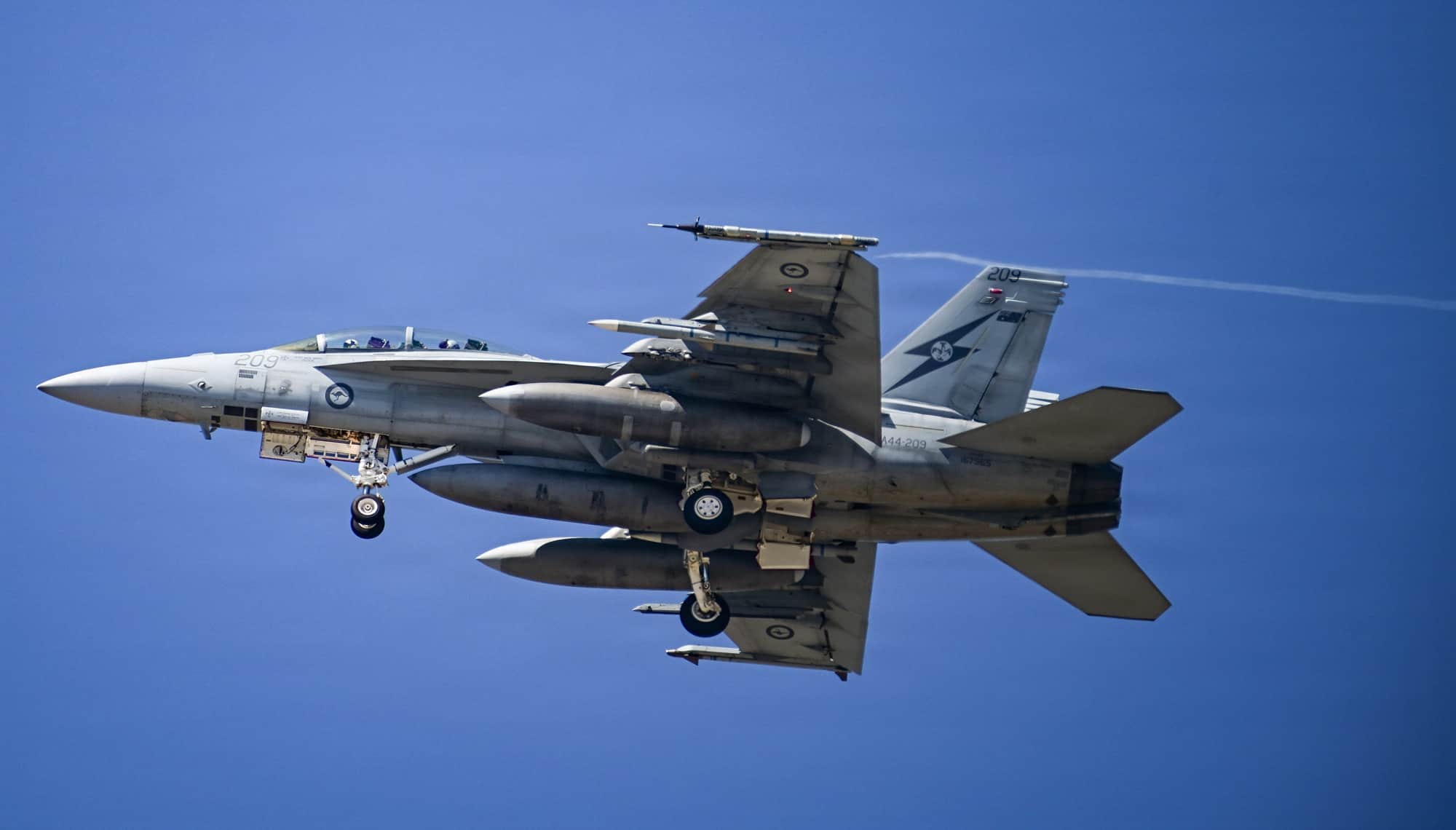
A Royal Australian Air Force F/A-18F Super Hornet was spotted carrying an inert AIM-260 Joint Advanced Tactical Missile (JATM) during the Gray Flag 2026 large-force test event at Naval Base Ventura County Point Mugu. The photo was captured on Sept. 11, 2026, although it was only released on Sept. 30.
The sighting comes few weeks after Australia announced that it would become the first country to operate the AIM-260 JATM outside the United States. In August 2026, the Australian government said it is investing almost $736 million to acquire the new missile via foreign military sales (FMS).
The AIM-260 will be first integrated onto Australia’s F/A-18F Super Hornet, followed by the F‑35A Lightning II and EA-18G Growler. The government said “The acquisition of the AIM-260 JATM will provide Air Force platforms with a credible deterrent against airborne targets, complementing existing air-to-air missile capabilities and other surface-based missile capabilities across the Australian Defence Force (ADF).”
AIM-260 on Australian Super Hornet
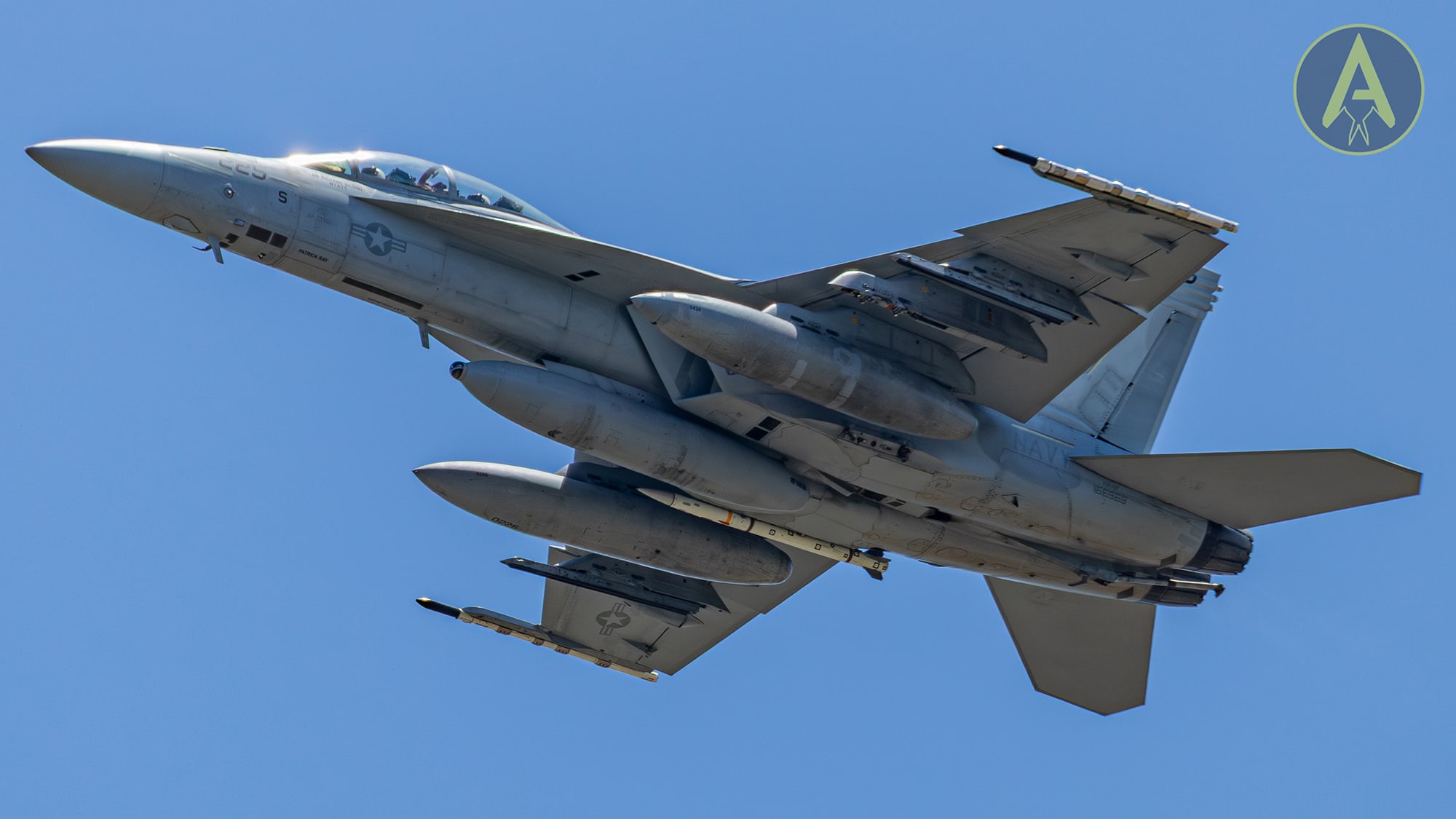
The photo captured at Naval Base Ventura County Point Mugu shows the F/A-18F Super Hornet, assigned to No. 1 Squadron, flying with a mixed loadout of inert air-to-air weapons. Similarly to the first sighting on a U.S. Navy Super Hornet, the AIM-260 can be seen installed on the weapon station 7, also known as “cheek station,” on the exterior of the air intake.
A Royal Australian Air Force F/A-18F Super Hornet assigned to No. 1 Squadron takes flight at Naval Base Ventura County Point Mugu during Gray Flag 2026, Sept. 11, 2026. | Source: U.S. Navy photo by Dana Rene White
The loadout also includes a CATM-9X (the inert training variant of the AIM-9X) on the right wingtip, as well as a CATM-120 (the inert training variant of the AIM-120 AMRAAM) on the weapon station 2, the left wing’s outermost pylon. The payload is completed by three external fuel tanks, a Tactical Combat Training System (TCTS) pod on the left wingtip and the AN/ASQ-228 ATFLIR targeting pod on the other cheek station.
Details about the test mission are not available, although there are no reports of live firing activity with the new weapon. The test mission might have involved the captive carry of the JATM in a representative operational scenario.
Gray Flag 2026
Gray Flag, held annually at Naval Base Ventura County Point Mugu, is the naval aviation test community’s premier large-force test event. This year’s edition, which ended on Sept. 25, was the largest to date, according to the Navy, with more than 750 sorties flown.
Gray Flag 2026 was hosted by the Naval Test Wing Pacific and Air Test and Evaluation Squadron (VX) 9, which led test execution with Naval Air Warfare Center Weapons Division. The latter manages the Gray Flag program and operates the Point Mugu Sea Range, a 36,000-square-mile instrumented range.
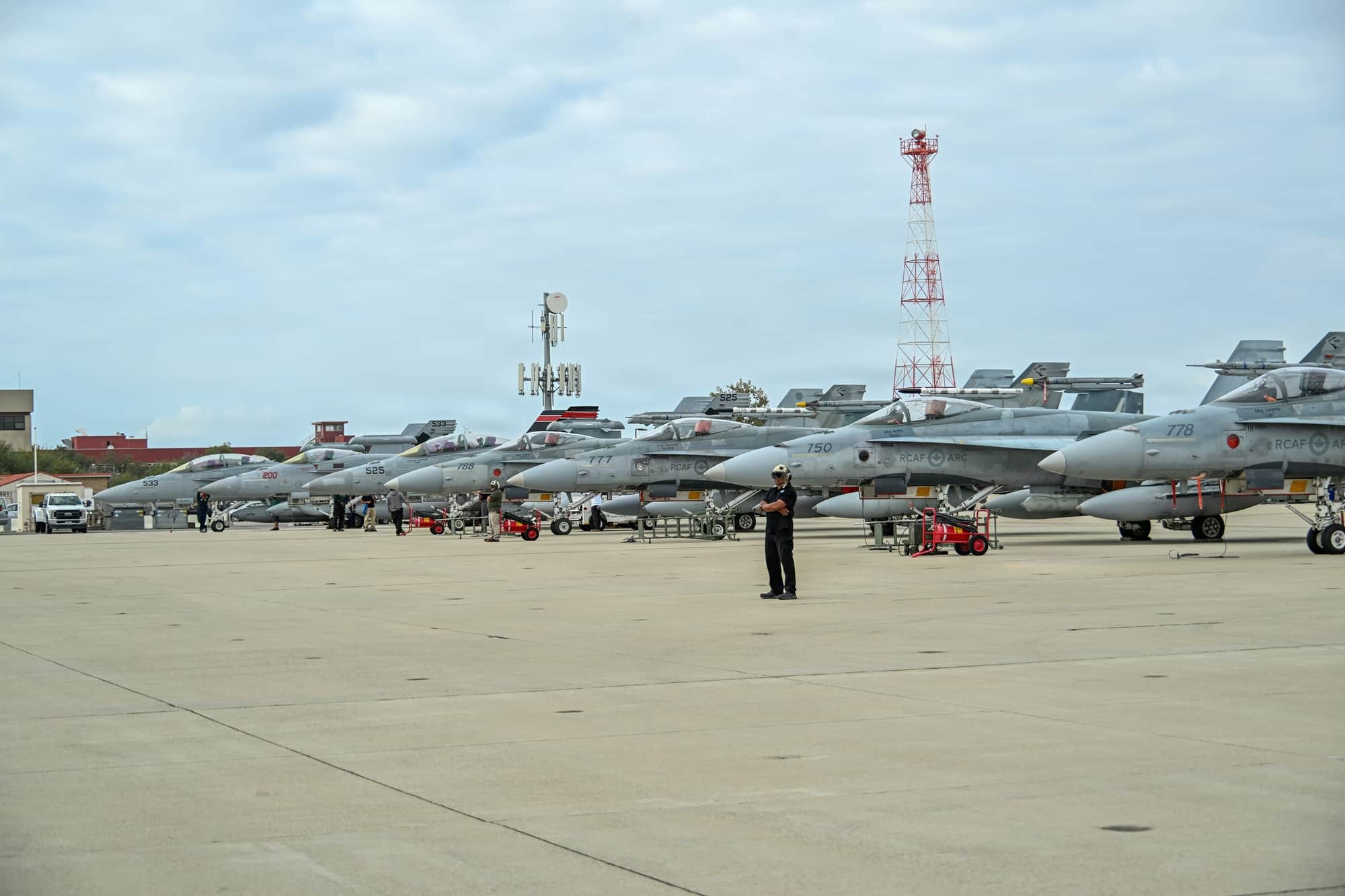
Royal Canadian Air Force CF-18 Hornets sit on the flight line at Naval Base Ventura County Point Mugu, Sept. 30, 2026. | Source: U.S. Navy photo by Katie Archibald
“Our range, combined with other test and training ranges around us, gives us the space and instrumentation to test new systems the way the joint force will use them,” said Rear Adm. Keith Hash, NAWCWD commander. “We want to find the problems here, fix them here and make sure what we send to the fleet works when the warfighter needs it.”
The service said the two-week event drew more than 3,000 participants from more than 150 organizations, and crews logged more than 2,000 flight hours covering hundreds of multi-domain test objectives for the fleet and joint force. U.S. Navy and Air Force test teams were joined by the Royal Australian Air Force, Royal Canadian Air Force and Royal Air Force.
“We leave much more informed with respect to future capabilities that enable Australia to shape our requirements for future projects and future platform upgrades that increase our lethality and survivability,” said RAAF Wing Commander Trent Baldry, commanding officer of No. 1 Squadron.
AIM-260 JATM
The existence of the AIM-260 Joint Advanced Tactical Missile was first revealed in 2019 by the Air Force, who is jointly developing the missile with the Navy. However, it was also revealed that the program had been ongoing for more than two years in 2019, meaning the program might have started in 2017 or earlier.
VX-31 F/A-18F carrying what appears to be an AIM-260 missile at Eglin AFB on May 13, 2026. | Source: Jonathan Tweedy
The AIM-260 is intended to serve as the primary long-range air-to-air weapon of both the U.S. Air Force and U.S. Navy in the coming years, becoming the successor to the AIM-120 Advanced Medium-Range Air-to-Air Missile (AMRAAM). The latter will continue to be developed, complementing the AIM-260.
The new missile will be compatible with the AMRAAM (Advanced Medium Range Air-to-Air Missile) dimensions, but with greater range, and is planned to be carried in the F-22 weapons bay and on the F/A-18 at first, with the F-35 to follow. The AIM-260 is also expected to be integrated on the U.S. Air Force’s upcoming unmanned Collaborative Combat Aircraft (CCA).
The missile is being developed and produced by Lockheed Martin. When the weapon was first unveiled, reports mentioned that AIM-260 production would overtake AIM-120 production by 2026, however, with the program’s details being highly classified and the recent boosts in the AMRAAM’s production, it is unclear if this goal still stands.
Initially, it was said the AIM-260 was also meant to counter the threat posed by the Chinese PL-15 and PL-17 missiles. The military in fact said the goal was to avoid foreign threats being able to outrange the AIM-120.
The project is an advanced state, with official saying in 2019 that flight tests would start in 2021 and Initial Operational Capability was expected in 2022, although the current timeline is unknown. Documents later showed that flight testing of the AIM-260 began as early as 2020.

 Login