Key takeaways In een poging om het onderzoek naar hogesnelheidsluchtvaart te bevorderen, heeft NASA contact gezocht met gepensioneerde ingenieurs van in de zeventig om te helpen bij een mogelijk SR-71 Blackbird-project. Supersonische vluchten Volgens berichten van Aviation Week zijn er formele aanstellingsvoorstellen gedaan aan Tim Conners en Mike Relja, die beiden eerder als testingenieurs voor […]
The new award is a step towards the Air Force’s planned fleet of 267 F-15EXs, replacing the aging F-15C/D Eagle and also beginning the recapitalization of the F-15E Strike Eagle fleet.
As The Aviationist had reported, the larger acquisition will allow the service to begin the recapitalization of the aging F-15E Strike Eagle fleet, in addition to replacing the F-15C/D Eagle which the F-15EX was originally meant to supplant. The award of the new contract also comes on the same day Boeing was chosen by the Navy for its F/A-XX next-generation fighter jet, after being selected last year for the Air Force’s F-47 NGAD.
Air and Space Forces Magazine, considering the $2.38 billion contract value disclosed by Boeing, estimated an average cost per airframe of $108 million. This value does not include the GE Aerospace F110-GE-129 engines, which the Air Force will purchase separately.
Boeing, for its part, said that it is currently delivering Lot 3 aircraft, and will continue for the remainder of this year. The deliveries of the Lot 3 started earlier this month with the delivery of the EX-22. The company also added that it is working with the Department of War (DoW) and the U.S. Air Force to hike F-15EX production to two aircraft a month.
The DoW also awarded on Sept. 29 another F-15EX-related contract to the Wisconsin-based Astronautics Corp. of America for the fighter’s engine fuel hydraulic display depot activation. The $10 million sole-source acquisition contract covers the “knowledge, skills and operational resources to independently perform depot-level repair of F-15EX engine fuel hydraulics display.” Work will be performed at Oak Creek, Wisconsin, and is expected to be completed by October 2029.
F-15EX Lot 7 contract
Air & Space Forces Magazine also reported that the Sept. 29 contract came just before a deadline for using funds allocated through last year’s $2.8 billion ‘One Big Beautiful Act’ reconciliation package and the $115 million in the FY 2026 budget. The Trump administration’s 2025 reconciliation bill mandated a reduction of the allotted funds by 8.3% if they were not spent by Oct. 1, creating pressure to award the contract to Boeing before the fiscal year ended on Sept. 30.
The press release by the Air Force Life Cycle Management Center (AFLCMC) reflected the urgency in closing the deal with Boeing:
“Through focused, complex negotiations, the F-15 Program Office and Boeing reached an agreement that maintains the procurement of all 22 Lot 7 aircraft within available funding […] This award followed extensive collaboration among program management, contracting, pricing, engineering, financial management, logistics and other acquisition professionals. The team assessed the impacts of changing production conditions and inflation, aligned the aircraft procurement with available funding, and completed the action before the fiscal-year deadline.”
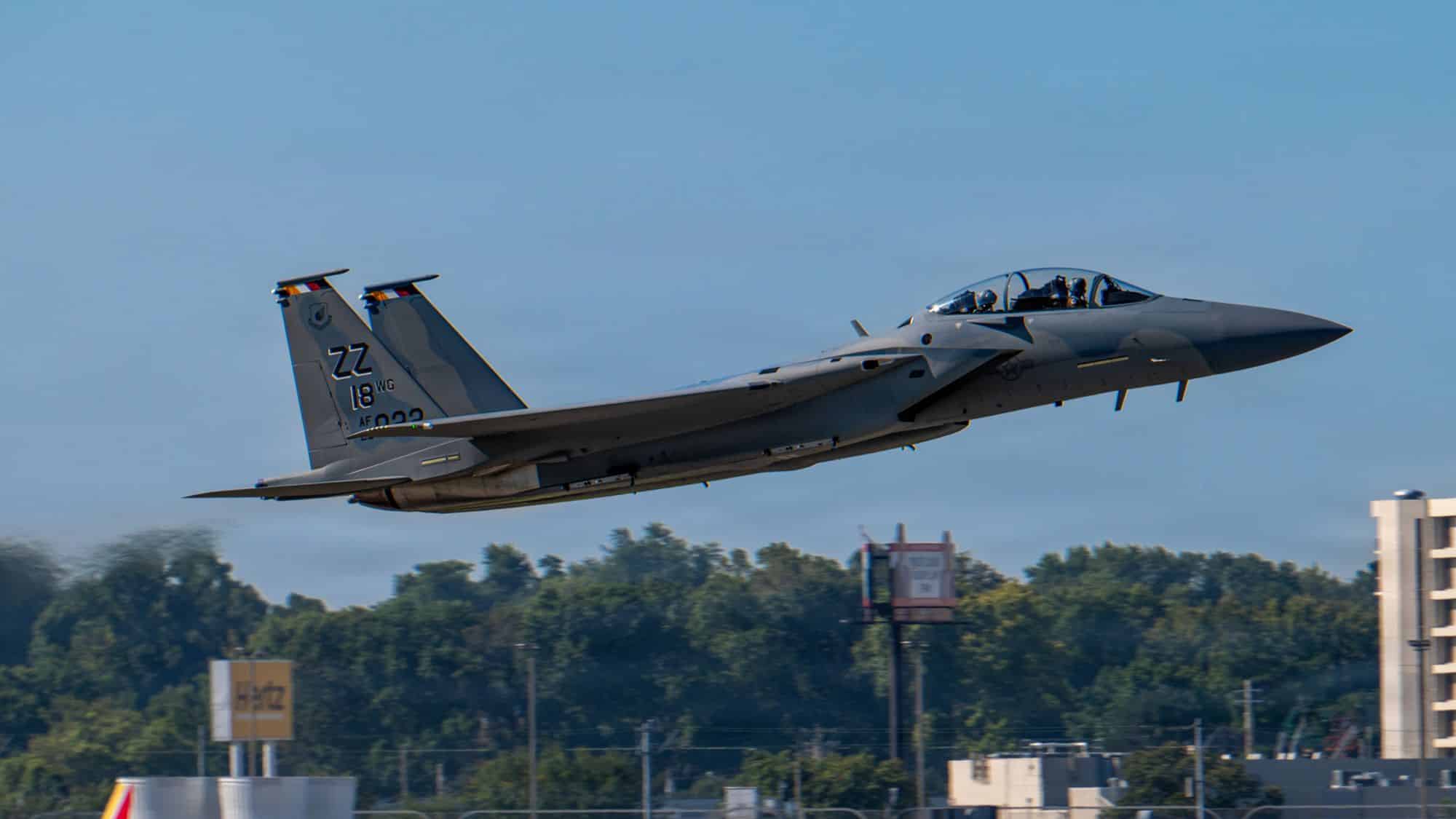
A U.S. Air Force F-15EX Eagle II designated for Kadena Air Base, Japan, flies en route to Portland Air National Guard Base, Oregon, after departing Boeing’s St. Louis facility, Aug. 28, 2026. | Source: U.S. Air Force photo by Senior Airman Melany Bermudez
Portfolio Acquisition Executive for the Fighters and Advanced Aircraft Directorate Brig. Gen. Timothy Helfrich described the Lot 7 contract as a disciplined approach that balanced available resources and industrial capacity. “The team remained focused on affordability, production continuity and delivering the aircraft needed to modernize the U.S. Air Force’s fighter fleet for the threats we face today and into the future,” Helfrich said in the release.
The release noted functional areas such as senior-level decisions, cost, schedule, and aircraft quantity that the team carefully accounted for before awarding the contract to Boeing.
“The Lot 7 award demonstrates what is possible when the acquisition enterprise moves with purpose, remains accountable to the taxpayer and stays focused on delivering capability to the warfighter,” said Col. Jonathan Varoli, System Program Manager of the directorate’s F-15 Program Office. “This effort brought together the right expertise, at the right time, to achieve an outcome that strengthens the F-15EX program and supports the future fighter force.”
Flying high for 5⃣!
Five years ago, the first #F15EX test jet flew. Since then, F-15EX has really taken off, completing hundreds of test flights and achieving several milestones — including Initial Operational Capability. Now, we’re delivering over 100 jets to the @USAirForce. pic.twitter.com/qwz6yEulL1
The F-15EX is the modern evolution of the twin-engine heavyweight multirole jet, featuring advanced avionics, large-area displays, digital backbone architecture and enhanced survivability capabilities. “It is intended to replace aging F-15C and F-15D aircraft while providing a platform for continued modernization as operational requirements evolve,” the Air Force said.
One of its defining features is the AN/ALQ-250 Eagle Passive Active Warning Survivability System (EPAWSS), an electronic warfare suite that provides integrated radar warning, threat detection and advanced jamming and countermeasure capabilities.
Thanks to its capabilities, the F-15EX is also being introduced in the Indo-Pacific, with Kadena Air Base in Japan, home to the Air Force’s 18th Wing, selected as its first permanent overseas operating location.

 Login