


















FreshRSS

πŸ”’
❌ About FreshRSS
There are new articles available, click to refresh the page.
Yesterday β€” 6 September 2026ZeroHedge

Federal Government Backs Supreme Court Challenge To AR-15 Bans

6 September 2026 at 23:00
Federal Government Backs Supreme Court Challenge To AR-15 Bans

Authored by Bill Pan via The Epoch Times,

The federal government is urging the U.S. Supreme Court to side with gun owners challenging state and local bans on AR-15-style rifles.

In a brief filed Friday, Solicitor General D. John Sauer asked the justices to overturn rulings from the U.S. Courts of Appeals for the Second and Seventh Circuits, which upheld AR-15 bans in Connecticut and Cook County, Illinois, respectively.

"The AR-15 rifle is unquestionably in common use among law-abiding citizens for lawful purposes," the federal government argued.

The cases, Viramontes v. Cook County and Grant v. Higgins, have been consolidated for Supreme Court review.

Connecticut has prohibited what it deemed "assault weapons" since 1993. It significantly expanded the ban after the 2012 shooting at Sandy Hook Elementary School, describing AR-15-style rifles as particularly dangerous and preferred by mass shooters.

Cook County, which covers the city of Chicago, adopted its current firearm ordinance in 2006, prohibiting the possession, sale, and transfer of a list of semiautomatic weapons.

The 'Common Use' Debate

At the center of the dispute is whether AR-15-style rifles qualify as weapons "in common use" for lawful purposes and therefore fall under Second Amendment protection.

The idea dates back to the Supreme Court's 1939 decision upholding a federal ban on short-barreled shotguns because those weapons were not "in common use."

The Court relied on the same concept in 2008 to invalidate a ban on handguns in the nation's capital, affirming that they are "the most popular weapon chosen by Americans for self-defense in the home."

Most recently, the Court referred to the common-use test in 2022 when it struck down a New York law requiring people to show a special need before receiving a license to carry a handgun in public.

Connecticut argues that AR-15-style rifles do not meet the Supreme Court's legal standard.

"Americans do not commonly own assault weapons for self-defense," state lawyers argued in an earlier Supreme Court filing, adding that the weapons are "neither used nor useful for that purpose."

The gun owners challenging the bans, however, argue that AR-15s easily pass the common-use test.

"If the most popular rifle in the country is not in common use," the challengers said in their petition, "it is hard to see what that phrase could possibly mean."

The Justice Department is siding with challengers in the debate.

"Today, AR-15s are lawful at the federal level and in 40 States, with law-abiding citizens using them for lawful purposes such as self-defense, target shooting, and hunting," the government said.

"Legislatures may not ban arms in common use among law-abiding citizens for lawful purposes."

DOJ Counters Pro-Ban Arguments

Sauer also rejected arguments that AR-15-style rifles can be banned because of their military origins, firepower, or use in mass shootings.

"When it comes to lethal arms, rifles such as AR-15s are not 'especially dangerous,'" the government argued.

Handguns are easier to carry and conceal and are used in crimes far more often than rifles, the government said. Yet the Supreme Court has already ruled that handguns cannot be broadly banned.

The government also rejected the argument that AR-15 bans are acceptable because people can still use handguns for self-defense.

Sauer compared that reasoning to banning one type of First Amendment-protected speech simply because another remains available.

Allowing a government to ban rifles because handguns remain legal would be "like saying books can be banned because people can always read newspapers," he wrote, quoting an analogy Justice Brett Kavanaugh made as an appeals court judge.

How Courts Could Judge 'Common Use'

The government also proposed a way for courts to determine whether a weapon is in common use without relying solely on estimates of how many people own it.

A longstanding ban adopted by Congress and most states could be evidence that a type of weapon is not commonly and lawfully possessed, the brief said.

The opposite would also be true. A firearm that has remained widely legal for decades would weigh in favor of constitutional protection.

The government argued that both the legal history and ownership figures favor the AR-15.

The AR-15 was developed by ArmaLite in 1956 and has been commercially available for decades. Industry estimates suggest that between 28 million and 32 million AR-15-style rifles are in circulation in the United States.

In 1994, Congress adopted a narrow ban on certain new semiautomatic firearms but did not prohibit possession of previously manufactured rifles. That ban expired in 2004.

The respondents' briefs are due Oct. 21. The Supreme Court has scheduled oral argument for Dec. 2.

A ruling is expected before the Court concludes its 2026-2027 term, typically in late June.

Tyler Durden Sun, 09/06/2026 - 16:00

Biggest 'Go Woke, Get Broke' Story Of A Generation: S&P Nukes Nike From Elite Blue-Chip Index

6 September 2026 at 22:30
Biggest 'Go Woke, Get Broke' Story Of A Generation: S&P Nukes Nike From Elite Blue-Chip Index

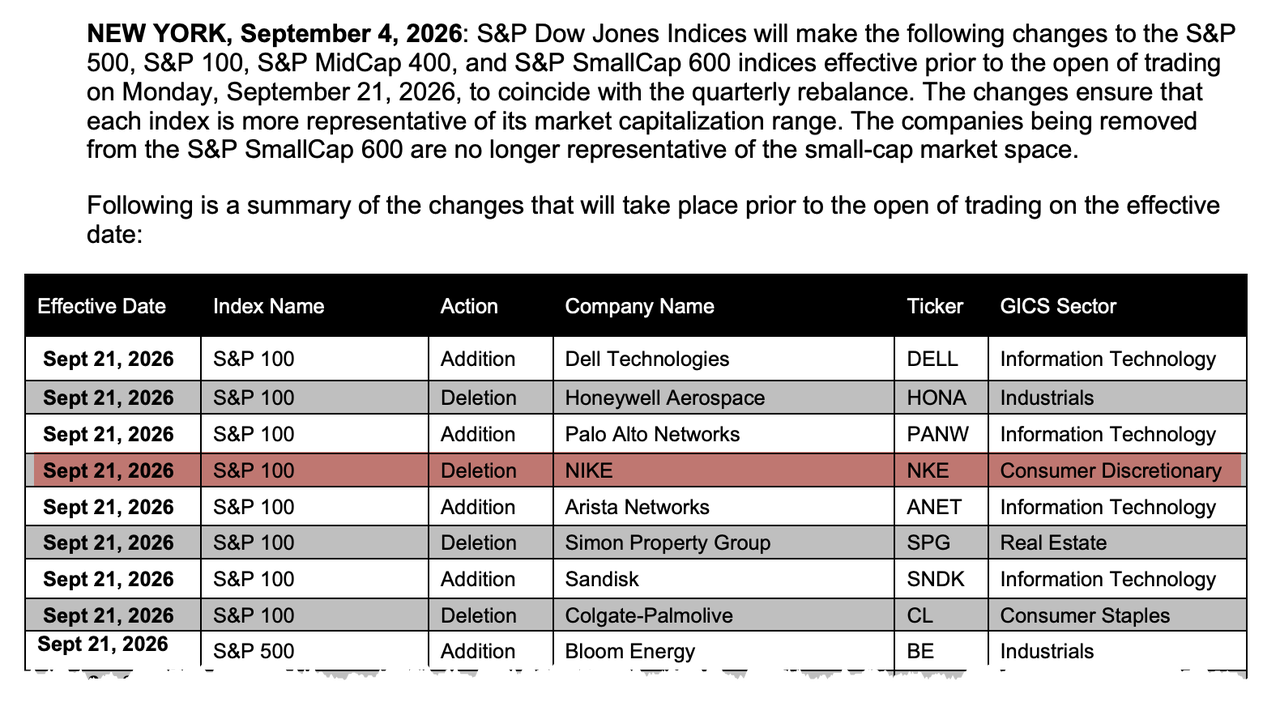
S&P Dow Jones Indices announced Friday that Nike is being booted from the S&P 100 after nearly two decades, another sign of how America's most exclusive blue-chip benchmark is being reshaped by the artificial-intelligence spending boom. But that's not the entire story...Β 

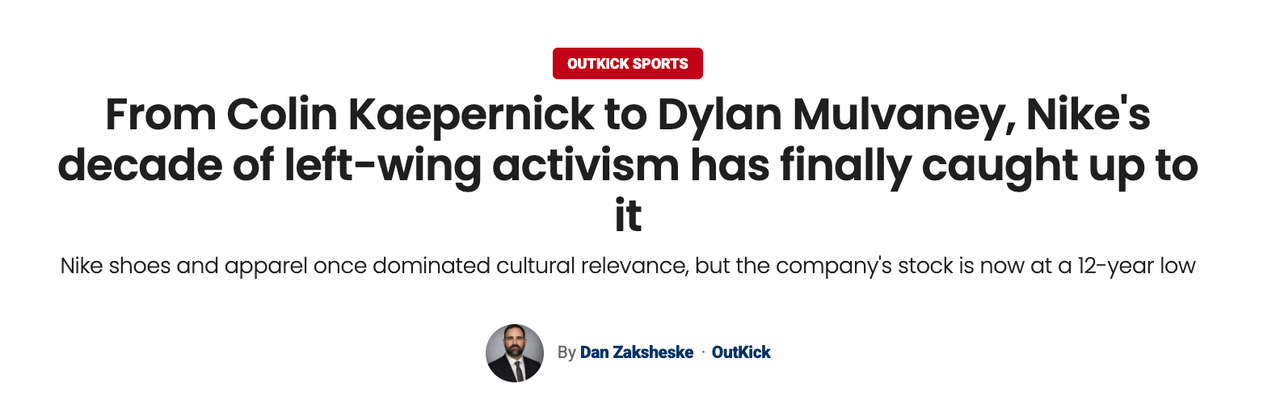
Perhaps what really happened with Nike is that it lost its way. Instead of focusing on basketball shoes and athletic leisure, it pursued the whole woke culture, which damaged the brand.

Injected itself into far-left politics.Β 

And this ...Β 

BREAKING: Nike is set to be removed from the S&P 100 after nearly 18 years.

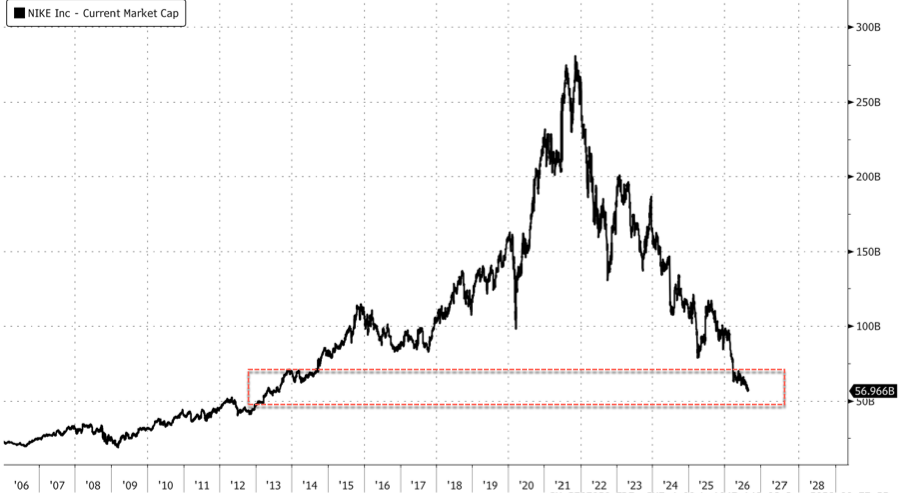
The stock is now down almost 80% from its 2021 peak, turning one of the market’s most iconic consumer brands into one of its biggest recent disappointments. pic.twitter.com/3uJNIxcg4j

β€” I Meme Therefore I Am πŸ‡ΊπŸ‡Έ (@ImMeme0) September 5, 2026

Via Fox News...

Not surprising whatsoever who accelerated Nike's demise.Β 

LMAO, look at the marketing & strategy officers for Nike.

Don’t worry, guys; I’m sure Nike will climb out of the huge woke hole they are in πŸ₯΄πŸ«  pic.twitter.com/7CXinp8VUA

β€” Mrs B (@attackdogX) September 6, 2026

S&P Dow Jones Indices noted that Nike will remain in the broader S&P 500.

Nike's peak was in late 2021, when it sported a $280 billion market cap that has since crashed to as low as $56 billion following Friday's close, its lowest market capitalization since 2013.

No longer a growth story?Β 

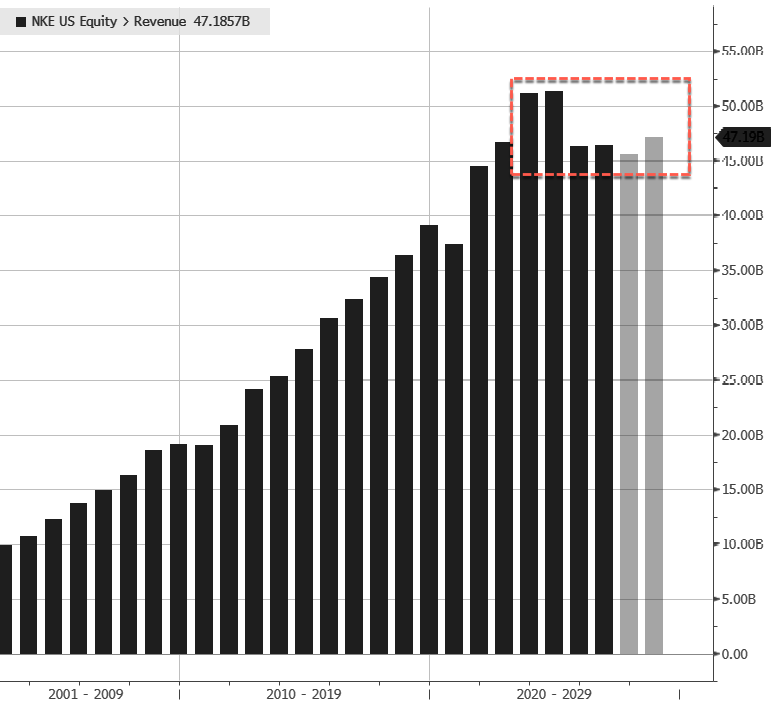
Nike's upcoming demotion from the S&P 100, set to take effect on Sept. 21, comes after a series of missteps as the sportswear giant struggles to revive sales and has lost market share to rivals including On and Hoka.

Perhaps management should not have focused on left-wing cultural issues but instead on clothing and sneakers.

Tyler Durden Sun, 09/06/2026 - 15:30

Trump: Michael Cohen Recanted Testimony Behind NY Cases

6 September 2026 at 22:00
Trump: Michael Cohen Recanted Testimony Behind NY Cases

Authored by Luis Cornelio via Headline USA,

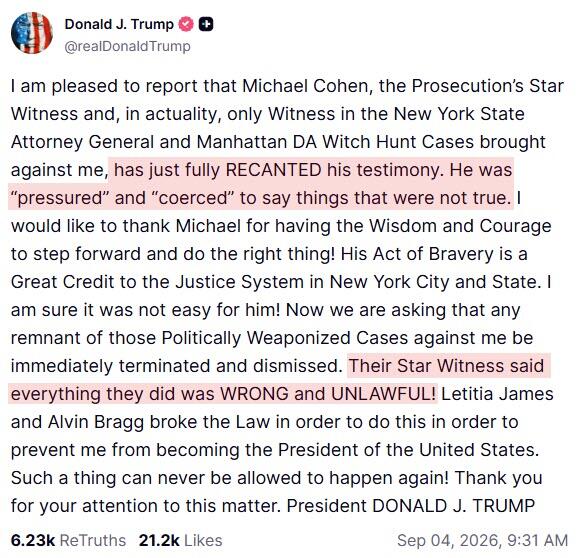
Michael Cohen, a key witness in the New York criminal and civil cases against President Donald Trump, has "fully recanted" his testimony in both cases, the Republican president announced Friday via Truth Social.

Previously known as Trump's longtime fixer, Cohen was used by New York Attorney General Letitia James in her controversial civil lawsuit against the Trump Organization and by Manhattan District Attorney Alvin Bragg in his so-called hush money case against Trump.

The civil case against the Trump Organization culminated in a $364 million fine over claims Trump inflated his asset values to secure more favorable loans for his business. The fine was tossed by the New York Appellate Division, which ruled the amount violated Trump's Eighth Amendment rights.

In his Truth Social post, Trump said Cohen was "pressured" and "coerced" into saying "things that were not true."

The fallout between Trump and Cohen began after the 2016 election, after Cohen started cooperating with federal prosecutors.

Cohen was sentenced to three years in prison and served more than a year behind bars after pleading guilty to multiple charges, including making false statements to Congress.

Trump and Cohen have made amends in recent months, particularly after Cohen came forward saying he was pressured by New York prosecutors to testify against Trump.

Trump thanked Cohen "for having the Wisdom and Courage to step forward and do the right thing!"

"His Act of Bravery is a Great Credit to the Justice System in New York City and State," Trump added, before demanding that the cases be dismissed.

"I am sure it was not easy for him! Now we are asking that any remnant of those Politically Weaponized Cases against me be immediately terminated and dismissed."

The president said that James and Bragg "broke the law in order to do this in order to prevent me from becoming the President of the United States. Such a thing can never be allowed to happen again!"

Trump appeared to be referring to a Jan. 16, 2026, Substack post in which Cohen accused prosecutors from James' and Bragg's offices of pressuring and coercing him to provide testimony that would help them build their cases against Trump.

TRUMP: Reposts Michael Cohen article claiming political power corrupts justice, citing insider warning pic.twitter.com/FlydWGDuBI

β€” Trump Truths (@trumptruthsbot) September 4, 2026

Cohen wrote at the time:

"From the time I first began meeting with lawyers from the Manhattan DA's Office and the New York Attorney General's Office in connection with their investigations of President Trump, and through the trials themselves, I felt pressured and coerced to only provide information and testimony that would satisfy the government's desire to build the cases against and secure a judgment and convictions against President Trump."

He later added:

"I experienced a similar dynamic in the Attorney General's civil case. Letitia James made it publicly known during her 2018 campaign for attorney general that, if elected, she would go after President Trump. Her office made clear that the testimony they wanted from me was testimony that would help them do just that. Again, I felt compelled and coerced to deliver what they were seeking."

Tyler Durden Sun, 09/06/2026 - 15:00

A GoFundMe In Support of Lindsay Clancy Nears $1.2 Million After Mistrial

6 September 2026 at 21:30
A GoFundMe In Support of Lindsay Clancy Nears $1.2 Million After Mistrial

A Massachusetts jury deliberated for roughly 38 hours over seven days and failed to reach a unanimous verdict in the case against Lindsay Clancy, resulting in Judge William Sullivan declaring a mistrial on FridayΒ due to a holdout juror.Β 

Clancy has admitted to strangling her three children, Cora, 5, Dawson, 3, and Callan, 8 months, with exercise bands inside the family's home in Duxbury, Mass., in January 2023 after sending her husband out to pick up dinner. She then cut her own wrists and neck, then jumped from a window, which left her paralyzed from the waist down.

Reddington built his case on a claim of severe postpartum psychosis, worsened, he argued, by a combination of prescription medications. Prosecutors rejected that framing entirely and argued Clancy understood what she was doing and planned the killings in advance. Clancy had not been diagnosed with psychosis before the murders and reportedly had not told any doctor she was hearing voices.

Judge Sullivan has scheduled a status and trial assignment hearing for Sept. 29.

Lindsay Clancy's supporters are clearly expecting a new trial. The Musgrove Family Fund, a GoFundMe campaign supporting Clancy's parents, Michael and Paula Musgrove, surpassed $1.16 million in donations from more than 33,000 donors within hours of the mistrial. Organizer Brandee Mulligan, a 42-year-old mother of three, raised the fund's goal to $3 million that same day and told supporters the extended legal process means the Musgroves will need help for a while longer.

"The original purpose of this fundraiser hasn't changed - it's simply to take one thing off their plate while they continue to show up for their family. If they have to keep showing up longer, I want to make sure the support does too."

The Musgroves left Wallingford, Connecticut, and moved roughly 150 miles to stay near Duxbury. Clancy's sister, Allison Ozga, appeared at the proceedings alongside them. GoFundMe's page states the Musgroves are the named beneficiaries who receive the money themselves, that Mulligan has no access to any of it, and that both the parents and Reddington knew about the campaign before it went live.

Mulligan, who is from Wisconsin and launched the fund on Aug. 11, previously told the Daily Mail that she had no contact with the Musgroves when she first created it and "did it without even asking permission." A GoFundMe spokesperson has confirmed the campaign is verified and that all funds go to Mike Musgrove as the intended beneficiary.

"In January 2023, Lindsay Clancy was accused of killing her three young children in the family's Duxbury, Massachusetts home," the GoFundMe page reads. "More than three years later, her case is now being tried in court. Throughout those three years, Lindsay's parents, Mike and Paula Musgrove, have continued to show up for their daughter."

"And that is who this fundraiser is for, Mike and Paula, who have spent years traveling back and forth, staying in hotels, attending court proceedings and ultimately relocating from Connecticut to Massachusetts so they could remain close to Lindsay," the page continues. "Their lives have largely been put on hold while they have continued doing what parents do: showing up for their child during the unimaginable. That has come at an enormous financial cost. This fundraiser is not asking anyone to agree on Lindsay, her case, or what the outcome of her trial should be. People will have different feelings about all of those things."

The new donations range from five dollars to three hundred, one-time gifts sitting beside recurring monthly pledges, though some of the biggest donations to the fund are in the thousands. One anonymous donor gave $5,000.

One donor wrote that their heart was with Lindsay and her parents and that they could not imagine the pain the family has endured. Another, on a fifth contribution, wrote that they could not imagine what Lindsay and her family are feeling right now.

The fund's success has spawned imitators on the platform, both for and against the family, including pages titled "Lindsay Clancy is an awful person!" and "Against the Musgrove Family Fund." GoFundMe told CT Insider it is monitoring and "reviewing" all Clancy-related fundraisers, and that "any found to be in violation of our terms of service will be removed."

Copycat

The trial appears to have produced at least one copycat. Corie A. Walsh, 38, of Frankfort, Illinois, was charged Friday with three counts of first-degree murder after her 2-year-old son Barrett was found hanging in the basement of the family home, a ligature around his neck. A 17-year-old neighbor was performing CPR when police arrived. Officers found Walsh upstairs in a bathtub, surrounded by bloody water, with cuts to her wrists and thighs. Her three other children were unharmed. Her husband was out of town.

Prosecutors said in a court proffer that Walsh "had recently become very invested in the Lindsay Clancy murder trial" and had been "actively discussing the case via group text message with her friends" until hours before her son was found. The boy died Tuesday afternoon, while the Clancy jury was still deliberating. Walsh told officers she killed him because he was the "devil" and the "anti-Christ."

Tyler Durden Sun, 09/06/2026 - 14:30

From Par To Pennies

6 September 2026 at 21:00
From Par To Pennies

Submitted by QTR's Fringe Finance

Private credit’s reckoning is not arriving with one grand, spectacular crash. It is arriving slowly and steadily, one loan at a time.

For years, one of private credit’s great attractions was the remarkable stability (orΒ perceivedΒ stability) of its valuations. Public bonds could fall ten points in a week. Leveraged loans could gap lower after a bad earnings report. But private loans somehow possessed the soothing ability to remain at 98, 99 or 100 cents on the dollar through almost anything, all while paying investors a healthy yield.

Incredible, right? Another financial fairy tale…a proverbial unicorn sh*tting rainbows.

Until reality eventually reared it’s head, and now, to the surprise of no one, we are finding out unicorns don’t exist. Imagine that. We are learning that the absence of volatility in a reported mark does not mean the absence of deterioration in the underlying loan. And that is increasingly where the private credit story gets heinous…and why I’ve been writing about it for 2 years now.

The opacity is unlike any other corner of markets. Some borrowers can weaken for months, even years, while their loans remain marked at levels suggesting that most or all of the money is still coming back.

Eventually, though, something happens that makes the deterioration impossible to finesse away. A borrower stops paying interest. A hoped for refinancing disappears. The sponsor declines to put in more equity. A rescue transaction collapses. Or, most decisively, like we are seeing more and more, the underlying company files for bankruptcy.

That is when the soothing stability of private credit can suddenly disappear. A loan that sat near par through months of worsening fundamentals can plunge to 50, 20, five cents or even zero inΒ remarkablyΒ short order. The economic deterioration may have been happening all along. The mark simply waited until reality became too difficult to ignore. You then get headlines like this one fromΒ BloombergΒ yesterday.

And increasingly, the pattern looks familiar. A company struggles, leverage stays high, liquidity deteriorates and interest becomes harder to pay. Yet there is always a reasonΒ notΒ to mark the loan too aggressively. Maybe EBITDA recovers. Maybe rates fall. Maybe the sponsor writes another check. Maybe there is a refinancing, an asset sale or a transformational M&A deal just around the corner. Maybe the guy responsible for marking down the loan has set his β€œout of office” email response to inform people he is taking 2 month vacation on his yacht in Malta.


πŸ”₯ 85% OFF FOREVER IF YOU SUBSCRIBE TODAY:Β I am again offering an 85% discount to anyone that wants to become aΒ Fringe FinanceΒ annual subscriber today. It’s a discount you can keep and stays applied for as long as you wish to remain a subscriber:Β Get 85% off forever


Hope, conveniently, has a fair value. It’s always 100 cents on the dollar or damn close to it. But then…painstakingly and eventually…reality catches up and 100 cents quickly becomes 20 cents. Or zero cents.

The latest example is Loparex, a borrower held by Blue Owl Capital Corp., or OBDC. According toΒ Bloomberg, at the end of 2025, its first lien debt was still carried around par and its second lien debt at roughly 88 cents on the dollar. By June, OBDC was carrying portions of the second lien at about five cents and one first lien position at roughly 22 cents. Loparex was also put on nonaccrual. Moody’s has since deemed the company in default and said a Chapter 11 filing is a possibility.

Perhaps recoveries ultimately exceed those marks. That happens in restructurings. But the interesting number is not five cents. It is 88 cents.

The loan did not suddenly become troubled on the day somebody changed the valuation. Loparex had been struggling with its debt load for years, including a 2024 distressed exchange that S&P considered tantamount to default.Β Yet the second lien still ended 2025 marked at roughly 88.

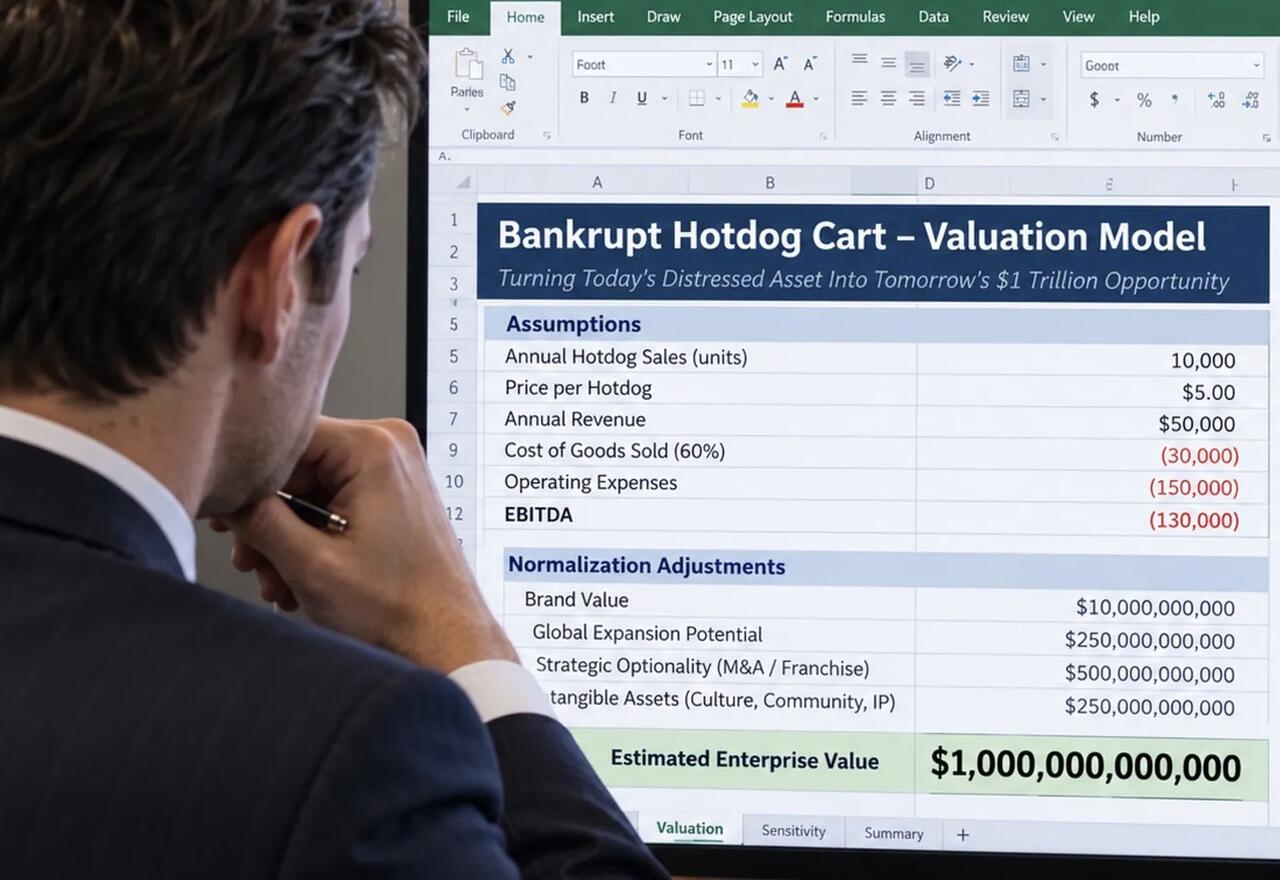
This gets to the central problem with private credit valuations that I have been harping on non-stop for years. These loans generally do not trade in liquid markets, so managers rely on models, comparable companies, third party valuation firms and their own judgment. That is unavoidable. But it also means that valuation becomes most subjective precisely when the underlying credit becomes most uncertain. If an executive were so inclined, he could figure out a way to model a bankrupt hot dog cart at a $1 trillion valuation. Like the Fed, printing cash, it’s all just made up bullsh*t out of thin air manipulated in seconds on a spreadsheet.

And that’s all good and well. But bankruptcy has a nasty habit of pissing in the proforma punchbowl. Once a company actually files bankruptcy, the comfortable range of hypothetical outcomes (hereinafter referred to as β€œbulls*it”) gets much narrower. Creditors, restructuring advisers and courts start converting theoretical enterprise values into actual recoveries. At that point, extending and pretending gets considerably harder.Β 

Bankruptcy does not necessarily create the loss. It can simply make the loss impossible to avoid recognizing.

Here are some recent examples that make the point and what to watch out for.

--

QTR’s Disclaimer:Β Please read my full legal disclaimerΒ on my About page here.Β This post represents my opinions only.Β In addition, please understand I am an idiot and very often get things wrong and lose money. I may own or transact in any names mentioned in this piece at any time without warning, meaning if I’m long I could sell or if I’m short I could cover at any time.

Contributor posts, guest posts and curated posts have been hand selected by me, but have not been fact checked and are the opinions of their authors. They are either submitted to QTR by their author or reprinted under aΒ Creative Commons licenseΒ with my best effort to uphold what the license asks, or with the permission of the author.

I cannot guarantee the accuracy of any or all facts and figures included in this article though I made an effort to get them right. I have been wrong before and will be wrong again, and encourage you to always double check, do your own research and speak to a licensed financial professional, which I am not.

This is not a recommendation to buy or sell any stocks or securities, just my opinions. I often lose money on positions I trade/invest in. I may add any name mentioned in this article and sell any name mentioned in this piece at any time, without further warning. None of this is a solicitation to buy or sell securities. I may or may not own names I write about and are watching. Sometimes I’m bullish without owning things, sometimes I’m bearish and do own things I’m bearish on. Just assume my positions could be exactly the opposite of what you think they are just in case. If I’m long I could quickly be short and vice versa. I won’t update my positions.

Starting in 2026, I have been attempting to no longer actively trade as much as I once did (read my story here). My goal is for myΒ investing/saving to be done by recurring contributions mostly to sector ETFs and a few select equities, trusted third parties who oversee my accounts, and advisors. Such advisors or funds, through individual equities, options, index funds, mutual funds, ETFs, or other securities, may have positions in, exposure to, or holdings of names mentioned herein that I know nothing about. It is possible I could own, have exposure to, or not own anything, at any point. In anΒ attempt to lead a healthier lifestyle, I’ve also excluded myself from fantasy sports, sports betting, online and in-person casinos and prediction markets.

Any of my positions can change immediately as soon as I publish, with or without notice and at any point I can be long, short or neutral on any position. You are on your own. Do not make decisions based on my blog. I exist on the fringe. If you see numbers and calculations of any sort, assume they are wrong and double check them. I failed Algebra in 8th grade and topped off my high school math accolades by getting a D- in remedial Calculus my senior year, before becoming an English major in college so I could bullsh*t my way through things easier. Hence, why I am a writer.

The publisher does not guarantee the accuracy or completeness of the information provided in this page. These are not the opinions of any of my employers, partners, or associates. I did my best to be honest about my disclosures but can’t guarantee I am right; I write these posts after a couple beers sometimes. Many times I edit after my posts are published because I’m impatient and lazy, so if you see a typo, check back in a half hour.

Also, again I just straight up get sh*t wrong a lot. I mention it multiple times because it’s that important you understand.

Tyler Durden Sun, 09/06/2026 - 14:00

They/Them Communist Activist Declares Ozempic "Fascist" Plot To "Genocide Fat People"

6 September 2026 at 20:30
They/Them Communist Activist Declares Ozempic "Fascist" Plot To "Genocide Fat People"

America's socialist leadership increasingly looks less like a political movement and more like a circus where the clowns run the show.

Its most radical theorists openly advocate dismantling capitalism and the institutions underpinning the Western order while romanticizing communist regimes defined by nation-killing economic ruin and political repression. Rather than building a credible working-class movement, these clowns have marginalized themselves through far-left extremism and become objects of national ridicule.

The latest clown show comes from Da'Shaun L. Harrison, an Atlanta-based writer, activist, and self-described Afropessimist, anarcho-communist, abolitionist, and trans theorist who uses they/them pronouns.

Recently, at the Socialism 2026 conference, Harrison called the political deployment of GLP-1 drugs "fascistic" because they exist in "a world fixated on genociding fat people."

"The political deployment of GLP-1s is fascistic, not because individuals take them, but because the conditions under which they become necessary are shaped by a world fixated on genociding fat people," Harrison continued.

To explain why GLP-1s are fascistic, Harrison turned to Frantz Fanon and "Black flesh under colonial surveillance."

🚨 Da’Shaun L. Harrison at Socialism 2026 argues that the political deployment of GLP-1 drugs is β€œfascistic” because they exist in β€œa world fixated on genociding fat people.”

β€œThe political deployment of GLP-1s is fascistic, not because individuals take them, but because the… pic.twitter.com/CMxfUTUq0e

β€” Stu Smith (@thestustustudio) September 5, 2026

If Harrison wants to really own his own words, then every diet, every gym, every bariatric surgery, and every doctor who says folks are overweight should be viewed as a war criminal. Make this far-left activist eat his own words.Β 

Tyler Durden Sun, 09/06/2026 - 13:30

Diplomatic Blitz: Witkoff, Kushner Hold "Substantial" Ukraine Talks After Putin Meeting

6 September 2026 at 20:05
Diplomatic Blitz: Witkoff, Kushner Hold "Substantial" Ukraine Talks After Putin Meeting

President Trump's diplomatic sprint shifted from Moscow to Kiev over the weekend, with White House special envoy Steve Witkoff and presidential son-in-law Jared Kushner arriving in Ukraine for talks with senior officials. The visit came one day after the pair met with Russian President Vladimir Putin.

Russian state media outlet TASS cited Kremlin spokesman Dmitry Peskov, who said Putin's meeting with Witkoff and Kushner had created an "atmosphere of trust, at least through this channel of communication."

Putin meets Witkoff and Kushner for peace talks. pic.twitter.com/NqqAelwuEG

β€” Clash Report (@clashreport) September 5, 2026

"The very fact that the meeting is taking place means that an atmosphere of trust does indeed exist, at least through this channel of communication, and that it is strengthening. As a rule, however, expanded exchanges of such welcoming remarks emerge when there are messages that the head of state considers necessary to convey," Peskov explained to the outlet.

A White House official said Witkoff and Kushner's three-hour meeting with Putin "discussed substantive plans for next steps, which will be announced in the coming weeks."

Last week, Reuters cited Kremlin aide Yuri Ushakov, who said Putin, Trump, and Chinese President Xi Jinping may hold a trilateral meeting at the next Asia-Pacific Economic Cooperation summit in November.

After the Moscow meeting on Saturday, Witkoff and Kushner traveled to Ukraine for the first time during Trump's second term as part of his pledge to bring the conflict to an end.

Steve Witkoff and Jared Kushner arrived in Ukraine by train.

They were greeted by senior Ukrainian officials. pic.twitter.com/KLRk9796Zf

β€” Clash Report (@clashreport) September 6, 2026

Bloomberg reported early Sunday that Witkoff and Kushner's first round of talks with Ukrainian President Volodymyr Zelenskyy and other high-level officials had ended.

Witkoff was quoted by the outlet as describing his talks with Ukrainian officials as "substantial," although no further details about what was discussed were released.

"We all want to end the war, and we are on the same page here," Zelenskyy said in brief remarks to reporters after the first meeting. "Every such meeting gets us closer to peace."

Steve Witkoff to Zelensky:

We're having a great time here, and the hospitality is unsurpassed.

The President wanted Jared and I to come here.

We had a great trip, took the train, and as you said, it was a delightful trip. pic.twitter.com/QTFxcdlwdT

β€” Clash Report (@clashreport) September 6, 2026

Zelenskyy was expected to speak to the reporters later in the day alongside the US envoys.

The push for a diplomatic end to the four-and-a-half-year conflict began with CIA Director John Ratcliffe's unexpected visit to Moscow nearly two weeks ago.

Ahead of the weekend meetings, Bloomberg reporters were increasingly less optimistic about a breakthrough peace deal, saying the prospects for ending the war remained low.

Tyler Durden Sun, 09/06/2026 - 13:05

Iran Vows 'Faster, More Painful' Response To US Attacks After Weekend Sea Battle

6 September 2026 at 19:40
Iran Vows 'Faster, More Painful' Response To US Attacks After Weekend Sea Battle

Iran's Parliament Speaker Mohammad Bagher Ghalibaf on Sunday announced a heightened military posture in the war with the US, saying that new attacks on the country will "meet a faster, heavier and more painful response."

"If they haven't understood by now, they should understand before it’s too late that the rules of the game have changed and that from now on, any violation of Iran’s interests and security will receive a β€˜faster, heavier, and more painful’ response,” Ghalibaf said in a postΒ on Telegram. He has warned that Iranian retaliation will no longer be "proportionate".

Source: US Central CommandΒ 

Ghalibaf also conceded that Iran faces severe economic pressures amid US-led sweeping sanctions and the campaign of 'strangulation' and isolation efforts.

"Severe fluctuations in the exchange rate, inflation, unemployment, and market management are fundamental challenges that have put serious pressure on people’s livelihoods," Ghalibaf said.

He also laid out that the Islamic Republic must aim to bolster domestic production and use technology to "devise short-term and permanent solutions." Iran's military has all along touted that it never stopped manufacturing missiles and drones, even as US-Israeli bombs decimated many industrial sites.

Ghalibaf's words come a day after theΒ Islamic Revolutionary Guard Corps (IRGC) said it attacked three American military ships and three oil tankers using an "unauthorized" route in the Strait of Hormuz. Also, in the latest:

Iran said Sunday it struck an unmanned U.S. vessel trying to enter the Strait of Hormuz, a claim that the U.S. military dismissed as a "total lie."

The US military earlier on Saturday hadΒ struck three Iranian oil tankers,Β M/T Downy, M/T Stark 1, and M/T KyloΒ - in a major first of the conflict (that is, a US attack on civilian vessels).

The Iranian parliament speaker continues to try and troll Trump and Bessent on X:

Wheels up. Warm-ups before liftoff:

Diesel ATH: Short it

Your biggest creditor dumping: Good luck with Yentervention++

NOR cutting $80B: Rename Norway to Americaway

Low recruitment: Debt-to-Service w/ DO[Israel's]W, per your puppeteers

Oh. Fed's dot plot flashing red 😁 https://t.co/E1KzG1T6Yf pic.twitter.com/zJb56tsd7p

β€” Ω…Ψ­Ω…Ψ―Ψ¨Ψ§Ω‚Ψ± Ω‚Ψ§Ω„ΫŒΨ¨Ψ§Ω | MB Ghalibaf (@mb_ghalibaf) September 6, 2026

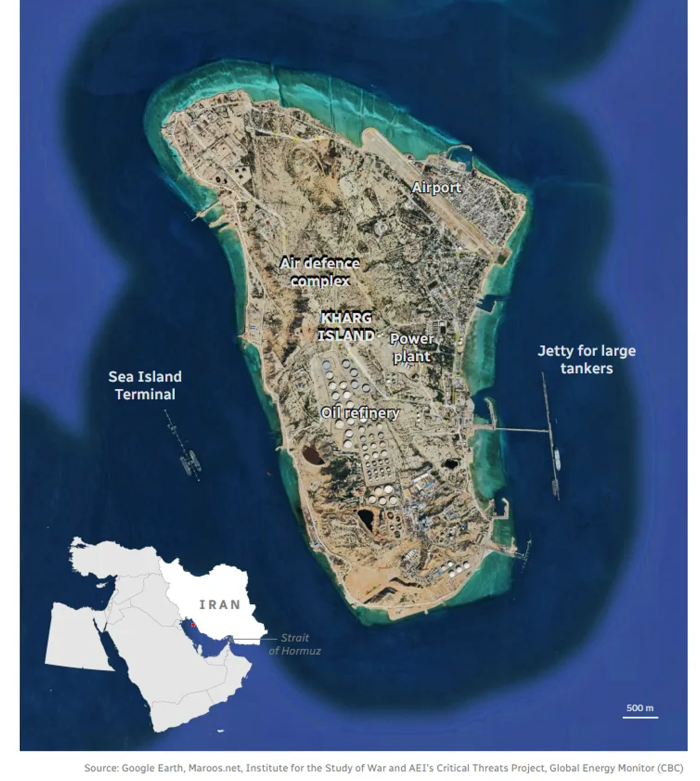
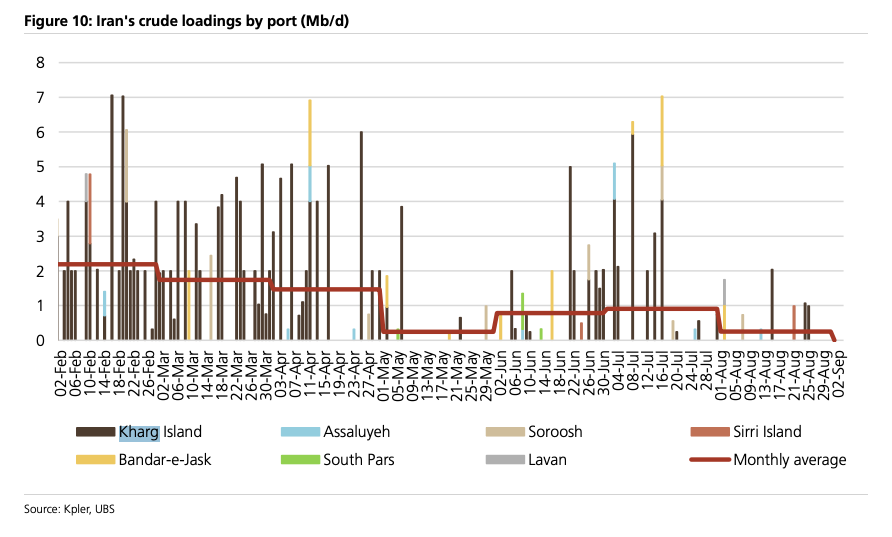
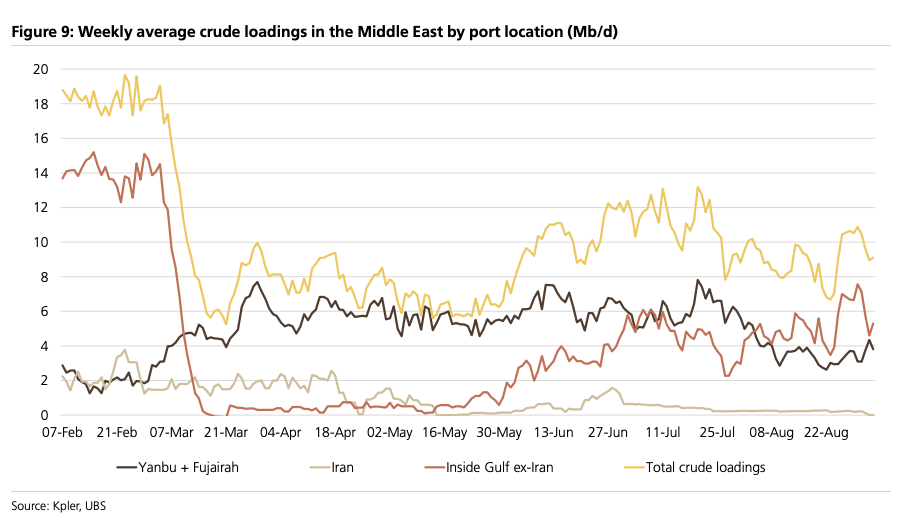
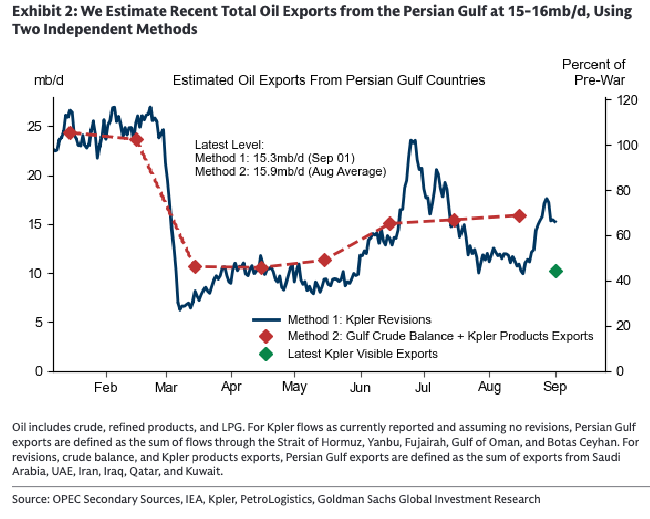
Washington is meanwhile touting more and more energy flow through the Strait of Hormuz, while also appealing for other nations to help:

US Energy Secretary Chris Wright says on average nine million barrels of oil a day are getting through the Strait of Hormuz that should help relieve pressure on rising energy prices.

Wright told CNN with oil also moving through pipelines in the region, β€œwe’re probably two-thirds or more of pre-conflict flows”.

Those flows, however, depend on the presence of the US Navy to help escort tankers and provide some protection against possible Iranian attacks.Β Wright said he expected other countries will eventually support the Navy’s efforts.

But events like this weekend are likely going to continue to escalate the crisis. "There’s going to be more clashes between the Iranians and the Americans. There can be miscalculations. There can be more civilian casualties" especially on the Iranian side,Β Sina Azodi, the director of the Middle East studies program at George Washington University, has explained.

The "small potatoes" conflict according to the Commander-in-Chief...

Reporter: Can you explain to the American people, if this is not a war, what exactly is it?

Trump: A lot of people don’t call it a war. I call it a military conflict because it's small potatoes for us. It's not a big thing.

Reporter: It certainly doesn’t feel like small… pic.twitter.com/a4hvccNCoD

β€” Acyn (@Acyn) September 4, 2026

"The [US] secretary of defense can send more troops to the region, but I don’t think the Iranians are going to back down. They’re going to resist that blockade and impose further costs on the United States," the analyst said.

Indeed every escalation step ordered by Washington has typically resulted in the Iranians 'answering' with significant missile and drone attacks on US bases in the Gulf, and as far away as Jordan. Some analysts are calling this a successful 'debasification' campaign that has existed since the war's start.

Tyler Durden Sun, 09/06/2026 - 12:40

Waste Of The Day: $79M To Not Work

6 September 2026 at 18:40
Waste Of The Day: $79M To Not Work

Authored by Jeremy Portnoy via RealClearInvestigations,

Contractors working for the State of Illinois took a 470,000-hour paid lunch break on taxpayers' dime.

A company hired during the Covid-19 pandemic to fill staffing shortages at hospitals and long-term care facilities spent more than a third of its time on "standdown," a contract provision that paid them to be on-site and available in case they were needed.

The contractor, Favorite Healthcare Staffing, was supposed to notify the state any time its employees were on standdown for more than 24 hours. There was no evidence those notifications occurred, and the state only conducted limited oversight, according to an Aug. 11 report from Auditor General Christopher Meister.

Key facts: Favorite Healthcare earned $220.3 million from Illinois from 2022 to 2023, including $78.5 million for standdown hours.

The audit found 270 employees who billed for standdown time without actually working a single hour in two years. They earned $7.5 million.

At least eight employees even billed overtime at rates of up to $330 per hour during weeks they were on standdown for five consecutive days, according to the audit. One employee billed for overtime while he was in quarantine and not working.

Other employees billed more than 24 hours in a single day. The state paid their invoices without flagging the discrepancy, the audit found,

Favorite Healthcare was reimbursed $1.4 million for lodging costs, even though its employees were staying in their personal residences.

Upon discovering the issues, Illinois hired the consulting firm Innovative Emergency Management to review Favorite Healthcare's invoices.

But Innovative Emergency Management also had its own billing issues, the audit found. The company billed Illinois using duplicate timesheets and for employees who did not report working any hours.

Illinois later had to hire yet another firm, Crowe, to review Innovative Emergency Management's invoices. Crowe earned $1.3 million.

Summary: The public should not have to pay contractors to sit around and twiddle their thumbs, nor pay consultants to figure out why.

The #WasteOfTheDay is brought to you by the forensic auditors at OpenTheBooks.com.

Tyler Durden Sun, 09/06/2026 - 11:40

Twelve Companies Make DOE's Latest Nuclear Launch Pad Cut

6 September 2026 at 18:05
Twelve Companies Make DOE's Latest Nuclear Launch Pad Cut

The DOE's National Reactor Innovation Center announced 12 companies covering 13 projects for its latest Nuclear Energy Launch Pad (NELP) round on August 24th. Similar to the project coverage from the first round, this new group also spans multiple stages of the nuclear industry.Β 

As we covered when the first four companies were selected, the initial group included the uranium enrichment company General Matter and reactor developers Radiant, Deployable Energy and NuCube Energy.

Multiple companies are seeing repeat entries into the fast-track nuclear development programs under the DOE:

  • Oklo, Antares, and Valar are all returning after achieving criticality on their pilot reactor designs under the DOE's Reactor Pilot Program
  • Deployable Energy is returning with two programs after also being included in the initial NELP selection round.

The NELP offers access to nuclear expertise and infrastructure with a prioritized pathway through DOE authorization. The NELP is the new program that succeeded the DOE Reactor Pilot Program and DOE Fuel Line Pilot Program that have kick-started the nuclear renaissance in the US.

While not every company has been open about what they're working on under the NELP, we collected what we could find on each of the companies and their various programs:

Antares Nuclear: Transportable microreactors for military and space applications. Its R1 design combines TRISO fuel with sodium heat pipes, targeting 100 kilowatts to 1 megawatt of electricity. Its selection uses β€œLaunch Pad USA”, which means they do not have to be at the Idaho National Laboratory (INL) site to enjoy the benefits of the program

Atlas Atomics: They’re developing heavy-water reactor technology intended to combine electricity generation with medical and industrial isotope production and the reuse of spent nuclear fuel. Not much is known about their reactor design, but based on it being heavy water, it makes it similar to the CANDU reactor fleet in Canada. And with a previously written letter of support for Utah being one of the locations considered for the Nuclear Lifecycle Innovation Campuses, it is anticipated the company will be starting in the same state for their initial work.

Deployable Energy: Working on Unity, a transportable, high-temperature gas-cooled β€œnuclear battery” designed to generate 1 megawatt using helium cooling and conventional <5% enriched LEU fuel for industrial, defense, maritime and remote applications. Its two NELP selections cover a full-power demonstration at INL and a maritime demonstration with Hornbeck Offshore under Launch Pad USA.

Forge Atomics: Developing Ember, a factory-built, 25-megawatt reactor for data centers and the grid. It's one of the least novel designs on the list, leaning into the industry's decades of experience with pressurized water designs and conventional LEU fuel. Components are sized for highway transport, with factory manufacturing intended to bring down construction costs and delays.

Hexium: Developing laser-based isotope enrichment, initially targeting lithium for fusion and fission applications. The company is modernizing Atomic Vapor Laser Isotope Separation, technology developed at the DOE's national labs, and has also outlined plans for uranium enrichment. The company announced partnerships with Oklo and TerraPower when they initially came out of stealth last year.

Lightbridge: Developing twisted uranium-zirconium metallic fuel rods for existing and new reactors, including small modular reactors, aiming to improve heat transfer, increase output and extend refueling intervals. Its NELP project is SHED, a planned INL manufacturing facility for lead test assemblies destined for testing in U.S. commercial power reactors.

Nusano: Developing accelerator-based radioisotope production for cancer diagnosis and treatment, with additional work on industrial isotopes and nuclear batteries. Its energy business is pursuing mass-separation technology that enriches uranium metal to produce high-assay low-enriched uranium (HALEU) for advanced reactor fuel.

Oklo: Developing Aurora fast-fission reactors to supply electricity and burn used nuclear fuel from traditional reactors. Their business model calls for owning and operating plants and selling their output under long-term contracts. The company is also pursuing nuclear-fuel recycling and isotope production for medical, industrial and research applications.

Raven-Flint Nuclear: Developing the Corvus Route for uranium conversion, producing uranium hexafluoride without elemental fluorine gas. Following laboratory production, its NELP project is Torch, a planned pilot conversion plant at INL targeting 500 tonnes of uranium annually. That would add capacity between uranium mining and enrichment.

Scaled Atomics: Developing the MN-350, a mobile nuclear power system designed for a standard 20-foot shipping container and a ten-year refueling interval. It targets military missions, disaster response and remote commercial sites. The company says Launch Pad USA will help advance MN-350 from advanced design toward demonstration and commercial deployment.

Sublime Nuclear: Focused on rebuilding the domestic nuclear fuel supply chain and reducing dependence on foreign suppliers. Unfortunately, that's about as much information as is currently available. The website doesn't have much else to it, and no press releases have been put out by the company yet.

Valar Atomics: Developing high-temperature gas-cooled reactors for mass production and deployment. Its ambitions extend across AI data centers, industrial heat, hydrogen and synthetic fuels, with manufacturing and deployment concentrated at what it calls gigasites. The company made headlines recently with a recent funding round that reached over $1 billion in equity and debt.
Β 

Tyler Durden Sun, 09/06/2026 - 11:05

September Market Weakness: The Setup Has Teeth

6 September 2026 at 17:30
September Market Weakness: The Setup Has Teeth

Authored by Lance Roberts via RealInvestmentAdvice.com,

The Setup Has Teeth

Earlier this week, in ourΒ Daily Market Commentary, I flagged that the market was testing support after three straight down days, starting in September, with the calendar. That was just the warm-up, as the real story lies in a note fromΒ Scott Rubner at Citadel Securities, whose read on September market weakness is among the best that I have read. Rubner’s case is not that the bull market has ended. It is that the near-term math just changed, and hardly anyone is positioned for the shift.

Why September Market Weakness Is A Record, Not A Fluke

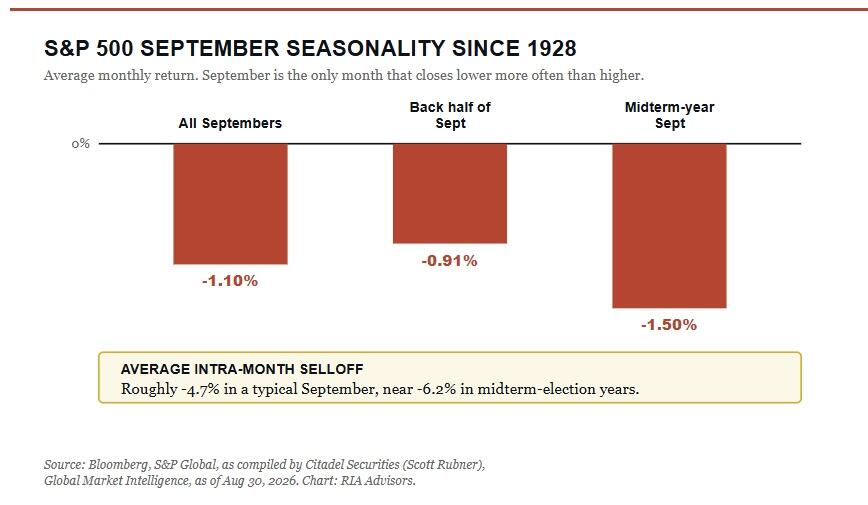
September has a losing record that is worth paying attention to. Since 1928, September is the only month in the year that closes lower more often than higher. Over the past century, the average return is a loss of roughly -1.1%, and in midterm election years like this one, it slips to roughly -1.5%. Furthermore, the back half of the month is the weakest two-week stretch of the calendar year.

AsΒ CNBC notedΒ in its writeup of Rubner’s work, this is not aΒ β€œquirky stat” from a cherry-picked window, it is close to a century of data pointing the same direction, and the average intra-month selloff of -4.7%Β (nearer -6.2% in midterm years)Β is the kind of air pocket that turns a quiet drift into a real drawdown before most investors update their models. Such is the reputation September has earned honestly.

The Buyers Who Carried August Are Leaving The Table

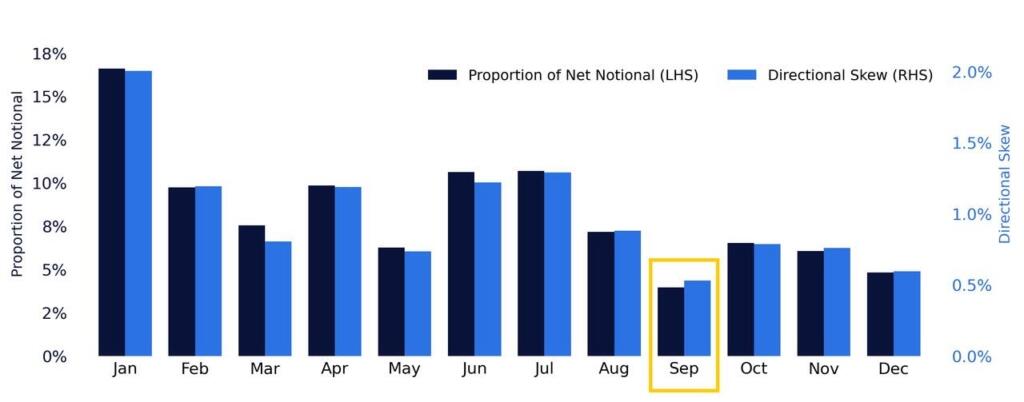
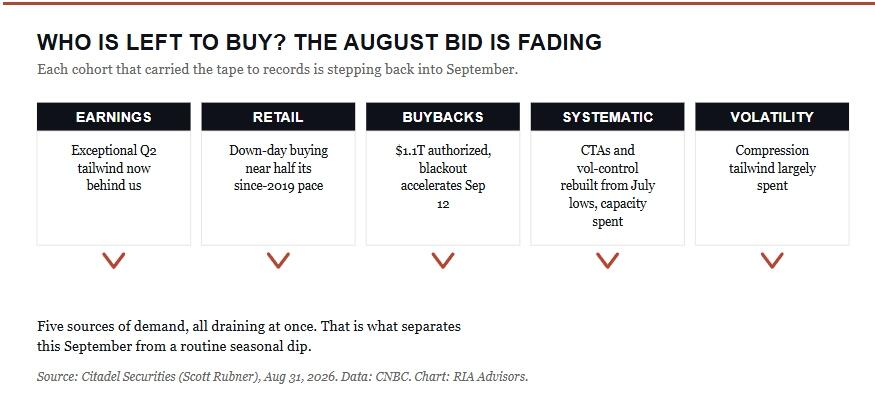
Here is what makes this year different. Every cohort that pushed the S&P 500 to records in August is stepping back at the same time. The earnings tailwind that carried the tape is largely behind us. Retail buyers, who returned in force through the summer, tend to fade in September, and Citadel’s own data show their buying on down days has run near half its normal pace since 2019.Β (Chart courtesy of Citadel Securities)

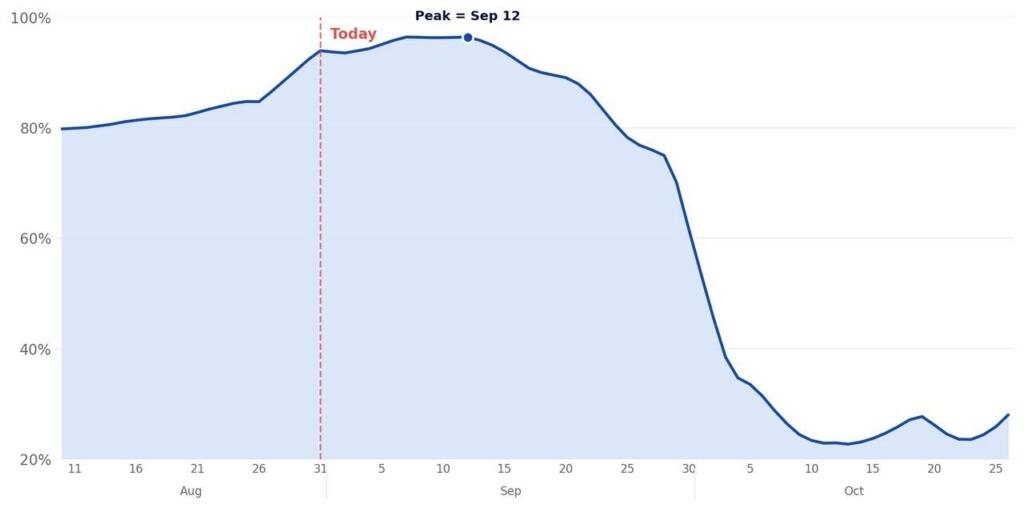
AsΒ we have discussed previously, the corporate bid, which has been a net buyer of equities since 2000, turns negative. Companies authorized more than $1.1 trillion in buybacks through August, but that buyer goes quiet as blackouts accelerate around September 12, right before third-quarter reporting.Β (Chart courtesy of Citadel Securities)

The systematic crowd, the CTAs and volatility-control funds that reloaded off the July lows, have already spent most of their capacity.Β (Chart courtesy of Citadel Securities)

When you add up the cohorts, the demand side is quietly EMPTYING.

So, here is the most common criticism hitting my inbox this past week:Β β€œYes, but that seasonality is just a statistic.” That is a fair statement, and it is indeed an average of returns. However, a statistic is exactly what it is. A statistic with five structural tailwinds draining out behind it, though, stops being a coin flip and starts being a setup

Protection Has Rarely Been This Cheap Into The Noise

Now, the part that should get your attention. Volatility collapsed in late August. The VIX fell to around 14, its lowest reading of the year, and S&P skew sank to the first percentile of its range, which is a technical way of saying downside insurance was the cheapest it had been all year. The one-month, 25-delta put changed hands near its most affordable level since December 2024.

As we headed into the month, a garden-variety three-day decline popped the VIX back toward 16 in just a handful of sessions. The size of that move, given the very mild decline, tells you how little cushion was priced in. Cheap protection is landing just as the macro calendar turns increasingly noisy, with the jobs report yesterday, then CPI, and an FOMC decision all stacked into the next two weeks.Β When protection is this cheap and buyers are this tired, the cost of being caught without a hedge climbs quickly.Β As Howard Marks likes to remind investors, you cannot predict, but you can prepare, and September has consistently been a month to prepare for.

To wit: cheap insurance is a gift the market rarely leaves on the table for long, and it never rings a bell on the morning it decides to take the gift back.

The Options Market Is Carrying A Record Into Expiry

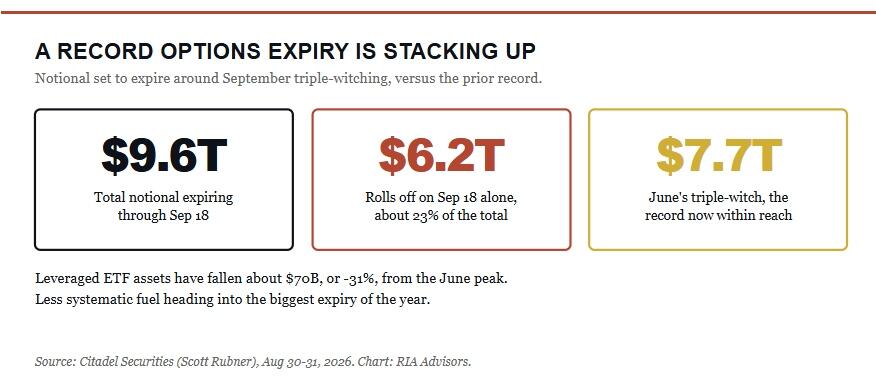
The last piece of the September puzzle is purely mechanical. On the third Friday of the month, the September options expiry will occur. That event is currently on track to set a record. Roughly $9.6 trillion is set to roll off through September 18. Then about $6.2 trillion of that is concentrated to expire on the 18th alone.Β That single day would clear the June triple-witch near $7.7 trillion, which was itself a record.Β Add quarter-end pension rebalancing, with funding ratios near 112% and plans de-risking out of stocks and into bonds, and the plumbing itself leans against equities into month-end.

Notably, none of this guarantees a market selloff. However, it does stack the odds against overly aggressive investors. Currently, every major desk from JPMorgan to BofA has turned cautious. However, CNBC’s own investment committee is refusing to sell a single share into the weakness. That crowd can be right about the direction and still be wrong, or early, on the timing. Such is the nature of a market that loves to punish the obvious trade.

A Second Desk Lands On The Same Downside

While Scott Rubner reads the market through flows, BTIG’s Jonathan Krinsky reads it through the tape. Interestingly, he lands in nearly the same place as Rubner. Krinsky’s framing is that the post-summer rally has been a game ofΒ β€œmusical chairs” rather than a trueΒ β€œbroadening.” Money rotated out of Technology and AI into Consumer Cyclicals and Large Cap Value. At the same time, the index sits roughly where it did on June 2. Breadth has quietly rolled over. The share of Russell 3000 names above their 50-day average is the lowest since early April. Furthermore, the one-month correlations just jumped to their highest level since June. That is a classic tell that names begin to fall together.

Β 

The other half of the concern is investor complacency. The five-day put/call ratio sits near 0.82. That is one of the lowest readings in years. Notably, the tape has not printed a single 80% NYSE downside-volume day in almost a year. That long stretch falls against a historical average of 21.

Lastly, Krinsky’s base case is a failed retest of the 7,600 breakout, followed by a slide toward 7,200-7,300. Such a pullback would encompass 7% to 8% off the highs.Β While not a meaningful decline, given the market’s low volatility and high investor complacency, it willΒ β€œfeel” much worse.Β That lower zone sits right on Rubner’s midterm seasonal math and the rising 200-day average near 7,127.

Think about it this way. When both a flow desk and a technical desk reach the same number from opposite directions, you should at least respect it. Crucially, none of that means that it will happen with absolute certainty, nor does it pinpoint the day. But it is certainly a risk worth appreciating.

Β 

What Should Investors Do Now

So, what does this all mean for investors? Most importantly, this is a tactical market reset, not a call to abandon equities and go hide in cash. Scott Rubner himself framed the September weakness as aΒ β€œbetter entry point ahead of a more constructive mid-October.”

He is correct. Once mid-October arrives, the options expiry will have cleared, the FOMC will have met, and corporate buybacks will have resumed. Notably, the market will be focusing on Q3 corporate earnings reports. which typically support markets heading into November. Β 

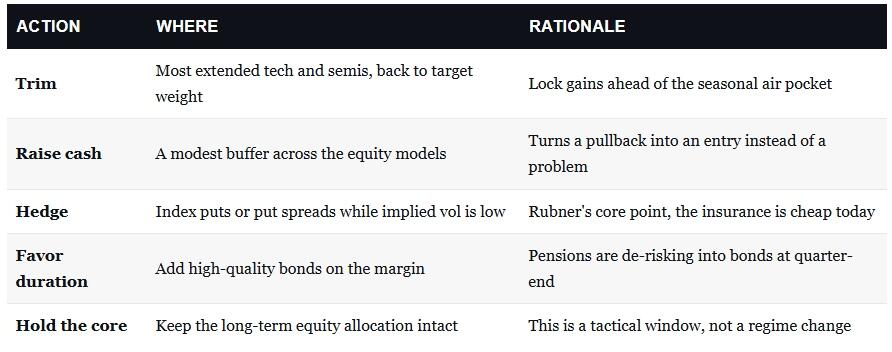
Therefore, the investor playbook is to use market strength to rebalance portfolio risk rather than chase it.

The moves worth making now are the unglamorous ones. Start by taking profits and banking gains where a position has run well past its intended weight. Raise a little cash so a pullback becomes an opportunity rather than a scramble. Then add downside protection while it is still on sale. Why? Because the whole point of Rubner’s note is that the insurance is cheap today and may not be next week. Such is the value of preparing before the crowd decides it has to.

September rarely hands out cheap insurance and a clear warning at the same time. When it does, the disciplined move is to take both.

*Β  *Β  *

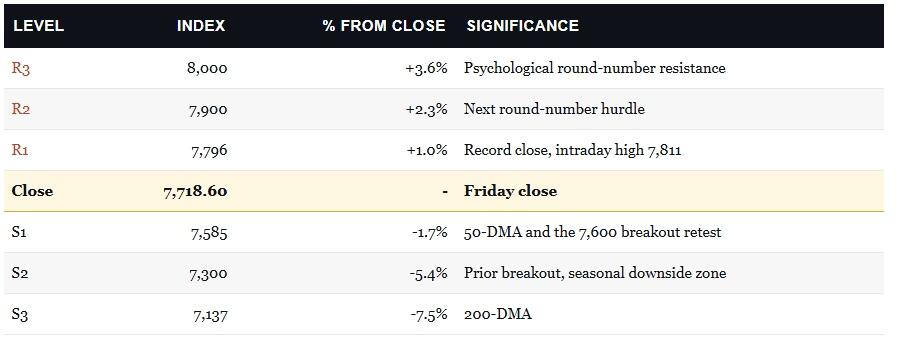
Heading into next week, the support and resistance levels are evident. The first resistance is the record at 7,796, about 1% away. Just above that are the round numbers at 7,900 and 8,000.Β (Those are our year-end targets that sit just above previous all-time highs.)Β Conversely, support starts at the 50-day near 7,585. That level also marks the breakout that a failed retest would expose. Just below that level is the 7,300 zone, then the 200-day at 7,137, the same downside band the seasonal math points toward.

With that setup going into next week, we will want to continue playing defense rather than offense. Secondly, investors should consider increasing cash buffers keep stops under the 50-day. Lastly, use any push toward the record market levels to trim rather than chase.

To be fair to the bullish camp, a decisive close back above 7,796 would neutralize the momentum warning and reopen those round-number targets. There are several risks ahead, from the mid-term election cycle to the loss of corporate buybacks, so this is a two-sided setup rather than a directional call. However, pay close attention to the 7,585 next week. If the market can hold that level, the uptrend will remain intact. If it fails, the seasonal downside risk increases.

Key Catalysts Next Week

Next week is a holiday-shortened trading week with one question that will dominate it.

β€œDoes inflation confirm the hike that Friday’s jobs report just put back on the table?”

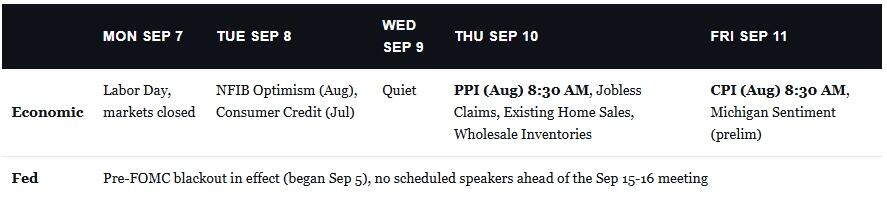
With the market closed on Monday for Labor Day, that stacks the two prints that will matter the most at the very end. PPI lands Thursday morning and CPI follows Friday, both at 8:30 AM ET, and both feed straight into the September 16 FOMC decision.

This week is where the Fed debate will get settled. Ellen Zentner, chief economic strategist at Morgan Stanley Wealth Management, framed it well after the jobs report. The upside payroll surprise certainly heightened rate-hike concerns, but the outcome will hinge on next week’s inflation numbers. If CPI and PPI come in cooler than feared, the Fed can discount the hot labor market signal. However, if both prints come in hotter than expected, a September hike moves from a coin flip to the base case.

As far as the rest of the week goes, the slate is fairly thin. Tuesday brings NFIB small business optimism and consumer credit. Then on Thursday, we will see jobless claims, existing home sales, and wholesale inventories. As noted, PPI also drops on Thursday, with Friday’s CPI report coming alongside the preliminary Michigan sentiment read. The Fed itself goes quiet, with the pre-meeting blackout that began September 5 keeping every official off the tape through the decision.

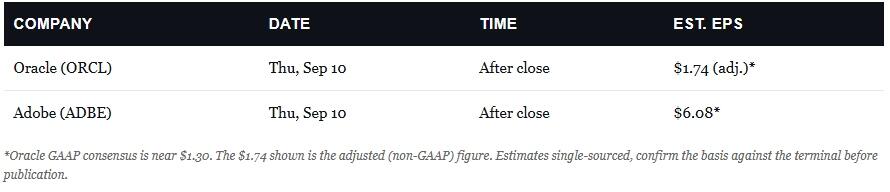
Overall, the earnings calendar remains very light, with the vast majority of earnings already behind us. However, of note, Oracle reports on Thursday after the close and will be scrutinized for AI cloud demand and hyperscaler capex. Its numbers and backlog commentary will swing semiconductors and the broader AI complex more than any single macro release.

Adobe follows the same afternoon. Crude is the other wildcard, with a 9% weekly surge on Middle East supply fears keeping energy and inflation risk alive. Thin post-holiday liquidity can exaggerate the reaction to both inflation prints, so expect sharper intraday swings than the calendar alone would suggest.

Friday’s CPI is THE report for the week, and everything else is pretty much a sideshow until that number crosses.

Tyler Durden Sun, 09/06/2026 - 10:30

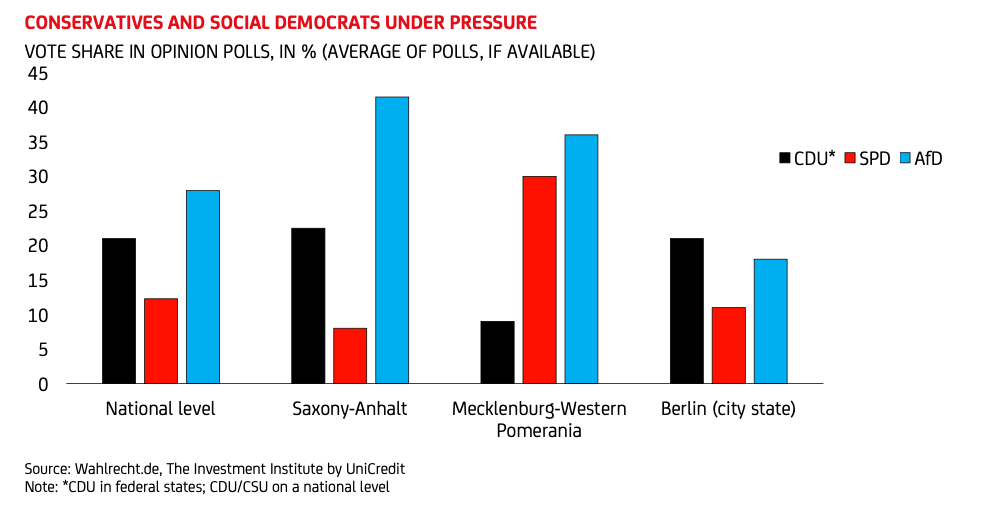
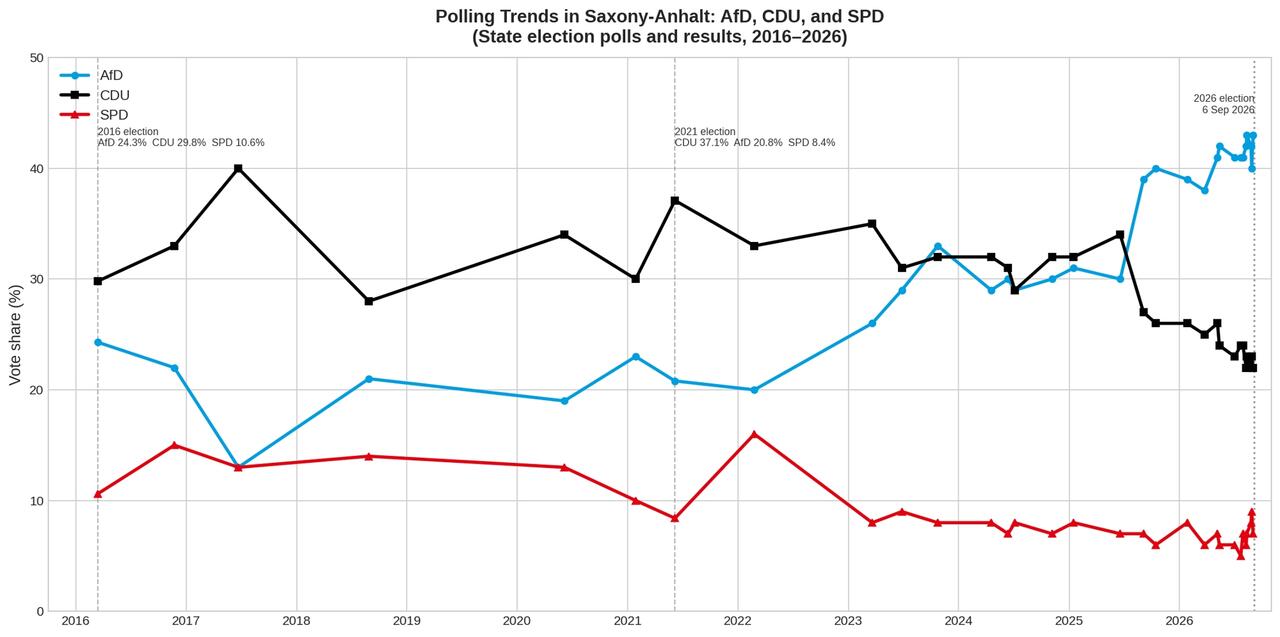
AfD Sweeps Saxony-Anhalt Election In First "Far Right" Victory Since WW2: "Signal To Berlin"

6 September 2026 at 21:00
AfD Sweeps Saxony-Anhalt Election In First "Far Right" Victory Since WW2: "Signal To Berlin"

Update(1400ET): In a political earthquake, the AfD has taken a massive lead, per exit polls, at the Saxony-Anhalt election in what the party's state leader hailed as sending a resoundingΒ "signal to Berlin." This moment marksΒ the first time what has been dubbedΒ a German "far-right party" taking power at a state level since World War II. This is absolutely historic.

"The exit polls, published by German public television stations, suggested that the party, known by its German initials AfD, would win between 39 and 41 seats in the eastern state of Saxony-Anhalt," NY Times reports. "That would leave it just short of an absolute majority of 42, but far ahead of its nearest rival."

But it remains unclear whether it will be able to form a government. Below is the latest viaΒ Deutsche Welle:

Alternative for Germany (AfD)Β co-leaderΒ Tino ChrupallaΒ  says his party secured a mandate to govern with its strong election result inΒ Saxony-Anhalt.

"We have halved the CDU, so from that point of view it’s a great evening,"Β Chrupalla told journalists in Magdeburg, referring to an earlier remark byΒ Christian Democratic Union (CDU)Β leader and chancellorΒ Friedrich MerzΒ that AfD's result could be cut in half.

Chrupalla called the outcome "sensational."Β 

"Ulrich Siegmund will be the new premier of Saxony-Anhalt,"Β he said. "From here, we will change Germany."

If the party falls short of an absolute majority, Chrupalla said it would be open to talks and even suggested an AfD minority government could be tolerated by other parties.

AfD has signaled it is open to a coalition partner that would be open to changing its migration and energy policy - though this option doesn't seem to be on the political map realistically at this early point.

Youth turn to AfD in droves...

Bei den jungen 5%! pic.twitter.com/W7Mb67WpRc

β€” Anosteras (@anosteras) September 6, 2026
AFP/Getty Images

*Β  *Β  *

Voters in Saxony-Anhalt head to the polls today in an election that could deliver Germany's most massive political shock in decades, with the right-wing Alternative fΓΌr Deutschland on track to beat Chancellor Friedrich Merz's Christian Democrats.

AfD is the only hope for Germany https://t.co/6ONn1LOipE

β€” Elon Musk (@elonmusk) August 19, 2026

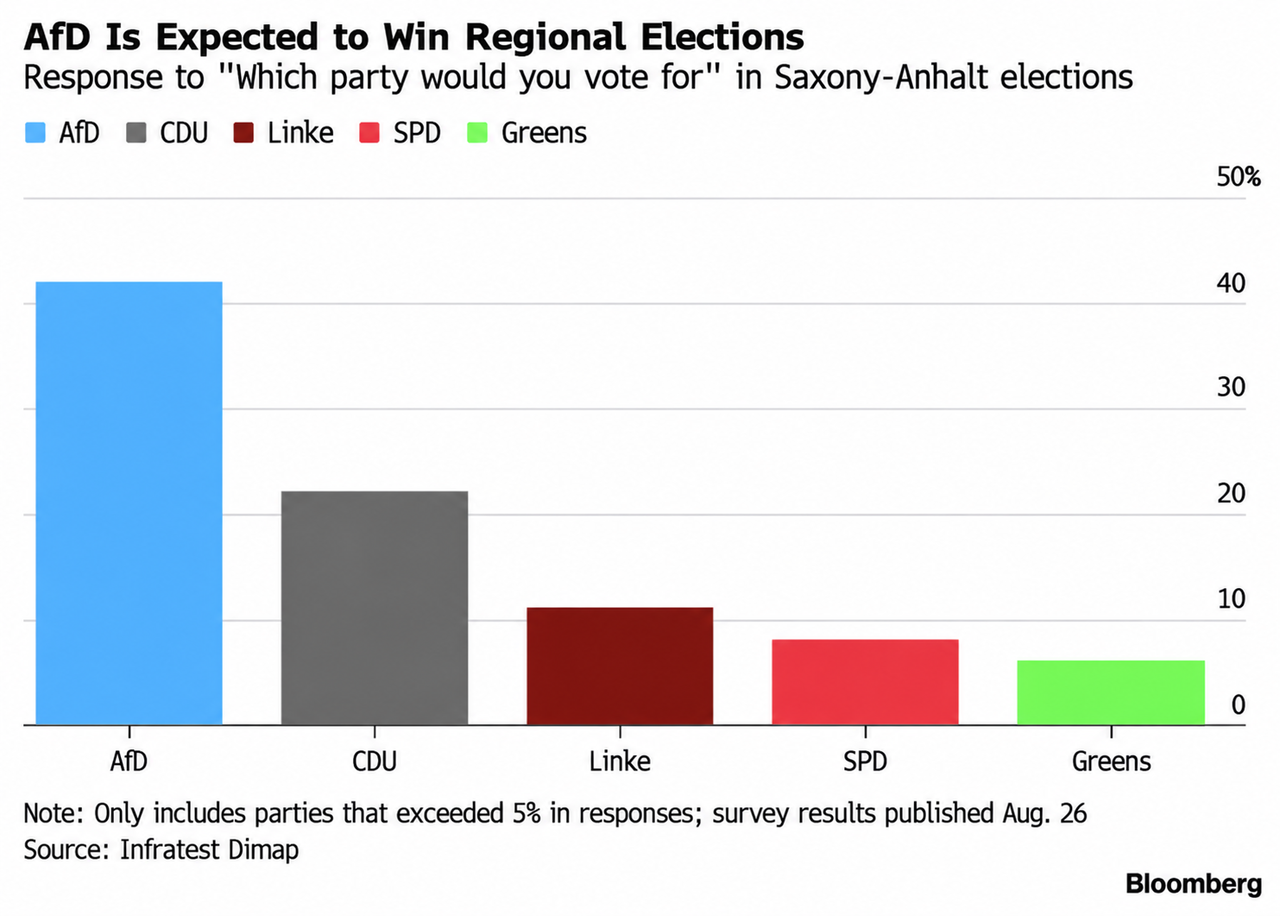
Final polling estimates put the AfD at 40% to 41%, nearly double the CDU's 23%. The party's lead candidate, 35-year-old Ulrich Siegmund, has ruled out governing in a coalition, suggesting the AfD would need an outright majority to take power of its first German state government.

🚨 BREAKING: Germany's right-wing anti-mass migration AfD party backed by Elon Musk is poised for a HISTORIC VICTORY in the Saxony-Anhalt elections β€” with polling showing them over 40% support, a STUNNING LEAD of close to 20 points

CDU at just over 20%, and other parties near… pic.twitter.com/HnYvxgKlQr

β€” Eric Daugherty (@EricLDaugh) September 6, 2026

About 1.7 million people are set to vote today, with polls closing at 6 p.m. local time. AfD's rapid ascent comes as voters are furious over Germany's stagnant economy, deindustrialization, energy costs, and the Third World migrant invasion.

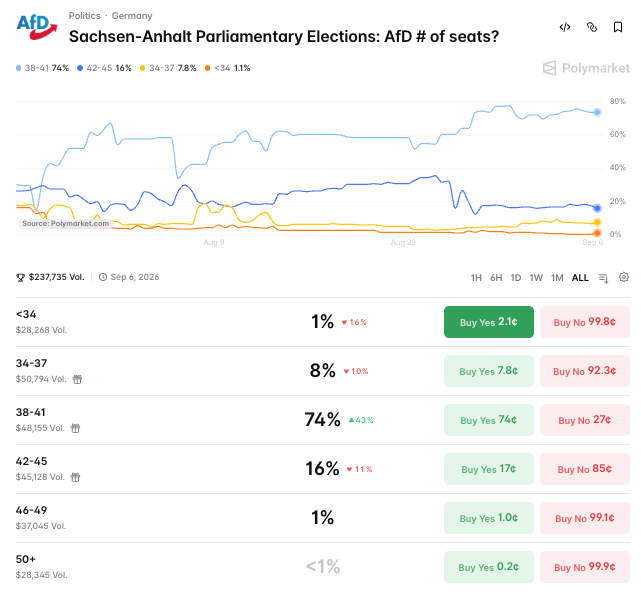
The Polymarket bet on how many seats the AfD is expected to win today assigns a 74% probability to 38 to 41 seats, with 42 to 45 seats at 16%.

Ahead of the historic election, thousands of far-left Antifa crazies took to the streets wearing all black and holding Antifa and LGBT flags. Others were seen carrying signs reading "FCK NZS" and "FCK AFD."

EIL: Schwere Krawalle in Halle, Antifa-Demo eskaliert! 🚨

Am Vorabend der Landtagswahl hat die linksextreme Szene nach Halle mobilisiert. Die Demo versinkt in Gewalt, es werden Unmengen an Pyrotechnik gezΓΌndet und teils auf die Polizei geworfen. Straßenkampf mit Ansage. Und ein… pic.twitter.com/k2bwEQtZ8N

β€” COMPACT-Magazin (@COMPACTMagazin) September 5, 2026

A reported 15,000 left-wing activists joined a so-called pro-democracy festival in the state capital, Magdeburg, on Saturday, organized by the "Saxony-Anhalt Open to the World" alliance. Yet the whole globalist cult in Germany has likely run its course. It has been nothing more than what some call a nation-killing experiment, pushing uncontrolled mass migration and deindustrialization policies that have sent Europe's largest economy into a tailspin.

German Chancellor Friedrich Merz on Saturday threatened the AfD, saying, "We will not let these people, who trash Germany and everything we have achieved in recent years and decades," before adding, "We will not let these people talk our country into ruin!"

πŸš¨πŸ‡©πŸ‡ͺ German Chancellor Friedrich Merz is once again threatening to ban the AfD?!

"We will not let these people β€” who trash Germany and everything we have achieved in recent years and decades."

"We will not let these people talk our country into ruin!" pic.twitter.com/3iiyrwBRV2

β€” Mario ZNA (@MarioBojic) September 6, 2026

German politics coverage:

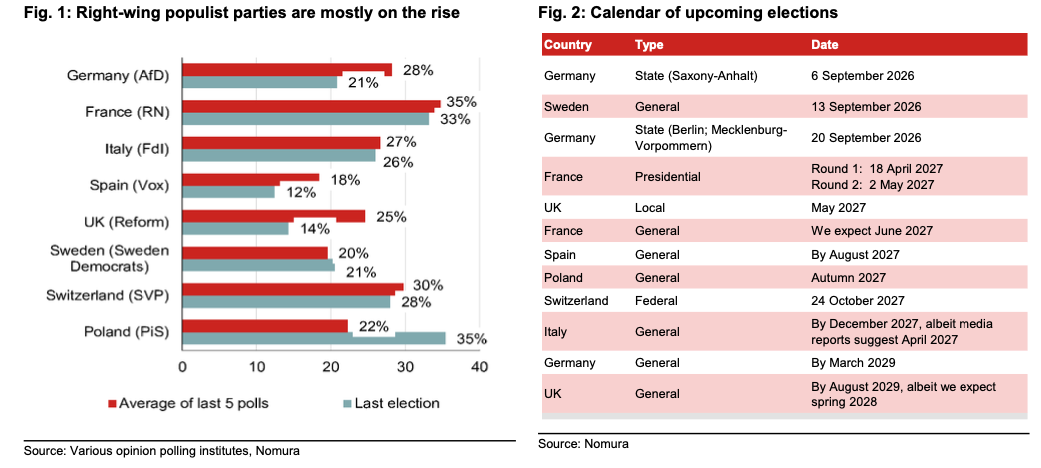
What Nomura analysts see over the next 18-month election cycle across Europe:Β 

Yet what did Merz actually achieve? Destroying Germany's economy? That is something he certainly accomplished.

Tyler Durden Sun, 09/06/2026 - 14:00

UN Demands African Statues In London As Britain Is Told To Atone For Slavery

6 September 2026 at 16:20
UN Demands African Statues In London As Britain Is Told To Atone For Slavery

Authored by Steve Watson via Modernity News,

The United Nations has decided that Britain has not grovelled enough.

After years of toppled statues, boarded-up war memorials and official lectures about "colonialism," a UN human-rights committee now wants the country that ended the Atlantic slave trade to fill its public squares with statues of "people of African descent,"

The globalist body also suggests Britain should rewrite what children are taught, and treat historic slavery as a live brief for migration policy and hate-speech enforcement.

'It's high-time we called out the ideological capture of UN committees.'

'It's recognition of the contribution made by Africans at the height of colonialism.'

Broadcaster Rafe Heydel-Mankoo and Ken Hinds debate whether statues of Africans should be erected to atone for slavery. pic.twitter.com/51h05u6WvF

β€” GB News (@GBNEWS) September 2, 2026

This comes in the form of formal "reparatory justice" guidance from the UN Committee on the Elimination of Racial Discrimination, published six months after member states voted in New York to treat the transatlantic trade as the "gravest crime against humanity" and to press former slaving nations for apology, restitution and cash.

Britain abstained. The committee has carried on regardless.

The recommendations sit in guidance largely drafted by CERD panellists Gay McDougall, an American lawyer, and Pela Boker-Wilson, a Liberian legal expert. Former slave-trading states, the committee says, have a moral and legal "obligation to repair" the damage of slavery.

The guidance suggests that "Public spaces should honour the contributions of people of African descent and clearly acknowledge the wrongs of those who supported or benefited from historical atrocities."

That, the authors add, can mean artworks, statues, memorials and "dedications," and "Satisfaction to people of African descent can include the right to investigation and truth, public judgments and acknowledgements, apologies, acceptances of responsibility and public commemorations."

Full on virtue signalling grovelling, in other words.

The committee adds that schools "must ensure that schoolbooks and curricula present accurate, unbiased accounts of transatlantic chattel slavery, its aftermath and current realities, based on thorough research."

It adds that political leaders should "educate the public on the importance of reparatory justice for building a healthy, inclusive society." And on speech and migration, states "must act early to prevent prejudice and address misinformation about transatlantic chattel slavery and its ongoing harms to people of African descent."

It further outlines that reparations should include policies "eradicating xenophobia towards migrants and others perceived as such."

In other words: monuments, classrooms, archives, apologies - and a tighter leash on anyone who objects.

United Nations says Britain should put statues of 'people of African descent' in public spaces to atone for the slave trade https://t.co/W77TO8IXNr

β€” Daily Mail (@DailyMail) September 2, 2026

The report even revisits the 2020 Black Lives Matter summer. Protesters who tore down monuments linked to slavery and empire, it complains, were unfairly "disparaged" in the media, their cause painted as "obscure" and "Left-wing."

Edward Colston, dumped in Bristol harbour, is cited as the exhibit. The vandalism is recast as a moral lesson the United Kingdom has still not learned.

The political class in London has spent years flattering this mood. The public has not.

Historian and GB News presenter Matt Goodwin put the demand in one line: UN lawyers want "British people who never owned slaves and whose ancestors helped end the slave trade to pay people who were never slaves while ignoring the many millions of slaves in non-Western nations today." His verdict: "jog on."

UN woke lawyers want British people who never owned slaves and whose ancestors helped end the slave trade to pay people who were never slaves while ignoring the many millions of slaves in non-Western nations today.

I have two words: jog on pic.twitter.com/e059k0MZEw

β€” Matt Goodwin (@GoodwinMJ) September 2, 2026

Cambridge historian Professor Robert Tombs, founder of History Reclaim, called the campaign "sinister" and aimed at "censoring free discussion and imposing a certain view."

"Those who supported and benefitted included the predecessors of those who now demand reparations," he said. An "accurate, unbiased" account, he added, "would mean paying tribute to those in Britain and elsewhere who struggled to end the Atlantic slave trade."

"On that subject, we hear a lot about how Britain paid compensation to White slave owners in its colonies, but I have rarely if ever heard public recognition of the money paid to black slave traders for the same reason." His conclusion was blunt: "the whole thing is a huge financial and political scam."

Professor Lawrence Goldman, emeritus fellow in History at St Peter's College, Oxford, made the same point from another angle. "It's ironic that the UN should be telling Britain what to do about slavery. It was in Britain more than 200 years ago that the anti-slavery movement started, and we then led in the fight to end slavery across the world in the Victorian era, long before the UN existed."

He added, "But millions of people today are modern slaves, unable to live and work freely. Rather than lecture the leading anti-slavery nation about the past, the UN should do something about slavery in the present. That's its job."

That job is the one the UN keeps declining. Descent-based slavery still exists in parts of the Sahel. The Arab and East African trades ran for centuries after Britain banned its own. The committee's guidance barely glances at any of it. The target is always the same short list of Western capitals.

James Kariuki, formerly Britain's chargΓ© d'affaires at the UN, has said London engaged in talks with the UN but "continues to disagree with fundamental propositions of the text." The EU's explanation of vote was even clearer: suggestions of retroactive international law and reparations claims were "incompatible with established principles of international law."

A UN judge has already floated a figure of more than Β£18 trillion as Britain's supposed bill - a sum several times the size of the UK economy. The Brattle Group's earlier estimate for Western states ran to tens of trillions. Many are adamant that these numbers are a shakedown dressed as justice.

The fashionable story treats Britain as the author of African slavery. The record is the opposite of that cartoon.

Parliament banned the British slave trade in 1807. The Slavery Abolition Act of 1833 then dismantled slavery across most of the empire, freeing more than 800,000 people in the Caribbean, the Cape and Mauritius.

To force the measure through against the West India interest, the Treasury committed about Β£20 million in compensation to registered owners - roughly 40 percent of annual government spending at the time.

The debt was financed through gilts. When the Treasury modernised the gilt portfolio in 2015, the last of those instruments was redeemed. That fact is now used as a taunt. It is also evidence of something the UN will not say: Britain paid an enormous price, in cash and in political capital, to end a system it had once joined.

Then came the part no UN committee wants to see on a plinth. From 1808 the Royal Navy's West Africa Squadron hunted slaving ships off the African coast. Over roughly half a century it seized around 1,600 vessels and freed some 150,000 Africans.

Sailors died of fever in large numbers doing work no other great power was willing to fund at that scale. At its height the suppression effort consumed a serious slice of national effort - diplomatic pressure, mixed courts, bribes and gunboats - to drag other nations into line.

Wilberforce, Clarkson, Sharp, Equiano and the Quaker networks did not wait for a UN working group. They built a mass movement inside a slave-trading country and won. African brokers and kingdoms, meanwhile, captured and sold people into the Atlantic system for generations.

The trans-Saharan, Red Sea and Indian Ocean trades ran longer still. Will any of these facts be included in an "accurate, unbiased account"?

Instead the official culture treats "colonial" as a magic word that wipes the slate. Nelson, Wellington, Picton, explorers, viceroys, even figures whose later lives were spent against bondage are folded into one smear.

In June 2020, after Colston went into the harbour and "was a racist" was sprayed on Winston Churchill in Parliament Square, London boxed up its own history.

Churchill, a statue of George Washington, and the Cenotaph - the memorial to the British dead - were boarded over before further marches.

Churchill's statue today in London. I'm speechless. pic.twitter.com/lU6Y37my7e

β€” Antonello Guerrera (@antoguerrera) June 12, 2020

Robert Milligan was lifted from outside the Museum of London Docklands. Guy's and St Thomas' talked of moving figures linked to slavery. Oriel's Rhodes statue became a permanent siege. Within months the argument had spread from slave traders to anyone who could be tagged "empire."

Sadiq Khan then appointed a Commission for Diversity in the Public Realm: a 15-member panel of curators, campaigners and cultural operators tasked with reviewing statues, street names and memorials so that London might be 'corrected'.

The mayor's office insisted the body was "not being established to preside over the removal of statues." Khan had already said "there are some slavers that should come down, and the commission will advise on that." Jacob Rees-Mogg called the exercise a stack of "loony, left-wing wheezes." Shaun Bailey called the appointees "unelected activists."

Excited to announce brilliant members for London's new Commission for Diversity in the Public Realm – we will be working hard to ensure London's history is fully reflected and celebrated. @MayorofLondon https://t.co/AWd2pe8uZU pic.twitter.com/f2pyVRmJGF

β€” Justine Simons OBE (@justinesimons1) February 9, 2021

The net widened. Figures whose records included opposition to slavery were swept into the same "contested heritage" files. The point was never a careful ledger. It was to make British history look illegitimate in its own capital.

Wales made the method official. Labour's devolved government audited commemorations and issued "best-practice" advice that statues of "powerful, older, able-bodied white men" may be "offensive" to a "more diverse" public.

"Every record has been destroyed or falsified, every book rewritten, every picture has been repainted, every statue and street building has been renamed, every date has been altered"

Wales: Orwell called it https://t.co/CbFITY7rw8

β€” Martin Daubney ?? (@MartinDaubney) March 12, 2023

Councils were told to set the "right historical narrative." Options included concealing monuments, boxing them, wrapping them in new artworks, renaming streets - or destroying them.

Nelson, Wellington, Thomas Picton and Henry Morton Stanley were named. Diversity, the guidance lamented, was "hardly visible at all in public commemorations," which risked the "perception that the achievements that society considers noteworthy are those of powerful, older, able-bodied white men."

That sentence is the tell. A country is instructed to be ashamed of the men who built its navy, won its wars and, in the same era, smashed the trade the UN now pretends Britain never opposed. The term "Colonial" does the rest of the work.

The people who never owned a slave, and whose great-great-grandparents were more likely to have been mill hands than planters, are the ones invited to feel the shame. The governments that still tolerate bondage get a pass. The UN, which cannot keep slaves out of the Sahel or young protesters off Iranian gallows, finds the time to lecture the country that policed the Atlantic.

Britain abolished the trade. Britain spent a fortune and a navy making that abolition stick. The UN's answer is more statues, more guilt, and a warning to be nicer to the next boat full of illegal migrants. That is not reparatory justice. It is a political project that needs British history to stay on its knees.

Your support is crucial in helping us defeat mass censorship. Please consider donating via Locals or check out our unique merch. Follow us on X @ModernityNews.

Tyler Durden Sun, 09/06/2026 - 09:20

Interpreting The Taliban's Invitation For American Investments

6 September 2026 at 15:10
Interpreting The Taliban's Invitation For American Investments

Authored by Andrew Korybko via Substack,

This was arguably a preemptive de-escalation move that would also gauge the US' intentions...

The New York Times (NYT) interviewed Afghan Foreign Minister Amir Khan Muttaqi in Kabul as part of their coverage of the fifth anniversary of the Taliban's return to power. Muttaqi invited the US to reopen its embassy and invest in his country's minerals, dams, and roads. He also declared that "We consider the chapter of war to have come to an end, and from now on, we want relations based on mutual respect and a new chapter of positive engagement." This new policy requires some interpretation.

After all, Trump has repeatedly called for the return of US forces to Bagram Airbase and the US has pivoted to the Taliban's new Pakistani enemy over the past year and a half of his second term, both of which the NYT mentioned as possible obstacles. The Taliban also refuses to return the US arms and equipment that were left in Afghanistan while denying that it's holding a dual Afghan-American citizen prisoner. The State Department thus predictably told the NYT that bilateral ties won't be normalized.

Two of the experts that the NYT interviewed referenced Trump 2.0's business-driven foreign policy, ergo why some might be surprised that the State Department rejected normalizing bilateral ties as a quid pro quo for presumably privileged access to Afghanistan's rare earth minerals wealth. This goes to show that geostrategy, not geo-economics, is presently determining Trump 2.0's policy towards Afghanistan. Interestingly enough, however, it's the opposite with the Taliban. Here are three background briefings:

* 2 July: "Reviewing Russia's Latest UNSC Briefing On Afghanistan"

* 19 July: "Lavrov Warned That Western Arms & Ammo Are Being Sent From Ukraine To ISIS-K In Afghanistan"

* 16 August: "Five Reflections On The Fifth Anniversary Of The Taliban's Return To Power"

In a nutshell, Pakistan is passively facilitating the flow of arms to ISIS-K as part of its undeclared war with Afghanistan, which the US discreetly approves of as a means of pressuring the Taliban into complying with its demands. If the Taliban were weakened or deposed, they might not ever regain their former strength due to their historical Pakistani patron having cut them off and their new Russian military-technical partner being unable to replace the multifaceted support that Islamabad previously provided.

The end result could be the re-subjugation of Afghanistan, but this time as a US-Pakistani client state that would serve as a launchpad for expanding their military and economic influence into Central Asia, which aligns with Trump 2.0's Neo-Reagan Doctrine of rolling back Russian influence. Turkiye is already poised to do the same from the west via August 2025's "Trump Route for International Peace and Prosperity", which also functions as a NATO military logistics corridor, so the combined effect could be profound.

Given the grand strategic consequences if the US and Pakistan successfully re-subjugate Afghanistan, there's a certain logic to why Trump 2.0 rejected the rare earth minerals opportunity that the Taliban offered it. The group arguably did this as a preemptive de-escalation move that would also gauge the US' intentions, which are now crystal clear. Looking forward, joint US-Pakistani pressure on Afghanistan is therefore expected to increase, which could lead to an increase in Russian-Taliban military-technical ties.

Tyler Durden Sun, 09/06/2026 - 08:10

IAEA 'Unclear' On Iran's Nuclear Program As US, Europe Escalate At UN Security Council

6 September 2026 at 14:35
IAEA 'Unclear' On Iran's Nuclear Program As US, Europe Escalate At UN Security Council

Western allies are pressing the International Atomic Energy Agency (IAEA) β€Œboard to bring a formal complaint and resolution before the UN Security Council and the General Assembly.Β ReutersΒ reportsΒ Saturday that the US, UK, France, and Germany are behind the new pressure campaign, which hinges on aΒ request that the nuclear watchdog's director general transmit the new resolution.

The draft resolution, as seen by Reuters, calls on Iran to "urgently remedy β€Œits non-compliance ⁠with its Safeguards Agreement by taking all steps deemed necessary by the Agency and the Board, so that the Director General can provide the necessary assurances regarding the correctness and completeness of Iran's declarations."

via Associated Press

"The draft has not yet been formally submitted to the board and negotiations over the exact wording are ongoing,"Β ReutersΒ wrote based on diplomatic sources.Β 

Prior such draft resolutions have all been approvedΒ by the IAEA board. A year ago, prior to Trump launching Operation Epic Fury, an adopted IAEA resolution charged that wasΒ Iran in breach of its obligations under the Nuclear Non-Proliferation Treaty (NPT), which Tehran is a formal signatory to.

But Iran is being 'non-compliant' at a moment it is getting routinely bombed by US forces. Iran has also frequently pointed out the obvious double standard - that Israel itself is armed with nukes and isΒ notΒ a signatory to the NPT.

This fact has long been an 'open secret' in Washington and among world leaders. But if the US government were to officially recognize Israel as a nuclear-armed power, it could trigger legal repercussions which would impact foreign aid to Israel.

Days agoΒ IAEA Director General Rafael Grossi stated in a formal report that the status of Iran's nuclear program remains unclear:Β 

The status of a key part of Iran's nuclear program remains unknown while international inspectors have yet to gain access to nuclear facilities, the International Atomic Energy Agency reported on Tuesday, as the country’s six-month conflict with the United States shows no signs of resolution.

IAEA monitors cannot verify the location or status of Iran’s stockpile of near-bomb grade uranium, according to the 11-page restricted report that was sent to member states and cited by Bloomberg and Reuters.

"The agency’s lack of information about this nuclear material and access to facilities to verify it is a matter of proliferation concern," Grossi wrote in the report.

Tehran's position has remained that the IAEA is too cooperative with Israeli intelligence, and that it's neutrality has been compromised...

Next week @iaeaorg which is a spy org for Israel will vote to declare Iran breach of NPT. They bombed all the sites and still want to send spies to inspect them. πŸ˜‚ pic.twitter.com/bIGgOlUYAN

β€” Ali (@MerruX) September 4, 2026

He called on Iran to allow inspectors back in "with the utmost urgency" - and yet, this a place that's still under threat of more US bombing campaigns. There is basically an active war still on, even with occasional pauses.

Tyler Durden Sun, 09/06/2026 - 07:35

Is This Peak 'Clown World'?

6 September 2026 at 14:00
Is This Peak 'Clown World'?

Authored by Steve Watson via Modernity News,

Transport for London has dropped a dog house-shaped "calm space" onto the concourse at Ealing Broadway station and called it progress.

The tiny pod features a bench, noise-dampening acoustics and a "soothing" forest mural. They claim that it is part of an effort to "boost accessibility for neurodivergent travellers under TfL's Equity in Motion strategy," whatever that means.

Massive backlash has ensued, with many questioning this as a priority over train delays, complete lack of air conditioning on many lines, poor cleanliness, broken escalators and an epidemic of fare dodgers costing Β£190 million a year.

We're trialling a calm space at Ealing Broadway station for four weeks ?

From today, you'll find a quieter space for customers who may benefit from a calmer environment during their journey.

What we learn from the trial will help us understand how we can make our network... pic.twitter.com/mRFiD2vtvM

β€” TfL (@TfL) September 4, 2026

The kennel is part of TFL's 'Equity in Motion' scheme, a 'customer inclusion plan' launched in February 2024 which it claims will make travel "fairer, safer, more inclusive and more accessible."

Mark Evers, who leads customer insight, strategy and experience at TfL, told Ealing.News: "Everyone should be able to travel confidently and independently across London, and we know that busy environments can sometimes pose a barrier and be overwhelming, particularly for our neurodivergent customers."

"These trials will help us understand how we can better support customers who might need to take some time out when using our services," he added.

Jesus wept.

The photograph did more work than the press release. Open sides. Pitched roof. Wood-effect walls. A painted woodland. A single bench. It reads as a child's playhouse parked in a ticket hall.

Literally crying ? it's a fucking dog kennel ? https://t.co/lnMfJYhkfv

β€” Emma Manzini (@EmmaManzini) September 5, 2026

Absolutely, totally and utterly insane. Once upon a time I'd have thought that post from TfL was a joke. Now I believe it's real. Sadly.

β€” Alastair Hilton (@London_W4) September 5, 2026

Darren Johnson, a former London Assembly member, went at the physics of the claim:

I am not sure that putting an open-sided kiosk in a station used by 42,000 passengers a day and calling it a 'calm space' actually makes it a calm space. https://t.co/pDBoR212mV

β€” Darren Johnson (@DarrenJohnson66) September 5, 2026

Surely the forest mural will counter the tannoy blasts, barrier alarms and the endless chirruping of TikTok reels blasting from phones, right?

Everyone who played any part in creating this has a 'non-job'. https://t.co/rkSJBiRidS

β€” Leo Gibbons (@Layo_FH) September 4, 2026

Serious question... if you can actually get on a tube to go somewhere, how the fuck is waiting in a weird shed going to help you?

This is design by fuckwit. It really is. https://t.co/3kv6IejafA

β€” Arthur Foxache ?? (@OldMackIsBack) September 4, 2026

Just make the fucking trains arrive clean and on time. https://t.co/1g7JYRs9xp

β€” Jack (@FFS_WhatNow) September 4, 2026

When I was a Councillor my Ward included Ealing Broadway Station. It is a manic station with lots of issues. This 'calm space' is an absolute joke, and a complete waste of money. It won't be long until it is vandalised https://t.co/iRDJzcIxGy

β€” Alexander Stafford (@Alex_Stafford) September 4, 2026

There are plenty of more pressing issues:

This is all nice and well but Highbury and Islington Station has been missing a ceiling and wall tiles for the last 8 years. Priorities.

β€” Joseph (@josephkazUK) September 4, 2026

Do they really think this thing is going to be used as they envisage?

I give it two days until diversity takes a shit inside and then moves in. https://t.co/F4ec7PoaKP

β€” WireSpy (@WireSpy92) September 4, 2026

20 minutes until needles, dimps, empties and piss puddles?

β€” Cooking Lager is drinking a wrexham lager (@CarpeZytha) September 4, 2026

American Citizen, under Milo's joke post, was blunter: "Chances are a migrant will be inside this taking a shit."

Chances are a migrant will be inside this taking a shit.

β€” American Citizen (@paisnano) September 5, 2026

Day 1-4: 13 year old gangsta wannabes take over and blurt drill music from a Bluetooth speaker and nuisance stream from it.
Day 5: Homeless guy takes a shit in it
Day 6: Someone is sexually assaulted inside it by an Eritrean
Day 7: Dismantled and removed by TFL https://t.co/nhjMIvPAX8

β€” Sir Webblyingworth Brian Squirrelingtonshire ? (@WebSquirrel) September 5, 2026

To be fair, the house is more cosy looking than those featured in plenty of accommodation ads in London.

Detached house to let in W5, 3500pw plus bills https://t.co/ekolfpb3Qj

β€” David P GCSE (multiple) (@DavidPGCSE) September 5, 2026

When passengers noted that the pod would be almost immediately wrecked or occupied, TfL actually replied, suggesting "We understand the concern. The pod is located close to station staff and within CCTV coverage, and it's included in routine station security and safety checks."

They added, "Any inappropriate behaviour will be managed in line with standard station procedures, and any damage will be addressed as needed. The trial will also help us understand how the space is used in practice."

We understand the concern. The pod is located close to station staff and within CCTV coverage, and it's included in routine station security and safety checks. Any inappropriate behaviour will be managed in line with standard station procedures, and any damage will be addressed...

β€” TfL (@TfL) September 5, 2026

That sentence is doing a lot of work. "Standard station procedures" is the same toolkit that already coexists with barrier-jumping, vaping in carriages, speakerphone culture and graffiti that TfL has had to throw extra cleaning gangs at.

The Times reported earlier this year that a graffiti surge left parts of the Underground looking, in one MP's phrase, "like 1970s New York," with Bakerloo and Central hit hardest because those lines have so little spare stock that tagged trains stay in service. Bakerloo's 1972 stock is the oldest passenger rolling stock in the country.

CCTV does not stop crime when there is no consequence. People refuse fares, vape on trains and disturb other passengers with impunity.

This is not a quiet branch line. Ealing Broadway is a Zone 3 interchange for the Central line, District line, Elizabeth line and National Rail. At peak times it is a crush of school runs, office traffic and Heathrow-bound crowds.

It is also a known fare-evasion hotspot. BBC reporting from the concourse described officers watching people hurdle barriers, crawl under them and "double gate" behind paying passengers.

TfL has put the network-wide loss at about Β£190 million a year - 3.5 per cent of fare income - and wants 1.5 per cent by 2030. A later disclosure to Tube Alerter, reported by MyLondon, said the real figure could be as high as Β£211 million because TfL applies a 10 per cent haircut to avoid "overstating" the loss.

The same station had a passenger trapped and dragged by a train in November 2024. RAIB published its report in March 2026. Temporary barriers went up on platform 4 because of the gap between train and platform. Lifts routinely fail. Step-free access comes and goes. That is the arena into which TfL has now inserted a woodland cubby and a QR code for feelings.

Ffs.
How about you ban people have their phones on speaker or listening to music?
Molly coddling adults in this way is embarrassing.
A functioning society never needed this kennel before.

β€” Karrie (@KarrieboKarrie) September 5, 2026

What???????
Can someone please tell me what is going on with this generation???
All this 'safe space' nonsense and 'you're safe with me' badges??
Can anyone imagine this generation in the world wars????
What are they all scared of? https://t.co/AyhNvwsw4I

β€” Women Won't Wheesht ??? (@TheParty1sOver) September 5, 2026

TFL, which cannot keep toilet facilities usable, has discovered the language of trauma for a four-week photo opportunity.

There is no air con on most of the deep Tube. Central, Bakerloo, Jubilee, Victoria, Waterloo & City, Piccadilly and Northern still cook passengers in summer. Only about 192 of 620 Tube trains are air-conditioned. The trains many west Londoners ride every day were built when Ted Heath was in Downing Street.

Sadiq Khan's City Hall has spent years announcing equity frameworks while the basic deal of public transport - you pay, the train comes, the carriage is usable - has got sloppier. Fare evasion doubled on the Tube against pre-pandemic levels. Prosecutions are still well below the old peak. Penalty fares often go unpaid. Staff take the abuse. Paying passengers fund the gap. Then the same organisation asks those passengers to admire a sensory pod.

This is peak clown world.

Your support is crucial in helping us defeat mass censorship. Please consider donating via Locals or check out our unique merch. Follow us on X @ModernityNews.

Tyler Durden Sun, 09/06/2026 - 07:00

The Real Elites Vs. The Ruling Elites

6 September 2026 at 06:20
The Real Elites Vs. The Ruling Elites

Authored by Ryan McMaken via The Mises Institute,

Always and everywhere, political institutions are controlled by elites. It doesn't matter if the regime type is democratic or monarchical. It doesn't matter if there is a written constitution or not. All political institutions - and certainly every sovereign state - are run by a group of elites who control the means of coercion.The myth of "rule by the people" is precisely that: a myth.

But this leaves a big question open: who are the elites? Wilfredo Pareto, that pioneer of Italian elite theory, convincingly suggests that elites are simply those people who are most skilled in their respective fields. Being skilled does not suggest any sort of virtue or beauty, of course, and we cannot assume that any member of the elite will be more moral or refined than any, say, middle-class mechanic.

In the case of political elites, to be "elite" simply means to be the most effective at organizing and commanding political action. This can be done toward both virtuous ends or evil ends. The political elites excel at the gaining and wielding of political power. Nothing more. In hereditary monarchies, for example, the monarch is a monarch because his ancestors were more effective at using violence - and at stealing and killing - than were their competitors. Their descendants are able to remain in the elite through effective political scheming to maintain their positions. In democracies, those who gain and maintain power are effective at deceiving the voting public and at currying favor with the ruling coalitions of various interest groups. They're not "the elite" because they are especially virtuous or well educated. They simply excel at cultivating the knowledge necessary to wield the power of the state against their enemies and against potential rivals.

Economic Elites vs. Political Elites

There is, however, often confusion as to the difference between economic elites and political elites. One could say that economic elites are those who are most skilled at the management of property. Yet, the nature of the economic elites depends largely on what type of regime exists within society. In a society that has a mostly market system, the economic elites are those who are most productive in the free marketplace. These are the people who are skilled at entrepreneurship, sales, logistics, investing, and all other aspects of a freely functioning market. In a mostly free society, the economic elites are free to spend most of their time on their activities in the marketplace, and they are thus rewarded for spending their efforts in improving their own productivity. Moreover, all of society benefits from these sorts of economic elites. This is because rewards in the marketplace stem from delivering more goods and services to more people at a price that a growing number of people can afford.

Things are different in a society where the economy is dominated by the state - and thus by the political elite. In such a society, the economic elites are those who are most skilled at using the power of the state to achieve success in the state-regulated marketplace. In this case, the economic elites are those who are able to partner with the regime to obtain policies that benefit the elites through the manipulation and regulation of the market. These policies include bailouts, state-backed monopolies, and an easy-money-fueled financial system. In this system, the economic elites are able to maintain and enhance their positions and their wealth through effective political action, and by serving the political elites instead of customers in the marketplace.

When this happens, we cannot assume that the economic elites are there because they add value to society. Rather, the economic elites in this latter system are parasitical. They rely on the exploitation of others to maintain their positions and to expand their market share. One of the most dramatic examples of this can be seen in the response to the financial crisis that began in 2008.

Had the marketplace been allowed to function, many large banks and other firms would have been bankrupted, and their property repurposed by other, more efficient owners and managers. Those new owners could have become a new economic elite. But thanks to the intervention of the incumbent political elites, failing firms were saved through the redistribution of wealth from the productive classes to hand-picked, politically connected incumbent firms and owners. Thus, firms like Citicorp and AIG were bailed out, new regulations imposed, and firms like JP Morgan greatly expanded their market share. The Federal Reserve's mass purchasing of mortgage-backed securities rescued a large portion of the financial sector from insolvency. As a result, most of the economic "elite" we find in the financial sector owe their positions to political action rather than any actual skill in the marketplace. Sure, these people are fond of telling themselves that they are rich because "the market" values them so highly. In reality, they are successful because lobbyists have succeeded in propping up their firms and ensuring, through constant monetary inflation, growth in their portfolios.

But this is just one example. In any society where the political elites are prolific spenders, or engage in widespread regulation of the economy, the economy is continually distorted in a way as to favor the politically well connected at the expense of everyone else. For example, the economic "elites" who rely heavily on government contracts - e.g., Elon Musk, Peter Thiel, the founder of Flock Safety, et al - are not in the elite because they are especially productive in a free market. They are in the elite because they are adept at seizing the property of taxpayers through the tax-and-spend mechanism.

Note that in this interventionist system, the real economic elites - the people who would have risen to the top of an actually free economy - are crowded out and kept down by government action that favors certain firms. Who are these would-be elites? We'll never know, and instead we are left with our counterfeit billionaire class which is "elite" only in their skill at exploiting people who do real work in the private sector.

Conclusion

Thus we have a merging of the economic and the political elite. Both types of elites generally rely on some sort of deception to buttress their claims.

The political elite, for example, claim their positions by virtue of some sort of mandate from heaven, or moral virtue, or because they allegedly reflect the "will of the people." These are all lies, of course, but have nonetheless worked to fool and pacify the public for many centuries.

Under a regime of economic interventionism, the economic elites rely on lies as well. They claim they are elites because they are efficient or hard-working, or "serve the customer." These are lies as well since, in the absence of a free - or even mostly free - market, the elites are, in fact, in their positions due to political maneuvering. They are, in effect, merely an extension of the political elite. The more interventionist the regime is, the more this is true.

The real elites have always been those who receive the voluntary and free support of others through the private sector, or through other non-violent means of interaction: through families, religious institutions, and other institutions of the private sector. On the other hand, those who become "elites" through the initiation of violence, and through the looting of others, have always been frauds and imposters.

Tyler Durden Sat, 09/05/2026 - 23:20

Hegseth's Polygraphs Return To Pentagon In 'Major Leak Hunt' Over Iran War

6 September 2026 at 05:45
Hegseth's Polygraphs Return To Pentagon In 'Major Leak Hunt' Over Iran War

The polygraphs have returned to the Pentagon, after the Trump administration has been furious over what the president calls 'leaks' by US officials to the press, particularly regarding alleged diminished munitions stocks and missile shortages.

TheΒ New York TimesΒ reportsΒ Saturday that Pentagon investigators have questioned roughly 50 personnel on the Joint Staff whether they had disclosed classified information to journalists.

File image, Anadolu Agency

The publication calls it a "major leak hunt" - with the widespread polygraph tests having taken place in August, and possibly with more rounds to come.

"Between 1,500 and 2,000 officers and officials work for the Joint Staff, which coordinates operations, policy and war plans with combatant commanders around the world," the NY Times notes.

Dozens of other officials, including under US Central Command (CENTCOM), were also polygraph tested earlier this summer.

An avalanche of media reports in August, and from earlier in the summer, have said the US exhausted much of its stock of long-range Tomahawk missiles on the Iran war, along with Patriot and THAAD missile interceptors.

US officials have stated to CBS that no one failed the tests, but it has had a chilling effect, given that sources have also described the scope of the dragnet as "extraordinary".Β 

All of this seems not only geared towardΒ preventing leaks to the press, but comes amidΒ a climate of perceived 'disloyalty' and dissentΒ against War Secretary Pete Hegseth.

Polygraphs are typically used in the military or intelligence community in cases of suspected foreign espionage or instances of suspicion of handing off classified information. Hegseth has alreadyΒ greatly narrowed his trusted inner-circle.

Pentagon spokesman Sean Parnell has only said that the Department of War "takes all leaks of classified national security information extremely seriously and investigates accordingly."

This isn't the first wave of polygraphs at the Pentagon under Trump. Hegseth had previewed these actions all the way back in Fall 2025. There's also been widespread signings of NDAs.

Now they gotta do it again to find out who leaked this https://t.co/t0P837nvoq

β€” Dave DeCamp (@DecampDave) September 5, 2026

While there already exist laws and policies covering unauthorized disclosure of classified, restricted, or sensitive information, this is clearly part of a broader push to tighten up leaks.

The reality too is that leaks to the media are a fairly standard part of any administration, going back through American history. Trump likely knows this, but is naturally leery of any further efforts to undermine his policies - especially in this sensitive moment ahead of the November midterm elections.

Tyler Durden Sat, 09/05/2026 - 22:45

China Expands Online Content Controls, Putting More Pressure On Creators

6 September 2026 at 05:10
China Expands Online Content Controls, Putting More Pressure On Creators

Authored by Michael Zhuang via The Epoch Times,

China's new rules governing companies that produce and distribute content for social media took effect on Sept. 1, potentially exposing both independent content creators and the accounts they manage to penalties for violations.

Men play games on computers in an internet bar in Beijing on Dec. 16, 2015. Greg Baker/AFP via Getty Images

The regulations require companies providing services such as content planning, production, distribution, marketing, promotion, and talent management to register as service providers.

Critics and independent content creators told The Epoch Times that the rules could broaden the communist regime's control over online content, particularly information about sensitive social issues such as unemployment, unpaid wages, unfinished housing projects, and protests.

They spoke on condition of anonymity out of fear of reprisal.

Under the new rules, companies already registered to provide such services have 30 days from the regulations' effective date to amend their business registrations.

Companies involved in online performance management, publishing, audiovisual services, or internet news services must also obtain the relevant licenses.

The rules require covered companies to appoint a person responsible for content management and establish a management team, as well as procedures governing employees and emergency responses.

When signing contracts with online creators, companies must verify their identities and clearly define their management responsibilities.

Platforms can also impose measures on both the companies and the content creators they have contracted with when alleged violations of laws, regulations, platform rules, or contractual agreements occur.

Those measures can include restricting account functions, suspending monetization, or shutting down accounts.

Risks to Online Creators

For people working in China as independent content creators, the new requirements have raised concerns about both income and uncertainty over what content is permissible.

A content creator in Shenyang, China, told The Epoch Times that the rules could directly affect the livelihoods of people who depend on online traffic for income.

"Many people doing livestreams don't know what they can say and what they can't say. Once the traffic gets high, the risks come with it," she said.

The content creator explained that she has seen other creators have their accounts blocked after their livestreams began attracting substantial audiences.

She also questioned how regime authorities and platforms would determine what constitutes prohibited content.

"What does it mean to incite emotions, and what does it mean to make false propaganda? Who decides? There is no clear standard," she said.

The regulations are formally framed as a system for managing businesses involved in the distribution and operation of online content.

However, critics say the requirements could extend beyond large multi-channel networks (MCNs), and apply to smaller operations that may not previously have considered themselves part of the industry.

A Chinese online commentator told The Epoch Times that the rules could encompass small studios, account-management teams, and small livestreaming accounts.

"In the past, many small studios simply helped people obtain advertising, edit videos, and do promotions. They didn't consider themselves MCNs," the commentator said.

"This time, the regulations are very broad. As long as you participate in producing content for online accounts, or help distribute it, you could be required to register and file records, and you would have to assume them as a condition for operating."

In his view, the system shifts part of the regime's censorship responsibilities onto platforms and content-operations companies. Rather than directly intervening in every piece of content, the regime can require companies and platforms to police the accounts under their control.

Concerns Over Reporting on Social Issues

The potential impact could be particularly significant for creators who cover social and economic problems in China.

An independent content creator in Harbin, China, who focuses on analyzing social issues and asked to be identified only by his surname Li, told The Epoch Times that he regularly follows issues including gig employment, difficulties facing restaurants and other businesses, unfinished housing projects, and problems withdrawing money from banks.

Such topics, he said, could potentially be interpreted by platforms as negative information or as an attempt to exploit social issues for attention.

"If influencers continuously follow these things, the network regulators may think you are hyping up a social incident, seeking attention, and making money from traffic," Li said.

"I can only speculate this way. The regime has not clearly stated the standards."

Although Li primarily analyzes information from the perspective of a reader, rather than reporting firsthand on every incident, he said he remains concerned about the restrictions.

"Some content is not false; it's just different from what the official releases say," he said. "Creators are afraid of losing their accounts or income, so they may simply give up publishing. This is self-censorship."

Li said the result could be that social events increasingly have only the version of events permitted by regime authorities.

Once creators face the possibility of having their accounts closed, losing their ability to earn money, or effectively losing their livelihoods, he said, they may choose not to publish information even when they believe it to be accurate.

The regulations impose penalties for violations under existing laws and regulations. Where no specific penalty is provided, the regime can issue warnings and impose fines ranging from 10,000 yuan ($1,490) to 200,000 yuan ($29,800).

For creators and critics, however, the greater concern may be the effect of the rules before any formal penalty is imposed.

If platforms and companies are held responsible for the content produced by the accounts they manage, they have an incentive to remove material that could attract regulatory scrutiny.

That could leave creators increasingly reluctant to report on sensitive social issues, not necessarily because the information is false, but because the potential loss of an account, audience, or income may make publishing it too risky.

Xiao Bin contributed to this report.

Tyler Durden Sat, 09/05/2026 - 22:10

New Images Reveal China's Stealth Drone At Secretive "Area 51" Base

6 September 2026 at 04:35
New Images Reveal China's Stealth Drone At Secretive "Area 51" Base

Aviation researcher Andreas Rupprecht posted footage on LinkedIn that appears to show China’s next-generation high-altitude intelligence, surveillance and reconnaissance drone, an aircraft he estimates is β€œcomparable in size to the US Air Force’s B-21 Raider.”

Rupprecht wrote on LinkedIn that the WZ-X drone was spotted at a secretive air base in China’s Xinjiang region, known to some as China’s version of Area 51:

Two new images of the PLAAF’s latest and largest intercontinental HALE ISR #UAV, provisionally referred to simply as the #WZ-X, have been leaked, apparently showing the aircraft somewhere in Xinjiang. The UAV was first spotted on satellite imagery in May 2025 at the PLAAF’s UAV test centre at Malan Air Base in the Xinjiang Uygur Autonomous Region of northwestern China.

Rupprecht continued:

In recent years, Malan/Uxxaktal (ZWML) has developed into the PLAAF’s main test centre for trialling UAVs and UCAVs of all types, while also serving as the base of the 178th UAV Brigade. Satellite imagery from 2022 onwards shows extensive expansion of the base’s infrastructure, including new hangars, taxiways and facilities likely linked to the previously unknown, very large flying-wing UAVs WZ-X and the similarly mysterious UCAV GJ-X, both of which are roughly comparable in size to the B-21 Raider. As such, the base, much like the second secret air base at Lop Nur, which is likely focused more on manned systems such as the J-36, J-XDS and, eventually, the H-20, is often compared to the US Area 51 because of its remote location and its role in testing next-generation weapon systems.

Based on the few, often blurry, images available, the WZ-X appears to be a twin-engined flying-wing design similar in configuration to the US RQ-180, but considerably larger. Rough estimates suggest a wingspan of about 52 m and a length of roughly 14 m. Its two engines, of unknown type, are reportedly fed by a central top-mounted intake, allegedly covered by a conformal mesh to reduce radar cross-section. Apart from its very wide span, the design appears to feature a relatively spacious central fuselage section and a dorsal SATCOM antenna. Its range is estimated at more than 20,000 km, with a normal cruising altitude of 18-20 km and a cruising speed of Mach 0.5-0.65. As for the manufacturer, some sources claim it was developed by Nantong University (NTU), located in Nantong, Jiangsu province.

The WZ-X could help Beijing locate warships, map air defenses and relay targeting information to China’s massive arsenal of long-range missiles, as well as hypersonic weapons, in the event of a conflict over Taiwan

Last week, a new report from Taiwan’s leading English-language daily newspaper, the Taipei Times, revealed that China had deployed a record 244 coast guard, research and other government vessels around the island.

Technical details about the WZ-X remain scarce, and claims about its capabilities remain unverified. However, the expanding infrastructure at Malan and repeated sightings suggest that the aircraft is undergoing flight testing.

Tyler Durden Sat, 09/05/2026 - 21:35

US Sanctions Turkish Bank Over Alleged IRGC Transfers In Latest Action

6 September 2026 at 04:00
US Sanctions Turkish Bank Over Alleged IRGC Transfers In Latest Action

Via The Cradle

The US Treasury announced sanctions on Friday on a Turkey-based bank and two of its subsidiaries, accusing them of moving tens of millions of dollars on behalf of Iran's Islamic Revolutionary Guard Corps (IRGC) Quds Force and facilitating Tehran's movement of funds across the international banking system.Β 

β€œ"Financial institutions continue to find out the hard way that we are serious about Operation Economic Outcast," US Treasury Secretary Scott Bessent said. "We know who you are, we know where you are, and we will continue to take action together with our allies and partners until we have buried the head of the Iranian snake."

The Office of Foreign Assets Control (OFAC) named Golden Global Yatirim Bankasi Anonim Sirketi, alongside its two Istanbul-based units, Golden Global Varlik Kiralama Anonim Sirketi and Golden Global Portfoy Yonetimi Anonim Sirketi.

OFAC alleges the bank was created to help Iranian oil revenues reach Turkey from China, where exchangers converted the funds into cash and gold, and accuses it of opening correspondent banking to Iranian institutions through accounts under Quds Force control.Β 

The sanctions come as part of Washington's Operation Economic Outcast, a campaign to economically asphyxiate Iran by cutting off its remaining revenue and severing the channels it uses to move money abroad.Β 

Bessent toldΒ ReutersΒ on August 30 thatΒ fresh secondary sanctionsΒ would follow every week, with banks first in line. He said the Treasury was telling lenders it was not acceptable to hold Iranian money or assist the government in Tehran, and indicated the next escalation could mean severing an institution from the dollar system altogether.

Days earlier, the Treasury barred the UAE branches ofΒ Egypt's Banque MisrΒ from dollar access over alleged Iranian links.Β 

Speaking ahead of the G20 finance meeting in Asheville, North Carolina, Bessent threatened ministers and central bank governors to break their economic ties with Iran or face secondary sanctions of their own, warning that no leakage would be tolerated.

The sanctions come as part of Washington’s "Economic D-Day," an economic strangulation campaign launched after Washington failed to achieve its military objectives against Iran.Β 

"In the Second World War, D-DayΒ markedΒ theΒ historicΒ beginningΒ of a campaignΒ with our alliesΒ to targetΒ and drive theΒ enemyΒ from itsΒ positions, includingΒ thoseΒ inΒ thirdΒ countries.Β  Today,Β in that same spirit, we areΒ launchingΒ anΒ economicΒ onslaughtΒ againstΒ Iran’s financialΒ connectionsΒ around the globe.Β OurΒ objectiveΒ is toΒ severΒ every economicΒ lifelineΒ that sustains thisΒ tyrannical regime until Tehran stands alone," Bessent had said.

"President Trump has taken action that his predecessors have long deferred.Β Under his leadership, America is no longer managing the Iranian threat. We are ending it.Β Those who stand with the United States willΒ reap the rewards of ourΒ partnership.Β Those who tether themselves to Tehran should expect to share in the isolation of a witheringΒ regime," he had also said.

Tyler Durden Sat, 09/05/2026 - 21:00

DHS Seeks Faster Dismissal Of Some Asylum Claims

6 September 2026 at 02:50
DHS Seeks Faster Dismissal Of Some Asylum Claims

Authored by Timothy Frudd via The Epoch Times,

The Department of Homeland Security (DHS) is seeking to move quickly to dismiss more asylum cases found legally insufficient.

The U.S. Immigration and Customs Enforcement at the Department of Homeland Security in Washington on Feb. 17, 2026.(Madalina Kilroy/The Epoch Times) (The U.S. Immigration and Customs Enforcement at the Department of Homeland Security in Washington on

"If an asylum claim is facially deficient, you don't need an evidentiary hearing. We are done wasting time and government resources indulging sham asylum claims." DHS general counsel James Percival wrote in an X statement on Sept. 3.

Evidentiary hearings, also known as merits hearings, allow asylum applicants and DHS officials to present evidence regarding asylum claims. They also give immigration judges an opportunity to hear arguments from both sides and review the evidence submitted.

The department's push to expedite the dismissal of asylum claims deemed legally insufficient follows multiple actions by the Trump administration to crack down on asylum fraud.

In his social media post on Thursday, Percival shared a Fox News report that U.S. Immigration and Customs Enforcement's (ICE's) Office of the Principal Legal Advisor's attorneys had been instructed by DHS to seek the dismissal of legally insufficient asylum applications.

The attorneys were instructed by DHS to file motions to pretermit in immigration court, according to the report. Pretermit motions formally request that immigration judges deny asylum applications prior to full merits hearings.

Asked about the new guidance, a DHS spokesperson told The Epoch Times that a pending asylum application did not "confer legal status" in the United States.

"America's asylum system was never intended to be used as a de facto amnesty program or a catch-all, get-out-of-deportation-free card," the spokesperson said in an emailed statement on Sept. 3.

President Donald Trump and DHS Secretary Markwayne Mullin have reversed the previous administration's "catch and release" border policy. The policy allowed many illegal immigrants to be released into the United States instead of detaining them until their immigration cases were resolved.

"All illegal aliens receive due process. We are applying the law as written by Congress," the DHS spokesperson said.

The Epoch Times reached out to ICE about the new guidance but did not hear back before publication time.

Administration's Broader Asylum Measures

The department's U.S. Citizenship and Immigration Services (USCIS) previously announced an interim rule change in late July to expedite asylum applications.

The interim rule change allows USCIS to refer asylum applications to immigration judges without interviewing asylum applicants in advance. The change was implemented to reduce the backlog of asylum applications.

When the asylum application rule change was announced in July, Percival said it would improve efficiency and fulfill Trump's immigration mandate.

"One of the greatest barriers to effective immigration enforcement is intentional delay by illegal aliens and the open borders attorneys who represent them," he said.

In May, DHS directed ICE to crack down on fraudulent asylum claims by taking action against attorneys who file false asylum claims in immigration court.

On Sept. 3, the spokesperson added that the department has worked for months to recruit new immigration judges who will "ensure the rule of law and restore integrity" to the immigration system in the United States.

The DHS directive came after Trump issued a presidential memorandum in March in response to what he described as "rampant fraud and meritless claims" in America's immigration system. The memorandum called for lawyers and law firms to be held accountable for misconduct.

Homeland Security Investigations later announced in July that it was seeking to impose a fine of more than $470,000 against an immigration attorney who allegedly filed false asylum claims for clients.

Trump's memorandum was criticized by the American Immigration Lawyers Association (AILA) as a "chilling directive" targeting immigration attorneys, law firms, and the immigration bar.

"It seeks to delegitimize the work of resolute professionals who ensure that immigrants - many of whom are fleeing persecution and are contributing to their new communities - have access to fair legal representation," AILA President Kelli Stump said at the time.

Tyler Durden Sat, 09/05/2026 - 19:50

COSCO Denies US Claims Its Container Ships Serve As Beijing's Global Spy Network

6 September 2026 at 02:15
COSCO Denies US Claims Its Container Ships Serve As Beijing's Global Spy Network

China's state-owned shipping giant COSCO rejected a report published last week alleging that the company had concealed advanced surveillance equipment aboard its cargo ships to monitor US military communications near the coastlines of target nations, including the US.

Reuters quoted COSCO on Friday as calling the allegations "totally unfounded" and false.

What Reuters reported on Tuesday:

The officials, who spoke on condition of anonymity to discuss the U.S. assessment of the Chinese program, said COSCO has a decades-long intelligence-collection partnership with Beijing. The arrangement allows China to collect communication signals from vessels and aircraft operating across Europe, North America and Asia, they said.

The advanced equipment aboard the ships is intended to enable China to gather information about "military communications technologies and encryption developments," one of the officials said.

The world's fourth-largest container carrier also told the outlet:

COSCO SHIPPING has always adhered to market‑oriented operations and compliance practices across all our global businesses

All communication, navigation, safety and operational equipment installed on our vessels is used solely for legitimate β€Œcommercial ⁠purposes, including navigation safety, ship-to-shore communications and emergency response.Β 

The allegations surface just weeks before Chinese President Xi Jinping's expected Sept. 24 visit to Washington for talks with President Trump.

If substantiated, COSCO's alleged use as a signals intelligence operations would fit a broader pattern of Chinese gray-zone activity in which commercial infrastructure and civilian technologies are leveraged to advance state objectives.

Dr. Ryan Clarke of the CCP BioThreats Initiative wrote in a book last year that Beijing's strategy increasingly combines next-generation weapons with irregular and nonkinetic tools, including synthetic narcotics such as fentanyl and cannabinoids, what he characterized as biological weapons involving COVID-19, psychological influence through platforms such as TikTok, and other instruments of unconventional warfare.

Tyler Durden Sat, 09/05/2026 - 19:15

"Experiencing A Psychotic Episode...": First 'Clancy Copycat?' Mom Hangs 2-Year-Old Son

6 September 2026 at 01:40
"Experiencing A Psychotic Episode...": First 'Clancy Copycat?' Mom Hangs 2-Year-Old Son

Authored by Steve Watson via Modernity News,

A horrific copycat Lindsay Clancy murder of a child has been committed by a woman in Frankfort, Illinois.

Prosecutors say Corie Walsh hanged her 2-year-old son, Barrett, from a basement rafter on Tuesday, then tried to kill herself with a knife. She told police she did it because the boy was the "devil" and the "anti-Christ."

Witnesses said she had become "very invested" in the Lindsay Clancy trial and was still texting friends about it hours before her son was found.

HORRIFIC: An Illinois mother, Corie Walsh, hanged her 2-year-old son in the basement before trying to kill herself in what appears to be a Lindsay Clancy copycat. She told police she did it because the little boy was the "devil" and the "anti-Christ."... pic.twitter.com/aK2j2FuFjM

β€” RedWave Press (@RedWavePress) September 4, 2026

Just after 4pm on Tuesday, Frankfort police were called to the 22700 block of Brook Stone Court. A neighbor was already on the floor doing CPR on 2-year-old Barrett Walsh. The neighbor told investigators she had found the boy hanging from a device attached to a basement rafter, a ligature around his neck, his feet off the ground. An autopsy's preliminary finding was asphyxia from ligature compression of the neck.

Upstairs, the same neighbor found Corie Walsh in a bathtub with a knife. Court papers describe Walsh fully dressed, surrounded by bloody water, with cuts to her wrists and thigh.

Walsh later told officers she "did this to her baby because he was the 'devil' and the 'anti-Christ.'" In the hospital she described how she killed him. Those statements, prosecutors said, matched what was found in the house.

?? BREAKING β€” New details emerge about Corie Walsh, the mother who KILLED her 2-year-old son in Frankfort, Illinois.

She allegedly HUNG the 2-year-old child from the rafters in the basement...

Investigators said she called the child the "devil" and the "anti-Christ." A... pic.twitter.com/Jc5qWsbJCc

β€” The Patriot Oasisβ„’ (@ThePatriotOasis) September 4, 2026

Another infant was found at the home unharmed. Two school-age children returned around the time the body was found. Walsh's husband was out of state on business and flew home that night.

Prosecutors are asking a judge to deny pretrial release, writing that Walsh poses "a specific, real and present threat to her husband and her living three children."

They say she spoke of harming the remaining children and her husband.

Walsh, charged with three counts of first-degree murder on different theories of intent, was held for medical treatment and booked into the Will County jail. Her first court date is set for Tuesday, September 8.

Her lawyer, Andrea Lyon, issued the line the Clancy fandom has been rehearsing for weeks:

"This is a tragedy, for the Walsh family all of whom are mourning the loss of this child. It is also a tragedy in that Corey herself was experiencing a psychotic episode at the time this happened."

Prosecutors added the detail that turned a suburban homicide into a national alarm. Witnesses told police Walsh "had recently become very invested in the Lindsay Clancy murder trial." She had been "actively discussing the case via group text message with her friends" until about 12:30 p.m. Tuesday - three and a half hours before Barrett was found. The Clancy jury was already deliberating in Plymouth when those texts went out.

Questions clearly have to be asked regarding the media coverage of support for Clancy and the fallout from it.

...

While the jury sat, Clancy's supporters gathered outside the courthouse in pink. They screamed at the district attorney as he tried to speak. One of the lines captured on video: "You only cared when the kids were dead! Why don't you care about the mother?!"

? WTF?! DERANGED Lindsay Clancy fans are SCREAMING at the District Attorney while he attempts to give a press conference

These people need to be INSTITUTIONALIZED

"You only cared when the kids were dead! Why don't you care about the mother?!"

Just VILE. pic.twitter.com/aPimy7EG4l

β€” Nick Sortor (@nicksortor) September 4, 2026

That is the moral inversion this case has been selling for weeks. The children are the backdrop. The mother is the victim. The system is the villain. The man who will not play along is the problem.

Joe Rogan earlier noted that If the women in pink could see the crime scene - "those dead kids with their vacant eyes staring up because their mother took their life, the last thing that they saw was their mother standing over them, choking them to death" - he said, "I don't think they would feel so bad."

He added that if a father had done this he would not get a fan club, and if Clancy walks, "her supporters should have to let her babysit."

Bill Maher, no MAGA mascot, asked the question the pink shirts treat as blasphemy: "What I don't get is why does she have fans?" He compared the courthouse crowd to the women who turned Luigi Mangione into a folk hero. Frustration with systems is one thing. Building a following around a woman who ended three young lives is another. He also noted the wider cultural permission structure: not many women kill their children, "but a lot of them are not afraid to say, 'I don't like being a mom.'"

White liberal women are identifying with a child murderer. Courthouse pilgrimages have been framed as sisterhood. "I could have been her" essays written with living children in the next room.

Rep. Brandon Gill pointed out that mental illness is not a license.

"She's anything but brave." "I have an enormous amount of sympathy for the three kids who were slaughtered. I don't for Clancy."

"You don't get a license to murder your children or anybody else because you have health problems," He stated, adding "We've gotten into the habit of medicalizing evil." When Will Cain asked whether medicalizing a crime lets people dodge accountability, Gill answered: "It's a lack of recognition that evil exists."

Brandon Gill is absolutely right.

Mental illness is NEVER an excuse for killing children.

GILL: "She's anything but brave."

"I have an enormous amount of sympathy for the three kids who were slaughtered. I don't for Clancy."

"You don't get a license to murder your children or... pic.twitter.com/MyLed6vjqg

β€” Overton (@overton_news) September 4, 2026

Prosecutors in Massachusetts never denied Clancy was severely ill. They said she still understood what she was doing: she cleared her husband out of the house on an errand, she completed three killings with a method that worked, she chose a different method for herself that failed. The jury never reached the question of sentence. One man would not sign off on the idea that doubt about her mind erased the crime.

In Illinois, the first apparent copycat did not wait for a verdict. Her lawyer is already reaching for the same word: psychotic episode. The remaining three children and the husband who was out of town are now, in the state's filing, people she may still try to harm.

Jury service is not a support group. It is the last brake in a culture that has spent a generation teaching women that their distress is the main character and other people's bodies are scenery.

Eleven jurors, on the defense account, were prepared to treat three strangled children as a tragedy that happened to their mother. One juror would not.

Contagion is not a metaphor when a mother in Frankfort is discussing a live murder trial until lunchtime and a neighbor is cutting a toddler down from a rafter the same evening.

Your support is crucial in helping us defeat mass censorship. Please consider donating via Locals or check out our unique merch. Follow us on X @ModernityNews.

Tyler Durden Sat, 09/05/2026 - 18:40

Citadel Eyes US Shale As Oil Trading Moves Closer To The Wellhead

6 September 2026 at 00:30
Citadel Eyes US Shale As Oil Trading Moves Closer To The Wellhead

Authored by Julianne Geiger via OilPrice.com,

Citadel is shopping for U.S. oil production assets, including a previous bid for WildFire Energy before Magnolia Oil & Gas agreed to buy the Eagle Ford producer for $4.06 billion.

Reuters reported Friday that the hedge fund and commodities trader has held talks with several private-equity owners of oil-weighted exploration and production companies in recent weeks.

WildFire would have given Citadel roughly 53,000 barrels of oil equivalent per day of production, about 70% of it oil, plus 810,000 net acres in South Texas. Magnolia ultimately won the auction in July.

Citadel already trades oil, natural gas, power, and other commodities. It also already owns natural gas production. The firm bought Paloma Natural Gas from EnCap Investments in 2025, renamed it Apex Natural Gas, and added more assets from Comstock Resources and Azul Resources.

Oil would give Citadel another physical position behind its commodities trading business.

U.S. shale has become particularly attractive this year because its barrels do not need the Strait of Hormuz, Bab el-Mandeb or another overseas chokepoint to reach Gulf Coast refineries and export terminals. Middle East disruptions have kept crude prices elevated and pushed U.S. producers to some of their strongest earnings in years.

That geography is something Citadel founder Ken Griffin was already worried about months ago. In April, Griffin warned that a six-to-12-month Hormuz closure would push the global economy into recession. His concern was straightforward: sustained oil shortages would raise energy costs, inflation and transportation costs across the global economy.

Owning U.S. production gives a commodities firm direct exposure to the barrels that become more valuable when overseas supply gets disrupted.

Citadel would hardly be alone. Vitol built and later sold its VTX Energy Partners shale business. Gunvor has been pursuing more than $1 billion of Haynesville gas assets.

Private-equity-backed shale producers have traditionally been sold to larger drillers looking for acreage and scale. Citadel's interest adds another class of buyer: firms that already make money trading the price of oil and increasingly want ownership of the oil itself.

Tyler Durden Sat, 09/05/2026 - 17:30

DeepSeek's 160,000 Huawei Order Is A Real Threat To Nvidia In 2027

5 September 2026 at 23:55
DeepSeek's 160,000 Huawei Order Is A Real Threat To Nvidia In 2027

Roughly 350 kilometers northwest of Beijing, in the city of Ulanqab, DeepSeek is constructing a data center measured in gigawatts. Running at full capacity, the site would draw enough power to supply 750,000 homes. On Friday, Bloomberg reported that DeepSeek intends to fill a portion of this massive footprint with at least 160,000 of Huawei's newest AI processors, the Ascend 950DT. Once operational, it will stand as the largest known cluster of Chinese-made AI silicon in the world.

Yet, Huawei's processors have a notoriously poor track record when it comes to the heavy lifting of training AI models - a limitation DeepSeek experienced firsthand with the previous chip generation. Instead of building models from scratch, the Huawei chips will be relegated to inference: running DeepSeek's finished models to generate answers for end users. That is not the consolation for Nvidia it sounds like. Inference is the larger pool of compute, the faster-growing one, and increasingly the one that pays - and Huawei has just taken the biggest inference order in China.

What The Chips Won't Do

Every AI model leads a double life. The first phase is training: a grueling, months-long process where tens of thousands of chips work in perfect synchronization, digesting vast swaths of the internet to learn how to predict the next word. The second phase is inference, which encompasses everything that follows - answering chatbot queries, writing code, or summarizing documents. Training determines who holds the technological crown, but inference drives the sheer volume of compute and, increasingly, the revenue.

When Huawei laid out its roadmap last September, it positioned the 950DT as a dual-threat capable of both training and inference. However, Bloomberg's sources indicate DeepSeek has zero intention of using it to train. Last year, buckling under pressure from Chinese authorities to adopt domestic hardware, DeepSeek spent months attempting to train its R2 model on older Ascend chips with on-site Huawei engineers. According to the Financial Times, the effort failed to yield a single successful training run. DeepSeek ultimately reverted to Nvidia for training, keeping Huawei strictly for inference. A year later, and a full hardware generation newer, Friday's report confirms that division of labor remains intact.

This means China's premier domestic chip has successfully captured the inference market, but remains locked out of the training arena. Ironically, this is precisely the boundary U.S. export controls were designed to enforce. Four years of restrictions were intended to block China from training frontier models; Washington never actually set out to prevent them from running finished ones.

What Nvidia keeps in China, meanwhile, barely counts. Its remaining Chinese training demand is fueled by rented overseas compute and alleged smuggling routes, and neither pipeline shows up on Nvidia's balance sheet as legitimate Chinese revenue. The segment Huawei has taken is the one that books.

Huawei Can't Fill It

One issue - Huawei simply cannot manufacture these chips fast enough. According to Bloomberg, severe shortages of top-tier memory will bottleneck 950DT production to the low hundreds of thousands this year. Huawei is actively juggling DeepSeek's massive order against other domestic clients and a fledgling export initiative, meaning it could take well over a year just to fulfill this single contract. DeepSeek has even petitioned Beijing to pressure Huawei into accelerating deliveries.

The root of this bottleneck lies in a component often overlooked in AI coverage. An AI accelerator is only as fast as the high-bandwidth memory (HBM) stacked alongside it. The companies that matter here are South Korea's SK Hynix and Samsung, and the U.S.'s Micron. When Washington severed China's access to advanced HBM in December 2024, Huawei had to pivot to developing its own. The 950 series is the first Ascend generation to feature this in-house memory, and Bloomberg's sources confirm it is exactly what is crippling output.

China's national champion is having its flagship chip rationed by the state, while the nation's most prominent AI lab waits in line begging for a larger allocation. To put this in perspective, Bloomberg reported last year that Huawei's entire 2026 production target is roughly 1.6 million Ascend dies - enough for about 600,000 of the older 910C chips and a scattered mix of newer silicon. Furthermore, the 950DT is generally considered to be on par with Nvidia's Hopper generation (the H100s that fueled the 2023 AI boom). By the time DeepSeek's cluster is fully operational in late 2027, more than a year from now, Nvidia will be two full generations ahead in training - a race Huawei is no longer running.

A Fraction Of The Site

The bigger open question is scale. Bloomberg emphasizes that 160,000 950DTs will constitute "only one chunk" of the gigawatt-scale facility in Ulanqab. What will occupy the rest of the site remains a mystery.

When Elon Musk's xAI activated its initial 100,000 Nvidia H100s in Memphis in 2024, the cluster required roughly 150 megawatts of power. Applying that ratio to 160,000 Hopper-class Huawei chips yields a footprint of about 250 megawatts - roughly a quarter of DeepSeek's planned gigawatt, or perhaps a third if the 950DT proves more power-hungry than Nvidia's hardware (a metric Huawei keeps under wraps). Regardless of the exact math, the vast majority of the gigawatt site is unaccounted for.

Washington has its own theory regarding the missing hardware. In February, a senior Trump administration official claimed that DeepSeek trained its latest model on Nvidia's Blackwell chips - current-generation hardware strictly banned from entering China - and suggested these chips are likely housed at the Inner Mongolia facility. "We're not shipping Blackwells to China," the official stated, though they declined to elaborate on how DeepSeek procured them. DeepSeek did not respond to Reuters' requests for comment at the time. While Washington has repeatedly accused both DeepSeek and Moonshot of relying on smuggled Nvidia silicon, Bloomberg notes it hasn't independently verified these claims.

The Huawei order is the narrative Beijing wants public, while the Blackwell smuggling allegation is the narrative Washington wants public - and neither explains the true scale of the Ulanqab facility.Β 

Beijing Is The One Saying No

In December, the Trump administration cleared Nvidia to sell its H200 chips - the crown jewel of the Hopper generation - to vetted Chinese buyers, provided the U.S. Treasury received a 25 percent cut. The Commerce Department formalized this rule in January, and Bloomberg reports the administration was ready to authorize the export of up to a million chips. Beijing has approved a fraction of that volume.

Given the options, Chinese tech giants still prefer Nvidia. Both Alibaba and Tencent placed massive orders the moment U.S. restrictions relaxed, and Chinese firms continue to rent top-tier Nvidia compute by the hour from unregulated overseas data centers. The true blockade is being orchestrated in BeijingΒ - as the Chinese government is aggressively weaning its domestic labs off foreign silicon, restricting Nvidia imports, and forcefully pivoting the industry toward Huawei.

So -Β Huawei is not winning Chinese inference on price and performance. It is winning on quota - which makes the threat to Nvidia a policy instrument rather than a product, and a far harder thing to compete against.Β 

Nvidia CEO Jensen Huang has warned for years that U.S. export controls would inevitably forge a self-sufficient Chinese chip industry. His prophecy is now being fulfilled - by the Chinese government itself. Regardless of what Washington permits, Beijing acts as the ultimate gatekeeper, utilizing import quotas to force its most critical AI labs to adopt Huawei hardware for their fastest-growing workloads.

Tyler Durden Sat, 09/05/2026 - 16:55

With Its War On Prediction Markets, The Gaming Lobby Plays A Bad Hand

5 September 2026 at 23:20
With Its War On Prediction Markets, The Gaming Lobby Plays A Bad Hand

Authored by Dean Heller via RealClearMarkets,

There's a saying in Vegas, the house always wins. I represented Nevada in Congress for more than a decade and I can attest to the truth behind that phrase. But what I learned is that it's rarely a fair fight. The gaming industry works to stack the odds against competition, whether it's at the tables, in courtrooms, or in the halls of Congress.

It was never a fair fight, which is why the gaming industry is so worried about prediction markets. Prediction markets are far from perfect, but they're fair. There is no house. It's no wonder the gambling industry is working overtime to stop them. Recently, the American Gaming Association tried to join a lawsuit in Wisconsin against the CFTC, and its lobbyists went to Congress this week asking for an outright ban on sports event contracts.

While representing Nevada, I sat on the Senate Finance and Banking committees, and whipped votes to protect our gaming industry from anything that smelled like competition. When Sheldon Adelson wanted a federal ban on online gambling, I backed the Restoration of America's Wire Act and warned that internet gaming would be "a final nail" for brick-and-mortar casinos. Looking back, I was probably being a little dramatic. The bill failed anyway, in large part because opponents argued it would cost states an economic boost and push bettors toward unregulated offshore sites.

So when I watch the gaming lobby go to war against prediction markets today, I recognize the play. I ran it.

The industry has launched a multi-state litigation campaign, fired off cease-and-desist letters to stop sports event contracts, and cheered as 41 state attorneys general urged the CFTC to cede jurisdiction over these markets to the states. In certain states, lottery and gaming agencies are colluding with the American Gaming Association. When your state gaming agency and the casino lobby are copying each other's homework, it's fair to ask who's actually regulating whom.

Here's what makes the crusade hard to take seriously. While the casinos lecture Washington about consumer protection, a lawsuit in Philadelphia is showing the country how the sportsbook business actually works. A gambler named Terry Thompson wagered roughly $18.5 million on FanDuel and lost more than $1.5 million. He was a "VIP." His reward for all that losing? His FanDuel host arranged a personalized Cameo video from Phillies star Bryce Harper, who says he never consented and thought he was recording a holiday greeting. Thompson is now suing FanDuel for feeding his addiction, and the Pennsylvania Gaming Control Board is reviewing sportsbooks' use of celebrity messages to keep high rollers betting.

Think about the business model that produces that story. Sportsbooks make money when customers lose. So the customers losing the most get the white-glove treatment, and the ones who win too much get shown the door.

There's a reason prediction markets can be straight with their customers in a way sportsbooks can't. An exchange collects a small fee on every trade, win or lose, so no revenue rides on anyone's losing streak. When a platform's paycheck doesn't depend on a customer going broke, it can step in at the signs of trouble, the repeat losses and the chasing, without touching its own bottom line. And instead of fighting oversight, this industry keeps asking for more of it.

Some of these markets, like Kalshi and NADEX, are federally regulated, based in the United States, and volunteering to pay state taxes. North Carolina just passed a law recognizing federal oversight and taxing prediction market revenue, which was smarter than burning taxpayer money in court and inconvenient for the claim that these platforms cost states money. New Jersey came close to taxing prediction markets this year, and the loudest opposition came from the union representing Atlantic City's own casino workers, who argued that taxing prediction markets would "legitimize" a competitor to their industry. They'd rather forgo the tax revenue than admit prediction markets are here to stay.

My advice to my old friends in gaming is the advice I wish someone had given me during the Wire Act fight: innovate, don't litigate. The knee-jerk lawsuits didn't stop sports betting, tribal gaming, or the internet, and they won't stop this. I love Las Vegas. It's one of my favorite places on earth, and there's plenty of room for everyone. Let consumers decide.

After all, this is the town that will take a bet on anything. Funny that the one wager it won't touch is a fair fight.

Tyler Durden Sat, 09/05/2026 - 16:20
Before yesterdayZeroHedge

Under-The-Radar Oklahoma Bitcoin Mining Site Condemned After Leaking 3 Million Gallons Of Water

5 September 2026 at 22:45
Under-The-Radar Oklahoma Bitcoin Mining Site Condemned After Leaking 3 Million Gallons Of Water

A massive water leak in El Reno, Oklahoma has brought new scrutiny to a Bitcoin mining operation that city officials say had been operating without required approvals and in violation of multiple building and safety codes, according to KFOR 4. Three million gallons of water were leaked, according to KOCO ABC.Β 

The facility, operated by Athlon BT LLC, had largely escaped public attention until the leak was discovered. City officials say the company had also installed a fire hydrant without their knowledge, while questions remain about how water was being used at the site.

Athlon originally applied for building permits in 2022. By 2023, however, El Reno had issued a stop-work order after the permits expired and officials identified multiple fire and life-safety code violations. The company was given until December 2023 to address the problems, according to the city.

Instead, officials say Athlon continued construction and eventually began operating the facility despite lacking the inspections and final certificate of occupancy required by the city. Officials have cited problems involving electrical systems, drainage and other areas of the property.

β€œThey really weren’t in compliance at all,” city spokesperson Lyndsay Bayne said.

The discovery came as a surprise not only to residents but also to local officials, who said the Bitcoin mining operation had attracted little attention before the leak, according to KFOR 4.

Athlon had previously described the structures on its website as β€œmobile data centers.” The operation, however, differs considerably from the large hyperscale data centers proposed in communities such as Yukon and Piedmont, which have generated debate over their potential demands on local infrastructure and water supplies.

The KFOR 4 report says thatΒ El Reno officials say Athlon told the city its equipment was air-cooled and therefore should not have required water for cooling. According to the city, the water line involved in the leak was supposed to serve only a fire hydrant.

That hydrant itself has raised additional questions. Officials say Athlon installed it behind the property without notifying the city, and it did not appear on municipal records. The hydrant was also reportedly concealed beneath a large pile of brush.

KFOR later observed above-ground piping that appeared to connect the mobile data center units and extend toward the hydrant. Athlon’s website, before becoming unavailable, also referenced what the company called β€œhydro-cooling technology.” Those details have prompted questions about whether the water line may have served a purpose beyond fire protection.

Photo: KOCO ABC

KFOR reported that its attempts to obtain an explanation from Athlon have gone unanswered. Calls and emails to the company received no response, and its website subsequently displayed a maintenance notice.

After the water leak was discovered, El Reno condemned the property.

The episode is unfolding amid a broader debate over data center development in Oklahoma, although city officials have stressed that Athlon’s Bitcoin mining operation should not be confused with the much larger data center projects being proposed elsewhere.

β€œEl Reno doesn’t have any large data centers or any plans to have any large data centers,” Bayne said. β€œThis was completely under the radar.”

The city has since strengthened its rules governing future data center developments. A recently adopted ordinance requires proposed data centers and large artificial intelligence facilities to undergo greater scrutiny and provide an opportunity for public comment before they can move forward.

For residents concerned about the strain such facilities could place on local resources, the Athlon controversy has added urgency to calls for stronger oversight. The unresolved questions surrounding the company’s permits, infrastructure and water use are also likely to keep the Bitcoin mining operation under scrutiny as city officials determine how the facility was able to operate for so long without full compliance.

Tyler Durden Sat, 09/05/2026 - 15:45

FICO Crashes As Trump Housing Chief Pulte Cracks Mortgage-Score Monopoly

5 September 2026 at 21:35
FICO Crashes As Trump Housing Chief Pulte Cracks Mortgage-Score Monopoly

"Equifax, Experian, and TransUnion have been overcharging Americans for far too long," Federal Housing Finance Agency Director Bill Pulte wrote on X late Thursday.

The Trump administration's campaign against the cost of credit scores and reports used in the mortgage industry sent shares of Fair Isaac, the company behind FICO scores, as well as Equifax and TransUnion, tumbling on Friday morning.

Pulte continued: "This will end soon. We are seriously considering bi-merge, and stronger solutions (SAFER and SOUNDER). We will not allow companies to take advantage of American consumers. No more."

Equifax, Experian, and TransUnion have been overcharging Americans for far too long. This will end soon. We are seriously considering bi-merge, and stronger solutions (SAFER and SOUNDER). We will not allow companies to take advantage of American consumers. No more.

β€” Pulte (@pulte) September 4, 2026

Pulte's warning was accompanied by a Reuters report that mortgage giants Fannie Mae and Freddie Mac will allow all lenders to use VantageScore, a competing credit-scoring model, expanding a rollout across 50 lenders.

The move to lower costs for homebuyers and boost competition in the mortgage credit-scoring market, which FICO dominates, is seen by the market as a direct challenge to FICO's long-standing dominance.

Ashish Sabadra, an equity-research analyst at RBC Capital Markets, provided clients on Friday morning with more details about the industry implications following Pulte's X post:

Assessing the Impact on Credit Bureaus (EFX/TRU/EXPN) and FICO

Our view: Tweet from FHFA Director Bill Pulte suggests the agency is seriously considering permitting bi-merge credit reports for conforming loans. If fully adopted across the mortgage market, this shift could negatively impact up to one-third of mortgage inquiries. Beyond volume loss, the move would also introduce greater competition in mortgage credit reporting, a dynamic we will monitor closely for signs of pricing pressure.

Regarding bureau-level impact, EFX carries the greatest mortgage exposure given its mortgage solutions and income and employment verification businesses, though these same assets also present meaningful bundling opportunities. However, with the remaining third-party resellers estimated to control 75%+ of the market, these players may preferentially gravitate toward TRU and EXPN. EXPN has the least mortgage exposure among the three bureaus and would likely face the smallest revenue headwind from this potential regulatory change.

Separately, Bill Pulte also tweeted that, effective immediately, he is instructing Fannie Mae and Freddie Mac to approve all lenders to use VantageScore. VantageScore adoption has already gained meaningful traction, with VS4 market share reaching approximately 25% at UWM and ~34% at Rocket through August 25th. However, while 50 lenders participated in the pilot program, Fannie Mae data indicates that only four mortgage lenders were actively issuing VantageScore loans. Pulte's directive to open adoption to all lenders would therefore represent a significant broadening of the program.Β 

Mortgage exposure: In 2025, Mortgages represented ~21% of EFX's revenues, with mortgage credit reports and mortgage solutions collectively accounting for ~11% of total revenues, or 32% of USIS revenues. For TRU, mortgage exposure stood at ~13% of total revenues, representing ~35% of US Financial Services revenues. EXPN has comparatively limited exposure at ~4% of total revenues.

Background. FHFA Director Bill Pulte announced last night that effective immediately, Fannie Mae and Freddie Mac have been instructed to approve all lenders to use VantageScore as an eligible credit scoring system. The directive follows a successful initial rollout in which 50 lenders delivered loans using VantageScore under the program.

In a separate post, Pulte stated that EFX, TRU, and EXPN are overcharging American consumers and that he is seriously considering a bi-merge credit pull requirement for conforming loans, as well as structural reforms.

Fair Isaac crashed as much as 21%, its sharpest intraday decline since March 2020 if losses sustain through close.Β Equifax and TransUnion each tumbled as much as 11%.

Separately, TD Cowen analyst Jaret Seiberg told clients that Pulte's attack on ​​​​​​mortgage-related costs could support the administration's affordability message ahead of the midterm elections this fall.

Tyler Durden Sat, 09/05/2026 - 14:35

The Soft Antichrist Of The AI Age: What Everyone Is Missing About The US-China Arms Race

5 September 2026 at 21:00
The Soft Antichrist Of The AI Age: What Everyone Is Missing About The US-China Arms Race

Authored by Patrick Feeley via Substack,

I. The word

Peter Thiel spent the back half of last year giving private lectures on the Antichrist, and the word has been loose in the discourse ever since. His political reading is the old one. The Antichrist is not a cartoon devil. He is the figure who arrives offering peace and safety, and who uses the fear of catastrophe to install one universal order. In Thiel's telling that figure is a regulator. He stops technology in the name of survival. The price of the peace is stagnation.

I want the frame. I do not want his conclusion.

The more probable figure is not the one who promises safety. It is the one who promises growth. Most of the world does not lie awake about existential risk from machine intelligence. It lies awake about electricity, logistics, credit, tax collection, and a median citizen who is twenty four and needs work. To that world the universal offer is not a moratorium. It is a stack. Cheap. Financed. Hosted. Present. Already attached to the handsets, the ports, and the power.

That is the soft Antichrist. It does not arrive with a speech about ending history. It arrives as the only AI that can grow your GDP.

I am not writing theology. I am writing underwriting.

II. The comforting story

The market is telling itself a story. The AI race is a contest of models. America builds the best systems. China copies. Europe regulates. Capital therefore clusters around closed labs, chipmakers, and hyperscale cloud. The scoreboard is a benchmark table.

That story is not false. It is incomplete in a way that misprices power. It treats the richest customers as the only customers that matter. It treats evaluations as destiny. It treats national power as a software demo.

I disagree.

The race will be decided by who becomes the default operating system for the economies that still have the most growth left. Those economies will not adopt AI as a lifestyle product. They will adopt it as a growth tool. They will take the stack that is cheap, present, financed, and attached to what they already run. If that stack is Chinese, Beijing does not need to conquer anyone. It only needs to become expensive to leave.

III. Where the mass actually is

When Sargasso maps AI adoption across emerging GDP rather than across model releases, the picture is not the one the market is priced for.

Start with the denominator. On purchasing power terms, IMF projections for 2026 put China at about $44.3 trillion against $32.4 trillion for the United States. India is near $18.9 trillion. Indonesia clears $5.4 trillion and Brazil $5.2 trillion. Turkey is at $4.0 trillion, Mexico $3.6 trillion, Saudi Arabia $2.9 trillion, Egypt $2.6 trillion, Nigeria $2.4 trillion. Nominal dollars still flatter America, and by a wide margin. China's nominal print is about $20.9 trillion against the same $32.4 trillion for the United States. Both numbers are true. They answer different questions. Nominal tells you who can buy foreign assets. PPP tells you how much physical and administrative activity there is to automate. For an adoption thesis, the second number is the one that matters.

Ray Dalio has been describing the political consequence in plain terms. He calls it a tribute system. A hierarchical order in which leaders travel to Beijing to acknowledge relative power in exchange for access and stability. He ties it to a growing view abroad that American security guarantees will not be honored under stress. I take the framing seriously. I do not treat it as scripture. Ports and rail were the first set of rails. Models will be the next set.

IV. The evidence is already in the download data

This part of the argument is no longer speculative.

Over roughly four years, the American share of model downloads on Hugging Face fell from about sixty percent to the mid teens by late 2025, according to reporting in The Wire China. Hugging Face's own one year review of the DeepSeek moment is blunt on the composition shift. DeepSeek R1 became the most liked model on the platform in its history. The top of that list is no longer majority American. Baidu went from zero public Hugging Face releases in 2024 to more than one hundred in 2025. ByteDance and Tencent raised their release counts eight to nine fold. Of newly created models under a year old, downloads for Chinese models surpassed any other country, including the United States. Western startups and researchers now routinely fine tune Chinese base models because those are the largest open weights available.

The Wire China's Southeast Asia reporting puts the commercial logic in local language. A Jakarta lab head said developers will always pick the cheapest one. A Malaysian founder said he wants the biggest model and there is no Western open source offering at that size. Chinese cloud providers were running thirty seven availability zones across six Southeast Asian regions against thirty across four for the Western field.

None of this shows up cleanly in a frontier benchmark table. All of it shows up in switching costs three years from now.

V. The institutional layer

Beijing is not leaving the volume layer to price alone. In July 2026 it stood up the World Artificial Intelligence Cooperation Organization in Shanghai, with twenty nine founding members. Public reporting names Russia, Kazakhstan, Pakistan, Indonesia, Brazil, and a broader set spanning Africa and Latin America among the signatories. The five year commitments attached to the body, as reported by Caixin and The Diplomat, are unglamorous and therefore serious. Training placements. Joint application centers with regional blocs. A weather early warning system deployed into dozens of countries.

Read that list as an underwriter. Training placements create the administrators who will write the next procurement. Application centers create the reference deployments. Weather systems create dependency inside a ministry that cannot afford an outage. Standards get set that way. Not with a better model. With a bureaucracy that has already learned one.

VI. America is running the right play against the wrong clock

Washington understands the problem. Executive Order 14320, signed July 23, 2025, created the American AI Exports Program to push full stack packages abroad. Chips, models, applications, cybersecurity, cloud, and data centers sold together. Analysis from the Institute for Progress argues the contested emerging markets that should sit at the center of that effort include Brazil, Egypt, Indonesia, Nigeria, Thailand, the Philippines, Malaysia, Vietnam, and Bangladesh. That is the correct map. It is essentially the map in this piece.

The tension is that the same government running an export promotion program is running an export control program, and the second one moves faster than the first. The UAE's status was upgraded only in July 2026, and even then chip access was scoped to approved entities. Meanwhile Huawei has been shopping Ascend parts into the UAE, Saudi Arabia, and Thailand, and courting Egypt directly. Beijing has published a self sufficiency ambition on a near term horizon and is moving to expand domestic AI chip output.

Set aside whether the controls are correct on the merits. Underwrite the second order effect. Capability still flows outward through commercial relationships and distillation. American open efforts start constrained at home. The result is a one way street into the volume layer of the world economy, at exactly the moment when the volume layer is where the standard gets set.

Western discourse is spending its attention elsewhere. Alignment theater. Synthetic media. White collar displacement in rich cities. Those are real problems. They are also rich country problems. The quieter failure is dependency. Once an emerging state's logistics, credit, schools, and revenue collection run on foreign models, switching stops being a procurement decision. It becomes a sovereignty decision. Sovereignty decisions do not get made on price.

VII. The map I would force into any serious strategy memo

When we screen a country the way we screen a company, we are not asking which model it admires. We are asking what it has already installed, who financed the installation, and what it would cost to rip out.

Asia. India, Indonesia, Vietnam, Malaysia, Thailand, the Philippines, Bangladesh, Pakistan, Kazakhstan, Cambodia, Laos, Sri Lanka.

Middle East and Gulf. Saudi Arabia, the UAE, Egypt, Turkey, Iran.

Africa. Nigeria, Ethiopia, Kenya, South Africa, Angola, Ghana.

Latin America. Brazil, Mexico, Argentina, Chile, Colombia.

These are not equivalent cases. India can build its own. The Gulf can simply buy, and is buying from both sides. Vietnam and Indonesia industrialize and will take whatever shortens the industrialization. Nigeria and Ethiopia need administration and power far more than they need chat interfaces. Brazil and Mexico live between Western finance and Chinese trade and will hedge accordingly. Pakistan and Kazakhstan sit on corridors Beijing already financed once.

The common variable is growth urgency. Growth urgency selects the stack that shows up, and it selects it quickly.

VIII. The throat

Compute is the oil of this cycle, and the supply chain has a throat. Counterpoint Research put TSMC at seventy three percent of the pure play foundry market in the second quarter of 2026. Its position at the leading nodes is more concentrated than that headline suggests.

You do not need an invasion scenario to price the leverage. You need governments that come to believe only one counterpart can reliably keep the chips, the cloud, the handsets, and the financing flowing. That belief is cheaper to create than a fab and harder to reverse than a tariff.

IX. Two futures

In the first, America wins the cathedral. Benchmarks stay American. Safety papers multiply. Closed models remain impressive and expensive. Emerging economies still buy the stack attached to Chinese devices, Chinese capital, and turnkey Chinese infrastructure. Global token volume follows global GDP, which is to say it follows the parish. The United States keeps the prestige and loses the installed base.

In the second, America treats emerging GDP as the actual battlefield. Competitive open weights exist and are hostable by states that want an alternative to Beijing without becoming a tenant of a single American lab. Energy, chips, and cloud are treated as national goods rather than as line items. The public companies that can genuinely deploy AI into durable operations are valued above the ones that can only demonstrate it.

Markets are priced closer to the first future than the evidence supports. That gap is the part I care about.

X. This is the same thesis, widened

In Pilot Purgatory I argued that AI works and capital is available, and that the binding constraint is organizational. Companies cannot absorb what they have bought. Forty two S&P 500 companies captured 312 percent of the index's price return since ChatGPT while the other 458 captured 38 percent. Fifty eight percent of small and mid cap companies claim an AI strategy and under one percent describe implementation as mature.

That was a governance problem inside public companies. Widen the aperture by one order of magnitude and it is the same problem at the level of the state. Intelligence is being manufactured at declining cost. Absorption is the bottleneck. When Sargasso underwrites a company, the question is whether the organization can metabolize the technology it has already purchased. Run that question at the level of a country with weak administrative capacity and urgent growth targets, and the answer is worse. That is precisely why the party that clears the bottleneck earns something more durable than a product cycle. It writes the rails under the next order.

XI. What I would underwrite

If you underwrite AI as a feature race between rich country labs, you will be right about the models and wrong about the century.

Underwrite instead who owns the rails that India, Indonesia, Brazil, Mexico, Saudi Arabia, the UAE, Vietnam, Nigeria, Egypt, and Turkey will actually run. Underwrite who captures adoption where governance is thin and growth is urgent. Underwrite the closed labs and the national champions as though their real competitor is not the next chat interface, but a hierarchy that intends to make itself impossible to leave.

The AI race that matters is not who builds the smartest model in the richest city. It is who becomes the operating system for the economies that still have the most growth left in them.

This is not a recommendation. It is my map.

Sargasso Capital Management is a constructivist investment firm. This post is research and commentary. It is not an offer to sell or a solicitation of an offer to buy any security or interest in any fund.

Sources

  1. Fortune, "Peter Thiel is delivering 4 private sold-out lectures at a club in San Francisco, about the Antichrist," September 2, 2025. Link; Reason, "I listened to over 7 hours of Peter Thiel's leaked Antichrist lectures," October 14, 2025. Link
  2. Visual Capitalist, "The World's Largest Economies in 2026, Nominal vs. PPP," using IMF World Economic Outlook projections. Link; IMF DataMapper, GDP based on PPP. Link
  3. Fortune, "Ray Dalio says China's ascent ushers in era of 'tribute system,'" May 16, 2026. Link; Fortune, "Ray Dalio just finished a 10-day trip to China," June 24, 2026. Link
  4. The Wire China, "Surrounding American AI from the South," June 21, 2026. Link
  5. Hugging Face, "One Year Since the 'DeepSeek Moment,'" January 20, 2026. Link
  6. Reuters, "Twenty-nine countries sign agreement to establish global AI cooperation body," July 16, 2026. Link; Caixin Global, "China Launches Shanghai-Based AI Governance Body With 29 Founding Nations," July 17, 2026. Link; The Diplomat, "With New AI Governance Organization, China Seeks to Formalize Its Global AI Influence," July 2026. Link
  7. Executive Order 14320, "Promoting the Export of the American AI Technology Stack," July 23, 2025. Link; Institute for Progress, "America's AI Exports Program." Link
  8. Morgan Lewis, "BIS Upgrades UAE Export Control Status, with AI Chip Access Limited to Approved Entities," July 2026. Link
  9. South China Morning Post, "Huawei eyes export of AI chips to Middle East, Southeast Asia to rival Nvidia," July 12, 2025. Link
  10. Bloomberg via Free Malaysia Today, "Huawei pitches AI chips to Egypt in test of US tech diplomacy," August 26, 2026. Link
  11. RCR Wireless, "China aims to triple AI chip output," August 28, 2025. Link
  12. Counterpoint Research, Global Pure Foundry Market Share, Q2 2026. Link
  13. Sargasso Capital Management, Pilot Purgatory, May 6, 2026. Link
Tyler Durden Sat, 09/05/2026 - 14:00

Foldable iPhone Production Reportedly Limited Ahead Of Launch

5 September 2026 at 20:25
Foldable iPhone Production Reportedly Limited Ahead Of Launch

Apple is expected to unveil its first, long-awaited foldable iPhone next Wednesday at its product event in Cupertino, California. Rumored to be called the iPhone Ultra, the device could start at more than $2,000, with MacRumors estimating that the new iPhone could cost as much as $2,499.

Apple analyst Ming-Chi Kuo expects the company to introduce the foldable alongside the iPhone 18 Pro lineup, although Nikkei Asia reports that manufacturing constraints could delay preorders.

Sources deep within Apple's supply chain told the Japanese outlet that production lines for the foldable iPhone are producing only a few hundred units per day as the company works to meet its extremely high quality-control standards.

"Apple has very high quality requirements and added an extra trial run in August ahead of actual production. However, production is ramping up slowly, with output currently at only a few hundred units a day in late August. That initial volume could be challenging to meet market demand," one supply-chain manager told the outlet.

The simple production math is absolutely brutal. Apple has reportedly targeted production of between 8 million and 10 million foldable iPhones this year. Even at 500 units per day, the current production rate would yield fewer than 200,000 phones over the course of a year.

The iPhone Ultra is now said to feature MagSafe charging after all.

Previous leaks suggested Apple was skipping this feature on their first foldable due to space constraints. pic.twitter.com/95EomHTV9c

β€” AppleTrack (@appltrack) September 2, 2026

Separately, Kuo expects manufacturing constraints to delay preorders until the fourth quarter. That would mirror the 2017 rollout of the iPhone X, which was unveiled in September but did not become available for preorder until late October.

Next week's unveiling will be the first major product showcase under CEO John Ternus, the longtime hardware chief who succeeded Tim Cook last Tuesday. Cook has moved into the executive chairman role after leading Apple for 15 years.

Late this week, Brandon Nispel, an equity research analyst at KeyBanc Capital Markets, published a note to clients outlining what to expect at next week's launch event:

We think Apple's Sept. 9 iPhone launch event is likely a negative catalyst for shares where we likely learn the main unknown, iPhone pricing, neither of which we think hold positive implications. We think either: 1) a larger price increase can soften gross margin pressure, but likely will impact unit volumes and bring "sticker shock"; or 2) prices are raised more selectively, amplifying the focus on gross margins, and a possible need to raise prices again in the future; we don't think either is a great outcome. Apple's Sept. event is typically followed by modest negative reaction to shares.

What do we expect to be announced?

We expect 3 new iPhones: iPhone 18 Pro, iPhone 18 Pro Max, and the iPhone Fold/Ultra.

iPhone 18 Pro

The iPhone 18 Pro is expected to maintain the same 6.3 inch display as the iPhone 17 Pro, while moving to an A20 Pro processor, vs. the A19 Pro chip in the 17 Pro. The A20 Pro should provide better performance and power efficiency when compared to the iPhone 17 Pro, while Apple's C2 modem is expected to improve battery life when using cellular data and improve performance in congested coverage areas. The smartphone is also set to be equipped with an upgraded variable aperture camera allowing users to adjust the amount of light passes through the camera lens. Additionally, the iPhone will have a 4,288mAh battery vs. 4,252mAh in the iPhone 17 Pro.

iPhone 18 Pro Max

The iPhone 18 Pro Max is expected to maintain the same 6.9 inch display as the 17 Pro Max, similarly moving to the A20 Pro processor, and includes a 5,567mAh battery compared to the 5,088mAh battery in the 17 Pro Max, which may increase the thickness of the iPhone. The Pro Max is also expected to include the new variable aperture camera.

iPhone Fold/Ultra

Apple is expected to release its first ever foldable iPhone, which is expected to have a 5.5 inch display when closed and a 7.8 inch display when opened. The Ultra may include the A20 Pro processor, C2 modem, a titanium frame, and the Company will bring back Touch ID on the side of the device rather than having Face ID. It is anticipated to be Apple's thinnest iPhone yet at ~4.5mm, coming in roughly 1mm thinner than the iPhone Air, which was launched at last year's event. However, the phone is expected to come with a camera downgrade compared to the other models, with two rear cameras and no telephoto lens. The Fold/Ultra is also rumored to include two batteries, which could make it the largest battery capacity in an iPhone.

We expect 2 new Apple Watches: Apple Watch Series 12 and Watch Ultra 4.

We expect new AirPods.

We expect timing of iOS 27 launch timing to be solidified.

What's the typical reaction to the event?

We believe given Apple is one of the world's most well reported on companies, announcements at the event rarely are surprising to investors and it doesn't pay to be bullish going into the event. In the past 5 years, Apple's average stock performance the day the iPhone is announced is -0.72%, and T+5 day performance is -1.22%.

What's our view?

At this point, we expect iPhone 18 Pro and Pro Max builds of 73M in F4Q26/F1Q27, which compares to our estimate of 67.7M in the prior year, so on a like-for-like basis, we expect a higher number of iPhone 18 Pro/Pro Max builds vs. the iPhone 17. However, when including the iPhone 18 Fold/Ultra and the iPhone 17 base model, we see total iPhone 18 builds of 80M, vs. ~91M in the prior year, where we see declining unit volumes due to the lack of iPhone 18 base model. We suspect the decline in unit volume of ~12% is made up for with higher pricing due to mix as well as higher unit ASPs. We are factoring in iPhone Pro price increases of $150 to $1,249 and iPhone Pro Max price increases of $200 to $1,399, and assume a $2,199 price for the iPhone Fold/Ultra

Apple shares are up 17.7% year to date as of Friday's close.

The average 12-month price target among analysts tracked by Bloomberg is $329.91, representing roughly 3% upside from current levels.

Also next week, Chinese smartphone rival Huawei will release the latest generation of its trifold smartphone on Monday, just ahead of Apple's launch event.

Tyler Durden Sat, 09/05/2026 - 13:25

Thank You Rick Santelli, You Legend

5 September 2026 at 19:50
Thank You Rick Santelli, You Legend

Submitted by QTR's Fringe Finance

It was announced this past week that Rick Santelli will be retiring next month.

So today I offer a tribute to perhaps the last man standing on CNBC with a functioning economics textbook, and one of the few figures in financial media who could simply tell you that one plus one equaled two without disappearing into an academic sounding, postmodern, jargon filled bullshit word salad that somehow ended with the conclusion that paying a quadrillion dollars a day in interest on the national debt while inflation ran at 10% was a sign of economic prosperity.

Santelli has been on CNBC for years, but his appearances, especially more recently, often seemed confined to a few precious minutes talking about Treasuries, yields, the Fed and the macro picture. But he never let the limited airtime limit the subject matter.

He used those short spots to shoehorn in a daily reminder that supply and demand had not been repealed, incentives still mattered, capital actually had a cost, debt was still debt, and governments had not discovered some previously unknown branch of mathematics in which borrowing and spending enormous amounts of money made everyone permanently richer.

What was supposed to be a quick update on the 10 year Treasury routinely became a five minute crash course in basic economics, usually delivered with the urgency of a man driving who desperately needs to piss and just learned the next rest stop is still 90 miles away.

That was what made him such a breath of fresh air. There was always a healthy Austrian school instinct underneath the commentary: skepticism toward central planning, respect for price signals, suspicion of artificially cheap money, and the old fashioned belief that markets contain information that policymakers might want to consider before deciding they know better.

None of thisΒ shouldΒ have been particularly radical, but in modern financial media, suggesting that there might be consequences to borrowing trillions of dollars can occasionally make you sound like you arrived at the studio carrying a musket and a copy ofΒ The Road to Serfdom.

Santelli also had the irritating habit of asking what might happenΒ afterΒ the thing everyone else was busy celebrating. If rates were going to stay at zero forever, perhaps there would be consequences. If Washington was going to spend another trillion dollars, perhaps somebody should ask where the trillion dollars came from. If the Fed was going to flood the system with liquidity, perhaps asset prices would cease to be entirely reliable indicators of underlying economic health. If inflation appeared after an extraordinary monetary and fiscal expansion, perhaps we didn’t need a team of PhDs to discover an entirely new explanation for it.

His real offense was refusing to participate in one of the great linguistic achievements of modern economics, where unpleasant concepts can apparently be eliminated simply by giving them nicer names. Debt became stimulus, government spending became investment, money printing became liquidity, bailouts became stabilization, intervention became support, and inflation became transitory.

Rick would sit there listening to all of this and eventually ask the embarrassingly unsophisticated question that everyone else had somehow managed to avoid:Β who is actually paying for all this shit?

You could almost feel the collective discomfort through the television. Somewhere a strategist had prepared seventeen slides explaining why an additional $2 trillion of government borrowing was bullish for equities, while Santelli was committing the social faux pas of wonderingΒ where the f*ck the money was actually coming from…

β€œDo you think I want to take a shower every hour? The last place I'm ever gonna live or work is D.C.” - Rick Santelli

That was the beauty of a Santelli segment. He could begin with the perfectly innocent observation that the 10 year yield had moved four basis points and, five minutes later, somehow be halfway through an impromptu seminar on central banking, fiscal policy, monetary debasement, moral hazard, government incentives, price discovery and the accumulated economic wisdom of several centuries…all while making a face like he was passing a bladder stone the size of a regulation size WNBA basketball.

And just as he was arriving at some crucial economic question upon whose answer the survival of free markets and Western civilization depended, someone would remind him that they had to go to commercial.

Most financial television can spend an hour producing five minutes of genuinely useful information. Santelli somehow had the opposite problem. He was perpetually trying to stuff an hour of economic common sense into the five minutes he had been allotted. You could practically sense the control room watching the clock while Rick attempted to explain why $30 trillion, then $32 trillion, then $34 trillion of debt might conceivably deserve more attention than whether the latest CPI print was one tenth above or below consensus.


πŸ”₯ 85% OFF FOREVER IF YOU SUBSCRIBE TODAY:Β I am again offering an 85% discount to anyone that wants to become aΒ Fringe FinanceΒ annual subscriber today. It’s a discount you can keep and stays applied for as long as you wish to remain a subscriber:Β Get 85% off forever


And whether you agreed with every Santelli rant was never really the point. I certainly don’t think you had to. What mattered was that somebody was willing to challenge the premise of the conversation rather than merely debate the approved range of conclusions. Maybe debtΒ isn’tΒ wealth. Maybe borrowingΒ isn’tΒ saving. Maybe government spendingΒ doesn’tΒ become productive investment simply because somebody puts the word β€œinvestment” in the name of the bill. Maybe artificially suppressing the price of capital for yearsΒ createsΒ distortions. MaybeΒ incentivesΒ matter more than intentions.

Most importantly, Santelli understood the concept that seems to disappear fastest whenever Washington or the Fed gets involved: tradeoffs. Every policy has a cost, every intervention changes incentives, every subsidy encourages something, every tax discourages something, every artificially cheap dollar of capital ends up somewhere, and every debt ultimately belongs to somebody.

There is no free lunch, even when Congress has renamed the lunch the American Prosperity and Strategic Lunch Affordability Act and the Congressional Budget Office has produced a chart showing that it pays for itself in 2047.

That perspective made Santelli unusual because financial media is generally very good at explaining what happened over the previous fifteen minutes. Rick was often more interested in what happens over the next fifteen years. He brought historical memory into conversations that sometimes seemed to assume economic history began at the previous Fed meeting, and he maintained an almost pathological attachment to the idea that economic principles continue to operate even when acknowledging them would be inconvenient.

A good Santelli rant was part economics lecture, part old school β€œgo f*ck yourself” style Chicago trading floor, part ideological argument and part angry drunk uncle at Thanksgiving. Underneath the theatrics, though, the message was remarkably consistent. Markets matter because prices contain information. Incentives matter because people respond to them. Debt matters because eventually somebody has to service it. Interest rates matter because capital is not supposed to be free. Supply and demand matter because declaring something affordable does not create more of it.

Most of all, arithmetic matters because reality has an annoying habit of refusing to participate in whatever narrative happens to be fashionable at the moment.

Here’s some of my favorite Santelli rants for you to enjoy. His commentary on Obama’s mortgage plan:

Commenting on the US’s debt downgrade during Obama:

Destroying Steve Liesman on mortgages:

Laying bare that QE can never end:

Questioning why we can never get out of crisis mode:

And finally, Santelli taking Andrew Ross-Sorkin to task on restrictions when the debate had just started taking place during COVID:

Rick Santelli at his best was skeptical, argumentative, occasionally volcanic, frequently hilarious and stubbornly unwilling to pretend that changing the terminology changed the underlying economics. In a financial media culture that can sometimes confuse consensus with wisdom and complexity with sophistication, he remained attached to a handful of remarkably simple questions. What are the incentives? Where is the money coming from? What happens to prices? What are the unintended consequences? And, eventually, who pays?

The questions Rick asked weren’t especially glamorous, but they have survived every economic fad invented to avoid answering them. Just as Santelli’s legacy will do, no matter how many guest spots MSNBC gives to Elizabeth Warren, Paul Krugman, Jeremy Siegel and Zohran Mamdani in the future. Godspeed, Rick.

---

QTR’s Disclaimer:Β Please read my full legal disclaimerΒ on my About page here.Β This post represents my opinions only.Β In addition, please understand I am an idiot and very often get things wrong and lose money. I may own or transact in any names mentioned in this piece at any time without warning, meaning if I’m long I could sell or if I’m short I could cover at any time.

Contributor posts, guest posts and curated posts have been hand selected by me, but have not been fact checked and are the opinions of their authors. They are either submitted to QTR by their author or reprinted under aΒ Creative Commons licenseΒ with my best effort to uphold what the license asks, or with the permission of the author.

I cannot guarantee the accuracy of any or all facts and figures included in this article though I made an effort to get them right. I have been wrong before and will be wrong again, and encourage you to always double check, do your own research and speak to a licensed financial professional, which I am not.

This is not a recommendation to buy or sell any stocks or securities, just my opinions. I often lose money on positions I trade/invest in. I may add any name mentioned in this article and sell any name mentioned in this piece at any time, without further warning. None of this is a solicitation to buy or sell securities. I may or may not own names I write about and are watching. Sometimes I’m bullish without owning things, sometimes I’m bearish and do own things I’m bearish on. Just assume my positions could be exactly the opposite of what you think they are just in case. If I’m long I could quickly be short and vice versa. I won’t update my positions.

Starting in 2026, I have been attempting to no longer actively trade as much as I once did (read my story here). My goal is for myΒ investing/saving to be done by recurring contributions mostly to sector ETFs and a few select equities, trusted third parties who oversee my accounts, and advisors. Such advisors or funds, through individual equities, options, index funds, mutual funds, ETFs, or other securities, may have positions in, exposure to, or holdings of names mentioned herein that I know nothing about. It is possible I could own, have exposure to, or not own anything, at any point. In anΒ attempt to lead a healthier lifestyle, I’ve also excluded myself from fantasy sports, sports betting, online and in-person casinos and prediction markets.

Any of my positions can change immediately as soon as I publish, with or without notice and at any point I can be long, short or neutral on any position. You are on your own. Do not make decisions based on my blog. I exist on the fringe. If you see numbers and calculations of any sort, assume they are wrong and double check them. I failed Algebra in 8th grade and topped off my high school math accolades by getting a D- in remedial Calculus my senior year, before becoming an English major in college so I could bullshit my way through things easier. Hence, why I am a writer.

The publisher does not guarantee the accuracy or completeness of the information provided in this page. These are not the opinions of any of my employers, partners, or associates. I did my best to be honest about my disclosures but can’t guarantee I am right; I write these posts after a couple beers sometimes. Many times I edit after my posts are published because I’m impatient and lazy, so if you see a typo, check back in a half hour.

Also, again I just straight up get shit wrong a lot. I mention it multiple times because it’s that important you understand.

Tyler Durden Sat, 09/05/2026 - 12:50

NANO Nuclear Advances KRONOS With Baker Hughes, Adds Enveniam To Fuel Efforts

5 September 2026 at 19:15
NANO Nuclear Advances KRONOS With Baker Hughes, Adds Enveniam To Fuel Efforts

Three weeks after we noted that NANO Nuclear Energy's vertical-integration strategy was beginning to look more like a physical fuel cycle than a corporate slide deck, the company has delivered a pair of updates spanning both ends of the nuclear value chain.

NANO’s announcement from Thursday details ongoing progress for the design of a circulation pump for cooling their KRONOS reactor, and Friday's announcement describes the multi-prong agreement with a new engineering firm for developing their nuclear fuels business segment.

$NNE NANO Nuclear and Howden, a Baker Hughes Business, Advance Engineering Collaboration for the KRONOS MMRβ„’ Primary Helium Circulator to Detailed Design Phasehttps://t.co/ueOKR7DcOp

β€” NANO Nuclear Energy (NASDAQ: NNE) (@nano_nuclear) September 3, 2026

Development of the primary helium circulator was moved from preliminary engineering to detailed design. Howden, a Baker Hughes subsidiary following the acquisition of Chart Industries, is β€œbuilding upon the reactor performance requirements established by NANO Nuclear.”

The helium circulator is one of the most critical components of high-temperature gas-cooled reactors like NANO's KRONOS design. It moves helium coolant through the reactor to transfer heat from the core and out to the secondary system.

Howden has established a β€œmature technical foundation” which allows for further optimization in manufacturing planning.

Jay Yu, Founder and Chairman of NANO Nuclear Energy, noted:

"each engineering milestone strengthens the industrial ecosystem supporting KRONOS while further positioning the program for future first-of-a-kind deployment and long-term commercial success."

The day after announcing progress with the circulator, NANO released a statement detailing a new agreement with Enveniam.

The MOU establishes a collaboration between the two companies addressing a wide range of operations across the nuclear value chain. The press release points to six principle workstreams under the combined effort:

  • Nuclear fuel transportation
  • Conversion and deconversion
  • Microreactor commercialization
  • Advanced manufacturing
  • Domestic fuel supply chain
  • Commercial energy markets

James Walker, Chief Executive Officer of NANO Nuclear Energy, highlights:

"Enveniam's capabilities closely align with our expertise and business plans across these critical workflows. We believe this collaboration can help us evaluate projects more efficiently, identify execution risks earlier and build stronger delivery plans as opportunities advance toward definitive agreements."

Most notably, this new work between NANO and Enveniam follows the announcement last year that Enveniam will be serving as Lead Project Integrator for LIS Technologies.

There, Enveniam will lead β€œthe design, development, and construction of the LIST laser-based uranium enrichment facility.”

LIS Technologies and NANO Nuclear are working together to develop a vertically integrated fuel chain, with LIS fulfilling the enrichment stage. NANO is working on multiple other stages of the fuel chain, to include conversion and deconversion, fuel fabrication, and fuel transportation.

Tyler Durden Sat, 09/05/2026 - 12:15

Biden-Appointed Judge Dismisses DOJ Lawsuit Against New Jersey Law Restricting ICE Operations

5 September 2026 at 18:40
Biden-Appointed Judge Dismisses DOJ Lawsuit Against New Jersey Law Restricting ICE Operations

Authored by Troy Myers via The Epoch Times,

A district judge ruled on Friday that New Jersey can continue restricting federal immigration officers from using state property for immigration enforcement-related purposes.

New Jersey Gov. Mikie Sherrill is shown in this file photo. Eduardo Munoz Alvarez/Getty Images

The Department of Justice (DOJ) had accused New Jersey in a lawsuit of violating the Supremacy Clause of the U.S. Constitution, also known as preemption, which holds that federal law supersedes state law when the two are in conflict.

The agency alleged that an executive order New Jersey Gov. Mikie Sherrill signed earlier this year blocked federal immigration operations from using state property, preventing Immigration and Customs Enforcement (ICE) from carrying out its duties.

Biden-appointed Judge Georgette Castner of the U.S. District Court for the District of New Jersey disagreed.

"[The executive order] does not prevent the United States from carrying out federal immigration laws; rather, it declares that New Jersey will not provide its own resources to assist the United States in these efforts," said Castner.

The judge also dismissed DOJ lawyers' argument that adhering to federal immigration law, the Immigration and Nationality Act, specifically, was "impossible" because of the state restriction and prevented "the United States from accessing aliens."

"The Court finds this response unconvincing," Castner wrote. "The Court also finds no conflict preemption."

The Justice Department did not respond to a request for comment by publication time.

Under Sherrill's executive order, federal immigration officers are prohibited from using state property as a staging area, processing location for illegal immigrants, or operations base for carrying out enforcement.

The law also prevents any New Jersey executive branch departments or agencies from allowing federal authorities to use state property.

Sherrill included an exception in her order that allows access if authorized by a judicial warrant or order.

The governor welcomed Castner's decision in a Friday statement, criticizing federal immigration agents as "untrained."

"ICE is not making New Jersey's communities any safer," she said in a statement.

"My number one priority will always be to protect New Jerseyans, and I will continue to fight for safe communities for everyone in our state."

Although Castner conceded in her 30-page opinion that the federal government has an obligation to remove illegal immigrants from the United States, she wrote that "nothing in the [Immigration and Nationality Act] indicates that states are required to assist the federal government in meeting this obligation."

After the signing ceremony of her executive order earlier this year, Sherrill announced a website launch for New Jersey residents to report their interactions with ICE and upload photos and videos of officers.

Information submitted to the portal would be used by the state attorney general's office to potentially "hold the government accountable."

New Jersey has also adopted a mask ban on federal law enforcement officers and a requirement for them to show identification before making an arrest. The DOJ sued over that law as well.

The Garden State, and a few others, had already banned its local and state law enforcement agencies from cooperating with ICE, otherwise known as 287(g) agreements, prior to President Donald Trump's return to the White House last year.

Several more Democratic-led states have followed in outlawing such cooperation or attempting to do so since Trump, a Republican, began his second term and made it a priority to stop illegal immigration.

Tyler Durden Sat, 09/05/2026 - 11:40

'Not Simple': Witkoff, Kushner Meet Putin For High-Level Peace Talks Under 72-Hour Ukraine Air Truce

6 September 2026 at 01:39
'Not Simple': Witkoff, Kushner Meet Putin For High-Level Peace Talks Under 72-Hour Ukraine Air Truce

Summary:Β 

  • Putin TellsΒ Witkoff and Kushner that Ukraine War "Not Simple"Β 
  • Putin Meets Witkoff and Kushner for Peace TalksΒ 
  • US Envoys Witkoff, Kushner Land In Moscow For Peace Talks As Putin Halts Attacks On Kiev

New details have emerged about the meeting between US envoys Steve Witkoff and Jared Kushner and Russian President Vladimir Putin earlier today. The meeting began hours after Putin ordered Russian forces to suspend strikes on Kiev for three days.

Bloomberg reports that Putin opened talks with Witkoff and Kushner by describing the situation they were seeking to resolve as "not simple."

Putin asked them to convey his best wishes to President Trump.

The outlet continued:

Expectations for the visit are low, though, according to people close to the Kremlin. Multiple previous trips to Moscow by Witkoff and Kushner failed to achieve progress and there's no reason to believe they're bringing acceptable proposals now, the people said.

Putin is ready to stop the war only on his own terms, and Moscow's demands are getting tougher because it believes it has the military edge over Ukraine, said the people, who asked not to be identified discussing sensitive matters.

People familiar with the thinking in Kyiv said Ukraine is also pessimistic about making meaningful progress around the Witkoff-Kushner visit. The US envoys are expected to push previous ideas like making Donbas an economic free zone, which Russia has already rejected, the people said.

Putin meets Witkoff and Kushner for Ukraine peace talks.

Putin meets Witkoff and Kushner for peace talks. pic.twitter.com/NqqAelwuEG

β€” Clash Report (@clashreport) September 5, 2026

More footage from the meeting:

Steve Witkoff to Putin:

President Putin, thank you so much for having us.

We were sitting outside just now, me, Jared, Kirill, Yuri, and we were talking about, when we retire, we will have all these incredible stories and memories, and yours will be right at the top of it all. pic.twitter.com/r4OVAZSaST

β€” Clash Report (@clashreport) September 5, 2026

Putin to Kushner and Witkoff:

The quality of the mediation and the trust placed in those carrying it out are, of course, very important.

I want to tell you that we are comfortable working with you, and that the level of trust on our side throughout this process is quite high. pic.twitter.com/EimtFxf6Eh

β€” Clash Report (@clashreport) September 5, 2026

For now, the optics suggest that the Trump administration is reactivating high-level diplomacy in an effort to end the 4.5-year war, a grinding conflict that continues to impose severe human and economic costs on both sides. The renewed push also comes as Trump and Republicans enter the final two months before the Nov. 3 midterm elections.

After Moscow, Kushner and Witkoff plan to travel to Ukraine on Sunday, marking their first trip since the war began.Β 

US Envoys Witkoff, Kushner Land In Moscow For Peace Talks As Putin Halts Attacks On Kiev

Roughly 11 days after CIA Director John Ratcliffe unexpectedly traveled to Moscow and reportedly floated a trilateral summit involving President Trump, Russian President Vladimir Putin, and Ukrainian President Volodymyr Zelenskyy, US envoys Steve Witkoff and Jared Kushner arrived in Moscow on Saturday morning.

"Dmitriev was deep in conversation with Witkoff and Kushner as they stepped onto Russian soil for key Ukraine talks," Russian media outlet RT wrote on X, accompanying the post with footage of the US delegation's arrival.

Dmitriev deep in conversation with Witkoff and Kushner as they step onto Russian soil for key Ukraine talks https://t.co/eC8u8gbJVe pic.twitter.com/DIksgrUj54

β€” RTRussia (@RT_Russia_) September 5, 2026

Russian outlet Sputnik reported that Putin had ordered a three-day pause in strikes on Kiev just as Witkoff and Kushner arrived in Russia for peace talks.

Kremlin spokesman Dmitry Peskov stated:

  • The pause in strikes on Kyiv is linked to preparations for and the holding of meetings with American negotiators there.
  • The Russian president will meet US negotiators Steve Witkoff and Jared Kushner at the Kremlin later Saturday.

Putin orders halt to strikes on Kiev for three days, starting from midnight today - Kremlin

Other statements by Dmitry Peskov:

πŸ”ΈThe pause in strikes on Kiev is linked to the preparation and holding of meetings with American negotiators there

πŸ”ΈThe Russian president will meet… pic.twitter.com/MJ0g4pWizr

β€” Sputnik (@SputnikInt) September 5, 2026

Witkoff and Kushner are scheduled to meet Putin before traveling to Kyiv on Sunday, marking their first visit to Ukraine since the war began.

Bloomberg reports that expectations for a breakthrough peace deal to end the war remain low.

The Kremlin said there was "no talk of new ideas," while describing Moscow's negotiating position as "unshakeable." Russia continues to demand that Kiev surrender the entirety of four regions claimed by Moscow and abandon its NATO ambitions, conditions that Kiev rejects.

The diplomatic push comes as intensifying attacks by both sides around the Black Sea raise the risk of a global food crisis next year. Meanwhile, Ukrainian attacks on Russian energy infrastructure, combined with disrupted Persian Gulf flows, are pushing the global refined-products market toward crisis, creating twin food and energy risks.

The visit merely suggests an intensifying Trump administration campaign to reopen high-level negotiating channels ahead of the midterm elections in the US and end the Russia-Ukraine war after more than four years of costly fighting.

Tyler Durden Sat, 09/05/2026 - 18:39

Iran: Several Ballistic Missiles Fired At US Aircraft Carrier, Navy Destroyer

6 September 2026 at 14:50
Iran: Several Ballistic Missiles Fired At US Aircraft Carrier, Navy Destroyer

Summary:

  • Iran says it has attacked 3 'US-linked' along with 3 American ships in the Hormuz Strait
  • State media released footage of foreign vessels under attack in "response" to US aggression
  • CENTCOM Confirms Iranian Tankers Hit NearΒ Kharg Island
  • Iranian Tanker Reportedly Hit By Missiles Near Kharg Island

*Β  *Β  *

Iran Unleashes Large Drone Swarm Attacks on Several Ships

Iran state media is releasing footage of its own Saturday action against US assets in the Strait of Hormuz on Saturday, as part of the fresh weekend tit-for-tat fighting with the United States. Per state PressTV and IRIB, it seems Tehran is saying it has targeted six vessels:

  • The IRGC targets three US-related vessels and three oil tankers in the Hormuz Strait, warning all vessels against choosing unauthorized routes to transit Hormuz.
  • In response to US attacks on three Iranian tankers, Iran has targeted three vessels in the unauthorized route of the Strait of Hormuz, along with three American ships.

Al Jazeera Breaking:

BREAKING: Iran says several ballistic missiles fired at US aircraft carrier, Navy destroyer

The IRGC Navy is claiming a "response" to US aggression: "This morning, the terrorist and aggressor US military, in a brutal act born of desperation from the closure of the Strait of Hormuz, attacked three oil tankers belonging to the Islamic Republic, causing damage," the force said in a statement on Saturday. In response, it continues: "the fighters of the IRGC Navy targeted three oil tankers traveling along an unauthorized route through the Strait of Hormuz, as well as three vessels affiliated with the child-killing United States, in other areas."

IRAN SHOWS NEVER-BEFORE-SEEN STRIKES on β€˜VIOLATING’ vessels in Hormuz β€” Tasnim

IRAN SHOWS NEVER-BEFORE-SEEN STRIKES on β€˜VIOLATING’ vessels in Hormuz β€” Tasnim

VESSEL after VESSEL gets HAMMERED https://t.co/TLh1CwAfTa pic.twitter.com/P6xgBnwMCe

β€” RT (@RT_com) September 5, 2026

In response to US attacks on three Iranian tankers, Iran has targeted three vessels in the unauthorized route of the Strait of Hormuz, along with three American ships. pic.twitter.com/HAzpefIWJV

β€” IRIB (Islamic Republic of Iran Broadcasting) (@iribnews_irib) September 5, 2026

The overnight into early Sunday hours are going to be interesting, awaiting more possible Pentagon action, even as the Department of War says this is not a "war".

CENTCOM Confirms StrikesΒ 

US Central Command confirmed on X that US forcesΒ struck three Iranian oil tankersΒ after the Islamic Revolutionary Guard Corps launched ballistic missiles toward two US Navy warships.Β 

CENTCOM provided details:

Following Iran's failed attacks, CENTCOM permanently disabled the IRGC crude oil carriers M/T Downy off the coast of Kharg Island and M/T Stark 1 near Jask. American forces also completely destroyed the unladen crude oil carrier M/T Kylo (also known as the "Noxen") in the Gulf of Oman, striking the vessel in multiple critical locations to render it inoperable after the crew was directed to abandon ship.

The three Iranian crude oil tankers are part of a multibillion-dollar shadow network that funds the IRGC and its regional proxies. Iran has no means by which to defend them.

CENTCOM commanderΒ Adm. Brad Cooper stated:

Let the message to the IRGC be clear: If you shoot at two of our ships, we will impose an even higher economic cost β€”taking out three of yours.Β 

We will not hesitate to defend American forces, and if necessary, destroy Iran's limited and exposed oil fleet.Β 

https://t.co/Xo0Vj0t2AJ

β€” U.S. Central Command (@CENTCOM) September 5, 2026

The key question heading into Sunday evening is how Brent crude futures will price the US strikes on Iranian tankers near Kharg Island.Β 

Iranian Tanker Reportedly Hit By Missiles Near Kharg Island

Iranian state media reported early Saturday that US forces had struck an oil tanker near Kharg Island. Although the US military has not confirmed the maritime incident, the attack, if verified, would mark a significant escalation near Iran's most important crude-export terminal and increase the risk of further disruptions to Persian Gulf energy flows.

Tasnim News Agency, which is affiliated with the Islamic Revolutionary Guard Corps, said several missiles hit the tanker early Saturday and published images purportedly showing black smoke rising from the ship.

Video of the Iranian oil tanker which was reportedly hit this morning by the US near the Iranian Kharg Island. pic.twitter.com/217O0lLn09

β€” Mehdi H. (@mhmiranusa) September 5, 2026

Kharg Island is the jugular vein of Iran's oil economy. The deepwater terminal handles about 90% of the country's crude exports, connecting Iran's major onshore fields to global markets, specifically China.Β 

Henri Patricot, CFA, a Paris-based energy equity research analyst at UBS, published Kpler data showing that crude loadings at major Iranian export terminals, including Kharg, have been significantly reduced over the course of the six-month conflict.

Weekly average crude loadings in the Middle East by port location also show a slight recovery on an ex-Iran basis across the major Gulf producers.

Average flows through Kharg have ranged from 1.5 million to 2 million barrels per day, although the data above show that those volumes collapsed to roughly 220,000 to 255,000 barrels per day in August under the US naval blockade. The island also contains massive storage facilities, pipelines, and loading berths. Any attack by US forces, whether kinetic through air-delivered munitions, or offensive cyber operations, could cripple Tehran's largest moneymaker.

President Trump warned Friday that the US could soon attack Pickaxe Mountain, a suspected Iranian nuclear facility.

As for Hormuz flows, Goldman commodities strategist Yulia Zhestkova Grigsby and her team said this week that they had to revise tanker-flow estimates sharply higher (full note available here for pro subs), suggesting that Tehran's ability to control the strategic maritime chokepoint has been significantly degraded.

Grigsby and her team told clients on Wednesday that Gulf oil exports had recovered to between 15 million and 16 million barrels per day, roughly two-thirds of prewar levels.

However, Grigsby pointed out that visible tanker data show flows of only about 10 million barrels per day on a seven-day moving average. That 5 million-barrel-per-day gap reflects what Goldman's energy team called the "rise of dark transits." In other words, tankers are switching off their Automatic Identification System transponders to avoid detection by Iran.

Net hit to Persian Gulf flows of 7.9mb/d nowΒ 

Polymarket odds that Tehran will lose control of Kharg Island stand at 2% by Sept. 30 and just 7% by year-end.

What the Trump administration decides to do with Kharg remains the energy market's billion-dollar question.

Tyler Durden Sun, 09/06/2026 - 07:50

AI Bears: Right About The Excess, May Be Wrong On The Trade

5 September 2026 at 17:30
AI Bears: Right About The Excess, May Be Wrong On The Trade

Authored by Lance Roberts via RealInvestmentAdvice.com,

While the AI bears focus on concentration and circular financing, the last tech overbuild was financed with debt, and this one is being paid for in cash.

Before I discuss why I disagree with the β€œAI bears,” I want to state that I respect their opinions, have evaluated their concerns, and have simply derived a different set of conclusions. That is an important statement, because this particular group ofΒ β€œAI bears” includes some of the sharpest risk minds in the business, and they have been early to almost every warning that later mattered.

When people this good line up on one side of a trade, you go back and check your own work. That’s what I did, and this article is where I landed. As always, the reason I publish these articles is for accountability later, for you and our clients.

While this group of AI bears may indeed be right about the excess, they could still be potentially wrong about the trade. I care about the latter, and those are two different claims that the market keeps confusing.

The Bear Case Deserves A Hearing

Let’s start with the person I admire the most in the AI bear camp: Fred Hickey. Fred has run The High-Tech Strategist since 1987 and has made the cleanest version of the argument. He compares today’s datacenter mania to the fiber-optic overbuild that cracked in 2000, only far larger. To wit: he has called it aΒ β€œmore dire situation than the great fiber-optic capacity overbuilds.” 

He is not alone in this view, and that really is the point to address. Michael Burry has been circling the same plumbing, watching Nvidia’s credit-default swaps widen as the chipmaker turns into banker, landlord, and equity partner to its own customers.

But the AI bear roster doesn’t stop there. The Bank for International Settlements flagged roughly $1.65 trillion in off-balance-sheet obligations held by the largest hyperscalers, exceeding the amounts they carry on their books. Then Sequoia’s David Cahn put the annual gap between AI infrastructure spending and ecosystem revenue at nearly $600 billion. Furthermore, Allianz measured the capex-to-revenue divergence at about 46%, well past the 32% that marked the 2001 telecom bust. Then, lastly, in August, an MIT study suggested that most corporate AI pilots had produced no measurable revenue at all.

That is a very serious AI bear group making a very serious case, and you should only ignore it at your peril. When a strategist who has correctly traded five separate Nvidia collapses of 55% or more says a sixth is coming, and a Bank of America survey shows 54% of professional managers are now calling AI aΒ β€œbubble,” you need to factor that into your thinking. As investors, we must work out precisely which parts are right and which parts are borrowed pattern-matching from a different era.

So, let’s start with where the AI bears are right.

Where The Bears Are Right

Yes, valuations are stretched, and by the measure that matters most for fragility, concentration is worse now than it was in 2000.

Notice how far the line has traveled in the chart above. The ten largest stocks now make up roughly 43% of the S&P 500, a record, and past the 27% peak the index touched at the height of the dot-com boom.Β By that single measure, the market is more top-heavy today than at any point in modern history.Β The equal-weight index has already begun to diverge from the headline benchmark, which is exactly the kind of internal crack that tends to show up before the megacaps wobble. Such is the setup the AI bears keep pointing toward, and on that point, they are correct.

Secondly, the circular-financing argument is real, too. When Nvidia takes an equity stake in a company that then commits to buying Nvidia chips, part of what gets reported asΒ β€œdemand” is the seller funding its own sales. Such is a genuine distortion of the signal, and it deserves the scrutiny that it has been getting. Add theΒ depreciation math, where trailing capex of roughly $434 billion dwarfs the $149 billion of depreciation currently running through income statements, and you get a bill that arrives in 2027 through 2029, whether the revenue does or not. The AI bears did not invent any of this; they just read the corporate filings.

Where The Analogy Breaks

So, with all that stated, it seems to be obvious that you should just get out of the AI trade now before the nextΒ β€œDot.com” crash occurs. Here’s the problem with that comparison. The comparison to theΒ fiber-opticΒ β€œboom and crash” is that itΒ turns on the one variable that actually determined the outcome in 2000, and that variable does not read the same today:Β who is writing the checks.

Leading up to the 2000 overbuild, the financing came from companies that had no business borrowing what they borrowed. WorldCom, Global Crossing, and the upstart carriers that were stringing fiber on debt, and the vendor loans that Lucent and Nortel handed customers who could not pay them back. When revenue failed to arrive on schedule, those balance sheets could not cover the shortfall, and the structure collapsed into bankruptcy court.

Today’s buildout is a different animal on this exact axis. Roughly two-thirds of the 2026 capex is funded directly from the operating cash flow and equity of Microsoft, Alphabet, Amazon, and Meta, four of the most profitable enterprises ever assembled. The existing borrowing is investment-grade and still a minority of spending.Β The balance sheets carrying this cycle are not WorldCom’s, and that difference is close to the whole ballgame.

Revenue Is Real

Second,Β β€œno revenue” is not the same thing as revenue that simply hasn’t caught up to the spending yet. Inference now clears roughly 70% gross margins. Microsoft’s AI business is past a $37 billion run rate, Amazon’s AI revenue is growing in the triple digits, and Anthropic went from about $9 billion to a reported $47 billion run rate in a single year.

More notably, even Nvidia, the bears’ favoriteΒ β€œwhipping boy,” has seen forward earnings climb so rapidly that its multiple has actually compressed as fundamentals caught up to what was believed to be overly exuberant expectations. That is the mirror image of Cisco in 2000, which peaked at nearly 30 times sales on earnings that then evaporated.Β The revenue trailing capex is a timing issue, not the zero-payback story the headlines imply.

Third, the AI bears predict a glut, yet the binding constraint right now is the opposite of a glut. Microsoft is sitting on something like $80 billion of Azure orders it cannot fill for lack of electricity, with GPUs idle in inventory waiting on power.

Today, more than 60% of the data center capacity planned for 2027 is not yet under construction. If or when datacenter demand is rationed by the power grid rather than by customers walking away, you do not have a capacity glut; you have a shortage. However, a fair objection at this point, and it is the strongest one the bears have: build two or three years’ worth of power and transmission, and today’s shortage becomes tomorrow’s oversupply. That is true concern, and it is the timeline risk worth watching closely, but it is also a 2028 question, not a 2026 one.

What The AI Bears Debate Means For Investors

Let me be clear. The AI bears have a real case, but no timing. This is the same problem we noted inΒ β€œDebt Trap: A Crisis Without A Calendar.” I am definitely not arguing that investors should be buying the AI complex with both hands and closing their eyes. The question is NOT whether there is excess, because there plainly is. The real question is what a disciplined investor does with a genuine, extreme, but cash-funded overbuild.

Start with position sizing, because it is the one tactic that survives contact with a drawdown. NVIDIA has fallen by 55% or more on five separate occasions since 2000, and it has recovered to new highs after each. Investors who were sized to hold through the pain benefited tremendously. They did even better if they managed their exposure risk during those drawdowns. Β Own your AI exposure at a weight where a 50 percent drawdown is uncomfortable rather than fatal.Β Sizing comes first.

Secondly, the rules are simple.

  • Favor the self-funders over the borrowers, and
  • Spread your exposure across the layers of the trade, the chips and the clouds, and the power underneath them, rather than staking the whole thesis on a single chip name.
  • Always insist that the price you pay is backed by existing earnings and not by a total addressable market slide.
  • Lastly, keep some dry powder (ie, cash), because the volatility in this complex is a feature rather than a defect, and a real correction turns into a gift the moment you have cash and a shopping list ready.

Where you take the risk matters as much as how much you take. Not all AI exposure carries the same danger, and the map below is how I would sort it.

The 5-Signals

The self-funders and the power bottleneck are part of this trade that looks least like 2000. Conversely, the levered edges are the part that looks most like it. That levered part is where a revenue disappointment does the real damage, and those are the first positions to shed when the story starts to wobble.Β The profitable compounders funding their own buildout sit in a different bucket, and selling them because a bear called a top is how investors miss years of compounding while waiting on a crash that shows up late, or never.

Which raises the harder question.Β How do you know when the story is actually wobbling?

This is crucial, and the trap that most investors fall into.Β You do not need to call the top.Β What you need is a short list of signals that fire before the top is obvious to everyone, and the discipline to act on the list rather than argue with it.

Which brings me to the question I get most often:Β β€œWhy not skip the stock-picking and just own the index?”

Here is my opinion. The index has quietly become theΒ β€œbet.” With the ten largest names accounting for nearly 43% of the S&P 500, buying the market today is a concentrated wager on those same few companies, made passively, without anyone ever deciding it was a good idea.Β Owning the index is not a way to sidestep the AI trade,Β because it is the AI trade, whether you meant it that way or not.

Bob Farrell’s Rule #9Β is always worth repeating here:

β€œWhen all the experts and forecasts agree, something else usually happens.”

Conclusion

With more than half of managers now calling AI aΒ β€œbubble” andΒ β€œlong the Magnificent 7” ranked the most crowded trade on the Street for nearly two years, the consensus has already tilted bearish. That does not make the AI bear case wrong, but it does suggest the obvious crash may refuse to arrive on the obvious schedule.

One of my favorite quotes from Howard Marks is that,Β β€œbeing too far ahead of your time is indistinguishable from being wrong.” When it comes to investing, timing is critical.Β Most importantly, notice that Hickey himself holds his AI-bear book at roughly 1% of his portfolio in puts, suggesting he treats it as a hedge rather than a conviction short. That is the posture worth borrowing.Β Own the compounders, hedge the tail, and let the revenue prove or disprove itself on the tape.

The AI bears will eventually be right about a drawdown, because everyone is eventually right about a drawdown.Β Whether they are right about the trade depends on a question their favorite analogy cannot answer:

β€œWhat happens when the richest companies on earth overbuild with their own money rather than borrowed money?”

Such is the question actually on the table, and that is the question you must answer before you sell.

We publish a variety of perspectives. Nothing written here is to be construed as representing the views of ZeroHedge.

Tyler Durden Sat, 09/05/2026 - 10:30

Starbase Louisiana 101: A Look At Elon's New Space City

5 September 2026 at 05:48
Starbase Louisiana 101: A Look At Elon's New Space City

Following the Starbase Louisiana announcement last week, questions have swirled over Musk's motivation for choosing this location. In response, Deutsche Bank analyst Edison Yu takes a closer and identifies four main reasons including i) orbital trajectory (optimizing for ODCs), ii) geography, iii) regulation, and iv) propellant (bringing processing/production onsite).

New Starbase

SpaceX announced a new $100 billion Starship launch site in Louisiana last week with initial plans to build five two-pad complexes or ten towers. Longer term, Elon Musk commented there could be over twelve towers capable of launching more than 30 flights daily. The site is expected to be materially larger than Starbase Texas and essentially be a "space city" with on-site fuel processing/production, dedicated power generation, deep-water port, employee housing, and potentially an airport; Starship manufacturing however will seemingly not occur here. Construction is slated to begin next year with first launch slated for no earlier than in 2029 (2030 is more realistic). Headline investment amount is $100bn although this could span over a decade. The exact location will be an area called Pecan Island (~125k acres), located in the Vermilion Parish which is on the Gulf of America coast. The site was formerly owned by ExxonMobil and was transferred to the state following settlement of a coastal environmental lawsuit. SpaceX expects to createΒ about 10,000 jobs with 60-80% being locally hired.

Rationale #1 - Orbital trajectory

To establish some basic principles: the Earth's spin is fastest at the equator. Therefore, a rocket launching eastward starts with that speed already in hand. The further from the equator a launch site sits, the less benefit from that free push. Inclination is the angle an orbit makes with the equator. For example, a satellite in a 0Β° orbit circles above the equator; one in a 90Β° orbit passes over both poles.Β  The rule is essentially a rocket can most efficiently reach any orbit whose inclination is at least the latitude of its launch site. Reaching a lower inclination requires an expensive mid-flight turn, burning fuel that could otherwise have carried payload. Azimuth is the compass direction the rocket flies after liftoff. Rockets shed spent stages and occasionally fail, so regulators only permit trajectories where debrisΒ would fall over open ocean water or empty land.

As discussed in our Data Centers in Space series, SpaceX is seeking to deploy a large number of orbital data centers. The ideal position for these satellites is a type a sun-synchronous orbit (SSO) running along the day-night boundary (β€œdusk-dawn orbit”), to maximize continuous sunlight. To launch to SSO, the rocket needs to fly nearly due north or due south. That means a launch site with open water or empty land in that direction is optimal. SpaceX's existing Starship site at Boca Chica sits at the southern tip of Texas, on the Mexican border. It launches east over the GulfΒ Β of America because southerly trajectories run into Mexican territory almost immediately. So while it is a decent site for the orbits Starship has been testing into, it is not ideal for high volume SSO launches. In comparison, a site on the central Louisiana coast sits further from the Mexican coastline and opens a long southerlyΒ corridor over open water.

Rationale #2 - Geography

Due to Starship’s enormous size, it’s impractical to use truck or rail for transport. Instead, the rocket will be moved by barge on water and be relatively accessible from the production site in Texas. Pecan Island is an 18-mile strip with a deep-water bayou off the Gulf of America which can serve as a port. Moreover, there’s also the sheer size of the area (125k acres), allowing for the build out of towers, propellant farms, power generation, etc… Other locations are either too small or crowded (e.g., multiple entities launch from Florida now). For context, the total scope of area in Texas owned or controlled by SpaceX covers <10k acres even after factoring in potential annexations.

In relation, the LA location is ideal for methane supply. Henry Hub is in Vermilion Parish and sets the US natural gas benchmark pricing (nearly 10% of US production is in Louisiana). Around a dozen interstate and intrastate pipelines interconnect here. The Louisiana Gulf Coast is also home to a very dense concentration of gasΒ liquefaction expertise built up around the LNG export terminals over the years.

Rationale #3 - Regulation

SpaceX indicated it has been looking for a high-rate launch site for about seven years and discussions began with state officials (Project Osprey) in early 2026. DB's original view was that Texas could scale up to 4-5 launch pads and the regulatory regime would gradually adapt. With the Louisiana location, this should help de-risk longer-term capacity constraints by shifting traffic to a different corridor although certain details still need to be worked out (launch licenses, wildlife, airspace, etc…). Currently, the FAA has capped Starbase Texas at 25 launches annually (up from initial 5) and could scale up further to >100; a bottleneck would emerge at some point even factoring in an additional 120 licensed flights out of Florida, where SpaceX is planning to have three pads. Ultimately, Florida will be mainly used for NASA/govt missions and Vandenberg will continue launching Falcon 9 for the foreseeable future, leaving Texas and Louisiana to beΒ workhorse sites for Starship-captive missions (Starlink, Starmind).

Rationale #4 - Propellant

Beyond launch operations and regulation, the next structural bottleneck appears to be propellant, which the Louisiana set-up can potentially address. For background, Starship's Raptor engines run on liquid methane or LCH4 and liquid oxygen or LOX (known together as methalox). A fully fueled stack weighs roughly 5,000 metric tons at liftoff, of which about 4,600 metric tons is propellant. The engines burn the two in a ratio of ~3.6 parts oxygen to 1 part methane.

At small scale, propellant can be transported via trucks. To illustrate, a typical LOX trailer holds about 20 metric tons, implying 180 trucks per flight. However, this is not scalable once Starship reaches hundreds of flights annually, let alone thousands. It is therefore likely that LOX will be made onsite and then piped to tank farms near the pad. LOX is made out of air, using electricity by compressing, cooling, and then distilling. To do this requires large cryogenic air separation units (ASUs). Similarly, methane is also trucked in now but will be processed onsite and piped. In fact, SpaceX already is building Starpipe in Texas (8-mile, 16-inch natural gas pipeline from Brownsville) along with its own liquefier and air-separation unit. Long term, assuming a launch cadence in the thousands, this type of architecture will beΒ required and could drive large cost savings.

More in the full DB report available to pro subs.

Tyler Durden Fri, 09/04/2026 - 22:48

2.3 Million Illegals Gone: America's Immigrant Population Plummets For First Time In A Century

5 September 2026 at 16:20
2.3 Million Illegals Gone: America's Immigrant Population Plummets For First Time In A Century

Authored by Steve Watson via Modernity News,

The numbers the open-borders crowd swore were impossible are now in black and white.

A new Center for Immigration Studies analysis of the Census Bureau's Current Population Survey finds the illegal immigrant population has fallen by about 2.3 million since President Trump returned to office in January 2025. Another 600,000 legal immigrants have left. The total foreign-born population is down 2.9 million.

That is the first sustained drop in America's immigrant population in nearly a hundred years.

?? BREAKING β€” IT'S OFFICIAL: The illegal alien population in the United States has DROPPED by 2,300,000 under President Trump.

Another 600,000 LEGAL immigrants have LEFT the country, marking the largest reduction in the U.S. Immigrant population in a CENTURY!

"We are seeing... pic.twitter.com/xVkO8Y6OCk

β€” The Patriot Oasisβ„’ (@ThePatriotOasis) September 4, 2026

CIS research director Steven A. Camarota and demographer Karen Zeigler tracked the government's monthly household survey from January 2025 through July 2026. The foreign-born total - naturalized citizens, lawful permanent residents, long-term temporary visitors and illegal immigrants - fell from roughly 53.3 million to 50.5 million.

Camarota's preliminary estimate puts the illegal population at 13.5 million in July, down from 15.8 million when Trump took the oath.

"We've never seen anything quite like this before," Camarota told The Washington Times. "This is big and sustained, as best as we can tell."

He added: "It is a fundamental change, and it's profound."

The same dataset shows what happened during the Biden years. From January 2021 to January 2025 the foreign-born population jumped 8.3 million - the largest four-year increase in American history.

Catch-and-release, mass parole, asylum abuse and a wide-open southern border did exactly what critics said they would do. The survey now shows that surge going into reverse.

CIS is not counting plane seats. It is measuring net change: new arrivals minus deportations, voluntary departures, legalizations and deaths. That is why the 2.3 million illegal decline can sit beside larger Homeland Security departure figures.

At the one-year mark of Trump's second term, DHS said nearly 3 million illegal immigrants had left the country, including about 675,000 formal removals and 2.2 million self-deportations. CIS is looking at who is still here after new arrivals are subtracted.

Latin American non-citizens who arrived in 1980 or later account for the entire drop in the foreign-born count. That group overlaps heavily with the illegal population. Naturalized-citizen numbers actually rose by about 680,000 over the same stretch. The collapse is among non-citizens who should not have been waved in.

Interior ICE removals more than tripled compared with the tail end of the Biden term. Voluntary departures tied to enforcement jumped as well. Camarota put it simply in the CIS release: "The best data we have shows an enormous decrease in the total foreign-born population, with most of the falloff among illegal immigrants."

He added, "Regaining control of the border and robust interior enforcement has partly undone the huge increase in the illegal immigration that took place during the border surge."

Only 44 percent of those who left were workers. That goes some way to explain why the national jobs numbers have not imploded the way corporate lobbyists predicted. U.S.-born employment has continued to rise even as immigrant workers in the household survey fell by a little less than 1.3 million. Some regional pockets - construction in South Texas is the example Camarota cited - have felt it. The country as a whole has not.

"It's nothing to panic about," he told the Times. "First of all, we're mostly losing low-income workers. But like anything else, it can create challenges. And it creates winners and losers."

Workers competing for jobs and housing are the winners. "On balance, I think it's a good deal for the country because I think most people are more worried about wages, housing prices, congestion and impact on schools and hospitals."

Census analysts had already flagged a "historic" drop in net international migration when they reported that overall population growth slowed to 0.5 percent from mid-2024 to mid-2025 - a window that captured only the first months of the new enforcement regime.

Camarota now says the country's total population is likely heading toward an unprecedented decline. That is what happens when an 8.3 million artificial surge is no longer being pumped through the border.

The media spent four years insisting the border was "secure" and that anyone who noticed otherwise was a bigot. Then Joe Scarborough, trying to score points on Trump's deportation totals, walked straight into the truth on his own show.

"They should know when to take the victory. They could have been campaigning on closed southern border this whole time!" Scarborough said. Then: "You're never going to get the [deportation] numbers that Joe Biden had, right? You're not going to get those numbers because Joe Biden and his administration were letting in so many illegal immigrants. It was very easy to sweep up 5,000 right on the border and send them back."

Nobody cornered him. He said it unprompted.

That is the whole scam in one clip. Biden-era "removals" were a revolving door at the Rio Grande. Trump closed the door. Crossings collapsed. The population inside the country started falling for the first time in a generation. The same networks that called that outcome "impossible" or "racist" are now reduced to quibbling over methodology while the survey they usually treat as gospel shows a 2.9 million decline.

The drop did not happen by accident. It happened because the new administration treated Temporary Protected Status as what it had become: a backdoor amnesty, not a temporary shelter.

A late Biden-era internal memo, exposed in July, laid out a plan to expand TPS in the final days of that presidency in a way that would have locked in de facto protection for more than 3 million foreign nationals and boxed the incoming administration into years of litigation. The scheme was designed to run out the clock through activist courts after voters had already chosen mass deportations.

Trump's team has been ripping that wiring out. The Supreme Court cleared the path to end TPS for Haitians and Syrians. Extensions that were never meant to be permanent are being terminated where the statute allows. The people who wrote that memo were not confused about the election result. They were trying to cancel it with paperwork.

Once TPS for Haitians lapsed, ICE moved from roughly one deportation flight a month to a weekly schedule. Internal documents reported by The New York Times described the ramp-up after the Court allowed the humanitarian program to be cancelled. Flights into Cap-HaΓ―tien have already carried criminals alongside other removable aliens. DHS has publicly flagged deportees with records that include sex crimes involving children.

The press response was automatic. Outlets that spent years ignoring gang control of Port-au-Prince suddenly discovered Haiti the week shackled men appeared on a Homeland Security video walking onto a plane. The spin is always the same: enforcement is the crisis, not the policy that imported hundreds of thousands of people the statute never contemplated as permanent residents.

Haiti is violent. That is not an argument for turning Temporary Protected Status into a forever visa. It is an argument for not running a four-year parole-and-release machine that dumped the consequences on Springfield, New York, and South Florida while daring anyone to notice.

The same enforcement machine is now using third-country removals for people whose home governments will not take them back, or who have withholding orders that bar return to a specific country but not removal from the United States.

Over a ten-day stretch in late August, internal documents obtained by CBS News showed three ICE flights carrying more than 100 deportees to eight African countries: Burundi, Cameroon, the Central African Republic, Equatorial Guinea, Eswatini, Liberia, Rwanda and Sierra Leone. Nationals on those flights included people from Afghanistan, Cuba, Nicaragua, Iran, Nepal, Turkey and Venezuela - not just Africans being sent "home."

Liberia has publicly agreed to take a large number of third-country deportees. Equatorial Guinea has already received dozens. Rights groups and legacy outlets have filled pages with horror copy about Level 4 travel advisories and "chain refoulement." What they will not say is why these flights exist: years of catch-and-release created a population of people with final orders who cannot be dumped back on a country that refuses the plane.

If a judge bars return to Caracas or Kabul, that order is about that country. It is not a lifetime lease in Houston. The prior administration built the backlog. This one is draining it.

DHS, asked for comment on the Times piece, sent an earlier release on collapsed border crossings. That is the other half of the story. You cannot shrink a 15.8 million illegal population if 10,000 more people walk in every week. Trump stopped the inflow first. Then he started removing the stock.

For four years the line was that immigration was a force of nature. "Root causes." Climate. Violence. Poverty. Anything except the obvious: if you fly people in, parole them, hand them a court date years out and dare ICE to find them in a sanctuary city, they stay. If you seal the border, end the parole pipelines, revoke the TPS expansions and put officers in the interior, they leave.

Jim Jordan put the prior era in one sentence at a recent hearing: a systematic plan to open the border, park millions in sanctuary jurisdictions, and then starve the agency that removes them. Voters watched it. They voted against it. The CPS is now recording the result.

The remaining illegal population is still enormous. CIS's 13.5 million is a decline, not a victory lap. DHS has used higher starting estimates than CIS. Either way, millions of people with no right to be in the US are still there. The difference is that the direction of travel has changed for the first time since the Depression.

Employers who built business models on an endless supply of illegal labor will complain. School districts that padded enrollment will complain. NGOs that lived on the casework will complain. Networks that spent half a decade calling enforcement a moral panic will complain loudest of all, then run another Haiti-video segment and call it news.

The households competing for apartments, emergency-room beds and entry-level wages are not complaining. They are watching the first government in a generation treat the immigration statutes as if they were written to be enforced.

America is not a holding pen for the Western Hemisphere. It is not a third-country processing hub with a welfare office attached. The survey data now shows what happens when a president acts like that is true: the illegal population falls, legal inflows tighten, and the foreign-born total drops by millions in eighteen months.

Your support is crucial in helping us defeat mass censorship. Please consider donating via Locals or check out our unique merch. Follow us on X @ModernityNews.

Tyler Durden Sat, 09/05/2026 - 09:20

Alarm Bells Ring As Global Food Prices Hit 2022 Highs, Perfect Storm Stokes New Inflation Shock

5 September 2026 at 15:45
Alarm Bells Ring As Global Food Prices Hit 2022 Highs, Perfect Storm Stokes New Inflation Shock

The United Nations Food and Agriculture Organization's global food-commodity index climbed in August to its highest level since 2022, with the index now gaining momentum to the upside. The upside reinforces warnings from several major Wall Street desks, which we have covered extensively, that global food shortages could materialize next year.

The United Nations Food and Agriculture Organization's (FAO) Food Price Index, which tracks monthly changes in the international prices of a basket of globally traded food commodities, averaged 133.3 in August, up 1.9% from July, with every major category advancing. Sugar prices surged 11.9%, while wheat gained 2.6% and now stands 15% above year-ago levels.

The surge in global food prices comes as a perfect storm of factors emerges, from El NiΓ±o and higher fertilizer and diesel prices to disruptions in the Black Sea and the Strait of Hormuz, all of which could push the global food system toward another crisis.

Earlier this week, the Bloomberg Agriculture Spot Index (BCOMAGSP) posted its largest monthly gain since the chaotic days of the Arab Spring riots and is nearing a breakout above its 2023 highs, signaling a broad-based acceleration in agricultural commodity prices.

Latest coverage:

With diesel at record highs to end the week, agricultural markets tightening, and global food prices accelerating, another inflationary impulse is quickly moving through global supply chains just as central banks decide whether interest rates are restrictive enough.

Tyler Durden Sat, 09/05/2026 - 08:45

Ukraine Pushes Congress For Russia Sanctions Before Election Recess

5 September 2026 at 15:10
Ukraine Pushes Congress For Russia Sanctions Before Election Recess

Authored by RFE/RL staff via OilPrice.com,

Ukraine's top sanctions official says he remains optimistic about prospects for a sweeping Russia sanctions bill in the US Congress despite growing uncertainty over when the House of Representatives will take it up, as lawmakers face a sharply shortened legislative calendar ahead of the November elections.

Vladyslav Vlasiuk, Ukrainian President Volodymyr Zelenskyy's sanctions commissioner, spent this week in Washington meeting lawmakers and congressional staff as Kyiv presses Congress to advance the Lindsey O. Graham Sanctioning Russia and Iran Act of 2026.

The legislation passed the Senate on August 7 by an overwhelming 86-11 vote, reflecting rare bipartisan agreement. The bill would give the president additional authority to impose punitive tariffs on countries that continue buying Russian fossil fuels. It also includes provisions targeting Iran, which Vlasiuk said is engaged in close military-industrial cooperation with Moscow.

But the measure faces a more complicated path in the House, where some Democrats have expressed reservations about provisions that would give President Donald Trump additional authority to impose tariffs.

Republican leaders announced on September 3 that the final two weeks of the pre-election House session are canceled, severely curtailing what had been a full legislative calendar for September.

House members are expected to leave Washington no later than September 17 and not return until mid-November. The House will reconvene for one additional week of business after next week's Labor Day break.

The compressed calendar has increased pressure on supporters of the sanctions legislation. Senior Republican aides told RFE/RL that the bill remains a GOP priority, provided Democrats "get their ducks in a row."

Democratic aides, in response to RFE/RL inquiries, expressed cautious optimism about the measure, underscoring uncertainty over whether Speaker Mike Johnson will bring it to the floor.

Vlasiuk: 'Good Chance'

Vlasiuk said he held roughly 20 meetings with lawmakers and congressional staff during his Washington visit, including discussions with members of both parties.

He said the Ukrainian delegation encountered broad support for increasing pressure on Russia and that no lawmaker told him outright that they would oppose the legislation.

"Everyone agreed that it was necessary to increase pressure on Russia," Vlasiuk said at a briefing at the Ukrainian Embassy in Washington. "No one said that he definitely would not support this bill."

He described Ukraine as "quite optimistic" about the level of support for the legislation, including among Democrats.

One potentially important route would be for the House to consider the bill under suspension of the rules, a fast-track procedure generally used for legislation expected to command broad support. Vlasiuk said that was among the realistic scenarios for moving the bill forward.

"I think that there is really good chance that this bill will be brought onto the floor," he said.

Vlasiuk has previously identified the week after next as Kyiv's preferred window for a House vote. With the House calendar now compressed, that period could provide one of the last opportunities for a vote before lawmakers leave Washington.

Asked by RFE/RL whether the momentum surrounding the bill was still there, Vlasiuk pointed to what he characterized as continued bipartisan backing for Ukraine.

"There is a lot of support for Ukraine on the Hill," he said, adding that Kyiv has been "very vocal" in stressing the urgency of passing the bill. "At the same time, well, I mean, let's wait and see," Vlasiuk said.

Democrats Wary Of Trump Powers

The principal obstacle is not broad disagreement over confronting Russia, according to Thomas Melia, a former senior State Department official and Senate Foreign Relations Committee deputy staff director who is currently with the Free Russia Foundation.

In an interview with RFE/RL, Melia explained that Democratic leaders have several reasons for hesitating. One is that the legislation is not strictly necessary for the administration to impose sanctions, he said. Trump already possesses significant authority to sanction Russian individuals and entities.

The bill's principal value, in Melia's assessment, is therefore partly political and symbolic: Its bipartisan backing would demonstrate congressional resolve to increase pressure on Moscow.

But Melia said the House Democratic leadership was not sufficiently involved in negotiating the version that ultimately emerged from the Senate.

That concern is particularly relevant to Representative Gregory Meeks of New York, the senior Democrat on the House Foreign Affairs Committee, who has expressed general support for tougher pressure on Russia but has raised concerns about provisions of the legislation.

There is also a substantive concern: The final version of the legislation gives the president additional tariff authority. Melia said that has created hesitation among Democrats who are wary of giving Trump another instrument that could be used broadly against US trading partners.

Melia also emphasized another change from the bill's earlier form: The final version makes the sanctions optional rather than mandatory.

That distinction matters, he said, because the original legislation's political force came in part from its mandatory sanctions provisions and overwhelming bipartisan support in the Senate.

After the death of Senator Lindsey Graham, the administration backed a version of the legislation but sought changes that made sanctions nonmandatory and added tariff authority, Melia said.

The result, in his view, is a weaker measure than the original. Melia said the final version nevertheless retains substantial political significance because of the broad bipartisan support that surrounded the tougher proposal.

Kyiv Backs Tariffs

Vlasiuk defended the tariff provisions, arguing that they could make sanctions substantially more effective. "This is a powerful instrument which will allow to amplify the effect of the sanctions," he said.

He argued that tariffs and sanctions can have similar economic effects but differ in their ability to be circumvented.

"Sanctions can be adapted, sanctions can be evaded, tariffs cannot be adapted or evaded," Vlasiuk said.

He also rejected concerns that countries could be arbitrarily targeted under the bill, saying the legislation establishes criteria based on purchases of Russian fossil fuels.

In particular, he pointed to China and India, which Ukraine considers central to Russia's continued ability to sell its energy exports.

Vlasiuk said the pressure could represent "a huge blow" to Russia's ability to finance its war against Ukraine.

Ukraine also supports the bill's inclusion of Iran, he said, citing Tehran's close military cooperation with Moscow.

"Everyone understands how close cooperation is between the military-industrial complex of these countries," Vlasiuk said. "Therefore, Iran is very well-deserved."

House Vote Window Narrows

The political stakes are heightened by the House's decision to cancel its final two weeks of pre-election legislative work.

The chamber is expected to depart Washington no later than September 17, although Republican leaders have said members could be recalled if the Senate advances a party-line budget reconciliation package. That scenario is not currently expected.

Representative Don Bacon of Nebraska, a Republican who has supported the sanctions effort, described the lack of congressional action as a serious failure.

"This is a real shame. It passed 86-11 in the Senate," Bacon said. "Congressional inaction on Russia's invasion of Ukraine and on Putin's crimes is a real failure. The history books will not be kind."

For Kyiv, the urgency is not simply legislative.

Vlasiuk warned that Ukraine faces another difficult winter after months of Russian missile and drone attacks. He said 160 people had been killed in missile and drone strikes in recent months.

"We have to increase the pressure over Russia to make them change their plans, to make them really negotiate," he said.

He argued that passing the sanctions bill now would have two effects: It could eventually increase economic pressure on Russia, while immediately sending a political signal to both Ukraine and the Russian government.

There is, he said, an element of inertia in sanctions policy. Even after legislation passes, implementing measures can take days, and producing a significant effect on Russia's economy can take weeks.

"But at the same time, the very fact of passing this sanction bill," Vlasiuk said, would send a "strong signal of support to Ukrainian people" and a "really strong signal to Russian government."

Tyler Durden Sat, 09/05/2026 - 08:10

Germany Braces For AfD Election Breakthrough In Saxony-Anhalt

5 September 2026 at 14:35
Germany Braces For AfD Election Breakthrough In Saxony-Anhalt

Voters in Saxony-Anhalt head to the polls on Sunday, followed two weeks later by elections in Mecklenburg-Western Pomerania and Berlin. With the right-wing Alternative for Germany leading the national polls, the elections could be the opening act ofΒ an 18-month period in which Europe "lurches to the right," as Nomura analysts explained last month.

UniCredit's chief German economist, Dr. Andreas Rees, told clients on Friday: "Three state elections in just 14 days will test Germany's government coalition and its reform plans. While political noise is likely to increase, we expect the push for structural reform to remain on track."

The polling chart compiled by Rees' team shows the rising popularity of the AfD and the pressure facing Germany's establishment parties. The AfD leads nationally at roughly 28%, compared with 21% for the CDU/CSU and 12% for the SPD. In Saxony-Anhalt, the gap is far wider, with the AfD polling near 41%, versus 23% for the CDU and just 8% for the SPD. However,Β CDU/CSU leads over AfD in Berlin.Β 

Rees touched on this Sunday's big election in Saxony-Anhalt, which could quite possibly usher in AfD leadership:

On Sunday, voters in Saxony-Anhalt will head to the polls; two weeks later, Mecklenburg-Western Pomerania and the city-state of Berlin will follow. Formally, these are state elections with regional specifics and differences. Politically, however, three elections within 14 days will probably be viewed as a report card for Chancellor Friedrich Merz's CDU/CSU-SPD coalition, at a time when the government is trying to move from fiscal firepower towards structural reforms of the pension system, the labour market and bureaucracy.

THE DATA

The starting point is uncomfortable for the conservative CDU/CSU alliance and the Social Democratic Party (SPD). In the latest nationwide opinion polls, the right-wing AfD stood at about 28%, ahead of the CDU/CSU with around 21%, while the SPD came in at just 12%. Recent polls for the state of Saxony-Anhalt, the election federal policymakers may watch most nervously, even put the AfD at around 41%, far ahead of the CDU, which is polling at 23%. The SPD is currently only at around 8%. In Mecklenburg-Western Pomerania, the AfD also leads clearly, while the SPD is holding up considerably better. In Berlin, the race is highly fragmented, according to opinion polls.

OUR VIEW

Sunday's election outcome in Saxony-Anhalt could grab most of the headlines. At current polling levels, the AfD does not have an outright majority. But with several parties, including the SPD, hovering around the 5% threshold, relatively small shifts in votes could translate into larger changes in seats and potentially open the path to an AfD-led government, the first one in a federal state. However, from an investor perspective, there is one question that matters more: what does this all mean for the federal government in Berlin?

  1. The CDU/CSU-SPD coalition will continue. Even poor results would give neither the conservatives nor the Social Democrats a good reason to leave the government. A weak CDU performance could strengthen demands within the Union for a tougher profile on migration, security and economic competitiveness. A poor SPD result in Mecklenburg-Western Pomerania, where the prime minister is a Social Democrat, however, would intensify pressure on the party to defend its social-policy priorities.
  2. The structural reform agenda remains (largely) intact. At the beginning of July, the CDU/CSU and the SPD agreed on a 34-measure reform package spanning pensions, labour-market rules, competitiveness, taxation and bureaucracy reduction, with key measures intended to pass the Bundestag by the end of this year. Politically, abandoning these reforms after strong AfD results would be difficult for either party to defend. Mr. Merz could argue that voters are punishing weak growth and insufficient change, while the SPD needs to demonstrate that reforms can be combined with social protection.
  3. A more-fragmented Bundesrat could not block large parts of the reforms. Saxony-Anhalt, Mecklenburg-Western Pomerania and Berlin together hold 11 of the Bundesrat's 69 votes. However, the federal states' leverage differs substantially across individual reforms. For instance, the envisaged tax cuts for low- and middle-income households, financed by tax hikes on top-income earners, require the Bundesrat's consent. Core pension and labour-market reforms, meanwhile, are generally not dependent on Bundesrat approval.

Overall, we expect more political noise in the next few weeks, but not political paralysis in Berlin. A few reform measures may be diluted or delayed beyond year-end 2026, but the broader reform push is likely to remain on track.

The rise of the AfD in the polling data is not a surprise. It is a closely watched political theme we have been tracking, and one that has quite clearly terrified German Chancellor Friedrich Merz, who has fear-mongered about the potential for AfD victories.

The problem with Merz's AfD fear angle is that Nomura counters it, arguing that markets are welcoming populist right-wing political parties and are more concerned about left-wing regimes that "desire to increase spending, often paid for through higher borrowing or higher taxes, which are likely to shut the engine off of already stuttering economies."

Here's the EU election roadmap over the next 18 months, according to Nomura:

The shift to the right is happening across the West.

Brazilian socialist President Luiz InΓ‘cio Lula da Silva's lead over right-wing Sen. FlΓ‘vio Bolsonaro has imploded. IfΒ Bolsonaro can pull off a victory next month, that would cement the continent's shift from nation-killing left-wing socialism to right-wing common sense.

Tyler Durden Sat, 09/05/2026 - 07:35

Meanwhile In Ceuta...

6 September 2026 at 03:11
Meanwhile In Ceuta...

Authored by Steve Watson via Modernity News,

Viral footage out of the invaded Spanish enclave of Ceuta shows a bottlenose dolphin calf came in close to the sand at Playa del TrampolΓ­n in Ceuta this week, disoriented and still alive. A group of men who entered illegally in the July surge pulled it from the water, hoisted it like a prize, and - according to local reporting, a conservation complaint, and Telecinco - one of them bludgeoned it in the head with a stick.

An Ecoservicios worker in high-vis tried to stop the handling. Voices on the clip can be heard shouting "No! No! You can't eat it! It's a dolphin!" The animal was killed. Some of the men then moved off toward the breakwater with the body.

The conservation group DAUBMA took photographs, clips and social-media stills to the Guardia Civil and asked for animal-cruelty and protected-fauna charges. Alvise PΓ©rez's Se AcabΓ³ la Fiesta filed at Ceuta's court on the same facts. A petition by Nadia GarcΓ­a GΓ³mez put it in writing: the calf was "brutally pulled from the water... handled as if it were an object and violently struck on the head."

?? "NO! NO! YOU CAN'T EAT IT! IT'S A DOLPHIN!"

A video from Ceuta shows a group of migrants pulling a dolphin calf from the water as a man desperately tries to stop them.

The group reportedly found the calf near the shore at Playa del TrampolΓ­n, pulled it from the water, and...

β€” Mario Nawfal (@MarioNawfal) September 4, 2026

Spanish citizens must now share their city with savages who treat a dolphin like a piΓ±ata.

The illegal migrants in Ceuta pulled a baby dolphin out of the sea today and clubbed it to death for fear fun.

Get them out of Europe immediately pic.twitter.com/4ERzMgH8kC

β€” VisegrΓ‘d 24 (@visegrad24) September 3, 2026

They likely have a lower IQ than the animal they pulled out of the sea and bludgeoned. They are predatory scum acting solely on chemical instinct, completely lacking in empathy, judgement or respect for anything other than their own worthless existence.

El TrampolΓ­n is not a postcard cove anymore. It is the same strip that has held thousands of arrivals since late July, when more than 70,000 people crossed from Morocco into a city of roughly 84,000.

Madrid still talks as if most of them "went home," yet the reality is that reed shacks, rotting food and human waste have sat on that shoreline for weeks. The calf swam into that hell and couldn't escape.

One of the men in the circle was filming the spectacle on what looks like an iPhone 17 Pro Max. The "destitute asylum seeker" kit keeps getting more expensive.

'Asylum seeker refugee' in Ceuta filming the dolphin bludgeoning with his iPhone 17 pro max and brand new braces. pic.twitter.com/1AJdc6vsuI

β€” m o d e r n i t y (@ModernityNews) September 4, 2026

DAUBMA says the calf reached the shallows alive, was dragged out, was struck, and shows a bleeding wound under one eye while people on the tape try to wipe the blood. It called the case "extrema gravedad ambiental" and asked the environmental prosecutor to take it. Bottlenose dolphins are protected under Spanish and EU law.

A day earlier the animal-rights party PACMA shared a clip showing a migrant in Ceuta immobilising a park goose, bagging it, legs bound, a fish already in hand. A bystander intervened and the bird was dropped. The man left the scene.

?Esto ha ocurrido en Ceuta hace escasas horas.

?Un hombre ha pillado a otro inmovilizando y embolsando a una oca de un parque pΓΊblico para llevΓ‘rsela. Se desconoce el objetivo, pero nada bueno.

?La bandera que ampare al maltratador es total y absolutamente irrelevante para... pic.twitter.com/Jle5dirVlY

β€” PACMA (@PartidoPACMA) September 3, 2026

PACMA issued a statement condemning "any act of violence, capture or manipulation of an animal, regardless of who commits it, their nationality, origin or administrative situation," while adding that there is "not enough information to affirm that the incidents with animals were motivated by hunger."

As we highlighted in mid-August carers who feed Ceuta's street-cat colonies said sites by the desalination plant and in Huerta TΓ©llez, Carmelitas, PrΓ­ncipe, Sidi Embarek and Punta Blanca had emptied after the migrant camps spread over the same ground. Volunteers described dead cats found cut or missing half a body, and pigeons and gulls half-eaten near the settlements.

Conservative influencer Eva Vlaardingerbroek points out that while everyone is rightly disgusted over the dolphin incident, European children are being raped and killed by migrants relentlessly, and it's beginning to become little more than background noise.

"It took a dolphin calf," she wrote. "That says something about the way our society views the value of human children." She also pointed to the Lindsay Clancy case in the United States - a mother who strangled her three children and was immediately wrapped in feminist excuse-making. Murder a dolphin instead, Vlaardingerbroek noted, and that chorus disappears.

Everyone is rightfully outraged over migrants in Ceuta beating a baby dolphin to death, but European children are raped and killed by migrants on a daily basis and we barely see this level of fury.

It took a dolphin calf. That says something about the way our society views the... https://t.co/WyETEIjWcO pic.twitter.com/rv3LkwGy2W

β€” Eva Vlaardingerbroek (@EvaVlaar) September 4, 2026

The situation in Ceuta remains dire. Playgrounds that used to hold Spanish children are smeared with excrement. Beaches that held families have become open latrines. Mothers cannot let their daughters outside without a male escort.

Ceuta's chief prosecutor, Silvia Rojas, told Spanish media that 23 sexual assaults - nine of them against children - had been recorded since the late-July surge, almost one case a day. Police unions speak of women and girls clinging to vans near the CETI because stepping away results in assault, and being dragged into the hills.

Locals have had enough. In late August residents tore beach camps apart, threw gear into the sea and chanted that if the men would not leave, Ceuta would throw them out. Police put a cordon between Spaniards and the shacks and used rubber bullets on the people who live there.

The revolt did not stay inside the enclave. Marches spread across the peninsula.

SΓ‘nchez went to Congress and called it "absurd to think that the government knew and did nothing." He boasted of returns "within 72 hours" and a €309 million emergency package. Foreign Minister JosΓ© Manuel Albares has claimed "practically the entirety" of those who entered have gone back to Morocco.

Video from El TrampolΓ­n a month later still shows tents, wrecked shoreline and a city that looks sacked. Tent camps billed for 1,500 cannot accomodate 5,000 to 10,000 people.

Your support is crucial in helping us defeat mass censorship. Please consider donating via Locals or check out our unique merch. Follow us on X @ModernityNews.

Tyler Durden Sat, 09/05/2026 - 20:11

How To Tackle Domestic Extremists' Foreign Enablers

5 September 2026 at 06:25
How To Tackle Domestic Extremists' Foreign Enablers

Authored by Daniel McCarthy via The Epoch Times,

Left-wing terrorism is a serious problem in the United States, though for political reasons it doesn't receive anything like the attention right-wing violence gets.
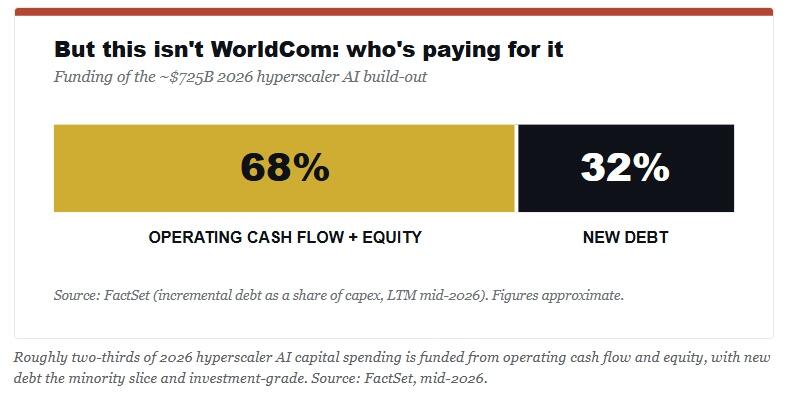
When most people think of violence connected to abortion, they imagine attacks on abortion clinics - yet lately, pro-abortion extremists have been firebombing crisis pregnancy centers across the country.
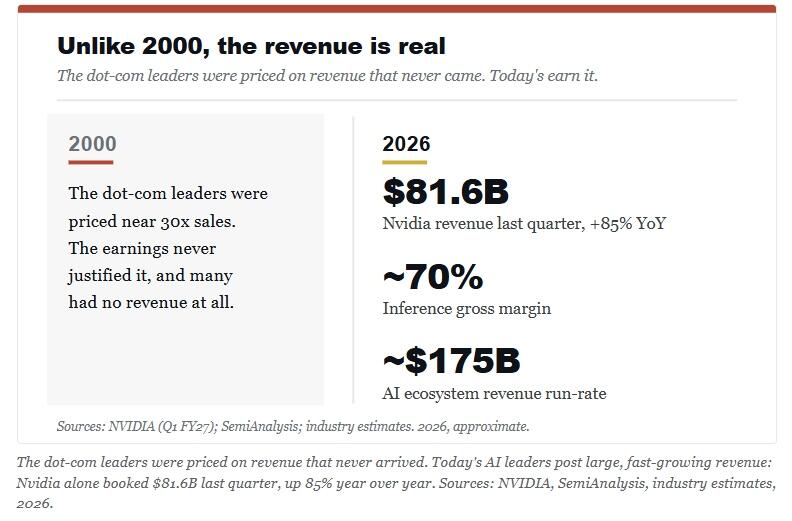
These centers help women who want to have their babies or who are undecided about having an abortion: In other words, women who are making a choice, just not the choice supposedly "pro-choice" abortion advocates find acceptable.

So a group calling itself "Jane's Revenge," referring to the "Jane Roe" of Roe v. Wade, has declared war on anyone who might choose life.

A report in the left-wing Guardian newspaper, headlined "Pro-choice militants are attacking 'crisis pregnancy centers' across US," documented terroristic attempts at intimidation from New York and North Carolina to Wisconsin, Texas and Washington state in the past several years.

The paper noted: "The methods have been extreme: vandals have thrown molotov cocktails, committed arson, damaged property and made threats."

Jane's Revenge issued a statement demanding "anti-choice establishments" shut down in 30 days or face further violence.

That was in 2022 - yet the group continued operating, until its website went dark just days ago thanks to a Trump administration crackdown on terrorist infrastructure.

Jane's Revenge and various other radical organizations, including antifa groups, were part of a network relying on web services provided by Italy's "Autistici/Inventati," or A/I Collective.

According to the State Department, the A/I Collective "builds and operates the digital infrastructure for violent Antifa cells and other far-left militants across the world," providing technology "designed to support the operations of far-left terrorist networks, built to enable them to organize, recruit, communicate, disseminate propaganda, share target information and tactics, and carry out violent attacks - all while remaining anonymous, untraceable, and beyond the reach of the law."

The collective has been facilitating leftist provocations for years.

But on Aug. 26, the State Department struck back, officially deeming the A/I Collective a "specially designated global terrorist."

The designation means sanctions can be imposed on domestic individuals and financial institutions that do business with the foreign group, as well as restricting any of the collective's assets that are under American jurisdiction.

Results were immediate: radical sites shut down.

"Antifascism and anticapitalism are not terrorism," the collective complains in a media statement. "Protesting is not terrorism."

Yet all too often, it is: Groups like Jane's Revenge consider terrorism a legitimate form of protest.

And antifa organizations specialize in using protests as cover for carrying out acts of mayhem.

Indeed, that's the grand strategy - to tear down American society, which is capitalist and "fascist" in the left's eyes, by exploiting the freedoms our "capitalist" Constitution protects.

Legend has it Lenin once said capitalists would sell communists the very rope they would use to hang them.

Today's militant left is counting on capitalists and constitutionalists to provide them the legal protections they need to incite and perpetrate violence.

But the Trump administration refuses to play along.

The State Department's action is long overdue:

Americans should not have had to wait for a Republican administration like this one before government acts to dismantle the infrastructure that supports intimidation and violence.

Foreign interests like the A/I Collective are often suppliers of that infrastructure:

America's domestic extremists are not simply isolated local loonies who spring up at random in our own communities - they're connected to and coordinated with international networks.

The networks encourage cross-pollination and collaboration:

A/I Collective, the State Department notes, provides services to European "anarchist cells responsible for sabotaging rail systems across France, Italy, Germany, and the Netherlands" as well as to the domestic "anarchist cell responsible for waging a violent campaign to prevent the construction of a law enforcement training center in Atlanta, Georgia."

The violent left is a transnational movement, and the Trump administration is right to see it in the same light as other networks that support or engage in terrorism.

Domestic sites and groups using A/I Collective resources have published calls for "direct action" against the nation's immigration laws - and the officers responsible for enforcing them.

That includes publishing pamphlets urging activists to shine laser pointers at Customs and Border Protection helicopters, intending to blind pilots and potentially cause them to crash.

Other sites "dox" ICE agents, providing personal information on immigration-enforcement officers to allow activists to harass them at home - or to firebomb their homes, if they take inspiration from groups like Jane's Revenge.

This is not protesting, and it's not certainly not democratic: These are attempts by a radical fringe to do through intimidation and violence what they can't do at the ballot box.

Going after the foreign enablers of far-left violence and threats is a first, common-sense step in defending the very principle of self-government.

We publish a variety of perspectives. Nothing written here is to be construed as representing the views of ZeroHedge.

Tyler Durden Fri, 09/04/2026 - 23:25

The Politics Of Measles

5 September 2026 at 05:35
The Politics Of Measles

Authored by Jeffrey A. Tucker via The Epoch Times,

By the middle point of 20th-century American history, measles was widely considered a rite of passage for kids. You get it and you shake it off. You earn lifetime immunity. This was true of every generation just before mine.

For the previous century, measles had become ever less dangerous with sanitation and nutrition. By the time the vaccine came along, it was fully controlled and only very rarely led to hospitalization. The protocols were taught in every school and understood by all classes.

I was apparently part of the first generation to receive the inoculation. It was convenient, but not necessary simply because society had systems and traditions in place to manage it well. How much difference did the shot make in driving infection to zero? Some, surely, and this added to the prestige of vaccines.

That said, I did get chicken pox as a natural infection and recall well what it was like. That no longer happens except in a few communities. I was the last to experience this and I'm happy to share the experience.

My parents came to me excitedly and said we were going to a party. I found myself among a group of kids I did not know and we played and played for hours. Then we left. That was fun, I thought, but a bit confusing. The next day, I woke up with itchy red spots.

My parents cheered. Their plan had worked. I recalled feeling great confusion. Why were my parents celebrating my sickness? It seemed very odd. They had their reasons. They knew the science.

They explained to me how the immune system works and why it is best that I get this when I'm young rather than old. My immunity would be durable and be boosted later in life as my own kids caught the normal childhood infections, which in turn would protect me from the related infection of shingles.

There is this tendency now to treat these strategies as paleolithic as compared with syringes and fluids in the childhood vaccination schedule. Actually, we should look back on these days as the height of serious science. My parents knew exactly what they were doing and it taught me a valuable lesson as a kid. I learned about the high complexity of the immune system that needs exposure as training.

Eventually, of course, the chicken pox vaccine came along and many others as well, resulting in a vast mixture of combined shot after shot. Industry profited. Human health suffered. The Trump administration is trying to fix the problem. Industry doesn't like that. It is calling in favors from politicians to stop the return to science.

This takes us to the wild drama now playing itself out in Pennsylvania. In April of this year, the media and the governor's office started going on about a measles outbreak. It was centered in Lancaster and Lebanon counties - both with sizable Amish and Mennonite populations.

The framing here matters. The Amish and Mennonite communities routinely expose children, just as my parents did. It is not an "outbreak" but an application of sophisticated science.

The health of this community ranks among the highest. The most common health issues affecting children in the United States are nearly absent among the Amish, including autism, obesity, diabetes, ADHD, and so on.

Nonetheless, Pennsylvania set up 91 pop-up clinics around the infected community and jabbed kids with more than 4,000 doses using the MMR shot that many people connect to the rise of autism. Forty more clinics are planned.

In science, you have the control group and the tested group. The Amish are the control and keep revealing that there might be a better way. Eliminate the control and you eliminate the embarrassment. This is precisely what both Pfizer and Moderna did after their own tests of the COVID shot: they pushed it on the saline group following first results.

In Pennsylvania, opposition arose to this push for industrial inoculation, and understandably so. In the post-COVID era, trust in public health is depleted to near zero.

Here is where the current drama picked up. On Aug. 14, a newborn child died in Strasburg Township, Lancaster County. The cause of death was later given by the county coroner: lacerated/ruptured spleen, massive blood loss. The postmortem used the PCR test (which detects presence, not infection) and found measles in utero. Obviously, this baby could not otherwise have been vaccinated. It is pointless to call a baby unvaccinated for measles, just as it is ridiculous to observe the infant is illiterate.

A week later, the Pennsylvania Department of Health announced two "measles-associated" deaths in Lancaster County: unvaccinated residents, they said. They claimed these were the first measles-related deaths in Pennsylvania in 35 years. There were no other details given: nothing about the cause of death, nothing about ages, nothing about anything.

Governor Josh Shapiro announced two deaths caused by measles. Not merely associated or related, but caused. The media ran with the story, using the language of causation. He called the deaths preventable and tied them to lack of immunization. He highlighted his clinic campaign and told reporters that Secretary Kennedy had called to offer help with the outbreak to which he responded:

"I was very, very blunt with him, and I made very clear that his actions and the rhetoric that's coming from this administration are having a negative impact on communities across America, particularly right here in Pennsylvania."

It was at this point that the narrative fell apart. The CDC called. The governor's office could give no more information. The Lancaster County Commissioner Josh Parsons spoke out and said that the coroner's office has zero deaths with measles listed as immediate cause; one person died with measles, not from it.

No one could find out anything else about this supposed second death. The coroner's office said it had no such death at all. RFK, Jr. said what everyone was thinking: the second death "may even have been altogether fabricated." Meanwhile, all available evidence confirmed that the baby died of traumatic spleen laceration and the spleen was not enlarged/inflamed.

Even the mainstream media started getting frustrated at this. You cannot whip the public up with measles fears based on wholly fabricated data. When asked about this, Shapiro deflected:

"I think the Department of Health has made clear that they've shared all the information that they are permitted under state law to share, and that those two deaths were measles related. ... I don't think it serves the interest of public health or slows the spread of this outbreak for me to get into a back-and-forth about conspiracy theories that are showing up online."

Much of the mainstream media has now dialed back its claims but the New York Times has still not corrected its story from Aug. 25: "Two unvaccinated people in Pennsylvania have died from measles, as a large outbreak there continues to spread."

That sentence in the paper of record is factually incorrect. It's my personal guess that the reporter would like to make a correction but these people are hemmed in by editors and committees. At this point, to change the wording would be to admit a significant breach.

We are no longer a naive people. Whether the media comes around or not, the real story is already out there.

What concerns me is that we have now several generations who know not what I was taught as a kid, that routine exposure is a necessary and safe way to deal with normal childhood infections that are not deadly and easily treatable. A measles case is not a disaster; it is protective, both broad and durable. Superior to a vaccine? Every expert has to admit that it is. In private, they do.

We have gone so crazy with vaccination that a whole generation of medical professionals and industry leaders have been cajoled into saying that potions can replace the immune system. There is an ocean of money at stake in these decisions. Chicken pox parties are lacking in profit just as is natural immunity generally.

Demonizing religious communities is not a good path for public health and neither is raging against any changes to the childhood schedule. The parents of Pennsylvania, Amish or not, should be left alone. It's ghoulish for the state to plot the elimination of the control group.

As for my parents, they were wiser than the faculty of Harvard and Yale and the executives of pharmaceutical companies. They knew then what we need to rediscover now. Potions and jabs are not an automatic pathway to health and actually do much to compromise and sometimes end it. We need to rediscover this wisdom we mistakenly left behind.

Views expressed in this article are opinions of the author and do not necessarily reflect the views of The Epoch Times or ZeroHedge.

Tyler Durden Fri, 09/04/2026 - 22:35

Warner Bros. "Lanterns" Series Is Another Whiny Woke DEI Disaster

5 September 2026 at 05:10
Warner Bros. "Lanterns" Series Is Another Whiny Woke DEI Disaster

Comic book content is largely dead in Hollywood.Β  Not because audiences don't want to see it anymore (Spider-Man: Brand New Day brought in nearly $2.4 billion in global box office, absolutely crushing Christopher Nolan's Odyssey film), but because the studios have turned most of these franchises radioactive with woke politics.Β Β 

James Gunn's DCU projects for Warner Bros. have proven this over and over again.Β  His girl-boss version of Supergirl was an abject failure largely because of the woke undertones of the film.Β  One would think these people would learn their lesson, or at least care enough about making money to change their behavior.Β  There are two problems, though...

First, activists always double down.Β  They do not learn.Β  They can be forced to shut up and do their jobs properly if studios apply pressure, but left to their own devices they will inevitably inject everything they touch with propaganda.Β  They can't help themselves, they're ideological fanatics.

Second, sometimes studios want to change course and steer away from DEI cultism because it rarely makes any money.Β  But, a lot of the projects in their line-up started production years ago when Hollywood still thought that every American was going to be reeducated into the woke fold.Β  Meaning, they now have all this content slated for release which started development back in 2022-2023.

Such is the case with the Warner/HBO series "Lanterns", a modern take on the comic book series "Green Lantern".Β  The show went into development in 2022...and it's obvious.Β  The crux of the story?Β  A black man (John Stewart) is set up to replace a white guy (Hal Jordan) as the great hero.Β  Stewart's family was essentially ruined by Hal Jordan when Stewart's father failed a test of fear for the Lantern's powerful ring.Β  Hal Jordan ends up taking the ring instead.Β 

The Lanterns interviews are just hilarious. Just say you hate white people and be done with it alreadyπŸ™„ pic.twitter.com/DymaS3pWWt

β€” Steph Anie (@mynerdyhome) September 2, 2026

You see, the fear that prevented John Stewart's black father from earning the ring of a heroic Green Lantern was not his fault.Β  He grew up with constant fear because of "white supremacy".Β  In other words, the black community's failures are once again deflected and foisted upon a nefarious white conspiracy to hold them back from greatness.Β  It's all the ridiculous 2016 to 2020 BLM talking points packed into a 2026 comic book show.

So Hal Jordan was only chosen to be Green Lantern after John Stewart's father failed the test... pic.twitter.com/jp0pcykIXZ

β€” DCU Brief (@DCUBrief) August 31, 2026

The story is apparently meant to be a combination of the legacy comic and the gritty True Detective series (yes, right off the bat we're entering low IQ narrative territory with this idea).Β  The comic book setting aside, the writers and creators of the series have been very vocal about their intentions with the story and they openly admit - This is about the black man finally taking back what is "rightfully his" after the white man "stole it" from him.Β 

Showrunner Chris Mundy described the series as being β€œabout replacement,” with Hal as the aging figure who should β€œstep aside” and out of the way of the younger and more competent John Stewart.

We knew the #lanterns creators hated hal Jordan

But damn.... pic.twitter.com/KOgmbOp2ig

β€” SyL β˜• #SyLgorithm (@sylabdul) September 2, 2026

"As a black person, being in an interview, that's one of our worst nightmares, being in a position where you're being judged by a white person."

-HBO Max's official "Lanterns" podcast pic.twitter.com/rJEM59K0cV

β€” Breitbart News (@BreitbartNews) September 1, 2026

Keep in mind, many studios are cleaning house today and kicking a lot of their DEI hires to the curb, but this process is slow and there's no guarantees that they will ever be able to return to decent storytelling anytime soon.Β  So, in the meantime they're still stuck with a bunch of talentless minority and LGBT writers they hired to gain virtue points and ESG loans.Β 

Most of the middle-aged white guys with imagination and merit were cast out.Β 

It is therefore ironic that the entire basis for the Lanterns series is the fallacy that minorities are rejected because of their skin color and "cultural experiences", rather than a lack of merit.Β  When, in Hollywood, this has been the exact case with DEI hiring pushing out white male actors and writers with talent for the past decade (unless they are gay).Β Β 

The inferiority complex of activist writers is apparent in the stories they obsessively tell - Build up a popular white hero into a washed up strawman who is then easy to tear down.Β  They can't surpass their pale skin peers in the real world without outside help, so they have to beat up artificial white men in artificial worlds.Β  Β Β 

At bottom, minority groups in the west have been hand fed, enjoying promotions and positions of influence within politics, the corporate world and entertainment media.Β  Many of these people where hired despite not having the ability or intelligence to do the job.Β  They were hired to fill an ethnic quota, and that is all.Β  And, this trend shows in the steady decline of media and numerous other sectors of western society.Β Β 

Lanterns may be nothing more than a meaningless superhero show being used as a vehicle for black leftists to cry about not being good enough, but it gives us another window into the warped mind of the opposition.Β  What do we see in through that window?Β  A group that will never take responsibility for themselves and their own problems.Β  They will always blame someone else.Β  Which means, there's no reason to hold their hand anymore.Β  It's a waste of time.Β  Β 

Tyler Durden Fri, 09/04/2026 - 22:10

How Neoliberals Fueled The Rise Of Socialism

5 September 2026 at 04:45
How Neoliberals Fueled The Rise Of Socialism

Authored by Connor O'Keeffe via Mises Institute,

The rising popularity of politicians on the American left who either explicitly identify as socialist or, at least, don't shy away from or disavow the term appears to be causing genuine concern within the Washington establishment.

That is, of course, entirely justified. Socialism is profoundly unjust and destructive.

These days, the socialists like to present their entire ideology as nothing more than having a bit of empathy for those in need or an interest in seeing everyone "have" access to services like modern healthcare.

Look any deeper, though, or ask some follow-up questions, and the truth will eventually surface. What the socialists actually want is a massive increase in government interventionism that would see nearly every aspect of life politicized and the remaining productive components of the economy hollowed out into a zero-sum lobbying battle to claim some of the diminishing loot of a much larger, more powerful, and tax-happy federal government.

Any step towards socialism needs to be energetically opposed by everyone who cares about the rights and material well-being of everyday Americans.

However, the concern we're seeing from the neoliberal and neoconservative establishment is frustrating. Because the political order that they have built and preserved over the last half century has made the growing popularity of this kind of "democratic socialism" all but inevitable.

Scholars like Gabriel Kolko, Murray Rothbard, and Patrick Newman have written extensively about how the powerful, centralized federal government that we live under today originated in the so-called Progressive Era in the late 1800s and early 1900s. And, importantly, it was not grassroots reformers who spurred the growth of the federal government at the time, but well-connected business interests.

The narrative many of us were taught in school of government officials reluctantly giving themselves more power over the economy at the turn of the century to placate a public demanding an end to laissez-faire capitalism is merely a convenient creation myth to justify what has always been a scheme to use state power to redistribute wealth from the broader public to a small caste of well-connected families and firms.

As nearly all of human history makes clear, these sorts of crony, state-empowered redistributive schemes tend to be rather unstable.

That's in part because people typically aren't all that pleased when it starts to become clear that the government is transferring some of their wealth to people that are already far wealthier - requiring the opinion molders of the political class to frequently scramble to find some new way to excuse the policies making up the racket.

But also, the government doing things like warping credit markets to benefit certain industries or launching unnecessary wars to enrich weapons companies and empower foreign leaders who are good at lobbying has plunged the country into several economic and geopolitical crises.

So far, the American political class has done a remarkable job using these crises to greatly expand and accelerate their self-enriching redistributive rackets. But every crisis is unique. Different situations have required different responses.

Which brings us to the rise of what's often called the neoliberal "Washington consensus."

The political establishment's well-known embrace of neoliberalism in the 1980s was primarily a response to the events of the 1970s. For much of that decade, the country was forced to endure a prolonged period of high price inflation that was caused by the Federal Reserve's extensive money printing in the 60s and early 70s to help finance the Vietnam War and Johnson's Great Society programs. That economic chaos was then intensified by the collapse of the Bretton Woods system, the OPEC oil shocks, and Nixon's wage and price controls.

As we've seen in the past few years, inflation alone is more than enough to create strong public demand for political change. But in the 70s, previous credit expansion combined with the government's persistent unwillingness to allow the economy to correct itself also resulted in a stagnant economy. And that combination of high inflation and stagnant economic growth, or "stagflation" as it's come to be known, was considered economically impossible by Keynesian economists.

So the high inflation, low economic growth, and real-time collapse of Keynesianism - the school of thought the political class had been using to justify its economic interventionism - meant change was coming. Also, by the mid-to-late 1970s, the so-called New Left movement, which had started as student protests against the Vietnam War in the 60s, had descended into a highly disturbing mix of lethargic drug use and outright terrorism.

Into that vacuum stepped Milton Friedman.

The nerdy, quick-witted, suit-sporting economist was a perfect foil to the radical, convention-flouting far left much of the country was growing tired of. Friedman's ability to quickly, thoroughly, and politely eviscerate left-wing economic arguments in a highly entertaining fashion made him a star on the talk shows of the day. And, unlike the Keynesians, Friedman's monetarism seemed vindicated by the stagflation.

Thanks in large part to Friedman, the neoliberals took hold of the culture enough to prompt the left-leaning Carter administration to deregulate many parts of the economy including the railroad, airline and trucking industries.

And then, of course, came Ronald Reagan.

Together with Friedman and his fellow Chicago School economists and foreign leaders like Margaret Thatcher, Ronald Reagan and his political successors supposedly rolled back all the reforms made since the Progressive Era, ushering in an age of "market fundamentalism," or unfettered capitalism. They helped bring about the modern "Washington consensus" that the government ought not meddle in the economy at all, which we're told is only just now - four decades later - starting to face some pressure from figures like Bernie Sanders and Donald Trump.

At least, that is the narrative that both neoliberals and their opponents have settled on. But it is a lie.

The rise of neoliberalism in the 70s and 80s was, to be sure, a real ideological shift. The Friedmanites did come to dominate the economics discipline and political culture in very much the same way Keynesians had decades before.

However, the actual implementation of those free-market ideas was nowhere even close to what the establishment's narrative would have us believe.

Virtually all the deregulation that occurred during the Reagan presidency had actually been passed during the Carter administration. It was only because the changes were phased in during the Reagan administration that made it seem like the new president was deregulating the economy. In fact, he was doing no such thing.

The same goes for tax cuts. As Murray Rothbard explained, the much-heralded Reagan tax cuts that were passed in 1981 were more than offset by tax increases that same year. The administration then spent years raising taxes even more in the name of "closing loopholes."

And all of that was necessary to help fund the massive increase in government spending that took place throughout the Reagan years. The so-called Reagan revolution was truly, to paraphrase Rothbard, an acceleration of statist intervention, rolled out under the cover of free-market rhetoric.

There was, however, one area where the Friedmanites did see their policy prescriptions implemented in a genuine and lasting way: monetary policy.

Unfortunately, when it comes to monetary policy, the Friedmanites entirely abandon their support for markets and instead advocate for government central planning. These new establishment-approved neoliberal economists believed - not only in a fiat monetary system controlled entirely by a government central bank - but in a highly active, inflationist central bank.

Friedman himself even wrote a famous book with Anna Schwartz that used questionable econometric methods to argue that the Great Depression happened because the Federal Reserve had not been printing enough money.

Unsurprisingly, the political class was a lot more than willing to implement a Friedmanite program that gave them more power over the economy rather than less. And so, it was in the realm of monetary policy that the largest expansions of both state power and the crony rackets it's utilized for took place under the new neoliberal paradigm.

First, the Fed was leaned on to print money to help pay for the hawkish foreign policy of the post-1980 Republican Party. And then, especially under the Chairmanship of the late Alan Greenspan, the central bank began to directly prop up the financial sector.

The evolution of Wall Street from one of many options for investing one's savings to essentially being the nerve center of the entire economy was not the result of some natural change in saver preferences; it was the consequence of government policy. Specifically, Greenspan's Fed helped prop up Wall Street with a steady supply of easy money and cheap credit to artificially boost the sector, paired with extensive bailouts for these firms whenever the good times ran out.

This was, in effect, a major escalation of the kinds of crony rackets the federal government had been carrying out since the Progressive Era - all justified by Friedman's monetarist apologia for government money printing.

And that gets to the core of it. The Friedmanite, Reagan-led neoliberal revolution did not end economic interventionism, it rebranded it. And the financialized economy was that new brand. Getting rich on Wall Street became the epitome of capitalism. The rising stock market was the new metric for economic strength. And the Fed's money printing became the economy's lifeblood.

In the decades since, that Fed-enabled racket has expanded dramatically and has seeped far beyond the financial sector. It has allowed the political class to supercharge the rackets built up over the last century - which, remember, the neoliberals never did away with - transferring far more of our wealth to that small caste of well-connected cronies.

And yet, thanks in large part to the neoliberals of the past and present, this highly-interventionist system where the government is actively warping the market to benefit those already on top is called - and truly considered by many to be - genuine, free-market capitalism.

That isn't true. It's a trick - a trick meant to mislead us so that whenever a new economic crisis strikes, we reflexively conclude the crisis happened only because the government isn't involved enough in the economy. And that is the mindset that has made so many normal, everyday, non-ideological people open to the arguments of these self-described democratic socialists.

The neoliberal and neoconservative establishment has done much to carry out this trick. They shouldn't be surprised that it's working.

We publish a variety of perspectives. Nothing written here is to be construed as representing the views of ZeroHedge.

Tyler Durden Fri, 09/04/2026 - 21:45

Pimco's Top-Performing 60/40 Fund Bets AI's Next Winners Are In Asia, From Chips To Rare Earths

5 September 2026 at 04:20
Pimco's Top-Performing 60/40 Fund Bets AI's Next Winners Are In Asia, From Chips To Rare Earths

Emmanuel Sharef, who oversees Pacific Investment Management Co.'s flagship Balanced Income and Growth Fund, spoke with Bloomberg about how the next leg of the artificial-intelligence boom could be concentrated in Asian stocks and beyond.Β 

Wealthy clients in Taiwan, Hong Kong, Singapore, and mainland China have been piling into the $19 billion fund, which has outperformed 97% of its peers during the past three years.

The fund is underweight most hyperscalers and members of the Magnificent Seven as soaring AI capital expenditures increase debt loads, pressure free cash flow, spark credit concerns, and make already eye-popping valuations much harder to justify.Β 

"We're underweight the majority of hyperscalers at the moment and we're underweight the majority of the Mag seven just given their high valuations," Sharef told the outlet earlier this week.

He continued, "You don't necessarily need to own the most expensive stocks to capture a particular theme or a particular market trend."

The 60/40 Balanced Income and Growth Fund has been moving further down the supply chain toward companies that build data center components and has becomeΒ overweight in Asia, where it sees stronger earnings growth, cheaper valuations, and greater exposure to the companies that should be viewed as the building blocks of a data center.

That infrastructure includes semiconductor components, cooling systems, cable interconnects, optical equipment, power supplies, construction machinery, and industrial metals.

"The AI capex build-out is enormous," he said. "It would imply significant demand for semiconductor components for chips, cooling equipment, cable interconnects, optical equipment, power supplies, construction equipment, metals, all of the things that go into building a data center."

The fund's 60% stock allocation gained exposure to AI last year by plowing billions of dollars into firms such as Samsung Electronics, SK Hynix, and Taiwan Semiconductor Manufacturing.

Sharef also highlighted a theme we've been developing: the importance of exposure to mining and materials companies tied to data-center construction and global rare-earth supply chains.

"Chinese resource extraction and materials companies are quite significant, not just for the data center buildup, but also for rare earths," he added.

Sharef's call to gain exposure to rare earths and critical materials reinforces a theme we have been developing: the AI trade is ultimately constrained by access to the physical inputs required to build chips, data centers, and power infrastructure. Rare earths and other critical materials areΒ becoming a crucial component of the next AI trade as Chinese suppliers restrict some shipments to the US and US companies accelerate efforts to secure alternative sources beyond Beijing's reach.Β 

The takeaway fromΒ Sharef's conversation with Bloomberg is that the next AI winners will be on an ex-US basis, mostly in Asia.Β 

Tyler Durden Fri, 09/04/2026 - 21:20

AI Tax Increases Are Like The Tractor Tax Proposals Of Old

5 September 2026 at 03:55
AI Tax Increases Are Like The Tractor Tax Proposals Of Old

Authored by Bruce Thompson via RealClearMarkets,

President Ronald Reagan famously described Washington politicians' solutions to every problem as "if it moves, tax it." That is exactly what many in Washington today want to do with artificial intelligence.

As Wall Street Journal chief economic commentator Greg IP wrote recently, a growing number of experts believe there is "a simple answer to AI job losses." Tax it. His column described a petition signed by 1,000 economists, including 17 Nobel laureates, pleading for higher taxes on AI to prevent "large scale" job losses.

Reagan knew what he was talking about. He grew up in the Midwest in a small town surrounded by farms, and he surely remembered a time when politicians wanted to tax tractors, a new technology driving change. In the early 1900s, the tractor was revolutionizing farming, and politicians were pushing proposals to tax the tractor and prevent the loss of farm jobs. Rep. Willian Connery, a Massachusetts Democrat and Chairman of the House Labor Committee, was a leading advocate of taxing tractors and other labor-saving machines to stop mass unemployment.

The introduction of tractors was the most revolutionary change in our history, affecting millions of jobs and driving millions off the farm. Between 1910 and 1960, nearly 10 million farm workers lost their jobs and 25 million people left their farms for the city. The benefits of the tractor were enormous. Farm production soared, food prices dropped, and the U.S. provided enough food to feed people around the world.

The farm revolution transformed the American economy, creating growth, and increasing prosperity. Millions of farm workers were freed from back-breaking labor and found better jobs in the city. An NBER study called tractors the "engine of growth" and estimated they doubled per-capita GDP and created millions of jobs.

AI promises a bright future of technological and scientific progress, increased productivity, and a more prosperous economy. Like many changes in the past, there are concerns about the impact on jobs. But taxing AI would be just like taxing tractors, a futile knee jerk reaction to change.

Not surprisingly, there is no shortage of terrible tax ideas floating around Washington. Senator Bernie Sanders has proposed a 50% tax on the equity of AI companies. Senators Elizabeth Warren and Ron Wyden have proposed new taxes on data centers. House Democrats have proposed a new tax on AI computing powers, and others have proposed a tax on robots. If it moves, they want to tax it.

None of these tax increases are a good idea. Raising taxes on AI would slow investment, curb innovation, and only help our foreign competitors. Just like a tractor tax, a new AI tax would only slow new technological advances that will benefit everyone.

Rather than taxing AI, Washington should focus on assisting those jobs which have been most affected by automation, such as entry-level jobs. Congress should consider targeted tax incentives for entry-level employment, including payroll tax relief and job training for junior workers. Helping young workers get started is a much better response to the AI revolution than trying to stop it with a tax increase.

Bruce Thompson was a U.S. Senate aide, assistant secretary of Treasury for legislative affairs, and the director of government relations for Merrill Lynch for 22 years.

Tyler Durden Fri, 09/04/2026 - 20:55
❌