A Bank for International Settlements (BIS) working paper tests the XRP Ledger (XRPL) as a proof-of-concept for verifying official statistics on-chain, recording cryptographic fingerprints of public datasets that publish in three to five seconds and verify in one to two.
The Working Paper No 1374 essentially asks how statistical agencies can give users an independent way to check the origin and integrity of published data without changing their existing dissemination systems.
International organizations (the BIS among them) rely on the SDMX standard to exchange official statistics, and the prototype binds each SDMX dataset to its source by hashing it and writing a single summary value to the ledger.
Though only the fingerprints reach the chain, never the underlying numbers, so confidential data stays off-ledger, and the method extends to formats such as XBRL. The BIS has tested public blockchains before, including Project Mariana, which trialed wholesale central bank digital currency settlement on a public chain with the central banks of France, Singapore, and Switzerland.
The system normalizes each file with Canonical XML 1.1, hashes it with SHA3-512 at the whole-file and per-series level, and collapses those hashes into one Merkle root written to the Memos field of an XRPL Payment transaction. Each file also carries a W3C Verifiable Credential in its header, signed by the publisher’s identity keys.
Cost and Simplicity
The memo approach needs no smart contracts, so the authors avoided gas costs and contract risk, and XRPL’s base fee of 10 drops, or 0.00001 XRP, put anchoring close to free. Batching compounds that.
A single ledger entry can cover thousands of datasets, dropping the on-chain cost to a fraction of a cent each. The paper also cites the ledger’s fast consensus finality and the published technical analysis of its consensus protocol.
XRPL has taken on other institutional workloads this year. CryptoPotato reported on a pilot that linked the ledger to interbank rails with JPMorgan, Mastercard and Ondo, which settled tokenized Treasury bills in under five seconds, and Ripple has published an institutional roadmap adding compliance credentials and permissioned trading. The BIS tests ran on XRPL’s DevNet, a test network.
It notes that DevNet shares the mainnet’s transaction format and close cadence, so the latency figures carry over, and mainnet fees stay in the sub-cent range.
A Few Firm Limits
The paper also describes the build as an experimental proof-of-concept, stating a production service would need hardware-backed signing, pinned validator nodes and formal load testing.
Though keep in mind the ledger certifies only what was published, by whom and when, so the paper reaches no adoption decision and gives no endorsement of XRP, and the authors attribute the views to themselves, not to the BIS or its member central banks.
Standard Chartered extended its deliverable Bitcoin (BTC) and Ether (ETH) spot trading to institutional clients in the United Arab Emirates on September 3, becoming the first Global Systemically Important Bank (G-SIB) to offer the service in the country.
The offering runs through Standard Chartered DIFC, the bank’s arm in the Dubai International Financial Center (DIFC), which said it is the only global bank currently providing institutional digital asset spot trading in the region.
Built on the UK Launch
The launch adds trade execution to a custody service the bank already runs in the UAE. The trades are deliverable, so clients take possession of the underlying Bitcoin and Ether at settlement, and they can settle through a custodian of their choice, including Standard Chartered’s own digital asset custody solution that went live in September 2024.
Trades run through the bank’s electronic channels and sit inside its existing platforms, letting clients access the two assets through the same FX interfaces they already use. Standard Chartered DIFC is regulated by the Dubai Financial Services Authority (DFSA).
“The UAE has developed a clear digital assets regulatory framework that supports institutional participation and innovation,” said Rola Abu Manneh, Chief Executive Officer for the UAE, Middle East and Pakistan at Standard Chartered. She said pairing execution with custody, governance, and the bank’s global connectivity gives clients a more integrated way to participate in digital asset markets.
Standard Chartered first introduced institutional Bitcoin and Ether spot trading through its UK branch in July 2025, the first G-SIB to offer deliverable spot crypto trading to institutional clients.
“DIFC provides an established platform for international financial institutions to deploy global capabilities across markets,” said Christopher Parsons, Senior Executive Officer at Standard Chartered DIFC. He said the arrangement combines the bank’s global markets network with a regulated base for serving clients across the region.
A Wider UAE Digital Asset Push
The trading service sits inside a broader digital asset strategy that spans custody, trading and tokenization through Standard Chartered’s Corporate and Investment Bank, with its ventures ecosystem reaching into Zodia Markets and Libeara.
The bank already lets institutional clients mint and redeem USDC directly through its DIFC platform, a service it built with Circle. SC Ventures, its innovation arm, has backed a $100 million digital asset joint venture in the UAE with Japan’s SBI Holdings that targets market infrastructure, compliance tools, DeFi and tokenization.
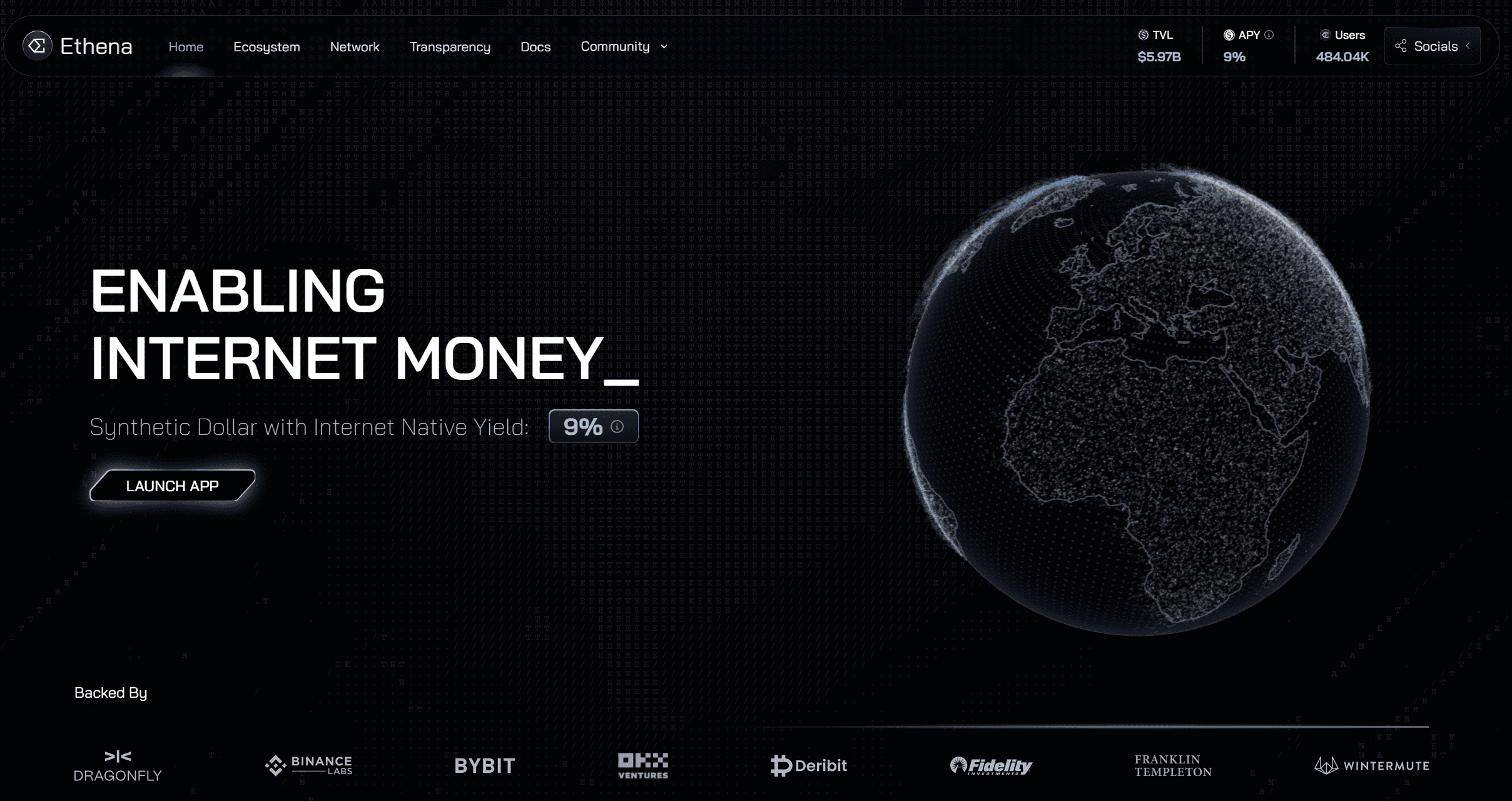
Ethena (ENA) has officially launched Ethena Pay, a self-custodial money app the project bills as “the internet money neobank,” advertising a 6% dollar savings rate, 5% card cashback.
It even has free transfers across roughly 50 countries at launch. It also comes with dollar savings, card spending, international transfers and free onramps in dollars, pounds and euros, with fiat account numbers tied to self-custodial stablecoin wallets.
Though access starts with 400 early users and expands weekly through a September beta. Notably, Avalanche (AVAX) is the exclusive settlement network, and a feature called Buy Now Pay Never puts savings rewards toward purchases without touching the principal.
Tiers and Caps
As mentioned, Ethena’s card cashback is at a flat 5%. The product page breaks it into tiers: the free Standard plan pays 4% on spending with cashback capped at $100 a month, while the Pro and VIP plans lift the monthly caps to $360 and $1,000, with 5% reserved for the top tier.
Savings follow the same pattern: Standard accounts earn 5%, upper tiers get the advertised 6%, and rewards pay out daily. A footnote says the rates rest on Ethena-reported weekly data and assume no net staking activity during reward vesting.
Introducing @EthenaPay: the internet money neobank.
→Card spend cashback at 5.0%
→Best-in-class 6.0% dollar savings rate
→Borderless, free, instant global money transfers
→Free global onramps in USD, GBP, EUR and local FX
→Multi-currency high-rewards savings accounts in… https://t.co/d76b1Gul4Vpic.twitter.com/1gpw7zS2cZ
Users can generate a virtual Visa card in under a minute, spend it at more than 130 million merchants, and add it to Apple Pay, with Google Pay to follow. Third National issues the card under license from Visa, with program management from Signify Holdings, operating as Rain.
The card is not offered to US persons, and users must be 18 to register. Transfers between Ethena Pay users are free, with no monthly account fees, and euro, yen, and Brazilian real accounts are listed as coming soon.
Not a Bank, Though
Ethena Pay Ltd, incorporated in Malta, has clearly stated that it is not a bank, holds no customer funds, and provides fiat account numbers through licensed banking partners, while wallet keys stay with the user behind passkeys and biometrics.
Moreover, the official site flags that balances carry no coverage from the FDIC, the UK’s Financial Services Compensation Scheme or Malta’s depositor scheme, and the savings rate flows from the yield engine behind USDe, Ethena’s synthetic dollar, which has drawn its returns from a crypto basis trade.
USDe’s circulating supply stands near $4.2 billion, per DefiLlama, and Ethena says it has paid holders more than $750 million in rewards on over $30 billion of mints and redemptions. Ethena has widened its lineup before, launching USDtb, a stablecoin backed primarily by BlackRock’s BUIDL fund.
ENA, which recorded its biggest single day of network growth in more than three months in May after Grayscale added the token to its DeFi Fund, traded 8.6% higher on launch day, per CoinGecko.
Ripple Labs and SettleMint have announced a strategic partnership that plugs Ripple Custody into SettleMint’s Digital Asset Lifecycle Platform (DALP), giving regulated financial institutions a single system to custody, issue and manage tokenized assets across their full lifecycle.
Announced from Singapore, the offering has already commenced in Asia, and the companies plan to extend it to other markets as institutional demand develops. Beyond banks, the stack targets market infrastructure operators and sovereign entities, adding compliance, settlement and servicing to the custody and issuance layer so institutions can drop separate vendors for each function.
“Financial institutions across Asia Pacific are putting digital assets to work. They are asking how to do more without stitching together separate solutions for custody, issuance and governance,” said Fiona Murray, Managing Director, Asia Pacific at Ripple.
The Very Lucrative Tokenization Market
The joint release cites Boston Consulting Group’s May 2026 report, “The Future of Digital Assets,” which describes the shift toward digital assets as a fundamental restructuring of financial infrastructure.
Today, we’re proud to announce a landmark partnership between SettleMint and @Ripple that offers regulated financial institutions a single, connected foundation for digital asset custody, issuance and lifecycle management.
BCG projects that tokenized real-world assets could reach $88 trillion by 2035, and estimates that banks failing to adapt could see profits fall by as much as 30% over the same horizon. The release also names RLUSD, Ripple’s stablecoin, and the cryptocurrency XRP as assets underpinning the company’s solutions.
Elsewhere in the region, Ripple piloted RLUSD in Singapore’s central bank sandbox with supply chain finance firm Unloq in March, and its XRP Ledger featured in a cross-border pilot with JPMorgan, Mastercard and Ondo Finance that settled tokenized US Treasuries in under five seconds.
Custody Stack Assembled Through Deals
Ever since it was founded, Ripple has been selling payments, custody, liquidity and treasury infrastructure to banks and payment providers, and has assembled the custody line through a run of transactions. Moreover, Ripple has put its cumulative M&A and corporate venture spending on crypto infrastructure at around $4 billion.
Those include partnerships with Securosys and Figment, an integration with compliance analytics firm Chainalysis, and the acquisition of wallet infrastructure provider Palisade, which added MPC-based key sharding and multi-chain support.
SettleMint supplies the lifecycle side. Headquartered in Leuven, Belgium (though it has offices in the UAE, Singapore and Japan), the company stated that its composable DALP already runs in production and pre-production deployments across North America, Europe, the Middle East and Asia Pacific for banks, market operators and governments.
“Global capital markets are moving fully on-chain, and that shift only works when digital asset custody and lifecycle management operate as one system rather than two,” noted Adam Popat, CEO of SettleMint.
Asset manager Bitwise said that its XRP ETF (XRP) has crossed $500 million in assets under management (AUM) just nine months after launch. The fund’s page showed $502.7 million in net assets across 364.75 million XRP last Friday and $507.23 million after Monday’s close.
“14 years in, and the $XRP community continues to be unstoppable,” the firm wrote in its announcement on X, adding it was “grateful for the chance to expand mainstream access to XRP.”
14 years in, and the ripple:native community continues to be unstoppable.
The Bitwise XRP ETF (XRP) crossed $500,000,000 in AUM—just 9 months after launch.
Grateful for the chance to expand mainstream access to XRP and steward investors’ exposure to the opportunities in this… pic.twitter.com/sgeMDiY5ce
The fund logged $25.9 million in trading volume on its first day on the New York Stock Exchange on November 20, one week after Canary Capital’s XRP ETF (XRPC) opened the US spot category with a nearly $60 million debut.
It was Bitwise’s 49th investment product at launch, and the new funds even outdrew Bitcoin and Ethereum products in their first weeks, with cumulative inflows reaching $756 million by December 1.
Net assets stood at $241.4 million at the end of December and $299.1 million on June 30, according to the trust’s 10-Q for the second quarter. Investors added roughly 181.5 million XRP worth $269.9 million through share creations over the first half, including 105.3 million XRP worth $137.9 million in the June quarter alone.
Bitwise charges a 0.34% sponsor fee, which it waived entirely on the first $500 million of trust assets through December 19, 2025.
Bullish Resilience
Over the same six months, the trust recorded a $176.6 million net decrease from operations, which the filing attributed primarily to “XRP price depreciation from $1.82 on December 31, 2025, to $1.04 on June 30, 2026.”
The token then climbed from $1.00 to a multi-month high of $1.70 between August 19 and 22, slid below $1.40 by Friday’s close, and changed hands at $1.38 on Monday, per CoinGecko.
US XRP funds took in $110.49 million last week, their best weekly haul since early December, pushing cumulative net inflows to a record $1.66 billion on Friday, according to SoSoValue data. Every trading day landed in double digits, topped by $28.14 million on Wednesday.
Bitwise’s fund leads that table with more than $600 million in cumulative net inflows, ahead of Canary’s XRPC at $483 million and Franklin Templeton’s XRP fund (XRPZ) at $462.86 million.
Crypto company BitGo has officially acquired NYDIG’s Bitcoin-focused institutional trading business. The deal was signed and completed on Thursday and reported on Friday, paying $7 million in cash and about $35.5 million in stock at closing, with up to $15 million more in cash tied to two revenue milestones.
The purchase brings NYDIG’s derivatives, structured products, financing, and capital markets operations to the custody company, along with roughly 30 employees.
NYDIG Turns to Power and Compute
Around 250 institutional client relationships were moved across, though they appear in the 8-K filed the same day, which also grants seller NYDIG IHC LLC earn-out shares on the second milestone and sets aside staff retention awards targeting $5 million each in stock and cash.
“Institutions increasingly want to work with a trusted partner that can support the full lifecycle of digital assets,” said Mike Belshe, CEO and Co-founder of BitGo. The firm went public on the NYSE at the start of the year and had a market value below $1 billion as of Thursday, per CNBC.
NYDIG, an affiliate of Stone Ridge Holdings Group, said the sale lets it concentrate on power generation, Bitcoin mining and high-performance computing data centers, a development pipeline it puts above 3 gigawatts, with more than 1 gigawatt deliverable in 2027 and 2028.
“Our team built NYDIG’s institutional trading business into something exceptional: proven execution expertise with derivatives and financing capabilities,” said Tejas Shah, CEO of NYDIG, adding that the data center business is “where we see one of the most significant opportunities ahead.”
Belshe Pushes Senators on CLARITY
Belshe went on CNBC’s Squawk Box on Friday, days after Bitcoin briefly topped $80,000. Asked about a crypto winter, he said the markets “have had high highs and low lows” while “the thesis behind Bitcoin continues to grow,” pointing to tokenized equity plans from Morgan Stanley, Charles Schwab and DTCC.
On the CLARITY Act, which faces a Senate cloture vote on September 15, Belshe said everyone should want the market structure bill to pass. “This is what gives a legislative path forward to help rein that in, prevent any FTX from ever happening again,” he said, estimating 12 to 18 months of rulemaking after passage and noting he was at the White House with President Trump last week.
Belshe confirmed BitGo runs infrastructure for USD1, the stablecoin behind the Trump family’s World Liberty Financial, and said BitGo just received a license in South Korea. “People don’t realize this, but America actually is behind,” he added.
Changpeng “CZ” Zhao made headlines earlier this week after stating Bitcoin (BTC) will reach $1 million, and that the climb will not take 25 years.
“I think for Bitcoin to hit $1,000,000 would be a good thing. And it’ll happen,” the former Binance CEO said on the conference’s Nakamoto Stage, in a video clip posted by Bitcoin Magazine, which is owned by conference organizer BTC Inc.
“I don’t think we need 25 years. I think it’s gonna happen much quicker.”
Bitcoin Overtaking Gold?
Zhao spoke during “The Bitcoin Century,” a session moderated by When Shift Happens host Kevin Follonier on the opening day of the two-day event at the Hong Kong Convention and Exhibition Center.
“For sure, I think Bitcoin will become more important than gold. It will take some time, but it will happen.”
He put gold’s market capitalization at about ten times Bitcoin’s and said sovereign reserve allocations will eventually tilt toward digital assets, with Bitcoin making up more than 50% of strategic crypto holdings alongside Ethereum (ETH) and BNB.
CZ SAYS: “I THINK #BITCOIN WILL TAKE OVER GOLD PRETTY SOON”
“For sure, I think Bitcoin will become more important than gold.”
Bitcoin closed below $65,000 on August 18 and $79,000 on August 28, per Coin Metrics data, still well below its October 2025 peak of over $126,000. But CryptoQuant said in an August 25 report that Bitcoin may be entering a new bull-market phase, with its Bull Score index climbing to 80 from 30, and put confirmation at a daily close above the 365-day moving average near $83,000.
South China Morning Post reported that the remarks drew applause and cheers from a large crowd, against what it described as a lingering crypto slump with capital and talent moving toward artificial intelligence.
Zhao also called the UAE’s crypto rules “the most progressive” and said Hong Kong was “moving pretty quickly.” He claimed “a tiny bit of advocacy” in the UAE’s recognition of Bitcoin as a store of value.
Zhao pleaded guilty to a US anti-money-laundering charge in 2023, served a four-month sentence in 2024, and received a presidential pardon from Donald Trump in October 2025. He returned to the US in February for a Mar-a-Lago crypto event hosted by Trump-family-backed World Liberty Financial.
Circle’s Internet Group will put its name and USDC branding on the front of Chelsea Football Club’s shirts from the 2026/27 season, a principal partnership announced on Friday that makes its on-pitch debut on Sunday, August 30, when the men’s side hosts Brighton in their first home Premier League match of the campaign.
The agreement covers the Men’s, Women’s, and Academy kits. Neither company disclosed the value or length of the deal, though Chelsea’s commercial executives had reportedly held out for £60 million to £65 million a year for the slot; reports and rumors put the reduced asking price at around £45 million.
“We built USDC on the belief that money should work seamlessly for everyone everywhere, the way the internet does. Partnering with Chelsea connects us with a global sports community built on that exact same borderless vision,” said Jeremy Allaire, Co-Founder and CEO of Circle.
Interestingly, Chelsea last began a season with a front-of-shirt partner in 2022/23, the final year of telecoms firm Three’s contract.
Sports data company Infinite Athlete filled the slot for the remainder of 2023/24 in a deal ESPN put at £40 million, Dubai property developer DAMAC appeared late in 2024/25, and industrial AI firm IFS carried the shirt from February to the end of last season.
Chelsea opened the current campaign with a blank shirt front for a fourth consecutive year.
“Circle is changing how money moves around the world, and we’re changing what it means to be a global football club. This is more than a logo on a shirt, it represents a partner who’s building something,” said Todd Kline, President of Commercial at Chelsea FC.
The branding also reaches the women’s team as it moves into the 40,000-capacity Stamford Bridge. “We are excited to introduce Circle and USDC to the Chelsea Women family for our inaugural season at Stamford Bridge,” said Aki Mandhar, CEO of Chelsea FC Women.
USDC Circulation Tops $73 Billion
Circle reported $73.3 billion of USDC in circulation at the end of the second quarter, up 19% year over year, alongside $14.8 trillion in on-chain transaction volume for the three months. The company, which completed its IPO in the second quarter of 2025, is preparing a September 16 public mainnet launch for its Arc blockchain, with BlackRock, Visa and Mastercard among the founding validators.
Similarly, Tether, issuer of the rival USDT stablecoin, took a minority stake in Juventus and later lodged a binding all-cash offer for Exor’s 65.4% controlling stake in the Italian club, a buyout the holding company rejected within a day.
Revolut began rolling out EURR, its first euro-denominated stablecoin, opening the token to what the company called a “select group of customers” in Denmark, Poland, and Portugal ahead of a wider European Economic Area (EEA) launch expected later this year.
The token is issued by Bridge, the stablecoin infrastructure firm Stripe acquired for $1.1 billion in 2025, and sits inside Revolut’s retail app as what Revolut describes as a “euro-denominated, on-chain rail” between euros and crypto.
Support For More Networks
Bridge Building S.A., the issuer’s Luxembourg entity, holds the reserves and redeems EURR at €1.00 per token under the EU’s Markets in Crypto-Assets (MiCA) framework, a register that grew to 14 stablecoin issuers and 39 licensed service providers in its early months.
Bridge announced its own electronic money institution license and MiCA authorization covering all 27 EU member states on July 2.
“EURR connects 80 million Revolut customers directly to on-chain finance,” said Emil Urmanshin, Head of Crypto and New Bets at Revolut, adding that the combination of scale and licensed banking infrastructure is “unlocking real-world stablecoin utility that no traditional bank or crypto native can match.”
The public offer opened on August 20 on Ethereum and Polygon, according to the company’s blog post, which names Revolut Digital Assets Europe Ltd as sole distributor and lists Revolut X, the firm’s standalone exchange, as a second distribution channel. Support for Solana, Arbitrum, Optimism, Avalanche, Injective, TON, and Sui is planned.
Revolut’s token also shares its ticker with an existing MiCA-authorized euro stablecoin from StablR, which CoinGecko lists under the same EURR symbol.
Revolut Queues More Currency Tokens
Revolut said additional currency-denominated stablecoins are in development through separate regulatory pathways, and the broader EEA rollout of EURR remains subject to regulatory, operational, and product readiness.
“Revolut initially eliminated hidden fees and friction in currency exchange. EURR completely removes the pain of moving on and off-chain, becoming a new seamless and instantaneous bridge between fiat and crypto,” noted Iman Olya, product owner of stablecoin at Revolut.
Revolut began rolling out its UK bank after the Prudential Regulation Authority removed the limits on its banking license in March, also starting with a small group of customers. Circle’s EURC, the largest regulated euro stablecoin by market capitalization, held about €394 million in circulation today, per CoinGecko.
Grayscale’s Zcash fund began trading on NYSE Arca as the Zcash ETF (ZCSH) this Tuesday, August 25, billed by the firm as the first exchange-traded product in the world to offer spot exposure to Zcash (ZEC) and carrying a sponsor’s fee of 2.5% a year.
ZCSH’s predecessor launched as a private placement in October 2017, and its shares have been quoted on OTCQX since October 2021. The registration statement went effective on August 24, NYSE Arca certified the listing the same day, and the fund shed the Grayscale Zcash Trust name in the process.
NAV Discount Narrows to 1%
The final prospectus also fills in the fee rate, a line that was still blank when CryptoPotato covered the August 18 amendment disclosing contribution talks with a Digital Currency Group (DCG) unit last week.
“As AI reshapes how financial activity can be monitored, we believe demand for genuine financial privacy will only grow. With ZCSH, Grayscale is building on its history of industry firsts by giving investors a way to gain exposure to one of the market’s leading privacy-focused assets,” said Steve Vanourny, Head of Index at Grayscale.
Coinbase Custody Trust Company holds the fund’s ZEC, and Foreside Fund Services acts as the marketing agent.
The Zcash ETF – Built by Grayscale (Ticker: $ZCSH) begins trading today @ZcashETF.
The world’s first Zcash ETF offering exposure to $ZEC, now accessible from brokerage or investment accounts.
Shares that traded at a 17% discount to net asset value on June 30 narrowed to a 7% discount by August 12 and 1% by August 20, when they closed at $45.34 on OTCQX. The trust reported a net asset value of $155.2 million at the end of June, when its holdings amounted to approximately 2.3% of the ZEC in circulation.
The prospectus also carries forward the warning that DCG, Grayscale’s parent, may come to own a majority of the shares. DCG International Investments, a subsidiary, remains in discussions to acquire shares through an authorized participant in exchange for roughly 200,000 ZEC, a stake expected to constitute “a substantial portion” of the fund’s ownership. The talks are not binding, and the unit “could determine to purchase more, fewer, or no Shares,” the document states.
ZEC Trades Near an Eight-Year High
Launched in 2016, Zcash pairs a Bitcoin-style 21 million coin supply cap and proof-of-work consensus with optional transaction privacy that shields sender, recipient, and amount details.
Grayscale’s announcement even cites the network’s upgrade record, from Sapling in 2018 and Orchard in 2022 through the Ironwood upgrade that went live in July with a turnstile mechanism against counterfeit coins.
In a post on X, the firm put shielded supply at 4.4 million ZEC, roughly 26% of the circulating total.
ZEC changed hands at $785 on August 26, according to CoinGecko, the 12th-largest digital asset at a $13.2 billion market capitalization. Two days before the listing, the token touched roughly $880, its highest price since January 2018.
The exchange has signed a non-binding letter of intent with Apex Fintech Solutions that would make its subsidiary, Gemini Titan, the exclusive regulated venue for crypto event contracts.
According to the press release, these contracts will be distributed through Apex’s futures commission merchant (FCM) to its brokerage customers.
Brokerages offering those contracts through the Apex FCM would use Gemini for execution and clearing. The release said Gemini also gives Apex flexibility to collaborate on sports, economics, and financial markets contracts on a non-exclusive basis. Both firms said they look forward to finalizing details in the coming weeks.
Gemini’s forward-looking statements described the arrangement as a non-binding letter of intent and listed the possibility that the parties fail to reach a definitive agreement among the risks investors should weigh.
Two Licenses Came First
The Commodity Futures Trading Commission (CFTC) approval arrived in stages, and Gemini Titan already secured a Designated Contract Market (DCM) license in December 2025, which let Gemini start offering regulated prediction markets to US customers.
Gemini first filed for that license in March 2020. In April, subsidiary Gemini Olympus obtained a Derivatives Clearing Organization (DCO) license, moving derivatives clearing and settlement for Gemini Titan in-house.
“Leveraging more than a decade of experience building and operating a regulated platform for crypto, a new and emergent asset class, we deliberately chose to build our predictions platform in-house,” Gemini CEO Tyler Winklevoss said.
He added that predictions are “the future of markets” and that the approach lets Gemini “expand our offering and open access to valued partners like Apex as demand for event contracts grows.”
The two companies have shipped together before. Gemini launched stock trading at 0% commissions for certain US customers in July, with Apex Clearing Corporation acting as custodian and clearing broker.
Event Contract Revenue
Apex Global Head of Digital Markets Travis McGhee noted that brokerage clients “get regulated access to crypto event contracts without having to build the plumbing themselves.”
Apex says its infrastructure supports hundreds of clients and tens of millions of end investors, and its Apex Clearing Corporation subsidiary is licensed in 53 states and territories.
Similarly, Robinhood booked $156 million in event contract revenue in the second quarter, more than 10 times higher than a year earlier, on a record 13.6 billion contracts.
Gemini’s prediction market arm is already in court, though. New York Attorney General Letitia James sued the prediction market arms of Coinbase and Gemini, arguing that they run unlicensed gambling without New York State Gaming Commission approval.
“Gambling by another name is still gambling, and it is not exempt from regulation under our state laws and Constitution,” James stated.
Franklin Templeton is preparing to put tokenized assets inside its conventional mutual funds and ETFs, Bloomberg reported on Thursday, eight days after SEC staff cleared the firm to hold its $721 million blockchain-based money market fund in those portfolios.
Franklin characterizes relief as the first US regulatory clearance for digitally native products inside conventional funds.
“It is not a rule, regulation, or statement of the Commission, and the Commission has neither approved nor disapproved its content,” the Division of Investment Management wrote on August 12, adding that it “has no legal force or effect.”
Staff set aside paragraphs (b), (e), and (f) of Rule 17f-2 under the Investment Company Act of 1940, the provisions built around vault custody of share certificates.
The Franklin OnChain U.S. Government Money Fund (FOBXX) reported net assets of $720,928,224 on July 31 and a 3.50% seven-day net yield. Franklin Templeton Investor Services will open a separate wallet on Stellar for each investment fund.
Twelve Conditions Attached
Staff attached twelve conditions. Each fund’s board of trustees must approve the arrangement and review it at least annually.
FTIS has to retain the power to correct errors, freeze or migrate wallet records and restore the official ownership record, and if it ever stops acting as transfer agent it must hand the successor administrative control over the smart contracts.
Independent public accountants must verify each fund’s holdings at least three times a fiscal year, two without prior notice. Moreover, funds may use the shares for cash balances and securities lending collateral. CryptoPotato reported in December that BENJI served as collateral in a SemiLiquid credit pilot, staying encumbered across the loan lifecycle.
Relief Rests on a 1992 Letter
Staff granted the position by analogy to a September 24, 1992 letter to Franklin Investors Securities Trust, which covered a master-feeder arrangement where an affiliated transfer agent held fund shares in book-entry form. Franklin argued a Stellar wallet raises the same question, since FTIS still maintains the official ownership record and keeps unilateral control over it.
The letter names 23 investment managers, among them Putnam, Western Asset, ClearBridge, BrandywineGLOBAL, Royce and Clarion Partners. CryptoPotato has covered Franklin’s agreement to buy 250 Digital, the firm spun out of CoinFund, as its digital asset arm passed 50 staff.
On August 18, the SEC proposed the Regulation Crypto Assets with $5 million and $75 million offering paths, a proposed rule carrying a 60-day comment period. Franklin’s request was signed by Navid J. Tofigh, Senior Associate General Counsel, and answered by Taylor Evenson, Senior Counsel.
Coinkite, the company behind Coldcard, has shipped a firmware update that will not generate a new wallet seed until the owner supplies randomness by hand.
That means at least 50 dice rolls, 128 coin flips, or 65 timed key presses, three weeks after a defect in its random number generator opened customer funds to attackers.
Coldcard’s two device lines run separate firmware tracks, so the release carries two numbers, 5.6.1 for the Mk4 and Mk5, and 1.5.1Q for the Q, the larger model with a keyboard and QR scanning.
Boot Check Targets the Defect
Coinkite stated that the input is added on top of device randomness from the STM32 TRNG and both secure elements.
Coldcard was built to draw seed entropy only from its hardware generator, but Coinkite traced the failure to a build and link error that left the setting meant to disable the software path without effect, sending the random-number call to MicroPython’s Yasmarang PRNG, which entered the seed path in March 2021.
Affected seeds carry about 72 bits of entropy instead of the expected 128 bits after 594.5 BTC was swept from 500 addresses on July 30.
Firmware 5.6.1 now verifies at boot that the random-number call reaches the intended hardware path, halting the device if it fails. Coinkite replaced Yasmarang with a SHA-256 Hash_DRBG, specified in NIST SP 800-90A, and seeds it at startup with a full 256-bit digest from both secure elements, which earlier firmware truncated to 32 bits.
Key mashing follows Peter Todd’s push-button RNG design, hashing keypad press timing at CPU-cycle resolution. The first press sets a reference, and each of the 64 gaps that follow is credited with two bits of entropy.
Old Seeds Still Need Migrating
“Installing this update does not make an existing vulnerable seed safe,” Coinkite wrote, directing anyone whose seed may have been generated on affected firmware between 2021 and July 2026 to create a replacement and move their Bitcoin (BTC). Mk2 and Mk3 fall outside this release, and their minimum fixed version stays at 4.2.0.
A compromised USB host could rewrite a staged transaction after the owner approved it, so the signature covered different outputs. The device now rechecks those bytes before signing and stops with a “Transaction modified” warning.
Coinkite’s new Security Status page lists four independent reviews, among them a real-device test that observed eight hardware RNG reads for a 32-byte seed request and a rebuild matching every byte of the signed firmware.
The company noted that the checks are “not a complete audit of every firmware binary.” As CryptoPotato reported, confirmed losses passed $100 million, with Galaxy Research counting 1,596 BTC from roughly 7,300 addresses, and a suspected fourth wave sweeping nearly 449 BTC on August 3.
HSBC and Standard Chartered executed the first live tokenized deposit transaction on SWIFT’s blockchain-based ledger, the two banks said on August 19, six weeks after the network opened to an initial cohort of 17 banks.
Payment messages moved between HSBC’s Tokenized Deposit Service (TDS) and Standard Chartered’s own tokenized deposit infrastructure, with the resulting obligations recorded on both banks’ systems.
SWIFT’s ledger worked as an orchestration layer, matching and netting the obligations between the two institutions before final settlement ran through existing payment rails.
“HSBC’s interoperability transaction with Standard Chartered via SWIFT is a landmark moment for the promise of tokenised deposits,” said Lewis Sun, Head of Digital Currencies at HSBC.
Mark Willis, Head of Emerging Payments, Transaction Services and Digital Assets at Standard Chartered, noted that “tokenized deposits are a key pillar of Standard Chartered’s digital assets strategy, which aims to build end-to-end solutions.”
Ledger Runs on Hyperledger Besu
SWIFT says the ledger MVP is built on open-source foundations, using an Ethereum Virtual Machine-compatible architecture based on Hyperledger Besu, and that it is designed to integrate with the broader digital asset ecosystem.
SWIFT operates the ledger itself, handling orchestration of transaction workflows, validation of funding commitments, and coordination of interbank processes. Consensys built the conceptual prototype when Swift announced the project in September 2025.
Seventeen banks from six continents are preparing to pilot live transactions, among them ANZ, BNP Paribas, BNY, Citi, DBS, MUFG, UBS, and Wells Fargo. CryptoPotato covered that SWIFT has experimented before with moving tokenized value across public and private blockchains.
HSBC has put bank money on a ledger before, joining a S$400 million digital bond issuance with SGX and Temasek that cut primary settlement from five days to two.
“With our new ledger capability, we’re extending the trust and stability of established finance into the frontiers of digital money,” said Thierry Chilosi, Chief Business Officer at Swift.
Rival Network Targets 2027
American banks are building a competing rail. The Clearing House is developing a tokenized deposit network called The Bridge with JPMorgan Chase, Bank of America, Citigroup and Wells Fargo, targeted at the first half of 2027 and open to all US banks. Bank of America’s Mark Monaco said clients are not “beating down the door” for tokenized deposits yet.
SWIFT moves the equivalent of world GDP every two to three days across more than 200 markets. The cooperative says 75% of payments on its network reach beneficiary banks within 10 minutes.
Grayscale has disclosed discussions with a Digital Currency Group (DCG) subsidiary over a contribution of roughly 200,000 ZEC to its Zcash Trust, in an August 18 amendment to the registration statement that would move the fund onto NYSE Arca.
Grayscale Investments Sponsors, the trust’s sponsor, said it is in discussions with DCG International Investments Ltd. for the unit to acquire shares through an authorized participant in exchange for the tokens. The filing adds that “because these discussions are not binding agreements or commitments to purchase, the Potential Investor could determine to purchase more, fewer, or no Shares.”
Moreover, the trust intends to list under the ticker ZCSH, which already carries its shares on OTCQX. Net asset value was $155.2 million on June 30, when the trust held about 2.3% of circulating ZEC, and shares closed at $36.6 on August 12 at a 7% discount to NAV per share.
Since October 2021, the shares have been quoted at a discount on 700 days, with a maximum discount of 55% and a maximum premium of 240%, though the SEC has not approved or disapproved the shares.
DCG Sits on Both Sides
Grayscale’s parent would take a controlling position if the contribution is completed. DCG “may, directly and indirectly through the Potential Investor and other affiliates, own a majority of the Shares representing ownership in the Trust,” the filing states, and would hold “the ability to control the outcome of virtually all matters presented to our shareholders for their approval.”
DCG also mines the asset. Fortitude Mining, a DCG subsidiary, mines ZEC and runs infrastructure on the network, while Foundry Digital operates a ZEC mining pool that accounted for approximately 15.4% of the Zcash Network’s hash rate for the month ended July 2026.
DCG “could prioritize its own interests in these and other investments over those of the Trust,” according to the filing. Zcash itself shipped the Ironwood upgrade and its turnstile mechanism after a counterfeiting bug surfaced in the Orchard shielded pool.
Fee Line Still Blank
The Sponsor’s Fee, the only ordinary recurring expense the trust expects, appears in Amendment No. 4 with its annual rate left blank, as does the trust’s intended new name. Coinbase Custody Trust Company holds the ZEC, and Coinbase is the prime broker.
Grayscale has run this conversion before. The SEC cleared its Digital Large Cap Fund for NYSE Arca alongside generic listing standards that removed the 19(b) filing requirement, and the manager earlier filed to convert its XRP trust into an ETF on the same exchange.
ZEC traded at $550.78 on August 19, according to CoinGecko, with a market capitalization of $9.3 billion.
SkyBridge Capital founder and managing partner Anthony Scaramucci told CNBC’s Squawk Box on Tuesday that Bitcoin (BTC) will climb back over $100,000 as the halving cycle tightens prices, a level the asset has not closed above since November 13, 2025.
Bitcoin briefly hit $65,000 on Tuesday, according to CoinGecko. The next halving falls at block 1,050,000, which countdown trackers place around April 2028, and the network stood at block 963,063 on Tuesday.
Halvings arrive every 210,000 blocks, and the block subsidy will drop to 1.5625 BTC from 3.125 BTC.
Prior Call Targeted $170,000
Coin Metrics puts Bitcoin at $64,908 on April 20, 2024, the day of the last halving. The cycle that followed peaked at over $126,000 on October 6, 2025. The asset last closed at or above six figures on November 13, 2025, at $100,035, then fell to $86,505 by December 1, $76,911 on February 1, and $65,734 on March 1. Its 2026 low was at under $58,000 on July 1.
Scaramucci made a similar argument before the last halving in early 2024, expecting Bitcoin to reach $170,000 after the April halving, based on a pattern he described as multiplying the halving-day price by four roughly 18 months later. BTC traded near $43,000 when he made that call.
The four-year pattern is itself disputed now, as even analysts, including Scott Melker and Arthur Hayes, are questioning whether the cycle still holds, with Melker noting Bitcoin ran 1,080 days from its last major low against a historical peak window of 1,060 to 1,070 days, and PlanB placing a possible top anywhere between 2026 and 2028.
Clarity Act Vote Set for September
Some of the catalysts for the price surge, at least in the short term, could be the impact of the Clarity Act and the state of crypto among the topics covered across the eight-minute interview.
The Digital Asset Market Clarity Act, filed as H.R. 3633, is scheduled for a Senate cloture vote on September 15 at 2:15 PM ET.
CryptoPotato reported that Senate Majority Leader John Thune filed cloture shortly before the August recess after Democrats declined to back a procedural vote, and that the bill’s odds of becoming law this year have fallen, according to experts and prediction platforms.
The motion needs 60 votes, and senators will not be voting on the legislation itself that day.
Bybit intercepted more than $700 million in potential user losses between January 1 and June 15, blocking over 30,000 suspicious withdrawal requests and protecting close to 20,000 users, according to a risk and security report it published on August 18.
That compares with $300 million intercepted across the whole of 2025 under what the company then called a new AI-driven risk framework. CryptoPotatoreported the earlier tally alongside the 3 million credential-stuffing attempts Bybit said it blocked that year, when its recovery work covered roughly 4,000 users.
The company said the metrics should not be read as a guarantee of future performance or as a comparative ranking of exchanges.
“The cybersecurity arms race has entered an era of minutes,” said David Zong, Head of Group Risk Control and Security at Bybit, who noted that human judgment remains “at the center of critical security decisions.”
AI-Assisted Auditing
Bybit said AI-assisted auditing identified high-severity vulnerabilities at three to five times the rate of manual review, and that automation cut the time from security assessment to testing from about two weeks to two hours.
An automated red-team platform assessed 1,489 public-facing assets and flagged more than 100 high-severity vulnerabilities, with discovery to first penetration test down to under 24 hours. More than 100,000 alerts were processed with AI assistance. Monitoring now reaches 100% of business-relevant on-chain activity, including listed token contracts and the exchange’s cold, warm, and hot wallets. Also, the initial risk reviews averaged 4.7 minutes, with 95% finished within 10 minutes.
Bybit said it handled 10 incidents involving listed token projects with no platform losses, completing emergency responses ahead of other major exchanges in eight and detecting two before the affected projects did.
Lawsuit Freezes $30.5 Million
This comes shortly after Bybit sued North Korea, its Reconnaissance General Bureau, and the Lazarus Group in the US District Court for the District of Columbia, announcing on August 8 that it had secured a preliminary injunction freezing identified stolen assets.
It has recovered about $48.4 million and frozen more than $30.5 million across over 28 exchanges and custodians.
“Our focus has never changed: protect our users first, recover what we can, and make sure the people behind these attacks are held accountable,” stated Ben Zhou, Co-founder and CEO of Bybit.
In February 2025, attackers drained roughly $1.46 billion, by Bybit’s count, after compromising a cold wallet signing process. As reported, the FBI attributed the theft to the Lazarus Group, which US agencies valued at $1.5 billion and traced to more than 41,000 ETH.
Security firm Blockaid counted $1.1 billion stolen across 212 incidents marketwide in the first half of 2026.
BitMine Immersion Technologies (BMNR) has repurchased 1.7 million common shares in the week ending August 16. This is the smallest weekly buyback since the program began on July 1 and the third consecutive weekly decline, while the company’s Ethereum (ETH) treasury grew to 5,815,164 tokens.
Total crypto, cash, and “moonshot” holdings came to $11.4 billion, down from $11.6 billion a week earlier, even though BitMine added 9,926 ETH over the period. The company marked its ETH at $1,893 per token on August 16, against $1,928 a week before. As reported, BitMine purchased a 7,391 ETH batch that took the treasury past 5.8 million tokens last week.
“We are encouraged to see the ETH/BTC ratio at 0.02994 and rising,” stated Thomas “Tom” Lee, Chairman of BitMine, who linked the move to tokenization and agentic-AI applications.
Buyback Slows for Third Week
BitMine’s holdings equal 4.8% of the 120.7 million ETH supply, leaving it 96% of the way to its stated target of owning 5%. Lee said the company has bought ETH every week since the treasury strategy began on June 30, 2025.
BitMine has repurchased 20.8 million common shares since July 1 under a $4 billion authorization. Weekly totals disclosed in its filings peaked at 6.1 million shares in the week to July 26, then fell to 4.5 million, 3 million, and 1.7 million. Lee has called the stock undervalued or attractively valued in each of those three releases, and described the program as the largest ever executed by any crypto digital asset treasury.
Back in July, BitMine cut its weekly ETH buying to 7,430 tokens from more than 30,500, a slowdown Lee attributed at the time to capital redirected toward repurchasing shares.
Cash Falls to $78 Million
Total cash and marketable securities stood at $78 million on August 16, a line that has declined in every weekly disclosure since June 28, when BitMine reported $527 million, passing through $482 million, $385 million, $268 million, $173 million, and $104 million.
Alongside the ETH, the company reported 210 Bitcoin (BTC), a $180 million stake in Beast Industries, and a $73 million stake in Eightco Holdings (ORBS).
BitMine’s board declared seventeen weekly cash dividends on its 9.50% Series A Perpetual Preferred Stock on August 14, most at $0.1847 per share, payable from September 4 through December 28.
That security trades on the NYSE as BMNP against a $100 stated value.
Exchange-traded funds (ETFs) took 25.0% of Gen Z equity trading volume on Binance in the first days of August, up from 14.6% in June.
According to a Binance Research report published on August 12, millennials directed 9.5% of their early-August equity volume to the same instruments. Unleveraged ETFs drew 18.5% of Gen Z net equity inflow in June and 21.9% in July, while the single-stock share fell from 77.0% to 74.2%.
Report author Lim Kim Thye cautioned that “two months is not enough to establish a trend.”
The Money That Stayed
Binance opened direct stock trading in June 2026, and its tokenized US equities reached $100 million in assets under management within two weeks of launch, with 47% of trading activity outside regular US market hours.
Gen Z’s total net equity deployment fell 17.4% in July. Net inflow to unleveraged ETFs slipped 2.0% over the same period, against 20.4% for single stocks and 28.5% for leveraged products.
Interestingly, Gen Z was the only cohort whose ETF holder base grew, rising 2.9%, while Millennials fell 4.5% and Gen X fell 5.9%. Its ETF buyers traded the least in July at 7.9 times against 10.3 for Millennials. Across the sample, ETF buyers held 1.4 to 1.6 fund symbols each, and in the June cohort, positions averaged 10 to 14 days, with 36% to 45% still open at the snapshot.
Ticket sizes ran in the same direction. The largest average buys in direct equities went to the dividend ETF SCHD at $16,567 per trade and Broadcom (AVGO) at $12,370, while the smallest went to the best-known names, Tesla (TSLA) at $633 and Nvidia (NVDA) at $514 in stocks.
Almost No Leverage
Leveraged and inverse ETFs made up 9.25% of Gen Z direct-equity turnover in July but 3.93% of net monthly inflow, a share that has fallen from 4.55% in June to 2.65% in the opening days of August. “Gen Z does not appear to be committing capital to leveraged exposure,” the report stated.
But 88.2% of Gen Z accounts recorded no leveraged or inverse activity in TradFi-Perps, against 84.5% of Millennials and 85.9% of Gen X. In direct equities, the figure is 96.5%, though Baby Boomers lead every product and reach 98.9% there.
Gen Z averages 13 trades a month on perpetuals against 17 for Millennials, and 22% of its direct-equity accounts have never placed a sell order, behind Millennials at 30%.
Bank Leumi will offer Bitcoin (BTC), Ethereum (ETH), and Solana (SOL) trading to roughly 2.5 million retail customers from early 2027 through a partnership with Galaxy Digital (GLXY), the two companies said on August 14, in what they describe as the first digital asset trading service offered by a bank in Israel.
Customers of Leumi and PEPPER (its mobile digital banking arm) will trade inside a dedicated, secured section of Leumi Trade, the bank’s capital markets application.
GalaxyOne Institutional supplies the trading platform, and custody runs on Galaxy’s custody infrastructure platform, formerly known as GK8.
“This initiative represents a significant pillar of the bank’s innovation strategy and enables us to provide customers with simple, secure, and regulated access to trading digital assets,” said Maya Ravia, Head of Strategy at Bank Leumi.
Regulator Blocked the 2022 Attempt
The plan is subject to approval by the Bank of Israel. Leumi and PEPPER announced a partnership with Paxos to offer BTC and ETH trading back in 2022, and that service never reached customers after the Bank of Israel declined to approve it.
Israeli rules have shifted since. The Bank of Israel’s Banking Supervision Department removed the automatic delay on deposits originating from crypto transactions above NIS 100,000 in mid-July.
Moreover, according to Chainalysis, Israel received roughly $22 billion in on-chain value in the 12 months to June 2025.
The Capital Market Authority has separately circulated a draft that would let licensed companies offer trading in the 50 leading digital assets, subject to a $500 million minimum market capitalization, limits on holder concentration, and registration in recognized jurisdictions, including the European Union and New York State.
Custody Traces Back to Celsius
Galaxy’s custody technology reached it through a bankruptcy. Celsius paid $115 million for GK8, a Tel Aviv custody firm, and Galaxy won the platform in the insolvency proceedings, adding about 40 staff and a Tel Aviv office. GK8 co-founder Lior Lamesh now runs Galaxy Israel.
“The future of finance will run on open, programmable rails, and we believe the banks that move first will define the era that follows,” stated Lior Lamesh, Chief Executive Officer of Galaxy Israel.
Layer-1 chain Flare has announced that FXRP now works as collateral on Derive, letting XRP holders trade on-chain options and perpetual futures from their own wallets.
According to a press release shared with CryptoPotato, holders can mint FXRP through Flare’s FAssets system, deposit it on Derive, and run positions from a single Portfolio Margin V2 account, which covers hedging, premium generation, and directional trades on the same collateral.
Flare said XRP holders previously had limited ways to hedge a position or generate options premium without relying on centralized exchanges or custodians.
Options Cash Settle in USDC
Derive’s XRP options are cash-settled in USDC. When a contract expires in the money, the difference is paid out in USDC, and the FXRP stays posted as collateral, so settlement moves no underlying XRP. Sellers need enough USDC on hand to cover that payout, and they carry margin and liquidation risk on the position.
Derive is built on infrastructure from Lyra Finance and runs options, perpetual futures, and spot trading through one portfolio margin system. It traded more 30-day notional options volume than any other on-chain venue tracked by DefiLlama, which puts its total value locked near $118 million.
“Options are often the last major market to develop around an asset, and XRP has been waiting for the infrastructure,” said Nick Forster, Co-Founder and Chief Executive Officer of Derive. FXRP gives one of crypto’s largest holder bases “a credible path on-chain,” he stated.
XRPFi Stack Adds Derivatives
FAssets represents XRP on Flare through an overcollateralized system run by independent agents and the network’s data oracles, which pull cross-chain and real-world data through the Flare Time Series Oracle and the Flare Data Connector.
FXRP reached mainnet in September 2025, capped at 5 million tokens for its first week while Flare rolled out incentives, and the network said that the cap was filled within four hours. More than 155 million FXRP had been minted within seven months.
That supply already backs lending, borrowing, and yield tokenization. As CryptoPotato reported, FXRP deployed across DeFi applications rose from 82 million to 144 million since February, with more than 40 million XRP earned through Flare’s Smart Accounts across nearly 24,000 accounts. Flare has since listed an FXRP/USDC spot pair on Hyperliquid that lets the token move across chains.
“XRP has one of the most committed long-term holder bases in crypto, and until now they’ve had no permissionless options market to generate yield or hedge against their position,” said DeFi analyst Will Procheska.
The entity behind the world’s largest stablecoin has announced that KPMG U.S. issued an unqualified audit opinion on the financial statements of Tether International, S.A. de C.V. for the year ended December 31, 2025. This is the first full financial statement audit in the history of the company behind USDT.
An unqualified opinion carries no reservations, exceptions, or caveats, and is the strongest conclusion an independent auditor can reach. This means KPMG examined the balance sheet, income statement, statement of changes in equity, and cash flow statement under US generally accepted accounting principles, with each area subject to independent substantive testing. The audited statements report reserves exceeding liabilities by $6.81 billion.
KPMG physically counted and inspected every individual gold bar Tether holds, verifying its existence and identifying information. Tether said the procedure went beyond the reports supplied by custodians and counterparties.
The Attestations And The Audit
Tether has provided regular independent attestations of its backing assets for years, but an attestation just checks reserves at a point in time, while the KPMG engagement covered the full financial statements.
Back in 2022, BDO Italia replaced MHA Cayman on the reserves reports, a move Tether called “the next step in the company’s path toward a complete audit.” BDO still prepares the quarterly reports, among them the Q1 2026 attestation showing a record $8.23 billion excess reserve buffer.
Tether had also completed a SOC 2 Type 1 examination covering IT and security controls in 2024, but that examination stopped at the controls and never reached the financial statements.
Moreover, those quarterly figures sit outside KPMG’s opinion. Tether’s most recent attestation covered the second quarter of 2026 and reported $1.5 billion in net operating profit, roughly $184.6 billion of USDT issued, and more than 146 tons of gold.
Tether’s Long History With Regulators
The Commodity Futures Trading Commission fined Tether $41 million in October 2021, finding the company held sufficient fiat reserves to back USDT in circulation for only 27.6% of the days in a 26-month sample from 2016 through 2018.
The order also found Tether had told customers and the market that every token was backed by an equivalent amount of corresponding fiat currency, while its reserves included unsecured receivables and non-fiat assets.
“For years, some detractors said an audit of Tether could not be completed. They said the Company refused to subject itself to the most rigorous scrutiny. We have once again proven them wrong. Completing our financial statement audit sets a new standard for the industry and reflects the leadership we’ve brought to this market from the start,” said Paolo Ardoino, Chief Executive Officer of Tether.
Tether announced signing with a Big Four auditor earlier this year and described the completed engagement as the largest inaugural financial audit in history.
The breach hit 11,742 customers whose names, email addresses, phone numbers, and shipping addresses were all exposed, plus 1,947 whose names, cities, and email addresses were taken.
Order numbers were included. Trezor said the records came from orders received between May 10 and August 8, 2026, and named the United States, United Kingdom, Sweden, Colombia, Brazil, Italy, and Portugal as the affected markets.
“Our systems were not compromised, and your Trezor device is secure,” the company stated, adding that hardware wallets, private keys, and wallet backups were not affected.
A 90-day data storage policy, which Trezor said it negotiated into its fulfillment partners’ terms as well, kept older orders out of the exposed set, but every affected customer was contacted individually by email.
Phishing Warning Follows Address Leak
Trezor told customers to treat any communication that demands immediate action or requests personal information as “suspicious,” to check claims against official channels, and to never enter a wallet backup on a website or share it with anyone.
Its disclosure said affected customers “could experience an increase in phishing attempts.” But it seems users found that statement cynical. “Phishing?? They have physical addresses, you imbeciles,” wrote an X user posting as Chikun, in a reply that collected about 159 likes within the hour. Another reply called the exposure “irl phishing.”
We have some difficult news to share. Unfortunately, one of our shipping providers has experienced a data breach that exposed sensitive order data. This affects new customers in the US, UK, Sweden, Colombia, Brazil, Italy, and Portugal who received an order within the 90 days…
The phishing risk still tracks what followed a comparable incident at a rival. CryptoPotato reported that scammers used order data leaked from Ledger’s e-commerce partner Global-e to send phishing emails claiming Ledger and Trezor had merged, pushing recipients to enter 24-word recovery phrases on a fake site.
Yet Another Trezor Incident
Trezor said it is investigating and will publish updates on its blog. The company also mentioned building an Anonymous Delivery option, with neutral packaging, generic sender details, and automatic deletion of shipping identifiers.
Not an easy time for being a Trezor customer, as they have been reached through vendors twice before. Attackers sent phishing emails through a Trezor mailing list compromised at MailChimp in 2022, pointing users to lookalike download domains built to steal seed phrases.
Two years later, a breach of a third-party support ticketing portal exposed names and email addresses for roughly 66,000 users who had contacted Trezor Support since December 2021. Both of those exposed contact details, but this one exposed home addresses across multiple countries.
US President Donald Trump was sued on August 12 in federal court in Manhattan over Truth API, the Truth Social feed that delivers his posts to paying subscribers for as much as $100,000 a month.
Citizens for Responsibility and Ethics in Washington filed the complaint alongside Yale Law School’s Media Freedom and Information Access Clinic, the Public Integrity Project, and Altshuler Berzon LLP.
It calls the arrangement “extraordinary, corrupt, and unconstitutional,” argues that the First Amendment guarantees equal access to presidential announcements and that the Fifth Amendment bars charging unreasonable sums for them, and asks the court to stop the program.
Feed Costs $100,000 Monthly
Trump Media launched Truth API on August 1 as a business-to-business subscription carrying low-latency access to posts from the ten most-followed Truth Social accounts, among them @realDonaldTrump, @WhiteHouse, and Vice President JD Vance. Access costs $100,000 per month, or $60,000 for customers who commit to three years.
More than ten customers have signed, interim Chief Executive Officer Kevin McGurn said in the company’s second-quarter release. Direct buyers are primarily high-frequency trading firms that ingest the posts to inform algorithmic trading, McGurn told Axios in an interview. Trump Media filed with the SEC.
He said the company would also disrupt scrapers that collect the same posts for free.
“We’re going to create a lot of friction for those folks that aren’t coming to us directly,” McGurn stated.
McGurn said during the earnings call that Trump Media is evaluating licensing the feed to prediction market operators and is weighing deals with large language model developers.
The complaint quotes those remarks back, describing the prediction market plan as one that would facilitate betting on the president’s announcements.
Trump Media terminated its Trump Media Group CRO Strategy venture with Crypto.com on August 7, and Cronos (CRO) fell under $0.05, its lowest price since October 2023.
Both companies now plan a marketing agreement putting Crypto.com’s prediction markets in front of Truth Social users, replacing the embedded integration announced in October 2025 that lifted CRO 10% in an hour.
McGurn said the sector is already crowded with established companies, and Intercontinental Exchange has committed around $2 billion to Polymarket.
Fireplace, the prediction markets trading terminal that raised $1.5 million in February, told users on August 10 that it is shutting down and gave them until September 30 at 23:59 UTC to close positions, withdraw funds, and export their accounts.
“We’re shutting down Fireplace,” the company posted. “To everyone who traded with us and supported us along the way, thank you. It was a hell of a run.” No reason for the closure appears anywhere in the announcement, and a reply asking whether the problem was volume drew no response from the company. Fireplace asked anyone building in prediction markets and interested in its technology to contact the team directly. The terminal stays online until September 30 at 23:59 UTC.
We’re shutting down Fireplace.
To everyone who traded with us and supported us along the way – thank you. It was a hell of a run.
The site stays open until the end of September so you can close positions, withdraw funds, and export your account. Please do it before September…
Fireplace launched publicly on January 27 and announced its pre-seed round on February 18, putting 195 days between the launch and the wind-down.
Frachtis led the round, joined by White Star Capital and syndicate rounds on Legion and Echo. Fireplace said at the time that it had more than 30,000 traders on a waitlist, over 10,000 followers on X, and the Polymarket builders badge.
The terminal aggregated markets, liquidity, and execution across venues, with real-time data, wallet and whale tracking, advanced charting, and smart order routing. “Prediction markets are one of the most powerful financial primitives, but the user experience hasn’t caught up,” said Sumer Malhotra, Co-Founder and CEO. Co-Founder and CTO Akshay Rajagopal stated that prediction markets “needed their own Bloomberg Terminal.” Fireplace was “building the professional interface that markets like Polymarket have been missing,” noted Xavier Meegan, CIO of Frachtis.
A Few Prediction Venues Keep Raising Billions
Kalshi closed a $1 billion Series F on May 7 at a $22 billion valuation, led by Coatue alongside Sequoia Capital, Andreessen Horowitz, IVP, Paradigm, Morgan Stanley, and ARK Invest. The exchange said its annualized trading volume climbed from $52 billion to $178 billion over six months and that it handles more than 90% of US prediction market activity.
Polymarket is in talks to raise $400 million at a valuation near $15 billion, and NYSE parent Intercontinental Exchange has committed about $2 billion to the company across two investments. It’s worth knowing that Fireplace routed orders into Polymarket and Kalshi, the two platforms CryptoPotato ranks first and second among the best prediction markets.
Venture firms invested roughly $4 billion across 355 crypto and blockchain deals in the first quarter of 2026, a 50% drop in capital quarter over quarter and a 16% fall in deal count, according to Galaxy Digital.
Jupiter launched Lend v2 on Solana on August 10, introducing two opt-in features that let supplied and borrowed assets work as decentralized exchange liquidity while they sit in a lending position.
As per a press release shared with CryptoPotato, Jupiter said Lend v2 is the first lending protocol on Solana where borrowed assets can earn trading fees, and the upgrade adds Smart Collateral and Smart Debt, alongside Lifetime PnL, a record of what each position has earned or cost over its life.
Collateral That Earns Three Ways
With Smart Collateral, a user deposits a single supported asset, such as USDC, USDT, SOL, or JupSOL, and the protocol automatically composes it into a correlated liquidity pair. Eligible deposits can earn lending yield, trading fees, and, where applicable, native staking rewards from one position.
Smart Debt extends the model to borrowed assets by letting them also function as DEX liquidity. As traders swap through those pools, the trading fees a debt position generates offset borrowing costs, and the mechanics of borrowing and repaying stay the same.
“There’s been a wall between the two primary ways people earn APY onchain, lending and LPing. Lend v2 brings down that wall by letting users opt-in to letting their liquidity work as both Lending and AMM liquidity at the same time,” said Kash Dhanda, COO of Jupiter.
Both features are entirely optional. Users who prefer traditional lending can keep supplying and borrowing assets without exposure to the DEX.
Lifetime PnL Tracks Every Position
Lifetime PnL gives users a complete record of what a position has earned or cost over its lifetime, across lending yield, borrowing costs, and trading fees.
Jupiter runs swaps, perpetuals, and lending on Solana and describes its mission as building the full financial ecosystem on-chain while maximizing capital efficiency across the network.
JupSOL, one of the assets eligible for Smart Collateral, is Jupiter’s liquid staking token and held $396.0 million in total value locked on August 10, according to DefiLlama. The firm’s perpetual futures venue held a further $702.6 million on the same day.
A company with staff in four or five countries and customers in over twenty has a payments problem its bank was never built to solve. It can be messy, with factors like wire transfers clearing in several days, or maybe the correspondent bank taking a cut at every hop.
Or a contractor in Buenos Aires, Singapore, or Lagos often waiting much longer for payment (often more than the work itself took). Stablecoins do provide an advantage by changing some of those routes, but they are not necessarily perfect.
That’s why this guide covers some of the best payment platforms a business can sign up for today, what each charges, where each can send money, and who regulates it.
We looked at published pricing, regulatory standing, the currencies and countries each platform reaches, and whether a business can verify any of it without booking a sales call. That last test separated the field more than expected. Several established names publish nothing beyond a contact form, and we have marked every case where that is true.
Best Payment Platforms for Global Businesses: A Quick Rundown
Performa is a finance operations platform for businesses that need to manage stablecoin payments alongside their existing financial operations. Its non-custodial setup allows companies to connect external wallets to Performa and use them for day-to-day payment workflows without first transferring assets into a new custodial wallet.
Once connected, those wallets can be monitored from a single dashboard, where finance teams can track incoming transactions, create invoices and payment links, and keep payment activity visible in one place. This is particularly useful for businesses already operating across multiple wallets that want a more structured way to manage those flows while retaining control of their assets.
The non-custodial layer sits alongside Performa’s broader finance infrastructure. Businesses that need additional functionality can also use the platform for bulk payouts, fiat settlement and crypto-fiat conversion through vetted OTC partners. This means external wallets, stablecoin payments and fiat operations can be managed through the same operational interface rather than as separate workflows.
Onboarding runs in two tiers. Businesses can access non-custodial functionality with simplified onboarding, while completing full KYB unlocks Performa’s wider custodial and fiat capabilities.
Performa Fees and Coverage
In a nutshell:
Assets: more than 50 cryptocurrencies, including USDT, USDC, BTC, ETH, SOL, TRX and BNB
Non-custodial: external wallets can be connected and managed through the Performa dashboard
Published rate: 0.1% on Smart FX auto-conversion, the only fee disclosed publicly
Everything else: quoted per account, with custom terms for high-volume clients
Company-stated reach: payouts to more than 170 countries, local withdrawals in more than 140
Verification: simplified onboarding is available for non-custodial functionality; full KYB is required for wider custodial and fiat services
BVNK is a London-based company that accepts stablecoins, holds balances, converts to fiat, and also offers an API.
It moves around $30 billion a year across more than 200 markets. Mastercard even bought it earlier in 2026, in a $1.5 billion deal, plus up to $300 million tied to performance milestones, and it completed on August 3, ahead of the December timetable set at signing.
It was one of the largest stablecoin acquisitions on record. Coinbase had been in talks at around $2 billion some months before.
Its regulatory footprint runs deeper than anything else, with more than 40 licenses and registrations across the UK, the EU and the US, including an electronic money institution authorization from the Financial Conduct Authority.
BVNK Fees and Coverage
Enterprise terms throughout, with one significant restriction:
Pricing: not published, quoted per client
Scale: around $30B a year moved across 200+ markets
Regulatory: 40-plus licenses, UK and Malta EMIs, EU CASP registrations, US money transmitter licenses
NOWPayments is a crypto payment gateway launched by ChangeNOW in 2019. It accepts more than 300 cryptocurrencies and 75 fiat currencies, and settles them to a wallet the merchant controls.
Payments route through a one-time deposit address, convert if the merchant wants a different asset, and pay out automatically to the merchant’s own wallet. An optional Custody product pools funds inside the platform instead, so a merchant withdraws once rather than paying a network fee on every payment.
Mass payouts run up to 1,000 transactions at a time, which covers contractor payroll alongside refunds and affiliate payments.
The service fee is 0.5% on a mono-currency payment, where the customer sends and the merchant receives the same coin. It rises to 1% when the payment converts between coins, and sits at 1% when a fixed exchange rate or the fee-paid-by-user option is switched on.
Network fees sit on top of that. The company’s own documentation counts three of them per payment: one paid by the customer, two taken from the deposit.
NOWPayments Fees and Coverage
In a nutshell:
Service fee: 0.5% mono-currency, 1% multi-currency, 1% with fixed rate or fee-paid-by-user
Network fees: three per payment, flat amounts set by the blockchain
Assets: 300+ cryptocurrencies and 75+ fiat currencies, including USDT, USDC, DAI, PYUSD and FDUSD
Mass payouts: up to 1,000 transactions in a single batch
Company-stated volume: $10 billion processed since 2019, 30 million transactions a month
Pros and Cons of NOWPayments
Pros:
0.5% on mono-currency payments, among the lowest published service fees in the sector
Funds settle to a wallet the merchant controls, with pooled custody available as an option
Accepts business types most processors refuse, including iGaming, casinos and adult platforms
Cons
Three network fees per payment put the real cost above the 0.5% headline
The site publishes an AML and KYC policy but names no payments license or regulator
Converting between coins, or fixing the rate, doubles the service fee to 1%
BitPay has processed crypto payments since 2011, and is one of the largest payment service providers and digital wallet applications. New York’s Department of Financial Services licenses BitPay for virtual currency business activity under NMLS ID 1496848.
The supported asset list is broad, covering BTC, BCH, ETH, XRP, LTC, DOGE, USDC, DAI and EURC among others. Fiat settlement is narrower, at seven currencies including the US dollar, the euro and the British pound.
Moreover, a merchant can take fiat, crypto, or a split of the two, with fiat arriving daily in a bank account. They usually pay 2% plus 25 cents below $500,000, 1.5% plus 25 cents between $500,000 and $999,999, and 1% plus 25 cents from $1 million upward.
BitPay Fees and Coverage
In a nutshell again:
Processing: 2% + 25c below $500K, 1.5% + 25c to $999K, 1% + 25c from $1M
Settlement: daily, in fiat, crypto, or a combination
Fiat currencies: seven, including the US dollar, the euro and the British pound
Licensing: NYDFS virtual currency license, NMLS ID 1496848
No monthly fee and no stated minimum
Pros and Cons of BitPay
Pros:
A published fee schedule, which makes the cost possible to budget
Volume tiers reward growth without a renegotiation
Fourteen years of operating history behind a US state license
Cons:
2% is expensive for a small merchant besides stablecoin-native rails
Seven fiat settlement currencies constrain a genuinely global business
Weighted toward accepting payments, with little for payroll or treasury
Revolut Business: Best Business Account With Crypto Exposure
Revolut is the largest payment processor in Europe, allowing multi-currency balances, local account details, cards, expenses, bulk payments and API access, across markets including the UK, the US, the EEA, Singapore, Australia and the UAE.
Crypto sits beside all of that as an investable asset. A business can buy, hold and sell more than 220 tokens inside the Business app, with the majority of funds in cold storage and permissions governing which team members can trade.
Read the boundary carefully, because it defines what Revolut is for. The company states that a business “can’t receive cryptocurrencies from other accounts” and “can’t send cryptocurrencies from your Revolut Business account”.
Funds that originated in crypto dealing or trading are barred from the account under its terms. The crypto here is treasury exposure, and the payments still travel on bank rails.
Revolut Business Fees and Coverage
Published in a legal fee schedule, which few platforms here manage:
UK plans: Basic £10 a month, Grow £35 or £360 a year, Scale £125 or £1,080 a year, Enterprise custom
Crypto: 220+ tokens to buy, hold and sell, with no external send or receive
Custody: majority of funds in cold storage, and no individual wallet for the business
Banking: Revolut Bank UK Ltd, PRA-authorised, Financial Services Register number 981170
EU crypto services run through a CySEC-licensed CASP entity under MiCA
Pros and Cons of Revolut Business
Pros:
A fully licensed bank since March 2026, carrying deposit protection no crypto platform here offers
Plan fees, allowances and limits published in the terms rather than quoted on a call
Crypto exposure and everyday business banking behind one login
Cons:
Crypto cannot be sent or received, which rules it out as a payment rail
The terms bar funds originating in crypto dealing or trading, excluding many crypto businesses outright
Currency exchange allowances are capped per plan, with conversions above them charged a markup
How to Choose a Payment Platform for a Global Business
Let’s try to quickly summarize what you need from the get go:
Step 1: Choose a provider based on what you need: collecting payments, making payouts, holding balances, and currency conversion. Few providers excel at all four.
Step 2: Look beyond the advertised fees: Include transaction, payout, subscription, and FX costs, and compare the exchange rate to the mid-market rate, as FX spreads are often the biggest hidden expense.
Step 3: Check how recipients are paid: Confirm they can receive local currency in a local bank account if needed, and whether bank transfers or stablecoin payouts are the better option for your markets.
Step 4: Ask about settlement times in real-world conditions, including weekends, holidays, and compliance reviews (not just the best-case scenario).
Step 5: Verify the provider’s regulatory status. Registration, licensing, and banking offer different levels of oversight and protection, so confirm what applies and request the licence number.
Step 6: Finally, make sure your business is supported. It might sound obvious, but many providers restrict crypto-related activities, so check the terms before integrating.
Risks and What to Watch
Many factors to watch out when considering using a payment platform, including but not limited to:
Stablecoin issuer risk
Because a dollar in USDC is a claim on Circle’s reserves, a dollar in USDT is a claim on Tether’s, and neither one is a bank deposit with insurance behind it.
Concentration
Which compounds the risks. Two issuers dominate business stablecoin flows, so trouble at either would reach every platform in this guide except (except the ones that don’t accept stablecoins like Wise).
Self custody
Another important aspect is custody
Find out whether the platform holds your keys or you do… and what happens to your balance if the company fails.
Crypto payments do not reverse: That shields a merchant from chargeback fraud while leaving a buyer without recourse, which shapes the kind of business that can sensibly accept them.
Regulation: Licensing regimes for digital asset payments differ sharply between Singapore, the EU and the US, and a platform available in one market this year may not be in another next year.
FAQ
What Is the Cheapest Way to Pay Contractors Abroad?
It depends on the destination. For SEPA and other well-served corridors, a mid-market-rate transfer through Wise usually costs less than a stablecoin payout once conversion at both ends is counted.
For markets with slow banking or restricted dollar access, a USDC or USDT payout is normally cheaper and lands far faster.
Does a Global Business Need a Crypto Payment Platform?
Only where crypto solves a problem it has. A company whose customers pay by card and whose staff sit in well-banked countries gains very little. A company paying contributors across fifteen countries, or one whose customers want to settle in stablecoins, gains a great deal.
How Are Stablecoin Payouts Treated for Accounting?
As payments in property in most jurisdictions, which means a transaction can create a gain or loss between receipt and spending. This is why platforms producing audit-grade records, Request Finance among them, matter more than their feature lists suggest. Take local advice before running payroll this way.
What Happens if a Stablecoin Loses Its Peg Mid-Payment?
The recipient ends up with less value than the sender intended. Platforms that settle merchants in fiat, absorb that risk in exchange for their fee. Platforms paying out in stablecoins pass it to the recipient, which is why the contract should say who carries it.
Scammers impersonating financial regulators and licensed exchanges are targeting crypto holders who are still moving assets five weeks after the EU’s licensing deadline under the Markets in Crypto-Assets Regulation (MiCA).
This is according to several regulators, including France’s Autorité des Marchés Financiers (AMF), the Dutch Authority for the Financial Markets (AFM), and the European Securities and Markets Authority (ESMA), which described the pattern to the Financial Times.
Fraudsters contact customers of firms that failed to win authorization, present themselves as staff of a regulator or an exchange, then direct the customer to a website or account the criminals control. Regulators say they never cold-contact consumers with instructions to send funds to a particular account.
The transitional period under the Markets in Crypto-Assets Regulation (MiCA) closed on July 1. ESMA’s register listed 322 authorized crypto-asset service providers across 26 member states at its August 4 update, and every provider outside it lost the right to serve EU clients.
Regulators Told Users to Move
ESMA’s public statement of June 23 ordered unauthorized providers to “immediately stop onboarding new EU clients” and to limit services to “actions necessary to sell or transfer crypto-assets, reallocate assets, or close positions.” Custody may continue only for the period strictly necessary to complete an orderly exit.
That same statement told clients to check the register and, where their provider is unauthorized, to transfer holdings “to an authorized CASP, where one is identified, or to a self-hosted wallet.”
Regulators said that the overlap is what the fraudsters are exploiting, with large numbers of users being legitimately told to move funds in the same window.
Authorizations clustered ahead of the cut-off. Seventy-six firms entered the register in June, more than in any other month since the regime opened, with 31 added in July. OKX European CEO Erald Ghoos had predicted that 80% of crypto companies would not survive MiCA and would be pushed out of the bloc.
Impersonation Fraud Is Scaling
Chainalysis put the growth of impersonation scams at 1,400% year over year in 2025, with the average payment rising from $782 to $2,764. The firm valued total crypto scam and fraud losses for the year at near $17 billion.
CryptoPotato reported £2.1 million in Bitcoin taken from a cold wallet after a caller posed as a senior UK police officer and sent the victim to a site that captured the seed phrase, and the FBI has warned of a fake token carrying an “FBI message” subject line on Tron built to harvest wallet access.
ESMA said that national competent authorities are directly engaged with the firms concerned and may now take coordinated action against unauthorized providers, as the transitional period has ended.
Traders cut the odds of a September Federal Reserve rate hike to 44% on Friday after US non-farm payrolls unexpectedly fell by roughly 23,000 in July, all while Bitcoin (BTC) rose a very modest 0.7% in the hour after the release, jumping to a local high of $65,300.
Moving on, payrolls were forecast to rise by 83,000, according to the Dow Jones consensus, and the Bureau of Labor Statistics (BLS) published the decline at 8:30 a.m. ET, as per CNBC.
CME Group’s FedWatch tool put the probability of a September move at 44% and October at 58.3% once the numbers landed, and Dow futures climbed close to 200 points as Treasury yields fell.
Bitcoin traded at $64,500 in the 30 minutes before the release and touched $65,300 in the hour that followed, according to data from CoinGecko.
Revisions Deepen the Slowdown
BLS cut May payrolls by 66,000 to 63,000 and June by 37,000 to 20,000, leaving the two months a combined 103,000 weaker than previously reported. Average monthly job creation across the past year now stands at 34,000.
Local government education shed 50,000 positions, leisure and hospitality 40,000, retail trade 19,000, and financial activities 14,000. Moreover, health care added 22,000, below its 36,000 monthly average, and construction added 22,000. Private payrolls rose 30,000 while government employment dropped 53,000.
Average hourly earnings rose 2 cents to $37.62. Annual wage growth slowed to 3.2%, under the 3.5% forecast and the weakest since May 2021. The unemployment rate edged down to 4.1% as the labor force shrank by 264,000 and participation fell to 61.4%.
Hike Bets Fade as Bitcoin Lags
The Federal Open Market Committee held its benchmark rate at 3.50% to 3.75% on July 29 by a 9-to-3 vote, with three regional presidents preferring a quarter-point increase. CryptoPotato covered the same 3.50% to 3.75% range being held at Kevin Warsh’s first meeting as Fed chair in June. Inflation has run above the central bank’s 2% target.
“This morning’s report is a game changer in the sense that all of the recent focus has been on inflation and this report highlights the risks that are embedded in the labor market as well,” said Chris Zaccarelli, chief investment officer at Northlight Asset Management.
Crypto responded far more violently to the opposite surprise two months ago, when stronger-than-expected labor data triggered a hawkish repricing and drove Bitcoin to $59,100, a 20% weekly loss accompanied by $1.7 billion in liquidations.
Digital asset funds bled $454 million in a single week during an earlier stretch of fading rate expectations.
Bitcoin (BTC) active addresses reached roughly 0.98 million a day on July 31, the highest daily count since December 2024, after attackers began sweeping wallets whose seeds were generated on defective Coldcard firmware.
Glassnode published the figure on August 6 and called the surge “fear-driven on-chain activity.” The analytics firm stated that “holders migrating seeds and moving funds to alternative custody reflects an operational security response, not a change in market conviction.”
Following the Coldcard firmware exploit, the number of active Bitcoin addresses surged to 0.98M/day, the highest since December 2024.
This is fear-driven on-chain activity. Holders migrating seeds and moving funds to alternative custody reflects an operational security response,… pic.twitter.com/BoKql7UpDH
Coin Metrics recorded 967,546 active addresses that day, 54% above the July average of 627,061. The last higher reading on that series was 985,635 on December 10, 2024.
Bitcoin held on exchanges rose from 2,654,863 on July 29 to 2,676,998 on August 3, a build of 22,135 coins or 0.83%, according to Coin Metrics. The balance eased to 2,667,058 by August 5, leaving roughly 12,200 of those coins on exchanges.
The transaction count moved the other way. The network processed 607,581 transactions on July 31, below the July average of 656,321, while active addresses ran 54% above their monthly average.
Coin Metrics logged 730,433 active addresses on August 5, roughly 16% above the July average and the seventh straight day above it.
Losses Pass $100 Million
Coinkite, the Canadian firm behind Coldcard, disclosed that seeds created on Mk2 and Mk3 firmware version 4.0.1, released in March 2021, through version 4.1.9 carry weakened randomness.
Likewise, seeds generated on Mk4, Mk5, and Q devices before the patched releases hold about 72 bits of entropy against the 128 bits intended. Fixed firmware shipped as version 4.2.0 for Mk2 and Mk3, 5.6.0 for Mk4 and Mk5, and 1.5.0Q for Q.
Something to notice is that seeds built with at least 50 fair, independent, and private dice rolls drew enough entropy from the dice alone, and a strong, unique BIP-39 passphrase forces an attacker to discover the passphrase as well.
Moreover, Coinkite noted that a passphrase “does not repair the affected seed” and told those users to migrate anyway. Installing the patch does not fix a seed already created.
The first sweep took 594.5 BTC across 1,324 UTXOs from about 500 single-signature addresses in four consecutive blocks on July 30. Median loss per victim was 0.41 BTC, and the largest single loss was 29.9 BTC.
Galaxy Research counts 1,596 BTC confirmed stolen from about 7,300 addresses, rising to 2,055 BTC once suspected sweeps are included. As CryptoPotato reported, the confirmed haul passed $100 million last week.
Santiment measured 0.58 bullish comments for every bearish one across social channels, the lowest positive-to-negative ratio since the firm began tracking. Coinkite has told every owner who generated a seed on affected firmware to move funds to a new seed on patched hardware. Bitcoin traded at $64,606 on August 6.
Net loss came to $57.2 million, narrowed from $81.8 million in the first quarter. A $71.2 million non-cash loss on digital assets ran through operating expenses, and the operating loss was $74.1 million while Bitcoin fell about 12% over the quarter.
CryptoPotato reported on the $81.8 million first-quarter loss that landed alongside a then-record 817 Bitcoin mined in May.
Reserve Climbs Toward 8,300 Bitcoin
Eric Trump, Co-Founder and Chief Strategy Officer, said on X that the reserve had grown to roughly 8,300 BTC as of August 3 and described American Bitcoin as the “#16 Largest Publicly Traded Bitcoin Company in the World.”
The company has traded on Nasdaq since its September 2025 debut through a stock merger with Gryphon Digital Mining.
“Our conviction in Bitcoin remains absolute, and our goal is simple: to deliver relentless growth, quarter after quarter, and build the preeminent American Bitcoin powerhouse for the long haul,” Trump noted in the earnings release.
The owned fleet stood at about 89,242 miners and 28.1 EH/s at quarter-end, with the 11,298 Bitmain units that added 3.05 EH/s at Hut 8’s Drumheller site fully energized in April. The operational fleet ran 58,999 miners at 25.0 EH/s.
American Bitcoin valued the reserve at about $478.9 million in its quarterly report, against a Bitcoin price of $59,847 on June 30.
Mining Revenue Up 8%
Mining revenue reached $67.0 million, up about 8% from $62.1 million in the first quarter. Moreover, revenue per Bitcoin mined slipped roughly 5% to about $71,900.
Cost to mine held near flat at about $36,500 per Bitcoin, driven by marginally higher energy costs at selective sites. General and administrative expense was $7.7 million, close to 11% of revenue.
American Bitcoin effected a 1-for-15 reverse stock split on July 2, cutting shares issued from 1,092,295,800 to roughly 73 million. Class A stock resumed split-adjusted trading on The Nasdaq Capital Market on July 6 under the same ticker.
The split was “primarily intended to increase the per-share price” of the stock, the firm stated in its July 1 announcement, and “to maintain compliance with the minimum bid price requirement for maintaining its Nasdaq listing.” Stockholders approved the measure at the annual meeting on June 22.
PayPal has reported $486.4 billion in total payment volume for the second quarter on July 28, up 10% year over year. It also confirmed a reorganization that hands crypto its own division inside the company.
The unit, Payment Services & Crypto, sits alongside Checkout Solutions & PayPal and Consumer Financial Services & Venmo. In the same presentation, PayPal listed stablecoins as one of three areas it is expanding into under an “innovating with discipline” heading, next to agentic commerce and identity and biometrics.
Crypto Holdings Cost $81 Million
Further, revenue came in at $8.68 billion, up 5%. Non-GAAP earnings were $1.38 per share against analyst estimates near $1.28. Transaction margin dollars rose 1% to $3.9 billion, and adjusted free cash flow reached $1.83 billion. PayPal raised full-year transaction margin guidance to about $15.6 billion and lifted the low end of its EPS range to roughly $5.38.
Net losses on strategic investments and crypto assets held for investment came to $81 million in the quarter, added back in the reconciliation to non-GAAP net income. The same line ran $74 million in the first quarter. PayPal’s full-year 2025 GAAP earnings carried a positive impact of about $0.14 per share from that portfolio.
PYUSD supply sat near $2.8 billion in mid-July, down from more than $4 billion in March. The token went live natively on Polygon on July 9 through issuer Paxos, and PayPal has said the stablecoin reaches 70 markets.
YouTube began paying US-based creators in PYUSD in December. CryptoPotato has also reported on CoinGecko research showing PYUSD and Societe Generale’s EURCV taking little share while USDT and USDC hold 93.5% of fiat-backed stablecoin supply.
CEO Restructures After Rejecting Stripe
CEO Enrique Lores, who took the role on March 1 after Alex Chriss departed, is targeting at least $1.5 billion in gross run-rate savings over the next two to three years, with about $400 million reached by year-end.
The plan runs to 2029 across three drivers: a simplified structure, operational and portfolio optimization, and accelerated AI adoption, which PayPal expects to deliver around 40% of the savings.
Ethereum’s (ETH) genesis block turned 11 on July 30, closing quite a busy year. The network now runs on a 60 million gas limit, double where it sat two years ago, with rollups carrying roughly 95% of its transactions.
On the morning of the anniversary, blocks were landing about 229 transactions each, close to 21 per second on the base layer, and running 55% full. The base fee sat near 5.3 gwei, which works out to about $0.20 for a plain ETH transfer, $0.52 for an ERC-20 transfer, and $3.79 for a swap, according to data from Etherscan.
Scaling and ETFs
The fund wrappers arrived alongside the scaling. Morgan Stanley began trading the cheapest US ether ETP at a 0.14% expense ratio on Tuesday, staking 50% to 80% of its holdings and passing the rewards through.
Likewise, BlackRock’s ETHB holds spot ETH and stakes a portion of it, the firm’s first crypto fund to do so. Both lean on Revenue Procedure 2025-31, the safe harbor letting exchange-traded products stake and distribute rewards without a separate tax charge.
Two upgrades are queued for this year: Glamsterdam and Hegotá. The 2026 protocol roadmap sets three tracks – scaling, user experience, and hardening the base layer – and targets a gas limit beyond 100 million per block, and names post-quantum readiness a consideration across protocol development.
Despite all of this, it has been a painful year for the native token. ETH traded at $1,920 on July 30, down 49% over the 12 months to the anniversary and 61% below the $4,946 record it set on August 24, 2025. Its market capitalization stood at $231 billion across 120.7 million coins, second behind Bitcoin.
Two Directors Out in Five Months
The network had some interesting developments, and the overall project managed to thrive, despite all the duress the Ethereum Foundation (EF) went through recently.
Around 54 colleagues had departed, close to 20% of its workforce, and reorganized what remained into five clusters covering the protocol, access, user, community and institutional layers, plus operations and management.
Investor Ryan Berckmans, an eight-year figure in the community, attributed the wider wave of exits to disagreements over sub-strategies. He said confidence in the network itself was not the reason. Researchers Carl Beek, Julian Ma, Barnabé Monnot, Tim Beiko, Trent Van Epps and Josh Stark all left during the same stretch.
Tomasz Stańczak stepped down as co-executive director on February 13, effective immediately, with Bastian Aue named interim co-executive director. The board said Stańczak left “after extensive contributions to the Foundation’s mission and operations.”
Hsiao-Wei Wang resigned as co-executive director and board member in June, writing that she had decided to step down “after my sabbatical.” That leaves Vitalik Buterin, Patrick Storchenegger and Aya Miyaguchi on the board.
The notice puts the aggregate market value at $53,394.95, or $20.45 per share, with Cantor Fitzgerald handling the sale on NYSE Arca.
Mintzberg acquired the shares on October 3, 2024, through a privately negotiated transaction with the issuer and paid cash. He reported no sales of the security in the previous three months. A Form 144 registers an intention to sell and does not confirm a completed trade.
Third Insider to File on GXRP
Mintzberg took over as Grayscale’s CEO on August 15, 2024, arriving from Goldman Sachs, which put the purchase seven weeks into the job. The fund was a private placement for accredited investors at the time, holding close to $17 million across 301,500 shares by its first anniversary in September 2025.
Two other Grayscale insiders filed notices on the same security in January. For example, Digital Currency Group founder Barry Silbert, listed as a 10% stockholder, reported 9,158 shares worth $336,373.34, held through a Roth IRA and routed via Capital Institutional Services.
Moreover, Chief Legal Officer Craig Salm reported 7,123 shares worth $266,970.04 through Canaccord Genuity. Silbert’s notice names OTCQX as the venue, while Salm’s and Mintzberg’s both name NYSE Arca.
All three insiders bought inside the same seven-week window in 2024. Silbert took 4,407 shares on September 14 and 4,751 on October 4. Salm took 2,319 on October 8 and 4,804 on October 31.
Both January notices reached the SEC on January 26, and Salm signed his three days earlier. The January filings imply share prices of $36.73 and $37.48, against the $20.45 in Mintzberg’s notice, a decline of 44% over the six months between them.
Trust Float Halves in Six Months
The January filings each listed 5,790,100 shares outstanding. Mintzberg’s July notice lists 2,840,100, a reduction of 2,950,000 shares, or 51%. At $20.45 a share, the remaining count values the trust near $58 million, behind the category leaders at close to $500 million for Bitwise’s fund and below $470 million for Canary’s XRPC.
Grayscale uplisted the fund eleven days after the first US spot XRP ETF began trading on Nasdaq on November 13, 2025, with GXRP shares opening on NYSE Arca on November 24.
Across the category, seven of the ten business days to July 19 recorded zero net flows, at US spot XRP funds, against close to $1.5 billion in cumulative inflows since launch.
XRP traded at $1.07 on July 30, 70.5% below the $3.65 high it set on July 17, 2025.
The investment banking giant has begun trading for the Morgan Stanley Ethereum Trust (MSSE) and the Morgan Stanley Solana Trust (MSOL) on NYSE Arca on July 28.
Both funds are priced at a 0.14% expense ratio, which undercuts every rival ETH and SOL product on the US market, as CryptoPotato covered the amended filings that locked in the 14 basis point figure earlier this month.
Notably, Grayscale’s Mini Ethereum Trust held the previous low mark among ETH funds at 0.15%. Franklin Templeton’s SOEZ was the cheapest SOL fund at 0.19%. Bloomberg ETF analyst Eric Balchunas said at the time that the pricing made the two funds “the cheapest in the U.S. and world.”
Cheapest ETH and SOL ETFs, But With Tax Cover
Both trusts stake a share of their holdings and hand the rewards back to shareholders.
“MSIM will not retain any portion of the rewards earned by either ETP for itself,” the firm said in its announcement. The registration docs put the staking targets at 50% to 80% of ETH holdings and up to 100% of SOL, run through Figment, Galaxy and Coinbase Canada, with provider service fees capped at 5%.
The Treasury and the IRS published the Revenue Procedure 2025-31 in November, a safe harbor that lets an exchange-traded product stake a single proof-of-stake asset and pass rewards to investors without a separate tax charge.
The conditions include a third-party custodian holding private keys, an independent staking provider, and SEC approval of the disclosures.
MSSE tracks the CoinDesk Ether Benchmark 4 PM NY Settlement Rate. MSOL tracks the CoinDesk Solana Benchmark at the same cutoff. MSIM acts as delegated sponsor for both, with Foreside Fund Services as marketing agent.
Building on the Bitcoin Fund
The launches follow the Morgan Stanley Bitcoin Trust (MSBT), the first crypto ETP from a US bank-affiliated asset manager, which opened earlier this year with $34 million in first-day volume.
MSBT held more than $381 million in assets under management through July 16 and carries the same 0.14% fee.
“Since introducing our first ETFs in 2023, we’ve built a diversified suite of ETFs and ETPs that now exceed $14 billion in assets under management,” said Ally Wallace, Global Head of ETFs at MSIM. The suite runs to 22 products, three of them digital asset ETPs.
Liquid staking app Lido has started moving the bulk of its staked ETH onto Ethereum’s larger post-Pectra validators, and the operators running them are now putting up their own capital for the first time.
The main idea is that Lido’s curated node operators stop running thousands of identical 32 ETH validators and collapse them into far fewer, much larger ones.
$16B in ETH Moved
Moreover, Ethereum’s Pectra hardfork, activated in May 2025, raised the maximum effective balance per validator to 2,048 tokens through what are known as 0x02 credentials. Curated Module v2 is the piece of Lido Core that now supports them natively (Phase 1 went live on Monday).
The scope is the Curated Module itself, the permissioned operator layer that has handled well over 90% of Lido’s staked ETH since the protocol launched in 2020. That covers more than 265,000 existing validators and more than 8 million ETH, worth about $16 billion.
It’s worth knowing Lido is doing this in a tighter market. As CryptoPotato reported, its revenue fell roughly 25% last year, and its share of all staked ETH slid from more than 28% in 2024 to just over 24% in December 2025.
No Longer Trust, Operators Now Must Post Bonds
Basically, trust alone is no longer enough, and operators have skin in the game. This means they have to lock up their own ETH as collateral, so if they get or fail operationally, that ETH is taken.
Their bond is smaller than in Lido’s permissionless modules because they’re still considered more trustworthy than open applicants. The governance update also removes unnecessary DAO votes for routine administrative tasks like changing an operator address, reducing bureaucracy.
The migration will take months because Ethereum limits how quickly validators can exit and be restaked. While they’re offline, they stop earning rewards, which Lido estimates will cost about 738.5 ETH. The 117-day figure is the fastest Ethereum theoretically allows, while six months is the practical estimate.
Prediction markets have stopped being a niche crypto experiment for some time now, and they’ve ventured well into the mainstream. They’re even cited in political debates, news channels, and just about everywhere on social media.
Even regulated exchanges are competing with on-chain protocols for the same traders, and the biggest sportsbooks and brokerages have piled into the race.
In this guide, I’ll break down the five platforms that matter most right now: what each one is, how the trading actually works, what you pay in fees, and what makes each one special.
Best Prediction Markets in 2026: A Quick Rundown
We ranked the platforms on liquidity, market breadth, fees, access, regulation and custody, and the actual trading experience. Keep in mind every figure in this guide was checked against primary data in July 2026, including CFTC’s registries of designated exchanges, analytics dashboards, official fee schedules, company announcements, etc.
In a nutshell:
Polymarket: best prediction market overall, with a record June and a regulated US arm
Kalshi: best regulated US prediction exchange and the sector’s volume leader
Limitless: best up-and-coming on-chain market, built on Base
Myriad Markets: best media-native prediction market
Azuro: best on-chain prediction infrastructure, powering over 50 apps
As a surprise to no one, Polymarket is the biggest prediction market in the world and the one that turned event trading into a spectator sport.
NYSE parent Intercontinental Exchange has committed up to $2 billion to the company at a valuation around $9 billion, X made Polymarket its official prediction market partner with odds piped into the feed alongside Grok analysis, and the company told CNBC in late June that annualized revenue had passed $1 billion.
Executives have confirmed a POLY token and an airdrop are coming, though nothing had launched as of July 2026.
The platform runs on Polygon and settles in USDC, with funds held in your own wallet. Since December 2025, it also operates a separate, CFTC-regulated US exchange, the product of its $112 million acquisition of licensed operator QCEX.
Trading works on a central order book. You basically buy Yes or No shares priced from 0.1 cent to 99.9 cents, with winning shares redeemable at $1, and you can exit any position before resolution. On the international venue, outcomes are decided by UMA’s optimistic oracle, where token holders confirm or dispute proposed results.
The US exchange requires full identity verification and resolves under its regulated rulebook.
Polymarket Fees
Fees are modest and skewed against takers:
International venue: takers pay a formula-based fee across 10 market categories, with the highest at 50/50 odds. Sports peak at 0.75% and crypto markets at 1.80%, while geopolitics markets remain fee-free. Makers pay nothing and earn a daily share of taker fees.
US venue: takers pay at most $1.50 per 100 contracts at 50 cents, and resting orders earn a small rebate.
No deposit or withdrawal fees on either venue beyond network gas.
Pros and Cons of Polymarket
Pros:
Deepest liquidity and market breadth of any prediction platform. Over $10B traded on the international venue in June 2026 alone
Self-custody: funds stay in your wallet (USDC on Polygon), no counterparty holding your balance
Now has a CFTC-regulated US arm after the QCEX acquisition, so US users have a legal on-ramp
Low fees: makers pay nothing, takers pay only on some categories, geopolitics markets are free
Institutional credibility, with ICE (NYSE’s parent) backing, official X partnership, $1B+ reported annualized revenue
Cons:
Oracle resolution risk: UMA disputes have flipped outcomes that looked settled (the $160M Zelensky suit market), and the fact that disputes still happen post-overhaul
The regulated US venue has a much thinner market list than the global one, and the global one blocks US users
Wallet-based onboarding still confuses newcomers used to normal fintech apps
Trustpilot reviewers cite account disablements without explanation and slow support
Kalshi has been a CFTC-designated contract market since 2020.
In June alone, the platform was valued at $2B after its latest funding round. Its World Cup winner market alone attracted more than $1.4 billion.
It works quite similarly to Polymarket. You just deposit dollars, pass full KYC, and trade Yes/No contracts on an order book, from Fed decisions and inflation prints to sports and award shows.
Kalshi contracts are also reachable through brokers, which is how Robinhood users trade them. Once US-only, the exchange now accepts customers from around 143 countries, though it remains restricted in about 54 jurisdictions, including the UK, Canada and Australia.
Kalshi’s specialty could be the fact it offers the deepest regulated market menu in the US, institutional-grade APIs, and the confidence of trading on a federally supervised venue.
The drawbacks? Depends on how you see it, but the design obviously carries KYC on everything, no self-custody (and the fact there’s an ongoing legal war over its sports contracts, with several states and tribal groups challenging them in court, but it’s the same with Polymarket).
Kalshi Fees
Fees are taker-only on most markets and depend on price: roughly 7 cents to $1.75 per 100 contracts, most expensive at 50/50 odds and cheapest at the extremes. Most resting orders pay nothing, there are no settlement or membership fees, and ACH deposits and withdrawals are free.
Pros and Cons of Kalshi
Pros:
Sector volume leader: $31.5B in June 2026, roughly triple Polymarket’s international venue
Full federal oversight as a CFTC-designated exchange since 2020; customer funds in segregated accounts
Fiat-native: free ACH deposits and withdrawals, no crypto knowledge needed, clean purpose-built app
Reachable through brokers like Robinhood, and now open to users in roughly 143 countries
Cons:
Depending on how much you value your privacy, there’s basically KYC on everything and no self-custody
The ongoing legal war over sports contracts: blocked or contested in several states (Nevada injunction in force, losses in Maryland, Ohio, New York), as we mentioned.
Fees peak at 50/50 odds, which is exactly where most action is
Limitless is one of the fastest-growing crypto-native prediction markets, and it looks nothing like Polymarket.
Built on Base, it leans into rapid-fire trading: hourly and 15-minute crypto price markets alongside daily and longer-dated questions.
Trading is wallet-based with no default KYC, settled in USDC on Base. Most markets run on a central order book, with an AMM handling some of the rest. Getting started takes a wallet and a deposit, and there is no account approval process.
Limitless Fees
The fee model rewards liquidity providers:
Makers pay nothing across the board.
AMM markets charge a flat 0.40%.
Order-book buys cost 0.40% to 3.00% depending on price, and sells 0.42% to 1.50%, peaking at 50/50 odds.
Taker fees on the short-duration crypto markets are currently rebated 100% to makers.
Its LMTS token went live in October 2025, and in May 2026 the team filed an application with the CFTC to launch a regulated US exchange offering five-minute Bitcoin event contracts, which is still pending.
Pros and Cons of Limitless
Pros:
Fastest-growing on-chain venue: 61,808 monthly active traders in June, from double digits in early 2024
Rapid-fire markets nobody else offers at scale: hourly and 15-minute crypto price contracts on Base
No KYC, wallet-in-and-trade onboarding; makers pay zero fees and short-duration taker fees are currently rebated to makers
Serious regulatory ambition: CFTC application filed May 2026 for regulated 5-minute BTC contracts; LMTS token already live
Cons:
US users are just outright prohibited by its terms of service
Activity metrics are flattered by airdrop-points seasons. Team-reported volume ($3.4B) runs well above independent measurement ($1.7B), something to keep in mind
Unsurprisingly, liquidity can be thin next to Polymarket and Kalshi, especially outside crypto markets
Order-book trading on short timeframes has a real learning curve for casual users
Myriad Markets: Best Media-Native Prediction Market
Myriad is a bit of an outlier here, and we could even say it takes the opposite approach to everyone else on this list. So, instead of building a destination exchange, it just embeds prediction markets where audiences already are.
The platform was built by DASTAN, the company formed by the merger of crypto publisher Decrypt and Rug Radio, and its markets appear inside articles, apps and games rather than on a standalone trading screen.
It’s essentially a non-custodial AMM where outcome prices always sum to $1. Markets live on Abstract, BNB Chain and Linea, funds stay in your own wallet, no KYC is required, and Chainlink serves as the official oracle, including for its World Cup markets.
Myriad Fees
Fees are light and simple:
Buys carry a 0% to 2% fee depending on the market, plus a flat $0.0085 per transaction that covers gas.
Fees are shared between liquidity providers, the protocol and the builders who integrate it.
Pros and Cons of Myriad Markets
Pros:
Unique distribution: markets embedded directly in content and apps (built by DASTAN, Decrypt’s parent), so you predict where you already read
Non-custodial and KYC-free, with cheap, simple fees (0 to 2% plus a flat $0.0085 per transaction)
Chainlink as the official oracle, a more standardized resolution setup than most small venues
Credible backing: $20M pre-Series A in Feb 2026 from Hack VC and Jump Crypto; 430K+ users within two months of mainnet
Cons:
Small on-chain footprint; many markets feel thin and exit liquidity can be poor
More an engagement product than a trading venue (serious traders will outgrow it)
Spread across three chains (Abstract, BNB Chain, Linea), which fragments the experience
Relatively a young platform with limited track record on contested resolutions
Azuro is technically not a prediction market, but more like a liquidity layer that prediction and betting frontends build on. In other words, the protocol hosts markets and pooled liquidity in smart contracts, and every app plugged into it shares that same pool: a bet placed on one frontend draws from the same liquidity as a bet on another.
In practice you use Azuro through those frontends. bookmaker.XYZ was the first independent one, DexWin offers a gasless sportsbook experience, PinWin extends Azuro liquidity to Solana users, etc.
Builders earn a share of pool profits generated by their own users, which is why new frontends keep appearing.
Azuro fees
There is no maker/taker fee schedule to compare. Costs sit inside the odds spread, the way a bookmaker builds margin into its prices, so the practical move is to compare quoted odds across frontends rather than hunt for a fee page.
Note that your experience depends on whichever frontend you choose and on the protocol’s scale, while real, is modest compared to the consumer giants above.
Pros and Cons of Azuro
Pros:
It has quite a robust infrastructure, reaching well above $414M in all-time volume, $5.1M protocol revenue, and at least 54 apps built on its shared liquidity layer so far
One pooled liquidity base across every frontend, so even new apps launch with usable depth
Permissionless and KYC-free at the protocol level, live across Polygon, Gnosis, Base and Arbitrum
Choice of experiences: sportsbook-style (bookmaker.XYZ, DexWin) or Solana-friendly (PinWin) without fragmenting liquidity
Cons:
Not a destination app; quality of your experience depends entirely on the frontend you pick
No transparent fee schedule; costs hide in the odds spread, so comparing value takes effort
Sports-heavy in practice, with less breadth in politics and culture markets
Modest scale overall next to the consumer giants, and the protocol’s TVL has been drifting down
What Are Prediction Markets?
Prediction markets let you trade contracts on the outcome of real-world events: elections, sports, interest rates, crypto prices, even award shows.
Each market has Yes and No shares priced between 1 cent and 99 cents, and the price doubles as a probability. So, if Yes trades at 60 cents, the market collectively thinks the event has about a 60% chance of happening. The idea is pretty simple: correct shares redeem at $1 when the market resolves and wrong ones expire worthless.
You can also sell at any time before resolution and lock in a profit or cut a loss.
And how different is it from sports betting? Well, you trade against other people rather than a bookmaker, prices move like any market, and you can exit early instead of riding a bet to the end.
Risks to Know Before You Trade
In July 2025, a Polymarket market asking whether Ukraine’s president would wear a suit before July drew roughly $160 million in wagers and resolved No after nine days of oracle disputes, despite plenty of media outlets describing his NATO summit outfit as exactly that.
UMA overhauled how Polymarket resolutions are proposed afterward, but disputed markets have surfaced again since, including a $16 million market that spent weeks in dispute limbo in April 2026. On any oracle-resolved platform, read the resolution rules before you size a position.
CryptoPotato once covered a report from the WSJ that claimed Polymarket paid college-age creators to stage up to $1.9 million in fake bets, and that the majority of the winning bets, and the reason for the platform’s viral growth, had to do with copycat versions of its website.
Regulation is another front, particularly for Kalshi’s sports contracts. They have won in some courts, including a federal appeals ruling in its favor, and lost in others, with courts in Maryland, Ohio, Nevada and New York siding against it as of early July 2026.
Why Trust CryptoPotato
As we always say, CryptoPotato is a veteran cryptocurrency-focused media outlet, and we cover the industry since 2016.
Every figure in this guide was verified against primary sources, including registry of designated
exchanges, official fee documentation, and raw data from sources and company statements.
We carefully examine each narrative and its triggers (as well as effects) to bring you the full picture.
FAQ
Are prediction markets legal in the US?
Trading on CFTC-designated exchanges such as Kalshi, Polymarket US, and Crypto.com’s derivatives venue is federally regulated and legal.
Keep in mind that sports event contracts remain contested, with several states and tribal groups challenging them in court, so availability can vary by state. Moreover, offshore and on-chain platforms generally block US users (or fall into a gray zone).
What is the difference between a prediction market and sports betting?
At a sportsbook, you bet against the house at fixed odds, whereas on a prediction market you trade against other people, prices float with the crowd’s information, and you can sell your position early.
The margin you pay is a visible fee or spread rather than odds shaded against you.
Which prediction market is best for crypto users?
Polymarket’s international venue offers the deepest on-chain liquidity and self-custody in USDC. Limitless is the pick for fast crypto price markets on Base, and Myriad is the easiest way to dip in casually without visiting an exchange at all.
How do prediction market odds work?
Prices and probabilities are the same thing, so a “Yes” share trading at 25 cents implies a 25% chance, and if the event happens, it pays out $1, quadrupling your money.
That also means the market updates in real time: when news breaks, the price moves before most headlines do, which is why traders treat these markets as a live probability feed as much as a way to bet.
Conclusion: Best Prediction Markets in 2026
Prediction markets have managed to evolve far beyond a crypto niche – as we established in this guide. They offer a sophisticated way to trade on everything from politics to macroeconomics and sports. Whether you prioritize deep liquidity, regulatory oversight, self-custody, or fast-moving crypto markets, there’s definitely a platform that’s tailored to your trading style.
Just remember that regardless of the platform you choose, you have to understand the rules that govern market resolution, the fee structure, as well as any possible jurisdiction restrictions – this is just as important as identifying opportunities.
As our industry continues to mature, informed users will be better positioned to take advantage of this rapidly expanding market.
El rally de Bitcoin, que lo llevó a superar los USD 88,000, se detuvo bruscamente ayer tras los últimos aranceles de Trump. BTC se desplomó en más de seis mil USD en cuestión de horas.
Las altcoins reaccionaron de manera similar, con muchas perdiendo hasta un 10 % de su valor desde sus picos locales.
Bitcoin se desploma en USD 6K
El fin de semana de Bitcoin fue bastante lento, ya que el activo no logró superar los USD 84,000 y cayó hacia los USD 81,000 el domingo por la noche y el lunes. Sin embargo, BTC logró rebotar hacia los USD 84,000. Pero sin éxito.
Más volatilidad se produjo el martes, cuando Bitcoin pasó de USD 82,400 a USD 85,500 en pocas horas. BTC no logró sostenerse en ese nivel e incluso se desplomó a USD 81,200 en un flash crash en Bitstamp.
Ese descenso fue también breve, ya que la criptomoneda comenzó a ganar tracción real ayer por la noche, en medio de informes falsos que indican que Trump descartará a Musk próximamente.
Bitcoin se disparó hasta un máximo semanal de más de USD 88,500 en cuestión de horas. Sin embargo, los últimos aranceles impuestos por el presidente de EE. UU. contra numerosos países detuvieron ese impulso, y BTC cayó en más de seis mil USD en minutos, situándose poco por encima de los USD 82,000.
Desde entonces, se ha recuperado ligeramente y ahora se encuentra por encima de los USD 83,000. Sin embargo, su capitalización de mercado ha caído a USD 1.650 billones, mientras que su dominio sobre las altcoins se mantiene cerca del 60 % según CoinGecko.
Precio de Bitcoin: TradingView.
Las altcoins vuelven a la zona roja
Muchas altcoins siguieron el ascenso de BTC, pero han experimentado rechazos masivos y caídas en sus precios. Toncoin, Avalanche y Solana encabezan la tendencia adversa entre las criptomonedas de mayor capitalización, perdiendo hasta un 6 % a diario y más del 10 % desde los picos de ayer.
ETH, XRP, DOGE, ADA, XLM y LINK también se encuentran en rojo, aunque de manera algo menos pronunciada. Descensos aún más violentos se observan en HYPE (–10 %), CRO (–11 %) y PI (–7,5 %).
La capitalización total del mercado cripto ha perdido alrededor de USD 140 mil millones desde el máximo de ayer, situándose en USD 2.765 billones según CoinGecko.
Esta volatilidad eliminó casi USD 500 millones en posiciones apalancadas, mientras que las posiciones largas dominan ligeramente (USD 260 millones). Casi 160,000 traders resultaron afectados en las últimas 24 horas, según datos de CoinGlass.
A Bitcoin mining pool is a group of miners who combine their computational (hash) power to boost their chances of mining new blocks. To explain more simply, the miners connect the mining hardware at the pool’s server rather than creating your own. Moreover, the pool rewards are distributed among participants based on how much hash power each provides.
Mining pools emerged as Bitcoin mining became more competitive and resource-intensive, making it difficult for smaller, solo miners to earn consistent rewards. Without considering the expense of energy and power supplies, the user would need considerable resources and capital to earn a consistent, lucrative reward.
Consistency: More frequent rewards compared to solo mining.
Accessibility: You can participate without massive hardware or electricity investments.
Assistance: Many pools offer less-experienced miners support, tools, and guidance.
Mining pools also enhance network security by increasing the number of miners involved, maintaining decentralization, and preventing any one entity from dominating the blockchain.
It’s a tough market out there for miners, given how fierce the competition is, which is why most would opt for pool mining due to steadier returns while still contributing to the network’s security and decentralization. But, like anything in life, there are a few pros and cons to each:
Solo mining pros:
Full control over any mined rewards.
No fees to a pool operator.
And cons:
Irregular rewards; potentially very long gaps between successes.
High cost for hardware and electricity.
Pool mining pros:
More consistent earnings due to collaborative efforts.
Lower initial investment compared to solo mining.
And cons:
Pool fees reduce overall profit.
Less autonomy since the pool operator often makes decisions.
How Does Bitcoin Mining Work?
Now that the basics have been explained, it’s time to dive a bit deeper into the specifics. To explain how Bitcoin mining works, let’s use setting up and joining a BTC mining pool as an example.
Choosing a Bitcoin Miner
Most Bitcoin miners use ASIC devices, like an Antminer S19 or S9, because traditional GPUs and CPUs are no longer profitable for BTC mining. The mining rig should meet current efficiency standards to stay competitive.
Moving on, match your power supply unit (PSU) to the miner’s power draw. For instance, an Antminer S9 can consume approximately 1,375 watts, so a robust and reliable PSU is essential.
Next, set up a stable, wired Ethernet connection (recommended) to minimize downtime and ensure your rig can communicate consistently with the pool’s servers. This is because your shares (i.e., your units of work to prove your contribution to solving the cryptographic puzzle) must be submitted as quickly as possible, and wireless connections may experience interruptions due to multiple elements (physical obstacles, high latency, inconsistent bandwidth due to network congestion, etc.).
Miner Settings and Pool Navigation
Naturally, you want to plug in the miner and the PSU and connect an Ethernet cable to your local network. The next step is to use a network scanner, like Angry IP Scanner, to find your miner on your local network.
The tool will scan your network and show the IP addresses of all connected devices. Find the miner’s IP address and enter it into a web browser to open its control panel. Miners have default login details, often “root/root” username and password, but you may want to immediately change these credentials for security so no one else can access your miner.
Selecting a Bitcoin Mining Pool
New miners should research pools based on fees, payout schemes, security measures, and server geography. Some of the best Bitcoin mining pools include F2Pool, Foundry USA Pool, and Slush Pool.
Once you’ve selected a pool, you must create your worker credentials, which are basically your username and password. Your username (should be) often a combination of your pool account name and an optional “worker” identifier (e.g., account_name.worker_name), but the password can be of any value (or the one suggested by the mining pool).
Configuring the Miner
Next, check the pool’s website and go to the dashboard to check the list of Stratum addresses. This is a URL protocol that your miner will use to submit work and receive tasks. While mining pools offer a general/default Stratum URL, ideally, you want to choose the closest server geographically due to lower latency and better efficiency.
For example, in North America, it should be something like this:
In your rig’s control dashboard, go to miner configuration or settings and enter the Stratum address specific to your chosen mining pool, along with your pool username and password.
After saving, your miner will begin directing its hashing power toward the pool.
Linking a Bitcoin Wallet
Connect your Bitcoin wallet address to the pool. This can be part of your account profile on the pool’s website. Some pools allow participants to set a minimum payout threshold, controlling how often their earnings are sent to their wallets.
If you don’t have one already, check out our guide on some of the best Bitcoin wallets in 2025, from hot to cold solutions.
Starting the Mining Process
After it is configured, your miner will send shares (the units of work) to the pool, which aggregates all participants’ hashing power to find valid blocks. In return, you receive a percentage of block rewards proportional to your contribution. The more you contribute, the more you are rewarded.
You can monitor your miner’s performance either through its own interface or the pool’s website.
How Are Rewards Distributed in Bitcoin Mining Pools?
There are three types of payout models for rewards. Each approach involves specific trade-offs concerning fees, rewards, and risk:
Pay-Per-Share (PPS): With PPS, you receive a fixed, predetermined payout for every share your mining hardware submits to the pool. The pool operator absorbs the risk of whether a block is actually found, offering you predictable and steady income.
Full Pay-Per-Share (FPPS): FPPS builds on PPS by paying a fixed rate per share and including an estimated share of transaction fees in addition to the block reward. This method offers even more predictable earnings by smoothing out the variability of transaction fee income, but it can come with slightly higher fees since the pool operator is assuming more risk.
Pay-Per-Last-N-Shares (PPLNS): This method pays out only when the pool finds a block, distributing rewards based on the proportion of the last N shares submitted by all miners. Your payout can fluctuate. If the pool is unlucky or you disconnect before a block is found, your earnings for that period may be low or zero. Over time, however, this method can yield higher rewards during lucky periods.
How to Choose the Proper Payout Method
Choosing a reward distribution model is as important as choosing the right pool. There are four main points to consider: risk tolerance, fees, mining goals, and dependency on operators, which can be summarized as follows:
PPS and FPPS are good fits for those who prefer a steady income and avoid fluctuations tied to block discovery. However, PPS and FPPS pools tend to charge higher fees because they assume more risk but pay their participants regardless of block discovery.
However, PPLNS pools offer lower fees but are much more volatile. They often have uneven payouts depending on how often the pool finds blocks. In other words, the more blocks that are found, the higher the yield.
Generally speaking, there are two reasons why a miner would choose PPs or FPPS: either they have limited resources, or they want predictable, steady income. However, those with substantial hashing power and resources often gravitate toward PPLNS because of the bigger yields. This maximizes overall earnings in times of bullish market activity but accepts some short-term uncertainty, all in exchange for the biggest rewards.
Risks of Using Bitcoin Mining Pools
When using a BTC mining pool, there are three main risks miners should be aware of.
Power concentration
It’s no secret that large pools can dominate the share of the Bitcoin network’s total hashrate. Such a concentration of power defeats the purpose of decentralization, as a few entities wield increased influence over transaction validation and block production.
Another risk to consider is chain and pool manipulation. Pools may commit certain unethical practices, like withholding valid blocks to gain an advantage or censoring specific transactions to compromise the network’s security and trustworthiness. Moreover, operators hold significant control over reward distribution, and those dishonest may manipulate payouts, delay rewards, or even vanish with participants’ funds (in what is known as an exit scam).
Security concerns:
When assessing any mining pool, it’s prudent to verify its track record of uptime, the security measures in place, such as advanced Distributed Denial-of-Service (DDoS) protection, and its history of handling potential threats. In that sense, a secure and dependable pool protects your earnings and operational consistency.
A pool experiencing repeated disruptions (DDoS attacks, most often) can lead to server downtime, impacting profits. For instance, in 2020, Poolin, one of the largest Bitcoin mining pools at the time, suffered a DDoS attack in which the pool’s servers were flooded with malicious traffic. This caused downtime and a loss of revenue for participating miners.
Pool reputation
In addition to the above, researching a pool’s reputation and transaction history is always a fundamental step before joining one.
But even so, there’s no guarantee that a reputable mining pool won’t engage in questionable behavior. For instance, F2Pool, a leading miner in terms of network hashrate, drew criticism back in 2023 when it began filtering transactions linked to addresses sanctioned by the US Office of Foreign Assets Control (OFAC). It was found that the pool excluded specific transactions from its blocks, imposing external compliance measures within what is intended to be a neutral, decentralized network.
Needless to say, this action ran counter to Bitcoin’s principle of censorship resistance, sparking community backlash. F2Pool eventually halted its filtering patch, but the point remains the same.
Best Bitcoin Mining Pools
Some of the top Bitcoin mining pools are listed below, according to their hashpower, popularity, payouts and fees, security, and key features, among other crucial considerations.
Foundry USA
Foundry USA is the largest Bitcoin pool in 2025, controlling over 30% of the network hashrate.
Source: Foundry USA
Key Features
Institutional-grade services: In addition to standard pool operations, Foundry offers treasury management, BTC custody, and derivatives products, which are mostly targeted at large-scale enterprises.
Security and compliance: Foundry has SOC 2 Type 1 and Type 2 certifications, which means strong internal controls and operations. Moreover, all members must fulfill Know Your Customer (KYC) and Anti-Money Laundering (AML) requirements before joining, which may deter miners who prefer anonymity but provides a safer environment for both retailers and mining companies.
Transparency and reliability: Detailed fee structures, exportable data, and in-depth analytics. This allows miners to evaluate and track their performance much more efficiently.
Fees and Payment Methods
Foundry USA has a tiered structure that adjusts rates according to a miner’s quarterly average hashrate. Deductions come from the FPPS payouts, including newly minted Bitcoin, e.g., block subsidies and transaction fees. Under FPPS, miners benefit from regular and predictable payments credited daily.
Moreover, a 0.001 BTC minimum payout threshold makes Foundry approachable for smaller-scale operations, allowing frequent distributions even for those not contributing massive amounts of hash power.
Hashrate and Supported Equipment
Foundry USA is the largest mining pool, contributing roughly 277 to 280 EH/s to the Bitcoin network. This means it finds blocks quickly, providing reliable payouts for participating miners.
The pool supports various popular ASIC miners, including Antminer S19 models, WhatsMiner M50 series, and AvalonMiner rigs.
Pros and Cons
Pros explained:
Stable FPPS payouts, which include transaction fees
High-level security with SOC certifications and robust compliance measures
Institutional services, providing lending, custody, and advanced financial products
Advanced analytics and tools for miners
Cons explained:
KYC/AML requirements, which can be off-putting for certain miners
Holding over a third of the network hashrate means the pool has a massive influence on the Bitcoin network
AntPool
AntPool, launched by Bitmain Technologies in 2014, remains one of the most influential Bitcoin mining pools.
As of early 2025, it commands close to 19% of the network’s total hashrate, providing miners with a robust infrastructure and multiple reward structures. Although primarily focused on Bitcoin, AntPool also supports other proof-of-work cryptocurrencies.
Key Features
Multi-currency support: In addition to Bitcoin, AntPool supports Bitcoin Cash (BCH) and Litecoin, among other popular PoW options.
Global server: AntPool operates servers worldwide, helping reduce latency and stale shares. This network design contributes to more stable performance, regardless of a miner’s geographic location.
Daily payouts and reliability: Once a miner’s balance reaches 0.001 BTC, earnings are sent out every 24 hours. Security measures include two-factor authentication (2FA), DDoS protection, and wallet locks, all of which safeguard user accounts.
Tools and resources for miners: The dashboard offers real-time hashrate metrics, detailed income histories, and integrated profitability calculators. These features simplify monitoring and help users fine-tune their operations.
Fees and Payment Methods
AntPool offers three payout schemes, and they come with varying fees, influencing individual earnings:
PPLNS: 0% fee (transaction fees not included).
PPS+: 2.5% fee.
FPPS: 4% fee.
Miners receive payouts once they exceed the 0.001 BTC threshold. Distributions occur daily after that balance is reached.
Hashrate and Supported Equipment
With a reported output of approximately 132.7 EH/s, AntPool contributes close to 19% of the total Bitcoin network hashrate. AntPool accepts many ASIC miners, including Bitmain’s Antminer series (S19 Pro, S19 XP), WhatsMiner (M50), and AvalonMiner devices. Although it is developed by Bitmain, other SHA-256 ASIC rigs can connect without issue.
Pros and Cons
Pros explained:
Multiple payout models
Zero fee for PPLNS (transaction fees not included)
Backed by Bitmain’s longstanding mining expertise
Global server infrastructure for reduced latency
Cons explained:
FPPS has a higher fee (4%) compared to some alternatives
Large share of hashrate may increase centralization concerns
Some users find the interface less streamlined than other pools
ViaBTC
ViaBTC is one of the best crypto mining pools, with a reputation for robust infrastructure, extensive coin support, and a vast suite of resources and tools for miners.
Image via: ViaBTC
Headquartered in China, it has become the third-largest Bitcoin mining pool globally, holding about 14% of the network’s hashrate as of early 2025. In addition to BTC, ViaBTC covers numerous other PoW cryptocurrencies.
Key Features
Wide range of assets: ViaBTC supports over 20 crypto assets, including BTC, BCH, LTC/DOGE (merged mining), ZEC, and DASH.
Global server: Distributed servers minimize latency and ensure stable connections for participants across different regions.
Auto-conversion: Miners are not required to manually trade their BTC earnings as the pool can automatically convert their profits.
Security measures: ViaBTC implements two-factor authentication (2FA), multi-level risk controls, and wallet locks for enhanced account protection.
Advanced tools and cloud mining: The pool offers real-time performance tracking, mobile apps for on-the-go monitoring, and a cloud mining feature for those who prefer mining without owning physical equipment.
Fees and Payment Methods
ViaBTC offers PPS and PPLNS for miners, charging 4% and 2%, respectively.
Hashrate and Supported Equipment
ViaBTC contributes around 83.5 EH/s, accounting for approximately 14% of Bitcoin’s total hashrate.
Moreover, ViaBTC supports ASIC miners for Bitcoin and other SHA-256 coins and GPU rigs for altcoins such as Ethereum Classic (ETC) or Zcash (ZEC). It also offers various setup guides for mining software like PhoenixMiner or T-Rex Miner.
The default minimum threshold for payouts is 0.0001 BTC, making the pool accessible to smaller-scale participants. Miners are paid once they exceed this amount, with disbursements typically processed daily.
Pros and Cons
Pros explained:
Supports multiple cryptocurrencies for diversification
Different payout methods
Low payout threshold to suit smaller miners
Strong security features
Auto conversion and other tools to simplify user experience
Cons explained:
PPS fees are higher than most competitors
Cloud mining is still considered risky as it’s often associated with market volatility
Luxor Mining Pool
Luxor Mining Pool, established in 2018, is a North American-based operation recognized for its Full Pay Per Share (FPPS) model and broad support for multiple cryptocurrencies.
Though its Bitcoin hashrate is lower than some market-leading pools, Luxor remains a strong choice for miners seeking hourly payouts, competitive fees, and extra services like Catalyst, which allows mining altcoins but receiving rewards in Bitcoin.
Key Features
Catalyst service: Multi-coin miners can direct their hash power to coins like Zcash or Dash but opt for Bitcoin payouts, simplifying portfolio management across various networks.
Global servers: These are spread across Asia, Europe, and the Americas to reduce latency and bolster uptime for miners worldwide.
Advanced analytics and developer tools: Luxor’s dashboard offers detailed performance tracking, an API for custom integrations, and user-friendly resources for real-time monitoring.
Security: The pool is certified SOC 2 Type 2, bolsters accounts with 2FA, and maintains cloud redundancy to safeguard miner data.
Tax reporting integration: Miners can partner with Luxor’s recommended platforms to automate tax filings for cryptocurrency revenues, streamlining compliance.
Fees and Payment Methods
The pool charges a fee of 0.7% for Bitcoin, only under the FPPS system, with consistent hourly payouts based on submitted shares, including block rewards and transaction fees. For altcoins, the fee structure may vary, as some altcoins use PPS or PPLNS models (occasionally at 0% for PPLNS).
Luxor’s 0.7% fee under FPPS compares favorably against other major pools, especially those with higher percentages for full pay-per-share payouts.
Hashrate and Supported Equipment
Luxor contributes an estimated 20 EH/s to the Bitcoin network, which puts it behind some larger competitors yet keeps it influential in North America.
The pool works with leading ASIC miners:
Bitmain Antminer (e.g., S19 Pro, S19 XP)
WhatsMiner (e.g., M50 series)
AvalonMiner devices
GPU mining is also supported under the Catalyst feature for certain altcoins. The minimum Bitcoin payout is 0.004 BTC.
Pros and Cons
Pros explained:
Competitive 0.7% FPPS fee
Hourly payouts for stable earnings
Catalyst service converts altcoin gains into Bitcoin
Strong security (SOC 2 Type 2, 2FA)
Developer-friendly API for advanced analytics
Cons explained:
Roughly 20 EH/s—smaller than major pools like Foundry USA or AntPool
Higher payout threshold (0.004 BTC) can be less convenient for small-scale miners
No merged mining support (cannot mine multiple coins simultaneously under a single algorithm)
F2Pool
F2Pool is among the market’s longest-running and most diverse cryptocurrency mining pools. Established in 2013, it supports over 40 digital assets, including Bitcoin, Ethereum PoW (ETHW), Litecoin (LTC), and many more.
Alongside its broad coin coverage, F2Pool offers a range of payout structures (PPS+, FPPS, and PPLNS), daily automatic distributions, and strong security features to safeguard miners’ earnings.
Key Features
Multi-currency support: F2Pool accommodates more than 40 cryptocurrencies. It also supports different hardware for these altcoins.
Advanced tools: F2Pool delivers in-depth statistics like real-time hashrate monitoring, revenue history, and profitability projections. It also supports cross-platform accessibility through web and mobile apps, making it straightforward for miners to track and manage their operations on the go.
Security measures: Strong DDoS defenses and secure payout systems help minimize disruptions. The company’s reputation, built over nearly a decade, is a testament to its dependable infrastructure and prompt responses to potential threats.
Fees and Payment Methods
2FPool offers three types of payment methods, depending on the user’s need: PPS+, FPPS, and PPLNS.
F2Pool’s Bitcoin mining fees vary based on the payout model, generally ranging from 2% for PPLNS to 4% for FPPS. Although this may be slightly higher than smaller pools, many miners find the stability and reliability worthwhile. Again, it all depends on the user’s goals and needs.
Bitcoin miners can expect a minimum payout of 0.005 BTC by default, which they can adjust in their account settings to suit their preferences.
Hashrate and Supported Equipment
F2Pool provides about 10% of the total Bitcoin network hashrate in 2025, translating into roughly 81.4 EH/s. This means the pool often finds blocks relatively quickly. Moreover, most modern ASIC devices, like the Antminer S19 series, are compatible, and F2Pool also accommodates GPU mining for certain altcoins.
Pros and Cons
Pros explained:
A solid track record since 2013
A wide range of mineable cryptocurrencies
Comprehensive mining statistics and real-time monitoring
Robust security and DDoS protections
Cons explained:
Higher fees than some competing pools
Has engaged in questionable practices that contradict Bitcoin’s decentralized nature, fueling concerns about Bitcoin mining centralization
Crypto staking is the backbone of every Proof-of-Stake (PoS) blockchain. Without it, most crypto networks wouldn’t be able to secure their primary mechanism for security and transaction validation. That’s how important it is.
Staking also ensures that validators have a financial incentive to act honestly, as their staked tokens can be slashed, either partially or fully, for engaging in malicious behavior or failure to perform their respective duties.
Another key point is that staking is crucial for keeping blockchain ecosystems decentralized. It provides a structured way to reward participants for contributing to a network’s health and overall functionality.
This article takes a deep dive into the best crypto staking platforms, each reviewed carefully by their functionalities and amount of assets supported. It also goes through the basics of staking and how to stake crypto in multiple ways.
Staking is the process of locking up cryptocurrency in a wallet to help secure and maintain a blockchain network that uses a Proof of Stake (PoS) consensus mechanism. In return for committing your tokens, you earn rewards—typically in the form of additional cryptocurrency. By staking, you contribute to the network’s security, validate transactions, and help create new blocks on the blockchain.
In essence, staking incentivizes honest behavior. Users who stake their coins can gain rewards for supporting the network, while malicious or negligent validators risk having their tokens “slashed” (i.e., a portion of their stake is removed). This setup encourages active participation and maintains the blockchain’s integrity.
Benefits of Crypto Staking
There are several advantages to crypto staking, not just for users but also for blockchain networks and DeFi protocols:
Passive yield generation:
Staking allows you to earn rewards without selling cryptocurrency, creating a consistent passive income stream. If reinvested, these rewards can compound, boosting your overall returns.
Higher returns:
Depending on the blockchain and market environment, annual percentage yields (APYs) can range from single digits to over 20%, making them a more lucrative option than many conventional financial instruments.
More accessibility and network support:
Unlike PoW blockchains, staking requires no specialized hardware or heavy energy use because PoS networks only require relatively smaller amounts, making it accessible to a broad range of participants.
Moreover, by locking up tokens, you help validate transactions on the blockchain, protecting it against threats like 51% attacks and maintaining long-term stability. This rewards users for their role in network health.
Liquidity options:
Liquid staking derivatives (Lido’s stETH, Rocket Pool’s rETH, etc) let you access your staked assets in DeFi while still earning staking rewards, providing flexibility for additional trading or lending activities.
Restaking:
Some popular protocols like EigenLayer allow you to “restake” your already-staked tokens, using them as collateral or deploying them in other staking systems. This strategy can compound yields further and increase engagement within the DeFi ecosystem. But, the biggest perk is that restaking allows DeFi projects to leverage the security and capital of already established networks.
This will be explained further in the article, but for now, note that restaking is far more complex than traditional or liquid staking, requiring more responsibilities and technical knowledge to carry out the process.
Best Crypto Staking Platforms in 2025: Our Top Picks
Below are some of the best staking platforms, providing a comprehensive breakdown of their features, supported assets, and other important information.
Jito – Solana’s Largest Liquid Staking Platform
Jito is the largest liquid staking platform on the Solana blockchain. Participants stake SOL and receive JitoSOL in exchange, which is a liquid staking token (LST) that can be used in other Solana-based dApps. This allows users to lock their staked tokens but use a tokenized version in other DeFi projects to generate more yields.
The project’s MEV approach—often controversial—has drawn attention. Some critics argue that MEV exploits traders by front-running orders or reordering transactions, while others see it as a way to improve market efficiency and ensure lenders are repaid.
Jito tackles MEV by implementing an auction system where traders bid on profitable transaction sequences. Third-party block engines simulate these bids to identify the most valuable transaction groupings. The resulting profits are funneled back to validators and JitoSOL holders, effectively curbing spam benefits and increasing staking rewards.
Key Features of Jito
Liquid staking with JitoSOL: Users stake SOL and receive JitoSOL, representing their staked assets. JitoSOL can be deployed across DeFi (e.g., lending, trading, or liquidity pools) while continuing to earn staking rewards.
MEV Integration: Jito captures MEV by optimizing transaction ordering within blocks, redistributing extra revenue to JitoSOL holders, and boosting overall staking yields.
Full decentralization: The protocol’s governance token, JTO, grants holders voting rights on delegation strategies, treasury management, and protocol updates, while the Jito DAO ensures community-driven oversight.
Security and transparency: Jito relies on audited smart contracts and delegates SOL to established validators within the Solana ecosystem. Governance by the Jito DAO further enhances transparency.
Supported Assets
Given Jito’s exclusive integration with the Solana blockchain, it only supports SOL tokens.
EigenLayer – The Restaking King
EigenLayer is a middleware protocol built on Ethereum that pioneered the idea of restaking, meaning you can deposit staked ETH (like stETH) into a new set of liquidity pools. These staked tokens are then distributed across various decentralized applications or AVS (Actively Validated Services), oracles, Layer 2s, data availability layers, cross-chain bridges, and more.
By doing so, EigenLayer allows these services to tap into Ethereum’s robust security without creating their own separate validator networks.
Key Features of EigenLayer
Restaking marketplace: In a sense, EigenLayer is a sort of marketplace where validators and protocols negotiate pooled security for a cost. Protocols can buy staked tokens or stETH as an “extra layer” of security. Meanwhile, validators can choose which protocols they want to secure, evaluating them for risk and reward. They also control how much staked capital is allocated, preventing overexposure to any single protocol.
Flexible staking options: Users can opt for solo staking, run their own nodes, delegate their stake to third parties, and even perform dual staking, requiring both ETH and a native token to be staked. This way, the protocol welcomes more advanced validators, users, and developers.
Programmability: Developers can customize validation rules and security parameters for their EigenLayer-based applications, allowing for more nuanced protection, including multi-token quorums tailored to specific risk profiles.
Modular security: EigenLayer supports a modular approach, letting stakers secure specific functionalities or “modules,” such as decentralized storage, DeFi applications, or cross-chain bridges. This flexibility tailors security to each project’s unique requirements.
Supported Assets
EigenLayer only supports ETH, any ERC-20 token, and liquid staking tokens such as Lido’s stETH and Rocketpool’s rETH.
Lido Staking
Lido is the largest decentralized liquid staking platform in the industry, reaching a peak of roughly $40B in total value locked (TVL) in mid-2024, representing a massive share of the total DeFi TVL.
Lido’s appeal is straightforward: It allows users to earn staking rewards on various PoS cryptocurrencies without requiring them to unstake their assets. This makes Lido the pioneer of liquid staking: The protocol issues a tokenized version of ETH, stETH, which represents the staked assets.
Users can deploy stETH across several DeFi projects in Ethereum, allowing them to earn additional yield on top of their staked assets.
Key Features of Lido
Liquid Staking: When you stake with Lido, you receive a derivative token, like stETH, on a 1:1 basis. Moreover, users can stake any amount of crypto, except for validators, which require the typical 32 ETH deposit.
Validator Distribution: Staked tokens are spread across a network of professional validators chosen by the Lido DAO, reducing risks tied to validator downtime or slashing penalties.
Open source and audited: Lido’s smart contracts are publicly available and regularly audited. Audits can be found on GitHub.
Fee structure: Lido charges a 10% fee on staking rewards, which is shared between node operators and the Lido DAO treasury.
Supported Assets
Lido supports a wide variety of crypto assets, including:
ETH is the most widely used staking option on Lido.
Polygon (MATIC): Tokenized as stMATIC.
Kusama (KSM): Tokenized as stKSM.
Polkadot (DOT): Tokenized as stDOT.
However, support for SOL was discontinued due to disagreements and community votes over unsustainable long-term fees on both blockchains.
Binance Earn
Binance Earn is a yield-focused offering within the Binance ecosystem, designed to help both novice and experienced investors earn passive income on their cryptocurrency holdings.
It serves as a one-stop solution for several investment products, championed by its extensive staking program, where users can choose Locked Staking, where they deposit their crypto for a set duration (e.g., 30, 60, or 90 days) to earn higher rewards.
Key Features of Binance Earn
DeFi and liquid staking: Connects users to external protocols, offering higher APYs but carrying general risks associated with using these DeFi platforms. Binance also supports ETH 2.0 Staking, enabling participants to stake Ethereum without operating their own validator node; in return, users receive BETH as a tokenized representation of their staked ETH.
Savings products: Besides staking, Binance Earn provides Flexible Savings, which allows immediate access to funds but offers more modest interest rates. Locked Savings, on the other hand, require users to commit their assets for a predefined period in exchange for higher yields.
Dual investment: The platform offers more advanced products like Dual Investment, a high-yield option involving two different cryptocurrencies with returns contingent on market conditions.
BNB Vault: A popular feature for Binance Coin (BNB) holders. It combines blending staking, savings, and liquidity farming all in one to maximize returns on BNB holdings.
Supported Assets
Binance Earn supports over 180 cryptocurrencies up for staking, including major assets like Bitcoin, Ethereum, Solana, and Cardano, as well as stablecoins such as USDT and USDC.
Ethena – A Yield-Bearing Stablecoin Backed by Crypto
Ethena USDe is a synthetic dollar stablecoin built on Ethereum, designed to maintain a 1:1 peg with the U.S. dollar through delta-neutral hedging and on-chain collateral.
Launched by Ethena Labs, the platform offers a censorship-resistant alternative to traditional stablecoins. It is backed entirely by crypto assets such as ETH, BTC, and liquid staking derivatives.
Key Features of Ethena
USDe: Ethena’s USDe employs a delta-neutral hedging model to balance any fluctuations in the value of its underlying collateral. The protocol takes short positions on derivatives contracts to keep the stablecoin pegged at $1 without depending on fiat reserves or traditional custodians.
Crypto collateral: All minted USDe is backed by on-chain cryptocurrencies, including ETH, stETH, BTC, and various other stablecoins. This maintains a consistent ratio of collateral to outstanding tokens.
Yield-bearing token: One of Ethena’s most popular offerings is the ability to stake USDe to earn sUSDe, a yield-bearing derivative token that appreciates over time. All returns on investments are generated through 1) Ethereum staking rewards and 2) the funding spreads earned through delta-neutral derivatives positions. The staking process follows the ERC-4626 Token Vault standard.
Insurance fund: Ethena is one of the few DeFi protocols to offer a reserve fund that acts as a buyer of last resort. This fund is a safety net in case of extreme scenarios, like negative funding rates or sudden market shocks.
Supported Assets for Staking
Ethena supports staking primarily with its native token, USDe. Upon staking, users receive sUSDe, which captures accumulated rewards from both derivatives funding spreads and Ethereum staking yields.
How to Stake Crypto In a Few Steps
There are several ways to stake crypto. But whichever way, you must first get a proper crypto wallet to begin your staking journey. You can look at our guide on the best DeFi wallets to analyze and compare some of the top options in 2025.
Staking With Crypto Wallets
Some crypto wallets like Trust Wallet, Exodus, and Phantom allow you to stake assets directly without leaving the app.
For example, if you want to stake using the Phantom wallet, simply go to your account and choose an asset. Next, click on the asset and select Staking.
Phantom offers two options: native staking, where you simply lock up assets in the Solana blockchain, and liquid staking using Jito.
If you choose native staking, then you have to pick a validator. The Phantom Validator is the most popular due to its trustworthiness and security, but rewards are usually lower. Afterward, just enter the amount you wish to stake. Note that with native staking, your assets are locked, so you cannot use them across dApps for extra yield until the cooldown period ends.
On the other hand, staking with Jito may result in bigger rewards and lower fees. Once you deposit your assets, you’ll get JitSOL, which you can use across DeFi protocols to win some extra rewards.
Using a Staking Platform
Using a crypto wallet, you can join a crypto staking pool where users deposit their funds to increase the chances of earning rewards. This is ideal for those with smaller amounts of crypto or who can’t meet minimum staking requirements in a given protocol.
For example, if you want to stake ETH, you can simply go to Lido, choose the number of tokens you wish to stake, click on proceed, and, once you have done so, receive stETH tokens representing the staked amount. This allows you to use the tokenized version of your funds across Ethereum-based DeFi protocols.
Image source: Lido Finance.
Node Staking
Node staking is more complicated and reserved for those who run a validator node on Solana or Ethereum. This means validators get to stake their own currency plus the currency of other liquid stakers. You earn rewards on your own staked assets and a commission fee based on the rewards your node generates for liquid stakers.
One of the best pools for node staking is Rocketpool, one of the largest ETH staking pools. It requires at least 16 ETH to operate a node but comes with a 14% cut from rewards. Other platforms are StakeWise V3 and Marinade Finance for Solana users.
Exchange Staking
An alternative option would be centralized staking, in which exchanges like Binance or Coinbase handle the staking process on your behalf, simplifying the experience but requiring trust in their security measures.
For instance, Binance Earn allows you to choose from different staking products, from popular cryptocurrencies to stablecoins, with different durations and APRs.
Image source: Binance Earn.
Frequently Asked Questions
Can I Unstake My Assets?
Yes, you can unstake assets after a cooldown period, which depends on the protocol you’re using. This is to prevent validators from immediately withdrawing their funds, which could allow malicious actors to avoid penalties, such as slashing. It also helps maintain economic stability by preventing large-scale, sudden withdrawals.
What’s the Difference Between Native Staking and Liquid Staking?
Native staking requires the user to lock assets to generate rewards. Meanwhile, Liquid staking platforms give users a tokenized version of their already staked assets, which can be used across different DeFi projects, boosting their earning potential.
What Makes Restaking More Complex Than Traditional Staking?
Restaking allows you to reuse already staked tokens as collateral in other protocols. This allows users to compound rewards while offering extra security for multiple decentralized applications and blockchain protocols. The issue is that restaking requires a lot of technical expertise in DeFi since the user is interacting with multiple smart contracts and DeFi projects and must manage a higher level of risk.

 FreshRSS