FreshRSS

🔒
❌ About FreshRSS
There are new articles available, click to refresh the page.
Today — 7 September 2026CryptoPotato

Crypto Holders Turn to Loans as Markets Cool in 2026: CQ

7 September 2026 at 00:20

Crypto holders relied more on loans backed by digital assets as market conditions weakened in 2026, according to research from CryptoQuant.

The report analyzed data from crypto lender CoinRabbit. It found higher borrowing activity among both retail and high-net-worth users.

Borrowing Activity Rises

Crypto-backed loans allow holders to access cash without immediately selling their digital assets. Borrowers usually pledge more collateral than they receive, but falling prices can trigger liquidation or require more collateral.

According to the report, retail users recorded the biggest change in borrowing activity during the period. Their average number of loans rose 74%, from 30.8 per user in 2025 to 53.5 in 2026, while high-net-worth users rose 18%, from 16.5 to 19.4.

Repeat borrowing also became more common across the platform. The share of users taking multiple loans increased from 61.9% to 65.1%. Retail borrowers waited an average of 21 days between loans, compared with 11 days previously.

Beyond borrowing activity, collateral preferences also shifted, particularly among wealthier users.  Bitcoin’s share of pledged assets among high-net-worth users fell from 57.8% to 30.5%, while Zcash reached 24.2% after not appearing among the previous top 10.

CryptoQuant linked part of Zcash’s rise in collateral use to its sharp price rally. Zcash climbed from about $50 in late 2025 toward $800, while Monero, Chainlink and Cardano also gained larger shares among high-net-worth collateral.

Shifting Asset Preferences

Retail users continued to rely heavily on XRP as collateral during the period. However, its share fell from 41.7% to 35.2%, while Bitcoin remained close behind. TRON, Stellar, BNB, Kaspa, and Velo also entered the mix.

Meanwhile, the assets users traded most frequently changed during the period as market conditions shifted. Tether and Bitcoin remained the two largest assets by volume, while USD Coin moved into third place. Flare, Ether, and Ondo also entered the top 10.

Solana, Stellar, and Shiba Inu dropped out of the top 10 by trading volume. Together, these changes show that users adjusted both their borrowing and asset preferences during the weaker market period.

The post Crypto Holders Turn to Loans as Markets Cool in 2026: CQ appeared first on CryptoPotato.

Yesterday — 6 September 2026CryptoPotato

Bitcoin’s 4-Year Cycle Could Be Changing: Willy Woo Reveals What Could Replace It

6 September 2026 at 21:38

Given the nature of its blockchain, bitcoin was long considered to move around within a broader four-year cycle prompted by the halving, which takes place in general every four years. However, the pattern has been rejected in the past year or so, and popular on-chain analyst Willy Woo took the same approach in his latest opinion on the matter.

He suggested that BTC may be transitioning toward a six-to-eight-year cycle, increasingly influenced by the same debt and liquidity conditions that drive traditional financial markets.

From Halving to Liquidity?

Woo’s reasoning begins with the cryptocurrency’s diminishing supply shock. Following the latest halving in April 2024, new BTC issuance dropped to approximately 0.8% of the existing supply per year. The next event, scheduled to take place in early 2028, will reduce that figure to roughly 0.4%.

As newly mined supply becomes increasingly insignificant relative to the existing market, Woo argued that the halving’s ability to dictate BTC’s broader price cycle weakens. Instead, the asset may begin moving more closely with TradFi’s six-to-eight-year short-term debt cycle.

The halving framework worked remarkably well for much of bitcoin’s history. Now, though, the market structure has changed dramatically, perhaps mostly from the US spot Bitcoin ETFs. Current data shows that these financial products hold close to 1.3 million BTC, which is over 6% of the circulating supply. Public companies with at least 1,000 BTC currently own over a million units.

Together, ETFs and those corporate treasuries controlled almost 12% of circulating BTC – vastly more than miners now create annually.

Others who have supported the narrative that the four-year cycle is dead include Arthur Hayes, who claimed in 2025 that traders focus too heavily on it, and Fidelity Digital Assets. In a report from last year, the analysts questioned whether BTC’s maturing market could produce more gradual rallies and corrections rather than the violent boom-and-bust cycles of the past.

Not Everyone Is Convinced

Galaxy Research examined the same question in June this year, but concluded something different – BTC’s four-year cycle remains visible in the data. The researchers noted that bitcoin again peaked in October 2025, roughly 18 months after the April 2024 halving – precisely within the historical window.

The difference is that each cycle is becoming less extreme. Bitcoin’s previous bear markets produced drawdowns of approximately 85%, 84%, and 77%, while the decline to the July 1 low was considerably milder at just over 53%.

The post Bitcoin’s 4-Year Cycle Could Be Changing: Willy Woo Reveals What Could Replace It appeared first on CryptoPotato.

Ripple Price Analysis: Where Is XRP Heading Next Week After Defending Its 200-Day EMA?

6 September 2026 at 20:09

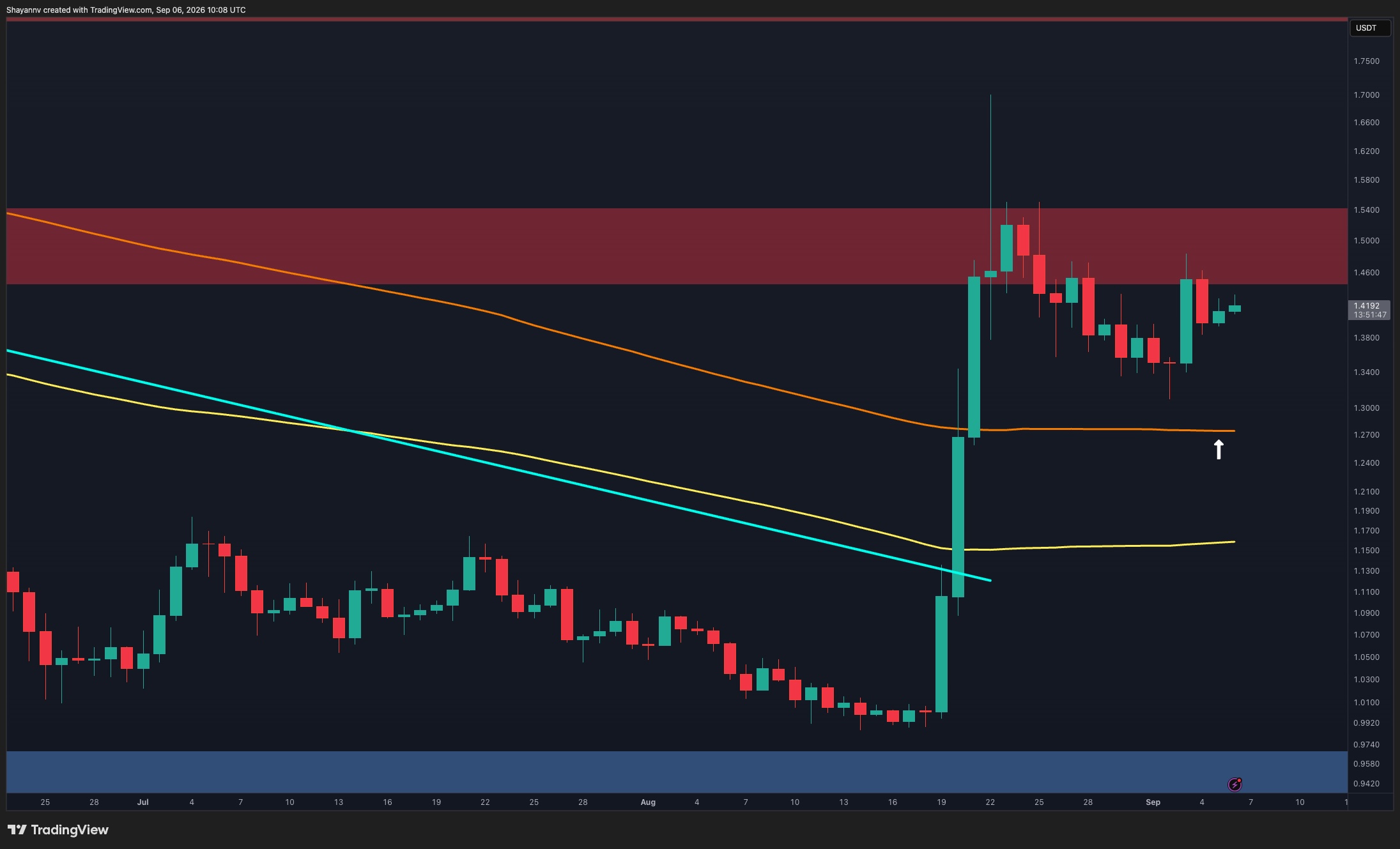
Ripple’s XRP remains in a corrective phase after its sharp August breakout, with buyers struggling to regain control of the key overhead supply zone. The current structure suggests that the market may need more consolidation before another sustained directional move develops.

XRP Price Analysis: The Daily Chart

On the daily timeframe, XRP’s explosive rally from the $0.94-$0.97 support zone broke the previous descending structure and pushed the price as high as roughly $1.70. However, the breakout was followed by an equally notable rejection, and the asset has since been unable to establish itself above the $1.45-$1.54 resistance zone.

The price is currently trading around $1.42, just below this major supply area. More importantly, XRP continues to hold above the long-term moving average near $1.27, which has flattened after previously trending lower. This level represents an important structural support for the ongoing recovery.

As long as the $1.27 area holds, the recent weakness can still be viewed as consolidation following an impulsive rally. A daily close above the $1.45-$1.54 resistance zone would strengthen the bullish case and could eventually bring the $1.70 high back into focus. Conversely, losing the $1.27 support would substantially weaken the structure and increase the probability of a deeper retracement toward the lower moving average around $1.15.

XRP/USDT 4-Hour Chart

The 4-hour chart highlights a descending channel that has contained XRP since the initial surge. The asset has repeatedly failed to break through the channel’s upper boundary, which is now converging with the crucial $1.45-$1.54 resistance zone.

The latest rebound from around $1.34 has brought XRP back toward $1.42, placing it directly beneath this descending resistance. This makes the current area particularly important. A breakout above the trendline followed by a successful reclaim of $1.45 could signal that the corrective structure is ending, with the $1.50-$1.54 zone becoming the next hurdle.

However, another rejection would preserve the descending structure and could send the token back toward $1.34-$1.38. Below there, the channel’s lower boundary is approaching the $1.27-$1.30 region, which overlaps with a clearly defined support zone.

Therefore, XRP remains caught between improving support underneath and persistent resistance overhead. Until the descending channel is broken, the short-term outlook appears more consistent with continued consolidation and potentially another corrective move rather than an immediate bullish continuation.

The post Ripple Price Analysis: Where Is XRP Heading Next Week After Defending Its 200-Day EMA? appeared first on CryptoPotato.

Ethereum Price Analysis: ETH Consolidates at $2.5K as Whale Participation Stalls

6 September 2026 at 20:04

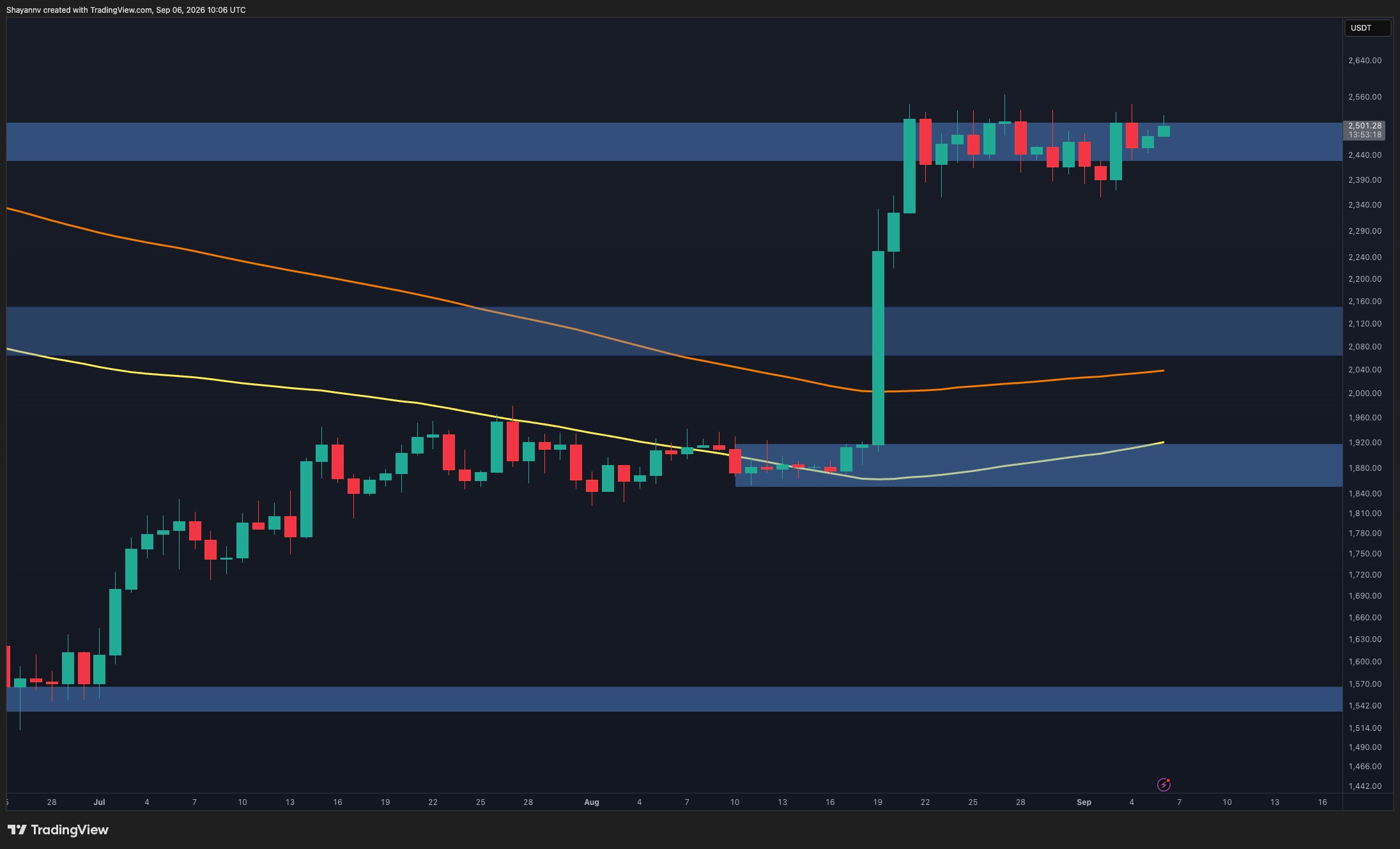
Ethereum is attempting to stabilize after its explosive August breakout, but the follow-through has remained limited. ETH is holding around $2.5K, yet repeated swings within the same range suggest the market is still digesting the rally rather than establishing a fresh directional trend.

Ethereum Price Analysis: The Daily Chart

ETH’s broader structure remains constructive after the powerful breakout from the $1.85K-$1.92K base. Yet, momentum has stalled inside the $2.44K-$2.52K resistance area. Several daily candles have tested this region without producing a sustained breakout, while repeated upper and lower wicks indicate considerable indecision. ETH is currently trading near $2.5K, close to the upper portion of this range.

A clean daily breakout above roughly $2.52K-$2.56K would be required to confirm that buyers have regained control and potentially initiate another impulsive leg higher. Until then, continued consolidation remains the more likely scenario.

On the downside, losing the $2.39K-$2.44K area would weaken the current setup and increase the probability of a deeper correction. In that case, the $2.08K-$2.15K former resistance zone would become the major medium-term support to watch.

ETH/USDT 4-Hour Chart

The 4-hour timeframe shows ETH trapped in a broad consolidation between approximately $2.35K and $2.56K following the vertical advance from below $2K.

The important development is that buyers have repeatedly stepped in near the lower portion of this range. The latest recovery from around $2.38K has carried ETH back toward $2.5K, placing the price once again near the upper resistance region. Yet multiple previous attempts around $2.5K-$2.55K have failed to generate continuation.

Therefore, another rejection could keep the market oscillating inside the existing range. A breakdown below the $2.35K-$2.39K floor would be more consequential and could expose the first major pullback zone around $2.22K-$2.27K.

Conversely, sustained acceptance above $2.52K-$2.56K would invalidate the near-term consolidation scenario and indicate that buyers are ready to resume the broader bullish move.

Sentiment Analysis

Ethereum’s Spot Average Order Size provides an important clue regarding the lack of follow-through. The latest observations around $2.4K-$2.5K are predominantly gray, classified as normal-sized orders, while the green whale-order activity visible during earlier portions of the recovery has largely disappeared.

This suggests that ETH’s recent push toward $2.5K has not been accompanied by notable large-player participation. There is also no visible concentration of retail orders in the latest data, pointing to an absence of aggressive positioning from either side.

The lack of dominant whale activity fits well with the price action. With neither substantial large-scale demand nor supply appearing in the metric, ETH may remain prone to low-conviction, choppy movements inside its current range. A renewed appearance of significant whale orders could therefore be an important signal that the consolidation is approaching a more decisive resolution.

The post Ethereum Price Analysis: ETH Consolidates at $2.5K as Whale Participation Stalls appeared first on CryptoPotato.

8 in a Row: Ripple (XRP) ETFs Record Another Green Week but Warning Signs Return

6 September 2026 at 19:16

For the eighth consecutive week, the spot XRP ETFs ended in the green, attracting almost $19 million. Although this sounds impressive, the actual number was significantly lower than last week’s figure.

Moreover, Friday ended as a no-inflow day for the first time in about three weeks, reigniting an old dilemma about actual demand.

XRP ETFs Still in the Green

The last full week of August was the best for the XRP ETFs in 2026. They gained over $110 million, making it the most impressive one since early December 2025. The first slowdown during the previous business week was felt on August 31, when investors poured in a more modest $5.64 million.

The double-digit net inflows returned on September 1 with $14.38 million, but the trend changed on Wednesday when withdrawals were dominant with $7.20 million taken out. This was the first red day for the Ripple ETFs since August 5.

$6.14 million entered the funds on Thursday, but Friday was a no-show day with SoSoValue data showing flows of $0.00. The good news is that the cumulative total net inflows hit another all-time high of $1.68 billion.

The worrying part of the weekly performance is actually twofold. First, it was Wednesday’s net outflows, which broke a near-one-month streak. Second, it was Friday’s no-reportable flows, which raised concerns that had been forgotten in the past few weeks.

Before the market-wide revival experienced after August 19, the spot XRP ETFs had seven such days out of 11 trading days in August. Nevertheless, the broader weekly performance was still bullish with almost $19 million in net inflows. The streak of consecutive green weeks is up to eight.

Spot XRP ETF Inflows. Source: SoSoValue

XRP Defends $1.40

Despite the massive inflows of over $110 million during the previous business week, the underlying asset had failed to capitalize and had fallen below the key support at $1.40 last weekend. It dipped further to $1.33 during the new week, but finally found support and surged to $1.45 on Friday.

It was stopped there and pushed south to $1.41 as of press time, which means that it remains above the key support at $1.40. Analysts remain highly bullish on its recent performance, claiming that its bull phase has finally begun. Moreover, Ali Martinez and EGRAG CRYPTO outlined some mind-blowing price targets for the culmination of the bull market, of up to $60.

We break them down in more detail in this article, and review the actual obstacles XRP would have to face on its way to these levels.

The post 8 in a Row: Ripple (XRP) ETFs Record Another Green Week but Warning Signs Return appeared first on CryptoPotato.

Bitcoin ETFs Rake In Nearly $1 Billion as Ethereum Funds Keep the Streak Alive

6 September 2026 at 17:31

The spot exchange-traded funds tracking the largest cryptocurrency attracted almost $1 billion in the past week, despite the $236 million in net outflows registered on September 1.

The Ethereum ETFs were also well in the green. They have marked more inflows than outflows for eight out of the past nine weeks.

BTC ETFs See Another $1B in Inflows

The previous business week ended with a $201.81 million net outflow from the spot BTC ETFs, but the overall performance was quite impressive. The inflows in the other four days offset all the losses on Friday, and the week ended with a net gain of $924.48 million. Thus, the funds built on the previous week’s major inflows of $1.92 billion.

August finished with net inflows of $216.70 million, followed by $236.46 million in net outflows on September 1. Investors shifted their stance in the following three days by attracting $101.15 million on Wednesday and $174.60 million on Friday. Thursday was particularly spectacular, as the funds gained $730.87 million, the highest amount since January.

Thus, the total number for the week was $986.85 million, bringing the cumulative net inflows to $55.62 billion. Recall that this number had plummeted to $51.79 billion in mid-August.

BlackRock’s IBIT remains the undisputed leader in the ETF space, with cumulative net assets exceeding $62.6 billion. Fidelity’s FBTC follows suit with $14.07 million, and Grayscale’s larger fund, GBTC, is next with $10.36 billion.

Spot Bitcoin ETFs Net Flows. Source: SoSoValue

ETH ETFs in Green, Too

Given their size, the spot Ethereum ETFs have performed even better over the past several weeks. As mentioned above, they have had only one red week since early July, and even that was quite modest, with just $2.26 million in net inflows back in mid-August.

The financial vehicles gained $824.42 million during the week that ended on August 28, and another $218.41 million in the first week of September. Thursday was once again the most notable day in terms of net inflows, with $141.39 million entering the funds. Another $87.68 million went in on Monday, $10.95 million on Tuesday, and $26.46 million on Friday. The only red day was Wednesday with $48.08 million.

The cumulative total net inflows have skyrocketed from $10.89 billion in early July to $13.19 billion on September 4.

Spot Ethereum ETF Flows. Source: SoSoValue


The post Bitcoin ETFs Rake In Nearly $1 Billion as Ethereum Funds Keep the Streak Alive appeared first on CryptoPotato.

ZEC Just Hit $1,200: What You Need to Know About Its Meteoric 370% Surge in 3 Months

6 September 2026 at 16:43

It was just three months ago that FUD around Zcash (ZEC) was running rampant, and a vulnerability in its Orchard privacy pool turned the tables and raised some uncomfortable questions.

The situation has taken a major turn, as the protocol patched the issue, and its privacy nature made it arguably the top performer in the large-cap altcoin space in the past three months.

The Meteoric Rise

Recall that the issue was first disclosed by Zcash founder Zooko Wilcox and members of Shielded Labs, who explained that a hacker could have used this weakness to make endless fake ZEC in Orchard, Zcash’s protected transaction area, without getting caught right away. Although by the time they made this public, the vulnerability was fixed, it still pushed some prominent names, such as Arthur Hayes, to dispose of their holdings, citing further potential issues.

The impact on the native token was felt immediately. The asset traded at $650 before the issue became public and tumbled by 60% within a day or so to $260 as FUD was being spread left and right.

That’s when the trend reversed for the privacy coin as it managed to stabilize at around $500, where it spent the next couple of months. The most significant leg up began with the August 19 market-wide breakout that drove it to $900. While the rest of the market stalled following the initial gains, ZEC kept climbing and briefly exceeded $1,200 earlier today for the first time in almost 10 years.

This means that the token has skyrocketed by 370% since the early June low. Its market cap now is above $20 billion, making it bigger than HYPE and DOGE.

ZEC/USD. Source: TradingView

Data from CoinGlass shows that ZEC’s spectacular surge over the past 24 hours has resulted in $46 million in short liquidations, the highest among all cryptocurrencies.

The Drivers and What’s Next

Shortly after the mid-August rally began, Grayscale debuted its Zcash ETF (on August 25), which has already raked in $34.4 million in net inflows.

“The bigger question isn’t whether Zcash can keep going up. It’s whether the ETF era is creating a new pathway for capital to rotate into crypto assets that were previously overlooked. ZEC may be an early test of that thesis,” commented The Wolf of All Streets.

Meanwhile, Ted Pillows noted that a major whale DCA-ed into ZEC between 2022 and 2024, accumulating 22,840 ZEC for about $1.1 million. The position had grown to $23 million by today, when they transferred the entire amount to Binance, potentially to cash in.

Crypto Patel weighed in on ZEC’s price potential, indicating that it has created a “Beautiful Cup & Handle Pattern” on the weekly scale. He added that the asset has broken the Neckline/Resistance of this pattern, which could materialize in another massive surge to $2,200.

As Per $ZEC Chart, you can see a Beautiful Cup & Handle Pattern formed on the Weekly Timeframe.@Zcash has already broken the Neckline/Resistance of this pattern, and if the pattern follows the 100% target, the target could be around $2,200.

No doubt, Cup & Handle is a strong… pic.twitter.com/Eys4EivIHQ

— Crypto Patel (@CryptoPatel) September 6, 2026

The post ZEC Just Hit $1,200: What You Need to Know About Its Meteoric 370% Surge in 3 Months appeared first on CryptoPotato.

CLARITY Act Gets a Major Boost, But Another Setback Threatens Its 2026 Passage

6 September 2026 at 15:21

The CLARITY Act received a potentially important boost ahead of its first Senate floor test, which was supposed to take place on September 15, but another scheduling setback is further threatening its chances of becoming law this year.

On the plus side, the National Sheriffs’ Association (NSA) has changed its tune on the landmark crypto market structure bill from opposition to neutral after previously raising concerns that it could make it more difficult for authorities to combat illicit finance involving digital assets.

NSA Turns Neutral

In the filing to the US Senate, the agency said that it believes the appropriate course is to step back and allow the legislative process to continue given the legislation’s complexity and the issues still being negotiated. This change matters because law enforcement concerns had become a major hurdle for some Senate Democrats whose votes could determine whether the bill advances.

Although the NSA’s move doesn’t mean that it now supports the legislation, its shift from opposition to neutrality removes a source of pressure on senators considering voting to advance it. Essentially, it removes another potential obstacle to attracting the Democratic support the bill needs when it reaches the Senate floor later this month.

Recall that the Senate Majority Leader John Thune filed a cloture vote motion to proceed with H.R. 3633 in early August so that the Senate can vote on the bill once recess ends.

The vote requires 60 senators and will not pass the CLARITY Act itself. Instead, success would limit debate on the motion to proceed and move the bill toward formal Senate consideration. Republicans hold 53 seats, meaning that Democratic or independent support will be necessary if the conference votes together.

Another Setback

House Republican leaders canceled voting sessions during the weeks of September 21 and 28, removing eight legislative days from the calendar, and the House is now scheduled to leave Washington on September 17, which is just two days after the Senate’s first procedural vote.

The new calendar leaves no time for the Senate negotiations to begin and conclude before lawmakers turn their attention to the November midterms. That makes a post-election lame-duck session an increasingly realistic path for the legislation if it clears the Senate.

Galaxy Research already reduced its estimated probability that the CLARITY Act will become law in 2026 from 50% to 30% after the Senate failed to vote on it before the August recess. Prediction markets are even less optimistic, with passage odds currently below 20%.

The post CLARITY Act Gets a Major Boost, But Another Setback Threatens Its 2026 Passage appeared first on CryptoPotato.

Arbitrum (ARB) Rockets by 42% Daily, Bitcoin (BTC) Fights for $80K: Weekend Watch

6 September 2026 at 13:35

As with most previous weekends, this one is also quite sluggish for bitcoin, which continues to fight for $80,000 without making any major moves.

The same cannot be said for some altcoins, though. ZEC, for example, has skyrocketed by 17% daily, while ARB has stolen the show with a massive 42% surge.

BTC Fights for $80K

The primary cryptocurrency closed August (on Monday) in the green for the first time in a bear market, surging by over 25% for the month. This came even after its early Monday retracement from $79,000 to $77,000 as the US and Iran resumed the strikes against each other.

Bitcoin rebounded to $79,000 rather quickly, but it was rejected on Tuesday and driven south to under $76,500 by Wednesday. That’s when the bulls returned in full force, initiating a major leg up that drove the asset to $82,400. This became BTC’s highest price tag since mid-May.

However, the strong US jobs report from Friday led to a major decline, as bitcoin slipped by three grand as the odds for the Fed to hike the rates skyrocketed. Nevertheless, BTC managed to rebound from the drop to $78,600 and jumped to around $80,000, where it spent most of the weekend, even though the amount of bearish news that should push it south has risen significantly in the past week.

Its market capitalization is back at $1.6 trillion on CMC, while its dominance over the alts has declined slightly to 59.1%.

BTCUSD September 6. Source: TradingView

ZEC, ARB on a Roll

Ethereum has neared $2,500 again after a 1.75% increase daily. BNB, which touched $770 yesterday, is below $760 now, while XRP has defended the $1.40 support. SOL is well above $100 once again, and similar gains are evident from the likes of HYPE, DOGE, RAIN, XMR, LINK, and ADA.

Uniswap’s UNI has jumped to $7 after a 10% increase, while ZEC is close to $1,200 for the first time in almost a decade following a major 17% jump. Arbitrum’s native token has stolen the show, surging by 42% to over $0.19.

The total crypto market cap remains at just over $2.7 trillion on CMC after a 0.8% increase since yesterday.

Cryptocurrency Market Overview September 6. Source: QuantifyCrypto


The post Arbitrum (ARB) Rockets by 42% Daily, Bitcoin (BTC) Fights for $80K: Weekend Watch appeared first on CryptoPotato.
Bitcoin at $80K Is Stronger Than It Looks: BTC Is Surviving a Perfect Storm of Bearish News

6 September 2026 at 11:00

Bitcoin tried and failed on several occasions to decisively break above the crucial $80,000 level, but perhaps the more important question is why it hasn’t dumped much further.

After all, the macro landscape is anything but bullish given the renewed attacks between the US and Iran, the hawkish Fed, and the surprisingly strong jobs data.

BTC Should Be Hurting

The latest geopolitical developments arrived this weekend as the two warring parties exchanged fresh attacks after Iran’s Revolutionary Guard launched ballistic missiles against two US Navy vessels. The US subsequently struck three Iranian crude oil carriers, while the Middle Eastern country also targeted tankers and US-linked vessels in waters around the Strait of Hormuz.

The escalation matters far beyond geopolitics as Brent crude climbed toward $100 per barrel again amid renewed concerns about energy supplies. Higher oil prices can directly feed into inflation, making the Federal Reserve’s decision next week even harder.

The US central bank has become another issue for BTC. Chair Kevin Warsh adopted a distinctly more hawkish tone at Jackson Hole last week, emphasizing that inflation remains too high and that the Fed could still have “work to do.”

The odds for a September rate hike jumped after the speech and went even higher after Friday’s jobs report. It showed that the US economy added 162,000 jobs in August, almost triple expectations of 56,000, while unemployment remained unchanged at 4.1%.

Although that’s good news for the economy, risk assets do not benefit as the hope for easier monetary policy fades given the higher inflation.

September rate hike odds jumped to 65% at their peak. The two-year Treasury yield reached its highest level since January 2025, the greenback strengthened, and stocks came under pressure.

Bitcoin dropped by $3,000 initially, but rebounded swiftly.

Absorbing Bad News

All of the above creates an atmosphere highly unfavorable for risk-on assets like BTC. Yet it remains at $80,000 even during the weekend when the attacks in the Middle East resumed, and it’s up roughly 25% over the past month.

Part of the explanation for why the cryptocurrency has performed so well comes from the ETF performance. The funds continue to attract significant amounts, with Thursday being a prime example. Over $730 million entered the ETFs, the highest single-day level since January.

What’s even more impressive is that gold has lost a significant portion of its gains charted after the mid-August rally, while BTC holds strong. However, this doesn’t guarantee that BTC cannot fall. In fact, there are two major threats in the next 10 days or so.

First, it’s the CPI, which arrives on September 11. A hotter-than-expected inflation reading, especially after the rise in oil prices, could push expectations for a rate hike even further.

Then it’s the conclusion of the FOMC meeting on September 16. An increase in the rates combined with hawkish guidance from Warsh could finally push BTC through key support levels, as discussed yesterday.

The post Bitcoin at $80K Is Stronger Than It Looks: BTC Is Surviving a Perfect Storm of Bearish News appeared first on CryptoPotato.

Bitcoin’s Link to Gold Hits a 6-Year High as Tech Correlation Fades: Why It Matters

6 September 2026 at 08:45

The correlation between the leading cryptocurrency and the largest financial asset, gold, has climbed to its highest level since the 2020 pandemic, while its relationship with the Nasdaq has weakened significantly.

The shift comes as concerns about debt, deficits, and currency debasement return to the spotlight after the latest developments in the US.

Closer to Gold

The change started to occur following the mid-August rally, which was propelled by the US Treasury Department’s announcement that it would at least double the maximum size of liquidity-support buybacks for longer-dated government debt, going from $2 billion to $4 billion per operation.

BTC rocketed from under $65,000 to over $80,000 within days, while the bullion went from $4,350/oz to $4,700/oz before it was rejected.

The analysts at the Kobeissi Letter argued that BTC’s increasing correlation with the precious metal accelerated following the Treasury’s move, with investors increasingly treating both as protection against currency debasement, even though gold has lost a major chunk of its gains.

Grayscale’s Head of Research, Zach Pandl, supported this narrative, noting recently that the bitcoin-gold correlation has climbed from near zero at the beginning of the year to over 50%. At the same time, the Nasdaq relationship has moved in the opposite direction.

US federal debt going past $40 trillion, persistent government deficits still existing, and concerns about the long-term purchasing power of fiat currencies have brought the so-called “debasement trade” back into focus.

Both BTC and gold have limited supply characteristics that can make them attractive under that thesis, despite the cryptocurrency’s infamous volatility.

Further Away From Nasdaq

The other part of the equation could be equally important since BTC’s 90-day correlation with the Nasdaq 100 has fallen from over 60% to around 30%-33%. This is a major change from earlier periods, when the cryptocurrency frequently behaved like a high-beta tech asset, jumping alongside growth stocks when financial conditions eased and vice versa.

The August rally was a striking example of the opposite, with BTC gaining over 20% in days, while US equities struggled. As previously reported, bitcoin had underperformed the S&P 500 on roughly two-thirds of trading days over the preceding three months before it suddenly reversed that trend.

This divergence suggests investors are increasingly valuing bitcoin for its scarcity and monetary properties rather than simply treating it as a speculative risk asset.

However, this substantial trend change does not mean that the relationship with equities has fully flipped. The Friday reaction to the strong US jobs report hinted at a higher correlation between the two as both asset classes slipped.

The post Bitcoin’s Link to Gold Hits a 6-Year High as Tech Correlation Fades: Why It Matters appeared first on CryptoPotato.

Fed Rate Hike Could Hit XRP Hard: ChatGPT Reveals How Low Ripple’s Price Could Go

6 September 2026 at 07:01

The monetary landscape in the United States changed in the past week or so, first after the hawkish stance taken by the current Federal Reserve Chairman, Kevin Warsh, and then following last Friday’s strong US jobs report.

As such, the expectations have changed, with investors and experts pricing in a potential rate hike for the next FOMC meeting scheduled to take place on September 15-16. After answering how this could impact BTC, we turned our focus to XRP, whose case was described as “arguably more interesting than bitcoin’s,” by ChatGPT.

What Happens to XRP Then?

With the current odds on prediction markets at well over 50% for a rate hike in September, the warning signs for risk-on assets are fully flashing. This was felt on Friday briefly after the jobs report, with BTC dropping by $3,000 and XRP slumping from $1.45 to under $1.40, where it found support.

ChatGPT estimated that the cross-border token is likely to react “more violently to a Fed hike” even though it has two cushions: strong ETF demand and the CLARITY Act process. The initial reaction to a 25 bps increase on September 16 would be a 4%-8% decline, the AI predicted. From the current levels, this would materialize in a dip below $1.30.

The situation could worsen in the following days and weeks, with $1.20 emerging as the first major support to be tested. If Warsh takes an even more hawkish approach in his post-FOMC meeting speech, XRP could “fall further toward $1.05-$1.15.”

One of the cushions mentioned above, the CLARITY Act, has not made any real progress lately. It was delayed once again in early August, and its September vote, scheduled for just a day before the conclusion of the FOMC meeting, is no longer guaranteed after the latest developments. As such, XRP could be primed for even more painful performance in case of a rate hike.

The Dark Horse

ChatGPT believes that the spot XRP ETFs could be the silver lining for the underlying asset, as they have remained relatively solid even during market distress, and their performance has picked up after the August rally. The cross-border token could quickly bounce after the initial shock if the Fed signals no immediate second hike and the ETF demand is still intact.

If that’s the case, $1.50-$1.60 will come into focus as this level has halted many of XRP’s previous breakout attempts. However, if the Fed surprises the market and raises rates by 50 bps, while Warsh goes fully hawkish, the altcoin’s future could quickly deteriorate, with another leg down to and even below $1.00, ChatGPT warned.

The post Fed Rate Hike Could Hit XRP Hard: ChatGPT Reveals How Low Ripple’s Price Could Go appeared first on CryptoPotato.

BIS Tests XRP Ledger to Anchor Official Statistics On-Chain in Proof-of-Concept Paper

6 September 2026 at 00:52

A Bank for International Settlements (BIS) working paper tests the XRP Ledger (XRPL) as a proof-of-concept for verifying official statistics on-chain, recording cryptographic fingerprints of public datasets that publish in three to five seconds and verify in one to two.

The Working Paper No 1374 essentially asks how statistical agencies can give users an independent way to check the origin and integrity of published data without changing their existing dissemination systems.

International organizations (the BIS among them) rely on the SDMX standard to exchange official statistics, and the prototype binds each SDMX dataset to its source by hashing it and writing a single summary value to the ledger.

Though only the fingerprints reach the chain, never the underlying numbers, so confidential data stays off-ledger, and the method extends to formats such as XBRL. The BIS has tested public blockchains before, including Project Mariana, which trialed wholesale central bank digital currency settlement on a public chain with the central banks of France, Singapore, and Switzerland.

The system normalizes each file with Canonical XML 1.1, hashes it with SHA3-512 at the whole-file and per-series level, and collapses those hashes into one Merkle root written to the Memos field of an XRPL Payment transaction. Each file also carries a W3C Verifiable Credential in its header, signed by the publisher’s identity keys.

Cost and Simplicity

The memo approach needs no smart contracts, so the authors avoided gas costs and contract risk, and XRPL’s base fee of 10 drops, or 0.00001 XRP, put anchoring close to free. Batching compounds that.

A single ledger entry can cover thousands of datasets, dropping the on-chain cost to a fraction of a cent each. The paper also cites the ledger’s fast consensus finality and the published technical analysis of its consensus protocol.

XRPL has taken on other institutional workloads this year. CryptoPotato reported on a pilot that linked the ledger to interbank rails with JPMorgan, Mastercard and Ondo, which settled tokenized Treasury bills in under five seconds, and Ripple has published an institutional roadmap adding compliance credentials and permissioned trading. The BIS tests ran on XRPL’s DevNet, a test network.

It notes that DevNet shares the mainnet’s transaction format and close cadence, so the latency figures carry over, and mainnet fees stay in the sub-cent range.

A Few Firm Limits

The paper also describes the build as an experimental proof-of-concept, stating a production service would need hardware-backed signing, pinned validator nodes and formal load testing.

Though keep in mind the ledger certifies only what was published, by whom and when, so the paper reaches no adoption decision and gives no endorsement of XRP, and the authors attribute the views to themselves, not to the BIS or its member central banks.

The post BIS Tests XRP Ledger to Anchor Official Statistics On-Chain in Proof-of-Concept Paper appeared first on CryptoPotato.

Before yesterdayCryptoPotato

Dogecoin (DOGE) Suddenly Pumps by Double Digits as Analysts Declare the Start of Altseason

5 September 2026 at 22:44

The largest meme coin by market cap has soared on Saturday evening to $0.094, hitting a two-week high. The move is rather unexpected given the typically calm nature of the weekends.

However, there were certain signs about a potential rally, even though DOGE has slipped from its local high to $0.09 as of press time.

DOGEUSD on TradingView

CryptoPotato outlined yesterday the three major signals that flashed for DOGE, including the TD Sequential. Analysts quickly determined that the OG meme coin is primed for another leg up.

However, that didn’t transpire at first, as the asset was rejected at $0.088 and slipped back down to $0.084 as the entire market bled following the strong US jobs report, which was considered bearish for risk-on assets.

Nevertheless, DOGE exploded on Saturday evening, gaining 12% from its low yesterday to the two-week high at $0.094. Popular analyst CW noted that the meme coin has reached the first major sell wall on its path forward, which is too solid to be broken now. If it falls, though, the next such wall sits all the way up at $0.14.

Fellow analyst Alex Marzell believes DOGE did “exactly what it needed to,” as it rebounded from the Friday lows to reclaim a key resistance.

$DOGE did exactly what it needed to.

Friday’s jobs print dumped it back to the $0.083 base, six flat 4H candles held it, and today one 4H candle ripped $0.0876 to $0.0952 straight back through $0.088.

Old resistance is the new line. Hold $0.088 and I think $0.095 goes next and… pic.twitter.com/y7hW91yCek

— Alex Marzell (@MarzellCrypto) September 5, 2026

Max Crypto also weighed in on DOGE’s impressive move and even suggested that its breakouts have been the “best indicator” for the start of an Altseason.

The post Dogecoin (DOGE) Suddenly Pumps by Double Digits as Analysts Declare the Start of Altseason appeared first on CryptoPotato.

Standard Chartered Extends Institutional Bitcoin and Ether Spot Trading to the UAE

5 September 2026 at 22:37

Standard Chartered extended its deliverable Bitcoin (BTC) and Ether (ETH) spot trading to institutional clients in the United Arab Emirates on September 3, becoming the first Global Systemically Important Bank (G-SIB) to offer the service in the country.

The offering runs through Standard Chartered DIFC, the bank’s arm in the Dubai International Financial Center (DIFC), which said it is the only global bank currently providing institutional digital asset spot trading in the region.

Built on the UK Launch

The launch adds trade execution to a custody service the bank already runs in the UAE. The trades are deliverable, so clients take possession of the underlying Bitcoin and Ether at settlement, and they can settle through a custodian of their choice, including Standard Chartered’s own digital asset custody solution that went live in September 2024.

Trades run through the bank’s electronic channels and sit inside its existing platforms, letting clients access the two assets through the same FX interfaces they already use. Standard Chartered DIFC is regulated by the Dubai Financial Services Authority (DFSA).

“The UAE has developed a clear digital assets regulatory framework that supports institutional participation and innovation,” said Rola Abu Manneh, Chief Executive Officer for the UAE, Middle East and Pakistan at Standard Chartered. She said pairing execution with custody, governance, and the bank’s global connectivity gives clients a more integrated way to participate in digital asset markets.

Standard Chartered first introduced institutional Bitcoin and Ether spot trading through its UK branch in July 2025, the first G-SIB to offer deliverable spot crypto trading to institutional clients.

“DIFC provides an established platform for international financial institutions to deploy global capabilities across markets,” said Christopher Parsons, Senior Executive Officer at Standard Chartered DIFC. He said the arrangement combines the bank’s global markets network with a regulated base for serving clients across the region.

A Wider UAE Digital Asset Push

The trading service sits inside a broader digital asset strategy that spans custody, trading and tokenization through Standard Chartered’s Corporate and Investment Bank, with its ventures ecosystem reaching into Zodia Markets and Libeara.

The bank already lets institutional clients mint and redeem USDC directly through its DIFC platform, a service it built with Circle. SC Ventures, its innovation arm, has backed a $100 million digital asset joint venture in the UAE with Japan’s SBI Holdings that targets market infrastructure, compliance tools, DeFi and tokenization.

The post Standard Chartered Extends Institutional Bitcoin and Ether Spot Trading to the UAE appeared first on CryptoPotato.

Bitcoin Holders Just Cashed Out 110,000 BTC in Profits: Is a Bigger Price Drop Coming?

5 September 2026 at 19:58

CryptoQuant data shows that bitcoin investors started realizing major profits after the explosive August rally, disposing of roughly 110,000 BTC in just a few weeks.

Such highly concentrated profit-taking developments have historically been followed by substantial price correction for the underlying asset, the analysts warned. Moreover, several demand indicators have weakened, which could add to the selling pressure.

110K BTC Profit Taken

The major run that began on August 19 at prices of under $65,000 drove the leading cryptocurrency to almost $80,000 in just two days. According to CQ’s latest weekly report, holders realized net profits of 23,000 BTC on that day alone (August 21), which became the largest single-day profit realization this year.

The asset indeed dipped in the following days as it felt almost inevitable after such a gigantic jump, but went on the offensive once again in the following week or so. It rocketed past $82,000 on Friday before it was rejected following the US jobs report, and now sits below $80,000.

The report described the major profit-taking as a classic characteristic of a bullish cooldown, but warned that if they continue at such a rapid pace, the asset’s price could be primed for another correction. Historical occurrences have shown that BTC tends to dump hard after a major rally if investors are not convinced about its potential.

“It is a hallmark of a bullish cooldown: bullish because it happens into strength, cautionary because concentrated realization can cap near-term upside,” reads the report.

Bitcoin Profit Taking. Source: CryptoQuant

Cooling Demand

CryptoQuant outlined another reason why BTC could be primed for a more profound correction, even though it already slipped from $82,400 to $79,600. Its apparent spot demand briefly expanded by 43,000 units, marking its fastest growth pace of the year. However, that metric has lost its momentum and is now back in contraction.

US investors’ demand has weakened as well. The most used metric for this, the Coinbase Premium, measuring the price difference between the asset on the leading US exchange and other trading platforms, has returned to slightly negative territory at -0.05.

The analysts said similar periods of soft US spot demand have capped the cryptocurrency’s rallies three other times this year alone.

Nevertheless, the short-term picture does not necessarily mean that BTC’s run is over and that it will return to a bearish phase. The Bull Score currently stands at 70, which is above the 60 threshold historically associated with sustainable bull markets.

” This keeps the broader picture constructive: Bitcoin remains in the early phase of a new bull market even as short-term momentum cools. The “official” bull market begins once price closes above its 365-day moving average,” they added, outlining that this key MA is located at around $83,000 – the level that stopped BTC in May.

The post Bitcoin Holders Just Cashed Out 110,000 BTC in Profits: Is a Bigger Price Drop Coming? appeared first on CryptoPotato.

Bitcoin Price Analysis: The Good and the Bad for BTC After Latest $82.4K Rejection

5 September 2026 at 19:12

Bitcoin remains locked in a post-breakout consolidation phase, but the latest rejection from the upper end of the structure shows that buyers are still struggling to generate sustained momentum above $80K. The broader trend remains constructive, although the current range leaves BTC vulnerable to further liquidity-driven swings before its next directional move.

Bitcoin Price Analysis: The Daily Chart

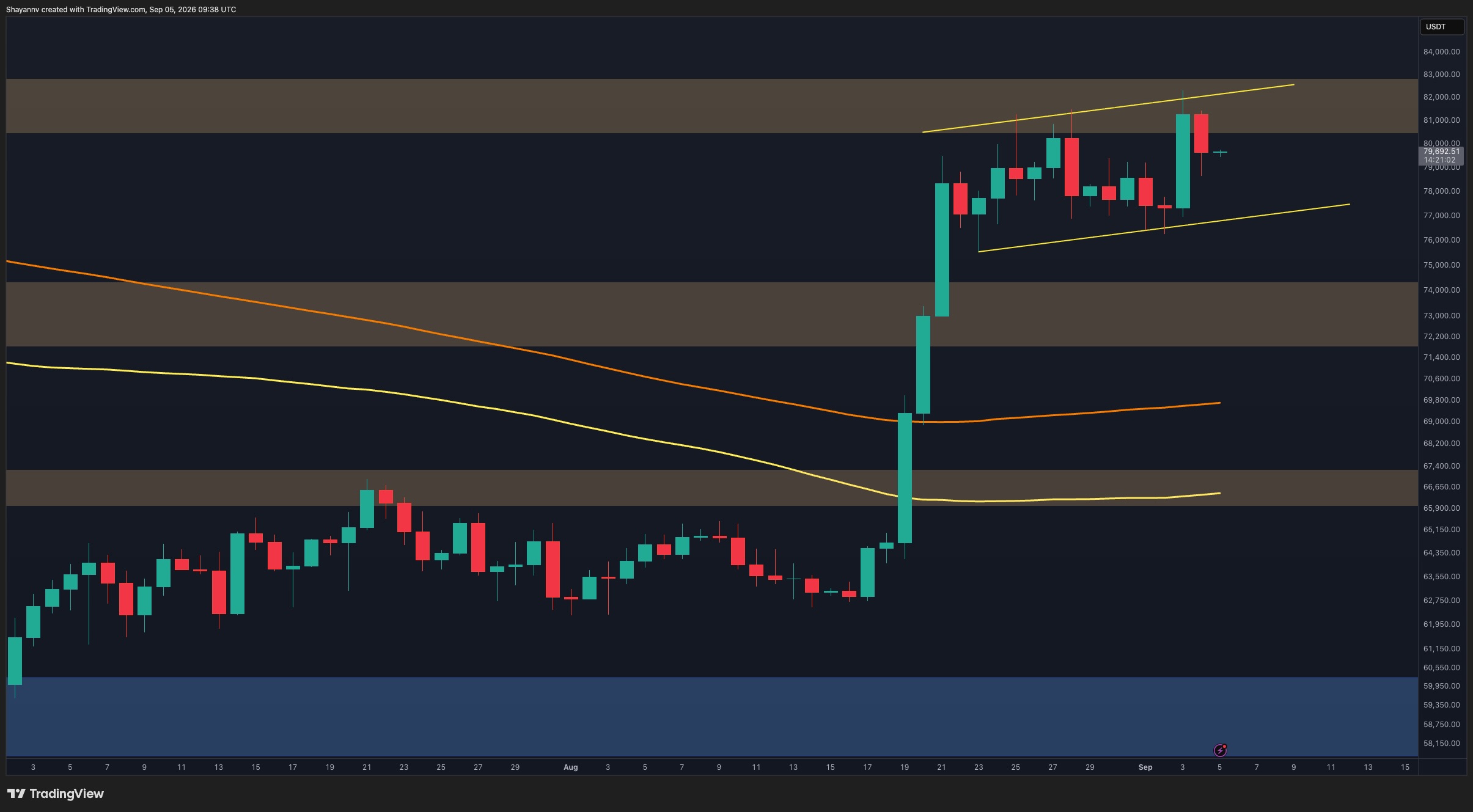
Bitcoin’s daily structure remains significantly stronger than it was before the August breakout. The asset is holding well above the former $72K-$74.5K resistance zone and both moving averages, preserving the broader bullish shift despite the recent loss of momentum.

However, BTC has repeatedly encountered selling pressure inside the $80.5K-$82.5K resistance zone. The latest attempt briefly pushed toward $82K before being rejected, sending the price back below $80K. This inability to establish acceptance above the resistance area suggests that supply remains active at higher prices.

At the same time, the asset continues to trade within a gradually ascending channel. Its lower boundary currently sits around the $76K-$77K region, making this the most important nearby structural support. As long as BTC remains above this area, the ongoing price action can still be interpreted as consolidation following the sharp rally rather than a confirmed bearish reversal.

A decisive breakout above the $80.5K-$82.5K zone would strengthen the continuation scenario. Conversely, losing the channel support around $76K-$77K could trigger a more substantial correction, with the former $72K-$74.5K breakout zone becoming the next major area of interest.

BTC/USDT 4-Hour Chart

The 4-hour chart highlights the market’s current indecision more clearly. BTC rallied from the lower boundary of the ascending structure near $76.5K-$77K and quickly tested the $81K-$82K area, only for sellers to reject the move once again.

Price subsequently dropped toward $79.5K and has entered a tight short-term consolidation. This creates a notable contrast between the rising channel structure and the repeated failures near its upper boundary. Buyers are still defending higher lows, but they have yet to demonstrate enough momentum to convert the $80.5K-$82.5K supply area into support.

The $76.5K-$77.5K region therefore remains crucial. Another test of this zone could determine whether the ascending structure survives. A strong reaction would keep a renewed push toward $81K-$82K in play, whereas a breakdown would indicate that the consolidation is transitioning into a deeper corrective phase.

Sentiment Analysis

The one-week BTC liquidation heatmap shows substantial liquidity on both sides of the current price, which supports the possibility of continued choppy trading and liquidity sweeps.

Above the market, notable liquidation concentrations appear around $81K-$82K and extend toward approximately $84K. These clusters could attract price if buyers regain momentum.

However, the downside liquidity is particularly relevant following the latest rejection. A broad and comparatively dense concentration is visible below the market, especially around the $76K-$78K region. This aligns closely with the lower boundary of the ascending technical structure.

As a result, a downside liquidity sweep toward $76K-$78K remains a plausible near-term scenario before another recovery attempt. Such a move would not automatically invalidate the broader bullish setup, but a sustained breakdown beneath this region would increase the probability of a deeper retracement toward the $72K-$74.5K support zone.

The post Bitcoin Price Analysis: The Good and the Bad for BTC After Latest $82.4K Rejection appeared first on CryptoPotato.
BNB Hits 7-Month High After Major Kalshi Move and Explosive Chain Growth

5 September 2026 at 17:48

Binance Coin is among the top performers in the past 24 hours in the altcoin space, surging by over 6% and further extending its lead above XRP in terms of market cap placement.

This impressive rally on a rather dull Saturday after the Friday market rejection came following some positive news from Kalshi and the overall growth of the BNB Chain.

BNB Pops

The native token of the broader Binance ecosystem traded at $725 yesterday amid the market-wide revival that drove BTC to $82,400. However, the subsequent retracement prompted by the strong US jobs report pushed it south to $710. The asset found solid support there and exploded out of the gate, surging to $770 minutes ago for the first time since early February.

BNBUSD on TradingView

This Saturday’s rally is quite unexpected since most of the market is still in the red following yesterday’s bad news for risk-on assets. As such, the reason for BNB’s defiance is likely coming from outside factors, such as Kalshi’s move to launch perpetual futures contracts for the asset in the US, regulated by the Commodity and Futures Trading Commission.

Leverage is capped at around 4.5x for eligible US traders and comes after the platform added support for other altcoins such as ADA, AAVE, WLD, and VVV. Kalshi also supports BNB Smart Chain (BSC) integrations for managing deposits and withdrawals on international accounts.

BNB Chain Growth

The other probable reason comes from a Grayscale report cited by Wu Blockchain. As explained, BNB Chain is among the most widely used networks for trading tokenized equities.

The paper reveals that the weekly spot volume peaked at almost $3 billion in August, while only 5% of the market is currently deployed in on-chain finance. Robinhood Chain leads the pack, followed by BNB Chain and Solana.

Grayscale explained that further US regulatory clarity could “expand tokenized stocks from global, around-the-clock trading products into productive on-chain financial assets.”

Grayscale: Tokenized Equity Weekly Spot Volume Nears $3B, Only 5% Used in Onchain Finance

Grayscale said tokenized equity trading reached record highs in August, with weekly spot volume peaking near $3 billion, while only about 5% of the market is currently deployed in onchain… pic.twitter.com/ZcVA72DYTX

— Wu Blockchain (@WuBlockchain) September 4, 2026

The post BNB Hits 7-Month High After Major Kalshi Move and Explosive Chain Growth appeared first on CryptoPotato.

XRP’s Breakout Rally Has Begun, Analysts Say – But Their Targets Will Shock You

5 September 2026 at 16:45

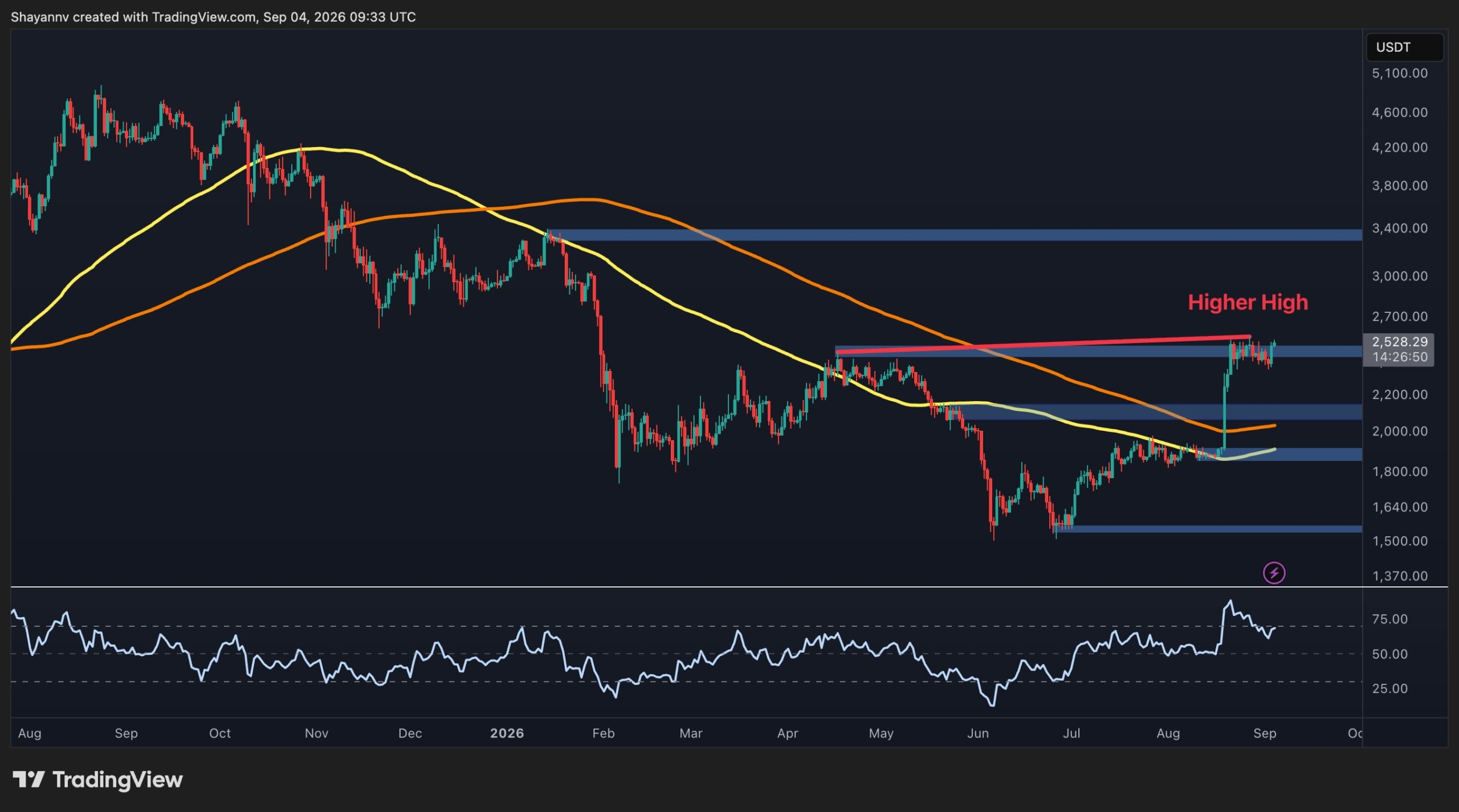
Although it was rejected at $1.70 a couple of weeks ago after its major mid-August surge, Ripple’s cross-border token is still up by 40% from its multi-year lows marked less than a month ago.

This has turned numerous analysts highly bullish. While this sounds quite expected for market observers like EGRAG CRYPTO, Ali Martinez’s recent price target is what got the community going.

XRP to $60!?

Martinez has recently been quite convinced that Ripple’s native token has already bottomed out during this cycle and is on its path to recovery. In a previous post, he noted that XRP’s breakout is confirmed and outlined a more modest target of $1.70. This one came actually after the asset reached that level on August 21-22, following its 70% surge in less than 72 hours.

However, it was violently rejected there and pushed south to under $1.35 last week. Its ability to maintain that level and the subsequent rebound to the current $1.40 gave bulls more hope, and Martinez joined the party.

In a post from earlier today, the analyst told his 166,000 followers that XRP has been “forming a massive ascending triangle on the monthly chart.” If it breaks above and closes north of the key barrier at $3.66, then it would “confirm the breakout and activate a technical target near $60.” Yes, that’s $60 per XRP.

XRP BULL MARKET TARGET: $60

For nearly a decade, $XRP has been forming a massive ascending triangle on the monthly chart.

The $3.66 resistance level is the key barrier. A monthly close above it would confirm the breakout and activate a technical target near $60. pic.twitter.com/RpAnbER9cv

— Ali Charts (@alicharts) September 5, 2026

Now, we are not trying to be the bearer of bad news, but $60!? Even if it takes another 10 years, it would require a near-4,200% surge from current levels. Moreover, its market cap, even if XRP’s supply remains the same, which it won’t, would be at around $4 trillion (yes, with a T). This would make it 2-3 times bigger than BTC’s current market cap, and its valuation would top even giants like Amazon and Microsoft.

Maybe $25?

Similar highly bullish (and a bit far-fetched) predictions typically come from other analysts, such as EGRAG CRYPTO. But even his most recent analysis was more modest than Martinez’s.

Basing his findings on XRP’s previous expansions, in which the asset exploded by up to 2,400%, the analyst outlined some major targets in his September 5 analysis. The highest of which is at $25 if XRP is to mimic the most significant rally from its 2017-2018 bull phase.

The other, slightly less bullish, targets are set between $11 and $15.8. Naturally, all of those sound a bit unrealistic at the moment, even though the market structure has shifted significantly over the past several weeks.

The post XRP’s Breakout Rally Has Begun, Analysts Say – But Their Targets Will Shock You appeared first on CryptoPotato.

We Asked AI: What Happens to Bitcoin’s Price if the Fed Hikes Rates in 11 Days?

5 September 2026 at 15:07

Following the strong US jobs report from Friday and the hawkish stance taken by Federal Reserve Chair Kevin Warsh the week prior, the odds for a rate hike have grown significantly in just seven days.

Bitcoin’s price reacted to both developments with a minor leg down before it recovered some of the losses. An actual rate increase, though, could have a much more profound effect.

What Happens to BTC

The previous FOMC meeting in July was quite condensed, as it was described as the most unpredictable one in over six years. At the end, though, the Fed refused to change the rates, leaving them at 3.50%-3.75% following a 9-3 vote.

However, the fact that there were 3 policymakers in favor of such a monetary pivot was the first hint at a potential change. The rest came in the past week or so, as Warsh was quite hawkish during his first Jackson Hole speech at the end of August. The blowout US jobs report from yesterday only tilted the odds further, currently being at over 50% for a hike, since it gives the central bank leeway to keep fighting the stubborn inflation through a tighter monetary policy.

Next week’s CPI data will be crucial. The FOMC meeting will take place on September 15-16, and ChatGPT believes BTC’s initial reaction will be a nosedive. However, the AI platform added that it “would not expect another catastrophic bear-market leg.”

Instead, it noted that the key part of bitcoin reaction will be from the fact of whether the hike is “already fully priced in by then, and what Kevin Warsh says about what comes next.”

“At the moment, markets are putting roughly a 60% probability on a September hike after the surprisingly strong August jobs report. BTC is around $79,650 after already falling from above $81,000 as that probability increased.”

Precise Prediction

The popular AI chatbot noted that another 2%-5% decline is expected in ten days after the conclusion of the FOMC meeting if the Fed indeed proceeds with hiking the rates. This means that bitcoin would test the $75,000 support at first.

Another leg down to $72,000 could be in the cards if yields continue climbing by the end of September. Moreover, it could slip below $70,000 for the first time since mid-August if Warsh remains hawkish. Those scenarios are in case the Fed increases the benchmark by 25 bps.

In the more unexpected scenario in which the central bank hikes it by 50 bps, then ChatGPT expects BTC to slump by up to 15% very quickly, going to under $70,000 within a day or so.

“A drop to $68,000 could be instant, with leveraged liquidations potentially producing a temporary wick into the mid-$60Ks,” it warned.

Although all of those predictions sound quite worrisome for BTC, which finally had some fresh air during the mid- to late-August rally, it’s worth noting that the cryptocurrency is known for often moving in the opposite direction of what people expect from it.

The post We Asked AI: What Happens to Bitcoin’s Price if the Fed Hikes Rates in 11 Days? appeared first on CryptoPotato.

PONS Skyrockets Another 30% to New ATH, Bitcoin Loses $80K: Weekend Watch

5 September 2026 at 13:32

Bitcoin’s price reacted immediately to the stronger-than-expected US jobs report on Friday, plunging from a multi-month high of over $82,000 to under $79,000 before it found some support.

Red dominates the larger-cap alts’ charts, with XRP dropping back to $1.40, ETH losing the $2,500 level, and XMR plunging by over 5%. BNB stands in the opposite corner with a 4.5% surge.

BTC Halted at $82K

The primary cryptocurrency faced a similar fate last Friday when it jumped to $81,500 only to be rejected and driven south to under $77,000 after the hawkish speech by Fed Chair Kevin Warsh at Jackson Hole. However, it rebounded during the weekend and even tapped $79,000 on Sunday.

The resumed military actions in the Middle East brought another leg down on Monday morning, with BTC slipping to $77,000 again. The bulls managed to defend that level again, and the cryptocurrency remained stuck between that lower boundary and the upper one at $79,000 for a few days.

The breakout began on Thursday when the asset surged past the latter level and kept climbing on Friday morning. The peak came at $82,400, which became BTC’s highest price tag in three and a half months. Although it was stopped there, it remained above $81,000 before the aforementioned jobs report went live and plunged immediately after it made the headlines to just under $79,000.

It has rebounded to $79,600 since then, with its market cap standing close to $1.6 trillion on CMC. Its dominance over the alts has retreated slightly to 59.45%.

BTCUSD September 5. Source: TradingView

PONS Keeps Rocking

The new rockstar of the altcoin space, PONS, is once again the top performer, surging by 30% in the past 24 hours to a new all-time high of almost $0.90. DASH follows suit, skyrocketing by 25% to over $65.

Binance Coin is up by 4.5%, being the biggest gainer among the larger caps, and now sits at $750. NEAR has gained 11% and is above $2.25. DOT, TAO, and LTC are also well in the green.

In contrast, ETH is down by 2.5% to $2,450, XRP has slipped by almost 3% to $1.40, and XMR is down by 5% to $525. RAIN, HYPE, and ADA are also in the red.

Cryptocurrency Market Overview September 5. Source: QuantifyCrypto


The post PONS Skyrockets Another 30% to New ATH, Bitcoin Loses $80K: Weekend Watch appeared first on CryptoPotato.

2 Major Ripple (XRP) News From The Past 24 Hours: Details

5 September 2026 at 11:28

Less than two months after announcing a major partnership with the Kansas Jayhawks, the company behind XRP has doubled down on its US sports endeavors by collaborating with the Florida Gators.

Almost immediately after the news was announced, both parties shared a video showing that XRP’s logo was painted on the sports team’s ground.

$XRP and @FloridaGators.🐊
Soon. https://t.co/AI7wKEy3xw

— Ripple (@Ripple) September 4, 2026

Further details on the partnership indicate that the team will generate $5 million annually by placing the logos in the Swamp.

“Florida has a long history of embracing innovation and technology to enhance the experience of our fans and advance our programs,” athletic director Scott Stricklin said in a statement. “This partnership brings together two organizations that think boldly about the future, and we look forward to introducing XRP to our fans.”

The first game to host XRP’s logo will be played tonight at the Ben Hill Griffin Stadium, as the Florida Gators will face the Florida Atlantic Owls.

Recall that Ripple made a similar partnership with the Kansas Jayhawks, who represent the University of Kansas, and their teams have won 15 national championships, including 12 NCAA Division I titles. This one was more personal for Ripple’s CEO, who was raised in the state and holds a Bachelor of Arts in Economics from the University of Kansas.

The second news was shared by one of the most popular XRP Army members, BankXRP, on X. The user noted that Ripple will be the headline sponsor of Stable Launch – Stablecon USA’s startup competition.

The company’s Whittney Levitt will join the judging panel of the event, in which the winning startup gets a $200,000 investment.

The post 2 Major Ripple (XRP) News From The Past 24 Hours: Details appeared first on CryptoPotato.

Pi Network Just Released 3 Major Upgrades: Here’s What They Mean for Pioneers

5 September 2026 at 09:58

The Core Team behind the popular project rolled out three new capabilities designed to make its ecosystem more attractive to app developers. The project also overhauled its developer documentation as it continues its broader push toward real-world utility.

The team said this update comes after several months of releases focused on enhancing Pi beyond simple crypto transactions and creating more reasons for users to actually explore and utilize the ecosystem.

3 New Features

The three new developer capabilities are local storage, access to app-specific staking data, and file and video sharing. Perhaps the most interesting is the first one.

Selected whitelisted Pi Browser apps can now store certain information directly on a user’s device instead of requiring devs to maintain their own backend infrastructure. Preferences, session inflation, and other applicable data can consequently be stored on the device, which can reduce infrastructure costs and complexity while providing a consistent experience across Android and iOS, added the post.

It’s worth noting that the data is not uploaded to Pi Network’s servers, even though the feature currently has several limitations. Only whitelisted apps have access, as storage capability is limited, and old data can eventually be removed.

Staking Data API, the second release, allows eligible developers to see how much effective Pi a user has staked specifically for their application through Ecosystem Directory Staking. Devs could potentially use this info to build app-specific features around their most committed supporters.

The last one, called Pi.shareFile, allows apps to use a phone’s native sharing functionality for files, images, and videos. Some of the examples outlined in the blog post range from marketplace customers sharing receipts or photos to gaming and content apps allowing users to share clips directly.

More Devs Wanted

In addition to the three new features, Pi Network announced that it has consolidated previously fragmented dev resources into a single documentation platform, which now covers everything from app registration and sandbox development to authentication, Pi payments, Mainnet preparation, and launch.

It also introduces AI-assisted guidance for integrating authentication and payments. The idea is quite clear as it reduces the friction involved in building applications for Pi and fits into the project’s broader strategy.

The team said that these releases tackle a problem that could be very important for the project and the native token’s long-term prospects: giving developers more tools and fewer technical obstacles to continue building apps that people actually want to use.

The post Pi Network Just Released 3 Major Upgrades: Here’s What They Mean for Pioneers appeared first on CryptoPotato.

Bitcoin’s $3K Drop Comes as Fed Rate Hike Bets Surge, but Analyst Remains Bullish

5 September 2026 at 08:35

All eyes on Friday were on the US jobs report, which actually showed that the US economy had added 162,000 jobs in August, almost triple expectations of roughly 55,000-58,000. The unemployment rate remained at 4.1%, while July’s initially reported loss of 23,000 jobs was revised to a gain of 21,000.

The reaction in financial markets was instant. Bitcoin dropped sharply below $79,000 after it was rejected at $82,400 earlier that day, and the US stock market joined the ride. In contrast, Treasury yields and the greenback jumped.

Good News Is Hurting Markets?

Although a strong labor market sounds positive at first glance for financial markets, there’s more to the story as it comes to monetary policy. Such a favorable labor environment gives the Federal Reserve more room to keep fighting inflation without worrying that higher borrowing costs will trigger a sharp deterioration in employment. Perhaps that’s why the rate hike odds immediately jumped to over 50% after the jobs report went live.

Consequently, strong economic data can become negative news for risk assets when inflation remains high. The analysts at the Kobeissi Letter determined that “the system is broken,” pointing to stocks falling despite the economy creating substantially more jobs than expected. Even US President Donald Trump was surprised by the initial market reaction.

The system is broken.

You know the system is broken when stocks FALL after the US unexpectedly adds +162,000 jobs in a month, TRIPLING expectations.

Why? Because a strong jobs report means a higher chance of rate hikes.

This is the product 60-straight months of 2%+ inflation.… pic.twitter.com/kP8y9kxBOj

— The Kobeissi Letter (@KobeissiLetter) September 4, 2026

Expectations for higher interest rates typically push Treasury yields and the dollar north, while tightening financial conditions and reducing investors’ appetite for risk assets. That should explain BTC’s immediate reaction and price drop after the report went live.

Long-Term Bullish

Bitcoin analyst Adam Livingston outlined a different scenario beyond Friday’s reaction, arguing that persistent inflation, rising debt, and the monetary response ultimately required to sustain the financial system strengthen BTC’s long-term value proposition.

In that framework, higher rates can pressure the cryptocurrency in the short term, but they don’t solve the structural problems BTC was designed to hedge against.

The asset remains very sensitive to interest-rate expectations over shorter periods, but if inflation stays structurally elevated while governments continue running large deficits and debt burdens grow, the long-term argument for owning a scarce asset with a fixed supply could become much stronger.

The post Bitcoin’s $3K Drop Comes as Fed Rate Hike Bets Surge, but Analyst Remains Bullish appeared first on CryptoPotato.

CoinRabbit Wins “Best Crypto Lending Platform 2026” Award from International Business Magazine

5 September 2026 at 07:59

[PRESS RELEASE – Toronto, Canada, September 4th, 2026]

CoinRabbit has been named Best Crypto Lending Platform 2026 by International Business Magazine, highlighting a lending product that has issued more than $1.45 billion in loans since 2020.

About the International Business Magazine Award

The International Business Magazine Awards recognize companies and executives making a significant impact across global industries. The selection process combines public nominations with jury review, with nominees assessed on their work, progress, and contribution to their respective industries.

For CoinRabbit, the award comes at an important stage in the company’s development. It is moving beyond borrowing against crypto and building a broader ecosystem for managing digital-asset capital.

Why CoinRabbit Was Named the Best Crypto Lending Platform

The Best Crypto Lending Platform 2026 award recognizes the work CoinRabbit has put into its ecosystem. The platform provides borrowers with fast access to liquidity and confidence that their funds remain secure. CoinRabbit maintains a clear no-rehypothecation policy, giving clients greater certainty that their collateral is not being reused or lent out elsewhere.

That focus on a predictable borrowing experience has remained central as CoinRabbit has expanded the product. There is no traditional credit check because crypto collateral does the underwriting, and the lending process takes about 10 minutes whether a client is borrowing a few hundred dollars or managing a six-figure position.

The award jury also highlighted CoinRabbit’s Private Program as a high-touch approach for clients with significant balances. Designed for portfolios of $500,000 and above, it offers a more personalized way to manage assets around each client’s financial goals, liquidity needs, and timing. As part of CoinRabbit’s broader digital-asset ecosystem, the program gives clients a more private banking-style experience.

Capital Preservation at the Core

CoinRabbit is expanding into capital management, but lending remains at the core of the business. By giving clients access to liquidity without a need to sell their crypto, it helps preserve capital and keep assets invested for the long term.

Walter Barrett, Chief Strategy & Growth Officer at CoinRabbit, commented:

“We’ve spent years building and refining the product, and it’s rewarding to see that work recognized. At the same time, CoinRabbit is becoming more than just a lending platform. With the Private Program, we’re bringing a private credit approach to managing crypto. Clients can work directly with a success manager to find the right strategy for their needs, with a more tailored way to build crypto capital. We also continue to improve the core lending product, keeping it simple. For us, the goal is to make both sides of the business stronger as we grow.”

As CoinRabbit evolves, capital preservation remains a central idea behind the company’s products and services.

About CoinRabbit

CoinRabbit is a crypto asset management platform built for long-term capital preservation. It provides flexible liquidity management across multiple environments. Instant payments and lending, yield and trading products, and also the Private Program are available from a single platform. Since 2020, CoinRabbit has maintained a 100% capital reserve model, ensuring that client assets are fully reserved and never rehypothecated.

The post CoinRabbit Wins “Best Crypto Lending Platform 2026” Award from International Business Magazine appeared first on CryptoPotato.

XRP Bulls Defend Key Level as Analyst Envisions Another 100% Rally

5 September 2026 at 07:03

The price rally initiated by the cross-border token in mid-August was halted at $1.70, and the subsequent correction drove it south hard to under $1.35. However, the asset managed to rebound swiftly and now sits above a key support level at $1.40.

This has provided additional fuel to popular bullish analysts such as EGRAG CRYPTO to map out XRP’s next move, which could take it north by almost 100%.

Is $2.70 on the Map for XRP?

The token’s recovery coincided with a substantial increase in trading activity as the spot volume across major exchanges skyrocketed to its highest level since February in late August. Binance alone handled almost $7.3 billion in XRP spot trades, followed by South Korea’s Upbit ($4.7 billion) and Bithumb with $2.6 billion.

EGRAG argued that XRP is now attempting to establish a bullish continuation pattern after recovering from the recent pullback that drove it from $1.70 to $1.33 in just over a week. The key here will be whether buyers can reclaim the resistance area that has repeatedly capped the asset’s breakout attempts.

If XRP is finally successful, it could aim at $2.70, said EGRAG, which would be a 100% move from the recent lows. However, there are still several hurdles in place.

The first major resistance level stands at $1.50, followed by the next at $1.60. Only if XRP is able to decisively close above both on the daily, it would have the opportunity to target the psychological $2.00. If it doesn’t, it can rely again on the $1.25-$1.30 support, which was already tested successfully recently.

Demand Still Present

Aside from the hurdles, there are some encouraging signs behind the latest leg up. Perhaps the most notable comes from the ETF inflows, as the financial products registered their best week in 2026 at the end of August, attracting over $110 million. The cumulative net inflows consequently tapped a new all-time high of $1.66 billion. Although the trend cooled in the past week, the funds still closed in the green as they have done for the past two months straight.

Ripple whales have also been on a substantial accumulation spree lately. Although these positive developments do not guarantee that EGRAG’s $2.70 target will materialize, they show that demand is still present despite the underlying asset’s rejection at $1.70. However, before it aims at $2.70, XRP would have to overcome other key resistance lines, with the first located at $1.50.

The post XRP Bulls Defend Key Level as Analyst Envisions Another 100% Rally appeared first on CryptoPotato.

Coinbase Files With SEC to Bring Single-Stock Perpetual Futures to US Investors

5 September 2026 at 01:37

Coinbase said this week it filed notice registrations with the US Securities and Exchange Commission (SEC) to offer single-stock perpetual futures domestically, according to a post from the company’s official account.

The move adds another regulated derivatives product to Coinbase’s US lineup and comes as regulators continue sorting out how perpetual contracts should be classified under American law.

Coinbase Files for US Single-Stock Perps

“We’re working to bring single stock perps to the US,” Coinbase wrote, adding that it plans to work with both the SEC and the CFTC to bring more major financial products onshore.

The company shared images of two filings, both submitted on September 1. The first is a Form 1-N from Coinbase Derivatives, LLC, the entity through which the exchange already offers other futures products. The second is a Form BD-N from Coinbase Financial Markets, Inc., registering as a security futures product broker-dealer under Section 15(b)(11) of the Securities Exchange Act of 1934.

Neither filing guarantees the product launches on any set timeline. Notice registrations open the door for a broker or exchange to offer a given product, while approval and any conditions attached to it still rest with regulators.

The filing also comes alongside a broader push into tokenized products, with Coinbase launching tokenized stock trading for customers outside the US in August, alongside options trading and real-world-asset perpetual futures tied to equity indices.

It also rolled out pre-IPO perpetual futures starting with SpaceX, with Anthropic and OpenAI contracts expected to follow, a corner of the market that grew more than tenfold in volume since May, to around $12 billion, according to CryptoQuant.

A Product Category Still Being Fought Over

Perpetual futures carry no expiration date, letting traders bet on an asset’s price without owning it, and the US market for them is new.

In May, the CFTC approved Kalshi to offer Bitcoin perpetual futures, the first time the product cleared for the US market, and a decision CME Group said it would challenge in court on the grounds that perpetuals should be regulated as swaps rather than futures.

At the time, CME CEO Terrence Duffy noted that the company spent eight months preparing the case and argued that its exclusive licensing deals with benchmark providers mean any perpetual contract tied to those benchmarks still has to run through CME.

CFTC Chair Michael Selig has defended the original approval as a way to bring regulated, expiration-free products onshore under US oversight.

The post Coinbase Files With SEC to Bring Single-Stock Perpetual Futures to US Investors appeared first on CryptoPotato.

South Korea Plans Stablecoin-Based Tokenization by 2027

4 September 2026 at 23:51

South Korea’s Financial Services Commission unveiled a phased roadmap on September 4 for converting stocks, bonds and investment funds into blockchain-based tokens, with the earliest phase due to start in February 2027 once an amendment to the Electronic Registration Act takes effect.

The plan links the country’s securities market to a stablecoin payment system that regulators want built by the time the rollout reaches its final stage.

Seoul Lays Out a Three-Step Timeline

The FSC’s roadmap, presented during the third private-public consultative meeting on securities tokenization, breaks the transition into three stages.

Phase one starts in February 2027 and covers privately pooled money market funds and bonds reserved for institutional investors, unlisted stocks held through trust structures, and publicly offered fractional investment securities.

Phase two widens the pool to every type of publicly offered security. But the third phase is the more ambitious one: an on-chain payments system tied to stablecoins, though the FSC says the pace of phases two and three depends on how the first rollout goes, how fast the market adapts, and where pending stablecoin legislation ends up.

The commission also published model standards for fractional investment, capping individual subscriptions at whichever is smaller between 30 million won ($22,200) and 5% of an issuance, and requiring issuers to reserve a minimum retail allocation.

Trading tokenized securities over the counter won’t need a separate license, though firms must consult the Financial Supervisory Service first, and retail investors face an annual cap of 100 million won ($74,000) in net purchases per exchange.

Entities that manage tokenized securities accounts will need at least 4 billion won, which is about $2.9 million, in equity and dedicated staff for account management, internal control, and IT security, while the Korea Securities Depository is finalizing the technical checks that securities firms must pass before connecting to the shared ledger.

Revised rules under the FSCMA and the Electronic Registration Act are due by the end of September.

The Risk Other Regulators Have Already Flagged

As CryptoPotato reported previously, the IMF warned in an April note that tokenization strips out the settlement delays banks rely on to manage liquidity, delays that also give regulators time to step in before a crisis hardens.

The fund pointed to liquidity pressure, thin oversight of smart contracts, and the difficulty of policing assets that cross borders as the main risks, arguing that public infrastructure such as central bank digital currency (CBDC) is what keeps tokenized markets from making instability worse.

South Korea has also moved quickly against platforms it views as skirting its rules, with authorities blocking domestic access to Polymarket in August over concerns that the platform amounts to unlicensed gambling, joining a growing list of countries that have restricted it since last year.

The post South Korea Plans Stablecoin-Based Tokenization by 2027 appeared first on CryptoPotato.

Binance Issues a Critical Scam Warning: Details Inside

4 September 2026 at 22:29

The world’s largest cryptocurrency exchange advised its clients to be extremely cautious amid a rise in phishing attacks targeting crypto investors.

Here are the necessary steps that could lead to better protection against such wrongdoers.

Don’t Act Before You Think

Binance explained that attackers send fake “security alert” text messages to trick users into clicking malicious links, potentially resulting in devastating losses.

The team revealed that such scams are often disguised as a notification that seems official, such as “Your account settings were changed: or “Suspicious login detected.” Additionally, they can contain a shortened link asking users to “verify immediately” and create urgency for victims to act before they think.

“Remember: Binance will never ask you to tap a link in a text message to “verify” or “secure” your account,” the company clarified.

It also outlined three vital steps that can enhance protection. First, people should never click on unfamiliar links; instead, they should check their legitimacy using Binance Verify.

Next, users must turn on Withdrawal Address Whitelist in their security settings. “Once enabled, funds can only go to addresses you’ve pre-approved,” the message reads.

Third, people should enable Anti-Phishing Code and remember that genuine Binance emails will always include users’ unique codes. If the message doesn’t have it, then it’s not from the exchange.

Last but not least, Binance advised those receiving suspicious texts or who have already tapped a link to contact the official customer support immediately through the application.

Recent Binance Updates

The company has been quite active lately, delisting certain cryptocurrencies that no longer meet the required criteria and adding others to align with the latest market trends.

Last month, it announced that it will terminate all services with ICON (ICX), Secret (SCRT), and Storj (STORJ). The delisting took place yesterday (September 3), yet the prices of the affected tokens plunged sharply immediately after the disclosure.

Such reactions are normal, since Binance remains the largest crypto exchange, and withdrawing support results in reduced liquidity, diminished availability, and reputational damage. Declines of that magnitude were also observed in June for Alchemix (ALCX), Ardor (ARDR), NFPrompt Token (NFP), and Marlin (POND) after the company said goodbye.

Earlier this week, the exchange added PONS to its Binance Alpha section (an early-stage discovery hub featuring emerging cryptocurrencies before they potentially receive official support). The trending altcoin headed north after the news and continued its impressive performance. It has skyrocketed by roughly 1,500% over the past two weeks, while its market capitalization has neared $500 million.

The post Binance Issues a Critical Scam Warning: Details Inside appeared first on CryptoPotato.

Bitcoin ETF Inflows Exceed $700M as Historical Pattern Points to BTC Local Top

4 September 2026 at 21:01

US spot Bitcoin ETFs ended August on an impressive note and appear to have continued to build momentum, recording $731 million in net inflows on September 3rd, their strongest single-day performance since January.

Now, a pattern has sparked speculation over whether Bitcoin could see another short-term top following the latest surge in ETF demand.

ETF Buying Explodes

Analyst Ted Pillows said that on the previous two occasions when Bitcoin ETFs recorded daily inflows above $700 million, first in October 2025 and then in January 2026, BTC went on to form a local peak shortly afterward.

Despite a minor hiccup on September 1st, which saw outflows of over $236 million, US-based spot Bitcoin ETFs have bounced back strongly. Total net assets reached $103.34 billion, representing just over 6% of Bitcoin’s market capitalization. Cumulative net inflows since the ETFs launched in January 2024 stood at $55.44 billion.

Data shared by SoSoValue revealed that BlackRock’s IBIT led the gains with around $454 million. Next up was Ark and 21Shares’ ARKB at $137.7 million, followed by Fidelity’s FBTC at $74.4 million. Grayscale’s two products attracted a total of $57 million in capital.

On the other hand, VanEck’s HODL and WisdomTree’s BTCW were the only funds to have posted outflows of $20 million and $5 million, respectively.

Over the past month, Bitcoin saw around 105,000 BTC equivalent in net capital inflows, and the US spot Bitcoin ETFs accounted for approximately 42,800 of that total. According to Axel Adler Jr., the fund inflows accounted for about 41% of the overall capital entering the market during the period.

Bear Market Debate Continues

Alongside these inflows, Bitcoin surged by over 4% to trade near $81,130. Open interest on Binance and Bybit reached levels not seen since May 5, which suggested that derivatives activity is rebuilding alongside the latest price advance. These developments have prompted some experts to believe that the crypto bear market may be coming to an end.

However, Fidelity believes that the recent recovery does not yet prove the bear market is over. The firm noted that BTC’s historical four-year cycle could leave room for another market low around November 2026, although the pattern is not guaranteed.

The latest technical setup, however, looks more bullish. Bitcoin moved back above the weekly EMA ribbon after recently falling below it, a level that previously signaled the start of a sell-off. Dami-Defi explained that the EMA ribbon currently sits between about $71,000 and $78,000. The reclaim is seen as a positive shift, but the crypto asset still needs to hold above the ribbon on weekly closes. If it does, the next major resistance level to watch is around $95,000-$96,000. A drop below the ribbon, however, could invalidate the recovery.

The post Bitcoin ETF Inflows Exceed $700M as Historical Pattern Points to BTC Local Top appeared first on CryptoPotato.

3 Reasons Why Dogecoin (DOGE) Is Ready for a Breakout

4 September 2026 at 19:26

The OG meme coin has jumped by 5% over the past 24 hours following the renewed green wave sweeping through the broader cryptocurrency market.

According to Ali Martinez, several key factors suggest a much more substantial rally may unfold in the near future.

Ready to Breakout?

As of press time, DOGE is worth approximately $0.087 (per CoinGecko), representing a 24% increase over the past month. Martinez revealed that the asset’s Tom DeMark Sequential has flashed a buy signal on the daily timeframe, suggesting that the meme coin could be preparing to resume its uptrend.

His second optimistic element is the formation of a so-called “morning doji star” on the 24-hour chart. The analyst claimed that this reversal pattern usually occurs near the end of a downtrend, signaling that selling momentum may be fading as buyers step in.

Next on Martinez’s list is whale activity. He disclosed that large holders have scooped up more than 400 million DOGE over the last five days, “adding meaningful buying pressure at current levels.”

The analyst opined that the accumulation has reinforced a major on-chain support near $0.0813, where almost 35 million units were previously traded.

“As long as this level holds, the bullish setup remains intact, with $0.1552 and $0.1774 as the next upside targets,” he concluded.

Interestingly, earlier this week, Martinez suggested that the $15 Dogecoin target he has been tracking for a long time was invalidated after the price briefly plunged below the lower boundary of the channel that had defined the thesis for such a potential explosion.

Additional Forecasts

Other X users who recently made DOGE predictions include Crypto With Gopal and Celal Kucuker. The former claimed the meme coin has formed a massive falling wedge, with the price compressing near the $0.08 support zone and sellers gradually losing momentum.

He claimed that a breakout above the upper trendline (which sits at over $0.10) could trigger a major reversal toward the $0.40 target. “Bulls are waiting for confirmation – long-term sentiment is turning bullish,” the analyst added.

For their part, Celal Kucuker envisioned a 10x expansion in DOGE’s market cap, which could push the price to a new historic record beyond the $1 milestone.

The asset’s recent exchange netflow supports the bullish perspective. Over the past several days, outflows have outpaced inflows, indicating that investors have shifted from centralized platforms to self-custody, which in turn has reduced immediate selling pressure.

DOGE Exchange Netflow
DOGE Exchange Netflow, Source: CoinGlass

The post 3 Reasons Why Dogecoin (DOGE) Is Ready for a Breakout appeared first on CryptoPotato.

BTC Stopped at $82K as Strong US Jobs Report Shakes Markets, Strategy Resumes Buying: Weekly Recap

4 September 2026 at 17:51

It was another eventful week in the cryptocurrency markets as August closed, with BTC ending in the green for the first time during a bear market, further signaling a major shift in sentiment. However, Friday’s jobs report flipped the script again.

Before we dive into all of that, let’s rewind the clock by a week and see what the landscape was last Friday. Despite briefly surging past $81,000 on a couple of occasions, BTC was quickly halted and driven south to just under $80,000. Most altcoins, though, produced major weekly gains.

The rejection at the time came after the hawkish stance taken by Fed Chair Kevin Warsh, and the leg down drove BTC to just under $77,000 on Saturday morning. However, the asset rebounded swiftly and tapped $79,000 on Sunday. Another leg down to $77,000 took place on Monday morning as the US and Iran initiated new attacks against each other.

The primary cryptocurrency remained volatile in the following few days, but was contained in a relatively tight range between $76,400 and $79,000. It last tested the upper boundary on Wednesday morning, and the bulls managed to defend it. The subsequent leg up came on Thursday and was significantly more successful.

Bitcoin broke out of its $79,000 barrier and surged past $80,000. It kept going during the early hours on Friday and jumped to $82,400 for the first time since mid-May. Although it was stopped there, it remained above $81,000 until earlier today, when the much stronger-than-expected US jobs report came out.

BTC slumped immediately by two grand as the general assumption is that the Fed will be more inclined to raise the hikes at the end of the month. The weekly performance shows a few clear winners – ZEC has gained 20%, and it even surpassed $1,000 earlier today, XMR is up by 10%, while UNI has rocketed by almost 40%.

Market Data

Cryptocurrency Market Overview Weekly, September 4. Source: QuantifyCrypto

Market Cap: $2.775T | 24H Vol: $121B | BTC Dominance: 57.6%

BTC: $79,270 (-0.35%) | ETH: $2,450 (-2.5%) | XRP: $1.39 (-1.5%)

This Week’s Crypto Headlines You Can’t Miss

Strategy Is Buying Bitcoin Again After 2-Month Pause: Here’s How Much. Monday began with a bang as the world’s largest corporate holder of BTC resumed its purchases for the first time in over two months, accumulating 4,603 BTC for $370 million. The problem for the company is that it sold at low prices only to buy back at much higher levels.

Gold Just Erased All Its August Gains – Bitcoin Is Holding Up Better at $77K. The precious metal exploded alongside BTC in the middle of August, hitting $4,700 for the first time in months. However, it lost all gains, even dipping below its starting price of $4,360 earlier this week. In contrast, BTC is up by roughly 25% even after today’s correction.

Arthur Hayes Says Ignore Warsh and Watch EUR/JPY for Bitcoin’s Next Move. BitMEX’s former CEO believes the Fed and Kevin Warsh are not the most important factors to determine BTC’s next move. Instead, he urged investors to pay more attention to the euro-yen exchange rate.

Trezor Breach Is Much Bigger Than Initially Thought: Another 67,000 Customers Exposed. The hardware wallet manufacturer admitted today that the ShipMonk breach was significantly more worrisome than initially believed. Its latest update showed that the actual number of affected US customers from the data leaks is over 80,000, not 13,689.

Bitcoin Makes History With First-Ever Green August During a Bear Market. As mentioned above, bitcoin ended August in a highly unexpected manner. History suggested that the asset wouldn’t enjoy the eighth month of the year, but reality was much different. BTC closed with a near-25% surge for the first time in bear market years.

Bitcoin Is Back Above $80,000, But Fidelity Says the Bear Market May Not Be Over Yet. The flagship digital asset surged past $80,000, as explained earlier, but analysts at Fidelity weren’t convinced BTC is out of the woods. They outlined some historical references and determined that the bear market might not be over yet.

Charts

This week, we have a chart analysis of Ethereum, Ripple, Cardano, Binance Coin, and Hyperliquid – click here for the complete price analysis.

The post BTC Stopped at $82K as Strong US Jobs Report Shakes Markets, Strategy Resumes Buying: Weekly Recap appeared first on CryptoPotato.

Ethereum Price Analysis: ETH Rejected at $2.5K Again – What Happens Next?

4 September 2026 at 17:14

Ethereum has staged a sharp recovery from the June lows and is now consolidating below $2.5K after reclaiming several important technical levels. The daily structure has improved materially, but ETH is still struggling at a key resistance area, while the latest taker-flow data suggests that aggressive buying has not yet fully confirmed the move.

Ethereum Price Analysis: The Daily Chart

The daily chart shows a clear structural recovery from the $1.5K area. ETH subsequently reclaimed the $1.9K zone and pushed above the $2K mark, with the latest impulsive move taking price toward $2.5K.

The most important development is the price moving above the previous swing-high area around $2.45K and finally creating a higher high after months of decline. However, the asset is still sitting directly below the $2.5K resistance zone and has not yet cleared it after it was rejected again today. Therefore, further upside may require a decisive daily breakout rather than another rejection from the same area.

The 100-day and 200-day moving averages have also become more constructive. Both are now sloping upward after being reclaimed, with the 200-day moving average around the $2K region being the most important support element buyers should defend.

If ETH establishes a daily close above the $2.5K resistance zone, the next major upside area visible on the chart is the next swing high at $3.4K. Conversely, a rejection could send ETH back toward the $2K-$2.1K region, which appears to be the key structural support that must be held at all costs.

ETH/USDT 4-Hour Chart

The 4-hour chart shows that most of the recent advance occurred through a very aggressive vertical move from roughly $1.9K toward $2.5K. Since then, ETH has been consolidating inside a tight range, roughly between $2.35K and $2.55K.

This consolidation is important because it follows a strong impulsive breakout. Rather than immediately giving back the entire move, ETH has spent several weeks holding above the previous breakout area. The latest candles are also moving toward the upper boundary of the range.

The $2.4K-$2.5K area is therefore the key near-term pivot. Holding around this region would preserve the bullish structure and could allow another attempt to break out higher. This would strengthen the continuation case and potentially expose the $2.8K area before the larger $3.4K resistance zone.

On the downside, a loss of the consolidation range’s low around $2.4K would weaken the immediate setup and could trigger a deeper retracement toward the $2.25K order block. Meanwhile, the 4-hour RSI remains constructive, although it has cooled from its recent spike. This suggests that momentum is still positive without being as stretched as it was immediately after the breakout.

Sentiment Analysis

The Ethereum Taker Buy/Sell Ratio chart provides a more cautious signal. The 30-day moving average of the metric has recently dropped below the neutral 1.0 level  again and appears to be hovering around 0.995, meaning aggressive sell orders have slightly outweighed aggressive buy orders across exchanges.

This is notable because ETH has simultaneously remained close to $2.5K. In other words, the latest price strength has not been accompanied by a strong increase in taker buying pressure.

The divergence does not necessarily invalidate the bullish technical structure, but it does suggest that the current consolidation may need another wave of genuine spot or aggressive futures demand before ETH can sustain a larger breakout. A move back above 1.0 in the taker buy/sell ratio alongside a decisive break above $2.5K would provide stronger confirmation for continuation and potentially lead to a genuine market recovery after months of downtrend.


The post Ethereum Price Analysis: ETH Rejected at $2.5K Again – What Happens Next? appeared first on CryptoPotato.

Liquid Mercury Announces Initial Closing of ACQUA1 Offering

4 September 2026 at 17:04

[PRESS RELEASE – Chicago, United States, September 4th, 2026]

Liquid Mercury today announced that ACQUA1, LLC completed the initial closing of its MERC exchange offering on September 1, 2026.

ACQUA1 is a Liquid Mercury subsidiary that operates Liquid Mercury’s Lab Company program, licensing Liquid Mercury technology to companies primarily tokenizing real-world assets and receiving fees plus a minority equity stake in return. Liquid Mercury is the majority holder and Manager.

“Over the past 18 months, dozens of companies have approached Liquid Mercury seeking to tokenize their assets,” said Tony Saliba, CEO and founder of Liquid Mercury. “Many assumed they would need to raise capital and build this infrastructure from scratch. Licensing Mercury RWA lets them launch on systems that were already live and proven, at a fraction of the time and cost. ACQUA1 token holders now own a slice of the business that earns equity, plus fees from the companies in the Lab Company program.”

Verified accredited investors subscribed by exchanging MERC for non-voting Class B units of ACQUA1 at the initial conversion rate of 10 MERC per unit. Under its operating agreement, ACQUA1 must burn 100% of the MERC it receives at each closing within five business days and may not transfer, trade, lend, stake, pledge, or otherwise deploy it.

On September 2, all 563,230,000 MERC received at the initial closing were burned via a transfer to the dead address, as the offering documents require.

Initial Closing Highlights

  • Initial closing: September 1, 2026
  • MERC burned: 563,230,000
  • Transferred to the dead address September 2, 2026
  • Units issued: 56,323,000
  • Non-voting Class B units of ACQUA1, LLC under Rule 506(c) of Regulation D
  • 10 MERC per unit
  • Evidenced on-chain by ACQUA1-C tokens
  • ACQUA1-C tokens convert one-for-one into ACQUA1 tokens upon issuance
  • Remaining closings: On or about October 30 and December 31, 2026
  • ACQUA1 may skip or terminate at its discretion
  • The conversion rate at subsequent closings may differ

Verification Links

Burn transaction

ACQUA1-C contract

Verified accredited investors can request full terms at acqua1.liquidmercury.com/contact.

About Liquid Mercury

Liquid Mercury powers professional crypto trading and digital asset marketplaces. The company delivers institutional-grade infrastructure, access to deep liquidity, and best-in-class trading tools and workflow automation across its Pro, OTC, and RWA platforms. Through Mercury RWA, Liquid Mercury is extending that infrastructure into tokenized real-world assets, with $MERC serving as the access and platform layer token. For more information, visit www.liquidmercury.com.

Investor Notice

This press release does not constitute an offer to sell or the solicitation of an offer to buy any securities. Class B units of ACQUA1, LLC and the ACQUA1 tokens representing them are offered and sold in reliance on the exemption from registration provided by Rule 506(c) of Regulation D under the Securities Act of 1933, solely to verified accredited investors as defined in Rule 501(a) of Regulation D, and solely pursuant to ACQUA1’s confidential private placement memorandum, as supplemented, and definitive subscription documents, which contain important information, including risk factors. ACQUA1 tokens are restricted securities, are subject to transfer restrictions under ACQUA1’s operating agreement and may remain illiquid indefinitely; investors should not assume that Rule 144 will be available. Statements regarding future revenues, valuations, portfolio performance, and subsequent closings are forward-looking and subject to risks and uncertainties; actual results may differ materially. The MERC contract has no burn function; tokens are removed from circulation by transferring to the dead address. Supply outstanding excluding the dead address is 5,436,770,000 MERC, as of the date of publication.

The post Liquid Mercury Announces Initial Closing of ACQUA1 Offering appeared first on CryptoPotato.

Crypto Price Analysis Sep-04: ETH, XRP, ADA, BNB, and HYPE

4 September 2026 at 16:08

This Friday, we examine Ethereum, Ripple, Cardano, Binance Coin, and Hyperliquid in greater detail.

Ethereum (ETH)

Ethereum was flat this week. Still, the price held well above the support at $2,400. However, the volume has been falling since the initial rally, and volatility has decreased significantly compared to the early days.

While a consolidation period is normal, this is also a period of weakness in the price action when sellers could make their return. Nevertheless, as long as the key support is not challenged, buyers continue to have the upper hand.

Looking ahead, ETH must stay above $2,400 if it wants the rally to continue. So far, buyers appear in control, but the road towards $2,800 could be bumpier compared to the past few weeks.

eth_price_chart_0409261
Source: TradingView

Ripple (XRP)

XRP was also mostly flat this week, booking a modest 2% gain. The price has been moving sideways between $1.3 and the resistance at $1.6. This range also kept the price in check between February and May this year.

To get momentum back, this cryptocurrency will need to break away from this range. That will likely see volume and volatility return as well. Based on the current price action, buyers have the advantage, but this could change if they fail to clear $1.6.

Looking ahead, the market is showing some indecision here after a strong pump. While a continuation would put an end to the bear market, it is still too early to say this is it. That’s why buyers may be hesitating here.

xrp_price_chart_0409261
Source: TradingView

Cardano (ADA)

ADA closed 5% higher this week after a good push from buyers, with the price retesting resistance at $0.23. At the time of this post, the resistance remains intact but could be put under pressure by any renewed buying.

For Cardano to confirm a bottom under $0.15, the price has to move beyond its current resistance. Buyers were rejected there in August. However, another push in September could be successful.

Looking ahead, this cryptocurrency is ripe for a strong rally as soon as $0.23 turns into a key support. That can easily see ADA move towards $0.30 and $0.40 if buying volume picks up.

ada_price_chart_0409261
Source: TradingView

Binance Coin (BNB)

This week, Binance Coin held well above the support at $690, but did not manage to distance itself much beyond that. That’s the reason why the price is up only 1% in the past seven days.

While momentum has been decreasing, BNB is very close to making a higher high. Any price above $745 would confirm it and likely see this cryptocurrency continue its rally towards $900 next.

Looking ahead, the market may be taking a pause right now before momentum returns. While the price action favors a continuation of the rally, a higher high is needed to give it confidence.

bnb_price_chart_0409261
Source: TradingView

Hype (HYPE)

This week, Hyperliquid managed to break above the $85 resistance and closed 4% higher. This both confirmed a higher high and new price record. The question is if this level can hold as support or sellers will turn it into a resistance again.

If the latter, then buyers will likely move to the support at $76 next to defend the recent gains. Still, HYPE has been in a rally for weeks without any significant pullback or correction. One should be expected eventually.

Looking ahead, HYPE could continue its push higher until it hits the psychological level at $100. Sellers could be making a stand there if buyers decide to go for it. But for now, best to watch the price reaction at $85 in the coming days.

hype_price_chart_0409261
Source: TradingView

The post Crypto Price Analysis Sep-04: ETH, XRP, ADA, BNB, and HYPE appeared first on CryptoPotato.

Bitcoin Price Plunges After Blowout US Jobs Report: Here’s Why

4 September 2026 at 15:47

The US economy added almost three times as many jobs as expected in August, triggering an immediate sell-off for risk-on assets like bitcoin as investors reassess the chances of another Federal Reserve rate hike.

The cryptocurrency’s price had risen to over $81,000 before the news went live, but plunged immediately by $2,000 to $79,200.

BTCUSD September 4. Source: TradingView

More specifically, the US economy added 162,000 jobs in August, according to data shared by the Bureau of Labor Statistics. The general expectations were for roughly 55,000-58,000 new jobs, which means that the actual numbers were significantly higher. The unemployment rate remained unchanged at 4.1%.

The July reading was also revised sharply higher, from a previously reported loss of 23,000 jobs to a gain of 21,000. Average hourly earnings increased 0.3% monthly and 3.1% annually.

A strong labor market gives the Federal Reserve more room to keep monetary policy tight, which, given Kevin Warsh’s hawkish speech from last week, spells trouble for risk-on assets like bitcoin.

The blowout jobs number weakens one argument for keeping rates unchanged: that the US labor market needs protection from tighter monetary policy. Higher interest-rate expectations typically push Treasury yields and the greenback north while reducing the relative appeal of risk assets.

Although the jobs report does not guarantee a September rate hike, as inflation remains the biggest concern for the US central bank, it certainly gives investors a lot to think about ahead of the CPI data next week.

The post Bitcoin Price Plunges After Blowout US Jobs Report: Here’s Why appeared first on CryptoPotato.

Digital Collectibles Platform ‘MEMONS’ Officially Launches

4 September 2026 at 15:29

[PRESS RELEASE – Los Angeles, California, United States, September 4th, 2026]

Digital collectibles platform MEMONS has officially launched its service. MEMONS is a digital collectibles platform where users can obtain digital cards of various rarity levels by opening Capsules, collect them, and trade them with other users through the Marketplace.

Unlike conventional collectible services that end once an item is acquired, MEMONS connects Capsule Opening, Collection, and Marketplace functions within a single platform. This creates a continuous ecosystem in which collecting and trading continue even after cards are obtained.

MEMONS combines the concepts of collecting, scarcity, and trading—widely used across the global collectible card, loot box, gacha, and digital asset markets—within a digital environment.

Recently, Web3 projects have increasingly expanded beyond token- and community-centered models into services where users can actively participate, including IP, gaming, digital content, and marketplaces.

In line with this trend, MEMONS is expanding into a digital collectibles platform that can connect various IPs and Web3 projects, beginning with APEPE.

About MEMONS

MEMONS is a digital collectibles platform that brings Capsule Opening, Collection, and Marketplace experiences together within a single ecosystem. Users can obtain digital cards of varying rarity levels, build their own collections, and trade cards with other users through the Marketplace.

Incubated within the APEPE ecosystem, MEMONS is designed as a scalable platform capable of supporting various IPs, characters, and Web3 communities. APEPE serves as its founding IP and core ecosystem partner.

Website: https://memons.io

The post Digital Collectibles Platform ‘MEMONS’ Officially Launches appeared first on CryptoPotato.

Uniswap Buys PONS Stake, Token Jumps 40% to New All-Time High

4 September 2026 at 14:30

Uniswap Labs has purchased a stake in PONS as part of a longer-term partnership, sending the token to a new all-time high of $0.75.

The move comes as the Pons team reported rising activity on the platform, with more than 63% of Robinhood Chain launchpad volume passing through the protocol over the past 24 hours.

Uniswap Labs Confirms the Purchase

Pons announced the purchase on September 4, saying the deal would deepen its partnership with Uniswap and give the two projects “long-term alignment.” However, the post did not disclose how much PONS Uniswap Labs purchased or the value of the transaction.

Still, the market reaction was immediate. At the time of writing, PONS was trading at $0.71, up 40.2% in the last 24 hours and more than 507% in the last week, per CoinGecko. It touched as high as $0.75 earlier in the day, a new price record, before easing back, so the current price sits close to 4% below that peak.

Volume climbed too, with $151.8 million changing hands in the past day, a 9% jump from the session before. And if you look at longer timeframes, the numbers get harder to ignore. PONS is up more than 1,769% in the last 14 days and over 2,713% for the month, a run that traces back to a low of $0.0033 in mid-July, and it’s also up close to 25% on its pairing with Bitcoin.

A Token Built Around Burning Its Own Supply

Pons has leaned on deflationary mechanics since it launched. The project says 29.34% of the total PONS supply has been burned to date, with 80% of protocol fees going toward buying back and burning more tokens on an ongoing basis.

The team has also been adding tokenized stock pairs to its platform, including UPS, Snap, Lululemon, Figma, Moderna, Pfizer, Rivian, Marvell, and Johnson & Johnson in the past day alone. Trading followed. More than 63% of all volume on Robinhood Chain’s launchpad flowed through its platform in a single 24-hour stretch, a day that saw $400 million in volume overall.

Uniswap’s PONS purchase came the same week its own token, UNI, was climbing. As CryptoPotato reported earlier, UNI gained as much as 32% over seven days, and it has since gone even higher, changing hands at just under $6.40 as of this writing, a jump of over 60% in the last 30 days.

The post Uniswap Buys PONS Stake, Token Jumps 40% to New All-Time High appeared first on CryptoPotato.

Trezor Breach Is Much Bigger Than Initially Thought: Another 67,000 Customers Exposed

4 September 2026 at 13:36

The hardware wallet manufacturer revealed in a new update from September 4 that another 67,000 customers in the United States had their personal information exposed in the breach at its shipping provider, ShipMonk.

These clients placed orders between November 2019 and August 2021, meaning some of the compromised records were almost seven years old.

CryptoPotato reported last month that Trezor had initially said the ShipMonk breach affected approximately 13,689 customers. The timing was quite peculiar as it came amid the Coldcard saga, and investors’ confidence was already shaken.

12,742 of the entire amount had their names, emails, phone numbers, and shipping addresses exposed, while another 1,947 had more limited information compromised.

The latest discovery, though, shed some more worrisome light on the incident, as much older customer information remained in ShipMonk’s systems. Trezor said it had repeatedly requested – and received, written assurances from the logistics provider confirming that the data had been deleted in accordance with its contract and data policy.

“We are very disappointed that, despite receiving this confirmation, the data was not deleted in their systems,” reads the update on X.

Adding the newly identified 67,000 customers brings the known number of affected users to more than 80,000. The hardware wallet provider noted that all newly affected customers have been contacted directly by email and explained that users who have not received a notification are not believed to be impacted.

Trezor’s team emphasized that its own systems were not compromised and that its wallets remain secure. Private keys and wallet backups were not exposed in the ShipMonk incident.

However, the danger comes from criminals possessing detailed information identifying people are hardware wallet customers. The company warned affected users to be particularly cautious of fake emails, fraudulent phone calls, and physical letters.

The update also highlighted potential physical security risks, which have become a considerably more serious issue lately.

The post Trezor Breach Is Much Bigger Than Initially Thought: Another 67,000 Customers Exposed appeared first on CryptoPotato.

Garrett Jin’s ZEC Short Bleeds Over $18M as Zcash Explodes Past $1,000

4 September 2026 at 12:56

The wild nature of the cryptocurrency markets has returned for some major altcoins, such as the privacy coin leader, Zcash (ZEC). The token skyrocketed to a new multi-year peak of just over $1,000 earlier today.

The move caught many traders, including Garrett Jin, unprepared. Data from Lookonchain outlined his massive loss due to a short squeeze.

The analysts provided a screenshot from a wallet linked to Jin, showing that he had entered a massive short for 32,760 ZEC (currently worth over $33 million) at prices well below the current level of $444.

Given the asset’s substantial rally in the past several days, Jin had to add to his short position over time before ultimately realizing a loss of over $18.5 million.

As $ZEC broke above $1,000, Garrett Jin (@GarrettBullish) has lost over $18.5M on his 32,760 $ZEC ($33.11M) short.https://t.co/bLk5NAoS2r pic.twitter.com/YiAA6oySEo

— Lookonchain (@lookonchain) September 4, 2026

The privacy coin is among the top performers in the past 24 hours. Its daily gains stand at over 21% as of now, as its price jumped to $1,020 for the first time in eight years. Moreover, ZEC’s value has doubled since the market broke out on August 19, when it traded at around $500.

Data from CoinGlass indicated that the total value of wrecked ZEC positions is up to $36 million, meaning Jin’s wipeout accounted for half of it.

The post Garrett Jin’s ZEC Short Bleeds Over $18M as Zcash Explodes Past $1,000 appeared first on CryptoPotato.

Recent Pi Network (PI) Price Forecasts, Ethereum’s (ETH) Potential, and More: Bits Recap September 4

4 September 2026 at 12:47

Pi Network’s native token has soared by 11% over the past month and has recently drawn mixed price predictions.

Ethereum seems ready to post substantial gains in September, while Shiba Inu may not fare so well this month.

PI’s Next Targets

The token has rebounded by roughly 35% from its July historic bottom and currently trades at around $0.095 (per CoinGecko). It remains among the most discussed cryptocurrencies, and, as expected, many industry participants have paid attention to its recent price performance and made interesting predictions.

X user OxNeena noted that PI is holding a key support zone around $0.09-$0.10 after a long consolidation, envisioning a massive uptrend above $0.30 if bulls reclaim $0.20.

Nakamoto Files argued that “something is moving behind the scenes” at Pi Network, while CT News believes that if the next altcoin rotation reaches PI, the coin could climb much faster than most think.

“The sleeping giant may not stay asleep forever,” they added.

Meanwhile, there has been growing speculation that the team behind Pi Network intends to implement a burning mechanism that could positively impact the price. However, the X account BSCN and other users rejected the development.

ETH in September?

The second-largest cryptocurrency jumped by nearly 5% over the past 24 hours, once again exceeding the psychological $2,500 mark. Some important factors, including strong demand from institutional investors, suggest that the coming weeks may deliver further gains.

SoSoValue’s data shows that spot ETH ETFs posted 12 consecutive green days before the run paused on September 2. The momentum quickly returned, with the following 24 hours adding another strong inflow.

The amount of ETH stored on cryptocurrency exchanges is another bullish element. Several days ago, the figure plunged to roughly 14.9 million coins, the lowest since the summer of 2016. Later on, there was a slight move north, yet the total remains below 15 million. Such a development signals that many investors prefer to avoid centralized platforms, thereby reducing immediate selling pressure.

At the same time, Ethereum’s seasonal performance serves as a warning. The asset has ended 7 of the past 11 Septembers in the red, and there hasn’t been a year in which both August and September closed with gains. Recall that last month delivered a 32% price increase for ETH.

SHIB’s Perspective

Unlike ETH, the self-proclaimed Dogecoin killer appears more likely to underperform in September than to post a major rally. The worrying signals include Shibarium’s stalled activity, the declining burn rate, and others.

Moreover, September has been a predominantly poor month for SHIB, with its valuation finishing the timeframe in the red three out of five times.

There is still a glimmer of optimism. Back in 2021, both August and September closed in the green, giving the SHIB Army hope that history could repeat itself, especially since the meme coin pumped by 7.5% last month.

The post Recent Pi Network (PI) Price Forecasts, Ethereum’s (ETH) Potential, and More: Bits Recap September 4 appeared first on CryptoPotato.

Ethereum Whale Keeps Offloading as ETH Price Rockets Past $2.5K

4 September 2026 at 10:38

The largest altcoin is on the move again alongside the rest of the market, surging by over 4% daily to $2,150 as of press time. It even tapped $2,530 earlier today before it was stopped.

Its market cap has risen to well over $300 billion, but this has provided some market participants with a proper exit opportunity.

Lookonchain has repeatedly reported on a major whale who has been disposing of their ETH tokens for days. The selling spree began at the start of the month, when the unknown entity received $408 million worth of the altcoin before transferring $174 million to exchanges.

The deposits continued in the following days, with another major transfer of $253 million to multiple trading platforms. The latest was reported earlier today, which culminated in the sale of all 167,855 tokens ($408 million), meaning that the whale has disposed of the entire ETH fortune in just five days.

Insane!

This mysterious #Ethereum whale has sold off all 167,855 $ETH($408M) in the past 5 days.https://t.co/PdCiRP6taI pic.twitter.com/YbajyBEhLf

— Lookonchain (@lookonchain) September 4, 2026

Despite this substantial sell-off in just days, the underlying asset has rebounded swiftly from its dip below $2,400. It’s up by more than 4% daily and now sits above $2,500 with a market cap of $305 billion.

Its market dominance has also increased lately, going past 11% on CoinMarketCap.

The post Ethereum Whale Keeps Offloading as ETH Price Rockets Past $2.5K appeared first on CryptoPotato.

Bitcoin Is Back Above $80,000, But Fidelity Says the Bear Market May Not Be Over Yet

4 September 2026 at 10:11

Bitcoin, once again, climbed above $80,000 after surging by 4.3% on Friday. The recent strength comes as a welcome change, as the crypto market spent much of the third quarter under pressure before a sharp rally in late August changed the tone. BTC, for one, recorded its strongest monthly gain since November 2024, which led some investors to believe the bear market may have ended.

But according to Fidelity, there is no guarantee that’s the case yet.

Possible November Bottom?

One factor in focus is Bitcoin’s historical four-year market cycle. The crypto asset has generally formed major bear-market bottoms and bull-market tops about four years apart. Since the previous bear market bottom came in November 2022, this pattern could point to another potential low around November 2026 if the cycle continues.

While Fidelity stressed that the four-year cycle is not guaranteed to repeat and that Bitcoin’s bottom may already have occurred in July, it still speculated that the cryptocurrency could fall again and set another low in November or later.

There are several catalysts that could also influence whether the crypto bear market ends. The financial giant pointed to more crypto-friendly regulation, changes in government monetary policy, the emergence of an unexpectedly popular crypto use case, and increasing institutional adoption. Price volatility is another factor the firm is watching.

Bitcoin’s previous bear markets have historically ended with a period of relatively low volatility followed by higher volatility and an upward expansion in price. Fidelity said the market experienced relatively low volatility from June through mid-August, which indicated that sellers may have become exhausted.

During that period, its analysis showed BTC and other crypto assets were trading toward the lower, or “value,” end of their historical price ranges. In late August, volatility increased sharply, with Bitcoin rising more than 25% during the third week of the month. Ethereum gained around 34% over the same period, while Solana rose 28%. Fidelity said this price behavior does not confirm that the bear market is over, but it is consistent with one possible historical pattern.

Meanwhile, events that might normally have pushed prices lower, including the Coldcard hardware wallet security exploit and the stalling of the CLARITY Act, did not result in further declines. This could support the narrative that cryptocurrencies are near a market bottom and may now be waiting for a new positive catalyst.

Crypto adoption continued to expand despite weak market sentiment. Bitwise Investments reported in early July that stablecoin transaction volume had reached 2.3 times Visa’s volume. MetaMask also reported in July that the real-world asset market had grown faster in 2026 than in any previous year.

Fidelity said this created a disconnect between adoption and prices, as activity in parts of the crypto industry kept increasing while the overall market remained in a bear market. The recent recovery could indicate that adoption and price have started to “recouple” again. An exact pattern occurred during the 2021-2022 bear market and the subsequent new bull market that began in late 2022.

CLARITY in Focus

Regulation remains another key factor for the market. The industry is still awaiting further action on the CLARITY Act, which aims to create a broader US regulatory framework for digital assets and clarify the responsibilities of federal regulators. The bill has passed the House but remains under consideration in the Senate, which leaves its timing and outcome uncertain.

The SEC also proposed Regulation Crypto Assets, which would address when certain early-stage crypto asset offerings could qualify for exemptions from securities registration requirements. The proposal is still subject to public comment and is not final, but Fidelity described it as an important step toward a more “tailored regulatory approach.”

The post Bitcoin Is Back Above $80,000, But Fidelity Says the Bear Market May Not Be Over Yet appeared first on CryptoPotato.

XRP Trading Activity Hits Highest Level Since February as Price Jumps 8%

4 September 2026 at 09:01

XRP’s spot trading volume climbed to its highest level since February during August, and the token’s price is now up roughly 8% in the last day to trade near $1.45.

The pickup in trading activity landed as the broader crypto market came back to life, with Bitcoin clearing $80,000 for the first time in a week and altcoins moving right along with it.

Volume Returns Across Major Exchanges

Data shared by CryptoQuant contributor Arab Chain showed XRP’s spot trading volume rising across several major exchanges last month, reaching its highest point since February.

Binance accounted for the largest share, logging about $7.28 billion in XRP trades during August, followed by Upbit at around $4.68 billion and Bithumb Korea at close to $2.59 billion.

Bybit processed about $1.40 billion, Gate.io around $1.33 billion, and KuCoin near $1.23 billion, while Bitget and Coinbase each came in just under the billion-dollar mark, at $918.5 million and $915.4 million, respectively.

On its own, a jump in trading volume does not point to higher or lower prices ahead. It simply means more buyers and sellers are active. Still, hitting a six-month high on volume points to a real improvement in liquidity around XRP, and if that pace holds, it could help the token absorb bigger price swings going forward.

Price Follows the Rest of the Market Higher

XRP is changing hands around $1.45 as of this writing, up more than 6% in the last 24 hours, per CoinGecko. The token has traded between $1.35 and $1.48 in the last day and between $1.31 and $1.48 in the last week, and the weekly change of just 1.4% suggests most of the recent gain came in one quick move rather than a steady climb.

Looking further out, XRP is up around 36% on the month, though it still sits about 49% below where it was a year ago and roughly 60% under its all-time high of $3.65, reached in July 2025.

The move ties into a wider rebound that took hold on Thursday, when Bitcoin pushed past $80,000 for the first time in a week, as CryptoPotato reported earlier, after briefly dipping to a 10-day low near $76,200 amid tension in the Middle East.

XRP was among the bigger movers in that stretch, gaining 9% on the day and clearing $1.40, ahead of ETH’s climb toward $2,500 and BNB’s push above $720.

The post XRP Trading Activity Hits Highest Level Since February as Price Jumps 8% appeared first on CryptoPotato.

Remixpoint Cuts ETH, XRP Exposure After Market Review, Keeps 1,506 BTC in Treasury

4 September 2026 at 07:02

Remixpoint made ¥117.8 million ($746,800) from selling its altcoin holdings, and the gain is slated for recognition as business-segment revenue in the second quarter of fiscal 2027.

The company said its decision to dispose of all its altcoins and become a Bitcoin-only treasury was based on market conditions, the assets’ risk-return profiles, and its financial strategy.

Dogecoin Sale Ends in Loss

According to the official document shared by Remixpoint, Ethereum generated the largest profit at ¥60.2 million ($381,000), followed by Solana at ¥49.3 million ($312,000) and XRP at ¥11.5 million ($72,900). Dogecoin was the only outlier as the meme coin produced a ¥3.3 million ($21,000) loss.

Remixpoint still holds roughly 1,506 BTC, worth more than $115 million. Its Bitcoin strategy has also produced additional income through lending. The company reportedly earned 14.92 BTC in fees between February 24 and August 31. Those fees were valued at ¥164.2 million ($1 million) using the relevant month-end exchange rates.

The funds generated from this sale are being considered to expand assets in growth areas, including grid-scale battery storage, strengthen its financial foundation, and pursue other measures that contribute to increasing corporate value and shareholder value.

The Japanese energy consulting firm secured around ¥31.5 billion in financing back in July 2025, the proceeds of which were earmarked entirely for BTC purchases. Remixpoint had set an initial target of reaching 3,000 BTC.

During the same period, Remixpoint had also announced that its President and CEO would receive his full executive compensation in Bitcoin. The move made it the first listed company in Japan to adopt BTC-only compensation for its top executive. The company linked the decision to its goal of “shareholder-oriented management.” By paying the CEO in Bitcoin, Remixpoint said management would share economic risks and rewards with shareholders.

Fresh Pressure

Bitcoin has struggled to break above $79,000 over the past few days. The crypto asset briefly fell to around $76,500 earlier this week, its lowest level since August 23. It has since recovered and was trading near $77,700 on Thursday. Ethereum also faced pressure, falling 3.5% over the past week to around $2,400.

Meanwhile, Solana recovered slightly and was trading just above $100. Dogecoin also saw a small rebound. The meme coin gained 1.13% over the past 24 hours, which pushed its price to $0.083.

The post Remixpoint Cuts ETH, XRP Exposure After Market Review, Keeps 1,506 BTC in Treasury appeared first on CryptoPotato.

Multicoin Sells Another 10% of HYPE Stack as Holdings Fall From 4 Million Tokens

4 September 2026 at 00:59

Multicoin Capital has sold another 10% of its HYPE holdings, according to blockchain analytics platform Arkham Intelligence. Still, HYPE remains its largest holding, currently worth around $90.5 million.

The investment firm had accumulated the tokens between February and March this year and has held the position for more than six months.

Slashing HYPE

Arkham stated that Multicoin held 4 million HYPE at its peak and now owns just over 25% of that amount. Earlier this week, the firm moved a large amount of the token to Coinbase Prime. On-chain data showed three separate transfers totaling 261,555 HYPE, worth about $21.7 million. The batches contained 63,235, 101,144, and 97,176 units. The transfers drew attention because they came as the crypto asset traded near its recent highs.

In June, Multicoin said it projected that HYPE could hit $319. The target came from valuing $8 billion in expected 2028 earnings at 20 times, which results in a $160 billion valuation based on an adjusted supply of about 502 million HYPE tokens. Its base case assumes crypto derivatives volume grows 35% annually, DEXs reach 32% of the derivatives market, Hyperliquid captures a 30% share, and USDC balances rise with volume.

On the other hand, its bear case puts HYPE at $109, while its bull case reaches $689 on $17.3 billion in projected cash flow. In the same report, Multicoin also compared Hyperliquid’s growth path with Binance’s rapid rise in 2017.

HYPE has been one of the best-performing assets this year. It has been on an absolute tear. The asset has gained 50% over the past month alone and recently established an all-time high of $86.71. It has since suffered a minor pullback, but continues to hover above $82.

Hyperliquid was also discussed during Donald Trump’s meeting with major crypto executives at the White House last month. Trump said CFTC Chair Michael Selig is working to bring the perpetuals-focused trading platform into the US. He said the goal is to make Hyperliquid operate in a “fully compliant and legal fashion.” The meeting also covered Bitcoin, the Digital Asset Market Clarity Act, and efforts to expand crypto activity in the US.

Due for a Drop?

While the broader outlook remains bullish, one trader is betting on a drop. Pseudonymous market watcher “swarmik” shared a bearish view on the token. The trader said it could fall 17.2% based on a four-hour chart setup while pointing to signs of weakness in the market structure. Heavy selling liquidity could push the price lower.

However, a potential correction could create an opportunity for a short position, with three downside targets being $76.77, $72.68, and $68.49. The trade would carry a risk level of 1.5R, according to the analysis.

The post Multicoin Sells Another 10% of HYPE Stack as Holdings Fall From 4 Million Tokens appeared first on CryptoPotato.

New XRP Ledger Tool Turns Amendment Testing Into Public Scorecard

3 September 2026 at 23:08

XRPL developer Denis Angell launched a live dashboard this week that scores every amendment on the XRP Ledger for how much of its functionality has actually been exercised on devnet before it reaches mainnet.

The tool turns amendment readiness, previously a matter of trust in the process, into a public scorecard that shows exactly which transaction types, fields, and result codes have never been touched by a real transaction.

What the Dashboard Actually Tracks

Angell built the tool, hosted at amendments-staging.xrpl.foundation, to read each amendment’s full spec surface directly from the node rather than maintaining it by hand. That includes every transaction type, optional field, flag, result code, and ledger entry the amendment introduces.

The dashboard then watches devnet activity and checks whether a validated transaction has ever exercised each one, with green cells linking to the transaction that first did it and red cells marking what hasn’t happened yet.

The developer explained the reasoning behind the project directly, saying:

“Every new XRPL feature ships as an amendment. Validators vote it in, and once it’s active it’s part of the protocol for good. That deserves real evidence that the feature has been exercised end to end on devnet, not just tested in isolation.”

As of this week, the dashboard is watching 16 amendments live on devnet, and 13 of them still have untested surface.

The widest gaps sit in newer amendments: Sponsor has 65 of its 107 possible checks never exercised, XChainBridge is missing 30 of 40, and MPTokensV1 is short 27 of 102.

This week’s scan also turned up 59 findings across the set: two spec bugs, 23 documentation gaps, and 34 test gaps.

One amendment, XLS-75 permission delegation, which lets an account hand off narrow powers to another key, such as freezing trust lines and nothing else, closed out its remaining test gaps this week.

According to Angell, the team added logic mapping each delegated transaction back to the specific permission behind it, then exercised every remaining cell on devnet, bringing all 122 checks across its 12 granular permissions to full coverage.

He’s framed the effort as crowdsourced, encouraging XRPL builders to “go find the red cells” and run the missing transactions themselves, since the dashboard picks up new activity within seconds.

Amendment Testing Comes as Adoption Lags

The push for more rigorous pre-activation testing follows a rocky upgrade cycle. As CryptoPotato reported in July, Ripple’s v3.2.0 update, which renamed the core server software from rippled to xrpld and cut node memory usage by 30% to 40%, had sat unadopted by more than half of XRPL nodes weeks after release, even as 89% of the network’s trusted validator set had moved it.

The post New XRP Ledger Tool Turns Amendment Testing Into Public Scorecard appeared first on CryptoPotato.

Who Will Win the Privacy Coin Battle in 2026: ZEC, XMR, or Another Competitor? (3 AIs Weigh In)

3 September 2026 at 21:29

ZEC and XMR are among the market’s top performers over the past 30 days, both experiencing double-digit price increases.

The former remains the largest in the privacy coin sector, so we wanted to check whether it will keep its throne by the end of 2026 or be replaced by some of its competitors. Here’s what three widely used AI-powered chatbots said on the matter.

ZEC Has a Solid Chance

As of this writing, Zcash has a market capitalization of more than $14 billion, making it the 10th-biggest cryptocurrency, and ChatGPT expects the token to finish the year as number one in its niche for various reasons.

First, it noted that ZEC has better exchange accessibility, stating that it is available on major platforms like Binance and Coinbase. In contrast, its biggest competitor, XMR, was removed from the biggest crypto exchange in 2024 and has never been listed on Coinbase.

“This gives ZEC deeper liquidity and easier access for speculative and institutional capital,” the chatbot said.

Another positive development is the recent launch of the first Zcash ETF. The product is issued by Grayscale and represents a conversion from the existing Trust to an exchange-traded fund.

The financial product saw the light of day on August 25, and the social buzz prior to the launch drove a rally to a historic peak above $870. In the following days, ZEC experienced heightened volatility, briefly surpassing that record after reaching nearly $890 before retracing to the current $847 (per CoinGecko).

It is important to note that ChatGPT also praised XMR as a “strong privacy product,” but gave it a 33% chance of topping the ranking by the end of 2026. ZEC, in turn, has a 65% likelihood of keeping its first spot.

Perplexity also ranked Zcash’s token as the leading candidate on this front, giving particular attention to XMR:

“Monero will almost certainly remain the go-to for maximal privacy, but it’s unlikely to outperform ZEC on price and access by year-end under the current regulatory regime.”

More in Favor

Google’s Gemini agreed with the theories presented by the aforementioned chatbots. It claimed that the existence of a ZEC ETF could capture Wall Street liquidity, making it really difficult for XMR to keep pace. Additionally, it noted that the current market cap gap between the two coins is nearly $5 billion.

“For Monero to overtake Zcash by the end of 2026, it would need a massive surge to overcome major hurdles like centralized exchange delistings, slower P2P liquidity, and ZEC’s strong lead from institutional ETF capital. With only a few months remaining, XMR would have to drastically outpace ZEC’s growth – an unlikely scenario barring an unexpected regulatory shift,” Gemini concluded.

The post Who Will Win the Privacy Coin Battle in 2026: ZEC, XMR, or Another Competitor? (3 AIs Weigh In) appeared first on CryptoPotato.

Bitcoin (BTC) Rally Driven by Short Covering, Not Fresh Leverage: QCP

3 September 2026 at 20:03

Bitcoin has gained almost 23% over the past month, but a few choppy sessions briefly dragged the asset below $76,500. BTC has since stabilized above $77,700 following a minor 1.4% surge on Thursday.

The latest uptick came mainly from short covering rather than a fresh increase in leverage, according to QCP Capital, as markets continued to face a firm Federal Reserve stance.

Fragile Positioning?

Kevin Warsh reinforced the Fed’s focus on maintaining a 2% PCE inflation target, while headline PCE remains at 3.7%. This leaves little visible support for near-term rate cuts. Treasury long-end buybacks were doubled to $4 billion quarterly, but QCP said the amount represents only 0.013% of the $31.5 trillion Treasury market, which points to liquidity support rather than a policy pivot.

Heavy long-dated investment-grade issuance is also adding pressure, as technology companies account for 38% of 10-year-plus supply. Additionally, ETF inflows near the 95th percentile indicate genuine spot demand, although MSTR’s Bitcoin accumulation was funded through equity issuance.

“With policy guidance scarce and liquidity narrow, is this conviction or fragile positioning?”

Meanwhile, analyst NoName said that Bitcoin’s next major move could depend on whether it can close above $83,000. The analyst is also watching a CME futures gap above the current price and sees it as an important level separating a genuine reversal from another relief rally. A daily close above the level, supported by strong spot volume, would be needed to confirm a new uptrend.

Without that confirmation, NoName said that the recent bounce was a retest of previous supply. They warned that a rejection at $83,000 followed by a break below $74,000 could send the crypto asset toward $50,000-$55,000.

CryptoPatel also flagged the exact level and said that Bitcoin could face further losses if it fails to reclaim it with a higher-timeframe candle close. In that scenario, the analyst expects potential declines toward $70,000, $65,000, and $60,000. If the bearish market structure remains intact, the crypto asset could eventually fall toward the $50,000-$40,000 range. However, a higher-timeframe close above the $83,000 level would invalidate the bearish setup.

Another market watcher, Rain, noted that Bitcoin is starting to lose the demand support that helped the August rally.

The Case for Further Upside

Not everyone sees further downside ahead. Doctor Profit, for one, reiterated his stance that the bear market is over. He had previously stated that BTC broke out above key resistances and entered the Soft Bull Market, which he expects to turn into a full bull market escalation.

“Many desperate investors that wish for a lower Bitcoin price, some even call for a new low, and others say the bear market isn’t over. In fact, and I say it with my full conviction, I consider the bear market as over!”

More on the current market state can be found in our latest video below.

The post Bitcoin (BTC) Rally Driven by Short Covering, Not Fresh Leverage: QCP appeared first on CryptoPotato.

❌