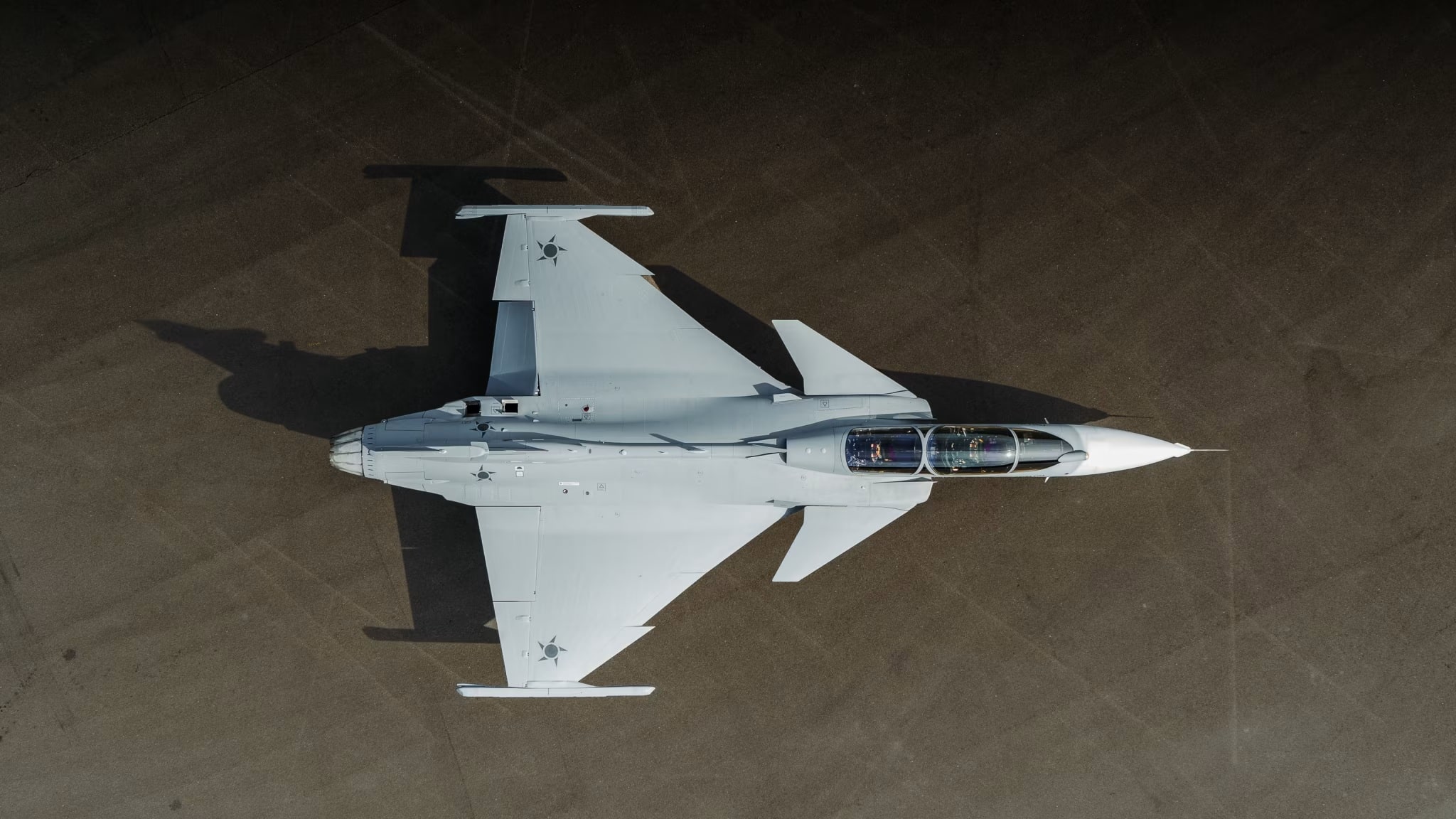
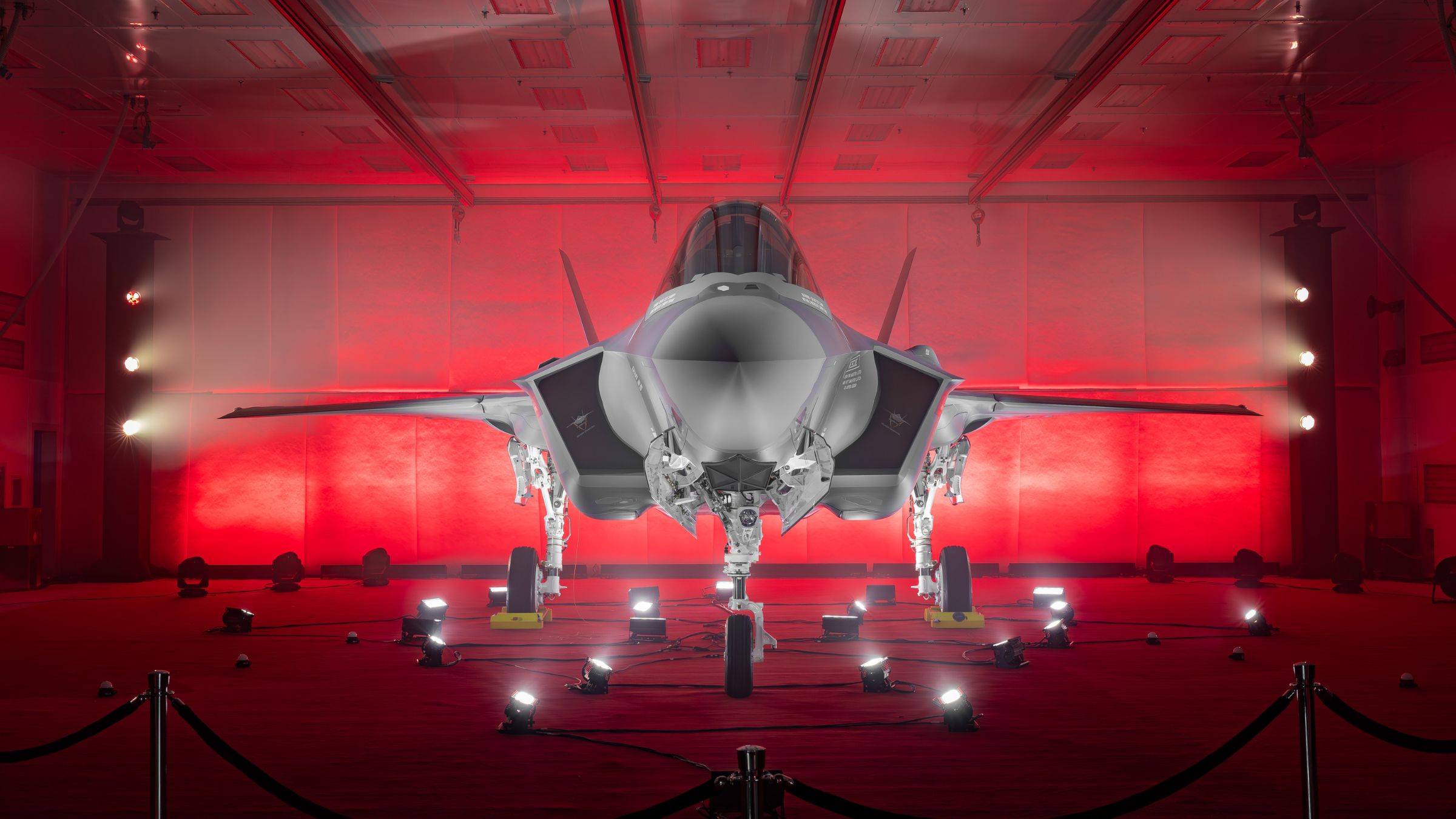
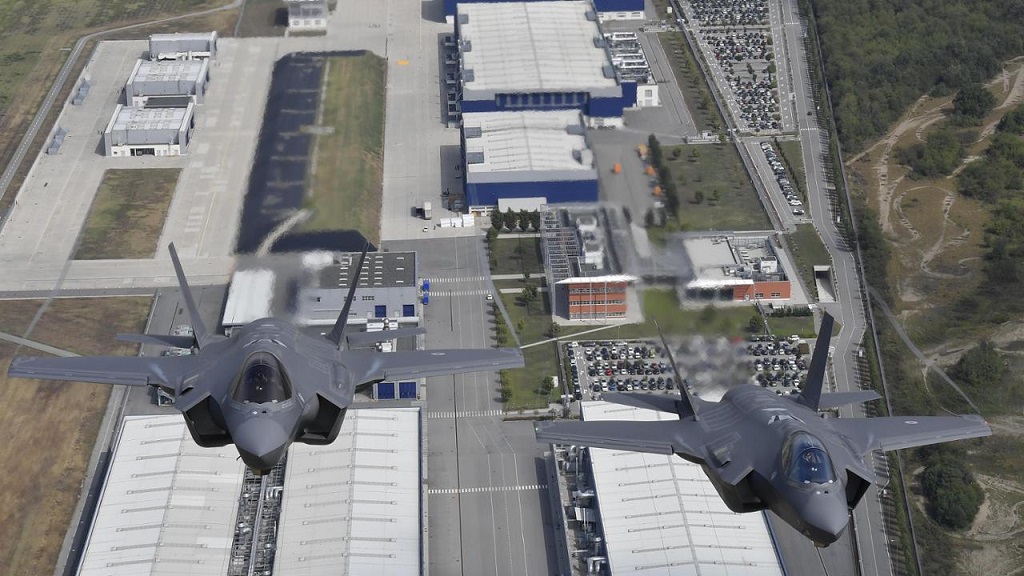
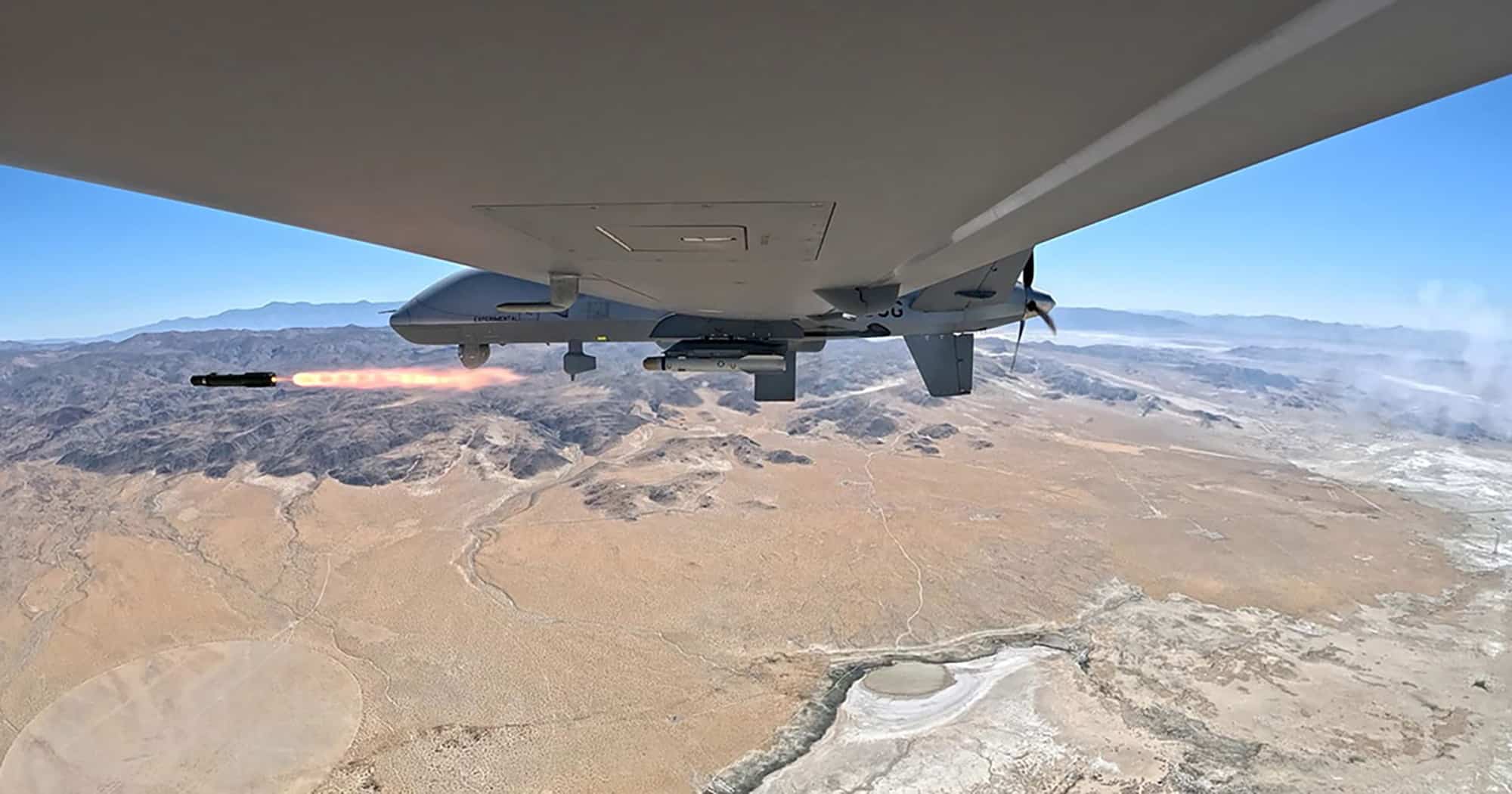
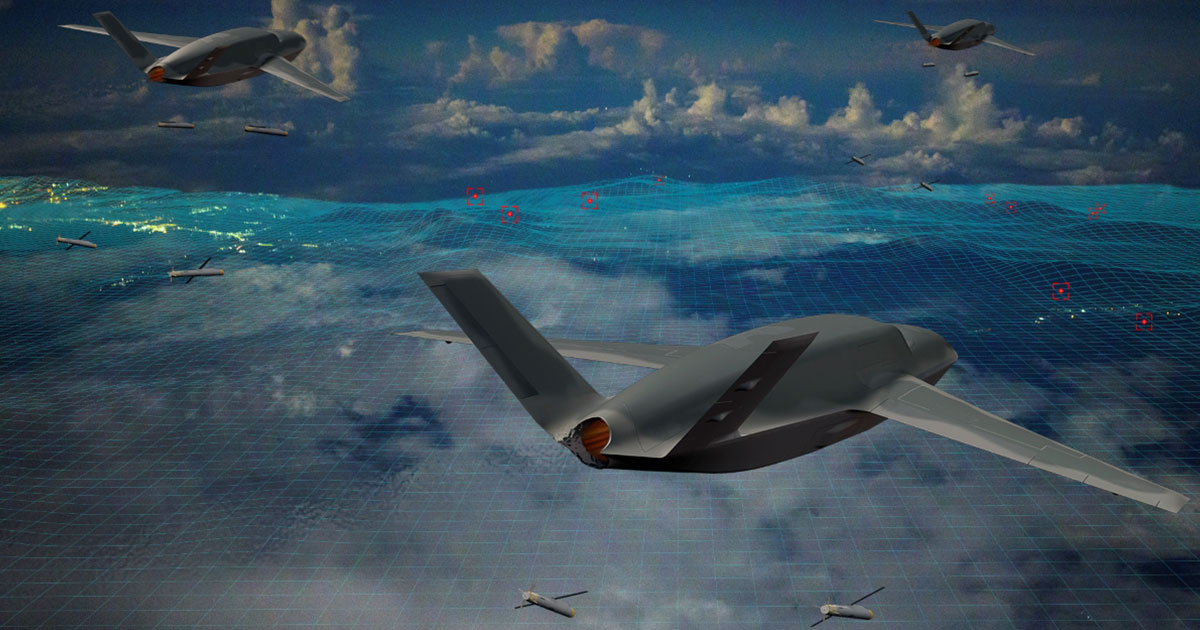
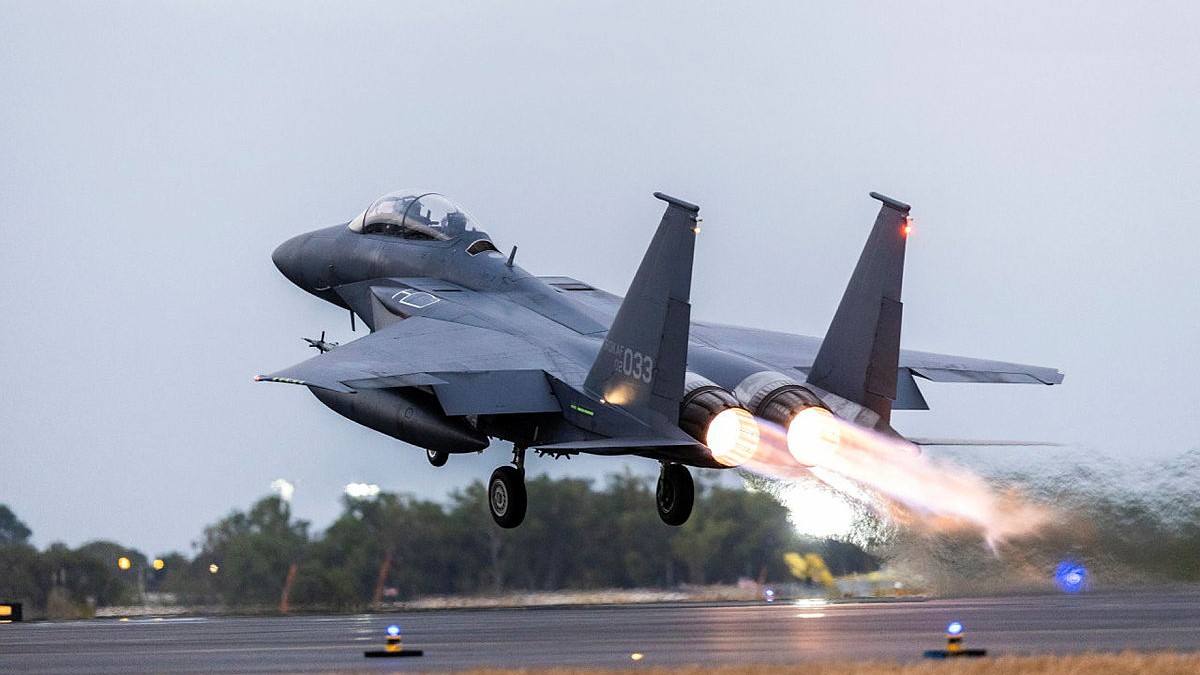
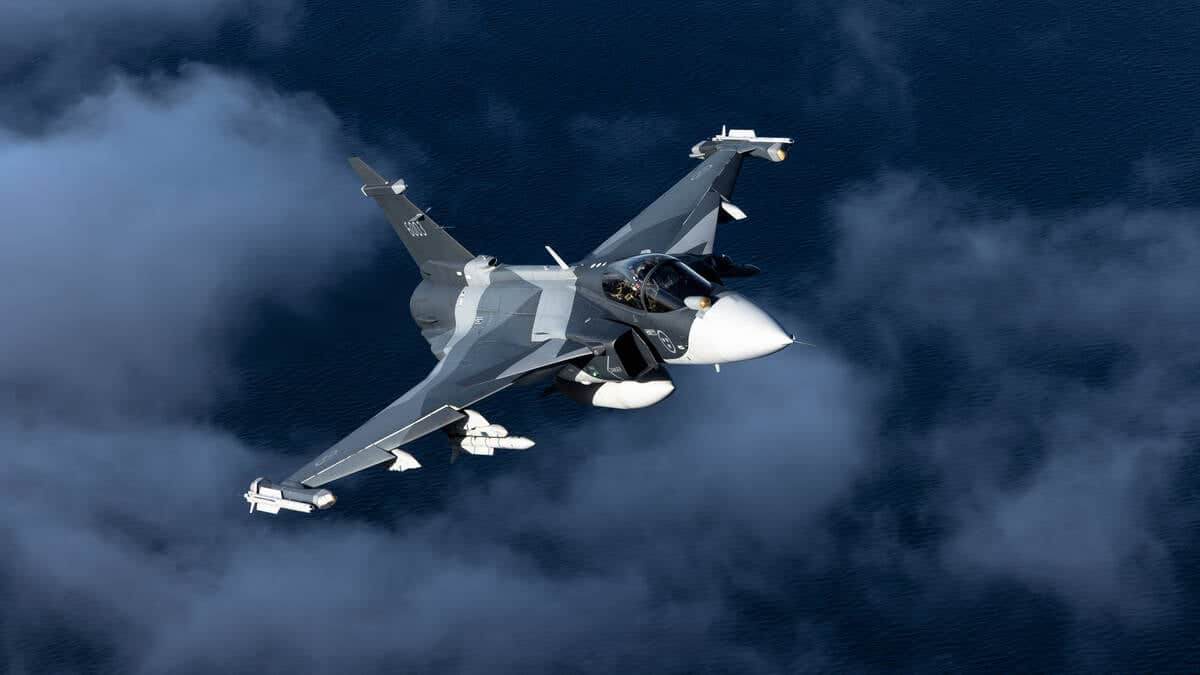
The Gripen F, the twin-seater variant of the Gripen E, conducted its first flight from Saab’s airfield in Linköping.
Saab has announced the successful first flight of the Gripen F, the twin-seater variant of the Gripen E fighter jet, on Aug. 28, 2026. The aircraft took off at 09:40 local time from Saab’s airfield in Linköping, Sweden, and remained airborne for 40 minutes, said the company.
The Gripen F as flown by Saab chief test pilot Jakob Högberg and Brazilian Air Force test pilot Lieutenant Colonel Aviator Abdon de Rezende Vasconcelos. In fact, Brazil is the launch customer of this variant, which was sporting the insignias of the Brazilian Air Force, and co-developed it with Sweden.
The aircraft was officially rolled out during a ceremony on June 2. With the first flight, the pilots successfully verified the functionality of the aircraft core systems and its initial flight performance, explained the company.
“This first flight represents an important step forward for both Saab and the Brazilian Air Force,” says Lars Tossman, head of Saab business area Aeronautics. “Seeing Gripen F take to the skies is particularly significant for all the Swedish and Brazilian teams whose years of engineering work have helped turn this aircraft into a reality.”
Following the initial production acceptance flights, the test campaign will move into a progressive envelope expansion phase, clearing each performance limit, including speed, altitude, G-load and angle of attack. In parallel, Saab says that tactical capabilities and rear cockpit functions specific to the two-seat configuration will also be evaluated.
Following the completion of the test campaign, the Gripen F will undergo acceptance procedures to be delivered to Brazil.
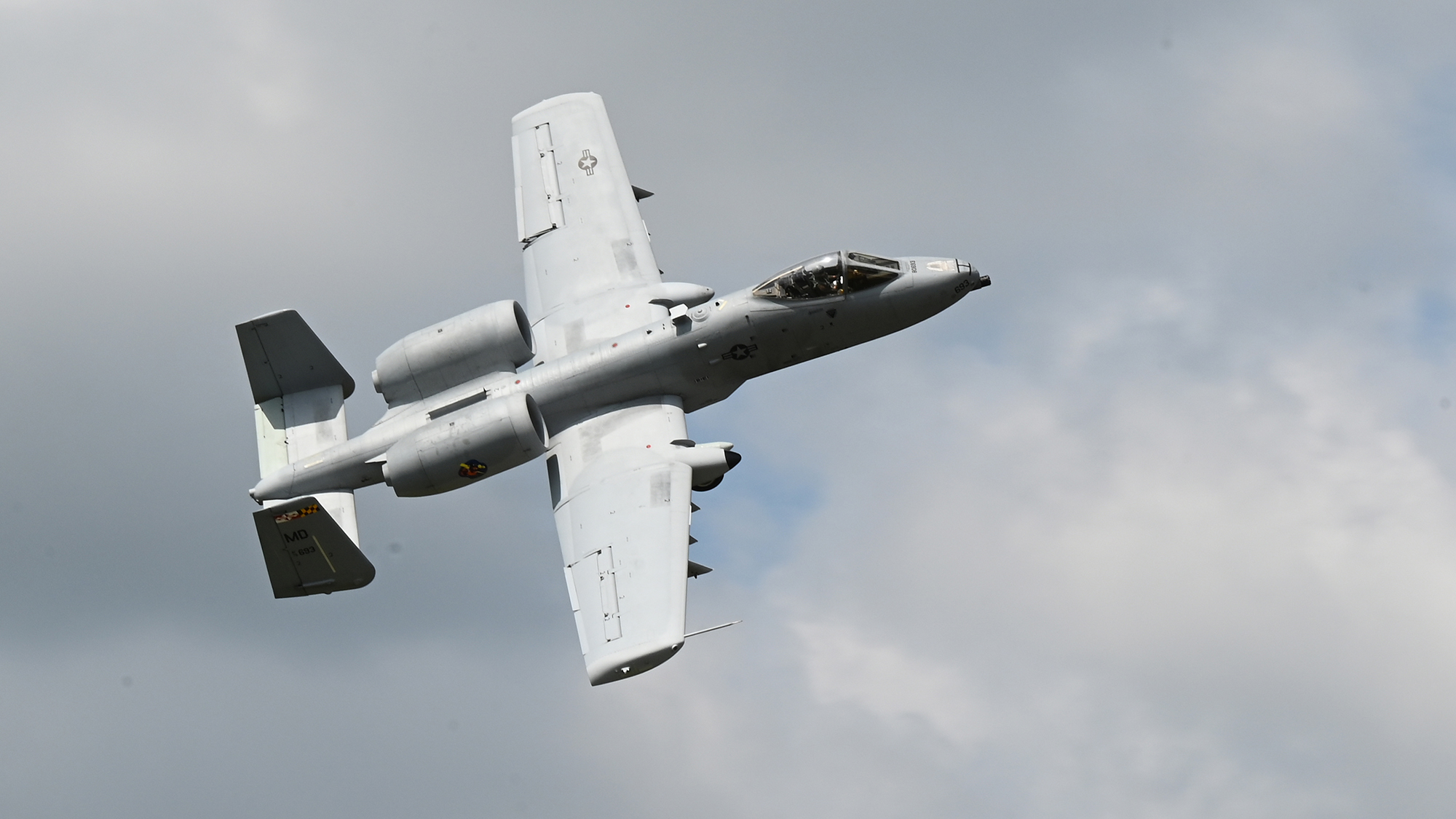
A top view of the first Gripen F. | Source: Saab
Gripen F
The Gripen F is the twin-seater variant of the Gripen E, Saab’s leading fighter jet. The company says it has been developed to meet the training and operational requirements of modern air forces by combining conversion training and combat capability on the same platform.
The aircraft features a fully independent second cockpit, allowing the Gripen F to be a fully operational fighter without restricting it to a training mission only. In fact, performance, sensors, and architecture mirrors the ones of the Gripen E.
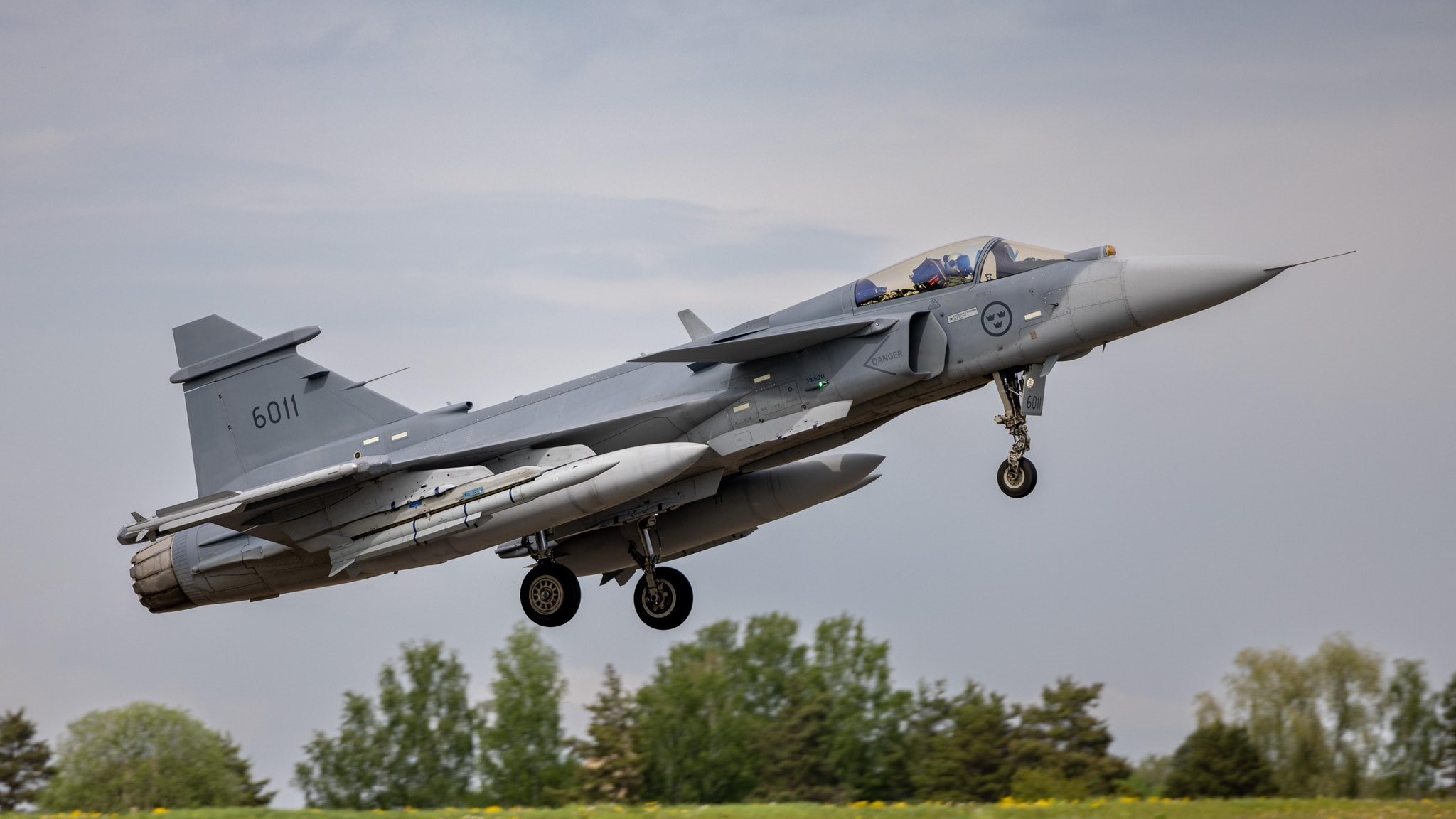
The Gripen E is a significantly modernized variant of Sweden’s indigenously produced Gripen fighter jet. The jet is powered by the GE F414G engine, which provides 20% more thrust than the Gripen C’s RM12 engine, and is also equipped with a brand-new AESA (Active Electronically Scanned Array) radar, IRST (Infrared Search and Track) system, and EW (Electronic Warfare) systems.
A Gripen E during testing. | Source: Swedish Armed Forces
With 10 hardpoints for carrying various munitions, it is almost an entirely new platform, featuring a new avionics architecture with data-fusion capabilities, a wide-area cockpit display, and open mission systems. Externally, the aircraft is much similar to its predecessors, with the IRST in front of the cockpit and the wingtip rails being the main differentiators.
The single-seater Gripen E flew for the first time on June 15, 2017, with Sweden’s being the launch customer. On the other hand, the Gripen F only flew for the first time on Aug. 28, 2026, after Brazil became the launch customer with a contract signed in 2014.
The Brazilian Air Force has ordered 28 Gripen E and eight Gripen F, with eleven aircraft handed over since 2020. Thailand and Colombia have later included the Gripen F in their procurement contracts.
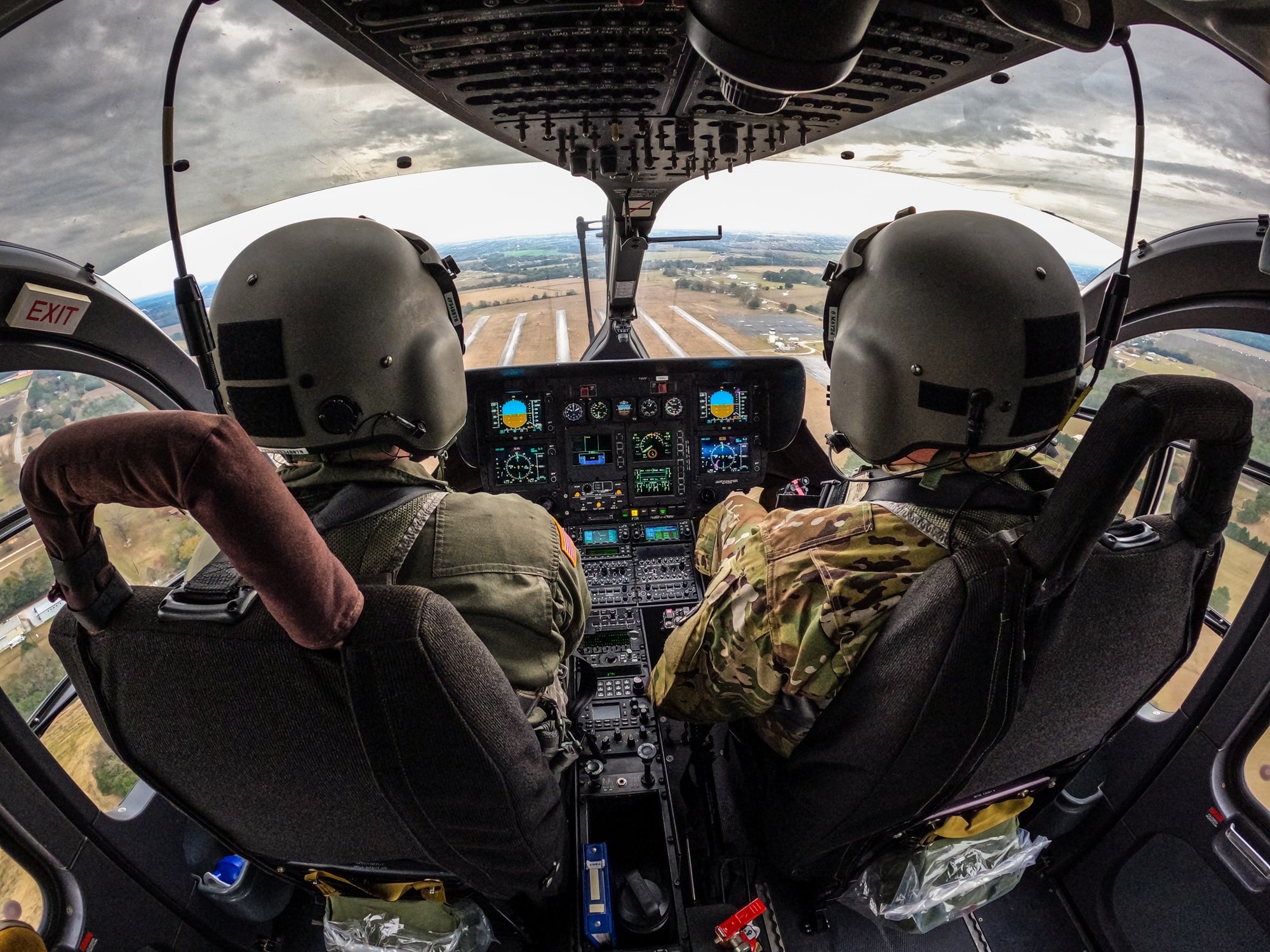
An MH-60 Black Hawk of the U.S. Army’s 160th Special Operations Aviation Regiment crashed in a wooded area in Colorado, and the crew was able to escape without injuries.
A U.S. Army MH-60 Black Hawk, assigned to the 160th Special Operations Aviation Regiment (SOAR), has crashed in Colorado on Aug. 25, 2026. The crew was able to escape unharmed, according to Army officials.
The incident, which happened during a training flight, saw the helicopter going down in a wooded area to the north of Golden Gate Canyon State Park, according to a statement from the Gilpin County Sheriff’s Office to CBS News. The aircraft can be seen surrounded by broken trees, possibly as a result of the incident.
Army Black Hawk helicopter goes down in Colorado foothills west of Denver in “aviation mishap,” no reported injuries. https://t.co/Ojq0k2DqQ9
The images available show that the helicopter suffered substantial damage to the main rotor, with the blades snapped near the rotor mast, with the airframe appearing mostly intact. The specialized equipment and the black livery used by the 160th SOAR can be easily recognized.
A US Army Black Hawk helicopter from the 160th Special Operations Aviation Regiment (“Night Stalkers”), based at Fort Campbell, Kentucky, made an apparently unplanned landing in a wooded area of the Colorado foothills west of Denver on Tuesday (Aug. 25) — near Golden Gate… pic.twitter.com/2wMmxgYDvg
No additional details are available at this time, with emergency personnel still on scene. A safety investigation has already been launched.
Here is a statement released by the service to CBS News:
“The 160th Special Operations Aviation Regiment (Airborne) is aware of an August 25, 2026, aviation mishap during routine training operations near Denver, Colorado. The command takes all training incidents and the safety of our personnel seriously. Because this is currently the subject of an active safety investigation, we cannot provide additional comment or information at this time.”
Update: No injuries reported after an incident in Colorado today involving an MH-60 Blackhawk helicopter, per U.S. Army Special Operations Command. https://t.co/siNQClmGkfpic.twitter.com/batR5IN3vu
The incident happened few weeks after the crash of a U.S. Army AH-64E Apache in Texas. That incident however had a different outcome, causing the loss of the airframe and the death of both crewmembers.
This is a developing story, further updates will be provided as more information becomes available.
The MB-339, one of the most recognizable symbols of Italian aviation, celebrated the 50th anniversary of the first flight.
The Italian-made MB-339 jet trainer turned 50 on Aug. 12, 2026. The aircraft took to the skies for the first time from the Aermacchi facilities in Venegono, near Varese in northern Italy. The two-seat jet trainer that would go on to become one of the most recognizable Italian military aircraft of this era.
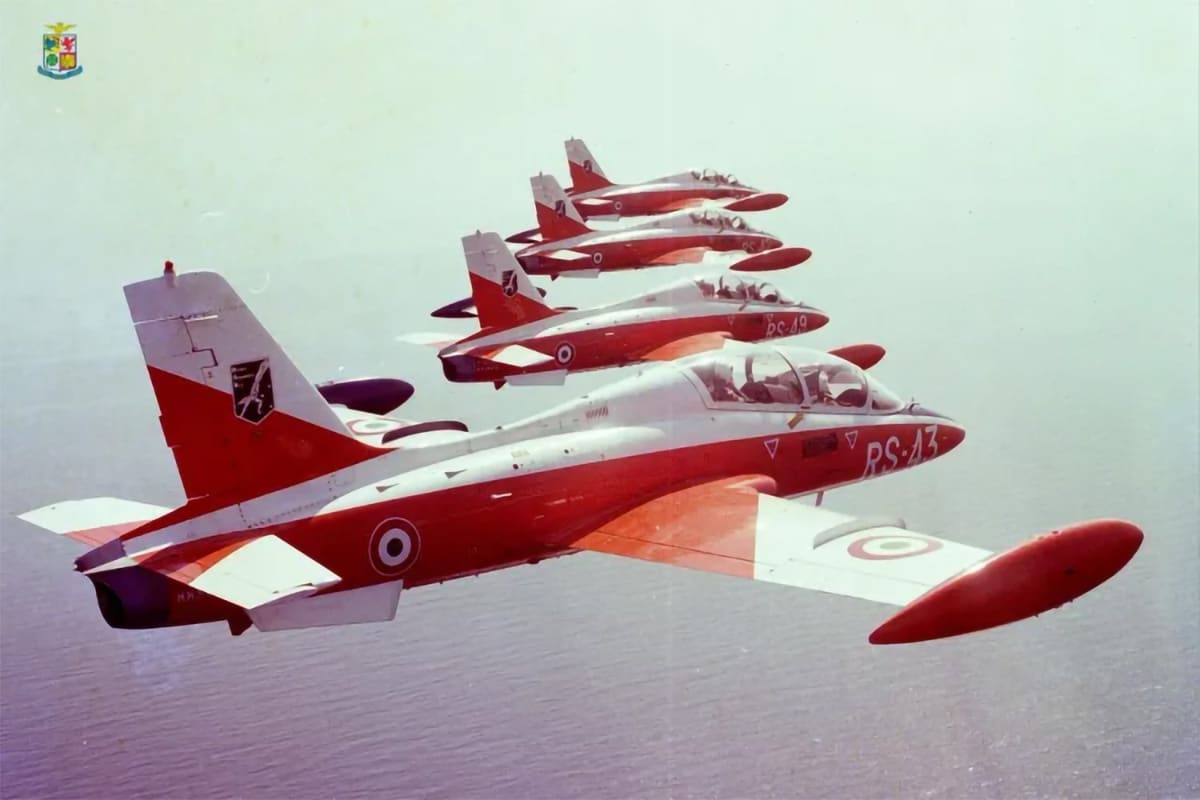
Fifty years later, the aircraft remains closely associated with the Italian Air Force and, above all, with the unmistakable green, white and red smoke trails of the Frecce Tricolori, the Italian Air Force’s national aerobatic team. While its most famous role is undoubtedly as an aerobatic aircraft, the MB-339’s was designed primarily to train military pilots, with a secondary role as a light attack platform.
Over the following decades, the aircraft had a good export success and found customers across Europe, Africa, Asia, Oceania and South America. The MB-339 even saw combat in the Falklands War and in Africa.
The birth of the MB-339
The origins of the MB-339 date back to the early 1970s, when the Italian Air Force began looking for a successor to the Aermacchi MB-326 “Macchino,” which entered service in 1962. Rather than developing a completely new aircraft, Aermacchi decided to build on the experience accumulated with the MB-326.
MB-339s during the testing by the Italian Air Force’s Reparto Sperimentale Volo (Experimental Flight Unit). | Source: Italian Air Force
The new design retained the basic configuration of its predecessor but introduced a substantially redesigned fuselage, new cockpit arrangement and improved avionics. Similarly to the MB-326, the design was developed under the direction of Ermanno Bazzocchi, Aermacchi’s chief designer, whose name is reflected in the “B” of the aircraft’s designation.
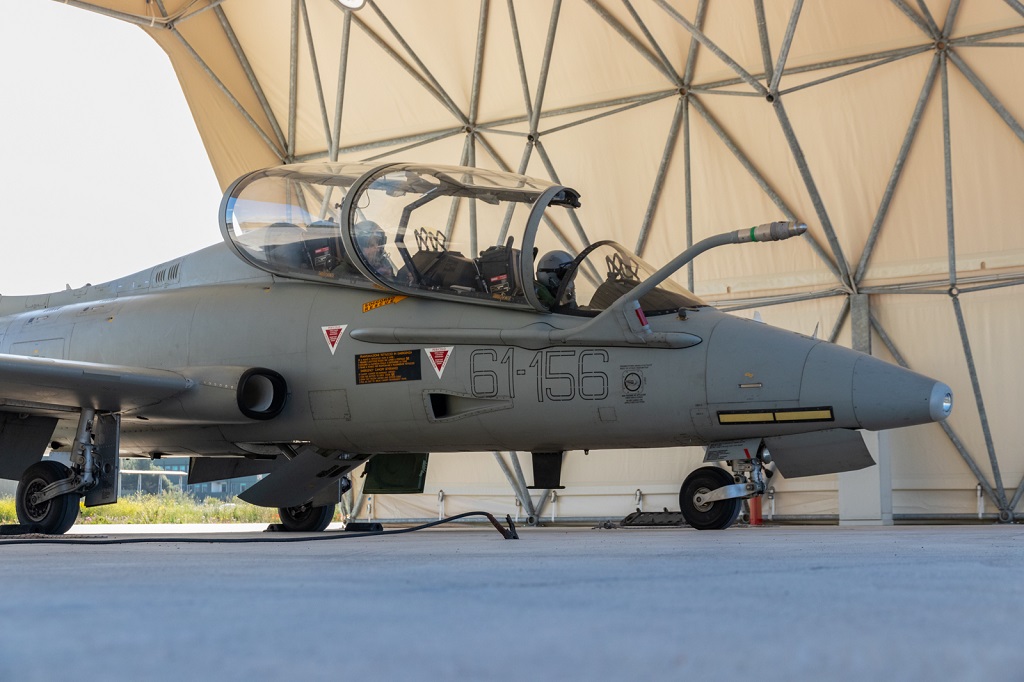
One of the most recognizable characteristics of the MB-339 is its stepped cockpit, with the instructor sitting higher than the student in the front cockpit. This arrangement provides the instructor with improved forward visibility and became one of the defining features of the aircraft.
The Italian Air Force selected the MB-339 proposal in 1975, and construction of the first prototypes followed. The first prototype, designated MB-339X and with registration I-NOVE, took to the air on Aug. 12, 1976, with Aermacchi test pilot Franco Bonazzi at the controls, while the second prototype, with registration I-NINE, followed in 1977.
In 1978, the first production aircraft conducted its maiden flight. The MB-339 subsequently entered service with the Italian Air Force in 1979, beginning a career that continues today.
Two MB-339A perform a formation takeoff. | Source: Stefano D'Urso/The Aviationist
The aircraft is powered by a Rolls-Royce Viper 632-43 turbojet, a variant of the engine already used on the MB-326. The Viper is relatively simple and reliable, while providing enough performance for advanced jet training and secondary combat missions.
The MB-339 can reach around 900 km/h and is equipped with six underwing hardpoints for external stores. Depending on the configuration, these can include bombs, rockets, gun pods, fuel tanks and air-to-air missiles, making the MB-339 more versatile than a conventional trainer and allowing it to be used for both training and light attack missions.
From trainer to combat aircraft
The MB-339 was never intended to replace a front-line fighter, but its ability to carry weapons meant that it could be employed in low-intensity conflicts and secondary combat roles. Its combat debut came in one of the most famous conflicts of the early 1980s, the Falklands War.
During the conflict, the Argentine Navy deployed MB-339s, delivered only a year earlier, to Port Stanley. From there, the aircraft were used against British forces operating around the islands.
A student pilot and his instructor during prepare to start-up their MB-339CD. | Source: Stefano D’Urso/The Aviationist
The Argentine MB-339s carried out several attack missions, taking advantage of the aircraft’s ability to operate from relatively austere bases. On May 21, 1982, an Argentine MB-339, armed with 30 mm gun pods and rockets, attacked British forces during the landing at San Carlos Water, in one of the most notable combat actions involving the type.
The MB-339 would see combat again more than a decade later. Eritrean MB-339s were employed during the 1998–2000 Eritrean-Ethiopian War, attacking targets in Ethiopia with rockets and bombs.
The MB-339’s evolution
Aermacchi continued to develop the aircraft throughout its production life. Multiple variants were created, although some stopped at the prototype phase.
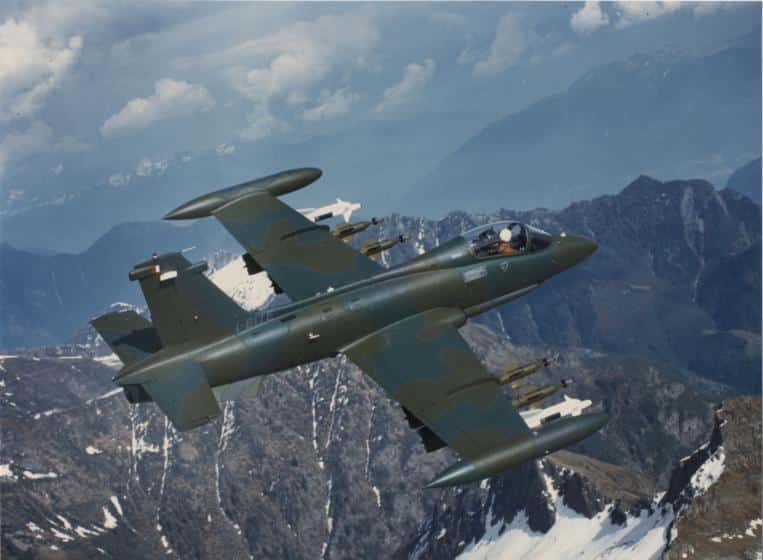
One of the most unusual developments was the MB-339K Veltro II, a single-seat light attack version that first flew in 1980. The aircraft was designed specifically for the attack mission as a successor to the MB-326K, but the concept did not attract production orders and only a single prototype was completed.
The prototype of the single-seater MB-339K. | Source: Aermacchi/Leonardo archives
The remaining variants were improved two-seat versions, both for Italy and for export customers. The aircraft’s evolution eventually culminated in the MB-339CD, developed for the Italian Air Force with a completely digital cockpit.
The MB-339CD introduced modern avionics, MultiFunction Displays (MFD) and Head-Up Displays (HUD) in both cockpits. This configuration allowed the aircraft to remain relevant, replicating the cockpits found in modern combat aircraft which moved from traditional analog instruments toward digital cockpits.
The change was particularly important because the MB-339 was not only used for basic training, but also for pre-operational or Lead-In Fighter Training (LIFT). This phase of training represented the final step before the students moved to Operational Conversion Units (OCU) to train on their assigned aircraft.
The Frecce Tricolori
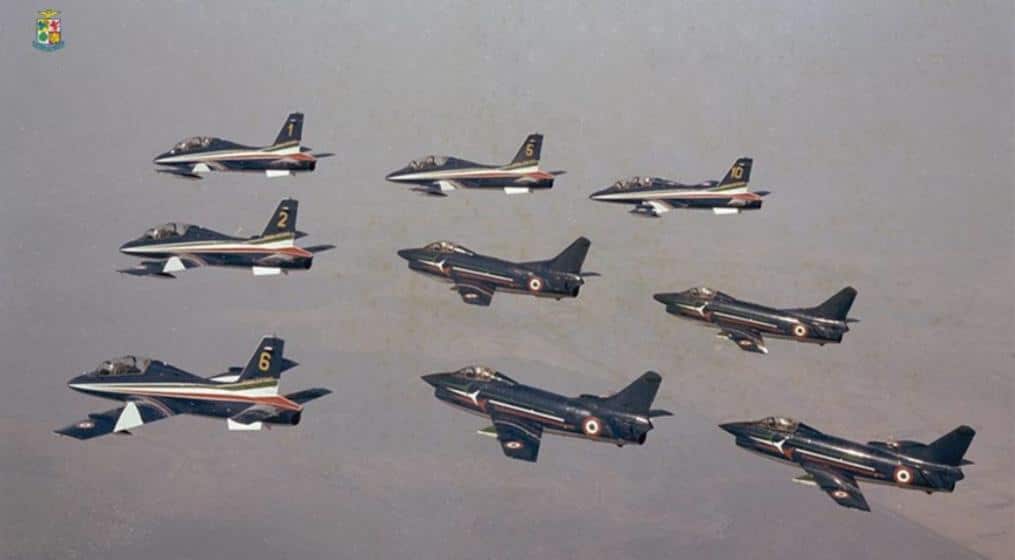
The Frecce Tricolori selected the MB-339 to replace the Fiat G.91PAN in 1981. The first MB-339PAN aircraft entered service with the team in 1982, beginning a partnership that would last for more than four decades.
The MB-339PAN and the G-91PAN during a mixed formation flight. | Source: Italian Air Force
The aircraft was modified for the demanding aerobatic mission, most visibly through the installation of the smoke-generation system used to create the colored trails that form the Italian tricolor in the sky. Another variation was the removal of the MB-339’s peculiar wingtip fuel tanks, replaced by standard ones installed under the wings.
The MB-339 proved particularly well suited to the role. Its compact dimensions, handling characteristics and two-seat configuration allowed the team to perform the complex formations and maneuvers that became its trademark, including some that were previously unthinkable for a jet aircraft, such as the Lomcovák.
The sight of nine MB-339s flying in close formation, leaving green, white and red smoke trails behind them, and the solo who takes the MB-339 to its limit, became one of the most recognizable images of Italian aviation. Throughout the years, the MB-339 accompanied the Frecce Tricolori on countless international deployments and airshows, becoming an unofficial ambassador of the Italian Air Force and the Italian aerospace industry.
An international success
The MB-339 also became an important export product for Aermacchi. In fact, in addition to Italy, the aircraft was selected by several countries, including Argentina, Eritrea, Ghana, Malaysia, New Zealand, Nigeria and Peru.
The MB-339s of the Frecce Tricolori paint the sky with the green, white and red of the Italian flag. | Source: Stefano D'Urso/The Aviationist
The company adapted the aircraft to the customers’ specific requirements, with some aircraft optimized primarily for training and others retaining a stronger light-attack capability. New Zealand, for instance, operated the MB-339CB, while Malaysia received the MB-339AM and Peru the MB-339AP.
Aermacchi, now part of Leonardo, thus established itself as one of the world’s leading manufacturers of military training aircraft. Approximately 230 MB-339s were eventually produced between the late 1970s and 2006, when the production ended.
The U.S. State Department approved a possible Foreign Military Sale to Italy of the air-to-air variant of the APKWS-II, which would include over 5,000 guided rockets.
The U.S. Defense Security Cooperation Agency (DSCA) announced that the State Department has approved a possible Foreign Military Sale (FMS) to Italy of the air-to-air variant of the Advanced Precision Kill Weapon System-II (APKWS-II). The deal would include 5,031 Guidance Sections Single Variant Air-to-Air Advanced Precision Kill Weapon System-II WGU 59B/B for an estimated total cost of $364 million, which equals €311.66 million.
Additionally, the approved package includes LAU-131 A/A launchers, Mk-152 high explosive warheads, MK66 rocket motors, proximity fuzes, WTU-1/B practice warheads, and inert MK66 rocket motors. As usual, also included are engineering, technical, and logistics support services.
“The proposed sale will improve Italy’s capability to meet current and future threats by strengthening its homeland defense and serving as a deterrent to regional threats,” said the DSCA. “This enhanced capability will protect Italy and local allied land forces and will significantly improve Italy’s contribution to NATO integrated air missile defense.”
The statement by the DSCA did not include which armed force will receive the weapon, if the sale is finalized. Also, there is no indication about the platform which would use it, however the specific mention of the air-to-air variant is notable.
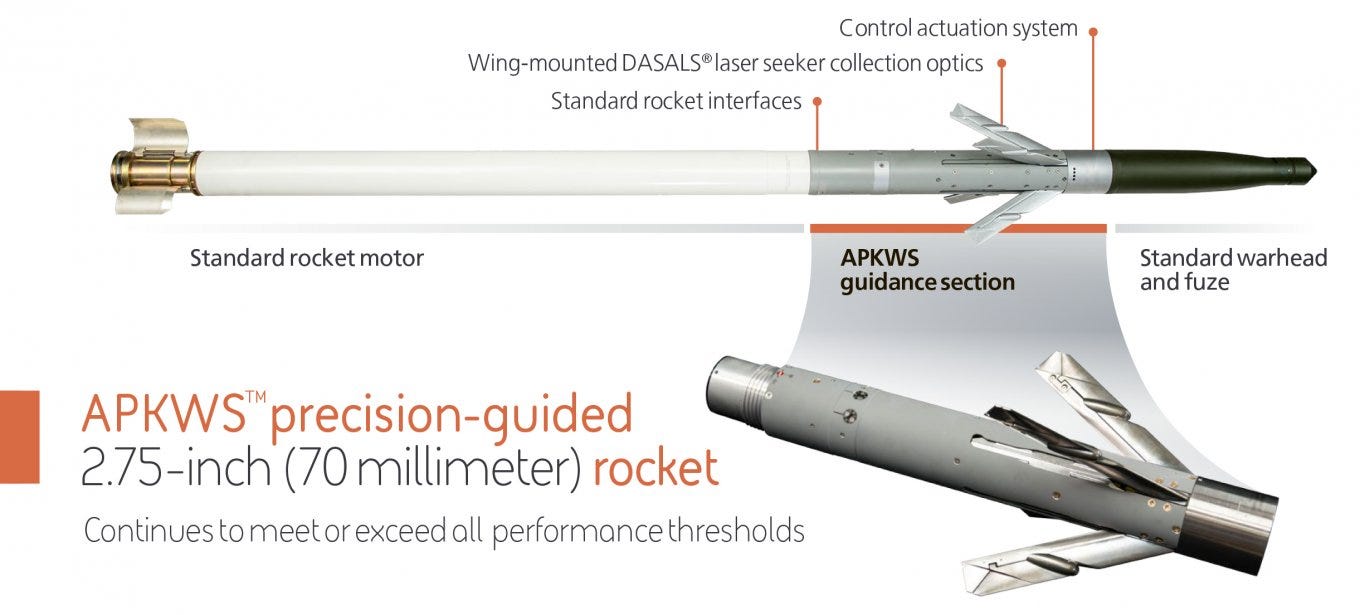
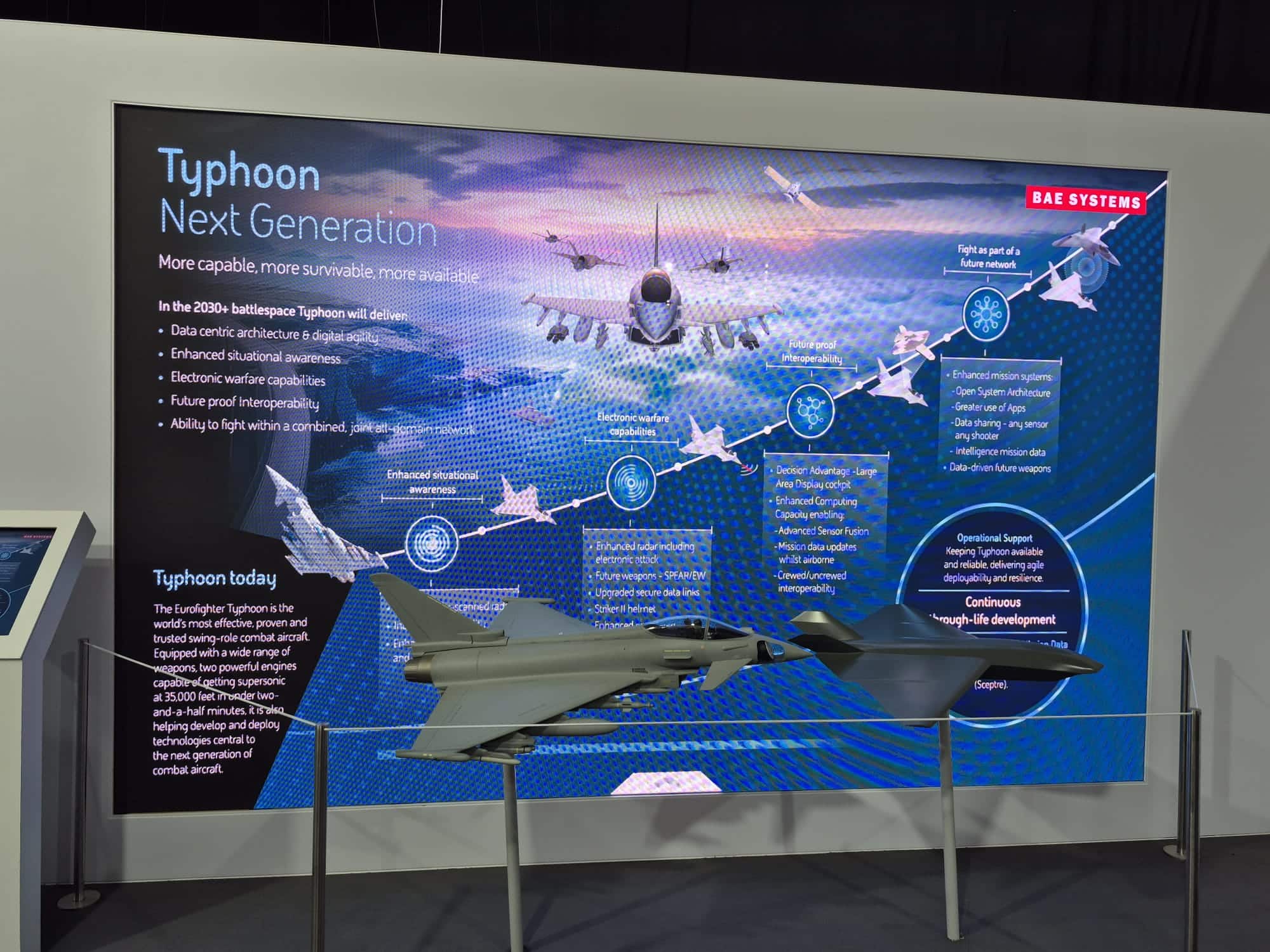
An infographic about APKWS. | Source: BAE Systems
APKWS for Italian Typhoons?
The mention of the air-to-air variant of the APKWS-II rockets could point to the weapon being eyed by the Italian Air Force to equip its fighter jets for Counter Unmanned Aerial Systems (C-UAS) missions. Last year, a service spokesperson told Janes’ Gareth Jennings that the Italian Air Force was “not looking at acquiring any additional mission-specific systems to counter the UAS threat.”
@ItalianAirForce also “not looking at acquiring any additional mission-specific systems to counter the UAS threat”. Depending on what the Spanish have to say, could be a short conversation for the Eurofighter CEO.
At the time, the UK similarly said it did not have plans to equip its Typhoons with rockets for the C-UAS mission. Less than a year later, the Royal Air Force deployed operationally the APKWS-II aboard its Typhoons, following a quick integration campaign.
What a difference a year makes – after every @eurofighter partner operator told me in 2025 that they had no plans to fit #APKWS for counter-#drone, @BAESystemsAir tells @JanesINTEL and others at Warton today that there is now strong interest from all 10 partner and export…
It should be noted that, as part of an Implementing Arrangement, the Italian Air Force and the Royal Air Force are working to increase the interoperability in the maintenance and logistics of their common Typhoon fleets, as well as the integration of their assets when employed in the same operational context. Last year, Italian Typhoons also deployed to the UK to conduct integration trials of the Paveway IV, a weapon already used by the RAF on its Typhoons.
In line with last year’s statements, the integration of the APKWS-II rockets on the Italian F-2000 fleet (as the Eurofighter Typhoons are designated in Italy according to the MoD’s Mission Design Series) was not previously announced and does not figure in publi government documents. However, should this be confirmed, the integration might take advantage of the lessons learned by the RAF.
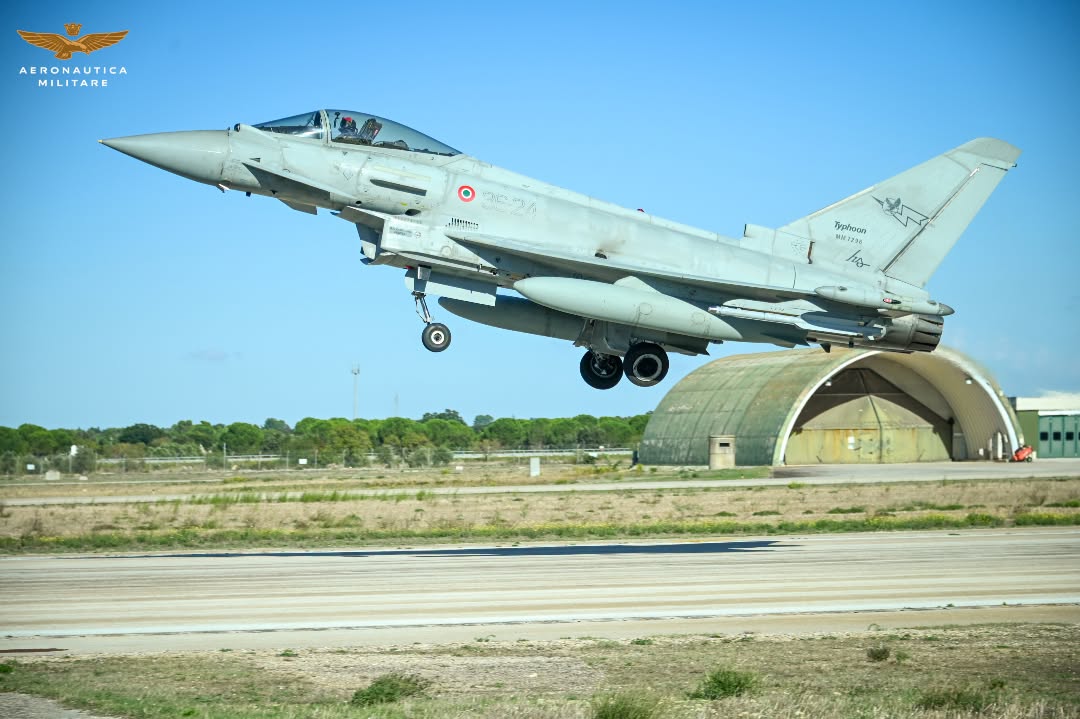
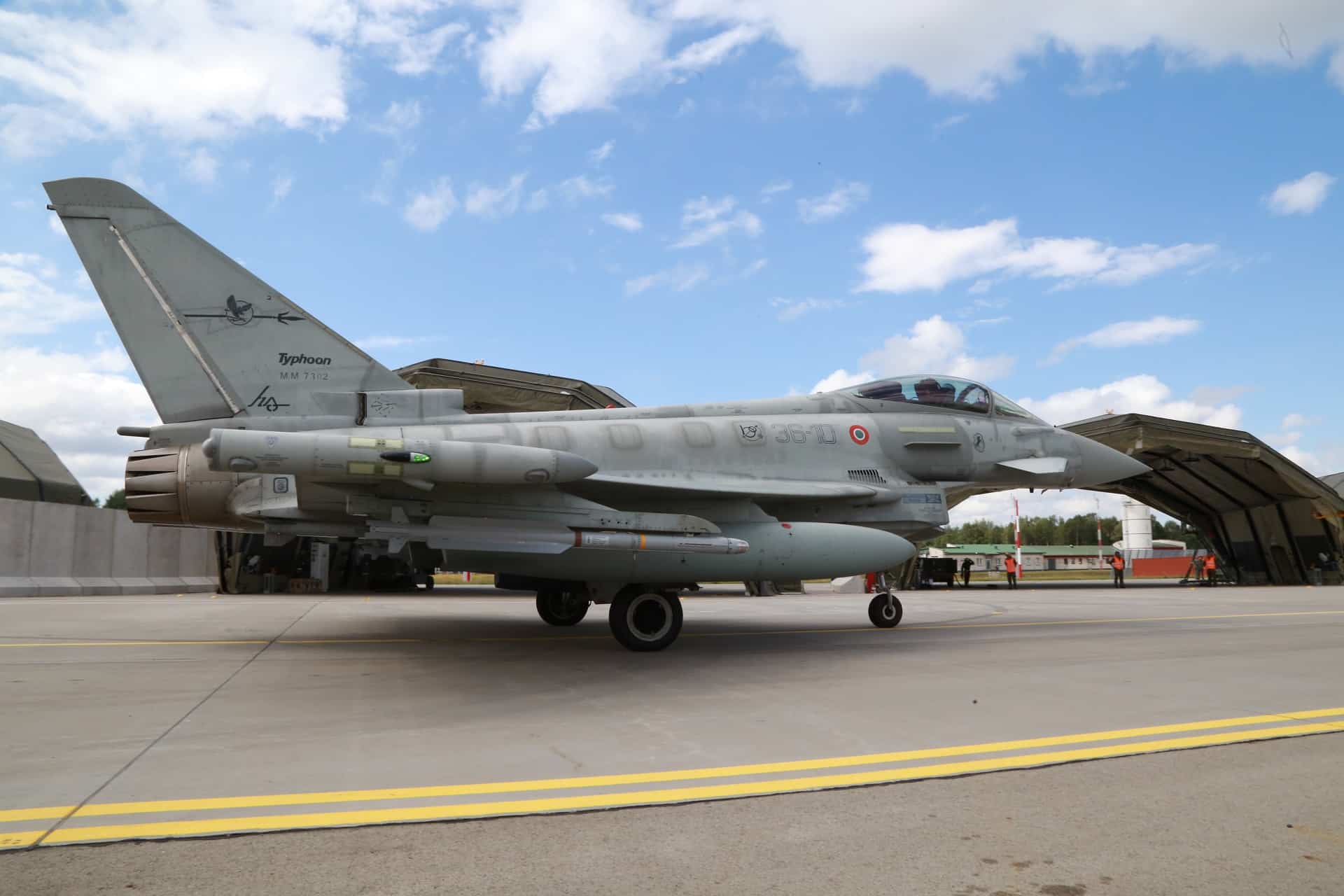
An F-2000A Typhoon of the Italian Air Force. | Source: Italian Air Force
The Italian Typhoons currently rely on their standard armament for the C-UAS mission, including AIM-120 AMRAAM and Meteor radar-guided missiles, AIM-2000 IRIS-T IR-guided missiles and the 27 mm Mauser BK-27 cannon. Earlier this month, one of these weapons was used to shoot down a unidentified drone which entered Latvia’s airspace during a NATO Baltic Air Policing mission.
The APKWS
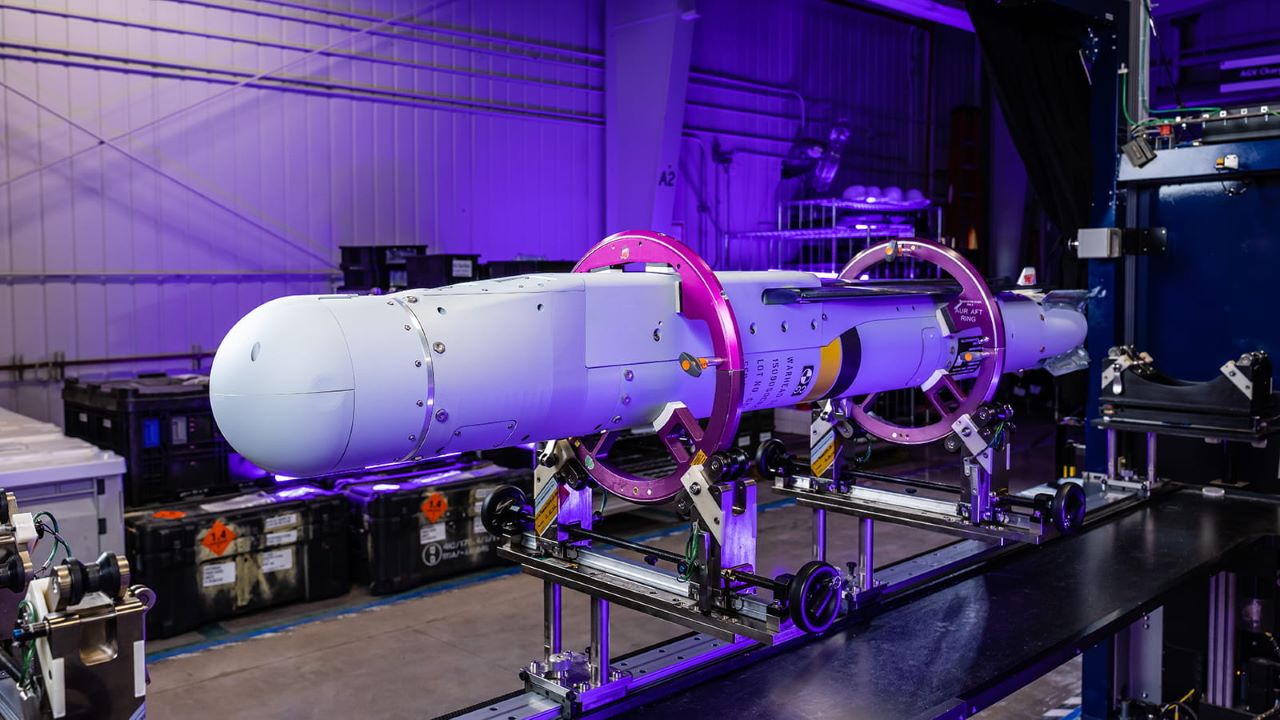
The AGR-20 Advanced Precision Kill Weapon System II (APKWS II) is a conversion of the Hydra 70 unguided rockets which adds a laser guidance kit to the baseline weapon, turning it into a precision-guided munition (PGM). By adding a guidance section to a cheap rocket (inserted in the middle of the rocket, between the 10-pound high-explosive warhead at the front and the Mk66 Mod 4 rocket motor at the rear), BAE Systems created a low-cost smart munition that can be used in the air-to-ground role.
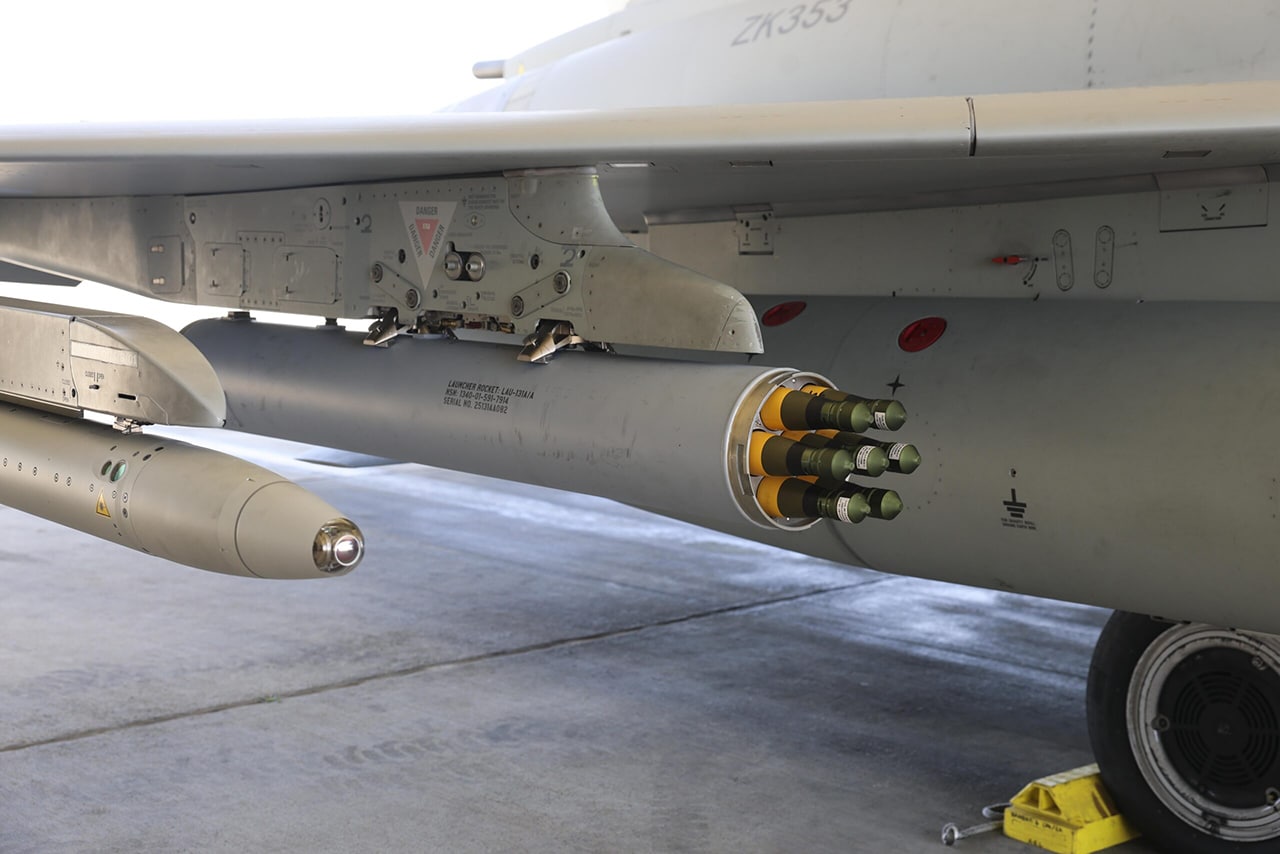
The guidance section of the APKWS includes four foldable wings with wing-mounted laser seeker collection optics with a wide field of view which enable to engage both moving and stationary targets. BAE Systems says that “no modifications are required to the rocket, firing platform or fire control system,” with the only known modification being a longer variant of the LAU-131/A 7-round rocket launcher normally employed by the U.S. Air Force, called the LAU-131 A/A.
Further developing an air-to-air capability out of these older rockets was an impressive feat for the U.S. Air Force, which was the first to test and deploy the new capability, opening to the possibility to engage targets at a very small fraction of the cost of other existing missiles. The high cost of the interceptors against these cheap targets and the magazine size of the launching platforms have been two of the main concerns highlighted by forces countering these attacks.
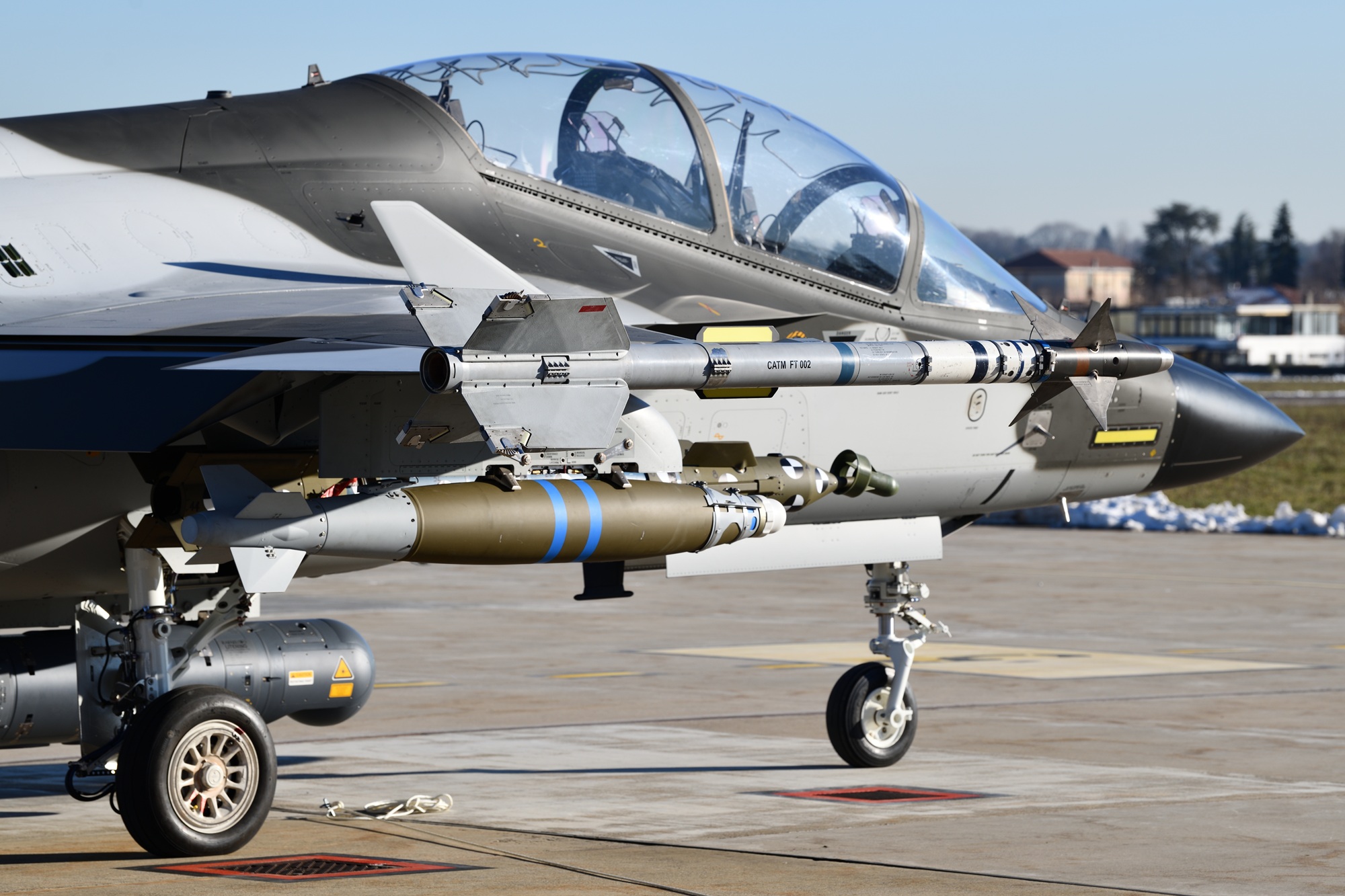
APKWS rounds loaded on the wing of a Typhoon FGR4. | Source: Crown Copyright 2026
A current beyond visual range radar-guided AIM-120 Advanced Medium Range Air-to-Air Missile (AMRAAM) is priced at more than $1 million each, and an AIM-9X Sidewinder Block II has a price tag of around $420,000. On the other hand, the guidance section of an APKWS II only costs around $15,000, with the full APKWS II round only costing a few thousand dollars more (to include the warhead and the motor).
The low cost of the APKWS II comes with some restrictions, as the weapon is shorter ranged than the current air-to-air missiles, and the warhead is also smaller. However, against slow and cheap targets like drones, the AGR-20 can provide a highly cost-effective weapon.
Moreover, the APKWS II can provide fighter jets with deeper magazines for air-to-air munitions, as they can be carried in a 7-shot rocket pod on a single hardpoint that could otherwise take only a single missile. This feature could come in hand while facing swarm or saturation attacks from enemy drones, a tactic that has already been used by Russia in their aggression of Ukraine, by Iran in their attacks on Israel and sometimes on a smaller scale even by the Houthis.
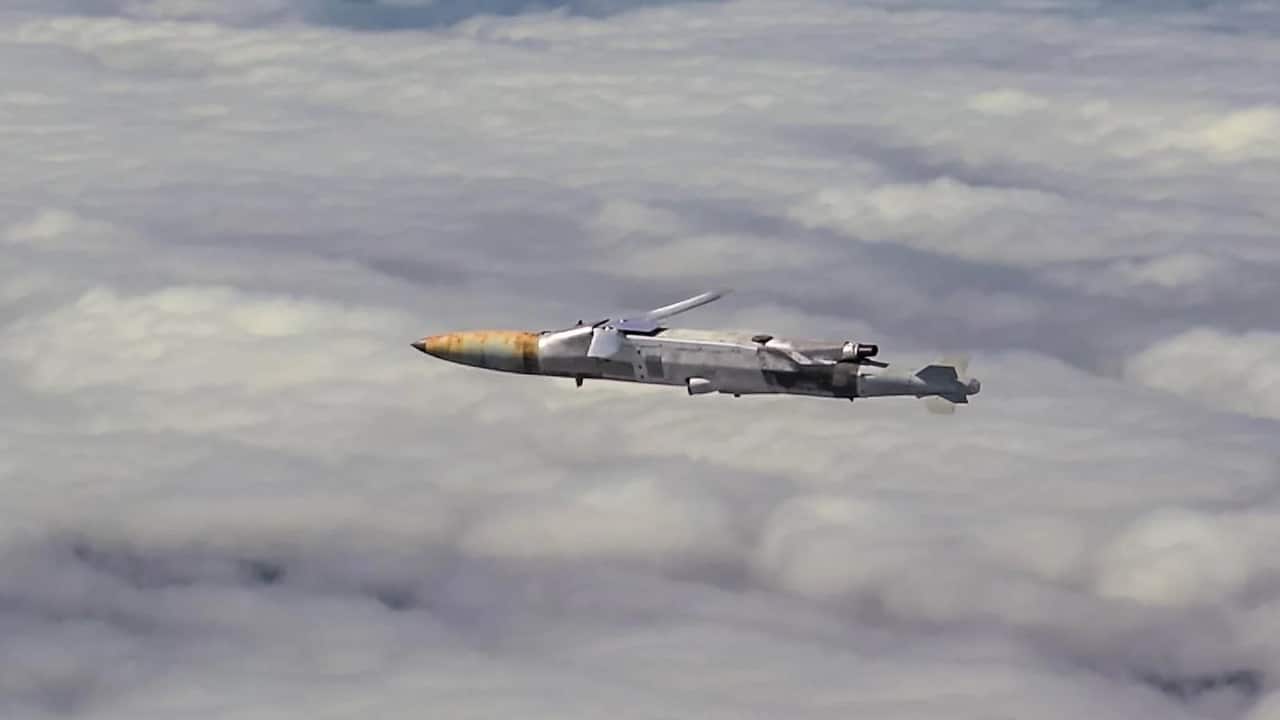
A Swedish Air Force JAS 39 Gripen C launched for the first time a Taurus KEPD 350 cruise missile over the Vidsel Test Range.
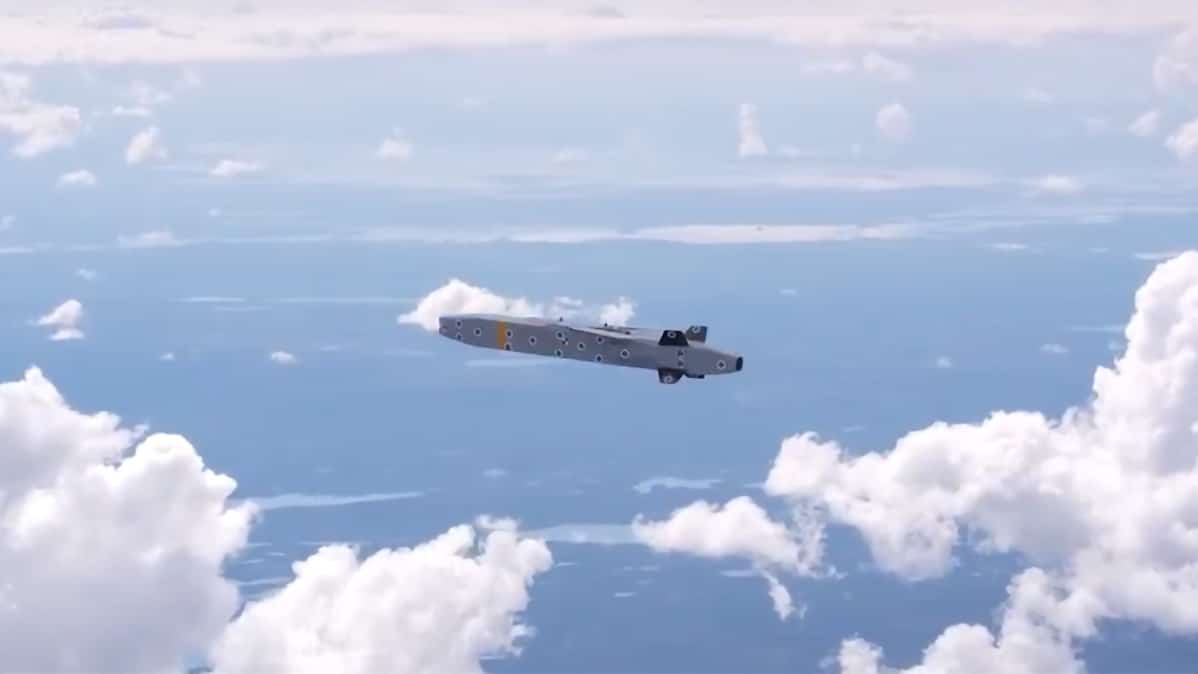
The Swedish Air Force released a video on Aug. 21, 2026, announcing that a JAS 39 Gripen launched for the first time a Taurus KEPD 350 cruise missile. The live fire activity, conducted at the Vidsel Test Range, represents a new step towards the introduction in service of the new deep-strike capability.
According to the post on X, the launch of the weapon was conducted on Aug. 21. No additional details have been released, while the video shows that the Taurus employed in the test was a live example, as denoted by the yellow stripe.
TAURUS LAUNCH
Today a TAURUS KEPD 350 cruise missile was launched from a Swedish JAS 39 Gripen for the first time. The test was conducted at the Vidsel Test Range in Norrbotten.
Today TAURUS is a long-range cruise missile that introduces a new deep-strike capability. FMV pic.twitter.com/vYcL75Lu4p
The introduction in service of the Taurus KEPD 350 with the Swedish Air Force was first planned by 2028. However, last year Maj. Gen. Jonas Wikman, the Commander of the Swedish Air Force, said in an interview to Defense News that the service, the Defense Materiel Agency (FMV) and the industry were working together to introduce the capability sooner.
“The capability itself is very important because we haven’t had any deep-strike or offensive counter-air capabilities before,” said Wikman. “We could just put all of our money on defensive abilities, but now that is a huge shift for us.”
The Taurus KEPD 350 in flight over the Vidsel Test Range. | Source: FMV
The integration on the Gripen
Saab has described the Taurus as a weapon compatible with Gripen going back to the early 2000s. Saab was also one of the development partners in the German-Swedish weapon, the other being MBDA.
In 2002, when the German production contract was announced, Saab explicitly listed the JAS 39 Gripen among the aircraft capable of carrying the weapon. However, Sweden announced that it started the integration and procurement only in February 2025.
The work might have started few months before, in December 2024, when Saab announced a contract for the integration of new air-to-air and air-to-ground missiles. At the time, the weapons involved were not identified.
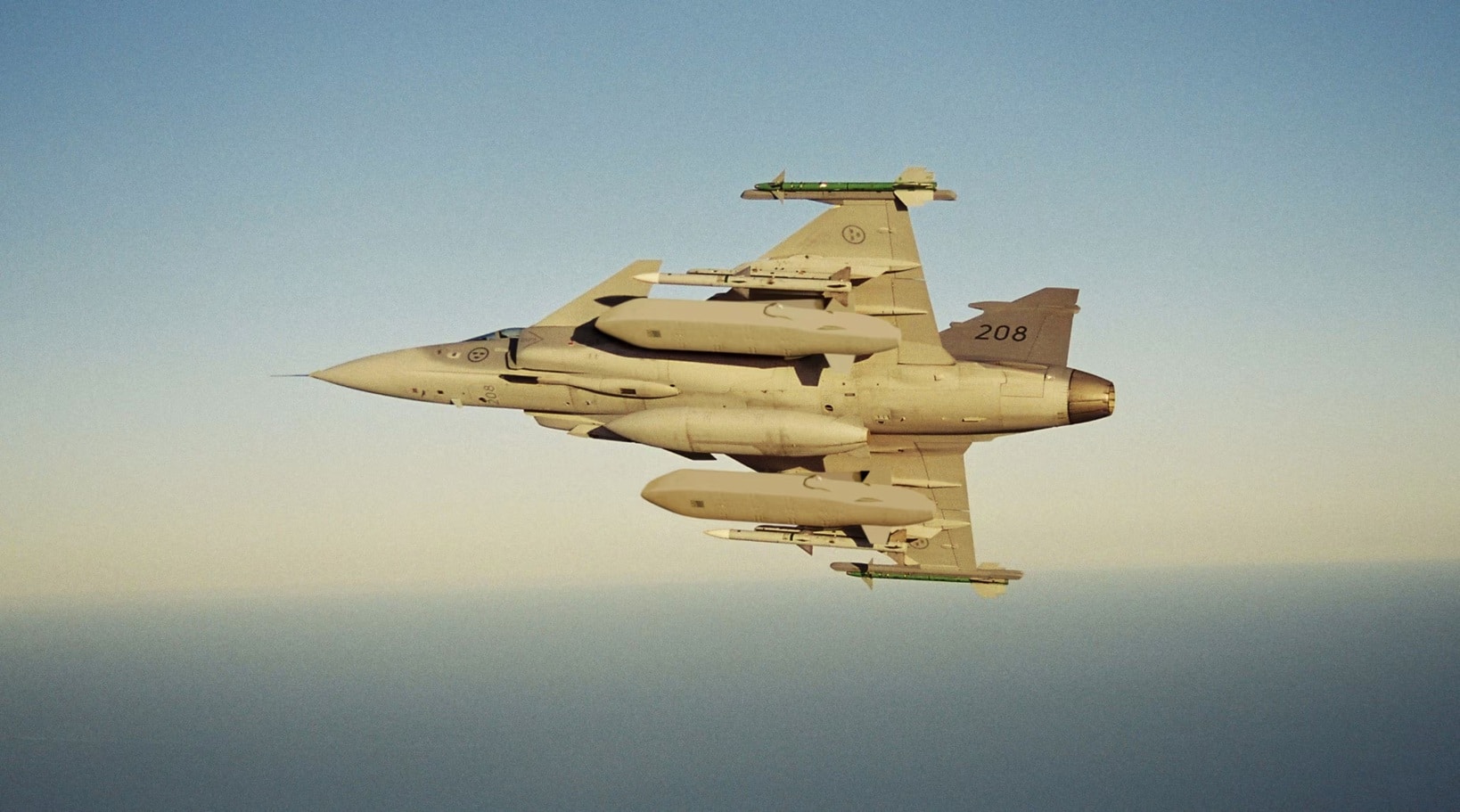
Saab previously released a photo of a Gripen flying with two Taurus weapons, although that was likely only for promotional purposes and no further tests were publicly confirmed. Mockups of Taurus were also installed on Gripens at airshow, with the first instance being FIDAE 2016 in Chile.
An old photo of the Gripen equipped with Taurus KEPD 350 missiles. | Source: Saab
It is likely that not all aircraft in service will be equipped with the new weapon, as the FMV said in 2025 it would upgrade 60 Gripen C/Ds which would remain in service alongside the Gripen E/F. Jets upgraded to the MS20 Block 3 configuration are planned to be delivered from 2026, and the MS20 Block 4 will follow in 2028, according to FMV.
After the completion of the integration work on the older Gripen C, Taurus is expected to be integrated also on the new Gripen E. Saab has already mentioned that the weapon is compatible with its newest fighter jet, although tests were not yet conducted.
Taurus KEPD 350
The Taurus KEPD 350 is a long-range, air-launched stand-off cruise missile developed by Taurus Systems GmbH, a German-Swedish joint venture between MBDA Deutschland and Saab. The name Taurus is actually an acronym which stands for Target Adaptive Unitary and Dispenser Robotic Ubiquity System.
Designed to engage high-value and hardened targets at stand-off ranges, the missile has a range of more than 500 kilometers. It can fly at only 35 meters and a speed of 1,170 km/h (Mach 0.95), reducing the exposure to enemy air defenses.
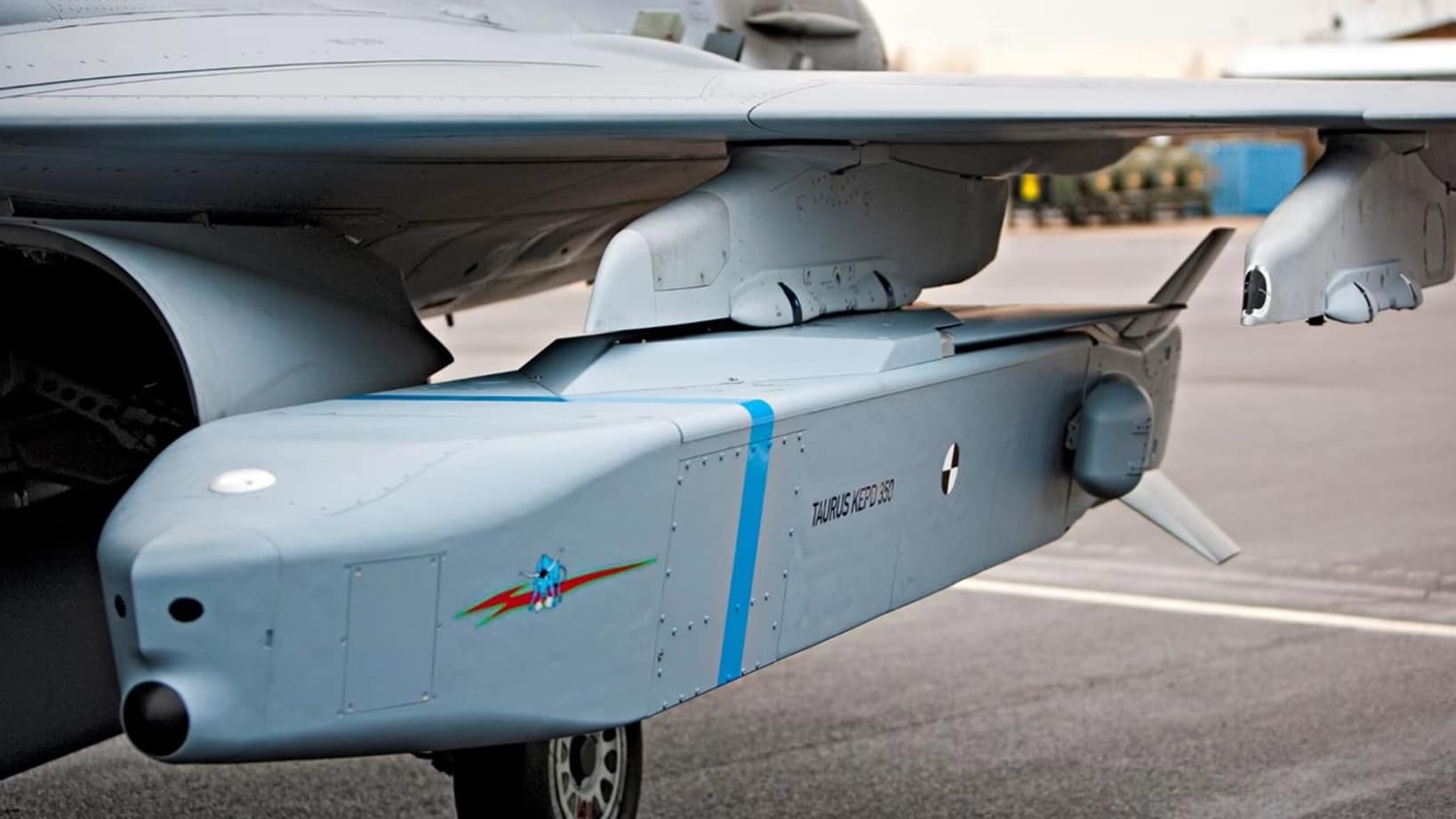
An inert Taurus KEPD 350 missile under the wing of a Gripen. | Source: Saab
The Taurus uses a combination of inertial, GPS, terrain-reference and image-reference navigation to maintain its planned flight path and accurately reach its target. The weapon is equipped with the 481 kg MEPHISTO (Multi-Effect Penetrator High-Sophisticated and Target Optimized) multi-stage warhead, specifically developed to defeat hardened and deeply buried targets.
The weapon can be programmed before launch with a detailed mission profile, allowing it to approach the target along a predefined route. Among the targets for which Taurus is intended are hardened command facilities, bunkers, airfields, bridges and other high-value infrastructure.
The Secretary of the U.S. Air Force confirmed that Seymour Johnson AFB is the planned recipient of the F-15EX Eagle II aircraft included in the proposed Fiscal Year 2027 budget.
The Secretary of the U.S. Air Force Troy Meink confirmed in a letter to Senator Ted Budd that Seymour Johnson Air Force Base, North Carolina, will replace new F-15EX Eagle IIs to replace its current F-15E Strike Eagles. The undated letter, published on Aug. 20, 2026, referred to an inquiry by Sen. Budd dated July 29, 2026.
Air and Space Forces Magazinefirst reported the news, noting that Seymour Johnson’s F-15Es assigned to the 4th Fighter Wing are expected to move to Whiteman AFB, Missouri. The move, however, is pending a final decision expected in fall 2028, and would happen after the base receives the F-15EX.
— Air & Space Forces Magazine (@ASForcesMag) August 20, 2026
Near term F-15E upgrades
Seymour Johnson was the first operational base to receive the F-15E Strike Eagle in 1988, few months after the training unit at Luke AFB, Arizona. A year later, the local 336th Fighter Squadron achieved the Initial Operational Capability for the type.
The base hosts the F-15E’s Formal Training Unit (FTU) and operational squadrons. Throughout the years, it has been deeply involved in operations, however its aircraft are among the oldest in the fleet, including ones with the older Pratt & Whitney F100-PW-220 engines (newer Strike Eagles use the F100-PW-229).
An F-15E Strike Eagle assigned to the 333rd Fighter Squadron, takes off during a hot pit refueling operation exercise at Seymour Johnson Air Force Base, North Carolina, Aug. 26, 2025. | Source: U.S. Air Force photo by Senior Airman Leighton Lucero
“The 4th Fighter Wing has operated at a significantly high operational tempo, including deployments to the Middle East and the Pacific, demonstrating the critical role Seymour Johnson plays in defending our nation,” said Sen. Budd. “The base is also the primary training ground for Air Force F-15 pilots and home to two operational F-15E squadrons, currently deployed to undisclosed locations in Southwest Asia in support of Operation Epic Fury.”
Sec. Meink said that “the Air Force has no plans to reduce Seymour Johnson’s F-15 missions without replacement aircraft already in place.” The service is now moving to preserve the base’s capabilities and missions without gap.
Because of this, in the near term, Seymour Johnson will receive modernized F-15Es “as aircraft become available elsewhere in the Air Force,” added the Secretary. It is yet unknown from which units the service will take the modernized Strike Eagles for the transfer.
However, last year, responding to questions from Sen. Budd, the then U.S. Air Force Chief of Staff Gen. David W. Allvin said the service was evaluating a transfer of RAF Lakenheath’s two F-15E squadrons. He further added that Seymour Johnson was one of the locations being evaluated for the transfer the base will be “critical to the F-15E and F-15EX community.”
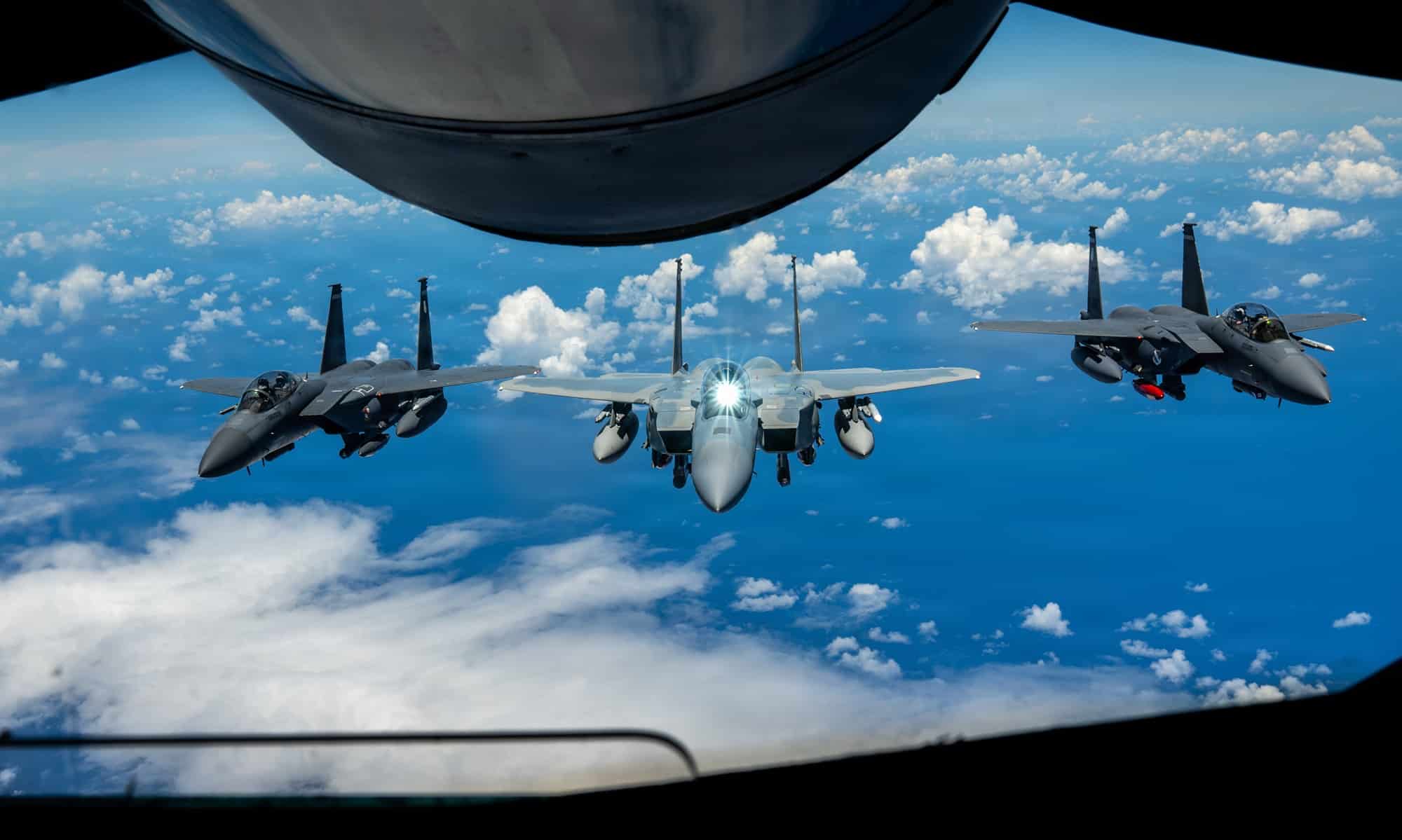
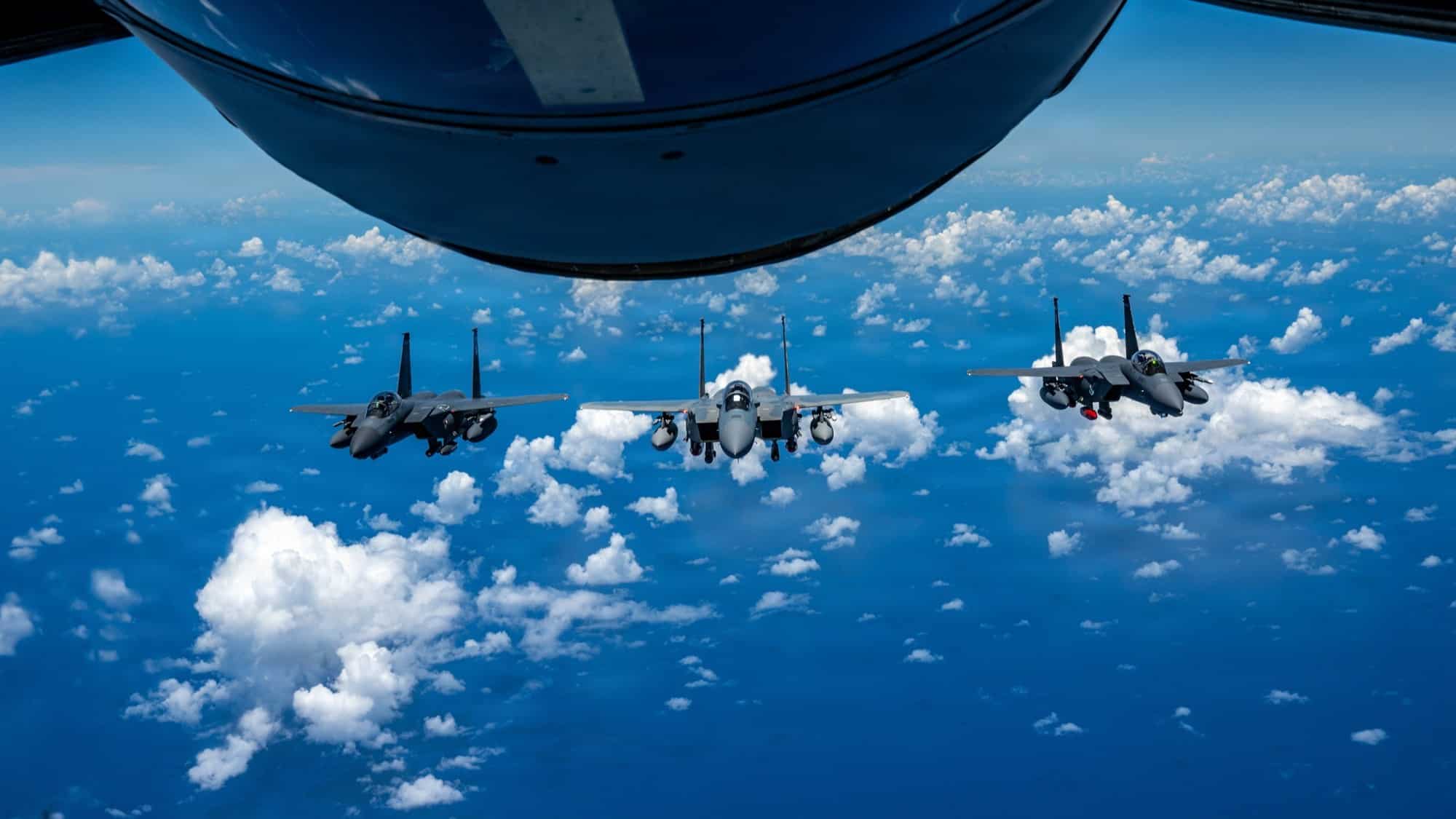
A U.S. Air Force F-15EX Eagle II and F-15E Strike Eagles assigned to the 85th Test and Evaluation Squadron, Eglin Air Force Base, Florida, fly in formation after receiving fuel from a KC-135 Stratotanker assigned to the 909th Air Refueling Squadron over the Pacific Ocean, June 29, 2026. | Source: U.S. Air Force photo by Staff Sgt. Dwane R. Young
F-15EX for Seymour Johnson
Following the arrival of the modernized F-15Es, Seymour Johnson will prepare to receive newly built F-15EX Eagle IIs. “Seymour Johnson is the planned recipient of the F-15EX aircraft procured through the Fiscal Year 2027 budget, if authorized and appropriated by Congress,” said Meink in the letter.
“This confirmation from the Department of the Air Force that Seymour Johnson’s mission is being prioritized and modernized with the procurement of F-15EX aircraft is an important step toward ensuring America maintains its air dominance,” said Sen. Budd in response to the announcement.
The service was initially planning to perform the training on the type at Kingsley Field in Klamath Falls, Oregon, where the 173rd Fighter Wing ran the F-15 Eagle B-Course. Following the base’s selection for an F-35 FTU in 2023, the F-15EX training was expected to be taken over by Seymour Johnson.
The timeline for the delivery of the new aircraft has not been disclosed, although it is likely to happen by the early 2030s, according to the letter. In fact, Meink noted that the base’s F-15Es would be transferred only after the delivery of the F-15EXs.
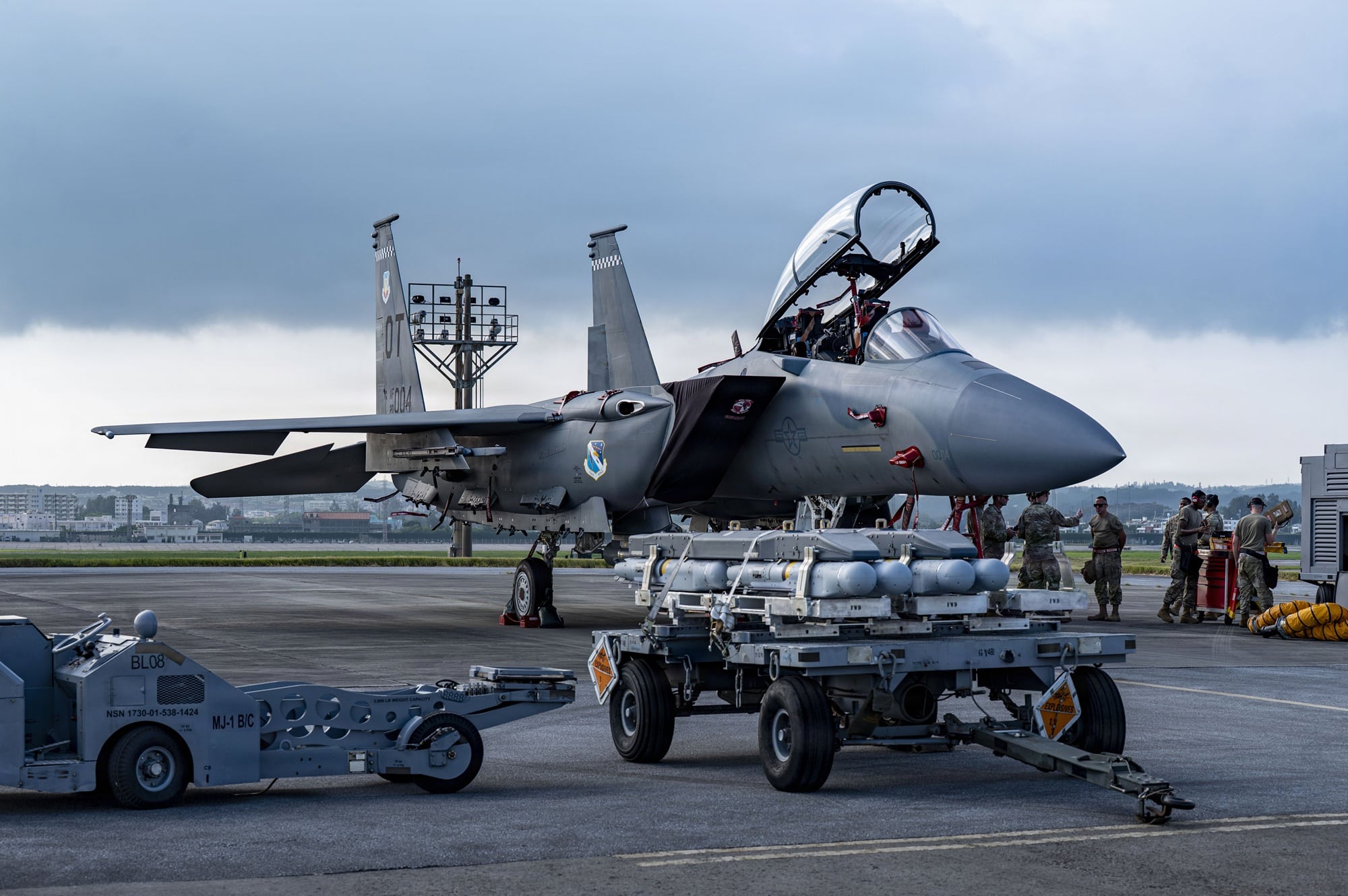
U.S. Air Force Airmen assigned to the 67th Fighter Generation Squadron prepare to load munitions onto a U.S. Air Force F-15EX Eagle II assigned to the 85th Test and Evaluation Squadron, Eglin Air Force Base, Florida, at Kadena Air Base, Japan, July 8, 2026. | Source: U.S. Air Force photo by Airman 1st Class Gracelyn Hess
He then mentioned the potential future relocation of F-15E to support an Air Force Reserve mission. While the final decision is expected in Fall 2028, Whiteman AFB, Missouri, has been identified as the sole candidate location, according to Rep. Mark Alford.
The Reserve unit there, the 442nd Fighter Wing, will replace its current A-10Cs with the F-15Es. Air and Space Forces Magazine received a statement by a service spokesperson saying that the F-15Es at Whiteman will reach Initial Operational Capability in 2032 and Full Operational Capability in 2034.
Considering both this statement and Meink’s, it is possible the Air Force expects the delivery of the F-15EX at Seymour Johnson to happen before 2032.
The main landing gear of a JASDF F-15 collapsed during landing, causing the aircraft to slide on the runway and turn 180 degrees as it slowed down.
An F-15 of the Japan Air Self Defense Force appears to have suffered a left main landing collapse while landing at Naha Airport on Aug. 18, 2026. The jet tilted, sliding on the runway while leaning on the left wingtip and external fuel tank, before turning 180 degrees as it slowed down and stopped facing backwards.
According to NHK News, the pilot was able to safely leave the aircraft without injuries. The runway was closed for four hours while the aircraft was removed with a crane and the scene was cleaned up, leaving Naha with only a runway active.
The airport, on the island of Okinawa, shares its runways with Naha Air Base. The base is home to two F-15J squadrons, a support flight which shares T-4 jet trainers with the two squadrons and an E-2C squadron.
The runway closure reportedly affected a total of 40 passenger flights, which suffered delays of up to 35 minutes. Okinawa Gov. Denny Tamaki described the incident as “gravely disappointing,” calling for an investigation.
According to The Mainichi, the aircraft was returning from a Quick Reaction Alert (QRA) mission. The Japan Joint Staff, which usually reports scrambles on its channels, has not yet released information, with the latest reported scramble being on Aug. 17.
The F-15J
F-15J is a license produced variant of the F-15C/D Eagle, locally built by Mitsubishi in Japan. First flying in 1980, and introduced into service in 1981, the fighter has been a mainstay of the JASDF for well over four decades.
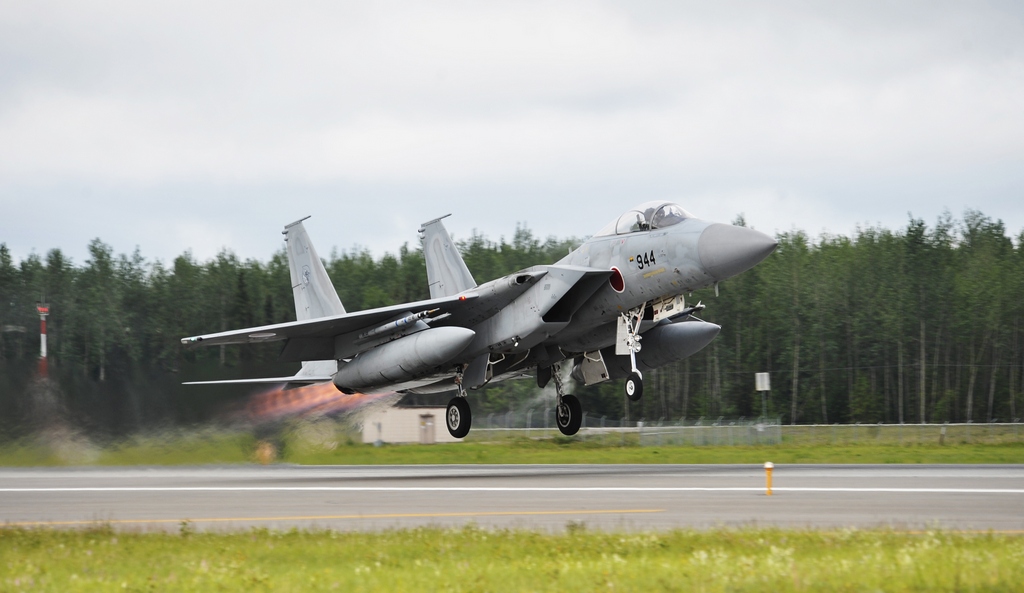
A Japanese Air Self Defense Force F-15J Eagle launches from the runway during RED FLAG-Alaska 12-2 June 11, 2012, Eielson Air Force Base, Alaska. | Source: U.S. Air Force
The JASDF acquired 223 aircraft trough the “Peace Eagle” program, with 203 being single seaters and the remaining ones twin seaters. The aircraft were later upgraded through the Multistage Improvement Program (MSIP), similarly to U.S. Air Force F-15s.
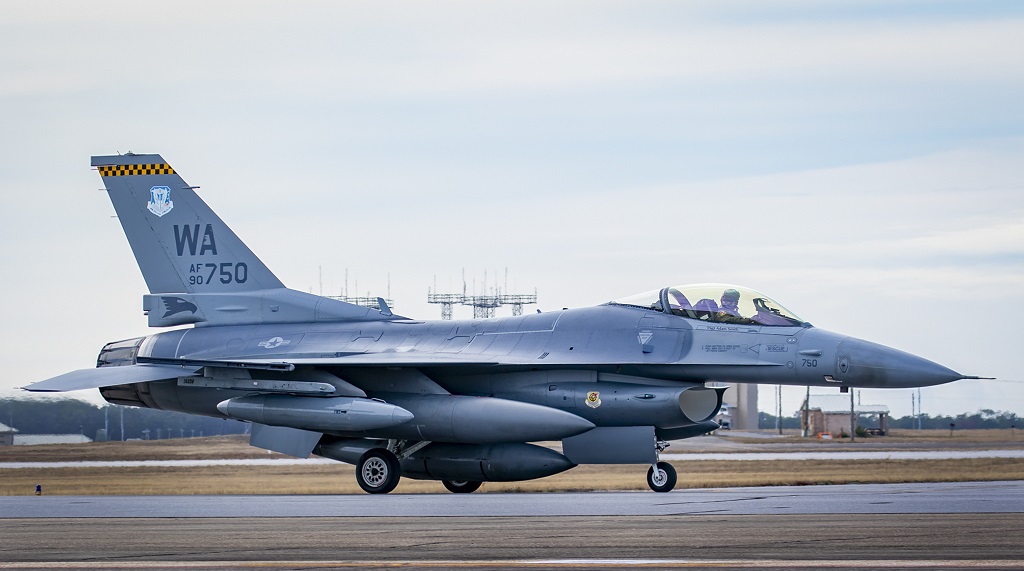
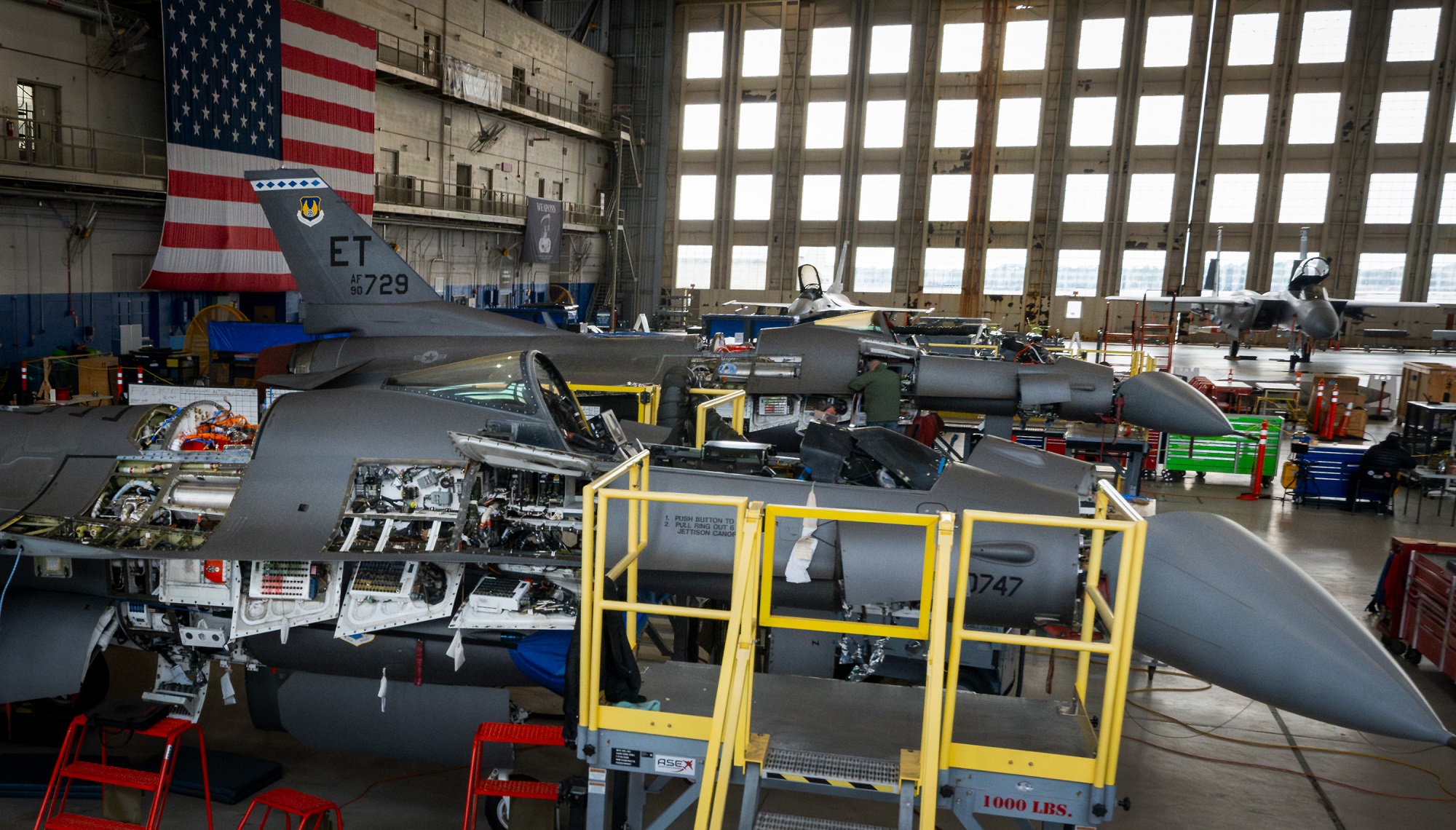
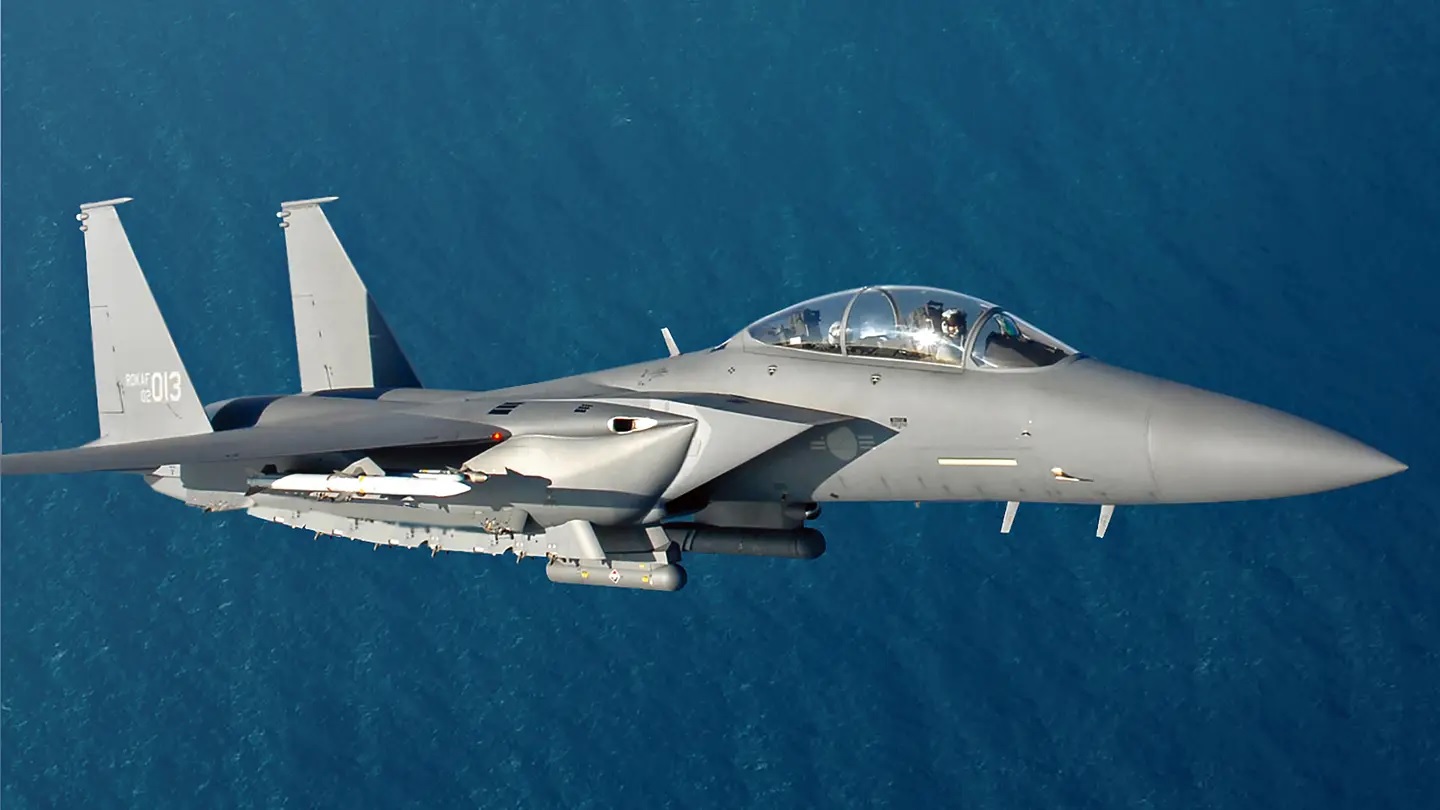
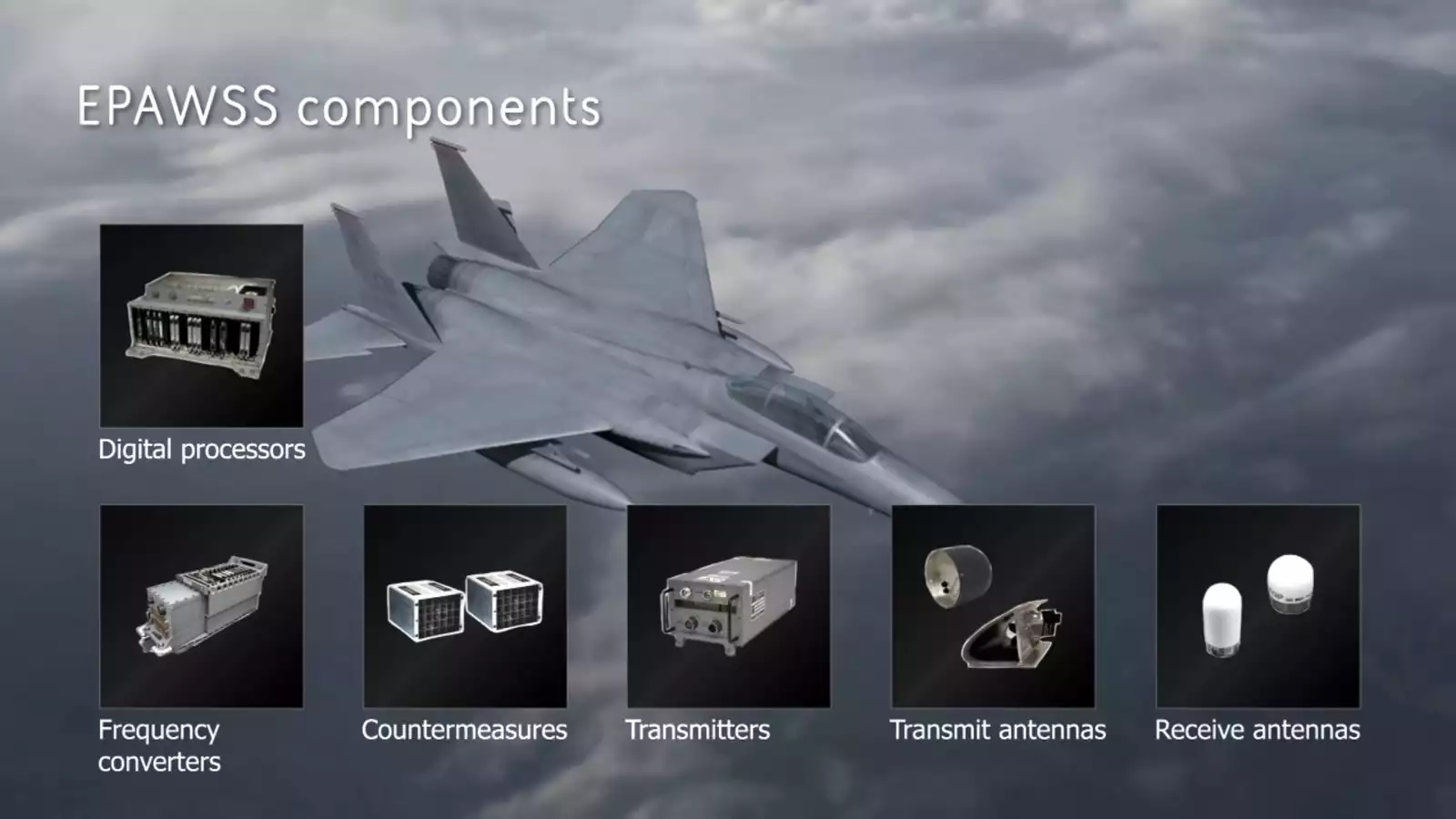
New investment, with the goal of creating a “Japanese Super Interceptor,” will see around half of the current F-15J fleet upgraded with the Raytheon APG-82(v)1 AESA (Active Electronically Scanned Array) radar alongside the AN/ALQ-250 EPAWSS (Eagle Passive Active Warning Survivability System). Moving beyond the air superiority role, the upgrade also includes the capability to deploy precision air-to-ground weaponry for the first time.
The JSI program, which will be worked on in Boeing’s St. Louis plant, Missouri, and Eglin Air Force Base, Florida. Japan’s MHI (Mitsubishi Heavy Industries), will carry out upgrade work locally once the upgrade package is done.
Upgraded aircraft will field the AGM-158B JASSM-ER (Joint Air-to-Surface Standoff Missile-Extended Range), providing both a long-range land attack role. The Japanese government procured the weapon trough two different Foreign Military Sales (FMS) cases.
Tokyo plans to upgrade only around half of its F-15J fleet, with the rest being replaced with 105 F-35As as outlined in the Medium Term Defense Program.
The Boeing 737-700, formerly operated as N712JM, spent years as a secretive U.S. Air Force flying testbed, and is now becoming NASA’s new reduced-gravity research aircraft with the registration N837NA.
NASA has unveiled on Aug. 13, 2026, its newest reduced-gravity research aircraft, which will support the Artemis program to validate astronaut lunar suits and associated crew systems during lunar-gravity parabolic flights. Additionally, this Boeing 737-700 will be used for systems‑integration research for flight testing autonomy, sensors, and other digital systems, says NASA.
Interestingly, this aircraft has a secretive past as a U.S. Air Force flying testbed. The agency’s Armstrong Flight Research Center in Edwards, California, took ownership of the jet from the Air Force in June 2026.
The aircraft, now registered as N837NA, is the former N712JM, a Boeing 737-73W that spent several years undergoing extensive modifications for an Air Force program whose precise purpose remains undisclosed. The modifications for its new mission are currently in progress, with the photo of the new livery showing it at an undisclosed location in Oklahoma.
The aircraft is a Boeing 737-73W, which was first delivered in 2013 with the registration N712JM, according to available information. The aircraft first attracted attention in 2020 after appearing with an unusual green finish, which is a protective coating applied before the final painting process, and extensive external modifications while operating from California.
Photos showed what appeared to be extensive instrumentation, wiring and sensors distributed around the fuselage, immediately suggesting that the aircraft was not a conventional 737. At the time, the aircraft has been acquired by the U.S. Air Force as a specialized flying testbed.
Just a year before, the aircraft had been associated with Denmar Technical Services, a company involved in specialized aviation and radar measurement work. There has been considerable speculation over the years about its possible roles, particularly because of the visible sensors, wiring and other modifications.
The ever-elusive ex-USAF Boeing 737 (formerly N712JM, now N837NA), held at COS’s Sierra Nevada Corporation hangar since 2020, departs COS to get a makeover for NASA. This aircraft will in time, help train Artemis astronauts how to move in sub-earth gravity conditions. pic.twitter.com/nM6gM9PjtZ
Notably, as The War Zone noted when it first reported about this aircraft, the registered address in N712JM’s documents was the exact same address of the Air Force’s Rapid Capabilities Office (RCO). The RCO, created to develop, procure and field high-priority advanced technologies quickly, oversees programs such as the B-21 Raider stealth bomber.
NASA’s contracting documentation indicated that indeed the aircraft served in the Air Force under a classified military program. However, the agency also stated it did not have the necessary “need to know” to receive details of the classified modifications or provide them to another contractor ahead of the modifications for the new mission, which will thus be performed by Denmar Technical Services.
The available evidence does not establish exactly what N712JM was testing for the Air Force. The service also confirmed to TWZ that it ended the program which saw the involvement of this 737 as a flying testbed.
The Other NASA 837
Recent photographs and flight tracking records identify N837NA as the same Boeing 737-700 previously operated as N712JM. The FAA database still displays the N837NA record in its historical form, showing NASA as the reserving party, without mentioning the airframe associated, while all data is still present for N712JM.
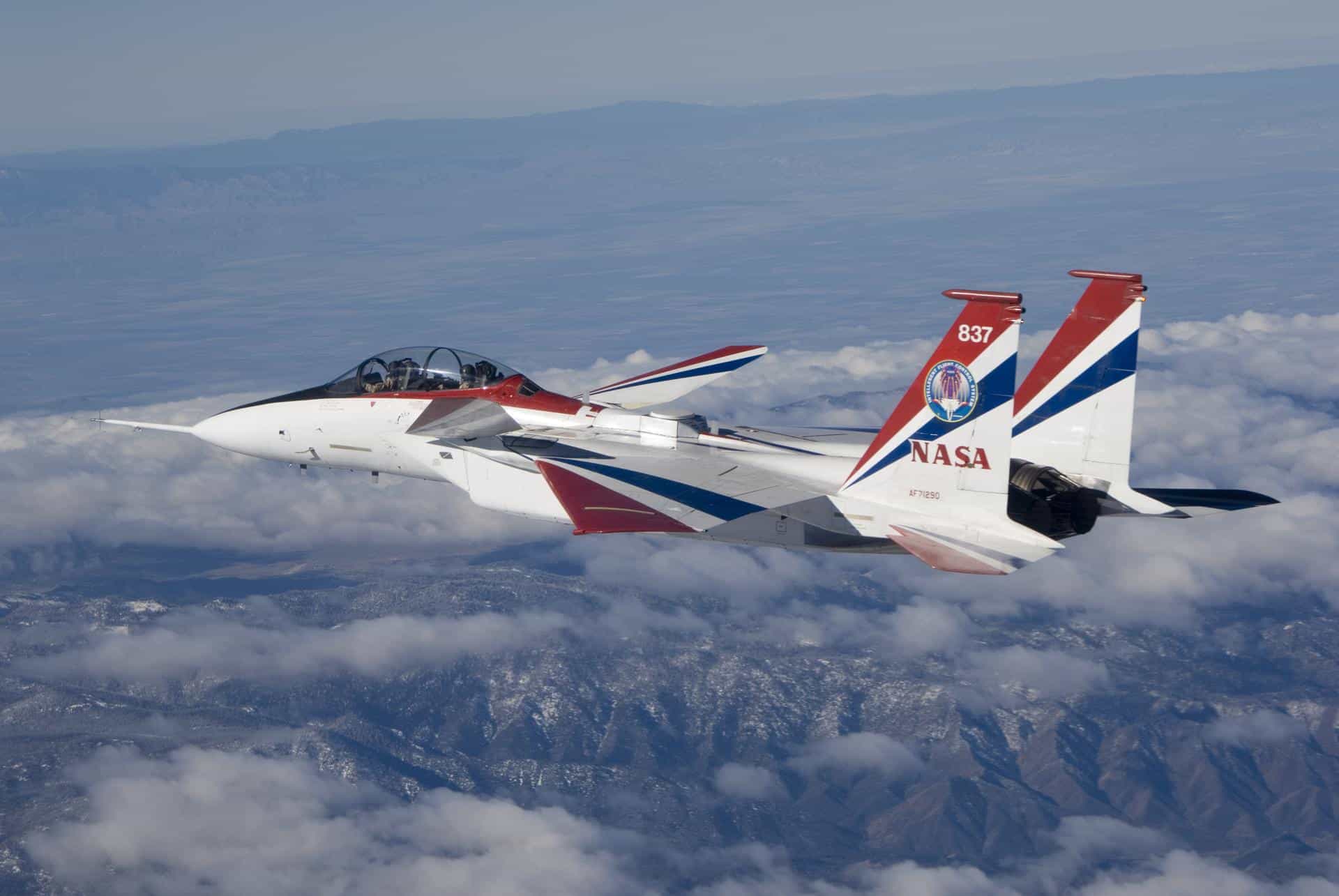
NASA’s NF-15B testbed during a research flight. | Source: NASA/Lori Losey
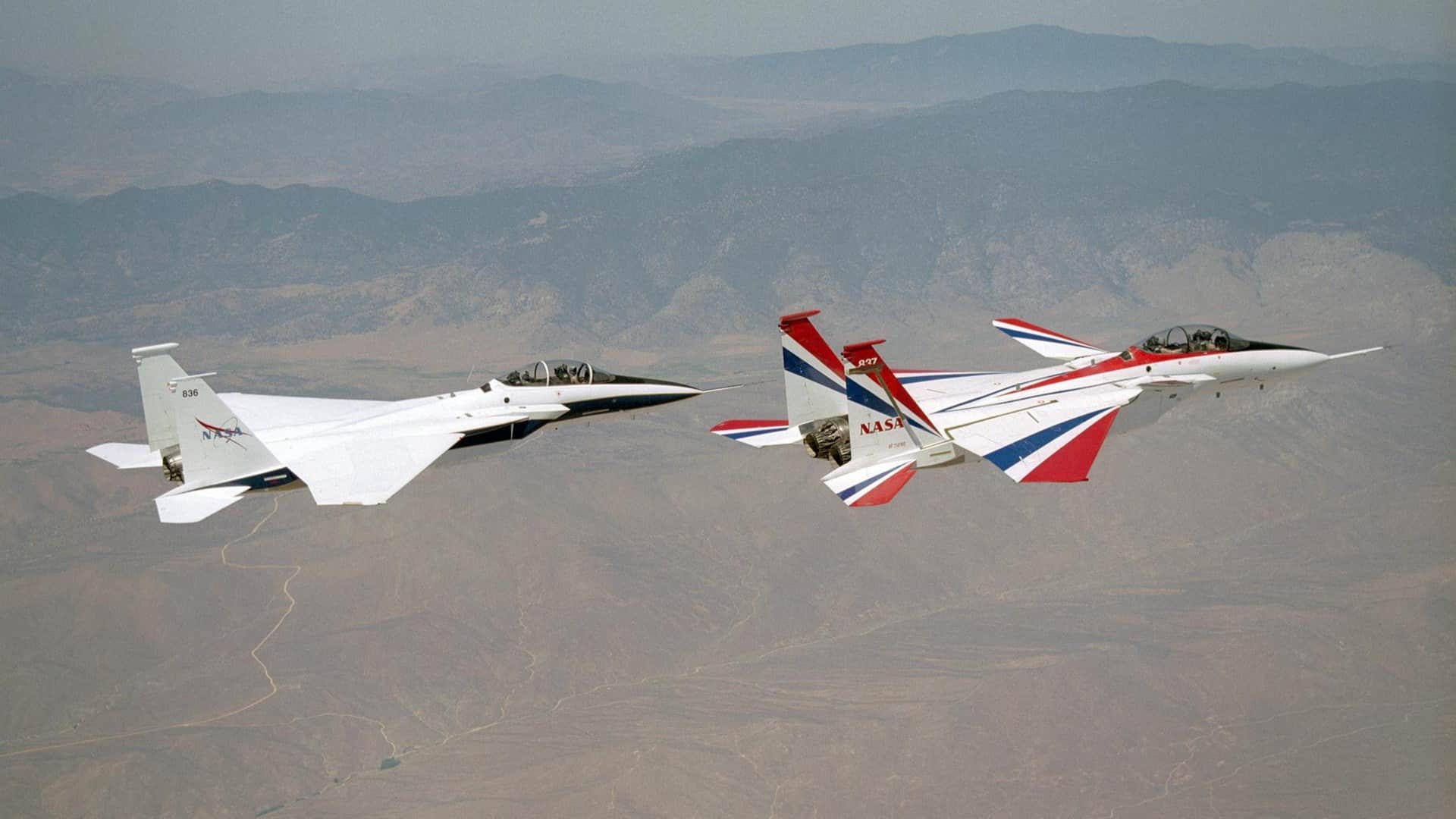
The new registration is also more interesting than it might initially appear. In fact, in the past NASA used the N837NA registration for a very different aircraft: the highly modified NF-15B Eagle, serial number 71-0290.
The aircraft began life in 1973 as the first two-seat TF-15A prototype, before being was later redesignated F-15B and extensively modified for flight-test work. NASA received the aircraft in 1993, becoming known as NASA 837 and later registered as N837NA in 2001.
NASA used the NF-15B (where the “N” prefix stands for “Special Test, Permanent) for a succession of advanced research programs, including the Advanced Control Technology for Integrated Vehicles (ACTIVE) program and the Intelligent Flight Control System (IFCS). The agency described the aircraft as a highly modified pre-production F-15B, incorporating features including canards, thrust-vectoring nozzles and an advanced digital flight-control system.
The aircraft made its final flight in January 2009, after almost 36 years of service in U.S. Air Force, McDonnell Douglas and NASA research programs. NASA subsequently preserved it at Edwards AFB, where it is on display near the Armstrong Flight Research Center.
NASA F-15B research aircraft #836 shadows its stablemate, F-15B #837, during a test flight. | Source: NASA/Carla Thomas
NASA’s New Reduced-Gravity Research Aircraft
NASA plans to use its new 737 for parabolic flights designed to reproduce lunar gravity. During a parabolic maneuver, the aircraft follows a carefully controlled flight profile that produces short periods of reduced gravity inside the cabin.
The reduced-gravity phase of each parabola lasts for around 20 seconds, with typical flights including 15-30 parabolas. By varying the trajectory, researchers can simulate different gravitational environments.
This testing will allow Artemis astronauts, engineers and researchers to evaluate spacesuits and associated crew systems under conditions similar to the ones they would find on the Moon, which are substantially different from those experienced on Earth. A lunar spacesuit can be described as a pressurized life-support system that affects an astronaut’s mobility, balance and ability to perform physical tasks while experiencing roughly one-sixth of Earth’s gravity.
Parabolic flight provides NASA with a relatively controlled way of testing those interactions before equipment and astronauts reach the lunar surface. This would be used in combination with other techniques, such as neutral buoyancy activity and dedicated suspension systems.
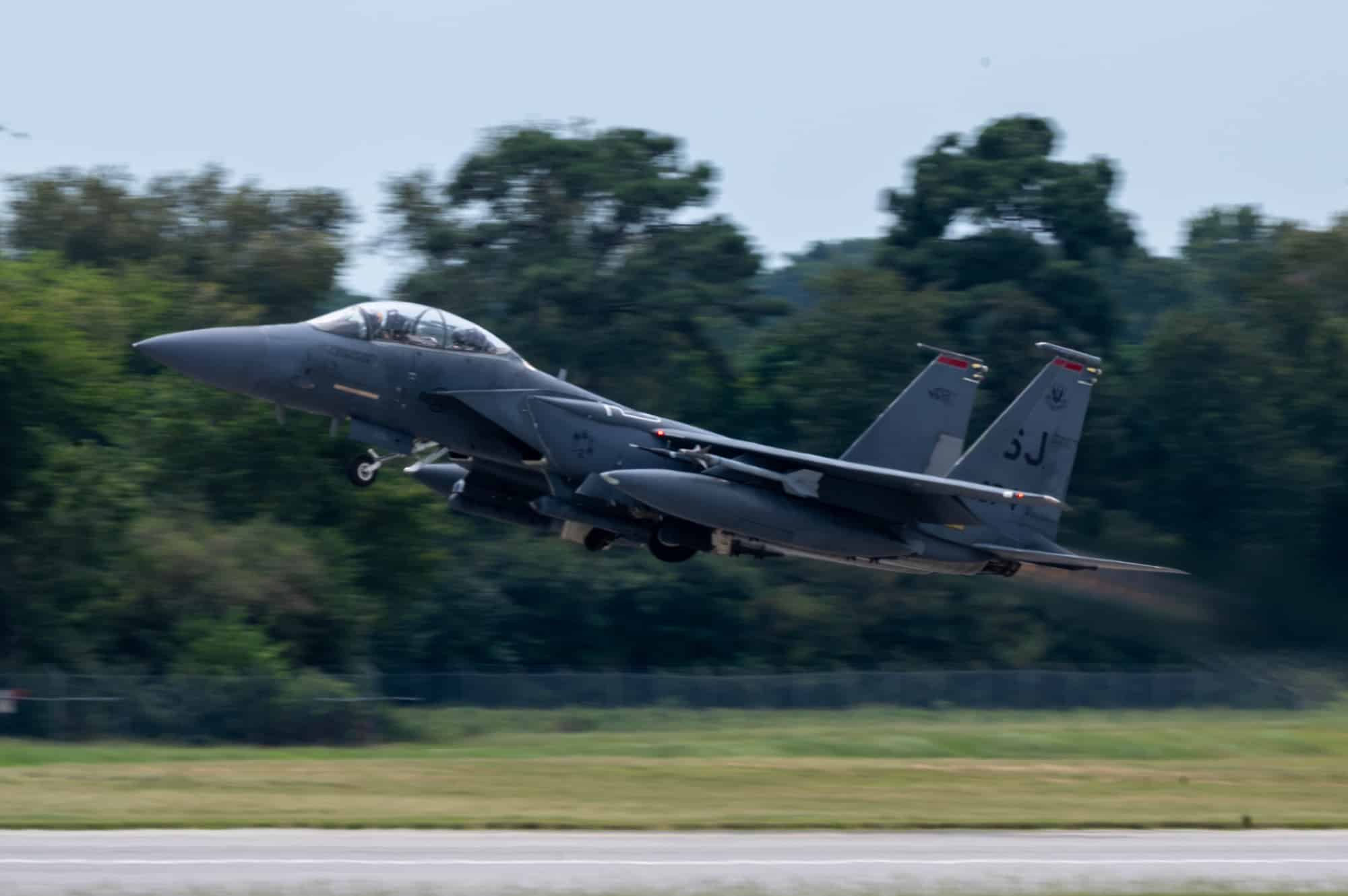
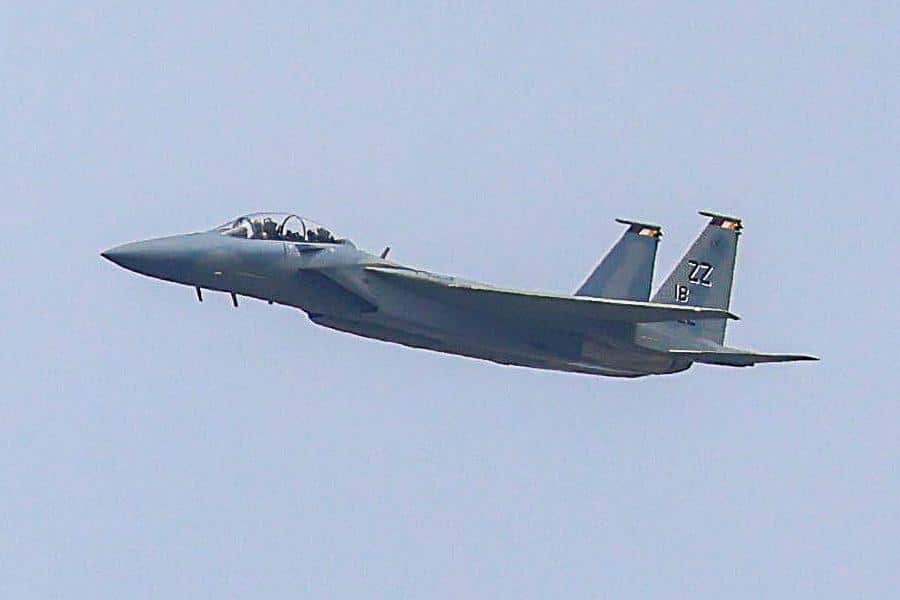
The first F-15EX Eagle II destined to Kadena Air Base in Japan broke cover, flying with the “ZZ” tail flash and the markings of the 18th Wing.
The first F-15EX Eagle II destined to Kadena Air Base, in Japan, has received the “ZZ” tail flash and the markings of the 18th Wing. The aircraft, 22-0022, has flown from Boeing’s facilities in St. Louis, Missouri, for the first time on Aug. 4, 2026, at the time only with the primer paint, before receiving its full livery and flying again on Aug. 15.
Our friend and aviation photographer Jerry McGrath was able to capture images and videos on both occasions and kindly shared them with us. Notably, this F-15EX is also the first of the new Lot 3, whose deliveries are planned to begin later this year.
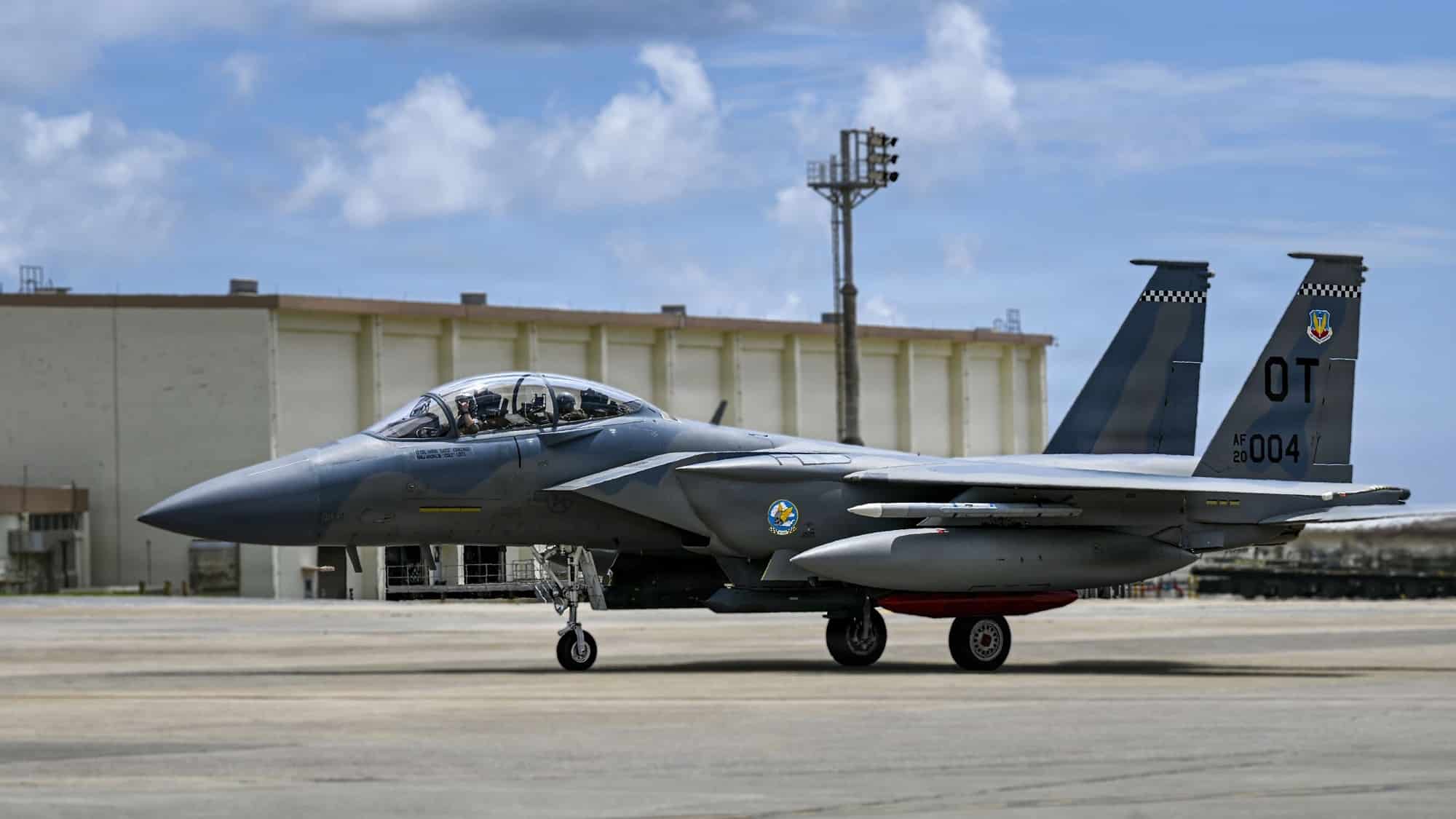
Meanwhile, Kadena is continuing the preparations to receive the new fighter jet. As part of the preparations, an F-15EX was deployed to Kadena in June 2026 to conduct integration and familiarization training with local units, following a first visit a year earlier.
The 67th Fighter Squadron will be Kadena’s first operational F-15EX unit, followed by the 44th Fighter Squadron. A total of 36 new fighters is expected to be delivered there starting next year, according to Air Force Secretary Troy Meink.
Kadena’s first F-15EX Eagle II flies from Boeing’s St. Louis facilities. | Source: Jerry McGrath
The arrival of the first Eagle IIs at Kadena was initially expected in Spring 2026. Recently, Meink said that the first F-15EXs would arrive in Japan in 2027, with a full complement delivered by 2028.
The F-15EX at Kadena
Kadena Air Base, home of the 18th Wing’s 44th and 67th Fighter Squadrons, most recently flew in an air superiority role with the F-15C/D Eagle. The unit conducted the final operational flight of the F-15C Eagle on Jan. 24, 2025, after 45 years of flight operations at the Japanese base.
On July 3, 2024, the U.S. Department of Defense announced a “modernization plan” with the goal of deterring Chinese aggression in the region and strengthening forces in Japan. As part of the plan, it was announced that the base would replace its 48 Eagles with 36 F-15EX Eagle II jets.
Remarkably, the announcement marked the first commitment of the new F-15EX Eagle II, the most advanced Eagle variant ever produced, to a base outside the United States. At the time, no definitive timeline for the arrival of the first F-15EXs at the base was given, but it was later revealed that the delivery was expected between March and June 2026, before being delayed to 2027.
A U.S. Air Force F-15EX Eagle II assigned to 85th Test and Evaluation Squadron, Eglin Air Force Base, Florida, lands at Kadena Air Base, Japan, June 29, 2026. | Source: U.S. Air Force photo by Airman 1st Class Gracelyn Hess
The new aircraft required a shift in the organizational structure of the 18th Wing. The 67th FGS (Fighter Generation Squadron) was in fact activated to support the eventual arrival of the F-15EX, while the 18th AMXS (Aircraft Maintenance Squadron) was deactivated.
At least one of Kadena’s last F-15Cs is being converted into a maintenance training aircraft for weapons loaders and maintainers, taking advantage of the large commonality between the F-15EX and the F-15C. Also, some crews with the 67th FGS have been sent to the Portland ANG to train with their new F-15EXs.
Thanks again to Jerry McGrath for the photos he sent us. Make sure to follow him on Instagram for more!
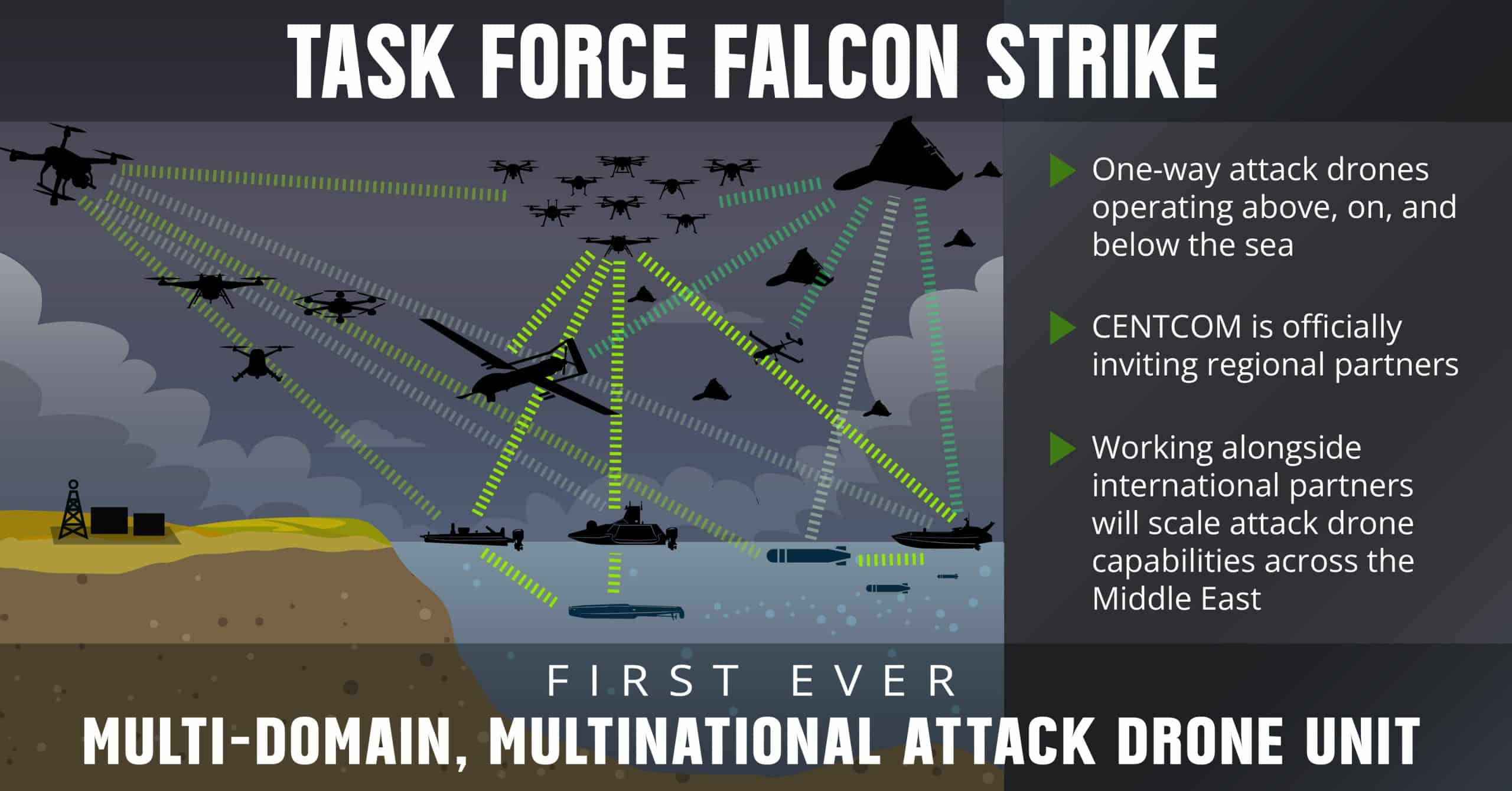
Task Force Falcon Strike will bring together U.S. and regional forces operating one-way attack drones in the air, on the surface and underwater.
The U.S. Central Command (CENTCOM) is taking the next step in its rapidly expanding use of One-Way Attack (OWA) drones. On Aug. 13, 2026, the command announced the creation of a new multinational task force, called ‘Falcon Strike’, that will integrate unmanned systems operating in the air, on the surface of the sea and underwater.
Compared to the earlier Scorpion Strike, the new task force will bring together U.S. military personnel and regional partners to operate OWA drones across multiple domains. CENTCOM said it has started consulting with and formally inviting regional partners to participate, although it has not yet identified them.
“Task Force Falcon Strike will expand on Scorpion Strike’s success given the tremendous innovation happening among our regional allies and partners,” CENTCOM commander Adm. Brad Cooper said. “Integrating and deploying our new capabilities together will help us rapidly realize the new possibilities that are on the horizon.”
The announcement comes only nine months after CENTCOM established Task Force Scorpion Strike, which was the U.S. military’s first dedicated OWA drone squadron in the Middle East. During this time, the unit achieved several operational firsts involving unmanned systems in combat.
An infographic about Task Force Falcon Strike. | Source: CENTCOM
From Scorpion Strike to Falcon Strike
Task Force Scorpion Strike was established in December 2025 as part of an effort to integrate one-way attack (OWA) drones into operations in the Middle East. The goal of the TF was to quickly deliver low cost and effective drone capabilities into the hands of warfighters.
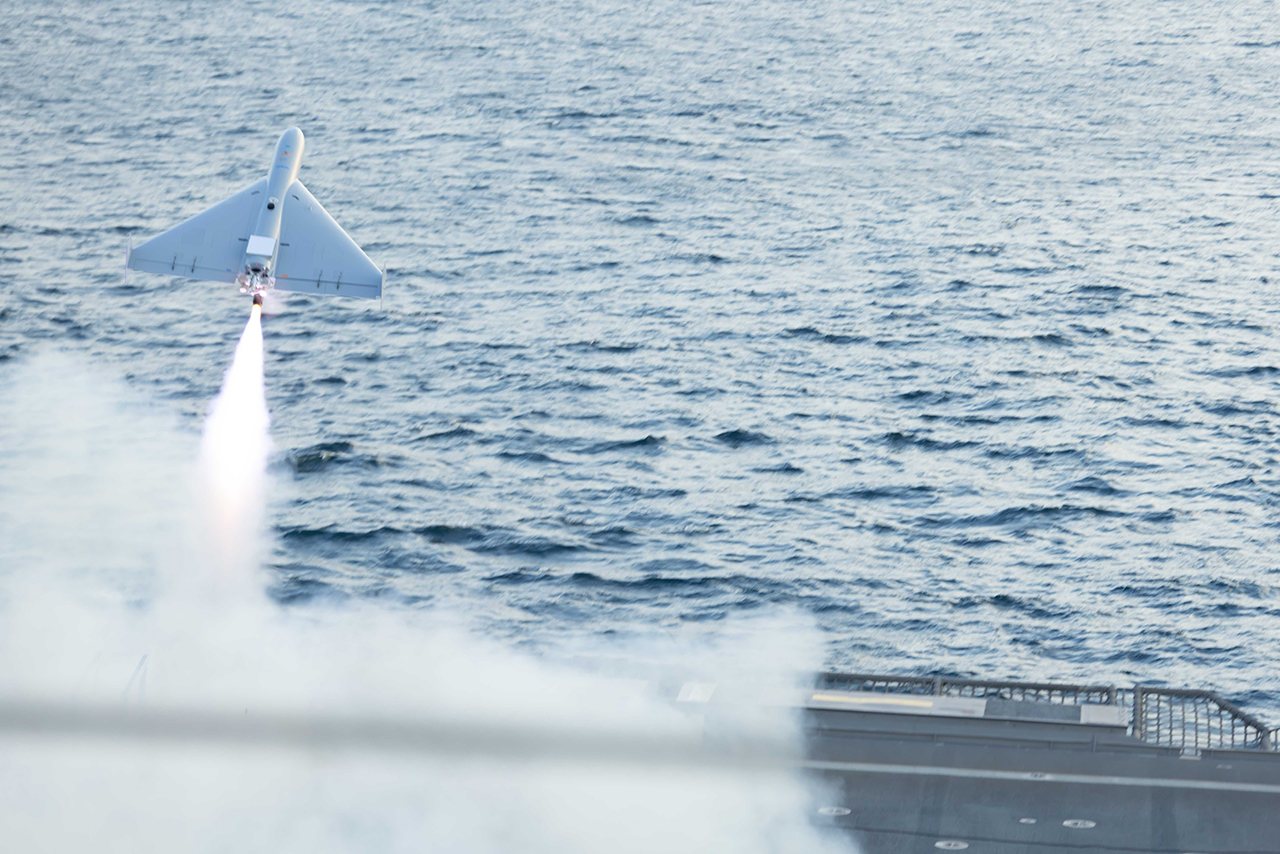
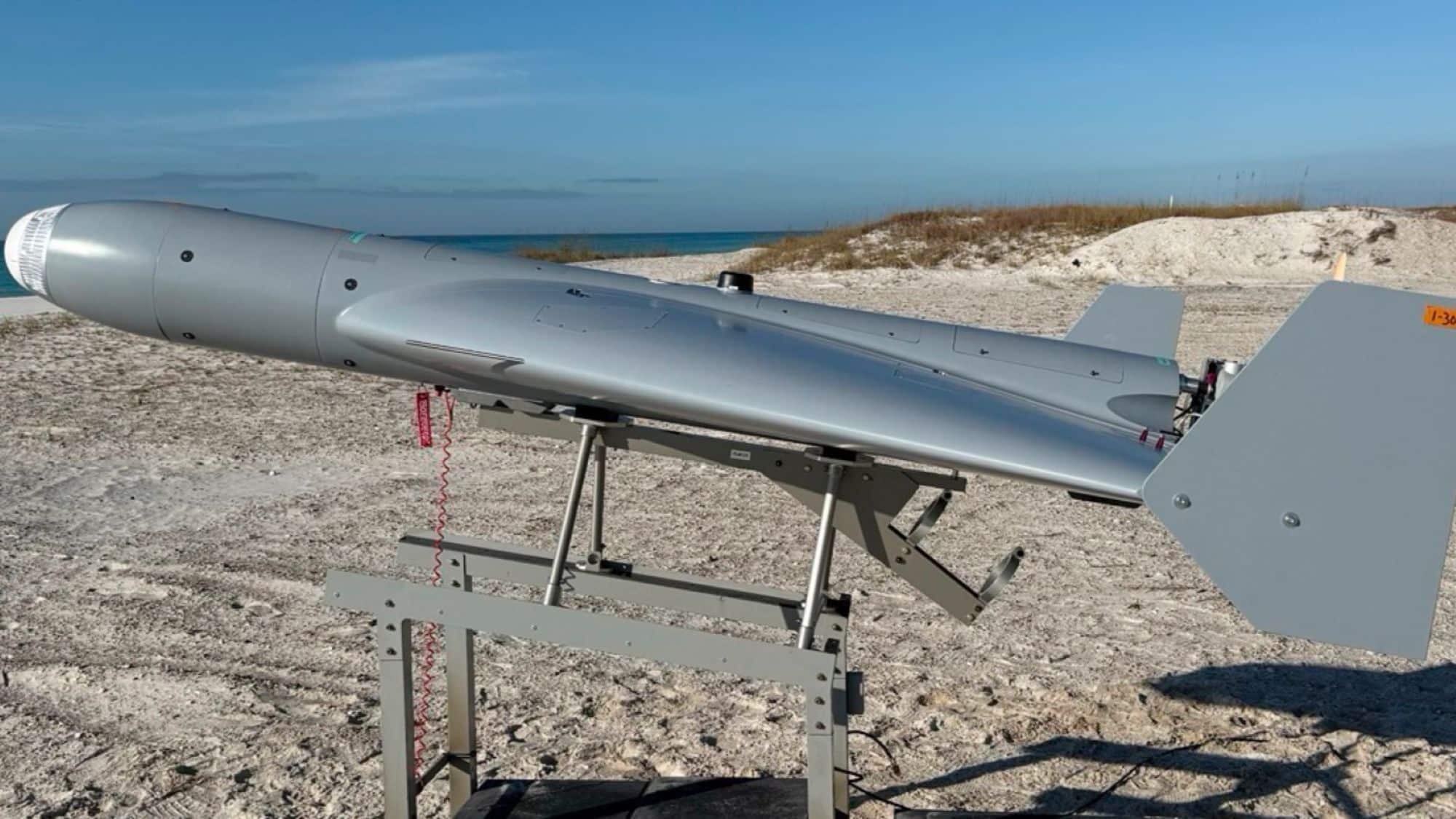
Among the systems used by the task force was the Shahed-like Low-cost Unmanned Combat Attack System (LUCAS) drone. One of the first milestones came shortly after the task force was established, when a LUCAS drone was launched from a U.S. Navy warship.
During Operation Epic Fury, U.S. forces employed OWA UAVs against Iran multiple times. The use of a relatively inexpensive one-way attack drone provided an option for striking lightly defended targets while preserving more sophisticated weapons.
The evolution of Scorpion Strike was not limited to aerial systems, as it later evolved to include Unmanned Surface Vessels (USV). In July, these were used to attack port facilities on Iran’s coast.
A Low-cost Unmanned Combat Attack System (LUCAS) successfully launches from the flight deck of the Independence-class littoral combat ship USS Santa Barbara (LCS 32) while operating in the Arabian Gulf, Dec. 16. Task Force 59 operated the LUCAS drone, which is part of Task Force Scorpion Strike, a one-way attack drone squadron recently deployed to the Middle East to strengthen regional security and deterrence. (U.S. Army photo by Spc. Kayla Mc Guire) | Source: U.S. Army photo by Spc. Kayla Mc Guire
U.S. Special Operations Command Central (SOCCENT), which was involved in establishing Scorpion Strike, will now lead Falcon Strike’s staff of U.S. and regional representatives, says CENTCOM.
Above, on and below the sea
The wording used by CENTCOM to describe Falcon Strike is particularly significant. The statement said the task force will employ one-way attack drones consisting of unmanned systems operating “from above, on, and below the sea.”
The first two categories are already publicly acknowledged by the U.S. military, who confirmed the use of both UAV and USV systems in combat in the Middle East. However, while CENTCOM has acknowledged the use of Unmanned Underwater Vehicles (UUVs) in the region, it has not publicly acknowledged using a UUV as a one-way attack weapon in combat.
It currently remains unclear whether the task force will immediately field an existing U.S. underwater attack system or it is still being developed. As an alternative, the system could be provided by regional partners.
A LUCAS one-way attack drone on ground launcher. | Source: Shield AI
The introduction of one-way attack UUVs is not a small evolution in maritime warfare. While an USV can approach a target without placing a crew at risk while being easily detected, an underwater system could go almost undetected until the strike on the target.
A multinational approach
The other defining characteristic of Falcon Strike is that, unlike Scorpion Strike, it is being built around regional partners. As mentioned earlier, CENTCOM says it has begun the process of consulting with and formally inviting countries in the region to participate, but it has not identified the nations involved.
“As regional partners formally join, Task Force Falcon Strike will scale attack drone capabilities across the Middle East into a unified multi-domain, multinational deterrent,” CENTCOM said.
This approach could prove important because several U.S. partners in the Middle East have developed or acquired their own unmanned systems. Bringing those capabilities into a common framework could provide CENTCOM with access to a wider range of platforms while allowing regional forces to contribute their own operational experience.
The command has not yet indicated how the Task Force will be organized and if every partner will operate identical systems. It cannot be excluded that Falcon Strike could eventually become an umbrella under which different national platforms are integrated into a common operational concept.
The U.S. Army M1 Support Services to train new pilots as part of the Flight School Next program, with the Robinson R66 helicopter replacing the UH-72 Lakota.
The U.S. Army announced on Aug. 13, 2026, the selection of M1 Support Services for the Flight School Next program which will take over the training of new helicopter pilots. As part of M1’s proposal, the Robinson R66 helicopter will replace the UH-72 Lakota currently used by the service for this role.
The helicopter is already being used by the U.S. Army for the Part 141 Initial Entry Rotary Wing (IERW) demonstration in Marianna, Florida, as has also been introduced into the U.S. Navy’s Contractor Operated Pilot Training – Rotary (COPT-R) program. According to Robison, in press release published last year, the R66 received the designation TH-66 SAGE.
“We are honored to be entrusted with this vital mission,” said George Krivo, Chairman and CEO of M1. “M1 will deliver a fully integrated, innovation rich training solution designed to develop more proficient Army Aviators on time and on budget.”
The Army says the firm-fixed-price, indefinite-delivery/indefinite-quantity contract has a combined cumulative total face value of $10 billion and a potential period of performance of up to 26 years. The new training program will use a contractor-owned, contractor-operated solution with commercially available services and equipment.
“Flight School Next delivers a critical improvement in our Initial Entry Rotary Wing Training model. Simply put, it delivers new military helicopter pilots with far better foundational skills,” said Maj. Gen. Clair A. Gill, commanding general of the U.S. Army Aviation Center of Excellence. “The fact that it delivers this increased capability at a significant long-term savings to our Army is a great added benefit.”
The new training program will increase the pilot output from the current 1,250 aviators trained annually to up to 1,500. The service explains it will incorporate industry best practices and advanced technologies to increase training efficiency, accountability and throughput while preserving the quality and professionalism expected of Army aviators.
“By partnering with industry and leveraging a streamlined aircraft fleet and fully integrated modern training system, Flight School Next ensures we will continue producing highly capable aviators prepared to dominate the future fight,” added Maj. Gen. Gill.
Flight School Next
The U.S. Army released a final call for solutions for the Flight School Next (FSN) program in December 2025, as part of the Army Aviation Training Commercial Solutions Opening (CSO). FSN will shape the future of the Initial Entry Rotary Wing (IERW) Training Program at Fort Rucker, Alabama, where all Army’s helicopter pilots are trained.
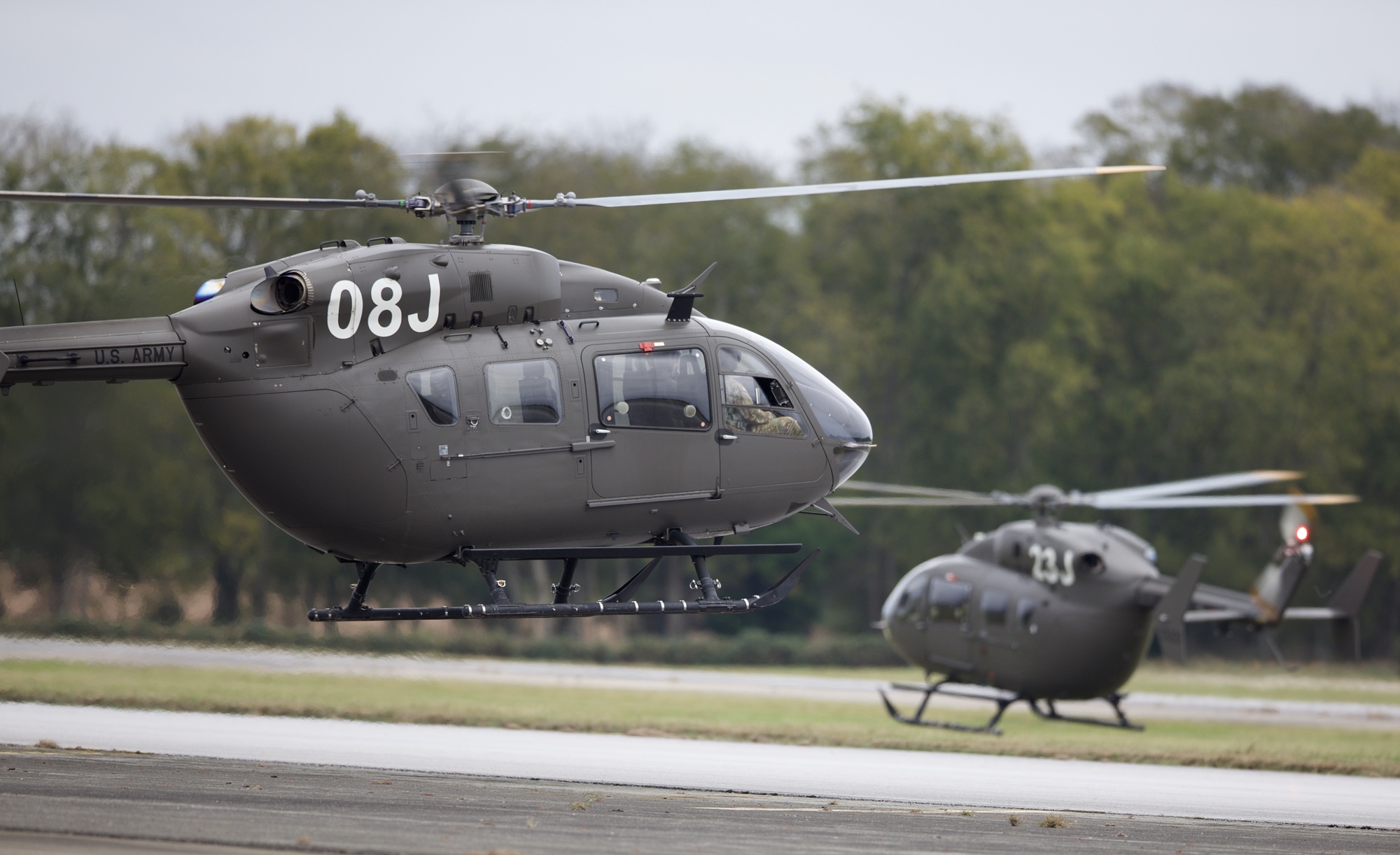
Two U.S. Army UH-72 Lakota Helicopters, assigned to 1st Battalion, 145th Aviation Regiment performs a hover taxi on Toth Stagefield Army Heliport, Fort Rucker, AL,. November 8, 2019. These Army Aviation students are completing their first phase of flight training to become U.S. Army helicopter pilots. | Source: U.S. Army Reserve Photo by Staff Sgt. Austin Berner
In the notice, the service said it is seeking for the first time “a Contractor-Owned, Contractor-Operated (COCO) solution using commercially available services and equipment on a single contract to provide annual training for 900 -1500 rotary wing pilots.” Notably, the contractor will be required “to train pilots to a U.S. Army standard equivalent to the Federal Aviation Administration’s (FAA) commercial helicopter pilot certification, including single engine aircraft, parts, maintenance, instructors (both academic and flight), and simulation (if required).”
The request is not casual, as the service intends “to increase the proficiency of U.S. Army aviators using commercially available equipment and instruction practices.” The pilots, upon graduation, will need to “be proficient with terrain flight, terrain flight navigation, and tactical flight mission planning, and familiar with multi-aircraft operations and night operations,” and “prepared for advanced aircraft training in the AH-64E, UH-60M, CH-47F, C-12U and the MV-75.”
The new helicopter will replace the Airbus UH-72 Lakota, which became the primary training aircraft at Fort Rucker in 2015 and in December 2025 surpassed one million flight hours supporting the IERW training program. Initially, the Army decided to move from a single-engine trainer – the Bell TH-67 Creek – to a modern, twin-engine aircraft that more closely resembles the flight characteristics of an operational aircraft.
Now, Army officials said the Lakota is too advanced and too expensive for the training role, attributing this in part to its dual-engine design. Airbus however refuted the Army’s comments.
An Initial Entry Rotary Wing (IERW) student, and instructor fly approaches at a Fort Novosel stagefield during the primary phase of UH-72 Lakota helicopter training on November 30, 2023. | Source: U.S. Army photo by 2nd Lt. Hannah Lamb
Anyway, the call for solutions now mentions among the first requirements that the new helicopter needs to be a single engine design. The helicopter will need to accommodate a flying student pilot, an observing student pilot and an instructor, as well as be able to support night operations, with Night Vision Google (NVG) being a desired but not mandatory requirement.
Among the requirements are also with Mode S Transponder and Automatic Dependent Surveillance-Broadcast (ADS-B) In and Out, and UHF and VHF radios.
M1 Support Services’ proposal
M1 Support Services took part in the competition as prime contractor in partnership with Robinson Helicopters. M1 is already working within the Army’s training, as it provides flight training, simulation and maintenance for AH-64, UH-60, CH-47 and UH-72 helicopters, as well as the Air Force’s TH-1s.
Their solution for Flight School Next is based on the Robinson R66 helicopter, the company’s first turbine helicopter based upon the piston-engined R44. In production since 2011, the helicopter saw wide success with over 1,500 R66s in service worldwide.
The Robinson R66 military trainer. | Source: Robinson Helicopters
“More than 1,900 Robinson helicopters are used for civil and military flight training programs worldwide,” said earlier this year Lt. Gen. Doug Gabram, U.S. Army (Retired), M1 Strategic Advisor. “Safe, rugged, and reliable, it’s the perfect training aircraft for the Army and offers lower operating costs than any competitor.”
“In addition to R66 helicopters, our holistic solution for Flight School Next features innovative training and simulation technologies that are truly transformative,” added George Krivo, CEO of M1 Support Services. “M1 will provide high-quality pilot training at a more affordable cost for our partners.”
In the latest press release, following the selection, M1 described its proposal, called Flight School First, as “a comprehensive training and simulation ecosystem, integrating an AI enabled adaptive learning environment, advanced simulation platforms, immersive virtual training, proficiency based instruction, and safe, reliable R66 helicopters.”
M1 and Robinson highlight an “ideal balance of safety, performance, and affordability” with this helicopter. Among the features are a full glass cockpit with NVG compatibility and integrated 4k cockpit camera for debriefing students.
An Italian F-2000 Typhoon assigned to the NATO Baltic Air Policing mission shot down an unidentified drone which entered Latvia’s airspace.
An F-2000A Typhoon (as the single seater Typhoons are designated in Italy in accordance with the MOD’s Mission Design Series) of the Italian Air Force has shot down an unidentified which entered Latvia’s airspace in the morning of Aug. 14, 2026. The aircraft, operating as part of NATO’s Baltic Air Policing (BAP) mission, was scrambled from Šiauliai Air Base, Lithuania, together with another Typhoon, as well as two Turkish F-16s from Ämari Air Base, Estonia.
The Italian fighter jets, assigned to the the Task Force Air “Baltic Thunder III,” were controlled by NATO’s Combined Air Operations Centre (CAOC) in Uedem, Germany. Their deployment started on July 31, with the first scramble few days later, on Aug. 3.
The Latvian Ministry of Defense said this was “a foreign unmanned aerial vehicle that had entered Latvia as a result of Russian electromagnetic warfare,” without identifying the nationality. The Latvian Armed Forces issued an alert for the population to shelter in place until the threat was removed.
Earlier today, two Italian Eurofighters from Šiauliai Air Base, Lithuania, and two Turkish F-16 fighter jets from Ämari Air Base, Estonia, on Air Defence missions over the Baltics, scrambled after an unidentified drone entered Latvia’s airspace
NATO’s Air Command said that, after the positive identification, the drone was shot down over an unpopulated area. Latvia later identified the area as the Balvi Municipality, located in the north-east of the country and bordering the Russia’s Pskov Oblast.
Due Eurofighter F-2000 della Task Force Air “Baltic Thunder III” dell’#AeronauticaMilitare, impegnati nella missione #NATO di difesa aerea sul fianco orientale dell’Alleanza, sono decollati in scramble dopo la violazione dello spazio aereo lettone da parte di un drone.
The incident happened in the early morning hours, as the Latvian MoD said the alert ended at 4:50 local time. No other details have been provided at the time of writing.
In Latvian airspace, in Balvi Municipality, NATO Baltic Air Policing fighter jets have successfully shot down a foreign unmanned aerial vehicle that had entered Latvia as a result of russian electromagnetic warfare.
At the same time, the National Armed Forces informed that the… https://t.co/HWa1EHNy41
— Ministry of Defence of Latvia (@MoD_Latvia) August 14, 2026
Additionally, this would be the first time that an Italian Typhoon opened fire during an interception as part of a NATO mission. It is unclear which weapon was used, although the Italian fighters usually fly during Quick Reaction Alert (QRA) missions with two AIM-120 AMRAAM radar-guided missiles and two AIM-2000 IRIS-T IR-guided missiles, in addition to the 27 mm Mauser BK-27 cannon with up to 150 rounds.
Similar incidents recently
The incident in Latvia comes amid a growing number of drone incursions into NATO airspace along the Alliance’s eastern flank. French Rafales already shot down a drone over Latvia in June 2026, again near the border after electronic warfare caused the drone to go off course.
One of the most significant recent examples occurred in Romania in late July. The country recorded drone incursions on four consecutive days amid a series of Russian attacks against Ukrainian targets near the Danube river.
File photo of an Italian Eurofighter F-2000A Typhoon assigned to the Baltic Air Policing mission. | Source: Italian Air Force
On July 24, a Romanian F-16 shot down a Shahed-type drone that had entered Romanian airspace. The following day, another drone was intercepted and destroyed, while on July 26 a third drone was shot down by an F-16 approximately 12 km northeast of Sulina, over Romanian territorial waters.
On July 27, a fourth drone briefly entered Romanian airspace east of Sulina, prompting another scramble of two F-16s. This time, however, the aircraft crossed back into Ukraine before it could be intercepted.
The sequence was particularly notable because Romania had previously relied primarily on monitoring and warning measures despite repeated violations, before its F-16s were authorized to destroy the intruding drones. NATO fighters, including Italian Typhoons, were also involved in the interceptions, although the Romanians F-16s were the ones who opened fire.
The Romanian incidents were followed by further drone activity in the region. More recently, on Aug. 11, two unidentified Gerbera-type drones were destroyed near the Neptun Deep offshore gas project in the Black Sea.
A U.S. Army AH-64E Apache crashed in Salado, Texas, leaving no survivors and sparking a 100 acres grass fire.
A U.S. Army AH-64E attack helicopter crashed at about 1:30 pm Central Standard Time on Aug. 12, 2026, in Salado, Texas. Both crew members died in the impact, which also sparked a large grass fire spanning over 100 acres.
The Apache was assigned to the nearby Fort Hood, which hosts the helicopters of the 1st Air Cavalry Brigade of the 1st Cavalry Division and is located 30 miles away. In a statement, the installation confirmed the deceased service members have been transported to Carl R. Darnall Army Medical Center while working on notification of next of kin.
Today, an Apache helicopter crashed in Bell County during Fort Hood operations, killing two members of our military.
Join Cecilia and me in prayer for their families and the entire Fort Hood community. Texas is forever indebted to those who serve our state and nation.…
“Our thoughts and deepest sympathies are with the families, friends, and fellow Troopers of those involved during this incredibly difficult time,” said Brig. Gen. Ethan Diven, 1st Cavalry Division acting commanding general.
The Bell County Sheriff’s Office confirmed that no buildings or structures were damaged by the crash, with the grass fire being the only reported consequence. According to CBS News, the fire was still burning out of control two hours after the crash, requiring the intervention of firefighting aircraft.
An U.S. Army AH-64 “Apache” attack helicopter from Fort Hood crashed near Salado, Texas, at approximately 1:30 p.m. local time today, killing both soldiers aboard.
Fort Hood confirmed the aircraft was assigned to the installation, while the acting commander of the 1st Cavalry… pic.twitter.com/apHj3uK2QA
New details in the BRRRRT Act’s full text reveal plans to keep selected Warthogs recoverable, examine potential foreign transfers and test emerging autonomous systems.
Weeks after it was first introduced to the U.S. Congress, the full text of the ‘BRRRRT Act’ has now been released. The bill’s text now reveals that the proposed legislation goes considerably further than simply preventing the U.S. Air Force from retiring the A-10 Thunderbolt II.
In fact, in addition to requiring the service to maintain at least 126 Warthogs through Fiscal Year 2033, the bill would preserve selected retired aircraft in recoverable condition, restore A-10 sustainment and training capacity, examine potential transfers to foreign partners, and explore experimenting with autonomous capabilities relevant to the A-10 mission set.
H.R. 9780, the “Bolstering Recognition, Resurgence, Retention, and Remembrance of the Thunderbolt Act of 2026,” was introduced in the House of Representatives on July 20, 2026, by Rep. Abe Hamadeh (R-Ariz.), with Rep. Don Davis (D-N.C.) and four other lawmakers as original cosponsors. The bill was referred to the House Armed Services Committee and the House Foreign Affairs Committee on the same day.
As we previously reported, the legislation would prohibit the Department of Defense from reducing the A-10 inventory below 126 aircraft from FY2027 onward, unless a higher number is deemed necessary by the Secretary of the Air Force. However, the bill also seeks to preserve the broader enterprise required to operate the aircraft.
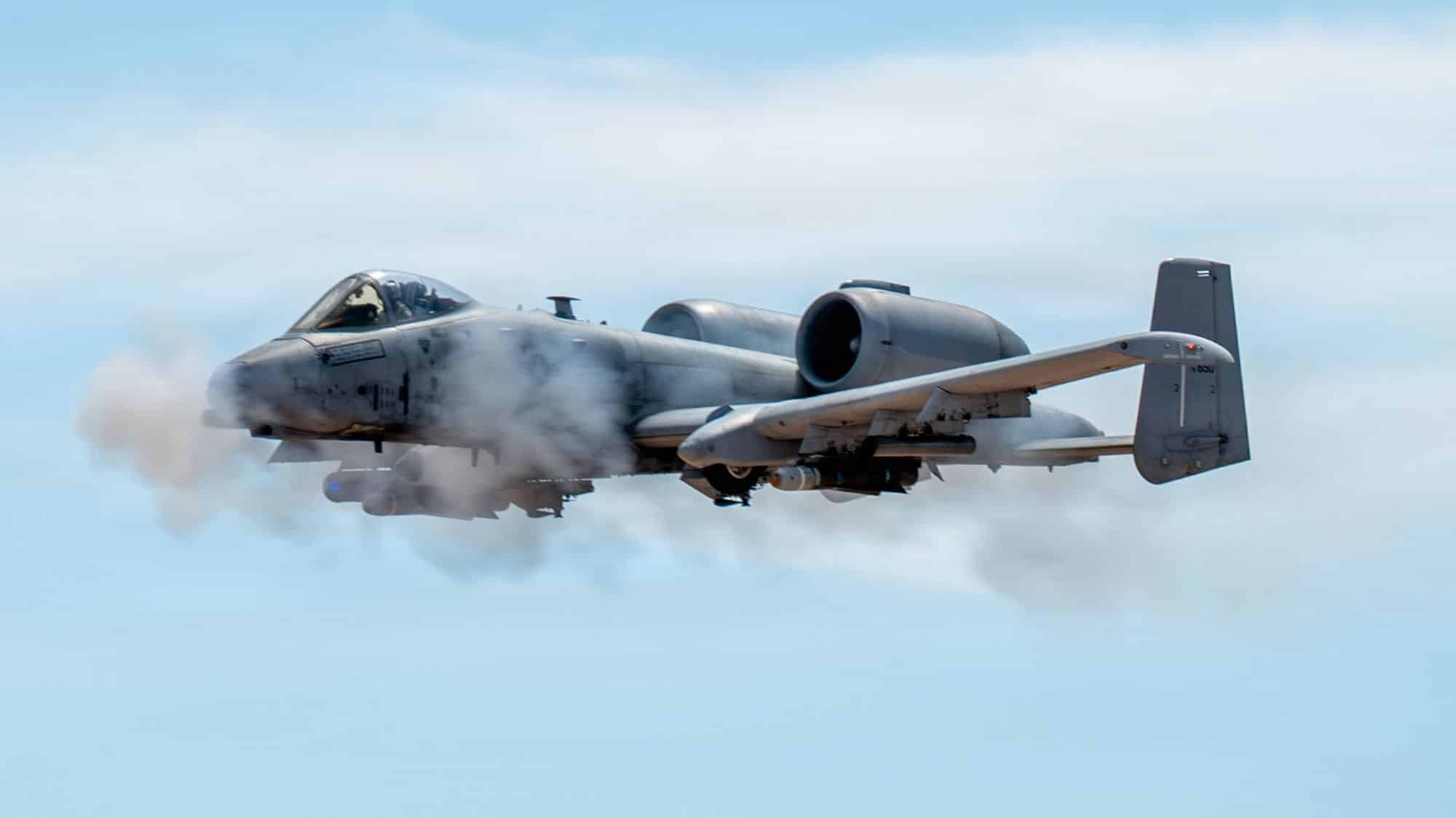
A U.S. Air Force A-10C Thunderbolt II aircraft assigned to the 357th Fighter Generation Squadron demonstrates live fire at the Barry M. Goldwater Range near Gila Bend, Arizona, June 11, 2026. | Source: U.S. Air Force photo by Senior Airman Christopher Ornelas Jr.
Specifically, it would prevent reductions in A-10 unit personnel, pilot training capacity, operational test capacity, depot maintenance and sustainment activities. At the same time, the legislation requires the Air Force to restore sufficient capacity to support the fleet through FY2033.
A real replacement for the A-10
One of the bill’s most significant provisions is its definition of what would constitute an acceptable replacement. The bill specifically mentions that this replacement must achieve full operational capability before the restriction on the A-10’s retirement can be waived.
The replacement would have to be operationally fielded and supported by the necessary pilots, maintainers, training, sustainment logistics and depot facilities. More importantly, the replacement needs to assume the missions currently assigned to the A-10 as its primary missions, including Close Air Support (CAS), Forward Air Controller-Airborne (FAC-A), Combat Search And Rescue (CSAR) support, personnel recovery support and armed overwatch.
This means that simply assigning A-10 missions to existing aircraft, such as the F-35, F-16, F-15E and F-15EX would not necessarily satisfy the legislation’s requirements. The Pentagon would have to demonstrate that the required operational effects, personnel and supporting infrastructure are actually available.
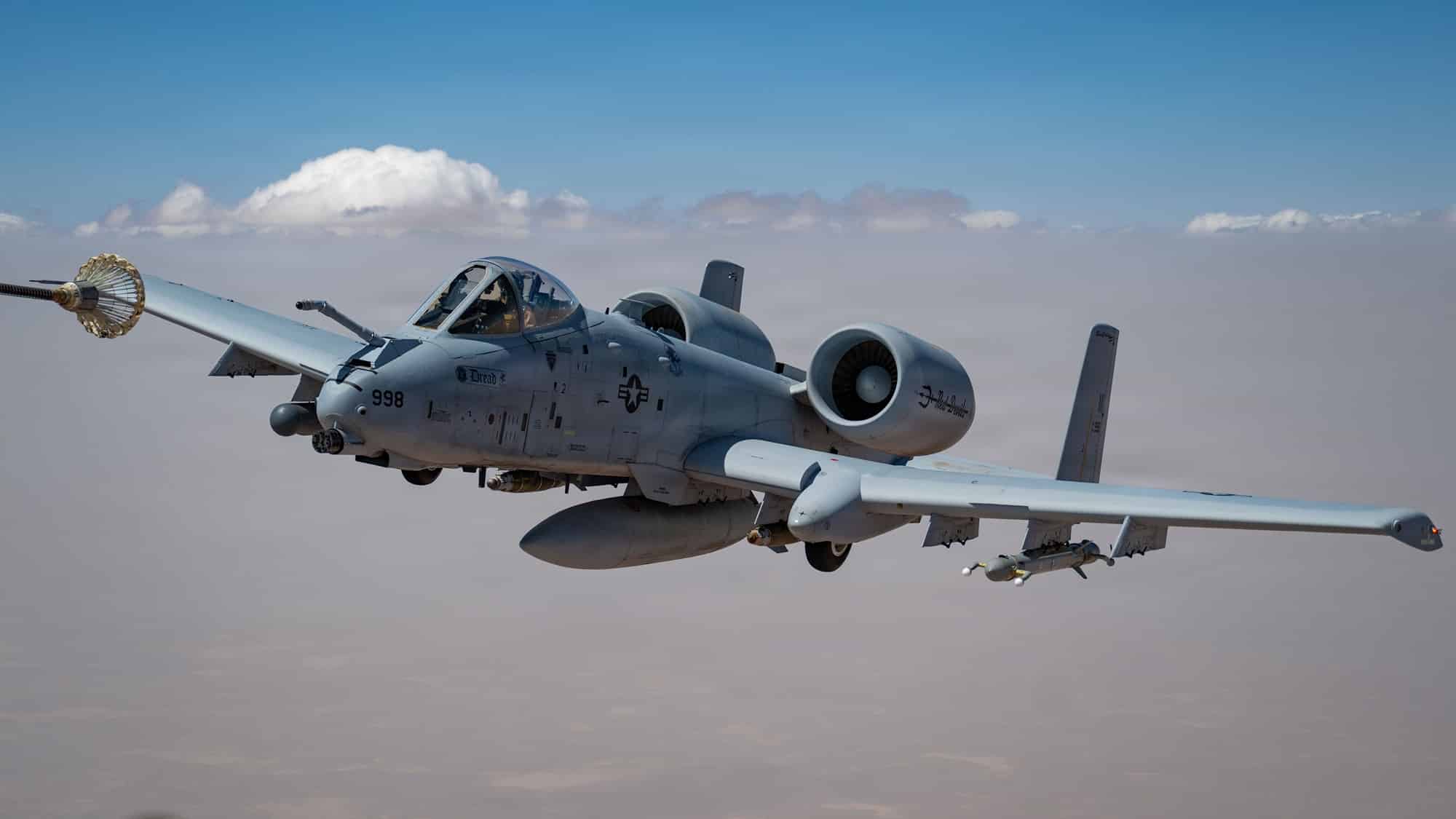
A U.S. Air Force A-10C Thunderbolt II aircraft approaches an HC-130J Combat King II aircraft for aerial refueling in the U.S. Central Command area of responsibility, May 9, 2026. | Source: U.S. Air Force
Then, the Secretary of War would have to certify that a replacement aircraft has fully assumed the A-10’s mission. That certification would also need to be approved in writing by the Secretary of the Army, the Commandant of the Marine Corps, and the Commander of U.S. Special Operations Command, confirming that it would satisfy their requirements.
Retired Warthogs in recoverable storage and no cannibalization
In addition to preserving a minimum fleet in service, the bill also takes aim at what happens to A-10s once they leave operational service. Selected retired aircraft would have to be preserved in a recoverable storage condition, likely referring to the Type-1000 storage which maintains the aircraft in a condition that allows recall for future service.
The bill describes that the stored A-10s would retain the major systems, mission equipment and structural components needed for a potential return to service, training, testing or transfer to a foreign partner. Additionally, the aircraft could not be demilitarized or otherwise altered in a way that would unnecessarily compromise their future recoverability.
An important point in the legislation would also prohibit the cannibalization or parting out of certain A-10s. These include aircraft that have received wing replacements or service-life-extension modifications, retain more than 1,500 projected flying hours, or have been identified as candidates for reconstitution, contingency activation or foreign transfer.
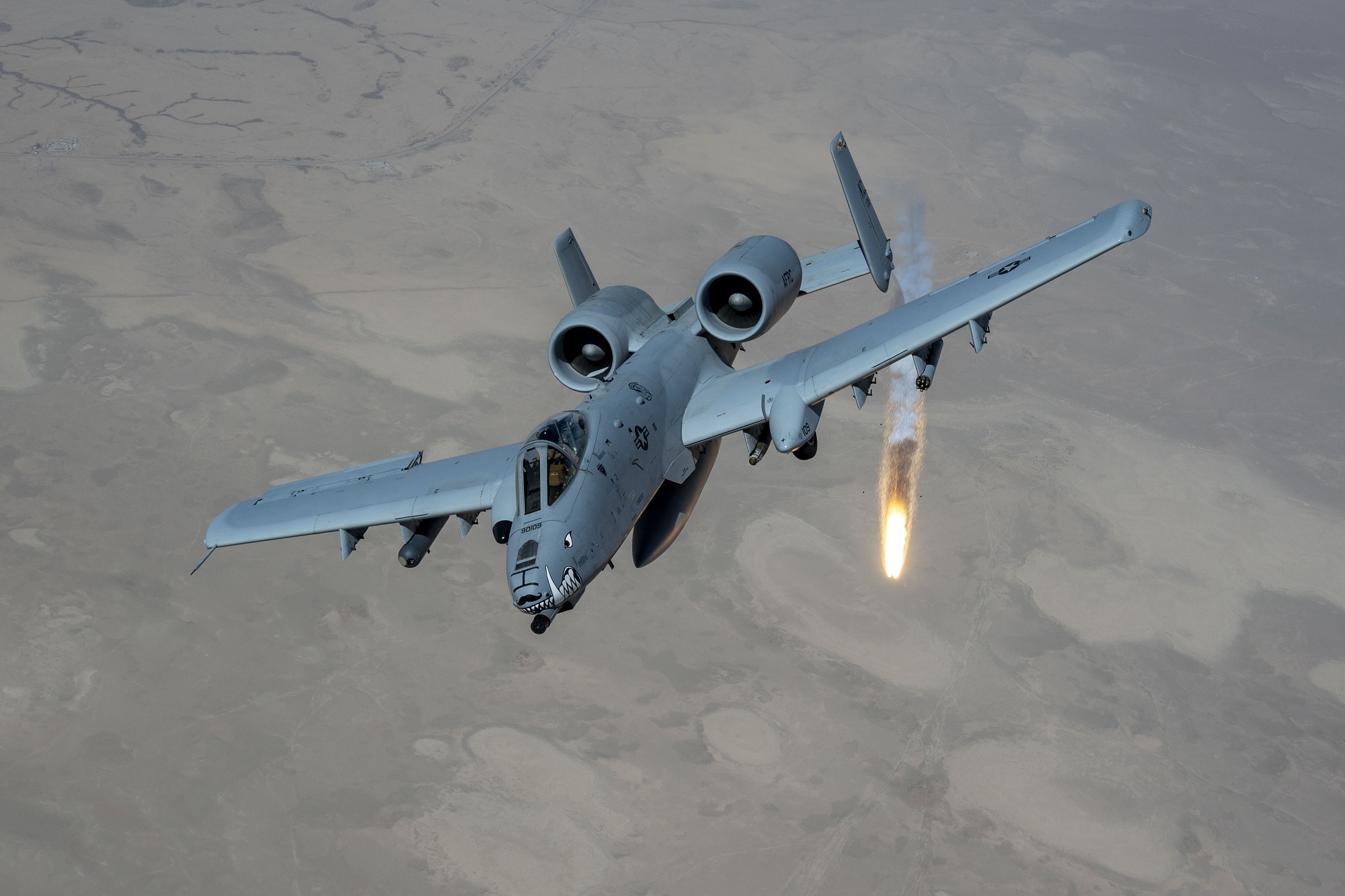
A U.S. Air Force A-10 Thunderbolt II fires flares as it departs from aerial refueling with a KC-135 Stratotanker over the U.S. Central Command area of responsibility, Sept. 23, 2025. | Source: U.S. Air Force photo by Senior Airman Natalie Jones
Until the Air Force submits a required sustainment roadmap, the bill would further prevent retired or retiring aircraft sent to the 309th Aerospace Maintenance and Regeneration Group (AMARG) at Davis-Monthan Air Force Base from being placed into storage or processing categories equivalent to non-recoverable reclamation, disposal or broad parts-harvest status.
Moreover, the roadmap would have to look even beyond 2033, should a replacement not be ready by then. The legislation mentions a contingency plan for maintaining sufficient A-10 capacity through FY2037 and an assessment of the costs and consequences of attempting to reconstitute the mission after its termination.
Possible A-10 transfers to foreign operators
Since the BRRRRT Act aims to keep the A-10 in service with the U.S. Air Force, perhaps the most unexpected provision in the bill is the one that directs the Pentagon to examine whether surplus A-10s could be transferred to foreign partners. It must be noted, however, that this is not the first time lawmakers direct the Pentagon to explore such a possibility.
In fact, in 2024 lawmakers directed the military to explore a possible transfer of A-10s to Jordan. The possibility was mentioned in the 2025 National Defense Authorization Act (NDAA).
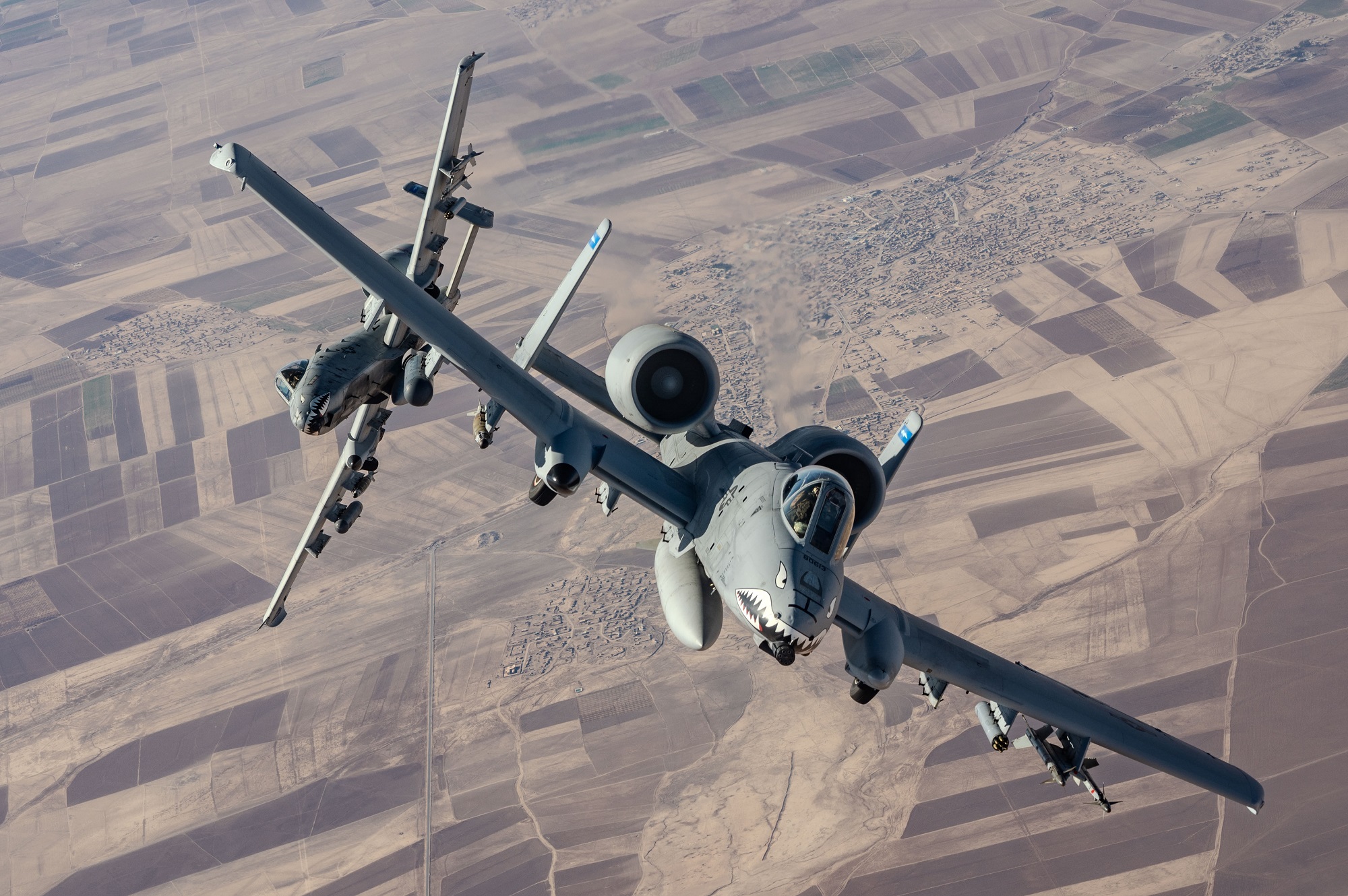
U.S. Air Force A-10 Thunderbolt II aircraft fly over the U.S. Central Command area of responsibility, Dec. 15, 2024. | Source: U.S. Air Force photo by Staff Sgt. Jackson Manske
The new bill says surplus aircraft could retain value for security cooperation, partner burden-sharing and contingency operations. The administration would need to assess whether aircraft could be transferred through Foreign Military Sales, the Excess Defense Articles program or other authorities, or maintained in recoverable condition for future use.
The Secretary of War, the Secretary of the Air Force and the Defense Security Cooperation Agency would have to brief Congress on the feasibility of such transfers by January 2027. It is important to note, however, that the bill does not authorize an A-10 transfer to any particular country.
Autonomous capabilities relevant to the A-10’s mission set
The BRRRRT Act also appears to look at Manned-Unmanned Teaming (MUM-T) as a possible replacement for some of the A-10’s missions. The bill would require the Air Force to develop a plan for competitive experimentation, prototyping and operational assessment of autonomous, semi-autonomous, AI-enabled and adjunct aircraft capabilities relevant to the A-10 mission set.
According to the text, the initiative would encourage participation by nontraditional defense contractors, commercial technology companies and venture-backed defense firms capable of rapidly developing autonomy, sensing, communications and mission-system technologies. Also, the legislation explicitly calls for meaningful human command and control over mission-critical functions, including target engagement, weapons release and mission abort.
A U.S. Air Force A-10 Thunderbolt II assigned to the 303rd Expeditionary Fighter Squadron provides rescue escort during exercise Blue Phoenix in the U.S. Central Command area of responsibility, Aug 5, 2025. | Source: U.S. Air Force photo by Airman 1st Class Keagan Lee
It thus appears that there might be an opening towards a replacement of at least some of the capabilities, although the focus is obviously on a true replacement for the A-10 aircraft and its main mission set. The Secretary of the Air Force would have 180 days to present a report about this plan.
Preserving the A-10’s combat experience
The legislation would also require the Pentagon to examine what can be learned from the A-10’s combat history, specifically citing the aircraft’s employment from Operation Desert Storm through current operations, including recent support to the recovery of downed aircrew during Operation Epic Fury.
A report to Congress would have to be presented by January 2027, would examine the A-10’s combat employment and identify lessons applicable to force design with the A-10’s successor, doctrine, training and capability development. The report would also assess potential further A-10 modernization options.
In parallel, the bill mentions the return of the A-10 demonstration team, preserving the aircraft’s visibility during the 250th anniversary of the United States. The team would operate until 2033.
A NASA WB-57F Canberra arrived in Iceland, from where it will depart on Aug. 12 to fly in the path of the solar eclipse.
A NASA WB-57F Canberra arrived at Keflavík Airport in Iceland on Aug. 10, 2026. Flying as ‘NASA926’, the aircraft departed from Ellington Field, Texas, on Aug. 9, and made a stop in Bangor, Maine, before crossing the Atlantic Ocean.
The visit of a NASA WB-57 in Europe is a rare occurrence, however the presence of the specialized high-altitude research jet is not casual. In fact, the Canberra will take-off on Aug. 12 to fly in the path of the upcoming solar eclipse.
Eyes to the skies – we’re preparing to capture the upcoming solar eclipse in a way only NASA can.
On August 9, our WB-57 high-altitude aircraft took off from Ellington Field in preparation to capture the Moon covering the Sun on August 12. The team will take off from Iceland and… pic.twitter.com/FwFQOnJ8fX
— NASA’s Johnson Space Center (@NASAJohnson) August 10, 2026
This total solar eclipse will sweep across Greenland, Iceland, northern Russia, the Atlantic Ocean, Spain, and a small corner of Portugal. The aircraft will send back views for researchers to learn more about the celestial event, says NASA.
Obviously, this is not the first time NASA uses a WB-57 to study a solar eclipse. For instance, in 2024 NASA used the WB-57 to study the Sun’s corona, ionosphere, and other eclipse phenomena, while in 2017 is was used to study the structure of the corona.
A NASA WB-57 aircraft launches from March Air Reserve Base in support of the Artemis II mission. | Source: U.S. Air Force photo by Tech. Sgt. Steven Lewis
The use of this aircraft for observation presents some advantages, starting from its 50,000 feet cruise altitude which would put it above most of the water vapor, haze, and turbulence which are found at lower altitudes and ground level. This allows the onboard sensors to pick up clearer, sharper images and record wavelengths which usually don’t reach the ground.
At the same time, using the WB-57 NASA can extend the observation time as it would follow the Moon’s shadow, leading to an increased amount of data that can be collected. In 2024, this allowed airplanes to see an eclipse that lasted about 25 percent longer.
NASA WB-57F
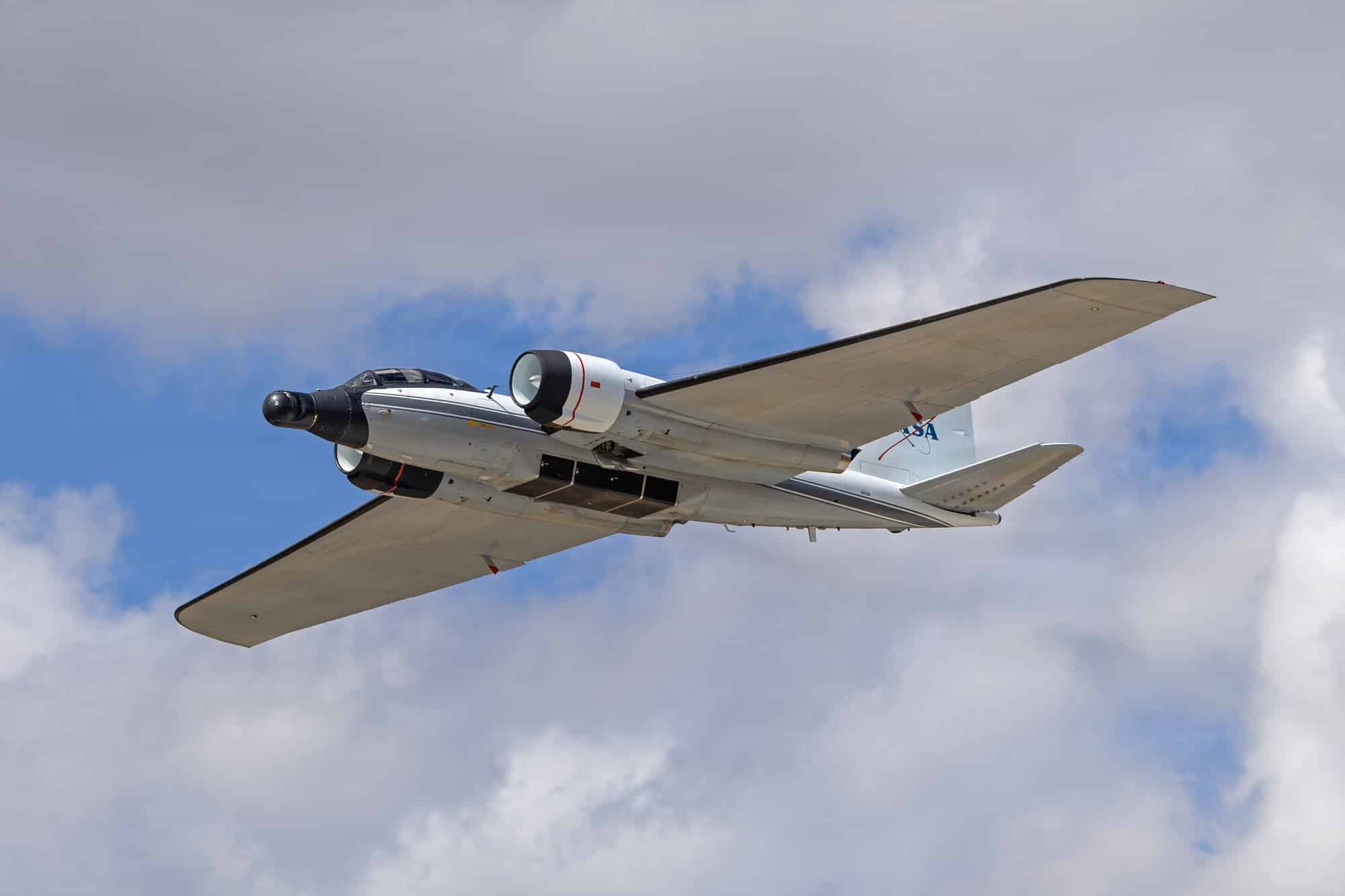
The WB-57 used by NASA is a highly modified high-altitude research aircraft derived from the Martin B-57 Canberra, the U.S.-built version of the British English Electric Canberra. Operated by NASA’s Johnson Space Center (JSC) from Ellington Field, Houston, the WB-57 retains the basic configuration of the original aircraft but has been extensively adapted for scientific and technology-development missions.
The aircraft has a mid-wing, twin-engine configuration with a distinctive high-aspect-ratio wing spanning approximately 122.5 ft (37.3 m), which gives it the aerodynamic efficiency required for sustained flight at high altitudes. The aircraft is powered by two Pratt & Whitney TF33 turbofan engines, and can operate above 60,000 ft at approximately 410 kt true airspeed, or Mach 0.78, for approximately 6.5 hours, with a range of roughly 2,500 nautical miles.
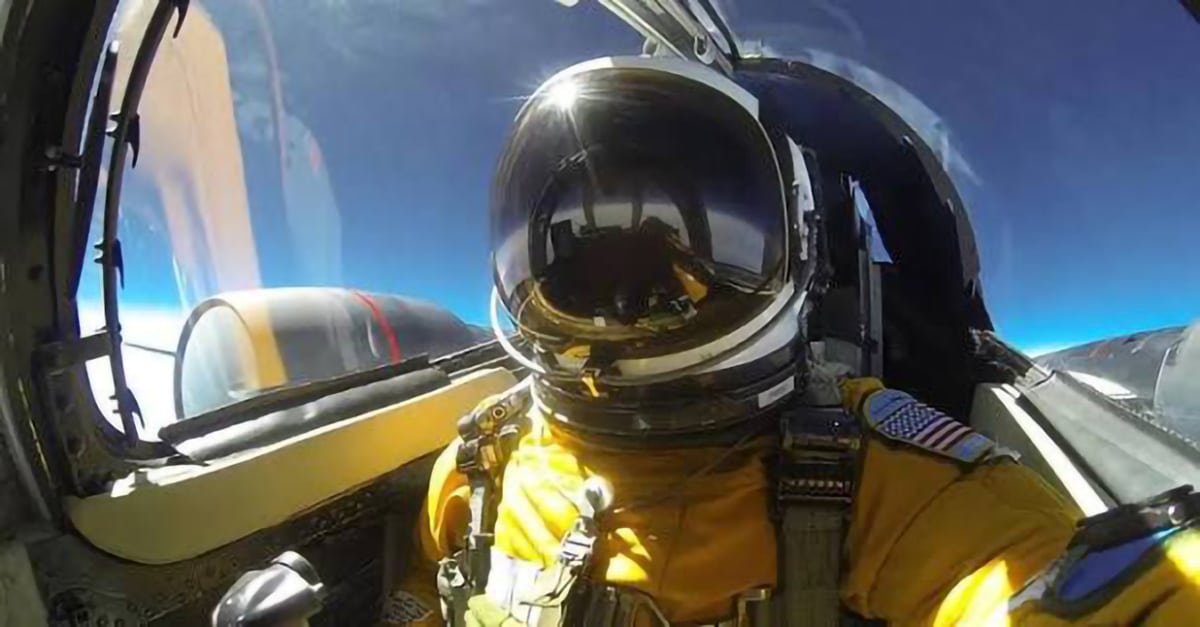
Similarly to the U.S. Air Force’s U-2 Dragon Lady, the pilots of NASA’s WB-57s need to wear pressurized suits. | Source: NASA
The WB-57’s main advantage resides in its high-altitude performance, which puts its above a significant portion of the Earth’s atmosphere. This capability is particularly valuable as the aircraft would get an unobstructed view without atmospheric water vapor and other phenomena which can interfere with observations in certain infrared and other electromagnetic bands.
The payload architecture includes interchangeable fuselage pallets, wing pods, wing-mounted hatches, a nose section and other external mounting points, allowing different scientific instruments to be installed according to mission requirements. NASA’s current documentation lists payload capacities of up to approximately 8,800 lb, although the usable payload depends on the specific configuration and mission profile.
The WB-57 normally operates with a two-person crew seated in tandem. The pilot occupies the forward cockpit, while the sensor equipment operator (SEO) occupies the second station and manages navigation, scientific instruments and associated payload systems.
Operationally, NASA employs the WB-57 for atmospheric and Earth science, high-resolution imaging, ground mapping, cosmic-dust collection, astronomical observations, rocket-launch support and testing of future airborne and spaceborne systems. Recently, the aircraft was used in support of the launch of the Artemis II mission.
NASA employs a fleet of three WB-57s, however only one, N926NA, is currently operational. As we reported in January 2026, the WB-57 N927NA suffered an emergency gear-up landing and NASA says on its website maintenance is expected to be completed by the end of June 2027.
The remaining aircraft, N928NA, is currently undergoing a major inspection expected to end by January 2027, according to NASA’s website. This inspection was initially launched in 2021, before being put on indefinite hold.
The U.S. Air Force awarded Boeing a procurement contract for GBU-75 JDAM Long Range kits, clearing the initial production for the U.S. Navy.
Boeing has announced that it has been awarded a $75 million Undefinitized Contract Action (UCA) to acquire the BSU-111/B Payload Delivery Unit (PDU) for the GBU-75 Joint Direct Attack Munition Long Range (JDAM LR). The weapon was first tested by the U.S. Navy in April 2026.
The UCA now clears the production of the new weapon, developed with a nearly $100 million internal investment by Boeing, for the U.S. Navy. The BSU-111/B PDU includes a wing kit and a compact turbojet engine, allowing the weapon to travel over 300 nautical miles with a 500-pound class (226-kilogram) payload.
Almost $100 million in Boeing investment. Affordable, mass producible, adaptable long-range capability. Proud to partner with the U.S. Air Force and U.S. Navy.
As noted in the opening, while the weapons will go to the Navy, the UCA was awarded by the Air Force. In fact, the JDAM program is jointly managed by the Air Force and Navy, with the Air Force being the lead service and thus also managing acquisitions.
“This first production contract is a major milestone for the JDAM LR program, demonstrating our ability to deliver long-range precision-strike capability at a significantly lower cost,” said Bob Ciesla, vice president of Boeing Precision Engagement Systems. “Scaling production of the GBU-75 will provide the fleet with an affordable, sustainable solution designed to eliminate long-range land and sea-based threats to U.S. and international forces and enable them to safely and effectively operate in a contested battlespace.”
The first JDAM LR cruises above the U.S. Navy’s Point Mugu Sea Range, California, on April 1, 2026. | Source: U.S. Navy photo
Compared to previous JDAM variants, the new GBU-75 will provide the ability to strike targets at standoff ranges, and out of the range of adversary air defenses. The weapon can also outperform weapons such as the AGM-84H/K SLAM-ER, AGM-154 JSOW and the baseline AGM-158 JASSM, but at a fraction of the cost.
“JDAM LR gives operators an affordable, mass-producible option for striking targets from beyond the effective range of enemy defenses,” said Ciesla. The Navy previously described the JDAM LR as a game-changer.
The JDAM-LR
The JDAM Long Range was initially known as Powered JDAM (PJDAM), with reports about the weapon’s development going as far back as 2010. The weapon has surfaced again in 2020 as a possible low-cost stand-off weapon.
The Navy explained in a short video on social media that the addition of a small turbojet engine transforms the standard JDAM in a low-cost, high-precision cruise missile. In a recent product card, Boeing confirmed the engine as the TDI J85 by Kratos Defense already announced for the PJDAM.
A Navy F/A-18 carries the new Joint Direct Attack Munition (JDAM) Long Range (LR) variant during a test event in early April off the coast of California. | Source: U.S. Navy photo/released
The company says that the weapon could be able to reach a 300+ NM range, or 700+ NM if the Mk-82 500 lb bomb is replaced by a “low-cost decoy fuel tank.” Quickstrike and Maritime Strike variants are also shown during wind tunnel testing.
Compared to the JDAM Extended Range (ER), the new weapon uses a different body which includes the standard JDAM tail kit, the ER’s wing kit and the turbojet engine. The warhead is also partially enclosed in the new body, with approximately half of it protruding in the front.
The JDAM-LR uses the existing aircraft interface and In-Weapon Launch Acceptable Region (LAR) of the standard JDAM, allowing for a quicker integration. This would allow for the aircraft which were already cleared to employ the standard JDAM to use also the new variant.
The new weapon has been designated as GBU-75, according to a statement by Boeing. The company has also explained that the tests were conducted on Apr. 1 and 3.
The first test demonstrated safe separation, engine start, cruise and guidance through terminal flight and impact in water, within meters of its planned target, after a 34-minute flight. The second test saw a similar flight profile, this time successfully incorporating altitude changes and weapon maneuvering.
AI agents, using data from a Legion Infrared Search and Track pod, controlled the X-62 VISTA and executed 27 autonomous intercepts of airborne targets throughout eight flights.
The U.S. Air Force and Lockheed Martin’s Skunk Works division announced new milestones with the Test Pilot School’s (TPS) X-62 Variable In-flight Simulation Test Aircraft (VISTA) following the Mission Systems Upgrades (MSU). Among these were the autonomous intercepts conducted by the AI agents by using data from an Infrared Search and Track (IRST) sensor.
The milestones were part of two accelerated test programs, HAVE HEAT and HAVE HOLIDAYS, conducted with the X-62 VISTA throughout April 2026 but only revealed on Aug. 4, 2026. The two programs were driven by the MSU, a strategic investment from the Test Resource Management Center to expand autonomy testing with the X-62 in more complex scenarios.
Skunk Works®’ AI used Legion Pod® sensor data on the X-62A VISTA to autonomously intercept live targets. pic.twitter.com/ogPAtOsdrj
The HAVE HEAT program saw the X-62 employing the Legion Pod, Lockheed Martin’s IRST podded IRST sensor. The goal was to demonstrate the ability of AI agents to use real sensor data to autonomously intercept airborne targets in real time.
“HAVE HEAT represents a meaningful expansion of avionics capability towards integrated, AI-driven control of multiple sensors and air vehicles for mission autonomy. This bridges a capability gap and positions us to test advanced autonomy faster,” says Lt. Col. Joshua Strafaccia, dean of faculty for research, U.S. Air Force Test Pilot School.
The X-62 VISTA basks in the Mojave sun before embarking on several test flights supporting HAVE HEAT and HAVE HOLIDAYS for the Air Force Test Pilot School and industry partners at Edwards Air Force Base, California, April 22, 2026. | Source: U.S. Air Force Photo by Lindsey Iniguez
In its press release, Lockheed Martin explained that the X-62 tracked a live T-38 Talon, feeding the IRST data to the AI agent that autonomously piloted the fighter into a tactical intercept position. The company further explained that Skunk Works’ “Supermassive” AI agent generation capability, whose full integration and ground test occurred in just three months, dramatically improved speed and agility.
“Our ongoing partnership with TPS is driving important progress with this latest flight test series demonstrating that our AI can effectively and reliably close the sensor‑to‑action loop aboard an operational combat aircraft,” said Ron Fehlen, vice president and general manager, Lockheed Martin Skunk Works. “Our autonomous agents consumed classified infrared search and track feeds and executed combat‑critical maneuvers in real time. This achievement marks a decisive advance toward delivering AI‑augmented air dominance for the United States.”
NEWS: X-62 VISTA continues setting precedents, demonstrates ability of #AI agents to ingest live infrared sensor data to #autonomously intercept live airborne targets. #AFMC#TRMC
The service described HAVE HOLIDAYS as a parallel program to HAVE HEAT. The program included simultaneous integration and evaluation of a wide suite of modular technologies into the X-62’s Enterprise Open Mission System Architecture computer.
Among these technologies were the integration of a non-prime, third-party autonomous agent onto the X-62, testing of enhanced safety rules to prevent autonomous vehicles from violating user-established operational limits, and further chip integration for advanced sensor exploitation.
The X-62A VISTA flies in the skies above Edwards Air Force Base, California, April 30, 2024. | Source: U.S. Air Force Photo By Richard Gonzales
The Air Force explained that “this system-of-systems test served as critical technical risk mitigation on the design and development of logistics and integration frameworks required to maximize flight opportunities post-MSU, paving the way for broader government, academic, and industry partnerships.”
Next steps
The service said in its statement that the next step of the Mission Systems Upgrades (MSU) will feature the integration of the RTX PhantomStrike radar and an unspecified modern network data communications. The integration of this AESA (Active Electronically Scanned Array) radar was first announced in December 2025.
“X-62 is continued proof that an agile, dedicated team can rapidly advance Department of War initiatives through intentional collaboration. Accomplishing these significant milestones is a direct reflection of the adaptability and warfighter focus personified by all members of the school,” says Col. Maryann Karlen, commandant, U.S. Air Force Test Pilot School.
The Air Force further explains that using the X-62 “provides consistency for continued national investment in human-machine teaming without sacrificing safety or human contributions to the AI models developed.” Additionally, “the completion of the MSU effort will position X-62 as a foundational enabler for the Air Force’s highest-priority programs.”
The X-62 Variable In-Flight Stability Test Aircraft (VISTA) flies in the skies over Edwards Air Force Base, California, March 23, 2023. | Source: U.S. Air Force photo by Ethan Wagner
Similarly, Lockheed Martin says “the X-62’s Mission Systems Upgrade will enable the aircraft to demonstrate seamless integration of combat systems, sensors and airborne AI agents within a next‑generation mesh network.”
X-62 MSU
The Mission Systems Upgrade (MSU) builds on DARPA’s Air Combat Evolution program, which resulted in the first-ever human versus AI dogfight in 2023. The next phase of the testing will evaluate integration of combat systems and collaboration with airborne agents in increasingly complex environments.
Specifically, the incorporation of advanced radar and sensor integration will allow to fly the aircraft into more complex scenarios and will evaluate AI systems integration, collaboration, and make decisions in real time, explains the service.
The first mention of the radar upgrade for the X-62 came in August 2024, when the service released a Request for Information (RFI) for a potential radar upgrade on the X-62. Specifically, the radar was described as “part of a set of modular components that can be used individually or together to provide sensory input to aircraft.”
The landmark X-62 VISTA artificial intelligence and autonomy testbed is receiving a variety of mission system upgrades thanks to investments by the Test Resource Management Center (TRMC). | Source: U.S. Air Force photo by Lindsey Iniguez
The RFI also mentioned the goal of having the autonomy agents control and use the radar: “the aircraft will be capable of processing raw data from the AESA radar in an autonomy enclave that can use machine learning to process the data and directly control the sensors using either the existing modes available via the radar OFP or via experimental modes and experimental combinations of modes inaccessible or unachievable by human use.”
Among the requirements are air cooling, weight less than 200 lb, AESA technology “that can operated in an unclassified mode,” air-to-air and air-to-ground modes and startup time less than 2 minutes. In December 2025, RTX announced the selection of its PhantomStrike radar, whose weight is below 150 lb and is powered by air-cooled gallium nitride (GaN) technology.
The U.S. Air Force’s 355th Wing conducted the final flight with the A-10C Thunderbolt II at Davis-Monthan AFB, as the service ends A-10 operations at the installation.
The A-10C Thunderbolt IIs assigned to the U.S. Air Force’s 355th Wing flew for the last time at Davis-Monthan Air Force Base, Arizona. The flight celebrated the end of the A-10 operations at the installation after 50 years, as the aircraft first arrived there in 1976.
The flight was a two-ship formation piloted by the 355th Operations Group Commander, Lt. Col. Rodney Dwyer, and the 357th Fighter Squadron Commander, Lt. Col. Ryan Rutter. The service says the Warthogs flew “over Tucson and the installation for the last time, honoring a legacy of precision and courage through the Close Air Support mission.”
The 357th FS recently graduated the last class of A-10 pilots in April 2026, after they completed their mission qualification training in mid-March. In June, the base also hosted at the Barry M. Goldwater Range near Gila Bend, Arizona, the last public Range Day with the A-10C.
Last year, the base also saw the deactivation of the 924th Fighter Group, which oversaw the 47th Fighter Squadron, the Air Force Reserve Command’s (AFRC) Formal Training Unit for the A-10C. The unit is now slated to transition to the F-35A Lightning II.
The A-10’s retirement
The end of the A-10’s flight operations represents yet another step towards the retirement of the aircraft. The service already closed the A-10’s depot maintenance at Hill AFB, Utah, and will soon end the A-10 operations at Nellis AFB’s Weapons School.
These steps appear to be continuing even if the service announced that it would retain two squadrons through 2030. These will be one active-duty squadron at Moody Air Force Base, Georgia, and one Air Force Reserve squadron at Whiteman Air Force Base, Missouri.
In an attempt to further delay the retirement, Rep. Abe Hamadeh (R-Ariz.) introduced in the U.S. Congress the ‘BRRRRT Act’, or ‘Bolstering Recognition, Resurgence, Retention, and Remembrance of the Thunderbolt’, (H.R. 9780) on July 20, 2026. The bipartisan bill would require the U.S. Air Force to maintain a viable A-10 fleet through Fiscal Year 2033, as well as halting the dismantling of the infrastructure needed to sustain the aircraft.
The bill was referred to the Committee on Armed Services but, at the time of writing, its text was not yet public. The bill would require the Air Force to maintain at least 126 A-10 aircraft and restore depot maintenance, pilot training, sustainment activities and flight testing.
In order to proceed with the retirement, the Secretary of War would have to certify that a replacement aircraft has fully assumed the A-10’s mission before any further divestment could proceed. That certification would also need to be approved in writing by the Secretary of the Army, the Commandant of the Marine Corps, and the Commander of U.S. Special Operations Command.
The U.S. Navy’s C-2A Greyhound conducted its last ever flight, landing at Naval Air Station Pensacola to be inducted into the National Naval Aviation Museum.
Following the final flight operations off an aircraft carrier last month, the U.S. Navy’s C-2A Greyhound has flown for the last time on July 28, 2026. The aircraft, attached to the “Rawhides” of Fleet Logistics Support Squadron (VRC) 40 landed at Naval Air Station (NAS) Pensacola’s Sherman Field, greeted by nearly 6,000 onlookers, says the service.
For the occasion, the Greyhound was escorted by the Blue Angels, honoring its six decades of carrier onboard delivery (COD) services and logistics support to the fleet. The airframe will now be inducted into the National Naval Aviation Museum and exhibited from 2027.
A C-2A Greyhound attached to the “Rawhides” of Fleet Logistics Support Squadron (VRC) 40 leads a formation flight with the U.S. Navy Blue Angels over Naval Air Station (NAS) Pensacola during the aircraft’s final flight in service.#CNIC#CNRSE#NASP#vrc40#usnavyblueangelspic.twitter.com/eBBYPvH5Wt
“Seeing Pensacola overhead, it is the ‘Cradle of Naval Aviation,’ said Cmdr. Paul Ingram, VRC-40’s commanding officer, who began his naval aviation career at NAS Pensacola. “It’s very sad to me, but I feel satisfaction that we did it safely – we did it right in coming to a close like this.”
With the retirement of the C-2, the Navy says VRC-40 is being disestablished. Addressing the crowd, Ingram reflected on the meaning of the COD mission, which goes far beyond the logistics required by the fleet at sea.
The Navy’s final C-2A Greyhound, attached to the “Rawhides” of Fleet Logistics Support Squadron (VRC) 40, lands onboard Naval Air Station (NAS) Pensacola’s Sherman Field after the aircraft’s final flight in service, before being turned over to the National Naval Aviation Museum. | Source: U.S. Navy photo by Lt. Cmdr. Antonio More
“When a C-2 appears on the horizon, it brings with it far more than just cargo,” Ingram said. “Every single mission carries a deep, personal meaning for someone aboard the carrier. For a nervous new Sailor, that trap represents the excitement of arriving for their first fleet assignment and for a seasoned master chief, it is the final catapult shot before a hard-earned retirement. It is the joyous flight ferrying a Sailor home to a waiting family, or the delivery of a simple, handwritten letter from a loved one that restores morale during a grueling deployment. In its most urgent capacity, the Greyhound serves as a flying ambulance, executing a life-saving medical evacuation that ensures an injured service member lives to see tomorrow. No other aircraft in the history of Naval Aviation carries so many personal memories for as many people as the C-2.”
Describing the service accomplishments of the C-2, the Navy says it conducted more than 250,000 carrier landings, transported millions of personnel and ferried more than 100 million pounds of cargo. Notably, the retirement of the C-2 also marks the close of another chapter in the U.S. naval aviation history.
“The retirement of the Greyhound also ends an era of enlisted aircrew flying in aircraft equipped with tailhooks,” said National Naval Aviation Museum Deputy Director Hill Goodspeed. “The service of these Sailors dates to before World War II when enlisted men began flying as gunners in carrier-based bombing and torpedo aircraft.”
The C-2A Greyhound
The Grumman C-2A Greyhound served for six decades as the U.S. Navy’s dedicated Carrier Onboard Delivery (COD) aircraft. Throughout the years, it provided a critical logistical link between shore bases and carrier strike groups at sea.
The Navy’s final C-2A Greyhound, attached to the “Rawhides” of Fleet Logistics Support Squadron (VRC) 40, leads a formation flight with the U.S. Navy Blue Angels over Naval Air Station (NAS) Pensacola’s Sherman Field during the aircraft’s final flight in service before being turned over to the National Naval Aviation Museum. | Source: U.S. Navy photo by Mass Communication Specialist Seaman Jon Jezreel Andres
The C-2 shares its DNA with the E-2 Hawkeye, from which it was derived in the 1960s. The two aircraft share the same wings and engines, as well as a similar tail configuration, modified on the C-2 to account for the missing radar.
Apart for the missing radar dome, the main difference on the C-2 is the widened fuselage with a rear loading ramp. This allowed the aircraft to carry passengers, mail, high-priority cargo and critical spare parts.
The C-2A flew for the first time in 1964 and entered operational service in 1966, replacing the piston-powered C-1 Trader. Because of its ability to transport urgently needed equipment, the C-2 quickly became an indispensable component of carrier operations. The Greyhound fleet was first overhauled in 1973, and in 1984 more C-2As were ordered under designation Reprocured C-2A or C-2A(R).
In the early 2000s, these underwent a Service Life Extension Program (SLEP), which increased their life from 10,000 hours, or 15,000 carrier landings to 15,000 hours or 36,000 landings. Additionally, the SLEP included structural improvements to the center wing, an eight-bladed NP2000 propeller and avionic upgrades.
Fire and Emergency Services Gulf Coast fire fighters wet down the Navy’s final C-2A Greyhound, attached to the “Rawhides” of Fleet Logistics Support Squadron (VRC) 40, onboard Naval Air Station (NAS) Pensacola’s Sherman Field after the aircraft’s final flight in service, before being turned over to the National Naval Aviation Museum. | Source: U.S. Navy photo by Mass Communication Specialist Seaman Olivia O'dell
The upgrades were meant to allow the Greyhound to fly until 2027. The last flight off an aircraft carrier on June 25, 2026, and the last flight on July 28 marked the end of fixed-wing carrier onboard delivery as the mission now transitions to rotary wing with the CMV-22B Osprey.
The CCA Experimental Operations Unit tested the uncrewed aircraft in Agile Combat Employment scenarios in a realistic operational environment at Creech AFB.
The U.S. Air Force is continuing testing with Collaborative Combat Aircraft (CCA), this time at Creech Air Force Base, Nevada. The base is not new to operations with uncrewed aircraft, as it hosts the 432nd Wing with its MQ-9A Reapers and, notoriously, RQ-170 Sentinels.
The testing was conducted by the CCA Experimental Operations Unit (EOU), which the service established to accelerate Manned-Unmanned Teaming (MUM-T) concepts and accelerate the entry into service of CCAs. The service says the exercise was designed with a primary goal of building the foundational tactics, techniques and procedures that will define how CCA are integrated into the force.
“Air superiority in today’s increasingly contested environments requires the rapid fielding of affordable mass,” said Air Force Chief of Staff Gen. Ken Wilsbach, emphasizing the strategic driver for the platform. “CCA are essential to this effort. By integrating uncrewed systems to fly alongside our Airmen, we extend reach and increase lethality.”
Notably, the operations at Creech AFB focused on Agile Combat Employment (ACE) in a realistic operational environment. The service further said that the EOU “generated multiple sorties demonstrating reliability and extended range; integrated with manned platforms in the local airspace to project power across distributed battlefields; and simulated scenarios that will inform future requirements for the platform.”
A U.S. Air Force YFQ-42A Dark Merlin aircraft assigned to the Collaborative Combat Aircraft Experimental Operations Unit descends in the air before landing at Creech Air Force Base, Nevada, July 22, 2026. | Source: U.S. Air Force photo by Staff Sgt. Jake Jacobsen
“This exercise was about getting the systems into the hands of the warfighter,” said Lt. Col. Matthew Jensen, Experimental Operations Unit commander. “We are focused on operating CCA outside of a traditional test environment so we can continue to learn, inform, and rapidly iterate.”
The photos released by the Air Force show that the CCA used for the exercise were both the YFQ-42 and the YFQ-44. According to the captions, the operations started on July 21.
The press release mentioned that members from the Air Force Operational Test and Evaluation Center (AFOTEC) observed the event, “as part of a new, rapid operational testing procedure.” Brigadier General Jesse Friedel, AFOTEC commander, explained that similar exercises allow to “gather and analyze data that aids in informed CCA fielding decisions well ahead of the normal process.”
Additionally, the photos show that members of the Royal Netherlands Air and Space Force were also at Creech AFB as observers. In fact, in October 2025, the Netherlands joined the CCA program, with the U.S. Air Force granting “total access on all levels.”
A U.S. Airman assigned to the Collaborative Combat Aircraft Experimental Operations Unit helps load an inert AIM-120 air-to-air missile onto a YFQ-44A Fury aircraft at Creech Air Force Base, Nevada, July 21, 2026. | Source: U.S. Air Force photo by Senior Airman Renee Blundon
Collaborative Combat Aircraft
The Air Force is rapidly advancing the development of CCAs, with plans to begin deploying over 150 units in the next five years. These autonomous systems could take on a range of missions, from surveillance to direct combat, working as force multipliers in collaboration with manned platforms and taking on high-risk missions traditionally performed by manned fighters.
Unlike legacy fighters, CCAs feature modular designs, enabling rapid upgrades and streamlined maintenance. The modular design and open architecture, the latter becoming a staple in the design of modern military aircraft, allows to introduce new capabilities as they become available, allowing in turn to always field the latest technologies to keep an edge over rapidly evolving battlefields.
In early 2024, Anduril Industries and General Atomics were awarded contracts to design and test production-ready CCAs, marking a pivotal step in the program. Both companies are developing these unmanned aircraft to support both the upcoming NGAD fighters, as well as current F-35s and other manned aircraft, by sharing sensor data, executing coordinated maneuvers, and potentially carrying out combat roles.
In early 2025, the U.S. Air Force’s then Chief of Staff, General David Allvin, announced the official designation of the first two CCAs. The two aircraft by General Atomics and Anduril have been named YFQ-42A and YFQ-44A, respectively, marking the first use of the ‘Unmanned Fighter’ designation by the USAF.
A U.S. Air Force YFQ-44A Fury aircraft assigned to the Collaborative Combat Aircraft Experimental Operations Unit, sits on the flight line during weapon loading procedures at Creech Air Force Base, Nevada, July 21, 2026. | Source: U.S. Air Force photo by Senior Airman Renee Blundon
These two aircraft flew for the first time in August 2025 and October 2025, respectively. Since then, they have been involved in a series of tests to demonstrate the required capabilities, working in close partnership with the service.
The Air Force is planning to field a diverse fleet of over 1,000 CCAs, designed with modular configurations for weaponry, sensor capabilities, and rapid adaptability to mission needs. One notable advancement in 2024 was the first flight of the XQ-67A, a low-cost drone designed by General Atomics under the Off-Board Sensing Station (OBSS) program, which occurred in February 2024.
This platform, along with the earlier XQ-58A Valkyrie, demonstrates a “common chassis” concept—using shared components for various drone models to streamline production and reduce costs. This approach aims to provide a scalable, cost-effective solution for enhancing combat capacity without relying on high-cost crewed jets, which is essential given the Air Force’s budget constraints and strategic emphasis on distributed, resilient forces.
A bipartisan group of U.S. lawmakers has introduced legislation aimed at halting the retirement of the A-10 Thunderbolt II until a fully certified replacement is operational.
Rep. Abe Hamadeh (R-Ariz.) introduced in the U.S. Congress the ‘BRRRRT Act’, or ‘Bolstering Recognition, Resurgence, Retention, and Remembrance of the Thunderbolt’, (H.R. 9780) on July 20, 2026. The bill, co-led by Rep. Don Davis (D-N.C.), would require the U.S. Air Force to maintain a viable A-10 fleet through Fiscal Year 2033, as well as halting the dismantling of the infrastructure needed to sustain the aircraft.
Named after the distinctive “BRRRRT” sound produced by the A-10’s GAU-8/A Avenger 30 mm cannon, the legislation reflects continuing congressional concern over the Air Force’s efforts to retire the Warthog before an aircraft capable of fully replacing its close air support (CAS) mission has entered operational service. Similar provisions were also included in the recent Fiscal Year 2027 National Defense Authorization Act (NDAA) draft.
Preserving a Proven Close Air Support Capability
The bill was introduced in the U.S. Congress’ House of Representatives on July 20, and referred to the Committee on Armed Services. At the time of writing, however, the text of the bill was not yet public.
A U.S. Air Force A-10C Thunderbolt II aircraft approaches an HC-130J Combat King II aircraft for aerial refueling in the U.S. Central Command area of responsibility, May 9, 2026. | Source: U.S. Air Force
“The BRRRRT Act ensures we do not retire a proven weapons system before a certified replacement exists,” said Hamadeh in a statement on July 21. “This is about common sense, national security, and keeping faith with the men and women who depend on the A-10 in combat.”
Notably, the legislation enjoys bipartisan backing, with Hamadeh accompanied by Davis serving as co-lead, and original cosponsors including Reps. Richard McCormick (R-Ga.), Derrick Van Orden (R-Wis.), Sam Graves (R-Mo.), and Cory Mills (R-Fla.).
As we recently reported, the U.S. Air Force announced that it would retain two squadrons through 2030, following direction from President Donald Trump and Secretary of War Pete Hegseth. These will be one active-duty squadron at Moody Air Force Base, Georgia, and one Air Force Reserve squadron at Whiteman Air Force Base, Missouri.
However, as noted by Hamadeh’s statement, the reverse in the retirement plans does not stop the dismantlement of the training, maintenance and logistics required to keep the aircraft in service. The service already closed the A-10’s depot maintenance at Hill AFB, Utah, and graduated the last A-10 pilots.
An A-10C Thunderbolt II aircraft assigned to the 104th Fighter Squadron, Maryland Air National Guard, takes off from Martin State Air National Guard Base, Maryland, May 30, 2025. | Source: U.S. Air National Guard photo by Senior Master Sgt. Chris Schepers
According to details of the legislation obtained by Military Times, the bill would require the Air Force to maintain at least 126 A-10 aircraft. This number is an increase compared to the congressionally mandated minimum of 103 aircraft.
The bill also details that, within 90 days of enactment, the Secretary of the Air Force would have to submit a plan detailing how the service intends to restore depot maintenance, pilot training, sustainment activities and flight testing. Additionally, the bill would significantly tighten the conditions under which additional A-10 retirements could occur.
In fact, the Secretary of War would have to certify that a replacement aircraft has fully assumed the A-10’s mission before any further divestment could proceed. That certification would also need to be approved in writing by the Secretary of the Army, the Commandant of the Marine Corps, and the Commander of U.S. Special Operations Command.
The legislation also includes a requirement for an aircraft to be considered a fitting replacement for the A-10, noting that it would qualify only if CAS is the primary mission. This provision goes against earlier plans to distribute the A-10’s mission among multirole aircraft such as the F-35A Lightning II, F-15E Strike Eagle and F-16 Fighting Falcon.
U.S. Air Force A-10 Thunderbolt II aircraft fly over the U.S. Central Command area of responsibility, Dec. 15, 2024. | Source: U.S. Air Force photo by Staff Sgt. Jackson Manske
Continuing a Longstanding Debate
The bill represents the latest chapter in the decades-long disagreement between Congress and the Air Force over the future of the A-10. The service is steadily retiring the aircraft, with the entire fleet now based in the U.S. after the A-10 was withdrawn from Osan Air Base, South Korea.
The Air Force entered Fiscal Year 2026 with 162 A-10s and initially sought authority to retire the entire fleet by the end of the year. Congress rejected that proposal, instead establishing a minimum inventory of 103 aircraft in the Fiscal Year 2026 National Defense Authorization Act.
The debate was once again fueled by recent combat operations, with the A-10 playing an important role during operations against Iran. Among these is the “Sandy” mission in support of the Combat Search and Rescue (CSAR) of the two crew members of the F-15E Strike Eagle downed in Iran.
As mentioned in the opening, provisions against the A-10’s retirement were also introduced by Hamadeh in the Fiscal Year 2027 National Defense Authorization Act (NDAA). Should the BRRRRT Act not advance to become law, the NDAA might still some see the same provisions approved, albeit in a different form.
Sikorsky has completed the initial ground and flight testing of the Nomad 100 rotor blown wing VTOL drone as part of DARPA’s EVADE program.
Sikorsky has completed initial ground and flight testing of its Nomad 100 Uncrewed Aerial System (UAS), the novel rotor blown wing vertical take-off and landing (VTOL) drone first unveiled last year. The testing is part of the Defense Advanced Research Projects Agency (DARPA) Early VTOL Aircraft Demonstration (EVADE) program.
“Nomad 100’s ongoing flight testing reflects our commitment to advancing autonomous technology while delivering safe and reliable mission capabilities that equip customers to fill critical operational gaps,” said Rich Benton, vice president and general manager, Sikorsky. “Nomad will serve as part of a crewed-uncrewed team complementing missions anywhere from austere forward operating bases to ship decks and unimproved landing zones.”
.@Sikorsky, a @LockheedMartin company, has completed initial ground and flight testing of its Nomad 100 uncrewed aerial system (UAS) in collaboration with @DARPA‘s Early VTOL Aircraft Demonstration (EVADE) program. Click for more:
Following this milestone, the company says it will continue with “an intensive flight test campaign at a government facility, replicating a host of multirole Nomad 100 missions.” While details about the next round of tests are not available, Sikorsky previously said that Nomad can conduct all-weather operations from reconnaissance, light attack and contested logistics.
In the press release, the company also noted that Nomad represents its entry into the UAS market, building on decades of advanced rotorcraft and autonomy expertise. The goal is “delivering high-performing uncrewed systems to servicemembers operating in rapidly evolving, contested environments.”
The Nomad family of VTOL drones can be scaled in size for a variety of sea and land-based missions. | Source: Sikorsky
Nomad 100
Sikorsky announced in October 2025 a new family of long-endurance, runway-independent drones, called Nomad, designed for reconnaissance, light attack, contested logistics and more. Nomad exploits the rotor blown wing architecture in a tail-sitting configuration.
The rotor blown wing architecture takes its name from the rotor wash which, due to the position of the engine nacelles, blows over the wing. This allows to increase lift once the transition from VTOL to airplane mode is complete.
In fact, the drone takes off vertically like a helicopter and then tilts the entire airframe to put the wings level and fly like a fixed wing aircraft. Sikorsky highlights that the twin proprotor design combines the versatility of a helicopter with the speed and range of a fixed-wing airplane.
The 10.3-ft wingspan prototype Nomad 50 aircraft is shown in flight test in spring 2025. | Source: Sikorsky
A first prototype with a 10.3 ft wingspan, called Nomad 50, was used to prove the design in March 2025. At the time of the announcement in October, the company said it was already building Nomad 100, described as a Group 3, 18 ft wingspan variant of the prototype.
Sikorsky specifically mentioned that the Nomad family can be scaled from a Group 3 UAS (56 pounds to 1,320 pounds) to Group 4/5 (1,320 pounds and up). The drones predominantly use fuel-efficient hybrid-electric propulsion, while future larger variants will feature a conventional drivetrain.
Furthermore Nomads are operated via Sikorsky’s MATRIX autonomy technology. The company has already demonstrated MATRIX across a range of applications, including aerial firefighting, logistics resupply, and advanced aerial mobility, and says it will allow seamless integration of Nomad with rotary and fixed-wing aircraft.
The first Polish F-35 to be built at Cameri’s Final Assembly Check Out facility in Italy has conducted its first functional test flight.
The first Polish Air Force F-35A Husarz (as the Lightning II has been designated in Poland) to be built in Italy has conducted its first functional test flight. The milestone follows the arrival of the first F-35s, built at Lockheed Martin’s Fort Worth plant in Texas, at Łask Airbase on May 22, 2026.
Aviation photographer Diego Mor captured a photo of the aircraft as it returned from the first flight and kindly shared it with us. As you can see, the F-35 is sporting the tail number “3517,” identifying it as the first of the second batch of 16 aircraft.
In fact, Poland has opted to manufacture half of its 32 F-35s in the U.S., while the remaining ones are being built in Italy. The country hosts in Cameri one of the two Final Assembly Check Out (FACO) facilities, with the other being in Japan.
Polish F-35A program
On Sept. 11, 2019, the U.S. State Department approved the sale of 32 F-35 fifth-generation jets to Poland at a cost of USD 6.5 billion, according to a Defense Security Cooperation Agency (DSCA) announcement. Poland opted for the F-35A CTOL (Conventional Take-Off and Landing) variant to replace its aging Soviet-era MiG-29 and Su-22 fleets.
One of the first three Polish F-35s lands at Łask Airbase. | Source: Polish MoD
In January 2020, a contract was signed for the procurement of 32 F-35s, with first delivery initially expected in 2024. Along with the aircraft, Poland has also acquired various weapon systems for the F-35, including AIM-120C-8 AMRAAM air-to-air missiles and “several hundreds” AGM-158B JASSM-ER cruise missiles.
Further weapons procurements were also approved, such as AIM-9X-2 Sidewinder missiles and AGM-88G Advanced Anti-Radiation Guided Missile-Extended Range (AARGM-ER) missiles. The deals were signed in 2024 and 2025, respectively, followed by a deal for the AIM-120D-3 AMRAAM in 2025.
In 2021, it was decided that the Polish F-35 fleet of 32 aircraft would be entirely stationed at Łask AB in central Poland. Later, Świdwin was also selected, with the F-35s divided among the two bases.
On Aug. 28, 2024, the first Polish Air Force F-35A, designated AZ-01, was officially unveiled during a roll-out ceremony at Lockheed Martin’s Fort Worth facilities, Texas, in the presence of Polish officials. The first aircraft to fly, however was AZ-02, which successfully completed its first test flight on Dec. 2, 2024.
The first Polish Air Force F-35A unveiled at Fort Worth’s plant. | Source: Lockheed Martin
The first aircraft were delivered to Ebbing Air National Guard Base, Arkansas, where Polish pilot training is taking place, as the base is used for the training of foreign military sales (FMS) customers. The first F-35s were planned to arrive in Poland in 2026, with the remainder of the fleet to be delivered by 2030.
As expected, Polish Air Force F-35s don’t sport the traditional white-and-red checkerboard symbol, replaced by a low-visibility version of the emblem. This marks a significant change, as all Polish Air Force aircraft have historically worn the full-color white-and-red checkerboard, including Su-22s and MiG-29s, even after being repainted in new all-grey camouflage schemes.
The Cameri Final Assembly Check Out facility
The Italian FACO, a 101-acre facility including 22 buildings and more than one million square feet of covered work space, housing 11 assembly stations, and five maintenance, repair, overhaul, and upgrade bays, is owned by the Italian Ministry of Defense and is operated by Leonardo in conjunction with Lockheed Martin Aeronautics.
According to LM, 800 skilled personnel are engaged in full assembly of the Conventional Take-off/Landing F-35A and F-35B aircraft variants and is also producing 835 F-35A full wing sets to support all customers in the program. The Cameri FACO also has the only F-35B production capability outside the United States and was selected as F-35 Maintenance, Repair, Overhaul and Upgrade (MRO&U) center for the entire European region.
Two Italian F-35s fly over the FACO in Cameri. | Source: Italian Air Force
In March 2025, an F-35A of the U.S. Air Force, operated by the 495th FS “Valkyries,” was also inducted at the Cameri MRO&U. his event marked the beginning of the first ever planned depot maintenance of a USAF F-35A based in Europe undertaken at Cameri’s facilities.
The United States government cleared European customers to request their aircraft to be produced in Italy. Pricing and production standard are the same, as U.S. Air Force officers are assigned by the Defense Contract Management Agency in Cameri to make sure that quality stays consistent.
The main difference is the volume of the production, as Cameri builds about 15 F-35s per year and Fort Worth produces about 130. What makes Cameri’s FACO attractive is the possibility to have the initial aircraft delivered quickly, in spite of current Technology Refresh 3 (TR-3) delays experienced by Fort Worth.
Lockheed Martin confirmed to us earlier this year that the FACO is currently producing TR-2 aircraft, which are not subject to the delays and will be later retrofitted to the TR-3 configuration. According to Jennings, Poland has expressed an interest in Cameri’s production for these reasons.
Thanks again to Diego Mor for the photo he sent us. Make sure to follow him on Instagram for more!
GA-ASI and MBDA announced a cooperations which will allow the integration of the SPEAR munitions on the MQ-9B and Gambit 6 uncrewed platforms.
General Atomics Aeronautical Systems (GA-ASI) and MBDA have signed a Memorandum of Understanding (MoU) to integrate the SPEAR (Selective Precision Effects At Range) precision munitions onto the MQ-9B Remotely Piloted Aircraft (RPA) and the Gambit 6 Collaborative Combat Aircraft (CCA). The MoU expands the long-standing partnership between the two companies that began with the integration of the Brimstone missile on the Royal Air Force’s Protector RG Mk1.
The agreement, announced during the Farnborough International Airshow 2026, was signed by GA-ASI President David R. Alexander and MBDA UK Managing Director Chris Allam. The collaboration aims to provide current and future operators with a new long-range precision strike capability for both remotely piloted aircraft and autonomous combat platforms.
Building on the Brimstone-Protector Partnership
The new agreement builds directly on the successful integration of MBDA’s Brimstone missile, which was initially known as the SPEAR 2, onto the UK’s Protector RG Mk1, the Royal Air Force designation for the MQ-9B SkyGuardian. Notably, on the same occasion, GA-ASI also announced the completion of the weapon qualification testing of the Protector, which involved the Paveway IV guided bomb and Brimstone 3 missile.
MQ-9B launching a Brimstone 3 missile over Southern California. | Source: GA-ASI
“We’ve built an excellent business relationship with MBDA as part of the integration of the Brimstone missile onto the UK’s Protector,” said Alexander. “So, working with MBDA to enable SPEAR on our broader MQ-9B line, and our Gambit CCA, feels like a very natural extension of our partnership.”
Allam described the agreement as another milestone in the long-standing cooperation between the two companies. “The consolidation of MBDA’s relationship with GA-ASI is a testament to the strength of our long history of cooperation, most recently with Brimstone and Protector,” he said, echoing Alexander’s comments.
“Remotely piloted aircraft and autonomous/collaborative platforms, such as MQ-9B and Gambit, are revolutionizing modern air combat,” further added Allam. “Integrating the innovative capability of SPEAR multiplies the effect these platforms provide into decisive operational advantage.”
Extending the Reach of MQ-9B
The integration of SPEAR would significantly enhance the strike capabilities of the MQ-9B family, allowing operators to engage targets from beyond the range of modern air defense systems. This would add another layer of capabilities in modern operational scenarios, while maintaining the aircraft’s characteristic long-endurance surveillance and reconnaissance capabilities.
An MQ-9B SeaGuardian RPA. | Source: GA-ASI
The press release did not specifically identify the variant of SPEAR, however its description leads to the SPEAR 3 that is currently being tested by the UK. “SPEAR is MBDA’s miniature cruise missile, a next-generation air-launched surface attack weapon that provides a low collateral damage precision effect, with a high load out for persistence,” said the statement, similarly to previous descriptions by MBDA for SPEAR 3.
The weapon, designed to equip the UK’s F-35 fleet, combines stand-off range with a compact size, enabling aircraft to carry multiple missiles while minimizing collateral damage. Its range allows launch platforms to remain safely away from hostile air defenses, while engaging a broad range of targets.
GA-ASI and MBDA did not disclose whether there are MQ-9B operators already interested in the new capabilities. The RPA is currently in service or on order with nearly a dozen countries, including the UK, Germany, Denmark, Belgium and Poland.
SPEAR for Collaborative Combat Aircraft
The agreement also includes integration of SPEAR onto the Gambit 6, GA-ASI’s Collaborative Combat Aircraft designed to operate alongside crewed fighters in high-threat environments. The aircraft was first unveiled in November 2025 as the latest iteration of the Gambit Series of Unmanned Combat Air Vehicles (UCAV).
A rendering of the new Gambit 6 multirole CCA. | Source: GA-ASI
Gambit 6 will be a multirole Collaborative Combat Aircraft (CCA), adding air-to-ground operations to its already available air-to-air capability. GA-ASI says the platform is optimized for roles such as Electronic Warfare (EW), Suppression of Enemy Air Defenses (SEAD), and deep precision strike.
GA-ASI plans to offer Gambit 6 for international CCA programs, although there are no available details about possible interested operators. The company previously said the new platform will be available for international procurement starting in 2027, with European missionized versions deliverable in 2029.
Gambit 6 has been initially shown with the GBU-53/B StormBreaker precision-guided glide bomb. Equipping the platform with SPEAR would provide it with another precision stand-off weapon well suited to these missions, particularly against defended targets where survivability and engagement range are critical.
BAE Systems has already built a prototype for the Brontanax CCA, which is set to fly alongside a Typhoon by the end of 2027.
BAE Systems has unveiled during the Farnborough International Airshow its latest development program, the Brontanax Collaborative Combat Aircraft (CCA). The aircraft, whose name is derived from Ancient Greek and means ‘Thunder King’, has been defined as the first British-designed CCA.
The company says that more than 500 of its employees have been involved in the aircraft’s development to date, working with over 75 large companies and SMEs from across the UK’s aerospace sector. The development, led by the FalconWorks division, was self-funded by BAE Systems.
The future of combat air is here.
Today we unveiled the UK’s first British-designed Collaborative Combat Aircraft at @FIAFarnborough.
“The unveiling of Brontanax, the UK’s first uncrewed autonomous Collaborative Combat Aircraft, is a testament to the extraordinary talent and innovation across our sovereign defence industry,” said Wes Streeting, recently appointed as the new Defence Secretary.
The announcement comes after the UK Government recently published its Defence Investment Plan, which confirmed a £300m commitment to the Storm Fighter sovereign autonomous CCA program. Storm Fighter will provide the Royal Air Force with Europe’s first sixth generation capability, according to the company.
“We’re investing £300 million in our StormFighter programme to develop an autonomous combat aircraft here in the UK,” added Streeting. “This launch shows the depth of industrial capability we have here in Britain to help deliver our ambition to become Europe’s first sixth generation air force.”
“The Royal Air Force will become Europe’s first sixth generation air force” – Wes Streeting, new UK Secretary of State for Defence pic.twitter.com/mP78N8wSte
Although it has been shown cooperating with a Typhoon in concept videos, the company described Brontanax as a “stepping stone towards GCAP.” The trinational program will in fact include CCAs which will fly alongside the crewed sixth-generation fighter jet.
“The RAF is determined to become Europe’s first 6th Generation Air Force, driving innovation and accelerating the adoption of cutting-edge technology to stay ahead in an increasingly complex and contested battlespace,” said Chief Of The Air Staff Air Marshal Sir Harv Smyth. “Working alongside BAE Systems, we are taking a major step towards that ambition, with a prototype expected to fly next year.”
Brontanax
The Brontanax CCA is intended to provide electronic warfare and precision strike capabilities against airborne and ground targets. BAE Systems did not release specifics about the dimensions, although it said it is similar in size to a Hawk trainer jet. A full scale model was also on exhibit at Farnborough.
The models of the Typhoon and Brontanax. | Source: James Gray
Brontanax features a low-observable delta-wing configuration with canted tails. Details about the powerplant are not available, although the models appears to be a single-engined aircraft with the air inlet positioned below the nose.
“We recognise armed forces are being challenged to meet the demands of speed, adaptability and scale,” says Simon Barnes, Group Managing Director, BAE Systems Air sector. “Our Collaborative Combat Aircraft will provide the ability to extend the reach of crewed aircraft, generating greater combat mass at lower cost, while keeping pilots out of harm’s way.”
The CCA is designed to be operated by a Typhoon pilot or any mission commander for Crewed-Uncrewed Teaming operations. The end goal is to enhance combat mass and operational effectiveness at a lower cost than traditional combat aircraft.
Similarly to other recent drone programs, the Brontanax CCA was developed with an open architecture and modular design. This allows the aircraft to be easily adapted to stay ahead of evolving threats, maintaining operational relevance and adaptability for years to come.
The full-scale model of Brontanax. | Source: James Gray
Speaking at Farnborough, FalconWorks Director Dave Holmes described the aircraft as a “pre-series, pre-production prototype” that will be used as “Operational Concept Demonstrator for CCA.” The company ultimately intends to manufacture the aircraft in quantity for both the United Kingdom and export customers.
BAE Systems, according to Holmes, is aiming at a CCA with 70- 80% of the Typhoon’s capabilities, but at 20-25% of the cost.
The company has already built the prototype at its facilities in Warton, Lancashire. The aircraft is now being prepared for ground-based testing, according to the statement, with the first flight expected next year.
By the end of 2027, BAE System is planning to have Brontanax flying together with a Typhoon. The current timeline sees the aircraft entering service before the end of the decade.
The Aviationist’s contributor and James Gray helped in the preparation of this article.
Leonardo will provide Indonesia with 12 M-346F Block 20 light fighter aircraft and negotiate a contract for AW149 helicopter, while looking at a potential cooperation with the Ukrainian drone industry.
Leonardo and PT ESystem Solutions announced on July 21, 2026, two new aircraft procurements for the Indonesian Ministry of Defense (MoD). These will see two of Leonardo’s current flagship programs, the M-346F Block 20 and the AW149, join the diverse aircraft fleet of the Indonesian military. The partnership with Indonesia was confirmed on Tuesday by CEO and General Manager of the company, Lorenzo Mariani, who spoke to the press during a media briefing held at the Farnborough International Airshow, underway near London, UK.
Indonesia and the M-346F
The Indonesian Air Force will get 12 M-346F Block 20 aircraft, the light fighter variant of the M-346 trainer. The contract follows a Letter of Intents (LOI) announced in February 2026.
#LDO_PR#Leonardo and PT ESystem Solutions Indonesia today announced, at @FIAFarnborough, the signing of a contract to provide the Ministry of Defence (MoD) of the Republic of Indonesia with 12 Leonardo #M346F#Block20 multirole light fighter aircraft to meet Indonesian Air… pic.twitter.com/4QfkHYdOPl
The deal includes the localization of a range of support, maintenance, overhaul and training capabilities as well as human capital development, says the press release. Deliveries are expected to start in 2030.
Leonardo says the M-346 F Block 20 will provide multirole combat capabilities and enable advanced training for Indonesian pilots, as part of the Indonesian MoD’s modernization plan. The country is currently renovating its aircraft fleet, with the latest platform to be delivered being the Dassault Rafale.
The contract marks the introduction of the Block 20 in the South East Asia region, with the country being the 23rd operator of the M-346 globally. To date, the M-346 has logged over 170,000 hours in flight with over 170 aircraft ordered.
The M-346FA demonstrator with a representative weapon loadout. | Source: Leonardo
“The introduction of the M-346 F in Indonesia provides clear evidence not only of the aircraft system’s inherent quality but also of the country’s continued and yet growing trust in our capabilities across domains,” said Lorenzo Mariani, Leonardo CEO and General Manager. “We’re here to stay and further expand our contribution and engagement, in both established and new sectors, to deliver the level of technology the country requires in its long-term aerospace and defense development roadmap.”
Indonesia and the AW149
After the M-346F contract, a Letter of Intents (LOI) was signed for the possible procurement of AW149 helicopters for the Indonesian Navy. The agreement also includes plans to develop local technical assistance, maintenance, completion and training capabilities.
#LDO_PR#Leonardo, PT ESystem Solutions and the Ministry of Defence of the Republic of Indonesia (MoD) today announced the signing of a Letter of Intent (#LOI) for the supply and support of naval helicopters for the Indonesian Navy. The agreement also includes plans to develop… pic.twitter.com/50Ua2AmqVx
Leonardo says the AW149 helicopters would be used for search and rescue and disaster relief, for both land-based and embarked operations. This would support both Indonesia’s naval modernization and emergency response capabilities.
“The LOI highlights the growing partnership between Leonardo and PT ESystem Solutions, following the launch of the Indonesia’s M-346 F Block 20 light fighter programme,” says the company in the press release. “It shows continued confidence by Indonesia’s MoD in Leonardo’s products and technologies as well as in the company’s commitment to providing a major contribution to the growth of the country’s national aerospace and defence industry.”
Leonardo AW149. | Source: Leonardo
M-346 Block 20
Leonardo announced at the 2024 Farnborough International Air Show the launch of a comprehensive capability enhancement package for the M-346. This major upgrade comes as the M-346 fleet surpassed 100,000 flight hours as well as ten years of service.
Both M-346 AJT (Advanced Jet Trainer) training and M-346 LFFA (Light Fighter Family of Aircraft) fighter variants will benefit from these enhancements for a wide spectrum of applications, while implying significant margin for further developments in the future. Leonardo said that ‘M-346 T Block 20’ and ‘M-346 F Block 20’ are the designations for the new standard of both aircraft.
The Block 20 standard cockpit will be completely renewed, featuring two Large Area Displays (LAD), one per each seat, replacing the existing six Multi-Functional Displays (MFD), plus a low-profile Head-Up Display (HUD). These will be combined with a new digital video and data recorder and a new augmented reality Helmet Mounted Display (HMD).
The M-346 F Block 20 light fighter aircraft. | Source: Leonardo
The M-346 Block 20 will also benefit from new navigation, weapon management, flight management system, IFF (Identification of Friend or Foe) transponder. Specifically for the M-346 F variant, further critical capability enhancements include an AESA (Active Electronically Scanned Array) radar featuring fire control radar capability, integration of new weapons for both air-to-air and air-to-ground roles in addition to a built-in missile datalink.
The most visible differences of M-346F from the standard configuration are the two wingtip missile rails, that bring the total hardpoints to seven, new antennas and the Defensive Aid Sub System (DASS). The aircraft, which is being proposed for Homeland Defence/Air Policing, Slow Mover Intercept, Close Air Support (CAS), Counter INsurgency (COIN), Forward Air Controller – Airborne (FAC-A), Combat Search And Rescue (CSAR), Interdiction, Battlefield Air Interdiction (BAI), Tactical Air Support for Maritime Operations (TASMO) and Tactical Reconnaissance roles, can carry more than 2,000 kg of weapons.
AW149
The AW149 is a medium helicopter, which can be employed in different tactical scenarios based on the latest military requirements. At the same time, the AW149 follows design and engineering philosophies which allow the helicopter to be interoperable with all assets involved in today’s rapidly evolving scenarios, with a forward-looking focus on multi domain operations.
Troops prepare to board an AW149 during a tactical extraction scenario. | Source: Leonardo
The AW149 was born with the multi-role capability in mind, especially with a large unobstructed cabin which can be rapidly and easily reconfigured to support different roles. Avionics and communications, including Situational awareness and tactical scenario representation, are also another focus, with potential for continuous growth as technology and requirements changes.
The helicopter completes Leonardo’s military medium helicopter offer, joining the lighter AW169M and AW139M. The AW149 obtained an important commercial success in recent times, with orders and interest demonstrated around the world.
The AW149 has a maximum take-off of 8,600 kg, with a large 11.2 cubic meters cabin which can carry 16 fully kitted troops. The helicopter is rated for both single and dual pilot operation in VFR and IFR conditions, day and night.
A head-on view of the AW149. | Source: Leonardo
As for most military helicopters, the AW149 is NVG-ready (Night Vision Googles) and equipped with IR formation light for night tactical operations. Similarly, the helicopter is all-weather and can work in desert conditions, with filters for the air intakes, and icing conditions, thanks to an ice protection system, optionally available in a limited and full protection variant.
Aerial mission profiles for the AW149 span tactical transport for both regular troops and Special Operations Forces, Search and Rescue (SAR) and Combat SAR, medical evacuation (MEDEVAC) and casualty evacuation (CASEVAC), Close Air Support (CAS), Intelligence, Surveillance and Reconnaissance (ISR), aerial resupply, and Head of State transport.
The helicopter can employ a barycentric cargo hook with a 2.8 tons capability. The hook has two cameras which provide a visual of the load, the hook and the landing gear, which also allow to check the landing gear while landing on unprepared surfaces.
The design enables rapid reconfiguration via mission kits including EO/IR turret, rescue hoist, stretchers, cargo hooks, searchlights, crew served machine guns, and precision armaments like rocket pods and air-to-ground missiles. A dedicated mission console can also be installed in the cabin, able to interface with the systems installed on the helicopter, as well as transmitting data to and receiving data from other assets.
Other updates
The media briefing at FIA 2026 was also an opportunity for Mariani to answer the questions from the media representatives, about several initiatives currently underway in multiple areas.
Among the most interesting thing the CEO of Leonardo said during the meeting is that the company is looking with interest at a cooperation with the Ukrainian industry following that has built up operational experience that no one else could have gained previously. “There is no specific objective I can communicate today, but I am firmly convinced that a successful collaboration, like the one between Leonardo and Baykar, should also include forms of cooperation with Ukraine’s industry in the area of drones.’
“The Aerostructures JV [joint venture] project is progressing,” Mariani also confirmed.
“Initially,” he explained, “my predecessor had expected to sign a preliminary memorandum of understanding by June this year. However, the difficulties resulting from the conflict in the Middle East have made face-to-face meetings more challenging. Some of the work required to define the project has therefore been slightly delayed, but both sides still aim to finalize the process by the end of the year. It is a complex undertaking, not only because it depends on the willingness of the parties involved, but also because of the form and structure the final agreement will ultimately take.”
Italy, Japan and the UK welcomed Canada’s participation as an Observer in the Global Combat Air Programme (GCAP), marking the first expansion of the trilateral initiative.
After reports in the last few weeks about discussions being in progress, Canada has officially joined the Global Combat Air Programme (GCAP) as an Observer. The development marks the first formal expansion of the trilateral sixth-generation fighter initiative led by Italy, Japan, and the United Kingdom.
The announcement was made on July 21, 2026, following a meeting in London between Italian Defence Minister Guido Crosetto, Japanese Defense Minister Koizumi Shinjirō, UK Secretary of State for Defence Wes Streeting, and Canadian Minister of National Defence David J. McGuinty. “The Ministers of Italy, Japan and the UK welcomed Canada’s participation as an Observer, and all four Ministers welcomed the opportunities arising from this important development,” said the joint statement.
We are delighted to welcome Canada as our first #GCAP Observer!
Read the quadrilateral joint statement to find out why this is an important moment for our programme and how Canada will benefit from being a GCAP Observer:https://t.co/iLwh3YehQY
Canada’s observer status will provide Ottawa with greater insight into the Programme while allowing it to deepen its understanding of GCAP’s governance, operational capabilities, industrial framework, and associated security requirements. The status also opens the door to broader cooperation opportunities.
The three founding nations described the new development as an important step toward strengthening cooperation among trusted partners in response to an increasingly complex international security environment. Additionally, they said “Canada’s involvement will also support greater alignment of strategic priorities and deepen mutual understanding of future combat air ambitions.”
The Defence Secretary joins counterparts from Japan, Italy and Canada to discuss the Global Combat Air Programme (GCAP).
Earlier this year, officials have revealed that Canada is looking to join GCAP as an observer nation. This was reportedly the main topic of a meeting on Mar. 6, 2026, between Japanese Defense Minister Shinjiro Koizumi and Canada’s Minister of National Defense, David McGuinty.
At the time, the Asahi Shimbun reported that the three current partner nations planned to hold a defense ministers’ meeting in the UK as early as July to formally announce Canada’s participation. This indeed materialized with the announcement in London on July 21.
This is how we celebrated the arrival of Canada as our first #GCAP Observer, on day 2 of @FIAFarnborough#FIA26
Canada, who had been a long term defense partner of the U.S., has invested heavily in the F-35 program, with the first aircraft expected to be delivered soon. However, with the deterioration of the relations with the U.S., Canada also started looking elsewhere for its modernization of the armed forces.
Observer status
Canada’s observer status does not make it a full member of the Global Combat Air Programme (GCAP). Instead, it provides Ottawa with privileged access to the governance, capabilities and industrial framework, as well as the related security requirements and wider partnering opportunities.
However, this privileged access does not imply that Canada will have decision-making authority. This, in fact, will remain the responsibility of Italy, Japan and the UK.
Nevertheless, the observer status could facilitate future discussions on industrial cooperation and potential long-term participation, should the Canadian government decide to pursue a more substantial role. An upgrade to full partner is unlikely at the moment, due to Japan’s insistence that no more partners are added to the development of the aircraft, in case it leads to delays in the platform entering service.
Anyway, the Ministers reaffirmed their commitment to maintaining GCAP as an open and collaborative program, emphasizing continued engagement with trusted allies and partners. Canada’s involvement in GCAP, even in a limited capacity, could benefit the current partner nations, allowing for reduced overall airframe costs as the number of deliveries increase.
It is thus likely the GCAP partners will evaluate how closer cooperation with Canada could benefit the program, ahead of a future decision, possibly after the demonstrator enters the flight testing phase.
The U.S. President said to reporters that the new VC-25B Bridge aircraft will soon undergo additional modifications to introduce new capabilities.
U.S. President Donald Trump announced that the VC-25B Bridge aircraft, which recently entered service with the U.S. Air Force as the new presidential aircraft, will soon undergo new modifications. The information was disclosed by Trump to reporters while returning from the FIFA World Cup final in New Jersey on July 19, 2026.
This was in response to reporters asking whether the new aircraft is equipped with defensive capabilities after having to switch to the older VC-25A when returning from the NATO Summit in Turkey. “It has a lot of capability, but as I understand it, in about a month or so, they’re gonna send it to have it be maxed out…It’ll take about a month,” said Trump.
The President did not elaborate on the nature of the planned modifications. Similarly, the U.S. Air Force had not publicly commented on the announcement at the time of writing.
Questions over defensive systems after overseas trip
The announcement follows weeks of scrutiny over the aircraft’s defensive capabilities and overall security configuration. The service previously confirmed that the jet has been fitted with at least a certain level of advanced communications and self-defense capabilities, without providing further details.
VC-25B Bridge landing at RAF Mildenhall. | Source: Stewart Jack
Typically, U.S. Air Force aircraft designated to serve as Air Force One receive extensive upgrades, including hardened defenses, secure and redundant communications systems, and survivability enhancements intended to support presidential command and control during a national emergency or nuclear conflict.
Given the expedited timeline, it is unclear which requirements were fulfilled during the conversion. It is possible, however, that some of the capabilities requiring more extensive modifications will be set aside.
Unconfirmed rumors mentioned the aircraft might be limited to flights within the U.S. because of the lack of sufficient defensive capabilities. As mentioned earlier, however, the VC-25B was used to fly Trump to Turkey.
While Trump flew to Ankara on the VC-25B Bridge, a VC-25A accompanied him as backup aircraft, as usual in U.S. presidential flights. On the return leg, however, Trump switched plane.
U.S. Air Force Col. Chris Robinson, 89th Airlift Wing commander, right, and Staff Sgt. Joshua Pollard, 89th Aerial Port Squadron NCOIC of Special Air Missions Passenger Terminal, salute as the U.S. Air Force VC-25B Bridge aircraft, Air Force One, taxis at Joint Base Andrews, Maryland, July 1, 2026. | Source: U.S. Air Force photo by Tech. Sgt. Sean Evans
According to The New York Times, the decision was due to a security precaution related to the recent fall of the ceasefire with Iran and the resumption of hostilities. The President later denied this, saying it was done so the VC-25B could leave early and give personnel assigned to U.S. bases in Europe a chance to see it.
Once at RAF Mildenhall, UK, the President switched aircraft once again. He also told reporters that, while on the VC-25A, they were “on a dangerous plane” due to the threat from Iran and him being “Iran’s number one target.”
VC-25B Bridge aircraft
The VC-25B Bridge aircraft conducted the first presidential flight as Air Force One on July 1, 2026, after arriving at Joint Base Andrews, Maryland, in early June 2026. The aircraft arrived there following a secretive nighttime flight to avoid unveiling the new livery before the official ceremony, which took place on June 19.
After the unveiling, the VC-25B Bridge started a series of certification flights ahead of its official entry into service with the 89th Airlift Wing’s Presidential Airlift Group. The controversial aircraft, a modified 747-8i donated by Qatar, underwent a rapid conversion process with minimal changes in order to act as a “bridge” until the fully-fledged VC-25Bs enter service.
VC-25B Bridge on the deck at RAF Mildenhall. | Source: Glenn Lockett
Critics highlighted the possible security risks of using an aircraft transferred by another nation to fly the U.S. President. However, the Air Force explained that “elite specialists from multiple government agencies developed advanced protocols to detect and-if necessary-neutralize potential technical hazards on previously owned aircraft.”
“The safety and security of the commander in chief is our highest priority,” said Secretary of the Air Force Troy Meink. “From the beginning, we meticulously evaluated every requirement to accelerate delivery while maintaining the high standards expected of the presidential mission. This effort proves that the U.S. Air Force can move fast without sacrificing quality, security, or reliability.”
The fielding of the VC-25B Bridge aircraft could be considered a “forced decision,” as the Air Force needed options to avoid capability gaps in the presidential transport mission. In fact, the service explains that an interim capability became an absolute imperative as the Boeing VC-25B deliveries delayed past the initial 2024 target and VC-25A heavy maintenance cycles are extending.
Despite the unusually public debate surrounding the aircraft, details about its conversion remain scarce. The Air Force has so far declined to discuss the specific modifications being made or whether any requirements were adjusted to accelerate delivery.
Raytheon UK has introduced the new Red Kite munition, described as the company’s first sovereign precision weapon fully designed and digitally engineered in the United Kingdom.
Raytheon UK has unveiled, during the second day of Farnborough International Airshow 2026, a new precision air-launched munition called Red Kite. The weapon is described as the company’s “first sovereign precision weapon fully designed and digitally engineered in the United Kingdom.”
Red Kite was developed in cooperation with a consortium of British defense partners, quickly moving from concept to prototype thanks to advanced digital modelling technologies. The goal is to manufacture an affordable, highly deployable precision weapon that will allow the UK to rapidly scale critical stockpiles.
“Red Kite was designed with affordability and adaptability in mind, and marks a significant step forward for UK defence,” said James Gray, managing director and chief executive of Raytheon UK. “Working closely with our partners over the past five years, we’ve combined innovative design, digital engineering and proven technologies to develop a sovereign capability for the RAF faster and more efficiently than ever.”
Notably, as shown in the concept’s rendering, Red Kite uses the same airframe of the GBU-53 Stormbreaker. This would indicate that Red Kite falls in the 250 lb (113 kg) class, as the Stormbreaker has a reported weight of 204 lb (93 kg).
The GBU-53 Stormbreaker, which shares the same airframe of Red Kite. | Source: RTX
It is unclear if Red Kite will share other capabilities with Stormbreaker. The latter notably features a tri-mode seeker that employs imaging infrared, semi-active laser and millimeter wave radar to see through fog, smoke and rain as the weapon glides over 45 miles to strike both fixed or moving targets on land or at sea.
Although it did not disclose details about the guidance, Raytheon said the new weapon builds on the company’s experience with the Paveway IV, the dual-mode precision-guided bomb which is the standard free-fall weapon used by the Royal Air Force. Red Kite can be integrated across a wide range of air platforms, says the company, with likely candidates being the UK’s fleet of Typhoons and F-35s.
“Red Kite is about getting capability to the frontline faster – reducing cost, increasing availability and meeting our customers’ needs when it matters most,” added Gray. “It represents a clear step toward a more resilient, sovereign UK defence industrial base.”
Following the recent tests, Leonardo and Baykar shared more details about the Crewed/UnCrewed Teaming (CUC-T) that saw the M-346F light fighter aircraft take control of the Kizilema UCAV.
In a briefing at this year’s edition of the Farnborough International Airshow, Leonardo and Baykar shared additional details about the recent tests as part of the K-SWARM program. The testing, meant to demonstrate the ‘loyal wingman’ concept, saw an M-346F – the light-fighter variant of the M-346 trainer – take control of two Kizilelma uncrewed fighter aircraft.
The testing
The flight campaign was conducted in May 2026, although only announced in June, at Baykar’s flight and test center in Çorlu, Turkey. The two companies said this represents only the first phase of the live testing, setting a major milestone in the development of Crewed/UnCrewed Teaming (CUC-T) capabilities.
At the @FIAFarnborough Airshow 2026, #Leonardo and @BaykarTech provided a comprehensive overview of the Crewed-Uncrewed Teaming testing recently carried out in Turkey, involving the #M346 and #KIZILELMA aircraft. The partners illustrated the development of the algorithms required… pic.twitter.com/0v3sXYSQoy
Two M-346s were flown from Italy to Turkey, including a company-owned M-346F and an Italian Air Force T-346A which acted as safety chase aircraft. Baykar employed two Kizilelma aircraft.
Before the live testing, the two companies worked together also in the lab to prepare software and hardware and simulate the CUC-T operations. Specifically, Baykar integrated advanced Smart Fleet Autonomy capabilities into the CUC-T algorithms while Leonardo assessed algorithms and procedures in its Avionic, Flight Control Innovation Labs and product capability and concept laboratory (PC2LAB) linked with an M-346 Full Mission Simulator.
A Kizilelma takes off to rejoin the M-346F for a Crewed-Uncrewed Teaming test mission. | Source: Leonardo
Leonardo says the build up approach adopted for the CUC-T development and testing was based on step-by-step criteria, with a progressive risk reduction through simulation-based validation, an assessment of safety-critical scenarios, including link-loss separation manoeuvres. This allowed a seamless transition from virtual to live operations with both crewed and uncrewed aircraft.
An unspecified number of live flights were then conducted, putting to the test several months of work by pilots and technicians of the Leonardo and Baykar teams. This was also made possible by an advanced radio frequency data exchange system allowed for the synchronization of all data shared between the M-346 and Kizilelma platforms, with the NATO Standard Interface for Manned-Unmanned assets enabling communications.
The datalink was protected by Leonardo’s Tactical Cybersec Platform, a proprietary cyber defense platform built on multi-agentic AI architecture which protects and monitors systems in real time. Cyber security is considered as an important part of the CUC-T operations to prevent disconnection of the uncrewed platforms and spoofing by an adversary.
During the live testing, Kizilelma autonomously conducted taxi, take-off and rejoin thanks to Smart Fleet Autonomy algorithms developed by the Baykar’s Hardware-in-the-Loop (HIL) Laboratory. Then, upon Ground Control Station approval, the M-346F assumed full control of the uncrewed Kizilelmas.
The M-346 light fighter variant during a test flight. | Source: Leonardo
The test pilots aboard the M-346F used a ‘newly developed fully integrated onboard avionic suite’, said the joint press release. Leonardo further detailed that the dedicated user interface was integrated into the M-346F’s avionics and also featured HMI enhancements.
An image shared during the briefing provided a glimpse into the user interface, with the datalink providing the positions of the UCAVs on the Multi-Function Display’s Horizontal Situation Display (HSD) screen, while the two other MFDs were used for the selection of the formation and the training scenario, respectively. The modifications allowed full command and control of uncrewed assets, continuous situational awareness, reduced pilot workload and an effective human oversight of autonomous operations.
The M-346’s pilots were able to command different formations, which were autonomously executed by the Kizilelma. Additional maneuvers included position changes, separations and rejoins.
Future
Leonardo and Baykar say that data and analysis gathered have been crucial in defining the next steps in the K-SWARM program. The two companies are now planning to move into more complex operations “requiring greater situational awareness and assets working together ‘as one’ towards mission objectives.”
The Kizilelma taking off with a TEBER-82 guided bomb for its first live-fire test in 2025. | Source: Baykar
These activities have also been linked to the Global Combat Air Programme (GCAP) and its Collaborative Combat Aircraft (CCA), which already sees the involvement of Leonardo. The vision is for a high number of aircraft, currently as many as six but possibly more, to be assigned to each crewed aircraft.
The joint press release notes that this “refinement and maturity of AI technology, algorithms and collaborative procedures will enable the uncrewed systems to incrementally shift from remote piloting to autonomy, with the aim of reducing pilot workload and increasing mission efficiency while maintaining full control and decision-making.”
New tests are now planned in the coming months, with increasing complexity and additional functions. It is unclear if Leonardo plans to include in the activities also other aircraft such as the Eurofighter Typhoon.
The Aviationist’s contributors Kai Greet and James Gray helped in the preparation of this article.
The secretive FalconWorks and Skunk Works are working together to develop the new Blizzard modular, multi-mission uncrewed air system, offering multiple launch options and payloads.
BAE Systems and Lockheed Martin announced that their secretive FalconWorks and Skunk Works divisions are working together to develop Blizzard, a new modular, multi-mission uncrewed air system (UAS). Designed as a rapidly deployable and cost-effective platform, Blizzard is intended to provide a range of operational effects, including electronic warfare, attack missions and collaborative battlefield capabilities.
The system represents the latest development from both companies to create a new generation of affordable, adaptable and autonomous platforms capable of operating alongside traditional crewed aircraft and providing additional combat mass. BAE and Lockheed announced last year a strategic partnership to collaborate on a range of uncrewed autonomous air systems and capitalize on the experience that each accumulated.
Two of defence’s most secretive labs rarely work together This time, they did.
Meet Blizzard: a modular, multi-mission uncrewed air system from BAE Systems FalconWorks and @LockheedMartin Skunk Works®. Multiple launch options. One purpose.
“Through our collaboration with Lockheed Martin, we’re delivering disruptive capabilities that can make a real difference to our military customers at pace, enabling them to confront the operational requirements of today’s battlefield,” said David Holmes, Managing Director of BAE Systems’ FalconWorks.
Blizzard UAS
The initial variant of Blizzard will be designed with modularity and adaptability for different missions, says BAE Systems. Additionally, it will offer multiple launch options such as air drop, ground launch, maritime launch and launch from a wide-body logistic aircraft.
The ability to deploy the system from multiple platforms could provide significant operational flexibility, adapting to mission requirements. For instance, an air-launched configuration could enable rapid deployment alongside combat aircraft, while ground or maritime launch options could provide additional options for ground troops or naval vessels.
A screengrab showing multiple Blizzards launched from a cargo aircraft in a concept similar to the U.S. Air Force’s Rapid Dragon, now Dragon Cart. | Source: BAE Systems
The mention of launch from wide-body logistic aircraft is particularly notable, as it would allow large-scale deployment of autonomous systems from transport aircraft. In a short video released on social media, the company showed a system similar to the U.S. Air Force’s Rapid Dragon, now Dragon Cart, palletized cruise missile concept.
While details regarding Blizzard’s configuration remain limited, BAE Systems describes the system as payload agnostic, allowing operators to integrate different mission packages depending on the required effect. The company highlights several key characteristics, including interoperability with existing and future systems, operation in GPS-denied environments, dynamic retasking capabilities, and weapon open system architecture.
These characteristics reflect many of the requirements that have emerged from recent conflicts, most notably the GPS-denied environment. In fact, military forces increasingly require systems capable of operating in heavily contested environments affected by electronic warfare, degraded communications and sophisticated air defense networks, which are becoming the norm on today’s battlefields.
A key aspect of Blizzard is its ability to generate collaborative effects against targets, either operating independently or as part of a wider network of autonomous systems. This approach aligns with the broader concepts of distributed warfare and drone swarms, where multiple lower-cost platforms cooperate to increase operational effectiveness and complicate an adversary’s decision-making process.
Among the key features, BAE systems also lists the ability to provides time critical effects, increase the lethality of exquisite munitions and the survivability of crewed assets, rapid redesign through spiral development and operational flexibility through adaptability across multiple roles. These similarly reflects the current trends of defense acquisitions, with militaries around the world looking at low-cost weapons more in line with the value of the target and shorter development times.
Iran conducted a retaliatory attack with ballistic missiles and drones against Muwaffaq Salti Air Base in Jordan, with two U.S. service members killed and one more still missing.
In a retaliatory strike for the recent U.S. bombing campaign, Iran has attacked Muwaffaq Salti Air Base in Jordan with ballistic missiles and drones on July 17, 2026. The base is known to host a large presence of U.S. forces.
In a statement on July 18, the U.S. Central Command (CENTCOM) confirmed the attack, saying that it caused the death of two U.S. service members while one more is still missing. Several others were injured but now returned to duty, says CENTCOM, including four that were evacuated to Jordanian hospitals.
CENTCOM Statement on Recently Fallen, Missing U.S. Service Members
TAMPA, Fla. — On July 17, two U.S. service members in Jordan were killed in action as U.S. Central Command (CENTCOM) and partner forces defended against Iranian ballistic missile and drone attacks. Additionally,…
The strike against the Jordanian base comes after a weeklong exchange of strikes between the U.S. and Iran. As of July 17, U.S. forces conducted seven consecutive nights of strikes, with Iran responding by attacking nearby countries, including Kuwait, Jordan and Qatar.
Strikes on Muwaffaq Salti Air Base
The strikes on Muwaffaq Salti Air Base happened in the intervening night between July 17 and 18. At least two missiles impacted the base, according to open source reports.
NASA’s Fire Information for Resource Management System (FIRMS) satellites reported two heat sources at the base around 2:00 AM local time. The area signaled by FIRMS appeared to be where the living quarters for personnel were located.
A fire is burning at the USAF-utilized Muwaffaq Salti Air Base in Jordan after an Iranian ballistic missile attack earlier tonight.
Currently there is no information about the extent of the damage, with CENTCOM’s statement in the afternoon of July 18 being the first confirmation of damage and casualties at the base.
Large plumes of smoke are billowing from Jordan’s Muwaffaq al-Salti Air Base after it was hit once again by Iranian ballistic missiles this afternoon. https://t.co/ihq4cSN6wnpic.twitter.com/7q6wsPu0LB
As happened on previous occasions, the attack on the Jordanian base is likely to trike a new wave of U.S. attacks. At the time of writing there are yet no reactions or statements from the U.S. leadership.
U.S.-Iran exchanges
While a large part of the contingent of U.S. aircraft deployed to the Middle East returned home in the first days of July, U.S. forces racked up strike after strike on Iranian targets, showing the effective collapse of the fragile ceasefire.
CENTCOM launched a round of strikes against Iran at 3 p.m. ET today for the seventh consecutive night. The strikes are designed to continue degrading Iranian military capabilities at the Commander in Chief’s direction.
As mentioned in the opening, CENTCOM confirmed that the strikes were conducted on seven consecutive nights. Targets included surveillance sites, military logistics infrastructure, underground weapons storage, and maritime capabilities.
CENTCOM said the goal was to “further degrade Iranian military capabilities,” and especially the “military capabilities used to threaten vessels freely transiting through the Strait of Hormuz.” Iran called this an unjustified act of aggression.
The Islamic Revolutionary Guard Corps (IRGC) warned that any country hosting U.S. bases involved in the attacks against Iran should expect a response. The IRGC also claimed it only struck military facilities.
The Islamic Revolutionary Guard Corps (IRGC) released a statement claiming its latest strikes were carried out in direct response to recent U.S. attacks on Iranian infrastructure.
The IRGC warned that any country hosting U.S. forces used to conduct operations against Iran should… pic.twitter.com/LhfICUFQbJ
However, countries around the Gulf reported that the Iranian attacks struck civilian infrastructure, including water and electricity. Kuwait confirmed that there were injuries among emergency responders and civilians, while other countries reported intercepts of Iranian attacks.
Overnight, Iran launched strikes against U.S. assets and regional partners across the Gulf following reported U.S. attacks on Iranian infrastructure.
Iran had previously warned it would target the infrastructure of any Gulf nation hosting U.S. forces involved in operations… https://t.co/PN86NRNVdc
Meanwhile, the U.S. is deploying again additional fighters to the region. Among these are reportedly included aircraft from RAF Lakenheath, UK, and Spangdahlem Air Base, Germany.
The DARPA and U.S. Air Force are conducting human-on-the-loop in-air testing of AI-capable F-16s modified with the VENOM Autonomy Kit as part of DARPA’s Artificial Intelligence Reinforcements program.
Two years after the beginning of the modifications, the first U.S. Air Force F-16 equipped with DARPA’s Viper Experimentation and Next-gen Operations Model (VENOM) Autonomy Kit (VAK) has flown. The modified jet will serve as an autonomous flying testbed with using an artificial intelligence (AI) agent to control flight.
The program is a joint effort between the U.S. Air Force and DARPA, initiated under the Air Combat Evolution (ACE) program and part of the Artificial Intelligence Reinforcements (AIR) program. The ACE program also previously involved the X-62 Variable In-flight Simulator Aircraft (VISTA), which proved an AI agent could autonomously pilot a fighter jet in a dogfight.
The future of flight is here.
Check out this VENOM-modified F-16. As part of the Artificial Intelligence Reinforcements (AIR) program, AI takes the controls to advance combat tech while a human pilot stays “on-the-loop.”
“These groundbreaking flight tests of VENOM-modified F-16s advance the infrastructure needed to develop trusted, autonomous air combat capabilities,” said Brig. Gen. James “Fangs” Valpiani, DARPA program manager. “The Air Force and DARPA team has automated flight controls and sensors on a standard F-16 without changing the jet’s core software. This enables an efficient pipeline for developing dominant AI for aerial combat, allowing us to rapidly innovate for the warfighter.”
The VAK utilizes a novel interface with the aircraft’s flight controls and mission systems, allowing a pilot to toggle between traditional human control and AI control with the flip of a switch, explained the press release. The goal is to ensure a safe, reliable environment for human-on-the-loop experimentation.
The first F-16 modified with the VENOM Autonomy Kit takes off for the maiden flight. | Source: U.S. Air Force | Samuel King Jr., 96th Test Wing
As part of the AIR program, the VENOM fleet will be used to test multiple AI agents in live-flight scenarios, paving the way for human pilots to seamlessly command and orchestrate teams of autonomous, uncrewed aircraft, continues the statement. The lessons learned will also be used for the including Collaborative Combat Aircraft (CCA) program.
“The emerging threat environment, especially as it relates to aerial combat, is growing increasingly complex,” added Valpiani. “AI has tremendous potential to help humans manage this complexity in beyond-visual-range combat, but many hard questions remain concerning the performance and trustworthiness of combat AI in the extreme fog and friction of modern warfare. The AIR program aims to apply cutting-edge combat agents to operationally relevant scenarios to address these questions and field war-deterring, war-winning capabilities to our warfighters.”
What is VENOM
VENOM-AFT, or Viper Experimentation and Next-gen Operations Model – Autonomy Flying Testbed, is a program designed and funded to accelerate testing of autonomy software on crewed and uncrewed aircraft, complementing the Autonomy Data and AI Experimentation proving ground at Eglin and informing the Collaborative Combat Aircraft program and other autonomy developers.
The 96th Test Wing and 53rd Wing welcomed the first three F-16 Fighting Falcons ready to take part in the Viper Experimentation and Next-gen Operations Model – Autonomy Flying Testbed program also known as VENOM. | Source: U.S. Air Force photo by David Shelikoff
“The VENOM program marks a pivotal chapter in the advancement of aerial combat capabilities. This transformative program holds the potential to redefine air combat paradigms by fostering novel autonomous functions for current and future crewed and uncrewed platforms,” said in 2024 Maj. Ross Elder, VENOM developmental test lead. “We look forward to the culmination of years of engineering and collaboration, as VENOM leads a measured step towards a new age of aviation.”
A total of six F-16Cs will be modified into test platforms to rapidly evaluate autonomous capabilities and undergo developmental and operational testing via the 40th Flight Test Squadron and the 85th Test and Evaluation Squadron. The aircraft, however, will not be a crewless drone like the QF-16, as pilots will always be in the cockpit to monitor the autonomy and ensure flight and mission systems test objectives are met.
“It’s important to understand the ‘human-on-the-loop’ aspect of this type of testing, meaning that a pilot will be involved in the autonomy in real time and maintain the ability to start and stop specific algorithms,” said Lt. Col. Joe Gagnon, 85th TES commander when the first aircraft arrived at Eglin in 2024. “There will never be a time where the VENOM aircraft will solely ‘fly by itself’ without a human component.”
F-16 Fighting Falcons undergo modifications as part of the Viper Experimentation and Next-gen Operations Model – Autonomy Flying Testbed program at Eglin Air Force Base, Florida. | Source: U.S. Air Force photo by Samuel King Jr.
The first three Vipers arrived at Eglin in April 2024 to undergo software, hardware and instrumentation modifications that will eventually allow the autonomy agents to fly the aircraft. These were followed by the last aircraft in April 2025, for a total of six F-16s.
A physical change mentioned by the service is the inclusion of an auto-throttle, which would allow the autonomy to regulate the thrust, while the flight control surfaces would be handled by the Flight Control System’s computer. For the software, the goal is to ensure the VENOM autonomy connects to and communicates with the aircraft’s system, while the goal for the hardware is to ensure the autonomy can’t go past its limits or exceed its flight envelope, thus ensuring the safety.
In fact, during flight testing a test pilot will be on board to oversee the flight with the ability to start and stop the autonomy in real time. To expedite the program, similarly to most F-16 and F-15 testing at Eglin, officials previously said the VENOM program will undergo simultaneous developmental and operational testing.
BAE Systems received a contract to deliver the AN/ALQ-250 EPAWSS to upgrade the Republic of Korea Air Force’s F-15K Slam Eagle fighter jets.
BAE System announced that it has received a contract from Boeing to provide the AN/ALQ-250 Eagle Passive Active Warning Survivability Systems (EPAWSS) for the upgrade of the Republic of Korea Air Force’s F-15K Slam Eagle fighter jets. The development follows the contract to Boeing earlier this year and the Foreign Military Sale (FMS) approval in 2024.
The upgrade program was launched in 2022 by South Korea’s Defense Acquisition Program Administration (DAPA), with the U.S. Air Force Life Cycle Management Center working with the U.S. industry on behalf of the ROKAF and DAPA. The goal is to upgrade the ROKAF’s F-15K Slam Eagle fleet to a configuration similar to the F-15EX Eagle II, significantly enhancing its long-range strike and survivability capabilities.
EPAWSS was included among the systems mentioned by the FMS notice. Until now, there was no confirmation that the EPAWSS will indeed be installed on the F-15K, as the systems mentioned in the notice do not necessarily reflect the systems that will effectively be part of a contract.
The new Electronic Warfare (EW) suite will provide South Korean pilots with 360-degree threat detection and increased number of countermeasures. In addition to enhancing the F-15K’s capabilities in hostile and signal-dense electromagnetic environments, EPAWSS will also increase the interoperability with the U.S. Air Force.
Promotional image for the EPAWSS upgrade on the F-15K Slam Eagle. | Source: BAE Systems
“We are working closely with Boeing, the ROKAF and regional industry teams to deliver the most technically advanced EW system for the F-15K aircraft upgrade,” said Phillip Casalegno, F-15 international program director at BAE Systems. “Our focus is on providing allies with EW capabilities needed to support regional stability and security.”
The AN/ALQ-250 EPAWSS
The Eagle Passive Active Warning Survivability System is a cutting-edge self-protection system intended to enable the F-15 to detect, identify, locate, deny, degrade, disrupt, and defeat air and surface-to-air threats during operations within highly contested environments. The system will replace the previous self-protection suite installed on the Strike Eagle.
EPAWSS is fully integrated with radar warning, geo-location and increased chaff and flare capability to detect and defeat surface and airborne threats in signal-dense and highly contested environments. Because of this, the system enables freedom of maneuver and deeper penetration into battlespaces protected by modern integrated air defense systems.
“EPAWSS is a leap in technology, improving the lethality and combat capabilities of the F-15E and F-15EX in contested, degraded environments against advanced threats,” said Maj Bryant “Jager” Baum, EPAWSS Test Director for the U.S. Air Force Operational Test & Evaluation Center (AFOTEC). “EPAWSS has set the baseline for EW within the fighter community.”
An F-15K Slam Eagle. | Source: ROKAF
BAE Systems, the manufacturer of the system, notes EPAWSS is notably smaller and lighter than previous EW systems for the F-15, thanks to its fully digital technology. The company also says EPAWSS has broad instantaneous bandwidth and a high-speed scan capability to detect all RF threat classes, including low probability of intercept and modern agile threats.
EPAWSS also allows to increase the F-15’s chaff and flares capacity by 50%, with four more dispensers added in the EPAWSS fairings behind the tail fins (two for each fairing), for a total of 12 dispenser housing 360 cartridges. This improvement is important as in modern scenarios chaff and flares are often released preemptively to counter MANPADS (Man Portable Air Defense System), meaning that now the Eagle will have more countermeasures available for a better protection.
EPAWSS integrates cognitive electronic warfare to better discriminate the signals received by the system. This capability was demonstrated during the Northern Edge 2023 large force exercise test event, which tested EPAWSS’ ability to rapidly respond to previously unencountered electromagnetic threats. The tests challenged the system’s ability to process in-mission sensor data, create exquisite techniques, and optimize waveforms in real time.
In the Director, Operational Test & Evaluation report, it is mentioned that EPAWSS replaces three functionally obsolete F-15 legacy Tactical Electronic Warfare System components: the AN/ALR-56C Radar Warning Receiver, the AN/ALQ-135 Internal Countermeasures Set, and the AN/ALE-45 Countermeasures Dispenser Set. The system also integrates with the F-15 AN/APG-82(V)1 radar and Advanced Display Core Processor II mission computer.
Infographic about EPAWSS components. | Source: BAE Systems
The F-15K Upgrade
The contract awarded in early 2026 to Boeing, worth $2.806 billion, covers “the design and development of an integrated suite of aircraft systems to support modification of the F-15K,” reads the notice published by the U.S. Department of Defense. The U.S. Air Force Life Cycle Management Center is mentioned as the contracting activity, acting on behalf of the ROKAF and DAPA.
The notice further mentions that the work will be performed at Boeing’s facilities in St. Louis, Missouri, and is expected to be complete by Dec. 31, 2037. The timeline is broadly in line with what was initially planned by the DAPA, from 2024 to 2034, taking also into account the delay in the contract award.
The FMS authorized in 2024 mentioned an estimated cost of $6.2 billion, which would include both the design and development covered by the contract awarded to Boeing and the equipment and work for the upgrade of the aircraft.
As part of DAPA’s program, the Defense Security Cooperation Agency’s (DSCA) FMS notice says a number of components were requested for the upgrade, including 96 Advanced Display Core Processor II (ADCP II) mission system computers, 70 AN/APG-82(v)1 Active Electronically Scanned Arrays (AESA) radars, seventy 70 AN/ALQ-250 Eagle Passive Active Warning Survivability System (EPAWSS) electronic warfare (EW) suites and 70 AN/AAR-57 Common Missile Warning Systems (CMWS).
A ROKAF F-15K Slam Eagle takes off for a night mission during the Pitch Black 2024 exercise. | Source: Australian Defense Force
The components included in the sale indicate that the ROKAF intends to upgrade its entire fleet of F-15Ks to a configuration similar to the new F-15EX Eagle II currently being delivered to the U.S. Air Force. Interestingly, the Korean configuration will also include the CMWS, currently not installed on the EX, so the F-15K will also require some structural modifications to add the blisters on each side of the canopy rail where the sensors are installed.
The inclusion of aerial refueling support and aircraft ferry support in the FMS notice suggested that at least the initial aircraft could be ferried to the United States for the modifications before the rest are modified in country. The mention of the work to be conducted in St. Louis further points to that possibility.
The U.S. Air Force started live-fire testing with the YFQ-44A Collaborative Combat Aircraft, firing an AIM-120 AMRAAM missile over the Mojave Desert.
The U.S. Air Force has announced the beginning of the live-fire testing of the Collaborative Combat Aircraft (CCA) program, with a YFQ-44A firing for the first time an AIM-120 AMRAAM missile. The service says the weapon was launched at “a digital target in secluded airspace over the Mojave Desert.”
CCA Live-Fire
The milestone follows the inert carriage evaluations conducted earlier this year in Febraury, which focused on collecting in-flight data to verify the aircraft’s handling. Subsequent evaluations validated the data link integration between the aircraft and the weapon system, before progressing to the live-fire.
We’re one step closer to getting CCA to the warfighter with this live fire test! pic.twitter.com/1jAsIiXzVa
— General Ken Wilsbach (@OfficialCSAF) July 15, 2026
The AIM-120 employed in the test appears to be a live variant, as denoted by the yellow and brown bands, indicating the presence of an explosive warhead and fuel, respectively. The exact variant is unclear due to the quality of the image, although during captive carriage the aircraft was seen with the C variant under the wings.
“This live-fire test is an important next step in the development of Collaborative Combat Aircraft,” said U.S. Air Force Chief of Staff Gen. Ken Wilsbach. “We’re one step closer to delivering capabilities to the warfighter.”
New test footage: first missile shot from YFQ-44A.
YFQ-44A executed an end-to-end, beyond-line-of-sight strike against a simulated target.
The service stressed once again that the CCA program will retain human oversight, especially when it comes to the use of lethal force.
“CCA will not autonomously employ weapons,” said the statement. “The decision to release any weapon system remains exclusively with a human operator, who maintains command and control of the platform at all times.
The live-fire test was performed in coordination with the 412th Test Wing’s Air Dominance Combined Test Force, who worked to refine and validate the models required for a safe live-fire execution, explained the service. The start of the live-firing campaign follows the recent production contracts for the CCA Increment 1, which includes Anduril’s YFQ-44 and General Atomics Aeronautical Systems’ YFQ-42.
A YFQ-44A Collaborative Combat Aircraft flies over the Mojave Desert after conducting live-fire testing over the Mojave Desert. The live-fire test of the YFQ-44 aircraft is the latest milestone in the rapid development of safe and effective CCA operations. | Source: U.S. Air Force photo by Jennifer Healy
“Moving from inert carriage earlier in the year to this weapon release demonstrates program maturity, allowing us to validate our digital integration models with actual data,” said Gen. Dale White, Department of War direct reporting portfolio manager for Critical Major Weapon Systems. “These tests provide operational validation that Collaborative Combat Aircraft can execute the weapon employment sequence autonomously within pilot-defined parameters, accelerating capability delivery to the warfighter.”
The YFQ-44A
The YFQ-44A Fury is Anduril Industries’ design for the U.S. Air Force’s Collaborative Combat Aircraft (CCA) program. Developed as a low-cost, autonomous force multiplier, the YFQ-44A is designed to operate alongside crewed fighters such as the F-35 Lightning II, F-15EX Eagle II and the future F-47, extending their reach while undertaking high-risk missions that would otherwise expose human pilots to danger.
Originally derived from Anduril’s Fury concept, the aircraft emphasizes rapid development, open-system architecture and modularity. The Air Force officially unveiled the production-representative test vehicle in May 2025, with the announcement of the beginning of ground testing.
A YFQ-44A takes off from the runway at Edwards Air Force Base, Calif., during a Collaborative Combat Aircraft exercise. | Source: U.S. Air Force photo by Ariana Ortega
The YFQ-44A achieved its maiden flight on Oct. 31, 2025, reaching this milestone “just 556 days after the start of development,” says Anduril, an unusually rapid pace for a military aircraft. According to the company, the aircraft flew semi-autonomously rather than being remotely piloted, demonstrating the company’s software-driven approach to autonomous aviation.
Testing has continued to expand throughout 2026, with the CCA conducting captive-carry evaluations with inert AIM-120 AMRAAM missiles to validate weapons integration and safe store separation before live-fire testing. Later, it has also begun operational experimentation with the U.S. Air Force’s Experimental Operations Unit at Edwards Air Force Base, California, allowing to start developing tactics, techniques and procedures for integrating autonomous combat aircraft into future air operations.
More recently, the U.S. Air Force awarded several contracts for the Collaborative Combat Aircraft program, including production contracts for the Increment 1 aircraft as well as mission autonomy software. The service explained that the award arrived months ahead of scheduled because the two uncrewed assets already met rigorous mission requirements and are ready for full-scale manufacturing.
Notably, the CCAs are now dropping the ‘Y’ designation which indicated prototypes, while maintaining the designation of UAVs (as denoted by the ‘Q’ vehicle type code) with the intended role as a fighter (indicated by the ‘F’ basic mission). The service intends to field approximately 1,000 combat-capable CCA throughout multiple Increments.
The U.S. Air Force confirmed that the B-21 will be flown by two pilots, launching a transition program for Weapons System Officers and Combat Systems Officers who will be chosen to attend pilot training.
The U.S. Air Force has officially confirmed on July 9, 2026, that the B-21 Raider will operate with a two-pilot crew. The confirmation ended months of speculation over whether the new stealth bomber would instead be flown by a pilot and a Weapon Systems Officer (WSO).
However, WSOs and Combat Systems Officers (CSOs) will still play a part in the B-21 community. In fact, the service is launching a transition program that will allow selected WSOs and CSOs to attend Undergraduate Pilot Training before receiving follow-on assignments to the Raider.
The announcement settled an internal debate that became public in late 2025 after reports revealed that former Air Force Global Strike Command (AFGSC) commander Gen. Thomas Bussiere had recommended replacing one of the pilots with a WSO. The service later conducted an evaluation to determine the best composition for the crew.
Two pilots remain the preferred solution
In its press release, the Department of the Air Force stated that the decision followed an extensive review of the Raider’s capabilities and requirements.
The second B-21 Raider stealth bomber at Edwards Air Force Base, California. | Source: U.S. Air Force
“Following careful analysis of the B-21’s advanced capabilities, Air Force leadership determined that a two-pilot configuration optimally supports the aircraft’s mission profile,” mentioned the statement. “To maximize the lethality and survivability of the Raider, it is imperative to retain the deep tactical and combat experience currently residing within the WSO and CSO communities.”
This way, the B-21 will have two qualified pilots in the cockpit and, at the same time, will also retain the competencies of the WSOs and CSOs. The service further explained that eligible officers will receive further guidance through their command channels, although a timeline for the transition program has not been disclosed.
Reversing the proposed pilot-WSO concept
The announcement effectively overturns a proposal that emerged last year, first reported by the Aviation Week. The report mentioned a memo by then-head of Air Force Global Strike Command (AFGSC) Gen. Thomas Bussiere.
“Unleashing the Raider’s full potential demands a complex blend of skills: airmanship, weaponeering, electromagnetic spectrum operations, sensor management, real-time battle management and agile replanning in combat. For this reason, the B-21 will be crewed by one pilot and one weapon systems officer,” wrote Bussiere.
The tanker, serial number #61-0320, designated as an NKC-135 because it carries special equipment required to support the testing of other aircraft, refuels the B-21. | Source: U.S. Air Force
The report was released in August, although the first public reports only arrived months later, in November. At the time, this crew-complement was still a recommendation, and it was not yet a final decision towards a new Air Force policy.
However, as we reported back then, the service also previously announced in 2020 plans to allow current WSOs from current B-52 Stratofortress and B-1B Lancer units to retrain as pilots ahead of the B-21’s arrival. It is unclear whether this developed beyond the proposal stage and if any WSOs did undergo such role conversion training.
Long-duration missions remain a key factor
Although the Air Force has not detailed every factor behind the decision, the nature of the B-21’s expected missions makes the rationale relatively straightforward. Like the B-2 Spirit it will eventually replace, the Raider is designed for round-trip strike missions from its home bases in the U.S. lasting well over 24 hours.
For instance, during Operation Midnight Hammer, B-2 Spirit bombers flew approximately 37-hour round-trip missions from Whiteman Air Force Base, Missouri, to strike Iranian nuclear facilities before returning directly to the United States. Similar durations were reported also for the missions during Operation Epic Fury.
U.S. Air Force Airmen with the 912th Aircraft Maintenance Squadron prepare to recover the second B-21 Raider to arrive for test and evaluation at Edwards AFB, Calif., Sept. 11, 2025. | Source: U.S Air Force photo by Kyle Brasier
Such sorties require pilots to alternate flying duties, allowing one crew member to rest while the other remains at the controls. The B-2 already incorporates facilities – such a toilet and a small galley – to support the crew during these extended flights, and AFGSC has previously indicated that the B-21 will provide similar accommodations.
Additionally, maintaining two fully qualified pilots also offers additional redundancy during demanding missions and reduces workload during critical phases such as aerial refueling and attack runs in heavily contested airspace.
Looking ahead
The Air Force continues to prepare for the Raider’s operational debut in the near future. Two production-representative aircraft are currently conducting flight testing at Edwards Air Force Base, California.
The first operational B-21 unit is expected to stand up at Ellsworth Air Force Base, South Dakota, in 2027. Air Force Secretary Troy Meink confirmed that the unit will receive one of the two jets currently at Edwards, according to Air and Space Forces Magazine.
The second B-21 in flight on its way to Edwards AFB. | Source: U.S. Air Force
“The test aircraft will be going there,” Meink said. “We’re going to actually turn the test aircraft into operational aircraft at some point in time. They’ll be going there and starting to really do the things you need to do to prepare the base to get the long-term operational aircraft there.”
The service is working to accelerate the fielding of its new stealth bomber. Work is already ongoing at Ellsworth to build the required facilities and prepare to receive the new aircraft.
“We really pushed to accelerate a lot of this activity,” Meink said. “It’s going to get those aircraft into the hands of the actual units, so that they can start figuring out how they’re going to operate it. It’s pretty exciting.”
Personnel will soon start to familiarize with the bomber in order to be ready for its induction in service, establishing Standard Operating Procedures (SOPs) and policies. With the crew composition now formally established, the service can also begin building the required pilot pipeline.
The attack on Bandar Abbas marked the first confirmed combat use of U.S. unmanned surface vessels (USVs), with three Saronic Corsair drone boats striking a submarine and ship maintenance facility.
The U.S. military has confirmed that it employed armed Unmanned Surface Vessels (USVs) in combat for the first time on July 12, 2026. According to the U.S. Central Command (CENTCOM), three Saronic Corsair USVs were used to strike Bandar Abbas Naval Base, Iran’s main base overlooking the Strait of Hormuz, targeting a submarine and ship maintenance facility.
“Yesterday, using multiple one-way attack surface drones, CENTCOM forces successfully struck a submarine and ship maintenance facility in Iran. Three Corsair unmanned surface vessels hit the port at Bandar Abbas Naval Base, marking the first time American forces have employed sea drones in combat operations,” CENTCOM said in a statement posted on social media.
Yesterday, using multiple one-way attack surface drones, CENTCOM forces successfully struck a submarine and ship maintenance facility in Iran. Three Corsair unmanned surface vessels hit the port at Bandar Abbas Naval Base, marking the first time American forces have employed sea… pic.twitter.com/bOM2kmgRxz
According to the command, the strike was intended to degrade Iran’s ability to continue attacks against commercial shipping transiting the strategically important waterway. The attack also comes as the U.S. announces that it will resume the naval blockade against Iran.
Video of the attack
A 25-second video released by CENTCOM shows the three unmanned vessels independently approaching the Iranian naval installation before exploding on impact. The footage includes both overhead imagery from an Unmanned Aerial Vessel (UAV) as well as onboard video from one of the Corsair USVs during its final approach toward the pier.
The onboard view from the USV seconds before hitting the pier. | Source: CENTCOM
The latter provided a view of what has been identified as a Ghadir-class midget submarine positioned on a maintenance gantry. The submarine, of which up to 23 were built, has a reported displacement of 115 tons and is designed for use in shallow littoral waters.
The video ends immediately after the explosions, providing no indication of the extent of the resulting damage. The images however were enough to allow a geolocalization, showing that the Corsairs were able to enter deep into the base before detonating.
Geolocation of a CENTCOM strike on an Iranian Navy maintenance facility, marking the first combat use of one-way attack unmanned surface vessels (USVs) by American forces.
The U.S. Navy has employed Unmanned Surface Vessels (USVs) for several years, however this is the first confirmed instance of their use to strike an adversary. Specifically, the USVs have been described as one-way attack surface drones, in line with the definition of one-way attack drones attributed to the so-called ‘kamikaze’ drones such as the U.S.-made LUCAS or the Iranian Shahed.
The Corsair, developed by Texas-based Saronic, is a 24-foot autonomous surface vessel capable of carrying payloads of up to 1,000 pounds, either sensors or explosive. The USV can sail over distances exceeding 1,000 nautical miles, while reaching speeds of approximately 35 knots.
The U.S. military confirmed multiple military variant Saronic Corsairs, our 24ft ASV, were used in strikes to degrade Iran’s ability to continue attacking commercial shipping — marking the first time American forces have employed sea drones in combat operations.
The platform features an open architecture designed to integrate different payloads, which allow missions ranging from Intelligence, Surveillance and Reconnaissance (ISR) to logistics and kinetic operations.
From experimentation to combat
The Corsair had already gained operational visibility during the current Middle East conflict. In fact, last month, a Corsair operated by Task Force 59 (TF59) was used to rescue two U.S. Army personnel after their AH-64 Apache crashed off the coast of Oman.
The U.S. could have used a missile. Instead, it used a Saronic Corsair unmanned surface vessel in its first operational strike.
The attack tested the drone in combat, exposed weak IRGC defenses and could indicate the U.S. is applying lessons learned from Ukraine’s battlefield… pic.twitter.com/YWgcJhNVP6
According to CENTCOM, the unmanned vessel located and recovered the aircrew, marking one of the first publicly acknowledged operational uses of an autonomous surface craft in a search and rescue (SAR) mission. TF 59 is headquartered in Bahrain, within the U.S. Fifth Fleet area of responsibility, since 2021 to operate and evaluate the evolving use of USVs and artificial intelligence (AI) in the naval domain.
Most of TF59’s USVs are used for intelligence, surveillance, and reconnaissance (ISR) tasks, with some specialist roles including mine detection and communications relays. The task force began fielding Corsair USVs earlier this year as part of its broader effort to operationalize unmanned maritime capabilities.
File image of a Saronic Corsair USV. | Source: Saronic
Interestingly, a U.S. defense official told USNI News that the Bandar Abbas operation was conducted directly by CENTCOM rather than by Task Force 59 or the U.S. Navy. It is unclear if this might indicate the capability has now transitioned into operational employment under joint command structures.
Lessons from recent conflicts
The operational concept behind the Corsairs’ strike against Bandar Abbas mirrors developments observed in recent conflicts, particularly Ukraine’s extensive use of explosive unmanned surface vessels against Russia’s Black Sea Fleet. In fact, as we often reported, Ukrainian forces have repeatedly demonstrated how relatively inexpensive autonomous boats can threaten much larger naval assets and coastal infrastructure.
Following President Donald J. Trump’s announcement this morning that the U.S. naval blockade of Iran will resume, U.S. Central Command (CENTCOM) has confirmed blockade operations will resume at 4:00 p.m. ET on July 14.
This forced Russia to relocate significant portions of its fleet away from occupied Crimea while investing heavily in counter-USV defenses. The USVs were also used in other roles, including as anti-aircraft assets with the use of adapted infrared-guided air-to-air missiles.
Iran and its regional proxies have also experimented with explosive surface craft for years. The Houthis notably employed explosive-laden USVs in attacks against naval vessels in the Red Sea.
In one of NATO’s most ambitious experimentation campaigns, Task Force X – Central Mediterranean tested the integration of uncrewed capabilities across the five operational domains.
From Jun. 22 to Jul. 10, 2026, Italy hosted and led Task Force X – Central Mediterranean (TFX CentMed), the latest iteration of NATO Allied Command Transformation’s (ACT) Task Force X framework. NATO described the event, led by the Italian Defense General Staff, as one of its most ambitious operational experimentation campaigns to date.
Compared to its predecessors in the Baltic Sea and the Arctic, TFX CentMed marked several important firsts. In fact, this was the first Task Force X to be led by an individual Allied nation rather than directly by NATO ACT, the first to be fully multi-domain and the first on NATO’s Southern Flank.
“Task Force X-Central Mediterranean is a significant step for the Alliance,” said Admiral Pierre Vandier, Supreme Allied Commander Transformation. “For the first time, we are bringing the Task Force X model to bear across all domains simultaneously, on NATO’s Southern Flank, with Italy leading and Allies contributing. This is how NATO learns and adapts: by testing emerging technologies in realistic operational conditions, integrating crewed and uncrewed systems, and turning what works into capabilities that Allies can adopt and scale at speed.”
The campaign saw the simultaneous integration of emerging and dual-use technologies across land, maritime, air, cyber, and space domains. Additionally, the TFX demonstrated how traditional forces and uncrewed systems can operate together within a single operational framework.
“Italy promotes Task Force X-Central Mediterranean as a concrete contribution to the Alliance’s innovation and technological transformation,” said General Luciano Portolano, Italy’s Chief of the Defense Staff. “Through this initiative, we seek to advance multidomain integration, strengthen cooperation among Allied nations, and enhance NATO’s complementarity, redundancy, resilience and overall operational effectiveness.”
The ultimate goal was the creation of a fully interconnected “system of systems,” where crewed platforms, autonomous vehicles, sensors and artificial intelligence cooperate within a single operational architecture. Human operators would remain firmly in control of every decision involving the use of force, with the autonomous system being an aid rather than a replacement.
A Radon X UAV of the Italian Army shortly before the transition from vertical to forward flight. | Source: Stefano D'Urso/The Aviationist
“Contemporary threats have no borders nor do they manifest themselves in a single operational domain,” added Gen. Portolano. “For this reason, Italy has structured the first fully multi-domain Task Force X, expanding its scope compared to previous initiatives, so as to validate a system of systems capable of integrating, interconnecting and making heterogeneous platforms, sensors and data fully interoperable and strengthening the Alliance’s deterrent posture on the Southern Flank.”
The Aviationist was among the outlets that were invited to attend the media day at the Italian Army’s Torre Veneri training range near Lecce, in the Puglia region, where the TFX was hosted. Personnel from Italy, Croatia, Latvia, Slovenia, and the United States took part in the campaign, together with more than 100 uncrewed systems.
Not an Exercise
One of the first misconceptions surrounding Task Force X is that it is a military exercise, comparable to other NATO multinational drills such as the recent Ramstein Flag. Similarly, Task Force X is not an operational deployment, nor is it a procurement program for new capabilities.
Rather, TFX CentMed is strictly an experimentation framework developed by NATO Allied Command Transformation and led by the Italian Defense General Staff. The initiative is part of NATO’s Rapid Adoption Action Plan, an effort launched to reduce the traditionally lengthy timeline between technological innovation in the industry’s laboratories and fielded military capability.
Historically, as it can be noted in our reports about development programs here at The Aviationist, the introduction of new defense technologies has often required years or even decades before reaching operational units. However, the increasingly accelerating pace of technological development, particularly in fields such as artificial intelligence, autonomous systems, machine learning and advanced networking, has made such timelines increasingly incompatible with the evolving security environment.
Thanks to the collaboration with industry, which has been an integral part of the campaign, Task Force X placed emerging technologies directly into realistic operational scenarios. This allowed military personnel, industry representatives and NATO officials to evaluate their effectiveness together before deciding whether the Alliance could benefit from their adoption in future.
An UAV is launched from an Italian Navy vessel, with an USV visible in the background. | Source: Italian Defense General Staff
The diversity of participating assets illustrates the extension of the experimentation. The official information provided by the Ministry of Defense mentions the presence of Uncrewed Aerial Vehicles (UAV), Uncrewed Aerial Systems (UAS), Uncrewed Ground Vehicles (UGV), Uncrewed Surface Vehicles (USV), Uncrewed Underwater Vehicles (UUVs), Counter-UAS systems, Cyber-Electromagnetic Activities (CEMA) nodes, satellite capabilities and Battle Management Systems.
The Operations
Throughout the experimentation, the control room oversaw the employment of two different Battle Management Systems provided by the industry. These showed in real-time the information fed to the network by the sensors, that was first relayed to NATO ACT’s Command in Norfolk, Virginia, before being distributed to users around the world.
Notably, in addition to the users in Torre Veneri, the data was also relayed to the NATO summit in Ankara, Turkey. During the summit, NATO announced a number of procurement programs for the modernization of the Alliance, which also included new technologies such as the ones saw during TFX.
During the activities, uncrewed assets integrated with crewed ones to achieve mission objectives. This integration was conducted across all domains, including Air, although this was a first step before real Manned-Unmanned Teaming (MUM-T) operations.
The main goal of the integration was, in fact, the demonstration of the data sharing between crewed and uncrewed assets during the same mission. Real MUM-T operations, with crewed assets taking control of uncrewed assets is something in the works and might end up in a future TFX, told us NATO officials.
Having all the information shared on a single network, able to reach both newer and legacy assets, is the first step towards that goal. The second step would be a single command and control system, which was similarly was of the aspects in the experimentation.
The Quadrupedal Unmanned Ground Vehicle (Q-UGV) Cesare of the Italian Army. | Source: Stefano D'Urso/The Aviationist
From the Baltic to the Mediterranean and from the Seabed to Space
The TFX concept originated within NATO ACT following growing concern over the vulnerability of critical maritime infrastructure. Particularly, a series of incidents involving undersea cables and energy pipelines in Northern Europe highlighted the need for persistent surveillance of the maritime domain.
The first Task Force X campaign was thus conducted in the Baltic region in 2025, focused primarily on integrating uncrewed surface and underwater vehicles to improve maritime domain awareness and infrastructure protection. NATO sought to determine whether commercially available autonomous systems could help provide continuous surveillance over areas that would otherwise require large numbers of ships and aircraft.
A subsequent Task Force X campaign was launched in June 2026 to extend the concept into Arctic environments, where harsh weather conditions, vast distances and limited infrastructure present an entirely different set of operational challenges. However, both initiatives remain largely confined to the maritime domain.
The Italian-led Task Force X Central Mediterranean was launched shortly after the Arctic campaign, and represented a significant evolution of that original concept. In fact, as mentioned in the opening, the TFX was this time not focused only on the maritime domain, but instead integrated capabilities across every operational domain simultaneously.
Multi-domain has become a key work in the description of the operational environment covered by modern combat operations. Officially, there are five operational domains recognized by NATO: Land, Maritime, Air, Cyber and Space.
In addition to the traditional domains, there also two more environments in which operations are conducted: the underwater environment and the electromagnetic spectrum. Both of these were included in the experimentation, effectively extending situational awareness from the seabed to orbit.
A visual of the Battle Management System showing in real-time the position of each asset and the data feed from their sensors. | Source: Italian Defense General Staff
The underwater environment has become an increasingly contested operational space following repeated incidents involving submarine telecommunications cables, offshore energy infrastructure and underwater pipelines over recent years. Persistent underwater surveillance has consequently emerged as a priority for NATO, particularly in areas containing critical infrastructure.
Similarly, control of the electromagnetic spectrum has become indispensable to modern military operations. Electronic warfare systems, communications networks, radar emissions, navigation signals and cyber capabilities all generate valuable information that contributes to understanding the operational environment.
The data collected by a diverse array of sensors from the five domains, the underwater environment and the electromagnetic spectrum contributed to a continuously updated common operational picture. Data was then combined to provide commanders with persistent situational awareness supporting faster and more informed decision-making.
Another key term of Task Force X Central Mediterranean which is becoming increasingly common in today’s military operations is “system of systems.” The definition refers to an operational architecture that connects numerous independent platforms, sensors and effectors into a single network capable of sharing information in near real time.
This marks a step in a new direction compared to legacy systems designed to work independently. In fact, in a system of systems, the individual platform becomes less important than the information and the effects it can provide.
A drone would thus become a sensor node feeding intelligence into a common operational picture. All contribute data that can be fused, correlated and distributed to commanders regardless of the service or domain from which the information originated.
An UGV scouts the area while an Italian Navy MH-90 helicopter prepares to depart in the background. | Source: Stefano D'Urso/The Aviationist
Here comes another important doctrinal change as, for decades, military operations were largely organized around service branches. The introduction of joint operations increasingly blurred those distinctions, but yet information often remained compartmentalized within individual services and command structures.
Task Force X Central Mediterranean thus broke the barrier, with over 100 uncrewed systems employed by different services, manufacturers or even different nations, operating together and seamlessly exchanging information regardless of the operator or domain to which it was assigned.
Obviously, connecting such a diverse collection of platforms presents a challenge. Different sensors generate different types of information, operate under different communication protocols and encryptions, yet they need to find a common ground to exchange information.
The solution evaluated during TFX CentMed was a Battle Management System (BMS) serving as the central hub for information integration. Officials have described the experimentation as employing a non-classified Battle Management System capable of collecting, integrating, correlating and visualizing information originating from sensors, autonomous platforms, effectors and data services.
The BMS acted as a digital integration layer, collecting information, associating observation and presenting operators with a coherent operational picture instead of dozens of disconnected sensor feeds. Once processed, the information can then be federated into national command-and-control systems.
Italy’s Joint Force in Action
Although the experimentation includes contributions from Croatia, Latvia, Slovenia and the United States, the backbone of Task Force X Central Mediterranean is provided by Italy’s joint force. As mentioned in the opening, the Italian Defense General Staff served as the overall lead, coordinating the experimentation, integrating data flows and overseeing the campaign’s operational architecture.
Italian Army soldiers during a patrol with UGVs. | Source: Italian Defense General Staff
Supporting the initiative are assets and personnel from the Italian Army, Navy, Air Force, Carabinieri and Guardia di Finanza, reflecting a whole-of-defense approach that extends beyond traditional military service boundaries. More than 800 personnel were involved in the campaign, alongside approximately 180 sensors originating from the Italian Armed Forces, industry partners and participating Allied nations.
The inclusion of the Guardia di Finanza is particularly noteworthy, as the force is deeply involved in the maritime security, protection of critical infrastructure and border surveillance in the Mediterranean. One of the assets they deployed was the V-Bat Vertical Take-Off and Landing (VTOL) reconnaissance drone.
The Air Force participated with the F-2000 Typhoons of the 4° Stormo (Wing) which were deployed to Gioia del Colle Airbase, the F-35 Lightning IIs and MQ-9A Predators (Italy did not adopt the Reaper designation) of the 32° Stormo from their home at Amendola Airbase and the secretive EC-27J JEDI (Jamming and Electronic Defense Instrumentation) also deployed to Gioia del Colle.
The Navy deployed the ITS San Giorgio amphibious transport dock and the ITS Thaon di Revel patrol vessel, which were used to launch and control a number of uncrewed assets for air, surface and underwater operations. The Army hosted the experimentation at its training range, also deploying its uncrewed assets, the CEMA equipment of the 9th Cyber Security Regiment “Rombo” and making available the assets of the local Scuola di Cavalleria (Cavalry School), including the new Centauro 2 armored vehicle.
Industry as a Partner
As anticipated earlier, Task Force X Central Mediterranean is not an experimentation meant to select and procure systems. However, the industry was integrated as a partner in the experimentation’s environment alongside the military as part of a collaborative approach which would see technologies tested, refined and adapted under realistic conditions.
More than 80 companies participated in TFX CentMed, ranging from large defense contractors to small and medium-sized enterprises developing specialized technologies. Their involvement reflects a fundamental change in the way NATO approaches innovation.
An Italian Air Force operator controls an UAV as it approaches the base for landing. | Source: Stefano D'Urso/The Aviationist
Traditionally, defense procurement was a linear process starting from the requirement and them moving to development, testing, procurement and finally deployment. However, this process often takes many years, depending on the complexity of the project.
Today’s rapid evolution of technologies such as artificial intelligence, autonomous platforms, advanced sensors and commercial communications has challenged this model which is now not feasible anymore. In fact, a capability that is considered innovative today may already be outdated by the time it completes a traditional acquisition cycle.
The new approach would allow the military to get to know the solutions being developed by the industry well before the requirements are defined. The military would thus be able to provide immediate feedback while companies rapidly adapt their systems.
In a sense, the industry would help the military to define new requirements, showing off what is currently available on the market or in development. This way, the military would explore whether the new technology might be useful and worth procuring to address future requirements or, as alternative, show the industry what the military might need.
This collaborative approach is particularly important for autonomous technologies, as they rely on the ability to communicate, exchange data and operate alongside systems produced by different manufacturers and nations. Experimentations such as TFX would allow to quickly demonstrate these abilities and make the required corrections to achieve a full interoperability well before the official procurement, resulting in a “plug and play” capability.
The USS Gerald R. Ford (CVN-78) aircraft carrier and Carrier Air Wing 8 recently returned from the Middle East, with its Super Hornets showing new markings from the operations against Iran.
The F/A-18E/F Super Hornets of the U.S. Navy’s Carrier Air Wing (CVW) 8 were among the aircraft which took part in the flyovers for the America 250 celebrations in New York on July 4, 2026. CVW-8 recently returned from the Middle East aboard the USS Gerald R. Ford (CVN-78) aircraft carrier.
New photos captured on July 4 by aviation photographer William Abrams (@whiskey_alpha_photo) show that some of the aircraft received new markings following their participation to the combat operations against Iran. Multiple squadrons, with both single- and twin-seater Super Hornets took part to the flyover.
“These photos were taken at NAS Oceana in Virginia Beach, Virginia, on July 4, 2026, during the recovery following the America 250 celebration in New York,” told us Abrams. “I was listening to ATC beforehand, so I knew the recovery was about to begin and was already in position when the aircraft started arriving.”
Markings from combat deployments
The painting of markings signifying the combat actions in which the aircraft took part is a common tradition of U.S. squadrons returning from deployments. These markings usually attract lots of attention from aviation enthusiasts, especially with the aircraft also receive nose arts in the process.
The F/A-18F Super Hornet of Strike Fighter Squadron (VFA) 213 with the Commander Air Group (CAG) livery. | Source: William Abrams @whiskey_alpha_photo
However, they also give us a better understanding of how a certain aircraft has been employed. A-10C Thunderbolt IIs and F-15E Strike Eagles are commonly known to show a vast array of weapons employed against a multitude of targets, as well as their elaborate nose arts.
In the Super Hornets’ case, the aircraft assigned to the Commander Air Group (CAG) also have prominent, colorful markings which distinguish them from the rest of the fleet. Two CAG birds took part in the New York flyover, the F/A-18F of Strike Fighter Squadron (VFA) 213 and the F/A-18E of Strike Fighter Squadron (VFA) 87.
“The VFA-213 CAG jet immediately stood out with its nose art and mission markings, and I wanted to capture a clean side profile to show off the aircraft,” told us Abrams. “I was also able to photograph one additional VFA-213 Blacklions aircraft, along with aircraft from VFA-31 Tomcatters, VFA-37 Ragin Bulls, and VFA-87 Golden Warriors that returned during the same recovery.”
An F/A-18E Super Hornet of Strike Fighter Squadron (VFA) 37. | Source: William Abrams @whiskey_alpha_photo
The Super Hornets
The photos sent to us by William Abrams show that the Super Hornets each employed different numbers and types of weapons. For instance, the grey F/A-18E and the CAG bird assigned to VFA-87 showed four AGM-154 JSOW and 11 JDAM bombs, respectively.
The two jets from VFA-37 saw more action, with the first showing four JSOWs and 42 JDAMs, while the second showed four JSOWs and 19 JDAMs. JDAM bombs were among the most used weapon of the air campaign against Iran, with different sizes used in both the standard JDAM and Laser JDAM configurations.
Perhaps the most puzzling markings were the ones seen on VFA-213’s CAG bird. A total of 31 identical markings are visible on the jet, although they are not immediately identifiable.
The F/A-18E Super Hornet of Strike Fighter Squadron (VFA) 87 with the Commander Air Group (CAG) livery. | Source: William Abrams @whiskey_alpha_photo
The markings feature what appears to be a Mk-80 bombs casing, the same shape used for the JDAM bombs. However, there is another not easily identifiable shape on top of each bomb’s marking.
VFA-213 was often featured in official photos from CENTCOM released on the DVIDS network. Its F/A-18Fs were often seen in a clean configuration during training flight, as well as the so-called “five wet” configuration for aerial refueling and in ground attack configuration with multiple JDAM and Laser JDAM bombs.
New York Flyover
If you are wondering how the New York flyover with these Super Hornets looked like, here is a nice photo sent to us by our contributor Howard German, who was in New York for the America 250 celebrations. As you can see, the F/A-18s were also joined by VFA-115’s F-35Cs.
The 10-ship formation that flew over New York during the America 250 celebrations, which included eight F/A-18E/Fs from CVW-8 and two F-35Cs from VFA-115. | Source: Howard German
A big thank you to William Abrams for sending us these shots. You can find more of his work on Instagram @whiskey_alpha_photo. H/T to @realhudfootage for the heads-up!
As part of new procurements announced at the summit in Ankara, NATO will buy up to five MQ-4C Triton to complement the RQ-4Ds of the AGS Fleet and reinforce maritime surveillance.
Following the GlobalEye’s selection for the Airborne Early Warning and Control (AEW&C) role, NATO also says that Denmark, Finland, Germany and Norway announced the procurement of up to five Northrop Grumman’s MQ-4C Triton unmanned aircraft. The announcement was made at the NATO Summit Defense Industry Forum in Ankara, Turkey, on July 7, 2026.
The aircraft will reinforce NATO’s Intelligence, Surveillance and Reconnaissance (ISR) Force and complement the RQ-4Ds of the Alliance Ground Surveillance (AGS) Fleet that operates from Sigonella airbase in Italy. NATO says the MQ-4C “will increase Allies’ ability to detect threats early, protect our sea lines of communication, and support operations in demanding regions, such as the Arctic and the High North.”
NATO’s Intelligence, Surveillance and Reconnaissance Force just got stronger
The Alliance is adding up to 5⃣ Triton uncrewed aircraft that will help detect threats early, protect sea lines of communication & support Arctic operations.
Notably, the procurement will see a deep involvement of the European industry, in what NATO has described as a “transatlantic industrial consortium.” In fact, while Northrop Grumman will build the Tritos, Airbus Defence and Space and other European companies will provide the ground segment, data management services, command and control, infrastructure and mission support, says the statement.
The MQ-4C Triton
The MQ-4C Triton is the U.S. Navy’s newest Intelligence, Surveillance, and Reconnaissance Maritime Patrol asset and augments the capabilities of the P-8 Poseidon maritime patrol aircraft. The aircraft is based upon the U.S. Air Force’s RQ-4B Global Hawk, while its sensors are based upon components of (or entire systems) already fielded in the DoD inventory, according to NAVAIR’s description.
Also known as Broad Area Maritime Surveillance (BAMS), the MQ-4C platform complements the P-8A Poseidon within the Navy’s Maritime Patrol and Reconnaissance Force family of systems. Aircrew gather and process surveillance information utilizing data fusion tools that integrate sensor data from multiple aircraft into a comprehensive networked picture to further assist in building an accurate threat representation.
A U.S. Navy MQ-4C Triton assigned to Unmanned Patrol Squadron 19 takes off from the flightline at Marine Corps Air Station Iwakuni, Japan, Oct. 5, 2022. | Source: U.S. Marine Corps photo by Lance Cpl. David Getz
After assembling lessons learned from Triton’s initial deployment to Guam in 2020, the MQ-4C received significant updates including an upgraded sensor suite. These enhancements increase Triton’s ability to provide a persistent maritime intelligence, surveillance, reconnaissance and targeting (MISR-T) capability.
The MQ-4C is believed to be a sort of Block 20 and Block 30 Global Hawk hybrid, carrying Navy payload including an AN/ZPY-3 multi-function active-sensor (MFAS) radar system. This gives the Triton the ability to cover more than 2.7 million square miles in a single mission that can last as long as 24 hours at a time, at altitudes higher than 50,000 ft, with an operational range of 8,200 nautical miles.
Expanded Strategic Airlift
As part of the new programs and acquisitions announced during the summit, a new multinational High Visibility Project will involve a fleet of Airbus A400M transport aircraft. The program was launched by Belgium, Croatia, France, Poland, Spain, Turkey and the United Kingdom.
At the #NATOSummit in Ankara, Türkiye , @NATO paves the way towards a Multinational #A400M Fleet with European governments designed to address strategic airlift capability gaps among European allies.
The objective is to establish a ‘pooling and sharing’ strategy similar to the… pic.twitter.com/Q8loR4H1Wd
NATO’s statement says the new program will follow the same ‘pooling and sharing’ concept of the Multinational Multi-Role Tanker Transport (MRTT) Fleet (MMF) based on the A330 MRTT. Participating countries will thus pool the aircraft and share costs, benefitting from economies of scale.
The statement further says that the “Airbus A400M gives NATO and Allied forces much greater operational flexibility, and allows the movement of military assets across the Alliance in peace, conflict and crisis.” These aircraft will complement the three C-17 Globemaster II aircraft of the NATO Strategic Airlift Capability (SAC) which are based at Pápa airbase in Hungary.
Additionally, NATO said that Finland joined the MMF program which now counts nine members, with the others being Belgium, Czechia, Denmark, Germany, Luxembourg, the Netherlands, Norway and Sweden. The statement also mentioned the imminent delivery of the10th Airbus A330 MRTT, bringing the fleet closer to its full capacity of 12 aircraft.
A German Air Force A400M. | Source: Bundeswehr/Christian Timmig
Counter-Drone Capabilities
Another large program announced at the summit is the investment of over 40 billion dollars in counter-drone capabilities over the next five years. NATO says it will establish “a counter-drone marketplace that will ensure that systems are NATO-tested, NATO-compatible, and available for purchase.”
Additionally, the Alliance is aiming to train five times as many drone operators by the end of 2027. This will be done by leveraging NATO’s multinational Flight Training Europe (NFTE) initiative, says the statement.
The initiative was created in 2020 to facilitate aircrew training, with full operational capability reached in 2024 and a total of 16 locations participating across eight countries. Among these are the International Flight Training School (IFTS) in Italy and the Flight Training Centre Pardubice in Czechia, which were the first two to be selected.
A joint Italian Air Force-Italian Army team with a Fuciliere dell’Aria carrying a C-UAS system. | Source: ANSA
The initiative will now be extended to cover training for drone operators. Additionally, Finland, France and Sweden announced during the summit that they joined the seventeen other NFTE members.
High-End Space Capabilities
Multinational initiatives and partnerships to develop new space-based NATO capabilities have also been announced. Among this is a new multinational initiative named HALO – Hybrid Alliance Layered Operations in Space – launched by eight Allies.
“HALO will focus on improving connectivity and integration of sovereign, nationally owned and controlled military satellites into a networked mega constellation,” says NATO. The initiative “aims to improve Alliance resilience and military advantage in space,” by enabling high-speed communications, intelligence and missile tracking while overcoming the cost, time and coverage limitations of single-nation satellite constellations.
NATO’s STARLIFT multinational initiative expanded with Canada entering as the 15th member. The goal is to explore “ways to develop a network of launch capabilities that will help Allies launch assets at short notice from spaceports across the Alliance,” allowing to “react more quickly to threats from space.”
STARLIFT was launched in 2024, with reports about a possible proposal to join sent also to Japan, South Korea, Australia and New Zealand. Meanwhile, German company Isar Aerospace signed a contract with Canada’s Maritime Launch Services to secure access the launch infrastructure and services at Spaceport Nova Scotia and improve its orbital launch readiness.
Additionally, Spain became the 19th country to join NATO’s Alliance Persistent Surveillance from Space (APSS). The initiative, launched in 2022, has been defined as “the largest multinational investment in space-based capabilities in NATO’s history.”
By December 2025, the APSS achieved initial operational capability, allowing commanders to access timely, relevant information for decision-making. Spain will contribute by increasing coastal surveillance through imagery from its “Atlantic Constellation” satellites.
NATO Secretary General Mark Rutte announced that a number of allies decided to procure up to ten Saab GlobalEye aircraft to replace the aging E-3 AWACS fleet.
After months of anticipation, NATO has officially selected the Saab GlobalEye as its next Airborne Early Warning and Control (AEW&C) platform, replacing the aging E-3 Airborne Warning and Control System (AWACS). The decision was announced by NATO Secretary General Mark Rutte at the summit in Ankara, Turkey.
Rutte said that a number of allies have jointly decided to acquire the GlobalEye and create a fleet of up to ten aircraft. The new platform will not replace the E-3s on a one-to-one basis, as the fleet currently counts 14 aircraft and originally was composed by 18 aircraft.
NOW: NATO allies sign contracts to jointly procure up to 10 Saab GlobalEye AEW&C aircraft, snubbing Boeing. pic.twitter.com/d6RALojxTS
French and German news outlets first reported about the GlobalEye selected by Alliance in April 2026, citing sources familiar with the matter. However, at the time this was not confirmed by NATO and Saab.
NATO says in a statement that the Allies involved in the decision are Belgium, Canada, Denmark, Germany, Latvia, Lithuania, Luxembourg, the Netherlands, Norway, Romania, and Sweden. Additionally, eight Allies also launched a new cooperative project to field airborne early warning capabilities to meet their national requirements.
A NATO E-3 AWACS at the Royal International Air Tattoo (RIAT) in 2019. | Source: Crown Copyright 2021/Cpl Lee Matthews RAF
In a press statement acknowledging NATO’s decision, Saab noted that it “has not signed a contract or received an order related to the announcement.” Negotiations with the NATO Support and Procurement Agency (NSPA) will now start, however a timeline is not yet available.
“We are honoured and proud to support NATO in its next-generation AEW&C capability,” says Micael Johansson, President and CEO of Saab. “We are confident that GlobalEye is the right choice for the Alliance, delivering proven capability, adaptability and long-term operational advantage. Today’s announcement clearly positions GlobalEye as the world-leading solution for advanced airborne early warning and control. We look forward to the next steps in the negotiations.”
Great news! I am proud that NATO has chosen the Swedish platform GlobalEye as the Alliance’s new platform for airborne early warning and control.
GlobalEye will contribute greatly to core needs for our collective defense. Great for NATO and great day for Swedish jobs pic.twitter.com/jU6XtQiuNn
The news was also welcomed by Swedish Prime Minister Ulf Kristersson, saying that this represents “a moment of great pride for Sweden and even prouder for what it entails for NATO.” He further added that, “by 2027, we will see these GlobalEyes operating from Swedish bases,” according to Breaking Defense.
Two GlobalEye aircraft in formation. | Source: Saab
Botched Wedgetail Procurement
NATO initially decided in 2023 to replace its current fleet of 14 E-3A AWACS (Airborne Warning And Control System) aircraft with six new E-7A Wedgetail aircraft. The decision was part of the initial Alliance Future Surveillance and Control (iAFSC) capability deal would deliver an initial element to mitigate the risk of airborne surveillance and control capability gaps with the retirement of the AWACS.
At the time, the NATO Support and Procurement Agency (NSPA) said that “the E-7A is the only known system currently capable of fulfilling the strategic commands’ essential operational requirements and key performance parameters and available for delivery within the timeframe required.” The consortium that was proceeding with the procurement was composed by Belgium, Germany, Luxembourg, the Netherlands, Norway, Romania and the United States.
Among the NATO members, Turkey already operates the Wedgetail, while the United States and United Kingdom have selected the E-7 as replacement for their own AWACS aircraft. The program of the American and British Wedgetails has already been delayed.
An artist’s rendition of the E-7 Wedgetail in NATO livery. | Source: Boeing
In 2025, the Netherlands’ Ministry of Defense announced, on behalf of the iAFSC Support Partnership Committee nations, that alternatives would be sought to replace the ageing AWACS aircraft by 2035. The announcement came at the time when the U.S. Air Force’s plans were shifting away from the E-7, although it is unclear how much this could have influenced the decision.
Saab GlobalEye
The Saab GlobalEye is described as a multi-domain Airborne Early Warning and Control (AEW&C) aircraft designed to provide long-range surveillance across the air, maritime and land domains. The platform combines Saab’s Erieye Extended Range radar with additional surveillance sensors and a multi-domain Command and Control (C2) system on a Bombardier Global 6500 aircraft.
The long-endurance business jet airframe allows to support missions which are can last more than 11 hours. This enables extended surveillance missions over large areas while operating at high altitude.
The Erieye radar is the platform’s primary sensor, installed in a dorsal fairing above the fuselage. This Active Electronically Scanned Array (AESA) radar, which utilizes gallium nitride (GaN) technology, is designed to detect and track airborne targets at long range, including low-flying aircraft, while maintaining wide-area air surveillance.
Additionally, the GlobalEye incorporates a Leonardo Seaspray 7500E maritime surveillance radar, a FLIR Systems Star SAFIRE 380HD electro-optical/infrared (EO/IR) sensor, Electronic Support Measures (ESM), Identification Friend or Foe (IFF) systems and an Automatic Identification System (AIS) receiver, allowing it to detect, identify and track air, surface and ground contacts using multiple sensor types.
Information collected by the onboard sensors is processed through Saab’s mission system, which can fuse data from multiple sources and distribute it through existing command-and-control networks to support military operations. This enables operators to monitor activities across multiple domains while sharing real-time information with air, land and maritime forces.
The MQ-28 Ghost Bat took part in a flight with the F-15EX and a proof-of-concept FARP operation as part of the Experimental Operations Unit’s activities during Valiant Shield 2026.
The Pacific Air Forces (PACAF) released new undated photos from Exercise Valiant Shield 2026, showing that the MQ-28 Ghost Bat flew together with the F-15EX Eagle II. The milestone flight transformed into reality Boeing’s concept artworks which suggested the goal of having the two platforms work together in Manned-Unmanned Teaming (MUM-T) operations.
“An MQ-28 Ghost Bat and U.S. Air Force F-15EX Eagle II participated in Exercise Valiant Shield 2026 over the Philippine Sea, demonstrating the future of human-machine teaming in the theater,” said PACAF in a post on social media. “Uncrewed systems act as a force multiplier, extending the reach and effectiveness of human pilots.”
It is unclear if crew of the F-15EX, assigned to the 85th Test and Evaluation Squadron, took control of the MQ-28 during the flight. It should be noted that the service’s fighter jets already took control of drones during past tests, thus the possibility of the F-15EX controlling the MQ-28 should not be excluded.
An F-15EX Eagle II and an MQ-28 Ghost Bat fly together during Valiant Shield 2026. | Source: PACAF
Moreover, in the press release announcing the MQ-28’s involvement in Valiant Shield last month, PACAF said “the uncrewed MQ-28 will fly in concert with crewed fighter platforms, providing a critical opportunity for the joint force to refine tactics, techniques, and procedures for this next evolution of airpower.”
Take a peek into the future.
With the F-15EX’s future manned-unmanned teaming capabilities supported by an advanced cockpit system, communication networks and two-seat configuration, the superior fighter could serve as a battle manager and joint all domain command and control. pic.twitter.com/07oRhGdIjV
The MQ-28 was deployed to Rota, Commonwealth of the Northern Mariana Islands, for the duration of the exercise. The specific aircraft is a production representative airframe, which is equipped with an Infra-Red Search and Track (IRST) system.
Artist concept of a Boeing F-15EX flying in formation with four MQ-28s, back when it was still known as the Boeing Airpower Teaming System (ATS) aircraft. | Source: Boeing
While at Rota, the MQ-28 also took part in a proof-of-concept Forward Arming and Refueling Point (FARP) operation for Collaborative Combat Aircraft (CCA) on June 28. The operation was supported by a HC-130J Combat King II and Airmen assigned to the 79th Rescue Squadron, alongside members of the Royal Australian Air Force and the Experimental Operations Unit (EOU).
The involvement of the EOU is notable as it was activated in June 2025 at Nellis Air Force Base, Nevada, to accelerate the introduction of CCA. The role of the EOU will be to develop the initial tactics, techniques and procedures needed to ensure CCAs are integrated in the fleet and tactically viable for future conflicts.
The unit recently conducted a round of testing with the YFQ-44A at Edwards Air Force Base, California. The service said the unit “executed a series of sorties that refined core operational and logistical procedures for deploying and sustaining CCA in a contested environment.”
With PACAF confirming the involvement of the EOU, it is likely the participation to Valiant Shield 2026 was part of a new round of testing which used the MQ-28 as surrogate for the FQ-42 and FQ-44. The Air Force recently awarded production contracts for the two CCAs.
A U.S. Air Force HC-130J Combat King II and Airmen assigned to the 79th Rescue Squadron, alongside members of the Royal Australian Air Force and the Nellis Air Force Base-based Experimental Operations Unit, conduct a proof-of-concept Forward Arming and Refueling Point operation for Collaborative Combat Aircraft with the MQ-28 Ghost Bat in Rota, Commonwealth of the Northern Mariana Islands, June 28, 2026, in support of VALIANT SHIELD 2026. | Source: U.S. Air Force photo by Senior Airman Austin Salazar
F-15EX Visits Kadena Again
The same F-15EX which flew with the MQ-28 also arrived at Kadena Air Base, Japan, on June 29, 2026, accompanied by two F-15E Strike Eagles. The visit, whose duration is unknown, might have happened after the flight with the MQ-28, as Valiant Shield officially ended on July 1.
This is the second time an F-15EX is deployed to Kadena as the base prepares to receive its permanently assigned Eagle IIs. As we reported in the past here at The Aviationist, the base is transitioning from the F-15C/D Eagle to the new F-15EX Eagle II.
The 67th Fighter Squadron will be Kadena’s first operational F-15EX unit, followed by the 44th Fighter Squadron. A total of 36 new fighters is expected to be delivered there starting next year, according to Air Force Secretary Troy Meink.
A U.S. Air Force F-15EX Eagle II assigned to 85th Test and Evaluation Squadron, Eglin Air Force Base, Florida, lands at Kadena Air Base, Japan, June 29, 2026. | Source: U.S. Air Force photo by Airman 1st Class Gracelyn Hess
“The F-15EX represents the next chapter of airpower at Kadena,” said U.S. Air Force Brig. Gen. John Gallemore, 18th Wing commander. “Our Airmen have the opportunity to train with the aircraft, build confidence in its capabilities and ensure we’re ready to project lethality and integrate into operations as we continue providing combat power in support of a free and open Indo-Pacific.”
Valiant Shield
Valiant Shield is a biennial, multinational, joint exercise focused on integrating the joint force in a multi-domain environment. The exercise brings together forces from the U.S. Air Force, Navy, Marine Corps, Army, and Space Force, alongside regional allies and partners, to train across a vast geographic area in the Pacific.
First established in 2006, Valiant Shield has evolved into one of the largest and most sophisticated military exercises in the Pacific. This reflects the growing emphasis on joint and combined operations in response to an increasingly contested security environment.
A U.S. Air Force F-15EX Eagle II and F-15E Strike Eagles assigned to the 85th Test and Evaluation Squadron, Eglin Air Force Base, Florida, fly in formation after receiving fuel from a KC-135 Stratotanker assigned to the 909th Air Refueling Squadron over the Pacific Ocean, June 29, 2026. | Source: U.S. Air Force photo by Staff Sgt. Dwane R. Young
“Valiant Shield demonstrates our enduring commitment to a free and open Indo-Pacific,” Adm. Steve Koehler, commander of U.S. Pacific Fleet. “Exercising advanced multidomain capabilities with our allies ensures we continue to seamlessly innovate and operate together, project combat power together and prevail over any challenge – together.”
The exercise typically features a wide range of assets, including fighter aircraft, bombers, aerial refueling tankers, intelligence, surveillance and reconnaissance (ISR) platforms, naval surface combatants, submarines, amphibious forces, and advanced command-and-control systems. “This routine training fosters real-world proficiency in sustaining joint forces through detecting, locating, tracking, and engaging units at sea, in the air, on land, and in cyberspace in response to a range of mission areas,” explains PACAF.
Three crew members were recovered alive after an MH-60S assigned to the USS George H.W. Bush ditched in the Arabian Sea, while search and rescue operations continue for a fourth crew member.
An MH-60S Seahawk helicopter assigned to the USS George H.W. Bush (CVN 77) aircraft carrier conducted an emergency water landing in the Arabian Sea during the early hours of Jul. 1, 2026. According to a statement by U.S. Naval Forces Central Command/U.S. 5th Fleet, the incident occurred at approximately 3:30 a.m. EDT (7:30 UTC).
Three of the helicopter’s four crew members were safely recovered and are in stable condition aboard the USS Bush. The service said in the statement that U.S. Navy assets are conducting search and rescue operations for the remaining missing aircrew member.
On July 1 at 3:30 a.m. ET, the aircrew of an MH-60S Sea Hawk helicopter assigned to USS George H.W. Bush (CVN 77) conducted an emergency water landing in the Arabian Sea. There is no indication the emergency was caused by hostile action. Three of the helicopter’s four crew…
— U.S. Naval Forces Central Command/U.S. 5th Fleet (@US5thFleet) July 1, 2026
At the time of this writing, the search for the missing aircrew member remains ongoing, and the Navy has not released updates.
The cause of the incident is currently under investigation. However, the Navy stated there is “no indication the emergency was caused by hostile action.”
The service has not released additional details regarding the nature of the emergency or the mission being flown at the time of the accident. The aircraft carrier was among the assets enforcing the naval blockade on Iran and, as commercial ship traffic in the Strait of Hormuz is gradually resuming, continues to monitor the area to ensure the safety of the transiting vessels.
USS George H.W. Bush (CVN 77) sails in the Arabian Sea. Two aircraft carriers continue to operate in the Middle East as U.S. forces remain present and vigilant. pic.twitter.com/IhQLCoV1YT
The MH-60S Seahawk is the U.S. Navy’s primary combat support helicopter, employed for a wide variety of missions including logistics, search and rescue, medical evacuation, special warfare support, vertical replenishment and maritime security. When assigned to a Carrier Air Wing (CVW), the main roles of the Seahawk are ‘plane guard’ – providing Search and Rescue (SAR) support during aircraft carrier flight operations – and Carrier Strike Group (CSG) logistics.
At the time of the incident the USS George H.W. Bush and its embarked Carrier Air Wing 7 were operating in the U.S. 5th Fleet area of responsibility. CVW-7 is assigned a single MH-60S squadron, the Helicopter Sea Combat Squadron (HSC) 5 “Nightdippers.”
This is a developing story, further updates will be provided as more information becomes available.
The contract enables the procurement of 16 Gripen E jets by Ukraine, with the first deliveries expected in 2029-2030, and prepares the planned donation of 16 JAS 39 C/D aircraft.
Ukraine and the Swedish Defense Materiel Administration (FMV) signed the contract for the procurement of 16 Gripen E fighter jets for the Ukrainian Air Force. To enable the acquisition, the FMV then signed the contract with Saab, worth approximately SEK 24.6 billion (€2.22 billion/$2.5 billion) and to be booked in the third quarter 2026.
The aircraft are being financed through an European Union support loan. In addition to the aircraft, the contract also includes spare parts and associated items and equipment, with the first deliveries scheduled to take place in 2029-2030.
Thank you, Sweden!
Strengthening the defense of our skies — a landmark agreement for 16 Swedish JAS 39 Gripen E fighters, arriving from early 2029.
First, 16 Gripen C/D land in early 2027 as Swedish military aid.
The development follows the announcement by Sweden’s Prime Minister Ulf Kristersson and Ukraine’s President Volodymyr Zelenskyy in May 2026 that Ukraine would get an initial package of up to 36 Gripen aircraft. These included an initial batch of up to 20 Gripen E/F fighters to be procured from Saab and up to 16 Gripen C/D fighters which Sweden intends to donate.
The new agreement was signed on June 30, 2026, during a meeting between Ukrainian President Volodymyr Zelenskyy and Swedish Minister of Defense Pål Jonson. Jonson highlighted that the UK contributed to making the deal possible, without providing details.
Today Sweden and Ukraine signed the first Gripen sales contract: 16 Gripen E fighter aircraft, with UK support. A first step towards Ukraine’s ambition to acquire up to 150 Gripen E/F over time. Swedish defence industry delivers for freedom and security. pic.twitter.com/tb1x0ta6hN
— Försvarsdepartementet (@ForsvarsdepSv) June 30, 2026
The UK’s Ministry of Defense later released a statement mentioning that essential parts of the aircraft will be built in Britain. In fact, over 50 companies across the UK supply critical components including the radar and landing gear, with over 30% of each aircraft manufactured in the UK, says the statement.
Minister Jonson additionally noted that this agreement also prepares the planned donation of 16 JAS 39 C/D aircraft as part of Sweden’s 22nd military support package, aimed to begin in early 2027. President Zelenskyy confirmed that the training of Ukrainian pilots and technical personnel is already underway in Sweden.
Sweden has signed a sales contract with Ukraine for 16 Gripen E fighter aircraft, and FMV has signed the enabling contract with Saab. This is a major step for Ukraine’s freedom and Europe’s security. Gripen will strengthen Ukraine’s ability to defend its skies. (1/4) pic.twitter.com/nAgh87bJ0B
We are grateful for the United Kingdom’s important contribution to making this possible. Support to Ukraine is strongest when allies and partners act together, combining financing, industry, training and political resolve in defence of freedom and European security. (3/4)
The official statements once again noted that this is only the first step as part of Ukraine’s ambition to buy up to 150 Gripens over time to rearm its air force. The aircraft will also be accompanied by a weapon package “which may consist of IRIS-T missiles, advanced medium range air-to-air missiles (AMRAAM) and long-range METEOR air-to-air missiles.”
Ukraine’s road to Gripen contract
Ukraine has long set eyes on the Gripen as one of its future fighter jets, replacing the Soviet-era aircraft currently in service and joining the F-16s and Mirage 2000s donated by European countries. The Swedish fighter has long been considered a perfect candidate for Ukraine, thanks to its ability to perform dispersed operations from roads and unprepared runways in isolated locations with minimal support.
In 2023, Ukraine requested the permission for pilots and technicians to evaluate operationally the Gripen as one of the measures to strengthen the country’s air defenses until a final decision on the F-16 arrived. Sweden agreed and granted the possibility of orientation training on the Gripen for the Ukrainian personnel, which happened by the end of the summer.
In September 2025, Ukraine’s Deputy Defense Minister, Lieutenant General Ivan Havryliuk, confirmed that the Gripen was among the platforms expected to reinforce the Ukrainian Air Force. Earlier, Swedish Defense Minister Pål Jonson said Sweden was open to discussing Gripen sales only after the war ends.
A Gripen E test aircraft. | Source: Saab
Just a month later, in October 2025, Ukrainian President Zelenskyy and Swedish Prime Minister Ulf Kristersson signed a defense cooperation agreement. One part of the agreement confirmed Ukraine’s intent to modernize and expand its air force with potentially between 100 and 150 Saab Gripen multirole fighter aircraft.
Speaking at the press conference, Kristersson said: “We fully realise it’s a long road ahead of us, but from today we are committed to exploring all the possibilities in providing Ukraine with a large amount of Gripen fighters in the future.” If confirmed, this would represent Sweden’s largest ever export order.
In May 2026, Sweden and Ukraine took new steps towards the Gripen procurement. Following a meeting, Kristersson and Zelenskyy announced that Ukraine would procure an initial package of 36 aircraft.
Specifically, Ukraine intends to acquire an initial batch of up to 20 Gripen E/F fighters and Sweden intends to donate up to 16 Gripen C/D fighters. At that time negotiations were still ongoing between Sweden’s Defense Materiel Administration and Ukraine, but it was already noted that the donation of the older Gripen C/Ds would be conditional on the acquisition of the newer variant.
A Gripen E during testing. | Source: Swedish Armed Forces
The donation also includes the Swedish support intended for training on and maintenance of the Gripens and the weapons, with a total value of SEK 22.2 billion ($1.4 billion). Training of Ukrainian pilots and other personnel is already underway, said Sweden’s Minister of Defense.
The donated Gripen will be replaced by new Gripens which will be acquired by the Swedish Air Force. The aircraft might be delivered to Ukraine as early as next year, together with weapons “which may consist of IRIS-T missiles, advanced medium range air-to-air missiles (AMRAAM) and long-range METEOR air-to-air missiles.”
The C-2A Greyhound conducted its last ever catapult launch from a U.S. Navy aircraft carrier, ending its 60-year Carrier On-board Delivery mission.
The U.S. Navy’s C-2A Greyhound has flown off an aircraft carrier for its last time, ending its 60-year Carrier On-board Delivery (COD) mission which will now be passed to the new CMV-22B Osprey. The last arrested landings and catapult launches were conducted on June 25, 2026, during the Fleet Exercise (FLEETEX) 250.
The aircraft involved in this last mission at sea were two C-2A Greyhounds attached to the “Rawhides” of Fleet Logistics Support Squadron 40, which operated from the USS Nimitz (CVN 68) aircraft carrier. The C-2s flew to the carrier and back to transport Vice Adm. Doug Perry, commander of U.S. 2nd Fleet, and other passengers for a distinguished visitor tour aboard the ship.
The two Greyhounds were also visible on deck in the photos with the MQ-25’s T1 test asset and four F/A-18E Super Hornets. Following this last catapult launch, the C-2 will continue to fly until later this year, when the retirement will be completed.
A C-2A Greyhound, attached to the “Rawhides” of Fleet Logistics Support Squadron 40, takes off from the flight deck of Nimitz-class aircraft carrier USS Nimitz (CVN 68), making the last ever catapult launch of a Greyhound from a U.S. Navy aircraft carrier, in the Atlantic Ocean, June 25, 2026. | Source: U.S. Navy photo by Mass Communication Specialist 2nd Class Peter K. McHaddad
It should be noted that these were also the last arrested landing and catapult launch ever for the COD mission, not only for the C-2. In fact, as the CMV-22B is a tiltrotor aircraft, it will not need to use arresting wires and catapults while operating from the flight deck of an aircraft carrier.
The C-2A Greyhound
The Grumman C-2A Greyhound served for six decades as the U.S. Navy’s dedicated Carrier Onboard Delivery (COD) aircraft. Throughout the years, it provided a critical logistical link between shore bases and carrier strike groups at sea.
The C-2 shares its DNA with the E-2 Hawkeye, from which it was derived in the 1960s. The two aircraft share the same wings, engines and distinctive tail configuration. Apart for the missing radar dome, the main difference on the C-2 is the widened fuselage with a rear loading ramp.
This allowed the aircraft to carry passengers, mail, high-priority cargo and critical spare parts. The C-2A flew for the first time in 1964 and entered operational service in 1966, replacing the piston-powered C-1 Trader.
Because of its ability to transport urgently needed equipment, the C-2 quickly became an indispensable component of carrier operations. The Greyhound fleet was first overhauled in 1973, and in 1984 more C-2As were ordered under designation Reprocured C-2A or C-2A(R).
In the early 2000s, these underwent a Service Life Extension Program (SLEP), which increased their life from 10,000 hours, or 15,000 carrier landings to 15,000 hours or 36,000 landings. Additionally, the SLEP included structural improvements to the center wing, an eight-bladed NP2000 propeller and avionic upgrades.
Twenty-six ships from 13 partner and allied nations steam in formation with Nimitz-class aircraft carrier USS Nimitz (CVN 68) as part of Fleet Exercise (FLEETEX) 250 in the Atlantic Ocean, June 25, 2026. | Source: U.S. Navy photo by Mass Communication Specialist 3rd Class Gina M. Gallia
The upgrades were meant to allow the Greyhound to fly until 2027. The last flight off an aircraft carrier on June 25, 2026, now marks the end of fixed-wing carrier onboard delivery as the mission now transitions to rotary wing.
The CMV-22B Osprey
The V-22B Osprey was selected to replace the C-2A Greyhound as the U.S. Navy’s Carrier Onboard Delivery (COD) aircraft in 2015, and received the CMV-22B designation a year later. The decision brought a fundamentally different approach to fleet logistics, moving from fixed wing to rotary wing.
In fact, rather than relying on catapult launches and arrested recoveries, the tiltrotor can take off and land vertically. This introduces more flexibility to the COD mission, as the CMV-22B would be able to move personnel and cargo throughout a carrier strike group without being limited to the carrier itself.
A CMV-22B Osprey, assigned to the “Mighty Bison” of Fleet Logistics Multi-Mission Squadron (VRM) 40, lands on the flight deck of the world’s largest aircraft carrier, USS Gerald R. Ford (CVN 78), Sept. 19, 2024. | Source: U.S. Navy photo by Mass Communication Specialist 2nd Class Maxwell Orlosky
The CMV-22B is derived from the Marine Corps’ MV-22B, but it incorporates several modifications tailored to the COD mission. The most visible are enlarged fuel tanks integrated into both the wings and the forward sponsons, extending the aircraft’s unrefueled range to approximately 1,150 nautical miles.
Other changes include beyond-line-of-sight communications, improved cargo handling equipment and a public address system in the cabin. Crucially, the aircraft is meant to carry the F-35C Lightning II‘s Pratt & Whitney F135 engine internally, a capability that was not available to the C-2 as it was too large to fit inside its cargo bay.
The CMV-22B flew for the first time in December 2019 and, a year later, in November 2020, conducted the type’s first landings and take-offs aboard the aircraft carrier USS Carl Vinson (CVN 70). The aircraft achieved the initial operational capability (IOC) in December 2021.
A CMV-22B Osprey tiltroter aircraft of Fleet Logistics Multi-Mission Squadron (VRM) 50 flies over the Pacific Ocean enroute to conduct a flyover of NASCAR San Diego Weekend, on Naval Base Coronado, June 19, 2026. | Source: U.S. Navy photo by Mass Communication Specialist 1st Class Matt Hall
The Navy subsequently established dedicated Fleet Logistics Multi-Mission Squadrons (VRM) on both the U.S. West and East Coasts as the Osprey progressively assumed the COD mission from the Greyhound. The transition, however, has not been without challenges.
In fact, following the fleet-wide grounding of the V-22 after the fatal U.S. Air Force CV-22 crash off Japan in late 2023, the Navy had to surge the last C-2A squadron to meet the COD needs. At the same time, operational testing highlighted reliability and maintainability issues that the service has continued to address as the platform matures.
The U.S. Air Force revealed for the first time that the B-2A Spirit stealth bomber can employ the AGM-158C Long Range Anti-Ship Missile, after the weapon was featured in a recent Sinking Exercise.
The U.S. Air Force’s Pacific Air Forces (PACAF) command announced that the B-2A Spirit recently took part in a live-fire Sinking Exercise (SINKEX). What distinguishes this SINKEX from past ones which already saw the B-2’s involvement is the employment of the new AGM-158C Long Range Anti-Ship Missile (LRASM), whose integration on the stealth bomber was not previously disclosed.
The bomber was already cleared to carry the similar AGM-158 Joint Air-to-Surface Standoff Missile (JASSM), thus making the integration quicker. As we previously explained here at The Aviationist, both weapons share the same baseline airframe, with the differences being mainly internal.
The SINKEX
The SINKEX was part of the ongoing Exercise Valiant Shield 2026 in the Philippine Sea, with the specific event taking place on June 27, 2026, in the Mariana Island Range Complex. The weapon struck a maritime vessel, which was not identified by neither the press release nor the captions accompanying the images.
Japan Maritime Self-Defense Force submarine fires a torpedo at the decommissioned USS Juneau in support of a live-fire sinking exercise (SINKEX) as part of Valiant Shield 2026 while underway in the Philippine Sea, June 27, 2026. | Source: U.S. Navy photo by Mass Communication Specialist Seaman Anthony Vilardi
However, images released on the DVIDS network show that the vessel involved was the decommissioned Austin-class amphibious transport dock USS Juneau (LPD 10). The caption, in line with the B-2’s ones, mention that the SINKEX was conducted more than 200 nautical miles off the coast in the Mariana Islands Range Complex on June 27.
A Japan Maritime Self- Defense Force submarine and the USS George Washington (CVN 73) aircraft carrier were also involved in the exercise. Photos captured before the a Japanese torpedo was fired show that the USS Juneau was already struck by at least three weapons, one of which could have been the LRASM fired by the B-2.
In coordination with the Royal Australian Air Force and U.S. Navy, a Royal New Zealand Air Force P-8A Poseidon aircraft and crew from No. 5 Squadron successfully fired two AGM-84 Harpoon guided missiles at a decommissioned target ship, with both missiles hitting the target. pic.twitter.com/fPm0SRRjuq
The ship was also struck by two AGM-84 Harpoon anti-ship missiles launched by a Royal New Zealand Air Force P-8A Poseidon, in the first live-fire missile launch by the service’s Poseidons. Photos later relased by Japan’s Joint Staff show that the submarine which fired the torpedo was not alone, as the USS Juneau was engaged by a JMSDF SH-60 helicopter which fired a AGM-114 Hellfire, a JMSDF destroyer which launched a Type 90 anti-ship missile and a JASDF F-2 fighter which launched a ASM-2/Type-93 anti-ship missile.
This is not the first time a B-2A Spirit participates in a SINKEX. For instance, the bomber took part in the sinking of the decommissioned Tarawa-class amphibious assault ship USS Tarawa (LHA-1), engaging it with a 2,000 pound QUICKSINK weapon during RIMPAC 2024.
A U.S. Airman from the 393rd Bomber Generation Squadron prepares to load an AGM-158C Long-Range Anti-Ship Cruise missile (LRASM) onto the B-2 Spirit stealth bomber at Whiteman Air Force Base, June 22, 2026. | Source: U.S. Air Force photo by Senior Airman Bryce Moore
QUICKSINK is a variant of the Joint Direct Attack Munition (JDAM) modified for maritime strike, which features a dedicated seeker for this role. The weapon was described as “a new low-cost, air-delivered capability for defeating maritime threats.”
In recent years, QUICKSINK was the main weapon employed by the stealth bomber in the maritime strike role. The addition of the AGM-158C LRASM gives the B-2 Spirit the ability to reach maritime targets farther away and in heavily defended areas.
The photos shows that the B-2 was loaded with a live LRASM at Whiteman Air Force Base, Missouri, June 22, in preparation for the exercise. The bomber later deployed to Andersen Air Force Base, Guam, from where it took off for the SINKEX on June 27.
A U.S. Air Force B-2 Spirit aircraft takes off at Andersen Air Force Base, Guam, in support of VALIANT SHIELD, June 27, 2026. | Source: U.S. Air Force photo by Staff Sgt. Joshua Hastings
“The B-2’s impressive performance underscores the US military’s commitment to adaptability and flexibility in the face of emerging security challenges,” said General Kevin B. Schneider, Commander, Pacific Air Forces. “By prioritizing counter-maritime strike operations, we can maintain a decisive edge over adversaries, protect our national interests and ensure the free and open Pacific that underpin our global security.”
PACAF describes the deployment of the LRASM from the B-2 Spirit as a major step forward in countering maritime threats. In the captions, the command further said that this demonstrates “flexibility across the globe and hold maritime vessels at risk.”
The AGM-158C LRASM
The AGM-158C LRASM, based on the AGM-158B Joint Air-to-Surface Standoff Missile – Extended Range (JASSM-ER), is the new low-observable anti-ship cruise missile developed by DARPA (Defense Advanced Research Projects Agency) for the U.S. Air Force and U.S. Navy. NAVAIR describes the weapon as a defined near-term solution for the Offensive Anti-Surface Warfare (OASuW) air-launch capability gap that will provide flexible, long-range, advanced, anti-surface capability against high-threat maritime targets.
A U.S. Air Force B-2 Spirit Stealth Bomber, assigned to the 509th Bomb Wing and an F-15E Strike Eagle, assigned to the 85th Test and Evaluation Squadron participate in a live-fire sinking exercise (SINKEX) as part of Valiant Shield 2026 over the Philippine Sea, June 27, 2026. | Source: U.S. Air Force photo by Staff Sgt. Blake Wiles
NAVAIR says the weapon reduces dependency on Intelligence, Surveillance and Reconnaissance (ISR) platforms, network links, and GPS navigation in electronic warfare environments. In fact, once launched, LRASM guides to an initial point using a GPS guidance system and employs onboard sensors to locate, identify, and provide terminal guidance to the target. Semi-autonomous guidance algorithms will allow it to use less-precise target cueing data to pinpoint specific targets in the contested domain.
There are currently three variants which comprise the OASuW Increment 1 program, designated LRASM 1.0, LRASM 1.1, and LRASM C-3. The LRASM 1.0 variant, which was fielded with early operational capability in 2019, has already been integrated on the B-1B Lancer and F/A-18E/F Super Hornet.
The newer LRASM 1.1 variant was fielded in 2023 and is undergoing Initial Operational Test & Evaluation, according to the Director, Operational Test and Evaluation’s report. The weapon is also being integrated on the P-8A Poseidon.
A Long Range Anti-Ship Missile in flight after being released from a RAAF F/A-18F Super Hornet. | Source: Australian Defence Force
As for the future LRASM C-3, which adds extended range capability, the program planned a land strike capability was part of the LRASM C-3 upgrade but has since decided to remain focused on surface warfare capabilities. The missile concept of operations and system requirements were completed last year, focusing on anti-surface warfare employment range and updating the missile target threat library compared to LRASM 1.1.
The Navy has scheduled LRASM C-3 early operational capability (EOC) for 4QFY26. Meanwhile, the Department of Defense continues to plan for OASuW Increment 2 to be developed via full and open competition, with EOC anticipated in FY29 and initial operational capability anticipated in FY31. The Navy funded LRASM C-3 to bridge the gap until an OASuW Increment 2 program of record is established.
The Boeing-owned MQ-25 Stingray T1 demonstrator has been embarked on the USS Nimitz aircraft carrier during the recent Fleet Exercise (FLEETEX) 250 in the Atlantic Ocean.
Photos released by the U.S. Navy show that the demonstrator of the service’s new drone, the MQ-25 Stingray uncrewed tanker, has been embarked on the USS Nimitz (CVN 68) aircraft carrier. The aircraft in question is the Boeing-owned T1 demonstrator, which originally flew in 2019.
The aircraft was embarked on occasion of the Fleet Exercise (FLEETEX) 250, a series of structured multilateral training events at-sea, aimed at building cohesiveness, validating tactical procedures, and strengthening the interoperability of participating units from the U.S. and 13 partner and allied nations. The MQ-25 was lined up on between four F/A-18E Super Hornets during a photoshoot.
Celebrating America 250
To honor the United States’ 250th anniversary, the MQ-25A T1 prototype is aboard the USS Nimitz, offering a glimpse of the Navy’s carrier air wing of the future. The special “Boeing Backs America” mark highlights our support for U.S. aviation. pic.twitter.com/hbFYXtCxfK
It should be noted that this is not the first time an MQ-25 has been aboard an aircraft carrier. In fact, Boeing and the Navy conducted in December 2021 a flight deck demonstration, which allowed to test the remote control system and ensure the MQ-25 can move around the deck just like other aircraft.
The aircraft now sports a plain gray livery, without the orange surfaces which were previously seen during testing. Additionally, the MQ-25 now received new “250” markings on both sides and a “Boeing Backs America” marking.
Twenty-six ships from 13 partner and allied nations steam in formation with Nimitz-class aircraft carrier USS Nimitz (CVN 68) as part of Fleet Exercise (FLEETEX) 250 in the Atlantic Ocean, June 25, 2026. | Source: U.S. Navy photo by Mass Communication Specialist 3rd Class Gina M. Gallia
It is unclear if the MQ-25 had a role during the FLEETEX or if it only took part in the photoshoot. Notably, the aircraft is not equipped with the Cobham ARS pod used for air refueling, usually carried under the left wing.
In a post on social media, Boeing said the presence of the MQ-25 on the USS Nimitz “honors the United States’ 250th anniversary” and offers “a glimpse of the Navy’s carrier air wing of the future.” The photos also allow to get a better idea of the Stingray’s dimensions compared to the Super Hornet and the C-2 Greyhound.
The milestone follows the first flight of the production representative MQ-25 on Apr. 25, 2026. A month later, the service approved the uncrewed tanker’s move into the Low-Rate Initial Production (LRIP).
The MQ-25 Stingray
The Boeing MQ-25 Stingray is an aerial refueling drone that resulted from the Carrier-Based Aerial-Refueling System (CBARS) program, which grew out of the earlier Unmanned Carrier-Launched Airborne Surveillance and Strike (UCLASS) program.
The MQ-25’s T1 demonstrator on the USS Nimitz aircraft carrier. | Source: U.S. Navy via Boeing
The genesis of the MQ-25 Stingray traces back to the U.S. Navy’s imperative for a carrier-based unmanned aerial vehicle (UAV) capable of providing aerial refueling to carrier strike groups’ assets. The primary mission of the MQ-25 is to deliver on-demand refueling support, significantly extending the endurance and operational flexibility of carrier-based aircraft.
The MQ-25 Stingray carried out the first ever air-to-air refueling operation between an unmanned tanker and a manned receiver aircraft in 2021. The milestone was achieved by the Boeing-owned MQ-25 T1 test asset employing the Cobham Aerial Refueling Store (ARS), the same used by F/A-18s, to perform the refueling operation.
The U.S. Navy is planning to procure 76 MQ-25, including the Engineering Development Model aircraft and System Demonstration Test Article aircraft. These will replace the F/A-18E Super Hornets in the aerial refueling role they currently have as part of the Carrier Air Wing, resulting in more fighters available for operational missions.
The MQ-25 would also become the first operational carrier-based UAV. The service says it would serve “as the pathfinder for the future of unmanned carrier aviation,” as it would be “at the forefront of integrating unmanned systems alongside manned platforms within the CVW.”
The first operational U.S. Navy MQ-25A Stingray soars over southern Illinois during a successful two-hour first flight on April 25, 2026. | Source: Boeing
“MQ-25 increases the overall lethality of the CVW by relieving the F/A-18E/F Super Hornet of the aerial refueling mission, enabling ordnance to replace refueling stores on the F/A-18’s pylons. As secondary missions, MQ-25 will conduct recovery tanking and organic intelligence, surveillance and reconnaissance (ISR) to the CSG,” says the website of Unmanned Carrier-Launched Multi-Role Squadron Ten (VUQ-10), the Fleet Replacement Squadron (FRS) for the MQ-25 Stingray, established on Oct. 01, 2022, at Naval Air Station Patuxent River, Maryland.
In addition to VUQ-10, two operational MQ-25A squadrons, VUQ-11 and 12, will be established. Following the first flight, additional sorties are expected before the aircraft moves to Pax River later this year to prepare for carrier qualifications, which were previously planned be conducted on the USS Theodore Roosevelt (CVN-71) by the end of the year.
The Accident Investigation Board found that a trainee OA-1K pilot inadvertently shut off fuel, with task saturation, communication issues and crew resource management shortcomings being contributing factors.
The U.S. Air Force Special Operations Command (AFSOC) has released last week the Accident Investigation Board (AIB) report into the Oct. 23, 2025 loss of an OA-1K Skyraider II. The board concluded that the aircraft was destroyed after the pilot inadvertently activated the engine fuel shutoff valve instead of the fuselage fuel tank valve during a training flight.
The accident occurred near Oklahoma City while the aircraft, callsign ‘ZORRO 75’ and assigned to the 17th Special Operations Squadron under the 492nd Special Operations Wing, was conducting an Initial Qualification Training sortie from Will Rogers Air National Guard Base. As we reported at the time, the OA-1K went down near SE 119th Street and Sooner Road, striking two power poles, road signs and fencing, and causing a small grass fire.
Both crew members escaped without injury following the forced landing. However, the aircraft was deemed a write-off, with damage estimated at approximately $17.9 million.
An OA-1K Skyraider II takes off from Eglin Air Force Base, Florida on Jun. 25, 2025 in a developmental testing campaign with 96th Test Wing and U.S. Special Operations Command. | Source: U.S. Air Force photo by Samuel King Jr.
According to the AIB, the mishap resulted from the unintended activation of the fuel shutoff valve, which immediately isolated the engine from its fuel supply and caused a complete loss of power. The board also identified three contributing factors: pilot task saturation, communication challenges combined with ineffective crew resource management (CRM), and ineffective task prioritization after the engine failure.
The mishap
The mishap aircraft, serial number 23-000009, departed Will Rogers International Airport shortly after 2:35 p.m. local time. The planned Initial Qualification Training mission included instrument approaches at Shawnee, Chickasha and El Reno regional airports.
The student pilot in the front cockpit was an active-duty service member while a civilian contractor was the instructor pilot in the rear cockpit. After departure, the crew leveled at 3,500 feet MSL and began the standard cruise checklist.
As part of that checklist, the instructor directed the student to momentarily open the fuselage fuel tank valve to check its functionality. However, the student “inadvertently turned the fuel shutoff valve handle clockwise to ‘OFF’ instead of pulling the fuselage fuel tank valve backward to ‘ON’.”
The OA-1K Block 1’s Fuel Control Panel, with the fuselage fuel tank valve lever and the fuel shutoff valve handle circled in silver and red, respectively. | Source: U.S. Air Force
That action immediately interrupted fuel flow to the Pratt & Whitney PT6A turboprop engine. The pilot noticed the error “approximately four to five seconds later,” turned the valve back on but did not notify the instructor.
The instructor took control of the aircraft in response to the power loss. However, the crew “failed to accurately assess the cause of power loss and prioritized overriding the fuel control unit, made a ‘mayday’ distress radio call, and prepared for an emergency landing.”
Similar-looking cockpit controls
One of the report’s findings concerns the physical arrangement of the cockpit controls. Investigators explain that the fuselage fuel tank valve lever, painted in silver, and the fuel shutoff handle, painted in red, are located only about five inches apart in the front cockpit.
The fuel tank valve is operated by pulling and pushing the lever, while the fuel shutoff requires rotating the red handle. Additionally, on the OA-1K Block 1 involved in the accident, investigators noted that the fuselage fuel tank valve is also partially obscured by the aircraft’s larger power lever, potentially making identification more difficult than in earlier Block 0 aircraft.
The cockpit of the OA-1K. | Source: L3Harris
For context, the OA-1K Block 0 is the unmodified variant used for initial training, likely referring to the AT-802U trainer aircraft delivered in 2024. The OA-1K Block 1 is the missionized variant equipped with the Garmin 3000 glass cockpit and also used for training, delivered in 2025.
The AIB concluded that the student pilot identified the wrong control while performing the checklist, unintentionally shutting off fuel to the engine. The report also mentions that after the valve activation, the pilot “immediately redirected his attention to the other side of the aircraft to troubleshoot his communications issues.”
The report further mentions that investigators found no evidence of mechanical malfunction, contamination or maintenance deficiencies that contributed to the accident. Analysis conducted by L3Harris, Air Tractor and Pratt & Whitney determined that all aircraft systems were functioning normally before the inadvertent shutdown.
Human factors
As mentioned in the opening, investigators determined several human factors contributed to the mishap. These prevented the attempt to recover the aircraft before the crash.
A U.S. Air Force OA-1K Skyraider II is parked on the flightline at Hurlburt Field, Florida, Jan. 28, 2025. | Source: U.S. Air Force photo by Staff Sgt. Natalie Fiorilli
The student pilot was simultaneously managing multiple cockpit tasks during the climb, including communications, autopilot engagement, cruise checks and troubleshooting an intercom problem that made it difficult to hear the instructor over engine and wind noise. The report classified this as task saturation.
Communication issues compounded the problem. The student pilot did not tell the instructor about his difficulty hearing cockpit communications, nor did he report that he had reopened the fuel shutoff valve after realizing his mistake. As a result, the instructor never developed an accurate understanding of the cause of the power loss.
Finally, investigators concluded that once the instructor took control of the aircraft, the crew prioritized overriding the fuel control unit, declaring an emergency and preparing for the forced landing instead of immediately executing the published Critical Action Procedures intended to restart the engine and, if necessary, feather the propeller to maximize glide performance. According to the report, the aircraft still had approximately 2,300 feet above ground level – sufficient altitude to attempt those memory procedures.
After the U.S. strikes against Iranian coastal targets in response to the attack on a commercial vessel, the two sides agreed once again to halt further hostilities ahead of new talks.
The U.S. and Iran have once again agreed to halt hostilities after the recent round of reciprocal attacks, according to Reuters and Axios. The new ceasefire arrives ahead of the new talks between the two sides which are expected on June 30, 2026.
“Technical talks are slated to continue on all areas of the MOU. Both sides will stand down for now and vessels can move freely,” the official said.
(Reuters) – Iran and the United States agreed to halt recent hostilities in the Gulf and renew talks regarding their dispute over the Strait of Hormuz, a U.S. official said on Sunday, raising hopes of saving an interim peace deal that was under pressure from days of tit-for-tat…
On June 25, the Singapore-flagged container ship M/V Ever Lovely was hit by an Iranian one-way attack drone while exiting the Strait of Hormuz along the Omani coast. The vessel is the first to be struck since the beginning of the 60-day ceasefire between the U.S. and Iran.
US launched strikes on Iranian missile, drone and radar sites near the Strait after a drone attack on the Singapore-flagged container ship Ever Lovely.
“The unwarranted aggression against commercial shipping by Iranian forces clearly violated the ceasefire,” said the U.S. Central Command (CENTCOM). “Furthermore, Iran’s dangerous behavior undermined freedom of navigation as commerce increasingly flows through the vital international trade corridor.”
U.S. President Donald Trump stated that at least four Iranian one-way attack drones had targeted the commercial vessel, adding that three were intercepted by U.S. forces. While CENTCOM has not publicly commented on this, U.S. officials quoted by multiple outlets confirmed the President’s account.
In response to the attack, the U.S. military conducted airstrikes against military targets along Iran’s southern coast on Jun. 26, 2026. According to CENTCOM, American aircraft struck Iranian missile and one-way attack drone storage facilities, as well as coastal radar sites.
CENTCOM described the operation as “a powerful response” against the unwarranted aggression. The command did not provide additional details, however Air & Space Forces Magazine, citing a source familiar with the operation, reported that six U.S. warplanes attacked four targets along Iran’s southern coastline.
Iranian retaliation and new wave of U.S. strikes
Iran rejected the U.S. characterization of events, accusing Washington of violating the interim peace agreement first. Iranian officials described subsequent military actions as “defensive” responses to American strikes.
The Islamic Revolutionary Guard Corps (IRGC) claimed they were able to “thwart and foil the attack,” and U.S. forces had been forced to retreat during the operation. No evidence was provided to substantiate the assertion, with the IRGC promising a retaliation.
Iranian state media then reported that the IRGC targeted locations associated with U.S. military forces in the region following the American airstrikes. Bahrain, which hosts the headquarters of the U.S. Navy’s Fifth Fleet, announced that Iranian drones had entered its airspace and condemned the attack as a violation of the memorandum.
A U.S. Air Force F-16 flies over the U.S. Central Command area of responsibility. The F-16 is among more than 100 land and sea-based aircraft supporting Project Freedom. | Source: U.S. Air Force photo
Similarly, Kuwait’s military said that air defenses were activated to deal with Iranian missile and drone attacks, with at least two ballistic missiles intercepted. A large U.S. installation in the country is Ali Al Salem Air Base, which also hosts the Kuwaiti Air Force’s Eurofighter Typhoon fleet.
Iranian media also reported that IRGC naval forces had fired “warning shots” toward vessels allegedly using shipping lanes not authorized by Tehran. However, the Panama-flagged tanker M/T Kiku, carrying more than two-million barrels of crude oil, was struck by an Iranian one-way attack drone on June 27.
The U.S. then responded with a new wave of airstrikes, targeting Iranian military surveillance infrastructure, communication systems, air defense sites, drone storage facilities, and minelayer capabilities. CENTCOM said that U.S. Navy and Air Force fighter jets conducted strikes on a total of ten military targets at multiple locations in and near the Strait of Hormuz.
U.S. Navy and Air Force fighter jets conducted strikes tonight on 10 Iranian military targets at multiple locations in and near the Strait of Hormuz for Iran’s drone attack on M/T Kiku. pic.twitter.com/Z0TLZRqmF6
“It’s a larger strike than last night,” a U.S. official told Fox News’ Jennifer Griffin. “Iran had a chance to stop shooting and they didn’t take it, instead, they attacked another ship in Hormuz this morning, the MT Kiku.”
US official tells me US military is carrying out a new round of airstrikes against Iran right now in response to IRGC hitting a ship in Strait of Hormuz earlier today. US military is
hitting air defense, drone storage, cruise missiles, targeting radars, minelaying capabilities…
Following the U.S. airstrikes, reports mentioned that some of the Iranian targets attacked by the U.S. jets were already attacked during the air campaign against Iran as part of Operation Epic Fury. The explanation provided by officials is that Iran have repaired the damage from previous airstrikes.
“I asked a senior defense official why the US has had to go back and restrike these sites that have been hit multiple times since February 28 when the war began,” wrote Fox News’ Jennifer Griffin on X. “I was told Iran has reconstituted its air defense and missile systems along the Strait of Hormuz since the US bombing campaign ended on April 7.”
I asked a senior defense official why the US has had to go back and restrike these sites that have been hit multiple times since February 28 when the war began. I was told Iran has reconstituted its air defense and missile systems along the Strait of Hormuz since the US bombing…
Some of the targets were later geolocated by using videos released by CENTCOM and open source imagery. Among these was a communication tower at a coastal radar site.
The latest exchange between the U.S. and Iran comes as maritime traffic gradually resumed through the Strait of Hormuz after months of disruption.
Iran has increasingly sought to assert control over shipping routes through the Strait, insisting that vessels follow transit corridors designated by Tehran. Iranian officials have warned that ships failing to comply with these instructions cannot be guaranteed safe passage.
Meanwhile, the U.S. continues to support an alternative southern transit lane along Oman’s coastline. Officials reiterated that U.S. forces remain committed to safeguarding commercial navigation through one of the world’s most strategically important maritime chokepoints.
AH-64 Apache helicopters patrol the Strait of Hormuz. Actually the photos released by CENTCOM were probably taken as the aircraft were inbound the area rather than above it, somewhere off the coast of Oman or UAE. | Source: CENTCOM
Fragile ceasefire
The exchange represents the most significant military escalation since Washington and Tehran signed an interim peace memorandum intended to end months of hostilities and reopen the Strait of Hormuz to international shipping. Both sides accused each other of violating the ceasefire, vowing to respond to the provocations.
Vice President JD Vance stated that the United States had complied with the agreement, warning that “violence will be met with violence” if Iran continues military actions rather than pursuing diplomatic channels. A similar statement was released by President Trump.
“There may come a point when we are no longer able to be reasonable, and will be forced to militarily complete the job that we very successfully started,” Trump wrote on social media. “If that happens, the Islamic Republic of Iran will no longer exist!”
Anyway, despite the renewed exchange of strikes, both governments have continued to publicly support negotiations aimed at reaching a broader settlement. As mentioned in previous reports, the negotiations’ main points surround Iran’s nuclear program and long-term security arrangements in the Gulf.

 FreshRSS