FreshRSS

πŸ”’
❌ About FreshRSS
There are new articles available, click to refresh the page.
Yesterday β€” 6 September 2026The Aviationist

First to Mach 2: A Look at the Douglas D-558 Skyrocket

6 September 2026 at 17:02
Douglas D-558 Skyrocket

Using both turbojet and rocket propulsion, the Douglas D-558 Skystreak and Skyrocket research aircraft set a series of speed and altitude milestones in the years after World War II, culminating in the first flight beyond Mach 2.

During a period of abundant experimental record-breaking designs, men and machines were pushed to the edge of the envelope in ever increasing speeds and altitudes. The Douglas D-558 series aircraft played a major role in aircraft experimentation and development, eventually becoming the first to fly Mach 2.

The Douglas D-558-1 Skystreak

Kept as simple as possible, the Douglas D-558-1 was designed to meet the requirements of both the NACA (National Advisory Committee for Aeronautics) and the United States Navy (USN) Bureau of Aeronautics for a high-speed research aircraft. This particular aircraft design would focus on researching and studying high subsonic speeds.

Requirements included flight speeds of Mach 0.75 up to 0.85 and to operate at altitudes between sea level and 40,000 ft. The aircraft would also need to gather aerodynamic loads and pressure measurements in free flight at these speeds and altitudes; as such data could not be obtained from wind tunnels at that time.
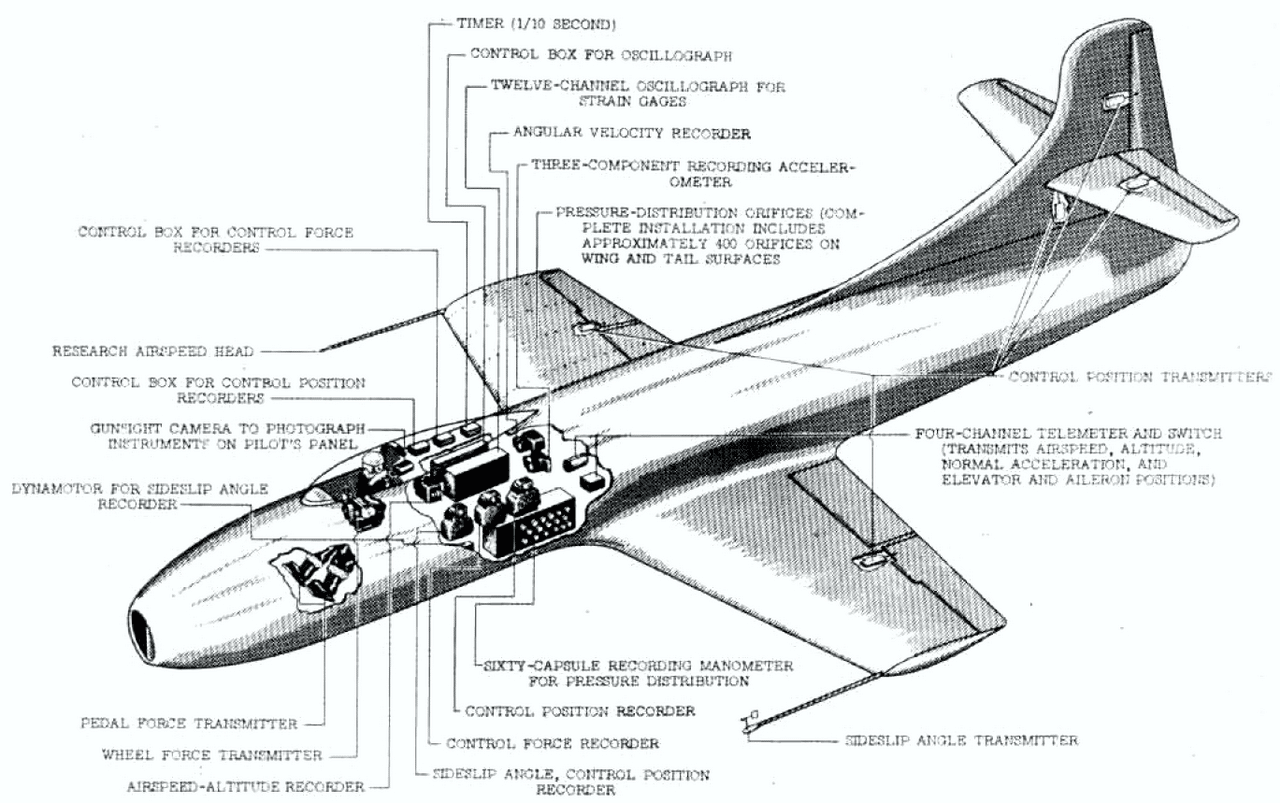
Drawing of the Douglas D-558-1 Skystreak showing the installed research instrumentation and design layout. | Source: United States Navy

An automated pressure recording system had 400 measuring points from the airframe connected to it, along with strain gauges placed on selected tail section and wing section positions. At least 500 lbs of instruments would need to be carried.

The D-558-1, known as the Skystreak, was a cantilever low-wing aircraft with large vertical tail surfaces and the horizontal tail surfaces attached one-third up the vertical fin. Tricycle retractable landing gear kept the aircraft streamlined along with the slender circular fuselage design. The aircraft would be required to take off and land on its own power.

The pilot sat in a single-seat cockpit that in an emergency would be jettisoned with the entire nose section from just rear of the pilot’s seat forward. It was intended the pilot would then bail out conventionally from this jettisoned nose section after separation and slowing.
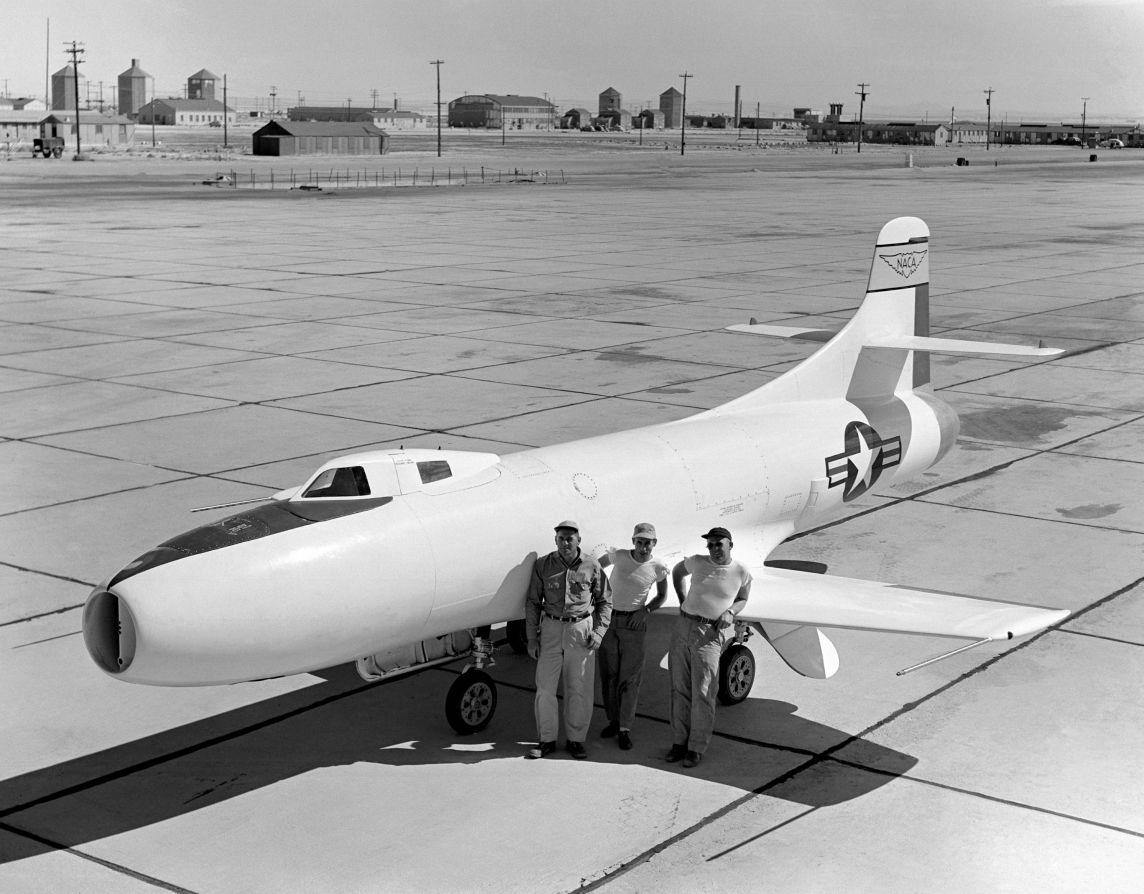
A NACA Muroc Flight Test Unit photograph taken in 1949 with the Douglas D-558-1 on the ramp. Ground crew members are seen posing against the wing of the Skystreak. The D-558-1 was designed to be just large enough to hold the J35 turbojet engine, pilot, and instrumentation and the fuselage cross section had to be kept to a minimum. The D-558-1 pilots found the cockpit cramped and could not easily turn their head. | Source: NASA

Originally fitted with a rounded windscreen, a more streamlined V-shaped unit was later installed for high-speed testing. This configuration further shrank the room in the cockpit and mandated the pilot wear a chamois covering on his helmet or a soft helmet to prevent scratching the glazing.

A total of three D-558-1s were constructed, with the first flight in the spring of 1947 at Muroc Army Air Field (Edwards Air Force Base) by Douglas test pilot Eugene F. May. Powered by a single Allison J-35-A-11 turbojet, a new world speed record was established on Aug. 20, 1947 of 640.743 mph (miles per hour) average speed by the first D-558-1 flown by USN Commander Turner Caldwell at an altitude of 75 ft [note: NASA gives 640.663 mph, while the Navy museum gives 640.743 mph]. That record was soon shattered five days later when an average speed of 650.6 mph was reached in the second D-558-1 flown by Marine Lt. Colonel Marion Carl at times at only 25 ft in altitude.

Records claimed by the Germans during the war years flying the Me 163 Komet were achieved in secrecy, without official observers and not under strict regulated conditions using timed runs, so the Komet was not officially recognized as holding the official air speed record.
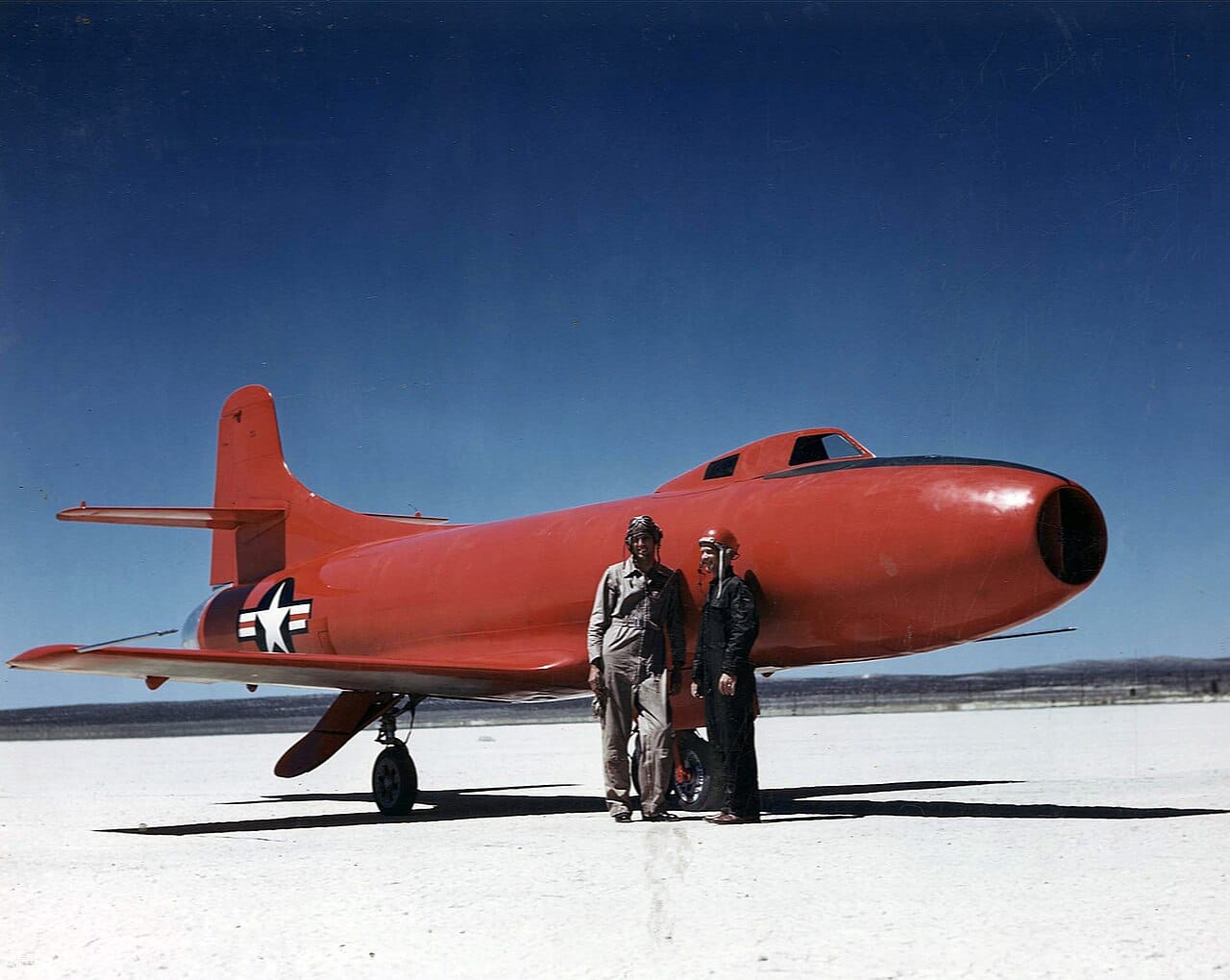
Marine Major Marion Carl (left) Navy Commander Turner Caldwell stand next to a Douglas D-558-1 Skystreak at Muroc Army Airfield. Both Carl and Caldwell established world speed records in D-558-1 type aircraft within five days of each other in 1947. | Source: United States Navy

The second D-558-1 was lost on May 3, 1948 when the engine compressor disintegrated after takeoff, killing NACA pilot Howard C. Lilly. It had completed 27 flights total before NACA instrumentation, then Lilly flew five NACA research flights in spring 1948 before the fatal crash. A third Skystreak completed a total of 82 flights by June 10, 1953. The third aircraft had been kept in operation with spares and components robbed from the first prototype: NACA 140 was never flown by NACA and was used as a spares source for NACA 142. Three additional D-558-1 examples were cancelled.

The D-558-1 held the distinction of the fastest aircraft in the world for a short time, as the bright crimson painted Skystreak was soon overshadowed by the X-1 and Captain Chuck Yeager. Eventually the paint was changed to white in order to improve visibility, tracking, and photography. The aircraft had played an important role in research flying extended periods at transonic speeds.
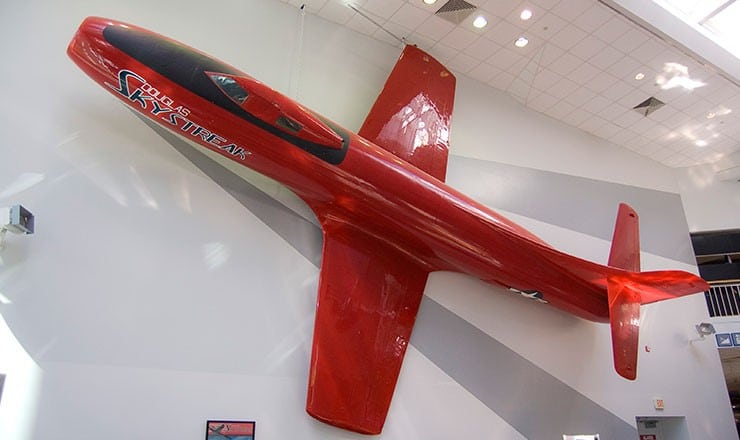
Douglas D-558-1 (Bureau No. 37970) mounted on the wall at the National Naval Aviation Museum in Pensacola, Florida. This was the first Skystreak produced and the aircraft flown by Commander Turner Caldwell on Aug. 20, 1947 when he set a world air speed record. The third and only other remaining D-551-1 (Bureau No. 37972) is located at the Sullenberger Aviation Museum at the Charlotte-Douglas International Airport, Charlotte, North Carolina). | Source: United States Navy

The Douglas D-558-2 SkyrocketΒ Β Β Β Β Β Β 

The phase-two version of a planned three-phase program, the D-558-2 became more than just a modified D-558-1. Designer Ed Heinemann determined his previous design would need extensive modifications to allow for two sources of propulsion, both jet and rocket. The fuselage would need to be larger and a smaller turbojet used. However, Heinemann also wanted to develop sweptback wings as well for the aircraft. This led to a new and different research aircraft designated the D-558-2 Skyrocket.

Three D-558-2 aircraft were substituted for the original additional three D-558-1 cancelled aircraft. Mid –set wings sweptback at 35 degrees produced a wing span of 25 ft and complemented by horizontal stabilizers swept at 40 degrees. The design retained the jettisonable nose section and tricycle landing gear of the Skystreak.
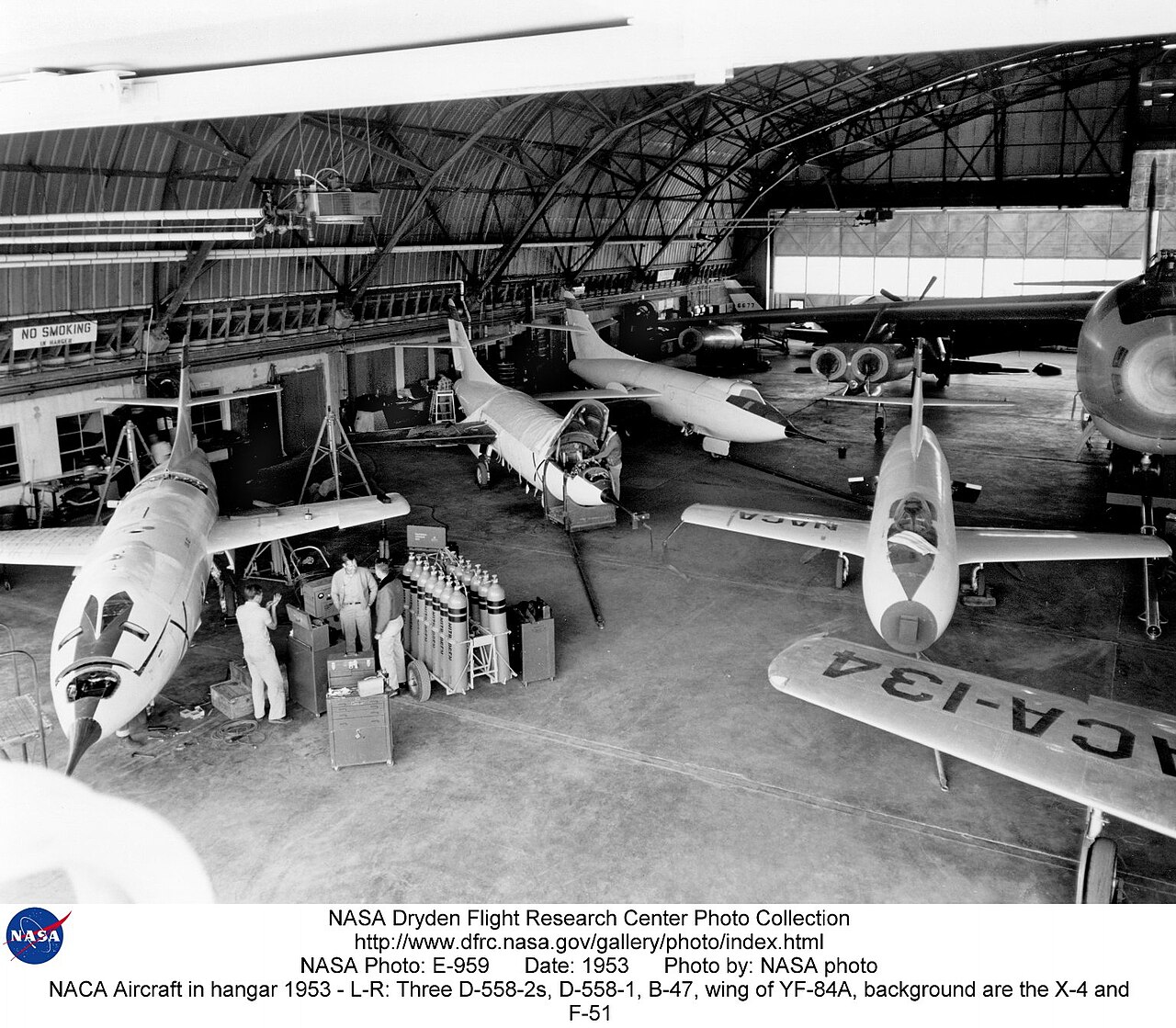
1953 photo showing an impressive lineup: All three of the D-558-2 Skyrockets, a D-558-1 Skystreak, and a glimpse of a B-47, YF-84A, F-51, and X-4. | Source: NASA

A Westinghouse J34 turbojet engine was intended to power the 42 ft in long aircraft during takeoff, climbing and landing. An additional power source, a four-chamber Reaction Motors LR8-RM-6 rocket was to be used for high-speed flight.

The flush cockpit canopy of the D-558-2 was also reconfigured with a raised cockpit and angled windows to increase poor visibility. The larger profile area had to be balanced by adding 14 inches to the height of the vertical stabilizer.

On Feb. 4, 1948, Douglas test pilot John F. Martin flew the Skyrocket for the first time at Muroc, although the aircraft was only equipped with a jet engine. It was the beginning of a successful test program in which the characteristics of swept-wing aircraft at transonic and supersonic speeds were studied. A great deal of information and data was gathered about pitch-up issues along with drag and buffeting characteristics of swept-wing aircraft traveling at high speeds.
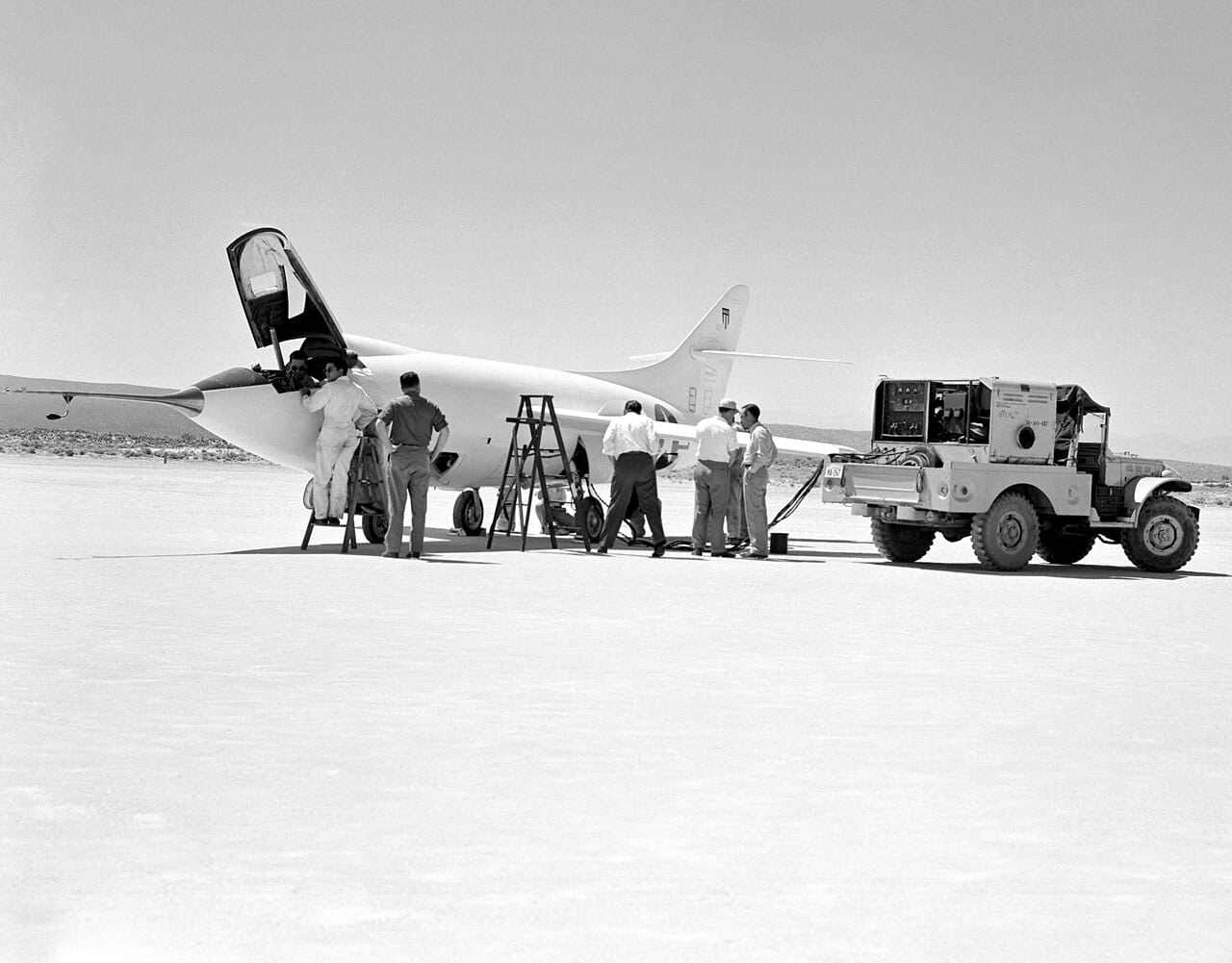
This 1949 photograph shows a Douglas D-558-2 undergoing pre-flight operations on Rogers Dry Lakebed. Prior to flight, the aircraft’s systems had to be checked out, the instrumentation calibrated, cameras and oscillographs loaded with film, and the aircraft filled with dangerous propellants. | Source: NASA

NACA 144 (Bureau No. 37974) was flown by NACA pilots Robert A. Champine and John H. Griffith 21 times to conduct testing and research on airspeed calibrations and stability and control. The turbojet engine was replaced in 1950 with an LR-8 rocket engine.

Douglas pilot Bill Bridgeman flew 37974 seven times to Mach 1.88 and to 79,494 ft setting an unofficial record at the time on Aug. 15, 1951. Without the jet engine for takeoffs, the rocket configured Skyrocket was now slung under a P2B-1S Navy variant of the Boeing B-29 bomber.
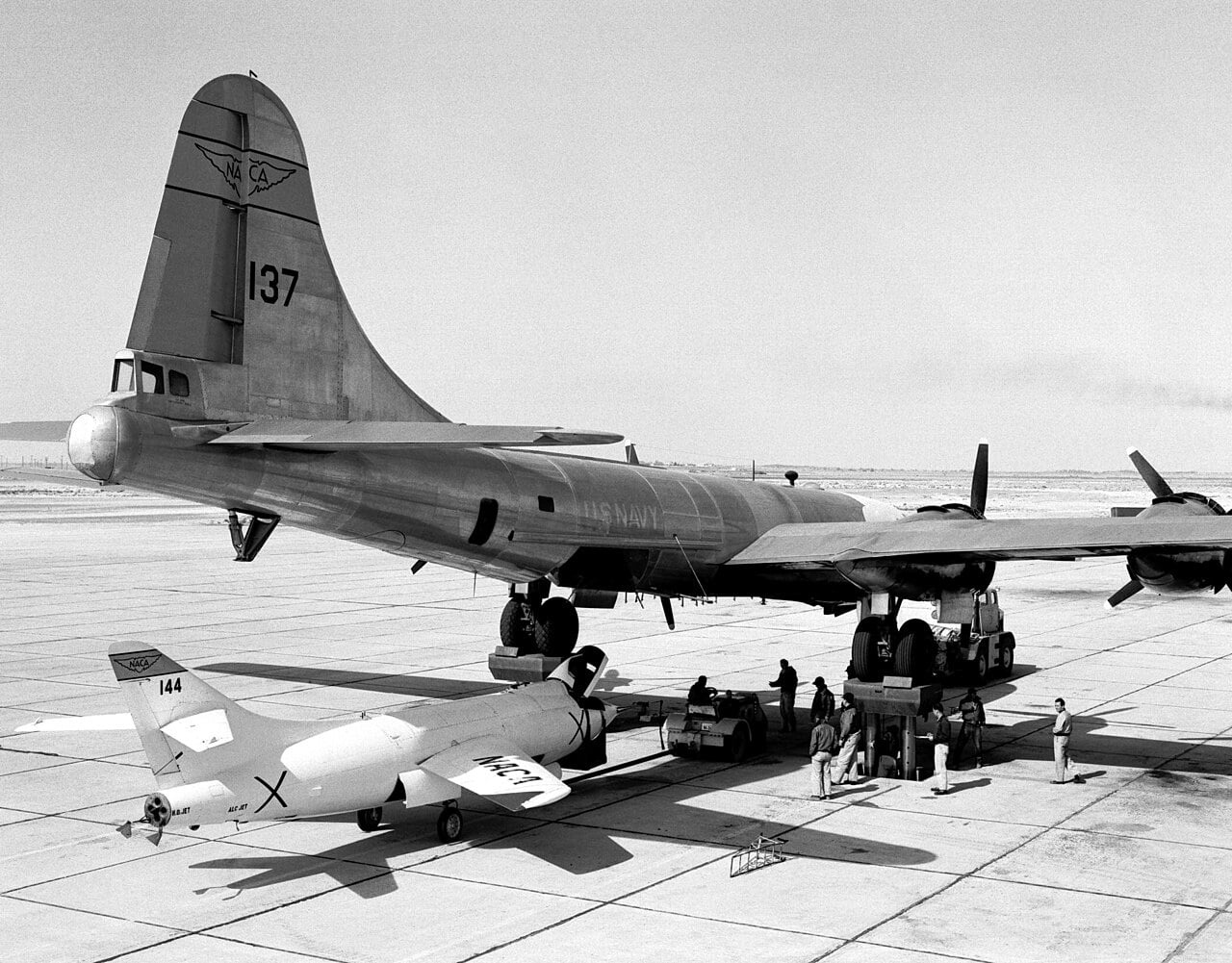
This 1953 NACA photograph shows the Douglas D-558-2 Skyrocket (NACA 144) being towed under the P2B-1S launch vehicle (NACA 137) for attachment prior to flight. The large hydraulic jacks used to elevate the P2B-1S can be clearly seeen. | Source: NASA

The P2B-1S was specially modified for the project, and would fly to 30,000 ft and drop the D-558-2. Known as β€˜Fertile Myrtle’, aircraft 84029 would be used as the β€˜mothership’ to launch Skyrocket aircraft during the 1950s. Identified with the call sign β€˜NACA 137’, the P2B would be placed on jacks in order to provide the needed clearance for loading the Skyrocket to its attachment points under the heavily modified bomb bay. The D-558-2 would be dropped from its cradle at altitude, its pilot firing the rockets once clear of the P2B.

Issues with lateral instability were noted during Bridgeman’s supersonic flights, leading NACA engineers to study the aircraft’s behavior prior to their own flight research that began in Sept. 1951.
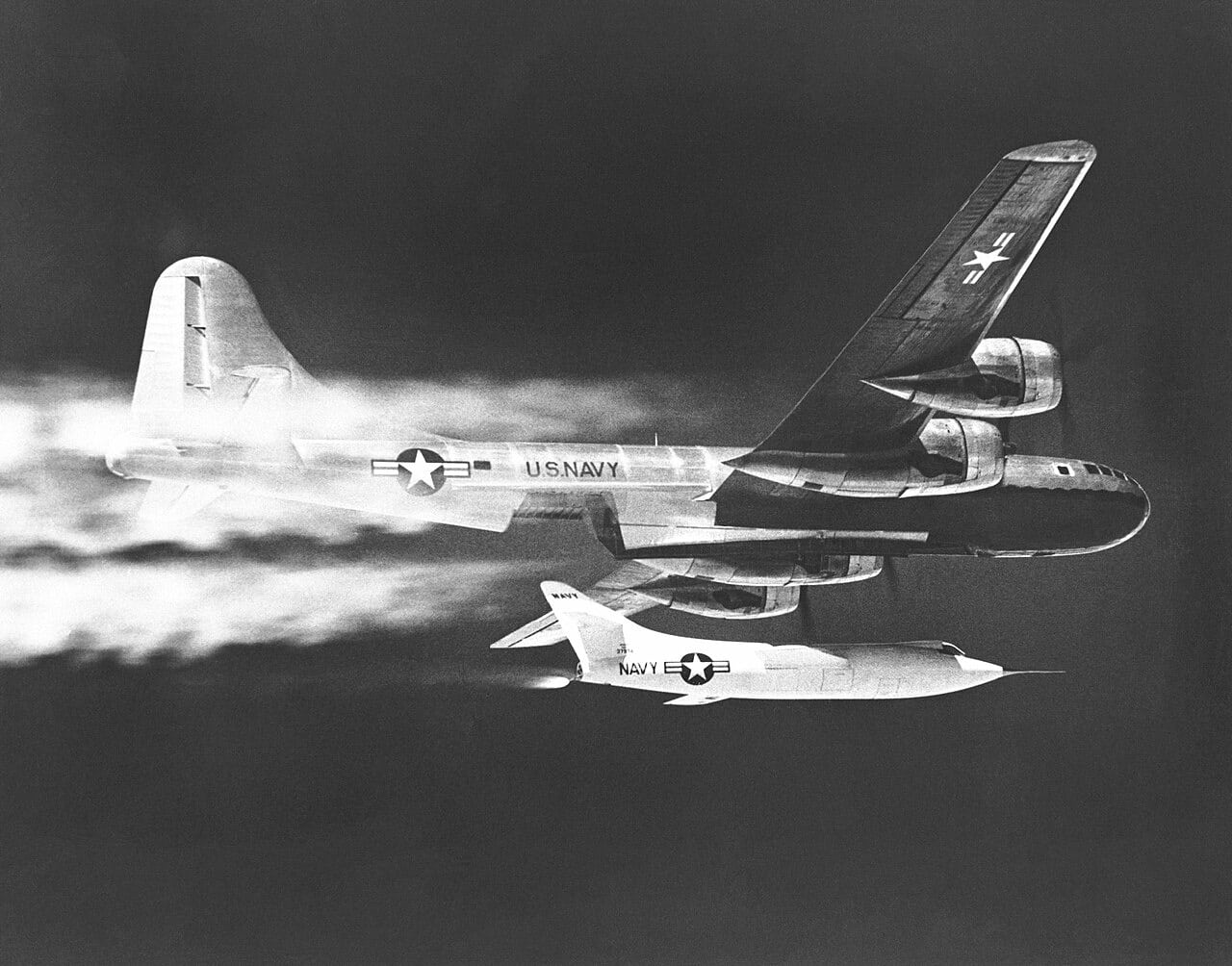
D558-2 Skyrocket just after release from the P2B mothership. | Source: NASA

Preparing for twice the Speed of Sound

NACA test pilot Albert β€˜Scott’ Crossfield had flown the Skyrocket 20 times over a period of approximately two years, gathering data and studying longitudinal and lateral stability along with control as well as lift, drag, and buffeting characteristics of the aircraft at supersonic speeds up to Mach 1.878.

Marine pilot Lt. Colonel Marion Carl took the aircraft to an unofficial record altitude of 83,235 ft on Aug. 21, 1953, hitting Mach 1.728 during the flight. Since the aircraft did not take off on its own power, the altitude record was not recognized. After Carl’s flights, NACA engineers added nozzle extensions to the LR-8 combustion chambers in order to prevent exhaust gas from affecting the rudder. Engine thrust was also increased by 6.5 percent.
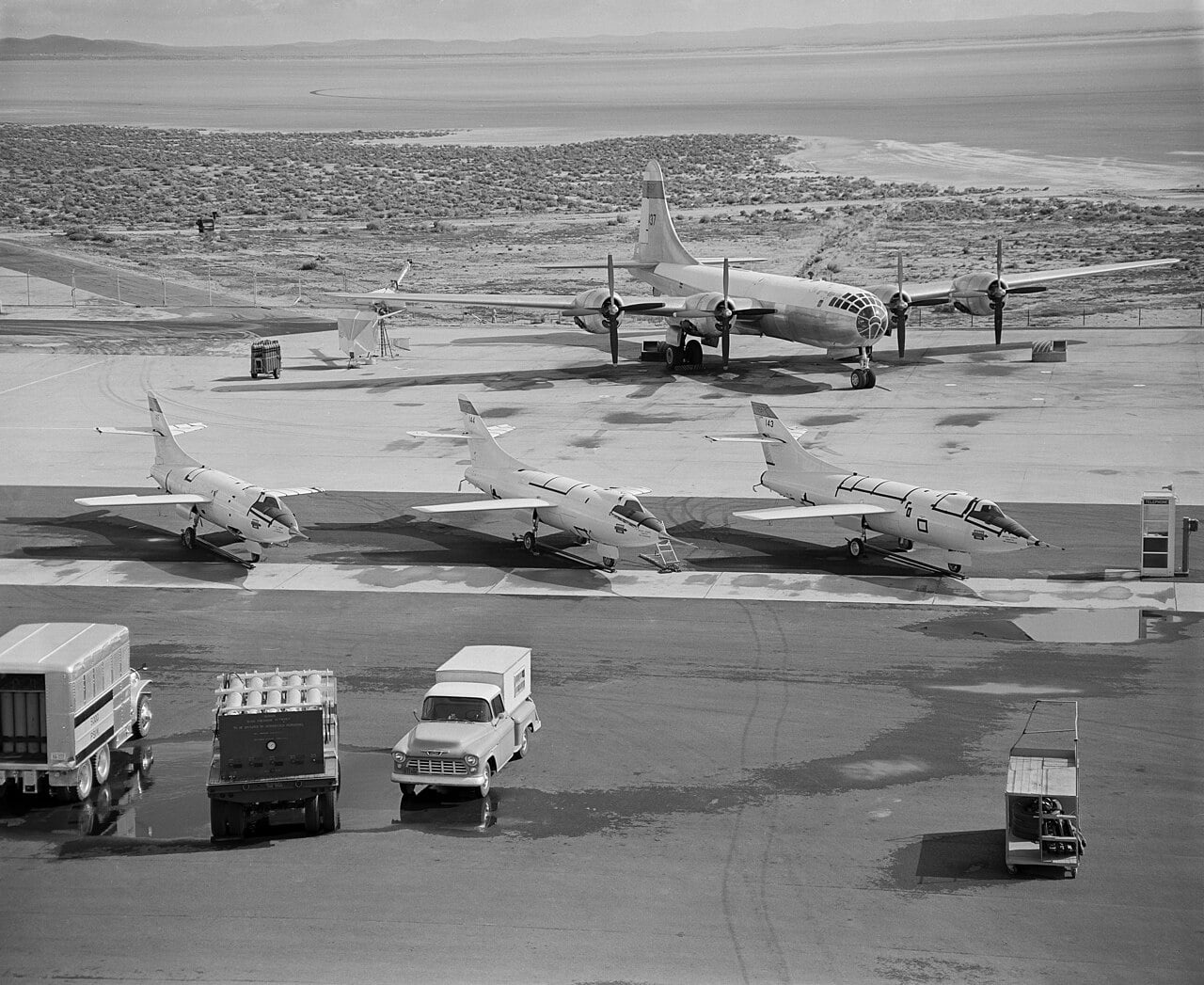
All three D558-2 Skyrockets along with the P2B mothership fill the ramp. | Source: NASA

After securing an agreement with the Navy’s Bureau of Aeronautics by Crossfield, NACA allowed the attempt of a record-setting Mach 2 flight in the aircraft.

The NACA flight team personnel waxed the fuselage of the Skyrocket to reduce drag, and chilled the fuel so the tanks would hold more, and fueling the aircraft hours ahead of time gave the fuel time to settle allowing for additional fuel to be added later. Masking tape was placed over any drag inducing cracks, and the stainless steel prime and jettison tubes were replaced with lighter aluminum.

The tubes were bent into the blast of the rocket engine allowing them to be burnt off and fall away from the aircraft once no longer needed, saving a few more pounds. The plan called for reaching 72,000 ft and pushing over into a slight dive. It was hoped the 200 second blast of her rocket engine would push the aircraft past Mach 2.
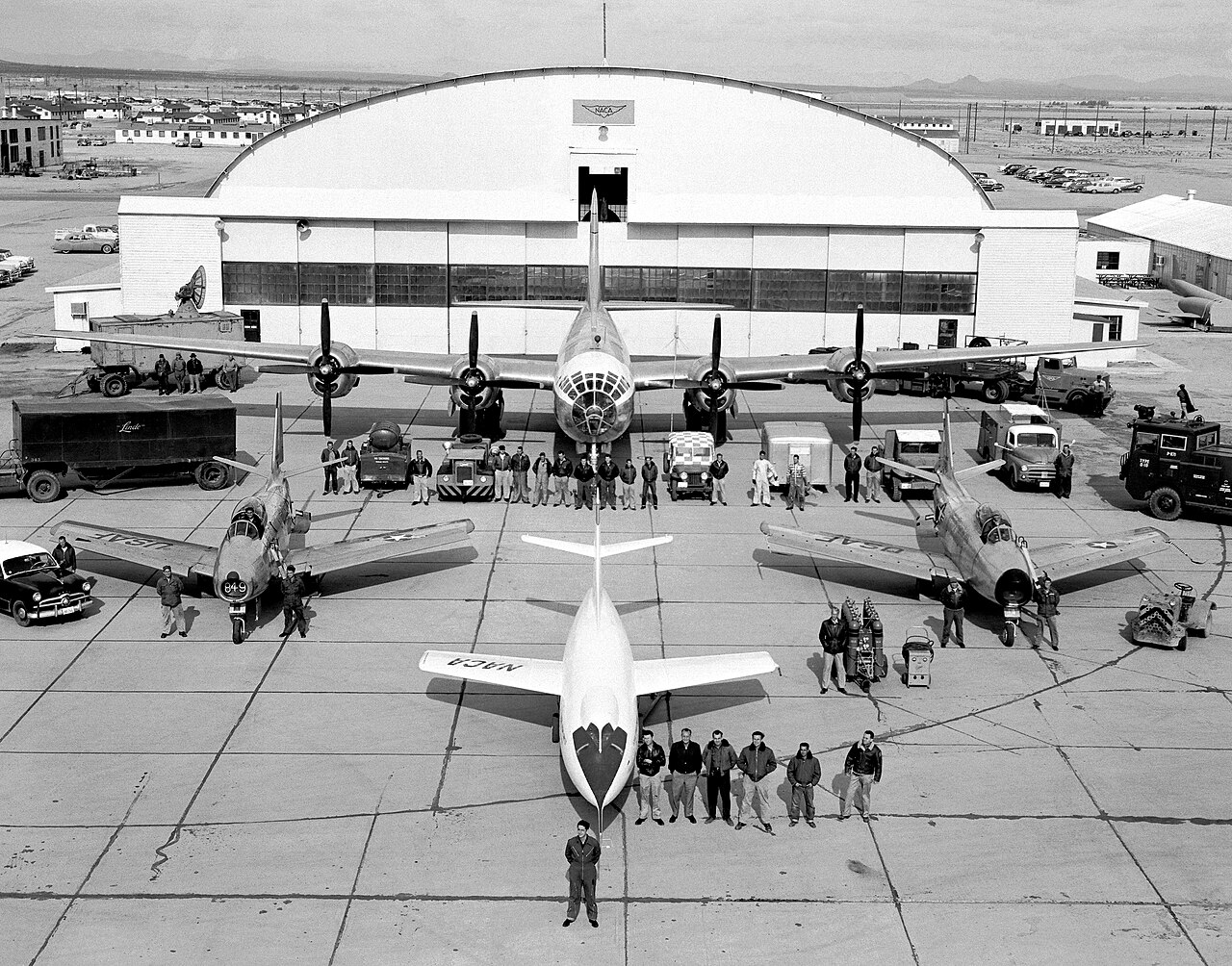
The people and equipment that supported the flight of the NACA D-558-2 Skyrocket at Edwards AFB. Visible are two F-86 Sabre chase planes, the P2B-1S launch aircraft, and an assortment of ground support equipment, including communications, tracking, maintenance, and rescue vehicles. NACA pilot Scott Crossfield stands in front of the Skyrocket. | Source: NASA

Weak from a bout with the flu, pilot Scott Crossfield approached the P2B sitting on the desert ramp on a cold blustery Nov. 20, 1953. The D-558-2 was tucked under the mothership with mechanics bundled against the cold swarming the scene. Pipes, hoses, and cords plugged equipment carts and fuel trucks into the needy Skyrocket. It was not yet daybreak.

While loading hydrogen peroxide fuel onto the aircraft in the freezing temps and darkness, an accident almost delayed the flight. A frozen vent fitting caused by the β€˜cold soak’ practices earlier to allow more fuel capacity had caused the dangerous liquid to burst out of an untapped port showering a P2B launch panel operator in the face. The peroxide was so potent that a rag doused in it would burst into flames. The affected operator, however, due to the quick reaction of a nearby mechanic who sprayed him in the face with a fire hose, only suffered temporary white blotches that lasted a few days. The show went on.
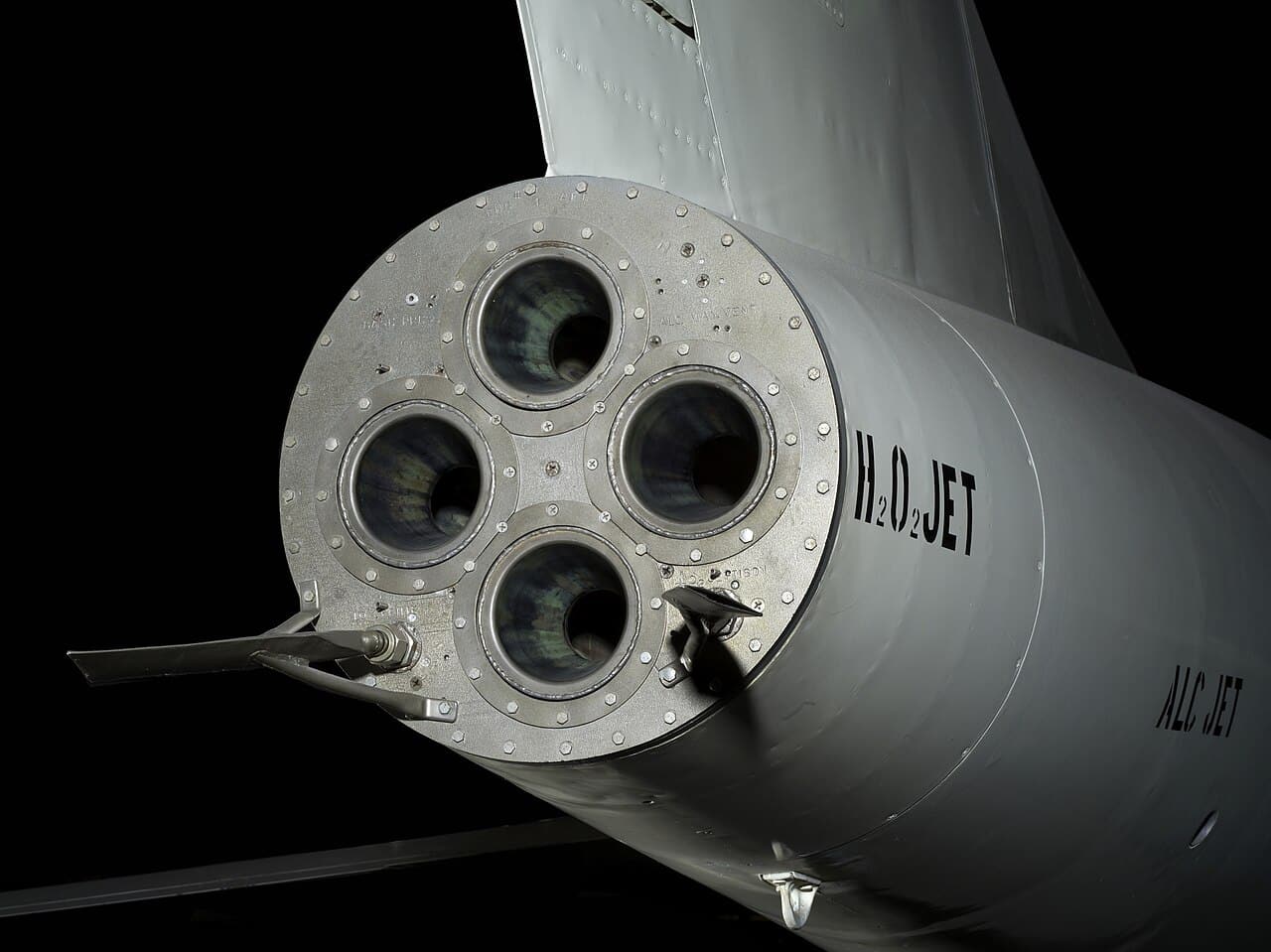
View of the rear of the D-558-2 and the rocket exhausts. | Source: Mark Avino/Smithsonian National Air and Space Museum

Taking the Skyrocket to Mach 2

When the P2B reached 10,000 ft, Crossfield got into the cockpit of the D-558-2. He would be required to pressurize the cockpit, an experience that produced a sudden burst of gas into the cockpit, not a gradual process. The sudden burst could wreak havoc on human sinuses, and the influenza Crossfield was battling could exacerbate the situation. Scott had brought along a small cork, placing it in the compressed-air inlet tube and gradually easing it out slowly as he turned the valve on. The pressurization gauge slowly reached the green and caused Crossfield no pain or difficulty. The aircraft combination continued on to the launch point.

As the Skyrocket fell away from the belly of the mothership, blinding sunlight hit Crossfield’s eyes. The ship rolled naturally to the right, and he hit the rocket-barrel switches; pausing a split second until each one caught. The D-558-2 surged forward and the horizon disappeared from view. Soon the P2B was below and behind.
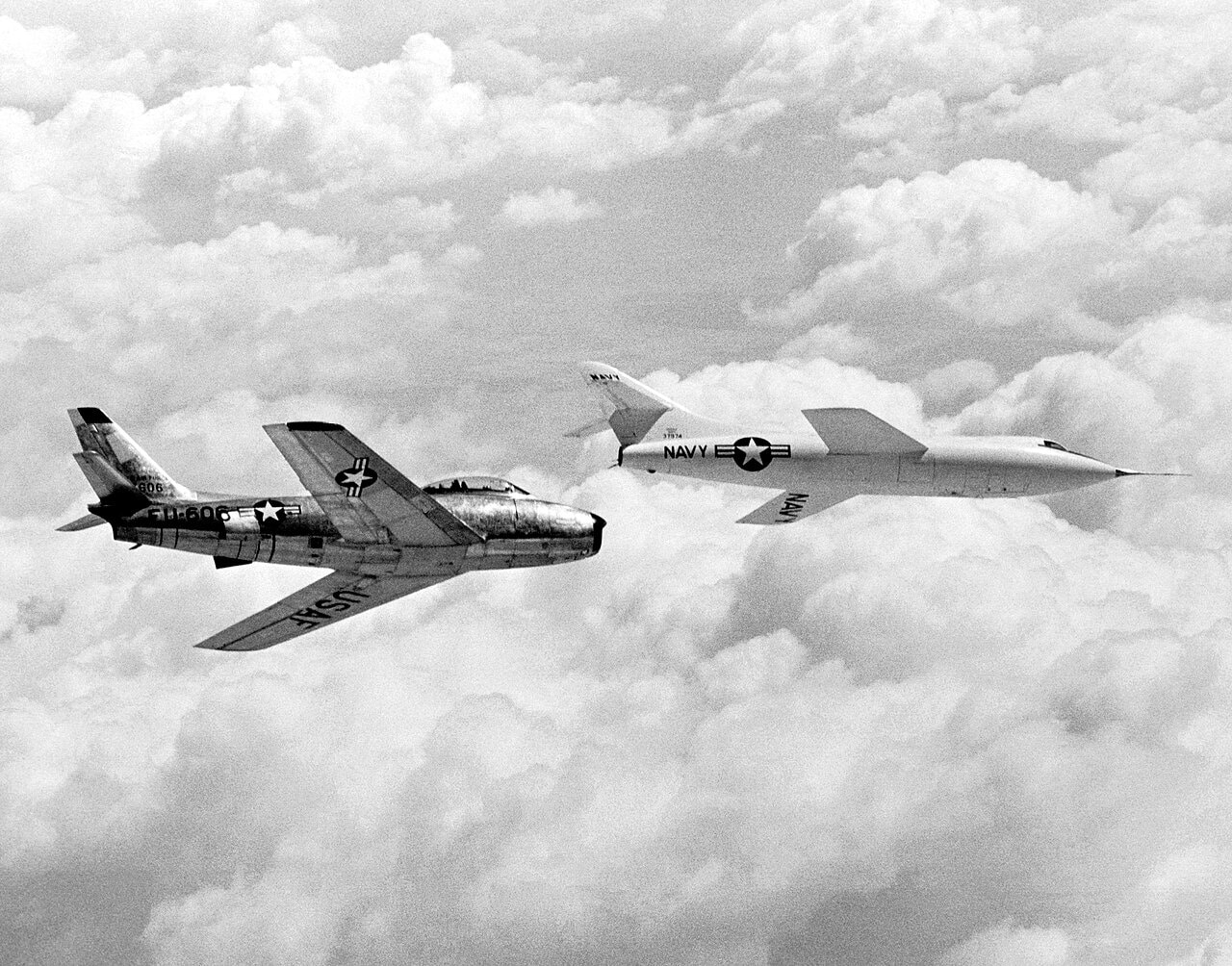
Douglas D-558-2 Skyrocket and a North American F-86 Sabre chase aircraft in flight. | Source: NASA

Crossfield now had a total of 200 seconds to accomplish his goal. This would be his only chance. As he approached 72,000 ft, he began the pushover with the rocket engines burning furiously. The Skyrocket was living up to its name in this most spectacular dive. Scott closely monitored the Mach needle, and as the fuel lasted an incredible 207 seconds, the needle edged past Mach 2 and stayed at Mach 2.005. He had become the first man to fly twice the speed of sound with the instruments on board the Skyrocket recording the data automatically. The risky β€˜cold soak’ process had paid off with an extra seven seconds. The altitude of the Mach 2 peak was about 62,000 ft.

As the engines cut out and the D-558-2 entered thick air, it slowed dramatically throwing Crossfield forward in the shoulder straps. Still coasting at Mach 1.8, he dropped back to Mach 1.0 with the aircraft shaking violently but briefly.

A dead stick landing was the next challenging part of the flight as Crossfield approached the dry lake bed at 15,000 ft performing a victory roll. Chase planes soon lined up on his wing tips guiding him down. The Skyrocket touched down between two painted black lines exactly where it was intended to land, rolling to a complete stop 12 minutes after being launched.
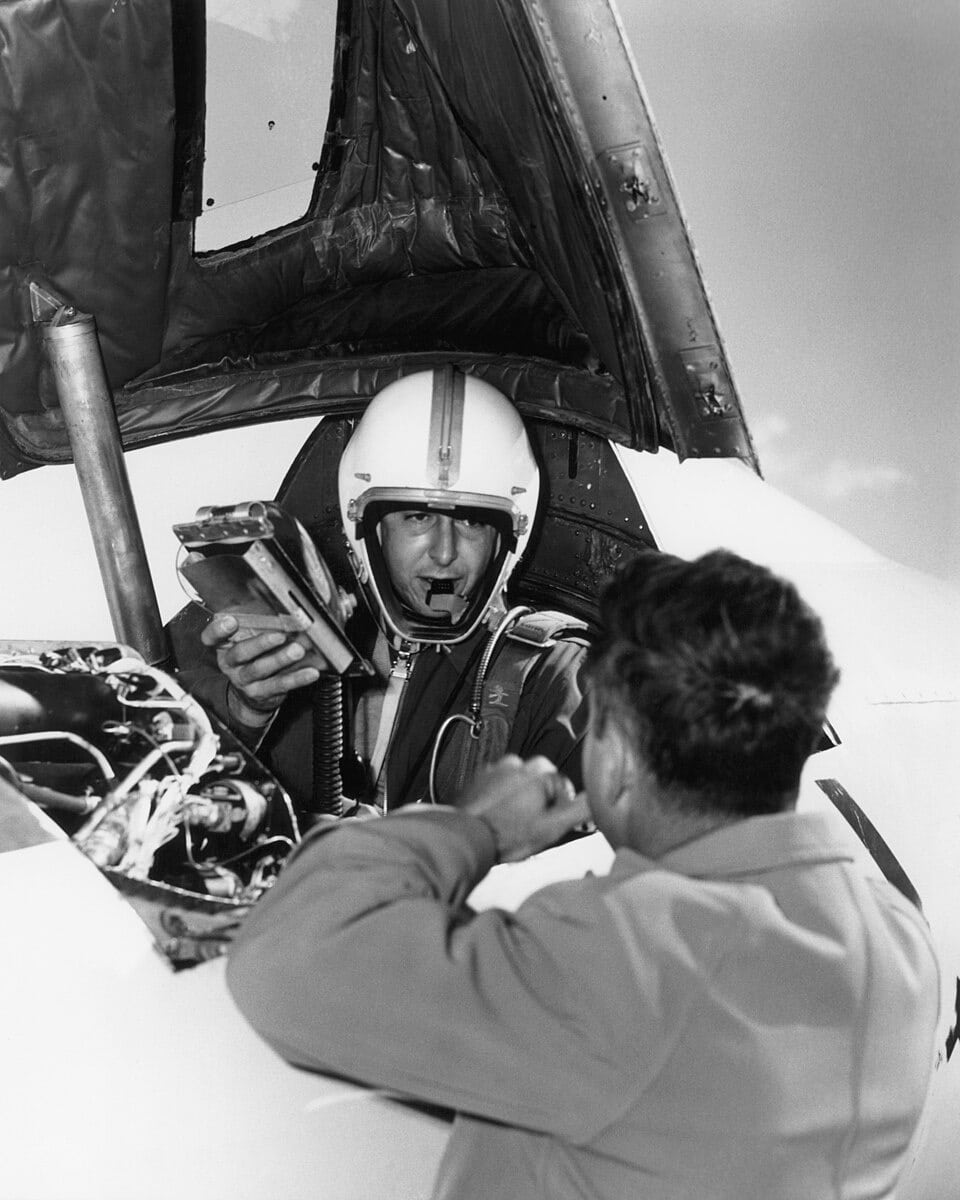
NACA pilot Scott Crossfield in the cockpit of the D-558-2 after the Mach 2 flight. | Source: NASA

Surviving Skyrockets

The three D-558-2 aircraft flew 313 times setting several records and gathering invaluable data. This data would go on to aid in the design of future aircraft, including the Century Series of fighter aircraft.

The program ended with the last flight on Dec. 20, 1956. A third version of the aircraft, the D-558-3 Skyflash, was an ambitious Mach 9 performer with space capabilities was abandoned in favor of the North American X-15.
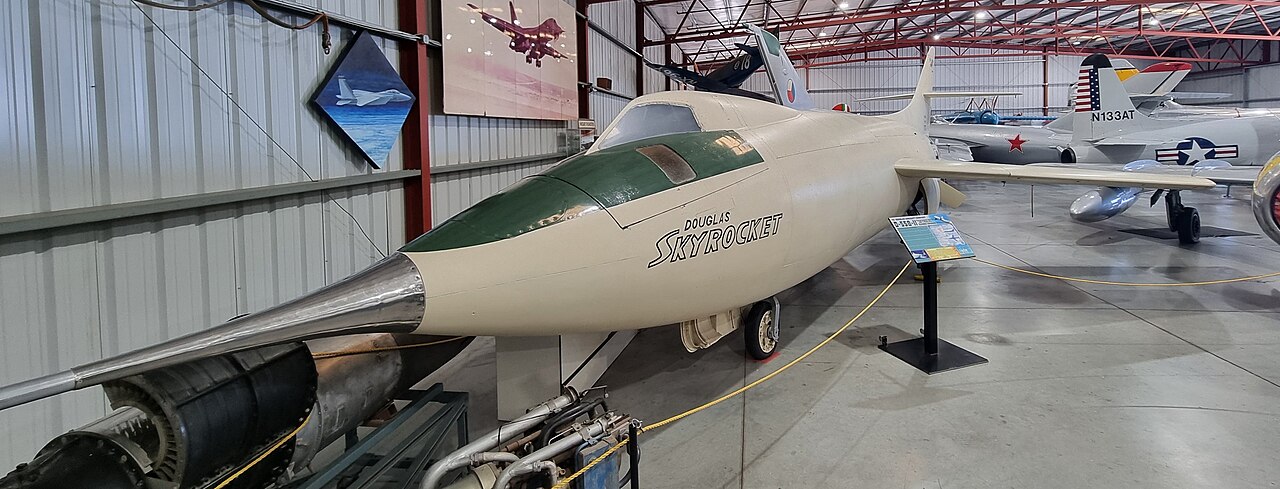
: Douglas D558-2 (37973), the first Skyrocket built, on display at the Planes of Fame Museum in Chino, California. | Source: Wikimedia Commons

All three of the D-558-2 Skyrockets have been preserved. The first example built is on display at the Planes of Fame Museum in Chino, California.

The second example, the one Crossfield took to Mach 2, resides at the National Air and Space Museum in Washington D.C., and aircraft number 3 is mounted on a pylon at the Antelope Valley College in Lancaster, California.
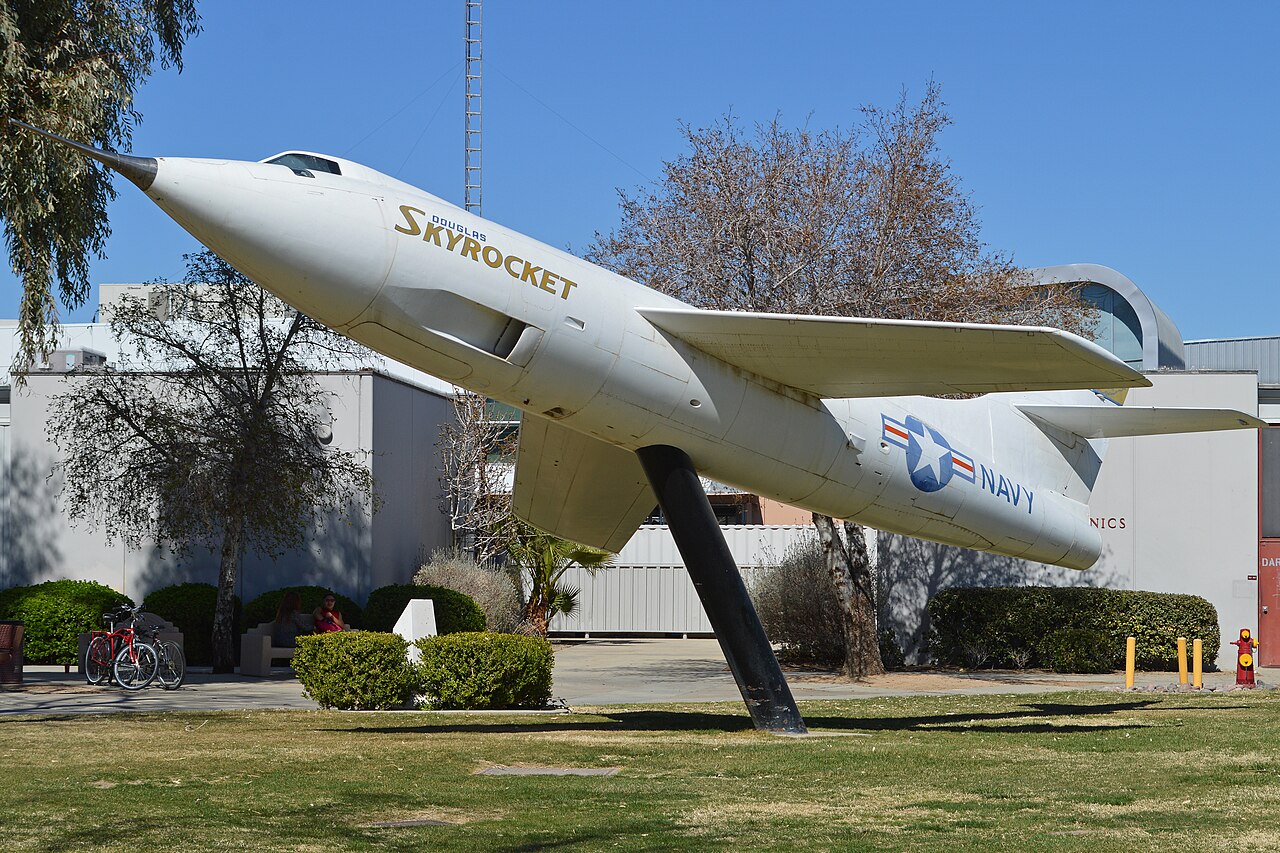
The third and final D-558-2 on display on a pylon at Antelope Valley College in Lancaster, California. | Source: Wikimedia Commons
Before yesterdayThe Aviationist

Photo-Recon in Pink: The Story of the Colorful PRU Spitfires

24 August 2026 at 22:48
PRU Spitfires

In an obscure and perhaps less glorious role, Britain’s well-known World War 2 fighter excelled at important photo-reconnaissance missions while donning some unusual paint schemes.

Sometime in 1939, a Royal Air Force (RAF) officer made an observation that the current method of utilizing modified bombers, which were heavy and slow, for photo reconnaissance missions was that the opposite would be more effective. His idea was for a small, light, high-performance aircraft flying unarmed to save weight, that could evade enemy air defenses and fighter aircraft more easily and safely than the larger well-armed bombers.

Eyes in the Sky

As early as 1911, the value of aerial photographic reconnaissance was known, and, during World War 1, cameras were used in aircraft by opposing nations in attempts to gain the upper hand. In early 1939, war was once again just months away.

A photo-reconnaissance unit (PRU) had been established by the British at Heston, near London, and commanded by Sidney Cotton. Cotton thought outside the box and was considered a genius when it came to photography. He had been experimenting with various aircraft for PR (Photo-Reconnaissance) use, and concluded that Britain’s premier fighter aircraft of the time, the Supermarine Spitfire, was best suited for fulfilling the role.

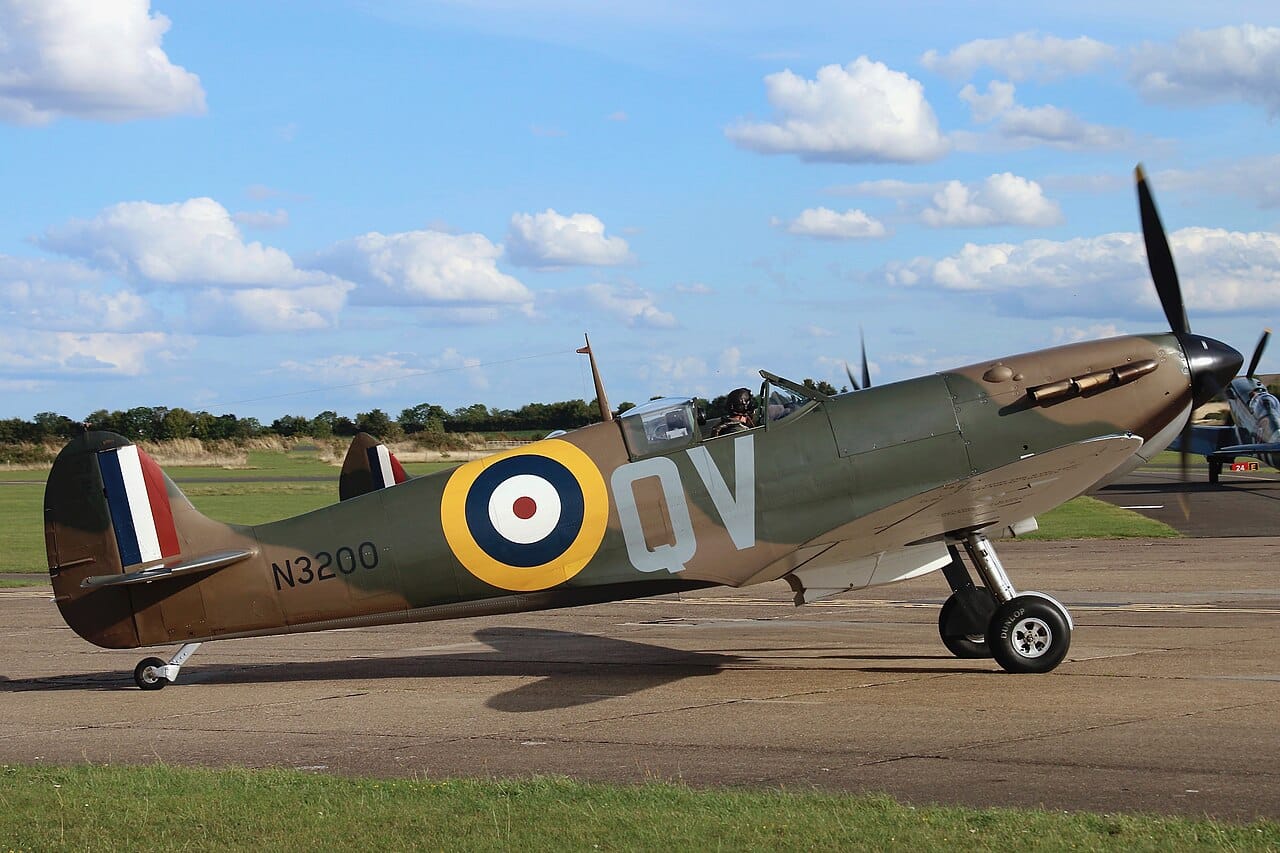
Supermarine Spitfire Mk 1 (N3200) at Duxford on Oct. 5, 2025. | Source: Wikimedia Commons

However, being a frontline fighter, demand was high for the aircraft and Cotton had no luck acquiring the type for PR duties. Finally, after seeing Air Officer Commanding-in-Chief Sir Hugh Dowding of Fighter Command in October 1939, he was granted two Spitfires. They arrived at Heston the next morning.

The First PR Spitfires

The two Spitfires to be converted to PR duties were Mk Is. All armor and armament was stripped of the aircraft and F.24 cameras mounted in each wing. The external surfaces of the aircraft were given a hard smooth glossy finish. All this resulted in the now pale duck-egg greenish aircraft attaining a top speed to close to 400 mph.

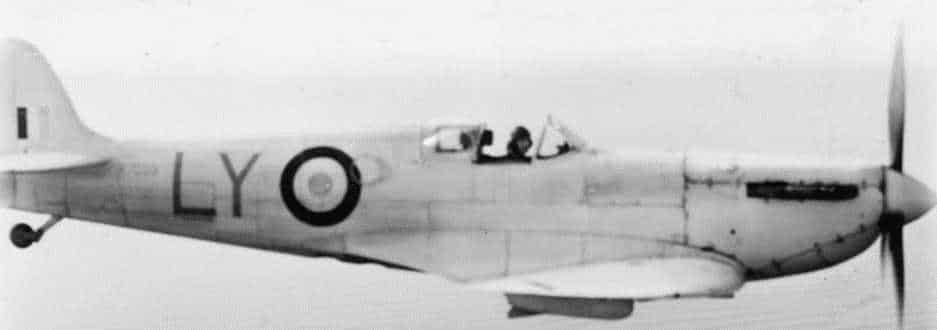
PR Spitfire of the No. 1 Photographic Reconnaissance Unit of the Royal Air Force based at Heston, 1941. | Source: Royal Air Force

On Nov. 18, 1939, the first Spitfire PR mission was launched from Seclin, France. Flown by Maurice β€˜Shorty’ Longbottom in Spitfire N3071, the sortie was aborted due to bad weather. Longbottom would go on to complete a total of 15 PR flights up until Jan. 10, 1940.

On ten of the flights he returned with photos taken over enemy territory that covered 5,000 square miles. He demonstrated his idea that PR results could be best obtained by an unarmed fighter relying on speed to escape instead of an armed heavier aircraft. This would be the method used by the Royal Air Force (RAF) throughout the war.

Early in 1940, the PR organization at Heston continued to expand and added more pilots and aircraft. By June 18, the unit had 11 Spitfires and was placed under the No 16 Group, Coastal Command with Wing Commander Geoffrey Tuttle in command.

Three of the units Spitfires were the newer PR 1c models which incorporated a fuselage camera mounting system and a β€˜blister’ canopy that would become a distinction of most future PR Spitfires. In late December, the PRU was moved to Benson in Oxfordshire to avoid bombing by the Germans.

Close look at Supermarine Spitfire PR IG (R7059). Built as a Mk I, it had a β€˜limited conversion’ and flew reconnaissance missions over French ports including Brest, observing the German battle cruisers. This version would later be re-designated PR Mk VII and still carried eight machine guns along with one oblique and two vertical cameras in the rear fuselage. | Source: Royal Air Force

Pretty in Pink

Modifications continued to progress on the PRU Spitfires, with one issue requiring much thought and experimentation was the camouflage finish to be applied to the aircraft. An unarmed aircraft needed every advantage it could get, and remaining unseen was paramount to accomplishing important missions.

After the initial duck-egg green finish and the testing of several schemes, two found their way to the surfaces of most PRU aircraft. The first color, applied mostly to the aircraft operating at medium to high altitudes, would be a unique shade of blue known as PRU Blue (BS 636). This blue was also applied to the lower surfaces of some high altitude fighters.

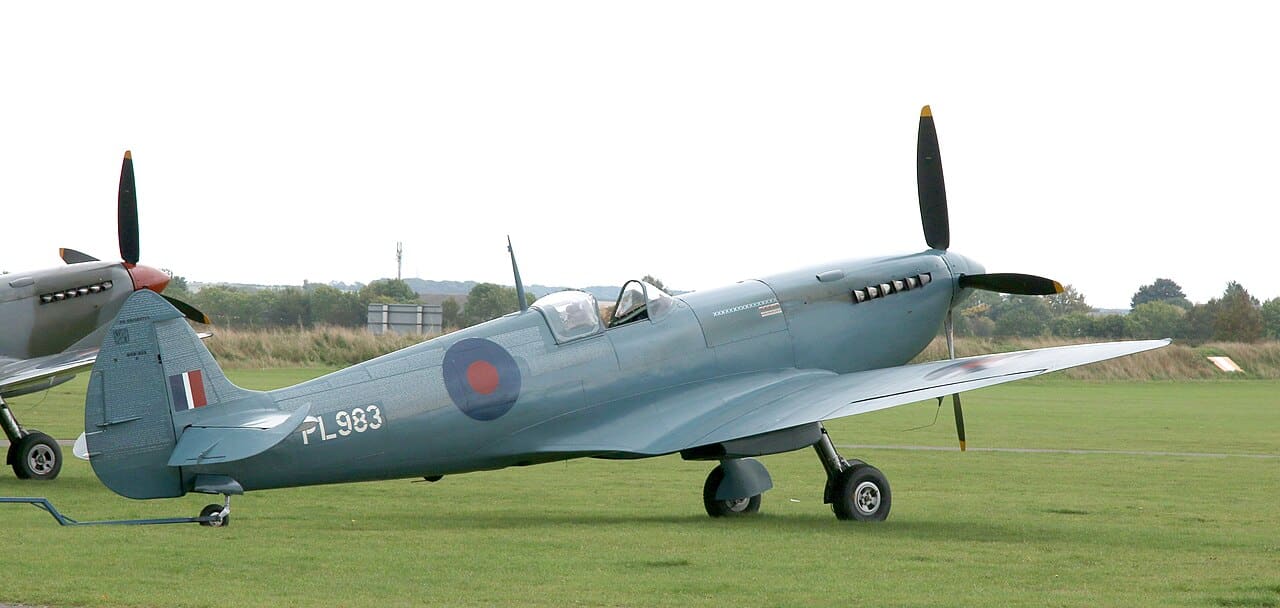
Spitfire PR XI (PL893) on display at Duxford sporting PRU Blue, Oct. 22, 2021. A total of 471 PR XIs were produced, serving until 1947. Three were sold to Denmark and continued to serve well into 1955. The PR XI had a negative-g carburetor fitted during the production stage and was capable of over 400 mph at high altitudes. | Source: Wikimedia Commons

PR Spitfires that were expected to be flown at lower altitudes, particularly during early morning or late evening when the skies took on various shades of mauve, pink, and orange, were painted a pale pink shade to blend in with the surrounding colors of the sky and the clouds. This was found to be effective at hiding the aircraft. This pale pink was only applied to PRU aircraft and became known as PRU Pink.

The idea to use a pink hue seems to have originated with Lord Mountbatten, who had the idea that naval ships should be painted a greyish mauve color in order that they would blend in with the early morning or late evening skies and reflections on the water, making the ships more difficult to spot or distinguish. Some sources list the color used on the PR Spitfire as the same as what became known as Mountbatten Pink from the naval applications, but PRU Pink was a much paler almost off-white color with a pinkish hue.

It has been described as almost appearing white until something white is placed next to it, then it takes on a slight pinkish hue. Many current renditions of the color on restorations or scale models display a much more vibrant pink color, creating an attractive and unique visually stunning aircraft.

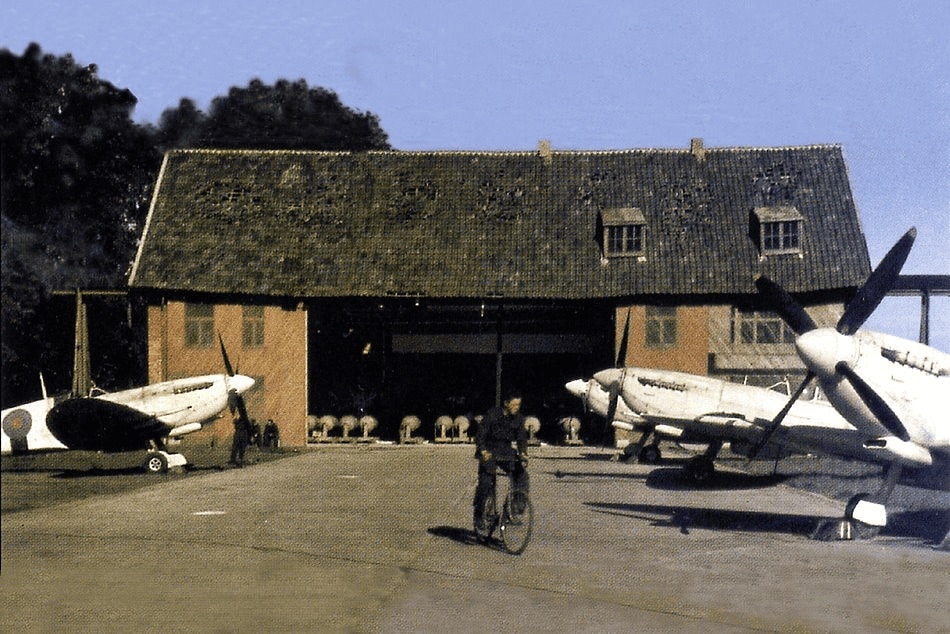
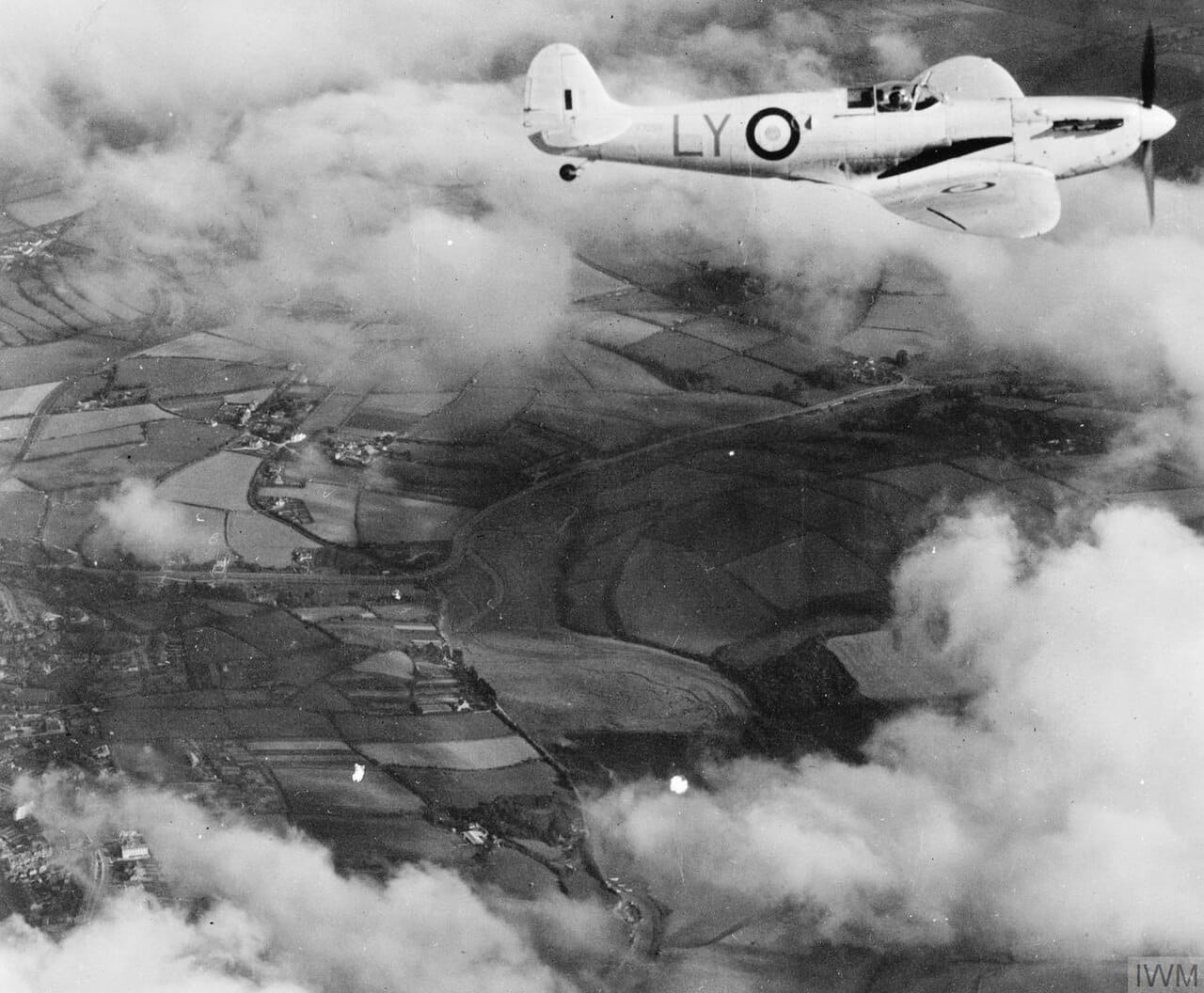
Period photograph thought to be genuine of PRU Spitfires in PRU Pink clearly showing the almost white appearance. It is reportedly taken with a captured German color camera. | Source: Royal Air Force

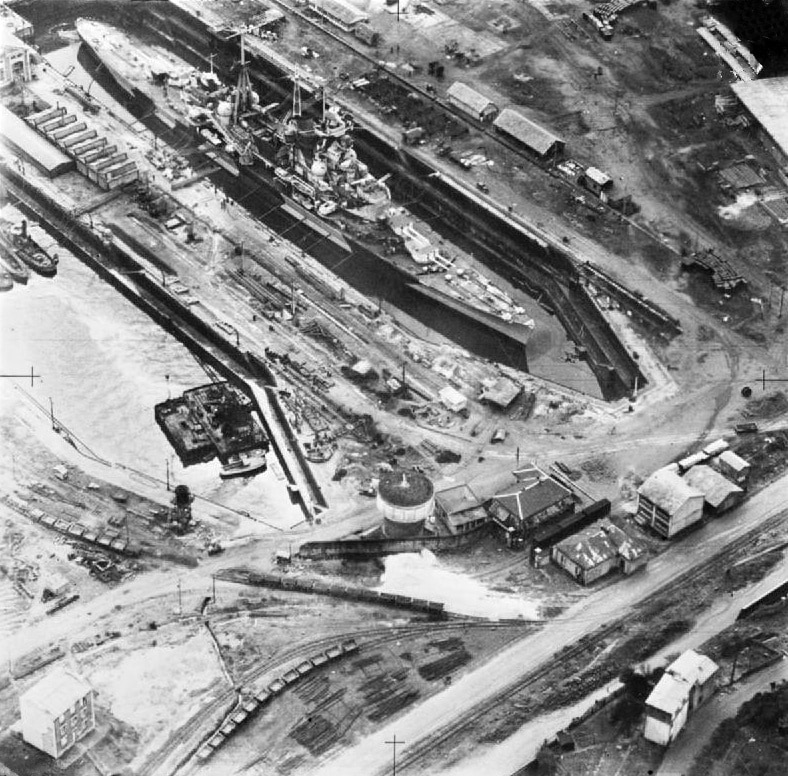
While highly effective at hiding the aircraft, it was reported that PR pilots were not exactly fond of flying a pink aircraft. However, PRU Spitfires are responsible for gathering important photographs during the war, including discovering the battleship Bismarck and cruiser Prinz Eugen on May 21, 1941, nestled in a Norwegian fjord as it was attempting to break out into the Atlantic to execute convoy raiding duties.

Photograph of Admiral Hipper German cruiser in dry dock at Brest, taken by a PR Spitfire in 1941. | Source: Wikimedia Commons

Continued Development

Variations and upgraded modifications, such as increased fuel capacity which increased range, continued to evolve the aircraft, and camera systems were revised for low or high altitude operations. One version, known as the FR. Mk XIX, was designated as a β€˜Fighter-Reconnaissance’ type, since it added a fuselage mounted camera but maintained its standard gun armament. PR Spitfires flew with other countries as well, including the United States and went on to fly missions for years after the war.

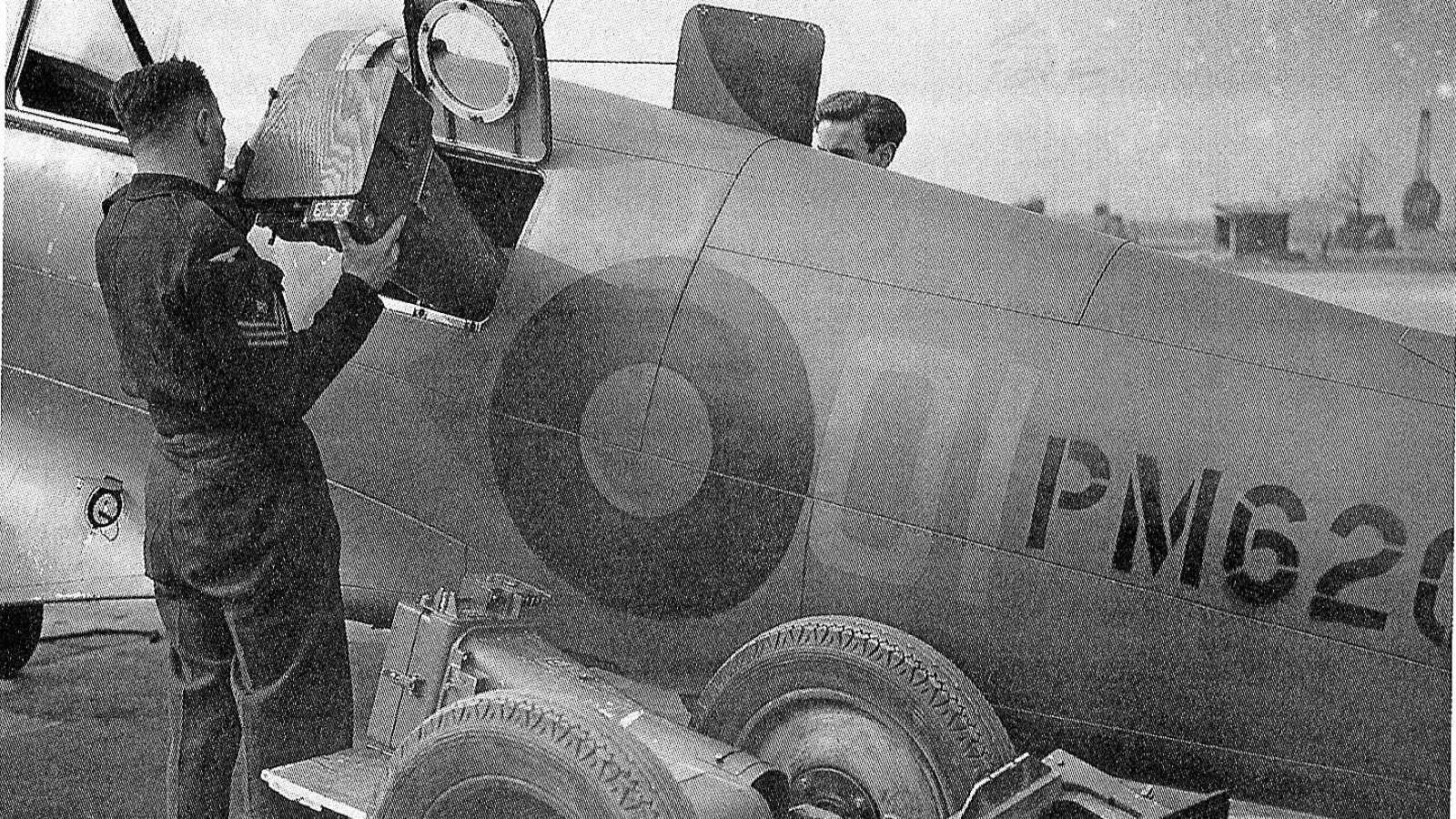
A pair of F52 cameras being loaded into a PR Mk XIX (PM620). These cameras were remotely controlled by the pilot and proved highly effective. | Source: Royal Air Force

The last and most capable PR Spitfire was the Griffon-powered PR Mk XIX. Like some of its predecessors this version featured a pressurized cabin but with improved pilot visibility. It arrived during the final weeks of the war. It was said that at high-altitudes and in the hands of a capable pilot, the PR Mk XIX could evade a Me 262 jet fighter, and do so easily.

Bent Wing Beauty: How the F4U Corsair got its Distinctive Look

3 August 2026 at 23:44
F4U Corsair

Despite the ability to create a more streamlined and aerodynamic design with inline engines, the U.S. Navy stayed with the radial engine design, asking Pratt & Whitney to develop the largest and most powerful radial aircraft engine at the time.

During the late 1930s, the trend for power plants for fighter aircraft was shifting more and more towards inline engines. Pratt & Whitney was even asked by the U.S. Army Air Corps (USAAC) to concentrate on developing inline liquid cooled engines and abandon the radial all together. However, the U.S. Navy (USN) recognized the advantages of the radial and that development of the design was essential for their uses.

In 1938, the USN issued a design completion for a new shipboard fighter powered by a powerful radial engine. This engine would be so powerful and require such a large propeller that it would strongly influence the design of the new aircraft and create an instantly recognizable aircraft profile, feared by enemies and loved by aviation enthusiasts the world over.

Why the Radial

The USN understood that radials were much simpler to maintain. The design was rugged; it could absorb battle damage and still continue flying. An inline engine was much more susceptible to taking hits in the cooling system that could cause the engine to seize. The cooling systems used with the inline designs also added complexity and required more maintenance. The radial engine was dependable as well.

While not appearing sleek and aerodynamic, the U.S. Navy found the radial engine to be rugged, dependable, and easy to maintain. The R-2800-8 shown here in a Corsair could produce 2,000 horsepower for takeoff. | Source: Wikimedia Commons

In Europe, both the Germans and the British had favored the inline designs for the majority of fighter aircraft, but the Japanese stayed with the radial design for most of their fighter aircraft in the Pacific. The German Focke Wulf Fw 190 was also equipped with a radial engine.

The V-166B

With the Navy issuing the design competition in February 1938 demanding a shipboard fighter that could match the best land-based fighters, Vought responded with two designs that were similar. They were known as the V-166A and the V-166B.

The V-166A was to be fitted with the existing Pratt & Whitney R-1830 Twin Wasp engine. The V-166B was to incorporate the new supercharged XR-2800-2, pending successful development of the power plant.

Pratt & Whitney R-2800 radial engine. | Source: Wikimedia Commons

The XR-2800-2 Double Wasp was rated at 1,850 horsepower at takeoff, way above anything in the inventory of the USN at the time. In order to harness the available horsepower and put it to good use, Hamilton-Standard produced a huge three-bladed propeller with a diameter of 13 ft 4 in.

The largest propeller ever designed for a fighter aircraft presented challenges to the design team lead by Rex Beisel. Clearance would need to be maintained for takeoffs and landings, moving across the ground on the mainwheels with the nose closer to the ground than it would be when resting on the tailwheel. This would require extremely long main landing gear struts to insure enough clearance. Being a carrier-borne aircraft, long fragile main gear would not hold up well on abrupt landings on carriers.

A propeller from a Vought F4U showing the kill markings of the four squadrons of U.S. Marine Aircraft Group 31, possibly at Yontan Airfield, Okinawa, in 1945. The squadrons are VMF-224, VMF-311, VMF-441 and VMFN-542 night fighting squadron. | Source: U.S. Navy

Vought’s V-166B featured stub wings that left the fuselage dropping down at an angle with the outer wing panels canting back upwards, giving the aircraft the distinctive inverted gull wing appearance. This allowed the clearance issue for the propeller to be solved by placing the main landing gear at the lowest point in the Vee formed by each wing, allowing a short and rugged landing gear leg.

Flush landing gear stowage was achieved and the outer wing panels folded upwards at the gull wing bend for shipboard storage. The unique wing design allowed the folded wing height to be lower. The outer wing panels would be framed using metal with large areas covered in fabric, rather unusual for American fighters at the time.

Head on view of the design showing the large propeller, short main gear, folding wings, and the cooling intakes in the stub wings. | Source: Vought

The inverted gull wing design took advantage of maximum strength because of the angle the wing attached to the fuselage, and it minimized drag. Improved visibility below the aircraft was another benefit of the design. Ditching at sea would also be easier and safer. A new spot welding technique developed by Vought in conjunction with the Navy would give the aircraft a very smooth skin and reduced drag as well.

Open vents in the stub wing leading edge would draw in air for cooling engine oil and air for supercharger cooling equipment. These would be modified on production aircraft, and it would soon be discovered by anyone on the ground in the sights of this aircraft would hear a whistling sound as air rushed through the radiators, with the Japanese naming the aircraft β€˜whistling death.’

Close up of the original vent design used on the prototype. These would later be modified on the production models. | Source: Vought

The XF4U-1

On Feb. 8, 1939, a full scale mock-up was completed of the V-166B, and Vought was authorized by the Navy to build a single prototype that would be known as the XF4U-1.

The XF4U-1 would be shorter in length than the later production Corsairs at 31 ft 11 in in length. Wingspan was 41 ft, and the empty weight was 7,505 lb with a max takeoff weight of 10,074 lb.

Side view of the XF4U-1. | Source: Vought

The aircraft was ready almost 15 months later, and on May 29, 1940, Lyman A. Bullard Jr. made the initial flight. Equipped with an upgraded R-2800-4, the flight lasted 38 minutes, with some problems presenting themselves but nothing serious.

Armament included two .50 caliber machine guns, one in each wing, with 600 rounds available. Two .30 caliber machine guns located in the cowl had 1,500 rounds available. There was also provision for 20 anti-bomber formation bombs.

On the fifth test flight, pilot Boone T. Guyton ran low on fuel and was forced to put the XF4U-1 down on a golf course. In doing so the plane flipped onto its back and crushed the tail section, with the right wing being completely torn from the aircraft. However, the aircraft was repaired and flown again, proving the ruggedness of the design and saving the program.

Colorful image of the XF4U-1. The prototype was painted silver with Chrome Yellow wings (FS 13538) with tri-color propeller tips and flat black lettering. Standard national insignia was placed on all four wing positions. | Source: Vought

Early problems included issues with roll control and the port (left) wing stalling before the starboard (right) wing. These issues, and the aircraft’s tendency to bounce on landing, would delay it as being used as a carrier fighter until rectified.

On Oct. 1, 1940, this aircraft became the first single engine American fighter to exceed 400 miles per hour in level flight, prompting General Henry β€˜Hap’ Arnold into taking a second look at the powerful R-2800 engine and its possible use in a new USAAC fighter.

Into Production and Into History

On June 30, 1941, Vought was awarded a contract to construct 584 of the first production model Corsair, known as the F4U-1. The type would go on to see several modifications and be produced by three different firms including Brewster and Goodyear joining Vought.

A Vought F4U-1 Corsair fighter in flight 1942. Most were delivered wearing a two-tone scheme of non-specular Blue Gray (FS 35189) and non-specular Light Gray (FS 36440). The red disk was removed from the national insignia on May 20, 1942 to avoid confusion with the Japanese insignia. | Source: U.S. Navy

The Corsair would find huge success in the Pacific Theater of World War 2 and went on to serve in Korea as well as serving with other nations and in other conflicts. Its legendary performance and distinct inverted gull wing silhouette have been known and respected throughout the aviation community for decades and still is today as one of the most effective and beautiful piston-engine designs ever created.

Blackbird Beginnings: The A-12 Oxcart Story

17 July 2026 at 15:31
A-12 Oxcart Story

The well-known SR-71 owes its roots to a more obscure predecessor, the A-12 developed by the famous Lockheed β€˜Skunk Works’ as a successor for the U-2.

When Francis Gary Powers was shot down flying a U-2 over the Soviet Union, it became apparent the Soviets had finally found a way to knock the high-flying spy plane from the sky at last. With the Cold War heating up and in order to continue overflights of the Soviet Union and Warsaw Pact territories, a new aircraft was needed; one with tremendous speed, range, and altitude capabilities.

Kelly Johnson had already been working on just such a project at Lockheed in the late 1950s, with the final result being an aircraft with impressive engineering and capabilities even by today’s standard built with 1960s technology.

The Need for Speed

Even before Francis Gary Powers had his U-2 knocked out of the sky on May 1, 1960, Clarence β€˜Kelly’ Johnson of Lockheed’s Advanced Development Projects, or better known as the infamous β€˜Skunk Works’, had been working on a replacement for the U-2. President Eisenhower had officially and publically ended U-2 overflights of the Soviet Union, but Kelly was determined to create an aircraft that was leaps and bounds ahead of its time and the U-2.

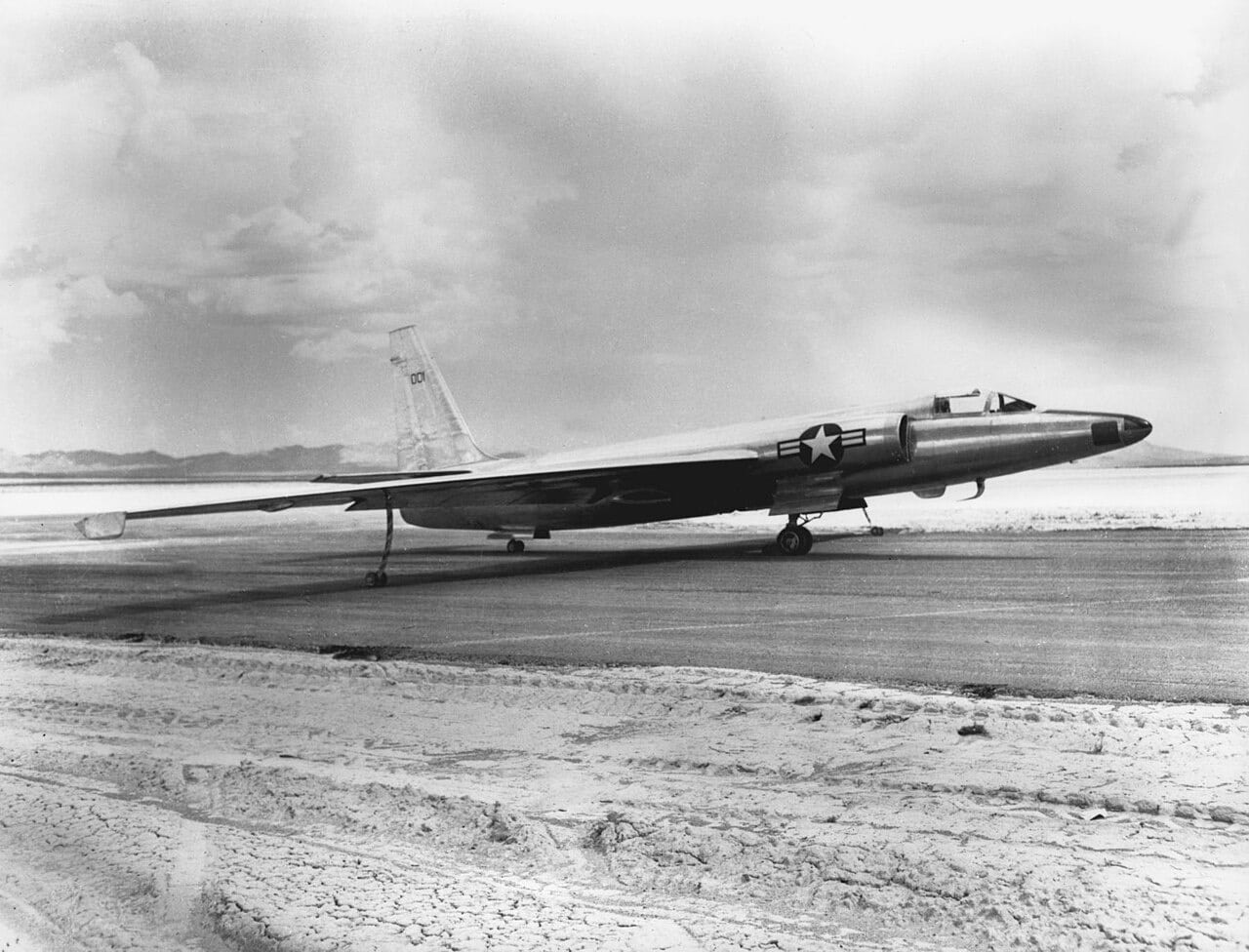
The first Lockheed U-2 built displaying tail number 001. This aircraft first flew on Aug. 4, 1955. | Source: United States Air Force

Johnson wanted a long-range aircraft with Mach 3+ cruising speed and that would fly at 90,000 ft, higher than even the U-2. He envisioned an aircraft that would rule the skies for the next ten years or more β€” one the Soviets couldn’t improve missile systems in a few years and intercept. Johnson wanted something that had never been done before.

A small group of Lockheed’s best was put to the task; many had worked on a hydrogen-powered aircraft design that never came to fruition, but that project gave them much needed experience and perspective.

This aircraft would utilize conventional engines and fuel but have the ability to outrun Soviet missiles. This would require new engineering and design in almost every area. Almost everything would have to be built from scratch and not robbed from previous aircraft systems.

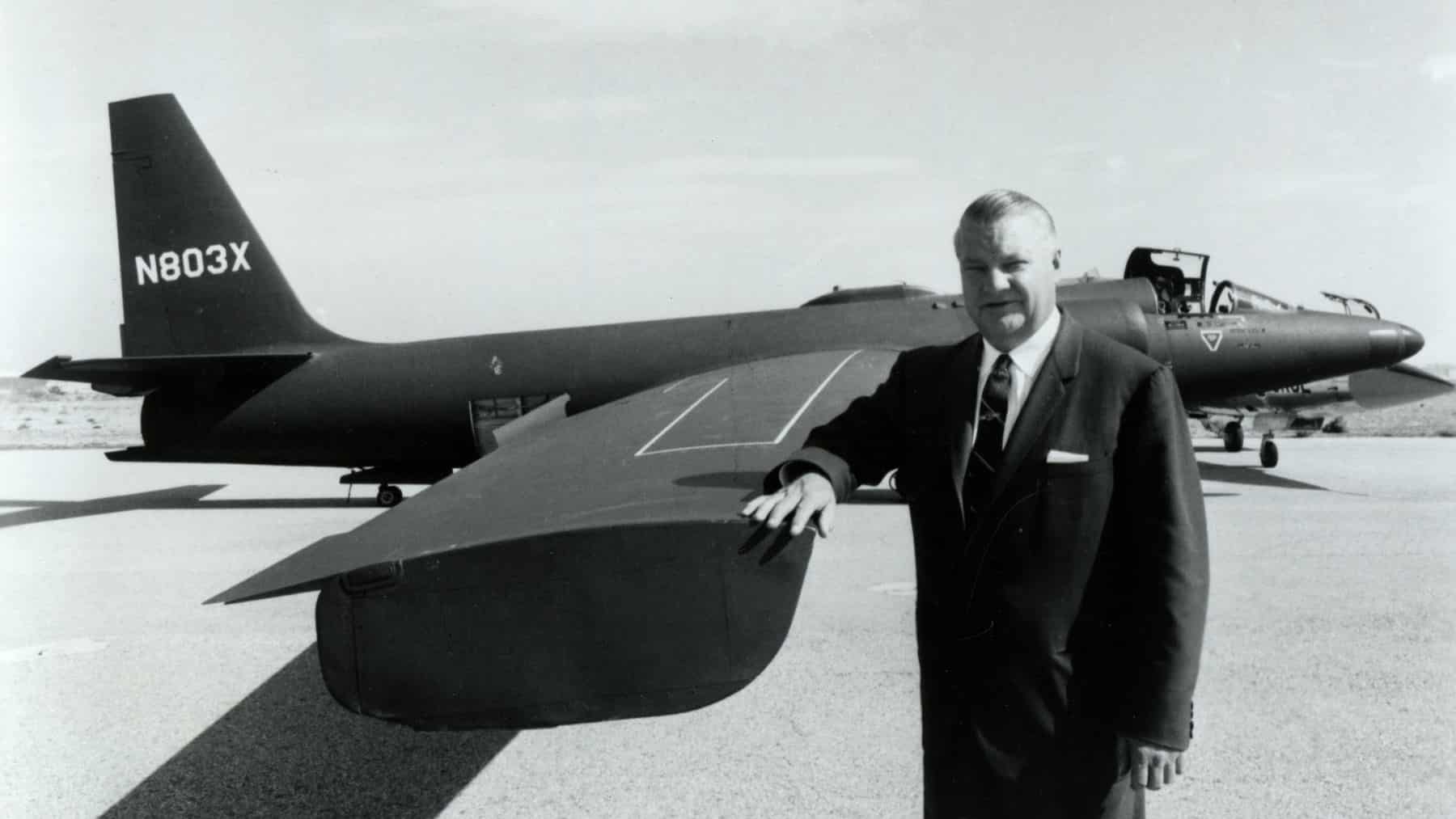
[Image:Β  A12_3.JPG. Caption:Β  Clarence β€˜Kelly’ Johnson of Lockheed’s β€˜Skunk Works’ poses at the wing of a U-2. Johnson picked up the name β€˜Kelly’ after how he handled a school yard bully during his youth, breaking the offending youngster’s leg in the process. Johnson’s peers decide he needed a good Irish fighting name, and β€˜Kelly’ was chosen from a popular song at the time, β€˜Kelly from the Emerald Isle’. The name stuck. | Source: U.S. Air Force
Working with U-2 project manager Richard Bissell, Johnson promised to deliver such an aircraft to the CIA (Central Intelligence Agency) in a mere 20 months, but it was a more difficult job to sell the idea to President Eisenhower. Eisenhower felt spy satellites offered a safer and less threatening alternative to overflights with aircraft, although the images taken by the U-2 were superior to what satellites could offer at the time, and a spy plane could fly over troubled areas at any given time and loiter if need be, whereas intelligence from satellites was restrained by their orbits.

Going for the Gusto

While Kelly Johnson attempted to sell his aircraft with its altitude and speed advantages, Eisenhower and the CIA became more interested in an aircraft with a low radar cross section (RCS). Eisenhower didn’t want another shoot down, and the best way to prevent that, he rationalized, was if the Soviets never even knew the aircraft was there. This aircraft would not only need speed, altitude, and range, but also stealth characteristics.

A CIA committee led by Polaroid executive Edwin Land was established to help select the replacement for the U-2. Project Gusto was created to explore producing an aircraft with very high speed and altitude characteristics, but built from radar absorbing materials. Β 

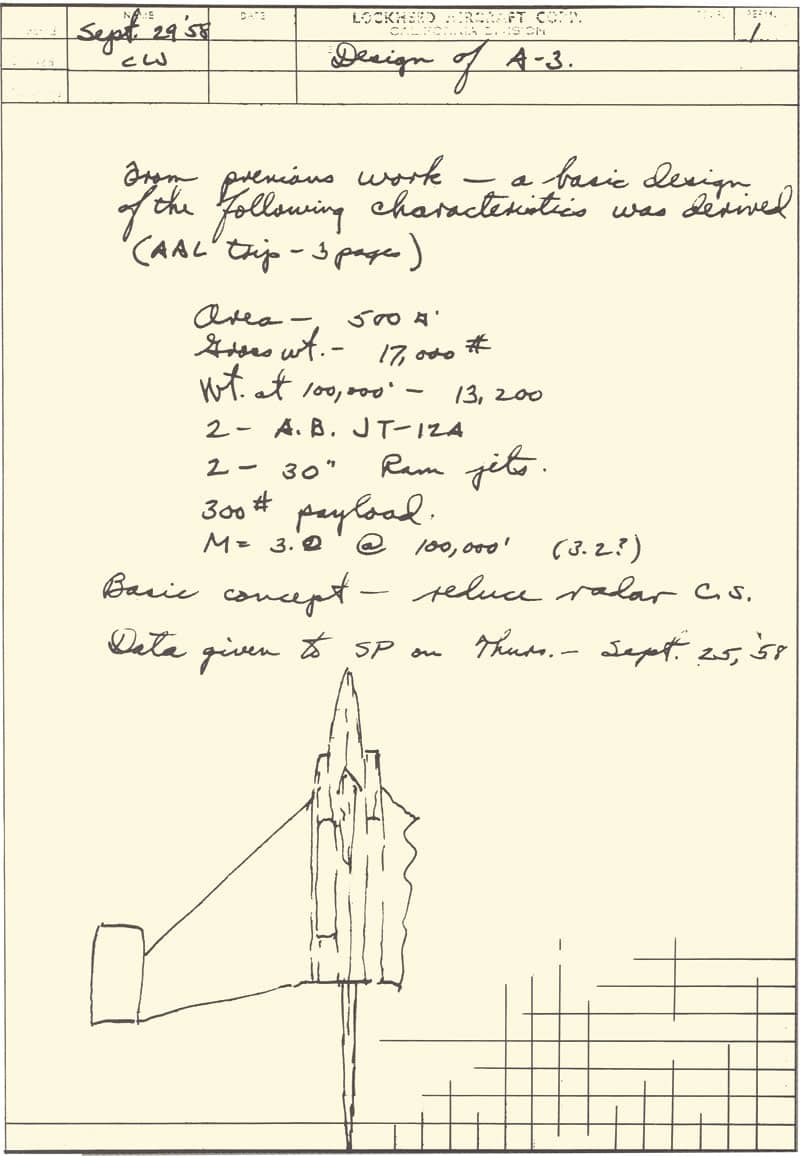
Sketch of a Lockheed A-3 Mach 3 ram jet design from Kelly Johnson’s notebook. | Source: CIA/Kelly Johnson)

At Lockheed a series of design configurations were drawn up for a U-2 replacement aircraft, designated by Lockheed in the beginning as β€˜Archangel-1’, β€˜Archangel-2’ and so forth, but eventually simply known as A-1 through A-11. Each configuration was further subdivided into variants of the parent design. The A-1 had the look of obvious blazing speed, being a sleek bullet-shaped fuselage with small delta wings mounted two-thirds of the way back on the fuselage. However, it lacked the low RCS desired.

Convair, which was building the B-58 Hustler supersonic bomber, was another major aviation company working on a solution for the CIA. They proposed a piloted ramjet known as the Fish, carried aloft and launched by a Mach 2 B-58B, but the B-58B was still unavailable and it wasn’t proven it could reach Mach 2 with the other aircraft attached. The ramjet technology was somewhat unproven as well.

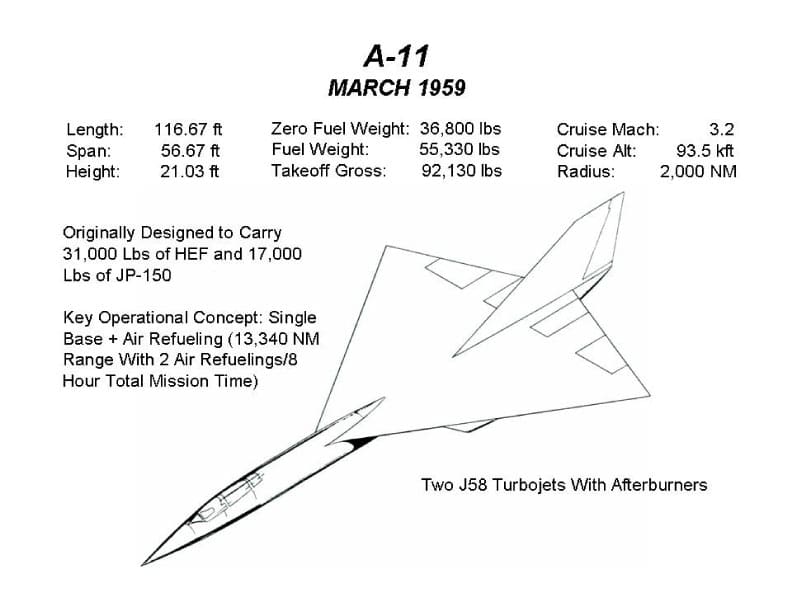
Line drawing and specs for the Lockheed A-11 design. | Source: Central Intelligence Agency/Center for the Study of Intelligence

By May 1959, Skunk Works had successfully dramatically lowered the RCS of design number A-11 by modifying the bullet-shaped fuselage by adding a chine β€” a lateral downward sloped surface β€” giving the aircraft the appearance of a hooded cobra. The chines also added lift. The underbelly was now flat and the RCS decreased by 90 percent.

The design now consisted of a large twin-tailed, twin-engine, single-seat aircraft with a long forward fuselage and delta wings. The engines were housed in nacelles set in the extremely thin wings. The vertical stabilizers were canted inward, also reducing the RCS. The 102 ft long new design with a 57 ft wingspan became known as the A-12.

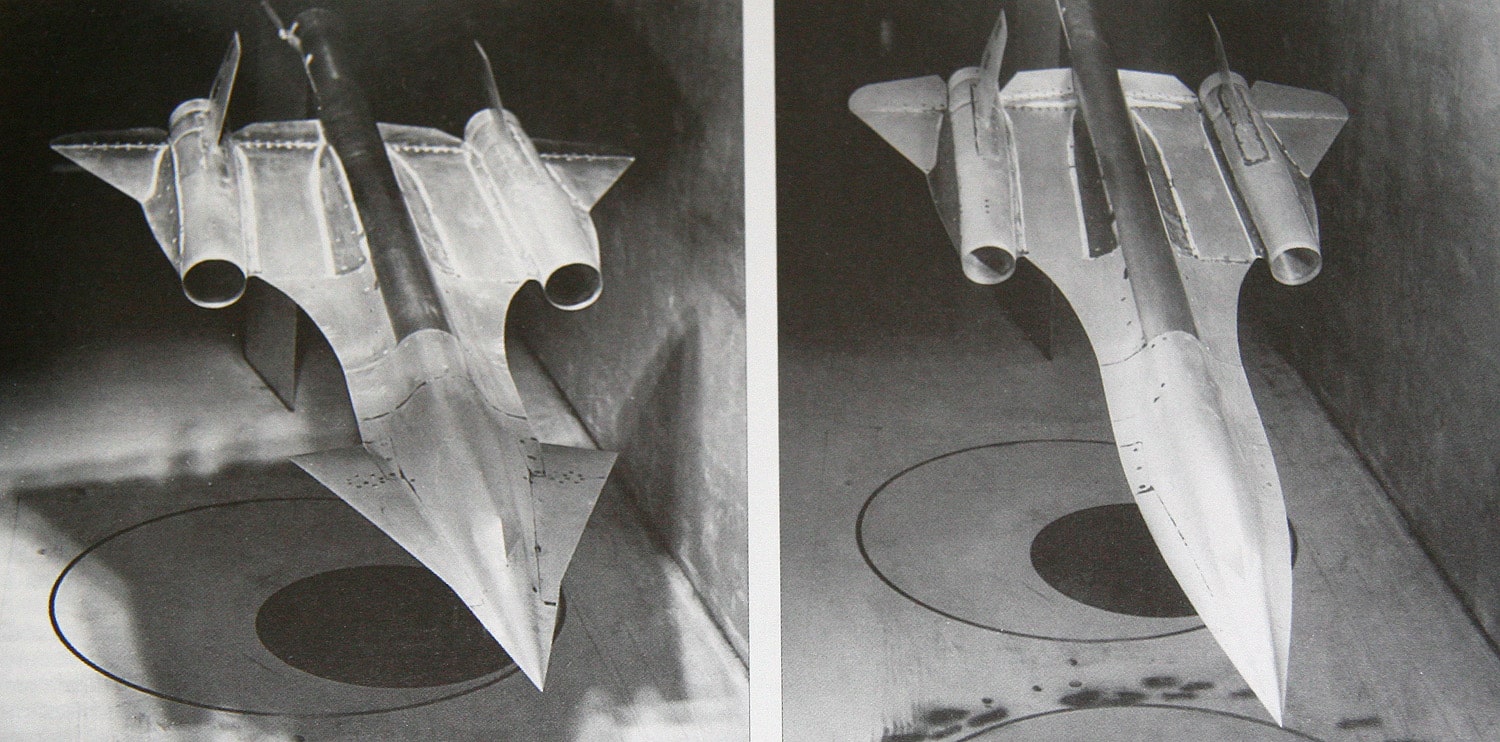
Wind tunnel models showing experimentation with canards as well as the more familiar configuration that was eventually chosen. | Source: NASA

Lockheed’s design was chosen the winner and project Gusto came to an end. The new program to develop the U-2’s successor was named Oxcart, with the aircraft also taking on that name. A full-size mockup of the design was built and placed on a pedestal to have the RCS determined from several angles.

Engineering a Mach 3 Aircraft

Johnson knew his aircraft operating at such high speeds and altitude while maintaining a low RCS would require development or modification of virtually everything needed to make the plane a reality. This included not just the aircraft design, but the engines as well. Special fuels, manufacturing tools, techniques, paints, sealants, plastics, tires, windshields, cables, electronics, and even wiring and wiring connections would all be needed for this unique project.

A mockup A-12 being tested from various angles for RCS. | Source: Central Intelligence Agency

Material for the structure of the aircraft would have to withstand temperatures of up to 800 degrees F (Fahrenheit) on some areas, which ruled out aluminum. Engine cowlings would reach 1,200 degrees F and the windshield 620 degrees F. Titanium was chosen over stainless steel alloys to save weight. Over 90 percent of the airframe would be constructed of a titanium alloy. However, only one U.S. company milled titanium and in varying degrees of quality, and there were limited reserves.

To alleviate the shortage of quality titanium, the CIA established various shell companies and purchased the base metal from the Soviet Union, the country with the largest known reserves. The very country the aircraft was being built with the intention of spying on, supplied the titanium to help build it. The Soviets were under the impression pizza ovens were being built with the material.

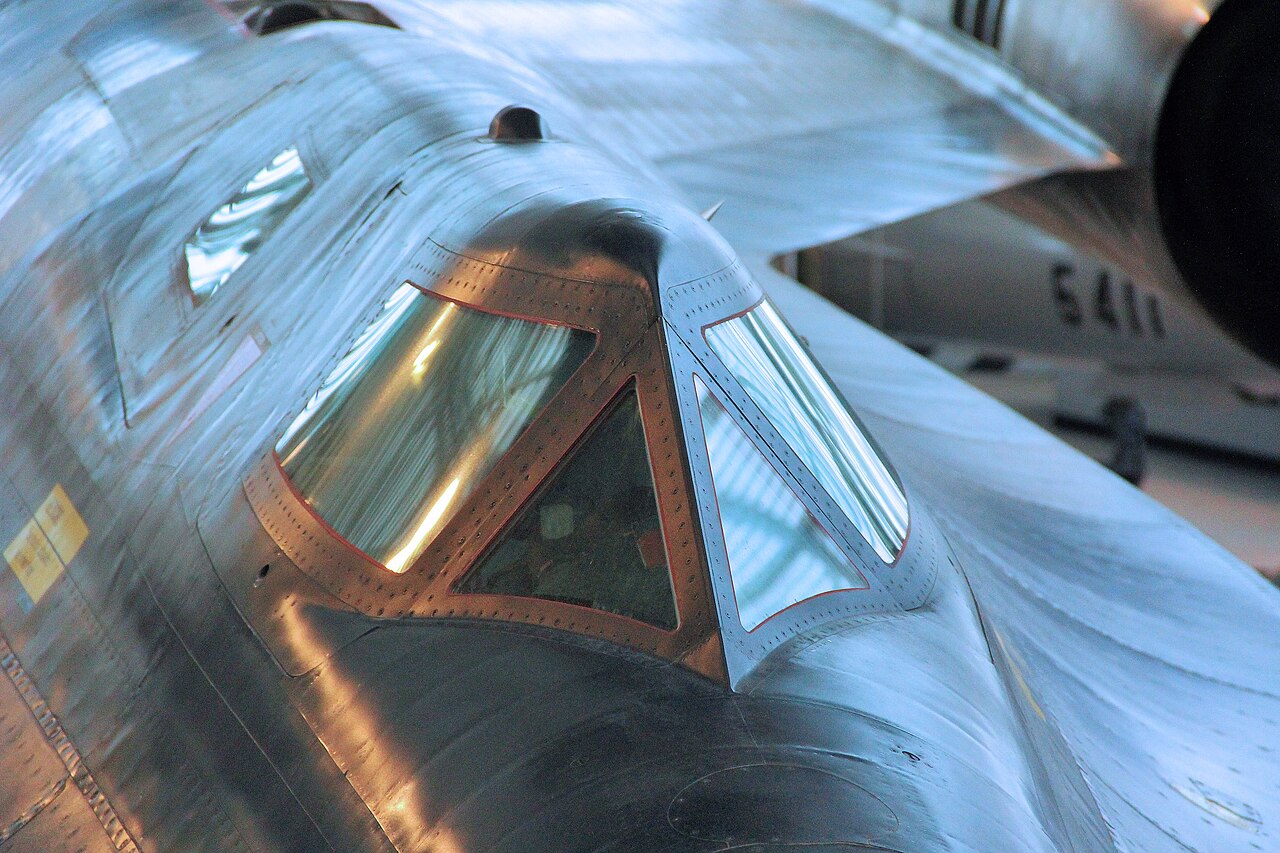
The windshield had to be made to withstand extreme heat; this example is the M-21 on display in Seattle, Washington at the Museum of Flight. The M-21 was a modified A-12, designed to carry the D-21 Drone. | Source: Wikimedia Commons

However, titanium would prove challenging to work with. Conventional drill bits broke and cutting tools snapped due to the extreme hardness of the material. New specialized drill bits were obtained from West Germany that could now drill up to 150 holes before needing sharpened, and Lockheed was forced to manufacture their own titanium screws and rivets.

A special press was developed and built to shape the titanium under very high pressures very high temperatures of up to 1500 degrees F. Titanium is too rigid to be forced into place and must be tooled to fit precisely.

Cadmium-plated tools would destroy titanium bolts, the cadmium would flake off and after being exposed to 600 degrees F, the bolt heads fell off. Tool boxes had to be purged and hand tools replaced.

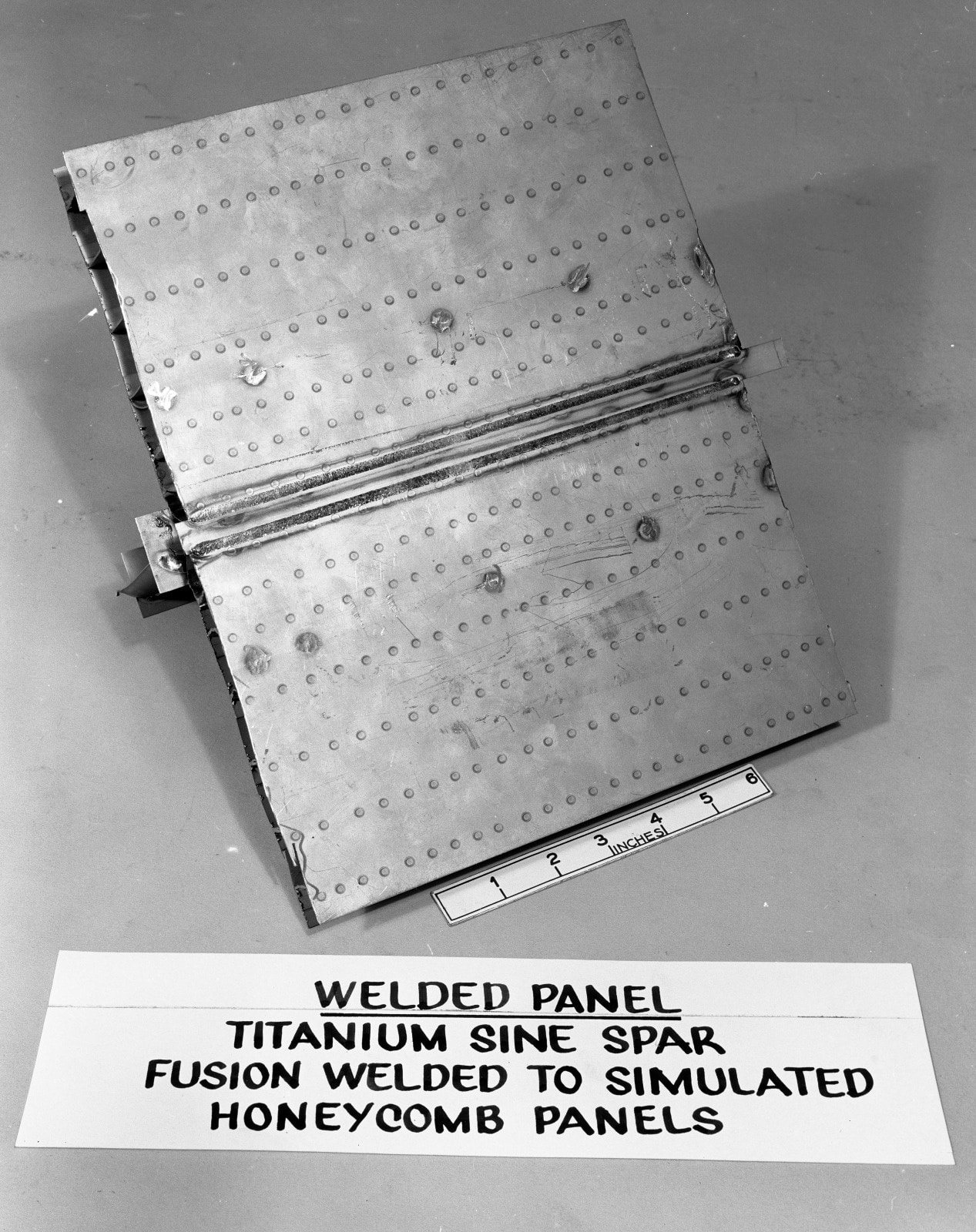
An example of titanium fusion welding. Working with titanium presented a plethora of problems, requiring all new tooling, techniques, and lots of patience. | Source: Wikimedia Commons

Welds on the wing panels also failed, but mysteriously only if the panels were built in the summer. Winter constructed panels held up fine. It was discovered that the summer water supply in Burbank, California contained chlorine to reduce summer algae growth, but was not used in the winter water supply. The chlorine attacked the welds, and switching to distilled water for washing down the panels after acid treatment solved the issue. In addition, it was discovered certain Pentel pens also contained chlorine and would etch the titanium when used to draw lines on the panels.

Welds were conducted in specially constructed chambers in an inert nitrogen environment to prevent the welds from being brittleness caused by oxidation. A special hydraulic fluid was designed by Pennsylvania State University that included seven ingredients in order to withstand the temperature extremes and still function.

Rubber O-rings or leather seals could not be used at these temperatures, and stainless steel was used to make the hydraulic lines. Elgiloy, the material watch springs are made from, was used to make control cables and plumbing lines were required to be gold-plated. A lubricating oil was formulated to operate from the extreme temperatures of 600 degrees F down to 40 degrees F, containing a diluent in order to remain fluid.

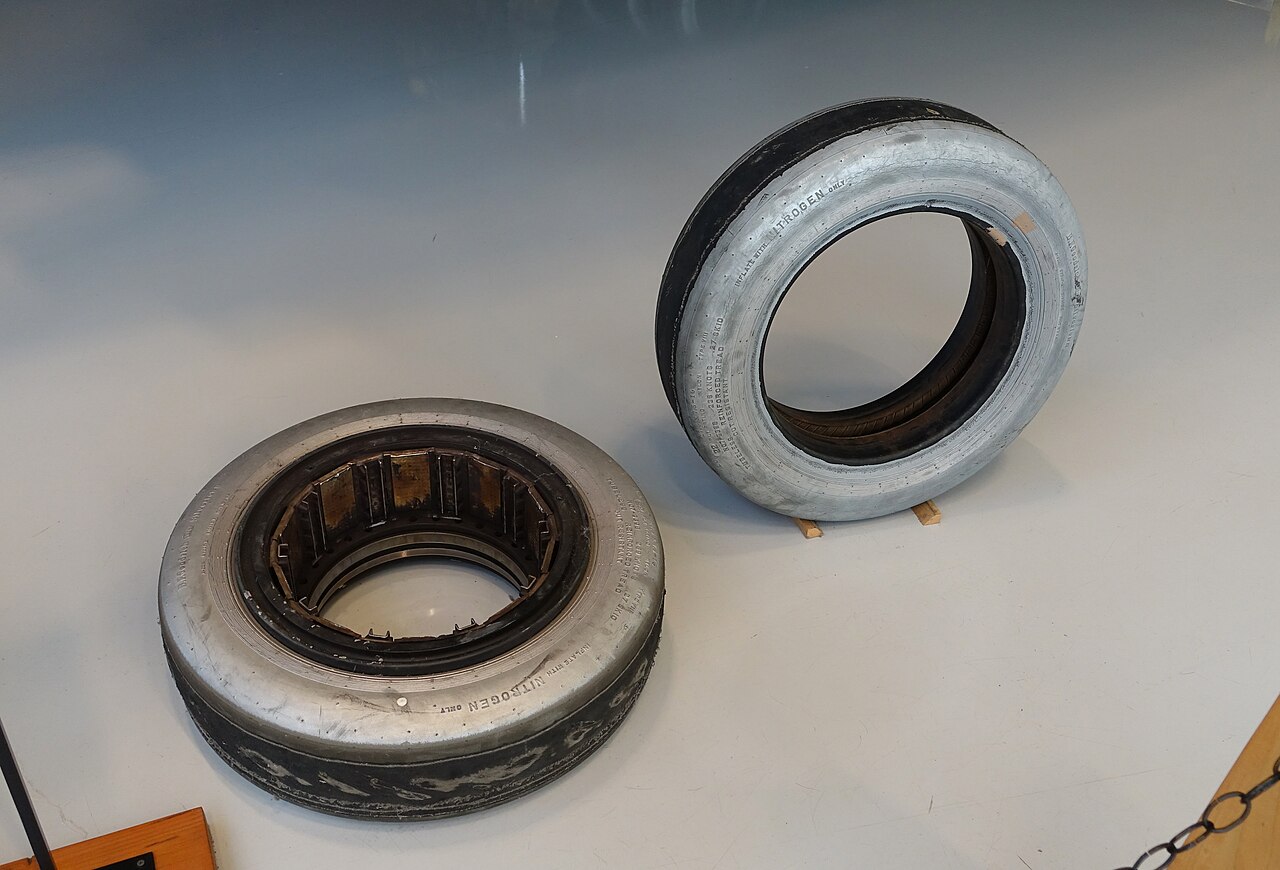
B.F. Goodrich developed a special rubber for the tires containing aluminum particles that provided radiant cooling, giving the tires a silvery appearance. In addition the retracted landing gear rested in the middle between fuel tanks and was cooled by the fuel, keeping the tires insulated against very high temperatures. Also the tires were filled with nitrogen, which is less explosive than air. All of this prevented the plane landing with tires ready to blow out once they touch down.

Blackbird tires on display at the Evergreen Aviation & Space Museum in McMinnville, Oregon. | Source: Wikimedia Commons

Shell Oil had created a good fuel for the U-2, so Lockheed turned to Jimmy Doolittle, now a top executive with the company, for a fuel solution for the new Mach 3 aircraft. The fuel would have to remain useful and safe at extreme temps, from minus 90 degrees F at midair refueling to 650 degrees F in supersonic flight. In conjunction with Pratt & Whitney, Ashland, and Monsanto, a new fuel was created, designated LF-2A and known as JP-7 to the military. The fuel had a high-flash point and would not vaporize or explode under tremendous heat and pressure. A lighted match could be tossed into a spill and it would not ignite.

Nitrogen would be pumped into the fuel tanks as an added safety precaution, pressurizing them and preventing vapor ignition. Through heat exchangers and smart valves, the fuel would also act as an internal coolant for critical parts of the aircraft. A cesium additive reduced the radar detectability of the afterburner plume. The aircraft would carry 64,600 lb of fuel in five uninsulated tanks.

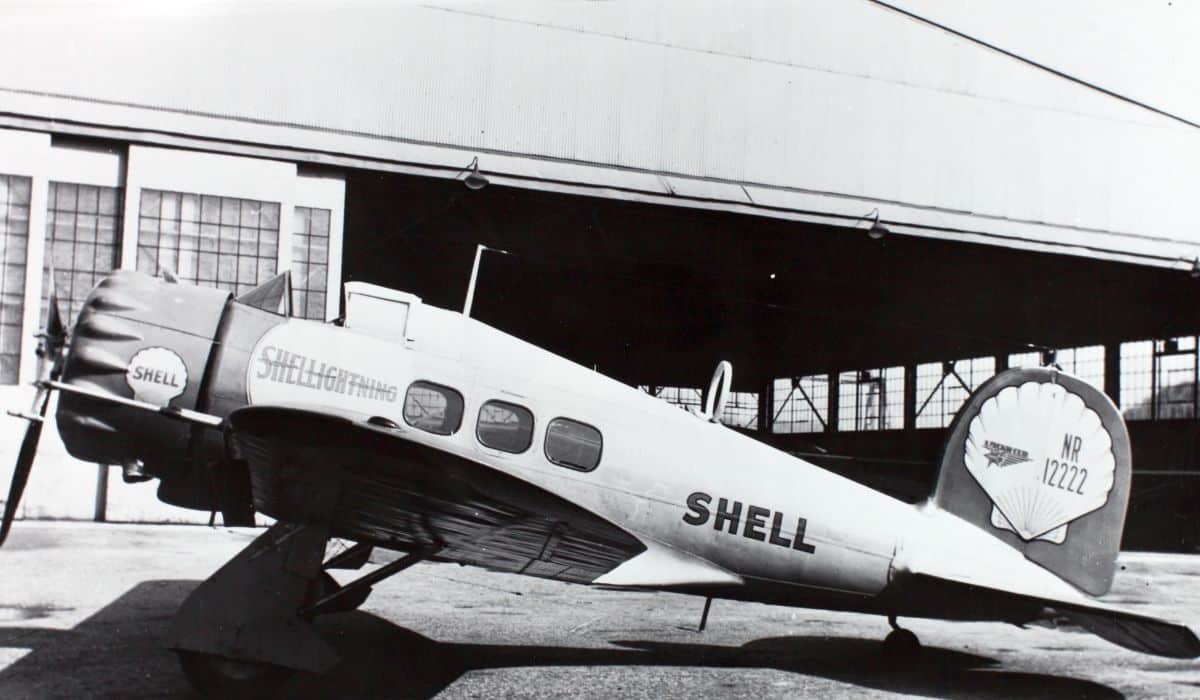
A Lockheed Model 9 Orion. Originally built as an Altair in 1933, it was rebuilt as an Orion 9C in 1934. Sold to Shell Oil, it was named the β€˜Shellightning’ and flown by Jimmy Doolittle to various oil business oriented events before World War 2. Doolittle would serve famously in the war and then return to Shell as Vice President after the war. | Source: Wikimedia Commons

New unique plastics would be developed with high heat resistance along with a low RCS and used in the radome, cockpit, and other areas. The inward canted twin tails were constructed of non-metallic substances as well. Plastics made up approximately 20 percent of the aircraft surface. If fuel was spilled on the plastic surfaces and exposed to high temperatures of around 550 degrees F, miniature explosions occurred on the plastic skin. Paint that was fuel proof as well as rain proof would be needed.

Special wiring using Kevlar was created and wrapped with asbestos for heat resistance. Unique plugs were designed so connections could only be assembled one way, after Johnson discovered about 10 percent of his workforce was colorblind, and color coded wiring was sometimes ineffective.

To prevent the wing sections from wrinkling in high temperatures, some skin panels were corrugated and dimpled so, when the titanium heated up, the corrugations deepened preventing wrinkling.

In his book Kelly:Β  More Than My Share of it All, Kelly Johnson states surfaces of the aircraft were also painted a dark blue-black color that was determined after emissivity tests to make the aircraft surface up to 80 degrees F cooler. He goes on to state the paint became bluer as the temperatures increased with speed and altitude. Special paints had to be formulated for the aircraft markings and insignia as well. Red paint would turn brown and white became mottled in the high temperatures.

Underside view of the Lockheed A-12 (60-6927) two-seat trainer at the California Science Center in Los Angeles clearly shows the myriad of panel work required in constructing such an advanced aircraft. | Source: Wikimedia Commons

Anti-radar coatings were created with iron ferrites and asbestos loaded in the mix, and applied to the aircraft, lowering the RCS. <these coatings made up approximately 18 percent of the aircraft’s materials.

Creature Comforts and Cameras

In order to save weight, the cockpit was not insulated, exposing the pilot to temperatures of around 250 degrees F. To alleviate this problem, an air-conditioning system was designed that would bleed air from the engine compressor and run it through a fuel air cooler, then an expansion turbine and into the cockpit it went at minus 40 degrees F. When it mixed with the oven-like temperatures inside the cockpit, it created a comfortable environment of around 75 degrees F.

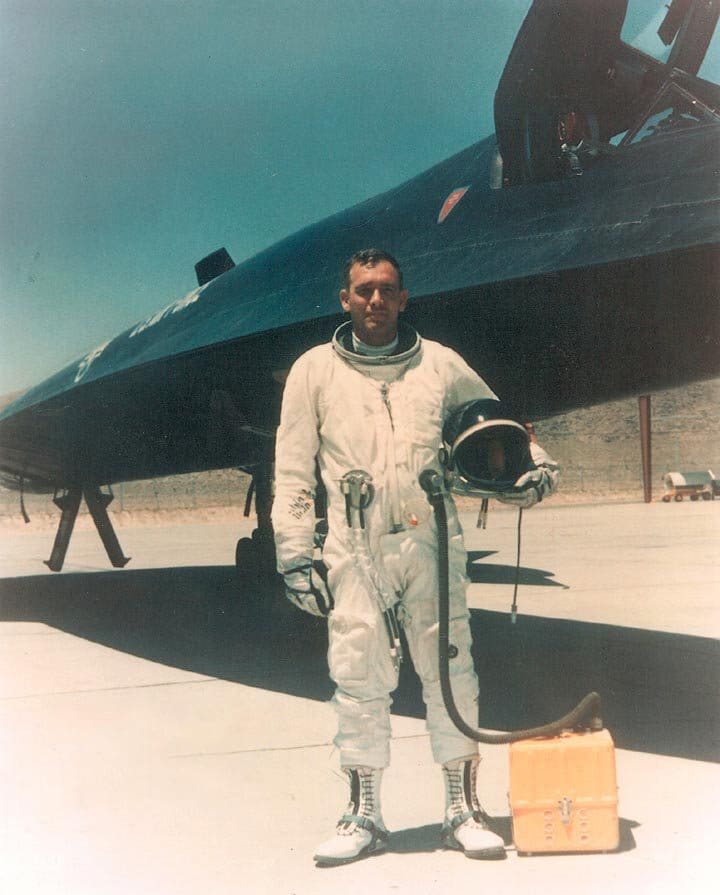
Pilots wore a special type of space suit with its own cooling, oxygen supply, and pressure control as well as other life support features. The suit was designed after the one used with the X-15. It was engineered to protect the pilot from extreme heat in the cockpit as well as extreme cold outside should they have to eject.

A-12 pilot Frank Murray in the specialized S-901 pressure suit. | Source: Central Intelligence Agency

Should a pilot need to eject, cables would hold his feet against the seat while the aircraft was being cleared, and a special stabilization parachute prevented the pilot from spinning as he descended over 12 miles for seven minutes. When the pilot reached 15,000 ft, a main parachute deployed and the pilot would be separated from the seat.

Since this was a reconnaissance aircraft, it would need to carry photographic equipment, which also presented problems due to the extreme temperatures. Optical distortion would be an issue due to the very high temps (550 degrees F) outside the aircraftβ€˜s double quartz window and the much lower temperature inside the aircraft (150 degrees F). It took three years and $2 million dollars for Corning Glass Works to solve the riddle. The windows were fused to a titanium frame using an unconventional process of high frequency sound waves.

The cameras themselves were specially designed and built by Perkin-Elmer. A stereo camera, designated the Type 1, it produced pairs of photos covering a 71 square mile area with a ground resolution of 12 inches. The camera had a 5,000 ft supply of film and incorporated new concepts never before used in a camera system, meeting size and weight requirements along with thermal resistance while maintaining the necessary resolution and coverage. The camera flew on all 29 East Asia A-12 missions with only one recorded failure.

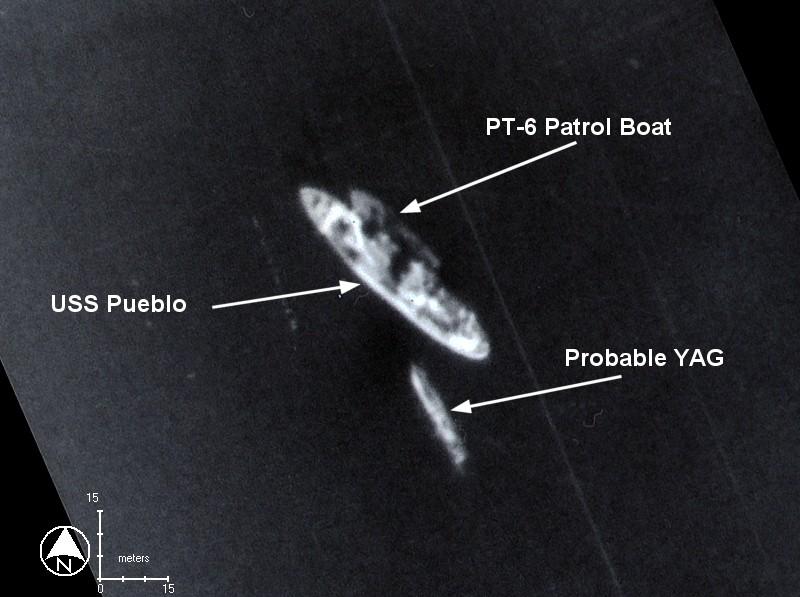
Image of the USS Pueblo after its capture by North Korea, photographed by a Lockheed A-12 piloted by CIA pilot Frank Murray, January 26, 1968. While designed and built with the intention of overflying the Soviet Union, A-12s did most of their work East Asia. | Source: Central Intelligence Agency

Engines and Inlets

The engines Johnson intended to use in the A-12, the J58 turbojet that was designed for a cancelled Navy project in 1956, would need to undergo several modifications to turn them into the most powerful air-breathing propulsion devices ever built. This would also prove to be somewhat troublesome.

Built by Pratt & Whitney, once again extreme temperatures would require new engineering. Fuel temps could reach 700 degrees F, engine inlet temps hit 800 degrees F or above, the turbine inlets hitting over 2,000 degrees F. An engineer from Pratt & Whitney stated β€œI do not know of a single part, down to the last cotter key, that could be made from the same materials as previous engines.” Weight was also an issue with the huge power plants, with all of these challenges culminating in delays in completing the first A-12 Oxcart.

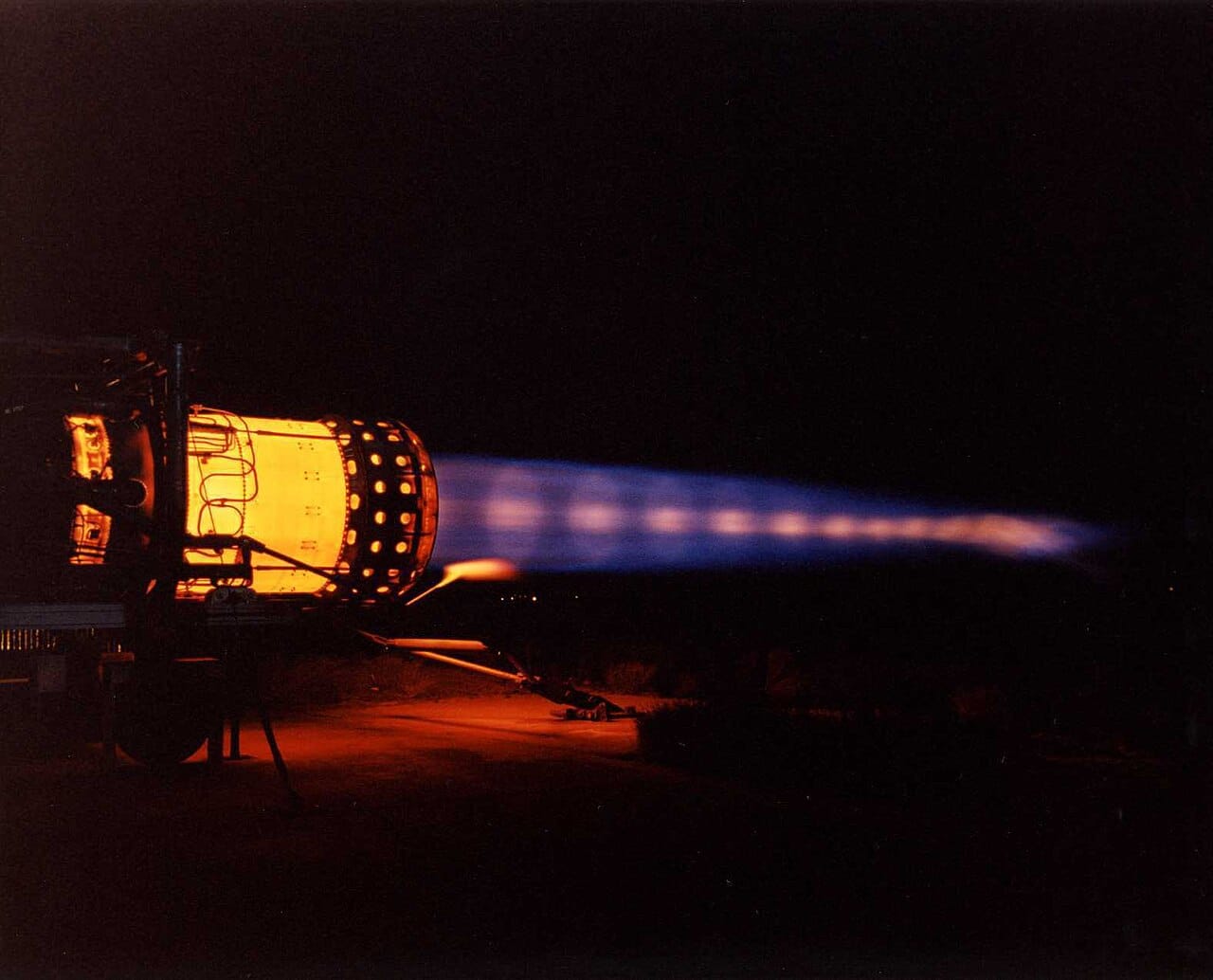
A Pratt & Whitney J58 statically mounted with full afterburner. The bright areas seen in the exhaust are known as shock diamonds. | Source: NASA

In order to prevent further delays, Johnson decided along with CIA officials that early flights would utilize the less powerful but available J75. The airframe was modified for the substitute engine, and the aircraft was only able to reach Mach 1.6 and an altitude of 50,000 ft.

The design feature that eventually made the J58s generate the necessary power once they were finally available was the retractable inlet spikes developed by Ben Rich and his crew at Lockheed. The spikes worked as regulators to decelerate, compress, and superheat incoming air, which was then further heated by the bypass engines before fuel was added. Supercharged air then expanded through the turbine and fed to the afterburners. Without these inlets, the J58s only produced about 20 percent of the power needed.

View of the inlet spike cones on the A-12 displayed at CIA headquarters. | Source: Central Intelligence Agency

Getting the inlets to function correctly was a time and resource consuming challenge. Rich’s team spent hours tweaking the design and testing it in the NASA wind tunnel in northern California. The tests used so much power they had to be conducted at night in order to not drain the local power grid. Issues included getting the mechanical controls to respond quickly enough to shock-wave induced variations of incoming air flow.

An electronic control was developed to help eliminate this problem that could cause β€˜unstarts’, and later a new configuration was designed including an automatic restart. Eventually the J58s would take the A-12 to Mach 3.2 on the 66th flight, with the initial official first flight being on Apr. 30, 1962.

Legacy Continued

The CIA’s A-12 Oxcart spy plane pioneered technology that would lead to further development of the design. A two-seat trainer was also built known as the β€˜Titanium Goose’ and would bare the distinction of being the only aircraft in the family to carry Kelly Johnson aloft, and it was never refitted from the J75 engines to the J85s.

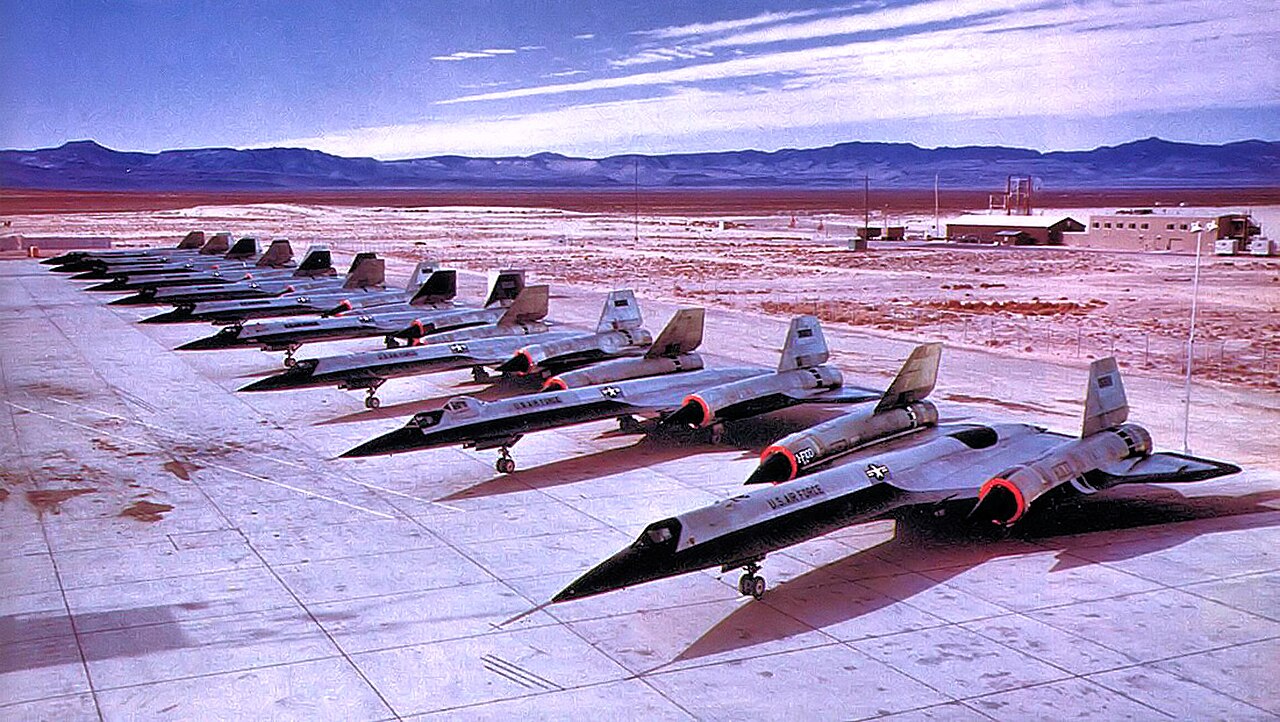
Ten A-12 Oxcart aircraft in Palmdale, California, include the two-seat trainer known as the β€˜Titanium Goose’. Note paint has been applied to the leading edges of the aircraft at this time. | Source: United States Air Force

Other members of the Oxcart family would include the YF-12A, a modified interceptor version of the A-12, with three being built before being cancelled. The M-21 was a modified A-12 that carried the D-21 drone, the drone itself also incorporating some of the technology gained from the A-12 project.

The final and most prolific aircraft is the SR-71 Blackbird, which appears very similar to the A-12 but is about six feet longer and weighs 15,000 more pounds fully loaded. The SR-71 also incorporated a two-seat cockpit and had more prominent nose and body chines along with carrying more radar imagery, optical systems, and ELINT (Electronic Intelligence) sensors.

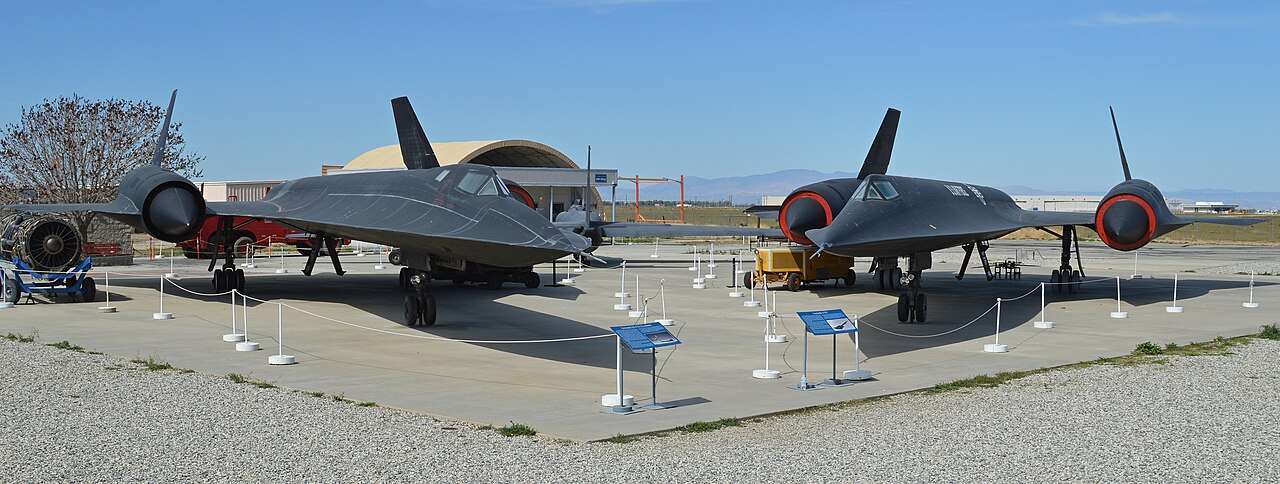
Left is SR-71A (61-7973) Right is A-12 (60-6924) on display in the Blackbird Airpark, Palmdale, California. Behind them and facing away is a U-2. | Source: Wikimedia Commons

The B-45 Tornado: North American’s oft Overlooked Class of ’47 Bomber

21 June 2026 at 18:01
B-45 Tornado

During a relatively obscure service life, often overshadowed by the Boeing B-47, the North American B-45 made a significant contribution to the U.S. Air Force, including many pioneering β€˜firsts.’

In the waning months of World War 2, the jet engine had been developed into a reliable propulsion source, and while nations began building arsenals of advanced jet-powered fighter and interceptor aircraft, the United States Army Air Force (USAAF) possessed a fleet of aging piston engine bombers that would be easy targets.

The Class of β€˜47

In response to the increasing development of jet propulsion in fighter aircraft, the USAAF Air Material Command initiated a competition in 1944 for a new bomber. The bomber was to be jet-propelled, carry a mixed bomb load or single 22,000 lb bomb and be capable of dropping weapons at 40,000 ft altitude.

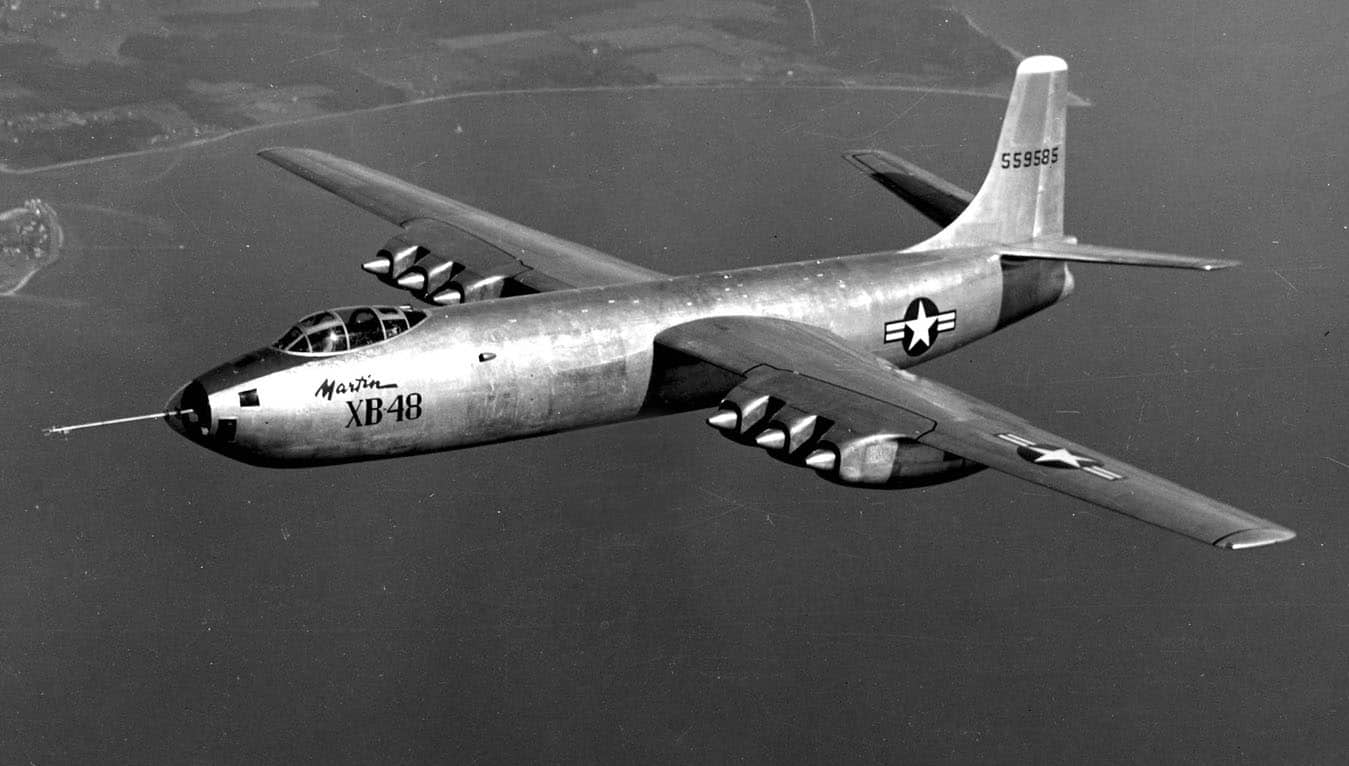
The Martin XB-48 powered by six jet engines was a straight-wing design that lost out to the North American XB-45. | Source: United States Air Force

This would be a light bomber with a gross weight between 80,000 and 200,000 pounds. Simply strapping jet engines to existing airframes, such as the Boeing B-29, was not an option.

Convair, Boeing, Martin, and North American Aviation all submitted designs, with each one making their initial flights in 1947. These aircraft became known as the β€˜Class of β€˜47’.

Convair’s proposal was the XB-46 that looked a lot faster than it actually was. | Source: United States Government

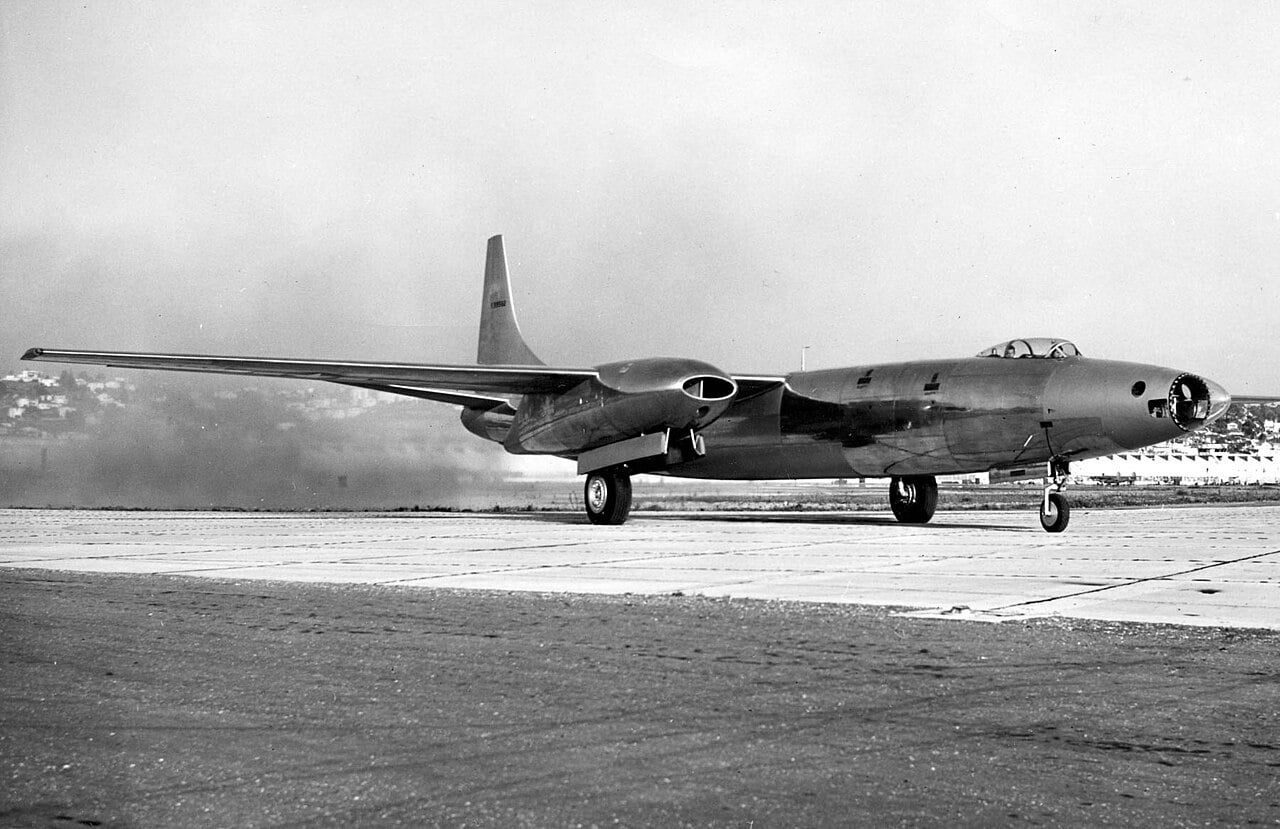
Submissions included Convair’s sleek and beautiful XB-46 that only looked fast. Martin produced the straight-wing XB-48 that was powered by six jet engines and utilized tandem dual-wheeled bicycle-style landing gear. Boeing’s entry was a radically designed swept-wing design powered by six engines, known as the XB-47, later to become known as the B-47 Stratojet. North American submitted the XB-45, a straight-wing design powered by four engines.

A Tornado is spawned

North American received a contract to develop its proposal on Sept. 8, 1944, and began work on three prototypes in 1945. The end of World War 2 created defense cuts, but ever increasingly heated tensions with the Soviet Union in 1946 would bring the project back to the forefront.

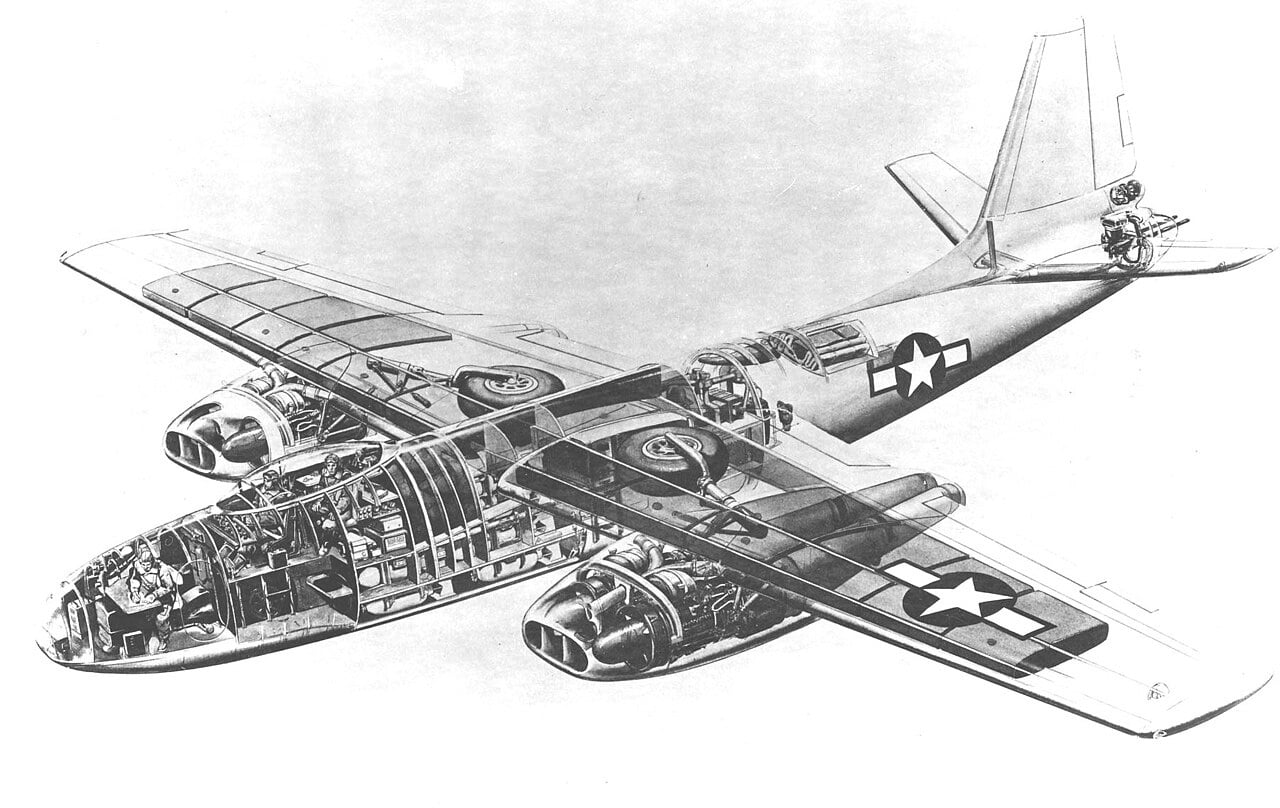
Cutaway drawing of an XB-45 showing crew locations, engine configuration, tail armament, fuel storage, and retracted landing gear along with internal structure details. | Source: United States Air Force

The XB-45, also known inside North American as the NA-130, first flew on Mar. 17, 1947, with test pilot George Krebs at the controls along with Paul Brewer at Muroc Dry Lake (Edwards Air Force Base), California. It was the first aircraft of the Class of ’47 to take to the air, and the first American bomber powered by four jet engines to achieve flight-test status.Β  The first prototype and crew would later be lost during a test program that fought technical problems and setbacks; however political pressure pushed the efforts to qualify the aircraft as soon as possible.

Two pairs of Allison-built General Electric J-35-A-4 engines in two nacelles slung under the wings failed to provide impressive performance, with speed topping out at 516 mph. Wingtip tanks could extend a disappointing range, but not enough to be impressive.

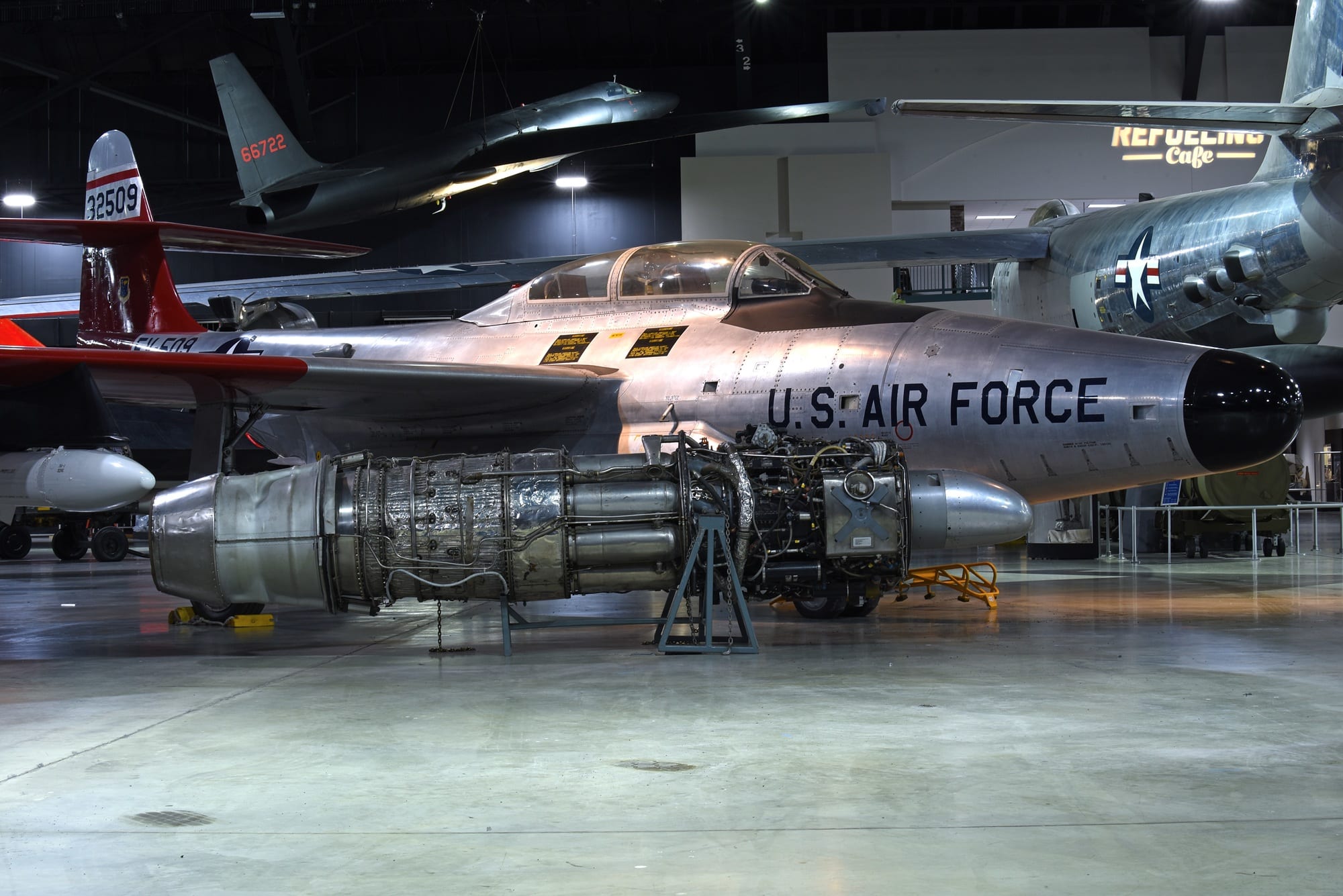
A General Electric designed Allison produced J-35 engine on display at the National Museum of the United States Air Force. The J35 was used to power various prototypes such as the XB-43, XB-45, XB-46, XB-47, XB-48 and XB-49. The engine used in two of the USAF’s leading fighters of the 1950s as well:Β  The F-84 Thunderjet and the F-89 Scorpion, shown here. | Source: United States Air Force

A fighter-like canopy housed the two pilots while the bombardier sat in a glazed nose section. The aircraft’s sole defensive armament, a pair of Browning M3 .50 caliber machine guns, was manned by a rear gunner in the tail.

The Boeing and Martin design prototypes were still two years away so the USAAF evaluated the first two designs:Β  the XB-46 from Convair and North American’s XB-45. The XB-45 was further along in development and cost less, so it was chosen. On Jan. 2, 1947, a production contract was signed for the B-45A Tornado.

The B-45A

A total of 96 B-45A variants were produced, the first flying in February 1948 and entering service in November.Β  The first production block of 22 aircraft, designated B-45A-1 retained the J35 engines and were assigned to mostly training units within the ATC (Air Training Command) and the remaining 74 upgraded to J47-GE-7/9 engines being designated B-45A-5 and assigned to the 47th Bombardment Group at Barksdale Air Force Base (AFB) in Louisiana.

The B-45A was the first operational jet bomber in USAF service. It was also one of the first aircraft to have its maximum speed defined utilizing Mach numbers.

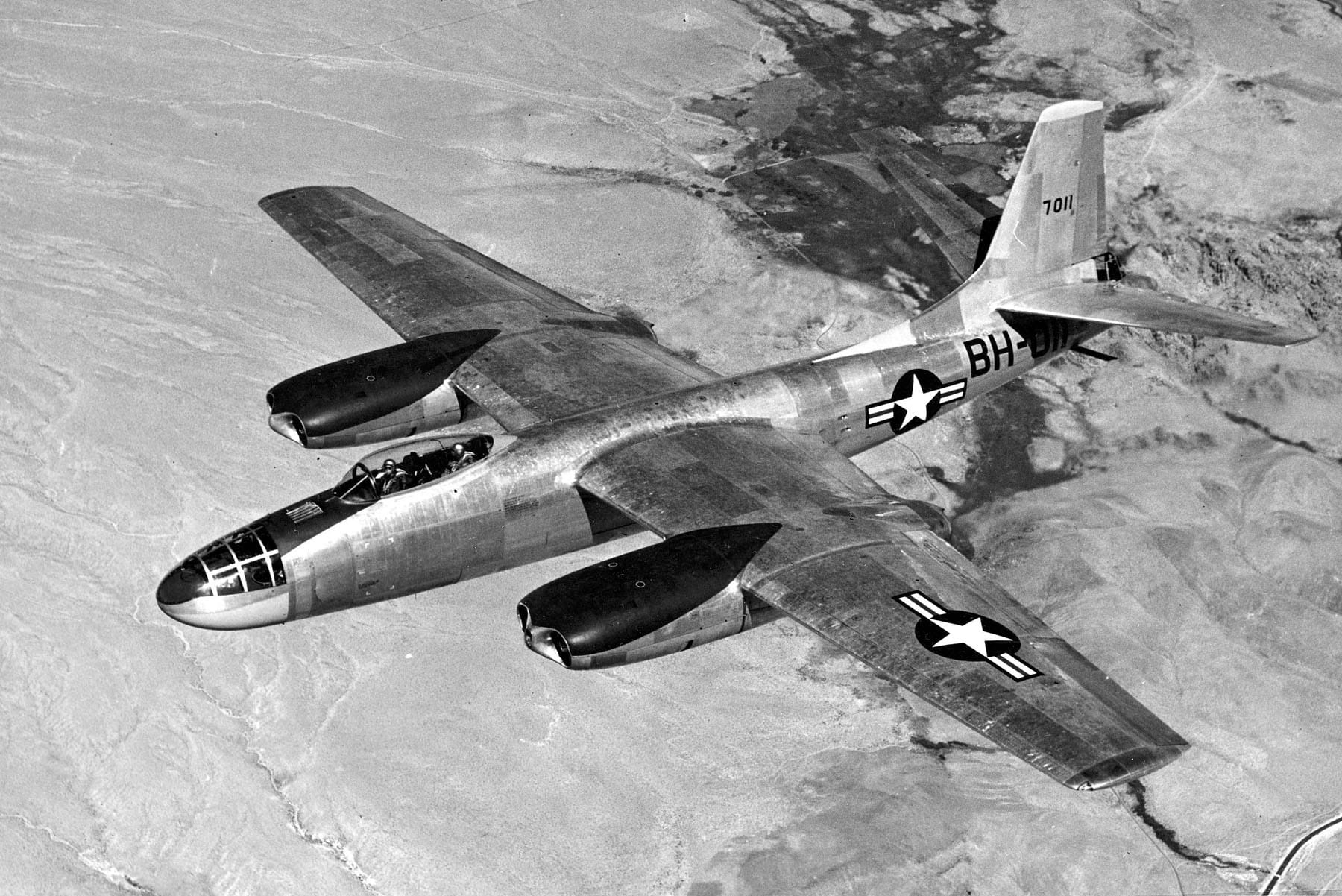
An early North American B-45A-1-NA Tornado in flight. | Source: United States Government

The B-45A had a length of 75 ft 4 in, height of 25 ft 2 in, wingspan of 89 ft, and weighed in at around 46,000 lb empty. Maximum takeoff weight was just over 91,000 lb and maximum speed was 566 mph. Range was 1,192 miles and service ceiling was 46,000 ft. Up to 22,000 lb of bombs, both conventional and nuclear types, could be carried.

Initially the B-45A was not equipped with bomb fire control systems and suffered failures with engines, cockpit gauges, and gyrocompasses. The engines proved especially troubling and the bombing and navigational radar also caused issues. Often pressurization issues prevented operation at certain altitudes as well.

General Electric J47 engine on display at the National Museum of the United States Air Force. The J47 was an improvement over the earlier J35. | Source: Wikimedia Commons

In 1952, several B-45s were part of a program known as Operation Fandango to modify the aircraft for nuclear missions from the United Kingdom. Modifications included additional fuel storage and an improved defensive system. These served as the Tactical Air Command’s (TAC) frontline deterrent against the threat of massive Soviet and Warsaw Pact armor forces poised in Eastern Europe.

The last B-45As were retired from frontline bombing roles in 1958. A total of 14 were converted to target tugs and re-designated TB-45As. The bomb bay would house a cable reel and equipment for the attachment of Chance Vought target glider. A single B-45A would become an engine test bed used by Westinghouse and designated the JB-45A. A proposed variant with improved fire-control and radar systems designated the B-45B was never built.

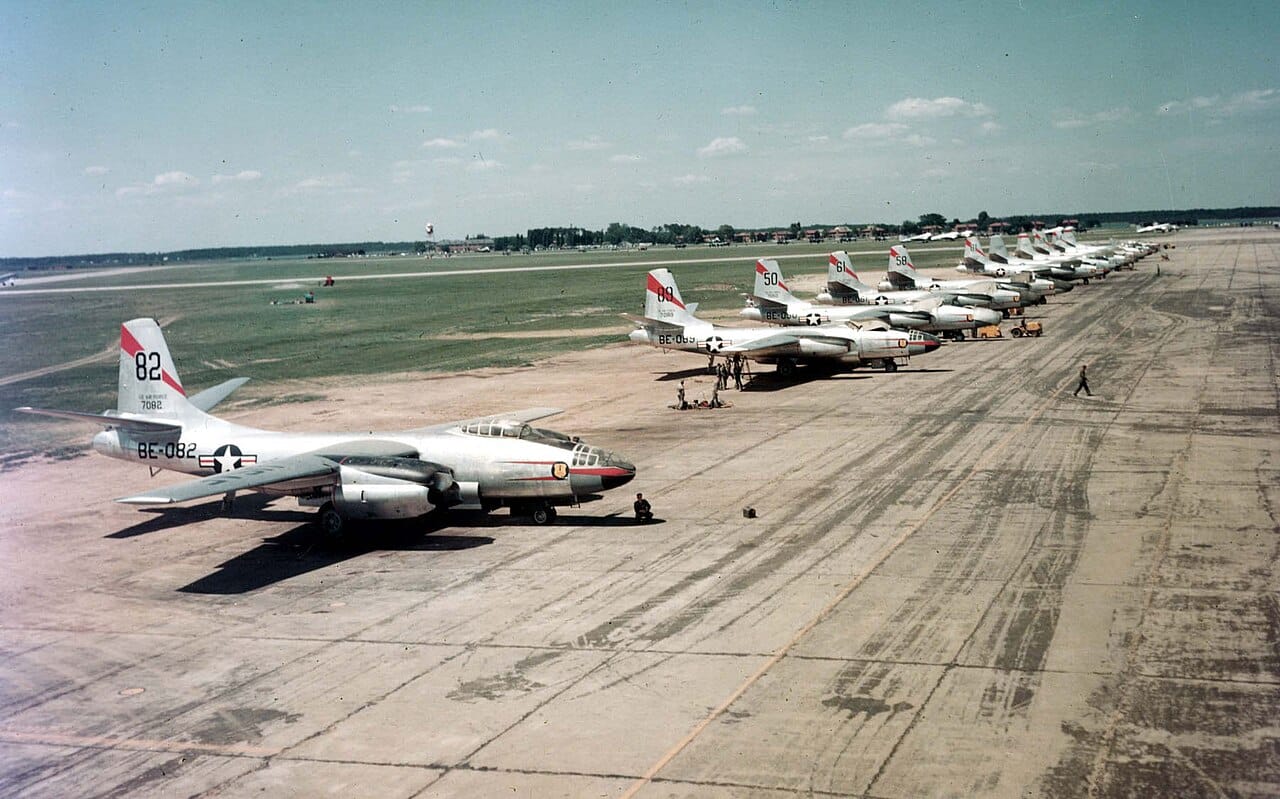
North American B-45As in United States Air Force service line the ramp. | Source: United States Government

The B-45C

The B-45C had a strengthened airframe to permit a higher take-off weight which increased to 110,000 lb along with a heavier canopy. Updated J-47 engines increased power. The plane was now capable of 570 mph and also equipped for inflight refueling. The first B-45C flew on May 3, 1949 and a total of 43 were ordered. Only ten would be produced however. The remaining 33 airframes would be converted to the RB-45C.

The B-45C was the first jet bomber to drop an atomic device, dropping two in atmospheric nuclear tests over the Pacific in 1951 and 1952. The Mark 7 warhead they tested was intended for the Thor missile.

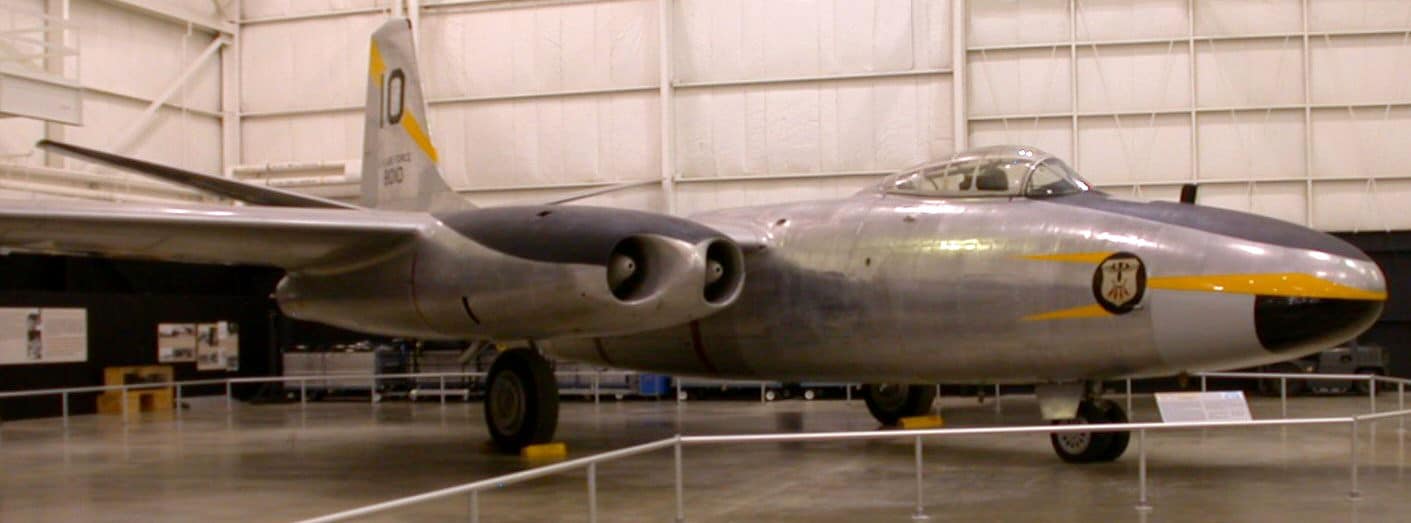
The B-45C on display inside the National Museum of the United States Air Force near Dayton, Ohio. | Source: Wikimedia Commons

A new twist for the Tornado

Perhaps the version of the B-45 that made the most contributions to Cold War efforts was the RB-45C reconnaissance version. The final 33 B-45s to be built would be converted to RB-45Cs delivered between June 1950 and October 1951. One RB-45C would later be converted to an engine test-bed used by General Electric and designated the JB-45C.

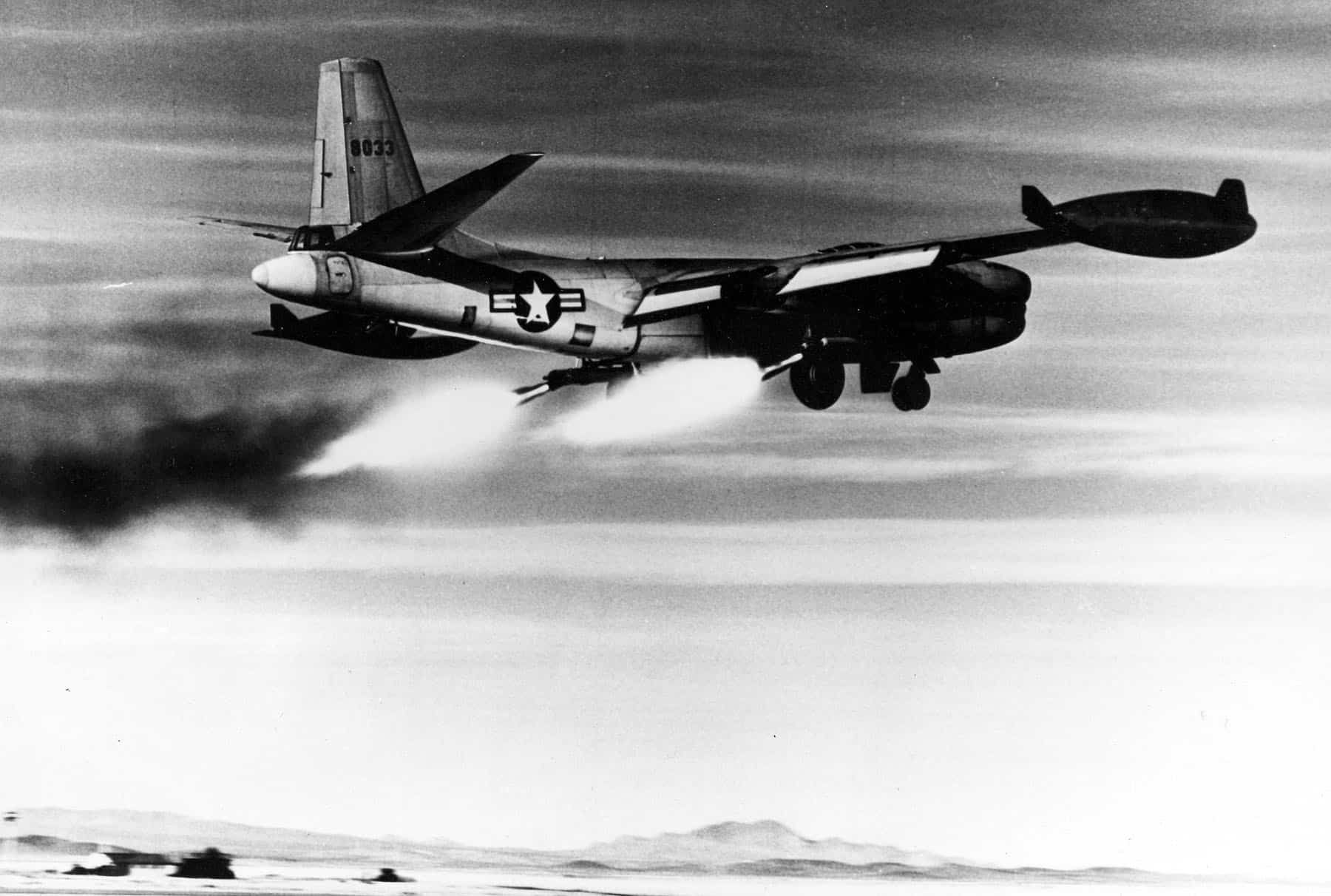
Changes were made internally for camera installations, including some that would utilize new techniques for low-level high-speed photography. A total of 12 cameras in four fuselage positions were carried along with 25 M122 photoflash bombs and additional fuel tanks in the bomb bay. Water injection via a jettisonable tank fitted under each engine nacelle provided additional takeoff power. Rocket-assisted take-off (RATO/JATO) was also used.

A North American RB-45C utilizing rocket-assisted take-off. | Source: United States Government

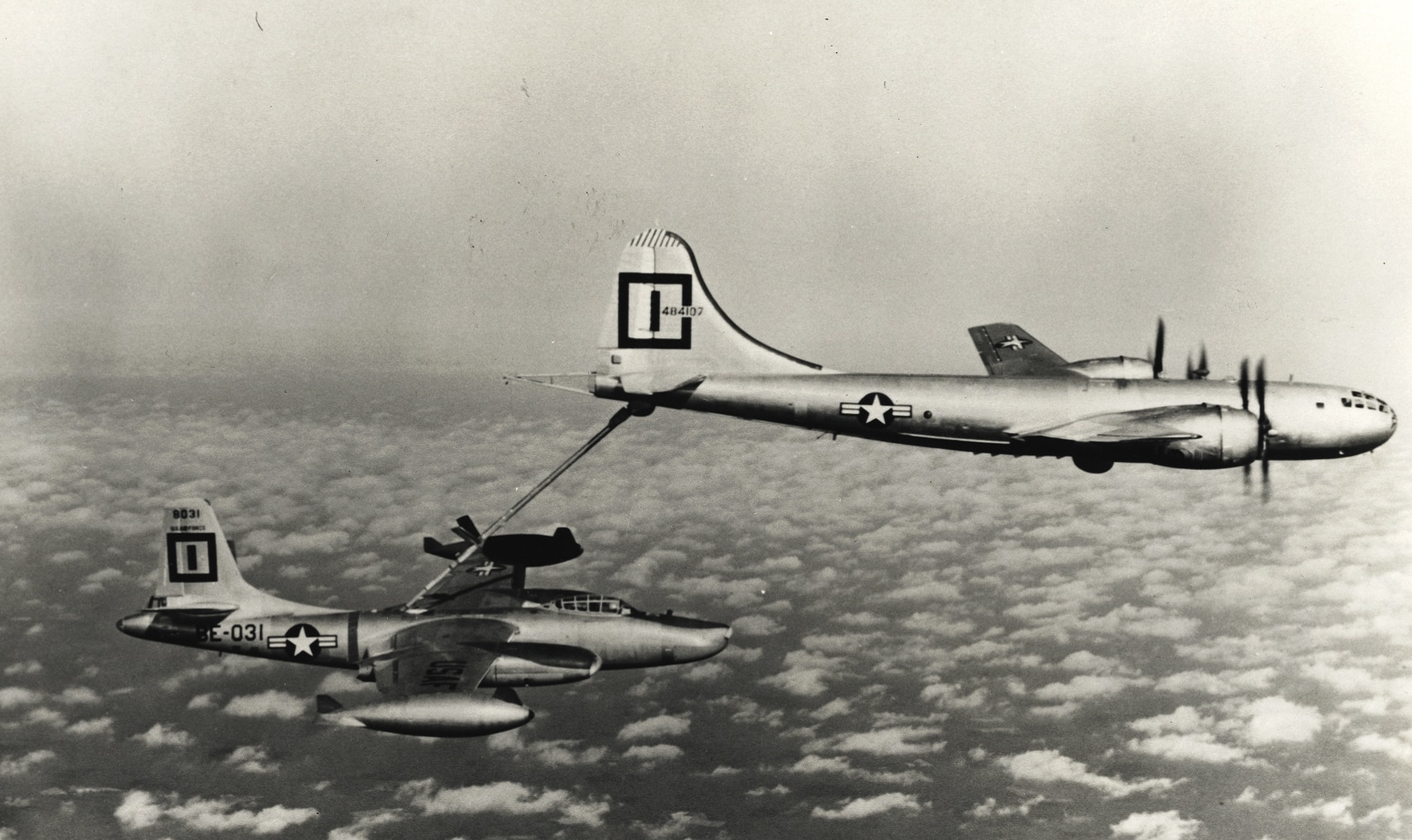
The first multi engine jet bomber/reconnaissance aircraft to be refueled inflight was an RB-45C that connected with a Boeing KB-29 tanker in the fall of 1950.

During the Korean War, RB-45Cs flew surveillance missions over North Korea and β€˜MiG Alley’ often during hours of darkness. MiG-15s appeared on the scene not long after the RB-45Cs arrived. Soviet records show an RB-45C was downed by a MiG-15 on Dec. 4, 1950, and one piloted by Capt. Charles E. McDonough did go missing on that day.

A RB-45C of the 91st Strategic Reconnaissance Wing from Barksdale Air Force Base, Louisiana, is being refueled by a 91st Air Refueling Squadron Boeing KB-29P. | Source: United States Government

First operated by the 91st Strategic Reconnaissance Wing (SRW), the RB-45Cs provided a platform for USAF units keeping watch on the Soviet Union, including some RB-45Cs in British national insignia.

Tornados behind the Iron Curtain

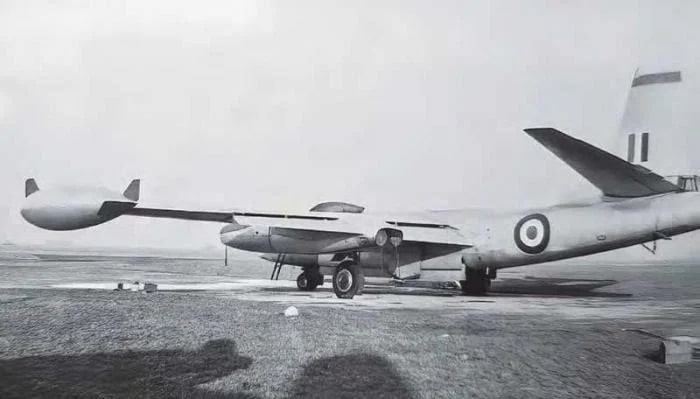
Flying American-owned RB-45Cs painted in RAF (Royal Air Force) markings and operating from RAF Sculthorpe in the United Kingdom, British crews carried out highly classified missions conducting overflights of the Soviet Union during the Cold War. Electronic and photographic intelligence was gathered during a period of 1952-1954. The missions were not revealed until 1994 when the Public Records Act allowed the missions to become public knowledge.

Americans were prohibited by their government at the time of conducting overflight missions, so it was decided RAF crews would take on the task in American aircraft painted in RAF markings. At the time the only aircraft in inventory capable of making the deep-penetration reconnaissance missions was the new RB-45C. Four aircraft were allocated for what was known as Operation Ju Jitsu.

RB-45C in British markings at RAF Sculthorpe, UK, during Operation Ju Jitsu. | Source: RAF Sculthorpe Heritage Center

Relying heavily on aerial refueling from KB-29Ps, missions were flown behind the Iron Curtain in attempts to gather information on Soviet bomber strength and locations in order to develop a target list. The flights were successful for the most part without encountering enemy aircraft or fire. However the program was ended when the squadron leader, John Crampton, had his RB-45C come under anti-aircraft fire and was close to being intercepted by MiG-15s.

End of Service

After filling important roles in the early days of the Cold War, the B-45 would eventually surrender most of its duties as a nuclear deterrent to a Soviet ground invasion in Europe and flying highly classified reconnaissance flights to the more capable and advanced Boeing B-47. An interesting and important part of aviation history, the B-45 faded into oblivion.

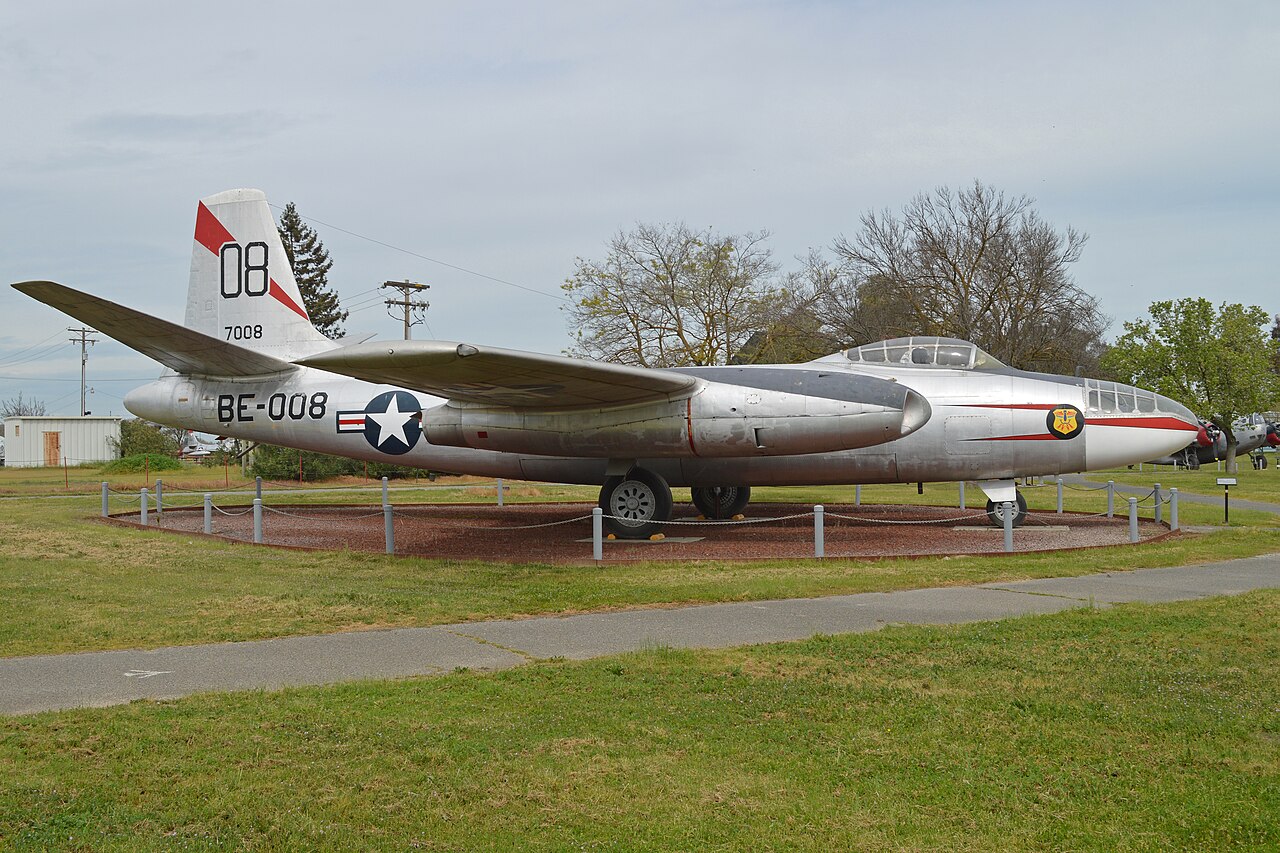
Of the 143 B-45 Tornados built only three display-worthy survive, this being the only β€˜A’ model. It is on display at the Castle Air Museum, Atwater, California. | Source: Wikimedia Commons
There are currently three surviving B-45s out of the 143 produced on display as most were scrapped and the aircraft forgotten at the end of their service in the late 1950s. A B-45A is on display at Castle Air Museum in Atwater, California. The National Museum of the United States Air Force near Dayton, Ohio, has a B-45C on display, and an RB-45C resides at the Strategic Air Command & Aerospace Museum in Ashland, Nebraska.
Nighthawks over Panama: The Story of the F-117’s First Combat

17 June 2026 at 14:20
Nighthawks over Panama

Seeking Panama’s dictator Manuel Noriega on multiple drug trafficking charges, the U.S. deployed one of their most secretive and effective weapons for the first time in the darkness of Dec. 20, 1989.

At 0101 hours on Dec. 20, 1989, the pitch black peaceful tropical night outside the Panamanian Defense Force (PDF) barracks was suddenly disturbed by two large explosions lighting up the sky and jarring soldiers from their restful sleep, confusing and stunning everyone in the area as bombs fell from unseen and undetected aircraft in the night skies above.

A Long Journey

At dusk on Dec. 19, 1989, eight unconventional aircraft belonging to the 37th Tactical Fighter Wing (TFW) left their secretive base at Tonopah Test Range in Nevada. The aircraft, little known to the American public and most of the world, were products of the famous Lockheed β€˜Skunk Works,’ known for producing technologically advanced aircraft in secrecy. These aircraft were built with new technology almost invisible to radar and equipped with advanced pinpoint weapons guidance systems. Because of the stealth characteristics, these aircraft could bomb flying straight and level, aiding accuracy.

Painted black with a sinister shape and designed to operate with impunity over enemy territory at night, these aircraft were known as the F-117A Nighthawk, but are often referred to as the β€˜Stealth Fighter,’ although it is actually more of a nocturnal attack aircraft that carries precision-guided bombs. The aircraft’s stealthy characteristics and pinpoint accuracy are why it was decided to finally unveil the United States Air Force’s (USAF) secret they’d been hiding in the Nevada desert and utilize it for the first time on an important mission.

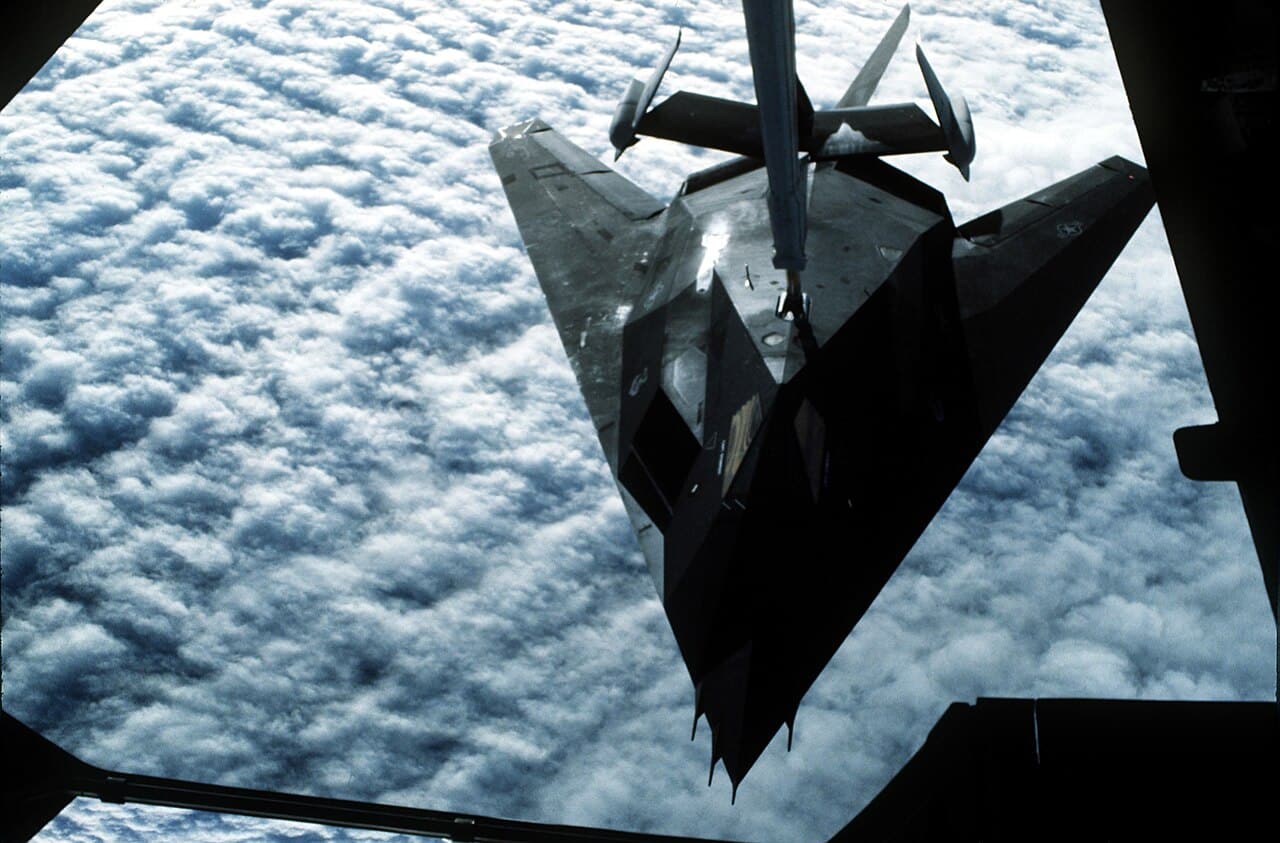
A 37th TFW F-117A Nighthawk refuels from a 22nd Air Refueling Wing KC-10 Extender aircraft. | Source: United States Air Force/Staff Sgt. Scott P. Stewart

Two of the airborne aircraft were to conduct the mission in the opening hours of what was known as Operation Just Cause, another four were to conduct a still classified mission, and two held in reserve in the event of mechanical problems or the unlikely probability of a shoot down. A total of seven aerial refuelings would be required as they traveled over 3,000 miles for almost eight hours in the dark with their KC-10 tankers to Central America.

The Objective

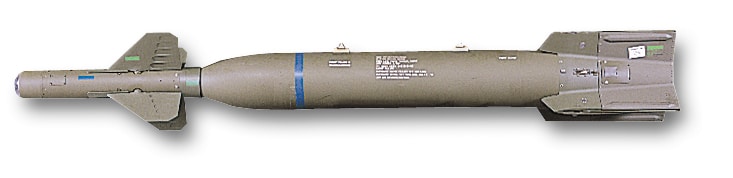
Carrying a single GBU-10 or GBU-27 laser-guided 2,000 lb bomb each, tucked away in internal bomb bays to maintain stealth characteristics, the Nighthawks could place the bombs in an area the size of a phone booth or a 5 ft circle with relative ease. However, not only did they have to strike the designated targets accurately, but they also had to hit them at a precise pre-determined time.

GBU-27 Paveway III 2,000 lb laser-guided bomb. | Source: Wikimedia Commons

The intent was to disorient but not kill elite members of the Panamanian Defense Forces (PDF) known to be fiercely loyal to General Manuel Noriega at Rio Hato while they slept in their barracks. The bombs were to be dropped in open areas a safe distance from occupied buildings and act as giant stun grenades. Army Rangers and other special forces would then immediately converge on the area in positions along the nearby runway in the confusion. The mission was further complicated by the fact that a dispensary with possible civilian patients was nearby as well as teenage cadets in training. Hitting either of these would be a disaster.

The Strike

As the two F-117s broke away from their tankers, went silent and disappeared even from the prying eyes of the E-3 Sentry Airborne Warning and Control System (AWACS) aircraft and Panamanian radar, and began their target runs, the winds changed directions. To further complicate things, plans were changed at the last minute causing the lead aircraft, piloted by Capt. Greg Feest, to drop his bomb right on time where it was originally intended the second aircraft would strike. Confused communications and possible incorrect coordinates caused the second aircraft piloted by Maj. Dale Hanner, who now thought they had reverted back to the original plan, to drop is bomb 325 yards wide of the intended target.Β 

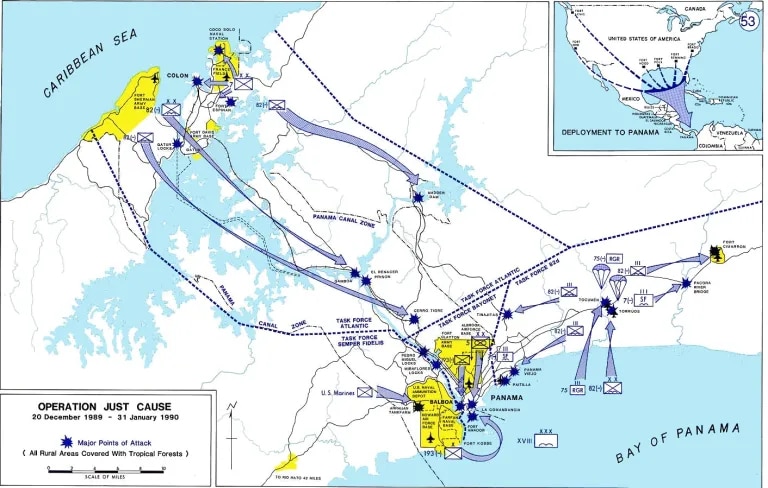
Map illustrating Operation Just Cause. | Source: United States Department of Defense

Despite the targeting mix-up and the fact it appeared the PDF had been tipped off and was already alert and in place defending the air strip, reports indicated the explosions did create some desired confusion, with PDF soldiers running about in their underwear and some throwing down weapons and running off.

It was 0102 hrs on Dec. 20, and the two F-117s would not stick around to watch the fireworks as an AC-130 Spectre gunship and AH-64 Apache attack helicopter, joined by a pair of AH-6 Little Birds, would be making their runs on the airstrip, all part of an over 300 aircraft air armada assembled for the largest United States military action since Vietnam.

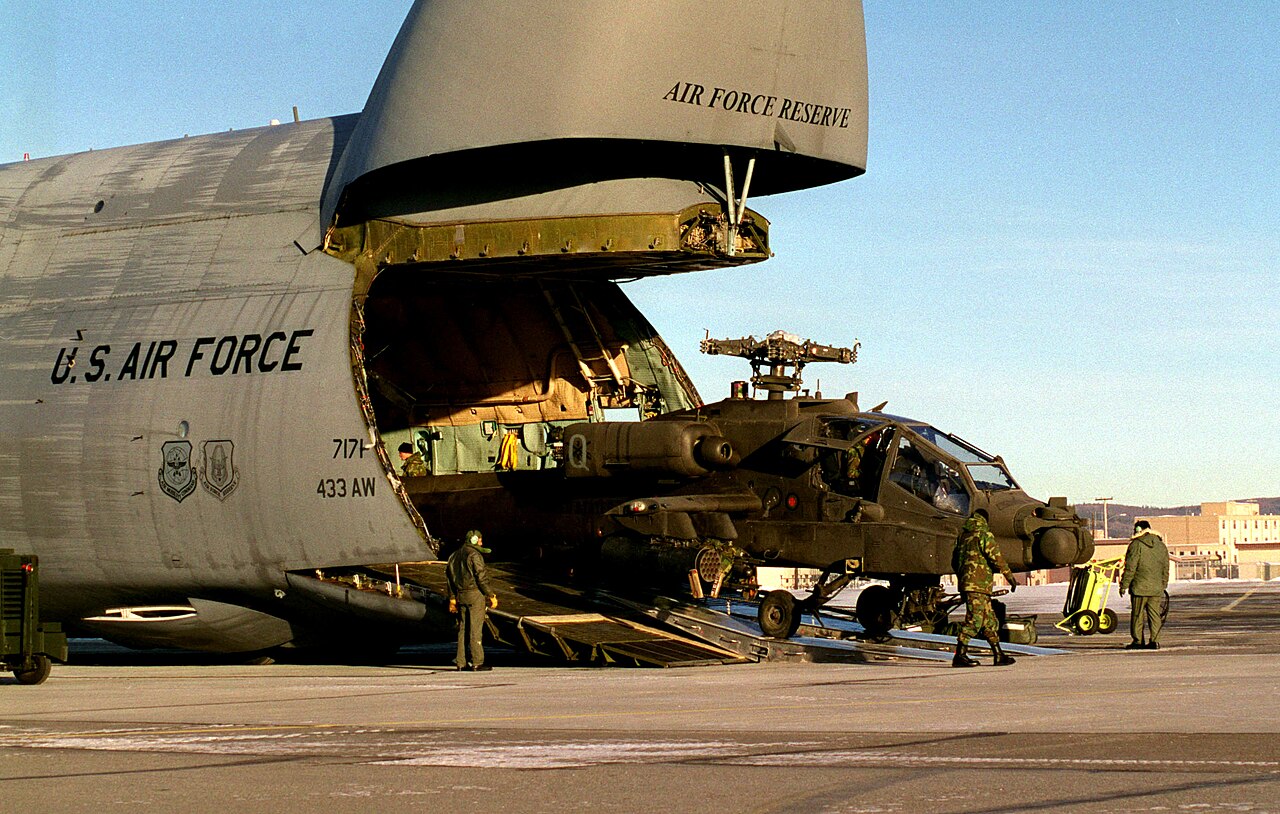
A U.S. Army AH-64 Apache attack helicopter is winched down the ramp of a National Guard C-5 Galaxy at Eielson Air Force Base, Alaska, on Feb. 6, 1998. The Apache is attached to the 4th Battalion, 3rd Armored Cavalry Regiment, Fort Carson, Colorado. The Galaxy is deployed from Kelly Air Force Base, Texas. | Source: United States Air Force/Senior Airman Michael D. Morford

The Apaches had been smuggled onto Howard Air Force Base (AFB) inside giant C-5 Galaxy transport aircraft. The helicopters were only flown at night and tucked away in hangers before dawn to prevent the PDF from knowing they were present at the air base inside Panama.

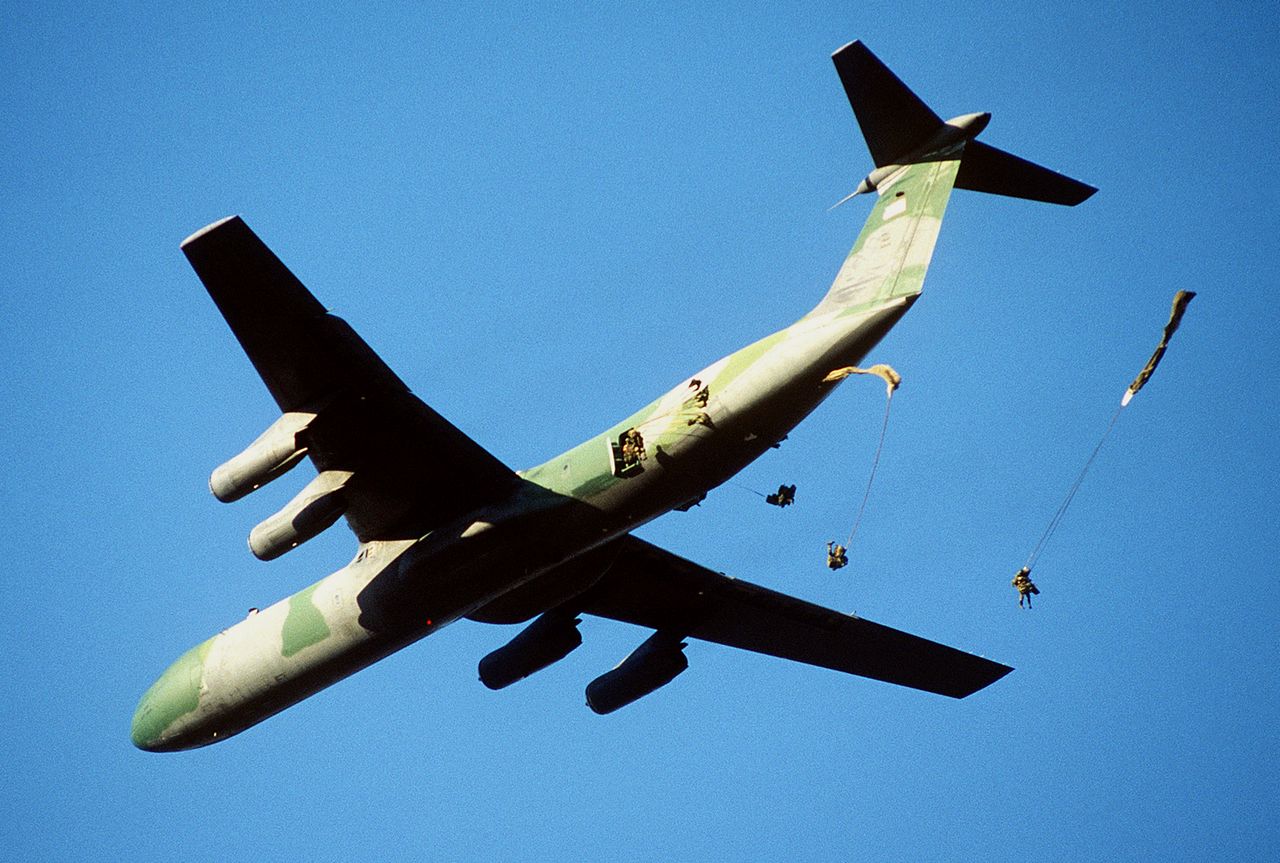
Soon 144 C-130 and C-141 transport aircraft carrying troops, armored vehicles, weapons, and equipment were dropping their cargos in the largest airborne operation since World War 2, while fighters provided escort and KC-135 and KC-10 fueled the thirsty air fleet.

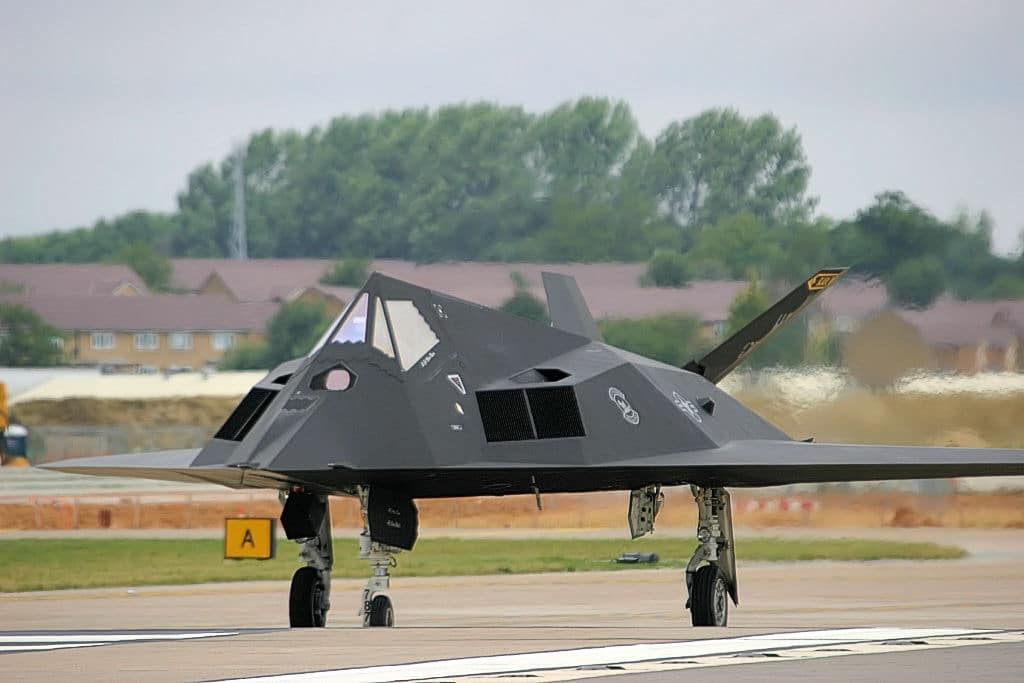
A Lockheed F-117A at 2004 Royal International Air Tattoo. | Source: Wikimedia Commons

Air National Guard A-7 Corsair IIs and Howard Air Force Base A-37 Dragonfly attack aircraft stood by, should additional fixed-wing fire support be needed. F-15s provided Combat Air Patrol (CAP) flights in the event the Panamanian Air Force mounted a challenge. The F-15s were also prepared to intercept any attempt by Noriega to escape the country by aircraft. Search and Rescue aircraft were placed in strategic locations as well.

The other four F-117s that had been tasked with a separate mission assisting Special Forces in the capture of Noriega, but were called off after intelligence indicated he was not at any of the assigned targets.

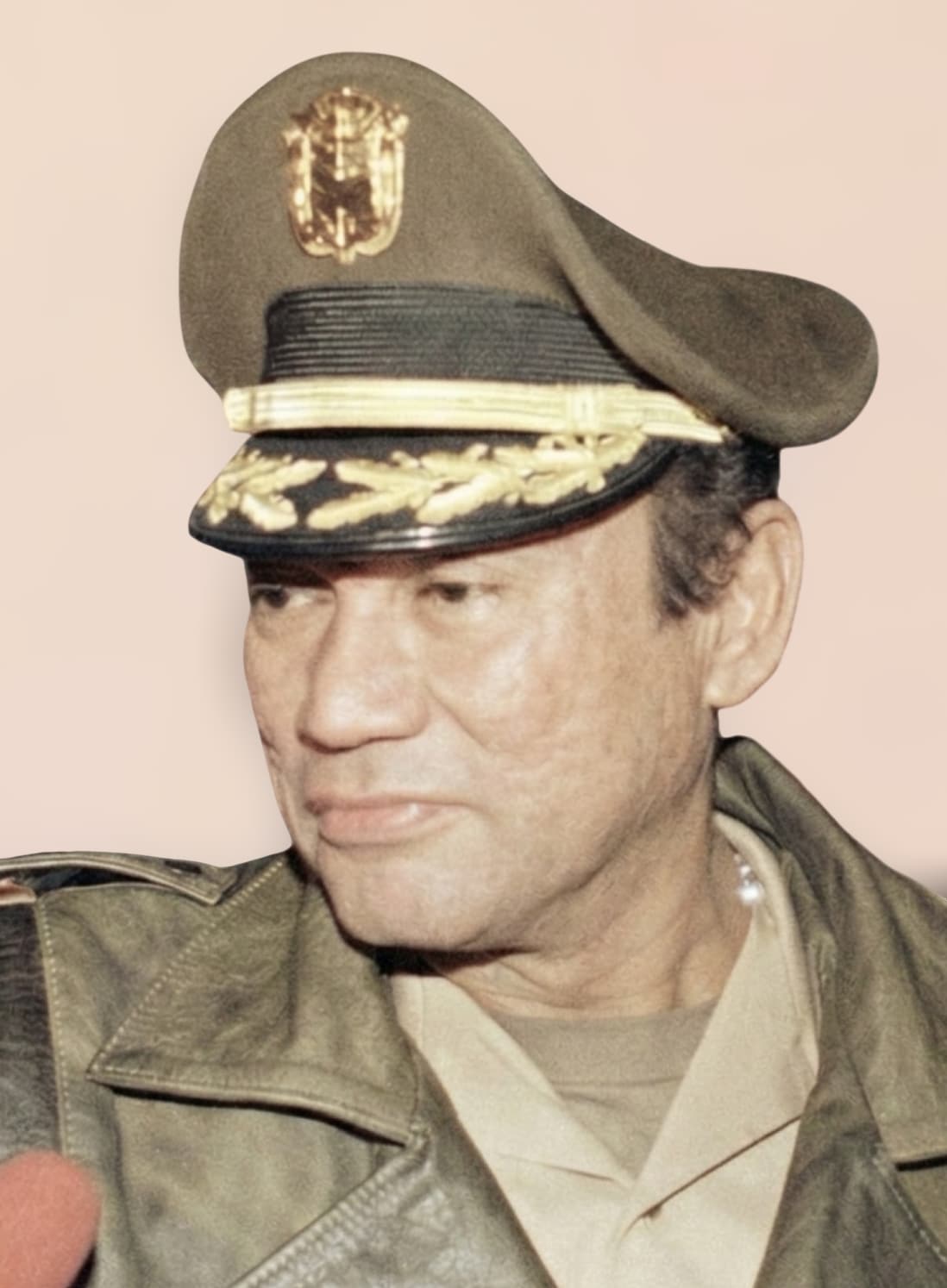
Panamanian Dictator Manuel Noriega in 1988. | Source: Wikimedia Commons

The Results

The F-117 had proven itself against an enemy Integrated Air Defense System (IADS) in combat for the first time, and had done what it was asked to do. Even with the targeting miscues, General Carl Steiner, commander of the XVIII Airborne Corps, was pleased with the results and happy that he had requested the use of the F-117s for the operation.

The PDF was quickly overwhelmed by American forces while Noriega evaded capture, eventually seeking sanctuary at the Apostolic Nunciature. After ten days of having Van Halen blasted by U.S. forces from a cassette tape, constant helicopters coming and going and other intentional loud noises, he surrendered on Jan. 3, 1990, and was taken as a prisoner to be prosecuted and sentenced. He passed away on May 29, 2017, from complications during surgery for a brain tumor. He was 83.

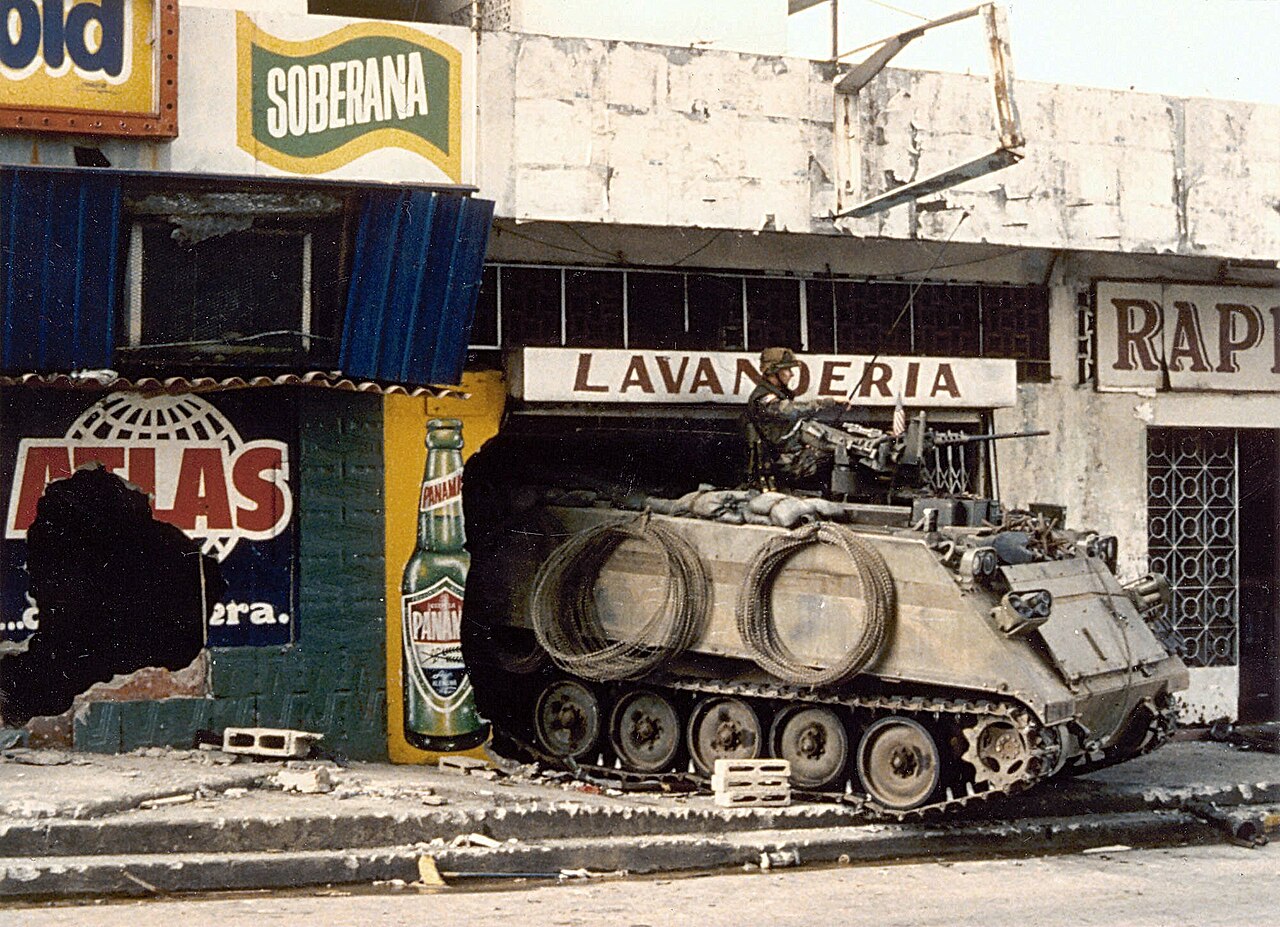
A U.S. Army M-113 armored personnel carrier guards a street near the destroyed PDF headquarters building during the second day of Operation Just Cause, Dec. 21, 1989. | Source: United States Department of Defense

Captain Feest was chosen to lead the F-117 mission over Panama instead of a Major because of the secrecy of the program and him being the top performer in the wing, bypassing those who outranked him. Capt. Feest had won the squadron’s Top Gun award in two consecutive years and maintained a perfect 100% hit rate.

The F-117A would go on to prove even more valuable and deadly in January 1991, when it would achieve legendary status in the skies over Iraq. Now a Major, Greg Feest would be at the forefront once again, striking important targets with precise accuracy and timing in an F-117A Nighthawk.

Unleashing a Deadly Snake: The Birth of the AH-1 Cobra

24 May 2026 at 20:17
Birth of the AH-1 Cobra

As the conflict in Vietnam raged, the UH-1 Huey was modified into a gunship, but the ubiquitous helicopter was slow and underpowered at times, thus prompting the need for a dedicated attack aircraft.

Bell Helicopter had anticipated the eventual need for a pure attack helicopter and had already started research and development even before the conflict in Southeast Asia. This gave Bell the upper-hand when the Unites States Army would request just such a machine for close air support and escorting troop transport helicopters over the dense jungles of Vietnam.

Bell’s Early Efforts

1958 saw the Bell D245 Combat Reconnaissance Helicopter design, a narrow-body gunship concept. The design was presented to the United States Army’s 7292nd Aerial Combat Reconnaissance Company, but with no applicable doctrine or priority given to armed helicopters, support waned and eventually the idea died.

Scale model of the Bell D245 design. | Source: Bell Helicopter

Despite the lack of interest by the Army, Bell continued the work, funding the research within the company. Bell intended to design an attack helicopter utilizing many existing components used on the UH-1.

The result of these efforts produced the D255 Iroquois Warrior in June 1962. The D255 featured tandem β€˜stepped’ seating with both a pilot and a gunner seated in a narrow fuselage with stub wings and a streamlined ventral gun pod along with a nose turret.

The design produced excellent visibility for the crew members as well as presenting a slender target when viewed head-on. The aerodynamics offered good handling characteristics along with improved delivery of ordinance. They finally got the Army’s attention.

The Bell D255 Iroquois Warrior, 1962. | Source: Bell Helicopter

In December 1962, after the Army allocated funds for researching and developing an attack helicopter, Bell received approval to build a testbed aircraft. The result was the Model 207, a combination of OH-13S and Model 47J-2 components. Known as the Sioux Scout and completed in 1963, trials made an impression and the Army asked for a similar aircraft only with a turbine engine.

Meanwhile, in 1964 the Army presented a Request for Proposal (RFP) known as the Advanced Aerial Fire Support System (AAFSS). Keeping the United States Air Force (USAF) in the dark with somewhat ambiguous specifics but stringent requirements, several manufacturers went to work designing dedicated close air support (CAS) aircraft.

Lockheed produced the AH-56 Cheyenne design while Sikorsky’s entry was known as the S-66 Blackhawk. Both these designs were chosen for further evaluation by the Army, while Bell’s entry, the D262, a version of the Iroquois Warrior, was eliminated from the competition.

The Bell Model 207 Sioux Scout in 1963. | Source: United States Army

Undaunted, Bell continued work on the idea, convinced they could produce what the Army needed. In January 1965, engineers at Bell took the proven components from the D262 and the Super Sioux and produced a prototype. The idea was to convince the Army that a short lead time and low development cost could result the Army having the helicopter in service much quicker.

The Bell Model 209

Bell’s efforts produced the Model 209 that again featured a narrow fuselage with a crew of two sitting tandem in tiered seats. The co-pilot/gunner was seated in the front and lower seat, with the pilot seated behind and above. An Emerson Electric turret located on the chin of the aircraft contained a GAU-2B/A 7.62 mm minigun. Stub wings provided both lift and hard points for various ordinance and weapons.

Bell Model 209 tail number N209J was the first prototype. Note the retracted landing skids, tandem seating arrangement, panoramic view offered by the canopy, and smooth, clean lines. This aircraft would fly from Sept. 7, 1965, until retired in 1970, working as a demonstrator and test bed. It is shown here wearing camouflage. The aircraft is currently in the collection of the U.S. Army Aviation Museum along with the second prototype at Ft. Rucker, Alabama. | Source: Bell Helicopter

The 209 received power from a Lycoming T53-L-11 turbine engine producing 1,100 shp (shaft horsepower). The transmission and rotor system was that of the UH-1C. The traditional stabilizer bar system was replaced by a Stability Control Augmentation System (SCAS) which reduced weight. The landing skids retracted allowing for less drag and a wider firing radius for the chin turret.

Bell called the new helicopter the Cobra, bucking the tradition of naming Army helicopters after Native Americans. A distinctive collective-lever in the shape of a cobra snake’s head supported the branding.

The first Model 209 prototype flew Sept. 7, 1965, and on Oct. 25 the helicopter broke the world speed record for its weight class of 180.1 mph when it recorded a sustained speed of 200 mph. Meanwhile, the UH-1C, incorporating a more powerful engine than previous models, struggled to keep pace with the CH-47 Chinook transports they were escorting in the skies over Vietnam.

The capable Lockheed AH-56 would not be available until 1970 and things were heating up in Southeast Asia. The Army would need something to fill the gap and soon.

A UH-1D helicopter prepares to land at Camp Evans during airlift operations moving elements of the 1st Cavalry Division (Airmobile) from Camp Evans their new forward base camp, east of Khe Sanh, in preparation for Operation Pegasus. In the background a CH-47 Chinook helicopter being loaded with equipment. | Source: United States Army/SP5 Richard S. Durrance

Bell had made a presentation to the Army in August 1965 on the need for a faster and heavily armed helicopter for escorting transports in Vietnam. They suggested the Model 209 could be put into production rapidly utilizing UH-1 components, and pointed out the AAFSS was not arriving in time. The Army agreed with Bell, however the helicopter would not be considered for adoption without facing contenders from other companies.

The contenders the 209 faced were converted and modified utility helicopters already in existence. Only the Bell entry was designed from the beginning as an attack helicopter, and after a two-month trail at Edwards Air Force Base in California, the Model 209 was chosen by the Army. Finally, on April 4, 1966, a contract with an order for two preproduction prototypes was awarded to Bell.

The AH-1G Cobra

Designated the AH-1G, the Army placed an order for 110 Huey Cobras on April 13, 1966. The designation stood for β€˜Attack Helicopter Type 1’. 838 AH-1s would be ordered by late 1968, with a total of 1,126 being purchased by the Army and Marine Corps when production of the G model ended in 1973.

The outlines of the Bell AH-1G Cobra. Note the slender fuselage when viewed head-on, the chin turret and the stubby wings with rocket pods attached, and the fixed landing skids. These drawings also show the tail rotor moved to the starboard side. | Source: Wikimedia Commons

Changes to the production models included the Avro Lycoming T53-L-13 engine replacing the L-11, producing 200 more horsepower. This gave the Cobra a cruising speed of 166 mph and a dive speed of around 220 mph. Self-sealing fuel tanks gave the aircraft a range of 362 miles. Maximum takeoff weight was 9,500 lb, and the service ceiling was 12,700 ft.

The retracting landing skids were replaced with fixed skids and the ventral tail fin extension of the 209 was eliminated, along with the distinctive cobra head collective-lever. Armor plating was added to protect vital systems and components. The crew also received armored seats, nose plate, armored side panels and a bulletproof windshield. The tail boom was carried over from the UH-1C, and most antennas were mounted flush or within the airframe to improve aerodynamic efficiency.

A close-up of the chin turret with the business end of the 7.62 mm minigun and the 40 mm grenade launcher staring down the viewer. | Source: Wikimedia Commons

Initial production AH-1s had an Emerson Electric TAT-102A turret housing a single GE XM-134 7.62 mm minigun capable of firing 4,000 rounds per minute, but later production saw a TAT-141 turret with a GAU-2B/A minigun along with a M-129 40 mm grenade launcher, which could also be configured to carry two of the same of either of these weapons. The miniguns had a 4,000 round supply and the grenade launchers had 231 rounds available.

The gunner would normally control and fire the turret weapons utilizing a pantographic sighting system, but the turret weapons could also be fired by pilot if in the fixed-forward position. The gunner also had the capability of flying the aircraft if need be.

Munitions are loaded on an AH-1, including belted 7.62 mm ammunition and rockets. | Source: Wikimedia Commons

The stub wings could carry various types of ordinance on four pylons, including rocket pods, minigun pods, or even a six-barrel M61A1 20 mm cannon. These weapons were fired by the pilot using the Mk-18 adjustable rocket sight, with the gunner having the capability to fire the weapons as well in an emergency. The AH-1G Cobra carried up to 76 of the 2.75 in rockets.

Cobras Unleashed

First to receive the Cobras in Vietnam was the 334th Assault Helicopter Company (AHC) in late September 1967. The unit’s 1st Platoon, known as The Playboys, traded their UH-1Cs for the sleek new AH-1s and saw their first combat mission on Oct. 8. Four enemy bunkers and fourteen sampans were destroyed that day.

An AH-1 Cobra pulls up from an attack, making its thin silhouette visible against the smoke plumes and explosions. The Cobra could perform maneuvers normally left to fixed-wing aircraft and made difficult targets for enemy gunners. | Source: Wikimedia Commons

The speed and slender silhouette of the Huey Cobra proved a challenge to enemy gunners, and increased dive angle, maneuverability, and weapons allowed Army pilots to do things normally limited to fixed-wing aircraft. Soon the Cobras developed a reputation among friend and foe alike as the snake that bites.

The stifling heat of Southeast Asia coupled with the large canopy area heated up the enclosed cockpit making them unbearable. Small powerful air conditioners were soon installed to solve the problem. In addition, pilots used to relying on their door gunners when flying the UH-1s soon realized those extra eyes and ears were no longer present, along with their suppressive fire from the sides of the aircraft. Despite these shortcomings, the AH-1 found great success operating in Southeast Asia.

An AH-1 firing rockets in Vietnam at a target. | Source: Wikimedia Commons

During the Tet offensive of February 1968, Cobras decimated communist forces during attacks at Tan Son Nhut Airbase, Bein Hoa, and even around the Saigon area, where the AH-1 was credited as a key component in defeating the communists. The ability to rapidly deploy as opposed to fixed-wing aircraft and the pinpoint accuracy of the helicopter’s weapons had demonstrated the effectiveness of the Cobras.

Before the conflict was over, AH-1s would be found performing a variety of missions including serving with Aerial Rocket Artillery Batteries, Air Calvary, Aerial Weapons Companies, Assault Helicopter Companies; flying escort or providing firepower on call to troops on the ground, assisting with rescues, or whatever would be asked of them.

The spring of 1972 saw the Cobra’s first confrontation with enemy tanks during an enemy offensive that saw one AH-1G unit destroy or damage over 20 tanks,Β  most of them with unguided rockets. The aircraft were in the hands of F-Battery, 79th Aerial Field Artillery, 1st Calvary’s 3rd Brigade. Two helicopters were lost to heat-seeking SA-7 surface-to-air missiles (SAMs), resulting in the installation of an upturned exhaust directed into the main rotor to reduce infra-red signatures. ALQ-44 infra-red kits were also installed.

An early AH-1 Cobra with the tail rotor on the port side and a 20 mm rotary cannon under the wing. The cut down M61A1 M195 General Electric gun could be combined with an additional M18E minigun pod on the inboard position, giving the Cobra impressive firepower. A chute below the cannon ejected spent cases out and away from the tail rotor. | Source: Wikimedia Commons

During the war, another modification that took place was moving the tail rotor from the port side to the starboard side to improve directional control, as the large tail fin was sensitive to tail winds.

A total of 38 AH-G models were diverted to the United States Marine Corps in 1969, taking on many of the same missions as those with the Army, with the addition of armed observation and assuming many roles previously done by UH-1s. The Marines eventually received their own version of the Cobra, a twin-engine model known as the Sea Cobra and designated the AH-1J.

The Marine version of the AH-1, the AH-1J Sea Cobra, clearly showing the twin-engine design. | Source: San Diego Air & Space Museum

Because of urgent needs during the Vietnam War, the deadly attack helicopter known as the Cobra was born. Both the United States Army and Marines utilized the helicopter with great effectiveness in Southeast Asia, despite the loss of nearly 300 Army and 10 Marine aircraft to both operational and combat causes.

The AH-1 design continued to be modified and upgraded and still serves several nations as well as private enterprises and even emergency services, although the United States Army retired the Cobra in 2001. The U.S. Marines and a handful of other countries still operate a version known as the AH-1Z Viper.

A right front view of three AH-1 Cobra gunship helicopters in use during Operation Ocean Venture ’84. They are assigned to the Army’s 17th Cavalry. | Source: United States Air Force/Staff Sgt. Phil Schmitten

The Hainan Island Incident: 25 Years Later we Interview one of the Pilots

12 May 2026 at 22:28
first-hand account Hainan Island incident

We get a first-hand account from the third pilot onboard the EP-3 and his experiences while being held by the Chinese, as well as being released and coming home.

On April 1, 2001, a United States Navy EP-3E signals intelligence (SIGINT) aircraft collided with a Chinese interceptor over the South China Sea, causing the EP-3 to make an unauthorized emergency landing on Hainan Island and sparking an international incident between the United States and the People’s Republic of China. The American crew would be held for 11 days by the Chinese.

The Collision and Aftermath

Two Chinese Navy J-8 II aircraft intercepted the EP-3 while conducting a signals intelligence mission involving overflights of the South China Sea. Aggressive passes were made at the American aircraft by the Chinese pilots, resulting in a collision that would seriously damage the EP-3, destroy the Chinese aircraft and cause the loss of the pilot. The EP-3 would have to land on the Chinese Island of Hainan at the Lingshui airfield.

Map showing the location of the collision and Hainan Island. | Source: Wikimedia Commons

After landing, the crew of the American aircraft was detained by the Chinese government, and the Chinese took possession of the EP-3. Classified information had been destroyed by the crew prior to landing; however the Chinese still attempted and succeeded in gathering information and materials from the aircraft.

Diplomatic efforts achieved the release of the crew after 11 days, while the aircraft was not released back to the United States until it was disassembled. Technicians from Lockheed Martin dismantled the aircraft and it was returned on an AN-124 transport aircraft in July 2001. The aircraft was reassembled in Georgia, repaired and placed back in service.

The EP-3

Built by Lockheed, the EP-3 was an electronic signals reconnaissance version of the P-3 Orion anti-submarine aircraft. Introduced in the 1960s and based on the L-188 Electra airliner, the P-3 received many modifications during its service life.

The EP-3 was a variant of the anti-submarine P-3 Orion shown here. | Source: Wikimedia Commons

The EP-3 variant was known by the acronym ARIES (Airborne Reconnaissance Integrated Electronic System) and was capable of intercepting signals such as communications or more specifically electronic signals not directly used in communications.Β  A total of 12 P-3Cs were converted to the EP-3E ARIES II ELINT (Electronics Intelligence) variant, the last one delivered in 1997. The last EP-3E was retired in 2025.

The aircraft received power from four Allison turboprops engines and had a length of over 116 ft and wingspan of 99 ft 8 in. It usually carried a crew of 24, which included linguists, cryptographers, and technicians.

The J-8 II Interceptor

The Shenyang J-8 II (Finback-B) is a development of the earlier J-8 (Finback) interceptor. Development began in the early 1980s and it entered service in 1988. The primary users include the People’s Liberation Army Air Force and the People’s Liberation Army Naval Air Force of the People’s Republic of China.

The Shenyang J-8 II interceptor in flight. The original shock cone and intake was replaced with a radome and lateral intakes on the J-8 II version of the J-8. | Source: Wikimedia Commons

The J-8 II’s power is derived from two WP-13A-II turbojets capable of pushing the 70 ft 10 in long jet to 1,452 mph. Armament includes a single twin-barrel Type 23-III 23 mm cannon and seven external hard points able to carry a variety of weaponry and drop tanks.

The J-8 II also was radically redesigned with the Type 208 pulse-Doppler radar installed. Over 70 percent of the original J-8’s airframe structure and systems were reworked, including the nose air intakes and the shock cone being replaced with a radome and lateral air intakes.

The Interview with Jeff Vignery, 3rd Pilot

The Aviationist: Can you please provide us some background information such as where you grew up, where you attended school, and your path to the U.S. Navy?Β 

I was born in San Diego California at Balboa Naval Hospital and then we moved to Goodland, Kansas, once my Dad finished his time in the Navy as a JAG officer.Β I grew up in Goodland and graduated from Goodland High School, and then attended and graduated from the University of Kansas. I was in the Naval ROTC program while at KU.

What unit or units were you a part of during your Navy career and what duties did you perform?Β 

I was part of VQ-1 in Whidbey Island where I flew the EP-3.Β While stationed there, my ground jobs were Public Affairs Officer and Aviation Safety Officer.Β After leaving Whidbey I took joint flight instructor orders with the Air Force’s 32nd Flight Training Squadron in Enid, Oklahoma.Β I instructed Air Force and Navy students in the T-1A Jayhawk.

A T-1A Jayhawk, the type Jeff instructed Air Force and Navy students on with the Air Force’s 32nd Flight Training Squadron in Oklahoma. | Source: Wikimedia Commons

At the time of the Hainan Island Incident, what position and rank did you hold?Β 

I was the 3rd pilot on the crew and a Lieutenant Junior Grade. Below is a breakdown of the crew positions.

  • 1P / PPC (Patrol Plane Commander): The most senior pilot, responsible for the safe operation of the aircraft and mission accomplishment.
  • 2P (Second Pilot / Co-Pilot): A qualified pilot who is experienced but not yet fully qualified to be a PPC.
  • 3P (Third Pilot): The most junior pilot who is in training and acting as a safety observer and/or copiloting while gaining experience.

What type of aircraft is the EP-3 and what types of missions did it fly?Β 

The EP-3 is a signal intelligence aircraft built by Lockheed.Β We flew reconnaissance missions all over the world.

What duties did you perform on the EP-3 on that particular mission on April 1, 2001, and where did the mission take place?

I was the 3rd pilot on the aircraft and we were flying off the coast of China.

How many crew members were onboard the EP-3 for this particular mission?Β 

We had 24 crew members on board the EP-3.

Can you briefly describe what occurred during the time leading up to the collision with the Chinese J-8II interceptor? Can you describe the collision? What did you witness?Β 

At the time of the incident I was sitting in the left seat of the cockpit.Β I was observing the Chinese fighter approach our aircraft on an approximate 45 degree bearing line.Β He would get close to our aircraft and then break away.Β On his 3rd attempt of doing this, it is my assumption that he was trying to β€œthump” (a tactical, often aggressive maneuver where a fighter jet zooms directly in front of a slower, intercepted aircraft (like a spy plane or bomber), causing the target to fly through the fighter’s wake turbulence) our aircraft. I believe he miscalculated and wasn’t in front of us enough when he pulled up on his aircraft.

This resulted in our #1 engine propeller cutting his aircraft in half just in front of his vertical stabilizer.Β I immediately looked at the aircraft commander in the right seat (Shane Osborn) in disbelief at what had just happened.Β Shortly after that the aircraft bumped up and then went into a slow roll to almost inverted as we tried to get the aircraft under control.Β 

The damaged EP-3 on Hainan Island. | Source: Lockheed Martin

What kind of damage was done to the EP-3 and how did it affect flight performance?Β 

The nose cone was torn off, the #1 and #3 engines had to be shut down and the propellers failed to feather, HF antenna wrapped around the elevator which led to some elevator issues, and no airspeed indicator.Β I tell people the aircraft was shaking like a single wet towel in a washing machine on spin cycle that is stuck on one side.Β Shane Osborn performed a two-engine, no flap landing using the GPS to interpolate airspeed..

What became of the Chinese aircraft and pilot?Β 

It is my understanding that both were lost at sea.

What occurred on board the EP-3 after the collision?Β 

After the collision we were all happy to be alive.Β We spent time determining our next steps as the plane was surrounded by armed personnel and they were yelling for us to come off of it.

At what point was the decision made to land the EP-3 on Hainan Island?Β 

Once the aircraft was somewhat under control we performed a seat swap and requested the Navigator (Regina Kaufman) provide the closest airfield.Β However, when I left the flight station I was going to my ditching station (where I would sit for ditching the aircraft in the ocean).Β So my assumption was we were going to ditch the aircraft in the ocean.

What were your thoughts after the collision after realizing the damage done to the EP-3?Β 

Well, I don’t think there is a way to realize the full extent of the damage until after you exit the aircraft.Β Honestly, I was thanking God for providing a miracle.Β Β 

What was the emergency landing like and the reception?

I think any landing after something like that is the best.Β The plane was immediately surrounded by armed Chinese military personnel.

Can you describe what happened after the crew exited the aircraft?Β 

We were ushered onto a bus where we waited for hours. It is my assumption that they didn’t know what to do with us and were waiting for direction from higher authority.

Members of the Lockheed Martin Aeronautics Company recovery team move the US Navy EP-3E Aries II fuselage, on a dolly, on a loading ramp to an Antonov An-124 Condor. | Source: Lockheed Martin

How did the Chinese troops and personnel treat the crew of the EP-3?

No physical harm was done to anyone on the crew.Β They mostly left us alone until you were taken for interrogation.Β  Sometimes during interrogation there were threats but they were never executed.Β Β 

When did you realize they were not sending you home right away and were you able to communicate with loved ones back home and if so how often and by what means?Β 

I think we all realized it after a couple of days when we were requesting to speak to the Red Cross and/or a U.S. military representative and nothing was happening.Β We weren’t able to communicate at all with loved ones back home that I remember.

Did the Chinese interrogate the crew? If so can you describe how that was done?Β 

The pilots were interrogated individually twice a day at random times. Sometimes we were interrogated in the middle of the night, early in the morning, or afternoon.Β Β 

Did you witness anything the Chinese did with the EP-3 while they had control of it?Β 

No, we were kept in barracks away from the airfield and told to keep the blinds closed on our windows.Β Β 

How was the crew’s morale during the time they were detained? How did you deal with the unknowns of what was going to happen next?Β 

I think morale was as best it could be in that type of situation.Β We encouraged prayer and prayed before meals when we were all together.Β The 2P (Pat Honeck) and myself would come up with short skits to perform when we were all lining up for meals to try and keep the crew smiling or laughing if we could.

When and how did you find out you were finally being released?

If I remember correctly, the Defense Attache Brigadier General Neal Sealock came and let all of us know that we would be going home the next day.Β We were all allowed one phone call to a loved one to let them know we would be coming home the next day.

When you were released, how was the crew transported and to where? What did your journey home look like?Β 

We were transported by Continental Airlines. First time, I ever had my own row of seats on a plane and served a meal on actual plate ware instead of paper. We stayed one night in Guam then headed to Hawaii.Β Spent a couple days in Hawaii for debriefing and President Bush made sure we made it home in time to spend Easter with our families.

Navy Lt. Junior Grade Jeffery Vignery on board a chartered aircraft that will fly him from China to Guam on Apr. 12, 2001, during Operation Valiant Return. | Source: Wikimedia Commons

Can you describe the reception you received when you returned home?Β 

Incredible reception both at Whidbey Island and my personal one in Goodland, Kansas.Β  Definitely unexpected in both cases.Β I think the entire crew felt like we were doing what we were trained to do.Β Unfortunately another aircraft ran into us and, in my opinion, God ensured that aircraft remained airworthy enough for us to get everyone to safety.

I understand the crew was invited to the White House by President George W. Bush. Can you describe that experience?Β 

Meeting the President of the United States was amazing.Β He showed us around the oval office and explained the various artwork in the space. One of our crew actually asked if they could sit in his chair behind the desk.Β Of course the secret service was shaking their head no but President Bush replied β€œabsolutely”. Which was great because we all took a turn sitting in that chair.

Secretary of Defense Donald H. Rumsfeld adjusts the medal of Lt. Junior Grade Jeffrey Vignery during an award ceremony on May 18, 2001. Chairman of the Joint Chiefs of Staff Henry H. Shelton (right) is presenting the awards to the 24 crew members of the U.S. Navy EP-3. | Source: Wikimedia Commons

Do you remain in contact with any of your former crew members from this incident?Β 

We do remain in contact the best we can when life doesn’t get in the way.Β An email does get sent every April 1st and crew members respond with an update on where they are and what they are doing.Β Those that were able did get together this year on April 1st to see the plane in a boneyard in Arizona.Β Unfortunately, a lot of us were unable to make it.

Do you know what became of the specific EP-3 from this incident?Β 

The specific EP-3E is now on display at the Pima Air & Space Museum in Tucson, AZ.

The Hainan Island Incident EP-3E (156511) was towed from the 309th Aerospace Maintenance and Regeneration Group to the Pima Air and Space Museum in Arizona to be placed on display. | Source: Pima Air and Space Museum

Is there anything else you’d like to let our readers know about this event and your experience?Β 

When I look back at this event and the near misses throughout.Β I truly believe God was watching over us and kept the plane airborne until we were safely on the ground. The experience increased my faith in God and continues to be my reminder that he is always with us.

The Aviationist would like to send out a huge thank you to Jeff Vignery for agreeing to answer our questions and share his experiences. In addition, very special thanks to Rachel Berkheiser and J. Ronald Vignery for working behind the scenes and connecting us with Jeff.

Stealing a MiG-29 was a Piece of Cake – Sort of. Alexander Zuyev’s Great Escape – Part 2

10 May 2026 at 22:37

In the second part of this story, we cover the day Soviet Air Force Captain Alexander M. Zuyev defected in a MiG-29 fighter after executing a brilliant and bold plan in 1989, landing at a coastal airport in Turkey.

This article is the second of a two-part story covering the prepararations and then the defection of Alexander Zuyev. You can find the first part here.

Making an Escape

Returning to the dormitory, everyone was still sleeping, and Zuyev waited as the alert guard was relieved late at 0420. Zuyev went to the armory padlock and rammed a file into the keyhole of the padlock, breaking it off and jamming it. He then went outside and removed the keys from the fuel truck and a van, dropping them in the sewer. This prevented them from being used to block the runway.

At 0506 Zuyev cut all six phone lines from the control tower junction box and waited ten minutes to insure cutting them hadn’t triggered any alarms. Nothing happened; the tower and alert building were still quiet. The first patches of dawn were beginning to appear.

A view of a Soviet ZIL-131 6Γ—6 fuel truck in 1993. In the event of an attempted unauthorized aircraft takeoff, fuel trucks and other vehicles were to be placed in the path of the aircraft to prevent it from taking off. | Source: Don S. Montgomery/Wikimedia Commons

Zuyev then entered the dining room quietly finding the communication wires again. One by one he sliced them with cutters, with the last one triggering a sound from the phone in the dormitory, another thing he hadn’t thought about. The broken circuit caused a single ding from the bell. He grabbed his helmet bag and papers. It was time to go.

Approaching the alert apron, Zuyev pulled his Makarov pistol from his flight jacket and cocked it. One round was in the chamber and seven in the magazine of the small handgun. He saw the outline of the guard carrying an AKM rifle. It was a stocky Asian named Corporal Chomayev. He respected him as one of the better guards and hoped to disarm him without harming him.

Four MiG-29s sat in pairs on the alert area with canopies and instrument probes covered in canvas while sharing generator trucks connected to start cables. Zuyev confronted the guard questioning his earlier tardiness. Then producing the pistol, Zuyev demanded the guard put his hands up.Β  Instead the guard lunged at Zuyev, forcing the small the small automatic from his face.

The small Makarov semi-automatic pistol was no match for the AKM rifle.Β  Holding only 8 rounds it fires a 9 mm 95 grain bullet at 1,060 feet per second. The pistol has a reputation of being well-made. | Source: Wikimedia Commons

A wrestling and fighting match ensued, with both men becoming disarmed and trading blows, as both were skilled adversaries. Zuyev was a highly trained and experienced wrestler, Chomayev was experienced in self-defense. Neither refused to go down, and when Chomayev began yelling for help. Zuyev produced a knife.

Chomayev, at the sight of the knife blade, dove for his AKM on the ground as Zuyev then scrambled to retrieve his Makarov, hearing the bolt of the AKM cocking while he bent to grab the pistol. Chomayev was crouched beneath the nose of a MiG three yards away bringing the rifle to Zuyev’s chest level. Knowing Chomayev was not properly braced to fire the full-auto rifle and that it would pull up towards the right when fired, Zuyev dived to his own right the moment Chomayev fired. Chomayev missed to the left and Zuyev fired repeatedly at Chomayev, with one bullet hitting its mark. Chomayev dove under a MiG, and fired another burst. Zuyev having fired eight rounds, now had an empty gun.

Alexander ran around the nose of the aircraft and ran toward another MiG, with Chomayev firing a burst at him. Suddenly Zuyev felt a sharp pain in his upper right bicep. A round from the AKM had passed through it as jet fuel from a MiG that had been hit leaked onto the concrete. Chomayev had now emptied his 30 round magazine. Zuyev had one 7 round magazine left.

Zuyev would take the number one alert aircraft 400 yards away. He ran to it and quickly removed the heavy metal right wheel chocks, throwing them up on the wing to prevent anyone from placing them back under the wheels while he was in the cockpit. He removed the inlet covers and the left wheel chock, realizing his wounded arm was now going numb and he didn’t have the strength to lift the second chock onto the wing, he tossed it back by the tail of the aircraft.

MiG-29 9-12 β€˜Blue 315’ shown with ladder in place and wheel chocks after a demonstration flight at the Abbotsford Air Show, July 1, 1989. | Source: Wikimedia Commons

The alert MiG-29 was armed with missiles, their sensors covered with canvas ground caps and the pylon release points locked with pins. There was no time to remove these things, if Zuyev had to fight another aircraft in the air, he’d have to use the cannon. He failed to remove the aircraft’s pitot cover after tugging on it as well. He would have to fly without major instruments or target acquisition systems as there was just not enough time to remove all the coverings. The radar altimeter and a magnetic compass though would have to do.

He climbed the ladder to the cockpit scanning his surroundings and spotted Chomayev behind the tail of a plane. Zuyev raised the Makarov and fired, causing Chomayev to retreat. Zuyev was concerned all the shooting was going to wake up someone. He had four minutes at the most before the response team might show up on the apron.

The canopy was covered and Zuyev unfasted one side of the cover and shoved it back, realizing it would blow off later. The generator truck cable was still plugged in as well, but it too would release under the power of the huge jet engines.

Now in the cockpit and utilizing only his left hand, Zuyev went through the automatic starting procedures for the MiG. However, when attempting to start the number two engine, he only heard a dry clicking sound. Checking the battery voltmeter which showed fully charged he hit the starter a second time. And a third time, only to hear the same click.

Cockpit of an early MiG-29. Later versions would be knowns as β€˜glass cockpits’ with more screens and less analog indicators and controls. | Source: Wikimedia Commons

Fearing the tower had already used the one form of communication left, the emergency radio, to call for help, Zuyev felt he had failed. With his head cloudy from blows from the previous fight and his right arm numb from a bullet wound, he tried not to panic. He looked across the apron and realized he had dropped his helmet bag full of papers during the fight. He began thinking of his backup plan and escaping on foot.

Zuyev examined all the settings on the panel once again, realizing the throttles were in full stop β€” he had failed to move them to idle! He pushed them to the idle position and hit the start button once more and the number two engine roared to life. Attempting to move, he realized the cable from the generator was holding the plane back. Alexander slid the throttle forward and managed to free the aircraft from the generator and at the same time prevented the aircraft from shooting into the soggy grass off the taxi ramp and becoming bogged down. He looked back to see the generator cart tumbling end over end in the jet blast. Number one engine then came to life.

A Polish MiG-29 with some of the covers in place that hampered Zuyev in his escape. The inlets are covered as well as the exhausts. | Source: Wikimedia Commons

In his rush to get airborne, Zuyev had not properly strapped into the ejection seat, and now the aluminum warning plate that was to be removed before flight jabbed at the base of his spine. If he could get airborne now, he would have about a seven minute lead on the alert pilots should they also get airborne.

As soon as he could, he jammed the throttle all the way forward to maximum afterburner, which seemed excessively loud without a flight helmet. All he had to do was to wait for the airspeed needle to hit the required kilometers per hour (Soviet aircraft did not use knots to measure airspeed). Except the instrument was dead due to the covers still being in place, and Zuyev instead watched the upper inlet louvers close and the lower ones open at what he knew would be approximately 200 km/h (108 knots). Zuyev realized he’d need adequate speed with a full belly tank and weapons load so he held the nose down a couple more seconds and then lifted off smoothly. It was now 0524.

Zuyev climbed, burning fuel from the centerline tank before dropping it in an empty swamp to avoid houses and people. The MiG shot up rapidly with the loss of the heavy tank, almost causing a stall, but Zuyev’s quick actions prevented disaster. It was now time to strafe the MiG-29s on the ground.

A line of Romanian MiG-29s sit on the ramp much like the Soviet MiGs did when Zuyev intended to strafe them. | Source: Wikimedia Commons

Zuyev lined his MiG up on the line of gray MiGs on the ground and squeezed the cannon trigger. Nothing happened. He had no functioning weapons. Frustrated and confused, it was time for him to head for Turkey. Zuyev flew past the control tower and rocked his wings in farewell.

He had never flown so low and so fast. As Zuyev kept the aircraft at Mach .95 at 90 ft altitude, he was avoiding radar, but dodging high tension power lines near the coast of the Black Sea momentarily exposed him to the radar of a nearby missile system. Alexander tripped the chaff dispenser switch, popping chaff packets every 1.5 seconds, confusing the radar and its operators. The radar warnings in his cockpit disappeared.

Flying low and fast over the water began to confuse Zuyev; he felt the aircraft was not flying straight and level as lack of landmarks created a loss of orientation. The adrenaline was wearing off, his wounded arm was useless and he felt sick. The missing adrenaline would soon be replaced however.

Radar warnings once again flashed, this time from behind, forcing Zuyev to fly even closer to the sea and trip the chaff dispenser. All he could do was hang on. The radar warning flashed once more then went dark. Zuyev began to feel as if he might pass out, and moved up to 1,500 ft. He managed to finally get strapped into the ejection seat after climbing another 600 ft. These altitudes were risky but he felt he may be too weak or groggy to land and may have to eject. While he was battling the ejection harness and safety pins, he had moved into Turkish airspace.

Zuyev eased back the throttle and climbed to 3,000 ft. As he flew on he found Trabzon and its winding streets lined with shade trees leading down to the coast. He noticed a long highway east of the city, and then realized it was the single runway of the airport. The airspace was clear of other traffic.

Zuyev steadied the stick with his knees and dropped the landing gear and flaps. All he had for instruments was the radar altimeter and the angle-of-attack gauge. He set the aircraft down on what was an unbelievingly smooth concrete runway regardless, and let the MiG roll past the terminal and tower. The airport seemed deserted. He parked the aircraft and opened the canopy.

A MiG-29 9-12 with engines running. | Source: Wikimedia Commons

He could see double-trailer trucks in the distance on the coastal highway as he took in the cool clean air. The trucks were brightly painted, not like the drab trucks of the Soviet Union. He saw them as a sign of wealth and commerce. He noticed billboards along the road as well, one portraying a happy man driving a car. He knew these were advertisements, not propaganda pieces. He laughed with joy.

As he went to work shutting down systems on the aircraft, he noticed the master weapons system panel switch was still off and that is why the cannon would not fire. Soviet bureaucracy had ordered an anti-glare curtain be installed over the panel to prevent instrument light from glaring on the HUD (Heads Up Display), and the curtain hid the switch from Zuyev’s view in his rushed and excited state. Bureaucracy had just inadvertently saved 12 MiGs.

It was now 0547, and Zuyev’s pain was increasing. No one was coming to get him and he would need a ladder to get out of the aircraft. He finally spotted three men watching him from the terminal door. One finally came out to the MiG, the oldest of the three, a watchman, and stood by the left wing staring up at the red stars on the tail.

Zuyev shouted β€œAmerican!Β  I am American!” – English words he had memorized for this occasion. The old man smiled.

An American

It was June 17 and Zuyev had been in Turkey for about a month, receiving treatment for his wounds. He had made a formal request for political asylum and asked the Turks to contact the Americans.

The Soviets sent a delegation and a huge Il-76 transport plane to Turkey to reclaim the MiG-29. The Turks had intentions of keeping decent relations with their neighbors and agreed to return the aircraft. However they would not surrender its pilot.

Turkey did contact the United States State Department concerning asylum for Alexander Zuyev. An American convoy consisting of two vans and a sedan picked him up. Zuyev took a seat in the backseat of the sedan, of such luxury he had never seen before. There he was granted asylum and welcomed to the United States of America.

Zuyev would watch the Berlin Wall fall and the Soviet Empire crumble from the luxury of his home in Virginia on a color television set with his mother and younger brother.

He would go on to help train American pilots prepare to encounter Iraqi pilots who had been trained by the Soviets and flew Soviet supplied aircraft. He assisted in detecting the radars of MiG-29s and worked as a consultant for the CIA and the Pentagon.

Alexander M. Zuyev’s book he wrote detailing his experiences living in the Soviet Union and his daring escape in a MiG-29. | Source: Author’s Collection

Alexander Zuyev wrote a book, published in 1992, titled Fulcrum:Β  A Top Gun Pilot’s Escape from the Soviet Empire. Much of the information for this article was gleaned from his first-hand accounts described in his book.

On June 10, 2001, Alexander M. Zuyev was killed when his and Jerry Warren’s Yakolev Yak-52 crashed.

Stealing a MiG-29 was a Piece of Cake – Sort of. Alexander Zuyev’s Great Escape – Part 1

9 May 2026 at 23:01
Alexander Zuyev’s Great Escape

In 1989 Soviet Air Force Captain Alexander M. Zuyev defected in a MiG-29 fighter after executing a brilliant and bold plan, shocking the Soviet Union’s communist rulers and handing the West an advanced combat aircraft.

This article is the first of a two-part story covering the prepararations and then the defection of Alexander Zuyev. Stay tuned for the second part!

Captain Zuyev had been a top fighter pilot during his military career and a supporter of the Soviet communist system most of his life during the Cold War, however discovering the truth about several events, secretly tuning in to Radio Liberty, and experiencing a growing frustration over how the Soviet system reeked of corruption and favoritism and left shelves empty in stores for most citizens while those in power lived lives of luxury.Β  A massacre of civilian demonstrators would finally tip the balance and cause Zuyev to act and carry out a plan that rivals the plots of some of the best fictional novels.

Humble Beginnings

Alexander Zuyev grew up in Kuybyshev (Samara) on the Volga River. His parents were both engineers and they lived in a tiny one-room 128 sq ft apartment in an old building. His father supplemented their income by working as a photographer. His mother taught him to read and write at a young age in their tiny kitchen.

A television program titled I Serve the Soviet Union ran an episode dedicated to the Air Force (VVS) and the Air Defense Force (PVO), focusing on young cadets and their training to fly jet aircraft and Zuyev sat glued to the screen. Alexander’s mother had been encouraging him to specialize in construction engineering, even though Soviet bureaucrats had left her without advancement for her years of dedication in the engineering field and to the Party. But Zuyev couldn’t get those jets out of his mind.

At a young age, Zuyev was captivated by the actions of pilots and the aircraft of the Great Patriotic War such as the Ilyushin Il-2 ground attack aircraft pictured here. After watching a television program focused on cadets training to fly jet aircraft, Zuyev became determined to fly. | Source: Wikimedia Commons

Alexander went to the Army and inquired about applying for openings at military aviation academies. Soon he realized only young men with influential families could get into the helicopter academy since high-paying jobs in the civilian world existed for former military pilots. After inquiring about a military aviation school near his home, he was again told it was off-limits to those without influence.

Finally he was told of openings at the PVO Higher Military Aviation Academy at Armavir. With some help of his military training instructor at his school, Lt. Col. Gusev, the school endorsed Alexander’s efforts and he was allowed to apply.

Learning to Fly

In August 1979, his class was flown to Pirsagat in Azerbaijan, on the coast of the Caspian Sea. Here, in the stifling heat with nothing more than wooden barracks and a few slow turning ceiling fans, the trainees slept in wet sheets to stay cool at night.Β 

Early picture of Alexander Zuyev in the cockpit. | Source: Wikimedia Commons

Now just turning 18, Alexander and his class would begin preflight training on the L-29 jet trainer. The L-29 had a 32 ft wingspan, with tandem cockpits each with a complete set of flight controls. Built in Czechoslovakia by Aero Vodochody, it was the standard Warsaw Pact advanced training aircraft.

Normally the L-29 cadets would move on to the MiG-21, however Zuyev had scored 380 points out of a possible 400 during the maneuver competition and a select group of 50 pilots were to be chosen from the 250 of his class to jump straight from the L-29 to the MiG-23. Alexander was chosen as part of the group of 50.

An L-29 jet trainer on display at Marine Corps Air Station, Miramar, California in 2014. The L-29, with the NATO reporting name β€˜Maya’, was a product of Czechoslovakia. | Source: TomΓ‘s Del Coro/Wikimedia Commons

The MiG-23 is a variable-geometry third generation fighter powered by a Tumansky R-29 turbofan engine capable of high supersonic speeds of Mach 2.35. The wings can swing back from 16 degrees for low speeds to 72 degrees for supersonic speeds. The large vertical tail is over 12 ft high. The aircraft design trades lift for speed, and can be dangerous to fly at low speeds.

Zuyev was excited to be assigned to a MiG-23 regiment in Soviet Georgia, hoping to prepare to train for action in Afghanistan. He reported to the 176th Frontal Aviation Fighter Regiment at Mikha Tskhakaya Β in December 1982.

A photo of a MiG-23M β€˜Flogger’ swing-wing fighter in flight in 1989. MiG-23s were used mostly for ground attack roles in Afghanistan. It was known by Soviet pilots as the β€˜Crocodile’ due to the unusual stance it portrayed when viewed head-on while on the ground. | Source: Wikimedia Commons

Alexander was somewhat disappointed when receiving orders and being selected to fly the new MiG-29 instead of going to Afghanistan. It wouldn’t be until he flew the new fighter and experienced its performance that he was finally happy he was assigned to fly it instead of going to Afghanistan.

Designated the 9-12, the MiG-29 prototype began flying in October 1977, and production model β€˜Fulcrum-As’ entered service in the 1980s. Twin Klimov RD-33 turbofan afterburning engines propel the jet to Mach 2.25+, and the fighter has an impressive thrust-to-weight ratio allowing it to be a formidable opponent in close-range combat. Service ceiling is 59,000 ft.

The MiG-29 can carry a variety of air-to-air missiles and ground attack munitions on seven hardpoints, and is equipped with a GSh-30-1 30mm cannon with 150 rounds available. External fuel tanks between the engine pods extend range, which varies depending on configuration and weapons load.

MiG-29 9-12 β€˜Blue 315’ sporting inert missiles at Farnborough, UK, September 1990. | Source: Wikimedia Commons

While designed for performance to compete with the United States’ F-16 and F-15, the MiG-29 design kept with Soviet doctrine of retaining the capability to operate from rugged or damaged runways. Strong landing gear was utilized and separate engine intakes on the upper surface of each wing root allow the main intakes to be shut during taxiing, takeoff and landing.

Tragedies and Scandals

While serving, Alexander Zuyev came to know the truths about many tragedies, scandals, and never-ending examples of corruption and unfairness in regards to how Party officials lived and how the common citizens of the Soviet Union lived. While he was a dedicated Party supporter, believer in the Soviet system, and served in the military, doubts about all those things began to eat away at him.

He soon discovered the official news media often didn’t tell the entire story, if the story was reported at all. Many times innocent civilians of not only his country but other countries had died in events left unexplained or swept under the rug. He learned he could hear another side of the news by tuning into Radio Liberty or the Voice of America. His marriage failing, Zuyev began plotting ways to escape the Soviet Union.

Photos of the Apr. 9, 1989 massacre victims, mostly females, on billboard in Tbilisi, Georgia. | Source: Wikimedia Commons

After attempting and failing to receive a medical discharge, the final straw came on Apr. 9, 1989. Interior Ministry troops along with Army paratroopers had attacked a large protest in Tbilisi, killing 16 and wounding almost 300. Thousands of people, men, women, and children, were subject to the effects of a thick unknown toxic gas and sickened. More would die later in hospitals. It seemed protesters had been beaten with sharpened military trench shovels and heavy clubs.

All this news was coming from Alexander’s prohibited news source, Radio Liberty. The Soviet media remained silent unit later that night when it could no longer be concealed. A fellow service member shared photos of the massacre with Zuyev and described the scene vividly. Alexander wondered how long it would be before he and his fellow pilots would be ordered to strafe and bomb his own citizens.

Making a Plan

Zuyev decided he was going to leave the Soviet Union and escape the communist oppression. He would do it by stealing a MiG-29, strafe other MiG-29s on the ground with the aircraft’s cannon, and if he survived past that, head for Turkey in the MiG and land at the nearest NATO (North Atlantic Treaty Organization) base. He hoped to destroy the parked MiGs on his way out as an act of vengeance for all those killed in the protests and the millions of other lives snuffed out by the Soviets. He went back home to Samara say goodbye to family.

When he returned to Ruslan Air Base, he discovered court martial proceedings against him had been initiated. While awaiting his trial, Zuyev was assigned as the regiment’s controller of flight operations. He would be responsible for supervising the control tower dispatchers, the alert aircraft section, and coordinate flying schedules with other nearby units and missile batteries. This gave him an official reason to be on the flight line day or night.

Alexander knew he had to fly out low and fast to escape detection. This would limit his range to around 300 miles, and looking at suitable landing places in Turkey brought the civilian airport at Trabzon into focus as the primary destination.

Photo of the Trabzon airport taken in 2008. | Source: Wikimedia Commons

He would also have to fly over the Black Sea and the Soviet naval presence with their array of anti-aircraft missiles and radar-controlled anti-aircraft artillery. Hugging the radar-masking mountainous coast would also put the Batumi missile complex directly in his path on the Soviet-Turkish frontier.

His plan consisted of flying south of Tskhadkaya low on the deck, dogleg around the Meria air base, and climb into the mountains to the east of Batumi, fly through a valley and pop up over the summit ridge into Turkey, descending down into the opposite valley. Plan B was to fly directly over the Black Sea.

Now he would need a fully fueled and armed MiG-29. This would be a challenge, even though the all aircraft were fueled with armed cannons, the duty-alert aircraft also carrying full belly tanks and were armed with both missiles and cannon.Β  Security personnel and measures had been increased in light of the recent protests, but the alert aircraft were located at the far western end of the runway, isolated from most of the base.

The duty-alert aircraft were required to be in perfect mechanical condition and ready to launch within five minutes. Zuyev decided he would steal a duty-alert MiG. He estimated he could be airborne in less than four minutes, carefully calculating and recalculating the time it took for each necessary step to launch the aircraft.

Bangladesh Air Force MiG-29 showing its full underbelly. Β The centerline fuel tank is clearly visible. | Source: Bangladesh Air Force

However, Zuyev soon realized he would not be able to take full advantage of the belly tank’s fuel if he intended to use the cannon to strafe parked aircraft before leaving. The older versions of the MiG-29 were prevented from firing the cannon with the centerline tank in place; empty casings would directly strike the tank, creating a dangerous situation. The gun could be fired once the tank had been ejected however. Zuyev would burn much of the fuel in the tank during taxiing, takeoff, and climb, drop the tank, then attack the parked aircraft.

Somehow an armed guard would have to be dealt with without alerting others. The alert apron guard was tasked with the duty of stopping unauthorized takeoffs. A team of twelve was on standby to draw AKM rifles and block the runways with trucks as well. It seemed an impossible task. The guard and the alert team would need to be neutralized along with the alert pilots and maintenance personnel. The duty dispatcher and communicator in the control tower also presented an issue. Zuyev didn’t want to kill anyone.

Running β€˜readiness tests’, Zuyev had determined the amount of time it would take for the guards to respond and draw their weapons from the locked armory. If he could jam the padlock on the armory rendering the key useless, then the only weapons available to confront him in the alert area would be the single AKM rifle of the apron guard and the Makarov pistols the alert pilots carried.

The prolific AKM rifles, a version of the famous AK-47, are constructed with a stamped received as opposed to the AK-47s milled receiver. This makes them easier and cheaper to manufacture and also lighter. Another difference is the slanted compensator on the muzzle of the AKM, absent from the AK-47. The compensator is designed to direct the rifle muzzle blast upward and to the right, as the rifle has a tendency to climb during rapid firing. The rifle is capable of fully-automatic fire and often chambered in the 7.62Γ—39 cartridge. | Source: Wikimedia Commons

Zuyev decided to use drugs to neutralize everyone without harming them. He studied different types of drugs and their availabilities, hoping to sneak them into the sugar everyone added to the tea they constantly drank. However, he discovered none of the drugs were water soluble, including the Neozepam he remembered being prescribed in the past. However, after studying the drug, he determined it would work if he could find a way to get everyone to consume it.

Sweets were a rare treat for the troops or for most any normal citizen of the Soviet Union, so Alexander decided to bake a cake laced with six times the amount of Neozepam required to put that number of men to sleep. Scrounging he found flour, butter, sugar, and eggs, buying most of these. He borrowed six cans of sweetened condensed milk from a neighbor and felt lucky to find fresh strawberries at a market.

He would need 180 total Neozepam tablets which amounted to ten bottles. Hitting several stores and faking a sleeping issue while flashing roles of rubles, he finally had enough of the drug. It was Friday, May 12, 1989.

Photo showing citizens lining up in Moscow to obtain goods outside stores in the in 1931. The problem of shortages had been an issue for years, and was still prevalent during the time Zuyev was living there. Corruption and bureaucracy were the main culprits. Party officials lived well while the everyday citizens often did without the basic necessities. | Source: Wikimedia Commons

Baking a Cake

Zuyev prepared an escape kit containing necessities such as a compass, flashlight, food, matches, a pair of socks, and other items he might need should the attempt to steal a MiG-29 go awry and he would have to flee the scene on foot. He placed the bag in high grass near the airfield perimeter, and planned to grab it and flee south on foot into the nearby swamps and head for the mountains on the frontier should things go bad.

Next he gathered pictures and photo albums, sorting out the few photos he could take with him, burning the rest with personal papers in the corner of the soccer field. He also reviewed the handwritten diagrams and notes he had made on the MiG-29 detailing Soviet air-combat maneuvers and the missile and fire-control technology of the aircraft. Hoping to give this information to the Americans, he placed them inside his helmet bag.

His thoughts turned to Viktor Ivanovich Belenko, who in September 1976 had flown his MiG-25 interceptor to Japan and defected. However, the official Soviet story was the pilot became hopelessly lost and was taken captive by the Americans once he ran low on fuel and was forced to land in Japan.

A Soviet MiG-25 β€˜Foxbat’ interceptor. | Source: United States Air Force

On May 17, Zuyev baked his seven pound three-layer cake frosted in creamy white with sliced fresh strawberries adorning its massive size. The creamy frosting was laced with the drug, except for one corner marked with the largest strawberry. That piece would be Alexanders. He would cut it first and reserve it for himself.

Alexander planned making his move at night, but that night the weather turned bad with a low ceiling and high winds. As a result all flying was cancelled for the next day. The weather was expected to remain poor for the next 12 hours or so, making flying through mountain passes impossibly dangerous. Zuyev had to adjust his schedule. He would now try to make his escape at dawn on May 20.

May 20 had been declared a holiday, so the Friday night before meant the men were drinking and hanging out in the sauna. Zuyev made promise of treating the alert pilots to a video but returned instead with the cake. Cheers went up as he sliced the rare treat into generous pieces for the men, keeping an eye on the corner piece with the largest strawberry. One of the alert pilots however, refused a piece, declaring he was on a diet. This was an unanticipated problem for Zuyev.

Alexander then took the remains of the cake to the guardroom for the alert response team to devour. Upon returning to the officer’s dayroom, another pilot appeared that was not there before. There was no cake left β€” another surprise! Now two pilots, both armed with Makarov pistols, had not eaten the drug-laced cake. Everyone would soon be dozing off except those two.

Borrowing the keys from the groggy desk guard, Zuyev unlocked the dining room and placed his helmet bag under a table. He located the bundle of communication lines that carried all forms of communication from the section. It would be easy to disable everything sans an emergency radio frequency by cutting the wires in the bundle.

When returning to the dormitory, Zuyev found everyone still awake but beginning to doze off. He stretched out and waited for everyone else to fall into a deep sleep. At approximately 0400 he walked past a snoring desk guard out to the alert apron encountering the single guard on duty. He hoped someone had saved this guard a piece of cake as promised.

Crossing the β€˜Line of Death’ at 2,125 MPH: SR-71 Battle Damage Assessment after β€˜El Dorado Canyon’

5 April 2026 at 20:38
Crossing the Line of Death

In the aftermath of Operation El Dorado Canyon, the Lockheed SR-71 Blackbird was sent across Qaddafi’s β€˜Line of Death’ for a high-risk overflight of Libya to deliver critical battle damage assessment.

After a joint strike mission conducted by United States Air Force (USAF) and United States Navy (USN) aircraft on key Libyan targets, it was imperative to learn the effects of the attack. Post-strike reconnaissance providing battle damage assessment (BDA) intelligence was eagerly awaited by Pentagon officials, but would require crossing Qaddafi’s β€˜Line of Death’, and only one aircraft had the performance and capabilities to provide such information quickly and relatively safely: the Lockheed SR-71 Blackbird.

Operation El Dorado Canyon

Libyan strongman Muammar Qaddafi had repeatedly been a thorn in the side of the United States and her allies for years, thought to be a sponsor of terrorist organizations as well as training militants to carry out terrorist acts. Qaddafi had declared territorial rights over much of the international waters of the Gulf of Sidra, daring the United States to cross his β€˜Line of Death’.

The April 5, 1986 bombing of a West Berlin discotheque, known as La Belle and often frequented by United States service personnel, killed two Americans and a Turkish woman, and wounded 229 others, 79 of those being Americans. United States President Ronald Reagan accused Libya of being behind the attack, citing intelligence gathered from intercepted communications from the Libyan embassy in East Berlin and Tripoli.

Reagan ordered strikes against Libya. The operation would be known as El Dorado Canyon.

A United States Navy chart showing operations during β€˜Operation Attain Document III’, Mar. 23-26, 1986, shortly before β€˜Operation El Dorado Canyon’. Qaddafi’s β€˜Line of Death’ is represented by a solid red line crossing the Gulf of Sidra. | Source: United States Navy

Air elements of both the United States Navy (USN) and the United States Air Force (USAF) would attack Libya on April 15, 1986. The USAF force would include 24 General Dynamics F-111F Aardvark fighter-bomber aircraft stationed at RAF (Royal Air Force) Lakenheath with the 48th Tactical Fighter Wing, along with five EF-111s from the 20th Tactical Fighter Wing at RAF Upper Heyford equipped with jamming equipment to blind Libyan radar and air defenses. Six F-111s and one EF-111 would be spares. Multiple KC-10 and KC-135 tankers would also be used for air refueling support.

A USAF General Dynamics F-111F from the 48th Tactical Fighter Wing departs RAF Lakenheath, on Apr. 14, 1986 and part of β€˜Operation El Dorado Canyon’. This aircraft, armed with 500 lb Mk 82 bombs, was one of six that were to attack military aircraft at Tripoli Airport. | Source: United States Air Force/SSgt. Woodward

Naval and Marine Corps assets would include aircraft from two carriers, the USS America (CV-66) and USS Coral Sea (CV-43). A total of 14 Grumman A-6E Intruder strike aircraft along with 12 McDonnel Douglas F/A-18, six Ling-Temco-Vought A-7E Corsair IIs , and a EA-6B Prowler would partake in the raid. Β Navy aircraft were assigned targets in the Benghazi area, including a suspected terrorist training camp and Benina Airfield. Grumman F-14 Tomcats provided fleet air defense.

The Air Force F-111s departed Lakenheath April 14 at 17:36 Greenwich Mean Time (GMT) and Β would have a lengthy flight of over 6,400 miles round-trip, logging 13 hours in the air while requiring multiple in-flight refueling sessions. British Prime Minister Margaret Thatcher had allowed the U.S. use of the base to launch the attack, however other American Allies such as France and Spain had denied use of their airspace, forcing the planes to fly all the way around Europe, needle through the Strait of Gibraltar, and dash east across the Mediterranean Sea to their targets in Tripoli. Their targets included a suspected naval terrorist training base, military aircraft at the Tripoli Airport, and a compound known as the Azziziyah Barracks containing a residence and tent frequented by Qaddafi.

Soviet-built Ilyushin Il-76 transports targeted by an F-111F at the Tripoli Airport during β€˜Operation El Dorado Canyon’. | Source: United States Department of Defense

Adhering to strict Rules of Engagement (ROE), the six flights of three F-111s found Tripoli at close to midnight GMT. The EF-111 conducted electronic countermeasures while the Navy planes provided surface-to-air missile (SAM) suppression. Navy aircraft attacked the Benina Airfield and military barracks near Benghazi while the F-111s pounded the air base and Azziziyah barracks and targets around Tripoli.

All Navy aircraft returned to their carriers, one F-111 went down with the loss of both crewmen. Libya had advanced sophisticated and effective air defenses, and they were ready when the American planes arrived. Immediate results were fuzzy and getting battle damage assessment reports and photos of the aftermath of the raids was going to be a challenge.

The Need for Speed

The United States had previously secured permission to operate Lockheed SR-71 Blackbird spy planes at RAF Mildenhall beginning in 1976.Β  On April 5, 1982 Prime Minister Margaret Thatcher announced that Detachment 4 (Det 4) of the 9th Strategic Reconnaissance Wing (SRW) would be a permanent SR-71 detachment with two aircraft assigned, allowing flights classified as β€˜routine’ to be flown without British authorization, while those of more sensitive nature still fell under the restrictions requiring approval.

SR-71 61-7980 of the 9th SRW pulling a tight turn May 24, 1986. 980 was one of two Blackbirds assigned to Detachment 4 at RAF Mildenhall during β€˜Operation El Dorado Canyon’. | Source: Mike Freer /Touchdown Aviation

The aircraft of Det 4 would be tasked with providing reconnaissance of the damage inflicted by El Dorado Canyon. At 0500 SR-71 number 61-7980 departed Mildenhall and linked with two tankers off the southwest corner of England, topping-off the Blackbird with JP-7. Flown by Lt. Colonel Jerry Glasser and Lt. Colonel Ron Tabor, this aircraft was backed up by a second aircraft in the event of an abort or equipment failure.

SR-71 number 64-17960 would leave Mildenhall at 0615 hrs flown by Maj. Brian Shul and Maj. Walt Watson and rendezvous with tankers as they replicated the route flown by Glasser and Tabor. Shul spotted the returning F-111s approaching head-on several thousand feet below. The F-111 flight leader rocked his wings in recognition with Shul returning the salute rocking the wings of the big Blackbird.

An SR-71 of the 9th SRW refueling from a KC-10 Extender of the 78th Air Refueling Squadron. | Source: United States Air Force/Staff Sgt. Bill Thompson

Equipped with chin-mounted Technical Objective Cameras (TEOCs) for spot coverage and an Optical Bar Camera (OBC) nose-mounted camera for coverage from horizon to horizon, the SR-71s would arrive six hours after the initial attacks by the F-111s and Navy aircraft. This meant the entire air defense network of Libya was on full alert and looking for an opportunity to even the score.

Maj. Shul records in his book Sled Driver Watson and him shooting past Qaddafi’s β€˜Line of Death’ in the Gulf of Sidra at 2,125 miles per hour or close to Mach 2.8. Once over Libya and deep into Libyan airspace, the Blackbird was fired upon when nearing the final turn. The Libyans had launched SA-2 and SA-4 SAMs capable of reaching Mach 5.

A U.S. and a Somalian soldier under a SA-2 surface-to-air missile during exercises in 1981. The SA-2 was no stranger to knocking American spy planes from the sky, and as well proved effective in the skies over Vietnam. | Source: United States Department of Defense

As launch signals alerted RSO (Reconnaissance System Officer) Watson, Shul increased speed and began calculating the time it would take for the missile to reach their altitude. Shul estimated they could make the final turn towards the Mediterranean and stay on course, beating the missiles. The Blackbird blasted along, the aircraft pushing past its Mach 3.2 β€˜limit’.

Shull coaxes the SR-71 past Mach 3.3 then 3.45. Cresting at 80,000 ft now at Mach 3.5 and making the turn, the Blackbird heads toward the sea speeding past Tripoli, defeating any missiles fired at it. Pulling the throttles back south of Sicily, 960 refuses to slow at first and eventually overruns the tanker waiting for it near Gibraltar.

Aftermath

Additional sorties from Det 4 were carried out the following days with the same crews in order to obtain accountability for all weapons dropped. Clouds had blinded the cameras on the early attempts around Tripoli, however eventually all weapons dropped were accounted for.Β  This time of intense reconnaissance missions had seen the first time both of Det 4’s SR-71s were airborne simultaneously.

Image from the BDA efforts of the Blackbirds showing the effectiveness of β€˜Operation El Dorado Canyon’ on the Benina Airfield. Damaged and destroyed MiG-23s can be seen. | Source: United States Air Force

Intelligence collected by the Blackbirds demonstrated the effectiveness of the raid, with all targets being struck. At Benina Airfield four MiG-23 fighters, two Fokker F-27s, and a pair of Mil Mi-8 helicopters were destroyed by the Navy aircraft. Al Jamahiriyah Barracks was also hit.

Despite only a few of the 18 F-111s successfully dropping their bombs, the airport in Tripoli was struck with the destruction of six Il-76s, as well as a Boeing 727 and G.222. Other smaller aircraft lost included two Twin Otters, two Cessna 402s and two Cessna 152s. Qaddafi’s headquarters at Al Azziziyah Barracks and the Sidi Bilal suspected terrorist training camp were also hit.

Six F-111s aborted dropping due to technical issues or the strictness of the ROE. Seven missed their targets, causing collateral damage along with spent SAM boosters falling back to earth. One controversial bomb landed near the French Embassy, with many claiming at the time it was intentional payback for France refusing the use of her airspace for the raid.

F-111F β€˜Miss Liberty’ in special markings for the Commander of the 48th Fighter Wing, RAF Lakenheath in May 1992. Also visible is the campaign ribbon for its role in operation β€˜El Dorado Canyon’. | Source: Mike Freer /Touchdown Aviation

Thirty-seven civilians were killed along with several others injured. The raid also personally touched Qaddafi with reports of the loss of an adopted daughter and damage to one of his residences. Reports even circulated that he had been injured by flying debris in the shoulder.

The SR-71 had once again proven it could conduct needed reconnaissance in the most hostile environments by utilizing its high altitude capabilities and blazing speed coupled with well-trained and brave crewmembers. Blackbirds would be called again to Libyan airspace in August 1987 in search of rumored Soviet provided MiG-29 β€˜Fulcrums’, but the aircraft type was not found at that time.

Remembering the Green Ramp Disaster

23 March 2026 at 20:18
Green Ramp Disaster

Tragedy struck on March 23, 1994, at Pope Air Force Base, North Carolina, on an aircraft parking ramp known as β€˜Green Ramp.’

A number of paratroopers were lost and several injured after flames and debris rained down on their training and assembly area after a mid-air collision between a fighter jet and a cargo plane, the debris also igniting a large cargo plane parked on the ramp.

The Paratroopers

A force of over 500 paratroopers from the 504th and 505th Parachute Infantry Regiments, along with the 782nd Support Battalion of the 82nd Airborne Division of Fort Bragg, North Carolina, had assembled for training. Mar. 23, 1994, was a beautiful day weather-wise with temperatures in the mid 60’s on this bright, sunny, almost windless Wednesday β€” the perfect weather for jumping.

Along with members of the 525th Military Intelligence Brigade and the 59th Aviation Battalion, the paratroopers assembled in an area near what is known as the β€˜Green Ramp’ at Pope Air Force Base, North Carolina. This area contained buildings and other facilities used by the 82nd Jumpmaster School.

A pack shed, steel CONEX containers, a pair of Air Force buildings, trailers, and even a snack bar were included in the training area. C-130 and C-141 transport aircraft mockups were mounted on concrete platforms for practicing aircraft exits along with higher wooden platforms for rehearsing landings.

U.S. Army Maj. Sean Barrett assigned to the 82nd Airborne Division’s 1st Brigade Combat Team, jumps from a 40-foot parachute training tower at the Advanced Airborne School, Fort Bragg, North Carolina, Apr. 8, 2011. (Image credit: United States Army)

The Plan

This day there were two Lockheed C-141 Starlifters parked on the runway, waiting to load the paratroopers. Several Lockheed C-130 Hercules aircraft were also parked in the area further away. F-16 Fighting Falcons and A-10 Warthogs conducted training in the skies overhead.

The paratroopers conducted training, rehearsed jump and safety drills along with attending briefings. The time was approximately 2:00 P.M. Some troops were gathered under shade trees, others, some already with parachutes on, lined with their backs to the runway listening to briefings.

Some troops were sitting, most without helmets on. Several were walking from the packing shed. Another briefing was scheduled at 2:30 before the C-141s were to be boarded.

Members of the U.S. Army 82nd Airborne Division jump from a USAF Lockheed C-141B Starlifter aircraft over Honduras on Mar. 1, 1988. (Image credit: United States Air Force)

The Spark

At 2:10 P.M. the high pitch of a jet aircraft at full throttle filled the air, followed shortly by reverberating massive explosion. Soon a torrent of flame filled the sky above the area and pieces of wreckage shot across the ground, through the air, and then rained down on the area occupied by the paratroopers.

A United States Air Force (USAF) F-16D had attempted to land along with a C-130E on the same runway at the same exact time. The nose of the F-16 struck the C-130, severing the right elevator from the big cargo plane. The F-16 pilot then applied full afterburner in an attempt to recover, but the fighter began to break apart, causing the crew of two to bail out of the aircraft. The F-16, however, or what was left of it, continued on at full afterburner towards the Green Ramp.

An F-16D, the two-seat version of the F-16C, shown here originating from the National Aeronautics and Space Administration’s (NASA) Dryden Flight Research Center during the Automatic Collision Avoidance Technology (ACAT) program.Β  The purpose of the ACAT project was to develop collision avoidance technologies for fighter aircraft that would reduce the risk of mid-air collisions. (Image credit: NASA)

The F-16 struck the ground at full force between two parked C-130s and skidded into one of the parked C-141s. The fuel tanks of the C-141 were punctured and the resulting explosion created a huge fireball which hurled wreckage of the F-16 directly into the area were the paratroopers were assembled.

Troops dove for the ground or whatever cover they could find as the fireball and wreckage filled the air. The blowtorch sucked the air from lungs, some blacked out only to awaken to find themselves on fire. Debris struck buildings and personnel as they frantically rushed in a dazed and confused state to extinguish the flames on fellow soldier’s fuel-soaked clothing.

Everywhere they looked, people and things were ablaze, and the air had turned bright orange. Fuel impregnated in uniforms continued to reignite upon being extinguished, creating difficulties in tending to the massive amounts of casualties. Ammunition from the F-16’s M61A1 20 mm six-barrel cannon began cooking off, creating explosions and more chaos.

The C-141 burning on the ramp. (Image credit: United States Air Force)

The Reaction

Ambulances and emergency vehicles and personnel responded, transporting wounded to Womack Army Medical Center on Fort Bragg. Vehicles of every sort were pressed into service transporting the injured, including Humvees and even privately owned vehicles (POVs). Pieces of plywood, blackboards, even doors were hurriedly put into service as make-shift litters to move the wounded.

Military Police (MPs) escorted vehicles transporting the victims insuring they arrived at the hospital as soon as possible. The Emergency Room was soon overwhelmed with a triage center sprouting up outside shrouded with sheets. Nearby medical personal rushed to assist with the mass influx of patients.

Destroyed vehicles, including what appears to be a snack truck in the foreground, along with downed trees and other debris show the devastation and force unleased in the explosion and ensuing inferno. (Image credit: United States Air Force)

Specialized Burn Teams were flown in to treat the victims along with ventilators. Some burn victims had burns on 100 percent of their body. Several casualties were dispersed to specialty institutions, such as regional burn facilities.

President Bill Clinton visited the Green Ramp and the injured at Womack two days after the disaster. Clinton visited the paratroopers and spoke at a press conference. The Secretary of Defense, Chief of Staff of the Army, and Chief of Staff of the Air Force also visited the hospital.

Overhead view of the destroyed C-141. (Image credit: United States Air Force)

The Aftermath

The struck C-130 circled around and landed safely with no casualties, and the two pilots of the F-16 survived the ordeal.

Despite the heroic and expedient response of both emergency and non-emergency personnel which saved many lives, there would be nine deaths on the scene, with two more passing away on the way to the hospital. Twelve more soldiers would pass away later. The last victim would die 10 months later, bringing the total to 24 lives lost.

There were 130 total casualties. The disaster remains one of the most tragic in United States Military History.

A wreath is placed by paratroopers of the 82nd Airborne Division on Mar. 22, 2024 at the 82nd Airborne Monument to commemorate the β€˜Green Ramp Disaster’ 30 years prior on Mar. 23, 1994. (Image credit: United States Army/Staff Sgt. Rob Whitlow)

The Tomcat’s Six Pack: The F-14 Six on Six Phoenix Test

22 March 2026 at 20:43
F-14 Six on Six Phoenix Test

Designed for fleet air defense, the F-14 was armed with a potent long-range missile and, with a powerful new radar, could engage multiple airborne targets at once.

The United States Navy’s F-14 Tomcat was the most potent fleet defense aircraft of its time. Its AIM-54 Phoenix missile had a long range, the new AWG-9 radar and fire control system was very powerful, the combination could track and engage multiple targets effectively at the same time, at least on paper. But would it perform in the real world?

Previous Testing

In late April 1972, two pre-production Grumman F-14 Tomcat aircraft assigned to the Naval Air Missile Test Center, Point Mugu, California, began testing the Hughes AIM-54 Phoenix air-to-air missile. The aircraft involved included bureau number 157983, the forth Tomcat built and also the first to receive the new Hughes Aircraft Company AN/AWG-9 radar and fire control system, and bureau number 157988, the ninth F-14 produced.

An early XAIM-54A air-to-air missile is launched from a Douglas NA-3A Skywarrior, which was used as a testbed on Sept. 8, 1966. A Grumman F-9J Cougar is visible in the background. (Image credit: United States Navy)

Earlier tests of the AIM-54 at Point Mugu began in 1965 with an A-3 Skywarrior as the test aircraft. The first interception by the Phoenix missile was on May 12, 1966, when a drone was destroyed. The first multiple launch (2) of the AIM-54 occurred from an F-111B against a pair of drones in March 1969.

Test pilots for the program were Commander John R. Wilson Jr. and Radar Intercept Officer (RIO) Lt. Commander Jack Hawver. Previous tests conducted by the program included shooting down a target drone at over 100 miles, along with other simulated targets of fighters, bombers, and even cruise missiles being successfully engaged and destroyed.

In April 1973, flying at Mach 1.5 at 50,000 ft, a BQM-34E high-speed target drone, simulating a bomber, would utilize intermittent noise jamming but was detected at long range at 132 nautical miles (NM) by the F-14 flying at 44,000 ft. Accelerating to Mach 1.5, the F-14 launched a Phoenix at the BQM-34E at a distance of 110 NM. The AIM-54 flew to an altitude of 103,500 ft before dropping down within lethal distance in less than 3 minutes, covering a horizontal distance of 72.5 NM. Never before had an air-to-air missile flown so high and so far to make an intercept.

A Lockheed QT-33 drone is hit and destroyed over the U.S. Navy Naval Weapons Center (NWC) China Lake, California, on May 19, 1975. The OT-33 was a target drone version of the T-33 trainer aircraft. (Image credit: United States Navy)

Since the AWG-9 was a multi-channel system with six channels dedicated to guidance of the AIM-54 to six different targets, the biggest test was to be against multiple targets, six to be exact. This would tax the aircraft, crew, missiles, and avionics to the maximum in preparation for perceived threats from the Soviet Union, including the new Tupolev Tu-26 (Tu-22) β€˜Backfire’ swing-wing bomber.

The Six on Six Test

Wilson and Hawver departed Point Mugu with a full complement of six AIM-54 Phoenix missiles, with two mounted under each wing on pylons and four more under the fuselage of their F-14. Three Lockheed QT-33 (target drone versions of the T-33 trainer) were launched in opposition, along with two BQM-34As and one BQM-34E, all remote controlled high-speed target drones. The drones would simulate Backfire bombers attacking the U.S. fleet. It was Nov. 21, 1973.

Spread over a 15 NM frontage, the six targets were at altitudes of between 20,000 and 24,000 ft and moved at speeds from Mach .6 to Mach 1.1. Flying their F-14 at 28,400 ft at Mach .78, Wilson and Hawver detected the drones at distances ranging from 85 to 115 NM.

A Ryan BQM-34 Firebee target drone is launched. The BQM-34 is radio controlled and can be both ground-launched and launched from an aircraft. (Image credit: United States Air Force)

Wilson and Hawver selected the first three targets manually while the AWG-9 computer calculated and selected the second priority targets. At a distance of 31 NM the first Phoenix was launched towards its target with five more to follow within a timeframe of 38 seconds, with only 3.5 seconds between launches of the shortest interval.Β  Wilson had launched the first Phoenix; Hawver fired number two through five with Wilson firing the sixth and last AIM-54. Below is video footage of the test.

In this rare footage, the F-14 fires six AIM-54 Phoenix missiles and assigns them to six individual targets. It turned out that only 4 drones were destroyed due to failures with the drones, but the results gave the system a rating of 80%.

Results

Four of the targets were hit including two of the QT-33’s, one of the BQM-34As, and the BQM-34E. One BQM-34A experienced a flight control module failure leading the AIM-54 targeting it to break lock with the drone; one Phoenix missile had a radar antenna fail causing it to miss its QT-33 target.

A look at an F-14 carrying a full load out of six AIM-54 Phoenix missiles. (Image credit: Wikimedia Commons)

The BQM-34 that had a failed flight control module was ruled a no-test, and the only miss was attributed to the Phoenix antenna failure, giving the test an overall success rate of 80 percent. The test was considered an overwhelming success demonstrating the capabilities of the Navy’s new F-14 fighter in the role of fleet air defense and the deadly combination of the AIM-54 Phoenix missile and the AWG-9 radar and fire control system.

While it was rarely seen carrying a full complement of six AIM-54s, and the missiles were not used in actual combat but only on rare occasions (twice with three missiles total being fired) by the United States Navy, another customer had purchased the Tomcat (79 examples) along with her potent radar system and Phoenix missiles.

That country was Iran, and the F-14 and the Phoenix would demonstrate their combined effectiveness in the Iran-Iraq War from 1980-1988, with the great range of the AIM-54 well-respected and acknowledged by anyone nearing Iranian airspace for decades. It is believed the last remaining operational Tomcats may have been destroyed in the recent conflict involving Iran, Israel, and the United States in March 2026.

F-14 15798 with a Phoenix missile in the foreground as another is prepared for attachment during testing in 1973. (Image credit: United States Navy)

The B-29 Goes Atomic: A Look at Operation Silverplate

10 March 2026 at 17:38
B-29 Goes Atomic

Departing in the predawn darkness of Aug. 6, 1945, a modified B-29, designated with radio call sign β€˜Dimples 82’, was carrying a single bomb. Enola Gay was about to change the world.

Approximately a year and nine months earlier, on Dec. 2, 1943, a lone Boeing B-29 Superfortress bearing serial number 42-6259 had secretly taken to the Kansas skies. The aircraft was the 58th B-29 completed by Boeing of Wichita and had just been delivered to the Smoky Hills Army Air Field near Salina, Kansas, two days earlier. The bomber’s destination was Wright Army Air Field in Ohio to participate in a special modification program to carry a new top secret weapon.

Los Alamos

While well-known for the work done by scientists, physicists, and engineers on creating the first atomic bomb under β€˜Project Manhattan’ at the Manhattan Engineering District, Los Alamos, New Mexico, another group of experts worked on a delivery vehicle for such a weapon.Β  With a rough understanding of the expected size and weight of the yet to be produced weapon, the team quickly determined only two aircraft were capable of carrying the bomb and had the range to perform the upcoming anticipated missions deploying it. The Manhattan Project would only be a success if they built an atomic bomb and could find a way to deliver it reliably and on target.

A reliable and proven design, the British Avro Lancaster bomber was briefly considered for the role of delivering of the atomic bomb. (Image credit: Wikimedia Commons)

Those two aircraft included the reliable British Avro Lancaster, and the somewhat troublesome but promising Boeing B-29 Superfortress. The Lancaster was soon dropped from consideration due to its somewhat narrow bomb bay, and also at the insistence of General Henry β€˜Hap’ Arnold that only an American designed and built aircraft carry the atomic bomb. Β 

In late 1943, USAAF (United States Army Air Force) Headquarters issued a directive that Material Command at Wright Army Airfield near Dayton, Ohio, initiate modification efforts on a single B-29 for the highly classified purpose of carrying an atomic bomb.

The Pullman Airplane

B-29 42-6259 was known as the β€˜Pullman Airplane’ from an internal code name assigned by the Army Air Forces Material Command Engineering Division. Pullman had been chosen to fit the overall cover story for the project that including involving either a Pullman car or a special B-29 (sources vary) for use by British Prime Minister Winston Churchill and President Franklin Roosevelt during a tour of the United States.

Completed Boeing B-29s on the ramp at the Wichita, Kansas plant. (Image credit: Wikimedia Commons)

Built in Wichita Kansas and delivered to the 468th Bombardment Group of the 58th Bomb Wing at Smoky Hill Army Air Field in Kansas on Nov. 30, 1943, the aircraft would be the first airframe modified to carry atomic weapons. The bomber would be flown out only two days later on Dec. 2, 1943, to Wright Army Air Field near Dayton, Ohio to participate in a secret project known as β€˜Silver Plated Project,’ but later shortened to β€˜Silverplate’.

The initial bomb design, known as β€˜Thin Man,’ was a plutonium-based bomb 17 ft. long and would not fit into either of the B-29s two bomb bays. The center fuselage section of the Superfortress’ belly was removed along with the radome from between the bomb bay doors, and one large bomb bay was created with two 27 ft doors replacing the four 12 ft doors.

A bomb suspension system was added to secure the weapon to the modified fuselage. The first suspension system design failed while conducting tests at Muroc Field in California, prompting the aircraft to be grounded for repair to bomb bay doors and a new suspension system was designed. However, test flights would be suspended when the Thin Man design was realized ineffective by Los Alamos personnel.

Thin Man bomb casings. (Image credit: Wikimedia Commons)

The failure of β€˜Thin Man’ led to a design utilizing uranium instead of plutonium, and this allowed for a weapon of shorter length, one that would easy fit into a standard B-29 bomb bay. The new bomb design would be known as β€˜Little Boy’. Aircraft 42-6259 would return to a double bomb configuration but with an improved and more robust release system. The second successful bomb design, β€˜Fat Man’, also fit the bomb bay configuration.

More Silverplate Aircraft

The expanding test program progressed through the summer of 1944 with more Silverplate aircraft needed. Aug. 22 saw 24 more modified B-29s ordered from the Glen L. Martin Modification Center at Omaha, Nebraska. Three were to be delivered by the end of September with 11 more in December. The first 14 aircraft would be used for testing and training. The other ten were planned for delivery in 1945 with all the latest modifications and would be reserved for actual combat.

B-29 hanger at Wendover Army Air Field in Utah as seen in 2006. (Image credit: Wikimedia Commons)

Muroc Field did not have the manpower or facilities to support such a fleet of maintenance intensive aircraft, so the project was moved to Wendover, Utah. The unit designation would be the 393rd Bomb Squadron under the newly activated 504th Bomb Group, but it was suddenly detached from the 504th and assigned to another new unit, the 509th Composite Group. Colonel Paul W. Tibbets was placed in command.

By mid-October the first of the new Silverplate aircraft arrived from the facility in Omaha. These would now be fitted with a bomb release similar to the British β€˜Type F’ with a single point release and mounted on an improved frame in the forward bay. The rear bay was reserved for additional long range fuel tanks. A new crew position known as the β€˜weaponeer station’ was added with a monitoring system to prepare the bomb for release and detonation.

Tibbets pushed the men and planes with extensive training and testing in Wendover with the 509th, however, by January 1945, most of the modified aircraft had been flown to the maximum hours that maintenance would support, and the aircraft were all but worn out. Technology had already surpassed most of these aircraft, and the standing order for aircraft was increased from a total of 24 to 48 in February, with five more added to the order in April. A total of 46 Silverplate B-29s were delivered before Japan surrendered.

A Wright R-3350 engine is changed out on a B-29. (Image credit: United States Air Force)

The latest modifications included improved Wright R-3350-41 fuel-injected engines, and new Curtiss reversible-pitch propellers improving braking and landing. Bomb bay doors would become pneumatic instead of hydraulic, with the pneumatic system being much faster closing the drag-creating doors and assisting in quickening the escape of the aircraft and crew after dropping the bomb. The defensive gun turrets were removed to lighten the aircraft, along with armor plating, increasing range and speed. Only the tail guns remained for defense against Japanese fighters.

Deployed

By the spring of 1945, the 509th was trained and ready for overseas deployment, although the majority of the officers and enlisted men of the unit had no idea of the actual intention of the unit, as the entire project was shrouded in secrecy. Personnel were trained in on single tasks and never told the purpose or how the work related to any other work going on. Strick security was enforced around sensitive materials and equipment. Most of those involved assumed a special bomb was being deployed, but had no idea of just how powerful the weapon was.

U.S. Navy Seabees view USAAC B-29 Superfortresses arriving at North Field, Tinian. (Image credit: United States Navy)

In early May, elements of the 509th began to leave Wendover and by July the Silverplate bombers were at North Field, Tinian in the Northern Mariana Islands. July 16 saw the first atomic device detonated at a site near Alamogordo in the New Mexico desert.

News of the successful test, known as β€˜Trinity,’ was relayed to President Harry S. Truman, at the time attending an allied conference in Potsdam, Germany. Β Winston Churchill and Joseph Stalin were present at the conference, and plans for post-war Europe and the final defeat of Japan were being discussed. After consultation with military and civilian advisors, along with Churchill, the opinions were unanimous – use the weapon to end the war and avoid the mass casualties of an invasion of the Japanese home islands. Truman therefore authorized using the atomic weapons on Japan.

During the buildup of the 509th and while observing an outdoor USO show on Tinian, servicemen from other units on the island noticed the outline of a beautiful American cruiser not far offshore. Personnel had also noticed strange and mysterious things occurring at the 509th. Unusual pits had been dug under the B-29s, similar to an automotive service pit. The planes had been stripped of defensive turrets. Also present were air conditioned Quonset Huts, which were unheard of. Civilians were on the base as well, mingling with the military brass and seemingly working on some unknown project.

The 509th Composite Group headquarters on Tinian. (Image credit: Wikimedia Commons)

The Navy ship off shore turned out to be the USS Indianapolis, which had delivered components of the β€˜Little Boy’ bomb to Tinian. The heavy cruiser was torpedoed just four days later by the Japanese Navy submarine I-58. A total of 1,195 crewmen were aboard with approximately 300 going down with the ship. The remaining 890 were stranded on the open ocean with few lifeboats and little food or water. Four days later a Navy PV-1 Ventura spotted the survivors. By the time aircraft and ships were on scene to rescue the sailors, only 316 remained. The loss of life was the greatest ever suffered by a United States warship sunk at sea.

The pits were dug under the aircraft in order to allow for the large bombs to be loaded into the B-29s without having to raise the aircraft. The air conditioned huts were used for final assembly of critical components of the atomic bombs.

One of the mysterious pits under the Silverplate B-29s reveals its purpose as β€˜Little Boy’ is loaded into the bomb bay of β€˜Enola Gay’. (Image credit: Wikimedia Commons)

To War

In the summer of 1945, General Curtis Lemay, previous commander of the 21st Bomber Command which had now been redesignated Headquarters Twentieth Air Force, was made the chief of staff to General Carl Spaatz, commander of the newly formed U.S. Strategic Air Forces.

On Aug 2, LeMay flew to Tinian and briefed the 509th on an operation whose orders had already been drafted by group commander Paul Tibbets. LeMay filled the Group in on the details of β€˜Special Mission 13’.

The mission would be in four days, set for Monday, Aug. 6. Three possible targets were listed:Β  Hiroshima, Kokura, and Nagasaki. Hiroshima was the primary, Kokura the secondary, and Nagasaki the backup. Hiroshima was a headquarters for the Japanese Army on the Island of Kyushu, as well as the home of a Japanese submarine school.

Col. Tibbets’ aircraft β€˜Enola Gay’ after the Hiroshima bombing, Aug. 6, 1945. (Image credit: Wikimedia Commons)

Tibbets had already decided he was leading the attack himself, and in the few days before the attack he trained his crew and prepared his aircraft for the mission. After the last training flight, Tibbets instructed the unit’s sign maker to paint Enola Gay, the name of his mother, on the port side fuselage below the pilot’s cabin on his aircraft (44-86292). Previously the tail markings had been changed to match the 6th Bombardment Group and the squadron number changed from 12 to 82 as security measures.

At 0145 hours, a trio of special reconnaissance B-29s, designated F-13s, left Tinian to report weather conditions over the targets. Tibbets took to the dark skies an hour later in Enola Gay carrying β€˜Little Boy’. Two additional B-29s, The Great Artiste and Necessary Evil, joined the mission as observation aircraft with scientists, test equipment, and cameras on board. As Enola Gay disappeared into the darkness, the atomic weapon was armed by Capt. William Parsons, a Navy weapons expert, while airborne as a precaution against a crash on takeoff with an armed bomb that could possibly destroy the entire island of Tinian.

The Hiroshima aircraft of the 509th Composite Wing after their bombing mission of Hiroshima 1945. Pictured left to right: Big Stink, The Great Artiste, and Enola Gay. (Image credit: Harold Agnew)

Awaiting word from the F-13s, Tibbets was cleared for Hiroshima, with the drop time set at 8:15 am. Tibbets arrived over the city as scheduled, opened the bomb bay doors, and at the precise set time, the bomb was dropped free. The bomb would drop five miles, slowed by a parachute.

With the weight of the bomb now gone, the Enola Gay reared up. Tibbets had precious little time to put the bomber with a 141 ft wingspan and a weight of over 105,000 lb into the required 115 degree diving right turn at a 60 degree angle of bank to escape the effects of the detonation. The engines were run at full tilt and the aircraft was able to reach the 10 mile separation point before detonation. The new fuel injected engines and the faster cycling bomb bay doors had added precious seconds to their escape.

As the big bomber rumbled away, rear-gunner Technical Sgt. George Caron was witness to the instant death of thousands of Japanese people and the devastation of over 48,000 structures as β€˜Little Boy’ detonated at 1,900 ft.Β  A new era of warfare had dawned with a blast rivaling the Sun in brightness and heat. Enola Gay was 11.5 miles away before the shock waves reached the aircraft.

Smoke billowed 20,000 feet above Hiroshima while smoke from the burst of the first atomic bomb had spread over 10,000 feet on the target at the base of the rising column. Six planes of the 509th Composite Group participated in this mission; β€˜Enola Gay’ to carry the bomb, β€˜The Great Artiste’ with scientific measuring instruments, and β€˜Necessary Evil’ to take photos. The other three flew approximately an hour ahead to act as weather scouts. (Image credit: United States National Archives)

Despite the city of Hiroshima being destroyed by a single bomb and the ultimatums presented by the United States and the Allies, Japan had yet to surrender. Bureaucratic procrastination and communication problems slowed the Japanese response. On Aug. 8, the Japanese made an appeal to the Soviet Union to intervene and end the war. Moscow replied on Aug. 9 by handing the Japanese ambassador a declaration of war, and Red Army troops immediately began to attack Japanese positions on the Manchurian border.

With still no surrender from the Japanese, in the early morning hours of Aug. 9, another B-29, Bockscar, and two other B-29s departed Tinian for Japan. Major Charles W. Sweeny was piloting Bockscar, callsign β€˜Dimples 77’, and was carrying β€˜Fat Man’.Β  Arming was once again completed after takeoff.

Comparison of the two atomic bombs dropped on Japan. (Image credit: Wikimedia Commons)

This mission would not go as smoothly as the previous one, as during the journey a light on the bomb control panel came on, one that is normally only illuminated when the bomb is about to be dropped. The issue was resolved with a switch at the improper positon, and the fear the crew had about the bomb detonating in the aircraft was soon put to rest. Another issue was that, at an assembly point off the coast of Japan, one of the observation B-29s, Big Stink, failed to rendezvous, causing Bockscar to linger in the area burning precious fuel awaiting its arrival.

During the mission, Bockscar had received word that all targets were clear from the weather planes. The primary target of Kokura however was obscured by smoke and clouds as Bockscar arrived, the delay waiting for Big Stink had resulted in changing conditions over the target. Sweeny made bomb run attempts, but by the third run, anti-aircraft fire was zeroing in as well as Japanese fighter radio activity detected.

Photo of Major Charles W. Sweeny on Tinian who piloted β€˜Bockscar’ dropping the second atomic bomb β€˜Fat Man’ on Nagasaki. (Image credit: Wikimedia Commons)

Sweeny, now running low on fuel, turned for the secondary target, Nagasaki, which was also shrouded in clouds. Finally, at 11:01 bombardier Captain Kermit Beahan was able to get a visual on the target and β€˜Fat Man’ was released. The bomb detonated 47 seconds later at an altitude of approximately 1,650 ft. Big Stink witnessed the explosion from 100 miles away and flew towards the blast to observe.

Bockscar, with all the delays and an electrical problem preventing access to the fuel in the reserve tanks, would now be forced to put down on Okinawa, with only enough fuel for a single approach. Sweeny attempted to contact the control tower to no avail, the crew began firing off flares to alert the ground crews of an emergency landing. Bockscar came in hard and too fast, with the number two engine stopping on approach due to fuel starvation.

Sweeny brought the big bomber down midway on the landing strip with the B-29 bouncing up and slamming back down. The reversible propellers were not enough to slow the plane down, and with both pilots standing on the brakes, Bockscar swerved 90 degrees at the end of the runway as a second engine died. The plane finally came to a stop, in the company of completely surprised ground crews and base personnel who had no idea who they were, where they’d been, Β and that they were coming to Okinawa.

With the devastation being brought to Japan not only by B-29s with atomic bombs, but also with conventional weapons, and the declaration of war by the Soviets, Japan realized the war was lost. A formal surrender ceremony took place on the deck of the battleship USS Missouri on Sept. 2, 1945.

Gen. Carl Spaatz decorates Col. Paul W. Tibbets with the Distinguished Service Cross after the Hiroshima mission. (Image credit: United States Air Force)

Silverplate Ends

The prototype Silverplate B-29 42-6259 was utilized at the isolated base at Wendover, Utah, as a test bed up until late 1944, when it suffered damage in an accident and was later scrapped in 1948.

After the war, the United States began rapidly demobilizing. The B-29 Silverplate aircraft served as America’s delivery system for atomic weapons and were assigned to the United States Air Force (USAF) Strategic Air Command (SAC) until 1949. The program name was changed from Silverplate to Saddletree in 1947. The weary and worn B-29s of Silverplate were replaced by B-50 and B-36 bombers.

Enola Gay has been fully restored and is on display at the National Air and Space Museum’s Steven F. Udvar-Hazy Center in Virginia, and Bockscar resides at the National Museum of the United States Air Force in Dayton, Ohio.

β€˜Enola Gay’ on display at the National Air & Space Museum Steven F. Udvar-Hazy Center in Virginia, surrounded by other historical aircraft. (Image credit: Wikimedia Commons)

The Legacy of the U.S. Navy Jolly Rogers

19 February 2026 at 15:29
U.S. Navy Jolly RogersDating back to the days of sailing vessels and piracy on the high seas, the intimidating black flag with a white skull and crossbones logo has adorned U.S. Navy aircraft since 1943. Flying some of history’s most feared and well-known aircraft, squadrons bearing the Jolly Rogers name have carried a tradition of U.S. Naval aviation […]

Faulty Fokker: The Troubled Dr.1 Triplane

2 February 2026 at 22:19
Faulty Fokker Dr.1Carrying a mystic of almost invincibility and pure terror, the Red Baron’s famous mount was anything but perfect, with several faults limiting it below its anticipated performance. Although built in somewhat limited numbers and in service for a short period of time, the most famous mount of the world’s most famous ace, Germany’s Manfred von […]

How the F-14 Tomcat was Top Dog: A Look at the AWG-9 Radar System

19 January 2026 at 21:43
F-14 Tomcat AWG-9 radar systemDeveloped by Hughes through the F-111 program, the AWG-9, mated with the AIM-54 Phoenix, made the Grumman F-14 Tomcat the most deadly fleet defense weapon of its time. Produced by Hughes Aircraft Company and originally conceived through the F-111 program, the Air Weapons Group Nine (AWG-9) avionic system found a home in the Grumman F-14 […]

A Look at NATO Air Assets Employed during Operation Allied Force

6 January 2026 at 19:03
Employing a variety of air assets from 13 nations and seemingly striking targets with precision and impunity, NATO enjoyed overwhelming air superiority over Yugoslavia during the Kosovo War. Relying heavily on contributions from the United States, the operation was intended as an air campaign lasting only a few days to force the end to bloodshed […]

New York to London in a Flash: A Look at an SR-71 Record Flight

23 December 2025 at 17:36
SR-71 Record FlightLeaving the airspace above New York City at 2,455 miles per hour, SR-71 tail number 64-17972 would set a transatlantic speed record on Sept. 1, 1974. Stationed at Beale Air Force Base (AFB) California, SR-71 972 would become no stranger to setting world records. Crewed by pilot James Sullivan and RSO (Reconnaissance Systems Operator) Noel […]

Chasing a Solar Eclipse at Mach 2 in a Concorde

14 December 2025 at 22:48
Chasing Solar Eclipse ConcordeExperiencing a total eclipse for 74 minutes, passengers of Concorde 001 followed the path of totality as it crossed Africa in 1973, setting a record for the longest-ever total eclipse observation. Experiencing a total eclipse for 74 minutes, passengers of Concorde 001 moving at Mach 2 followed the path of totality as it crossed the […]

Going Hypersonic: A Look at the Record-setting X-15

7 December 2025 at 21:55
Look at the Record-setting X-15An important part of data collection for the United States space program, the North American X-15 had astonishing performance utilizing the technology of the 1950s and 60s. The North American X-15 was built for one purpose – high speeds at high altitudes. An important part of data collection for the United States space program, the […]

Soaring Eagles: F-15C Air Superiority during Operation Desert Storm

23 November 2025 at 22:48
F-15C Air Superiority during Operation Desert StormIraq’s invasion of its neighbor Kuwait on Aug. 2, 1990, caused an international coalition to respond with Operation Desert Shield, eventually culminating in the Coalition forces taking control of the skies in Operation Desert Storm. With elite Iraqi Republican Guards near the Saudi Arabian border in Kuwait poised to drive south into Saudi Arabia, an […]

Super STOL: A Look at Operation Credible Sport and the XFC-130H

9 November 2025 at 22:10
Operation Credible Sport and the XFC-130HInside the audacious plan to convert a C-130 Hercules into a rocket-assisted Super STOL aircraft capable of landing in a confined urban space for a daring hostage rescue in Iran. Faced with an ever increasingly embarrassing situation and reeling from a disappointing rescue attempt, President Jimmy Carter ordered a second rescue attempt of the American […]

JP-7: A Look at the Special Fuel of the SR-71

2 November 2025 at 23:06
JP-7 Special Fuel of SR-71Flying at altitudes and speeds unheard of for contemporary jet aircraft, the Blackbird family required a fuel with unique properties to perform in the extremes the aircraft would be subject to. The Mach 3+ speeds of the Lockheed A-12, M-21, YF-12A, and SR-71 would heat fuel up to 350 degrees, and, lacking insulated fuel tanks, […]

B-29 Strategic Operations against Japan Part 2: Island Operations

1 November 2025 at 22:09
B-29 Strategic Operations against Japan Part 2Originally struggling to achieve success in the China Burma India Theater, the Boeing B-29 Superfortress made its mark once tactics were changed and incendiaries were used. Originally operating out of the China Burma India Theater with disappointing results, costly losses, and constant supply issues, the Boeing B-29 Superfortress was struggling to achieve success in its […]

B-29 Strategic Operations against Japan Part 1: The CBI Theater

3 October 2025 at 14:31
B-29 Operations against Japan Part 1Suffering an arduous start in the CBI Theater, the B-29 would initially struggle to prove its worth, the victim of teething problems from its rapid development and production, along with supply issues once in theater. Originally designed as a high-altitude precision strategic bomber for daylight raids, the Boeing B-29 Superfortress was included in the plans […]

The Breakthrough Performance of Stealth and the F-117

5 September 2025 at 20:25
Although the F-117 Nighthawk first saw action during operations over Panama, the aircraft impressively demonstrated its capabilities during the initial air campaign over Baghdad, Iraq. Making coalition first strikes on high priority targets with precision in the opening hours of the air campaign during Operation Desert Storm, Lockheed’s β€˜Stealth Fighter’ had proven invaluable in a […]

The Evolution of the B-1 and its Adaptation to Modern Warfare

28 August 2025 at 23:45
B-1 EvolutionOriginally conceived as a supersonic long-range strategic nuclear heavy bomber, the B-1 has evolved into a very effective multi-role conventional warplane. A product of the Cold War, the North American Rockwell B-1 bomber was conceived as a strategic nuclear deterrent, with a greater payload, range, survivability probability, and penetration capability than the mainstay of the […]

The Tragic Final Mission of B-17G β€˜Wee Willie’

11 August 2025 at 22:23
B-17G β€˜Wee Willie’The oldest B-17G still in service with the 91st Bomb Group and the next to last B-17 lost to hostile action by the group met a horrifying fate in the skies over Germany on April 8, 1945, just 30 days before Germany surrendered on May 7. Captured in the black and white photographic images from […]

A Look at the Engineering and Maintenance of the A-10’s GAU-8/A Cannon

30 July 2025 at 00:17

The United States Air Force A-10 was designed as a Close Air Support aircraft, built around a potent armor-destroying 30 mm rotating barrel cannon known as the Avenger. Known as the A-10 β€˜Thunderbolt II’ or, more affectionately, the β€˜Warthog’, the Fairchild Republic Close Air Support (CAS) aircraft can carry a variety of ground attack munitions, […]

The post A Look at the Engineering and Maintenance of the A-10’s GAU-8/A Cannon appeared first on The Aviationist.

The Secretive D-21 Drone and Operation Senior Bowl

23 July 2025 at 21:50
D-21 and Operation Senior Bowl

Even more Top Secret than the Lockheed SR-71, the D-21 drone was a promising Cold War idea that could have eliminated the need for manned overflights, although it was mostly unsuccessful. After the Soviet Union brought down a Lockheed U-2 spy plane on May 1, 1960, and captured the pilot, Francis Gary Powers, the Cold […]

The post The Secretive D-21 Drone and Operation Senior Bowl appeared first on The Aviationist.

The Flexible C-17 Globemaster III has Impressive STOL Capabilities

13 July 2025 at 17:43

Proving to be one of the most flexible transport aircraft in United States Air Force history, the McDonnell Douglas/Boeing C-17 Globemaster III provides improved airlift capabilities close to battlefields, humanitarian missions, and peacekeeping operations, with the ability to operate from austere airfields in remote areas. C-17 Origins The U.S. Department of Defense (DoD) initiated a […]

The post The Flexible C-17 Globemaster III has Impressive STOL Capabilities appeared first on The Aviationist.

Raptors Unleashed: A Look Back At The F-22’s Initial Combat Operations Against ISIS

3 July 2025 at 19:36
F-22 ISIS

Looking back at its first combat operations against ISIS, the F-22 proved it could do much more than dominate the skies, delivering precision strikes and sharing critical data with allied platforms across the battlespace. Although primarily designed as an air dominance fighter, the fast super-maneuverable and stealthy F-22 also fills other roles, including precision air-to-ground […]

The post Raptors Unleashed: A Look Back At The F-22’s Initial Combat Operations Against ISIS appeared first on The Aviationist.

The Bizarre German Aircraft with an Identity Crisis: The BV 155

25 June 2025 at 23:52
Blohm & Voss BV 155

First conceived by Messerschmitt as a carrier-borne fighter, the Me 155 morphed into a high-speed attack plane and later a high-altitude interceptor known as the Blohm & Voss BV 155. Nazi Aircraft Carrier An agreement on June 18, 1935, with the British allowed Germany the construction of two aircraft carriers. Construction of Germany’s first aircraft […]

The post The Bizarre German Aircraft with an Identity Crisis: The BV 155 appeared first on The Aviationist.

The Last Cat: The F-14 Tomcat and its Fleet Air Defense Role

16 June 2025 at 23:23
The Last Cat F-14 Tomcat

The final member of the Grumman cat family, the F-14 Tomcat, with its signature variable-geometry wings and twin-engine design, became an iconic symbol of the Cold War. Creating the Cat A product of the β€œGrumman Iron Works” (Grumman Corp.), famous for producing rugged fighter aircraft such as the F4F Wildcat and F6F Hellcat during World […]

The post The Last Cat: The F-14 Tomcat and its Fleet Air Defense Role appeared first on The Aviationist.

A Look at the Dozen SR-71 Blackbird Losses

9 June 2025 at 17:01

The SR-71 is perhaps the most iconic Cold War spy aircraft, famous for many record-setting flights. Seemingly impervious to loss by enemy defenses, a dozen Blackbirds were lost to accidents. Blackbird Beginnings On July 24, 1964, President Lyndon B. Johnson announced at a news conference the existence of a Mach-3 capable reconnaissance aircraft designated the […]

The post A Look at the Dozen SR-71 Blackbird Losses appeared first on The Aviationist.

Fantastic Phantom: the Records set by the McDonnell Douglas F-4

26 May 2025 at 23:58
Phantom records

Looking more like a killer than a speedster, the large twin-engine jet built to sweep skies clear of enemy MiGs and deliver large payloads of bombs would also record many β€œfirsts.” Overachiever from the Beginning Out of a requirement for an all-weather fleet defense interceptor, McDonnell Douglas developed the XF4H-1 twin-engine two-seat test aircraft. In […]

The post Fantastic Phantom: the Records set by the McDonnell Douglas F-4 appeared first on The Aviationist.

The Super Starfighter: Story of the Lockheed CL-1200 Lancer

23 May 2025 at 19:53

Conceived as a high-performance fighter for the export market, the Lockheed CL-1200 was a company-funded attempt to build an improved and cost-effective version of the Starfighter. From the Skunk Works A product of the famous Lockheed Skunk Works headed by Clarence β€œKelly” Johnson, the CL-1200 was designed in the late 1960s. The idea was to […]

The post The Super Starfighter: Story of the Lockheed CL-1200 Lancer appeared first on The Aviationist.

A Look Back at the AGM-69A Short-Range Attack Missile

20 May 2025 at 23:17
AGM-69A Short-Range Attack Missile

Originally designed by Boeing to neutralize SAM threats and improve the survivability of SAC’s manned bomber force, the mission of the AGM-69 expanded to include selected strategic targets. Nothing but a Hound Dog Developed during the 1950s, the United States Air Force (USAF) Strategic Air Command (SAC) AGM-28 (Air-to-Ground Missile) Hound Dog was a rather […]

The post A Look Back at the AGM-69A Short-Range Attack Missile appeared first on The Aviationist.

A Brief History of the DEFCON System

17 May 2025 at 19:39
History of DEFCON system

Created during the Cold War as a system of progressive levels of defense readiness for a potential nuclear attack, DEFCON is a ranking of perceived nuclear threat level facing the national security of the U.S. The Origins of the DEFCON System DEFCON is short for Defense Condition, or sometimes referred to as Defense Readiness Condition, […]

The post A Brief History of the DEFCON System appeared first on The Aviationist.

The Overlooked Role of the Vought RF-8A and VFP-62 in the Cuban Missile Crisis

12 May 2025 at 20:42
RF-8A and VFP-62 in the Cuban Missile Crisis

U.S. Navy and Marine Corps RF-8A Crusaders played an important, often forgotten, high-speed low-level and dangerous recon role during a time the world was on the brink. Backyard Threat On Oct. 14, 1962, United States Air Force Major Richard Heyser flew a Lockheed U-2 belonging to the Central Intelligence Agency (CIA) from Edwards Air Force […]

The post The Overlooked Role of the Vought RF-8A and VFP-62 in the Cuban Missile Crisis appeared first on The Aviationist.

The Flying Wings of Jack Northrop that Led to the B-2 Spirit – Part Two

1 May 2025 at 23:38

Research and data obtained during the testing of these and other experimental aircraft would lead to today’s B-2 Spirit bomber and beyond. Project MX-140 and the N-9 American concerns that Great Britain might fall to Axis forces in World War Two, and therefore eliminating the possibility of launching bombing missions into occupied Europe from British […]

The post The Flying Wings of Jack Northrop that Led to the B-2 Spirit – Part Two appeared first on The Aviationist.

The Flying Wings of Jack Northrop that Led to the B-2 Spirit – Part One

18 April 2025 at 20:57
Flying Wings of Jack Northrop

From his youth, Jack Northrop imagined efficient all-wing aircraft so advanced that technology and power plants needed to support them efficiently were not yet available. Jack Northrop John β€œJack” Northrop was born in 1895 in Newark, New Jersey, and grew up in Santa Barbara, California. Jack lived in the area where, in their infancy, aircraft […]
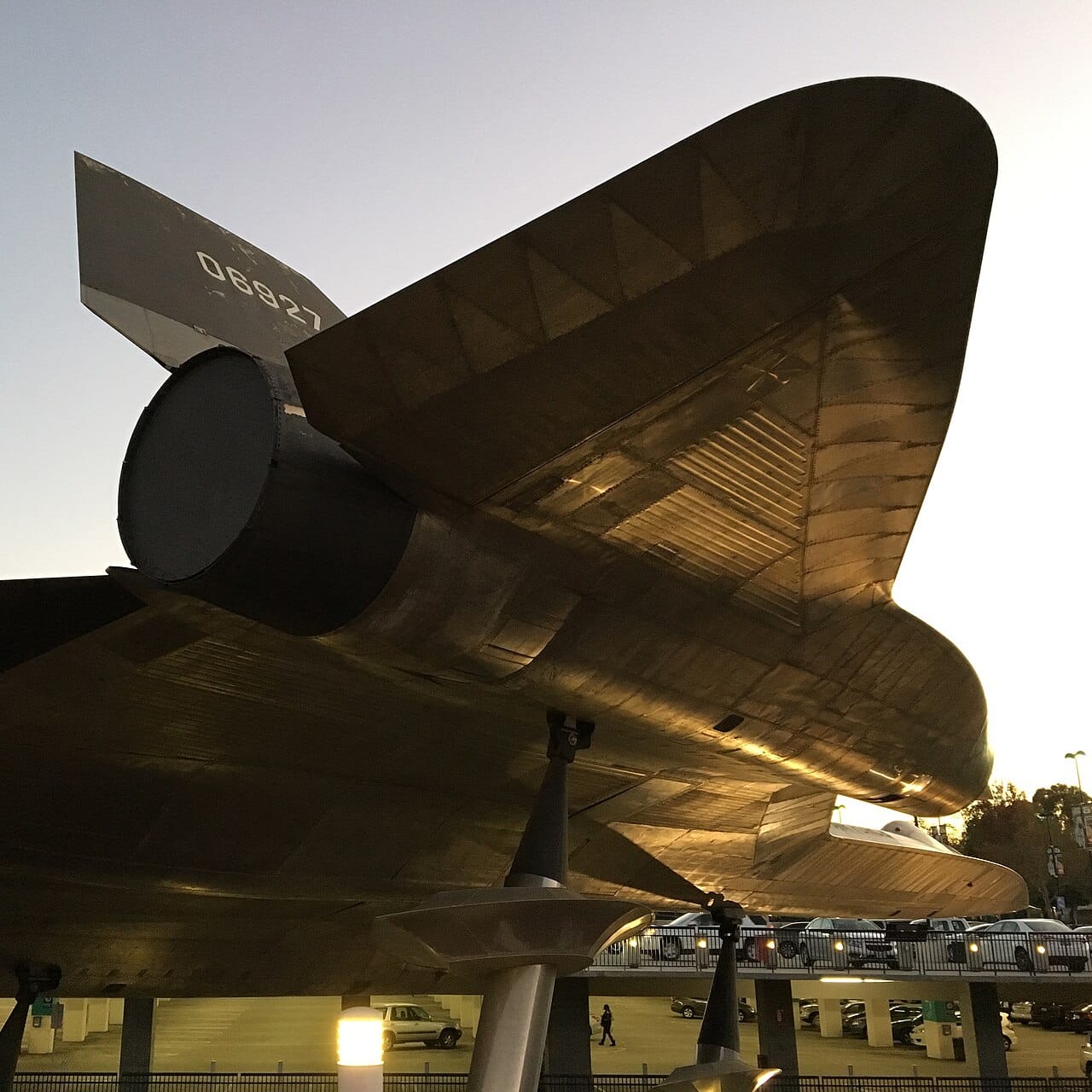
The post The Flying Wings of Jack Northrop that Led to the B-2 Spirit – Part One appeared first on The Aviationist.
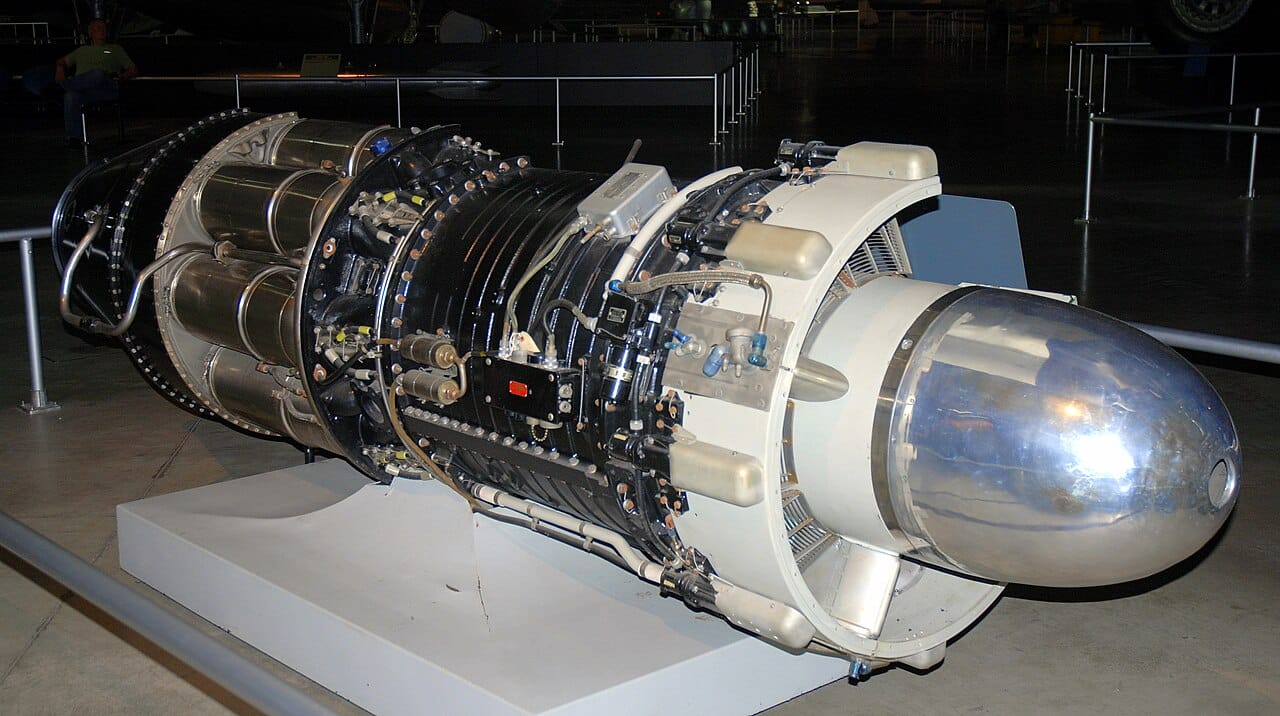
An Aircraft so Bad it Made People Literally Sick: The Republic XF-84H β€œThunderscreech”

13 April 2025 at 15:16
Republic XF-84H β€œThunderscreech”

The XF-84H was an ambitious project to reverse-engineer a jet-powered F-84 into a prop-driven aircraft capable of achieving near-jet performance. The Need for the Screech The United States Navy initially had an interest in a single-seat turboprop-powered carrier fighter-bomber aircraft that would not need catapult assistance and was compatible with the current fleet of aircraft […]

The post An Aircraft so Bad it Made People Literally Sick: The Republic XF-84H β€œThunderscreech” appeared first on The Aviationist.

A Pistol, a Parachute, and a Prayer: The Amazing Story of Lt. Owen Baggett

31 March 2025 at 21:02
Lt. Owen Baggett story

What began as a bombing mission to destroy an enemy bridge turned into a story of heroic bravery and incredible odds for young Lt. Owen J. Baggett on March 31, 1943. Disaster Strikes and a Hero is Born Fuel tanks burned and oxygen tanks exploded as the attacks continued and 2nd Lt. Owen John Baggett […]

The post A Pistol, a Parachute, and a Prayer: The Amazing Story of Lt. Owen Baggett appeared first on The Aviationist.

A Lone Two-Seater: The Story of the YA-10B Warthog

30 March 2025 at 16:32
YA-10B Warthog

Designed for all-weather, night attacks, the two-seat YA-10B was meant to counter Soviet Cold War armor tactics, but only one was built. Project A-X The Vietnam War had demonstrated to the United States Air Force a need for a better CAS (Close Air Support) aircraft, along with the looming threat of the growing numbers of […]

The post A Lone Two-Seater: The Story of the YA-10B Warthog appeared first on The Aviationist.

What Went Wrong with the AH-56A Cheyenne Attack Helicopter

22 March 2025 at 22:34
AH-56A Cheyenne

Ahead of its time in performance and design, the Lockheed AH-56 seemed like a promising attack helicopter for the United States Army during the Vietnam War, but instead ended up on the chopping block. Gunship Success During America’s involvement in Vietnam, it was discovered that adding firepower to a Bell UH-1 Iroquois or β€œHuey” helicopter, […]

The post What Went Wrong with the AH-56A Cheyenne Attack Helicopter appeared first on The Aviationist.

Major Buang-Ly’s Great Escape

14 March 2025 at 19:45
Major Buang-Ly's Great Escape

As South Vietnam collapsed under the onslaught of communist forces, one South Vietnamese pilot made a brave and daring escape in a tiny aircraft, miraculously finding a place to land it out at sea, saving himself and his family. April 1975 American combat forces had left Vietnam, all that remained was the United States Embassy […]

The post Major Buang-Ly’s Great Escape appeared first on The Aviationist.

Why Did a South Vietnamese Fighter Bomb the South Vietnamese Presidential Palace?

13 March 2025 at 21:06

Near the end of the war in Vietnam, an American-built Northrop F-5 fighter in South Vietnamese markings dropped bombs on the South Vietnamese Independence Palace shortly before the fall of Saigon. April 8, 1975 Adding to the panic felt as North Vietnamese and Viet Cong troops moved rapidly south towards the city, a solitary Northrop […]

The post Why Did a South Vietnamese Fighter Bomb the South Vietnamese Presidential Palace? appeared first on The Aviationist.

❌