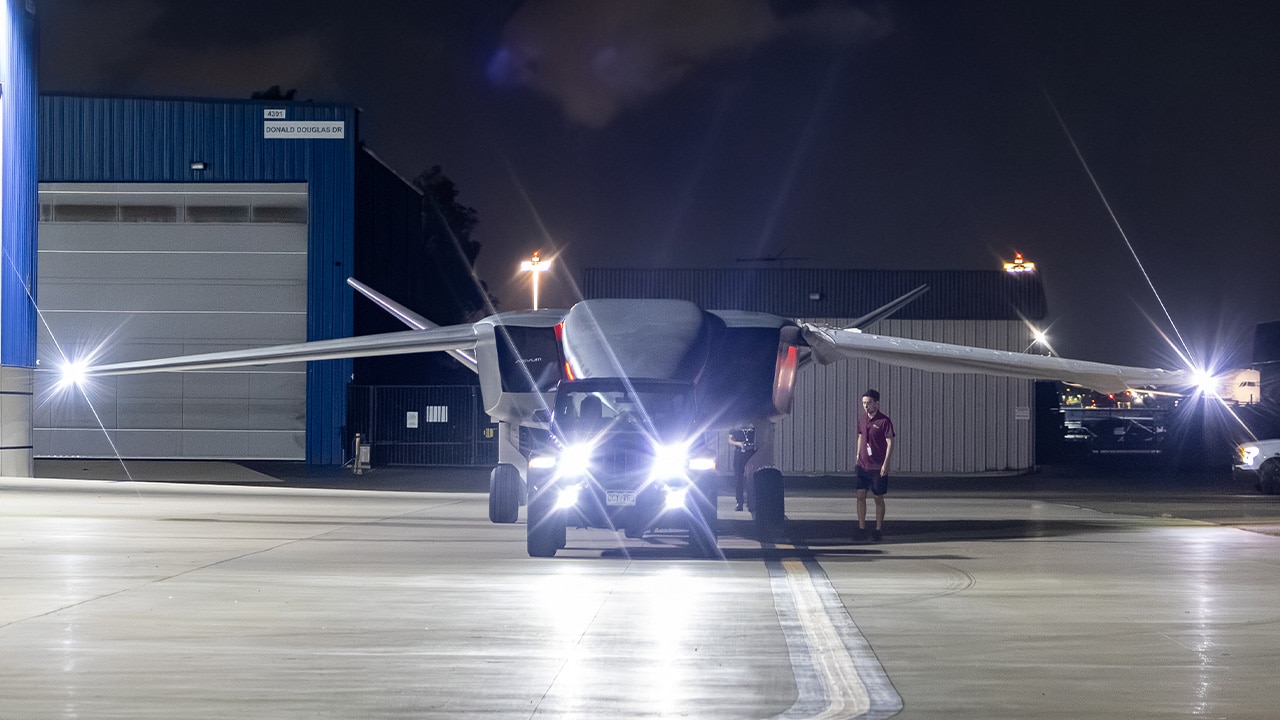
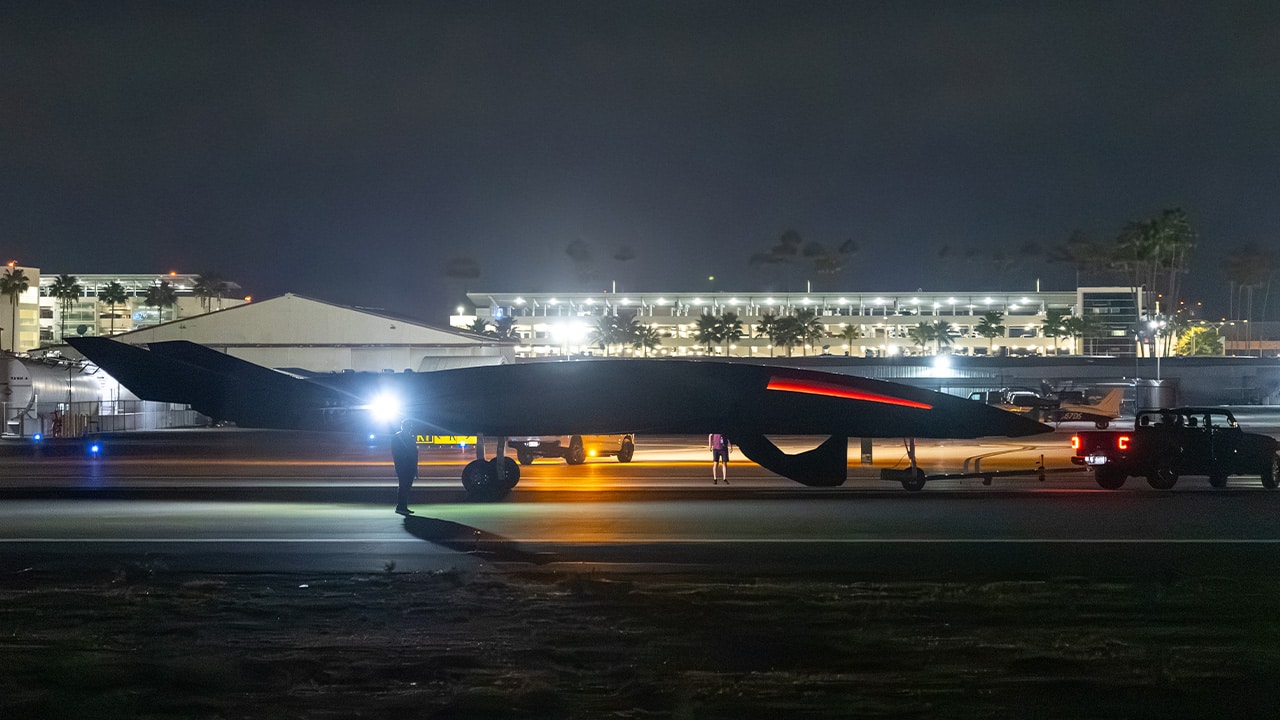
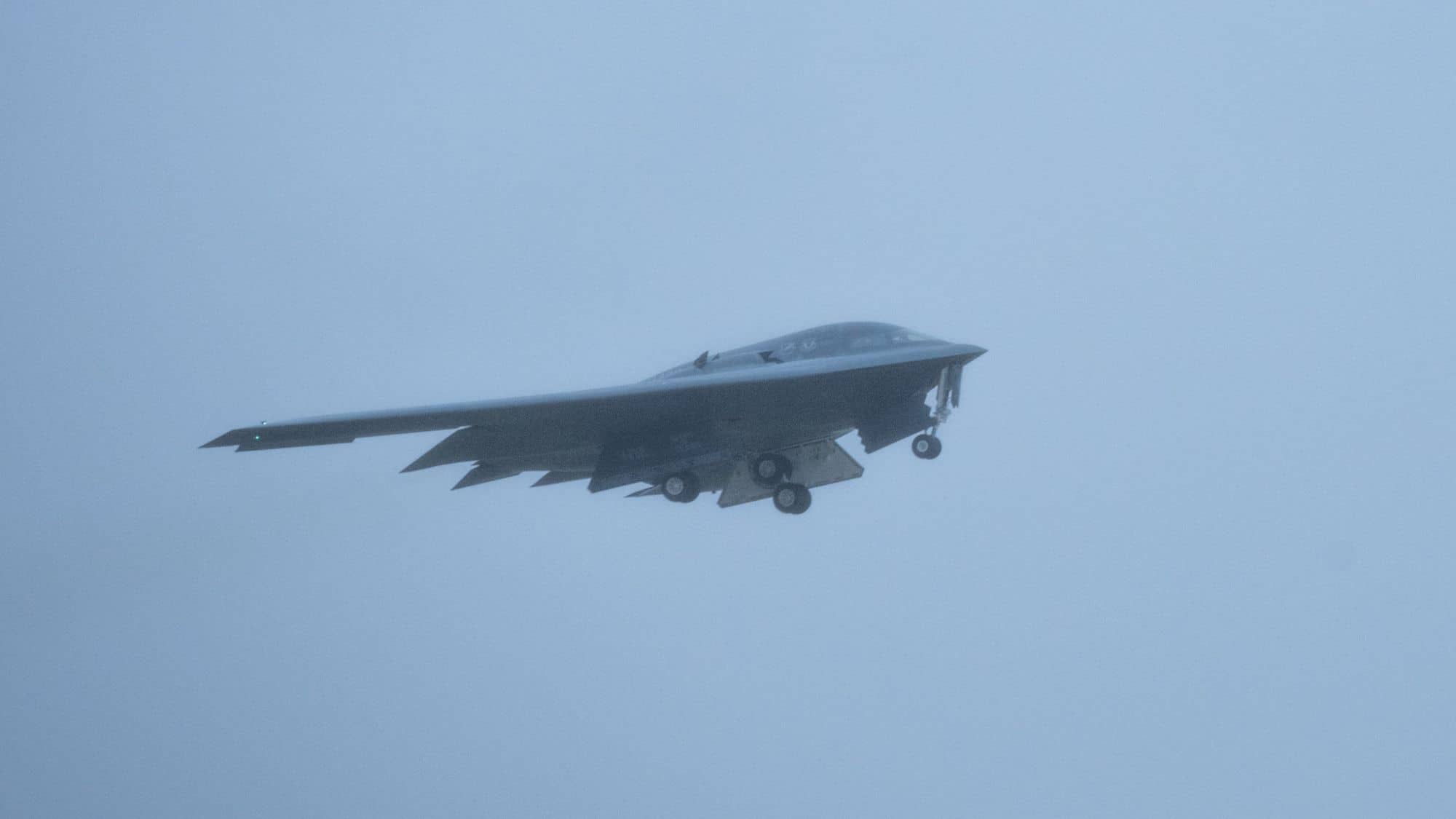
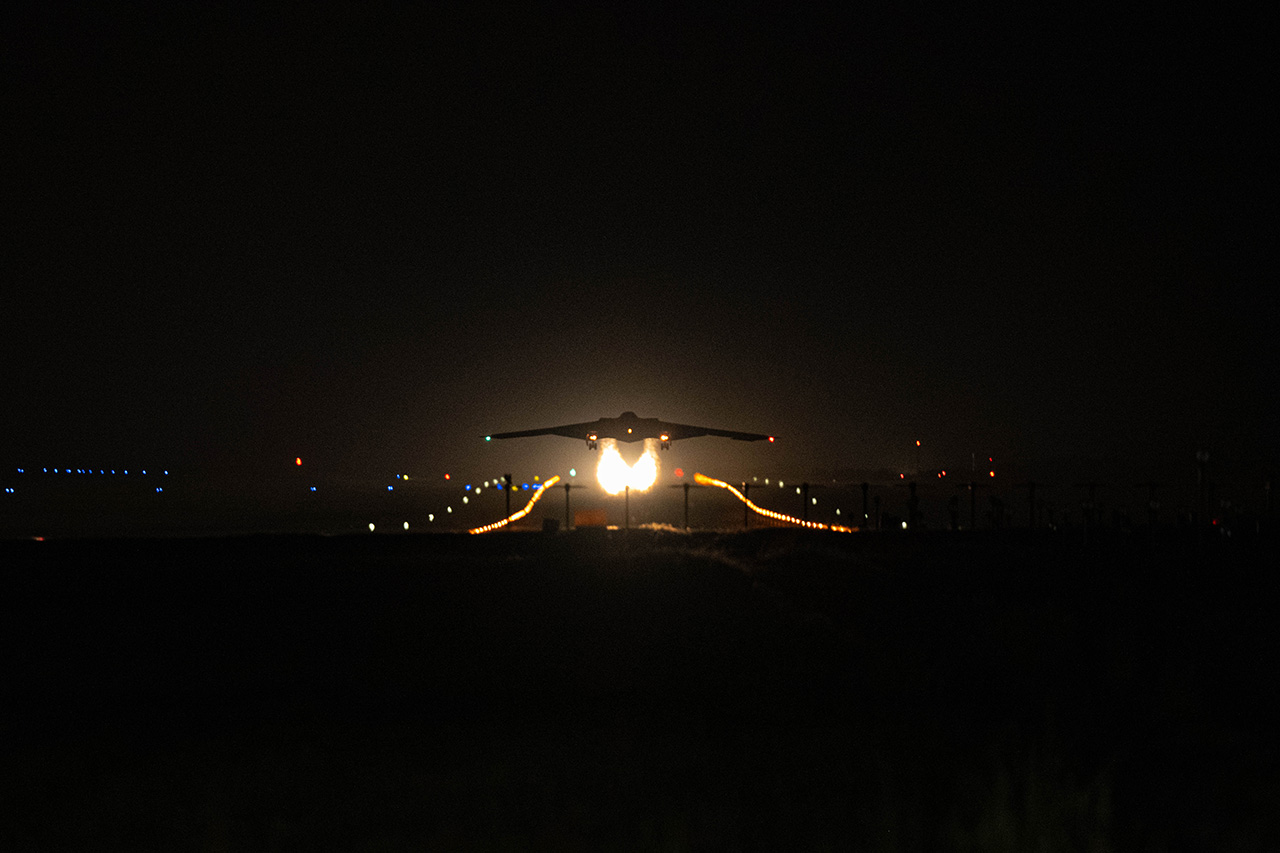
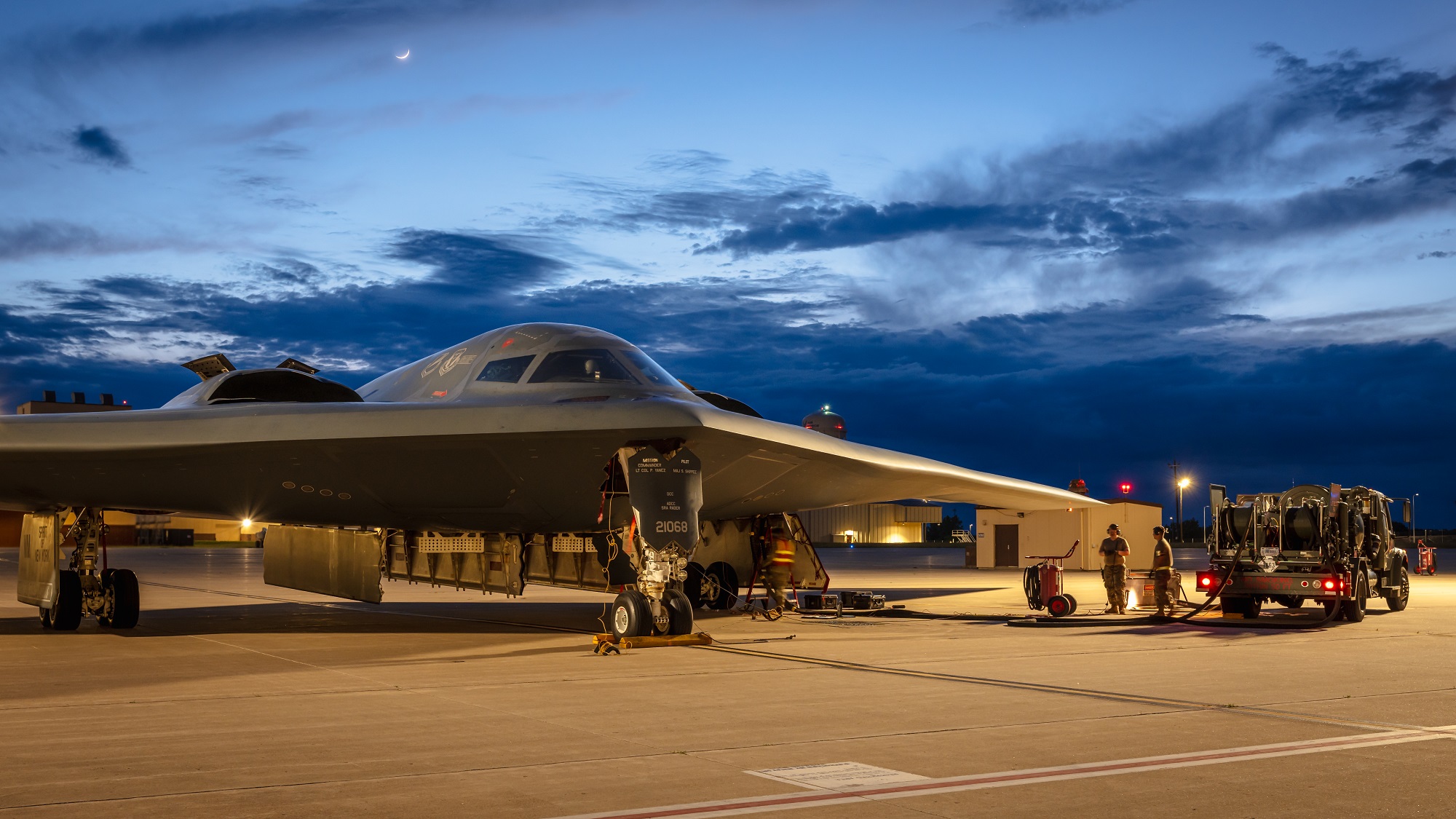
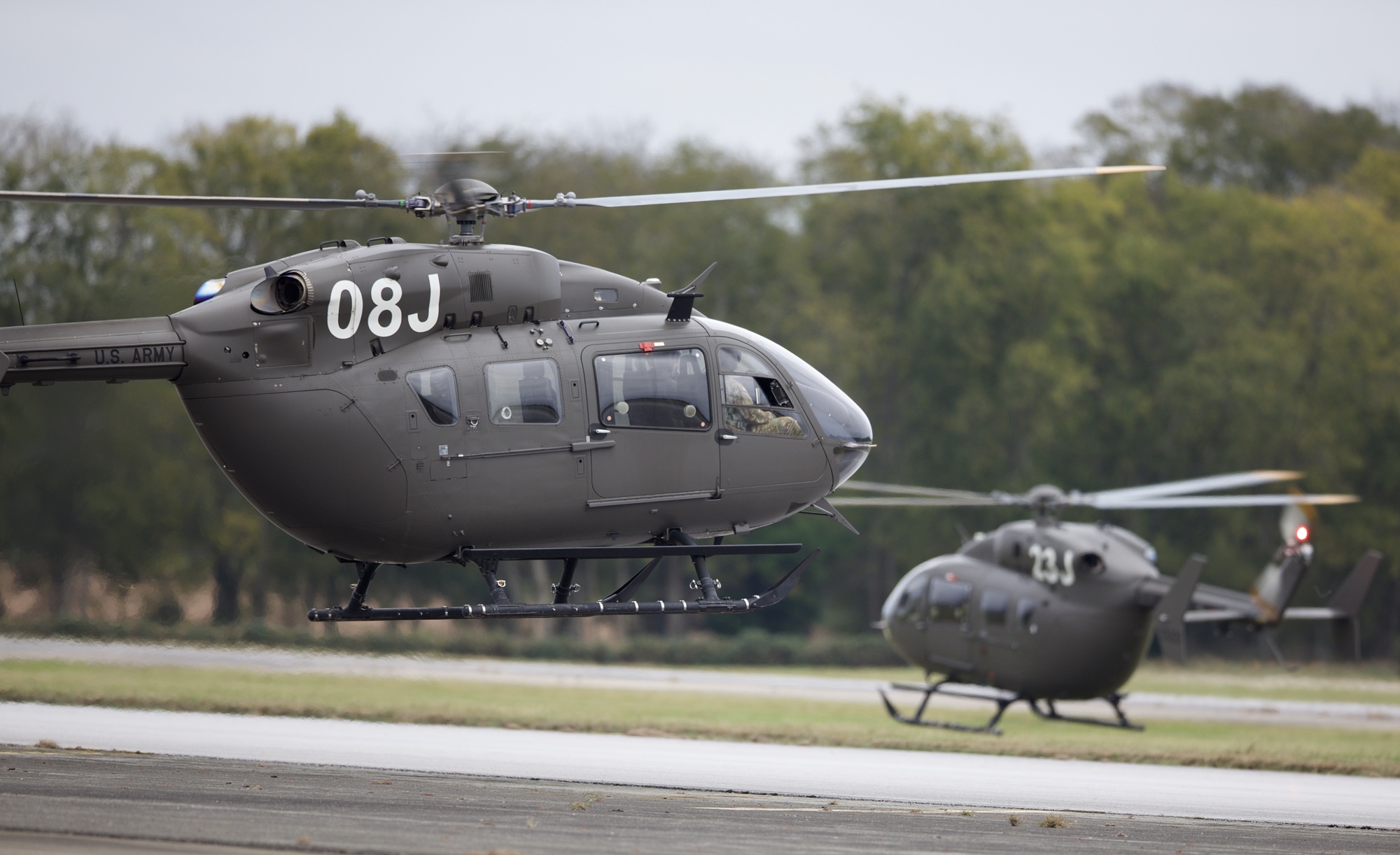
After years of little activity, the Ravn X rolled out of a hangar at Long Beach Airport for its very first autonomous taxi tests and caught the attention of local enthusiasts. Designed to launch small payloads into space, its planned first mission in 2021 has still yet to take place.
At eighty feet long and with a wingspan of sixty feet, the Ravn X is a huge autonomous aircraft said to pack two afterburning turbofan engines that allow high subsonic flight up to an altitude of 60,000 feet.
Head on with the Ravn X, showing its impressive size. | Source: Matthew Dawson
At maximum velocity, the Ravn X is designed to release the rocket-powered second stage which then takes over boosting the 100 kilogram payload into orbit. This fills a niche in providing a responsive launch capability that can be readied at much shorter notice compared to traditional launch vehicles like the Falcon 9 or Vulcan Centaur.
Aevum distinguishes Ravn X from air launch methods (such as Northrop Grumman’s Pegasus or Virgin Orbit’s LauncherOne) as the vehicle is not dropping the rocket but rather accelerating it up through the atmosphere. pic.twitter.com/mVIT8pzmQi
The U.S. Air Force contracted Aevum in 2019 to provide the launch system for the ASLON-45 mission, featuring a number of cubesats. To this date, the Ravn X has still not flown and as time went on it became questionable whether any development was proceeding on the aircraft.
However quiet the company was about its operations, we can now see that work did continue, and the Ravn X has finally completed its first taxi tests.
It is not immediately apparent whether this airframe – also marked and registered as N567RX – is the same as the one shown off by Aevum in 2020, which we reported on here. It may still be a mockup rather than a flight representative airframe, and certainly the landing gear appears to be fixed and for ground use only.
Aevum Ravn X, showing off a distinctive light design. | Source: Matthew Dawson
No official announcement has yet been forthcoming from Aevum – which is headquartered in Long Beach – or any other stakeholder as to why the Ravn X made such a sudden appearance after years in the dark.
If The Aviationist learns any more about this story, we will be sure to update you.
Many thanks to Long Beach local Matthew Dawson for sending us his images of the Ravn X’s roll out. You can find him on Instagram here.
From Sep. 1, the Royal Air Force’s headquarters is now to be known as Air & Space Command, reflecting the still increasing importance of the space domain to national security and the RAF’s role beyond Earth’s atmosphere.
Formed in 2007 following the merger of Strike Command and Personnel & Training Command, Air Command has served as the office of the Chief of the Air Staff (the professional head of the Royal Air Force) and the effective headquarters for the whole organisation. Strike Command was itself an amalgamation of Fighter Command and Bomber Command, while Personnel & Training Command was the successor to Support Command.
This may have passed unnoticed by many, but it’s a big deal in the reorganisation of UK Defence. Air Command has been re-designated to Air & Space Command. Per Ardua ad Astra https://t.co/Nx8KqNq4xT
While the RAF has long held responsibility over the space domain, managing the ballistic missile early warning facility at RAF Fylingdales since the early 1960s, and overseeing the UK’s SKYNET communications satellite network since 1969, the integration of space-based capabilities at every level of military operations – down to the individual soldier on the battlefield – as well as to daily civilian life has made its security a key priority.
‘Major Tedman of UK Space Command has described satellite jamming as a weekly occurrence. ‘
You’re daily reminder that we’re in a Cold War and woefully underprepared. https://t.co/SWQSsYOxZ2
— Martin Prince-Parrott RIBA FRSA (@MPrinParr) July 7, 2026
Chief of the Air Staff Sir Harv Smyth noted: “Space is essential to defence, security, prosperity, and our modern way of life. But it is also a domain of growing strategic competition. It has fast become an operational domain in its own right, and is vital to our ambition to develop and mature the integrated force. The RAF’s core mission of gaining and maintaining control of the air is fundamentally dependant on our freedom of action in and through the space domain.”
“It is now more important than ever for space power to be planned and delivered through the highest levels of military leadership, like all other domains. Our new HQ Air & Space Command will lead the delivery of space power with the same dedication that it leads for the air domain,” he added.
Smyth, himself, was previously the first person to hold the role of Director Space UK, and then moved to the role of Deputy Commander (Operations) in 2022. In 2023, this role was itself named to Air & Space Commander. Smyth continued in this post until 2024, at which point he was promoted to Deputy Chief of the Defence Staff (Military Strategy and Operations), and then to his current role as Chief of the Air Staff.
UK Space Command (UKSC), which was formed under the Air Command structure in 2021, will continue to operate under the new Air & Space Command umbrella.
This may have passed unnoticed by many, but it’s a big deal in the reorganisation of UK Defence. Air Command has been re-designated to Air & Space Command. Per Ardua ad Astra https://t.co/Nx8KqNq4xT
Though led by the RAF, UKSC incorporates personnel from the Royal Navy, British Army, and Civil Service. It maintains the 1 Space Operations Squadron at the National Space Operations Centre, RAF High Wycombe, and 2 Space Warning Squadron is tasked with operating RAF Fylingdales. UKSC personnel are also deployed in small numbers worldwide to support the UK’s overseas bases and deployments.
In the latest 60 Second update from across the RAF, UK Space Command are deployed on @HMSPWLS, while working with the Australian Defence Space Command and we welcome the new Chief of the Air Staff, Air Chief Marshal Harv Smyth. pic.twitter.com/PIIdOGKToe
Dating from the formation of the Royal Flying Corps in 1912, the Royal Air Force’s famous motto will continue to ring strong through the service, perhaps with a renewed sense of meaning. Per ardua ad astra – through adversity to the stars.
Using both turbojet and rocket propulsion, the Douglas D-558 Skystreak and Skyrocket research aircraft set a series of speed and altitude milestones in the years after World War II, culminating in the first flight beyond Mach 2.
During a period of abundant experimental record-breaking designs, men and machines were pushed to the edge of the envelope in ever increasing speeds and altitudes. The Douglas D-558 series aircraft played a major role in aircraft experimentation and development, eventually becoming the first to fly Mach 2.
The Douglas D-558-1 Skystreak
Kept as simple as possible, the Douglas D-558-1 was designed to meet the requirements of both the NACA (National Advisory Committee for Aeronautics) and the United States Navy (USN) Bureau of Aeronautics for a high-speed research aircraft. This particular aircraft design would focus on researching and studying high subsonic speeds.
Requirements included flight speeds of Mach 0.75 up to 0.85 and to operate at altitudes between sea level and 40,000 ft. The aircraft would also need to gather aerodynamic loads and pressure measurements in free flight at these speeds and altitudes; as such data could not be obtained from wind tunnels at that time.
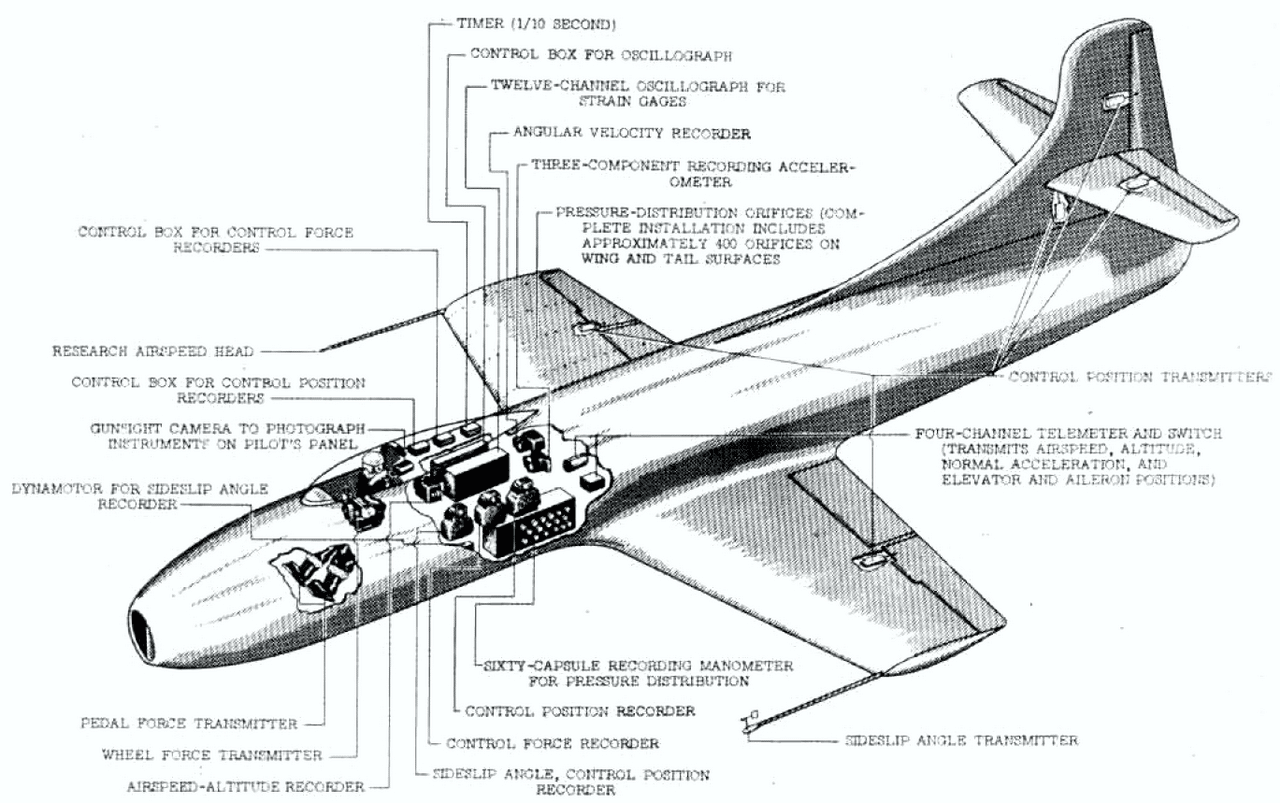
Drawing of the Douglas D-558-1 Skystreak showing the installed research instrumentation and design layout. | Source: United States Navy
An automated pressure recording system had 400 measuring points from the airframe connected to it, along with strain gauges placed on selected tail section and wing section positions. At least 500 lbs of instruments would need to be carried.
The D-558-1, known as the Skystreak, was a cantilever low-wing aircraft with large vertical tail surfaces and the horizontal tail surfaces attached one-third up the vertical fin. Tricycle retractable landing gear kept the aircraft streamlined along with the slender circular fuselage design. The aircraft would be required to take off and land on its own power.
The pilot sat in a single-seat cockpit that in an emergency would be jettisoned with the entire nose section from just rear of the pilot’s seat forward. It was intended the pilot would then bail out conventionally from this jettisoned nose section after separation and slowing.
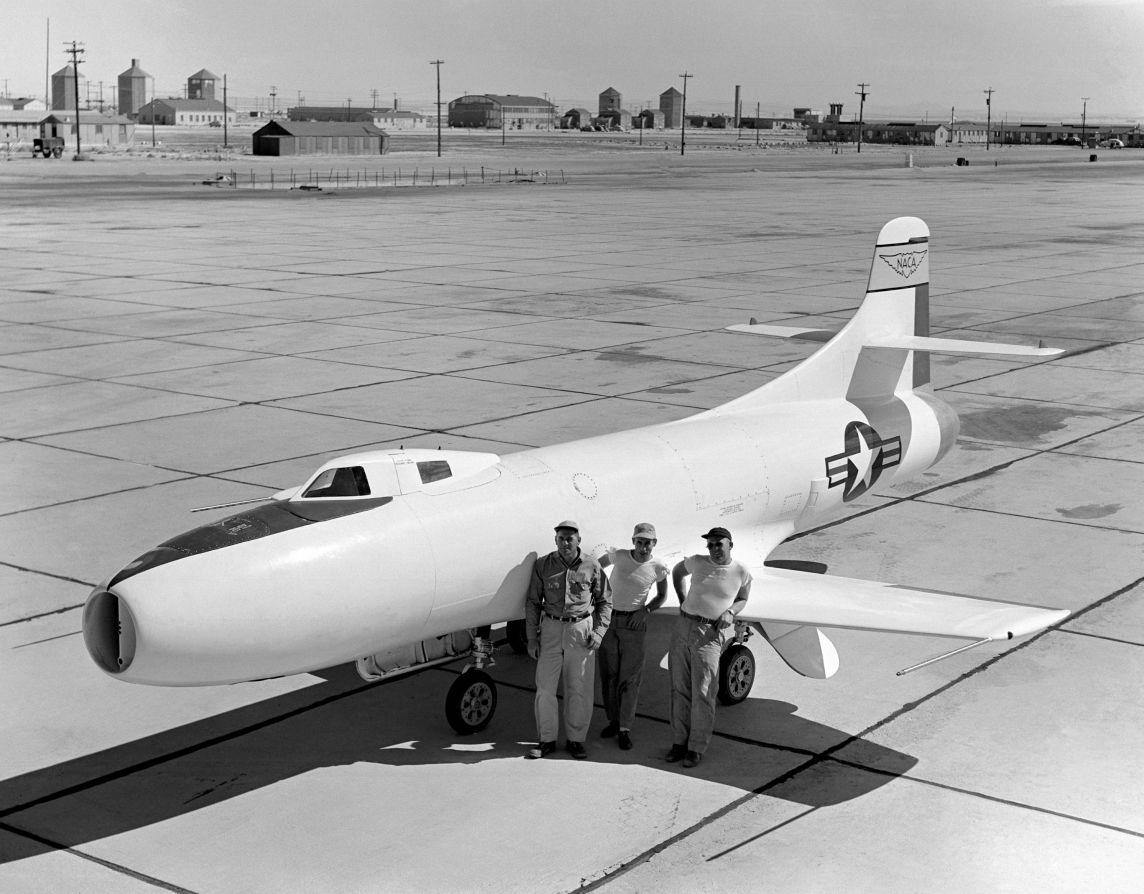
A NACA Muroc Flight Test Unit photograph taken in 1949 with the Douglas D-558-1 on the ramp. Ground crew members are seen posing against the wing of the Skystreak. The D-558-1 was designed to be just large enough to hold the J35 turbojet engine, pilot, and instrumentation and the fuselage cross section had to be kept to a minimum. The D-558-1 pilots found the cockpit cramped and could not easily turn their head. | Source: NASA
Originally fitted with a rounded windscreen, a more streamlined V-shaped unit was later installed for high-speed testing. This configuration further shrank the room in the cockpit and mandated the pilot wear a chamois covering on his helmet or a soft helmet to prevent scratching the glazing.
A total of three D-558-1s were constructed, with the first flight in the spring of 1947 at Muroc Army Air Field (Edwards Air Force Base) by Douglas test pilot Eugene F. May. Powered by a single Allison J-35-A-11 turbojet, a new world speed record was established on Aug. 20, 1947 of 640.743 mph (miles per hour) average speed by the first D-558-1 flown by USN Commander Turner Caldwell at an altitude of 75 ft [note: NASA gives 640.663 mph, while the Navy museum gives 640.743 mph]. That record was soon shattered five days later when an average speed of 650.6 mph was reached in the second D-558-1 flown by Marine Lt. Colonel Marion Carl at times at only 25 ft in altitude.
Records claimed by the Germans during the war years flying the Me 163 Komet were achieved in secrecy, without official observers and not under strict regulated conditions using timed runs, so the Komet was not officially recognized as holding the official air speed record.
Marine Major Marion Carl (left) Navy Commander Turner Caldwell stand next to a Douglas D-558-1 Skystreak at Muroc Army Airfield. Both Carl and Caldwell established world speed records in D-558-1 type aircraft within five days of each other in 1947. | Source: United States Navy
The second D-558-1 was lost on May 3, 1948 when the engine compressor disintegrated after takeoff, killing NACA pilot Howard C. Lilly. It had completed 27 flights total before NACA instrumentation, then Lilly flew five NACA research flights in spring 1948 before the fatal crash. A third Skystreak completed a total of 82 flights by June 10, 1953. The third aircraft had been kept in operation with spares and components robbed from the first prototype: NACA 140 was never flown by NACA and was used as a spares source for NACA 142. Three additional D-558-1 examples were cancelled.
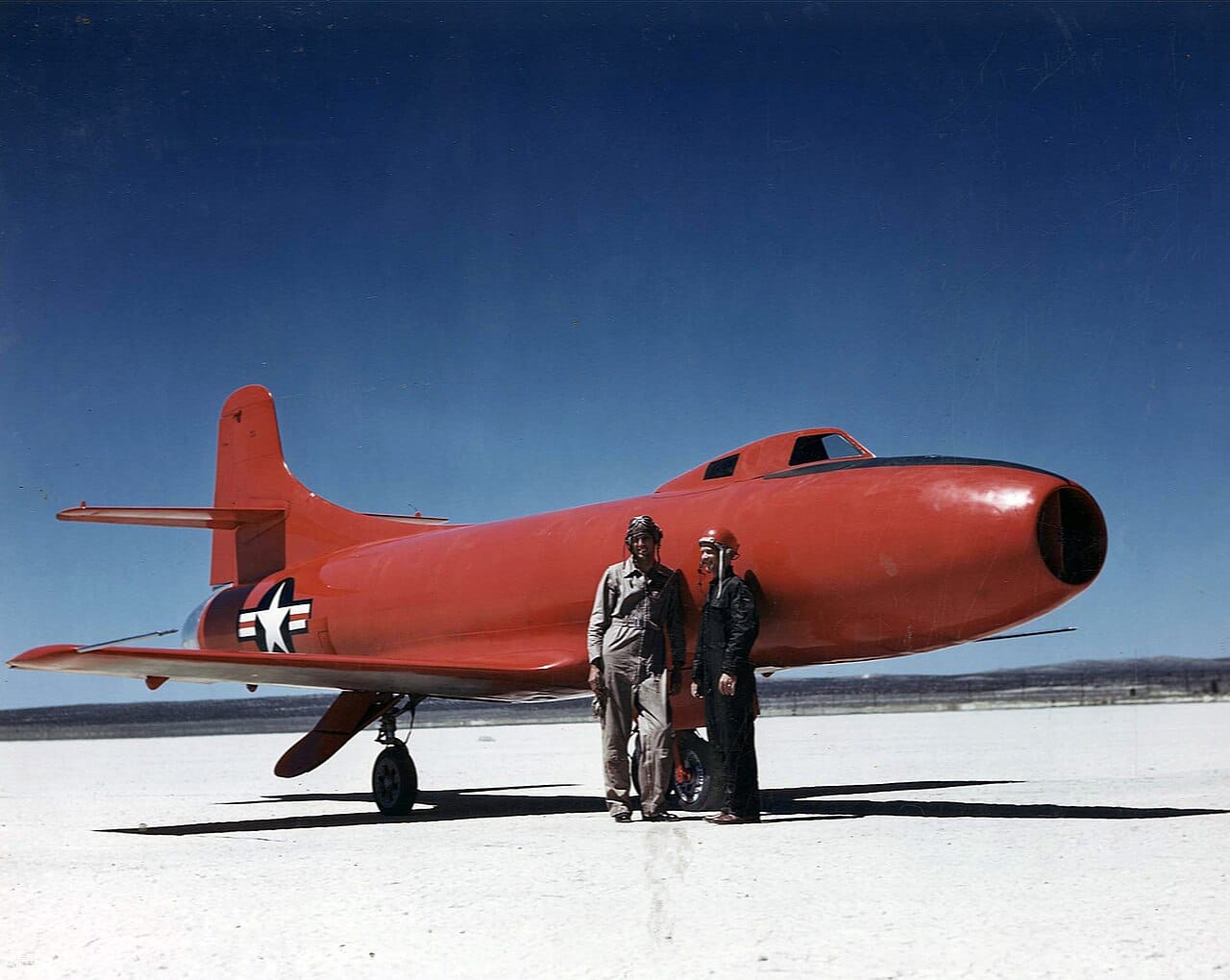
The D-558-1 held the distinction of the fastest aircraft in the world for a short time, as the bright crimson painted Skystreak was soon overshadowed by the X-1 and Captain Chuck Yeager. Eventually the paint was changed to white in order to improve visibility, tracking, and photography. The aircraft had played an important role in research flying extended periods at transonic speeds.
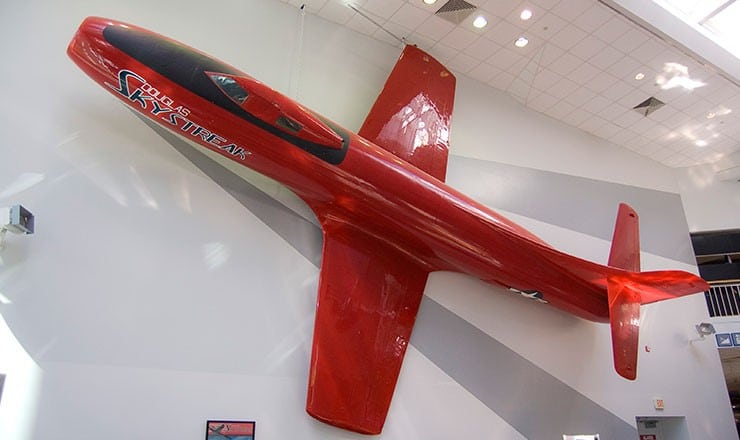
Douglas D-558-1 (Bureau No. 37970) mounted on the wall at the National Naval Aviation Museum in Pensacola, Florida. This was the first Skystreak produced and the aircraft flown by Commander Turner Caldwell on Aug. 20, 1947 when he set a world air speed record. The third and only other remaining D-551-1 (Bureau No. 37972) is located at the Sullenberger Aviation Museum at the Charlotte-Douglas International Airport, Charlotte, North Carolina). | Source: United States Navy
The Douglas D-558-2 Skyrocket
The phase-two version of a planned three-phase program, the D-558-2 became more than just a modified D-558-1. Designer Ed Heinemann determined his previous design would need extensive modifications to allow for two sources of propulsion, both jet and rocket. The fuselage would need to be larger and a smaller turbojet used. However, Heinemann also wanted to develop sweptback wings as well for the aircraft. This led to a new and different research aircraft designated the D-558-2 Skyrocket.
Three D-558-2 aircraft were substituted for the original additional three D-558-1 cancelled aircraft. Mid –set wings sweptback at 35 degrees produced a wing span of 25 ft and complemented by horizontal stabilizers swept at 40 degrees. The design retained the jettisonable nose section and tricycle landing gear of the Skystreak.
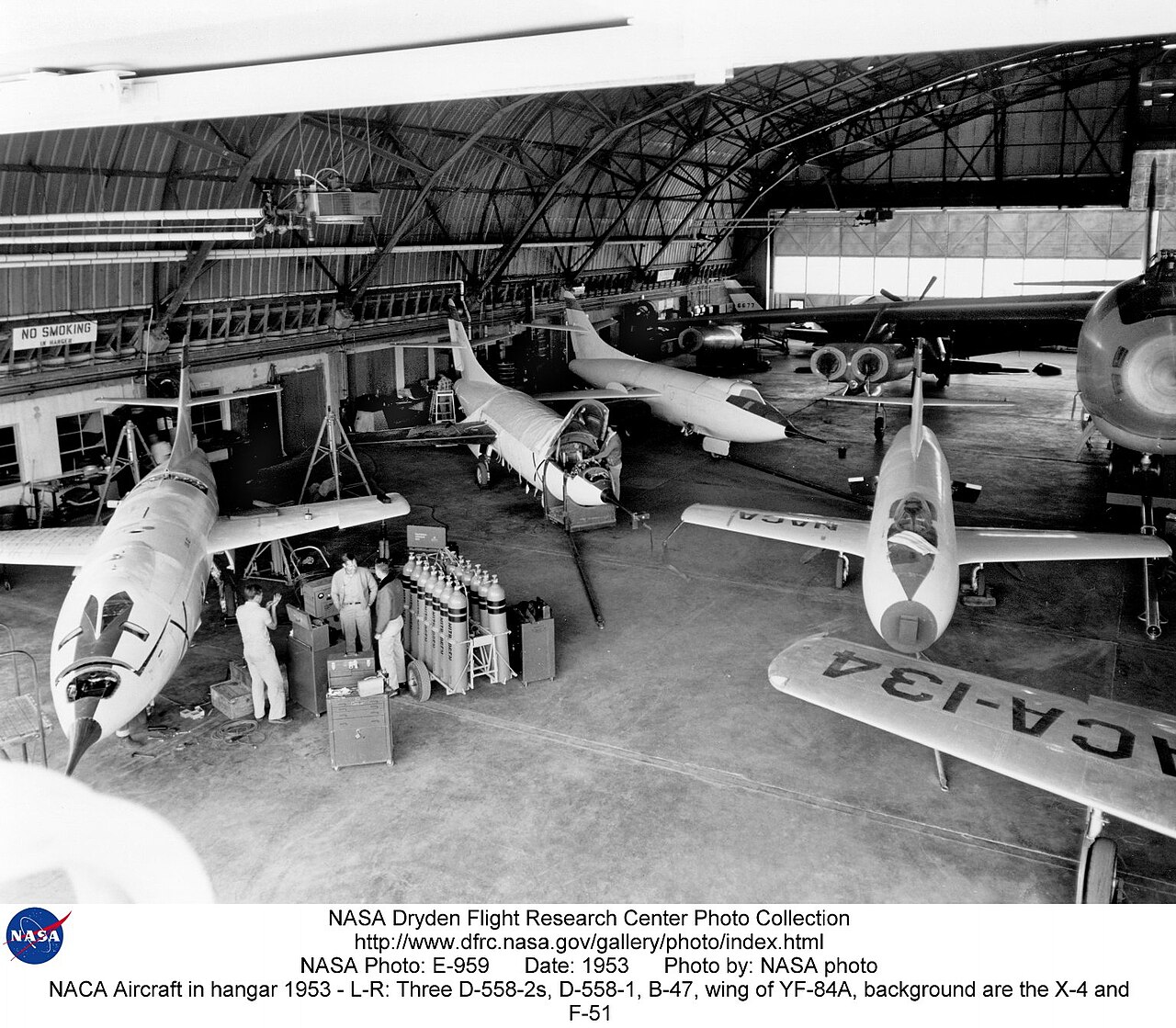
1953 photo showing an impressive lineup: All three of the D-558-2 Skyrockets, a D-558-1 Skystreak, and a glimpse of a B-47, YF-84A, F-51, and X-4. | Source: NASA
A Westinghouse J34 turbojet engine was intended to power the 42 ft in long aircraft during takeoff, climbing and landing. An additional power source, a four-chamber Reaction Motors LR8-RM-6 rocket was to be used for high-speed flight.
The flush cockpit canopy of the D-558-2 was also reconfigured with a raised cockpit and angled windows to increase poor visibility. The larger profile area had to be balanced by adding 14 inches to the height of the vertical stabilizer.
On Feb. 4, 1948, Douglas test pilot John F. Martin flew the Skyrocket for the first time at Muroc, although the aircraft was only equipped with a jet engine. It was the beginning of a successful test program in which the characteristics of swept-wing aircraft at transonic and supersonic speeds were studied. A great deal of information and data was gathered about pitch-up issues along with drag and buffeting characteristics of swept-wing aircraft traveling at high speeds.
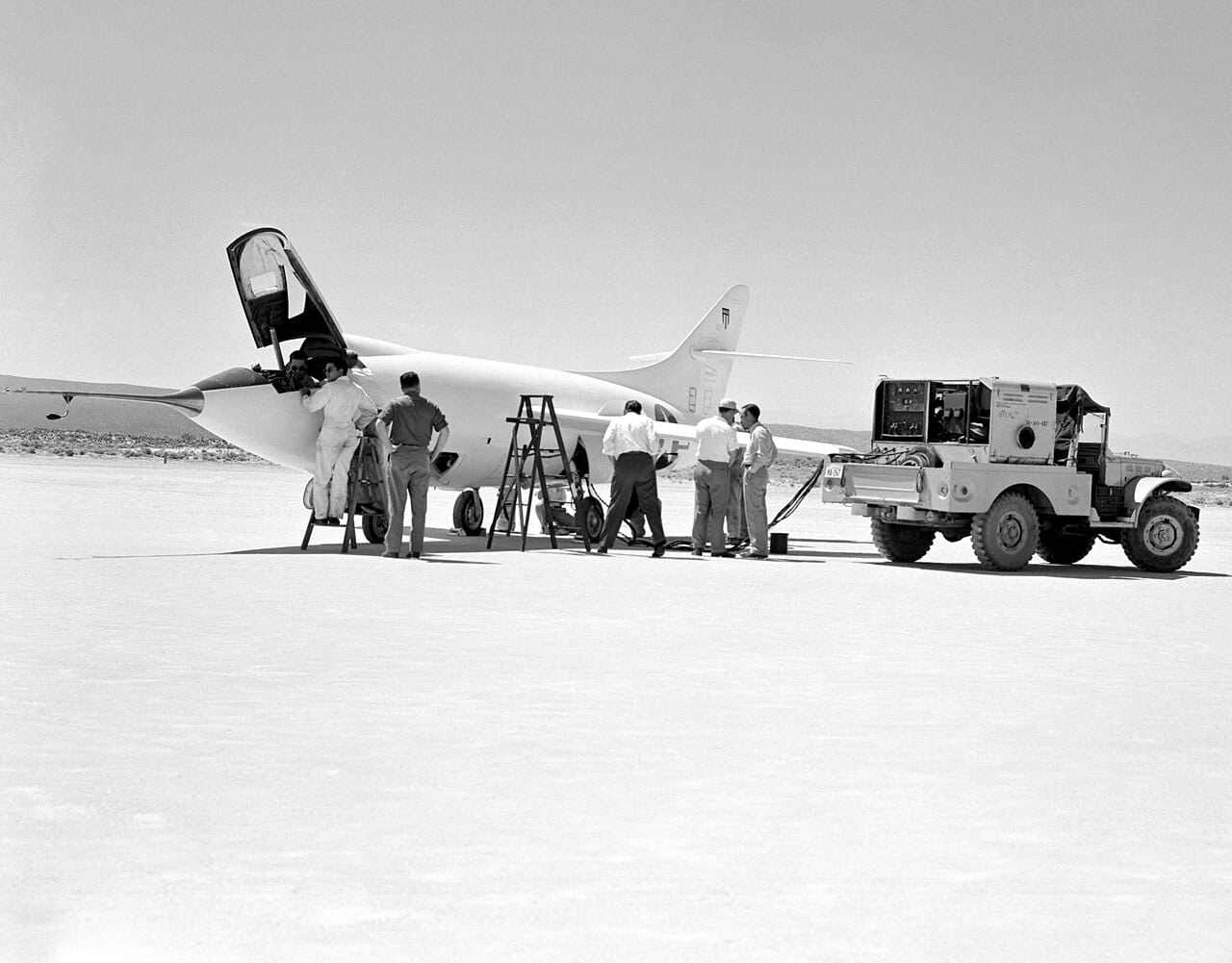
This 1949 photograph shows a Douglas D-558-2 undergoing pre-flight operations on Rogers Dry Lakebed. Prior to flight, the aircraft’s systems had to be checked out, the instrumentation calibrated, cameras and oscillographs loaded with film, and the aircraft filled with dangerous propellants. | Source: NASA
NACA 144 (Bureau No. 37974) was flown by NACA pilots Robert A. Champine and John H. Griffith 21 times to conduct testing and research on airspeed calibrations and stability and control. The turbojet engine was replaced in 1950 with an LR-8 rocket engine.
Douglas pilot Bill Bridgeman flew 37974 seven times to Mach 1.88 and to 79,494 ft setting an unofficial record at the time on Aug. 15, 1951. Without the jet engine for takeoffs, the rocket configured Skyrocket was now slung under a P2B-1S Navy variant of the Boeing B-29 bomber.
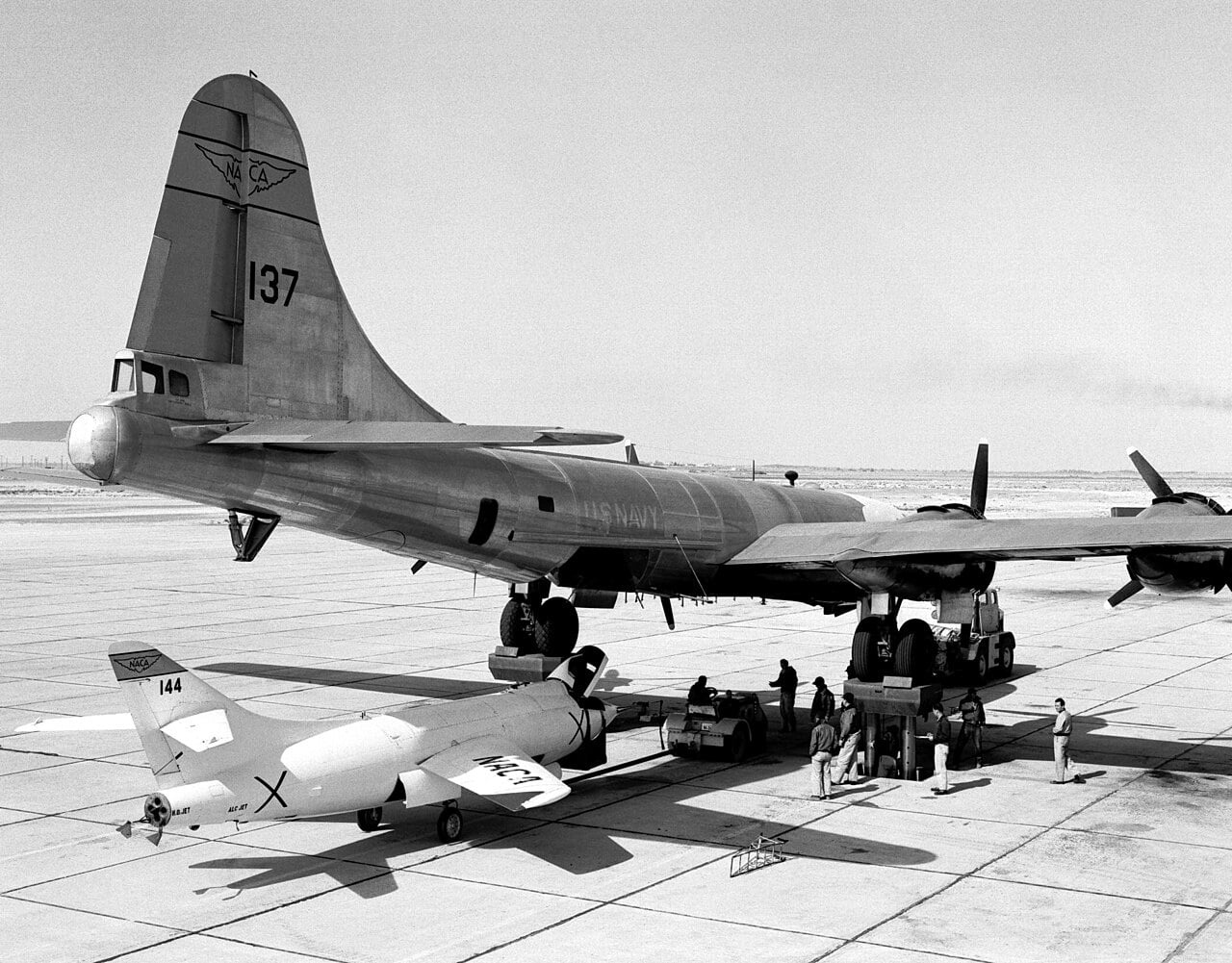
This 1953 NACA photograph shows the Douglas D-558-2 Skyrocket (NACA 144) being towed under the P2B-1S launch vehicle (NACA 137) for attachment prior to flight. The large hydraulic jacks used to elevate the P2B-1S can be clearly seeen. | Source: NASA
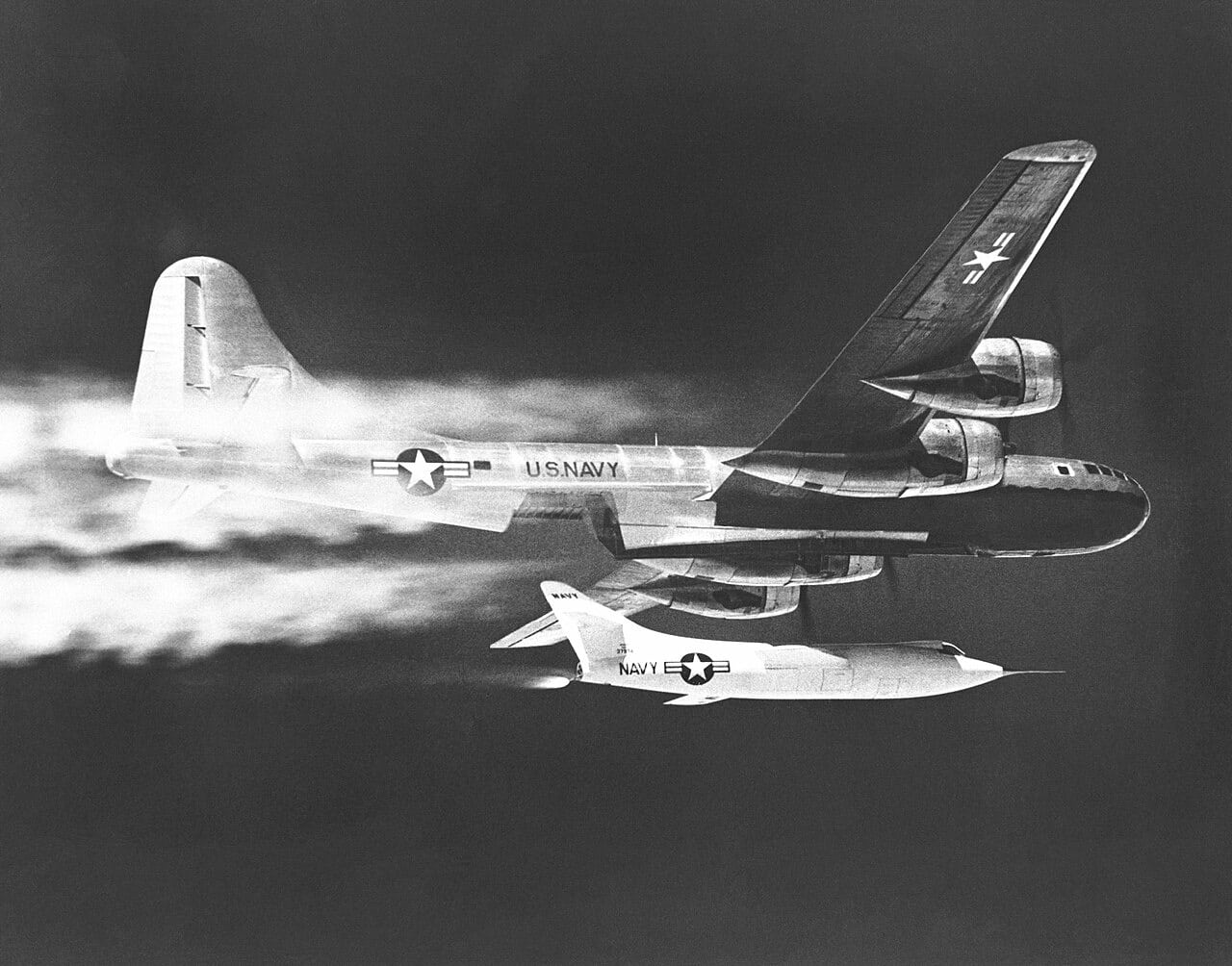
The P2B-1S was specially modified for the project, and would fly to 30,000 ft and drop the D-558-2. Known as ‘Fertile Myrtle’, aircraft 84029 would be used as the ‘mothership’ to launch Skyrocket aircraft during the 1950s. Identified with the call sign ‘NACA 137’, the P2B would be placed on jacks in order to provide the needed clearance for loading the Skyrocket to its attachment points under the heavily modified bomb bay. The D-558-2 would be dropped from its cradle at altitude, its pilot firing the rockets once clear of the P2B.
Issues with lateral instability were noted during Bridgeman’s supersonic flights, leading NACA engineers to study the aircraft’s behavior prior to their own flight research that began in Sept. 1951.
D558-2 Skyrocket just after release from the P2B mothership. | Source: NASA
Preparing for twice the Speed of Sound
NACA test pilot Albert ‘Scott’ Crossfield had flown the Skyrocket 20 times over a period of approximately two years, gathering data and studying longitudinal and lateral stability along with control as well as lift, drag, and buffeting characteristics of the aircraft at supersonic speeds up to Mach 1.878.
Marine pilot Lt. Colonel Marion Carl took the aircraft to an unofficial record altitude of 83,235 ft on Aug. 21, 1953, hitting Mach 1.728 during the flight. Since the aircraft did not take off on its own power, the altitude record was not recognized. After Carl’s flights, NACA engineers added nozzle extensions to the LR-8 combustion chambers in order to prevent exhaust gas from affecting the rudder. Engine thrust was also increased by 6.5 percent.
All three D558-2 Skyrockets along with the P2B mothership fill the ramp. | Source: NASA
After securing an agreement with the Navy’s Bureau of Aeronautics by Crossfield, NACA allowed the attempt of a record-setting Mach 2 flight in the aircraft.
The NACA flight team personnel waxed the fuselage of the Skyrocket to reduce drag, and chilled the fuel so the tanks would hold more, and fueling the aircraft hours ahead of time gave the fuel time to settle allowing for additional fuel to be added later. Masking tape was placed over any drag inducing cracks, and the stainless steel prime and jettison tubes were replaced with lighter aluminum.
The tubes were bent into the blast of the rocket engine allowing them to be burnt off and fall away from the aircraft once no longer needed, saving a few more pounds. The plan called for reaching 72,000 ft and pushing over into a slight dive. It was hoped the 200 second blast of her rocket engine would push the aircraft past Mach 2.
The people and equipment that supported the flight of the NACA D-558-2 Skyrocket at Edwards AFB. Visible are two F-86 Sabre chase planes, the P2B-1S launch aircraft, and an assortment of ground support equipment, including communications, tracking, maintenance, and rescue vehicles. NACA pilot Scott Crossfield stands in front of the Skyrocket. | Source: NASA
Weak from a bout with the flu, pilot Scott Crossfield approached the P2B sitting on the desert ramp on a cold blustery Nov. 20, 1953. The D-558-2 was tucked under the mothership with mechanics bundled against the cold swarming the scene. Pipes, hoses, and cords plugged equipment carts and fuel trucks into the needy Skyrocket. It was not yet daybreak.
While loading hydrogen peroxide fuel onto the aircraft in the freezing temps and darkness, an accident almost delayed the flight. A frozen vent fitting caused by the ‘cold soak’ practices earlier to allow more fuel capacity had caused the dangerous liquid to burst out of an untapped port showering a P2B launch panel operator in the face. The peroxide was so potent that a rag doused in it would burst into flames. The affected operator, however, due to the quick reaction of a nearby mechanic who sprayed him in the face with a fire hose, only suffered temporary white blotches that lasted a few days. The show went on.
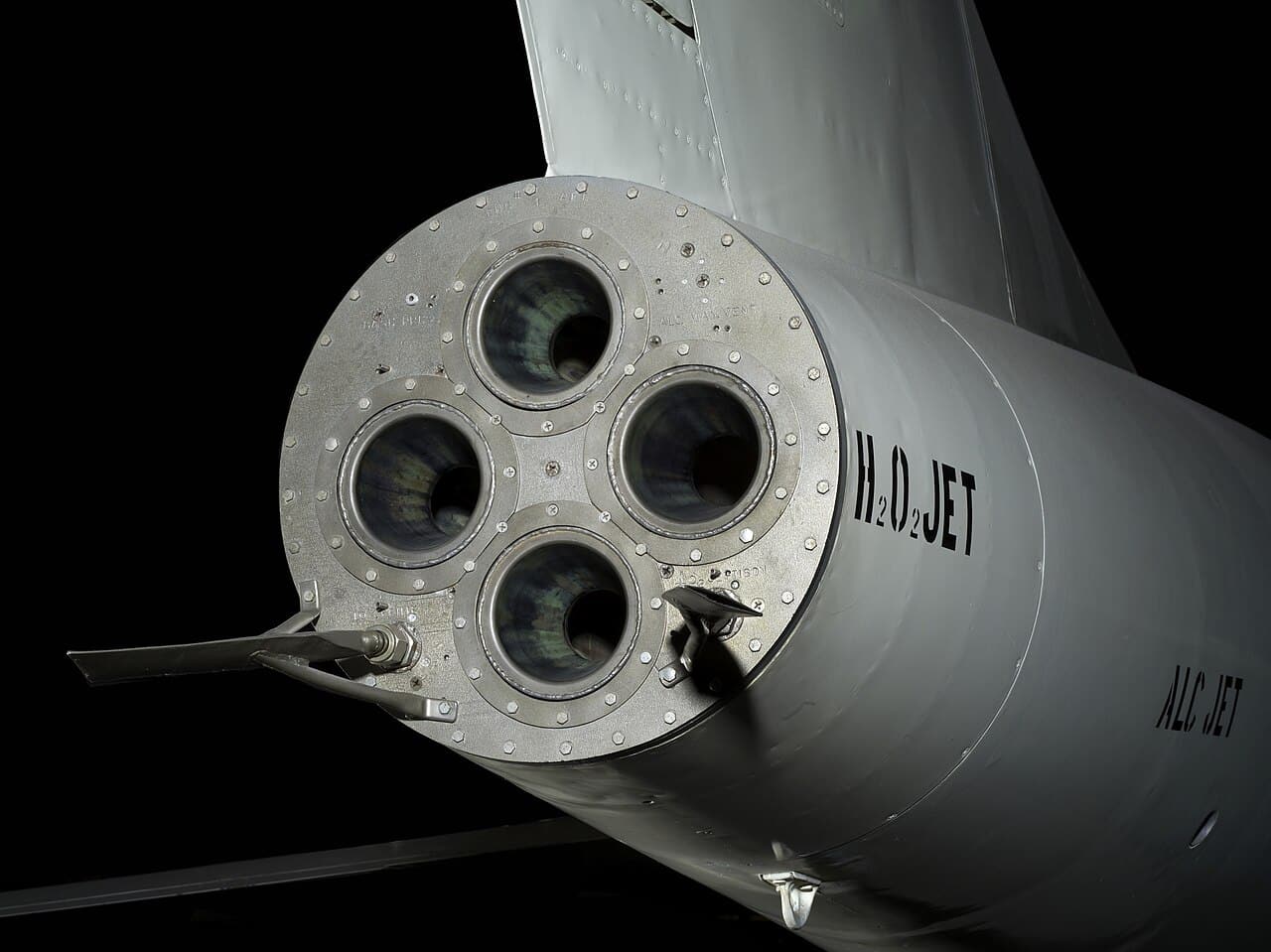
View of the rear of the D-558-2 and the rocket exhausts. | Source: Mark Avino/Smithsonian National Air and Space Museum
Taking the Skyrocket to Mach 2
When the P2B reached 10,000 ft, Crossfield got into the cockpit of the D-558-2. He would be required to pressurize the cockpit, an experience that produced a sudden burst of gas into the cockpit, not a gradual process. The sudden burst could wreak havoc on human sinuses, and the influenza Crossfield was battling could exacerbate the situation. Scott had brought along a small cork, placing it in the compressed-air inlet tube and gradually easing it out slowly as he turned the valve on. The pressurization gauge slowly reached the green and caused Crossfield no pain or difficulty. The aircraft combination continued on to the launch point.
As the Skyrocket fell away from the belly of the mothership, blinding sunlight hit Crossfield’s eyes. The ship rolled naturally to the right, and he hit the rocket-barrel switches; pausing a split second until each one caught. The D-558-2 surged forward and the horizon disappeared from view. Soon the P2B was below and behind.
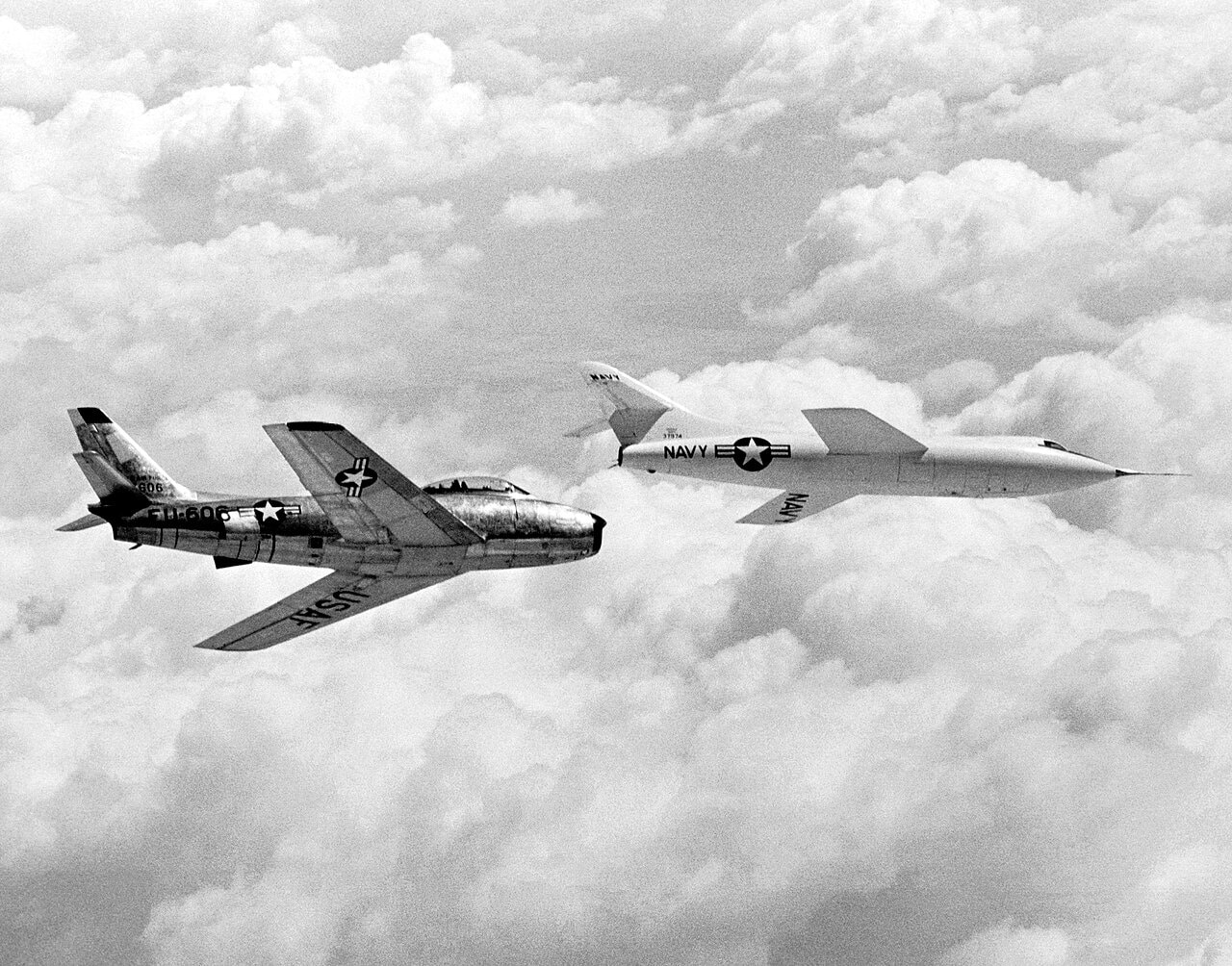
Douglas D-558-2 Skyrocket and a North American F-86 Sabre chase aircraft in flight. | Source: NASA
Crossfield now had a total of 200 seconds to accomplish his goal. This would be his only chance. As he approached 72,000 ft, he began the pushover with the rocket engines burning furiously. The Skyrocket was living up to its name in this most spectacular dive. Scott closely monitored the Mach needle, and as the fuel lasted an incredible 207 seconds, the needle edged past Mach 2 and stayed at Mach 2.005. He had become the first man to fly twice the speed of sound with the instruments on board the Skyrocket recording the data automatically. The risky ‘cold soak’ process had paid off with an extra seven seconds. The altitude of the Mach 2 peak was about 62,000 ft.
As the engines cut out and the D-558-2 entered thick air, it slowed dramatically throwing Crossfield forward in the shoulder straps. Still coasting at Mach 1.8, he dropped back to Mach 1.0 with the aircraft shaking violently but briefly.
A dead stick landing was the next challenging part of the flight as Crossfield approached the dry lake bed at 15,000 ft performing a victory roll. Chase planes soon lined up on his wing tips guiding him down. The Skyrocket touched down between two painted black lines exactly where it was intended to land, rolling to a complete stop 12 minutes after being launched.
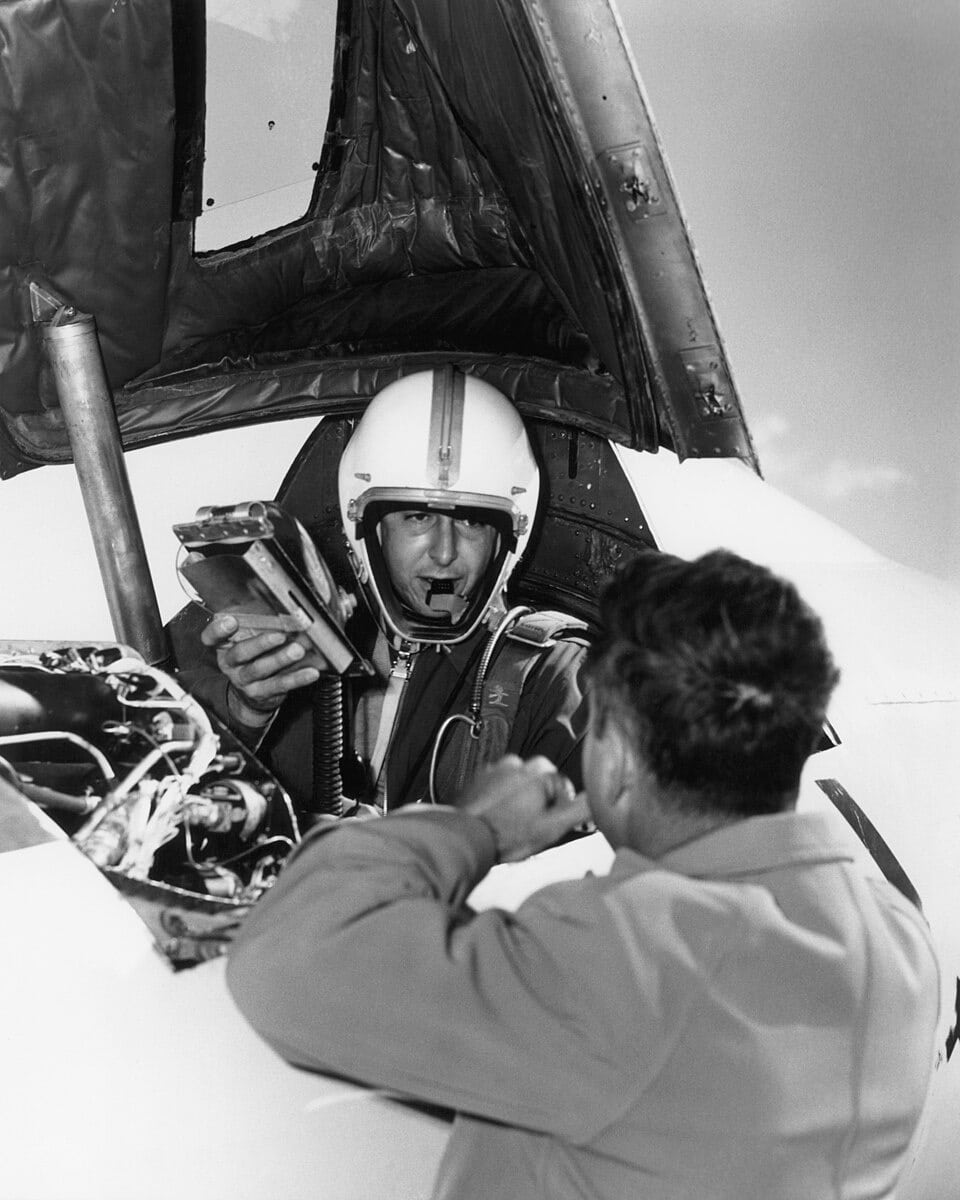
NACA pilot Scott Crossfield in the cockpit of the D-558-2 after the Mach 2 flight. | Source: NASA
Surviving Skyrockets
The three D-558-2 aircraft flew 313 times setting several records and gathering invaluable data. This data would go on to aid in the design of future aircraft, including the Century Series of fighter aircraft.
The program ended with the last flight on Dec. 20, 1956. A third version of the aircraft, the D-558-3 Skyflash, was an ambitious Mach 9 performer with space capabilities was abandoned in favor of the North American X-15.
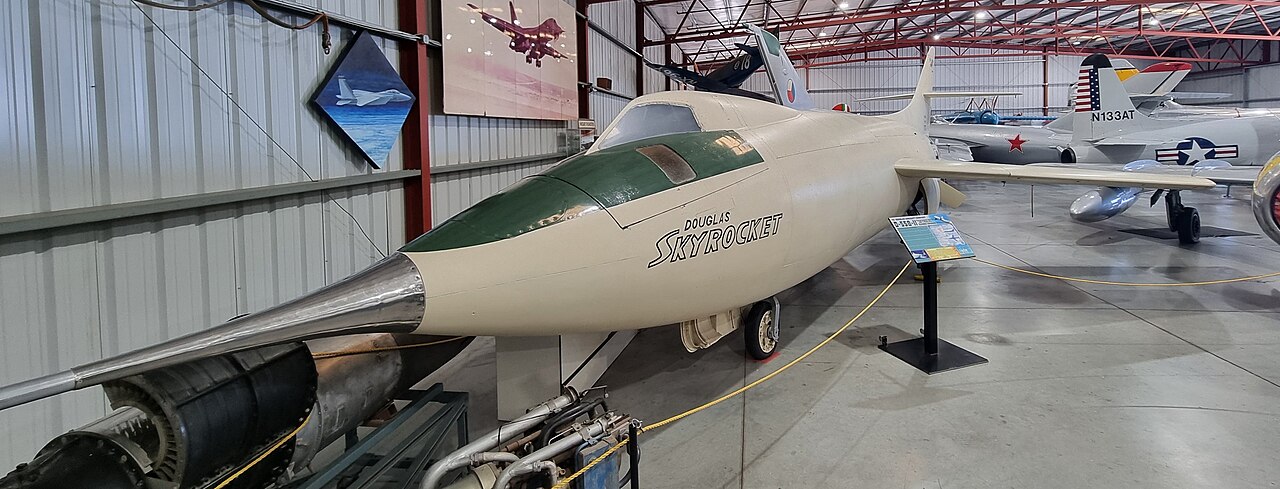
: Douglas D558-2 (37973), the first Skyrocket built, on display at the Planes of Fame Museum in Chino, California. | Source: Wikimedia Commons
All three of the D-558-2 Skyrockets have been preserved. The first example built is on display at the Planes of Fame Museum in Chino, California.
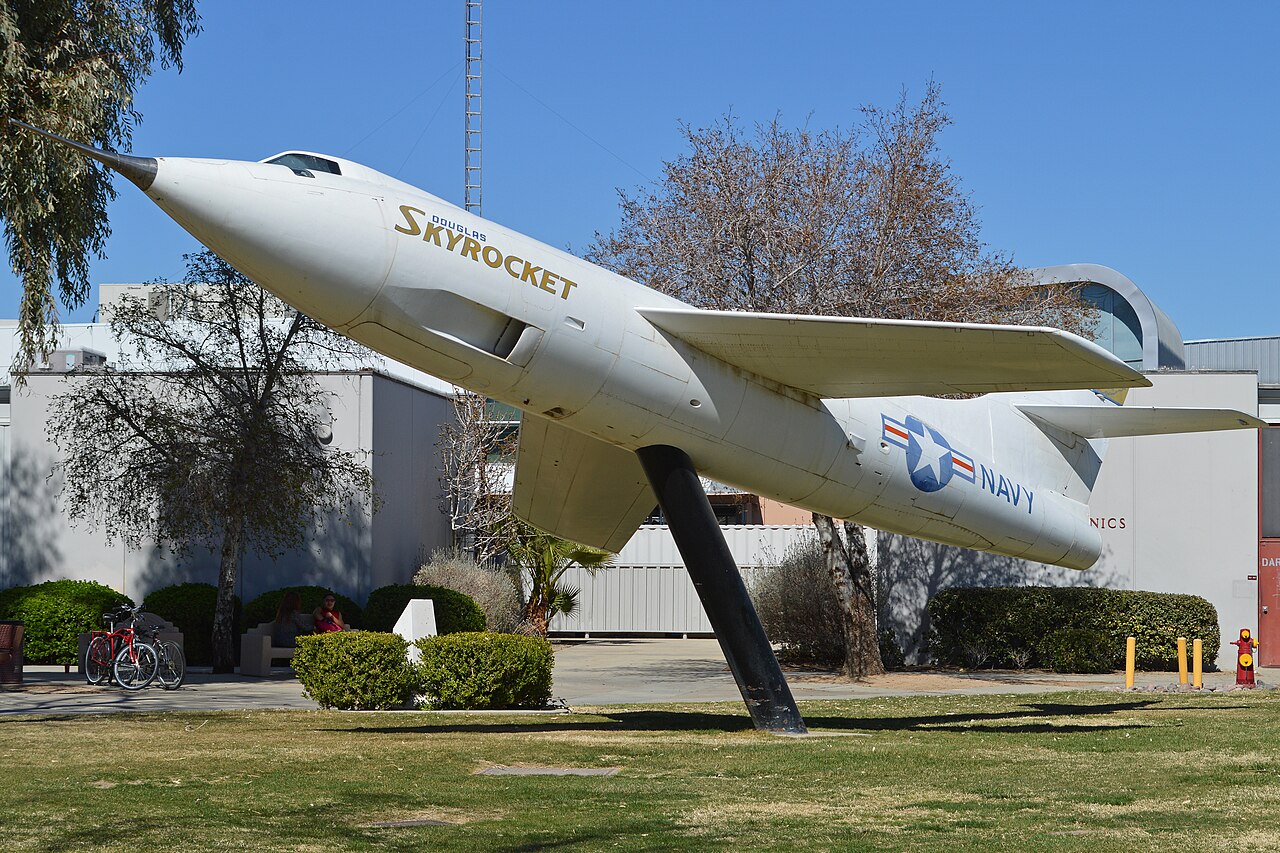
The second example, the one Crossfield took to Mach 2, resides at the National Air and Space Museum in Washington D.C., and aircraft number 3 is mounted on a pylon at the Antelope Valley College in Lancaster, California.
The third and final D-558-2 on display on a pylon at Antelope Valley College in Lancaster, California. | Source: Wikimedia Commons
An F-4AUP Phantom of the Hellenic Air Force crashed during a flying display part of Athens Flying Week. There are no signs of the pilots ejecting.
On Sept. 5, 2026, at around 15.00 LT, an Hellenic Air Force F-4 Phantom (01504) crashed at Tanagra Air Base, near Athens. Videos shared online show the aircraft impacting the ground and exploding into flames close to the airport. While the status of the aircrew has not been disclosed yet, the footage does not show the two aircrew members ejecting from the aircraft.
Video showing the crash.
Never forget how difficult it is to fly these aircraft on the edge of their capabilities. Regardless of the outcome the crew are heroes.https://t.co/9OGvlVOAma
According to the reports, the aircraft crashed during the first 2 minutes of its display and the impact reportedly occurred outside the runway in the industrial zone of Tanagra, near factories, which were closed at the time of the incident.
Clips shared online show the aircraft flying at low altitude and high speed and then turning towards the runway. Then, the jet lost altitude and crashing into trees, close to the runway.
A HAF F-4 Phantom II just crashed at the Athens Fling Week airshow. We can only hope for the best, but I saw no parachutes. He hit the ground coming out of a turn. pic.twitter.com/JtW4YdPJ5x
There was no information from the HAF or the Greek Ministry of Defence at the time of writing. Following the crash, Minister of National Defense Nikos Dendias left Tanagra and returned urgently to Athens.
The HAF is one of the last operational Phantom operators in the world, flying 17 of the airframes (as per the last count by Dec. 2025, now down to 16 following the crash). The jets are assigned to the 338 Mira of the 117 Combat Wing. The country also celebrates the European Phantom Conference (PhanCon), bringing aviation enthusiasts from around the world to the Andravida Air Base.
Other Phantom operators are the Turkish Air Force (TuAF) and the Islamic Republic of Iran Air Force (IRIAF) – the latter sparingly flying their highly sanctioned and part-starved jets with local fixes and some smuggling. The HAF is also an F-16V Viper operator, with Lockheed Martin announcing on Sep. 5, having delivered 59 of the jets.
BREAKING: A Hellenic Air Force F-4 Phantom has crashed during an aerial display at Athens Flying Week in Tanagra, Greece.
The twin-seat aircraft went down during Saturday’s show, sending a massive column of black smoke into the sky in front of thousands of spectators.…
The Hellenic Air Force released an official statement about the incident, confirming the two crew members were killed.
On Saturday, September 5, 2026 at 14:55, an F-4E Phantom II aircraft of the 338th Squadron of the 117th Fighter Wing, which was participating in the “Athens Flying Week 2026” Airshow, crashed 3 nautical miles southeast of the 114th Fighter Wing, resulting in the fatal injuries of the two crew members, First Lieutenant (I) I.M. and First Lieutenant (I) D.P.
The causes of the accident are being investigated by a competent Air Force committee.
Now back on its own wheels ready for the next phase of restoration, the Bristol Type 170 Freighter, built in Britain but now the only surviving example in the whole of Europe, is due to eventually take pride of place in Aerospace Bristol’s new outdoor exhibit area.
Aerospace Bristol, a rapidly growing aviation museum founded in 2017 on the site of Bristol Filton Airport, is most well known for being the home of G-BOAF, the last Concorde built and the last to ever fly, but has taken on diverse range of aircraft as part of its ambition to showcase British aviation history.
The Bristol Freighter, developed by the legendary manufacturer that was proudly headquartered at Filton, taking its name from the nearby city, was one of the largest and last projects delivered by the firm before its amalgamation into the British Aircraft Corporation (BAC) conglomerate in 1960. The prototype Freighter first flew in December 1945, and the last ever flight by a Freighter took place in Canada in 2004.
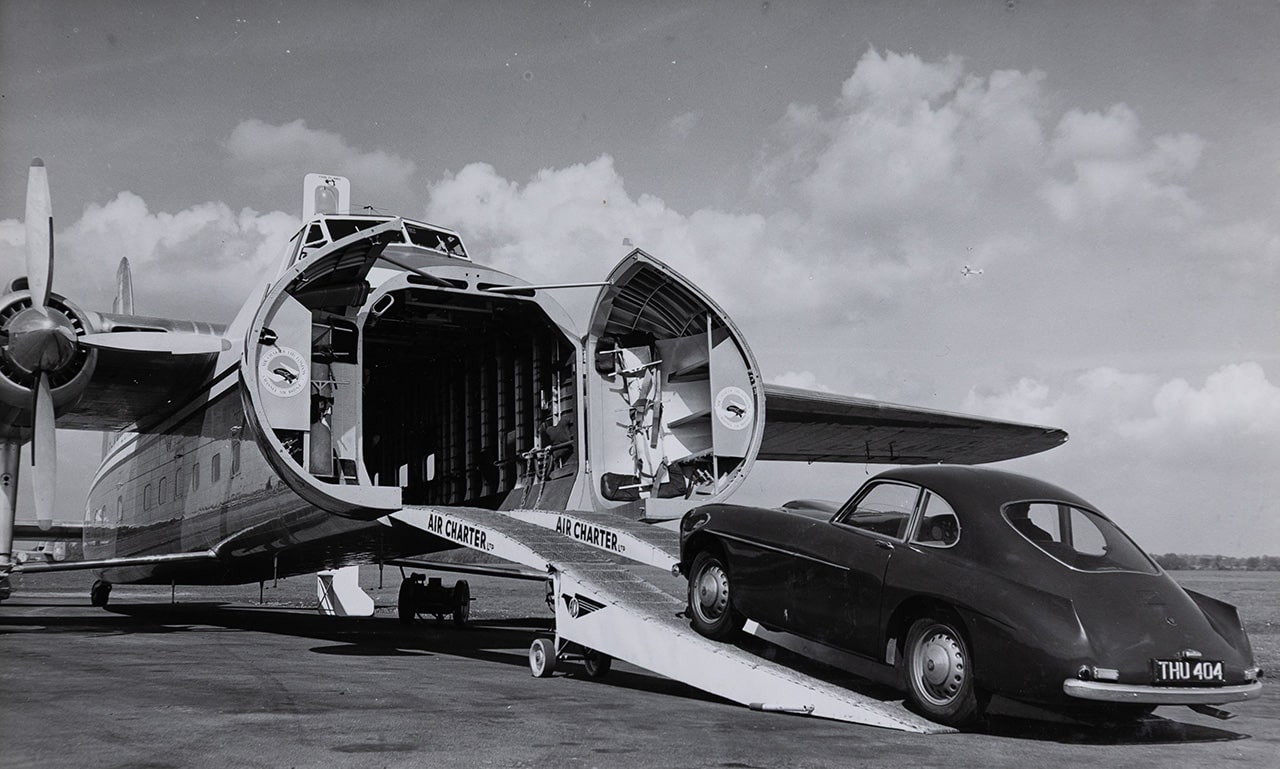
With the cockpit mounted high, a nose cargo door allowed excellent access for loading and unloading freight, and the Type 170 became particularly well known as a vehicle transporter. Over 200 of these aircraft were built, but fewer than ten percent of these survive, and Aerospace Bristol’s example became the only survivor in Europe after its delivery from New Zealand in 2018.
Historic image of a Type 170 Freighter in use as a car transporter. | Source: Aerospace Bristol
“Seeing our Freighter standing tall is a truly special moment for everyone who has contributed to this project. It is a testament to the skill, dedication and sheer number of hours of work that our team has put into bringing this beautiful aircraft back to life,” said Sally Cordwell, CEO of Aerospace Bristol.
“The Freighter has already come along extraordinarily since returning to Bristol in 2018, having only left its conservation hangar last month. There’s more to do, but seeing this project becoming a display that truly allows visitors to experience a remarkable piece of Bristol’s aviation heritage up close is incredibly rewarding for us.”
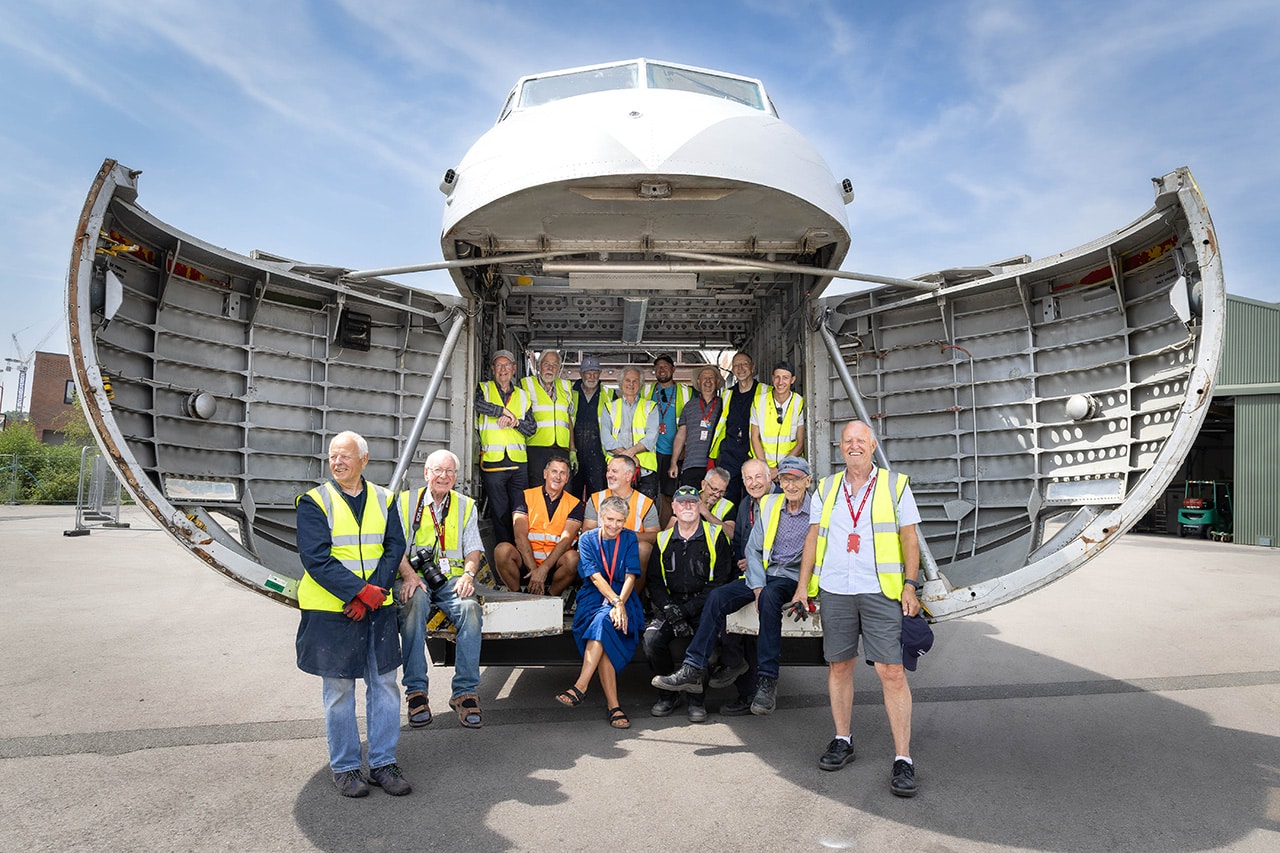
Aerospace Bristol CEO and volunteers with their Type 170 Freighter. | Source: First Avenue Photography/Aerospace Bristol
NZ5911 was built at Filton in 1953 for the Royal New Zealand Air Force, remaining in service until 1977 and even flying missions during the Vietnam War. Sold to the civilian market, the aircraft saw little further use and was grounded from 1978 and stored externally for decades before its acquisition by the museum.
The full restoration now being planned for the coming years aims to see the Freighter restored to a complete, static display standard. Up to 50 specialist volunteers, former aerospace engineers and ex-Bristol Aeroplane Company employees – including a 90 year old former apprentice – will spend an expected total of 10,000 hours preserving the airframe to be seen for generations to come.
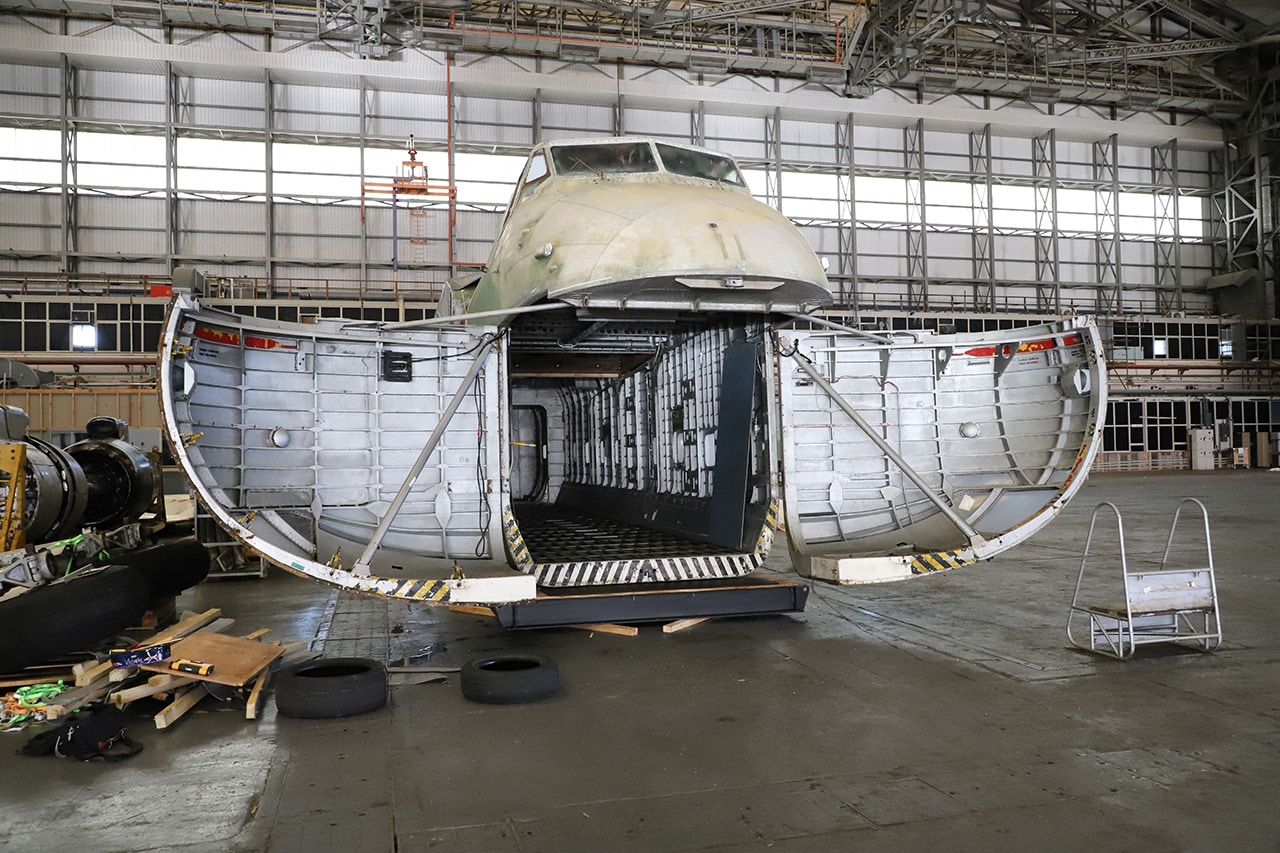
The Freighter inside the conservation hangar prior to being raised onto its landing gear once again. | Source: Aerospace Bristol
When fully reassembled, the Bristol Freighter will have a wingspan of 108 feet (32.9 metres). The wings are currently stored separate from the aircraft, and are undergoing their own restoration process.
The undertaking is the largest restoration ever attempted by Aerospace Bristol, and one which – unusually – will be completed largely in public view, allowing museum visitors over the years to watch and see progress being made in real time.
Post-War Bristol
Bristol’s post-war aircraft designs – like the Type 170 Freighter, and its Wayfarer passenger variant – are often overlooked by history despite making a strong mark in the aviation world in their day. The Freighter alone saw civilian service in no fewer than 22 countries across 6 continents. The type additionally flew with the military or state aviation operators of 8 countries.
Bristol’s Superfreighter, a stretched variant, upped the load capacity and was specialised in the ‘air ferry’ role transporting cars and their passengers to holiday destinations.
After the freighter came the Britannia, an early turboprop airliner which struggled to compete against emerging jet airliners but managed to reach 85 production airframes. Britannias served with British Overseas Airways Corporation (BOAC), Cubana, and Monarch Airlines. Notably, in service with Israeli flag carrier El Al, a Britannia was used to secretly extradite Adolf Eichmann to stand trial in Jerusalem for his role in perpetrating the Holocaust.
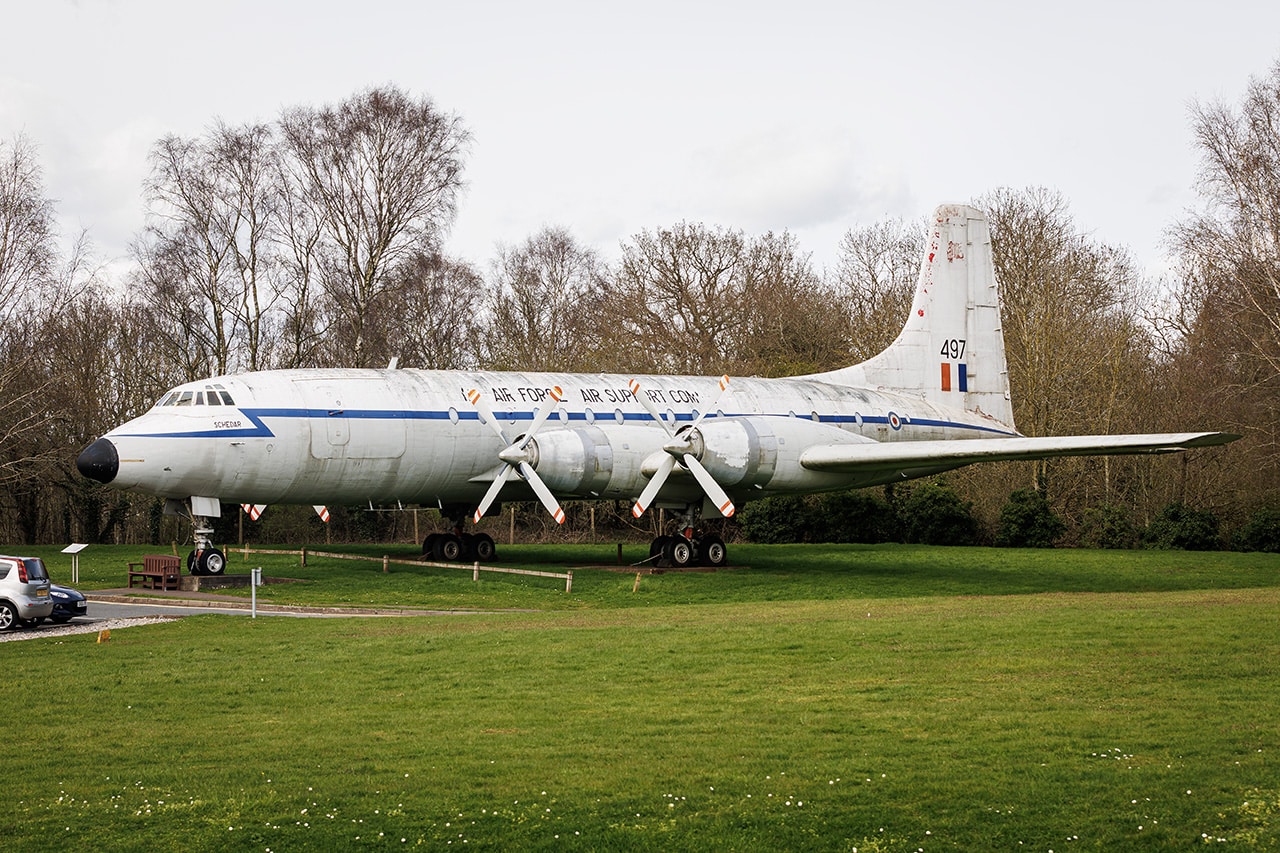
A former Royal Air Force Bristol Britannia on display outside Royal Air Force Museum Midlands (Cosford). | Source: Kai Greet
The crowning achievement in Bristol’s lineup was hoped to be the Brabazon, a mammoth piston airliner developed in the mid to late 1940s for transatlantic service. Unfortunately for Bristol, technology caught up with the Brabazon before it could ever enter service, and no customers placed an order for the expensive, luxurious behemoth. The only example ever built was reduced to scrap just years after completion.
#OnThisDay 1950: Newsreel showed footage of a behemoth of the skies, the Bristol Brabazon, as it touched down in London for the first time. pic.twitter.com/nktcVP2ciQ
The last aircraft to bear the Bristol name, developed just as the firm was absorbed by BAC, was also one of its most distinctive. Some have labelled the Bristol Type 188 as Britain’s answer to the Lockheed SR-71, despite being built for a very different purpose. Aesthetically, though, it is sort of easy to see why, though as a purely experimental aircraft the Type 188 eschewed the signature matte black Blackbird look in favor of bare stainless steel. It also fell short in terms of speed, reaching a maximum of ‘just’ Mach 1.88 at a fairly average altitude of 36,000 feet.
The Bristol Type 188 was the world’s first stainless steel supersonic aircraft. Two were built for experimental research. In April 1966 both 188 fuselages were sent to the Proof & Experimental Est. at #Shoebury Garrison for target practice. XF926 was later scrapped at #Foulness. pic.twitter.com/3kzU3YKyW6
— Southend & South Essex History (@HistorySouthend) December 17, 2021
Nonetheless, the Type 188 served its purpose in experimenting with different aircraft design techniques, manufacturing practices, and materials, informing the development of Concorde as well as the TSR-2 strike aircraft.
Aerospace Bristol proudly displays a variety of Bristol’s aircraft types alongside its centrepiece Concorde, as well as a few examples of aircraft developed by its successor firms, including a Sea Harrier and a BAe 146 airliner.
The first eight of a dozen Vermont Air National Guard F-35As are returning home from their combat deployment in the CENTCOM area of operations.
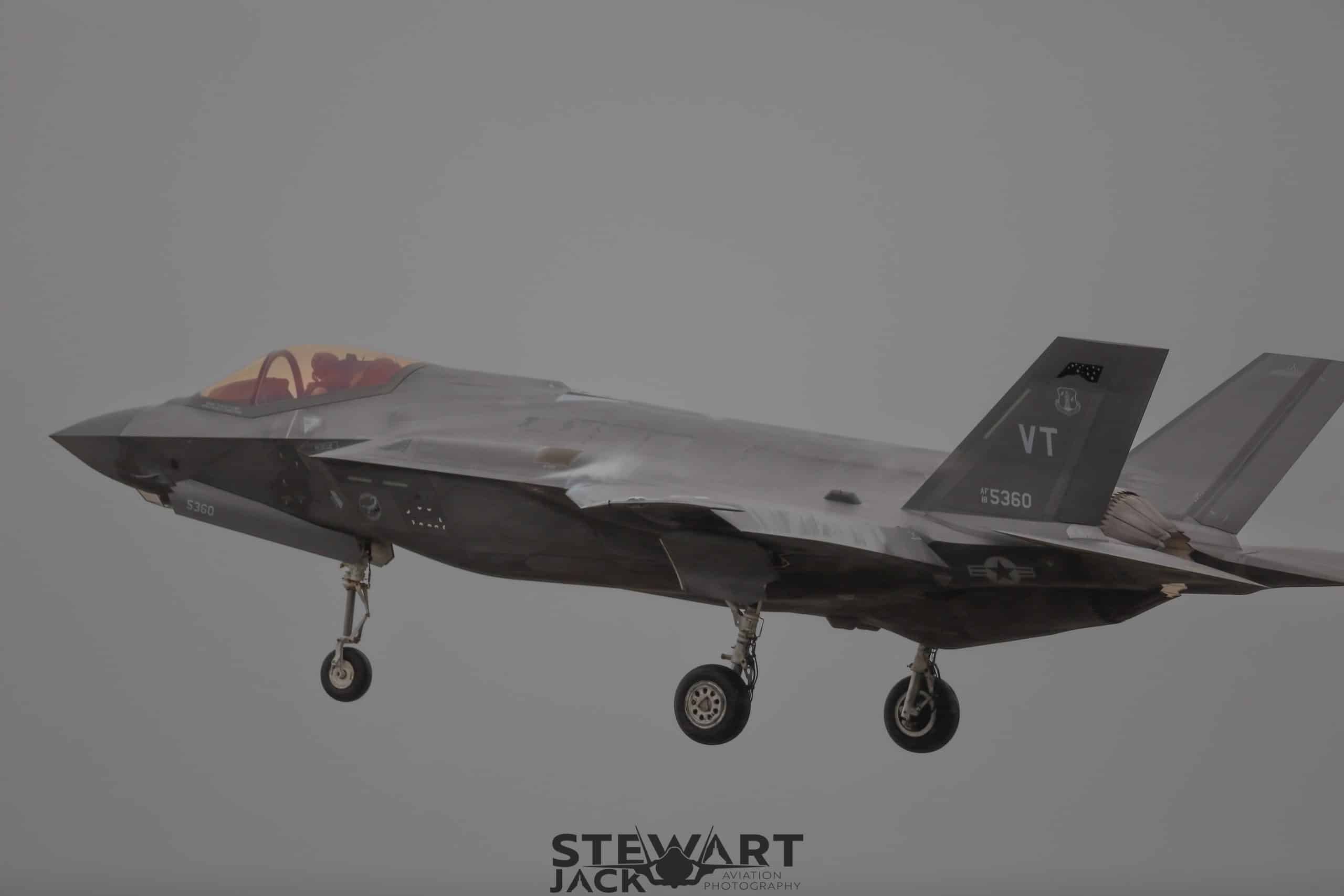
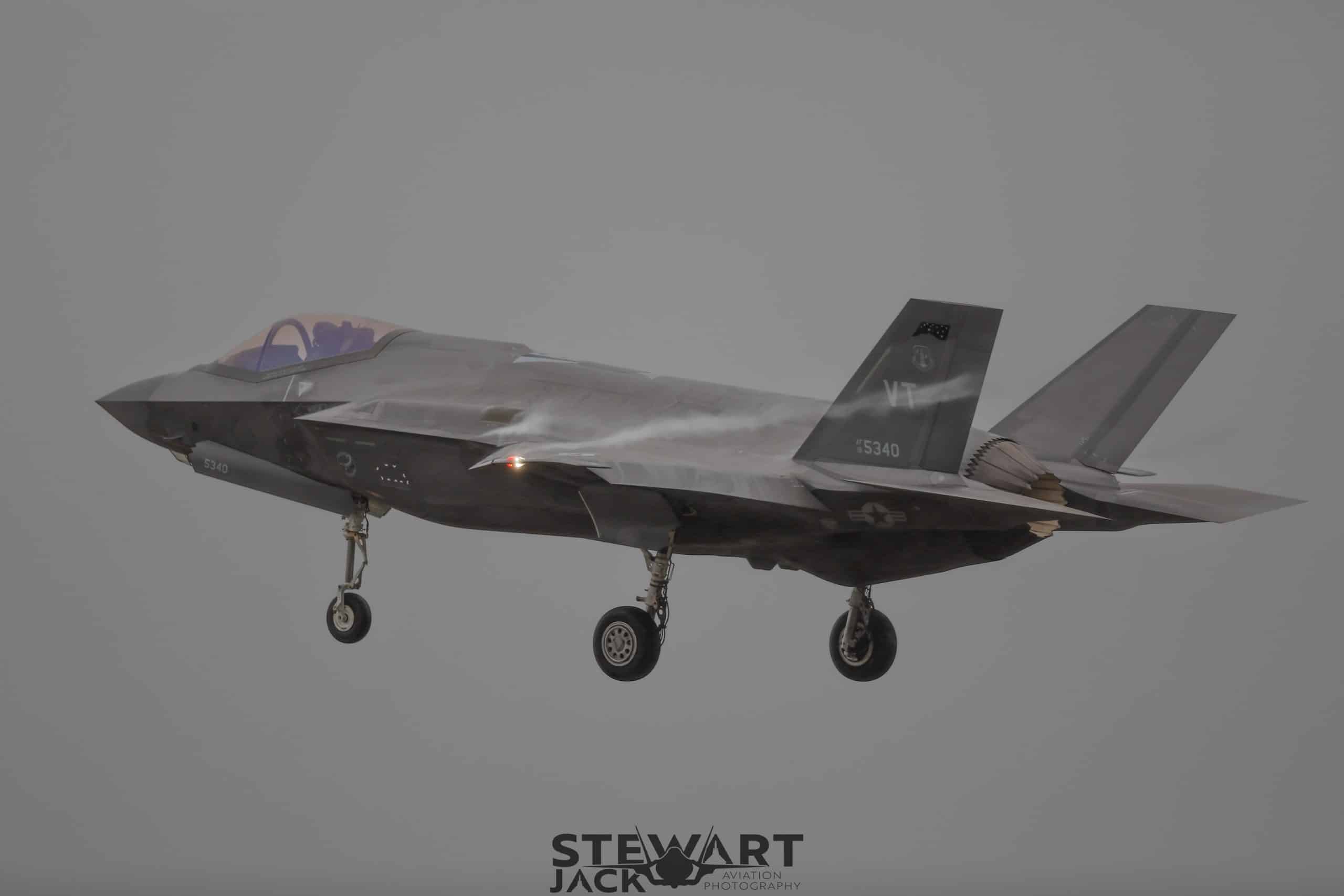
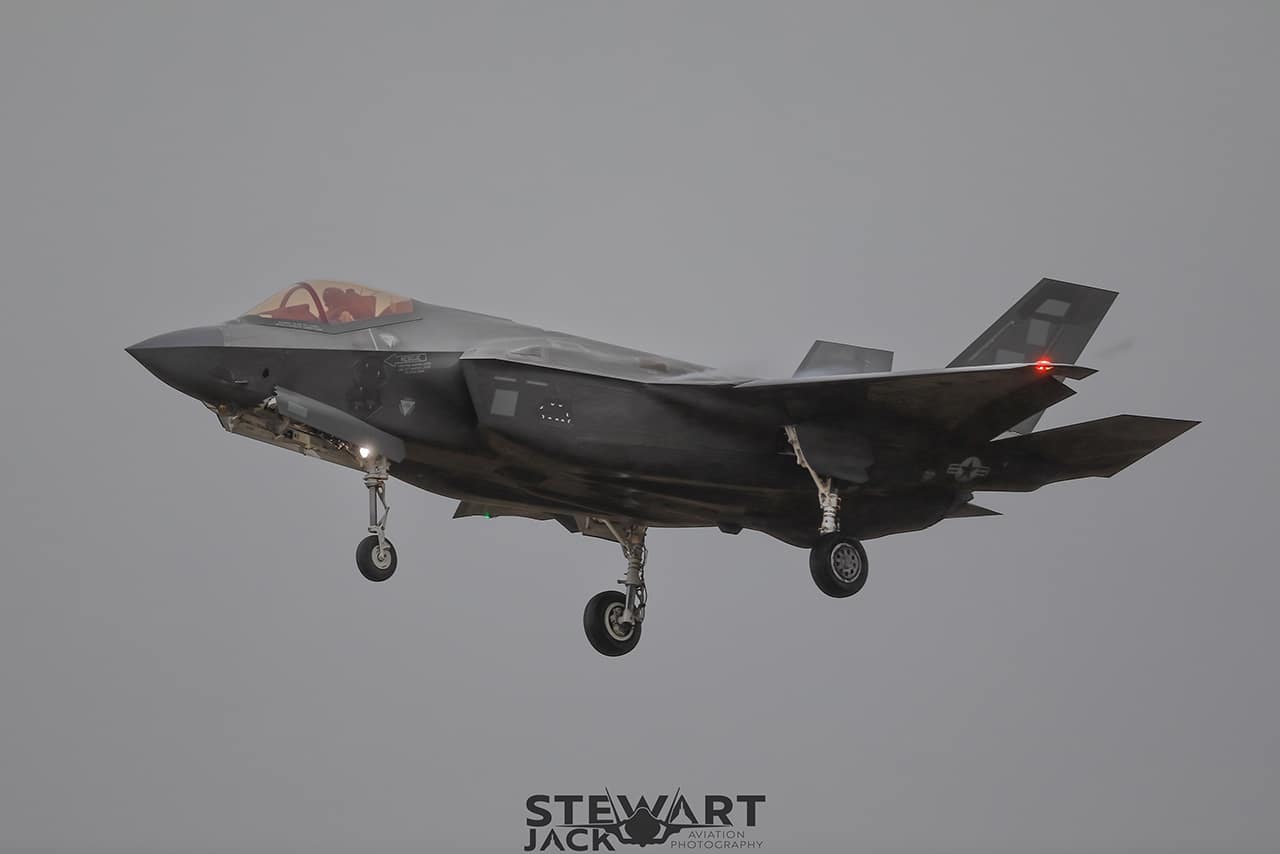
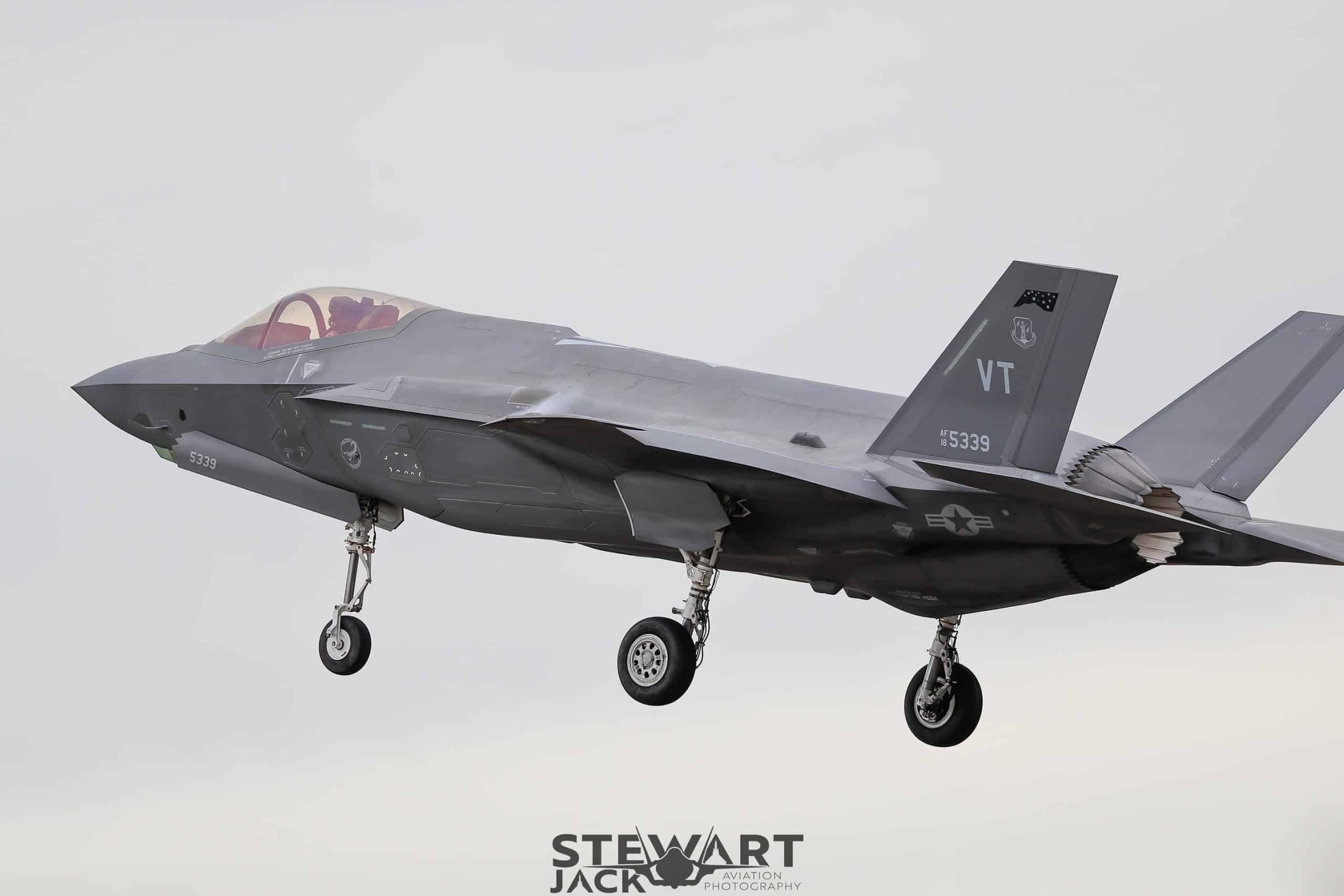
Split into two flights, the first eight F-35A jets of the Green Mountain Boys of the Vermont Air National Guard 158th Fighter Wing/134th Fighter Squadron, arrived in the UK on their way back to their homebase at Burlington Air National Guard Base, Burlington, Vermont, on Sept. 4, 2026.
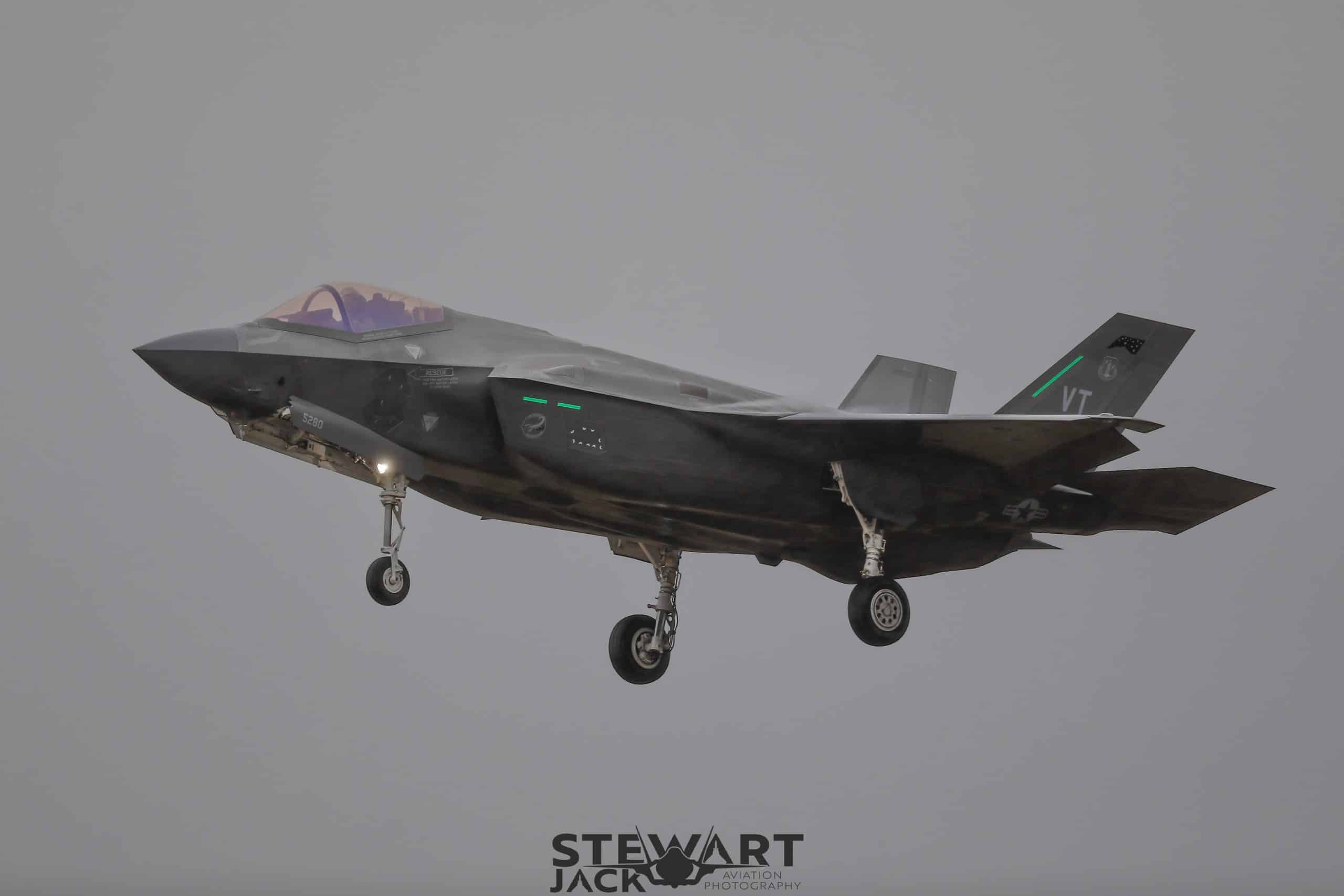
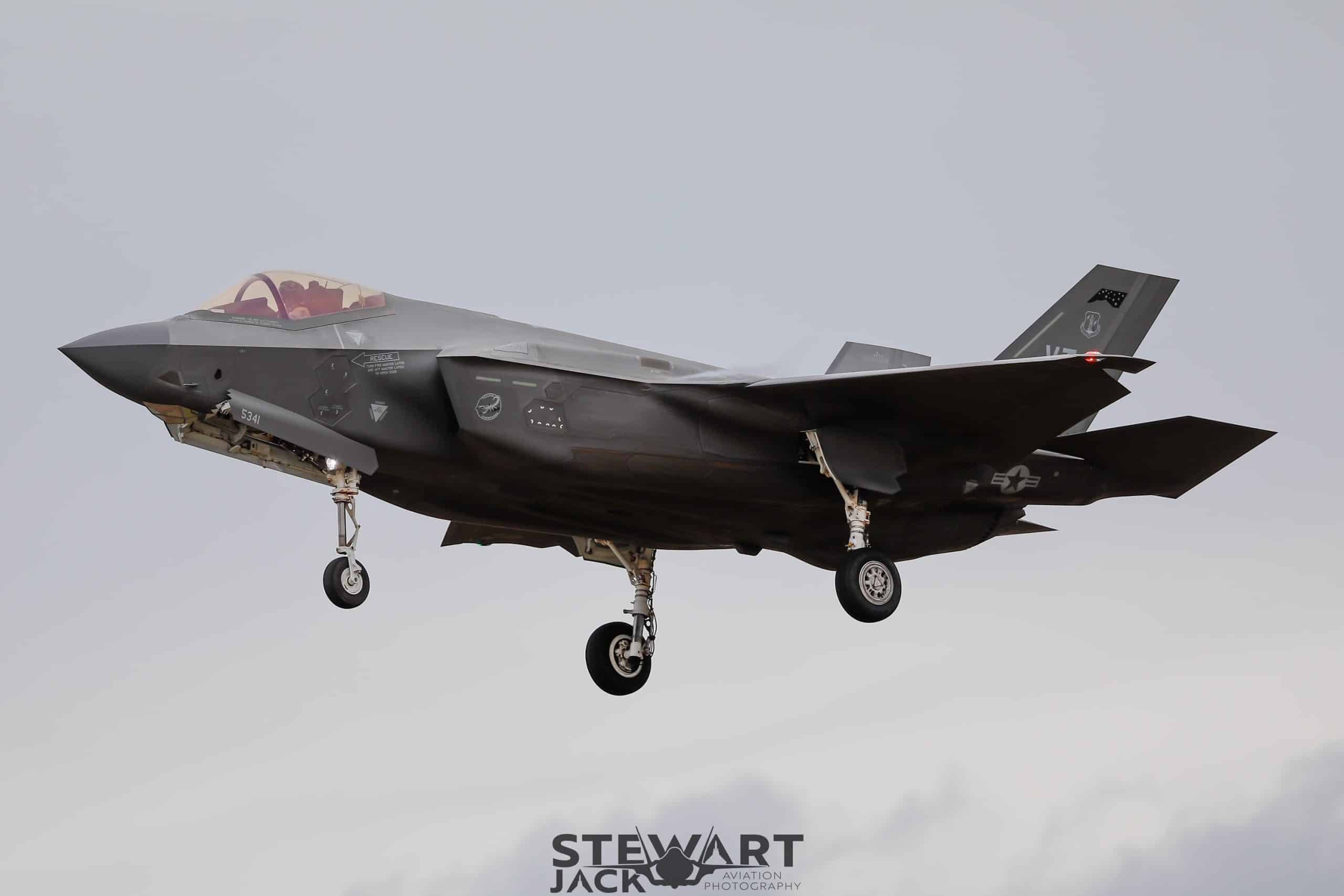
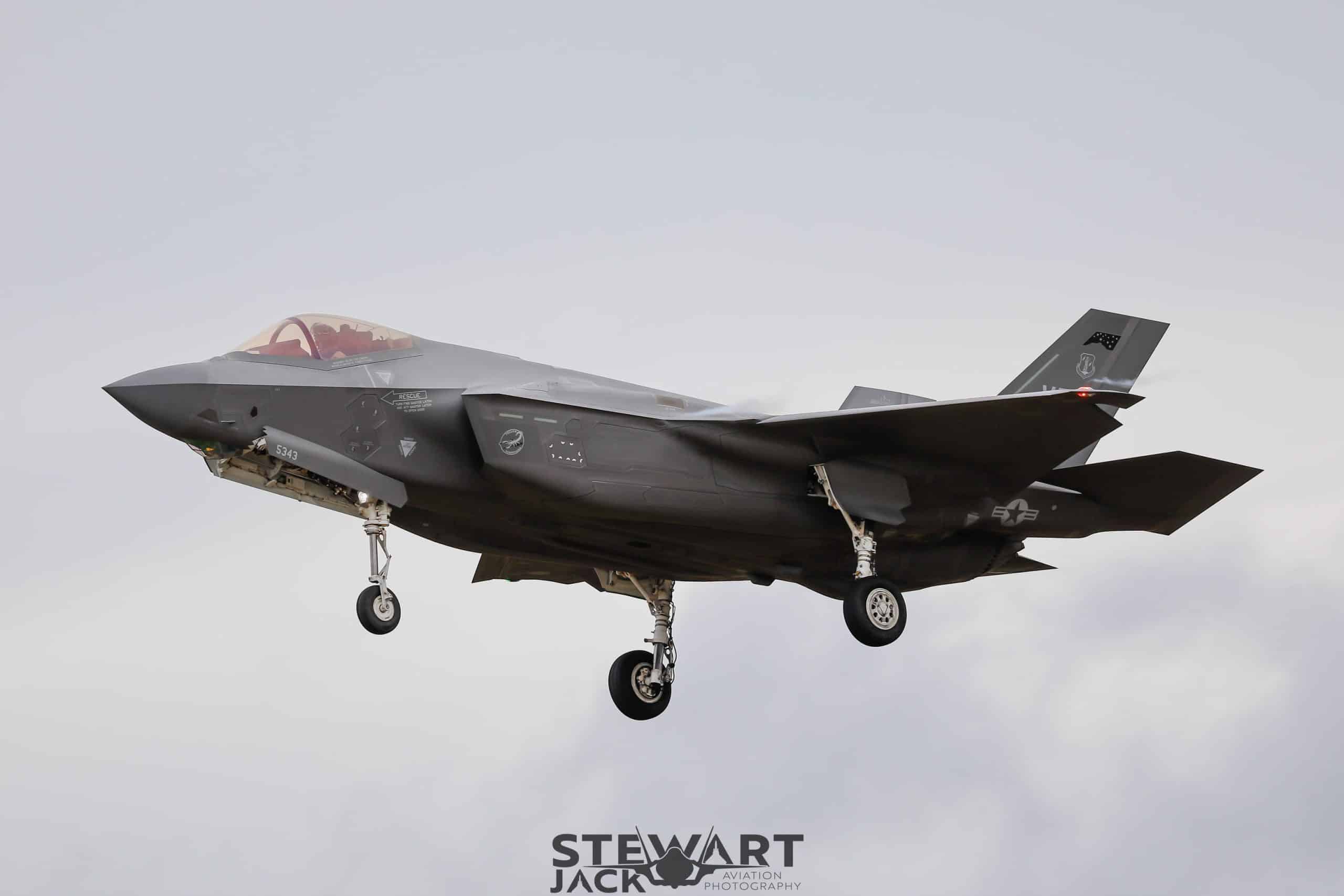
Flying as TABOR 81-84 and 91-94, the eight Lightning II aircraft were airframes 17-5280, 18-5336, 18-5360, 18-5340, 18-5338, 18-5339, 18-5341, 18-5343.
The two flights were supported by four KC-135 tankers, CLEAN 35-36 and 45-46, launched from Romania.
Twelve Green Mountain Boys F-35s had deployed to the Middle East via Lakenheath and Moron Air Base to support Operation Epic Fury in February 2026. The remaining four jets should arrive in the UK for a stopover during the weekend.
17-5280 | Source: Stewart Jack18-5360 | Source: Stewart Jack18-5340 | Source: Stewart Jack
As we noted back then when the aircraft deployed to the CENTCOM area of responsibility, one of the VT F-35s that arrived in the UK on Sept. 4, 2026, identified as 18-5336 thanks to the last four digits of the serial number painted inside the nose‑wheel door, has almost all of its identifying marks obscured, while other aircraft have full tail numbers visible.
Blanked out 134th FS F-35A 18-5336 landing at RAF Lakenheath on Sept. 4, 2026. | Source: Stewart Jack
18-5339 | Source: Stewart Jack18-5341 | Source: Stewart Jack18-5343 | Source: Stewart Jack
While the VT F-35s are returning home, other assets are on their way to the sandpit: 12 F-16Cs from 180th FW OH ANG from Toledo Air National Guard Base in Swanton, Ohio, are deploying to the Middle East.
UPDATE: Coronet East 110 Continues towards CENTCOM #IranWar
It appears the jets are on the move once again as 2 cells, with initial tanker support from Lajes:
The company says the first pod was assembled using production systems, as Viper Shield orders grow to 233 units across eight allied nations.
According to a statement released on Sept. 3, 2026, L3Harris Technologies has assembled its first podded Viper Shield electronic warfare system using production-standard hardware. This is a significant step forward for the external configuration first unveiled in 2025. The company has also completed production of the first 35 Viper Shield systems and is ramping toward full-rate production for 233 units currently on order.
The company describes Viper Shield as the only F-16 electronic warfare system currently in production with orders from eight allied nations.
Viper Shield detects, identifies and counters electronic threats by providing digital armor around the aircraft. The technology can support the pilot as an integrated internal system or as an external pod. L3Harris also assembled its first pod leveraging production systems.
Viper Shield is the only F-16 electronic warfare system currently in production with orders from eight allied nations. L3Harris is ramping up to full-rate production for the 233 systems currently on order. Additional partner nations that select Viper Shield will benefit from an active production line with quality assurance and a supply chain capable of meeting the demands of large-scale manufacturing.
Developed by L3Harris in partnership with Lockheed Martin and the U.S. Air Force, Viper Shield can be installed internally on new-build F-16 Block 70/72 aircraft or carried externally in podded form, allowing operators of earlier F-16 variants to access the same core electronic warfare capability without requiring the same level of internal integration.
The pod shown in L3Harris renderings bears a significant resemblance to the Northrop Grumman’s AN/ALQ-131(V) ECM (Electronic Countermeasure) pod already in use on the global F-16 fleet, but also on other platforms such as the A-10 and F-15, as well as F-4 and F-111.
The AN/ALQ-131 pod. | Source: USAF
When we reported on the system in September 2025, L3Harris had unveiled the podded version of the AN/ALQ-254(V)1 Viper Shield system, saying seven international partners had selected the suite for 168 F-16s. Since then, the program has moved deeper into production: the customer base has grown to eight allied nations, with the orders increased to 233 systems. The first 35 units have been completed along with the first external pod.
Interestingly, according to the manufacturer, around $1 billion in shared investment by foreign F-16 operators has already funded development, laboratory testing, flight testing and current production, potentially reducing the cost of any future U.S. Air Force or Air National Guard entry into the program.
“The $1 billion shared investment by countries operating F-16s means the U.S. Air Force and National Guard could benefit from joining the program,” said Chris Aebli, President, Communications & Spectrum Dominance at L3Harris. “The foreign investment is funding development, lab testing, flight testing and current production of Viper Shield systems, which presents the United States with a savings opportunity to avoid upfront costs.”
Viper Shield is designed for the F-16 Block 70/72 and its digital radar warning receiver (DRWR) technology integrates seamlessly with the aircraft’s new APG-83 active electronically scanned array (AESA) radar, to deliver greater situational awareness, while remaining compatible with earlier F-16 blocks. The system also includes a digital radio frequency memory (DRFM)-based jamming system, which provides enhanced capability against advanced threats.
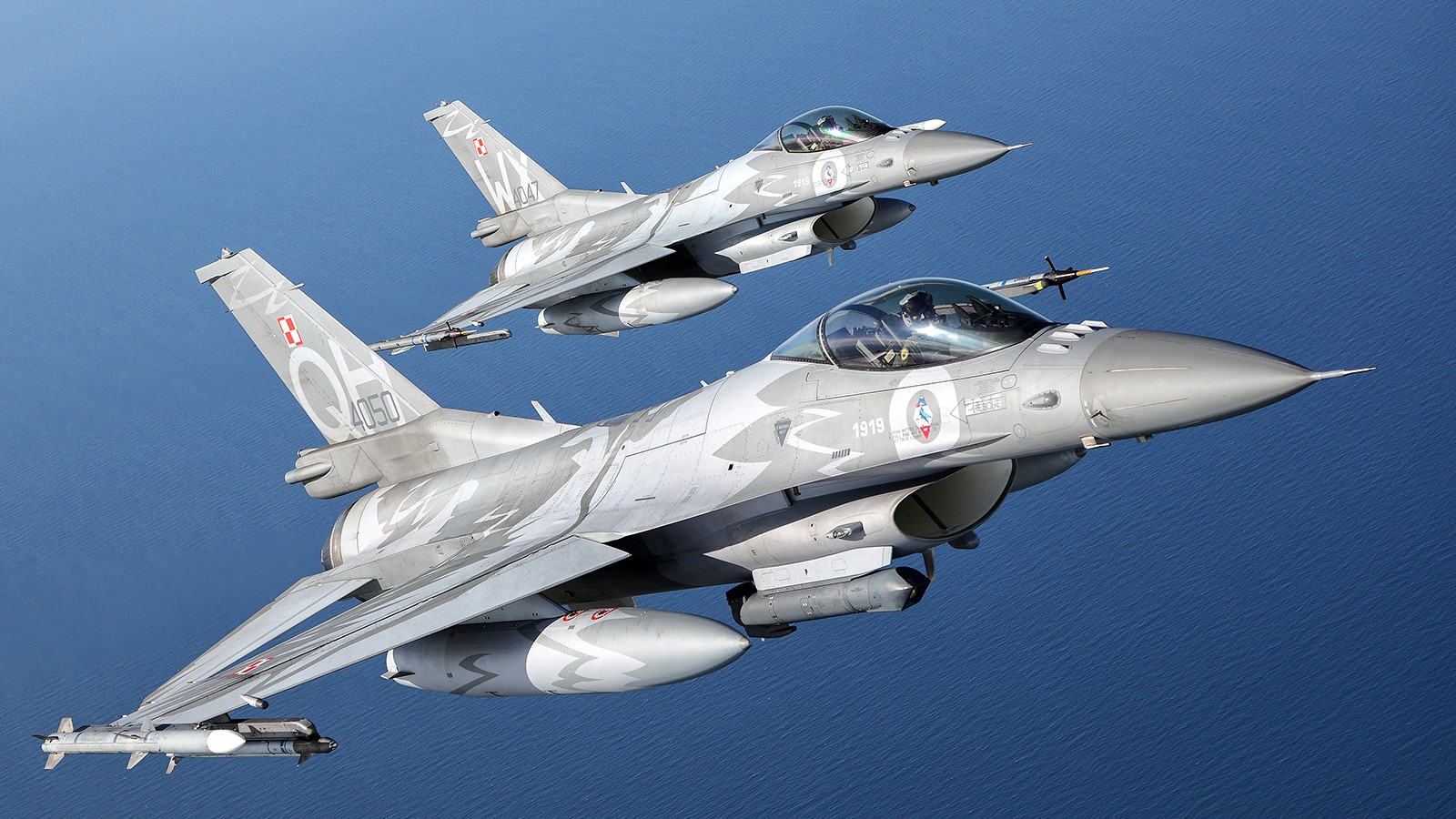
Polish F-16C Block 52+ jets in flight. (Image credit: Bartek Bera/Poland MoD) | Source: Poland MOD
The manufacturer says it designed Viper Shield with fewer critical components than previous generation EW systems not only to obtain a smaller form factor and reduced weight, but also a higher mean time between failure and lower lifecycle costs. The modular design, which supports swapping LRUs in the field, together with the COTS (Commercial Off The Shelf) technology and software-defined architecture, allows to simplify future upgrades as technology and threats evolve.
The goal of the system is to provide a virtual electronic shield around the aircraft, with state-of-the-art capability, to address emerging and future threats with a fully integrated, internally mounted system. In the most modern F-16s, the integrated system eliminates the need to employ external EW pods usually installed on the centerline station, freeing it for other payloads such an external fuel tank.
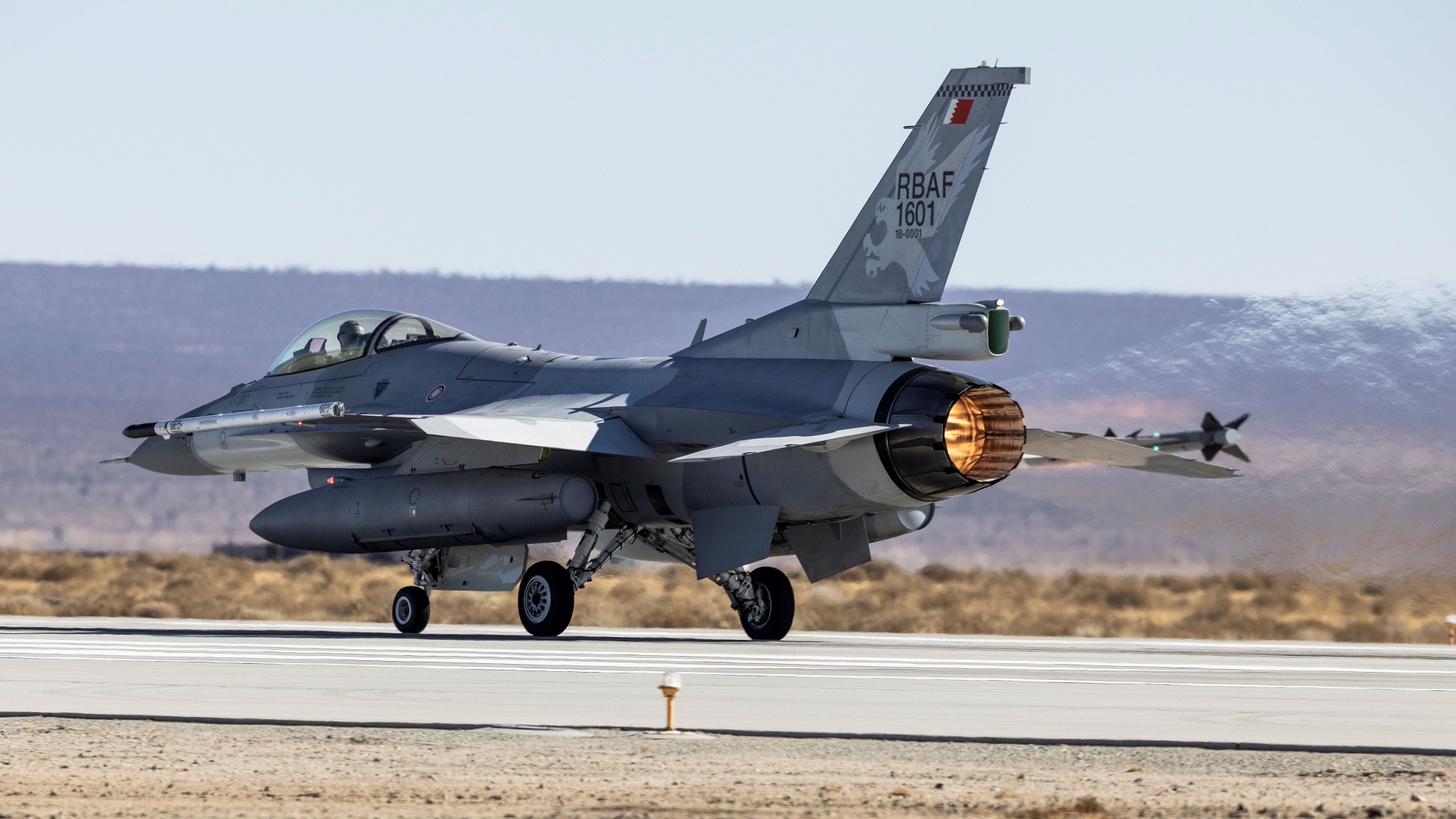
The internal variant of the system first flew on an F-16C Block 70 of the Royal Bahraini Air Force in February 2025 at Edwards AFB, California, conducted by a pilot of the 416th Flight Test Squadron, Airpower Foundations Combined Test Force.
The internal and podded variants of the system use the same physical component hardware, a versatile design that enables 100% hardware commonality between internal and pod configurations and reduces overall maintenance, support and lifecycle cost, particularly where the end user deploys a combination of new and upgraded F-16s. Beyond that, the external pod remains particularly useful to those operators that need to integrate the system on previous generation F-16s.
The Viper Shield electronic warfare suite conducted its first flight Jan. 23, 2025, from Edwards Air Force Base in California. (Photo courtesy of Lockheed Martin) | Source: Lockheed Martin
The IOC for the Grey Wolf comes as the U.S. prepares to transition to the Sentinel ICBM from the legacy Minuteman III, where the helicopter’s improved performance and mission systems are better suited for the nuclear security role.
The U.S. Air Force MH-139 Grey Wolf helicopter, meant to replace the UH-1N Huey in the missile-field security and rapid transport of Tactical Response Forces, including Intercontinental Ballistic Missiles (ICBM) convoys support, has reached Initial Operational Capability (IOC), the Air Force Global Strike Command (AFGSC) announced on Aug. 31, 2026. The IOC, granted on Aug. 10, comes alongside a modernization of the nuclear triad’s land leg, with the new LGM-35A Sentinel Inter-Continental Ballistic Missile (ICBM), the service said.
The Sentinel, which will replace the legacy Minuteman III, requires an extensive supporting infrastructure of its own, including new launch facilities, technical support and maintenance equipment, cabling, software and communications systems.
The Grey Wolf’s increased speed, range and payload are commensurate with these upgrades, as the Vietnam-era Huey is phased out.
A newer and “resilient” platform like the Grey Wolf would also better patrol the 20th Air Force’s ICBM launch facilities spread across the 20th Air Force’s approximately 33,600-square-mile area of responsibility, spanning varied terrain including prairies, plains and mountain ranges. The Air Force has also said that the MH-139’s capabilities support Search and Rescue (SAR), disaster response and medical evacuation roles.
MH-139 Grey Wolf achieves Initial Operational Capability, ushering in a new era of modernization for nuclear security operations.https://t.co/hN4B8q9qoC
The IOC follows a series of milestones, including rigorous Initial Operational Test and Evaluation (IOT&E) flights; a Nuclear Convoy Course (NCC) featuring emergency-response drills with armed Tactical Response Force personnel from Missile Security Operations Squadrons; and the first operational Minuteman III convoy security mission in January 2026. In October 2025, Boeing also received a $173 million contract for eight additional helicopters, bringing the total number under contract to 34.
Grey Wolf Supports Transition From Minuteman III to Sentinel
The Air Force release said the IOC for the MH-139 Grey Wolf marks the “historic transition from the Vietnam-era UH-1N Huey, a platform that served the Air Force for more than five decades.” The MH-139 Grey Wolf offers enhancements across the board, including being nearly 50% faster; being able to carry twice as many troops; and being equipped with better self-defensive systems, suited for modern battlefield threats.
“These advancements allow security forces to mobilize combat power and arrive on-site sooner than the legacy platform,” the statement said. “For more than half a century, the UH-1N Huey has been a key element of our Intercontinental Ballistic Missile security, and we owe a debt of gratitude to the crews who flew and maintained it over all these years,” said AFGSC commander Gen. S.L. Davis. “Securing these missiles demands our best efforts and the MH-139 will significantly improve our capabilities. The integration of the Grey Wolf ensures Global Strike Command remains postured, prepared, and ready to meet any threat to the land leg of the nuclear triad,” Davis added.
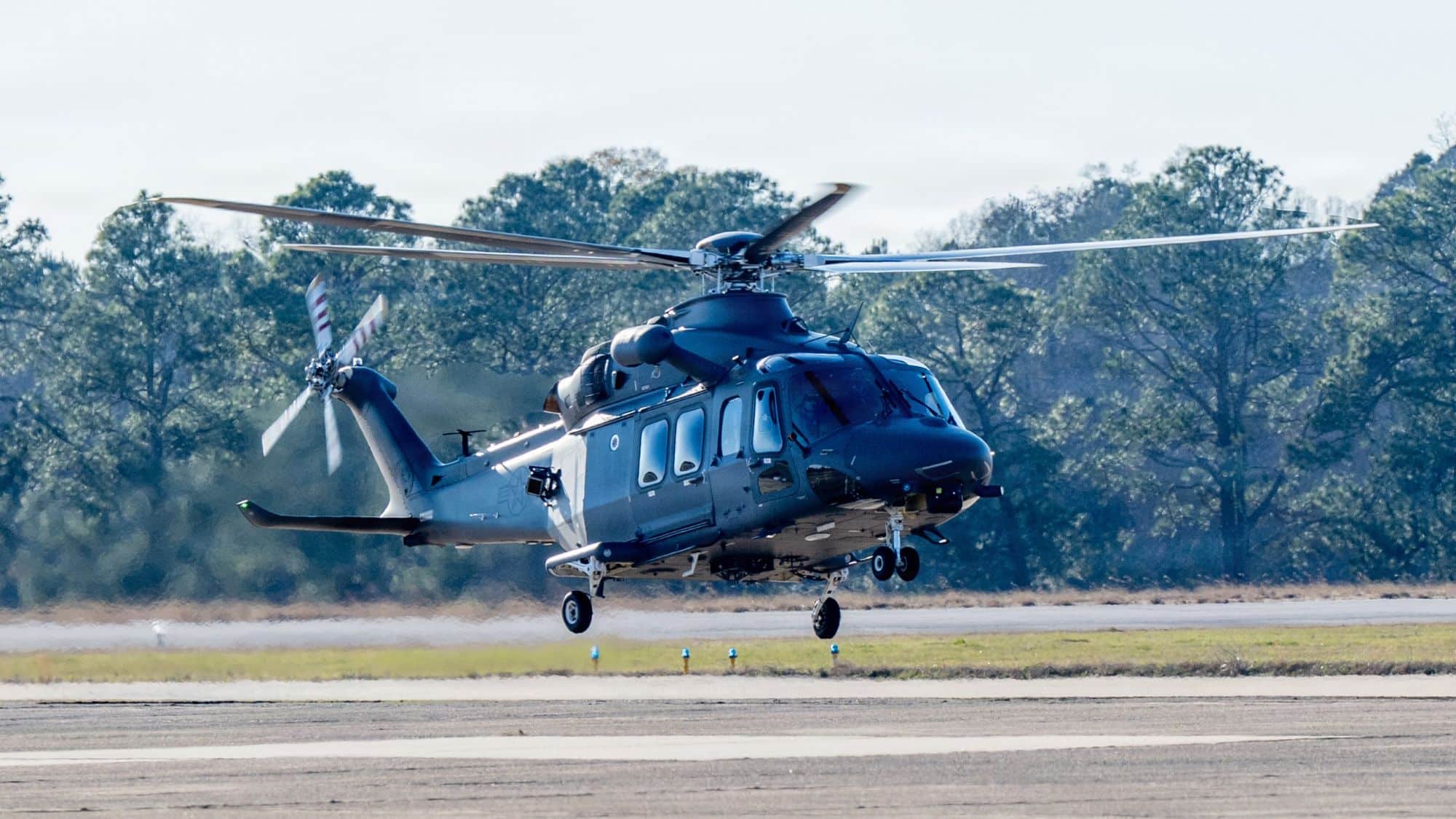
An MH-139A Grey Wolf assigned to the 908th Flying Training Wing, lands after a short flight at Maxwell Air Force Base, Alabama, Feb. 7, 2026. (Image credit: USAF/Staff Sgt. Erica Webster) | Source: USAF
The MH-139 Grey Wolf’s kinematics better support the missile field security 24 hours and 365 days mission, across vast and austere terrain. “The Grey Wolf’s “speed, range, and modern command-and-control systems are crucial” to securing assets during the phased transition to Sentinel that marks “a comprehensive overhaul of [U.S.’s] land-based ICBMs.” The “phased transition” needs “uninterrupted operations as new Sentinel sites are brought online, and Minuteman III facilities are decommissioned.”
Developments in Sentinel program
In Oct. 2025, Northrop Grumman, the Sentinel’s developer, announced completing the Critical Design Review (CDR) of the Sentinel’s Launch Support System (LSS). The LSS is a “digital command and control infrastructure” that supports Sentinel tests and launches, and the CDR paves the way for “system build, test, and qualification phases.” The LSS would be constructed in Roy, Utah, and deployed at Vandenberg Space Force Base.
Go for Launch! Sentinel program’s Launch Support System (LSS) clears Critical Design Review!This achievement ensures LSS will support Sentinel flight tests for decades. Our team’s innovation and dedication are transforming digital models into real-world integration, driving… pic.twitter.com/TPdGn9phP3
This was followed by a March 27, 2026, release announcing the accelerated prototyping of a launch-silo tube for the Sentinel ICBM. The Sentinel program envisages around 400 such launch silos.
We’ve broken ground on a Sentinel launch silo prototype at our facility in Utah. The new design concept is expected to reduce risk, accelerate fielding, prioritize future maintainability and drive cost savings for the program.
As mentioned earlier, the journey to an IOC for the MH-139 Grey Wolf saw extensive operational trials in representative scenarios by the 582nd Helicopter Group. The process included the 550th Helicopter Squadron completing the aircraft’s first Initial Operational Test and Evaluation (IOT&E) flight in January 2025.
Then, the January 2026 first operational Minuteman ICBM convoy support mission by the 40th Helicopter Squadron (40th HS) saw the MH-139 “successfully escorting maintenance and armored security vehicles over 100 miles during a six-hour movement without needing to refuel.”
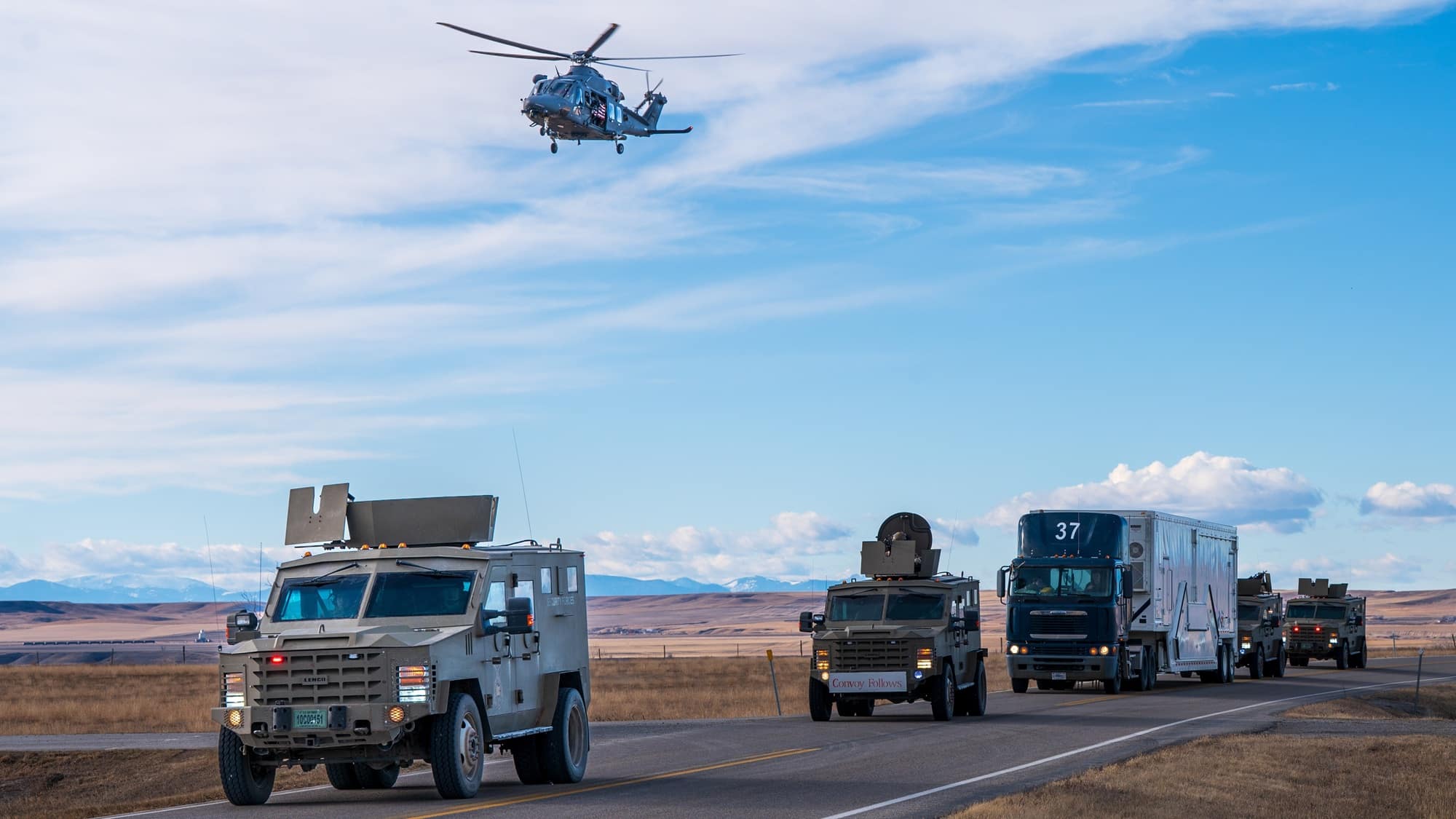
A U.S. Air Force MH-139 Grey Wolf assigned to the 40th Helicopter Squadron conducts its first operational mission alongside 341st Missile Security Operations Squadron convoys at Malmstrom Air Force Base, Montana, Jan. 8, 2026. (Image credit: USAF/Airman 1st Class Jack Rodriguez Escamilla) | Source: USAF
The MH-139 was also put through “electromagnetic compatibility testing” in Nov. 2025 at the Benefield Anechoic Facility (BAF) under the 412th Test Wing’s 772nd Test Squadron at Edwards AFB. The testing on the Grey Wolf, assigned to the 908th Airlift Wing, “evaluated [its] electronic warfare systems and avionics within the highly controlled, radio frequency-isolated environment of the BAF, which is vital for validating its survivability against electromagnetic threats.”
On Aug. 14, 2026, F.E. Warren AFB, Wyoming, also opened a modernized facility supporting the 37th Helicopter Squadron and the 90th Missile Security Operations Squadron Tactical Response Force.
The MH-139A participated in its first Nuclear Convoy Course (NCC). A weeklong exercise in Wyoming to ensure the safe and secure transport of nuclear weapons and materials.
In the latest Air Force release, 582nd HG commander Col. Bryant Bevan said it had been “distinct privilege […] to watch the iconic Huey faithfully support our global operations.” “However, this transition represents a critical leap forward. The advanced capabilities of the MH-139A Grey Wolf will directly empower our airborne forces with the enhanced speed, range and survivability required to decisively defend and secure the Minuteman III weapons system,” Bevan added.
The U.S. Air Force’s EC-130H has conducted its last ever flight, marking the end to an illustrious career spanning more than four decades.
On September 2, 2026, EC-130H reg. 73-1590 departed Davis-Monthan Air Force Base, Arizona, under the callsign VOLT01, for what was scheduled to be the final flight of the type. The aircraft took off at approximately 07.00 local time before returning to Davis-Monthan around six hours later, marking the formal end of the U.S. Air Force’s EC-130H operations.
73-1590 was initially delivered to the USAF as a generic C-130H, after which it underwent modification and conversion to be delivered as an EC-130H in 1992.
“VOLT01 right base, gear, full stop” And with that, the era of the EC-130H comes to an end after 43 years of service. pic.twitter.com/z2sy0MXmYU
Our long time friend Steven Fortson, who posts on X/Twitter as Zaphod58, was on site during the landing, and reported the presence of an F-16D from the 152nd Fighter Squadron based at the nearby Morris ANGB (Air National Guard Base), as well as an EA-37B – the type replacing the Compass Call, the first of which was delivered to Davis-Monthan just under two years ago. It is implied that the three aircraft participated in a photo-mission to officially record the final flight of the EC-130H, with the backseater of the F-16 serving as the cameraman.
F-16D Block 42H 90-0785, part of the 152nd Fighter Squadron, 162nd Wing based at Morris ANG Base, Tucson International Airport. This was most likely the camera bird for the final EC-130H flight today. pic.twitter.com/grRG3TrBHd
As the designation implies, the EC-130H was developed from the Lockheed C-130H Hercules, and was extensively modified to undertake airborne electronic warfare missions. Its main role was to disrupt enemy C4 (Command, Control, Communications, Computers) networks and mount offensive counterinformation attacks. The large antenna arrays, fairings, and wing-mounted pods mounted on an otherwise familiar C-130H airframe easily give away its specialised mission set, which proved crucial in conflict zones such as Kosovo, Haiti, Panama, Libya, Iraq, Serbia and Afghanistan in operations like Iraqi Freedom, Enduring Freedom, and Inherent Resolve.
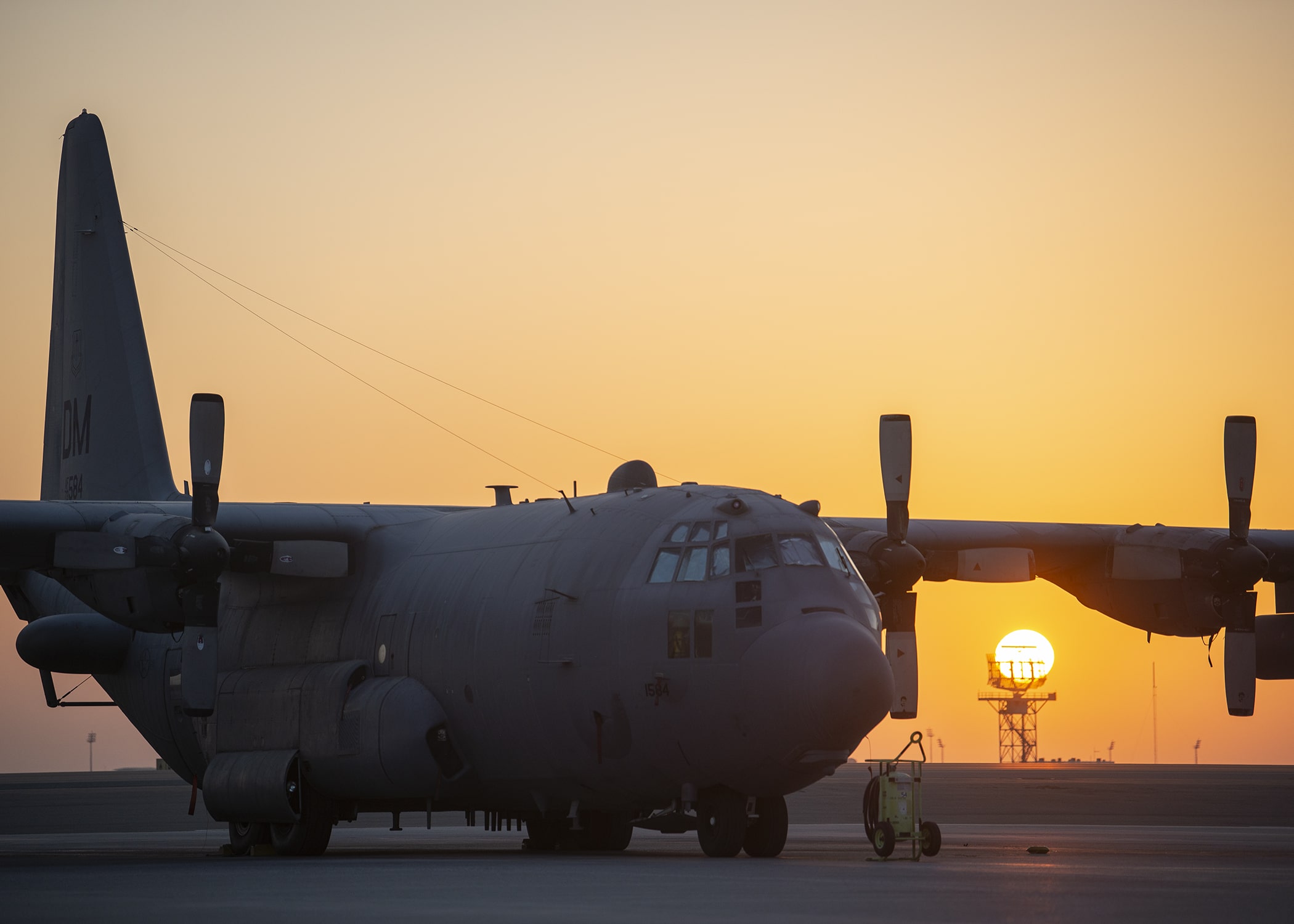
A U.S. Air Force EC-130H Compass Call assigned to the 41st Expeditionary Electronic Combat Squadron sits parked on the ramp at Al Dhafra Air Base, United Arab Emirates, Dec. 2, 2020. (Image Credit: U.S. Air Force photo by Senior Airman Bryan Guthrie) | Source: USAF
The EC-130H flew for the first time in 1981, and the first example was delivered to the USAF on Mar. 12, 1982. The type gained IOC (Initial Operational Capability) in 1983, and was continuously upgraded as advancements were made in the potential threats it could face. All EC-130Hs were operated by the 55th ECG (Electronic Combat Group), which although based in Davis-Monthan AFB, reported to the 55th Wing at Offutt Air Force Base, Nebraska.
It served as one of the core components of the US’s SEAD (Suppression of Enemy Air Defences) triad, alongside the Navy’s EA-18G (which replaced the now retired EA-6B) and the USAF’s Wild Weasels operating the F-16CM.
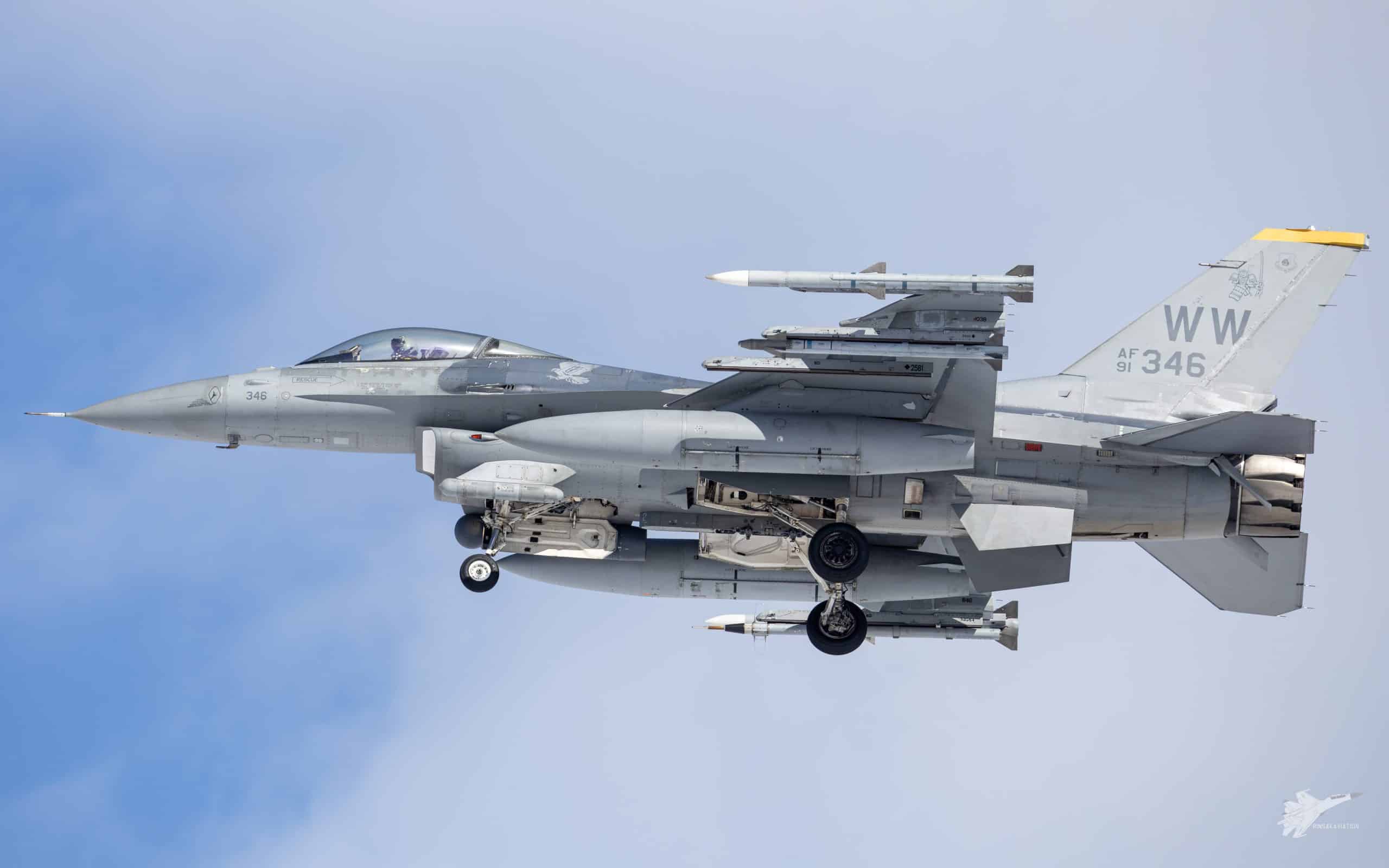
A USAF F-16CM Block 50, which specialises in S/DEAD (Suppression/Destruction of Enemy Air Defences). Note the HTS (HARM Targeting System) pod on the chin mount. (Image credit: Rin Sakurai) | Source: Rin Sakurai
By the mid-2010s, however, the aging airframes of the EC-130H became increasingly difficult to ignore. The airframes themselves were modified C-130Hs, already largely obsolete and replaced by the newer C-130J in US service; meanwhile, the electronic warfare environment had also dramatically changed since the type entered service. Considering this, the type was scheduled for retirement in 2014. The first EC-130H to be modified, 73-01587, flew for the last time on Jan. 15, 2020 after almost 29,000 hours of flight time.
By 2025, DoD (Department of Defence) budget documents noted that the EC-130H aircraft had reached the limits of their programmed depot maintenance lives and were being operated under waivers because of their planned retirement. The final aircraft’s extended waiver was due to expire on September 30, 2026, and keeping the aircraft flying beyond that point would also have required significant additional investment. According to the same document, extending the EC-130H’s service life by up to two years would cost approximately $14 million per aircraft.
U.S. Air Force aircrew assigned to the 55th Electronic Combat Group, perform post flight checks on an EA-37B Compass Call at Kadena Air Base, Japan, Sept. 27, 2025. (U.S. Air Force photo by Senior Airman Melany Bermudez) | Source: USAF
The replacement aircraft for the EC-130H is the EA-37B Compass Call, also known by its nickname of Banshee, based on Gulfstream’s G550 business jet. The EA-37B is significantly faster and capable of operating at a much higher altitude than the EC-130H, while also offering a much larger range and capability upgrade than that of its predecessor at an almost 50% decrease in operational cost.
The transition has also already taken the new aircraft beyond CONUS (CONtinental United States) and into combat – it was one of the participating aircraft in Operation Epic Fury, the recent conflict between the US and Iran.
A big thank you to Steven Fortson/zaphod58 for providing his images for this article.
In a response to an MP’s written question, Defence minister Luke Pollard said that the RAF’s existing aerial refueling force will be complemented by the development of a boom refueling capability.
The news comes following our previous article, which reported on rumors from anonymous officials that a boom refueling option was being ‘looked at’. Confirmation from Luke Pollard MP, who is Minister of State for Defence Readiness and Industry, suggests that such a move has now been approved at a governmental level.
In response to a question from opposition MP Ben Obese-Jecty, the Minister said: “The Royal Air Force currently operates a probe and drogue air-to-air refuelling system and will complement this with the development of a boom system. This will ensure we have a sovereign air-to-air refuelling capability for the future Royal Air Force fleet that enhances interoperability with NATO Allies and partners.”
For the first time we have a Minister confirming the Boom is coming to Royal Air Force tankers, although the when and the how currently remain very much up in the air.
Still significant to have it through government voices and not just through the RAF itself. pic.twitter.com/esRN7NVoPy
While a boom refueling system, like the type operated by the U.S. Air Force and many NATO forces, has been frequently put forward as a matter of urgency for the Royal Air Force due to the service’s operation of boom-refueled aircraft like the P-8 Poseidon MRA1, RC-135 Rivet Joint, and C-17A Globemaster III, as well as future operation of the F-35A Lightning II and E-7A Wedgetail MRA1, the change in policy is likely motivated by another factor.
A French air force A330 MRTT refueled and RC-135 aircraft over France for the first time, demonstrating a significant step in allied air-force integration.
It is interesting to note that the Royal Air Force is not able to refuel its own RC-135W Rivet Joint aircraft, as it… pic.twitter.com/YK2tR4zbme
The design of the resulting sixth generation fighter from the Global Combat Air Programme, or GCAP, is known feature a receptacle for boom refueling. While a retractable probe might be able to be fitted to the aircraft, there is suspicion that with the exceptional size of the fighter this lower capacity refueling system might not be able to deliver an adequate flow of fuel for timely refueling.
Other operators of the A330 MRTT, known as Voyager in RAF service, have fitted their aircraft with a flying boom system, but the RAF relies solely on hose and drogue units. As written in our previous article:
Although the A330 MRTT is used across the world with a flying boom system, the RAF’s examples, known as Voyagers – owned by the AirTanker consortium and leased to the RAF through a private finance initiative (PFI) – are fitted for hose and drogue refueling operations only. Voyager KC2 aircraft are configured with two wing-mounted Cobham 905E hose and drogue units while Voyager KC3 aircraft additionally feature a Cobham 805E Fuselage Refueling Unit (FRU) in the rear fuselage with the option for a higher fuel transfer rate for larger aircraft like the Airbus A400M.
It is unknown at this stage whether a boom refueling capability is planned to be considered as an upgrade for the RAF’s existing Voyagers or whether new aircraft – potentially from Airbus’ upgraded MRTT+ line – are being proposed. These details may yet to be decided within the MoD. The current fleet is technically owned by AirTanker and provided to the RAF under a private finance initiative (PFI) which is due to expire in 2035. After this date, the aircraft are apparently due to fall under RAF ownership, though they will also be older than almost all other MRTTs in operation worldwide.
Notably, though the RAF’s examples are not currently configured for this, the A330 MRTT is also exclusively able to be refueled by the flying boom system, so adoption of the boom could allow a return to tanker-to-tanker refueling in the RAF. Such a capability was lost with the retirement of the VC10 and TriStar, which were both adapted with refueling probes.
The carrier’s first full port stop of the deployment comes after 286 days at sea and nearly seven months of combat operations, with the ship visibly showing the effects of its prolonged time in the harsh marine environment.
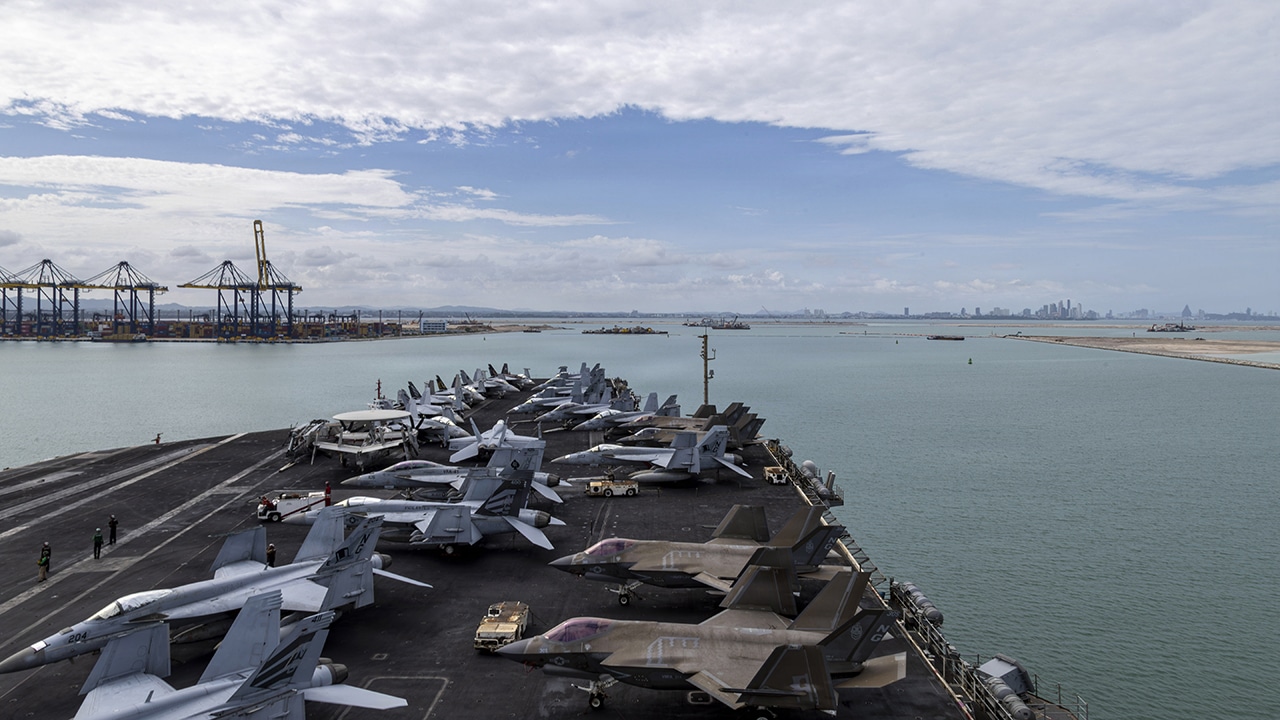
USS Abraham Lincoln arrived at Laem Chabang, Thailand, early on Sept. 2, 2026, for what the U.S. Navy described as the carrier’s first full port stop since the start of its deployment in November 2025. Elements of the Abraham Lincoln Carrier Strike Group (ABECSG), including the embarked Carrier Strike Group 3 staff, Carrier Air Wing 9, Destroyer Squadron 21 and the nine squadrons of CVW-9, also arrived in Thailand as part of the scheduled visit.
The port call of the U.S. supercarrier after its prolonged deployment was streamed live by Reuters:
Subsequent close up images showed even more clearly the Lincoln has clear signs of its prolonged deployment, with streaks of so-called “running rust” and heavy algae buildup visible along much of the hull.
USS Abraham Lincoln (and her aircraft) looking worse for wear as she pulls into Sattahip/Pattaya in Thailand pic.twitter.com/nyWvZy8prk
While the carrier looks weathered, official sources stated the hull appearance is normal for a long deployment.
Saltwater is extremely aggressive toward steel, and the marine environment gives corrosion plenty of help. Constant salt spray, high humidity, strong sunlight, heat, flight-deck activity and long periods at sea all take their toll, particularly when opportunities for more extensive preservation work are limited.
However, it’s also worth remembering that a heavily streaked hull can look much worse cosmetically than the actual condition of the steel underneath.
The U.S. Navy’s aircraft carrier USS Abraham Lincoln has arrived at Laem Chabang Port, Thailand. pic.twitter.com/3RIRP9joR4
According to the official release, the deployment has included 286 days at sea and comes after nearly seven months of operations in the U.S. Central Command area of responsibility. During the same period, the strike group and other U.S. Navy and Marine Corps assets conducted combat operations in support of Operation Epic Fury and supported the enforcement of “the largest naval blockade in decades.”
USS Lincoln departed Naval Base San Diego in November 2025. Although the carrier made brief stops during the deployment, including a short visit to Guam in December, none of these where full “port calls” or “stops”. Therefore, the Thailand visit represents the first regular port call of the deployment and a long-awaited opportunity for the crew to disembark for rest and recharge after months of high-tempo operations.
Nimitz-class aircraft carrier USS Abraham Lincoln (CVN 72) arrives in Laem Chabang, Thailand, Sept. 2, 2026. Abraham Lincoln is conducting routine operations in the U.S. 7th Fleet area of operations. Units assigned to 7th Fleet conduct continuous patrols to deter aggression, strengthen alliances and partnerships and advance peace through strength. (U.S. Navy photo by Mass Communication Specialist Seaman Gage Thomas) | Source: U.S. Navy
The U.S. Navy said elements of the Abraham Lincoln Carrier Strike Group (ABECSG), including Nimitz-class aircraft carrier USS Abraham Lincoln (CVN 72), the embarked staffs of CSG-3, Carrier Air Wing (CVW) 9, and Destroyer Squadron (DESRON) 21, and the nine squadrons of CVW-9 arrived in Laem Chabang, Thailand, while Arleigh Burke-class guided-missile destroyer USS Frank E. Petersen Jr. (DDG 121) docked in nearby Sriracha, for scheduled port visits, Sept. 2, 2026.
Escort Ticonderoga-class guided-missile cruiser USS Robert Smalls (CG 62) also arrived in Map Ta Phut, Thailand for their own scheduled port visit.
“Our arrival in Laem Chabang provides a well-deserved opportunity for our Sailors and Marines to rest and recharge. It also underscores the strong and enduring partnership and alliance between the United States and Thailand,” said Rear Adm. Robert E. Loughran, commander, Carrier Strike Group 3 in a public statement. “What this strike group has accomplished is truly historic. I could not be prouder of the exceptional professionalism and expertise demonstrated by every member of this team during our operations in the U.S. Central Command area of responsibility.”
“Abraham Lincoln’s visit to Laem Chabang is a clear demonstration of our enduring commitment to our allies and partners in Thailand, and we are all very excited to make Thailand the first port visit on our historic deployment,” said Capt. Dan Keeler, Abraham Lincoln’s commanding officer. “This port visit will help us gain a deeper understanding of one another, demonstrate our mutual commitment to the security of the region, and allow our crew to enjoy this beautiful and historic country.”
Explosive-laden drones, including one which hit, but failed to detonate, a Ukrainian Antonov transport aircraft at Leipzig Airport in early August have been publicly identified by German officials as part of a Russian hybrid warfare campaign.
Germany’s Foreign and Interior Ministers spoke publicly in Berlin on Sep. 1, 2026, to publicly announce new measures the German government will take against Russia in light of “police investigations” and “intelligence findings” which conclude that a “low-level” Russian agent was behind the drone incidents at Leipzig in August.
Security services were first alerted to a potential threat when a quadcopter drone was discovered on the airport tarmac next to a parked Antonov An-124 belonging to the Ukrainian state-owned Antonov Airlines. 800 grams of explosives were attached to the drone, which CCTV footage showed impacting the wing of the aircraft before falling to the ground without detonating.
Antonov’s aircraft have used Leipzig Airport in central eastern Germany as a hub for many years, though it has become the airline’s primary base of operations since Russia’s full scale invasion of Ukraine in 2022. Its fleet of An-124 transports, the heaviest active transport aircraft type in the world, are used extensively to support and supply Ukraine’s defensive efforts. The airport, then, would be a lucrative target for any Russian or Russia-aligned actors.
Germany’s response underlines the importance of close coordination among Allies. #NATO stands united in protecting our countries and deterring threats across the Alliance. Support for #Ukraine and strengthened defence capabilities remain essential to our collective security. 2/2
After the An-124 incident, following the airport’s closure for security reasons, a Boeing 757-200 freighter operated by European Air Transport for carrier DHL struck an object while aborting its landing. Minor damage was identified on the nose of the aircraft after it landed at another airport. It is believed this object was another drone, potentially operating alongside the one that was apparently intended to strike and damage the An-124.
U.S. intelligence has reportedly linked the explosive-laden drone discovered at Germany’s Leipzig/Halle Airport this week to the Russian government, according to The Wall Street Journal.
The drone was discovered Tuesday night inside a secure area of the airport, just meters from… pic.twitter.com/4w5KulzYMm
A third drone was discovered later in the month in a field near to the airport.
Johann Wadephul, the German Foreign Minister, told reporters: “With the attempted attack in Leipzig, the Russian leadership has, in fact, deliberately chosen to further and significantly damage our already severely strained bilateral relationship.”
Interior Minister Alexander Dobrindt said: “Taken together, police investigations, patterns of the offences and intelligence findings establish Russian responsibility for the attempted attack at Leipzig Airport.”
German Interior Minister Dobrindt: “Ladies and gentlemen, we are not at war. But we are the target of hybrid warfare every day.” https://t.co/Rxe8ZPL7zT
In response, Wadephul said that Russia’s consulate-general in Bonn would be closed down from Sep. 18. A Russian state-owned cultural hub in Berlin, Russia House, would also be shuttered. Russia’s ambassador was also summoned by the German government, likely to be delivered an official message and protest to be conveyed to Moscow.
Moscow maintains its innocence in the affairs, with its Berlin embassy saying the accusations are “unsubstantiated, absurd and contrary to common sense”.
Germany’s stance has drawn support from its NATO and EU allies. Mark Rutte, General Secretary of NATO, wrote on social media: “The evidence is clear. And I welcome the measures announced by Germany in response. NATO will continue to strengthen our ability to deter and defend all Allies against any threat – including malign actions like those seen in Leipzig and elsewhere across the Alliance.”
I just spoke with @Bundeskanzler Friedrich Merz. NATO stands in full solidarity with Germany after the Russian hybrid attack in Leipzig on 4 August.
The evidence is clear. And I welcome the measures announced by Germany in response. NATO will continue to strengthen our ability…
“Russia’s attempts to intimidate us, to undermine our unity and our willingness to support Ukraine are futile and will fail. Our support to Ukraine is unwavering, as is our ironclad commitment to NATO’s collective defence,” he added.
UK Prime Minister Andy Burnham, who took office in late July and notably chose Ukraine as the first overseas trip of his leadership, said: “The United Kingdom stands in full solidarity with Germany following Russia’s egregious and reckless attack in Leipzig. Russian attempts to undermine our united resolve and our willingness to support Ukraine are futile and doomed to fail.As I made clear in Kyiv last week, our commitment to supporting Ukraine from Russia’s illegal invasion is ironclad.”
“The strong measures taken by the German government show action against any attack of this nature will be met with a clear response. We will not waver in our resolve to deter attacks on our freedom and security.”
L’Allemagne a établi la responsabilité de la Russie dans les graves incidents survenus à Leipzig début août.
Ces attaques hybrides se multiplient en Europe. Elles ne peuvent rester sans réponse.
La France est pleinement solidaire de l’Allemagne et soutient l’adoption de…
French President Emmanuel Macron wrote: “These hybrid attacks are multiplying in Europe. They cannot go unanswered. France is fully in solidarity with Germany and supports the adoption of new European sanctions against Russia. In the face of this escalation, we must be united, determined, and strengthen our support for Ukraine. France will continue to play its full part.”
No official comment has, at the time of writing, been noted from U.S. President Donald Trump or from the wider U.S. Government.
Held on Aug 26, Rescue Flag 26-1 brought together forces from the USAF, USMC, JMSDF, and JASDF for a comprehensive simulated casualty exercise.
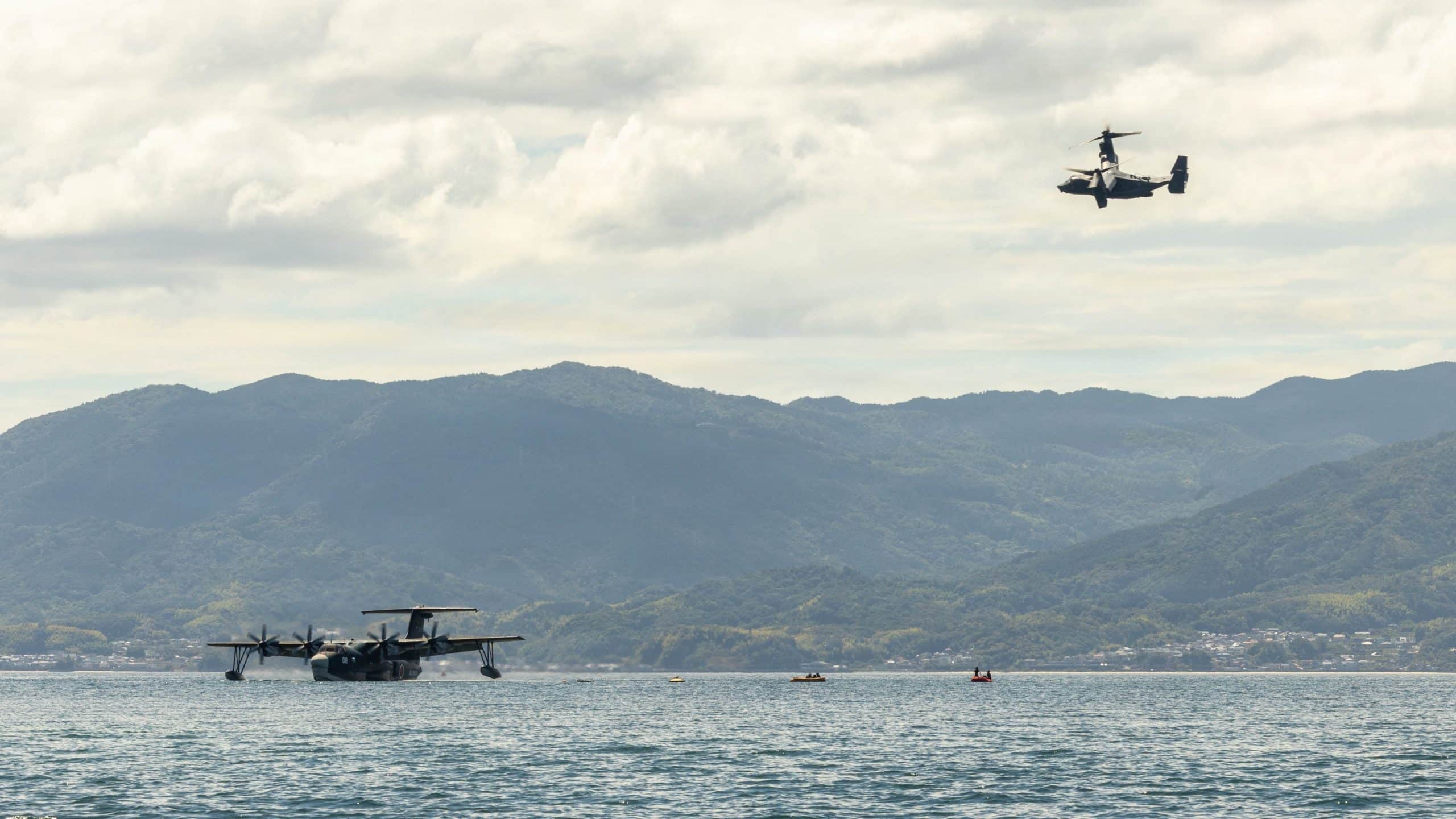
A USAF CV-22B Osprey joined a JMSDF (Japan Maritime Self-Defense Force) US-2 amphibious aircraft for the first time during the Rescue Flag series of exercises. The two aircraft, alongside several others operated by the USMC (United States Marine Corps) and JASDF (Japan Air Self-Defense Force), participated in the CSAR exercise at Marine Corps Air Station Iwakuni on Aug. 26, 2026.
Rescue Flag is a bilateral exercise between the US and Japan, and is typically held in the airspace around Iwakuni or Okinawa. As its name implies, the exercise focuses on CSAR (Combat Search and Rescue), and allows participants to “practice open-water recovery methods, communication protocols, and supply distribution techniques under simulated crisis conditions,” according to the USMC.
Both the US-2 and the CV-22B that participated in RF 26-1 are Japan-based aircraft: the US-2 is assigned to Air Rescue Squadron 71, Fleet Air Wing 31 at Iwakuni, while the CV-22B is assigned to the 21st Special Operations Squadron under the 353rd Special Operations Wing based at Yokota Air Base, Tokyo. The USAF’s CV-22Bs all belong under AFSOC (Air Force Special Operations Command), which provides specialized airpower capabilities for special operations, personnel recovery, mobility, and other missions.
A JMSDF US-2 and USAF CV-22B pictured conducting a simulated casualty rescue exercise during Rescue-Flag 26-1 (Image Credit: U.S. Marine Corps photos by Lance Cpl. David Getz) | Source: USMC
Imagery published on DVIDS shows the aircraft participating in a simulated casualty-rescue scenario, in which US personnel from VMGR-152 were ‘rescued’ from the sea, recovered from rafts, and provided with first aid on board the US-2. The CV-22B, alongside a UH-60J(II) from the JASDF’s Air Rescue Wing Nyutabaru, is also shown hoisting simulated casualties during the exercise.
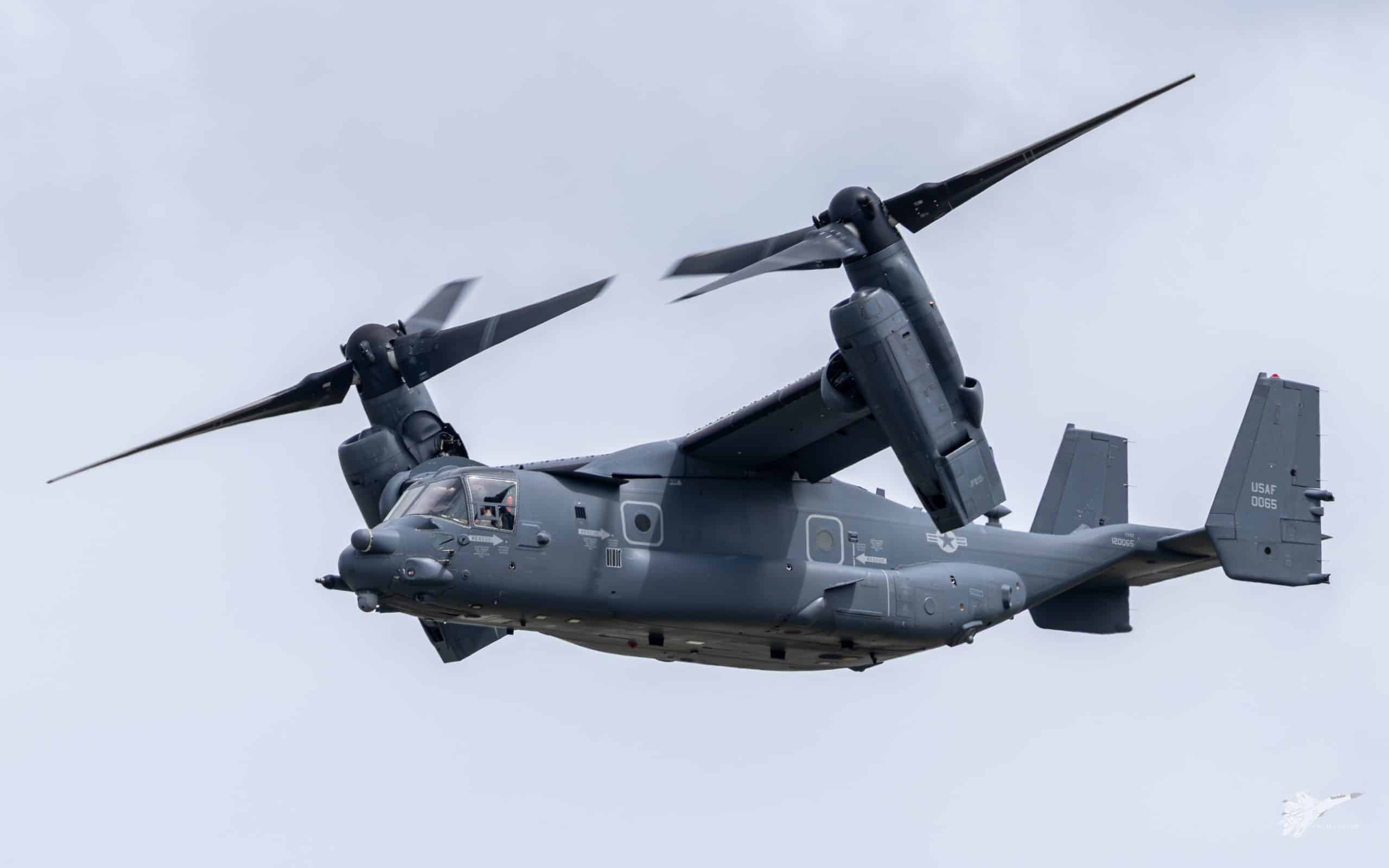
CV-22B 12-0065 – the airframe seen in the photos published by the USMC – at its home airfield of Yokota Air Base, Japan. (Image credit: Rin Sakurai) | Source: Rin Sakurai
Notably, USMC Col. William B. Millett III, the commanding officer of MAG-12 (Marine Aircraft Group 12), was onboard the US-2 during the exercise, providing a direct opportunity for a senior USMC aviation commander to observe the aircraft’s amphibious rescue capabilities firsthand.
While this marks the first time a USAF CV-22B has participated in the Rescue Flag series, it is not the first time the two aircraft types have operated together. Notably, they both participated in the 2023 edition of Cope Angel – another bilateral CSAR exercise between the two nations – which was held between February and March of that year.
Past iterations of Rescue Flag saw participation from other assets from the various services, including HH-60G/Ws, MC-130Js, F-35Bs, MV-22Bs, AH-1Zs, CH-53Es, and U-125As.
A JASDF U-125A search-and-rescue aircraft taking off. The prominent fairing on the aircraft’s lower fuselage accommodates additional mission equipment associated with its search-and-rescue role. (Image credit: Rin Sakurai) | Source: Rin Sakurai
The Amphibious Capabilities of the US and Japanese Forces
Japan already operates a dedicated amphibious aircraft in the form of the ShinMaywa US-2, giving the JMSDF a capability that is particularly well suited to the country’s vast maritime operating environment. The aircraft, which can operate from both conventional runways and the open water, is employed mainly in the CSAR role while serving a secondary purpose as a transport aircraft. The aircraft – initially designated the US-1A Kai (改, meaning ‘improved’ or ‘revised’), was a development of the US-1 – and its incredible low-speed handling – helped, in part, by its boundary-layer control system – allows it to conduct the sea-borne CSAR mission incredibly effectively.
Seaplanes also provide an additional layer of safety in an active combat environment: their lack of dependence on a land-based airfield means that it is able to operate somewhat effectively even if its home base is destroyed by enemy action, giving mission planners more flexibility. Indeed, U.S. Forces have also actively pursued innovative airborne capabilities like the MAC (MC-130J Amphibious Capability) – whose development was paused in 2024 due to budgetary constraints – in an effort to make ‘runway independence’ and operations from austere environments more feasible in the form of an amphibious aircraft.
The US interest in such ideas inevitably led them to closer contact with the JMSDF, who are one of the most experienced operators of amphibious aircraft, even on a global scale. In 2022, it was reported that the deputy commander of AFSOC visited JMSDF US-2 crews and observed the aircraft’s ability to operate from both land and water, and described the Japanese platform as an example from which the U.S. could learn while exploring its own amphibious options. Thus, the repeated use of the US-2 in bilateral training provides the U.S. with an opportunity to work alongside an established amphibious capability while developing its own concepts for operating beyond conventional runways.
Although there are currently no amphibious aircraft in service with any branch of the US armed forces, such a capability could prove to be highly valuable in future conflicts in the Pacific, particularly in a conflict against the PLA, where land-based airfields could come under significant attack in the opening stages of hostilities. China itself is also moving forward with its own amphibious capabilities through the development of the AG600, a four-engine amphibious aircraft that is largely similar in shape to the US-2, highlighting the continued interest in large amphibious aircraft in the region.
During the recent Project Convergence Capstone 6, an H-60M Black Hawk crew employed an Altius-700 Air-Launched Effect to autonomously find the target, pass data across the formation, and strike.
As explained by Sikorsky in an interview at Farnborugh International Airshow last month, a major focus of Armed Black Hawk’s development is on air-launched effects (A-LE): the integration of such capability allows aircrews to command unmanned A-LE systems (small uncrewed systems deployed from aircraft to provide capabilities such as surveillance, targeting, electronic warfare, communications relay, deception, or strike) from a position of relative safety, extending the reach, lethality and survivability of the platform.
The U.S. Army put the H-60M Black Hawk Air-Launched Effects (A-LE) capabilities to test last month, during Project Convergence Capstone 6. The activity added to the three-day flight tests conducted at Fort A.P. Hill’s test range, Virginia, in June, when H-60M aircrews successfully launched and controlled multiple medium-range launched effects.
According to the U.S. Army, Increment 1 of the A-LE capability is a fully government owned and designed system, developed in partnership with the Utility Helicopters Project Office (UHPO) and the U.S. Army Combat Capabilities Development Command (DEVCOM) Aviation and Missile Center (AvMC).
Over the course of the three-day exercise, a joint effort involving the military and commercial industry partners, aircrews of an H-60 in a fully networked system configuration launched and controlled multiple launched effects (LEs) over the Mojave Desert. The extreme heat of the area allowed the team to validate also the system’s environmental resilience.
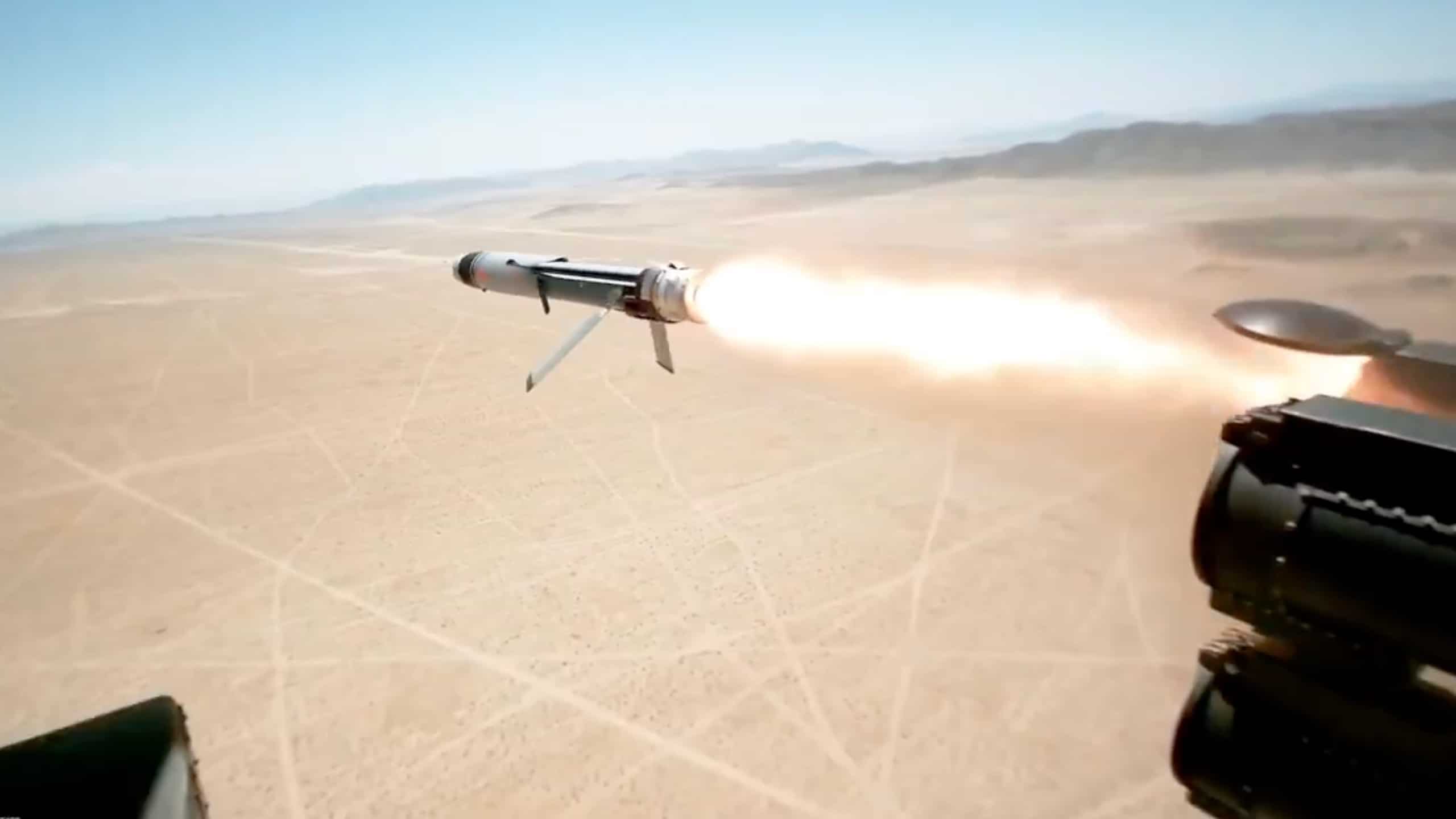
Interestingly, as part of the capstone event, the H-60M also employed the Anduril Altius-700 A-LE. The Altius-700 is a modular launched-effect air vehicle that can carry ISR, electronic-warfare, communications and other payloads; the Altius-700M is its weaponized loitering-munition variant, equipped with a warhead of up to 33 lb for strikes against vehicles, vessels and infrastructure, and a range of 160 km.
Footage of the test was shared online by Anduril:
New Test Footage: Black Hawk executes rocket-powered launch of Altius-700.
At Project Convergence Capstone 6, an H-60M Black Hawk crew employed an Altius-700 hunter-killer team to autonomously find the target, pass data across the formation, and strike.
Noteworthy, while Anduril refers to the vehicles in the newly released footage simply as Altius-700, the video shows one of the launched effects striking what appears to be an armored ground vehicle. Ahead of Project Convergence Capstone 6, the U.S. Army had specifically identified the armed Altius-700M loitering munition as the Long-Range Precision Munition (LRPM) scheduled to be launched from a Black Hawk during the event, suggesting that the kinetic vehicle seen in the footage is indeed a 700M.
Managed by the Capability Program Executive (CPE) for Offensive Fires, LRPM is a U.S. Army effort to provide helicopters with a stand-off precision-strike weapon capable of engaging targets at ranges significantly greater than traditional weapons such as the AGM-114 Hellfire (11 km reach).
“Successfully launching Air-Launched Effects from a Black Hawk is more than a milestone, it is a leap forward,” said Brig. Gen. Kevin Chaney, Deputy Portfolio Acquisition Executive for Maneuver Air.“ By extending their reach and increasing lethality, we are changing the battlefield geometry and delivering a decisive advantage to our Soldiers.”
Traditionally, if you think of an Army helicopter conducting anti-armor or precision attack, you think of the AH-64 Apache gunship. A Black Hawk is primarily a utility/assault helicopter; giving an H-60 the ability to launch autonomous sensors and long-range precision effects means the Army is effectively allowing a utility helicopter to act as a launch platform or mothership, rather than requiring it to become a conventional gunship.
Responding to one of our questions at FIA 2026 airshow, Jason Wrigley, Director of Business Development for Army and Air Force Systems at Sikorsky, said about A-LE: “[…] we do not envision employing just one at a time. We expect multiple systems to be operating simultaneously, and the future battlespace will include large numbers of drones that need to communicate back to a mothership or another control node. The Black Hawk will be capable of performing that role.”
Anyway, regardless of the actual type, it is worth highlighting that launched effects allow the helicopter to move both sensing and strike far beyond the range of its traditional onboard weapons. A non-kinetic A-LE can scout hundreds of kilometers ahead of the formation, while the weaponized variant can strike targets at stand-off range, allowing the crewed aircraft to remain well outside the threat envelope.
BTW, even the fully unmanned U-Hawk is being integrated with an internal A-LE launching system, which provides a way to carry launched effects inside the aircraft. On the manned Black Hawk, they are carried externally on the wings, while on the unmanned variant they can be housed internally.
Another image of the test involving the Altius-700. | Source: Anduril
Dealing with Project Convergence Capstone 6, the Army demonstrated a broader H-60M Air-Launched Effects architecture capable of launching and controlling multiple types of effects. The exercise paired reconnaissance-oriented infrared-sensing LEs with a lethal Long-Range Precision Munition for the terminal strike, while also evaluating additional medium-range launched-effect technology demonstrators. Thanks to the footage release by Anduril we know that the Altius-700 family was among the A-LE systems involved in the tests, but the Army has not publicly identified every launched effect used during the event.
After refueling Egyptian MiG-29s during EoC 2025, the PLA Air Force’s YY-20A has now been photographed refueling an EAF Rafale during this year’s Eagles of Civilization exercise.
A Chinese YY-20A Multi-Role Tanker Transport (MRTT) refueled an Egyptian Air Force (EAF) Rafale fighter during the ongoing Eagles of Civilization 2026 air drills, the latest official images released by both militaries show. During last year’s inaugural installment of the exercises, a YY-20A refueled EAF MiG-29M/M2 fighters. EoC 2026 set another milestone with PLA Air Force J-16s training with EAF Rafales.
While this appears to be the first publicly documented instance of a Chinese YY-20A refueling a Western-built fighter, Rafales have been integrated with a Russian platform before. The Indian Air Force’s (IAF) Ilyushin Il-78 tankers regularly refuel its French Rafales.
Thus, Eastern and Western platforms have been integrated through the Il-78/Rafale and YY-20A/MiG-29 pairings, thanks to their compatible probe-and-drogue systems. Given the incremental enhancements in interoperability seen during the EoC exercises, it was only a matter of time before the YY-20A connected with the Rafales.
Rafale meets YY-20:
China, Egypt continue joint air force exercise ‘Eagles of Civilization 2026’
New photo from @EgyArmySpox shows a Chinese YY-20 tanker refueling an Egyptian Rafale fighter during aerial refuelling training of the “Eagles of Civilization-2026” joint exercise.… pic.twitter.com/Y5RPqLiuh2
The image was first released by the Egyptian military spokesperson and was later shared by the official ‘China Military Bugle’ handle. The in-flight picture shows a twin-seat Rafale B on the starboard side of the YY-20A, with the fighter’s fixed In-Flight Refueling (IFR) probe connected to the hose-and-drogue unit deployed from the tanker’s refueling pod. Two other Rafales are also seen to the right of the EAF Rafale.
While the number of refueling operations that may have taken place is not known, it is unclear how many of the participating EAF Rafales actually took fuel from the YY-20A. The YY-20A can also be identified from the faint low-visibility markings under the wing.
Other images from the Egyptian military showed EAF and PLAAF crews during a briefing, pictures from the cockpit of a MiG-29M/M2 showing another MiG-29 to its right during what appears to be a takeoff run, and a shot of four PLAAF J-16s flying overhead.
China Military Bugle then used the official Egyptian picture of the YY-20A refueling the Rafale and posted EoC 2025’s image of the tanker connecting with the EAF’s MiG-29M2, highlighting the progression in interoperability between the two air forces.
Egyptian and Chinese statements
The release from the Egyptian military spokesperson mentioned the various simulated kinetic mission sets, aimed at fostering joint operations and improving combat skills in line with current warfare trends.
“The exercise is being conducted at several airbases across the Arab Republic of Egypt. Joint sorties were carried out to train on managing air combat operations – specifically attacking hostile targets and protecting vital assets – in accordance with the latest aerial tactics. These activities facilitate the exchange of expertise and enhance the pilots’ skills and capabilities to operate jointly with complete harmony and coordination, in addition to conducting aerial refueling training. The exercise aims to maximize the benefits for participating personnel regarding the planning and execution of modern air operations and to enhance the exchange of expertise. This, in turn, boosts the capability and readiness of both nations’ air forces to execute all assigned missions with efficiency and competence.”
Onwards and Upwards.
An #IAF contingent arrived today at the Eielson AF Base of @usairforce, at Alaska, USA, to participate in the upcoming edition of the multi-national exercise Red Flag 24.
Ably supported by its IL-78 air to air refuellers and the C-17 transport ac, the IAF… pic.twitter.com/8mi2VlNbVT
The Chinese military highlighted the step-up from EoC 2025:
“New photo from (the Egyptian Army spokesperson) shows a Chinese YY-20 tanker refueling an Egyptian Rafale fighter during aerial refuelling training of the ‘Eagles of Civilization-2026’ joint exercise. This follows last year’s joint exercise during which the YY-20 tanker refueled Egyptian MiG-29s, demonstrating the deepening interoperability between the two sides.”
The Chinese PLA Air Force has sent an elite fleet of aircraft, including the J-16 fighter jet, to Egypt for the “Eagles of Civilization 2026” joint training exercise.
The multiple types of aircraft and personnel participating in the exercise arrived at an Egyptian air base on… pic.twitter.com/ytUbRpBiXL
Besides the J-16, the other PLAAF platform that debuted in EoC 2026 is the Y-9LG Stand-Off Jammer (SOJ). The four to five Y-20 strategic airlifters, a YY-20A MRTT that made the more than 6,000-km journey to Egypt, the Z-20KS battlefield tactical helicopter, and the KJ-500 Airborne Early Warning and Control (AEW&C) aircraft participated in 2025 too. The inaugural EoC 2025 had also seen the PLAAF send its J-10Cs to train with EAF MiG-29s.
The current set of images and statements from EoC 2026 does not include the Y-9LG SOJ, the KJ-500 AEW&C or the Z-20 helicopter. Chinese official media had, however, mentioned these platforms on Aug. 24, a day after EoC 2026 kicked off on Aug. 23. During EoC 2026, Chinese reporting has also associated the Z-20 with Combat Search and Rescue (CSAR) training.
The final Jayhawk has departed Vance for Davis-Monthan, closing more than three decades of T-1A operations and bringing an end to the 3rd Flying Training Squadron’s latest chapter.
Monday, Aug. 31, 2026, marked the official close of a chapter in U.S. Air Force training history that may never be equaled when it comes to safe and efficient aircraft operations. The T-1A Jayhawk was officially retired from service after more than 30 years and a remarkable safety record with no fatalities.
T-1A 93-0644 was the star of the “T-1A Jayhawk Sunset” and symbolic fly-away ceremony on Aug. 21, 2026, at Vance AFB, Oklahoma, in Hangar 199. The hangar, where routine maintenance on Vance’s T-1 fleet had taken place for more than three decades, hosted a celebration for an aircraft whose career was anything but routine. Ceremony participants and audience members came from across the country, including senior U.S. Air Force leadership, to witness the event.
Beechcraft T-1A Jayhawk, serial #93-0644, leads a mixed-formation flight consisting of a T-38C Talon (left) and T-6A Texan II (right), all of which are assigned to the 71st Flying Training Wing, Vance AFB, Oklahoma on Aug. 21, 2026. These aircraft conducted two passes following the T-1A Sunset Ceremony to mark the end of T-1 operations for the USAF. 93-0644 was retired the next week to the 309th Aircraft Maintenance and Regeneration Group at Davis-Monthan AFB, Arizona. This aircraft was delivered to the USAF on Feb. 1, 1995 retired to the 309th Aircraft Maintenance and Regeneration Group at Davis-Monthan AFB, Arizona on Aug. 28, 2026. (All images, credit: Greg L. Davis) | Source: Greg L. Davis
The ceremony not only marked the end of T-1 operations but also served as the inactivation ceremony for the 3rd Flying Training Squadron, one of the oldest flying squadrons in the U.S. military. The 3rd FTS guidon was “cased” by Col. Timothy A. Thoren, commander of the 71st Operations Group, and Master Sgt. Adam Hart, 71st Security Forces Squadron first sergeant.
Col. Timothy Thoren, 71st Operations Group Commander, speaks during Beechcraft T-1A Jayhawk Sunset Ceremony at Vance AFB, Oklahoma, on Aug. 21, 2026. | Source: Greg L. Davis
After the formal portion of the Sunset Ceremony was complete, 93-0644 was towed out of the hangar and onto the flight line. It then launched for multiple formation flybys before making a ceremonial departure for Woodring Regional Airport in Enid, Oklahoma, where it became the star of the show the following day, Saturday, at the monthly Woodring Regional Airport Fly-In and Breakfast.
Closing the day’s events was the formal dedication of Beechcraft T-1A Jayhawk serial number 95-0071 near the main entrance to Vance AFB, where it now sits in a prominent position near the Visitor Center. The aircraft was the 180th and final T-1A built for the USAF and carries noteworthy markings.
Beechcraft T-1A Jayhawk, serial #93-0644, is towed from Hangar 199 to the flight line after the T-1A Sunset Ceremony on Aug. 21, 2026, Vance AFB, Oklahoma. The T-1A wears the marking of the 3rd Flying Training Squadron, 71st Flying Training Wing, with ‘VN’ tailcode. This aircraft was delivered to the USAF on Feb. 1, 1995 and was the final T-1A delivered to the 309th Aircraft Maintenance and Regeneration Group at Davis-Monthan AFB, Arizona on Aug. 28, 2026. | Source: Greg L. Davis
While Aug. 31 marked the end of program funding, T-1A serial 93-0644 flew from Vance AFB, Oklahoma, to Davis-Monthan AFB, Arizona, on Aug. 28, 2026, for induction into the “Boneyard.” The flight was deliberately made ahead of the funding cutoff in case any last-minute maintenance issues arose. Had the jet been unable to launch for any reason, it could have been stranded at Vance.
During the T-1’s operational life, there were only two major accidents, both landing overruns, and no fatalities associated with the program. It is a remarkable safety record considering the amount of time the aircraft spent operating in the traffic pattern and conducting low-level training. There may never be another USAF training aircraft capable of matching it.
Maj. Gen Travolis A. Simmons, Commander 19th Air Force, during dedication ceremony of Beechcraft T-1A Jayhawk, serial #95-0071, of the 3rd Flying Training Squadron, 71st Flying Training Wing, Vance AFB, Oklahoma, wearing ‘VN’ tailcode. The aircraft wears the markings for the Commander of the 71st Flying Training Wing, is named ‘City of Enid’ on the starboard side, has ‘Pride of Enid’ and the post-9/11 ‘Let’s Roll’ emblems on the port side. Photographed on Aug. 21, 2026, during the T-1A Jayhawk Sunset event at Vance AFB. This aircraft was delivered to the USAF on July 22, 1997 and dedicated as a gate-guard on Aug. 21, 2026. This was the 180th and final T-1A manufactured and delivered to the USAF. | Source: Greg L. Davis
Overview of the T-1A
The T-1A was the commercial-off-the-shelf answer to the USAF’s desire to alleviate pressure on the T-38 Talon fleet in the early 1990s by creating a Specialized Undergraduate Pilot Training program. Under the new system, the T-38 could remain the advanced trainer for future fighter and bomber pilots, while students destined for airlift, tanker and other heavy aircraft could complete advanced training in an aircraft with flight characteristics more representative of the platforms they would eventually operate.
T-1A Jayhawk, serial #91-0081, of the 86th Flying Training Squadron, 47th Flying Training Wing, Laughlin AFB, Texas wearing ‘XL’ tailcode. Photographed at Laughlin AFB, Texas on Sept. 23, 2024. This aircraft was delivered to the USAF on Aug. 31, 1992. | Source: Greg L. Davis
The T-1 also introduced students to multi-engine operations and crew resource management early in their careers.
The T-1A Jayhawk entered what was then Air Training Command when the first aircraft was accepted by the USAF on Jan. 15, 1992, at Reese AFB in Lubbock, Texas.
T-1A Jayhawk, serial #91-0079, of the 52nd Flying Training Squadron, 64th Flying Training Wing, Reese AFB, Texas. Shown in front of the massive, historic hangar at Kelly AFB, Texas which was, at the time, an Air Force Materiel Command base and Home of the San Antonio Air Logistics Center. 91-0079 was photographed on Aug. 30, 1992 along with two other T-1s and a Learjet C-21A VIP transport. 91-0079 was delivered to the USAF on July 31, 1992. (Photo by Greg L. Davis) | Source: Greg L. Davis
Operating Units and Bases
While the 52nd Flying Training Squadron, 64th Flying Training Wing, received the first aircraft at Reese AFB, Texas, student training did not begin until after the formal training unit was established at Randolph AFB, Texas, under the 99th Flying Training Squadron, 12th Flying Training Wing.
This was where T-1A instructor pilots were initially trained before being assigned to the various bases supporting Specialized Undergraduate Pilot Training.
Eventually, T-1As flowed from the factory in Wichita, Kansas, to the major AETC training bases at Laughlin AFB, Texas; Columbus AFB, Mississippi; and Vance AFB, Oklahoma.
A three-ship mixed formation photo showing three training type aircraft currently assigned to Columbus AFB, MS. The aircraft are T-6A Texan II, serial # 98-3541, of the 41 Flying Training Squadron, T-37B ‘Tweet’, serial # 58-1954, of the 37th FTS and T-1A Jayhawk, serial # 94-0137, of the 48th FTS. The T-6A wears markings for the 14th Operations Group Commander (14 OG) and is one of two T-6As at Columbus that wears a trial grey and black paint scheme. The 41st Flying Training Squadron has fully converted from the T-37B to the T-6A while their sister squadron, the 37th FTS, is in full-scale conversion mode and will complete by March 2008. The aircraft belong to the 14th Flying Training Wing. Dec. 4, 2007. | Source: Greg L. Davis
T-1s were also operated by the geographically separated 451st Flying Training Squadron at Naval Air Station Pensacola, Florida, under the 12th Flying Training Wing. The 451st FTS retired its final T-1A in July 2025.
Beechcraft T-1A Jayhawk, serial # 92-0334, wearing markings for the 479th Flying Training Group Commander, Col. Shane ‘Shamus’ Muscato, on April 28, 2025, NAS Pensacola, Florida. The jet wears ‘Spirit of Pensacola’ nose-art on the left side of the nose. The 479th FTG is the parent organization of the 451st Flying Training Squadron which operates T-1As in the Combat System Officer Training role. | Source: Greg L. Davis
Two Missions
The initial mission of training pilots destined for heavy aircraft using the T-1 was a great success. That success eventually allowed the Air Force’s pilot and officer aircrew training pipelines to evolve further as platforms such as the T-43A were retired.
The retirement of the T-43 eliminated the USAF’s dedicated navigation trainer, resulting in the T-1 being pressed into service in that role as well. It was subsequently used to train Combat Systems Officers at NAS Pensacola.
The T-1s assigned to this mission received modifications that added additional crew positions, allowing multiple students to be trained efficiently during a single flight. The configuration placed one student in the front right seat, with additional students seated in the rear. A T-1 instructor pilot occupied the front left seat, while an additional rear position was occupied by a CSO instructor.
The CSO instructor operated a laptop-based system capable of simulating various navigation and threat scenarios for the students.
The 451st FTS continued flying the T-1 in this role until its aircraft departed in 2025.
T-1A Jayhawk, serial #93-0644, of the 3rd Flying Training Squadron, 71st Flying Training Wing, Vance AFB, Oklahoma, wearing ‘VN’ tailcode. Photographed at Vance AFB, Oklahoma, on April 23, 2025. This aircraft was delivered to the USAF on Feb. 1, 1995, and retired to the 309th Aircraft Maintenance and Regeneration Group at Davis-Monthan AFB, Arizona on Aug. 28, 2026. | Source: Greg L. Davis
Why Was the T-1 Retired?
The retirement of the T-1 remains a controversial topic, particularly among those who believe the aircraft still had useful service life remaining.
One of the Air Force’s principal justifications was avoiding the cost of replacing or overhauling aging engines as they approached their life limits, along with other recapitalization and sustainment expenses. With two engines per aircraft, keeping a large fleet operational would have required significant investment.
At the same time, 73 T-1As had recently undergone a $156 million Avionics Modification Program, which replaced obsolete cockpit equipment and was intended to improve aircraft availability while reducing sustainment costs. The final upgraded aircraft was returned to service in January 2023.
T-1A Jayhawk, serial #94-0120, of the 451st Flying Training Squadron, 479th Flying Training Group, NAS Pensacola, Florida, wearing ‘AP’ tailcode. This jet is shown taxing past the famous NAS Pensacola passenger terminal when photographed on April. 28, 2025. This aircraft was delivered to the USAF on Aug. 31, 1995, and retired to Davis-Monthan AFB, Arizona on May 28, 2025, with 11,508.1 hrs at departure from NAS Pensacola using Congo 33 callsign. | Source: Greg L. Davis
This meant that a substantial portion of the fleet had been positioned for continued service if the Air Force had elected to make the necessary engine and sustainment investments. Many T-1s also retained significant structural service life.
Ironically, the Jayhawk drawdown began shortly after completion of the avionics modernization program.
The Air Force’s broader justification was its transformation of undergraduate flight training. Future mobility pilots and Combat Systems Officers would increasingly rely on the T-6 and advanced synthetic training rather than progressing through a dedicated T-1 phase. Air Force budget documents specifically cited the shift in training methodology as allowing the service to avoid the impending costs associated with T-1 engine replacement and recapitalization.
AETC also planned to redirect savings from T-1 divestment toward other training priorities, including the troubled Boeing T-7A Red Hawk program.
FMS to Tunisia
While the T-1A Jayhawk is no longer in USAF service, four aircraft have received a reprieve from scrapping through the U.S. government’s Foreign Military Sales program.
The four jets are currently being overhauled at Field Aerospace in Oklahoma City and are expected to be transferred to the Tunisian Air Force upon completion, where they will serve as organic VIP transports.
The T-1’s Legacy Lives On
It is important to note the impact the T-1A has had on both military and commercial aviation.
Military pilots are particularly sought after by commercial operators, especially major airlines. Many of the pilots who trained aboard the T-1 now occupy airline cockpits around the world, and many will continue doing so for decades to come.
That may ultimately be the real legacy of the T-1A Jayhawk: generations of pilots trained to move people and cargo safely and efficiently around the world.
Now, many of them simply wear white shirts instead of military flight suits.
The author would like to acknowledge AETC Headquarters Public Affairs, Vance AFB Public Affairs, and Maj. James A. Davis, 3rd FTS Director of Operations.
T-1A Jayhawk, serial #94-0117, of the 3rd Flying Training Squadron, 71st Flying Training Wing, Vance AFB, Oklahoma wearing ‘VN’ tailcode. This aircraft was delivered to the USAF on July 12, 1995 and retired to the 309th Aircraft Maintenance and Regeneration Group at Davis-Monthan AFB, Arizona on May 13, 2026. Photographed at Vance AFB, Oklahoma, on April 23, 2025. | Source: Greg L. Davis
The first Hürjet jet trainer destined to the Turkish Air Force, part of a first batch of 12 aircraft, flew for the first time on Aug. 30, 2026.
The first production-representative Hürjet jet trainer aircraft destined to the Turkish Air Force (Türk Hava Kuvvetleri – THK) made its maiden flight on Aug. 30, 2026, announced the manufacturer TUSAŞ/TAI (Türk Havacılık Ve Uzay Sanayi Anonim Şirketi/Turkish Aerospace Industries). The flight took place on the 30th Anniversary of Turkey’s Victory Day, celebrated on Aug. 30.
Turkish reports mentions regular deliveries of the Hürjet to the THK, of which the service has ordered 12 aircraft, are slated to begin by 2027. According to TurDef and SavunmaSanayiST, an initial batch of six will be delivered to the THK in the first phase, while production of additional production-representative aircraft is underway and activities continue with the prototypes.
The Hürjet that took to the skies on Aug. 30, 2026, is now the third airframe to be built, following the two existing prototypes. Among these, TUS-A003 had previously flown with a new paint scheme, and was spotted flying with weapons pylons in May 2026.
The new milestone also boosts the international prospects for the Hürjet program, which enters the highly competitive advanced jet trainer and light attack aircraft market. The Ejército del Aire y del Espacio (Spanish Air and Space Force – SASF) is the first international customer, which is acquiring 30 jets under the SAETA-II program.
A new chapter begins for HÜRJET.
On the 104th anniversary of Türkiye’s August 30 Victory Day, the first HÜRJET Jet Trainer destined for the Turkish Air Force has successfully taken to the skies, marking another important milestone on its journey toward operational service. pic.twitter.com/fwrkItJOPT
Another potential market opportunity is the United Kingdom, which is searching for a new jet trainer. TAI chief Mehmet Demiroğlu said at the recent Farnborough International Airshow (FIA) that the company is intending to participate in the competition.
Maiden flight of production aircraft
The first production-representative Hürjet airframe, tail ‘TUS-A020’, sported a white factory primer during the maiden flight. It was accompanied by ‘24-001’, the first early pre-production prototype that bears the red-and-white paint scheme.
Footage from inside ‘24-001’ showed the TUS-A020 flying with two crew members and its landing gear down the entire 18 minute flight. This is a common procedure for maiden test flights of a new aircraft.
The production airframe taxiing ahead of the first prototype after landing. | Source: TAI
Both aircraft also have their flight data probes (pitot tubes) installed on the nose. Other footage from an electro-optical sensor showed both the aircraft flying in close formation, possibly taken by an unmanned aircraft, although this could be confirmed at the time of writing.
Demiroğlu described this first flight as “another important milestone for our national aviation.”
Another angle of the Hurjet in flight, taken from the cockpit of the first prototype that acted as a chase aircraft. | Source: TAI
Future
The Hürjets will primarily replace the THK’s older T-38 Talon jet trainers, of which reportedly 68 are still in service. In Spain, the Hürjets will replace the F-5M Freedom Fighter trainers, of which 19 are reported to be still in service, at Talavera La Real Air Base. Local manufacturing in Spain under SAETA II will oversee 68% of the jet being produced by an Airbus-led consortium incorporating domestic components and subsystems.
In the THK and SASF, the Hürjet will be part of a broader Integrated Combat Training System (ITS-C), including ground simulators, theoretical and practical instructions training aids, to better prepare aviators for future Gen. 4.5 and Gen. 5 aircraft. Turkey is rapidly moving towards operationalizing its indigenous Kaan fighter, while also lobbying to be admitted back into the F-35 program.
Footage from an electro-optical system showing both aircraft in flight. | Source: TAI
Both future production batches of the Hürjet and the Kaan fighter are also planned to integrate the domestically-developed TEI’s TF-series engines, and are currently flying with U.S.-made GE 404 and GE F110 powerplants.
Demiroğlu had also previously talked about the Hürjet’s naval version, envisioned to fly off the future Mugem carrier, and stated the company could meet production orders. He however did not divulge details on whether the Turkish Naval Forces had evinced specific interest in such a variant.
A new budget document released by the Japanese Ministry of Defense includes a reference to the ASM-3 as both an anti-ship and an anti-air missile, hinting at an additional role for the newly developed supersonic munition.
The ASM-3 is Japan’s latest indigenous anti-ship missile, designed to replace the ASM-1 and ASM-2 missiles carried most notably by the Mitsubishi F-2. Development took place during the 2010s, culminating in flight testing in 2017. At this stage, further testing was postponed in order to allow for an upgrade (ASM-3A) to increase the missile’s range to the 400 kilometre mark. ASM-3A officially began to be fielded in 2025, while a further upgrade pushing the range out to 600 kilometres is in development as the ASM-3 Kai (coming from 改, meaning ‘modified’ or ‘revised’).
An air to air variant has not previously been discussed before the release of this document, though it can be assumed to have now been on the cards for some time. Presumably, this missile would fulfil the long-range air to air missile role for the Japan Air Self-Defense Force (JASDF).
Japan, at present, employs the AIM-120 AMRAAM and the home-grown AAM-4 as beyond visual range air to air munitions, but even the latest AMRAAM developments fail to break past the 200 kilometre mark that could be achieved by even the original ASM-3 design.
This development would echo the rapid push towards longer range air to air missile seen across the Pacific in the United States, where the AIM-174B has been created from the ship-launched SM-6 (which has a range in excess of 370 kilometres) while the AIM-260 Joint Advanced Tactical Missile (JATM) and the newly revealed AIM-424 Malice wait in the wings.
An AIM-424 Long Range Air-to-Air Missile (LRAAM) is mounted in the internal weapons bay of an F-35C with an AIM-120 Advanced Medium Range Air-to-Air Missile (AMRAAM) mounted on the weapon bay door. (via Dvids) pic.twitter.com/xJLA4IN5Bc
These missiles are expected to have the biggest impact in the Pacific theatre, countering China’s growing arsenal of long range air to air weapons.
As noted in our article on the AIM-424:
Although the capabilities of the large missiles aren’t clear when it comes to engaging hostile fighters over long distances, they will certainly be effective in targeting high-value targets including the likes of AEW&C (Airborne Early Warning and Control), EW (Electronic Warfare), and ISR (Intelligence, Surveillance, and Reconnaissance) aircraft in the early phases of a potential conflict.
The ASM-3’s guidance module already features an Active Electronically Scanned Array (AESA) radar derived from the one used in the AAM-4B, so it is possible very little to no modification might be necessary to use the missile for airborne targets. However, it is likely that any missiles designated for anti-aircraft use would be fielded with an alternative warhead to the armor piercing tandem charge, perhaps instead incorporating a proximity-detonated fragmentation round which would allow the weapon to be effective even without directly hitting an aircraft.
Meteor
Integrating the AAM-4B’s AESA radar onto the European MBDA Meteor was previously investigated by a joint UK-Japan program known as Joint New Air to Air Missile (JNAAM). Work on this soon went quiet, and it is unclear how far down the road the project got or whether it is still possibly held on the back burner.
Like the ASM-3, Meteor attains its extended range by using a highly efficient ramjet engine. Meteor’s current (publicly known) upper limit for range is around 200 kilometres, and a previously planned mid-life upgrade for the missile has been scrapped in favor of newer designs. If an AESA equipped Meteor did ever come to fruition, which seems increasingly unlikely as time marches on, it would more likely take the place of Japan’s AIM-120s rather than this new ASM-3 based design.
AARGM-ER
The Japanese budget documents also refer to the U.S.-made AGM-88 AARGM-ER (Advanced Antiradiation Guided Missile – Extended Range), the first time a possible procurement of this weapon has been disclosed for Japan.
Japan does not currently field a dedicated suppression of enemy air defences (SEAD) missile, so the introduction of AARGM-ER would also be an introduction of an entirely new category of weapon for the JASDF. Crucially, unlike earlier variants of the AGM-88, the AARGM-ER can be carried in the internal weapon bays of Japan’s fleet of F-35A Lightning IIs.
Except for F35B users, the rest of the #F35 community would have access to the AARGM-ER, and the USAF’s Stand In Attack Weapon. Initially, #SiAW will operationalize a modified #AARGMER on F-35A but may eventually produce a significantly different, or a completely new weapon. https://t.co/l04wVzeoZmpic.twitter.com/rGCQPSiLK4
— Air-Power | NatSec Ledger (@NatSecLedger) July 2, 2023
There is also the theoretical possibility that it would, in the future, be able to be integrated in the sixth generation fighter that is due to sprout from the Global Combat Air Programme (GCAP) joint venture with the UK and Italy.
As with the ASM-3 air to air variant, we await further comment and additional detail on this.
Many thanks to our friend Ryan Chan (@ryankakiuchan) for pointing us towards this story and many others. You can find his work on X/Twitter here.
Weeks after the first photographs emerged, Uzbek J-10CE fighters have now been officially shown on national television.
Uzbekistan’s acquisition of the Chinese J-10CE fighter jets was finally confirmed on Aug. 28, 2026, when the aircraft appeared in a two-hour feature broadcast by state television channel O’zbekiston 24 Telekanali on the occasion of the 35th Independence Day celebrations. The appearance of the jets on TV comes days after unconfirmed photos showed the jets with faint tail flashes resembling the Central Asian country’s flag.
In the video, at least six fighters were shown landing at an air base in the country, greeted by a water cannon salute. One of the jets is seen landing with a brake chute, and with the national flag clearly visible on the tail.
An immediate feature that stands out is the absence of the J-10’s fixed In-Flight Refueling (IFR) probe, normally installed on the starboard (right-side) of the front fuselage, behind the nose.
The reason for the absence of the probe is not confirmed, however it must be noted that Uzbekistan doesn’t operate aerial refueling aircraft, nor has long-distance expeditionary military orientation. All the jets are also carrying three external fuel tanks – two underwing and one centerline – used for extended range operations.
The aircraft departed from Chengdu in central China for a 3,000 km journey to Uzbekistan, although it is unclear where the aircraft stopped for fuel. Chengdu is home to the Chengdu Aircraft Corporation (CAC), the J-10’s manufacturer.
The number of jets Tashkent has acquired and the finer diplomatic and military workings behind the deal remain unknown. It must be noted that photos of the jets with the tail flash hidden (either with low-visibility markings or reportedly masking tape) have been circulating since earlier this month.
In the intervening time, clearer photos emerged on Aug. 23 and 24, particularly showing tail number ‘1020’ meant for the UzAF but with the flag on the vertical stabilizer still masked. The images were reportedly captured at the Chengdu Aircraft Corporation (CAC) facilities.
The arrival of the J-10CEs in Uzbekistan thus could have been very recent, and just around the time they were featured on O’zbekiston 24. The water cannon salute suggests that the feature showed the landing at the end of the delivery flight.
Interesting claim; allegedly the original, clearer version of this picture was actually taken already last month.
The J-10Cs join Uzbekistan’s fleet MiG-29s, Su-25 Frogfoots and Su-27s. This makes Uzbekistan the second international operator of the J-10CE after Pakistan, and its third overall user after the People’s Liberation Army Air Force (PLAAF).
The J-10C’s popularity grew following the May 2025 conflict between Pakistan and India. The Pakistani Air Force (PAF) has at least 20 J-10Cs in service with five more on order.
There is currently no information on the weapons package included in the deal between Uzbekistan and China. The deal is likely to include air-to-air missiles such as the PL-10 short-range air-to-air missile (AAM), the PL-12 medium-range AAM, and the PL-15 Beyond Visual-Range (BVR) AAM.
Screengrab of the six Uzbek J-10Cs flying overhead. | Source: O’zbekiston 24
Other J-10C potential customers
Other Asian countries have already officially announced interest in the J-10C. Reuters quoted on Aug. 25 the Bangladesh Prime Minister’s Information and Broadcasting Adviser Zahed Ur Rahman saying his country was in the process of preparing a formal draft agreement for J-10CEs.
Bangladesh’s separate Letter of Intent (LoI) for Eurofighter Typhoons meanwhile has yet to be translated into a formal contract. The Bangladesh Air Force flies various variants of Chengdu F-7s (heavily upgraded Chinese derivative MiG-21 Fishbed) and MiG-29 Fulcrums.
Here in Uzbekistan, a video was shown on television about the arrival of the J-10. pic.twitter.com/Kq9vrPobNC
The Indonesian Air Force (TNI Angkatan Udara – TNI AU), a Rafale, F-16, Su-27 and Su-30 operator, has budgeted $9 billion for the J-10C, but has not yet followed that up with a deal. The country previously denied claims that a contract was finalized.
The South Korean Defense Acquisition Program Administration (DAPA) has sought detailed industry proposals for a sixth generation jet.
South Korea set the ball rolling for its future next-generation jet, with the Defense Acquisition Program Administration (DAPA) issuing a Request for Proposal (RFP) inviting companies to submit their conceptual designs, industrial and technological roadmaps. The RFP was issued on Aug. 21, 2026.
According to South Korean publication BizHancook, the Conceptual Study of the Korean Next-Generation Fighter seeks submissions in the next 14 months with a budget of 900 million Won ($650,000). It envisages both tailless and conventional designs for a single-seat fighter with Radar Absorbent Material (RAM) and low-observability in the L, S, and X bands, two adaptive cycle engines capable of supersonic cruising, and an internal weapons bay.
Interestingly, the Agency for Defense Development (ADD) also unveiled on Jul. 7, 2026 at the Aerospace Conference 2026 a conceptual design currently being researched. BizHancook however added that this design is currently a separate effort running in parallel.
— Forrestal’s 3D / Commission Always Ok (@3DCG_mylife) August 27, 2026
The ADD’s design was developed “during the research process on design methodologies aimed at rapidly realizing aircraft shapes and quickly analyzing flight performance and radar cross-section (RCS) compared to the past,” BizHancook added. It is possible elements of the study might still influence the features in the proposals the agency has sought, for which Korea Aerospace Industries (KAI) and Korean Air are likely to participate.
Concept
The concept rendition reported by the press is a creation by independent 3D artist Choi Dong-hyun. Choi also shared the rendition on his X profile ‘@3DCG_mylife/Forrestal’s 3D’ on Aug. 27 and, in a previous post, said the design was influenced by the references from the ADD.
It is thus important to note that this is not an official rendering.
The concept shows a single-seat, twin engine tailless fighter. The aircraft features a cranked delta wing with canard foreplanes which appears to be canted outwards.
The engines feature flat exhaust nozzles, although it is unclear if they feature thrust-vectoring.
FA-50, KF-21 and now this… South Korea’s defence ecosystem is clearly heading in the right direction. We’ve already seen two iterations of their 6th gen models, and they’re moving fast. #6thGenhttps://t.co/IiUNH7bUOdpic.twitter.com/xrd8ApfjPW
The program is still in a very nascent stage, and a lot of questions remain regarding its place in South Korea’s other defense projects. South Korea is also developing advanced versions of the KF-21 Boramae, referred to as the KF-21 Block 3 or the KF-21EX.
It is unclear whether the future sixth generation fighter would affect the Boramae’s development and procurement. The KF-21 Block 3 is planned to have an internal weapons bay, low observability, ability to control Collaborative Combat Aircraft (CCA), advanced computing and sensor fusion technologies to bring it closer to a fifth generation classification.
https://t.co/64y23ni91G DAPA and ROKAF issued a tender on August 21 for a conceptual study on Korean Next-Generation Fighter. The study will proceed in parallel with Agency for Defense Development (ADD)’s Stealth Bridge Program, with a budget of KRW 900 million over a 14-month… pic.twitter.com/sE1Li0wo3y
This new KF-21 version would also introduce an indigenous engine being developed under DAPA’s Advanced Aviation Engine Development Project. The KF-21 Block I currently flies with the General Electric F414, which Hanwha Aerospace manufactures locally under license.
The ongoing effort aims to develop a new engine, called the KTF16000, that produces 16,000 pounds of dry thrust and 24,000 pounds of thrust with afterburners. Following manufacturing, ground testing and certification, flight tests with the KF-21 Block III are planned to commence by 2040.
The RFP for the new fighter also includes adaptive cycle engines – powerplants that are able to adjust their air intake and bypass ratios mid-flight to switch between fuel efficiency and high-performance modes. It is not known at this stage whether the future sixth generation fighter will use KTF16000 engines or an adaptive cycle engine that South Korea would develop domestically.
The Gripen F, the twin-seater variant of the Gripen E, conducted its first flight from Saab’s airfield in Linköping.
Saab has announced the successful first flight of the Gripen F, the twin-seater variant of the Gripen E fighter jet, on Aug. 28, 2026. The aircraft took off at 09:40 local time from Saab’s airfield in Linköping, Sweden, and remained airborne for 40 minutes, said the company.
The Gripen F as flown by Saab chief test pilot Jakob Högberg and Brazilian Air Force test pilot Lieutenant Colonel Aviator Abdon de Rezende Vasconcelos. In fact, Brazil is the launch customer of this variant, which was sporting the insignias of the Brazilian Air Force, and co-developed it with Sweden.
The aircraft was officially rolled out during a ceremony on June 2. With the first flight, the pilots successfully verified the functionality of the aircraft core systems and its initial flight performance, explained the company.
“This first flight represents an important step forward for both Saab and the Brazilian Air Force,” says Lars Tossman, head of Saab business area Aeronautics. “Seeing Gripen F take to the skies is particularly significant for all the Swedish and Brazilian teams whose years of engineering work have helped turn this aircraft into a reality.”
Following the initial production acceptance flights, the test campaign will move into a progressive envelope expansion phase, clearing each performance limit, including speed, altitude, G-load and angle of attack. In parallel, Saab says that tactical capabilities and rear cockpit functions specific to the two-seat configuration will also be evaluated.
Following the completion of the test campaign, the Gripen F will undergo acceptance procedures to be delivered to Brazil.
A top view of the first Gripen F. | Source: Saab
Gripen F
The Gripen F is the twin-seater variant of the Gripen E, Saab’s leading fighter jet. The company says it has been developed to meet the training and operational requirements of modern air forces by combining conversion training and combat capability on the same platform.
The aircraft features a fully independent second cockpit, allowing the Gripen F to be a fully operational fighter without restricting it to a training mission only. In fact, performance, sensors, and architecture mirrors the ones of the Gripen E.
The Gripen E is a significantly modernized variant of Sweden’s indigenously produced Gripen fighter jet. The jet is powered by the GE F414G engine, which provides 20% more thrust than the Gripen C’s RM12 engine, and is also equipped with a brand-new AESA (Active Electronically Scanned Array) radar, IRST (Infrared Search and Track) system, and EW (Electronic Warfare) systems.
A Gripen E during testing. | Source: Swedish Armed Forces
With 10 hardpoints for carrying various munitions, it is almost an entirely new platform, featuring a new avionics architecture with data-fusion capabilities, a wide-area cockpit display, and open mission systems. Externally, the aircraft is much similar to its predecessors, with the IRST in front of the cockpit and the wingtip rails being the main differentiators.
The single-seater Gripen E flew for the first time on June 15, 2017, with Sweden’s being the launch customer. On the other hand, the Gripen F only flew for the first time on Aug. 28, 2026, after Brazil became the launch customer with a contract signed in 2014.
The Brazilian Air Force has ordered 28 Gripen E and eight Gripen F, with eleven aircraft handed over since 2020. Thailand and Colombia have later included the Gripen F in their procurement contracts.
The reported phase out follows years of availability and maintainability problems with Sweden’s NH90 fleet and a decision to expand its UH-60M Black Hawk fleet.
Less than a decade after taking delivery of its full fleet of 18 NH90 helicopters, Sweden will begin phasing out nine of its NH90 TTHs (Tactical Transport Helicopters) from 2027, reports emerged on Aug. 24, 2026 said. According to Avia News and Aeromorning, the retirement on the HKP 14E (Swedish designation for the NH90 TTH) is envisaged in the 2027 defense plan.
The restructuring builds upon Sweden’s 2024 decision to buy 12 more UH-60M Black Hawks, expanding from its initial purchase of 15 airframes.
The decision follows longstanding availability and maintainability issues that have affected Sweden’s NH90 fleet, as well as the type’s troubled service history with some other European operators. Sweden also began receiving its fleet after years of delays, with the first helicopters delivered in 2011 instead of 2005.
Sweden operates a total of 18 NH90s that it first ordered in 2001. They are currently split into nine HKP 14Es and nine HKP 14Fs (the NH90 NFH – NATO Frigate Helicopter). The HKP 14F will however remain in service, pending a new procurement for an alternative maritime utility and naval combat helicopter.
The HKP 14Es are also described as the High-Cabin Version (HCV) used in battlefield tactical roles, ferrying personnel, equipment, Search and Rescue (SAR), MEDEVAC/CASEVAC and sling-load operations. The HKP 14F is equipped with a tactical maritime search radar, dipping sonar, sonobuoys and torpedoes for Anti-Submarine Warfare (ASW), but it is also used for maritime Search and Rescue (SAR) and naval utility roles.
Sweden’s NH90 fleet
Sweden’s original NH90 order was composed of 13 HKP 14Es and five HKP 14Fs. Deliveries were planned to begin by 2005, but overshot significantly and the first four HKP 14 A/Bs in the Initial Operational Configuration (IOC) reached Sweden only by April 2011.
One “enhanced basic” HKP 14C was delivered shortly thereafter. This was followed by seven mission-standard HKP 14Ds delivered between 2013 and 2015, most of which were later converted into the HKP 14E (land-role) standard.
The first HKP 14F (naval role) was delivered in December 2015, bringing the total fleet to 12. In the intervening period, Sweden opted for converting four HKP 14Es into the maritime HKP 14Fs.
In August 2019, Sweden took delivery of the 18th and final production NH90. Then on Nov. 30, 2023, NHI said it delivered the last seven helicopters retrofitted in the “Final Operational Capability (FOC) configuration.”
The Swedish NH90 helicopters operate from the F21 air force base in Luleå and the F17 air force base in Ronneby.
On November 30th, NHIndustries, in collaboration with its long-standing partner PATRIA, delivered the last of 7 NH90 SAR helicopters, retrofitted in FOC configuration, to the Swedish Armed Forces. #NHIndustries#PATRIA#NH90#SAR#Swedenpic.twitter.com/iINcKKFawt
Issues with the Swedish NH90s have been publicly reported since 2022. In June 2022, then defense spokesperson Louise Levin told Norran that Sweden’s issues with its NH90 fleet were “similar” to that of Norway.
Oslo’s bitter legal battle with NHIndustries over the poor state of the NH90s was resolved in an out-of-court settlement in November 2022. The same month, the erstwhile Swedish Armed Forces chief Gen. Micael Byden announced the cancellation of the plans for an additional order of HKP 14s, citing long-running poor availability rates.
Avia News added that the Swedish NH90s had an operational cost of $18,154 (SEK 200,000) per flight hour, compared to Black Hawk’s $3,630 (SEK 40,000).
Do you know which helicopter SOF commonly operate?
Meet the NH90 TTH — Tactical Transport Helicopter. Operated by the Utti Jaeger Regiment, it is the backbone of Finland’s special operations air mobility.
The NH90 has also seen an unpleasant history with some of its other users, like Norway, Finland, Belgium, Australia and Greece. Norway’s experience with the troubled NH90s spurred the government to take NHIndustries to court, with the two parties finally settling separately in November 2025.
NHI agreed to take back all of Norway’s NH90s and reintegrate them into the broader program to make spares available for other users. NHI also agreed to pay Oslo €305 million, in addition to €70 million which amount to previously paid pursuant to bank guarantees.
Australia, which operated 46 NH90 airframes designated the MRH-90 Taipan (Multi-Role Helicopter) since 2008, retired them a decade ahead of schedule. The helicopters had experienced a series of engine failures and maintenance issues. In August 2022, Canberra approved the purchase of 40 UH-60M Black Hawks to replace the Taipan.
While #Sweden has now ordered UH-60M to replace NH90 TTHs, NHI doesn’t consider their retirement a done deal. “There is no firm or official decision on what they intend to do. [The availability problems] were driven by a situation which was prior to 2022, and they are now very… pic.twitter.com/7XqdpPK5eh
Other users like France, the Netherlands, Italy, Germany and Spain have however faced only little issues with their NH90s. France also recently received the first of its 18 NH90 Standard 2 dedicated to special operations.
Tre #NH90 transporthelikoptrar från #UTJR Helikopterbataljon tränar i Sverige 15. – 23. november.
Utbildning med den helikopterenheten fördjupar samarbetet, beredskapen och förmågan mellan enheterna. Flygverksamhet kommer att bedrivas i centrala delar av Sverige. pic.twitter.com/8HbtFYf1dN
Spain approved in September 2018 the purchase of 23 additional NH90 TTHs. In Germany, Elbe Flugzeugwerke GmbH (EFW) announced on Aug. 26, 2026 a seven-year contract with the German Armed Forces to maintain their NH90 TTHs. The helicopter is also flown by Oman, Qatar and New Zealand.
The exercise marks the first deployment of Chinese J-16 fighters to Africa and sees them training against Egyptian Rafales and MiG-29M2s.
Building on the 2025 edition of the Egyptian-Chinese Eagles of Civilization drills, this year’s exercise sees People Liberation Army Air Force (PLAAF) J-16s training with Egyptian Air Force (EAF) Rafale and MiG-29M2 fighters. The training event also marks the first time J-16s deployed to Africa, after having previously visited Russia, Thailand and Pakistan.
China released extensive official imagery and information, while the Egyptian Armed Forces spokesperson only confirmed the participation of the EAF Rafale and MiG-29M2. It must be noted that the J-16 has trained with another Western platform in the past, the JAS39 Gripen of the Royal Thai Air Force (RTAF), in this year’s Falcon Strike exercise.
The exercise kicked off on Aug. 23, 2026, and is slated to continue until early-September. Other assets involved are the Y-9LG airborne Stand-Off Jammer (SOJ) platform. the KJ-500 AEW&C aircraft, Y-20 airlifters, YY-20A Multi-Role Tanker Transport (MRTT) aircraft and Z-20 tactical utility helicopters.
FIle photo of Egyptian Rafales. | Source: Dassault
Eagles of Civilization 2026
The clearest visual evidence of the J-16 and Rafale taking part in air combat training together comes from an official video feature from the Chinese military, provocatively titled “Shenyang J-16 vs Dassault Rafale.” The footage included a clip from the J-16’s cockpit showing a Rafale making a high-speed pass to the left of the Chinese fighter, in what could be the beginning of a high-aspect Basic Fighter Maneuver (BFM) scenario.
The video called it “medium and close-range air combat drills”, although it is unclear if the fighters faced each other in beyond and later within visual-range combat. The video also specified the scenario was part of the first day of the exercise.
Other official Chinese footage showed the J-16s taking off, videos from its cockpit, and the J-16s and MiG-29s landing with their brake chute. PLA officer Shen Hao laid out the types of air combat mission sets to CCTV:
“The joint training will progress from basic one-on-one and two-on-two air combat to more integrated system-level operations. As mutual understanding between the pilots deepens, we can more effectively exchange tactical concepts and operational techniques. [This] enhances tactical proficiency and combat capabilities of both sides.”
China Military Bugle officially identified the above-mentioned platforms involved in EoC 2026, confirming that the “participation of the J-16 marks the first time China has sent any of its heavyweight fighter jets to Africa.” It noted the PLAAF’s strategic capability to execute expeditionary inter-continental, heavy, large fleet and sophisticated exercises, while touching upon Egyptian cooperation:
“The fleet flew more than 6,000 kilometers across two continents and four countries in nearly nine hours, overcoming challenges including the long flight and complex weather conditions. En route to Egypt, a YY-20A tanker aircraft conducted aerial refueling for J-16 fighter jets.
After arriving in Egypt, Chinese military personnel promptly unloaded supplies, organized equipment and conducted exchanges and coordination with their Egyptian counterparts as they began preparations for the training phase. The cross-border deployment and rapid loading and unloading operations demonstrated the Chinese air force personnel’s capabilities in long-range projection, agile deployment and cross-system operations.”
The Chinese PLA Air Force has sent an elite fleet of aircraft, including the J-16 fighter jet, to Egypt for the “Eagles of Civilization 2026” joint training exercise.
The multiple types of aircraft and personnel participating in the exercise arrived at an Egyptian air base on… pic.twitter.com/ytUbRpBiXL
The publication also mentioned “air combat tactics, air superiority operations, and search-and-rescue missions” are included in the mission sets of the exercise. No images and information were however released by the Egyptian MoD.
Other official Chinese footage showed debriefings between the PLAAF and EAF personnel, in what China Daily said involved “in-depth discussions on the joint training scenarios, clarifying flight safety and airspace control rules, takeoff and landing procedures, and emergency response protocols.”
The first-ever combat exercise between China’s J-16 heavyweight fighter jets and the French-made Rafale fighters took place on Sunday, according to the People’s Liberation Army Air Force.
The journey and previous J-16 international deployments
The J-16’s impending participation in the drills was revealed in unofficial photographs of the PLAAF contingent of at least six J-16s (from the 98th Air Brigade), a Y-20 cargo aircraft and a KJ-500 AEW&C aircraft captured at Pakistan’s Karachi airport on Aug. 20, while en route to Egypt.
In the contingent’s onward journey, a YY-20A is also seen refuelling two J-16s, while the Z-20 appears to have been unloaded from the Y-20. The six J16s and four Y-20s were also tracked on FlightRadar.
In Pakistan the J-16 is not an unfamiliar sight, as it flew with Pakistani JF-17 Thunder fighters and J-10Cs during Islamabad’s and Beijing’s recurring Indus Shield exercises. The first time the J-16 participated in an exercise outside China, however, was in August 2021 in Russia during the International Army Games, along with the J-10 and the Y-20 strategic airlifter.
Six J-16 fighter jets, along with a KJ-500 AEW&C aircraft and a Y-20 transport aircraft, were spotted in Karachi, Pakistan, ahead of their deployment to Egypt for the joint Egyptian-Chinese air forces exercise. https://t.co/SmC9DJwjvDpic.twitter.com/KO9hf8faQ4
An MH-60 Black Hawk of the U.S. Army’s 160th Special Operations Aviation Regiment crashed in a wooded area in Colorado, and the crew was able to escape without injuries.
A U.S. Army MH-60 Black Hawk, assigned to the 160th Special Operations Aviation Regiment (SOAR), has crashed in Colorado on Aug. 25, 2026. The crew was able to escape unharmed, according to Army officials.
The incident, which happened during a training flight, saw the helicopter going down in a wooded area to the north of Golden Gate Canyon State Park, according to a statement from the Gilpin County Sheriff’s Office to CBS News. The aircraft can be seen surrounded by broken trees, possibly as a result of the incident.
Army Black Hawk helicopter goes down in Colorado foothills west of Denver in “aviation mishap,” no reported injuries. https://t.co/Ojq0k2DqQ9
The images available show that the helicopter suffered substantial damage to the main rotor, with the blades snapped near the rotor mast, with the airframe appearing mostly intact. The specialized equipment and the black livery used by the 160th SOAR can be easily recognized.
A US Army Black Hawk helicopter from the 160th Special Operations Aviation Regiment (“Night Stalkers”), based at Fort Campbell, Kentucky, made an apparently unplanned landing in a wooded area of the Colorado foothills west of Denver on Tuesday (Aug. 25) — near Golden Gate… pic.twitter.com/2wMmxgYDvg
No additional details are available at this time, with emergency personnel still on scene. A safety investigation has already been launched.
Here is a statement released by the service to CBS News:
“The 160th Special Operations Aviation Regiment (Airborne) is aware of an August 25, 2026, aviation mishap during routine training operations near Denver, Colorado. The command takes all training incidents and the safety of our personnel seriously. Because this is currently the subject of an active safety investigation, we cannot provide additional comment or information at this time.”
Update: No injuries reported after an incident in Colorado today involving an MH-60 Blackhawk helicopter, per U.S. Army Special Operations Command. https://t.co/siNQClmGkfpic.twitter.com/batR5IN3vu
The incident happened few weeks after the crash of a U.S. Army AH-64E Apache in Texas. That incident however had a different outcome, causing the loss of the airframe and the death of both crewmembers.
This is a developing story, further updates will be provided as more information becomes available.
A U.S. Air Force C-17 was noted making an unusual journey into Russian airspace on Aug. 25, 2026 shortly before U.S. media outlets broke the story that CIA Director John Ratcliffe was in Moscow for undisclosed talks.
The C-17 Globemaster III, flying under Air Mobility Command (AMC) callsign REACH 4555 (four digit callsigns have been noted regularly for ‘high priority’ C-17 taskings), took off from Riga International Airport on the morning of Aug. 25 after arriving from Andrews Air Force Base. 07-7181, the airframe in question, is one of a significant number of AMC aircraft almost completely devoid of identifying markings, sporting only a U.S. flag and a low-visibility U.S. Air Force roundel.
In a rare move, the C-17 flew east across the Russian border and to Vnukovo International Airport, Moscow. Hours after this was first reported, U.S. media outlets reported on a surprise trip by John Ratcliffe, Director of the Central Intelligence Agency, to Moscow for high level talks – his first known visit to Russia. Neither the U.S. nor Russia have officially acknowledged the visit.
WSJ: CIA Director Ratcliffe arrived in Moscow after the US gathered intelligence indicating mobilization preparations and plans to test NATO's resolve.
Former Deputy Director of US National Intelligence Beth Sanner told the publication that Ratcliffe may have met with Putin to… pic.twitter.com/49R7Ml5TIM
Ratcliffe and his entourage appear to have travelled from Andrews to Riga using a C-40B (a military Boeing 737-700 BBJ) before transferring over to the C-17.
U.S. Air Force C-40B landing in Riga. | Source: Gustavs Gailitis
The C-17 would have likely still needed to travel via Andrews to collect a Roll-On Conference Capsules (ROCC), which provides a more comfortable travel option for VIPs compared to the very rudimentary seating options usually offered in an airlifter’s cargo hold.
Russian media report that a motorcade with American diplomatic license plates was spotted on the streets of Moscow following reports that a U.S. Air Force Boeing C-17 Globemaster III had landed at Vnukovo Airport. https://t.co/EiKsKdnu6tpic.twitter.com/Hzrppj9fFy
The ROCC, certified as a Sensitive Compartmented Information Facility (SCIF), features a conference room, living quarters, toilet facilities, and an array of secure communication options. These containerized units replaced the famous ‘Silver Bullet’ trailers which – unlike the ROCC – could not be occupied during takeoff or landing, nor during air to air refueling or moderate turbulence.
C-17s (and other airlifters) have routinely been used to accommodate VIP airlift into less secure locations, being much more discreet than a dedicated executive aircraft while also boasting a defensive aids suite (DAS) designed for flying into potential threat zones. This type of mission is what originally spawned the creation of the Silver Bullet system, and why an investment was made into the ROCC.
REACH 4555, almost completely devoid of markings, at Riga International Airport. | Source: Gustavs Gailitis
In theory, an arranged trip into Russian airspace should be considered relatively safe and it is not known exactly why this additional layer of security was considered necessary. Notably, in 2025, a U.S. Air Force C-37B in the highly visible blue and white VIP scheme made a brief trip to Moscow for unknown reasons. The last time a C-17 is recorded to have visited Moscow was, according to Russian media, in 2017.
When the flight was first spotted on flight tracking sites like Flightradar24.com, many initial assumptions were that the C-17 was taking part in a fairly routine support mission for the U.S. Embassy in Moscow. C-17s conduct these missions on a regular basis across the world, often with the callsign REACH 1815, keeping the extensive network of U.S. Embassies and diplomatic offices linked together. It was only after reports of the C-40’s simultaneous presence at Riga did the mission spark additional interest, before the news about Ratcliffe began to hit the headlines.
U.S. diplomatic relations with Russia have soured but not ceased during the latter’s full scale invasion of Ukraine, and official visits to Russia by high level officials were notably resumed under President Trump’s second term after being curtailed by President Biden’s administration. In return, Russian President Vladimir Putin made a short visit to U.S. territory in Alaska last year for a major summit with Trump himself.
Russian aircraft have also ventured regularly to New York, using a complicated route to avoid overflying many European nations, in order to support Russia’s presence at the United Nations.
#RuAF Russian Air Force – Special Flight Detachment
Ilyushin Il-96-300 1x
#157713 RA-96019 – STATE AERO 788
The C-17 departed Moscow after around eight hours, heading back to Riga. The accompanying C-40 then departed Riga bound for Bangor, Maine (fuel efficiency is decreased when flying westbound across the Atlantic).
Many thanks to our friend Gustavs Gailitis for contributing his images for this story!
UK Prime Minister Andy Burnham cleared MBDA to release classified technical data to Ukraine on UK components used in the Storm Shadow in exchange for access to Avengers AI Labs.
The decision was announced ahead of the Prime Minister’s visit to Kyiv, his first foreign visit since taking office, on Aug. 24, 2026, and allows Ukraine and France to set up missile production in Ukraine to support the needs of the Ukrainian Air Force. So far, missiles that have been delivered to Ukraine have either been donated directly from the stocks of Italy, France or the UK, or delivered from MBDA’s recently reopened production lines.
This announcement will ensure that Ukraine will be able to make the weapons it needs, without the added burden of transportation from its allies. Whilst France had already announced its plan to set up production of SCALP-EG in Ukraine in July 2026, in coordination with the British and the Italian governments, Burnham’s announcement confirmed this plan, ensuring that the British owned half of MBDA Missile Systems can release its classified technical knowledge to the Ukrainians.
The UK and Ukraine have signed a landmark AI partnership to develop new defence technologies and strengthen national security.
The UK will be the first international partner to access Ukraine’s Avengers AI Labs, combining Ukrainian battlefield insight with British AI expertise. pic.twitter.com/xuSoyQMrbq
In exchange Britain has been given access to Ukraine’s Avengers AI Labs as a part of the two nations’ 100 Year Partnership. This AI platform provides real world data and insights collected by thousands of daylight cameras and infrared sensors across the battlefield in Ukraine to train AI models in targeting. This data has allowed Ukraine to enable its drones to function fully autonomously, ensuring that they can operate in electronic warfare environments.
The partnership will also see the UK and Ukraine collaborate in the technology sector, with the UK backing Ukrainian universities, researchers and technology companies who will help to advance the UK’s emerging AI sector, helping British innovators and researchers.
On the deal, Defence Secretary Wes Streeting stated:
“Ukraine is pushing the frontier of defence innovation as they bravely resist Putin’s illegal invasion. From supporting with military equipment and training to co-developing cutting-edge technology, the UK will stand shoulder-to-shoulder with Ukraine for as long as it takes.
By combining the UK’s world-leading scientists, engineers and tech companies with Ukraine’s unique battlefield experience and data, we will strengthen both of our nations’ defence and security.”
Burnham likely chose Ukraine for his first international visit as Prime Minister to send a message to Russia that Britain remains steadfast in supporting Ukraine in its struggle. Despite threats directed from Russian Press Secretary Dmitry Peskov of unspecified consequences that would impact the UK, the Prime Minister has demonstrated that there is little that Russia can actually do to prevent the technology transfer.
For the visit, Burnham travelled into Kyiv by train, where he was met by Ukraine’s foreign minister Andrii Sybiha. He was then photographed laying a flower at the grave of one of Ukraine’s unknown soldiers at Ukraine’s national military cemetery. Here over 300 unidentified Ukrainian soldiers are buried awaiting their hopeful identification through DNA testing.
Andy Burnham to Ukraine:
We are with you in this struggle all the way, heart and soul. As prime minister, I’m with you personally.
The Prime Minister then joined Ukrainian President Volodymyr Velenskyy outside the St Sophia Cathedral to mark the 35th anniversary of Ukrainian independence with a speech comparing Ukraine’s resistance against Russia to Britain’s fight against Nazi Germany. He addressed several Russian threats made towards Britain for its role in bolstering Ukraine’s defences stating, and vowed to bolster Ukraine’s air defences ahead of the next winter.
He stated:
“My nation kept the flame of European freedom alive in the 20th century, you hold that flame in the 21st.
Ukraine has been Europe’s protector, not a drain on our security but the front line in keeping Europe safe.
The Ukrainian people deserve not just our continued support but our gratitude and respect.”
Ukrainian Air Force Su-24M Fencer with underwing Storm Shadow missiles viewed from head on. The aircraft was the primary Storm Shadow delivery system for Ukraine until the delivery of the Mirage 2000. These older aircraft were given a new lease on life with the air launched cruise missile role, allowing them to inflict extreme damage on Russia relative to their age. | Source: Vladyslav Demyanenko/Ukrainian Air Force
Donated Storm Shadow and SCALP-EG missiles can already be carried by modified Su-24 fighter bombers and French donated Mirage 2000-5 aircraft, and will be deployable from the 16 Dassault Rafale aircraft that France agreed to send Ukraine from 2028.
Storm Shadow and SCALP-EG missiles have been delivered to Ukraine since May 2023, with these weapons taking out numerous high value targets across Russia and Russian occupied Ukraine, including the Kilo-class submarine Rostov-on-Don which was hit whilst in dry dock in Sevastopol.
However, weapon usage by Ukraine has been limited to donations made from the existing stocks used by Italy, the UK and France as production of the missiles had ended several years prior. Unofficial assessments had put Rome’s, London’s and Paris’ weapon stocks in the higher hundreds/few thousands, however they are significantly depleted after supply to Ukraine.
As a result, the production line was restarted in the UK and France in July 2026 to help make up the difference in the weapons used and to also give Ukraine a more sustainable supply of missiles.
Mock ups of the Storm Shadow/SCALP missile at the Farnborough Air Show, next to its eventual replacements for both the RAF and the Armée de l’Air et de l’Espace, the Stratus Low Observable and the Stratus Rapid Strike missiles. | Source: James Gray
Now that Ukraine will be able to produce its own weapons, Italy, France and the UK will be able to preserve more of their stockpile whilst they await the introduction of the newer Stratus missiles, also developed by MBDA. Once these weapons enter service in large numbers it is likely that Ukraine will receive significant donations of the older weapons that these nations no longer have need for.
Storm Shadow and its Future
Storm Shadow, or SCALP-EG as it is called in France, is a long-range, stand-off, air-launched cruise missile (ALCM) that is deliverable by Tornado, Typhoon, Rafale, Mirage and Su-24 Fencer aircraft. It carries a two stage 400kg warhead called Bomb Royal Ordnance Augmented Charge (BROACH) which was developed by BAE Systems in the UK.
Its initial charge is used to penetrate the armoured target, with its second charge used to destroy it from the inside. As a result, the missile is designed to attack important hardened targets and infrastructure such as buried and protected command centres or bunkers.
A RAF Typhoon aircraft departing from RAF Akrotiri for a sortie over the Middle East on Operation SHADER. The aircraft is armed with Storm Shadow Cruise missiles to conduct strikes against Daesh who were hiding in cave complexes south-west of the city of Erbil. | Source: Crown copyright 2021/Cpl Steve Buckley RAF
Mission and target data is loaded into the weapon’s main computer before the aircraft leaves on its mission, allowing it to be used in a fire and forget manner which was ideal for Ukraine’s needs. After release, the wings deploy and the weapon navigates its way to the target at low level using terrain profile matching and an integrated GPS.
On approaching the target, its onboard infrared seeker takes control, matching the target image with the stored data to ensure a precision strike and minimal collateral damage. British and French intelligence has been vital to the employment of these missiles in Ukraine, with a number of service personnel embedded in Ukraine to facilitate the data transfers and provide assistance.
Four RAF Tornado’s from No 31 Squadron, the Goldstars, launched a Storm Shadow strike on Syrian installations involved in the use of chemical weapons, following the Douma chemical attack in April 2018. The success of the attack in neutralising Assad’s chemical weapon stockpile highlighted the potency of the Storm Shadow in its accuracy and stealth. | Source: Crown copyright 2018/Cpl L Matthews
Storm Shadow and SCALP-EG are virtually identical missiles, with minor differences in their software and aircraft interface components allowing them to be used by the different nations. As it is French aircraft that will form Ukraine’s future missile delivery systems, it is understandable that France is taking the lead on setting up production in Ukraine itself. However, British approval was still needed to allow MBDA to set up production due to the presence of British built components in the missile, especially the warhead.
The Storm Shadow missile is however a weapon born from the 1990s, with missile technology having steadily moved on in the years since. Whilst still potent, it is to be replaced by the Stratus LO and RS missiles, which will improve the striking abilities of the air forces employing them. These missiles, also products of MBDA, are to be tested in 2028 in both the air and sea launched variations, paving the way for a new generation of striking power.
The Project Brakestop ‘fly off’ is underway. Its between: Rotron, MGI and MBDA.
The first, an SME, offers SKYLANCE, the second, a Formula One company, offers TIGERSHARK and the third, an established missile maker offers CROSSBOW. pic.twitter.com/6xoCP7tzAA
As a result of this development, the Storm Shadow missile will be retired in RAF service at some point in the next few years, according to announcements made in this year’s Defence Investment Plan. It will be replaced by Stratus and several variants of cheaper One Way Effector munitions being developed under Project BRAKESTOP for the Ukrainian Armed Forces. These weapons will provide the UK a much needed high-low mix of long range missiles, one of the most significant lessons from the war in Ukraine.
The sun may be setting on the Storm Shadow for the UK, but for Ukraine this is only the beginning.
In an obscure and perhaps less glorious role, Britain’s well-known World War 2 fighter excelled at important photo-reconnaissance missions while donning some unusual paint schemes.
Sometime in 1939, a Royal Air Force (RAF) officer made an observation that the current method of utilizing modified bombers, which were heavy and slow, for photo reconnaissance missions was that the opposite would be more effective. His idea was for a small, light, high-performance aircraft flying unarmed to save weight, that could evade enemy air defenses and fighter aircraft more easily and safely than the larger well-armed bombers.
Eyes in the Sky
As early as 1911, the value of aerial photographic reconnaissance was known, and, during World War 1, cameras were used in aircraft by opposing nations in attempts to gain the upper hand. In early 1939, war was once again just months away.
A photo-reconnaissance unit (PRU) had been established by the British at Heston, near London, and commanded by Sidney Cotton. Cotton thought outside the box and was considered a genius when it came to photography. He had been experimenting with various aircraft for PR (Photo-Reconnaissance) use, and concluded that Britain’s premier fighter aircraft of the time, the Supermarine Spitfire, was best suited for fulfilling the role.
Supermarine Spitfire Mk 1 (N3200) at Duxford on Oct. 5, 2025. | Source: Wikimedia Commons
However, being a frontline fighter, demand was high for the aircraft and Cotton had no luck acquiring the type for PR duties. Finally, after seeing Air Officer Commanding-in-Chief Sir Hugh Dowding of Fighter Command in October 1939, he was granted two Spitfires. They arrived at Heston the next morning.
The First PR Spitfires
The two Spitfires to be converted to PR duties were Mk Is. All armor and armament was stripped of the aircraft and F.24 cameras mounted in each wing. The external surfaces of the aircraft were given a hard smooth glossy finish. All this resulted in the now pale duck-egg greenish aircraft attaining a top speed to close to 400 mph.
PR Spitfire of the No. 1 Photographic Reconnaissance Unit of the Royal Air Force based at Heston, 1941. | Source: Royal Air Force
On Nov. 18, 1939, the first Spitfire PR mission was launched from Seclin, France. Flown by Maurice ‘Shorty’ Longbottom in Spitfire N3071, the sortie was aborted due to bad weather. Longbottom would go on to complete a total of 15 PR flights up until Jan. 10, 1940.
On ten of the flights he returned with photos taken over enemy territory that covered 5,000 square miles. He demonstrated his idea that PR results could be best obtained by an unarmed fighter relying on speed to escape instead of an armed heavier aircraft. This would be the method used by the Royal Air Force (RAF) throughout the war.
Early in 1940, the PR organization at Heston continued to expand and added more pilots and aircraft. By June 18, the unit had 11 Spitfires and was placed under the No 16 Group, Coastal Command with Wing Commander Geoffrey Tuttle in command.
Three of the units Spitfires were the newer PR 1c models which incorporated a fuselage camera mounting system and a ‘blister’ canopy that would become a distinction of most future PR Spitfires. In late December, the PRU was moved to Benson in Oxfordshire to avoid bombing by the Germans.
Close look at Supermarine Spitfire PR IG (R7059). Built as a Mk I, it had a ‘limited conversion’ and flew reconnaissance missions over French ports including Brest, observing the German battle cruisers. This version would later be re-designated PR Mk VII and still carried eight machine guns along with one oblique and two vertical cameras in the rear fuselage. | Source: Royal Air Force
Pretty in Pink
Modifications continued to progress on the PRU Spitfires, with one issue requiring much thought and experimentation was the camouflage finish to be applied to the aircraft. An unarmed aircraft needed every advantage it could get, and remaining unseen was paramount to accomplishing important missions.
After the initial duck-egg green finish and the testing of several schemes, two found their way to the surfaces of most PRU aircraft. The first color, applied mostly to the aircraft operating at medium to high altitudes, would be a unique shade of blue known as PRU Blue (BS 636). This blue was also applied to the lower surfaces of some high altitude fighters.
Spitfire PR XI (PL893) on display at Duxford sporting PRU Blue, Oct. 22, 2021. A total of 471 PR XIs were produced, serving until 1947. Three were sold to Denmark and continued to serve well into 1955. The PR XI had a negative-g carburetor fitted during the production stage and was capable of over 400 mph at high altitudes. | Source: Wikimedia Commons
PR Spitfires that were expected to be flown at lower altitudes, particularly during early morning or late evening when the skies took on various shades of mauve, pink, and orange, were painted a pale pink shade to blend in with the surrounding colors of the sky and the clouds. This was found to be effective at hiding the aircraft. This pale pink was only applied to PRU aircraft and became known as PRU Pink.
The idea to use a pink hue seems to have originated with Lord Mountbatten, who had the idea that naval ships should be painted a greyish mauve color in order that they would blend in with the early morning or late evening skies and reflections on the water, making the ships more difficult to spot or distinguish. Some sources list the color used on the PR Spitfire as the same as what became known as Mountbatten Pink from the naval applications, but PRU Pink was a much paler almost off-white color with a pinkish hue.
It has been described as almost appearing white until something white is placed next to it, then it takes on a slight pinkish hue. Many current renditions of the color on restorations or scale models display a much more vibrant pink color, creating an attractive and unique visually stunning aircraft.
Period photograph thought to be genuine of PRU Spitfires in PRU Pink clearly showing the almost white appearance. It is reportedly taken with a captured German color camera. | Source: Royal Air Force
While highly effective at hiding the aircraft, it was reported that PR pilots were not exactly fond of flying a pink aircraft. However, PRU Spitfires are responsible for gathering important photographs during the war, including discovering the battleship Bismarck and cruiser Prinz Eugen on May 21, 1941, nestled in a Norwegian fjord as it was attempting to break out into the Atlantic to execute convoy raiding duties.
Photograph of Admiral Hipper German cruiser in dry dock at Brest, taken by a PR Spitfire in 1941. | Source: Wikimedia Commons
Continued Development
Variations and upgraded modifications, such as increased fuel capacity which increased range, continued to evolve the aircraft, and camera systems were revised for low or high altitude operations. One version, known as the FR. Mk XIX, was designated as a ‘Fighter-Reconnaissance’ type, since it added a fuselage mounted camera but maintained its standard gun armament. PR Spitfires flew with other countries as well, including the United States and went on to fly missions for years after the war.
A pair of F52 cameras being loaded into a PR Mk XIX (PM620). These cameras were remotely controlled by the pilot and proved highly effective. | Source: Royal Air Force
The last and most capable PR Spitfire was the Griffon-powered PR Mk XIX. Like some of its predecessors this version featured a pressurized cabin but with improved pilot visibility. It arrived during the final weeks of the war. It was said that at high-altitudes and in the hands of a capable pilot, the PR Mk XIX could evade a Me 262 jet fighter, and do so easily.
The MB-339, one of the most recognizable symbols of Italian aviation, celebrated the 50th anniversary of the first flight.
The Italian-made MB-339 jet trainer turned 50 on Aug. 12, 2026. The aircraft took to the skies for the first time from the Aermacchi facilities in Venegono, near Varese in northern Italy. The two-seat jet trainer that would go on to become one of the most recognizable Italian military aircraft of this era.
Fifty years later, the aircraft remains closely associated with the Italian Air Force and, above all, with the unmistakable green, white and red smoke trails of the Frecce Tricolori, the Italian Air Force’s national aerobatic team. While its most famous role is undoubtedly as an aerobatic aircraft, the MB-339’s was designed primarily to train military pilots, with a secondary role as a light attack platform.
Over the following decades, the aircraft had a good export success and found customers across Europe, Africa, Asia, Oceania and South America. The MB-339 even saw combat in the Falklands War and in Africa.
The birth of the MB-339
The origins of the MB-339 date back to the early 1970s, when the Italian Air Force began looking for a successor to the Aermacchi MB-326 “Macchino,” which entered service in 1962. Rather than developing a completely new aircraft, Aermacchi decided to build on the experience accumulated with the MB-326.
MB-339s during the testing by the Italian Air Force’s Reparto Sperimentale Volo (Experimental Flight Unit). | Source: Italian Air Force
The new design retained the basic configuration of its predecessor but introduced a substantially redesigned fuselage, new cockpit arrangement and improved avionics. Similarly to the MB-326, the design was developed under the direction of Ermanno Bazzocchi, Aermacchi’s chief designer, whose name is reflected in the “B” of the aircraft’s designation.
One of the most recognizable characteristics of the MB-339 is its stepped cockpit, with the instructor sitting higher than the student in the front cockpit. This arrangement provides the instructor with improved forward visibility and became one of the defining features of the aircraft.
The Italian Air Force selected the MB-339 proposal in 1975, and construction of the first prototypes followed. The first prototype, designated MB-339X and with registration I-NOVE, took to the air on Aug. 12, 1976, with Aermacchi test pilot Franco Bonazzi at the controls, while the second prototype, with registration I-NINE, followed in 1977.
In 1978, the first production aircraft conducted its maiden flight. The MB-339 subsequently entered service with the Italian Air Force in 1979, beginning a career that continues today.
Two MB-339A perform a formation takeoff. | Source: Stefano D'Urso/The Aviationist
The aircraft is powered by a Rolls-Royce Viper 632-43 turbojet, a variant of the engine already used on the MB-326. The Viper is relatively simple and reliable, while providing enough performance for advanced jet training and secondary combat missions.
The MB-339 can reach around 900 km/h and is equipped with six underwing hardpoints for external stores. Depending on the configuration, these can include bombs, rockets, gun pods, fuel tanks and air-to-air missiles, making the MB-339 more versatile than a conventional trainer and allowing it to be used for both training and light attack missions.
From trainer to combat aircraft
The MB-339 was never intended to replace a front-line fighter, but its ability to carry weapons meant that it could be employed in low-intensity conflicts and secondary combat roles. Its combat debut came in one of the most famous conflicts of the early 1980s, the Falklands War.
During the conflict, the Argentine Navy deployed MB-339s, delivered only a year earlier, to Port Stanley. From there, the aircraft were used against British forces operating around the islands.
A student pilot and his instructor during prepare to start-up their MB-339CD. | Source: Stefano D’Urso/The Aviationist
The Argentine MB-339s carried out several attack missions, taking advantage of the aircraft’s ability to operate from relatively austere bases. On May 21, 1982, an Argentine MB-339, armed with 30 mm gun pods and rockets, attacked British forces during the landing at San Carlos Water, in one of the most notable combat actions involving the type.
The MB-339 would see combat again more than a decade later. Eritrean MB-339s were employed during the 1998–2000 Eritrean-Ethiopian War, attacking targets in Ethiopia with rockets and bombs.
The MB-339’s evolution
Aermacchi continued to develop the aircraft throughout its production life. Multiple variants were created, although some stopped at the prototype phase.
One of the most unusual developments was the MB-339K Veltro II, a single-seat light attack version that first flew in 1980. The aircraft was designed specifically for the attack mission as a successor to the MB-326K, but the concept did not attract production orders and only a single prototype was completed.
The prototype of the single-seater MB-339K. | Source: Aermacchi/Leonardo archives
The remaining variants were improved two-seat versions, both for Italy and for export customers. The aircraft’s evolution eventually culminated in the MB-339CD, developed for the Italian Air Force with a completely digital cockpit.
The MB-339CD introduced modern avionics, MultiFunction Displays (MFD) and Head-Up Displays (HUD) in both cockpits. This configuration allowed the aircraft to remain relevant, replicating the cockpits found in modern combat aircraft which moved from traditional analog instruments toward digital cockpits.
The change was particularly important because the MB-339 was not only used for basic training, but also for pre-operational or Lead-In Fighter Training (LIFT). This phase of training represented the final step before the students moved to Operational Conversion Units (OCU) to train on their assigned aircraft.
The Frecce Tricolori
The Frecce Tricolori selected the MB-339 to replace the Fiat G.91PAN in 1981. The first MB-339PAN aircraft entered service with the team in 1982, beginning a partnership that would last for more than four decades.
The MB-339PAN and the G-91PAN during a mixed formation flight. | Source: Italian Air Force
The aircraft was modified for the demanding aerobatic mission, most visibly through the installation of the smoke-generation system used to create the colored trails that form the Italian tricolor in the sky. Another variation was the removal of the MB-339’s peculiar wingtip fuel tanks, replaced by standard ones installed under the wings.
The MB-339 proved particularly well suited to the role. Its compact dimensions, handling characteristics and two-seat configuration allowed the team to perform the complex formations and maneuvers that became its trademark, including some that were previously unthinkable for a jet aircraft, such as the Lomcovák.
The sight of nine MB-339s flying in close formation, leaving green, white and red smoke trails behind them, and the solo who takes the MB-339 to its limit, became one of the most recognizable images of Italian aviation. Throughout the years, the MB-339 accompanied the Frecce Tricolori on countless international deployments and airshows, becoming an unofficial ambassador of the Italian Air Force and the Italian aerospace industry.
An international success
The MB-339 also became an important export product for Aermacchi. In fact, in addition to Italy, the aircraft was selected by several countries, including Argentina, Eritrea, Ghana, Malaysia, New Zealand, Nigeria and Peru.
The MB-339s of the Frecce Tricolori paint the sky with the green, white and red of the Italian flag. | Source: Stefano D'Urso/The Aviationist
The company adapted the aircraft to the customers’ specific requirements, with some aircraft optimized primarily for training and others retaining a stronger light-attack capability. New Zealand, for instance, operated the MB-339CB, while Malaysia received the MB-339AM and Peru the MB-339AP.
Aermacchi, now part of Leonardo, thus established itself as one of the world’s leading manufacturers of military training aircraft. Approximately 230 MB-339s were eventually produced between the late 1970s and 2006, when the production ended.
Unveiled at the recent ILA Berlin air show, the Cobra 600 is a jet-powered uncrewed aircraft developed by Polaris to carry and launch a Diehl Defense IRIS-T air-to-air missile.
The prototype for Diehl Defense’s Cobra 600 drone-based air defense system has made its first flight, the German aerospace startup Polaris Raumflugzeuge announced on Aug. 22, 2026. Polaris, which is developing the small flying-wing aircraft, said the “perfectly smooth first flight covered a distance of 20 km,” with more trials planned in the coming months.
Unveiled at the recent ILA Berlin airshow under the Airborne Launching and Attack System (AirLAS) program, the Cobra 600 envisages a jet-powered drone carrying Diehl Defense’s IRIS-T air-to-air missile (AAM) on a top-mounted rail launcher. The base platform from which the Cobra 600 is being developed is Polaris’ MIRA III demonstrator
Polaris is also the same company developing Germany’s reusable hypersonic vehicle program, under contract from the Federal Office of Bundeswehr Equipment, Information Technology, and In-Service Support (BAAINBw). As part of the Hypersonic Test and Experimentation Vehicle (HYTEV) program, the company has been testing the small-scale demonstrator MIRA II with a linear aerospike engine in support of a larger demonstrator that will fly by 2027.
Cobra 600 test flight
The image released by Polaris showed the MIRA III with the pylon which will carry the IRIS-T missile on top of the aircraft. The drone is shown with four small jet engines, which in earlier close-up photographs from ILA Berlin were identified as JetCat P1000-PRO micro turbojets, although on that occasion only two engines were installed instead of the four of the final version.
Diehl Defence showcased Cobra 600 unmanned aerial vehicle (UAV) armed with its air-to-air missile at ILA Berlin Airshow 2026. @DiehlDefence
The Cobra 600 drone on display was equipped with a missile rail, on top of the fuselage, armed with Diehl Defence’s IRIS-T air-to-air… pic.twitter.com/kcWgdPEl9n
Other concept illustrations from Polaris also showed the MIRA II with the IRIS-T on top. The MIRA II has four large protruding air inlets above the wing’s leading edge.
The four-engine MIRA III configuration appears better suited to carrying the IRIS-T’s roughly 85 kg weight. It should be noted that the Cobra 600 is not the first drone to carry an air-to-air missile on top, as Russian Geran-type One-Way Attack (OWA) drones emerged in Ukraine with R-60 AAMs and Man-Portable Air Defense Systems (MANPADS) mounted on top.
Polaris further said in its statement: “With a take-off mass of less than 600 kg, COBRA is a light uncrewed aircraft that POLARIS is developing in cooperation with Diehl Defence within the joint AirLAS project (Airborne Launching and Attack System). COBRA is primarily designed to carry and launch IRIS-T air-to-air missiles for air defence missions.”
Operational concept
The operational concept for the Cobra 600 has not been disclosed by Polaris or Diehl Defense. The system is nevertheless being developed around the idea of using an inexpensive uncrewed aircraft to carry an IRIS-T air-to-air missile, potentially providing an additional layer of protection against aerial threats.
The concept has some parallels with recent Russian experiments involving Geran-series one-way attack UAVs equipped with air-to-air missiles or MANPADS. These systems have demonstrated how relatively inexpensive unmanned aircraft can be adapted to engage other aerial targets, although the capabilities and intended roles of the Russian systems differ from those of Cobra 600.
And another mesh network-enabled air-to-air variant of the Geran-2. This time with a MANPAD. pic.twitter.com/7MQDKCyoZG
It is not known whether the operational system will carry its own electro-optical or infrared sensors, or whether targeting information will instead be provided by external platforms and ground-based air-defense networks and counter-drone systems. The latter approach could allow the relatively simple drone to operate as a distributed interceptor within a wider integrated air-defense architecture.
The decision comes as Argentina restructures its Naval Aviation fleet, retires legacy aircraft and introduces new capabilities.
After nearly forty years of service, including combat operations during the 1982 Falklands (Malvinas) war, the Argentine Navy (Armada de la República Argentina – ARA) will retire its French-built Dassault-Breguet Super Étendard naval fighter. The decision was announced on Aug. 20, 2026, as part of Plan Dédalo.
The five-year restructuring and modernization program sees the service restructuring its forces with the redesignation, relocation and reassignment of aircraft, units, personnel and bases, while also phasing out several other fixed- and rotary-wing aircraft. The plan was laid out at the Punta Indio Naval Air Base by the ARA’s naval aviation chief Rear Admiral Román Enrique Olivero.
The Argentine government’s press release announced the retirement saying: “This year will see the final retirement from active service of the Super Étendard, closing more than four decades of glorious historical trajectory and outstanding performance in the Falklands.”
The statement provided a description of Plan Dédalo:
“The plan represents the closing of a historical cycle marked by the exhaustion of the previous operating model and marks the beginning of a new stage adapted to technological advances, doctrinal updating and the optimization of available human and material resources. The operational redesign seeks to optimize functional efficiency through strategic relocations and a new operational structure.”
Super Étendards in Argentine service
Argentina originally ordered 14 Super Étendards from France in 1979. Five aircraft were delivered before the Falklands War and the remaining nine were delivered after the conflict.
Between 1980 and 1981, ARA pilots trained in France, including operations on the carrier Clemenceau, before the Falklands War (or Guerra de Malvinas as known in Argentina) with the United Kingdom broke out in 1982. The training program was then cut short.
| El adiós a una leyenda de la Aviación Naval
La Armada Argentina anunció que durante el presente año se efectuará el retiro definitivo del servicio activo de los Super Étendard, poniendo fin a más de cuatro décadas de trayectoria de uno de los sistemas de armas más… pic.twitter.com/mHuVUG1Fdp
— Fuerzas Armadas Argentinas (@FAArgentinas) August 21, 2026
Argentine Super Étendards were employed in the war, sinking the destroyer HMS Sheffield on May 4, 1982, and the merchant ship Atlantic Conveyor on May 25, 1982, using the AM39 Exocet Ant-Ship Missile (AShM).
In 2018, a year after the initial agreement, Argentina purchased five ex-French Navy Super Étendard Modernisés (SEM). The deal, worth €14 million, also included spares and a simulator.
The aircraft were delivered in 2019 but never returned to operational service. This was in part because the Argentine Navy could not obtain the required components, including the cartridges, for their Martin-Baker Mk 6 ejection seats amid British export restrictions.
Attempts to address the technical issue domestically, involving the company MBA Argentina SA, faced regulatory hurdles from the Joint Military Airworthiness Directorate (DIGAMC). Reports said the ground tests were deemed unsatisfactory.
Hoy se anunció la desprogramación de otro avión emblemático de nuestra aviación de combate, en este caso, de la Aviación Naval Argentina: el Super Étendard. Se ha ganado su lugar en la historia. pic.twitter.com/sUtBAY5wmL
Then Argentine Defense Minister Jorge Taiana formally announced the end of the effort to make the five SEMs operational:
“We had planned to recover them, so I went to speak with the [French] defense minister, who told me that they cannot be recovered, for two reasons. Because of the seats, which the British did not give up, and because of a series of parts of the Super Étendard Modernisés that are now retired. Therefore they, who had initially seen the possibility of manufacturing the parts, say that they cannot make them.”
Super Étendards in the Falklands (Malvinas) War
A notable action took place on May 4, 1982, when the Royal Navy Type 42 destroyer HMS Sheffield was sunk following an Exocet missile strike from ARA Super Étendards. The jets were assigned to the 2nd Naval Fighter/Strike Squadron (2da Escuadrilla Aeronaval de Caza y Ataque), operating from Río Grande. Although designed for carrier operations, the Argentine Super Étendards operated from the Río Grande naval air base during the war because ARA 25 de Mayo was unable to deploy them operationally.
An Argentine Super Étendard on display. | Source: Martin Otero via Wikimedia Commons
Another action was on May 30, 1982. Two Super Étendards, one reported to be carrying an Exocet anti-ship missile (AShM), escorted by four A-4C Skyhawks each with two 500 pound bombs, made an attempt on the HMS Invincible aircraft carrier.
The Super Étendards are not the only aircraft being retired as part of Plan Dédalo. In fact, the Argentine Navy’s Beechcraft B-200 patrol aircraft will also be replaced by two Beechcraft B350s by 2027.
Additionally, the single AS-555 light helicopter will be decommissioned by 2027. In October of the same year, the country is expected to receive two of its four Leonardo AW-109s.
Four Shield V-BAT unmanned aerial vehicles will also be inducted by 2028-2029 “for exploration operations from the decks of surface units.” This would be a reference to surveillance and reconnaissance operations at sea.
A French Super-Étendard from the French Navy Ship Charles de Gaulle performs a touch-and-go landing on the flight deck of the Nimitz-class aircraft carrier USS John C. Stennis on Apr. 12, 2007 in the north Arabian Sea. | Source: U.S. Navy photo by Mass Communication Specialist 3rd Class Ron Reeves
Rear Admiral Olivero further said the remaining two of P-3C Orion maritime patrol and anti-submarine warfare aircraft acquired from Norway are expected to arrive between June and October 2027.
Speaking about Plan Dédalo, Olivero explained that the wide-ranging decisions followed a rigorous study in 2025 by the Naval Air Council and the ARA chief, Admiral Juan Carlos Romay.
The U.S. has approved a possible foreign military sale (FMS) of up to 21 UH-60M Black Hawks to Norway plus spares and associated equipment for $2.3 billion.
Just months after Norway reneged on its plan to acquire nine HH-60W Jolly Green II helicopters, which was approved by the U.S. Department of State in 2025, the Scandinavian country is now setting its eyes upon a larger order of the less-specialised but widely popular Lockheed Martin/Sikorsky UH-60M Black Hawk.
Approved for up to 21 UH-60Ms alongside 46 of its General Electric T700-GE-701D powerplants, the proposed deal also includes 25 sets of AN/AAR-57 Common Missile Warning Systems, Common Infrared Countermeasures (CIRCM), and AN/APR-39E(V)2 Radar Warning Receivers.
Proven and pioneering with unparalleled speed, performance and reliability, our Common Infrared Countermeasures (CIRCM) maximizes aircraft survivability and protects warfighters in the most challenging environments.
If the purchase goes through, the Black Hawks are most likely to supplant the Royal Norwegian Air Force’s 18 strong fleet of Bell 412s, which have been in service for over thirty years. These have been undergoing a mid-life upgrade (MLU) program in order to extend their expected service lives.
Norwegian & U.S. special forces from @US_SOCEUR teamed up for joint training in Troms, Norway. Strengthening ties and practicing personnel recovery behind enemy lines. Norwegian Bell 412 helicopters in action. : Nicholas Moyte, U.S. Army. #AdamantSerpent#StrongerTogetherpic.twitter.com/1Y8IH6GcUf
— Norwegian Armed Forces | Forsvaret (@Forsvaret_no) October 5, 2023
Notably, the Black Hawks will share the same basic powerplant as the service’s AW101 Merlins, which are used primarily for search and rescue duties. There will also be a high degree of commonality with the Royal Norwegian Navy’s MH-60R Seahawks.
The long-rumored potential purchase of additional AW101s by Norway in an anti-submarine warfare configuration would also share the T700 powerplant. Although the helicopters are envisioned to be very similar to the Royal Navy’s examples, new AW101 airframes are no longer produced with the Rolls-Royce Turbomeca RTM322s used by UK Merlins.
Norway’s cold climate, with significant amounts of territory within the Arctic Circle, means that snow skis for the aircraft’s landing gear are included among the additional specified equipment in the approval. Other equipment includes bambi buckets for aerial firefighting, litters for casualty evacuation, fast rope insertion equipment, external fuel tanks, MX-10D electro-optical/infrared camera turrets, M240H machine guns, and M134 miniguns.
A U.S. Army UH-60 Black Hawk in Alaska fitted with snow skis. | Source: U.S. Army National Guard photo by Spc. Michael Risinger
LINK-16 datalink terminals will be fitted to the aircraft, allowing secure data communications with other Norwegian and allied units. Norway already employs LINK-16 on a range of its equipment, and the nation has participated in testing of new capabilities using the NATO-standard protocol.
The Department of State’s approval notice stated that the sale “will support the foreign policy and national security objectives of the United States by improving the security of a NATO Ally that is a force for political stability and economic progress in Europe.”
“The proposed sale will improve Norway’s capability to meet current and future threats and enhance its interoperability with U.S. and other allied forces. It will also upgrade Norway’s rotary wing capability, allowing Norwegian Army and Special Operations Forces to independently conduct operations while taking advantage of a common platform across the fleet,” it adds.
No comment is yet apparent from Norway acknowledging the approval. The sale will still be subject to final confirmation and contractual arrangements.
A decidedly frosty Swedish UH-60M in #Älvdalen (central Sweden). The not-perhaps-completely-objective pilot argues it is nicest piece of kit of the Swedish Air Force #UH60#Blackhawkhttps://t.co/lmggOdWYD1
Norway’s neighbour, Sweden, is a current operator of the UH-60M and in 2024 expanded upon their initial purchase of 15 airframes with an order for 12 additional helicopters.
Despite making its first flight over 50 years ago, the UH-60 continues to receive massive amounts of investment to ensure it remains effective for modern military forces, and even as the U.S. Army looks towards the MV-75 Cheyenne II as a successor it is clear that the UH-60 and its array of derivatives will remain a solid workhorse for years to come.
The U.S. Navy has publicly revealed a previously little-known next-generation air-to-air missile: the AIM-424 LRAAM (Long-Range Air-to-Air Missile), officially named “Malice.”
The new missile was announced at the Tailhook Symposium held in Reno, Nevada on Aug. 22, 2026, and was first reported by The Aviation Week. The weapon then appeared on the Navy’s official Fact Files website on the same day, providing the first official glimpse of the missile intended to give U.S. Navy and U.S. Marine Corps (USMC) aviators an increase in their air-to-air engagement ranges.
Photos of F/A-18Es and F-35Cs belonging to Air Test and Evaluation Squadron 23 (VX-23) carrying the new munition appeared on DVIDS (Digital Visual Information System) that same day. Of the two images, the one featuring a Strike Test F/A-18E in flight, which shows the jet carrying four CATM-424s (Captive Air Training Missile, identifiable by the blue lines on the missile’s fuselage) on Stations 3, 4, 8, and 9, and four CATM-120s on Stations 2, 5, 7 and 10, was taken in Apr. 2026.
The other, which shows the missile in the weapons bay of the F-35C Lightning II along with an AMRAAM (Advanced Medium Range Air-to-Air Missile) mounted on the bay door, was taken earlier this month.
A close-up of the CATM-424s installed on the F/A-18E. | Source: U.S. Navy
The Navy’s Long-Range Air-to-Air Missiles
According to the Navy, the LRAAM is being developed “to strengthen fleet defense and maintain a decisive air domain overmatch against advanced threats”. The missile, which is developed by Raytheon, is expected to arm the Navy’s F/A-18E/F Super Hornets, F-35C Lightning II, and future F/A-XX once operational.
The AIM-424 is the latest in a string of new air-to-air missiles developed by the US Navy, including the AIM-174B Gunslinger, which was first seen operationally in Jul. 2024, and the AIM-260 JATM (Joint Advanced Tactical Missile), which was captured in flight for the first time in May. 2026.
A U.S. Navy F/A-18F assigned to Air Test and Evaluation Squadron (VX) 9, flies over the Point Mugu Sea Range in Southern California during Gray Flag 2024 on Sept. 24, 2024. | Source: U.S. Navy photo by Lt. Cmdr. Kory Hughs edited by The Aviationist
The Malice is slightly shorter than the Gunslinger, with the officially acknowledged length of 13.5 feet (or 4.11 meters) compared to the Gunslinger’s 16.5 feet (or 5.03 meters) according to the Navy’s Fact Files. The two missiles share a diameter of 13.5 inches (or 0.34 meters), but the AIM-174B’s wingspan is much larger at 42.7 inches (1.08 meters) to the AIM-424’s 26.2 inches (0.67 meters), due to the large ‘dorsal fins’ on the former.
The Gunslinger’s large wingspan puts forward a significant issue in terms of operational capability; it is confirmed to be capable of being carried and launched only by the F/A-18E/F, and is unable to be carried internally by the Navy’s stealthier F-35C. The Malice, on the other hand, is already confirmed to be able to fit within the jet’s internal weapons bays.
An AIM-424 Long Range Air-to-Air Missile (LRAAM) is mounted in the internal weapons bay of an F-35C with an AIM-120 Advanced Medium Range Air-to-Air Missile (AMRAAM) mounted on the weapon bay door. | Source: U.S. Navy
Nonetheless, both missiles have a significant acknowledged range; the Navy’s Fact Files lists the AIM-424’s range as “in excess of 250 nautical miles” or 463 km, and the AIM-174B is also expected to have an operational range of over 200 nautical miles. The Aviation Week reports that the new munition is a two-stage missile – and the missile seems to feature an inlet for a solid-fuel dual-mode ramjet – which implies the munition is capable of flying at very high speeds across a very large distance.
It is currently unclear whether the Malice will replace the Gunslinger entirely, or serve alongside it for the foreseeable future. The Navy has never confirmed whether the AIM-174 represented an interim capability until the deployment of a new, more advanced weapon.
It is also unclear whether the U.S. Air Force (USAF) will also induct the new missile into service, as it has done with several munitions developed by the Navy in the past – including the AIM-9 Sidewinder, AIM-7 Sparrow, AGM-84 Harpoon, and AGM-88 HARM. It is important to note that the USAF is also actively looking to design and field a VLRAAM (Very Long Range Air-to-Air Missile) for themselves.
The long-range nature of these missiles in part helps to counter the increasingly longer-range air-to-air missiles fielded by potential adversaries – including Russia’s R-37M, which has seen extensive use in the invasion of Ukraine, the PLA’s (People’s Liberation Army) PL-15, made infamous in the May 2025 skirmish between Pakistan and India, and the more secretive PL-16 and PL-17. However, the AIM-424 provides the U.S. Navy the ability to employ such a long-range missile from the internal weapons bays of a stealth fighter, something the PLA is yet to achieve – at least publicly.
Although the capabilities of the large missiles aren’t clear when it comes to engaging hostile fighters over long distances, they will certainly be effective in targeting high-value targets including the likes of AEW&C (Airborne Early Warning and Control), EW (Electronic Warfare), and ISR (Intelligence, Surveillance, and Reconnaissance) aircraft in the early phases of a potential conflict.
Saab plans to fly the first A3-001 demonstrator within 18 months, with three prototypes planned as the design evolves.
Swedish defense company Saab unveiled on Aug. 21, 2026 a full-scale model of its next-generation unmanned fighter aircraft, called the A3-001. The unveiling comes ahead of the Jubilee Air Show on Aug. 22 and 23 at Malmen Air Base in Linköping, the culmination of the Swedish Air Force’s celebrations for its 100th anniversary.
The aircraft is meant as a multi-role collaborative combat aircraft (CCA) which will primarily operate alongside the JAS39 Gripen E. Although the displayed model is tailless, Saab said it will also test prototypes both with and without a tail depending upon what the engineers’ encounter, the company’s Head of Advanced Programs Peter “Nizze” Nilsson told journalists.
According to Corren, one of the news portals that attended the event, Nilsson explained Saab will first build a demonstrator designated as A1, which will be used to inform the development of the subsequent A2 and A3. The model that was displayed represents the A3 configuration, which will be without a vertical stabilizer.
In coordination with the Swedish Air Force (Flygvapnet) and the Defence Materiel Administration (FMV), Saab is targeting a first flight in “a year and a half.” This would translate to a first flight happening by the end of 2027 or early 2028.
Interestingly, Saab in 2024 had presented a series of potential new-generation aircraft, including a crewed fighter as well as uncrewed CCAs/UCAVs, all of them working alongside the Gripen E. The concepts were aired on Sweden’s SVT Channel.
The newly unveiled A3-001 closely matches the unmanned fighter concept shown in Saab’s 2024 presentation, suggesting that the earlier concept has now evolved and the development phase is in progress.
Saab A3-001
Saab said that the A3-001 is designed for multi-domain operations and cooperation with manned aircraft across the air, land, maritime, space, and cyber domains. A screengrab of a promotional brochure lays out a roadmap for a first flight by 2031 and an Initial Operational Capability (IOC) by 2035.
The full-scale model of the Saab A3-001 Collaborative Combat Aircraft. | Source: Saab
The A3-001 features a blended wing-body configuration with a compound-delta planform and outward-swept trailing edges, and a prominent chine along the forward fuselage. The aircraft is single-engined, with the exhaust enclosed by a serrated shroud and lacks a conventional protruding nozzle, a configuration that may help reduce the aircraft’s infrared signature.
Welp, I guess it’s out there. Meet the A1, Saab’s High-Level ACP. I can’t fully say much on it for obvious reasons, gotta wait a bit longer, but I can say it is a pretty girl. The A1 is the first of what will be Saabs ACP prototypes, with her sister A2 to follow. pic.twitter.com/EJ4lLZ0M1J
Nilsson did say the A3 design is centered around low-observability and supersonic speeds. This brings us to the engine, which has not yet been selected as the aircraft is still on the design board.
Nilsson explained Saab could potentially use the same engine as the Gripen E. The fighter is powered by GKN Aerospace’s RM16, the Swedish version of the General Electric F414-GE-39E turbofan.
The full-scale model of the Saab A3-001 Collaborative Combat Aircraft following the unveiling in Linköping. | Source: Saab
The goal of the A3-001 drone is to put the pilot out of harm’s way during high-risk missions, with the unmanned aircraft flying ahead of the crewed fighter to perform sensing and other missions without exposing the pilot. In its statement, the company said the aircraft would conduct electronic warfare, suppression of enemy air defences, and precision strike operations in highly contested environments.
Speaking about the A3-001’s mission set, Nilsson said:
“We have just started delivering Gripen E. But unmanned aircraft can complement Gripen or any other combat aircraft. We can send the unmanned aircraft into tougher environments without risking Gripen E and the pilot. It can be used in different roles. It can be hunting, which requires high speed. But if you are going to carry out attack missions, it can be a little simpler and it should also be capable of electronic warfare. It should have sensors that are fully integrated with the Gripen and get closer to the target, send data back to the Gripen that drops bombs or fires missiles.”
Nilsson added that the work on the first prototype is already underway, reflecting the highly ambitious 18-month target to a first flight. The unmanned aircraft is expected to be “considerably cheaper than the Gripen,” pointing toward an emphasis on affordability.
“We are currently in an intensive development phase where, together with Sweden, we are exploring technologies that will lay the foundation for the next generation of combat air systems,” said Nilsson. “As part of this work, we intend to fly uncrewed demonstrators with fighter-like characteristics before 2030 as we support Sweden in considering their future options.”
Saab’s Head of Advanced Programs Peter “Nizze” Nilsson in front of the A3-001. | Source: Saab
2024 CCA and next-gen fighter concept
In the 2024 segment on SVT Channel, Saab’s concept video presented a broad vision for what it described as an “ecosystem” of future collaborative crewed and uncrewed aircraft. Titled “Saab F-Series,” the aircraft in the ecosystem featured the “same brain in different bodies,” according to the company.
Saabs Peter Nilsson, head of Advanced Programs showing some future concepts for Swedish TV.
Perhaps next step, a loyal wingman to #Gripen E. And an overall vision of multiple air system components sharing DNA. #FCAS#aerospace
Among the assets included were a Manned Future Fighter,; a subsonic unmanned jet weighing less than five tons, the current Gripen E, a supersonic uncrewed five ton-plus fighter strikingly similar to the A3-001, and a low-cost subsonic drone with a weight of under one ton.
The manned fighter in the F-Series appears to be Saab’s proposed successor to the Gripen. The aircraft features a blended wing-body design, a double delta-wing with cropped edges and outward canted vertical stabilizers.
The subsonic unmanned fighter concept featured outward-canted vertical stabilizers and forward-swept engine intakes. This chisel-shaped intake is also seen on the A3-001.
New details emerged in the recent photos of the Shaanxi Y-15, initially known as Y-30, which is believed to be China’s future tactical transport aircraft.
China’s new Y-15 four-engine turboprop transport aircraft, developed by the Shaanxi Aircraft Corporation (SAC), has appeared in its clearest images yet. The aircraft is the latest development in Shaanxi’s long-running Y-8/Y-9 family of four-engine turboprop transports.
The aircraft, initially designated as Y-30 in scale models, was later revealed as Y-15 by China-based military observers. Images of the aircraft have been increasingly appearing unofficially on social media, especially since 2025, and the latest set of pictures give us our best look at what is believed to be China’s future tactical transport aircraft.
One image of the aircraft on the taxiway shows a probe extending forward from above the cockpit and enclosed in a tubular fairing. This could look like a refueling probe for the hose-and-drogue system used by Chinese aircraft, with a position comparable to Western aircraft.
However, as it can be noted in other pictures taken from the ground, the thin size of the probe would rather point to a long air-data boom. Such probes are commonly fitted to developmental aircraft to collect precise measurements of air pressure, temperature, airflow and other parameters during testing.
Considering its role, the aircraft is likely to receive an In-Flight Refueling (IFR) probe in future. The probe could replace the air-data boom and use the same fairing.
Regarding the configuration, the aircraft has a high-t tail and a straight, slightly tapered wing with winglets. These features are associated with a high lift configuration, useful for quick intra-theater transport with Short Take-Off and Landing (STOL) capabilities to be able to operate from austere runways.
The four turboprop engines drive six-bladed propellers, a configuration which is now a standard feature across turboprops for improved performance, speed and handling.
The Y-15 is understood to be powered by WJ-10 turboprops, which can produce around 6,800 hp each, according to unofficial figures. Sources report that the Y-15 might have a cargo capacity around 30 tons, compared to the earlier Y-9 which is in the range of 20-25 tons.
Interesting size comparison of all three PLAAF transports: Y-9, Y-15 & Y-20 as CG made by @大包CG pic.twitter.com/9JsykjK2Ei
The Y-15 is often compared to the A400M for its visual similarities, although it cannot be considered as a Chinese equivalent. In fact, the A400M is a larger aircraft which can carry a 37-ton payload, and has substantially more power thanks to its four TP400D-6 turboprop engines, each of which produces 11,000 hp.
By comparison, the Y-15 appears closer to the C-130J in terms of size and intended mission than to the A400M. Its eventual payload, range and performance remain unconfirmed, however, so a direct comparison with either aircraft might not be accurate without additional data.
IMO it is not an A400M equivalent but better fits into the size of a C-130J with a slightly wider fuselage … but overall the Y-15 reminds me a lot to an turboprop-powered YC-15! https://t.co/zNXSGemtCApic.twitter.com/NL0PQK79MR
The Y-8 and Y-9 families provided the basis for various specialized aircraft, such as Airborne Early Warning and Control (AEW&C), anti-submarine warfare and maritime patrol or electronic warfare roles. At this stage, however, there is no indication of special-mission variants being in the works.
If I’m not mistaken, then this lineup of the 4th Transport Division, 10th Air Regiment shows at least 15 Y-9 transports.
It is possible the Y-15 will eventually complement or even replace the Y-9 in future, leading to the creation of new specialized variants. These might incorporate newer sensors and electronics compared to the ones the PLA is currently introducing in service.
At this time it is unknown if China is planning to export the Y-15, although more info might become available should the aircraft take part in defense exhibitions such as the Zhuhai airshow. It should be noted that both the Y-8 and the Y-9 had success on the export market, and is thus likely that the Y-15 will follow suit.
The U.S. State Department approved a possible Foreign Military Sale to Italy of the air-to-air variant of the APKWS-II, which would include over 5,000 guided rockets.
The U.S. Defense Security Cooperation Agency (DSCA) announced that the State Department has approved a possible Foreign Military Sale (FMS) to Italy of the air-to-air variant of the Advanced Precision Kill Weapon System-II (APKWS-II). The deal would include 5,031 Guidance Sections Single Variant Air-to-Air Advanced Precision Kill Weapon System-II WGU 59B/B for an estimated total cost of $364 million, which equals €311.66 million.
Additionally, the approved package includes LAU-131 A/A launchers, Mk-152 high explosive warheads, MK66 rocket motors, proximity fuzes, WTU-1/B practice warheads, and inert MK66 rocket motors. As usual, also included are engineering, technical, and logistics support services.
“The proposed sale will improve Italy’s capability to meet current and future threats by strengthening its homeland defense and serving as a deterrent to regional threats,” said the DSCA. “This enhanced capability will protect Italy and local allied land forces and will significantly improve Italy’s contribution to NATO integrated air missile defense.”
The statement by the DSCA did not include which armed force will receive the weapon, if the sale is finalized. Also, there is no indication about the platform which would use it, however the specific mention of the air-to-air variant is notable.
An infographic about APKWS. | Source: BAE Systems
APKWS for Italian Typhoons?
The mention of the air-to-air variant of the APKWS-II rockets could point to the weapon being eyed by the Italian Air Force to equip its fighter jets for Counter Unmanned Aerial Systems (C-UAS) missions. Last year, a service spokesperson told Janes’ Gareth Jennings that the Italian Air Force was “not looking at acquiring any additional mission-specific systems to counter the UAS threat.”
@ItalianAirForce also “not looking at acquiring any additional mission-specific systems to counter the UAS threat”. Depending on what the Spanish have to say, could be a short conversation for the Eurofighter CEO.
At the time, the UK similarly said it did not have plans to equip its Typhoons with rockets for the C-UAS mission. Less than a year later, the Royal Air Force deployed operationally the APKWS-II aboard its Typhoons, following a quick integration campaign.
What a difference a year makes – after every @eurofighter partner operator told me in 2025 that they had no plans to fit #APKWS for counter-#drone, @BAESystemsAir tells @JanesINTEL and others at Warton today that there is now strong interest from all 10 partner and export…
It should be noted that, as part of an Implementing Arrangement, the Italian Air Force and the Royal Air Force are working to increase the interoperability in the maintenance and logistics of their common Typhoon fleets, as well as the integration of their assets when employed in the same operational context. Last year, Italian Typhoons also deployed to the UK to conduct integration trials of the Paveway IV, a weapon already used by the RAF on its Typhoons.
In line with last year’s statements, the integration of the APKWS-II rockets on the Italian F-2000 fleet (as the Eurofighter Typhoons are designated in Italy according to the MoD’s Mission Design Series) was not previously announced and does not figure in publi government documents. However, should this be confirmed, the integration might take advantage of the lessons learned by the RAF.
An F-2000A Typhoon of the Italian Air Force. | Source: Italian Air Force
The Italian Typhoons currently rely on their standard armament for the C-UAS mission, including AIM-120 AMRAAM and Meteor radar-guided missiles, AIM-2000 IRIS-T IR-guided missiles and the 27 mm Mauser BK-27 cannon. Earlier this month, one of these weapons was used to shoot down a unidentified drone which entered Latvia’s airspace during a NATO Baltic Air Policing mission.
The APKWS
The AGR-20 Advanced Precision Kill Weapon System II (APKWS II) is a conversion of the Hydra 70 unguided rockets which adds a laser guidance kit to the baseline weapon, turning it into a precision-guided munition (PGM). By adding a guidance section to a cheap rocket (inserted in the middle of the rocket, between the 10-pound high-explosive warhead at the front and the Mk66 Mod 4 rocket motor at the rear), BAE Systems created a low-cost smart munition that can be used in the air-to-ground role.
The guidance section of the APKWS includes four foldable wings with wing-mounted laser seeker collection optics with a wide field of view which enable to engage both moving and stationary targets. BAE Systems says that “no modifications are required to the rocket, firing platform or fire control system,” with the only known modification being a longer variant of the LAU-131/A 7-round rocket launcher normally employed by the U.S. Air Force, called the LAU-131 A/A.
Further developing an air-to-air capability out of these older rockets was an impressive feat for the U.S. Air Force, which was the first to test and deploy the new capability, opening to the possibility to engage targets at a very small fraction of the cost of other existing missiles. The high cost of the interceptors against these cheap targets and the magazine size of the launching platforms have been two of the main concerns highlighted by forces countering these attacks.
APKWS rounds loaded on the wing of a Typhoon FGR4. | Source: Crown Copyright 2026
A current beyond visual range radar-guided AIM-120 Advanced Medium Range Air-to-Air Missile (AMRAAM) is priced at more than $1 million each, and an AIM-9X Sidewinder Block II has a price tag of around $420,000. On the other hand, the guidance section of an APKWS II only costs around $15,000, with the full APKWS II round only costing a few thousand dollars more (to include the warhead and the motor).
The low cost of the APKWS II comes with some restrictions, as the weapon is shorter ranged than the current air-to-air missiles, and the warhead is also smaller. However, against slow and cheap targets like drones, the AGR-20 can provide a highly cost-effective weapon.
Moreover, the APKWS II can provide fighter jets with deeper magazines for air-to-air munitions, as they can be carried in a 7-shot rocket pod on a single hardpoint that could otherwise take only a single missile. This feature could come in hand while facing swarm or saturation attacks from enemy drones, a tactic that has already been used by Russia in their aggression of Ukraine, by Iran in their attacks on Israel and sometimes on a smaller scale even by the Houthis.
A Swedish Air Force JAS 39 Gripen C launched for the first time a Taurus KEPD 350 cruise missile over the Vidsel Test Range.
The Swedish Air Force released a video on Aug. 21, 2026, announcing that a JAS 39 Gripen launched for the first time a Taurus KEPD 350 cruise missile. The live fire activity, conducted at the Vidsel Test Range, represents a new step towards the introduction in service of the new deep-strike capability.
According to the post on X, the launch of the weapon was conducted on Aug. 21. No additional details have been released, while the video shows that the Taurus employed in the test was a live example, as denoted by the yellow stripe.
TAURUS LAUNCH
Today a TAURUS KEPD 350 cruise missile was launched from a Swedish JAS 39 Gripen for the first time. The test was conducted at the Vidsel Test Range in Norrbotten.
Today TAURUS is a long-range cruise missile that introduces a new deep-strike capability. FMV pic.twitter.com/vYcL75Lu4p
The introduction in service of the Taurus KEPD 350 with the Swedish Air Force was first planned by 2028. However, last year Maj. Gen. Jonas Wikman, the Commander of the Swedish Air Force, said in an interview to Defense News that the service, the Defense Materiel Agency (FMV) and the industry were working together to introduce the capability sooner.
“The capability itself is very important because we haven’t had any deep-strike or offensive counter-air capabilities before,” said Wikman. “We could just put all of our money on defensive abilities, but now that is a huge shift for us.”
The Taurus KEPD 350 in flight over the Vidsel Test Range. | Source: FMV
The integration on the Gripen
Saab has described the Taurus as a weapon compatible with Gripen going back to the early 2000s. Saab was also one of the development partners in the German-Swedish weapon, the other being MBDA.
In 2002, when the German production contract was announced, Saab explicitly listed the JAS 39 Gripen among the aircraft capable of carrying the weapon. However, Sweden announced that it started the integration and procurement only in February 2025.
The work might have started few months before, in December 2024, when Saab announced a contract for the integration of new air-to-air and air-to-ground missiles. At the time, the weapons involved were not identified.
Saab previously released a photo of a Gripen flying with two Taurus weapons, although that was likely only for promotional purposes and no further tests were publicly confirmed. Mockups of Taurus were also installed on Gripens at airshow, with the first instance being FIDAE 2016 in Chile.
An old photo of the Gripen equipped with Taurus KEPD 350 missiles. | Source: Saab
It is likely that not all aircraft in service will be equipped with the new weapon, as the FMV said in 2025 it would upgrade 60 Gripen C/Ds which would remain in service alongside the Gripen E/F. Jets upgraded to the MS20 Block 3 configuration are planned to be delivered from 2026, and the MS20 Block 4 will follow in 2028, according to FMV.
After the completion of the integration work on the older Gripen C, Taurus is expected to be integrated also on the new Gripen E. Saab has already mentioned that the weapon is compatible with its newest fighter jet, although tests were not yet conducted.
Taurus KEPD 350
The Taurus KEPD 350 is a long-range, air-launched stand-off cruise missile developed by Taurus Systems GmbH, a German-Swedish joint venture between MBDA Deutschland and Saab. The name Taurus is actually an acronym which stands for Target Adaptive Unitary and Dispenser Robotic Ubiquity System.
Designed to engage high-value and hardened targets at stand-off ranges, the missile has a range of more than 500 kilometers. It can fly at only 35 meters and a speed of 1,170 km/h (Mach 0.95), reducing the exposure to enemy air defenses.
An inert Taurus KEPD 350 missile under the wing of a Gripen. | Source: Saab
The Taurus uses a combination of inertial, GPS, terrain-reference and image-reference navigation to maintain its planned flight path and accurately reach its target. The weapon is equipped with the 481 kg MEPHISTO (Multi-Effect Penetrator High-Sophisticated and Target Optimized) multi-stage warhead, specifically developed to defeat hardened and deeply buried targets.
The weapon can be programmed before launch with a detailed mission profile, allowing it to approach the target along a predefined route. Among the targets for which Taurus is intended are hardened command facilities, bunkers, airfields, bridges and other high-value infrastructure.
President Trump toured the ornate, granite helipad under construction on the White House South Lawn with reporters, adding his signature to a piece of the stonework that could see use as soon as next month.
Commissioned following the long, highly publicized drama of the new VH-92A Patriot helicopters being unable to land at the White House without scorching the manicured grass lawn, the new helipad will be used for all helicopter movements in and out of the President’s official residence as well as for hosting events and press conferences.
It is constructed of four inch thick Californian granite and inlaid with the Presidential seal. The $5-6 million bill is reportedly being funded by Sikorsky, who manufactures the VH-92 aircraft, alongside personal donations including from President Trump.
“This is a helipad at the highest level. It can land any helicopter in the world, no matter how big, no matter how powerful, no matter how strong,” the President told reporters. Presumably, this means it could also accommodate the V-22 Osprey, as flown in a support role by HMX-1. The Osprey is also well known for its hot exhaust causing scorch marks and even fires on grass landing sites, and its particularly strong downdraft has destroyed less substantial helipads. While HMX-1’s V-22s do not carry the President, the ability for the type and those like it to land safely at the White House is arguably a good contingency measure for emergency scenarios.
Construction workers wait on the new helipad for President Trump to tour the new site which is under construction on the South Lawn of the White House. @POTUSpic.twitter.com/dhDMTiC5QZ
Used for decades to land the legacy fleet of HMX-1 helicopters and their predecessors, the White House’s South Lawn has seen a wide variety of occasions through the years. Frequently used for ceremonial occasions, most recently it controversially hosted a massive, temporary stage for the UFC Freedom 250 event. This was widely accused of causing significant damage to the lawn, though as we now know this was partially mitigated by plans for the helipad’s construction immediately afterwards. Off to the sides of the South Lawn are Presidential amenities, including a putting green, tennis courts, and swimming pool.
The grass is usually protected from damage by circular aluminium panels that could be placed on the grass ahead of a helicopter’s arrival. The skilled pilots of HMX-1 would then land the helicopter on these red dots, so that the landing gear did not damage the turf or – in wetter weather – sink into the ground.
President Barack Obama and First Lady Michelle Obama arrive on the South Lawn of the White House following their trip to Fort Bragg, N.C., Dec. 14, 2011. | Source: Official White House Photo by Chuck Kennedy
Heat damage is a newer concern, caused by the VH-92’s exhaust gases from the main engines and the auxiliary power unit (APU). While the VH-92 commenced Presidential service during President Biden’s term in office, this issue meant that helicopter transport to and from the White House itself was still primarily handled by the VH-3D Sea King and VH-60N White Hawk.
Exclusive: President Trump has directed contractors to redo weeks of work on his planned White House helipad, according to people who spoke on the condition of anonymity.
Trump claims that attempts to build a dedicated helipad at the White House had been made for decades but had not made progress until now. Most Presidents assume a role closer to a caretaker when occupying the White House, and are reluctant to make significant permanent changes to the structure or the grounds unless absolutely necessary. President Trump, however – at least in his current, second term – has appeared to feel much less bound to such traditions.
WASHINGTON (AP) — The entire White House East Wing has been demolished as Trump moves forward with ballroom construction, AP photos show.
With the covering over of the famous Rose Garden early in his term, as well as the complete demolition of the White House’s East Wing in favor of a lavish, controversial new ballroom (and, underneath, a new Presidential bunker), the addition of a granite helipad is certain to be one of the less unpopular changes. As Trump remarked of the solid stone pad, “this will be here long after we’re gone, no matter what happens with the world, this is not moving.”
The Secretary of the U.S. Air Force confirmed that Seymour Johnson AFB is the planned recipient of the F-15EX Eagle II aircraft included in the proposed Fiscal Year 2027 budget.
The Secretary of the U.S. Air Force Troy Meink confirmed in a letter to Senator Ted Budd that Seymour Johnson Air Force Base, North Carolina, will replace new F-15EX Eagle IIs to replace its current F-15E Strike Eagles. The undated letter, published on Aug. 20, 2026, referred to an inquiry by Sen. Budd dated July 29, 2026.
Air and Space Forces Magazinefirst reported the news, noting that Seymour Johnson’s F-15Es assigned to the 4th Fighter Wing are expected to move to Whiteman AFB, Missouri. The move, however, is pending a final decision expected in fall 2028, and would happen after the base receives the F-15EX.
— Air & Space Forces Magazine (@ASForcesMag) August 20, 2026
Near term F-15E upgrades
Seymour Johnson was the first operational base to receive the F-15E Strike Eagle in 1988, few months after the training unit at Luke AFB, Arizona. A year later, the local 336th Fighter Squadron achieved the Initial Operational Capability for the type.
The base hosts the F-15E’s Formal Training Unit (FTU) and operational squadrons. Throughout the years, it has been deeply involved in operations, however its aircraft are among the oldest in the fleet, including ones with the older Pratt & Whitney F100-PW-220 engines (newer Strike Eagles use the F100-PW-229).
An F-15E Strike Eagle assigned to the 333rd Fighter Squadron, takes off during a hot pit refueling operation exercise at Seymour Johnson Air Force Base, North Carolina, Aug. 26, 2025. | Source: U.S. Air Force photo by Senior Airman Leighton Lucero
“The 4th Fighter Wing has operated at a significantly high operational tempo, including deployments to the Middle East and the Pacific, demonstrating the critical role Seymour Johnson plays in defending our nation,” said Sen. Budd. “The base is also the primary training ground for Air Force F-15 pilots and home to two operational F-15E squadrons, currently deployed to undisclosed locations in Southwest Asia in support of Operation Epic Fury.”
Sec. Meink said that “the Air Force has no plans to reduce Seymour Johnson’s F-15 missions without replacement aircraft already in place.” The service is now moving to preserve the base’s capabilities and missions without gap.
Because of this, in the near term, Seymour Johnson will receive modernized F-15Es “as aircraft become available elsewhere in the Air Force,” added the Secretary. It is yet unknown from which units the service will take the modernized Strike Eagles for the transfer.
However, last year, responding to questions from Sen. Budd, the then U.S. Air Force Chief of Staff Gen. David W. Allvin said the service was evaluating a transfer of RAF Lakenheath’s two F-15E squadrons. He further added that Seymour Johnson was one of the locations being evaluated for the transfer the base will be “critical to the F-15E and F-15EX community.”
A U.S. Air Force F-15EX Eagle II and F-15E Strike Eagles assigned to the 85th Test and Evaluation Squadron, Eglin Air Force Base, Florida, fly in formation after receiving fuel from a KC-135 Stratotanker assigned to the 909th Air Refueling Squadron over the Pacific Ocean, June 29, 2026. | Source: U.S. Air Force photo by Staff Sgt. Dwane R. Young
F-15EX for Seymour Johnson
Following the arrival of the modernized F-15Es, Seymour Johnson will prepare to receive newly built F-15EX Eagle IIs. “Seymour Johnson is the planned recipient of the F-15EX aircraft procured through the Fiscal Year 2027 budget, if authorized and appropriated by Congress,” said Meink in the letter.
“This confirmation from the Department of the Air Force that Seymour Johnson’s mission is being prioritized and modernized with the procurement of F-15EX aircraft is an important step toward ensuring America maintains its air dominance,” said Sen. Budd in response to the announcement.
The service was initially planning to perform the training on the type at Kingsley Field in Klamath Falls, Oregon, where the 173rd Fighter Wing ran the F-15 Eagle B-Course. Following the base’s selection for an F-35 FTU in 2023, the F-15EX training was expected to be taken over by Seymour Johnson.
The timeline for the delivery of the new aircraft has not been disclosed, although it is likely to happen by the early 2030s, according to the letter. In fact, Meink noted that the base’s F-15Es would be transferred only after the delivery of the F-15EXs.
U.S. Air Force Airmen assigned to the 67th Fighter Generation Squadron prepare to load munitions onto a U.S. Air Force F-15EX Eagle II assigned to the 85th Test and Evaluation Squadron, Eglin Air Force Base, Florida, at Kadena Air Base, Japan, July 8, 2026. | Source: U.S. Air Force photo by Airman 1st Class Gracelyn Hess
He then mentioned the potential future relocation of F-15E to support an Air Force Reserve mission. While the final decision is expected in Fall 2028, Whiteman AFB, Missouri, has been identified as the sole candidate location, according to Rep. Mark Alford.
The Reserve unit there, the 442nd Fighter Wing, will replace its current A-10Cs with the F-15Es. Air and Space Forces Magazine received a statement by a service spokesperson saying that the F-15Es at Whiteman will reach Initial Operational Capability in 2032 and Full Operational Capability in 2034.
Considering both this statement and Meink’s, it is possible the Air Force expects the delivery of the F-15EX at Seymour Johnson to happen before 2032.
The TB-001 was intercepted alongside a Y-9Z electronic warfare aircraft as Chinese and Russian aircraft continue to operate in Japan’s Air Defense Identification Zone.
Japan has said China’s Tengden TB-001 “Twin-Tailed Scorpion” surveillance-strike drone has been probing its airspace, triggering scrambles by Japan Air Self-Defense Force (JASDF) fighter jets. The Tengden TB-001 is a large Chinese Unmanned Combat Aerial Vehicle (UCAV) capable of carrying a substantial weapons payload that first appeared in 2022.
On Aug. 18, 2026 and a month prior on Jun. 12, the Japan MoD’s Joint Staff photographed and officially identified the Unmanned Combat Aerial Vehicle UCAV alongside an accompanying Y-9Z “High New” Signals Intelligence (SIGINT) and Electronic Warfare (EW) aircraft over the East China Sea (ECS), off western Japan. Japan’s Minister for environment and nuclear emergencies Shinjiro Koizumi called the Jun. 12 interception of the TB-001 the “first time” the UCAV was intercepted around Japanese waters.
The Y-9Z has been periodically intercepted lately, with the latest incident being on Aug. 19, and before that on Jul. 6 and Aug. 12. The first time the Y-9 SIGINT aircraft was encountered around Japan was in August 2024.
On both occasions, the TB-001 flew various patterns in a north-south direction off the Nagasaki and Okinawa Prefectures. The Japan MoD said about the Aug. 18 interception:
“On August 18 we confirmed that a Chinese military information-gathering aircraft (Y-9) and a reconnaissance/attack-type unmanned aerial vehicle (TB-001) flew over the East China Sea from off the Goto Islands in Nagasaki Prefecture to off the main island of Okinawa, and in response, we scrambled fighter aircraft from the Air Self-Defense Force’s Western Air Defense Force and other units.”
Regarding the Jun. 12 interception, the Joint Staff similarly had named both the aircraft and identified their route as coming “over the ECS from the south of Nagasaki Prefecture’s Danjo island to off the coast of Okinawa’s main island.” The tracks showed that on both occasions the Y-9 turned west towards China after heading north, while flying circular routes at some point in its journey.
Both their routes were very close and overlapped briefly. While the available data do not establish whether the two aircraft were operating as a manned-unmanned teaming (MUM-T) pair, their overlapping flight paths are notable. The U.S. and Australia have already demonstrated larger special mission aircraft like the E-7A Wedgetail and P-8A Poseidon could be used to control drones like the MQ-28A Ghost Bat and the MQ-4C Triton.
Koizumi said about the Jun. 12 TB-001 intercept, while calling it a “reconnaissance/attack-type” UAV: “This unmanned aerial vehicle is noted as a model that possesses long-range and long-endurance flight capabilities and can be equipped with anti-ship and surface-to-surface missiles. We will continue to maintain utmost vigilance in surveillance and take all necessary measures against airspace violations.”
China mostró los UAV TB-001 Twin-Tailed Scorpion en su nueva configuración de dron bombardero
(Imágenes vía wb/前站起飞) pic.twitter.com/zdysRAfMI8
— Drones de guerra war drones (@dronesdeguerra) December 6, 2022
TB-001
The Tengden TB-001 is a twin-tail boom and a tri-turboprop heavy drone, with the third rotor being a pusher propeller. It has a reported payload of 1.2 to 3 tonnes, and an endurance of 40 hours, according to available data.
важковик БПЛА TB-001 Twin-Tailed Scorpion з бомбовим навантаженням понад 3000 кг, дальністю до 8000 км і макс. часом польоту 36 год pic.twitter.com/BXsXzrNfuT
However, it must be noted that Japan’s official in-flight images of the TB-001 reveal some differences from the drone’s known configuration. In fact, the aircraft features an antenna atop the starboard (right-side) vertical stabilizer and has a visible flight-data probe.
1/4 Tengden TB-001 “Twin-Tailed Scorpion” MALE UCAV high quality photo thread in Zhuhai Air Show 2022.
Officially emerged in 2022 and unveiled in the 2022 edition of the Zhuhai Air Show, the drone captured attention owing to the massive representative payload of air-to-ground munitions it has been displayed and flown with. The TB-001 also has a large electro-optical ball turret.
I know I’m a “bit famous” for being a nerd on PLA serial numbers and even if the latest imagery for the Tengden TB-001 “Twin-Tailed Scorpion” revealed a PLAAF-style serial number 20403, I’m sure it is not yet in PLAAF service nor is this a true serial.https://t.co/7Wl1fEP1fapic.twitter.com/89Q0fFokHV
The Y-9Z that was intercepted on Jul. 6 flew a circular north-south circuit. On Aug. 12, it flew a one-way north-to-south, according to the tracks.
The four-engine turboprop Shaanxi Y-9 is a popular Chinese carrier aircraft for special mission roles like Airborne Early Warning and Control (AEW&C) and Anti-Submarine Warfare (ASW). Observers have classified the as a Y-9-based SIGINT aircraft part of a family of progressively improved systems, beginning with the Y-9G.
The Y-9Z features large rectangular arrays on the rear fuselage (likely related to the EW/SIGINT payload), a canoe-like ventral fairing on the underside and a dome-shaped sensor under the chin (usually hosting maritime radars with synthetic radar imaging capabilities), as well as another dorsal fairing on the spine just behind the wings (possibly a SATCOM antenna).
There is another unidentified fairing on top of the horizontal stabilizer. Pipe-shaped sensors across the front-side fuselage and blade-shaped antennas along the spine, above the cockpit and the underside usually are related to encrypted radio communications and the communications intelligence (COMINT) role.
The Block II’s open architecture for the E-2D’s mission systems, computers and displays enhance cockpit functionality, support future upgrades and improve sensor fusion.
The U.S. Navy’s E-2D Advanced Hawkeye Airborne Early Warning and Control (AEW&C) aircraft’s Block II upgrades have completed the Critical Design Review (CDR), Northrop Grumman and the U.S. Navy announced on Aug. 18, 2026. The Navy completed the CDF in May, but announced the milestone only now. Flight testing of the Block II-configured aircraft is scheduled to begin in Fiscal Year 2029.
This milestone follows a Jul. 22, 2026, U.S. Navy contract worth $1.2 billion awarded to Northrop Grumman for three E-2D Advanced Hawkeyes, which are scheduled for delivery by 2031. Naval Air Systems Command (NAVAIR), the contracting authority, initially obligated $583 million in FY2026 Navy aircraft procurement funds for the award.
The Block II upgrade introduces an open systems software architecture, an upgraded cockpit architecture, improved battlespace management, increased computing power and modular interfaces intended to support future upgrades. Northrop Grumman says the CDR has cleared the path for integration, testing and delivery of Block II-configured aircraft by 2030. Existing E-2D Advanced Hawkeyes will also receive the Block II upgrades.
Our E-2D Advanced Hawkeye Block II upgrade held the critical design review, a pivotal step in bringing the most significant upgrades in the platform’s history. Learn more: https://t.co/kbcQMZ1zhrpic.twitter.com/c1iymeRHHU
As of December 2025, the Navy had a total of 86 E-2 Hawkeyes of the C and D variants, including 62 E-2Ds delivered by the end of 2024. The service’s stated requirement is for 86 E-2Ds.
The Navy initially planned to end the procurement of the aircraft with the Fiscal Year 2024 budget request, but resumed acquisition in FY2026, with Congress approving funding for three aircraft. In the FY2027 budget request, the Navy has requested six additional E-2Ds, with plans to operate the type well into the 2040s.
Improved situational awareness, crew efficiency and future proof
Northrop Grumman has described Block II as the “most significant upgrade” in the E-2D’s development, saying it will improve situational awareness and crew efficiency while preparing the platform for future upgrades. The company says that “using a modular open systems approach and commercial off-the-shelf products, Block II reduces costs and supports long-term fleet sustainment and modernization.”
Why is the E-2D Advanced Hawkeye one of the coolest things made in Florida?
Advanced radar and sensors Real-time battle management Proven command-and-control for U.S. and allied forces
Northrop Grumman will integrate the Block II upgrade into the production line for new E-2Ds while also retrofitting aircraft already in service. The E-2/C-2 Airborne Command & Control Systems Program Office (PMA-231) said that Block II upgrade is centered on providing the “software foundation for rapid capability insertion.”
“This modernization introduces state-of-the-art cockpit architecture, increased computing power, an Open Mission Systems framework and robust cybersecurity,” said the Navy. “By integrating an Open Mission Systems architecture, the program resolves current and future parts obsolescence and enables rapid, non-proprietary technology insertion.”
The service further explained that the modernized cockpit and flight systems are also expected to “significantly reduce pilot workload and elevate situational awareness, allowing crews to focus on complex battlespace management.”
Our technology led the way at Valiant Shield 2026. See how we’re enabling forces to sense, connect and command the battlespace with speed and precision. https://t.co/7Kz3rD3ne6pic.twitter.com/7AoaiJ7Qzr
A May 2025 Northrop Grumman release provided further details, stating that the “E-2D’s next-generation mission computers and displays are being designed to support open mission systems architecture, which will allow for flexible and rapid future incorporation of containerized capabilities.”
PMA-231 added its joint team with Northrop Grumman “rigorously assessed the finalized system Product baseline” during the CDR, transitioning the Block II upgrades “out of the design phase and into physical aircraft retrofits and flight-testing phases.”
E-2D upgrades so far
The E-2D’s primary sensor is the AN/APY-9 Active Electronically Scanned Array (AESA) radar, which provides detection and tracking of aerial and maritime targets. The Block II upgrades form part of the Delta System Software Configuration 6 (DSSC-6), that introduces new open-systems software, flexible interfaces, improved computing and data processing capabilities.
The modular architecture is also intended to support future Artificial Intelligence-Machine Learning (AL-ML) technologies, as well as new sensors and additional upgrades. A new cockpit architecture is designed to reduce pilot workload and support battlespace management.
The Navy received the first E-2D in June 2007, while the final production contract was awarded in March 2013. According to a September 2024 report by DoW’s Office of the Inspector General, Operational, Test and Evaluation (OT&E) by the Navy’s Operational Test and Evaluation Force (OPTEVFOR) since July 2014 has informed successive Delta System Software Configurations. DSSC-1 included upgrades to the radar, mission computer display and communications system.
The Navy received its first E-2D in June 2007, while the final production contract was awarded in March 2013. According to a September 2024 Department of Defense Office of Inspector General report, operational testing by the Navy’s Operational Test and Evaluation Force (OPTEVFOR) since July 2014 has informed successive Delta System Software Configurations.
DSSC-1 introduced upgrades to the radar, mission computer display and communications system. DSSC-2 added satellite communications and an Identification Friend or Foe (IFF) system. DSSC-3 improved target-tracking functionality, while DSSC-3.1 upgraded radio communications and aerial-refueling capabilities. DSSC-4 introduced improvements to data fusion, the satellite navigation (SATNAV) system, beyond-line-of-sight (BLOS) communications and sensor integration, as well as a tactical targeting network capability.
At the time, DSSC-5 and DSSC-6 were planned to be incorporated by FY 2025 and FY 2026, respectively. DSSC-5 included upgrades to the sensors and counter-electronic attack capability, while DSSC-6 would include “readiness and reliability upgrades paired with architecture improvements.”
This year has seen several developments for the E-2D Advanced Hawkeye. In January, the U.S. Navy awarded a contract to BAE Systems to establish a dedicated depot for the maintenance of the E-2D’s AN/APX-122A IFF system, worth $62 million.
In April, Lockheed Martin and Northrop Grumman completed flight testing of the Digital Receiver Exciter Recorder, a new radar subsystem. The same month, Northrop Grumman selected Green Hills Software’s real-time operating system for the Hawkeye’s GPS-modernized Embedded GPS/Inertial Navigation System.
The E-2D Advanced Hawkeye is currently operational with eight of the nine deployable U.S. Navy Airborne Command and Control Squadrons (VAW) assigned to the Carrier Air Wings (CWV). The aircraft played a vital role in the West Asia conflict in 2024, tracking Shahed-type One-Way Attack (OWA) drones.
France, Egypt and Taiwan are the international users of the E-2C Hawkeye. The French Navy is scheduled to transition to the E-2D in 2027, while the U.S. Navy will transition its last E-2C squadron.
The main landing gear of a JASDF F-15 collapsed during landing, causing the aircraft to slide on the runway and turn 180 degrees as it slowed down.
An F-15 of the Japan Air Self Defense Force appears to have suffered a left main landing collapse while landing at Naha Airport on Aug. 18, 2026. The jet tilted, sliding on the runway while leaning on the left wingtip and external fuel tank, before turning 180 degrees as it slowed down and stopped facing backwards.
According to NHK News, the pilot was able to safely leave the aircraft without injuries. The runway was closed for four hours while the aircraft was removed with a crane and the scene was cleaned up, leaving Naha with only a runway active.
The airport, on the island of Okinawa, shares its runways with Naha Air Base. The base is home to two F-15J squadrons, a support flight which shares T-4 jet trainers with the two squadrons and an E-2C squadron.
The runway closure reportedly affected a total of 40 passenger flights, which suffered delays of up to 35 minutes. Okinawa Gov. Denny Tamaki described the incident as “gravely disappointing,” calling for an investigation.
According to The Mainichi, the aircraft was returning from a Quick Reaction Alert (QRA) mission. The Japan Joint Staff, which usually reports scrambles on its channels, has not yet released information, with the latest reported scramble being on Aug. 17.
The F-15J
F-15J is a license produced variant of the F-15C/D Eagle, locally built by Mitsubishi in Japan. First flying in 1980, and introduced into service in 1981, the fighter has been a mainstay of the JASDF for well over four decades.
A Japanese Air Self Defense Force F-15J Eagle launches from the runway during RED FLAG-Alaska 12-2 June 11, 2012, Eielson Air Force Base, Alaska. | Source: U.S. Air Force
The JASDF acquired 223 aircraft trough the “Peace Eagle” program, with 203 being single seaters and the remaining ones twin seaters. The aircraft were later upgraded through the Multistage Improvement Program (MSIP), similarly to U.S. Air Force F-15s.
New investment, with the goal of creating a “Japanese Super Interceptor,” will see around half of the current F-15J fleet upgraded with the Raytheon APG-82(v)1 AESA (Active Electronically Scanned Array) radar alongside the AN/ALQ-250 EPAWSS (Eagle Passive Active Warning Survivability System). Moving beyond the air superiority role, the upgrade also includes the capability to deploy precision air-to-ground weaponry for the first time.
The JSI program, which will be worked on in Boeing’s St. Louis plant, Missouri, and Eglin Air Force Base, Florida. Japan’s MHI (Mitsubishi Heavy Industries), will carry out upgrade work locally once the upgrade package is done.
Upgraded aircraft will field the AGM-158B JASSM-ER (Joint Air-to-Surface Standoff Missile-Extended Range), providing both a long-range land attack role. The Japanese government procured the weapon trough two different Foreign Military Sales (FMS) cases.
Tokyo plans to upgrade only around half of its F-15J fleet, with the rest being replaced with 105 F-35As as outlined in the Medium Term Defense Program.
The award follows other investments in munitions production capacity aimed at reducing delivery times, strengthening supply chains and supporting U.S. and allied demand.
Raytheon, an RTX business, has received a $22.9 billion, seven-year contract from the U.S. Navy to accelerate production of Tomahawk cruise missiles, the company and Department of War announced on Aug. 17, 2026. The contract is part of the Department’s Arsenal of Freedom initiative and is intended to increase annual BGM-109 Tomahawk Land-Attack Missile (TLAM) production to more than 1,000 missiles.
The award follows a broader landmark agreement from February to “increase production capacity and speed deliveries” of the TLAM and other munitions like Advanced Medium Range Air-to-Air Missiles (AMRAAM), Standard Missile-3 (SM-3) Block IB, SM-3 Block IIA and SM-6 interceptors. Under the agreement, RTX said the annual production of Tomahawks would increase to more than 1,000, the AMRAAM’s production would reach at least 1,900, the SM-6 more than 500, while SM-3 IIA and SM-3 IB figures have not been disclosed.
The new contract comes after the U.S. used a significant number of Tomahawk missiles during the war with Iran, including at least 1,000 reportedly fired during Operation Epic Fury. RTX said supporting the increased annual production of the missiles “ensures a stable, predictable supply for the Navy and allies.”
Fortify supply chains, reduce delivery timelines
Under Secretary of War for Acquisition and Sustainment Michael P. Duffey said the contract will increase manufacturing throughput, strengthen the missile’s supply chain and reduce procurement lead times. Calling the TLAM “a critical long-range strike capability,” he further added its accelerated production “increases our ability to equip the Joint Force, ensuring our Warfighters never face a fair fight.”
We called on industry to rapidly scale up munitions output, and @RTX_News is delivering.
This landmark Tomahawk contract ensures our warfighters continue to have the lethal firepower they need to win. pic.twitter.com/YekpFgKXSg
— Acting Secretary of the Navy Hung Cao (@SECNAV) August 17, 2026
“This landmark $22.9 billion investment will accelerate Tomahawk missile delivery to our warfighters at unprecedented speed,” Acting Secretary of the Navy, Hung Cao said. By working closely with industry to expand our munitions industrial base’s capacity, the Department is utilizing every available tool to meet the demands of our current operations, ensuring they are equipped to fight, win, and come home safe.”
In its latest statement, RTX said that its recent investments in manufacturing capacity to ramp up TLAM production translated into three times as many missiles being delivered in the first half of 2026 compared to the corresponding period of 2025. “With this contract, RTX will increase capacity and collaborate closely with hundreds of small and mid-sized suppliers nationwide to rapidly scale output to meet long-term needs,” added the company.
BGM-109 TLAM
The Tomahawk is a long-range, subsonic cruise missile that has been in U.S. service for over forty years and is one of the most widely known missile types even outside of the defence industry. The weapon is primarily launched from surface ships and submarines, but it has also been integrated with the U.S. Army’s ground-based Typhon system and is being acquired by several U.S. allies.
File photo of the Los Angeles-class fast-attack submarine USS Annapolis (SSN 760) launching Tomahawk cruise missiles in 2018. | Source: U.S. Navy photo by Mass Communication Specialist 1st Class Ronald Gutridge
The Block IV and Block V Tomahawks have a publicly stated range of more than 1,600 km and carry a 1,000-pound-class warhead. The missile uses a combination of inertial navigation, GPS and terrain following capabilities that allow high-speed low level flight to increase survivability.
Tomahawk international users
Japan is also expanding its Tomahawk inventory. In July, the Japan Maritime Self-Defense Force’s Kongō-class destroyer JS Chōkai became the country’s first warship to launch the TLAM during a live-fire test. Japan is acquiring 400 missiles to strengthen its long-range strike capability.
Germany is also moving toward acquiring the missile. Reuters reported on July 9 that German Chancellor Friedrich Merz told lawmakers that Berlin had signed a letter of intent with Washington to purchase Tomahawks on the sidelines of the NATO summit in Ankara.
JMSDF conducts its first firing of a Tomahawk Land Attack Missile from JS Chokai.
Japan is purchasing around 200 Block IV and 200 Block V TLAM to equip at least 5 of its AEGIS destroyers.
While the number of Tomahawks to be purchased remains undisclosed, the LoI signed with Washington was expected to be followed by formal approval in August. The deal would also include ground-based Typhon launchers.
Australia, the Netherlands and the United Kingdom are other TLAM users, with London using the missile from its submarines. Canberra and Amsterdam, on the other hand, use the missile from their surface combatants.
The Boeing 737-700, formerly operated as N712JM, spent years as a secretive U.S. Air Force flying testbed, and is now becoming NASA’s new reduced-gravity research aircraft with the registration N837NA.
NASA has unveiled on Aug. 13, 2026, its newest reduced-gravity research aircraft, which will support the Artemis program to validate astronaut lunar suits and associated crew systems during lunar-gravity parabolic flights. Additionally, this Boeing 737-700 will be used for systems‑integration research for flight testing autonomy, sensors, and other digital systems, says NASA.
Interestingly, this aircraft has a secretive past as a U.S. Air Force flying testbed. The agency’s Armstrong Flight Research Center in Edwards, California, took ownership of the jet from the Air Force in June 2026.
The aircraft, now registered as N837NA, is the former N712JM, a Boeing 737-73W that spent several years undergoing extensive modifications for an Air Force program whose precise purpose remains undisclosed. The modifications for its new mission are currently in progress, with the photo of the new livery showing it at an undisclosed location in Oklahoma.
The aircraft is a Boeing 737-73W, which was first delivered in 2013 with the registration N712JM, according to available information. The aircraft first attracted attention in 2020 after appearing with an unusual green finish, which is a protective coating applied before the final painting process, and extensive external modifications while operating from California.
Photos showed what appeared to be extensive instrumentation, wiring and sensors distributed around the fuselage, immediately suggesting that the aircraft was not a conventional 737. At the time, the aircraft has been acquired by the U.S. Air Force as a specialized flying testbed.
Just a year before, the aircraft had been associated with Denmar Technical Services, a company involved in specialized aviation and radar measurement work. There has been considerable speculation over the years about its possible roles, particularly because of the visible sensors, wiring and other modifications.
The ever-elusive ex-USAF Boeing 737 (formerly N712JM, now N837NA), held at COS’s Sierra Nevada Corporation hangar since 2020, departs COS to get a makeover for NASA. This aircraft will in time, help train Artemis astronauts how to move in sub-earth gravity conditions. pic.twitter.com/nM6gM9PjtZ
Notably, as The War Zone noted when it first reported about this aircraft, the registered address in N712JM’s documents was the exact same address of the Air Force’s Rapid Capabilities Office (RCO). The RCO, created to develop, procure and field high-priority advanced technologies quickly, oversees programs such as the B-21 Raider stealth bomber.
NASA’s contracting documentation indicated that indeed the aircraft served in the Air Force under a classified military program. However, the agency also stated it did not have the necessary “need to know” to receive details of the classified modifications or provide them to another contractor ahead of the modifications for the new mission, which will thus be performed by Denmar Technical Services.
The available evidence does not establish exactly what N712JM was testing for the Air Force. The service also confirmed to TWZ that it ended the program which saw the involvement of this 737 as a flying testbed.
The Other NASA 837
Recent photographs and flight tracking records identify N837NA as the same Boeing 737-700 previously operated as N712JM. The FAA database still displays the N837NA record in its historical form, showing NASA as the reserving party, without mentioning the airframe associated, while all data is still present for N712JM.
NASA’s NF-15B testbed during a research flight. | Source: NASA/Lori Losey
The new registration is also more interesting than it might initially appear. In fact, in the past NASA used the N837NA registration for a very different aircraft: the highly modified NF-15B Eagle, serial number 71-0290.
The aircraft began life in 1973 as the first two-seat TF-15A prototype, before being was later redesignated F-15B and extensively modified for flight-test work. NASA received the aircraft in 1993, becoming known as NASA 837 and later registered as N837NA in 2001.
NASA used the NF-15B (where the “N” prefix stands for “Special Test, Permanent) for a succession of advanced research programs, including the Advanced Control Technology for Integrated Vehicles (ACTIVE) program and the Intelligent Flight Control System (IFCS). The agency described the aircraft as a highly modified pre-production F-15B, incorporating features including canards, thrust-vectoring nozzles and an advanced digital flight-control system.
The aircraft made its final flight in January 2009, after almost 36 years of service in U.S. Air Force, McDonnell Douglas and NASA research programs. NASA subsequently preserved it at Edwards AFB, where it is on display near the Armstrong Flight Research Center.
NASA F-15B research aircraft #836 shadows its stablemate, F-15B #837, during a test flight. | Source: NASA/Carla Thomas
NASA’s New Reduced-Gravity Research Aircraft
NASA plans to use its new 737 for parabolic flights designed to reproduce lunar gravity. During a parabolic maneuver, the aircraft follows a carefully controlled flight profile that produces short periods of reduced gravity inside the cabin.
The reduced-gravity phase of each parabola lasts for around 20 seconds, with typical flights including 15-30 parabolas. By varying the trajectory, researchers can simulate different gravitational environments.
This testing will allow Artemis astronauts, engineers and researchers to evaluate spacesuits and associated crew systems under conditions similar to the ones they would find on the Moon, which are substantially different from those experienced on Earth. A lunar spacesuit can be described as a pressurized life-support system that affects an astronaut’s mobility, balance and ability to perform physical tasks while experiencing roughly one-sixth of Earth’s gravity.
Parabolic flight provides NASA with a relatively controlled way of testing those interactions before equipment and astronauts reach the lunar surface. This would be used in combination with other techniques, such as neutral buoyancy activity and dedicated suspension systems.
The next-generation T901, developed as part of the ITEP program, cleared the Preliminary Flight Rating and will now proceed toward full airworthiness qualification testing.
The T901 engine developed by GE Aerospace to replace the T700 engines powering the U.S. Army’s UH-60M Black Hawk and AH-64 Apache fleets has completed Preliminary Flight Rating (PFR) testing, the service announced on Aug. 12, 2026. The Army described the PFR as a key airworthiness milestone on the path toward full qualification.
This new development comes a year after the T901’s first ground test in January 2025 on a Black Hawk. Images from both the test events show orange-colored shrouds on both the main and tail-rotor assemblies, believed to contain sensors to collect data on the engine’s performance.
The Army said that the next step is the full airworthiness qualification testing, which is scheduled to begin in the first quarter of Fiscal Year 2027 and will run in parallel with the UH-60M’s developmental testing. The campaign will include Flight Load Surveys and continued flight tests to “demonstrate the added capabilities the T901 provides for the UH-60M at heavy, high, and hot conditions.”
Additionally, the Army released on Aug. 14 a sources sought notice for the production of the T901. This will allow the service to push the engine into rapid production after testing concludes.
The two T901-GE-900 engines for the UH-60M Black Hawk helicopter integration delivered by the U.S. Army to Sikorsky at the latter’s facility in West Palm Beach, Florida. | Source: Sikorsky
T901 engine
The T901 was developed in response to the Army’s Improved Turbine Engine Program (ITEP) effort, with the primary requirement of a 3,000 shaft-horsepower powerplant for the UH-60 and AH-64. GE Aerospace says that the T901 is an improvement in several attributes to the existing T700.
Compared with the T700, the T901 provides 50% more power and 25% better specific fuel consumption, translating into “less fuel usage and fewer carbon emissions,” while its single-spool core architecture is intended to simplify maintenance. GE also says the engine incorporates ceramic matrix composites and additive manufacturing to reduce weight and improve efficiency.
Plans to upgrade the MH-60M Black Hawks operated by the 160th Special Operations Aviation Regiment “Night Stalkers” (160th SOAR) depend in part on the T901’s development. U.S. Special Operations Command (SOCOM) officials told journalists at the SOF Week conference in May that they hope to integrate the T901 into their MH-60Ms to create a Block 2 variant of the type.
The Army emphasized how the T901’s development deviated from traditional engineering practices. The conventional route has been “a slow, step-by-step process” with years of testing prototypes “in a sealed ground chamber” to test parts until they fail from fatigue, allowing engineers to identify weaknesses and redesign them before flight testing begins.
Moreover, the T901 program “changed the paradigm with simultaneous ground and flight testing,” the Army said. The service explained that “running ground and flight trials in parallel allowed the team to rack up over 2,600 test cell hours and more than 90 hours of aircraft ground and flight test time.”
This approach shortened the “feedback loop between the ground and air,” where if test pilots detected a minor anomaly during a flight run, ground engineers “could immediately replicate the conditions, diagnose the issue, and push software or hardware refinement back to the flight line for the next day’s mission.”
The modified UH-60 Black Hawk at Sikorsky’s facility in West Palm Beach, Florida during the ground testing of the GE T901 engine. | Source: Sikorsky
Digital engineering and high-and-hot testing
Before the physical T901 engine powered an aircraft, its design had already undergone thousands of hours of simulated testing in a digital environment during the Engineering and Manufacturing Development (EMD) phase. The Army explained the team built a digital twin and used Numerical Propulsion System Simulation to run thousands of iterations, incorporating real-world data from early altitude testing.
The combined Lockheed Martin, GE, and the U.S. Army team also used advanced Computational Fluid Dynamics to model complex aerodynamic and thermal behaviors. By simulating heat transfer within the cramped confines of the helicopter’s engine compartment before manufacturing any physical parts, the team mitigated integration risks and saved months of software and hardware redesigns.
The ultimate benchmark for the T901 is its high-and-hot operational rating: the ability to deliver full mission performance at 6,000 feet in 95-degree Fahrenheit conditions (6k/95°), where high density altitude severely degrades engine performance.
To expand the engine’s flight envelope so it could handle these extreme operational conditions, the program took a methodical, stepped approach. The Army says the recent testing reached 17,000 ft and 160 knots and established the foundation for the formal operational assessment of the 6k/95° requirement planned for FY2028.
The first F-15EX Eagle II destined to Kadena Air Base in Japan broke cover, flying with the “ZZ” tail flash and the markings of the 18th Wing.
The first F-15EX Eagle II destined to Kadena Air Base, in Japan, has received the “ZZ” tail flash and the markings of the 18th Wing. The aircraft, 22-0022, has flown from Boeing’s facilities in St. Louis, Missouri, for the first time on Aug. 4, 2026, at the time only with the primer paint, before receiving its full livery and flying again on Aug. 15.
Our friend and aviation photographer Jerry McGrath was able to capture images and videos on both occasions and kindly shared them with us. Notably, this F-15EX is also the first of the new Lot 3, whose deliveries are planned to begin later this year.
Meanwhile, Kadena is continuing the preparations to receive the new fighter jet. As part of the preparations, an F-15EX was deployed to Kadena in June 2026 to conduct integration and familiarization training with local units, following a first visit a year earlier.
The 67th Fighter Squadron will be Kadena’s first operational F-15EX unit, followed by the 44th Fighter Squadron. A total of 36 new fighters is expected to be delivered there starting next year, according to Air Force Secretary Troy Meink.
Kadena’s first F-15EX Eagle II flies from Boeing’s St. Louis facilities. | Source: Jerry McGrath
The arrival of the first Eagle IIs at Kadena was initially expected in Spring 2026. Recently, Meink said that the first F-15EXs would arrive in Japan in 2027, with a full complement delivered by 2028.
The F-15EX at Kadena
Kadena Air Base, home of the 18th Wing’s 44th and 67th Fighter Squadrons, most recently flew in an air superiority role with the F-15C/D Eagle. The unit conducted the final operational flight of the F-15C Eagle on Jan. 24, 2025, after 45 years of flight operations at the Japanese base.
On July 3, 2024, the U.S. Department of Defense announced a “modernization plan” with the goal of deterring Chinese aggression in the region and strengthening forces in Japan. As part of the plan, it was announced that the base would replace its 48 Eagles with 36 F-15EX Eagle II jets.
Remarkably, the announcement marked the first commitment of the new F-15EX Eagle II, the most advanced Eagle variant ever produced, to a base outside the United States. At the time, no definitive timeline for the arrival of the first F-15EXs at the base was given, but it was later revealed that the delivery was expected between March and June 2026, before being delayed to 2027.
A U.S. Air Force F-15EX Eagle II assigned to 85th Test and Evaluation Squadron, Eglin Air Force Base, Florida, lands at Kadena Air Base, Japan, June 29, 2026. | Source: U.S. Air Force photo by Airman 1st Class Gracelyn Hess
The new aircraft required a shift in the organizational structure of the 18th Wing. The 67th FGS (Fighter Generation Squadron) was in fact activated to support the eventual arrival of the F-15EX, while the 18th AMXS (Aircraft Maintenance Squadron) was deactivated.
At least one of Kadena’s last F-15Cs is being converted into a maintenance training aircraft for weapons loaders and maintainers, taking advantage of the large commonality between the F-15EX and the F-15C. Also, some crews with the 67th FGS have been sent to the Portland ANG to train with their new F-15EXs.
Thanks again to Jerry McGrath for the photos he sent us. Make sure to follow him on Instagram for more!
The only airworthy example of an original de Havilland DH.88 Comet nosed-over while landing following a display at Shuttleworth’s Flying Proms. The pilot was quickly extracted, and has since been discharged from hospital after medical checks.
G-ACSS, named Grosvenor House, is a staple of the Shuttleworth Collection’s yearly program of flying displays at Old Warden, Bedfordshire. Painted in its original striking red livery, the aircraft is famous for having won the MacRobertson Air Race in October 1934, completing the England-Australia route in just 70 hours, 55 minutes – 19 hours ahead of the Douglas DC-2 that took second place.
Following yesterday’s incident at our Flying Proms Air Show (15.08.2026), we can confirm that the crew member involved has been discharged from hospital. pic.twitter.com/KdmNZZeAhd
After displaying for the Shuttleworth Flying Proms event on Aug. 15, 2026, the notoriously difficult to land de Havilland racer nosed-over on the grass airfield and came to rest upside down. While the extent of the damage has yet to be assessed, the aircraft’s tail can be seen to have taken a substantial hit, with the horizontal stabilizers now visibly out of alignment with the fuselage.
Just heard the Shuttleworth Comet G-ACSS has nosed over on landing, possibly heavy braking. pic.twitter.com/XVMfosQveK
Nosing-over is a well known risk for aircraft with a taildragger landing gear configuration. With the centre of gravity so finely balanced, even slight miscalculations with braking can see the aircraft pivot forward on its main landing gear and strike its nose on the ground. With enough momentum, this can lead to the aircraft completely flipping over.
The Comet’s long nose, low-set cockpit, and twin engines (mounted above and forward of the main landing gear), mean that it can be particularly difficult to land. In fact, as a machine designed purely for air racing speed, the Comet in general was a hard aircraft for pilots to master, intended primarily as a product of prestige and intended to be flown in small numbers by few pilots.
Countdown #10 for the @ShuttleworthTru 2021 Season on DVD/Blu-ray/Vimeo stream available later this month. A clip of the Collections famous DH88 Comet racer with headcam footage courtesy of Shuttleworth Chief Engineer and pilot Jean Munn. pic.twitter.com/Q2rgTL4BPC
Drawn up by de Havilland chief designer Arthur Ernest Hagg, the Comet was the first British aircraft to follow the formula of then-modern high performance aircraft. The fuselage incorporated stressed-skin, the landing gear was fully retractable, and the cockpit was completely enclosed – all features that were pivotal for providing the aerodynamic shape necessary for its 237 mile per hour maximum speed and near-3,000 mile range. It completed its first test flight only six weeks prior to the air race beginning.
Grosvenor House was restored to airworthy condition beginning in 1972, an effort that took until 1987 to complete. It was the first time G-ACSS had flown in almost 50 years. Four other Comets were produced, though all but one of these have not survived.
Did you know that our 1934 DH88 Comet G-ACSS was alleged to be involved in a plot to assassinate Hitler?
The sole remaining example other than Grosvenor House is G-ACSP, or Black Magic. Black Magic was the first Comet to be built, though it failed to complete the race after suffering engine issues. It was sold to Portugal in anticipation of a Lisbon-Rio de Janeiro flight but this was thwarted after it was damaged during takeoff. Black Magic, known as Salazar in Portugal, was subsequently lost for over four decades before being rediscovered and returned to the UK where it is undergoing a long, careful restoration to flight.
Though the damage to Grosvenor House is certain to see it out of commission for an extended period, there is still hope that one day in the near future the UK’s display circuit will be graced by both of these incredible flying machines.
The Comet name would later be reused by de Havilland for the world’s first jet airliner, which set multiple records in its own right before being developed into the Nimrod, serving with the Royal Air Force until 2011.
Task Force Falcon Strike will bring together U.S. and regional forces operating one-way attack drones in the air, on the surface and underwater.
The U.S. Central Command (CENTCOM) is taking the next step in its rapidly expanding use of One-Way Attack (OWA) drones. On Aug. 13, 2026, the command announced the creation of a new multinational task force, called ‘Falcon Strike’, that will integrate unmanned systems operating in the air, on the surface of the sea and underwater.
Compared to the earlier Scorpion Strike, the new task force will bring together U.S. military personnel and regional partners to operate OWA drones across multiple domains. CENTCOM said it has started consulting with and formally inviting regional partners to participate, although it has not yet identified them.
“Task Force Falcon Strike will expand on Scorpion Strike’s success given the tremendous innovation happening among our regional allies and partners,” CENTCOM commander Adm. Brad Cooper said. “Integrating and deploying our new capabilities together will help us rapidly realize the new possibilities that are on the horizon.”
The announcement comes only nine months after CENTCOM established Task Force Scorpion Strike, which was the U.S. military’s first dedicated OWA drone squadron in the Middle East. During this time, the unit achieved several operational firsts involving unmanned systems in combat.
An infographic about Task Force Falcon Strike. | Source: CENTCOM
From Scorpion Strike to Falcon Strike
Task Force Scorpion Strike was established in December 2025 as part of an effort to integrate one-way attack (OWA) drones into operations in the Middle East. The goal of the TF was to quickly deliver low cost and effective drone capabilities into the hands of warfighters.
Among the systems used by the task force was the Shahed-like Low-cost Unmanned Combat Attack System (LUCAS) drone. One of the first milestones came shortly after the task force was established, when a LUCAS drone was launched from a U.S. Navy warship.
During Operation Epic Fury, U.S. forces employed OWA UAVs against Iran multiple times. The use of a relatively inexpensive one-way attack drone provided an option for striking lightly defended targets while preserving more sophisticated weapons.
The evolution of Scorpion Strike was not limited to aerial systems, as it later evolved to include Unmanned Surface Vessels (USV). In July, these were used to attack port facilities on Iran’s coast.
A Low-cost Unmanned Combat Attack System (LUCAS) successfully launches from the flight deck of the Independence-class littoral combat ship USS Santa Barbara (LCS 32) while operating in the Arabian Gulf, Dec. 16. Task Force 59 operated the LUCAS drone, which is part of Task Force Scorpion Strike, a one-way attack drone squadron recently deployed to the Middle East to strengthen regional security and deterrence. (U.S. Army photo by Spc. Kayla Mc Guire) | Source: U.S. Army photo by Spc. Kayla Mc Guire
U.S. Special Operations Command Central (SOCCENT), which was involved in establishing Scorpion Strike, will now lead Falcon Strike’s staff of U.S. and regional representatives, says CENTCOM.
Above, on and below the sea
The wording used by CENTCOM to describe Falcon Strike is particularly significant. The statement said the task force will employ one-way attack drones consisting of unmanned systems operating “from above, on, and below the sea.”
The first two categories are already publicly acknowledged by the U.S. military, who confirmed the use of both UAV and USV systems in combat in the Middle East. However, while CENTCOM has acknowledged the use of Unmanned Underwater Vehicles (UUVs) in the region, it has not publicly acknowledged using a UUV as a one-way attack weapon in combat.
It currently remains unclear whether the task force will immediately field an existing U.S. underwater attack system or it is still being developed. As an alternative, the system could be provided by regional partners.
A LUCAS one-way attack drone on ground launcher. | Source: Shield AI
The introduction of one-way attack UUVs is not a small evolution in maritime warfare. While an USV can approach a target without placing a crew at risk while being easily detected, an underwater system could go almost undetected until the strike on the target.
A multinational approach
The other defining characteristic of Falcon Strike is that, unlike Scorpion Strike, it is being built around regional partners. As mentioned earlier, CENTCOM says it has begun the process of consulting with and formally inviting countries in the region to participate, but it has not identified the nations involved.
“As regional partners formally join, Task Force Falcon Strike will scale attack drone capabilities across the Middle East into a unified multi-domain, multinational deterrent,” CENTCOM said.
This approach could prove important because several U.S. partners in the Middle East have developed or acquired their own unmanned systems. Bringing those capabilities into a common framework could provide CENTCOM with access to a wider range of platforms while allowing regional forces to contribute their own operational experience.
The command has not yet indicated how the Task Force will be organized and if every partner will operate identical systems. It cannot be excluded that Falcon Strike could eventually become an umbrella under which different national platforms are integrated into a common operational concept.
Authorities said Wu’s repeated photography of Whiteman AFB’s infrastructure, including after a warning, distinguished the case from ordinary aircraft photography.
Qilin Wu, the Chinese national who in January was charged with unlawfully photographing Whiteman AFB, Missouri, home to the U.S. Air Force’s B-2 Spirit bombers, was sentenced to six months in federal custody by U.S. Magistrate Judge Jill A. Morris in Kansas City, the Air Force Office of Special Investigations (AFOSI) said on Aug. 13, 2026.
The agency said that an investigation was launched because, despite receiving a warning to not photograph the base in the incident on Dec. 2, 2025, Wu returned to the spot the next day and continued capturing new photos of the installation.
Apr 21: national Qilin Wu pleaded guilty in federal court to one count of taking photographs of a vital military installation and military equipment without authorization.
This was also explained in the press release: “In Wu’s case, investigators said the concern was not just his camera, but that he returned after being warned and photographed more than the aircraft. That conduct ultimately led to an investigation, guilty plea and sentencing.”
Following his formal arrest, the U.S. Department of Justice (DOJ) on Apr. 22 announced that Wu had pleaded guilty before U.S. Magistrate Judge Jill A. Morris. In the sentencing hearing earlier last month, Wu was remanded to the custody of the U.S. Marshals Service.
He had previously entered the country illegally in June 2023, and was arrested a first time by the Immigration and Customs Enforcement (ICE). “Due to a lack of detention space, Wu was released on his own recognizance to await immigration removal proceedings originally scheduled for Feb. 9, 2027,” said the DOJ. On Dec. 3, 2025, he was arrested once again by ICE.
A U.S. Air Force B-2 Spirit aircraft departs Whiteman Air Force Base, Missouri, during Exercise Global Thunder 26, Oct. 26, 2025. | Source: U.S. Air Force photo by Senior Airman Bryson Sherard
The case
The incident in question took place on Dec. 2, 2025, when members of the 509th Security Forces Squadron responded to a report of a suspicious minivan near Whiteman’s perimeter. Wu, who was driving a vehicle with Massachusetts license plates, said he had come to observe the B-2.
In addition to the B-2 bombers, he photographed base infrastructure and equipment, going beyond mere aviation photography. As we had written at the time:
“[…] in the United States, photographing military installations from public land is generally lawful and protected, and by itself does not constitute a crime. Plane spotting and photography near air bases is a long-established and largely accepted practice, provided no trespassing occurs and no other laws are violated.”
However, the circumstances and the return after being warned heightened the investigators’ concerns. The AFOSI release quoted a senior unidentified official who noted the “pattern of behavior” which “made this different.”
A U.S. Air Force B-2 Spirit takes off to support Operation MIDNIGHT HAMMER at Whiteman Air Force Base, Missouri, June 2025. | Source: U.S. Air Force
“In Wu’s case, investigators focused on his repeated conduct, his return after being warned and the subjects captured in his photographs,” the AFOSI press release said. The DOJ had said that 18 images and videos were found on Wu’s phone, showing the base area, the aircraft and other military equipment.
He also admitted that he had photographed other locations in Florida and Virginia, although the press release did not identify them.
A Cold War-era legal framework
The AFOSI mentioned the use of the Cold War-era Executive Order 10104 signed by late President Harry S. Truman on Feb. 1, 1950. The other law applied in Wu’s prosecution was Section 795 of United States Code Title 18.
Both laws deal with “unauthorized photographs, sketches, maps and other visual representations“ of U.S. military bases and equipment. Specifically, Executive Order 10104 established the framework for designating military installations and equipment subject to these restrictions, while Section 795 of Title 18 of the U.S. Code provides the criminal penalties for unauthorized photography and other visual representations.
U.S. Airmen assigned to the 509th Logistics Readiness Squadron and 393rd Bomber Generation Squadron conduct hot-pit refueling for a B-2 Spirit at Whiteman Air Force Base, Missouri, May 28, 2025. | Source: U.S. Air Force photo by Staff Sgt. Joshua Hastings
Wu admitted that he repeatedly photographed aircraft and infrastructure at Whiteman as well as locations in Florida and Virginia. He could have faced up to a year in prison, as well as a fine, but the court sentenced him to six months.
Col. David Bethel, commander of the AFOSI Region 8, said that “when someone gathers information around a sensitive military installation, AFOSI has the tools to hold them accountable.” He further added this case was “about recognizing that the operating environment has changed,” referring to the shift from “clear-cut threats in overseas environments to more ambiguous activity around military installations inside the United States.”
The U.S. Army M1 Support Services to train new pilots as part of the Flight School Next program, with the Robinson R66 helicopter replacing the UH-72 Lakota.
The U.S. Army announced on Aug. 13, 2026, the selection of M1 Support Services for the Flight School Next program which will take over the training of new helicopter pilots. As part of M1’s proposal, the Robinson R66 helicopter will replace the UH-72 Lakota currently used by the service for this role.
The helicopter is already being used by the U.S. Army for the Part 141 Initial Entry Rotary Wing (IERW) demonstration in Marianna, Florida, as has also been introduced into the U.S. Navy’s Contractor Operated Pilot Training – Rotary (COPT-R) program. According to Robison, in press release published last year, the R66 received the designation TH-66 SAGE.
“We are honored to be entrusted with this vital mission,” said George Krivo, Chairman and CEO of M1. “M1 will deliver a fully integrated, innovation rich training solution designed to develop more proficient Army Aviators on time and on budget.”
The Army says the firm-fixed-price, indefinite-delivery/indefinite-quantity contract has a combined cumulative total face value of $10 billion and a potential period of performance of up to 26 years. The new training program will use a contractor-owned, contractor-operated solution with commercially available services and equipment.
“Flight School Next delivers a critical improvement in our Initial Entry Rotary Wing Training model. Simply put, it delivers new military helicopter pilots with far better foundational skills,” said Maj. Gen. Clair A. Gill, commanding general of the U.S. Army Aviation Center of Excellence. “The fact that it delivers this increased capability at a significant long-term savings to our Army is a great added benefit.”
The new training program will increase the pilot output from the current 1,250 aviators trained annually to up to 1,500. The service explains it will incorporate industry best practices and advanced technologies to increase training efficiency, accountability and throughput while preserving the quality and professionalism expected of Army aviators.
“By partnering with industry and leveraging a streamlined aircraft fleet and fully integrated modern training system, Flight School Next ensures we will continue producing highly capable aviators prepared to dominate the future fight,” added Maj. Gen. Gill.
Flight School Next
The U.S. Army released a final call for solutions for the Flight School Next (FSN) program in December 2025, as part of the Army Aviation Training Commercial Solutions Opening (CSO). FSN will shape the future of the Initial Entry Rotary Wing (IERW) Training Program at Fort Rucker, Alabama, where all Army’s helicopter pilots are trained.
Two U.S. Army UH-72 Lakota Helicopters, assigned to 1st Battalion, 145th Aviation Regiment performs a hover taxi on Toth Stagefield Army Heliport, Fort Rucker, AL,. November 8, 2019. These Army Aviation students are completing their first phase of flight training to become U.S. Army helicopter pilots. | Source: U.S. Army Reserve Photo by Staff Sgt. Austin Berner
In the notice, the service said it is seeking for the first time “a Contractor-Owned, Contractor-Operated (COCO) solution using commercially available services and equipment on a single contract to provide annual training for 900 -1500 rotary wing pilots.” Notably, the contractor will be required “to train pilots to a U.S. Army standard equivalent to the Federal Aviation Administration’s (FAA) commercial helicopter pilot certification, including single engine aircraft, parts, maintenance, instructors (both academic and flight), and simulation (if required).”
The request is not casual, as the service intends “to increase the proficiency of U.S. Army aviators using commercially available equipment and instruction practices.” The pilots, upon graduation, will need to “be proficient with terrain flight, terrain flight navigation, and tactical flight mission planning, and familiar with multi-aircraft operations and night operations,” and “prepared for advanced aircraft training in the AH-64E, UH-60M, CH-47F, C-12U and the MV-75.”
The new helicopter will replace the Airbus UH-72 Lakota, which became the primary training aircraft at Fort Rucker in 2015 and in December 2025 surpassed one million flight hours supporting the IERW training program. Initially, the Army decided to move from a single-engine trainer – the Bell TH-67 Creek – to a modern, twin-engine aircraft that more closely resembles the flight characteristics of an operational aircraft.
Now, Army officials said the Lakota is too advanced and too expensive for the training role, attributing this in part to its dual-engine design. Airbus however refuted the Army’s comments.
An Initial Entry Rotary Wing (IERW) student, and instructor fly approaches at a Fort Novosel stagefield during the primary phase of UH-72 Lakota helicopter training on November 30, 2023. | Source: U.S. Army photo by 2nd Lt. Hannah Lamb
Anyway, the call for solutions now mentions among the first requirements that the new helicopter needs to be a single engine design. The helicopter will need to accommodate a flying student pilot, an observing student pilot and an instructor, as well as be able to support night operations, with Night Vision Google (NVG) being a desired but not mandatory requirement.
Among the requirements are also with Mode S Transponder and Automatic Dependent Surveillance-Broadcast (ADS-B) In and Out, and UHF and VHF radios.
M1 Support Services’ proposal
M1 Support Services took part in the competition as prime contractor in partnership with Robinson Helicopters. M1 is already working within the Army’s training, as it provides flight training, simulation and maintenance for AH-64, UH-60, CH-47 and UH-72 helicopters, as well as the Air Force’s TH-1s.
Their solution for Flight School Next is based on the Robinson R66 helicopter, the company’s first turbine helicopter based upon the piston-engined R44. In production since 2011, the helicopter saw wide success with over 1,500 R66s in service worldwide.
The Robinson R66 military trainer. | Source: Robinson Helicopters
“More than 1,900 Robinson helicopters are used for civil and military flight training programs worldwide,” said earlier this year Lt. Gen. Doug Gabram, U.S. Army (Retired), M1 Strategic Advisor. “Safe, rugged, and reliable, it’s the perfect training aircraft for the Army and offers lower operating costs than any competitor.”
“In addition to R66 helicopters, our holistic solution for Flight School Next features innovative training and simulation technologies that are truly transformative,” added George Krivo, CEO of M1 Support Services. “M1 will provide high-quality pilot training at a more affordable cost for our partners.”
In the latest press release, following the selection, M1 described its proposal, called Flight School First, as “a comprehensive training and simulation ecosystem, integrating an AI enabled adaptive learning environment, advanced simulation platforms, immersive virtual training, proficiency based instruction, and safe, reliable R66 helicopters.”
M1 and Robinson highlight an “ideal balance of safety, performance, and affordability” with this helicopter. Among the features are a full glass cockpit with NVG compatibility and integrated 4k cockpit camera for debriefing students.

 FreshRSS