FreshRSS

🔒
❌ About FreshRSS
There are new articles available, click to refresh the page.
Before yesterdayPolitie - Militair

USAF MH-139 Grey Wolf Reaches Initial Operational Capability

3 September 2026 at 16:47

The IOC for the Grey Wolf comes as the U.S. prepares to transition to the Sentinel ICBM from the legacy Minuteman III, where the helicopter’s improved performance and mission systems are better suited for the nuclear security role. 

The U.S. Air Force MH-139 Grey Wolf helicopter, meant to replace the UH-1N Huey in the missile-field security and rapid transport of Tactical Response Forces, including Intercontinental Ballistic Missiles (ICBM) convoys support, has reached Initial Operational Capability (IOC), the Air Force Global Strike Command (AFGSC) announced on Aug. 31, 2026. The IOC, granted on Aug. 10, comes alongside a modernization of the nuclear triad’s land leg, with the new LGM-35A Sentinel Inter-Continental Ballistic Missile (ICBM), the service said.

The Sentinel, which will replace the legacy Minuteman III, requires an extensive supporting infrastructure of its own, including new launch facilities, technical support and maintenance equipment, cabling, software and communications systems.

The Grey Wolf’s increased speed, range and payload are commensurate with these upgrades, as the Vietnam-era Huey is phased out.

A newer and “resilient” platform like the Grey Wolf would also better patrol the 20th Air Force’s ICBM launch facilities spread across the 20th Air Force’s approximately 33,600-square-mile area of responsibility, spanning varied terrain including prairies, plains and mountain ranges. The Air Force has also said that the MH-139’s capabilities support Search and Rescue (SAR), disaster response and medical evacuation roles.

MH-139 Grey Wolf achieves Initial Operational Capability, ushering in a new era of modernization for nuclear security operations.https://t.co/hN4B8q9qoC

— U.S. Air Force (@usairforce) September 1, 2026

The IOC follows a series of milestones, including rigorous Initial Operational Test and Evaluation (IOT&E) flights; a Nuclear Convoy Course (NCC) featuring emergency-response drills with armed Tactical Response Force personnel from Missile Security Operations Squadrons; and the first operational Minuteman III convoy security mission in January 2026. In October 2025, Boeing also received a $173 million contract for eight additional helicopters, bringing the total number under contract to 34.

Grey Wolf Supports Transition From Minuteman III to Sentinel

The Air Force release said the IOC for the MH-139 Grey Wolf marks the “historic transition from the Vietnam-era UH-1N Huey, a platform that served the Air Force for more than five decades.” The MH-139 Grey Wolf offers enhancements across the board, including being nearly 50% faster; being able to carry twice as many troops; and being equipped with better self-defensive systems, suited for modern battlefield threats.

“These advancements allow security forces to mobilize combat power and arrive on-site sooner than the legacy platform,” the statement said. “For more than half a century, the UH-1N Huey has been a key element of our Intercontinental Ballistic Missile security, and we owe a debt of gratitude to the crews who flew and maintained it over all these years,” said AFGSC commander Gen. S.L. Davis. “Securing these missiles demands our best efforts and the MH-139 will significantly improve our capabilities. The integration of the Grey Wolf ensures Global Strike Command remains postured, prepared, and ready to meet any threat to the land leg of the nuclear triad,” Davis added.
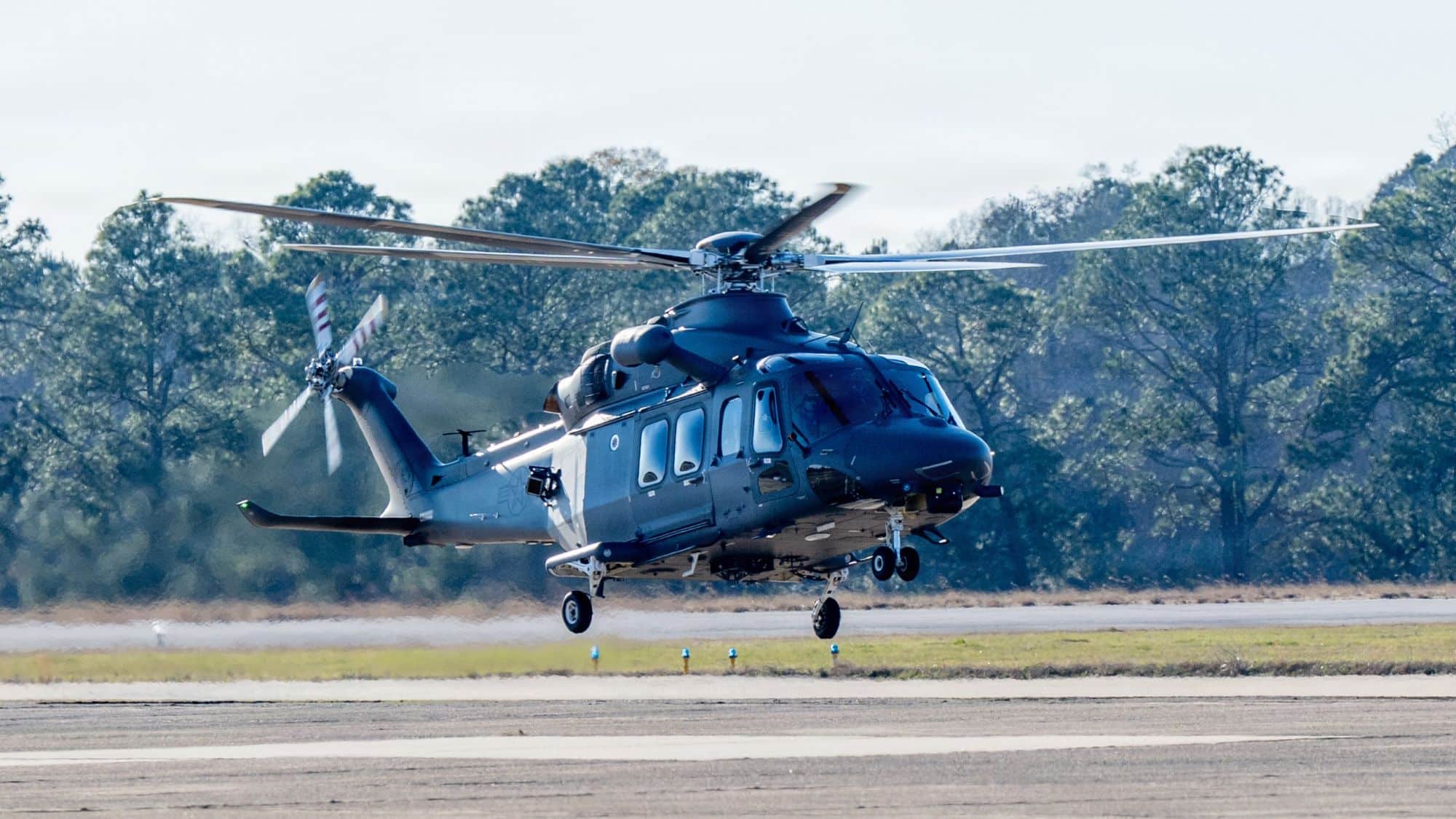
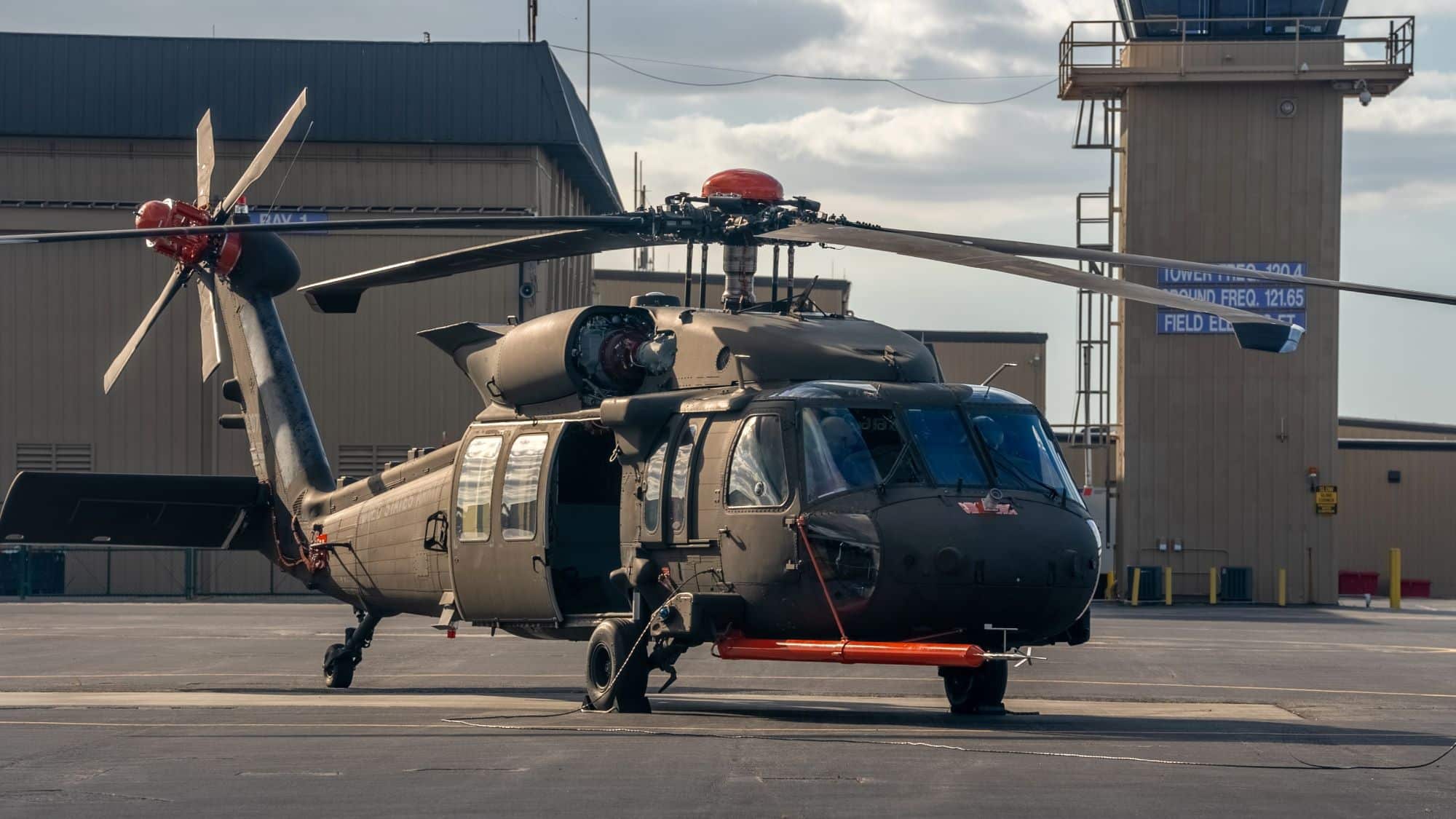
An MH-139A Grey Wolf assigned to the 908th Flying Training Wing, lands after a short flight at Maxwell Air Force Base, Alabama, Feb. 7, 2026. (Image credit: USAF/Staff Sgt. Erica Webster) | Source: USAF

The MH-139 Grey Wolf’s kinematics better support the missile field security 24 hours and 365 days mission, across vast and austere terrain. “The Grey Wolf’s “speed, range, and modern command-and-control systems are crucial”  to securing assets during the phased transition to Sentinel that marks “a comprehensive overhaul of [U.S.’s] land-based ICBMs.” The “phased transition” needs “uninterrupted operations as new Sentinel sites are brought online, and Minuteman III facilities are decommissioned.”

Developments in Sentinel program

In Oct. 2025, Northrop Grumman, the Sentinel’s developer, announced completing the Critical Design Review (CDR) of the Sentinel’s Launch Support System (LSS). The LSS is a “digital command and control infrastructure” that supports Sentinel tests and launches, and the CDR paves the way for “system build, test, and qualification phases.” The LSS would be constructed in Roy, Utah, and deployed at Vandenberg Space Force Base.

🚀Go for Launch! Sentinel program’s Launch Support System (LSS) clears Critical Design Review!🌟This achievement ensures LSS will support Sentinel flight tests for decades. Our team’s innovation and dedication are transforming digital models into real-world integration, driving… pic.twitter.com/TPdGn9phP3

— Northrop Grumman (@NGCNews) October 20, 2025

This was followed by a March 27, 2026, release announcing the accelerated prototyping of a launch-silo tube for the Sentinel ICBM. The Sentinel program envisages around 400 such launch silos.

We’ve broken ground on a Sentinel launch silo prototype at our facility in Utah. The new design concept is expected to reduce risk, accelerate fielding, prioritize future maintainability and drive cost savings for the program.

Read more: https://t.co/J974qeb1m1 pic.twitter.com/QqOPnZH4tK

— Northrop Grumman (@NGCNews) March 27, 2026

Road to IOC

As mentioned earlier, the journey to an IOC for the MH-139 Grey Wolf saw extensive operational trials in representative scenarios by the 582nd Helicopter Group. The process included the 550th Helicopter Squadron completing the aircraft’s first Initial Operational Test and Evaluation (IOT&E) flight in January 2025.

Then, the January 2026 first operational Minuteman ICBM convoy support mission by the 40th Helicopter Squadron (40th HS) saw the MH-139 “successfully escorting maintenance and armored security vehicles over 100 miles during a six-hour movement without needing to refuel.”
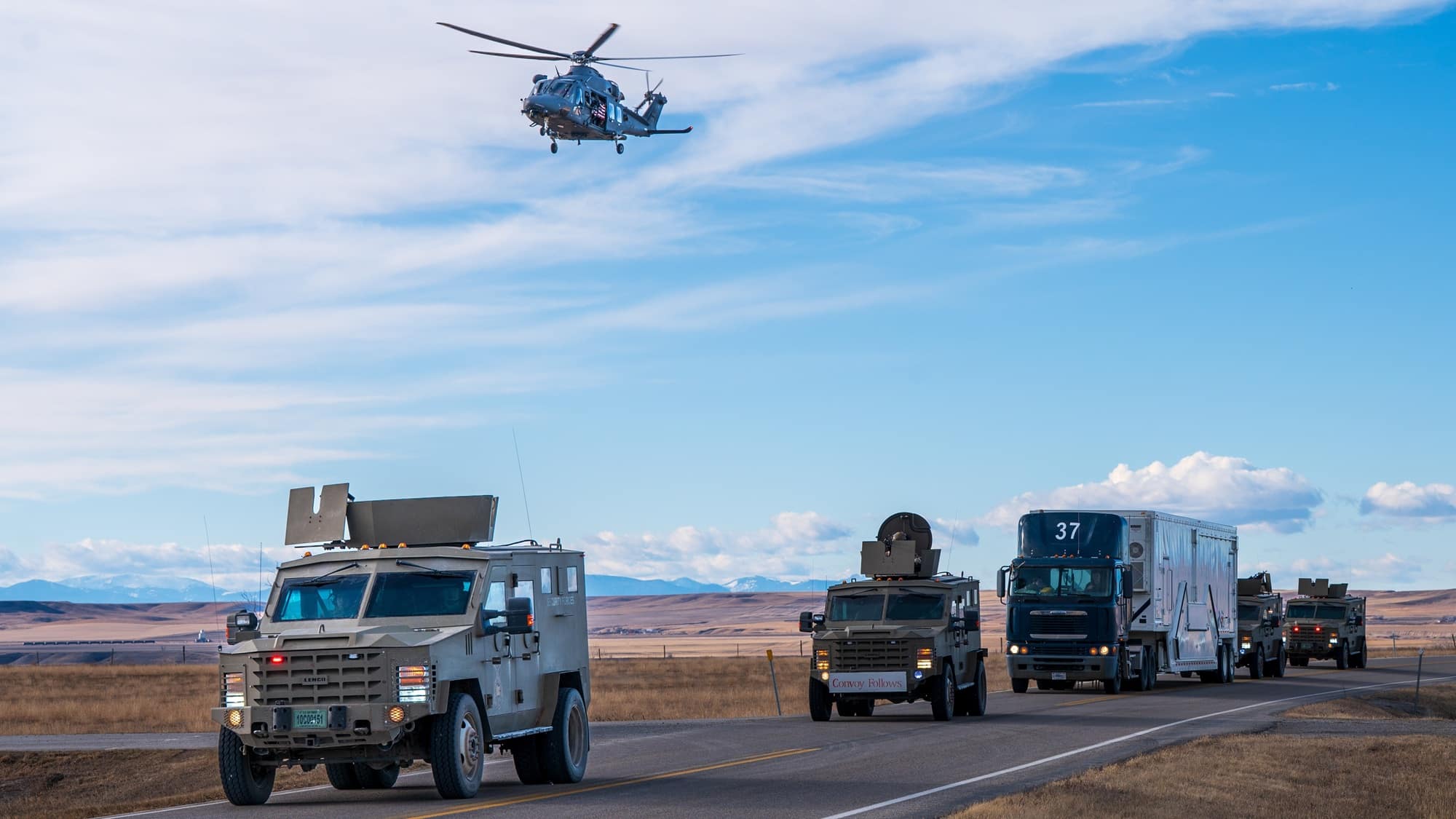
A U.S. Air Force MH-139 Grey Wolf assigned to the 40th Helicopter Squadron conducts its first operational mission alongside 341st Missile Security Operations Squadron convoys at Malmstrom Air Force Base, Montana, Jan. 8, 2026. (Image credit: USAF/Airman 1st Class Jack Rodriguez Escamilla) | Source: USAF

The MH-139 was also put through “electromagnetic compatibility testing” in Nov. 2025 at the Benefield Anechoic Facility (BAF) under the 412th Test Wing’s 772nd Test Squadron at Edwards AFB. The testing on the Grey Wolf, assigned to the 908th Airlift Wing, “evaluated [its] electronic warfare systems and avionics within the highly controlled, radio frequency-isolated environment of the BAF, which is vital for validating its survivability against electromagnetic threats.”

On Aug. 14, 2026, F.E. Warren AFB, Wyoming, also opened a modernized facility supporting the 37th Helicopter Squadron and the 90th Missile Security Operations Squadron Tactical Response Force. 

The MH-139A participated in its first Nuclear Convoy Course (NCC). A weeklong exercise in Wyoming to ensure the safe and secure transport of nuclear weapons and materials. 😎

📷 Staff Sgt. Michael A. Richmond

PS. I still can’t believe the USAF bought Italian helicopters for… pic.twitter.com/FkH25eC2Yq

— Thenewarea51 (@thenewarea51) May 22, 2025

In the latest Air Force release, 582nd HG commander Col. Bryant Bevan said it had been “distinct privilege […] to watch the iconic Huey faithfully support our global operations.” “However, this transition represents a critical leap forward. The advanced capabilities of the MH-139A Grey Wolf will directly empower our airborne forces with the enhanced speed, range and survivability required to decisively defend and secure the Minuteman III weapons system,” Bevan added.
Chinese YY-20A Tanker Refuels Egyptian Rafale During Eagles of Civilization 2026 Air Exercises

1 September 2026 at 12:09
YY-20

After refueling Egyptian MiG-29s during EoC 2025, the PLA Air Force’s YY-20A has now been photographed refueling an EAF Rafale during this year’s Eagles of Civilization exercise.

A Chinese YY-20A Multi-Role Tanker Transport (MRTT) refueled an Egyptian Air Force (EAF) Rafale fighter during the ongoing Eagles of Civilization 2026 air drills, the latest official images released by both militaries show. During last year’s inaugural installment of the exercises, a YY-20A refueled EAF MiG-29M/M2 fighters. EoC 2026 set another milestone with PLA Air Force J-16s training with EAF Rafales.

While this appears to be the first publicly documented instance of a Chinese YY-20A refueling a Western-built fighter, Rafales have been integrated with a Russian platform before. The Indian Air Force’s (IAF) Ilyushin Il-78 tankers regularly refuel its French Rafales.

Thus, Eastern and Western platforms have been integrated through the Il-78/Rafale and YY-20A/MiG-29 pairings, thanks to their compatible probe-and-drogue systems. Given the incremental enhancements in interoperability seen during the EoC exercises, it was only a matter of time before the YY-20A connected with the Rafales.

Rafale meets YY-20:

China, Egypt continue joint air force exercise ‘Eagles of Civilization 2026’

New photo from @EgyArmySpox shows a Chinese YY-20 tanker refueling an Egyptian Rafale fighter during aerial refuelling training of the “Eagles of Civilization-2026” joint exercise.… pic.twitter.com/Y5RPqLiuh2

— China Military Bugle (@ChinaMilBugle) August 31, 2026

YY-20A refuels Rafale

The image was first released by the Egyptian military spokesperson and was later shared by the official ‘China Military Bugle’ handle. The in-flight picture shows a twin-seat Rafale B on the starboard side of the YY-20A, with the fighter’s fixed In-Flight Refueling (IFR) probe connected to the hose-and-drogue unit deployed from the tanker’s refueling pod. Two other Rafales are also seen to the right of the EAF Rafale.

While the number of refueling operations that may have taken place is not known, it is unclear how many of the participating EAF Rafales actually took fuel from the YY-20A. The YY-20A can also be identified from the faint low-visibility markings under the wing.

Other images from the Egyptian military showed EAF and PLAAF crews during a briefing, pictures from the cockpit of a MiG-29M/M2 showing another MiG-29 to its right during what appears to be a takeoff run, and a shot of four PLAAF J-16s flying overhead.

#المتحدث_العسكرى : استمرار فعاليات التدريب الجوي المصري الصيني المشترك ( نسور الحضارة – 2026 ) … pic.twitter.com/CKC5gjlbdA

— المتحدث العسكرى (@EgyArmySpox) August 31, 2026

China Military Bugle then used the official Egyptian picture of the YY-20A refueling the Rafale and posted EoC 2025’s image of the tanker connecting with the EAF’s MiG-29M2, highlighting the progression in interoperability between the two air forces.

Egyptian and Chinese statements

The release from the Egyptian military spokesperson mentioned the various simulated kinetic mission sets, aimed at fostering joint operations and improving combat skills in line with current warfare trends.

“The exercise is being conducted at several airbases across the Arab Republic of Egypt. Joint sorties were carried out to train on managing air combat operations – specifically attacking hostile targets and protecting vital assets – in accordance with the latest aerial tactics. These activities facilitate the exchange of expertise and enhance the pilots’ skills and capabilities to operate jointly with complete harmony and coordination, in addition to conducting aerial refueling training. The exercise aims to maximize the benefits for participating personnel regarding the planning and execution of modern air operations and to enhance the exchange of expertise. This, in turn, boosts the capability and readiness of both nations’ air forces to execute all assigned missions with efficiency and competence.”

Onwards and Upwards.

An #IAF contingent arrived today at the Eielson AF Base of @usairforce, at Alaska, USA, to participate in the upcoming edition of the multi-national exercise Red Flag 24.
Ably supported by its IL-78 air to air refuellers and the C-17 transport ac, the IAF… pic.twitter.com/8mi2VlNbVT

— Indian Air Force (@IAF_MCC) May 30, 2024

The Chinese military highlighted the step-up from EoC 2025:

“New photo from (the Egyptian Army spokesperson) shows a Chinese YY-20 tanker refueling an Egyptian Rafale fighter during aerial refuelling training of the ‘Eagles of Civilization-2026’ joint exercise. This follows last year’s joint exercise during which the YY-20 tanker refueled Egyptian MiG-29s, demonstrating the deepening interoperability between the two sides.”

The Chinese PLA Air Force has sent an elite fleet of aircraft, including the J-16 fighter jet, to Egypt for the “Eagles of Civilization 2026” joint training exercise.

The multiple types of aircraft and personnel participating in the exercise arrived at an Egyptian air base on… pic.twitter.com/ytUbRpBiXL

— China Military Bugle (@ChinaMilBugle) August 24, 2026

Other platforms

Besides the J-16, the other PLAAF platform that debuted in EoC 2026 is the Y-9LG Stand-Off Jammer (SOJ). The four to five Y-20 strategic airlifters, a YY-20A MRTT that made the more than 6,000-km journey to Egypt, the Z-20KS battlefield tactical helicopter, and the KJ-500 Airborne Early Warning and Control (AEW&C) aircraft participated in 2025 too. The inaugural EoC 2025 had also seen the PLAAF send its J-10Cs to train with EAF MiG-29s.

China YY-20
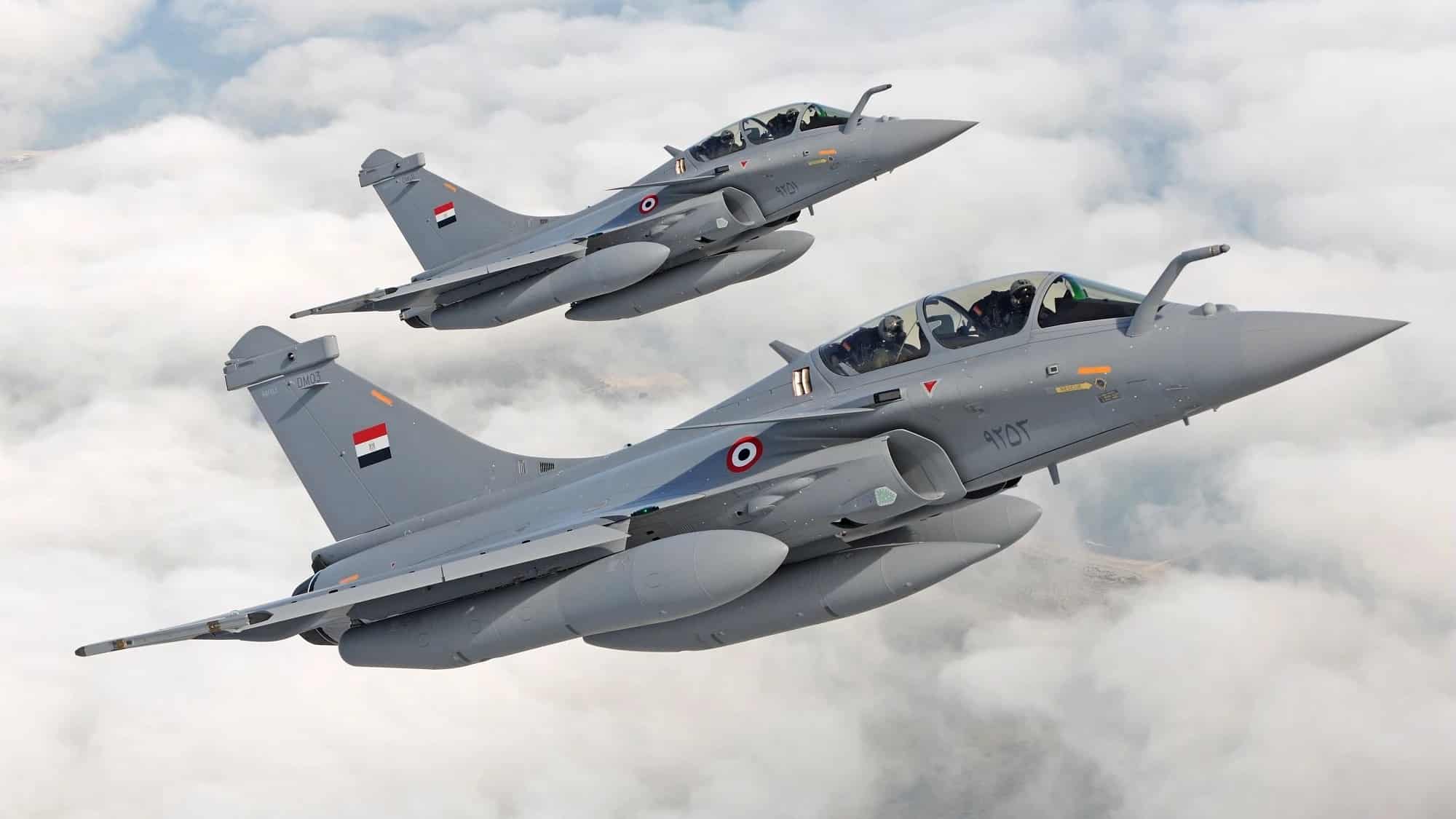
File photo of Egyptian Rafales. (Image Credit: Dassault) | Source: Dassault

The current set of images and statements from EoC 2026 does not include the Y-9LG SOJ, the KJ-500 AEW&C or the Z-20 helicopter. Chinese official media had, however, mentioned these platforms on Aug. 24, a day after EoC 2026 kicked off on Aug. 23. During EoC 2026, Chinese reporting has also associated the Z-20 with Combat Search and Rescue (CSAR) training.

First Production-Representative Hürjet Jet Trainer Makes Maiden Flight

31 August 2026 at 17:14

The first Hürjet jet trainer destined to the Turkish Air Force, part of a first batch of 12 aircraft, flew for the first time on Aug. 30, 2026.

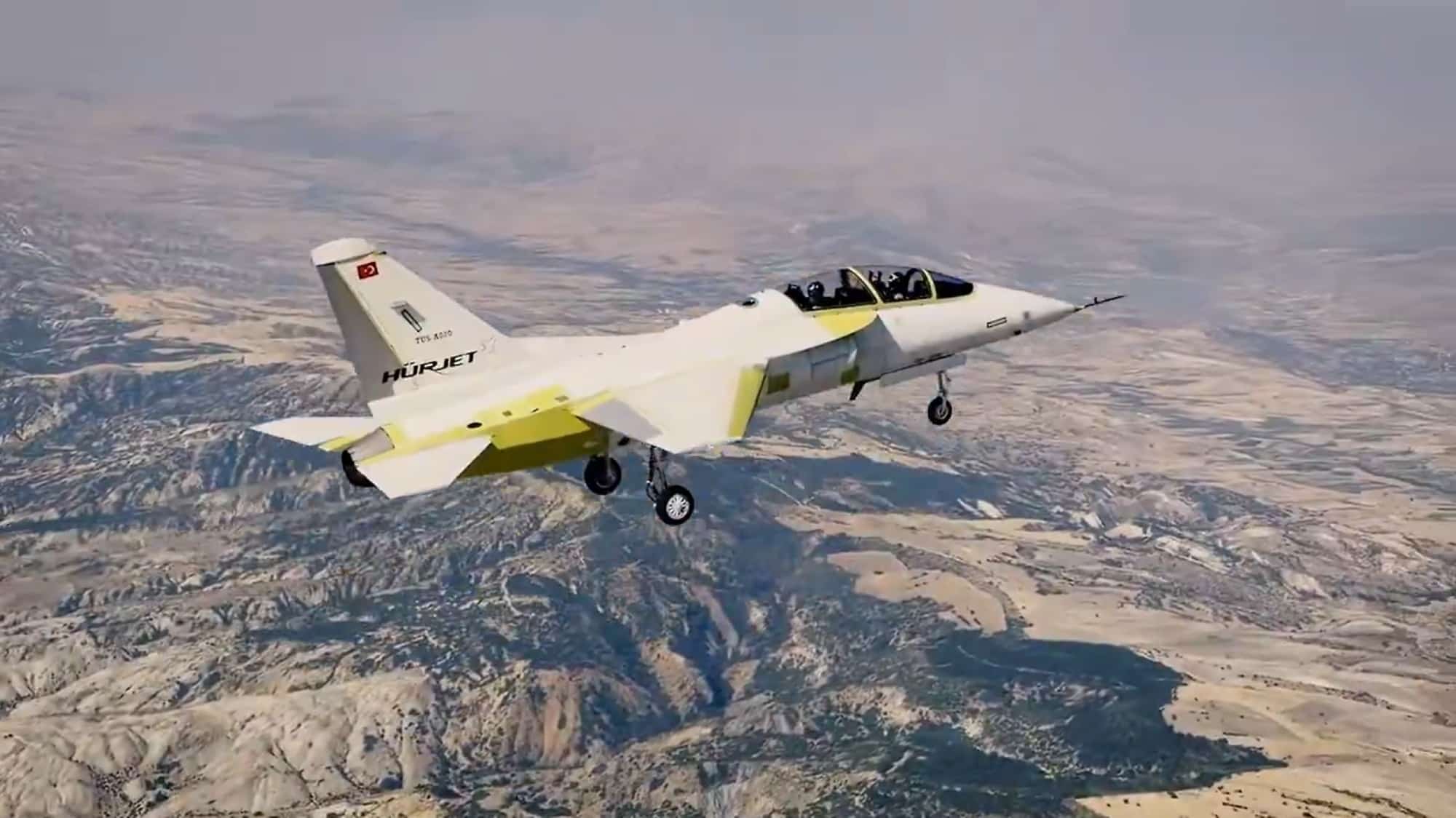
The first production-representative Hürjet jet trainer aircraft destined to the Turkish Air Force (Türk Hava Kuvvetleri – THK) made its maiden flight on Aug. 30, 2026, announced the manufacturer TUSAŞ/TAI (Türk Havacılık Ve Uzay Sanayi Anonim Şirketi/Turkish Aerospace Industries). The flight took place on the 30th Anniversary of Turkey’s Victory Day, celebrated on Aug. 30.

Turkish reports mentions regular deliveries of the Hürjet to the THK, of which the service has ordered 12 aircraft, are slated to begin by 2027. According to TurDef and SavunmaSanayiST, an initial batch of six will be delivered to the THK in the first phase, while production of additional production-representative aircraft is underway and activities continue with the prototypes.

The Hürjet that took to the skies on Aug. 30, 2026, is now the third airframe to be built, following the two existing prototypes. Among these, TUS-A003 had previously flown with a new paint scheme, and was spotted flying with weapons pylons in May 2026.

The new milestone also boosts the international prospects for the Hürjet program, which enters the highly competitive advanced jet trainer and light attack aircraft market. The Ejército del Aire y del Espacio (Spanish Air and Space Force – SASF) is the first international customer, which is acquiring 30 jets under the SAETA-II program.

A new chapter begins for HÜRJET. 🇹🇷✈

On the 104th anniversary of Türkiye’s August 30 Victory Day, the first HÜRJET Jet Trainer destined for the Turkish Air Force has successfully taken to the skies, marking another important milestone on its journey toward operational service. pic.twitter.com/fwrkItJOPT

— Turkish Aerospace (@TUSAS_EN) August 30, 2026

Another potential market opportunity is the United Kingdom, which is searching for a new jet trainer. TAI chief Mehmet Demiroğlu said at the recent Farnborough International Airshow (FIA) that the company is intending to participate in the competition.

Maiden flight of production aircraft

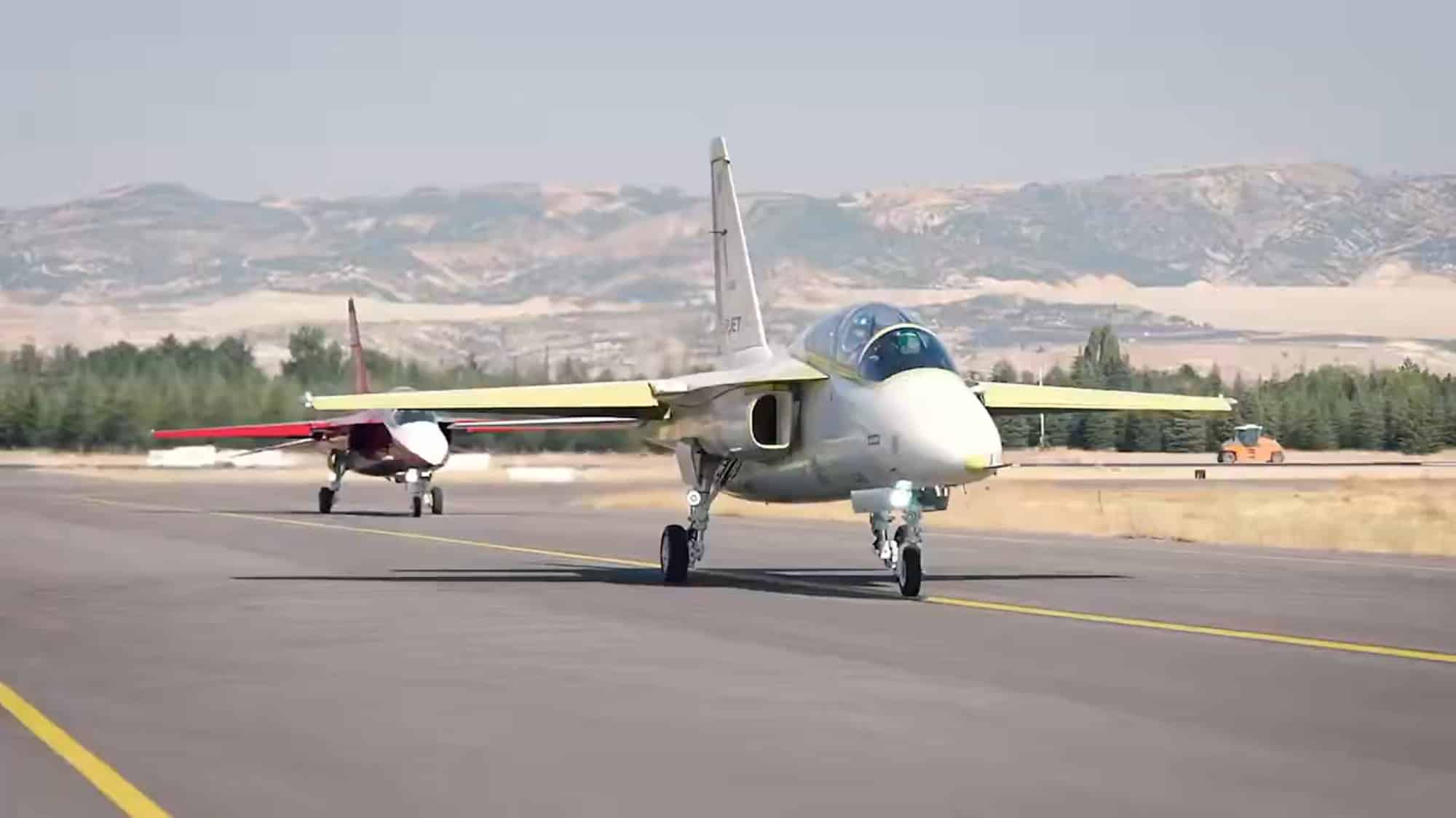
The first production-representative Hürjet airframe, tail ‘TUS-A020’, sported a white factory primer during the maiden flight. It was accompanied by ‘24-001’, the first early pre-production prototype that bears the red-and-white paint scheme.

Footage from inside ‘24-001’ showed the TUS-A020 flying with two crew members and its landing gear down the entire 18 minute flight. This is a common procedure for maiden test flights of a new aircraft.

The production airframe taxiing ahead of the first prototype after landing. | Source: TAI

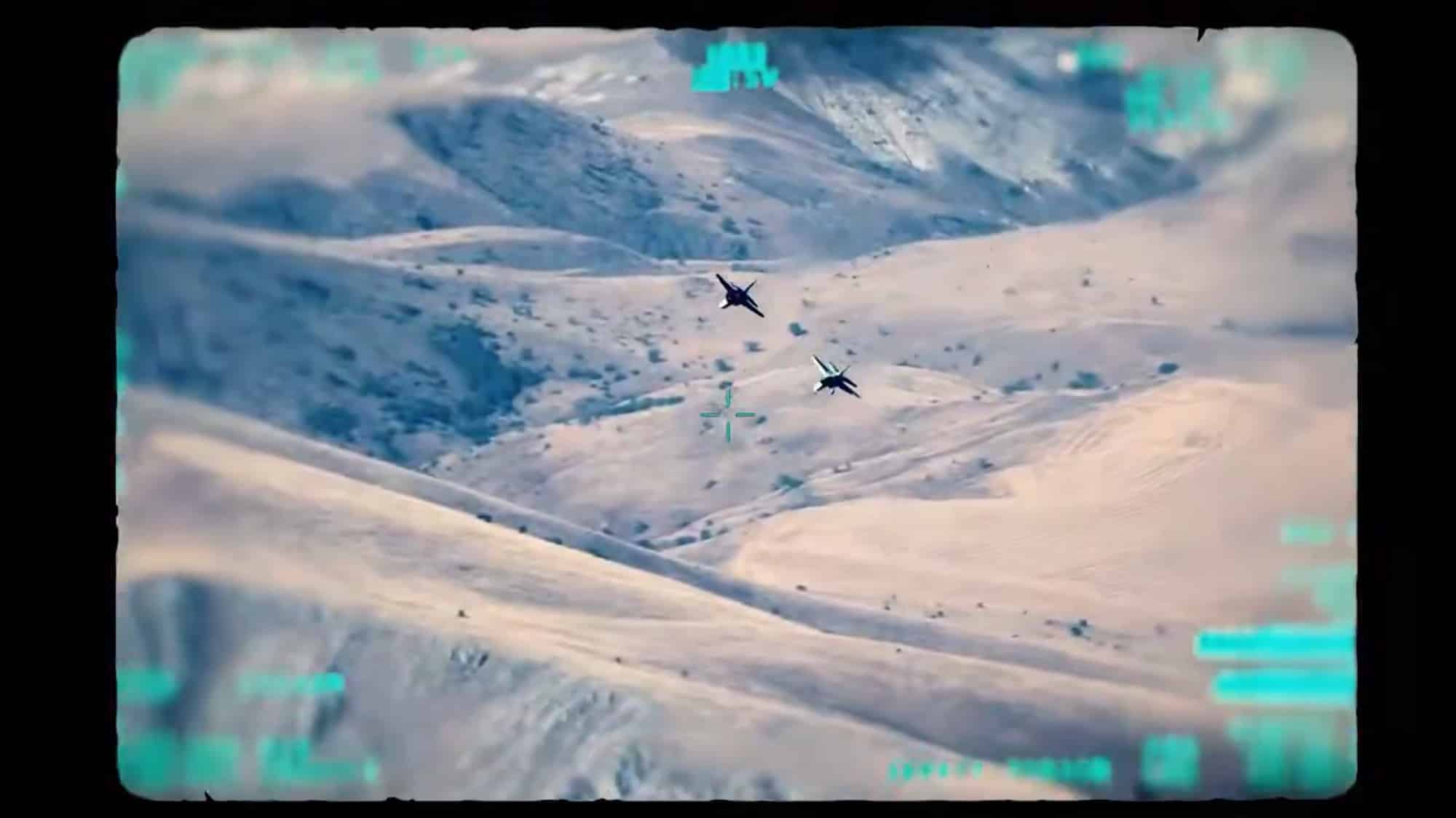
Both aircraft also have their flight data probes (pitot tubes) installed on the nose. Other footage from an electro-optical sensor showed both the aircraft flying in close formation, possibly taken by an unmanned aircraft, although this could be confirmed at the time of writing.

Demiroğlu described this first flight as “another important milestone for our national aviation.”

Another angle of the Hurjet in flight, taken from the cockpit of the first prototype that acted as a chase aircraft. | Source: TAI

Future

The Hürjets will primarily replace the THK’s older T-38 Talon jet trainers, of which reportedly 68 are still in service. In Spain, the Hürjets will replace the F-5M Freedom Fighter trainers, of which 19 are reported to be still in service, at Talavera La Real Air Base. Local manufacturing in Spain under SAETA II will oversee 68% of the jet being produced by an Airbus-led consortium incorporating domestic components and subsystems.

In the THK and SASF, the Hürjet will be part of a broader Integrated Combat Training System (ITS-C), including ground simulators, theoretical and practical instructions training aids, to better prepare aviators for future Gen. 4.5 and Gen. 5 aircraft. Turkey is rapidly moving towards operationalizing its indigenous Kaan fighter, while also lobbying to be admitted back into the F-35 program.

Footage from an electro-optical system showing both aircraft in flight. | Source: TAI

Both future production batches of the Hürjet and the Kaan fighter are also planned to integrate the domestically-developed TEI’s TF-series engines, and are currently flying with U.S.-made GE 404 and GE F110 powerplants.

Demiroğlu had also previously talked about the Hürjet’s naval version, envisioned to fly off the future Mugem carrier, and stated the company could meet production orders. He however did not divulge details on whether the Turkish Naval Forces had evinced specific interest in such a variant.

Uzbekistan Unveils its Chinese J-10CE Fighters

30 August 2026 at 19:42

Weeks after the first photographs emerged, Uzbek J-10CE fighters have now been officially shown on national television.

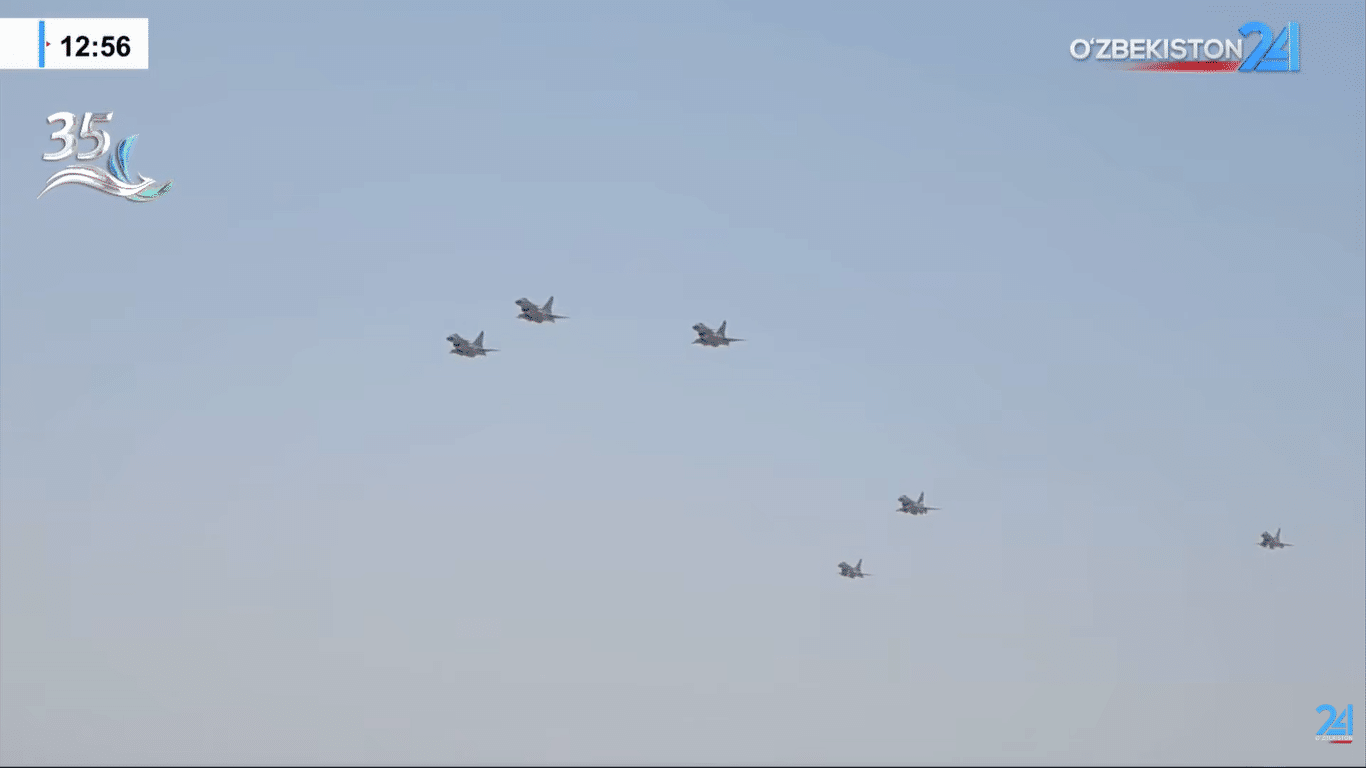
Uzbekistan’s acquisition of the Chinese J-10CE fighter jets was finally confirmed on Aug. 28, 2026, when the aircraft appeared in a two-hour feature broadcast by state television channel O’zbekiston 24 Telekanali on the occasion of the 35th Independence Day celebrations. The appearance of the jets on TV comes days after unconfirmed photos showed the jets with faint tail flashes resembling the Central Asian country’s flag.

In the video, at least six fighters were shown landing at an air base in the country, greeted by a water cannon salute. One of the jets is seen landing with a brake chute, and with the national flag clearly visible on the tail.

An immediate feature that stands out is the absence of the J-10’s fixed In-Flight Refueling (IFR) probe, normally installed on the starboard (right-side) of the front fuselage, behind the nose.

The reason for the absence of the probe is not confirmed, however it must be noted that Uzbekistan doesn’t operate aerial refueling aircraft, nor has long-distance expeditionary military orientation. All the jets are also carrying three external fuel tanks – two underwing and one centerline – used for extended range operations.

The aircraft departed from Chengdu in central China for a 3,000 km journey to Uzbekistan, although it is unclear where the aircraft stopped for fuel. Chengdu is home to the Chengdu Aircraft Corporation (CAC), the J-10’s manufacturer.

🇺🇿J-10CE fighter jet of the Uzbekistan Air Force pic.twitter.com/9K2URDyWD1

— Uz_Air_Force (@Uz_Air_Force) August 29, 2026

Uzbek J-10CEs

The number of jets Tashkent has acquired and the finer diplomatic and military workings behind the deal remain unknown. It must be noted that photos of the jets with the tail flash hidden (either with low-visibility markings or reportedly masking tape) have been circulating since earlier this month.

In the intervening time, clearer photos emerged on Aug. 23 and 24, particularly showing tail number ‘1020’ meant for the UzAF but with the flag on the vertical stabilizer still masked. The images were reportedly captured at the Chengdu Aircraft Corporation (CAC) facilities.

The arrival of the J-10CEs in Uzbekistan thus could have been very recent, and just around the time they were featured on O’zbekiston 24. The water cannon salute suggests that the feature showed the landing at the end of the delivery flight.

Interesting claim; allegedly the original, clearer version of this picture was actually taken already last month.

I hope it is not again an AI modified version of it. https://t.co/2qxYnBJ5SU pic.twitter.com/qC3KasTWYH

— @Rupprecht_A (@RupprechtDeino) August 16, 2026

The J-10Cs join Uzbekistan’s fleet MiG-29s, Su-25 Frogfoots and Su-27s. This makes Uzbekistan the second international operator of the J-10CE after Pakistan, and its third overall user after the People’s Liberation Army Air Force (PLAAF).

The J-10C’s popularity grew following the May 2025 conflict between Pakistan and India. The Pakistani Air Force (PAF) has at least 20 J-10Cs in service with five more on order.

Another J-10CE with the serial 101x pic.twitter.com/jObQJ4xKty

— Dan The Man (@tong96083420) August 23, 2026

There is currently no information on the weapons package included in the deal between Uzbekistan and China. The deal is likely to include air-to-air missiles such as the PL-10 short-range air-to-air missile (AAM), the PL-12 medium-range AAM, and the PL-15 Beyond Visual-Range (BVR) AAM.

Screengrab of the six Uzbek J-10Cs flying overhead. | Source: O’zbekiston 24

Other J-10C potential customers

Other Asian countries have already officially announced interest in the J-10C. Reuters quoted on Aug. 25 the Bangladesh Prime Minister’s Information and Broadcasting Adviser Zahed Ur Rahman saying his country was in the process of preparing a formal draft agreement for J-10CEs.

Bangladesh’s separate Letter of Intent (LoI) for Eurofighter Typhoons meanwhile has yet to be translated into a formal contract. The Bangladesh Air Force flies various variants of Chengdu F-7s (heavily upgraded Chinese derivative MiG-21 Fishbed) and MiG-29 Fulcrums.

Here in Uzbekistan, a video was shown on television about the arrival of the J-10. pic.twitter.com/Kq9vrPobNC

— Akela Freedom (@AkelaFreedom) August 28, 2026

The Indonesian Air Force (TNI Angkatan Udara – TNI AU), a Rafale, F-16, Su-27 and Su-30 operator, has budgeted $9 billion for the J-10C, but has not yet followed that up with a deal. The country previously denied claims that a contract was finalized.

South Korea Launches Next Generation Fighter Program

29 August 2026 at 15:54
South Korea Next Generation Fighter

The South Korean Defense Acquisition Program Administration (DAPA) has sought detailed industry proposals for a sixth generation jet.

South Korea set the ball rolling for its future next-generation jet, with the Defense Acquisition Program Administration (DAPA) issuing a Request for Proposal (RFP) inviting companies to submit their conceptual designs, industrial and technological roadmaps. The RFP was issued on Aug. 21, 2026.

According to South Korean publication BizHancook, the Conceptual Study of the Korean Next-Generation Fighter seeks submissions in the next 14 months with a budget of 900 million Won ($650,000). It envisages both tailless and conventional designs for a single-seat fighter with Radar Absorbent Material (RAM) and low-observability in the L, S, and X bands, two adaptive cycle engines capable of supersonic cruising, and an internal weapons bay.

Interestingly, the Agency for Defense Development (ADD) also unveiled on Jul. 7, 2026 at the Aerospace Conference 2026 a conceptual design currently being researched. BizHancook however added that this design is currently a separate effort running in parallel.

[6th Generation Korean Fighter Jet] https://t.co/3tBSx2kfi9 pic.twitter.com/sIX5DfaXRm

— Forrestal’s 3D / Commission Always Ok (@3DCG_mylife) August 27, 2026

The ADD’s design was developed “during the research process on design methodologies aimed at rapidly realizing aircraft shapes and quickly analyzing flight performance and radar cross-section (RCS) compared to the past,” BizHancook added. It is possible elements of the study might still influence the features in the proposals the agency has sought, for which Korea Aerospace Industries (KAI) and Korean Air are likely to participate.

Concept

The concept rendition reported by the press is a creation by independent 3D artist Choi Dong-hyun. Choi also shared the rendition on his X profile ‘@3DCG_mylife/Forrestal’s 3D’ on Aug. 27 and, in a previous post, said the design was influenced by the references from the ADD.

It is thus important to note that this is not an official rendering.

The concept shows a single-seat, twin engine tailless fighter. The aircraft features a cranked delta wing with canard foreplanes which appears to be canted outwards.

The engines feature flat exhaust nozzles, although it is unclear if they feature thrust-vectoring.

FA-50, KF-21 and now this… South Korea’s defence ecosystem is clearly heading in the right direction. We’ve already seen two iterations of their 6th gen models, and they’re moving fast. #6thGen https://t.co/IiUNH7bUOd pic.twitter.com/xrd8ApfjPW

— Tatya Vinchu (@officialTatya_1) August 28, 2026

Future

The program is still in a very nascent stage, and a lot of questions remain regarding its place in South Korea’s other defense projects. South Korea is also developing advanced versions of the KF-21 Boramae, referred to as the KF-21 Block 3 or the KF-21EX.

It is unclear whether the future sixth generation fighter would affect the Boramae’s development and procurement. The KF-21 Block 3 is planned to have an internal weapons bay, low observability, ability to control Collaborative Combat Aircraft (CCA), advanced computing and sensor fusion technologies to bring it closer to a fifth generation classification. 

https://t.co/64y23ni91G DAPA and ROKAF issued a tender on August 21 for a conceptual study on Korean Next-Generation Fighter. The study will proceed in parallel with Agency for Defense Development (ADD)’s Stealth Bridge Program, with a budget of KRW 900 million over a 14-month… pic.twitter.com/sE1Li0wo3y

— Sheldon (@sheldon3103) August 24, 2026

This new KF-21 version would also introduce an indigenous engine being developed under DAPA’s Advanced Aviation Engine Development Project. The KF-21 Block I currently flies with the General Electric F414, which Hanwha Aerospace manufactures locally under license.

The ongoing effort aims to develop a new engine, called the KTF16000, that produces 16,000 pounds of dry thrust and 24,000 pounds of thrust with afterburners. Following manufacturing, ground testing and certification, flight tests with the KF-21 Block III are planned to commence by 2040.

The RFP for the new fighter also includes adaptive cycle engines – powerplants that are able to adjust their air intake and bypass ratios mid-flight to switch between fuel efficiency and high-performance modes. It is not known at this stage whether the future sixth generation fighter will use KTF16000 engines or an adaptive cycle engine that South Korea would develop domestically.

Sweden to Begin Phasing Out NH90 TTH Helicopters by 2027 – Reports

27 August 2026 at 16:51
Sweden NH90 phase-out

The reported phase out follows years of availability and maintainability problems with Sweden’s NH90 fleet and a decision to expand its UH-60M Black Hawk fleet.

Less than a decade after taking delivery of its full fleet of 18 NH90 helicopters, Sweden will begin phasing out nine of its NH90 TTHs (Tactical Transport Helicopters) from 2027, reports emerged on Aug. 24, 2026 said. According to Avia News and Aeromorning, the retirement on the HKP 14E (Swedish designation for the NH90 TTH) is envisaged in the 2027 defense plan.

The restructuring builds upon Sweden’s 2024 decision to buy 12 more UH-60M Black Hawks, expanding from its initial purchase of 15 airframes.

The decision follows longstanding availability and maintainability issues that have affected Sweden’s NH90 fleet, as well as the type’s troubled service history with some other European operators. Sweden also began receiving its fleet after years of delays, with the first helicopters delivered in 2011 instead of 2005.

Sweden operates a total of 18 NH90s that it first ordered in 2001. They are currently split into nine HKP 14Es and nine HKP 14Fs (the NH90 NFH – NATO Frigate Helicopter). The HKP 14F will however remain in service, pending a new procurement for an alternative maritime utility and naval combat helicopter.

🚁🇸🇪 La Suède restructure sa flotte d’hélicoptères avec la suppression progressive des premiers #NH90 TTH HCV (HKP14E) @NHIndustriesSAS à partir de 2027. https://t.co/Gz22naLzXP pic.twitter.com/sYVllnykSB

— Philippe Top-Action (@top_force) August 26, 2026

The HKP 14Es are also described as the High-Cabin Version (HCV) used in battlefield tactical roles, ferrying personnel, equipment, Search and Rescue (SAR), MEDEVAC/CASEVAC and sling-load operations. The HKP 14F is equipped with a tactical maritime search radar, dipping sonar, sonobuoys and torpedoes for Anti-Submarine Warfare (ASW), but it is also used for maritime Search and Rescue (SAR) and naval utility roles. 

Sweden’s NH90 fleet

Sweden’s original NH90 order was composed of 13 HKP 14Es and five HKP 14Fs. Deliveries were planned to begin by 2005, but overshot significantly and the first four HKP 14 A/Bs in the Initial Operational Configuration (IOC) reached Sweden only by April 2011.

One “enhanced basic” HKP 14C was delivered shortly thereafter. This was followed by seven mission-standard HKP 14Ds delivered between 2013 and 2015, most of which were later converted into the HKP 14E (land-role) standard.

The first HKP 14F (naval role) was delivered in December 2015, bringing the total fleet to 12. In the intervening period, Sweden opted for converting four HKP 14Es into the maritime HKP 14Fs.

In August 2019, Sweden took delivery of the 18th and final production NH90. Then on Nov. 30, 2023, NHI said it delivered the last seven helicopters retrofitted in the “Final Operational Capability (FOC) configuration.”

The Swedish NH90 helicopters operate from the F21 air force base in Luleå and the F17 air force base in Ronneby.

On November 30th, NHIndustries, in collaboration with its long-standing partner PATRIA, delivered the last of 7 NH90 SAR helicopters, retrofitted in FOC configuration, to the Swedish Armed Forces. 🇸🇪🚁#NHIndustries #PATRIA #NH90 #SAR #Sweden pic.twitter.com/iINcKKFawt

— NHIndustries (@NHIndustriesSAS) December 5, 2023

Problems

Issues with the Swedish NH90s have been publicly reported since 2022. In June 2022, then defense spokesperson Louise Levin told Norran that Sweden’s issues with its NH90 fleet were “similar” to that of Norway.

Oslo’s bitter legal battle with NHIndustries over the poor state of the NH90s was resolved in an out-of-court settlement in November 2022. The same month, the erstwhile Swedish Armed Forces chief Gen. Micael Byden announced the cancellation of the plans for an additional order of HKP 14s, citing long-running poor availability rates.

Avia News added that the Swedish NH90s had an operational cost of $18,154 (SEK 200,000) per flight hour, compared to Black Hawk’s $3,630 (SEK 40,000). 

Do you know which helicopter 🇫🇮 SOF commonly operate?

Meet the NH90 TTH — Tactical Transport Helicopter. 🚁 Operated by the Utti Jaeger Regiment, it is the backbone of Finland’s special operations air mobility.

What it delivers:

💪 Rapid insertion and extraction of troops and… pic.twitter.com/JU4BVtjaTS

— NATO Allied SOF Command (SOFCOM) (@NATO_SOF) February 19, 2026

NH90 issues with other users

The NH90 has also seen an unpleasant history with some of its other users, like Norway, Finland, Belgium, Australia and Greece. Norway’s experience with the troubled NH90s spurred the government to take NHIndustries to court, with the two parties finally settling separately in November 2025.

NHI agreed to take back all of Norway’s NH90s and reintegrate them into the broader program to make spares available for other users. NHI also agreed to pay Oslo €305 million, in addition to €70 million which amount to previously paid pursuant to bank guarantees.

Australia, which operated 46 NH90 airframes designated the MRH-90 Taipan (Multi-Role Helicopter) since 2008, retired them a decade ahead of schedule. The helicopters had experienced a series of engine failures and maintenance issues. In August 2022, Canberra approved the purchase of 40 UH-60M Black Hawks to replace the Taipan.

While #Sweden has now ordered UH-60M to replace NH90 TTHs, NHI doesn’t consider their retirement a done deal. “There is no firm or official decision on what they intend to do. [The availability problems] were driven by a situation which was prior to 2022, and they are now very… pic.twitter.com/7XqdpPK5eh

— Gareth Jennings (@GarethJennings3) October 21, 2025

Other users like France, the Netherlands, Italy, Germany and Spain have however faced only little issues with their NH90s. France also recently received the first of its 18 NH90 Standard 2 dedicated to special operations.

Tre #NH90 transporthelikoptrar från #UTJR Helikopterbataljon 🇫🇮 tränar i Sverige 15. – 23. november.

Utbildning med den 🇸🇪 helikopterenheten fördjupar samarbetet, beredskapen och förmågan mellan enheterna. Flygverksamhet kommer att bedrivas i centrala delar av Sverige. pic.twitter.com/8HbtFYf1dN

— Utin jääkärirykmentti (@UtinJR) November 14, 2024

Spain approved in September 2018 the purchase of 23 additional NH90 TTHs. In Germany, Elbe Flugzeugwerke GmbH (EFW) announced on Aug. 26, 2026 a seven-year contract with the German Armed Forces to maintain their NH90 TTHs. The helicopter is also flown by Oman, Qatar and New Zealand. 

Chinese J-16s Train Against Egyptian Rafales During Eagles of Civilization 2026

26 August 2026 at 15:50
Eagles of Civilization 2026

The exercise marks the first deployment of Chinese J-16 fighters to Africa and sees them training against Egyptian Rafales and MiG-29M2s. 

Building on the 2025 edition of the Egyptian-Chinese Eagles of Civilization drills, this year’s exercise sees People Liberation Army Air Force (PLAAF) J-16s training with Egyptian Air Force (EAF) Rafale and MiG-29M2 fighters. The training event also marks the first time J-16s deployed to Africa, after having previously visited Russia, Thailand and Pakistan.

China released extensive official imagery and information, while the Egyptian Armed Forces spokesperson only confirmed the participation of the EAF Rafale and MiG-29M2. It must be noted that the J-16 has trained with another Western platform in the past, the JAS39 Gripen of the Royal Thai Air Force (RTAF), in this year’s Falcon Strike exercise.

Shenyang J-16 VS Dassault Rafale:

Chinese and Egyptian air force pilots participating in the Eagles of Civilization 2026 joint training conducted medium- and close-range air combat drills on August 23, 2026. #China #Egypt #AirForce#EaglesofCivilization2026#J16 #MiG29pic.twitter.com/DduBaktqeM

— China Military Bugle (@ChinaMilBugle) August 24, 2026

The exercise kicked off on Aug. 23, 2026, and is slated to continue until early-September. Other assets involved are the Y-9LG airborne Stand-Off Jammer (SOJ) platform. the KJ-500 AEW&C aircraft, Y-20 airlifters, YY-20A Multi-Role Tanker Transport (MRTT) aircraft and Z-20 tactical utility helicopters.

FIle photo of Egyptian Rafales. | Source: Dassault

Eagles of Civilization 2026

The clearest visual evidence of the J-16 and Rafale taking part in air combat training together comes from an official video feature from the Chinese military, provocatively titled “Shenyang J-16 vs Dassault Rafale.” The footage included a clip from the J-16’s cockpit showing a Rafale making a high-speed pass to the left of the Chinese fighter, in what could be the beginning of a high-aspect Basic Fighter Maneuver (BFM) scenario.

The video called it “medium and close-range air combat drills”, although it is unclear if the fighters faced each other in beyond and later within visual-range combat. The video also specified the scenario was part of the first day of the exercise.

Other official Chinese footage showed the J-16s taking off, videos from its cockpit, and the J-16s and MiG-29s landing with their brake chute. PLA officer Shen Hao laid out the types of air combat mission sets to CCTV:

“The joint training will progress from basic one-on-one and two-on-two air combat to more integrated system-level operations. As mutual understanding between the pilots deepens, we can more effectively exchange tactical concepts and operational techniques. [This] enhances tactical proficiency and combat capabilities of both sides.” 

China Military Bugle officially identified the above-mentioned platforms involved in EoC 2026, confirming that the “participation of the J-16 marks the first time China has sent any of its heavyweight fighter jets to Africa.” It noted the PLAAF’s strategic capability to execute expeditionary inter-continental, heavy, large fleet and sophisticated exercises, while touching upon Egyptian cooperation:

“The fleet flew more than 6,000 kilometers across two continents and four countries in nearly nine hours, overcoming challenges including the long flight and complex weather conditions. En route to Egypt, a YY-20A tanker aircraft conducted aerial refueling for J-16 fighter jets.

After arriving in Egypt, Chinese military personnel promptly unloaded supplies, organized equipment and conducted exchanges and coordination with their Egyptian counterparts as they began preparations for the training phase. The cross-border deployment and rapid loading and unloading operations demonstrated the Chinese air force personnel’s capabilities in long-range projection, agile deployment and cross-system operations.”

The Chinese PLA Air Force has sent an elite fleet of aircraft, including the J-16 fighter jet, to Egypt for the “Eagles of Civilization 2026” joint training exercise.

The multiple types of aircraft and personnel participating in the exercise arrived at an Egyptian air base on… pic.twitter.com/ytUbRpBiXL

— China Military Bugle (@ChinaMilBugle) August 24, 2026

The publication also mentioned “air combat tactics, air superiority operations, and search-and-rescue missions” are included in the mission sets of the exercise. No images and information were however released by the Egyptian MoD.

Other official Chinese footage showed debriefings between the PLAAF and EAF personnel, in what China Daily said involved “in-depth discussions on the joint training scenarios, clarifying flight safety and airspace control rules, takeoff and landing procedures, and emergency response protocols.”

The first-ever combat exercise between China’s J-16 heavyweight fighter jets and the French-made Rafale fighters took place on Sunday, according to the People’s Liberation Army Air Force.

In video footage published by the #PLA Air Force on Monday, Chinese pilots were seen… pic.twitter.com/2D4ua7t8lI

— China Daily (@ChinaDaily) August 24, 2026

The journey and previous J-16 international deployments

The J-16’s impending participation in the drills was revealed in unofficial photographs of the PLAAF contingent of at least six J-16s (from the 98th Air Brigade), a Y-20 cargo aircraft and a KJ-500 AEW&C aircraft captured at Pakistan’s Karachi airport on Aug. 20, while en route to Egypt.

pic.twitter.com/0BoluQIeAW

— Hûrin (@Hurin92) August 21, 2026

In the contingent’s onward journey, a YY-20A is also seen refuelling two J-16s, while the Z-20 appears to have been unloaded from the Y-20. The six J16s and four Y-20s were also tracked on FlightRadar.

In Pakistan the J-16 is not an unfamiliar sight, as it flew with Pakistani JF-17 Thunder fighters and J-10Cs during Islamabad’s and Beijing’s recurring Indus Shield exercises. The first time the J-16 participated in an exercise outside China, however, was in August 2021 in Russia during the International Army Games, along with the J-10 and the Y-20 strategic airlifter.

🇨🇳🇪🇬 Six J-16 fighter jets, along with a KJ-500 AEW&C aircraft and a Y-20 transport aircraft, were spotted in Karachi, Pakistan, ahead of their deployment to Egypt for the joint Egyptian-Chinese air forces exercise. https://t.co/SmC9DJwjvD pic.twitter.com/KO9hf8faQ4

— Egypt’s Intel Observer (@EGYOSINT) August 20, 2026

Cobra 600 Air Defense Drone Completes First Flight

23 August 2026 at 18:58
Cobra 600 first flight

Unveiled at the recent ILA Berlin air show, the Cobra 600 is a jet-powered uncrewed aircraft developed by Polaris to carry and launch a Diehl Defense IRIS-T air-to-air missile.

The prototype for Diehl Defense’s Cobra 600 drone-based air defense system has made its first flight, the German aerospace startup Polaris Raumflugzeuge announced on Aug. 22, 2026. Polaris, which is developing the small flying-wing aircraft, said the “perfectly smooth first flight covered a distance of 20 km,” with more trials planned in the coming months. 

Unveiled at the recent ILA Berlin airshow under the Airborne Launching and Attack System (AirLAS) program, the Cobra 600 envisages a jet-powered drone carrying Diehl Defense’s IRIS-T air-to-air missile (AAM) on a top-mounted rail launcher. The base platform from which the Cobra 600 is being developed is Polaris’ MIRA III demonstrator

Polaris is also the same company developing Germany’s reusable hypersonic vehicle program, under contract from the Federal Office of Bundeswehr Equipment, Information Technology, and In-Service Support (BAAINBw). As part of the Hypersonic Test and Experimentation Vehicle (HYTEV) program, the company has been testing the small-scale demonstrator MIRA II with a linear aerospike engine in support of a larger demonstrator that will fly by 2027. 

Cobra 600 test flight

The image released by Polaris showed the MIRA III with the pylon which will carry the IRIS-T missile on top of the aircraft. The drone is shown with four small jet engines, which in earlier close-up photographs from ILA Berlin were identified as JetCat P1000-PRO micro turbojets, although on that occasion only two engines were installed instead of the four of the final version.

🇩🇪 Diehl Defence showcased Cobra 600 unmanned aerial vehicle (UAV) armed with its air-to-air missile at ILA Berlin Airshow 2026. @DiehlDefence

The Cobra 600 drone on display was equipped with a missile rail, on top of the fuselage, armed with Diehl Defence’s IRIS-T air-to-air… pic.twitter.com/kcWgdPEl9n

— DefPost (@defpostmedia) June 11, 2026

Other concept illustrations from Polaris also showed the MIRA II with the IRIS-T on top. The MIRA II has four large protruding air inlets above the wing’s leading edge. 

The four-engine MIRA III configuration appears better suited to carrying the IRIS-T’s roughly 85 kg weight. It should be noted that the Cobra 600 is not the first drone to carry an air-to-air missile on top, as Russian Geran-type One-Way Attack (OWA) drones emerged in Ukraine with R-60 AAMs and Man-Portable Air Defense Systems (MANPADS) mounted on top.

Video of a Russian Shahed / Geran-2 OWA UAV equipped with an R-60 air-to-air missile downed by the 412th Nemesis Brigade’s Darknode battalion with a Sting interceptor from @wilendhornets. https://t.co/QkWH79sXfHhttps://t.co/w3BS2MaRwq pic.twitter.com/f6VE4uNmu2

— Rob Lee (@RALee85) December 1, 2025

Polaris further said in its statement: “With a take-off mass of less than 600 kg, COBRA is a light uncrewed aircraft that POLARIS is developing in cooperation with Diehl Defence within the joint AirLAS project (Airborne Launching and Attack System). COBRA is primarily designed to carry and launch IRIS-T air-to-air missiles for air defence missions.”

Operational concept

The operational concept for the Cobra 600 has not been disclosed by Polaris or Diehl Defense. The system is nevertheless being developed around the idea of using an inexpensive uncrewed aircraft to carry an IRIS-T air-to-air missile, potentially providing an additional layer of protection against aerial threats.

The concept has some parallels with recent Russian experiments involving Geran-series one-way attack UAVs equipped with air-to-air missiles or MANPADS. These systems have demonstrated how relatively inexpensive unmanned aircraft can be adapted to engage other aerial targets, although the capabilities and intended roles of the Russian systems differ from those of Cobra 600.

And another mesh network-enabled air-to-air variant of the Geran-2. This time with a MANPAD. pic.twitter.com/7MQDKCyoZG

— Fabian Hinz (@fab_hinz) January 4, 2026

It is not known whether the operational system will carry its own electro-optical or infrared sensors, or whether targeting information will instead be provided by external platforms and ground-based air-defense networks and counter-drone systems. The latter approach could allow the relatively simple drone to operate as a distributed interceptor within a wider integrated air-defense architecture.

Argentina Abandons Efforts to Return Super Étendard Fighters to Service

23 August 2026 at 18:45

The decision comes as Argentina restructures its Naval Aviation fleet, retires legacy aircraft and introduces new capabilities.

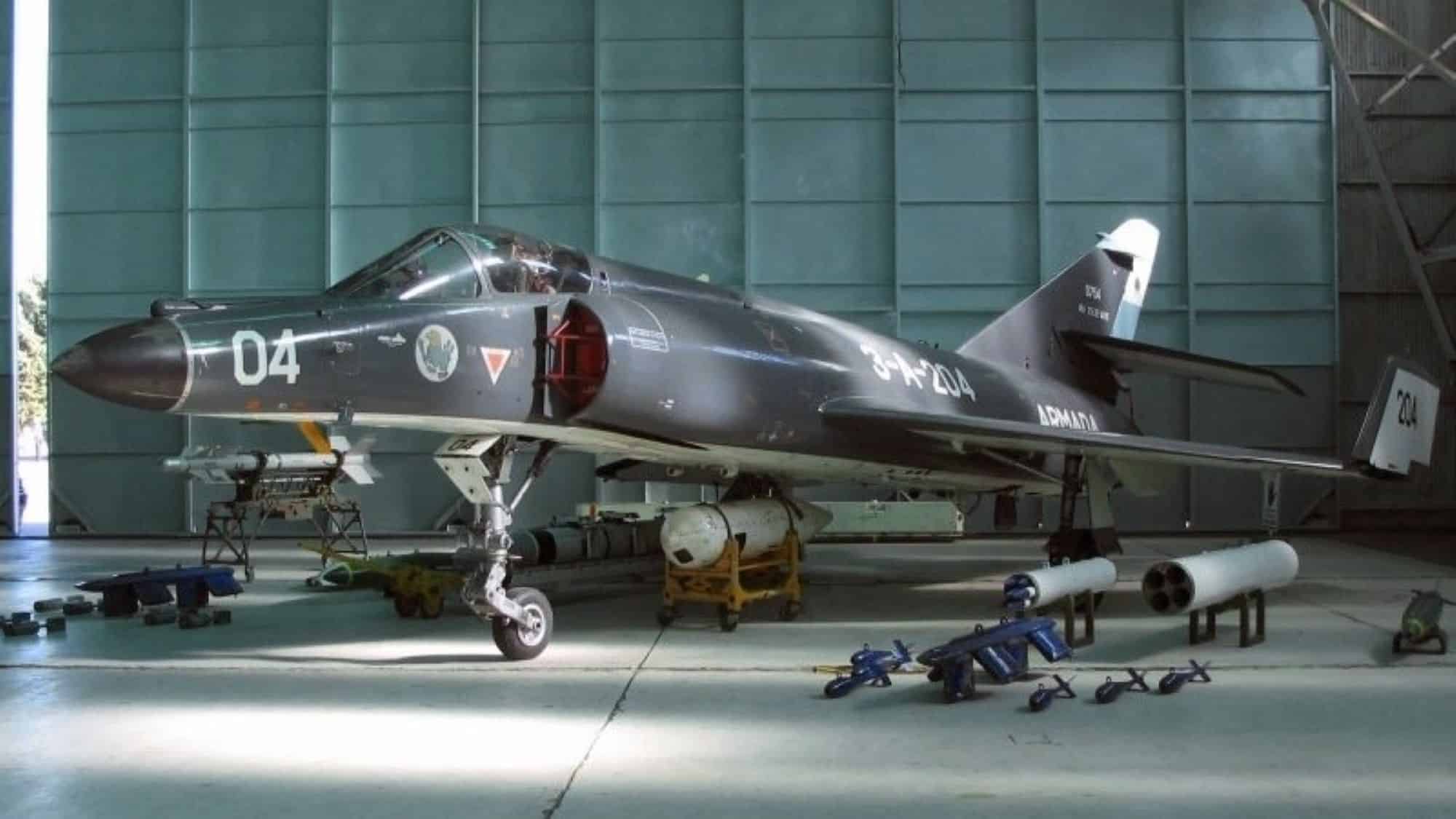
After nearly forty years of service, including combat operations during the 1982 Falklands (Malvinas) war, the Argentine Navy (Armada de la República Argentina – ARA) will retire its French-built Dassault-Breguet Super Étendard naval fighter. The decision was announced on Aug. 20, 2026, as part of Plan Dédalo.

The five-year restructuring and modernization program sees the service restructuring its forces with the redesignation, relocation and reassignment of aircraft, units, personnel and bases, while also phasing out several other fixed- and rotary-wing aircraft. The plan was laid out at the Punta Indio Naval Air Base by the ARA’s naval aviation chief Rear Admiral Román Enrique Olivero.

The Argentine government’s press release announced the retirement saying: “This year will see the final retirement from active service of the Super Étendard, closing more than four decades of glorious historical trajectory and outstanding performance in the Falklands.”

📍Buenos Aires, #Argentina (🇦🇷)

The @Armada_Arg announced yesterday that they have abandoned the attempt to recover the Super Étendard once again.

Plan Dédalo, a 5-year plan for modernization, announced that the type will be retired after abandoning attempts to recover units. https://t.co/jjuiNLpJp3 pic.twitter.com/2EM3FBTwmQ

— SA Defensa (@SA_Defensa) August 21, 2026

The statement provided a description of Plan Dédalo:

“The plan represents the closing of a historical cycle marked by the exhaustion of the previous operating model and marks the beginning of a new stage adapted to technological advances, doctrinal updating and the optimization of available human and material resources. The operational redesign seeks to optimize functional efficiency through strategic relocations and a new operational structure.”

Super Étendards in Argentine service

Argentina originally ordered 14 Super Étendards from France in 1979. Five aircraft were delivered before the Falklands War and the remaining nine were delivered after the conflict.

Between 1980 and 1981, ARA pilots trained in France, including operations on the carrier Clemenceau, before the Falklands War (or Guerra de Malvinas as known in Argentina) with the United Kingdom broke out in 1982. The training program was then cut short.

🇦🇷 | El adiós a una leyenda de la Aviación Naval

La Armada Argentina anunció que durante el presente año se efectuará el retiro definitivo del servicio activo de los Super Étendard, poniendo fin a más de cuatro décadas de trayectoria de uno de los sistemas de armas más… pic.twitter.com/mHuVUG1Fdp

— Fuerzas Armadas Argentinas 🇦🇷🇦🇷🇦🇷 (@FAArgentinas) August 21, 2026

Argentine Super Étendards were employed in the war, sinking the destroyer HMS Sheffield on May 4, 1982, and the merchant ship Atlantic Conveyor on May 25, 1982, using the AM39 Exocet Ant-Ship Missile (AShM).

🇫🇷🇦🇷𝐋’𝐚𝐯𝐢𝐨𝐧 𝐟𝐫𝐚𝐧𝐜̧𝐚𝐢𝐬 𝐪𝐮𝐢 𝐚 𝐟𝐚𝐢𝐭 𝐭𝐫𝐞𝐦𝐛𝐥𝐞𝐫 𝐥𝐚 𝐑𝐨𝐲𝐚𝐥 𝐍𝐚𝐯𝐲 𝐯𝐢𝐞𝐧𝐭 𝐝𝐞 𝐯𝐨𝐥𝐞𝐫 𝐩𝐨𝐮𝐫 𝐥𝐚 𝐝𝐞𝐫𝐧𝐢𝐞̀𝐫𝐞 𝐟𝐨𝐢𝐬

Plus de 40 ans après la guerre des Malouines, l’Argentine vient d’annoncer le retrait définitif de ses Super… pic.twitter.com/arejlgVBJq

— Forum Militaire (@forummilitairef) August 21, 2026

In 2018, a year after the initial agreement, Argentina purchased five ex-French Navy Super Étendard Modernisés (SEM). The deal, worth €14 million, also included spares and a simulator.

The aircraft were delivered in 2019 but never returned to operational service. This was in part because the Argentine Navy could not obtain the required components, including the cartridges, for their Martin-Baker Mk 6 ejection seats amid British export restrictions.

Attempts to address the technical issue domestically, involving the company MBA Argentina SA, faced regulatory hurdles from the Joint Military Airworthiness Directorate (DIGAMC). Reports said the ground tests were deemed unsatisfactory.

Hoy se anunció la desprogramación de otro avión emblemático de nuestra aviación de combate, en este caso, de la Aviación Naval Argentina: el Super Étendard. Se ha ganado su lugar en la historia. pic.twitter.com/sUtBAY5wmL

— PegasusA4 (@A4KikeLippi) August 20, 2026

Then Argentine Defense Minister Jorge Taiana formally announced the end of the effort to make the five SEMs operational:

“We had planned to recover them, so I went to speak with the [French] defense minister, who told me that they cannot be recovered, for two reasons. Because of the seats, which the British did not give up, and because of a series of parts of the Super Étendard Modernisés that are now retired. Therefore they, who had initially seen the possibility of manufacturing the parts, say that they cannot make them.”

Super Étendards in the Falklands (Malvinas) War

A notable action took place on May 4, 1982, when the Royal Navy Type 42 destroyer HMS Sheffield was sunk following an Exocet missile strike from ARA Super Étendards. The jets were assigned to the 2nd Naval Fighter/Strike Squadron (2da Escuadrilla Aeronaval de Caza y Ataque), operating from Río Grande. Although designed for carrier operations, the Argentine Super Étendards operated from the Río Grande naval air base during the war because ARA 25 de Mayo was unable to deploy them operationally.

An Argentine Super Étendard on display. | Source: Martin Otero via Wikimedia Commons

Another action was on May 30, 1982. Two Super Étendards, one reported to be carrying an Exocet anti-ship missile (AShM), escorted by four A-4C Skyhawks each with two 500 pound bombs, made an attempt on the HMS Invincible aircraft carrier.

According to ‘The Official History of the Falklands Campaign: War and Diplomacy – Volume 2’, two of the Skyhawks and the Exocet missile were shot down by anti-air missiles and 4.5 inch guns from the HMS Exeter and HMS Avenger, respectively. The attack did not succeed, and the Argentine claim that the carrier was damaged remains disputed to this day.

Other platforms retired and new acquisitions

The Super Étendards are not the only aircraft being retired as part of Plan Dédalo. In fact, the Argentine Navy’s Beechcraft B-200 patrol aircraft will also be replaced by two Beechcraft B350s by 2027.

Additionally, the single AS-555 light helicopter will be decommissioned by 2027. In October of the same year, the country is expected to receive two of its four Leonardo AW-109s.

Four Shield V-BAT unmanned aerial vehicles will also be inducted by 2028-2029 “for exploration operations from the decks of surface units.” This would be a reference to surveillance and reconnaissance operations at sea.

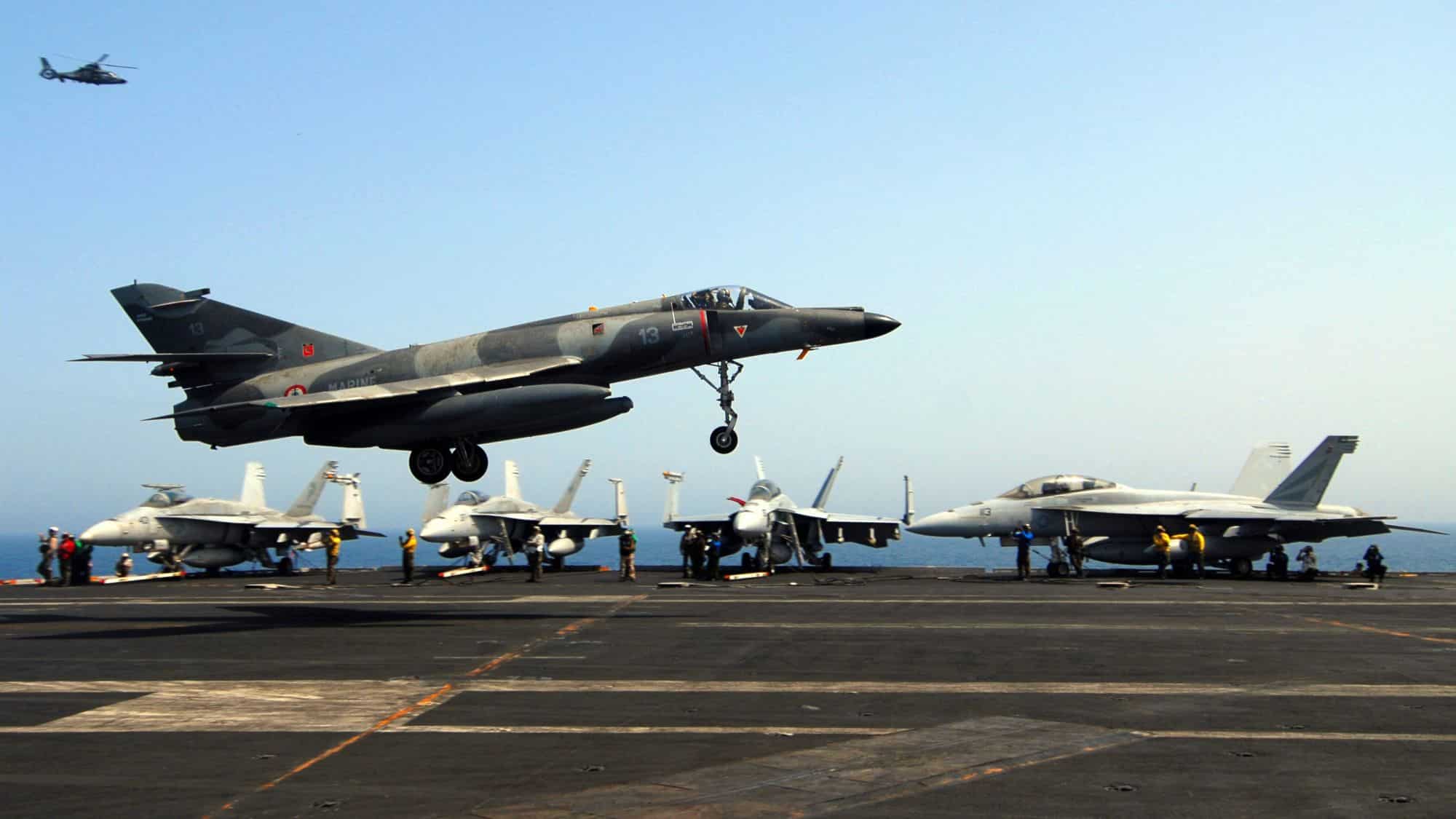
A French Super-Étendard from the French Navy Ship Charles de Gaulle performs a touch-and-go landing on the flight deck of the Nimitz-class aircraft carrier USS John C. Stennis on Apr. 12, 2007 in the north Arabian Sea. | Source: U.S. Navy photo by Mass Communication Specialist 3rd Class Ron Reeves

Rear Admiral Olivero further said the remaining two of P-3C Orion maritime patrol and anti-submarine warfare aircraft acquired from Norway are expected to arrive between June and October 2027.

Speaking about Plan Dédalo, Olivero explained that the wide-ranging decisions followed a rigorous study in 2025 by the Naval Air Council and the ARA chief, Admiral Juan Carlos Romay.

Saab Unveils A3-001 Collaborative Combat Aircraft Concept

22 August 2026 at 16:26
Saab A3-001

Saab plans to fly the first A3-001 demonstrator within 18 months, with three prototypes planned as the design evolves.

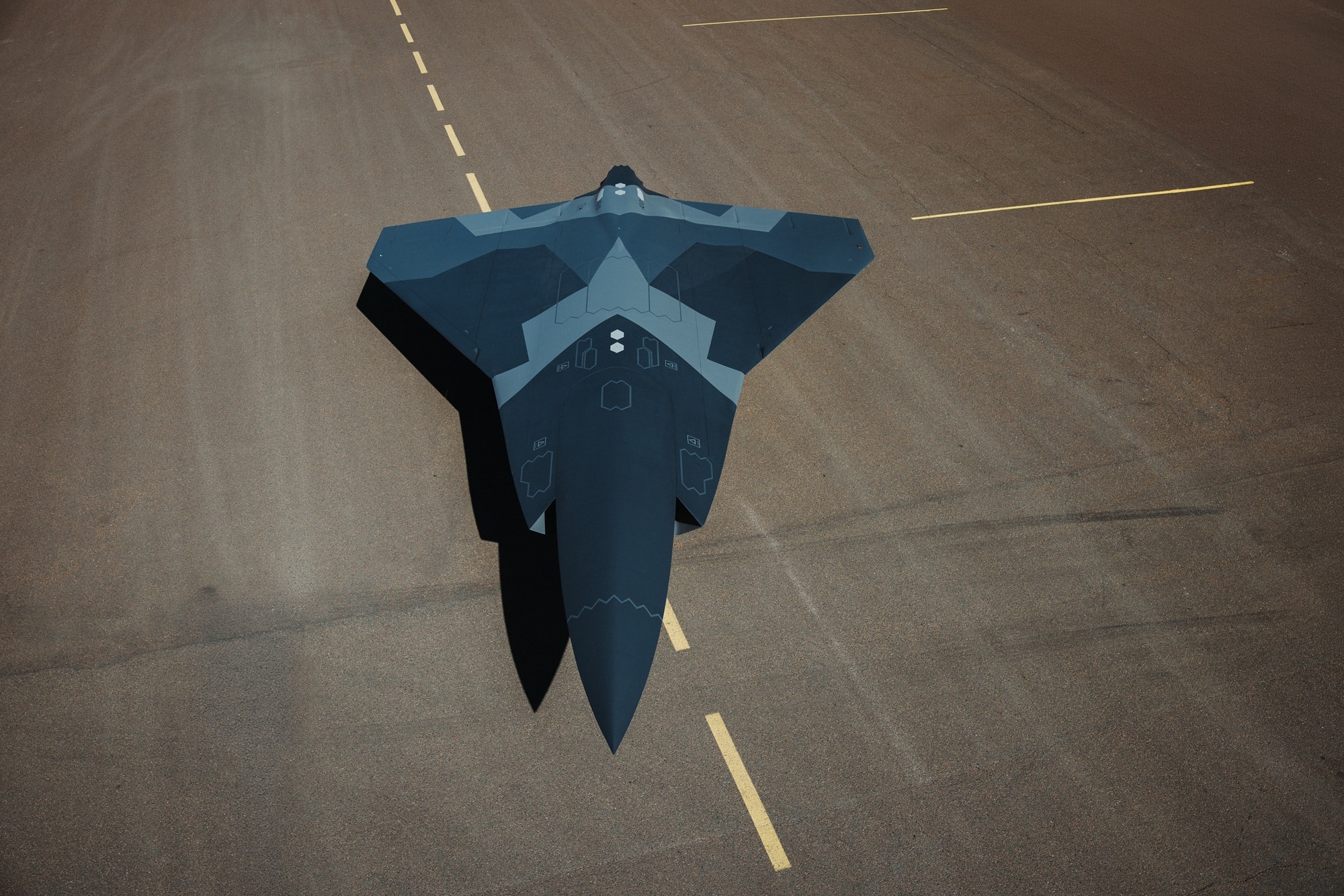
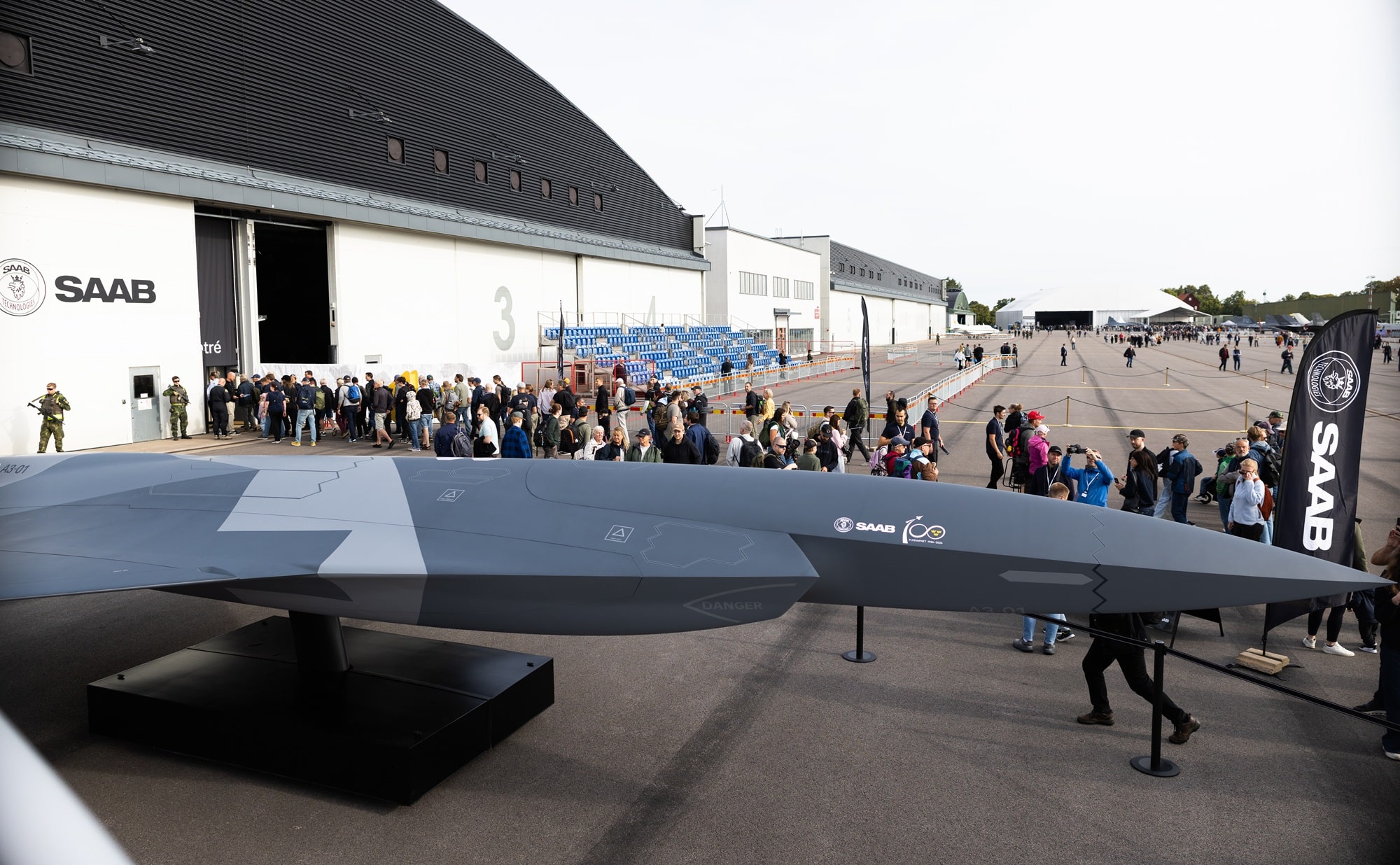
Swedish defense company Saab unveiled on Aug. 21, 2026 a full-scale model of its next-generation unmanned fighter aircraft, called the A3-001. The unveiling comes ahead of the Jubilee Air Show on Aug. 22 and 23 at Malmen Air Base in Linköping, the culmination of the Swedish Air Force’s celebrations for its 100th anniversary.

The aircraft is meant as a multi-role collaborative combat aircraft (CCA) which will primarily operate alongside the JAS39 Gripen E. Although the displayed model is tailless, Saab said it will also test prototypes both with and without a tail depending upon what the engineers’ encounter, the company’s Head of Advanced Programs Peter “Nizze” Nilsson told journalists.  

According to Corren, one of the news portals that attended the event, Nilsson explained Saab will first build a demonstrator designated as A1, which will be used to inform the development of the subsequent A2 and A3. The model that was displayed represents the A3 configuration, which will be without a vertical stabilizer.

In coordination with the Swedish Air Force (Flygvapnet) and the Defence Materiel Administration (FMV), Saab is targeting a first flight in “a year and a half.” This would translate to a first flight happening by the end of 2027 or early 2028.


View this post on Instagram


A post shared by Saab (@saab)

Interestingly, Saab in 2024 had presented a series of potential new-generation aircraft, including a crewed fighter as well as uncrewed CCAs/UCAVs, all of them working alongside the Gripen E. The concepts were aired on Sweden’s SVT Channel.

The newly unveiled A3-001 closely matches the unmanned fighter concept shown in Saab’s 2024 presentation, suggesting that the earlier concept has now evolved and the development phase is in progress.

Saab A3-001

Saab said that the A3-001 is designed for multi-domain operations and cooperation with manned aircraft across the air, land, maritime, space, and cyber domains. A screengrab of a promotional brochure lays out a roadmap for a first flight by 2031 and an Initial Operational Capability (IOC) by 2035.

The full-scale model of the Saab A3-001 Collaborative Combat Aircraft. | Source: Saab

The A3-001 features a blended wing-body configuration with a compound-delta planform and outward-swept trailing edges, and a prominent chine along the forward fuselage. The aircraft is single-engined, with the exhaust enclosed by a serrated shroud and lacks a conventional protruding nozzle, a configuration that may help reduce the aircraft’s infrared signature.

Welp, I guess it’s out there. Meet the A1, Saab’s High-Level ACP. I can’t fully say much on it for obvious reasons, gotta wait a bit longer, but I can say it is a pretty girl. The A1 is the first of what will be Saabs ACP prototypes, with her sister A2 to follow. pic.twitter.com/EJ4lLZ0M1J

— NOAH (@NoahGairn) August 21, 2026

Nilsson did say the A3 design is centered around low-observability and supersonic speeds. This brings us to the engine, which has not yet been selected as the aircraft is still on the design board.

Nilsson explained Saab could potentially use the same engine as the Gripen E. The fighter is powered by GKN Aerospace’s RM16, the Swedish version of the General Electric F414-GE-39E turbofan.

The full-scale model of the Saab A3-001 Collaborative Combat Aircraft following the unveiling in Linköping. | Source: Saab

The goal of the A3-001 drone is to put the pilot out of harm’s way during high-risk missions, with the unmanned aircraft flying ahead of the crewed fighter to perform sensing and other missions without exposing the pilot. In its statement, the company said the aircraft would conduct electronic warfare, suppression of enemy air defences, and precision strike operations in highly contested environments.

Speaking about the A3-001’s mission set, Nilsson said:

“We have just started delivering Gripen E. But unmanned aircraft can complement Gripen or any other combat aircraft. We can send the unmanned aircraft into tougher environments without risking Gripen E and the pilot. It can be used in different roles. It can be hunting, which requires high speed. But if you are going to carry out attack missions, it can be a little simpler and it should also be capable of electronic warfare. It should have sensors that are fully integrated with the Gripen and get closer to the target, send data back to the Gripen that drops bombs or fires missiles.”

Nilsson added that the work on the first prototype is already underway, reflecting the highly ambitious 18-month target to a first flight. The unmanned aircraft is expected to be “considerably cheaper than the Gripen,” pointing toward an emphasis on affordability.  

“We are currently in an intensive development phase where, together with Sweden, we are exploring technologies that will lay the foundation for the next generation of combat air systems,” said Nilsson. “As part of this work, we intend to fly uncrewed demonstrators with fighter-like characteristics before 2030 as we support Sweden in considering their future options.”

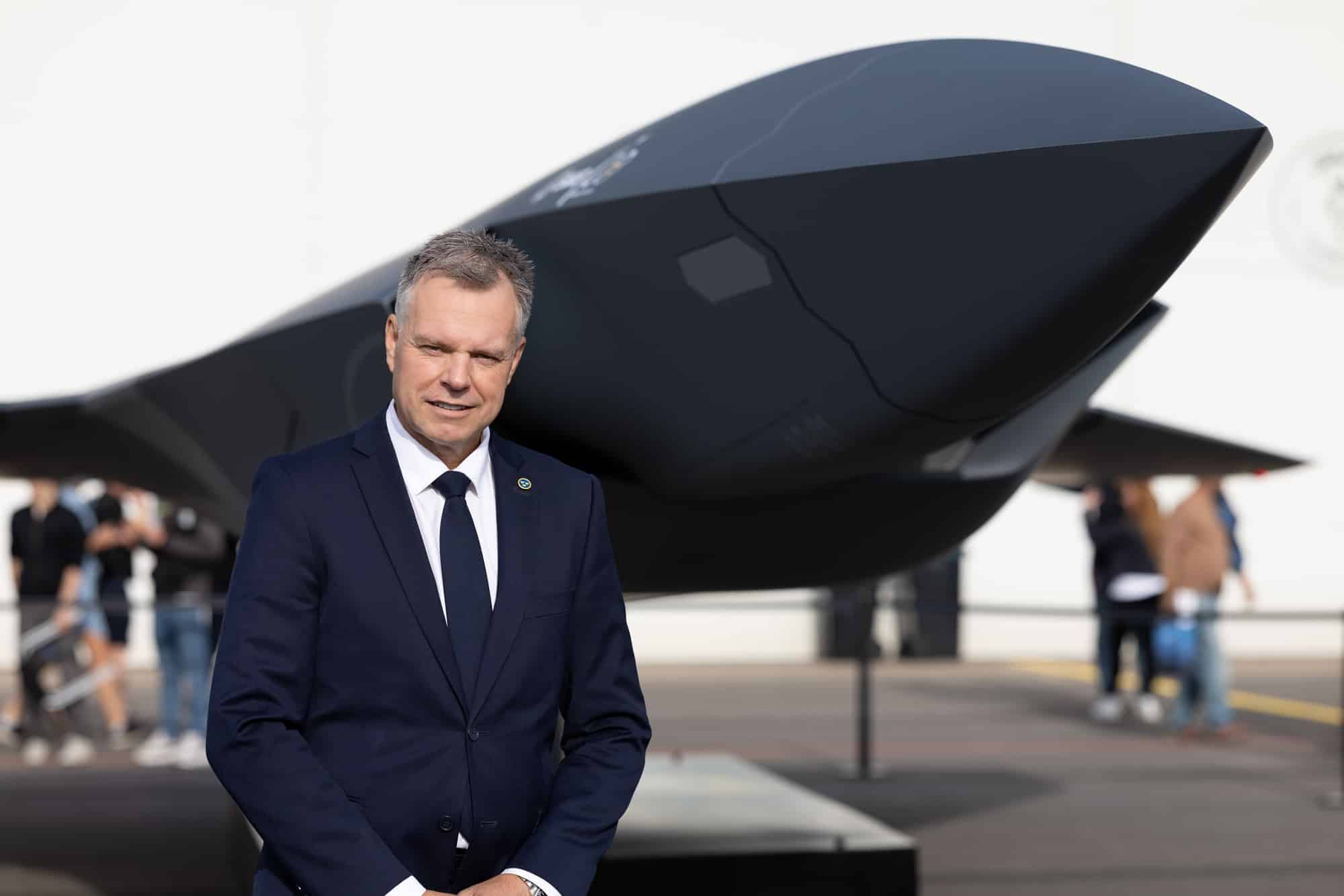
Saab’s Head of Advanced Programs Peter “Nizze” Nilsson in front of the A3-001. | Source: Saab

2024 CCA and next-gen fighter concept

In the 2024 segment on SVT Channel, Saab’s concept video presented a broad vision for what it described as an “ecosystem” of future collaborative crewed and uncrewed aircraft. Titled “Saab F-Series,” the aircraft in the ecosystem featured the “same brain in different bodies,” according to the company.

Saabs Peter Nilsson, head of Advanced Programs showing some future concepts for Swedish TV.

Perhaps next step, a loyal wingman to #Gripen E. And an overall vision of multiple air system components sharing DNA. #FCAS #aerospace

Screen dumps & source: https://t.co/xOhBIHwxWK pic.twitter.com/p7QvxXmXgQ

— Gripen News (@GripenNews) December 16, 2024


Among the assets included were a Manned Future Fighter,; a subsonic unmanned jet weighing less than five tons, the current Gripen E, a supersonic uncrewed five ton-plus fighter strikingly similar to the A3-001, and a low-cost subsonic drone with a weight of under one ton.

The manned fighter in the F-Series appears to be Saab’s proposed successor to the Gripen. The aircraft features a blended wing-body design, a double delta-wing with cropped edges and outward canted vertical stabilizers.

The subsonic unmanned fighter concept featured outward-canted vertical stabilizers and forward-swept engine intakes. This chisel-shaped intake is also seen on the A3-001.

China’s Y-15 Turboprop Tactical Cargo Aircraft Emerges in Clearest Images Yet

22 August 2026 at 14:22
China Y-15

New details emerged in the recent photos of the Shaanxi Y-15, initially known as Y-30, which is believed to be China’s future tactical transport aircraft.

China’s new Y-15 four-engine turboprop transport aircraft, developed by the Shaanxi Aircraft Corporation (SAC), has appeared in its clearest images yet. The aircraft is the latest development in Shaanxi’s long-running Y-8/Y-9 family of four-engine turboprop transports.

The aircraft, initially designated as Y-30 in scale models, was later revealed as Y-15 by China-based military observers. Images of the aircraft have been increasingly appearing unofficially on social media, especially since 2025, and the latest set of pictures give us our best look at what is believed to be China’s future tactical transport aircraft.

More of Y15 https://t.co/zSCSg9KpJC pic.twitter.com/LYCsydEy1q

— Hûrin (@Hurin92) August 20, 2026

Design and configuration

One image of the aircraft on the taxiway shows a probe extending forward from above the cockpit and enclosed in a tubular fairing. This could look like a refueling probe for the hose-and-drogue system used by Chinese aircraft, with a position comparable to Western aircraft.

However, as it can be noted in other pictures taken from the ground, the thin size of the probe would rather point to a long air-data boom. Such probes are commonly fitted to developmental aircraft to collect precise measurements of air pressure, temperature, airflow and other parameters during testing.

Considering its role, the aircraft is likely to receive an In-Flight Refueling (IFR) probe in future. The probe could replace the air-data boom and use the same fairing.

Regarding the configuration, the aircraft has a high-t tail and a straight, slightly tapered wing with winglets. These features are associated with a high lift configuration, useful for quick intra-theater transport with Short Take-Off and Landing (STOL) capabilities to be able to operate from austere runways.

Two more clear Images of the Y-15. pic.twitter.com/91lHOlI01w

— @Rupprecht_A (@RupprechtDeino) May 30, 2026

The four turboprop engines drive six-bladed propellers, a configuration which is now a standard feature across turboprops for improved performance, speed and handling.   

The Y-15 is understood to be powered by WJ-10 turboprops, which can produce around 6,800 hp each, according to unofficial figures. Sources report that the Y-15 might have a cargo capacity around 30 tons, compared to the earlier Y-9 which is in the range of 20-25 tons.

Interesting size comparison of all three PLAAF transports: Y-9, Y-15 & Y-20 as CG made by @大包CG pic.twitter.com/9JsykjK2Ei

— @Rupprecht_A (@RupprechtDeino) December 17, 2025

The Y-15 is often compared to the A400M for its visual similarities, although it cannot be considered as a Chinese equivalent. In fact, the A400M is a larger aircraft which can carry a 37-ton payload, and has substantially more power thanks to its four TP400D-6 turboprop engines, each of which produces 11,000 hp.

By comparison, the Y-15 appears closer to the C-130J in terms of size and intended mission than to the A400M. Its eventual payload, range and performance remain unconfirmed, however, so a direct comparison with either aircraft might not be accurate without additional data. 

IMO it is not an A400M equivalent but better fits into the size of a C-130J with a slightly wider fuselage … but overall the Y-15 reminds me a lot to an turboprop-powered YC-15! https://t.co/zNXSGemtCA pic.twitter.com/NL0PQK79MR

— @Rupprecht_A (@RupprechtDeino) December 17, 2025

Future

The Y-8 and Y-9 families provided the basis for various specialized aircraft, such as Airborne Early Warning and Control (AEW&C), anti-submarine warfare and maritime patrol or electronic warfare roles. At this stage, however, there is no indication of special-mission variants being in the works.

If I’m not mistaken, then this lineup of the 4th Transport Division, 10th Air Regiment shows at least 15 Y-9 transports.

(Image via by78/SDF) pic.twitter.com/zcJHGmQahr

— @Rupprecht_A (@RupprechtDeino) February 21, 2020

It is possible the Y-15 will eventually complement or even replace the Y-9 in future, leading to the creation of new specialized variants. These might incorporate newer sensors and electronics compared to the ones the PLA is currently introducing in service.

That’s just a new Y-9FQ (High New 15) next generation ASW aircraft. pic.twitter.com/kPNVjmYycj

— @Rupprecht_A (@RupprechtDeino) March 30, 2026

At this time it is unknown if China is planning to export the Y-15, although more info might become available should the aircraft take part in defense exhibitions such as the Zhuhai airshow. It should be noted that both the Y-8 and the Y-9 had success on the export market, and is thus likely that the Y-15 will follow suit.

Looks like Y-9E has a new customer besides Namibia: Kazakhstan Air Force pic.twitter.com/laD8jdS5bh

— Dan The Man (@tong96083420) August 14, 2026

Japan Intercepts Chinese TB-001 ‘Twin-Tailed Scorpion’ Drone Over East China Sea

21 August 2026 at 00:42
Japan Intercepts Chinese TB-001

The TB-001 was intercepted alongside a Y-9Z electronic warfare aircraft as Chinese and Russian aircraft continue to operate in Japan’s Air Defense Identification Zone.

Japan has said China’s Tengden TB-001 “Twin-Tailed Scorpion” surveillance-strike drone has been probing its airspace, triggering scrambles by Japan Air Self-Defense Force (JASDF) fighter jets. The Tengden TB-001 is a large Chinese Unmanned Combat Aerial Vehicle (UCAV) capable of carrying a substantial weapons payload that first appeared in 2022.

On Aug. 18, 2026 and a month prior on Jun. 12, the Japan MoD’s Joint Staff photographed and officially identified the Unmanned Combat Aerial Vehicle UCAV alongside an accompanying Y-9Z “High New” Signals Intelligence (SIGINT) and Electronic Warfare (EW) aircraft over the East China Sea (ECS), off western Japan. Japan’s Minister for environment and nuclear emergencies Shinjiro Koizumi called the Jun. 12 interception of the TB-001 the “first time” the UCAV was intercepted around Japanese waters.

令和8年8月18日(火)中国軍の情報収集機(Y-9)及び、偵察/攻撃型無人機(TB-001)が、長崎県男女群島沖から沖縄本島沖にかけて東シナ海上を飛行したことを確認し、これらに対して航空自衛隊 の西部航空方面隊等の戦闘機を緊急発進させ対応しました。 https://t.co/A6KtLEM6fj pic.twitter.com/8MlskzueNj

— 防衛省・自衛隊 (@ModJapan_jp) August 19, 2026

The Y-9Z has been periodically intercepted lately, with the latest incident being on Aug. 19, and before that on Jul. 6 and Aug. 12. The first time the Y-9 SIGINT aircraft was encountered around Japan was in August 2024.

The intervening period also saw interceptions of Russian Ilyushin Il-20 Coot-A SIGINT aircraft on Jul. 24 and Aug. 10, continuing a consistent pattern of Russia’s individual and joint patrols with Chinese aircraft around Japan.

令和8年8月19日(水)中国軍の情報収集機(Y-9)が、長崎県男女群島南方から沖縄本島沖にかけて飛行したことを確認し、 これに対して #航空自衛隊 の南西航空方面隊等の戦闘機を #緊急発進 させ対応しました。 pic.twitter.com/PqLIqKl4u3

— 防衛省統合幕僚監部 (@jointstaffpa) August 19, 2026

The intercepts

On both occasions, the TB-001 flew various patterns in a north-south direction off the Nagasaki and Okinawa Prefectures. The Japan MoD said about the Aug. 18 interception:

“On August 18 we confirmed that a Chinese military information-gathering aircraft (Y-9) and a reconnaissance/attack-type unmanned aerial vehicle (TB-001) flew over the East China Sea from off the Goto Islands in Nagasaki Prefecture to off the main island of Okinawa, and in response, we scrambled fighter aircraft from the Air Self-Defense Force’s Western Air Defense Force and other units.”

中国軍のTB-001偵察/攻撃型無人機が東シナ海上空を飛行することを確認・公表したのは今年度初めてです。
この無人機は、長距離・長時間飛行能力を有し、対艦・対地ミサイルを搭載可能な機種と指摘されています。
引き続き警戒監視と対領空侵犯措置に万全を期してまいります。 https://t.co/GEwxwAMQmX

— 小泉進次郎 (@shinjirokoiz) June 13, 2026

Regarding the Jun. 12 interception, the Joint Staff similarly had named both the aircraft and identified their route as coming “over the ECS from the south of Nagasaki Prefecture’s Danjo island to off the coast of Okinawa’s main island.” The tracks showed that on both occasions the Y-9 turned west towards China after heading north, while flying circular routes at some point in its journey.

Both their routes were very close and overlapped briefly. While the available data do not establish whether the two aircraft were operating as a manned-unmanned teaming (MUM-T) pair, their overlapping flight paths are notable. The U.S. and Australia have already demonstrated larger special mission aircraft like the E-7A Wedgetail and P-8A Poseidon could be used to control drones like the MQ-28A Ghost Bat and the MQ-4C Triton.

Koizumi said about the Jun. 12 TB-001 intercept, while calling it a “reconnaissance/attack-type” UAV: “This unmanned aerial vehicle is noted as a model that possesses long-range and long-endurance flight capabilities and can be equipped with anti-ship and surface-to-surface missiles. We will continue to maintain utmost vigilance in surveillance and take all necessary measures against airspace violations.”

🇨🇳China mostró los UAV TB-001 Twin-Tailed Scorpion en su nueva configuración de dron bombardero
(Imágenes vía wb/前站起飞) pic.twitter.com/zdysRAfMI8

— Drones de guerra 💥war drones💥 (@dronesdeguerra) December 6, 2022

TB-001

The Tengden TB-001 is a twin-tail boom and a tri-turboprop heavy drone, with the third rotor being a pusher propeller. It has a reported payload of 1.2 to 3 tonnes, and an endurance of 40 hours, according to available data.

🇨🇳важковик БПЛА TB-001 Twin-Tailed Scorpion з бомбовим навантаженням понад 3000 кг, дальністю до 8000 км і макс. часом польоту 36 год pic.twitter.com/BXsXzrNfuT

— Злий Конопляний Джмелик (@DimSel007) December 6, 2022

However, it must be noted that Japan’s official in-flight images of the TB-001 reveal some differences from the drone’s known configuration. In fact, the aircraft features an antenna atop the starboard (right-side) vertical stabilizer and has a visible flight-data probe.

1/4
🇨🇳Tengden TB-001 “Twin-Tailed Scorpion” MALE UCAV high quality photo thread in Zhuhai Air Show 2022.

Laser guided FT-9 & FT-7A (250kg) bombs & JK-2K missile & BA-7B & CM-502KG bombs

Could also carry AR-4, AR-3, FT-8D & FT-10 missiles (not in photo)
(via wb/能量机动工作室) pic.twitter.com/eOrsTW4sra

— Jesus Roman (@jesusfroman) December 27, 2022

Officially emerged in 2022 and unveiled in the 2022 edition of the Zhuhai Air Show, the drone captured attention owing to the massive representative payload of air-to-ground munitions it has been displayed and flown with. The TB-001 also has a large electro-optical ball turret.

I know I’m a “bit famous” for being a nerd 🤓 on PLA serial numbers and even if the latest imagery for the Tengden TB-001 “Twin-Tailed Scorpion” revealed a PLAAF-style serial number 20403, I’m sure it is not yet in PLAAF service nor is this a true serial.https://t.co/7Wl1fEP1fa pic.twitter.com/89Q0fFokHV

— @Rupprecht_A (@RupprechtDeino) June 28, 2023

Y-9 intercepts

The Y-9Z that was intercepted on Jul. 6 flew a circular north-south circuit. On Aug. 12, it flew a one-way north-to-south, according to the tracks.

The four-engine turboprop Shaanxi Y-9 is a popular Chinese carrier aircraft for special mission roles like Airborne Early Warning and Control (AEW&C) and Anti-Submarine Warfare (ASW). Observers have classified the as a Y-9-based SIGINT aircraft part of a family of progressively improved systems, beginning with the Y-9G.

The Y-9Z features large rectangular arrays on the rear fuselage (likely related to the EW/SIGINT payload), a canoe-like ventral fairing on the underside and a dome-shaped sensor under the chin (usually hosting maritime radars with synthetic radar imaging capabilities), as well as another dorsal fairing on the spine just behind the wings (possibly a SATCOM antenna).

令和8年8月12日(水)中国軍の情報収集機(Y-9)が東シナ海を飛行し、 これに対して航空自衛隊の西部航空方面隊等の戦闘機を #緊急発進 させ対応しました。 pic.twitter.com/sW2zHAKr4O

— 防衛省統合幕僚監部 (@jointstaffpa) August 12, 2026

There is another unidentified fairing on top of the horizontal stabilizer. Pipe-shaped sensors across the front-side fuselage and blade-shaped antennas along the spine, above the cockpit and the underside usually are related to encrypted radio communications and the communications intelligence (COMINT) role.

Block II Upgrades for E-2D Advanced Hawkeye Clear Critical Design Review

19 August 2026 at 23:28
E-2D Block II

The Block II’s open architecture for the E-2D’s mission systems, computers and displays enhance cockpit functionality, support future upgrades and improve sensor fusion.

The U.S. Navy’s E-2D Advanced Hawkeye Airborne Early Warning and Control (AEW&C) aircraft’s Block II upgrades have completed the Critical Design Review (CDR), Northrop Grumman and the U.S. Navy announced on Aug. 18, 2026. The Navy completed the CDF in May, but announced the milestone only now. Flight testing of the Block II-configured aircraft is scheduled to begin in Fiscal Year 2029.

This milestone follows a Jul. 22, 2026, U.S. Navy contract worth $1.2 billion awarded to Northrop Grumman for three E-2D Advanced Hawkeyes, which are scheduled for delivery by 2031. Naval Air Systems Command (NAVAIR), the contracting authority, initially obligated $583 million in FY2026 Navy aircraft procurement funds for the award.  

The Block II upgrade introduces an open systems software architecture, an upgraded cockpit architecture, improved battlespace management, increased computing power and modular interfaces intended to support future upgrades. Northrop Grumman says the CDR has cleared the path for integration, testing and delivery of Block II-configured aircraft by 2030. Existing E-2D Advanced Hawkeyes will also receive the Block II upgrades.

Our E-2D Advanced Hawkeye Block II upgrade held the critical design review, a pivotal step in bringing the most significant upgrades in the platform’s history. Learn more: https://t.co/kbcQMZ1zhr pic.twitter.com/c1iymeRHHU

— Northrop Grumman (@NGCNews) August 18, 2026

As of December 2025, the Navy had a total of 86 E-2 Hawkeyes of the C and D variants, including 62 E-2Ds delivered by the end of 2024. The service’s stated requirement is for 86 E-2Ds.

The Navy initially planned to end the procurement of the aircraft with the Fiscal Year 2024 budget request, but resumed acquisition in FY2026, with Congress approving funding for three aircraft. In the FY2027 budget request, the Navy has requested six additional E-2Ds, with plans to operate the type well into the 2040s.

Improved situational awareness, crew efficiency and future proof

Northrop Grumman has described Block II as the “most significant upgrade” in the E-2D’s development,  saying it will improve situational awareness and crew efficiency while preparing the platform for future upgrades. The company says that “using a modular open systems approach and commercial off-the-shelf products, Block II reduces costs and supports long-term fleet sustainment and modernization.”

Why is the E-2D Advanced Hawkeye one of the coolest things made in Florida?

✅Advanced radar and sensors
✅Real-time battle management
✅Proven command-and-control for U.S. and allied forces

Vote E-2D: https://t.co/VwHDgjH6MV https://t.co/48jYWL1cWT pic.twitter.com/en0WAaQHwl

— Northrop Grumman (@NGCNews) June 29, 2026

Northrop Grumman will integrate the Block II upgrade into the production line for new E-2Ds while also retrofitting aircraft already in service. The E-2/C-2 Airborne Command & Control Systems Program Office (PMA-231) said that Block II upgrade is centered on providing the “software foundation for rapid capability insertion.”

“This modernization introduces state-of-the-art cockpit architecture, increased computing power, an Open Mission Systems framework and robust cybersecurity,” said the Navy. “By integrating an Open Mission Systems architecture, the program resolves current and future parts obsolescence and enables rapid, non-proprietary technology insertion.”

The service further explained that the modernized cockpit and flight systems are also expected to “significantly reduce pilot workload and elevate situational awareness, allowing crews to focus on complex battlespace management.” 

Our technology led the way at Valiant Shield 2026. See how we’re enabling forces to sense, connect and command the battlespace with speed and precision. https://t.co/7Kz3rD3ne6 pic.twitter.com/7AoaiJ7Qzr

— Northrop Grumman (@NGCNews) July 2, 2026

A May 2025 Northrop Grumman release provided further details, stating that the “E-2D’s next-generation mission computers and displays are being designed to support open mission systems architecture, which will allow for flexible and rapid future incorporation of containerized capabilities.”

PMA-231 added its joint team with Northrop Grumman “rigorously assessed the finalized system Product baseline” during the CDR, transitioning the Block II upgrades “out of the design phase and into physical aircraft retrofits and flight-testing phases.”

E-2D upgrades so far

The E-2D’s primary sensor is the AN/APY-9 Active Electronically Scanned Array (AESA) radar, which provides detection and tracking of aerial and maritime targets. The Block II upgrades form part of the Delta System Software Configuration 6 (DSSC-6), that introduces new open-systems software, flexible interfaces, improved computing and data processing capabilities.

The modular architecture is also intended to support future Artificial Intelligence-Machine Learning (AL-ML) technologies, as well as new sensors and additional upgrades. A new cockpit architecture is designed to reduce pilot workload and support battlespace management.

We’re keeping the E-2D mission-ready, using AR and VR tech to cut repair times by up to 75%, getting aircraft back in the air faster. https://t.co/yviiMa0JA9 pic.twitter.com/4jqrbbBO0r

— Northrop Grumman (@NGCNews) May 21, 2026

The Navy received the first E-2D in June 2007, while the final production contract was awarded in March 2013. According to a September 2024 report by DoW’s Office of the Inspector General, Operational, Test and Evaluation (OT&E) by the Navy’s Operational Test and Evaluation Force (OPTEVFOR) since July 2014 has informed successive Delta System Software Configurations. DSSC-1 included upgrades to the radar, mission computer display and communications system.

The Navy received its first E-2D in June 2007, while the final production contract was awarded in March 2013. According to a September 2024 Department of Defense Office of Inspector General report, operational testing by the Navy’s Operational Test and Evaluation Force (OPTEVFOR) since July 2014 has informed successive Delta System Software Configurations.

DSSC-1 introduced upgrades to the radar, mission computer display and communications system. DSSC-2 added satellite communications and an Identification Friend or Foe (IFF) system. DSSC-3 improved target-tracking functionality, while DSSC-3.1 upgraded radio communications and aerial-refueling capabilities. DSSC-4 introduced improvements to data fusion, the satellite navigation (SATNAV) system, beyond-line-of-sight (BLOS) communications and sensor integration, as well as a tactical targeting network capability.

E-2D Breakthrough! The E-2D Advanced Hawkeye successfully refueled mid-air from 3 French tankers (Rafale, MRTT, A400M)—a historic first! This extends its range for continuous surveillance, boosting joint #Lethality & #Readiness. #Warfighting #NavalAviationhttps://t.co/UlvPjHqjSV pic.twitter.com/lkXjZ0DPsU

— NAVAIR (@NAVAIRNews) September 27, 2025

At the time, DSSC-5 and DSSC-6 were planned to be incorporated by FY 2025 and FY 2026, respectively. DSSC-5 included upgrades to the sensors and counter-electronic attack capability, while DSSC-6 would include “readiness and reliability upgrades paired with architecture improvements.”

This year has seen several developments for the E-2D Advanced Hawkeye. In January, the U.S. Navy awarded a contract to BAE Systems to establish a dedicated depot for the maintenance of the E-2D’s AN/APX-122A IFF system, worth $62 million.

In April, Lockheed Martin and Northrop Grumman completed flight testing of the Digital Receiver Exciter Recorder, a new radar subsystem. The same month, Northrop Grumman selected Green Hills Software’s real-time operating system for the Hawkeye’s GPS-modernized Embedded GPS/Inertial Navigation System. 

A @USNavy E-2D Advanced, BU #169870 CAG LIVRY from VAW-117 the #WALLBANGERS , CVW-9, based at @NBVCCalifornia w/ an amazing 13 SHAHED-129 KILLS & 4 Cruise Missile KILLS. WOW! #HAWKEYEPOWER shot recovering during #GrayFlag2025 #FLYNAVY 09-17-25 pic.twitter.com/fRCfYfJaTj

— Matt Hartman (@ShorealoneFilms) September 18, 2025

E-2D Advanced Hawkeye relevance

The E-2D Advanced Hawkeye is currently operational with eight of the nine deployable U.S. Navy Airborne Command and Control Squadrons (VAW) assigned to the Carrier Air Wings (CWV). The aircraft played a vital role in the West Asia conflict in 2024, tracking Shahed-type One-Way Attack (OWA) drones. 

France, Egypt and Taiwan are the international users of the E-2C Hawkeye. The French Navy is scheduled to transition to the E-2D in 2027, while the U.S. Navy will transition its last E-2C squadron.

RTX Receives $22 Billion Contract to Accelerate Tomahawk Production

18 August 2026 at 16:10
Accelerate Tomahawk Production

The award follows other investments in munitions production capacity aimed at reducing delivery times, strengthening supply chains and supporting U.S. and allied demand.

Raytheon, an RTX business, has received a $22.9 billion, seven-year contract from the U.S. Navy to accelerate production of Tomahawk cruise missiles, the company and Department of War announced on Aug. 17, 2026. The contract is part of the Department’s Arsenal of Freedom initiative and is intended to increase annual BGM-109 Tomahawk Land-Attack Missile (TLAM) production to more than 1,000 missiles.

The award follows a broader landmark agreement from February to “increase production capacity and speed deliveries” of the TLAM and other munitions like Advanced Medium Range Air-to-Air Missiles (AMRAAM), Standard Missile-3 (SM-3) Block IB, SM-3 Block IIA and SM-6 interceptors. Under the agreement, RTX said the annual production of Tomahawks would increase to more than 1,000, the AMRAAM’s production would reach at least 1,900, the SM-6 more than 500, while SM-3 IIA and SM-3 IB figures have not been disclosed.

The @DeptofWar and @USNavy just awarded a $22.9B contract to @Raytheon to ramp up Tomahawk missile production. This major investment fortifies the defense industrial base and delivery to the Joint Force. https://t.co/FSOwzUUjpm pic.twitter.com/nj1MlGqncb

— USW(A&S) (@DoW_USW_AS) August 17, 2026

The new contract comes after the U.S. used a significant number of Tomahawk missiles during the war with Iran, including at least 1,000 reportedly fired during Operation Epic Fury. RTX said supporting the increased annual production of the missiles “ensures a stable, predictable supply for the Navy and allies.”

Fortify supply chains, reduce delivery timelines

Under Secretary of War for Acquisition and Sustainment Michael P. Duffey said the contract will increase manufacturing throughput, strengthen the missile’s supply chain and reduce procurement lead times. Calling the TLAM “a critical long-range strike capability,” he further added its accelerated production “increases our ability to equip the Joint Force, ensuring our Warfighters never face a fair fight.”

We called on industry to rapidly scale up munitions output, and @RTX_News is delivering.

This landmark Tomahawk contract ensures our warfighters continue to have the lethal firepower they need to win. pic.twitter.com/YekpFgKXSg

— Acting Secretary of the Navy Hung Cao (@SECNAV) August 17, 2026

“This landmark $22.9 billion investment will accelerate Tomahawk missile delivery to our warfighters at unprecedented speed,” Acting Secretary of the Navy, Hung Cao said. By working closely with industry to expand our munitions industrial base’s capacity, the Department is utilizing every available tool to meet the demands of our current operations, ensuring they are equipped to fight, win, and come home safe.” 

In its latest statement, RTX said that its recent investments in manufacturing capacity to ramp up TLAM production translated into three times as many missiles being delivered in the first half of 2026 compared to the corresponding period of 2025. “With this contract, RTX will increase capacity and collaborate closely with hundreds of small and mid-sized suppliers nationwide to rapidly scale output to meet long-term needs,” added the company.

BGM-109 TLAM

The Tomahawk is a long-range, subsonic cruise missile that has been in U.S. service for over forty years and is one of the most widely known missile types even outside of the defence industry. The weapon is primarily launched from surface ships and submarines, but it has also been integrated with the U.S. Army’s ground-based Typhon system and is being acquired by several U.S. allies.

File photo of the Los Angeles-class fast-attack submarine USS Annapolis (SSN 760) launching Tomahawk cruise missiles in 2018. | Source: U.S. Navy photo by Mass Communication Specialist 1st Class Ronald Gutridge

The Block IV and Block V Tomahawks have a publicly stated range of more than 1,600 km and carry a 1,000-pound-class warhead. The missile uses a combination of inertial navigation, GPS and terrain following capabilities that allow high-speed low level flight to increase survivability.

Tomahawk international users

Japan is also expanding its Tomahawk inventory. In July, the Japan Maritime Self-Defense Force’s Kongō-class destroyer JS Chōkai became the country’s first warship to launch the TLAM during a live-fire test. Japan is acquiring 400 missiles to strengthen its long-range strike capability.

Germany is also moving toward acquiring the missile. Reuters reported on July 9 that German Chancellor Friedrich Merz told lawmakers that Berlin had signed a letter of intent with Washington to purchase Tomahawks on the sidelines of the NATO summit in Ankara.

🇯🇵JMSDF conducts its first firing of a Tomahawk Land Attack Missile from JS Chokai.

Japan is purchasing around 200 Block IV and 200 Block V TLAM to equip at least 5 of its AEGIS destroyers.

Via @JMSDF_PAO pic.twitter.com/nRiMlO1oTE

— Navy Lookout (@NavyLookout) July 30, 2026

While the number of Tomahawks to be purchased remains undisclosed, the LoI signed with Washington was expected to be followed by formal approval in August. The deal would also include ground-based Typhon launchers.

Australia, the Netherlands and the United Kingdom are other TLAM users, with London using the missile from its submarines. Canberra and Amsterdam, on the other hand, use the missile from their surface combatants.

GE’s T901 Engine Clears Preliminary Flight Rating for UH-60 Black Hawk

17 August 2026 at 23:24
T901 Preliminary Flight Rating

The next-generation T901, developed as part of the ITEP program, cleared the Preliminary Flight Rating and will now proceed toward full airworthiness qualification testing.

The T901 engine developed by GE Aerospace to replace the T700 engines powering the U.S. Army’s UH-60M Black Hawk and AH-64 Apache fleets has completed Preliminary Flight Rating (PFR) testing, the service announced on Aug. 12, 2026. The Army described the PFR as a key airworthiness milestone on the path toward full qualification.

This new development comes a year after the T901’s first ground test in January 2025 on a Black Hawk. Images from both the test events show orange-colored shrouds on both the main and tail-rotor assemblies, believed to contain sensors to collect data on the engine’s performance. 

The Army said that the next step is the full airworthiness qualification testing, which is scheduled to begin in the first quarter of Fiscal Year 2027 and will run in parallel with the UH-60M’s developmental testing. The campaign will include Flight Load Surveys and continued flight tests to “demonstrate the added capabilities the T901 provides for the UH-60M at heavy, high, and hot conditions.”   

Additionally, the Army released on Aug. 14 a sources sought notice for the production of the T901. This will allow the service to push the engine into rapid production after testing concludes.

The two T901-GE-900 engines for the UH-60M Black Hawk helicopter integration delivered by the U.S. Army to Sikorsky at the latter’s facility in West Palm Beach, Florida. | Source: Sikorsky

T901 engine

The T901 was developed in response to the Army’s Improved Turbine Engine Program (ITEP) effort, with the primary requirement of a 3,000 shaft-horsepower powerplant for the UH-60 and AH-64. GE Aerospace says that the T901 is an improvement in several attributes to the existing T700.

Compared with the T700, the T901 provides 50% more power and 25% better specific fuel consumption, translating into “less fuel usage and fewer carbon emissions,” while its single-spool core architecture is intended to simplify maintenance. GE also says the engine incorporates ceramic matrix composites and additive manufacturing to reduce weight and improve efficiency.

Plans to upgrade the MH-60M Black Hawks operated by the 160th Special Operations Aviation Regiment “Night Stalkers” (160th SOAR) depend in part on the T901’s development. U.S. Special Operations Command (SOCOM) officials told journalists at the SOF Week conference in May that they hope to integrate the T901 into their MH-60Ms to create a Block 2 variant of the type. 

We have light off!

For the first time, a UH-60M Black Hawk conducted ground runs equipped with two @GE_Aerospace T901 Improved Turbine Engines. pic.twitter.com/xqVV1ScQaE

— Sikorsky (@Sikorsky) January 29, 2025

The Army emphasized how the T901’s development deviated from traditional engineering practices. The conventional route has been “a slow, step-by-step process” with years of testing prototypes “in a sealed ground chamber” to test parts until they fail from fatigue, allowing engineers to identify weaknesses and redesign them before flight testing begins.

Moreover, the T901 program “changed the paradigm with simultaneous ground and flight testing,” the Army said. The service explained that “running ground and flight trials in parallel allowed the team to rack up over 2,600 test cell hours and more than 90 hours of aircraft ground and flight test time.”

This approach shortened the “feedback loop between the ground and air,” where if test pilots detected a minor anomaly during a flight run, ground engineers “could immediately replicate the conditions, diagnose the issue, and push software or hardware refinement back to the flight line for the next day’s mission.”

The modified UH-60 Black Hawk at Sikorsky’s facility in West Palm Beach, Florida during the ground testing of the GE T901 engine. | Source: Sikorsky

Digital engineering and high-and-hot testing

Before the physical T901 engine powered an aircraft, its design had already undergone thousands of hours of simulated testing in a digital environment during the Engineering and Manufacturing Development (EMD) phase. The Army explained the team built a digital twin and used Numerical Propulsion System Simulation to run thousands of iterations, incorporating real-world data from early altitude testing.

The combined Lockheed Martin, GE, and the U.S. Army team also used advanced Computational Fluid Dynamics to model complex aerodynamic and thermal behaviors. By simulating heat transfer within the cramped confines of the helicopter’s engine compartment before manufacturing any physical parts, the team mitigated integration risks and saved months of software and hardware redesigns.

The ultimate benchmark for the T901 is its high-and-hot operational rating: the ability to deliver full mission performance at 6,000 feet in 95-degree Fahrenheit conditions (6k/95°), where high density altitude severely degrades engine performance.

To expand the engine’s flight envelope so it could handle these extreme operational conditions, the program took a methodical, stepped approach. The Army says the recent testing reached 17,000 ft and 160 knots and established the foundation for the formal operational assessment of the 6k/95° requirement planned for FY2028.

Chinese National Sentenced to Six Months After Unlawfully Photographing Whiteman AFB

15 August 2026 at 20:35
Chinese sentenced Whiteman

Authorities said Wu’s repeated photography of Whiteman AFB’s infrastructure, including after a warning, distinguished the case from ordinary aircraft photography.

Qilin Wu, the Chinese national who in January was charged with unlawfully photographing Whiteman AFB, Missouri, home to the U.S. Air Force’s B-2 Spirit bombers, was sentenced to six months in federal custody by U.S. Magistrate Judge Jill A. Morris in Kansas City, the Air Force Office of Special Investigations (AFOSI) said on Aug. 13, 2026.

The agency said that an investigation was launched because, despite receiving a warning to not photograph the base in the incident on Dec. 2, 2025, Wu returned to the spot the next day and continued capturing new photos of the installation.

Apr 21: 🇨🇳 national Qilin Wu pleaded guilty in federal court to one count of taking photographs of a vital military installation and military equipment without authorization.

On Dec 2, 2025, the Whiteman Air Force Base Office of Special Investigations (AFOSI) investigated a… https://t.co/OJlLPdOwNc pic.twitter.com/NwTtjpUx3N

— Byron Wan (@Byron_Wan) April 23, 2026

This was also explained in the press release: “In Wu’s case, investigators said the concern was not just his camera, but that he returned after being warned and photographed more than the aircraft. That conduct ultimately led to an investigation, guilty plea and sentencing.”

Following his formal arrest, the U.S. Department of Justice (DOJ) on Apr. 22 announced that Wu had pleaded guilty before U.S. Magistrate Judge Jill A. Morris. In the sentencing hearing earlier last month, Wu was remanded to the custody of the U.S. Marshals Service.

He had previously entered the country illegally in June 2023, and was arrested a first time by the Immigration and Customs Enforcement (ICE). “Due to a lack of detention space, Wu was released on his own recognizance to await immigration removal proceedings originally scheduled for Feb. 9, 2027,” said the DOJ. On Dec. 3, 2025, he was arrested once again by ICE.

A U.S. Air Force B-2 Spirit aircraft departs Whiteman Air Force Base, Missouri, during Exercise Global Thunder 26, Oct. 26, 2025. | Source: U.S. Air Force  photo by Senior Airman Bryson Sherard

The case

The incident in question took place on Dec. 2, 2025, when members of the 509th Security Forces Squadron responded to a report of a suspicious minivan near Whiteman’s perimeter. Wu, who was driving a vehicle with Massachusetts license plates, said he had come to observe the B-2.

In addition to the B-2 bombers, he photographed base infrastructure and equipment, going beyond mere aviation photography. As we had written at the time:

“[…] in the United States, photographing military installations from public land is generally lawful and protected, and by itself does not constitute a crime. Plane spotting and photography near air bases is a long-established and largely accepted practice, provided no trespassing occurs and no other laws are violated.”

However, the circumstances and the return after being warned heightened the investigators’ concerns. The AFOSI release quoted a senior unidentified official who noted the “pattern of behavior” which “made this different.”

A U.S. Air Force B-2 Spirit takes off to support Operation MIDNIGHT HAMMER at Whiteman Air Force Base, Missouri, June 2025. | Source: U.S. Air Force

“In Wu’s case, investigators focused on his repeated conduct, his return after being warned and the subjects captured in his photographs,” the AFOSI press release said. The DOJ had said that 18 images and videos were found on Wu’s phone, showing the base area, the aircraft and other military equipment.

He also admitted that he had photographed other locations in Florida and Virginia, although the press release did not identify them.

A Cold War-era legal framework

The AFOSI mentioned the use of the Cold War-era Executive Order 10104 signed by late President Harry S. Truman on Feb. 1, 1950. The other law applied in Wu’s prosecution was Section 795 of United States Code Title 18.

Both laws deal with “unauthorized photographs, sketches, maps and other visual representations“ of U.S. military bases and equipment. Specifically, Executive Order 10104 established the framework for designating military installations and equipment subject to these restrictions, while Section 795 of Title 18 of the U.S. Code provides the criminal penalties for unauthorized photography and other visual representations.

B-2 upgrades
U.S. Airmen assigned to the 509th Logistics Readiness Squadron and 393rd Bomber Generation Squadron conduct hot-pit refueling for a B-2 Spirit at Whiteman Air Force Base, Missouri, May 28, 2025. | Source: U.S. Air Force photo by Staff Sgt. Joshua Hastings

Wu admitted that he repeatedly photographed aircraft and infrastructure at Whiteman as well as locations in Florida and Virginia. He could have faced up to a year in prison, as well as a fine, but the court sentenced him to six months.

Col. David Bethel, commander of the AFOSI Region 8, said that “when someone gathers information around a sensitive military installation, AFOSI has the tools to hold them accountable.” He further added this case was “about recognizing that the operating environment has changed,” referring to the shift from “clear-cut threats in overseas environments to more ambiguous activity around military installations inside the United States.”

Mi-24 Hind Plays ‘Adversary’ in U.S. Marine Corps Exercise

13 August 2026 at 00:13
Mi-24 threat replication

Since 2020, two Mi-24D Hind helicopter gunships have provided invaluable threat replication to the U.S. Marine Corps, Army and Air Force.

The participation of a Russian-made Mi-24D Hind attack helicopter in the U.S. Marine Corps Adversary Force Exercise (AFX) 4-26 at the Marine Corps Air Ground Combat Center in Twenty Nine Palms, California, has again shone the spotlight on dissimilar combat training with actual threat platforms the U.S. has been running for a while.

Two known Mi-24 airframes, ‘118’ and ‘120’ – with the numbers stenciled just before the engine exhausts, have appeared in Marine and U.S. Air Force press releases on DVIDS since 2020. The two Hinds have served realistic threat replication in aerial ground attack for the Marines, the U.S. Army, and helicopter-on-helicopter testing against both the U.S. Air Force Rescue Squadrons’s (RQS) HH-60G Pave Hawks and Army UH-60 Black Hawks. 

The latest official images, captured on Jul. 31, 2026 released on the DVIDS network on Aug. 9, show ‘118’ providing “air support during a company attack” during the AFX. The AFX offers “training and certification across multiple warfighting functions in realistic force-on-force scenarios,” explains the service.  

An ex-Bulgarian Air Force Mi-24D Hind-D (N118NX) provides air support during a company attack as a part of Adversary Force Exercise 4-26 at Marine Corps Air-Ground Combat Center Twentynine Palms, California, Aug. 1, 2026.

(📸/U.S. Marine Corps photo by Sgt. Vincent Needham) https://t.co/I2LtujCXeQ pic.twitter.com/ro7Ze3Uy1G

— Guy Plopsky (@GuyPlopsky) August 10, 2026

It is important to note that this is not the first time Russian aircraft have been used by the U.S. government. In fact, around 30 Russian Mi-17s and the type’s export variant, the Mi-171, are estimated to be operated by the CIA and the U.S. Army’s Aviation Technology Office (ATO), and are periodically sighted flying without recognizable markings.

Mi-24s in U.S. military exercises

We previously reported here at The Aviationist on Jan. 24, 2020 about the first time U.S. Air Force used an actual adversary aircraft to replicate threats instead of their own HH-60 Pave Hawks. The exercise saw the 355th Wing’s 55th RQS “training with two Russian Mi-24 attack helicopters at Davis-Monthan AFB outside Tucson, Arizona.” Both ‘120’ and ‘118’ were seen in the official images.

A Mil Mi-24 Hind helicopter simulates an adversary attack during a Base Recovery After Attack Training as part of Integrated Training Exercise 1-26 at Marine Corps Air Ground Combat Center, Twentynine Palms, California, Jan. 31, 2026. | Source: U.S. Marine Corps photo by Lance Cpl. Jozef P. Majewski

The then 55th RQS flight commander Capt. Kurt Wallin said: “This is the first time this training has been done outside the weapons school at Nellis AFB. This is [also] the first time we have trained outside of HH-60G Pave Hawk versus HH-60G. This training lets us see the capabilities of other aircraft against our own tactics and procedures.”

A Mil Mi-24 Hind helicopter simulates an attack during a Base Recovery After Attack Training as part of Integrated Training Exercise 4-25 at Marine Corps Air Ground Combat Center, Twentynine Palms, California, August 2, 2025. | Source: U.S. Marine Corps photo by Lance Cpl. Jozef P. Majewski

Since then, ‘120’ has appeared in Base Recovery After Attack Training (BRAAT) drills at Twenty Nine Palms on Jan. 31, 2026 and Aug. 2, 2025. The BRAAT drill from Feb. 1, 2025 doesn’t clearly show the Mi-24’s airframe number.

A Mi-24 Hind Attack Helicopter coordinates a simulated attack during a Basic Recovery After Attack exercise as part of Integrated Training Exercise 1-25, at the Strategic Expeditionary Landing Field, Marine Corps Air-Ground Combat Center, Twentynine Palms, California, Feb. 1, 2025. | Source: U.S. Marine Corps photo by Cpl. Anna Higman

One Mar. 27, 2024, the Weapons and Tactics Instructor (WTI) Course 2-24 near Marine Corps Air Station (MCAS) Yuma, Arizona, saw ‘118’ flying as an opposing force against U.S. Army UH-60 Black Hawks. This also marked the first time Army Black Hawks participated in a Marine WTI exercise, which integrates Marine ground forces, command and control systems, logistics and air defense.  

A Mil Mi-24 Hind helicopter assigned to Marine Aviation Weapons and Tactics Squadron One flies as an opposing force rotary aircraft during the Weapons and Tactics Instructor Course 2-24 near Marine Corps Air Station Yuma, Ariz., March 27, 2024. | Source: Alaska National Guard photo by Alejandro Peña

A Feb. 15, 2022 video again featured the U.S. Air Force’s 55th RQS which employed a Hind for “more realistic training against a potential adversary aircraft,” according to Capt. Glynis Facciano.

Then, on Jun. 6, 2022 at Moody AFB, Georgia, the 41st RQS maneuvered its Pave Hawk against ‘118’. Pilots Capt. Tyler Hudson and Maj. Matthew Keough said the “fight against an actual threat helicopter” in “basic helicopter maneuvering” gave an “accurate representation both visually and aerodynamically.”

Another event dates back to Apr. 20-22, 1997 reported on DVIDS on Jun. 27, 2025, where a Mi-24 conducted a ground attack in a simulated aerial chemical strike at the Dona Ana Range at Fort Bliss. The caption said this airframe was operated by the Optec Threat Support Activity based at Biggs Army Airfield in Texas.

A few months later in Jun. 1997, the U.S. and Saddam Hussein’s Iraq clashed diplomatically over United Nations Special Commission Weapons (UNSCOM) weapons inspectors. 

A Mi-24 Hind attack helicopter simulates ground attacks as it flies in the mist of a simulated aerial chemical attack on an air defense site at Dona Ana Range, Fort Bliss, El Paso, Texas, on April 22, 1997, during Exercise Roving Sands ’97. The Russian made helicopter is operated by Optec Threat Support Activity, Biggs Army Airfield, Texas. | Source: U.S. Air Force photo by Senior Airman Jim Shryne

Origins

A Mar. 15, 2018 feature by Elan Head for Vertical Magazine, said that the Hinds used in the threat simulation likely belong to VTS Aviation LLC (VTSA) out of Tacoma, Washington, and System Studies & Simulation (S3) Inc. out of Huntsville, Alabama.

The two Hinds have Bulgarian origins and were displayed at the Cold War Air Museum until 2017 when the venue closed, and then began to appear in threat simulations under contract for the U.S. military.

It appears however that the U.S. Marine Corps might now have stepped in, as the captions accompanying the latest images mention that the Mi-24s are operated by the service. The captions of the 2024 images further mentioned that the helicopters are assigned to Marine Aviation Weapons and Tactics Squadron One (MAWTS-1).

Mi-24 Hind

The Mi-24 Hind is the only heavyweight-class attack helicopter that is also a tactical troop carrier. The cabin, with an eight-person capacity, primarily extensively served troop insertion and exfiltration, especially during the Soviet-Afghan War.

The helicopter was first introduced in the 1970s for combat in eastern Europe with NATO. The eight-year-long counter-insurgency war in Afghanistan later exposed its limitations, as safety concerns for the on-board infantry restricted Hind crews from more aggressive tactics. Troops were thus often flown on Mi-8s, with the Mi-24s providing fire support.

A Ukrainian Mi-24 performing an ultra-low-level flight over fortified defensive lines. pic.twitter.com/vX75CZqlFO

— Special Kherson Cat 🐈🇺🇦 (@bayraktar_1love) June 12, 2026

However, an attack helicopter with a large cabin with reconfigurable seats and stretchers does offer a ton of functionality across MEDEVAC/CASEVAC, tactical resupply and Combat Search and Rescue (CSAR) roles –  especially in the absence of separate assets for these missions. In Ukraine, Russia’s rotary-wing CSAR package typically consists of a weaponized Mi-8/Mi-17, supported by a Ka-52 Alligator and/or a Mi-28 Havoc.

Attack helicopters today have adopted a counter-drone role, with the Ukrainian Mi-24 too being used widely in hunting Russia’s One-Way Attack (OWA) UAVs. However, this mission profile imposed on Ukraine’s limited Hinds restricts their massive utility in pushing back Russian forces on the ground, although helicopters themselves have been vulnerable to small drones.

The Mi-35M is the Hind’s most heavily upgraded variant developed by Mil. It features an improved engine, rotor blades, transmission, drivetrain offering enhanced ‘hot and high’ performance, a digital night vision-capable glass cockpit and improved navigation and communications suites.   

Another Ukrainian Mi-24 bearing an impressive 98 kill marks for Russian drones shot down. https://t.co/WQy5T79k1b pic.twitter.com/zmgXG19T0f

— Special Kherson Cat 🐈🇺🇦 (@bayraktar_1love) August 6, 2026

Damaged USAF C-17 Flies Again After First-of-its-Kind Repair

8 August 2026 at 23:23
Damaged C-17 Repaired

A C-17 of the 445th Airlift Wing extensively damaged in March 2025 was repaired by using new technologies of the Rapid Sustainment Office, after no vendors were able to provide the needed parts.  

The Air Force Rapid Sustainment Office (RSO) helped put a C-17 Globemaster III back in the air with the first use of a new manufacturing technology after it has been grounded since March 2025. The RSO’s Advanced Manufacturing Program Office Automation and Robotics (A&R) team employed the Incremental Sheet Forming (ISF) system to repair damaged airframe panels of tail ‘0194’ from the 445th Airlift Wing (445th AW)

The Globemaster III took its first flight after the repairs on Jul. 30, 2026 from Wright-Patterson AFB, images on the DVIDS network showed. The Aug. 4, 2026 press release from the Air Force Life-Cycle Management Center (AFLCMC) said the first such successful effort has also spurred the RSO to produce parts for a KC-135 and an F-15.

With Boeing’s interest in resuming the C-17’s production being reported since last year yet to translate into a formal decision, such innovations will greatly benefit the roughly 220 C-17s in service with the U.S. and the smaller fleets of India, United Arab Emirates, Qatar, Kuwait, Canada, Australia and the United Kingdom. The company closed its production line at Long Beach in California after putting together the 279th Globemaster III on Feb. 26, 2015.

The Rapid Sustainment Office is redefining aircraft readiness by delivering a first-of-its-kind repair solution, proving that innovation, advanced manufacturing, and rapid problem-solving keep our warfighters mission ready when it matters most. #OneAFMChttps://t.co/7imJdbQqZB pic.twitter.com/ASZ1xzVwbA

— U.S. Air Force Materiel Command ✈ (@HQ_AFMC) August 6, 2026

The initiative also comes as the U.S government wrests greater state control on repair and upgrade rights from contractors and Original Equipment Manufacturers (OEM) in its weapons contracts. However, the U.S. Air Force and armed forces in general have a rich history of other in-house innovations solving both simple routine equipment problems and other high-end repairs of fifth-generation platforms.

The damaged C-17 of the 445th Airlift Wing

The AFLCMC said that tail 0914, assigned to the 445th AW based at Wright-Patterson Air Force Base (AFB), was parked overnight on the tarmac of Perot Field Fort Worth Alliance Airport on Mar. 4, 2025. As “strong winds, large hail, and severe thunderstorms whipped through the Dallas-Fort Worth, Texas area,” the C-17 sustained extensive damage to the airframe panels on the “left side door, fuselage and nose area” when “two private Bombardier Challenger jets were blown into the aircraft.”

Initial damage to the C-17’s left nose panel required a challenging part replacement, and the aircraft seemed doomed to be non-mission capable for at least two years. | Source: U.S. Air Force courtesy image

Wind microbursts of up to 80 miles/hour “ravaged buildings and trees” and “left considerable destruction.” The C-17 was forced to fly home to Dayton, Ohio with interim fixes, including a Boeing-approved temporary left-nose panel repair and its landing gear down throughout the flight.

The AFLCMC explained: “Upon its return to Wright-Patterson AFB, the 445th Maintenance Group (445 MXG) was able to repair the damaged door and fuselage but determined the left nose panel would require replacement.” Boeing however communicated that such a panel would not be available and would have to be produced afresh. Worse, no vendor would invest in the tooling and machining equipment for just an isolated part for a single aircraft.

“After an unsuccessful repair attempt, the C-17 seemed doomed to sit in storage for at least a year, with repair work requiring an additional year to complete,” said the AFLCMC. Deeming unacceptable that “one of only nine mission-essential C-17s” would risk being grounded for years, the 445th MXG reached out to the Air Force Rapid Sustainment Office (RSO) for a solution.

The newly formed nose panel undergoes an initial fit check on the C-17 on April 20, 2026 at Wright-Patterson AFB in Dayton, Ohio. | Source: U.S. Air Force photo by Casey Tromp

Sheet forming system

The RSO’s Automation and Robotics (A&R) team decided that the panel was an “ideal candidate” for its Incremental Sheet Forming (ISF) system, “a robotic technology that progressively deforms metal sheets into functional parts.” Collaborating with engineers from the University of Dayton Research Institute (UDRI), the A&R team began production of the panel in January 2026.

The team moved rapidly through the production process, “advancing from formation on the ISF, located at the RSO’s Integrated Technology Operations Center, to an initial fit check and panel testing to ensure the part was flightworthy.” Following a final fit check in April, Boeing and the 445 MXG installed the completed panel on the C-17 in July, and the repair was finally ground-validated through a “front landing gear test and some minor adjustments to the nose area.”

U.S. Air Force Staff Sgt. Jordan Brandt, 445th Aircraft Maintenance Squadron crew chief, marshals in C-17 Globemaster III aircraft tail 0194, assigned to the wing, after landing at Wright-Patterson Air Force Base, Ohio, July 30, 2026. | Source: U.S. Air Force photo by Tech. Sgt. Daniel Peterson

“The C-17 returned to the skies July 30, resuming support of the 445 AW’s essential mission,” said the press release. RSO A&R lead program manager Mary Schuler said “leveraging the ISF, with critical support from UDRI” shortened the repair timeline “from years to only a few months.”

Col. Karen Gharst, 445 MXG commander, said using the ISF technology to rapidly produce an “otherwise unobtainable part allowed us to avoid a prolonged work stoppage.” She further said “The RSO was exceptionally responsive, delivering a part for fit check in just over a month.”

The AFLCMC added: “This panel is the first part produced via ISF to be flown on an Air Force platform, but it won’t be the last. The RSO is also working to produce parts for a KC-135 and an F-15.”  

No parts? No problem! 🛠✈

The 809th Maintenance Support Squadron (MSS)’s RAPID Lab at Hill Air Force Base, Utah, used 3D printing to reverse-engineer F-35 Lightning II canopy frames, closing a critical training gap and bypassing supplier delays.

This in-house innovation… pic.twitter.com/t81xye3zGD

— F-35 Lightning II Joint Program Office (@theF35JPO) June 15, 2026

Another recent manufacturing and repair innovation was fielded by the 809th Maintenance Support Squadron’s (809th MSS) RAPID Lab at Hill AFB, Utah, which used 3D printing to reverse engineer F-35 canopy frames. The in-house innovation bypassed “supplier delays […] accelerates timelines, cuts costs, and boosts readiness for the F-35 and our warfighters,” the F-35 Joint Program Office (JPO) said.

China Shows H-6 Bomber Carrying Nuclear-Capable JL-1 ALBM

7 August 2026 at 00:42
H-6N JL-1

China released images of the H-6 bomber carrying the JL-1 air-launched ballistic missile as part of promotional features marking the 99th anniversary of the People’s Liberation Army (PLA).

China released for the first time official footage showing a PLA Air Force H-6N bomber carrying the massive JL-1 air-launched ballistic missile (ALBM). The bomber was also accompanied by two J-20 fighters.

The missile, unveiled for the first time during the Sep. 3, 2025 Victory Day parade in Beijing, is strikingly similar to the ALBM system previously unofficially captured under the H-6. At the time, we had identified the missile as the CH-AS-X-13 ALBM, with some earlier assessments believing it to be an air-launched version of China’s DF-21D Anti-Ship Ballistic Missile (AShBM).

It is not clear whether the JL-1 is related to the CH-AS-X-13 as a final improved derivative or is the missile’s official designation. However, the fact that the missile was carried under the ‘N’ variant of the H-6, which is part of the aerial triad of China’s nuclear arsenal, does suggest an atomic role.

H-6N carrying JL-1 ALBM on a nuclear patrol escorted by J-20s https://t.co/cbLNkfTaY0 pic.twitter.com/f338dXDSKF

— Hûrin (@Hurin92) August 4, 2026

The video was a part of a series of promotional features released since Aug. 4, 2026 to mark the 99th anniversary of the Chinese People’s Liberation Army (PLA). The full video shows a joint operation involving the PLA Air Force, PLA Navy, and PLA Rocket Forces conducting a coordinated combined arms strike operation in the western Pacific by trading targeting and situational awareness data.

Situation for JL-1’s use

Chinese military observers stated that the JL-1 can also be carried under the H-6KG, thus suggesting that the JL-1 might also have a conventional strategic-strike role, with the nuclear warhead swapped out. This suggestion would work under the assumption that the H-6N has an exclusive nuclear strike role, and the implication that the H-6KG carries dual-role non-nuclear conventional delivery missiles.

China also has an avowed no-first use nuclear policy and less than 600 warheads, unlike Russia and the U.S. whose respective stockpiles of roughly 5,500 and 3,700 nukes are backed by active first strike nuclear postures. A retaliatory attack after sustaining a strike would likely see an H-6N launching a nuclear JL-1.

C-AS-X-13というやつか
結局YJ-21と関係無いのかどうかが分からん https://t.co/8nMLf7KK4h pic.twitter.com/r8IsshG2ZE

— MIKOYaN☆🕷 (@mikovlev130) April 5, 2025

Without announcements from Beijing regarding a change in its nuclear posture, a possible interpretation is that the H-6KG could be used to launch a conventionally-armed variant of the JL-1, although this remains unconfirmed.The weapon could be potentially employed against large static targets or, depending on the guidance and targeting capabilities (including satellite), even slow-moving targets such as high-value naval vessels.

Either way, as shown in the clip, the H-6 would be accompanied by J-20s, the PLAAF’s most advanced fighter. This highlights the importance given to the protection of the bomber during the high-value mission profile.

A zoomed-in view of the JL-1 under the H-6N. | Source: Chinese state media

With the JL-1 now  shown officially paired with the H-6, it is possible that soon there will be images of the weapon being released from the bomber. The H-6K in general has been captured unofficially carrying other large weapons like the YJ-21/KD-21 anti-ship missile.

PLAAF’s drones supporting Army, Navy and Rocket Force

Interestingly, China’s state media showed on Aug. 5 the PLA Air Force’s unmanned aerial reconnaissance fleet, which currently includes the GJ-3A, the Wing Loong-10/WZ-10, and the WZ-7. The aircraft provide intelligence support to the PLA Army, Navy and Rocket Force.

The GJ-3A UCAV, the WZ-10 and the WZ-7 surveillance drones. | Source: China Military Online

While the GJ-3A is a Medium-Altitude Long-Endurance (MALE) ISR-strike drone, the WZ-10 and the WZ-7 roughly perform the same role as the MQ-4C Triton. These are believed to have optical, maritime search radar and synthetic aperture radar imaging payloads.

Unmanned operations and smart technologies are reshaping China’s army for the modern battlefield, according to an episode of CMG’s six-part documentary, The Road to Victory, released on August 4 to mark the 99th anniversary of the founding of the Chinese People’s Liberation Army… pic.twitter.com/hdC31j9g5W

— CCTV+ (@CCTV_Plus) August 5, 2026

CCTV and CGTN shared a clip of Li Zhengwei, an officer from an unspecified PLAAF Aviation Brigade in the Southern Theater Command (STC), and drone operators saying they are working on “intelligent data processing” and “wide-area search over key locations including airports, ports and major transportation hubs.” Zhengwei added the drones are critical for targeting information for the PLARF, situational awareness for the PLAN and support for the PLA ground force’s long-range tube rocket artillery systems.

Other official Chinese missile unveilings

These developments also come after China has officially unveiled other surface-fired strategic missiles. Late in December 2025, its military media showed the YJ-20 hypersonic aeroballistic missile being fired from the PLAN’s Type 055 destroyer, its most advanced surface combatant.

Type 055 Destroyer Wuxi conducted the YJ-20 AShM type approval test. pic.twitter.com/RA3b3kyVYi

— dafeng cao (@dafengcao) December 28, 2025

Then, on Jun. 22, 2026, China officially showed for the first time the DF-17 aeroballistic-Hypersonic Glide Vehicle (HGV) missile being launched by a PLA Rocket Force (PLARF) road mobile Transporter-Erector Launcher (TEL).

Chinese official media has publicly shown the launch of the Chinese People’s Liberation Army (PLA) Rocket Force’s DF-17 hypersonic missile for the first time, accompanied by the first official disclosure of what a military commentator said could be an upgraded variant of the… pic.twitter.com/zJSLbrDuYO

— Global Times (@globaltimesnews) June 22, 2026

A media wing’s promotional video then emerged on Jun. 29, 2026, showing the YJ-20 now being fired from the older Type 052D destroyer, showing commonality in Vertical Launch Silos (VLS) and expanded launch platform options.

The first footage of Chinese YJ-20 hypersonic anti-ship ballistic missile being launched from a Type 052D destroyer.

The YJ-20 is estimated to fly at Mach 6+ with terminal speeds up to Mach 10 and a range of 1,000–1,500 km, designed to threaten large surface combatants like US… pic.twitter.com/NW7mbKd4Ow

— Clash Report (@clashreport) July 29, 2026

Lastly, on Aug. 1, China showed officially, possibly for the first time, H-6Ks armed with four YJ-15 supersonic anti-ship missiles in a “joint naval-air training exercise” under the Southern Theater Command (STC) over the disputed Scarborough Shoal (or Huangyan Dao in Mandarin) in the SCS.

The Chinese military’s joint training exercise of navy and air force in the territorial sea and airspace of China’s Huangyan Dao and its surrounding areas is a necessary action taken in light of the current situation in the South China Sea and in response to the acts of certain… pic.twitter.com/D4boVff9do

— China Military Bugle (@ChinaMilBugle) August 1, 2026

The latest promotional video released on Aug. 4 shows the H-6K firing the YJ-15. Both the YJ-15 and the YJ-20 were officially unveiled in the September 2025 military parade in Beijing.

The H-6K fires the YJ-15. | Source: Chinese state media

USMC VMFA-115 Sets Stage for Reactivation with First F-35C Flight

5 August 2026 at 14:16
VMFA-115 F-35C

After being disbanded in November 2023 following the last flight with legacy F/A-18C/D Hornets, VMFA-115 is preparing for the reactivation later this year as an F-35C squadron.

The U.S. Marine Corps’ Marine Fighter Attack Squadron-115 (VMFA-115) “Silver Eagles” took a new step towards its impending reactivation later this year, flying for the first time with the F-35C Lightning II on Jul. 31, 2026 at Marine Corps Air Station (MCAS) Cherry Point, North Carolina. The unit, part of Marine Aircraft Group 31 (MAG-31) within the 2nd Marine Aircraft Wing (2nd MAW), was disbanded on Nov. 9, 2023 at MCAS Beaufort, South Carolina, when it flew its legacy F/A-18C/D Hornets for the last time.

“The squadron’s first flight with the F-35C marked a significant milestone in VMFA-115’s reactivation process, as it continues preparations to return to operational service later this year,” said the caption in an image published on the DVIDS network.


View this post on Instagram


A post shared by 2nd Marine Aircraft Wing (@2nd_maw)

At least one F-35C with the markings of VMFA-115 is seen in the images, accompanied by another F-35C with the markings of VMFA-251 “Thunderbolts” (or “T-Bolts”). VMFA-251, which is also based at MCAS Cherry Point, may have lent one of its aircraft for the training flight, as two VMFA-115 pilots were photographed following the landing.

The unit’s first F-35C was piloted by VMFA-115’s commanding officer Lt. Col. Hugh Anderson. A second image showed him standing beside Capt. Jackson Zagurski, another VMFA-115 pilot, which was likely flying the F-35C with VMFA-251’s markings.

A MAG-14 unit under the 2nd MAW, VMFA-251 received its first F-35Cs at MCAS Cherry Point on Sep. 17, 2024. This made VMFA-251 the first East Coast operational F-35C squadron.

A U.S. Marine Corps F-35C Lightning II with Marine Fighter Attack Squadron (VMFA) 115, Marine Aircraft Group 14, 2nd Marine Aircraft Wing, takes off during VMFA-115’s first flight at Marine Corps Air Station Cherry Point, North Carolina, July 31, 2026. [Note: the aircraft sports the markings of VMFA-251, while the pilot is assigned to VMFA-115] | Source: U.S. Marine Corps photo by Lance Cpl. Michael Robinson

VMFA-115 and F-35C

VMFA-115 has previously flown aircraft like the F-4U Corsairs during World War 2, F9F Panthers during the Korean War, F-4 Phantoms during the Vietnam War and finally the legacy Hornet. As mentioned, the unit was then deactivated to start the transition to its next aircraft.

“The squadron’s first flight with the F-35C marked a significant milestone for VMFA-115 as the squadron prepares for official reactivation later this year,” the 2nd MAW said on Instagram.

A U.S. Marine Corps F-35C Lightning II with Marine Fighter Attack Squadron (VMFA) 115, Marine Aircraft Group 14, 2nd Marine Aircraft Wing, takes off during VMFA-115’s first flight at Marine Corps Air Station Cherry Point, North Carolina, July 31, 2026. | Source: U.S. Marine Corps photo by Lance Cpl. Michael Robinson

As of the last available count in December 2025, the Corps’ combined fleet of F-35Bs and Cs stands at 122 aircraft, with 12 and 152 more on order, respectively. The 2026 Marine Corps Aviation Plan (AVPLAN) also mentions VMFA-115, VMFA-224 and VMFA-231 as the squadrons slated to receive Technology Refresh-3 (TR-3) aircraft.

The AVPLAN estimates that a total of 205 F-35Bs and 56 F-35Cs will be delivered to the Corps “by the end of 2026.” With regards to the F-35C transition, the AVPLAN is looking at VMFA-115 acquiring six F-35Cs by FY27, expanding to 10 jets by the first half of FY28, and an ultimate fleet of 12 F-35Cs by FY2031.

皆さんこんばんは。
↓MCAS Cherry Point (NC)にて離陸するF-35C (170611)(2026)
F/A-18CからF-35Cへの再編に伴いMCAS Beaufort (SC)から拠点を変更するVMFA-115 “Eagles”所属機で、再編完了後はF-35C飛行隊としてUSNのCVWへの一時編入等を想定した運用に投入される予定です。 pic.twitter.com/5G57xFMbWA

— akaumigame (@acaumigame) August 4, 2026

USMC F-35 fleet size and organization plan

The USMC has a Program of Record (PoR) of 420 F-35 aircraft. As per the procurement profile adjusted in 2025, these include 12 squadrons with 280 F-35Bs and eight squadrons with 140 F-35Cs. The AVPLAN envisions 10 Primary Aircraft Available (PAA) squadrons, prepared to deploy with Marine Expeditionary Unit (MEU) onboard amphibious ships or regular U.S. Navy flat tops, part of Carrier Air Wings (CVW).

U.S. Marine Corps F-35C Lightning II aircraft with Marine Fighter Attack Squadron (VMFA) 115, Marine Aircraft Group 14, 2nd Marine Aircraft Wing, land during VMFA-115’s first flight at Marine Corps Air Station Cherry Point, North Carolina, July 31, 2026. | Source: U.S. Marine Corps photo by Lance Cpl. Michael Robinson

Marine F-35Cs are also seeing active frontline duty in the current West Asian crisis with Iran. The U.S. Central Command (CENTCOM) on Aug. 2 released a video of an F-35C from VMFA-314 “Black Knights” being launched from the USS Abraham Lincoln in the Arabian Sea, supporting the U.S. blockade against Iran.

A U.S. Marine Corps F-35C stealth fighter jet launches from USS Abraham Lincoln (CVN 72) as the aircraft carrier transits the Arabian Sea and supports the U.S. blockade against Iran. As of Aug. 2, CENTCOM has redirected 35 commercial vessels, disabled 2, and boarded 2. pic.twitter.com/Bh84WHh3nu

— U.S. Central Command (@CENTCOM) August 2, 2026

VMFA-314, a squadron under the 3rd MAW currently assigned to Carrier Air Wing 9 (CVW-9) onboard the Lincoln, was also both the first F-35C squadron in the Marine Corps and the first to receive its Safe-For-Flight Operations Certificate (SFOC) on Mar. 20, 2020

U.S. Marine Corps Lance Cpl. James Roberts, left, Cpl. Matthew Giambrone, center, and Jose Maldonado, from Texas, all powerline mechanics with VMFA-115 conduct pre-flight checks on an F-35C Lightning II before VMFA-115’s first flight at Marine Corps Air Station Cherry Point, North Carolina, Jul. 31, 2026. | Source: U.S. Marine Corps photo by Lance Cpl. Michael Robinson

The AVPLAN says VMFA-314’s duty with the Navy’s CVW reflects its “commitment to Naval Integration and Tactical Aircraft Integration (TAI) [that] will persist through the TACAIR Transition to F-35.” The document further adds: “Our commitment to Naval Integration will remain steady as we continue to balance Marine Corps TACAIR global priorities with support to CVW deployments.”

France Receives First NH90 Special Operations Helicopter

1 August 2026 at 22:24

Airbus delivered to the French military the first NH90 Caïman Standard 2, a specifically modified variant of the helicopter for special operations.

France received its first NH90 Standard 2 helicopter, the variant of the helicopter designed for special operations within the Aviation Légère de l’Armée de Terre (French Army Aviation), Airbus Helicopters announced on Jul. 30, 2026. The helicopter is a modified variant of the NH90 TTH, which is designated by France as “Caïman.”

The delivery is in line with what was previously disclosed by the Directorate General of Armaments (Direction Générale de l’Armement – DGA), which expected the first deliveries for the 18 helicopters by the middle of this year. Confirming the receipt of the helicopter, the DGA added that it handed over the NH90 Caïman Standard 2 to the French Army (Armée de Terre) and said the aircraft heralds a new era for its special operations forces.

According to the French press, a second round of operational trials is also expected. Another NH90 FS (Forces Spéciales – Special Forces), the alternative designation for the helicopter, already underwent an operational test campaign.

The video released by Airbus showed the new NH90 Standard 2 in French Army light green-dark grey-light brown camo paint scheme in flight. The prototype employed during the operational testing used an all-black paint scheme. 

This new variant of the NH90 TTH was designed specifically for special operations. France has ordered a total of 18 #NH90 Standard 2 helicopters that will be delivered by mid 2029. In 2025, Spain joined the programme ordering 31 NH90s in a similar standard. https://t.co/z4Ua2SmZbh pic.twitter.com/N9hgncF2Ae

— Airbus Helicopters (@AirbusHeli) July 30, 2026

Capable helicopter

The press release from Airbus Helicopters quoted its CEO Matthieu Louvot, who touted the benefits of the helicopter being built upon the TTH and its “breakthrough features” to optimally suit the operations support role.

“More than ever, special forces operators will be able to execute their difficult missions in the toughest environments,” said Louvot. “We are very pleased that Spain has also joined the development of the features that will enhance the crew’s situational awareness. It shows that this new standard of the NH90 is on its way to becoming the benchmark for special forces across the world.”  

The DGA said the “upgrade of the NH90 Caïman will provide the special forces with new intervention capabilities adapted to their missions in all types of theaters of operation.” 


View this post on Instagram


A post shared by Direction générale de l’armement (@dga_gouv)

The Standard 2’s defining feature is the Safran Euroflir 410 electro-optical system (EOS) ball turret with infrared modes and a laser tracker/designator. Additionally, the helicopter includes a new digital map generator; space for a third crew member; and new enlarged rear sliding windows able to accommodate self-protection guns.

The airframe modifications have provisions for integration of an under-development Eurofl’eye wide-field Distributed Aperture System, with multispectral cameras around the aircraft that offer all-round visibility and situational awareness in all weather, day-night conditions. The TopOwl digital helmet-mounted display from Thales meanwhile assists with target cueing, and simultaneously displays DAS and EOS feeds on the visor.

On the flight-control and logistical end, the NH90 Standard 2 has an all-new digital fly-by-wire system for improved handling; single-pilot capability; an anti-icing system; and an automated fault and maintenance diagnostic system. 

The NH90 Standard 2 in flight. | Source: DGA

France’s NH90 Standard 2 program

Meant to replace the Airbus Helicopters H225M Caracal and the H215M Cougar, 18 NH90 FS have been ordered from the manufacturer NHIndustries to equip the 4th Special Forces Helicopter Regiment in Pau. In December 2025, Spain too joined the programme, ordering 31 NH90s in a similar standard.

The NH90 FS/Standard 2 is derivative of the NH90 TTH (Tactical Transport Helicopter), one of the two main variants, with the other being the NH90 NFH (NATO Frigate Helicopter). It features a series of new systems ranging from optical reconnaissance, communication, navigation, self-protection, targeting suites and some airframe modifications for extra personnel space and machine gun ports.

The Armée de Terre currently operates 64 NH90 TTH Standard 1s, while 27 NH90 NFHs are in service with the Marine Nationale (French Navy). The NH90 Standard 2 program was launched in 2020 when the NATO Helicopter Management Agency (NAHEMA) contracted NHIndustries – a Joint Venture between Airbus Helicopters (62.5%), Leonardo (32%) and GKN Fokker (5.5%).

Graphic representation of the new electronics and mission systems that would equip the NH90 Standard 2. | Source: DGA

Operational flight tests

According to French defense media reports, the NH90 Standard completed the first round of operational test and evaluation early in March ahead of deliveries this year. Reports said that the DGA’s DGA EV flight test division and the Army Technical Section (GAMSTAT) would kick off a second round of even expansive operational trials in July, following the delivery of the first production airframe.

🚁🇫🇷 #NH90 #FS standard 2, je dis un grand OUI pour une livrée noire. pic.twitter.com/xIQqJlnWzk

— Philippe Top-Action (@top_force) November 7, 2025

Images of the trials in March showed the troops entering the helicopter, and the side-door mounted MAG58 machine gun, suggesting the trials tested whether the weapon’s handling interfered with any other hardware, wiring or cabling.

The second round of tests will examine various functions of the Euroflir 410 optronic ball, its laser designator, the NH90’s kinematic performance in various payload configurations, and isolated and combined testing of its special forces-centric and general mission systems. These tests usually lay down the operational concepts, tactics, procedures based on the platform’s performance, the training curriculum and maintenance/logistical protocols for ground crews.

Second Prototype of Turkey’s Kaan Begins Taxi Trials

1 August 2026 at 01:33

The Kaan’s second prototype is undergoing taxi testing, with Turkish officials indicating that the aircraft may begin flight testing before the end of 2026.

One of the two new prototypes of Turkey’s Kaan fifth generation fighter, P1, finally began taxi trials on Jul. 31, 2026. The aircraft was first revealed at the facility of its manufacturer Turkish Aerospace Industries (TAI/TUSAŞ) in February 2026 along with P2.

TAI released a video showing the aircraft already parked outside the hangar on the apron, before it began rolling down the taxiway on its own power. This test represents the first step in the run up to the first flight, checking the aircraft’s systems and ground handlings at various speeds.

P1 and P2 are supposed to be production representative airframes, learning from the experience and lessons learnt from prototype P0. For P1, TAI officials and Turkish defense commentators have indicated that the flight testing will begin before the end of this year.

The KAAN P1 design lines is now fully revealed from many different angles. Compared to the P0, the fuselage has taken on a much more aerodynamic and aesthetically pleasing form. The KAAN will be a true masterpiece. Congratulations to our TUSAŞ engineers https://t.co/sR5BAlFRXM pic.twitter.com/bUqGHXnQ5Z

— TR_tech (@T_Nblty) July 31, 2026

We had reported about a second prototype in September 2025, when it was spotted behind P0 in official footage of a Turkish military veterans organization. The fact that Turkish defense media’s earlier claims that a third prototype (P2) was under construction were confirmed in February 2026 underscores Ankara’s determined effort to field an indigenous fifth-generation fighter capability.

😉#KAAN pic.twitter.com/wWXXweP4af

— Türk Havacılık Uzay Sanayii (@TUSAS_TR) July 31, 2026

Kaan P1 prototype

This is what we had written in our previous report comparing the design of prototypes P1, P2 and P0:

“[…] the P1’s nose section appears to be wider, while the engine intake also appears to be taller, overshooting the chine line on the fuselage, and a little closer to the canopy. A major spot is the Tulgar Helmet-Mounted Display (HMD) fifth generation headgear […]  seen through the cockpit canopy on the seat [of the P1].”

📍 Ankara | TUSAŞ Tesisleri

✈🇹🇷

Millî Muharip Uçak KAAN Projemiz kapsamında, KAAN hangarımızı ziyaret ederek tam boy statik test uçağımızda gelinen son aşamaya ilişkin kapsamlı bilgi aldık ve sahadaki çalışmaları yerinde inceledik.

2024 yılında ilk uçuşunu icra eden ve ilk… pic.twitter.com/mipIGkTtSs

— Prof. Dr. Haluk Görgün (@halukgorgun) February 13, 2026

“One difference in the design between the P0 and P1 is that the engine intake has been moved much behind in the fuselage, and is exactly under the boundary line of the cockpit hinges. This creates more space for self-defensive sensors like missile proximity, radar warning, directional infrared countermeasures or other arrays concerned with giving all-round 360 degree visibility, like the F-35’s Distributed Aperture System (DAS). The main landing gears are also moved a little further to the side, now emerging only partly from the underbelly. This also provides some space for both external and internal ventral weapons stores. Most importantly, a top view shows that the distance between the both engines in the P1 has also increased.”

🛩 Comparison of the KAAN P1 prototype with the P0

➡There has been some change in the fuselage back geometry. You can see the changes in the slope lines. (Image-1)

➡At P1, the air intake has been moved back towards the cockpit level. We have seen this before in the visuals… https://t.co/iAdNAJ9mnr pic.twitter.com/qwII1TW7Yl

— TR_tech (@T_Nblty) February 14, 2026

Most importantly, the P1 has a prominent forward-looking sensor outside the canopy above the nose – a positioning suited for a multipurpose Forward-Looking Infrared (FLIR) and an Infrared Search and Track (IRST). These are used for passive target tracking and discrimination.

Front view of the P1 Kaan prototype during the taxi trials showing the sensor above the radome outside the canopy. | Source: TAI

Another faceted sensor on the chin is in a position consistent with an air-to-ground tracking role. The shape of these optical systems are nearly identical to the Karat IRST and the Toygun Electro-Optical Tracking System (EOTS) tested on a new Kizilelma prototype. It is possible the one on Kaan P1 could be their derivatives. 

Kaan, F-35, S-400 and geopolitics

The country is also hedging against a future disruption in the supply of the U.S.-origin General Electric F110-GE-129 by accelerating the development of the   indigenous Tusaş Engine Industries (TEI) TF35000 engine, which is hoped to come online and be certified for future production batches. This reflects the premium placed on reducing Western leverage on strategic defense technology.

Side view showing the optical system under the chin. | Source: TAI

The F110s are assembled under license in Turkey but are still subject to U.S. export control restrictions. Even with the ongoing development of a new engine, Turkey will still need the F110 for the initial prototype fleet and the early low-rate initial production airframes.

Reporter: Türkiye wants the F-110 jet engines, and they want their F-35 fighter jets. Are you going to Türkiye with a big gift bag?

Trump: I think so. He’s a member of NATO. Some people don’t consider himself, but he really is.

He is a strong member of NATO. Yeah, I’m going to… pic.twitter.com/O2Yda1Vs3n

— Clash Report (@clashreport) June 24, 2026

Reuters reported in June 2025 that President Donald Trump has decided to green light a $700 million sale of F110s to Turkey. Turkey has also been lobbying to be admitted back into the F-35 program after being booted out in 2019 over its acquisition of the Russian S-400 system.

There are periodic reports about Turkey reaching an understanding with the U.S. over mothballing the S-400 and sending it to Ukraine, with the latest being agreeing to send it to an unidentified Gulf monarchy. Some reports claim it is the UAE.

Le turc #TUSAŞ 🇹🇷 annonce que le chasseur #KAAN recevra le moteur national TF35000 dès 2033.https://t.co/s1z6VPAPjO pic.twitter.com/iiF9tcfVTu

— Juan Agullo 🦉 (@JuanAgulloNews) July 27, 2026

Kaan’s development is partly motivated by wielding a domestic option before the Americans and threatening its leverage over a major NATO ally that has long been a vital tool against Russian interests in West Asia. Likewise, Turkey’s SİPER surface-to-air missile (SAM) system is also being touted as an alternative to the S-400 itself.

This is beside an impressive array of other homegrown aircraft, armed drones and advanced munitions programs driving Turkey’s strategic rejuvenation in West and Central Asia.

Kizilelma UCAV Drops Munitions from Internal Bays for the First Time

31 July 2026 at 13:15

After initially testing weapon release from underwing pylons, the Kizilelma UCAV now progressed to the employment of munitions from the internal weapon bays.

Turkey’s Baykar Kizilelma fighter-drone used its internal weapons bays to release air-to-ground munitions for the first time, the company reported on Jul. 30, 2026. The rapidly advancing Unmanned Combat Aerial Vehicle (UCAV), that has previously displayed a significant surface-strike and anti-air capability with conventional underwing weapons stations, dropped a Teber-82 guided bomb and a Tolun-P glide bomb from its weapon bays and struck marked targets on the ground.

The test drops also make the Kizilelma the first air-to-air combat-oriented UCAV to release ordnance from its internal weapons bays, after previously becoming the first fighter-class drone to engage and destroy an aerial target with an air-to-air missile. Another Turkish UCAV, the ANKA-III, too has released the TOLUN from its weapon bays back in January 2025.

#KIZILELMA ✈🚀🍎

🚀 Dahili Silah İstasyonundan TEBER-82 ve TOLUN-P Mühimmatı Atış Testi
🚀 TEBER-82 & TOLUN-P Munition Firing Test from the Internal Weapons Bay

🎯 Tam İsabet | Bull’s Eye@BaykarTech 🤝 @Roketsan 🤝 @Aselsan#MilliTeknolojiHamlesi 🌍🇹🇷 pic.twitter.com/RPiW6FUZj3

— Selçuk Bayraktar (@Selcuk) July 30, 2026

The Kizilelma, particularly its newer third prototype, had conducted captive carry and live-fire trials with the Tolun and Teber-82, carried under the wings, in October 2025. According to Yeni Safak, the S2 prototype was used in the latest firing trials.

The Kizilelma has also reached other milestones, including being integrated with a Murad-100A Active Electronically Scanned Array (AESA) radar, Toygun Electro-Optical Tracking System (EOTS) and being controlled by Italian M-346As in Manned Unmanned-Teaming (MUM-T) trials.

The test

The video released by the company shows the Kizilelma at the Corlu Flight Training and Test Center closing the weapon bay’s doors before taxiing to the runway. After taking off and proceeding to the designated test range while being ‘chased’ by a Akinci drone, which usually accompanies the Kizilelma, the aircraft proceeded to release both munitions.

The Kizilelma UCAV takes off for the drop test. | Source: Baykar

The Teber-82 guided bomb, which has a Semi-Active Laser (SAL) seeker, is released first and hits a marked ground target. We can see the ground target being laser illuminated.

It is unclear which platform designated the target during the test. This may have been done from the Akinci, as the Kizilelma seen in the video of the test is not carrying the chin-mounted Toygun EOTS.

This is followed by the release of the Tolun-P, which lands significantly away from the bullseye. On both occasions, footage from inside the ground control center showed the crew commanding the munitions’ release.

Aselsan has further mentioned the use of its Sadak-4T quad-rack, or the Smart Multiple Carriage Rack, as the company calls it, in the tests. “With this integration, Bayraktar KIZILELMA will gain the capability to carry up to eight TOLUN-P precision-guided munitions in its internal station,” Aselsan said.

The Teber-82 hits the marked target on the ground. | Source: Baykar

This suggests Kizilelma’s internal weapon bays, the insides of which we cannot clearly see in the video, can carry two Sadak-4T quad-racks. The Sadak-4Ts are also commonly seen on Turkish Akinci UCAVs and the Turkish Air Force’s  F-16s, both of which have also been integrated with the Tolun and Teber munitions.

Tolun and Teber munitions

The Tolun glide bomb, roughly in the same class as the U.S.-made GBU-39 Small Diameter Bomb (SDB) and the Russian D-30SN. The system is developed by Aselsan, while the warhead is a product of Tübitak SAGE.

It is not clear whether the Tolun-P is a new variant, different from the Tolun glide bombs tested from the Kizilelma, Turkish Air Force F-16 fighters and Akinci UCAVs. Aselsan says it is a 250 pound-class weapon that uses an Inertial Navigation System (INS) and Satellite Navigation (SATNAV) guidance and is carried on the Sadak-4T.

#AKINCI ✈🐳🚀

🚀 2⃣ x TOLUN-P Salvo Atışı
🚀 2⃣ x TOLUN-P Salvo Firing

🎯 Tam İsabet | Bull’s Eye@BaykarTech 🤝 @Aselsan#MilliTeknolojiHamlesi 🌍🇹🇷 pic.twitter.com/YnPIZAiOFb

— Selçuk Bayraktar (@Selcuk) July 29, 2026

An advanced penetration warhead can defeat armored and non-armored warheads, and can penetrate through one meter of reinforced concrete. Aselsan has also developed an IIR (Imaging Infrared) seeker variant of the Tolun to hit moving targets, with a pod to keep the pilot in the loop, and an unnamed “ground-launched version with Delta-V’s hybrid fuel rocket motor.”

Yüksek hassasiyet, ileri teknoloji, güçlü seri üretim. ⚙
ASELSAN TOLUN göreve hazır. 🚀
🌐
High precision, advanced technology, powerful serial production. ⚙
ASELSAN TOLUN stands ready for deployment. 🚀 pic.twitter.com/PdBfz1oEqf

— ASELSAN (@aselsan) May 11, 2026

The ground launched variant suggests launch by an MLRS (Multiple Rocket Launch System) like the TRG-230. This is similar to the U.S.-made GLSDB (Ground-Launched Small Diameter Bomb), that fires the modified GBU-39 SDB from the HIMARS (High Mobility Artillery Rocket System).

According to TurDef, TOLUN “achieved important milestones such as four simultaneous hits and hitting its target under intense GPS jamming” after being dropped by an F-16 in early 2024. An air-dropped TOLUN guided by GNSS and INS has a range of more than 110 km.

Bayraktar #AKINCI ✈🐳🚀

✅ MAM-T Tandem Warhead
✅ TEBER-82 Guidance Kit
✅ TEBER-82 Fixed Wing

🚀 Munition Firing Tests

🎯 Bull’s Eye#Baykar 🤝 @Roketsan#NationalTechnologyInitiative 🌍🇹🇷 pic.twitter.com/CDu10POx5E

— BAYKAR (@BaykarTech) June 26, 2026

The JDAM-equivalent Teber kit converts Mk-81 and Mk-82 bombs into guided munitions with a Semi-Active Laser (SAL) seeker and SATNAV-guidance. Roketsan, the Teber-82’s developer, said that “TEBER increases the ability of the bomb to strike both static and mobile targets with high precision. TEBER can also be detonated by its proximity sensor.”

U.S. Marine Corps Receives its Last MV-22 Osprey

30 July 2026 at 16:41
USMC Last MV-22B

The USMC received the last of its 359 MV-22B tilt-rotor aircraft, which will remain the mainstay of the Marine Air Ground Task Force (MAGTF) aerial logistics until 2055.

The U.S. Marine Corps reached a major milestone on Jul. 28, 2026 with the delivery of its last MV-22B Osprey tilt-rotor aircraft, completing its Program of Record (PoR) of 359 aircraft. With the Corps now shifting its focus from operationally fielding to modernization and sustainment of the aircraft, the service and Bell stressed upon the versatile platform’s vitality in Marine logistical operations, rapidly transporting troops and equipment well up to 2055.

The Marines operate the largest fleet of V-22 Ospreys, now flying 359 MV-22Bs which account for 75% of the service’s rotary-wing assault support. The final aircraft rolled out of the Bell Amarillo Assembly Center in Texas in a special ceremony attended by senior USMC officials and company executives.  

The other U.S. Osprey users, the U.S. Navy and the U.S. Air Force Special Operations Command (AFSOC), fly 29 CMV-22Bs and 51 CV-22Bs, with a total planned fleet for a PoR of 46 and 53 aircraft, respectively, as per figures counted by December 2025. The Japan Ground Self-Defense Force (JGSDF), the only international user of the Osprey, operates 17 MV-22s.

#MarineCorps and industry partners marked the completion of the MV-22B Osprey Program of Record on July 28, 2026, with the delivery of the 359th aircraft.

This milestone shifts the Marine Corps’ focus from fielding the aircraft to sustaining and modernizing the fleet for… pic.twitter.com/CUu20vbSg1

— U.S. Marines (@USMC) July 29, 2026

In the U.S. Marine Corps, the Osprey attained Initial Operational Capability (IOC) in 2007. Since then, it has flown over 686,500 hours across 114 operational deployments globally, conducting everything from combat operations, contested logistics, medical evacuations and humanitarian assistance from forward-deployed locations, the press release said.

USMC MV-22 Osprey

Bridging the gap between rotary-wing and fixed-wing capabilities, the Marines said the Osprey’s configuration helps “transport personnel and cargo faster and farther than legacy platforms, operating from both amphibious ships and austere shore sites.” Marine Expeditionary Unit-based MV-22Bs can extend the aircraft’s operational reach to almost any location around the globe, said the statement. 

A Marine MV-22B Osprey with Marine Medium Tiltrotor Squadron (VMM) 268 (Reinforced), Marine Rotational Force – Darwin 26, during Exercise Pitch Black 26 in Darwin, Australia, Jul.   23, 2026. | Source: U.S. Marine Corps photo by Sgt. Kyle Chan

Lt. Gen. William Swan, Deputy Commandant for Aviation, said the MV-22B “fundamentally changed the way the Marine Air-Ground Task Force generates combat power.” He further added “it provides commanders with decision space that only speed and reach can provide, connecting ships, bases and distributed forces in ways previous generations could only imagine. Today, Marine commanders build operations around the assumption that the MV-22B will be there.”

V-22 Joint Program Office (JPO) Program Manager Col. Robert Hurst said the V-22 Osprey sets the United States apart from every other military on the planet with the operational employment of tilt-rotor technology.” He further added “the delivery of the MV-22B has extended the reach and lethality of the United States Marine Air-Ground Task Force for 20 years, and it will continue to be a game-changer on the battlespace. We remain focused on efforts to enhance fleet readiness, capability and modernization of the MV-22B Osprey, the backbone of the Marine Corps for decades to come.”    

U.S. Marines and Sailors with Marine Rotational Force – Darwin 26 disembark an MV-22B Osprey tiltrotor aircraft assigned to Marine Medium Tiltrotor Squadron (VMM) 268 Reinforced, MRF-D 26, during a mass casualty training event at Mount Bundy Training Area in Northern Territory, Australia, July 25, 2026. | Source: U.S. Marine Corps photo by Cpl. Grant Schirmer

Osprey’s troubled history

The Osprey had a troubled history in U.S. service, with four fatal mishaps since 2022 that have killed 20 service members, injured another 20, and taken the life of 65 military personnel since the entry in service, according to the Congressional Research Service (CRS).

These have been owing to long-standing technical problems like the so-called “hard-clutch engagements,” poor metallurgy of the alloy in a steel gear in the Prop-Rotor Gear Box (PRGB) – the reason behind the Nov. 29, 2023 AFSOC CV-22B crash off the Japanese coast that killed eight personnel – and a flawed input quill assembly. Secondary issues like lack of logistical cooperation, maintenance data sharing between the three American users, and their poor coordination with the Joint Program Office (JPO) flagged by the Government Accountability Office (GAO) and the Naval Air Systems Command (NAVAIR), has exacerbated the problems.

The Osprey however remains a critical heavy logistical and personnel transport provider to the three services, offering the lift and vertical take-off capability of a helicopter and the speed and range of a fixed-wing airplane. While in the Navy drones are poised to supplant the CMV-22B and the MH-60 for the lighter loads, the Osprey will remain the mainstay of the Carrier On-Board Delivery (COD) mission.

A Marine MV-22B Osprey assigned to VMM 363, MAG 24, 1st MAW, hoists a survivor in a rescue basket during water rescue training at Kaneohe Bay, Marine Corps Base Hawaii, July 10, 2026. | Source: U.S. Marine Corps photo by Cpl. Anabelle Reed-O’Brien

Marine MV-22B Ospreys for instance figured prominently in the Humanitarian Assistance Disaster Relief (HADR) operations into Venezuela following the recent earthquake. Under the U.S. Southern Command (SOUTHCOM), Marine Ospreys frequently flew men and material to the Simon Bolivar International Airport and Hato Airport in Curacao.

The platform has also acquired new roles like Anti-Submarine Warfare (ASW), first seen during exercises in 2025. For this mission, the MV-22B teamed up with U.S. Navy MH-60R Sea Hawks and deployed sonobuoys to detect underwater acoustics for ships and submarines.

#Marines with the 24th Marine Expeditionary Unit load supplies on MV-22B Osprey with supporting supplies at Hato Airport, Curacao.

At the direction of @Southcom, assigned U.S. military forces are supporting @StateDept-led U.S. disaster assistance to the people of Venezuela in… pic.twitter.com/UFZALEhjHt

— U.S. Marines (@USMC) July 3, 2026

Safety issues addressed

Interestingly, the Marines’ press release indirectly referred to the aforementioned safety issues when it briefly listed the modernization steps being undertaken to keep the MV-22 operational through 2055. “Current initiatives are focused on improving nacelle wiring to reduce maintenance hours, pursuing improved prop-rotor gear boxes with triple-melted, refined steel components, standardizing aircraft configurations across the fleet and redesigning key components to enhance safety and make the aircraft more sustainable,” said the service. 

This is the first indirect admission of the problems in the Osprey’s complicated engineering in an official service release, which so far have publicized only regular operations, and safety stand downs following mishaps. These issues are expected to have been addressed in the Bell MV-75 Cheyenne II for the U.S. Army, which only has the rotor-hubs tilting instead of the entire engine nacelle.

Heavy lift around the clock! 🦅🌅

In the glow of the setting sun, CMV-22B Ospreys launch, recover and load cargo on the flight deck of USS George Washington. Rapid logistical missions guarantee operational readiness to defend a free and open Indo-Pacific. #FlyNavy | #US7thFleet pic.twitter.com/NJiSRGRyMH

— 7th Fleet (@US7thFleet) June 3, 2026

Swan further spoke about the continuous improvement and evolution of the Osprey: “We cannot assume that because the MV-22B transformed Marine aviation once, its evolution is complete. It is our responsibility to carry this legacy forward and ensure this aircraft remains ready, relevant, safe and lethal for the fight ahead.”

#Marines with @15thmeu, #ROKMarines and #ROK Navy SEALS conduct a military free fall jump from a #USMC MV-22B Osprey. pic.twitter.com/EdyLnw1RMZ

— III MEF Marines (@IIIMEF) September 6, 2024

Bell, on its part, in addition to mentioning the continuing production of “new CMV-22 variants for the U.S. Navy,” also informed that it is currently supporting the “Nacelle Improvement modernization program for the U.S. Air Force CV-22 fleet.” 

FQ-42A and FQ-44A CCAs Are in Serial Production

29 July 2026 at 17:45

A month after contracts were awarded, GA-ASI and Anduril announced that their CCAs are already in production.

The U.S. Air Force’s Collaborative Combat Aircraft (CCA) program took a major leap forward on Jul. 28, 2026, with General Atomics Aeronautical Systems, Inc (GA-ASI) and Anduril announcing major progress on the production front of their respective aircraft. While GA-ASI declared the FQ-42A Dark Merlin entered production with “full-scale manufacturing underway,” Anduril rolled out the first FQ-44A Fury produced at its Arsenal-1 factory in Ohio.

The development comes a little over a month after the U.S. Air Force awarded production contracts for both the CCAs and the various mission autonomy software as a part of the program’s Increment 1 phase. The awards also saw the ‘Y’ being dropped from the CCAs’ ‘YFQ’ designations, representing the transition from experimental aircraft to operational assets part of the Air Force fleet.

It was remarkable to watch @anduriltech‘s first Ohio-made, unmanned combat aircraft roll off the production line at Arsenal-1 in Pickaway County this morning. Congratulations to everyone involved in this significant milestone for national defense! pic.twitter.com/arka9TgkRf

— Governor Mike DeWine (@GovMikeDeWine) July 27, 2026

Recently, from July 21, the two CCAs also participated in their first Agile Combat Employment (ACE) exercise at Creech AFB, Nevada. The exercise saw the Experimental Operations Unit (EOU) conducting multiple sorties, integrating crewed aircraft and replicating operational scenarios to inform requirements.

Full-scale #manufacturing of FQ-42A Collaborative Combat Aircraft is underway. The semi-autonomous fighter will deliver uncrewed #airpower for the U.S. Air Force.

More on #FQ42A CCA: https://t.co/4im1OcMRKz pic.twitter.com/UaaAK6uWp9

— General Atomics Aeronautical Systems, Inc (GA-ASI) (@GenAtomics_ASI) July 28, 2026

FQ-44A Fury

Anduril highlighted, in its announcement on X, the success of the producibility that it envisions for both its factories and weapons. “557 days ago, Arsenal-1 didn’t exist. Today, the first FQ-44A built in Ohio rolled off the production line,” said the company.

Anduril disclosed late in March that its CCA entered production at Arsenal-1. Later, the existing aircraft progressed to flight trials with the Experimental Operational Unit (EOU) at Edwards AFB, California, in April, and in July, fired a live AIM-120C Advanced Medium-Range Air-to-Air Missile (AMRAAM) for the first time.

557 days ago, Arsenal-1 didn’t exist. Today, the first YFQ-44A built in Ohio rolled off the production line. pic.twitter.com/zVM8i75vrW

— Anduril Industries (@anduriltech) July 28, 2026

The aircraft that was rolled out of the assembly line at Arsenal-1 bears the flag of Ohio on its vertical stabilizer, together with the writing “Ohio, the birthplace of aviation.” Rolling out the first Fury in four months of setting up the factory and beginning operations seemingly backs Anduril’s touted ethos of its aircraft and munitions products being unprecedentedly scalable.

The company has repeatedly said it trades off technical sophistry for mass producibility to support longer sustained wars against peer adversaries. Its ethos revolves around simple design, proven components from established supply chains and vendors, and employing reconfigurable factory lines with common, non-specialist manufacturing machinery and tooling equipment.

We’re one step closer to getting CCA to the warfighter with this live fire test! pic.twitter.com/1jAsIiXzVa

— General Ken Wilsbach (@OfficialCSAF) July 15, 2026

What changes, especially internal in terms of components like networking and flight control suites, are present inside the production-representative Fury remains to be seen. The company has long established that Fury is a scalable fighter drone meant to supplement a fighter fleet that has dwindled since the 1990s.

The FQ-44 is largely an off-board weapons release platform, leveraging networking and targeting data from other manned assets. For this role the aircraft carries weapons externally and employs a forward-looking infrared search and track (IRST) sensor housed inside a small dorsal bump.

During the YFQ-44’s first live-fire of the AIM-120 AMRAAM, the U.S. Air Force stressed the precedence of human oversight and control in lethal use of force by CCAs. “CCAs will not autonomously employ weapons. The decision to release any weapon system remains exclusively with a human operator, who maintains command and control of the platform at all times,” the service’s statement said.

YFQ-44 Experimental Operations Unit
A YFQ-44A takes off from the runway at Edwards Air Force Base, Calif., during a Collaborative Combat Aircraft exercise. | Source: U.S. Air Force photo by Ariana Ortega

FQ-42A Dark Merlin

The FQ-42A Dark Merlin hit a bump earlier this year when an airframe suffered a mishap on Apr. 6, 2026 at the company-owned Gray Butte Airport near Palmdale, California. The company said, following the incident, that it had paused the Dark Merlin’s flight testing, resuming a month later.

The aircraft was considered a total loss. A safety review found the cause to be an autopilot miscalculation for the weight and center of gravity of the aircraft, prompting a software remediation.

The review was conducted together with the Air Force, with both endorsing the modifications ahead of returning to flight testing. The announcement about the production arrived two months after the return to flight.

A U.S. Air Force YFQ-42A Dark Merlin aircraft assigned to the Collaborative Combat Aircraft Experimental Operations Unit descends in the air before landing at Creech Air Force Base, Nevada, July 22, 2026. | Source: U.S. Air Force photo by Staff Sgt. Jake Jacobsen

The company did not provide further details and it is thus unclear if a first aircraft was already rolled out of the factory or if it is still on the assembly line.

STATEMENT ON YFQ-42A CCA FLIGHT INCIDENT

A YFQ-42A Collaborative Combat Aircraft test platform experienced a mishap following takeoff from a company-owned airport in the California desert on Monday at approximately 1 p.m. Pacific.

No one was injured in the incident. Flight… pic.twitter.com/9Gdh4362HB

— General Atomics Aeronautical Systems, Inc (GA-ASI) (@GenAtomics_ASI) April 6, 2026

Airbus A400M Debuts Firefighting Mission as Wildfires Blaze Through France and Spain

28 July 2026 at 18:06
A400M Firefighting

France has deployed the newly-developed firefighting kit aboard the A400M to support the assets suppressing the fires in the country’s southwest.

The Airbus A400M conducted its first firefighting operation when an aircraft  operated by the French Air and Space Force (FASF) dropped fire retardant over raging wildfires in France’s southwest on Jun. 25, 2026. The move is part of the response to the massive fires that are raging in France.

With the flames now closing in on the city of Bordeaux, Paris is saying the blazes could continue burning for months. Over 220,000 persons have been evacuated, according to the European Commissioner for crisis management Hadja Lahbib.

Congratulations to the @Armee_de_lair and Sécurité Civile @SecCivileFrance for the first successful #A400M deployment to fight the wildfires in South West of France.

On July 25, a FFrench Air & Space Force A400M has been equipped with a Roll-on/Roll-off (RO-RO) firefighting… pic.twitter.com/ArWdhwUzeR

— Airbus Defence (@AirbusDefence) July 26, 2026

Airbus has been testing a modification kit to rapidly convert the A400M into a water bomber aircraft. This would allow the A400M to supplement traditional firefighting aircraft in case of high demand, such as with the current wildfires.

A variety of assets is being employed in the operation, including France’s fleet of 12 Canadair CL-415 amphibian firefighting aircraft operated by the Sécurité Civile (Civil Protection) force; Aérospatiale AS 350B3 helicopters of the Bouches-du-Rhône Fire and Rescue Service (Pompiers13) equipped with the Bambi Bucket system and Dash-8 Q400-MR multirole tankers. According to Aerial Fire, six Australian Air Tractor AT-802Fs from Aerotech Group and Xo Aviation have also been pressed into service for this effort.

L’ A400M dans la lutte🔥.
L’AAE avec @AirbusDefence , @CeamAwc , @SecCivileFrance et EMATT testent un kit de largage de retardant permettant de larguer jusqu’à 20t d’eau.
🎯 Appuyer les moyens spécialisés pour renforcer la lutte contre les incendies.
🔗 https://t.co/4H5AJFAfSB pic.twitter.com/XNbYfPZc3h

— Armée de l’Air et de l’Espace (@Armee_de_lair) July 24, 2026

A400M firefighting conversion and capability

The images released by Airbus and the FASF show the aircraft carrying the ‘A400M Firefighter Demo Kit Mk2’ and releasing the fire retardant. The press release by the Ministry of the Armed Forces suggested a single A400M being used in what it termed ‘Operation Sentinelle’, as a part of the continuing firefighting qualification testing being carried out with the Military Air Expertise Centre (CEAM), Airbus and the Directorate General for Civil Security and Crisis Management since 2024.

The service’s 25-plus A400Ms are based at Air Base 123 (BA 123) in Orléans.

A French A400M military plane dumped retardant over Lacanau’s wildfire-hit forest land, joining firefighting efforts for the first time pic.twitter.com/iLx4gMmyVI

— Reuters (@Reuters) July 25, 2026

Indonesia too has been considering ordering firefighting kits for two of its own A400Ms from Airbus. Airbus said in November 2025 that the roll-on/ roll-off (Ro-Ro) modular firefighting kit allows the A400M to be rapidly converted into a water bomber aircraft, capable of dropping up to 20,000 litres (20 tons) of fire retardant or water in a single pass.

The Ro-Ro kit can be rapidly installed in the cargo hold without any permanent airframe modification. The tanks, which discharge the fire retardant through the rear ramp, can be refilled in under 10 minutes by standard ground pumps.

The company previously conducted trials and certification of this firefighting module in April 2025 at Nîmes-Garons. The performance of the kits firefighting ability was separately assessed by Entente-Valabre’s Test and Research Centre (CEREN).

Images du premier largage de liquide retardant depuis la soute d’un A400M.

Une première mondiale, rendue possible en seulement quinze jours grâce à la mobilisation exemplaire de la Sécurité civile, des armées et d’Airbus. Merci à toutes celles et ceux qui l’ont rendue possible.… pic.twitter.com/XpA7afWFXb

— Sébastien Lecornu (@SebLecornu) July 25, 2026

The statement from Airbus said the so-called “cup grid tests” demonstrated “the accurate distribution and concentration of retardant upon reaching the ground,” with the modified A400M flying at altitudes below 30 meters (98 feet) and speeds around 230 km/hour (125 knots).

Canadair CL-415s at the Air Base 123 in Orléans. | Source: French Air and Space Force

The French Ministry of the Armed Forces added that the 20 ton fire-retardant drop capability is “equivalent to two drops by Dash aircraft.” The Ministry further explained how the A400M would be used in the firefighting role: “The aircraft would operate upstream of the flames. Its use would thus contribute to providing ad hoc support to specialized resources in this field, particularly those of the Civil Security service: Canadair and Dash aircraft. This new capability would not change the aircraft’s structure, which would retain its military capabilities.”

Impresionante, gracias por vuestra lucha. pic.twitter.com/3y1g6UfmS1

— Capitán General de los Tercios (@capTercio) July 26, 2026

While the firefighting kit has now been used operationally, the trial phase will still continue and put the kit through the “necessary […] testing and qualification.” The statement further added “The CEAM (Air Warfare Experimentation Center) is fully committed to this effort, particularly in the operational performance evaluation phases and the formulation of conclusions.”

Le lundi 29 juin 2026 sur la base aérienne 106 “capitaine Michel Croci” les Air tractor décollent de la base | Source: French Air and Space Force

France’s former defense minister and current Prime Minister Sébastien Lecornu described the first real-life fire retardant drop by the A400M as “A world first, made possible in just fifteen days thanks to the exemplary mobilization of Civil Security, the armed forces, and Airbus.” He further added: “Thank you to all those who made it possible. This new capability now strengthens the aerial resources already deployed in the field.”

Le combat continue, force à ceux qui sont en pleine bataille encore aujourd’hui ! Il faudra s’en rappeler une fois le calme revenu. pic.twitter.com/XSc1l3UroF

— Thomas Pesquet (@Thom_astro) July 27, 2026

Europe mobilizes

Interestingly, at least one of the two Czech S-70 Firehawks that Prague ordered in November 2025 also operated in suppressing the fires in the village of La Temple, in the Gironde department in southwestern France’s Nouvelle-Aquitaine region. The Fire and Rescue Service of the Czech Republic said on X that “The Czech air firefighting module in France today helped protect the village of Le Temple, which was practically surrounded by flames. The fire in the Gironde department affected around 30,000 ha.”

🚁Český modul leteckého hašení ve Francii dnes pomáhal chránit obec Le Temple, kterou plameny prakticky obklíčily. 🔥 Požár v departementu Gironde zasáhl okolo 30 000 ha. Pracovali jsme ve formaci s francouzským vrtulníkem a kolegy ze Slovenska.
✅ Český tým je v pořádku. pic.twitter.com/A00Huqn6yN

— Hasičský záchranný sbor ČR (@hasici_cr) July 25, 2026

The EU Civil Protection and Humanitarian Aid has informed that seven aircraft and four helicopters from the Czech Republic, Croatia, Germany, Portugal, Serbia, Sweden and Turkey have been sent to France to help battling the fires.

More ⬇https://t.co/8k2TLSrd7Y

— EU Civil Protection & Humanitarian Aid 🇪🇺 (@eu_echo) July 27, 2026

Europe is also mobilizing to help Spain with the wildfires that are similarly expanding across its territory. The Spanish Ministry of the Interior has informed that four Canadair CL-415s (two each from Italy and Greece), along with 14 and 33 specialist personnel, respectively, are in various stages of beginning firefighting operations.

Greece additionally reported sending a C-27J Spartan to Spain to support the operations.

Grazie Italia! 🇮🇹🇪🇺🇪🇸 https://t.co/nJkGxTCBzA

— EU Civil Protection & Humanitarian Aid 🇪🇺 (@eu_echo) July 27, 2026

France, Greece and Turkey have sent six aircraft to Spain, while Portugal has deployed 134 personnel and 41 vehicles. Many of these aircraft are Portuguese and Turkish AT-802 firefighting aircraft.

Teşekkürler Türkiye! 🇹🇷🇪🇺🇪🇸 https://t.co/Yz7XYQNBxF

— EU Civil Protection & Humanitarian Aid 🇪🇺 (@eu_echo) July 27, 2026

Firefighting efforts so far

The French Air and Space Force has also said that the BA 123 and BA 107 in Villacoublay were providing support to the Civil Security department’s CL-415s. The aircraft landed there for technical stops while dousing fires in the Fontainebleau forest in Seine-et-Marne region.

“At very short notice, the military was able to refuel the aircraft, allowing them to quickly resume their missions,” said a statement.

📍 Sud de la France | Les armées aux côtés de la population 🔥

➡ Face à cette crise majeure, les armées sont mobilisées en appui des forces de sécurités intérieures et des services de secours engagés contre les incendies.

🎯 Au plus près des zones sinistrées, elles déploient… pic.twitter.com/vCWIb4m9nx

— Armée française – Opérations militaires (@EtatMajorFR) July 26, 2026

Other FASF bases supporting the firefighting efforts include BA 701 Salon-de-Provence in the Southeast, which is “positioned close to the most exposed areas” and “hosted a water-bombing helicopter from the Bouches-du-Rhône Fire and Rescue Service (SDIS) throughout the summer season.” Further west, BA 106 in Bordeaux-Mérignac reactivated its water-bombing base on Jun. 24, as it was “located in the immediate vicinity of the most vulnerable forest areas.”

En cette période d’épreuve, je salue l’engagement exemplaire de celles et ceux qui sont mobilisés face aux incendies. Le dévouement qui anime l’ensemble des acteurs de la lutte contre le feu, des services de secours aux sapeurs pompiers, appuyés par les hommes et les femmes des… pic.twitter.com/b0l6Xbh3YI

— Chef d’état-major des armées (@CEMA_FR) July 26, 2026

This facility specifically supported the resupply of water for the firefighting aircraft. “Since its commissioning this season, more than 240 movements have already been recorded, involving Dash 8s, Air Tractors, as well as Écureuil and Puma helicopters,” the FASF said.

Dans la vallée de la Restonica, le feu de forêt de Corte a déjà parcouru près de 1 000 hectares et continue de progresser. Les sapeurs-sauveteurs du 7e RIISC déploient 2 km de tuyaux pour contenir la progression des flammes.

👩‍🚒🚁Chaque nuit depuis une semaine, entre 10 et 20… pic.twitter.com/9l5q3swji9

— Sécurité Civile (@SecCivileFrance) July 27, 2026

Spain struggles

Even with Europe’s help, Spain is left with an aerial emergency rescue capability gap following the sanctions against Russia. In fact, its ten Russian Kamov Ka-32 11BC helicopters cannot receive spares or be serviced by Russian technicians owing to the embargo, La Razon reported. 

Espagne : des hélicoptères anti-incendie russes cloués au sol par les sanctions européennes

Depuis 2024, l’Espagne combat les feux de forêt sans ses hélicoptères Kamov Ka-32. Ces appareils russes, capables de larguer plus de 5 000 litres d’eau avec une grande précision et… https://t.co/YYSCZ9tg8g pic.twitter.com/gBIvd80WMI

— Laurent Ozon (@LaurentOzon) July 25, 2026

Portugal is similarly a former user of the Ka-32 firefighting helicopter, highly recognizable for its coaxial rotors. The country sent six of the aircraft to Ukraine in late 2024, after they were grounded by the sanctions.

Others have also pointed to the Russian Beriev Be-200 jet-powered amphibian aircraft that could have been requisitioned to meet the pressing need. The aircraft have however their limitations in terms of logistics, maintenance and maneuverability while flying between valleys and mountainous regions.

Ces hydroavions amphibies russes sont extrêmement performants pour lutter contre les incendies de forêt. Ils peuvent charger 12000 litres d’eau en 14 secondes en rasant la surface de l’eau et sont parmi les plus rapides et les plus efficaces au monde dans leur catégorie (seul… https://t.co/VQJaGTuYHg

— Didier Maïsto (@DidierMaisto) July 26, 2026

IAI Unveils Ellyon Electronic Warfare and ISTAR Aircraft

27 July 2026 at 17:08

The new Ellyon multi-mission platform integrates multiple payloads for Electronic Warfare, SIGINT and ISTAR roles.

Israel’s state-owned Israel Aerospace Industries (IAI) has unveiled a new airborne platform offering combined Electronic Warfare (EW) and Intelligence, Surveillance, Target Acquisition, and Reconnaissance (ISTAR) capabilities, called Ellyon. The platform integrates the different payloads into a “new generation multi-mission […] unified airborne platform,” the Jul. 20, 2026 press release from the company said.

Illustrative videos released with the announcement showed a Ellyon aircraft, based on a modified business jet, undertaking combined Signals Intelligence (SIGINT) and ISTAR roles. The video also shows among the capabilities Communications Jamming (COMJAM), wide spectrum Electronic Attack, jamming of ground-based air-defense (AD) radars and the use of optical sensors to identify ground targets and conduct battle-damage assessment.

IAI said an “Artificial Intelligence-based multimission management system” fuses the data from these sensors and transmits them to friendly assets over data links and satellite-based Beyond Line-of-Sight (BLOS) communications. It is unclear which market or customer IAI plans to target with Ellyon.

IAI Ellyon

The aircraft has a large bulbous nose, as well as prominent conformal fairings on the sides of the fuselage. Antenna blades seen running across the spine and the underside are usually associated with encrypted radio communications across various bands frequencies, and the Communications Intelligence (COMINT) role.

The tail has a large ‘sting’, possibly housing additional sensors. An unusual payload is a sharp, faceted-nose fairing on the ventral side, almost looking like a detachable podded system.

The sensor is housed underneath a two-part air inlet, likely related to the cooling system for the electronics, with the bottom of the sensor housing what appears to be a fixed optical camera. It is unclear if the fairing hosts a radar array.

Screengrab showing the highly faceted array on the ventral side, attached underneath two air intakes. | Source: IAI

IsAF special mission aircraft fleet

The Israeli Air Force’s 122 Squadron “Nachshon” at Nevatim airbase currently operates six SIGINT, Conformal Airborne Early Warning (CAEW) and ISTAR aircraft. Three are the Gulfstream V-based ‘Shavit’ SIGINT planes, supporting the Special Electronic Mission Aircraft (SEMA) role thanks to Elta’s EL/I-3001 sensor, carried in a ventral canoe-like fairing, that offers Ground Moving Target Indicator (GMTI) and Synthetic Aperture Radar (SAR) imaging.

The others are two G550-based ‘Eitam’ CAEW aircraft, carrying Elta’s EL/W-2085 radar, and the G550-based ‘Oron’, that the Israeli Air Force received in 2021 and combines both the SIGINT and ISTAR role.  Eitam hosts in the conformal fairings the EL/M-2085 AESA radar, which offers a 360 coverage for detecting airborne targets.

An Israeli Air Force ‘Shavit’ SEMA aircraft on Jun. 28, 2016. | Source: Oren Rozen on Wikimedia Commons

The Oron, according to a Apr. 4, 2021 Ynet report that quoted the then head of Israel MoD’s Research and Development Brig. Gen Yaniv Rotem, can simultaneously “monitor enemy activities and launches from Syria and Lebanon [and] Gaza Strip,” while flying for eight to nine hours at altitudes of 30-40,000 feet. The aircraft also has visual intelligence (VISINT) capabilities, apart from ELINT and COMINT systems, which Rotem said can operate in all weather conditions “identifying thousands of targets simultaneously.”

Ynet further quoted then IAI vice president Yoav Turgeman, who called the Oron “a plane with monstrous capabilities.” He further added that, “Unlike those […] primarily involved in air control […] the new plan with its unique radar will focus on holding territory with high throughput and good resolution, receiving a lot of data from enemy territory” and using AI will transfer it in real time for attack. 

According to IAI, ISTAR aircraft are “airborne intelligence and ground-control aircraft for wide-area surveillance, based on AESA Synthetic Aperture Radar and Ground Moving Target Indication (SAR/GMTI) radar technology, SIGINT systems (ELINT and COMINT), communications, and self-protection systems, all integrated into a unified system.”

A Gulfstream V Shavit and a G550 Eitam conformal AEW aircraft of the 122nd Squadron over Nevatim airbase on May 12, 2016 during Israel’s 68th Independence Day flypast. | Source: Oren Rozen on Wikimedia Commons

IAI also mentions here that the Ellyon is based on the Bombardier Global 6500. This platform is considered an ideal carrier aircraft, with a wide popularity for modified special mission aircraft.

Ellyon payload and capabilities

IAI said Ellyon features an Elta AESA wideband standoff jammer which uses “multibeam technology” and “emits independent electronically steered beams to simultaneously perform RADARJAM on multiple aerial and ground targets.” It also has a multi-mode AESA that can be used in “strip and spot” air-to-ground (SAR, GMTI), air-to-sea and air-to-air modes.

The mention of “air-to-air mode” means the Ellyon can practically double up as an AEW aircraft. AESA radars can be used in multiple modes simultaneously, which is a massive boost to the intelligence-gathering capabilities of the aircraft.

The Israeli Air Force’s Oron multi-intelligence aircraft. | Source: IDF/Amit Agronov

The “high‑sensitivity COMINT and ELINT suites” on the Ellyon can “intercept, locate and record enemy communications and emitters” to construct an Electronic Order of Battle (EOB), IAI added. Advanced COMJAM systems disrupt enemy communications, while a high resolution, multi spectral long-range EO/IR payload supports target identification and classification.

Israeli Air Force Gulfstream G550 Nachshon Shavit (684) making surveillance mission between #Egypt and #Cyprus pic.twitter.com/J0y9dlZFXc

— itamilradar (@ItaMilRadar) May 20, 2019

A variety of communications and networking suites include secure HF/VHF/UHF radios, tactical datalink, wideband Line of Sight (LOS) and SATCOM communications. The Mission Management System (MMS) and sensor fusion capabilities are supported by AI and Machine Learning (ML) tools to “process vast quantities of sensor data while minimizing crew workload.”

IAI added that Ellyon also supports aerial manned-unmanned teaming (MUM-T) with UAVs. IAI’s chairman of the board Boaz Levy said the Ellyon continues the company’s “legacy by integrating advanced intelligence collection, Electronic Attack and AI-driven mission management into a single platform.”

Russia Shows Su-34s Carrying Four Jet-Capable UMPK Glide Bombs

26 July 2026 at 00:02
UMPK

The new UMPK kit, strapped on to a FAB-500T bomb, has an elongated body with improved aerodynamics and space for a small turbojet motor.

Russia’s Su-34 Fullback fighter-bombers are now flying carrying four bombs equipped with the improved (UMPB/UMPK) glide bomb kits. The new kits have an elongated body that has the potential to carry a small jet motor.

The first official videos from the Russian Ministry of Defense’s, published on Jul. 15 and Jul. 24, 2026, show the Su-34 dropping the bombs.

15th July 2026 (Russian MoD) pic.twitter.com/zwRengtxPy

— Piotr Butowski (@piotr_butowski) July 24, 2026

The kit is bolted onto the FAB-500T unguided munition – as it can be seen stencilled in Cyrillic/Russian on the bomb’s body – with the entire system identified by Russian ‘mil bloggers’ and military analysts as the UMPB-5/UMPK-5R or the UMPB-PD.

The new bomb appeared for the first time in October 2025 in the Poltava Oblast, in northeast Ukraine, as a near intact, unexploded weapon. At the time, at least some of the photos of the wreckage appeared to show the remains of a turbojet.

Улучшенная российская авиабомба ФАБ-500Т с УМПК, летит 100+ км, а такая же, только с реактивным двигателем, на 200+ кмhttps://t.co/cqA1xDsIyx #всрф #нанотехнологии https://t.co/As2Ba2tkhu pic.twitter.com/v1n0iA3N7U

— Necro Mancer (@666_mancer) October 21, 2025

A close-up of the engine revealed it to be a commercial-off-the-shelf SW800Pro-Y made by Chinese company Swiwin. The images from the same wreckage showed the inscription UMPK-5R.

Photos of the turbojet engine found on Russia’s new UMPB-5R bomb. It’s a commercial-off-the-shelf SW800Pro-Y made by Chinese company Swiwin. A similar model is used in the Banderol and possibly in the new version of the UMPK.https://t.co/bWw595N2ROhttps://t.co/3EMUSPpN5Y pic.twitter.com/AQPGDIgEyG

— John Hardie (@JohnH105) October 23, 2025

Russian MoD videos

The latest visuals do not clearly capture the bombs’ rear end to verify the presence of an engine’s exhaust. This would have helped determine if these weapons were powered or not.

Both the engagements in the videos took place in the jurisdiction of Russia’s Zapad Army Group (Zapad Group of Forces), covering Ukraine’s northeastern regions of Kharkiv and Lugansk. Both the releases saw the Russian MoD officially identifying the Su-34 and the UMPB/UMPK glide bomb – something it has been doing for some time – but it did not specify whether it was jet-powered or not.

Screengrab of the Jul. 15 video showing the four UMPK-5R/UPMK-PD kitted FAB-500Ts on the Su-34 while it takes off. | Source: Russian MoD

The Jul. 15 engagement saw the Su-34 striking the “personnel and temporary deployment point of a Ukrainian Armed Forces unit” with “aerial bombs equipped with universal gliding and correction modules” after receiving “target coordinates from reconnaissance.” This targeting data could be from ground-based Joint Terminal Attack Controllers (JTAC)-like teams, using a combination of simple tactical battlefield surveillance drones and hand-held optical devices.

In the Jul. 24 release, the Russian MoD said the Su-34 “multirole supersonic fighter-bomber” destroyed a Ukrainian “militant stronghold” and “command post.” Both the videos showed all the four bombs being released, but not the ground targets being hit.

Other videos from this month showing the use of FAB-250, 500, 1500 and 3000 bombs with UMPBs capture overhead drone “objective control” footage of only the various ground targets being struck, but not the bombs being released. In other words, there are few videos where both the release and target destruction of UMPB-kitted glide bombs are captured together.

Su-34s have otherwise been seen in official and unofficial visuals flying with a mix of glide-bomb loadouts. A Jul. 13 RuMoD video showed a Su-34 taking off with four non-elongated UMPK kits.

A screengrab from the Jul. 13, 2026 video showing the Su-34 taking off with four non-elongated UMPK kitted bombs. | Source: Russian MoD

A Jul. 17 image from the ‘AviamiR’ TG channel showed a Su-34 with a mix of the non-elongated UMPK kit-equipped FAB-250-270 bombs, and the more refined UMPK D-30SN – the Russian equivalent of the GBU-39 SDB.

A photo recently posted on the “Aviamir34” TG channel showing a VKS Su-34 series strike fighter parked in an aircraft shelter armed with UMPK-equipped OFAB-250-270 bombs and UMPB guided glide weapons (reportedly designated “UMPB D-30SN”).

This and other Russian TG channels have… pic.twitter.com/V0LCbsQhen

— Guy Plopsky (@GuyPlopsky) July 17, 2026

Other images from last year showed a larger D-30SN loadout. 

Russia has begun putting a preformed frag casing on the UMPB D-30SN bomb.

While some have said the tail fins were also updated, this version was introduced in 2024 (see below).

The bombs in 2nd photo show 8/17/25 manufacture date.

(Links in alt text)https://t.co/wS3G4MMnBy pic.twitter.com/D5hp3Jmd7C

— John Hardie (@JohnH105) October 2, 2025

On a different note, the Su-34s in both the Jul. 15 and Jul. 24 videos appear to be the Su-34 NVO variant, that Russian military aviation analysts have noted have a small ‘bump’ on the spine, behind the cockpit. This has been assessed to be a Beyond Line-of-Sight (BLOS) satellite communication link.

Russian glide bombs

Kommersant reported in October 2025 that the latest version of the UMPK-kit has ranges of up to 100 km and can reach 200 km with a range-extending booster. While this claim should be treated with caution, anywhere close to this distance significantly enhances the standoff capability.

Without a jet motor, the new UMPK kit can take the FAB-500T to a distance of 95-100 km when dropped from 12 km and a speed of about 1,000 km/hour.

Undated photo (possibly recent), posted on the Aviahub TG channel earlier today, that clearly shows a pair of UMPB D-30SN glide weapons under the port wing of a VKS Su-34 strike fighter. pic.twitter.com/L5iPpor7Rq

— Guy Plopsky (@GuyPlopsky) June 19, 2025

The publication further added that the new UMPK-PD/UMPK-5R kit features an elongated body that improves aerodynamics, enlarged wings, redesigned rear fairings and a different wing deployment mechanism. The UMPK wings seen on the FAB bombs since last year are two-part fold out wings, with the entire bomb turning upward into flight position upon release.

The ISW (Institute for the Study of War), quoting Russian reports, had said that UMPK-kitted FAB-3000, FAB-250 and FAB-1500 have ranges from 50-60 km to 60-70 km, respectively. According to TASS, the range of early models did not exceed 50-60 km for the FAB-3000 and 40-70 km for the FAB-250, FAB-500, and FAB-1500.

In the past, Ukrainian media, quoting Armed Forces of Ukraine (AFU) officials, reported the use of such munitions against targets in the Kharkiv region (Lozovaya, approximately 90 km from the frontline) and the Sumy region (Khoten village, 10 km from the front).

The bombs are typically released by Su-34 aircraft.
A tandem 2-section wing with a folding main (front) section and a fixed tail section apparently gives extra lift.
Jamming of the satellite navigation system is difficult to achieve due to use of multi-element antenna arrays .
2/ https://t.co/78DaoweYOf pic.twitter.com/Zgb8DrbhRw

— Roy🇨🇦 (@GrandpaRoy2) September 25, 2025

Ukraine too has introduced its own glide bombs. However, we are yet to see visuals of that weapon in combat.

Claims Swirl Around Possible Su-57 Crash near Moscow

23 July 2026 at 17:45

A military aircraft crashed in Moscow’s suburbs, with unconfirmed reports identifying it as an Su-57 Felon.

A military aircraft crashed near Moscow, in Russia, on Jul. 23, 2026. Russian press and defense commentators identified the aircraft as an Su-57 of the Russian Aerospace Forces (RuAF), although this was not yet officially confirmed at the time of writing.

Images that emerged on Telegram and later on X show the immediate aftermath of the crash in an open field near Moscow, with flames and thick billowing smoke. However, in the images of the crash already published there is no visible debris that could help identify the aircraft.

The Russian MoD later confirmed the incident, and specified there were no casualties, but did not name the aircraft, as per a quote attributed to it by many unofficial Russian ‘mil bloggers’.

“On July 23rd of this year, a training and combat aircraft crashed in the Moscow Region during takeoff. The pilot ejected safely, and his life is not in danger. The aircraft crashed in a deserted area, and there is no damage on the ground,” said the statement.

/2. More footages of the Su-57 crash site pic.twitter.com/9JgVRDj57e

— Special Kherson Cat 🐈🇺🇦 (@bayraktar_1love) July 23, 2026

If confirmed, this would become the second reported crash of the fifth-generation fighter. This first crash was reported during a test flight in 2019.

The Su-57 is being heavily pushed for international sales from the top Russian leadership, including Kremlin spokesperson Dmitry Peskov and industries minister Denis Manturov, beside the United Aircraft Corporation (UAC). The aircraft, which was born as a single-seater, has also recently seen a twin-seater variant starting flight testing.

Algeria Su-57
One of the Su-57s recently delivered to the Russian Aerospace Forces. | Source: UAC

Russian media and TG reports

Russian business news outlet Kommersant, quoting an unidentified source, reported that the aircraft was an Su-57 and identified the location as the Odintsovo region – a suburb near western Moscow. The publication has also claimed the immediate launch of a separate criminal investigation, beside the standard air crash probe by Russia’s military and civil aviation authorities.

Here is a translation of the report:

“A Su-57 fighter jet crashed in the Odintsovo urban district. The pilot ejected, and there were no injuries. The Investigative Committee of the Russian Federation has opened a criminal case for violating flight regulations or preparation for such (Article 351 of the Russian Criminal Code), a Kommersant source reported.

According to Kommersant’s source, the crash occurred during a training flight; the aircraft was unarmed. In addition to the Investigative Committee, military experts and a Defense Ministry commission will investigate the cause of the accident.”

The Kremlin-aligned Telegram channel Fighter-Bomber, which often posts many updates and unofficial pictures from frontline Russian Aerospace Forces (RuAF) units, also confirmed the incident, identified the aircraft as the Su-57 and mentioned the special investigation. “The cause of the Su-57 crash will be determined by a state commission, which has already been dispatched to the scene of the incident,” said a post on the channel.

Initial claims by Russian ‘mil bloggers’, based on preliminary information from unidentified Russian officials, say the jet crashed during a training flight. Others maintain the involvement of air defense, suggesting friendly fire, although this is completely unconfirmed at this stage.

📌Russia is deploying Pantsir-SMD air defense systems from Mi-26 helicopters onto the rooftops of tall buildings in Moscow. #breakıngnews pic.twitter.com/DoA9C8iCpn

— Akıncı (@Aknc35624923) June 6, 2026

It must also however be noted that civilian structures and buildings around Moscow were upgunned with the Pantsir gun-missile hybrid point defense system to tackle the long-range One-Way Attack (OWA) drone attacks from Ukraine.

❗🇺🇦⚔🇷🇺 – Recent open-source satellite imagery reveals the extensive air defense network now surrounding Moscow.

The map shows dozens of S-300, S-400, and Pantsir systems (marked “P”) deployed in multiple concentric rings around the capital, forming one of the densest air… pic.twitter.com/t44127utGd

🔥🗞The Informant (@theinformant_x) May 28, 2026

We will update this story as more information becomes available.

Ukrainian F-16 Shot Down Russian Fighter for the First Time

23 July 2026 at 00:44
Ukrainian F-16 Shot Down Russian Fighter

The Chairman of the Joint Chiefs of Staff Dan Caine told U.S. lawmakers that a Ukrainian F-16 shot down a Russian fighter in early July.

A Ukrainian Air Force (UkrAF) F-16 shot down a Russian jet in the first-of-its-kind action by the U.S.-made jet since its arrival in Ukraine, according to the Chairman of the U.S. Joint Chiefs of Staff, Gen. Dan Caine. The information was disclosed in testimony to the Senate Appropriations Committee.

While Caine did not identify the model of the Russian jet, the shoot down is being tied to a claim by the UKrAF on Jul. 8, 2026, which mentioned the downing a Su-35S in the “eastern sector.” Moreover, on the same date, Russia’s Kremlin-aligned Telegram channel ‘Fighter-Bomber’ confirmed the engagement and appeared to confirm the loss of the Su-35S, while suggesting the pilot was safely rescued.

Fighter-Bomber has ties to many Russian Aerospace Forces (RuAF) frontline units, distributing everyday crowdfunded supplies and accessories. While being a hardline handle supportive of the Russian government, it has periodically reported Russian losses throughout the war, and has also criticized Russian MoD planning and procurement policy in the past.

Subsequent footage, filmed by a Ukrainian tactical battlefield surveillance drone, showed the debris of the Su-35S. The aircraft crashed upright, with the outline of the airframe clearly identifiable. 

pic.twitter.com/SiTFV3c83l

— OSINTtechnical (@Osinttechnical) July 21, 2026

Fighter-Bomber also mentioned the tactical scenario surrounding the engagement, claiming the involvement of a number of “enemy aircraft” and a Patriot surface-to-air missile battery. It must be noted that the Su-35S is a leading RuAF asset conducting swing-role missions with SEAD/DEAD (Suppression/Destruction of Enemy Air Defense) loadouts using the Kh-31P Anti-Radiation Missile (ARM) as its primary radar-killer weapon.

A Russian Su-35S. | Source: United Aircraft Corporation

It is unclear if the Ukrainian F-16s and the Patriot battery acted in concert, baiting and destroying the Su-35S. No details of the engagement, including the weapon used, have yet been revealed by the Ukrainian Armed Forces, except for the Jul. 8 update – presumably for Operational Security Reasons (OPSEC) reasons.  

🇺🇦🇷🇺

Tutuuuuute les rageux !

Confirmation visuelle, le Su-35 🇷🇺 a bien été abattu, les 🇺🇦 ont pu vérifier le kill grâce à un drone envoyé sur place

Un F-16 🇺🇦 l’aurait abattu grâce notamment aux données radar d’une batterie Patriot et à l’aide d’un AIM-120C-8

Good Kill 😎 https://t.co/TT7xxcwJih pic.twitter.com/1LACc3CIfc

— Le Mot de Cambronne (@LemotCambronne) July 9, 2026

Gen. Dan Caine’s testimony and Fighter-Bomber’s post

Caine made the revelation during a hearing before the Senate Appropriations Committee about a nearly $1 trillion supplemental budget request for FY2026 from the Department of War. Secretary of War Pete Hegseth was also present before the lawmakers.

Caine was responding to a question by Sen. Dick Durbin, who asked him whether he acknowledges President Volodymyr Zelenskyy’s request to “help him with air defenses as a high priority at this point.”

Durbin also asked Caine’s opinion on the impact on the Ukrainian military preparedness if the administration is held back for three years from spending President Donald Trump’s supplemental $400 billion funding for Ukraine,  including money for air defenses.

Caine replied: “Sir, I want to highlight the incredible work the Ukraine industrial base is doing as they scale their own capabilities. It ranges from their surface-to-air capabilities to air-to-air capabilities. I’ll note that recently we had the first air-to-air kill [where a] Ukrainian F-16 shot down a Russian fighter. So I think their ability to scale their layered defense has come a long way over the past couple of years with the help and assistance of many.”         

Caine did not elaborate on the details. However, the Jul. 8 post by Fighter-Bomber shares a lot of insight.

“Yes, the battle was interesting and engaging. 3 enemy aircraft + a ‘Patriot’ system against one of ours. Unfortunately, we acted in a predictable manner, while they did not. Moreover, our fighter jet was hesitant to engage two F-16s on its own. Everyone is alive and well. ‘KANATOVO’ will face consequences,” wrote the Russian channel.

🇺🇸🇺🇦🇷🇺 Hopefully we learn more about this kill in the near future.

I’ve said in the past that it would likely take a series of pilot errors for a Russian jet to get downed by one of Ukraine’s F-16s. They remain heavily disadvantaged due to their inferior radar. https://t.co/xLSL8uykr5 pic.twitter.com/vHX2HPopTH

— Colby Badhwar (@ColbyBadhwar) July 21, 2026

Since the post only explicitly identified only two F-16s, the identity of the third aircraft is unknown. The aircraft could have been either a third F-16 or a MiG-29 or Su-27, the other non-Western jets Ukraine would use for air-to-air engagements.

Embraer and Anduril Team Up for Palletized Launch of Barracuda-500M from C-390 Millenium

22 July 2026 at 11:21
C-390 Barracuda-500M

Embraer and Anduril signed a Memorandum of Understanding to integrate the Barracuda-500M on the C-390, adding the capability to conduct palletized launches of kinetic effects.

Embraer announced on Jul. 21, 2026 a Memorandum of Understanding (MoU) with Anduril to integrate the Barracuda-500M Autonomous Air Vehicle (AAV) on the C-390 Millennium transport aircraft for palletized launches. Signed on the sidelines of the Farnborough International Air Show, the collaboration comes as the 500M itself has been tested in the U.S. for palletized release within the Enterprise Test Vehicle (ETV) program.

The integration “expands the C-390’s operational capabilities by providing a flexible, rapidly deployable solution for modern military operations,” Embraer said. The company further said the agreement “boosts the C-390 Millennium beyond tactical air mobility to generate operational effects while preserving its core capabilities.”

The palletized launch is described as a “Roll-on/roll-off mission system and conventional aerial-delivery procedures enable the C-390 to deploy mass effects in dispersed operations.”

The C-390 obtained a good market success, as it is in service with or has been chosen by the air forces of Brazil, Portugal, Hungary, the Republic of Korea, the Netherlands, Austria, the Czech Republic, Uzbekistan, Sweden, the United Arab Emirates, Slovakia, and Lithuania. The C-390 is also set to be modified with a boom refuelling system in collaboration with Northrop Grumman for the U.S. Air Force and an ISR-electronic warfare variant with Israeli company Elbit.

NEWS | Embraer and Anduril sign MoU to expand C-390 capabilities with palletized Barracuda-500M. Read full news: https://t.co/01m6tmPsoU@anduriltech pic.twitter.com/W9YHZB5DI8

— Embraer (@embraer) July 21, 2026

Anduril has already secured a U.S. Army contract for 3,000 Surface-Launched Barracudas (SLB-500M) for the service’s Program Acquisition Executive FIRES (PAE FIRES) effort. A clause allows optional integration with the company’s proprietary Lattice autonomous flight and guidance software for enhanced survivability in contested environments.

Anduril and Embraer in Europe

Most importantly, Anduril had secured a foothold in Europe only recently, when on Jul. 7, 2026 it announced a localized production deal of the SLB-500M with Poland’s Polska Grupa Zbrojeniowa S.A. (PGZ). The event was attended by Prime Minister Donald Tusk and Polish Minister of National Defence Władysław Kosiniak-Kamysz, reflecting Europe’s political push to bolster its armory and reinforce NATO’s eastern flank before Russia.

Mamy to! 🚀

✍ Podpisano porozumienie o współpracy pomiędzy:
🇵🇱 @PGZ_pl,
✈ Wojskowymi Zakładami Lotniczymi Nr 2 [@WZL2_SA],
🇺🇸 @anduriltech.

Ze strony PGZ dokument popisali: @AdamLeszkiewicz, Prezes Zarządu i Piotr Zawieja, Wiceprezes Zarządu PGZ S.A.

✅ Celem jest… pic.twitter.com/BfvNvAX9f5

— Polska Grupa Zbrojeniowa🇵🇱 (@PGZ_pl) July 6, 2026

Embraer too has recently signed a Memorandum of Agreement (MoA) with Poland’s leading aerospace Maintenance Repair and Overhaul (MRO) company, Wojskowe Zakłady Lotnicze Nr 2 SA (WZL-2), a subsidiary of Polska Grupa Zbrojeniowa Group (PGZ).

The Jun. 25, 2026 pact includes industrial cooperation between the two companies for “services and support [..] related to the KC-390,” mentioned a statement. WZL-2 and Embraer “will jointly prepare a broad framework for future collaborations, encompassing a wide range of capabilities in services and support, aircraft completion and conversion, exterior painting, and systems integration.”

Barracuda-500M palletized launch

The Barracuda-500M is an autonomous air vehicle, embodying Anduril’s goals of simple engineering, established local supply chains, reconfigurable assembly lines and proven components to allow scalability and upgradability to afford mass in long, protracted conventional wars.

The ‘M’ suffix in the Barracuda family of AAVs – the others being Barracuda-100 and Barracuda-250 – represents the kinetic effect mission. The ones without it are meant for ISR and other electronic warfare roles.

The Barracuda-500M’s range is reported to be under 500 nautical miles (926 km), with a speed between 190 and 500 knots (350-926 km/h). The speed would also depend upon the type and weight of its warhead, and other payloads.

Barracuda-500, a low cost cruise missile, is the big brother of the Barracuda family.

An air & ground launched cruise missile developed by 🇺🇸#US manufacturer Anduril Costing <$200,000 with a range of up to 925km, a speed of Mach 0.75, and a 45kg warhead⬇ https://t.co/NVnh25S1CE pic.twitter.com/clg6aiNdx1

🇺🇸 🇺🇸 🇺🇸Midobecker 🇺🇸 🇺🇸 🇺🇸 (@midobecker_1) October 13, 2025

A September 2024 trial overseen by the Defense Innovation Unit (DIU) saw the Barracuda-500M released from the air “to emulate palletized employment from air-lift aircraft,” Anduril had said. What aircraft was used to drop the missile is still not known.

The missile performed “autonomous navigation and flight for over 30 minutes, successful capture of a GPS coordinate target identified in Lattice, and autonomous terminal guidance to the target.” This supported the prototype effort for the DIU’s Enterprise Test Vehicle (ETV) program, where the modular design and Weapon Open Systems Architecture (WOSA)-enabled weapons blur the line between long-range One-Way Attack (OWA) drones and cruise missiles.

The image released by Embraer on the sidelines of the Farnborough International Air Show showed a rear shot of the company-owned KC-390 Millenium with its cargo ramp open, and the Barracuda-500M on a stand a few feet away in the foreground. No conceptual rendition exists of the Barracuda being released in palletized form from the Millenium.

In less than 10 months, the U.S. and Poland turned a shared vision into action. Today’s Anduril–PGZ Barracuda-500 production agreement in Bydgoszcz marks another milestone in our strategic partnership – bringing together American innovation and Polish industrial capacity to… pic.twitter.com/RTnsfNrlL0

— US Embassy Warsaw (@USEmbassyWarsaw) July 6, 2026

That system would not be hard to develop as it entails simple engineering to have launch pallets that can fit inside most existing military airlifters, with drag chutes and electronic control units that release the munition before they begin their journey. Target destinations can either be pre-loaded, supported by prior reconnaissance, or fed in during launch from the interfaces operated by the loadmaster – depending upon mission needs. 

Barracuda-500M from C-390 Millenium

According to Embraer, the joint pursuit of “integration of Anduril’s pallet-launched Barracuda-500M (B-500M) stand-off cruise missile into the C-390 Millennium […] represents a significant step in the aircraft’s evolution as a multi-mission platform and force multiplier, supporting agile combat employment and addressing the operational requirements of U.S. and allied forces through enhanced interoperability and mission effectiveness.”

Check out the best images of the maiden flight of the first C-390 Millennium aircraft ordered by the Czech Air Force. The NATO-standard aircraft will enhance and modernize the operational capabilities of the country being able to perform a wide range of missions. pic.twitter.com/AjMgVWGhu9

— Embraer (@embraer) May 25, 2026

President and CEO of Embraer Defense & Security Bosco Da Costa Junior said making the C-390 capable of launching standoff, palletized systems for kinetic and non-kinetic effects “marks another important step in the evolution” of the aircraft. “Together, we are developing innovative solutions that strengthen mission versatility, support agile combat employment, and increase operational possibilities for our customers worldwide,” he further added.

“Integrating the pallet-launched Barracuda-500M with Embraer’s C-390 Millennium gives allied militaries a new way to generate massed, stand-off effects from a proven airlift platform,” said Anduril’s senior vice president Greg Kausner in the joint press release. “Anduril’s Barracuda family of systems delivers rapidly producible, operationally relevant capabilities to meet the growing demand for affordable, scalable munitions.”  

F-16’s AVEN Thrust Vectoring Nozzle Integrated with X-BAT’s F110-GE-129 Engine

21 July 2026 at 12:19
X-BAT AVEN

In a critical milestone towards the first flight later this year, Shield AI and GE Aerospace integrated the X-BAT with the AVEN thrust vectoring system which was tested in the 1990s on the F-16.

Shield AI’s fighter-class X-BAT Vertical Take-Off Landing (VTOL) drone took a major step forward with the company announcing on Jun. 20, 2026, the integration of the Axisymmetric Vectoring Exhaust Nozzle (AVEN) with the General Electric F110-GE-129 engine that will power it. The company announced it had chosen the F110 back in November 2025.

Shield AI said the two companies “successfully completed integration, actuation, and engine light-off testing” of the AVEN. The specialized AVEN nozzle suits the X-BAT’s unique launch and operation, providing the appropriate “thrust vectoring capability for vertical flight, launch, and landing,” the company’s release said.  

A video released by the company on Jul. 15 also showed the F110 undergoing “hotfire testing” in a wind tunnel facility, with three such powerplants visible. The video also showed a full-sized model of the aircraft being put through radar cross section testing in an anechoic chamber, wind tunnel trials, structural stress tests on the wing and, most importantly, the unique Launch and Recovery Vehicle for Tethered Flight. 

No runway, no problem.

Shield AI and @GE_Aerospace just cleared a critical path to vertical flight, completing engine light-off testing of the Axisymmetric Vectoring Exhaust Nozzle (AVEN) for X-BAT.

Engineers from both companies integrated the AVEN into GE Aerospace’s… pic.twitter.com/OxV3y3sRKB

— Shield AI (@shieldaitech) July 20, 2026

In our previous report, we had observed there were little details on this unidentified docking mechanism. The three deep slots seen on the LRVTF, corresponding to the X-BAT’s underside, give an idea about the unique system being developed for runway independent operation.

The X-BAT, along with Lockheed Martin’s Vectis high-end full-stealth UCAV, is one of the autonomous unmanned fighters expected to be pitched during the Increment 2 phase of the U.S. Air Force’s Collaborative Combat Aircraft (CCA) program. Shield AI had previously said it plans the first vertical take-off test for the X-BAT in 2026, a full system flight testing and operational validation in 2028 and launch of production by 2029. 

X-BAT is on the way. pic.twitter.com/LhLGT80Fjm

— Shield AI (@shieldaitech) July 15, 2026

AVEN nozzle integrated with F110

The latest footage released by Shield AI shows the variable geometry nozzle performing various expansions, contractions and shape changes – functions it would have to undertake during various stages of the X-BAT’s flight, including VTOL operations. “Engineers from both companies integrated the AVEN into the F110-GE-129E engine, then completed functional checkouts and engine light-off to verify system performance at GE Aerospace’s test operations site in Peebles, Ohio,” said the company.

“This is the first fully integrated test campaign of its kind since the 1990s, bringing AVEN’s hardware, controls, and engine systems together to execute coordinated nozzle movement sequences using defined test protocols,” added Shield AI’s statement. The company further defined this as a “critical milestone in the program’s path to vertical flight.”

We’re fired up!

X-BAT completed its first engine fire, lighting @GE_Aerospace‘s F110 and taking a major step in the development program.

Autonomy for the world. The greatest victory requires no war. pic.twitter.com/kMaJu1PjW3

— Shield AI (@shieldaitech) March 18, 2026

The F110-GE-129 powers the F-16 from the Block 50 onward, the F-15K Slam Eagle, the F-15SA, the F-15QA and the F-15EX. The engine is Full Authority Digital Engine Control (FADEC)-capable, with an intermediate thrust of 76.3 kN and full afterburner thrust of 131.2 kN.

The F110 was developed in the mid-1980s in response to an Air Force need for a 129 kN class engine that retained the durability, maintainability and reliability of the F100-PW-220 and F110-GE-100 powerplants. Pratt & Whitney and GE thus produced the F100-PW-229 and the F110-GE-129, respectively.

Screengrab from a recent Shield AI promotional video showing an X-BAT model undergoing radar cross section in an anechoic chamber. | Source: Shield AI

AVEN, F110 and X-BAT

The AVEN nozzle was originally installed on the experimental F-16 Multi-Axis Thrust Vectoring (MATV) aircraft – later designated the NF-16D Variable In-flight Simulator Test Aircraft (VISTA). It then became the X-62A VISTA in July 2021, and is currently testing various autonomous air combat AI agents developed by Defense Advanced Research Projects Agency (DARPA), Air Force Research Laboratory (AFRL) and private contractors like Lockheed Martin.

X-BAT’s not just going where the wind takes it.

The team is pushing X-BAT through thousands of wind tunnel test conditions, evaluating how it performs as the environment changes. The goal: a prototype engineered for stability, resilience, and mission success before it ever… pic.twitter.com/QNd5To2KQc

— Shield AI (@shieldaitech) June 10, 2026

Shield AI’s senior vice president of aircraft engineering Armor Harris explained how the type of propulsion is key to the X-BAT’s VTOL, fully runway- and airbase-independent capability. “The AVEN is what makes vertical flight possible on a platform this size and this capable. We’re applying it differently than it was ever used before. Vertical flight requires fast gimbaling to maintain attitude control, a demand the original program never had to meet,” Harris said.

Earth is our runway.

To build the world’s first AI-piloted VTOL fighter jet, you have to get VTOL right. Early inlet testing ensures the thrust and stability needed for X-BAT to launch and land anywhere and everywhere.

Autonomy for the world. The greatest victory requires no… pic.twitter.com/IIuxOI2Aci

— Shield AI (@shieldaitech) March 23, 2026

“Taking hardware with a flight-proven track record and adapting it for that mission has let us move through development at an incredible pace instead of starting from zero. The next step is iterating on our propulsion approach to make future versions faster, lighter, and more capable,” further said Harris. 

Screengrab showing the docking mechanism for the X-BAT. | Source: Shield AI

On the NF-16D VISTA, the AVEN nozzle accumulated 73 hours of ground testing and 135 flight hours across 95 flights in the 1990s. Now, the AVEN was refurbished and is “undergoing ground testing in preparation for flight test aboard the X-BAT prototype.”

X-BAT

Powered by Shield AI’s proprietary Hivemind AI autonomous flight software, X-BAT addresses key issues like unmanned aircraft that fly long with heavy payload while contending with constraints like available runways and airfields in contested battlespaces. Operating from existing merchant civilian vessels, naval surface warships, amphibious assault ships, aircraft carriers and remote islands, the X-BAT “can fly independently or as part of a force package alongside crewed aircraft.” 

The prototype X-BAT’s wing undergoing structural testing. | Source: Shield AI

The drone can carry an ordnance payload of up to 2,000 pounds internally in each of its internal weapons bays, “comparable in size to the F-35’s.” The 80 kilowatts of power it generates can power Electronic Warfare and Intelligence, Surveillance and Reconnaissance payloads and active and passive radar modes.

New X-BAT design just dropped.

X-BAT took center stage at @AFA_Air_Space Warfare Symposium, unveiling its new sleek wing for better aerodynamic performance. We brought a 45% scale model of the world’s first AI-piloted VTOL fighter jet, giving customers and industry a clear look… pic.twitter.com/nDFhO3mmCa

— Shield AI (@shieldaitech) March 4, 2026

Shield AI says it is expected to have a combat radius of 1,000 miles. The drone has also been shown being able to operate the AGM-158, either the JASSM (Joint Air-to-Surface Standoff Missile) or LRASM (Long-Range Anti-Ship Missile), and the AGM-154 JSOW (Joint Stand-Off Weapon).

GA-ASI Completes Preliminary Technical Review for Joint Strike Missile on MQ-9B

21 July 2026 at 00:13
MQ-9B Joint Strike Missile integration

GA-ASI and Kongsberg took another step towards the integration of the Joint Strike Missile on the MQ-9B family of Remotely Piloted Aircraft, which would give it a standoff strike capability.

Taking a step towards the integration of an air-launched standoff strike capability on the MQ-9B Remotely Piloted Aircraft (RPA), first announced a few months ago, General Atomics Aeronautical Systems (GA-ASI) has now announced the conclusion of the System Requirement Review (SRR) and Preliminary Design Review (PDR) for the integration of the Norwegian Joint Strike Missile (JSM) on the MQ-9B.

On the sidelines of the Farnborough International Airshow 2026, GA-ASI said that the SRR and the PDR were completed in Norway on Jun. 30, 2026. GA-ASI specified that the effort was funded by both companies, and will allow the new capability to be soon available to the MQ-9B and its users.

GA-ASI quoted Kongsberg’s senior VP for missiles and aerostructures Jens Gjestvang, who said the JSM’s integration with an uncrewed platform like the MQ-9B “enables a highly capable strike mission set that can be employed in conjunction with or independently of piloted aircraft.”  He further added “this is an operational capability that we’re seeing greater interest in across the defence sector.”

GA-ASI and Kongsberg successfully completed reviews for integration of the Joint Strike Missile weapon system onto #MQ9B multi-mission #UAS.

Read the full release: https://t.co/yFx9QTaI3Z

#FarnboroughAirshow pic.twitter.com/KEKuifvKas

— General Atomics Aeronautical Systems, Inc (GA-ASI) (@GenAtomics_ASI) July 20, 2026

Despite witnessing large losses of the earlier MQ-9A variant in the current conflicts in the Middle East, the MQ-9B SkyGuardian and SeaGuardian family has found relevance in mission sets that require operating from standoff distance in a permissive environment but with a very long on-station capability. Beside long-range air-to-surface strike, the others include Anti-Submarine Warfare (ASW), Counter-Unmanned Aerial System (C-UAS), Airborne Early Warning (AEW) and electromagnetic spectrum warfare roles.

Drones also allow to unburden costlier manned systems of those roles. The air-to-air engagement is another evolving mission set, already seen in the MQ-28A Ghost Bat’s, Kizilelma’s and FQ-44A Fury’s development. 

JSM integrated on the MQ-9B

GA-ASI vice president Niki Johnson stressed on the industry’s dynamism to combine the capabilities of two existing platforms to meet battlefield needs. “We recognize the value JSM brings to our MQ-9B platform. This integration effort shows how industry can effectively collaborate to integrate new capabilities and make them available quickly to our warfighters,” Johnson said.

GA-ASI called the MQ-9B SkyGuardian and SeaGuardian models “industry-leading uncrewed aircraft systems (UAS)” and Kongsberg’s JSM a “best-in-class weapon system for use against high-priority targets.”

Securing the Indo-Pacific requires aircraft that do more and go farther.

​Learn how #MQ9B goes the distance at #Avalon2023 booth 3M11. pic.twitter.com/NJOYnUbw9s

— General Atomics Aeronautical Systems, Inc (GA-ASI) (@GenAtomics_ASI) February 28, 2023

“MQ-9B is a long-endurance uncrewed platform that can conduct missions over land and over water. JSM is a fifth-generation stealth air-to-surface missile for use against high-priority targets,” the press release further said.

In its February announcement about integrating the JSM, AGM-158B Joint Air-to-Surface Standoff Missile (JASSM) and the AGM-158C Long-Range Anti-Ship Missile (LRASM) with the MQ-9B, GA-ASI had said its engineers were already working on structural and kinematic aspects like the missiles’ impact on the drone’s airframe range, speed and stability.

Use cases

The company had also named the vast expanses of the Western Pacific as the theater warranting the new capabilities – holding targets at risk from longer ranges, for a longer amount of time in an independent yet mutually supporting role to manned aircraft.

The announcement’s press release additionally laid out a real-world use case. The MQ-9Bs can loiter at standoff distances outside adversary long-range anti-access/area-denial (A2/AD) weapons engagement umbrella and, with man-in-the-loop control from ground control stations and networking with other manned assets, the MQ-9Bs can employ these long–range missiles, upon receiving the command from either of these elements.

JASSM LRASM JSM MQ-9B
Concept rendition showing MQ-9Bs carrying JASSM, LRASM and JSM missiles. | Source: GA-ASI

At the time, reflecting its confidence in integrating the admittedly heavy missiles on the High-Altitude Long-Endurance (HALE)-class RPAs, GA-ASI said it plans “to fly at least one of these new weapons as early as 2026.”

GA-ASI’s concept rendition at the time showed three MQ-9Bs, with one carrying three JSMs, and the other two with a single JASSM and one LRASM, respectively. The company has not specified if these configurations represent the MQ-9B’s actual payload capacity with these missiles.

The SkyGuardian and SeaGuardian can carry a payload of 2,155 kg (4,750 lb) on nine hardpoints – eight under the wings and one on the centerline. With the JASSM weighting 1,200 kg (2,600 lb), the LRASM weighting 1,250 kg (2,760 lb) and the JSM weighting 416 kg (917 lb), it can be said that the rendering reasonably reflects the actual configuration that will be used by the MQ-9B.

F-35A + Joint Strike Missile (JSM) = Maritime dominance for #Norway and #Japan 😉 The long-range JSM, is the only 5th-generation cruise missile designed to be launched from the internal weapons bay of an F-35. It was successfully tested last February. #avgeeks #aviation #news pic.twitter.com/VN3zzfVOv3

— Air Power (@RealAirPower1) December 16, 2022

Renditions from the 2023 iteration of the Avalon exhibition at Australia already showed an MQ-9B SkyGuardian with a pair of JSMs under each wing. That notional illustration also showed the maritime search radar on its underside and two Sledgehammer EW pods.

This might indicate that the latest effort would require both these payloads to be dropped for the JSM to be carried, and relying on the missile’s post-launch mission update capability for target guidance and updates. Each JSM weighs 416 kg (917lb), according to the manufacturer.

French Rafales and German Eurofighters Conduct First Joint ‘Forward Deterrence’ Drill

19 July 2026 at 23:28
France Germany joint air activity

France and Germany conducted their first joint air activity as part of the forward deterrence initiative, a day before announcing new programs as part of an increased defense cooperation.  

Two Armée de l’Air et de l’Espace (French Air and Space Force – FASF) Dassault Rafales and two Luftwaffe (German Air Force) Eurofighter Typhoons conducted their first “joint air activity” on Jul. 16, 2026, supporting Paris’ “forward deterrence” initiative. During the flight the fighters were refueled by a French A330 ‘Phenix’ MRTT.

The drill, that saw the involvement of two twin-seater Rafale Bs from France’s Strategic Air Forces (Forces Aériennes Stratégiques – FAS) at Saint-Dizier air base (BA 113) and two Eurofighters of the Luftwaffe’s 31st Tactical Air Wing, came a day prior to the Franco-German Defense and Security Council summit held in Nörvenich, Germany.

French President Emmanuel Macron and German Chancellor Friedrich Merz, accompanied by their respective cabinets, announced on Jul. 17 a series of military strategic and defense industrial collaborations. Among these there is a “German conventional participation in a French nuclear exercise,” as per a separate statement from the Élysée Palace.

This is a reference to the recurring Poker nuclear exercise, France’s flagship nuclear deterrence drill, of which the first iteration in 2026 was held between Mar. 16 and 17. The latest moves also build upon a Mar. 2, 2026 joint declaration, with which the two countries laid the foundation for the joint strategic military collaboration.

📍Dissuasion nucléaire | Déclaration commune des forces armées allemandes et françaises. pic.twitter.com/leQcACgC2o

— Armée française – Opérations militaires (@EtatMajorFR) July 17, 2026

Joint air exercise

Specifying that the latest joint air activity “did not involve nuclear weapons,” France’s Ministry of the Armed Forces said that the fighters conducted “specific maneuvers.” The aircraft then proceeded to the Luftwaffe’s Nörvenich air base, which hosted the Council meeting the next day, on Jul. 17.  

The sole image released by the French Joint Staff shows the two Eurofighters and two Rafale Bs to the A330’s starboard (right-side), with the tanker flying with both its underwing refuelling hoses extended.

The Rafales are carrying two MICA-IR air-to-air missiles on the wing tips, as well as four MICA-RFs on the outermost weapons stations and the fuselage’s mounting points, in addition to external fuel tanks. The German Eurofighters are flying with a single IRIS-T missile and a Litening targeting pod, in addition to external fuel tanks.

Deutschland und Frankreich vertiefen ihre Zusammenarbeit in der Verteidigung. Wir stärken die europäische Abschreckung. Noch in diesem Jahr werden wir uns an einer nuklearen Übung der französischen Streitkräfte beteiligen. pic.twitter.com/zTtA1eoCHY

— Bundeskanzler Friedrich Merz (@bundeskanzler) July 17, 2026

The French MAF said: “Two French Rafales aircraft from the Saint-Dizier airforce base and two German Eurofighter from Nörvenich airforce base joined a French MRTT Phenix for air-to-air refuelling. This activity marks the first operational step within the framework of bilateral strategic cooperation agreed upon by President Macron and Chancellor Merz in the Joint Declaration of March 2, 2026. In addition, this endeavour has also contributed to increase overall interoperability of French and German air forces (sic).”

France, Germany lead European defense, boost ties        

Both German Chancellor Friedrich Merz and French President Emmanuel Macron committed to strengthening European deterrence through deeper defense collaboration that drives European industry and enhances economic resilience. Merz then stated on X that Germany will participate in a “nuclear exercise of the French armed forces” this year.

En Allemagne, le Conseil des ministres franco-allemand que nous co-présidons aujourd’hui avec le Chancelier Friedrich Merz doit nous permettre de renforcer notre compétitivité, notre sécurité et notre défense et la résilience de nos démocraties.

Le réflexe franco-allemand… https://t.co/9utgniu3Ni

— Emmanuel Macron (@EmmanuelMacron) July 17, 2026

Merz welcomed Macron at Nörvenich air base near Cologne, with the two leaders emerging from a Super Puma helicopter – itself a symbol of successful French-German cooperation. They then presided over the joint defense and security council meeting held next to a French Rafale jet and a Eurofighter. 

The Franco-German nuclear deterrence cooperation follows France’s proactive role in reinforcing NATO’s eastern flank before Russia with support to Ukraine, strengthening its nuclear deterrent and later expanding it to cover Europe. It has also reopened Luxeuil Air Base with an investment of €1.5 billion and commenced work on the ASN4G hypersonic nuclear missile.

France is stepping up defense cooperation with its European partners. President Emmanuel Macron and German Chancellor Friedrich Merz have agreed to increase defense cooperation, with Germany set to join a French nuclear exercise later this year. Meanwhile, Poland and France have… pic.twitter.com/EUqTHiNtlH

— TVP World (@TVPWorld_com) July 18, 2026

The two countries are also motivated by repairing their relations following the collapse of the sixth generation Future Combat Air System (FCAS) project. “The aim is for the two countries to ‘bounce back’ from last month’s implosion of the joint Future Combat Air System (FCAS) fighter jet project, which fell victim to bickering between Airbus and France’s Dassault,” France24 said while quoting Macron.

Franco-German Defense and Security Council

The release by the Elysee Palace highlighted the broader “escalating hybrid threats” in Europe amid a Russian threat to NATO with its “illegal war of aggression against Ukraine.” The statement identified six areas of bilateral security defense cooperation and consensus on flashpoints like Iran and Lebanon.

The Nuclear Steering Group, established on Mar. 2 through “confidential consultations,” will work on “conventional, Deep Precision Strike and missile defence capabilities with nuclear deterrence, in order to increase our ability to manage escalation beneath the nuclear threshold and to develop the necessary conventional capabilities.”

Pendant que la France dort…
La nuit dernière, une quarantaine d’aéronefs ont sillonné le ciel français pour simuler un raid aérien nucléaire.
Nom de code : Poker.

Pour être prêt, à tout moment.
Pour garantir la crédibilité de la #dissuasion. pic.twitter.com/7ZLGxiQ4p6

— Armée de l’Air et de l’Espace (@Armee_de_lair) March 17, 2026

The initiative will however be subservient to and not take precedence over NATO’s nuclear deterrence and nuclear sharing agreements, to which Germany contributes.

The weapons programs include a evolving a common European standard for interoperability among fighters and drones through modular, open architecture and interfaces; financial and shareholding measures “for the success and long-term development” of pan-European defense company KNDS; pushing for a proof-of-concept of the Main Ground Combat System (MGCS); leveraging French space rocket company’ Arianne Group’s capabilities in the main rocket boost component of the 2,500 km-range British-led Deep Precision Strike (DPS) program; and pushing strategic space collaboration and interoperability.

Japan’s XEC-2 Stand-Off Jammer Aircraft Begins Operational Flight Testing

17 July 2026 at 23:15
XEC-2 Operational Testing

The new XEC-2 SOJ, which first flew in March 2026, has now started operational flight testing with the JASDF’s Air Development and Test Wing (ADTW) at Gifu Air Base.

The Japan Air Self-Defense Force’s EC-2 Electronic Warfare Stand-Off Jammer (EW-SOJ) aircraft, now designated the XEC-2, began its operational test and evaluation campaign on Jul. 15, 2026. Images and media recorded by several Japanese aviation photographers show the aircraft taking off and landing on tJuly 15, while the Air Development and Test Wing (ADTW) released a video on July 17 on X, confirming the development.

The JASDF released the first official images of the XEC-2 at Gifu AB on Mar. 12, 2026, nearly a month after it was spotted at the same base in an unofficial image, while parked on the apron. Japanese aviation photographers then reported on Mar. 16, 2026 the EC-2 was undergoing taxi trials, taking off for the first time a day later on Mar. 17.

飛行開発実験団は、令和8年7月15日にスタンド・オフ電子戦機(XEC-2)の飛行試験をはじめました!
隊員一同、雨にも負けず、暑さにも負けず、着実かつ安全に試験評価をすすめてまりいます。#飛行開発実験団 #航空自衛隊 #電子戦 pic.twitter.com/8wVoYAenB2

— 航空自衛隊 航空開発実験集団 (@jasdf_adtc) July 17, 2026

At the time, as it can be seen in the images by the spotters during both these events, the aircraft was not bearing the ATDC logo on the tail.

Months later, Japan’s MoD reported on Jun. 9 that the JASDF had deployed the “first stand-off electronic warfare aircraft” to the ADTW. These developments suggest the aircraft is being put through an operational test campaign.

XEC-2 Operational Testing
An image released by the JASDF’s Air Development and Test Wing showing the XEC-2 with all the personnel. Note that the ADTW tail logo is missing. | Source: Japan MoD

First operational test flight

Some interesting features were observed by plane spotters during this milestone event. The XEC-2 tail number ‘68-1203’ now also bears the tail flash of the JASDF’s Air Development and Experiment Command/Testing Command (ADEC/ADTC), which will undertake the operational testing campaign.

During the flight, the aircraft was also accompanied by a JASDF F-2 (the Japanese indigenous fighter based on the F-16s) as a chase aircraft. The short video released by the ADTC showed the XEC-2 taking off and recorded by the F-2, before coming back to land. 

岐阜基地 飛行開発実験団
XEC-2 68-1203
部隊マークつけて飛びました。
ちょっと懐かしいコールサインでした🤭☺
(2026.07.15) pic.twitter.com/znf3uEoVfq

— Taka.Dx (@TakaDx1) July 15, 2026

“The Flight Development Experiment Squadron began flight testing of the Stand-Off Electronic Warfare Aircraft (XEC-2) on July 15, Reiwa 8! The squadron members, undeterred by rain or heat, are steadily and safely advancing the test evaluations,” the ADTC said on X.

Probably the scariest Electronic Warfare plane ever made.
Japanese XEC-2 Platypus 🔥 https://t.co/69wsh9eNkD pic.twitter.com/7CA65059pn

— Airforce Nerd (@PrecisionLabs0) July 16, 2026

Spotters listening in on open radio communications and ATC channels noted that the aircraft flew with the “BOXER” call sign. The callsign is usually associated with the C-1 transport aircraft of ADTC at Gifu AB.

岐阜基地
F15さん 機動飛行

カモノハシさん XEC-2 pic.twitter.com/UqaZ7gqWMh

— ☆NARU☆稲沢市 (@naruse1001) July 15, 2026

Flight tracks of the aircraft on the date reported by one account showed the XEC-2 flying just a little off Japan’s eastern waters in the western Pacific at an altitude of 8,750 feet.

2026/7/15 岐阜基地
2nd
XEC-2(1203)
随伴機:F-2B(105)
飛実マークを引っ提げて、新生カモちゃん空をゆく。
少し懐かしいコールサインも聞けて嬉しい限り。#岐阜基地 pic.twitter.com/dozHleIt2U

— Naoki_O (@naoki_o_0557) July 15, 2026

Images released by both the agencies did not show the ADTW tail flash on the aircraft, suggesting it may have been added only around Jul. 15, before the commencement of the operational testing campaign under that body. The ADTW also invited spotters to capture the historic event, suggesting how special a place the “platypus” – named so because of its oddly-shaped nose sensor – has among the spotter community.      

今日はXEC-2いっぱい撮れたので追加掲載です! pic.twitter.com/NimzL5RmXg

— tujimon (@orapo960) July 15, 2026

2026/07/15 正式に”XEC-2″と命名のシンカモノハシ、本日、岐阜基地に配備されてからの初飛行、F-2 105がお供してました。
戻りのローパス、フルストップです。
コールサインはあっと驚く、、、、、、、すぐわかります。
私は小牧で聞いてチャット走って降りに間に合いました、ラッキーでした。 pic.twitter.com/NfF5JMYFp9

— rikizo misono (@rikizomisono) July 15, 2026

Japan’s SOJ aircraft

The June 9 update by the MoD described the XEC-2 saying that “A standoff electronic warfare aircraft is an aircraft that supports the execution of Japan Self-Defense Forces air operations through effective electromagnetic jamming.” The statement continued: “We will steadily develop this stand-off electronic warfare aircraft as a new force for the Japan Air Self-Defense Force, and we appreciate your continued support.”

The XEC-2’s role and mission profile is very similar to other electronic warfare aircraft like the Turkish Hava SOJ, the Australian MC-55A Peregrine, the U.S. EA-37B Compass Call and the French Archange. The aircraft was pursued as a domestic project to have indigenous capability in the “sensitive and strategic” electromagnetic spectrum warfare technologies.       

2026/3/16 岐阜飛行場
川崎重工改修機地上滑走試験
C-2(203)SOJ改修機
いよいよ出てきました、次期カモノハシ。
本日は地上滑走試験を実施。
異様な姿で見慣れるには時間が要ります。#岐阜飛行場#川崎重工
しっかしこれ…コクピット視界(前下方)どうなってるんだろ… pic.twitter.com/K28lOY5Nnc

— Naoki_O (@naoki_o_0557) March 16, 2026

The aircraft, beside the nose sensor, has two large bulbous dome-shaped arrays on the top of the fuselage along the spine, and on the rear sides between the wing and the vertical stabilizer. The new platform will replace the unique EC-1 which has been in service since 1986.

2026/3/17 岐阜飛行場
川崎重工改修機試験飛行
C-2(203)SOJ改修機
ついに新カモノハシ、空へ!
案外普通のC-2と同じように離陸していきました。#岐阜飛行場#川崎重工
…今更だけど、カモノハシが飛ぶって(以下略 pic.twitter.com/OPEj4GEUGo

— Naoki_O (@naoki_o_0557) March 17, 2026

The EC-2 is the second specialized variant of the C-2, after the RC-2 signal intelligence (SIGINT) aircraft which flew for the first time in 2018. The aircraft, the type’s second prototype 18-1202, was modified with similar, but smaller, bulges compared to the ones of the EC-2.

The J/ALQ-5 electronic countermeasures (ECM) system is among the known equipment inherited from the EC-1 by the XEC-2. The aircraft is expected to be operated by the Denshi Sakusengun (Electronic Warfare Operations Group) at Iruma Air Base, the same which operated the EC-1 and will in future also operate the RC-2.

Germany’s First Tranche 4 Eurofighter Makes Maiden Flight

16 July 2026 at 23:10

Airbus announced the maiden flight of the first Eurofighter acquired by the German Air Force under Project Quadriga, which will procure 38 Tranche 4 jets to replace the oldest aircraft in service. 

The first Tranche 4 Eurofighter Typhoon for the German Air Force (Luftwaffe) made its maiden flight from Airbus’ facility in Manching, Germany, the company announced on Jul. 15, 2026. Airbus is now looking at the delivery of the jet, the first procured under the Quadriga program, later this year.

As part of Project Quadriga, the service announced in November 2020 that it would acquire 38 new Tranche 4 Eurofighters, meant to replace an equal number of the Luftwaffe’s older Tranche 1 jets. Airbus now described the first flight of the new Tranche of Eurofighters as “a huge step forward for European defense and sovereignty.”

Work is already ongoing also for the Tranche 5, set to be delivered between 2031 and 2034, and replace part of the Luftwaffe’s Tornado ECR (Electronic Combat and Reconnaissance) fleet. The rest of the fleet will be replaced by the dedicated Suppression of Enemy Air Defense (SEAD) Eurofighter EK (Elektronischer Kampf), with Airbus converting 15 of the Luftwaffe’s older Eurofighters to that standard.

The first Airbus Quadriga Eurofighter (Tranche4) for Team Luftwaffe has officially completed its maiden flight! 🛫
This isn’t just a milestone for the programme — taking this new build standard to the sky is a huge step forward for European defense and sovereignty. Featuring… pic.twitter.com/QWpc4szEfx

— Airbus Defence (@AirbusDefence) July 15, 2026

Luftwaffe Eurofighter Tranche 4 first flight

German defense news portal Hartpunkt, quoting Airbus officials, said the aircraft that participated in the Production Flight Acceptance Test (PFAT) bore registration 34+02 and was piloted by Airbus test pilot Stefan Auer. The flight lasted for little more than an hour, and Auer “pushed […] the fighter to its limits” evaluating its “basic flight characteristics, engine performance, flight control system, hydraulics, and electrical systems.”

Other systems that were tested include cockpit instrumentation, navigation and communication systems. Airbus’ Military Aircraft Center in Manching is currently manufacturing 58 Eurofighters, including Germany’s aforementioned 38 Tranche 4 and 20 Tranche 5 airframes, whose contract was signed in October 2025.

Of the 38 Quadriga fighters, 30 would be single-seaters while eight are twin-seater. Hartpunkt added that the deliveries of the 38 fighters will be completed by 2030.

Germany Eurofighter Tranche 5 Approved
A Luftwaffe Eurofighter flying formation during a training mission. | Source: German Air Force

Airbus has long stressed upon the economic dimension of the project, pointing out that the German Quadriga and Spanish Halcon programs create 7,800 direct jobs in both countries, add Euro 6.5 billion to their GDPs and earn Euro 3.6 billion in tax revenue. The corresponding figures for the Tranche 5 and Halcon II programs stand at 19,500 jobs, Euro 15.3 billion and Euro 8.2 billion, respectively. 

ECRS radar on Tranche 4 and Tranche 5 jets

The flight of the first Quadriga jet comes alongside the testing of the European Common Radar System (ECRS) Mk 1 Active Electronically Scanned Array (AESA) radar – also known as the E-Scan – on the Airbus A320 Advanced Technology Research Aircraft (ATRA) testbed. The radar is also being tested independently by Spain, with a Spanish Air and Space Force (SASF) Typhoon flying for the first time with the new radar in December 2024.

The ECRS has three variants: ECRS Mk.0, which currently equips Kuwaiti and Qatari Eurofighter Typhoons; ECRS Mk.1, meant for the Eurofighter under Germany’s Project Quadriga, Tranche 5 and the Spanish Halcon variants; and the ECRS Mk.2, featuring a electronic warfare and electronic attack capacity, being developed for the United Kingdom’s Royal Air Force.

When you and your bestie show up to the party in the same outfit 👀
We hope you didn’t fall for our little clickbait 😉 This is of course the hybrid of the @DLR_EN #A320 Advanced Technology Research Aircraft (ATRA) and a #Eurofighter. Following the first flight earlier this year,… pic.twitter.com/toNdN1GFjb

— Airbus Defence (@AirbusDefence) September 23, 2025

Indra and Hensoldt, which are working together on the Mk 1 variant, reported in June 2025 that they completed the production of the “advanced processor and antenna power supply and control (APSC) subsystems” of the first ECRS Mk1 radar units. Hensoldt had said that the first radar models will undergo extensive qualification and flight tests in the Mk1 Step 1 stage on the ATRA, with series production planned in the summer of 2025.

The ECRS Mk.1 features like electronic warfare capabilities, a multi-channel receiver, a wider field of scanning, improved target recognition, and an enhanced detection range.

France Clears Rafale to Use 68 mm Rockets Against Drones

14 July 2026 at 23:14
Rafale rockets

France has cleared the Rafale for the use of 68 mm laser guided rockets in the Counter-UAS role, following trials launched in February 2026.

France has approved the use of 68 mm laser-guided rockets and the TALIOS targeting pod on the Rafale against low-cost One-Way Attack (OWA) drones, following the conclusion of a lengthy testing campaign on Jul. 7, 2026. The milestone was mentioned in reports on Jul. 13 quoting the Directorate General of Armaments (Direction Générale de l’Armement – DGA).

The trials underway since February 2026 involved the DGA’s Flight Test Center in Cazaux, the French Air and Space Force’s (FASF) Military Air Expertise Center (CEAM), Dassault and Thales – the maker of the 12-round JF12 pod that fires the Aculeus LG laser-guided rocket. In April 2026, a French Navy (Marine Nationale) Rafale M was photographed with at least one JF12/TELSON 12 rocket pod, possibly at Istres-Le Tubé Air Base (Base Aérienne 125).

The testing followed reports from June 2025 quoting DGA officials, who stressed the need to start using rockets for the counter-UAS role to avoid “using their high-value assets.” DGA chief Patrick Pailloux, a year later, told the National Assembly about the ongoing tests of C-UAS rockets on the Rafales, aiming to field them operationally by this summer. 

🚀 La roquette guidée laser sur #Rafale, c’est validé !

La DICOD confirme l’arrivée de la capacité LADAC (Lutte Anti-Drone sur Avion de Combat). En quelques mois, la DGA et le CEAM ont intégré la roquette de 68mm via la nacelle TALIOS.

🎯 La chasse aux drones Shahed est ouverte pic.twitter.com/oheVbHkVpb

— bruno aviation (@Bruno_Aviation) July 13, 2026

According to Mer et Marine, the system, called the Anti-Drone Warfare on Combat Aircraft (Lutte anti-drone sur avion de combat – LADAC) and developed for the Rafale, has reached an Initial Operational Capability (IOC). A larger order to Thales would follow soon, with deliveries beginning in July 2026 but details like the cost are not yet known.

Urgent requirement, rapid testing and fielding

To meet an urgent “operational emergency” and field an “effective and cost-effective anti-drone weapon as quickly as possible,” the DGA narrowed down its choice on Thales and the 68mm LGR in late 2025, since it was an available weapon that had already been integrated onto France’s Tiger attack helicopters. This was after the U.S. and Israeli experience fighting Iran, the Houthis, where the Americans had also quickly adopted APKWS II-armed F-15Es, F-16s and A-10s.

A few days before the Rafale M was spotted at Istres with the rocket pod, official videos showed FASF Rafales engaging OWA drones over Iraq with the MICA IR short-range air-to-air missile. The cost of the missile is in the $1-2 million range, while the Iranian drones are under $50,000.

Each Aculeus LG rocket costs between $25,000 and $40,000, roughly in the same range of Iranian Shahed-type OWAs. This would make the economics of the C-UAS mission more balanced.

FINALLY !

A French Rafale seen taking off from Istres air base with a rocket pod under its wing, most probably in order to test a low cost solution for drone hunting mission.

📸 via @Bruno_Aviation https://t.co/uYvZRFwwuS pic.twitter.com/U61V9d4gCD

— Etienne Marcuz (@Etienne_Marcuz) April 16, 2026

The tests of the DGA and FASF demonstrated the entire chain of engaging loitering munitions with larger fighters. The tests included drone detection by the radar Rafale’s RBE2 AESA radar, tracking and laser designation, the evaluation of the impact of the rocket pods on the airframe and flight characteristics, and finally firing the rockets in air-to-air mode. The report did not say how many flights and target drone engagements took place.

The trials took place at the DGA Missile Test site at Bicarosse and the DGA Aerospace Techniques in Balma, with EOS Technologies providing many of the target drones. At Balma, personnel assessed whether the pods function in an electromagnetic jamming heavy environment. DGA Land Techniques in Bourges and DGA Engineering and Projects in Paris validated the overall performance of the LADAC system.

Head of the DGA, Patrick Pailloux, told the National Assembly yesterday that integrating rockets onto the Rafale for the C-UAS role is now ongoing and will be ready for operational fielding “this summer”. @JanesINTEL story from myself and @JakOSpades to come… https://t.co/V4DTHM2jkd

— Gareth Jennings (@GarethJennings3) April 16, 2026

In October 2025, the FASF’s chief Gen. Jérôme Bellanger spoke in a parliamentary hearing about the need to approve either the Mirage 2000D RMV or the Rafale with rockets for the C-UAS role, Opex360 reported. “Regarding airborne anti-drone operations, it is not sustainable to use MICA air-to-air missiles costing over a million euros to shoot down a drone worth a few thousand dollars. […] There are off-the-shelf solutions, laser rockets that could very well be installed under Mirage 2000s or Rafales,” Bellanger said.      

This was because, at the height of Operation Epic Fury against Iran, French Rafales operating from UAE’s Al Dhafra air base “dwindled” their stockpile of MICA missiles “too quickly,” La Tribune reported on Mar. 15, 2026, quoting unidentified French military and diplomatic officials.

French Dassault Rafale fighter jet intercepting an Iranian Shahed/Geran-type long-range strike drone with an air-to-air missile (presumably MICA-EM/IR) over Erbil Governorate in northern Iraq this afternoon. pic.twitter.com/lbM2xJ2TBb

— Status-6 (War & Military News) (@Archer83Able) April 14, 2026

Rafale coordinates with EW drone

Dassault Aviation also announced on Jul. 13, 2026 “the completion in flight of a simulated collaborative engagement between a Rafale F4 and a drone carrying a NAMIB payload.” NAMIB is a new electronic warfare product jointly developed by Dassault and Harmattan AI.

Leveraging the F4’s organic networking, data linking and sensor fusion capabilities “with a wide variety of actors, including ground forces,” the trial flight demonstrated NAMIB discreetly and accurately locating a radar tens of kilometers away. “This location was transmitted to the Rafale fighter jet, which then simulated a firing pass on the target,” the release said.

NAMIB, le nouveau produit de guerre électronique embarqué développé par Harmattan AI et Dassault Aviation, réalise un vol collaboratif avec un Rafalehttps://t.co/uDl4BRkmKR pic.twitter.com/YT6Q78A0Sr

— Dassault Aviation (@Dassault_OnAir) July 13, 2026

NAMIB is an electronic warfare payload capable of detecting, identifying, and locating electromagnetic emissions, particularly those from air defense systems. It can be deployed on tactical drones, such as quadcopters, or fixed-wing drones with longer endurance.

U.S. Navy’s MQ-25A Stingray Unmanned Tanker Completes Second Test Flight

13 July 2026 at 21:57

The MQ-25 Stingray resumed testing with its second flight, in anticipation of the expansion of the flight envelope and validation of the autonomous flight control code ahead of carrier operations.

The U.S. Navy’s production-representative MQ-25A Stingray unmanned aerial refueller conducted its second flight test, Boeing announced on Jun. 10, 2026. This comes well over two months after the first flight on Apr. 25, 2026 from MidAmerica St. Louis Airport, Illinois.

Boeing noted the flight featured for the first time landing gear cycles, following the first in a landing configuration with gear down, as is customary for the maiden flight of a new aircraft. Additionally, the aircraft featured a new software load to support future flight envelope expansion tests.

Boeing’s release said that the plane “autonomously managed the propulsion, subsystems, guidance and flight controls necessary to achieve both landing gear up and landing gear down phases of the mission plan.” The aircraft was commanded through the Unmanned Carrier Aviation Mission Control System (UMCS) MD-5 Ground Control Station (GCS) at MidAmerica.

As is standard, the MQ-25A is carrying the Cobham Aerial Refueling Store (ARS) under the left wing. The system, already used by the F/A-18, hosts the hose-and-drogue system employed for the fuel transfer.

The first @USNavy MQ-25A Stingray™ completed its second test flight, featuring the aircraft’s first airborne landing gear cycles. The milestone further validates the autonomous flight controls and performance capabilities, moving it closer to carrier operations. pic.twitter.com/UmqXk6Wufl

— Boeing Defense (@BoeingDefense) July 10, 2026

In preparation for carrier operations, the MQ-25 is set to continue the flight test campaign and expand its flight envelope. The Stingray is also set to receive the official U.S. Navy livery.

A month after the MQ-25A’s first flight on Apr. 25, the U.S. Navy approved the uncrewed tanker’s move into the Low-Rate Initial Production (LRIP). More recently, the Boeing-owned T1 demonstrator, that flew for the first time in 2019, was seen embarked on the flight deck of the USS Nimitz aircraft carrier in official photos released by the U.S. Navy.

Boeing in June has also explained exactly which aspects engineers are testing during the ground and flight tests. Testing is particularly centered around the autonomous flight control code, and the various scenarios the MQ-25 is rigorously put through when the Air Vehicle Pilots (AVP) are not involved.

Second flight

Boeing said in its press release that the second test flight by the company’s and the U.S. Navy’s AVPs “further validates the aircraft’s flight controls and performance, moving it another step closer to carrier operations.” They proceeded to check the landing gear cycles by building upon the “success of the first flight.”

The MQ-25A Stingray takes off for its second test flight. | Source: Boeing

More importantly, Boeing and U.S. Navy teams also installed a new software that will support future flight envelope expansion tests. The new software “included vehicle management system and mission computer improvements,” explains Boeing.

The video released by the company shows a member of the test team activating the auto taxi and auto take-off commands, with the aircraft autonomously performing the operations while the ground team oversees them.

What happens before and during a MQ-25 test – Lab trials

In a Jun. 10 release, Boeing quoted its engineers who spoke about the autonomous flight control software, which was “built and tested […] through years of exhaustive verifications […] before the Stingray ever left the ground.” The Stingray has 600,000 lines of code, governing flight control and flight safety, which has undergone 200,000 hours of lab tests and over 1,000 hours of ground tests on the first flight aircraft.

The MQ-25A Stingray during its first test flight from MidAmerica airport, Illinois on Apr. 25, 2026. | Source: Boeing

AVPs in the UCAMCS MD-5 GCS do not control the autonomous Stingray “via a traditional stick and throttle,” which “presents distinct and novel challenges.”

“AVPs establish waypoints and flight paths the aircraft will fly,” explains the company. “They then send commands, with the press of a button, such as taxi, takeoff and land to the Stingray from a Ground Control Station known as the Unmanned Carrier Aviation Mission Control System (UMCS). The Stingray’s onboard autonomy translates commands and manages all onboard systems including propulsion, subsystems, guidance and flight control,” the Boeing release added.

The current MQ-25A Stingray is vastly different from the Boeing-owned T1 test asset that first flew in 2019, and is “equipped with a more advanced autonomy software and contingency management system.” According to MQ-25 Mission Systems Integrated Product Team leader Mark Dunn, the new software specifically helps the “MQ-25A safely integrate seamlessly with the carrier air wing.”

MQ-25 Stingray flew for the first time
The first operational U.S. Navy MQ-25A Stingray soars over southern Illinois during a successful two-hour first flight on April 25, 2026. | Source: Boeing Photo by Eric Shindelbower

Engineers separated and isolated the software and hardware checks. The software tests commenced in a lab “three years before the first flight” on the exact computers installed inside the aircraft – the Vehicle Management System Computers (VMSCs).

The team then “added aircraft components into the lab setup,” including the “real actuators on the airplane’s hydraulic and electrical systems.” This step assessed if the VMSCs ran the autonomy software and contingency-management system correctly.

Tests on the aircraft

Following the successful lab work, the aircraft received the same VMSCs. Juan Cajigas, MQ‑25 chief engineer, said they had to induce all “possible [emergency] scenarios the aircraft could experience in flight and ensure the airplane would autonomously react as we intended.”

Celebrating America 250 🇺🇸

To honor the United States’ 250th anniversary, the MQ-25A T1 prototype is aboard the USS Nimitz, offering a glimpse of the Navy’s carrier air wing of the future. The special “Boeing Backs America” mark highlights our support for U.S. aviation. pic.twitter.com/hbFYXtCxfK

— Boeing Defense (@BoeingDefense) June 29, 2026

“In the lab, engineers deliberately introduced failures” like “loss of GPS navigation, engine failure or loss of communication with the AVPs” to check how the autonomy software and contingency management system responded. In one specific test, deliberately injected a situation where the Stingray lost communication with the AVPs, and checked if the system triggered the “return-and-land behavior”, designed to direct the aircraft to autonomously return and land at its departure airfield.

Canada Inks $564 Million Joint Strike Missile Deal with Kongsberg

11 July 2026 at 23:25
Canada Joint Strike Missile

The Joint Strike Missile will equip Canada’s F-35 fleet, giving it the ability to carry internally stand-off weapons.

Canada has chosen Kongsberg’s Joint Strike Missile (JSM) as its new air-to-surface standoff weapon. The $564 million award, according to a Jul. 8, 2026 press release from the Norwegian company, makes Canada the sixth operator of the weapon, following Norway, Japan, Australia, the U.S., and Germany.

Kongsberg said the integration of the JSM into “Canada’s next-generation fighter will provide the Royal Canadian Air Force with a critical operational advantage.” The company has also laid out a broader local defense industrial investment within Canada in line with its Industrial and Technology Benefits (ITB) Policy.

“KONGSBERG today also announced investments in Canada, through the country’s Industrial and Technological Benefits (ITB) Policy”, said the press release. “These are aimed at creating long-term industrial capacity by stimulating job creation, the development of dual-use technologies and strengthening the defence industry through collaboration between industry and academia.”

#Canada/#Norway 🇨🇦🇳🇴:

Canada and Norway’s @KOGDefence have announced a NOK 4.7 billion contract for the delivery of JSM (Joint Strike Missile) cruise missiles, making the Royal Canadian Air Force (RCAF) the sixth operator of the air-launched missiles.

Full article:… pic.twitter.com/X3Tb3IXzYQ

— 𝕻𝖗𝖆𝖎𝖘𝖊 𝕿𝖍𝖊 𝕾𝖙𝖊𝖕𝖍 (@praisethesteph) July 10, 2026

Kongsberg’s CEO Erik Lie said the company is “pleased to welcome Canada as the sixth country to select the JSM. The acquisition of the Joint Strike Missile can fundamentally improve the operational range and effectiveness of Canada’s fighter fleet. In addition to delivering world-class defence technology, KONGSBERG is committed to contributing to industrial growth in the country.”

With a weight of 416 kg and a length of four meters, the JSM flies at high-subsonic speeds, and has a range in excess of 350 km (189 nautical miles). The weapon is equipped with a highly accurate navigation system that allows a low altitude flight profile.

Kongsberg further says the JSM uses an advanced mission planning system to exploit sea and land geography. Automatic Target recognition is supported by an advanced Imaging infrared seeker.

🇨🇦 Canada has awarded a contract to the Norwegian company Kongsberg for the procurement of the Joint Strike Missile (JSM) air-launched cruise missile worth 420 million €. https://t.co/luH8X3F9V8 pic.twitter.com/CSL9SRlcHv

— Jeff2146🇧🇪 (@Jeff21461) July 9, 2026

Canada and U.S.-made F-35

The JSM, an air-to-ground derivative of Kongsberg’s anti-ship Naval Strike Missile (NSM), is the only air-launched weapon in its class that can be carried internally by the F-35. The U.S.-made JASSM and LRASM can only be carried externally, since they are too large for the Lightning II’s internal weapons bays.

However, a major diplomatic fallout between Ottawa and Washington put a cloud over the fighter jet’s buy. PM Mark Carney’s government has been considering buying only 16 jets it has paid for and not the full fleet of 88.

Canada in 2023 inked a 19-billion Canadian dollar (USD13 billion) deal to buy 88 F-35As, with deliveries beginning in 2026 and the fleet expected to achieve full operational capability by 2034. Voices in Canada’s defense and strategic community have advised that a small F-35 fleet would be logistically and tactically even more unsound, while a certain section has pressed for leaving the program altogether.

F-35A + Joint Strike Missile (JSM) = Maritime dominance for #Norway and #Japan 😉 The long-range JSM, is the only 5th-generation cruise missile designed to be launched from the internal weapons bay of an F-35. It was successfully tested last February. #avgeeks #aviation #news pic.twitter.com/VN3zzfVOv3

— Air Power (@RealAirPower1) December 16, 2022

It must be noted that Canada has still not made a final decision on the F-35. As we have seen with other allies having an on-again-off-again relationship with the U.S, Canada might just continue a defense commercial relationship with Washington within a cooperative military alliance, while still diverging on key foreign policy issues. 

Other recent non-U.S. defense buys

At the same time, Carney has seriously indicated – while remaining non-committal overall – an interest in the Saab Gripen. The push has also come from the Swedish defense major itself, which has characteristically promised significant local industrial and employment benefits. A major indicator was the Gripen participating in May’s CANSEC 2026 exhibition, and the ruling Liberal Party’s MP Sima Acan entering its cockpit.

However, Carney has definitively decided on other major capital weapons. These include Saab’s GlobalEye AEW&C aircraft – also based on the Canadian Bombardier Global 6500 – which was selected over the Boeing E-7A Wedgetail.

“Ottawa plans to spend over $5 billion on a fleet of six aircraft. By choosing the Saab/Bombardier offer, the Carney government hopes to make Canada a hub for the Swedish manufacturer’s ‘airborne radars’ by building approximately forty surveillance aircraft on Canadian soil, which could then be sold to NATO member countries,” La Presse reported. NATO itself recently selected the GlobalEye to replace the older E-3 AWACS fleet.

A record crowd of 21,300 registered for the annual military trade show Cansec, where Mark Carney announced billions in new spending and attendees could sit in a Gripen fighter. https://t.co/zZtbNjjuAw pic.twitter.com/PqeeCZn40c

— The Logic (@the_logic) May 29, 2026

Lastly, Canada will also soon acquire nine (four new and five used) Airbus A330-200 aerial refuellers, designated as the CC-330 Husky, to replace the current CC-150 Polaris. Acquired under the Strategic Tanker Transport Capability effort, the first of CC-330 Husky completed its first test flight in Spain on Jul. 2, 2026.

Milestone reached for the Strategic Tanker Transport Capability. ✅

On July 2, the first CC-330 Husky completed its first test flight in Spain, allowing teams to assess design, performance, and safety. https://t.co/V2kvjM9jkj pic.twitter.com/LRNoJuRwh7

— National Defence (@NationalDefence) July 6, 2026

The JSM therefore comes close on the heels of Canada’s newfound defense strategic relationship with non-U.S. regions like Europe. A Saab Gripen acquisition is also unlikely to see any integration issues with the JSM, given both platforms’ European origins.

However, it remains to be seen if the Royal Canadian Air Force’s (RCAF) 70-75 CF-188A/B+ jets will carry the JSM, given diplomatic clearance and technical approval from the Original Equipment Manufacturer (OEM), Boeing.

Royal Navy Perform First-Ever Airdrops of Unmanned Boats Over North Sea

10 July 2026 at 20:25

The Royal Navy proved that Unmanned Surface Vessels (USV) can survive at sea after an airdrop and without support from ports or manned vessels.

The Royal Navy announced on Jul. 8, 2026 that it airdropped an Unmanned Surface Vessel (USV) from an A400M in the North Sea, before the uncrewed system began operating in the water in a major first-of-its-kind exercise. The milestone was part of a six-day demonstration which involved vessels procured under Project Beehive.

During the trials, Kraken Technology Group’s Kraken K3 Scout USV was released four times from an altitude of 1,300 feet using the extracted-load airdrop method. This sees the load – in this case the USV – installed on a pallet which is then extracted from the cargo bay with the use of a drogue chute, followed by the deployment of the main chutes.

Capewell supported the Royal Navy and the Kraken Technology Group during the exercise by providing its Universal Maritime Craft Aerial Delivery System (UMCADS). The reconfigurable Type V parachute-based UMCADS was described in the press release as “a sort of a sled to which the craft is attached, and used Kraken’s optional airdrop kit.

The operation demonstrated that the unmanned maritime platform can survive an airdrop and operate at sea without support from ports or larger manned vessels. Notably, this could also be the world’s first USV airdrop, as no other drill of the kind has been reported to date.

USV dropping in… 🪂

The Royal Navy is a step close to launching uncrewed surface vessels from the skies after a pioneering trial which saw the first airdrop of its kind from a military transport aircraft.

Read more: https://t.co/27q2A6bCxG pic.twitter.com/rb1s4g5Vbc

— Royal Navy (@RoyalNavy) July 8, 2026

First airdrop of a USV

The video released by the RN showed the K3 Scout on the UMCADS sled, rolled off the A400M’s rear cargo ramp. The small pilot parachute pulled out the sled out of the rear ramp, before the three main cargo parachutes opened.

The K3, still on the UMCADS, then descended and joined what appeared to be five other smaller boats operating in the water. Whether these too were USVs airdropped by other A400Ms as a part of project beehive, or manned patrol craft, is not clear.

Notably, a statement from the Kraken Technology Group (KTG) specified that the USV was dropped into waters during Sea State 4, which has significantly choppy and rough waters. “These demonstrations successfully proved a new force projection capability to rapidly insert high-performance uncrewed vessels into contested or difficult-to-access maritime environments,” said the company.

File image of a K3 Scout. | Source: Royal Navy

The trial campaign also validated a new pioneering IN-Release system. The system is described as a configurable electro-mechanical release mechanism that enables reliable, synchronized load disconnect across a wide range of aerial and maritime applications.

As mentioned earlier, the RN’s press release said that the six-day demonstration “proved that a crewless boat can both survive an airdrop and then operate without the need for a support ship or a nearby port.” This is “valuable progress as the Royal Navy continues to embrace uncrewed and autonomous technology.”

The proof-of-concept airdrop also showed that the “speed, range, and flexibility” of uncrewed maritime platforms, particularly those procured under Project Beehive, can be expanded. The release quoted Captain Adam Ballard, who described the goal and scope of Project Beehive and said it “was set up to allow the RN to rapidly learn lessons and develop the skills necessary to effectively operate Uncrewed Surface Vessels.”

A top view of the K3 Scout. | Source: Kraken Technology Group

Ballard added: “One of the limitations of small Uncrewed Surface Vehicles is their ability to self-deploy and so we are actively looking at concepts for deployment from motherships or ‘mother aircraft’. The recent air dispatch trials that Kraken have conducted show the potential of this capability to rapidly deploy globally.”

Furthermore, he pointed out how warfare has gone from “air power deploying from maritime power,” since the earliest aircraft carriers that launched sea planes, to “a future where maritime power can be deployed from air power.”

KTG’s founder and CEO Mal Crease stressed upon the modular K3 Scout’s ability to rapidly operate from airdrops in rough seas and “difficult-to-access” maritime environments. We recently also saw how a U.S. pilot was rescued in the Strait of Hormuz by an USV, showing unmanned systems can considerably unburden larger and costlier manned platforms of many routine tasks.

🇬🇧 Kraken Technology Group and Capewell, supported by the Royal Navy under Project Beehive, have successfully completed the world’s first extracted-load airdrop of an uncrewed surface vessel (USV) from an A400M military transport aircraft. @KrakenTechGroup @CapewellDefensepic.twitter.com/rFG59BZdIS

— DefPost (@defpostmedia) July 8, 2026

Mark Lavender, Director of Business Development and Training at Capewell said:

“In collaboration with Kraken we were able to validate the integration of a complex payload with our UMCADS platform while demonstrating the ease with which the system can be reconfigured for alternative mission essential equipment be they maritime or land applications. This was further validated in that we conducted 4 live airdrops in 6 working days with the same boat and platform during this campaign.”

Kraken USV and Project Beehive

Project Beehive was established by the Royal Navy to introduce emerging uncrewed technology into service and draw a roadmap for operating unmanned systems alongside conventional platforms. The service ordered 20 Kraken uncrewed boats earlier this year for £12.3 million.

The boats will be used by the Coastal Forces Squadron and 47 Commando Royal Marines. You can read more about the Royal Navy’s efforts to create a hybrid naval force here and here.

UK Kraken Group has closed a $175 million Series B funding round at a $1 billion valuation,the funding will support further development of its uncrewed surface vessels & payload capabilities, while accelerating the expansion of localised manufacturing facilities around the world. pic.twitter.com/qrA7AmdZEn

— Valhalla (@ELMObrokenWings) July 9, 2026

The Kraken K3 Scout can be used for a variety of tasks, ranging from surveillance, force protection, escort, search and rescue, tactical logistics and precision strikes.

According to Kraken, the K3 Scout is 8.4m long and can carry a payload of 600 kg. The USV can touch a top speed of 55 knots, and can go up to 650 nautical miles at 25 knots.

UK to Lead $50 Billion European Effort for Deep Precision Strike Missile

10 July 2026 at 15:17
UK Deep Precision Strike Missile

The new Deep Precision Strike Missile is meant to touch distances between 300 km and 2,000 km, inspired by Ukraine’s extremely long-range strikes far behind Russia’s frontlines.

The United Kingdom announced on Jul. 8, 2026 at the NATO summit in Ankara that it will lead a $50 billion (£37bn) European initiative to develop long-range precision strike missiles. The capability, to be developed over 10 years, satisfies the need to hit with pinpoint accuracy targets at distances between 300 km and to 2,000 km, bolstering deterrence across the Allies.

The press release mentions the example set by the war between Ukraine and Russia, with the former proving “that the effective use of long-range systems can have game-changing impacts on the battlefield.”

It must be noted that the UK is also working with Germany on another Deep Precision Strike (DPS), under the Trinity House agreement, to develop stealth and hypersonic weapons with ranges exceeding 2,000 km. The UK is also poised to join the United States and Australia in the Precision Strike Missile (PrSM) Programme

The British MoD released a short concept video of the MBDA Stratus, a future replacement to the British-French Storm Shadow/SCALP-EG currently under development. In its press release, the British government also quoted Prime Minister Keir Starmer who mentioned these three programs.

Stratus is the UK’s trilateral programme with France and Italy to develop the successor of Storm Shadow — one of our most battle-proven missiles.

The UK will put £1.4 billion into Stratus over the next four years. The project sustains more than 1,300 UK jobs at @MBDA_UK. pic.twitter.com/sSZrDl04I9

— Ministry of Defence 🇬🇧 (@DefenceHQ) July 8, 2026

Three Deep Precision Strike efforts

It is unclear whether there are different types of DPS missile projects bearing the same name at this time. A report by BBC talks about the DPS missile under the Trinity House pact getting this investment.

However, a closer reading of Prime Minister Keir Starmer’s statement suggests that the broader NATO-wide defence investment for the DPS covers all the three programs – the original Trinity House 2,000 km range DPS missile, the Stratus and the U.S. PrSM. This is because, as mentioned earlier, his statement mentions all the three programs.

As we reported in our coverage of the UK’s new Defence Investment Plan (DIP), Stratus is a future replacement for the British-French-Italian Storm Shadow/SCALP-EG. Notably, the Storm Shadow is now being freshly produced to replenish the stock following donations to Ukraine.

The new weapon will be supplemented by low-cost alternatives like Project Brakestop. The British MoD said it will pour £1.4 billion over the next four years into the Stratus missile.

A mockup of the Crossbow one way effector at DSEI 2025 produced by MBDA. Weapons like this will help replace the Storm Shadow, providing a low cost alternative to the high end weapon system. | Source: James Gray

The DIP outlays an investment of £3bn by 2030 for Britain’s own domestic deep strike capabilities. Both the domestic and international collaborative weapons programs are motivated by supporting jobs, with the defense industrial base driving the economic revival.

“The initiative will radically boost NATO’s defence and deterrence capabilities. The new initiative will enable European Allies to share expertise, technology advances and deepen industrial collaboration to rapidly advance NATO capabilities,” the release said.

PM Keir Starmer’s statement

The statement quoted Prime Minister Keir Starmer, who exhorted European NATO allies to combine industrial and technological resources to deter Russia. He then mentioned Ukrainian military achievements with long-range missile strikes.

“Ukraine’s Armed Forces have proved that the effective use of long-range systems can have game-changing impacts on the battlefield, giving the Armed Forces the ability to degrade enemy forces far behind the frontline,” said Starmer. “Ukrainian long-range strikes, such as those on key logistics hubs, have significantly impacted Russia’s ability to sustain their offensives.”

🔴İngiltere’den yeni füze programlarına yatırım kararı

🔹İngiliz Savunma Bakanlığı, Storm Shadow ve Meteor gibi uzun menzilli füzelerin modernizasyonu için artık yatırım yapmayacağını açıkladı.

🔹İngiltere bunun yerine, başta Fransa ve İtalya ile ortak yürütülen Stratus… pic.twitter.com/eTlnnVKDxH

— M5 Dergi (@M5Dergi) July 3, 2026

He further mentioned the Trinity House agreement with Germany to develop both stealth and hypersonic systems that can go beyond 2,000 km. The weapon, expected to enter service by the 2030s, will initially be a ground-launched variant, but in the future will also have “air and naval capabilities.”

The UK will invest £770m into that joint capability over the next four years. “Expected to come into service in the 2030s, it will be among the most advanced system ever designed in the UK,” the statement added.

The Stratus, the “next-generation successor” to the trilateral British, French and Italian Storm Shadow, will have both high-speed and stealth variants to “defeat high-value targets, destroy enemy ships, and suppress enemy air defences.” The Stratus program is already supporting over 1,300 British jobs at MBDA’s facilities in Stevenage and Bolton.

NEW: The MoD has confirmed it is investing £190M for the UK to get a new precision strike missile 🚀

This is a ground-launched supersonic ballistic missile, first used by the Americans in combat against Iran.

It is capable of hitting stationary targets up to 500km away. Each… pic.twitter.com/4XIw7x0OgR

— Dominic Hauschild (@domhauschild) July 7, 2026

Lastly, Starmer mentioned the UK will join the U.S. and Australia in the Precision Strike Missile program, which will arm the “British Army with a supersonic ballistic missile capable of hitting targets up to 500km away.” He said that, “together, these programmes will provide UK forces with a family of long-range strike capabilities, able to operate from land, sea and air to deter adversaries, defeat threats and strengthen the UK and NATO security.”

Message to Russia and Putin

The statement touched upon the frequent intercepts of Russian aircraft and their provocative overflights around NATO assets. “During the Summit, the Prime Minister will also underline the substantial threat Russia poses to the UK and NATO,” said the statement.

It further added that, “in the past two years, NATO has scrambled fighter jets to intercept Russian aircraft approaching allied airspace more than 700 times and Russian military activity around UK waters has surged 30%.” You can read more about the most recent encounter here.

Ukraine’s Fire Point has assembled the first 10 test samples of its own turbojet engine for the FP-5 Flamingo cruise missile. Chief engineer Denys Shtylerman said the company has developed the engine and will gradually transition from the Soviet AI-25 currently used in the… pic.twitter.com/TJQV83u98y

— NOELREPORTS 🇪🇺 🇺🇦 (@NOELreports) July 8, 2026

Defence Secretary Dan Jarvis said: “We are building the weapons of the future to keep the UK and NATO secure for decades to come, backed by billions of pounds and working with our closest European allies.” Foreign Secretary Yvette Cooper touched upon the strategic impact of hitting “high value military targets and the logistical engines that drive armies,” with the new plan “sending a clear message to President Putin.” 

B61-13 Nuclear Bomb Receives ‘Diamond Stamping’, Meeting All Requirements Ahead of Schedule

10 July 2026 at 00:13

The National Nuclear Security Administration (NNSA) said it completed ‘Diamond stamping’ of the new B61-13 nuclear bomb, meaning it has met all the requirements of the rigorous certification process.

The U.S. National Nuclear Security Administration (NNSA) announced on Jun. 8, 2026 the “diamond stamping” of all the Canned Subassemblies (CSA) of the new B61-13 gravity nuclear bomb. The milestone was reached “three months ahead of schedule” at the Y12 National Security Complex located in Oak Ridge, Tennessee.

The NNSA explained in a press release that “‘Diamond stamping’ signifies that a weapon component has met all the requirements of NNSA’s rigorous certification process and is approved for deployment to the U.S. nuclear stockpile as ‘war reserve’ quality.” The milestone also comes a little over a year after the Sandia National Laboratories (SNL) revealed the B61-13’s first Joint Test Assembly (JTA) in March 2025, and the first completed bomb unit a few months later in May 2025.

The NNSA explained that the CSA component in a modern two-stage thermonuclear weapon includes the secondary stage capsule and “other parts sealed (canned) within a thin metal container made of stainless steel or aluminum alloy.” This is combined with the primary stage – the warhead’s nuclear explosive package.

🚨NNSA has completed “diamond stamping” of all planned B61-13 nuclear gravity bomb canned subassemblies (CSAs) for the current Fiscal Year—three months ahead of schedule at @y12nsc.

This early milestone underscores our commitment to delivering on President Trump’s national… pic.twitter.com/BH90dCktTz

— NNSA (@NNSANews) July 8, 2026

The B61-13 has been described as a “modern variant of the B61 nuclear bomb, the longest-serving and most versatile weapon in America’s nuclear stockpile.” The new bomb is designed to “defeat hard and deeply buried targets,” and will be certified for delivery by strategic bombers of the U.S. Air Force, including the new B-21 Raider.

The B61-12 Life-Extension Program (LEP) and the production of the new B61-13 are being carried out in a way that does not change the number of nuclear gravity drop bombs in the U.S. inventory. As we explained in a previous report about the B61-12’s LEP in January 2025, the B61-13 will replace some of the B61-7s in the current stockpile and the number of B61-12s to be produced will be lowered by the same amount as the number of B61-13s produced.

Important milestone

In the press release, NNSA Administrator Brandon Williams said the progress on the B61-13 program demonstrates the Nuclear Security Enterprise’s “ability to respond to evolving geopolitical requirements with speed and precision.” Williams further added that “completing the 2026 baseline deliverables ahead of schedule is a clear indicator of discipline and operational focus,” and “sends a message to our adversaries that our national defense remains agile, secure and effective.”

A B61-13. | Source: Sandia National Laboratories

Additionally, a separate update on the SNL website reported 32 flight tests of inert weapons across the nuclear triad. Among these were “one air-launched cruise missile test with the W80,” conducted at the Utah Test and Training Range, and two B61-13 “earth-penetrator weapons.”

The agency generically mentioned “flight and ground tests,” but it is unclear if the B61-13 also underwent drop tests. Also, the mention of the W80 warhead suggests a test of the W80-1 warhead of the AGM-86 Air-Launched Cruise Missile (ALCM), or the W80-4 meant for the AGM-181 Long-Range Stand Off (LRSO) missile. 

B61-13

The B61-13 uses the older B61-7’s warhead, which had a yield ranging from 10 to 360 kt, but also features enhanced safety and accuracy mechanisms and improved components. The B61-13 will reportedly have both lower and higher yield options, from 0.3 to 1.5 kt, and between 10 to 50 kt.

It was my honor today to stamp the first completed B61-13 unit at the @PantexPlant!

This achievement signals to our adversaries and allies alike that the U.S. is prepared to meet the challenges of today’s environment from a position of strength and security. pic.twitter.com/1kgT3OF5Fa

— Secretary Chris Wright (@SecretaryWright) May 19, 2025

A specific feature of the B61-13 is the ability to strike underground targets with “limited earth penetration capabilities […] through soft soil,” according to the Federation of American Scientists (FAS). After hitting buried targets, the B61-13 can explode with “yields equivalent to a surface-burst weapon of more than one megaton.”

An F-35A flying at supersonic speed carried out a drop-test of the new B61-12 guided nuclear bomb. The first in a series of tests to certify the F-35A to be capable of delivering the B61-12. https://t.co/mM3yNVeGBE Some 480 B61-12s will arm US and NATO aircraft. pic.twitter.com/CzMAj8BO4p

— Hans Kristensen (also on Bluesky) (@nukestrat) November 23, 2020

Like the B61-12, the B61-13 too will be put through grueling stress, shock, pressure, vibration, impact and environmental tolerance testing to assess that the bomb and its individual parts function as planned. These include being fired from a Davis Gun operated by SNL into an 8 feet deep pool, a Forward Ballistic Impact test on a high-speed rail-mounted track and, finally, tests from various aircraft.

Currently, the B61-13 is meant to be used only by the B-21 Raider stealth bomber.

B61-12 Forward Ballistic Impact
Source: Sandia pic.twitter.com/Sm1LRsy6oq

— Casillic (@Casillic) November 10, 2023

The development of the new weapon was first publicly announced in October 2023. By March 2025, SNL revealed the B61-13’s first Joint Test Assembly (JTA) – a test article without the live nuclear warhead for various ground trials, as well as aerial captive carry and separation trials.

In May 2025, the NNSA announced the production of the first B61-13 nuclear bomb at the Pantex plant in Amarillo, Texas. This came almost a year ahead of “the original target date and less than two years after the program was announced, making the bomb one of the most rapidly produced post-Cold War nuclear weapons,” the statement said.

B61-12 Forward Ballistic Impact
Source: Sandia pic.twitter.com/Sm1LRsy6oq

— Casillic (@Casillic) November 10, 2023

In the latest press release, the NNSA highlighted: “The newer variant features a higher nuclear yield, oriented to defeat certain harder and large-area military targets, providing additional flexibility to the President’s nuclear response options. The B61-13 is one of six ongoing warhead modernization programs that NNSA is executing to ensure the long-term reliability and effectiveness of the U.S. nuclear weapons stockpile.”

Indian Air Force Received Nine Retired RAF Jaguars

9 July 2026 at 15:31
India importing British Jaguars

India for the last few years has been importing retired British, French and Omani Jaguars along with separate components to supply spares to its existing fleet.

The Indian Air Force (IAF), the only remaining operator of the Anglo-French SEPECAT Jaguar strike aircraft, has received nine retired Royal Air Force (RAF) aircraft since the beginning of this year, British Parliamentary proceedings revealed on Jul. 3, 2026. The information was revealed in a written response by MP and Secretary of State for Defence Luke Pollard to a query raised by Ben Obese-Jecty, who asked how many retired Jaguars have been transferred to India since Jan. 1, 2026.

Pollard put the figure at nine, specifying these included five GR1 variants and four twin-seat T2 trainers. The variants employed by India were developed from the GR1, also known as Jaguar S, and the T2, also known as Jaguar B.

This development follows reports from December 2025 about New Delhi also looking to buy spares from 20-24 ex-Omani jets – while considering retired Nigerian and Ecuadorian aircraft – to keep its fleet flying. An image on Reddit in June, shared by user ‘MindCorrupt’, also purported to show three Jaguars without the wings in protective covering at an unidentified port in the UK, with the thread saying the aircraft were destined for India.

A query sent to India’s MoD and the IAF spokesperson Wing Commander Jaideep Singh did not elicit a response at the time of writing.

France and the UK retired their Jaguars in 2005 and 2007, respectively. India, however, is still forced to operate these older fighters to avoid capability gaps, amid the retirement of the MiG-21, delays in the LCA Tejas Mk1A due to late deliveries of the GE F404-IN20 engines, the new Rafales still a few years away, no plans for a Su-30MKI engine upgrade and the fifth generation Advanced Medium Combat Aircraft (AMCA) still reported to be on the drawing board.  

🚨 BIG: The UK has officially confirmed the transfer of 9 retired Jaguar fighter jets to India. 🇮🇳✈

These aircraft won’t return to combat but they’ll play a crucial role in keeping the Indian Air Force’s Jaguar fleet mission-ready with spare parts.

With 42 more Jaguars still… pic.twitter.com/2tmZqvK8jM

— BharatVoxx 🇮🇳 (@BharatVoxx) July 6, 2026

Notably, IAF Jaguars, along with Su-30MKIs, have also trained with British F-35Bs as part of mock carrier strikes on the HMS Prince of Wales during last year’s Exercise Konkan. 

Retired Jaguars’ transfer

The UK held in storage a total of 51 retired Jaguars before the transfer of the nine aircraft to India. Pollard gave a brief breakup of the current decommissioned Jaguar fleet still within the country: “Of the 42 Jaguar aircraft the Ministry of Defence still holds, 13 are the GR1 variant and none are the T2 variant.”

Pollard’s response does not specify the composition of the remaining 29 airframes, which the question’s scope did not cover. The balance of the surviving fleet would be expected to comprise a mix of the upgraded GR3 single seaters and T4 twin seaters.

India Receives Nine Decommissioned Jaguar Attack Aircraft From the United Kingdom

India remains the last country operating Jaguar aircraft, known locally as the Shamsher. As the platform has long been out of production and original spare parts are becoming increasingly scarce,… pic.twitter.com/Xxqfyn59WM

— Agnika (@AntarAgnika) July 6, 2026

The Omani effort meanwhile was channeled through the 13th Joint Military Cooperation Committee meeting on Nov. 24, 2025. The procurement from the Gulf country is also what IAF officers specifically describe as a “Christmas tree” purchase, buying only selected spares and components, instead of the entire airframes, of which nearly two dozen should be available.

India’s ex-Jaguar cannibalizing efforts

This is not the first time India has purchased retired Jaguars from former users as a source of spares for its fleet, especially after HAL ceased production. In 2018, India acquired 31 retired Jaguars from France to cannibalize parts.

According to The Wire, Oman also provided two additional aircraft with eight Rolls-Royce Adour Mk 811 engines and 3,500 lines of spares. The UK similarly sold two twin-seater Jaguars and 619 rotables for around $400,000.   

The UK just sent India nine dead jets to keep old ones alive. 🇮🇳

These are retired RAF Jaguars, five GR1s and four T2s, headed straight into India’s spare parts pool.

Here is what this parts deal actually reveals about the state of India’s Jaguar fleet and why the IAF still… pic.twitter.com/v9AV9dYlvJ

— Military Observer (@TheMilObserverr) July 6, 2026

The IAF’s Jaguar fleet, as per the latest count in the World Air Forces 2026 report stands at 130 aircraft, following three losses in 2025, with other assessments estimating 120 jets. These are spread across six squadrons, each typically operating 18 to 20 airframes.

The twin-engine Anglo-French jet remains the mainstay of the service’s battlefield interdiction mission – a role it terms as the Deep Penetration Strike Aircraft (DPSA). The aircraft began entering IAF service in 1979, with the first 40 jets purchased in a flyaway condition.

Subsequent examples were license-built between the 1980s and 2008 by the state-run Hindustan Aeronautics Limited (HAL) in a technology-transfer by SEPECAT – the Joint Venture between France Breguet and the UK’s British Aircraft Corporation. Locally called the “Shamsher” (courageous sword), the IAF’s Jaguar IS, IB and the maritime strike IM variants aircraft subsequently underwent the domestically-evolved Display Attack Ranging Inertial Navigation I, II and III (DARIN I/II/III) upgrades.

An IAF Jaguar with an Harpoon anti-ship missile on Feb. 2, 2024. | Source: Indian Air Force

Indian Jaguars marred by lack of a new engine

The IAF’s Jaguars have long flown with the antiquated Rolls-Royce Adour Mk 811 afterburning turbofans, whose cancelled replacement limited the exceptional capabilities of the DARIN III standard. DARIN III arrived in 2008, when the jet’s defining Israeli Elta EL/M-2052 Active Electronically Scanned Array (AESA) made it the first jet in the IAF’s fleet with such a sensor, followed by a first flight in 2012.

The Jaguar is a twin engine strike aircraft in the IAF’s inventory. It has the capability to execute precision strikes, deep inside adversary’s territory.

📸 @AviationWall, @AviationKedar, @neel385#IAFCapabilities#IndianAirForce pic.twitter.com/VAa1QJSQGL

— Indian Air Force (@IAF_MCC) May 23, 2022

Other DARIN III features include a fully digital glass cockpit with three multifunction displays; a new digital engine and flight instrument system (EFIS) digital displays; a digital Heads-Up Display (HUD); a new Israeli-made Elbit Display and Sight Helmet (DASH) used to cue to the Advanced Short-Range Air-to-Air Missile (ASRAAM); and integration of the U.S.-made AGM-84L Harpoon anti-ship missile.

🔴İngiltere, emekli Jaguar savaş uçaklarını Hindistan’a devrediyor!

🔹İngiltere, SEPECAT Jaguar saldırı uçaklarını envanterden çıkarmasından uzun süre sonra, 9 adedini, yaşlanan Jaguar filosunun hizmette kalmasını desteklemek amacıyla Hindistan’a devretti.

🔹1974 yılında… pic.twitter.com/BE1F40eygA

— M5 Dergi (@M5Dergi) July 6, 2026

However, the jet also needed improved kinematic performance and maintainable engines, for which a potential candidate was the Honeywell F125-IN powerplant. The $13.2 million program was cancelled in 2019 after its cost was deemed too exorbitant.

While the reasons behind the nearly dozen Jaguar crashes between 2015 and 2025 are not officially known, IAF pilots have frequently lamented the Adour Mk 811’s poor thrust that limited maneuverability.

Czech Air Force Receives First C-390 Millennium Transport Aircraft

8 July 2026 at 15:18
Fist Czech C-390

The Czech Republic received the first of the two C-390 Millenniums ordered in 2024 from Embraer, with the second aircraft expected to arrive in 2027-2028.

The Czech Air Force received on Jul. 6, 2026 its first C-390 Millennium transport aircraft, when the plane landed at the 24th Transport Air Force Base in Prague-Kbely. The aircraft is the first of two C-390s the Czech Republic ordered in October 2024 as part of a CZK 11.3 billion ($508 million) deal.

Sharing the images on X, the Czech Armed Forces said: “The C-390 Millennium aircraft has arrived in the Czech Republic. Every new aircraft means greater capabilities for transporting soldiers, equipment, and materials where they are needed.”

Vítej doma! 🇨🇿

Do České republiky přiletěl letoun C-390 Millennium. Každý nový stroj znamená větší schopnosti přepravy vojáků, techniky i materiálu tam, kde je potřeba.✈ pic.twitter.com/gRnle3L35t

— Armáda ČR (@ArmadaCR) July 6, 2026

In a separate short update, the Czech Armed Forces (Armáda České Republiky) and the Ministry of Defense (Ministerstvo Obrany) identified the aircraft with its official local designation, the KCV-390 Millennium.

Embraer announced the CzAF C-390’s first flight on May 25. While revealing the aircraft on Jun. 13, 2026, following its paint job at its facility in Brazil, Embraer said that the special three-tone gray camouflage was designed by academic painter Pavel Holý from the Military History Institute in Prague.

Two Jas 39 Gripen C from 211th tactical squadron provided honorary escort for the new C-390 Millenium of the Czech Air Force as it entered Czech Airspace pic.twitter.com/cBx9j5bGn2

— Daniel of Bohemia (@Danny_elMayor) July 8, 2026

At the time, the Czech MoD also said that an initial batch of six pilots, six flight engineers and 12 ground-based engineering personnel were in Brazil as a part of a two-month training package. “After the aircraft arrives in the Czech Republic, training will continue for another six months under the supervision of Brazilian instructors,” FlightGlobal reported quoting the Czech MoD.

C-390 in Czech service

Embraer had previously said in October 2024, on the occasion of signing the contract with the Czech MoD, that the two C-390s for the CzAF are “NATO-standard” aircraft. These can perform a wide range of roles including “tactical transport of troops, vehicles, and equipment, medical evacuation, firefighting, disaster management, humanitarian support, and air-to-air refueling.”

Check out the best images of the maiden flight of the first C-390 Millennium aircraft ordered by the Czech Air Force. The NATO-standard aircraft will enhance and modernize the operational capabilities of the country being able to perform a wide range of missions. pic.twitter.com/AjMgVWGhu9

— Embraer (@embraer) May 25, 2026

The C-390 has a maximum payload of 26 tons and a top speed of 470 knots according to Embraer. With the addition of a “rapid deployment aerial refueling (AAR) system,” the C-390 becomes the KC-390, adding the capability to refuel aircraft with hose-and-drogue system, such as the Gripens in service in the CzAF.

There is also a significant local Czech defense industrial participation in the C-390 acquisition, with Embraer saying in October 2024 that the procurement “positively impacts the local aerospace industry, which will see a significant increase in its share of production for the program.” This includes the leading edges of the wings and the rear fuselage being manufactured by Aero Vodochody.

The statement also quoted then defense minister Jana Černochová: “Past and present history clearly shows us that the military needs to be able to transport people and heavier cargo over longer distances. Evacuations from Afghanistan and Sudan are clear evidence of this. I am therefore very pleased that we have managed to acquire aircraft for our Air Force that are capable of performing these tasks.”

Czech defense news outlet CZ DEFENCE, while saying the second aircraft is expected to arrive between 2027 to 2028, said there are plans to increase the fleet in the future with a view to have a “minimum threshold for a truly sustainable and operationally viable fleet.”

📸 24th Transportation AFB, CzAF, Tereza Dudová pic.twitter.com/uSgqRHrFq5

— Daniel of Bohemia (@Danny_elMayor) July 7, 2026

The report also added the current contract includes a host of other equipment and material like “simulators, training and maintenance facilities, a large set of spare parts, an operations and maintenance planner, equipment for special operations, a firefighting and refueling kit, equipment for ground refueling of vehicles, an air ambulance module, and equipment for search and rescue operations.” The Czech Air Force (CzAF) also operates six C-295 tactical transport aircraft and four smaller twin-turboprop Let L-410 UVP-E/UVP-T Turbolets for short-range passenger and cargo transport.

Na Ruzyni právě přistál první z dvojice Embraerů C-390 Millenium Vzdušných sil AČR. Doletěl ze závodu výrobce v Brazílii. Nová vlajková loď transportní letky uveze až 26 tun nákladu, případně pojme 80 cestujících nebo 64 plně vyzbrojených výsadkářů. Plně naložený letoun doletí… pic.twitter.com/qRNvyqO2XT

— Vojtěch Očadlý (@vojtaocadly) July 6, 2026

Do Prahy přiletěl první Embraer C-390 Millennium pro Armádu ČR

Letadlo pojme až 80 cestujících, dosahuje cestovní rychlosti zhruba 870 km/h. Při nákladu 14 tun má Embraer doletět přibližně 5 000 kilometrů, s přídavnými nádržemi až 8 000 kilometrů. Unikátní kamufláž navrhl… pic.twitter.com/Lsiu3xaFNK

— Georgi Bidenko (@georgibidenko) July 6, 2026

Support agreements with European companies

Being the fifth European and NATO member operator of the type also allows the CzAF to share maintenance and repair resources within the continent, saving costs and easing logistics. This is especially true as Embraer inked support and technology transfer agreements with other European countries.

On Jun. 25, 2026, the Brazilian company signed a Memorandum of Agreement (MoA) with Poland’s leading aerospace Maintenance Repair and Overhaul (MRO) company, Wojskowe Zakłady Lotnicze Nr 2 SA (WZL-2), a subsidiary of Polska Grupa Zbrojeniowa Group (PGZ).

The strategic agreement” includes industrial cooperation between the two companies for “services and support [..] related to the KC-390,” mentioned a statement. WZL-2 and Embraer “will jointly prepare a broad framework for future collaborations, encompassing a wide range of capabilities in services and support, aircraft completion and conversion, exterior painting, and systems integration.”

📍Václav Havel Airport Prague, #CzechRepublic (🇨🇿)

The first @ArmadaCR C-390 Millennium has arrived in country following delivery from #Brazil (🇧🇷).

📸: Letišti Praha https://t.co/NRlBrgkefm pic.twitter.com/TK6i8bHbzS

— SA Defensa (@SA_Defensa) July 6, 2026

The press release quoted WZL-2’s chairman of the board of directors Jakub Gazda: “Our goal is to develop industrial and maintenance capabilities in Poland to support KC-390 Millennium operations, while strengthening the country’s aerospace and defense capabilities. We believe that combining Embraer’s experience with WZL-2’s expertise will bring concrete benefits to the Polish Armed Forces and the entire Polish defense industry.”

A-10 Takes Part in Final Public Range Day in Arizona

2 July 2026 at 22:33
A-10 Final Range Day

Airmen and the local community gathered as Davis-Monthan hosted the final public A-10 Range Day at the Barry M. Goldwater Range.

Davis-Monthan Air Force Base hosted at the Barry M. Goldwater Range near Gila Bend, Arizona, the last public Range Day with the A-10C Thunderbolt II on Jun. 24, 2026 held its last Range Day. The announcement comes as the type inches towards its imminent retirement, despite Congressional approval to save the iconic aircraft.

“As the A-10C Thunderbolt II made one of its final passes over the Barry M. Goldwater Range near Gila Bend, Arizona, Airmen assigned to the 355th Wing, community members, and civic leaders gathered to witness the familiar roar that had echoed across Tucson’s skies for nearly five decades, marking one of the aircraft’s final range days,” said the press release.

For the sake of clarity, it should be noted, that while the press release mentioned “one of the aircraft’s final range days,” the title and the caption explicitly mentioned it “was the final A-10 Range Day.”

The Range Days are a traditional U.S. Air Force event held almost every other month at the Barry M. Goldwater Range by the 355th Wing. These events see the A-10C execute a live-fire demonstration of its combat mission, enthralling both public, Airmen, serving members and their families alike. 

A U.S. Airman photographs two A-10C Thunderbolt II aircraft as they release flares on Jun. 25, 2026 at the Barry M. Goldwater range. | Source: U.S. Air Force photo by Airman Najzee Kuzu

Imminent retirement

The A-10C, better known as Warthog, was earmarked for retirement by the end of 2026, however it will now remain in service at least until the 2030s. The U.S. Congress is in fact resisting attempts to fully retire the attack aircraft without a replacement.

The jets have seen considerable action against Iran during Operation Epic Fury, carrying a new refueling probe on the nose and electronic warfare pods, and returning with kill markings depicting bombs and Iranian naval vessels. The run up to the type’s eventual sundown has also seen the Air Force deactivate other associated units and activities.

This includes the shuttering of the 40th Test Flight Test Squadron’s Detachment 1 in December 2025, a geographically separate unit at Davis-Monthan AFB that executed A-10 developmental test operations. On Apr. 3, 2026, the U.S. Air Force also ended the training of the A-10C when the 357th Fighter Squadron graduated the last batch of student pilots at Davis-Monthan AFB. 

Final Range Day

Describing the final Range Day as “powerful and precise,” the service said this was “a living, breathing demonstration of everything the A-10 mission represented; discipline, dedication and an unwavering commitment to those on the ground watching.”

Among the spectators was also retired U.S. Air Force Lt. Gen. Glen “Wally” Moorhead, who has witnessed the A-10 over 38 years of service. Moorhead delivered the first A-10 to Davis-Monthan nearly five decades ago, and was also one of the first pilots of the A-10C variant.

U.S. Air Force Col. Jose Cabrera, 355th Wing Commander, watches an A-10C Thunderbolt II perform. | Source: U.S. Air Force photo by Airman Najzee Kuzu

“The culture of attack is a special culture inside the United States Air Force,” reflected Moorhead. “The people flying the airplanes, the people working on them, loading them, making them work, that culture of mission is just strong, it’s extremely strong. And it’s always been a pride of mine.”

Tucson natives meanwhile have come to view the Range Days as more than just aerobatic and live-fire demonstrations. “The growl of the gatling gun, and the sight of a warthog in the clouds above have become a message from the base to the city that supports it; a message that says, without words, that the people inside that fence are mission ready constantly,” said the release.

Retired Air Force Col. Bill Pitts, who flew the A-10 for more than 14 years in his 26-year career, reflected on the community ties the event: “The attitude, the atmosphere around the A-10 is special. The pilots grow to love each other, and the attack community is a unique bunch.”

A U.S. Air Force A-10C Thunderbolt II aircraft assigned to the 357th Fighter Generation Squadron demonstrates live fire at the Barry M. Goldwater Range near Gila Bend, Arizona, June 11, 2026. | Source: U.S. Air Force photo by Senior Airman Christopher Ornelas Jr.

Other recent Range Days

The recent Range Days before the final one at Gila Bend were held from the beginning of the year on Mar. 27, 2026, May 1, May 28 and Jun. 11. Hosted by the 357th Fighter Generation Squadron (357th FGS), Range Days are attended by Airmen, civic leaders, Civil Air Patrol cadets and Junior Reserve Officers’ Training Corps Cadets where they witness the “installation’s rescue and attack mission.”

A-10 Warthog strafing run! I think it was about 107°F up there on the range tower.

I had to keep my phone and camera in the shade between passes so that it wouldn’t overheat and not be able to record! pic.twitter.com/TbJOgVJr1w

— Andrew Kelly (@andrewkphotos) June 30, 2026

Attending Airmen “recognized as top performers had the opportunity to participate in an A-10 range day to see the mission their work supports.” As for the A-10, one image caption said the range day “demonstrated the aircraft’s speed and maneuverability while supporting pilot proficiency in dynamic training environments.”

Indonesia Won’t Produce the KF-21 Locally

30 June 2026 at 23:30
Indonesia will not co-produce the KF-21

Contrary to the original plans, Indonesia will not co-produce the KF-21 Boramae locally, opting for a direct procurement from South Korea.

The old differences between South Korea and Indonesia over the KF-21 Boramae fighter program appear to have reached some resolution, as Jakarta confirmed on Jun. 29, 2026 that it would not co-produce the jet locally. Initially, the KF-21 was planned to be manufactured by Dirgantara Indonesia as a junior partner to Korea Aerospace Industries (KAI), before disagreements over the monetary contribution, technology sharing, workshare and an alleged case of intellectual property theft created friction between the two countries.

There were signs of this eventuality in 2025 when, following the series of disputes, South Korea announced it would reduce Indonesia’s contribution to 600 billion won (approximately $389 million). This was a major drop from the 1.6 trillion won (around $1 billion) Indonesia had initially agreed on for the project that is now reportedly worth 8.1 trillion won (nearly $5.3 billion).

However, Seoul is nevertheless likely to approve the transfer of one of the six KF-21 prototypes to Jakarta. This follows a February plan for a “value transfer” agreed with Indonesia, the Defense Acquisition Program Administration (DAPA) revealed to the National Assembly’s National Defense Committee in April.

According to the Korea JoongAng Daily, the total value of the transfer of the fifth prototype is commensurate with the 600 billion won ($389 million) final Indonesian contribution.The fifth prototype of the KF-21 conducted its first flight in May 2023, and has subsequently participated in the trials of the AESA radar and aerial refuelling tests.

Indonesia abandons KF-21 co-production in strategic shockwave as Jakarta turns to direct fighter purchase from South Korea.

Can anyone give me a context to this? pic.twitter.com/oBsA9SKBna

— Harrier023 (@av8harrier023) June 28, 2026

The KF-21 has been progressing steadily over the last few years, conducting pit-drop trials of various air-to-surface weapons in December 2025 and concluding its flight test campaign by January 2026 ahead of schedule. KAI rolled out the first of 40 serial production aircraft in March 2026 and, two weeks ago, DAPA also granted the KF-21 and initial type certificate for operations after the aircraft met all 745 inspection requirements across 14 airworthiness categories. These included airframe structure, weapons integration and electronic systems.

No jets to be manufactured in Indonesia

Indonesia’s defense ministry spokesperson Rico Ricardo Sirait confirmed the development to Jakarta Globe, which first reported it. “The government is adjusting the scheme in the KF-21 Boramae program. We will no longer co-produce the jet, but we will adopt a direct procurement mechanism,” Sirait told the news outlet.

Turun Kelas Jadi Pembeli Reguler KF-21, Investasi Ratusan Juta Dolar AS Indonesia Jadi Sorotan https://t.co/y608K2izSf pic.twitter.com/vFWDX2U8i9

Indomiliter.com (@indomiliter) June 28, 2026

The government, according to Sirait, has made a “comprehensive evaluation” of the KF-21 program, taking into account “the program’s effectiveness, technology transfer, economic value, and domestic defense needs.” He “also admitted that Indonesia had not decided on how many KF-21 jets it would buy under the new mechanism,” Jakarta Globe added.

Fifth prototype transfer to Indonesia

According to KJAD, the transfer of the single-seat fifth prototype is worth approximately 350 billion won, part of Indonesia’s final 600 billion won contribution. The total package includes the technology transfer worth 174.2 billion won and 75.8 billion won for the development and testing data.

Since achieving its maiden flight in May 2023, the fifth prototype has been used to verify key avionics performance, including an active electronically scanned array radar, and to conduct aerial refueling tests.

Some really nice KF-21 Twin Seater Prototype Air to Air photos pic.twitter.com/2P6IEkBOxZ

— Fighterman_FFRC (@Fighterman_FFRC) February 19, 2025

Indonesia originally joined the program on the condition to meet about 20% of the KF-21 development cost. That figure came to roughly 1.6 trillion won, but a series of budget constraints and domestic economic conditions caused it to delay payments, with reports of Jakarta seeking renegotiation of the terms.

The Korean government subsequently lowered Indonesia’s contribution to 600 billion won and, following the review, it was also considering “whether to transfer a prototype from scratch,” KJAD added. Eventually, out of the total 600 billion won, Indonesia transferred 536 billion won and, as per the report, planned to pay the remaining 64 billion won by June.

KJAD said at the time: “DAPA plans to finalize the timing of the transfer of the prototype and development data once full payment is confirmed. Separately from the value transfer process, Korea is continuing talks with Indonesia to export 16 KF-21 jets.” Indonesia has also now been subsequently reported to have paid the full cost of 600 billion won, transferring the remaining 64 billion won.

Ok, what’s next? Mau diapakan prototipe KF-21 yang diserahkan ke Indonesia ini, tanpa adanya production line lokal? Sejauh apa Indonesia bisa memanfaatkan prototipe ini?

Penyakitnya selalu sama, berganti kepemimpinan, berganti juga kebijakannya. Komitmen kayanya sulit banget… https://t.co/IPmzrAIHwY pic.twitter.com/LGoM2Ulhic

— Feiferiz (@MightyWar3) June 28, 2026

KF-21 and Indonesia

In June 2025, the Indonesian Air Force’s (TNI-AU) Col. Ferrel Rigonald and Polish Air Force chief Maj. Gen. Iereneusz Nowak piloted the KF-21 Boramae for the first time. The Gen. 4.5 jet is part of Seoul’s and Jakarta’s 7.5 trillion Won ($6.3 billion) 2014 collaboration, where the latter had committed 20% of the development cost.

However, the joint program has witnessed financial, industrial workshare and technological transfer differences between the two countries. In 2018 Indonesia sought to renegotiate its share of the cost, resuming the payment of its share in 2022.

Then, in 2024, two Indonesian engineers were accused of attempting to steal the aircraft’s technical data in flash drives. A subsequent investigation by South Korea’s DAPA, the National Intelligence Service and the Defense Counterintelligence Command ruled out any classified data theft, effectively giving the Indonesian engineers a clean chit, the Herald Corporation reported.

🛩🇰🇷🇮🇩 Indonesian Air Force (TNI AU) test pilot, Colonel Ferrel Rigonald @FRigonald61799, conducted the maiden flight of the KF-21 prototype from the front cockpit, accompanied by KAI pilot Koh Hwi Seok in the rear cockpit. pic.twitter.com/t4Iia2cAJQ

— RANOSINT (@Ranosint) July 3, 2025

The publication added that Jakarta had reservations with the scope of technology transfer, technical ‘know-why’ and Intellectual Property (IP) rights. These issues reportedly have been taken up informally at the diplomatic level.

This is when KEDGlobal reported on Jun. 13, 2025, that DAPA agreed a “two-thirds” reduction for Indonesia’s contribution to 600 billion won. This reduction, KED Global said at the time quoting DAPA and Ministry of National Defense (MND) officials, was conditioned on “transferring less technology than earlier agreed” to Jakarta.

An agreement to that effect was signed during the Indo Defence Expo & Forum held in Jakarta. As it now turns out, the reduction in the contribution quota has eliminated the complete industrial scope.

KAI 🇰🇷 CEO Cha Jae-byung presented the vision “Global KAI Beyond Aerospace”, with an aim of securing new orders for 2026. KAI focuses on achieving first successful exports this year, to countries such as Philippines 🇵🇭 for the KF-21. The contract is expected before mid-year 2026. pic.twitter.com/61GK1lb1zB

— Para Bellum (@ReHorizon3) March 15, 2026

The TNI-AU however still would have an effective Gen. 4.5 and Gen. 5 fleet. It will soon operate a fleet of 42 Dassault Rafales, with the first aircraft recently delivered, and has signed a contract with Turkish Aerospace Industries (TAI) for 48 KAAN fighters.

The Turkish fighter is expected to see significant local assembly and manufacture rights. Indonesia has also abandoned its plans to purchase the F-15EX and has budgeted $9 billion for the Chinese J-10C – a procurement yet to materialize.

Russia’s Yak-130M Light Attack Variant Completes Maiden Flight

29 June 2026 at 20:28
Yak-130M first flight

Two years after it was first unveiled, the Yak-130M light attack aircraft has conducted its first flight as Russia aggressively pushes the jet and other fighters for international sales. 

The Yakovlev Yak-130M, the light attack variant of the advanced jet trainer aircraft, made its maiden flight on Jun. 25, 2026, from the Irkut Corporation Sokol Aircraft Plant, the United Aircraft Corporation (UAC) announced. UAC unveiled the first prototype of the new variant in 2024, and a second prototype, ‘002’, in October 2025.

Reports mention a total of three prototypes were planned before the aircraft entered production. The current aircraft bears the serial 13014000001, as seen on the left cheek, and sports a yellow factory primer.

The Yak-130M prototype with BRLS-130R AESA radar. pic.twitter.com/aZmr723tIV

— New Gen Fighters (@GenFighters) October 10, 2025

The aircraft enters a highly competitive trainer and light fighter market dominated by the South Korean FA-50 (the light attack variant of the T-50); Boeing T-7A Red Hawk (which however has yet not been weaponized); the Turkish Hürjet; and the Italian M-346. The standard Yak-130 is already used by Russia, Myanmar, Belarus, Algeria and Iran.

The Yak-130M combat trainer aircraft made its first flight.
🗺 Irkutsk region.
🎥TV report “VGTRK” (June 25) pic.twitter.com/OM4MV7d25X

— Massimo Frantarelli (@MrFrantarelli) June 25, 2026

First flight

According to various accounts quoting the UAC statement  from its Telegram channel, the maiden flight was conducted by 1st Class Test Pilot Alexander Guskov and Distinguished Test Pilot Andrey Voropaev lasted 50 minutes. The aircraft, which was also fitted with underwing pylons, flew at an altitude of 2,000 meters and touched a maximum speed of 600 km/hour.

The dedicated light attack fighter sports a range of new sensors, mission systems, defensive and electronics suites suitable for the role. These include the BRLS-130R Active Electronically Scanned Array (AESA) radar; the SOLT-130K optical targeting pod with CCD, laser designation, tracking and thermal vision modules; the President-S130 onboard defense complex with a Missile Approach Warning System, Radar Warning Receivers, active jammer and a countermeasure dispenser; and the KSS-130 encrypted radio communication system.

“The integration of new onboard systems will allow the Yak-130M to be used for training and combat purposes around the clock and in difficult weather conditions,” the UAC previously said.

A Rostec bejelentette hogy az új Yak-130M kiképző gép végre hajtotta első tesztelését. A gépet az 1. osztályú tesztpilóta Alekszandr Guszkov, és a többszörösen kitüntetett tesztpilóta Andrej Voropajev vezette. A gép 50 percig volt a levegőben, ezalatt elérve a 2000 méteres… pic.twitter.com/Z6ERP5zUd9

— Zsiguli🇭🇺 (@GZsgallos2007) June 25, 2026

TASS quoted Voropayev after the test flight: “At the very outset, huge potential was incorporated into the aircraft by those people who developed the Yak-130. The aircraft has been renewed to meet modern requirements. We can say that the aircraft’s equipment has been renewed by more than 50%.”

The report also quoted UAC’s CEO Vadym Badekha saying the Yak-130M upgrade can “fully address” all training and combat tasks “in any weather conditions, day and night at the level of modern aircraft platforms.” He further added “the Yak-130M’s combat objectives include destroying ground and aerial targets, among them heavy-class unmanned aerial vehicles.” 

The Yak-130M is capable of serving not only as a close air support (CAS) platform and a cost-effective successor to the Su-25, but also, thanks to its advanced AESA radar, as an airborne air-defense platform against drones and cruise missiles. https://t.co/4HXnb5znvu pic.twitter.com/8iqZIKPn98

— H. Memarian (@HEMemarian) June 25, 2026

Russian aircraft export plans

The first flight also follows the timeline set by Public Joint Stock Company (PJSC) Yakovlev (or the Yakovlev Design Bureau) managing director Vasily Prutkovsky in April. Prutkovsky said the first test flight would take place by June this year, reflecting the urgency in the Russian administration to display timely progress and secure international orders.

Yakovlev PJSC:
The first test flight of the Yak-130M combat trainer aircraft will take place in June of this year.https://t.co/h1R6ZCJwkd pic.twitter.com/nmaoSMjmr5

— Massimo Frantarelli (@MrFrantarelli) April 3, 2026

The same concerted effort is being seen in the Su-57 Felon and the Su-75 Checkmate. The Felon, which was recently unveiled in its twin-seater variant, has been aggressively marketed in defense exhibitions and even tested with upgraded engines, at a time when Russia has not landed any big ticket defense deal.

Algeria is also a Su-57 and Su-34 Fullback confirmed customer, after the aircraft were spotted in the country, beside being a Yak-130 user. One of the Su-34s has been frequently spotted in desert camouflage.

The New Algerian Su-34, Algeria is rapidly developing its army, air force, and navy, with Russian equipment, the modernization includes fighter-bombers, combat vehicles, coastal patrol boats, and there is also interest in the Su-57. pic.twitter.com/jW3ytLIAa8

— Zsiguli🇭🇺 (@GZsgallos2007) October 15, 2025

The Su-34 itself has been rolled out in the ‘NVO’ variant, incorporating lessons from the ongoing operations against Ukraine. It is distinguished by a small ‘hump’ on the spine, believed to be a satellite link.

The Yak-130M’s parallel development to these fighters suggest Russia is pitching these aircraft as complementary training and operational systems, and to make a mark in foreign weapons sales.

U.S. F-35As and Japanese F-15Js Intercept Massive Russian and Chinese Bomber Patrol

28 June 2026 at 17:49
China Russia Joint Patrol

The eleventh Joint Strategic Patrol announced by Russia and China saw Tu-95s, Tu-142s and H-6s escorted by Su-30SMs, Su-35s and J-16s in a six hour flight over the Sea of Japan and East China Sea.

China and Russia conducted their 11th Joint Strategic Patrol in the Sea of Japan and the East China Sea (ECS) on Jun. 27, 2026, consisting of a massive formation of at least 15 aircraft. As the footage released by the Russian Ministry of Defense (MoD) showed, the aircraft were also intercepted and escorted by U.S. Air Force F-35A Lightning IIs and Japan Air Self-Defense Force (JASDF) F-15J Eagles.

The official video released by the Chinese military showed among the aircraft involved the YY-20A/YU-20A refueling aircraft; a KJ-500 Airborne Early Warning and Control (AEW&C) aircraft; a Y-9Z and a Y-9G Signals Intelligence (SIGINT) aircraft; three J-11 and two J-10C fighters. The J-11s, J-10Cs, the KJ-500 and the Y-9 however were not seen in the in-flight footage released by either country or the tracks and images released by the Japanese MoD, but they were only seen taxing, taking off and landing.

pic.twitter.com/T7CDzhq5z9

— China Military Bugle (@ChinaMilBugle) June 27, 2026

However, the Chinese in-flight video did show the Y-20A simultaneously refueling two J-16s. Aircraft seen in the in-flight footage from Russian and Chinese aircraft and the Japanese images, beside the J-16s and the Y-20, also included H-6K and Tu-95MS strategic bombers; an Il-78M refueling tanker; Tu-142 maritime patrol aircraft; Su-30SMs; and a Su-35.  

Chinese and Russian air forces conducted their 11th joint strategic aerial patrol on Saturday over the Sea of Japan, the East China Sea and the western Pacific, China’s Ministry of National Defense said in an online release. #China #Russia https://t.co/d1kSGwWLrN pic.twitter.com/QvN6H5j2hN

— China Daily (@ChinaDaily) June 27, 2026

Japanese and South Korean military statements

The Japanese MoD put the total of the aircraft in the formation at 15, counting four H-6s, six J-16s, two Tu-95s, two Tu-142s and one Su-30. The statement explained how the various Chinese and Russian aircraft joined the formation on Jun. 27:

“On June 27 (Saturday), from morning to afternoon, we confirmed that two Chinese bombers (H-6) that had advanced from the East China Sea to the Sea of Japan joined up with two Russian bombers (Tu-95) and two Russian patrol aircraft (Tu-142) in the Sea of Japan, after which they conducted joint flight operations as far as the East China Sea. We confirmed that during this joint flight of the bombers, two Chinese fighter aircraft (J-16) and one Russian fighter aircraft (Su-30) were also flying.”

6月27日(土)午前から午後にかけて、東シナ海から日本海に進出した中国の爆撃機(H-6)×2機が、日本海においてロシアの爆撃機(Tu-95)×2機及びロシアの哨戒機(Tu-142)×2機と合流した後、東シナ海ま… pic.twitter.com/tgDIkApgHg

— 防衛省統合幕僚監部 (@jointstaffpa) June 27, 2026

“Furthermore, on the same day in the afternoon, two Chinese bombers (H-6) newly arriving from the direction of the continent joined up with two Russian bombers (Tu-95), and we confirmed that they conducted joint flight operations over a long distance from the East China Sea to the Pacific off the coast of Shikoku. We confirmed that during this joint flight of the bombers, two Russian patrol aircraft (Tu-142) and four Chinese fighter aircraft (J-16) were also flying. 

In response to these, we scrambled fighter aircraft from the Western Air Defense Force of the Air Self-Defense Force and other units to intercept.”

6月27日、中国空軍🇨🇳及びロシア空軍🇷🇺は第11次連合空軍戦略巡航を日本海,東シナ海,西太平洋上空で実施した。
中国側からはH-6K爆撃機の他、YY-20A空中給油機、KJ-500早期警戒管制機、Y-9G電子戦機、J-10,J-11,J-16戦闘機等が確認される。 pic.twitter.com/I3fmngStdm

— miki@横鎮/C108二日目東ノ-40b (@09120309) June 27, 2026

The track released by the MoD showed the Chinese and Russian aircraft joining up in the waters between Japan and South Korea, proceeding southwards to Japan’s southern Okinawa Prefecture, and turning east into the western Pacific. The formation then turned north, staying west of the Miyazaki prefecture, before retracing its steps, with the bombers heading back to their respective bases in Russia and China.

Screengrab of the Russian Ministry of Defense video showing two U.S. Air Force F-35As intercepting the Russian aircraft. | Source: Russian MoD

The South Korean Joint Chiefs of Staff (JCS) similarly said they had detected the Russo-Chinese formation “before [it] briefly entered and left” Seoul’s Air-Defense Identification Zone (ADIZ) “above the country’s eastern and southern waters,” according to The Korea Times. The JCS put the figure at 10 aircraft and added that it “dispatched Air Force fighter jets to prepare for any possible contingencies.”

Screengrab of the Russian Ministry of Defense video showing two Japan Air Self Defense Force F-15Js intercepting the Russian aircraft. | Source: Russian MoD

Chinese and Russian MoD releases

One Chinese military aviation tracker account said two of the PLA Air Force H-6s were an H-6KG (tail 10193) from the Southern Theater Command (STC), and an H-6J (20815) from the Eastern Theater Command (ETC). The Russian Ministry of Defense identified its own aircraft as Su-30SM, Su-35S, Tu-95MS, and the Chinese as H-6K and J-16, adding that the Sukhois and the J-16s “provided fighter cover along the route” and the patrol’s duration was six hours.

https://t.co/i3E2akz8Ae

— Massimo Frantarelli (@MrFrantarelli) June 27, 2026

The Russian MoD’s footage showed a Su-30SM taking off with two R-73 short-range AAMs, as well as cockpit footage from the rear seat showing both the Su-30SMs. A video taken from the cockpit of the Tu-142 and/or Tu-95 showed each of the Tupolevs, as well as a Su-35 on its starboard (left) side, the aerial refueling and a H-6 bomber.

The video also showed two U.S. Air Force F-35As, although their scramble was not mentioned in the statements from Japan and South Korea. The aircraft had the ‘HL’ tail flash of Hill AFB, which might identify them as some of the F-35s that were recently transferred to Misawa’s 35 Fighter Wing in Japan. Additionally, the video also shows the two Japan Air Self-Defense Force (JASDF) F-15Js. 

IMAGE 4: Screengrab of the footage from the rear seat of a Su-30SM capturing the second Flanker. | Source: Russian MoD

The Russian MoD mentioned the Sea of Japan, East China Sea (ECS) and the western Pacific as the area of operation, adding that “the strategic bombers were escorted by fighter jets from foreign countries […] at certain points along the route.” It additionally noted that the “event was held as part of the military cooperation plan for 2026,” reflecting their continued cooperation with China.

Russia and China have been holding Joint Strategic Patrols since 2019 and the drills take place not more than twice each year. Russian military aviation analyst Guy Plopsky recorded only 2022, 2023 and 2024 seeing two such events.

The latest patrol, the 11th, comes amid the ongoing exercise Valiant Shield in the western Pacific with the U.S., Japan and Australia and the Philippines, which China has warned might lead to unintended escalations. The Chinese Ministry of National Defense (MND) said the patrol “demonstrated their determination and ability to jointly safeguard regional peace and stability.”

IMAGE 8: Screengrab of the official Chinese video showing a Y-9Z SIGINT aircraft taking off. | Source: China Military Bugle

While Russian aircraft teasing NATO and NORAD airspace is a common occurrence, it must be noted that the RuAF and PLAAF also independently send provocative overflights around Japan.

Norwegian F-35As Shadow Russian Tu-160 Bombers Near Arctic Circle

27 June 2026 at 21:59
The Russian Tu-160 flying ahead of the Norwegian F-35A Lightning II on Jun. 23, 2026. (Image credit: NATO Air Command)

Norwegian F-35s intercepted a flight of Tu-160s and MiG-31BMs, supported by an Il-78M tanker, which were involved in a 16-hour patrol over the Norwegian and Barents Seas. 

NATO aircraft from Norway, France and Portugal tracked and escorted a series of Russian aircraft, including Tupolev Tu-160M strategic bombers, MiG-31BM fighters, an Il-78M aerial refueling aircraft and a Tu-154B in separate intercepts over the Barents Sea, Norwegian Sea and Baltic Sea regions.

The two Tu-160s were escorted by at least two MiG-31s, and supported by the Il-78M. The package was part of what has been described as a 16-hour patrol over the Norwegian and Barents Seas, the Russian Ministry of Defense (RuMoD) reported on Jun. 23, 2026, on its official Zvezda News website.

The RuMoD confirmed that the formation was “escorted by fighter jets of foreign countries,” but did not provide details. However, the NATO Air Command subsequently identified on Jun. 25 the fighters as F-35As of the Royal Norwegian Air Force (RoNAF), based at Evenes, that were scrambled for a Quick Reaction Alert (QRA) mission.

In the same post, NATO showed that French Air and Space Force (FASF) Rafales from the Baltic Air Policing (BAP) mission in Šiauliai, Lithuania, intercepted the Tu-154B. It is not clear who was intercepted by the Portuguese F-16s deployed for the BAP mission at Ämari, Estonia.

2/2 Footage released by the Russian MoD also shows an Il-78M tanker aircraft that supported the mission, MiG-31BM interceptors that escorted the Tu-160M1s at certain parts of their flight, and NATO (presumably RoNAF) F-35A stealth multirole fighters that performed a QRA mission. pic.twitter.com/oXOaBOZ1qk

— Guy Plopsky (@GuyPlopsky) June 23, 2026

The intercepts

Russian military aviation analyst Guy Plopsky put the number of Tu-160M1s intercepted at two – “Vasilky Senko” (Bort No: “11” Red / RF-94114) and “Vladimir Sudets” (BN: “15” / RF-94108). The video and images of the flight by the Russian Ministry of Defense (RuMoD), released on the official Zvezda News, shows footage from inside the Tu-160’s cockpit and other in-flight footage.

The footage from inside the cockpit of the Tu-160 also shows a clear view of the Il-78M’s oddly placed UPAZ-1M hose-and-drogue refueling pod. The pod is placed on the left side of the rear fuselage, instead of the centerline as other tankers, while two more UPAZ-1M pods are carried under each of the wings.

Other in-flight footage showed a MiG-31BM on the starboard (right) side and a MiG-31 on the port (left) side, with the latter separated by several meters from the RoNAF F-35A. In one of the images by NATO, the RoNAF F-35A is also seen between the Tu-160 and the MiG-31.

The statement by the RuMoD said:

“Tu-160 strategic missile carriers of the Russian Aerospace Forces’ Long-Range Aviation conducted a scheduled flight over the neutral waters of the Barents and Norwegian Seas. The aircraft spent approximately 16 hours in the air. During the flight, the crews of the Tu-160 strategic bombers practiced in-flight refueling. Fighter escort was provided by crews of MiG-31 aircraft of the Russian Aerospace Forces. At certain stages of the route, the strategic bombers were escorted by fighter jets from foreign countries. During the flight, the crews of the Tu-160 strategic bombers practiced in-flight refueling. Fighter escort was provided by crews of MiG-31 aircraft of the Russian Aerospace Forces. At certain stages of the route, the strategic bombers were escorted by fighter jets from foreign countries.”

Screengrab of the Russian MiG-31 seen in in-flight footage. | Source: Russian MoD

Regarding the other intercepts, the FASF Rafale C is seen escorting the Tu-154B, flying on its port-side and carrying four air-to-air missiles – two MICA IR and two MICA RF. The Portuguese F-16s however cannot be seen in any of the imagery released by NATO.

The tri-engine Tu-154B is rarely intercepted, and is used in the Russian Aerospace Forces (RuAF) for VIP transport. Intercepted over the Baltics, the aircraft may have been carrying Russian military personnel and/or senior officers to and from the exclave of Kaliningrad.

NATO’s post said:

“In the last couple of days Portuguese F-16 fighters deployed to Ämari, Estonia, Norwegian Quick Reaction Alert F-35 aircraft from Evenes, Norway, and French Rafale fighters deployed to Šiauliai, Lithuania were all scrambled on separate missions to identify Russian military aircraft flying close to NATO airspace.”

Busy days for @NATO Air Policing ✈

In the last couple of days Portuguese🇵🇹 F-16 fighters deployed to Ämari, Estonia, Norwegian🇳🇴 Quick Reaction Alert F-35 aircraft from Evenes, Norway, and French🇫🇷 Rafale fighters deployed to Šiauliai, Lithuania were all scrambled on separate… pic.twitter.com/Rp9JWLSIwf

— NATO Air Command (@NATO_AIRCOM) June 25, 2026

Other intercepts

NATO also reported on Jun. 11 the shoot down by FASF Rafales of an unidentified drone heading into Latvian airspace, and Portuguese F-16s escorting other Russian aircraft in separate incidents. These intercepts happened when the alliance’s Exercise Ramstein Flag was underway.

The unknown UAS was later shown in infrared footage released by the French Joint Staff, and appeared to be a pusher-propeller aircraft with a twin-tail boom configuration. The engagement of the drone was not shown.

Even as Ramstein Flag continues at full scale, NATO Allied air forces remain ready to respond to real-world events at a moment’s notice. Portuguese 🇵🇹 F-16s and French 🇫🇷 Rafale fighters were scrambled on separate occasions as part of NATO Air Policing missions over the Baltic… pic.twitter.com/Jws66F4cHC

— NATO Air Command (@NATO_AIRCOM) June 11, 2026

The Russian aircraft intercepted by the Portuguese F-16s meanwhile included an Il-76, an Il-78 and an Il-20M Signals Intelligence (SIGINT) aircraft.

❌