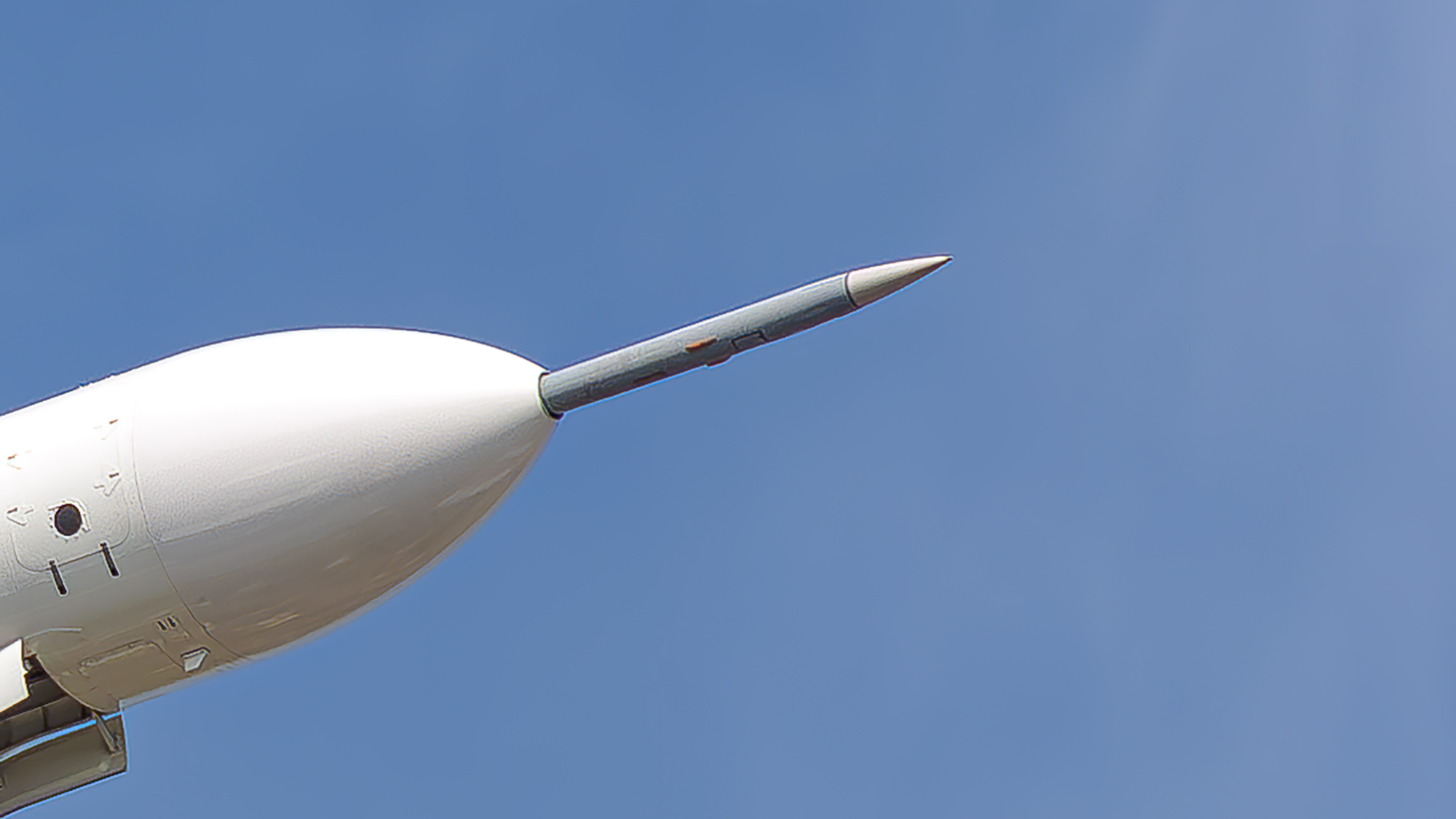
An F-4AUP Phantom of the Hellenic Air Force crashed during a flying display part of Athens Flying Week. There are no signs of the pilots ejecting.
On Sept. 5, 2026, at around 15.00 LT, an Hellenic Air Force F-4 Phantom (01504) crashed at Tanagra Air Base, near Athens. Videos shared online show the aircraft impacting the ground and exploding into flames close to the airport. While the status of the aircrew has not been disclosed yet, the footage does not show the two aircrew members ejecting from the aircraft.
Video showing the crash.
Never forget how difficult it is to fly these aircraft on the edge of their capabilities. Regardless of the outcome the crew are heroes.https://t.co/9OGvlVOAma
According to the reports, the aircraft crashed during the first 2 minutes of its display and the impact reportedly occurred outside the runway in the industrial zone of Tanagra, near factories, which were closed at the time of the incident.
Clips shared online show the aircraft flying at low altitude and high speed and then turning towards the runway. Then, the jet lost altitude and crashing into trees, close to the runway.
A HAF F-4 Phantom II just crashed at the Athens Fling Week airshow. We can only hope for the best, but I saw no parachutes. He hit the ground coming out of a turn. pic.twitter.com/JtW4YdPJ5x
There was no information from the HAF or the Greek Ministry of Defence at the time of writing. Following the crash, Minister of National Defense Nikos Dendias left Tanagra and returned urgently to Athens.
The HAF is one of the last operational Phantom operators in the world, flying 17 of the airframes (as per the last count by Dec. 2025, now down to 16 following the crash). The jets are assigned to the 338 Mira of the 117 Combat Wing. The country also celebrates the European Phantom Conference (PhanCon), bringing aviation enthusiasts from around the world to the Andravida Air Base.
Other Phantom operators are the Turkish Air Force (TuAF) and the Islamic Republic of Iran Air Force (IRIAF) – the latter sparingly flying their highly sanctioned and part-starved jets with local fixes and some smuggling. The HAF is also an F-16V Viper operator, with Lockheed Martin announcing on Sep. 5, having delivered 59 of the jets.
BREAKING: A Hellenic Air Force F-4 Phantom has crashed during an aerial display at Athens Flying Week in Tanagra, Greece.
The twin-seat aircraft went down during Saturday’s show, sending a massive column of black smoke into the sky in front of thousands of spectators.…
The Hellenic Air Force released an official statement about the incident, confirming the two crew members were killed.
On Saturday, September 5, 2026 at 14:55, an F-4E Phantom II aircraft of the 338th Squadron of the 117th Fighter Wing, which was participating in the “Athens Flying Week 2026” Airshow, crashed 3 nautical miles southeast of the 114th Fighter Wing, resulting in the fatal injuries of the two crew members, First Lieutenant (I) I.M. and First Lieutenant (I) D.P.
The causes of the accident are being investigated by a competent Air Force committee.
The first eight of a dozen Vermont Air National Guard F-35As are returning home from their combat deployment in the CENTCOM area of operations.
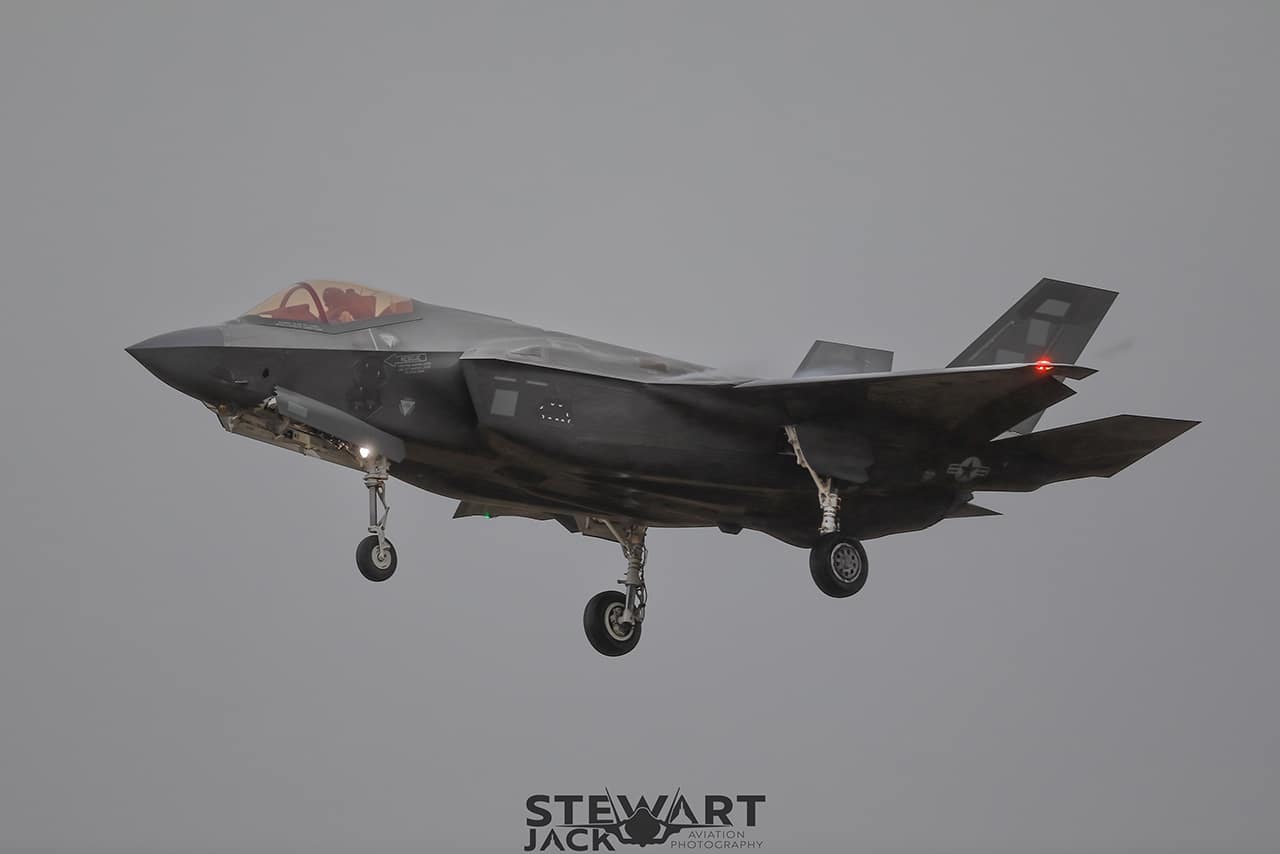
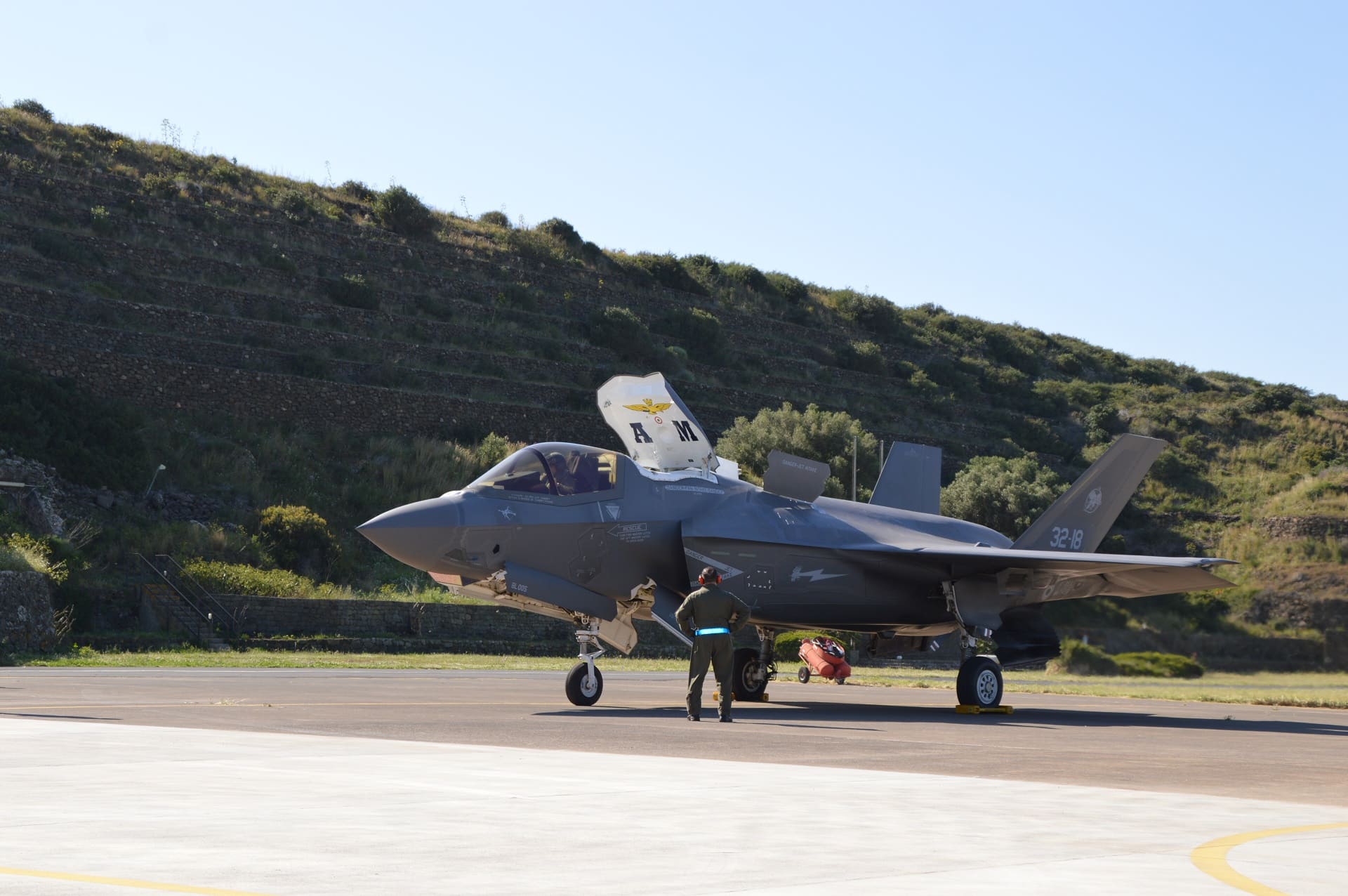
Split into two flights, the first eight F-35A jets of the Green Mountain Boys of the Vermont Air National Guard 158th Fighter Wing/134th Fighter Squadron, arrived in the UK on their way back to their homebase at Burlington Air National Guard Base, Burlington, Vermont, on Sept. 4, 2026.
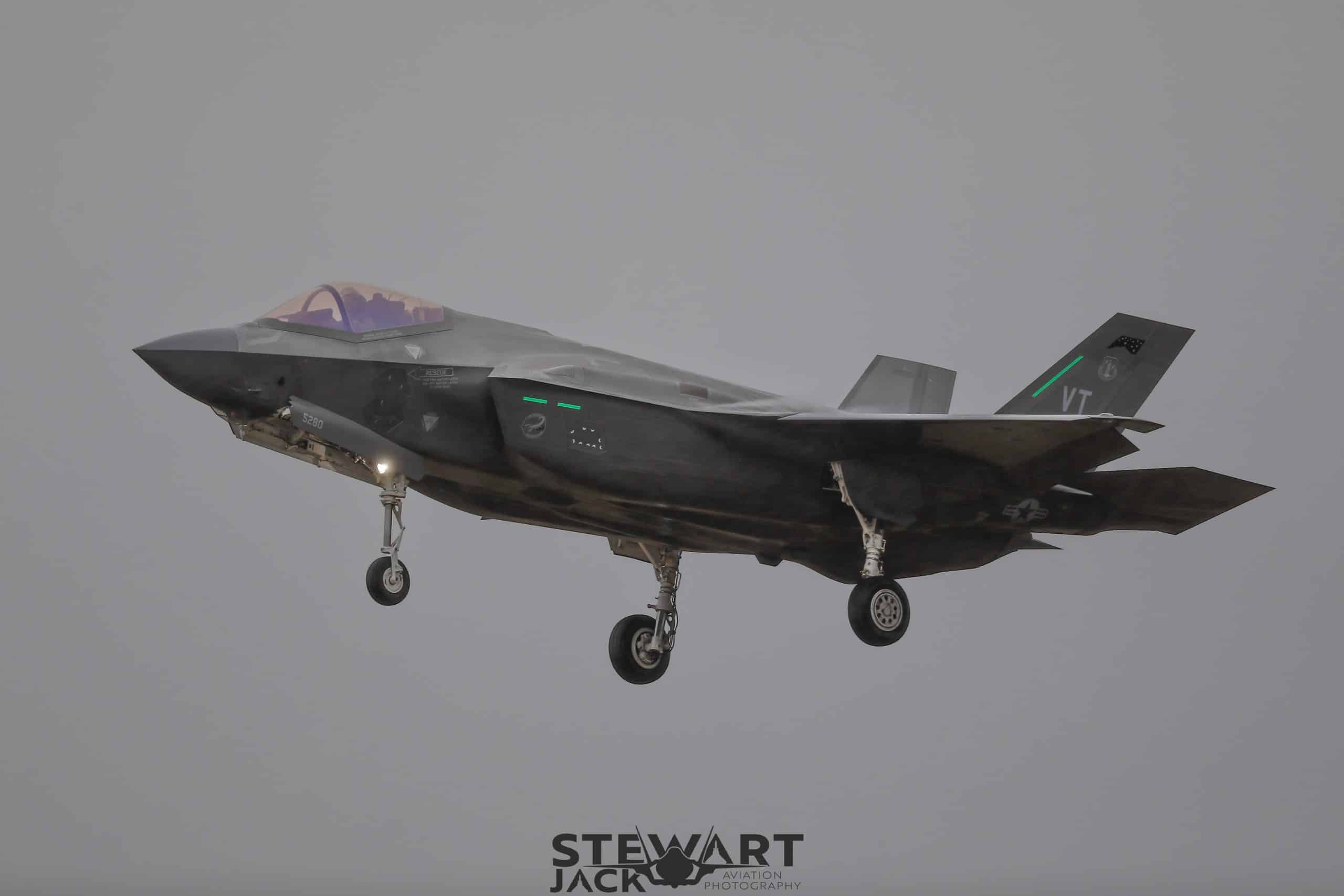
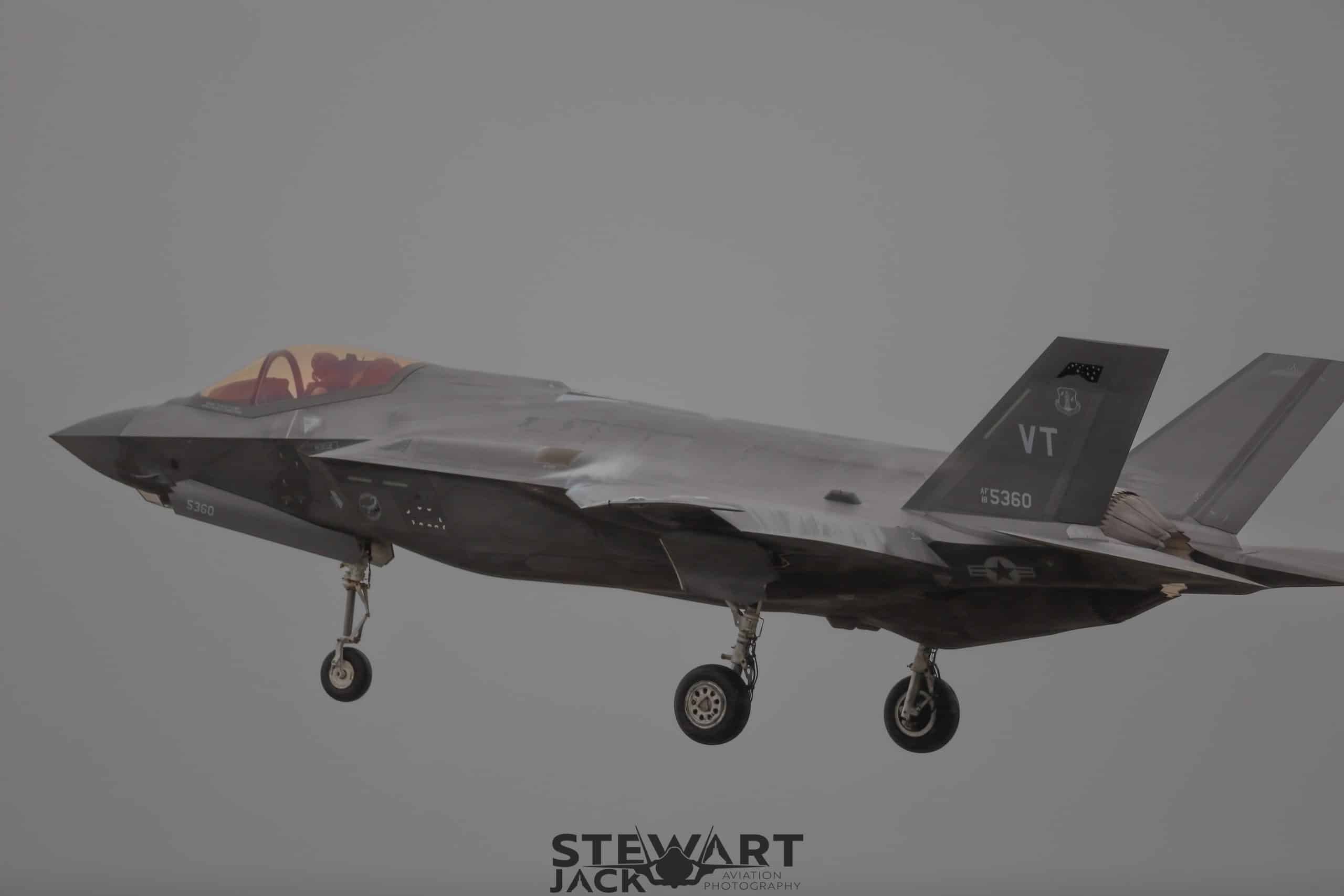
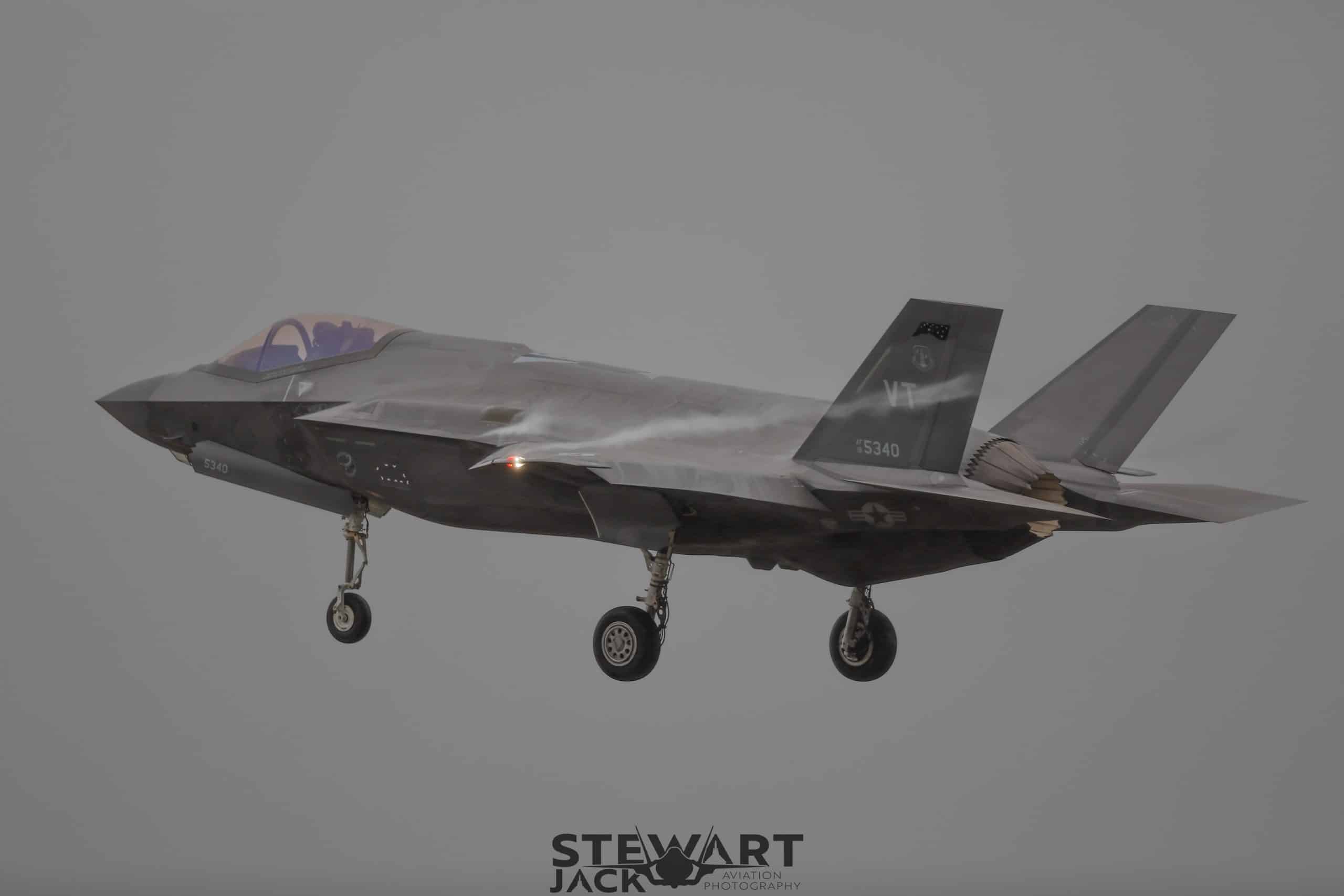
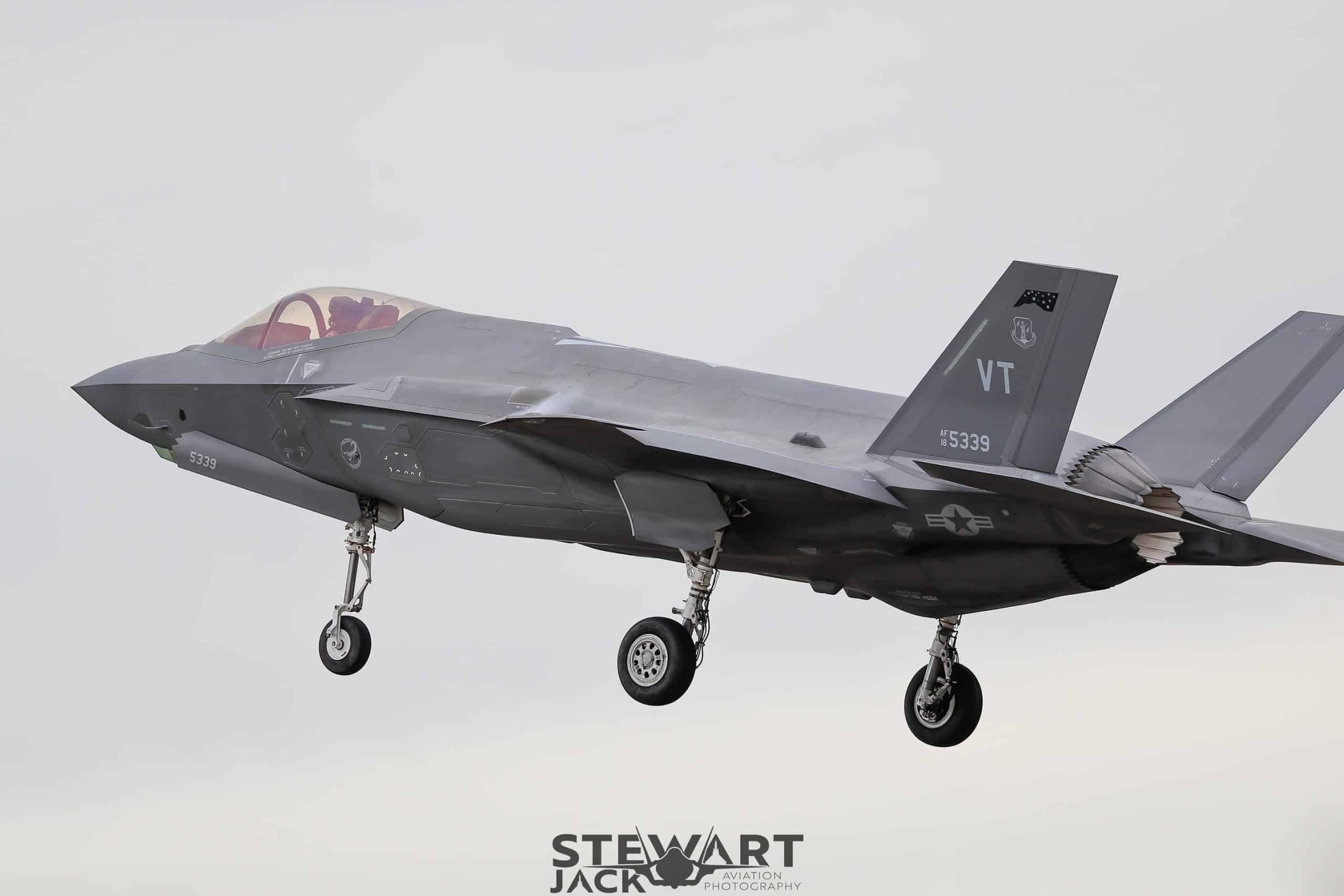
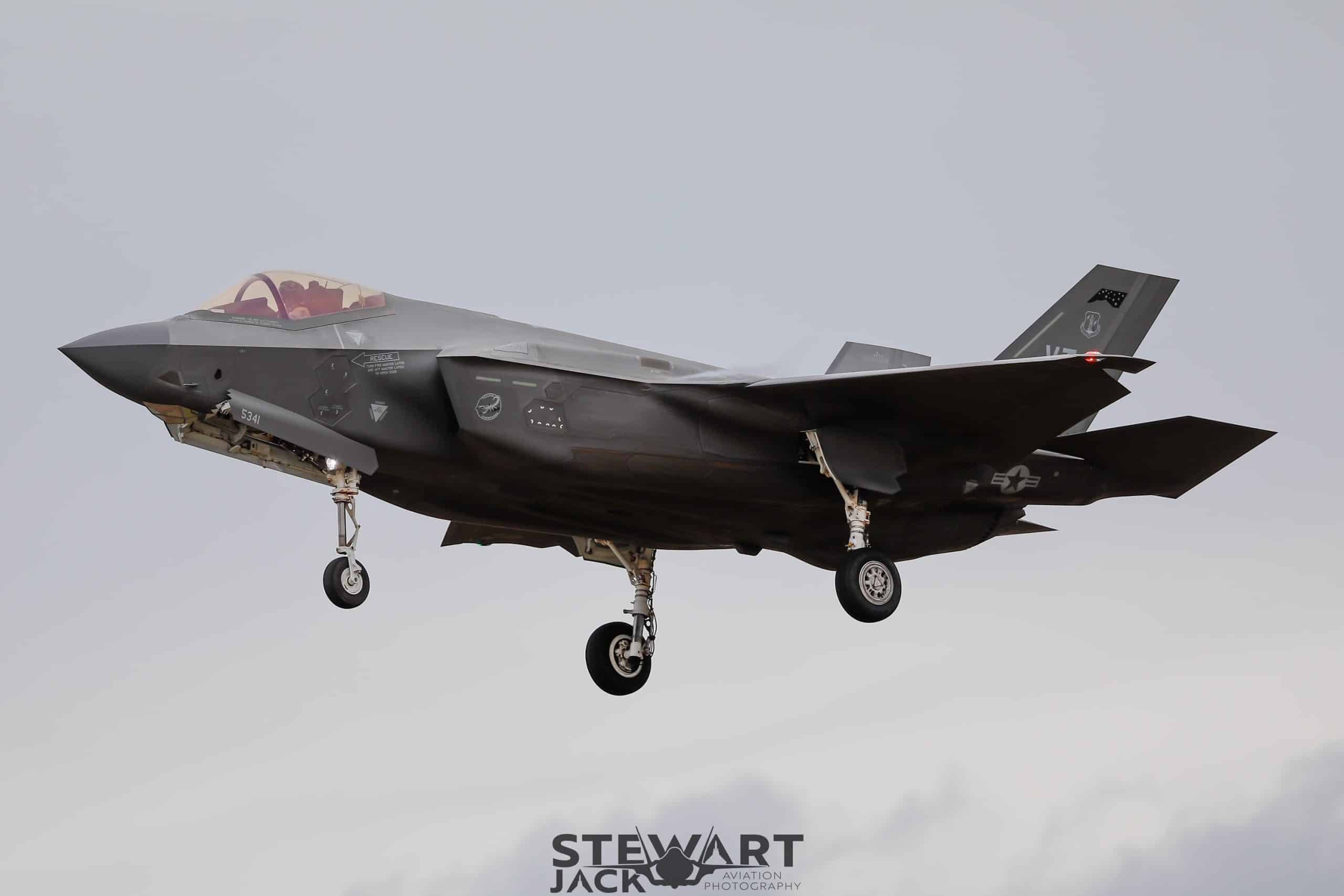
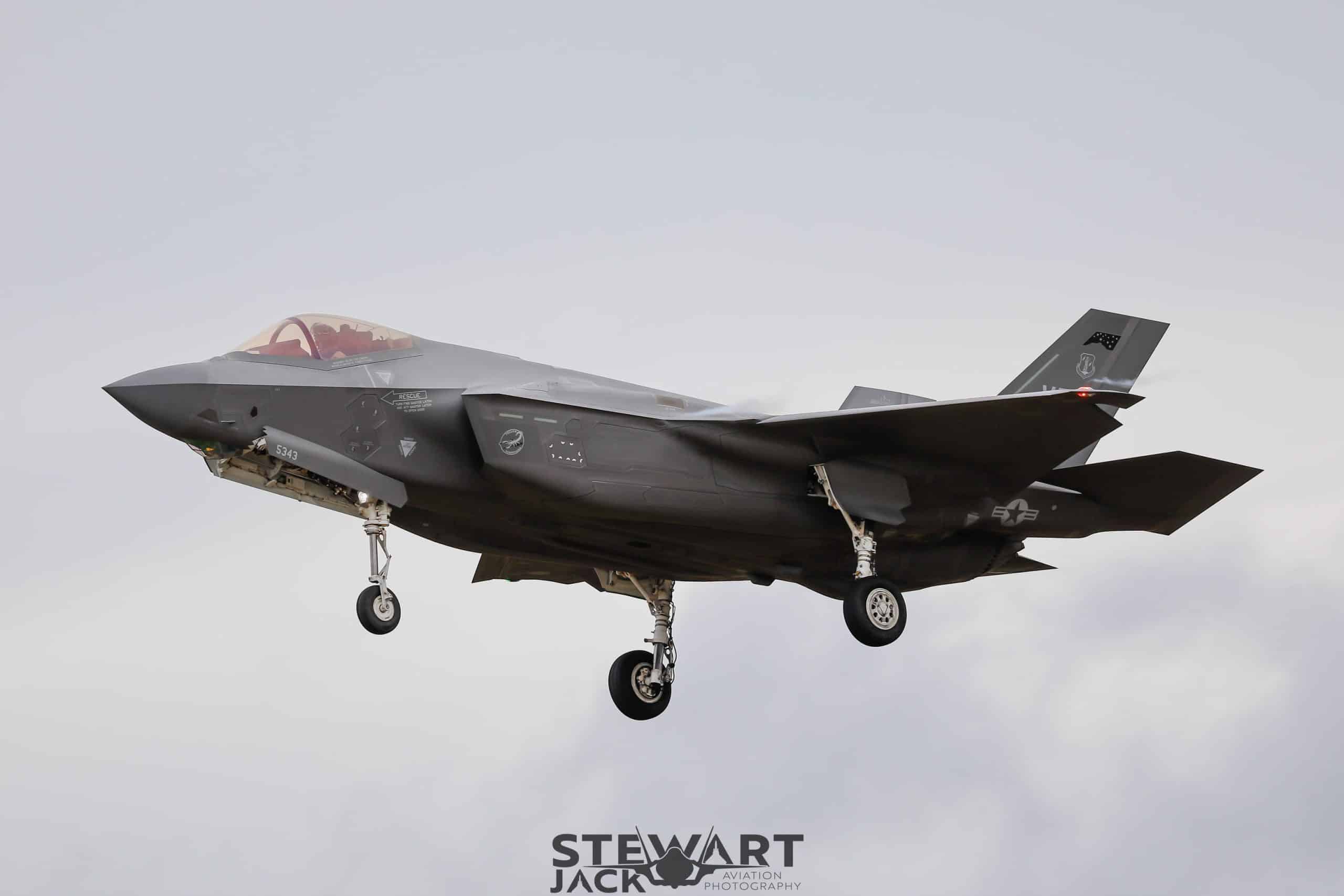
Flying as TABOR 81-84 and 91-94, the eight Lightning II aircraft were airframes 17-5280, 18-5336, 18-5360, 18-5340, 18-5338, 18-5339, 18-5341, 18-5343.
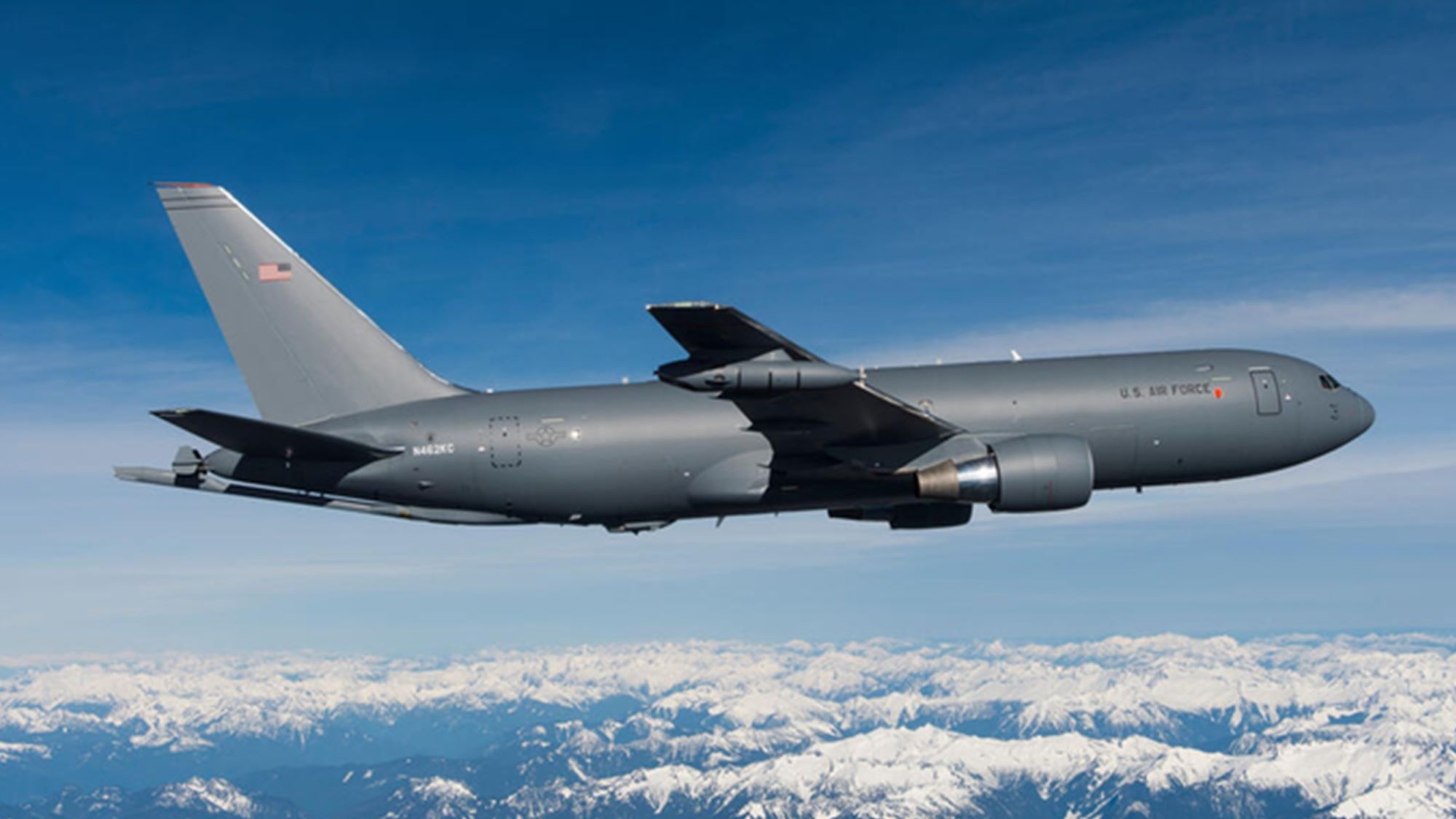
The two flights were supported by four KC-135 tankers, CLEAN 35-36 and 45-46, launched from Romania.
Twelve Green Mountain Boys F-35s had deployed to the Middle East via Lakenheath and Moron Air Base to support Operation Epic Fury in February 2026. The remaining four jets should arrive in the UK for a stopover during the weekend.
17-5280 | Source: Stewart Jack18-5360 | Source: Stewart Jack18-5340 | Source: Stewart Jack
As we noted back then when the aircraft deployed to the CENTCOM area of responsibility, one of the VT F-35s that arrived in the UK on Sept. 4, 2026, identified as 18-5336 thanks to the last four digits of the serial number painted inside the nose‑wheel door, has almost all of its identifying marks obscured, while other aircraft have full tail numbers visible.
Blanked out 134th FS F-35A 18-5336 landing at RAF Lakenheath on Sept. 4, 2026. | Source: Stewart Jack
18-5339 | Source: Stewart Jack18-5341 | Source: Stewart Jack18-5343 | Source: Stewart Jack
While the VT F-35s are returning home, other assets are on their way to the sandpit: 12 F-16Cs from 180th FW OH ANG from Toledo Air National Guard Base in Swanton, Ohio, are deploying to the Middle East.
UPDATE: Coronet East 110 Continues towards CENTCOM #IranWar
It appears the jets are on the move once again as 2 cells, with initial tanker support from Lajes:
The company says the first pod was assembled using production systems, as Viper Shield orders grow to 233 units across eight allied nations.
According to a statement released on Sept. 3, 2026, L3Harris Technologies has assembled its first podded Viper Shield electronic warfare system using production-standard hardware. This is a significant step forward for the external configuration first unveiled in 2025. The company has also completed production of the first 35 Viper Shield systems and is ramping toward full-rate production for 233 units currently on order.
The company describes Viper Shield as the only F-16 electronic warfare system currently in production with orders from eight allied nations.
Viper Shield detects, identifies and counters electronic threats by providing digital armor around the aircraft. The technology can support the pilot as an integrated internal system or as an external pod. L3Harris also assembled its first pod leveraging production systems.
Viper Shield is the only F-16 electronic warfare system currently in production with orders from eight allied nations. L3Harris is ramping up to full-rate production for the 233 systems currently on order. Additional partner nations that select Viper Shield will benefit from an active production line with quality assurance and a supply chain capable of meeting the demands of large-scale manufacturing.
Developed by L3Harris in partnership with Lockheed Martin and the U.S. Air Force, Viper Shield can be installed internally on new-build F-16 Block 70/72 aircraft or carried externally in podded form, allowing operators of earlier F-16 variants to access the same core electronic warfare capability without requiring the same level of internal integration.
The pod shown in L3Harris renderings bears a significant resemblance to the Northrop Grumman’s AN/ALQ-131(V) ECM (Electronic Countermeasure) pod already in use on the global F-16 fleet, but also on other platforms such as the A-10 and F-15, as well as F-4 and F-111.
The AN/ALQ-131 pod. | Source: USAF
When we reported on the system in September 2025, L3Harris had unveiled the podded version of the AN/ALQ-254(V)1 Viper Shield system, saying seven international partners had selected the suite for 168 F-16s. Since then, the program has moved deeper into production: the customer base has grown to eight allied nations, with the orders increased to 233 systems. The first 35 units have been completed along with the first external pod.
Interestingly, according to the manufacturer, around $1 billion in shared investment by foreign F-16 operators has already funded development, laboratory testing, flight testing and current production, potentially reducing the cost of any future U.S. Air Force or Air National Guard entry into the program.
“The $1 billion shared investment by countries operating F-16s means the U.S. Air Force and National Guard could benefit from joining the program,” said Chris Aebli, President, Communications & Spectrum Dominance at L3Harris. “The foreign investment is funding development, lab testing, flight testing and current production of Viper Shield systems, which presents the United States with a savings opportunity to avoid upfront costs.”
Viper Shield is designed for the F-16 Block 70/72 and its digital radar warning receiver (DRWR) technology integrates seamlessly with the aircraft’s new APG-83 active electronically scanned array (AESA) radar, to deliver greater situational awareness, while remaining compatible with earlier F-16 blocks. The system also includes a digital radio frequency memory (DRFM)-based jamming system, which provides enhanced capability against advanced threats.
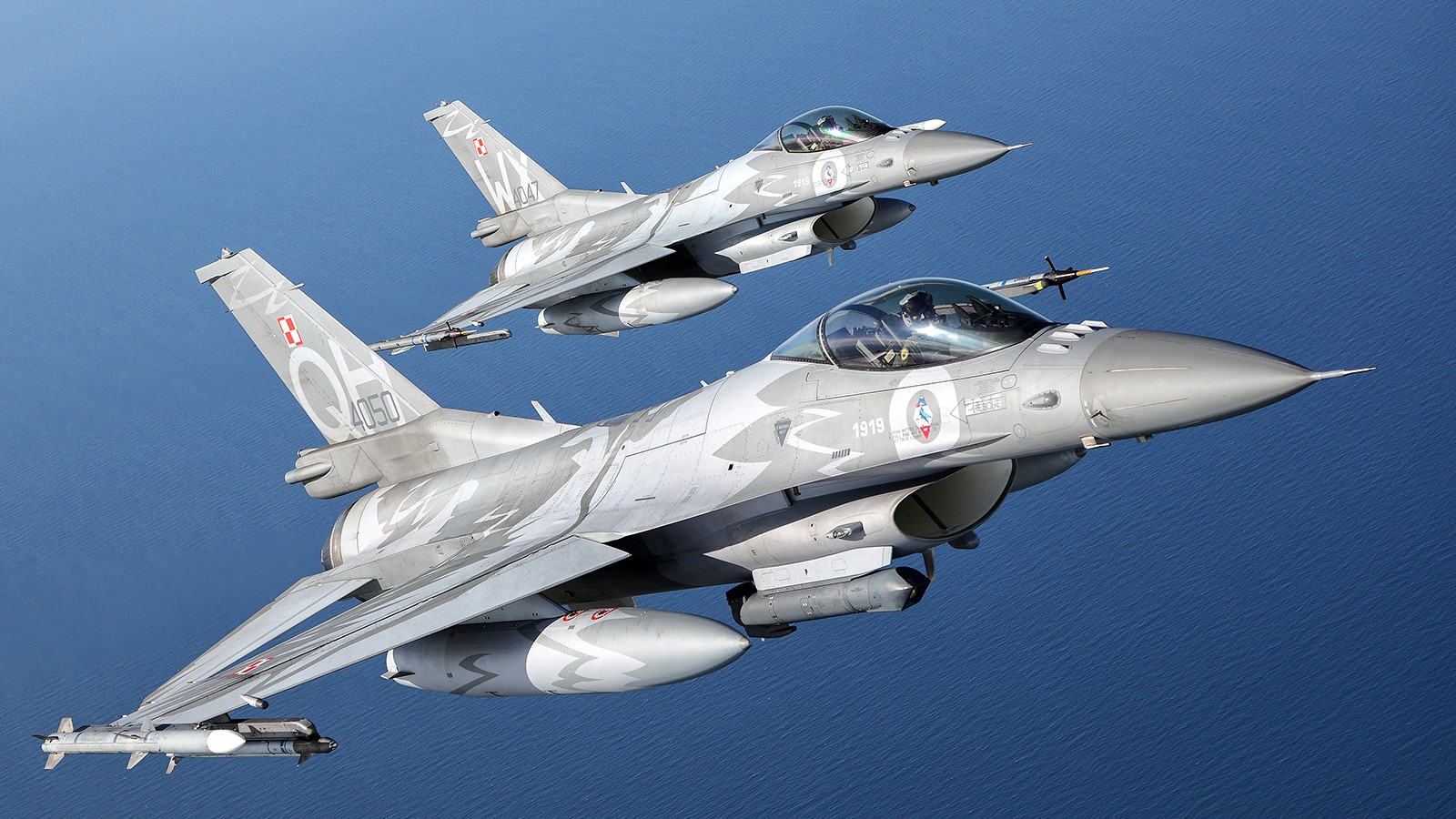
Polish F-16C Block 52+ jets in flight. (Image credit: Bartek Bera/Poland MoD) | Source: Poland MOD
The manufacturer says it designed Viper Shield with fewer critical components than previous generation EW systems not only to obtain a smaller form factor and reduced weight, but also a higher mean time between failure and lower lifecycle costs. The modular design, which supports swapping LRUs in the field, together with the COTS (Commercial Off The Shelf) technology and software-defined architecture, allows to simplify future upgrades as technology and threats evolve.
The goal of the system is to provide a virtual electronic shield around the aircraft, with state-of-the-art capability, to address emerging and future threats with a fully integrated, internally mounted system. In the most modern F-16s, the integrated system eliminates the need to employ external EW pods usually installed on the centerline station, freeing it for other payloads such an external fuel tank.
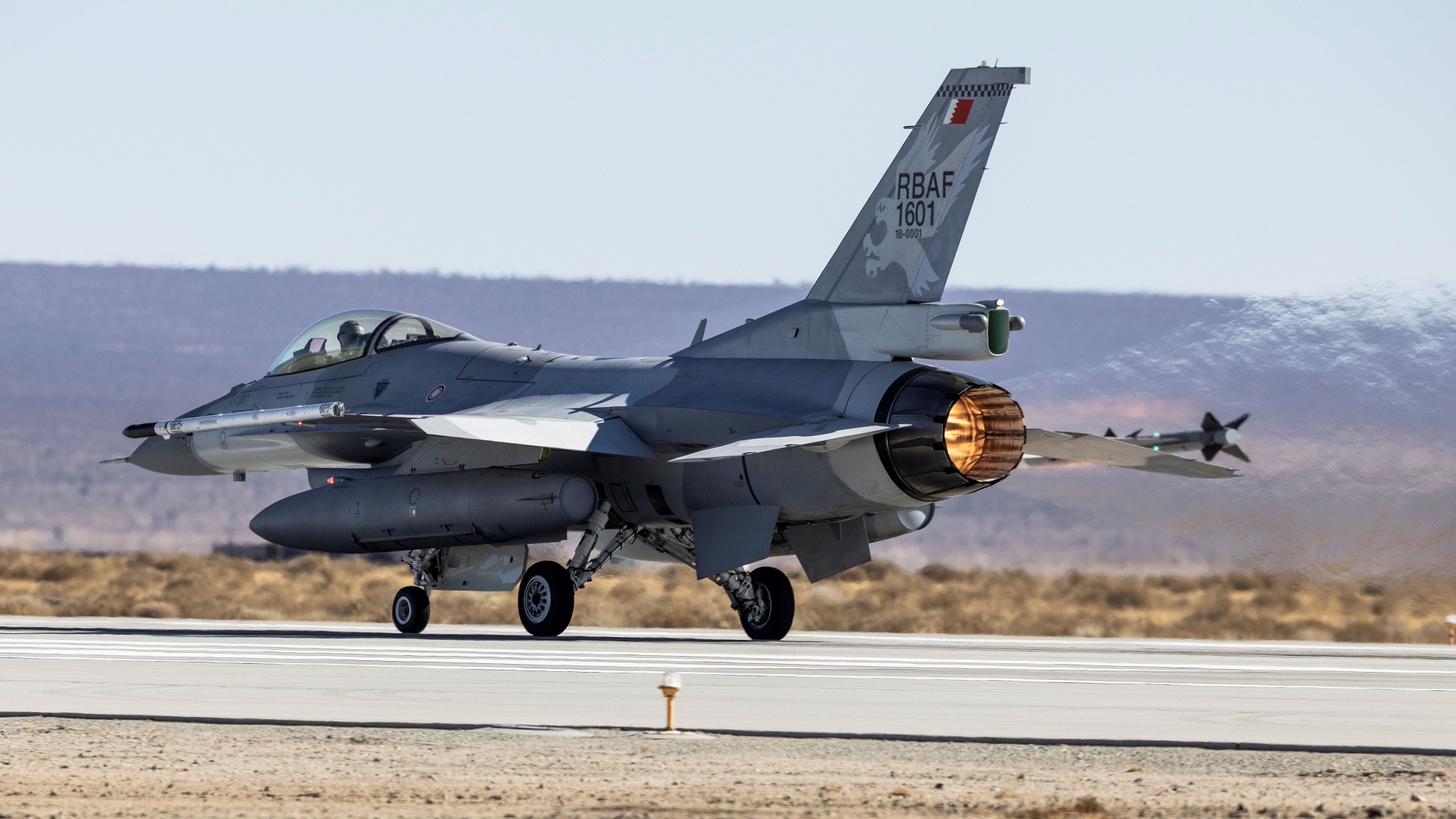
The internal variant of the system first flew on an F-16C Block 70 of the Royal Bahraini Air Force in February 2025 at Edwards AFB, California, conducted by a pilot of the 416th Flight Test Squadron, Airpower Foundations Combined Test Force.
The internal and podded variants of the system use the same physical component hardware, a versatile design that enables 100% hardware commonality between internal and pod configurations and reduces overall maintenance, support and lifecycle cost, particularly where the end user deploys a combination of new and upgraded F-16s. Beyond that, the external pod remains particularly useful to those operators that need to integrate the system on previous generation F-16s.
The Viper Shield electronic warfare suite conducted its first flight Jan. 23, 2025, from Edwards Air Force Base in California. (Photo courtesy of Lockheed Martin) | Source: Lockheed Martin
The carrier’s first full port stop of the deployment comes after 286 days at sea and nearly seven months of combat operations, with the ship visibly showing the effects of its prolonged time in the harsh marine environment.
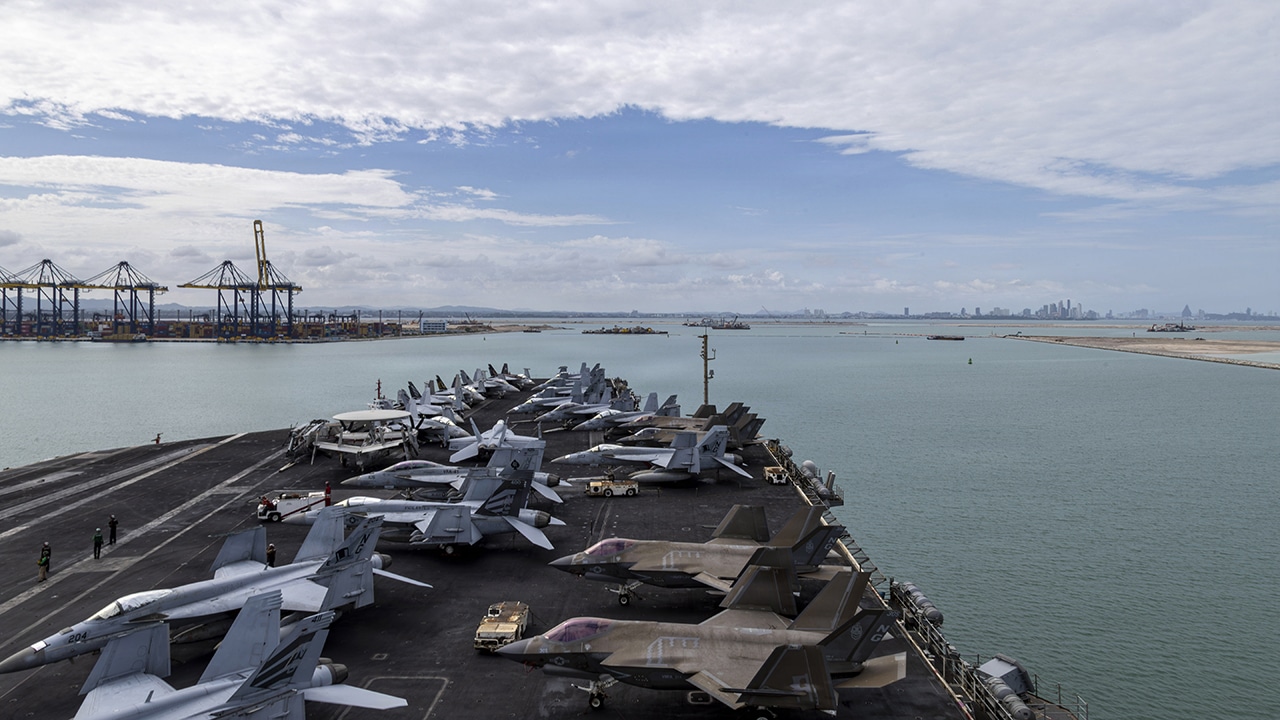
USS Abraham Lincoln arrived at Laem Chabang, Thailand, early on Sept. 2, 2026, for what the U.S. Navy described as the carrier’s first full port stop since the start of its deployment in November 2025. Elements of the Abraham Lincoln Carrier Strike Group (ABECSG), including the embarked Carrier Strike Group 3 staff, Carrier Air Wing 9, Destroyer Squadron 21 and the nine squadrons of CVW-9, also arrived in Thailand as part of the scheduled visit.
The port call of the U.S. supercarrier after its prolonged deployment was streamed live by Reuters:
Subsequent close up images showed even more clearly the Lincoln has clear signs of its prolonged deployment, with streaks of so-called “running rust” and heavy algae buildup visible along much of the hull.
USS Abraham Lincoln (and her aircraft) looking worse for wear as she pulls into Sattahip/Pattaya in Thailand pic.twitter.com/nyWvZy8prk
While the carrier looks weathered, official sources stated the hull appearance is normal for a long deployment.
Saltwater is extremely aggressive toward steel, and the marine environment gives corrosion plenty of help. Constant salt spray, high humidity, strong sunlight, heat, flight-deck activity and long periods at sea all take their toll, particularly when opportunities for more extensive preservation work are limited.
However, it’s also worth remembering that a heavily streaked hull can look much worse cosmetically than the actual condition of the steel underneath.
The U.S. Navy’s aircraft carrier USS Abraham Lincoln has arrived at Laem Chabang Port, Thailand. pic.twitter.com/3RIRP9joR4
According to the official release, the deployment has included 286 days at sea and comes after nearly seven months of operations in the U.S. Central Command area of responsibility. During the same period, the strike group and other U.S. Navy and Marine Corps assets conducted combat operations in support of Operation Epic Fury and supported the enforcement of “the largest naval blockade in decades.”
USS Lincoln departed Naval Base San Diego in November 2025. Although the carrier made brief stops during the deployment, including a short visit to Guam in December, none of these where full “port calls” or “stops”. Therefore, the Thailand visit represents the first regular port call of the deployment and a long-awaited opportunity for the crew to disembark for rest and recharge after months of high-tempo operations.
Nimitz-class aircraft carrier USS Abraham Lincoln (CVN 72) arrives in Laem Chabang, Thailand, Sept. 2, 2026. Abraham Lincoln is conducting routine operations in the U.S. 7th Fleet area of operations. Units assigned to 7th Fleet conduct continuous patrols to deter aggression, strengthen alliances and partnerships and advance peace through strength. (U.S. Navy photo by Mass Communication Specialist Seaman Gage Thomas) | Source: U.S. Navy
The U.S. Navy said elements of the Abraham Lincoln Carrier Strike Group (ABECSG), including Nimitz-class aircraft carrier USS Abraham Lincoln (CVN 72), the embarked staffs of CSG-3, Carrier Air Wing (CVW) 9, and Destroyer Squadron (DESRON) 21, and the nine squadrons of CVW-9 arrived in Laem Chabang, Thailand, while Arleigh Burke-class guided-missile destroyer USS Frank E. Petersen Jr. (DDG 121) docked in nearby Sriracha, for scheduled port visits, Sept. 2, 2026.
Escort Ticonderoga-class guided-missile cruiser USS Robert Smalls (CG 62) also arrived in Map Ta Phut, Thailand for their own scheduled port visit.
“Our arrival in Laem Chabang provides a well-deserved opportunity for our Sailors and Marines to rest and recharge. It also underscores the strong and enduring partnership and alliance between the United States and Thailand,” said Rear Adm. Robert E. Loughran, commander, Carrier Strike Group 3 in a public statement. “What this strike group has accomplished is truly historic. I could not be prouder of the exceptional professionalism and expertise demonstrated by every member of this team during our operations in the U.S. Central Command area of responsibility.”
“Abraham Lincoln’s visit to Laem Chabang is a clear demonstration of our enduring commitment to our allies and partners in Thailand, and we are all very excited to make Thailand the first port visit on our historic deployment,” said Capt. Dan Keeler, Abraham Lincoln’s commanding officer. “This port visit will help us gain a deeper understanding of one another, demonstrate our mutual commitment to the security of the region, and allow our crew to enjoy this beautiful and historic country.”
During the recent Project Convergence Capstone 6, an H-60M Black Hawk crew employed an Altius-700 Air-Launched Effect to autonomously find the target, pass data across the formation, and strike.
As explained by Sikorsky in an interview at Farnborugh International Airshow last month, a major focus of Armed Black Hawk’s development is on air-launched effects (A-LE): the integration of such capability allows aircrews to command unmanned A-LE systems (small uncrewed systems deployed from aircraft to provide capabilities such as surveillance, targeting, electronic warfare, communications relay, deception, or strike) from a position of relative safety, extending the reach, lethality and survivability of the platform.
The U.S. Army put the H-60M Black Hawk Air-Launched Effects (A-LE) capabilities to test last month, during Project Convergence Capstone 6. The activity added to the three-day flight tests conducted at Fort A.P. Hill’s test range, Virginia, in June, when H-60M aircrews successfully launched and controlled multiple medium-range launched effects.
According to the U.S. Army, Increment 1 of the A-LE capability is a fully government owned and designed system, developed in partnership with the Utility Helicopters Project Office (UHPO) and the U.S. Army Combat Capabilities Development Command (DEVCOM) Aviation and Missile Center (AvMC).
Over the course of the three-day exercise, a joint effort involving the military and commercial industry partners, aircrews of an H-60 in a fully networked system configuration launched and controlled multiple launched effects (LEs) over the Mojave Desert. The extreme heat of the area allowed the team to validate also the system’s environmental resilience.
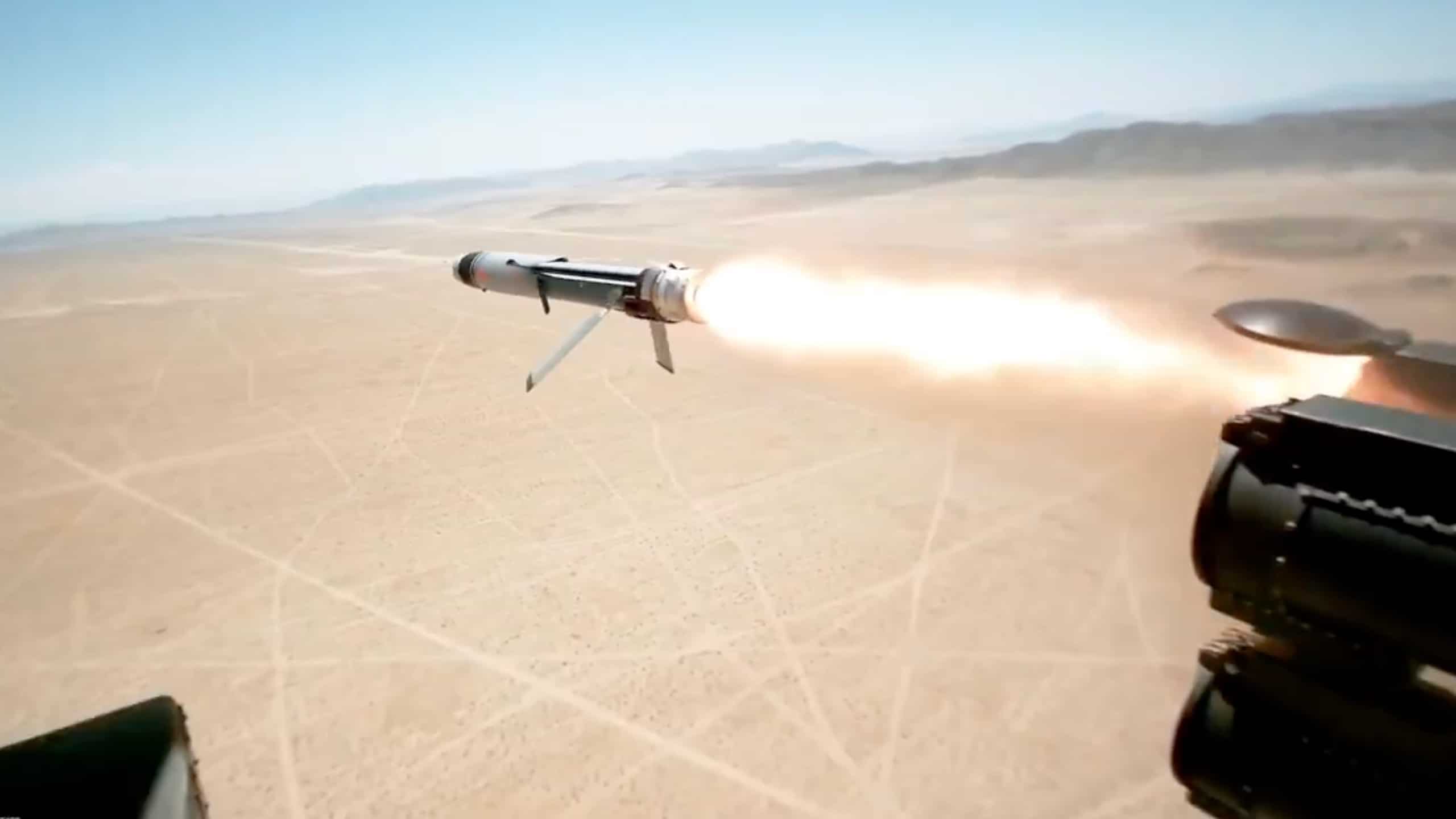
Interestingly, as part of the capstone event, the H-60M also employed the Anduril Altius-700 A-LE. The Altius-700 is a modular launched-effect air vehicle that can carry ISR, electronic-warfare, communications and other payloads; the Altius-700M is its weaponized loitering-munition variant, equipped with a warhead of up to 33 lb for strikes against vehicles, vessels and infrastructure, and a range of 160 km.
Footage of the test was shared online by Anduril:
New Test Footage: Black Hawk executes rocket-powered launch of Altius-700.
At Project Convergence Capstone 6, an H-60M Black Hawk crew employed an Altius-700 hunter-killer team to autonomously find the target, pass data across the formation, and strike.
Noteworthy, while Anduril refers to the vehicles in the newly released footage simply as Altius-700, the video shows one of the launched effects striking what appears to be an armored ground vehicle. Ahead of Project Convergence Capstone 6, the U.S. Army had specifically identified the armed Altius-700M loitering munition as the Long-Range Precision Munition (LRPM) scheduled to be launched from a Black Hawk during the event, suggesting that the kinetic vehicle seen in the footage is indeed a 700M.
Managed by the Capability Program Executive (CPE) for Offensive Fires, LRPM is a U.S. Army effort to provide helicopters with a stand-off precision-strike weapon capable of engaging targets at ranges significantly greater than traditional weapons such as the AGM-114 Hellfire (11 km reach).
“Successfully launching Air-Launched Effects from a Black Hawk is more than a milestone, it is a leap forward,” said Brig. Gen. Kevin Chaney, Deputy Portfolio Acquisition Executive for Maneuver Air.“ By extending their reach and increasing lethality, we are changing the battlefield geometry and delivering a decisive advantage to our Soldiers.”
Traditionally, if you think of an Army helicopter conducting anti-armor or precision attack, you think of the AH-64 Apache gunship. A Black Hawk is primarily a utility/assault helicopter; giving an H-60 the ability to launch autonomous sensors and long-range precision effects means the Army is effectively allowing a utility helicopter to act as a launch platform or mothership, rather than requiring it to become a conventional gunship.
Responding to one of our questions at FIA 2026 airshow, Jason Wrigley, Director of Business Development for Army and Air Force Systems at Sikorsky, said about A-LE: “[…] we do not envision employing just one at a time. We expect multiple systems to be operating simultaneously, and the future battlespace will include large numbers of drones that need to communicate back to a mothership or another control node. The Black Hawk will be capable of performing that role.”
Anyway, regardless of the actual type, it is worth highlighting that launched effects allow the helicopter to move both sensing and strike far beyond the range of its traditional onboard weapons. A non-kinetic A-LE can scout hundreds of kilometers ahead of the formation, while the weaponized variant can strike targets at stand-off range, allowing the crewed aircraft to remain well outside the threat envelope.
BTW, even the fully unmanned U-Hawk is being integrated with an internal A-LE launching system, which provides a way to carry launched effects inside the aircraft. On the manned Black Hawk, they are carried externally on the wings, while on the unmanned variant they can be housed internally.
Another image of the test involving the Altius-700. | Source: Anduril
Dealing with Project Convergence Capstone 6, the Army demonstrated a broader H-60M Air-Launched Effects architecture capable of launching and controlling multiple types of effects. The exercise paired reconnaissance-oriented infrared-sensing LEs with a lethal Long-Range Precision Munition for the terminal strike, while also evaluating additional medium-range launched-effect technology demonstrators. Thanks to the footage release by Anduril we know that the Altius-700 family was among the A-LE systems involved in the tests, but the Army has not publicly identified every launched effect used during the event.
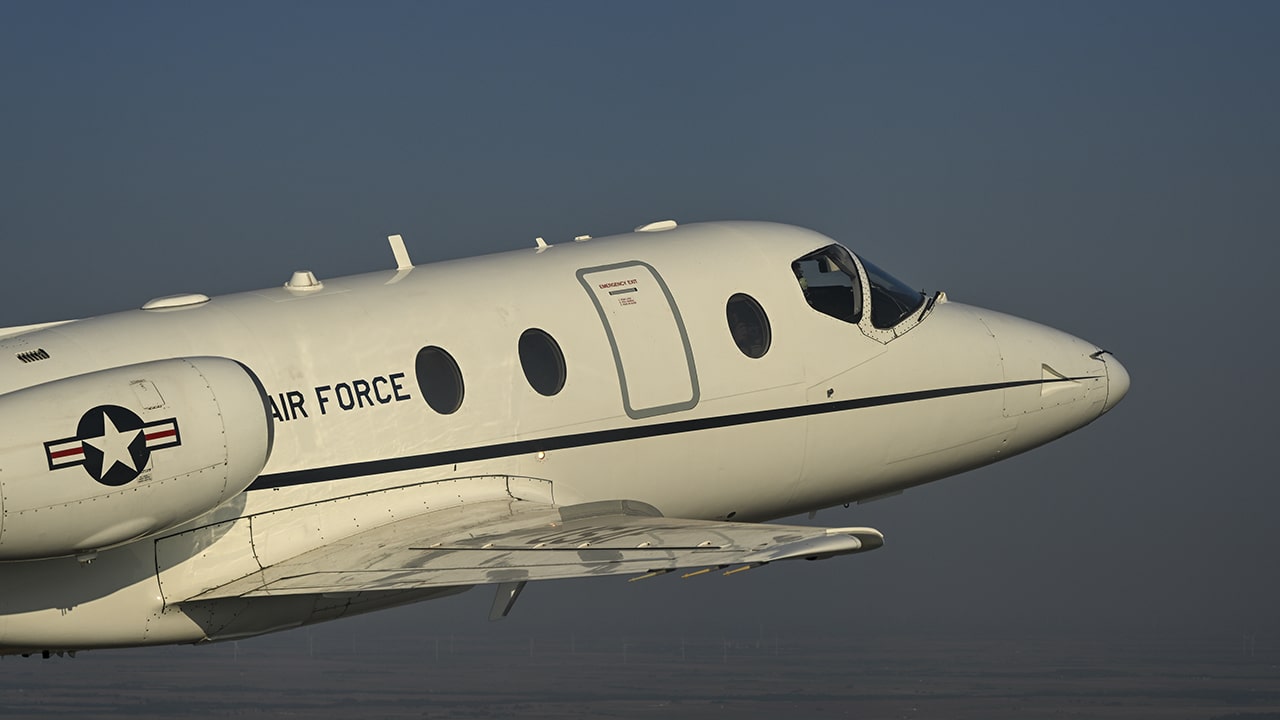
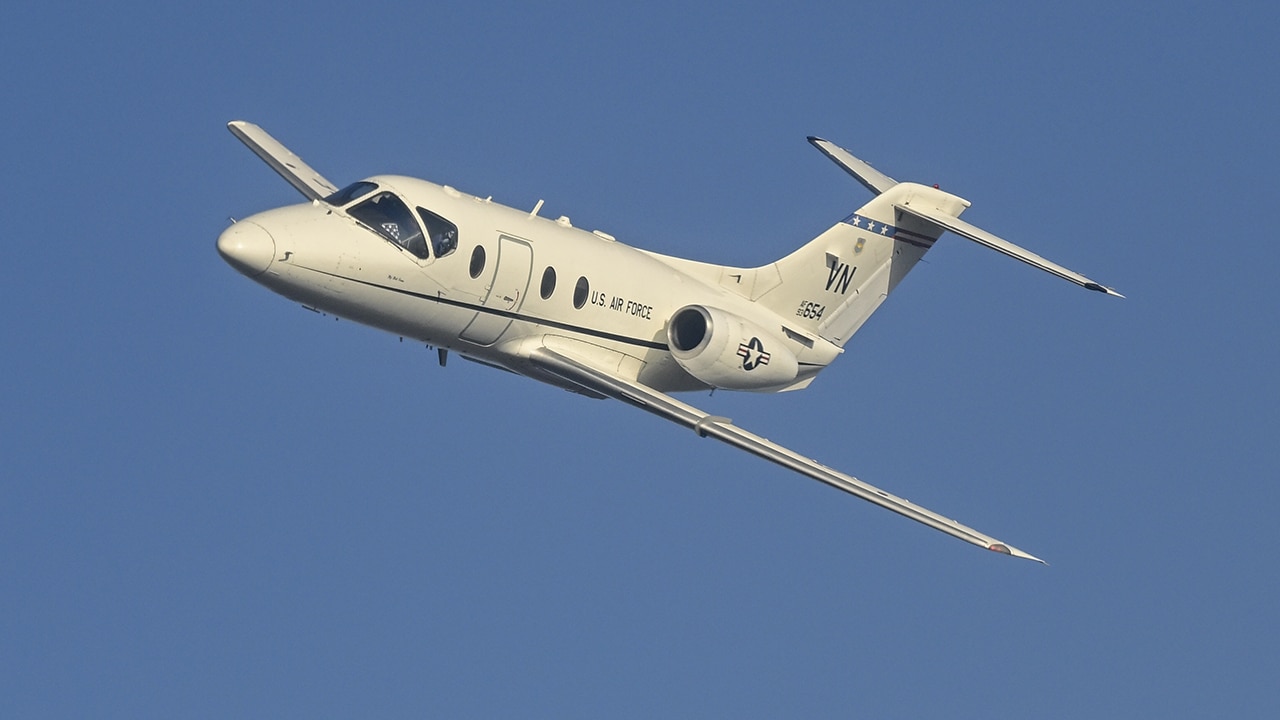
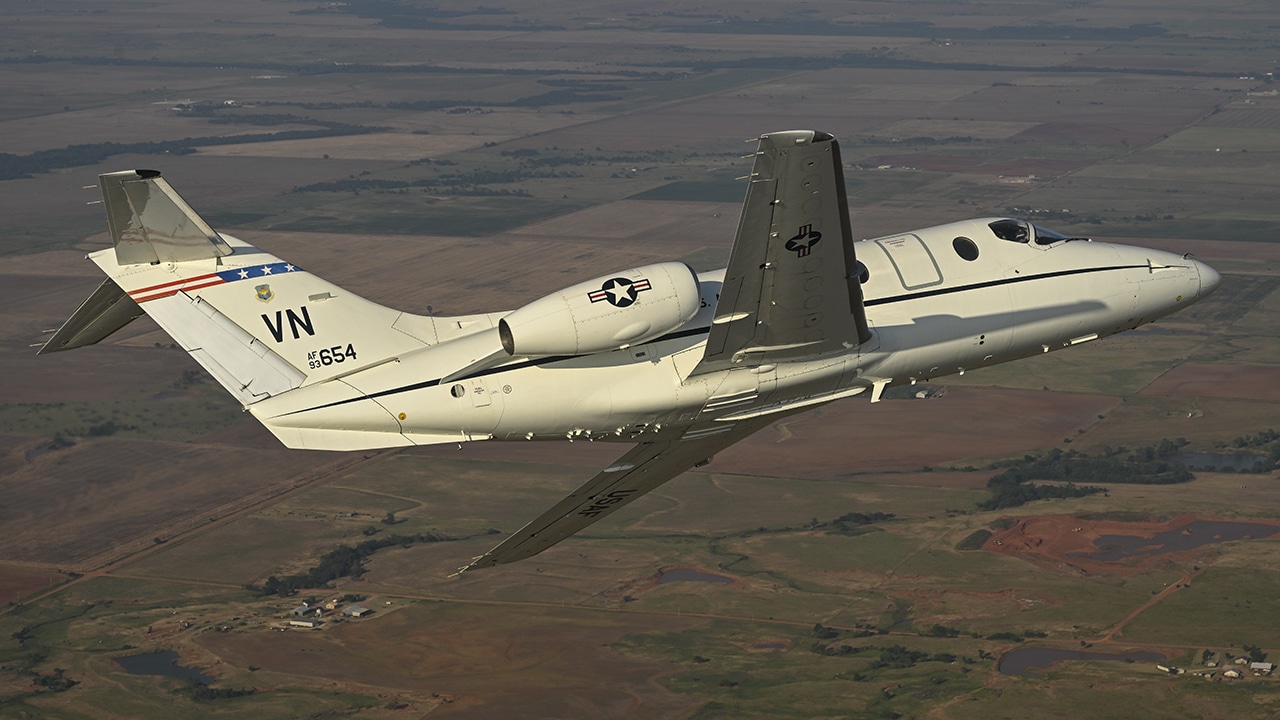
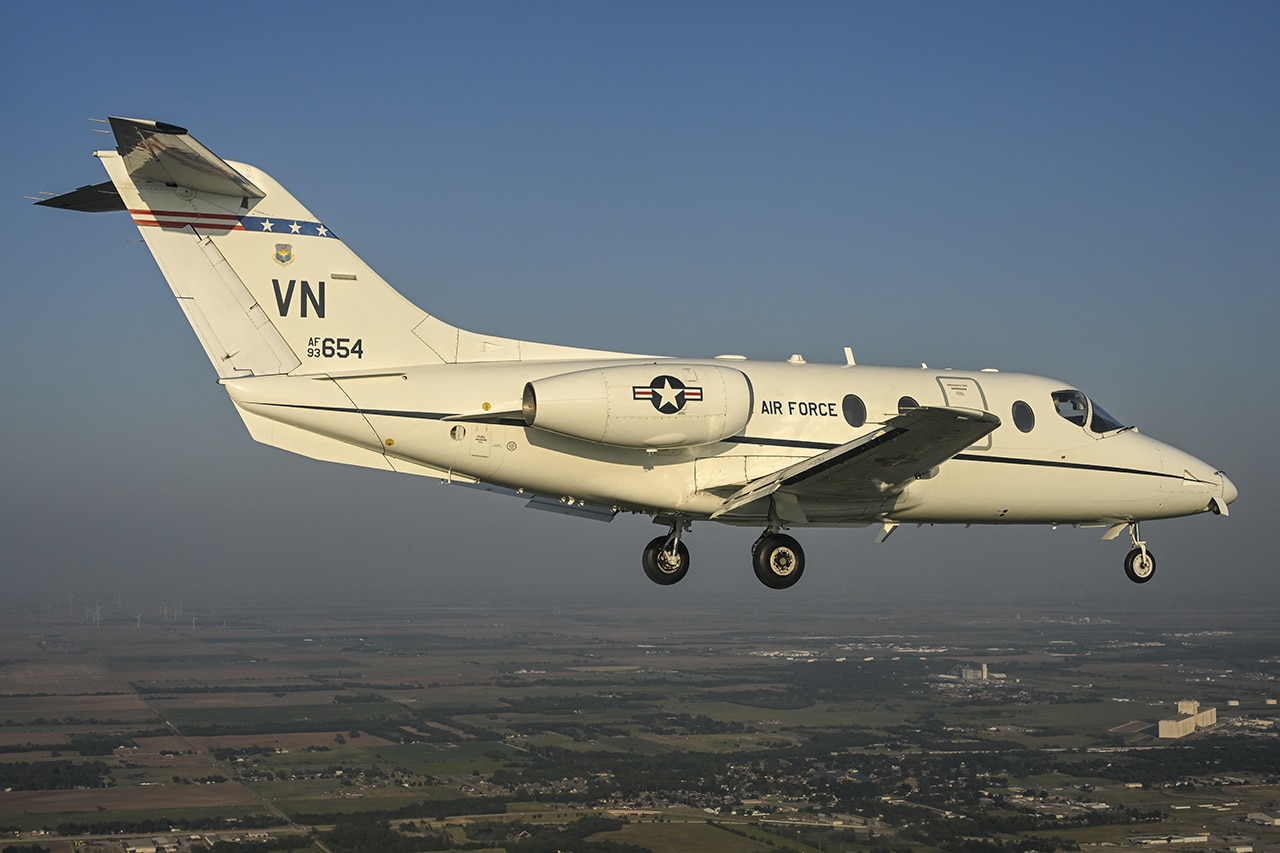
Ahead of the type’s planned retirement from Vance AFB, T-1A 93-0654 took to the skies over Oklahoma for one last aerial photography mission with The Aviationist contributor Greg “Cactus” Davis.
In preparation for the retirement of the T-1A Jayhawk in August 2026, the final aerial photos were shot at Vance AFB, Oklahoma, recently.
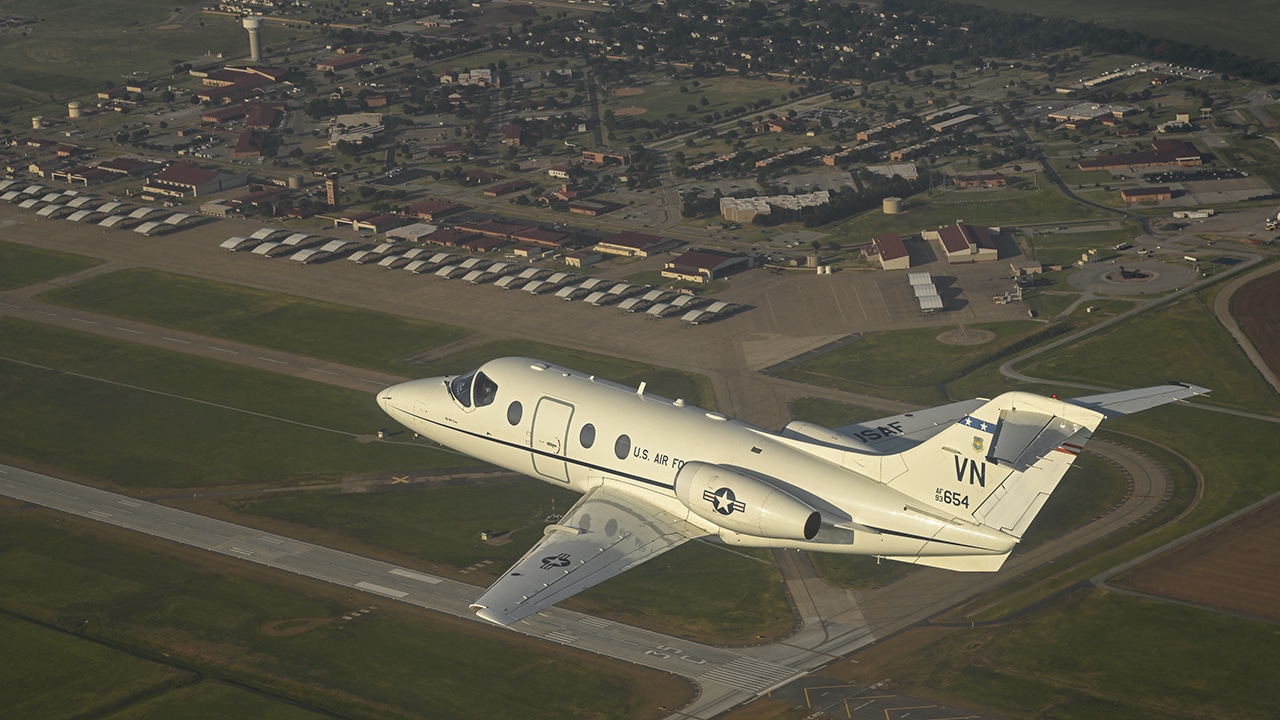
The photo shoot was carried out on July 23, 2026, during a late-afternoon sortie from Vance AFB, Oklahoma, home of the 71st Flying Training Wing and one of the final bases still operating the T-1A.
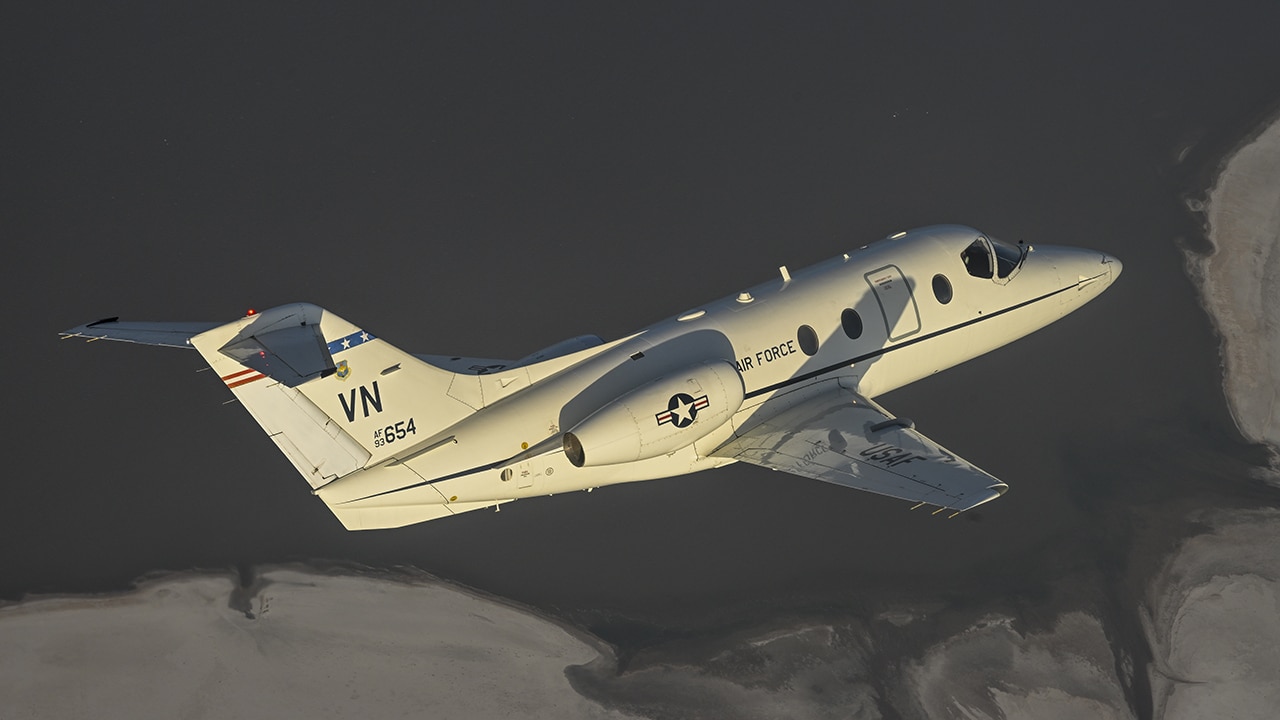
The subject aircraft was T-1A Jayhawk 93-0654, photographed from a T-6A Texan II chase aircraft by The Aviationist contributor Greg “Cactus” Davis.
The jet wore the standard markings of the 3rd Flying Training Squadron, including the “VN” tail code and the unit’s stylized American flag tail flash with three white stars.
Aircraft carrying commander or other special markings had already been retired or were being prepared for preservation and static display as the Air Force continued the final phase of the Jayhawk’s withdrawal from service.
Once its activity at Vance is complete, the final operational T-1As are expected to fly to Davis-Monthan Air Force Base, Arizona, for induction into the 309th Aerospace Maintenance and Regeneration Group, the “Boneyard.”
An American flag, folded into the traditional triangular shape, was carried aboard 93-0654 and placed inside the front-left cockpit window. The flag can be seen in several of the photographs from the mission that we are able to show here in exclusive.
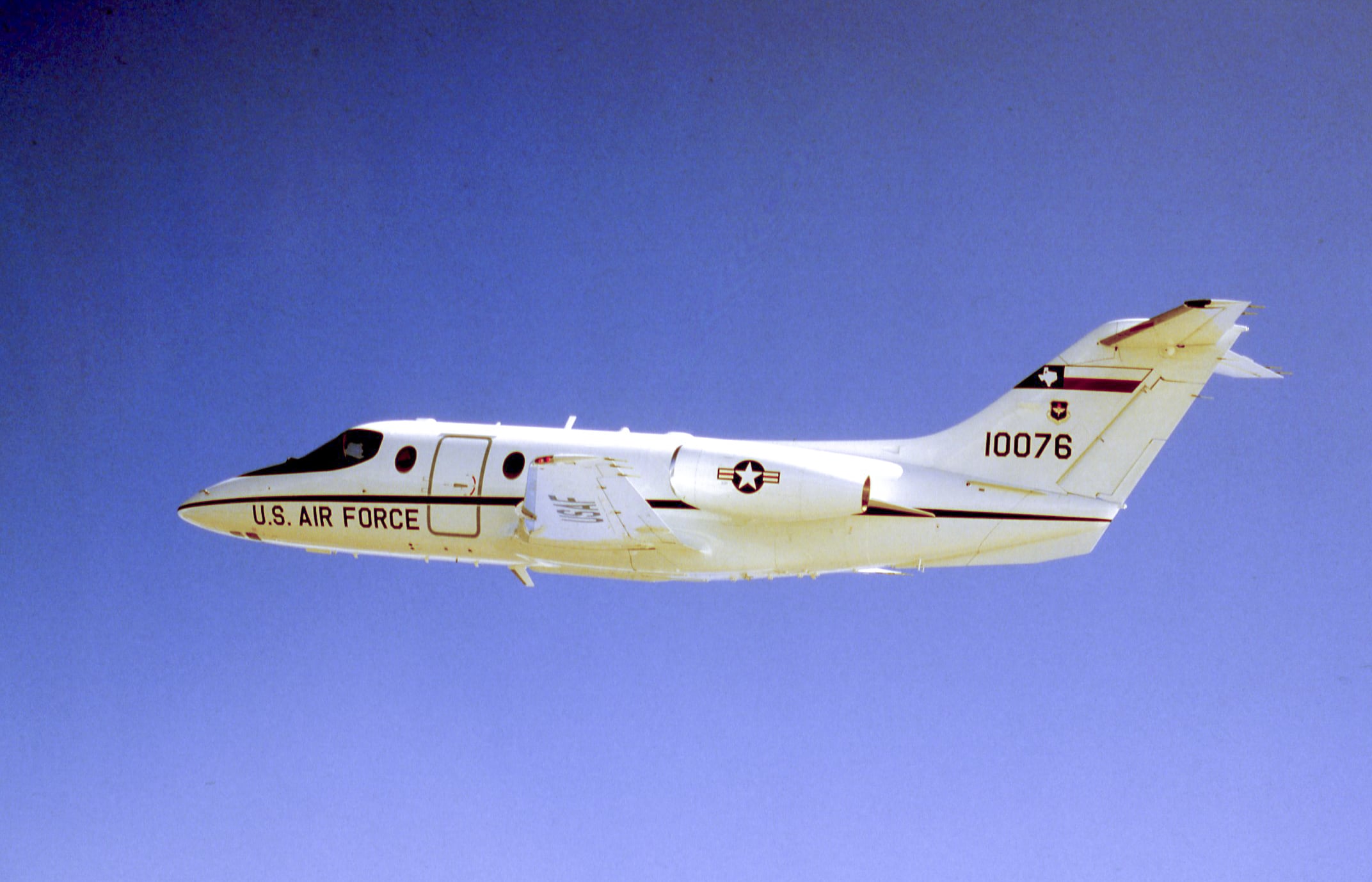
On that occasion, Davis photographed T-1A 91-0076, assigned to the 52nd Flying Training Squadron of the 64th Flying Training Wing at Reese AFB, Texas.
More than three decades later, he returned to photograph the aircraft during the closing stage of its career, completing a circle that began shortly after the Jayhawk entered service.
Based on the Beechjet 400A business jet, the T-1A was introduced to support the advanced phase of Specialized Undergraduate Pilot Training. It was used primarily to prepare pilots selected to fly multi-crewed/heavy aircraft such as tanker, airlift and other large multi-engine aircraft.
Its introduction allowed the Air Force to move much of the mobility-oriented training away from the T-38 Talon, using a platform whose handling, cockpit environment and crew coordination requirements were more representative of the aircraft students would later be assigned to.
The T-1A subsequently became an important part of the training pipeline for generations of mobility, special operations, reconnaissance and command-and-control pilots.
The retirement process has been gradual. The 451st Flying Training Squadron at NAS Pensacola retired their final T-1A Jayhawk to Davis-Monthan AFB, Arizona on July 28, 2025. Columbus AFB completed its final T-1A student-training activities, ending more than 30 years of T-1A operations with the 14th Flying Training Wing, in November 2025, with its last Jayhawk subsequently delivered to Davis-Monthan in March 2026.
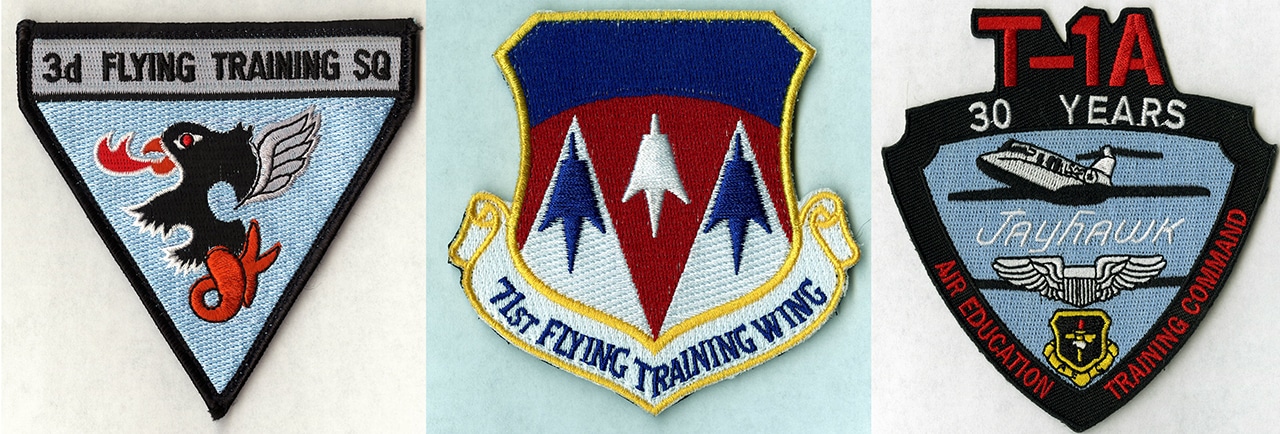
‘3d FLYING TRAINING SQ.’ Stitched ‘home plate’ patch for the 3rd Flying Training Squadron, ‘Peugeots’, 71st Flying Training Wing, Vance AFB, Oklahoma during T-1A Jayhawk operations; 71st TFW patch; T-1A 30 years patch (Greg L. Davis collection) | Source: Greg L. Davis
Vance continued operating the aircraft during the final stage of the fleet’s drawdown.
The Aviationist and contributor Greg L. Davis would like to thank Air Education and Training Command Headquarters Public Affairs, Vance AFB Public Affairs, the 71st Operations Support Squadron, the 3rd Flying Training Squadron and the 8th Flying Training Squadron for making this exclusive photo mission possible.
Special thanks go to Maj. James A. Davis, 3rd FTS Director of Operations; Maj. Nicholas Fairbrother, pilot; Lt. Col. Kyle Williams, copilot; Maj. Andrew Leach, safety observer; and Capt. Nicholas “Apex” Melville, the 8th FTS T-6A Texan II chase pilot.
Eurofighters, an E-550A CAEW, radars and counter-drone systems are officially confirmed, while reports indicate that SAMP/T and Skynex batteries are also part of a force of at least 700 personnel.
“Since the second half of March 2026, following the crisis in the Gulf region and the request for support from partner countries, the Italian Ministry of Defense has deployed an Air Force unit to support the Armed Forces and Security Forces of Saudi Arabia, Kuwait, and Bahrain. The Task Force Air – Arabia contributes to the surveillance and defense of airspace, as well as the protection of national forces and interests in the area.” These is how the Italian Ministry of Defense describes the Task Force it quietly deployed to Saudi Arabia to support the air defense of the Gulf Allies against the Iralianian drone and missile strikes.
While not secret, as demonstrated by the dedicated page on the Italian Ministry of Defence website, the deployment had remained largely out of the spotlight and public opinion knowledge until Italian journalist Fausto Biloslavo reported on it for Il Giornale.
The badge of the Task Force Air – Arabia | Source: Italian MOD
The Italian MOD website provides some interesting details about the composition of such contingent: its contingent consists of approximately 400 Italian Air Force personnel, deployed in Saudi Arabia, Kuwait, and Bahrain. Commanded by an Italian Air Force Colonel, the Task Force Air – Arabia includes:
Task Group Argo, equipped with E-550A CAEW aircraft, a multi-sensor system for early warning, aerial surveillance, and command, control, and communications functions. This asset allows for the detection, identification, and tracking of potential air threats, providing decision-makers and other deployed assets with an up-to-date information picture of the area of operations.
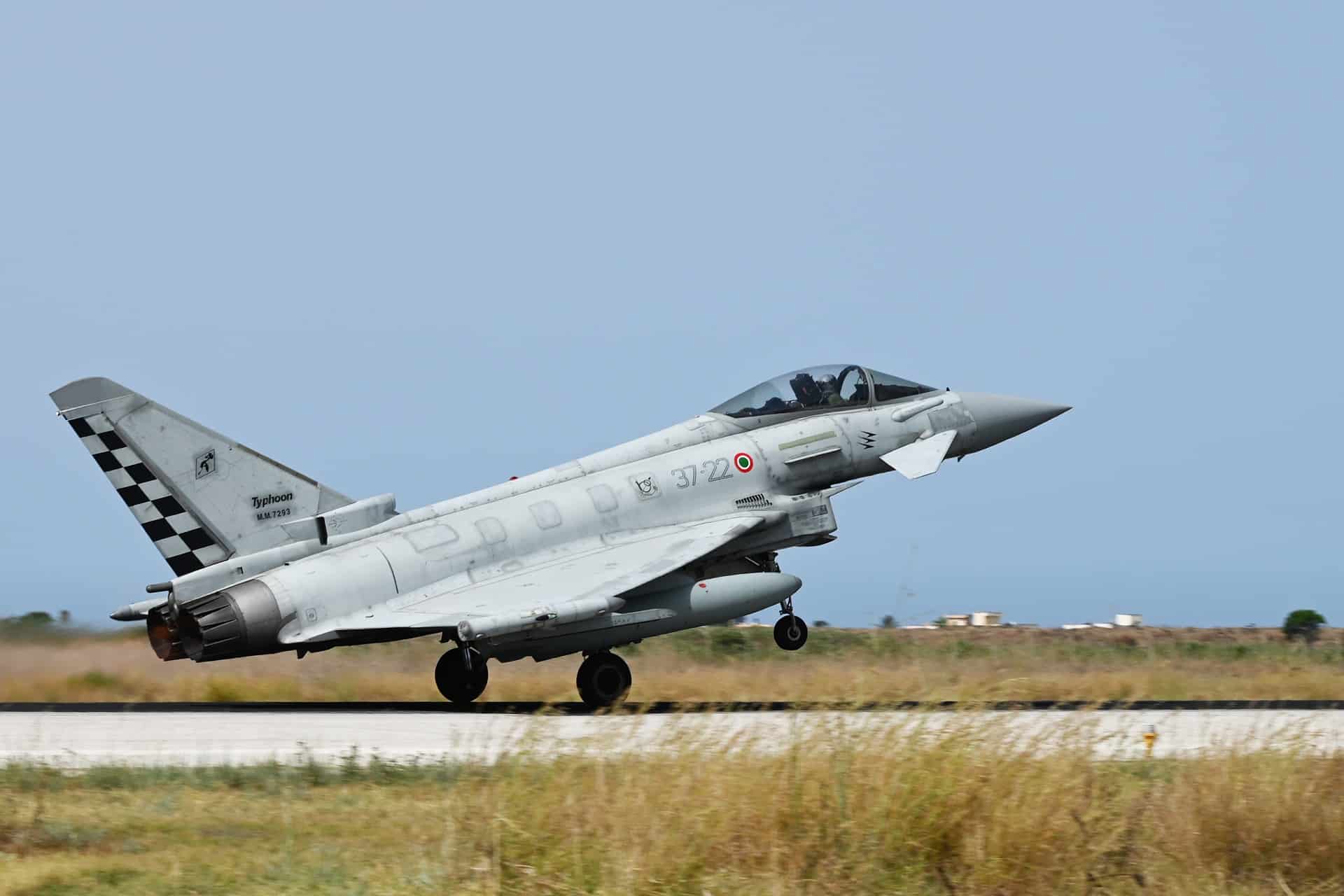
Task Group Typhoon, composed of four Eurofighter F-2000A aircraft, used to help defend assigned airspace.
Task Group Medal, equipped with C-130J/KC-130J transport aircraft, used for tactical transport missions and support for operational activities in the main theaters of national interest in the Middle East and the Horn of Africa, as well as for any medical evacuation needs.
Task Group Kuwait, which ensures air surveillance capabilities through an AN/TPS-77 air defense radar and provides specialized technical support to Kuwait Air Force aircraft.
Task Group C-UAS, equipped with the ACUS-E anti-drone system, used to counter small unmanned aerial systems.
The Task Groups’ activities are supported by personnel, vehicles, and materials dedicated to the logistical and administrative support of the entire national force.
While the Ministry does not say where the Task Force is based, analysis of Italian Air Force aircraft movements in the region clearly shows Al Taif Air Base, officially known as King Fahd Air Base, as the forward operating base for the Italian aircraft.
It is interesting to see the Italian Air Force’s continued use of Taif, a pattern we have observed since the beginning of the Gulf conflict.https://t.co/ZrQIE3Yz1T
The airbase is located in western Saudi Arabia, near the Red Sea, far beyond the standard operational range of many Iranian one-way attack drone and missile threats compared to other installations in the region, still close enough to launch assets supporting the air defense of the region. The base also hosts Royal Saudi Air Force Eurofighter Typhoon jets, making it the perfect choice for the Italian Air Force F-2000s.
As we reported, four Italian F-2000s were deployed to Ali Al Salem AB, in Kuwait, when the base came under Iranian attack on Mar. 15, 2026. The attack destroyed an Italian Air Force MQ-9A Reaper and damaged one Eurofighter Typhoon. Three returned to Italy a few days later, with the status of the fourth one still unknown.
When the Eurofighter where deployed to Al Taif AB is not clear but it should have been towards the end of the same month (March 2026).
Italian Air Force Eurofighter Typhoon pilots conduct combined personnel recovery and slow-moving target intercept validation with the 1st Assault Helicopter Battalion, 106th Aviation Regiment, Illinois Army National Guard on July 1, 2023, at Camp Buehring, Kuwait. (U.S. Army photo by Spc. Anastasia Strong) | Source: U.S. Army photo by Spc. Anastasia Strong
Interestingly, according to Biloslavo, also deployed to the region is a land contingent of the Italian Army, the Task Force Land – Arabia, comprising about 300 personnel, half of those in Saudi Arabia. While its existence is also acknowledged by the Italian MOD website, no additional details are provided about its composition. Biloslavo says the Task Force Land – Arabia is equipped with a SAMP/T battery for air and missile defence, one KRONOS radar in Saudi Arabia and another in Bahrain, and a Skynex anti-aircraft artillery battery in the UAE.
Sikorsky details plans to bring optional piloting into production, expand the Black Hawk’s payload and range, and offer armed configurations to both existing and new-build aircraft.
During the recent Farnborough International Airshow 2026, The Aviationist had the opportunity to discuss the future of one of Sikorsky’s most iconic aircraft, the Black Hawk, with Jason Wrigley, Director of Business Development for Army and Air Force Systems at Sikorsky.
The conversation explored how the company is working to keep the Black Hawk relevant on the future battlefield through a series of upgrades aimed at increasing its range and payload, integrating new weapons and launched effects, introducing greater levels of autonomy and simplifying the integration of future systems through an open-architecture approach.
Wrigley provided some interesting details about the Armed Black Hawk concept, including its potential weapon configurations and its application to both new and existing aircraft, as well as the fully unmanned U-Hawk, the cockpitless variant of the helicopter first unveiled at the end of last year.
Here’s what Wrigley told us.
The Aviationist: What are you showing here with the Armed Black Hawk, and how does this concept reflect Sikorsky’s broader plan to keep the Black Hawk relevant on the future battlefield?
Jason Wrigley: We’re thinking about how to ensure the aircraft remains missionized and relevant to future operational needs, so we’re focusing on several areas. How do we make it fly farther? How do we enable it to carry more? How do we bring in autonomy, including through our other fully autonomous variants? And how do we introduce an open-architecture solution that makes upgrades and new system integration easier?
What we’re showing here with the Armed Black Hawk is really the culmination of that missionization effort. We want to demonstrate that the Black Hawk, which has always been a utility and multirole aircraft, can take on additional missions and perform attack missions much more cost-effectively than a dedicated attack helicopter.
Essentially, it involves adding a mission kit to a utility helicopter that already performs a wide range of missions and has lower acquisition and lower supportability costs than most dedicated attack helicopters.
What enables that capability? The equipment itself, including the launched effects, missiles and guns, is obviously operationally useful. But the key enabler is the expansion of the Black Hawk’s payload capacity.
We’re introducing a new engine, the Improved Turbine Engine from GE Aerospace, which provides 50 percent more horsepower. We are currently conducting the flight-test program with the new engine. We’ve flown it for about 50 hours and taken it up to 17,000 feet above sea level.
We’re making significant progress with the engine test program. At the same time, we’re enhancing the Black Hawk airframe to allow it to carry an additional payload of 1,000 pounds or more, and we’re expanding the fuel tank to extend its range by 135 nautical miles.
See farther. Sense more. Act faster.
The U.S. Army’s air-launched effects testing from the UH-60M Black Hawk is helping shape future missions—giving soldiers new ways to extend reach, gain awareness and stay ahead of emerging threats. pic.twitter.com/wQawx8GZSw
In terms of weapons, is it going to carry everything? Is there something that we can say about the payload and the weapons that can be carried?
The way we envision it is through multiple configurations or packages, ranging from an initial weapons capability with guns and similar systems to a longer-range precision-strike package.
Another major focus of our development is what the U.S. Army calls launched effects. This involves carrying drones that can perform surveillance, carry weapons or support a wide range of other missions.
We see these systems as a way to expand both the mission capability and the operational reach of the platform, even beyond the improvements we are making to extend the aircraft’s own range.
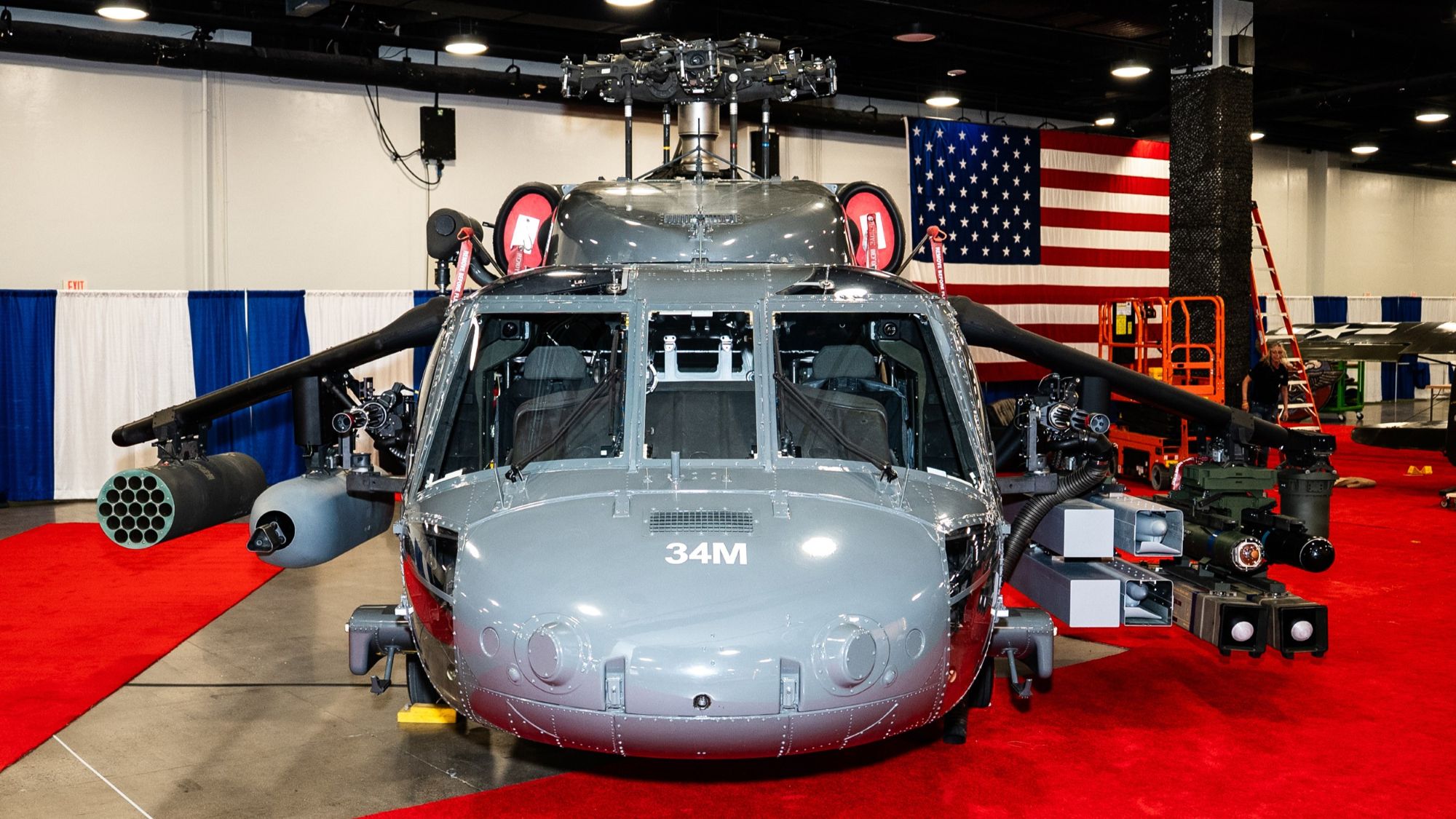
The Armed Black Hawk kit unveiled by Sikorsky at the Army Aviation Warfighting Summit in Nashville, Tennessee. (Image credit: Sikorsky) | Source: Sikorsky
Among all the things that you are doing with the aircraft, are you also looking at some kind of manned-unmanned teaming with other platforms?
Yes, that’s a great question. First, it really starts with those launched effects, because we do not envision employing just one at a time. We expect multiple systems to be operating simultaneously, and the future battlespace will include large numbers of drones that need to communicate back to a mothership or another control node. The Black Hawk will be capable of performing that role.
That communication could also be managed by ground systems, and the Black Hawk could serve as an airborne relay for the data.
We have also invested in and demonstrated Black Hawk autonomy for a very long time. We have flown, I think, around 1,000 hours with autonomous Black Hawks. We therefore see the aircraft as an autonomous node within that network, but also as a cooperative node when it is operated as a piloted platform.
A close up of the modular armament wings of the Armed Black Hawk kit. (Image credit: Author) | Source: David Cenciotti
Is this “optionally manned,” or is it manned?
That’s exactly right. What we’re doing with the Black Hawk is making it optionally piloted, or, to use another term adopted by the U.S. government, optimally piloted, because the level of crew involvement can be selected according to the mission.
It can be flown by a standard crew of two, by a single pilot with autonomy features reducing the workload and allowing the second crew member to focus more on mission tasks, or with no pilots at all.
Although we have demonstrated these capabilities for years, we are now working to transition them into production so that they can become part of the standard Black Hawk capability in the future.
And then over here is the U-Hawk. This is a variant of the Black Hawk that is totally unmanned, right?
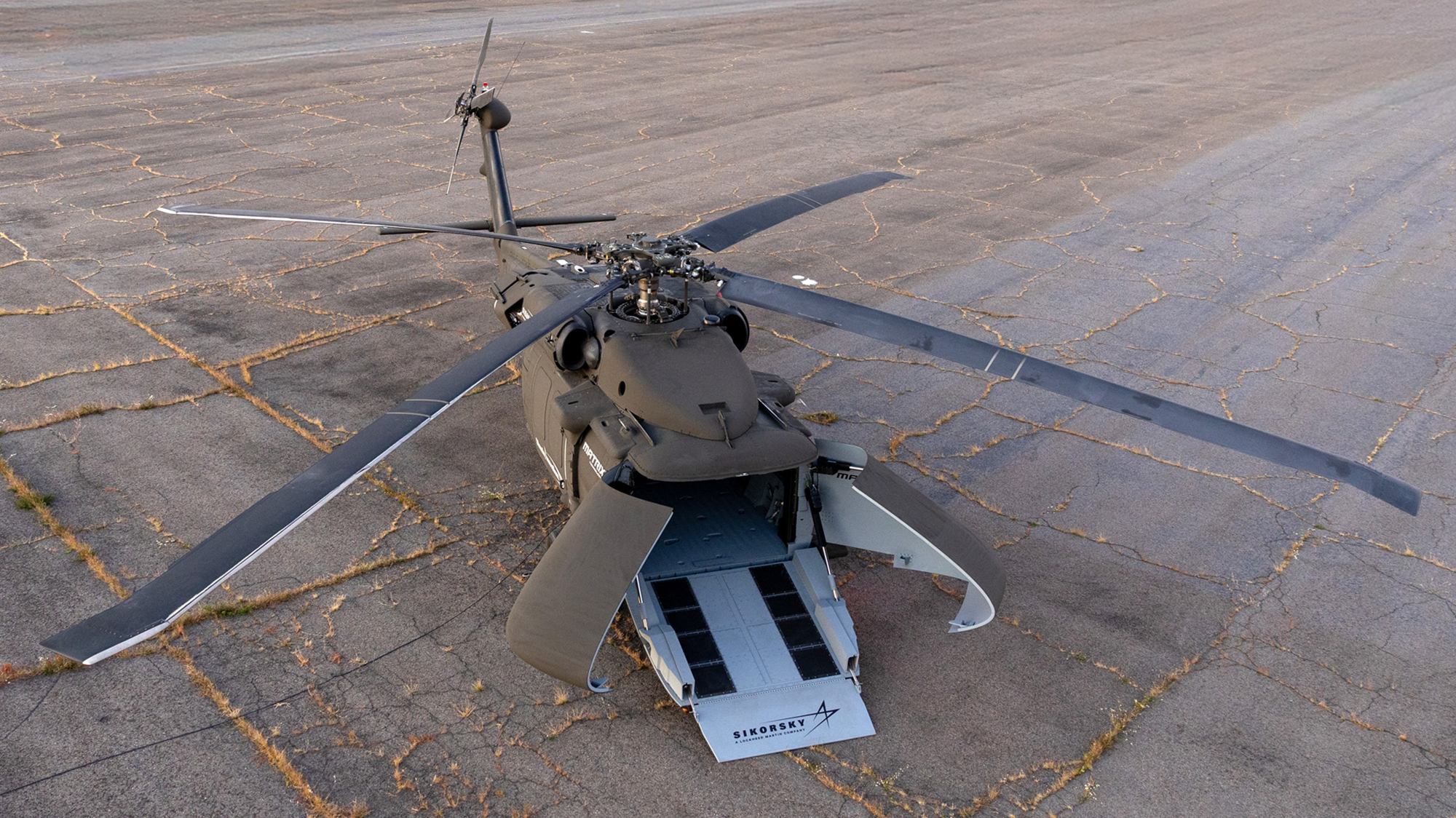
Unmanned, yes. We have removed the cockpit, so this variant is truly unmanned.
We built it around our MATRIX autonomy stack, which has already been proven on Black Hawks and on many other platforms.
This configuration also demonstrates the different ways in which the additional payload capacity can be used. By removing the cockpit and all the equipment associated with piloting the aircraft, we free up a significant amount of internal volume.
We have therefore installed clamshell doors at the front to make loading and unloading easier.
We are also showing here an internal launching system, which provides a way to carry launched effects inside the aircraft. On the Armed Black Hawk, they are carried externally on the wings, while on this variant they can be housed internally.
We are very excited about this variant.
By removing the cockpit, seats and crew stations, the Sikorsky S-70UAS U-Hawk helicopter becomes the first fully autonomous Black Hawk helicopter. (Photo courtesy, Sikorsky, a Lockheed Martin company.) | Source: Sikorsky
Could you provide some additional details about the two variants from a commercial perspective? Are you in discussions with customers outside the United States that may be interested in the Armed Black Hawk? And are there similar discussions regarding the U-Hawk?
There are, yes. We are in discussions regarding both variants.
From an Armed Black Hawk perspective, we formally launched the product earlier this year, and since then we have had a significant number of engagements and discussions.
As for the U-Hawk, we unveiled it at AUSA last year, and we have also had many conversations about the platform since then.
So there are ongoing discussions about both variants, including with potential customers outside the United States. Has the U.S. Army committed to either platform as a launch customer, or are you still seeking an initial contract?
With the U.S. Army, we are working through its modernization program and conducting a number of demonstrations to introduce and validate the capability.
Just last month, the Army employed multiple launched effects during a demonstration event called Capstone. It is an annual exercise designed to develop concepts and tactics, so the Army is now demonstrating the capability, gathering soldier feedback and working toward transitioning it into service.
The U.S. Army is also already working with several international customers through Foreign Military Sales to arm the Black Hawks they are acquiring. In parallel, we are working commercially to make the capability available across our S-70 fleet as well.
So there are multiple pathways and options for customers to acquire the kit.
One last question: can the kit be installed on existing airframes? Aside from the engine, are any additional modifications required to the airframe or onboard systems?
Exactly. The kit can be installed on existing aircraft, and it can also be incorporated into newly built aircraft.
The new engine is not strictly required. There are trade-offs in terms of available payload capacity and overall performance, but customers can already arm their existing platforms.
What we are showing here is the continued refinement of the design toward what we consider the optimal configuration.
Thank you very much for your time and for sharing these insights with us!
The Aviationist would like to thank Jason Wrigley for answering our questions, and Melissa Chadwick of Sikorsky Communications for arranging the interview and welcoming us to the Lockheed Martin chalet.
The service says its M-345 offers capabilities turboprops cannot match and has already employed the trainer to emulate cruise missiles in an aggressor role during a NATO exercise.
Having recently reached the 2,000-flight-hour milestone with the type and with all the 18 ordered aircraft now delivered, the Italian Air Force shared some interesting insights into its experience with the M-345 jet trainer during a media briefing held at the Farnborough International Airshow on July 22, 2026.
The briefing, hosted by Leonardo, the manufacturer of the aircraft also known as M-345 HET (High-Efficiency Trainer), focused on the initial operational capability achieved by the Aeronautica Militare with the new aircraft, which began being used for actual training courses in 2024.
At the presence of Tommaso Pani, SVP Marketing and Sales of the Leonardo’s Aeronautics Division, and Commander Giacomo “Jack” Iannelli, Head of Trainers Project Test Pilot at Leonardo, Lt. Col. Simone Perricci, Commander of the 214th Gruppo (Squadron) of the 61° Stormo (Wing), from Lecce-Galatina Air Base, provided some interesting insights into the first, quite intense, two years of operations of the Italian Air Force school, on the M-345.
An image of the M-345 briefing at Farnborough International Airshow 2026. (Image via Leonardo) | Source: Leonardo
First and foremost, the M-345, designated T-345 by the Italian Air Force, is not “just” an aircraft but part of an integrated training system similar to that of the M-346 (T-346 in ItAF service). Ground-based training is, in fact, just as important as the aircraft used for the actual flying phase. The M-345 share a “common training philosophy” with the M-346, and the aircraft is part of an integrated netcentric system, which allowed a significant reduction in the time needed for the training while improving its quality and efficiency.
According to figures shared by Lt. Col. Perricci, the duration of the training course has been reduced from 12 to nine months. The balance between simulator sessions and actual sorties has also changed, with 35% of training activities now conducted in a virtual environment and 65% involving real flying, compared with the previous 20/80 split.
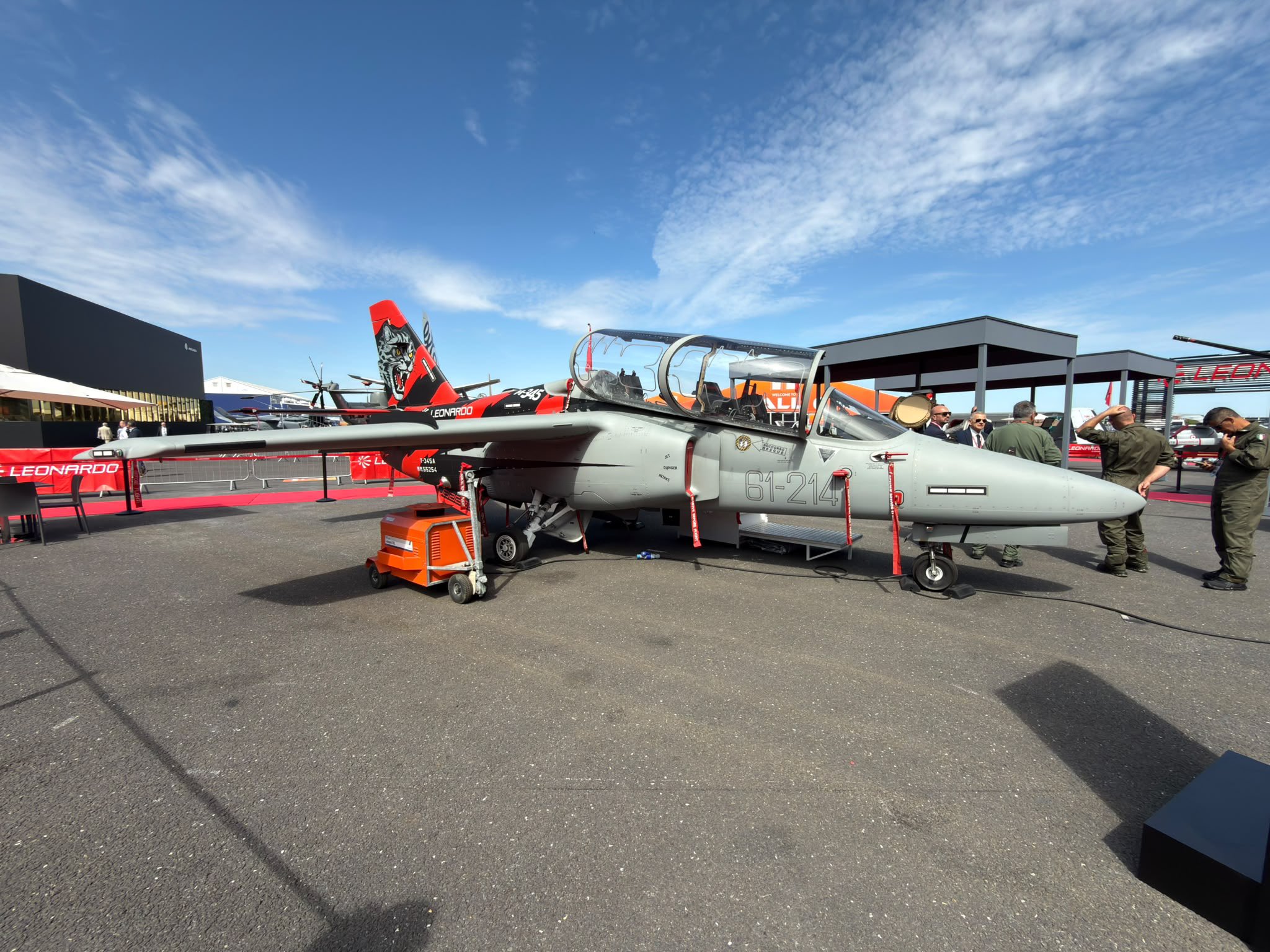
The Italian Air Force T-345 HET on display in the Leonardo apron at Farnborough International Airshow 2026. (Image credit: Kai Greet/The Aviationist) | Source: Kai Greet
The T-345 is a basic jet trainer whose characteristics and performance can be used for the entire training syllabus, from the Primary Pilot Training to the Specialized Pilot Training. The aircraft allows the so called Jet Ab Initio [Jet from the beginning] training, making available performance characteristics which are considered crucial to prepare student pilots for next generation combat systems: speed in the range 0 – 400 knots, high G load (+7/-3) and a roll rate comparable to the one of the M-346 and other fast jets.
For this reason, both the Italian Air Force, which invested in the type and reviewed its training model accordingly, and Leonardo (which is a world leader in combat pilot training), believe jet-powered aircraft can expand basic training in ways that simply cannot be matched by turboprops.
“Student pilots need to see high speed and high G-forces, and this is exactly what the M-345 provides,” Perricci says.
Diamo il benvenuto al nuovo velivolo addestratore, che entra in servizio al 61° Stormo.
Il #T345A, prodotto da #Leonardo e dotato di avionica moderna, tecnologia all’avanguardia, elevata efficienza e flessibilità operativa, è destinato all’addestramento dei piloti militari pic.twitter.com/684Z3mZbxE
— Aeronautica Militare (@ItalianAirForce) June 12, 2025
The aircraft is equipped with the latest technologies, such as an HUD (Head Up Display), touchscreen multi-functional displays, exposing the students to systems used in front-line aircraft, since the early stages of their training path, so they can gradually improve their competencies in using advanced avionics well before reaching the OCUs (Operational Conversion Units).
The onboard systems require minimum maintenance and allow the maximum safety and reliability. While not disclosed, its operational costs are said to comparable to the ones of a turboprop aircraft. The Williams FJ44-4M-34 turbofan engine is equipped with a modern digital control system and provides a good thrust with low fuel-consumption. In that respect, Iannelli explained that the aircraft allowed to carry out test sorties up to 2-hour long, compared to the usual 50 minutes of previous generation trainers. Perricci confirmed that burning approximately 1 kg of fuel per nautical mile and 700 kg fuel tanks, the jet can fly more than 2 hours, allowing different training profiles to be carried out during the same sortie, making the training longer and more realistic.
“The jet is very efficient and very cheap,” Perricci comments.
This is why Leonardo believes there is significant export potential for the M-345 training system, either as a standalone solution or as part of a multi-aircraft training model alongside the M-346, particularly in Eastern Europe, Africa and Southeast Asia.
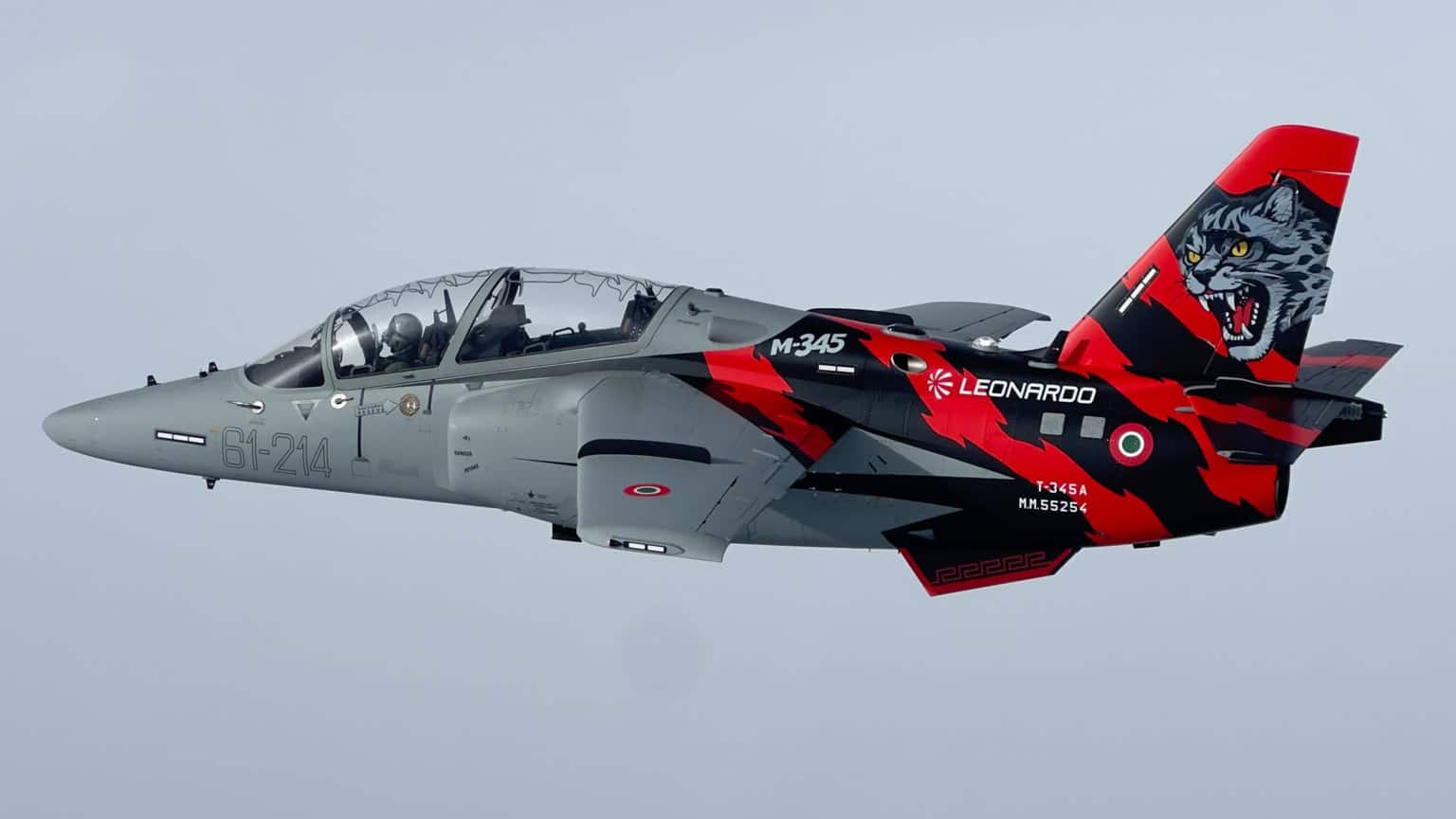
In addition to its training activities, the 214th Squadron also took on an operational role when it participated in the NATO Tiger Meet 2026 (NTM26) at Araxos, Greece, as an observer: the squadron’s emblem features a cat, and the NATO Tiger Meet brings together units whose insignia depict tigers or other felines.
The squadron’s participation was not merely symbolic: the T-345 HET aircraft were employed in a fighter support role similarly to what done 10 years ago by the T-346 during a TLP iteration. missile flight profiles. According to information we were able to gather, one of the aircraft successfully reached its target, while the other was intercepted, highlighting how effectively the M-345 performed in this new role during the exercise.
“This was not a one-off experience. We have already been invited and will probably take part in the same role at next year’s NATO Tiger Meet 2027, which will be held at Gioia del Colle Air Base in Italy,” Perricci said.
The T-345 in special Tiger livery for NTM 26. (Image credit: Italian Air Force) | Source: Italian Air Force
Eleven 48th Fighter Wing Strike Eagles have returned home from the Iran air war sporting interesting nose art and bomb markings.
On Jul. 1, 2026, eleven F-15E Strike Eagles belonging to the 48th Fighter Wing returned home from their latest combat tour in the Middle East. Although some aircraft carried 494th FS markings, according to our sources all the aircrews were from the 492nd Fighter Squadron “Madhatters” (or “Bolars” from the squadron’s callsign). It is not unusual for the two squadrons of the 48th Fighter Wing to pool aircraft and borrow jets from one another when some airframes are unavailable.
The jets made their way back to RAF Lakenheath from Jordan, where they had been deployed to support Operation Epic Fury, with a stopover at Sigonella Air Base in Italy.
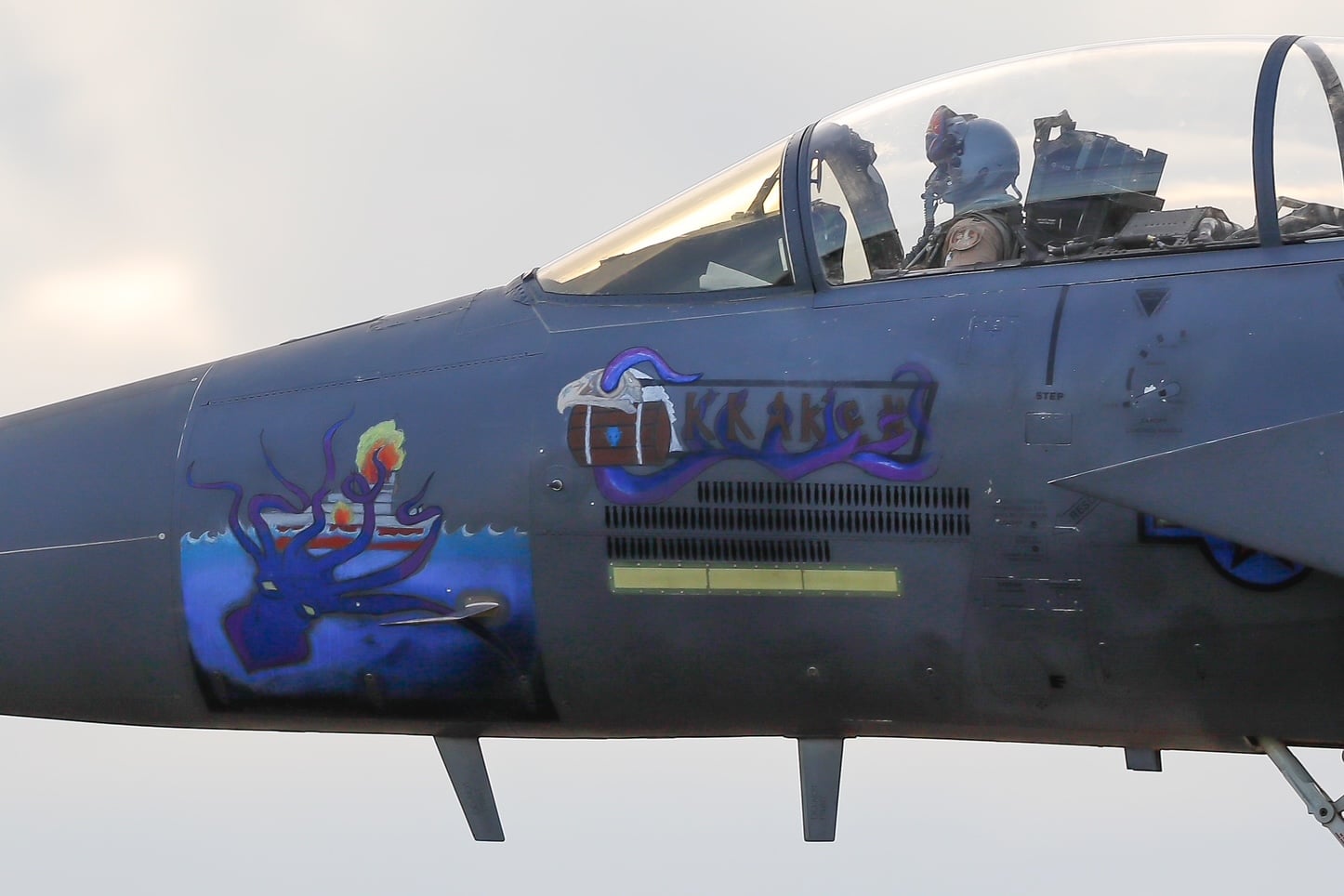
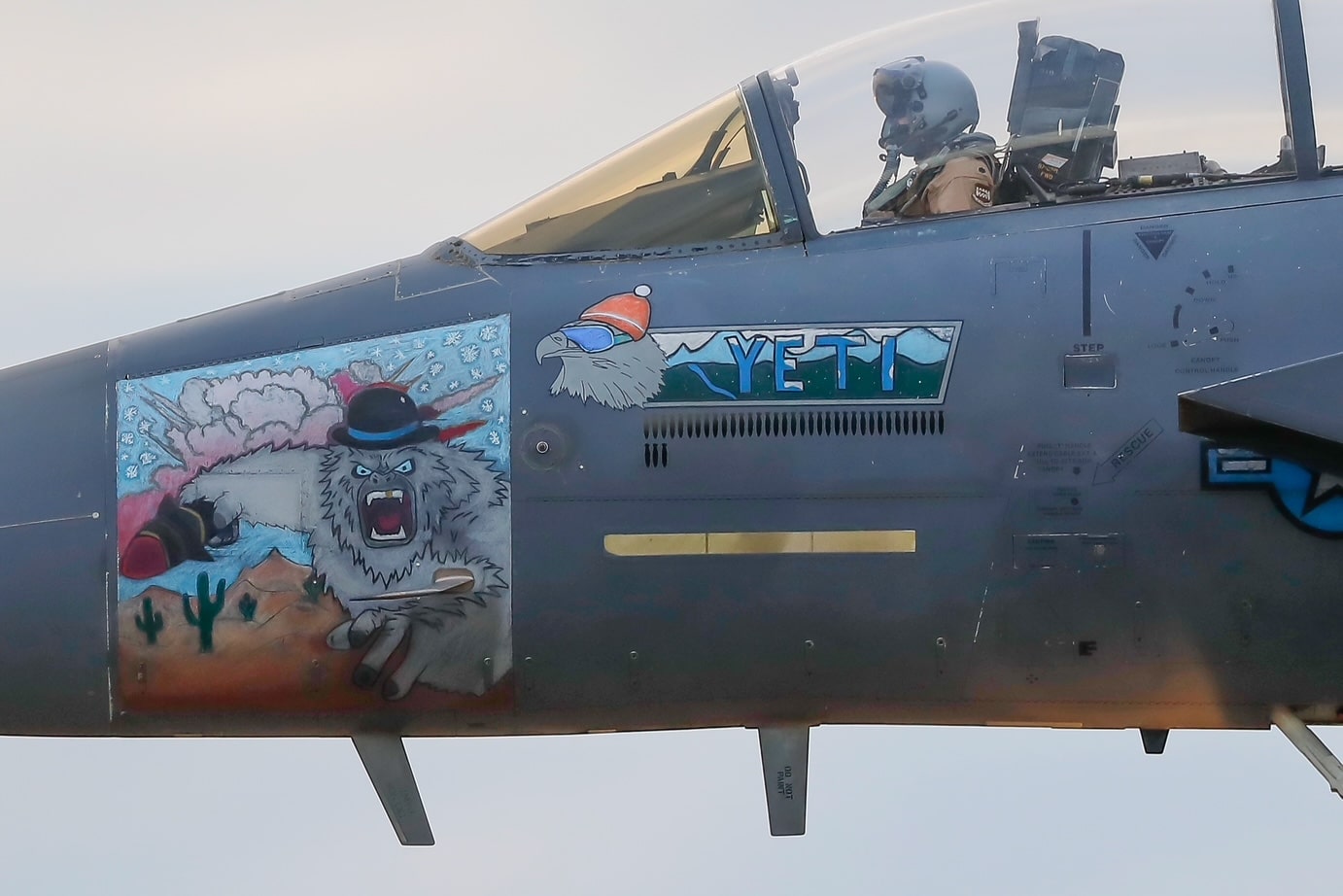
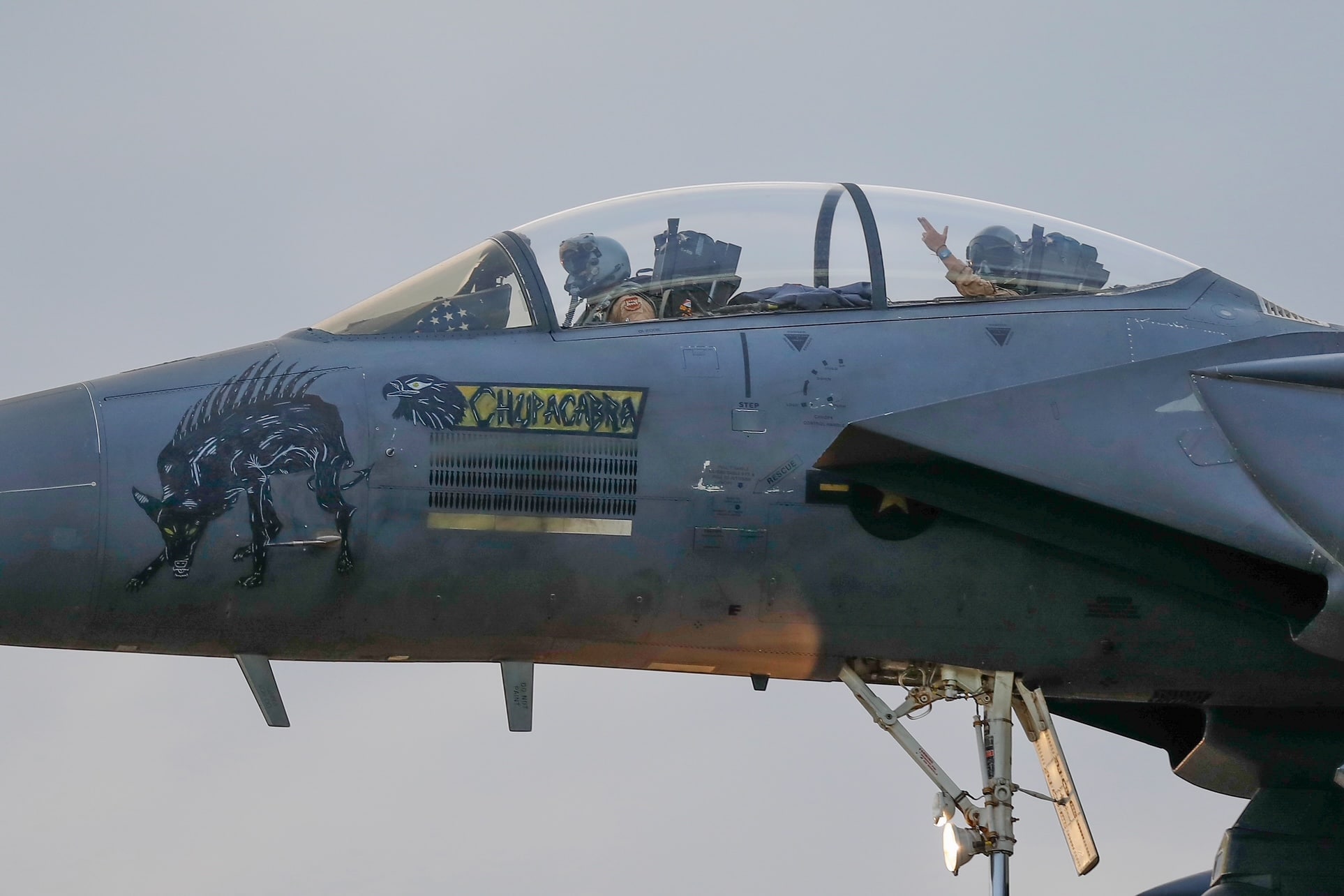
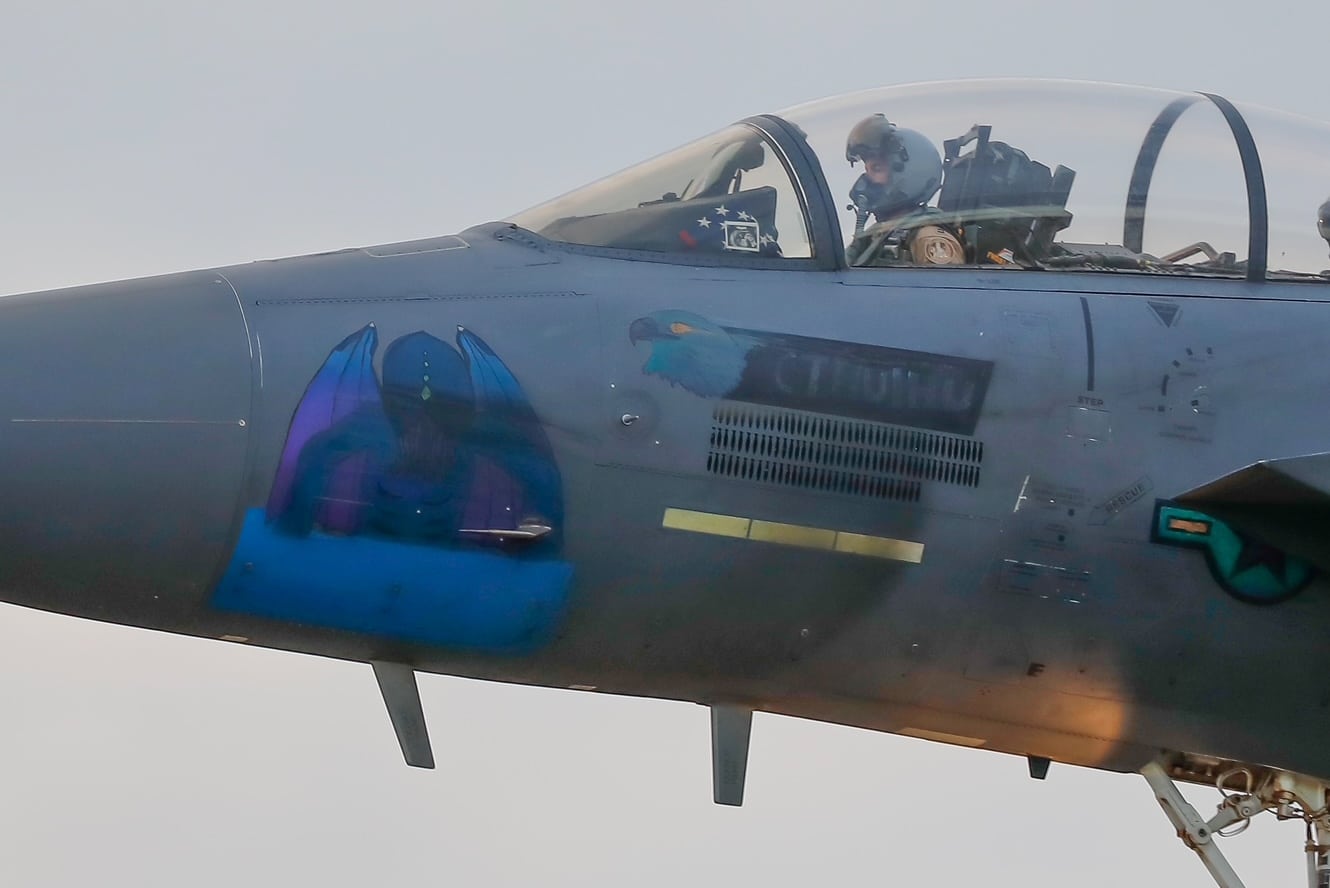
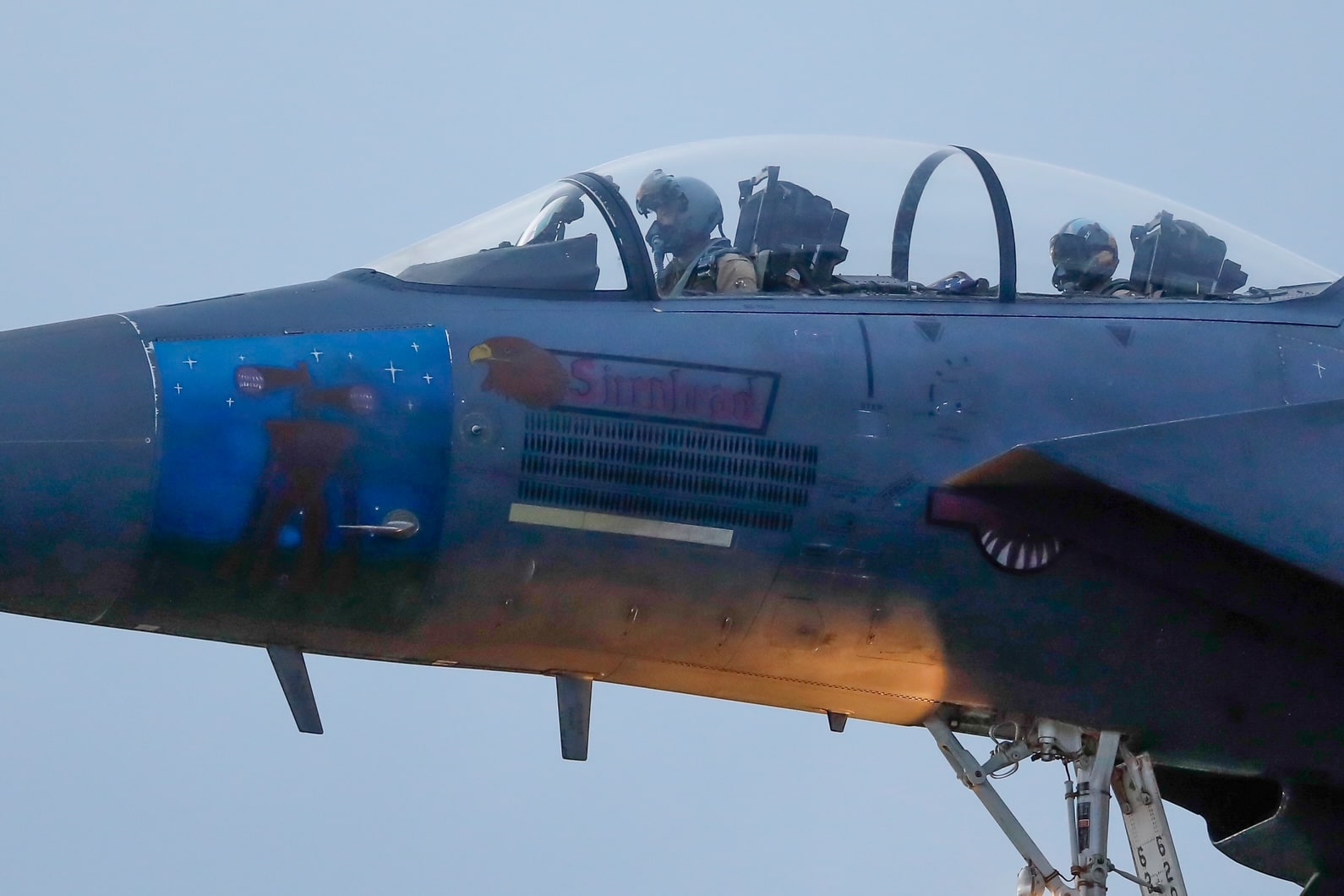
Flying as TREND 11-15 and TREND 21-26, the first eight jets landed before sunset. Despite the poor lighting conditions, our contributor Stewart Jack was there and took some interesting photographs of the F-15Es. The shots reveal nicknames and nose art applied to the jets, as has become a tradition for deployments to the CENTCOM AOR (area of responsibility). In this case, the nicknames appear to follow a monster/cryptid theme, mixing mythological creatures and horror figures.
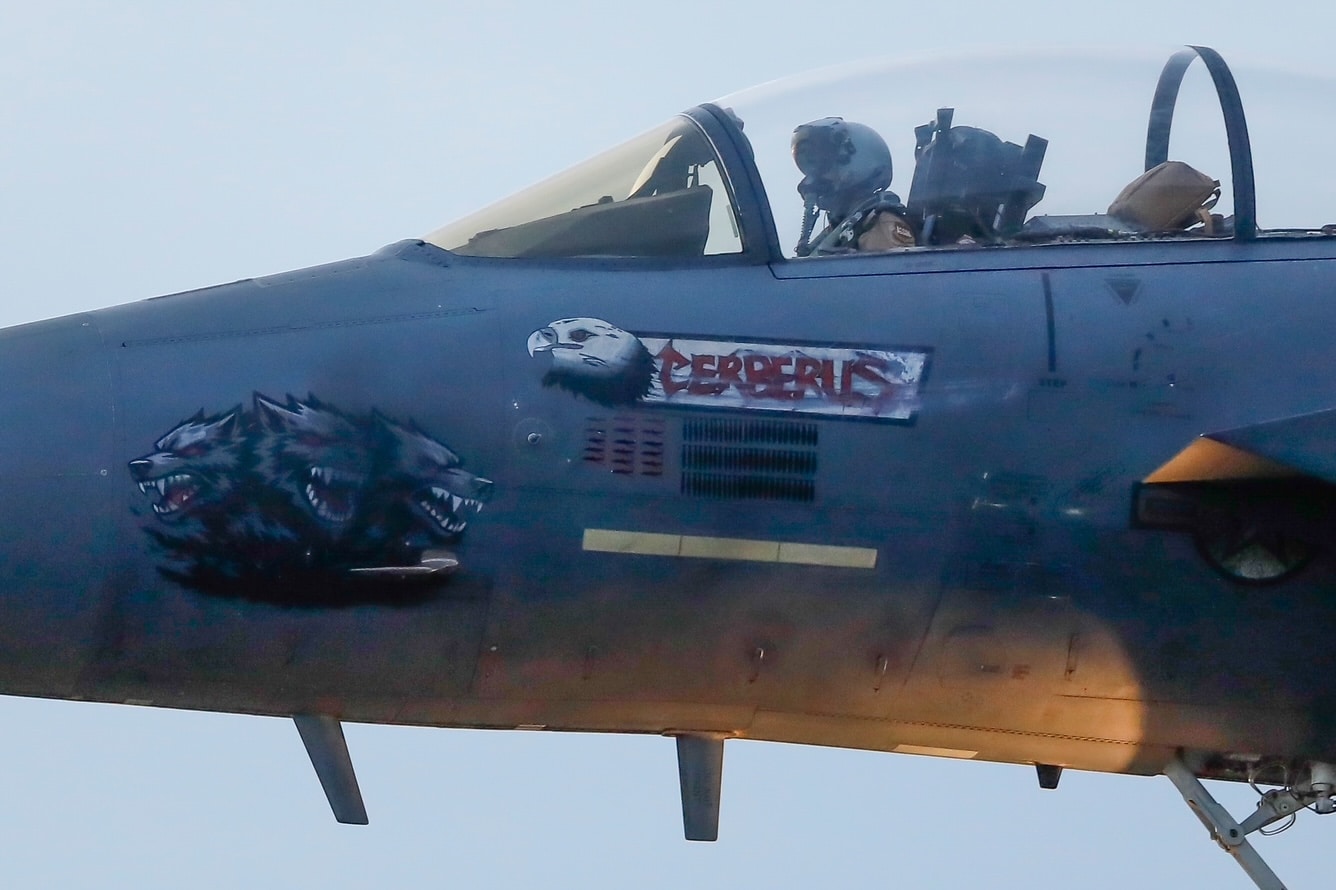
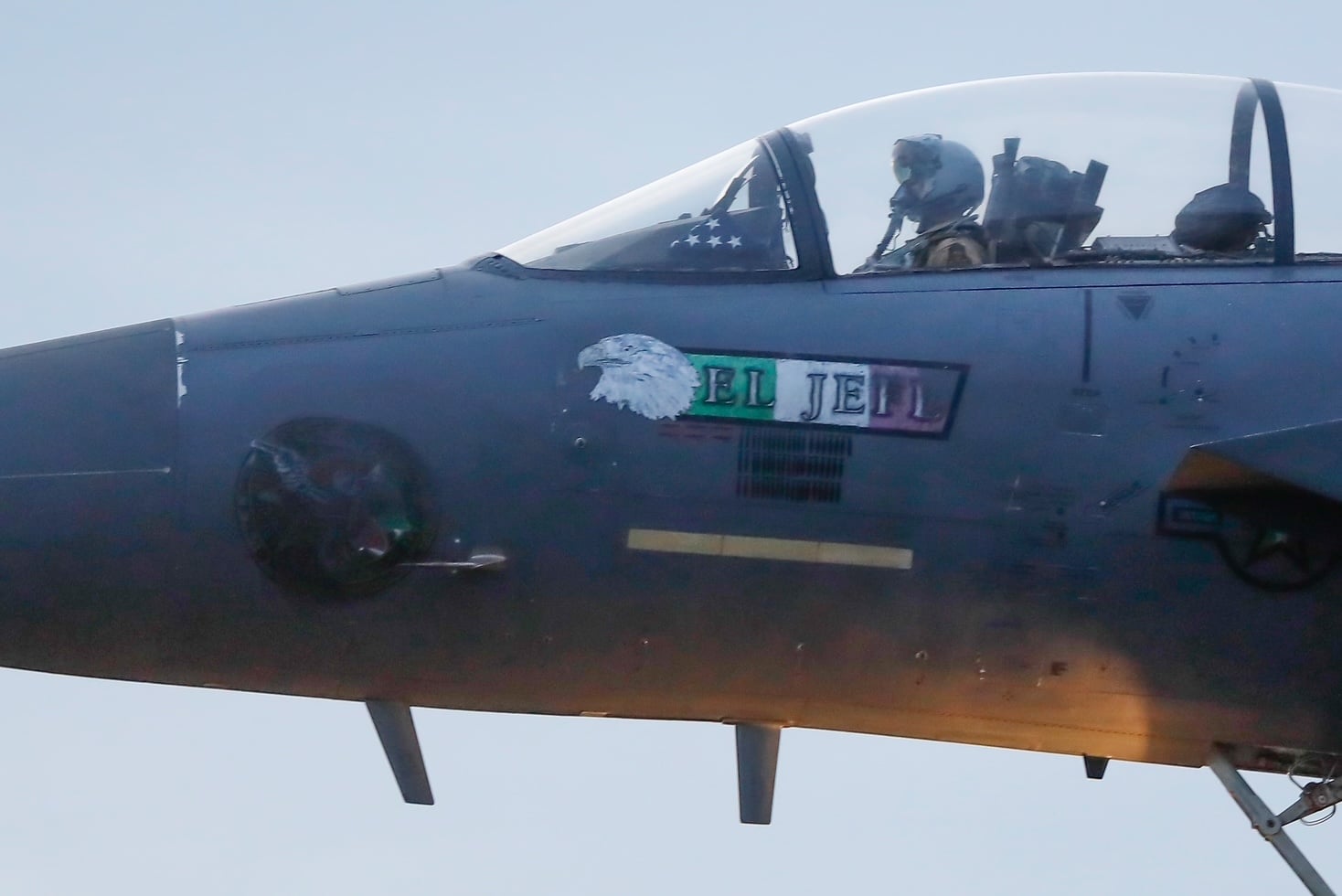
Overall, the first eight Strike Eagles were nicknamed Nessie, Kraken, Yeti, Chupacabra, Cthulhu, Cerberus, Sirenhead and El Jefe. The final three F-15Es landed at around 21:45 LT, when it was much darker, and for the moment we have been unable to determine their nicknames.
More in details the aircraft arrived in the following order:
91-0329 “Kraken” (All images, credit: Stewart Jack) | Source: Stewart Jack97-0221 “Yeti” | Source: Stewart Jack01-2001 “Chupacabra” | Source: Stewart Jack91-0331 “Cthulhu” | Source: Stewart Jack96-0205 “Sirenhead” | Source: Stewart Jack
All the aircraft sport a significant number of JDAM (Joint Direct Attack Munition) markings, with two of them, “Cerberus” and “El Jefe,” also painted with what appear to be AGM-158 JASSM (Joint Air-to-Surface Standoff Missile) silhouettes. Noteworthy, the first eight aircraft don’t seem to sport any APKWS II markings.
91-0309 “Cerberus” | Source: Stewart Jack91-0324 “El Jefe” | Source: Stewart Jack
Nose art and nicknames on Strike Eagles deployed to the Middle East first appeared on the 18 F-15E Strike Eagle jets belonging to the 391st Expeditionary Fighter Squadron returning to Mountain Home AFB from OIR (Operation Inherent Resolve) in April 2019. Since then, it has become a standard for all the F-15E squadrons deployed to the CENTCOM AOR.
On its maiden flight as Air Force One, the new VC-25B “Bridge” aircraft brought President Donald Trump to North Dakota.
On Jul. 1, the U.S. Air Force’s VC-25B Bridge aircraft, a rapidly converted 747-8 gifted by Qatar, made its first flight as “Air Force One,” to take Trump and his staff to Bismarck Municipal airport in North Dakota, for the opening of the Theodore Roosevelt Presidential Library and other 250th anniversary of the United States celebrations.
Images of the inaugural flight were shared online by members of the Presidential staff who had the chance to board the VC-25B for the flight from Joint Base Andrews.
For the first time, the VC-25B bridge aircraft has flown over the Washington, D.C. area with the callsign “AIR FORCE ONE.” @POTUS is on his way to North Dakota today. pic.twitter.com/VVwTbsyAKi
Interestingly, one of the U.S. Air Force’s two VC-25As, 92-9000, served as backup aircraft for the trip. This matches with our previous report according to which the aircraft flew its final planned Presidential sortie on Jun. 18. As we explained, White House staffers posted tributes to the aircraft on social media after it flew President Donald Trump home from the G7 Summit in France and we explained that: “While the U.S. Air Force has said the VC-25A type will remain in service for the foreseeable future to support Presidential Airlift Group and other VIP operations, these tributes likely indicate that the primary VC-25A will soon be 82-8000 – returning to service shortly after an overhaul and upgrade period – with 92-9000 moved to a backup role.
VC-25B-Bridge Makes Maiden Flight as AIR FORCE 1
US Air Force VC-25B-Bridge #AF83F3 is in the air from JB Andrews as AIR FORCE 1 for the first time.
USAF VC-25A #ADFDF9 is serving as SAM47 for this trip, a role that this aircraft hasn’t been in for years. pic.twitter.com/8fblf7iA6h
AIR FORCE ONE (VC-25B Bridge) departs in front of SAM 47 (VC-25A) at Andrews this morning as America has officially entered a new era of Presidential air travel! https://t.co/XTsndmUtxwpic.twitter.com/xL5XhNsokh
The serial for the VC-25B Bridge in U.S. Air Force service will be 25-3300. The aircraft originally carried the Qatari registrations A7-HJA, then A7-HJB. After the Qatar Amiri Flight put the jet into storage, it was re-registered as P4-HBJ. Then, after being transferred to the U.S. it was given the U.S. civilian registration N7478D.
The aircraft wears a somewhat controversial new paint scheme that is a modified version of the one chosen by President Trump for the VC-25B in his first term. This decision was reversed by the Biden administration in favor of an updated variant of the iconic light blue and white livery worn by the current VC-25As, then reversed again by the current Trump administration.
Speaking at the aircraft’s unveiling, President Trump confirmed plans to include the jet in the July 4 flyover over Washington, D.C., alongside F-22 Raptors, F-35 Lightning IIs and other military aircraft. On the other hand, the B-21 Raider will not take part in the flyover, despite some social media posts by Northrop Grumman appearing to suggest that the sixth-generation bomber might make a public appearance over the nation’s capital.
VC-25B Bridge aircraft
The VC-25B Bridge aircraft arrived at Joint Base Andrews, Maryland, in early June 2026, following a secretive nighttime flight to avoid unveiling the new livery before the official ceremony. The aircraft was officially unveiled on June 19.
After that, the VC-25B Bridge started a series of certification flights ahead of its official entry into service with the 89th Airlift Wing’s Presidential Airlift Group. The controversial aircraft, a modified 747-8i donated by Qatar, underwent a rapid conversion process with minimal changes in order to act as a “bridge” until the fully-fledged VC-25Bs enter service.
Critics highlighted the possible security risks of using an aircraft transferred by another nation to fly the U.S. President. However, the Air Force explained that “elite specialists from multiple government agencies developed advanced protocols to detect and-if necessary-neutralize potential technical hazards on previously owned aircraft.”
“The safety and security of the commander in chief is our highest priority,” said Secretary of the Air Force Troy Meink. “From the beginning, we meticulously evaluated every requirement to accelerate delivery while maintaining the high standards expected of the presidential mission. This effort proves that the U.S. Air Force can move fast without sacrificing quality, security, or reliability.”
The fielding of the VC-25B Bridge aircraft could be considered a “forced decision,” as the Air Force needed options to avoid capability gaps in the presidential transport mission. In fact, the service explains that an interim capability became an absolute imperative as the Boeing VC-25B deliveries delayed past the initial 2024 target and VC-25A heavy maintenance cycles are extending.
Despite the unusually public debate surrounding the aircraft, details about its conversion remain scarce. The Air Force has so far declined to discuss the specific modifications being made or whether any requirements were adjusted to accelerate delivery.
The service however confirmed that the jet has been fitted with at least a certain level of advanced communications and self-defense capabilities, though if these are sufficient to allow the aircraft to be used for overseas travel remains to be seen. Unconfirmed rumors mentioned the aircraft might be limited to flights within the U.S.
Typically, U.S. Air Force aircraft designated to serve as Air Force One receive extensive upgrades, including hardened defenses, secure and redundant communications systems, and survivability enhancements intended to support presidential command and control during a national emergency or nuclear conflict.
According to the most read Italian newspaper, the Italian Air Force Reaper remained at Ali Al Salem Air Base after Rome decided against relocating it to avoid any move that could be perceived as involvement in the war against Iran. The aircraft was destroyed there despite Italy not taking part in Operation Epic Fury.
On Mar. 15, an Iranian drone strike targeted Ali Al Salem Air Base in Kuwait, where an Italian Air Force MQ-9A Reaper (Predator B) was destroyed inside its protective shelter.
The RPA (remotely piloted aircraft), one of the six Predator B unmanned aircraft belonging to the 32° Stormo (Wing) of the Italian Air Force, homebased at Amendola Air Base, in southeastern Italy, was assigned to the Task Group Araba Fenice of the Italian National Contingent Command Air/Task Force Air Kuwait (IT NCC AIR/TFA-K) to carry out ISR (Intelligence Surveillance and Reconnaissance) missions as part of “Prima Parthica”, the Italian contribution to the multinational campaign against Daesh in Iraq and Syria.
Task Group Araba Fenice has been operating from Ali Al Salem Air Base (ASAB) in Kuwait since October 2014. Initially with the MQ-1C Predator A+ and, since January 2015, with the more advanced MQ-9A “Predator B.”
The Italian Air Force website describes the MQ-9 unmanned aircraft as follows:
The MQ-9A is a strategic-class remotely piloted aircraft system that provides long endurance at medium and high altitude, enabling high performance in Intelligence, Surveillance and Reconnaissance (ISR) missions as well as in land and maritime patrol operations, search and rescue, convoy and troop escort, and the protection of forces and installations.
Thanks to its onboard sensors and the professionalism of its flight crews and analyst personnel, the MQ-9A can detect the presence of threats or improvised explosive devices and monitor wide areas of operation, promptly sharing information with coalition partners that is useful to gain a detailed understanding of the environment of interest, thereby improving knowledge and awareness of the operational context.
According to a recent story by the Italian newspaper Corriere della Sera, citing “authoritative sources familiar with the matter,” Italy’s Ministry of Defense had already assessed that its aircraft in Kuwait could become targets following the beginning of the hostilities in the region, and had discussed possible force protection measures.
One option considered by the Italian military was to launch or relocate the aircraft simply to prevent them from being hit on the ground.
However, even a defensive move of that kind could have been interpreted as a hostile act. Since Italy was not a party to the conflict, Rome wanted to avoid any action that could be perceived as drawing the country into the air war against Iran. Following consultations, the decision was reportedly made to keep the aircraft on the ground. As a result, the MQ-9A, worth around 34 million Euro, remained inside its shelter at Ali Al Salem and was destroyed during the Iranian attack.
Satellite imagery released by Iran shows the strike on an Italian installation at Ali Al Salem Air Base in Kuwait that destroyed an MQ-9 Reaper in its hangar and, potentially, the satellite antenna associated with the system. (29.336° 47.5334°) 1/6 pic.twitter.com/UT52W7A7cr
Shortly after the attack, the Italian Defense Staff released an official statement:
“This morning, Ali Al Salem Air Base in Kuwait, which hosts U.S. and Italian capabilities and personnel, was the target of a drone attack that hit a shelter housing a remotely piloted aircraft belonging to the Italian Air Task Force. The aircraft was destroyed. I immediately spoke with Colonel Mangini to ascertain the condition of the Italian personnel present at the base. At the time of the attack, all personnel were safe and were not involved. I promptly informed Minister of Defense Crosetto of the incident, and I remain in constant contact with him to continuously monitor the situation of all our contingents abroad,” said the Chief of the Italian Defence General Staff, General Luciano Portolano.
The Italian Air Task Force contingent had been preventively reduced in recent days as part of the measures adopted in response to the evolving security situation in the area. The personnel who remained at the base are employed in carrying out the mission’s essential activities.
The aircraft that was hit was an indispensable asset for the conduct of operational activities and had remained deployed at the base in order to ensure continuity of operations.
The situation is being constantly monitored by the Chief of the Defence General Staff and by the Joint Operations Command (Comando Operativo di Vertice Interforze, COVI), which maintain continuous contact with the contingents on the ground.
Provided the Corriere della Sera article is correct, it would mean that Italy was so determined not to be drawn into the conflict that it accepted the risk of losing a valuable asset such as the MQ-9 Reaper.
The story published by the most read Italian newspaper comes after Italian Defense Minister Guido Crosetto criticized NATO Secretary General Mark Rutte who said that around 500 U.S. flights had utilized American air bases in Italy during the war in Iran, a disclosure that led Tehran to accuse Rome of taking part in the conflict. Crosetto said Rutte’s comments were “random,” “inappropriate,” and “superfluous,” clarifying that Italy authorized only logistical, non-combat operations in compliance with international treaties (a topic we discussed in a previous story you can find here explaining that any support for “kinetic” missions outside the scope of existing treaties would require parliamentary approval).
An Italian MQ-9A Predator B drone at Amendola AB. (Image credit: Author) | Source: David Cenciotti
What about the Eurofighters?
While it clarifies the reason why the valuable asset was not relocated at the beginning of the U.S. and Israeli air strikes on Iran, the Corriere della Sera report does not provide additional details about the damage to the Italian Eurofighters also deployed to Ali Al Salem. Their status has been subject to speculation and unconfirmed reports since the aftermath of the attacks. At the time, OSINT accounts as well as some media outlets claimed that two Italian Eurofighters had been damaged, although repairable. However, those claims were never officially confirmed.
An Italian F-2000A Typhoon sits on the ramp at Alì Al Salem Air Base. (Photo: Italian Air Force) | Source: Italian Air Force
We noted that four Italian Eurofighters were reportedly deployed to Kuwait at the time of the attack and that three had returned home a few days later, suggesting that either only one aircraft had actually been affected, or that one of the two allegedly damaged jets had suffered only very light damage and was still able to fly back.
Not sure here: four Italian Eurofighters were deployed. Three returned home a few days ago. Either only one was damaged, or one of the two was only very lightly affected and could fly back home. https://t.co/IIU2Jrk5r1
We reached out to the Italian Air Force, the Italian Defence General Staff, as well as the Italian Ministry of Defense, seeking an official answer. None of them responded to our multiple queries. Therefore, while as many as two Italian F-2000s were likely hit by shrapnel, the MQ-9A destroyed on Mar. 15 remains the only Italian aircraft loss publicly acknowledged in connection with the Iranian attacks on Ali Al Salem.
The F-35 wearing the tail code “WW” will join Misawa’s 35th Fighter Wing and fly the Suppression of Enemy Air Defenses (SEAD) mission from Japan.
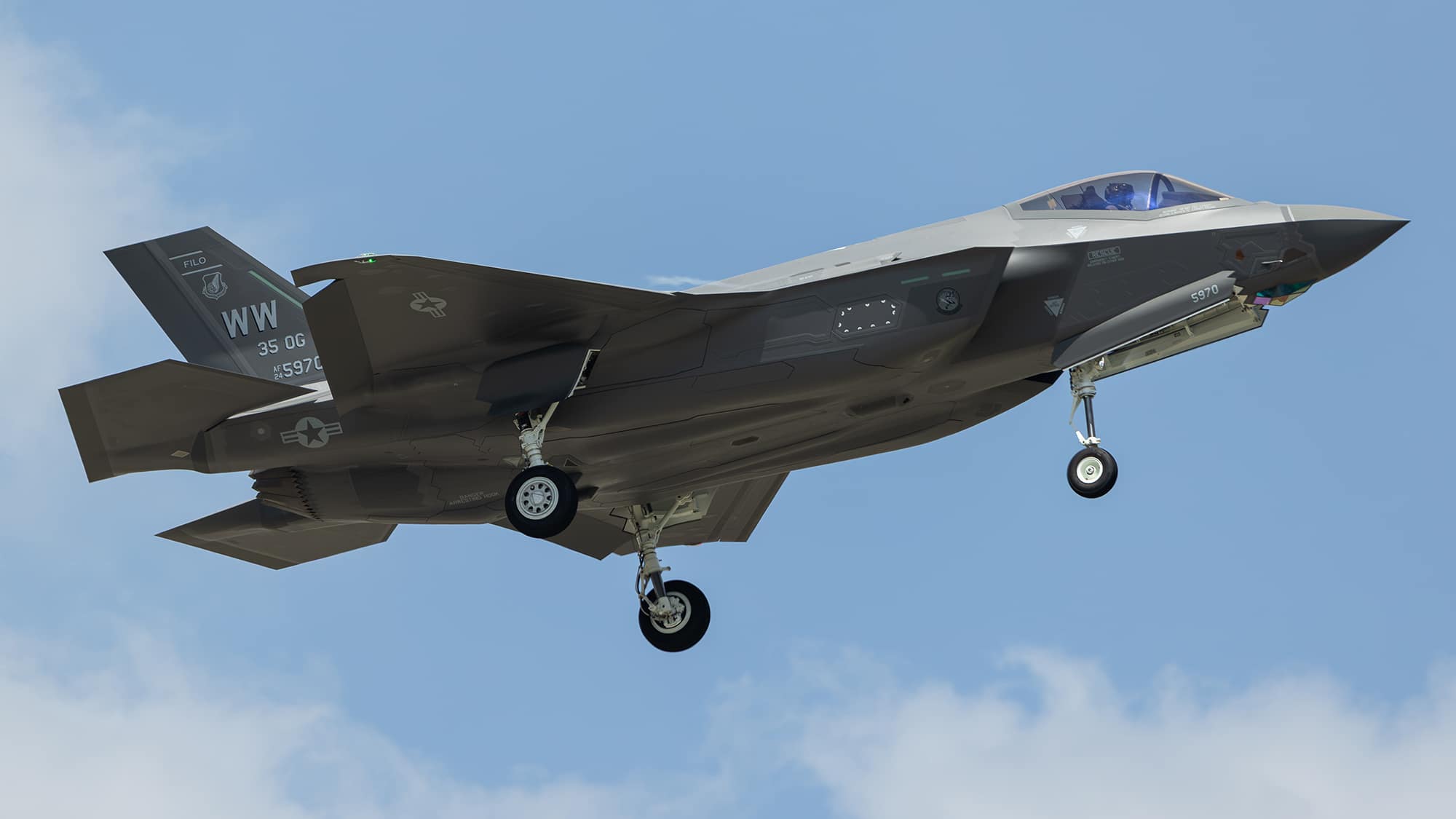
On June 16, 2026, the F-35A Lightning II aircraft 24-5970 made its first flight from Naval Air Station Joint Reserve Base Fort Worth. The jet departed around 2PM local time and returned roughly an hour later for a straight in approach to a full stop, accompanied by an ATAC F-1 chase.
The aircraft, destined to the 35th Fighter Wing, based at Misawa Air Base, Japan, is the first F-35 to carry the iconic “WW” tail code, as the photos, taken by photographer Tim Wurth, show.
Standing for Wild Weasel, the code reflects the wing’s heritage and mission, a nickname that, since the Vietnam War, has been associated with U.S. Air Force units and aircraft tasked with the Suppression of Enemy Air Defenses (SEAD) mission. Misawa’s fighters adopted the “WW” tail code on Jun. 18, 1996, when the 35th Fighter Wing changed its tail flash from “MJ” to “WW” to reflect both its mission and its long association with Wild Weasel operations, including its earlier role as the Wild Weasel training center at George AFB.
Interestingly, the text “FILO” appears on top of the tail: it stands for “First In, Last Out,” the 35th Fighter Wing’s motto, which highlights the unit’s willingness and confidence to put lives on the line, press the attack against integrated air defense systems, and see each mission through.
The aircraft is said to be destined to the 13th Fighter Squadron, although it is actually the Operations Group commander’s aircraft sporting also the badge of the 14th Fighter Squadron on the right air intake: a similar arrangement was previously seen on F-16C 90-0805 at Misawa Air Base. The aircraft, marked as a 35th Operations Group jet, carried the 14th Fighter Squadron emblem on the right side of the tail and the 13th Fighter Squadron emblem on the left, effectively representing both of Misawa’s Wild Weasel squadrons rather than a single unit.
The 13th Fighter Squadron traces its modern combat identity to the Vietnam War. Its predecessor, the 13th Tactical Fighter Squadron, was activated in 1966 and operated from Korat Royal Thai Air Force Base, flying Wild Weasel missions against North Vietnamese surface-to-air missile sites. Official Misawa material says the squadron “pioneered the Wild Weasel mission during the Vietnam War.”
The squadron later adopted the “Panther Pack” identity. According to Misawa’s fact sheet, in 1972 the 13th FS adopted a black Asian leopard named Eldridge and became known as the Panther Pack.
Another image of the first F-35 with the WW tail flash. (Image credit: Tim Wurth/@lightning_ll_images) | Source: Tim Wurth/@lightning_ll_images
The F-35A 24-5970 will join the first four F-35A Lightning II fighter jets that arrived at Misawa on Mar. 28, 2026, marking the arrival of the service’s first F-35s to be permanently based in Japan. As explained in a previous story we published here at The Aviationist, the first four aircraft, which arrived from the U.S. after a stop at Hickam Air Force Base, Hawaii, were not newly built: three F-35s were transferred from Hill Air Force Base, Utah, while the fourth previously belonged to RAF Lakenheath, UK. All of them retained their original tail codes, respectively “HL” and “LN”.
Along with the 13th FS, also the 14th Fighter Squadron will replace its F-16C/Ds with the F-35A: overall, the 35th Fighter Wing is slated to replace 36 F-16s with 48 F-35As.
The transition from the F-16 to the F-35 marks a major evolution in Misawa’s Wild Weasel mission, with the Lightning II bringing capabilities that are inherently suited to SEAD.
The F-35 and the Wild Weasel mission
The F-35 is said to have the ability to locate and track enemy forces, jam radio frequencies and disrupt attacks from stand-off distance. However, it still lacks the integration of a missile for SEAD missions.
While the Block 3F already provided the ability to use, among the other stand-off weapons, also the GBU-39 SDBs (Small Diameter Bombs), at the moment, the AARGM-ER, the missile that will replace the AGM-88 and that the F-35A and F-35C will be able to carry inside the weapons bay, is still not available.
As I’ve previously noted, the USAF is adopting the AARGM-ER as an interim solution for the service’s Stand In Attack Weapon program for the F-35A and other platforms. Northrop is expected to produce 5,000+ AARGM-ER / SiAW weapons under the current effort.https://t.co/40RrPjVCyP
So, the aircraft’s SEAD capability is, at least for some time, mostly reliant on the F-35’s AESA (Active Electronically Scanned Array) radar with sophisticated electronic attack capabilities, including false targets, network attack, advanced jamming and algorithm-packed data streams.
In an official U.S. Air Force release earlier this year, Lt. Col. John Widmer, commander of the 13th Fighter Squadron, described the F-35 as “tailor made to be a weasel platform,” noting that while legacy aircraft carried sensors or weapons added specifically for the mission, the F-35 was designed from the outset as a sensor platform, combining stealth, advanced sensors, sensor fusion and the ability to “quarterback” the fight. According to Widmer, stealth is one of the most significant advantages in the transition from the F-16, but it is the aircraft’s constantly evolving sensor package that allows pilots to detect, understand and manage the full spectrum of enemy threats.
An F/A-18D Legacy Hornet belonging to VMFA-323 crashed while flying the VR-1355 low-level route in Washington State, with the pilot’s ejection caught on camera.
On Jun. 13, 2026, at approximately 12.00 PDT an F/A-18D Hornet aircraft assigned to Marine Aircraft Group 11, 3rd Marine Aircraft Wing, crashed approximately 55 miles southeast of Seattle, while conducting a routine training mission
The pilot ejected safely and was recovered by the local sheriff’s department.
“The cause of the mishap is currently under investigation,” says an official 3rd Marine Aircraft Wing press release. “To preserve the integrity of the investigation, no additional details are available at this time. Mishap investigations can take several months to complete, depending on various factors.”
Interestingly, clips of the single pilot ejecting from the two-seat Legacy Hornet have almost immediately started circulating online, showing also the explosion following the impact of the jet with led to the ignition of the Pine Tree Fire, which has grown to two acres, according to the National Interagency Fire Center.
Video from Tic Toc of the F-18 crash in WA from VFMA-323. Rumor is the pilot ejected safely. Praying he is uninjured pic.twitter.com/hAmRftwdpc
The mishap took place along the Visual Route 1355, one of the low level routes running through national parks in the Cascade Mountains.
A US Navy F/A-18 crashed near Rimrock Lake, pilot ejected and walked out with medics according to reports. This is along the famous VR-1355 low level route in Washington State.
Colloquially called the “million dollar ride” for both the scenic views and the fun and “aggressive” flying that can be done through the valleys, VR-1355 is one of the most popular low level routes among the Growler squadrons based at NASWI.
An EA-18G Growler Electronic Attack aircraft belonging to the Electronic Attack Squadron 130 (VAQ-130) “Zappers” carrying two crew members crashed more or less in the same area, near Mount Rainier, little less than two years ago, on October 15, 2024. The aircraft wreckage was located in the mountainous region by search teams on Wednesday, October 16. The fate of the two naval aviators aboard the Growler at the time of the crash remained unknown until Oct. 21, 2024, when the U.S. Navy identified them as Lt. Cmdr. Lyndsay “Miley” Evans and Lt. Serena “Dug” Wileman.
While the U.S. Marine Corps did not provide any details about the exact type or unit of the Legacy Hornet that crashed on Jun. 13, the aircraft was almost immediately identified as BuNo 165412, tail code WS-415, from VMFA-323 “Death Rattlers,” based at Marine Corps Air Station (MCAS) Miramar in California, flying as SNAKE 21. The identification was made possible thanks to photographs of the aircraft departing King County International Airport – Boeing Field where the “Death Rattlers” Legacy Hornets from MCAS Miramar had deployed.
A Puget Sound photographer noticed that only three of the four aircraft returned to the departure airfield, with the missing jet being airframe 165412.
With regard to the fighter lost in a crash off Rimrock Lake in the Cascades, it is this Legacy Hornet airframe visiting from MCAS Miramar.
The bomb markings on the returning A-10 Thunderbolt II jets hint at the variety of weapons the Warthogs used against Iran, while the kill marks offer clues about some of the targets they hit.
On Jun. 12, 2026, 11 A-10C Thunderbolt II aircraft, belonging to the 75th Fighter Squadron of the 23rd Wing, from Moody Air Force Base, Georgia, arrived at RAF Lakenheath, UK, from Aviano Air Base, Italy, on their way back to the U.S. following their deployment to the CENTCOM AOR (Area Of Responsibility). During the deployment, they took part in Operation Epic Fury and also carried out missions over Iraq and Syria.
The Warthogs (as the A-10s are nicknamed) arrived in the UK split into four cells:
TABOR 11-13:
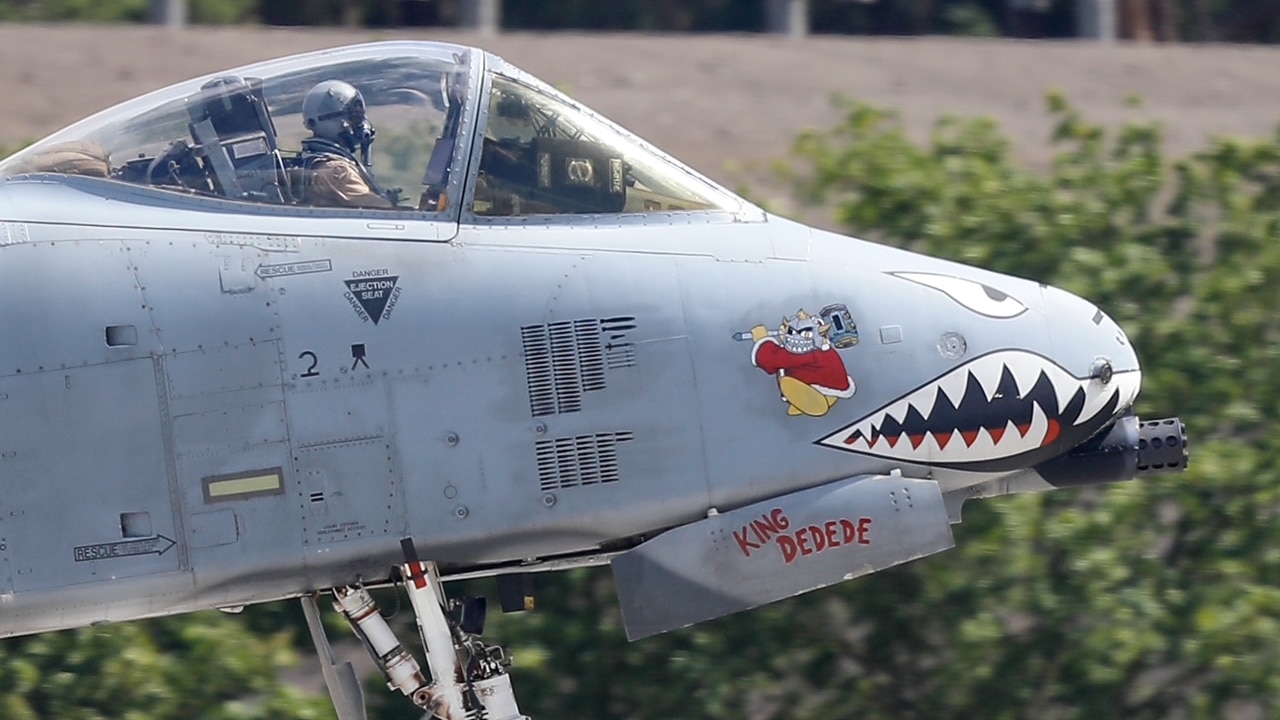
80-0175/FT “King Dedede”
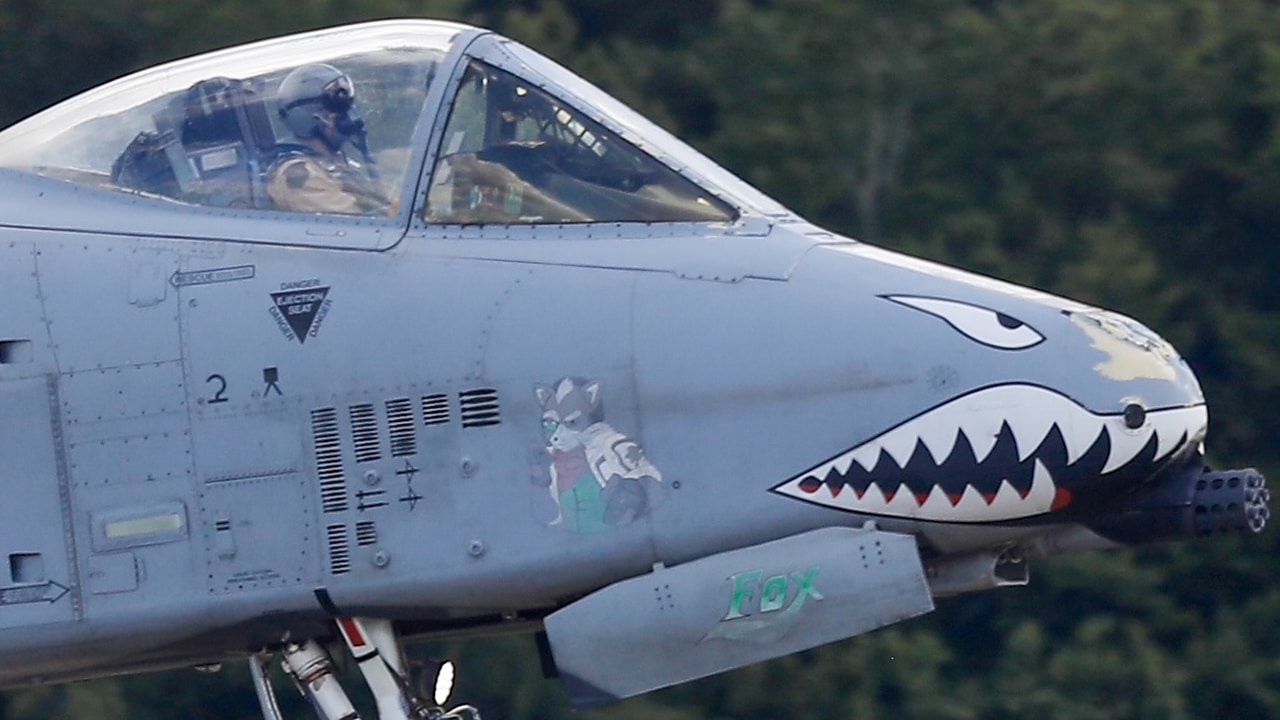
79-0157/FT “Fox”
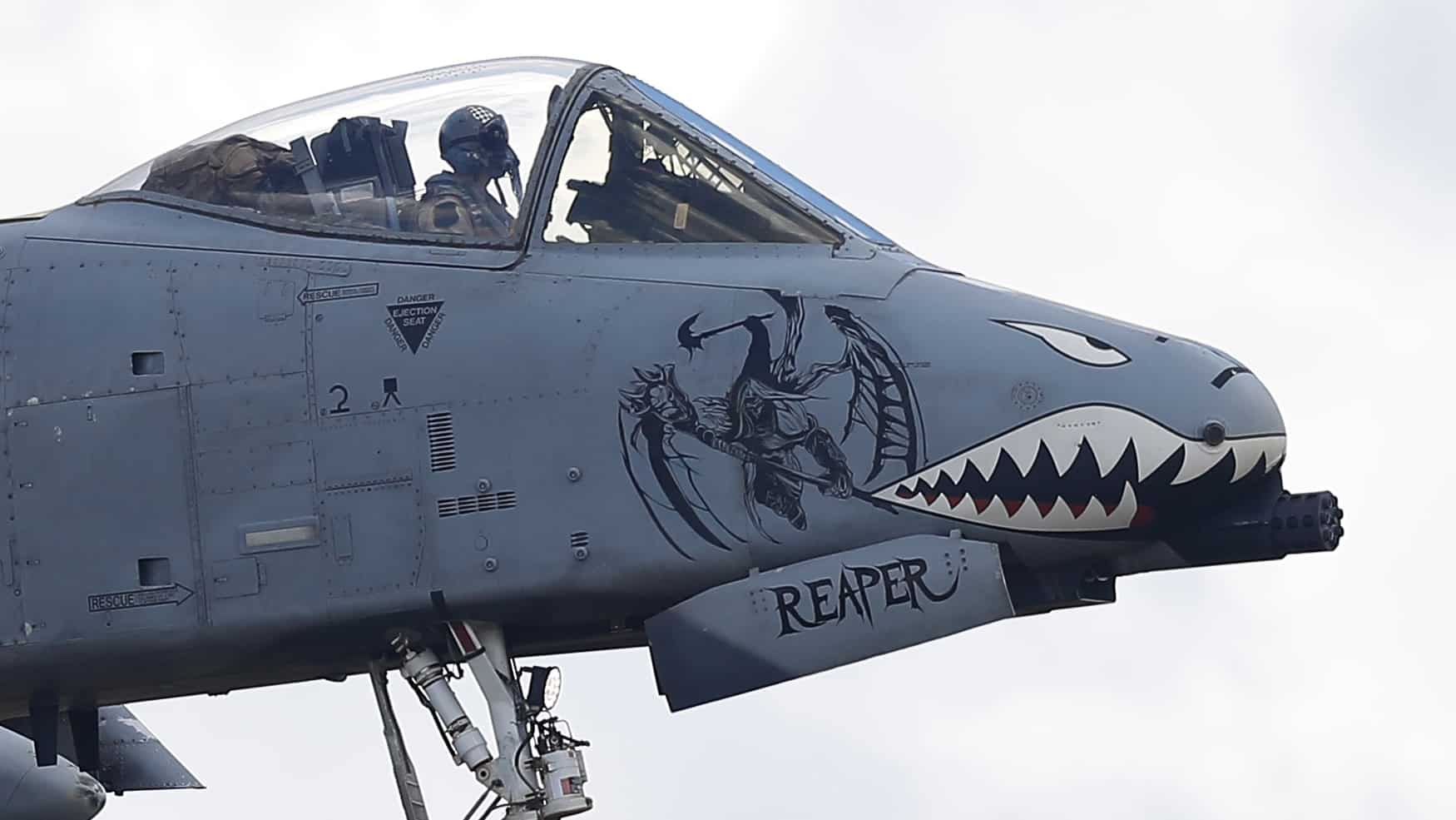
78-0649/FT “Reaper”
TABOR 14-16:
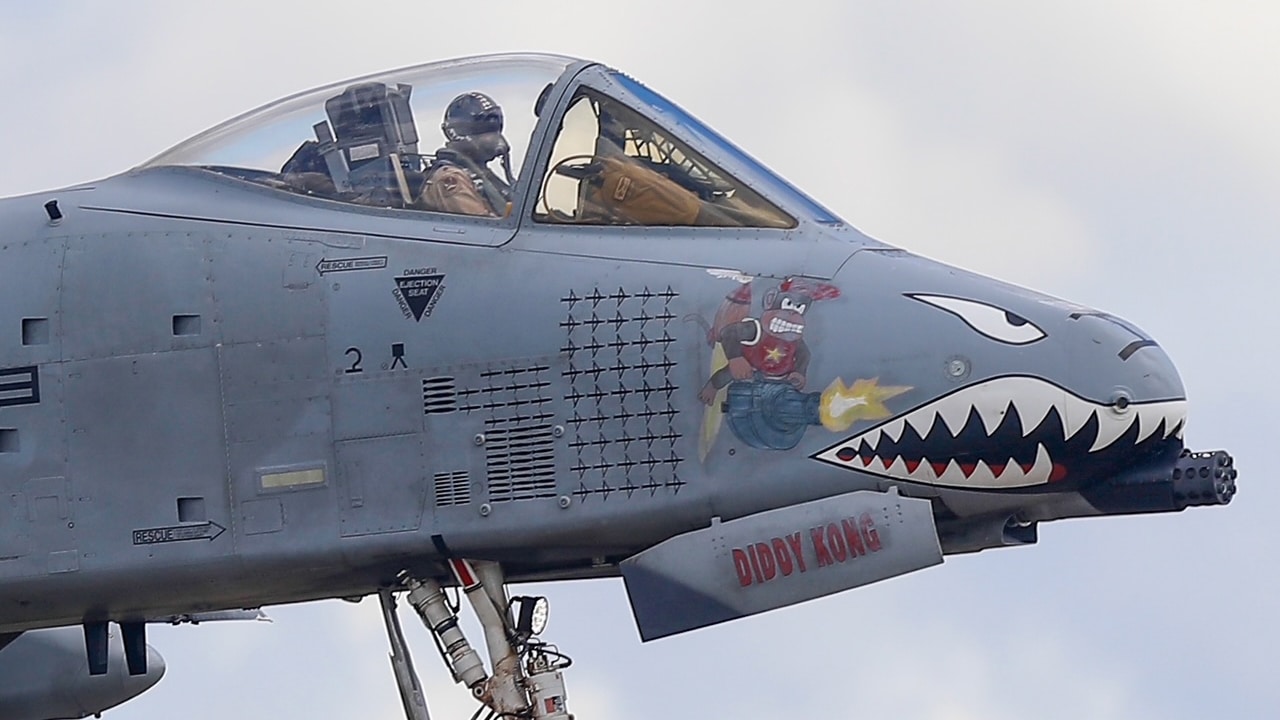
78-0613/FT “Diddy Kong”
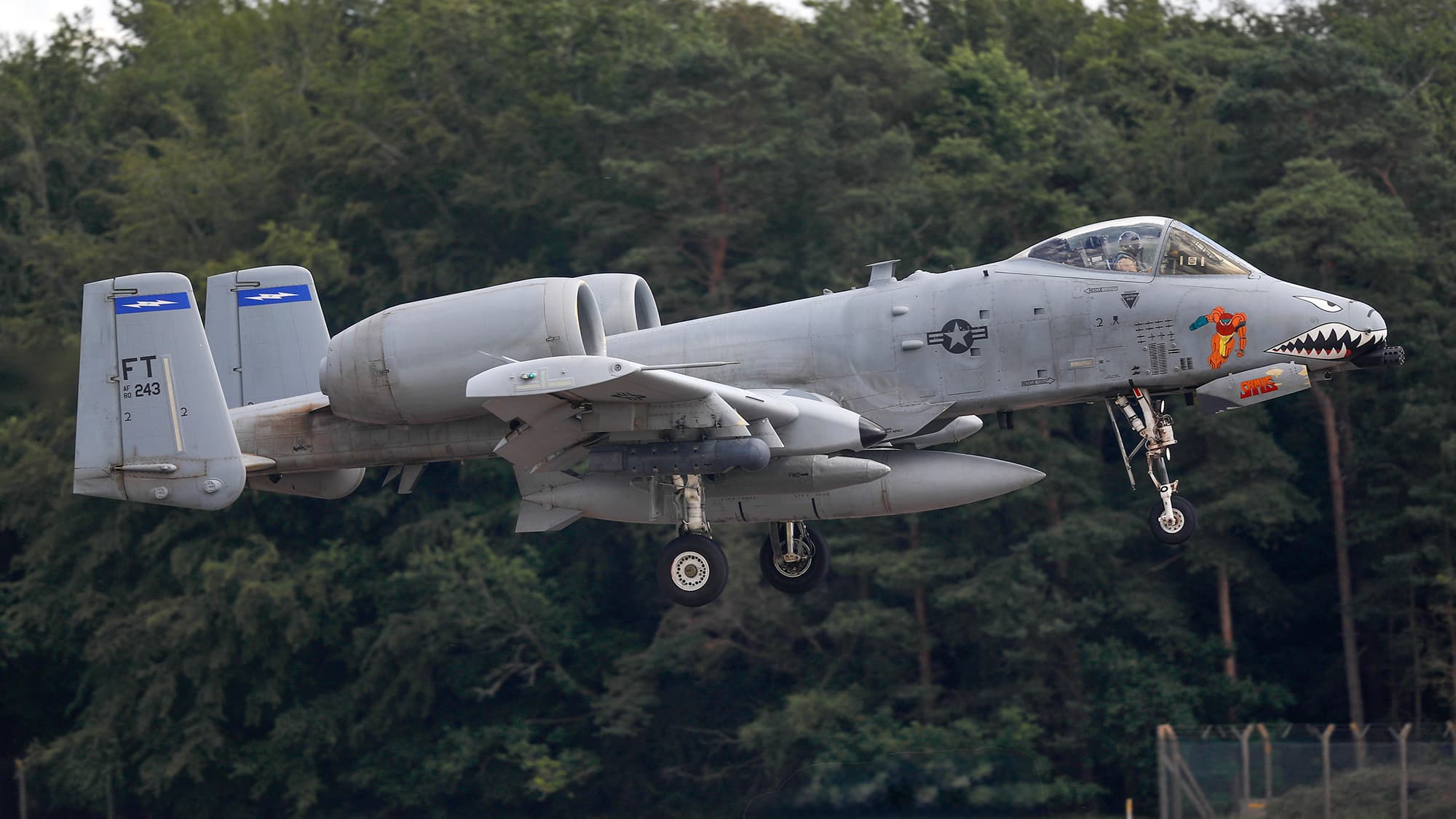
80-0243/FT “Samus”
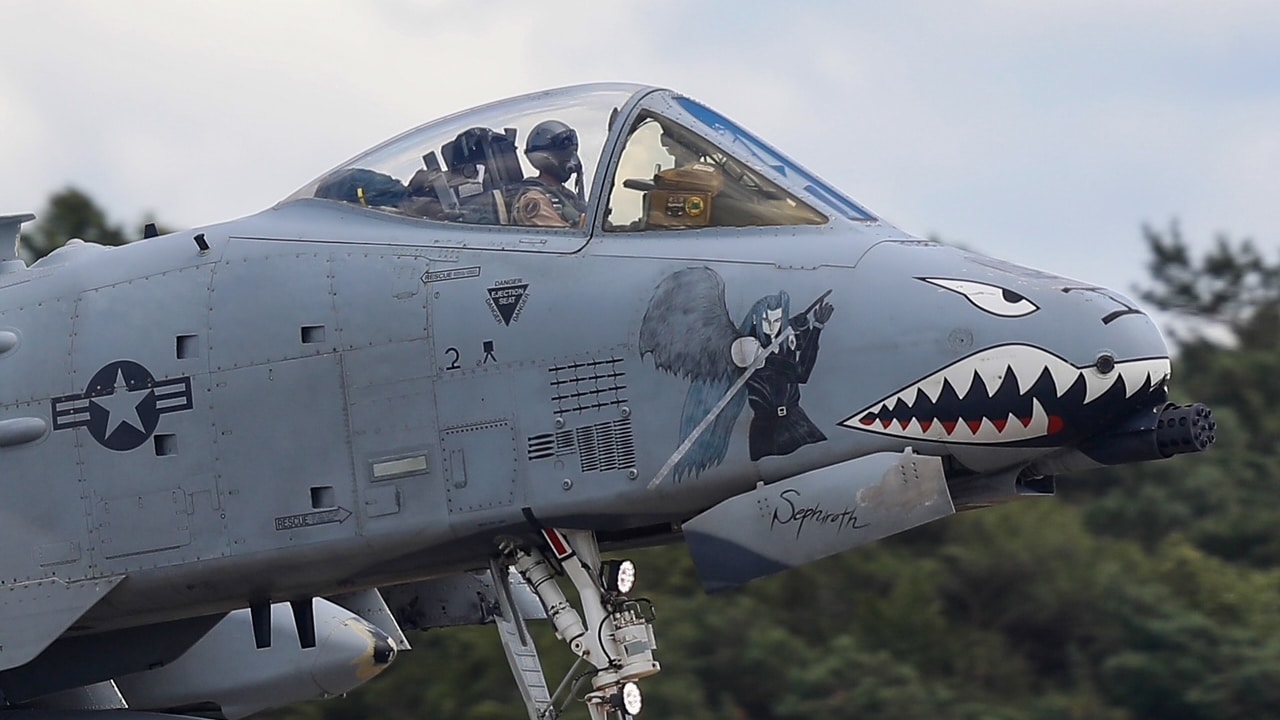
78-0583/FT “Sephiroth”
Tabor 21-23
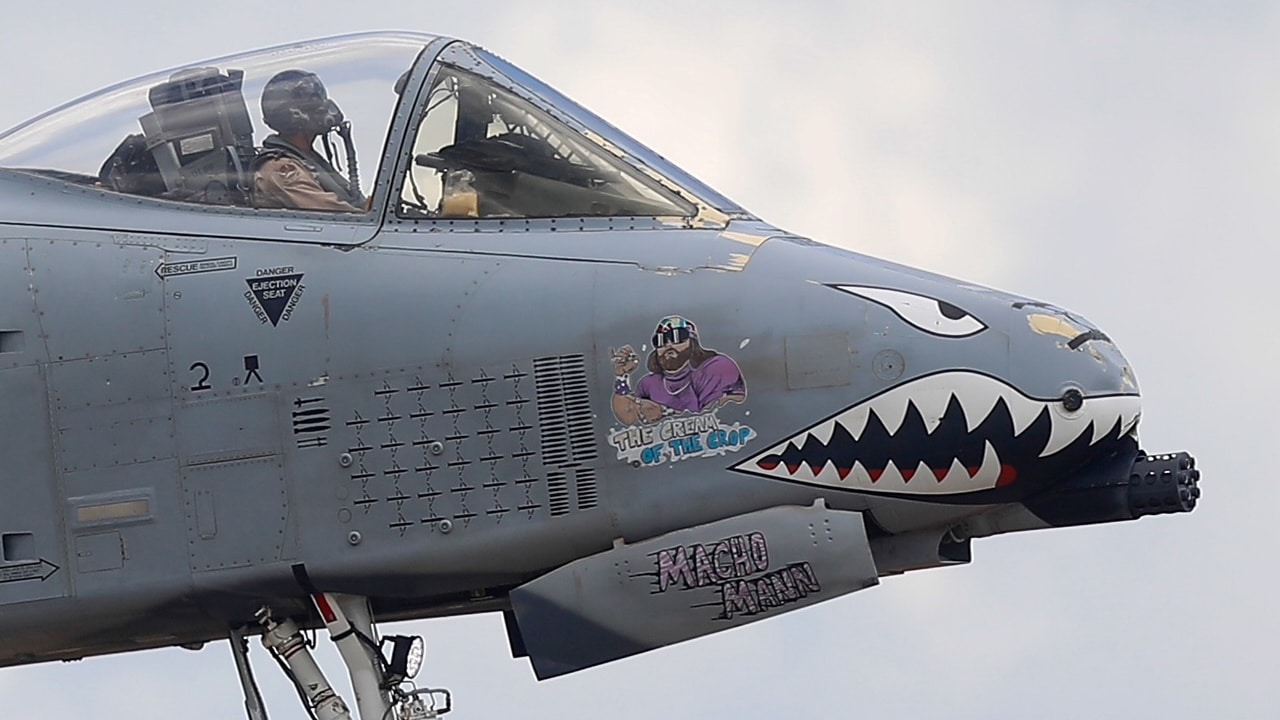
80-0188/FT “Macho Man”
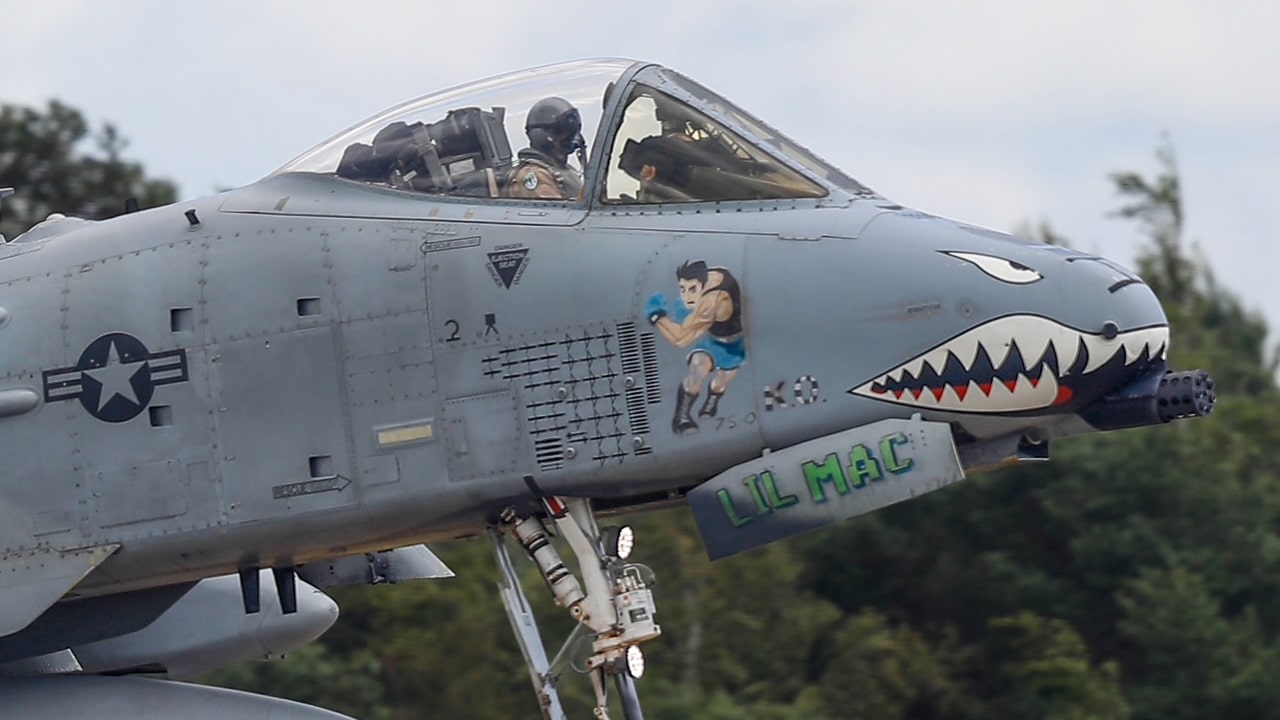
79-0095/FT “Lil Mac”
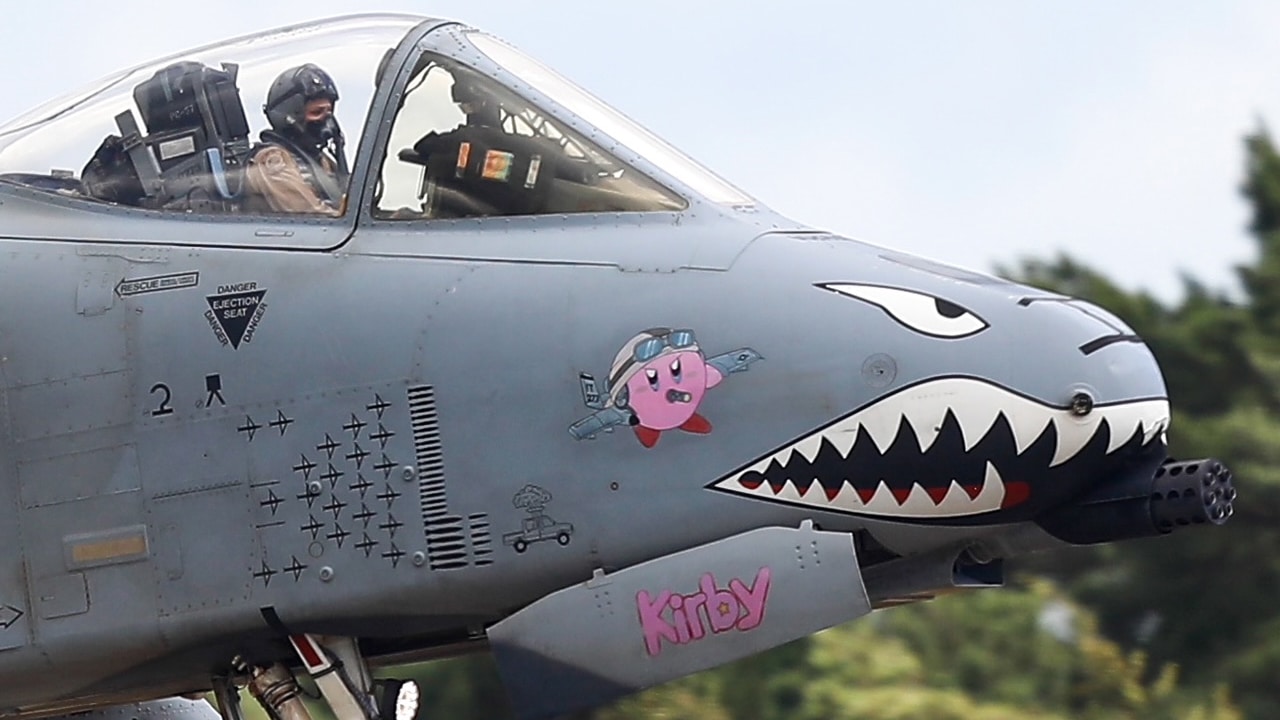
80-0273/FT “Kirby”
Tabor 24-25
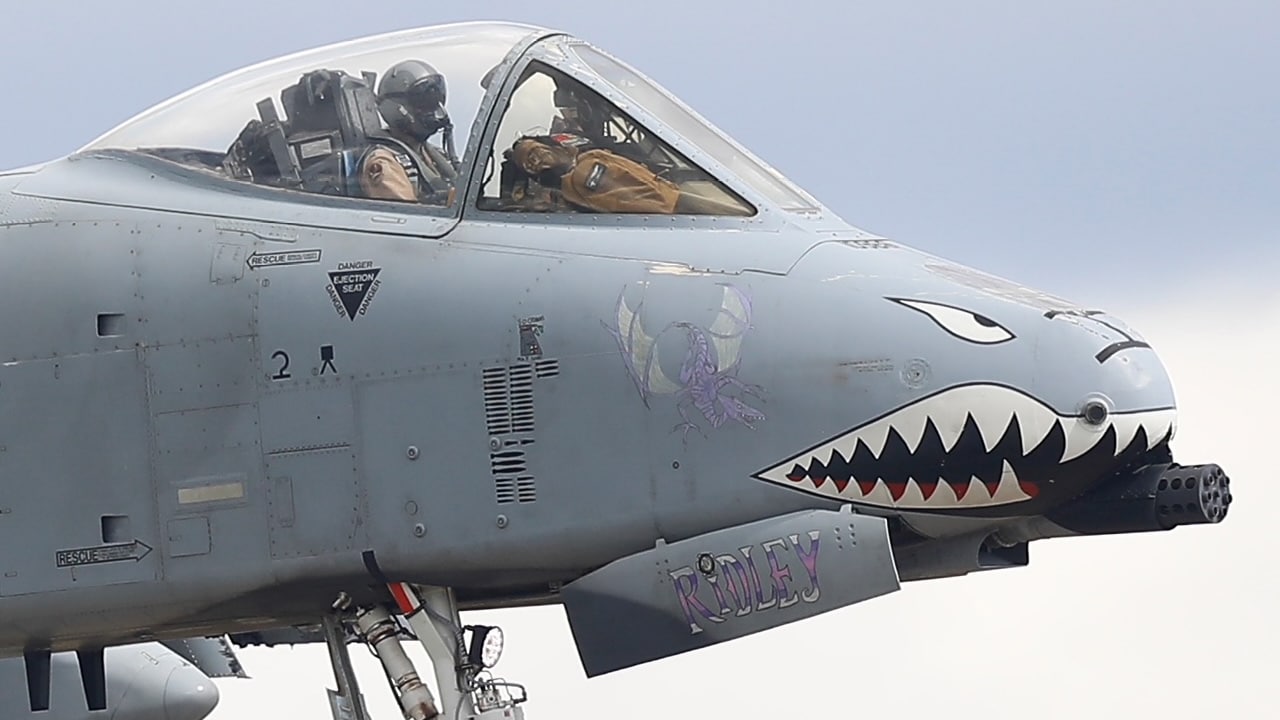
81-0988/FT “Ridley”
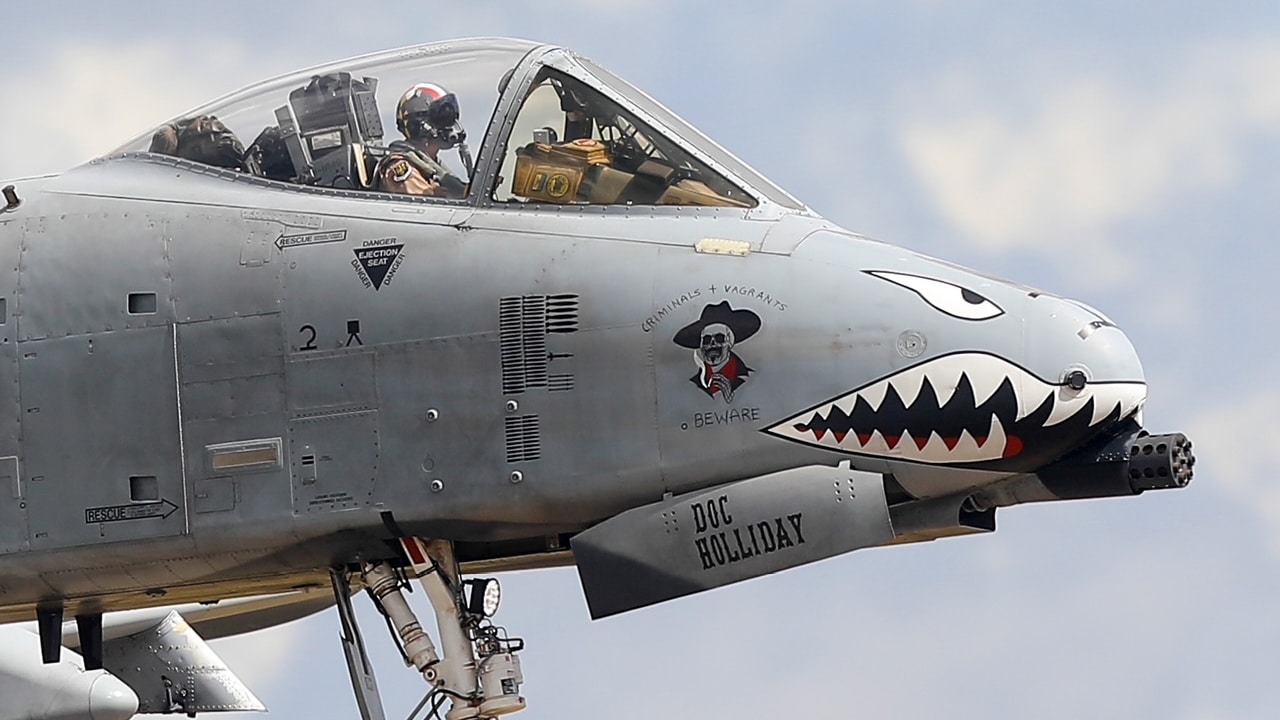
78-0586/FT “Doc Holiday”
As per tradition, during their stay at Muwaffaq Salti Air Base in Jordan, the Warthogs received nose art along with bomb markings. For what deals the nicknames, based on the photos taken by our contributor and friend Stewart Jack, most appear to follow a Nintendo/Super Smash Bros. theme we had already identified from photos released by CENTCOM, with references including King Dedede, Fox, Diddy Kong, Samus, Sephiroth, Little Mac, Kirby and Ridley. Macho Man, Reaper” and Doc Holiday seem to be possible outliers from the video-games theme.
King Dedede | Source: Stewart JackDoc Holliday (All images, credit: Stewart Jack, unless otherwise stated) | Source: Stewart JackMacho Man | Source: Stewart JackLil Mac | Source: Stewart JackSephiroth | Source: Stewart JackFox | Source: Stewart JackReaper | Source: Stewart Jack
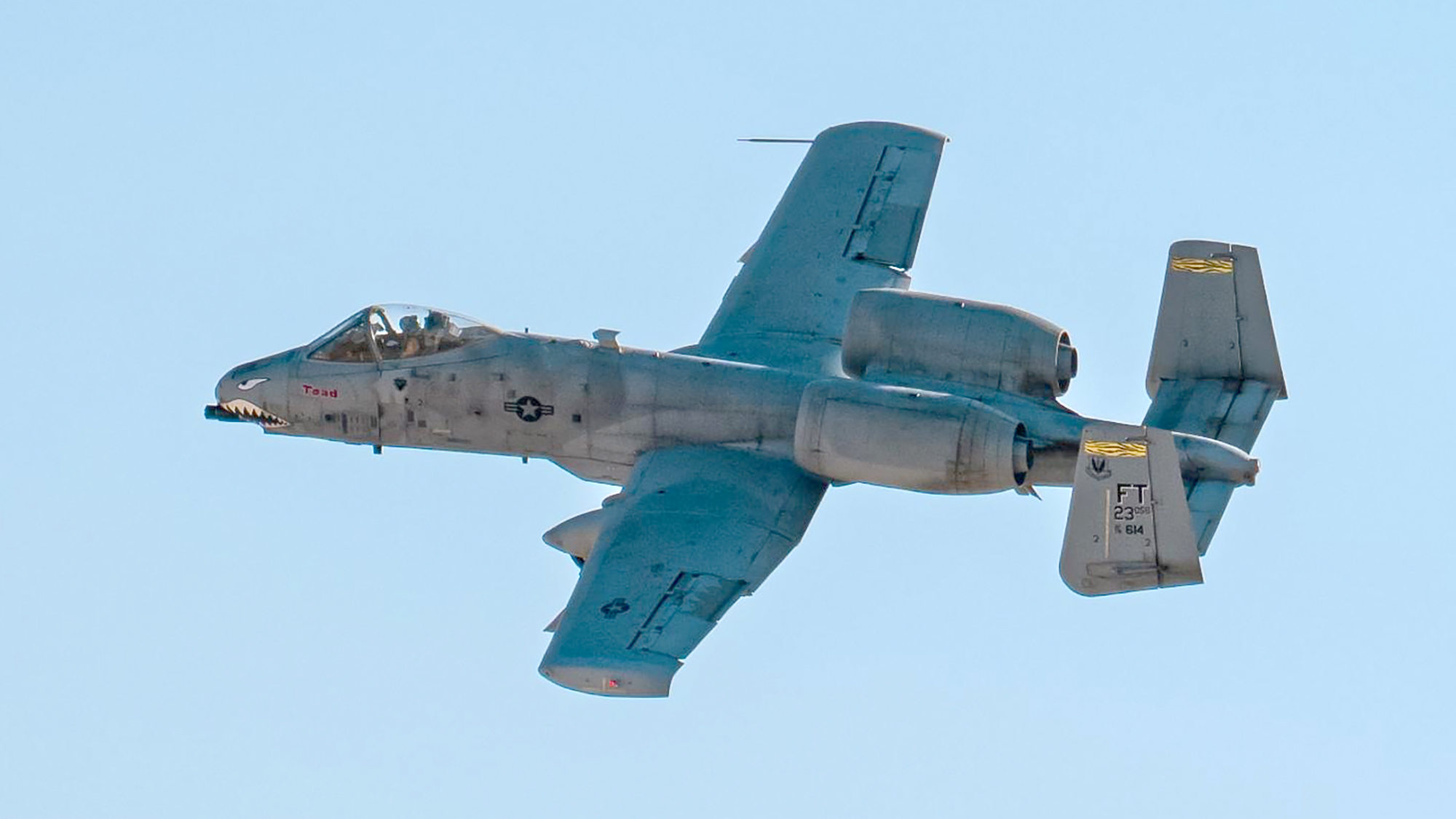
One notable missing A-10C is the one nicknamed “Toad” (#78-0614), that was depicted in the official Operation Epic Fury imagery in March. Its fate is currently unknown so we can’t rule out it is the Thunderbolt II aircraft lost during the air war in Iran..
A-10C “Toad” (Image credit: USAF) | Source: U.S. Air Force
The bomb silhouettes offer a glimpse at the wide variety of weapons the A-10s expended in theater. Although some markings are not completely identifiable, overall, the aircraft show what appear to be 2,000-lb GBU-31(V)1/B bombs, mid-sized GBU-38/54 JDAMs (Joint Direct Attack Munitions) or Laser-JDAMs, AGM-65 Maverick air-to-surface guided missiles, Advanced Precision Kill Weapon System II (APKWS II) guidance kit-equipped Hydra 70 rockets, along with plenty of 30-mm rounds fired by the A-10’s trademark GAU-8 Avenger hydraulically driven seven-barrel Gatling-type gun.
Diddy Kong with several SDBs and MALD markings | Source: Stewart Jack
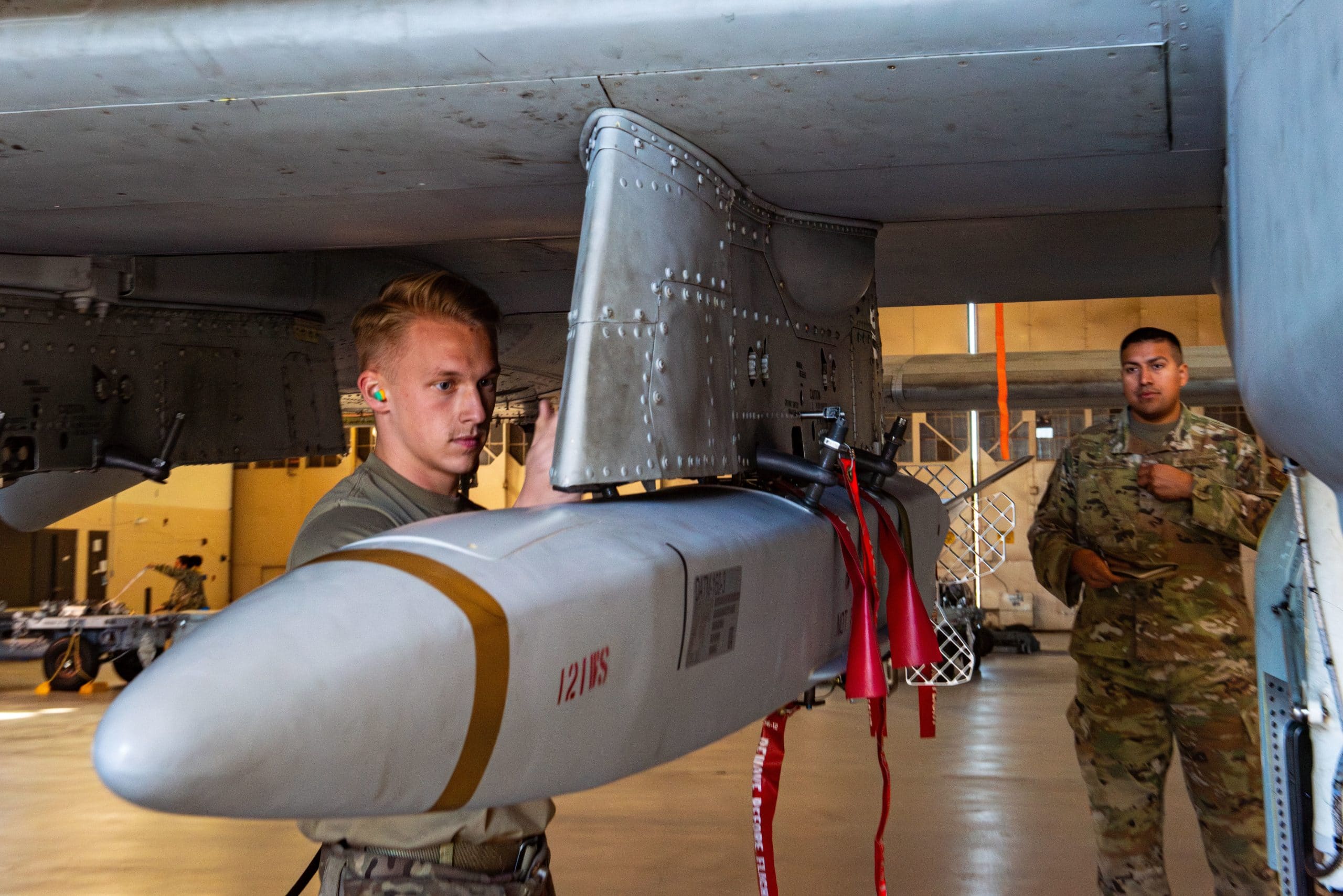
Interestingly, there are several marking that appear to depict MALDs (Miniature Air Launched Decoys). “MALDs are designed to mimic other aircraft, making them invaluable assets in diverting enemy fire away from pilots,” says Moody AFB website in an article dating back to 2024, when training with MALDs was being incorporated. “When MALDs are fired they deceive defense systems and enemy cruise missiles giving the illusion the decoy is an aircraft. MALDs can mimic the signal of various aircraft such as F-16s, B-52s, and F-35s”
U.S. Air Force Airman 1st Class Kyler Stenke, 74th Fighter Generation Squadron load crew member, tightens bolts to secure a Miniature Air-Launched Decoy onto an A-10C Thunderbolt II at Moody Air Force Base, Georgia, Feb. 14, 2024. (U.S. Air Force photo by Airman 1st Class Sir Wyrick) | Source: U.S. Air Force
But, probably, the most interesting things are the two kills markings of two Iranian vessels sported by “Samus”. In fact, along with the traditional CAS (Close Air Support) role, the A-10s have flown the maritime strike mission in support of Operation Epic Fury.
Samus | Source: Stewart Jack
This is an excerpt of what we wrote in a previous story that you can find here.
The shift to the maritime domain, whether from Jordan or another forward operating base in the region, makes a lot of sense, considering the type has regularly taken part in U.S. submarine escort and live-fire exercises in recent years. Moreover, the U.S. Air Force had released images of its A-10s deployed to the region escorting U.S. warships in the 5th Fleet Area of Operations last month.
In 2024, we reported about Warthogs practicing overwatch of a U.S. nuclear submarine during one of the most vulnerable phases of its navigation through the Strait of San Juan de Fuca, on the Pacific Northwest coast, between the state of Washington and Vancouver Island, British Columbia, Canada.
Few months later, a formation of six A-10Cs, assigned to Moody Air Force Base, escorted an Ohio-class ballistic missile submarine, the USS Wyoming (SSBN 742). The aircraft, were also involved in a live fire exercise with their GAU-8 30 mm gun and 70 mm rockets.
Born as a pure Close Air Support and anti-tank platform, the A-10 has rarely been employed in the maritime domain until roughly 15 years ago. In 2011, during Operation Unified Protector, when an A-10 and a P-3C Orion engaged together a patrol boat and several small attack craft in the port of Misrata, Libya.
More recently, following the renewed attention towards these types of asymmetric threats caused by the attacks in the Red Sea or the skirmishes between the Ukrainian USVs (Unmanned Surface Vehicles) and the Russian Navy in the Black Sea, the type has been used to target swarms of boats and strike small vessels in several training scenarios.
In the 2020s, the Warthog took part in multiple Maritime Surface Warfare exercises and conducted unit defense training. One of the exercises saw, in Sept. 2023, two A-10s engage simulated surface threats in the Gulf of Oman with the Arleigh Burke-class guided-missile destroyer USS Stethem.
High Value Targets, like U.S. warships and civilian ships and tankers could be attacked and overwhelmed by coordinated swarms of USVs, challenging the traditional naval defense strategies. The A-10’s maneuverability at low airspeeds and altitude, flexible armament, highly accurate weapons-delivery capabilities, and extended loiter time are all key attributes that make it highly effective at against fast naval targets in the Persian Gulf and beyond.
Another interesting marking is the F-15E tail with the text “So others may live” painted on “Ridley,” that might suggest the aircraft was involved in the recovery operation of DUDE 44, the Strike Eagle shot down over Iran.
Ridley | Source: Stewart Jack
Another marking that might be worth investigating is the one sported by “Kirby”: a pickup truck, possibly a “technical,” with an explosion or mushroom cloud rising from it….
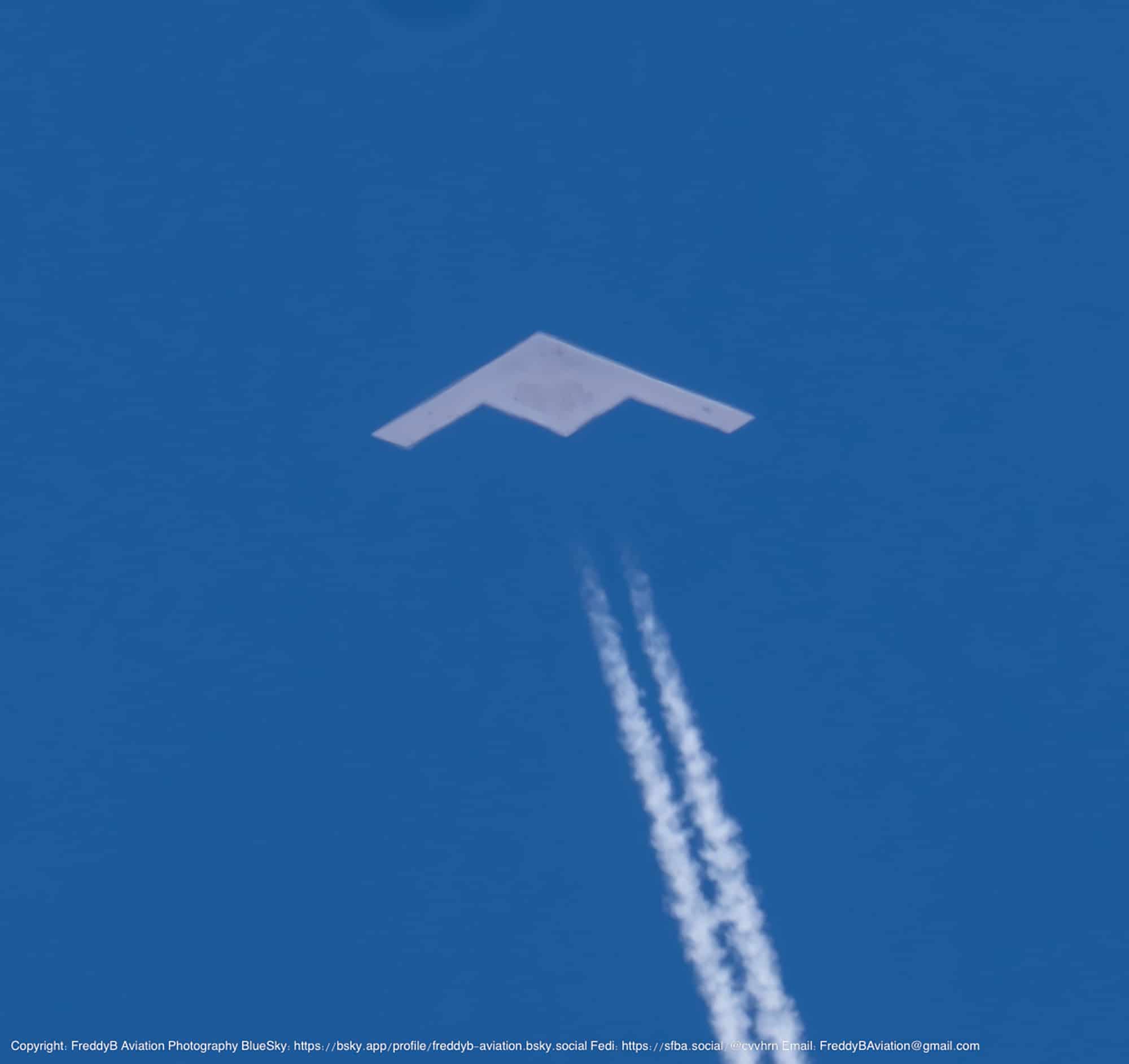
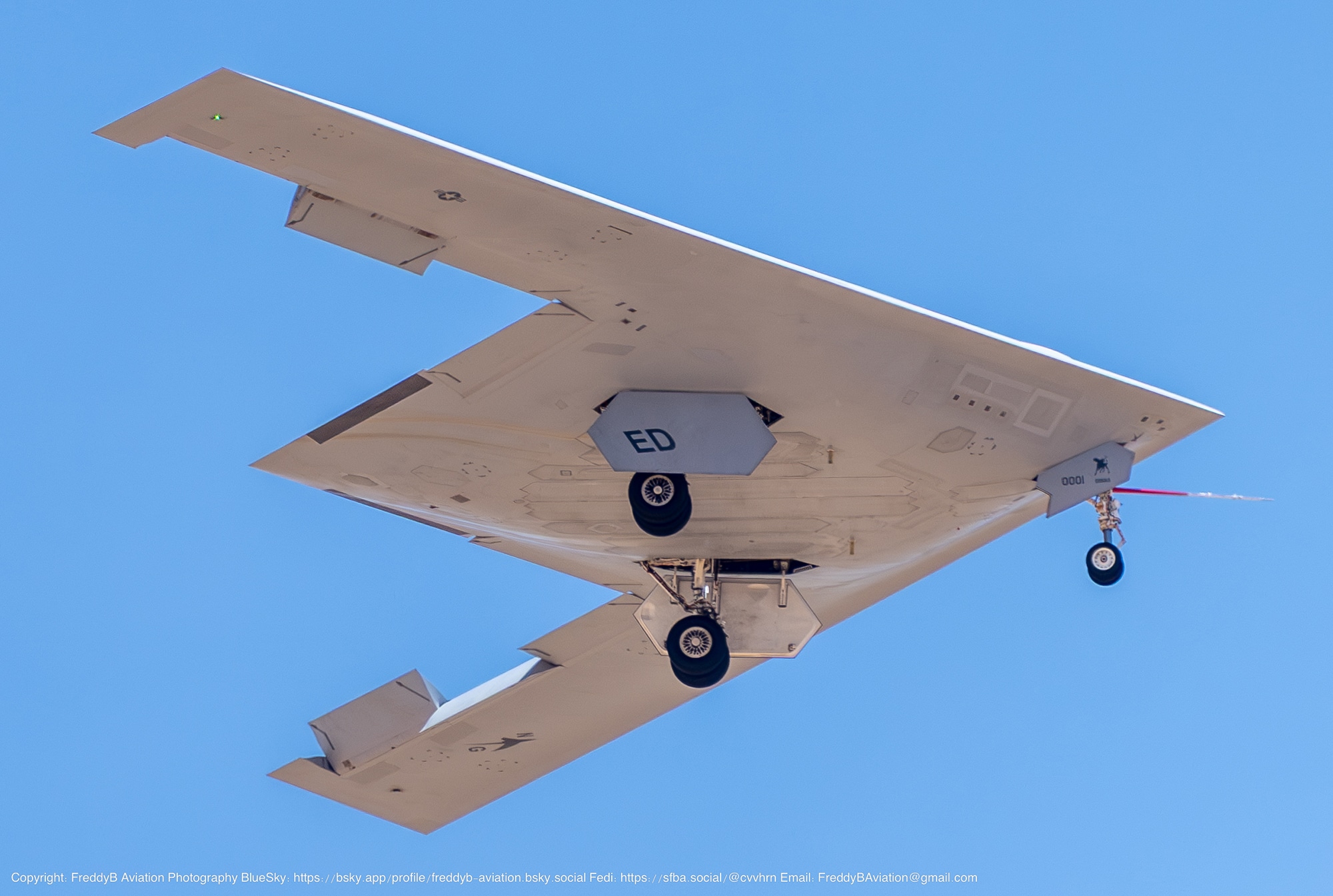
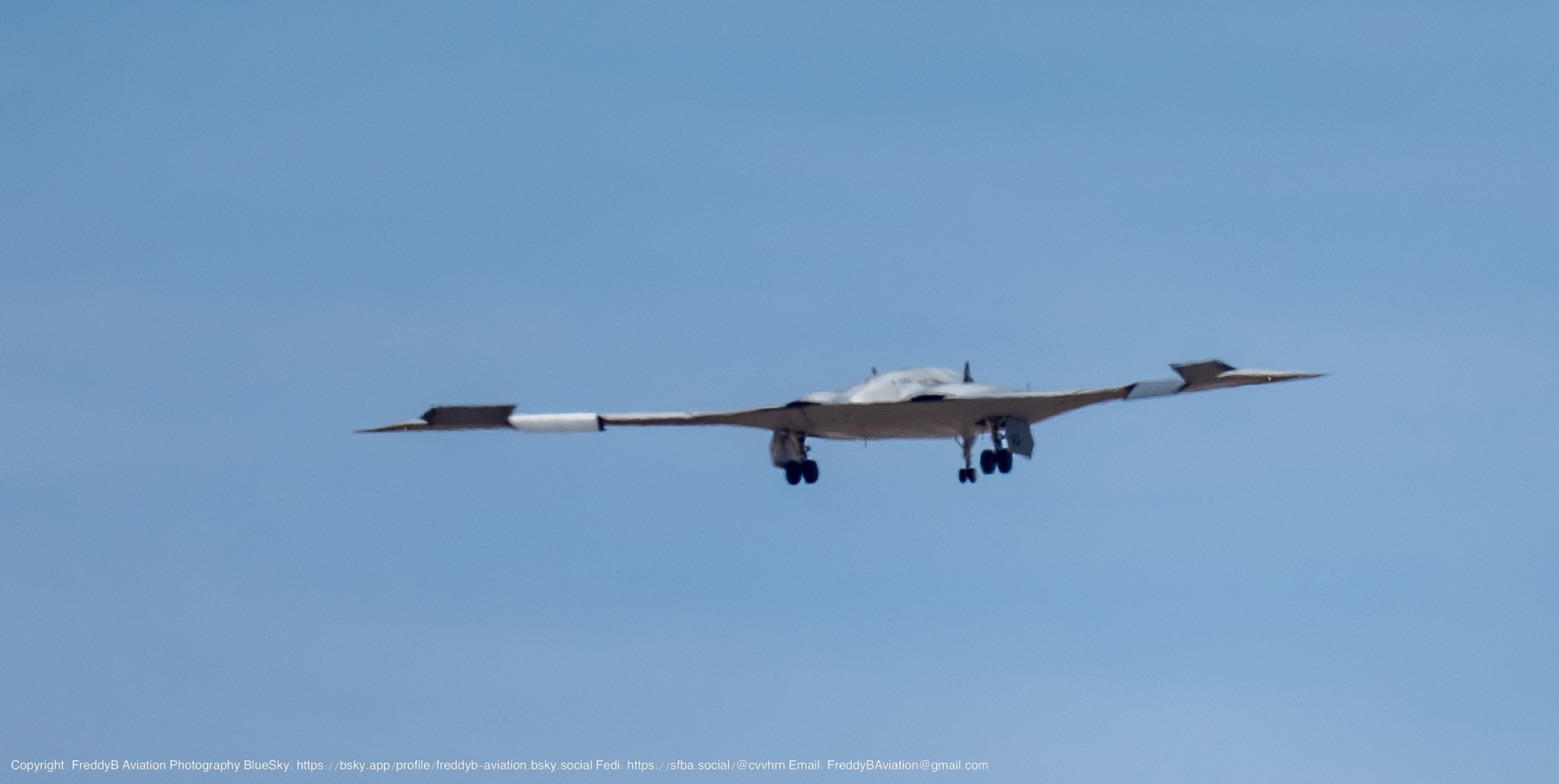
The photos appear to show the B-21 Raider’s outboard trailing-edge control surfaces deflected in opposite directions, suggesting a different speed-brake and drag-management arrangement than the B-2’s familiar split rudders.
On Jun. 3, 2026, the first prototype of the Northrop Grumman B-21 Raider carried out a test mission from Edwards Air Force Base, California. Using the radio callsign RAIDER17, the stealth bomber was airborne as two KC-46s, using ARRIS callsign, were also flying the typical tanker racetrack, and the Scaled Composites Hawker 4000 N639RA was operating in the same area using the radio callsign SCAT21. Both the tankers and SCAT could be tracked online on ADSBExchange.
Although the B-21 was obviously not tracking online, it was clearly visible from the ground.
“The Raider was not on tracker, however its orbit seemed to intersect with the other three planes perpendicular to theirs. They all broke orbit when the Raider called into the Edwards Tower to land,” told us photographer Fred Taleghani who was near Edwards to shoot some images of “Cerberus” (as the B-21 test article 0001 is nicknamed).
RAIDER17 at high altitude. (All images, credit: Fred Taleghani/FreddyB Aviation Photography) | Source: Fred Taleghani/FreddyB Aviation Photography
In fact, the B-21 has recently been involved in air-to-air refueling missions, the first of those took place over Eastern California on Mar. 10, 2026, lasted 5 hours and 33 minutes, was documented by several photographers who were able to shot some incredible images of the first Raider prototype behind the special equipped tanker based out of Edwards Air Force Base. On Apr. 14, 2026, the U.S. Air Force publicly acknowledged that the B-21 Raider has recently conducted aerial refueling from a KC-135 as part of its ongoing test and evaluation program, jointly conducted with Northrop Grumman, at Edwards Air Force Base, California.
As RAIDER17 came in to land, Taleghani was able to get a nice view of the landing gear and, above all, of the B-21’s control surfaces acting as speed brakes.
B-21 Raider test article 0001 landing on Jun. 3, 2026. | Source: Fred Taleghani/FreddyB Aviation Photography
Unlike the B-2, the B-21 appears to feature multiple discrete outboard trailing-edge control surfaces. As Taleghani’s photos show, the outermost surface (also called elevon or flaperon – although the latter definition is probably not correct as the surfaces don’t seem to have lift augmentation capabilities) appears deflected upward, while the adjacent mid-outboard surface appears deflected downward, suggesting that the Raider’s flight-control system may use differential deflection of adjacent surfaces rather than a simple B-2-style split drag-rudder arrangement.
Needless to say, the exact function of each surface and the associated control laws remain undisclosed, still the photos allow to “debunk” simplistic observations that suggested the B-21 used split drag rudders exactly like the B-2.
For comparison, this image provides a view of the B-2’s split rudders. | Source: Fred Taleghani/FreddyB Aviation Photography
Few years ago we posted an article with a video showing the movement of the split rudders and elevons of the B-2. As we explained, since the aircraft has no vertical fin, the split rudders and the elevons are used to control the aircraft rotation along the vertical/yaw axis, whereas pitch and roll are controlled by means of (mid and inboard) elevons. The split-rudders also act as speed brakes.
The B-2 Spirit also features a peculiar exhaust and the wedge-shaped flap in the middle of the trailing edge, the GLAS (Gust Load Alleviation System), that looks like the aircraft’s beaver tail and counters the rolling impact or resonance to smooth out the ride of the B-2 in turbulent conditions and extend the aircraft’s fatigue life. Air Force test data finite elemental analysis (FEA) modeling suggest the B-2 will remain structurally sound to approximately 40,000 flight hours.
Latest B-21 news
That being said, as we recently reported, the U.S. Air Force and Northrop Grumman are moving to speed up both production and delivery of the B-21 Raider, with the first bomber expected to reach Ellsworth Air Force Base, South Dakota, next year. In fact, the Department of the Air Force and Northrop Grumman have already announced an agreement aimed at expanding production of the new stealth bomber while accelerating its delivery timeline.
Based on the most recent statements, the first aircraft remains on track to be delivered to Ellsworth AFB, which will become the type’s first operational base, in 2027.
Preparations at Ellsworth are already well underway, with multiple construction projects ongoing to support the arrival of the new platform and provide the required infrastructure. These efforts also included runway expansion work, which forced the base’s B-1B Lancer fleet to temporarily relocate to Grand Forks AFB, North Dakota, last year.
At present, an undisclosed number of B-21s are in production, with final assembly taking place at Northrop Grumman’s Palmdale, California, facility, the same plant where the B-2 Spirit was also built. A second B-21 prototype was delivered on schedule to Edwards Air Force Base, California, in September 2025. As we noted at the time, unlike the first aircraft, it does not feature the air data probe and trailing cone typically seen on prototypes during the early stages of flight testing.
Another look at the B-21’s speed brake arrangement | Source: Fred Taleghani/FreddyB Aviation Photography
The port-side horizontal stabilizer of one KC-135 clipped the starboard-side stabilizer of another tanker parked nearby.
The U.S. KC-135 Stratotanker fleet continues to be plagued by a variety of mishaps. The latest, fortunately a minor one but still enough to keep the involved airframes grounded for a few days, occurred during ground operations at RAF Mildenhall, UK, between May 28 and 29, 2026.
While being backed into a parking spot by a tow vehicle, KC-135R 59-1509 of the 151st ARS (Air Refueling Squadron) Tennessee ANG hit the adjacent aircraft, an unmarked KC-135R(T) 60-0362 of the 22nd ARW (Air Refueling Wing). The port side horizontal stabiliser of 59-1509 struck the starboard side stabiliser of 60-0362, leaving visible tearing and deformation.
Repairs were carried out on the parking ramp where the accident occurred on May 30 and, as of June 2, both aircraft were still there, having not moved from their original positions.
Although taken from outside the base, and therefore from a significant distance, the images captured by photographer Bob Archer give an idea of the extent of the damage suffered by KC-135R 59-1509.
Close up image showing the damaged left stabilizer. (All images, credit: Bob Archer) | Source: Bob Archer
Despite six decades of service, the KC-135 is a crucial asset in the U.S. Air Force inventory. The size of the fleet is still impressive, counting over 350 KC-135s in service and little more than one hundred KC-46s, still hundreds of tanker sorties are required to sustain high-tempo oeperations. As explained in a previous article where we reported the transit through RAF Mildenhall of another KC-135 massively covered by patches (or BDR – Battle Damage Repairs), the tanker fleet took a huge hit during Operation Epic Fury: not only did the service lose a Stratotanker in a fatal mid-air incident over Iraq that cost the lives of six crew members, resulting in a lost tanker and a damaged one, but an unspecified number of KC-135s (and at least one KC-46, based on the images circulated online) were damaged in Iranian missile and one-way drone attacks on Prince Sultan Air Base and other bases across the region.
The patches applied to KC-135R 63-8028 spotted at RAF Mildenhall on May 30, 2026. | Source: Bob Archer
The battle-damaged Alaskan ANG KC-135R departed RAF Mildenhall on its way home from Operation Epic Fury, showing the massive temporary repairs performed to make the aircraft airworthy for the return flight.
On May 30, 2026, the KC-135R 63-8028, belonging to the 168th Wing of the Alaska Air National Guard, departed RAF Mildenhall, UK, for Bangor Maine, as RCH133 (“REACH 133”) on its way back to the U.S.
The tanker had arrived at RAF Mildenhall from Tel Aviv Ben Gurion airport, on May 23, 2026.
KC-135R 63-8028 AK ANG departing RAF Mildenhall for Bangor Maine on May 30, 2026. (Image credit: Bob Archer) | Source: Bob Archer
Images taken by photographer Bob Archer as the Stratotanker taxied for take off show the amount of temporary repairs performed on the airframe to enable the aircraft to fly home.
The KC-135R 63-8028 is the second battle-damaged Stratotanker photographed transiting through RAF Mildenhall. The first one, 59-1444, landed at RAF Mildenhall, UK, on Apr. 12, 2026, with spotters at the fencelines immediately noticing the battle damage repairs (BDRs) evident on the fuselage as well as on some of the engine cowlings. It had previously diverted into Chania International Airport, near Souda Bay, during its first attempt to fly from Prince Sultan Air Base (PSAB), Saudi Arabia, to Mildenhall.
While 59-1444 was most likely among the at least five Stratotankers damaged in the multiple Iranian attacks against PSAB, during March 2026, where 63-8028 was struck is unclear. According to FlightRadar24, it deployed from Eielson AFB, Alaska, to Tel Aviv, via Stuttgart, on Mar. 7, 2026. Flight tracking logs show that the tanker flew its first operational mission few hours after deploying to Israel.
In the following days, it flew sorties almost every day until Mar. 26, 2026, which appears to be its last tracked mission. Its next tracked flight was the ferry flight from Tel Aviv to RAF Mildenhall on May 23, 2026. What happened in the two months during which the aircraft appears not to have flown is unknown. We also cannot completely rule out that a change or error in hex codes occurred even before Mar. 26, showing the aircraft in Israel when it was actually in Saudi Arabia. Considering that another attack on PSAB damaged U.S. aircraft there on Mar. 27, there is also a possibility that the aircraft had been deployed there that same day, without FR24.com tracking it for some reason.
Flight tracking logs for 63-8028 in the Mar. 5 – May 30 timeframe. (Image credit: Flightradar24.com) | Source: FR24.com
Anyway, the location and density of the battle damage repairs on 63-8028 and 59-1444 are quite different: while 59-1444 showed large and small patches across its fuselage (including the upper part of it), wings, engines, and tail; all the BDRs on 63-8028 appear to be on the bottom rear side of the tanker, as if the shrapnel fragments had come from below and behind the aircraft. This would also explain why the boom had to be removed from this KC-135R, something that wasn’t necessary on 59-1444.
Closer look at the tail section of the USAF KC-135 63-8028 that suffered shrapnel damage from a Iranian drone/ballistic missile on the ground in Saudi Arabia. pic.twitter.com/RIT5HBPnef
After departing Mildenhall the jet stopped over in Bangor, Maine. Like 59-1444 last month, the final destination for 63-8028 is Tinker Air Force Base, Oklahoma, home to the Oklahoma City Air Logistics Complex, which oversees depot level maintenance for the KC-135 Stratotanker, KC-46 Pegasus, E-3 Sentry, E-6 Mercury, B-52 Stratofortress, and B-1B Lancer.
As for the 59-1444, the future of 63-8028 is still unclear. The aircraft could go through inspection, repair, and overhaul process to be brought back to full operational status or, as happened with other KC-135R airframes, such as 58-0011, the Stratotanker could be cannibalized for spares to sustain the surviving fleet rather than being restored.
We will see.
For sure, despite its impressive size (over 350 KC-135s in service and little more than one hundred KC-46s) the U.S. Air Force tanker fleet took a huge hit during Operation Epic Fury, because of the fatal incident over Iraq and the Iranian strikes on Prince Sultan. The Iran Air War showed, once again, that high-tempo operations involving hundreds of tanker sorties are required to support both direct combat missions and logistics taskings. Increased use of contracted aerial refueling services can alleviate a small part of this burden, particularly for training sorties, but demand for aerial refuelers remains consistently high.
An overnight attack on Russia’s Taganrog airfield reportedly destroyed two Tu-142s including a rare “MR” radio relay variant used to communicate with ballistic missile submarines.
Ukraine launched coordinated drone strikes on Russian energy infrastructure and military installations across multiple regions overnight.
Along with a tanker, fuel tank and administrative building in the port area, the attack on Taganrog, located in the Rostov region on the coast of the Sea of Azov, also targeted the Taganrog Aviation Plant. Taganrog is home to one of Russia’s important aviation industrial hubs. The site includes the Beriev Aircraft Company, known for amphibious aircraft as well as work on large military platforms such as the Tu-95MS, Tu-142 and A-50, and the 325th Aircraft Repair Plant, which supports transport aircraft including the Il-76, An-12 and An-72. The broader area also hosts aviation-related facilities such as Atlant Aero, reportedly involved in unmanned aircraft development and production.
In November 2025, two ultra-rare Russian aircraft were destroyed in a cruise and one-way attack drone strike on aircraft manufacturer Beriev’s plant in Taganrog. As we reported back then, satellite imagery showed the destruction of two Ilyushin Il-76 type aircraft: a Beriev A-60 and, reportedly, an A-100LL.
Based on the drone footage released by the Ukrainian military after the overnight strike, the drones destroyed two Russian Tu-142 aircraft undergoing repair in Taganrog, and also managed to hit an Iskander ballistic missile launcher.
Ukrainian drones destroyed two Russian Tu-142 anti-submarine strategic aircraft undergoing repair in Taganrog, and also managed to hit an Iskander ballistic missile launcher. pic.twitter.com/HP1FniPdPA
While it cannot be ruled out that one or more aircraft at Taganrog were undergoing maintenance or were not immediately mission-capable, the site is one of the key facilities used to repair and modernize the Tu-142 family. For this reason, the presence of two Tu-142s there points more to operational aircraft undergoing work at the plant than to retired airframes, although more details to confirm this are required. Russian MilBlogger FighterBomber wrote: “These are Tu-142MK and Tu-142MR aircraft, which were sent for repair in 1998 and 2002 from Nikolaev (Ukraine). But the Ukrainians didn’t provide money for the repairs, so they just let them deteriorate, because there was nothing to take from them. Apparently, the Ukrainians don’t plan to restore them.”
Interestingly, according to Piotr Butowski, an aviation journalist, writer and acknowledged expert about Russian aviation, one of the two Tu-142s destroyed in the attack was not a “simple” anti-submarine aircraft but a rare and important Tu-142MR strategic radio-relay aircraft.
One of the two Russian Tu-142s destroyed in Taganrog today by Ukrainian drones was an important Tu-142MR strategic radio-relay aircraft.
Beriev plant in Taganrog is responsible for the overhauls of these aircraft.
Tu-142MR page from my book Russian Air Power, Key Publishing . pic.twitter.com/TdU33mbTJh
According to Piotr Butowski in Russian Air Power, published by Key Publishing, the Beriev Tu-142MR is a strategic radio-relay aircraft developed at Taganrog and derived from the Tu-142 maritime patrol aircraft. Unlike other naval aviation aircraft, its importance does not come from weapons carried onboard, but from its role in Russia’s nuclear command-and-control architecture. The aircraft is built around the Oryol communications relay system, which performs a role broadly similar to the U.S. TACAMO concept, allowing national command authorities to transmit launch orders to submerged ballistic missile submarines.
Butowski notes that the Tu-142MR can be externally distinguished from other Tu-142 variants by the forward-pointing pod on the tailfin, replacing the rearward-facing magnetometer seen on anti-submarine versions. Another key feature is its very long trailing wire antenna, used for VLF communications with submerged submarines, deployed from a ventral pod connected to equipment installed in the forward bomb bay.
The same source says that an upgrade program, reportedly codenamed Kipelovo, had been launched to replace older equipment and support operations with newer-generation submarines. Butowski also notes that six Tu-142MR aircraft are assigned to each of the two Tu-142 units, one with the Northern Fleet at Kipelovo and the other with the Pacific Fleet at Mongokhto. One Tu-142MR (flying alongside a Tu-142 Bear F and escorted at least one MiG-31 Foxhound) was intercepted in international airspace off Norway on Mar. 7, 2020 by the Royal Norwegian Air Force F-35A.
In the end, only a small number of Tu-142MRs were produced. Depending on the source, the total appears to have been somewhere between about seven and 12 to 14 aircraft, with Butowski’s unit assignments pointing to at least 12 in service across the Northern and Pacific Fleets. Anyway, the type is pretty rare and valuable. In fact, while it probably does not directly support the tactical air war over Ukraine, the Tu-142MR plays a strategic role in Russia’s nuclear command-and-control architecture, acting as an airborne communications relay used to pass orders to submerged ballistic missile submarines. For this reason, the loss or damage of even a single operational aircraft (provided the one destroyed at Taganrog was flyable) would be a significant blow to Russia, not because of its direct impact on battlefield operations, but because of the niche and strategic mission it performs in nuclear deterrence.
The first KC-46 “Gideon” tanker for the Israeli Air Force has been delivered less than one month after its first flight was announced.
The Israeli Air Force received its first KC-46 at Nevatim Air Base on May 27, 2026. The tanker, designated as “Gideon” by the Israeli military, was delivered less than one month after the Israeli Ministry of Defense had announced its first flight on LinkedIn on May 4, 2026.
Today, the Israeli Air Force is adding the capabilities of the “Gideon”, the most advanced operational refueling aircraft in the world.
Its arrival marks a true leap forward in the Israeli Air Force’s ability to expand its operational range, extend the duration of operational… pic.twitter.com/LII80CKF30
The aircraft is the first of six KC-46s that are being procured by Israel and, according to the statements of the Israeli MOD, it “will be equipped with Israeli systems and adapted to the operational requirements of the Israeli Air Force, enabling it to extend operational range and maintain air superiority across all theaters.”
The Israeli Air Force says the “Gideon” is “the most advanced operational refueling aircraft in the world.”
A historic day for the IAF, which took delivery of its first KC-46A “Gideon” multi-mission aerial refueler.
The first aircraft, flying as RCH301 (“REACH 301” – a callsign typically used by U.S. Air Force aircraft assigned to the Air Mobility Command), could be tracked online.
— איתי בלומנטל Itay Blumental (@ItayBlumental) May 27, 2026
The U.S. State Department approved a Foreign Military Sale (FMS) of the KC-46 Pegasus tanker to Israel in 2020. The approval included up to eight tankers for an estimated price of $2.4 billion.
In 2021, the Israeli government approved the acquisition, clearing the way for the negotiations. A year later, Boeing was awarded a contract worth $930 million for the first four KC-46s, with deliveries expected by 2026.
Reports in 2025 mentioned that Israel was looking to increase the order, and thus two more KC-46 were procured. At this stage, it is unclear if the KC-46 will be further increased or it will remain at six airframes. Some Israeli media outlets reported the full order includes eight aircraft, whereas others still say the order is just for six ones.
The KC-46 will replace Israel Boeing 707 “Re’em” tankers that have been operating for around 60 years. According to available information, six 707s are currently in service with the Israeli Air Force, making the KC-46 acquisition, at least, a one-for-one replacement.
The delivery of the first Israeli Air Force KC-46 is certainly good news for Boeing, as it puts the troubled Pegasus under the spotlight again with the induction into active service by an important customer. Moreover, the news comes shortly after another customer, Italy, which had originally decided to replace its current fleet of four KC-767 tankers with the KC-46, halted the procurement of the Pegasus and eventually signed a deal with Airbus for the procurement of six A330 MRTT (Multi-Role Tanker Transport) aircraft.
The arrival of the first Gideon follows also the announcement jointly made by the U.S. Air Force and Boeing of a new plan to improve the readiness of the Pegasus tanker fleet and accelerate the delivery of long-awaited upgrades. In fact, the tanker has reportedly suffered from boom-related issues, including the stiffness of the telescoping actuator, which affected its ability to refuel some types of receiver aircraft, as well as fuel system leaks, delivery pauses and quality issues.
Among the upgrades that will be made available soon, there’s the one concerning the Remote Vision System 2.0, or RVS 2.0.
The system provides high-definition stereoscopic imagery to the vision goggles attached to a sort-of flight helmet worn by the boomer during the air-to-air refueling, replacing the so-called “direct view technology” used by the USAF in KC-135 and KC-10 legacy tankers, where the boom operator looks directly through a window at the receiver aircraft, lies face-down in a rear-mounted pod and uses a manual control stick with their right hand to “fly” the boom.
RVS 2.0 replaces the original remote camera and display architecture (RVS 1.0) used by KC-46 boom operators, introducing fixes to the image washout and 3D distortions affecting the original KC-46 RVS 1.0 design, especially under certain lighting conditions. These issues, some of the most persistent problems affecting the Pegasus since its entry into service, have been classified among the KC-46’s Category 1 deficiencies.
Boeing initially agreed to the Air Force’s demand in April 2020 to redesign the entire RVS and introduce the RVS 2.0 at no additional cost to the government. However, a series of technical, critical design reviews and certification for commercial off-the-shelf camera hardware kept pushing the RVS 2.0 delivery beyond 2026. As of late 2025, the service-wide retrofit was said to be expected in 2027, when RVS 2.0 would finally be certified and approved for delivery.
Moody AFB says the modification enhances the Warthog’s ability to support combat search and rescue and close air support missions, allowing probe-equipped A-10Cs to refuel from HC-130Js below 10,000 feet, with two aircraft taking fuel simultaneously.
The U.S. Air Force has revealed some interesting new details about the A-10C Thunderbolt II’s new Probe Refueling Adapter, adding some operational context to the capability first demonstrated in April and then seen in use in the Middle East earlier this month.
As we already reported in detail, the Warthog fleet recently received a new probe-and-drogue aerial refueling capability developed in response to an urgent combatant command requirement. The modification allows the A-10, to receive fuel from C-130-based tankers such as the HC-130J Combat King II, MC-130J Commando II and KC-130J Super Hercules, instead of the “traditional” flying boom of the KC-135 Stratotanker.
A few weeks later, we also reported that A-10Cs deployed to the Middle East in support of Operation Epic Fury had been photographed using the new probe while refueling from an HC-130J in the U.S. Central Command AOR (area of responsibility). Those aircraft, assigned to the 107th Fighter Squadron from Selfridge ANGB, were also carrying the Angry Kitten electronic warfare pod, marking the first time the pod had been publicly seen on deployed A-10s in an operational setting abroad.
A new release from Moody Air Force Base, adds additional details to the story.
According to the 23rd Wing, Airmen at Moody completed the installation of the base’s first air refueling probe on an A-10C Thunderbolt II, with the goal to enhance the aircraft’s ability to support both combat search and rescue (CSAR) and close air support (CAS) missions.
Moody maintainers learned in late April that the probes would be delivered to the base, received them on May 11 and began installation on the first of two aircraft on May 13, 2026.
An A-10C Thunderbolt II assigned to 74th Fighter Squadron flies with a newly installed air refueling probe during its first familiarization flight at Moody Air Force Base, Georgia, May 19, 2026. (U.S. Air Force photo by Airman 1st Class Rachel Howell) | Source: U.S. Air Force photo by Airman 1st Class Rachel Howell
The release says the new probe allows A-10s to receive fuel from HC-130J aircraft below 10,000 feet, keeping the Warthogs closer to the CSAR mission profile rather than forcing them to climb away from the operating area to meet traditional tanker support.
“It gives the A-10 a different way of being able to refuel with the HC-130s,” said Tech. Sgt. Wesley Zell, an A-10 refueling probe installer from Davis-Monthan Air Force Base. “Now they can go low level, below 10,000 feet, refuel with the HC-130 and stay in the CSAR mission.”
Another noteworthy detail is that the system allows two A-10s to refuel simultaneously from an HC-130J. This is a significant difference compared to traditional boom refueling with aircraft such as the KC-135, where the flow is limited to one receiver at a time. For a two-ship of A-10s supporting a rescue package, being able to take fuel together could reduce the time spent cycling through the tanker and help the aircraft return to the mission more quickly.
The 23rd Wing’s release also provides some insights into the practical side of the modification:
Installation typically takes approximately four hours to complete, though the team encountered challenges during the process.
“We did encounter an issue while installing the modified mount bolts that caused the nut-plates to cross thread, leading to the removal of the refueling receptacle, costing us several hours,” Vargas said.
Tech. Sgt. Wesley Zell, an A-10 refueling probe installer from Davis-Monthan Air Force Base, worked alongside Moody’s maintainers to complete the installation. Although the installation process is generally straightforward, removing existing aircraft hardware and correctly installing the mounting components proved to be one of the most difficult parts of the modification.
“There’s been a lot of issues getting these bolts removed so we can put the probe on,” Zell said. “These screws and bolts hardly ever come out anyway, so doing this is the time-consuming part of it. Once we get that part up, the install of the probe is very simple.”
U.S. Air Force maintainers assigned to the 23d Maintenance Squadron install an air refueling probe onto an A-10C Thunderbolt II at Moody Air Force Base, May 13, 2026. The new refueling capability allows A-10 aircraft to receive fuel from HC-130J aircraft at lower altitudes. (U.S. Air Force photo by Airman 1st Class Rachel Howell) | Source: U.S. Air Force photo by Airman 1st Class Rachel Howell
Moody pilots from the 74th Fighter Squadron then conducted familiarization flights with the new configuration. Capt. Ron Wayman was one of the pilots involved in those flights.
“It was a cool experience, something we’ve never done before,” Wayman said. “Getting to do it with the HC-130s from Moody was a pretty cool experience.”
During pre-deployment preparations, Moody maintainers coordinated with SMEs (subject matter experts) from Davis-Monthan AFB:
“Davis-Monthan maintainers came TDY to walk us through the installation process and how to implement modular pack-out kits provided to reduce reliance on traditional supply chains,” Tech. Sgt. Brent Vargas, 23d Maintenance Squadron fuels craftsman, said.
A U.S. Air Force pilot assigned to the 71st Rescue Squadron, monitors an A-10 as it receives fuel during training operations at Moody Air Force Base, Georgia, May 19, 2026. This flight follows after the installation of a probe refueling adapter on A-10C Thunderbolt II’s assigned to Moody. (U.S. Air Force photo by Airman 1st Class Rachel Howell) | Source: U.S. Air Force photo by Airman 1st Class Rachel Howell
In the end, the picture we get is that the probe refueling adapter is more than just a technical workaround for the A-10’s dependence on KC-135 tankers while KC-46 certification remains pending: it is a deployable, unit-level capability that gives the Warthog more flexibility in the specific mission sets where it still matters, especially close air support and combat search and rescue.
Under new plans announced by the Secretary of the Air Force, the legendary A-10 Thunderbolt II will remain in U.S. Air Force service until at least 2030.
The new plan changes the original timeline, which would have seen the A-10 completely withdrawn by fiscal year 2029.
Although the extension currently runs only until 2030, it will reportedly keep two A-10 squadrons in service until that date, with another squadron extended until 2029. The U.S. Air Force had previously favored a much faster drawdown of A-10 operations, even requesting the retirement of the entire fleet in its 2026 budget proposal, a move later blocked by Congress.
In any case, for an aircraft that is still approaching, one way or another, the final years of its service life, the modification (together with the other upgrades we described here), is a reminder that the A-10C is still viewed as a valuable and versatile platform, one worth adapting when urgent operational requirements call for new capabilities.
In 2023, a U.S. Air National Guard F-16CM shot down a UAP, or unidentified aerial phenomenon, over Lake Huron. Newly released footage appears to show that the object was likely a balloon.
On Feb. 12, 2023, a U.S. Air National Guard F-16C shot down an “unidentified object” in the Canadian airspace above Lake Huron. At the time, the object was described as being shaped like an octagon and was flying at 20,000 feet, posing a threat to commercial aircraft flying in the area.
The engagement marked the fourth time an object was shot down over North America: as we reported in detail back then, the first one was the famous Chinese high altitude balloon shot down with an AIM-9X infrared-guided air-to-air missile off the coast of South Carolina and within U.S. territorial airspace on February 4, 2023, at 2:39 p.m. by an F-22 Raptor, belonging to the 1st Fighter Wing from Langley Air Force Base. The second one was a “high altitude object” described as “cylindrical and silver-ish gray” and appeared to be floating, that was shot down by F-22 launched from Joint Base Elmendorf Richardson on Feb. 10, 2023, over Alaska. The third object was shot down on Feb. 11 over Yukon, Canada. According to some reports, the objects shot down over Alaska and Yukon (second and third downing) were too balloons, although the size of both was smaller than the famous Chinese one shot down in Feb. 4.
This is how this Author commented the third object being shot down yesterday. It still applies today:
“For the moment we can’t but notice the trend is concerning. What’s particularly interesting is that while the first one was clearly a balloon, the second and third remain unidentified, hence possibly belonging to the category of the so-called UAP (Unidentified Aerial Phenomena). Are these objects unmanned aircraft unleashed to spy on the U.S.? Maybe. For sure something is happening and after the criticism caused by the response to the China’s spy balloon (that flew over the U.S. for days before being shot down over the Atlantic Ocean), NORAD has engaged the “intruders” earlier (off the coast of Alaska, over territorial waters on Feb. 10; most probably over an unpopulated area in Canada, on Feb. 11).”
At the time, we noticed that the number of engagements had increased after airspace monitoring was enhanced following the Chinese balloon incident. Most probably, the ROE, or Rules of Engagement, had also been changed, leading to the early “decommissioning” of the unidentified object. “Interestingly, no photos of the engagements have been released yet, but pilots have certainly shot some photographs and pointed the targeting pods of their aircraft at the objects,” we noticed.
We finally got a chance to see a video of the UAP being shot down by the Minnesota ANG F-16 with an AIM-9X AAM (Air to Air Missile) as the footage was released by the Pentagon as part of the second batch of declassified material made available to the public under the Presidential Unsealing and Reporting System for UAP Encounters, or PURSUE, initiative. The first batch was published on May 8.
You can have a look at the clip yourself here below.
Here’s the description that accompanied the video in the DOW release:
On March 6, 2026, eight members of the U.S. House of Representatives requested access to 51 potentially UAP-related records allegedly held by the Department of War and the Intelligence Community. The All-domain Anomaly Resolution Office (AARO) identified a collection of responsive materials held on a classified network. Many of these materials lack a substantiated chain-of-custody.
AARO assesses that this video, whose uploader-defined title is, “USAF ANG F-16C (callsign [CALLSIGN]) Shoots Down UAP over Lake Huron with [Weapon System], 12 Feb 2023,” is likely derived from an infrared sensor aboard a U.S. military platform operating within the United States Northern Command area of responsibility in 2023. A user uploaded this video to a classified network in February 2023.
Video Description: At the 11 second mark, the sensor focuses on an area of contrast in the center of its field-of-view. At the 20 second mark, the footage appears to depict a kinetic interaction between two distinct areas of contrast, with the initial subject of the footage fragmenting in a radial displacement pattern that suggests a high-energy event.
While technically still not identified, the footage recorded by the F-16’s ATP (Advanced Targeting Pod) suggests the UAP was actually a balloon: you can see a cluster of wires, possibly tangled together, can be seen dangling beneath the object, giving the impression of a single cable, although no payload or other attached object is readily visible. Moreover, also the way in which the object appears to rupture and break apart seems to confirm it was a balloon, although much remains unknown about its exact nature and purpose.
Therefore, the “mysterious” UAP in the end was arguably a balloon-like object that will disappoint all those who were hoping to see some exotic kind of UFO (unidentified Flying Object), as UAP are still widely called. More or less, the same effect that the image of the unidentified object that was shot down by U.S. Air Force F-22 over Canada’s Yukon territory on Feb. 11, 2023, obtained and shared by CTVNews.ca.
That grainy image, part of a larger freedom of information request, provided the first visual confirmation of the unidentified object, an object described in reports as a “cylindrical” item with a metallic top and a dangling wire carrying a small payload. “Visual – a cylindrical object […] “Top quarter is metallic, remainder white. 20-foot wire hanging below with a package of some sort suspended from it.”
CTVNews.ca has obtained an image of the unidentified object shot down over Canada’s Yukon territory in February 2023. (Department of National Defence via Access to Information Request) | Source: Department of National Defence
In the end, we can only reiterate what we have been saying since 2023: regardless of the object’s actual nature, it is at least worth noting that the imagery of these UAPs, or objects described as such, is almost always of poor quality. This stands in contrast with the level of definition and detail that current-generation sensors carried by front-line aircraft should be able to provide, somehow fuelling speculation and making definitive identification of the objects far more difficult.
After questions were raised about the authenticity of the first leaked image, official photos and footage have now provided the first confirmed look at the two-seat variant of the Su-57 Felon fighter.
Footage of the two-seat Su-57 prototype performing its maiden flight in Russia recently was eventually released by TV Zvezda, the media outlet of the Russian Ministry of Defence, on May 19, 2026.
According to the details released by Rostec (Russia’s state defense-industrial giant) the aircraft was flown by Sukhoi Design Bureau Chief Pilot and “Hero of Russia” test pilot Sergei Bogdan. The takeoff proceeded as planned, in accordance with the flight mission requirements.
“Flight tests have begun on the prototype of the Su-57 fifth-generation two-seat fighter. This aircraft, developed proactively by our aircraft manufacturers, will boast unique combat capabilities, as well as the capabilities of a combat trainer and combat control aircraft,” noted First Deputy Prime Minister of Russia Denis Manturov.
“Today, our aircraft manufacturers are producing unprecedented volumes of aircraft in demand by the military and are continuously working on the development of modern aviation systems. The two-seat version of the Su-57, developed by specialists at the Sukhoi Design Bureau, can be used not only for pilot training but also for organizing and managing combat operations of a joint group of manned and unmanned aircraft, creating a unified information and control space,” Rostec said.
“We continue to work on improving and expanding the functionality of our most advanced fifth-generation aircraft system. I am confident that the two-seat version of the aircraft will significantly contribute to its success in international markets,” said UAC CEO Vadim Badekha.
Another image of the Su-57 taking off. | Source: Rostec
Rostec pitches the Su-57 as a multirole aircraft, designed to perform a wide range of combat missions: “It is capable of engaging air, ground, and sea targets. The aircraft can be used around the clock, including in adverse weather conditions and challenging jamming environments. Its low observability allows it to destroy targets even against modern air defense systems.”
As we reported in a previous article that you can find here, claims had emerged on May 16, 2026, that a two-seat variant of the Su-57 Felon was undergoing taxi trials. The information was first shared by the well-known Russian Telegram account FighterBomber, which has links to several Russian Aerospace Forces units and is known, among other things, for supplying crowdfunded military accessories and equipment to frontline personnel.
A day later, the same channel published a photo said to show the actual aircraft involved in the test. The authenticity of the image was disputed prompting FighterBomber to post another image of the aircraft, taken from the other side.
Fighterbomber disregarded the claim, in his way ofc.
Also, they showed another picture of the same prototype from a different angle.
On the very same day, Rostec and Zvezda released the first official imagery of the new variant of the Su-57, the second fifth-generation fighter to receive a two-seat version, following China’s J-20S, first seen in 2021.
Some analysts call the new variant the Su-57D, although the official designation is still unknown.
The cockpit layout is somewhat reminiscent of the Su-30, although the difference in height between the front and rear seats appears more pronounced on the Su-57. This arrangement would likely provide the rear crew member with improved forward visibility.
A new logo is also visible on the tail, featuring the silhouettes of both the Su-57 and the S-70 Okhotnik unmanned combat aircraft. A similar marking had already appeared on a previous Su-57 prototype, although it remains unclear whether this points to a possible role for the two-seat Felon in the control or coordination of unmanned aircraft.
No other major external differences are immediately visible compared to the single-seat Su-57. However, internal changes can be expected, as systems would likely need to be relocated to accommodate a second crew member. Structural modifications would also be required to integrate the additional cockpit position.
The role of the second crew member remains unknown. The extra seat could be used for an instructor pilot or for a weapon systems officer, although the description contained in a 2023 patent suggests the latter may be the more likely focus.
The Su-57D takes off for its maiden flight. | Source: Rostec
In May 2023, a patent was filed with Russia’s Federal Service for Intellectual Property for a “multifunctional two-seat low-observable tactical aircraft,” which was later registered on Nov. 17, 2023. As we already explained, the design described in the document appears reminiscent of the Su-57’s aerodynamic configuration, while also drawing conceptual comparisons with the Su-30 family, the only fully multirole twin-seat fighter currently in Russian Aerospace Forces service.
According to the patent, the aircraft would be intended to detect and destroy air, surface and ground targets at both supersonic and subsonic speeds, across a wide range of altitudes, while also acting as an airborne command post for network-centric operations involving mixed groups of aircraft.
The patent places particular emphasis on advanced communications, high-speed data links, satellite-enabled connectivity and the ability to exchange information with different types of aircraft, including in degraded environments. It also describes the analysis of data received from onboard systems and external sources, followed by the issuing of recommendations to the crew or commands to the wider group of aircraft, language that appears to point toward a sensor-fusion and battle-management role. While this is consistent with the possible use of a second crew member as a weapon systems officer or mission commander, it remains unclear whether the aircraft described in the patent is directly related to the two-seat Su-57.
It might also be a separate future stealth aircraft, or a study intended to preserve design options and shorten development times if the Russian Ministry of Defense and the Russian Aerospace Forces decide to pursue such a capability at a certain point. Still, we can’t but underline the similarities with the Su-57’s general layout, including the integral aerodynamic configuration, twin engines, all-moving horizontal tails and twin vertical fins.
Two EA-18G Growlers from the Growler Demo Team collided mid-air during the Gunfighter Skies Air Show at Mountain Home Air Force Base, Idaho. All four crew members ejected.
Two EA-18G Growlers of the Growler Demonstration Team of the VAQ-129 “Vikings” crashed after being involved in a mid-air collision during the Gunfighter Skies Air Show at Mountain Home Air Force Base, Idaho. A video apparently showing the incident shows the four crew members of the two aircraft ejecting.
2 E/A-18G Growlers from the VAQ-129 Growler Demo Team are reported to have collided during the Gunfighter Skies Airshow at Mountain Home AFB, Idaho today. Both crews are reported to have ejected safely. pic.twitter.com/k5SWJ9mz1u
Photographer Shane Odgen managed to film the entire sequence of the collision and subsequent ejections. He posted the video on Facebook here, the clip was later widely circulated online.
Footage of the mid air collision between a pair of Navy Super Hornets/Growlers during the Gunfighter Skies Air Show at Mountain Home Air Force Base moments ago. pic.twitter.com/yQqPavmSWk
The kinematics of the mid-air collision are almost incredible. The video of the incident appears to show the two EA-18G Growlers coming into very close proximity during the display. As they converge, the lead aircraft appears to turn, resulting in apparent contact. Both aircraft then seem to pitch up or abruptly increase their angle of attack. The jets subsequently appear to depart controlled flight and begin losing altitude, looking almost entangled for a moment, although this impression may be partly due to lens compression, perspective and video distortion. Shortly afterward, the crew members eject.
A sequence of photographs show the two Growlers and the crew members right after the ejection.
Photo sequence right after the ejection. Our good friend Henk Zuurbier was at the show today at Mountain Home AFB, ID. Wow! pic.twitter.com/7I9LaoxyLr
— RampCheck Aviation (@rampcheckglobal) May 17, 2026
We took screenshots of the ejection sequence from video captured by Shane Ogden. The jets remained entangled all the way to the ground. The crew in the lower jet appears incredibly fortunate, as the upper jet was not directly over their canopy. This could have ended much worse.… pic.twitter.com/D924hbrqpG
— RampCheck Aviation (@rampcheckglobal) May 17, 2026
The two aircraft were identified as being EA-18G 168895 “NJ-502” and EA-18G 168252 “NJ-540”.
— The Military Watch (@MarcinRogowsk14) May 17, 2026
The airshow was halted and the remainder of it cancelled after the incident, which occurred 2 miles to the northwest of the base.
The U.S. Navy stood up the EA-18G Growler Demo Team at NAS Whidbey Island, Washington in 2020. The team is made up of crews and aircraft from Electronic Attack Squadron 129 (VAQ-129), also known as “Vikings”, which is the Fleet Replacement Squadron (FRS) that is in charge of the training of all naval aviators that will fly the Boeing EA-18G Growler.
“While VAQ-129 has always been focused on training Navy, Marine Corps, and Air Force aircrew, today our student body includes our Royal Australian Air Force partners. Our instructor staff includes aircrew from the Royal Australian Air Force, the British Royal Air Force, the United States Navy, the United States Air Force, and the United States Marine Corps”.
Until today’s accident, the Vikings maintained a fleet of 55 EA-18G Growler aircraft, according to their official website.
This is a developing story we will update it as more details emerge.
The new AIM-260 JATM was photographed during a test flight out of Eglin Air Force Base, offering the first public look at the highly secretive air-to-air missile.
After years of waiting, it appears we have a first look at the secretive AIM-260A Joint Advanced Tactical Missile (JATM) which is being developed as a successor to the AIM-120 Advanced Medium-Range Air-to-Air Missile (AMRAAM). The weapon, notably a live example as denoted by the red and yellow bands, was loaded on one of the two fuselage hardpoints usually reserved to the AIM-120 or targeting pods, as photos taken by Jonathan Tweedy at Eglin Air Force Base on May 13, 2026 show.
The aircraft departed as part of a flight involving four other Navy test aircraft: one VX-9 E/A-18G Growler, one additional VX-31 F/A-18F, and a VX-9 F/A-18F. Their departure was at approximately 11:13 AM CST, and they returned to Eglin roughly an hour later after operating in the Gulf test airspace.
“I obviously cannot confirm the exact nature of the mission or whether the missile was fired, but based on the configuration, markings, and the live round indicators, I believe they may have at minimum been conducting separation-related testing,” Tweedy told us in an email. “Upon their return and based off of what was heard on their arrival communications the aircraft had offloaded the missile during the flight!”
Interestingly, the Tyndall based E-9A Widget (a surveillance platform whose role is to ensure the Gulf of Mexico waters are clear of civilian boaters and aircraft during live missile launches and other hazardous military activities) was also airborne over the Gulf at the time of their mission.
As we reported some weeks ago, the Northrop Grumman’s CRJ-700 test bed modified with a peculiar “pointy” nose bearing a striking resemblance to the AIM-260 had been spotted during testing at Eglin Air Force Base, Florida. For three consecutive days, on Mar. 24, 25 and 26, this aircraft, carrying the U.S. registration code N806X and typically operating using the radio callsign “SCAN 06”, and the Raytheon’s Boeing 727, with registration N289MT and radio callsign “VOODOO 1,” carried out concurrent missions over the Gulf of Mexico (Gulf of America).
SCAN 06 is one of the three heavily modified CRJ700s owned by Northrop Grumman, used to test sensors and communication systems before they are integrated into frontline combat aircraft, and was modified last year with the new missile nose. Because of this, the aircraft is believed to be involved in the development of the AIM-260.
The latest photos of the AIM-260 carried by the Super Hornet show the weapon as being very similar to the rendering released last year by the U.S. Navy. The U.S. Air Force later confirmed that the rendering reflected the weapon’s actual design and was not a placeholder.
Another look at the AIM-260 JATM carried by the Super Hornet at Eglin AFB. | Source: Jonathan Tweedy
The render was also almost identical in shape to an unknown missile depicted in a render from 2022 which showed three F-22A Raptors with new pods and fuel tanks, with one jet firing a new missile. According to the few known details, the AIM-260 should have a size and form factor comparable with the AIM-120, with the new photo apparently providing a confirmation of this aspect.
An aspect that immediately catches the eye is the lack of the mid-body control surfaces which are present on the AIM-120, which are typically used for enhanced aerodynamic stability and maneuverability. Four trapezoidal control surfaces can also be seen at the rear of the missile, which are quite similar to those of the AIM-120.
The markings appear to show a much larger rocket motor section compared to the AIM-120. That would be consistent with the much longer range expected from the AIM-260, with a minimum threshold range reportedly set at 100 miles (190 km), and a rumored new solid rocket motor to obtain the longer range.
Last month, the U.S. Air Force and Navy revealed plans to spend approximately $15.6 billion on development and production of the AIM-260 in the next few years. Last year, the two services publicly requested funding for the first time, and now are rising from the $894 million requested for 2026 to $2.9 billion for 2027.
The VX-31 F/A-18F returned to Eglin AFB without the missile suggesting it fired or carried out a separation test over the Gulf of Mexico. | Source: Jonathan Tweedy
AIM-260 JATM
The existence of the AIM-260 Joint Advanced Tactical Missile was first revealed in 2019 by the Air Force, who is jointly developing the missile with the Navy. However, it was also revealed that the program had been ongoing for more than two years in 2019, meaning the program might have started in 2017 or earlier.
The AIM-260 is intended to serve as the primary long-range air-to-air weapon of both the U.S. Air Force and U.S. Navy in the coming years, becoming the successor to the AIM-120 Advanced Medium-Range Air-to-Air Missile (AMRAAM). The latter will continue to be developed, complementing the AIM-260.
The new missile will be compatible with the AMRAAM (Advanced Medium Range Air-to-Air Missile) dimensions, but with greater range, and is planned to be carried in the F-22 weapons bay and on the F/A-18 at first, with the F-35 to follow. The AIM-260 is also expected to be integrated on the U.S. Air Force’s upcoming unmanned Collaborative Combat Aircraft (CCA).
The missile is being developed and produced by Lockheed Martin. When the weapon was first unveiled, reports mentioned that AIM-260 production would overtake AIM-120 production by 2026, however, with the program’s details being highly classified and the recent boosts in the AMRAAM’s production, it is unclear if this goal still stands.
Initially, it was said the AIM-260 was also meant to counter the threat posed by the Chinese PL-15 and PL-17 missiles. The military in fact said the goal was to avoid foreign threats being able to outrange the AIM-120.
The project is an advanced state, with official saying in 2019 that flight tests would start in 2021 and Initial Operational Capability was expected in 2022, although the current timeline is unknown. Documents later showed that flight testing of the AIM-260 began as early as 2020.
Special thanks to Jonathan Tweedy for sending us his shots and allowing us to share them with our readers. Make sure you follow him on Instagram here for more of his aviation photography.
The image shows Italy’s STOVL stealth fighters inside Pantelleria’s cavernous wartime aircraft shelter, a massive reinforced-concrete structure built into the island’s volcanic landscape before World War II.
Two F-35B aircraft, belonging to the 101° Gruppo (Squadron) of the 32° Stormo (Wing), based at Amendola Air Base, deployed to Pantelleria airport, from Apr. 20 to 24, 2026, the Italian Air Force announced. The service has been deploying the type to the Mediterranean island, located about 100 km (62 miles) southwest of Sicily and 60 km (37 miles) east of the Tunisian coast, since 2020.
However, the most recent deployment marked an important milestone in the integration process and in the development of the weapon system’s expeditionary capability.
The two F-35Bs at Pantelleria. (All images, credit: Italian Air Force, unless otherwise stated) | Source: Italian Air Force
In fact, compared to previous training-operational missions conducted with F-35B aircraft at Pantelleria airport, where an aircraft took off from Amendola and landed on the island for hot pit refueling, immediately taking off again to complete the mission, the novelty is the deployment of the entire logistics elements serving the system. In fact, a large team of specialists, appropriately equipped and with accompanying instrumentation, was deployed on site to allow the system to fully exploit all its capabilities away from its usual home base.
As happened in 2020, when the service’s first F-35B (MM7453/32-14) deployed to Pantelleria for the first time as part of an “Expeditionary” PoC (Proof of Concept), the two short take-off and vertical landing STOVL ( Short Take-Off and Vertical Landing) jets were recovered inside the base’s iconic “Nervi Hangar”, a massive cavern-like reinforced concrete structure built in the late 1930s.
Measuring about 340 meters in length and 26 meters in width, the shelter was designed to protect dozens of Regia Aeronautica (Italian Royal Air Force) aircraft beneath a parabolic vault camouflaged into the island’s volcanic landscape. It features two entrances and an original capacity reportedly estimated at around 80 aircraft. Although its name traditionally links it to Pier Luigi Nervi, more recent studies have questioned this direct attribution.
A photo of the hangar (Image via Ingegneria e Dintorni) | Source: Ingegneria e Dintorni
During the years, the hangar has been used to host few Italian assets (including MB-339 and Tornado aircraft) during short deployments of various Italian Air Force’s tactical units.
As part of the imagery released by the Aeronautica Militare at the end of the latest deployment, one shows two F-35Bs inside the hangar, an image that brings together Italy’s most modern aircraft and one of the most iconic protected aircraft shelters built about a century ago, even before World War II.
Expeditionary training
According to the Italian Air Force, the late April’s deployment was “a complex and detailed operation that required careful analysis and meticulous planning of sorties, involving a variety of different types of assets, specialized personnel, and the highest levels of logistical capabilities.”
The deployment involved several teams, including technicians and specialists, support systems, operational infrastructure setup, maintenance equipment supply, and all the components necessary to make the aircraft fully operational in a context different from its usual one. Needless to say, logistics played a key role, and the support provided by the Pantelleria Airport Detachment was significant.
An F-35B outside the cavernous hangar at Pantelleria. | Source: Italian Air Force
Its mission is to provide assistance to national and international military aircraft, deployed or in transit, as well as to ensure the organization’s high level of operational efficiency. Indeed, in carrying out their assigned mission, the Detachment’s personnel were responsible for planning, coordinating, and implementing all activities necessary to ensure logical and technical-operational support for the deployed assets. Specifically, the activities carried out in support of the 32nd Wing’s crews included the performance of operations related to the pre- and post-flight phases of the deployed aircraft, involving numerous members of the Detachment.
The F-35Bs did not operate alone: they integrated with the Eurofighter Typhoon aircraft of the 37th Wing, which operated from their home base at Trapani-Birgi with the goal to refine cooperation and interoperability capabilities between different assets, contributing to raising the overall level of training and operational readiness. Moreover, the deployment was supported by the C-130J aircraft of the 46th Air Brigade from Pisa.
F-2000A of the 37th Wing. | Source: Italian Air Force
Training activities of this type enable the development of the NATO Agile Combat Employment (ACE), an operational concept designed to improve the resilience and survivability of Air Power, i.e., the ability to move from a base and regenerate its air operational capability in geographically dispersed locations, and then continue to conduct the assigned mission, i.e., to be resilient and capable of generating operational readiness from the air in any circumstance.
Since the arrival of the first F-35B, the Italian Air Force has started to revive the expeditionary capability that had been put on the shelf with activities at Pantelleria and other (more or less) austere airfields. In 2020, the then Italian Air Force Chief of Staff Lt. Gen. Rosso said:
“This capability is extremely important to face new scenarios or situations like the one we had during the Gulf War. Our Tornado jets were deployed to an airbase [Al Dhafra Air Base, UAE] that was far away from the area of operations: this implied that our aircraft had to fly several hours and carry out several aerial refuelings before reaching their targets. The ability to operate from shorter runways can allow the selection of a closer airbase and solve the problem.
In terms of flexibility, just think that in Africa there are about 100 runways that have a length between 2,800 and 3,000 meters but there are 20 times as many runways between 1,000 and 1,500 meters in length. Being able to use short runways allows you to multiply your ability to deploy where needed, in a more convenient and faster way, especially closer to the area of operation. Having an aircraft that is capable of taking off from shorter runways allows incredible flexibility even in those scenarios that are currently only barely conceivable.
In case of conflict, aircraft that are able to operate from shorter runways can also be dispersed to increase their survivability. This flexibility to operate from bare/austere runways or even highways makes the air power more unpredictable and represents a fundamental capability in any scenario.
For this reason, after carefully studying all the scenarios and costs, the Italian Air Force has identified, as done by other air arms, a mixed fleet of F-35A and B aircraft, as the most economically convenient and effective configuration.”
Obviously, deploying two jets to a remote airbase does not mean the capability is “ready for use”; still, it is one step toward building experience and learning lessons that might come in handy when the need to use it for real arises.
Although the key fixes for the KC-46 will still take years to fully reach the fleet, a new plan promises a 20% availability increase by 2030, faster RVS 2.0 retrofits and a limited Boeing-led sustainment effort.
The U.S. Air Force and Boeing have announced a new plan to improve the readiness of the KC-46 Pegasus tanker fleet and accelerate the delivery of long-awaited upgrades. The initiative, which appears to be an attempt to turn the program from a troubled acquisition effort into a more stable operational capability, is built around three main streams: repurposing early-build aircraft for immediate fleet support, accelerating the retrofit schedule for the Remote Vision System 2.0, and implementing a temporary performance-based logistics arrangement focused on the aerial-refueling subsystem and other key readiness drivers.
According to an Air Force article published on May 12, 2026, the combined measures, together with investments included in the Fiscal Year 2027 Presidential Budget Request, are expected to increase KC-46 aircraft availability by more than 20% by 2030.
“The KC-46 is a cornerstone of U.S. power projection, and we are proactively partnering with Boeing to ensure it is always ready to deliver,” said Secretary of the Air Force Troy Meink in the service’s release. “By establishing this multi-pronged approach, we are directly improving aircraft availability, accelerating the delivery of vital new capabilities and significantly enhancing the overall supportability of the fleet.”
A KC-46A Pegasus in flight. (Image credit: Boeing) | Source: Boeing
The first part of the plan involves five early-build KC-46 aircraft. Rather than wait for them to enter the operational fleet (not before early 2031), the Air Force will use them to generate a more immediate readiness effect. Three non-operational aircraft will be repurposed to free high-value materiel, including engines and landing gear that will be used as spare parts for the fleet, while the remaining aircraft will support developmental and test activities, allowing operational tankers to remain focused on fleet missions.
The second and perhaps most closely watched element of the plan concerns the Remote Vision System 2.0, or RVS 2.0. As we have explained many times here at The Aviationist, the system provides high-definition stereoscopic imagery to the vision goggles attached to a sort-of flight helmet worn by the boomer during the air-to-air refueling, replacing the direct view technology used by the USAF in KC-135 and KC-10 tankers legacy tankers, where the boom operator looks directly through a window at the receiver aircraft. RVS 2.0 replaces the original remote camera and display architecture (RVS 1.0) used by KC-46 boom operators, introducing fixes to the image washout and 3D distortions affecting the original KC-46 RVS 1.0 design, especially under certain lighting conditions. These issues, some of the most persistent problems affecting the Pegasus since its entry into service, have been classified among the KC-46’s Category 1 deficiencies.
Boeing initially agreed to the Air Force’s demand in April 2020 to redesign the entire RVS and introduce the RVS 2.0 at no additional cost to the government. However, a series of technical, critical design reviews and certification for commercial off-the-shelf camera hardware kept pushing the RVS 2.0 delivery beyond 2026. As of late 2025, the service-wide retrofit was said to be expected in 2027, when RVS 2.0 would finally be certified and approved for delivery.
McConnell’s KC-135 Stratrotanker and KC-46A Pegasus kick off the start of the Frontiers in Flight Airshow with an aerial refueling demonstration Sep. 25, 2022, at McConnell Air Force Base, Kansas. (U.S. Air Force photo by Senior Airman Zachary Willis) | Source: U.S. Air Force photo by Senior Airman Zachary Willis
The new Air Force release offers a mixed picture: the retrofit campaign may be much faster once it starts, but the initial fielding of the full fix still appears to have moved further to the right. “Scheduled to begin fielding in early 2028, the plan creates a partnership with Boeing to bundle the modification with the Air Force’s depot-level maintenance and accelerate kit deliveries. This strategy reduces the retrofit timeline from 13 years to seven years, while simultaneously reducing the retrofit’s impact on aircraft availability by 90%.”
The third element of the new agreement is a temporary performance-based logistics effort targeting the aerial-refueling subsystem and other key components. The Air Force says reliability and parts availability of the aerial-refueling subsystem “collectively represent the largest detractors of KC-46 availability. This effort makes Boeing responsible for improving the availability of these critical systems and is designed to ensure a successful transition back to organic Air Force sustainment after a limited five-year period.”
This is one of the most significant parts of the announcement. While much of the public debate around the KC-46 has focused on RVS, the new plan effectively acknowledges that the Pegasus’ readiness problem is broader than a single system. It includes supportability, parts availability, depot timing and the reliability of the refueling equipment itself.
Indeed, in addition to RVS deficiencies, the tanker has suffered from boom-related issues, including the stiffness of the telescoping actuator, which affected its ability to refuel some types of receiver aircraft, as well as fuel system leaks, delivery pauses and quality issues.
Issues with the flying boom have also been concerning: there have been several cases of so-called nozzle binding, in which the boom nozzle becomes stuck or mechanically loaded during contact with the receiver aircraft. According to a story by The War Zone in August 2025 that three nozzle-binding incidents had cost the Air Force tens of millions of dollars in damage, while Defense One reported that investigations tied accidents to both boom handling and limitations in the information available to the boom operator.
A KC-46 Pegasus aircraft from Altus Air Force Base, Oklahoma, executes a fly-over at The Wings and Warriors Fly-In at San Marcos, Texas, Nov. 9, 2024. The demo team showcased the KC-46’s air refueling and slow-speed maneuvering capabilities by executing a high-speed pass with the boom deployed at 500 feet, followed by a pass with the gear and flaps down. (U.S. Air Force photo by Airman 1st Class Jonah Bliss) | Source: U.S. Air Force photo by Airman 1st Class Jonah Bliss
In February 2025, Boeing temporarily halted KC-46 deliveries after cracks were found on two aircraft awaiting delivery, prompting inspections of the then 89-aircraft Air Force fleet. The Air Force said at the time that the cracks were not found on flight surfaces or hinges, but on primary or secondary structures.
Boeing announced on Nov. 26, 2025, the award of a new contract, worth $2.47 billion, to build 15 additional KC-46A Pegasus refueling tankers for the U.S. Air Force, covering Production Lot 12. With the then 98 KC-46As already delivered to the service the total number of aircraft in the fleet will increase to 113 airframes.
Including six aircraft of the JASDF (Japan Air Self-Defense Force) and four contracted for the Israel Air Force, there are a total of 183 KC-46A multi-mission aerial refuelers “on contract or in service globally, providing advanced capability advantages for the joint force and allies,” the company said. The KC-46A is poised to replace the older KC-135 Stratotanker, of which the USAF operates 375 airframes, as per the 2025 World Air Forces report.
The service announced in July 2025 it would purchase another 75 KC-46 Pegasus refuelers on top of the current program of record for 188 while the Air Force explores plans for a Next-Generation Air Refueling System. The additional KC-46s are intended to serve as a short-term measure to keep production on a modern tanker going while the Air Force considers a long-term plan to replace its aging fleet of about 375 KC-135 Stratotankers.
However, as Air & Space Forces Magazine reported earlier this year, the Air Force would not finalize the planned contract for another 75 KC-46s until Boeing resolved outstanding deficiencies.
Breaking Defense reported that lawmakers are questioning a projected increase in future KC-46 prices, with budget documents showing a gross unit price rising from around $235 million in FY2027 to roughly $334 million for aircraft bought in FY2028. That adds another layer to the issue: even as the Air Force needs more modern tankers, Congress is watching both the aircraft’s technical maturity and its price trajectory.
William Bailey, performing the duties of the Assistant Secretary of the Air Force for Acquisition, Technology and Logistics, said the agreement secures Boeing’s continued investment in KC-46 readiness and the production line, lowering risk for the transition to KC-46 Production Extension.
In its fourth quarter 2025 earnings release, Boeing disclosed a $565 million loss tied to the KC-46. The company has already accumulated more than $7 billion in losses because of the new tanker since contract award; the KC-46 Pegasus is one of the costliest fixed-price programs in the company’s defense portfolio.
While the future of the KC-46 is somewhat still in question, what does not change is the fact that the Air Force needs to retire and replace older tankers. The effect is a sort of paradox: the aircraft is both a troubled program and an increasingly indispensable capability. It has entered service, deployed globally and continues to expand across the Air Force, Air National Guard and foreign customers (the latest one being Israel), but it has not fully escaped the long shadow of its technical deficiencies and damaged reputation, which have also cost it some additional international orders.
A JASDF KC-46A Pegasus in flight. (Image credit: Boeing) | Source: Boeing
The latest announcement does not erase the Pegasus’ troubled history. RVS 2.0 is still not in operational service, the boom and aerial-refueling subsystem remain central readiness concerns, and future aircraft buys are tied to confidence that Boeing and the Air Force can close the remaining gaps. But the plan seems to show that the U.S. Air Force is now trying to save time while increasing availability and confidence by harvesting parts from early-build aircraft, synchronizing depot work with RVS 2.0 retrofits and placing more sustainment responsibility on Boeing through a temporary performance-based logistics arrangement.
Whether it will succeed remains to be seen. What is certain is that something had to be done. The KC-46 is no longer just a tanker type waiting for fixes to its teething issues; we are well past the point of no return. The Pegasus is now a fleet that must be actively managed, sustained and improved, one way or another, while already performing a critical operational role.
The Initial Operational Capability (IOC) was achieved after testing performed by Air Test and Evaluation Squadron One (VX-1) with support from the Maritime Patrol and Reconnaissance Aircraft Program Office (PMA-290).
The U.S. Navy has declared Initial Operational Capability (IOC) for the P-8A Poseidon Increment 3 Block 2 (Inc 3 Blk 2) system.
“The P-8A Inc 3 Blk 2 modifications enhance Naval Aviation’s Maritime Intelligence, Surveillance, Reconnaissance, and Targeting (ISR&T) capabilities – the eyes of the Fleet,” said Rear Adm. Michael Wosje, Director of Air Warfare (OPNAV N98) in a public statement. “This capability enhancement is in line with the CNO Fighting Instructions and the Golden Fleet Initiative, which shifts the paradigm from platform-centric thinking to a warfighting system. We are delivering the P-8A Inc 3 Blk 2 as a high-end, networked, and rapidly adaptable platform.”
As we reported in June 2025, when the first P-8A Increment 3 Block 2, delivered to the U.S. Navy the same month, flew for the first time, the upgrade includes new airframe racks, radome, antennas, sensors, and wiring. The electronics comprise “a new combat systems suite with improved computer processing, higher security architecture, a wide band satellite communication system, an ASW signals intelligence capability, a track management system, and additional communications and acoustics systems to enhance search, detection and targeting capabilities. It brings the full ASW, anti-surface warfare (ASuW), and intelligence, surveillance and reconnaissance (ISR) capabilities outlined in the P-8A program’s evolutionary acquisition strategy.”
The modified P-8A BuNo 169562 is one of the seven airframes chosen for the upgrades in the contract with Boeing. Increment 3 Block 2 related modifications were implemented at Boeing’s Maintenance, Repair and Overhaul hangar at Cecil Airport in Jacksonville, Florida.
The P-8, is the Department of War’s only long-range full-spectrum anti-submarine warfare (ASW), cue-to-kill platform, with substantial armed anti-surface warfare (ASuW) and networked intelligence, surveillance, and reconnaissance (ISR) capabilities.
“The recent deployment of P-8A Increment 3 Block 2 marks the culmination of a spiral development strategy that delivers winning capability to the Fleet and ensures that the P-8A will remain agile, relevant, and lethal for decades to come,” said Rear Adm. Craig Mattingly, Commander Patrol and Reconnaissance Group (CPRG), responsible for the manning, training, and equipping of the Maritime Patrol and Reconnaissance fleet of aircraft for the U.S. Navy.
Among the new capabilities introduced by I3B2, a new secure communications suite and an enhanced sonar system that tracks detonation sounds reflected off submarines and detected by receiver buoys. The upgrade also includes a new track management system meanwhile fuses and prioritizes data on a single, aided by better “computing power” to meet the new demands of the improved mission suite. The aircraft will also receive a signals intelligence (SIGINT) capability, as well as the payloads currently used by the MQ-4C Triton.
As reported by The Aviationist in Aug. 2024, when a new Multi-Mission Pod (MMP) developed by Boeing was spotted on a Navy P-8A Poseidon, I3B2 allows the “aircrews to search, locate and track the most advanced submarines in the world, enabling the fleet to pace the threat with the required capability and capacity to win the fight.”
For surface strike missions, the P-8A Poseidon can already carry four AGM-84 Harpoons under its four underwing hardpoints, and is also being tested to be integrated with the AGM-184C LRASM (Long-Range Anti-Ship Missile) by Boeing and the U.S. Navy, with the company saying the work was scheduled to be concluded by the summer of 2024.
PMA-290 has advanced P-8A’s capabilities through a phased, incremental acquisition strategy using Engineering Change Proposals (ECPs). This approach began with Increment 1, which reconstituted the capabilities of the legacy P-3C Orion, and continued with further upgrades in Increment 2.
“I am extremely proud of the dedicated and focused acquisition team that is delivering this capability to the fleet,” said Capt. Erik Thomas, PMA-290 program manager. “The P-8A Increment 3 Block 2 modifications could not have come at a better time in our current state of evolving threats. The Poseidon is the cornerstone of sophisticated and lethal global maritime patrol and reconnaissance forces, and this enhanced capability ensures we sustain the core pillar of world-class maritime intelligence, surveillance, reconnaissance and targeting (ISR&T) and remain ready for our current and future fights.”
The Navy has not publicly stated that Increment 3 Block 2 modifies the AN/APS-154 Advanced Airborne Sensor (AAS). However, the upgrade’s new combat systems suite, improved processing, track management, higher security architecture and wideband communications are likely to improve how AAS-derived data can be processed, fused with other onboard sensors, displayed to the crew and shared across the wider kill chain.
The AAS is a Raytheon-developed, podded AESA radar carried in a distinctive canoe-shaped fairing under the P-8A’s fuselage. A successor to the AN/APS-149 Littoral Surveillance Radar System previously used on modified P-3C Orions, the AAS significantly expands the Poseidon’s ISR role beyond traditional maritime patrol missions, providing advanced surveillance functions believed to include SAR imaging, moving target indication over land and at sea, and other classified intelligence-gathering capabilities. By feeding this data into the P-8A’s mission systems, the sensor supports wide-area maritime and littoral surveillance, land-target tracking, anti-surface warfare and networked targeting across joint and allied forces.
A U.S. Navy P-8A Poseidon, supporting Patrol and Reconnaissance Squadron (VP) 26, departs from Kadena Air Base, Japan, April 28, 2026. Note the AAS radar. (Image credit: U.S. Navy Photo by Mass Communication Specialist 2nd Class William Bennett IV) | Source: U.S. Navy Photo by Mass Communication Specialist 2nd Class William Bennett IV
The Eurofighter Typhoon aircraft established radar contact with a target located above the Ukrainian territory. The pilots were authorized to engage the drones, but they did not fire on the drone.
A Russian drone, part of a swarm of 15 Russian OWA (One Way Attack) drones crashed in the municipality of Galați, Romania, early in the morning on Apr. 25, 2026, destroying a house extension and an electricity pole. No casualties were reported. Two Royal Air Force Eurofighters deployed to Romania to support NATO’s Enhanced Air Policing mission were scrambled from the 86th Air Base in Fetești to intercept the drones approaching the Romanian airspace.
Here’s the official statement released by the Romanian Ministry of Defence:
On Saturday morning, April 25th, the Russian forces resumed the drone attacks against the civilian and infrastructure targets in Ukraine, near the river border with Romania, in Tulcea County.
The Ministry of National Defence (MoND) radars detected drones operating close to Romania’s airspace. Two British Air Force Eurofighter Typhoon aircraft conducting Enhanced Air Policing mission scrambled at 02:00 from the 86th Air Base in Fetești.
The National Military Command Center notified the General Inspectorate for Emergency Situations to establish population alert measures in the localities of Grindu and Isaccea, Tulcea County. A RO-ALERT message was issued at 02:14.
The Eurofighter Typhoon aircraft established radar contact with a target located 1.5 km from Reni port city, above the Ukrainian territory. The pilots were authorized to engage the drones.
Ground-based MoND radars tracked a group of targets up to the area of Reni port city, Ukraine, where multiple explosions were reported.
At 02:31, the residents of the city of Galați reported, via the 112 emergency service, the fall of an object in the Bariera Traian area.
Specialized teams of the General Inspectorate for Emergency Situations and other structures of the Ministry of Internal Affairs are conducting investigations on site.
No casualties have been reported.
Preliminary assessments indicate that an outbuilding within a household and an electricity pole were affected, with no significant damage.
Drone fragments have been identified in several locations in the area, which has been secured by the Romanian Police and the Ministry of National Defence military personnel.
The Ministry of National Defence strongly condemns the irresponsible actions of the Russian Federation and emphasizes that they pose a new challenge to regional security and stability in the Black Sea area.
Such incidents demonstrate the Russian Federation’s disregard for international law and endanger not only the Romanian citizens’ safety but also NATO’s collective security.
Romania remains firmly committed to fulfilling its obligations as a member state of the Alliance and will continue to work closely with its partners and allies to monitor and defend its national airspace.
As explained by the Romanian MOD, “The Eurofighter Typhoon aircraft established radar contact with a target located 1.5 km from Reni port city, above the Ukrainian territory. The pilots were authorized to engage the drones.” Despite some media reports of a direct engagement between a NATO fighter and a Russian aircraft over Ukraine, the Romanian Ministry of National Defense explained that the British pilots did not shoot down the drone:
In an intervention on Digi24, Colonel Cristian Popovici, head of the Information Directorate of the Ministry of National Defense, stated that the British pilots did NOT fire on the drone that crashed in Galati, because neither they nor the ground radars “saw” the target in Romanian airspace, but only over Ukraine. “There was a swarm of 15 drones in the direction of Reni, which suddenly disappeared from the radars, after which explosions followed in Ukraine. We are not allowed to intervene on the territory of Ukraine ,” said Popovici. The military does not rule out that the drone got lost and was not seen by the radars, due to the low altitude at which it came.
The RAF Eurofighters deployed to Romania for a four‑month NATO Air Policing mission on the Alliance’s eastern flank in March.
Operating from Fetești or Borcea Air Base as part of the 121 Expeditionary Air Wing (EAW) the Eurofighters conduct enhanced Air Policing within NATO’s Eastern Sentry vigilance activity.
The RAF detachment and supporting personnel took responsibility from the German Eurofighter contingent.
U.S. CENTCOM released some interesting photos of the AH-64 gunships allegedly patrolling the Strait just as Iran moved to restrict traffic through the narrow waterway once again.
Iranian Revolutionary Guards Corps (IRGC) gunboats reportedly fired on a tanker transiting the Strait of Hormuz on Saturday, according to an advisory released by the UK Maritime Trade Operations (UKMTO), on Saturday Apr. 18, 2026.
The warning said the organization had received a direct notification from the ship’s master, who reported being approached by two IRGC gunboats some 20 nautical miles off the coast of Oman. No radio warning was said to have been issued before the tanker, whose identity was not disclosed, came under fire.
UKMTO WARNING 037-26 – ATTACK Report Date:18 Apr 2026 Report Time: 0920UTC Issue Date:18 Apr 2026 Source: Master UKMTO has received a report of an incident 20NM northeast of OMAN. The Master of a Tanker reports being approached by 2 IRGC gun boats, no VHF challenge that then fired upon the tanker. Tanker and crew are reported safe. Authorities are investigating.
During today’s attack agaisnt an Indian tanker by Iran in the Strait of Hormuz, it seems though the vessel was initially heading outbound, but was refused by the IRGC. The vessel is then seen heading inbound towards the Gulf again, but then turns off AIS and makes a run for it… pic.twitter.com/EK5pQaJvwm
The episode comes as Tehran has reimposed tight restrictions on shipping through the Strait, after U.S. President Donald Trump said on Friday Apr. 17, 2026 that the U.S. blockade on vessels using Iranian ports would continue. According to CENTCOM, 23 ships were forced to turn back since the blockade was enforced.
Littoral combat ship USS Canberra (LCS 30) patrols the Arabian Sea during the U.S. blockade. Since commencement of the blockade, 23 ships have complied with direction from U.S. forces to turn around. American forces are enforcing a maritime blockade against ships entering or… pic.twitter.com/PMIBOoeJXS
In a post on Saturday, the official X account of the IRGC Navy Command said that “Every breach of promise by America will be met with a fitting response. As long as the passage of vessels from Iranian origin to Iranian destination remains under threat, the status of the Strait of Hormuz will remain in its previous state. By the will of Allah.”
هر نقض عهدی از سوی امریکا، پاسخی شایسته دارد.
تا زمانی که تردد شناورها از مبدأ ایران و به مقصد ایران مورد تهدید باشد، وضعیت تنگه هرمز به حالت قبلی باقی میماند. باذن الله
— فرماندهی نیروی دریایی سپاه (@niroo_daryayi) April 18, 2026
The statement capped a confused 24 hours in which Tehran first said the Strait of Hormuz had reopened and then moved to reimpose restrictions that effectively closed it again.
As the news of attacks on vessels in the Strait started to circulate (two Indian vessels were fired upon by IRGC Navy watercraft in the Strait and forced to turn back), U.S. Central Command released some interesting shots of U.S. Army AH-64 Apache helicopters patrolling the waterway (actually the photos were probably taken as the aircraft were inbound the area rather than above it, somewhere off the coast of Oman or UAE).
AH-64 Apaches fly above the Strait of Hormuz during a patrol, April 17. U.S. Army Soldiers are flying in and around the strait providing a visible presence in support of freedom of navigation. pic.twitter.com/6K6cuCoqq2
On Mar. 19, 2026, during a Pentagon press briefing, General Dan Caine, Chairman of the Joint Chiefs of Staff, announced that U.S. Air Force A-10 Thunderbolt II jets supporting Operation Epic Fury had begun operating on the southern flank, targeting fast attack craft in the Strait of Hormuz. He also said that AH-64 Apache gunships were hunting one-way attack drones in the same area.
Alongside fast jets, the AH-64 is very well suited for such maritime patrol missions as it a platform combining persistence, precise sensors and a flexible weapons mix that allow the gunship helicopter to counter fast watercraft as well as OWA drones that might be launched against oil tankers and ships in a crowded littoral environment. As recent U.S. Army counter-UAS demonstrations have shown, the AH-64E can detect, track and defeat drones with multiple weapons, including the 30 mm M230 chain gun, APKWS-guided 70 mm rockets, HELLFIRE variants and even JAGM, offering crews scalable options depending on range, target size and collateral-risk considerations.
The helicopter is also well equipped on the sensor side, pairing electro-optical and infrared sights with the mast-mounted AN/APG-78 Longbow radar, which is designed to rapidly detect, classify and prioritize large numbers of contacts. In the Strait of Hormuz, where threats may include small one-way attack drones, fast attack craft and other fleeting, hard-to-sort targets, that combination makes the Apache a credible hunter-killer platform: it can build situational awareness, share data across networks, and engage everything from low, slow aerial threats to small hostile boats with direct fire, guided rockets or heavier missiles, depending on the tactical picture.
Despite being one of the oldest aircraft still flying in U.S. service, the U-2 remains relevant enough for Skunk Works to seek a qualified pilot in Palmdale.
Skunk Works, the legendary Lockheed Martin’s secretive advanced projects division, is hiring a U-2 pilot in Palmdale, California.
The job posting, that you can find here, calls for an onsite, full-time, first-shift position in Test Engineering for an experienced professional pilot, with a 4x10h schedule and possible relocation, and it is clearly framed as a test-oriented role rather than routine operational flying: according to the listing, the pilot would conduct engineering flight tests, production-acceptance flights, and flight-test support, help verify aircraft compliance and operational suitability, coordinate flight-operations efforts, approve cockpit configuration, and, if needed, perform demonstration flights for customers and government officials.
The ad, published on Apr. 6, 2026, says applicants must be no more than two years outside qualification on the U-2S Dragon Lady, hold a current FAA Class I or II medical, and possess either a suitable FAA Commercial Pilot certificate for multi-engine land and instrument airplane or an ATP (Airline Transport Pilot), while also being willing to travel, holding a valid U.S. passport, and arriving with an active Top Secret clearance.
Among the desired qualifications are 1,000 flight hours, graduation from a formal Test Pilot School, background in flight-test disciplines such as weapons, avionics and flight sciences, as well as instructor/training, communication, organizational and leadership or program-integration experience.
The posted compensation is a California salary range of $156,400 to $275,655 outside most major metro areas and $179,800 to $311,650 in most major metro areas, although the final offer depends on factors such as experience, training, skills, scope and business considerations; listed benefits include medical, dental, vision, life insurance, short- and long-term disability, flexible spending accounts, parental leave, paid time off, holidays, education assistance, and incentive-plan eligibility.
U-2 pilot. | Source: USAF
The emergence of the job posting is quite interesting, considering the iconic Dragon Lady was slated for retirement from U.S. Air Force service this year. However, while some U-2s have already been withdrawn from active service, the aircraft’s retirement date is far from settled, and the sundown of the type remains under intense congressional scrutiny.
In fact, U-2s are still flying active intelligence, surveillance, and reconnaissance (ISR) missions on a daily basis from forward operating locations, and there is little sign of that activity slowing down at least for now. USAF U-2s are home based at the 9th Reconnaissance Wing, Beale Air Force Base, California, but are rotated to operational detachments worldwide, including RAF Fairford, UK; Osan Air Base, South Korea, and RAF Akrotiri, Cyprus. The latter sustained damage from an Iranian kamikaze drone launched in retaliation for the U.S. and Israeli air strikes, last month.
In line with such continuous postponement of its retirement, in 2023 Lockheed Martin announced the first flight of the U-2 Avionics Tech Refresh (ATR), carried out by Skunk Works in partnership with the U.S. Air Force. The company said the flight tested an updated avionics suite, new cockpit displays and a mission computer designed to the Air Force’s open mission systems standard, with further testing planned to mature the software baseline before more mission systems were added.
More recently, BAE Systems was awarded a contract to support and sustain the U-2’s AN/ALQ-221 Advanced Defensive System (ADS), another sign that the aircraft is still receiving updates and meaningful attention rather than simply being allowed to age out quietly.
As for Palmdale, Plant 42 remains a hub for major activity involving the type, and the job posting seems to suggest Lockheed Martin expects the Dragon Lady to continue generating the kind of work that may require highly specialized pilot support for quite some time.
A U-2 Dragon Lady takes off for the first flight of the Avionics Tech Refresh program in Palmdale, California. | Source: Lockheed Martin
Eventually, it should not be forgotten that, beyond its operational role, the U-2 is still valued as a high-altitude testbed. Testing campaigns conducted over the last five years have leveraged the aircraft’s open architecture and its ability to integrate new technology quickly. The U-2 has been involved in containers and AI/ML experimentation, open-mission-systems integration, and gateway or data-sharing roles between different platforms. A Skunk Works pilot current on the U-2 would be useful if Lockheed is using the aircraft to trial payloads, communications systems, sensors, or battle-management concepts that may feed current and future programs.
Another (even more speculative) possibility is that Lockheed could employ a U-2 pilot as part of work on or around future classified ISR aircraft, using the Dragon Lady as a surrogate, a risk-reduction platform, or a bridge capability. With the RQ-180 spy drone slowly beginning to emerge from the shadows of black programs, there is a chance Skunk Works is maturing new manned or unmanned ISR concepts. In that context, having a U-2 pilot with a test background could make sense for comparative flying, sensor work, or manned-ISR experimentation.
Whatever, if you are interested and your profile fits the requirements, you’d better hurry: you have less than a month to apply, as the deadline is May 15, 2026.
The USAF has just released the first image showing the upper side of the new B-21 Raider bomber in photos from its aerial refueling tests.
On Apr. 14, 2026, the U.S. Air Force publicly acknowledged that the B-21 Raider has recently conducted aerial refueling from a KC-135 as part of its ongoing test and evaluation program, jointly conducted with Northrop Grumman, at Edwards Air Force Base, California.
The service released two photographs taken during the testing activity, including one that provides, for the first time, a view of the bomber’s upper surface and a better look at its distinctive air intakes and the dorsal aerial refueling receptacle. The latter appears to be different from the rotating one of the B-2 Spirit, as it features two-piece clamshell doors arrangement.
Some other interesting details can be noticed: the presence of markings just behind the cockpit side windows; in front of the cockpit there are air data ports similar to those used by the B-21; moreover, the walkway markings are also visible.
Close up of the upper surface of the B-21 | Source: U.S. Air Force
We reported about the Raider being spotted performing AAR (Air-to-Air Refueling) tests over Eastern California on Mar. 10, 2026. The air-to-air refueling mission, which lasted 5 hours and 33 minutes, was documented by several photographers who were able to shot some incredible images of the first Raider prototype behind the special equipped tanker based out of Edwards Air Force Base.
“The program’s progress exemplifies the principles of the Department of the Air Force’s transformed acquisition approach, which is focused on delivering integrated warfighting capability at speed,” says the service in an article published on the official website.
“The B-21 program is the leading edge of the acquisition mindset we are instilling across the force. Every test proves the success of empowering our leaders to deliver integrated capability from the start,” said Gen. Dale White, Department of War direct reporting portfolio manager for critical major weapon systems. “The program’s use of digital engineering and modern production processes is delivering a mature, highly capable system, giving us confidence as we continue to smartly scale our production capacity at the speed of relevance.”
Interestingly, the U.S. Air Force article describe the Raider as the most fuel-efficient bomber ever built, highlighting the impact the reduced demand has on the always-under-pressure U.S. tanker fleet: “the B-21 consumes a fraction of the fuel used by legacy aircraft. This significantly reduces demand for theater tanker logistics and provides commanders with greater flexibility in force packaging.”
“The B-21’s fuel efficiency is one of the core components of its lethality” said Air Force Chief of Staff Gen. Ken Wilsbach. “This long-range strike bomber will reduce the demand on our tanker fleet and free up assets to support the joint force. This will provide a wider range of employment options and the deterrence our nation requires.”
The war in Iran has once again shown how the ability to refuel bombers in-flight is crucial in projecting power globally from both CONUS (Continental US) as well as overseas forward operating bases.
“For our bomber crews and the combatant commanders they support, this is about endurance and mission readiness,” said Gen. S.L. Davis, commander of Air Force Global Strike Command. “This capability ensures we can deliver penetrating long-range strike anywhere in the world, at any time. We are strengthening the capabilities of our bomber force and putting a highly effective and lethal weapon system into the hands of our warfighters.”
The tanker, serial number #61-0320, designated as an NKC-135 because it carries special equipment required to support the testing of other aircraft, during the AAR tests with the B-21 Raider. | Source: U.S. Air Force
As we recently reported, the U.S. Air Force and Northrop Grumman are moving to speed up both production and delivery of the B-21 Raider, with the first bomber expected to reach Ellsworth Air Force Base, South Dakota, next year. In fact, the Department of the Air Force and Northrop Grumman have already announced an agreement aimed at expanding production of the new stealth bomber while accelerating its delivery timeline.
Air Force officials had previously indicated that the B-21 would likely enter service around 2026 or 2027. More recently, however, the service confirmed that the first aircraft remains on track to be delivered to Ellsworth AFB, which will become the type’s first operational base, in 2027.
Preparations at Ellsworth are already well underway, with multiple construction projects ongoing to support the arrival of the new platform and provide the required infrastructure. These efforts also included runway expansion work, which forced the base’s B-1B Lancer fleet to temporarily relocate to Grand Forks AFB, North Dakota.
At present, an undisclosed number of B-21s are in production, with final assembly taking place at Northrop Grumman’s Palmdale, California, facility, the same plant where the B-2 Spirit was also built. A second B-21 prototype was delivered on schedule to Edwards Air Force Base, California, in September 2025. As we noted at the time, unlike the first aircraft, it does not feature the air data probe and trailing cone typically seen on prototypes during the early stages of flight testing. The distinctive orange probe is clearly visible in the images released by the U.S. Air Force, confirming that the aircraft involved in the first aerial refueling test was the first prototype of the 6th generation bomber.
The certification makes the 17th Stormo Incursori (Raiders Wing) the first NATO unit recognized by U.S. Air Force Special Operations Command for Global Access Operations, a capability that enables air operations in austere, remote, or hostile environments.
The complex U.S. special operations effort to recover the WSO (Weapon Systems Officer) of a downed U.S. Air Force F-15E Strike Eagle from inside Iran earlier this month, proved how critical some niche capabilities can be in contested environments: in scenarios where air access has to be established, assessed and managed under threat, highly specialized personnel, including Combat Controllers can make the difference between a viable operation and no operation at all.
It is against such backdrop that the Italian Air Force recently announced that its 17° Stormo Incursori (Raiders Wing) has become the first NATO unit accredited by AFSOC (Air Force Special Operations Command) for Global Access Operations (GAO).
According to the service, the accreditation certifies full interoperability with the U.S. Armed Forces in the strategically important field of Global Access Operations, placing the unit’s Combat Controller-qualified Raiders among the select forces able to operate jointly with USAFSOC in complex, dynamic and multi-domain/muli-threat environments.
Let’s be clear: the initial reference to the recent rescue operation should not be misleading, as the accreditation does not mean the Italian Air Force can conduct autonomous missions even remotely comparable in complexity to the one the U.S. launched to rescue the stranded airman in Iran, which required, among other things, significant assets, technology and personnel. Still, it validates the maturity of Italy’s special operations capability in conducting Global Access Operations, that is, all the actions needed to open, secure or enable entry into an area so that follow-on forces and airpower can operate there, such as reconnoitering airfields and air defenses, establishing and controlling landing zones in austere environments, and supporting humanitarian operations.
Moreover, the accreditation also certifies the growing interoperability of the Italian Raiders with top-tier allied air forces.
The recognition follows what the service described as a long and structured evaluation process launched in July 2023. The process reportedly included documentary, procedural and technical-operational assessments, as well as field tests carried out under the direct supervision of U.S. instructors and evaluators. It culminated in the validation of the Combat Controller Skill Level 1 qualification course, whose latest edition involved students from the 9th BIAM (Brevetto Incursore dell’Aeronautica Militare), the Italian Air Force Raiders qualification course.
Training activities included operations in nighttime scenarios, harsh and semi-permissive environments intended to replicate the operational conditions associated with advanced force-projection missions.
At the core of the achievement is the Combat Control capability fielded by the 17th Wing, described as unique within the Italian defense. In short, Combat Controllers are trained to enable and manage takeoff and landing operations on semi-prepared or improvised runways in remote, austere or hostile areas, while also carrying out landing zone assessment, terrain analysis and military and civil air traffic control tasks.
Raiders working with a Tornado. | Source: Italian Air Force
That makes the capability particularly relevant in scenarios where air power must be projected rapidly into areas with limited or degraded infrastructure, or where access has to be established before follow-on forces can arrive. In other words, this is not simply about controlling aircraft movements, but about helping create the conditions for air operations where they would otherwise be difficult or impossible.
The AFSOC accreditation certifies the full synergy between the Italian Air Force Raiders and U.S. and allied air components, consolidating Italy’s role as a key and interoperable actor within the NATO Special Operations framework.
The result represents a prestigious achievement not only for the 17th Wing, but for the whole of Italian defense, confirming its ability to field highly qualified personnel equipped with advanced technical-military skills and resilience. It is therefore a decisive step that strengthens the nation’s aerospace posture and increases Italy’s operational weight in global scenarios characterized by multidomain threats and the need for rapid, precise and integrated responses.
For the Italian Air Force and, generally speaking, for the Italian military, the accreditation has both a symbolic and practical value: symbolic, because it highlights another capability of the 17th Stormo Incursori within the allied special operations community; practical, because it expands the pool of NATO-capable units able to support highly specialized air-ground integration tasks in austere or contested environments.
The 17° Stormo Incursori
The 17th Raider Wing, based at Furbara Military Airfield, north of Rome, is the Italian Air Force’s tier-one Special Forces unit. The unit traces its heritage to the Arditi Distruttori della Regia Aeronautica (ADRA), which distinguished themselves during WWII by achieving several strategic objectives in North Africa behind British lines.
The unit is made up of raiders capable of conducting the full spectrum of Special Operations (SO), while also ensuring, for COFS (Comando Forze Speciali – Joint Special Forces Command), the execution of missions that are more specifically air-minded, such as airfield seizure operations and the establishment of assault zones in semi-permissive or non-permissive environments through the employment of Combat Controller Teams (CCT) composed of raiders qualified as Air Traffic Operators (ATO) and Combat Weather Operators (CWO).
The Raiders during operations with the HH-101A Caesar helicopters. | Source: Italian Air Force
Italian Air Force raiders are selected and trained through a process lasting about two years, made up of training modules conducted both nationally and internationally and covering all the basic Special Forces disciplines across different environments.
At the end of the training pipeline, all raiders are qualified military parachutists in free-fall techniques, while CCT teams are also qualified in HAHO (High Altitude High Opening) operations using oxygen.
Raiders from the 17th Wing were deployed in Afghanistan in a joint-service environment as part of the ISAF (International Security Assistance Force) mission in the 2010s.
The imagery offers a closer look at the damage to the giant phased-array AN/FPS-132 radar struck during Iran’s attack on Qatar last month.
Newly published photos by Al Jazeera circulated online offer the clearest view yet t0 the damage sustained by the U.S.-made AN/FPS-132 Block 5 (SSPARS) ballistic missile early-warning radar in Qatar which was hit by an Iranian retaliatory strike last month.
The radar complex in Qatar, a high-value fixed-site phased-array system that forms part of the Gulf’s wider missile warning architecture, is located at Al Udeid Air Base, a key U.S. base in the region that has been targeted multiple times by Tehran’s missiles during the conflict sparked by the U.S. and Israeli air campaign against Iran.
Photos published by Al Jazeera for the first time reveal damage caused by Iranian strikes on the U.S.-made AN/FPS-132 Block 5 (SSPARS) ballistic missile early warning radar in Qatar.
Although the images themselves don’t allow to assess the full extent of the damage or the radar’s current operational status, they appear consistent with earlier reporting, based on satellite imagery, that suggested at least part of the radar installation had been hit. Earlier analysis had pointed to damage to one face of the radar, with debris and signs consistent with firefighting activity visible at the site.
Satellite imagery from Planet appears to confirm that recent Iranian strikes have damaged a U.S.-made AN/FPS-132 Block 5 (SSPARS) ballistic missile early warning radar in Qatar.
Again, the photos show burnt components and wiring, and while the damage is evident, it is impossible to determine whether the radar can be repaired or how long the repairs would take, and caution remains necessary. So far, there hasn’t been any official statement about the damage hence we don’t know how badly the radar was hit or whether it remains operational in some degraded mode.
Still, it’s worth highlighting that even partial damage to such a radar can matter. It does not necessarily mean the entire network is blinded, especially in a region where there is significant redundancy, but it can still degrade warning coverage, reduce tracking quality, and complicate the response to follow-on missile or drone attacks.
The AN/FPS-132 Block 5 is not just a radar in the regional air-defense picture, but a major fixed-site ballistic missile early warning system, one of the largest and most strategically important sensors deployed in the region.
According to the U.S. Defense Security Cooperation Agency, the radar was sold to Qatar to provide a “permanent defensive capability” for the peninsula, protect its economic infrastructure and help the country counter current and future threats in the region. The package included not only the radar itself, but also communications equipment, encryption devices, support and test equipment, training, and U.S. government and contractor engineering and logistics support. Raytheon was the primary contractor.
While some media outlets describe the radar complex as U.S.-operated, the radar was acquired by Qatar through a Foreign Military Sale and is therefore, technically, Qatari-owned and U.S.-made, although it is reasonable to assume that both Qatari and U.S. personnel work on the system. At the same time, the radar is said to be part of the broader U.S.- and allied-backed missile warning architecture in the Gulf, meaning it is tightly integrated into regional air and missile defense networks.
The U.S. also operates an A/N FPS-132 Block 5 SSPARS radar complex in Qatar at (25°42’24″N 51°15’16″E) with a 5,000 km range. It provides ballistic missile early warning to both the U.S. and IDF, giving them critical lead time to intercept most Iranian and Houthis missiles. https://t.co/2ukgyvXtjwpic.twitter.com/w30YzuG08R
According to publicly available details, the system employs three electronically steered phased-array faces providing 360-degree azimuth coverage and is capable of detecting ballistic missiles at a maximum range of 5,000 km. The same source says the radar supports missile warning, missile defense, and space situational awareness, placing it within the broader regional air and missile defense architecture rather than a narrow point-defense role.
Whatever, what makes the strike particularly important is the type of capability involved, a capability worth $1.1B in 2013, that can’t be repositioned or replaced more easily. Hence, there’s something symbolic in the giant Qatari radar.
However, the attack on this radar site was not an isolated action.
BREAKING:
U.S. soldiers filming an Iranian ballistic missile slamming into the ground very close to their position.
The Patriot air defense system at the Al Udeid Airbase in Qatar failed to intercept the Iranian missile. pic.twitter.com/XAtAY6HKDB
Since the beginning of Operation Epic Fury, Iran has consistently targeted multiple radar systems in the Middle East region, including several AN/TPY-2 sites, with the aim to degrade the warning and tracking architecture supporting the region’s integrated air and missile defense posture.
Photos have now confirmed the destruction of a AN/TPY-2 Forward Based X-band Transportable Radar operated by the U.S. Army, following an Iranian drone attack earlier this week targeting Muwaffaq Salti Air Base in Jordan. The AN/TPY-2 is the primary ground-based air surveillance… pic.twitter.com/54QyQCxNVW
The Russian submarine shadowed by the Swedish Gripens was transiting the Kattegat, a strategic waterway linking the Baltic approaches with the North Sea system.
Although the spotlight is currently on Iran, the Russian military activity in the Baltic region continues to draw scrutiny. The Swedish Armed Forces have just released some interesting images showing JAS 39 Gripens escorting a Russian Kilo-class submarine as it transited the Kattegat. The photos emerge at a time of growing concern over the scale and regularity of Russian undersea operations in Northern Europe, which Swedish naval officials say have become an almost weekly occurrence.
Swedish fighter jets tracking Russian submarine in the Kattegat.
On Friday, Swedish JAS 39 Gripen intercepted a Russian Kilo-class submarine in the Kattegat. Together with allies, we are now monitoring the submarine’s continued route into the Baltic Sea.https://t.co/BrIU6SD4ASpic.twitter.com/XBcwTPQ1bS
The encounter is far from being isolated. A broader pattern of persistent monitoring and rapid-response activity in the Kattegat, a strategic waterway linking the Baltic approaches to the North Sea, has been observed recently with several reported transits of Kilo-class submarines, dutifully intercepted by the Swedish fighters.
Warships with the Swedish Navy and Coast Guard, alongside JAS-39 Gripens with the Swedish Air Force, are currently shadowing the Russian Kilo-class diesel-electric submarine, Novorossiysk (B-261), in the Baltic Sea, after it passed eastbound yesterday through the Great Belt near… pic.twitter.com/1lUH7rxIcq
On Dec. 6, 2025, Capt. Marko Petkovic, chief of operations for the Swedish navy, revealed that encounters with Russian submarines in the Baltic Sea had become an “almost weekly” occurrence, highlighting how such contacts are no longer viewed as rare or exceptional events but rather as part of the routine operating activities for Swedish forces. As reported by The Guardian, Petkovic said Russian submarine activity in the region had increased noticeably in recent years, to the point that sightings were now “very common,” reflecting what he described as Moscow’s continuous effort to reinforce its military presence in the Baltic. He also pointed to Russia’s ongoing naval modernization, including the production of one Kilo-class submarine per year, as evidence that this is not a temporary surge but part of a broader and deliberate long-term buildup.
The Swedish “team” dispatched to monitor the Russian Kilo-class submarine activity in the Kattegat waters is the same as observed in similar intercept missions relying on a layered package combining JAS 39 Gripen fighters, providing airborne overwatch, with Visby-class corvettes at sea.
The latter, is a class of Swedish corvettes optimized for stealthy operations close to shore. Built with a composite hull and designed to minimize radar and infrared signatures, the Visby class is intended to operate in the kind of shallow, complex maritime environment found in the Baltic, where it can combine speed, sensors and multirole capability to hunt submarines, monitor surface traffic and defend key sea lanes.
The Kilo class is a family of Russian diesel-electric low acoustic signature attack submarines designed for stealthy operations in coastal and enclosed seas. These boats are armed with six 533 mm torpedo tubes and, in later variants, can also launch Kalibr cruise missiles. They are considered a credible threat to surface ships, land targets and maritime traffic in confined waters such as the Baltic.
Although surfacing may be required for several different reasons (ventilation, communications, navigation updates, or to deal with technical issues), the diesel-electric submarines, unlike nuclear ones, need to surface or, at least, come up to snorkel depth, from time to time: when submerged, the boat relies on batteries, which allow it to remain quiet but only for a limited period. Once those batteries are depleted, the submarine must raise a snorkel mast or surface to bring in oxygen, run its diesel engines, and recharge them.
When they surface, they are easier to detect and track, and become more vulnerable to Swedish Gripen C fighters and Visby corvettes. At the same time, their presence above the surface can provide a rare opportunity to capture interesting imagery, such as the photos released today by the Swedish Armed Forces.
What makes the Swedish approach particularly interesting is the fact that it appears to rely for the anti-submarine warfare mission on a combination of assets, the JAS 39 Gripens and Visby-class corvettes, rather than on dedicated maritime patrol and ASW (Anti-Submarine Warfare) aircraft like the P-8 Poseidon. In that sense, it also seems to reflect a workaround imposed, at least in part, by the lack of a specialized fixed-wing ASW platform. Aircraft like the P-8 (and P-72) are specifically designed for the maritime patrol role, combining long endurance, wide-area search capability, sonobuoy deployment and onboard acoustic processing. They are also equipped with various ESM (Electronic Support Measure) sensors, that make them ISR (Intelligence Surveillance Reconnaissance) platforms too.
By contrast, the use of fighters and corvettes points to a different approach, one that may still work in the Baltic’s confined environment, but remains significantly different from the more conventional ASW model built around purpose-designed patrol aircraft.
Speaking before Parliament after the controversy sparked by the denied landing of a U.S. aircraft at Sigonella, Defense Minister Guido Crosetto said Italy continues to apply long-standing agreements governing U.S. military activity.
On Mar. 31, 2026, the news spread that Italy had refused to allow the U.S. to use Sigonella Air Base, Sicily, a strategic hub and forward operating base to many U.S assets. The news was first published by Corriere della Sera and later by other news outlets including La Repubblica. The Government sources later confirmed the episode, saying it happened overnight on Mar. 27, 2026.
The refusal is said to have been ordered by Defense Minister Guido Crosetto after Italian authorities learned that several U.S. aircraft (in some cases referred to as “bombers”) were planning to land at Sigonella before heading on to the Middle East to support Operation Epic Fury.
The issue was that no prior clearance had been requested and Italian military authorities had not been consulted. ANSA news agency reported that Italy was informed only after the aircraft were already in the air, and checks later determined the flights were neither routine nor logistical, so they were not covered by existing agreements between Rome and Washington. This means that clearance should have been granted only upon Parliamentary approval.
Later on the same day, Crosetto said:
Someone is trying to push the narrative that Italy has decided to suspend the use of its bases by U.S. assets.
That is simply false, because the bases are active, in use, and nothing has changed.
The Government continues to do what all Italian governments have always done, in full compliance with the commitments made in Parliament and with the line reiterated in the Supreme Defense Council, in continuity with all previous Councils over the decades.
International agreements clearly regulate and distinguish between what requires specific authorization from the Government, for which it has been decided that Parliament should always be involved, and without which nothing can be granted, and what is instead considered technically authorized because it falls within the scope of those agreements.
A minister’s only duty is to ensure that those rules are respected.
There is no third option.
Lastly, I want to reiterate that there is no cooling of relations or tension with the United States, because they know the rules governing their presence in Italy since 1954 just as well as we do.
The type of aircraft whose landing in Italy was denied has never been disclosed, and this has contributed to the confusion, with some speculation pointing to assets that had deployed to the Middle East days before the “diplomatic incident” took place, and other claims allegedly involving flights whose details did not match the official date confirmed by the Italian MOD.
Anyway, the episode sparked considerable domestic controversy, which Crosetto had to address during a briefing before Italy’s lower house, the Chamber of Deputies, on Apr. 7, 2026. During the hearing, the Italian MOD provided some details about the policy regulating the use of Italian air bases by U.S. aircraft, as well as some interesting figures.
Sigonella Air Base | Source: Google Maps
First of all, the Italian government has not changed its policy on the use of U.S. military bases in Italy, and no administration has done so over the past 75 years, Crosetto explained, who also said the decision to deny the landing clearance to the U.S. assets did not mark a political shift, but reflected the continued application of the legal and treaty framework governing the U.S. military presence in Italy.
“No government of any political color has ever failed to honor or questioned the international and bilateral treaties between Italy and the United States” he said.
Crosetto also explained that Italy is not an exception in Europe, since countries such as the Germany, Spain, Greece, Poland and the UK have similar bilateral arrangements that allow the use of U.S. military facilities on their territory. In his view, compliance with those agreements does not automatically imply involvement in conflicts, but simply respect for obligations within the limits set by Italian law and the Constitution.
“Rispettare gli accordi sulle basi Usa in Italia non significa essere coinvolti in una guerra, ma adempiere con responsabilità a impegni previsti dalla legge. L’Italia non è in guerra, ma è parte della NATO e agisce nel pieno rispetto della Costituzione e dei trattati… pic.twitter.com/Q2dqmvP71B
Interestingly, to support his argument, Crosetto cited statistics concerning U.S. military activity at Aviano AB, in northeastern Italy, and Sigonella, in southern Italy, he obtained by the Italian military in response to the question whether the activity had increased at the two bases. The statistics, according to the Italian MOD prove that the current Meloni government has not altered the long-standing framework regulating access to American bases in Italy.
Naval Air Station Sigonella, as the U.S. section of the base is called, hosts rotational detachments of P-8 Poseidons and MQ-4Cs from Unmanned Patrol Squadron (VUP) 19 “Big Red,” along with many other manned and unmanned aircraft that regularly deploy to the base or stop there in the middle of the Mediterranean. The base has served as a forward operating locations for missions flown in Northern Africa as well as the Black Sea region. Aviano Air Base is home to the 31st Fighter Wing, including the 510th and 555th Fighter Squadrons, which fly the F-16 Fighting Falcon, as well as the 56th Rescue Squadron, which operates the HH-60W Jolly Green II.
At Aviano, in 2018 there were 525 cargo aircraft landings, including 43 classified as “hot cargo,” meaning flights carrying sensitive cargo or munitions, as well as 120 U.S. transits of tactical aircraft and 35 helicopter transits. In 2019, the number of landings rose to 628, including 52 hot cargo flights, along with 44 fighter aircraft in transit and 107 helicopter movements. In 2020, Aviano recorded 528 landings, 51 hot cargo flights, 28 aircraft in transit and 32 helicopter movements. In 2021, Crosetto cited 505 landings, 43 hot cargo flights, 59 fighter transits and 24 helicopters. In 2022, the total rose again to 609 landings, including 62 hot cargo flights and 172 transits. It’s not clear why he didn’t continue with the data about 2023, 2024 and 2025.
A U.S. Air Force F-16 Fighting Falcon from the 510th Fighter Generation Squadron takes off from Aviano Air Base, Italy. Aviano AB is home to the 510 and 555th FS of the 31st Fighter Wing which is also a parent unit to the 56th Rescue Squadron – flying the HH-60W – at Aviano. | Source: U.S. Air Force photo by Senior Airman Zachary Jakel
Sigonella airbase saw significantly higher U.S. traffic. According to the figures cited by Crosetto, the base recorded 2,547 landings and transits in 2019, including 271 hot cargo movements, as well as 18 aircraft, 28 helicopters and 898 remotely piloted aircraft flights. In 2020, the total stood at 2,081 landings, with 178 hot cargo cases and 755 UAS (Unmanned Aircraft System) flights. In 2021, the figures were 1,954 landings, 195 hot cargo movements and 805 UAS flights. In 2022, activity rose sharply again, with 2,919 landings, 273 hot cargo cases, 15 aircraft, 177 helicopter movements and 1,293 remotely piloted aircraft flights. Crosetto also cited more recent drone activity figures for Sigonella, with 246 UAS flights in 2023, 466 in 2024 and 338 in 2025.
Perhaps the most clear trend in the dataset is Sigonella’s UAS activity: after remaining very high between 2019 and 2022 and peaking sharply in 2022, it dropped dramatically in 2023, recovered only partially in 2024, and declined again in 2025. Compared with 2019, 2025 drones activity is down 62.4%.
The figures were presented to show that the Italian government does not politically redefine the tempo of operations at those bases, but rather verifies whether such activities fall within the legal and treaty framework already in place.
“We say yes when they are possible and no when they are not,” he explained, also rejecting the idea that the government could claim credit for any reduction in activity (that was probably due to the relocation of some assets to other bases in the region).
Italy, he said, will continue to act within the framework of its Constitution and laws, honoring the international agreements it has signed while continuing to respect Parliament and state institutions.
That being said, it is also worth noting that P-8A Poseidon and MQ-4C Triton aircraft based at Sigonella regularly operate in the Persian Gulf area, as extensively reported by the ItaMilRadar account on X.
Double strategic US Navy movement this morning: both a P-8A patrol aircraft and an MQ-4C Triton drone took off from Sigonella heading east. The P-8A is on a transfer flight to the Middle East, while the Triton operated over the Persian Gulf.https://t.co/hnVwZMHDpN
As the world questions whether President Trump will actually follow through on his threats, today a Triton departing from Sigonella orbited for an extended period off the strategic Khark Island.https://t.co/XFFA0ZzT85
The mission to rescue the isolated airman inside Iran has been described as one of the most challenging and complex in the history of U.S. special operations.
The Weapons Systems Officer (WSO) who ejected from the downed F-15E Strike Eagle belonging to the 48th Fighter Wing of the U.S. Air Force in Europe has been successfully rescued by the U.S. special operation forces on Apr. 5, 2026.
U.S. President Donald Trump announced the successful rescue with a post on Truth social network.
Trump confirms that the US rescued the wounded F-15E WSO after he evaded Iranian forces for over a day. pic.twitter.com/JzrCAOBHzp
“WE GOT HIM! My fellow Americans, over the past several hours, the United States Military pulled off one of the most daring Search and Rescue Operations in U.S. History, for one of our incredible Crew Member Officers, who also happens to be a highly respected Colonel, and who I am thrilled to let you know is now SAFE and SOUND!” Trump said.
“This brave Warrior was behind enemy lines in the treacherous mountains of Iran, being hunted down by our enemies, who were getting closer and closer by the hour, but was never truly alone because his Commander in Chief, Secretary of War, Chairman of the Joint Chiefs of Staff, and fellow Warfighters were monitoring his location 24 hours a day, and diligently planning for his rescue. At my direction, the U.S. Military sent dozens of aircraft, armed with the most lethal weapons in the World, to retrieve him. He sustained injuries, but he will be just fine. This miraculous Search and Rescue Operation comes in addition to a successful rescue of another brave Pilot, yesterday, which we did not confirm, because we did not want to jeopardize our second rescue operation. This is the first time in military memory that two U.S. Pilots have been rescued, separately, deep in Enemy Territory. WE WILL NEVER LEAVE AN AMERICAN WARFIGHTER BEHIND! The fact that we were able to pull off both of these operations, without a SINGLE American killed, or even wounded, just proves once again, that we have achieved overwhelming Air Dominance and Superiority over the Iranian skies. This is a moment that ALL Americans, Republican, Democrat, and everyone else, should be proud of and united around. We truly have the best, most professional, and lethal Military in the History of the World. GOD BLESS AMERICA, GOD BLESS OUR TROOPS, AND HAPPY EASTER TO ALL!”
In the subsequent hours additional details about the operation surfaced.
The complex CSAR mission [you can read more about Combat Search and Rescue procedures and assets in this long article we posted here] involved hundreds of special operations personnel, supported by dozens of aircraft as well as cyber, space and intelligence assets. No U.S. personnel involved in the rescue were reported injured, and both the rescued officer and the recovery force made it back safely.
U.S. MQ-9 Reaper drones protected the rescued F-15E crew member by striking Iranian military-aged males believed to be a threat who got within three kilometers of the Airman, a person familiar with the operation told Air & Space Forces Magazine.
According to the NYT, the F-15E belonging to the 48th Fighter Wing came down in an area of Iran said to be less supportive of the regime, something that may have helped the downed officer survive by relying, at least in part, on local assistance. Iranian forces, however, were also reportedly searching the area, and Tehran is said to have appealed to locals for help in locating the airman and even offered a reward (worth 60,000 USD) for his capture. According to the report, this may also have involved what is known as unconventional assisted recovery, a process in which intelligence channels can help establish contact with civilians willing to assist isolated personnel.
Interestingly, journalist Barak David wrote that before the WSO was located and the U.S. military launched the rescue mission, the CIA initiated a deception effort inside Iran aimed at spreading the impression that U.S. forces had already found the airman and were moving him overland for exfiltration.
The same official said the CIA used its unique capabilities to search for and ultimately locate the downed officer. “This was the ultimate needle in a haystack, but in this case it was a brave American soul inside a mountain crevice, invisible but for CIA’s capabilities,” the official said.
Once the airman’s position had been identified, the CIA is said to have immediately passed the exact location to the Pentagon, the U.S. military and the White House. According to the official, President Trump then ordered an immediate rescue mission, which was carried out by the Pentagon, while the CIA continued to feed real-time information in support of the operation.
A senior Trump administration official told me that prior to locating the weapons systems officer and the U.S. military rescue operation, the CIA first launched a deception campaign spreading word inside Iran that U.S. forces had already found him and were moving him on the… https://t.co/2CG2yqCic0
“As U.S. forces converged on the downed airman, a firefight erupted, a former senior military official briefed on the operation said. In the end, the United States extracted the officer in an operation that involved hundreds of special operations troops,” the NYT reported.
Heavy clashes have been reported in Dehdasht, a city in the Central District of Kohgiluyeh County, where the second American pilot was reportedly spotted. pic.twitter.com/DDleOptrfD
Two planes, most probably MC-130Js that carried the commandos tasked with exfiltrating the airman got stuck in the sand at a forward operating airstrip established inside Iran. The U.S. planners decided to deploy three new aircraft to extract all the U.S. personnel and destroy the stranded aircraft in place, in order to prevent them from falling into Iranian hands.
A pair of US Air Force C-130s, likely MC-130J Commando IIs, became disabled while at a remote Iranian airstrip forcing more aircraft to be launched to recover the personnel. The disabled aircraft were then destroyed. https://t.co/Iuw5E64i5P
Two images allegedly taken in the area where the U.S. forces had landed circulated online, one showing the two planes on the ground and the second, showing the smoke after the two C-130s had been destroyed.
Reported images of the forward airbase in Iran used by US forces to successfully rescue the downed US F-15 WSO.
A pair of C-130s were destroyed before final departure after they became stuck. pic.twitter.com/AtSeUBM9pd
The two C-130s were probably operating from a sort of FARP (Forward Arming and Refueling Point). A FARP is an airstrip where aircraft (usually helicopters or aircraft with short take off capabilities) can be refuelled and/or re-armed. A FARP is usually a temporary facility, located at a reduced distance from the area of operation or target, thus allowing a faster turnaround time. In other words, FARPs enable refueling on the ground of various types of aircraft, in expeditionary or special operations scenarios, in semi-permissive environments or where it is impossible to reach the refueling point with ground vehicles.
The landing zone has been later geolocated near Isfahan, a critical hub for Iranian forces as it hosted nuclear facilities, missile sites and F-14 Tomcat fighters before the start of the war.
Estimated location of 2 hc/mc130 and 2 little birds south of Isfahan.
Location of the USAF forward base set up deep within Iran for the F-15 crew rescue mission.
The base was set up just outside of Isfahan, a critical Iranian strategic hub with missile and army bases, nuclear facilities, and the airbase home to Iran’s F-14 fleet. pic.twitter.com/ax0NIIlbKs
Photos and videos from the site show what was left of the C-130 derivatives, reportedly MC-130J Commando IIs, that were destroyed after they became stuck on the ground. Among the wreck, parts of the A/MH-6 Little Bird helicopter, such as the main rotor, tail boom and canopy frame, can also be identified.
The presence of the A/MH-6 among the wreck points to the reports of special forces, which the New York Times says were from the U.S. Navy’s Naval Special Warfare Development Group (DEVGRU) better known as SEAL Team 6, which were inserted in the area of operations aboard helicopters of the 160th Special Operations Aviation Regiment (SOAR). While the Little Birds might not have the range required to reach the area, personnel from SOAR is trained to deploy the small helicopters aboard MC-130s and quickly assemble them upon unloading at a forward base to be able to fly in minutes.
It is still unclear which special operations assets were involved, as the mission reportedly involved hundreds of special operators. An unconfirmed video shows what could be a C-295W from the AFSOC’s secretive 427th Special Operations Squadron flying at low altitude in Iran.
Nice if true. Would be a rare sight of a USAF special forces CN-295 in Iran. https://t.co/cqOoRpoXOu
Although Iranian media claimed an F-35 has been shot down, images from the crash site clearly show debris belonging to an F-15E Strike Eagle.
On Apr. 3, 2026, Iranian media reported that the IRGC (Islamic Republic Guard Corps) shot down an American jet. According to the spokesperson for the Central Headquarters of Hazrat Khatam al-Anbia (PBUH), an F-35 was hit by a new air defense system over central Iran. However, the images from the crash site show that the debris does not belong to a Lightning II jet but to an F-15E Strike Eagle.
Spokesman of Iran’s Khatam al-Anbiya Headquarters:
A second US fifth-generation F-35 was struck & downed over central Iran by a new IRGC Aerospace Force air-defense system.
Given the massive explosion on impact and during the crash, the pilot is unlikely to have ejected. pic.twitter.com/akrsz1m8Mm
In particular, the remains of one of the tails still sport the U.S. Air Force in Europe badge as well as a red tail flash belonging to the 494th Fighter Squadron based at RAF Lakenheath, UK, deployed to Jordan as part of the 494th Expeditionary Fighter Squadron.
Iranian media has posted what appears to be debris from a USAF F-15E Strike Eagle, reportedly downed earlier today.
Considering the amount of fake and AI-generated imagery Iranian sources have circulated online since the beginning of Operation Epic Fury, it is legitimate to question the authenticity of these photos. However, at the moment, they do not appear to have been altered or computer-generated. The misidentification of the aircraft also seems to support the assessment that the images do in fact come from the crash site. Someone also suggested the crash site was the one where three F-15Es had been shot down in a friendly fire incident on Mar. 2, 2026. However, the terrain in the background does not look consistent with anywhere in Kuwait.
Just saw this, and yeah, that’s a sizeable crater that one would expect from a fighter-sized impact into ground.
Earlier, the IRGC released footage of what appeared to be the attempted interception of a U.S. F-15, although it said the incident involved an F-35 and took place over Qeshm Island in southern Iran.
A sophisticated US-Israeli enemy fighter jet was struck and downed moments ago over southern Qeshm Island by Iran’s advanced naval air defense system, in a direct rebuttal to the US president’s false claim of having completely destroyed the Iran’ air defenses. pic.twitter.com/sLHV9ASKoi
The two incidents may be completely unrelated. However, the fact that the alleged shootdown of an F-35 actually appears to involve an F-15E raises the possibility that both reports refer to the same aircraft, even though the reported locations do not match, namely the Strait of Hormuz and central Iran.
At the time of writing, CENTCOM had not commented on the photos of the debris. What’s not clear is the status of the two crew members. Did they ejected? Were they rescued? We will probably gather more details in the next few hours.
If confirmed, this would be the fourth F-15E lost by the U.S. Air Force since the beginning of Operation Epic Fury. In fact, as already mentioned, a Kuwait Air Force F/A-18 Hornet shot down over Kuwait three U.S. Air Force F-15E Strike Eagles that were returning from a combat mission, in a pretty unusual friendly fire incident, on Mar. 2, 2026.
F-15E deployment
F-15E Strike Eagles from RAF Lakenheath deployed to the CENTCOM AOR (Area Of Responsibility) on Sunday Jan. 17, 2026. A total of twelve F-15E Strike Eagles, backed up by two air spares, departed from RAF Lakenheath in the UK with tanker support heading towards the Middle East. Their arrival on station was confirmed by the U.S. Air Force on Jan. 18 with an image of a 494th Fighter Squadron Strike Eagle landing at an undisclosed Middle East base.
Geolocation based on buildings visible in the background of the imagery, as well as the destinations of some C-17 Globemaster III flights likely to be flying support missions for deployed units, all but confirm the location of this undisclosed base as Muwaffaq Salti Air Base, Jordan, a usual forward operating base in the Middle East for many U.S. assets.
CSAR mission
Images being shared online allegedly show that the U.S. forces launched a Combat SAR mission to rescue the aircrews of the F-15E. Iranian channels have published clips showing what appear to be a U.S. Air Force HC-130J Combat King II and HH-60 search and rescue (SAR) aircraft conducting an operation in Kohgiluyeh and Boyer-Ahmad province in southern Iran.
There are unverified videos circulating from a C-130 and a Blackhawk which are claimed to be flying over southern Iran, can’t confirm at the moment. #Iranpic.twitter.com/7JtGwfgwvw
U.S. President Donald Trump was briefed on the loss of a U.S. fighter and search and rescue is in progress for a pilot and weapon system officer, says White House Press Secretary Karoline Leavitt.
U.S. President Trump has been briefed on the downing of an American fighter jet this morning over Iran, White House Press Secretary Karoline Leavitt told CNN, as search‑and‑rescue efforts continue for the aircraft’s crew, a pilot and weapons officer, in Southern Iran.
Israeli N12 News‘ Amit Segal states, quoting a Western source, that one of the crew members was successfully rescued. CBS News and other U.S. outlets similarly reported the rescue, quoting U.S. officials.
Western source: One of the American crew members was successfully rescued.
U.S. forces rescued one of the crewmembers of a downed American F-15E Strike Eagle in Iran, according to three sources familiar with the matter, two of the sources said the pilot was alive, in U.S. custody and receiving medical treatment after being evacuated from Iran, according… pic.twitter.com/Dgs9V6lMOC
Meanwhile, a video of the alleged capture of a U.S. aircrew has been debunked and appears to be instead related to last year’s clashes between India and Pakistan.
The claim that this video shows a US pilot being captured by Iranians after the downing of an F-15 fighter jet is false.
The deployment of the one-of-a-kind 737 to MacDill Air Force Base, Florida, to support the Artemis II launch, provided aircraft spotters and photographers with an unprecedented opportunity for a closer look at the NT-43A “RAT 55” and its dorsal EO/IR turret.
As we reported in detail yesterday, the highly-modified Boeing 737-200, the U.S. Air Force NT-43A, better known with its callsign RAT55 (or RATT 55), was among the assets operating around Cape Canaveral to support the Artemis II launch on Apr. 1, 2026.
Both on the day of the launch and the day prior to that (when a rehearsal was carried out), the aircraft, usually employed as Radar Airborne Testbed (RAT) and believed to be used almost exclusively to evaluate the radar signatures of stealthy aircraft, flew from MacDill Air Force Base, Florida, and operated to the north of the launch pad, in an airspace reserved by NOTAM 03/643 (KZMA-A1035/26):
!CARF 03/643 ZMA AIRSPACE DCC EROP K0949 WINDOWABC SUPT STNR ALT RESERVATION WI AN AREA DEFINED AS 285000N0804700W TO 290400N0792900W TO 292800N0793400W TO 291500N0810100W TO POINT OF ORIGIN FL200-FL350 2604012125-2604020105
Interestingly, the aircraft did not use its usual callsign, but a NASA one (NASA 522), and was also visible on flight tracking websites along with the other aircraft observing the launch, such as one of the agency’s famous WB-57 Canberra high-altitude research aircraft, N926NA.
NT-43A tail number 73-1155 getting in to position along with one of the WB-57s tail number N926NA to support the launch of Artemis II. Just beautiful! pic.twitter.com/Eruu82tjTS
As we had speculated by connecting all the dots, the aircraft was indeed performing data-collection duties for the Artemis II launch, as the U.S. Air Force confirmed to TWZ, although the exact scope and details of this new role are still unclear. Generally speaking, the mission itself is not new, as the U.S. Air Force previously operated another asset dedicated to supplementing land- and sea-based tracking stations and covering telemetry gaps: the EC-135 Apollo/Range Instrumentation Aircraft (A/RIA), which later became the Advanced Range Instrumentation Aircraft (ARIA).
In an article about ARIA, that you can find here, we explained:
During the Apollo missions, ARIAs would fly where they were needed, and would receive and record the telemetry data of the spacecraft on magnetic tape recorders. In addition to this, they were also used as a receiving and transmitting base for verbal capsule communications between Houston and the spacecraft. The recorded telemetry data could either be held for post mission analysis, or could even be re-transmitted over different bands in real time.
Noteworthy, for the NASA Artemis II support mission, the NT-43A was fitted again with a removable dorsal enclosure and Electro-Optical/Infra-Red turret, which were spotted in other photographs of the aircraft taken from distance. The top “humps” are indeed clearly visible in the images taken by photographer Tim Stevenson at MacDill AFB who sent us the photos that you can find in this article.
Another image of NASA 522 taking off from MacDill AFB | Source: @filsfan_photography
The presence of the dorsal EO/IR turret (complementing those already installed above the two main radomes) may suggest the data collection carried out by the highly secretive aircraft, usually operating out of Tonopah Test Range Airport (TTR) or Area 51 in Nevada, included an optical tracking component as well, potentially allowing the aircraft not only to gather telemetry data but also to visually monitor and record parts of the mission profile, especially during the ascent phase (possibly to complement the imagery collected by the WB-57’s electro-optical and infrared sensors), much like airborne range instrumentation assets used in the past to supplement ground- and sea-based tracking coverage.
For the records, the dorsal enclosure was not installed on RATT55 when it was spotted working with a B-2 in August 2025.
As explained in other stories about the secretive RAT55, the T-43, based on the Boeing 737-200, was previously a relatively common airframe in the U.S. military, serving as training aircraft and then in a limited capacity for executive transport, but the unique NT-43A is the only such example still in service. Other 737s in U.S. service are of the more modern 737 NG or ‘Next Generation’ family, even including those that operate as part of Area 51’s ‘Janet’ fleet. While replacement of this ageing airframe would seem overdue, the continued modifications to the jet and the new role in NASA support more than ever suggest its time is not yet at an end.
The NT-43A flies at low altitude near MacDill AFB, Florida, on Mar. 31, 2026. | Source: @filsfan_photography
The two testbeds, known by their callsigns SCAN 06 and VOODOO 1, carried out concurrent operations in Eglin’s highly instrumented airspace.
For three consecutive days, on Mar. 24, 25 and 26, two testbed aircraft, the Northrop Grumman CRJ-700 carrying the U.S. registration code N806X and typically operating using the radio callsign “SCAN 06”, and the Raytheon’s Boeing 727, with registration N289MT and radio callsign “VOODOO 1,” carried out concurrent missions over the Gulf of Mexico (Gulf of America).
The two aircraft are extremely interesting. SCAN 06 is one of the three heavily modified CRJ700s owned by Northrop Grumman, the others being N804X and N805X, used to test sensors and communication systems before they are integrated into frontline combat aircraft. These jets can be reconfigured to support different developmental activities, including new radars, EW (Electronic Warfare) suites, targeting pods, missile seekers, and countermeasures. As we explained in detail here, N806X features a peculiar “pointy” nose bearing a striking resemblance to the AIM-260 Joint Advanced Tactical Missile (JATM) seen in renderings of the BVRAAM (Beyond Visual Range Air-to-Air Missile). For this reason, the aircraft is believed to be involved in the development of the AIM-260, a missile slated to replace the AIM-120 AMRAAM, which has been under development since 2017, with flight testing already underway for some time now.
N806X at Eglin AFB on Mar. 24, 2026 (All images, credit: Aaron Perlupo/@aaron unless otherwise stated) | Source: Aaron Perlupo
Similarly, the famous Boeing 727 VOODOO 1, or RMT (Raytheon Multi-program Testbed) sports an F-15 nose radome and was used to test the AN/APG-82 Active Electronically Scanned Array – AESA recently. As TWZreported when the aircraft took part in exercise Valiant Shield in June 2022: “Voodoo 1 is a key test asset for Raytheon. It has historically been mostly associated with the development of advanced radars, which it can carry on flight tests in its distinctly modified nose, which is basically that of an F-15 Eagle. This includes work on the AN/APG-63 series of Eagle radars, and more recently, the AN/APG-82 Active Electronically Scanned Array (AESA) type, versions of which are used on the Air Force’s new F-15EX Eagle II fighters and are being integrated onto existing F-15E Strike Eagle combat jets. Air Force B-52H bombers are also set to receive a variant of the AN/APG-82 as part of a radar upgrade program.”
N289MT | Source: Aaron Perlupo
Data collected by Flightradar24 provide an interesting “picture” of the activities carried out by the two aircraft last week.
VOODOO 1 carried out a mission from Eglin AFB, Florida, on Mar. 23, 2026. While flight-tracking websites do not show any other aircraft operating alongside the Raytheon testbed that day, it is worth remembering that not all aircraft, particularly military ones, are visible on these platforms. Therefore, N289MT may still have flown a test mission involving other airborne assets that were not trackable, or in coordination with ground stations or vessels.
The Raytheon radar testbed 727 N289MT, aka Voodoo-1, was active out over the gulf about an hour ago.
SCAN 06 flew from its base at Baltimore/Washington International Thurgood Marshall Airport (BWI) in Maryland to Eglin AFB on Mar. 23, 2026. The first mission, on Mar. 24, saw the CRJ depart from Eglin at 12.35LT and land after 3 hours and 21 minutes. SCAN 06 operated at around 27,000 feet inside a restricted airspace (W-151) while VOODOO 1 remained slightly higher at roughly 27,850 feet, with the Northrop Grumman testbed flying what looked like a flower-shaped pattern reminiscent of certain calibration-style tracks. Noteworthy, the barometric altitude shown by Flightradar24 is essentially a pressure-derived value and may differ slightly from the aircraft’s actual assigned Flight Level when converted into feet. For example, a displayed altitude of 27,850 feet would very likely correspond in practice to FL280. The discrepancy was probably caused by the difference between standard pressure (1013.2 hPa/29.92 inHg) and the real atmospheric pressure in the area, as well as by the way barometric data are transmitted, rounded, and displayed by the tracking platform. Above the transition altitude, aircraft no longer use the local altimeter setting (QNH), but switch to the standard pressure setting and are then assigned flight levels rather than true altitudes above mean sea level.
On Mar. 25, the mission lasted 2 hours and 52 minutes with departure at 11.52LT. VOODOO 1 again stayed higher, at around 27,000 feet, while SCAN 06 flew lower and more variable profiles between roughly 25,000 and 15,000-16,000 feet, with the two aircraft appearing to follow parallel tracks.
On Mar. 26 (2h 54m with take off at 12.56LT), the geometry changed as shown in the image below, with SCAN 06 at about 15,825 feet and Voodoo 1 lower at roughly 12,575 feet.
Interestingly, as the screenshots show, during the testing campaign on Mar. 24, 25 and 26, SCAN 06 has always operated to the East of VOODOO 1.
Taken together, these mission profiles that can be observed with altitude relationships and flight patterns seem to point to a series of test setups involving different relative positions, geometries and sensor or data-collection conditions, although, of course, the available evidence does not allow the precise purpose of the sorties to be determined.
Nonetheless, the fact that the Northrop Grumman testbed was flying in company with Raytheon’s VOODOO 1 for three consecutive days at Eglin is particularly interesting, as it suggests the activity may have involved some degree of integration between the sensors carried by the two platforms. As explained, VOODOO 1 is Raytheon’s airborne radar and mission-systems testbed, a platform that has already been used both to evaluate advanced radar capabilities in flight and to support demonstrations or exercises involving the collection, fusion and dissemination of targeting data across a wider network. We can only speculate here, but we can outline a number of tests the two testbeds may have been involved in, including telemetry-rich sensor, radar, communications or data-link testing tied to a distributed kill chain, the generation and sharing of targeting-quality tracks, broader battle-network experimentation, or other forms of mid-course support relevant to a modern BVRAAM.
Eglin Test & Training Complex
The activity took place within W-151 airspace over one of the most important test environments in the United States. Indeed, the Eastern Gulf Test and Training Range, or Eglin Gulf Test and Training Range, is the largest military range in the continental U.S., offering the capacity, instrumentation and safety footprint required for both real-life and simulated warfighting scenarios. Stretching from Key West to Northwest Florida and covering some 180,000 square miles of DoW-controlled airspace, the range supports everything from missile and aircraft testing to high-altitude supersonic air combat training, air-to-air missile trials, drone testing and hypersonic weapons evaluations. It is therefore an ideal setting for the testing of next-generation air armaments in realistic combat-surrogate conditions.
Interestingly, Aaron Perlupo, who took the photos of the two testbeds you can find in this post, mentioned that another quite famous testbed, the secretive RAT (or RATT) 55, a highly modified B737 fitted with advanced radar technology, and thought to be used almost exclusively to evaluate the radar signatures of stealthy aircraft, was also deployed to Florida operating out of Macdill at least 4 days prior to VOODOO and SCAN operating out of Eglin.
“I was visiting the region with a friend, and I saw VOODOO1 on Flightradar24 land at Eglin AFB,” Aaron told us in an email. “I also heard a report that RATT55 was in Florida, so I convinced my friend to drive to Eglin to try and see them. While planning the drive to Eglin, I noticed SCAN06 arrive and start flying circles with VOODOO. We drove to a public area north of the airport in the mid afternoon, where I was able to spot SCAN with the missile attached to its nose. As soon as I saw the missile I knew something was up, but I had no idea what type of missile or mission it was until someone else pointed it out to me after the fact.”
Close up of the nose of SCAN 06 | Source: Aaron Perlupo
AIM-260 JATM
Dealing with the missile, here’s what we wrote in a previous post about the AIM-260:
Intended to serve as the primary long-range air-to-air weapon of both the U.S. Air Force and U.S. Navy in the coming years, the AIM-260 is seen as America’s counter to increasingly advanced missile technologies under development by the People’s Republic of China. Compared to the AIM-120 AMRAAM it is intended to replace, the AIM-260 will feature a more capable rocket motor providing speeds up to Mach 5 and a range of over 200 kilometers.
The current AIM-120D-3 AMRAAM variant is said to offer around 160 kilometers of range. The AMRAAM will continue to be developed, with new variants intended to complement, rather than compete with, the JATM. Additionally, it’s likely many overseas customers would opt for newer models of the AMRAAM which would be more economical to purchase and familiar to operate.
Along with manned tactical fighter aircraft like the F-22 Raptor and F-35 Lightning II, the AIM-260 is expected to be integrated on the U.S. Air Force’s upcoming unmanned Collaborative Combat Aircraft (CCA). CCAs will operate in tandem with manned fighters, offering the capability to carry a greater payload into combat as well as providing a platform able to be sent into high threat environments without placing pilots at increased risk.
Previous statements have claimed AIM-260 production will overtake AIM-120 production by 2026. It is unknown whether this milestone is still on schedule, though it is likely that a significant number of AIM-260 units have been produced and will be fielded in the near future.
H/T to Aaron Perlupo for sending us the images of SCAN 06 and VOODOO 1. You can follow him on Instagram here.
Images shared by U.S. Central Command suggest that at least some A-10s taking part in Operation Epic Fury carry new video game-inspired nicknames, an operationally irrelevant detail but one likely to interest spotters and modelers.
As we already reported a few days ago, the U.S. Air Force A-10 Thundebolt II jets supporting operation Epic Fury have started targeting fast attack watercraft in the Strait of Hormuz. As explained by General Dan Caine, Chairman of the Joint Chiefs of Staff, during the Press Briefing at the Pentagon on Mar. 19, 2026, the Warthogs are now engaged across the southern flank, flying maritime strike missions.
U.S. CENTCOM has just shared a post on social media.
U.S. Air Force A-10 Thunderbolt II attack aircraft have been used to strike Iranian naval vessels during Operation Epic Fury. pic.twitter.com/VasnOrehax
The post on X is far from surprising; still, it is interesting because it not only confirms the involvement of the iconic Warthog in the hunt for Iranian naval vessels, but also shows that the A-10Cs deployed to the region were given new nicknames.
Based on the recently released photos, two A-10s were, in fact, nicknamed “King Dedede” and “Toad,” respectively.
Both are Nintendo characters, although from different game series.
King Dedede is a major character in the Kirby series. He is the self-proclaimed king of Dream Land, usually depicted as a round, blue, penguin-like character wielding a large hammer.
Toad is a character from the Super Mario series. He is one of the mushroom-headed citizens of the Mushroom Kingdom and is often shown helping Mario and Princess Peach.
A-10C “Toad” (Image credit: USAF) | Source: U.S. Air Force
Well before Operation Epic Fury began, there had been a long-standing tradition of giving all U.S. Air Force assets deployed to the U.S. Central Command AOR (Area of Responsibility) nicknames, usually alongside decorative nose art and kill markings representing the types of weapons employed and/or the types of targets struck.
For instance, in October 2025, A-10s with the 124th Fighter Wing of the Idaho Air National Guard, stationed at Gowen Field Air National Guard Base, Idaho, returned from their 6-month deployed to the CENTCOM AOR with Shahed-type UAS shapes, together with other kill markings as well as Greek gods nicknames.
While these nicknames are not relevant from an operational point of view, they are nonetheless interesting details for aviation enthusiasts, spotters, and modelers, as they offer a glimpse into the identity and culture of the deployed aircraft.
A-10 in naval role
We have covered the Warthog’s role in the maritime strike mission in detail in our previous story that you can find here. Below, a useful excerpt:
The shift to the maritime domain, whether from Jordan or another forward operating base in the region, makes a lot of sense, considering the type has regularly taken part in U.S. submarine escort and live-fire exercises in recent years. Moreover, the U.S. Air Force had released images of its A-10s deployed to the region escorting U.S. warships in the 5th Fleet Area of Operations last month.
In 2024, we reported about Warthogs practicing overwatch of a U.S. nuclear submarine during one of the most vulnerable phases of its navigation through the Strait of San Juan de Fuca, on the Pacific Northwest coast, between the state of Washington and Vancouver Island, British Columbia, Canada.
Few months later, a formation of six A-10Cs, assigned to Moody Air Force Base, escorted an Ohio-class ballistic missile submarine, the USS Wyoming (SSBN 742). The aircraft, were also involved in a live fire exercise with their GAU-8 30 mm gun and 70 mm rockets.
Born as a pure Close Air Support and anti-tank platform, the A-10 has rarely been employed in the maritime domain until roughly 15 years ago. In 2011, during Operation Unified Protector, when an A-10 and a P-3C Orion engaged together a patrol boat and several small attack craft in the port of Misrata, Libya.
More recently, following the renewed attention towards these types of asymmetric threats caused by the attacks in the Red Sea or the skirmishes between the Ukrainian USVs (Unmanned Surface Vehicles) and the Russian Navy in the Black Sea, the type has been used to target swarms of boats and strike small vessels in several training scenarios.
In the 2020s, the Warthog took part in multiple Maritime Surface Warfare exercises and conducted unit defense training. One of the exercises saw, in Sept. 2023, two A-10s engage simulated surface threats in the Gulf of Oman with the Arleigh Burke-class guided-missile destroyer USS Stethem.
High Value Targets, like U.S. warships and civilian ships and tankers could be attacked and overwhelmed by coordinated swarms of USVs, challenging the traditional naval defense strategies. The A-10’s maneuverability at low airspeeds and altitude, flexible armament, highly accurate weapons-delivery capabilities, and extended loiter time are all key attributes that make it highly effective at against fast naval targets in the Persian Gulf and beyond.
Besides the maritime role, the A-10s continue to operate in the more traditional CAS (Close Air Support) role on land-based targets as video regularly circulating online show.
The attempted strike on Diego Garcia would mark a major escalation, highlighting Tehran’s apparent ability to target the strategic U.S.-UK base deep in the Indian Ocean and potentially put parts of Europe within reach.
Iran has launched two missiles at the joint UK-U.S. base at Diego Garcia in the Indian Ocean, about 4,000 km away. Such a distance is well within the range separating Tehran from many European capitals. According to U.S. officials who talked to the Wall Street Journal, one ballistic missile reportedly failed because of a malfunction and did not reach the base, whilst the other was engaged by a U.S. destroyer utilizing an SM-3 interceptor.
Neither of the missiles hit the base, still, regardless of the outcome of the attack, the attempted strike with the IRBM, marks a potential turning point in the conflict. The choice of target, is a telling signal. The United Kingdom has just decided to grant the United States the use of its bases for the strikes, and British assets, as Iranian Foreign Minister Abbas Araghchi announced, have therefore become legitimate targets.
Until now, it had been believed that the intermediate-range missiles available to Tehran were capable of striking targets at a distance of up to 2,000 km. The decision to launch against the Diego Garcia base points to significantly greater capabilities in the weapons still available to the Islamic Republic.
The IRBMs, probably Khorramshahr-4s or another IRBM type, make not only Diego Garcia and other bases in the Middle East, but also many European capitals, potential targets within Tehran’s theoretical reach.
The Khorramshahr-4 is likely the intermediate-range ballistic missile that Iran used in the attempted attack on Diego Garcia, which analysts had previously assessed may have a range of +4,000km, though it had only been proven at between 2,000-3,000km. Such an attack would suggest… https://t.co/bLj7XzvKlzpic.twitter.com/fGMPtDs2Ih
U.S. and Israeli raids have significantly reduced Iran’s missile-launching capabilities. According to figures cited in recent days by U.S. President Donald Trump, Tehran has retained only 8% of its original capability. It is estimated that, before the conflict began, Tehran had at least 1,000 to 1,500 missiles. Among them, the Soumar has a range that is, in any case, below 3,000 km. Sejjil missiles can strike targets at a distance of 2,000 km. Shahed drones can also be used in medium- to long-range raids, considering that they can operate up to 1,700 km from their launch point. Still, despite being degraded, Iran continues to retain the ability to launch kamikaze drones and missiles, most likely relying on mobile launchers that are more difficult for U.S. and Israeli forces to detect and target, especially in dispersed areas in the eastern part of the country.
Although U.S. Chairman of the Joint Chiefs of Staff Gen. Dan Caine said during a briefing on Mar. 4, 2026, that ongoing operations against Iran were shifting from stand-off to stand-in strikes, using precision-guided bombs and shorter-range missiles, the continued use of AGM-158 JASSMs (Joint Air-to-Surface Standoff Missiles) observed on the external pylons of the B-52s departing RAF Fairford, U.K., on Mar. 20, 2026, suggests there is still a fairly significant requirement for stand-off munitions. Secretary of Defense Pete Hegseth claimed on Mar. 13 that only 1% of the munitions being used were stand-off weapons, while also stating that “Iran has no air defenses.”
Diego Garcia
Though officially a British territory and British base, Diego Garcia is predominantly used by U.S. forces. Alongside communications and intelligence gathering facilities, both of which were major justifications for establishing this permanent military outpost in the Indian Ocean, Diego Garcia’s airfield is one of only three locations outside of the continental U.S. equipped with dedicated hangar facilities for the B-2 Spirit, and it can accommodate a vast number of strategic bombers, air to air refuelers, and intelligence gathering aircraft. In 2025, the base saw its first known fighter deployment of F-15E Strike Eagles.
The base has been at the center of dispute earlier this year, over a Diego Garcia Military Base and British Indian Ocean Territory Bill, which intended to formalise and, in essence, ratify the deal signed between the UK and Mauritius in May 2025 that would see sovereignty of the British Indian Ocean Territory (BIOT) ceded to Mauritius in return for a 99-year guaranteed lease of Diego Garcia for continued military use. Upon its expiration, this 99-year lease could be extended for up to 40 years.
Critics claimed that ceding sovereignty places the base at risk of foreign espionage and interference. Just as it was set to head into the final stages of debate, the bill was paused after an amendment by the UK opposition party called into question whether the bill’s effects are in breach of a still-in-effect 1966 agreement between the United States and the United Kingdom regarding military use of Diego Garcia. The first clause of this agreement states that “The Territory shall remain under United Kingdom sovereignty”.
The Italian Air Force jets, deployed to Estonia to support NATO Baltic Air Policing mission, intercepted and escorted the Russian Navy Su-30SM.
On Mar. 18, 2026, a Russian Navy Su-30SM multirole fighter entered Estonian airspace, which extends 12 NM (Nautical Miles) offshore from Estonia’s sovereign territory. Although the violation of NATO airspace was brief, lasting “approximately one minute” according to Estonian authorities, Italian Air Force Eurofighter Typhoons deployed to Ämari, a few kilometers from Tallinn, Estonia, for the NATO Baltic Air Policing mission were scrambled to identify and escort the Russian aircraft, which was flying without a flight plan and without establishing two-way radio contact with Estonian air traffic services.
The Su-30SM involved in the latest violation was unarmed.
An MA VMF Su-30SM multirole fighter. Prior to Russia’s large-scale invasion of Ukraine, this aircraft (B/N “42” Blue) is known to have been assigned to the Crimea-based 43rd OMShAP. Given that this photo was taken over the Baltic Sea, it may have since been re-assigned to the 4th… https://t.co/voKo1rsbjIpic.twitter.com/fyINA2n7zx
The violation of Estonian airspace occurred over the Gulf of Finland near Vaindloo Island, an area located in the “corridor” used by Russian military aircraft flying from mainland Russia to Kaliningrad Oblast. In that region, the international airspace between the sovereign airspaces of Estonia and Finland is quite narrow, and such incursions can occur either by accident, because of a navigation error, or intentionally, to test NATO readiness and gather situational intelligence on NATO’s capabilities.
On Wednesday, 18 March, a Russian SU-30 fighter jet entered airspace near Vaindloo Island without permission, remaining for approximately one minute.
NATO Baltic Air Policing aircraft, operated by the Air Force, conducted an identification flight in response. 1/3 pic.twitter.com/nCLxbpVuPo
— Estonian Defence Forces | Eesti Kaitsevägi (@Kaitsevagi) March 19, 2026
Indeed, the latest incident involving the Su-30 occurred in the same area where Russian MiG-31 Foxhound jets violated Estonian airspace, on Sept. 19, 2025. Back then, three MiG-31s of the Russian Aerospace Forces entered Estonian airspace near Vaindloo Island, remaining inside for much more time: about 12 minutes. The fighters initially flew on a course toward Estonia’s capital Tallinn before circling within Estonia’s airspace, where they were eventually intercepted by two F-35A Lightning II of the Italian Air Force deployed to Ämari Air Base, Estonia.
NEW: Russian MiG-31 interceptor jets violated Estonian airspace on September 19. ISW continues to assess that Russia is deliberately attempting to gauge NATO’s capabilities and reactions to various air incursions in hopes of applying lessons learned to possible future conflicts… pic.twitter.com/A23f7HnZju
That incident reignited debate across social media and defense circles about NATO’s air policing protocols and rules of engagement in case of intrusion. In fact, as explained in detail, that incident, which occurred amid a wider pattern of drone intrusions over Poland and Romania, prompted some to question whether the Alliance should reconsider its threshold for kinetic response in the Baltic region. Others argued that maintaining a posture of restraint remains essential to prevent miscalculation and escalation along NATO’s eastern flank.
Once again, it’s worth highlighting a couple of things when reporting about such close encounter:
such missions are quite routine. Sovereign airspace violations are not that frequent though.
there’s a subtle difference between standard English and aviation usage of the word “intercept”: in aviation it means to approach, identify, monitor and eventually shadowing/escorting another aircraft whereas in English language there’s clear implication of stopping or preventing.
Operation Baltic Eagle III
The Italian jets that were scrambled from Estonia, are involved in Operation Baltic Eagle III. In fact, this is the third time the Italian Air Force has deployed personnel and assets to Estonia. The Eurofighter Typhoons have replaced the F-35A aircraf on the Alliance’s easternmost flank, in October 2025.
With Operation Baltic Eagle III, the Italian Air Force contributes to safeguarding the airspace of the Baltic Republics as part of NATO’s enhanced Air Policing mission, whose aim is to preserve Allied airspace while ensuring the related training requirements of the host nation.
The Air Task Force, deployed at Ämari Air Base, operated F-35A aircraft from the 32nd Wing at Amendola and the 6th Wing at Ghedi, now replaced by multirole Eurofighter Typhoons from the 4th Wing at Grosseto, the 36th Wing at Gioia del Colle, the 37th Wing at Trapani, and the 51st Wing at Istrana. The Task Force also employed the Gulfstream G550 CAEW (Conformal Airborne Early Warning) aircraft from the 14th Wing from Pratica di Mare for airspace control and command as well as the SAMP/T missile system from the Air Defense Artillery Command in Sabaudia to protect against aerial threats.
Interestingly, the Italian Air Force Eurofighters have been recently involved in multiple overseas operations. Until a few days ago, four F-2000As (as the single seater Typhoons are designated in Italy) had been deployed to Ali Al Salem Air Base, in Kuwait; an airbase that has come under Iranian attack following the U.S. and Israeli air strikes on Iran, recently. According to the Italian MOD, an ItAF MQ-9 RPV (Remotely Piloted Vehicle) was destroyed in one of the attacks; unconfirmed reports say that also one or two Eurofighters were damaged.
Not sure here: four Italian Eurofighters were deployed. Three returned home a few days ago. Either only one was damaged, or one of the two was only very lightly affected and could fly back home. https://t.co/IIU2Jrk5r1
U.S. Air Force A-10s in maritime attack role are hunting small Iranian fast attack boats that could threaten shipping or naval forces in the Strait of Hormuz.
The U.S. Air Force A-10 Thundebolt II jets supporting operation Epic Fury have started flying a different type of mission. As explained by General Dan Caine, Chairman of the Joint Chiefs of Staff, during the Press Briefing at the Pentagon on Mar. 19, 2026, the Warthogs are now engaged across the southern flank, targeting fast attack watercraft in the Strait of Hormuz.
LIVE: @SecWar, Chairman of the Joint Chiefs of Staff, Air Force Gen. Dan Caine hold a press briefing at the Pentagon. https://t.co/h5YoEfU8xH
The fact that the iconic jet was actively supporting Operation Epic Fury in Iran was not a secret, since their participation had been confirmed in writing by CENTCOM during the first 48 hours of the conflict.
Recent images released by the U.S. Central Command, showed A-10C Thunderbolt II outfitted with dedicated anti-air as well as dedicated anti-surface weaponry; a loadout that included a LITENING targeting pod, two AGM-65 Maverick air-to-surface guided missile, a centerline standard 600 gallon drop tank for extended range and loiter time, as well as two AIM-9M Sidewinder air-to-air missiles, and a single LAU-131 seven round rocket pod loaded with Advanced Precision Kill Weapon System II (APKWS II) guidance kit-equipped Hydra 70 rockets.
As we explained commenting those images:
A-10s have routinely been equipped with Sidewinders as a last layer of self defence against hostile aircraft, but with the increased use of small uncrewed aerial vehicles (UAVs) like the Shahed 136 as attack munitions, the A-10 can now use them in a more offensive role.
Flying over Iraq and Jordan, A-10s armed with Sidewinders and APKWS rockets can ably intercept hostile drones bound for friendly bases. It should be noted though, as the A-10 lacks its own radar, unless the drones are spotted visually or with infrared optics the pilots would most likely rely upon external means to be directed towards such targets.
Until now, A-10s had not been confirmed to have taken part in any missions over Iran itself.
Deployed to Muwaffaq Salti Air Base in Jordan, the Hogs had reportedly been involved in operations against Iran-backed Popular Mobilization Forces (PMF) in Iraq, where they have operated in the quite traditional CAS (Close Air Support) role for several time.
A-10 Thunderbolt II during a mission in support of Operation Epic Fury. (Image credit: U.S. Central Command)
However, we now know that the attack aircraft are directly involved in Epic War, although on the naval front. The shift to the maritime domain, whether from Jordan or another forward operating base in the region, makes a lot of sense, considering the type has regularly taken part in U.S. submarine escort and live-fire exercises in recent years. Moreover, the U.S. Air Force had released images of its A-10s deployed to the region escorting U.S. warships in the 5th Fleet Area of Operations last month.
A U.S. Air Force A-10 Thunderbolt II aircraft provides close air support to Independence-variant littoral combat ship USS Santa Barbara (LCS 32) during a training exercise in the Arabian Gulf, Feb. 2, 2026. Santa Barbara is deployed to the U.S. 5th Fleet area of operations to support maritime security and stability in the Middle East. (U.S. Navy photo by Mass Communication Specialist 2nd Class Iain Page)
In 2024, we reported about Warthogs practicing overwatch of a U.S. nuclear submarine during one of the most vulnerable phases of its navigation through the Strait of San Juan de Fuca, on the Pacific Northwest coast, between the state of Washington and Vancouver Island, British Columbia, Canada.
Few months later, a formation of six A-10Cs, assigned to Moody Air Force Base, escorted an Ohio-class ballistic missile submarine, the USS Wyoming (SSBN 742). The aircraft, were also involved in a live fire exercise with their GAU-8 30 mm gun and 70 mm rockets.
Born as a pure Close Air Support and anti-tank platform, the A-10 has rarely been employed in the maritime domain until roughly 15 years ago. In 2011, during Operation Unified Protector, when an A-10 and a P-3C Orion engaged together a patrol boat and several small attack craft in the port of Misrata, Libya.
More recently, following the renewed attention towards these types of asymmetric threats caused by the attacks in the Red Sea or the skirmishes between the Ukrainian USVs (Unmanned Surface Vehicles) and the Russian Navy in the Black Sea, the type has been used to target swarms of boats and strike small vessels in several training scenarios.
In the 2020s, the Warthog took part in multiple Maritime Surface Warfare exercises and conducted unit defense training. One of the exercises saw, in Sept. 2023, two A-10s engage simulated surface threats in the Gulf of Oman with the Arleigh Burke-class guided-missile destroyer USS Stethem.
High Value Targets, like U.S. warships and civilian ships and tankers could be attacked and overwhelmed by coordinated swarms of USVs, challenging the traditional naval defense strategies. The A-10’s maneuverability at low airspeeds and altitude, flexible armament, highly accurate weapons-delivery capabilities, and extended loiter time are all key attributes that make it highly effective at against fast naval targets in the Persian Gulf and beyond.
An A-10 Thunderbolt IIs with the 74th Fighter Squadron from Moody Air Force Base, Ga., flies over the Gulf of Mexico during Combat Hammer. The 86th Fighter Weapons Squadron’s Combat Hammer is a weapons system evaluation program at Eglin Air Force Base, Fla. (U.S. Air Force photo/Ilka Cole)
As previously reported, the type’s retirement timeline continues to be postponed. While the Air Force most recently aimed to withdraw all 162 remaining A-10s from service by fiscal year 2026, accelerating an earlier plan that would have phased the fleet out through 2029, Congress once again intervened. The most recent National Defense Authorization Act authorizes the retirement of only 59 aircraft, effectively slowing the divestment and keeping a portion of the fleet in service beyond the Air Force’s preferred schedule.
That decision, however, came with trade-offs: the Air Force did not include funding for A-10 sustainment in its FY2026 budget request, estimating that maintaining the fleet would have required roughly 423 million USD, resources it intended to redirect toward other modernization efforts.
Meanwhile, U.S. decision-makers continue to rely on the type, which has also been upgraded with the addition of Link 16, to keep the aircraft operationally relevant and interoperable in modern, networked combat environments for as long as it remains in service.
A-10 Thunderbolt II during a mission in support of Operation Epic Fury. (Image credit: U.S. Central Command)
The iconic 70-year-old spy plane is receiving updates to its AN/ALQ-221 Advanced Defensive System.
Despite ever changing plans to retire the type in the next few years, the U.S. Air Force’s U-2 Dragon Lady continues to play a crucial role in providing vital ISR (Intelligence, Surveillance, and Reconnaissance) to U.S. top military leaders. With the U.S. involved in combat operations in the Middle East and, previously, in the Caribbean, the aircraft, 70 years after its first flight, now more than ever before needs software updates to ensure its EW (Electronic Warfare) system can detect and counter emerging threats in contested airspace.
For this reason, BAE Systems was recently awarded a contract to support and sustain the U-2’s AN/ALQ-221 Advanced Defensive System (ADS). According to a company press release, “Under the contract, BAE Systems will provide continuous field service support for the aircraft’s electronic warfare (EW) system, complete repairs to maintain system availability, and provide software updates so it can detect and engage new threats.”
U-2S 80-1076 from Beale Air Force Base, approaching Wittman Regional Airport, Oshkosh WI on Sunday (arrivals day) at EAA AirVenture 2025. (Image credit: Howard German)
“The AN/ALQ-221 system provides integrated radar warning and electronic countermeasures that equip U-2 pilots with situational awareness and self-protection capabilities. The system includes long-range sensors and onboard processing, enabling the U-2 to operate in contested airspace and provide vital intelligence, surveillance, and reconnaissance information to decision-makers.”
“The Advanced Defensive System for the U-2 is part of BAE Systems’ long legacy in electronic warfare,” said Tim Angulas, U-2 product area director at BAE Systems, in the release. “Evolving, modernizing, and sustaining EW systems is in our DNA. Our efforts ensure they can operate effectively throughout their lifecycles.”
“BAE Systems has continuously matured and advanced the ADS during the system’s 60-year lifespan, and it is an integral part of the U-2’s modernization program. The aircraft’s unique, modular design and open avionics architecture allow BAE Systems to quickly develop, test, and field capabilities to support battlespace operations. The AN/ALQ-221 Advanced Defensive System is sustained by experts at BAE Systems’ facility in Nashua, New Hampshire and by dedicated field service representatives.”
Indeed, notwithstanding its age, the U-2 features an open avionics architecture that has allowed the U.S. Air Force to use the type as a flying lab for new capabilities. For instance, on Sept. 22, 2020, a U-2 from Beale Air Force Base, California, flew for the first time a Kubernetes cluster to pool available on-board computing power and run advanced machine learning algorithms on four individual, flight-certified computers. In a second test, on Oct. 16, 2020, Kubernetes was used to deploy “improved automatic target recognition algorithms” in an unspecified test application/sensor aboard the aircraft.
A U.S. Air Force U-2 Dragon Lady assigned to the 99th Expeditionary Reconnaissance Squadron flies during the Royal International Air Tattoo at RAF Fairford, England, July 19, 2025. The U-2 is a high-altitude reconnaissance aircraft that supports global intelligence missions. (U.S. Air Force photo by Airman 1st Class Adam Enbal)
Sundown
The Dragon Lady was due to retire from the U.S. Air Force in 2026, and some aircraft have already been withdrawn ahead of this date. However, as has happened previously, the aircraft’s retirement date is a subject of intense scrutiny by Congress and we may well see the type continue to operate beyond the end of this year. In fact, U-2s are still engaged in active intelligence, surveillance, and reconnaissance missions on a daily basis from forward operating locations, and these show little sign of slowing down, quite the contrary.
U-2s are home based at the 9th Reconnaissance Wing, Beale Air Force Base, California, but are rotated to operational detachments worldwide, including RAF Fairford, UK; Osan Air Base, South Korea, and RAF Akrotiri, Cyprus. The latter sustained damage from an Iranian kamikaze drone launched in retaliation for the U.S. and Israeli air strikes, earlier this month.
An Iranian one-way drone struck RAF Akrotiri, a British air base in Cyprus, hitting a hangar used for U.S. U-2 spy planes.
A 30-ft hole was blown in the hangar wall.
No casualties and equipment inside was reportedly undamaged.
While many of the U-2’s original functions are now covered by satellites, the ability to rapidly reconfigure U-2 airframes with different sensor payloads and task the aircraft to different locations in real time mean there is still significant utility to be gained from its use.
Unmanned aircraft can take some of this burden, and indeed there are plans for unmanned aircraft to begin operating from RAF Fairford in the near future. However, the RQ-4 Global Hawk, which is the closest unmanned alternative to the U-2, has a smaller payload than its manned competitor.
The RQ-4 itself is due to be withdrawn in the years to come, being succeeded by more capable aircraft like the classified and provisionally named “RQ-180“, but remains in frequent operational service likely due to lower operational costs and the more flexible basing allowed by a publicly acknowledged aircraft type.
SNOOP 01 (U-2 spy plane) just called NICOSIA ATC descending out of FL600 aka 60,000 feet for recovery back into RAF Akrotiri, Cyprus. pic.twitter.com/Yg5azqtGZs
The attack on Prince Sultan Air Base brings the total number of tankers damaged during Operation Epic Fury to six, with a seventh destroyed in the mid-air incident that claimed the lives of six crew members.
A recent Iranian missile strike hit Prince Sultan Air Base (PSAB) in Saudi Arabia, damaging five U.S. Air Force refueling planes on the ground, the Wall Street Journal reported , citing two U.S. officials. The aircraft were damaged but not destroyed, and no one was killed in that strike.
According to the WSJ, the refuelers are currently being repaired, although the extent of the damage is not clear. U.S. Central Command has not released any official statement on the incident yet.
A U.S. Air Force KC-135 at Price Sultan Air Base, Kingdom of Saudi Arabia. (U.S. Air Force photo by Master Sgt. Benjamin Wiseman)
While the type of aerial refuelers damaged in the Iranian attack has not been disclosed, the most recent satellite imagery showed only KC-135s deployed at PSAB. Still, we can’t rule out some KC-46s were also there.
BREAKING: Unfortunately, as a result of a ballistic missile strike by the IRGC Aerospace Force at Prince Sultan Air Base in Saudi Arabia, five historic KC-135R/T Stratotankers of the U.S. Air Force and Air National Guard have either been damaged or destroyed. These historic… pic.twitter.com/RShCpt4fwk
— Babak Taghvaee – The Crisis Watch (@BabakTaghvaee1) March 14, 2026
The base has been targeted by Iranian air strikes multiple times recently: a U.S. service member died after being seriously injured during an attack at the Saudi base on March 1; the Saudi MOD said they intercepted five Iranian drones near PSAB on the following day.
المتحدث الرسمي لوزارة الدفاع : اعتراض وتدمير 5 مسيّرات معادية بالقرب من قاعدة الأمير سلطان الجوية. pic.twitter.com/ki4YlSChb4
Prince Sultan is a strategic forward operating base that is located in the Saudi interior some 600 km from the Iranian coast. It regularly hosts U.S. assets.
Prince Sultan Air Base, Riyadh, is a massive logistical complex that sits deep in the Saudi interior, roughly 600 km from the Iranian coast. That sounds like a long distance, but at ballistic speeds, a missile can cover that gap in about 6 to 8 minutes. By the time a launch is… pic.twitter.com/RdjFhOp5yO
Despite the attack, the base is active, with multiple tankers tracking online during aerial refueling missions launched from there.
Not sure on the amount of tankers stationed at Prince Sultan, but air operations continue from it. Several tankers up today via online tracking. Current snapshot https://t.co/StTBA71yGHpic.twitter.com/uzPnZr6EFJ
Following the report by the WSJ, Iranian media have started circulating online photos of damaged KC-135s that were not taken during the recent attack but date back to 1999; images that were immediately debunked.
All Crew Members of U.S. KC-135 Loss in Iraq Confirmed Deceased
TAMPA, Fla. – All six crew members aboard a U.S. KC-135 refueling aircraft that went down in western Iraq are now confirmed deceased. The aircraft was lost while flying over friendly airspace March 12 during…
President Trump wrote a comment about the incident, and the way it was reported by U.S. media, on the Truth social media:
Yet again, an intentionally misleading headline by the Fake News Media about the five tanker planes that were supposedly struck down at an Airport in Saudi Arabia, and of no further use.
In actuality, the Base was hit a few days ago, but the planes were not “struck” or “destroyed.” Four of the five had virtually no damage, and are already back in service. One had slightly more damage, but will be in the air shortly.
None were destroyed, or close to that, as the Fake News said in headlines. The New York Times and The Wall Street Journal (in particular), and other Lowlife “Papers” and Media actually want us to lose the War. Their terrible reporting is the exact opposite of the actual facts!
They are truly sick and demented people that have no idea the damage they cause the United States of America.
Tanker force
According to open sources analysis more than 160 tankers have been deployed by the U.S. Air Force across the CENTCOM and EUCOM (European Command) Areas of Responsibility (AOR).
In the CENTCOM AOR, 17 KC-46A Pegasus and 62 KC-135 Stratotankers have been positioned at airfields in the Middle East as well as at Diego Garcia.
More than 40 additional tankers have also been spotted at Tel Aviv Ben Gurion Airport, Israel.
Tankers have also been rotating at airbases in Europe and the Mediterranean region, supporting other assets flying from the United Kingdom toward the Middle East.
As of June 2025, the U.S. Air Force (Active Duty, Air National Guard, and Air Force Reserve) operated 376 KC-135s and 89 KC-46As.
Commenting on the incident, a former KC-135 boom operator noted on social media that the attack underscores the vulnerability of the aging KC-135 Stratotanker fleet and urged the U.S. Air Force to accelerate the transition to the KC-46 Pegasus. Here below can find the link to his article, posted on X. It’s worth a read.
Adoption of KC-46A has progressed slower than originally planned. In its fourth quarter 2025 earnings release, Boeing disclosed a $565 million loss tied to the type. The company stated it delivered 14 KC-46s in 2025 and is now targeting an increase to 19 deliveries in 2026. Under the current contract Boeing will provide 183 tankers for U.S. and international customers, although the number might soon increase as the Air Force is planning to procure 75 additional aircraft to recapitalize the aging KC-135 Stratotanker fleet.
As we reported at the beginning of this year, the cost overruns are also due to its long history of technical challenges, which included issues with the aircraft itself and the refueling equipment. These problems notably led to a temporary halt to the deliveries in 2024.
Among the most serious and enduring issues has been the Remote Vision System (RVS), which replaces the classic boom operator’s rear-facing window and controls with a new console equipped with a camera system. However, the system has suffered from many issues, leading the Air Force to classify it as a Category 1 deficiency, which represents problems that could result in loss of life or damage to aircraft.
The tanker has also experienced problems with its refueling boom actuator, which affected the stiffness and controllability of the boom during refueling operations. These issues limited the KC-46’s ability to refuel certain receiver aircraft, with a notable instance being the A-10 Thunderbolt II, and required new modifications to meet Air Force requirements.
Product quality issues involved three separate parts of the aircraft: drain masts for its auxiliary power unit (APU), a seal for its fuel manifold and a drain line that runs near the cockpit. Specifically, the APU’s drain masts showed a tendency to crack, solved with additional reinforcements.
The fuel manifold, which runs 555 feet throughout the plane, is fitted with flex couplings throughout so that it can bend in flight. However, an incorrect positioning of the coupling’s seals enabled fuel to seep out of the inner tube into the outer one, so Boeing implemented a new flex seal.
The last one was related to the AAR receptacle on top of the cockpit, specifically the receptacle drain line, which empties liquid out but is at risk of cracking and could cause fuel to leak into the cockpit. A fix has been found and is being implemented.
Structural concerns have also interrupted production. In 2024, Boeing was forced to temporarily halt KC-46 deliveries for approximately three months after cracks were discovered in the aircraft’s wing structure, requiring inspections and repairs across multiple aircraft. The pause highlighted the ongoing manufacturing challenges, complicating once again delivery schedules.
The KC-135 was reportedly lost after an incident involving another aircraft in friendly airspace; the second aircraft landed safely.
A KC-135 was lost during Operation Epic Fury, U.S. Central Command announced on Mar. 12, 2026.
Here’s the statement released by CENTCOM:
U.S. Central Command is aware of the loss of a U.S. KC-135 refueling aircraft. The incident occurred in friendly airspace during Operation Epic Fury, and rescue efforts are ongoing. Two aircraft were involved in the incident. One of the aircraft went down in western Iraq, and the second landed safely.
This was not due to hostile fire or friendly fire.
More information will be made available as the situation develops. We ask for continued patience to gather additional details and provide clarity for the families of service members.
Many KC-135s are currently supporting Operation Epic Fury and some of them have been observed using the emergency transponder code while operating in Israeli airspace. For the moment it’s not clear whether any of the aircraft tracked online squawking 7700 off the Israeli coast were involved in the incident.
This is the first loss of a Stratotanker in almost 13 years. In fact, on May 3, 2013, a KC-135 Stratotanker (KC-135R 63-8877) belonging to the 22 ARW (Air Refueling Wing) from McConnell Air Force Basecrashed in Kyrgyzstan, near Chaldovar, a village located about 100 miles west of Manas, the departure airport.
This is the first loss of a KC-135 in support of combat operations since 3 May 2013 when KC-135 63-8877 of the 22nd ARW suffered a structural failure and crashed over Northern Kyrgyzstan after supporting operations in Afghanistan killing all 3 crew members. https://t.co/sn7G8itmwP
According to CBS, the other aircraft involved in the midair incident was another KC-135.
According to CBS News, the other aircraft involved in the crash of a U.S. Air Force KC-135 Stratotanker tonight over Western Iraq was another KC-135, with the tanker that went down in Iraq carrying a total of six servicemembers, while the other tanker was able to safely return to… pic.twitter.com/JgP6LiOirh
Although the official sources ruled out the aircraft was lost because of friendly or enemy fire, several accounts on social media are spreading the news that the KC-135 was “shot down”.
The KC-135Rs involved usually operate at an altitude of 19,000ft or 5,791m.
Not impossible that Iraqi Resistance fighters with a 358 Surface-to-air Missile could have targeted them, a reachable target if no fighter jets are around, since this aircraft can’t deploy flares.. https://t.co/cdaTeklHRQpic.twitter.com/gecyyYrLez
PMU affiliated channels are claiming that they successfully shot down the KC-135.
Weird how they start claiming this just after CENTCOM makes their announcement….those channels also said Iran downed F-15s in the first few days of the war, still waiting for that evidence too….
There is still no word from the U.S. regarding the status of the six crew members on board the incident aircraft. An image has emerged on social media of the second aircraft involved in the incident, which showed on flight tracking websites as 63-8017, on the ground at Ben Gurion Airport with damage to the vertical stabiliser.
Facebook pic showing a KC-135 at Ben Gurion with a portion of the tail fin missing. pic.twitter.com/fsog4l75Gz
This damage reinforces widespread speculation of a midair collision.
Contrary to some reporting, the aircraft involved do not appear to be the rare receiver-capable KC-135RT airframes. Some talk on this matter arose based on the listing of 63-8017 as a “KC-135R/T” in various databases. Rather than meaning the aircraft is a KC-135RT, this actually is intended to mean the aircraft is either a KC-135R or KC-135T – images of 63-8017 available online show that it lacks the refueling receptacle above the cockpit.
The exact identity of the incident aircraft is still unclear, but the airframes known to have been active at the time point to it also having been a KC-135R or KC-135T and not a KC-135RT.
Update 09:00 UTC
New photos now provide a closer look at the damage sustained by the KC-135 63-8017, which is missing about 40% of the vertical stabilizer. Considering that the entire structure is 25 ft long (7.6 m), the part missing is around 10 ft long (3 m).
תיעוד: אחד ממטוסי התדלוק האמריקניים, שהיה מעורב אתמול בתאונה בשמי עיראק, צולם בנתב”ג ללא חלק משמעותי ממיצב הכיוון בזנב המטוס. תיעוד המטוס הגיע אלינו הבוקר, ומלמד משהו על התאונה החריגה במהלך התקיפות באיראן
— איתי בלומנטל Itay Blumental (@ItayBlumental) March 13, 2026
Officials have not yet provided new updates about the ongoing Combat Search and Rescue (CSAR) effort. A video emerged online, credited to an unspecified Iraqi outlet, appears to show what could be HC-130J Combat King II aircraft flying at low altitude over Western Iraq, possibly as part of the rescue mission.
Video footage published by an Iraqi outlet which appears to show 2 HC-130J Combat King IIs with the U.S. Air Force, which specialize in Combat Search and Rescue (CSAR), flying at low altitude tonight over Western Iraq, likely searching for the crash site of the KC-135… pic.twitter.com/FSSGKFsjW5
CENTCOM has now provided an update about the ongoing CSAR operation. A brief statement posted on social media says that “four of six crew members on board the aircraft have been confirmed deceased as rescue efforts continue.”
Four Confirmed Deceased in Loss of U.S. KC-135 Over Iraq
TAMPA, Fla. – At approximately 2 pm ET on March 12, a U.S. KC-135 refueling aircraft went down in western Iraq. Four of six crew members on board the aircraft have been confirmed deceased as rescue efforts continue.
The command stressed once again that the “loss of the aircraft was not due to hostile fire or friendly fire,” adding that the circumstances of the incident are under investigation.
The statement also included a first indication about when the crash happened, at approximately 2 pm ET, which is 6 pm UTC. This would put it within an hour of the appearance on flight tracking websites of the KC-135R 63-8017, which was squawking 7700 as it entered Israeli airspace at around 5:15 pm UTC.
Update 14:17 UTC
CENTCOM provided another update about the ongoing CSAR operation, confirming that all six crew members were killed in the crash.
All Crew Members of U.S. KC-135 Loss in Iraq Confirmed Deceased
TAMPA, Fla. – All six crew members aboard a U.S. KC-135 refueling aircraft that went down in western Iraq are now confirmed deceased. The aircraft was lost while flying over friendly airspace March 12 during…
The non-combat-related blaze started in the carrier’s main laundry spaces and was quickly contained, and the ship remains fully operational while supporting Operation Epic Fury.
A fire broke out aboard the U.S. Navy aircraft carrier USS Gerald R. Ford while the ship was operating in the Red Sea in support of Operation Epic Fury. While the root cause of the incident has not been disclosed, it is not related to the sustained air campaign the U.S. flattop is currently supporting.
Here’s the official statement from the U.S. 5th Fleet:
On March 12, USS Gerald R. Ford (CVN 78) experienced a fire that originated in the ship’s main laundry spaces. The cause of the fire was not combat-related and is contained.
There is no damage to the ship’s propulsion plant, and the aircraft carrier remains fully operational.
Two Sailors are currently receiving medical treatment for non-life-threatening injuries and are in stable condition. Additional information will be provided when available.
The Gerald R. Ford Carrier Strike Group is currently operating in the Red Sea in support of Operation Epic Fury.
Aircraft carriers are among the most dangerous places on earth. They combine several high risk elements, including jet fuel, large quantities of bombs and missiles (especially when involved in combat operations), thousands of crew members and, above all, a flight deck with tens of aircraft launching or recovering. For this reason, similar incidents occur every now and then.
USS Gerald R. Ford (CVN 78), the world’s largest aircraft carrier, is in the fight with U.S. forces supporting Operation Epic Fury – launching aircraft from the Eastern Mediterranean Sea. pic.twitter.com/olehL4htW4
For instance, in May 2008, fire erupted aboard USS George Washington en route from Chile to San Diego. It took 12 hours to the sailors to extinguish the flames that damaged electrical cabling and components running through 80 of the 3,800 compartments across several decks of the carrier, injuring 37 sailors.
More serious incidents occurred in the 1960s. In 1967, fire aboard USS Forrestal in the Gulf of Tonkin and the 1969 blaze on USS Enterprise near Hawaii, both triggered by accidental rocket detonations on the flight deck, resulted in heavy casualties and significant damage.
For what concerns USS Ford, the U.S. Navy’s newest carrier, the incident occurred as the carrier’s deployment has been repeatedly extended and redirected to the Red Sea to support the U.S. builds up forces in the Middle East and the subsequent air war on Iran.
CSG-12 Reconstituting in the Red Sea
OSINT Update (Mar 11 ): Carrier Strike Group 12 is actively building up its combat power in the Red Sea.
Following my March 7th update where the USS Gerald R. Ford was operating with a single escort, new imagery confirms the defensive… pic.twitter.com/Y3As2jjUTM
As reported by the WSJ recently, the extended deployment has had a significant impact on the morale of the sailors aboard the ship: some service members interviewed said they missed milestones such as funerals or long periods with young children, and a few are even considering leaving the Navy after the deployment ends.
As if prolonged separation from their dearest ones was not enough, morale has also been affected by persistent technical problems including the recurring failures in the ship’s vacuum-based sewage system, which has caused frequent toilet outages across sections of the ship. According to the WSJ, maintenance teams have reportedly dealt with hundreds of repair calls in a short time, sometimes requiring long working hours to track down leaks and clogs.
The USS Gerald R. Ford has been at sea for 241 days.
Her deployment has been extended twice. She is now heading back toward the Middle East for a third time, and the Wall Street Journal just published what the Pentagon does not want you to read.
The Ford CSG currently hosts Carrier Air Wing 8 (CVW-8), comprising F/A-18E Super Hornets of Strike Fighter Squadrons (VFA) 31, 37, and 87, F/A-18F Super Hornets of VFA-213, EA-18G Growlers of Electronic Attack Squadron (VAQ) 142, E-2D Hawkeyes of Airborne Command and Control Squadron (VAW) 124, C-2A Greyhounds from Fleet Logistics Support Squadron (VRC) 40, and MH-60S and MH-60R Seahawks of Helicopter Sea Combat Squadron (HSC) 9 and Helicopter Maritime Strike Squadron (HSM) 70 respectively.
The Gerald R. Ford Carrier Strike Group continues around-the-clock operations in support of Operation Epic Fury from the Mediterranean Sea. With another Carrier Strike Group in the Middle East, U.S. forces are squeezing Iran from the sea. pic.twitter.com/MfLNbXA04o
Photographers captured some incredible images of the B-21 Raider refueling from a KC-135 during a test over the Mojave Desert.
A Northrop Grumman B-21 Raider was spotted performing aerial refueling from a KC-135 Stratotanker over Eastern California on Mar. 10, 2026. The air-to-air refueling mission, which lasted 5 hours and 33 minutes, was documented by several photographers who were able to shot some incredible images of the first Raider prototype behind the special equipped tanker based out of Edwards Air Force Base,.
Among them, there were also our contributors Jarod Hamilton and Ian Recchio who took the photos of the AAR (Air-to-Air Refueling) activity over the Mojave Desert.
The images not only show the presence of the usual F-16 chase plane, but also a business jet modified as testbed somehow involved in the testing activity.
A business jet in the same frame: it’s not clear whether the aircraft, which did not show on flight tracking websites, was involved in the AAR test mission.
The testbed was identified as being N879AD out of Mojave. This aircraft is particularly interesting, as it is the only Douglas NC9D used as a testbed by Raytheon.
While the zoom used by the photographers may have distorted them a little, the images still provide a useful size comparison with the tanker, suggesting that the B-21 is probably bigger than we expected.
As usual, an F-16 chase plane, escorted the B-21 during the test mission.
Interestingly, the tanker; serial number #61-0320, designated as an NKC-135 because it carries special equipment required to support the testing of other aircraft, could be tracked online during the whole mission. Flightradar24 data shows that the refueling altitude for the mission was FL230 (23,000 feet).
The track of the tanker during the mission (Image credit: Flightradar24.com)
As we recently reported, the U.S. Air Force and Northrop Grumman are working to accelerate the production and the delivery of the B-21 Raider, with the first bomber arriving at Ellsworth Air Force Base, South Dakota, next year. In fact, the Department of the Air Force and Northrop Grumman have announced an agreement to expand the production of the new B-21 Raider stealth bomber and accelerate the delivery.
Previously, Air Force officials said the B-21 was expected to be ready for service around 2026 or 2027. More recently, the service has confirmed that the first B-21 is on track for the delivery to Ellsworth AFB, the type’s first operational base, in 2027.
Work is already ongoing at Ellsworth to prepare it for the arrival of the new platform, with multiple construction projects in progress to prepare the required infrastructure. Among the projects was also the runway expansion work which required the base’s B-1B Lancer bombers to temporarily relocate to Grand Forks AFB, North Dakota.
At the moment, an unspecified number of aircraft are currently in production, with final assembly conducted at Northrop Grumman’s Palmdale, California, facility, the same where also the B-2 Spirit was built. A second B-21 prototype was delivered on schedule to Edwards Air Force Base, California, in September 2025. As we explained back then, unlike the first one, the latter is not equipped with the air data probe and the trailing cone usually mounted on prototype aircraft as part of initial flight testing. Since the orange probe is clearly visible in the images captured by Recchio and Hamilton, we can conclude that the one performing the first (at least documented) aerial refueling test was the first prototype.

 FreshRSS