FreshRSS

🔒
❌ About FreshRSS
There are new articles available, click to refresh the page.
Yesterday — 6 September 2026Politie - Militair

Aevum’s Sleek Space Launch Drone Turns Heads at Long Beach Airport

6 September 2026 at 23:21
Aevum Ravn X

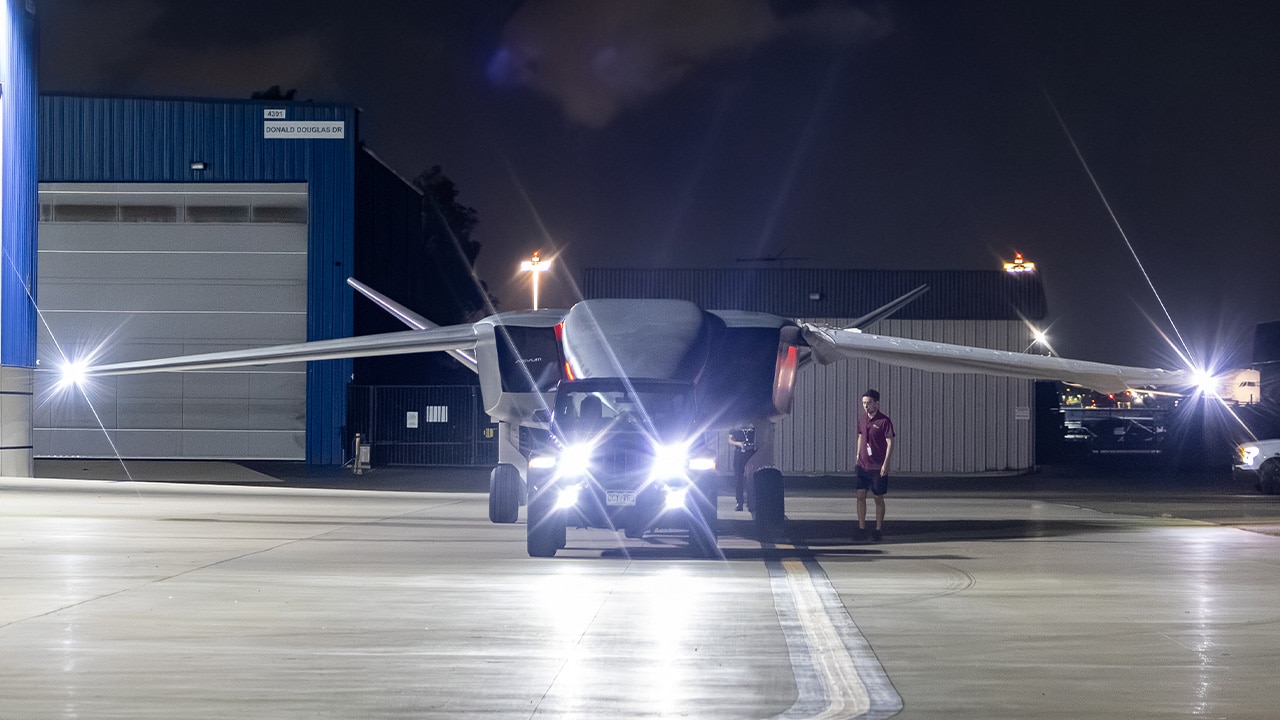
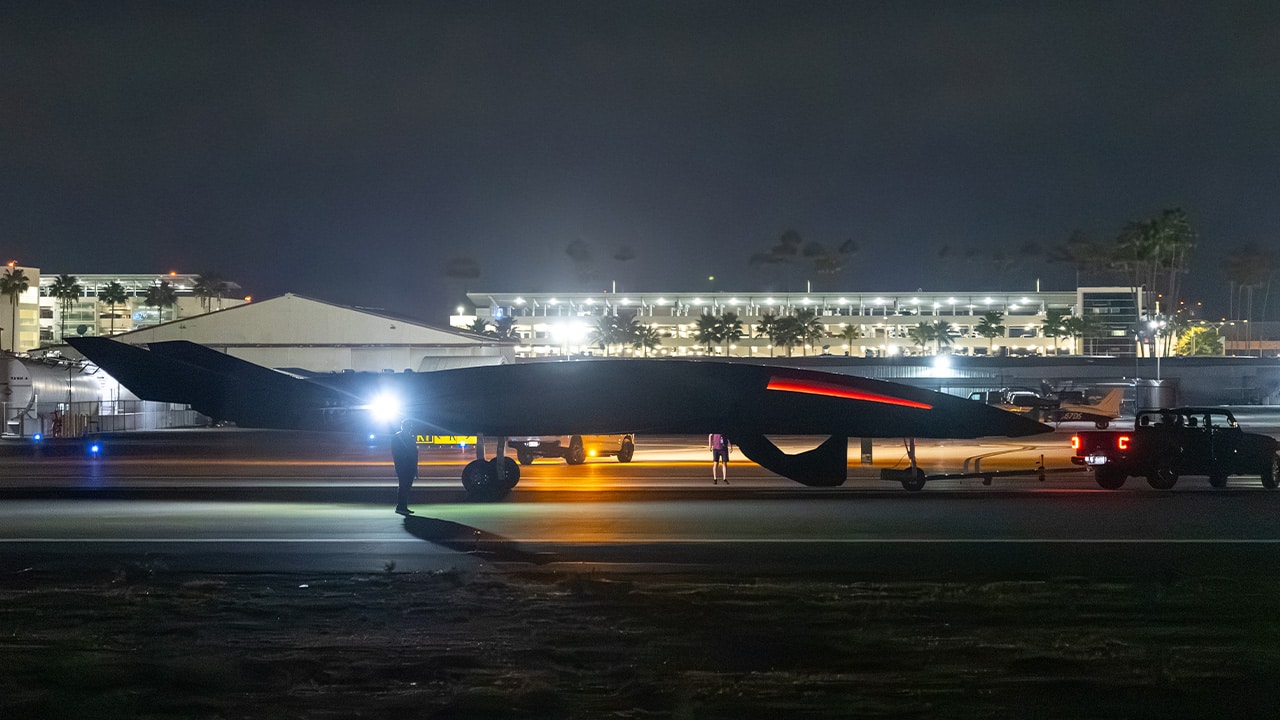
After years of little activity, the Ravn X rolled out of a hangar at Long Beach Airport for its very first autonomous taxi tests and caught the attention of local enthusiasts. Designed to launch small payloads into space, its planned first mission in 2021 has still yet to take place. 

At eighty feet long and with a wingspan of sixty feet, the Ravn X is a huge autonomous aircraft said to pack two afterburning turbofan engines that allow high subsonic flight up to an altitude of 60,000 feet.

Head on with the Ravn X, showing its impressive size. | Source: Matthew Dawson

At maximum velocity, the Ravn X is designed to release the rocket-powered second stage which then takes over boosting the 100 kilogram payload into orbit. This fills a niche in providing a responsive launch capability that can be readied at much shorter notice compared to traditional launch vehicles like the Falcon 9 or Vulcan Centaur. 

Aevum distinguishes Ravn X from air launch methods (such as Northrop Grumman’s Pegasus or Virgin Orbit’s LauncherOne) as the vehicle is not dropping the rocket but rather accelerating it up through the atmosphere. pic.twitter.com/mVIT8pzmQi

— Michael Sheetz (@thesheetztweetz) December 3, 2020

The U.S. Air Force contracted Aevum in 2019 to provide the launch system for the ASLON-45 mission, featuring a number of cubesats. To this date, the Ravn X has still not flown and as time went on it became questionable whether any development was proceeding on the aircraft.

However quiet the company was about its operations, we can now see that work did continue, and the Ravn X has finally completed its first taxi tests.


View this post on Instagram


A post shared by Matthew Dawson (@mattdawson.photography)

It is not immediately apparent whether this airframe – also marked and registered as N567RX – is the same as the one shown off by Aevum in 2020, which we reported on here. It may still be a mockup rather than a flight representative airframe, and certainly the landing gear appears to be fixed and for ground use only. 

Aevum Ravn X, showing off a distinctive light design. | Source: Matthew Dawson

No official announcement has yet been forthcoming from Aevum – which is headquartered in Long Beach – or any other stakeholder as to why the Ravn X made such a sudden appearance after years in the dark. 

If The Aviationist learns any more about this story, we will be sure to update you.

Many thanks to Long Beach local Matthew Dawson for sending us his images of the Ravn X’s roll out. You can find him on Instagram here


Spitfire Vs Bf 109: handling tests and why the latter turned more readily to the right than to the left

6 September 2026 at 21:36

One of the world’s finest single seat fighters

During the early war years the Bf 109 was one of the world’s finest single seat fighters. Its basic design provided the potential for it to take new engines and armament so that it remained the backbone of the Luftwaffe fighter forces throughout World War Two.

The Messerschmitt Bf 109 began as an entry by the Bayerische Flugzeugwerke in a Luftwaffe (German Air Force) fighter competition in the early 1930s. Willy Messerschmitt’s creation incorporated one of the most advanced aerodynamic designs at the time, with retractable landing gear, an enclosed cockpit, automatic slats, cantilever wings and stressed skin construction. During the trials, the Bf 109 clearly outperformed the larger and heavier favorite, Heinkel’s He 112. The first production model, the Bf 109B, began coming off the lines in 1936. The redesignation of the Bayerische Flugzeugwerke AG (Aktiengesellschaft or Corporation) to the Messerschmitt AG in 1938 led many to call it the Me 109, although the official Luftwaffe designation of the aircraft remained the Bf 109 throughout the war.

The Bf 109B first entered combat with German-manned Condor Legion units during the Spanish Civil War, and they were a welcome replacement for the obsolete Heinkel He 51 biplane fighter. The Bf 109C, introduced in 1938, retained the twin 7.9mm MG 17 machine guns mounted above the engine but replaced the single MG 17 firing through the propeller spinner with two MG 17s in the wings.

After less than 200 Bf 109Ds were built, the Bf 109E entered production with the Daimler Benz DB 601 in early 1939. Early in World War II, the Bf 109E completely dominated the Polish PZL fighters. In the invasion of France in May 1940, the Bf 109E outfought French Morane-Saulnier MS 406s and British Hawker Hurricanes.

Spitfire Vs Bf 109: handling tests

Bf 109 Vs Spitfire: the handling tests and why the former turned more readily to the right than to the left
Messerschmitt Bf 109E-3

In the air battles over the English Channel and later during the Battle of Britain, the Bf 109E not only exposed its Achilles heel — its short range — but also met its equal, the Supermarine Spitfire.

As explained by Neil Page in his book Luftwaffe Fighters: Combat on all Fronts Volume 1, both the Messerschmitt Bf 109 and the Spitfire had their rolling manoeuvrability at high speeds seriously curtailed by aileron heaviness.

The following data for the Bf 109 E is extracted from a British test document entitled Messerschmitt Bf 109 Handling and Manoeuvrability Tests by the Ministry of Supply. September 1940: “More detailed aileron tests (measurement of stick forces and time to bank) were made. These tests showed that although the Bf 109 ailerons felt much heavier than those of the Spitfire at speeds between 300mph (483km/h) and 400mph (644km/h), the a/c could be made to bank at about the same rate as the Spitfire at these high speeds.

“The more ‘solid’ feel of the Bf 109 ailerons at high airspeeds is attributed to the smaller stick travel (+/- 4in compared to +/- 8in on the Spitfire), fairly rigid control circuit, and partly to the awkward seating position of the pilot… at 400mph (644km/h) the Bf 109 pilot, pushing sideways with all his strength, can only apply about 1/5 aileron, thereby banking 45 deg. in about 4 secs.; on the Spitfire also, only 1/5 aileron can be applied at 400mph, and again the time to 45 deg. bank is about 4 secs…”

How a captured Focke-Wulf Fw 190A led to the development of the Spitfire Mk IX, the best close-in fighter of WWII
Spitfires

Turning more readily to the right than to the left

The Spitfire’s ailerons did not feel as ‘solid” at 400mph as those of the Bf 109; this was because there was rather more ‘stretch’ in the aileron control circuit of the Spitfire. The maximum sideways force a pilot could exert on the stick worked out at around 60lb on the Spitfire, but only about 40lb on the Bf 109. The reason for this difference was that the cockpit of the Bf 109 was so cramped that a pilot could not bring his arm round into the position most favourable for applying a large side force to the stick. And it was not only the ailerons that caused problems for the 109 pilot.

The following is again from the Ministry of Supply September 1940 test report: ‘It is at high speeds that lack of a rudder trimmer most seriously inconveniences the pilot. At 215mph (346km/h) the a/c is trimmed directionally, no rudder being required. At higher speeds left rudder must be applied, and at 300mph (483km/h) about 2 deg. of left rudder are needed. The rudder is very heavy at high speeds, and a large force is required to apply even such a small amount. This becomes very tiring, and affects the pilot’s ability to put on more left rudder to assist a turn to the left. Consequently at high speeds the Bf 109 turns more readily to the right than to the left.”

Luftwaffe Fighters: Combat on all Fronts Volume 1 is published by Mortons Books and is available to order here.

Spitfire model
This model is available to order from AirModels – CLICK HERE TO GET YOURS.

Photo credit: Alan Wilson from Stilton, Peterborough, Cambs, UK via Wikipedia

Here’s why the C-141 is The Most Significant Aircraft in History of Airlifter Design

6 September 2026 at 19:54

The Starlifter

Introduced to replace slower piston-engined cargo planes such as the C-124 Globemaster II, the C-141 was designed to requirements set in 1960 and first flew in 1963. Production deliveries of an eventual 285 planes began in 1965: 284 for the Air Force, and one for the National Aeronautics and Space Administration (NASA) for use as an airborne observatory.

The C-141 Starlifter was the workhorse of the Air Mobility Command from the 1970s into the early 2000s. The Starlifter fulfilled the vast spectrum of airlift requirements through its ability to airlift combat forces over long distances, delivering those forces and their equipment either by air, land or airdrop, resupply forces and transport the sick and wounded from the hostile area to advanced medical facilities.

Looking back to Starlifter’s layout, Lockheed’s Wilfred C. Garrard recalls in George Cox and Craig Kaston book American Secret Projects Vol 2:

`During the preliminary design phase of the C-141 aircraft a small team was given the task of comparing all configurations that could be conceived for performing the C-141 mission. The hope was that a new configuration could be developed which would be superior … either in speed or cost or some other major characteristic. One factor in our minds was that something new or different would catch the imagination of USAF and if it offered one or more advantages, we would have an overwhelming competitive advantage. Unfortunately our hopes were dashed in this endeavor..’

Lockheed opted for a high-wing, T-tailed configuration with four turbofans slung on wing-mounted pylons. The wing’s moderate sweep (25° at quarter chord) traded a reduction in cruise speed for an increase in payload for the same size wing. The reduced sweep also decreased approach speeds, allowing Lockheed to eliminate leading edge slats.

C-141A

In March 1961 the Air Force ordered the building of five development aircraft under the designation C-141A. Even before the first of these had flown, a contract was placed for 132 production aircraft, which was subsequently increased to 248. Lockheed delivered the first C-141A to the USAF in October 1964 and the final example in February 1968.

Cargo models
Huge selection of transport diecast models to choose from – get yours here.

Lockheed also designed a version of the Starlifter aimed at the civil market, known as the L-300 Super Starlifter. The company built a demonstrator that flew in 1963, but it attracted no orders.

The C-141 was arguably the USAF’s first strategic jet airlifter. It was not, however, without its limitations. A report published in January 1973 by the USAF’s Office of MAC (Military Airlift Command) History, noted that it had ‘a shorter fuselage than the C-133 and DC-8F; its maximum payload of 34 tons less than that of the Boeing 707-300 series (44.9 tons) and Douglas DC-8F (38.7 tons); its economy cruise speed fell 35mph short and 64mph below the 707-320B and DC-8F respectively; while its maximum range was some 500 miles less than that of either the 707 or DC-8F. In addition … the C-141 was incapable of carrying the outsized cargo that the C-124 or C-133 could.’

C-141 Airlifter Design

Nevertheless the report makes clear that the C-141 gave MAC what it had long wanted: a fast cargo aircraft, with a troop-carrying capability. It may not have had the outsize cargo capability of the C-124, but it did cruise at twice the speed and, compared with the other fast aircraft, the 707 and DC-8, it could carry cargo that they could not. Like all designs, it was a compromise, and overall it proved a successful one. Having entered service in 1964, the last examples of the C-141 were not retired until September 2004.

This very lengthy operational life was in no small part due to a substantial mid-life modification programme. The process extended the fuselage by adding two plugs, one of 13ft 4in (4.07m) ahead of the wing, the other of 10ft (3.05m) aft of it. It also added in-flight refuelling capability by inserting a boom receptacle in the top of the fuselage aft of the cockpit. These changes were tested on a prototype (designated the YC-141B) in 1977, and over the following five years 270 C-141As were converted into C-141Bs. Some of these aircraft received avionics and cockpit display upgrades, becoming C-141Cs.

The C-141 is also significant in the history of airlifter design for its configuration, which would become the norm for virtually every future large military transport: high-mounted swept wings, T-tail, and fuselage-attached main undercarriage. In years to follow the Lockheed C-5, McDonnell Douglas Boeing C-17, Ilyushin IL-76, Kawasaki C-1 and C-2, Embraer KC-390, Xi’an Y-20, and Airbus A400M would all embrace the C-141’s basic design features.

American Secret Projects Vol 2 is published by Crecy and is available to order here.

The C-141 is possibly The Most Significant Aircraft in History of Jet Airlifter Design. Here’s why.

Photo credit: U.S. Air Force

Tuning the Bugatti Tourbillon’s V16 Exhaust Sound Took a Lot of Work. It Was Worth It

6 September 2026 at 19:00

A naturally aspirated V16 that revs to 9,000 rpm is a great starting point, but Bugatti didn’t leave anything to chance. As explained in a video from the automaker, its engineers spent thousands of hours developing and testing the exhaust sound of the Tourbillon. Even a naturally talented singer can benefit from voice coaching, y’know.

The 8.3-liter, cross-plane-crank engine built by Cosworth sounds pretty great on its own. In the Tourbillon, the V16 is teamed with three electric motors to produce a combined 1,800 horsepower, getting the hypercar from zero to 62 mph in two seconds flat, and on to a top speed of 276 mph. Making this first-ever Bugatti plug-in hybrid sound good regardless of the level of electric intervention was a new challenge the engineers of the Veyron and Chiron didn’t face.

Bugatti Tourbillon sound test
Bugatti

Those Volkswagen-era Bugattis were also designed not just for record-breaking performance, but with an attitude toward everyday usability more reflective of a mass-market conglomerate than a boutique brand. So the Tourbillon had to be loud, but refined. And thankfully, engineers intend for the Tourbillon to be driven with the windows down—which isn’t always the case in this era of hyperfixation on airflow. They also claim that what drivers and passengers will hear is completely natural, without any artificial sounds pumped through speakers.

A variety of engine types have powered Bugattis throughout the years, from the outgoing quad-turbocharged, 8.0-liter W16 to the straight-eights of the classic prewar grand prix cars. It’s hard to pull anything consistent out of all that, but Romain Volatier, the automaker’s head of NVH and acoustics, zeroed in on a “dirty and raw” character. The Tourbillon’s exhaust has a building rumble, not a clean metallic ring.

Of course, the Tourbillon also had to be road-legal. As shown in the video, the car had to pass drive-by sound tests by emitting no more than 72 decibels. That’s a total figure that includes not only the exhaust, but any noise the car might make. Tires, air flowing around the body, and any other mechanical noises contribute to that number, so quieting them means the exhaust can be louder.

Tourbillon deliveries are expected to start later this year but, with production capped at 250 cars, they won’t be a common sight. I hope that if I’m lucky enough to see one, I’m also lucky enough to hear it at full chat.

The post Tuning the Bugatti Tourbillon’s V16 Exhaust Sound Took a Lot of Work. It Was Worth It appeared first on The Drive.

GMC Offered Plaid Valve Covers as a Factory Option in 1963

6 September 2026 at 17:00

If you want to dress up an engine, valve covers are a solid place to start. Too bad the options usually begin and end with chrome. Sixty years ago, GMC tried something very different. For reasons lost to time and General Motors’ corporate archives, the truck brand briefly offered plaid valve covers on its big-block V6s.

If you’ve never seen these, don’t be surprised. They were apparently used only on half-ton trucks equipped with the 305-cubic-inch V6 for the 1963 model year. While automakers were a lot more adventurous with colors and styling in the 1960s, they clearly did not start a trend of patterned valve covers. That’s probably just as well. I’m a fan of Pfaff Motorsports’ and Stewart Grand Prix’s plaid liveries, but this just looks bizarre to me.

1963 GMC plaid valve covers
Kyle’s Car Farm via YouTube

As for why GMC did this, a post on the 6066 GMC Club forum (via Hemmings) citing a conversation with a former GMC engineer claims it wasn’t about fashion, but economy. The story goes that when GMC launched this generation truck in 1960, one of the main complaints from customers was the poor fuel economy of the big-block V6. Engineers tested different carburetors and camshafts to find a solution, and when they did find one, they used adhesive shelf-lining paper with a tartan pattern to mark engines running the improved setup because it happened to be around.

According to the post, people from GMC’s marketing department saw the engines wear the improvised plaid valve covers and, perhaps leaning into cultural stereotypes of Scottish cheapness, decided to put them into production. That did happen, as you can see from the very clean 1963 GMC truck in the embedded video from Kyle’s Car Farm. Given the constant churn in styling features between model years at the time, and the extra cost of applying the plaid covering, it’s not surprising that they were a one-year-only option.

This generation of half-ton trucks was already a major milestone for the manufacturer. It was the first of GM’s light-duty pickups to use a dedicated truck platform, and it lasted until 1966, when it was replaced by the seminal “Action Line” generation.

It’s hard to imagine GMC bringing this back for the Sierra or Canyon, and you’d have a hard time seeing the plaid through a modern truck’s plastic engine cover if it did. Remarkably, though, a company is selling the correct pattern for restorations of the original 1963 trucks.

The post GMC Offered Plaid Valve Covers as a Factory Option in 1963 appeared first on The Drive.

RAF Air Command Officially Renamed to Air & Space Command

6 September 2026 at 17:09
RAF Air & Space Command

From Sep. 1, the Royal Air Force’s headquarters is now to be known as Air & Space Command, reflecting the still increasing importance of the space domain to national security and the RAF’s role beyond Earth’s atmosphere. 

Formed in 2007 following the merger of Strike Command and Personnel & Training Command, Air Command has served as the office of the Chief of the Air Staff (the professional head of the Royal Air Force) and the effective headquarters for the whole organisation. Strike Command was itself an amalgamation of Fighter Command and Bomber Command, while Personnel & Training Command was the successor to Support Command.

The redesignation to Air & Space Command makes a step in the direction other air arms have taken, notably the French Air & Space Force (renamed in 2020), Spanish Air and Space Force (renamed 2022), and the Royal Netherlands Air and Space Force (renamed in 2025). For now, the Royal Air Force’s official title remains unchanged, but the update to the Air Command name comes in only just below it in terms of prominence.

This may have passed unnoticed by many, but it’s a big deal in the reorganisation of UK Defence. Air Command has been re-designated to Air & Space Command. Per Ardua ad Astra https://t.co/Nx8KqNq4xT

— Greg Bagwell (@gregbagwell) September 2, 2026

While the RAF has long held responsibility over the space domain, managing the ballistic missile early warning facility at RAF Fylingdales since the early 1960s, and overseeing the UK’s SKYNET communications satellite network since 1969, the integration of space-based capabilities at every level of military operations – down to the individual soldier on the battlefield – as well as to daily civilian life has made its security a key priority. 

‘Major Tedman of UK Space Command has described satellite jamming as a weekly occurrence. ‘

You’re daily reminder that we’re in a Cold War and woefully underprepared. https://t.co/SWQSsYOxZ2

— Martin Prince-Parrott RIBA FRSA 🇬🇧 (@MPrinParr) July 7, 2026

Chief of the Air Staff Sir Harv Smyth noted: “Space is essential to defence, security, prosperity, and our modern way of life. But it is also a domain of growing strategic competition. It has fast become an operational domain in its own right, and is vital to our ambition to develop and mature the integrated force. The RAF’s core mission of gaining and maintaining control of the air is fundamentally dependant on our freedom of action in and through the space domain.”

“It is now more important than ever for space power to be planned and delivered through the highest levels of military leadership, like all other domains. Our new HQ Air & Space Command will lead the delivery of space power with the same dedication that it leads for the air domain,” he added.

Smyth, himself, was previously the first person to hold the role of Director Space UK, and then moved to the role of Deputy Commander (Operations) in 2022. In 2023, this role was itself named to Air & Space Commander. Smyth continued in this post until 2024, at which point he was promoted to Deputy Chief of the Defence Staff (Military Strategy and Operations), and then to his current role as Chief of the Air Staff. 

UK Space Command (UKSC), which was formed under the Air Command structure in 2021, will continue to operate under the new Air & Space Command umbrella.

This may have passed unnoticed by many, but it’s a big deal in the reorganisation of UK Defence. Air Command has been re-designated to Air & Space Command. Per Ardua ad Astra https://t.co/Nx8KqNq4xT

— Greg Bagwell (@gregbagwell) September 2, 2026

Though led by the RAF, UKSC incorporates personnel from the Royal Navy, British Army, and Civil Service. It maintains the 1 Space Operations Squadron at the National Space Operations Centre, RAF High Wycombe, and 2 Space Warning Squadron is tasked with operating RAF Fylingdales. UKSC personnel are also deployed in small numbers worldwide to support the UK’s overseas bases and deployments. 

In the latest 60 Second update from across the RAF, UK Space Command are deployed on @HMSPWLS, while working with the Australian Defence Space Command and we welcome the new Chief of the Air Staff, Air Chief Marshal Harv Smyth. pic.twitter.com/PIIdOGKToe

— Royal Air Force (@RoyalAirForce) September 1, 2025

Dating from the formation of the Royal Flying Corps in 1912, the Royal Air Force’s famous motto will continue to ring strong through the service, perhaps with a renewed sense of meaning. Per ardua ad astra – through adversity to the stars.

First to Mach 2: A Look at the Douglas D-558 Skyrocket

6 September 2026 at 17:02
Douglas D-558 Skyrocket

Using both turbojet and rocket propulsion, the Douglas D-558 Skystreak and Skyrocket research aircraft set a series of speed and altitude milestones in the years after World War II, culminating in the first flight beyond Mach 2.

During a period of abundant experimental record-breaking designs, men and machines were pushed to the edge of the envelope in ever increasing speeds and altitudes. The Douglas D-558 series aircraft played a major role in aircraft experimentation and development, eventually becoming the first to fly Mach 2.

The Douglas D-558-1 Skystreak

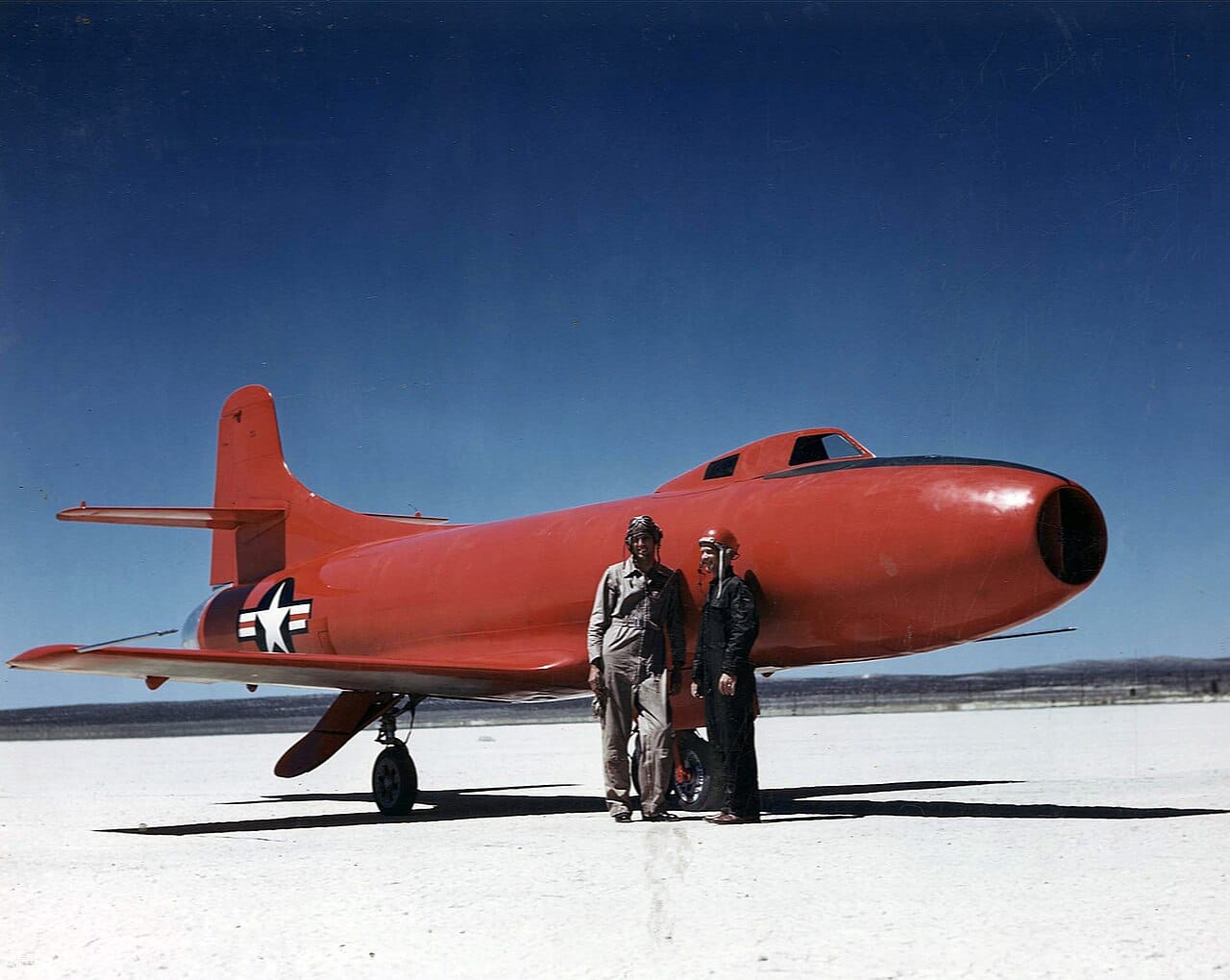
Kept as simple as possible, the Douglas D-558-1 was designed to meet the requirements of both the NACA (National Advisory Committee for Aeronautics) and the United States Navy (USN) Bureau of Aeronautics for a high-speed research aircraft. This particular aircraft design would focus on researching and studying high subsonic speeds.

Requirements included flight speeds of Mach 0.75 up to 0.85 and to operate at altitudes between sea level and 40,000 ft. The aircraft would also need to gather aerodynamic loads and pressure measurements in free flight at these speeds and altitudes; as such data could not be obtained from wind tunnels at that time.

Drawing of the Douglas D-558-1 Skystreak showing the installed research instrumentation and design layout. | Source: United States Navy

An automated pressure recording system had 400 measuring points from the airframe connected to it, along with strain gauges placed on selected tail section and wing section positions. At least 500 lbs of instruments would need to be carried.

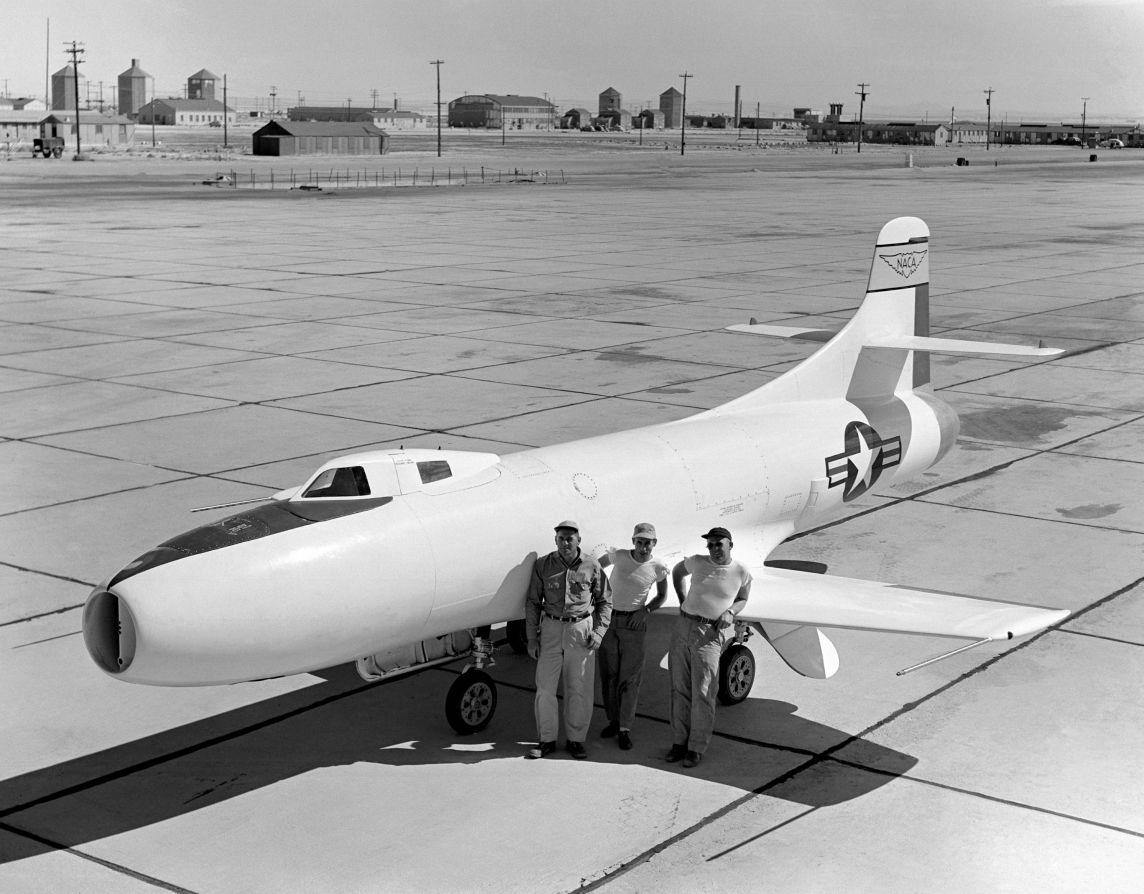
The D-558-1, known as the Skystreak, was a cantilever low-wing aircraft with large vertical tail surfaces and the horizontal tail surfaces attached one-third up the vertical fin. Tricycle retractable landing gear kept the aircraft streamlined along with the slender circular fuselage design. The aircraft would be required to take off and land on its own power.

The pilot sat in a single-seat cockpit that in an emergency would be jettisoned with the entire nose section from just rear of the pilot’s seat forward. It was intended the pilot would then bail out conventionally from this jettisoned nose section after separation and slowing.

A NACA Muroc Flight Test Unit photograph taken in 1949 with the Douglas D-558-1 on the ramp. Ground crew members are seen posing against the wing of the Skystreak. The D-558-1 was designed to be just large enough to hold the J35 turbojet engine, pilot, and instrumentation and the fuselage cross section had to be kept to a minimum. The D-558-1 pilots found the cockpit cramped and could not easily turn their head. | Source: NASA

Originally fitted with a rounded windscreen, a more streamlined V-shaped unit was later installed for high-speed testing. This configuration further shrank the room in the cockpit and mandated the pilot wear a chamois covering on his helmet or a soft helmet to prevent scratching the glazing.

A total of three D-558-1s were constructed, with the first flight in the spring of 1947 at Muroc Army Air Field (Edwards Air Force Base) by Douglas test pilot Eugene F. May. Powered by a single Allison J-35-A-11 turbojet, a new world speed record was established on Aug. 20, 1947 of 640.743 mph (miles per hour) average speed by the first D-558-1 flown by USN Commander Turner Caldwell at an altitude of 75 ft [note: NASA gives 640.663 mph, while the Navy museum gives 640.743 mph]. That record was soon shattered five days later when an average speed of 650.6 mph was reached in the second D-558-1 flown by Marine Lt. Colonel Marion Carl at times at only 25 ft in altitude.

Records claimed by the Germans during the war years flying the Me 163 Komet were achieved in secrecy, without official observers and not under strict regulated conditions using timed runs, so the Komet was not officially recognized as holding the official air speed record.

Marine Major Marion Carl (left) Navy Commander Turner Caldwell stand next to a Douglas D-558-1 Skystreak at Muroc Army Airfield. Both Carl and Caldwell established world speed records in D-558-1 type aircraft within five days of each other in 1947. | Source: United States Navy

The second D-558-1 was lost on May 3, 1948 when the engine compressor disintegrated after takeoff, killing NACA pilot Howard C. Lilly. It had completed 27 flights total before NACA instrumentation, then Lilly flew five NACA research flights in spring 1948 before the fatal crash. A third Skystreak completed a total of 82 flights by June 10, 1953. The third aircraft had been kept in operation with spares and components robbed from the first prototype: NACA 140 was never flown by NACA and was used as a spares source for NACA 142. Three additional D-558-1 examples were cancelled.

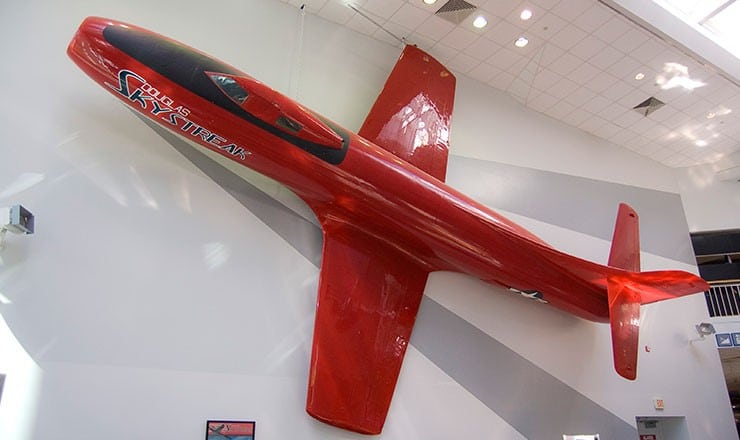
The D-558-1 held the distinction of the fastest aircraft in the world for a short time, as the bright crimson painted Skystreak was soon overshadowed by the X-1 and Captain Chuck Yeager. Eventually the paint was changed to white in order to improve visibility, tracking, and photography. The aircraft had played an important role in research flying extended periods at transonic speeds.

Douglas D-558-1 (Bureau No. 37970) mounted on the wall at the National Naval Aviation Museum in Pensacola, Florida. This was the first Skystreak produced and the aircraft flown by Commander Turner Caldwell on Aug. 20, 1947 when he set a world air speed record. The third and only other remaining D-551-1 (Bureau No. 37972) is located at the Sullenberger Aviation Museum at the Charlotte-Douglas International Airport, Charlotte, North Carolina). | Source: United States Navy

The Douglas D-558-2 Skyrocket       

The phase-two version of a planned three-phase program, the D-558-2 became more than just a modified D-558-1. Designer Ed Heinemann determined his previous design would need extensive modifications to allow for two sources of propulsion, both jet and rocket. The fuselage would need to be larger and a smaller turbojet used. However, Heinemann also wanted to develop sweptback wings as well for the aircraft. This led to a new and different research aircraft designated the D-558-2 Skyrocket.

Three D-558-2 aircraft were substituted for the original additional three D-558-1 cancelled aircraft. Mid –set wings sweptback at 35 degrees produced a wing span of 25 ft and complemented by horizontal stabilizers swept at 40 degrees. The design retained the jettisonable nose section and tricycle landing gear of the Skystreak.

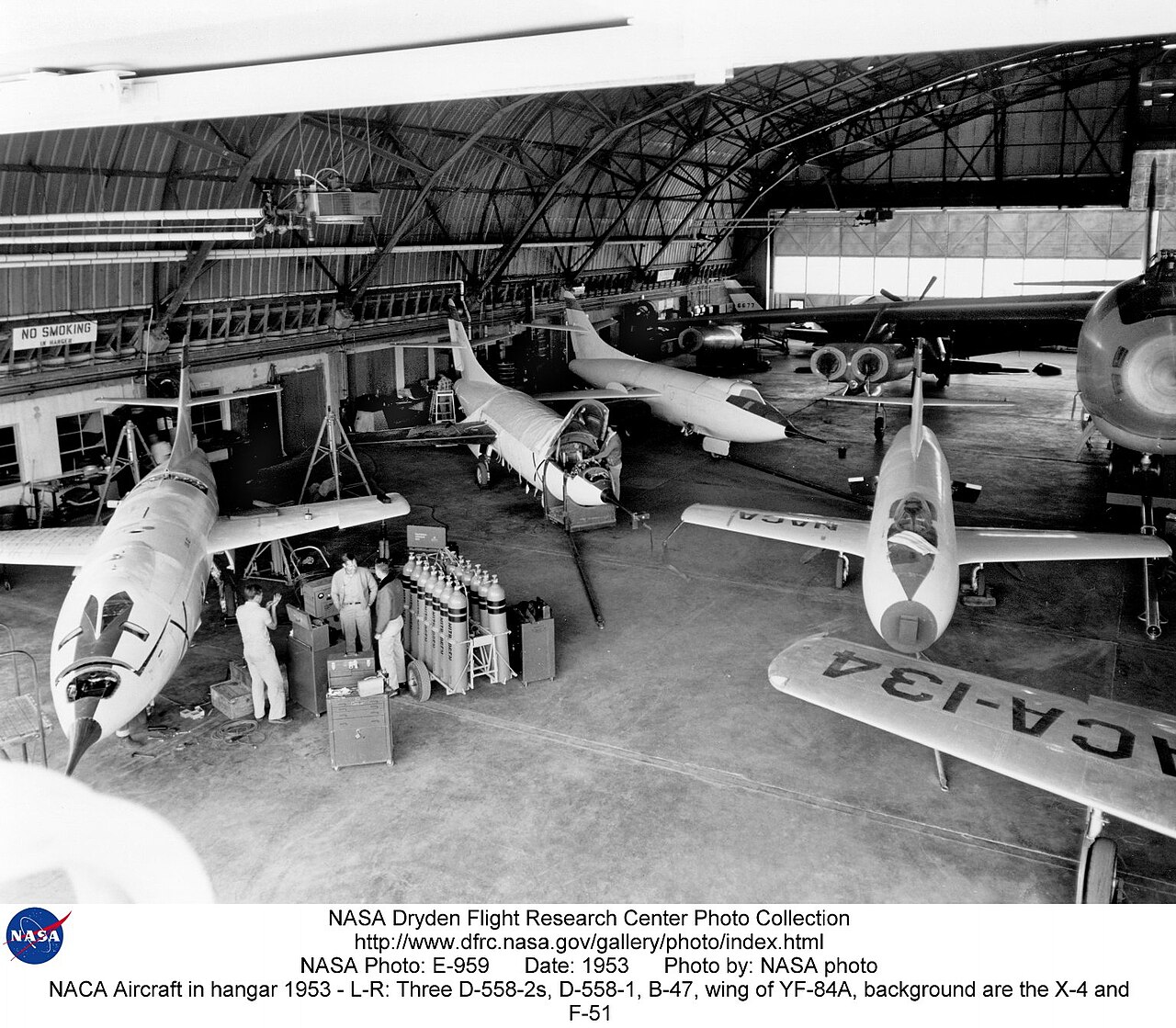
1953 photo showing an impressive lineup: All three of the D-558-2 Skyrockets, a D-558-1 Skystreak, and a glimpse of a B-47, YF-84A, F-51, and X-4. | Source: NASA

A Westinghouse J34 turbojet engine was intended to power the 42 ft in long aircraft during takeoff, climbing and landing. An additional power source, a four-chamber Reaction Motors LR8-RM-6 rocket was to be used for high-speed flight.

The flush cockpit canopy of the D-558-2 was also reconfigured with a raised cockpit and angled windows to increase poor visibility. The larger profile area had to be balanced by adding 14 inches to the height of the vertical stabilizer.

On Feb. 4, 1948, Douglas test pilot John F. Martin flew the Skyrocket for the first time at Muroc, although the aircraft was only equipped with a jet engine. It was the beginning of a successful test program in which the characteristics of swept-wing aircraft at transonic and supersonic speeds were studied. A great deal of information and data was gathered about pitch-up issues along with drag and buffeting characteristics of swept-wing aircraft traveling at high speeds.

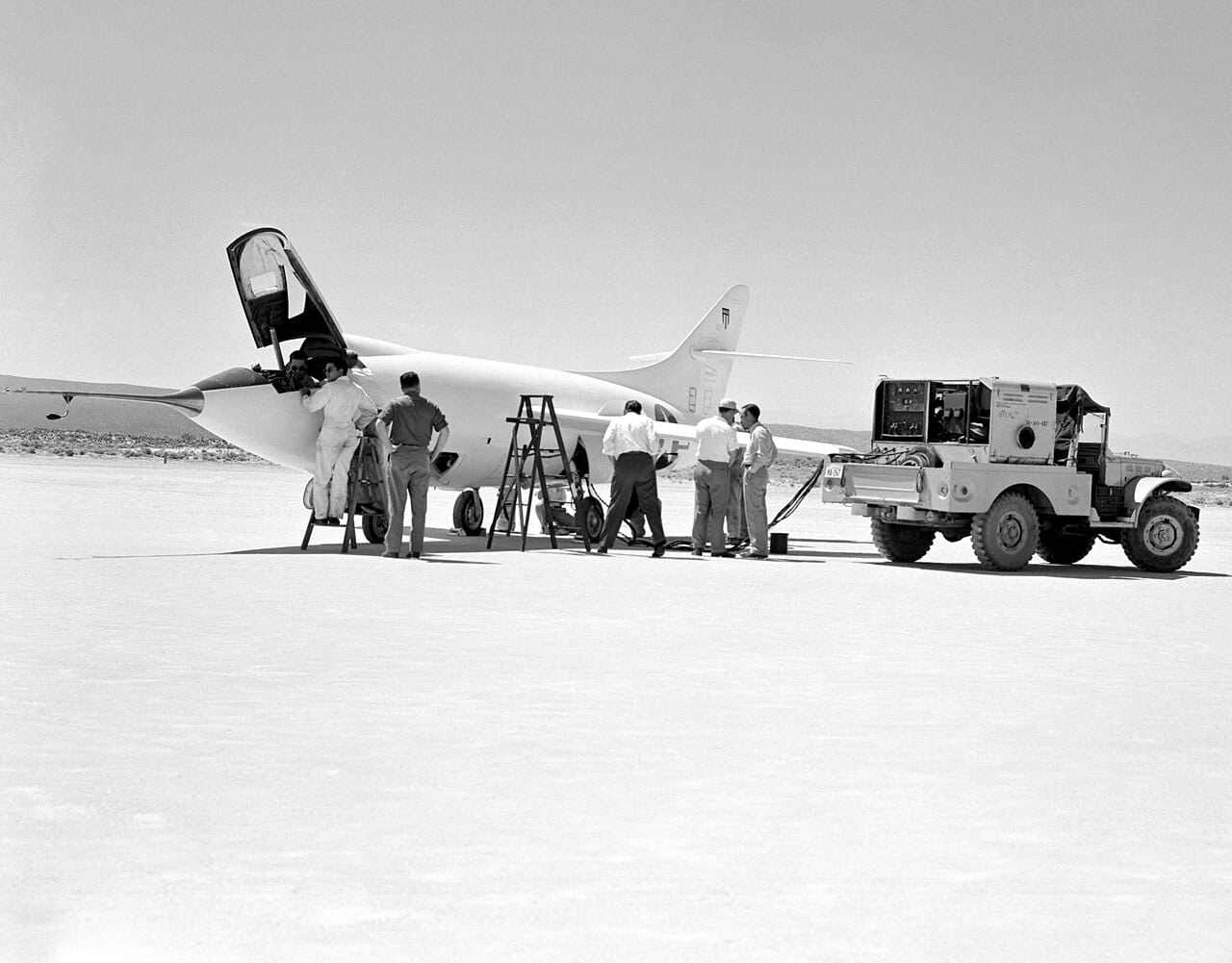
This 1949 photograph shows a Douglas D-558-2 undergoing pre-flight operations on Rogers Dry Lakebed. Prior to flight, the aircraft’s systems had to be checked out, the instrumentation calibrated, cameras and oscillographs loaded with film, and the aircraft filled with dangerous propellants. | Source: NASA

NACA 144 (Bureau No. 37974) was flown by NACA pilots Robert A. Champine and John H. Griffith 21 times to conduct testing and research on airspeed calibrations and stability and control. The turbojet engine was replaced in 1950 with an LR-8 rocket engine.

Douglas pilot Bill Bridgeman flew 37974 seven times to Mach 1.88 and to 79,494 ft setting an unofficial record at the time on Aug. 15, 1951. Without the jet engine for takeoffs, the rocket configured Skyrocket was now slung under a P2B-1S Navy variant of the Boeing B-29 bomber.

This 1953 NACA photograph shows the Douglas D-558-2 Skyrocket (NACA 144) being towed under the P2B-1S launch vehicle (NACA 137) for attachment prior to flight. The large hydraulic jacks used to elevate the P2B-1S can be clearly seeen. | Source: NASA

The P2B-1S was specially modified for the project, and would fly to 30,000 ft and drop the D-558-2. Known as ‘Fertile Myrtle’, aircraft 84029 would be used as the ‘mothership’ to launch Skyrocket aircraft during the 1950s. Identified with the call sign ‘NACA 137’, the P2B would be placed on jacks in order to provide the needed clearance for loading the Skyrocket to its attachment points under the heavily modified bomb bay. The D-558-2 would be dropped from its cradle at altitude, its pilot firing the rockets once clear of the P2B.

Issues with lateral instability were noted during Bridgeman’s supersonic flights, leading NACA engineers to study the aircraft’s behavior prior to their own flight research that began in Sept. 1951.

D558-2 Skyrocket just after release from the P2B mothership. | Source: NASA

Preparing for twice the Speed of Sound

NACA test pilot Albert ‘Scott’ Crossfield had flown the Skyrocket 20 times over a period of approximately two years, gathering data and studying longitudinal and lateral stability along with control as well as lift, drag, and buffeting characteristics of the aircraft at supersonic speeds up to Mach 1.878.

Marine pilot Lt. Colonel Marion Carl took the aircraft to an unofficial record altitude of 83,235 ft on Aug. 21, 1953, hitting Mach 1.728 during the flight. Since the aircraft did not take off on its own power, the altitude record was not recognized. After Carl’s flights, NACA engineers added nozzle extensions to the LR-8 combustion chambers in order to prevent exhaust gas from affecting the rudder. Engine thrust was also increased by 6.5 percent.

All three D558-2 Skyrockets along with the P2B mothership fill the ramp. | Source: NASA

After securing an agreement with the Navy’s Bureau of Aeronautics by Crossfield, NACA allowed the attempt of a record-setting Mach 2 flight in the aircraft.

The NACA flight team personnel waxed the fuselage of the Skyrocket to reduce drag, and chilled the fuel so the tanks would hold more, and fueling the aircraft hours ahead of time gave the fuel time to settle allowing for additional fuel to be added later. Masking tape was placed over any drag inducing cracks, and the stainless steel prime and jettison tubes were replaced with lighter aluminum.

The tubes were bent into the blast of the rocket engine allowing them to be burnt off and fall away from the aircraft once no longer needed, saving a few more pounds. The plan called for reaching 72,000 ft and pushing over into a slight dive. It was hoped the 200 second blast of her rocket engine would push the aircraft past Mach 2.

The people and equipment that supported the flight of the NACA D-558-2 Skyrocket at Edwards AFB. Visible are two F-86 Sabre chase planes, the P2B-1S launch aircraft, and an assortment of ground support equipment, including communications, tracking, maintenance, and rescue vehicles. NACA pilot Scott Crossfield stands in front of the Skyrocket. | Source: NASA

Weak from a bout with the flu, pilot Scott Crossfield approached the P2B sitting on the desert ramp on a cold blustery Nov. 20, 1953. The D-558-2 was tucked under the mothership with mechanics bundled against the cold swarming the scene. Pipes, hoses, and cords plugged equipment carts and fuel trucks into the needy Skyrocket. It was not yet daybreak.

While loading hydrogen peroxide fuel onto the aircraft in the freezing temps and darkness, an accident almost delayed the flight. A frozen vent fitting caused by the ‘cold soak’ practices earlier to allow more fuel capacity had caused the dangerous liquid to burst out of an untapped port showering a P2B launch panel operator in the face. The peroxide was so potent that a rag doused in it would burst into flames. The affected operator, however, due to the quick reaction of a nearby mechanic who sprayed him in the face with a fire hose, only suffered temporary white blotches that lasted a few days. The show went on.

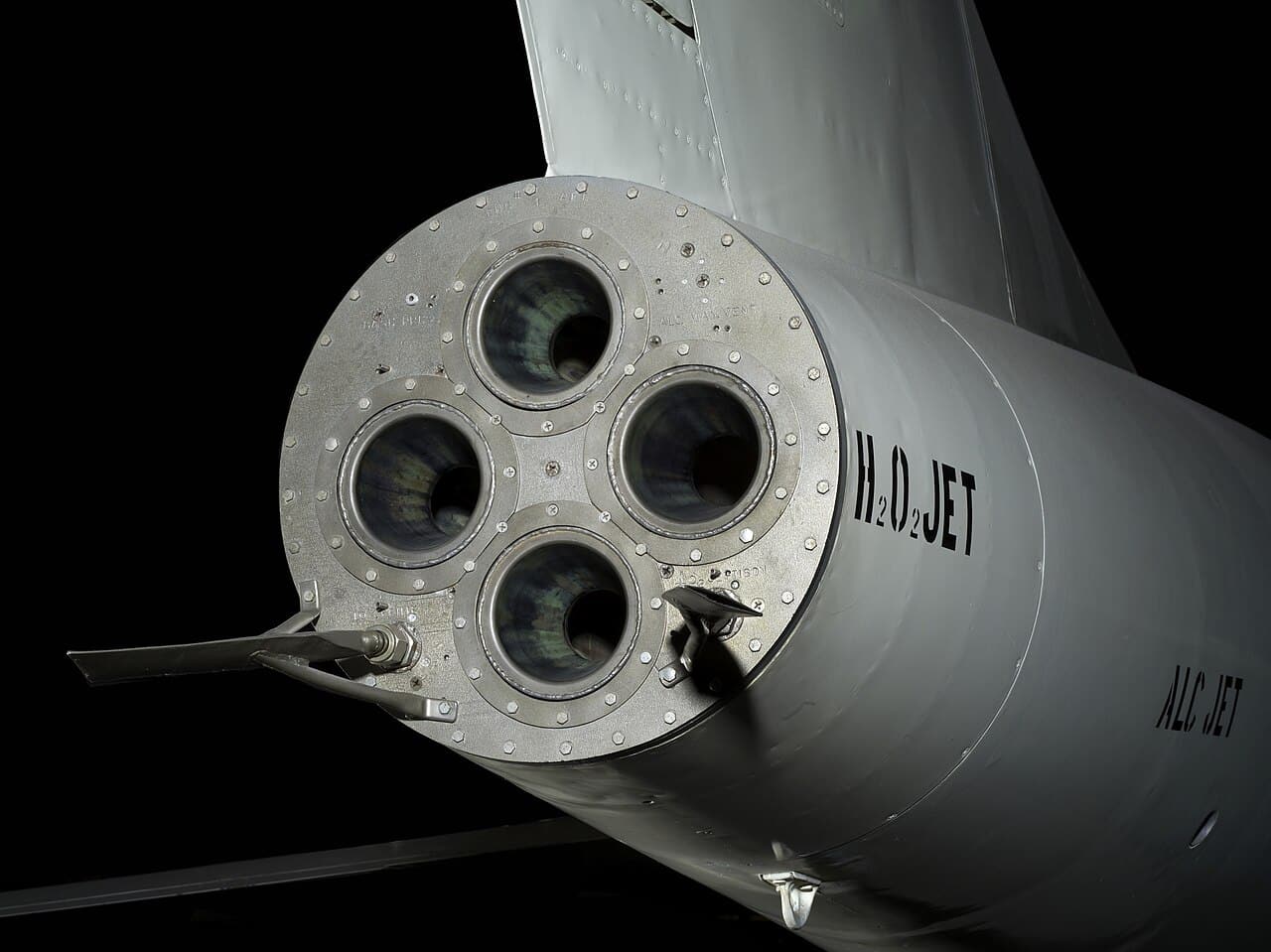
View of the rear of the D-558-2 and the rocket exhausts. | Source: Mark Avino/Smithsonian National Air and Space Museum

Taking the Skyrocket to Mach 2

When the P2B reached 10,000 ft, Crossfield got into the cockpit of the D-558-2. He would be required to pressurize the cockpit, an experience that produced a sudden burst of gas into the cockpit, not a gradual process. The sudden burst could wreak havoc on human sinuses, and the influenza Crossfield was battling could exacerbate the situation. Scott had brought along a small cork, placing it in the compressed-air inlet tube and gradually easing it out slowly as he turned the valve on. The pressurization gauge slowly reached the green and caused Crossfield no pain or difficulty. The aircraft combination continued on to the launch point.

As the Skyrocket fell away from the belly of the mothership, blinding sunlight hit Crossfield’s eyes. The ship rolled naturally to the right, and he hit the rocket-barrel switches; pausing a split second until each one caught. The D-558-2 surged forward and the horizon disappeared from view. Soon the P2B was below and behind.

Douglas D-558-2 Skyrocket and a North American F-86 Sabre chase aircraft in flight. | Source: NASA

Crossfield now had a total of 200 seconds to accomplish his goal. This would be his only chance. As he approached 72,000 ft, he began the pushover with the rocket engines burning furiously. The Skyrocket was living up to its name in this most spectacular dive. Scott closely monitored the Mach needle, and as the fuel lasted an incredible 207 seconds, the needle edged past Mach 2 and stayed at Mach 2.005. He had become the first man to fly twice the speed of sound with the instruments on board the Skyrocket recording the data automatically. The risky ‘cold soak’ process had paid off with an extra seven seconds. The altitude of the Mach 2 peak was about 62,000 ft.

As the engines cut out and the D-558-2 entered thick air, it slowed dramatically throwing Crossfield forward in the shoulder straps. Still coasting at Mach 1.8, he dropped back to Mach 1.0 with the aircraft shaking violently but briefly.

A dead stick landing was the next challenging part of the flight as Crossfield approached the dry lake bed at 15,000 ft performing a victory roll. Chase planes soon lined up on his wing tips guiding him down. The Skyrocket touched down between two painted black lines exactly where it was intended to land, rolling to a complete stop 12 minutes after being launched.

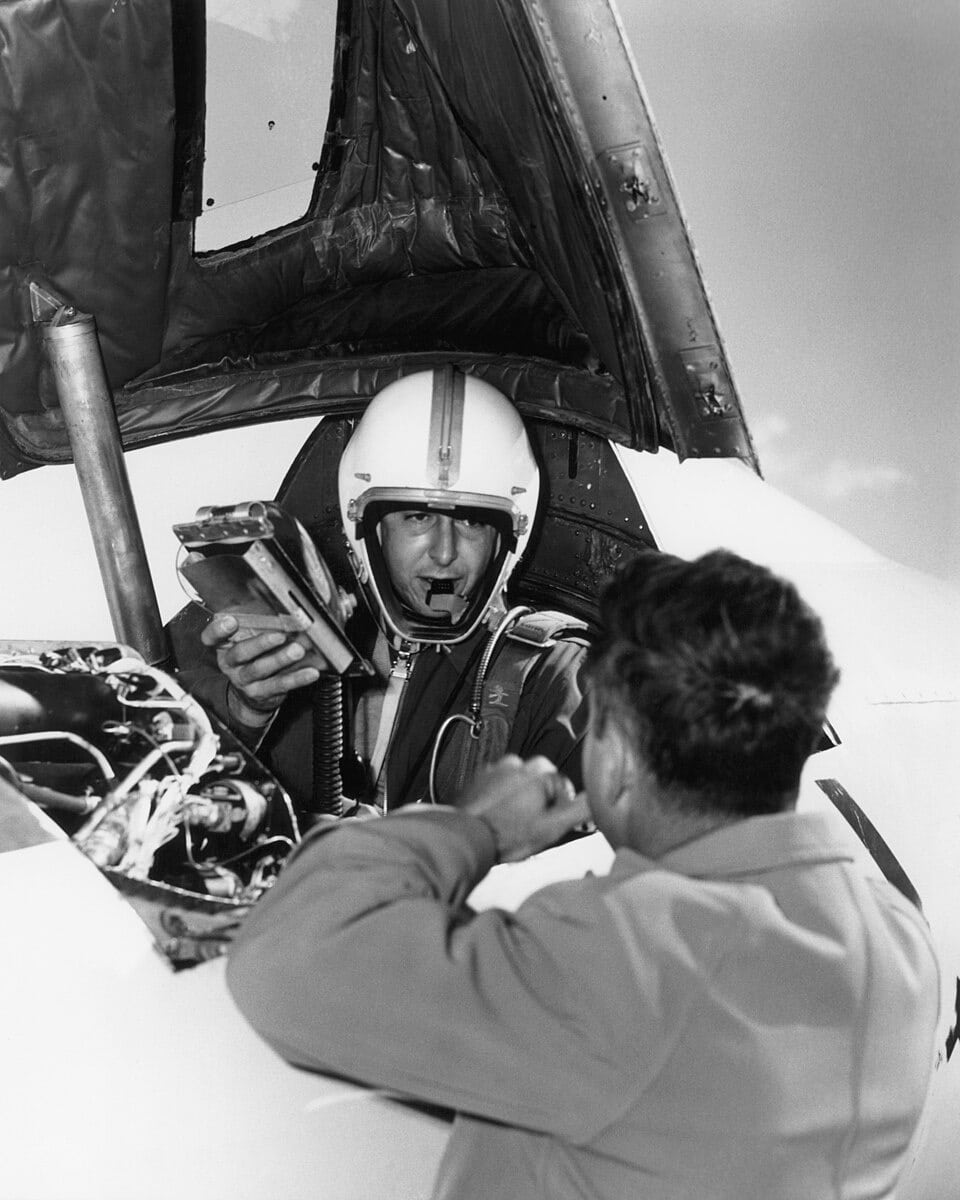
NACA pilot Scott Crossfield in the cockpit of the D-558-2 after the Mach 2 flight. | Source: NASA

Surviving Skyrockets

The three D-558-2 aircraft flew 313 times setting several records and gathering invaluable data. This data would go on to aid in the design of future aircraft, including the Century Series of fighter aircraft.

The program ended with the last flight on Dec. 20, 1956. A third version of the aircraft, the D-558-3 Skyflash, was an ambitious Mach 9 performer with space capabilities was abandoned in favor of the North American X-15.

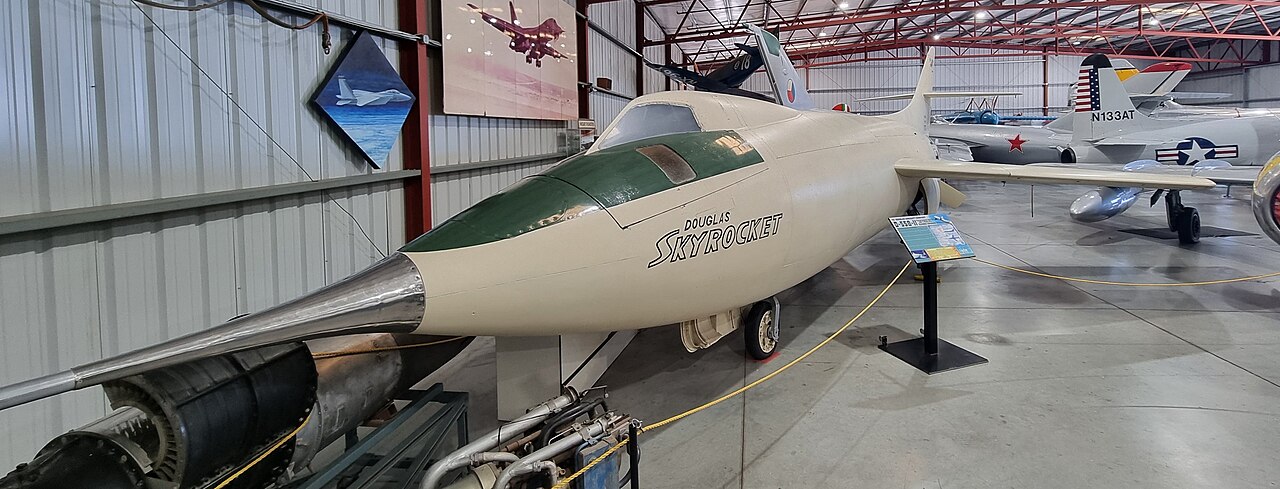
: Douglas D558-2 (37973), the first Skyrocket built, on display at the Planes of Fame Museum in Chino, California. | Source: Wikimedia Commons

All three of the D-558-2 Skyrockets have been preserved. The first example built is on display at the Planes of Fame Museum in Chino, California.

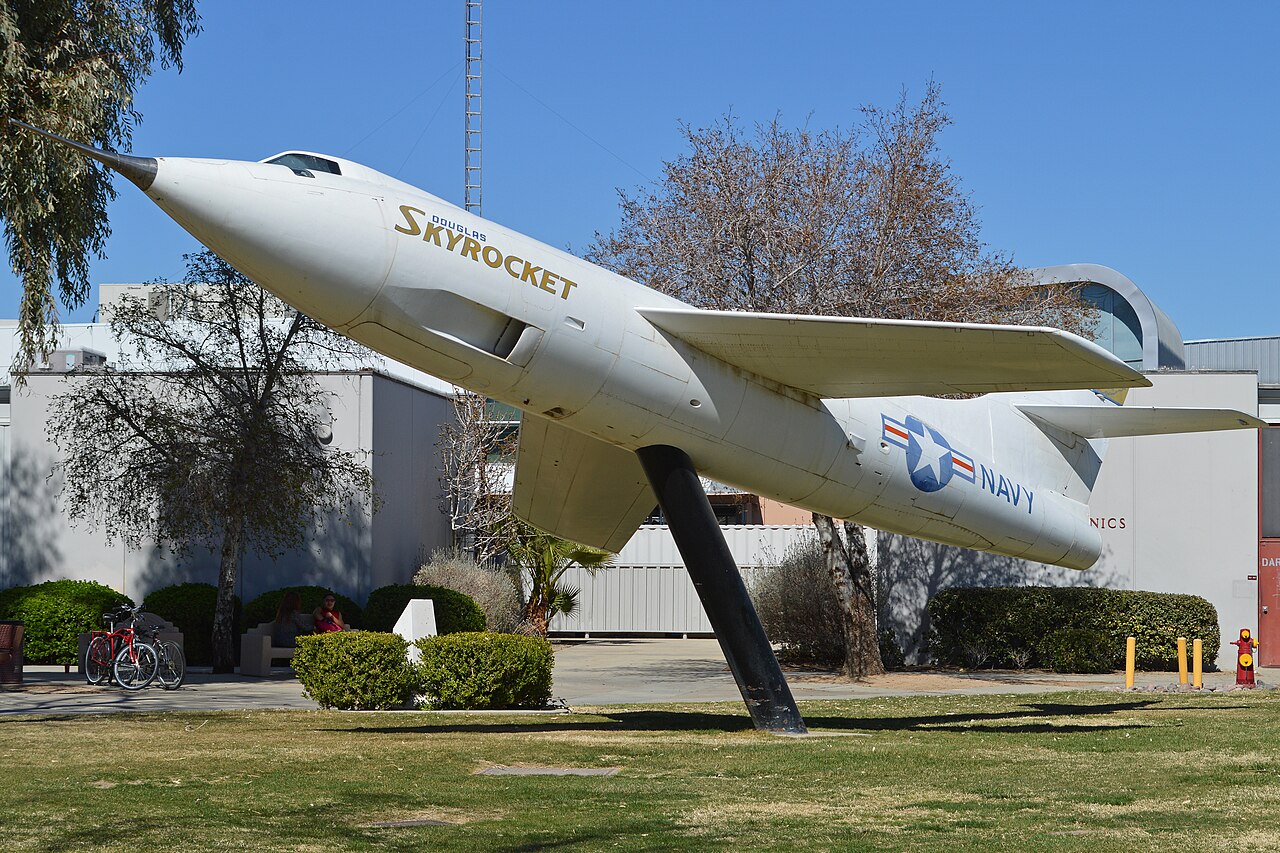
The second example, the one Crossfield took to Mach 2, resides at the National Air and Space Museum in Washington D.C., and aircraft number 3 is mounted on a pylon at the Antelope Valley College in Lancaster, California.

The third and final D-558-2 on display on a pylon at Antelope Valley College in Lancaster, California. | Source: Wikimedia Commons

F-15 maintainer tells why although NASA equipped an Eagle with an AIM-54 USAF Never Outfitted its F-15 fleet with the Phoenix

6 September 2026 at 16:52

Used exclusively on the F-14A/B/D

The AIM-54 Phoenix Missile, used exclusively on the F-14A/B/D Aircraft, is a radar guided, air-to-air missile consisting of a guidance section, armament section, propulsion section, control section, interconnecting surface cables, wings, and fins. The missile is designed for ejection launch using the LAU-93 or LAU-132 launchers. Semi-active and active homing radar and hydraulically operated fins direct and stabilize the missile on course to the target. This is one of two known Phoenix 54C missiles to be on display in the U.S. The other is in the Smithsonian Museum.

Although, as explained above, the only aircraft capable of carrying the Phoenix (in clusters of up to six missiles) was the F-14 Tomcat, the odd photos in this post show an F-15 Eagle fighter jet carrying an AIM-54.

At the time these pictures were taken, researchers at NASA’s Dryden Flight Research Center at Edwards, CA, and the Naval Air Warfare Center Weapons Division, China Lake, CA, investigated the use of surplus demilitarized Navy AIM-54 Phoenix air-launched missiles as possible hypersonic test platforms or testbeds. Hypersonic flight is defined as aerodynamic flight at speeds of Mach 5 or greater, and use of surplus Phoenix missiles was one of the methods being considered to obtain critical flight data in the hypersonic regime.

NASA F-15 with AIM-54 Phoenix

These missions, conducted over restricted military test ranges, involved launching a missile from a NASA F-15 aircraft flying at speeds up to Mach 2.0, with the missile then accelerating to speeds up to Mach 5.0, depending on its trajectory before fuel is exhausted. The missiles would carry experimental research payloads into the hypersonic regime, something that is currently difficult to achieve.

F-15 maintainer tells why although NASA equipped an Eagle with an AIM-54 USAF Never Outfitted its F-15 fleet with the Phoenix
NASA Dryden aircraft and avionics technicians (from left) Bryan Hookland, Art Cope, Herman Rijfkogel, and Jonathan Richards install the nose cone on a Phoenix missile prior to a fit check on the center’s F-15B research aircraft. Robert Garcia watches in the background.

The Phoenix missiles used for hypersonic research had their explosive warheads removed, and their tracking and guidance systems replaced with a smaller, more lightweight guidance system. The missiles were also heavily instrumented to obtain and transmit test data from experiments in such areas as thermal protection materials, scramjet propulsion, guidance & control, boundary layer transition, and aerodynamics at hypersonic speeds.

NASA performed design, analysis, and testing that lead up to a Critical Design Review at the end of 2007. As part of the preliminary studies, several “captive-carry” flights were be flown by the F-15 with an inactive missile with no propellant carried on the aircraft’s centerline pylon to determine the performance of the aircraft when carrying the missile. However, the project was not been funded to conduct actual launches to obtain hypersonic flight test data.

APG-63

Since the photos in this post clearly show that the Eagle could be equipped with the mighty Phoenix one might ask why US Air Force (USAF) F-15d never carried the AIM-54.

‘I was with the F-15 program for about 10 years, maybe a little more. I know the airplane extremely well,’ said James Cowan, former F-15 Eagle maintainer, on Quora. ‘To begin with, the F-15A was equipped with the Hughes APG-63 radar, which worked well with both AIM-9 Sidewinders and AIM-7 Sparrow missiles.

‘There have been significant upgrades to that radar and with the AIM-120 replacing the AIM-7, the combination is very adequate in the F-15’s operating environment.

F-15 maintainer tells why although NASA equipped an Eagle with an AIM-54 USAF Never Outfitted its F-15 fleet with the Phoenix
An inert AIM-54 Phoenix missile nestled under the fuselage of NASA Dryden’s F-15B aircraft.

‘The AIM-54 Phoenix and AWG-9 radar were Navy-mission-specific and in and of themselves, were an integrated weapon system. The AWG-9 could also manage AIM-7 and AIM-9 missiles. The AWG-9 had the capability to fire missiles at six targets simultaneously, and track 24 more. This was essential because the F-14 at the time had one job: to protect the multi-billion-dollar carriers. So, the F-14 was optimized as an interceptor. And it excelled in that role.

An entirely different environment

‘The F-15 operates in an entirely different environment, and within Air Force Doctrine. While the F-15 is certainly a potent interceptor, most of all it is a tactical air superiority fighter—made to mix it up with other fighters—dogfighting, usually over land. Desert Storm was a made to order war for the F-15. Everything about the F-15 was virtually perfect for that environment. Of the 36 Iraqi fighters shot down, the F-15 got 34 of them. The Navy F-18’s got the other two. I will also note that both aircraft were built by McDonnell Douglas in St Louis MO, now folded into Boeing.

‘So, while the F-14 and F-15 have some outward similarities and some mission overlap, they’re really apples and oranges when you get right down to it. Because the F-14 is a Navy fighter, it has to be built much more rugged than USAF fighters. The abuse Navy fighters get is much tougher than USAF landing on long concrete runways.’

Cowan concludes: ‘I’m not sure in my own mind whether or not the F-15’s radar is compatible with the AIM-54, and even if it was, it’s too heavy for the F-15 to use and keep all of its fantastic air to air capabilities.’

F-15 model
This model is available from AirModels – CLICK HERE TO GET YOURS.

Photo credit: Tom Tschida / NASA

Let’s Hope This 1JZ-Powered Toyota Crown Hearse Has Tie-Downs for the Casket Because I Want the Driver to Whip It Into the Graveside

5 September 2026 at 19:00

We all have to take that last ride eventually, but what if a Cadillac or Lincoln isn’t your style? For practical reasons, the choice of hearse can’t always reflect a person’s car preferences in life, but JDM fans are in luck. In their home market, Nissan and Toyota produce stately sedans that make the perfect basis for hearse conversions. One of those just popped up on Facebook Marketplace.

This 2001 Toyota Crown Athlete V has the requisite casket space, but otherwise looks like the perfect start for a drift build. It’s powered by a 1JZ-GTE turbocharged 2.5-liter inline-six—and engine with plenty of tuning potential—and it’s rear-wheel drive. The transmission is an automatic, but if we recall correctly, there wasn’t a manual option for these cars. Toyota made both sedan and wagon versions of this generation (the S170), and this hearse looks like it might have been converted from the latter.

2001 Toyota Crown Athlete V hearse
Dylan Cain via Facebook Marketplace

While not as elaborate as traditional Japanese hearses, this looks like it will get the job done without drawing accusations of cultural appropriation. The wheelbase doesn’t appear to have been stretched, so the casket lies over where the rear seats would normally go. And while the cargo area is nicely decked out in wood paneling, that doesn’t extend to the hastily converted rear seating area. But it’s not like the passenger will notice.

The S170 Crown was introduced in 1999 and produced through 2002. The Athlete was the sportier version (there was a luxe Royal as well, plus the stretched Majesta), distinguished by the turbocharged 1JZ and styling elements like a mesh grille and subtle body kit.

The Crown nameplate itself is one of the oldest in the Toyota lineup, dating back to 1955. In recent years Toyota has expanded its use to a lifted sedan based on the TNGA platform and the Signia crossover (both currently sold in the United States) alongside the traditional rear-wheel-drive models (which are not).

2001 Toyota Crown Athlete V hearse
Dylan Cain via Facebook Marketplace

The listing doesn’t have much information about this car, but does confirm that it has 81,797 miles. As 2001 model, it only became legal to import under the 25-year rule this year. The car is located in Washington State, but the $19,995 asking price is in Canadian dollars, so it’s possible the hearse was biding its time in Canada until it was legal to import. The asking price is $14,514 U.S. at current exchange rates, which is quite a bit higher than what similar-vintage JDM Crowns have been going for on Bring a Trailer, but this is an unusual vehicle.

There have been plenty of unorthodox hearse conversions, but this one is for the JDM fans. Or anyone who doesn’t want their last ride to be slow and stately. Short of strapping a jet engine to one, this is probably about as sporty as a hearse will get.

Got a tip? Reach out to tips@thedrive.com

The post Let’s Hope This 1JZ-Powered Toyota Crown Hearse Has Tie-Downs for the Casket Because I Want the Driver to Whip It Into the Graveside appeared first on The Drive.

Shaping Your Car Exhaust Like a Silly Straw Is Horrible for Performance, Dyno Proves

5 September 2026 at 17:00

Exhaust systems come in many shapes and sizes, and that can have a real effect on performance. The Fabrication Series YouTube channel recently proved that by testing both conventional and unconventional exhaust shapes. Where does this team of fabricators go from there? To a design not even intended for cars, obviously.

The subject of this video is a Tesla valve which, while it is also named after inventor Nikola Tesla, has nothing to do with the automaker. A Tesla valve might look like a silly straw design, but it’s actually a one-way valve that has no moving parts. Curved segments that look like half hearts allow fluids to flow in one direction, but not the other. Most applications involve liquids rather than gases, but that didn’t stop Justin and his team from making a Tesla valve exhaust system and dyno testing it.

Tesla valve exhaust
The Fabrication Series via YouTube

Patented in 1920, the Tesla valve’s channels direct the flow back onto itself in one direction and provide a straight shot in the other, preventing the flow from reversing. A lot of these loop-like channels are needed to get the job done, but due to the limited amount of space under the car (it wasn’t intended to accommodate so many curves in the exhaust, after all), there was only enough room for four. To see how well it worked (or didn’t), the Tesla valve exhaust was run on the dyno in both the correct and reverse directions, with a stock exhaust system acting as the control group.

With the exhaust positioned correctly, the Mitsubishi Lancer Ralliart test car made a little less power than with its stock exhaust, but we’re talking single-digit differences: 142 horsepower for the Tesla valve versus 146 hp for the stock exhaust, averaged across three pulls. The real difference was in the noise level. The Tesla valve exhaust made effectively no noise; everything audible was coming from under the hood.

Flipping the exhaust around didn’t completely cut off flow—the engine was still able to start—but it pegged the back-pressure gauge. The amount of back pressure was also pretty high with the exhaust oriented correctly, granted, but it seemed to have more of an effect here. Not surprisingly, the engine took longer to build revs and made less power as it did, averaging 134 hp. The reversed exhaust also generated lots of extra heat.

So while a Tesla valve might reduce noise, it does so by making your engine run a lot less efficiently. It turns out something not intended to be used as an exhaust system doesn’t work that well as an exhaust system. Nor does it work that well as a Tesla valve. As Justin points out in the video, gases can compress, so forcing them through the valve’s channels builds up pressure but doesn’t stop the flow completely, as it would with a liquid. That’s the principle behind turbochargers, and it’s why you won’t see a Tesla valve exhaust at this year’s SEMA show.

The post Shaping Your Car Exhaust Like a Silly Straw Is Horrible for Performance, Dyno Proves appeared first on The Drive.

This Groovy and Patriotic ‘Austin Powers’ Corvette Is Up for Grabs

5 September 2026 at 15:00

As spoof spy movies, cool cars were obligatory for the Austin Powers trilogy. And while some of the jokes have gotten stale, classic sports cars like the 1965 Chevrolet Corvette convertible from The Spy Who Shagged Me are as cool as ever.

The C2 ‘Vette from the 1999 sequel will be one of the star attractions at Carlisle Auctions’ fall auction, scheduled for October 1-2. Decked out in an American flag paint scheme and wearing the license plate “CIA 1,” it was driven in the movie by CIA agent Felicity Shagwell (played by Heather Graham). It was the natural counterpart to the Union Jacked 1967 Jaguar E-Type “Shaguar,” which also makes an appearance here, along with a Volkswagen New Beetle with a psychedelic livery.

Austin Powers 1965 Chevrolet Corvette
Carlisle Auctions

Like the Jag, the Corvette appears to be the only car used in filming. That’s unusual, given that movie productions often source multiple identical cars more specific shots, and to keep things rolling in the event of damage or mechanical issues. But the production didn’t call for any gadgets or outrageous stunts, so one car could do the job more easily. The same car was also featured in the music video of Lenny Kravitz’s 1999 cover of “American Woman” from the movie’s soundtrack, so buying it will give you a double dose of Millennial nostalgia.

In addition to its pop culture provenance, this is simply a nice C2 Corvette. It has a numbers-matching 327-cubic-inch (5.3-liter V8) and four-speed manual transmission. According to the listing, it was given a frame-off restoration that was completed in 2008 and has only accumulated 7,000 miles since then. Documentation, including the bill of sale from New Line Cinema to the first post-Hollywood owners, is provided.

Austin Powers 1965 Chevrolet Corvette
Carlisle Auctions

As the shortest-lived Corvette generation, and the one from the peak of the muscle-car era, the C2 is already a darling of collectors. Whether the movie connection boosts the hammer price of this car beyond that of an ordinary 327, four-speed convertible remains to be seen, but the potential ceiling is pretty high. The “Shaguar” E-Type sold for $880,000 at auction in January 2025.

The winning bidder will not be able to drive around unnoticed. Even if people don’t remember its movie role, nothing says “America” like a star-spangled Corvette convertible (although this homemade Jeep Liberty chop job comes pretty close). The question is whether this car’s driver will get more salutes or raised pinky fingers.

Got a tip? Reach out to tips@thedrive.com

The post This Groovy and Patriotic ‘Austin Powers’ Corvette Is Up for Grabs appeared first on The Drive.

Before yesterdayPolitie - Militair

Here’s why the F/A-18 has its rudders deflected inward during cat shot

5 September 2026 at 21:57

The US’ first all-weather fighter and attack aircraft

The F/A-18 Hornet became the US’ first all-weather fighter and attack aircraft, and was designed for traditional strike applications such as interdiction and close air support without compromising its fighter capabilities. The F/A-18 A-D is employed in Marine Corps fighter attack squadrons, US Navy and Marine Corps Reserve squadrons.

The Hornet demonstrated its capabilities and versatility early in its lifecycle during Operation Desert Storm where the F/A-18 wherein the aircraft shot down Iraqi MiG-21 fighters and bombed enemy targets within the same mission. Other operations with the aircraft have been Operation Southern Watch from 1992 to 2003 and with flights over Bosnia and Kosovo in the mid-1990s. Hornets have also participated in Operation Enduring Freedom in 2001 and Operation Iraqi Freedom in 2003. The F/A-18 has been replaced by the Super Hornet with the designations of F/A-18-E/F. The last operational flight by a Hornet as by an F/A-18C in October 2019.

F/A-18 rudders deflected inward during cat shot

One interesting thing about the F/A-18 is that during the cat shot its rudders are deflected inward.

Why is that?

Here’s why the F/A-18 has its rudders deflected inward during cat shot

William Lambert, former US Air Force (USAF) F-15 Avionics Technician, explains why on Quora;

‘To ensure the plane starts climbing upon launch from the catapult while the pilot’s hands are off the stick and throttles.

‘Basic aerodynamics. The vertical stabilizers on F-18s aren’t straight up and down, they are canted from true vertical to make a “V” shape. This means the rudders will impart a small pitch (nose up/nose down) force in addition to a yaw (nose left/nose right) force when they move. When they move synchronously (both to the left or both to the right) the pitch forces cancel out because one will apply pitch up and the other pitch down.

‘On the F-18, automatically moving both rudder surfaces inwards at the same time results in a net “nose up” force during launch. This is important because when the catapult is initiated the pilot is hands off the stick and throttle so that the launch forces don’t cause unintended stick/throttle input. The Takeoff Trim settings allow the plane to have the necessary inputs during the short time the pilot is hands off the controls.

The US Navy F/A-18 that shot down a crewless US Navy E-2C to prevent it from crashing in a populated area
This model is available from AirModels – CLICK HERE TO GET YOURS.

‘Many modern aircraft have a Takeoff Trim setting for the flight controls which sets them into position(s) that reduce the amount of stick/rudder movement needed from the pilot. Many aircraft so equipped will takeoff on their own with no additional pilot input provided the runway is long enough. Since Takeoff Trim already applies some “nose up” input, the amount of input from the pilot is reduced.’

F-15EX in Takeoff Trim

Lambert concludes;

‘Example (photo below) of flight controls on an F-15EX in Takeoff Trim. The leading edges of the horizontal stabilizers are lower than the “neutral” position and remain in place with no pilot input. While Takeoff Trim is engaged this position becomes the new “neutral” position meaning if the pilot moves the stick, the flight controls will move from and return to this position. Once airborne and Takeoff Trim is turned off the flight controls will return to their normal neutral positions. NOTE: The rudders are turned to the left here because the pilot is making a left turn, not because of Takeoff Trim.’

Here’s why the F/A-18 has its rudders deflected inward during cat shot

Photo credit: Photographer’s Mate Airman Benjamin Dennis / U.S. Navy and Ilka Cole / U.S. Air Force

The tragic death of John Derry, the first British pilot to break the sound barrier

5 September 2026 at 19:32

Speed: an essential factor

In 1952, the British aircraft industry gradually emerged from the economic crisis. All elements of the aircraft industry were present at the annual Farnborough fair to exhibit their new projects to the public.

As explained by Bart Vandamme in his book Mach Busters, in total, 120,000 aviation enthusiasts could see the Avro A-698 delta bomber and the Bristol Britannia. This airliner weighed almost 85.3 tonnes (84 tons) could transport 104 passengers over a distance of 6,000km (3,728 miles) at a speed of 503km/h (313mph). In addition, the Vickers Valiant and the Gloster Javelin, the successor of the Gloster Meteor, were on display for the first time. The Hawker Hunter, first Proposed in 1951, was back on the official program.

Because speed had become an essential factor in the latest generation of fighter jets, the aircraft manufacturers showed sonic “booms” or “bangs.” At the beginning of the 1950s breaking the sound barrier was exciting to witness for spectators as well as for the pilots to fly. One of the British manufacturers that wanted to provide a spectacle was de Havilland.

The tragic death of John Derry, the first British pilot to break the sound barrier
John Derry and Anthony Richards

The tragic death of John Derry

With the Comet, the manufacturer had sent its best test pilot John Derry (who is believed to be the first British pilot to break the sound barrier to have exceeded the speed of sound in flight*) to the aviation fair. On Saturday, September 6, John would present a flight with the two-seater DH-110.

Taking off with his observer Tony Richards, with the second prototype of the DH-110 (WG240), Derry embarked on a spectacular speed demonstration. After a few sonic booms, John was getting ready to land. He intended to fly over the runway one last time at a low altitude. When John reduced his speed and made a turn, the jet suddenly broke apart. Pieces of the fuselage, cockpit and the Rolls-Royce Avon jet engines fell over the square. The crash claimed the pilot and his observer as well as members of the audience. In total, 28 people died during this air disaster and the emergency services counted at least 63 spectators wounded.

The tragic death of John Derry, the first British pilot to break the sound barrier
DH-110

A tribute to deceased friends

One of the eyewitnesses of the accident was Neville Duke, RAF’s highest-scoring fighter pilot in the Mediterranean theatre and later a test pilot of supersonic jets. To regain the public’s confidence without hesitation, Neville took off as soon as the runway was cleared. Although deeply saddened and shocked by the disaster and the loss of his close friend Derry, Duke, ever the professional, flew an immaculate display. Eight miles above Odiham, he dived at 40 degrees descending at 15,240m (50,000ft) a minute. Minutes later, the Hunter’s sonic boom reverberated around Farnborough. The show had gone on. For Neville, a tribute to his deceased friends.

“My dear Duke,” the Prime Minister wrote the next day, “It was characteristic of you and of No 615 Squadron, to go up yesterday after the shocking accident. Accept my salute. Yours in grief, Winston Churchill.”

Neville Duke

Spitfire model
This model is available to order from AirModels – CLICK HERE TO GET YOURS.

For many British people, the Hawker Hunter was an aircraft with which Neville Duke became synonymous. By 1952, the pilot dressed in white overalls had dispensed with the old-style leather flying cap for what became part of his trademark, an American white helmet, born of gridiron football and soon adopted by teenagers and motorcyclists for their Tiger 110s. The breathtaking demonstrations that he gave at Farnborough, year after year, are legendary.

Neville Duke became an Officer of the Order of the British Empire (OBE) in January 1953 and was awarded the Queen’s Commendation for Valuable Service in the Air in 1955.

*He is widely believed to have exceeded the speed of sound on 6 September 1948, when he lost control of his aircraft and the Mach meter supposedly ‘briefly showed’ supersonic speeds in a shallow dive from 12,195 m (40,000 ft) to 9,145 m (30,000 ft). Despite lack of substantial evidence (the recording apparatus was switched off during the flight), the news was promoted by the British press as having broken the sound barrier.

Mach Busters is published by Key Publishing and is available to order here.

The tragic death of John Derry, the first British pilot to break the sound barrier
Neville Duke

Photo credit: KSAK:s tidning Flygrevyn and unknown

A gift from the East: The defection of Viktor Belenko, the Soviet MiG-25 pilot who stole a Foxbat and flew it to Japan

5 September 2026 at 16:25

The Foxbat

The Mikoyan-Gurevich MiG-25 (Russian: Микоян и Гуревич МиГ-25; NATO reporting name: Foxbat) is a supersonic interceptor and reconnaissance aircraft that was among the fastest military aircraft to enter service. It was designed by the Soviet Union’s Mikoyan-Gurevich bureau and is one of the few combat aircraft built primarily using stainless steel. It was the last plane designed by Mikhail Gurevich before his retirement.

The first prototype flew in 1964, and the aircraft entered service in 1970. As told by Peter W. Merlin in his book Dreamland The Secret History of Area 51, it was reportedly capable of cruising at Mach 3.2 and reaching altitudes above 80,000 feet. This perplexed Western experts, who wondered how the Soviets had apparently achieved unexpected breakthroughs in metallurgy, engine and airframe design, and perhaps even avionics. In 1973 Air Force secretary Robert C. Seamans asserted that the MiG-25 was “probably the best interceptor in production in the world today.”

Records set in 1967 with stripped-down prototypes achieved a speed of 1,852 mph and a zoom- limb altitude of 118,898 feet. If the MiG-25 proved to be as formidable as analysts believed, the American government would be forced to respond with costly and urgent defense appropriations. If, on the other hand, Western fears proved unfounded, then the DoD and Congress could more efficiently and intelligently allocate resources to counteract real threats.

The defection of Viktor Belenko

A gift from the East: The defection of Viktor Belenko, the Soviet MiG-25 pilot who stole a Foxbat and flew it to Japan
Viktor Belenko

Those answers were delivered on a silver platter on Sep. 6, 1976, when Lt. Viktor Ivanovich Belenko, with the Soviet air force departed from his assigned flight plan during a training sortie, dove to treetop level to avoid being tracked on radar, switched off his radio, and flew toward Japan. With only thirty seconds of fuel remaining, Belenko broke through the clouds near the island of Hokkaido, where his only option was to land immediately at Hakodate Airport. On approach he narrowly missed a departing commercial airliner before touching down at high speed, skidding off the runway, and blowing a tire. The MiG-25 came to rest in the grass beyond the end of the runway. As soon as he exited the cockpit, Belenko tried to communicate to airport officials that he was re- questing political asylum in the United States.

Upon learning of this momentous event, Dave Ferguson from 6513th Flight Test Squadron (the “Red Hats”)* called Maj. Gen. Stafford (then Air Force Flight Test Center commander) to request an urgent meeting to discuss the exploitation possibilities. Belenko’s defection had ignited a political firestorm. The Soviets were furiously demanding that both plane and pilot be immediately re- turned. Though it was unlikely that such a valuable defector would be denied asylum, US authorities would probably agree to return the MiG-25 as a matter of diplomacy Ferguson made a strong case that if the Red Hats were to examine the plane, then time was of the essence.

One of the Soviets’ latest, most sophisticated production aircraft

Ferguson traveled to Hakodate with SMSgt. Robert O. “Bobby” Ellis and other maintenance technicians and a team of Foreign Technology Division (FTD) analysts, eleven men in all. The mission, dubbed Project STABLEMATE, was carried out under the remit of HAVE BRIDGE. Western diplomats fended off Soviet entreaties long enough for the Red Hats to airlift the MiG-25 via C-5A from Hakodate to Hyakuri Japan Air Self-Defense Force Base, east of Tokyo, for a more comprehensive exploitation.

MiG-25 Model
This model is available in multiple sizes from AirModels – CLICK HERE TO GET YOURS.

Belenko’s plane had been manufactured between December 1975 and February 1976 and was thus one of the Soviets’ latest, most sophisticated production aircraft.

The results of mechanical, electronic, and metallurgical analysis surprised FTD specialists. The airplane’s electronic systems still used vacuum tubes instead of transistors. Analysts surmised that the Soviets must have reasoned that vacuum tubes would not be affected by electromagnetic pulse in the event of nuclear attack, were more resistant to temperature extremes than transistors, and were easier to replace at remote airfields where transistors might not be readily available. All welding was done by hand, and rivet heads were left exposed in areas not subjected to critical levels of parasitic aerodynamic drag. The airplane’s metal skin was flecked with rust; it had been made from steel alloys rather than titanium, although strips of titanium were used in areas subject to the most-severe heating.

Surprising information

Information provided by the pilot’s flight manual and data supplied by Belenko himself under initial interrogation by the CIA seemed surprising and, at first, contradictory to what was already known about the MiG-25. “You cannot safely exceed Mach 2.8, but actually we were forbidden to exceed Mach 2,5,” Belenko explained. “At high speeds the engines have a very strong tendency to accelerate out of control, and if they go above Mach 2.8 they will overheat and burn up.” Three years earlier, according to intelligence reports, a MiG-25 was tracked overflying Israel at Mach 3.2 and reportedly landed in Egypt with its engines completely wrecked. Western analysts had thought this was a freak accident, but Belenko assured his interrogators that it was simply the inevitable consequence of operating the Foxbat’s Tumansky R15D-300 engines to maximum performance capability.

A gift from the East: The defection of Viktor Belenko, the Soviet MiG-25 pilot who stole a Foxbat and flew it to Japan

The MiG-25 was not an air-superiority fighter, but rather an interceptor designed to climb at tremendous speeds, fire missiles during a single pass, and then land.

With a gross weight of 64,200 pounds, the MiG-25 could carry a weapons load of two missiles to a maximum operational altitude of 78,740 feet for a maximum du- ration of two minutes; carrying four missiles reduced the maximum altitude to 68,900 feet. Although experts had feared that the MiG-25 would be a threat to the SR-71, Belenko assured them this was not the case. The Blackbird flew too high and fast to be caught in a trailing pursuit. Additionally, Soviet air-to-air missiles lacked sufficient velocity to overtake a target cruising at Mach 3 speeds, and in the event of a head-on intercept the missile’s guidance system could not adjust to the high closure rate of the SR-71.

Free of mechanical problems

Not at all surprising either to the Red Hats or FTD analysts were Belenko’s claims that the MiG-25 had been remarkably free of mechanical problems. Like other Soviet airplanes, it had been designed for ease and simplicity of maintenance. Even a mechanic with modest skills and training could quickly check critical systems by inserting plugs from portable test sets.
Once the Americans and Japanese had finished methodically mining the MiG-25 of its secrets, they finally agreed to return the plane to the Soviets.

Critics, most notably Rep. Milton R. “Bob’ Carr of the House Armed Services Committee, were quick to disparage the MiG-25 as being barely equal to the aging F-4 Phantom and “hopelessly outclassed by our new-generation McDonnell [Douglas] F-15 and General Dynamics F-16… our two newer Air Force fighters [that] can out-climb, out-accelerate, out-turn, out-see, out-hide and out-shoot the Foxbat by margins so wide that our expected kill-ratio advantage is almost incalculable.”

A gift from the East: The defection of Viktor Belenko, the Soviet MiG-25 pilot who stole a Foxbat and flew it to Japan

Yet, having closely examined one during its brief visit to Japan, some American analysts were very impressed with the MiG-25. One reportedly said that some aspects of the plane were brilliantly engineered. Though relatively crude by Western standards. The plane seemed likely to be capable of performing its mission effectively at a frac- ion of the cost of a US equivalent, should one have been built.

A damned good plane

“We thought it was a damned good plane, and that’s what it turned out to be,” another analyst commented “We’re belittling it because it’s unsophisticated or because it rusts; in fact, it can fly higher, faster, and with a bigger payload than any plane in the world.” As had been seen during previous exploitation of Eastern Bloc military hardware, it was readily apparent that Soviet designers were efficient cost managers who used only as much quality as was needed to accomplish a task. One expert summed up the situation: “They [Soviet designers seem to ask, ‘Why go to the expense of developing something new when we have something proven and cheaper on the shelf?’ They could come over here and teach us something in the way of cost-conscious management and design.”

*The 6513th Flight Test Squadron (known as the “Red Hats”) was activated at Edwards AFB, CA on 1 Dec 1977 as part of the USAF Flight Test Center. The squadron was assigned to Edwards, although it operated from Tonopah Test Range Airport, NV to perform technical evaluations of acquired Soviet Aircraft. Ferguson started as Suit’s deputy and eventually became commander of the Red Hats.

Dreamland The Secret History of Area 51 is published by Schiffer Publishing and is available to order here.

A gift from the East: The defection of Viktor Belenko, the Soviet MiG-25 pilot who stole a Foxbat and flew it to Japan

Photo credit: CIA and unknown

Greek F-4 Phantom Crashes During Airshow Near Athens

5 September 2026 at 16:22
F-4 crash

An F-4AUP Phantom of the Hellenic Air Force crashed during a flying display part of Athens Flying Week. There are no signs of the pilots ejecting.

On Sept. 5, 2026, at around 15.00 LT, an Hellenic Air Force F-4 Phantom (01504) crashed at Tanagra Air Base, near Athens. Videos shared online show the aircraft impacting the ground and exploding into flames close to the airport. While the status of the aircrew has not been disclosed yet, the footage does not show the two aircrew members ejecting from the aircraft.

Video showing the crash.

Never forget how difficult it is to fly these aircraft on the edge of their capabilities. Regardless of the outcome the crew are heroes.https://t.co/9OGvlVOAma

MechDesign.xyz (@MechDesignxyz) September 5, 2026

According to the reports, the aircraft crashed during the first 2 minutes of its display and the impact reportedly occurred outside the runway in the industrial zone of Tanagra, near factories, which were closed at the time of the incident.

Clips shared online show the aircraft flying at low altitude and high speed and then turning towards the runway. Then, the jet lost altitude and crashing into trees, close to the runway.

A HAF F-4 Phantom II just crashed at the Athens Fling Week airshow. We can only hope for the best, but I saw no parachutes. He hit the ground coming out of a turn. pic.twitter.com/JtW4YdPJ5x

— Sova🇧🇬 (@sovva1_1) September 5, 2026

A Greek F-4E AUP Phantom has just crashed during its display at Athens Flying Week 2026. No chutes.

Godspeed. pic.twitter.com/7nyuhE2AWL

— Angad Singh (@zone5aviation) September 5, 2026

The aircraft had performed a rehearsal flight during the Media Day on Sept. 4. 

Athens Flying Week 2026 rehearsal&media day pic.twitter.com/MwKM03rO11

— Wang Shao-Hsiang (@hsiangwang324) September 4, 2026

There was no information from the HAF or the Greek Ministry of Defence at the time of writing. Following the crash, Minister of National Defense Nikos Dendias left Tanagra and returned urgently to Athens.

The HAF is one of the last operational Phantom operators in the world, flying 17 of the airframes (as per the last count by Dec. 2025, now down to 16 following the crash). The jets are assigned to the 338 Mira of the 117 Combat Wing. The country also celebrates the European Phantom Conference (PhanCon), bringing aviation enthusiasts from around the world to the Andravida Air Base.

AirShow w Grecji F4 Phantom sie rozwalił. Pilot nie żyje pic.twitter.com/zB9GVBniqQ

— Roman_P 🚢😎🤦 (@RomanP314) September 5, 2026

Other Phantom operators are the Turkish Air Force (TuAF) and the Islamic Republic of Iran Air Force (IRIAF) – the latter sparingly flying their highly sanctioned and part-starved jets with local fixes and some smuggling. The HAF is also an F-16V Viper operator, with Lockheed Martin announcing on Sep. 5, having delivered 59 of the jets.

🚨 BREAKING: A Hellenic Air Force F-4 Phantom has crashed during an aerial display at Athens Flying Week in Tanagra, Greece.

The twin-seat aircraft went down during Saturday’s show, sending a massive column of black smoke into the sky in front of thousands of spectators.…

— XPRESS (@Xpress_24_7) September 5, 2026

It is also a future F-35A Lightning II operator, currently considering expanding its order apart from the 20 its has already contracted.

🚨 GÖSTERİ UÇUŞU FACİAYLA SONUÇLANDI!

Yunanistan’daki Athens Flying Week’te Yunan Hava Kuvvetleri’ne ait F-4 Phantom, Tanagra Hava Üssü’ndeki gösteri uçuşunda düştü.

Savaş uçağının ardından gökyüzünü kaplayan yoğun siyah duman kameralara böyle yansıdı. pic.twitter.com/T2RhdAv3Or

— herdem_aviation (@muratherdemm) September 5, 2026

The Hellenic Air Force released an official statement about the incident, confirming the two crew members were killed.

On Saturday, September 5, 2026 at 14:55, an F-4E Phantom II aircraft of the 338th Squadron of the 117th Fighter Wing, which was participating in the “Athens Flying Week 2026” Airshow, crashed 3 nautical miles southeast of the 114th Fighter Wing, resulting in the fatal injuries of the two crew members, First Lieutenant (I) I.M. and First Lieutenant (I) D.P.

The causes of the accident are being investigated by a competent Air Force committee.

Persoverzicht van zaterdag 5 september 2026

5 September 2026 at 12:02

Feiten van 04/09/2026 om 6 uur tot 05/09/2026 om 6 uur

Willebroek, Bormstraat: Inbraak in een woning. Een raam van de woning wordt beschadigd. Het pand wordt betreden en doorzocht. Nadeel: juwelen en een geldsom. 


Gabriel Bortoleto Is ‘Willing to Sacrifice Everything’ to Achieve F1 Greatness. Anything Less Isn’t an Option

5 September 2026 at 00:44

Ask the seasoned veterans and team headhunters up and down the Formula 1 paddock, and there’s only one name they’ll whisper when discussing rising talent and untapped potential: “Gabi.” As someone with decades of experience in various F1 teams put it to me, “he’s got the same level of talent as Max and Kimi, but maybe an even stronger work ethic.” Those are fighting words, but after interacting with the young Brazilian several times earlier this season, they’re the right words to describe Audi F1 driver Gabriel Bortoleto.

Bortoleto’s story is well known by now: a young man who was given the chance to race karts after other members of his family found success in motorsport. His father, Lincoln, enjoyed great popularity in the Stock Car Pro Series, a crowd-favorite championship in Brazil; Lincoln now serves as its CEO. His brother, Enzo, competed in karts all the way up to F4 and British Formula 3. To say that fuel runs through that family’s veins is an understatement.

2026 Dutch Grand Prix - Saturday
2026 Italian Grand Prix - Friday
Andy Hone, Sam Bagnalli via Audi F1 Team

It’s also known that Enzo made an enormous sacrifice—the sacrifice—to make sure his brother could keep racing. Despite having the talent and a well-defined trajectory to reach the upper echelons of open-wheel racing, the older of the two siblings hung up his helmet so the younger could continue. It’s also worth mentioning that even with all the resources the well-off and well-positioned family could muster, the journey to the top is so intense and expensive that both parents and siblings understood there was only enough to catapult one Bortoleto to F1. All the bets were on Gabriel.

This loving dedication and unwavering support from Enzo and the entire family fuel the young Audi driver to this day and will continue to do so through his career. It’s what the family has focused on for most of his life, but most importantly, it’s what he has worked so hard for since he was a young child. But let’s face it, at 21, he is still a child—a fact I’m crudely aware of given that my own son is just a year and change younger than him.

Aware of his backstory when I sat down with Bortoleto for a chat earlier this summer, I explored various questions that dug deeper and hopefully exposed his character: how passionate, hungry, and thankful he is about where he’s come from, where he’s at, and where he is going in his wild and turbulent career as an F1 driver. I think you’ll agree that he played ball. Obrigado, Gabi.

2026 Dutch Grand Prix - Friday
2026 Hungarian Grand Prix - Saturday
Andy Hone, Steven Tee via Audi F1 Team

Jerry Perez: When you first jumped in a kart at around six years old, who did you pretend to be when behind the wheel?

Gabriel Bortoleto: No, not really, no one. I just wanted to be myself. I was so young, you know; you don’t pretend to be anyone when you’re that age. You just want to have fun and enjoy driving. Ayrton [Senna] was my idol, and it was always very clear that I wanted to be like him, but I didn’t pretend to be him.

What I meant is that many times when you play fútbol or basketball or whatever sport you’re into as a kid, you role-play and pretend to be one of the big stars of the moment.

That’s actually a good point because in fútbol, I used to do that. When I kicked the ball around, I wanted to be Neymar, or Messi, or Ronaldinho, but not in karting. In karting I always wanted just to be myself—I wanted to drive.

During your early karting years, who did you look up to at that point in F1?

Felipe Massa; he was a great Brazilian driver. However, I was always a big, big fan of Ayrton. I really liked the way Ayrton drove; I liked that he had crazy and bright helmets, and when you are a kid, when you are six years old, that’s so nice. He was very cool.

JEREZ DE LA FRONTERA, SPAIN - SEPTEMBER 21: Gabriel Bortoleto of Brazil and Trident (2) poses for a photo during day one of Formula 3 Testing at Circuito de Jerez on September 21, 2022 in Jerez de la Frontera, Spain. (Photo by Joe Portlock - Formula 1/Formula Motorsport Limited via Getty Images)
Gabriel Bortoleto of Brazil and Trident drives on track during practice ahead of Round 4:Monte Carlo of the Formula 3 Championship at Circuit de Monaco on May 25, 2023 in Monte-Carlo, Monaco. (Photo by Beata Zawrzel/NurPhoto)
Joe Portlock, NurPhoto via Getty

Did you switch favorite F1 drivers as you grew up?

The truth is, as soon as Max [Verstappen] entered F1, I was a fan of him. I think I really liked the way he was driving, the way he was young and delivering such a strong performance from the beginning.

How was that transition from karting to F4—what was the most difficult part of jumping from a kart to a formula car?

[I had] to adapt to a completely different way of driving. Karting is a great school, but most of the time you don’t have gear shifts in karting and stuff like this, and then you go to F4, and it’s a completely different car. It feels like less grip than in karting, actually, and it’s really quite a tough car to drive because it’s very different from before—and also from what you’re going to drive in the future. But yeah, it was not difficult; it was just a different way of adapting.

I’d like to hear about those moments between championships, between teams, those dreaded off-seasons when there’s always a risk that that next seat may not come, that next drive may never arrive. Is there a specific one that stands out?

I think it was the off-season going into 2021: we chose a team that wasn’t very good, the owner had a few problems, and the team wasn’t doing well. Then we had to change teams at the last second; there were not really many options. I ended up on a good team after all, but in the sense that we were okay—not a top-3 team—though we did get a few podiums that season and a few points. It [ended up being] a great season for me.

BAHRAIN, BAHRAIN - FEBRUARY 11: <> during day one of Formula 3 Testing at Bahrain International Circuit on February 11, 2024 in Bahrain, Bahrain. (Photo by Ryan Pierse - Formula 1/Formula Motorsport Limited via Getty Images)
IMOLA, ITALY - MAY 19: Second placed Gabriel Bortoleto of Brazil and Invicta Racing (10) celebrates on the podium during the Round 4 Imola Feature race of the Formula 2 Championship at Autodromo Enzo e Dino Ferrari on May 19, 2024 in Imola, Italy. (Photo by James Sutton - Formula 1/Formula Motorsport Limited via Getty Images)
James Sutton, Ryan Pierse via Getty

There had to be a time when you maybe thought your career had come to an end and said, “Maybe this is where I don’t reach the next step?”

I don’t think there was ever this moment. I must be honest, I’m a big believer, you know. I’m also realistic, but I was always a big believer, so for me, there was never this moment. I think the only moment that probably came close was after F3, going into F2. Everything was going alright; I was leading the championship, but I didn’t have a spot in F1 yet, so I didn’t know what was happening to my career after that. I didn’t know what series I was going to. I wanted to be in F1, and I didn’t even know if I would keep racing [in general] if I didn’t make it there. So yeah, it was just a moment when I didn’t know what was next, what the next step was, and that was interesting for me because it was the first time that happened in my life. I ended up getting the F1 seat, and happy days—we are here living a big dream.

You have gone through this journey at a very young age—I mean, you’re still very young! Do you think this prepares you early on for the harsh reality of F1?

I think so because it makes you stronger, you know? There is no perfect life in the sense that you don’t go through good moments and [more] good moments. This has never existed with any driver. So I think this is important for shaping you as a person and for when you actually deal with very tough moments in F1, because they are going to happen. You need to be able to go through them with friends, [have] mental strength, and just be strong and leave them behind, you know? You need to understand what you need to do better to be a better person and a driver. And I think I learned this from a young age.

2026 Dutch Grand Prix - Saturday
Andy Hone via Audi F1 Team

You just touched on something I had written down in my notes: your mental strength. How do you become mentally strong, especially as a teenager?

That’s a secret question (laughs). I don’t know, I really don’t know. You just live through moments, you know, you live through things, and you prepare. I think it’s who you are, the ambitions you have, how much you are willing to sacrifice in life to achieve your dreams and your goals. If you are willing to sacrifice everything in life to be a world champion one day, nothing is going to stop you, and your mental strength is always going to be the strongest ever, because nothing is going to stop you. If you are not very passionate about it, or you are passionate but not enough to get through the bad moments, then maybe you don’t deserve to achieve greatness at all. That’s my view of it.

How important has your family been through these moments—your parents, your brother, everyone?

Everything—they’re everything to me. They have supported me through every single second of my career and never let me down. They made sure that I kept my ambitions, goals, and dreams alive and never gave up on them. And that made me a better driver and a better, stronger person as well.

Father-son relationships can be complicated. I recently spoke with Mick Schumacher, and he explained that Michael never pushed or forced him to race and was very sort of hands-off. Then there’s Max, who has been very outspoken about how tough Jos was with him as a kid. What was yours like?

My father was always supportive, but never aggressive in any sense. He was always clear about the sacrifice that my family was making to help me race. It was very clear since I was 10 or 11 years old that [they were like], “Okay, our lives completely shifted because of you [racing].” It was a pressure that was put on me, but in a positive way. My dad never put any negative pressure on me, but made it clear to me that “we’re all in on you,” he and his company. He’s a successful guy, but, like, all the work my brother sacrificed to stop racing because of me. My dad always wanted to see me work hard. If I was lazy, he would come and give me shit for it, you know? He would say things to my face, but I never gave him many opportunities to do that, if I’m being very honest with you. I always had it very clear what I had to do and the hard work I had to put in. I think the only time he gave me shit was at the beginning of my career, when I didn’t really like simulators because I was not the best at them. 
He said, “You are too lazy, and you’re not good enough in the sim; that’s why you don’t like it. You say you don’t like it because you’re not good at it. But if you practice, get good at it, and get strong at it, I’m sure you will like it, so don’t be lazy and get your head up and work.” So I started doing that, and I became a very good sim driver and very competitive—and then I started liking it (laughs). He was right.

2026 Dutch Grand Prix - Friday
Rudy Carezzevoli, Simon Galloway via Getty

I’ve been told you spend a lot of time in the simulator now, so clearly it worked, whatever he said.

It did, yeah. Big hero.

Lastly, this role with Audi. I would probably call it a once-in-a-lifetime opportunity to start with what’s essentially a new team. How do you take the most advantage of what you have right now?

The best thing I can do is understand the brand I’m representing and do my best for it. There are a lot of people working hard to put us at the top in F1; they want [to achieve here] everything they have achieved outside of F1. It’s a big responsibility, and I will just give it my all. I will sacrifice everything to bring this team to the top and win with them.

Email the author at jerry@thedrive.com

The post Gabriel Bortoleto Is ‘Willing to Sacrifice Everything’ to Achieve F1 Greatness. Anything Less Isn’t an Option appeared first on The Drive.

Tesla Cybercab Isn’t Just Missing a Steering Wheel. It Doesn’t Even Have Brake Lines

4 September 2026 at 23:22

The Tesla Cybercab, aka Robotaxi, is a driverless personal transportation pod resembling a car. With no steering wheel and no pedals, I’m sure it’ll feel freaky to ride in even if you’re used to the marvels of modern automotive automation. But the differences between Cybercab and most regular cars go beyond what you can see from the seats—the brake system is fundamentally different from almost everything else on the road.

As for whether or not these things will actually be on the road en masse remains to be seen—the NHTSA has already opened an investigation into how Tesla certified these for public use. More on that later.

As for the interesting stopping tech, well, a typical automotive braking setup is hydraulic, relying on long hoses full of fluid to control the movement of the pads. When you push your brake pedal, a little piston is pumped, pushing sealed fluid out to the calipers, which then pinch spinning rotors. The Cybercab has calipers and rotors—but no master cylinder or brake lines. It uses a completely electric brake-by-wire system, which is still (almost) unheard of in 2026.

Some cars use electronic brake controls to operate a hydraulic system (like Lexus’ electro-hydraulic brake design), and Tesla isn’t even the very first to have no brake fluid at all in a production vehicle (the Chery Exeed EX7 claimed that title earlier this year).

That’s an important distinction: Electro-hydraulic (EHB) braking, like Lexus uses, has been in production vehicles for many years. Electro-mechanical braking (EMB)—no fluid at all—is newer and more novel.

The way this works is, instead of a master cylinder and plumbing and a pedal, there’s a little electronically controlled actuator putting braking force on the rotors, individually, at each corner.

Kyle Conner from the Out of Spec Reviews EV-focused YouTube channel was at the vehicle’s reveal party and shared this little clip of a partially assembled Cybercab, showing exactly what we’re talking about:

Old heads in various comment sections are calling this a little scary, but even as a Luddite myself, I think brake-by-wire here actually makes a lot of sense. The advantages are significant—I’m sure production costs were slashed (which was probably Tesla’s main motivation to employ such a system)—but it also allows for disparate levels of force to be applied to each wheel individually, which could aid in traction. As an EV, the Cybercab will likely do most of its self-slowing with regenerative braking. And when it does need mechanical brakes, it won’t let them get all that hot—it’s a city cab, not a sports car.

The Cybercab is really a marvel of low-cost construction, using as few and as light parts as possible. The exterior body panels are literally injection-molded polyurethane. It’s basically a giant PowerWheels car.

Tesla seems to have front-loaded the expense of making this thing (figuring out how to make the thing work with as few parts as possible), and now is banking on manufacturing and maintaining a ton of them for very little money. Seems like a logical model for cabs to me, though I still think it’s strange they only have two seats. (Though most cab rides reportedly are for two or fewer people, so there’s empirical reasoning behind that decision, too.)

The specific supplier of the Cybercab’s brake system has not been officially cited yet, but a critical mass of critics seem to be agreeing that it’s likely Brembo’s Sensify system.

I suspect we’ll see this in other vehicles in the near future, too. Meanwhile, I’m looking forward to learning more about the Cybercab—it’s kind of aesthetically cute and conceptually quite fascinating. Kyle Conner described it as looking like it’s built for long-term use in his video clip; it looks more to me like it’s designed to be disposable, like a phone, and similarly built so cheaply that whole-vehicle replacement would be a trivial expense.

Wall Street doesn’t seem quite as enamored with it as the first YouTubers to see it, though. Tesla’s stock is down as “underwhelming Cybercab launch draws US probe.” Oh, yeah, the vehicle is already under investigation to “examine the process and technical data on which Tesla relied when certifying the Cybercab and related issues.”

Got any Cybercab insider knowledge? Tell me about it! I’m andrew.collins@thedrive.com.

The post Tesla Cybercab Isn’t Just Missing a Steering Wheel. It Doesn’t Even Have Brake Lines appeared first on The Drive.

This Independent BMW Mechanic Built a Cooler Digital Dash Than BMW Itself

4 September 2026 at 20:52

A while back, we said that big screens in cars wasn’t the answer—many more tiny ones are. Clever minds in the aftermarket have started to explore that concept, building digital gauge clusters for vehicles that are much more refined, and more thoughtful, than a tablet stuck in a binnacle. One such inventor is Jean, owner of Usual Suspects garage in Naples, Florida that specializes in BMWs and Porsches. He started developing his own plug-and-play hardware and software for digital clusters in the E28 BMW 5 Series and E30 3 Series because he wanted it to exist, only to discover that plenty of other owners did, too.

We first came across Jean’s project on his garage’s Instagram page, where he’s regularly uploading behind-the-scenes footage of his work. Jean doesn’t expect to have a final, shippable product ready until next year, but his first inkling to embark on this labor of love dates back to the start of the decade. After some false starts with suppliers, and initially struggling to find the proper displays to suit his vision, he returned to it three years ago and took on everything himself, including the programming—all the while running his existing business.

“I didn’t know how to code beforehand,” Jean told me over the phone. “I started with one screen on a piece of cardboard, but I had the layout for the E30s. I bought another one, and then I realized it’s not going to fit in the E30 housing, so I moved it over to the E28, which is what I really started with in the beginning of everything.

“Then I started thinking, ‘All right, how can I make this unique?’ I added my little shift light, trip reset button, and I kind of started having fun with the code on my spare time.” Jean said he “just kind of let [his] brain go crazy” with the possibilities, and was also able to return to developing an E30 version, once he found touchscreens that fit.

Perhaps not surprisingly, sourcing displays was one of the biggest hurdles Jean told me he had to overcome in this journey, one that repeatedly derailed it in the early days. Circular screens weren’t as readily available back in 2020 as they are now, especially in the sizes he needed. And even once they became more common, fitting everything required to drive them was another bugbear.

But finding displays that fit just right and can be packed behind a standard BMW instrument cluster of the era without too many extra parts is really important to Jean’s vision for the project, which is that everything has got to be not only plug-and-play, but also easy to install and remove, if a customer wants to move their digital cluster into a different car down the line.

A good look at Jean’s E30 setup. Usual Suspects Garage

“I’m trying to take account for every single variable that I can come up with in terms of the differences in years, the differences in wiring, and like what’s needed and what’s not needed,” Jean said, adding that his main focus at the moment is UI refinement.

“I don’t want it to be laggy because then it reminds you that it’s digital,” Jean said. “I was looking at a video of, I think it’s MoTeC unit, in a Gunther Werks Porsche. I noticed the needle was kind of laggy, and I was surprised that, you know, that’s what you accept at that price level for certain things, but obviously you don’t buy the car for that. When you have a car that extreme, you don’t buy the car for the cluster, but people are going to buy my cluster for the cluster, right? So I can’t have that.”

Jean is targeting a price of $1,300 for a whole unit. It’ll include a control knob, “because no one’s really gonna want to reach behind a steering wheel and mess with a touchscreen,” as he says, as well as wireless connectivity to enable over-the-air updates, likely from a paired smartphone with a companion app. He’s open to phone projection as well, via Apple’s new CarPlay Ultra system that is made for circular screens, though it’s not currently in the project’s scope.

A Pro version with built-in navigation is under consideration, though. That’s where a digital replacement cluster could really shine—not just in recreating the look of the original gauges, but in letting drivers quickly scroll through all kinds of information without leaving the original aesthetic completely behind.

It’s a lot of ground to cover, especially since it’s simply Jean working on this with his cousin, all completely self-funded for now. He’s considered crowdfunding, but would go down that route only after he’s proven himself with the initial launch. “Realistically, I don’t want to lose anyone’s trust,” he said.

There are plenty of people tuned into what he’s doing, though, as over 1,000 people have registered their interest in the BMW clusters. Some work has already been done for a Porsche version, and, down the line, he’s eyeing Mercedes, too. “For reference, my Facebook page was sitting at 1,000 followers, and within like two weeks, it was at 40,000,” he told me, off the back of a few snippets of the project that went viral in enthusiast communities. When Jean started all this, he was building the product he wished somebody else had. Now, he’s leading the way.

Got a tip about a cool aftermarket project you want us to cover? Reach out to tips@thedrive.com

The post This Independent BMW Mechanic Built a Cooler Digital Dash Than BMW Itself appeared first on The Drive.

Jeep’s Best Path to a V8 Wagoneer Is Hiding In Plain Sight

4 September 2026 at 20:02

So far, Jeep has been somewhat left out of the V8 party. The Wrangler 392 soldiers on, and Gladiator 392 is coming, but at the other end of the spectrum, the V8 has been eliminated from the Grand Wagoneer and was essentially DOA in the current-generation Grand Cherokee. The latter ostensibly launched with a Hemi option, but good luck finding one. It only lasted until 2023, and the long-wheelbase L model lost its Hemi option in 2024.

Things are a bit weird at Stellantis right now, to put it mildly. Virtually every brand has a new (or freshly un-retired) exec at the helm, and each of its brands is still fighting to overcome the whiplash of the past five years. Two things are happening here. First, Stellantis has had other priorities for the Hemi, and second, the company just spent a ton of money to develop a new family of turbocharged inline engines (both 4- and 6-cylinder) that it needs to try to recoup.

They’re good motors, and the company has every incentive to make a return on that investment. More and more, it seems like Jeep is going to be the program’s primary beneficiary, since Durango is leaning hard on the Hemi-ssance. In fact, between stuffing them into Dodge’s volume leader and the Ram 1500, Stellantis started running out of V8s.

The 4xe plug-in hybrid took its place, and, well, we saw how that worked out. Even as a replacement, it didn’t match the Hemi’s 7,200-pound tow rating—nor does any other current powertrain option in the Grand Cherokee lineup. This leaves a subset of potential buyers in the lurch. Jeep has teased the return of a Hemi to the Grand Cherokee, which seems virtually inevitable at this point. But I’d like to propose an alternative: How about a Wagoneer Classic?

Hear me out: You give the Durango a seven-slot nose job, jazz up the interior with some nostalgia-soaked design elements, and stick a Waggy badge on it. Offer it with the 3.6, 5.7, and 6.4, and since it’s a Wagoneer, it doesn’t have to be “Trail Rated” to fit with Jeep’s modern branding. Translation? No need to mess with the powertrain. The Durango is essentially the cheaper version of the Grand Cherokee L we didn’t get until the current generation—a long-wheelbase WK2—and since it’s already in production, the tooling costs would be relatively insignificant.

Is this as easy as dropping the 5.7-liter Hemi back in the Grand Cherokee and shipping it? Certainly not, but it would be a relatively low-stakes move for a company determined to make hay while the sun shines. Plus, it’s an opportunity to attract more enthusiasts to the Wagoneer sub-brand. That’s no bad thing, right?

Got a story tip? Let us know at tips@thedrive.com!

The post Jeep’s Best Path to a V8 Wagoneer Is Hiding In Plain Sight appeared first on The Drive.

Historic Bristol Freighter Restoration Achieves Major Milestone

5 September 2026 at 01:37
Bristol Freighter Aerospace Bristol

Now back on its own wheels ready for the next phase of restoration, the Bristol Type 170 Freighter, built in Britain but now the only surviving example in the whole of Europe, is due to eventually take pride of place in Aerospace Bristol’s new outdoor exhibit area. 

Aerospace Bristol, a rapidly growing aviation museum founded in 2017 on the site of Bristol Filton Airport, is most well known for being the home of G-BOAF, the last Concorde built and the last to ever fly, but has taken on diverse range of aircraft as part of its ambition to showcase British aviation history. 

The Bristol Freighter, developed by the legendary manufacturer that was proudly headquartered at Filton, taking its name from the nearby city, was one of the largest and last projects delivered by the firm before its amalgamation into the British Aircraft Corporation (BAC) conglomerate in 1960. The prototype Freighter first flew in December 1945, and the last ever flight by a Freighter took place in Canada in 2004

With the cockpit mounted high, a nose cargo door allowed excellent access for loading and unloading freight, and the Type 170 became particularly well known as a vehicle transporter. Over 200 of these aircraft were built, but fewer than ten percent of these survive, and Aerospace Bristol’s example became the only survivor in Europe after its delivery from New Zealand in 2018. 

Historic image of a Type 170 Freighter in use as a car transporter. | Source: Aerospace Bristol

“Seeing our Freighter standing tall is a truly special moment for everyone who has contributed to this project. It is a testament to the skill, dedication and sheer number of hours of work that our team has put into bringing this beautiful aircraft back to life,” said Sally Cordwell, CEO of Aerospace Bristol

“The Freighter has already come along extraordinarily since returning to Bristol in 2018, having only left its conservation hangar last month. There’s more to do, but seeing this project becoming a display that truly allows visitors to experience a remarkable piece of Bristol’s aviation heritage up close is incredibly rewarding for us.”

Aerospace Bristol CEO and volunteers with their Type 170 Freighter. | Source: First Avenue Photography/Aerospace Bristol

NZ5911 was built at Filton in 1953 for the Royal New Zealand Air Force, remaining in service until 1977 and even flying missions during the Vietnam War. Sold to the civilian market, the aircraft saw little further use and was grounded from 1978 and stored externally for decades before its acquisition by the museum.  

The full restoration now being planned for the coming years aims to see the Freighter restored to a complete, static display standard. Up to 50 specialist volunteers, former aerospace engineers and ex-Bristol Aeroplane Company employees – including a 90 year old former apprentice – will spend an expected total of 10,000 hours preserving the airframe to be seen for generations to come. 

The Freighter inside the conservation hangar prior to being raised onto its landing gear once again. | Source: Aerospace Bristol

When fully reassembled, the Bristol Freighter will have a wingspan of 108 feet (32.9 metres). The wings are currently stored separate from the aircraft, and are undergoing their own restoration process. 

The undertaking is the largest restoration ever attempted by Aerospace Bristol, and one which – unusually – will be completed largely in public view, allowing museum visitors over the years to watch and see progress being made in real time. 

Post-War Bristol

Bristol’s post-war aircraft designs – like the Type 170 Freighter, and its Wayfarer passenger variant – are often overlooked by history despite making a strong mark in the aviation world in their day. The Freighter alone saw civilian service in no fewer than 22 countries across 6 continents. The type additionally flew with the military or state aviation operators of 8 countries.

Bristol’s Superfreighter, a stretched variant, upped the load capacity and was specialised in the ‘air ferry’ role transporting cars and their passengers to holiday destinations. 

After the freighter came the Britannia, an early turboprop airliner which struggled to compete against emerging jet airliners but managed to reach 85 production airframes. Britannias served with British Overseas Airways Corporation (BOAC), Cubana, and Monarch Airlines. Notably, in service with Israeli flag carrier El Al, a Britannia was used to secretly extradite Adolf Eichmann to stand trial in Jerusalem for his role in perpetrating the Holocaust. 

A former Royal Air Force Bristol Britannia on display outside Royal Air Force Museum Midlands (Cosford). | Source: Kai Greet

The crowning achievement in Bristol’s lineup was hoped to be the Brabazon, a mammoth piston airliner developed in the mid to late 1940s for transatlantic service. Unfortunately for Bristol, technology caught up with the Brabazon before it could ever enter service, and no customers placed an order for the expensive, luxurious behemoth. The only example ever built was reduced to scrap just years after completion. 

#OnThisDay 1950: Newsreel showed footage of a behemoth of the skies, the Bristol Brabazon, as it touched down in London for the first time. pic.twitter.com/nktcVP2ciQ

— BBC Archive (@BBCArchive) June 19, 2024

The last aircraft to bear the Bristol name, developed just as the firm was absorbed by BAC, was also one of its most distinctive. Some have labelled the Bristol Type 188 as Britain’s answer to the Lockheed SR-71, despite being built for a very different purpose. Aesthetically, though, it is sort of easy to see why, though as a purely experimental aircraft the Type 188 eschewed the signature matte black Blackbird look in favor of bare stainless steel. It also fell short in terms of speed, reaching a maximum of ‘just’ Mach 1.88 at a fairly average altitude of 36,000 feet. 

The Bristol Type 188 was the world’s first stainless steel supersonic aircraft. Two were built for experimental research. In April 1966 both 188 fuselages were sent to the Proof & Experimental Est. at #Shoebury Garrison for target practice. XF926 was later scrapped at #Foulness. pic.twitter.com/3kzU3YKyW6

— Southend & South Essex History (@HistorySouthend) December 17, 2021

Nonetheless, the Type 188 served its purpose in experimenting with different aircraft design techniques, manufacturing practices, and materials, informing the development of Concorde as well as the TSR-2 strike aircraft. 

Aerospace Bristol proudly displays a variety of Bristol’s aircraft types alongside its centrepiece Concorde, as well as a few examples of aircraft developed by its successor firms, including a Sea Harrier and a BAe 146 airliner. 

When 12 Chinese MiGs were scrambled to intercept a lone CIA B-17 Spy Plane. They failed, and two of them crashed.

4 September 2026 at 22:33

“Fresco”

The design of the MiG-17 was undertaken to correct the deficiencies that the earlier MiG-15 had at higher speeds. It was the first Soviet fighter to have an afterburning engine, the Klimov VK-1. In 1949, the Mikoyan-Gurevich (MiG) design bureau began work on a new fighter to replace the MiG-15.

The prototype MiG-17 (NATO code name Fresco) first flew in January 1950 and was reported to have exceeded Mach 1 in level flight. Production began in late 1951, but the aircraft were not available in sufficient quantities to take part in the Korean War.

The MiG-17 has served in the air arms of at least 20 nations throughout the world – including China.

After Mao’s communists took control of mainland China in 1949, the US Central Intelligence Agency (CIA) developed an uneasy partnership with the nationalist Chinese government on Taiwan for covert air operations over the mainland – dropping agents and propaganda, and collecting signals, imagery and nuclear intelligence. But Communist China’s air defences reacted with determination and ingenuity to the unwelcome intruders.

MiG models
Huge selection of MiG diecast models to choose from – get yours here.

CIA Spy Planes

In fact, as explained by Chris Pocock with Clarence Fu in the book The Black Bats CIA Spy Flights Over China from Taiwan 1951-1969, Chinese military technicians adapted Soviet hardware as well as tactics. During 1957, the People’s Liberation Army Air Force (PLAAF) 11th Aviation School and the 14th and 18th Air Divisions worked to improve the performance of the newly-arrived MiG-17PF fighters. The shortcomings of this aircraft’s RP-5 intercept radar were already apparent to Western intelligence as well the Chinese. First, the effective range was only two-and-a-half miles. Second, operating below about 3,000 feet it could not discriminate aircraft targets from ground clutter.

One solution explored by the Chinese to the second problem was to inhibit the radar’s -14 degree downward scan in elevation. The upward scan started from two degrees below the horizontal, and might still be adequate for interception, provided that the MiG pilot was well-vectored by Ground-controlled interception (GCI) to fly towards the target at the same altitude. But the PLAAF soon realised that, in order to intercept a relatively slow-flying target like the B-17, the MiG-17 had to be flown at an Angle-of-Attack (AoA) of 4-5 degrees to keep it from stalling. At this attitude, the -2 degree scan was useless, unless the target was above the interceptor. Since the intruders from Taiwan were flying at 1,000 feet they were usually below the interceptors. And it would be suicide for the MiG pilots to try and fly lower at night.

The Chinese pilots and technicians thought again. The downward scan of the radar was inhibited by only seven degrees. When the MiG flew at 4-5 degrees AoA the radar can was effectively 2-3 degrees below horizontal. This could provide a scan of the target without including lots of ground clutter.

The night Chinese scrambled 12 MiGs to intercept a lone CIA B-17 Spy Plane. They failed, and two of them crashed.

12 Chinese MiGs scrambled to intercept lone CIA B-17 Spy Plane

The radar-equipped MiG-17PFs were thrown into the battle to intercept the intruders. On the night of Mar. 13, 1958, one Mig-17PF flown by Wang Guo Shan of the 18th Division was the PLAAF’s last chance against a 34th Squadron (Black Bat) B-17 that had flown for six hours over the southern provinces. No fewer than eleven MiG-15s had previously been scrambled further north when Wang took off from Shati airfield, in Guangdong. As the B-17 left the mainland and flew low out to sea Wang pursued it for 50 miles. Running short of fuel, he was directed by GCI to land at Shuixi airfield, on the Leizhou peninsula north of Hainan Island. But fog rolled over the airfield and Wang crashed and was killed as he tried to approach.

It was the second fatal loss of the night for the PLAAF. Earlier a MiG-15bis flown by Yang Yu Jiang took off from Changsha to act as a radio relay aircraft in the hunt for the B-17. Contact with the pilot was lost soon after takeoff, and the MiG crashed near Datuopu airfield at 2300.

The Black Bats CIA Spy Flights Over China from Taiwan 1951-1969 is published by Schiffer Publishing and is available to order here.

The dogfight where US Navy A-1 Skyraider attack aircraft scored 1 confirmed and 2 probable MiG Kills

Photo credit: U.S. Air Force

Eight VT ANG F-35A Jets Arrive at RAF Lakenheath on Their Way Back from Middle East Deployment

4 September 2026 at 20:15
VT ANG F-35

The first eight of a dozen Vermont Air National Guard F-35As are returning home from their combat deployment in the CENTCOM area of operations.

Split into two flights, the first eight F-35A jets of the Green Mountain Boys of the Vermont Air National Guard 158th Fighter Wing/134th Fighter Squadron, arrived in the UK on their way back to their homebase at Burlington Air National Guard Base, Burlington, Vermont, on Sept. 4, 2026.

Flying as TABOR 81-84 and 91-94, the eight Lightning II aircraft were airframes 17-5280, 18-5336, 18-5360, 18-5340, 18-5338, 18-5339, 18-5341, 18-5343.

The two flights were supported by four KC-135 tankers, CLEAN 35-36 and 45-46, launched from Romania.

#USAF United States Air Force – Coronet East 083

Boeing KC-135 Stratotanker 4x#AE04B2 57-1453 – CLEAN 35#AE0482 60-0337 – CLEAN 45
Unknown – CLEAN 36?
Unknown – CLEAN 46?

+ TABOR 81-8? Flt ?x “??”
+ TABOR 91-9? FLT ?x “??”

CLEAN 35-36/45-46 are supporting Coronet East 083… pic.twitter.com/nPVzgOZtLZ

— Armchair Admiral 🇬🇧 (@ArmchairAdml) September 4, 2026

Twelve Green Mountain Boys F-35s had deployed to the Middle East via Lakenheath and Moron Air Base to support Operation Epic Fury in February 2026. The remaining four jets should arrive in the UK for a stopover during the weekend.

17-5280 | Source: Stewart Jack
18-5360 | Source: Stewart Jack
18-5340 | Source: Stewart Jack

As we noted back then when the aircraft deployed to the CENTCOM area of responsibility, one of the VT F-35s that arrived in the UK on Sept. 4, 2026, identified as 18-5336 thanks to the last four digits of the serial number painted inside the nose‑wheel door, has almost all of its identifying marks obscured, while other aircraft have full tail numbers visible. 

Blanked out 134th FS F-35A 18-5336 landing at RAF Lakenheath on Sept. 4, 2026. | Source: Stewart Jack

The F-35s from Vermont ANG’s 134th Fighter Squadron (FS), which were sent to Puerto Rico before deploying to the Middle East, are currently a specialist suppression of enemy air defences (SEAD) unit. 

18-5339 | Source: Stewart Jack
18-5341 | Source: Stewart Jack
18-5343 | Source: Stewart Jack

While the VT F-35s are returning home, other assets are on their way to the sandpit: 12 F-16Cs from 180th FW OH ANG from Toledo Air National Guard Base in Swanton, Ohio, are deploying to the Middle East. 

UPDATE: Coronet East 110 Continues towards CENTCOM #IranWar‌

It appears the jets are on the move once again as 2 cells, with initial tanker support from Lajes:

Cell 1:
KC-46A “GOLD12” 22-46101 #AF4EE7
KC-46A “GOLD13” 21-46086 #AE63C2
F-16C “TABOR11” 88-0257 #AE0257
F-16C… https://t.co/BpLb3IEsMf

— DefenceGeek 🇬🇧 (@DefenceGeek) September 4, 2026

B-47 B/N recalls his Stratojet being the only one making across the Pond out of 45 B-47s that took off from Little Rock AFB to UK

4 September 2026 at 19:56

The Stratojet

The B-47 was the world’s first swept wing bomber and the first to use a bicycle arrangement landing gear, which was necessary because of the thin wings. It was also the first plane built solely for the delivery of nuclear weapons. A total of 1,260 B-47s were built as bombers and 600 were built as trainers and reconnaissance aircraft. The B-47 first flew on December 17, 1947 and the first B-47A was delivered to the USAF in 1951.

In May of that year the B-47 began replacing the propeller-driven B-29s and B-50s in US Air Force Strategic Air Command (SAC)’s medium bomber units. While it could carry about the same bomb tonnage as the aircraft it replaced, the B-47’s top speed was more than 200 mph faster.

45 B-47s taking off from Little Rock AFB to UK

In 1956 45 B-47s took off on a bomb run exercise from Little Rock Air Force Base (AFB) to the UK. Only one B-47 made it across the Atlantic Ocean; all the rest returned to the US. My father, B-47 navigator/bombardier Lieutenant Richard “Butch” Sheffield was prepared to follow. He quickly had to learn how to lead.

He recalls in his unpublished book, “Ohio to Supersonic:”

‘As we prepared to fly to the UK, my aircraft and crew were to be the fifth aircraft in a flight of five. I believe that because I was the lowest-ranking navigator with the least experience, they did not want me to have to navigate the Atlantic as lead or alone.

‘We took off from Little Rock, all forty-five B-47s, and flew up to Northern New York State to refuel from KC-97 tankers flying at fifteen thousand feet. We were at thirty-five-thousand feet. Tankers put out a radar signal that we could identify on our radar screen. Each set of tankers, nine different sets, put signals that were almost alike but not. I saw our signal and told the aircraft commander (AC). He relayed to the lead aircraft that we had the tankers that we were to refuel with, and they didn’t believe him.

B-47 B/N recalls when his Stratojet flew the then largest Nuclear Bomb ever built from UK to Spain
Richard “Butch” Sheffield is on the far right in the photo. His crew was named Best B-47 crew in 1960.

‘As we overflew them, we went over twice as fast and twenty thousand feet above them. My AC asked me if I was sure, and I said yes. He then told the lead, you are going to miss them; they are right below us now. Once again, they didn’t believe him, or I guess they didn’t believe that a Lieutenant could find the tankers from among the many radar signals.’

Heading for UK

He continues;

‘My AC asked me for a heading for the tankers and left the formation. We rendezvoused with our tankers and took on our fuel. After refueling (we could not use the radios while refueling), the pilots asked for our location, and I gave it to them. They called the rest of the flight and told them where the tankers were at that time; by then, they were far away from the tankers.

‘I really didn’t know what we were going to do next, then the AC said; give me a heading for the UK. Now, I knew we were going to the UK alone, and I was going to navigate the North Atlantic in the middle of the winter, all by myself. I broke into a cold sweat; I was not prepared to do it.

‘Normally, the fifth aircraft in a flight of five just station keeps (keeps other aircraft on the radar) on the other aircraft in front of them, and the navigator/copilot team doesn’t shoot stars.

‘The lead navigator would do his planning by pre-computing the star shots on the ground the day before the flight. Now, I had to do the star computations in the small area and dim light of the cockpit. All across the Atlantic, I shot one star after another. My copilot, Mac McCraken, was young and eager, like me. He would do anything I asked him in the air. The older World War Two copilots would not have done it. This was hard work, and we never stopped until I saw the UK lands on the radar. WE HAD MADE IT.’

B-47 B/N recalls his Stratojet being the only one making across the Pond out of 45 B-47s that took off from Little Rock AFB to UK
B-47 navigator/bombardier controls

The only B-47 out of 45 that made it across the pond

Sheffield concludes;

‘The following day, we were all told to report to see the Squadron Commander in his Office. This always meant trouble or an award. When we arrived, the AC was told to go in alone; Mac and I waited outside the door. We heard the Commander hollering all over the building, he was very mad that we had left the formation and went it alone.

‘When the AC came out, he was smiling. He said the Squadron Commander was just mad that the others were still back in the US, and they had never found the tankers and landed in North Eastern United States!

‘He said, I told him, we are here, and they are back in the US, so who goofed up?’

Dad was only 23 when navigated across the Atlantic ocean alone. I can see why he was selected to be one the first navigators for the new B-58 a few years later. Then he was first RSO to be selected for the SR-71 Blackbird program. Dad, was told to follow the older more experienced navigators, but he ended up having to lead and quickly learn to be good at it.

Be sure to check out Linda Sheffield Miller (Col Richard (Butch) Sheffield’s daughter, Col. Sheffield was an SR-71 Reconnaissance Systems Officer) Twitter Page Habubrats SR-71 and Facebook Page Born into the Wilde Blue Yonder for awesome Blackbird’s photos and stories.

The SR-71 pilot who flew the Blackbird beyond 90,000 feet with no simulator time to prepare him
The book Ohio to Supersonic: Flying the SR-71 Blackbird to the secret world of the Skunk Works by Colonel Richard “E.” Butch Sheffield and Linda Marie Sheffield will be published soon and is available to pre-order here.

Photo credit: U.S. Air Force and Linda Sheffield Miller

In America, a Bull Bar Is a Look. In Australia, It’s Just Another Factory Option

4 September 2026 at 17:53

The new Mitsubishi Pajero dropped this week; Americans know this model as the Montero. And while it left our market without ceremony 20 years ago, the three-row off-roader remained popular overseas as a less-expensive Toyota Land Cruiser alternative. In Australia, for example, the vehicle’s new design is a big deal. And clearly, Mitsubishi is serious about making this thing outback-worthy. Get a load of the optional steel bumper from the factory accessory catalog.

It’s kind of funny seeing a big, battering-ram bumper on a modern SUV design, isn’t it? Looks like something you’d slap on at Los Santos Customs in GTA V. Mitsubishi hasn’t released the full options list yet, but in that one teaser picture we can clearly see a real kangaroo-killing bumper, snorkel, and skid plate. The description is just: “Make the All-New Pajero uniquely yours with a wide range of Mitsubishi Genuine Accessories. Designed for Australian conditions and developed specifically for Pajero, each accessory delivers seamless integration, exceptional quality and confidence on every journey.”

This would be consistent with what Mitsu Australia offers on the Pajero Sport. Toyota sells something similar for the 300 Series Land Cruiser in the Land Down Under, too. (And of course, the mighty 70 Series is still sold there).

Toyota, Mitsubishi

So, yeah, while those look like aftermarket bumpers (and may indeed be made by ARB or another bumper brand that also sells direct to consumers) they’re OEM parts you can get from the factory. And even though they’re slightly odd-looking on modern vehicles, I do think they’re pretty darn cool.

The advent of front vehicle sensors and higher standards for pedestrian safety has largely removed such options from American vehicles, but in kangaroo country, they’re still a necessity.

And it’s not because Australia is a lawless land. Quite the opposite, in fact—speed enforcement is much stricter there than it is here. The legal driving-intoxication limit is lower. Firearms are much more tightly regulated. A driver’s license is harder to get and puts much greater restrictions on beginner drivers than US ones do.

No, the proliferation of seriously heavy-duty truck bumpers is not an “Aussies can do whatever they want” thing. It simply makes more sense there. Australia is about the same size as the contiguous United States, but with about 10% of the population. Meanwhile, the density of animals on the road is much higher.

I lived in Australia circa 2011 as an off-road tour guide, and crisscrossed the entire nation east/west, north/south, and a few diagonals, about a dozen times. We’d run 17-day trips where we’d see our last traffic light on the first day and not see another until the last. Once you get away from the coast, it’s animal country. Kangaroos ranging in size from “small dog” to “could beat up Jason Momoa,” plus emus, are an absolute menace to vehicles. As an animal lover, I share this with no pride, but I lost count of how many ‘roos I killed—in some areas of the outback, they simply bounce off your bumper like bugs while you blaze down a dark highway.

It can become impractical to pull over and inspect your vehicle after every kangaroo strike—there’s probably a Slim Dusty song about that (look him up if you want to experience a little piece of Australia for yourself now).

All this to say, Australia’s one place where prioritizing animal defense over pedestrian safety actually makes sense objectively.

As for me, the kangaroos got their revenge. I collided with a particularly dumb one while riding a Yamaha TTR250 motorcycle, and the main souvenir I took home from the trip was a slightly bent skeleton—left arm has ridden about an inch lower than my right ever since. I also had to drive across the Simpson Desert (three days) with a cracked collarbone and a misaligned acromioclavicular joint. But that’s a story for another time.

Got any Australian outback driving stories? Hit me up at andrew.collins@thedrive.com

The post In America, a Bull Bar Is a Look. In Australia, It’s Just Another Factory Option appeared first on The Drive.

VW Cuts Another 50,000 Jobs and Possibly a Brand: TDS

4 September 2026 at 17:03

Hello and welcome to The Downshift, or TDS for short, The Drive’s morning news roundup bringing you the biggest automotive headlines from around the world.

The Downshift recaps news briefly, with links to full stories for those seeking more info. Here’s your bulletin for Friday, September 4, 2026. Happy Labor Day and enjoy the long weekend!

🏭 Volkswagen’s board of supervisors finally approved a plan to restructure the company, to the tune of 50,000 more job cuts. That brings the planned total reduction in headcount to 100,000, of a global workforce of more than 650,000 people. Additionally, rather than close four of its plants, in Emden, Hanover, Neckarsulm, and Zwickau, VW will “seek alternatives” for their continued operation, which could mean sales to other automakers. [Reuters]

👕 Please excuse the self-promo, but we’ve collaborated with our friends at Blipshift to bring back another five of our favorite t-shirt designs. They’re on sale starting today, and will remain up for grabs until Thursday, Sept. 17. Get ’em while you can!

💺 According to a leaked document related to VW’s restructuring plan, the company may retire Seat as a brand in the coming years, while allowing Cupra—the much newer performance-minded spinoff of the Spanish automaker—to live on. [Autoblog]

🔥 BMW has recalled 190,000 older sedans in Germany, spanning 2014 through 2020 model-year 3, 5, and 7 Series vehicles, for starter relays that are not sufficiently protected against moisture, which could lead to corrosion, a short and, naturally, a fire. It’s worth stipulating that this recall has not been picked up by NHTSA here in the States yet, so until then, anyone who believes their vehicle might be impacted should check with their local dealer. [BMW Blog]

📃 The Alliance for ‌Automotive Innovation, a lobbyist coalition of automakers that includes Ford, General Motors, Honda, Hyundai, Stellantis, Toyota, and Volkswagen, sent a letter to Congress urging lawmakers to “enact a Chinese vehicle, software, and hardware ban” that would prohibit manufacturers like BYD, Chery, and SAIC from acquiring authorizations for U.S. sale—while notably leaving non-Chinese companies that have exported cars from China, like Ford and GM, to continue doing that if they so choose. [Reuters]

💪 The reborn, Chevy small-block-powered Jensen Interceptor has been fully revealed, with a face that’s a little more reminiscent of a recent Camaro than anything else. [CarBuzz]

🏁 Weekend races to watch (all times Eastern):

  • NASCAR O’Reilly Auto Parts Series at Darlington: Saturday at 7:30 p.m. on CW/ESPN
  • Formula 1 Italian Grand Prix: Sunday at 8 a.m. on Apple TV
  • World Endurance Championship 6 Hours of COTA: Sunday at 2 p.m. on truTV/Max
  • IndyCar at Laguna Seca: Sunday at 3 p.m. on Fox
  • NASCAR Cup Series at Darlington: Sunday at 5 p.m. on USA
  • NHRA Drag Racing US Nationals Finals: Monday at 12 p.m. on FS1

Got a tip or feedback for TDS? Reach out to tips@thedrive.com

The post VW Cuts Another 50,000 Jobs and Possibly a Brand: TDS appeared first on The Drive.

Lolly, Lolly, Lolly, Get Your Cool Shirts Here

4 September 2026 at 15:00

We weren’t joking. The Drive’s collab with Blipshift, purveyors of our favorite enthusiast-themed merch for many years, is back with a new drop of five hall-of-fame shirts. It’s live right now, patiently (adverb!) waiting for you to check it out. Hope you dig it.

If you know Blipshift, you know the site has had a fantastic catalog of apparel over the years, but the options change every few days. Plus, once a design goes out of print, it doesn’t come back—usually. Because, as part of our partnership, we’re reviving some of our favorites of the past.

In classic Blipshift style, each one will be available in whatever medium you like. It’s going to start getting chillier out there before you know it, so if a t-shirt isn’t in season, how about a long-sleeve or hoodie? Maybe a onesie for the budding enthusiast in your life? Heck, if you’re sufficiently clothed, you can always pick one up as a poster.

For this drop, you have two weeks—from Friday, Sept. 4, until Thursday, Sept. 17—to grab these five designs: Crazy Taxi, Daytonaaa, That’s No Pipe, We Have Luft, and Zipdependence Day. Plus, The Drive retro logo design remains on sale, harkening back to our OG look in those salad days of 2012. (That was longer ago than you think; there were only four Grand Theft Autos back then.) You can always find that one, as well as whatever we’re currently slinging, on our Blipshift store page.

Crazy Taxi

Daytonaaa

That’s No Pipe

We Have Luft

Zipdependence Day

The Drive Retro Logo

After this drop is through, on Thursday 9/17, the next one will start two weeks after that, on Friday 10/2. That’s how it’ll work for the rest of the year: two weeks on, two weeks off, etc. You never know what’s going to make the cut, so keep your eyes peeled. Here are the dates for the next three drops—before you know it, we’ll be Christmas shopping:

  • 10/2-10/15
  • 10/30-11/12
  • 11/27-12/10

One more thing: these are all made on demand, so production doesn’t begin until after each sale ends, so Blipshift knows how many to make. That means it’ll take a couple of weeks after you place your order before the package lands on your doorstep. But good things take time, y’know?

If you ruined your favorite shirt long ago (as I did with that Daytona tee) and want to score a new one, send your requests for revivals to feedback@thedrive.com. It just might show up in the next drop. Or let us know if you’ve got any great ideas for entirely new designs. We take requests!

The post Lolly, Lolly, Lolly, Get Your Cool Shirts Here appeared first on The Drive.

L3Harris Builds First Podded Viper Shield for the F-16

4 September 2026 at 19:18
Viper Shield

The company says the first pod was assembled using production systems, as Viper Shield orders grow to 233 units across eight allied nations.

According to a statement released on Sept. 3, 2026, L3Harris Technologies has assembled its first podded Viper Shield electronic warfare system using production-standard hardware. This is a significant step forward for the external configuration first unveiled in 2025. The company has also completed production of the first 35 Viper Shield systems and is ramping toward full-rate production for 233 units currently on order.

The company describes Viper Shield as the only F-16 electronic warfare system currently in production with orders from eight allied nations.

Viper Shield detects, identifies and counters electronic threats by providing digital armor around the aircraft. The technology can support the pilot as an integrated internal system or as an external pod. L3Harris also assembled its first pod leveraging production systems. 

Viper Shield is the only F-16 electronic warfare system currently in production with orders from eight allied nations. L3Harris is ramping up to full-rate production for the 233 systems currently on order. Additional partner nations that select Viper Shield will benefit from an active production line with quality assurance and a supply chain capable of meeting the demands of large-scale manufacturing.

Developed by L3Harris in partnership with Lockheed Martin and the U.S. Air Force, Viper Shield can be installed internally on new-build F-16 Block 70/72 aircraft or carried externally in podded form, allowing operators of earlier F-16 variants to access the same core electronic warfare capability without requiring the same level of internal integration.

The pod shown in L3Harris renderings bears a significant resemblance to the Northrop Grumman’s AN/ALQ-131(V) ECM (Electronic Countermeasure) pod already in use on the global F-16 fleet, but also on other platforms such as the A-10 and F-15, as well as F-4 and F-111.

The AN/ALQ-131 pod. | Source: USAF

When we reported on the system in September 2025, L3Harris had unveiled the podded version of the AN/ALQ-254(V)1 Viper Shield system, saying seven international partners had selected the suite for 168 F-16s. Since then, the program has moved deeper into production: the customer base has grown to eight allied nations, with the orders increased to 233 systems. The first 35 units have been completed along with the first external pod.

Interestingly, according to the manufacturer, around $1 billion in shared investment by foreign F-16 operators has already funded development, laboratory testing, flight testing and current production, potentially reducing the cost of any future U.S. Air Force or Air National Guard entry into the program.

“The $1 billion shared investment by countries operating F-16s means the U.S. Air Force and National Guard could benefit from joining the program,” said Chris Aebli, President, Communications & Spectrum Dominance at L3Harris. “The foreign investment is funding development, lab testing, flight testing and current production of Viper Shield systems, which presents the United States with a savings opportunity to avoid upfront costs.”

Viper Shield is designed for the F-16 Block 70/72 and its digital radar warning receiver (DRWR) technology integrates seamlessly with the aircraft’s new APG-83 active electronically scanned array (AESA) radar, to deliver greater situational awareness, while remaining compatible with earlier F-16 blocks. The system also includes a digital radio frequency memory (DRFM)-based jamming system, which provides enhanced capability against advanced threats.

Polish F-16 Viper Shield
Polish F-16C Block 52+ jets in flight. (Image credit: Bartek Bera/Poland MoD) | Source: Poland MOD

The manufacturer says it designed Viper Shield with fewer critical components than previous generation EW systems not only to obtain a smaller form factor and reduced weight, but also a higher mean time between failure and lower lifecycle costs. The modular design, which supports swapping LRUs in the field, together with the COTS (Commercial Off The Shelf) technology and software-defined architecture, allows to simplify future upgrades as technology and threats evolve.

The goal of the system is to provide a virtual electronic shield around the aircraft, with state-of-the-art capability, to address emerging and future threats with a fully integrated, internally mounted system. In the most modern F-16s, the integrated system eliminates the need to employ external EW pods usually installed on the centerline station, freeing it for other payloads such an external fuel tank. 

The internal variant of the system first flew on an F-16C Block 70 of the Royal Bahraini Air Force in February 2025 at Edwards AFB, California, conducted by a pilot of the 416th Flight Test Squadron, Airpower Foundations Combined Test Force. 

The internal and podded variants of the system use the same physical component hardware, a versatile design that enables 100% hardware commonality between internal and pod configurations and reduces overall maintenance, support and lifecycle cost, particularly where the end user deploys a combination of new and upgraded F-16s. Beyond that, the external pod remains particularly useful to those operators that need to integrate the system on previous generation F-16s. 

The Viper Shield electronic warfare suite conducted its first flight Jan. 23, 2025, from Edwards Air Force Base in California. (Photo courtesy of Lockheed Martin) | Source: Lockheed Martin

He became the only U-2 pilot to fly over Moscow and ‘ace-in-a-day’ without firing a single shot during the same mission: the story of Carmine Vito

4 September 2026 at 16:54

The Dragon Lady

The US Air Force (USAF) jointly managed U-2 Dragon Lady development, testing and missions with the CIA from the start. Pilots for overflights of the USSR, though, were civilians working for the CIA. President Dwight D. Eisenhower believed sending military pilots over the USSR would be perceived as an act of war, so USAF Reserve fighter pilots voluntarily quit the service and went to work as CIA pilots. Officially, they were Lockheed test pilots.

The first U-2 flight over the USSR took place on July 4, 1956, and it brought back photos of Leningrad’s shipyards. Several more flights followed, and the photos they produced helped the US conclude that there was no “bomber gap” or “missile gap” in favor of the Soviets, as many feared. Eventually the CIA flew 24 U-2 missions over the USSR, and numerous flights over other communist nations.

These early flights over the Soviet Union in the late 1950s provided the president and other US decision makers with key intelligence on Soviet military capability.

Carmine Vito

Carmine Vito, one of the first six pilots trained to fly the high-altitude reconnaissance craft for the CIA, is the only U-2 pilot to fly directly over Moscow. As explained by Eric Hehs in his article Carmine Vito: U-2 Pilot for Code One Magazine, his flight was the third operational flight over potentially hostile territory, or what the pilots called ‘hot’ flights. Carl Overstreet flew the first such flight of the U-2 on Jun. 20, 1956. The mission covered Poland and East Germany. Then Hervy Stockman flew over Soviet territory on Jul. 4, going as far north as Leningrad to photograph naval shipyards and then west to the Baltic States to cover jet bomber bases. The fourth, fifth, and sixth missions were flown by Marty Knutson, Glen Dunaway, and Jake Kratt. All were successful.

The day this U-2 pilot flew over Moscow he became ‘ace-in-a-day’ without firing a single shot
Carmine Vito is the only U-2 pilot to have ever flown directly over Moscow.

“The Russians launched planes to intercept Overstreet on the first flight,” notes Vito. “But they couldn’t reach him.” Stockman’s flight was also detected by Soviet radar. Several MiG fighters scrambled to intercept him, too. As with previous flights, the intercepts failed. Soviet fighters could not approach the altitude needed to shoot down the lofty U-2.

Selection

Vito’s selection for the Moscow mission was more a function of circumstance than of design when the orders came to fly. The U-2 detachment at Wiesbaden was typically given an alert notice from headquarters twelve hours before takeoff. The notice usually came before five p.m. During those twelve hours, ground crew and pilots prepared for the flight. Lockheed, Pratt & Whitney, and Kodak crews conducted ground checks of the airplane, engine, and cameras. Pilots suited up in their specialized partial pressure suits and breathed pure oxygen to ward off the effects of rapid decompression (the bends). To purge nitrogen from their blood, U-2 pilots had to be “on the hose” for at least two hours before they were given the green light for takeoff.

“Without a go signal from headquarters, everyone headed for the club after five that evening,” explains Vito. “On that particular weekend, the 4th of July, most everyone was celebrating. When the late go came down from headquarters, I was the only one who had had only one drink. So, even though our order of mission flights had been predetermined by drawing straws, I was selected for the mission.”

The Mission

After all of these years of describing this particular U-2 mission, Vito can’t be certain if he’s telling the story from actual memories or telling it from memories of previous descriptions. Whichever the case, he remembers the firework display keeping him awake that night and the obligatory steak and egg meal early the next morning. “They always fed us steak and eggs before a flight,” he says. “I didn’t want steak and eggs at two in the morning, but they were on the checklist. So I had to eat.”

The day this U-2 pilot flew over Moscow he became ‘ace-in-a-day’ without firing a single shot
According to a CIA history of the U-2, Vito’s mission came back with images of the Fili airframe plant where the Soviets were building their first jet bomber (known as the Bison to the West); a bomber arsenal in Ramenskoye; a rocket engine plant in Khimki; and a missile plant in Kaliningrad. From just east of Moscow, he turned north to the Baltic coast and then back south to West Germany.

Vito’s route took him over Kracow, Poland, and then to Brest and Baranovici in the Ukraine. He stayed on this east-northeasterly route, overflying Minsk on his way to the Soviet capital.

U-2 pilot flying over Moscow

The mission began in bad weather. “We had about 200 feet of visibility on the ground,” recalls Vito. “The sky was clear at 3,000 to 4,000 feet, but I had undercast halfway inbound.” The weather cleared as Vito followed a railroad line from Minsk to Moscow. At an altitude of more than 66,000 feet, he listened to Peter and the Wolf, a Russian musical composition with narration, transmitted from a Soviet radio station. Small mosaic fields of the collective farms passed below him. “Those fields reminded me that Russian farmers tilled the land by hand,” he says. “I couldn’t get mad at people who work that hard. I was never mad at the Soviet people themselves, just at their government.”

Vito’s mission took him directly over Moscow and its extensive network of newly built air defenses, which ringed the city in three concentric circles at twenty, forty, and sixty miles from the city center. A smoggy sky hid the city below. “My bubble burst,” Vito recalls. “I thought, Gee I came all this way for nothing. But the filters on my camera cut through the haze. A year or so later, I learned that the resulting film picked up some remarkable detail.”

According to a CIA history of the U-2, Vito’s mission came back with images of the Fili airframe plant where the Soviets were building their first jet bomber (known as the Bison to the West); a bomber arsenal in Ramenskoye; a rocket engine plant in Khimki; and a missile plant in Kaliningrad. From just east of Moscow, he turned north to the Baltic coast and then back south to West Germany.

The Taiwanese U-2 pilot who flamed out at 70,000 feet over the Rocky Mountains and glided to a rough night landing at a remote airport in Colorado
U-2

‘Ace-in-a-day’ without firing a single shot

“I learned later that the Soviets launched at least five fighters to intercept my flight,” says Vito. “Two planes took off initially. The lead plane aborted takeoff, ran off the runway, and exploded. The wingman went through lead’s flames and then bailed out. Two more airplanes scrambled and were refueled in the air. Those airplanes got lost or collided. The pilots bailed out. A fifth plane scrambled but couldn’t find the tanker. He was lost and never found to this day.” Vito never received credit for five aerial victories. “After all, I never fired a shot,” he says.

On his way back to West Germany, the Canadian radar came on the air: “Lone Ranger, this is Tonto. Keep heading the way you are going. You have twenty-two minutes to touchdown.”

“I knew they were talking to me because they had the best radar around and had picked us up on previous flights,” recalls Vito. “But U-2 pilots had to observe complete silence on the radio. To this day, I wish I could have replied, ‘Ti Ee Kemosabe.’”

Vito accumulated about 450 hours in about sixty-five flights in the U-2 from 1955 to 1959. His last flight was in the first U-2C at Edwards AFB. He left U-2 headquarters at the CIA in August 1960.

Lockheed Martin selection
Huge selection of Lockheed Martin diecast models to choose from – get yours here.

Photo credit: Lockheed Martin / U.S. Air Force

Persoverzicht van vrijdag 4 september 2026

4 September 2026 at 09:32

Feiten van 03/09/2026 om 6 uur tot 04/09/2026 om 6 uur

Willebroek, Blaasveldstraat: Inbraak in een woning. De deur van de woning wordt beschadigd. Het pand wordt betreden en doorzocht. Nadeel: dient men nog te bepalen. 


When a Tornado Destroyed 100 Brand New Corvettes, This Salvage Yard Got to Work

4 September 2026 at 01:53

The C8 Chevy Corvette was undoubtedly one of the most anticipated cars of our lifetimes. Gearheads had been waiting for the ‘Vette to go mid-engined for decades, and finally, Chevy obliged. But the manufacturer hit an unfortunate snag early in the car’s production run that kept more than 100 Stingrays from ever hitting the road. In fact, they were all sent to a salvage yard, destined for dismantling and demolition. This is the story of how it happened.

If you have a strong memory, you might recall the tornado that damaged General Motors’ Bowling Green Assembly Plant in December 2021. The storm sparked a fire inside the facility, which exclusively builds Corvettes. At this point, the C8 had only been in production for a year, so there weren’t many running around yet. Seeing one in the wild was a treat, but seeing one after another pour into Stricker Auto Parts in Batavia, Ohio, was really something.

Salvage C8 Corvette
Salvage C8 Corvette
Salvage C8 Corvette
Salvage C8 Corvette
Salvage C8 Corvette
Woodley said GM salvaged something like 122 brand-new Corvettes after the factory fire. Brandon Woodley

Brandon Woodley worked at the scrap facility as a dismantler, and nearly five years after those then-new Corvettes flooded his day job, he talked to me about the experience. “I had seen them in pictures, but I had never even seen one in person,” Woodley told me. “And then they come in and say, ‘All right, get to cutting.'” 

Woodley remembers that they were hauled in on transporters, just as if they were headed to a dealership. As he explained to me, many of them passed the salvage yard’s quality checks. When I asked if he saw any that were totally trashed, Woodley replied, “Not really. Not that I saw. Most of them, the damage wasn’t really that bad.”

Still, due to liability concerns, they all had to be torn apart. Stricker Auto Parts made sure every VIN was removed from the body shells, which employees like Woodley then cut in half. “They didn’t want anybody trying to rebuild and make a car out of it,” he said. Can you imagine how many YouTubers would have scrambled to buy a scrapped C8 back then?

Salvage C8 Corvette
Salvage C8 Corvette
Brandon Woodley

Woodley told me that many parts were sent back to GM, including entire drivetrains. These were all Stingrays with the 6.2-liter V8; Chevy hadn’t begun Z06 production yet. “They would drain all the fluids out, and then they’d come to me,” Woodley explained. “They’d hand me a stack of tags of what they wanted off, and I would pull every single thing off and put all the bolts for it in little baggies and tag it up and send it out.”

Curious what became of these salvaged parts, I asked GM if any of them were reused in new Corvettes. A company spokesperson replied, “Vehicles damaged by the December 2021 storm were scrapped. No parts from these vehicles were used in new builds. Despite significant damage to the plant in the storm, the Bowling Green Assembly team rallied to resume normal production 11 days later with the full standard of quality owners expect.”

You could say some aspects of this operation were secretive at the time, but since nearly five years have passed, the unofficial statute of limitations is up. Woodley no longer works for Stricker Auto Parts, and he explained that while he never had to sign anything prohibiting him from speaking publicly about the cars, he still waited until now to say something.

C8s are a lot more common these days. But at the time? People were lining up at the dealer, waiting for theirs to be delivered. And here these guys were, chopping them up into pieces.

Got a tip or question for the author? Contact them directly: caleb@thedrive.com

The post When a Tornado Destroyed 100 Brand New Corvettes, This Salvage Yard Got to Work appeared first on The Drive.

Cadillac V-One Concept Engineer Spills the Secrets of a Customer-Spec Le Mans Hypercar

3 September 2026 at 22:42

Ask the nice folks at Cadillac about this slick prototype race car displayed at The Quail during Monterey Car Week, and they’ll tell you over and over again that it’s just a “design study,” a “concept,” a “race car project.” Ask folks who have their ears on the ground at paddocks across the globe, and they’ll tell you that the program to sell these simplified Le Mans racers to customers is just about finalized.

That’s the best way to describe this beauty that Cadillac calls the V-One: an 830-horsepower, simplified Le Mans Hypercar—capital H because the real deal races in WEC’s Hypercar class (and IMSA’s GTP). And regardless of whether General Motors plans on selling these to a wider audience or just a select few—or even just one person like Porsche did for Roger Penske—the task of dumbing down one of the world’s most advanced race cars is no small feat.

Cadillac

There’s the engine side, the hybrid side, the electronics, suspension, downforce, maintenance intervals that could quickly bankrupt a very wealthy person, and, last but not least, selling a vehicle that 99.9% of people don’t have the skills to drive is a challenge in and of itself. And for those who do have the skills, then there’s the problem of where do you drive it, and how big of an army of engineers do you need to operate it? Where do you store it, and how do you prep it to make sure it starts up again later?

I spoke with Sean O’Shea, the lead propulsion engineer for Cadillac Racing and GM Motorsport’s hybrid powertrains, to get all of those answers and then some. He and I had the chance to explore the V-One up close and learn about what makes this project so ambitious, but also so exciting.

Here’s how Cadillac is building a Le Mans Hypercar that anyone can jump in and drive:

Jerry Perez, Cadillac

Jerry Perez: I know the official company line is that this is a concept, but what is Cadillac really trying to achieve here? Is the goal to just make a concept that never goes anywhere, or something that will become a reality? And how are you involved in all of this?

Sean O’Shea: As the engineering representative linking the design and the racing program, I’m really trying to make sure that [V-One] doesn’t stray too far from the race-car side and that this could be a reality. It’s a concept now, but everything you see here is very feasible and could be a reality.

I’m a big racing guy; I’ve been racing everything since I was little, like go-karts, cars, dirt bikes, all of it. I love racing, so when I got involved in the project, I wanted to make a track car that was a simplified version of our race car, but still had all the same tools and the same experience you would get as a pro driver, without being overly complicated.

Race cars are known for being complicated, so how do you take a Le Mans racer and make it less complicated?

Well, first, I want it to be a really fun track car, and one of the major details is that it needed to be an “ambient start car,” right? This means you can start it at 70 degrees and let it warm up on its own without having to pre-warm it [with auxiliary machinery like an F1 car]. Also, all the differential, traction control, and suspension are a simplified version of the real car. This means you can just go out and just drive the car and have a really good time. However, I didn’t want to take away from the sound, the power, or the downforce you have in a real race car. This way, when you get in it and look around, you get the same view as any of our pro drivers like Earl Bamber, Jack Aitken, or Delatraz. You’ll also have the same buttons around the cockpit, but maybe not all 12 control variations or whatever, right? That’s what I mean by the simplified version: something we mortals can learn, work through, and have a good time with.

Jerry Perez

I once spoke with Jenson Button while he was racing the Acura ARX at the Rolex 24, and he flat-out told me that the steering wheel and some of the controls of the GTP car—as well as the rear axle, brake balance, and traction control—were more complicated than in an F1 car from his era. If he is saying that, I can’t imagine what a normal person would say.

We had Jenson drive the [WEC] car, and yeah, the race car project is so complicated given what they want to accomplish. Between settings, energy recovery, and energy per lap, I worked with our pro drivers and just asked them: what would you like to simplify in the car if you wanted it to be fun? They gave me a lot of ideas, so if you look at the interior, it’s just an LMDh car, just a simplified version of it. We still have traction control with two settings—X and Y for lateral and longitudinal grip—and we really wanted to put ABS in the car, although these cars normally don’t have it. I wanted ABS to kind of eliminate the issues around break-in temperatures, tire warm-up procedures, and all of that. Just let the ABS handle it, then let the driver go out and learn to steer, shift, and go fast.

We worked closely with the [pro] drivers to understand how we can reduce complexity. And on the propulsion side and differential side, we worked with all of our performance engineers to, again, learn how to simplify things.
We went to Goodwood last year and this year, and it was like, how can the car be easy to use? You know, we started just kind of throwing calibration ideas out there, so that our driver could just basically drive out of the paddock and drive onto the track and not have a team of engineers with them.

The #12 Cadillac V-Series.R of Cadillac Hertz Team Jota, driven by Louis Deletraz of Switzerland, Will Stevens of Great Britain, and Norman Nato of France, competes during the 94th 24 Hours of Le Mans, a round of the FIA World Endurance Championship, at Circuit des 24 Heures du Mans on June 14, 2026, in Le Mans, France. (Photo by Daniele Paglino/NurPhoto)
#101 Cadillac WTR, Cadillac V-Series.R: Ricky Taylor (United States), Jordan Taylor (United States), Filipe Albuquerque (Portugal) during the 24 Hours of Le Mans at the Circuit de la Sarthe in Le Mans, France, on June 14, 2026. (Photo by Alessio Morgese/NurPhoto)
Daniele Paglino, Gabriele Lanzo via Getty

If you were to build this, would the driver just jump in and go?

The idea would be that we jump in, start it, and go. Well, you have to let it warm up before you go anywhere, you know, give it a little care. This is expensive, after all.

Would customers keep their cars at home, or would Cadillac store and transport them to tracks, as Ferrari does with its FXX program?

We have ideas and a kind of plan, but it’s nothing we’re ready to divulge yet. But for me, being just an enthusiast, if I bought this, I would want to keep it at home and impress my neighbors.

Who all has driven the V-One, and what’s their feedback so far?

Our pro drivers are in it since this is really close to the race car. We engineers don’t really drive it at all. I’ve been in the seat and pushed it around on EV drive, but nothing more than that. I really draw on their experience because they also drive our road cars; they’ve helped with the ZR1X programs, and they spend a lot of time in the sim rig. Together, we really looked at the interior [cabin] space and explored how to make it a little bigger. So I was like, can we remove the sway bars? And they were like, no, we need adjustable sway bars. I said, okay, but do you just need the rear and not the front? And the drivers were like, you need both—so we kept both. That type of stuff.

Jerry Perez

Which buttons did you keep on the dash and steering wheel, and what about the air conditioning?

Yes, there’s AC inside the car. The race car gets very hot, so we knew we wanted to keep that. There’s also pit lane limiter and other buttons to adjust various settings we already discussed.

You kept the loud bang from the transition from electric to ICE, like the race car when leaving pit lane, right?

Right, we didn’t want to change any of that. Plus, these things are miserable at slow speeds, so it’s much easier to maneuver the car on electric power; then you can just drive around. Again, the idea is to make it simple to use. Start the car, let it warm up. When you pull out of the pits, the ICE engine shuts off, and you leave in EV. Then you let one of the paddles go, and it turns the ICE engine on, and you go.

Biggest challenge of this project?

The interior, really. It’s the biggest change from the race car. We just want to make sure that we had space for a normal-sized human in there. And also visibility, because the race car is very claustrophobic. And we had to do all this without changing the tub shape, because if you change the tub, now you gotta make new tooling and homologate everything else. After that, it was just simplifying all the sensors and electronics.

Cadillac

Whenever a car company announces an “F1 car for the road,” it usually ends up rather messy. Whether it’s the McLaren F1, the Mercedes-AMG One, you name it, they’re awesome, but they’re full of gizmos and maintenance and reliability nightmares. I know this isn’t an F1 car, but pretty darn close.

Never driven an AMG One, but I’ve seen a lot about it, including on the forums. But to me, the complication just isn’t necessary. The core experience for me is being in the car, just having a good time, feeling the downforce, feeling the Gs, hearing the sound, and racing the car on a track. So, for everything we did here, I just wanted to simplify the race car and make it reliable and easy to use. The whole point is to give the owner the experience of driving the car, not to mess with gizmos, gadgets, screens, and everything else. Drive the car!

What are maintenance intervals like on one of these?

Anytime we do a performance car, anything inside GM, we start with a vehicle technical spec. So you put in what you want the car to do. right? Do you want to have good fuel mileage? 
Do you want to have faster 0-60 or lap times, all that stuff? When I did the vehicle technical spec for this, we targeted a lap time—it was a little bit slower than in the race car, and I targeted our performance interval, which is our highest in GM, to 24 hours of just changing tires. So, for 24 hours of racing, just add fuel, change tires, and go. If you want to go out and run 24 hours, that’s what the car will need.

Lastly, how will you gauge whether a potential customer can handle a V-One? Can someone who’s never driven a race car just jump in and have fun?

That’s what I hope, and that applies to me too. I’ve driven a lot of stuff in my life, but I’ve never driven a full downforce car, so my ultimate goal is just to drive this and have a good time.

Email the author at jerry@thedrive.com

The post Cadillac V-One Concept Engineer Spills the Secrets of a Customer-Spec Le Mans Hypercar appeared first on The Drive.

Save Hundreds: Yakima and Thule Car Racks Are 20% Off for REI’s Labor Day Sale

3 September 2026 at 22:34

The REI Labor Day sale, running now through September 7, is a great opportunity to save serious money on big-ticket car and camping accessories. High-quality bike racks are not cheap, so 20% off can mean more than a couple hundred bucks. Check out the best buys right here.

I tested Yakima’s StepUp Swing trailer-hitch bike rack this summer and absolutely loved it. Solid build quality, serious convenience—it’s so nice to be able to move bikes out of the way of my side-opening rear door without removing them. Anyway, that’s normally about $1,000 is now down to $800. There are plenty of options at lower prices, too, if you can skip the swing function.

Bike Rack Deals

See It

And here are some more automotive adventure-adjacent items you might want to score a deal on.

Travel Gear + Luggage Deals

See It

Camping Gear Deals

See It

Watersport Deals

See It

And here’s the rest of the rundown on Labor Day sale discounts, directly from REI:

Selected Offers:

  • 25% off selected REI Co-op Brand clothing and gear
  • 25% off all Darn Tough socks
  • 20% off all Thule and Yakima racks, roof boxes and accessories
  • 25% off selected Altra footwear
  • 25% off all KEEN footwear
  • 25% off selected Osprey packs and duffels
  • 25% off all Sea to Summit products
  • Up to 50% off clearance deals

REI Outlet Flash Deals:

  • August 31-September 1: Save up to 60% off select REI Outlet items
  • September 3-September 4: Save up to 60% off select REI Outlet items

REI Co-op Members enjoy even more benefits during the Labor Day Sale:

  • Extra 20% off one REI Outlet item
  • Extra 25% off installation services of new bike parts or accessories with purchase of product

REI Co-op Members can find added value throughout the event with member-only offers on REI Outlet and bike shop services. Anyone can join the co-op as a lifetime member for a one-time fee of $30, giving access to a range of benefits, including an annual Co-op Member Reward of 10% back on eligible purchases, discounts on shop services and experiences, special access to curated products and more. 

The post Save Hundreds: Yakima and Thule Car Racks Are 20% Off for REI’s Labor Day Sale appeared first on The Drive.

The aircraft carrier fantail opening: Here’s what it is used for

3 September 2026 at 23:44

The centerpiece of America’s Naval forces

Aircraft carriers are the centerpiece of America’s Naval forces – the most adaptable and survivable airfields in the world. On any given day, Sailors aboard an aircraft carrier and its air wing come to the fight trained and equipped across a full range of missions. They are ready to control the sea, conduct strikes, and maneuver across the electromagnetic spectrum and cyberspace. No other naval force fields a commensurate range and depth of combat capabilities.

Today the US Navy operates 11 carriers, all nuclear-powered: ten 101,000-ton, 1,092 ft long Nimitz class carriers and Gerald R. Ford (the lead of the class Gerald R. Ford) 110,000-ton, 1,106 ft long carrier.

This is what an aircraft carrier fantail opening is used for
Aircraft Intermediate Maintenance Department test a F414 engine from an F/A-18 Super Hornet on the fantail aboard aircraft carrier USS George Washington (CVN 73). Washington and its embarked air wing, Carrier Air Wing (CVW) 2 are deployed in support of Southern Seas 2015. (U.S. Navy photo by Mass Communication Specialist 2nd Class Chase C. Lacombe/Released)

Aircraft carrier fantail opening

As the images in this post show, each aircraft carrier has a large aft opening called fantail.

Fantails “are small insectivorous birds of Australasia, Southeast Asia and the Indian subcontinent belonging to the genus Rhipidura.” According to Twelve Mile Circle – An Appreciation of Unusual Places, they fly in a very distinctive way with the feathers spread out to help them turn quickly so they can catch insects.

The very back end of an aircraft carrier kind-of protruded in a similar way. Anyway, someone thought so because they called it the fantail.

‘The fantail opening serves several functions,’ says Paul Montgomery, Boiler/Eng Controls USS JFK CV67.

The US Navy F/A-18 that shot down a crewless US Navy E-2C to prevent it from crashing in a populated area
This model is available from AirModels – CLICK HERE TO GET YOURS

Montgomery sums up just about all of the reasons for this large aft opening on Quora.

  • It provides a sheltered area to access the ship when anchored away from a pier.
  • It provides a means to tow stuff behind the ship while underway. Some of those things are secret, but a common item to tow was a barge used as target practice by the pilots. Brrrt.
  • The jet engine shop is just behind doors at the center right. When open, they can extend a rail system where engines can be tested under full power after overhaul.
  • It provides a diving platform for divers to do repairs to the four screws (propellers).
  • You can fish off of it while anchored.
  • Sailors sometimes break out the barbecue grill there and cook.
  • It allows for excellent pictures of the wake of the ship extending out over calm waters for as far as you can see.

A wonderful place to go for relieving stress

Darald Daugherty, former Electronics Technician aboard US Navy aircraft carriers, adds;

‘I personally observed this area most routinely used for testing jet engines, but it was also used each morning for launching weather balloons. The Aerographer’s Mate’s weather balloon shop is on the far right side (of my CVN anyway).

‘As an added bonus, with flight ops secured, this area was a WONDERFUL place to go for relieving stress! It was both mesmerizing and tranquilizing to watch the frothy white wake of our ship’s four massive screws churning the sea. Within minutes, whatever or whomever had your mind on edge just simply didn’t matter anymore. And at night, if you were REALLY lucky, you might even be treated to a light show of bio luminescent algae which would leave a glowing green wake trail behind the ship. Such an experience is something that cannot be described or recorded, you simply have to see it first hand, out in the pitch black sky and open sea!’

As the following video taken from aboard USS Abraham Lincoln (CVN 72) shows, it is also a great spot for watching incoming jets, although aircraft carrier crew members go out there during one of the rare quiet moments with nothing in the air. Moreover the fantail is normally secured during flight operations for safety reasons.

Top image: PH Rome J. Toledo / U.S. Navy

Lexus RX Is About To Get a Lot Less Boring

3 September 2026 at 20:42

The Lexus RX RR is a near-future high-performance SUV slated to stand up to rivals like the BMW X5 M and Mercedes-AMG GLE 63. Rumor has it, it’ll even have “Morizo” nomenclature like the sporty Lexus LBX sold overseas. For now, we can confirm one thing about the enhanced RX: It’s going to look sick.

A semi-camo’d prototype was spied in Europe wearing fierce fender flares and a pretty mean-looking set of exhaust outlets. The wheels and tires have a really aggressive low-offset fitment, and you can see red Brembo brake calipers clearly in this album of spy shots. Zooming in on the images, it looks like we can spot 21-inch wheels, staggered Michelin Pilot Sport 4 SUV tires (265s front, 295s rear), cross-drilled and slotted rotors, and front intakes that may house intercoolers.

While no official performance specs have been shared yet, reports have speculated that this super-SUV variant of the RX could have a 600-horsepower hybrid powertrain. While some rivals are running big engines, word has it that Lexus is going with a 2.0-liter turbo four paired with two electric motors.

The Lexus RX, physically, is kind of an in-betweener. It’s considered a rival to the “mid-size” X5 and GLE, but is a bit smaller. That may translate to a performance advantage for the platform, as it’s upgraded for this special variant. The vehicle certainly looks right with a low stance and wide track. The RX is, historically, not a car many people would call “cool.” I think this version is on the right track to change that.

“Morizo” is, of course, Akio Toyoda’s racing pseudonym. The name’s been bestowed on some of Toyota’s hottest machines in the recent past, like the super-spec version of the GR Corolla.

I expect we’ll see this on dealer lots in calendar-year 2028, but of course the final form will be revealed sooner.

Got any insider info on the upcoming Lexus RX RR? Drop me a line at andrew.collins@thedrive.com!

The post Lexus RX Is About To Get a Lot Less Boring appeared first on The Drive.

Blackbird Pilot recalls Secret Party SR-71 Crews had with Victor Pugachev and other Soviet Su-27 Pilots at Paris Air Show 1989

3 September 2026 at 21:26

Det 4

The SR-71, the most advanced member of the Blackbird family that included the A-12 and YF-12, was designed by a team of Lockheed personnel led by Clarence “Kelly” Johnson, then vice president of Lockheed’s Advanced Development Company Projects, commonly known as the “Skunk Works” and now a part of Lockheed Martin Corp.

The Blackbird design originated in secrecy during the late 1950s with the A-12 reconnaissance aircraft that first flew in April 1962 and remained classified until 1976. President Lyndon Johnson publicly announced the existence of the YF-12A interceptor variant on Feb. 29, 1964, more than half a year after its maiden flight. The SR-71 completed its first flight on Dec. 22, 1964.

An SR-71 Blackbird first landed at RAF Mildenhall in September of 1974 when it made its international debut at the Farnborough Air Show. It flew into Mildenhall to prepare for its return flight back to the United States. The plan was to establish a world speed record from London to Los Angeles. Captain “Buck” Adams and RSO Maj. Bill Machoreck flew the 5,645 mile trip in 3 hours and 47 minutes, setting the world record.

On Mar. 31, 1979, Detachment 4 (Det 4) of the 9th SRW was established at Mildenhall. As a result, Habu traditions were carried over to Det 4. 

Habu tradition introduced to Soviet Su-27 Pilots

One Habu tradition was once introduced to old rivals—Soviet MiG pilots! SR pilot Capt. Steve “Griz” Grzebiniak, tells his story in Richard H. Graham’s book SR-71 Revealed The Inside Story.

‘Jim [ Maj. Jim Greenwood, his RSO] and I were TDY to Det in June 4 in June of 1989. The Det was tasked to send an SR-71 to the Paris Air Show. Lieutenant Colonel Tom Henichek was the Det 4 Commander at the time and became the Air Show deployment commander.

Blackbird Pilot recalls the Secret Party SR-71 Crews had with Victor Pugachev and other Soviet Su-27 Pilots at Paris Air Show 1989
Head test pilot for Sukhoi aircraft in the Soviet Union Victor Pugachev

‘We flew a brief arrival show, landing in showery weather at Le Bourget airport for four days of static display. The big attraction at the `89 Paris Show was to be the unveiling of the Soviet SU-27 Flanker, for the first time on western soil. The SU-27 was an impressive example of the cutting edge of Eastern Bloc air superiority. It was a large fighter, with massive engines and silenced the crowds daily with its aerial demonstration. Victor Pugachev, the head test pilot for Sukhoi aircraft in the Soviet Union, and the inventor of the unbelievable “Cobra Maneuver” in which the fighter would make a slow speed, high angle pass at low altitude, then snatch its nose back beyond the vertical, an recover with AB’s blazing, was there, along with an elite cadre of other Soviet pilots.

Introducing Victor Pugachev to the Blackbird

‘The Soviets were attracting a lot of attention and press coverage, as was anticipated. However, it seemed that a 25 year old aircraft on display only a few hundred yards away was drawing an even bigger crowd each day. The air buzzed with tension each time Jim, myself, or Tom Henichek would approach the Soviet aircraft displays.  We were finally granted a personal tour of the SU-27, and we reciprocated with an “up-close and personal introduction to our HABU.” The Soviets were extremely interested in the tour Jim gave, and so was the foreign press. It seemed like every time the Soviet pilots got near us, there were cameras and microphones bristling everywhere. This seemed to unnerve the Eastern visitors, and all statements were made by the very flamboyant and eloquent speaking Victor Pugachev. He was obviously schooled in what we would call, “politically correct speech.”

‘Jim and I decided we had to meet these pilots in a less formal manner. After all, they were flying some of the same aircraft, and indeed could have been the same pilots who regularly attempted high altitude intercepts against us in the Barents Sea! The day prior to our departure, after the final aerial demonstration of the afternoon, a note was passed to one of the Russian pilots reading, “Meet us at the base of the tower for a drink—the US pilots.”

‘We avoided being seen in numbers together. We arranged to meet at the Hughes Aircraft chalet. No press was informed, in fact not even Hughes knew why we requested the use of their conference room. We all took round-about paths to the Hughes chalet to avoid being intercepted by the press.

SR-71 Blackbird pilot: “we had a secret party with Victor Pugachev and other Soviet Su-27 Pilots”

Blackbird Pilot recalls the Secret Party SR-71 Crews had with Victor Pugachev and other Soviet Su-27 Pilots at Paris Air Show 1989

‘There was no prior coordination between us and the Soviets, but it became apparent that they had the right idea from the beginning. One of our resourceful maintenance supervisors, Robby Butterfield, obtained two bottles of Cuervo Tequila from a source at the US Embassy. Once behind closed doors, we all introduced ourselves and told our Soviet guests that we invited them for a traditional HABU flyer’s drink—a “Tequila Hooker” [also known as “Tequila Shooters”]! To our surprise, one of the Soviets produced two bottles of Russian vodka. They were prepared! We toasted our guests, showing them the proper “Tequila Hooker” technique, and they did the same for us with their native beverage.

‘They were acting very proper and cordial as Victor announced that they were ready to receive the “press” now. I told him there was, “no press, no cameras, no recorders, nobody knows we’re here Vic!” At that announcement, the room erupted with revelry! Victor was no longer the “mouth piece” for the group. Everyone was eager to learn more about their “comrades” from across the ocean. Victor said to me,

‘Steve, the next time you are spying on us in the Barents Sea, please come up on my radio frequency so we can say hello.” I jokingly said, “Vic, I’ll be glad to do that, but if my voice sounds clear, it’s not because we are very near your border in the Barents Sea, I’m really far away on a training mission, but our radios are very powerful.” We all had a good laugh, realizing that in a week, we would indeed be over the Barents, and we would see those tell-tale contrails of Soviet interceptors, hopelessly fluttering out of airspeed and ideas, far below us.

GLASTNOST, Paris, ’89

‘The spontaneous party lasted about an hour. We signed our bottle of Tequila, and our guests signed an unopened bottle of vodka, and we exchanged them as gifts. The following day, Jim and I departed Le Bouget with a series of afterburner passes. Our departure was to be the last aerial demonstration that day, immediately following the Soviets regular daily flying demo. All Soviet flying demos were mysteriously canceled that day. Could it have been the Tequila, or did they all want to be in place to see the HABU thunder past the crowd and disappear out of sight?

After returning to the Det, we placed the signed bottle of Russian vodka in a small glass case with a simple plaque reading, `GLASTNOST, Paris, ’89.’

Cool Video Explains how SR-71 Blackbird’s J58 Turbo-Ramjet Engine Works
This model is available from AirModels – CLICK HERE TO GET YOURS.

Photo credit: Alchetron and Brian Shul / U.S. Air Force

Gran Turismo 7’s Huge Spec IV Update Shows It’s Listening To Players

3 September 2026 at 20:12

Gran Turismo 7 will be getting another significant update before the year is out, series producer Kazunori Yamauchi announced during this morning’s PlayStation State of Play event. It’ll be issued in two parts—one in October, and then another in December—adding a total of 12 cars and two tracks to the game, as well as a host of features fans have been requesting for some time.

We’ll start with the tracks, because they’re both significant, for different reasons. Sportsland Sugo, a mainstay on the Super GT calendar located in Japan’s Tōhoku region, we’ll be making its GT debut first in October. It hasn’t appeared in a great many video games over the years, but it was featured in the Project Cars series, and real ones may remember it from Sega’s Ferrari F355 Challenge way back in the day.

Sugo is a fantastic circuit—not too long, tons of elevation change, plenty of very satisfying mid-speed corners, and some beautiful views. Personally, it’s one I’ve wanted to see in GT7 for a long time, and I’m excited it’s finally happening.

Sportsland Sugo at top, and Autumn Ring at bottom. Note the large grandstands in the background of the Autumn Ring shot, and what looks like the first corner of the old layout, seemingly floating in mid-air without runoffs or grandstands around it. Sony Interactive Entertainment

That said, longtime Gran Turismo fans will definitely be more excited for the other new track, which is actually an old one. Autumn Ring will return in December for the first time since GT6, and interestingly, it’ll be offered with two layouts. Kaz said that players “can race Autumn Ring with its original layout and scenery faithfully recreated,” but there will also be an “expanded” version, a “much larger racing circuit that offers a variety of new ways to drive.”

It’s unclear if this new take on Autumn Ring, one of the series’ oldest original tracks alongside High-Speed Ring, Trial Mountain, Grand Valley Speedway, and Deep Forest, is actually connected to the original circuit or separated from it entirely, like the two variations of Dragon Trail Speedway. It’s also uncertain if Autumn Ring Mini, the very short version of the track well-suited for low-power cars, will be included too.

The few still images Polyphony Digital has provided don’t provide us with an angle to see if the Mini layout is still feasible with the new track model. However, both screenshots are centered around Mini’s start/finish line, which is in a different spot from the full track’s main straight, so that could give us a clue.

Beyond tracks, there are a lot of other additions to name, so here they are courtesy of the official website:

October

・ Six new cars.
・ A new Spec IV opening cinematic.
・ Vintage, a section featuring cars no longer available to purchase new.
・ Car Concierge, a service for ordering Used and Legend cars.
・ Experience, a mode featuring brand-specific driving challenges.
・ Car Viewer, a feature that lets you admire the cars in your garage.
・ An increased Collector Level cap.

December

・ Six new cars.
・ Family, a new mode for players of all ages.
・ Shuffle Race, a luck-based race featuring randomly selected cars.
・ Online Drift Trial, a new mode where players can test their drifting skills against others worldwide.
・ The next evolution of Gran Turismo Sophy.
・ A new Power Pack difficulty level for advanced players.

Highlights include the Car Concierge, which will allow you to directly purchase a vehicle not currently offered for sale in the used or legend dealerships. It does appear there will be a delay as you wait for these to become available, and you’ll be able to view them as you can new cars, from a new “Vintage” section within each manufacturer’s menu. And GT5 fans will surely be excited for the return of Shuffle Races in December, a multiplayer mode that sets a performance cap and then gives every player a random car within it, for unpredictable battles.

The Vintage Dealership and Shuffle Race menus. Sony Interactive Entertainment

We don’t know each of the 12 new vehicles coming, but Polyphony has provided images of a few. They’ll include the E60 BMW M5, Citroen 2CV6, a revised version of the Mazda RX-Vision GT3, and the Mugen Motul Civic Si Group A race car that competed in Japanese touring cars in the late ’80s.

It seems we may not learn more about Spec IV until the Gran Turismo World Series esports competition hits Singapore exactly a month from today, so we’ll have to be patient.

Sony Interactive Entertainment

Got a news tip? Reach out to tips@thedrive.com

The post Gran Turismo 7’s Huge Spec IV Update Shows It’s Listening To Players appeared first on The Drive.

How the 2027 Chevy Corvette Grand Sport X Built on the Bones of the Old E-Ray Hybrid

3 September 2026 at 16:05

The electrified Corvette is dead; long live the electrified Corvette. When the 2027 Chevrolet Corvette Grand Sport X was announced, it became obvious that the first-ever hybrid ‘Vette, dubbed the E-Ray, wasn’t entirely being put out to pasture—more like, tinkered with, improved, and renamed. The result is a 721-horsepower, all-wheel-drive American sports car with a honkin’ V8 behind the cockpit.

I recently drove the entire LS6-powered lineup: Stingray, Grand Sport, and Grand Sport X, which you can read about in detail here.

Jerry Perez

When it comes to the Grand Sport X specifically, I set out to find out how this new all-weather hot rod differs from the defunct E-Ray, and to learn what it’s like on the racetrack and on the street. With a new 6.7-liter LS6, a hybrid system, the body kit of a Z06, and an electrified front axle plucked from the mighty ZR1X, it’s the ultimate expression of the “normal” Corvette. Going any higher in the range, into Z06 and ZR1 territory, commands bravery and many, many more dollars.

New LS6 V8

Proudly announced with the most torque of any naturally aspirated V8 Chevy has ever produced, the new 6.7-liter LS6 makes 520 lb-ft, eclipsing its predecessor, the LT2, which offered 470 lb-ft. And while the base Stingray and the regular Grand Sport offer 535 hp—up from 490 in the previous 6.2-liter—the Grand Sport X puts out 721 courtesy of some electrons.

Other highlights of the new mill include a 13.0:1 compression ratio (highest ever for Corvette) for sharper response, and a 95-mm throttle body with tunnel ram intake with high-velocity ports to move more air. Likewise, a new lubrication system, forged pistons and rods, and revised exhaust manifolds ensure durability in extended high-load, high-temperature environments.

Jerry Perez

The Grand Sport X, like all other C8 Corvettes, is only available with an eight-speed dual-clutch automatic transmission.

From E-Ray to Grand Sport X

The Grand Sport X doesn’t bother looking back at its predecessor all that much. The V8 is completely new, and so is the hybrid drivetrain, comprised of the electric motor and battery. So from a drivetrain perspective, the X is more of a new car than an evolution of the E-Ray. The hardware is borrowed from the ZR1X that recently set the all-time production-car record at Pikes Peak with J.R. Hildebrand behind the wheel, so you know it’s pretty darn capable. Naturally, there are engine tuning differences, given that the ZR1X isn’t propelled by the new LS6, plus it has 1,250 hp, which is a whopping 529 more than the GSX. For reference, the old E-Ray put out 655 ponies.

It’s a similar situation when it comes to styling. Historically, the Grand Sport has borrowed its design characteristics from the range-topping Z06, and that’s no different this time around. The wider, more aggressive-looking kit is pulled directly from the Z06, though the oversized badging ahead of the rear wheels, especially the X, will make you look twice to make sure it’s not a ZR1X without the massive rear wing. Overall, the new GSX looks a lot more like the new GS than it does the E-Ray.

Top: Grand Sport X – Jerry Perez Bottom: E-Ray – Adam Ismail

The chassis remains mostly untouched, though the Stingray and Grand Sport receive a recalibrated MagneRide for better performance, a change that carries over to the top trim of the LS6 lineup. The cabin also remains largely the same as the E-Ray’s, with only minor model-year updates.

In terms of performance, the X can do 0-60 mph in 2.4 seconds, versus the E-Ray’s 2.5 seconds, which is good. What isn’t that good is the fuel economy: 15 mpg city, 24 mpg highway, and 18 mpg combined, compared with the E-Ray’s 16 mpg city, 24 mpg highway, and 19 mpg combined. Call me crazy, but I don’t think anyone will care.

Driving the 2027 Chevy Corvette Grand Sport X

I never had the chance to drive the E-Ray, but my colleague and friend Adam Ismail recently did. From his June 2026 review:

“I’d heard that the C8 punched above its price bracket, and obviously the aforementioned figures tell a story, but I wasn’t ready for how much of a capital-S supercar the E-Ray actually is. Everything just feels locked in, optimized, honed for palpability and communication. My loaner rode on Michelin Pilot Sport All-Season rubber—not summer tires—and even so, the eagerness with which it changed direction and the total lack of ambiguity when it did were intoxicating. As was the raucous song of the small-block two feet from my spine, but that part is probably the least surprising of all. The hybrid E-Ray, by the way, supplements that growl with a weirdly distant siren tone that had me constantly looking in my mirrors.

Jerry Perez, Chevy

“Perhaps the front axle torque played a role in my confidence; I know it certainly made its presence known with a few flicks of the left paddle. Of course, it’s quick, and public roads don’t allow you to safely explore that for much longer than a brief pull. Everything about this car is so effortlessly capable yet full of character. And sure, the ride may beat you up a bit, and potholes, poor pavement, and driveline vibrations rarely go unnoticed, but you drive this thing precisely because it doesn’t dull the senses. It awakens them.”

It sure sounds a lot like my experience in the Grand Sport X, down the annoying fake sound that’s pumped into the cabin via the speakers to somehow remind you that you’re driving a hybrid ‘Vette. In the X, it’s not so much a siren as it is a spaceship-y whirring sound. I really didn’t like it.

On the track, it also feels locked-in and ready to tackle whatever series of corners you throw at it. It doesn’t take long to realize how much front grip this car has over its rear-drive sibling. At Atlanta Motorsport Park’s especially long and fast corners, the X exudes composure and ruthlessness in how it dices through sweepers and apexes. As Hildebrand explained while giving me a balls-out lap around the circuit, you don’t really understand how much energy the battery is sending to the front axle to keep the car rotating through tight or fast corners until you either look at the data, run out of battery, or hop in the rear-drive GS back-to-back.

Jerry Perez, Chevy

As Adam explained in his review, “the electric motor isn’t here to shrink anybody’s carbon footprint,” and that’s roughly the same case in the new model. Away from the track and on curvy country roads outside of Atlanta, the X was always ready to lurch forward and pounce on any corner or straight. Depending on which driving mode you selected, the LS6 could be somewhat subdued to make sure you don’t wake up the neighbors at startup, or so you can hold a meeting from the car. But in others, like Sport or Track, it was excessively loud. In fact, I only noticed how loud it really was after I took my helmet off, finished my track stint, and then drove on the street.

Ultimately, without driving both cars back-to-back, it’s hard to compare the nuances of the old LT2 V8 in the E-Ray versus the LS6 in the GSX, but knowing how much time and effort the engine team put into the new engine, I’d assume that all driving dynamics have been improved in the new car. Perhaps Chevy still has an E-Ray lying around in the Midwest and will let me take it out for a spin before snow starts falling.

At the end of the day, both cars represent a breakthrough for the Bowtie, especially considering many fans of the brand never thought they’d see a mid-engine Corvette. Now, we not only have a mid-engine car but also a hybrid one that’s all-wheel drive. And if you step out of the LS6 range, there’s even a $250,000 Corvette that can go 233 mph. What a time to be alive.

Click here for my full review and scoring of the 2027 Grand Sport X and its siblings.

Email the author at jerry@thedrive.com

The post How the 2027 Chevy Corvette Grand Sport X Built on the Bones of the Old E-Ray Hybrid appeared first on The Drive.

We Drove the New LS6-Powered 2027 Chevy Corvette Lineup. Here’s the One to Get

3 September 2026 at 16:00

The 2027 Chevrolet Corvette Grand Sport is finally here, and so is its electrified, all-wheel-drive twin, the 2027 Chevrolet Corvette Grand Sport X (RIP E-Ray). Behind the cockpit of these driver-focused trims sits the automaker’s next-generation high-performance V8: the LS6. The new 409-cubic-inch V8 is also making its way into the base-model Stingray for 2027 models, meaning that buyers are now spoilt for choice when it comes to choosing the mid-engine ‘Vette that fits their performance and budget needs.

The Stingray offers 535 horsepower and 520 lb-ft of torque, which carries over into the rear-wheel-drive Grand Sport (the GS gets an array of handling and appearance upgrades; more on this later), while the big-daddy Grand Sport X then gets help from a permanent magnetic drive motor on the front axle, which bumps its performance credentials to 721 hp.

Jerry Perez

I recently drove the Grand Sport and Grand Sport X on the track and the street, but the base Stingray only on the latter. And while you might not expect a big difference between three variants of the same model powered by the same engine, you’d be surprised just how unique the character of each car really is. That’s even true of the GS and GS X, where, in theory, the “only” difference is the active front axle and extra power.

Without further ado, here’s your LS6 explainer and 2027 Chevy Corvette buying guide:

Jerry Perez

New LS6

GM didn’t mince any words with the opening line of its press release: “This next-generation V8 produces more torque than any other naturally aspirated V8 before it.” It’s true. Its 520 lb-ft of torque eclipses its predecessor, the LT2, which offered 470 lb-ft of twist. Then there’s the obvious displacement upgrade, from 6.2 liters in the old mill to 6.7 liters in the new one. And lastly, horsepower is up a very healthy 45 ponies, from 490 hp to 535.

Under the direction of assistant chief engineer Mike Kociba, who proudly proclaims that “there’s no replacement for displacement,” the new 6.7-liter mill boasts a 13.0:1 compression ratio—the highest ever for Corvette—for sharper response and a 95-mm throttle body with a tunnel ram intake featuring high-velocity ports to move more air. There’s also a new lubrication system, forged pistons and rods, and revised exhaust manifolds that ensure durability in extended high-load, high-temperature environments.

Jerry Perez, Chevy

When it comes to putting the power down to the ground, buyers can choose from an eight-speed, dual-clutch automatic transmission or a… well, actually, that’s it.

2027 Corvette Stingray: The Everyday ‘Vette

It may be the cheapest, but while hopping in and out of the three Corvettes that day, I never got the feeling that I was in a base-model car. Of course, depending on options and packages, there may be some differences in materials, color choices, and performance—but the Stingray succeeds at offering the core Corvette experience.

Jerry Perez, Chevy

The V8 in the Stingray produces 535 hp and 520 lb-ft of torque. The test car I drove on public roads near Atlanta Motorsports Park was a 3LT with the Z51 performance package, which included new suspension tuning via its optional magnetic ride control. The final drive ratio is shorter for 2027 to improve throttle response, and Chevy also claims improved aero performance, while opting for the new Michelin Pilot Sport S 5 as a stock tire.

The LS6 feels at home in the base car, providing robust acceleration and, best of all, a really good tune to listen to on your commute or weekend getaway. The engine is loud by nature, but Chevy’s tuning of the programmable driving modes really makes it sing loud and proud—or not, should you choose a quiet start-up or a chill “Tour” mode. Bump that up to Sport or Track, and I hope you brought ear protection, especially if you’re driving a long distance. A side exhaust setup remains the standard option, but buyers can now opt for a center exit, and yes, it makes a difference. The latter is richer in bass and therefore sounds fuller.

On the road, the Stingray is just about everyhttps://www.thedrive.com/car-reviews/2027-chevy-corvette-lineup-ls6-reviewthing you expect and could want. It’s quick on its feet, and it’ll go like stink when you ask it to. You’ll feel the increased power, but you’ll really feel the extra torque, which matches the car quite well, as it already feels like a sports car with a pinch of muscle car. Also, it’s relatively friendly at high speed, unless really pushed to its limits. The ride quality in my tester was more than satisfactory; a good thing given the infamous Atlanta traffic.

2027 Corvette Grand Sport: The Sweet Spot

Atlanta Motorsports Park is a difficult track. It’s a real driver’s circuit that puts your skills to the test, but, perhaps more importantly, it also puts many of the car’s capabilities to the test. Suspension and brake components are tortured lap after lap due to its elevation changes and banked or off-camber corners. Most of all, however, it reveals how good a car’s balance is, and whether it can put the power down to the ground on its long and fast corners—one of which is a 100+ mph left-hander.

Chevy

Push your right foot down, and the Grand Sport lurches forward like a bat out of hell and straight into two esses, which right away show you how nicely dialed-in the steering is. The GS is a precision instrument, and this attribute really shines on the following corner, an uphill left-hander that opens up and then closes in as the elevation drops and the track disappears from your field of vision. Both the front and rear right tires are absolutely screaming through this 50- to 60-mph corner. As explosive as the LS6 is, it’s also gentle and builds power progressively, a byproduct of its increased displacement.

The tarmac never quite straightens out all the way, but I’m able to reach wide-open throttle for a couple of seconds before slamming on the brakes again for yet another tight corner with a big elevation change. In a nutshell, AMP is this same scenario over and over again. The Grand Sport feels at home here, with its healthy power and torque, dialed-in suspension, and great driving dynamics. Sadly, the GS and GS X I drove on track featured the more comfortable Competition Sport seats, which are great for the street but lack bolstering for the kind of extreme cornering speeds that AMP offers. Fun fact: When building a Corvette from the ground up, you’re now able to outfit it with two different seats, meaning the driver can opt for the track-day-friendly GT1 and GT2 seats, but choose a less hardcore seat for the passenger.

Jerry Perez

2027 Corvette Grand Sport X: The Modern Racer’s Corvette

JR Hildebrand came as close as anyone can to winning the Indy 500 (with the exception of David Malukas this year), but since that heartbreak in 2011, he has gone on to deliver impressive drives in IMSA and most recently, Pikes Peak. After setting the hybrid production car record at Pikes Peak this year in a 1,250-hp Corvette ZR1X, it was only fitting that I hopped in a GS X with him for a few laps around AMP. But before I was thrown around like a rag doll by Hildebrand, I set out to find out what the evolution of the Corvette E-Ray had to offer.

The first thing I noticed, aside from the wider Z06 body kit, was how much heavier the front end felt, and I’m not talking about the steering. (However, Track mode boosts the steering more than I’d like in both GS and GS X.) After enough laps, this sensation goes away because you get used to it, but this heavier feeling eventually turns into a net positive when you begin to realize how much more front-end grip this car has over its rear-drive sibling. A lot more. The two especially long, tight, and fast corners that I mentioned above are much less challenging to take at higher speed in the X. I don’t mean that it’s less intimidating at all, because it isn’t, but it does feel like the car is better planted, and you feel slightly less nervous about pushing the front tires beyond their grip limit.

Jerry Perez, Chevy

The biggest difference between the two Grand Sports, besides the electrified front axle, is the power rating. It’s a big jump from 535 to 721, and boy, do you feel it. However, you don’t feel a gut-punch as you’d expect. The extra power is evident at the edges of performance, such as the low and high end, like when coming out of a corner at full tilt or when you’re really nearing the top of the rev range. You can even hear the extra power, because Chevy added a silly spaceship sound that kicks in when you’re at full throttle or when you manually deploy the battery power via a switch on the steering wheel. It’s pretty cheesy.

This is the ultimate expression of the LS6, and it makes you smile from ear to ear—unless you’re riding shotgun with Hildebrand, of course, because then you’re just trying not to throw up all over the dash.

Verdict

Three different flavors, three different levels of performance, three price points, one great engine: the 6.7-liter LS6. If I had to spend my own money on one of these, it’d be the plain Grand Sport, and I’d add the $3,500 Z52 performance package, which adds summer performance tires, (steel) performance brakes, and active dampers.

Jerry Perez, Chevy

The X is a phenomenal piece of engineering and an extremely capable track machine—and, not to mention, its all-wheel-drive system means you can drive it year-round and up to about four inches of snow, according to GM engineers who drive their test cars through Michigan winters. That said, its price is just too steep. I prefer the GS’s less complicated approach to traditional hot-rodding, and I don’t have to turn off the silly spaceship sound every time I go for a drive.

If you’re trying to ball on a “budget,” there’s always the Stingray, which, depending on the packages you get, can practically be a Grand Sport without the badge.

Chevy provided The Drive with travel, accommodations, and access to the vehicle for the purpose of writing this review.

2027 Chevrolet Corvette Stingray, Grand Sport, X Specs

StingrayGrand SportGrand Sport X
Base Price $75,990$90,990$114,195
Powertrain6.7-liter V8 | 8-speed dual-clutch automatic | rear-wheel drive6.7-liter V8 | 8-speed dual-clutch automatic | rear-wheel drive6.7-liter V8 and permanent magnetic drive single motor | 8-speed dual-clutch automatic | all-wheel drive
Horsepower535535721
Torque520 lb-ft520 lb-ft520 lb-ft
Seating Capacity222
Curb Weight3,520 lbs3,520 lbs3,800 lbs
0-62 mph2.8 seconds2.75 seconds2.4 seconds est.
EPA Fuel Economy15 mpg city | 25 hwy | 18 combined15 mpg city | 23 hwy | 17 combined15 mpg city | 24 hwy | 18 combined
Score8/109/108/10

Email the author at jerry@thedrive.com

The post We Drove the New LS6-Powered 2027 Chevy Corvette Lineup. Here’s the One to Get appeared first on The Drive.

Ford Wants 100,000 Fathom Sales in First Year. It Took F-150 Lightning Five Years: TDS

3 September 2026 at 17:06

Hello and welcome to The Downshift, or TDS for short, The Drive’s morning news roundup bringing you the biggest automotive headlines from around the world.

The Downshift recaps news briefly, with links to full stories for those seeking more info. Here’s your bulletin for Thursday, September 3, 2026.

🔊 The latest episode of The DrivecastThe Drive’s weekly podcast, went live yesterday on Apple PodcastsSpotify, and wherever you get your podcasts.

📈 Ford has set a target of selling 100,000 examples of its new Fathom electric truck in the model’s first year on the market, according to a new report. That may be a tall order, as the automaker never managed to move more than 33,000 F-150 Lightning pickups in a single year, and needed five years to manage 105,000 vehicles sold. On one hand, the Fathom will start at $30,000, a price much lower than the Lightning was ever offered for. On the other, the Lightning did benefit from a federal EV tax rebate that is long gone for buyers. [Wall Street Journal]

⛐ Spanish rally co-driver Luis Moya, known for his successful career with Carlos Sainz, has poured fuel on the fire that is Toyota’s Celica revival. “Next year will be a bit of a dull year,” Moya said of the 2027 WRC season, “but we already know that the Toyota team is going to have a Celica,” later adding, “they are going to have a Celica as their Rally1 car, and they will have a Rally2 car as well.” [Rally Journal via Autoblog]

🚙 Scout has announced two new concepts based on the Traveler that demonstrate the range of performance options and trim customization owners may have at their disposal when the electric SUV goes on sale in 2028. [Scout Motors]

🔩 Tesla has issued strangely specific recall of 19 Model Y SUVs that have front suspension fasteners not torqued to specification. [NHTSA]

📉 Volvo recently ranked 24 of 32 brands in a dealership satisfaction survey, 14 spots lower than it placed five years ago. Franchises are facing inventory issues and sales programs that are changing too quickly, and the automaker’s software quality problems haven’t helped things, either. [Automotive News]

🏢 Uber will lay off 3,300 employees, or 10% of its staff, as part of its largest cuts since the COVID-19 pandemic. [Reuters]

🚕 Tesla is holding a Cybercab launch event in Austin on Thursday at 5:45 p.m. ET, where we may learn more about the curious two-seat robotaxi. [Reuters]

Got a tip or feedback for TDS? Reach out to tips@thedrive.com

The post Ford Wants 100,000 Fathom Sales in First Year. It Took F-150 Lightning Five Years: TDS appeared first on The Drive.

BOB-zomercampagne: meer dan 563 000 alcoholtests, aandeel positieve tests daalt opnieuw

3 September 2026 at 16:48

Daarvan was 1,36% positief. Ten opzichte van vorig jaar betekent dit opnieuw een daling van het aantal positieve alcoholtests. 

De afgelopen 12 weken hebben de Lokale Politie en de Wegpolitie van de Federale Politie meer dan 563 000 bestuurders gecontroleerd in het kader van de BOB-zomercampagne van Vias Institute. Dit aantal ligt opnieuw hoger dan vorige jaren (522 031 tests in de zomer van 2025 en 433 712 tests tijdens de zomercampagne van 2024).  

Van de 563 913 gecontroleerde bestuurders bliezen er 7 667 positief, wat neerkomt op 1,36%. Dit is een daling ten opzichte van de vorige BOB-zomercampagne, toen 1,62% van de bestuurders positief blies (in 2024 was dit 2,1%). Voorts werden tijdens de zomercampagne 3 811 rijbewijzen ingetrokken.
 

Drugs 

De politiediensten hebben tijdens deze campagne ook op drugs gecontroleerd. Dat resulteerde in 1 048 positieve speekseltesten (ten opzichte van 1 497 tijdens de BOB-zomercampagne vorig jaar). Daaropvolgend werden 817 rijbewijzen ingetrokken. 

Bemoedigende resultaten, maar …

Voor het vijfde jaar op rij daalt het percentage positieve alcoholcontroles. Daarmee lijkt het erop dat het merendeel van de bestuurders de boodschap van de BOB-campagnes heeft begrepen en zijn gedrag hierop aanpast. Dat is een positieve evolutie. Niettemin blijft een minderheid de boodschap hardnekkig negeren. Deze bestuurders brengen niet alleen zichzelf, maar ook andere weggebruikers in gevaar. Daarom blijven we erop hameren: drinken en rijden gaan niet samen.

Samen met Vias Institute en de zones van de Lokale Politie blijven we inzetten op meer verkeersveiligheid en minder verkeersslachtoffers.


USAF MH-139 Grey Wolf Reaches Initial Operational Capability

3 September 2026 at 16:47

The IOC for the Grey Wolf comes as the U.S. prepares to transition to the Sentinel ICBM from the legacy Minuteman III, where the helicopter’s improved performance and mission systems are better suited for the nuclear security role. 

The U.S. Air Force MH-139 Grey Wolf helicopter, meant to replace the UH-1N Huey in the missile-field security and rapid transport of Tactical Response Forces, including Intercontinental Ballistic Missiles (ICBM) convoys support, has reached Initial Operational Capability (IOC), the Air Force Global Strike Command (AFGSC) announced on Aug. 31, 2026. The IOC, granted on Aug. 10, comes alongside a modernization of the nuclear triad’s land leg, with the new LGM-35A Sentinel Inter-Continental Ballistic Missile (ICBM), the service said.

The Sentinel, which will replace the legacy Minuteman III, requires an extensive supporting infrastructure of its own, including new launch facilities, technical support and maintenance equipment, cabling, software and communications systems.

The Grey Wolf’s increased speed, range and payload are commensurate with these upgrades, as the Vietnam-era Huey is phased out.

A newer and “resilient” platform like the Grey Wolf would also better patrol the 20th Air Force’s ICBM launch facilities spread across the 20th Air Force’s approximately 33,600-square-mile area of responsibility, spanning varied terrain including prairies, plains and mountain ranges. The Air Force has also said that the MH-139’s capabilities support Search and Rescue (SAR), disaster response and medical evacuation roles.

MH-139 Grey Wolf achieves Initial Operational Capability, ushering in a new era of modernization for nuclear security operations.https://t.co/hN4B8q9qoC

— U.S. Air Force (@usairforce) September 1, 2026

The IOC follows a series of milestones, including rigorous Initial Operational Test and Evaluation (IOT&E) flights; a Nuclear Convoy Course (NCC) featuring emergency-response drills with armed Tactical Response Force personnel from Missile Security Operations Squadrons; and the first operational Minuteman III convoy security mission in January 2026. In October 2025, Boeing also received a $173 million contract for eight additional helicopters, bringing the total number under contract to 34.

Grey Wolf Supports Transition From Minuteman III to Sentinel

The Air Force release said the IOC for the MH-139 Grey Wolf marks the “historic transition from the Vietnam-era UH-1N Huey, a platform that served the Air Force for more than five decades.” The MH-139 Grey Wolf offers enhancements across the board, including being nearly 50% faster; being able to carry twice as many troops; and being equipped with better self-defensive systems, suited for modern battlefield threats.

“These advancements allow security forces to mobilize combat power and arrive on-site sooner than the legacy platform,” the statement said. “For more than half a century, the UH-1N Huey has been a key element of our Intercontinental Ballistic Missile security, and we owe a debt of gratitude to the crews who flew and maintained it over all these years,” said AFGSC commander Gen. S.L. Davis. “Securing these missiles demands our best efforts and the MH-139 will significantly improve our capabilities. The integration of the Grey Wolf ensures Global Strike Command remains postured, prepared, and ready to meet any threat to the land leg of the nuclear triad,” Davis added.

An MH-139A Grey Wolf assigned to the 908th Flying Training Wing, lands after a short flight at Maxwell Air Force Base, Alabama, Feb. 7, 2026. (Image credit: USAF/Staff Sgt. Erica Webster) | Source: USAF

The MH-139 Grey Wolf’s kinematics better support the missile field security 24 hours and 365 days mission, across vast and austere terrain. “The Grey Wolf’s “speed, range, and modern command-and-control systems are crucial”  to securing assets during the phased transition to Sentinel that marks “a comprehensive overhaul of [U.S.’s] land-based ICBMs.” The “phased transition” needs “uninterrupted operations as new Sentinel sites are brought online, and Minuteman III facilities are decommissioned.”

Developments in Sentinel program

In Oct. 2025, Northrop Grumman, the Sentinel’s developer, announced completing the Critical Design Review (CDR) of the Sentinel’s Launch Support System (LSS). The LSS is a “digital command and control infrastructure” that supports Sentinel tests and launches, and the CDR paves the way for “system build, test, and qualification phases.” The LSS would be constructed in Roy, Utah, and deployed at Vandenberg Space Force Base.

🚀Go for Launch! Sentinel program’s Launch Support System (LSS) clears Critical Design Review!🌟This achievement ensures LSS will support Sentinel flight tests for decades. Our team’s innovation and dedication are transforming digital models into real-world integration, driving… pic.twitter.com/TPdGn9phP3

— Northrop Grumman (@NGCNews) October 20, 2025

This was followed by a March 27, 2026, release announcing the accelerated prototyping of a launch-silo tube for the Sentinel ICBM. The Sentinel program envisages around 400 such launch silos.

We’ve broken ground on a Sentinel launch silo prototype at our facility in Utah. The new design concept is expected to reduce risk, accelerate fielding, prioritize future maintainability and drive cost savings for the program.

Read more: https://t.co/J974qeb1m1 pic.twitter.com/QqOPnZH4tK

— Northrop Grumman (@NGCNews) March 27, 2026

Road to IOC

As mentioned earlier, the journey to an IOC for the MH-139 Grey Wolf saw extensive operational trials in representative scenarios by the 582nd Helicopter Group. The process included the 550th Helicopter Squadron completing the aircraft’s first Initial Operational Test and Evaluation (IOT&E) flight in January 2025.

Then, the January 2026 first operational Minuteman ICBM convoy support mission by the 40th Helicopter Squadron (40th HS) saw the MH-139 “successfully escorting maintenance and armored security vehicles over 100 miles during a six-hour movement without needing to refuel.”

A U.S. Air Force MH-139 Grey Wolf assigned to the 40th Helicopter Squadron conducts its first operational mission alongside 341st Missile Security Operations Squadron convoys at Malmstrom Air Force Base, Montana, Jan. 8, 2026. (Image credit: USAF/Airman 1st Class Jack Rodriguez Escamilla) | Source: USAF

The MH-139 was also put through “electromagnetic compatibility testing” in Nov. 2025 at the Benefield Anechoic Facility (BAF) under the 412th Test Wing’s 772nd Test Squadron at Edwards AFB. The testing on the Grey Wolf, assigned to the 908th Airlift Wing, “evaluated [its] electronic warfare systems and avionics within the highly controlled, radio frequency-isolated environment of the BAF, which is vital for validating its survivability against electromagnetic threats.”

On Aug. 14, 2026, F.E. Warren AFB, Wyoming, also opened a modernized facility supporting the 37th Helicopter Squadron and the 90th Missile Security Operations Squadron Tactical Response Force. 

The MH-139A participated in its first Nuclear Convoy Course (NCC). A weeklong exercise in Wyoming to ensure the safe and secure transport of nuclear weapons and materials. 😎

📷 Staff Sgt. Michael A. Richmond

PS. I still can’t believe the USAF bought Italian helicopters for… pic.twitter.com/FkH25eC2Yq

— Thenewarea51 (@thenewarea51) May 22, 2025

In the latest Air Force release, 582nd HG commander Col. Bryant Bevan said it had been “distinct privilege […] to watch the iconic Huey faithfully support our global operations.” “However, this transition represents a critical leap forward. The advanced capabilities of the MH-139A Grey Wolf will directly empower our airborne forces with the enhanced speed, range and survivability required to decisively defend and secure the Minuteman III weapons system,” Bevan added.

The YF-23 Black Widow II: The super fighter USAF rejected for the less stealth YF-22

3 September 2026 at 15:59

YF-23 Black Widow II

The US Air Force (USAF)’s Advanced Tactical Fighter (ATF) program aimed to produce a fifth-generation air superiority fighter that would be better matched against emerging new aircraft such as the Su-27 Flanker.

In fact, during the late 1970s, a new generation of Soviet fighters and Surface-to-Air Missiles (SAMs) prompted the USAF to find a replacement for the F-15 Eagle air superiority fighter.

For this reason in 1986, the USAF awarded demonstration contracts to two competing industry teams, the Lockheed-Boeing-General Dynamics (whose proposal was the YF-22A) and the Northrop-McDonnell Douglas (whose proposal was the YF-23A), which would have competed one versus the other in the ATF program.

The YF-23 Black Widow II: The super fighter USAF rejected for the less stealth YF-22

The Northrop YF-23A was designed to meet USAF needs for survivability, ease of maintenance and supercruise. To satisfy the latter requirement two different engines (the Pratt & Whitney YF119-PW-100L and the General Electric YF120) were competing one versus the other too. Called Augmented Turbofans, these new engines would have allowed both the YF-22 and the YF-23 to fly supersonic without using the afterburner, resulting in fuel savings and increased combat radius and effectiveness.

YF-23A Prototypes

The YF-23 Black Widow II: The super fighter USAF rejected for the less stealth YF-22

Northrop built two YF-23A prototypes: the first YF-23 (serial number 87-0800), Prototype Air Vehicle 1 (PAV-1), was rolled out on 22 Jun. 1990 and took its 50-minute maiden flight on Aug. 27 with Alfred “Paul” Metz at the controls while the second YF-23 (serial number 87-0801, PAV-2) made its first flight on Oct. 26, piloted by Jim Sandberg. The first aircraft was painted charcoal gray and was unofficially nicknamed “Spider” and “Black Widow II”, the latter after the Northrop P-61 Black Widow of World War II because it featured a red hourglass marking resembling the marking on the underside of the black widow spider before Northrop management had it removed. The second prototype, which was powered by General Electric YF120 engines, was painted in two shades of gray and nicknamed “Gray Ghost”.

The YF-23 emphasized stealth characteristics: in fact to lessen weight and increase stealth, Northrop decided against using thrust vectoring for aerodynamic control as was used on the Lockheed YF-22A.

YF-23s

The first YF-23, with Pratt & Whitney engines, supercruised at Mach 1.43 on Sep. 18, 1990, while the second, with General Electric engines, reached Mach 1.6 on Nov. 29, 1990. By comparison, the YF-22 achieved Mach 1.58 in supercruise. The YF-23 was tested to a top speed of Mach 1.8 with afterburners and achieved a maximum angle-of-attack of 25°. The maximum speed is classified, though sources state a maximum speed greater than Mach 2 at altitude and a supercruise speed greater than Mach 1.6.

Combat demonstration

The aircraft’s weapons bay was configured for weapons launch, and used for testing weapons bay acoustics, but no missiles were fired; instead Lockheed fired AIM-9 Sidewinder and AIM-120 AMRAAM missiles successfully from its YF-22 demonstration aircraft.

The YF-23 Black Widow II: The super fighter USAF rejected for the less stealth YF-22

PAV-1 performed a fast-paced combat demonstration with six flights over a 10-hour period on Nov. 30 1990. Flight testing continued into December, and saw the two YF-23s flying 50 times for a total of 65.2 hours. The tests demonstrated Northrop’s predicted performance values for the YF-23: the YF-23 was stealthier and faster, but the YF-22 was more agile.

The two contractor teams submitted evaluation results with their proposals in Dec. 1990 and on Apr. 23, 1991, Secretary of the Air Force Donald Rice announced that the YF-22 was the winner, while the YF119 was chosen over the YF120 to power the F-22. The Lockheed and Pratt & Whitney designs were rated higher on technical aspects, were considered lower risks, and were considered to have more effective program management.

The YF-23 Black Widow II: The super fighter USAF rejected for the less stealth YF-22

Following the competition, both YF-23s, without their engines, were transferred to NASA’s Dryden Flight Research Center at Edwards AFB, California, where NASA planned to use one of the aircraft to study techniques for the calibration of predicted loads to measured flight results, but this did not take place.

Both YF-23 airframes remained in storage until mid-1996, when the aircraft were transferred to museums.

The YF-23 Black Widow II: The super fighter USAF rejected for the less stealth YF-22

YF-23-based bomber

Noteworthy in 2004, Northrop Grumman proposed a YF-23-based bomber to meet a USAF requirement for an interim bomber, for which the FB-22 and B-1R were also competing. Northrop modified aircraft PAV-2 to serve as a display model for its proposal, but the chance for the YF-23 to serve in this role ended in 2006, when Quadrennial Defense Review favored a long-range bomber with much greater range, that evoleved in the Next-Generation Bomber program and then in the Long Range Strike Bomber (LRS-B) heavy bomber program. Eventually the LRS-B competition was won by Northrop-Grumman with its B-21 Raider.

F-23 USAF Museum

Today the YF-23A PAV-1, Air Force serial number 87-0800, is on display in the Research and Development hangar of the National Museum of the United States Air Force near Dayton, Ohio, while the YF-23A PAV-2, AF ser. no. 87-0801, is on exhibit at the Western Museum of Flight, at Torrance Airport, Torrance, California.

However, rumours persisted that despite the two prototypes being retired, a classified strike variant of the YF-23 was developed to fulfil a role similar to that of the F-111.

Source: U.S. Air Force

F-22 model
This model is available from AirModels – CLICK HERE TO GET YOURS.

Photo credit: U.S. Air Force

The Sun Sets on Compass Call: The EC-130H Flies for the Final Time

3 September 2026 at 13:56
EC-130H

The U.S. Air Force’s EC-130H has conducted its last ever flight, marking the end to an illustrious career spanning more than four decades.

On September 2, 2026, EC-130H reg. 73-1590 departed Davis-Monthan Air Force Base, Arizona, under the callsign VOLT01, for what was scheduled to be the final flight of the type. The aircraft took off at approximately 07.00 local time before returning to Davis-Monthan around six hours later, marking the formal end of the U.S. Air Force’s EC-130H operations.

73-1590 was initially delivered to the USAF as a generic C-130H, after which it underwent modification and conversion to be delivered as an EC-130H in 1992.

“VOLT01 right base, gear, full stop” And with that, the era of the EC-130H comes to an end after 43 years of service. pic.twitter.com/z2sy0MXmYU

— Steven Fortson (@zaphod58) September 3, 2026


Goodbye forever friend! Enjoy retirement!!! pic.twitter.com/SinA7ciQNi

— Jacob “after burner enthusiast” Burgardt (@JacobBurgardtWX) September 2, 2026

EA-37B 17-5567 working the pattern at DM as the final EC-130H flight was taking place. pic.twitter.com/mP4o0dAc4s

— Steven Fortson (@zaphod58) September 2, 2026

Our long time friend Steven Fortson, who posts on X/Twitter as Zaphod58, was on site during the landing, and reported the presence of an F-16D from the 152nd Fighter Squadron based at the nearby Morris ANGB (Air National Guard Base), as well as an EA-37B – the type replacing the Compass Call, the first of which was delivered to Davis-Monthan just under two years ago. It is implied that the three aircraft participated in a photo-mission to officially record the final flight of the EC-130H, with the backseater of the F-16 serving as the cameraman.

F-16D Block 42H 90-0785, part of the 152nd Fighter Squadron, 162nd Wing based at Morris ANG Base, Tucson International Airport. This was most likely the camera bird for the final EC-130H flight today. pic.twitter.com/grRG3TrBHd

— Steven Fortson (@zaphod58) September 2, 2026

The EC-130H and the EA-37B

As the designation implies, the EC-130H was developed from the Lockheed C-130H Hercules, and was extensively modified to undertake airborne electronic warfare missions. Its main role was to disrupt enemy C4 (Command, Control, Communications, Computers) networks and mount offensive counterinformation attacks. The large antenna arrays, fairings, and wing-mounted pods mounted on an otherwise familiar C-130H airframe easily give away its specialised mission set, which proved crucial in conflict zones such as Kosovo, Haiti, Panama, Libya, Iraq, Serbia and Afghanistan in operations like Iraqi Freedom, Enduring Freedom, and Inherent Resolve.

A U.S. Air Force EC-130H Compass Call assigned to the 41st Expeditionary Electronic Combat Squadron sits parked on the ramp at Al Dhafra Air Base, United Arab Emirates, Dec. 2, 2020. (Image Credit: U.S. Air Force photo by Senior Airman Bryan Guthrie) | Source: USAF

The EC-130H flew for the first time in 1981, and the first example was delivered to the USAF on Mar. 12, 1982. The type gained IOC (Initial Operational Capability) in 1983, and was continuously upgraded as advancements were made in the potential threats it could face. All EC-130Hs were operated by the 55th ECG (Electronic Combat Group), which although based in Davis-Monthan AFB, reported to the 55th Wing at Offutt Air Force Base, Nebraska.

It served as one of the core components of the US’s SEAD (Suppression of Enemy Air Defences) triad, alongside the Navy’s EA-18G (which replaced the now retired EA-6B) and the USAF’s Wild Weasels operating the F-16CM.

A USAF F-16CM Block 50, which specialises in S/DEAD (Suppression/Destruction of Enemy Air Defences). Note the HTS (HARM Targeting System) pod on the chin mount. (Image credit: Rin Sakurai) | Source: Rin Sakurai

By the mid-2010s, however, the aging airframes of the EC-130H became increasingly difficult to ignore. The airframes themselves were modified C-130Hs, already largely obsolete and replaced by the newer C-130J in US service; meanwhile, the electronic warfare environment had also dramatically changed since the type entered service. Considering this, the type was scheduled for retirement in 2014. The first EC-130H to be modified, 73-01587, flew for the last time on Jan. 15, 2020 after almost 29,000 hours of flight time.

By 2025, DoD (Department of Defence) budget documents noted that the EC-130H aircraft had reached the limits of their programmed depot maintenance lives and were being operated under waivers because of their planned retirement. The final aircraft’s extended waiver was due to expire on September 30, 2026, and keeping the aircraft flying beyond that point would also have required significant additional investment. According to the same document, extending the EC-130H’s service life by up to two years would cost approximately $14 million per aircraft.

U.S. Air Force aircrew assigned to the 55th Electronic Combat Group, perform post flight checks on an EA-37B Compass Call at Kadena Air Base, Japan, Sept. 27, 2025. (U.S. Air Force photo by Senior Airman Melany Bermudez) | Source: USAF

The replacement aircraft for the EC-130H is the EA-37B Compass Call, also known by its nickname of Banshee, based on Gulfstream’s G550 business jet. The EA-37B is significantly faster and capable of operating at a much higher altitude than the EC-130H, while also offering a much larger range and capability upgrade than that of its predecessor at an almost 50% decrease in operational cost.

The transition has also already taken the new aircraft beyond CONUS (CONtinental United States) and into combat – it was one of the participating aircraft in Operation Epic Fury, the recent conflict between the US and Iran.

A big thank you to Steven Fortson/zaphod58 for providing his images for this article.

UK Minister Confirms Development of RAF Boom Refueling Capability

3 September 2026 at 10:43
RAF Boom Refueling

In a response to an MP’s written question, Defence minister Luke Pollard said that the RAF’s existing aerial refueling force will be complemented by the development of a boom refueling capability. 

The news comes following our previous article, which reported on rumors from anonymous officials that a boom refueling option was being ‘looked at’. Confirmation from Luke Pollard MP, who is Minister of State for Defence Readiness and Industry, suggests that such a move has now been approved at a governmental level. 

In response to a question from opposition MP Ben Obese-Jecty, the Minister said: “The Royal Air Force currently operates a probe and drogue air-to-air refuelling system and will complement this with the development of a boom system. This will ensure we have a sovereign air-to-air refuelling capability for the future Royal Air Force fleet that enhances interoperability with NATO Allies and partners.”

For the first time we have a Minister confirming the Boom is coming to Royal Air Force tankers, although the when and the how currently remain very much up in the air.

Still significant to have it through government voices and not just through the RAF itself. pic.twitter.com/esRN7NVoPy

— Gabriele Molinelli (@Gabriel64869839) September 2, 2026

While a boom refueling system, like the type operated by the U.S. Air Force and many NATO forces, has been frequently put forward as a matter of urgency for the Royal Air Force due to the service’s operation of boom-refueled aircraft like the P-8 Poseidon MRA1, RC-135 Rivet Joint, and C-17A Globemaster III, as well as future operation of the F-35A Lightning II and E-7A Wedgetail MRA1, the change in policy is likely motivated by another factor. 

A French air force A330 MRTT refueled 🇺🇸 and 🇬🇧 RC-135 aircraft over France for the first time, demonstrating a significant step in allied air-force integration.
It is interesting to note that the Royal Air Force is not able to refuel its own RC-135W Rivet Joint aircraft, as it… pic.twitter.com/YK2tR4zbme

— Tom Antonov (@Tom_Antonov) August 12, 2026


The design of the resulting sixth generation fighter from the Global Combat Air Programme, or GCAP, is known feature a receptacle for boom refueling. While a retractable probe might be able to be fitted to the aircraft, there is suspicion that with the exceptional size of the fighter this lower capacity refueling system might not be able to deliver an adequate flow of fuel for timely refueling.

Other operators of the A330 MRTT, known as Voyager in RAF service, have fitted their aircraft with a flying boom system, but the RAF relies solely on hose and drogue units. As written in our previous article:

Although the A330 MRTT is used across the world with a flying boom system, the RAF’s examples, known as Voyagers – owned by the AirTanker consortium and leased to the RAF through a private finance initiative (PFI) – are fitted for hose and drogue refueling operations only. Voyager KC2 aircraft are configured with two wing-mounted Cobham 905E hose and drogue units while Voyager KC3 aircraft additionally feature a Cobham 805E Fuselage Refueling Unit (FRU) in the rear fuselage with the option for a higher fuel transfer rate for larger aircraft like the Airbus A400M.

It is unknown at this stage whether a boom refueling capability is planned to be considered as an upgrade for the RAF’s existing Voyagers or whether new aircraft – potentially from Airbus’ upgraded MRTT+ line – are being proposed. These details may yet to be decided within the MoD. The current fleet is technically owned by AirTanker and provided to the RAF under a private finance initiative (PFI) which is due to expire in 2035. After this date, the aircraft are apparently due to fall under RAF ownership, though they will also be older than almost all other MRTTs in operation worldwide. 

Notably, though the RAF’s examples are not currently configured for this, the A330 MRTT is also exclusively able to be refueled by the flying boom system, so adoption of the boom could allow a return to tanker-to-tanker refueling in the RAF. Such a capability was lost with the retirement of the VC10 and TriStar, which were both adapted with refueling probes. 

Persoverzicht van donderdag 3 september 2026

3 September 2026 at 09:01

Feiten van 02/09/2026 om 6 uur tot 03/09/2026 om 6 uur

Geen feiten te melden. 


Verkeersongeval met lichamelijk letsel

Bornem, Sint-Amandsesteenweg: Aanrijding tussen twee fietsers waarbij beiden gewond raken. De 77-jarige fietser wordt zwaargewond overgebracht naar het ziekenhuis. De 13-jarige jongen raakt licht gewond. 


Dear Ford: Don’t Gatekeep the 6×6 Ranger Super Duty You Made for England

2 September 2026 at 22:34

As Americans, we get almost all of the cool trucks. It’s hard to complain when we have the Ford F-150 Raptor R, Ram TRX SRT, and Chevy Silverado ZR2, among others. But that doesn’t mean the Ford Ranger Super Duty would never be welcome here—especially in its new 6×6 configuration.

The Ranger Super Duty is exactly what it sounds like: A midsize truck with harder-working hardware underneath. It’s rated to tow 9,920 pounds and carry 4,370 pounds of payload in stock form, thanks to upgraded suspension that pairs nicely with a 3.0-liter turbodiesel V6. Markets like Australia eat that up, but the six-wheeler you’re looking at here was actually developed for the United Kingdom Ministry of Defense’s Light Mobility Vehicle (LMV) program.

Ford Ranger Super Duty 6x6
Enhance! Strangely enough, those look like six-lug wheels. The “normal” Ranger Super Duty wears eight-lugs. Ford

Ford already sells a tray-bed variant of the truck, but this takes it a step further by adding an extra axle. “We engineered Ranger for conversion from day one,” explained Jim Baumbick, president of Ford Europe. Specifically, the Blue Oval designed the Ranger Super Duty 6×6 for duty as both a troop-carrying vehicle and a battlefield ambulance.

The truck’s cab is ready to work in these applications, too. It sports a 12-inch screen, and while wireless Apple CarPlay probably isn’t that crucial to the job, the display allows operators to easily control “third-party tactical mission software,” as Ford explains. It also has pre-wired auxiliary switches that can be used for emergency lighting, communications, or whatever the heck.

Ford Ranger Super Duty conversion vehicles for UK Ministry of Defense LMV program
Ford

From what I can tell, there’s no guarantee yet that Ford will supply these to the UK Ministry of Defense. They were created to compete for the government’s LMV program, so it’s possible that another vehicle might get the honors. Regardless, I think Ford should build these and sell them to the public. Including me. For work, of course.

Got a tip or question for the author? Contact them directly: caleb@thedrive.com

The post Dear Ford: Don’t Gatekeep the 6×6 Ranger Super Duty You Made for England appeared first on The Drive.

The Subaru WRX Is Back With a Vengeance

2 September 2026 at 21:33

Look back about 12 months, and Subaru WRX sales were not in an enviable spot. 2025 marked the model’s worst-performing trip around the sun ever, though it wasn’t necessarily a byproduct of lagging demand. The WRX suffered as a casualty of Subaru’s manufacturing musical chairs over the last few years, when the new Forester supplanted it in production-line priority. While unfortunate, the move made sense from a business perspective, given that the SUV is a major sales driver for the small automaker.

But that’s in the past now, and since inventory for the sport sedan has recovered, and its base model is back on the menu, the WRX has enjoyed a much more comfortable end to the summer. 191% more comfortable, to be precise.

The WRX closed out August with almost three times the sales it pulled over the same month in 2025—1,778 cars, versus 611. Pack that into the year to date, and the WRX is selling 37.7% better than it was entering September 2025, having already reached 10,324 units sold. That’s just around 600 cars shy of 2025’s total, so the rally-bred sedan is all but certain to outperform last year’s historic low.

Of course, we’re happy to see it. It would seem that Subaru pulled the base WRX because it knew it had to make every sale count, so to speak, over a lengthy period when inventory would be constrained. The base version returned in January at $32,495, about $5,000 cheaper than the six-speed Premium, which was the lowest rung on the WRX ladder last year.

Today, the base WRX has more equipment than ever, though Subaru’s lack of meaningful performance updates beyond better brakes and suspension for higher-end packages like the TR and tS have left the current car feeling a bit long in the tooth. Meanwhile, a limited-slip differential still isn’t an option at any level, and every WRX still rolls off the line with the same 271-horsepower, 2.4-liter turbocharged boxer-four. We want to believe that the special models STI teased in Japan earlier this year will finally surprise us, but we’ve been burned so many times before.

Got a tip? Reach out to tips@thedrive.com

The post The Subaru WRX Is Back With a Vengeance appeared first on The Drive.

The Feds Diluted Gas to Cut Prices. Diesel Has No Such Fix

2 September 2026 at 20:53

Analysts and economists are starting to sound the alarm over a different number than the price of a gallon of gasoline and this number has massive implications for the economy: the price of diesel.

One year ago, the average cost of a gallon of diesel fuel in America was $3.70. Today, at the time of this recording, it’s $5.60. That’s 50% higher, and some forecasts have it touching a record $6 a gallon by the end of the year. Not good.

America doesn’t actually run on Dunkin, it runs on diesel. Unlike gasoline, the Government can’t mess with the formulas of diesel to try and lower price, and it certainly can’t dilute diesel like it tried with gasoline earlier in the year.

Fact is, our economy runs on diesel fuel. It’s in the semi-trucks and freight trains hauling all your Amazon packages, the buses taking your kids to school, the tractors and combines harvesting your food, and even the tanker trucks carrying regular gas to your local station. Not to mention the millions of heavy duty pickup trucks used by fleet operators and tradesmen across basically every sector. The price of diesel is a cost that almost every business and municipality in America has to account for, directly or indirectly. So when it goes up by 50%… well, that pain can only be contained for so long.

There’s no easy fix—just as the kids are going back to school, farmers are hitting peak harvest time, and holiday shopping season is almost upon us. On the latest episode of The Drivecast we discuss the domino effect of the diesel price spike. How bad will it get, how far will the ripple effects reach, and is $5 a gallon just the new normal?

New here? The Drivecast is The Drive‘s weekly podcast that takes you behind-the-scenes on the largest controversies, stories, and characters shaping the automotive industry along with the way our roads look today. Powered by The Drive‘s inside access, original reporting, exclusives, and insights, The Drivecast aims to make everyone an insider.

Listen to The Drivecast via SpotifyApple Podcasts, or Amazon Music. Love it? Like it? Want to help? Leave a five-star review on your platform of choice to help get The Drivecast in front of more people. Have a suggestion, tip, request, or feedback? Drop us a line at feedback@thedrive.com. I promise, we read every single email.

Full Transcript

Kyle: So, Caleb, let’s set the record straight here. How much diesel do you buy?

Caleb: Really, I should buy more than I currently do, because my 7.3 Ford Power Stroke is broken and has been for way too long.

Kyle: Ooh, sore subject.

Caleb: Yeah, you said we wouldn’t talk about that on this podcast. But no, for real, we have a Kubota tractor that we run often, and you fill that up 5 gallons at a time or so, so you don’t feel the pain nearly as bad. Still, doing it a few times a month, you definitely feel the pain. I don’t have it half as bad as over-the-road truckers or guys who are farming their fields and have got to go in harvest time. It could be worse, I feel for them for sure.

Joel: Just imagine if boats—wait, other people’s boats run on diesel. Thank goodness our boats don’t run on diesel. We run on 91 non-oxy premium, which is not cheap, but not diesel.

Caleb: Come on, baby.

Kyle: Nothing is cheap these days. Diesel prices—many people are used to seeing it on the gas station sign, but most people don’t pay attention to it because most people don’t drive diesel. It’s just another number that’s out there. In the past, it was often lower than regular gasoline at various points in time, and it’s one of those invisible costs that, as we said in the intro, affects literally everything in this country. Every kind of business, every kind of product, somewhere along the way involves being transported, made, or powered by diesel fuel. It is a really important thing that most people just look past. We’ve had plenty of other high prices to complain about; if you don’t actually use diesel yourself, it’s out of sight, out of mind—until it’s not. So, Caleb, just to sum it up, why has diesel gotten so expensive as the year’s gone on, and at a faster rate recently than regular gas?

Caleb: There are a few reasons, and at least two of them involve international armed conflicts. There’s the war between Russia and Ukraine, and also the closure, or at least serious restriction, of ship traffic through the Strait of Hormuz. While it’s maybe obvious why it would matter that the Strait of Hormuz traffic is super limited—obviously you can’t carry a whole lot of oil through there—the Russia-Ukraine conflict is a mess for a lot of reasons. In relation to this topic, Russia is actually the world’s second-largest exporter of refined fuel. There have been several successful Ukrainian drone attacks on Russian refineries that have totally knocked out their capacity. The crude oil supply actually isn’t that bad or too badly affected in terms of being a choke point on this whole process; it’s the refined fuel—what people can actually use on the other side of it—that has been an issue. Whenever we talk about the supply of diesel being low, it’s not because there’s less oil being pumped out of the ground or less being sent to the refineries; it’s that it just can’t make its way from the refineries out to the people. One more important point on this is that the global supply of diesel is affected by all of this. It’s not like, “Oh, I get my diesel from somewhere else.” There is tremendous demand for diesel across the world, not just in the United States—you could say maybe especially in the United States—but it doesn’t matter. Nobody is better off in this situation than the rest of us, so we’re all pulling from the same supply, and that supply is really low.

Joel: You got a little ahead of it there, because I was going to say, when you talked about the Strait of Hormuz and Russia and Ukraine, I live in Minnesota, Kyle lives here, why do those wars and conflicts over there affect the price at my pump for diesel? That was definitely on my mind.

Caleb: It’s exactly that. We are all going to the same place saying, “Can I have some more, sir?” Right now there just isn’t any of that; there’s not enough to go around. I couldn’t tell you off the top of my head what the price increases are elsewhere in the world. Here, we saw it’s nearly $2.00 a gallon more than it was at this point last year. Everybody is struggling with this, and we are starting to see the pain of that already—the knock-on effects of what happens when diesel price goes up and the rest of the economy has to respond—but I fear it’s just going to get worse from here.

Kyle: Yeah, and the U.S. hasn’t built a new refinery—this might sound crazy—since the ’70s. We have just expanded and invested in existing production facilities. I remember when Iran first started lobbing missiles at a bunch of facilities in the Middle East, it’s one thing to rebuild a pipeline, or pull off a diplomatic coup and reopen something like the Strait of Hormuz, but it takes time to build a refinery. You’re talking hundreds of millions or billions of dollars, and years-long construction. This is not like a switch that can be flipped, or backup refineries just waiting to come online. The stat from Goldman Sachs was telling—take what those guys say with a grain of salt, sure—but right now global refinery capacity outages are currently 60% higher than usual at this time of year compared to the seasonal average. That is really what’s going to put the ongoing squeeze on consumers eventually into next year. This is not something that, once the Strait of Hormuz opens, suddenly all this oil gets released and everything goes back to normal in due time. This is a much bigger issue with no easy fix and a lot more complex factors at play that we’re going to be feeling for many months.

Caleb: Exactly. Here recently there was a Reuters report that said Russia’s fuel export ban is likely to continue throughout September. Don’t be surprised if that gets re-upped for the next month, and the next month, and the next month. This has already been renewed several times at this point, so it’s a slow process. There are physical limitations on what you can do in order to make these facilities, build them back up, and get them fully operational. We are all feeling the pain from that.

Joel: If you think America runs on Dunkin’, you’re just a sucker for marketing, honestly, because it really runs on diesel. In theory, it takes fewer steps to produce diesel than gasoline, but regulations and taxes drive the price up even when there aren’t global conflicts, drone strikes, and shipping choke points. Caleb, talk to us about the modern realities of the situation in terms of diesel alone.

Caleb: Sure. Think about everything that you could buy at the grocery store—it was delivered there on a diesel truck, very likely. Sure, you talk about last-mile delivery maybe taking place with EVs depending on where you live, but diesel was very much involved in getting the goods to where you are. That’s just the reality of it. We might have the benefit that we’re not all truckers or farmers, but all those extra costs get passed down to us. I hear the argument a lot, especially from old farmers around here where I live in the Ozarks. They say, “It’s not even that hard to make diesel, why should it be this much more expensive than gas? I could probably make this tractor run on peanut oil, whatever.” Hey, maybe they could, right? But you have to take into consideration, especially for on-road use, you’ve got to use ultra-low-sulfur diesel that is taxed, right? There’s absolutely no chance that that’s going to get removed just to make it lighter on people’s wallets. I did a little bit of napkin math, so take this for what it’s worth, but we have the price of diesel almost $2.00 more per gallon than it was a year ago. Take into consideration a semi-truck; a lot of them have dual 100-gallon tanks, okay? Per fill-up, that is an additional $388. If you’re going from empty to full, that’s an extra $388 per fill-up. You can be generous and say a loaded semi gets 8 miles per gallon—lots of them don’t get that, all right—and factor in how many miles they can go in a day based on the time they’re allowed, they’re probably stopping for fuel twice in a week. I know this is all rough math, but if you’re filling up with fuel eight times in a month—not crazy to think for a semi—that would total $9,040 in diesel fuel alone. That is $3,100 more than it would have cost in August of last year. You can’t escape that.

Kyle: And that is one truck. That is one truck. So you can imagine a fleet company that has even 100 trucks.

Caleb: Oh, yeah.

Kyle: That is $300,000 more per month that needs to come from somewhere. There are lots of areas like this, as we discussed: trains, farm equipment, construction equipment, even pickup trucks. But semis are hauling the majority of goods in America, especially to the final destination, the final place where it’s sold or picked up. It’s kind of like the situation we had when the tariffs were first introduced at the beginning of last year. There’s all this freak-out and panic over what this means, how costs are going to go up, and how it’s going to get passed down to consumers. Then, for a while, nothing really happens because companies, especially bigger companies, are operating on longer timeframes. They’re projecting costs a couple of quarters in advance, so they’re figuring out ways in the short term to absorb that while they simultaneously figure out how to pass it on to consumers and get that money back from somewhere, either by cutting costs or raising prices. With this diesel thing, we’re in that staggered window where prices have spiked a lot this summer, and if they remain at this level, it’s going to take maybe a couple of months, but it’s not going to take that long for people to start to feel the increase in prices as all these companies charge more to ship all of the goods in America. Then the companies that make those goods need to charge more because they’re paying more for shipping, and we end up in this vicious cycle where suddenly the cost of diesel is almost like an inflationary force. It is really not a good picture.

Joel: I want to be clear, we’re not a political outlet and we’re not getting into politics, but we’re literally running into an election season. We’ve got a war going on that’s affecting this, we have the cost of goods—you talk about the cost of eggs—it’s not just diesel, it’s everything, right? So it’s interesting to see how this all plays in the political sector and whether it affects the outcome of all these things this fall, right? Because whether it’s flock cameras or diesel prices, everybody loves a lightning rod they can latch onto.

Caleb: Yeah, for sure. At my house, my kids eat so many blueberries, strawberries, and salads. We’re having to pay a lot more for our Cyclospora outbreaks; it’s really starting to impact us.

Kyle: That diarrhea does not come cheap, that’s for sure. But anyway, I’m curious—I live in Los Angeles, Joel lives in Minneapolis, and Caleb, you live in Missouri. Prices are so high out here anyway that people are feeling it, but I haven’t heard anyone talking about the price of diesel out here. I would assume, Joel, it’s probably the same for you. But Caleb, you mentioned your friends and acquaintances and the farmers wondering why they can’t just make cheaper diesel. Is this something that people who use diesel vehicles or equipment every day are now talking about in the same way that high gas prices are talked about by everybody? Has it really been picked up like that?

Caleb: Oh yeah, unquestionably so. Fortunately where I live, the average gallon of diesel price is lower than the national average. So whereas at the time of recording that’s more like $5.60 a gallon, we’re closer to $5.10 a gallon.

Kyle: Big savings.

Caleb: Big savings, big savings, everybody. Come to Missouri, get your fuel. But that’s still a huge leap from where it was. We’ve seen lots of fluctuation over time, of course. I started driving 12 years ago, and at that point it was pretty common to pay about $4.00 a gallon. Then that was unthinkable, it was wild, this is crazy. I, yet again, had a 7.3 Power Stroke during those days; that one ran, this one that I have now does not. You had dual tanks, man, you could spend a whole lot on diesel. I’m personally glad that my 7.3 is not up and running right now, because filling up two tanks at $5.10 a gallon, even though that’s a lot lower than the nationwide average, man, I just wouldn’t. Being real honest with you, in my case it’s largely optional; we have a gas truck that we’re able to pull with. I would just park that sucker, so maybe it’s doing me a favor by having never-ending electrical gremlins.

Kyle: Thank you, Ford.

Caleb: Thanks to the dude that tuned this thing up before I bought it. It is so massively screwed on just the dumbest issues. It’s not a Ford problem; we can blame Ford for a lot, but the 7.3 Power Stroke was one of their gifts to man, and man screwed this one up.

Kyle: As he often does. The other thing we should mention is that although the average price of diesel in America is extremely high right now, it is actually not the record. The record came in 2022 right after Russia invaded Ukraine—again, Russia and Ukraine, big factor. That was a peak of $5.82 a gallon. Obviously, inflation has happened a lot since then, so the inflation-adjusted costs, we’re still a fair ways off of what it was at the beginning of 2022. But that was very time-limited, and everyone knew why it was happening, and there weren’t all these compounding crises around the world making it difficult for everyone to adjust. So if you look at the line graph, there’s a big spike right when it happens, and then over the next two years it drops back down, not to where it was exactly, but close-ish to where it was right after the big COVID disruptions and right before Russia invaded Ukraine. So we are not quite in unprecedented territory yet, but we’re getting close, and this time there’s not this one thing that happened that everyone can figure out how to work around and suddenly everything goes back to relative normality. We are in a very weird and unpredictable time. It’s not looking good.

Caleb: Yeah, we’re all worn out on that saying “the new normal.” I hope that’s not the case forever with this, but certainly in the interim, this is the new normal.

Joel: I think our senior editor, Adam Ismail, is always saying, “What I wouldn’t give for some precedented times.” I think that applies here.

Caleb: Yeah, I’d agree.

Kyle: I’m tired of living through history. Another ripple effect that we touched on briefly in the intro is on school districts and local governments. School districts operate fleets of school buses; by and large, those also run on diesel, although some run on natural gas. A medium-sized school district with a normal fleet of buses could be looking at hundreds of thousands of dollars in additional costs over the coming months. That is another big problem; it’s not like they have a ton of money to begin with, and I think we’ve all seen what happens when districts have to make tough choices: teachers get laid off, teachers don’t get raises, class sizes rise, and then there’s a whole ripple effect from all of those things within the schools. So, Joel, I hope you’ve got your seatbelt on, that’s all I’ll say.

Joel: Yeah, I mean, we didn’t get a note from the school district saying fuel is going to be more expensive this year so you owe us more money, but I’ve gotten a lot of other emails about my kids going back to school. Some people in this house are excited, some people are not; it’s a very emotional time.

Caleb: Where I live it’s rural, and all of the towns around, the kids from each of these towns go to one high school for the entire county. It’s no stretch to say that they’re going 60 miles in terms of starting at one place and ending there at the last stop. There are lots of side roads that they’ve got to go down. It’s the same story here. Whenever you’ve got that much distance to cover, you’re doing it in the morning, you’re doing it in the evening. Yeah, it is not looking too good. I tell you, it might be enough to stop the bleacher construction for the football field at our local high school, and I don’t know what our kids will ever do about their education if the bleachers can’t be completed.

Joel: Meanwhile, in the state of Minnesota, we’ve got the State Fair going on, and I guarantee you no diesel prices are stopping anybody from making their trip to the State Fair. I’m just saying, you’ve got to get the corn dog and the fried pickles.

Kyle: Well, that’s kind of everything in a nutshell here, because drivers around the country have spent the last six months adjusting to these higher prices. They’ve remade their household budgets, or they’ve gone into credit card debt, or they’ve just—that has mostly been accounted for, even if it’s not a sustainable thing, at least people have adapted. But the price of diesel, because the way that people will feel it is so widespread and in so many different areas that really vary depending on where you live and your situation in life and if you have kids and whatnot, it’s not this thing where suddenly the price goes up, you see it on the sign, and you’re like, “Okay, now I know how much I have to spend on gas this month.” You have no idea of knowing how much prices are going to rise, which prices are going to rise, and when. It all just trickles down when it does. So, yeah, people may say, “I’m still going to go to the State Fair even if I drive a diesel truck,” but that’s just one area where the cost of diesel impacts their life. All those other areas, it’s just going to have to be wait-and-see and then try to adapt. Again, this is happening just as people are starting to get into the holiday shopping season, and people have already reconfigured their household budgets so they can buy their kids’ Christmas presents or Hanukkah presents, and suddenly those costs may also go up. We’re just trying to express that this is something that most people have no idea of how it’s going to impact them, if they even know that it will at all—but it will.

Joel: I think that’s it, right? Hank going to the Minnesota State Fair, he’s going to feel the pain when he has to fill up to drive to the State Fair, and he’s still going to buy fried pickles or whatever. But Mom and Dad buying Halloween candy, they’re not going to know why the Twix and the Reese’s are more expensive. They’re just going to say, “Well, eggs cost more, so this costs more,” and they’re not going to realize it might be because of diesel fuel, right? The reality of the situation is that it’s going to affect everything. Goods and services are going to cost more money, especially as we head into the holiday season, and this time it’s because of fuel.

Caleb: Yeah, and you’re not going to see any big tax cuts on diesel to make it more affordable on people. Think of—we can use this hypothetical again, right? We’re talking about a state fair. Let’s say that taxes just get totally stripped on diesel so that way it’s cheaper to fill up at the pump. Well, what happens whenever you have an event like that? There’s a million and one semi-trucks, heavy-duty pickups pulling trailers that love to just totally obliterate interstate highways, bridges, anything that they come across, right? Heavier vehicles take a heavier toll on infrastructure. Then suddenly they’re going to say, “Hey, where’s the money at that we would normally use to fix this?” That would never happen, that would never happen, that’s the point that I’m getting at. The hypothetical seems unlikely because it is incredibly unlikely. Don’t count on the Feds doing some kind of switcheroo like they have and diluting regular gasoline with ethanol. The same tricks don’t apply here, folks.

Kyle: Yeah, and also another place where the same tricks don’t apply, or the same expectations don’t apply: when gas prices rose at the beginning of the year, you saw an immediate spike the next month in hybrid car sales in America, and EV sales, too. This is, again, after the whole tax credit kerfuffle and the price of those went up by $7,500 by default, and everyone predicted, “Well, that’s it for EV adoption for the next 10 years.” Sales did drop, but then there are always people in the market for a new car, so when they are deciding on that and suddenly there’s a geopolitical catastrophe and gas prices go up by two bucks, it’s pretty easy for someone to adapt and say, “Okay, well, I’m just going to buy a hybrid next time,” and then they get to enjoy those savings. So there’s basically one practical electric semi-truck on sale that you can buy in America, and that’s the Tesla Semi. Other than that, it’s not like any of these fleet operators can just suddenly, next month’s purchase order, “I’m going to buy a bunch of electric semis instead, and then we can reap those savings elsewhere.” All these heavy-duty pickup truck operators—heavy-duty electric trucks are not a thing. There is no backstop to help with the demand destruction, as the economists put it, to just get the demand to a place where the supply can actually catch up. It just doesn’t work like that with vehicles in America, especially. We’re used to people seeing high gas prices and changing their purchase decisions on new cars accordingly; that can’t happen for a number of reasons with the price of diesel.

Caleb: Exactly. I’ll tell you this: a lot of people who are buying diesel trucks for leisure aren’t about to admit they can’t afford one, they’ll just get a bigger loan.

Joel: That’s the perfect place to end it. Let’s not even get into start talking about truck loans.

Caleb: See that? I told you everybody, I own a diesel, I am one of you. It’s just the fact of the matter. Nobody is going to skip out on a diesel and tell somebody else it’s because they can’t afford the price to fill it up. Come on, boys.

Kyle: Someone help Caleb with his budget, his family is dying. Too much diesel, too much diesel.

Caleb: Too much diesel, too much diesel.

The post The Feds Diluted Gas to Cut Prices. Diesel Has No Such Fix appeared first on The Drive.

❌